Volume 104, Issue 5, 2026
June 2026
- Title:
- Volume 104, Issue 5, 2026
- Issue Name:
- June 2026
- Date Issued:
- 2026-06-01
- year:
- 2026
- month:
- June
- Season:
- Spring
- PDF filename:
- NL_104.05_2026_Jun_Spreads_Entire
- Cover image:
- NL_104.05_2026_Jun_Cover.jpg
- Publisher:
- Nebraska Game and Parks Commission
- Format:
- Periodical
- volume:
- 104
- issue:
- 06
- number:
- 104.06
- Decade:
- 2020s
- edition:
- Special Issue
- Type:
- Rights Holder:
- Copyright Nebraskaland Magazine/Nebraska Game and Parks Commission, all rights reserved.
- Subject:
- nebraskaland
- Extracted Text:
-
J U N E 2 02 6
I N S P I R I N G O U T D O O R A DV E N T U R E S I N C E 1 92 6
Celebrating
100 years
FROM OUTDOOR NEBRASKA TO
NEBRASKALAND MAGAZINE
2
Nebraskaland • June 2026
June 2026 •
Nebraskaland
3
Volume 104
•
No. 5
•
June 2026
24
32
CHANGES
34
42
52
100 YEARS OF CONSERVATION
62
64
72
82
By Julie Geiser
OUTDOOR NEBRASKA
What to Do in June
By Jeff Kurrus
By Justin Haag
PORTRAITS FROM THE PAST
By Jeff Kurrus
A RETROSPECTIVE ON
NEBRASKALAND PHOTOGRAPHY
By Eric Fowler
A NEBRASKALAND TIMELINE
By Eric Fowler
WHAT I LEARNED, WHAT I SEE
Story and photos by Michael Forsberg
ART FOR CONSERVATION
By Jenny Nguyen-Wheatley
FOR 25 YEARS
Story by Jeff Kurrus, Photos by Eric Fowler
Departments
11
16
93
98
100
Your Nebraska
In the Field
Mixed Bag
Portraits from the Past
The Last Stop
On the Web
For more articles and information,
visit NebraskalandMagazine.com
Nebraskaland (VOL. 104 / NO. 5 ISSN 0028-1964) is published monthly, except for the combined
Jan./Feb. and Aug./Sept. issues, by the Nebraska Game and Parks Commission, 2200 N. 33rd
St., Lincoln, NE. Periodicals postage paid at Lincoln, Nebraska, and additional mailing offices.
POSTMASTER: Send all UAA to CFS. (See DMM 507.1.5.2); NON-POSTAL AND MILITARY
FACILITIES: send address corrections to Nebraskaland, P.O. Box 30370, Lincoln, NE 68503-0370.
4
Nebraskaland • June 2026
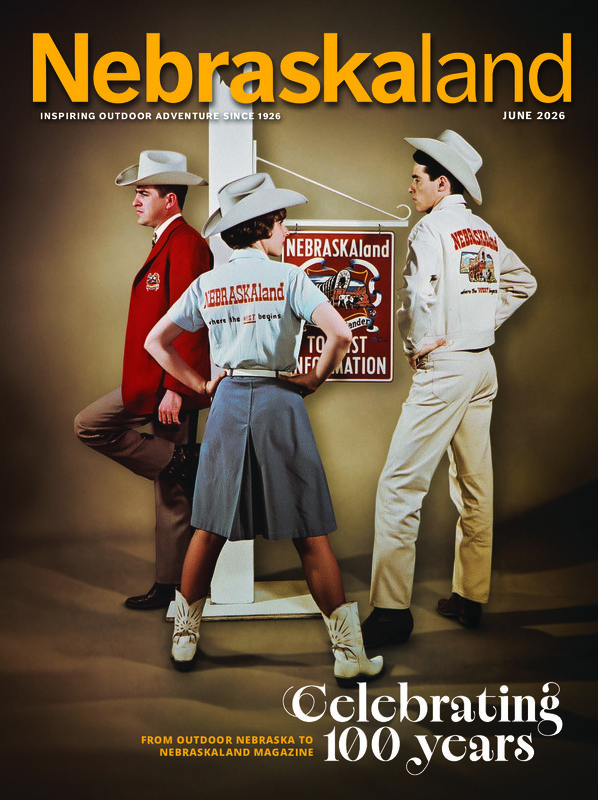
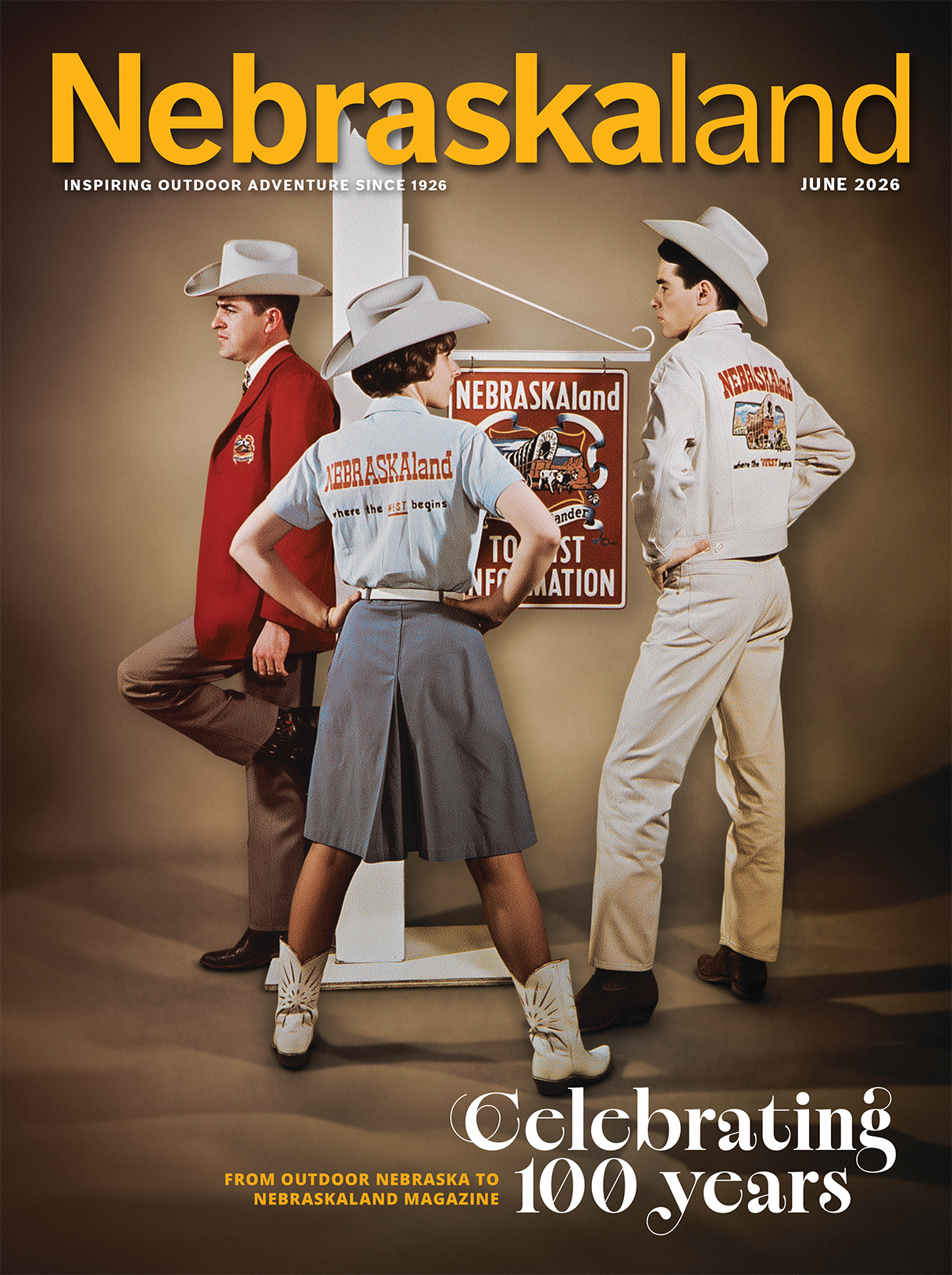
Cover: This April 1967 image appeared shortly after
Outdoor Nebraska became NEBRASKAland Magazine,
promoting “where the West begins.”
See story on page 20.
This page: This photo, taken near Lincoln in 1993,
was the cover image of The Road Home, one of
Nebraskaland’s most popular issues of the past century.
MICHAEL FORSBERG, NEBRASKALAND
June 2026 •
Nebraskaland
5
magazine
Published by the Nebraska Game and Parks
Commission since 1926. The Commission
is dedicated to the conservation and
protection of all the state's natural
resources and the people who use them.
Magazine Staff
Communications Director Christy Firestone
Public Relations Manager Shawna Richter-Ryerson
Editor Jeff Kurrus
Associate Editor Jenny Nguyen-Wheatley
Regional Editors Eric Fowler, Julie Geiser,
Justin Haag
Contributing Editor Michael Forsberg
Regular Contributors Chris Helzer, Chris Masada,
Todd Mills, Ryan Sparks, Gerry Steinauer
Art Director Ryan Holt
Graphic Designer Mel Severin
Videographer Nick Sauvageau
Photo Librarian Jaclyn Cruikshank Vogt
Administration
Director Tim McCoy
Chair - Donna Kush, Omaha
Vice Chair - Dan Hughes, Venango
Magazine Subscriptions
For address changes, magazine and subscription
questions, 800-632-5263 or visit
nebraskalandmagazine.com
Advertising
For advertising information, contact:
Shane G. Gilster, 402-742-0125
shanegilster@solotreemedia.com
An assassin bug captures tiny prey
with its raptorial front legs and then
injects a chemical that paralyzes and
liquefies the innards of the captured
creature. After it sucks out the resulting
nutritious slurry, it discards the outer
husk. For that and other reasons,
assassin bugs make charming guests in
outdoor spaces — as long as you’re not
a tiny insect. BY CHRIS HELZER
Kurt Arganbright, Valentine
Scott Cassels, Omaha
John Hoggatt, Kearney
Kent McNeill, Papillion
Steve Mossman, Lincoln
Lisa Roskens, Omaha
Doug Zingula, Sidney
Nebraskaland Magazine Copyright 2026, all rights reserved. Nebraskaland is available in audio from the Nebraska Library Commission Talking Book
and Braille Service, Suite 120, 1200 N St., Lincoln, NE 68508. 800-742-7691. Nebraskaland Magazine and the Nebraska Game and Parks Commission
reserve the right to reject any advertising not in keeping with the agency mission. Rates: $18 for one year; $33 for two years; $44 for three years.
Nebraska recipients must add appropriate sales tax. To subscribe call 1-800-NEBLAND (632-5263), or go online to: NebraskalandMagazine.com.
Commission Offices
Conservation Officers
Headquarters/Southeast District Office
2200 N. 33rd Street Lincoln, NE 68503
Phone 402-471-0641
Northeast District Office
2201 N. 13th St. Norfolk, NE 68701
Phone 402-370-3374
Southwest District Office
301 E. State Farm Rd. North Platte, NE 69101
Phone 308-535-8025
Northwest District Office (temporary)
1317 W 3rd St., Alliance, NE 69301
Phone 308-763-2940
Bassett Office
524 Panzer St., Box 508 Bassett, NE 68714
Phone 402-684-2921
South Central District Office
1617 First Ave. Kearney, NE 68847
Phone 308-865-5310
Schramm Education Center
21502 W. Highway 31 Gretna, NE 68028
Phone 402-332-3901
Omaha Office
8495 Frederick Street, Omaha, NE 68124
Phone 402-595-2144
OutdoorNebraska.gov
The Nebraska Game and Parks Commission does not discriminate
based on race, color, ethnicity, national origin, sex, pregnancy, religion,
disability, age, genetic information, veteran status, marital status,
and/or political affiliation in its programs, activities, or employment.
Any person who believes he or she has been discriminated against in
any program, activity, facility, or service should contact the Nebraska
Game and Parks Commission, Lincoln, NE 402-471-0641, the Equal
Opportunity Commission, Lincoln, NE 402-471-2024, TTY/TDD 800-6426112; Director, Office of Civil Rights, U.S. Department of the Interior,
1849 C St., NW, Washington, DC 20240.
6
Nebraskaland • June 2026
ADMINISTRATION
Jeff Clauson
402-471-5531
Lincoln HQ
Administrator
Travis Shepler
402-471-5531
Lincoln HQ
Asst. Administrator
Stacey Lewton
402-471-5531
Lincoln HQ
Asst. Administrator
Mike Thome
402-471-5531
Lincoln HQ
Asst. Administrator
(Includes counties covered)
NORTHWEST
Sean McKeehan 308-672-1824
Captain
SOUTH SUB-DISTRICT
Jerod Hahn
308-520-5539
Sergeant
Grant Albrecht
531-229-4405
Cheyenne, Deuel, Kimball
Hunter Lee
308-280-4320
Keith, Deuel
Jaden Porter
308-289-2274
Garden, Grant
Tyler Stueck
308-289-6260
Keith, Arthur
Keith Jadlowski 531-310-2869
Keith, Arthur
NORTH SUB-DISTRICT
Casey Gehrt
402-617-2112
Sergeant
Josh Widhelm
308-279-9133
Scotts Bluff, Banner, Sioux
Brandon Wallace 308-280-4488
Scotts Bluff, Banner, Sioux
Travis Schultz
308-279-1292
Morrill, Scotts Bluff, Box Butte
Vacant:
Dawes, Sheridan, Sioux
Cassidy Harwood 308-562-9099
Box Butte, Sheridan
Justin Gress
308-629-9335
Dawes, Sioux, Sheridan
NORTHEAST
Dale Davis
402-760-0712
Captain
WEST SUB-DISTRICT
Jeff Jones
402-762-5022
Sergeant
Hannah Holtmeier 402-601-7514
Boyd, Holt
Greg Hesse
308-546-7464
Rock, Brown, Keya Paha
Jonathan Andreasen 402-340-3981
Madison, Pierce
Trevor Stahlecker 402-928-9099
Knox, Antelope, Pierce
Mitch Johnson
402-613-8612
Cedar, Knox
EAST SUB-DISTRICT
Cory Krause
402-380-6410
Sergeant
Kyler Prochaska 402-830-8278
Platte, Colfax
Matt Costello
402-317-4014
Dodge, Colfax
Kelbi Abke
402-237-2537
Washington, Burt
Nicholas Fix
402-508-0261
Dixon, Dakota, Thurston
Kyle Hansen
531-739-7392
Dodge
Vacant:
Cuming, Wayne, Stanton
CENTRAL SUB-DISTRICT
Doug Pollard
308-730-7050
Sergeant
Vacant:
Howard, Greeley, Merrick
Matt Brandt
308-202-0819
Sherman, Howard
Klint Gill
402-613-5800
Nance, Wheeler, Boone, Polk
Garrett Zimmer 402-416-5736
Garfield, Loup, Valley
SOUTHWEST
Brian Piernicky 308-330-8780
Captain
NORTH SUB-DISTRICT
Alex Hasenauer
308-660-4671
Sergeant
402-389-0444
Frank Miller
Cherry, Hooker
Dana Miller
531-229-4404
Cherry, Hooker
Luis Nuñez
531-333-6093
Blaine, Custer, Thomas
Jacob Stoinski
308-395-6001
Lincoln, Perkins
Brandon O’Neal 308-530-3157
Lincoln, McPherson, Logan
SOUTH SUB-DISTRICT
Kelsey Glodowski 308-242-9000
Sergeant
Logan Smith
531-229-4406
Frontier, Furnas, Red Willow
Bryce Streger
308-537-0404
Dawson, Gosper
Logan Sanders
402-601-6302
Frontier, Hayes, Hitchcock, Red Willow
Tyler Adelman
402-314-4783
Dawson, Gosper
Sophia Gobber
308-222-0368
Chase, Dundy, Hayes, Hitchcock
SOUTHEAST
Matt Seitz
402-806-0915
Captain
WEST SUB-DISTRICT
Matt Taylor
402-200-9597
Sergeant
402-902-2017
Carson Ford:
Adams, Clay, Webster
Vacant:
Thayer, Nuckolls, Fillmore
Trey Kirch:
308-920-2762
Harlan, Franklin, Phelps
Vacant:
Buffalo, Kearney
EAST SUB-DISTRICT
Heath Packett
402-210-0888
Sergeant
Brett Greenfield 531-350-0915
Cass
Russell Mort
402-209-1506
Otoe, Johnson
Rich Berggren
402-619-1355
Douglas
Brian Arp
531-530-9011
Douglas, Sarpy
Mike Luben
402-443-6392
Saunders
Bryan Adams
402-429-1924
Nemaha, Pawnee, Richardson
CENTRAL SUB-DISTRICT
Curt Prohaska
402-470-1298
Sergeant
531-229-4407
Easton Albrecht
Lancaster
Benjamin Keller 308-430-5500
Gage, Jefferson
Mark McDonald 402-805-2353
Lancaster
Mark Sullivan
402-741-0636
Lancaster, Seward, Butler
Jarrod Messman 531-739-9760
Lancaster, Saline, York
June 2026 •
Nebraskaland
7
This is Nebraskaland
In this issue celebrating Nebraskaland Magazine’s 100th year in print, there are several things
you won’t learn about.
You won’t see every beautiful park and place in Nebraska, nor will you learn about all the
hunters, anglers and other conservationists who continue to protect this state’s natural
resources.
You won’t hear from the long list of people who work behind the scenes to continue to make
this publication thrive.
You also won’t hear the greatest campfire story I’ve ever been told.
What you will learn is our history, from the story behind the thousands of pictures we’ve
published, to the art, parks and conservation messages we have featured. You’ll see portraits
from our past, learn about the transition from Outdoor Nebraska to Nebraskaland, and
understand how important this publication has been for so many readers.
We know it is important when we meet people like Jake Reinders, the co-owner of Grandpa’s Woods
Golf Course near Murdock. While playing a round there with my son last fall, Reinders stopped
when he saw me, pointing at my chest.
“Are you from Nebraskaland?” he asked, reading the logo on my pullover.
I told him I was and, with his index finger in the air, he asked me to wait
for just a moment and disappeared.
Minutes later, he returned with a picture frame in his hand. It was a copy
of the July 1968 cover and the pages from a story about the golf course
published that year. Although it was nearly 60 years later, he couldn’t
have been prouder.
We encounter people like this often. Some people we meet are part of
families who have been reading Nebraskaland for generations. Some
become lifelong friends.
Because the messages we convey are important. Spending time outdoors is time well spent. There
are beautiful places in Nebraska that you need to see. And we want to continue building an outdoor
community with every single one of you.
We do that because the place we live is so special.
We do that because we’re Nebraskaland.
Jeff Kurrus, Editor
8
Nebraskaland • June 2026
June 2026 •
Nebraskaland
9
Instagram Photos
Your Nebraska
Follow us @nebraskaland and tag us in your
photos to be featured in an upcoming issue.
Joshua Redwine, Los Angeles
A Nebraska Sunset over Oak Lake
10
Nebraskaland • June 2026
June 2026 •
Nebraskaland
11
Your Nebraska
Requests to use reader-submitted images and stories appeared in the first issue of
Outdoor Nebraska in June 1926, and those requests haven’t stopped.
Using section titles, including Speak Up, Comment, Letters and From Our Readers,
Nebraskaland has featured reader-submitted content — from outdoor questions to
personal stories and even poems — for the past century.
Then, in the January/February 2019 edition, we began our latest iteration of this
section: Your Nebraska — a photographic look from the eyes of our readers. It’s become
so successful, with such a large backlog of images, that it still continues today.
We would like to thank everyone who shares their outdoor images with us and hope
you will continue to send more. — Jeff Kurrus, Editor
Rick Rasmussen, Doniphan
Red Fox Pup
Chris Masada, Lincoln
Female Cardinal
Send your comments and photos to:
Jeff Kurrus, Editor
Nebraskaland Magazine
P.O. Box 30370
Lincoln, NE 68503
or email Jeff.Kurrus@Nebraska.gov
David Turner, Omaha
Mean Heron — Winner of the 2025 State
Fair Wild and Scenic Photo Contest
12
Nebraskaland • June 2026
Please include your postal address
and telephone number. Letters
may be condensed and edited.
Photographs are also welcome.
Erik Johnson, Lincoln
Pants Butte Road
June 2026 •
Nebraskaland
13
Your Nebraska
Because
its openness is overwhelming.
Because
there’s nothing dominant to stop the eye,
they say, “There’s nothing out there.
Nothing at least
worth looking at,
and certainly nothing worth paying attention to.”
As Nebraskans,
we’ve heard this many times
and as Nebraskans,
we smile politely and shake our collective heads.
From John Kloefkorn’s “Crossing Nebraska”
BOB GRIER, NEBRASKALAND
14
Nebraskaland • June 2026
June 2026 •
Nebraskaland
15
In the Field
Since 1926, Nebraskaland Magazine’s main focus has been the same:
encouraging people to protect wildlife and spend time in the outdoors.
JOEL SARTORE, NATIONAL GEOGRAPHIC PHOTO ARK
“As a child growing up in Ralston,
I would study the pages of Nebraskaland
and dream of someday becoming a
wildlife photographer.
I was inspired by each month’s
issue, and because I had parents
who told me I could do whatever I
wanted in life, I believed them.”
~ Joel Sartore
Named Halsey after the town where she was struck by a vehicle, this albino porcupine
was rescued, then healed, by Nebraska Wildlife Rehab in Omaha.
This species is one of more than 18,000 now in the National Geographic Photo Ark, Joel
artore s decades ong e ort to doc ment ever species in h man care aro nd the or d
The Lincoln-based photographer began the project at the Lincoln Children’s Zoo in 2006.
16
Nebraskaland • June 2026
June 2026 •
Nebraskaland
17
In the Field
Magazine a Top Priority
for Chief Game Warden
By Justin Haag
Outdoor Nebraska’s founder didn’t
waste much time before creating
the magazine when he assumed a
leadership role in the Nebraska Game,
Forestation and Parks Commission,
nor did he rest on his accomplishment.
Frank O’Connell was named the
chief game warden in 1925, the year
prior to the first issue, and promoted to
director of the agency in 1929.
Samuel R. McKelvie, who had
recently returned to his position as
editor and publisher of the Nebraska
Farmer after serving two terms as
the state’s governor, mentioned
an encounter with O’Connell at
the capitol in a 1926 issue of his
publication — decades before his
name would become attached to
what is now the Samuel R. McKelvie
National Forest in Cherry County. It
indicates that O’Connell was eager to
show off the new magazine and the
state’s natural resources.
“I asked him if there were any trout in
Nebraska, and he replied emphatically
in the affirmative,” McKelvie wrote.
“Then he handed me a copy of the
first issue of Outdoor Nebraska — just
out — and there was a picture of a fine
catch made near Minatare.”
Outdoor Nebraska’s stories beneath
O’Connell’s byline show that he
was a gifted writer passionate
about wildlife conservation, but he
didn’t limit his messaging to print.
In 1937, he provided the script and
introduction for “Nebraska Beautiful.”
The 26-minute film, in its black-andwhite glory, highlighted Nebraska’s
attractions, leading off with its new
capitol building. Reports indicate he
18
Nebraskaland • June 2026
Frank O’Connell was named chief game warden in 1925, the year before he started
Outdoor Nebraska magazine.
took the film on tour and showed it at
events throughout the state.
He earned respect far beyond
Nebraska. In 1937, the International
Association of Game Commissioners
elected O’Connell president during the
organization’s meeting in Mexico City.
A military man, O’Connell served 30
years of active duty with the U.S. Army
and National Guard during a period
that spanned both world wars. He later
would be active in the American Legion
and serve as deputy state director for
the Selective Service System.
O’Connell died in 1971 in Lincoln at
age 79. He was a native of Malcolm
who graduated from Raymond High
School and New York University.
June 2026 •
Nebraskaland
19
In the Field
From Outdoor
Nebraska to
NEBRASKAland
By Justin Haag
The name has become so familiar to Nebraskans that
most don’t even ponder how it came to be.
The magazine’s name change from Outdoor Nebraska to
NEBRASKAland in 1964 came five years after the Game
and Parks Commission had taken on the task of tourism
promotion for the state.
The new moniker was part of what was being touted
by Game and Parks director M.O. Steen and others as
the most dynamic tourism promotion campaign ever.
“NEBRASKAland … where the West begins.”
In promoting the June 1964 issue of the
magazine, the agency supplied the media
with a photo of Gov. Frank Morrison
looking over the shoulder of a reader
to see the new publication. It had been
expanded to 60 pages, up from 28 just a
few years prior, and included a 12-page
spread about the state capitol building.
Also part of the branding effort were
a billboard campaign and a traveling
exhibit to 15 sport and travel shows
— Dallas, Cleveland, Los Angeles
and points between. Representatives
handed out four-color western-themed
travel folders titled “NEBRASKAland’s
Big Howdy,” and agency artist Frank
Holub produced a sheet of 21 stamps
showing the state’s historical, cultural
and scenic gems. A NEBRASKAland
symbol featuring an oxen-drawn wagon
superimposed on the state’s boundaries
was copyrighted.
The campaign also brought the birth of NEBRASKAland
Days, which started in Lincoln before moving to North Platte
in 1968. Now run by organizers in that city, it continues to
be one of the state’s top community celebrations.
20
Nebraskaland • June 2026
In 1971, the state’s tourism responsibilities moved to
the Nebraska Department of Economic Development. As
the Legislature was considering that move, Dick Schaffer,
chief of the Game and Parks’ Division of Information and
Tourism, stated the case for keeping things the way they
were in a Lincoln Journal Star article.
“How do you do it?” he asked. “If we run a story in
NEBRASKAland promoting Lake McConaughy, will we
draw fishermen — or tourists? And when does a man
cease being a fisherman and become a tourist?”
One of Schaffer’s proudest initiatives
was the NEBRASKAlander program,
w h i c h e n c o u r a g e d b u s i n e s s e s to
serve as tourism centers in addition
to their other offerings. More than
200 businesses earned the right to
display the big NEBRASKAlander
Tourist Information signs by meeting
thresholds of quality and passing a
written exam. The program won the
state the highest award by the National
Association of Travel Organizations,
and Schaffer was named travel director
of the year.
To d a y, t h e p r i m a r y d u t i e s f o r
attracting people from afar fall under
the Nebraska Tourism Commission,
which continues to partner with Game
and Parks in many ways under its Visit
Nebraska name.
It remains a challenge, though, to
make a clear distinction between
tourism and outdoor recreation in a state that is so rich
with the latter. In that spirit, the magazine still carries the
Nebraskaland name, albeit with fewer capital letters, and
does its part to attract people to “where the West begins.”
NEBRASKAland’s covered wagon
is pulled by oxen “Neb” and “Raska”
in a parade at the Wilber Czech Festival
in Saline County. LOU ELL, NEBRASKALAND
NEBRASKAland artist “Bud” Pritchard
mans a sportsman show exhibit in New
York City. NEBRASKALAND
Conestoga covered wagon used as the
Greenwood Tourist Station.
NEBRASKALAND
NEBRASKAland Magazine is represented
at the Capitol Tourist Station in Lincoln.
NEBRASKALAND
NEBRASKAland artist “Bud” Pritchard
assembles an exhibit to promote the
magazine. NEBRASKALAND
June 2026 •
Nebraskaland
21
In the Field
Roast Goose with
Black Cherries
By Jenny Nguyen-Wheatley
Published in Nebraskaland’s first Wild Game
Cookbook in 1978, “Roast Goose with Black
Cherries” intrigued me. This is my kind of recipe.
Dark fruit complements the minerality of goose
and duck brilliantly.
I didn’t have a goose in the freezer, so chose
a larger, fatty wigeon. Use a corn cob holder to
poke holes all over the skin, which will allow fat
to render more easily. Then, rub a piece of lemon
all over the skin, which will also help break down
fat. Season the inside and outside of the bird with
fine sea salt. Stuff the bird with the used piece of
lemon along with a quarter of an onion and some
fresh herbs, such as thyme or rosemary.
Ducks are much smaller than geese, so will
take less time to roast. Place the duck(s) in a
cast iron or roasting pan (with vegetables if
desired, such as fennel, potatoes and/or carrots)
and cook at 325 degrees Fahrenheit for 30-40
minutes, depending on size. There’s also no need
22
Nebraskaland • June 2026
to repeatedly remove rendered fat from the pan —
do that once at the end.
After roasting, remove the pan from the
oven. Crank up heat to 450 degrees. When the
oven comes to temperature, return the duck (or
goose) to the oven for the skin to brown, about
10-15 minutes, rotating the pan occasionally to
encourage even browning.
Instead of fresh cherries, I used a 15-ounce
can of Oregon Dark Sweet Cherries, which I
simmered with a couple of sprigs of thyme and a
squeeze of lemon juice for 20 minutes to thicken
the syrup.
Sadly, I could not track down Cherry Kijafa. So,
I used Luxardo’s Cherry Sangue Morlacco in the
gravy, and cut the recipe by half. Though, to be
honest, I didn’t think gravy was necessary. The
dark cherries and syrup could stand on their own.
For more flavor, stir in a spoonful of duck pan
juices to the cherries.
June 2026 •
Nebraskaland
23
Smith Falls
Early settlers knew Smith Falls as Arikaree Falls, in reference to a semi-nomadic
tribe of Native Americans that lived in the area. In 1896, Frederic Smith filed the
first homestead patent for the land and is who the falls are now named after. In
1941, Sandhills farmer Fred Krzyzanowski bought the property to graze cattle,
not knowing at first that the beautiful falls were on his newly purchased land. In
1992, the Game and Parks Commission agreed to a lease with the Krzyzanowski
family, turning the area into a state park.
Changes
Our Parks
through the years
By Julie Geiser
It’s cliché, we know: Some things change through
the years, while others seem to stay the same. Our
state park system is no different. And throughout
all of these changes, or lack there of, their photos
have been featured in Nebraskaland Magazine.
Smith Falls, ca. pre-March, 1964.
LOU ELL, NEBRASKALAND
24
Nebraskaland • June 2026
n
an A A accessible walking path was finali ed at
Smith Falls State Park, bringing even more visitors to this
iconic landmark. JUSTIN HAAG, NEBRASKALAND
June 2026 •
Nebraskaland
25
Scout’s Rest Ranch,
ca. 1980s. TED STUTHEIT
Fort Robinson
Fort Robinson was the site of the tragic Cheyenne Breakout in 1879 and the
death of famed Sioux Chief Crazy Horse. Over the years, the fort served as the
Red Cloud Indian Agency, as a cavalry remount station, K-9 dog training center,
POW camp and beef research station. Located near Crawford, the park comprises
more than 22,000 acres of exquisite Pine Ridge scenery, offering 60 miles of hiking
trails and 20 miles of mountain biking trails, making it Nebraska’s top park for
hiking enthusiasts.
Scout’s Rest Ranch,
after a fresh coat
of paint
.
JULIE GEISER, NEBRASKALAND
ort Robinson has served multiple roles through the years
including a military training station after World War ca. early
s.
NSHS, RG1517
Buffalo Bill
Once the home of American scout, Pony Express rider, buffalo hunter and
famed showman William F. “Buffalo Bill” Cody, Buffalo Bill Ranch State
Historical Park at North Platte recaptures his life through memorabilia
displayed in the mansion and Scout’s Rest Ranch barn.
Nowadays ort Robinson is known for many activities including its trail rides
.
JULIE GEISER, NEBRASKALAND
26
Nebraskaland • June 2026
June 2026 •
Nebraskaland
27
Indian Cave
Indian Cave is the main geologic feature of this state park and bears prehistoric
Native American petroglyphs of unknown date and origin. These unique features
can now be viewed from the ADA-accessible boardwalk that has seating,
informational signs and a viewing deck seated just below the cave opening.
Camping at Chadron tate Park ca.
RV camping, 1991.
.
NEBRASKALAND
BOB GRIER, NEBRASKALAND
avid and irsten ogt sit above the cave opening in
Campers still en oy the spacious sites at Chadron tate Park
.
. DON CUNNINGHAM, NEBRASKALAND
JUSTIN HAAG, NEBRASKALAND
Chadron
Chadron State Park, founded in 1921, is Nebraska’s first state park and has been
a crown jewel of the Pine Ridge for more than a century. Campers and other visitors
have long admired its mix of open fields and surrounding outcroppings as one of the
state’s most stunning landscapes.
A new boardwalk and deck give visitors an up close look inside the cave opening in
R C OWL R N
28
Nebraskaland • June 2026
RA
.
ALAN
June 2026 •
Nebraskaland
29
Ashfall Fossil Beds
Arbor Lodge
Nearly 12 million years ago, volcanic ash engulfed this ancient watering hole,
entombing more than 20 different species of animals from turtles, cranes, deer,
and rhinos, covering them in the rolling hills. Because of its scientific importance,
the 360-acre historical park between Orchard and Royal was acquired in 1987
and is a joint project of the Game and Parks Commission and the University
of Nebraska State Museum. Guests can tour this historical location and see
paleontologists continue to dig the site in search of fossils.
Arbor Lodge State Historical Park in Nebraska City started off as a small house
constructed in 1855 when it was purchased by Arbor Day founder J. Sterling
Morton and his wife, Caroline. The home has been remodeled eight times over the
years, transforming it into a beautiful 52-room mansion.
The fossil beds are now enclosed in the ubbard Rhino arn
as shown here in
protected from the elements and
still an active dig site. JEFF KURRUS, NEBRASKALAND
n
the Mortons began calling their home Arbor Lodge.
NSHS, RG2993-414
Paleontologist Mike oorhies carefully brushes
volcanic ash off a prehistoric rhinoceros fossil at
Ashfall ossil eds
. KEN BOUC, NEBRASKALAND
Arbor Lodge
30
Nebraskaland • June 2026
.
R C OWL R N
RA
ALAN
June 2026 •
Nebraskaland
31
Outdoor
Neb raska
WHAT TO DO IN JUNE
By Jeff Kurrus
This month, when the last of the cool mornings
transition to the heat of summer evenings, participate
in one of the many activities that has captivated
outdoor enthusiasts in the Cornhusker State for the
past century.
N
Take a Drive
Visit Ponca
Fish the Sandhills
June 1944 and June 1961
Summer 1934
Summer 1950
“Far too little has been said pertinent to the beauty and available vacation
resources furnished by Nebraska’s State Parks,” read the June 1944 issue of
Outdoor Nebraska. We can never say enough about the beauty of the state and
available vacation spots in Nebraska’s state parks, but we’ve certainly tried in
the past 82 years.
This month, take a drive. The kids are out of school, and there is a fishing,
camping, hiking, biking and sit-in-a-lawn-chair spot with your name on it. Visit
OutdoorNebraska.gov to find a park to visit or make a reservation to stay.
In the summer 1934 edition, a news
brief shared the following information:
“A brand new state park and recreation
grounds in Dixon County has been
handed to the Nebraska Game and
Parks Board as a gift .... The tract
contains 220 acres of scenic and partly
wooded bluff land ... situated two
miles north of Ponca.”
Ponca State Park remains one of
Nebraska’s most beautiful areas. Now
is the ideal time to RV or tent camp or
stay in one of its cabins and spend the
rest of your time trying to decide what
to do with all of the options in front of
you. Visit OutdoorNebraska.gov/parks.
“FISH NUMEROUS... ANGLERS
SCARCE ... In Sand Hills” read the title
of a 1950 Outdoor Nebraska article.
“Have you ever had the desire to go
fishing some place where there were
both too any fish and too few anglers
to catch them?”
As much as Nebraskaland Magazine
has promoted the Valentine National
Wildlife Refuge as other-worldly —
both topographically and fishing-wise
— our photographers rarely see these
lakes overloaded with anglers.
Now is the time to take your vehicle
down a two-track Jeep trail for the
su
er fishing adventure of your life.
32
Nebraskaland • June 2026
Capture a
Winning Photo
Shoot a
Muzzleloader
June 1970
June 1980
Nebraskaland Magazine announced
its first photo contest: “Start shooting
and bag a prize.”
In October, we will begin accepting
images for the 2026 photo contest, so
start shooting now. Outdoor recreation
is at its height in June. Look for unique
compositions and light to move yourself
to the front of the prize line. While a
bag shot of a kid holding a fish is cute,
an image of that same kid drenched in
golden, end-of-the-day light against
a gorgeous backdrop is what we’re
looking for. For more information, visit
NebraskalandMagazine.com.
“This scene might have been from
150 years ago as buck-skinner display
arms, tipi and other paraphernalia
connected with their sport,” noted
a cover caption by Ken Bouc on
muzzleloader shooting.
Whether you’re a longtime shooter,
a history buff or just curious, attend
the Fort artsuff State istorical ark
Rendezvous on June 19-21 in Burwell
and see fur trader reenactors with
their muzzleloaders. Learn more at
Calendar.OutdoorNebraska.gov.
For a complete calendar of events,
visit tinyurl.com/nebmuzzleloader.
June 2026 •
Nebraskaland
33
In May 1957, Coturnix quail are released at the Schramm Area by the Omaha
Fish and Wildlife Club. Of all attempts to introduce exotic game birds, only the
pheasant has met widespread success. NEBRASKALAND
Research and management of Canada geese prompts conservation officers to
release geese in hopes of re-establishing populations in the Sandhills, ca. 1970.
NEBRASKALAND
A WILD HISTORY
As Nebraska’s wildlife numbers recovered, species
also populated the pages of Nebraskaland
By Justin Haag
34
Nebraskaland • June 2026
June 2026 •
Nebraskaland
35
A Commission
biologist pulls a
net trapped with
white-fronted
geese to be
banded.
NEBRASKALAND
T
he 100-year history of Nebraskaland Magazine goes
back further than that. Or, at least the reasons for its
creation do.
Euro-American expansion across the continent in the
1800s resulted in devastating losses to wildlife and its
habitat, prompting the rise of the conservation movement
in the early 20th century.
By the time Outdoor Nebraska, as the magazine was
first known, was introduced in June 1926, species that had
once been abundant had been extremely diminished or
completely removed from the state.
When the publication was created, state fish and
wildlife agencies were striving to get the word out about
their efforts to reverse the tide of damage. In an age when
magazines were driving popular culture, Outdoor Nebraska
entered the scene bringing conservation messages to
residents of the state.
The magazine’s role as a voice for wildlife was apparent
from the first issue, which contained stories about the
introduction of the ring-necked pheasant and another
on the status of migratory waterfowl. It also emphasized
the importance of the game warden in conservation and
publicized a half-dozen newly established game refuges.
The magazine also was a strong advocate for the
development of parks and wildlands, with the first state
park, Chadron, being just 5 years old at the time of the
magazine’s birth.
“The people of the middle west are just now awakening to
the fact that unless something is done — and done quickly
— the wild life and natural beauty of this prairie will have
vanished before the ever-grasping hand of commerce,”
Frank O’Connell, the state’s chief game warden who served
as the magazine’s first editor, wrote in one of his early
articles.
The Lacey Act of 1900 kicked off a string of important
federal legislation to conserve fish and wildlife species,
among them the Migratory Bird Treaty Act of 1918,
Migratory Bird Hunting and Conservation Stamp Act
of 1934 (the Duck Stamp), the Federal Aid in Wildlife
Restoration Act of 1937 and the Federal Aid in Sport Fish
Restoration Act of 1950.
The magazine seemed to pull no punches in its goals
of conservation and preservation, lambasting those who
skirted hunting and fishing regulations and the “game
hogs” who posed near piles of dead animals they’d shot.
Early issues listed game violators and their fines.
36
Nebraskaland • June 2026
A group of women paddle a row
boat across the hatchery ponds at
Schramm Education Center, formerly
Ak-Sar-Ben Aquarium, at Schramm
Park State Recreation Area.
NEBRASKALAND
Conservation o cer Carl ettmann points out a no hunting sign on a
game refuge to a teenage boy carrying a firearm and bagged pheasants.
NEBRASKALAND
Visitors look at the trout
ponds at Schramm Park State
Recreation Area in Gretna.
NEBRASKALAND
June 2026 •
Nebraskaland
37
TOP: A greater prairie chicken
dances on a lek at urchard Lake
WMA in Pawnee County.
ERIC FOWLER, NEBRASKALAND
OTTOM: Nebraskaland artist
ud Pritchard shows his Wildlife
in One Reel illustration depicting
pheasants. NEBRASKALAND
In a colorful bit of prose,
O’Connell wrote an article in
1927 from the point of view
of a prairie chicken pleading
its case before “the court of
public opinion.”
“Today, Your Honor, we
are faced with extinction,”
O’Connell wrote, representing
the impassioned bird. “The
White Man has come in ever
increasing numbers, pushing
farther and farther westward until today there is no place
left for us. Not only is it impossible for us to find suitable
places where we can obtain food and build our nests —
worse than that, Your Honor, it is impossible for us to find
a place where White Man will even let us rest in peace and
security. There is only a handful of us left.”
With so little wildlife on the landscape, much of the
magazine’s content focused on the agency’s successful
efforts in establishing fish populations. The pages showed
photos of people holding their catch, the fruits of stocking
efforts that had taken place since the agency’s creation as
the Nebraska Fish Commission in 1879.
It also spread conservation messages to help wildlife,
with the most important messages earning mention on a
full back-page cartoon to drive home the message.
38
Nebraskaland • June 2026
The value of habitat,
whether leaving it or creating
it, was a prime topic in the
1950s, likely in response to the
ever-increasing intensity of
agriculture that followed World
War II. During that decade,
articles written by wildlife
biologists and others — based
on what they believed to be
the truth at the time — often
promoted planting some
species of trees and shrubs that
are now considered invasive.
Several stories in the 1950s
stumped for creation of the
Soil Bank program, including
some by Mel Steen, the Game
and Parks director, who wrote
the soil bank plan while in
Missouri.
As habitat and even pheasant
numbers declined, the writers
encouraged feeding game birds
to get them through the winter
and installing flushing bars on
horse-drawn mowers to give
birds warning to get out of
the way.
While conservation was a primary topic in the first
issues, not all wildlife was looked upon favorably. Along
with free-roaming housecats, some species were identified
as “enemies of wildlife” — crows, goshawks, sharp-shinned
hawks and turtles among them. Any species perceived to
be harmful to game animals was frowned upon. All insects
were considered to be a nuisance, and getting rid of them
was seen as a benefit of having game birds.
While the words have had an impact, Nebraskaland
imagery has surely done its part for developing the public’s
appreciation for wildlife.
Artist C.G. “Bud” Pritchard joined the staff in 1949,
bringing wildlife scenes to the cover and natural history
articles until his retirement in 1974. As camera technology
improved, staff photographers — the first of whom were
hired in 1957 — brought high-quality photographs of
countless species to the pages.
TOP L
TOP R
A O
T: ent ricke releases a river otter into the Platte River in all County.
T: Pronghorn are released in the andhills.
: Turkeys are released in the
ERIC FOWLER, NEBRASKALAND
NEBRASKALAND
s as part of the effort to restore wild populations to the state.
As game species rebounded and became plentiful enough
to hunt, the pages began telling about people pursuing them.
For instance, each of the early deer seasons, the first in 1945
and the second in 1949, were celebrated in the pages of
the magazine, including reports on hunter success and the
average weight of harvested deer and photos of happy hunters.
The magazine also has helped celebrate the reintroduction
of species. It reported on the release of Merriam’s wild
turkeys from South Dakota and Wyoming to the Pine Ridge
in the winter of 1958-1959, an effort that proved successful
after numerous other attempts failed. In 1958, it told of
the release of pronghorns south of Bassett to restore a
population lost to settlement.
NEBRASKALAND
It told about the bighorn sheep brought from South
Dakota’s Custer State Park to be placed in a 500-acre
enclosure at Fort Robinson State Park in 1981, and when
that growing herd was released from the pen in December
1988. Nebraskaland photographers accompanied wildlife
division staff when they obtained sheep for ensuing
releases from Colorado, Montana and Alberta, Canada.
The magazine also told about releases of river otters
on the Platte, Niobrara and Elkhorn rivers between 1986
and 1991, and the species’ recovery and removal from the
threatened list in 2020.
Just as state wildlife action plans such as the Nebraska
Natural Legacy Project have brought a focus to a wide
OPPO T TOP: A tom wild turkey struts at Crescent Lake
National Wildlife Refuge in arden County. J T N AA N RA ALAN
OPPO T OTTOM: ighorn sheep run at Cedar Canyon Wildlife
Management Area in cotts luff County. J T N AA N RA ALAN
L
T TOP: Canada geese are held in rearing pens at
acramento Wilco Wildlife Management Area. NEBRASKALAND
L T OTTOM: A bighorn sheep is released back to the
wild after receiving ear tags and a telemetry collar from
ame and Parks employees and volunteers at Williams
ap Wildlife Management Area. J T N AA N RA ALAN
array of animal species in need of conservation, the pages
of Nebraskaland have reflected a more holistic approach to
conservation by the agency. You’d be hard-pressed to find
a wildlife species that hasn’t graced the cover of Outdoor
Nebraska or Nebraskaland or at least mentioned within
its pages.
In the magazine’s time, Canada geese have risen from
near extinction to being considered a nuisance in areas. The
coverage of that species included reintroduction of geese
to the Sandhills after being raised in pens at SacramentoWilcox Wildlife Management Area. The publication also
helped spread the word about the harmful effects of the
pesticide DDT, and documented the return of bald eagles
and ospreys after it was banned. Even trumpeter swans
have become a common sight in places.
As the scope of research efforts for the state’s fauna and
flora has increased, Nebraskaland has delivered findings to
the people. Often, biologists have penned the articles.
There are still many challenges on the conservation front.
Among them are disease, predation and, of course, habitat
loss from, as O’Connell put it, the “ever-grasping hand of
commerce.”
However, if the first readers of Outdoor Nebraska could
have jumped ahead 100 years, they surely would marvel
at the wildlife populations of today. O’Connell would be
glad to see there are still prairie chickens around to state
their case.
As the agency’s conservation officers and wildlife
professionals have led the charge in preserving and
bringing back populations of living animals and plants, the
magazine has been there to document progress and deliver
the conservation messages that aided in the success. May
the coming century bring as many triumphs to report. N
40
Nebraskaland • June 2026
June 2026 •
Nebraskaland
SHARON PORTER, LINCOLN
CHRIS TWIDWELL, FLAGSTAFF, ARIZONA
JOHN TREMAIN, LINCOLN
INEZ GEBERS, JOHNSON
JIM STEELE, OMAHA
JEFF STUMPF, OMAHA
RON MELBYE, WAVERLY
LYLE CLEMENS, KENESAW
LOWELL J. STARK, PRIOR LAKE, MINNESOTA
RICK MEYER, HOUSTON, TEXAS
PHIL KNERL, PONCA
Portraits
W.C. BILL HAMILTON, ANKENY, IOWA
TOM EVANS, GOLDEN, COLORADO
from the Past
By Jeff Kurrus
BOB ANDERSON, LINCOLN
ROBERTA HYDE, COMSTOCK
MARK VAN SKIVER, HEBRON
EVAN KLANECKY, UTICA
KENT E. PERSON, HOLDREGE
MIKE DAUBERT, OMAHA
RAYMOND MLINAR, GREELEY
JOAN JOHNS, OMAHA
MIKE PONTE, GRAND ISLAND
PAUL LARSON, FREMONT
SALLY BOROWSKI, GRANT
DEREK RUSSELL, IMPERIAL
ROBERT T. STEVENS, VALENTINE
JIM WILSON, GRAND ISLAND
BECKY STIEHL MCCORD, COLORADO SPRINGS
MIKE LEMKE, GARDEN CITY, KANSAS
LARRY FREEZE, NORTH PLATTE
42
Nebraskaland • June 2026
June 2026 •
Nebraskaland
43
R
eading our “Portraits From the Past”
section each month is a cathartic
experience for me. Since December
1997, more than 850 reader-submitted
photos have been published, each an important
piece of Nebraska’s outdoor heritage. When
viewing these images, it’s easy to get emotional.
I never get over seeing photos of smiling
young men on their last upland or big game hunt
before they were sent off to fight for our country,
never having the opportunity to walk those
same fencerows or sit in that stand again.
When an elderly woman sends in a tattered
black-and-white photograph of herself as a little
girl holding a fish with her father, it’s impossible
not to think about my relationship with my own
daughter, knowing that in the future, images of
us will be shared in this same publication.
Many of these photos have also made me
smile: the excitement from a duck hunt 40 years
ago frozen in time, the sepia tones of the original
picture seemingly giving the hunter permission
to enjoy a smoke after a long day afield.
Portraits of the Past is also where pastimes
like trapping, and images of fathers and sons
and friends and neighbors proudly standing in
front of a pelt-covered barn wall, can be shown,
because “it was just different back then.”
Images like these are of particular interest
to many outdoor enthusiasts, because they are
about so much more than trapping, hunting,
fishing or camping — they illustrate a time when
our moms and dads and all the others who took
us outdoors were at the center of our universe,
where time spent in nature together was the best
time spent.
The Heyday, 1969
I always tried to fish on two specific days — New
Year’s Day and Super Bowl Sunday — rarely
encountering another angler.
– Leo Turner, Lisco
Looking for Pheasants, 1974
Here I am, going to look for a pheasant, shotgun in tow.
We didn’t need to wear helmets in those days.
– Curt Koehler, Bee
Waterfowl Hunting, 1929
This photo was taken in Atkinson. Johnny Seger and
his dad, Donat, are shown.
– Chuck Leiningen, Atkinson
44
Nebraskaland • June 2026
After the Hunt, ca. 1920s
I found this photo, taken in Lisco, of Ralph Golden,
Tom Belieu, Isaac Robbins and Bert Robbins after a
successful waterfowl hunt.
– Eldon Wohlers, Crawford
Coyote Pups, ca. 1938
My dad, Henry Petersen,
and I hold coyote pups
on our farm northwest of
Auburn. The pups were
remarkably calm and
didn’t struggle as long
as we kept our hands on
them and didn’t make
any fast movements.
– Loren Petersen Green,
Valley Center, California
My Dad Loved Coon Hounds, ca. 1950s
This is my dad, Ernest E. Harmon of Syracuse. Even before
he died at the age of 83, he made sure his coon hounds
had homes.
– Irene Fisher, Humbolt
Boat Car, 1966
Driving the boat car at Box Butte Reservoir is Bill
Barker, with Darlene Barker in the passenger seat
and my mom Bev Wieting.
– Mark Wieting, Lincoln
Deer Hunt, 1979
My wife, Kathy, and I are all smiles after a mule
deer hunt in Custer County.
– Gary Lemke, St. George, Utah
Cherry County Coyote Hunt, ca. 1922
My grandfather, Walter Adamson, and his
father-in-law, Joe Edwards, photographed with
coyote pelts from a Cherry County hunt.
– Marge Adamson Harris, Lincoln
June 2026 •
Nebraskaland
45
Hunting Near Agate, ca. early 1900s
My grandfather, John Wesley Warren, center
bottom row, used hunting to provide meat for
their family and some to sell.
– Jim Warren, Gretna
Turtle Creek Catch, ca. 1935
Bernard Rischling, Warren Rischling, Francis Fixemer and
Jack Adams — all from Geneva — after a day of fishing.
– Patty Adams, Omaha
A Good Day, ca. 1943
My paternal grandfather, George Nolda, and his
youngest son, Wilbur, with their two neighbors, Mr.
and Mrs. Fink, show off the results from a hunt near
Ravenna. Wilbur was drafted and sent to Korea years
later. In a letter home he lamented not being home for
pheasant season, but “I’ll be home next year and we’ll
give them hell.” He was killed in action a month later.
– Valerie Vierk, Ravenna
Fishing for Sunnies, ca. 1950s
This is me and my brother, Jim, sporting
matching hats and shirts, no less, with
sunfish from the creek near the old Mosely
place west of Weissert.
– Steve Moseley, York
Grandma’s Trout, ca.
1950
My grandmother,
Amelia “Millie” Lang,
holds trout she caught
alongside her husband,
PJ. Such style and class!
– Ed Wieger, Omaha
Fishing at Lake Ericson, 1933
Pictured are Lawrence, my dad Jim, Francis, Grandpa
John, Dave and Al — all Van Ackerens. I still have Dad’s
wooden tacklebox.
– Larry Van Ackeren, Yutan
Pelican Lake Pike, 1984
Our sons, Wyatt and Dustin, hold a northern pike
they caught while ice fishing at Pelican Lake on the
Valentine National Wildlife Refuge.
– Doyce Williams, North Platte
Deer Hunt Near Worms,
1953
Posing with the deer of their
dads from that season are Conni
Bales and Barb Sander.
– Bob Sander, Holdrege
Record Whitetail, 1961
My brother, Jeff Nelson, and Todd
Wackel show off the Nebraska
record whitetail that Todd’s dad,
Robert, shot. It scored 192 6/8.
– Bryan Nelson, Fremont
46
Nebraskaland • June 2026
Wood River Waterfowl, ca. late 1920s/early 1930s
This is my great-grandfather, Jack Glass, with Bill Glass and
Mort Mackey after a Platte River hunt near Wood River.
– Andrew Glass, Hastings
Crow Shoot, ca. 1947
Kennerd Palmer, Ralph Kohler and I pose with more
than 500 crows shot off their roost back when crows
were considered a disease carrier and this was legal.
– Gordon Cram, Tekamah
June 2026 •
Nebraskaland
47
Snow Bunnies, 1928
Joseph E. Hejl, Ermine Klima, Josef Hejl and Steve Klima
pose after a hunt in the Crete area. Josef immigrated
with his family to America in 1903 from Austria.
– Francis Hejl, Denton
Rock Creek Station Historical Park, 1985
After an afternoon hike, members of the Wolfe, Perau
and Schmersal families posed for a photo. Our three
families camped together for more than 40 years.
– Mark Wolfe, Lincoln
Hunting the Edwards Homestead, 1910
My grandmother, Delania Edwards Adamson, top second
from the left, poses with her brothers and neighbors at
the Edwards Homestead — now the Ford family ranch.
– Marge Adamson Harris, Lincoln
Me and Hank, 1986
Hank was owned by my hunting partner, Terry Rasmussen,
in northern Howard County. Great times hunting there in
the '50s and '60s.
– Henry “Hank” Lokke, Omaha
The Magic Bullet, 1918
My great-grandpa Allen Cooper and his son, Richard,
show the coyotes they shot with, as family legend tells,
one shell.
– Marla Cooper Wademan, Crete
Hunting with Dad, 1974
This is one of the many hunting trips with our father,
John Moreland. Pictured are Marc, Bruce and Karen. Dad
taught us to love the land, Nebraska in particular.
– Kristine (Morehead) Hansen-Cain, Omaha
From Hoops to Ducks, 1951
Pictured are my father, Mel Jelkin, Rodney Bunger and
Dallas Einspahr — three members of the 1951 Class C
state basketball championship team from Hildreth —
after a hunt near Clark Lake.
– Bill Jelkin, Omaha
Pheasant Hats, 1964
This is my father, Edward V. Naprstek, who prepared 340
pheasant pelts for shipment to Minneapolis where the
feathers were used for Milady’s Hats. The beaks were
used for artificial fingernails.
– Marjorie Kearney, Overton
Loup River Hunt,
ca. 1915
This is my father, John
C. Poppe (right). His
hunting companion
is unknown to me.
They lived in Scotia
and hunted the Loup
rivers area.
– Paul Poppe Newmyer,
North Platte
Loup City Pheasants, 1930
Back row from left are John Borzekofski, Lou McDonald,
Jake Kuntz with baby Mary Lou White, Frank Borzekofski
and Paul Borzekofski. In the front row are Dorothy Thies,
Barb Barnard, Bob Kuntz and me.
– Paul Kuntz, Beatrice
48
Nebraskaland • June 2026
First Mule Deer for Dad, ca. 1945
My father, Matt Freeman, grandfather Jesse and uncle
Douglas pose with the local game warden after a mule
deer hunt. The mounted head still hangs on my wall.
– Mark Freeman, Dallas
Jackrabbits near Wahoo, ca. 1941
Martin Hobza and I (right) show the results of a twohour jackrabbit hunt 10 miles west of Wahoo in 1941.
– Dick Novotny, Omaha
June 2026 •
Nebraskaland
49
Two Days on the Platte, ca. early 1900s
August Blenderman and Henry A. Heumann pose after
a two-day hunt on the Platte River near Elm Creek.
– Bob Basoco, Lincoln
Grandfather’s Buck, 1963
My grandfather, Herman Blankenau, was a native
German and World War I veteran for Germany. He grew
up wanting to hunt, but German restrictions didn’t allow
it. He cherished being able to hunt in Nebraska.
– Don Blankenau, Lincoln
Duck Hunt Near York, 1985
My dad, Tom, taught me to love the outdoors at a young
age. He passed away several years ago, but I am forever
grateful for all of the memories we shared in the field.
– Chris Cox, Oro Valley, Arizona
My Favorite Picture, ca. 1916
This photograph in Lindsay of my grandfather, Fred
Loeffler, is my favorite. He did not shoot the animal,
only posed with it, as I imagine others did as well. He
was 17 years old.
– Gary Ebert, Eagle
Two Days at Dewey Lake,
1908
My grandfather, Henry
Heumann, caught these
fish over two days, June
17-18, at Dewey Lake. He
turned 28 years old
the following day.
– Bob Basoco, Lincoln
A Lifelong Shotgunner, 1940
This is my mother, Darleen Butolph. She and my father,
Clarence, hunted together until he was drafted into the
Army during World War II. He was killed in action in France
in 1944, and my mother continued to hunt until 1990.
– Richard Butolph, Ventura, California
One of My Favorite Photos, 1968
Hunting pictures, and the stories that go with them,
are priceless. This memorable day took place on Ray
Walker’s farmstead between Genoa and Saint Edward.
– Heath Birkel, Callaway
Coyote Hunting by Airplane, ca. 1940s
Henry Glisman, Louie Steen, Bill Zimmerman, Henry
Siert (my grandfather) Clarence Schroeder and John
Zimmerman hunted coyotes by airplane west of Gretna.
– Bob Dickinson, Gretna
50
Nebraskaland • June 2026
Pheasant Hunt Near Schuyler,1982
During Thanksgiving weekend on the family farm,
my dad, Robert, and I hunted alongside our always
reliable German shorthair, Toni.
– Roger Schmidt, Adrian, Missouri
A Different Sort of Mixed Bag Hunt, ca. 1910s
Ernest Wagner, Herman Bolz and Charlie Feurer after what
looks to be a opossum, rabbit and squirrel hunt.
– David Feurer, Johnson
Fishing at Lake Mac, 1948
My dad, Henry Adkinson, Floyd Nickolson, Winnie
Adkinson, Francis Adkinson and my mother, Bula, show
their catch of the day.
– Beatrice Hatch, Ogallala
These portraits are powerful. They are our history, our
memories and proof that we were all young once. For many,
these images allow us to live vicariously through others as
we continue to read Nebraskaland and, in our memories, we
remain forever young.
“Portraits” is also where we can bask in the glory of others
in hopes of having at least one more shot of that same
feeling ourselves. N
June 2026 •
Nebraskaland
51
The Photographers
N
A Retrospective
on Nebraskaland
Photography
By Eric Fowler
TOP LEFT: Today, photographers battle dust on the sensors of their digital cameras. In the
late 1960s or early 1970s, Lou Ell stalked these elk on the Fort Niobrara National Wildlife
Refuge with his rafle peed raphic camera not knowing until the sheet film was
developed that an ant had hitched a ride in the camera.
TOP RIGHT: Louis Lovenberg, known to Outdoor Nebraska readers as Lou Ell, was a writer,
photographer and videographer for Nebraska Game and Parks for 17 years.
OTTOM L T: The tell tale circular highlights show reg eaumont used a mirror refle
lens similar to a telescope to capture this image of a duck on the Crescent Lake National
Wildlife Refuge in the early 1970s.
BOTTOM LEFT: Jon Farrar, pictured here in 1981, spent countless hours photographing
wildlife from a variety of blinds, including this one he built from conduit and chicken wire
to fit on his ohnboat during his
years with Nebraskaland.
52
Nebraskaland • June 2026
ebraskaland Magazine has long been known for its excellent photography.
Indeed, photos have been present on its pages since it began as Outdoor
Nebraska in 1926, including the first issue, which had a photo on the cover
and 13 more inside.
Who captured the first cover image of a child wearing a straw hat, sitting on a
stream bank, baiting a hook tied to his fishing line, tied to a twig is not known:
There is no photo credit for that image or any in the issue, and no negative or print
exists in the Nebraska Game and Parks Commission’s extensive photo library. The
identity of the child is not known, either.
We do know who captured the photograph of a Brittany spaniel, resting on its
master’s shotgun with three prairie chickens it had retrieved during a hunt featured
on the second cover: Loron Bunney.
Bunney had at least three more photos in that issue, including a landscape of
Scotts Bluff National Monument reflected in what is now known as Terry’s Pit,
photos of the new Rock Creek Hatchery, and anglers happily displaying their catch.
At the time, Bunney was in his second year as a game warden with the Bureau of
Game and Fish, a job he would hold for 40 years and do so well that an award given
annually to a current officer now carries his name. Bunney was also a dedicated
hunter and one of the state’s top trapshooters, and penned a few articles on that
subject and others for the magazine. But he was also a photographer, and a good
one. A profile of the officer in the Summer 1951 issue said: “Many of the pictures
appearing in past issues of Outdoor Nebraska were taken by Bunney.”
In 1949, Bunney even captured a photo of two whooping and three sandhill
cranes in flight along the North Platte River somewhere west of Lake McConaughy.
At the time, there were believed to be just 35 whoopers left in North America.
The second issue of the magazine perhaps told the story of where some of the
photos published in the decades to follow came from: “Pictures Wanted: The editor
of Outdoor Nebraska desires good pictures of fish and game. If you have a good
picture of your fishing trip, send it in. Or, if you have a picture of a Nebraska lake or
stream or bit of scenery, send it in. All pictures not used will be returned.”
There have been photos in nearly every issue of the magazine. Many, especially
photos of happy hunters and anglers with their bags, were likely contributed
by readers. Others may have been captured by the magazine’s editor, or cameratoting Commission biologists or wardens. Some were provided by the University of
Nebraska or local newspapers.
It wasn’t until 1957 that Outdoor Nebraska hired its first photographer, Fred Gibbs.
His first credited photos appeared in the fall issue. Gibbs was hired in advance of
the magazine’s transition from a quarterly to monthly publication in 1958.
In April 1958, he was replaced by Gene Hornbeck, who served several roles
on the staff, including photographer-writer and chief of photography, until 1969,
when he left to become the outdoor editor for the Omaha World-Herald, a position
he held until 1990. Hornbeck mostly photographed and wrote about hunters and
anglers pursuing fish and game around the state, but also photographed landscapes
and wildlife.
Lou Ell was the next photographer to join the staff. His photos and stories first
appeared in 1961, and he served as chief of photography before retiring in 1978. Ell
excelled in all fields, including landscapes and wildlife, and with a background in
studio photography, was innovative in that work. (See Old-School AI on page 59.)
Loron Bunney, pictured below, was a
game warden from 1925 to 1965. He was
also a photographer, capturing many
images for Outdoor Nebraska during his
career, including the cover for the second
ever issue of the magazine, a Brittany
spaniel after a successful grouse hunt.
June 2026 •
Nebraskaland
53
LEFT: Bob Grier found a single white horse grazing in front
of seven windmills as a storm approached the Watson
Ranch to the north of cottsbluff.
LEFT: Ken Bouc witnessed multiple lightning strikes
above an old farmstead.
LOW: Rocky offmann found Canada geese and
mallards swimming through steam fog on the North
Platte River on a cold winter morning.
LOW: Justin aag photographed a flock of turkeys
feeding in a snowstorm near Chadron.
ABOVE: Grier captured a storm
moving over the badlands in
iou County.
RIGHT: Don Cunningham used
a 35mm panoramic camera to
shoot this image of duck hunters
at sunrise.
ABOVE: Farrar captured a bison
wearing a bou uet of sunflowers on its
horn on the Niobrara Valley Preserve.
RIGHT: Farrar said this photo of an
eared grebe laying an egg in a andhills
marsh was his “all-time high.”
Several other photographers spent time on the staff,
including Dick Schaffer, Greg Beaumont, Charles Armstrong,
Steve O’Hare and Jack Curran.
While photography had become the calling card of the
magazine in the 1960s, it was the work of four individuals
who joined the staff between 1969 and 1974 that took it to
the next level: Ken Bouc, Jon Farrar, Bob Grier and Rocky
Hoffmann.
Grier and Hoffmann were the first staff assigned to district
offices, Grier in Alliance and Hoffmann in North Platte. Prior
to that, staff often made two-week-long road trips from
Lincoln to other parts of the state to gather images and words.
All four captured stunning landscapes, with perhaps Grier,
who the Commission sent to a workshop taught by Ansel
Adams, leading the way on that front. They photographed
wildlife, with Farrar going to great lengths to capture
intimate portraits of so many species, including the obscure,
lesser-known ones. (Read “A Rare Bird: Remebering Jon
Farrar” in the March 2022 Nebraskaland) Hoffmann often
Nebraskaland • June 2026
focused on people and what they did outdoors. Bouc often
focused on history, fishing and fish in his work. He captured
many of the photos in The Fish Book, a special issue produced
in 1987, using an underwater camera, mask, snorkel and fins,
or strobes and aquariums in the photo studio.
By the time the last of the quartet retired in 2012, they
had a combined 155 years of experience with the magazine.
Another outstanding writer and photographer who worked
during that same era was Don Cunningham, who joined the
staff in 1981 and was the editor before moving on in 2000.
Those five helped young Michael Forsberg, hired in 1993,
get started down a path that allowed him to leave his mark
in both images and stories in the magazine and become one
of the top conservation photographers in the country.
“I think what sticks with me about that staff in
general was across-the-board, you know, they were just
consistently good,” Forsberg said. “And they knew what
they were good at. And so they self-sorted, I think, the
kinds of stories and the kind of photography that they knew
they could pull off, and did it very well and worked really
well together as a team.
“They had just enough ego to care about the pictures
that they were making and the words that they were
writing, but were really genuinely good people. I couldn’t
have had a better mentorship opportunity than with all of
those guys.”
When I came to Game and Parks in 1998, my first job
was not with Nebraskaland, but I hoped it would lead to
a position on the staff. I thought that opportunity would
come in 10 years or so when Bouc, Farrar, Grier or Hoffmann
retired. It was Forsberg leaving in 1999 to do his own thing
that opened up the position I filled the following year.
I’m now the old guy on the staff, and find it hard to
believe I’ve been a part of the magazine for one-fourth of its
existence. I, too, was blessed to have learned so much from
the long-timers and Forsberg, the short-timer.
The goal of the current magazine staff — Jeff Kurrus, Justin
Haag, Jenny Nguyen-Wheatley and Julie Geiser — and others
I’ve worked with, including Doug Carroll, is simply to live
up to the standard set by those who preceded us. We know
that being a member of the staff is a dream job. We get paid
to photograph and write about all of the great things this
state has to offer: the land, fish, wildlife and the importance
of conserving all three, the many outdoor recreational
opportunities, and especially the people.
“It’s the Nebraska people,” Grier said of what makes
Nebraskaland special. “I was never turned down for the
opportunity to go on somebody’s land to photograph.
Everybody made themselves available. More than that,
they’d grab you and say, ‘Here, I’m going to show you this or
that.’ You meet an awful lot of good people.
“I think it’s something to be proud of. It’s something you
can say to people, when they say ‘What is your name?’ and
I’d say Bob Grier. And they’d say, ‘Oh, you’re a photographer
with Nebraskaland.’ They’ll recognize you for the rest of your
life working for the magazine.”
It is a responsibility none of us, current or past, take lightly.
June 2026 •
Nebraskaland
55
Photography History
W
ildlife photographers of today, imagine this:
Your assignment is to capture photos of greater
prairie chickens and sharp-tailed grouse in
the Sandhills. Your camera is a Graflex Speed
Graphic, with “speed” in the name because its top shutter
speed is 1/1000th of a second.
You have a 400mm lens mounted to the front of the
camera’s bellows. It is one of the larger focal lengths made for
the camera, but is comparable to a 120mm lens on a 35mm
camera. You focus manually, of course, likely through the
rangefinder on the side of the camera, compose the shot and
hope the birds don’t move before you can trip the shutter.
Your film comes in 3 1/4- x 4 1/4-inch sheets. You have a
special film holder that holds a dozen sheets mounted on
thin metal plates that can be shuffled front to back within
a leather bag hanging off the side. You remove a dark slide
before each exposure, and when you’ve exposed all 12, you
pop on another film holder or you are done until you can
reload in a darkroom or, possibly, in a dark bag you brought
to the photo blind.
That is how Lou Ell and Gene Hornbeck photographed
grouse for a feature in the May 1963 issue of Outdoor
Nebraska, according to a note in a later issue from editor
Dick Schaffer, who added that most grouse were 20 to
30 feet from their blinds. The film in the Nebraskaland
photo library tells a somewhat different story, with both
medium-format and 35mm negatives of grouse in the photo
spread. Regardless, some of the images were captured with
the Graflex, requiring the photographers to be extremely
deliberate, a far cry from the spray-and-pray approach that
is possible with today’s high-speed digital cameras.
Can you imagine photographing wildlife that way? I
asked Michael Forsberg, a former Nebraskaland staffer
and current contributor, who replied, “No. It just blows me
away to see that. I don’t think people understand the kind
of talent and commitment that existed back in the day for
the photographers for the magazine. We live in a luxurious
existence now.”
LEFT: Gene Hornbeck turned the camera on his photo blind and
new 500mm Nikkor lens in 1963.
R
T: A
sheet of film shows prairie chickens
captured by Lou ll with a rafle peed raphic camera.
While the Graflex was known to be one of the cameras
used in the 1950s and, in Ell’s case, into the 1970s, we have
no idea what others were carrying in the early years of the
magazine. Were they box cameras like the Kodak Brownie,
with a fixed aperture and 1/25 or 1/50 of a second shutter
speed that required you to shoot in full sun or with flash
with one type of film, or switch to a faster film on a cloudy
day? Were they viewfinder or rangefinder cameras? There
was a Leica M3 in the equipment pool at the magazine
at one time. The 35mm single-lens reflex camera most
of us are familiar with was introduced in the 1930s, but
didn’t offer interchangeable lenses until the 1940s or '50s.
Hornbeck had begun using 35mm in 1963, possibly sooner,
as he published a photo spread “Life on a Sand Hills Lake”
in September of that year that included a photo of his
new Nikkor lens sticking out of his blind with the caption:
“Cramped blind housed 500mm telephoto lens camera for
The evolution of cameras similar to ones that have been used by Nebraskaland photographers during the past
years ranges from bo
folding press rangefinder twin lens refle and asselblad medium format
mm single lens refle and digital LR and mirrorless.
56
Nebraskaland • June 2026
feature.” That camera may also have captured some of the
grouse photos previously mentioned.
When Bob Grier joined the staff in 1970, they did have
some Pentax Spotmatic 35mm SLR cameras, standard
lenses up to 500mm, and even a 1000mm reflex mirror lens.
But the primary camera was a Mamiya twin-lens reflex
with interchangeable lenses up to 400 mm, equivalent to
a 320mm in 35mm cameras. The medium-format camera
produced a 6cm-by-6cm image and held 12 exposure rolls of
film. The maximum speed of the leaf shutter, located in the
lens, was 1/500th of a second.
Staff moved to a different medium format camera, the
Hasselblad, in the late 1970s and continued using it into
the late 1990s. Grier said most staff had five lenses from
40mm to 500mm, which compared to 30mm to 400mm. The
tack-sharp Zeiss glass, and the comparable resolution of
the large film, made them excellent cameras for landscape
photography, if you forgive the weight and bulk. Like the
Mamiya, however, the maximum shutter speed was 1/500th
of a second, making them less than ideal for wildlife. The
interchangeable film backs did allow flexibility. “You had
two or three film backs,” Grier said. “You could have one
preloaded with faster film for wildlife situations, but you’re
still only getting 12 exposures.”
Of these early cameras, only the Pentax had a built-in
light meter, so photographers carried hand-held meters to
set their exposure. When rushed, they went with settings
printed on film boxes, which they had memorized, and
could always fall back on the “Sunny 16” rule. Grier said he
continued to use hand-held meters for several years after
built-in meters became standard. “I didn’t know if I could
believe the meter in the camera,” he said.
The serious move to 35mm SLRs came in the early
1980s, when Nikon F3 and Canon F1 bodies were added
to the bags. Some had motor drives, a first, allowing
between 6- and a blazing 9-frames-per-second, a major
advancement.
Autofocus technology hit the photography scene in
the 1980s. The magazine staff began moving that way in
1990 with the purchase of two Canon T90s. A few years
later they added Canon EOS-1, Nikon F4 and other bodies.
The early autofocus technology “sucked,” Forsberg
said. All practiced zone focusing, prefocusing at a set
distance and letting depth of field expand the range.
And they excelled at tracking moving subjects because
they practiced. “I’d go sit out in my front yard and
practice, focusing on the cars driving by on the street,”
Forsberg said.
In the early years of the magazine, photographers used
both black-and-white and color film, including Kodak
Tri-x and Kodacolor. Film was processed in house from the
1950s into the 1980s. It didn’t have much latitude, and the
cardinal rule in film photography was to keep the sun over
your shoulder.
When staff began using color-slide film, Kodachrome
was a favorite of some due to its color reproduction and
wider latitude. Others used Ektachrome. Later, the staff
switched mostly to Fuji film, including Velvia 50, with its
rich colors, and Provia. If light or the situation changed,
requiring a switch to a faster film, they were adept at
switching, even in mid-roll, when they would mark the
last frame on the film leader and reload it later to save a
few bucks. They bracketed exposures, taking one image
at the setting the camera’s meter recommended, one at a
stop over and another a stop under, just in case the meter
was fooled.
Advancements in the quality of film, cameras and
lenses allowed the magazine staff to abandon their
Hasselblads and move fully to 35mm SLR cameras in the
1990s, something Grier said was “extremely freeing.”
“You could carry a belt pack with a few lenses and camera
around your neck and very easily go hiking,” he said.
The biggest advancement in photography came with
the advent of digital. Grier and I began Nebraskaland’s
move to digital on our own equipment, Grier with a Canon
Powershot G2 in 2002 and a D60 the following year, and
myself with a Nikon D1x in 2004. Once we started shooting
digital, it was hard to go back to film. Instantly, we knew
if the exposure was correct and whether we captured the
image we were hoping for. The entire staff switched to
digital in 2005 and has upgraded several times since.
“We’re photographing wildlife on the prairies here in
Nebraska that are mostly active on the edges of day,
when the light is low,” Forsberg said. “There are a lot of
photographs that can be made today that couldn’t be
made in the old slide-film days.
“[With digital] you could look at the back of your screen
and see if you’ve got what you wanted. And if it wasn’t
running away or flying away, if it was a landscape or a
person or something else, you could explore compositions
with your camera, you could explore exposures with your
camera … and so I think it allowed us to start to see things in
a little bit different way.
“And we didn’t have to wait a week for the slides to
come back and put them on the light table to see if we got
something or not.”
June 2026 •
Nebraskaland
57
Old School AI
G
enerative artificial intelligence is changing the
world we live in. It is being used to write stories
and create photographs and videos so realistic it
is sometimes hard to tell they are not real.
AI-generated stories and photos will not be a part of
Nebraskaland Magazine’s content, as we have chosen to
follow long-held journalistic standards and lean toward
documentary-style content. But that doesn’t change
our past. “Fake” photos have been around as long as
photography, and many found their way onto the pages of
Outdoor Nebraska and Nebraskaland.
A O : aag began using a camera trap with e ternal flashes to
capture wildlife photos
in
. The tool is practically the
only way to photograph reclusive species like mountain lions.
RIGHT: Justin Haag has photographed the Pine Ridge from a
helicopter and with a drone.
The staff has always been quick to take advantage of
advancements that allowed them to capture photos in ways
they previously couldn’t. Capturing an up-close photo of a
bird on a nest, for example, once required either sitting in
a blind nearby or placing a camera even closer that could
be fired remotely from a blind nearby. The first remotes
were air activated, and the range was extremely limited.
It increased with the advent of infrared remotes, but only
slightly. Radio triggers increased the range to a mile.
Now we can use motion-activated camera traps equipped
with multiple flashes to capture intimate portraits of wildlife
24/7 while we are back in the office or sleeping at home.
While they existed long ago, camera traps weren’t practical
until digital expanded the number of photos you could
capture from 36 exposure roll of film to thousands.
The perspective of aerial photographs is sometimes the
best way to tell the story about a landscape, and aerials
have been a part of Nebraskaland since the 1930s. Now, in
addition to pointing the camera out of the window of a
Cessna from 500 to a few thousand feet above the ground,
we now have drones to capture images from lower elevations.
I got my start in photography in 1989 when my dad gave
me a Pentax Spotmatic his uncle had purchased in the early
Technological advances and lighter materials
used in super telephoto lenses have made life
easier for Nebraskaland photographers during
the past
years. Three lenses staff have used
include: Nikkor T C 1:5 f+50cm (Introduced in
. lbs. Nikon
mm f
. lbs. and a Nikon A
mm f L
R
. lbs. .
58
Nebraskaland • June 2026
1960s. It was the camera that began the shift to 35mm
at Nebraskaland. I had four lenses up to 300 mm, set my
exposure and focused manually, and advanced the film with
the fastest thumb in the west.
The advancements that have come since are mind boggling.
We now carry mirrorless cameras with incredibly accurate
autofocus that you can set to automatically detect and track
a subject like a bird or person. The maximum speed of the
electronic shutter is 1/32,000 second. Advanced metering
makes automatic exposure settings extremely reliable.
You can rattle off 120 frames per second if you really
want to catch the peak action. In the film days, exposing 10
36-exposure rolls of film in an outing was a lot. We can now
do that in 3 seconds. We can even back up in time, recording
images up to a half second before we actually tripped the
shutter. We can change ISO on the fly, or let the camera do
it for us. And we can capture usable, albeit barely, images at
ISOs up to an insane 102,000, nearly allowing us to shoot
in the dark.
Yet while much has changed in photography, the subjects
photographed by Nebraskaland staff remain the same:
its striking, diverse landscapes, its wildlife and its people
enjoying both.
A photo of boys collecting bait in the April 1931 Outdoor Nebraska
included a hand-drawn worm.
While considerable effort went into making some of
these photos, little went into the first, which appeared in
1931. In an illustration of two boys collecting bait to fish,
the worm was drawn in the photo … and not very well.
Gene Hornbeck began staging photos as soon as he
joined the staff in 1958. For the October cover that
year, he photographed a pheasant, likely a mount on
a stick, flushing from a field with a hunter taking
aim in the background. The following month it was a
Canada goose, again likely a mount, standing next to
a cornfield. Another mounted pheasant and turkeys
followed in 1959, both of which appear to have been
photographed outdoors.
Lou Ell joined the staff in 1961 and brought with him
experience in studio photography. He continued the type
of work Hornbeck was doing in a studio in his basement,
and helped design the studio in the Commission’s
new headquarters building, which opened in 1971.
In both, he built sets with dirt, mud, logs, cornstalks,
grass and other plants, and photographed taxidermy
mounts of birds under studio lights. Once you know this
occurred, it is easy to pick out some of the studio shots
he and Hornbeck created, as many included the same
sky-blue background.
Long-time staffer Bob Grier was hired by Ell in 1970 and
remembers assisting on some of these shoots, including
one where Ell set up a trigger to fire when a live pheasant
took flight. Insects were also brought into the studio.
Grier remembers another set Ell built centered around
a log. “He’d set up his lights and put the cottontail into
the log, and he’d stand over there with a can of flocking
material that you’d use on Christmas trees, and I’d be
over there and poke the other end of the log with a stick
and the rabbit would come out the front of the log and
he would spray this stuff up in the air above it and it just
came down like snow,” Grier said. That image was on the
cover of the February 1973 magazine, with Grier getting
the photo credit.
Gene Hornbeck
photographed
a mounted
pheasant in the
studio for the
eptember
cover.
Lou Ell photographed cottontail rabbits in the
studio more than once.
June 2026 •
Nebraskaland
59
Staff members also set up a coop made of nylon netting
in the studio to photograph birds in flight, including
hummingbirds and gamebirds. The hummingbirds,
photographed by Jack Curran, appeared in Birds of
Nebraska in January 1985.
Jack Curran photographed a hummingbird within a net enclosure
in the studio.
Hornbeck and Ell also got creative with fishing photos,
creating images to make it appear trout, bass and pike
were jumping out of the water. No one recalls exactly how
they did it, if the fish were real or mounts, or if they were
pulled out of the water or held above it while someone
tossed something below them to make a splash, but the
results were life-like enough that five made the cover. Ell
added another touch when creating the April 1966 cover,
having a bass leaping toward a dragonfly perched on some
cattails. Other fish were tethered with monofilament line
and photographed in streams. And Hornbeck made an
image look as though one was peering up through a hole
in the ice at a woman angler.
Ell staged wildlife photos outside as well. The March
1962 cover photo used off-camera flash to illuminate a
coyote that was likely a pet. The November cover that
same year featured a turkey that was likely a captive
bird or a mount with a hunter in the background aiming
to shoot.
Between 1958 and 1978, there were at least 23 of these
staged photos of fish, mammals and birds, real or mounted,
featured on the cover, and many more inside.
Jon Farrar was another photographer who had a
basement studio. He built an elaborate set for a least weasel
he kept in his basement for about a year, allegedly leaving a
window open during a snowstorm to give the set a different
look. His daughter, Tasha, said he harvested a deer during
rifle season to feed that weasel for the year or so he kept
it. Farrar photographed other wildlife in the basement, as
well, and Tasha was told that when she was just a baby, a
rattlesnake he kept escaped into their home.
Fish were also photographed in the studio, primarily by
long-time staffer Ken Bouc. Collected by fisheries biologists
from waters around the state, they were set loose in a
variety of fish tanks wrapped in black fabric and lit with
Pieces of clay targets were
glued to ple iglass held in
front of the camera to create
this image.
Bouc’s studio photo of male red shiners in
spawning colors graced the cover of The Fish
Book in 1987.
Lou ll staged several umping fish photos including this one for the April
shift from the old transparency and sharpen the photo.
60
Nebraskaland • June 2026
cover. Current A technology was used to remove the color
strobes. Bases were built with sand and gravel surfaces to
simulate the bottom of a lake or stream. Artificial plants,
and even plants collected from area waters, were added to
the tank to simulate a fish’s natural habitat.
Bouc’s underwater work wasn’t all in the studio. He
also is believed to have acquired the magazine’s first
underwater camera housing and went afield with a
snorkel and fins to capture fish images. The Fish Book,
a special issue published in 1987, is filled with these
images, many of which would have been difficult, if not
impossible, to capture in the wild when considering the
rarity of some of these species and the poor water clarity
in the state.
Some photos were created in the darkroom, including one
for a story Grier did on crow hunting. “I never could get a picture
of a crow flying,” he said. For his story, they sandwiched
two images, one Grier took of a hunter with a shotgun taking
aim and another of a flock of crows flying overhead.
Old-school AI was also used to create photos of
trapshooting. In an October 1970 story titled “Getting the
Jump on Birds,” pieces of clay targets were glued to a piece
of plexiglass and held in front of the camera with a shooter
in the background, a position no photographer would put
themselves in. Bouc recreated the idea in color for a July
1992 story on sporting clays.
Thanks to advancements in photography, including
camera traps, we can capture photos today that would
have been impossible in the past.
We continue to stage photos from time to time at
Nebraskaland, whether it is minnows in a tank or held
captive in a stretch of stream by nets, mussels in an
aquarium, or snakes in an enclosure. In some cases, this is
the easiest, or only, way to capture quality images.
But rest assured, the last image of a mounted pheasant
taking flight from grass appeared in the pages of this
magazine long ago. N
June 2026 •
Nebraskaland
61
1926
1958
The Nebraska Department of Agriculture,
Bureau of Game and Fish published the
first issue of Outdoor Nebraska set to be
released from “time to time.”
JUNE
1950
Longtime artist
C.G. “Bud” Prichard’s
artwork first appeared
on the cover of
Outdoor Nebraska. By
the time he retired in
1974, his work was
featured on 43 covers.
1928
JANUARY
JANUARY
JANUARY
1964
MARCH
Outdoor Nebraska
began publishing
monthly instead
of quarterly.
JANUARY
The first “Special Issue,” a book-length
publication on a single topic — Portrait of the
Plains, was published. Twenty-nine specials have
been published since then, the last one being
“100 Years of Nebraska State Parks” in 2021.
1976
2019
Between March and
June, the magazine’s
name changed from
Outdoor Nebraska to
Outdoor NEBRASKAland
before settling on
NEBRASKAland. An
8-page color section also
was added.
JANUARY
FEBRUARY
1986
AUGUST
SEPTEMBER
With this issue,
NEBRASKAland
began publishing 10
times per year.
First color cover.
Nebraskaland changed its
masthead to its current
typographic style. Since
its inception in 1926,
Nebraskaland Magazine
has featured more than
70 masthead changes.
1 0 0 Y E A R S OF NEBR ASK AL AND
By Eric Fowler
Winners of NEBRASKAland’s first
photo contest were announced.
The contest continued for two
years, then was discontinued
until 2014’s Beautiful Nebraska.
The reestablished contest
continues today.
1930
OCTOBER
This was the last
color cover printed
until August 1942.
Outdoor Nebraska
began paid
subscriptions: 25
cents a year or $1
for five years.
62
Nebraskaland • June 2026
1952
SPRING
1937
FALL
Outdoor Nebraska
adopted its present
8 by 10 format.
Fred B. Gibbs was the first
photographer listed on the
staff page. A year later, the first
photo spread was published.
1995
FALL
1957
SUMMER
1971
MARCH
1984
JANUARY
FEBRUARY
NEBRASKAland’s
youth magazine, Trail
Tales, launched, with
four 16-page issues
per school year. It is
sent to every fourthgrade classroom in
the state.
NEBRASKAland
began publishing 11
times per year, with
a combined January/
February edition.
June 2026 •
Nebraskaland
63
W H AT I L E A R N E D ,
64
Nebraskaland • June 2026
W H AT I S E E
A sandhill crane feather glows in the
evening light in Nebraska’s Platte River
Valley at the Crane Trust.
Story and photos by Michael Forsberg
June 2026 •
Nebraskaland
65
I
still remember my first month on the job at
Nebraskaland. It was January 1993. I was a newlywed
and had just landed a position as a staff photographer
and writer for a magazine I had loved since I was a kid
in Lincoln. My heart was full and my head was spinning.
On the first day, I was introduced to Carl Wolfe, my office
mate. Wolfe, a biologist and longtime outdoor educator,
greeted me kindly then quickly pointed at the paper wasp
nest suspended by fishing line from the ceiling near my new
desk. “That is Dick Turpin’s. He just moved to the second
floor but left the nest behind. He thought it still might have
wasps in it.” He couldn’t help but grin.
Fortunately, I wouldn’t be at my desk much. I would be
out learning to be a storyteller.
I FELL
IN LOVE
WITH WILD
NEBRASKA.
My first day afield was spent photographing field
sparrows riding prairie seed heads down to the ground
to feed during a snowstorm and fading light at Bur Oak
Wildlife Management Area near Seward. My first wildlife
story was documenting the daily rhythms of wintering bald
eagles during a subzero week at Lake McConaughy. I used
a cardboard refrigerator box as a blind covered with an old
white bed sheet.
My assigned gear was a used Nikon F3 with a motordrive
that shot a blistering six frames per second, and a 24mm,
50mm, 200mm macro and 400mm f3.5 prime lenses. No
autofocus. No zooms. Old school. We shot unforgiving
color slide film only and at $12 a roll for purchase and
processing 36 exposures, there was little room for technical
error or poor compositional judgement. When legendary
Nebraskaland staffer Jon Farrar reviewed my first photos
on the light table in his dimly-lit corner office, he said, “Kid,
your work is different.” I took it as a compliment.
At our all-staff meetings, I learned the complexity of how
a monthly statewide magazine was planned. We worked
on issues up to two years in advance while sitting around
a table stained with coffee and donuts arguing content and
jockeying for position and placement for our stories that we
would write, photograph and assist in layout. I didn’t know
it then, but I was in the best storyteller’s boot camp I could
ever imagine.
OPPOSITE TOP: Whitman Road on a fresh
June morning feels like the heart of the
Nebraska Sandhills.
OPPOSITE BOTTOM LEFT: A burrowing
owl displays at uffalo ap National
rasslands in outh akota.
OPPO T
OTTOM R
T: Caught
on a time-lapse camera, a windmill
stock tank and clearing thunderstorm
is revealed at the University of
Nebraska Lincoln udmundsen
Ranch in the Nebraska Sandhills.
66
Nebraskaland • June 2026
June 2026 •
Nebraskaland
67
R
T: Whooping cranes walk
through moonrise in a prairie
wetland during fall migration near
Marcelin, Saskatchewan.
AR R
T: Near sunset a bobcat
moves along a creek drainage at
Audubon s pring Creek Prairie
near enton Nebraska.
My early years with Nebraskaland shaped me more as a
photographer than any other period in my life. Beyond the
nuts and bolts, I learned how to track animals and gauge
their movements, build blinds, manage extreme heat and
cold and get trucks unstuck from a variety of circumstances
without the assistance of AAA.
I acquired simple truths, such as leaving the fence gate
the way you found it; if a rancher tells you it’s just over the
hill, you better pack a lunch; and the land you are standing
on is not just someone’s property but a family’s livelihood.
It also taught me how to approach and work with people
when access and acceptance are necessary to tell a story,
and those things are built on trust. And trust takes time.
Most importantly, my work with the magazine helped me
to see the often overlooked and underappreciated beauty of
one of the most ecologically diverse states in the Union. In
short, I fell in love with wild Nebraska, and that love has
instilled in me an unwavering responsibility to conserve
and protect it for generations to come.
Shot with a camera trap, a pronghorn herd on
the move crosses a wildlife-friendly fence on the
A Bar A Ranch near Encampment, Wyoming.
68
Nebraskaland • June 2026
June 2026 •
Nebraskaland
69
Photographed with a time-lapse camera,
a mountain lion pauses at sunrise above
the banks of the North Platte River at
tate Line Ranch Colorado.
“KID, YOUR
WORK IS
DIFFERENT.”
– Jon Farrar
Today in my rearview mirror, I see with clarity the
privilege I’ve had, camera in hand, to show the world
how North America’s cranes connect habitats and people
along the Central Flyway; how a lingering wildness still
survives across the 1 million square miles that is the Great
Plains ecosystem; and how a team of like-minded souls
can capture change over time across the Platte Basin by
following a drop of water from mountains to plains and
witness a watershed in motion, build community, and help
grow the next generation of conservation storytellers.
In that mirror I also see an older and grayer me.
Looking forward through the glare of a bug-stained
windshield, admittedly the future is harder to see. But what
I know is there are stories that want to be told and people
who need to tell them. And that is why this magazine is so
important. Our relationship with the land and what we hold
dear is really one big, unfurling, never-ending story. We
share, care, learn and grow together by telling these stories.
Here’s to another 100 years, Nebraskaland. I am grateful. N
TOP: A sandhill crane spreads its
wings at daybreak on the Platte
River roost at Nebraska’s Audubon
Rowe Sanctuary.
R
T: A lone bison bull strides
across the prairie under cloud
towers at Wind Cave National Park
outh akota.
70
Nebraskaland • June 2026
Michael Forsberg, a Lincoln native, was a full-time member
of the Nebraskaland Maga ine staff from
to
. e
has since published three books, co-founded the Platte Basin
Timelapse and received numerous awards for his conservation
writing and photography. A faculty member in the School of
Natural Resources at the University of Nebraska–Lincoln and
a enior ellow with the nternational League of Conservation
Photographers, he continues to contribute to Nebraskaland.
June 2026 •
Nebraskaland
71
CLAREMONT GALE “BUD” PRITCHARD
CLAREMONT GALE “BUD” PRITCHARD
NEAL ANDERSON
PAULA DAY
CLAREMONT GALE “BUD” PRITCHARD
CLAREMONT GALE “BUD” PRITCHARD
Art for Conservation
USE OF TRADITIONAL ILLUSTRATIONS THROUGH THE YEARS
By Jenny Nguyen-Wheatley
Photography and Nebraskaland are synonymous. The magazine
is known for its intimate portraits of fauna and flora, sweeping
landscapes of eastern prairies and western escarpments,
waterways and the people who enjoy them. While it’s difficult
to imagine a time when photography was not the dominant
medium, we would be remiss to forget the vital role that
traditional illustrations played during the magazine’s history.
PAULA DAY
72
Nebraskaland • June 2026
Although Outdoor Nebraska — Nebraskaland Magazine’s precursor — was
primarily, and sparsely, illustrated by black-and-white photographs, paintings
and syndicated comics and cartoons prior to 1949, it was the “Bud” Pritchard
years of the 1950s through 1970s that transformed the magazine into the visual
powerhouse it is today. For a while, traditional illustrations accomplished what
photography could not.
June 2026 •
Nebraskaland
73
Wildlife captivated the
young Pritchard so
intensely that he began
sketching and painting
their likeness.
BETTER THAN PHOTOGRAPHY
An English springer spaniel flushing a covey of quail,
mallards touching down on water, an underwater view of a
brown trout tussling with a fisherman above, a white-tailed
buck leaping over a fence and seemingly off the page … until
the 1960s, these up-close portraits of wildlife would have
been difficult or nearly impossible to capture in detail on film.
Camera technology had yet to keep up with the demands of
Outdoor Nebraska, and it would take a skilled artist to carry
the magazine through the next 20 years.
Having grown up on his family’s farm near Kenesaw
northwest of Hastings, Claremont Gale “Bud” Pritchard
spent countless hours observing migrating birds on the
two marshes near his home. Wildlife captivated the young
Pritchard so intensely that he began sketching and painting
their likeness as a boy — and he didn’t stop, not even for the
Second World War that shipped him to places such as India,
North Africa, Italy and the Philippines, where he sketched
local birdlife and scenery on the backs of military forms and
scraps of paper.
Once home, Pritchard caught his big break to become a
professional artist. By chance, he met pheasant and quail
biologist David Damon, who shared Pritchard’s wildlife art
with the Nebraska Game, Forestation and Parks Commission
Director Paul T. Gilbert. As editor of Outdoor Nebraska,
Gilbert offered the artist a job, and by the Summer 1950 issue,
C.G. Pritchard appeared on the staff page as “Artist” — the
magazine’s first full-time illustrator on payroll. For the next
two decades, Pritchard’s work would go on to define the look
of the magazine, and in many ways, also the agency.
“Considering that high-speed photographs capturing
animals in motion were not widely available,” wrote
longtime magazine editor Jon Farrar in his March 2006 story
“Bud Pritchard — Birder, Artist, Gentle Man,” “Pritchard’s
ability to render animals in motion was remarkable
testimony to his years of field study and sketching.”
His art appeared on 43 magazine covers from 1950 through
1958 — every cover except two. “Notes on Nebraska’s Fauna,”
a profile of a wildlife species, including lesser-known
nongame species, premiered in 1950 and ran through 1992,
alternating with “Notes on Nebraska’s Flora” from 1971 to
1989 — Pritchard’s artwork illustrated 193 of these features.
74
Nebraskaland • June 2026
ALL ART SHOWN BY CLAREMONT GALE “BUD” PRITCHARD
June 2026 •
Nebraskaland
75
CHRISTINE MERCER
DUANE WESTERHOLT
JACK CURRAN
STEVE O’HARE
DAN CURRAN
ROGER MEISENBACH
MICHELE ANGLE FARRAR
PAULA DAY
DUANE WESTERHOLT
EDUCATION THROUGH ART
Magazine covers weren’t the only place where
traditional illustrations made a lasting impact. Subsequent
Nebraskaland illustrators also contributed to the plethora
of artwork the magazine and Commission required over
the years to inform and appeal to hunters, anglers and
other outdoor enthusiasts. Because accurate identification
of game, fish and flora species was a priority to the
Commission, illustrators were frequently called upon to
produce art that could show wildlife characteristics in
fine detail.
Jack Curran was — pun intended — a jack-of-all-trades,
producing artwork and photography wherever needed
during his tenure as art director and contributor during
the mid-1960s through mid-1980s. Under Curran, Roger
76
Nebraskaland • June 2026
STEVE O’HARE
Meisenbach joined for a short period in 1968-1969 to offer
his perspective on history and the outdoors.
Michele Angle Farrar, whose work began appearing in the
late 1960s, was especially skilled in watercolors of native
plants, illustrating the “Notes on Nebraska’s Flora” series.
She became Nebraskaland’s art director in the early 1970s.
Appearing on the masthead as illustrator beginning in the
mid-1970s, Duane Westerholt took over as art director after
Angle Farrar’s departure in 1981. He was best known for
his detailed line drawings, including comparative anatomy
sketches of young versus older turkeys, waterfowl profiles and
a portrait of the legendary conservation officer Loron Bunney.
Longtime staffer Steve O’Hare bounced between different
mediums, providing photography to the magazine beginning
TIM REIGERT
NEAL ANDERSON
in the mid-1970s and contributing his unique style of
woodcut prints in the 1980s.
Along with O’Hare, illustrator Paula Day and Dan
Curran also provided sketches in the mid-1980s that
supported a range of feature stories, including those
on hunting, fishing and history. Similarly, Christine
Mercer’s pencilwork added life to sportsmen’s tales
published between 1981 and 1983; she also illustrated
the Nebraskaland Magazine Wild Game Cookbook
published in 1999.
After Pritchard’s death in 1975, Lincoln native Neal
Anderson took over the long-running “Notes on Nebraska’s
Fauna” series, producing nearly 100 gouache paintings for
the department on a freelance basis until 1989.
Tim Reigert, who retired earlier this year, contributed line
art and watercolors of flora and fauna, illustrations for howto stories and comical sketches of people in the outdoors
during his 30 years as art director.
Countless freelance artists also supported the magazine
during the last century.
Each of these artists contributed illustrations that helped
educate Nebraskans who may have had no other way to
learn about the flora, fauna and beautiful places found
in their own state, especially before the internet. Even
after advancements in photography, traditional artwork
continued to fill a niche illustrating how-to articles, complex
conservation ideas, humor, sportsmen’s tales and hard-tophotograph wildlife situations.
June 2026 •
Nebraskaland
77
TO IMAGINE HISTORY AND PLACE
Although Nebraskaland is best known for its stories
on wildlife and outdoor recreation, history, culture and
tourism have long been subjects the publication regularly
covers. One artist rises above the rest in this regard — Frank
Holub, who began contributing to Outdoor Nebraska in
the 1960s.
Holub’s most iconic work is arguably “Giganticus” —
also known as “The Monster of Walgren Lake” — which
appeared on the January 1962 cover: A green, dragon-like
creature with red eyes rising out of a rippling Walgren Lake,
startling cattle — its favorite food — that had been grazing
on the shore and causing a horse to rear on a nearby hill and
nearly throw its rider.
Like the Loch Ness Monster that has attracted droves
of curious tourists to the Scottish Highlands, the
accompanying tongue-in-cheek feature story cleverly
detailed the legend of the Sandhills’ own monster, with
official reports dating back to 1921. No doubt, this piece
of creative genius captivated readers and succeeded
in attracting parkgoers to this state recreation area in
northwestern Nebraska — which also offered boating,
camping, fishing and picnicking, the story noted.
Humor aside, Holub was also talented in his ability
to capture the swashbuckling spirit of the West. For
instance, his April 1962 cover is an exciting reimagining
of a rare piece of Nebraska history: A flustered Grand Duke
Alexis receiving an assist from Buffalo Bill Cody during a
bison hunt.
“The homespun, buckskin west had never seen anything
like him, an honest-to-goodness Russian prince ready to
take on the prairie wilderness for a couple days of buffalo
hunting. Big and bewhiskered, as fancy a greenhorn as had
ever graced the Plains, the Grand Duke Alexis had come a
visiting, the royal emissary of Alexander I, czar of all the
Russias,” wrote J. Greg Smith.
During Holub’s, Meisenbach’s and Curran’s time with the
Commission, they produced an astonishing body of work
that featured Native Americans, scenes of pioneer life and
the Wild West. Their art reinforced Nebraska as a place
of history, adventure and “Where the West Begins” — a
tagline that appeared on Nebraskaland’s cover from March
1964 through August 1972.
78
Nebraskaland • June 2026
ROGER MEISENBACH
ROGER MEISENBACH
FRANK HOLUB
JACK CURRAN
JACK CURRAN
FRANK HOLUB
JACK CURRAN
JACK CURRAN
June 2026 •
Nebraskaland
79
CLAREMONT GALE “BUD” PRITCHARD
CLAREMONT GALE “BUD” PRITCHARD
MICHELE ANGLE FARRAR
“The real reward
is making people
aware of the
need for habitat
where wildlife
CLAREMONT GALE “BUD” PRITCHARD
CLAREMONT GALE “BUD” PRITCHARD
can prosper.”
MICHELE ANGLE FARRAR
– C.G. Pritchard
NEAL ANDERSON
MICHELE ANGLE FARRAR
COURTESY OF N. Y. TRIBUNE
MICHELE ANGLE FARRAR
80
Nebraskaland • June 2026
MICHELE ANGLE FARRAR
ART FOR CONSERVATION
Pieces such as Neal Anderson’s 1982 painting of bighorn
sheep or Michele Angle Farrar’s ethereal Pine Ridge
landscapes in 1980 captured readers’ imaginations. These
artists helped the reading and viewing audience picture
remote places or envision elusive or endangered species and,
ultimately, encouraged readers to want to conserve those
unique environs and the flora and fauna that inhabit them.
Outside of the magazine, artwork from Pritchard,
Westerholt and Anderson was also featured on state and
federal wildlife stamps to raise revenue for habitat work.
For example, Pritchard’s hooded mergansers won first place
in a Federal Duck Stamp Art Contest and was featured on
the 1968-69 stamp, which raised $5.5 million for wetland
acquisition.
As far back as the 1920s, Outdoor Nebraska has used art
to spread messages of conservation, many involving humor
and sarcasm through cartoons and comics — though, during
the early years, the social and political commentary was
often heavy-handed.
Still, in this regard, art has changed little in its purpose.
Even when the magazine began featuring more photography
in the mid-1960s, the role of art did not change. Pritchard’s
ethos in creating wildlife images continues to resonate today.
“When pressed by acclaim for his work, Pritchard typically
replied the real reward of his job was making people aware of
the need for habitat where wildlife can prosper,” Jon Farrar
wrote in this tribute to the late artist.
Art, whether traditional or modern, should make people
feel something. And occasionally, that art can be impactful
enough to push people to take action. N
June 2026 •
Nebraskaland
81
FOR 25 YEARS
ERIC FOWLER’S CONTINUED LEGACY
AT NEBRASKALAND MAGAZINE
By Jeff Kurrus
Mallard ducks roost on a warm-water
slough along the South Platte River in
Lincoln County.
82
Nebraskaland • June 2026
Nebraskaland photographer Eric Fowler’s happy place is wading
through a marsh with at least one camera in his hand. JEFF MULLINIX
June 2026 •
Nebraskaland
83
I was terrified, and I didn’t even know
Nebraskaland photographer Eric Fowler yet.
It was the spring of 2002, and I was driving
with a good friend Matthew Marx on the
way to Verdon State Recreation Area to be
photographed for my first Nebraskaland story.
As a freelance writer, I had submitted an article to the
magazine and, to my extreme happiness, the story had been
accepted. The next step, then-editor Tom White informed
me, was that the magazine would send a photographer to
shoot photos of Matt and me fishing our favorite lake in
the state.
A reader of the magazine, I knew the work of the
staff, including the photographer assigned to my story —
Eric Fowler.
When his truck arrived, pulling a small, flat-bottom
boat behind it, my heart immediately sped up. For the first
time in my life, I had to catch fish. We did the customary
introductions and then he gave very specific instructions:
“Just go fish.”
Matt and I dropped in our little john boat and tried to
do what we normally do, but it was nearly impossible. We
simply couldn’t take our eyes off the photographer, who
effortlessly switched between telephoto and wide-angle
lenses while standing on the lake’s west jetty as we cast
toward him in the water.
When the light became oh-so-perfect, he shared his one
wish: “Now all we need is a fish.”
Luckily, I hooked up with a largemouth — seemingly on
command — which was the starting point for one of our
most memorable fishing trips ever.
“I still remember that day,” Fowler has told me through
the years, excitement always in his voice. “The light just
kept changing.”
After the day, we parted ways, but Matt and I couldn’t stop
talking about the way he worked — how a “Nebraskaland”
photographer does things. Fowler’s efforts did pay off. The
spread, with its variety of composition and light, appeared
in June 2003. I was proud of that story and showed it to
everyone. We even got the cover — a highly sought-after
cherry on top of the most wonderful dessert.
And it was all because of Fowler’s work.
84
Nebraskaland • June 2026
TOP: A marbled orb weaver spider in a rare orange phase,
also known as a pumpkin spider, hangs from its web.
TOP: A North American paddlefish swims in the Missouri River
below Fort Randall Dam in South Dakota.
TOP: Matt and Amy Ludwig of Adams kayak at sunrise at Wagon
Train Lake State Recreation Area.
BOTTOM: A bull elk makes his way through the bottomland forest
along the North Platte River near Lewellen.
BOTTOM: Using a camera trap, Fowler captured this image of a
female mountain lion at Indian Cave State Park.
BOTTOM: Sunrise illuminates the fog in a meadow along the
Platte River in Douglas County.
THE GROUNDWORK
CONTINUING THE GROUNDWORK
borrowed. He added one to his bag two years later, following
the work of Forsberg and colleague Justin Haag in hopes of
capturing photos of a mountain lion that had decided to call
Indian Cave State Park home.
His camera trap photo of a mountain lion walking across a
log at Indian Cave State Park immediately became iconic. His
painting-like depiction of this seldom-seen predator rivaled
some of the best photographs ever seen in this publication.
Today, he continues to run camera traps across the state.
He’ll also lie in a blind for days and shoot photos of wildlife
for a natural history story, just like Farrar, wake up early
and chase landscapes like Grier or roll up to a campground
in the afternoon like Hoffmann to mingle — while still
photographing — with visitors.
His most recent foray is drone photography in 2023, set in
motion by the drone work being done by Haag in the Pine
Ridge and his own longtime method of shooting from an
airplane — which started through an internship at Chadron
State and continues with his often-said motto for aerial
photography: “You buy, I’ll fly.”
Fowler’s dad, Dave, gave him his first 35 mm camera in
1989, and and soon after he had gotten the journalism bug
at Chadron State College. He shot for the student newspaper,
took on internships and did freelance gigs. He considered
going into business with his dad, a studio photographer, but
decided it would be more fun to go to ball games instead. He
worked for newspapers in Chadron and Scottsbluff, hoping to
get to Sports Illustrated someday, before landing a job with
the Nebraska Game and Parks Commission’s publications
department in 1998.
Because Fowler had also been writing and shooting outdoor
stories for these papers, becoming a staffer for Nebraskaland
Magazine was the new goal. His chance came three years later
when Michael Forsberg left the magazine to freelance full
time. From there, Fowler continued to excel, penning impactful
conservation stories on fire and water, natural histories on river
otters, elk, and other species, and countless human-interest
pieces of people experiencing the outdoors. But in many ways,
Fowler was just picking up the baton.
Fowler will be the first to share that his predecessors —
namely Jon Farrar, Ken Bouc, Rocky Hoffmann, Bob Grier
and Mike Forsberg — set the bar high at Nebraskaland and
strongly felt it was his duty to continue the caliber of their
work long after they retired from the magazine.
No one was better in the studio than Bouc, Fowler often said.
Bouc’s Cellars of Time from January/February 1994 is one he
frequently references, marveling at how the staff light painted
dinosaur skeletons while still shooting with film cameras.
Still inspired to this day, Fowler continues to improve his own
studio techniques, photographing anything from American
burying beetles to detailed shots of fishing tackle.
Bouc was also his staff’s de facto underwater photographer,
a skill Fowler picked up in 2009 with the purchase of a
point-and-shoot underwater housing, eventually becoming
SCUBA-certified in 2015 and adding underwater housing
dedicated to an SLR.
His first foray in camera trapping in 2014 resulted in
capturing bats in flight above a pond, but that set-up was
June 2026 •
Nebraskaland
85
OPPOSITE TOP: An arched doorway
marks the entrance to McDowell’s
Tomb in the cliff at Rose Creek Wildlife
Management Area in Jefferson County.
This camping photo at Indian Cave took three trips: one to scout,
another to cut down a dead tree and some invasive trees in the
prairie uphill from the campsite and the one for the shot.
ANOTHER LEVEL
A bald eagle flies above the spillway on Lake Ogallala
below Kingsley Dam.
A long, nighttime exposure reveals stars and gives a ghostly
appearance to sandhill cranes roosting on the Platte River in
Hall County.
86
Nebraskaland • June 2026
Fowler’s seemingly tough exterior quickly disappears
when he gets the opportunity to share images from a shoot
or has ideas for another one.
Recently, Fowler walked in my office and said, “Look at
this.” In the image was of one of his trail cameras on the
edge of an extinguished wildfire. “I can’t wait to see what’s
on this card,” he announced excitedly. That attitude is at
the heart of why this publication continues to excel. Fowler
has uploaded nearly 77,000 images to the magazine’s online
database, and has a few hundred thousand more to caption
and upload — if he could ever quit shooting.
A few days later, his focus was on photos of people
holding fish. “I’m just not very good at those,” he said
self-deprecatingly, as though a quarter-century worth of
knowledge could be diminished by this. But in that fleeting
moment, you could also see the light bulb clicking on —
some new idea he has yet to try.
In his mind, that’s what he’s supposed to do. Because
that’s what his predecessors did: constantly strive to tell
outdoor stories in new, visually stunning ways — because
they lived the conservation mission, hoped Nebraskaland
readers would stick around for another 100 years, and ...
they loved their jobs. N
June 2026 •
Nebraskaland
87
Nebraska Vacation Guide
88
Nebraskaland • June 2026
Nebraska Vacation Guide
June 2026 •
Nebraskaland
89
Nebraska Vacation Guide
90
Nebraskaland • June 2026
June 2026 •
Nebraskaland
91
Mixed Bag
Dual Threat: Longtime Nebraskaland staffer Rocky Hoffmann was an example of what has long been expected for
this publication — the ability to capture photos like this one, a close-up of a tom turkey, and write a story to go along
with it. See story on page 96. ROCKY HOFFMANN, NEBRASKALAND
92
Nebraskaland • June 2026
June 2026 •
Nebraskaland
93
Mixed Bag
More than
25,000 Calendars
By Jeff Kurrus
Hogs, hay and taxes. This is how
North Bend’s Richard Freeman has
spent his work life. As a longtime tax
accountant who also sold hogs and
hay for more than half a century, his
office is a collage of memories.
Do a quick spin in the room and
the walls and tabletops tell his story,
from the black-and-white pictures of
family members set beside prints of
his children to the framed newspaper
articles about his businesses on the
wall beneath antique farm implements.
Spend a few minutes talking to
Richard, and he mentions the long
list of people who have helped him
through the years, from his childhood
friend John Colgan to his assistant Barb
Porkorny and all the helpers in between.
And right in the middle of these
memories is yet another unique one:
piles of Nebraskaland calendars dating
back to 1967, two years after the
calendar began.
He s t a r te d g iv i n g aw ay t h e
Nebraskaland “Calendar of Color” that
year, gifting more than 25,000 copies
over his career to clients across the
country. When asked why, his answer
was simple: “Because it’s the best
calendar out there.”
That is not to say he hasn’t had his
favorites through the years, proudly
holding them up to reveal his love of
fog-covered mornings near the water
or keelboats floating the Platte River,
94
Nebraskaland • June 2026
or how he’s especially fond when the
calendar highlights multiple images
for a single month.
Like many of us, he has filled these
pages with appointments and errands
of the day, with a look at any particular
year providing an overview of what life
was like at the time.
Now, he’s finishing up his last tax
season before retiring at the age of
84. He reminisces about having some
clients for more than 50 years, then
laughs when he recounts that he has
done taxes for five different Robert
Johnsons. But he has no plan to stop
giving away calendars.
And why would he? “You have the
best calendar. No doubt.”
June 2026 •
Nebraskaland
95
Mixed Bag
A Word
on Rocky
Hoffmann
By Jeff Kurrus
In September 2006, I nervously walked into my first
Nebraskaland Magazine content meeting. In front of me
was more than 160 years of expertise. Bob Grier was a
technical wizard behind the camera and in Photoshop. Jon
Farrar was an award-winning author whose books on birds
and wildflowers had set the bar insanely high. Beside him
was Mike Forsberg. Ken Bouc, who hired me, was there,
along with Eric Fowler and then-editor Doug Carroll.
Sitting in the back was Rocky Hoffmann.
Rocky said little, occasionally writing notes but rarely
adding to the conversation. His eyes were intent, listening
more than talking as ideas bounced around the room.
Afterward, I was cornered by Forsberg and Farrar in
different conversations, and then by Fowler, all offering
their suggestions, and demands, on what my roles should be.
But not Hoffmann. He quietly headed back to his North
Platte office with thoughts of the magazine seemingly
gone. And for good reason, for he ran both the state’s largest
trap shoot in Doniphan each year as well as the Game and
Parks district office in North Platte.
Soon after, I received the text and photos for a story
scheduled for nine months later. The piece wasn’t even
close to being due, yet that was just what Hoffmann did,
and what he meant to this publication.
Writing is hard enough. Add photography and it becomes
a creative two-step. Nebraskaland has, for a very long time,
demanded these two skills from its staffers, and no one did it
as consistently as Hoffmann.
His stories and images on hunting, fishing and the
state park system graced the pages of Nebraskaland for
nearly four decades, building the backbone of each issue.
But it was his researching that left me just as floored as
evidenced in pieces such as his March 2008 story, “Wood
Engravings of the Past.”
“Precursors to today’s photojournalism practices,” the
article read, “woodblock engravings brought to life (and
96
Nebraskaland • June 2026
TOP: “Shooting Antelopes from a Railroad Train in Colorado.”
ARTHUR BOYD HOUGHTON, THE GRAPHIC, 29 JULY 1981
MIDDLE: “The First Buffalo.”
ARTHUR BOYD HOUGHTON, THE GRAPHIC, 29 JULY 1981
BOTTOM: This engraving by William M. Cary shows antelope
hunters luring a herd into range with one hunter lying on his back,
feet peddling the air.
readers across the world) many aspects of early Nebraska
life that otherwise would have remained virtually
unknown.” The words were accompanied by stunning
woodblock illustrations whose complexity and artistry
confounded the mind.
It was another example of how Hoffmann was able to
tackle any type of story he thought Nebraskaland readers
would appreciate, and do so with passion.
And nine months ahead of schedule.
An editor’s dream.
June 2026 •
Nebraskaland
97
Portraits from the Past
With My Granddad, 1968
Each issue, we rely on you, our Nebraskaland family,
to supply photographs for the ever-popular Portraits
from the Past department. This month, it’s our turn.
In this image, captured by Richard Voges of Nebraskaland,
Enfrid Nelson and his 7-year-old grandson, Danny, both
of Monroe, show off their catch from a sandpit lake near
the Loup River. It could have been taken in any decade of
Nebraskaland’s existence, including today.
We certainly hope each of you have experienced
a day like this.
Next issue, Nebraskaland will once again feature
your Portraits from the Past. These can be submitted to
jenny.wheatley@nebraska.gov. As always, thank you for
a look into your Outdoor Nebraska.
– Jeff Kurrus, Gretna
Send contributions to: Portraits from the Past, Nebraskaland Magazine, P.O. Box 30370, Lincoln, NE 685030370. Or e-mail to Jenny.Wheatley@Nebraska.gov.Photos should show people enjoying Nebraska outdoor
activities, such as camping, boating, hunting or fishing, and must have been taken before 2000. We will give
priority to unusual photos or activities. When possible, please include a story about the photograph and
identify the people, places and approximate date it was taken. Text may be edited and photos adjusted for
reproduction. All photos will be returned. Please send ORIGINALS if possible for best reproduction.
98
Nebraskaland • June 2026
June 2026 •
Nebraskaland
99
The Last Stop
Not So
Dismal
By Bob Grier
I had some memorable assignments in my 40 years with
Nebraskaland. One of the most memorable came in July 1971,
before I had even been on staff for a year.
Lowell Johnson, the magazine’s editor, and I joined two
men for a canoe trip down the Dismal River. On our second
day on the river, we already had to saw our way through a
tangle of cedar trees when we approached a waterfall and
made the poor decision not to portage around it.
Lowell summed up what came next in “A Dismal Trip” for
the October 1971 issue. “Somehow, we appeared to have let
our enthusiasm get the upper hand over good sense, and this
was the result: Our 17-foot aluminum canoe teetered on the
brink of a 7-foot waterfall, stopped from sliding over only
because our load grounded us on the lip. Bob Grier, the man
in the bow, was suspended over the raging pool below the
falls. Allowing a few seconds for the predicament to register
in his mind, he turned around slowly and said, half seriously
and half in jest, ‘Don’t get out!’”
We didn’t have waterproof cases back then so of course
I was worried about my camera gear, which was packed
in a wicker trappers’ bag. While the boat was being held I
grabbed the bag and ran around so I could look upriver over
the falls.
With my Mamiya twin lens reflex, I fired away as one of
the men from the second canoe came to help, slipped and
fell, swamping our canoe and sending it over with our gear
still inside. Most of it was lost, including a camp stove and
Lowell’s new ultralight fishing rod.
We spent quite a bit of time trying to find that gear before
giving up. When we finally got around to righting the canoe,
we managed to scoop up a nice brown trout that had become
trapped inside. There were several jokes about inventing a
new lure for trout — a 17-foot aluminum spoon.
Lowell included plenty of details of our trip in his story, but
he did leave one out: We had the fish for supper.
We didn’t know if it was legal or not at the time, so we
thought we’d keep that one to ourselves.
100
Nebraskaland • June 2026
June 2026 •
Nebraskaland
101
102
Nebraskaland • June 2026
June 2026 •
Nebraskaland
103
magazine
To renew your subscription or change
your address call 1-800-632-5263
$4.95
Position: 453 (22 views)