Volume 104, Issue 2, 2026
March 2026
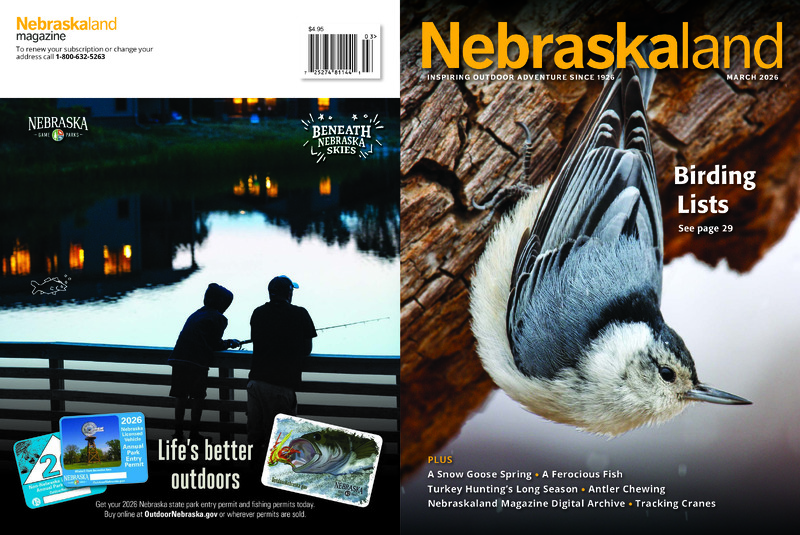
- Title:
- Volume 104, Issue 2, 2026
- Issue Name:
- March 2026
- Date Issued:
- 2026-03-01
- year:
- 2026
- month:
- March
- Season:
- Spring
- PDF filename:
- NL_104.02_2026_Mar_Spreads_Entire.pdf
- Cover image:
- NL_104.02_2026_Mar_Cover.jpg
- Publisher:
- Nebraska Game and Parks Commission
- Format:
- Periodical
- volume:
- 104
- issue:
- 02
- number:
- 104.02
- Decade:
- 2020s
- Type:
- Rights Holder:
- Copyright Nebraskaland Magazine/Nebraska Game and Parks Commission, all rights reserved.
- Subject:
- nebraskaland
- Extracted Text:
-
magazine
$4.95
To renew your subscription or change your
address call 1-800-632-5263
I N S P I R I N G O U T D O O R A DV E N T U R E S I N C E 192 6
M A RC H 20 26
Birding
Lists
See page 29
PLUS
A Snow Goose Spring
A Ferocious Fish
Turkey Hunting’s Long Season
Antler Chewing
Nebraskaland Magazine Digital Archive
Tracking Cranes
Volume 104
March 2026
No. 2
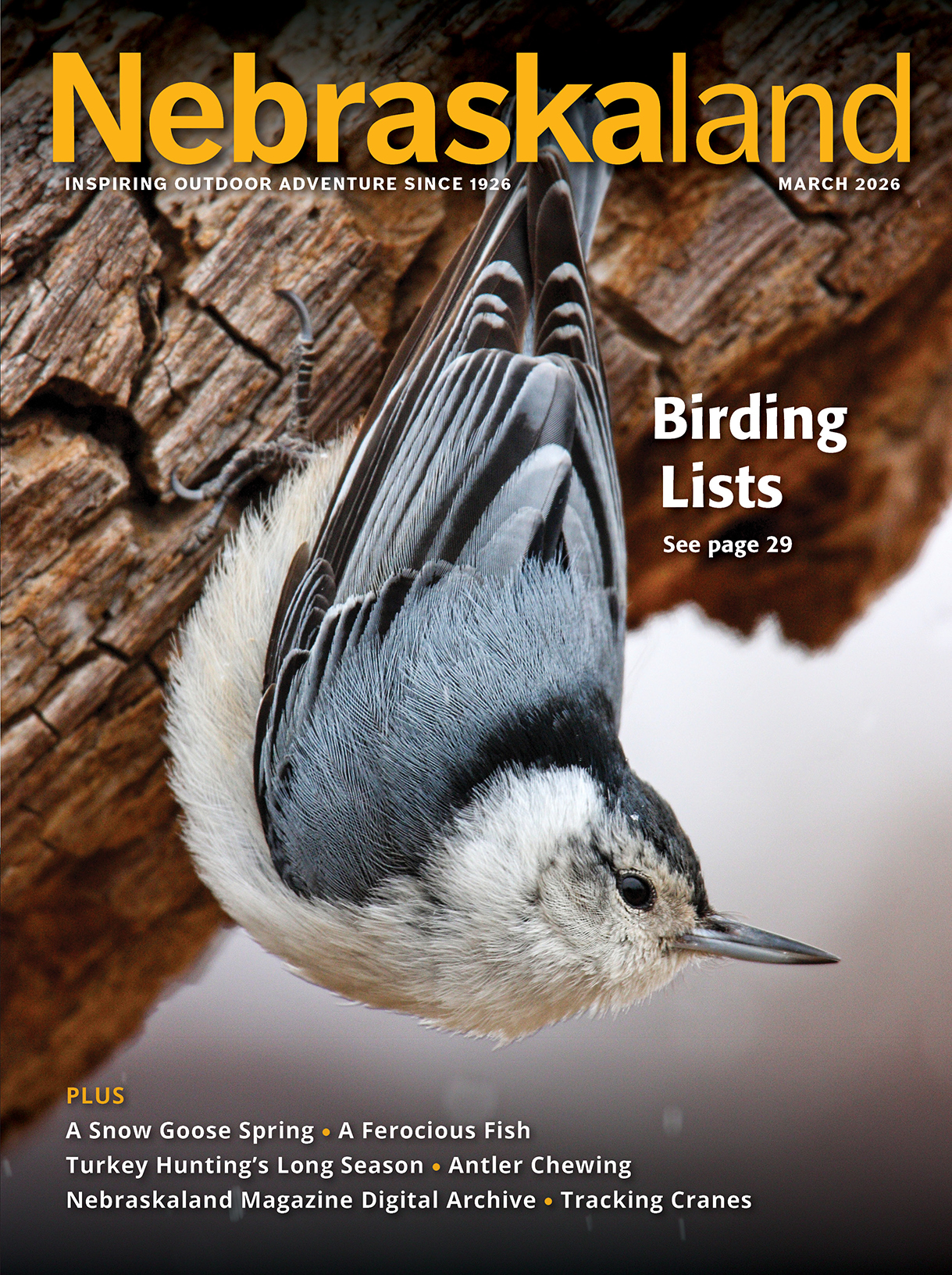
Cover: The white-breasted
nuthatch is just one of many
species to start your birding list
this month. For other March
activities, see page 28.
LUKE KATHOL
FEATURES
20
THE LONG SEASON
This page: Sandhill cranes
roost on the Platte River on a
foggy morning in Hall County.
ERIC FOWLER, NEBRASKALAND
A Change in the Nebraska Turkey Woods
Photos and story by Ryan Sparks
28
OUTDOOR NEBRASKA
What to Do in March
By Jeff Kurrus
30
CRANE TRACKING
36
ALONG THE TRAIL WITH CHARLES SAVAGE
38
MORE THAN BONE
Story and photos by Eric Fowler
By David L. Bristow, Nebraska State Historical Society
Behaviors Behind Wildlife Antler Recycling
Story and photos by Brian Peterson
42
ANCIENT TRAVELERS
American White Pelicans
By Monica Macoubrie
46
AQUATIC HABITAT 2026
By Eric Fowler
DEPARTMENTS
8 Your Nebraska
12 In the Field
50 Mixed Bag
60 Portraits from the Past
62 The Last Stop
ON THE WEB
For more articles and
information, visit
NebraskalandMagazine.com
4
Nebraskaland • March 2026
Nebraskaland (VOL. 104 / NO. 2 ISSN 0028-1964) is published monthly, except for the combined Jan./Feb. and Aug./Sept. issues, by the Nebraska Game and Parks Commission, 2200 N. 33rd
St., Lincoln, NE. Periodicals postage paid at Lincoln, Nebraska, and additional mailing offices. POSTMASTER: Send all UAA to CFS. (See DMM 507.1.5.2); NON-POSTAL AND MILITARY
FACILITIES: send address corrections to Nebraskaland, P.O. Box 30370, Lincoln, NE 68503-0370.
March 2026 •
Nebraskaland
5
magazine
Published by the Nebraska Game and Parks
Commission since 1926. The Commission
is dedicated to the conservation and
protection of all the state's natural
resources and the people who use them.
Magazine Staff
Communications Director Christy Firestone
Public Relations Manager Shawna Richter-Ryerson
Editor Jeff Kurrus
Associate Editor Jenny Nguyen-Wheatley
Regional Editors Eric Fowler, Julie Geiser,
Justin Haag
Contributing Editor Michael Forsberg
Regular Contributors Chris Helzer, Chris Masada,
Todd Mills, Ryan Sparks, Gerry Steinauer
Graphic Designer Mel Severin
Videographer Nick Sauvageau
Photo Librarian Jaclyn Cruikshank Vogt
Administration
Director Tim McCoy
Chair - Donna Kush, Omaha
Vice Chair - Dan Hughes, Venango
Magazine Subscriptions
For address changes, magazine and subscription
questions, 800-632-5263 or visit
nebraskalandmagazine.com
Advertising
For advertising information, contact:
Shane G. Gilster, 402-742-0125
shanegilster@solotreemedia.com
Ringneck snakes can be found under
rocks and logs as early as mid-March.
JEFF KURRUS, NEBRASKALAND
Kurt Arganbright, Valentine
Scott Cassels, Omaha
John Hoggatt, Kearney
Kent McNeill, Papillion
Steve Mossman, Lincoln
Lisa Roskens, Omaha
Doug Zingula, Sidney
Nebraskaland Magazine Copyright 2025, all rights reserved. Nebraskaland is available in audio from the Nebraska Library Commission Talking Book
and Braille Service, Suite 120, 1200 N St., Lincoln, NE 68508. 800-742-7691. Nebraskaland Magazine and the Nebraska Game and Parks Commission
reserve the right to reject any advertising not in keeping with the agency mission. Rates: $18 for one year; $33 for two years; $44 for three years.
Nebraska recipients must add appropriate sales tax. To subscribe call 1-800-NEBLAND (632-5263), or go online to: NebraskalandMagazine.com.
Commission Offices
Conservation Officers
Headquarters/Southeast District Office
2200 N. 33rd Street Lincoln, NE 68503
Phone 402-471-0641
Northeast District Office
2201 N. 13th St. Norfolk, NE 68701
Phone 402-370-3374
Southwest District Office
301 E. State Farm Rd. North Platte, NE 69101
Phone 308-535-8025
Northwest District Office (temporary)
1317 W 3rd St., Alliance, NE 69301
Phone 308-763-2940
Bassett Office
524 Panzer St., Box 508 Bassett, NE 68714
Phone 402-684-2921
South Central District Office
1617 First Ave. Kearney, NE 68847
Phone 308-865-5310
Schramm Education Center
21502 W. Highway 31 Gretna, NE 68028
Phone 402-332-3901
Omaha Office
8495 Frederick Street, Omaha, NE 68124
Phone 402-595-2144
OutdoorNebraska.gov
The Nebraska Game and Parks Commission does not discriminate
based on race, color, ethnicity, national origin, sex, pregnancy, religion,
disability, age, genetic information, veteran status, marital status,
and/or political affiliation in its programs, activities, or employment.
Any person who believes he or she has been discriminated against in
any program, activity, facility, or service should contact the Nebraska
Game and Parks Commission, Lincoln, NE 402-471-0641, the Equal
Opportunity Commission, Lincoln, NE 402-471-2024, TTY/TDD 800-6426112; Director, Office of Civil Rights, U.S. Department of the Interior,
1849 C St., NW, Washington, DC 20240.
6
Nebraskaland • March 2026
ADMINISTRATION
Jeff Clauson
402-471-5531
Lincoln HQ
Administrator
Travis Shepler
402-471-5531
Lincoln HQ
Asst. Administrator
Stacey Lewton
402-471-5531
Lincoln HQ
Asst. Administrator
Mike Thome
402-471-5531
Lincoln HQ
Asst. Administrator
(Includes counties covered)
NORTHWEST
Sean McKeehan 308-672-1824
Captain
SOUTH SUB-DISTRICT
Jerod Hahn
308-520-5539
Sergeant
Grant Albrecht
531-229-4405
Cheyenne, Deuel, Kimball
Hunter Lee
308-280-4320
Keith, Deuel
Jaden Porter
308-289-2274
Garden, Grant
Tyler Stueck
308-289-6260
Keith, Arthur
Keith Jadlowski 531-310-2869
Keith, Arthur
NORTH SUB-DISTRICT
Casey Gehrt
402-617-2112
Sergeant
Josh Widhelm
308-279-9133
Scotts Bluff, Banner, Sioux
Brandon Wallace 308-280-4488
Scotts Bluff, Banner, Sioux
Travis Schultz
308-279-1292
Morrill, Scotts Bluff, Box Butte
Vacant:
Dawes, Sheridan, Sioux
Cassidy Harwood 308-562-9099
Box Butte, Sheridan
Justin Gress
308-629-9335
Dawes, Sioux, Sheridan
NORTHEAST
Dale Davis
402-760-0712
Captain
WEST SUB-DISTRICT
Jeff Jones
402-762-5022
Sergeant
Hannah Holtmeier 402-601-7514
Boyd, Holt
Greg Hesse
308-546-7464
Rock, Brown, Keya Paha
Jonathan Andreasen 402-340-3981
Madison, Pierce
Trevor Stahlecker 402-928-9099
Knox, Antelope, Pierce
Mitch Johnson
402-613-8612
Cedar, Knox
EAST SUB-DISTRICT
Cory Krause
402-380-6410
Sergeant
Kyler Prochaska 402-830-8278
Platte, Colfax
Matt Costello
402-317-4014
Dodge, Colfax
Kelbi Abke
402-237-2537
Washington, Burt
Nicholas Fix
402-508-0261
Dixon, Dakota, Thurston
Kyle Hansen
531-739-7392
Dodge
Vacant:
Cuming, Wayne, Stanton
CENTRAL SUB-DISTRICT
Doug Pollard
308-730-7050
Sergeant
Vacant:
Howard, Greeley, Merrick
Matt Brandt
308-202-0819
Sherman, Howard
Klint Gill
402-613-5800
Nance, Wheeler, Boone, Polk
Garrett Zimmer 402-416-5736
Garfield, Loup, Valley
Tim Williams
308-380-7331
Hall, Hamilton
SOUTHWEST
Brian Piernicky 308-330-8780
Captain
NORTH SUB-DISTRICT
Alex Hasenauer
308-660-4671
Sergeant
402-389-0444
Frank Miller
Cherry, Hooker
Dana Miller
531-229-4404
Cherry, Hooker
Luis Nuñez
531-333-6093
Blaine, Custer, Thomas
Jacob Stoinski
308-395-6001
Lincoln, Perkins
Brandon O’Neal 308-530-3157
Lincoln, McPherson, Logan
SOUTH SUB-DISTRICT
Kelsey Glodowski 308-242-9000
Sergeant
Logan Smith
531-229-4406
Frontier, Furnas, Red Willow
Bryce Streger
308-537-0404
Dawson, Gosper
Logan Sanders
402-601-6302
Frontier, Hayes, Hitchcock, Red Willow
Tyler Adelman
402-314-4783
Dawson, Gosper
Sophia Gobber
308-222-0368
Chase, Dundy, Hayes, Hitchcock
SOUTHEAST
Matt Seitz
402-806-0915
Captain
WEST SUB-DISTRICT
Matt Taylor
402-200-9597
Sergeant
Vacant:
Adams, Clay, Webster
Vacant:
Thayer, Nuckolls, Fillmore
Vacant:
Harlan, Franklin, Phelps
Vacant:
Buffalo, Kearney
EAST SUB-DISTRICT
Heath Packett
402-210-0888
Sergeant
Brett Greenfield 531-350-0915
Cass
Russell Mort
402-209-1506
Otoe, Johnson
Rich Berggren
402-619-1355
Douglas
Brian Arp
531-530-9011
Douglas, Sarpy
Mike Luben
402-443-6392
Saunders
Bryan Adams
402-429-1924
Nemaha, Pawnee, Richardson
CENTRAL SUB-DISTRICT
Curt Prohaska
402-470-1298
Sergeant
531-229-4407
Easton Albrecht
Lancaster
Benjamin Keller 308-430-5500
Gage, Jefferson
Mark McDonald 402-805-2353
Lancaster
Mark Sullivan
402-741-0636
Lancaster, Seward, Butler
Jarrod Messman 531-739-9760
Lancaster, Saline, York
YOUR NEBRASKA
Instagram Photos
Follow us @nebraskaland
and tag us in your photos
to be featured in an
upcoming issue.
8
Nebraskaland • March 2026
Boni Edwards, North Platte
The Chase Is On
March 2026 •
Nebraskaland
9
Curt Blum, Lincoln
Snowflake
Send your comments and photos to:
Jeff Kurrus, Editor
Nebraskaland Magazine
P.O. Box 30370
Lincoln, NE 68503
or email Jeff.Kurrus@Nebraska.gov
Please include your postal address
and telephone number. Letters may be
condensed and edited. Photographs are
also welcome.
Derrill Grabenstein, Lincoln
Platte Textures
10
Nebraskaland • March 2026
Colette Rathke, Wahoo
Baiting My Hook
March 2026 •
Nebraskaland
11
IN THE FIELD
FROSTY PINES
A mountain lion kitten
sounds off while in
its den at Ponderosa
Wildlife Management
Area.
JUSTIN HAAG, NEBRASKALAND
12
Nebraskaland • March 2026
March 2026 •
Nebraskaland
13
IN THE FIELD
A SNOW GOOSE
PRIMER
By Julie Geiser
This is the year you start snow goose hunting during
Nebraska’s Light Goose Conservation Order. Here’s all you
need to begin.
Scouting
Once you spot large flocks of snow geese, drive back roads,
watch their patterns and get permission from landowners.
The work of finding a good field and setting out decoys can
result in two or three successful hunts. After that, the birds
may be gone, and it’s back to scouting.
Look for cornfields and winter wheat, as these are favored
foods. Avoid any water or flooded areas with high vegetation,
treelines or ditches running up to them. Keep away from
roads. If an open water area has quality feed around it, you’ve
found a honey hole.
Decoys
Use every decoy you have — from flyers, to windsocks, to
full bodies. Hunting with friends that have a few hundred
decoys will help with cost and effectiveness of a spread.
Many hunters use the “V” tactic in front of their blinds by
placing decoys on the upwind side with smaller groups of
decoys off to each side. Some hunters use the donut shape,
as it’s easy for hunters to move around the shape’s landing
hole according to wind direction and where the geese prefer
to land.
If geese are landing short of the spread, try moving some
of your decoys into that area, forcing the birds to land
elsewhere. If the geese aren’t coming all the way to your
decoys, move downwind from the decoys where flocks will
pass within shotgun range as they swing around the spread.
Pick Your Shot
Focus on one bird at a time; it’s easy to get distracted when
hundreds of birds are swarming you. As birds flair from a
spread, they’ll go up, so start with a target at the top and
work your way down to bag more birds.
Stay within your 45-degree shooting zone for safety and to
avoid doubling-up on birds.
Camouflage
Don’t skimp when it comes to concealment. Layout blinds
are popular, but portable waterfowl blinds are nice for their
easy setup and comfort. Camouflage yourself or blind to
match your surroundings and keep movements to a minimum.
14
Nebraskaland • March 2026
Snow goose shot over a farm pond.
JENNY NGUYEN-WHEATLEY, NEBRASKALAND
Calls and Guns
During the light goose conservation order, e-callers are a
must. Add bluetooth speakers in different areas of a decoy
spread for realistic sounds. When flocks are far away or the
wind is blowing, start loud then turn the volume down as
geese get close and add mouth calls as the birds near.
Once the shot is called, use the shotgun gauge that fits you
best. Many hunt with 12- and 20-gauge guns, using 2-shot
and BBs. If birds are in the 15- to 25-yard range, you’ll have
no problem bringing them down with these gauges or even
something as small as a .410.
Put these tips to use during your first snow goose spring,
and visit OutdoorNebraska.gov for regulations, including
zone locations and conservation order dates.
IN THE FIELD
he northern pike is a sport fish that knows how to make a splash.
JUSTIN HAAG, NEBRASKALAND
A FEROCIOUS FISH
By Justin Haag
With its big alligator-like mouth, torpedo-shaped body and
a striking olive-green-and-white-scale pattern, the northern
pike has a way of standing out on Nebraska’s fishing scene.
Suited to colder climates, most of Nebraska’s northern pike
live in the north-central and northwestern parts of the state.
They do especially well in the Sandhills lakes.
These predators aren’t picky about what they eat, and
consequently will bite on a variety of lures, baits and
presentations. The pike’s diet consists of about anything that
moves, and even the dead things that once did.
Fish, including other pike, amphibians, aquatic crustaceans
and sometimes even birds fall victim to the pike’s jaws and
its hundreds of sharp teeth. The pike is considered to be one
of the fastest freshwater fish, as it can sprint toward prey at
10 mph. With large sensory pores on its head, its lateral line
excels at detecting movement of prey.
Such a gluttonous appetite often produces a big fish. The
pike grows most rapidly in the first few years of its life, when
it puts on about 7 inches per year. At just 3 years old, a pike
measures about 18 inches long — the “hammer handle,” as
it’s often called. Nebraska’s record for northern pike dates
back to fall 1997 in the Panhandle; the fish measured 47
inches and weighed 30 pounds and 1 ounce. Steven Morris of
Scottsbluff caught it at Terry’s Pit on a twister tail.
Pike thrive in areas of heavy vegetation, both for spawning
and hunting, and can be caught from the bank. Not long after
ice-out, when the water temperature is 34-50 F, each female
16
Nebraskaland • March 2026
pike lays as many as half a million eggs in the shallows.
The eggs, which survive by attaching to sedges, grasses and
bulrushes, are fertilized by males and hatch in about two
weeks. The new recruits start by eating zooplankton and
insect larvae and work their way up to bigger fare.
Pike are subject to some ire from anglers because of their
tendency to eat popular panfish species and the perception
that they are hard to prepare for the table.
They have a set of y-bones branching from their spine,
not present in an easily-filleted walleye or bluegill. Many
anglers find their big fillets of white, flaky meat to be just
as tasty as those species, though, and cutting around the
bones isn’t difficult with practice.
Pike anglers often use medium-action spinning or
baitcasting rods with strong 10- to 20-pound line and
big lures that produce vibration. They’re also a popular
target beneath the ice, with either live bait on tip-ups or
jigging lures.
The statewide bag limit for pike is three, only one of
which can exceed 34 inches. Because management goals
vary where pike are present, many of Nebraska’s waters
have special regulations for the species. Check the Nebraska
Fishing Guide at OutdoorNebraska.gov for those rules and
the list of waters with pike in them.
Regardless whether or not a pike is targeted, even the
haters don’t seem to mind reeling one in. In fact, deep down,
they surely enjoy it.
IN THE FIELD
Turkey kabobs seasoned with a North African chili paste.
RYAN SPARKS
HARISSA TURKEY KABOBS
By Ryan Sparks
Harissa is a North African chili paste
that, when combined with wild turkey,
makes a perfect weeknight meal when
you feel like grilling. It is as simple as
marinating the turkey pieces, placing
them on skewers, and tossing them
on the grill. I like to serve it with
flatbread, a simple yogurt sauce,
and a salad of cucumber, tomato and
red onion.
Note: You can find dried chiles in the
Hispanic section of grocery stores.
Servings: 4
Prep Time: 24 hours (marinade time)
Cooking Time: ~15 minutes
Ingredients:
Harissa
3 dried pasilla chiles
2 dried guajillo chiles
2 dried ancho chiles
1 dried chipotle chile
4 dried arbol chiles (or more if you
want it hotter)
1 teaspoon caraway seeds
½ teaspoon coriander seeds
½ teaspoon cumin seeds
18
Nebraskaland • March 2026
¼ cup olive oil
2 teaspoons kosher salt
6 garlic cloves, smashed and minced
Lemon juice
Kabobs
1 wild turkey breast, trimmed
of silver skin and cut into 1½ to
2-inch chunks
¼ cup harissa
¼ cup red wine vinegar
Salt
Fresh mint (optional)
Instructions:
1. Remove the stems and seeds from
the dried chiles. Cut the chiles into
large pieces and cover them with
nearly boiling water. If the chiles
want to float, weigh them down
with a metal spatula or something
similar. Let them soak for 30 minutes
or until they are soft. Don’t throw
away the chile-soaking water.
2. When the chiles are soft, put them
and the remaining ingredients into
a blender or food processor and
blitz them into a nearly smooth
paste. If the paste seems too thick,
splash in some of the chile-soaking
water. When you’ve got it to a nice
consistency, it will keep in a jar in
the refrigerator for months.
3. Put the turkey chunks in a medium
bowl and add ¼ cup of the harissa
and the red wine vinegar. Give
everything a good mix, cover and let
it hang out in the refrigerator until
you are ready to grill. Overnight
is best, but 12 hours is also
enough time.
4. When you are ready to grill (a
charcoal grill is best), skewer the
turkey pieces onto four metal
skewers (or more if needed), sprinkle
them with salt, and place them on a
hot grill.
5. Once on the grill, I like to spray the
kabobs with light olive oil. The little
drips of oil that fall onto the hot
coals create a nice smoky flavor.
Grill for 5 to 10 minutes on each
side until little charred bits begin
to form.
6. Let the kabobs rest for 5 minutes,
sprinkle with the fresh mint (if
using), and serve.
A Change in the Nebraska Turkey Woods
Photos and story by Ryan Sparks
THE
LONG
SEASON
W
hen I was young, turkey
season was all about the
chase. There are nearly 15
hours of daylight during spring turkey
season, and I wanted to hunt every minute
of it. Those early years were filled with
restless boots, heart-thumping setups and
an endless obsession with all things turkey.
Spring turkey season felt like a secret
window into the natural world — those
first weeks of spring when the woods come
alive again, unfolding in shades of green
that seem impossible after winter’s gray.
In spring, everything smells new and hums
with life.
Spring turkey season also taught me
that, in Nebraska, permission for turkey
hunting comes more easily. Landowners
will often welcome you onto their land
with a smile when you ask about turkeys.
That meant I could explore new country
every season. It gave me a feeling of
endless exploration. It meant the spring
woods never felt small.
Over time, my passion has evolved.
Those early days of filling my own tags
gradually shifted into something else.
Now the most meaningful moments are
about who is with me — first-time turkey
hunters, friends, family and kids.
There’s nothing like watching a kid
shake uncontrollably as a tom runs toward
the decoys. Or seeing a new hunter freeze
as a fan tip appears over a terrace. When I
bring someone along, I’m reminded of why
I fell in love with turkey hunting in the
first place: the music of the spring woods,
the unpredictability, the chess match, the
chance to witness an ancient ritual at
arm’s length.
The Nebraska turkey woods changed me
from an eager kid who wanted nothing more
than to fill tags to a man who finds more joy
in calling for someone else. These photos
show the splendor of a spring morning and
the way a kid’s eyes light up when they
feel the magic of wild turkeys for the first
time.
Turkey hunting in Nebraska has given
me more than just a love of wild turkeys
— it’s given me a passion for the land
and a wonderful tradition to pass on. And
in these images, you can see that legacy
starting to take root. N
Sunlight through a turkey feather
feels like a spring morning.
20
Nebraskaland • March 2026
March 2026 •
Nebraskaland
21
OPPOSITE: Ryan Sparks’ nephew, Luke
Lovewell, had an exciting turkey hunt last
spring, shooting this Nebraska tom with a
.410 at 20 yards.
BELOW: Calling turkeys is a conversation.
Those who are good at it learn to speak
the same language as a wild turkey.
RIGHT: A turkey fan has a mesmerizing
iridescence. If you are fortunate enough
to shoot a spring turkey, take the time to
admire its beauty.
BOTTOM RIGHT: Tom Carpenter traveled
from Minnesota to hunt Nebraska turkeys
and was rewarded with a beautiful bird.
22
Nebraskaland • March 2026
March 2026 •
Nebraskaland
23
P A ebraska tom shows off
for the ladies in an ancient spring
ritual.
RIGHT: Jillian Sparks quickly sets
up a hen decoy as a gobbling tom
approaches quickly from the
woods behind her.
TOP: Ryan Sparks’ nephew, Abe
Lovewell, was all smiles after his
first turkey in
.
LEFT: A red dot sight can help turn
chaos into clarity. A single glowing
dot gives you a precise point of
aim.
24
Nebraskaland • March 2026
March 2026 •
Nebraskaland
25
LEFT: A tom’s spurs — the
pointed spike above the feet —
are an indication of the turkey’s
age. The longer the spur, the
more mature the bird.
RIGHT: Jillian Sparks practices
her aim and identifies her
shooting angles before a hunt.
BOTTOM RIGHT: Pulled barbecue
turkey sandwiches are a spring
staple in the Sparks’ house after
a successful hunt.
26
Nebraskaland • March 2026
March 2026 •
Nebraskaland
27
Outdoor Nebraska
By Jeff Kurrus
March is transition month in Nebraska. From open water to the
first gobbles of spring turkeys, the world is changing right in
front of our eyes. Make sure you’re outside to see it. N
What to Do in March
BOW Hunter Safety
Weekend
March 13, 6 p.m. – March 15, 1 p.m.
Ponca State Park
This Becoming an Outdoors-Woman weekend is
designed to teach women the basics of hunter
safety and provide firsthand firearm and archery
knowledge through simulated hunting and
shooting situations. Equipment will be provided.
Participants will receive a Hunter Education
certificate at the end of the weekend. Female
participants ages 12 years through 18 are
required to be accompanied by a participating
adult. The $200 fee includes shared cabin lodging
at Ponca State Park and meals. Register at
Apps.OutdoorNebraska.gov/BowEvents.
DAVID WOLFE
Archery Spring Turkey
Begin a Birding List
All Month Long | Statewide
All Month Long | Statewide
For hunters willing to scout, pick their setup carefully, and patiently wait for
a flock to arrive, archery turkey season offers a fun challenge and a chance to
enjoy spring’s first signs of life. Because early-season birds are often bunched
in winter flocks, scouting fields, roost sites and travel corridors are especially
important. Archery hunters are most effective from ground blinds, where
movement is concealed and shot opportunities are controlled.
Effective bow setups focus on close encounters place several decoys within
10-15 yards of the blind to draw curious birds within range. Calling should be
subtle to spark interest. TEXT BY RYAN SPARKS. PHOTO BY ERIC FOWLER, NEBRASKALAND
Most serious birders, or birdwatchers, keep lists of how
many different species of birds they have identified. March
in Nebraska can be a great time to start your list — whether
it be a life list, state list, county list, year list, day list, yard
list, trip list or just about any type of list you can imagine.
Because of so many species returning in the spring, each
passing week will offer new opportunities to add species to
whatever list you choose to pursue.
TEXT BY JOEL JORGENSEN. PHOTO BY JUSTIN HAAG, NEBRASKALAND
Attend a Fly-Tying Class
Open-Water Fishing
Watch the Weather | Statewide
By March, the itchiest of anglers can’t wait to get
back on the open water. Fish activity — including
bluegills, crappies and even larger fish — tends to
increase as the water temperature approaches 50
degrees, so diligently watch the weather.
“Start on north shorelines,” said fisheries biologist
Aaron Blank, “preferably lined with rocks, as
these areas warm quickest.” Fish these areas for
increased activity beneath the water’s surface.
JUSTIN HAAG, NEBRASKALAND
28
Nebraskaland • March 2026
March 4 and March 8
Turpin Outdoor Education Center
A woolly bugger, zebra midge or a San Juan worm —
these fly-tying patterns are some of the basics that
Cornhusker Fly Fishers experts will share with anglers
at the Turpin Outdoor Education Center on
Mar. 4, 6-9 p.m., and Mar. 8, 2-5 p.m. The workshop
welcomes new and experienced fly tiers and will
include all materials and tools. Participants will have
the opportunity to tie four to six flies. Cost is $10 per
class, and attendees can attend one or both classes. To
register, visit Calendar.OutdoorNebraska.gov.
ERIC FOWLER, NEBRASKALAND
March 2026 •
Nebraskaland
29
Crane
Tracking
Story and photos by Eric Fowler
A
sandhill crane banded and outfitted with a GPS
unit in Nebraska ended up nesting south of
the Bering Strait on the eastern trip of Russia,
wintered in New Mexico and Texas, and is likely back in
the Cornhusker State by now. The bird logged at least
11,000 miles.
It was one of five fitted with GPS tracking bands last
spring as part of a donor-funded study exploring what the
cranes do during their annual stopover in the Platte River
Valley. The study is led by the Crane Trust in partnership
with the U.S. Geological Survey and the International Crane
Foundation.
Abe Kanz, director of science with the Crane Trust, said
they want to know how far the cranes are traveling from
the Platte River to feed. The long-running answer to that
question, based on surveys done in the early 2000s, has been
less than 5 miles. Aerial surveys by the Trust and others in
recent years, however, have shown cranes going farther: One
of the tracked cranes fed 10 miles from the Platte, Kanz said.
30
Nebraskaland • March 2026
Data collected during the study also should show how
cranes’ foraging patterns shift during the season. Cranes
aren’t the only birds eating leftover grain — primarily corn —
in fields in the valley. Canada geese also feed on corn, as do
snow geese, which arrive before the cranes and have become
more abundant on the Platte as their migration patterns
have shifted to the west. While most cranes only stop in
Nebraska in the spring, more have been spending the fall and
all or part of the winter on the river in recent years: The Trust
counted an estimated 31,000 cranes in mid-December.
“Is that something that’s happening — depleting resources
near the river? That could also contribute to needing to
travel farther,” Kanz said.
Prior Crane Trust surveys have also shown the area
used by cranes in the spring has shifted east, with more
birds roosting on the Platte between U.S. Highway 34 and
Chapman, including a record number last year.
While the five birds were banded between Wood River and
Grand Island last spring, two roosted and fed east Highway
34 during the last weeks of their stay,
and one spent time on both sides of
the highway.
Kanz and others will also be looking at
fall migration patterns and whether the dates
are shifting and, if so, why; if sandhill cranes are
staging a second time in the Prairie Pothole region
of South Dakota after staging on the Platte; and, of
course, where they are breeding and wintering.
LEFT: Dave Brandt, a retired U.S. Geological Survey
biologist, sets a radio triggered snare he designed and
built in hopes of capturing a sandhill crane to tag last
spring as part of a research project led by the Crane Trust.
CENTER: Brandt holds a crane they captured as Abe Kanz
of the Crane Trust prepares to attach a GPS leg band and
Andy Caven of the International Crane Foundation draws
a blood sample.
RIGHT: Brandt releases a banded crane.
The above map shows the paths
five sandhill cranes trapped
and banded in Nebraska last
spring took to their breeding
and wintering grounds.
March 2026 •
Nebraskaland
31
he solar powered GPS tracking leg bands used in the rane rust research
pro ect weigh ust . ounces.
Sandhill cranes take flight from a corn field in
A crane flies from its roost on the Platte iver.
32
Nebraskaland • March 2026
Dave Brandt, a retired USGS
biologist from North Dakota, led the
trapping effort in late-February and
early-March. In pre-scouted locations
in pastures between Wood River and
Grand Island, the trapping team set
up to four 10-meter snare lines made
of heavy monofilament line and
spray painted to match the color of
the prairie grass. They also set up the
“ring of fire,” a spring-powered, radiotriggered snare Brandt designed and
built. With traps set before dawn, they
watched and waited in nearby blinds.
Brandt has helped band around
3,000 sandhill cranes and put GPS
trackers on another 700 sandhills as
well as 170 whooping cranes during his
career. One might think that with more
than 1 million cranes stopping on the
Platte during the migration, trapping
enough to deploy 20 transmitters for
the study would be easy. But that was
not the case.
“They live 30-plus years in the wild,
and they have incredible eyesight and
incredible hearing,” Brandt said. “So
it’s hard to outsmart them, sometimes,
even though there’s a lot of them.
You’ve got to be in the right place
at the right time and not get busted
by them.”
Cranes are much easier to trap
in their wintering grounds, where
all ounty. he rane rust s pro ect will help better understand where the
birds are feeding during their stopover on the Platte iver during the spring.
Brandt says food can be a limiting
factor, making it possible to get them
“addicted to bait.”
“That’s one of the difficulties here
is these birds do not really respond to
corn or bait, because they have corn ad
libitum,” he said. “Everywhere they go
is a cornfield, right?”
The team was able to capture three
lesser sandhill cranes and two juveniles
that are likely greaters. Each was fitted
with a solar-powered tracker built in a
leg band weighing just 2.3 ounces. The
trackers are programmed to record a
data point every five minutes within
the Platte River Valley and every 15
minutes elsewhere. They also contain
an accelerometer, which measures
speed and direction, and collect more
points when the birds are in flight.
This allows them to record behaviors,
such as kettling, which leaves a spiral
trail of dots as the birds circle to their
cruising altitude.
The trackers also record fewer
points when battery life is low. During
extended cloudy periods, they also
quit recording. That was the case with
the crane that nested in Siberia: It
flew through Alaska when wildfires
filled the air with smoke. Through Nov.
12, that crane’s tracker had recorded
201,000 points, compared to 485,000
for a crane that nested in Ontario.
March 2026 •
Nebraskaland
33
ranes drop into their roost on the Platte iver at sunset in
from southeastern Montana to New
Mexico, flew through the Nebraska
Panhandle. It later shifted to wintering
grounds in Texas. Kanz is interested
to see whether it will return to the
central Platte or follow other cranes to
spring staging areas along the North
Platte River in western Nebraska or
elsewhere. “If it doesn’t come back
through central Nebraska, there would
be a lot of questions around well, why
were you here last year and what are
you doing now?”
The other four birds wintered
in Oklahoma, Texas and southern
og rises from a Platte iver full of sandhill cranes on a March morning.
The five banded cranes left the
Platte between March 27 and April
6, each stopping in for a time in the
Dakotas and south-central Canada
before forging ahead to their nesting
grounds in early May.
The trackers upload data every four
hours whenever they are within range
of a cellular tower and only collect and
store data when they are not. Each of
the birds left areas with cell service
before reaching their nesting grounds.
“Once they got to some of these more
remote areas, we just didn’t hear from
them for a while,” Kanz said.
Kanz and others working on the
study were relieved when, in August
34
Nebraskaland • March 2026
and September, location data started
pouring back in and they knew all five
birds were still alive and well.
It was only then they could see that
one of the cranes had nested in Russia,
something that was known to occur
but not expected for this study. “How
cool and lucky is it that we managed
to snag one of those birds, right?”
Kanz said.
Researchers
were
pleasantly
surprised to see that the four other
birds each nested in a different part
of Canada: Manitoba, Ontario and the
Northwest and Nunavut territories.
“I couldn’t have planned it better,”
Kanz said. “And we didn’t plan it,
right? It’s random cranes. But it does
a really good job of showing just
how dispersed these populations of
sandhill cranes can be.”
The birds migrated south in lateAugust or early-September. They
stopped in locations in southern
Saskatchewan or North Dakota for a
few weeks before continuing south
in mid- to late-October. All five birds
flew through Nebraska, but none of
them stopped, something that didn’t
surprise Kanz as each passed on a day
with strong northerly winds.
The crane that nested in Russia
followed the most westerly route
south and, on the day it made it
all ounty.
Kansas. The one that nested in
Ontario flew all the way to the Gulf
Coast before flying back north to an
area near Wichita Falls, Texas, where
it spent the remainder of the winter.
If they haven’t returned to Nebraska
by now, the tagged cranes should
be here soon. And Kanz, Brandt and
others are already working to trap
another 15 cranes to fit with the
transmitters they didn’t use last year,
possibly trying some new techniques
to improve efficiency.
“I’m hoping we have some more luck
this spring,” Kanz said. N
he rane rust
Behind-the-scenes access to the Crane Trust’s sandhill
crane tracking project is one of several benefits that
come with membership to the organization.
Basic membership also includes access to the guided
virtual crane viewing tours during spring migration,
year-round access to the Trust’s livestream camera on
the Platte River and other exclusive online content, as
well as advanced priority booking for riverfront viewing
blinds and day tours.
Membership proceeds help support educational
programs, research and land management.
ranes dance on their roost on the Platte iver.
or more information visit cranetrust.org.
March 2026 •
Nebraskaland
35
Along the Trail
WITH
Charles Savage
Fort Kearny, attributed to Charles Savage.
High winds that day blurred the trees.
By David L. Bristow, Nebraska State Historical Society
NSHS RG2102-PH1-3
Mormon Camp, Wyoming, Nebraska.
Roland Reed Ranch, 2 miles west of Beaver Crossing,
Nebraska, 1866. NSHS RG2469-PH0-5
NSHS RG3351-PH0-31
T
hese pages contain rare photographs of the Nebraska
portion of the Oregon, Mormon and California trails
in the 1860s. Photography existed during the decades
when hundreds of thousands of people were heading
west. Why so few photos?
Consider photographer Charles Savage. An English-born
Mormon missionary, Savage learned photography in New
York before opening a studio in Florence, Nebraska, in 1859.
During his 1866 journey to Utah, he made the Nebraska trail
images shown here.
Making photos in the field was not easy. Savage brought
along a heavy, specially-built photography wagon. This
rolling, sheet-iron-sided darkroom was 9 feet long and 6 feet
high and filled with drawers for his chemicals and glass-plate
negatives.
“Every time he wanted to make a negative,” writes
historian John Carter, “he had to concoct his solutions, set up
a camera, and pour his emulsion onto a piece of glass, expose
and then develop it, all before the plate dried. This process
could occupy upwards of half an hour.”
Savage made the trip with a group of Mormon emigrants.
Not surprisingly, they did not want to wait while he stopped
to make a photo, and by 1866, it was dangerous to lag too
36
Nebraskaland • March 2026
far behind the group. Native Americans had lost patience
with the ongoing encroachment on their land. Even so,
Savage managed to make a number of photos, some of which
still exist.
The town of Florence — now part of Omaha — started out
as the 1848 “Winter uarters” when the first groups of LatterDay Saints headed to Utah. By 1866 the town of Wyoming
— a bit north of Nebraska City — had become the Mormons’
preferred “jumping-off ” point. Savage made a photo of the
emigrant camp before they departed around July 8.
From there, they followed a cutoff route to Fort earny,
where Savage made another photo. He wasn’t very happy
with it. Because of high winds and the long exposure time,
the waving branches are hardly visible and the trees look
like stumps.
Continuing west, Savage complained of constant wind
that somehow did not disperse the swarms of green flies
and mosquitoes. With daily temperatures rising over 100
degrees, it was often too hot for photo chemicals to work
properly. That was the case when the group arrived at Scotts
Bluff about midday, and Savage regretted that he could make
no photo before they had to depart.
Fortunately, he was able to photograph Chimney Rock.
The photo was long considered lost by historians until John
Carter found it on eBay in 2008. Purchasing a rare artifact
that way was still enough of a novelty that the story made
minor headlines nationwide.
“So why did Savage bother?” Carter asked in a Nebraska
History magazine article published later that year.
“Photographers, especially then, did not photograph for
posterity. Rather, they made photographs to sell.” And by
then, Salt Lake City was a well-established capital filled with
people who shared the experience of that difficult overland
journey. “Savage knew his market well and, I suspect, found
eager customers for his wares. His photographs were, in fact,
the visual narrative of their experience, their journey to the
Promised Land.”
As it turned out, 1866 was the last really big year of the
Platte Valley route. Three years later, Savage made his
most famous photograph, the iconic “golden spike” image
documenting the completion of the transcontinental
railroad. N
John Carter wrote two articles about Charles Savage, available
by searching “Charles Savage” at history.nebraska.gov.
The earliest known photo of Chimney Rock,
1866. This and other photos are by Charles
Savage. Photos listed as “attributed to”
were not labeled as Savage photos, but John
arter identified them by other evidence.
NSHS RG3319-PH1-45
more
than
bone
Behaviors Behind
Wildlife Antler Recycling
Story and photos by Brian Peterson
E
ach spring, white-tailed deer bucks shed their antlers and begin
growing a new set in preparation for the next season. For many outdoor
enthusiasts, searching for these shed antlers can be an enjoyable excuse
to get outside and stay active, but findings are often minimal. Many antlers
are swallowed up by vegetation, yet many more are picked up by a variety of
collectors.
Antlers lost to the woods serve as a valuable resource for a wide range
of wildlife species. Squirrels, like other rodents in Nebraska including mice,
woodchucks, porcupines, rabbits, chipmunks and beavers, have elodont teeth,
which are continuous-growing incisors that are only worn down by constant
gnawing. Antlers provide an ideal hardened surface for this purpose.
38
Nebraskaland • March 2026
A white-tailed deer skull
with extensive squirrel
chewing damage on main
beams and antler tines.
JEFF KURRUS, NEBRASKALAND
March 2026 •
Nebraskaland
39
A brown thrasher
perches on a shed
antler while feeding
on ants in the
surrounding area.
Cottontail rabbits are frequent visitors to shed antlers but
cause limited damage.
A young raccoon chews on a shed antler's brow tine.
A young white-tailed buck with new antler growth
investigates a shed antler.
40
Nebraskaland • March 2026
Small mammals, such as this white-footed mouse, nibble on
shed antlers, though damage is typically minimal.
A squirrel’s chisel-shaped incisors leave distinct chew
marks on the antlers, often appearing as elongated gouges
or divots. Based on years of shed collecting in Nebraska’s
Central Platte River Valley, however, I’ve observed minimal
rodent damage (<5%), suggesting antlers are not a limiting
mineral source, or that squirrel populations are too low to
cause a significant impact.
In my experience in central Nebraska, chew marks
on antlers are most often associated with coyotes, as I
frequently observe evidence of antlers being chewed on
or carried/transported by them. These antlers often show
rough tooth scoring and distinct bite marks, especially near
the tips. Like domestic dogs, coyotes may chew instinctively,
but the behavior could also serve practical purposes, such as
dental maintenance or mineral intake.
In addition to squirrels and coyotes, Nebraska camera
traps have recorded a wide range of other mammals,
including rabbits, raccoons, skunks, opossums, bobcats and
even deer interacting with shed antlers by licking, nibbling
and chewing on them. Because these encounters are brief
and infrequent, the extent of wear or damage caused by
these species remains unclear. That said, the longer an antler
remains on the landscape, the more likely it is to show signs
of chewing.
Though often overlooked, shed antlers play a vital role
in mineral recycling and ecosystem health, revealing the
hidden value in what many may consider to be nothing more
than a decaying bone on the forest floor. N
Coyotes frequently
chew and transport
shed antlers, often
leaving distinct tooth
scoring and bite
marks.
Eastern fox squirrels
commonly gnaw
shed antlers to wear
incisors and acquire
essential minerals.
Brian Peterson is a biologist and online academic program
advisor for the master's biology program at the University
of Nebraska at Kearney. His research has focused on whitetailed deer. He would like to thank the Smith family for land
access during this study. For more information, please contact
petersonbc@unk.edu.
March 2026 •
Nebraskaland
41
Ancient Travelers
American
White
Pelicans
By Monica Macoubrie
E
very spring and fall, Nebraska’s
skies put on a show: the
migration of American white
pelicans. Although these birds are
massive, with wingspans close to 9
feet, they somehow glide through the
air as though weightless, and when
watching a flock circle and touch
down onto a sandbar or reservoir, the
experience feels almost prehistoric.
Conservationist Aldo Leopold wrote
in “A Sand County Almanac”: “Let a
squadron of southbound pelicans but
feel a lift of prairie breeze … and they
sense at once that here is a landing
in the geological past, a refuge from
that most relentless of aggressors, the
future. With queer antediluvian grunts
they set wing, descending in majestic
spirals to the welcoming wastes of a
bygone age.”
Leopold’s words capture exactly
what pelicans make me feel when I
see them. They’re like time travelers.
American white pelicans fly above Spotted ail a Platte iver asin nvironments property near Mitchell.
When they land in Nebraska’s quiet
wetlands and wide-open prairies,
it’s like they’ve found one of the
last pieces of the ancient world that
hasn’t been modifid by humans. It’s
a reminder of what’s still wild — and
a quiet warning about how easily we
could lose it.
years, barely changing in form over
this vast stretch of time. They are
living reminders of a world long gone,
sharing traits with creatures that
soared when saber-toothed cats and
mastodons still roamed the earth.
The pelican is a rare and humbling
reminder that we share this landscape
with survivors of an ancient story still
unfolding right above us.
Prehistoric Bird
American white pelicans gather at Whitney ake Wildlife Management Area in
awes ounty. JUSTIN HAAG, NEBRASKALAND
42
Nebraskaland • March 2026
Everything about a pelican seems
ancient: Their long, scoop-like beaks;
the awkward, yet somehow majestic
way they take flight; and the sight of
them gathering in massive colonies —
just as they have for untold millennia.
Fossil records show pelicans have
been around for at least 30 million
Feeding
American white pelican at luestem
State ecreation Area in ancaster
ounty. ERIC FOWLER, NEBRASKALAND
Unlike their cousin, the brown
pelican, which dive-bombs into the
ocean with dramatic splashes, the
American white pelican has a calmer
and sneakier fishing style. Instead of
fishing solo, they team up. Groups of
JUSTIN HAAG, NEBRASKALAND
pelicans, sometimes more than 50,
gather in shallow water and paddle
in a loose line or half-circle. It looks
like they’re choreographing a slow
dance, but they’re actually herding
fish, working together to push schools
into tighter spaces. Once the fish are
corralled, the pelicans dip their heads
and scoop up their quarry into their
giant orange bills, which can hold up
to 3 gallons of water. Once they’ve
drained out the water, the meal goes
straight down the hatch.
A Seasonal
Spectacle
Nebraska is a key stop for pelicans
during their migration. Every year,
March 2026 •
Nebraskaland
43
graceful spirals. The birds barely flap
and instead, they rely on thermals and
air currents, making migration look
effortless. But don’t be fooled — the
journey is grueling.
Pelicans burn a lot of energy
covering those long distances, and
that’s where Nebraska comes in. Our
wetlands, rivers and reservoirs are the
pit stops that keep them going, offering
safe places to rest and fish. Without
these rich feeding grounds, the miles
ahead would be impossible for them to
cover. Protecting these stopover sites
isn’t just good for pelicans — it’s what
keeps this ancient migration alive.
Raising the Next
Generation
American white pelicans double crested cormorants and American coots flock to a shoreline at Sherman eservoir Wildlife
Management Area in Sherman ounty. ERIC FOWLER, NEBRASKALAND
American white pelicans fish at the inlet area of Sutherland eservoir State
ecreation Area in incoln ounty. JULIE GEISER, NEBRASKALAND
44
Nebraskaland • March 2026
these birds travel thousands of miles
between their nesting grounds in the
northern U.S. and Canada and their
wintering spots along the Gulf Coast
and deep into Mexico. It’s an epic
journey, one that’s been happening for
countless generations, and Nebraska
sits right in the middle of their flyway.
In spring and fall, our state
transforms into a pelican rest stop on a
scale that’s hard to imagine. Hundreds,
sometimes thousands, of American
white pelicans gather on Nebraska’s
big lakes and reservoirs. Places like
Lake McConaughy, Harlan County
Reservoir and Sutherland Reservoir
can look like someone scattered giant
white sails across the water — until
one of them suddenly lifts off and the
entire flock follows, rising in wide,
Not only is Nebraska an important
migratory stop for pelicans, it’s also
one of the rare places in the interior
U.S. where some American white
pelicans settle down and raise families.
These birds are incredibly selective
when it comes to real estate — they
won’t just nest anywhere. They seek
out remote, isolated islands on large
lakes and reservoirs, far from people,
predators and disturbances. These
spots are like safe, floating fortresses
where pelicans can focus on raising
chicks without interruption.
Nesting season begins in late spring.
Males and females share nest duties,
scraping out shallow depressions in
the sand or gravel and lining them with
sticks, grass or whatever vegetation is
nearby. Each pair typically lays one
to three chalky white eggs, and both
parents take turns incubating them for
about a month. When the chicks hatch,
both parents step into the demanding
role of delivering regurgitated fish
meals multiple times a day.
In these dense colonies, the young
often form “pelican nurseries,” called
creches, where dozens of chicks
huddle together for warmth and safety
while their parents are off fishing. By
late summer, these once-fluffy chicks
are nearly adult size and testing their
giant wings, readying for the first
migration of their lives.
When to See Them
Catching sight of American white
pelicans in Nebraska is all about
timing. From March through May, they
move north toward their breeding
grounds, often arriving in impressive
flocks that seem to appear almost
American white pelicans fly above Spotted ail a Platte iver asin nvironments
property near Mitchell. JUSTIN HAAG, NEBRASKALAND
An American white pelican takes an
early morning flight. CHRIS MASADA
overnight. Then, in late August
through October, they head south
again, gathering on Nebraska’s waters
to rest and feed before continuing
their long journey. These migration
windows are your best chances to
witness one of Nebraska’s most
spectacular bird movements up close.
They are not subtle travelers. You’ll
often see their enormous, white wings
cutting across the sky in a graceful
V-shaped formation, or see them
gathered on the water, bobbing like
a loose fleet of ships. Early mornings
and late evenings are especially
magical, when soft light turns their
soaring silhouettes into something
almost otherworldly.
Every spring and fall, American
white pelicans are reminders that
Nebraska is part of something much
bigger, a crossroads in their incredible
journey across the continent. They are
also reminders that the lakes, rivers
and wetlands that they rely upon must
be protected long into the future, so
these ancient birds can continue to
make their migration each year. N
March 2026 •
Nebraskaland
45
Aquatic
Habitat
2026
A
By Eric Fowler
project that began with
plans to replace a dilapidated
boat ramp at Standing Bear
Lake in Omaha grew into
a major Nebraska Game and Parks
Commission Aquatic Habitat and
Angler Access program project that
will start paying dividends for anglers
this year in the form of keeper-sized
bluegill and saugeyes, countless small
bass and some decent channel catfish.
One of the first major flood-control
reservoirs built by the U.S. Army Corps
of Engineers in Omaha, Standing
Bear had suffered the same fate as
A channel cut around Lake No. 1 at Windmill State Recreation
Area will carry floodwaters away from the area.
ERIC FOWLER, NEBRASKALAND
other mid-sized waters since it was
completed in 1975. Sediment washed
into the lake from the watershed and
shoreline erosion, and the presence of
common carp had muddied the waters,
creating poor conditions for gamefish.
The lake, owned by the City of
Omaha, was drained late in 2022 to
allow for construction. A new twolane boat ramp replaced the old ramp,
and a kayak launch was also built.
Breakwaters were added to protect
both launches and for fishing access,
and the parking lot was reconfigured
to improve traffic flow.
Several lakes at Windmill State Recreation Area were excavated to provide depth
to ensure shallow areas remain connected during low water. ERIC FOWLER, NEBRASKALAND
46
Nebraskaland • March 2026
On the lake’s north side, nine fishing
points were constructed along a 350yard stretch of shoreline, one of which
includes an accessible fishing pier and
sidewalk. Stairs and sidewalks lead
to the other points. These improve
a shoreline that previously was
steep, lined with riprap and trees
and difficult for anglers to access.
Sediment removed in front of each
structure and the boat and kayak
launches will help keep aquatic
vegetation at bay and give anglers
easy access to deep water.
Artificial habitat and fish attractors
were placed within casting distance of
the structures and in other locations
around the lake. This includes 19
rock shoals, more than 100 artificial
PVC fish attractors made by Connor
Tjepkes and fellow Troop 308
members as part of his Eagle Scout
project, and 240 cedar trees placed
with the help of volunteers from the
Nebraska B.A.S.S. Nation.
Restocking the lake began in the
fall of 2023 when a few adult bass
and bluegills were moved from other
area waters. Heavy rain in May of
2024 filled the reservoir seemingly
overnight, and more than 50,000
fingerling bass and bluegills have been
stocked since, as well as 8,000 10-inch
channel catfish and 33,000 fingerling
and advanced fingerling saugeyes. No
black crappies were stocked, but there
Nine fishing points
and an accessible
fishing pier and
sidewalk built on the
north side of Standing
Bear Lake in Omaha
improved angler
access. Rock shoals
and other structures,
now concealed by
water, will improve
fish habitat. NICK SAUVAGEAU
was no need, as that species found
its way into the lake from upstream
ponds, as did a few more adult bass.
Jacob Werner, district fisheries
biologist, said fish are thriving in
the abundant aquatic vegetation
that sprouted in the clear, carp-free
water. While their spring trap-net
surveys for some reason didn’t sample
many bluegills, there are plenty in
the lake, including good numbers of
5- to 8-inch fish. He was pleasantly
surprised with how the saugeyes are
doing and said anglers can expect fish
to reach the 15-inch minimum length
limit this year. Crappies are present
up to 8 inches and need some time to
grow, as do the channel catfish, which
are topping out at 16 inches. There are
a “ridiculous” number of bass in the
7- to 10-inch range from the first yearclass that is comprised of stocked and
naturally reproduced fish.
“The fishery is progressing really
nicely,” Werner said. “It’ll produce
some nice bluegills, and the saugeyes
in there actually look incredible.”
With the number of fish present, “It
will be a phenomenal place to take a
kid,” Werner said.
Jeff Jackson, aquatic habitat
program
manager,
said
while
numerous reservoirs have been built
in the Omaha Metropolitan Area since
the last of the original four Corps
reservoirs were completed in the
1980s, rehabilitating Standing Bear
Lake and basically creating another
new lake within a short drive of more
than 5641,000 resident anglers and
1 million people, is well worth the
$2.6 million investment. “There’s
probably nothing more important,”
he said. “You can’t build enough lakes
there.”
March 2026 •
Nebraskaland
47
Other Aquatic Habitat and Angler Access Program Projects
Nebraskans can enjoy this year include:
Medicine Creek and Swanson SRAs
In partnership with the U.S. Bureau of Reclamation, 42 rock
shoals were built in the lakebed at Medicine Creek Reservoir
in 2025 and 43 at Swanson Reservoir in 2023. The 10-by-20
foot wide, 3-foot-high structures were constructed in what
will be 8 feet of water when the reservoirs are at full pool,
providing habitat for fish where there is little except when
the lake is full. Buoys will mark the structures so they don’t
present a hazard for boaters.
I-80 Lakes
Invasive eastern red cedar and Russian olive trees were
removed from 11 borrow pit lakes along Interstate 80
between North Platte and Minden to improve shoreline
access for anglers. As part of the project, funded in part by a
Nebraska Environmental Trust grant, some of the cedar trees
were placed in the lakes for fish habitat.
The lakes include: War Axe SRA, North Kearney Rest Area
DOT, Fremont Slough, Pawnee Slough, East Gothenburg,
West Maxwell, Daar, Blue Hole, Coot Shallows, Bufflehead
and Bassway Strip WMAs.
Windmill SRA
Work will be completed this spring on a project to deepen
shallow bottlenecks that cause Lakes 2, 3, 4 and 6 to become
disconnected when water levels drop in the summer and
to add depth variation in other locations. The project also
included the addition of a fishing point on Lake 2, a floating
dock on Lake 4, and improved access in several more
locations on those and other lakes, including a new parking
lot near Lake 4. Floating islands seeded with plants will be
installed this spring in Lake 6. The root structure extending
below the islands will provide additional fish habitat. A new
channel will carry floodwaters around Lake 1 and lessen the
likelihood of carp and other rough fish entering the lakes, as
was the case in 2019. A renovation is tentatively planned for
that lake in 2026.
Starting in 2026
Niobrara State Park Pond
Work will begin this spring to reconfigure the pond, which
is larger than the watershed can maintain. Leaks will be
sealed and a well installed to maintain water levels. A small
boat ramp will be built on the south side of the pond that can
be used as a kayak launch.
Smith Lake WMA
Work will begin this spring to reconfigure the outlet and
improve the road to the south side of the lake, where nine
fishing points will be built to improve angler access. An
additional point will be built on the northeast corner of the
lake, and a breakwater will be added to protect the boat ramp.
Some dredging will be done around the points.
Oglala National Grassland Ponds
Work will begin this summer to deepen Agate and
Boardgate Reservoirs to prevent summer kill, and to improve
angler access. Fencing will be installed to prevent cows
from wading in the ponds, and new outlet structures will
help maintain water levels. Access improvements include
an accessible parking area, kayak launch and fishing point
at Agate. The U.S. Forest Service, a partner in the project,
recently improved roads to the lakes.
Improved Boat Access
Projects were completed at Bluestem SRA, Lewis and Clark
SRA-South Shore, Avocet WMA, Frye WMA, East Midway
SRA, Gallagher Cayon SRA, Phillips Canyon SRA, Plum
Creek WMA, and Merritt WMA/SRA, including new boat
ramps, accessible kayak launches, fishing piers, boat docks
and restrooms, and parking lot expansions. More boat ramp
improvements are planned this year at Verdel Landing and
Frenchman WMAs, Swanson Reservoir SRA and Indian Cave
State Park. N
Fort Robinson State Park
Work is underway to reconnect and restore 51 miles of
Soldier Creek. The dam that formed Carter P. Johnson Lake,
which was drained in 2023 because it posed a high hazard
to the park’s campground, will be removed. Downstream,
Crazy Horse Pond will be deepened and the stream routed
around the pond. A pipe will continue to feed water to the
pond. A U.S. Bureau of Reclamation Water Smart grant will
fund a majority of the project, which also has support from
the Nebraska Department of Natural Resources, Upper
Niobrara White Natural Resource District and the Nebraska
Department of Environment and Energy.
48
Nebraskaland • March 2026
Rock shoals created
at Red Willow State
Recreation Area
will provide habitat
for fish.
Game and Parks staff load cedar trees removed to improve
angler access at Pawnee Slough Wildlife Management Area
onto a boat to place in the lake for fish habitat.
JULIE GEISER, NEBRASKALAND
JULIE GEISER, NEBRASKALAND
A 100-Year Focus on Recreation
Since its inception, Nebraskaland Magazine — formally
Outdoor Nebraska — has strived to provide the most upto-date information on places its readers could fish, hunt
and recreate.
That began with the magazine’s first issue in June
1926, when outdoor enthusiasts were briefed on new land
access: “Four holdings have already been
purchased by the Bureau [the now Game
and Parks Commission] and thrown open
to the public. The largest of these is Goose
Lake, in Holt County.” That first publication
went on to discuss the other acquisitions:
Walgren Lake in Sheridan County and Rat
and Beaver lakes in Cherry County.
At the time, Nebraskans, with an
increasing amount of spare time and
money, were hungry for places to hunt,
fish, camp and enjoy nature. And with
the advent of the automobile, more of
them had the means to get there.
While there were thousands of miles of rivers and
streams and hundreds of natural lakes, mostly in the
Sandhills, all but a handful of the more than 400 public
reservoirs we now take for granted hadn’t yet been
envisioned. There were only four state parks, and the
agency was just beginning to acquire the first wildlife
management areas, of which there are now more than 250.
So any time the Commission acquired land “to provide
fishing and hunting for the thousands of Nebraska
citizens who desire such outdoor recreation,” Outdoor
Nebraska editor Frank O’Connell wrote in 1926, it was
welcome news.
One example is the Spring 1952 issue that features
a cover teaser that read: “Four New Waters Open to
Fishing.” These lakes were Medicine Creek Reservoir,
Atkinson Lake, Hull Lake and Smith Lake.
By Jeff Kurrus
The article revealed the most excitement, and
trepidation, over Medicine Creek. “Approximately 175,000
fish — both adult and fingerlings — have been released by
the Game Commission. These fish — affording a diversity
of fishing — consisted of walleye, white bass, largemouth
bass, crappie, bluegill and catfish.”
Excitement, however, was tampered in
the next line: “Though the reservoir has
been amply stocked with most major
species of game fish, Nebraskans are
cautioned not to become too optimistic
about future fishing in the reservoir. … If
Medicine Creek does follow the pattern
of most other reservoirs, fishing could be
expected to decline in years. Tons and tons
of silt being carried into the reservoir could
cover and kill vegetation.”
The article went on to discuss that this
silt would cloud the water, eliminating the
insects that use this vegetation and provide
food for fish. Plus, the fluctuating water levels “could play
havoc with fishing success.”
Land continues to be acquired for Nebraskans to
enjoy, and while a reservoirs continue to be built,
there are few suitable locations to do so. Nebraskaland
continues to highlight those additions. At the same
time, it also highlights the work of the Commission’s
Aquatic Habitat Program, which since 1995 has been
helping reverse some of decline that occurs as reservoirs
age. More than 70 years after it filled, Medicine Creek is
benefitting from that program with the addition of rock
shoals last year.
Celebrating 100 Years of
Nebraskaland Magazine
March 2026 •
Nebraskaland
49
MIXED BAG
A DE-LISTED SPECIES SPOTLIGHT
North American River Otter
By Ruby Micek, Environmental Specialist
North American river otter on the south channel of the Platte River in Hall County.
Slinking out of a tunnel hidden
between a tangle of roots and the
muddy bank, a North American river
otter mother slips out of her burrow
and into the icy stream in search of a
meal. Deep inside the streambank her
two black, velvety pups wait in their
grass-lined den for her return. Born in
March, they will not venture outside
for another two months while they
grow bigger and stronger.
With hungry mouths to feed, the
mother otter is in search of fish and
other prey to fuel herself. She chose
her den site well; this section of stream
is teeming with life, giving her the
resources she needs to raise her young.
Families like this one represent a
conservation triumph in Nebraska.
Unregulated trapping in the 1800s
decimated river otter populations
throughout North America. By
1920, they had been extirpated
from Nebraska, a fate shared in
many Midwestern states. Listed as
endangered in 1986, they became the
focus of statewide conservation efforts.
Biologists and partners worked
together to reintroduce otters to
Nebraska. Between 1986 and 1991,
159 otters trapped in other states
50
Nebraskaland • March 2026
were released in seven of the state’s
major rivers. As a result of good
scientific planning, the otters began to
reproduce on their own and expanded
their range.
After
research
showed
the
population was growing, the species
was down-listed to threatened in
2000. By 2020, their numbers had
climbed into the thousands and their
range included all of the state’s major
river systems; most of the descendants
were reintroduced in Nebraska and a
few were the result of recovery efforts
in neighboring states. With their
recovery complete, the call for delisting was made.
Today, otters are managed as a
furbearer species, with continuing
research on their distribution, genetics
and trapper success helping ensure
otters continue to thrive in Nebraska.
Nebraska lists 32 species of
plants and animals as threatened or
endangered. The North American river
otter (Lontra canadensis) was de-listed
in Nebraska in 2020.
For more information on Nebraska’s
threatened and endangered species,
visit OutdoorNebraska.gov.
ERIC FOWLER, NEBRASKALAND
Nebraska’s List
Threatened Species
Eastern black rail
Piping plover
Rufa red knot
Thick-billed longspur
Mountain plover
Southern flying squirrel
Lake sturgeon
Northern redbelly dace
Finescale dace
American burying beetle
Timber rattlesnake
Western massasauga
Western prairie fringed orchid
Ute ladies’-tresses
American ginseng
Small white lady’s slipper
Endangered Species
Eskimo curlew
Whooping crane
Interior least tern
Black-footed ferret
Swift fox
Gray wolf
Northern long-eared bat
Pallid sturgeon
Topeka shiner
Sturgeon chub
Blacknose shiner
Salt Creek tiger beetle
Scaleshell mussel
Blowout penstemon
Colorado butterfly plant
Saltwort
March 2026 •
Nebraskaland
51
MIXED BAG
LICHEN — NATURE’S QUIET PARTNERSHIP
By Monica Macoubrie, Wildlife Education Specialist
A house wrens sitting on a branch covered in lichen.
JUSTIN HAAG, NEBRASKALAND
Lichen on sandstone found at Toadstool Geologic Park.
CHRIS MASADA
It’s not a moss. It’s not a plant. And despite its sometimes
flaky, crusty appearance, it’s definitely not mold growing on
a rock. Lichen is a partnership — a symbiotic relationship
between a fungus and either an algae or a cyanobacterium.
It’s an impressive arrangement. The fungus provides
structure, holds moisture and protects its partner from harsh
environmental extremes, while the algae or cyanobacteria
can photosynthesize to create food from sunlight, which they
share with the fungus. When they team up, lichens can grow
on bare rock, rusty metal, sun-scorched bark, old gravestones
… you name it. That’s why we find lichens in places where
most other living things would throw in the towel.
Lichen Diversity
Over 300 lichen species have been documented in
Nebraska, and there are likely more waiting to be discovered.
They grow slowly — some less than a millimeter per year —
but are incredibly tough. From growing on shady cottonwood
trunks along the Missouri River to sunbaked limestone
outcrops in the Sandhills, some species can withstand
freezing temperatures, drought and even radiation.
52
Nebraskaland • March 2026
Some lichens form thin, tight crusts on stone that almost
looks like old paint, called crustose lichen. Others are looser
and leafier, curling up at the edges like old lettuce, called
foliose lichen. And then there are the bearded ones — those
shrubby, hair-like forms that dangle, resembling gray-green
beards on tree limbs, known as fruticose lichen.
Lichen as Environmental Indicators
Lichens have the ability to “speak” for the environment.
Because lichens don’t have roots, they don’t draw nutrients
from the soil like plants do. Instead, they absorb everything
— water, minerals and pollutants — straight from the
atmosphere. That makes them incredibly sensitive to air
quality, especially to substances like sulfur dioxide, ammonia
and nitrogen compounds from vehicle exhaust, power plants
or heavy fertilizer use.
In cities or areas near large-scale agriculture, it’s not
uncommon to find only a few tough, pollution-tolerant lichen
species — ones that can hang on in conditions where others
simply can’t survive. These lichens might be smaller, duller
in color or crustose types that hug tightly to stone and bark.
But in rural areas, especially where there’s cleaner air like
in the Sandhills, Niobrara Valley or along stretches of the
Missouri River, you’re more likely to spot a diverse mix of
lichen types in all shapes, colors and textures. It’s like
nature’s way of quietly waving a green flag, saying “things
are healthy here.”
Scientists may use lichens to monitor air quality in places
where they might not have the equipment to record data.
By noting what species are present — and which ones are
missing — they can get a sense of long-term environmental
shifts. Due to their slow growth, lichens are like “biological
journals” etched into bark and stone.
Some states even use lichen studies to guide conservation
decisions or track the impact of industry and urban
development. While Nebraska doesn’t currently have a
statewide lichen monitoring program, the potential is
there. These tiny organisms are like living sensors that cost
nothing to maintain and can survive in the most remote
places, just quietly keeping tabs on the air around them.
Small mammals, such as voles and shrews, may collect
lichens as bedding for their underground nests and burrows,
adding it to the grasses, leaves and mosses they use for
insulation. In some cases, lichens may even serve as a source
of antimicrobial protection, keeping nests a bit cleaner.
And during Nebraska’s long, harsh winters, food can be
scarce, especially out in the Sandhills or Pine Ridge, where
snow can blanket everything for weeks. That’s when
lichens become forage for wildlife, such as deer, elk and
even pronghorn. Though not particularly high in nutrients,
lichens are better than nothing when grasses and forbs are
buried underneath snow.
Lichens also play an indirect but vital role in the ecosystem.
They help break down rocks into soil, stabilizing thin soils
on cliffs and outcrops and contributing organic material as
they grow and decompose. Some types even fix nitrogen,
enriching the soil in areas where other plants might struggle
to gain a foothold. This is especially helpful in recovering
prairie or rocky outcrop ecosystems, where building up soil
health is a slow, long-term process.
While not flashy, the ecological and habitat benefits of
lichens are crucial, providing not only habitat and food but
also a measuring stick to how healthy the environment
where they’re growing actually is.
Part of Nebraska’s Wildlife Web
Beyond their roles as air quality indicators, lichens are
also an important — though often overlooked — part of
Nebraska’s wildlife web.
Tiny birds, such as hummingbirds, vireos and gnatcatchers,
use lichens as camouflage for their nests. They’ll carefully
collect pieces of foliose lichens and press them onto the
outside of their homes, blending them seamlessly into tree
bark. It’s a natural disguise that helps hide vulnerable eggs
and chicks from predators.
Lichen on a tree near West Ash Creek in the Nebraska
National Forest. JUSTIN HAAG, NEBRASKALAND
March 2026 •
Nebraskaland
53
March 2026 •
Nebraskaland
55
March 2026 •
Nebraskaland
57
MIXED BAG
NEBRASKALAND MAGAZINE DIGITAL ARCHIVE
By Jeff Kurrus
Visitors to the Nebraskaland Magazine Digital Archive can delight in every cover image since 1926.
Want a rabbit hole to climb down?
Nebraskaland Magazine has unearthed
a century’s worth of stories, photos
and history, just waiting for you to
explore. Celebrate 100 years of the
Nebraska outdoors in the newly
expanded Nebraskaland Magazine
Digital Archive at https://archives.
OutdoorNebraska.gov.
Inspiration for the project began
in 2014, when photo librarian Jaclyn
Cruikshank
Vogt
joined
Game
and Parks. With a background in
transforming print and visual materials
into searchable digital content, a skill
she learned on-the-job as a graduate
research assistant at UNL’s Center for
Digital Research in the Humanities,
digitization of Nebraskaland seemed
like a natural fit for the magazine. It
would bring together the entire run of
the publication into a single, unified
space — making every word, every
image every story — fully searchable
and easily accessible online. Game and
Parks partnered with UNL’s CDRH to
bring the idea to life.
58
Nebraskaland • March 2026
Project staff scanned back issues
page-by-page,
performed
optical
character recognition and encoded
textual transcriptions. The content
was then organized, indexed and made
available online in 2020, with the digital
archive website then capping off at the
December 1977 issue. Bringing the
next 50 years of the magazine into the
fold, including born-digital issues like
those Nebraskaland produces today,
necessitated some creative thinking
and migration to a new server, hosted
directly by Game and Parks.
Now, as we mark the 100-year
anniversary of Nebraskaland, it’s a thrill
to share the entire run of the magazine,
from 1926 to today. In addition to
nearly 50 more years of content, this
refreshed iteration of the digital archive
offers several new features, including a
redesigned search, additional browse
and filter options, and an integrated
PDF viewer for born-digital issues.
The archive brings to light much
about the history and evolution of the
magazine, as well as the history and
JEFF KURRUS, NEBRASKALAND
evolution of the Nebraska outdoors, its
people, places and cultural touchstones
through the years.
A jaunt through the 1950s shows
the awe-inspiring work of artist Bud
Pritchard, while the 1970s features the
magazine’s first of 31 special issues,
“Portrait of the Plains.” The January
1931 issue reveals a poignant first
mention of the Great Depression, while
a visit through the early 2000s reveals a
time when the magazine staff boasted
more than 200 years of experience
working for Nebraskaland.
From the reader’s perspective,
the Nebraskaland Magazine Digital
Archive is a walk down memory
lane, an education of the times, and a
look into an incredible body of work
created by a long list of Nebraskaland
contributors.
It’s a rabbit hole, for sure.
Celebrating 100 Years of
Nebraskaland Magazine
March 2026 •
Nebraskaland
59
PORTRAITS FROM THE PAST
Harlan County Lake family camp,
Early 1990s
The Gunther family has been camping
and fishing at Harlan County Lake for
over 50 years. We always go in August
when the white bass are schooling,
and we can chase the gulls. At first we
camped in tents three days. Now, we
stay a week. Some years the fishing
was excellent and some years not so
good, but we always had fun.
– Bob Bauer, Fairbury
Trolling at Lake McConaughy, Late 1990s
In the picture is my daughter, Julie; dad, Bill; and mom, Lucy. Dad and I were trolling near Sandy
Beach on the north side of the lake. Dad caught a pretty big fish. He thought it was a catfish
because it wasn’t fighting much. As he got the fish near the boat, it was this 8½-pound walleye!
– Ray Carr, Raymond
Opening day bucks, November 1991
As I was going through some old photos, I came across this photo of my three sons the year they
all shot a buck the opening day of deer season. From left to right: Jeff, Brett and Chris Meyer. We
have been enjoying your magazine for so many years. The articles and pictures are amazing!
– Beverly Milligan, Hooper
Sandhills geese, 1989
This picture was from the days of the
Sandhills Canada Goose Season. A special
free permit was required, and the limit
was one goose per season. In the picture,
from left: Joe Francis, Scott Schroth,
Marv Adamson and me. The dog was Joe’s
yellow Lab, Rye, who made quick work of
retrieving birds from the tough cover of
the Adamson’s marsh in Cherry County.
– Douglas Harris, Lincoln
Send contributions to: Portraits from the Past, Nebraskaland Magazine, P.O. Box 30370, Lincoln, NE 68503-0370. Or e-mail to Jenny.Wheatley@Nebraska.gov.
Photos should show people enjoying Nebraska outdoor activities, such as camping, boating, hunting or fishing, and must have been taken before 2000. We will give
priority to unusual photos or activities. When possible, please include a story about the photograph and identify the people, places and approximate date it was taken.
Text may be edited and photos adjusted for reproduction. All photos will be returned. PLEASE SEND ORIGINALS IF POSSIBLE FOR BEST REPRODUCTION.
60
Nebraskaland • March 2026
March 2026 •
Nebraskaland
61
THE LAST STOP
A 2006 sunrise at Memphis State Recreation Area in Saunders County.
JEFF KURRUS, NEBRASKALAND
COME BACK WITH SOMETHING
By Jeff Kurrus
I started at Nebraskaland Magazine in August 2006,
and there aren’t many photos of mine that survived
that first year. During those days, we backed up
everything on CDs and DVDs, and there weren’t many
of my images that survived the transfer from camera
to disc. Bad composition, bad light, bad everything.
Then, in 2013, the magazine staff began uploading
photos to a cloud-based system named Merlin. Since
that day, every photo the magazine staff keeps ends
up in this database. Currently, there are 323,114
images searchable by Nebraska Game and Parks
Commission staff and the general public.
One of these photos is this sunrise from Memphis
State Recreation Area from Nov. 1, 2006. Just
beginning my fourth month on the job, I had been
given Nebraskaland’s No. 1 rule for time in the field.
“You better come back with something.”
Sometimes the photo you’re chasing doesn’t work
out. Sometimes the angler doesn’t catch a fish, and
there are no birds being retrieved. But that doesn’t
62
Nebraskaland • March 2026
mean you don’t continue to shoot. You must find
something that an audience will find appealing.
On this particular morning, I was introduced to the
notion of reading clouds. They had formed way before
sunrise and, as I drove from my hometown of Gretna
to the closest public area I could find, Memphis State
Recreation Area, I prayed they held up.
When I arrived, the sun was just about to rise as I
stood on the northwestern end of the lake, wondering
what my first real sunrise photo for Nebraskaland
Magazine was going to be.
Was I going to pass my first real test Was I going to
come back with something?
The photo made it to the database and, 20 years
later, is still there. That says enough for me.
Celebrating 100 Years of
Nebraskaland Magazine
March 2026 •
Nebraskaland
63
Position: 110 (55 views)