Volume 103, Issue 10, 2025
December 2025
- Title:
- Volume 103, Issue 10, 2025
- Issue Name:
- December 2025
- Date Issued:
- 2025-12-01
- year:
- 2025
- month:
- December
- Season:
- Winter
- Publisher:
- Nebraska Game and Parks Commission
- Format:
- Periodical
- volume:
- 103
- issue:
- 10
- number:
- 103.10
- Decade:
- 2020s
- Type:
- Rights Holder:
- Copyright Nebraskaland Magazine/Nebraska Game and Parks Commission, all rights reserved.
- Extracted Text:
-
$4.95
magazine
To renew your subscription or change your
address call 1-800-632-5263
I N S P I R I N G O U T D O O R A DV E N T U R E S I N C E 192 6
GIVE A GIFT
SUBSCRIPTION
D EC E M B E R 2025
The Next
Generation
of Hunters
See page 14
Delight your friends and family with a Nebraskaland subscription—
the perfect gift for anyone who loves breathtaking photography,
inspiring stories and outdoor adventure.
Order today and save with
our special holiday offers!
Learn more
PLUS
The Value of Black Walnuts Ice-Fishing New Lakes
Did the Sheriff Commit the Crime? A Family Hunting Tradition
Eagle Addiction Photography Setting Big Game Seasons
2
Nebraskaland • December 2025
December 2025 •
Nebraskaland
3
Volume 103 No. 10
December 2025
FEATURES
22
CHASING THE LIGHTS
30
OUTDOOR NEBRASKA
Photos and story by Erik Johnson
What to Do in December
By Tim Reigert
32
THE VALUE OF BLACK WALNUTS
38
DID THE SHERIFF COMMIT THE CRIME?
42
STILL MAKING MEMORIES
Story and photos by Gerry Steinauer
By David L. Bristow, Nebraska State Historical Society
A Family Tradition
Story and photos by Jeff Kurrus
48
WALLEYE MOVEMENT AT LEWIS & CLARK
52
ADDICTED TO EAGLES
Story and photos by Eric Fowler
Ogallala woman enamored by
bald eagle photography
Story by Eric Fowler, Photos by Teri Elmshauser
DEPARTMENTS
8
12
58
68
70
Your Nebraska
In the Field
Mixed Bag
Portraits from the Past
The Last Stop
ON THE WEB
For more articles and
information, visit
NebraskalandMagazine.com
Nebraskaland (VOL. 103 / NO. 10 ISSN 0028-1964) is published monthly, except for the combined Jan./Feb. and Aug./Sept. issues, by the Nebraska Game and Parks Commission, 2200 N.
33rd St., Lincoln, NE. Periodicals postage paid at Lincoln, Nebraska, and additional mailing offices. POSTMASTER: Send all UAA to CFS. (See DMM 507.1.5.2); NON-POSTAL AND MILITARY
FACILITIES: send address corrections to Nebraskaland, P.O. Box 30370, Lincoln, NE 68503-0370.
4
Nebraskaland • December 2025
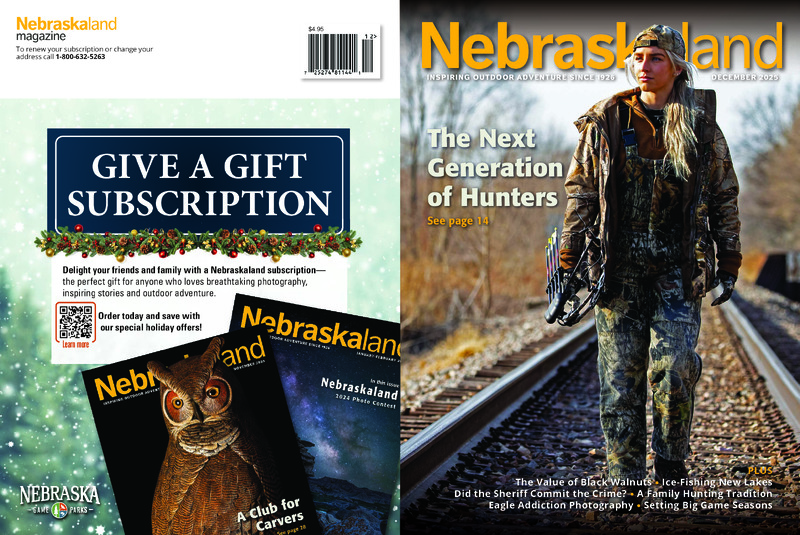
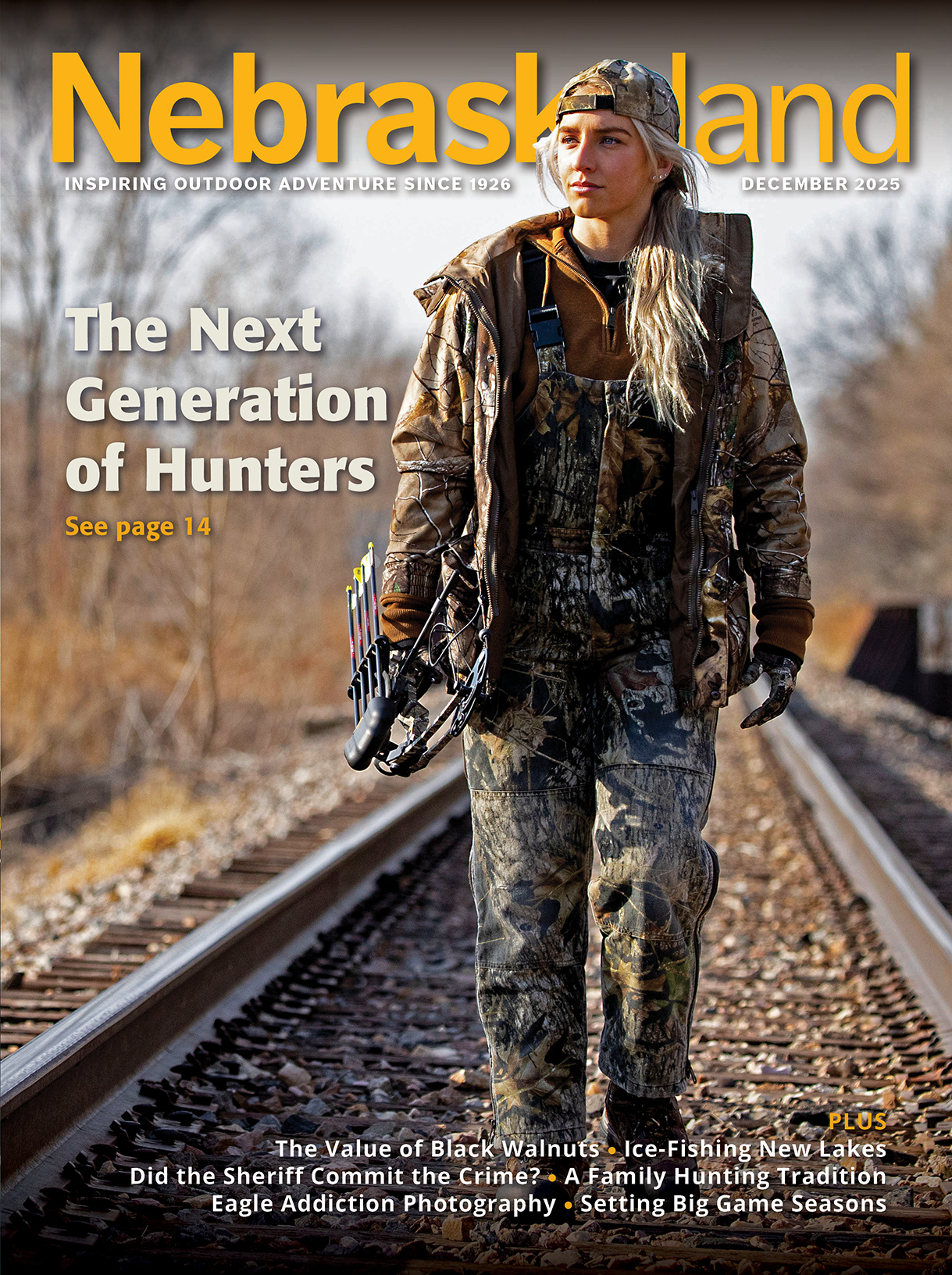
Cover: Hunters, including Alexa Sedlak of Gretna, are
utilizing modern technology and social media — tools not
available to previous generations — to improve hunting
and fishing success. See story on page 14.
JEFF KURRUS, NEBRASKALAND
This page: Sunset at Fort Niobrara National Wildlife
Refuge in Cherry County.
JUSTIN HAAG, NEBRASKALAND
December 2025 •
Nebraskaland
5
magazine
Published by the Nebraska Game and Parks
Commission since 1926. The Commission is
dedicated to the conservation and protection of
all the state's natural resources and the people
who use them.
Magazine Staff
Communications Director Christy Firestone
Public Relations Manager Shawna Richter-Ryerson
Editor Jeff Kurrus
Associate Editor Jenny Nguyen-Wheatley
Regional Editors Eric Fowler, Julie Geiser,
Justin Haag
Contributing Editor Michael Forsberg
Regular Contributors Renae Blum,
Chris Helzer, Chris Masada, Todd Mills,
Ryan Sparks, Gerry Steinauer
Art Director Tim Reigert
Graphic Designer Mel Severin
Videographer Nick Sauvageau
Photo Librarian Jaclyn Cruikshank Vogt
Administration
Director Tim McCoy
Chairman - John Hoggatt, Kearney
Vice Chairman - Donna Kush, Omaha
Magazine Subscriptions
For address changes, magazine and subscription
questions, 800-632-5263 or visit
nebraskalandmagazine.com
Advertising
For advertising information, contact:
Shane G. Gilster, 402-742-0125
shanegilster@solotreemedia.com
River otters begin breeding through
April. JON FARRAR, NEBRASKALAND
Kurt Arganbright, Valentine
Scott Cassels, Omaha
Dan Hughes, Venango
Kent McNeill, Papillion
Steve Mossman, Lincoln
Lisa Roskens, Omaha
Doug Zingula, Sidney
Nebraskaland Magazine Copyright 2025, all rights reserved. Nebraskaland is available in audio from the Nebraska Library Commission Talking Book
and Braille Service, Suite 120, 1200 N St., Lincoln, NE 68508. 800-742-7691. Nebraskaland Magazine and the Nebraska Game and Parks Commission
reserve the right to reject any advertising not in keeping with the agency mission. Rates: $18 for one year; $33 for two years; $44 for three years.
Nebraska recipients must add appropriate sales tax. To subscribe call 1-800-NEBLAND (632-5263), or go online to: NebraskalandMagazine.com.
Commission Offices
Conservation Officers
Headquarters/Southeast District Office
2200 N. 33rd Street Lincoln, NE 68503
Phone 402-471-0641
Northeast District Office
2201 N. 13th St. Norfolk, NE 68701
Phone 402-370-3374
Southwest District Office
301 E. State Farm Rd. North Platte, NE 69101
Phone 308-535-8025
ADMINISTRATION
Jeff Clauson
402-471-5531
Lincoln HQ
Administrator
Travis Shepler
402-471-5531
Lincoln HQ
Asst. Administrator
Stacey Lewton
402-471-5531
Lincoln HQ
Asst. Administrator
Mike Thome
402-471-5531
Lincoln HQ
Asst. Administrator
(Includes counties covered)
Northwest District Office (temporary)
1317 W 3rd St., Alliance, NE 69301
Phone 308-763-2940
NORTHWEST
Sean McKeehan 308-672-1824
Captain
Bassett Office
524 Panzer St., Box 508 Bassett, NE 68714
Phone 402-684-2921
Jerod Hahn
South Central District Office
1617 First Ave. Kearney, NE 68847
Phone 308-865-5310
Schramm Education Center
21502 W. Highway 31 Gretna, NE 68028
Phone 402-332-3901
Omaha Office
8495 Frederick Street, Omaha, NE 68124
Phone 402-595-2144
OutdoorNebraska.gov
The Nebraska Game and Parks Commission does not discriminate
based on race, color, ethnicity, national origin, sex, pregnancy, sexual
orientation, gender identity, religion, disability, age, genetic information,
veteran status, marital status, and/or political affiliation in its programs,
activities, or employment. Any person who believes he or she has been
discriminated against in any program, activity, facility, or service,
should contact the Nebraska Game and Parks Commission, Lincoln, NE
402-471-0641, the Nebraska Equal Opportunity Commission, Lincoln,
NE 402-471-2024, TTY/TDD 800-642-6112; Director, Office of Diversity,
Inclusion and Civil Rights, U.S. Department of Interior, 1849 C Street,
NW, Washington, D.C. 20240.
6
Nebraskaland • December 2025
– EAST SUB-DISTRICT –
308-520-5539
Sergeant
Grant Albrecht
531-229-4405
Cheyenne, Deuel, Kimball
Hunter Lee
308-280-4320
Keith, Deuel, Arthur
Jaden Porter
308-289-2274
Garden, Grant, Keith
Tyler Stueck
308-289-6260
Keith, Arthur, Grant
Keith Jadlowski 531-310-2869
Keith
Vacant
– WEST SUB-DISTRICT –
308-672-1824
Sergeant
KayLynn Miller
308-665-8440
Dawes, Sioux, Sheridan
Cassidy Harwood 308-562-9099
Box Butte, Sheridan
Josh Widhelm
308-279-9133
Scotts Bluff, Banner, Sioux
Brandon Wallace 308-280-4488
Scotts Bluff, Banner, Sioux
Travis Schultz
308-279-1292
Morrill, Scotts Bluff, Box Butte
Casey Gehrt
402-617-2112
Dawes, Sheridan, Sioux
NORTHEAST
Dale Davis
402-760-0712
Captain
– WEST SUB-DISTRICT –
Jeff Jones
402-762-5022
Sergeant
Greg Hesse
308-546-7464
Rock, Brown, Keya Paha
Jonathan Andreasen
402-340-3981
Madison, Pierce, Stanton
Trevor Stahlecker
402-928-9099
Knox, Antelope, Pierce
Mitch Johnson
402-613-8612
Cedar, Knox
– EAST SUB-DISTRICT –
Cory Krause
402-380-6410
Sergeant
Kyler Prochaska 402-830-8278
Platte, Colfax
Matt Costello
402-317-4014
Dodge, Colfax
Kelbi Abke
402-237-2537
Washington, Burt
Nicholas Fix
402-508-0261
Dixon, Dakota, Thurston
Kyle Hansen
531-739-7392
Dodge
– CENTRAL SUB-DISTRICT –
Doug Pollard
308-730-7050
Sergeant
Vacant
308-440-1863
Howard, Greeley, Merrick
Matt Brandt
308-202-0819
Sherman, Howard
Klint Gill
402-613-5800
Nance, Wheeler, Boone, Polk
Garrett Zimmer 402-416-5736
Garfield, Loup Valley
Vacant
308-380-7331
Hall, Hamilton
SOUTHWEST
Brian Piernicky 308-330-8780
Captain
– NORTH SUB-DISTRICT –
Alex Hasenauer
308-660-4671
Sergeant
Dana Miller
531-229-4404
Cherry, Hooker, Thomas
Jacob Stoinski
308-395-6001
Lincoln, Perkins
Frank Miller
402-389-0444
Cherry, Hooker
Luis Nuñez
531-333-6093
Blaine, Custer, Thomas
Brandon O’Neal 308-530-3157
Lincoln, McPherson, Logan
– SOUTH SUB-DISTRICT –
Kelsey Glodowski 308-242-9000
Sergeant
Logan Smith
531-229-4406
Frontier, Furnas, Gosper, Red Willow
Bryce Streger
308-537-0404
Dawson, Gosper
Tyler Adelman
402-314-4783
Dawson, Gosper, Furnas
Sophia Gobber
308-222-0368
Chase, Dundy, Hayes, Hitchcock
SOUTHEAST
Matt Seitz
402-806-0915
Captain
– WEST SUB-DISTRICT –
Matt Taylor
402-200-9597
Sergeant
402-902-2017
Vacant
Adams, Clay, Webster
Justin Gress
308-629-9335
Thayer, Nuckolls, Fillmore
Vacant
308-920-2762
Harlan, Franklin, Phelps
Vacant
308-440-3847
Buffalo, Kearney
– EAST SUB-DISTRICT –
Heath Packett
402-210-0888
Sergeant
Brett Greenfield 531-350-0915
Cass
Russell Mort
402-209-1506
Otoe, Johnson
Rich Berggren
402-619-1355
Douglas
Brian Arp
531-530-9011
Douglas, Sarpy
Mike Luben
402-443-6392
Saunders
Bryan Adams
402-429-1924
Nemaha, Pawnee, Richardson
– CENTRAL SUB-DISTRICT –
Curt Prohaska
402-470-1298
Sergeant
531-229-4407
Easton Albrecht
Lancaster
Ben Keller
308-430-5500
Gage, Jefferson
Mark McDonald 402-805-2353
Lancaster
Mark Sullivan
402-741-0636
Lancaster, Seward, Butler
Jarrod Messman 531-739-9760
Lancaster, Saline, York
YOUR NEBRASKA
Marquene Koontz, Ogallala
Red Fox
Instagram Photos
Follow us @nebraskaland
and tag us in your photos
to be featured in an
upcoming issue.
Connie Allen, Grand Island
Ruffled Robin
Amber Tull, Omaha
Garden Spider
8
Nebraskaland • December 2025
December 2025 •
Nebraskaland
9
Ron Hiett, Bellevue
Monarch On Display
Send your comments and photos to:
Jeff Kurrus, Editor
Nebraskaland Magazine
P.O. Box 30370
Lincoln, NE 68503
or email Jeff.Kurrus@Nebraska.gov
Mat Custer, Omaha
Eastern Fox Squirrel
10
Nebraskaland • December 2025
Please include your postal address
and telephone number. Letters
may be condensed and edited.
Photographs are also welcome.
December 2025 •
Nebraskaland
11
IN THE FIELD
ON THE MOVE
As large snowflakes fall,
a mule deer courts does
northeast of Chadron. A
tumbleweed accentuates
one of the buck’s antlers.
JUSTIN HAAG, NEBRASKALAND
12
Nebraskaland • December 2025
December 2025 •
Nebraskaland
13
IN THE FIELD
HOW THE NEXT GENERATION
HUNTS AND FISHES
By Jeff Kurrus
“Why are you on your phone?” It’s a 21st century question
countless parents have asked their teenage children.
“Checking the Reveal, Dad,” my 13-year-old said.
My tone changed entirely. “Seeing any bucks?”
The “Reveal” is our cellular camera that watches the woods
we hunt in eastern Nebraska. It’s one of many trail cams on
the market that sends pictures
back to a hunter’s phone. It’s
become a game-changer for
those wanting constant intel
about the areas they hunt.
But it’s not the only way the
next generation of hunters
and anglers are accessing the
outdoor world these days.
Online Forums
Angler Ryan Glatter, who
catches as many big fish in
Nebraska on public water JEFF KURRUS, NEBRASKALAND
as anyone I’ve recently
encountered, lives on online forums. Starting with nefga.org,
he listens to what other anglers say about public and private
waters throughout Nebraska.
Even if users are posting about private waters, Glatter
studies this information to catch fish on public waters. “I’ve
seen posts where people are catching catfish and even used
that information to catch largemouths in the same depths
and locations on a lake.”
There’s another key to these forums as well: You need to
add to the discussion, too. The more information anglers
share, the more other anglers will be willing to share.
“I pay a lot of attention to these forums,” Glatter said.
“These forums and using your online lake maps can help you
become a really good stick.”
Weather
“My buddy, Carl, has 20 weather apps on his phone,” said
longtime Nebraskland contributor Todd Mills. “These apps
decide so much of what we do when waterfowl hunting.”
Knowing the wind is crucial for waterfowl, Mills said. “It
is the most important for us. Carl will send me wind graphs
the night before we’re hunting, and he also passes along
moisture information.”
This knowledge helps them decide hunting locations
14
Nebraskaland • December 2025
and even decoy placement. “One of most important apps,
Tempest, links us to the closest weather station in the area
we’re hunting. Because the weather changes so quickly, this
allows us the most up-to-date information.”
But there is no one-stop shop. “Each of these apps has its
specialties,” Mills said. For example, Accuweather is great
at giving long-term forecasts,
he said, so he can see when
there might be a migration
push in the next couple of
weeks. But it’s not that good
if you want the best weather
details 18 hours from now. He
also has an app that tells them
where the snowline is, which
they will find and hunt just
below it.
And these apps aren’t
specific to waterfowl. “When
the humidity is high, we’ve
found that pheasants seem to
sit tighter.” This would then allow a hunter to manage their
pointer or flusher when chasing these upland birds.
onX
“OnX has changed everything for me,” said Quail Forever
Journal Editor Ryan Sparks. Known for listing public and
private lands and who owns these lands, this app does so
much more. “The first thing I do when planning a trip is
check onX,” Sparks said.
The app allows users to include waypoints for hunting
stands, for example, even offering suggestions on what
locations should be hunted regarding moon phases,
barometric pressure and wind.
“I can also use it to plant food plots,” he said. With a
feature that can mark the path of the user, Sparks will drive
the perimeter of a plot and learn the area’s total acreage,
allowing planting to be that much more efficient.
“Plus, they put their money where their mouth is,” Sparks
continued. “They’re a huge supporter of conservation and
have helped open up hundreds of thousands of acres of
land through Pheasant Forever’s PATH program, including
Nebraska Community Access Partnership land in Nebraska.”
These technologies — and what’s around the corner — will
continue to re-shape the next generation of hunters and anglers.
IN THE FIELD
Sometimes the holes that have already been cut are a hint as to where you can find fish that day, like these rainbow trout at
Eugene T. Mahoney State Park’s CenturyLink Lake. JEFF KURRUS, NEBRASKALAND
ICE-FISH WHERE YOU’VE NEVER
FISHED BEFORE
By Julie Geiser
After ice-fishing a couple of sandhill lakes last winter with
no luck, I thought about what I could have done differently
to catch fish. If you’re like me, you have limited time to fish,
and every bit of information and preparation can help make
trips on the frozen water more successful.
First off, I should have checked the Fishing Forecast and
used the interactive maps on the Nebraska Game and Parks
Commission website. These resources alone would have
helped me target species in a particular waterbody as well as
locate possible structures and lake depths.
Here are more ideas to make your trips more successful,
ones I should have paid more attention to.
Mark the Spot
In previous years, I ice-fished in the same places I fished
in the warmer months. I didn’t get to that this year, and a
little homework at these sandhill lakes would have done me
some good before ice-over. Marking GPS locations of where
you’ve caught fish is helpful for finding them during the rest
of the year.
Also, downloadable lake maps from LakeMaster,
Humminbird, Omnia Fishing, onX Fish or Navionics can help
you find places to fish before you even leave the house.
At the least, take photographs so you can refer back to
landmarks to re-create a great trip from the past.
16
Nebraskaland • December 2025
When and Where to Fish
Fish during peak feeding times, like mornings and evenings,
and in front of fronts. Pay attention to barometric pressure as
well and the fish’s response to these conditions.
Fish finders can also make ice-fishing a lot easier than
simply guessing where the fish might be under the ice. But
if you have to fish blindly, look for other anglers and fish
nearby but not close enough to intrude. If no one is around,
look for previously made holes and hope the maker had some
luck in those spots. If someone is around, ask if they have
had success.
You can also ask locals or baitshops and marinas about
locations to fish. And if none of these options pan out, it
might be time to purchase a fish finder.
Other Equipment
Bring tip-ups and several ice fishing rod/reel jigging
combinations so you’re prepared to catch larger fish such as
catfish, bass and northern pike, along with smaller species
like bluegill, perch and crappie.
Move when the fish aren’t biting and be prepared to change
lure and bait depth. Try different lures and bait for different
presentations. You never know which presentations fish will
like on any given day, so bring different lures and legal bait to
switch things up if needed.
December 2025 •
Nebraskaland
17
IN THE FIELD
Bring Nebraska’s Natural
Beauty Indoors
HOLIDAY PARTY CONVERSATIONS
By Jeff Kurrus
wild turkey or duck categories, you’ll have a decent shot to
In my personal experience of holiday gatherings going
win the room over (72% and 64%, respectively), but you’re
back 30 years, the topic has always turned to hunting with
not going to attract a lot of new hunters to shoot doves
friends, family and soon-to-be hunting partners whom I just
(38% approval rate). More and more birders are entering the
met that night.
outdoor landscape these days, and many see this songbird as
But those new friendships can only be made if, when
being exactly that, not a gamebird.
talking about our favorite outdoor pastimes, we have a
If you’re hunting a high fence area, don’t expect a lot of
decent idea of where to start the conversation.
ooohs and aaahs. Only about 30% will approve, next to
It’s good to know, therefore, that the Council to Advance
40% for hunting over bait. But if you use a bow and arrow
Hunting and Shooting Sports has done some of this work
for us. In a recent survey
conducted
with
2,212
participants from across the
country, the Council was able
to gauge the public’s views
on hunting and shooting,
not only providing critical
information about these
activities but also allowing
folks who are trying to read
the room exactly where to
begin their conversations.
The first thing you should
know is that an overwhelming
majority of people, 73%, agree
with legal hunting and 74%
agree with legal recreational
shooting. I’ve witnessed this
as well. Whether I’m visiting
schools, talking to someone
on either side of the political
Sharing the story of your latest duck-hunting trip will go a lot further with a holiday
aisle, or introducing myself gathering audience than relaying details of your latest dove-hunting adventure.
JEFF KURRUS, NEBRASKALAND
at a community event, I’ve
or a firearm when hunting (73% and 70%, respectively),
never been scorned for my love of hunting.
judgment will be minimal.
What I didn’t know, however, is that folks do have their
Males approve of legal hunting more than females (85% vs.
limits on what they deem acceptable. Unless you really know
63%), folks who live in rural areas (86%) are more approving
your audience, you might want to hold off on that story
than people from urban areas (65%), and people ages 35-54
about the African elephant you shot. You’re not going to get
(75%) approve more than those 18-34 years old (72%).
a lot of support in most rooms you enter. But deer … 72%
What do you do with these numbers? It’s pretty simple.
of folks you come across will be OK with you sharing your
Be respectful of people’s differences and remember what
passion. Even more if you’re in a small town across America
your goal is: to get others as excited about your passion as
or a Midwestern state like Nebraska.
you are.
But, this too comes with some considerations. While
You don’t do this with the photo of the 160-class Boone &
photographs of the big buck you shot seem like they would
Crockett you shot this firearm season, but you might just get
be the driving force to make a new friend, it might be more
another hunter in the field with the venison medallion recipe
sensible to share your latest venison recipes or how you
you just created.
process your own harvest.
For more information about the survey, visit cahss.org.
What if you’re a bird hunter? As long as it falls within the
18
Nebraskaland • December 2025
Transform your home or office with the stunning photography of Nebraskaland Magazine.
From sweeping landscapes to iconic wildlife, discover new ways to enjoy the Nebraska
you love. Whether you’re decorating your space or searching for the perfect gift, choose
from a mix of our favorite images — available as high-quality prints and keepsakes.
Browse by theme or explore the full gallery. Ordering is simple, secure and fast.
• Paper Prints
• Canvas Prints
• Metal Prints
• Framed Prints
• Acrylic Prints
• Fleece Blankets
• Greeting Cards
• Albums
• Acrylic Blocks
• Keepsake Boxes
• Mugs
• Ceramic Mugs
• Coasters
• Magnets
Visit
ShopNebraskaland.com
2
Nebraskaland • November 2025
to learn more.
IN THE FIELD
GOOSE BOLOGNESE PASTA
By Jenny Nguyen-Wheatley
Bolognese is the meat sauce of all
meat sauces. It’s hearty and rich, made
by slow-simmering ground meat with
a bit of milk for creaminess. This recipe
is about concentrating and building
flavors — and being patient. If you
can, make the sauce a day ahead.
It will save you from scrambling on
the day you plan to serve it, and the
overnight resting will improve the
flavor. Bolognese also freezes well.
Serve this pasta with a dry red wine,
such as Sangiovese or Barbera.
Servings: 4-6
Prep Time: 10 minutes
Cooking Time: 3 hours and 30
minutes
Ingredients:
1 pound of ground goose or duck
1 tbsp. olive oil
2 ribs of celery, chopped
1 carrot, peeled and chopped
1 medium onion, chopped
3 ounces of pancetta, finely
chopped
1 bay leaf
2 cloves of garlic, minced
1/3 cup of tomato paste
Pinch of nutmeg
Pinch of red pepper flakes*
1 cup of dry white wine
2 cups of low-sodium
chicken stock
1 cup of whole milk
1 pound of pappardelle pasta
Grated Parmesan cheese, for
serving
Kosher salt and freshly ground
pepper
* If you have it, substitute red pepper
flakes with 1 teaspoon of Trader Joe’s
Italian-style Soffritto Seasoning.
•
•
•
•
•
•
•
•
•
•
•
•
•
•
•
•
•
1. Pulse celery, carrot and onion in
a food processor until finely chopped.
20
Nebraskaland • December 2025
A rich meat sauce made of ground Canada goose.
Set aside.
2. In a heavy-bottomed medium pot,
heat 1 tablespoon of olive oil over
medium-high heat. Break up ground
goose into large chunks and add them
to the hot oil. Allow this first side to
form a nice crust before breaking up
the meat with a wooden spoon and
cooking through. Season with a pinch
of salt and then transfer meat to a
plate and set aside.
3. Lower heat to medium and add
finely chopped pancetta to render and
crisp. Then add the finely chopped
vegetables and cook until most of
the moisture has evaporated, and it
starts to stick to the bottom of the
pot, stirring often. Next, add bay leaf,
minced garlic, tomato paste, nutmeg,
red pepper flakes and a pinch of salt.
Cook for 2 minutes, stirring often.
4. Return cooked goose to the pot.
Pour in 1 cup of dry white wine and
cook, stirring often, until the wine
JENNY NGUYEN-WHEATLEY, NEBRASKALAND
is nearly completely evaporated,
meanwhile using a wooden spoon to
break up the meat as finely as you can.
Drink the rest of the white wine.
5. Add 2 cups of chicken stock and 1
cup of whole milk. Bring to a simmer
and then cook on low, uncovered, for
2 hours and 30 minutes or longer, until
the meat is completely tender. Stir
occasionally. Add more stock or water
as needed to prevent the bottom from
scorching. Season to taste with salt
and pepper.
6. It’s best to cook only as much pasta
as you’d eat at one sitting: Undercook
pappardelle pasta in salted boiling
water. In a pan, add sauce to taste
and heat on low. Transfer undercooked
pasta to the sauce, adding a bit of
pasta water to loosen up the sauce to
toss. The pasta will cook the rest of the
way during this time. Season to taste.
Serve immediately with lots of grated
Parmesan cheese.
December 2025 •
Nebraskaland
21
Chasing the
Lights
This example of the aurora borealis, also known
as the Northern Lights, was taken near an old
schoolhouse near Tekamah.
April 24, 2023.
Photos and story by Erik Johnson
22
Nebraskaland
• December 2025
December 2025 •
Nebraskaland
23
A faint display in the winter sky near Crawford.
Dec. 30, 2016.
F
or much of my life, I believed
that witnessing the Northern
Lights was only possible at the
farthest reaches of the world,
where the ground stays frozen and
the winter nights are long. I grew up
seeing photographs in textbooks and
viewing the shimmering lights on PBS
documentaries, but I never imagined
it could be a Midwestern experience.
It wasn’t until 2015 that I discovered,
camera in hand, that on rare occasions
we can witness the magical beauty of
the lights right here in Nebraska.
To be fortunate enough to catch a
glimpse of the aurora borealis, a few
key components need to be at play.
24
Nebraskaland
• December 2025
First and foremost, the right mix of
solar conditions must be present. The
lights are caused by charged particles
released by the sun that penetrate the
Earth’s magnetic field and interact
with molecules in our atmosphere,
causing a release of light.
In short, the lights are most common
in the days following a large solar flare
or storm on the surface of the sun. On
some occasions, local news outlets
will report an increased likelihood
of seeing the lights, but many times
these solar events go unreported by
mainstream media. As such, I use a
variety of forecasting resources found
online, such as spaceweather.com and
softservenews.com, which report the
current and future forecasted “KP”
number.
The KP is simply a numerical
scale for measuring geomagnetic
activity that spans from 0 to 9; 0
being no activity and 9 being a major
geomagnetic storm with strong
auroras likely. It’s also possible to sign
up for alerts from these sources to
receive an email or even text message
if conditions are favorable. In my
personal experience, I’ve found a KP of
6 or more is necessary to have a chance
of visible auroras this far south.
The second most important data
point to check is the “Bz,” or the north-
Strong colors and a
beam of green light
were reflected
on a small pond
near Lakeside.
May 25, 2024.
December 2025 •
Nebraskaland
25
Camera Tips
A long camera exposure is one of the key ingredients in
capturing the northern lights with a cellphone or digital camera.
A long exposure allows the camera to “soak up” more light over
time, making faint objects become brighter and visible, while also
revealing more color and detail.
You can set exposure time manually on most smartphones.
When in the dark, try setting the exposure to 5-10 seconds and
holding the phone as steady as possible. Any movement during
the exposure period will cause motion blur and potentially an
unusable photo. The photos shared here were all taken with a
Nikon digital camera and a tripod to keep the camera still.
With my camera, I prefer to set the lens’ aperture as large as
possible (the smallest f-stop number), turn the ISO up to 1,000+
(but not too high to avoid introducing too much grain into the
image), and use a 5-10 second shutter speed. If the lights are
moving rapidly, I might even opt for a 3-5 second exposure to help
prevent the lines of color from blending into one another.
Sometimes, even if the aurora isn’t visible to your eyes, you can
take a photo of the night sky, and your camera will capture color
invisible to the naked eye. I’ve had my camera register red or green
hues in an otherwise “black” sky. It does take some experimenting
and trial and error, but with a little practice, anyone can take
breathtaking photos worthy of sharing.
A flashlight was used to illuminate my truck near Valentine.
May 28, 2022.
south component of the interplanetary
magnetic field (IMF). If the Bz is south
(a negative number), the IMF is pointed
southward and the orientation strongly
couples with Earth’s northward
magnetic field, allowing solar wind
particles to stream in and fuel auroras.
If the Bz is north (a positive number),
it generally blocks solar wind from
entering Earth’s magnetosphere, and
26
Nebraskaland
• December 2025
you might have a bust regardless of the
KP number.
In addition to the right atmospheric
ingredients, a dark sky, free of
moonlight and clouds, is crucial. This
also means being far away from city
light pollution that will drown out
the night sky. I’ve had the best luck
witnessing the lights in the Sandhills,
far from any major cities. And, of
course, you’ll want to look due north.
The website darkskymap.com can be
helpful to pinpoint locations that are
untouched by city lights.
My first aurora “chase” was
spawned by a news report on June 22,
2015, which indicated the increased
likelihood of activity the following two
nights. The next evening, I set out with
my camera and drove north of Lincoln
until I finally traded pavement for
gravel near the town of Bee. Looking for
a subject in the countryside to frame in
a photograph, I eventually came upon a
lone windmill in a cornfield and waited
for the twilight to fade.
As stars began to emerge, I noticed
what seemed to be a vehicle’s
headlights cutting through dust
over the horizon and heading in my
An unexpected display on a friend’s ranch near Hyannis.
May 26, 2017.
December 2025 •
Nebraskaland
27
The lights reflect in a windmill stock tank near Valentine. The long camera exposure also captured the movement of the
windmill’s blades. April 22, 2017.
direction. As the beam continued to
rise vertically, I realized it wasn’t the
glow of human-made lights. I was
witnessing the Northern Lights for the
very first time in my life.
The single beam turned into several
vertical lines that moved in unison
from horizon to horizon. While the
lights appeared white and pale green
to me, my digital camera was able to
pick up much deeper colors with a long
exposure. I continued to photograph
28
Nebraskaland
• December 2025
the lights until the early hours of the
morning when things finally began to
quiet down.
After my first encounter, the most
memorable experience I’ve had
viewing the Northern Lights happened
during an unexpected encounter
on a friend’s ranch near the town of
Hyannis. As I settled in for the night
in my truck’s camper topper, I looked
up into the darkness and thought the
sky seemed far too bright for being
long past twilight. Allowing my eyes
to adjust for a few brief moments, I
realized the source of illuminance
was moving fluidly through the sky,
with picket-fence-like lines moving
above the horizon from west to east.
Being completely caught off guard
only added to the excitement, and
I could only imagine the awe that
civilizations throughout history might
have experienced when seeing the
unexplained and unexpected anomaly.
An old home near Crawford under a vibrant curtain of light. The KP index on this night reached 9
and is considered to be the strongest solar storm on Earth in the last two decades. May 24, 2024.
The past few years have brought
increased activity and many exciting
opportunities for first-time viewers
across our state. This is most likely
twofold: The first, and most important,
factor is that we are heading into the
“solar maximum,” or an 11-year cycle
of solar activity that the sun undergoes.
During the solar maximum, there are
more sunspots, solar flares and coronal
mass ejections, which all contribute
to more opportunities for bursts of
charged particles to make the journey
across our solar system. I believe
the second factor is wider access to
improved technologies to capture
these events.
Older cellphones did not have the
ability to capture long exposures at
night. Many phones can now be set
to take 10 or more second exposures,
which allow for capturing photos
in dimly-lit environments that had
previously been impossible without
the use of a digital camera.
This has led to a flood of stunning
photos being shared on Facebook and
other platforms after a night of aurora
activity, and a fine time for a new
photographer to introduce themselves
to the Northern Lights. N
Erik Johnson is a Lincoln-based
photographer, often joined on adventures
by his yellow Lab, Khloe. See more of his
work at @erikjohnsonphoto.
December 2025 •
Nebraskaland
29
Outdoor Nebraska
By Tim Reigert
tep outdoors this holiday season. There, you can find multiple learning
opportunities for young and old, archery for college students and hiking
into the night with naturalists. N
What to Do in December
Christmas Bird Count for Kids
Dec. 29, 10 a.m.-Noon | Schramm Education Center, Gretna
earn more about the birds that call chramm home during the winter
while participating in the longest-running community science pro ect in the
country. uring the event, participants can choose to help count birds indoors
near the bird feeders, or on a -mile hike in the prairie or down to the latte
iver. articipants who choose to hike should dress for the weather, as they
will be going out in rain, snow or sunshine.
articipants are encouraged to bring their own binoculars, as a limited number
of binoculars are available for loan. The cost to participate is
per person
(ages and under free), which includes the program and admission to the
chramm Education enter after the program. chramm Family ass Members
participate free. A state park vehicle permit is not re uired. JOEL JORGENSEN
Wise & Wild - Animal
Tracks and Signs
Wildcat Hills Homeschool Programs
Dec. 9, 2:30 p.m. | Eugene T. Mahoney State Park, Ashland
Dec. 18, 10 a.m. | Wildcat Hills Nature Center, Gering
The ildcat ills omeschool rograms will meet once a month at
a.m. Mountain Time at the ildcat ills ature enter. ertified staff
lead various programs on ecosystems, animals, adaptations and habitats
found only in western ebraska. Activities focus on hands-on learning and
observations. The programs are free, but a state park vehicle entry permit
is re uired. hildren must be accompanied by an adult. ontact the ature
enter at
for more information. JUSTIN HAAG, NEBRASKALAND
College Night on the Range
Dec. 2 and 9, 7-9 p.m. | Turpin Outdoor
Education Center, Lincoln
ollege ight on the ange provides opportunities for
college students to connect, unwind and e plore shooting
sports in a safe and friendly atmosphere. o e perience
with a bow o problem. Instruction and e uipment are
available. egistration is not re uired, but students must
show their I . heck-in closes at p.m., and the
fee
includes e uipment use. NGPC LIBRARY
30
Nebraskaland • December 2025
hat happened here Even though animals tend to avoid people, we can see
the clues they leave behind. ature enthusiasts ages
are invited to attend
the ise
ild program at Eugene T. Mahoney’s newly renovated ames
Family onservatory and ature enter. This program is designed for seniors
who love the outdoors and want to en oy time in the parks. oin us on your
own or bring along friends of any age. These programs are free, but a state
park vehicle entry permit is re uired.
JENNY NGUYEN-WHEATLEY, NEBRASKALAND
Night Hike at
Schramm Park
Dec. 11, 7-8 p.m. | Schramm Park, Gretna
oin chramm naturalists on a hike in the forest
after nightfall. Meet at the pond trailhead and
bring a flashlight or headlamp. articipants will
hike for about one hour and walk about miles
from the ond Trailhead along the ackberry
Trail to the full ed edar Trail loop. There
are stairs at the trailhead and some elevation
change. This is a free program, but a state park
vehicle entry permit is re uired. GETTY IMAGES
December 2025 •
Nebraskaland
31
THE VALUE OF
Black Walnuts
M
Black walnut
nutmeats, freshly
removed from
the shell.
Story and photos by Gerry Steinauer, Botanist
y earliest memory of black walnuts is the sharp
crack of a hammer striking their shells.
My dad loved black walnut (Juglans nigra)
nutmeats in his brownies, a taste he likely
developed during his childhood in Pawnee County, where
this native tree is common. As a kid, sitting on the driveway,
I would crack the nuts’ tough shells with a hammer and dig
out the kernels from their tangled chambers to fulfill my
job in brownie making. Not all the kernels made it into the
brownies; I ate plenty right out of the shell, savoring their
sweet, earthy flavor.
In college, I lived with friends in Vermillion, South Dakota,
where tall walnut trees shaded the backyard. On autumn
weekends, while grilling on the porch, we gathered fallen
walnuts in their green husks and hurled them at a metal
garbage can 30 yards away, scoring points for landing a
walnut in the can or hitting the outside. It was great fun.
Later in life, as a botanist, I came to know black walnuts in a
more professional light. During plant surveys and prescribed
burns at Indian Cave State Park, I was awed by the occasional
giant growing in deep, moist, never-logged ravines along the
Missouri iver bluffs. Their massive, branchless trunks, the
envy of loggers, filled my mind with thoughts of primeval
forest.
The morning sun highlights black walnuts in Walnut Grove Park in Millard. The grove was planted in the late 1800s and used as
a picnic spot by the early 1900s.
32
Nebraskaland • December 2025
December 2025 •
Nebraskaland
33
Black walnuts are common in eastern Nebraska forests,
providing food and habitat for wildlife. People especially
prize their rich nuts and dark, beautiful wood.
The Walnut’s Delectable Nut
In eastern Nebraska, black walnuts grow in rich, moist
forests along stream bottoms, low bluffs and upland
ravines of the Missouri iver and its lower tributaries. The
species extends westward into central Nebraska along the
Republican and Niobrara river drainages. On prime lowland
sites, the trees can reach 100 feet in height, though 40 to 60
feet is more typical. Black walnuts have also been planted in
groves for wood production and as yard trees, prized for the
graceful beauty of their wide-spreading branches, dark bark
and large, frond-like leaves.
The walnut’s wind-pollinated flowers appear in May
alongside the leaves. Male blooms grow in drooping green
In early autumn, walnuts ripen in thick green husks that fall to the ground and split open to release the nuts.
n spring male walnut flowers appear in long drooping
clusters known as catkins.
34
Nebraskaland • December 2025
catkins
to
inches long, while the female flowers are
smaller and less showy, appearing singly or in clusters of two
to five. By ctober, the nuts, encased in thick green husks,
ripen and begin to fall, often to the dismay of anyone with
a well-manicured lawn. On the ground, the husks dry and
decay, turning chocolate brown or black. Inside is a ridged
black nut, and within that, a creamy to golden-brown kernel.
uirrels flock to the crop, feasting on some nuts and
burying the rest for the cold winter ahead. Woodpeckers,
mice, other rodents and even black bears can pry or chew
through the hard shells for the rich reward inside.
People have also long valued walnuts. Archaeologists often
find nutting stones at ative American village sites. These
flat stones, with shallow, small, bowl-shaped depressions
carved into the surface were once used to hold walnuts or
other nuts while they were cracked with another stone.
Some tribes boiled the walnut meats and skimmed the oil
for cooking or ate them raw, roasted or ground into meal for
breads and porridges. In Nebraska, the Pawnee, Omaha and
Ponca ate them raw, mixed with honey or stirred into soups.
Among Euro-American settlers, nutting parties were both a
social event and a way to fill the pantry. n pleasant autumn
days, neighbors and friends gathered in walnut stands,
the adults collecting nuts while visiting, and the children
playing beneath the yellowing trees. Many nuts were eaten
on the spot, while the rest were taken home, likely in bushel
baskets on the back of a wagon, and stored to be savored in
cakes, pies and candies over the coming winter.
I usually gather walnuts about a month after they fall,
giving the husks time to dry and darken. This is a gamble: If
the crop is small, squirrels may leave
few behind. To husk them, I place
the nuts on a brick or concrete and
give the dried husks a few light taps
with a hammer to loosen them
before peeling them away. Then I
crack the shell with firmer blows
and pick out the nutmeats. It is
slow work, but I find it rela ing
and a bit nostalgic.
In “ ild easons: athering
and Cooking Wild Plants of
the reat lains,” author ay
Young notes that the husk’s
strong, pungent juice can seep
December 2025 •
Nebraskaland
35
through the shell and alter the nut’s flavor. he removes the
husks as soon as the nuts fall, while still green. Her method
is simple: ut on old rubber-soled shoes, roll each walnut
underfoot on a flat rock or concrete and then remove the
husks by hand. Wear gloves, as the husks’ juices will stain
your hands a lasting, ghoulish green-black. After husking,
she allows the nuts to dry and cure for about a month before
cracking. For those who want to skip the work, shelled black
walnuts are available online at a reasonable price.
The taste of black walnuts is not for everyone, as they
have a stronger flavor than the mild, store-bought English
walnuts. oung finds they pair well with baked s uash and
yams, fresh or cooked fruit and yogurt-based salad dressings.
Her book includes recipes for black walnut caramels, fudge,
toffee, bread pudding and cookies, all fitting autumn and
holiday treats.
The Beauty of Walnut Wood
As early as 1610, colonists were shipping walnut logs from
Virginia to England to be made into solid-wood furniture,
which was often painted. Like the English, early Americans
had little appreciation for walnut’s fine wood. They felled
trees for more practical uses: fence posts, railroad ties and
firewood. By the mids, when furniture styles improved
and walnut was finally valued for its fine grain and rich color,
lumber-grade trees had already become uncommon in settled
regions of the country.
During World Wars I and II, demand for walnut wood
surged because the wood is strong, shock- and warp-resistant
and easy to work with. Walnut was used to produce millions
of rifle stocks, propeller hubs and other precision parts for
the war efforts. overnment workers went door to door in
rural areas of the Midwest, including Nebraska, to locate
and harvest trees. They struggled to find enough, and during
World War II buyers roamed as far west as the Little Blue
River and Sandy Creek valleys in south-central Nebraska, far
beyond walnut’s prime range in the state. By the end of that
war, harvestable walnut had become even scarcer, prompting
foresters to encourage landowners to plant walnut groves for
future harvest and as an investment for their grandchildren.
teve arloff, a ebraska Forest ervice district forester
based in Omaha, said Nebraska’s oldest planted walnut
groves now have trees with trunks
to
inches wide and
are not yet ready for harvest. Unfortunately, many groves
were planted in poor locations, such as dry uplands or wornout farm fields, resulting in e ceptionally slow growth.
e e plained that ebraska’s finest black walnuts for
harvest grow in native forests on stream terraces along the
eastern edge of the state, where rainfall is highest and soils
are moist but well-drained. ompeting fiercely with other
A fox squirrel, determined to reach the nutmeats within, gnaws its way through a tough walnut shell.
A cut trunk displays the walnut’s rich, dark heartwood, highly valued by woodworkers, along with the whitish sapwood and
rough outer bark.
36
Nebraskaland • December 2025
trees, forest-grown walnuts shoot straight and tall in a race
to reach the canopy and sunlight. In the shade below, their
lower branches receive little light, die and eventually fall
away.
Trees prime for harvest have straight trunks for at least
the first
feet, with few branches, knots or other defects,
and are at least 24 inches in diameter a few feet above
the ground. These rarities can bring landowners ,
to
,
apiece. The most valuable walnuts arloff has seen
in Nebraska grow in Hummel Park in north Omaha along the
Missouri iver. The largest of these giants have trunks
inches in diameter, and a logger once valued a single tree at
,
.
Most walnuts in Nebraska, however, are not prime quality
and bring far less value. For example, an elderly neighbor of
mine had about 40 walnut trees in a woodlot outside Aurora.
The best of them had straight, branchless trunks for about
the first
feet and were
inches in diameter. Most had
narrower, crooked or knotty trunks. He contracted with a
logger to cut the trees and was paid only a few thousand
dollars, a price I thought was well below their habitat and
aesthetic value.
Not long ago, when working with woodland owners,
arloff completed
to
walnut timber appraisals a year,
relying on a few southeastern Nebraska loggers to harvest
the trees. Many of those loggers have since retired and not
been replaced. Today, he does only three or four appraisals
annually, with loggers now also coming from Iowa, Missouri
and ansas. e re uires that loggers cut only a few of the
larger, high-quality trees, leaving some for the future. Some
low-quality, less valuable trees are also harvested.
Woodworkers have long favored walnuts from the drier
reat lains, where slower tree growth produces tighter rings
and darker wood than in wetter regions to the east. There,
faster growth yields wider rings and lighter-colored wood.
Dark walnut is especially prized for veneer, a thin slice of
wood applied to a base material such as plywood to give the
appearance of solid walnut in furniture and cabinetry. Most
prime American walnut logs, including those from Nebraska,
are shipped to Europe and Asia, where they are highly valued
and processed into veneer. Lower-quality logs from the
state are milled locally into lumber for furniture, cabinets,
gunstocks and other uses.
With no woodworking skills, my connection to black
walnuts is personal. I admire the fine grain of my shotgun
stock on autumn hunts, enjoy walks beneath the sprawling
old trees at alnut rove ark in Millard and still crack and
eat walnuts on my driveway. N
December 2025 •
Nebraskaland
37
Did the Sheriff Commit the Crime?
By David L. Bristow, Nebraska State Historical Society
W
ho is the “bad man” in the two photos below? Is it the
man in the striped overalls? Or is he just playacting
while Buffalo ounty heriff alter ammons (in
vest) and earney olice hief ohn Trindle (in dark
suit) congratulate themselves for roughing up suspicious
characters?
hotographer olomon Butcher said he made this photo in
. ine years later, one of the men pictured was involved
in a sensational trial that shocked the community.
alter ammons was elected Buffalo ounty heriff in
ovember
. Twenty-seven years old, he was respected
as a tough and fearless deputy. e was also a ebraska
ational uard o cer and a panish-American ar veteran.
As a deputy, ammons chased criminals and harassed
suspicious characters.
ne day, he and olice hief
Trindle “picked up a couple of e tremely suspicious young
fellows at the nion acific depot,” said the earney
ub on April
,
. In their pockets, the men had
some ads for companies dealing in e plosives. ince
“neither of them could e hibit as much as a nickel,” a
local udge sentenced them to
days in ail for vagrancy.
In those days, suspicion was often enough for an arrest. The
A new fad of the Kearney sheri and Chief of Police Trindle when a bad man strikes the city.
Photo by olomon . utcher 9 . NSHS RG2608-0-2935
38
Nebraskaland
• December 2025
photos below look more like summertime but are probably
based on similar circumstances.
After completing three terms as sheriff, by
ammons
was working as a claim ad ustor for the nion acific ailroad
and had risen to lieutenant colonel in the uard. e had a wife
and -year-old daughter at home but spent part of hristmas
ay drinking in a local bar with his buddy elbert mith.
mith was a clerk at the local post o ce. e mentioned
that a special package had arrived containing a ,
bank
transfer. It sat in the post o ce safe until the banks opened
after the holiday.
Another view with a di erent bad man.
postcards. NSHS RG2608-0-2935A
maha
aily ee
ov.
9
.
utcher was known to stage photos re enacting events which he would then sell as
December 2025 •
Nebraskaland
39
Kearney Post
ce under construction in 9 . Today the building is home
to the useum of ebraska Art and is listed on the ational egister of
istoric Places. Photo by olomon . utcher. NSHS RG2608-0-2455
ammons trial was held in the maha Post
ce which doubled as a federal courthouse and o
landmark building at th and odge streets was demolished in 9 . NSHS RG3348-6-388
But when the post o ce opened, the money was gone,
a window was open and there were footprints in the snow.
ammons uickly volunteered to help. e spent si hours
a day with postal investigators, advising against the use of
bloodhounds, and suggesting a half dozen local residents as
suspects.
vening
40
orld
erald
Nebraskaland
ov. 9
9
.
• December 2025
ce building. uilt in
9
the
ostal inspectors thought the footprints and open window
were red herrings. It looked like an inside ob. ammons named
several post o ce employees but did not mention mith.
mith’s wife noticed that he wasn’t eating or sleeping.
n an. , he confessed but said he had not acted alone.
ammons, he said, had asked him for the o ce key and safe
combination and said they’d split the money.
ammons was arrested later that day, but it was ovember
before his case came to trial in federal court in maha. ut on
bond, he assembled a powerful legal team led by a former . .
senator and assisted by two judges.
The trial was a sensation. It seemed that half of earney
was filling downtown maha streets, cafes, theaters and
hotels. The defense said mith stole the money himself, but
multiple witnesses vouched for his whereabouts. And the
footprints in the snow were too small to have been made by
mith but not by ammons. ther witnesses cast doubt on
ammons’ alibi.
ammons remained cool.
e testified that he had
confronted mith, appealing “to all that was good and manly
in him to e onerate me by telling the truth.” mith, ammons
claimed, began crying and said, “They made me tell that story, and I’m afraid
to change it now for fear they’ll hang me.”
ne witness said he’d overheard ammons saying he didn’t think mith
“would s ueal on me.” Then it came out that ammons’ team had paid at
least one witness. Another defense witness was charged with per ury after
lying under oath about his criminal record. ammons was even accused of
jury tampering.
The -day trial ended on Thanksgiving morning.
“I feel pretty good,” ammons said. The ury had deliberated only a few
hours that probably meant ac uittal. But he turned pale and gripped the
edges of a table when the verdict of “guilty” was read.
mith had already pleaded guilty and said he was an ious to atone for his
part. Most earneyites believed his story. mith was sentenced to si months
in ail and a
fine. tudents at the earney teachers’ college offered to
board with his wife to help her make a living while mith was in prison. o
such offer was made for ammons.
ammons’ re uest for a new trial was denied. Thanks to his status and
connections, he had been granted every presumption of innocence, along with
the sort of legal representation that ordinary defendants could only dream of.
nlike the poor drifters he used to harass, he didn’t look like a “bad man.”
The former sheriff was sentenced to two-and-a-half years in the federal
penitentiary in eavenworth, ansas. e died in alifornia in
. N
Visit the Nebraska State Historical Society’s website at history.nebraska.gov.
maha
December 2025 •
aily ee
ov.
Nebraskaland
9
.
41
Still Making Memories
A Family Tradition
Story and photos by Jeff Kurrus
'I
once dated a girl who lived in that house,” Justin Stofer
said from beside me as we drove the back roads of
Fillmore County to our next bird-hunting spot.
The statement wasn’t braggadocios. Nor longing. It was
simply information shared from my bird hunting guide last
season.
But when he said it, I couldn’t help but feel a twinge of
jealousy.
While I consider myself a nonnative native of Nebraska,
having lived here for more than 20 years, I grew up driving
the back roads of a township of sorts north of Memphis,
Tennessee, named Shelby Forest. As a kid-turned-teenagerturned-adult, friends and I drove these back roads hunting
and fishing on any number of public and private lands.
This past winter, I had the good fortune of re-visiting this
area with my son, pointing to fishing holes that I remember
fondly that he’ll never remember again and even taking him
to our public duck hole that I hadn’t seen in 25 years.
So, when Justin made that simple throwaway statement
as we drove the gravel roads of his youth, I began to listen
Justin Stofer, his German shorthair, Mojo, son Teegan, Soren Frahm, pudelpointer Penny and Shane Frahm after
a day of hunting in Saline, Thayer and Fillmore counties. PHOTO COURTESY OF JUSTIN STOFER
42
Nebraskaland
• December 2025
Justin's German
shorthair pointer,
Trapper, retrieves
a pheasant during
a hunt near
Geneva.
Ella Stofer, Justin's daughter, has continued the
family's hunting tradition by deer hunting with dad
each year and trapshooting. PHOTO COURTESY OF JUSTIN STOFER
even more intently, because I knew what it was like to have
these memories. Yet, having not grown up here, I couldn’t get
enough of Justin’s nostalgia that returns to him every hunting
season.
“As a kid, one of my grandfathers was a gunsmith and the
other owned a mechanic shop in Geneva,” Justin said. “Dad
says the only time he would shut the mechanic shop down
was the opening day of pheasant season. It’s been a longstanding tradition for us.”
As a kid, Justin walked alongside his brother, Jon — 7
years older than him — on many bird hunts throughout the
county. Being part of the farming community, where Justin
eventually worked as a teenager, everyone knew everyone,
and having places to hunt was easy.
“We hunted all the time,” Justin said.
Like all hunters seem to have, Justin and his family
nicknamed their frequently traveled areas. Farmer’s, the
Milligan Ponds, the Big Pasture, Konzak's and more. The same
roads he traveled then are the same ones he travels now.
And the memories constantly resurface, like when the
44
Nebraskaland
• December 2025
Justin walks by a patch of sunflowers on an upland hunt in Fillmore County.
Having adequate food and cover is crucial for the long-term health of Nebraska's upland bird populations.
family became dog owners for the first time.
“My buddy and I were driving out near Sandpiper WMA,”
Justin said. “I worked on a farm near there, and a Brittany
[spaniel] came out of the ditch. No collar. No nothing. Either
someone had dumped her or she got lost hunting. So, we
loaded her up, took her to the vet and put up signs. But
nobody claimed her.
“She had no training. But was a fantastic dog.”
Justin hunted that dog through his teens and 20s,
eventually buying a German shorthair and hunting over
that breed since. But his shorthairs, Mojo and Trapper, aren’t
normal shorthairs.
They’re gigantic.
“The shorthairs came out of Minnesota from the Minnesota
Horse and Hunt Club,” Justin said. “As the story goes, the
owner of the club went to Germany and grabbed the No. 1
stud there and brought him back to America. My dogs trace
back to him. They’re just bigger.”
When we hunted, it was clear why he loves these dogs so
much. They cut through habitat — regardless of height —
with ease, and they can hunt long. This is beneficial to Justin
because he can walk — I mean, really walk.
As I trailed him with a camera through field after field near
Geneva, he reminded me of the 6-foot-5 hunting partner I
had as a kid, working field edges and plum thickets for quail
just like he does here.
In each instance, keeping up is the primary goal.
December 2025 •
Nebraskaland
45
Justin hunts many of the same places he did as a kid. This season, because of the weather
conditions throughout the spring and summer, he has high expectations for Nebraska's upland hunting.
“This year we put on 18 miles at the Sharptail Shootout,”
he said, the most unsurprising fact of the day. Each year, that
number grows into the hundreds of miles. And he and his
friends have most of the ground to themselves.
“You’ll see a few guys hunting early in the season,” he said.
“But I can tell you that before Covid, no one was hunting.
Now, you have to be at your spot at 4:30 or 5 a.m. on opening
morning.
“You’re an hour and a half from Lincoln out here,” he
continued. “A lot of guys will even come without a dog. But
once you get later in the season, there’s no pressure.”
Those are the times that Justin and his buddies begin their
own management strategies. “We won’t hunt coveys under
46
Nebraskaland
• December 2025
10 birds,” he said. “And we’ll stay in touch with each other to
tell what we do at a certain place.” This ensures that, given
good weather and no further loss of habitat, there will be
birds around the following season.
“The last three to four years have been really good on
private ground,” he said, “but plum thickets are still being
taken out on places. This is great habitat that has to stay. A
couple of years ago, public ground was great."
Habitat remains the crucial linchpin to everything Justin
loves to do each fall. “Since I was a kid, our spots have been
cut in half for production ag. Those days, you could drive
down the road and see birds in the ditches. We had more milo
around. Better habitat. Better cover. And fencerows getting
torn out makes a difference.”
But the weather has remained in his favor. “We had a good
summer,” he said. “We were dry in early June. That allowed
chicks to hatch, and they didn’t have to fight the cold, damp
rain every day. And not a ton of hail. But we had plenty of
rain the rest of the year to help with grass for cover and bugs
for food.”
Because of these conditions and the fact that hunting
remains such a huge tradition in his family, Justin knows
he won’t be the only hunter in the field this fall. He will
continue to hunt with his brother and his English pointer
throughout the season, and his 73-year-old dad will still run
blocker for their group.
Plus, there are the additions of his 16-year-old daughter,
Ella, and his 14-year-old son, Teegan. “We started them as
soon as they could come and walk,” he said. “Then we started
youth hunts.” They were put on wild birds immediately, and
Ella and Teegan have even taken shooting a step further by
trapshooting for the Ashland Gun Club and even competing
in the state championship in Doniphan.
Just like the days when his granddad would shut down the
mechanic shop in Geneva to hunt on opening day, Justin has
kept his family’s hunting tradition alive. Each opening day is
a holiday. Each gravel road is a reminder of an old memory
and a chance at a new one, just like every bird that rises from
the point of one of his dogs. N
December 2025 •
Nebraskaland
47
Walleye
Movement at
Lewis & Clark
Story and photos by Eric Fowler
A
4-year study of walleye and
sauger in Lewis and Clark
Lake and the Missouri River
above it confirmed what biologists had
suspected: A high number of larval
and young fish, and some adults, are
flushed through avins oint am.
It also revealed some interesting
movement patterns of adult fish and
the importance of deep-water habitat
in the reservoir to wintering walleyes.
The study was a cooperative effort
between outh akota ame, Fish,
and arks, the ebraska ame and
arks ommission and the niversity
of ebraska- incoln.
ill adigan,
who conducted the field research for
his doctoral study in
’s chool
of
atural
esources, implanted
transmitters into the abdomens of
adult walleyes and 82 saugers captured
in four segments of the
miles of
river and reservoir between the Fort
andall and
avins
oint dams.
e then tracked their movements
from
to
by placing
receivers every miles throughout the
system.
adigan found the movement of the
tagged fish varied according to se ,
species and where they were tagged. f
particular interest were some walleyes
tagged below Fort andall am that
had migrated in the fall to deep water
near avins oint am, where they
overwintered before swimming back
48
Nebraskaland
• December 2025
upstream in the spring. ne tagged
fish made that round trip twice.
“ hat we saw with the science
mirrored what the fishing guides saw
ust going out there and fishing every
day,” adigan said. “They catch fish
there, and our telemetry told us the
fish are going right there in the winter,
too.”
ther findings included:
Many walleyes gather to spawn
below Fort andall am and in an area
near antee.
p to one-third of the sauger
tagged in the delta in the upper end
of Lewis and Clark Lake never left
the delta and seemed to spawn there
as well, indicating that they have the
food and habitat they need there.
Appro imately
to
of walleyes and sauger were site
residents, moving less than
miles
from where they were tagged during
the study.
auger used up to
miles of the
study area.
Female walleyes tagged below
Fort andall used more of the study
area than males.
alleye tagged near antee
utilized more of the study area
(appro imately
miles) than walleye
tagged elsewhere ( miles).
Two fish tagged in the same
location e hibited opposite behaviors:
ne moved between the dams, and one
•
•
University of Nebraska-Lincoln
graduate student Will Radigan pilots
a boat as his assistants cast a trawl
net to sample larval sh in the
spillway below Gavins Point Dam.
•
•
•
•
•
stayed close to where it was tagged.
Additionally,
to
of the
tagged walleye and
to
of
tagged sauger were harvested each
year, rates similar to what has been
documented in studies on ake ahe.
“I had one fish that got caught by
anglers or different times, which is
kind of crazy because I didn’t tag that
many fish,” he said.
ust si of the
tagged fish passed
through avins oint am. “That
surprised me,” adigan said.
owever, using trawl nets set at
various depths weekly between May
and eptember below avins oint
am, adigan also found that roughly
to
million larval fish of
species
were flushed through the dam each
year. f those,
were freshwater
drum, and
,
to
,
were
walleye and sauger. adigan said that
was
times higher than the number
of fish flushed through Fort andall
am, which has a lower e change
rate and releases water from greater
depths.
That confirmed what biologists
in both states already knew: Lewis
and Clark Lake is a wide spot in the
Missouri iver, with the volume of
water being replaced, on average,
every seven days. ith that water goes
some fish. uring historically high
releases in
, turnover occurred
every . days. That figure was nearly
matched during the flood of
. ith
high flows, the number of fish flushed
through the dam is much higher.
“ e find that when we have high
water years, where releases through
avins are over
,
or
,
F , our gill net catch in ewis and
lark ake drops, and there’s a pretty
December 2025 •
Nebraskaland
49
Game and Parks
biologists e
Schuckman and
Phil Chvala wait as
Radigan sutures
a walleye after
implanting a
transmitter for
his study.
ike amsa of utan holds a walleye he caught on ewis and Clark ake. amsa was one of several shing guides who helped
adigan locate or even catch walleye to tag for the study as was the case with this sh.
Fish Tagging
While the receivers
were removed from the
system at the end of the
study and transmitters
no longer work, there are
still up to 180 tagged fish
swimming in the reach.
While some of those may
have lost the metal jaw
tags they received, anglers
might find a transmitter
while cleaning a fish.
Those who do can still
report it to the Game and
Parks fisheries staff in
the Norfolk office, SDGFP
staff in Chamberlain, or
by emailing Will Radigan
at wradigan2@huskers.
unl.edu to learn when and
where the fish was tagged.
50
Nebraskaland
• December 2025
significant relationship to that over
the last
or
years,” said eff
chuckman, district fisheries biologist
for ame and arks. onversely, when
releases are low, biologists catch more
fish in their sampling nets in the fall.
That was the case in the mid- to lates when releases from the dam
averaged less than
,
F , and
biologists sampled to times more
walleye than they did from
to
.
eleases were below normal during
the study, and it appears that fewer
adult fish move through the dam
during those conditions. “It’s hitting
them when they’re little larval fish and
the young of the year,” adigan said.
“It’s the cumulative effect through all
of the different life stages that is the
big deal.”
The study reinforced a decision by
both states to stop stocking walleyes
in the system. From
to
, more
than . million walleye fry and .
million fingerlings were stocked in the
lake to help it recover from the
flood. ampling showed those fish
contributed little to the population.
“ e had one year where the stocked
fish contributed heavily, and normally
it’s during a high water year, but most
years we have more than enough
natural reproduction up there to
supply our recruitment,” chuckman
said.
The study won’t lead to any changes
in how either state manages the
river or reservoir. Movement data
showed that biologists are sampling in
locations that accurately measure the
subpopulations of walleye. It did show
that it will be di cult to accurately
count sauger, many of which remain in
the delta.
“If we could figure out the logistics
on that, it might be a good way to
get some information, but boy that’s
di cult,” chuckman said, pointing
to the braided nature of the river in
the delta and the area it covers that
makes it hard to cover with gill nets or
electrofishing.
chuckman said he was most
surprised by the number of fish that
moved out of the reservoir to spawn
in the delta or beyond, a fact that
e plains the di culty they had
helping adigan capture fish to tag
there during the spring. “In most of
our reservoirs in the state, you go to
the dam in the spring of the year and
it’s full of spawning walleye,” he said.
“That is not the case in Lewis and
lark ake.”
adigan said area fishing guides
were instrumental in the study,
helping adigan catch fish to tag with
rod and reel or telling him where they
could catch them with electrofishing
gear.
ith low releases in recent years,
biologists’ catch rates have improved
significantly, as has the fishing. “ e’re
building numbers, and fishing in
is indicative of that,” said chuckman.
“ ife is good. They caught a lot of
limits of walleye out of ewis and
lark ake this spring.”
adigan and
chuckman agree
anglers need to enjoy catching and
keeping those fish now. “ e’re
one high-water year away from
losing a bunch of them again,”
chuckman said. N
December 2025 •
Nebraskaland
51
Addicted to Eagles
Ogallala woman enamored
by bald eagle photography
Story by Eric Fowler, Photos by Teri Elmshauser
U
nlike her husband, Jake, Teri
Elmshauser can’t wait for Lake
McConaughy to freeze over. For
Jake, the ice means there will be
no more walleye fishing until spring.
For Teri, it means she will soon be
making the short drive to the spillway
below Kingsley Dam, where she can
feed her “addiction”
photographing
bald eagles.
Elmshauser lives 15 minutes from
Lake Ogallala, which, in the coldest
of winters, can host hundreds of
bald eagles. On any given morning
when the eagles are around between
December and March, you are likely to
see her there, sitting in her shiny red
photo blind, a eep named ubi. ith
her huge camera and lens resting on
a sandbag in the open window, and a
heated blanket in her lap and slippers
keeping her warm, she waits for the
action: eagles swooping down to
feed on fish that are flushed through
the dam’s hydroelectric plant. If you
fre uent ebraska photography sites
like Nebraska Through the Lens on
Facebook, you’ve seen her work.
er interest in photography began
as a child in Lincoln. “Grandma used
to waste a lot of money on those little
cameras and film,” she said. er
interest faded growing up, but was
rekindled in 2006, when she bought a
basic
with a basic
mm lens
and took a photography class. oon
after, she became enamored with
eagles but is uick to say those first
Teri Elmshauser of Ogallala spends every winter morning she can sitting in her red
photo blind named Rubi photographing bald eagles at Lake Ogallala.
A pair of bald eagles ght
over a walleye one caught
in the spillway below
Kingsley Dam.
ERIC FOWLER, NEBRASKALAND
52
Nebraskaland • December 2025
December 2025 •
Nebraskaland
53
cold like this,” Elmshauser said last
February. “They just go crazy feeding.”
ith so many eagle photos in hand
already, she tries to limit her e posures
to the best action. But Elmshauser said
a successful day has little to do with
getting the perfect photo or the keeper
rate for the day.
Seeing high interest rates and
the cost of living take their toll on
everyday people in her ob as a loan
o cer at a local bank can be stressful,
she said. Being outdoors and engaged
with nature helps her let go, even
if it is just for an hour before work.
“ hotography is my check-out zone, if
you will,” she said. “It’s why I go out in
the mornings before my 8 to 5 and on
weekends. It gets my mind in the right
place to tackle the day. “A sweet photo
is ust the cherry on top.” N
An eagle lands in a dead tree next to Lake Ogallala.
Elmshauser traveled to Alaska to capture this photo of an eagle feeding on carrion.
photos weren’t great. “I have taken so
many bad pictures, it’s unbelievable,”
Elmshauser said. “I used to be happy to
get them ust sitting in a tree in sharp
focus. But you ust keep going.
“It’s been a slow progression of
better e uipment, getting a little
bit more comfortable with camera
settings and learning.”
Following her most recent camera
upgrade, Elmshauser now refers to
herself as an amateur with professional
e uipment. “It’s embarrassing, a little
bit, but it’s
,” she said. “I work hard
and spend my money on stuff like this.
It’s my hobby.”
The camera is only part of the
equation. Through many winters,
countless hours and thousands of
images, Elmshauser has learned how
to track the birds in flight, anticipate
their ne t move and capture tacksharp images of eagles or, in their
absence, gulls snatching fish from the
water. “ ots of good practice comes
54
Nebraskaland • December 2025
from the gulls,” she said.
The result is beautiful photos
of eagles, some perched, some in
flight and some snatching fish from
the water, filling the walls of her
home. Elmshauser prefers wildlife
photography to landscapes.
n
weekends, when the eagles are done
feeding for the day, or when they
aren’t around, she cruises backroads
between Lewellen and Paxton looking
for subjects.
uring the summer, she and ubi
cruise the beaches at Big Mac watching
the “different kind of wildlife” that
flocks to the lake. And with her husband,
she has traveled to photograph elk
in ocky Mountain ational ark,
sandhill cranes on the latte iver and
bears and eagles in Alaska.
nly Alaska tops ake gallala
for eagle photo ops, which is why, in
the winter, she stays close to home.
“It’s kind of hard to venture out when
you’ve got this,” she said.
Most weekday mornings provide
good photo opportunities, Elmshauser
said. She arrives before sunrise and
stays until she goes to work. She would
come after work, too, if it wasn’t already
dark. She will go out on weekends, but
they usually aren’t as good, partly due
to people coming and going from the
eagle viewing center, including some
who ignore the signs and walk the
banks of the spillway, deterring birds
from feeding. he once saw people try
to climb a tree that eagles were sitting
in. “ ou can’t pet the eagles, and they’re
not going to stay there, so I’m really not
sure what you’re doing,” she would’ve
liked to tell them.
Every day is different, be it the light
or the action, which is part of the
appeal. The best action, by far, is when
water and fish are flowing through
the hydroplant, producing what must
sound like a dinner bell to the eagles.
“It’s une plainable what happens
when the water turns on and it’s
An eagle rides its 6-foot-plus wingspan as it scans the spillway for fish.
December 2025 •
Nebraskaland
55
An eagle examines
an alewife it
plucked from the
spillway.
An eagle is reflected in the spillway as it snatches a freshwater drum from the water.
Eagle Viewing at Lake Ogallala
Visitors watch eagles and other fowl from the Central Nebraska Public Power and Irrigation District eagle viewing
facility at Lake Ogallala. ERIC FOWLER, NEBRASKALAND
During the winter, eagles roost in cottonwoods
around Lake Ogallala at night. They take flight in
search of fish in the spillway before sunrise, and again
in the evening before returning to roost. When they
aren’t feeding, eagles rest in trees or on the ice around
the lake, and on Lake McConaughy above it.
You will find the most eagles at the lake during the
coldest winters, when lakes and rivers are frozen and
the spillway might provide the only open water in
the area. The best viewing and photo opportunities
occur when the Central Nebraska Public Power and
56
Nebraskaland • December 2025
Irrigation District hydroelectric plant is running and
both water and fish are flowing through the dam. That
schedule, however, is highly variable during the winter
when the district is holding back water to refill Lake
McConaughy for the next irrigation season.
Central’s eagle viewing facility overlooks the spillway.
It is open on weekends, typically beginning in late
December through February. Binoculars and spotting
scopes are available, and educators can answer
questions. For more information, go to CNPPID.com,
or call 308-284-2332.
December 2025 •
Nebraskaland
57
MIXED BAG
STAKE SAVER
Securing hunting blinds on hard ground
By Justin Haag
As proficient as hub-style blinds
are at providing concealment from
wildlife, the stakes tasked with
keeping them from blowing across the
prairie are often no match for the hard
ground encountered at certain times or
places in our region. A hammer helps
drive the stakes into hard ground, but
too often mangles them in the process.
Using the same concept as a drivers
used to pound metal t-posts, a simple,
easily-constructed tool can relieve
stakes from the abuse of pounding.
First, find or buy a length of
threaded metal pipe and a screw-on
cap to match. Then, get a 3/8-inch
steel rod that is at least 6 inches longer
than the pipe. After screwing the cap
history.nebraska.gov/museum
131 Centennial Mall N, Lincoln, NE
over one end of the pipe, insert the
rod into the other. Grasping the pipe
and slamming it up and down over
the steel rod creates a pilot hole for
the stakes. After nearing a depth the
length of the stake, or reaching softer
soil, the rod can be removed and the
stake inserted in its place. Secure it by
tamping with the cap end of the pipe.
The size of the driver largely
depends on user preference. A
big, heavy pipe will make for quick
pounding, but will not be transported
as easily as a smaller setup. By keeping
the lengths shorter than that of your
blind’s bag, you can slip it in there for
easy carrying.
When cutting the rod to length,
grind one end to a sharp point to make
for easier driving. A case made of
capped PVC pipe will ensure the two
pieces stay together and that the rod’s
point does not pierce the bag’s fabric.
Of course, the pounding does make
noise that may scare wildlife, just as a
hammer would, so set the blind out in
advance when possible.
Whether trying to harvest a deer
over frozen ground in winter, or a
pronghorn on hard, dry clay in late
summer, the concealment provided
by a hub-style ground blind is surely
advantageous. By carrying this tool,
hunters can ensure their stakes are
deep enough that the blind will stay
where they put it.
Use a metal pipe and steel rod to create a pilot hole before securing stakes on hard ground.
58
Nebraskaland • December 2025
JUSTIN HAAG, NEBRASKALAND
December 2025 •
Nebraskaland
59
MIXED BAG
SETTING BIG GAME SEASONS A BALANCING ACT
By Eric Fowler
Though big game seasons are still open, Nebraska Game
recommendations during one of 12 in-person or virtual
and Parks wildlife biologists have been collecting information
meetings hosted in December and January. (Find a meeting
for most of the year that will help them set the 2026 deer, elk
at Calendar.OutdoorNebraska.gov.)
and pronghorn seasons.
Following those meetings, agency staff in each district
Biologists use the information gathered from many
discuss the data, the input they received and their
sources, including hunters and landowners, to formulate Big
observations throughout the year.
Game Recommendations, the
“They boil that all
guidebook for recommended
down and formulate their
permit quotas, bag limits
recommendations for each
and unit boundaries. These
of our units and each of our
recommendations are then
permits for deer, elk and
considered and approved by
antelope,” Meduna said.
the Commission each April.
They may suggest permits
Biologists rely heavily on
increase, decrease or stay the
data gained from mandatory
same to support populations,
harvest reporting during
age or sex ratios in each big
the
previous
seasons,
game species.
including whether there were
Their recommendations are
meaningful changes in hunter
then considered during the
harvests in a particular unit.
annual Management Council
They also factor in
meeting. Over the course
buck-doe and doe-fawn
of three days, conservation
ratios
observed
during
officers, wildlife managers
annual roadside surveys of
and permit staff review
pronghorn in August and
recommendations for each of
mule deer in December, and
the 44 deer, elk and pronghorn
whether disease or weather
management units and settle
has adversely affected any
on quotas to be advanced to
species.
the Commission. These are
Input from landowners,
published in the Big Game
who carry the burden of
Recommendation booklet,
crop or property damage
which is made available
when deer, elk or pronghorn
to the public in March at
A bull elk chews on a young ear of corn, one of many he
numbers are high, is also a
OutdoorNebraska.gov.
pulled from the stalk in a eld in ar eld County.
factor in setting the seasons.
The public can provide input
ERIC FOWLER, NEBRASKALAND
“We’re 97% privately
on these recommendations
owned land in Nebraska, so landowner input is always going
prior to the Board of Commissioners’ vote at their April
to weigh heavily,” said Luke Meduna, Game and Parks’ big
meeting.
game program manager. “In general, landowners are going to
“It’s hard to make everybody happy,” Meduna said.
want fewer animals, and hunters are always going to want
“Sometimes if both sides are mad at us, we know we’re
more.
probably about where we need to be.”
“We have to try and balance those desires.”
Meduna noted that balance can be difficult to achieve, as
For those experiencing wildlife damage issues to their crops
even landowner preferences “can change drastically by fence
or other property, Game and Parks is here to help. Depredation
line. Some landowners want tons of deer and tons of elk, and
biologists work with landowners to mitigate problems, Meduna
the neighbor next to them wants zero.”
said. But when numerous landowners are experiencing an issue
Everyone — landowners, hunters and interested parties
in one area, biologists know harvest numbers likely need to be
— can share their feedback for consideration in big game
adjusted.
60
Nebraskaland • December 2025
December 2025 •
Nebraskaland
61
MIXED BAG
COLORFUL WINTER SKIES
By Grace Gaard, Outdoor Education Specialist
few key elements: the weather, ebraska’s location in the
Midwest and the angle of the Earth.
The weather in Nebraska can be unpredictable, but as
we head into December, the consistency of those cooler
temperatures evens out. By January, the air is dry and cold.
This lower humidity, combined with less dust and pollen
particles
compared
to
warmer
days,
produces a crisp sky
with minimal barriers
for light and color to
The Why Behind
pass through.
the Colors in the
We have pretty
Sky
clean air in the
We all know that
Midwest. When a polar
the sun shares its
vortex comes through,
warmth and light with
icy, clean air makes
us throughout the
its way southward.
year. Each ray of that
That clear atmosphere
light contains all the
means that light has
colors of the rainbow
fewer barriers, and
within it.
more colors will reach
As
these
rays
our eyes.
of sunlight travel
A sunset where the Oglala Grasslands meet the Pine Ridge. JUSTIN HAAG, NEBRASKALAND
Finally, the angle
through the Earth’s
at which the sun sets
atmosphere,
they
is different in the winter, especially near the winter solstice.
come into contact with various molecules — such as nitrogen,
During this time of year, the Earth’s Northern Hemisphere is
o ygen and other particles in the air.
tilted away from the sun. Though winter nights come sooner
These “collisions” cause the light rays to ricochet in unique
and last longer, this tilt of the Earth results in the rays of
ways depending on their colors and wavelengths. This is
the sun stretching out across the sky longer. Essentially, the
called Rayleigh scattering, and the wavelength essentially
setting of the sun lingers, which adds to drawn-out sunsets.
determines how far the color needs to go for us humans to be
One last feature that makes these sunsets even better:
able to see it. This is why not all colors will reach the ground
clouds. With the right blend of temperature gradients and
in the same concentrations.
cloudy systems moving off to our west, these winter skies can
When blue and violet light come into contact with the
become the perfect tapestry of texture and light, a colorful
Earth’s atmosphere, their light scatters more readily in all
display that sends us into the dark night with the warmth of
directions above us, leading to lower concentrations of blue
those colors in mind.
and violet light reaching Earth. This is why our sky looks
blue and the Earth appears sheltered by a blue dome from
certain angles.
See for Yourself
When the sun is setting, our planet is rotating away from
A little research into when the sun sets in your location,
the sun, meaning light must travel even farther to reach
humidity levels and cloud cover can indicate if the conditions
our eyes. Coming into contact with more molecules in the
will be ust right for a colorful winter sky.
atmosphere leaves blue and violet light scattering away from
However, if research doesn’t appeal, who doesn’t love
our eyes, while colors like red, orange, pink and gold steal the
walking out to the surprise of a saturated sky as they leave
show.
work or the grocery store?
n these long, dark nights, find solace in the sky. Though
the weather is cold and the days are short, the gift of a winter
Ingredients for a Colorful Winter Sunset
sunset can carry us through.
Nebraska’s outstanding winter skies are created by a
If you’ve stepped out into a cold winter evening just as the
sun is dipping behind the horizon, you may have found your
breath catching at the sight of the colors in the sky — hazy
purples and blues along the edges of the landscape, fiery pink
and red beams arcing across the clouds.
The vibrancy of these winter sunsets isn’t your
imagination. Science
can e plain this fiery
phenomenon.
62
Nebraskaland • December 2025
December 2025 •
Nebraskaland
63
MIXED BAG
WHERE INSECTS MEET THE LAW
By Erin Bauer, Entomology Lecturer, University of Nebraska-Lincoln
Throughout history, insects have interacted with humans
in several beneficial ways, including as pest predators,
pollinators and even in pop culture. They can also play an
important role in many legal proceedings in estimating time
since death or postmortem interval, manner and location of
death, and environmental factors related to human or other
animal victims found at a death scene.
The life stages of insects, such as blow flies or carrion
beetles, found on a corpse can give clues about how long
the person has been dead and help build a timeline of the
crime. Insects may also provide clues about other aspects
associated with an investigation (i.e., fly specks, suspect
DNA). The study of how insects and related arthropods can
aid in legal investigations is known as forensic entomology.
The use of insects in homicide or other death investigations
comprises a category of forensic entomology known as
medicocriminal entomology. This is what many people are
most familiar with (often from watching shows like CSI)
and likely imagine when they hear “forensic entomology.”
However, this area can also include missing person cases,
abuse or neglect cases (e.g., maggot infestations of wounds
in nursing home patients), sudden death cases, tra c
A look at forensic entomology
accidents with no immediate cause (e.g., a wasp released into
a car before the victim drove it), and the criminal misuse of
insects, such as in biological warfare.
In addition, forensic entomology can also apply to civil
investigations, such as urban or stored product entomology. In
urban entomology, a forensic entomologist might get involved
in civil lawsuits involving structural or other pest insects.
E amples might include termites or carpenter ants affecting
the value of real estate, stable flies breeding in feedlots and
biting livestock, or maggot infestations in mortuaries.
In stored product entomology, a forensic entomologist may
be called in to investigate disputes over insect or insect parts
found in food or food products like cereal or flour. E amples of
this often include claims that insects found in food products
resulted in a person’s illness, resulting in lawsuits against
the food production company. This area may also apply
to complaints of insects found in canned or frozen goods,
maggots or other insects discovered in restaurant fare, or
insects planted fraudulently.
Overall, forensic entomology encompasses many diverse
areas where insects and the law intersect in both civil and
criminal cases.
Insects such as carrion beetles lay their eggs on dead organisms to rear their young, therefore contributing to the decomposition
process. Development of insect larvae can help estimate time since death in homicide cases. ERIC FOWLER, NEBRASKALAND
64
Nebraskaland • December 2025
December 2025 •
Nebraskaland
65
MIXED BAG
HOW ANIMALS FIND FOOD IN WINTER
By Monica Macoubrie, Outdoor Education Specialist
Although the chilly months can be harsh, the
resourcefulness of Nebraska’s animals is to be appreciated.
Hoarding and Stashing
Species such as squirrels, moles, birds and shrews get
ready for winter by storing food in the warmer months, a
behavior known as “caching.” Gray squirrels, for example,
collect acorns, walnuts and other nuts, burying them in
various spots. Impressively, they rely on memory and scent
to recover hidden food, even months later.
Another mammal that stores food, though in a different
way, is the short-tailed shrew. They mostly hunt insect
larvae, and their saliva contains a toxin that, when injected
through a bite, paralyzes the prey, allowing shrews to store it
in their nest for later meals.
Foraging Through the Snow
Deer and elk remain active year-round and continue to
search for food even when snow blankets the ground. Their
broad hooves allow them to dig through the snow to uncover
food underneath. When their usual food sources, such as
grasses and shrubs, are no longer accessible, they switch to
browsing on tree bark, twigs and woody plants.
Similarly, many bird species in Nebraska have adapted to
winter foraging by altering their diets. Birds like the northern
cardinal and downy woodpecker feed on seeds from trees
and shrubs that remain accessible during the colder months.
Other birds, such as the black-capped chickadee, forage for
insects found in tree bark or logs that can still be uncovered
on the frozen landscape. During winter, many birds also visit
bird feeders where people provide seeds and suet, helping to
supplement their diets.
A black-capped chickadee searches for remaining seeds
near Chadron. JUSTIN HAAG, NEBRASKALAND
Coyotes and red foxes are opportunistic feeders. In addition
to hunting small mammals and birds and scavenging
carcasses, they may also turn to fruits, berries and other
plant matter when animal food sources are scarce.
Hunting in Winter
Hawks, owls and foxes rely on their sharp senses and
hunting skills to catch prey. Red foxes use their acute hearing
to detect voles and mice moving beneath the snow. With
precise calculation, they leap into the air and dive headfirst
into the snow, breaking through the frozen surface to snatch
their meal. This hunting method, called “mousing,” is a
spectacular display of agility and accuracy.
Great horned owls are master hunters of the night. Their
e ceptional low-light vision and near-silent flight allow
them to find and ambush prey undetected.
Red-tailed hawks remain active during the day. With their
keen eyesight, eight times sharper than that of humans, they
can spot a vole or rabbit from great distances.
Human Assistance
Mule deer forage under a blanket of snow north of Hay
Springs. JUSTIN HAAG, NEBRASKALAND
66
Nebraskaland • December 2025
Bird feeders stocked with seeds and suet can be a lifeline for
species like chickadees, finches and woodpeckers. owever,
it’s important for people to feed wildlife responsibly.
Don’t leave out food for deer or other mammals, as large
gatherings of animals can spread disease and attract
predators. Instead, create a wildlife-friendly backyard with
native plants and shrubs to support wildlife through the
winter. eed heads on plants like coneflowers and black-eyed
Susans provide food, while brush piles give shelter for small
mammals and birds.
December 2025 •
Nebraskaland
67
PORTRAITS FROM THE PAST
Walleye fishing near Lexington, 1983
Pictured is my good buddy, Grant Wood, from Lincoln.
We both decided to skip work on a Friday in May and make
it a three-day weekend to fish Johnson Lake near Lexington
where my dad, Wilbur Simmons, owned a place on the lake.
The three of us went out in my dad’s boat and fished the
“hump,” an old roadbed, in Johnson. We caught several nice
walleyes on little Joe spinners and nightcrawlers. Although
40 years later, we still fish together.
– Kim Simmons, Bellevue
Pheasant hunting near St. Paul, 1960s
Pictured from left are Orville DeBoer, Ivan TeSelle, my dad Tom Liesveld, Ralph Vandergriend and my dad’s cousin, Paul
Liesveld. They were all from the Holland, Firth and Panama areas.
– Ron Liesveld, Lincoln
Pheasant hunting near
Elsie, 1996
Pictured from left is Gregg
Madsen, Benson the chocolate Lab,
and Monte Madsen. Photo taken
by Gail Madsen.
– Gail Madsen, Maxwell
Pheasant hunting near Cumro, 1985
I am from Indiana and graduated from Kearney State College in 1984. I returned to Nebraska the following winter to hunt
pheasants and waterfowl. That was, to this day, one of the greatest weeks of hunting I have ever experienced. My yellow
Labrador, Beauregard, was 8 months old at the time and grew up fast, but for some reason our dogs did not make the photo.
Pictured back at “the ranch” south of Kearney with a 15-bird limit we shot in snow-covered milo fields is, from left, Ev Terrell,
myself, Mike Lothamer and Todd Glandt, with Jay Westesen taking the photograph.
– Drew Armstrong, Ogallala
68
Nebraskaland • December 2025
Send contributions to: Portraits from the Past, Nebraskaland Magazine, P.O. Box 30370, Lincoln, NE 68503-0370. Or e-mail to Jeff.Kurrus@Nebraska.gov.
Photos should show people enjoying Nebraska outdoor activities, such as camping, boating, hunting or fishing, and must have been taken before 2000. We will give
priority to unusual photos or activities. When possible, please include a story about the photograph and identify the people, places and approximate date it was
taken. Text may be edited and photos adjusted for reproduction. All photos will be returned. PLEASE SEND ORIGINALS IF POSSIBLE FOR BEST REPRODUCTION.
December 2025 •
Nebraskaland
69
FIRST DAY
HIKES
THE LAST STOP
Happening January 1, 2026 • Statewide
Start the new year on the right foot—
join the adventure at your Nebraska State Parks.
A red fox pauses during a rabbit hunt near a plum thicket on the University of Nebraska-Lincoln’s East Campus.
JEFF KURRUS, NEBRASKALAND
STRIKE ONE
By Jeff Kurrus
The fox was locked in.
As I drove my vehicle out of the
parking lot at Nebraskaland Magazine
headquarters on the University of
Nebraska-Lincoln’s East Campus, the
red-furred beauty had only one focus
— the cottontail rabbit in the thicket
right next to the street.
The fox would enter, zig-zag its
way over and beneath the constant
barrage of limbs, and emerge from the
other side. Then the hunter would do
it again.
I had seen various animals hunt
like this before, but this particular
documentary playing out in front of
me involved the quarry as well.
70
Nebraskaland • December 2025
The pursuit of the fox remained one
step ahead the entire time. When the
fox went left, the rabbit emerged right.
By the time the fox exited, the bunny
had doubled back, re-entered the
thicket and was gone again.
While this was going on, I watched
from my vehicle, camera hanging out
of the window, driving back and forth
as the fox repeatedly entered the
thicket.
Eventually, nearly nightfall, the
fox gave up its pursuit of the rabbit.
The predator crossed the street and
disappeared into a grove of trees, well
aware that its hunt for that day’s meal
was just beginning.
Check our online event calendar
to find a hike near you.
Learn more
December 2025 •
Nebraskaland
71
Position: 116 (51 views)