Volume 103, Issue 8, 2025
October 2025
- Title:
- Volume 103, Issue 8, 2025
- Issue Name:
- October 2025
- Date Issued:
- 2025-10-01
- year:
- 2025
- month:
- October
- Season:
- Autumn
- Publisher:
- Nebraska Game and Parks Commission
- Format:
- Periodical
- volume:
- 103
- issue:
- 08
- number:
- 103.08
- Decade:
- 2020s
- Type:
- Rights Holder:
- Copyright Nebraskaland Magazine/Nebraska Game and Parks Commission, all rights reserved.
- Extracted Text:
-
magazine
$4.95
To renew your subscription or change your
address call 1-800-632-5263
I N S P I R I N G O U T D O O R A DV E N T U R E S I N C E 1 92 6
O C TO B E R 20 25
Jordy Bahl
circles back
home
See page 20
PLUS
The Pawnee Seed Savers Hunting the Calamus
How Lincoln Became the State Capital What to Do in October
Prairie Plants Prepare for Winter Fall Color The Last Stop
Volume 103 No. 8
October 2025
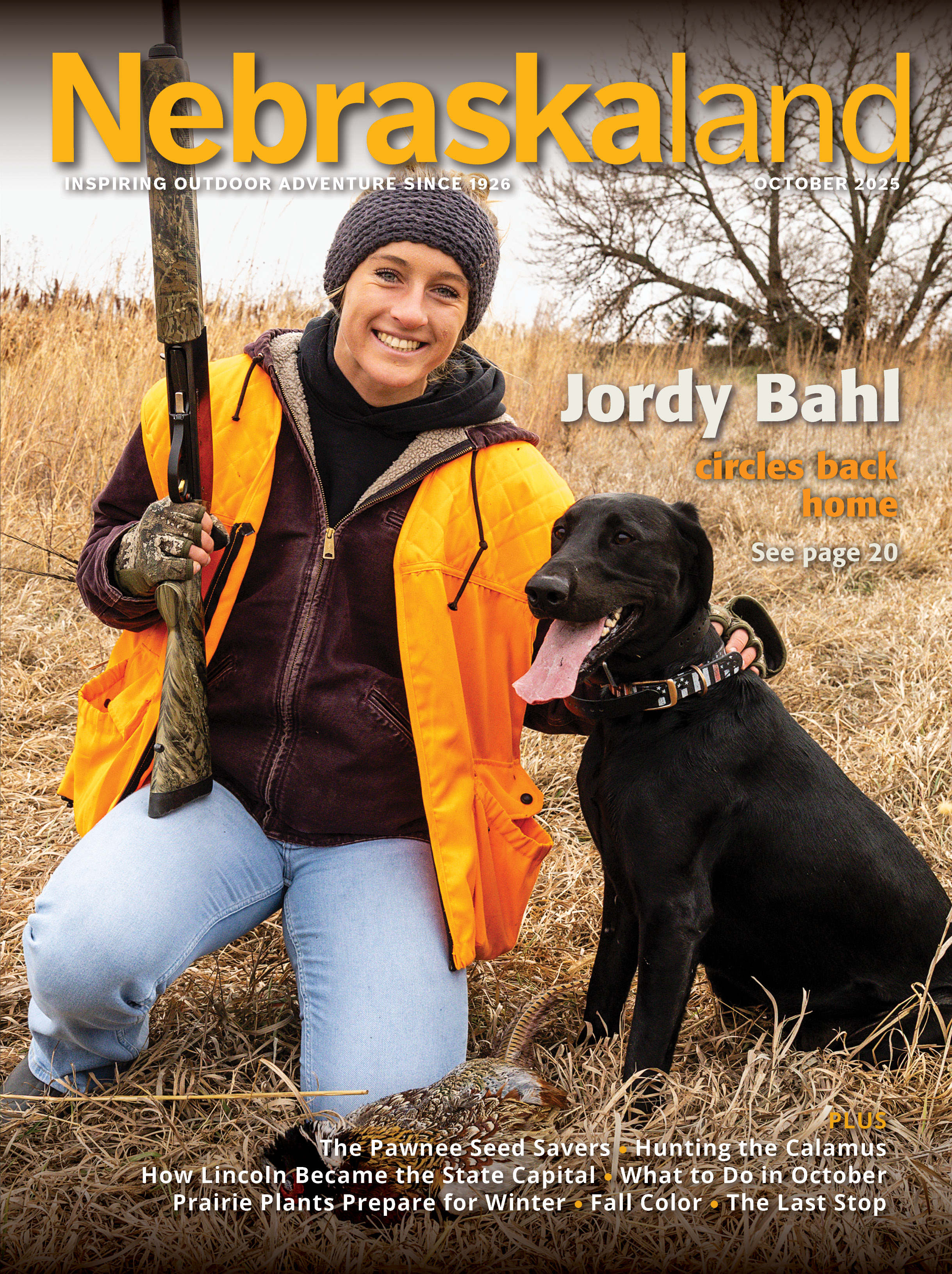
Cover: Jordy Bahl of Papillion pheasant hunts with her
black Lab, Remi, on private land in Otoe County.
See story on page 20.
JEFF KURRUS, NEBRASKALAND
This page: A two-track road in Chase County winds past
a lone tree and into the sunrise.
FEATURES
20
ERIC FOWLER, NEBRASKALAND
THE CIRCLE
The Jordy Bahl story is never about her
Story and photos by Jeff Kurrus
26
OUTDOOR NEBRASKA
What to Do in October
By Tim Reigert
28
THE PAWNEE SEED SAVERS
Nebraska gardeners replenish ancestral foods
Story and photos by Jenny Nguyen-Wheatley
36
HOW LINCOLN BECAME THE NEBRASKA STATE CAPITAL
40
HUNTING THE CALAMUS
By David L. Bristow, Nebraska State Historical Society
A Father and Daughter's Adventure
Story and photos by Gerry Steinauer
46
NEBRASKA PRAIRIE PLANTS PREPARE FOR WINTER
By Monica Macoubrie
DEPARTMENTS
6
10
50
56
58
Your Nebraska
In the Field
Mixed Bag
Portraits From the Past
The Last Stop
ON THE WEB
For more articles and
information, visit
NebraskalandMagazine.com
2
Nebraskaland • October 2025
Nebraskaland (VOL. 103 / NO. 8 ISSN 0028-1964) is published monthly, except for the combined Jan./Feb. and Aug./Sept. issues, by the Nebraska Game and Parks Commission, 2200 N. 33rd
St., Lincoln, NE. Periodicals postage paid at Lincoln, Nebraska, and additional mailing offices. POSTMASTER: Send all UAA to CFS. (See DMM 507.1.5.2); NON-POSTAL AND MILITARY
FACILITIES: send address corrections to Nebraskaland, P.O. Box 30370, Lincoln, NE 68503-0370.
October 2025 •
Nebraskaland
3
Magazine Staff
magazine
Communications Director Christy Firestone
Public Relations Manager Shawna Richter-Ryerson
Published by the Nebraska Game and Parks
Commission since 1926. The Commission is
dedicated to the conservation and protection of
all the state's natural resources and the people
who use them.
Editor Jeff Kurrus
Associate Editor Jenny Nguyen-Wheatley
Regional Editors Eric Fowler, Julie Geiser,
Justin Haag
Contributing Editor Michael Forsberg
Regular Contributors Renae Blum,
Chris Helzer, Chris Masada, Todd Mills,
Ryan Sparks, Gerry Steinauer
Average number of copies
of each issue during
preceding 12 months
Art Director Tim Reigert
Graphic Designer Mel Severin
Videographer Nick Sauvageau
Photo Librarian Jaclyn Cruikshank Vogt
Administration
Director Tim McCoy
Chairman - John Hoggatt, Kearney
Vice Chairman - Donna Kush, Omaha
Kurt Arganbright, Valentine
Scott Cassels, Omaha
Dan Hughes, Venango
Kent McNeill, Papillion
Steve Mossman, Lincoln
Lisa Roskens, Omaha
Doug Zingula, Sidney
Commission Offices
Headquarters/Southeast District Office
2200 N. 33rd Street Lincoln, NE 68503
Phone 402-471-0641
Northeast District Office
2201 N. 13th St. Norfolk, NE 68701
Phone 402-370-3374
Southwest District Office
301 E. State Farm Rd. North Platte, NE 69101
Phone 308-535-8025
Northwest District Office (temporary)
1317 W 3rd St., Alliance, NE 69301
Phone 308-763-2940
Bassett Office
524 Panzer St., Box 508 Bassett, NE 68714
Phone 402-684-2921
South Central District Office
1617 First Ave. Kearney, NE 68847
Phone 308-865-5310
Schramm Education Center
21502 W. Highway 31 Gretna, NE 68028
Phone 402-332-3901
Omaha Office
8495 Frederick Street, Omaha, NE 68124
Phone 402-595-2144
OutdoorNebraska.gov
The Nebraska Game and Parks Commission does not discriminate
based on race, color, ethnicity, national origin, sex, pregnancy, sexual
orientation, gender identity, religion, disability, age, genetic information,
veteran status, marital status, and/or political affiliation in its programs,
activities, or employment. Any person who believes he or she has been
discriminated against in any program, activity, facility, or service,
should contact the Nebraska Game and Parks Commission, Lincoln, NE
402-471-0641, the Nebraska Equal Opportunity Commission, Lincoln,
NE 402-471-2024, TTY/TDD 800-642-6112; Director, Office of Diversity,
Inclusion and Civil Rights, U.S. Department of Interior, 1849 C Street,
NW, Washington, D.C. 20240.
4
Nebraskaland • October 2025
Statement of ownership and monthly circulation
of Nebraskaland Magazine
Owner and publisher: Nebraska Game and Parks
Commission
Editor: Jeff Kurrus
Headquarters of Publisher and Publication:
2200 N. 33rd St., Lincoln, NE 68503
Stockholders, Bondholders, Mortgage and
Security Holders: None
Magazine Subscriptions
For address changes, magazine and subscription
questions, 800-632-5263 or visit
nebraskalandmagazine.com
Advertising
For advertising information, contact:
Shane G. Gilster, 402-742-0125
shanegilster@solotreemedia.com
Single issue
nearest to
filing date
A. Total Copies Printed
(net press run) ..................... 17,131 ........... 16,704
B. Paid Circulation
1. Mail subscriptions ........... 14,974 ........... 14,779
3. Single-copy sales ...................827 ................ 674
C. Total Paid Circulation.......... 15,801 ........... 15,453
D. Free Distribution
by Mail ........................................397 ................ 397
D. Free Distribution
Outside the Mail ........................342 ................ 342
E. Total Free Distribution ..............739 ................ 739
F. Total Distribution ................. 16,540 ........... 16,192
G. Copies Not Distributed .............591 ................ 512
H. Total ...................................... 17,131 ........... 16,704
I. Percent Paid and/or
Requested Circulation ........ 95.52% .......... 95.42%
Nebraskaland Magazine Copyright 2025, all rights reserved. Nebraskaland is available in audio from the Nebraska Library Commission Talking Book
and Braille Service, Suite 120, 1200 N St., Lincoln, NE 68508. 800-742-7691. Nebraskaland Magazine and the Nebraska Game and Parks Commission
reserve the right to reject any advertising not in keeping with the agency mission. Rates: $18 for one year; $33 for two years; $44 for three years.
Nebraska recipients must add appropriate sales tax. To subscribe call 1-800-NEBLAND (632-5263), or go online to: NebraskalandMagazine.com.
Conservation Officers
ADMINISTRATION
Jeff Clauson
402-471-5531
Lincoln HQ
Administrator
Travis Shepler
402-471-5531
Lincoln HQ
Asst. Administrator
Stacey Lewton
402-471-5531
Lincoln HQ
Asst. Administrator
Mike Thome
402-471-5531
Lincoln HQ
Asst. Administrator
(Includes counties covered)
Vacant
NORTHWEST
308-430-0572
Captain
– EAST SUB-DISTRICT –
Jerod Hahn
308-520-5539
Sergeant
Grant Albrecht
531-229-4405
Cheyenne, Deuel, Kimball
Hunter Lee
308-280-4320
Keith, Deuel, Arthur
Jaden Porter
308-289-2274
Garden, Grant, Keith
Tyler Stueck
308-289-6260
Keith, Arthur, Grant
Keith Jadlowski 531-310-2869
Keith
– WEST SUB-DISTRICT –
Sean McKeehan 308-672-1824
Sergeant
KayLynn Miller
308-665-8440
Dawes, Sioux, Sheridan
Cassidy Harwood 308-562-9099
Box Butte, Sheridan
Josh Widhelm
308-279-9133
Scotts Bluff, Banner, Sioux
Brandon Wallace 308-280-4488
Scotts Bluff, Banner, Sioux
Travis Schultz
308-279-1292
Morrill, Scotts Bluff, Box Butte
Casey Gehrt
402-617-2112
Dawes, Sheridan, Sioux
NORTHEAST
Dale Davis
402-760-0712
Captain
– WEST SUB-DISTRICT –
Jeff Jones
402-762-5022
Sergeant
Greg Hesse
308-546-7464
Rock, Brown, Keya Paha
Jonathan Andreasen
402-340-3981
Madison, Pierce, Stanton
Trevor Stahlecker
402-928-9099
Knox, Antelope, Pierce
Mitch Johnson
402-613-8612
Cedar, Knox
Bryce Streger
308-537-0404
Dawson, Gosper
Tyler Adelman
402-314-4783
Dawson, Gosper, Furnas
Sophia Gobber
308-222-0368
Chase, Dundy, Hayes, Hitchcock
– EAST SUB-DISTRICT –
SOUTHEAST
Matt Seitz
402-806-0915
Captain
Cory Krause
402-380-6410
Sergeant
Kyler Prochaska 402-830-8278
Platte, Colfax
Matt Costello
402-317-4014
Dodge, Colfax
Kelbi Abke
402-237-2537
Washington, Burt
Nicholas Fix
402-508-0261
Dixon, Dakota, Thurston
Kyle Hansen
531-739-7392
Dodge
– CENTRAL SUB-DISTRICT –
Doug Pollard
308-730-7050
Sergeant
Vacant
308-440-1863
Howard, Greeley, Merrick
Matt Brandt
308-202-0819
Sherman, Howard
Klint Gill
402-613-5800
Nance, Wheeler, Boone, Polk
Garrett Zimmer 402-416-5736
Garfield, Loup Valley
Tim Williams
308-380-7331
Hall, Hamilton
SOUTHWEST
Brian Piernicky 308-330-8780
Captain
– NORTH SUB-DISTRICT –
Alex Hasenauer
308-660-4671
Sergeant
Dana Miller
531-229-4404
Cherry, Hooker, Thomas
Jacob Stoinski
308-395-6001
Lincoln, Perkins
Frank Miller
402-389-0444
Cherry, Hooker
Luis Nuñez
531-333-6093
Blaine, Custer, Thomas
Brandon O’Neal 308-530-3157
Lincoln, McPherson, Logan
– SOUTH SUB-DISTRICT –
Kelsey Glodowski 308-242-9000
Sergeant
– WEST SUB-DISTRICT –
Matt Taylor
402-200-9597
Sergeant
402-902-2017
Vacant
Adams, Clay, Webster
Justin Gress
308-629-9335
Thayer, Nuckolls, Fillmore
Vacant
308-920-2762
Harlan, Franklin, Phelps
Ethan Teter
308-440-3847
Buffalo, Kearney
– EAST SUB-DISTRICT –
Heath Packett
402-210-0888
Sergeant
Brett Greenfield 531-350-0915
Cass
Russell Mort
402-209-1506
Otoe, Johnson
Rich Berggren
402-619-1355
Douglas
Brian Arp
531-530-9011
Douglas, Sarpy
Mike Luben
402-443-6392
Saunders
Bryan Adams
402-429-1924
Nemaha, Pawnee, Richardson
– CENTRAL SUB-DISTRICT –
Curt Prohaska
402-470-1298
Sergeant
531-229-4407
Easton Albrecht
Lancaster
Ben Keller
308-430-5500
Gage, Jefferson
Mark McDonald 402-805-2353
Lancaster
Mark Sullivan
402-741-0636
Lancaster, Seward, Butler
Jarrod Messman 531-739-9760
Lancaster, Saline, York
YOUR NEBRASKA
Instagram Photos
Follow us @nebraskaland
and tag us in your photos
to be featured in an
upcoming issue.
Boni Edwards, North Platte
Burrowing Owl Pellet
Curt Blum, Lincoln
Otoe Milky Way
Peyton Weller, Lincoln
Water Droplet Leaf
6
Nebraskaland • October 2025
Brian Beamer, Superior, Colorado
Cranes on the Roost
October 2025 •
Nebraskaland
7
Steve Krout, Papillion
Green Heron Dinner
Chuck Hackenmiller, Lincoln
Windmill at
Mahoney State Park
Corrections:
Aug-Sept 2025 issue
Page 28 – The image of the
observation deck should be
credited to Duane Reading/
Sandhills Prairie Refuge
Association.
Page 32 – The first Missouri
River Outdoor Expo was hosted
in September 2005. The wrong
date was listed.
•
•
Connie Allen, Grand Island
Goose and Goslings
8
Nebraskaland • October 2025
Send your comments and photos to:
Jeff Kurrus, Editor
Nebraskaland Magazine
P.O. Box 30370
Lincoln, NE 68503
or email Jeff.Kurrus@Nebraska.gov
Please include your postal address
and telephone number. Letters may
be condensed and edited. Photographs are also welcome.
October 2025 •
Nebraskaland
9
IN THE FIELD
STONE AND GRASS
A lichen-covered stone
lies amid prairie grasses
at Rock Glen Wildlife
Management Area in
Jefferson County.
ERIIC
ERIC
ER
C FOWLER,
FOWLER
FOW
LE
LER,
ER, NEB
NE RASK
NE
RA A
RAS
ALAN
LA D
LAN
10
Nebraskaland • October 2025
October 2025 •
Nebraskaland
11
IN THE FIELD
Eastern bluebird.
Eastern phoebe.
CHRIS MASADA
MARY CLAUSEN
BLUEBIRD BOUNCE BACK
By Joel Jorgensen, Nongame Bird Program Manager, NGPC
Wildlife is routinely forced to endure setbacks and
occasionally even catastrophic events that can dramatically
reduce overall population. Fortunately, many species are
resilient and have the capacity to recover from sudden
declines. An unexpected and notable drop in numbers of
two of our favorite feathered creatures, and the subsequent
rebound in the last few years, serves as a recent case study
of a comeback.
Eastern bluebirds are a familiar songbird whose dashing
plumage and cheery song have the potential to brighten up
anyone’s day. In 2021, in this very magazine, I wrote a short
article lamenting the absence of eastern bluebirds at many
of their usual haunts in Nebraska. Bluebird numbers suffered
a dramatic sudden decline, perhaps as much as an 80% drop,
following an intense mid-February cold spell that put much
of the southern and central Great Plains in a deep-freeze. If
you were in the state during that time, you probably still feel
the chill deep in your bones from temperatures that sunk as
low as over 30 degrees below zero.
The cold also reached well to our south and deep into states
like Texas and Louisiana. Even though bluebirds are a semihardy species that regularly overwinter in Nebraska, the
cold was associated with snow and ice, which likely covered
critical food resources bluebirds and other species rely on to
get them through the winter.
12
Nebraskaland • October 2025
Numbers of eastern phoebes also suffered a similar fate.
Phoebes are flycatchers that often nest under bridges or
building eaves. This brown and white bird is perhaps more
recognized by its “feee-bee” song over its appearance.
After a few years of these birds’ absence being more
notable than their presence, 2025 was the first year in a
while when it seemed like both species’ numbers were more
or less back to normal. Wanting confirmation, I queried Steve
Eno with Bluebirds Across Nebraska whether he and other
“bluebirders” were witnessing the same sort of recovery.
Bluebirds Across Nebraska is an organization whose
mission is to increase bluebird and other cavity nesting birds’
numbers. Many members maintain bluebird trails, which
are a series of bluebird nest boxes along a route or path.
The consensus from BAN members was like mine: bluebird
numbers have rebounded. A review of data on the online
birding portal eBird also showed a bounce back for both
species.
Following the February 2021 cold snap that caused the
unanticipated and dramatic drop in the number of these two
species, it was unclear whether or how quickly these species
would recover. It now appears the slump was a blip rather
than a trend or long-term consequence. This is good news
for anyone who enjoys the sight of eastern bluebirds at their
nest box or the song of the eastern phoebe in early spring.
IN THE FIELD
This European-mounted turkey foot is a combination of bones from two turkey feet.
JEFF KURRUS, NEBRASKALAND
FRANKENSTEIN TURKEY FOOT
By Jeff Kurrus
The idea came from the lazy — albeit patient —
way of European mounting deer. Separate the buck’s
head from the body, dig a hole and place the head in
the hole.
Once it is recovered with dirt and a container is
placed over the antlers to keep mice and other little
toothy mammals from eating, let the bugs do the rest.
Remove a year later, hose off and you’re done.
Which begs the obvious question: Could the same
steps be taken to European mount a turkey foot?
The answer? Sort of.
After a successful spring turkey hunt two seasons
ago, we removed the turkey’s feet with a pair of
shears where the feathers began. Then, imagining
a turkey foot is broken into multiple joints, in many
ways like a human’s feet and hands, we dug a hole
and buried both feet in a lidless plastic container
and let the bugs go to work.
Nine months later, that was exactly the case, so
well that nothing was left but the bones from both
14
Nebraskaland • October 2025
feet, with at least 30 individual bones to puzzle
together.
I gave an ornithologist friend a call to ask him
if he had a model detailing what turkey foot bone
attached to another bone, essentially the “knee
bone connected to the thigh bone, the thigh bone
connected …” type of question.
He instructed I find something else to do with my
time.
I then found a diagram online and started to piece
my Frankenstein foot together like I was building a
puzzle with multiple answers. Once I had what I felt
was one modestly put-together turkey foot, I began
the superglueing process.
One final touch of furniture polish on the claws
and my European turkey-mounted foot was
complete.
Just don’t touch it. Ever. If I were you, I wouldn’t
even breathe on it.
But man it looks cool.
IN THE FIELD
WHY SO MANY FALL COLORS?
By Jennifer Ruyle, Outdoor Education Specialist, NGPC
It’s that time of year when trees start to dress for winter.
Maybe not in the same sense that we do — they can’t
check the weather forecast and put on layers before a chilly
morning. But they prepare in other ways.
Inside their cells, tree leaves contain a pigment called
chlorophyll that absorbs sunlight and reflects green light
waves during photosynthesis. This causes leaves to look
green. The UV rays in sunlight break down chlorophyll all the
time, so new chlorophyll must constantly be made.
As days shorten toward autumn, deciduous trees start to
store nitrogen and phosphorus in their woody parts rather
than continuing to supply leaves with nutrients, protecting
themselves and saving energy.
So, with fewer nutrients and less sunlight, leaves slow
down their chlorophyll production, and the green color fades.
This enables other pigments in the leaf to show through and
reflect different colors.
The red maple leaf, below, is a great example of this
phenomenon. You can practically see the tree withdrawing
nutrients from the leaf. Areas closest to the leaf stem and
veins have the most chlorophyll production happening so
they still appear green. Nutrients from the perimeter of the
leaf have already been pulled back into the branch to be used
for leaf production next year.
But why are there so many fall colors? In addition to
chlorophyll, other pigments are present in leaves. Different
types of trees have genetic differences that cause certain
pigments to dominate their leaves in the fall and turn colors
characteristic to their species.
Bowhunters that favor hunting in river bottoms in early
fall will notice the golden yellow of cottonwoods. Hikers and
birdwatchers in oak hickory woodlands will enjoy red, brown
and golden bronze colors.
Of course, it doesn’t happen all at once. Every tree is an
individual in a unique place in the forest. And just like people,
they get ready for winter in their own time.
For deciduous trees like this red maple, chlorophyll production diminishes in the fall, revealing a number of other colors.
RENAE BLUM
16
Nebraskaland • October 2025
October 2025 •
Nebraskaland
17
IN THE FIELD
Pheasant and egg noodles with gravy.
JENNY NGUYEN-WHEATLEY, NEBRASKALAND
PHEASANT AND NOODLES
By Jenny Nguyen-Wheatley
Servings: 4
Prep Time: 1 hour
Cooking Time: 2 hours
Ingredients:
4 to 6 pheasant breasts
Sea salt, to taste
4 pats salted butter
1 tsp. fresh sage, minced
¼ tsp. dried thyme
¼ tsp. dried rosemary
¼ tsp. white pepper
¼ tsp. paprika
2 cups low-sodium chicken/game
stock
Half an onion
1 carrot, quartered
1 rib of celery, quartered
1 tbsp. chopped parsley
Reames Frozen Homestyle Egg
Noodles (12 or 16 ounces)
Cream of Chicken
4 tbsp. salted butter
½ cup all-purpose flour
2 cups low-sodium chicken/game
stock, warmed
3 tsp. Better Than Bouillon
•
•
•
•
•
•
•
•
•
•
•
•
•
•
•
•
•
•
18
Nebraskaland • October 2025
Roasted Chicken Base
• ¼ heaping tsp. celery seed
• ¼ heaping tsp. onion salt
• ¼ heaping tsp. garlic powder
• 1 cup whole milk, warmed
1. Cream of chicken: In a mediumlarge saucepan over medium heat,
melt 4 tablespoons of butter and
allow to foam for a few seconds. Then
add ½ cup of flour and whisk for 2
minutes; it will look dry and pebbly.
Next, slowly add warmed chicken
or game stock, whisking constantly,
to form a smooth roux. Then stir in
remaining ingredients, adding the
warmed milk slowly while whisking.
Bring to a simmer and cook until you
get a thick, smooth sauce, stirring
frequently, about 5 minutes. Adjust
heat accordingly to prevent scorching
the bottom. Take off heat.
2. Preheat the oven to 300 degrees
Fahrenheit. Move the oven rack to
the lower third. In a medium-size
enameled Dutch oven, add pheasant
in one layer and sprinkle with salt.
Pour the cream of chicken over the
pheasant, along with 4 pats of butter,
sage, thyme, rosemary, white pepper
and paprika. Then stir in 2 cups of
stock, carrot, celery and onion. Bring
to a simmer. Close the lid and transfer
the pot to a preheated oven. Cook
for 1-2 hours, or until the pheasant
becomes tender.
3. Twenty minutes before you think
the pheasant will be tender, add frozen
noodles directly into the pheasant and
gravy mixture and stir. If the mixture
seems dry, add a bit more stock or
water to loosen.
4. Cover and return the Dutch oven
into the oven and continue cooking
until the pheasant and noodles are
tender. When done, cut the pheasant
into bite-size pieces, and then return
it to the pot. Discard onion, carrot
and celery. Stir in chopped parsley and
season to taste with salt and pepper.
Serve pheasant and noodles by itself
or over hot mashed potatoes.
October 2025 •
Nebraskaland
19
The
Circle
The Jordy Bahl story
is never about her
Story and photos by Jeff Kurrus
I
n softball, pitchers throw from “the circle.” It’s where the
game is won or lost. And on the softball field, Nebraska
native Jordy Bahl, the 2025 National Fastpitch Coaches
Association Player of the Year, commands the circle like
no other. But it’s not her most important circle.
Jordy, originally from Papillion, is a three-time AllAmerican and a two-time national champion with the
University of Oklahoma. After winning the second of those
titles during her sophomore year with the Sooners in 2023,
she decided to come home, and transferred to the University
of Nebraska-Lincoln. In the months that followed, she
convinced a host of childhood teammates to play alongside
her with the Huskers. In 2024, when expectations for the
softball program were perhaps as high as they have ever
been, she tore the ACL in her left knee in the Huskers’ first
game. Her season was over before it began.
But because of the words that are so often used to describe
her — tenacious, fierce, competitive, driven — fans knew
her comeback would be epic. And it was. Not only did her
stellar pitching return after the injury, Nebraska head coach
Rhonda Revelle and her staff allowed Jordy to hit as well,
a rare double-dip in college softball where pitchers usually
just pitch. She solidified Revelle’s decision by becoming one
of the nation’s best hitters, leading the Cornhuskers within
one game of their first College World Series appearance since
2013.
It is in the softball circle where Jordy appears the most
comfortable. That is until you see her don a hunting vest
and, with a shotgun in hand, walk next to family in hopes of
seeing a rooster pheasant flush.
Off the softball field, Jordy’s family is her circle. They are
her comfort, peace and the ground beneath her feet.
Jordy Bahl and her Labrador retriever, Remi, pause during
an Otoe County pheasant hunt, after Remi’s first retrieve.
20
Nebraskaland • October 2025
October 2025 •
Nebraskaland
21
When Jordy is with her family, like during this upland hunt, she is in
full relaxation mode.
The Circle
The scene was a familiar one in
Nebraska each fall. On this day in Otoe
County, the line of upland hunters
clad in orange with guns in hand
consisted of Jordy; her dad, Dave; two
of her brothers, Hayden and Broden;
and her soon-to-be husband, Trey
Frahm.
In front of the group, Dave’s Labrador
retriever, Jessie, weaved left and right
across the line, a dog well-versed in
his job of flushing birds. Meanwhile,
Jordy’s black Lab, Remi, had to be
22
Nebraskaland • October 2025
ushered back to her job more than
once.
“J, if you’re not going to work this
dog,” Dave called out, “we’re going to
have to get her with grandpa.”
Jordy didn’t respond. How could
she? As one of Nebraska’s most
popular athletes, downtime for other
pursuits — even dog training — is
nearly nonexistent.
Two summers ago, when Jordy
announced her return to Nebraska, the
decision was reported by every major
sporting news outlet in the country.
Since then, she’s become a folk hero of
Jordy, seen here pitching against the University of Nebraska at Omaha at Connie Claussen Field in Omaha in 2025, is very
familiar with throwing in front of a packed house.
sorts. While she has continued to field
countless interviews from the likes
of ESPN, Sports Illustrated and other
titans of sports media, she would
also show up at a local Sunday night
Fellowship of Christian Athletes event
in places like Gretna to talk about her
relationship with God.
One might think the 23-year-old
carries a little weight on her shoulders.
But in that pheasant field that
day, while walking through a patch
of standing milo, the only weights
she carried were the semi-automatic
shotgun in her hands, and the thought
that she should have found a bit more
time to work Remi before the hunting
season began.
A Weight Lifted
“This is why,” Jordy said when
asked about her decision to return to
Nebraska. “This” was sitting in the
cabin of family friend, Barry Brandt,
and watching a Husker football
game alongside her family after the
pheasant hunt. She soaked in the
conversations filtering through the
room while everyone downed burgers
and drinks from Runza. “This is where
I realize that all of that other stuff —
the softball — it doesn’t matter.”
Jordy’s softball success came early,
garnering attention from universities
nationwide during her high school
years. But she felt different off the
field. “I internalized a ton in high
school,” she said. “I was very alone.”
She got involved with the
Fellowship of Christian Athletes,
where she developed her relationship
with God, and her anxiety improved.
“I began to seek a greater purpose than
softball,” she said. “That’s where my
identity and purpose were. But with
this platform [softball], I could give
back to Him.”
During these years, Jordy bounced
between church, the softball field
and nature — with her family always
nearby.
But her relationship with nature had
begun long before. Dave had taken
Jordy and her brothers hunting and
fishing since they were little.
“I was there when Broden shot his
first deer, a doe, and his first buck,”
Jordy said. She has also harvested
multiple deer through the years,
but squeezing the trigger is not her
October 2025 •
Nebraskaland
23
Back in the pheasant field, Jordy had
a similar feeling not 30 minutes after
her dad questioned Remi’s training
regimen during that Otoe County
pheasant hunt. A rooster had flushed
in front of the group as Jordy and Trey
took a shot. The pheasant went down,
but his head was upright as he fell into
the tall grass. The bird would be on the
move. Remi bolted, bounding toward
the mark and disappearing as Jordy
held out hope.
Her brothers and dad stopped midstride, ready to heckle her if Remi
returned empty-handed.
Trey called out, “She’s coming back!”
A moment later, Jordy shouted: “She’s
got the bird!” A smile covered her entire
face before cutting her eyes toward her
dad, who couldn’t help but grin.
Better Than a Tattoo
Now that Jordy has this dog training
thing figured out, she might want a
cat. On nights when her schedule is
clear, she wants to do nothing but lie
around. “I’m a big homebody,” she said.
While the rest of the world wants her
to play softball for the next 15 years,
Jordy, recently married but still just
a college kid, doesn’t yet know what
her future holds. She might teach. She
might coach. “But I don’t want to leave
Nebraska to do it,” she said.
Actually being home is better than
a tattoo. It is where she can stand in
the circle in front of a packed house of
screaming fans, knowing the ones that
matter most, the ones in her circle, will
be there long after the game is over. N
The Jordy Rules
Through success and failure,
Jordy has found these are
fundamental rules for life.
Know where you’re weak.
• Always
• share. be confident and
stop learning and
• Never
growing.
where to find your
• Know
identity.
follow feelings, follow
• Don’t
the truth.
it’s dark, search extra
• When
hard for the light.
train to be ready for the
• You
5%.
faith lets you know
• Your
you’ll still be loved.
Dave’s Lab Jessie retrieves a rooster during a Bahl family pheasant hunt.
favorite part of deer hunting. “I love
being able to sit down outside in the
middle of nowhere, with no one but
my family knowing where I am.”
When she moved to Norman for
college, that part of her life was no
longer there. Feeling that separation
during spring break her freshman
year — in between two-a-day softball
workouts — she got a tattoo: an
outline of her home state on her right
arm.
While grasping for any sort of
connection she could muster, pressure
and success at Oklahoma were
at an all-time high. “And with the
success,” Jordy said, “there came more
expectation.”
During her sophomore year, while
the rest of the athletic world was
singing her praises, she was once
again lost. She was hanging on every
word her coaches said and, believe it
or not, fearful of messing up and never
seeing the field again.
24
Nebraskaland • October 2025
“That fall, I got very far away from
God,” she said. “I had shame. Doubt.
Negative thoughts. Loneliness. My
prayer life had gone to a minimum. I
didn’t have light, but I wasn’t looking
for light either.”
Going home was at the forefront of
her mind.
Playing for the Huskers, she is again
teammates with friends from her
childhood — Bella Bacon, Ava Kuszak
and others.
Nebraska is where she gets to be
part of the day-to-day life of her
family. Because the story of Jordy Bahl
has never been all about her.
Home
Let’s Go!
Days after the Sooners won the
2023 national championship, Jordy
announced she was transferring to
Nebraska.
Home has so many layers for her.
There, she can listen to her dad tease
her about Remi, and remind herself to
watch a sunrise or sunset, just like she
has been doing for so many years.
It’s where she can visit the same
pitching coach — Darren Dubsky —
she has had since she was 8 years old.
To this day, whenever she needs a few
words of encouragement, she knows
he will be there.
“Let’s go!” Jordy screamed. Her body
rocked back and forth, and she was
biting her nails as if she lived and died
on every play.
Yet she was nowhere near a softball
field. And there weren’t thousands of
fans living on every one of her swings.
Instead, she was living on every
dribble her brother, Bryson, then a
high school basketball player, took.
Bryson was in a dogfight on the
hardwood and Jordy, like all of the fans
packed in the arena, was holding her
breath with each three-pointer that
left her brother’s hands.
Jordy, her dad Dave, brothers Hayden and Broden, and Jordy’s husband Trey Frahm after an Otoe County family pheasant hunt.
October 2025 •
Nebraskaland
25
Outdoor Nebraska
By Tim Reigert
Make time this month to experience the beauty of fall,
from changing leaves to hunting seasons, great fishing
opportunities and state park events. N
What to Do in October
Fish for largemouth
bass at interstate
lakesb
September to November
Central Nebraska
Fall is one of the best times to catch big
bass, and one place they can be found is in
Nebraska’s interstate lakes — dozens of small
water bodies scattered along Interstate 80
from Grand Island to Sutherland. According
to fisheries biologist Daryl Bauer, they may
contain largemouth bass as large as 5 or 6
pounds this year. You can fish more than one
of these lakes in a day. Find a guide to the
I-80 lakes on the Fishing Guides and Reports
page at OutdoorNebraska.gov.
ERIC FOWLER, NEBRASKALAND
See the Harvest Supermoon
this month
Youth pheasant hunting season
Oct. 6 | Statewide
Oct. 18-19 | Statewide
The Harvest Moon — also known as the Hunter’s Moon — will
reach peak illumination at 10:48 p.m. Central Time on Monday,
Oct. 6. Plus, it’s a supermoon — the very first of 2025 — so
it’s bigger and brighter than usual. You can use binoculars, a
telescope or your naked eye. Use a lunar filter on telescopes to
reduce glare. JUSTIN HAAG, NEBRASKALAND
This year’s youth pheasant, quail and partridge season will be Oct. 18-19 and is
open to hunters ages 15 and younger. Youth hunters do not need a permit to hunt
during this time, but non-residents will need a hunting permit and habitat stamp.
Adult mentors accompanying youth hunters (only one adult per youth) are allowed
to hunt, but only at designated Special Youth Hunt locations. Game and Parks will
release pheasants at specific wildlife management areas and the N-CORPE east
tract this season. For more information, contact Game and Parks at 402-471-0641.
JUSTIN HAAG, NEBRASKALAND
Take kids trick-ortreating at a state
park
Dates vary by park| Across the state
Take your kids trick-or-treating this
Halloween season at a state park or state
recreation area. Campers are encouraged
to decorate and hand out treats. Activities
are free and vary by park, but a park
entry permit is required. Visit Calendar.
OutdoorNebraska.gov for details.
Fall events in
Nebraska City
Multiple dates in October
Nebraska City
October in Nebraska City offers a variety of
fall-themed events, including the Scarecrow
Festival at Kimmel Orchard, the Nebraska
City Art Walk and All Hallows’ Eve
weekends at Arbor Day Farm. Additionally,
Arbor Day Farm will host Oktoberfest at
Steinhart Lodge on Oct. 17. Check each
venue for details. JEFF KURRUS, NEBRASKALAND
JUSTIN HAAG, NEBRASKALAND
26
Nebraskaland • October 2025
October 2025 •
Nebraskaland
27
THE PAWNEE
SNebraska
EED SAVERS
gardeners
Deb Echo-Hawk of Pawnee, Oklahoma,
founded the Pawnee Seed Preservation
Society to replenish ancestral foods lost
during tribal displacement. BRYAN DOWNEY
replenish ancestral foods
Story and photos by Jenny Nguyen-Wheatley
O
nce numbering 60,000 strong,
the Pawnee people lived in
the Loup, North Platte and
Republican river basins in present-day
Nebraska and northern Kansas. They
were semi-nomadic people, hunters
and gatherers for parts of the year and
cultivators during the growing season.
In spring, the Pawnee lived in
permanent cities and focused their
energies on tending crops such as
corn, beans and squash — known as
the “three sisters.” In June, hunters
traveled west to the High Plains, where
they spent the summer in mobile
tipis, to follow the bison herds that
roamed the prairies by the millions.
In late summer, they returned to their
respective villages to harvest crops,
and in late October or November, the
hunters left again for the winter hunt.
The Pawnee returned to their dome-
Miller, Alfred Jacobs. "Pawnee Running Buffalo." 1858-1860. Watercolor.
8 1/4 x 11 11/16 in. Commissioned by William T. Walters.
28
Nebraskaland • October 2025
October 2025 •
Nebraskaland
29
of North America, the French began
withdrawing from the Louisiana
Territory. France’s departure resulted
in the Pawnee becoming increasingly
vulnerable to attacks by their Sioux
and Osage enemies, who had allied
with the British.
Subsequently, the encroachment of
hostile tribes became a major factor
impacting the Pawnee way of life,
as well as the effects of colonialism
and the westward movement of EuroAmerican settlers that overtook the
Plains into the 19th century.
Disrupted Foodways
Regional Park Superintendent Laura Rose (left); gardener Ronnie O'Brien and her granddaughter, Louie Green,
of Shelton; and Fort Kearny State Historical Park Superintendent Gene Hunt stand near Arikara sunflowers.
Catlin, George. "Encampment of Pawnee Indians at Sunset." 1861-1869.
Oil on paperboard. 18½ x 24¾ in. Paul Mellon Collection.
30
Nebraskaland • October 2025
shaped earthen lodges in late winter to
begin another cycle of their variegated
lives on the Plains — according to the
Oklahoma Historical Society.
They called themselves Chatiks
si Chatiks, meaning "men of men.”
Explorer Francisco Vásquez de
Coronado was the first European to
meet the Pawnee in 1541 and noted
the nation’s powerful social and
governmental structure. In the early
1700s, the Pawnee began a lucrative
and mutually respectful trading
partnership with the French, with
whom they later allied to fight Spanish
expansion into the Great Plains.
However, following the Treaty
of Paris in 1763, which ended the
French and Indian War between
France and Great Britain over control
By 1850, smallpox and cholera
had reduced the Pawnee population
to about 6,000. When missionaries
Gottlieb Frederick Oehler and David
Zeisberger Smith visited the Pawnee in
eastern Nebraska in 1851, they found
a starving people whose traditional
foodways were being dismantled.
Oehler and Zeisberger’s account of the
visit was reprinted in the winter 2006
issue of “Nebraska History.”
Despite allying with the U.S.
Government, who had promised
resources and assistance in exchange
for lands that enabled westward
expansion, the missionaries described
the Pawnee’s plight as thus:
“The road of the emigrants lies
through the country belonging to the
Indians; their hunting grounds are
traversed by the long lines of whitecovered wagons, and the buffaloes, the
principal subsistence of the Indians,
are thereby chased away to more
distant and more secluded pastures …
and they have thereby been reduced
to poverty and want. For all these
privations they have been promised
presents, as a compensation, from our
Government, but thus far they have
received nothing.”
The final blow came in 1874-1875.
Increasing pressures and conflicts
with Nebraska settlers resulted in the
Pawnee’s decision to move to Indian
Territory in present-day Oklahoma,
Miller, Alfred Jacobs. "Pawnee Indians Watching the Caravan." 1858-1860.
Watercolor. 10 7/16 x 9 7/16 in. Commissioned by William T. Walters.
where the Pawnee Nation now resides.
This displacement was more than
geographical. Not only did they lose
many traditions and ceremonies, some
that were tied to the cycles of the
seasons in their homeland, the Pawnee
diet also was completely changed to
rations and unfamiliar foods.
Chef Anthony Warrior, the
Indianpreneurship director at the
Nebraska Indian Community College
in Santee, explained the predicament:
If you take ancestral varieties of
pumpkin, corn or beans that thrived
in the Great Lakes or the Great Plains
regions, and try to grow them in
Oklahoma, they would fail because
the soil and climate are completely
different.
“And that’s how you conquer
people,” Warrior said. “When you
take people’s food systems away, you
destroy them ... . When you can sever
that tie, you then invite [the body]
to disease and depression — and
control.”
Warrior pointed to the argument for
eating according to one’s genetics, a
field of study called nutrigenomics,
which
explores
the
complex
relationship between our genes and
the foods we eat, and how it impacts
our health outcomes and risk of
diseases.
Even Oehler and Zeisberger
recognized this breaking nearly 175
years ago, that want and hunger
had “shak[en] that tenacity and
attachment so strongly developed
in the Indian character, for long
cherished customs, and making them
more pliable in adopting the arts of
civilization.”
The Seed Warriors
For Native Americans living on
reservations, displacement and
assimilation came at the high costs
of poor health and the loss of access
and knowledge of their traditional
foodways. After generations of eating
nutrient-deficient, processed foods
such as fry bread, a food created
during hardship using meager
October 2025 •
Nebraskaland
31
a call from Nebraska. Ronnie O’Brien
of Shelton was working at The
Archway in Kearney at the time, and
she was reaching out to the Pawnee
about creating a historical program on
Native gardening.
Echo-Hawk had a better idea. Would
O’Brien help the Pawnee bring their
ancestral crops back home?
The Seed Keepers
Bi-colored painted-like-a-horse beans are white and brown and/or black. Hunt admires the beans' striking
appearance and sweet flavor.
In 2024, Hunt grew blue speckled corn in his Pawnee garden.
32
Nebraskaland • October 2025
government rations, diabetes and
heart disease have become two of the
leading causes of death among Native
Americans.
Recognizing the declining physical
and mental health of their people,
there has been a call from recent
generations to restore traditional
diets. One of those people is Deb
Echo-Hawk (Pawnee), who started
the Pawnee Seed Preservation
Project in 1998. Over time, ancestral
seeds diminished because they
did not grow well in Oklahoma, so
what was still viable was precious
— remnants of vegetables and fruit
that were the very last of their kind.
The Pawnee cultural committee and
chiefs asked families to come forward
with ancestral seeds, to be given to
Echo-Hawk, the Keeper of the Seeds,
for replenishment.
Then in 2003, Echo-Hawk received
That first year in 2004, O’Brien
received 25 seeds of Pawnee eagle
corn, Skidi red popcorn and yellow
flint, and as the daughter of a corn
farmer, she planted the seeds in the
way Nebraskans typically do in late
April.
“I was all excited — and they all
rotted in the ground. It was too early
and too cold,” O’Brien said.
The next year, Echo-Hawk sent
25 more seeds to Nebraska, but told
O’Brien that it was the last that she
could spare. The Pawnee had to keep
the few remaining seeds in Oklahoma
for posterity if the experiment in
Nebraska failed. Thankfully, the
second crop survived. O’Brien said
that it took about seven years for the
corns’ genetics to strengthen and take
off.
“Over time, as we built trust with
[the Pawnee], they would make more
seeds available … another family
might come forward with something
else out of their sacred bundle that
hadn't been [planted] for a long time,”
O’Brien explained.
This special partnership with the
Pawnee has lasted over two decades,
and during that time, the project
has recruited 20-plus volunteer
growers across Nebraska. It’s become
a network of gardeners exchanging
their experiences and ideas on how
to grow healthier, more robust crops
each year. Together, they grow over
20 varieties of Pawnee corn, in
addition to ancestral varieties of
beans, squash, sunflower seeds and
watermelon.
Omaha pumpkins can grow as large as 10 pounds, but most are closer to
6 pounds. It is a "pie pumpkin," a variety that is ideal for cooking.
In the fall, the crops are harvested
and transported to Pawnee, Oklahoma,
for use in ceremonial meals. EchoHawk hopes that by providing Native
people access to foods that their DNA
recognizes, the Pawnee could lead
healthier lives and feel more connected
with their history.
One gardener rolling up his
sleeves is Gene Hunt, who has been
superintendent at Fort Kearny State
Historical Park for 52 years. This is
Hunt’s 22nd season growing food for
the Pawnee.
Pawnee Gardens
In August 2024, Hunt led the
way across the green expanse of
lawn at the state historical park.
O’Brien, South-Central Regional
Park Superintendent Laura Rose and
I stopped at a rectangular patch of
tendrilled, sprawling vines. Large,
ground-covering leaves crowded our
view, while yellow-orange, starfishlike flowers floated over the green
foliage. The park superintendent sank
to his knees and pushed away vines
to reveal an elongated yellow-green-
October 2025 •
Nebraskaland
33
to teach us more this year than we
know about this variety,” O’Brien said.
Share the Harvest
Kahheetah Barnoskie (Pawnee) is a University of Nebraska-Lincoln
graduate agronomy student. She helps the Pawnee Seed Preservation
Society collect data on the ancestral corn grown by Nebraska gardeners.
striped pumpkin lying in the soil. It
was an unripe Omaha pumpkin, one
of the squashes that Hunt carefully
tends for the Pawnee.
In another garden patch, a stand of
Arikara sunflowers stretched toward
the sky. The Pawnees refer to the
sunflower as their “fourth sister.”
Not only did they eat the seeds, the
Pawnees also planted sunflowers
around their gardens as natural
fencing to help keep out rabbits and
even bison. At full height, the Arikara
sunflower can grow 10 feet tall.
In a different area of the garden, Hunt
stripped a bean pod to reveal striking
bi-colored seeds of white and brown
and/or black. Aptly called painted-likea-horse beans, they’re delicious and
sweet-tasting, according to Hunt.
And although he didn’t grow any
Mandan squash in 2024, Hunt spied
a stray squash growing among his
blue speckled corn, where Kahheetah
Barnoskie (Pawnee), a University of
Nebraska-Lincoln graduate agronomy
student, was busy measuring plants
and taking notes. Of all the sisters,
corn is the most sacred to the Pawnee.
It has a spiritual value that’s important
to their daily lives, and they believe
the crop holds healing powers. Corn is
34
Nebraskaland • October 2025
a large piece of the Pawnee story, and
having been lost for generations, being
able to bring back these ancestral
varieties has been encouraging.
Thus, Barnoskie spends her
summers in Nebraska traveling from
garden to garden to collect data for the
Pawnee Seed Preservation Society.
This information helps the society
identify which corn varieties are doing
well and where, and to determine what
to plant the following year. Barnoskie’s
work is establishing a baseline that
would help future gardeners replicate
this success.
“When you grow something for one
year or two years, you really don't
know [what it’s supposed to look like],”
O’Brien explained, especially if it’s a
crop that hasn’t been grown or seen
in decades. But as the genetics get
stronger through selective planting,
the crop starts to change.
“So now we have it back in its
homeland, and this corn is getting
stronger and thriving, and it's showing
us what this variety is supposed to be
like. And it's here in Kearney where
[there’s] clay in the soil, which is
essential, too. [There are] all kinds of
ideal situations going on here for this
beautiful crop … . And this one’s going
Although widely known for his
lightheartedness and jovial laugh,
Hunt tends his Pawnee garden with
seriousness and pride. Of all the crops
he’s grown, caring for the corn makes
him most anxious.
“There's so much pressure on the
corn, because you feel like you're given
something that has been on the verge
of extinction for 150 years … the corn
is very sacred,” Hunt said.
But the effort is well worth the toil.
Gardeners get to experience the fruits
of their labors in October, when the
harvest has been successful.
In October 2023, Hunt and
O’Brien helped facilitate a dinner
to honor the Pawnee Scouts; an
estimated 1,000 Pawnees served as
military allies to the United States
Army between 1864 and 1877. The
dinner coincided with the annual
Share the Harvest event, and more
than 100 Pawnee members attended
at Fort Kearny State Recreation
Area, as well as the Nebraska Army
National Guard and former Sen.
John Lowe.
Volunteers prepared bison raised
at Fort Robinson and cooked the
ancestral beans gardeners grew. They
also made 20 loaves of pumpkin bread.
In working with the Nebraska
gardeners, the Pawnee are able to forge
alliances that maintain homeland ties.
They consider many of the gardeners
like “family,” and Echo-Hawk believes
their Pawnee ancestors would be
pleased with their work, particularly
in replenishing the corn.
“We now safeguard around 24
ancestral corn varieties,” Echo-Hawk
said. “As we work toward expanding
our gardens, we look forward to tasting
each variety and strengthening our
spiritual connection to the past —
honoring our ancestors by nourishing
our people once again.” N
Fort Kearny SHP
Superintendent
Gene Hunt is one of
20-plus Nebraska
gardeners helping
the Pawnee Nation
replenish their
ancestral crops.
October 2025 •
Nebraskaland
35
How Lincoln Became the Nebraska State Capital
By David L. Bristow, Nebraska State Historical Society
N
ebraskans knew Lincoln would be the new state capital
before they knew where Lincoln would be.
Omaha had been the territorial capital since 1855. It
had maintained its status through shady parliamentary
maneuvers, bribery and, at times, even by physical
intimidation. By 1867, most Nebraskans wanted to start
fresh someplace else.
The Platte River was Nebraska’s big dividing line. The
unbridged river was tricky to cross, and most Nebraskans
lived south of it. They wanted the capital on their side of the
river.
The legislature debated a bill to move the capital to a tobe-determined location within a four-county area: Seward,
Lancaster or the southern half of Butler or Saunders counties.
Omaha did not have the votes to stop the bill. The best
they could do was to attach some poison-pill amendments
in the hope of siphoning off votes. One amendment required
that the capital city would also get the state university,
agricultural college, prison and insane asylum. Omahans
hoped this would discourage towns not in the running for the
capital to vote against the bill.
Another amendment required the capital city to be named
“Lincoln” in honor of the late president — an idea sure to be
Detail of Colton’s New Sectional Map of the State of
Nebraska, 1868, showing “Omaha City” and the four-county
area (Seward, Lancaster and southern Butler and Saunders)
in which the capital city was to be located. NSHS M782 1868 C72 C3
36
Nebraskaland
• October 2025
Southwest corner of Ninth and O streets, Lincoln, 1868.
October 2025 •
NSHS RG2158-PH10-55
Nebraskaland
37
The new state capitol, shown
here under construction in 1868,
was a rush job to ensure that the
legislature had a place to meet.
Replaced in 1879-88, it stood on the
site of the present capitol. NSHS RG1234PH4-4
Market Square, Lincoln. Photo of an 1868 painting.
NSHS RG2158-PH0-217
The new capital struggled at first. The selection commissioners built fine houses to demonstrate their confidence in the
new “city.” One of these, the Thomas P. Kennard House (shown in 1872, left center), still stands as the Nebraska Statehood
Memorial. NSHS RG2158.PH0-000011-A
38
Nebraskaland
• October 2025
unpopular in the heavily Democratic South Platte region.
But the bill passed anyway. That summer, a threeman commission toured the four-county region in search
of Lincoln. They selected Lancaster, population 30. The
village was far from any railroad or navigable river. Omaha,
meanwhile, had a major river for steamboats, a soon-to-becomplete transcontinental railroad and was on its way to
16,000 residents by 1870.
The commissioners reasoned that Lancaster was centrally
located in relation to the state’s main cities at the time:
Omaha, Fremont, Columbus, Plattsmouth, Nebraska City
and Pawnee City. They also thought
— mistakenly, it turned out — that
Lancaster’s salt deposits would prove
commercially valuable.
Omahans were furious. “Nobody
will ever go to Lincoln who does
not go to the legislature, the lunatic
asylum, the penitentiary or some
of the state institutions,” said one
Omaha paper. Lincoln is “destined for
ultimate oblivion,” said another.
Feelings in Omaha ran so high that the state auditor
conspired to have two wagonloads of furniture and books
removed secretly in the middle of the night. The wagons
were well out of town before daylight.
Thus, Lincoln got its name at least partly out of spite, and
got the original contents of the capitol through a clandestine
operation that looked like a nighttime burglary. N
Visit the Nebraska State Historical Society’s website at
history.nebraska.gov.
Lincoln had grown considerably by 1872. This view to the northwest from the tower of the state capitol shows the lone
building of the new University of Nebraska. NSHS RG2158.PH0-23
October 2025 •
Nebraskaland
39
Hunting the Calamus
A Father and Daughter’s Adventure
Story and photos by Gerry Steinauer, Botanist
s the first light of day spilled
over the high dunes to the
east, 9-year-old Harper Wright
nestled beside her father, Greg,
in the rushes along the Calamus River.
The ducks weren’t flying, but that
didn’t matter. What mattered was
that they were together, with the river
flowing past and the valley beginning
to stir.
I’ve known and worked with Greg
Wright, a U.S. Forest Service wildlife
biologist based at the Nebraska
A
National Forest near Halsey, for more
than a decade. As avid outdoorsmen,
our conversations often turn to
hunting. During one such talk, he
shared how he’s trying to pass on his
passion for hunting and the outdoors
to his daughter. In today’s busy world,
this is no easy task.
His approach is to make each
hunt with Harper about more than
just harvesting game. It’s also about
exploring, appreciating nature and
spending time together. I wanted
to see his strategy in action, so we
planned a waterfowl hunt for October
2024 on the Calamus River.
The Family
Cabin
Late on a Saturday afternoon, we
arrived at the Wright family’s cabin,
tucked beneath a riverside grove of tall
cottonwoods and elms a stone’s throw
from the Calamus River in Brown
County. Greg had recently hauled the
Harper Wright proudly
displays a hen wood duck
her father, Greg, harvested
on the Calamus River
during a fall 2024 hunt.
PHOTO BY ANGIE WRIGHT
The Wrights’ cabin, nestled beneath a tall grove of trees, sits along the Calamus River upstream of the Calamus Reservoir.
40
Nebraskaland • October 2025
October 2025 •
Nebraskaland
41
cabin, a simple prefab, onto a small
piece of family land. With one room
and no running water or electricity,
it reflected his practical, efficient
personality yet offered a snug retreat
in the vastness of the Sandhills.
We unpacked and, before sunset,
walked along the river bluff, scanning
the marshes below for ducks and
geese. The Calamus winds through a
narrow valley flanked by high, sandy
bluffs. Its floodplain is a patchwork
of prairie, wet meadow and curving
oxbow marshes formed in old, cut-off
channels. Ragged stands of cattails,
rushes and willows border the oxbows.
Back at the cabin as night fell, Greg
lit an oil lamp, and by its dim light
we sipped dandelion tea and played
a few rounds of cribbage, the cabin’s
traditional game, until our eyes grew
heavy. We crawled into sleeping bags,
eager for the morning hunt.
The Hunt
Greg and I rose well before sunrise.
His first task was to light the propane
heater and boil water on a camp
stove for coffee and hot chocolate.
Harper soon joined us at the table,
and we breakfasted on cinnamon rolls,
a favorite of Harper’s, that his wife
Angie, also a wildlife biologist, had
made especially for the trip. Greg and
I talked shop — the status of grouse
populations in the Sandhills, which
is typical for biologists. Most kids
would be bored out of their minds,
but Harper quietly listened. It seemed
her parents’ passion for nature was
already sinking in.
After breakfast, Greg and Harper
pulled on their chest waders and
camouflage and loaded their .410gauge shotguns and decoys into the
truck. Since we hadn’t seen ducks
or geese on the oxbows the previous
night, Greg chose a nearby bend in
the river where he hoped birds might
be enticed to land. Here, the river was
about 10 yards wide and 2 feet deep,
with a slow current and a gentle sand
bank. In the dawn light, Greg and
Harper set out a small spread of decoys
while I drove the truck back to the
cabin. Upon my return, we nestled into
a patch of tall, streamside grasses and
rushes to await the morning flight.
Greg’s waterfowl hunts are simple
affairs, with no heated blinds or
spreads of dozens of decoys. For
Harper’s sake, he keeps it low-key. She
can help set out a few decoys, and
what better experience than sitting
on the riverbank with her father
watching the sun rise and the valley
come to life?
Greg calls to a small flock of high-flying ducks, but they ignore his pleas.
The scenic Calamus River valley on the Wrights’ family land. Oxbow marshes — former river channels — fill the lower right
corner; the river appears near the top center of the photo.
42
Nebraskaland • October 2025
Unfortunately, few birds were
flying. One small flock of ducks flew
high overhead but showed no interest
in Greg’s pleading calls or the decoys.
He filled the void with his knowledge
of local wildlife.
“Harper, did you hear that screech
owl?” he said. “There it is again.”
He also drew our attention to the
chatter of marsh wrens in the oxbow
behind us, the faint cackling of prairie
chickens in the high dunes and the
splashing of unseen deer crossing the
river. These moments were for Harper.
He was keeping her engaged and
developing her naturalist’s skills.
Our talk was interrupted by a pair
of wood ducks zipping downriver, but
they, too, ignored us.
“Wood ducks are tough to decoy,”
Greg conceded. “They go where they’re
going.”
The action stayed slow, and he was
puzzled. “Two weeks ago, there were
hundreds of ducks here,” he said. On
that trip, Greg and Angie downed a
mixed bag of mallard, teal, wood duck,
gadwall and shoveler, which Harper
and her little sister were happy to
retrieve. “The Sandhills are dynamic,”
he explained. “You get local birds that
hatch here and others passing through
during migration. Usually, there’s
something to hunt.”
The warm weather may have
been responsible for the lack of bird
movement. Greg prefers hunting
when cold fronts are descending and
pushing waterfowl south. He takes
Harper hunting, however, only in
early fall when the weather, and her
experience, are more pleasant. When
she’s older, tougher and hopefully
hooked on hunting, he’ll introduce her
to those late-season, finger-numbing
hunts.
After an hour tucked along the
bank, Greg sensed that Harper was
growing restless and uncomfortable
in her waders and decided it was time
to move.
Exploring
We
walked
the
riverbank
downstream for a quarter mile to a
new beaver dam and lodge Greg
wanted to show Harper. We inspected
October 2025 •
Nebraskaland
43
Tungsten .410 Reloads
The rising sun illuminates Greg and Harper’s decoy spread on a bend in the Calamus River. Here, the river reaches a
maximum depth of 2 to 3 feet.
the rodents’ handiwork until our
attention turned to a piece of old
farm machinery partially buried in
sand. Harper climbed onto it as Greg
and I pondered its one-time use. We
concluded it was a piece of horsedrawn haying equipment used long
ago by local ranchers, when this part
of the ever-changing floodplain was
meadow, not marsh.
Soon after, our thoughts returned
to hunting. As we approached the
beaver dam, Greg caught a glimpse
of ducks rising and settling again on
44
Nebraskaland • October 2025
an oxbow farther downstream. Seeing
an opportunity for jump-shooting, he
and Harper snuck to the oxbow’s edge,
hidden by shoreline rushes. When
they arrived, about 40 birds sprang
from the still water. A single shot rang
out, and a bird fell back into the marsh.
Greg retrieved the green-winged teal.
In the excitement, Harper didn’t
get a shot off. Jump-shooting fleeing
ducks requires quick reflexes and
is tough for a child, especially one
bundled in a thick coat and waders.
For now, Greg prefers teaching her
wing-shooting over decoys, where she
can prepare for shots at birds with
cupped wings floating in to land.
As we examined the teal, Greg
noticed Harper was tiring. She had
walked a fair distance in waders since
leaving the decoys, and we still had
some hiking to do. We called it a day
and headed back to pick up the decoys.
I was impressed by Harper’s stamina,
which Greg credits to the hours she
spends in athletics and jumping on her
backyard trampoline.
Philosophy
Back at the cabin sipping coffee,
Greg said he wasn’t bothered that
Harper hadn’t taken a shot or bagged
a duck. “She still had fun, and I got
to spend some quality time with my
daughter,” he said.
He believes that parents often think
their kids need to harvest animals
to stay interested, but he disagrees.
While success is obviously important,
he believes that occasional failure to
harvest game can build more interest
Greg and Harper carried .410-gauge shotguns on our
Calamus River hunt, and they use these guns for most of
their upland bird hunts. Some readers might question a
.410’s ability to bring down a tough rooster pheasant or a big
Canada goose, but not Greg. He makes up for the .410’s small
bore by using hard-hitting tungsten reloads.
Tungsten pellets are 60% denser than lead and more than
twice as dense as steel, allowing the smaller tungsten pellets
to deliver the same impact as larger lead or steel shot.
For example, a No. 9
tungsten pellet, which
Greg uses in his duck
hunting reloads, weighs
the same as a No. 5 lead
pellet or a No. 3 steel
pellet. He can also pack
more of the smaller
tungsten pellets into
his .410 reloads than
are found in standard
12-gauge lead or steel
shells.
Tungsten shot holds
its shape and speed
better than other shot
types, resulting in tighter
patterns and better
penetration. Because
Greg’s .410-gauge No. 9 tungsten reloads
(right) pack a similar punch to 12-gauge,
of the high number of
3-inch No. 3 steel shells (left).
tungsten pellets in his
reloads and his desire to
expand their pattern, Greg uses an improved cylinder choke
for the most effective hunting results. For him, the main
benefit of tungsten shot is that it allows Harper to hunt with
a .410 when a larger gauge might still be too much for her.
“The gun is light, has little kick and isn’t loud,” he said. “It’s the
perfect gun to begin her journey into hunting.”
Greg admitted that tungsten shot has some downsides. The
pellets’ hardness can be tough on shotgun barrels, so he uses
special protective wads in his reloads. Manufactured tungsten
shells are expensive, and few companies make .410 tungsten
loads. Luckily for Greg, his reloads cost only about a dollar
each.
and drive. When hunting with Harper,
his focus is never on how many ducks,
geese or pheasants they shoot. “My
main goal is to teach her to value
wildlife and nature. If she has an
adventure, she’ll keep hunting.”
When I asked Harper about her
favorite part of the hunt, she said, “I
liked playing cribbage and just coming
to the cabin.” Then after a pause: “And
walking around in the water in my
waders and helping Dad pick up the
decoys.” She had enjoyed her weekend
adventure. N
October 2025 •
Nebraskaland
45
Nebraska
Prairie Plants
Prepare for
Winter
By Monica Macoubrie, Wildlife Education Specialist
hen fall rolls into
Nebraska, it’s not just
people grabbing cozy
sweaters and pumpkin
spice lattes — our native prairie plants
are busy getting ready for winter, too.
These tough plants have a toolkit of
tricks to handle the changing seasons,
ensuring they survive the chilly
months and come back strong in the
spring.
W
The Mighty Roots
If prairie plants had a superpower, it
would undoubtedly be their incredible
root systems. Picture big bluestem or
purple coneflower. While we admire
the foliage and blooms above ground,
the real action is happening beneath
the surface. The plants’ roots dig deep
into the soil, sometimes reaching
down 10 feet or more — they’re like
At the Platte River floodplain tallgrass prairie at the Lillian Annette Rowe Bird Sanctuary in Buffalo County, plants
include big bluestem, Indian grass, prairie cordgrass, switchgrass, goldenrod, white aster and Maximilian sunflower.
JON FARRAR, NEBRASKALAND
Known for its showy yellow flowers earlier in the year, the common evening
primrose takes on a different beauty in fall. JUSTIN HAAG, NEBRASKALAND
46
Nebraskaland • October 2025
nature’s underground skyscrapers.
These roots don’t just anchor the
plant. During the summer, they work
tirelessly to gather nutrients and
water, soaking up everything they can
while the days are long and the sun
shines bright.
Then when fall arrives, it’s time for
a serious shift. The plant transitions
from growth mode to survival mode. All
that energy that was once dedicated to
maintaining those beautiful stems and
leaves are now redirected to the roots.
Prairie plants begin hoarding nutrients
to prepare for their long winter’s “nap,”
storing sugars and starches deep
underground where the cold can’t
touch them.
While the above-ground parts may
appear to be shutting down — turning
brown, wilting and seemingly “dying”
— the plant is thriving below the
surface.
Seed Scattering
When fall hits, prairie plants go
into reproduction mode, and they
have some clever ways to spread the
next generation across the landscape.
But instead of just tossing their seeds
randomly, these plants have mastered
creative tactics to make sure their
seeds have the best shot at finding the
perfect place to grow.
Have you ever noticed those fluffy,
feather-light seeds on plants such as
goldenrod? It’s not just for looks —
those fluffy, little “parachutes” are
key to their strategy. The seeds are
designed to catch the wind, so they
can float and soar across the prairie,
landing far from the parent plant to a
new location.
But wind isn’t the only trick. Some
prairie plants are downright sneaky
about getting their seeds out there.
Take stickseed, for example. Its seeds
are tiny hitchhikers, equipped with
sticky barbs that latch onto the fur
and clothing of passing animals
and humans. These seeds use
unsuspecting critters as their personal
cab service, getting a free ride to a
new home where they’ll eventually
drop off and, hopefully, settle
October 2025 •
Nebraskaland
47
source, helping animals build up their
energy reserves for the long, chilly
months ahead.
But it’s not just birds and small
mammals that benefit. Migrating
pollinators,
such
as
monarch
butterflies, flock to the late-season
nectar produced by these plants. As
they prepare for their epic journeys
to warmer climates, these pollinators
find much-needed fuel in the blooms
of goldenrod and wild bergamot. It’s
a win-win situation: The plants get
pollinated, and the butterflies get a
tasty energy boost to help them along
their way.
Even after prairie plants have gone
dormant and their vibrant blooms fade,
they continue to play a vital role in the
ecosystem. The dried stalks and foliage
of these plants create cozy shelters for
small animals like rabbits and various
In October, these red current leaves have started their dormancy along a Pine Ridge stream.
in to grow.
Then there’s wild bergamot and
other plants that are a little more
patient. Instead of sending their seeds
out to sprout right away, they go into
dormancy. These smart plants know
that Nebraska winters can be harsh,
so they make sure their seeds don’t
germinate too early and risk freezing.
The seeds tuck away underneath the
soil or in leaf litter and wait for the
perfect combination of warmth and
moisture the following spring to wake
them up.
Some plants even have seeds that
require a little extra help from fire,
frost or digestion to kickstart their
growth. For example, certain prairie
plants need their seeds to pass
through the digestive system of an
animal, such as a turtle or a squirrel,
before they can germinate, a process
that breaks down the tough seed coat
and gives them a head start when
they land in, well, fertilizer. It’s like a
two-for-one deal — dispersal and a
nutrient boost.
48
Nebraskaland • October 2025
Leaf Drop and
Dormancy
Dropping
leaves
is
another
component of prairie plants’ strategy
to survive the colder, darker months.
By shedding their leaves, they stop
wasting precious energy and water
on parts of the plant they don’t need
during winter. Also, with fewer leaves,
there’s less surface area for water to
evaporate from, so they can hold onto
as much moisture as possible when
the dry, cold air hits.
Flexible and Frost Ready
Prairie plants are truly Nebraska
tough — they’ve got what it takes to
handle whatever wild weather comes
their way. As winter rolls in, these
plants don’t just stand there helpless
in the face of snowstorms and freezing
winds. Grasses like little bluestem and
switchgrass are the prairie’s flexible,
wind-proof warriors. Their stems
aren’t stiff and brittle like you might
overwintering insects. These natural
hideaways provide protection from
predators and harsh weather, making
them essential havens for wildlife as
they hunker down for the winter.
Nebraska’s native prairie plants
are the ultimate survivors. With their
deep roots, smart seed strategies,
flexible structures and winter-proof
tricks, they’ve mastered the art of fall
preparation. While they may look like
they’re winding down for the season,
these plants are busy behind the
scenes, making sure they’ll come back
strong when spring rolls around.
So next time you’re wandering
through the prairie in the fall,
remember that these plants aren’t just
pretty — they’re masters of survival,
working hard to ensure Nebraska’s
prairie ecosystem stays healthy and
vibrant, no matter the season. N
Birds and mammals stock up on seeds
such as milkweed and aster (shown
above) that provide crucial support to
wildlife in fall and winter months.
GERRY STEINAUER
BOB GRIER, NEBRASKALAND
expect. Instead, they can bend and
sway with ease, no matter how hard
the wind blows or how heavily the
snow piles on.
But that’s not all — some prairie
plants are equipped with antifreeze.
Plants like blue grama produce special
chemicals in their cells that act
like a natural antifreeze, protecting
them from temperatures that would
normally turn most plants to ice. These
chemicals help keep the water inside
the plant cells from freezing solid,
which is crucial because when water
freezes, it expands and can cause cells
to burst.
Plants Helping Wildlife
Prairie plants aren’t just focused on
their own survival during the fall —
they’re also providing crucial support
to local wildlife. As the days grow
shorter and colder, birds and small
mammals rely on the seeds from plants
like milkweed and asters to stock up
for winter. These seeds are a vital food
Switchgrass in snow illustrates how it lodges but remains standing and provides wildlife habitat in
Conservation Reserve Program land in Dixon County. JON FARRAR, NEBRASKALAND
October 2025 •
Nebraskaland
49
MIXED BAG
ENDANGERED SPECIES SPOTLIGHT
The Small White Lady’s Slipper
By Ruby Rolland, Environmental Specialist, NGPC
The small white lady’s slipper
(Cypripedium candidum), a species of
flowering plant, is listed as threatened
in Nebraska and can be found in a
variety of wet meadows and prairies in
the northeastern and central parts of
the state.
When thinking about where you
might find threatened or endangered
species, what usually comes to mind
are expanses of untouched prairie,
secluded canyon streams or middleof-nowhere wetlands. Some species,
however, have had to make do with
less. The small white lady’s slipper,
where it has been pushed out of its
preferred “untouched prairies,” has
settled for soggy road ditches.
Standing around 8 inches tall, the
small white lady’s slipper is a hearty
species of orchid. With several long
green leaves and one stalk tipped
with a white slipper-shaped flower,
this orchid was traditionally found
hidden among other prairie species
like equisetum and anemone within
wet meadows and prairies — fields
of native vegetation where the water
table is close to the surface.
However, as agricultural production
became more prevalent, these lush,
wet fields were preferable for tilling
and planting crops and stocking cattle.
Consequently, this turning over and
trampling of the prairie led to the rapid
decline of this orchid.
While patches of pristine habitat
still support some populations, many
small white lady’s slippers are now
found growing alongside asparagus,
pop bottles and other prairie species
seeking sanctuary. The road ditches
where these orchids have settled are
sometimes the only good places left
for them to grow, offering a small
but reliable refuge in a changing
landscape.
These road ditches, while safe
from cows and plows, do require
regular maintenance for the safety of
the travelling public. The Nebraska
Game and Parks Commission
and the Nebraska Department of
Transportation work closely together
to balance the duties of roadway
management with the needs of this
The small white lady’s slipper is listed as threatened in Nebraska.
50
Nebraskaland • October 2025
DREW GRANVILLE
Nebraska’s List
Threatened Species
Eastern black rail
Piping plover
Rufa red knot
Thick-billed longspur
Mountain plover
Southern flying squirrel
Lake sturgeon
Northern redbelly dace
Finescale dace
American burying beetle
Timber rattlesnake
Western massasauga
Western prairie fringed orchid
Ute ladies’-tresses
American ginseng
Small white lady’s slipper
Endangered Species
Eskimo curlew
Whooping crane
Interior least tern
Black-footed ferret
Swift fox
Gray wolf
Northern long-eared bat
Pallid sturgeon
Topeka shiner
Sturgeon chub
Blacknose shiner
Salt Creek tiger beetle
Scaleshell mussel
Blowout penstemon
Colorado butterfly plant
Saltwort
rare flower. Sometimes that means
adjusting mowing schedules so the
plants have time to flower and set
seed; other times, it means marking
patches to avoid during herbicide
applications. This careful coordination
is supported by site visits with Game
and Parks biologists, spring surveys
with conservationists and project
reviews with the Department of
Transportation’s
Environmental
Division.
Thanks to the efforts of dozens of
dedicated people, this unconventional
habitat continues to support one of
Nebraska’s rarest flowers.
For more information on Nebraska’s
threatened and endangered species, visit
OutdoorNebraska.gov.
October 2025 •
Nebraskaland
51
MIXED BAG
BULLFROG BRUMATION
By Justin Haag
As October comes and goes, it’s
time to say goodbye to many of the
pond’s familiar residents of spring,
summer and fall. One such character
is the American bullfrog (Lithobates
catesbeianus).
Unlike many of the pond’s bird
species, the bullfrog isn’t going far,
however. Neither is it “croaking,” in
the sense of life or death. Rather, it is
staying local to enter a sluggish period
of dormancy called brumation.
As cooler weather arrives, bullfrogs
retreat to the bottom of the pond and
stay there, perhaps oblivious to the cold
and snow above. Bullfrogs can absorb
oxygen through their skin. As their
heart and metabolic rates slow in the
brumation process, they don’t require
as much oxygen as they do during
summer when expending energy to
actively eat whatever bugs and animals
they can fit into their mouths.
Not only is brumation vital to
survival, but so is the frog’s heavy diet
of late summer. Bullfrogs add glucose
to their organs at this time, creating
something of an antifreeze.
Although many assume bullfrogs
burrow into the mud and litter at the
bottom of the pond, they stay atop
or not deep into it. Sometimes they’ll
even move during winter months,
albeit slowly, to seek water with more
oxygen in it.
This process happens upwards to
10 times, considered the maximum
lifespan for most bullfrogs in the wild.
When the water temperature reaches
about 60 degrees, we can welcome
the bullfrog once again as it returns to
the surface. Once there, it will resume
its feeding frenzy and greet us — or,
actually, a hoped-for mate — with its
familiar croak.
In a scene that represents seasonal transition, the bullfrog, a star vocalist from sweltering summer nights, awaits prey among
the fallen leaves that usher in the chilly days of autumn. JUSTIN HAAG, NEBRASKALAND
52
Nebraskaland • October 2025
October 2025 •
Nebraskaland
53
MIXED BAG
PARKS IN FULL COLOR CAMPAIGN
Donate to provide EnChroma
color-blindness glasses at state
parks
By Jenny Nguyen-Wheatley
Although most people who are color
blind can see color, they have trouble
accurately distinguishing between
different shades. Color vision deficiency
can drastically diminish the vibrancy and
range of colors that exist in the outdoors.
A study conducted by EnChroma, creators
of glasses for color blindness, found that
three-fourths of 505 respondents felt “left
out” or disappointed in trips to parks,
gardens and art museums because they
Trees at Indian Cave State Park are shown on a split screen with the left side
couldn’t fully experience the colors.
in full color and the right side displaying their appearance to people with redFurthermore, roughly three out of four
green color blindness. ERIC FOWLER, NEBRASKALAND
participants found it challenging to
Hurley advises colorblind hunters to plan ahead. Depending
understand maps, brochures, signs and exhibits that convey
on the type of color blindness, there are flashlights that
information through colors.
can help differentiate blood trails. Another trick is to use
Nebraska Game and Parks Fisheries Biologist Keith Hurley
hydrogen peroxide to make blood foam, making it more
described his color blindness as “moderate.” He has trouble
visible.
distinguishing between the colors red, green, brown, blue
Lately, Hurley has been reaching for his EnChroma glasses,
and purple — colors often found in nature.
a new technology that is helping people with red-green
In college, ornithology was a particularly difficult subject
color blindness — the most common type of color blindness
for Hurley, because bird identification hinges on a person’s
— see the world. These glasses stimulate the brain’s color
ability to detect colors quickly as a bird flies past.
processing center to enhance color vision for most people
“Someone might say, ‘Look at the red on that green bird.’
with this condition. Hurley uses the glasses whenever he is
And I’m like what red?” Hurley said. “Or they’ll say, ‘Look at
outside, whether hunting, fishing or simply enjoying nature.
that bright green.’ I’m looking at and it doesn’t look bright
“The first time I put these glasses on and the first time I’ve
green to me.”
watched others use them — they literally bring tears to your
As an archery hunter, Hurley has difficulty differentiating
eyes. It’s an emotional experience that you didn’t even know
deer among the browns of fall vegetation. However, when
was possible because you never knew it existed,” Hurley
he is successful in connecting with an animal, blood trailing
said. “One of the things about nature is just the splendor —
becomes the bigger challenge. Red and green colors are the
the visual splendor that nature has. And until I had these
most difficult colors for Hurley to separate, so trying to find
glasses, I never truly understood what that meant.”
specks of red blood on the greens and browns of oak leaves
However, EnChroma glasses are expensive. Recognizing
and grass can be frustrating.
that people with color blindness may struggle to fully enjoy
“I need to have some form of an aid to get me through the
activities like hiking, fishing, birdwatching and hunting,
blood tracking part because I can be crawling on my hands
the Parks in Full Color Campaign is looking for donations
and knees and not see blood that my son can see standing 5
to make these glasses available to visitors. The goal is to
feet away,” Hurley said.
provide EnChroma color-blindness glasses kits at locations
Hurley has to be mindful of his archery equipment. His
such as Wildcat Hills Nature Center, Schramm Education
setup allows for fast-expiring animals and the largest blood
Center and Ponca State Park, with plans to expand.
trail possible because he doesn’t have the ability to follow
To make a charitable donation, visit OutdoorNebraska.gov
long, difficult trails. Whenever possible, he has friends or
and search “Parks in Full Color Campaign.” Your support can
family members help him track deer. He has also leaned on
make a lasting impact on someone’s outdoor experience.
the help of dogs that can follow scent.
54
Nebraskaland • October 2025
October 2025 •
Nebraskaland
55
PORTRAITS FROM THE PAST
Pheasant hunting at North Bend, 1970s
My brother, Pat, and his dogs
Bridget and Buzz.
– Tom Elliott, Ralston
Pheasant hunting at Naponee, 1990
Pictured from left, back row: Stacey “Snuffy” Smith, South Carolina; Jim Brogdon, South Carolina; Charles McElveen, South
Carolina; Mitch Snyder, California; Bill Applebee (me), California; Charlie Bethea, South Carolina; Jim VanDyke, Kansas City.
Front row: My brother Jim Applebee, California; Larry Post, Naponee; Ron Fuller, New Orleans; Jerry Post, Nebraska; Unknown;
Vachel Applebee (father-deceased), Republican City; dog belonged to Jerry Post.
Every year since 1990 this group and more have been hosted by Larry And Terri Post. The group has evolved throughout the
years to include sons, daughters and friends.
Always good hunting, great food and friends.
– Bill Applebee, Huntington Beach, California
Pheasant hunting near Fremont (1969) and Fullerton (1982)
Little did I know that hunting pheasants back in 1968, while
attending Midland Lutheran College in Fremont, would lead to
a lifetime of hunting. My good friend Stephen Uehling got my
nephew, John Miles, and me (top photo, pictured left to right) into
hunting pheasants when the number of birds was high. This was
photographed in 1969, the Sunday of opening morning and taken in
Stephen’s dorm room before we attended church. We had a quick hunt
and still bagged five birds.
As the years passed, we hunted every opening day until they
both passed away. I lost two great hunting buddies. Because of this
introduction to hunting, I became actively involved in the Hunter
Education Program back in 1974. I started teaching classes back in
1994. I hung up teaching classes in August 2024. All of this led to the
Miles Family Annual Pheasant Hunt that lasted for 28 years.
Bottom picture was taken north and west of Fullerton in 1982,
showing hunters (pictured left to right) John Miles Sr. (deceased),
myself Steve Miles, John Miles (deceased), Mark Miles and Mitch
Miles. The tradition lives on with my son, Mitch, and me.
– Steven Miles, Grand Island
56
Nebraskaland • October 2025
Hunting near Chimney Rock, 1935
On Oct. 20, 1935, this photo was taken of
(left to right) Quinton Martin, Harry Martin,
Mr. Temple and Fred.
First day of pheasant season on Jim Durnal
farm near Chimney Rock near Bayard. Four
birds each.
– Ellis Martin, Kearney
Fishing at Lake McConaughy, 1978
Last camp of our honeymoon trip which
started at Lewis and Clark Lake to the Black
Hills then Big Mac. We rented a boat from
the marina and fished in Martin’s Bay. Still
fishing with my biggest catch — wife Cathy.
– Steve Partusch, Burr
Send contributions to: Portraits from the Past, Nebraskaland Magazine, P.O. Box 30370, Lincoln, NE 68503-0370. Or e-mail to Tim.Reigert@Nebraska.gov.
Photos should show people enjoying Nebraska outdoor activities, such as camping, boating, hunting or fishing, and must have been taken before 2000. We will give
priority to unusual photos or activities. When possible, please include a story about the photograph and identify the people, places and approximate date it was
taken. Text may be edited and photos adjusted for reproduction. All photos will be returned.
October 2025 •
Nebraskaland
57
THE LAST STOP
Bring Nebraska’s Natural
Beauty Indoors
Transform your home or office with the stunning photography of Nebraskaland Magazine.
From sweeping landscapes to iconic wildlife, discover new ways to enjoy the Nebraska
you love. Whether you’re decorating your space or searching for the perfect gift, choose
from a mix of our favorite images — available as high-quality prints and keepsakes.
Browse by theme or explore the full gallery. Ordering is simple, secure and fast.
A moonlit night around a campfire at the Niobrara Valley Preserve.
• Paper Prints
• Canvas Prints
• Metal Prints
• Framed Prints
• Acrylic Prints
• Fleece Blankets
• Greeting Cards
• Albums
• Acrylic Blocks
• Keepsake Boxes
• Mugs
• Ceramic Mugs
• Coasters
• Magnets
CHRIS HELZER
AFTER THE MILKY WAY
By Chris Helzer
Everyone else had left the campfire,
leaving just Nic and me. The skies above
the Niobrara Valley Preserve had been
spectacular that evening, with a terrific
sunset followed by a Milky Way so bright
we could see it even while sitting near the
fire. The sun had set nearly three hours
earlier, though, and people had headed
to bed, tired from a day of exploring the
Sandhills and river.
As Nic and I watched the fire slowly die
down, a glow appeared behind the ridge
to the north of us. The light illuminated
a smattering of diffuse clouds moving
58
Nebraskaland • October 2025
across the sky. Slowly, the distant glow
grew brighter and brighter until, finally, the
moon appeared just above the horizon. It
wasn’t a full moon — maybe 2⁄₃ of one —
but its light was startlingly bright in the
otherwise dark sky.
We watched, mesmerized, as the moon
climbed higher. Gradually, its light dimmed
our view of the stars and Milky Way but
suffused the beautiful landscape around us
with eerily beautiful light. After a while,
we doused the fire and headed off to sleep,
grateful for an opportunity that too few
people in the world ever get.
Visit
ShopNebraskaland.com
to learn more.
October 2025 •
Nebraskaland
59
Position: 305 (29 views)