Volume 103, Issue 3, 2025
April 2025
- Title:
- Volume 103, Issue 3, 2025
- Issue Name:
- April 2025
- Date Issued:
- 2025-04-01
- year:
- 2025
- month:
- April
- Season:
- Spring
- Publisher:
- Nebraska Game and Parks Commission
- Format:
- Periodical
- volume:
- 103
- issue:
- 03
- number:
- 103.03
- Decade:
- 2020s
- Type:
- Rights Holder:
- Copyright Nebraskaland Magazine/Nebraska Game and Parks Commission, all rights reserved.
- Extracted Text:
-
magazine
$4.95
To renew your subscription or change your
address call 1-800-632-5263
I N S P I R I N G O U T D O O R A DV E N T U R E S I N C E 1 92 6
A P R I L 20 25
The
Cowboy
Trail
Nebraska’s
Big Recreational
Trail Marks
30 Years
See page 20
INSIDE
Loup River Water Trail Native Rushes
A Birding Family Ginger and Pepper Walleye
Fighting Toms What to Do in April The Last Stop
2
Nebraskaland • April 2025
Volume 103
April 2025
No. 3
C
Cover:
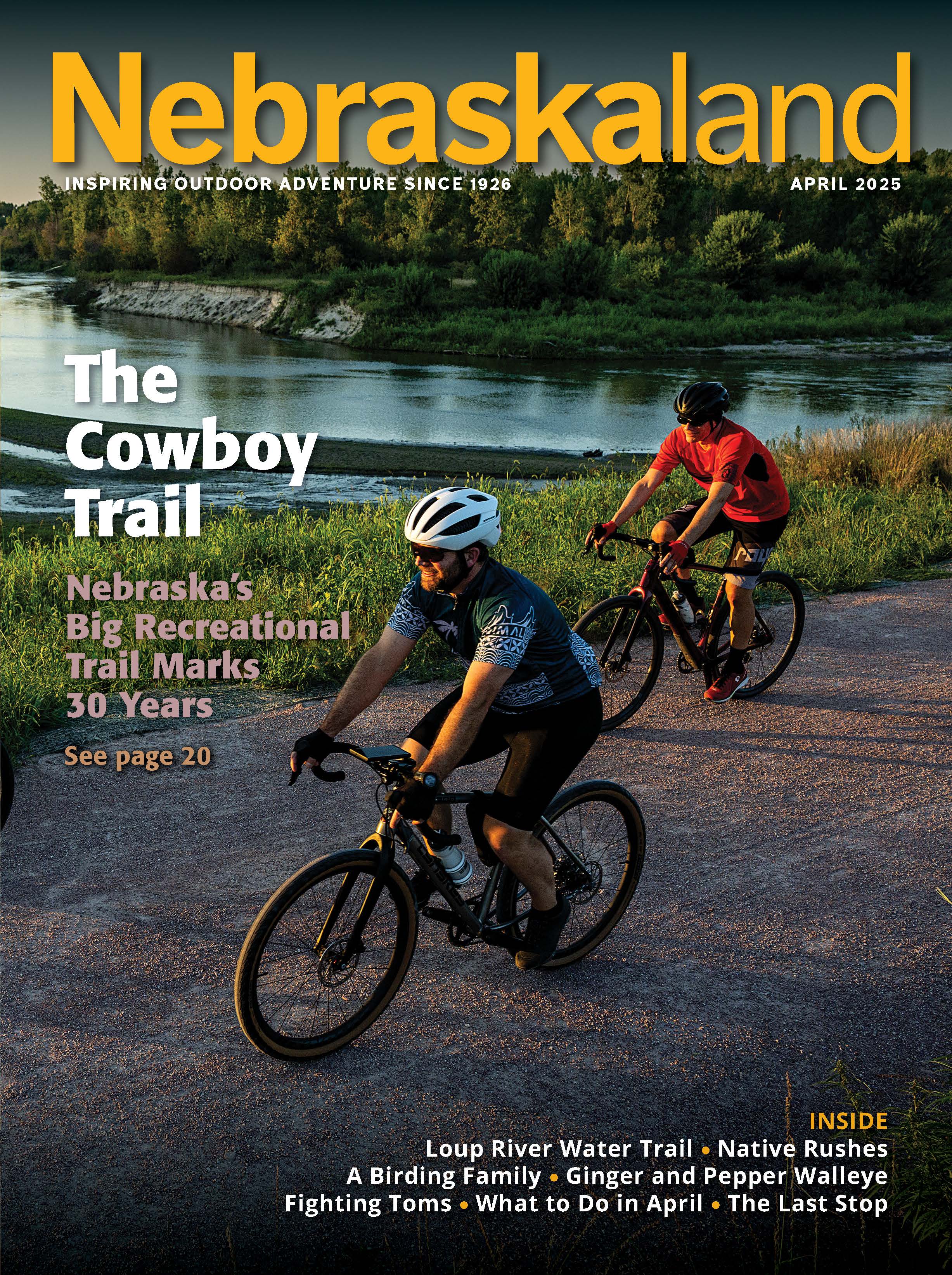
Andrew Smith and Larry Wenzl
oof Norfolk ride bikes on the Cowboy
TTrail along the Elkhorn River near
N
Norfolk. See page 20.
ERIC FOWLER, NEBRASKALAND
E
FEATURES
20
30
THE COWBOY TRAIL
Nebraska’s Big Recreational Trail Marks 30 Years
By Justin Haag
ERIC FOWLER, NEBRASKALAND
E
OUTDOOR NEBRASKA
What to Do in April
By Renae Blum
32
A BIRDING FAMILY
38
RUSHES REBORN
42
THE SERIOUS BUSINESS
44
T page: A male greater prairieThis
cchicken calls from a lek on the
VValentine National Wildlife Refuge in
C
Cherry County. The birds gather and
ddance as part of a spring
m
mating ritual.
Story and photos by Eric Fowler
By Gerry Steinauer
of Turkey Fighting
Story and photos by Justin Haag
LOUP RIVER WATER TRAIL
Story and photos by Eric Fowler
DEPARTMENTS
12
50
60
62
In the Field
Mixed Bag
Portraits from the Past
The Last Stop
ON THE WEB
For more articles and
information, visit
NebraskalandMagazine.com
Nebraskaland (VOL. 103 / NO. 3 ISSN 0028-1964) is published monthly, except for the combined Jan./Feb. and Aug./Sept. issues, by the Nebraska Game and Parks Commission, 2200 N. 33rd
St., Lincoln, NE. Periodicals postage paid at Lincoln, Nebraska, and additional mailing offices. POSTMASTER: Send all UAA to CFS. (See DMM 507.1.5.2); NON-POSTAL AND MILITARY
FACILITIES: send address corrections to Nebraskaland, P.O. Box 30370, Lincoln, NE 68503-0370.
4
Nebraskaland • April 2025
April 2025 •
Nebraskaland
5
Magazine Staff
magazine
Communications Director Christy Firestone
Public Relations Manager Shawna Richter-Ryerson
Published by the Nebraska Game and Parks
Commission since 1926. The Commission is
dedicated to the conservation and protection
of all the state's natural resources and the
people who use them.
Editor Jeff Kurrus
Associate Editor Jenny Nguyen-Wheatley
Regional Editors Eric Fowler, Julie Geiser,
Justin Haag
Contributing Editor Michael Forsberg
Regular Contributors Renae Blum,
Chris Helzer, Chris Masada, Todd Mills,
Ryan Sparks, Gerry Steinauer
Art Director Tim Reigert
Graphic Designer Mel Severin
Videographer Nick Sauvageau
Photo Librarian Jaclyn Cruikshank Vogt
Administration
Director Tim McCoy
Chairman - John Hoggatt, Kearney
Vice Chairman - Donna Kush, Omaha
2nd Vice Chairman - Ken Curry, Columbus
Pat Berggren, Broken Bow
Rick Brandt, Roca
Scott Cassels, Omaha
Dan Hughes, Venango
Kent McNeill, Papillion
Doug Zingula, Sidney
Commission Offices
Headquarters/Southeast District Office
2200 N. 33rd Street Lincoln, NE 68503
Phone 402-471-0641
Northeast District Office
2201 N. 13th St. Norfolk, NE 68701
Phone 402-370-3374
Southwest District Office
301 E. State Farm Rd. North Platte, NE 69101
Phone 308-535-8025
Magazine Subscriptions
For address changes, magazine and subscription
questions, 800-632-5263 or visit
nebraskalandmagazine.com
Advertising
For advertising information, contact:
Shane G. Gilster, 402-742-0125
shanegilster@solotreemedia.com
Conservation Officers
ADMINISTRATION
Jeff Clauson
402-471-5531
Lincoln HQ
Administrator
Travis Shepler
402-471-5531
Lincoln HQ
Asst. Administrator
Stacey Lewton
402-471-5531
Lincoln HQ
Asst. Administrator
Mike Thome
402-471-5531
Lincoln HQ
Asst. Administrator
(Includes counties covered)
NORTHWEST
Dan Kling
308-430-0572
Captain
Bassett Office
524 Panzer St., Box 508 Bassett, NE 68714
Phone 402-684-2921
Jerod Hahn
Ak-Sar-Ben Aquarium/Schramm Education
Center
21502 W. Highway 31 Gretna, NE 68028
Phone 402-332-3901
Omaha Office
8495 Frederick Street, Omaha, NE 68124
Phone 402-595-2144
OutdoorNebraska.gov
The Nebraska Game and Parks Commission does not discriminate
based on race, color, ethnicity, national origin, sex, pregnancy, sexual
orientation, gender identity, religion, disability, age, genetic information,
veteran status, marital status, and/or political affiliation in its programs,
activities, or employment. Any person who believes he or she has been
discriminated against in any program, activity, facility, or service,
should contact the Nebraska Game and Parks Commission, Lincoln, NE
402-471-0641, the Nebraska Equal Opportunity Commission, Lincoln,
NE 402-471-2024, TTY/TDD 800-642-6112; Director, Office of Diversity,
Inclusion and Civil Rights, U.S. Department of Interior, 1849 C Street,
NW, Washington, D.C. 20240.
6
Nebraskaland • April 2025
GETTY IMAGES
Nebraskaland Magazine Copyright 2025, all rights reserved.
Nebraskaland is available in audio from the Nebraska Library Commission
Talking Book and Braille Service, Suite 120, 1200 N St., Lincoln, NE 68508.
800-742-7691. Nebraskaland Magazine and the Nebraska Game and Parks
Commission reserve the right to reject any advertising not in keeping with
the agency mission.
Rates: $18 for one year; $33 for two years; $44 for three years. Nebraska
recipients must add appropriate sales tax. To subscribe call
1-800-NEBLAND (632-5263), or go online to:
NebraskalandMagazine.com.
Northwest District Office
East Hwy. 2, Box 725 Alliance, NE 69301
Phone 308-763-2940
Kearney Office
1617 First Ave. Kearney, NE 68847
Phone 308-865-5310
Newly emerged zebra swallowtail
butterflies are flying in the woodlands.
EAST SUB-DISTRICT
308-520-5539
Sergeant
308-280-4320
Hunter Lee
Keith, Arthur, Deuel
Jaden Porter
308-289-2274
Keith, Garden, Grant
Tyler Stueck
308-289-6260
Keith, Arthur, Grant
Keith Jadlowski 531-310-2869
Keith
WEST SUB-DISTRICT
Sean McKeehan 308-672-1824
Sergeant
KayLynn Miller
308-665-8440
Dawes, Sioux, Sheridan
Cassidy Harwood 308-562-9099
Box Butte, Sheridan
Josh Widhelm
308-279-9133
Scotts Bluff, Banner, Sioux
Brandon Wallace 308-280-4488
Scotts Bluff, Banner, Sioux
Travis Schultz
308-279-1292
Morrill, Scotts Bluff, Box Butte
Casey Gehrt
402-617-2112
Dawes, Sheridan
NORTHEAST
Dale Davis
402-760-0712
Captain
WEST SUB-DISTRICT
Jeff Jones
402-762-5022
Sergeant
Greg Hesse
308-546-7464
Rock, Brown, Keya Paha
Jonathan Andreasen
402-340-3981
Madison, Pierce, Stanton
Trevor Stahlecker
402-928-9099
Knox, Antelope, Pierce
Mitch Johnson
402-613-8612
Cedar, Knox
EAST SUB-DISTRICT
Cory Krause
402-380-6410
Sergeant
Kyler Prochaska 402-830-8278
Platte, Colfax
Matt Costello
402-317-4014
Dodge, Colfax
Kelbi Abke
402-237-2537
Washington, Burt
Nicholas Fix
402-508-0261
Dixon, Dakota, Thurston
Kyle Hansen
531-739-7392
Dodge
CENTRAL SUB-DISTRICT
Doug Pollard
308-730-7050
Sergeant
Daryl Teter
308-440-1863
Howard, Greeley, Merrick
Matt Brandt
308-202-0819
Sherman, Howard
Klint Gill
402-613-5800
Nance, Wheeler, Boone, Polk
Garrett Zimmer 402-416-5736
Garfield, Loup Valley
Tim Williams
308-380-7331
Hall, Hamilton
SOUTHWEST
Brian Piernicky 308-330-8780
Captain
NORTH SUB-DISTRICT
Alex Hasenauer
308-660-4671
Sergeant
308-395-6001
Jacob Stoinski
Lincoln, Perkins
Frank Miller
402-389-0444
Cherry, Hooker
Luis Nuñez
531-333-6093
Blaine, Custer, Thomas
Brandon O’Neal 308-530-3157
Lincoln, McPherson, Logan
SOUTH SUB-DISTRICT
Kelsey Glodowski 308-242-9000
Sergeant
Bryce Streger
308-537-0404
Dawson, Gosper, Custer
Tyler Adelman
402-314-4783
Dawson, Gosper, Furnas
Sophia Gobber
308-222-0368
Chase, Dundy, Hayes, Hitchcock
SOUTHEAST
Matt Seitz
402-806-0915
Captain
WEST SUB-DISTRICT
Matt Taylor
402-200-9597
Sergeant
402-902-2017
Eric Javins
Adams, Clay, Webster
Justin Gress
308-629-9335
Thayer, Nuckolls, Fillmore
Pat George
308-920-2762
Harlan, Franklin, Phelps
Ethan Teter
308-440-3847
Buffalo, Kearney
EAST SUB-DISTRICT
Heath Packett
402-210-0888
Sergeant
402-209-1506
Russell Mort
Otoe, Johnson
Rich Berggren
402-619-1355
Douglas
Brian Arp
531-530-9011
Douglas, Sarpy
Mike Luben
402-443-6392
Saunders
Bryan Adams
402-429-1924
Nemaha, Pawnee, Richardson
CENTRAL SUB-DISTRICT
Curt Prohaska
402-470-1298
Sergeant
402-890-6463
Dina Barta
Lancaster
Mark McDonald 402-805-2353
Lancaster
Mark Sullivan
402-741-0636
Lancaster, Seward, Butler
Jarrod Messman 531-739-9760
Lancaster, Saline, York
YOUR NEBRASKA
Instagram Photos
Follow us @nebraskaland
and tag us in your photos
to be featured in an
upcoming issue.
Paul Snyder, Scottsbluff
Bighorn Rams in the Rut
Travis Williams, Chappell
An After-School Duck Hunt with Tripp Williams
8
Nebraskaland • April 2025
April 2025 •
Nebraskaland
9
YOUR NEBRASKA
Connie Allen, Grand Island
Autumn Still Life
Roger Richters, Utica
Abandoned Farmhouse
Gordon Warrick, Valentine
Bobwhite Quail
Send your comments and
photos to:
Jeff Kurrus, Editor
Nebraskaland Magazine
P.O. Box 30370
Lincoln, NE 68503
or email Jeff.Kurrus@Nebraska.gov
Please include your postal address and
telephone number. Letters may be condensed and edited. Photographs are
also welcome.
10
Nebraskaland • April 2025
April 2025 •
Nebraskaland
11
IN THE FIELD
APRIL RIDGE
The sun shines on an
unnamed landform at
Fort Robinson State
Park in the Pine Ridge
of Dawes and Sioux
counties.
JUSTIN HAAG,
JUST
AG,
G, NEB
NEBRASK
NE
RASKALAN
RASK
ALAN
A D
12
Nebraskaland • April 2025
April 2025 •
Nebraskaland
13
IN THE FIELD
ANOTHER REASON FOR PICTURES
Story and photos by Jeff Kurrus
To record a memory. To be reminded of a time and place. To
show our friends. These are some of the reasons why people
shoot photographs.
For an angler, the reason might differ. To record the time
and place a fish was caught. To remind you what lure was
used. To foretell what can be repeated.
Before you plan this year’s fishing trips, or even decide
what you’re going to do this weekend, take a quick glance at
your fishing photographs. These images might just make the
decision for you.
May 28, northern pike, rooster tail, Clear Lake.
July 21, largemouth bass, spinnerbait, Pelican Lake.
June 15, carp, mulberry imitation, creek off the Platte River.
April 1, crappie, San Juan worm, private pond.
Aug. 1, smallmouth bass, woolly bugger, War Axe.
June 27, bluegill, popping bug, CenturyLink Lake.
14
Nebraskaland • April 2025
IN THE FIELD
Plover 274 has had a very busy year.
MICHAEL FORSBERG
PLOVER 274
By Elsa Forsberg
As far as I’m concerned, 2024 was the year of Plover
274. She is a piping plover, a small shorebird species that
is both state and federally threatened. The Tern and Plover
Conservation Partnership — a collaboration of Nebraska
Game and Parks, the University of Nebraska-Lincoln, private
industry and the U.S. Fish and Wildlife Service — has tracked
more than 800 piping plovers over the years, but Plover 274
stands out for several reasons.
Our record of her began in May 2013, when she was given
colored plastic leg bands that allowed us to uniquely identify
her. Since 2013, Plover 274 has hatched at least five nests
both on sandbars and at sand and gravel mines along the
lower Platte River in Sarpy, Saunders, Douglas and Dodge
counties. This summer, she was back for the first time at the
sand and gravel mine where she was banded 11 years prior.
It was quite a summer for Plover 274. In June, she was
incubating her nest on the sand when big thunderhead
clouds rolled in and brought golf-ball sized hail and 6 inches
of rain in an hour. Once the clouds cleared, Plover 274 was
still there, sitting tight on her nest. Contractors at the sand
16
Nebraskaland • April 2025
and gravel mine where she was nesting were amazed that
a small bird could protect her nest in a storm that cracked
windshields. They fondly called her “Hail Mary” after that.
She successfully hatched her eggs a week later and at the
end of July, Plover 274 was ready for her next adventure —
winter break on a Miami beach.
While Plover 274 became famous in her summer home
this year, she is also popular in her winter abode. She has
spent every winter for the last 12 years at the same beach on
a barrier island off the coast of Florida, where birdwatchers
recognize her distinct leg band color combination. Reports of
Plover 274 on the beach let us know she has made it another
day, which is quite an accomplishment.
Beyond surviving thunderstorms and attracting many
admirers, there’s something else special about Plover 274
— she is at least 13 years old, which is more than double the
average lifespan of a piping plover. As the summer of 2025
draws closer, I hope to see her back in Nebraska to raise yet
another brood of chicks and help boost the recovery of her
species.
IN THE FIELD
Walleye marinated in soy, ginger and black pepper.
JENNY NGUYEN-WHEATLEY, NEBRASKALAND
GINGER AND PEPPER WALLEYE
By Jenny Nguyen-Wheatley
This recipe is a variation of salt and pepper fish, a
Chinese dish. It will work with any white-fleshed fish,
but keep the skin on so the fillets don’t fall apart in the
pan while flipping and transferring.
Regular soy sauce is an OK substitute for dark soy
sauce, although you won’t get the nice caramelization
and depth of flavor. Do not use seasoned rice for this
recipe — the fish will be salty and is meant to be paired
with plain white rice. In a pinch, precooked jasmine rice
packets that you can throw in the microwave will work,
but adjust the rice vinegar amount to taste — you’re
looking for just a bit of tartness, similar to sushi rice.
Serving: 2
Prep Time: 5 minutes
Cook Time: 30 minutes
Ingredients:
2 walleye fillets, skin on
1 tbsp. finely grated ginger
3 tbsp. vegetable oil, separated
Freshly cracked pepper, to taste
•
•
•
•
18
Nebraskaland • April 2025
• 1 tsp. kosher salt
• 1 tsp. dark soy sauce
• 3 scallions, thinly sliced on the bias
• 1½ cup of long-grain white rice and water
• 1 tbsp. seasoned rice vinegar
1. Rinse rice and cook according to package directions.
When rice is cooked, fluff it with seasoned rice vinegar
and keep warm.
2. While rice is cooking, cut each walleye fillet into
2 to 3 pieces, depending on size. Season generously
with salt and pepper. Then combine 2 tablespoons of
vegetable oil, grated ginger and dark soy sauce in a bowl.
Toss seasoned fish in the marinade.
3. Heat the remaining 1 tablespoon of oil in a nonstick skillet over medium-high heat. When hot, sear
fish flesh side down until golden. Then flip and cook the
skin side until flesh is just cooked through. While the
second side cooks, add sliced scallion around the fish
and sauté until lightly browned. Serve fish and scallion
immediately with hot rice.
The Cowboy Trail
Nebraska’s Big Recreational
Trail Marks 30 Years
By Justin Haag
Nicole Bauer, Andrew Smith and
Larry Wenzl of Norfolk ride bikes
on the Cowboy Trail along the
Elkhorn River near Norfolk in
Madison County. ERIC FOWLER, NEBRASKALAND
20
Nebraskaland • April 2025
April 2025 •
Nebraskaland
21
Progress on the Cowboy Trail
MAP ARTWORK BY TIM REIGERT, NEBRASKALAND
The Cowboy Trail has two completed sections: Norfolk to Valentine, then Gordon to Rushville (solid line). Not yet
completed: Valentine to Gordon, and Rushville to Chadron (dotted line). Development between Rushville and
Chadron is underway.
C
oursing through cattle country, the name might
conjure up a dusty trail to drive longhorns across the
prairie. But the Cowboy Trail — formally the Cowboy
Recreation and Nature Trail — instead caters to the drive
of cyclists, runners, hikers and, yes, even some horseback
riders, as it crosses some of Nebraska’s most scenic regions.
This year marks the 30th anniversary of the trail, which
was born when trains stopped running on tracks operated by
the Chicago and North Western Railway. The historic route
known as “the Cowboy Line” was developed in the 1880s
and played a critical role in Euro-American settlement and
commerce in northern Nebraska.
When economic shifts forced the railroad company to
cease operations on the line in the 1980s, trail enthusiasts
capitalized on an opportunity. The Rails-to-Trails
Conservancy, a national organization based in Washington,
D.C., purchased the right-of-way between Norfolk and
Merriman for $6.2 million in 1994 and gifted it to the
Nebraska Game and Parks Commission. The portion between
Merriman and a spot a few miles east of Chadron was added
in the early 2000s when operations ceased there. In all, there
are 317 miles.
At the time it was purchased, the trail was publicized
to be the longest rails-to-trails conversion in the country.
So far, 187 miles between Norfolk and Valentine have
been completed, along with 15 miles between Gordon and
Rushville. Work is underway to complete more.
Yes, development has been derailed along the way, but
progress continues, and like the Little Engine That Could,
proponents are building momentum with an I-think-I-can
attitude.
provision that preserves railway corridors should they ever
be needed for trains again, but allows recreational use in
the meantime. About 25,000 miles of rail-trails have been
completed in the United States, with nearly 9,000 more in
progress.
With the dirt work and sturdy bridge structures already
in place, old rail lines make ideal multi-use trails. Once the
steel, ties and ballast are removed, the trail is surfaced with
low-maintenance crushed limestone, and bridges are fitted
with wood decking and safety rails.
Alex Duryea, recreational trails manager for Game and
Parks, said the Cowboy Trail has become a special way for
people to experience a large portion of the state.
“And, best of all, it’s free to do it,” he said. “Just hop on and
go.”
The Cowboy Trail, albeit desolate in places, features some
of the best aesthetics Nebraska has to offer. Beginning with
its trailhead at Ta-Ha-Zouka Park in Norfolk, it takes people
through the lush farmland of the Elkhorn Valley. Farther
west, it crosses the pristine trout waters of Long Pine Creek,
patches of wetlands and expansive grassland in the northern
Sandhills, and overlooks the mighty Niobrara River. Those
who travel the full distance get a sampling of at least five of
the state’s specified Biologically Unique Landscapes while
going through more than 25 cities and villages along the way.
Much of the trail runs parallel to U.S. highways 275
and 20, the latter designated the Bridges to Buttes Scenic
Byway. That name provides a clue to some of the trail’s most
impressive features.
More than 200 bridges on the trail have been converted
for recreational use. Southeast of Valentine, the bridge over
the Niobrara River is a quarter-mile long and 148 feet high.
Farther east, the 145-foot-tall bridge over Long Pine Creek
spans 595 feet.
Also attractive are the old rail line’s series of ornate arched
culverts constructed of stone blocks. Perhaps the most
impressive, just west of Johnstown, is 32 feet wide and 232
feet long. Plum Creek flows through it.
Part of the trail’s allure is the same thing that’s credited for
slowing development: the sparse population along the route.
Food, lodging, gear and other amenities can be found in
the route’s largest cities — Norfolk, Valentine, Ainsworth
and O’Neill. North Fork Outfitting in Norfolk caters to
Terri VanHouten of Long Pine
walks her dogs, Jasmine and
Harper, on a bridge over Long
Pine Creek on the Cowboy Trail in
Brown County. ERIC FOWLER, NEBRASKALAND
Big Features for a Big Trail
The Cowboy Trail is among the many rail-trails throughout
the nation that have capitalized on the gentle grade, 2
percent or less, and wide curves of old rail lines. Federal law
allows trail development of the lines through rail-banking, a
22
Nebraskaland • April 2025
April 2025 •
Nebraskaland
23
The Newport Pool Hall, located a few yards from the Cowboy Trail, is always open and offers free pool, concessions
and merchandise. Camping is allowed outside. ERIC FOWLER, NEBRASKALAND
cyclists with a shuttle and other services, for instance.
Fun stops can be found in smaller locales. One such place
is in Newport, population 97, where resident Melissa Denny
renovated an old hay scale building to a pool hall. The
unmanned facility is always open for trail users to shoot a
game of pool. Drinks, snacks, shirts and hats are available
on the honor system.
Other popular sites along the way are the Neligh Mill State
Historic Site and a pair of restored depots — one made of brick
in O’Neill and another constructed of wood at Long Pine.
The trail is surely not as busy as those in and near
metropolitan areas, but Duryea said it gets a lot more use
than most people think.
“We have automated trail counters out there now, and just
from January through the end of July 2024, we had 87,000
counts. That’s just between Norfolk and Valentine and doesn’t
include the section between Gordon and Rushville,” he said.
Most of the traffic occurs near communities along the way,
but there are users who like the challenge of taking it on in
its entirety.
Kylee Borg of Stuart, population 590, has a front row seat
for activity on the Cowboy Trail from her convenience store,
SouthSide Mini Mart.
“We see a lot of bicyclists stopping along their trip to fuel
Todd and Mary-Ann Madison of Valentine ride bikes on the Cowboy Trail, passing through the Sandhills southeast
of Valentine in Cherry County. ERIC FOWLER, NEBRASKALAND
their bodies — they don’t need gas, but they need bananas,
water and whatever else to make it to where they’re going,”
Borg said. “I would have never imagined how many people
bike the trail during the summer. A lot of Americans do it,
but there are also so many people from overseas. This past
summer, we had a lot of visitors from Europe.”
Borg helped promote the trail in fall 2024 by getting
firsthand experience in one of its premier activities. Even
though she doesn’t consider herself to be a runner, she
was persuaded by fellow community members to enter the
Cowboy 200, a grueling footrace that covers the trail’s entire
distance between Norfolk and Valentine. She made it 36
miles before bowing out of the 100-mile category. This year’s
race is set for Sept. 26.
Working Away
24
Nebraskaland • April 2025
ERIC FOWLER, NEBRASKALAND
Tackling the Trail
The Cowboy Recreation and Nature
Trail is open to hiking, running, cycling and
other non-motorized travel. Horses are allowed
alongside the trail, too.
Mountain bikes with large tires, such as fat
bikes and 29ers, are recommended. Especially
late in summer, the burs of puncturevine
(shown above), or “goatheads,” are present
in many places, so riders should be equipped
with extra tubes with internal sealant and an
air pump.
Class 1, 2 and 3 eBikes — pedal-assisted with
a top speed of 28 mph — are permitted.
Visit OutdoorNebraska.gov for information
about the trail, including a list of events
planned for its anniversary.
April 2025 •
Nebraskaland
ARTWORK BY TIM REIGERT, NEBRASKALAND
People ride horses along the Cowboy Trail near Long Pine in Brown County.
With little revenue to support the trail, Game and Parks
has had challenges maintaining and developing it since the
beginning,
“We are statutorily mandated to develop, operate and
maintain this corridor as a state recreational trail, so we are
doing our best with what resources we have,” Duryea said.
With the trail’s position in the Elkhorn Valley, occasional
high waters have caused problems. Flooding in 2010 washed
out a large section of trail and several bridges east of
Clearwater that have yet to be repaired due to funding and
logistics, forcing a detour along Highway 275.
In 2019, flooding resulted in five Federal Emergency
Management Area disaster sites along the trail. Three of
these locations have been fixed with disaster funding. They
include sites just west of Norfolk and Neligh, and another
east of Long Pine.
Remaining is a spot between Neligh and Oakdale where
floodwaters washed away the approaches to a bridge that
still stands. The other location to be fixed is erosion around
a twin 260-foot-long, 4-by-8-foot box culvert underneath
about 80 feet of embankment east of Valentine.
“If you’re just walking along the trail, you’d have no idea
that it’s even there,” Duryea said. “It’s a costly repair because
it’s in a remote, hard-to-get-to location.”
The setbacks from flooding have slowed new development,
but progress is being made.
An increased focus on maintenance has made the trail more
enjoyable for users in recent years. It also has seen a boost in
advocacy from its communities, with some stakeholders
along the route forming the Cowboy Trail Coalition.
The Cowboy Trail got a boost in publicity in 2019 when
the Rails-to-Trails Conservancy announced an effort to
connect Washington D.C. with Washington’s Pacific Coast
via what they dubbed the Great American Rail-Trail. With its
central location, the Cowboy Trail is key to the effort which
links 150 existing rail trails on the 3,700-mile-long route.
Kevin Belle, the conservancy’s project manager for the
effort, said more than half of the trail is already in place and
that it has already become popular even though numerous
gaps exist along the way.
“The Cowboy Trail is a big part of our history. You all are
pretty important with your location as the midpoint, and also
because you’re one of the longest rails-to-trails conversions
25
in the country. That helps make this trail possible,” he said.
“Now our big job is to figure out how to fill in the remaining
1,600 miles, including the segment of the Cowboy Trail that
still needs to be finished.”
Two nonprofit organizations in the Panhandle, Cowboy
Trails West of Sheridan County and the Northwest Nebraska
Trails Association based in Chadron, are working with Game
and Parks and other stakeholders to develop the western
end, which takes users from the edge of the Sandhills
through another one of Nebraska’s most scenic places, the
Pine Ridge.
Cowboy Trails West was born after cyclist Kris Ferguson
of Gordon was injured from being struck by a vehicle while
pedaling on the highway’s shoulder. The cyclist gathered
with other persistent Sheridan County residents to advocate
for completion of the trail, eventually partnering with Game
Volunteers pile railroad ties and other debris that was
collected during a clean-up effort on the corridor east
of Chadron in 2016. JUSTIN HAAG, NEBRASKALAND
26
Nebraskaland • April 2025
New decking and rails adorn a bridge on
the Cowboy Trail in the Pine Ridge east
of Chadron. It is one of 26 bridges on the
abandoned rail line between Rushville and
Chadron that received decking and rails in
summer 2024. The section of trail is expected
to be complete and open as soon as summer
2026. JUSTIN HAAG, NEBRASKALAND
and Parks to complete the portion between Gordon and
Rushville in 2015.
Contractors for Game and Parks decked bridges through
the Pine Ridge between Rushville and the terminus east
of Chadron in 2024. That section is projected to receive
surfacing in 2026. The trails association in Chadron is
working to develop a trail alongside the still active rail line
for the last 5 miles leading to its downtown area.
Once the section between Rushville and Chadron is
complete, a 91-mile gap between Valentine and Gordon will
remain. It is the trail’s most sparsely populated section, but
proponents believe its Sandhills scenery has potential to
attract interest from afar.
“I’m sure we could get money to develop the entire
trail now,” Duryea said, “but doing so without having
maintenance dollars would be setting us up for sure failure.
The big key is getting maintenance dollars. We don’t even
have enough money to maintain what we have. We need to
get a little more money to spur development and maintain
the additional miles out west.”
As with trails throughout Nebraska and the nation, much
of the funding for development has come from the Federal
Highway Administration’s Recreational Trails Program and
Transportation Alternatives Program.
Game and Parks is exploring other revenue sources, such as
building a fund to serve as principal for a lasting endowment.
Other ideas have been explored. Bills introduced to the
Nebraska Legislature in 1997, for instance, would have
provided about $1.5 million of annual funding by taxing
bicycle sales and raising vehicle registration fees, but they
failed to pass. Also considered have been voluntary fees
at iron rangers, but Game and Parks has been hesitant to
this idea, projecting the cost of management would exceed
income.
Wherever the money may come from, Duryea believes it’s
a good investment.
“The trail is so much more than just a trail,” he said,
noting the corridor contains 5,000 acres of opportunity for
wildlife and its habitat. Along the way, Game and Parks also
facilitates hundreds of crossings for electricity, fiber-optic
cable and pipes for water and sewer.
One full-time and two part-time employees are assigned
to the trail now. Game and Parks is working to secure
funding for another staff position to maintain the west end.
Duryea is optimistic for the trail’s future.
“I’m not saying we’re going to complete the entire trail in
five years or anything, but we have some good momentum,
and it will surely be a nice thing to see when it happens,”
he said.
Development of the entire route could also give Nebraska a
point of pride for being the longest rails-to-trails conversion
in the country, as it was first advertised to be. The 240-mile
long Katy Trail in Missouri claims to be the nation’s longest
developed section, but proponents want the Cowboy to
someday lasso that claim.
By staying the course and chugging along — or, perhaps,
cowboying up — proponents are betting on it. N
April 2025 •
Nebraskaland
27
The Cowboy Trail’s
Railroad History
T
By David L. Bristow, Nebraska State Historical Society
oday’s Cowboy Trail follows an old railroad
that was organized in January 1869, less
than two years after Nebraska statehood. Its
founders called it the Fremont, Elkhorn & Missouri
Valley Railroad. Starting in Fremont, track-laying
crews followed the Elkhorn River to Wisner before
an economic depression halted construction in the
early 1870s.
According to David Seidel’s book, Fremont, Elkhorn
& Missouri Valley R.R. Co., the original plan was to
continue northwest to the junction of the Niobrara
and Missouri rivers. The idea was to connect with
steamboat traffic on the upper Missouri. Plans
changed after gold was discovered in the Black
Hills. The army fought the Great Sioux War to
force the Lakotas to sell the Black Hills. Afterward,
the railroad began building again, but with a
new destination in mind. Following the Elkhorn
upstream, the tracks reached Norfolk, Neligh and
then O’Neill by 1880.
As the railroad approached the headwaters of
the Elkhorn, Chief Engineer J. E. Ainsworth planned
a route west across the Sandhills. The rails reached
Long Pine in 1881 and Valentine two years later.
The route originally looped south at Long Pine to
avoid a deep canyon, but there was no avoiding
the Niobrara River, which had to be spanned with
a high bridge. The original wooden structure was
Chicago and North Western Engine No. 1191 pulling a post office car, baggage car and passenger car, early 1900s. Photo by
Emanuel Wolfe of Neligh. NSHS, RG2836-0-1464
replaced in 1910 with a steel bridge that is still
enjoyed by Cowboy Trail travelers today.
The Chicago and North Western Railroad took
over the Elkhorn route in 1882 and soon found
itself in an enviable position. A competitor’s
planned route to the Black Hills was blocked when
Congress banned railroad construction on Indian
lands in Dakota Territory. The C&NW soon boasted
of having “The Only Line between CHICAGO and
the BLACK HILLS.” The rails reached Chadron in
1885, Rapid City in 1886 and Deadwood in 1890.
The railroad also continued west from Chadron
into Wyoming.
The Elkhorn route carried freight and passengers
for many years. Eventually traffic declined, and
operations ceased on most of the track in the
1980s and 1990s. N
Visit NSHS’s
website at History.
nebraska.gov.
Postcard showing the Chicago and North Western coal chutes at Oakdale,
circa 1907. NSHS, RG2986-5-32
Crossing the bridge over the Niobrara River east of Valentine, 1957. This 1910 bridge is a favorite spot along the
Cowboy Trail. NSHS, RG3314-10-144
28
Nebraskaland • April 2025
Postcard of the Chicago & North Western Depot at Neligh, circa 1910.
NSHS, RG2986-4-25
A column from the Chicago &
North Western’s April 28, 1957,
timetable shows the times to
“Chardon” Nebraska. NSHS, RG1633.AM
April 2025 •
Nebraskaland
29
Outdoor Nebraska
By Renae Blum
With warmer weather returning and signs of spring
everywhere, now is a great time to be outdoors. This month, find
a friend and enjoy wildlife watching, stargazing and fishing. N
What to Do in April
Watch the Lyrid meteor
shower
April 16-25, peaking in the early hours
of April 22 | Merritt Reservoir State
Recreation Area
Need a good excuse to spend some time under the
stars? Head to a dark sky location, like Merritt
Reservoir, to view the Lyrid meteor shower. One
of the oldest recorded meteor showers, it can
produce 15-20 meteors per hour at its peak. The
best time to watch is in the predawn hours. Be
patient, bring warm clothes and allow 30 minutes
for your eyes to adjust to the darkness.
GETTY IMAGES
Report sightings of whooping
cranes
Mid-March to mid-April | Primarily central Nebraska
Celebrate Earth Day at a state park
As you’re out exploring this month, be ready to report any sightings
of migrating whooping cranes. This critically endangered species may
spend time in wetlands and river channels, as well as in cornfields and
meadows near those habitats, mostly between Columbus and North
Platte. These large white birds stand 5 feet tall, with black wingtips
and reddish-black face masks. Never approach or pester these birds;
view them only from a safe distance. You can report sightings at
OutdoorNebraska.gov or by calling any Game and Parks office.
April 22 | Statewide
Nebraska’s state parks are ideal places to celebrate Earth Day, with its
emphasis on protecting the environment. You might organize a group bike ride
or walk on a park trail, while practicing Leave No Trace principles. Or consider
hosting a picnic with friends and family, where everyone brings eco-friendly
snacks or locally-sourced food in reusable containers. Find a state park near
you at OutdoorNebraska.gov.
ERIC FOWLER, NEBRASKALAND
JEFF KURRUS, NEBRASKALAND
View prairie-chickens at
N-CORPE’s blind
Catch bluegills on
warm afternoons
March 15 – April 30
About 30 minutes southwest of North Platte
As weather allows | Statewide
Greater prairie-chickens put on an amazing show
during their spring mating rituals. One popular spot
to view them is N-CORPE’s blind, where you can
make reservations for free. Given decent weather,
the chance of seeing birds close by is about 100
percent, said project manager Kyle Shepherd. The
blind comfortably holds six, and one group per day
is allowed, offering plenty of privacy. Learn more
and make reservations at Ncorpe.org/wildlifeviewing. JULIE GEISER, NEBRASKALAND
30
Nebraskaland • April 2025
If warm weather is in the cards this
month, anglers could see some of the best
opportunities all spring for catching bluegills.
On warm spring afternoons, bluegills will
move into shallow, protected areas, searching
for prey. Make use of any wax worms left
over from ice-fishing — and have fun. There’s
nothing better than soaking up some early
spring sunshine on a shoreline, waiting for a
bobber to go under.
JEFF KURRUS, NEBRASKALAND
April 2025 •
Nebraskaland
31
A Birding
Family
By Eric Fowler
or one Omaha couple, what began with hiking and a
birdsong book has led to two high-school-aged boys who
can hold their own with some of the top birdwatchers in
the state.
Corey and Andi Weber always enjoyed hiking. When their
son, Eli, was born in 2006, they received a membership to
Fontenelle Forest in Bellevue as a Christmas gift. That led to
more hikes with Eli and, two years later, Silas. “We took the
boys there ever since they were teeny tiny,” Andi said.
The hikes were simply about being outdoors. Corey grew
up in Wisner and had learned to identify the ducks he saw
F
The Weber family of Omaha, Corey, Andi, Silas and Eli, look for birds in the woodlands at Fontenelle Forest in Bellevue.
ERIC FOWLER, NEBRASKALAND
The Webers were looking for, and found, a northern parula
that had been spotted at Fontenelle Forest in Bellevue
during its northward spring migration. Eli Weber was able
to capture this photo of the bird. ELI WEBER
32
Nebraskaland
• April 2025
along the Elkhorn River but hadn’t paid much attention to
songbirds.
While perusing the clearance rack at a local bookstore,
Andi ran across a copy of the Bird Songs Bible, a book with
an audio player containing photos and sounds of all 750
breeding birds in North America.
“Eli would just sit and go through it one song at a time,”
Andi said.
One day, while sitting on the porch, Eli, who was 5 or 6
years old at the time, exclaimed, “Mom! Chimney swifts.”
When Andi asked what he was talking about, he told her
there were chimney swifts flying around the house, and he
knew that because of the noise they were making. “I thought,
‘That’s cute.’ And he went inside and got the book and came
out and played it and, sure enough, he was spot on,” she said.
“That’s when we were like, ‘He’s really into this. Let’s get
everybody some binoculars.’”
The family’s interest in birds grew with outings to
Fontenelle and other sites around Omaha. More than once,
while getting ready for a hike, Silas would wander off to talk
to other birders. “Silas was great,” Corey said. “He’d break the
ice with anybody else out on the trail.”
Silas’s outgoing personality led to a chance meeting
along a trail at Fontenelle in 2018 with Mark and Ed Brogie,
April 2025 •
Nebraskaland
33
warblers. Eli is quick to identify many species. “Without Eli,
we have a lot of question marks,” Corey said. “We really rely
on him like with the sparrows. It’s hard to be conclusive, but
that quick, he’s got it.”
“Corey and I, when we’re birding with the kids, we don’t
have to work as hard to figure out what stuff is,” Andi added.
The boys sometimes walked to Hanscom Park near their
home in midtown Omaha to look for birds, once spotting
a Cape May and hooded warbler on the same day. Until
recently, they relied on their parents to drive them to birding
spots farther from home. Those drives were for searching rare
birds reported on eBird, a website and app created by Cornell
Lab that allows birders to track and share their sightings.
“That’s what really got me into it,” Eli said of eBird.
Their bird identification skills didn’t go unnoticed with
birders met during the outings. Colleen Childers of Grand
Island and Boni Edwards of North Platte, both accomplished
bird-watchers, met the family when they were all among
birders gathered to see a limpkin that had stopped in Omaha
Eli Weber photographed this cinnamon/blue-winged teal
hybrid on the wetland at Fontenelle Forest last spring. ELI WEBER
Five-year-old Eli Weber holds a white-breasted nuthatch at the first bird banding workshop he attended at the Fontenelle
Forest Nature Center. COREY WEBER
brothers from Creighton and Wayne, and two of just seven
birders in the state who have checked off more than 400 birds
in Nebraska on their life lists. As it turned out, Mark had done
his student teaching under Corey’s father at Wisner-Pilger
schools. The next day, when they crossed paths again, the
Brogies and their party invited the Webers to join them in the
woods. “We saw a bunch of stuff we had never seen before,”
Andi said, noting a prothonotary warbler was the highlight
of the day.
Warblers piqued their interest early on, and they purchased
the warbler identification course from the Cornell Lab of
Ornithology’s Bird Academy to help them identify subspecies,
something that can be tricky with these small, colorful birds
that flit among the treetops. Other courses have followed.
The interest in warblers led to a vacation in High Island,
Texas, in the spring of 2019. The birdwatching destination
boasts the only strip of forest for miles on the Gulf Coast,
and it is where millions of neotropical songbirds, including
warblers, stop to rest after flying across the Gulf from their
wintering grounds farther south. The Webers were among a
group of bird-watchers when Silas, 10 at the time, made an
34
Nebraskaland
• April 2025
impression.
“Silas is up front, sitting down, and he says, ‘There’s a
chestnut-sided warbler.’ And I hear someone say, ‘Hey, that
little kid’s right,’” Corey recalled.
When the coronavirus pandemic shut the world down in
2020, the Webers did their social distancing in the woods,
often twice a day in the spring and fall.
“The pandemic really helped because I barely had any
schoolwork, and I was able to go out every day in the spring,”
Eli said.
“We were killing it,” Corey said. “We just saw so many
birds. It was a great use of time when there wasn’t much else
to do.”
The brothers each bring something to the table.
“Eli is the engine room,” Corey said. “He’s got the insatiable
appetite for it, and he kind of motivates the rest of us. Silas
has outstanding ears and outstanding eyes but takes a little
prodding to get going. Once he gets going, he loves it. But
sometimes he’s not dying to get up early and come out here.
But he’s good. He’s spotted a lot of birds for us.”
Silas’s eyes have made him good at spotting and identifying
Silas, Eli, Corey and Andi Weber watch a bird in the woodlands at Fontenelle Forest in Bellevue last spring.
April 2025 •
ERIC FOWLER, NEBRASKALAND
Nebraskaland
35
in 2022. They were so impressed with the boys’ skills and
interest that they each gave them one of their old cameras.
Andi was humbled and tried to pay the women, who
refused to take anything. “It was like they gave them a
quarter for a gumball,” Andi said.
Childers said she and Edwards had both recently upgraded
their cameras. “I thought, ‘Oh, man. I bet they’d love to have
cameras,’ too because I knew they were big birders. I saw
their names on eBird all the time,” Childers said. “It’s no big
deal. They just came off as really kind, respectful lovers of
nature, and I knew they loved birds. They are such good kids,
and they do know their stuff.”
The cameras opened a new world of birding, Eli said,
allowing him to document what he’s seen and do research
at home to help identify birds. “It’s really useful if you see
something you don’t quite know what it is and could be rare
for the area,” he said.
He’s also now able to post photos to accompany his
sightings on eBird. There had been some who doubted the
sightings the boys reported, simply because of their age. “I
think a lot of the local birders trust my sightings more than
they used to. But still, I’m far from being an expert, and I still
make mistakes all the time, but it’s always good to have a
little proof.”
Eli photographed this scissor-tailed flycatcher in 2024 near
Flanagan Lake in Omaha. ELI WEBER
36
Nebraskaland
• April 2025
Eli followed a report on eBird of a hooded warbler at Towl
Park in Omaha in 2024 and captured this photo. ELI WEBER
Now Childers and Edwards text the Webers whenever
they make a trip east to go birding. The family has gotten to
know many other birders from the Omaha area as well. “We
always run into somebody we know, and they always know
who the boys are,” Andi said. “Everyone is just very kind and
welcoming to them in the local birding community.”
They’ve stayed in touch with the Brogies, too, and even
called Ed when they were visiting Corey’s parents in Wisner
on Mother’s Day in 2022 and spotted a cerulean warbler. They
kept eyes on the bird, a rare sighting in Nebraska, until Brogie
could make the drive from Ponca.
Ed Brogie said he doesn’t see many children who get their
start in birding as young as the Webers did, and even fewer
who stick with it. “It’s a pretty good deal that a lot of older
birders kind of gave them some kudos, so to speak, and
boosted their interest,” he said. “They still have good eyesight
— they’re good at spotting things — and good hearing. And
they’re very enthusiastic, so I really enjoy those kids.”
Eli, now age 18, and Silas, 16, both play baseball for Omaha
Central High School, so schedules are full in the spring,
leaving Sunday as the day the family often goes birding. They
have more time in the fall when songbirds are heading south.
In the winter Eli will be looking for horned larks, waterfowl or
“any random rarity that shows up,” he said.
Silas’s interest in birds has waned as he focused more on
baseball. Not Eli, who is preparing to study wildlife in college
later this year and hopes to someday have a career involving
birds. He received a scholarship to attend the Nebraska
Ornithologists’ Union conference in McCook last fall. Andi
went, too, and they birded their way home across southern
Nebraska, adding species to their lists. Eli’s list has grown to
334 species, more than half of what is in the Bird Songs Bible,
with 262 in Nebraska.
Last summer, Eli attended an American Birding Association
Young Birder Camp, spending a week watching birds on and
around Delaware Bay in Delaware and New Jersey. On that
trip, his life list grew by 26 species, including pelagic birds
such as a Cory’s shearwater, a brown booby — rare even for
that area — and a curlew sandpiper, a bird native to the other
side of the world. “It was really cool to see a bird that wasn’t
even supposed to be on this continent,” Eli said.
“Probably the coolest thing for me was getting to meet
people my age who are as into birds as I am,” Eli continued.
“Before that, it was pretty much just my brother, who has not
been that interested in it the last few years, and a few others
who have either moved or got disinterested.”
While forming friendships with older birders has been
rewarding, it can be hard to relate. “I can’t just hang out with
a 40-year-old outside of birding,” Eli said. In hopes of finding
others with an interest locally, Eli started a birding club at his
school and dubbed it the Central Flyway. “If there were more
people my age, it brings a little bit of competitiveness to it …
just having someone to compare yourself to, I guess.”
Andi doubts Corey and she would’ve become so interested
in birds if it weren’t for the boys. “It was kind of a nice marriage
of our love for being outside and hiking and then Eli wanting
to be birding on top of that,” she said. That, in turn, has led
to other interests, including native plants, mushrooms and
foraging. “I think it was a really good springboard for all of us
to really get more interested and more in tune with what was
going on around us when we were outside.”
“I just love being outdoors in nature, and it kind of gives
me an incentive to get outside,” Eli said following a family
outing on the riverbottom last spring at Fontenelle Forest
that yielded, among other birds, a northern perula, a
migratory warbler more common to the east, and a hybrid
cinnamon/blue-winged teal. “It’s almost like treasure
hunting, sometimes, because you never know what you will
find. A morning in May, there could really be anything. You
could have a chance to find something pretty interesting and
special.”
Silas agreed, to a point. “But when you don’t find anything
it’s frustrating. But then you have like that perula we had
today, and it makes it better when you don’t see anything
else.”
“If he was guaranteed to go out and see a bunch of stuff,
he’d go all the time,” Eli said. “But it’s never guaranteed.”
What is guaranteed? Perhaps a life-long appreciation
of nature for two young men that began with family time
outdoors and a book. N
When the Webers bumped into fellow birders Colleen Childers of Grand Island and Boni Edwards of North Platte last spring
during an outing at Fontenelle Forest in Bellevue, Eli showed them a photo of a bird he captured. The women gave their old
cameras to Eli and his brother, Silas, when they upgraded. ERIC FOWLER, NEBRASKALAND
April 2025 •
Nebraskaland
37
Rushes Reborn
By Gerry Steinauer, Botanist
O
ne June morning in 2021,
Nebraskaland regional editor
Eric Fowler and I explored
an abandoned channel of the
Elkhorn River on Red Wing Wildlife
Management Area in Antelope County.
Eric was taking photos and gathering
material for an article about the
historic 2019 flood and how it altered
the river’s course along this stretch. I
was there to help him understand the
ongoing changes in the vegetation as
the channel gradually transitioned
from sandbar to marsh or woodland.
While Eric took advantage of the
warm, early-morning sunlight to
capture photos, my botanical eyes,
and camera, were immediately drawn
to the obscure rushes thriving on
the channel’s sandbars. It was no
coincidence that the flood we were
investigating was responsible for the
rush colonies.
Let me explain. When buried in
sediment and shielded from the
elements, tiny, nearly microscopic rush
seeds can remain viable for decades.
As floods have done for millennia,
the churning waters of the 2019 flood
tore down streambanks, scoured the
streambed and carried away sediment,
mainly sand, along with long-buried
rush seeds and those of other plants.
When the floodwaters receded and
slowed, the sand and seeds settled
across the floodplain.
The perennial
knotted rush
in bloom on a
sandbar of the
abandoned
Elkhorn River
channel.
The abandoned Elkhorn River channel on Red Wing Wildlife Management Area, as seen in September 2020. Severe flooding in
2019 caused the river to return to a channel it had abandoned during an earlier flood sometime before 1938. The abandoned
channel’s sandbars provide ideal habitat for several rush species. ERIC FOWLER, NEBRASKALAND
38
Nebraskaland • April 2025
GERRY STEINAUER, NEBRASKALAND
April 2025 •
Nebraskaland
39
Toad rush seedpods ripen to a rich brown in the June sun. This annual grows nearly statewide along the margins of lakes,
ponds and streams. It is especially abundant on sandbars, including those of the Elkhorn River. GERRY STEINAUER, NEBRASKALAND
Torrey’s rush in bloom. The bunched flower heads
contain 20 to 60 small individual flowers.
GERRY STEINAUER, NEBRASKALAND
Of the millions of rush seeds
carried by the floodwaters, some
were fortunate. They landed on bare
sand, warmed by the sun’s rays and
moistened by groundwater or nearby
pools and rivulets. Their long, dark,
dormant wait was over, and they
germinated. These reborn rushes were
the ones I photographed.
What is a Rush?
If an adventurous hiker had
happened to pass by that morning as
I knelt behind my camera, they might
have assumed I was photographing
grasses,
given
the
grass-like
appearance of rushes. However, the
40
Nebraskaland • April 2025
two plant groups differ in subtle yet
distinct ways.
For example, in grasses, the male
and female flower parts are protected
by two bracts, while rush flowers are
enclosed by six bracts that open as the
flowers mature.
Additionally, each mature grass
flower produces a single, relatively
large seed, whereas each rush flower
forms a pod containing dozens to
hundreds of seeds.
Furthermore, grass stems are round,
hollow and contain nodes, swollen
joints where the plants’ many leaves
emerge. In contrast, rush stems are
solid, lack nodes and are typically
round, except in a few species where
they are flat. Rushes have few leaves,
most of which grow from the base of
the plant.
To further complicate matters for
plant enthusiasts, sedges closely
resemble both rushes and grasses.
However, they can be distinguished by
a single bract that shields the flower
parts, as well as solid, triangular stems
that lack nodes. Fortunately, there is
a simple rhyme to help discern these
tricky plants:
Sedges have edges,
rushes are round,
and grasses have nodes
from the top to the ground.
Nebraska’s Rush
Diversity
Nebraska is home to 16 native
and one non-native rush species. By
comparison, the state has about 200
grass species and 75 sedge species.
While all our rushes inhabit wetlands,
some also grow in upland woodlands
and prairies. A few, like joint-leaf rush
and soft rush, have a limited range
and are rare in Nebraska, while others,
such as Baltic rush and interior rush,
are widespread and common.
Rushes play vital ecological roles
in wetlands. For example, the three
The northern rush grows on Elkhorn River sandbars
and wetlands in northeastern Nebraska. a) root and
stems, b-d) flower heads, e) single flower, f) seedpod
surrounded by bracts and g) seedpod.b GETTY IMAGES
species I photographed at Red Wing
WMA — knotted, toad and Torrey’s
rush — colonize sandbars and other
disturbed wetlands, where their
fibrous roots stabilize the soil and
prevent erosion. As their roots and
stems decompose, they contribute
organic matter, enriching the soil and
aiding the establishment of other
plant species.
Eventually, the rush colonies I
photographed at Red Wing will decline
as the sandbars transition to other
plant communities. In the meantime,
they will scatter countless seeds
across the sand. When the next flood
arrives, these seeds will be carried
away, hopefully settling on moist
sandbars to begin the eternal cycle
anew. N
Red Wing Wildlife
Management Area
Only 2.5 miles west of Neligh,
this management area features
320 acres that includes 1.5 miles
of Elkhorn River frontage. You’ll
find a beautiful wooded area with
some grassland and marshes.
April 2025 •
Nebraskaland
41
The
Serious
Business
of Turkey Fighting
Story and photos by Justin Haag
P
erhaps it’s the relatively small,
featherless, wrinkly head
on the big body that gives
it comical appeal. Make no
mistake, though, fighting among wild
turkeys is serious business.
Similar to other wildlife species,
most fighting among turkeys is related
to the mating scene. Throughout the
year, males establish a pecking order
with the most dominant toms earning
the right to breed and pass on their
genetics.
The process of developing this
hierarchy picks up in fall when turkeys
gather in flocks. While spending all
of that time together throughout the
winter, social structures develop.
Tough guys get a reputation. Inferior
birds are shunned. Gangs form. Hens
also squabble as they jockey for rights
to food and nesting locations.
Jake wild turkeys in Banner County lock beaks while sparring for dominance in the fall.
Such skirmishes help establish the flock’s pecking order.
A wild turkey pecks at the head of another after establishing dominance.
The bottom turkey waited for the bird on top to get out of sight before rising
and heading in an opposite direction at Chadron State Park.
42
Nebraskaland
• April 2025
While much of the dominance has
been determined come spring, the
mating period is when some of the
most dramatic fights occur. Toms have
a one-track mind and are intent on
their mission. As each day lengthens,
so rises the level of testosterone in the
males, making them more apt to get
worked up.
When toms become agitated in a
skirmish or excited at the presence of
females, blood rushes to their heads.
This changes the way light reacts
with collagen fibers, causing them to
emit the distinct red, white and blue
The characteristic red, white and blue
coloring.
appearance. This colorful head, with
its odd snood, caruncles and wattle, is
integral to the tom’s iconic courtship
display of Thanksgiving decor: a bird
in full strut, tail feathers erect and
wings dragging on the ground.
Fighting toms and jakes don’t abide
by any rules of engagement. Kicking,
scratching and biting are allowed.
There’s neck wrestling, wing flapping,
pecking at heads, clawing and a lot of
squawking.
One especially interesting sight is
two birds with locked beaks, appearing
as if they are trying to swallow each
other. The conflicts can last a few
minutes up to days.
For hunting purposes, it’s hard to
know when to play upon the birds’
tendency for conflict. A gobble or
fighting purr call paired with a full
strut decoy might attract a battleready big tom, but others are likely to
keep their distance for fear of getting
their butts kicked.
Especially comical is when a
confused tom beats up on a decoy or
attacks some other thing that isn’t a
turkey. Make no mistake, though, it’s
serious business. N
April 2025 •
Nebraskaland
43
Loup River
Water Trail
Story and photos by Eric Fowler
he Loup is a beautiful, braided river, flowing for 69
miles through fertile, eastern Nebraska farm country,
surrounded by towering cottonwoods that serve as ideal
perches and nesting spots for bald eagles.
Other than those who hike down its bank at five wildlife
management areas along its course or a city park in Columbus,
T
Bald eagles are plentiful along the Loup River Water Trail.
44
Nebraskaland • April 2025
few people spend
time on the river.
Until recently, even
fewer paddled its
waters, primarily
because there was
nowhere to easily
get on and off the
river. That changed
in 2023, when the
Loup River Water
Trail was completed
between
Genoa
and
Columbus,
the culmination
of work by many,
opening the river
to the countless
individuals who
have taken up
paddle sports in
recent years.
Ken Curry grew up in Lincoln, but his mother was from
Tilden. During the summer, the families would meet on the
banks of the Loup River at Pawnee Park in Columbus, the
midway point between the communities, for picnics. “As a
little kid, we would run up and down that river,” Curry said.
He has watched people play in the Loup River on summer
weekends since moving to Columbus in 1991. In many years
serving on the Chamber of Commerce, the river occasionally
came up during chamber planning meetings. “We always
said we have a great asset, this river, but we never did
anything with it,” Curry said. Similar discussions came up
during his time spent as a leader at the local and district level
Ken Curry and his son, Brian, of Columbus paddle the Loup River Water Trail between Monroe and Columbus.
The trail opened in 2023 with new put-in and take-out points.
of what is now Scouting America. An Eagle Scout himself,
neither of his sons paddled the river during their path to the
same rank. Access was the issue.
In 2021, when he was appointed to the Game and Parks’
Board of Commissioners, Curry started learning more about
water trails. That led to a meeting between a few Platte
County commissioners and the Columbus mayor and city
administrator. They reached out to Lee Rupp, and a former
state senator and Game and Parks fisheries biologist, a longtime resident of Monroe with a love for the river, for advice.
Rupp already had notes and a map drawn up when they met
with him. “We all said: ‘Let’s make it happen’,” Curry said.
While an official water trail access couldn’t be built on
George D. Syas Wildlife Management Area southeast of
Genoa, an existing fishing access point could be utilized
as the starting point. Eight miles downstream, the county
agreed to build an access point with plenty of parking on
land it owned south of Monroe. At Columbus, 16 miles
downstream, owners of the Quality Inn agreed to allow
paddlers to use their parking lot, a 250-yard walk up the
newly paved Pawnee Park Trail from the riverbank. With
those three points in place, the trail was opened in the spring
of 2023.
Late last year, a fourth point was developed 4½ miles
downstream on the banks of the Platte River, a mile from
the mouth of the Loup. Archer Daniels Midland, owner of an
April 2025 •
Nebraskaland
45
Enlarged Area
Monroe
Lee Rupp
WMA
2
Genoa
p
Lou
r
Rive
Oconee
er
p Riv
Lou
pR
ive
rC
an
al
Loup R
ive
r
George D. Syas WMA
Prairie Wolf
WMA
Lou
Columbus
1
3
Loup River Water Trail
Brian and Ken Curry paddle
beneath a railroad bridge
crossing the Loup River west
of Columbus.
Duncan
ver
i
R
e
t
Plat
1. George D. Syas Wildlife Management Area: A fishing access point is located on the southwest corner of the area at 445th
Avenue and 190th Street. An unimproved trail leads 80 yards from the parking area to the south bank of the river. 2. Monroe
Loup River Trail Access Site: This Platte County area is located south of Monroe on an access road on the east side of 370th
Avenue. The river is a few yards from the parking area. 3. Columbus Loup River Trail Access Site: River access is located on the
north bank on the east side of U.S. Highway 81. Paddlers can use the southeast corner of the Quality Inn parking lot and take
the Pawnee Park Trail 250 yards to the river. 4. Columbus Loup/Platte River Landing: This access is located on the north bank
of the Platte River 3.5 miles east and 1.5 miles south of Columbus south of the Archer Daniels Midland ethanol plant.
ethanol plant north of the site, granted the city an easement
for the access point. Other collaborators in the project
included the Nebraska Game and Parks Commission, the
Columbus Area Convention & Visitors Bureau, the Columbus
Morning Rotary Club and Columbus Area Recreational Trails.
“I’m a firm believer that a good idea is just looking for the
right time, and it turned out to be the right time,” Curry said.
“The collaboration of this community is great. We’ve always
come together to find ways to win and do things together,
and this is just another example.”
In most places, the Loup River looks like a smaller version
of the Platte, a wide, braided channel filled with constantly
shifting sandbars on a generally easterly course across the
state. In a few places, it looks like the Elkhorn, meandering
through the valley, carving away at the outside bank and
forming beautiful sandbars on the inside of bends.
I floated the Loup River Water Trail from Monroe to
Columbus late last June with Curry and his son, Brian. Along
46
Nebraskaland • April 2025
4
MAP ILLUSTRATION BY TIM REIGERT
George D. Syas WMA to Monroe: 8 miles, 3-4 hours
Monroe to Columbus: 16 miles, 6-8 hours
Columbus to Loup/Platte Landing: 4.6 miles, 2-3 hours
Kayaking Etiquette
When paddling Nebraska’s rivers, remember that
only the water belongs to the State of Nebraska.
The riverbeds and all adjacent lands are the
property of the landowner through which the
water flows. Appreciate the privilege of using the
waterway. Be respectful and mindful of landowners
and their property. Nebraska state statutes give
users permission to portage around fences and
other obstructions; however, you are responsible
for any damage to the property. You must have
landowner permission to picnic or camp.
There are 11 established water trails in
Nebraska. For a complete list and to download
trail guides, go to OutdoorNebraska.gov and
search “Water Trails.” The website also includes an
interactive trail map, tips, a list of river outfitters
and more.
April 2025 •
Nebraskaland
47
June, meaning there is often more water in the river, making
it the best time to paddle. Flows can still be highly variable
during this time depending on rainfall in the basin. For the
remainder of the summer, flows are low, but navigable.
Ken and Brian had tested the river during lower flows in
July of 2022. Paddling from George D. Syas WMA to Monroe
when flows were 350 cfs at Genoa, they had to work to stay
in the deepest channel but rarely had to put down their
paddles, grab a bow rope and walk.
With higher flows, our trip from Monroe to Columbus
took six hours, including a stop for lunch and a few more to
relax. “That was fun today,” Curry said. “But it was long and
definitely not a beginner’s course.”
Curry said the other two segments of the trail are more
suited for paddlers not looking for an all-day adventure. The
upper segment is a 3- to 4-hour float and the lower should be
2- to 3 hours, a distance that could even be inviting to tubers.
He can see someone launching an outfitting business to ferry
customers to and from the access points at Columbus and
expects people to drive from Lincoln and Omaha to float the
river. “You’ve got 1.5 million people within an hour,” Curry
said. “You saw the activity on the river today. Kids are hungry
and families are hungry for fun on that river.”
And now, they can easily access it. N
The Pawnees
The Loup River Valley was once home to the
Pawnee Indians. They called themselves Wolf
People, or “Skidi” in their native tongue. Early
French traders called them the “Pani Loups,” and
the river took their name. The Pawnee, however,
had their own name for the river: Kari Kitsu, or
“Plenty Potatoes River,” named for the abundance
of tubers Native American women gathered along
its course.
The Skidi were one of four Pawnee tribes living
in central Nebraska. They were farmers who lived
in earth lodge villages and raised corn, beans
and squash. They were also hunters and spent
much of the year hunting bison along the Loup,
Republican and Platte rivers.
Once numbering more than 60,000, Europeanborne diseases brought to Nebraska by white
settlers and local battles greatly reduced their
population. The tribe eventually ceded its territory
to the U.S. government and was relocated to what
is now Pawnee County in Oklahoma. Today, the
tribe has 3,200 enrolled members.
The Loup River takes a wide bend around George D. Syas Wildlife Management Area southeast of Genoa.
the way, we lost track of the number of bald eagles and
red-tailed hawks we saw perched in trees along the river or
soaring above it. We saw beaver and deer along the willowlined banks, and the sound of our paddles occasionally sent
silver carp, an invasive, non-native species, jumping out of
the water.
The Loup River and its three branches, the North, Middle
and South Loup, drain one-fifth of Nebraska. Fed primarily
by groundwater bubbling up from the Oglala Aquifer, its
reliable flows are diverted for power and irrigation. The
last diversion located near Genoa sends a majority of the
river’s flows down a canal that feeds Nebraska Public Power
District power plants.
At the time we floated the river, it would typically be laced
with sandbars. On this day, with less water than normal
being diverted into the canal, river flows measured by a U.S.
Geologic Survey gauge near Genoa were 1,600 cubic feet per
second, more than twice the norm. That was fortuitous, as
we were bucking a 15- to 20-mph headwind through most
48
Nebraskaland • April 2025
of the southeasterly course of the trail and literally moving
upstream in spots if we dropped our paddles. Simply moving
forward was enough work without having to chase the
channel. While the best flows are typically found on the
outside of bends, we found them sufficient throughout the
channel, even on the inside, and rarely did our kayaks bump
the bottom. When having to choose to go right or left of
the two small, wooded islands and a few large sandbars we
encountered on the trail, it was plain to see either choice
would have enough water.
Instead of sandbars, most of the sand we saw was what
historic flooding in 2019 piled on massive point bars. Those
bars were reshaped a few weeks before our trip when the
river approached flood stage following heavy rains. The
latter had harvested a fresh crop of cottonwoods from the
banks, leaving the river dotted with fresh snags.
The power district maintains at least 275 cubic feet per
second of flows in the river throughout the year. They are
limited in the amount they can divert from March through
Brian and Ken Curry load up their gear at a new access point on the Loup River Water Trail south of Monroe.
April 2025 •
Nebraskaland
49
MIXED BAG
50
Nebraskaland • April 2025
April 2025 •
Nebraskaland
51
MIXED BAG
A HARLAN RECONNECTION
By Eric Fowler
When reservoirs are new, and creekbottoms and draws
that once led to the river that was dammed fill with water,
they can be incredible fisheries. As the reservoirs age and
shorelines erode, however, the mouths of those bays can
become filled with sediment, disconnecting them from the
lake. That was the case with Methodist Cove on the north
side of Harlan County Lake.
Thanks to a $9.25-million aquatic ecosystem restoration
project set to be completed this spring that removed 150,000
cubic yards of silt and dredged a channel between the cove
and the lake, connection between the two will be more
frequent. The result should provide a spark to the lake’s
fish populations, especially crappie, and provide more
opportunities for anglers.
At Harlan County Lake, ice heaves and wind-driven waves
had no trouble moving light, eroded soils up and down the
bank. That lateral movement of sediment had formed berms
across the mouths of all but two of 29 coves, Patterson Harbor
and Gremlin Cove, both at the east end of the reservoir near
the dam, separating them from the reservoir except when it
was at or near full pool.
Prior to the habitat project, Methodist Cove became
Harlan County
Reservoir
disconnected from the reservoir when water levels dropped
less than 4 feet, and 11 times since 2000, the lake did not
rise enough in the spring to spill into the bay. When it did
and fish were able to spawn there, falling water levels when
the irrigation season began often trapped and doomed their
young.
Now, a 200-foot-wide channel connects the cove and the
lake when the lake is 9 feet from full pool. It was designed to
facilitate access to and from the cove in most years with two
critical time periods for crappies in mind: mid-April to midMay, when adults are looking for spawning habitat; and early
July, when young of the year are large enough to head for the
reservoir.
Additionally, the bay was less than 6 feet deep. After
100,000 cubic yards of sediment was removed — enough
to cover a football field 50 feet deep — water will be up to
17 feet deep when the lake is full, much closer to the depth
found there when the lake first filled in 1957. Even when it
becomes disconnected, water will be 8 feet deep, enough for
fish to survive the winter. More than 150 artificial structures
Artificial structures and cut cedar trees will serve as fish habitat in the area where sediment was excavated from Methodist
Cove at Harlan County Lake. ERIC FOWLER, NEBRASKALAND
52
Nebraskaland • April 2025
Water fills the portions of Methodist Cove where a channel was dug to connect the cove to the lake and sediment was
removed as part of an aquatic ecosystem restoration project at Harlan County Lake. Soon after this photo was captured last
fall, the construction road crossing the channel was removed. ERIC FOWLER, NEBRASKALAND
and roughly 1,000 dead cedar trees, as well as a 300-footlong rock shoal, were placed in the bay to provide spawning
habitat and cover for fish.
Water levels in the lake, dependent on precipitation in the
Republican River Basin that doesn’t always replenish water
released for irrigation, have varied widely through the years.
“There are going to be times that [Methodist Cove] doesn’t
connect, but you’re going to just have it function so many
more years than if we wouldn’t have done anything like this,”
said Tom Zikmund, who manages the lake for the U.S. Army
Corps of Engineers.
On both sides of the cove, shorelines were protected with
riprap and jetties were built to prevent sediment from filling
the new channel. The 500-foot jetty on the west side of the
cove extends from one of the Corps’ two major campgrounds
on the lake and will provide anglers access to deeper water.
A half-mile north of the lake, Corps Road B dissects the
creekbottom, forming a pond that had filled with silt washed
in from pastures and fields in the watershed and was just
a foot deep. The project removed 52,000 cubic yards of
sediment from the pond. Now 5 feet deep and bisected with
fingers, it will continue to capture sediment. Fed by reliable
flows from spring-fed Methodist Creek, it will also provide
additional shore fishing opportunities, as well as habitat for
waterfowl and other wildlife. Game and Parks plans to stock
largemouth bass, bluegills and crappies there this spring.
Federal funding from a program designed to improve
aquatic habitat on aging Corps reservoirs covered 75 percent
of the cost. The Nebraska Game and Parks Commission’s
Aquatic Habitat Program funded the other 25 percent. Project
managers with the Corps and Game and Parks fisheries
biologists began looking at ways to reconnect coves to the
reservoir about 15 years ago.
Keith Koupal, a reservoir specialist with Game and Parks,
said state and federal biologists weighed the cost and
benefits of reconnecting six coves on the lake. For each, they
looked at how deep the coves were, how much excavation
would need to be done to reconnect them to the reservoir,
how many years they would remain connected under typical
lake levels and how many acres of habitat would be available
to fish. While reconnecting other bays may have taken less
work at less cost, the size of Methodist Cove, and its location
on the upper end of the reservoir, where it was more affected
by seasonal drawdowns, made it the best choice. “We’re kind
of making a small lake within a big reservoir,” Koupal said.
Zikmund said his sons are among the many kids who ride
bicycles to the Methodist Cove to fish. He expects the project
will draw more anglers, both young and old, and they are
working on plans to improve access around the bay. “I’m very
excited about having more opportunities for people to bank
fish,” he said.
The Aquatic Habitat Program had previously funded a
project to protect Patterson Cove. Both agencies hope they
can work to reconnect more of the coves on the lake. That
will make crappie anglers, especially the ones who remember
fishing in Methodist Cove when the lake was new, happy. “In
all of my years of being around the lake, any time the water is
high, everybody is excited about the crappie,” Zikmund said.
“They all kind of know that we’re going to have coves that
have crappie in them.”
April 2025 •
Nebraskaland
53
54
Nebraskaland • April 2025
April 2025 •
Nebraskaland
55
MIXED BAG
PREVENTING CREEPY CRAWLERS
By Jarrod Spilger
Ticks are an unfortunate reality of spring turkey hunting.
My worst experience happened many years ago while
bowhunting along the Loup River. I must have stumbled into
a nest of ticks. Afterward, I picked dozens, if not hundreds, of
the critters off my body and clothes.
Thankfully, those days are over. Last season, I didn’t find
a single tick on me all spring while hunting, or all summer
while fishing, despite frequenting some pretty buggy places.
That’s because I wore specialized clothing infused with
Insect Shield, a permethrin treatment that not only repels
ticks, but also chiggers, mosquitoes, gnats and other insects.
A couple of well-known outdoor brands offer hunters,
anglers and hikers several bug-free apparel options, all of
which are infused with Insect Shield. The first is Sitka’s
Equinox Guard line of tick-repelling clothing. It consists of a
hoody with an integrated facemask and pants with integrated
ankle gaiters that tuck into boots and gloves. Color options
include several camo patterns suitable for spring turkey
hunting or early-season archery deer, as well as earth-tone
solids for outdoor lovers and tick haters who don’t need camo.
Learn more at Sitkagear.com.
Gamehide’s ElimiTick line offers an even larger selection of
bug-proof clothing. Options include lightweight, longsleeve
T-shirts, button-up shirts, pants, bibs, gloves, facemasks and
socks. ElimiTick’s Cover-Up Jacket and Pant can be worn over
other clothes when hunting in cooler weather. Many of these
items are also available in women’s sizes. Colors include
Mossy Oak and Realtree camo patterns perfect for spring
turkey hunting, as well as solid earth tones. Learn more at
Gamehide.com, including how to maintain these products
after wearing them multiple times.
Oddly, Sitka nor ElimiTick offer an insect-repelling cap, but
one is available directly from Insect Shield. It comes in either
Realtree or Mossy Oak camo. I wore the Insect Shield cap last
season, and it did a fine job of keeping gnats away from my
eyes. Buy it at Insectshield.com.
Stay safe and comfortable this spring and summer —
bugfree.
Lifelong Nebraskan Jarrod Spilger has been hunting turkeys for
35 years.{
Sitka’s Equinox Guard line of tick-repelling clothing is worth the price to keep insects off you this spring.
56
Nebraskaland • April 2025
COURTESY OF JARROD SPILGER
April 2025 •
Nebraskaland
57
MIXED BAG
CREATURES OF HABIT(AT)
By Mark P. Vrtiska
Ranchers and landowners who host migrating trumpeter
swans each year often share a common question for
biologists: “Is that the same pair of swans?” The answer,
more than likely, is yes.
A recent study of 38 trumpeter swans captured and fitted
with transmitters in the Sandhills found 80 percent of swans
that nested at a particular wetland or lake came back to that
same wetland or lake the following year. Their return to the
same area each spring appears to be driven by their diet.
The largest waterfowl species on the planet, swans feed
almost exclusively on submerged aquatic vegetation, which
only grows in wetlands, creeks and rivers with good water
quality and clarity. The swans likely return to these areas
knowing there will be food to eat when they get there.
The swans’ fidelity — or rate of return — for wintering
areas was similar, returning at a rate of just over 72 percent
for all swans, and 79 percent for swans with cygnets. It
should be noted, however, that all of the swans that were
tracked returned to the wintering area from the previous year
at one time or another.
Once swans migrated to a wintering area, they spent
almost 77 percent of their time there, but did move some,
using two to three areas during the winter. Again, there was
some unanticipated variation in their use of small creeks
where swan use had not been previously documented.
Known for being very territorial, there was never more than
one nesting pair on a wetland or lake in the Sandhills during
this study.
The future of trumpeter swans in Nebraska and elsewhere
depends on the conservation and management of breeding
and wintering areas with abundant, submergent aquatic
vegetation. Eliminating or reducing carp, soil runoff, invasive
plants and other factors will ensure they have access to those
resources they need.
Swans are the big, white “canaries” of high-quality
wetlands, lakes, creeks and rivers, and their status are an
indication in how good a job we’re doing in conserving those
areas, but also our own environment.
Mark P. Vrtiska is a professor of practice of wildlife
management at UN-L’s School of Natural Resources.
A female trumpeter swan rearranges eggs in her nest at Cottonwood Lake State Recreation Area in Cherry County.
ERIC FOWLER, NEBRASKALAND
58
Nebraskaland • April 2025
April 2025 •
Nebraskaland
59
PORTRAITS FROM THE PAST
Pheasant hunting near Hastings, 1968
Three generations of Joneses enjoying
a beautiful fall day hunting. From
left: Randy, Grandpa Charlie, Freddie
McCormack (a friend from Lincoln) and
Dale. Hunting near Bladen and Red Cloud
along creekbeds, plum thickets and
grasslands. Picture taken by Grandma
Amy who probably helped tired hunters
clean the birds.
– Randy Jones, Hastings
Pheasant and rabbit hunting near Albion, 1969
Shown are my nephew Rick Johnson and my dad Clarence Johnson of Fremont, my cousin Kurt Kinney of Albion and my uncle
John Henry Johnson of Neligh after a pheasant and rabbit hunt at Kinney Farm near Albion on Thanksgiving Day 1969. John
Henry would always wear his army leggings from WWII when hunting. Hunting in the Albion area was very good in the 1960s,
and my dad and I spent many weekends there during pheasant seasons.
– Art Johnson, Fremont
Carp fishing near Wahoo, 1969
Summer of 1969, we got these carp
in Silver Creek east of Wahoo.
Had them smoked, and my mom,
Edith, took the picture.
– Dave Radenslaben,
Cedar Bluffs
Waterfowl and jackrabbit hunting near Ohiowa, 1959 and 1958
I was looking through some pictures this weekend and found a few old pictures of my father from when he was a kid
enjoying the fine hunting opportunities that our state has to offer. He always loved the outdoors and is the person who
instilled my love for the outdoors, which I in return pass on to my children and others. He was very instrumental in my career
choice. Though he is no longer with us, his memory lives on.
The first picture is of my father, Layne Schelbitzki, and my grandfather, Loyd Schelbitzki, in December of 1959 after a
successful waterfowl hunt in the Ohiowa area.
The second picture is of my father with his cousin Jerry Dittmer, new dog and old farm cat. This is my father’s first
jackrabbit with his new .410 shotgun at the family farm near Ohiowa in the late 1950s — I would guess 1958.
– Dusty Schelbitzki, Lincoln
60
Nebraskaland • April 2025
Send contributions to: Portraits from the Past, Nebraskaland Magazine, P.O. Box 30370, Lincoln, NE 68503-0370. Or e-mail to Tim.Reigert@Nebraska.gov.
Photos should show people enjoying Nebraska outdoor activities, such as camping, boating, hunting or fishing, and must have been taken before 2000. We will give
priority to unusual photos or activities. When possible, please include a story about the photograph and identify the people, places and approximate date it was
taken. Text may be edited and photos adjusted for reproduction. All photos will be returned.
April 2025 •
Nebraskaland
61
THE LAST STOP
Fort Robinson State Park’s Soldier Creek at sunset.
JUSTIN HAAG, NEBRASKALAND
LINING UP A PHOTO
By Justin Haag
Last April, I added this image of Soldier Creek
at Fort Robinson State Park to the countless
sunrise and sunset photos I’ve shot through the
years. Some have been as easy as stepping out of
the truck and pushing the button. Occasionally,
the view from the driver’s side window even has
worked. More effort goes into others.
A goal on this day was to capture a photo
of a Pine Ridge stream at sunset. By studying
a website that shows the angle of the sun’s
exposure to locations at any given time, I
noticed this section of the creek would line
up with the setting sun on this day. Off I went
for an afternoon of photography around Fort
Robinson — always worthwhile, regardless if
planning is involved or not.
With the sun approaching the horizon and
62
Nebraskaland • April 2025
a bunch of other photos from around the park
in the bag, I arrived near the location, donned
chest waders and hiked to the spot with the
camera, wide-angle lens and tripod over my
shoulder. As expected, the sun shone through
the mostly leafless trees of early spring.
I was pleased to see, actually first hear, a
little waterfall. I waded into the creek and set
up below that spot. The tripod, placed in the
middle of the stream, allowed me to emphasize
the water’s motion with a slow shutter speed
and capture the sunburst with a small aperture.
Is it the best sunrise-sunset photo ever taken
at Fort Robinson? Not by a long shot. I like it,
though.
Besides, it’s always a good day of work when
we get to wade in the creek.
April 2025 •
Nebraskaland
63
Position: 341 (27 views)