Volume 103, Issue 2, 2025
March 2025
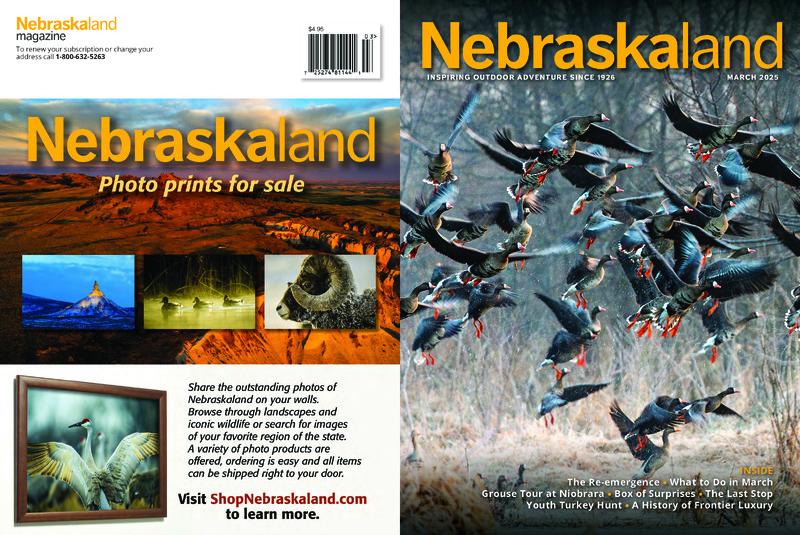
- Title:
- Volume 103, Issue 2, 2025
- Issue Name:
- March 2025
- Date Issued:
- 2025-03-01
- year:
- 2025
- month:
- March
- Season:
- Winter
- Publisher:
- Nebraska Game and Parks Commission
- Format:
- Periodical
- volume:
- 103
- issue:
- 02
- number:
- 103.02
- Decade:
- 2020s
- Type:
- Rights Holder:
- Copyright Nebraskaland Magazine/Nebraska Game and Parks Commission, all rights reserved.
- Extracted Text:
-
magazine
$4.95
To renew your subscription or change your
address call 1-800-632-5263
I N S P I R I N G O U T D O O R A DV E N T U R E S I N C E 1 92 6
M A RC H 2 0 2 5
INSIDE
The Re-emergence What to Do in March
Grouse Tour at Niobrara Box of Surprises The Last Stop
Youth Turkey Hunt A History of Frontier Luxury
2
Nebraskaland • March 2025
Volume 103
March 2025
No. 2
C
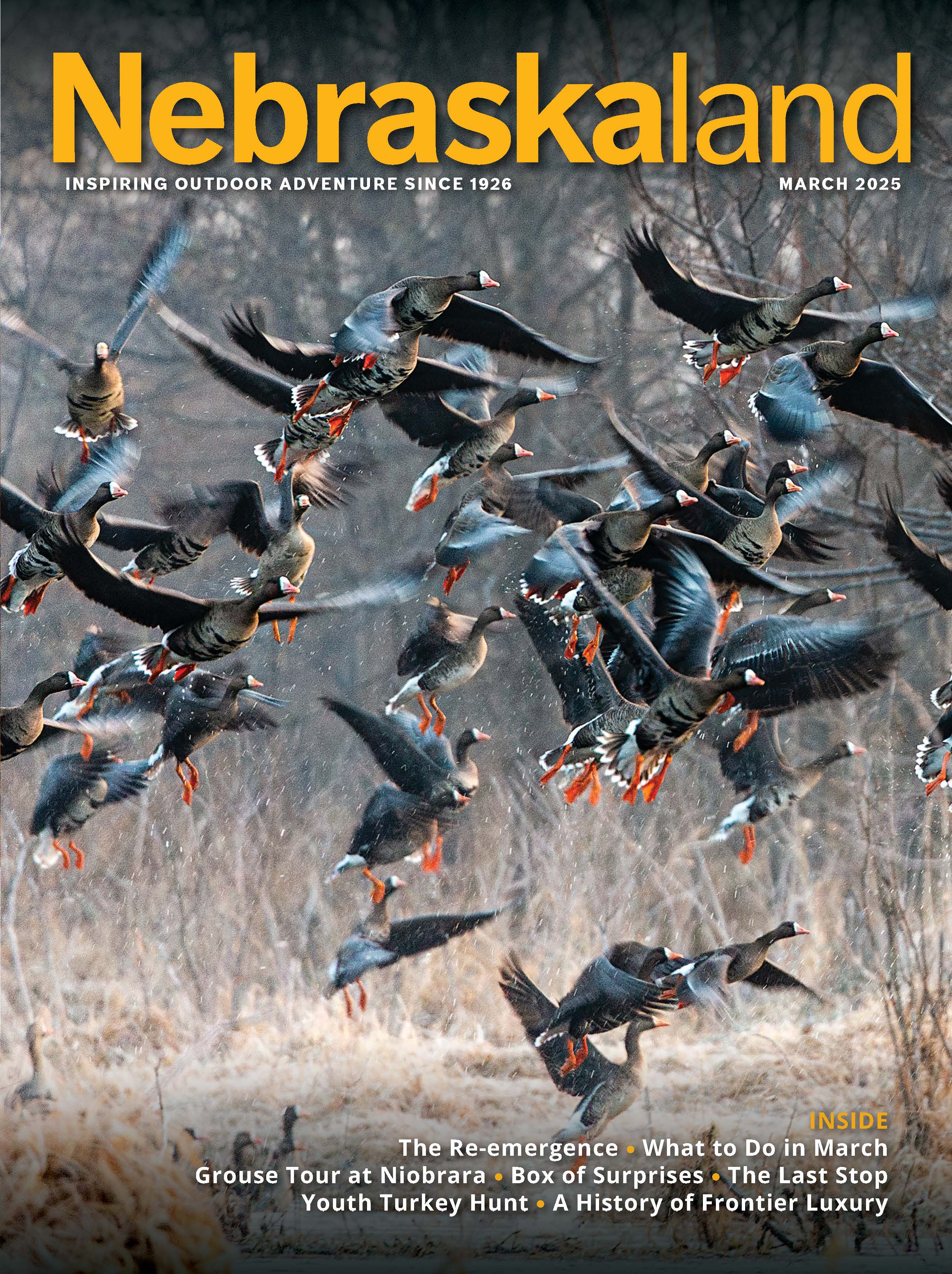
Cover:
A flock of white-fronted geese,
aalso known as specklebellies, lifts off
ffrom a pond near Louisville.
SSee page 32.
JJEFF KURRUS, NEBRASKALAND
FEATURES
20
26
28
BOX OF SURPRISES
Box Butte Reservoir attracts a variety of outdoor lovers
T page: Sandhill cranes return to
This
ttheir roost on the Platte River after
ffeeding in the surrounding fields as
tthe sun sets in Hall County. About
1 million cranes stop on the river in
ccentral Nebraska during their annual
n
northward spring migration.
ERIC FOWLER, NEBRASKALAND
E
Story and photos by Justin Haag
OUTDOOR NEBRASKA
What to Do in March
By Renae Blum
A GROUSE TOUR AND MORE
at Niobrara State Park
By Renae Blum
32
THE RE-EMERGENCE
38
FRONTIER LUXURY
42
A NIOBRARA TURKEY HUNT
48
READY TO FISH IN 2025
Photos and story by Jeff Kurrus
By David L. Bristow, Nebraska State Historical Society
Story and photos by Eric Fowler
By Eric Fowler
DEPARTMENTS
8
12
50
60
62
Your Nebraska
In the Field
Mixed Bag
Portraits from the Past
The Last Stop
ON THE WEB
For more articles and
information, visit
NebraskalandMagazine.com
4
Nebraskaland • March 2025
Nebraskaland (VOL. 103 / NO. 2 ISSN 0028-1964) is published monthly, except for the combined Jan./Feb. and Aug./Sept. issues, by the Nebraska Game and Parks Commission, 2200 N. 33rd
St., Lincoln, NE. Periodicals postage paid at Lincoln, Nebraska, and additional mailing offices. POSTMASTER: Send all UAA to CFS. (See DMM 507.1.5.2); NON-POSTAL AND MILITARY
FACILITIES: send address corrections to Nebraskaland, P.O. Box 30370, Lincoln, NE 68503-0370.
March 2025•
Nebraskaland
5
Magazine Staff
magazine
Communications Director Christy Firestone
Public Relations Manager Shawna Richter-Ryerson
Published by the Nebraska Game and Parks
Commission since 1926. The Commission is
dedicated to the conservation and protection
of all the state's natural resources and the
people who use them.
Editor Jeff Kurrus
Associate Editor Jenny Nguyen-Wheatley
Regional Editors Eric Fowler, Julie Geiser,
Justin Haag
Contributing Editor Michael Forsberg
Regular Contributors Renae Blum,
Chris Helzer, Chris Masada, Todd Mills,
Ryan Sparks, Gerry Steinauer
Art Director Tim Reigert
Graphic Designer Mel Severin
Videographer Nick Sauvageau
Photo Librarian Jaclyn Cruikshank Vogt
Administration
Director Tim McCoy
Deputy Director Jim Swenson
Assistant Director Roger Kuhn
Commissioners
Chairman - John Hoggatt, Kearney
Vice Chairman - Donna Kush, Omaha
2nd Vice Chairman - Ken Curry, Columbus
Magazine Subscriptions
For address changes, magazine and subscription
questions, 800-632-5263 or visit
nebraskalandmagazine.com
Advertising
For advertising information, contact:
Shane G. Gilster, 402-742-0125
shanegilster@solotreemedia.com
Pat Berggren, Broken Bow
Rick Brandt, Roca
Scott Cassels, Omaha
Dan Hughes, Venango
Kent McNeill, Papillion
Doug Zingula, Sidney
Nebraskaland Magazine Copyright 2025, all rights reserved.
Nebraskaland is available in audio from the Nebraska Library Commission
Talking Book and Braille Service, Suite 120, 1200 N St., Lincoln, NE 68508.
800-742-7691. Nebraskaland Magazine and the Nebraska Game and Parks
Commission reserve the right to reject any advertising not in keeping with
the agency mission.
Rates: $18 for one year; $33 for two years; $44 for three years. Nebraska
recipients must add appropriate sales tax. To subscribe call
1-800-NEBLAND (632-5263), or go online to:
NebraskalandMagazine.com.
Commission Offices
Conservation Officers
Headquarters/Southeast District Office
2200 N. 33rd Street Lincoln, NE 68503
Phone 402-471-0641
ADMINISTRATION
Jeff Clauson
402-471-5531
Lincoln HQ
Administrator
Travis Shepler
402-471-5531
Lincoln HQ
Asst. Administrator
Stacey Lewton
402-471-5531
Lincoln HQ
Asst. Administrator
Mike Thome
402-471-5531
Lincoln HQ
Asst. Administrator
Northeast District Office
2201 N. 13th St. Norfolk, NE 68701
Phone 402-370-3374
Southwest District Office
301 E. State Farm Rd. North Platte, NE 69101
Phone 308-535-8025
(Includes counties covered)
Northwest District Office
East Hwy. 2, Box 725 Alliance, NE 69301
Phone 308-763-2940
NORTHWEST
Dan Kling
308-430-0572
Captain
Bassett Office
524 Panzer St., Box 508 Bassett, NE 68714
Phone 402-684-2921
Jerod Hahn
Kearney Office
1617 First Ave. Kearney, NE 68847
Phone 308-865-5310
Ak-Sar-Ben Aquarium/Schramm Education
Center
21502 W. Highway 31 Gretna, NE 68028
Phone 402-332-3901
Omaha Office
8495 Frederick Street, Omaha, NE 68124
Phone 402-595-2144
OutdoorNebraska.gov
The Nebraska Game and Parks Commission does not discriminate
based on race, color, ethnicity, national origin, sex, pregnancy, sexual
orientation, gender identity, religion, disability, age, genetic information,
veteran status, marital status, and/or political affiliation in its programs,
activities, or employment. Any person who believes he or she has been
discriminated against in any program, activity, facility, or service,
should contact the Nebraska Game and Parks Commission, Lincoln, NE
402-471-0641, the Nebraska Equal Opportunity Commission, Lincoln,
NE 402-471-2024, TTY/TDD 800-642-6112; Director, Office of Diversity,
Inclusion and Civil Rights, U.S. Department of Interior, 1849 C Street,
NW, Washington, D.C. 20240.
6
Nebraskaland • March 2025
EAST SUB-DISTRICT
308-520-5539
Sergeant
308-280-4320
Hunter Lee
Keith, Arthur, Deuel
Jaden Porter
308-289-2274
Keith, Garden, Grant
Tyler Stueck
308-289-6260
Keith, Arthur, Grant
Keith Jadlowski 531-310-2869
Keith
WEST SUB-DISTRICT
Sean McKeehan 308-672-1824
Sergeant
KayLynn Miller
308-665-8440
Dawes, Sioux
Cassidy Harwood 308-562-9099
Box Butte, Morrill
Josh Widhelm
308-279-9133
Scotts Bluff, Banner, Sioux
Brandon Wallace 308-280-4488
Scotts Bluff, Banner, Sioux
Travis Schultz
308-279-1292
Morrill, Scotts Bluff
Casey Gehrt
402-617-2112
Dawes, Sheridan
NORTHEAST
Dale Davis
402-760-0712
Captain
WEST SUB-DISTRICT
Jeff Jones
402-762-5022
Sergeant
Greg Hesse
308-546-7464
Rock, Brown, Keya Paha
Look for pasque flowers toward the
end of March. JUSTIN HAAG, NEBRASKALAND
Jonathan Andreasen
402-340-3981
Madison, Pierce, Stanton
Trevor Stahlecker
402-928-9099
Knox, Antelope, Pierce
Mitch Johnson
402-613-8612
Cedar, Knox
EAST SUB-DISTRICT
Cory Krause
402-380-6410
Sergeant
Kyler Prochaska 402-830-8278
Platte, Colfax
Matt Costello
402-317-4014
Dodge, Colfax
Kelbi Abke
402-237-2537
Washington, Burt
Nicholas Fix
402-508-0261
Dixon, Dakota, Thurston
Kyle Hansen
531-739-7392
Dodge
CENTRAL SUB-DISTRICT
Doug Pollard
308-730-7050
Sergeant
Daryl Teter
308-440-1863
Howard, Greeley, Merrick
Matt Brandt
308-202-0819
Sherman, Howard
Klint Gill
402-613-5800
Nance, Wheeler, Boone, Polk
Garrett Zimmer 402-416-5736
Garfield, Loup Valley
Tim Williams
308-380-7331
Hall, Hamilton
SOUTHWEST
Brian Piernicky 308-330-8780
Captain
NORTH SUB-DISTRICT
Alex Hasenauer
308-660-4671
Sergeant
308-395-6001
Jacob Stoinski
Lincoln, Perkins
Frank Miller
402-389-0444
Cherry, Hooker
Luis Nuñez
531-333-6093
Blaine, Custer, Thomas
Brandon O’Neal 308-530-3157
Lincoln, McPherson, Logan
SOUTH SUB-DISTRICT
Kelsey Glodowski 308-242-9000
Sergeant
Bryce Streger
308-537-0404
Dawson, Gosper, Custer
Tyler Adelman
402-314-4783
Dawson, Gosper, Furnas
Sophia Gobber
308-222-0368
Chase, Dundy, Hayes, Hitchcock
SOUTHEAST
Matt Seitz
402-806-0915
Captain
WEST SUB-DISTRICT
Matt Taylor
402-200-9597
Sergeant
402-902-2017
Eric Javins
Adams, Clay, Webster
Justin Gress
308-629-9335
Thayer, Nuckolls, Fillmore
Pat George
308-920-2762
Harlan, Franklin, Phelps
Ethan Teter
308-440-3847
Buffalo, Kearney
EAST SUB-DISTRICT
Heath Packett
402-210-0888
Sergeant
402-209-1506
Russell Mort
Otoe, Johnson
Rich Berggren
402-619-1355
Douglas
Brian Arp
531-530-9011
Douglas, Sarpy
Mike Luben
402-443-6392
Saunders
Bryan Adams
402-429-1924
Nemaha, Pawnee, Richardson
CENTRAL SUB-DISTRICT
Curt Prohaska
402-470-1298
Sergeant
402-890-6463
Dina Barta
Lancaster
Mark McDonald 402-805-2353
Lancaster
Mark Sullivan
402-741-0636
Lancaster, Seward, Butler
Jarrod Messman 531-739-9760
Lancaster, Saline, York
YOUR NEBRASKA
Instagram Photos
Follow us @nebraskaland
and tag us in your photos
to be featured in an
upcoming issue.
Roy Liesegang, Bellevue
Eastern Fox Squirrel
Roger Richters, Utica
Heavenly Horizon
Boni Edwards, North Platte
Short-eared Owl
8
Nebraskaland • March 2025
March 2025•
Nebraskaland
9
YOUR NEBRASKA
Marquene Koontz, Ogallala
Morning Fog Rolling from the North
Matt Schuetz, Stanton
Waiting for Ducks
Gordon Warrick, Valentine
Crossbill
Send
your
photos to:
comments
and
Jeff Kurrus, Editor
Nebraskaland Magazine
P.O. Box 30370
Lincoln, NE 68503
or email Jeff.Kurrus@Nebraska.gov
Please include your postal address and
telephone number. Letters may be condensed and edited. Photographs are
also welcome.
10
Nebraskaland • March 2025
March 2025•
Nebraskaland
11
IN THE FIELD
CRANES IN THE FOG
A sandhill crane calls
from the roost on a foggy
morning on the Platte
River in Hall County.
ERIC FOW
OWLER,
LER, NEB
N RAS
RASK
SKA
ALAN
LAND
12
Nebraskaland • March 2025
March 2025•
Nebraskaland
13
IN THE FIELD
Beavers play a pivotal role in the health and biodiversity of local ecosystems.
ERIC FOWLER, NEBRASKALAND
THE BUILDERS OF THE WILD
By Monica Macoubrie
Beavers (Castor canadensis) in Nebraska serve as keystone
species, playing a disproportionately large role in the health
and biodiversity of local ecosystems. Their engineering
skill is particularly significant, as they create and maintain
habitats that support a multitude of species.
By constructing dams across streams and rivers, beavers
create ponds and wetlands that serve as critical habitats for
fish, amphibians, waterfowl and numerous plant species.
These wetlands act as natural filters, improving water
quality by trapping sediment and pollutants, and they also
regulate water flow, which can help mitigate downstream
flooding and maintain water levels during dry periods.
Beyond their direct impact on water dynamics and habitat
creation, beavers’ selective tree cutting promotes forest
regeneration. The presence of beavers enhances ecological
resilience by creating mosaic landscapes of successional
stages, which can buffer against environmental changes and
disturbances.
Beavers and humans share a complex relationship
characterized by beneficial and challenging interactions.
For humans, these benefits can translate into reduced flood
risks, improved water resources and enhanced opportunities
14
Nebraskaland • March 2025
for wildlife observation and eco-tourism.
However, beaver activities also can lead to conflicts with
human interests. Their dam-building can cause flooding of
agricultural lands, roads and properties, leading to economic
losses and necessitating costly management efforts.
Additionally, beavers may fell trees that are valued for timber,
landscaping or cultural purposes, further contributing to
tensions.
In many regions, collaborative efforts between
conservationists, landowners and government agencies aim
to find sustainable solutions that allow humans and beavers
to coexist. By understanding and managing the impacts of
beaver activities, it is possible to harness their ecological
benefits while mitigating their negative effects on human
infrastructure and activities. For example, flow devices can
control water levels around beaver dams, barriers can protect
valuable trees, and sometimes, the relocation of beaver
populations to less problematic areas is possible.
By recognizing beavers’ ecological importance and
implementing sustainable management practices, we can
ensure they continue to thrive and contribute to Nebraska’s
natural landscapes for generations to come.
IN THE FIELD
A turkey vulture strikes a pose on a dead tree. Almost all of the United States is in the species’ breeding range, and it resides
year-round in the Southeast and throughout Mexico and South America. JUSTIN HAAG, NEBRASKALAND
RETURN OF THE VULTURE:
SOMETHING TO CELEBRATE
By Justin Haag
A friend likened them to the famed “Swallows of
Capistrano.” It’s once again a joy to see the return of the
migratory “Vultures of Chadron.”
Our house is on a hill, so we get a good view of the turkey
vultures as they fly over the city. Occasionally, they “buzz
the tower,” flying just feet above our house. I captured this
photo by stepping out the back door last week. Not great, but
not bad considering how little effort I put into it.
As one who photographs wildlife, I sometimes get asked
what animal I’d like to be. After considerable thought, this
is the species.
For one, the big group with its biker gang vibe seems to be
having fun as individuals, effortlessly catching wind gusts
and thermals to soar above the city with minimal wingbeats,
assumedly searching for roadkill or some other dead thing
to eat.
“Roadkill? Yuck,” you might say. It’s certainly no dealbreaker. Unlike other wildlife species deemed to be more
charismatic, vultures aren’t obligated to expend energy
in the uncertain task of chasing and killing dinner. Sure,
roadkill may not be attractive to us, but they seem to like it,
and personal taste is what matters.
Some say they’re ugly, but let’s not forget that these birds
with their massive wingspans are often mistaken for the
16
Nebraskaland • March 2025
more esteemed species known as eagles. Of course, beauty
is in the eye of the beholder, and apparently these birds look
good enough to one another to procreate. Heck, they might
think we’re ugly.
Finally, I won’t complain about spending winters in the
South.
Yes, vultures do leave considerable droppings below their
roosts, and they can deface buildings and other structures
if they congregate above them. Note, though, that a vulture
superpower is the strong acid in its digestive system kills
most disease-causing bacteria and viruses. Therefore, the
feces is relatively “clean.”
Other than some unsightly poop, vultures do more good
than harm surely even from the most judicious humans’
standpoint. No predation of livestock and other wildlife. No
damage to crops and garden. Just out there cleaning up dead
things.
Just as the people of San Juan Capistrano, California,
created a big celebration around the annual return of cliff
swallows, I suggest my fellow citizens soar in merriment at
the return of the revered (at least by me) Vultures of Chadron
— or the turkey vultures of wherever else you may be seeing
them throughout their expansive range. They deserve a
warm welcome.
IN THE FIELD
This recipe blends rich, savory flavors with the first taste of spring. It is perfect for using
the rest of last year’s turkey meat. RYAN SPARKS
WILD TURKEY WILD RICE SOUP
By Ryan Sparks
This recipe is double wild,
containing both wild turkey and wild
rice. With wild turkey thighs, a slow
cooker is your friend to ensure the
meat is tender and delicious ahead
of time, so you don’t have to worry
about overcooking the rest of your
ingredients while waiting for the
thighs to cook.
My wife and I like to make this
recipe between late winter and early
spring. It is a perfect dinner to enjoy
the night before Nebraska’s archery
spring turkey opener in late March. It
goes well with toasted and buttered
bread.
Servings: 6
Prep Time: 15 minutes
Cooking Time: 5 hours
Ingredients:
4 tbsp. butter
4 carrots, cut into half-inch pieces
1 medium white or yellow onion,
chopped
1 lb. cremini mushrooms, sliced
4 garlic cloves, minced
1½ tsp. fresh thyme, minced (or
substitute dried thyme)
Salt
Pepper
¼ tsp. cayenne pepper (optional)
•
•
•
•
•
•
•
•
•
18
Nebraskaland • March 2025
• 1 bay leaf
• ¼ cup all-purpose flour
• 1 heaping cup wild rice
• 2 quarts turkey or chicken stock
• 4 cups cooked and chopped wild
•
•
turkey thigh meat (from 2 wild
turkey thighs)
1 cup heavy cream
Chopped parsley or chives for
garnish, optional
1. Place the turkey thighs in a slow
cooker on the high setting, cover with
water, and cook for about 5 hours.
Around the 4-hour mark, start to test
them with a fork. When the meat
easily flakes away from the bone, they
are done.
When the thighs are tender, remove
them from the slow cooker to a cutting
board and allow them to cool slightly.
Using your fingers, pull the meat from
the bone and shred it. When you have
a pile of shredded turkey meat, roughly
chop it with a knife. (See optional step
at end of the recipe.)
2. In a large saucepan or Dutch
oven, melt the butter over medium
heat. Add the carrots, onion, garlic,
mushrooms, thyme, cayenne and a
generous pinch of salt and pepper.
Cover and stir occasionally until the
mixture has softened but not browned,
around 10 minutes.
3. Sprinkle the flour over the
mixture and cook, stirring constantly
until evenly coated and the raw flour
taste has been removed, around 3
minutes.
4. Add the wild rice to the pan
and gradually stir in the stock.
Bring to a low boil, add the bay
leaf, then simmer over medium/low
heat, stirring occasionally until the
vegetables are nearly tender, around
20 minutes.
5. When the vegetables are almost
tender, add the chopped turkey meat,
stirring occasionally until the wild
rice is tender, 10 to 15 minutes more.
6. Lower the heat and stir in the
cream. Stir until evenly mixed and
then taste for salt and pepper. Ladle
into bowls, garnish with parsley or
chives and serve.
A Simple Wild Turkey Stock
Once you have removed the turkey
thighs from the cooking liquid, toss in
2 carrots, 2 celery ribs and 1 onion, all
roughly chopped. Then add 1 bay leaf,
whole black peppercorns, 1 teaspoon
of dried thyme and 1 teaspoon of
dried parsley. Keep the lid off the slow
cooker and allow to slowly reduce for
4-5 hours.
L
ong before the Niobrara River carries the multitudes of tubers
and kayakers in north-central Nebraska, it entertains a variety of
outdoor enthusiasts at a recreational hot spot in the Panhandle.
This far west, where the river would be better described as a
creek, stands a dam that was constructed by the Works Progress
Administration in the 1940s to create what was first known as Lake
Felton. Visitors now know the reservoir north of Hemingford at the
western edge of the Sandhills as Box Butte Reservoir State Recreation
Area and Wildlife Management Area.
The 1,600-acre reservoir, with 587 acres of public land surrounding
it, is full of fun surprises for an array of outdoor pursuits, perhaps most
notably fishing and camping.
Box of Surprises
Box Butte Reservoir attracts
a variety of outdoor lovers
Story and photos by Justin Haag
ABOVE: A tree swallow peers from its nest in Box Butte’s
flooded timber of spring.
OPPOSITE: The Niobrara River flows into Box Butte Reservoir
on a crisp fall morning.
20
Nebraskaland • March 2025
March 2025 •
Nebraskaland
21
Whether casting for bass, walleye and pike in the flooded timber
of spring, or dropping waxworms below the thick ice for winter
panfish, a diverse fishery awaits anglers.
The lake has a reputation for northern pike and large bluegills.
It’s also become one of western Nebraska’s best walleye lakes, along
with largemouth bass, yellow perch, channel catfish and crappies.
As a testament to the lake’s diversity, Nebraska’s fish records show
an array of other species, mostly less targeted, registered from Box
Butte: European rudd, white sucker, rock bass, smallmouth bass,
brown trout, common carp and gizzard shad are on the list. Many of
those are in the category of underwater spearfishing; with the lake’s
clear waters, it’s a popular place for that activity.
Recent upgrades have made the lake even more attractive. An
expansion of 20 electrical campsites in 2024 brought the total
number of available spaces to 60. A modern shower house and dump
station also were installed. Visitors have been enjoying an improved
two-lane boat ramp since 2018 and a state-of-the-art fish cleaning
station.
In spring, the water usually rises into the cottonwoods and
willows, providing spawning habitat and an ideal opportunity
for fishing by kayak or other small watercraft. When summer’s
irrigation season brings extensive drawdown, the lake’s big catfish
are often targeted.
Most of the property around the lake is open to hunting. The
expanse of tall cottonwoods, something of a rarity for public lands
in the Panhandle, provides ideal habitat for whitetails, turkeys,
cottontails and furbearers. The river at the lake’s west end welcomes
waterfowl hunters long after the region’s water bodies have frozen
over. Opportunity also exists for dove, pheasant and grouse.
The lake’s surprises are often seen through binoculars as
birdwatchers enjoy the variety of avian species attracted to the water
BOTTOM LEFT: Tubers beat the heat in
August. An improved ramp has helped
people get on the water even when the
water is low.
TOP RIGHT: The sunrise creates colorful
reflections on a still morning on the
lake’s north bank.
BOTTOM RIGHT: A bullsnake, one of
lake’s countless wildlife species, swims
across the water.
22
Nebraskaland • March 2025
March 2025 •
Nebraskaland
23
and its 14 miles of shoreline. Woodpeckers,
nuthatches, bluebirds, orioles, finches,
warblers and many songbirds can be located
around the lake in spring and summer.
Spring is also prime for viewing shorebirds
and waterfowl, with the occasional sighting
of common loons and trumpeter swans.
The fun doesn’t stop there. Take into
account a swimming beach and four
picnic shelters, and there’s something for
everyone. Whether it is what’s below the
water’s surface or above it, people surely
enjoy the pleasant surprises of Box Butte. N
ABOVE: A spotted sandpiper is among the many avian species
observed at Box Butte, a popular destination for birdwatchers.
BELOW: Whether it’s panfish by jigging rod or northern pike by tipup, Box Butte provides ample opportunity for ice anglers.
OPPOSITE: Snow and frost decorate the towering cottonwoods at
the lake, which offer scenic value year-round.
Box Butte Reservoir
Box Butte Reservoir SRA encompasses
2,212 acres on the western edge of the
Sandhills, 9 miles north of Hemingford.
It includes a 1,600-acre lake. The area
is a good spot for fishing, camping and
picnicking and also features some of
the best birdwatching in the state.
24
Nebraskaland • March 2025
March 2025 •
Nebraskaland
25
Outdoor Nebraska
By Renae Blum
Whether it’s sunny or cold, you can find an adventure waiting
for you this month, including fishing, viewing sandhill cranes
and more. N
What to Do in March
View red fox pups
March through early June | Statewide
Commonly found in urban areas, these
fascinating native animals are a delight to
watch as pups, busy wrestling and playing as
their parents care for them in the early months
of their lives. Litters often range from one to
seven, typically born from late February into
April. Dens can be anything from a dug hole
in a field or repurposed badger den to a space
underneath a shed, garage or old barn. View
pups from a distance, use binoculars and keep
your dogs leashed.
JUSTIN HAAG, NEBRASKALAND
Fish for early spring crappie
As soon as the ice goes out, through May | Statewide
Fishing for crappie in early spring, as soon as the ice has gone out, can be a
great opportunity this time of year. They’ll be staying shallow clear into May,
searching for food so they have energy to spawn. Early on, while the water is
cold, look for bays, coves and protected areas where temperatures are warmer,
and then fish slow. Take the kids, because when crappies are shallow like this,
anyone can catch them. JEFF KURRUS, NEBRASKALAND
View sandhill cranes at Fort
Kearny State Recreation Area
March 10 through the first week of April; peak is
the third and fourth weeks of March
About 10 miles southeast of Kearney
A popular choice for viewing the sandhill crane migration
is Fort Kearny State Recreation Area. Visitors flock to the
bridge on the park’s hike-bike trail, located on the east side
of the park about 600 yards from the parking lot. Arrive 30
to 45 minutes before sunrise and sunset for the best view.
For those staying overnight, the park offers 120 first-come,
first-served campsites; learn more at OutdoorNebraska.gov.
A park entry permit is required. JEFF KURRUS, NEBRASKALAND
26
Nebraskaland • March 2025
See a live magic show
March 8, 7-8 p.m. and March 9, 2:30-3:30 p.m. | Kountze
Memorial Theater at Eugene T. Mahoney State Park
Enjoy live, family-friendly magic shows at the beautiful Kountze
Theater. March 8 will feature a showcase of top magic acts from the
region, including Des Moines, Kansas City and Omaha. On Sunday,
enjoy a matinee show by Omaha magician Ryan Chandler. With a
camera acting as a giant magnifying glass, be sure not to blink as
magic is projected on a large screen. Admission is $10 for adults and $8
for ages 12 and under; reserve tickets by calling 402-944-2957. A park
entry permit is required. PHOTO BY ROSEANNE SCURTO
Become a certified youth
fishing instructor
March 23, 2-5 p.m. | Schramm Education Center
Do you want to share your love of fishing with others? This free course
will give you the training and tools to do just that, whether you’re
interested in teaching a Scout, church or family group, or if you’d rather
assist at a Nebraska Game and Parks event. There is no minimum
required time commitment; volunteer as often as you wish. Visit
Calendar.OutdoorNebraska.gov and search “Youth Fishing Instructor
Certification Class” to sign up. JUSTIN HAAG, NEBRASKALAND
March 2025 •
Nebraskaland
27
A Grouse
Tour and
More
at Niobrara State Park
By Renae Blum
L
ast spring, when I decided to try
out the new sharp-tailed grouse
viewing blind at Niobrara
State Park, I wasn’t prepared
for how funny the birds would be.
A dozen of them were gathered on
a pasture west of the park’s entrance,
performing spring mating rituals. The
males moved incredibly fast, like video
game characters. They rushed along
with wings extended, stamping their
feet rapidly.
They would freeze in place for about
10 seconds, the moment drawing out
until you wondered if something was
wrong. Then, out of nowhere, the flurry
Sharp-tailed grouse engage in standoffs during their spring mating rituals at Niobrara State Park,
as seen from a new viewing blind. CURT BLUM
Teri Farha (left), Kris Wilshusen and Ted Farha, all from Wichita, Kansas, watch
sharp-tailed grouse from a new blind at Niobrara State Park. RENAE BLUM, NEBRASKALAND
28
Nebraskaland • March 2025
of activity would begin again, just as
furious as before, and everyone in the
blind would chuckle. Pairs of males
also faced off in intense staredowns,
occasionally leaping into the air.
The sounds they made are hard
to describe — squeaking, chittering,
squawking and even a low thrumming
that is a bit like a frog’s. It was a
symphony of sorts that began before
the sun rose and lasted more than an
hour.
The entire thing was delightful,
and our group was spellbound. At 7:33
a.m., the last of the birds took flight at
once, their morning ritual complete.
“That was fabulous,” a woman
commented.
This was the second year the
park offered this wildlife watching
opportunity, and the three-and-a-halfhour drive from Lincoln was worth it.
But the rest of the park was calling.
My family had three days to explore
Niobrara State Park, and we soon
discovered that watching sharp-tailed
grouse isn’t the only spring activity
the park offers.
Day One
“This is an amazing view.” That
was the first thing my mom said upon
walking into our cabin. Niobrara State
Park’s cabins are arranged atop a
forested bluff overlooking the Missouri
River Valley. Glance out the windows
or step out the back door, and you face
a sweeping view of trees and water.
My parents were also impressed
by the cabin itself. “It’s like a little
house,” Mom said, taking in the living
room with sofas and a fully-furnished
kitchen. “I didn’t know how modern it
would be.”
We wouldn’t head out to see the
grouse until morning, so we took some
time to explore. Park superintendent
Cogan Thompson told us we could see
eagles at Niobrara Confluence Wildlife
Management Area, a nearly 3-mile
area spanning the entire north edge of
the park and beyond.
Bathed in golden evening light, two
mature eagles watched us quietly from
the trees. I had never been that close to
one before.
That evening, we also saw about a
dozen turkeys along the roadsides. We
would spot many more throughout our
stay and hear their gobbling often.
One of many red admiral butterflies
observed along Deer Creek Trail.
CURT BLUM
March 2025 •
Nebraskaland
29
for hours, and with expansive views of
bluffs and rolling hills all around us, it
made a stunning sight.
Day Three
A beautiful sunset brightened the sky during the second day of the author’s visit to Niobrara State Park.
CURT BLUM
Day Two
Curt Blum, the author’s dad, watches the Milky Way during an early morning at
Niobrara State Park. RENAE BLUM, NEBRASKALAND
30
Nebraskaland • March 2025
The best time to see the Milky Way
in the spring is in early morning, and
Niobrara State Park is fairly remote.
So we dragged ourselves out of bed at
3:30 a.m. to see if we’d have any luck.
Parking by a picnic table overlook,
we were greeted by a spectacular
starry sky with zero percent cloud
cover. As our eyes adjusted, the Milky
Way revealed itself. “I’ve seen it better,
but not much better,” Dad said.
Having lived most of my life in or
near Lincoln, it was my first time
seeing the Milky Way. There seemed
to be layers of stars, like pebbles in
a stream. It was one of my favorite
moments of the entire trip.
Back at our cabin, we made our way
to the group lodge to watch the sun
rise over the Missouri River Valley,
capturing dozens of photos. Then it
was time to head home.
Even though it wasn’t peak season,
we found plenty at Niobrara State Park
to keep us busy for a weekend — and at
all hours of the day and night. N
The next morning, we got up early to
ensure we’d get to the blinds before the
birds did. An eerie chorus of coyotes
howled in the distance as we climbed
a steep slope to reach the blind, a small
trailer built by a local high school shop
program.
It had a couple of space heaters, a
carbon monoxide detector, bench and
chairs. Dad, who has made similar
trips to photograph birds, commented
that it was one of the nicest blinds he
had been in.
Afterward, I was ready for more
adventure. I knew the park had an
unusual amount of geocaches — about
60, all placed by Liz and Gary Doerr
of Creighton, a husband-and-wife
volunteer team. I was eager to find out
if the caches were as creative and wellmaintained as I had been told.
Geocaching is a bit like a high-tech
treasure hunt. Using the Geocaching
app, we navigated to different
locations around the park, searching
for hidden caches at the coordinates
listed. We found five out of the eight
we searched for and were impressed
at the variety of containers and clever
hiding spots.
That afternoon, Dad and I hiked
Deer Creek Trail, a gently sloping
wooded path. To my delight, we were
accompanied by dozens of red admiral
butterflies. We also spotted a rabbit
munching on a leaf and saw deer
tracks and scat.
As the sun set, the sky turned
golden, then shades of purple, blue
and orange. The colors seemed to last
Viewing Blinds
at Niobrara SP
Experience the natural
wonder of the sharp-tailed
grouse mating dance. Niobrara
State Park is now taking
reservations for its viewing
blind, free of charge, for March
7 to April 20.
The large blind holds up to
eight guests. A two-person
popup blind will also be
available for photographers
with larger equipment. Both
blinds are first-come, firstserved by reservation only.
Book your spots by calling the
park office at 402-857-3373. A
Nebraska vehicle park entry
permit is required.
Make an early arrival easy
by staying at one of the
park’s electric campsites or
fully-equipped cabins. Visit
OutdoorNebraska.gov and
search “Niobrara State Park”
to make a reservation. Use the
promo code “SHARPTAIL25”
for discounted weekend rates.
Weekdays during the offseason are already discounted.
Sandy Blum, the author’s mom, reaches for a geocache dangling from a tree at
Niobrara State Park. RENAE BLUM, NEBRASKALAND
March 2025 •
Nebraskaland
31
The
Re-emergence
Photos and story by Jeff Kurrus
arch is a re-kindling of hope. A time to peek
at the 10-day weather forecast and celebrate
when we see above-freezing temperatures,
hoping we also see below-freezing winds.
It’s T-shirt weather. It’s parka weather.
It’s migration days on the Platte River watching birds from
the tailgate, closing our eyes and allowing the sun to hit our
cheeks like a long-lost friend.
It’s watching cranes come to roost from the heated confines
of the same vehicle, pointing from behind the glass.
We try hard in March. We force hikes along our trails in less
clothes than we need, hoping beyond hope we can shed our
M
hoodie for the layer beneath.
We use our spud bars on ice, wishing for one more fish
through the hard water, while also dressing the line on our
fly rods for the first open-water bite.
As photographers, we always answer the phone for tips,
for wildlife repeatedly ends up in places they don’t normally
frequent, a re-emergence for them as well it seems.
We know winter isn’t quite over, despite the official
calendar dates telling us spring begins this month, but many
of us hope to see the few remaining morsels of what winter
brings while also waiting very impatiently for the world to
green around us. N
ABOVE: At Eugene T. Mahoney State Park near Ashland, a wild plum shrub blooms.
OPPOSITE: A flock of specklebelly geese flush from a Cass County pond.
32
Nebraskaland • March 2025
March 2025 •
Nebraskaland
33
OPPOSITE: Antique fishing
reels from an estate sale
drew anglers, including
the author, itching for
anything associated with
spring.
TOP RIGHT: A crappie is
released at Towl Lake in
Douglas County.
BOTTOM RIGHT: Wood
ducks prepare to mate in
a wetland near Gretna.
34
Nebraskaland • March 2025
March 2025 •
Nebraskaland
35
TOP LEFT: The NASP tournament in
Lancaster County draws a wide array
of visitors to this indoor competition
where students compete.
BOTTOM LEFT: Wesley Batman, of
Gretna, shoots his bow at the Larry D.
Elston Archery Range in Sarpy County
near Schramm Park State Recreation
Area.
TOP RIGHT: Ellie Piersol, Jamie
Reigert, Francisco Grace, Alex Saw,
and Cassidy Allen talk around a fire
pit at Eugene T. Mahoney State Park
in T-shirt and shorts weather.
BOTTOM RIGHT: A white-tailed deer
walks through the snow in Sarpy
County.
36
Nebraskaland • March 2025
March 2025 •
Nebraskaland
37
Frontier Luxury
By David L. Bristow, Nebraska State Historical Society
ebraska frontier life involved hardship, deprivation and
… luxury?
One of the striking things about pioneer narratives is
the important role of luxuries where such things were
hard to get. When Nebraska Territory opened to settlers in
1854, a string of crude villages sprang up quickly along the
Missouri River. People staked out farms and town lots and
lived in tiny cabins or dugouts while they speculated in real
estate and dreamed of the future. For the first few years,
“Everybody considered himself rich or likely soon to be,” in
the words of early Omaha historian Alfred Sorenson.
Mrs. Fenner Ferguson, wife of the first chief justice of
the Nebraska Supreme Court, had a piano shipped from St.
Louis in 1855. Her daughter-in-law later recalled that “Mrs.
N
Ferguson’s piano was one of her greatest comforts in those
early days. I have often heard her say that many times when
she would be practicing, the room would suddenly become
darkened and she would find the Indians looking in at the
windows to see and hear what was going on. She often asked
them in and played for them.”
On New Year’s Day, 1855, Acting Gov. Thomas Cuming
bought a basket of eggs so his wife could make “Virginia
egg nog, Mrs. Cuming being a Virginian.” While sipping the
beverage, Cuming joked that the eggs were “extra fine” and
quoted the price — a dollar an egg, roughly $37 in today’s
money. It isn’t clear how Mrs. Cuming reacted to that news,
but she was still telling the story 50 years later.
That winter, Tom Cuming suggested holding an “executive
Twentieth century interior of the Kennard House, furnished in the style of the 1870s.
The Thomas P. Kennard house (with cupola) in 1872. Located on H Street just west of 17th Street in Lincoln, the house is owned
by the Nebraska State Historical Society. The view is to the southeast from the capitol. NSHS RG2432-1-337
38
Nebraskaland
• March 2025
ball” for incoming Territorial Gov. Mark Izard. It was at
Omaha’s City Hotel, a single-story frame building at 11th and
Harney streets. The weather was so cold and the building
so drafty that ice formed on the floor after it was scrubbed.
Few women lived in Omaha at the time, and only nine ladies
attended the ball. The band consisted of a solitary fiddler
from Council Bluffs. During the dancing, several people
slipped and fell. Gov. Izard was from Arkansas and not used
to Nebraska winters. He “stood around shivering with the
cold, but bore himself with amiable fortitude.”
By the latter 1850s, Omaha still “looked as though falling
down from the skies onto the bare plains,” in the words of
Emily Doane, wife of the new district attorney. The streets,
she recalled, were “mostly a sea of mud” with only one
sidewalk in town, but Doane also wrote of social events at
the Herndon House, the city’s finest hotel:
“At the dances and evening parties, it was most unusual to
see a man not in full dress suit, while women wore spreading
skirts containing yards and yards of material, and the
NSHS RG2158-0-1251-A
Even a nice end table was worth showing off. George Copsey
and family, Westerville, Custer County, 1886. Photo by
Solomon D. Butcher. NSHS RG2608-0-1008
March 2025 •
Nebraskaland
39
Built in 1858, the Herndon House at 9th and Farnam streets was Omaha’s first big hotel, the fanciest place in the territory.
David Hilton homestead with Mrs. Hilton’s beloved pump organ, Custer County, 1887.
NSHS RG2608-0-3535
NSHS RG2341-2-P46
low-cut bodices of Victorian times. The skirts were long and
had trains, for no lady would have allowed an ankle to be
seen in those days … .”
In each of these stories, people accepted inconvenience or
great expense to recreate something from their old life back
east. But sometimes extravagance had a political point, as in
1869 when Thomas Kennard and a few other prominent men
built expensive houses in the new state capital of Lincoln. At
the time, many people doubted that the state government
would remain in such a tiny, out-of-the-way village. Spending
money on a fancy house demonstrated confidence and
prompted others to invest in the would-be city.
Even folks far from the capital worried about public opinion
— as photographer Solomon Butcher found out when he
visited the David Hilton homestead in Custer County in
1887. Historian John Carter writes that “the family still lived
in a sod house, a situation of considerable embarrassment to
Mrs. Hilton — so much so that she steadfastly refused to be
photographed in front of it.
“To make the picture to her liking, Mr. Hilton and the
photographer had to drag the pump organ out and away from
the house so that she could show friends back east that she
40
Nebraskaland
• March 2025
had one without revealing the condition of their dwelling.”
Sometimes refinement had more to do with the kind of
society that people hoped to build. Beatrice, for example,
was still a rough frontier town in the 1870s when a group of
local residents led by suffragist Clara Bewick Colby decided
to open a library.
A letter to the Beatrice Express argued that a library was
necessary to “give tone to the community while still in its
youth, and to bring in more of those of whom we can never
have enough, i.e., people who ask what opportunities the
place affords for mental culture.”
We tend to assume that pioneers were a rough lot (and
sometimes they were) or that they were plain-living people
who spurned luxury — although that was often out of
necessity rather than choice. Few Nebraskans could afford
some of the extravagancies described here. But the taste
for refinement reveals how people not only comforted
themselves with nice things, but also how they looked to the
future, not seeing their crude present reality so much as their
dreams of future prosperity. N
Visit NSHS’s website at history.nebraska.gov.
What this town needs most is a public library, said a group of Beatrice residents a year before this 1874 photograph. The view
is west along Court Street from Fourth Street. NSHS RG4396-13-68
March 2025 •
Nebraskaland
41
A Niobrara
Turkey Hunt
Story and photos by Eric Fowler
T
urkeys were already gobbling
in their roost trees when Gabe
Sovereign and his mentor, Greg
Hesse, walked to the blind they
had set up in a wooded creek bottom
east of Verdigre 40 minutes before
sunrise.
About 30 minutes later, the birds
began to leave their roosts, making
even more noise in the woods, clucking,
purring and gobbling to the left, right
and even over the hill in front of them,
answering most of Hesse’s calls.
“Geez,
they’re
everywhere,”
said Sovereign, a 13-year old from
Coolridge.
“Be careful not to move,” said
Hesse, a Nebraska Game and Parks
Commission conservation officer
based in Long Pine. “We’ve got a hen
close to us somewhere. I can hear her
clucking.”
After that hen made a brief
appearance next to the two-track road
where they had set up their decoys,
Sovereign settled the barrel of his
shotgun into a shooting stick, and
they waited. Soon, turkeys appeared
on the hillside, scratching their way
across it in search of food.
Thirty minutes after sunrise, Hesse’s
calls finally coaxed five of them, three
hens and two toms, closer. As the hens
cautiously approached the decoys,
stopping at 30 yards, the toms strutted
across the draw 50 yards away for five
minutes before they all continued on
their way.
The hunters moved their blind a
few hundred yards east to the edge of
a feedlot turkeys frequented and cows
42
Nebraskaland
• March 2025
weren’t currently using, Sovereign
losing a boot in the mud on the way.
As he got lessons from Hesse on how
to use a slate call, the residents of the
feedlot returned, curiously gathering
around their decoys and even licking
and nibbling on them. “I wish turkeys
were like this, just walking up here and
staring at us,” Sovereign said.
Sovereign had hunted ducks and
deer with his father, harvesting a
buck the previous fall. But this was
his second day of turkey hunting ever,
a guest at a mentored youth hunt
hosted by conservation officers from
northeastern Nebraska at Niobrara
State Park.
The previous morning, opening
day of the youth turkey season, he
passed on a chance to fill his tag with
a bearded hen that came to Hesse’s
call. “I thought there would be a bigger
turkey come in,” he said. “It was cool.
It got me really nervous.”
Sovereign was one of six youths
who took part in the mentored hunt
and one of four who didn’t harvest a
bird. But on this weekend, conditions
were less than ideal for turkey hunting.
With plenty of hens talking, toms don’t
respond to calls like they might later in
the season. And with winds gusting to
50 mph, some couldn’t even hear the
calls. But whether or not the hunt was
a success depends on how success is
measured.
Conservation
officers
from
northeastern Nebraska began hosting
mentored youth hunts in 2010, when
Jeff Fields, then the superintendent
Hunter Sonnenfelt of Battle
Creek sets up a turkey decoy as
and his mentor, Conservation
Officer Trevor Stahlecker of
Tilden, prepares a blind during
a youth turkey hunt near
Niobrara last spring.
March 2025 •
Nebraskaland
43
skies,” she said. “I’m good.”
Two hunters were successful on
opening morning. One was Lilly
Mortensen of Neligh. The 13-year-old
was participating in the 4-H shooting
sports program, and in order to move
up and shoot .22-cal. rifles, she was
required to take hunter education.
There, she was selected to take part
in a mentored pheasant hunt. No one
in her family hunted, but this sparked
interest, and she was chosen for the
turkey hunt at Niobrara.
Paired
with
Katie
Leware,
superintendent of Ponca State Park,
she saw several turkeys in the first
hours of opening morning. The first
was a tom that strutted for a while
at 80 yards, but came no closer. The
second was 30 yards from the blind,
but stayed behind some trees and
didn’t offer a clear shot. “Then about
an hour and a half later there was
one that came from behind the blind,
and it was messing with the decoy,”
Mortensen said. “I didn’t shoot that
one, but then after that one came
a bunch of them from over the hill.
I waited a while and there was one
about 15 yards away from the hunting
blind, and that’s the one I shot. It was
really exciting.”
“She couldn’t keep a smile off her
face,” Leware said. “She called the
birds in. She didn’t shoot the first one,
and took her time and made sure she
had a good, clean shot.”
Mortensen passed away the
following October, surrounded by
family. Her parents, Adam and Kendra,
said she was ecstatic about the
experience she had on the mentored
hunt, and they shared her joy.
Another successful hunter was
Lennix Chavez. The 13-year-old had
moved to Verdigre from Colorado a
year earlier and became interested in
hunting. “It just sounded fun,” he said.
His mother, Cassandra, went to
work trying to feed that interest. “I
was worried we wouldn’t be able to
find anybody to show him, but after
I sent a crazy number of emails,
somehow I got linked into these guys.”
After completing hunter education,
Chavez was chosen to participate in
Officer Jeff Jones of Hartington and Katie Leware, superintendent of Ponca State Park, watch as Gabe Sovereign of Coolridge
takes his turn on a hunt simulator in the Eagle View Group Lodge at Niobrara State Park.
of Ponca State Park, and Tom Zimmer,
the district conservation officer for
the region, set up a muzzleloader deer
hunt in the park. The following spring,
they held a turkey hunt at Ponca and
have alternated between the two each
year since. Last spring, they moved the
turkey hunt to Niobrara State Park.
Several organizations, including
the Tri-County Chapter of Whitetails
Unlimited, the Big Game Conservation
Association, the Verdigre Niobrara
Valley Sportsmen and the Nebraska
Game and Parks Foundation sponsor
the hunt. Each youth leaves with a
new shotgun, a hunting blind, turkey
calls, hats and other gear, as well
as a lifetime hunting permit. Area
landowners provide places for the
youths to hunt.
Participants are recent graduates
of the Hunter Education program,
nominated by instructors and have
little, if any, hunting experience.
“We try to pick kids who don’t have
44
Nebraskaland
• March 2025
these opportunities to hunt and get
them outdoors,” said Cory Krause, a
conservation officer from West Point
who helps organize the hunts.
The weekend-long event begins
Friday evening with a turkey hunting
101 course, where safety, shot
placement and calling are discussed.
After spending the night in cabins
at the park and an early breakfast,
hunters head to blinds mentors have
set up in promising spots scattered
around northern Knox County.
Like all mentored youth hunts
conducted by Game and Parks, the
goal is to turn interest into passion
and create future hunters. Often, that
happens. Be it deer, turkey or pheasant
season, Krause can expect to receive
photos sent by parents of their son or
daughter following successful hunts.
“And these kids are hooked,” he said.
One of those hunters to send
photos to Krause last fall was Austyn
Batenhorst, who harvested her first
deer in November. The 14-year-old from
West Point had hunted pheasants and
coyotes with her dad. “It’s just always
been something my family does, and I
enjoy it a lot,” she said. But deer and
turkey hunting were different. She
took part in the mentored deer hunt
at Ponca in December 2023 and was
invited to the turkey hunt last spring.
The first morning, she was teamed
with Kelbi Abke, a conservation
officer from Craig, who was also her
mentor on the deer hunt. In the blind,
Batenhorst admitted she hadn’t slept
much the previous night. She made
sure to take a photo of the sunrise and
enjoyed watching a squirrel run past
the blind. But there were no turkeys to
be seen or heard.
“With this wind, things might not
move, but you have a smile, so that’s
good,” Abke said. Batenhorst was
smiling the entire weekend.
“I came for the food and the pretty
Successful hunters Lennix Chavez of Verdigre and Lillian Mortensen of Neligh pose with their birds and their mentors, Officer
Mitch Johnson of Crofton and Katie Leware of Ponca, on the first morning of the hunt.
March 2025 •
Nebraskaland
45
Tom turkeys strut just of out range for Sovereign.
Conservation Officer Mentored Hunts
Gabe Sovereign of Coolridge and his mentor, Officer Greg Hesse of Long Pine, walk back to their truck after a morning hunt.
the youth deer hunt at Ponca, where
he harvested a doe. He was just the
kind of kid the officers like to have, so
they invited him to the turkey hunt as
well.
Paired with Mitch Johnson, an
officer from Crofton, their hunt didn’t
last long on opening morning. In the
blind for 45 minutes, they started
hearing birds.
“All of the turkeys we heard were
behind us,” Chavez said. “They were
about a half-mile away, but we kept
on calling and waiting. And out of
nowhere, this big tom comes and just
gobbles.”
Out of range when it appeared, the
bird turned to leave twice, but each
time was called back by Johnson. The
final time, the bird closed to 35 yards.
“As soon as he stopped, I shot him.”
Quiet and reserved, Chavez simply
said “yes” when asked if he was
46
Nebraskaland
• March 2025
excited.
Johnson provided more insight.
“As we got out of the blind, he was
shaking,” Johnson said. “I asked if he
was cold, and he said maybe a little bit.
I told him I knew the feeling — when
you shoot something or are hunting
something and have an encounter —
of shaking when the adrenaline kicks
in. He was definitely proud. And he
should be.”
So is his mother. “It’s kind of our
passion now, so it makes me happy,”
Cassandra said of her son, who
harvested more deer since his first
mentored hunt. “Our freezer is full
because of him.”
Not all of Chavez’s turkey made it
home. He contributed some to the
Saturday evening meal, where it
was turned into a stir fry by officers
assigned the cooking duties. Dinner
that night, shared by hunters and a
few of their parents, was a wild game
feed that also included deer roast and
antelope taco salad.
The hunts aren’t all about turkeys
and hunting. Mentors share their
knowledge of the outdoors, the wildlife
they see and their careers.
Jack Baumert remembers many
details of the mentored pheasant and
turkey hunts he took part in while
growing up in West Point. His mentors
became friends, people he would call
for advice about upcoming hunts. “I
felt like I was the king of the world
when I could share hunting stories
with an adult,” Baumert said.
They helped him grow not only as a
hunter and outdoorsman, but also as
a person, and played a pivotal part in
his life, he said. One of those mentors
was the late Pat Ellis of West Point, the
school’s trap shooting coach, who took
him on his first pheasant hunt. “That
was enough to set the hook in me, I
guess,” Baumert said.
The other was Krause. “The few
days I spent with Cory made me realize
what I wanted to do when I grew
up: I wanted to be a game warden,”
said Baumert, who in 2023 did just
that when he became a wildlife
conservation officer with South
Dakota Game, Fish and Parks.
Krause helped him decide which
classes to take and which internships
would serve him best. They still talk
regularly, except instead of asking
Krause for advice on an upcoming
hunt, Baumert asks about cases he’s
working. And now, Baumert has
become the mentor, guiding youths on
waterfowl hunts.
“It’s fun to be able to plant the seed,”
he said. “You can see the kids who are
interested when we do the mentored
Mentored hunts organized by Game and Parks conservation officers
give youths who have an interest in hunting, but not necessarily a place
to go or someone to take them, a chance to go.
Donors provide hunting equipment the kids get to take home and
food, and landowners open their property to the youths. Parks and
Wildlife division staff assist in the hunts.
Southeastern Nebraska Deer Hunt: Six first-time hunters camp at
Indian Cave State Park and hunt on private land nearby during the River
Antlerless Season in October. Leg work and networking by Game and
Parks staff help identify young hunters to participate in the program.
Ash Hollow Youth Waterfowl Hunt: Twenty-five youths ages 11 to
15 spend a morning learning about blind and boat safety, waterfowl
identification, duck calling and decoy setup and placement, and shoot
clay targets before spending the afternoon hunting ducks and geese
from blinds at Clear Creek Wildlife Management Area. The event is
on the second day of the youth waterfowl season in late October.
Registration opens after Labor Day, with preference given to those with
no hunting experience. Contact Ash Hollow State Historical Park for
more information.
hunts. You can tell some probably
won’t be game wardens, but they
definitely seek out nature-related jobs
in our department.”
Baumert may not be the only
participant to become a game warden.
Batenhorst has also set that as her
career goal. That seed had been
planted before she took part in the
deer hunt at Ponca State Park, but her
time in the blind with Abke really got
it growing.
“I like being out in nature a lot, and
I would like to be part of protecting it,”
she said.
Should that happen, Krause said, it
will be another success story from the
many hunts the officers have hosted,
where success isn’t measured in birds
harvested or game wardens created.
“It goes back to making memories
and, hopefully, a little drive, and they
want to keep doing it,” Krause said. N
March 2025 •
Nebraskaland
47
Ready to Fish in 2025
By E
B
Eric
i F
Fowler
l
E
xcellent water quality and
abundant aquatic vegetation
have returned to Goose Lake
Wildlife Management Area near
Chambers, and fish populations have
responded accordingly.
An Aquatic Habitat Program project
in 2003 included the construction
of barriers in Cache Creek to keep
carp out of this shallow, Sandhills
lake. Following a renovation, aquatic
vegetation (which is the base of the
food chain) and fish thrived. Record
rainfall in the region in 2010, however,
pushed stream levels above the
barriers, allowing carp to reenter the
lake, muddying the water and causing
a rapid decline in vegetation and game
fish populations.
Biologists took advantage of low
water levels in 2022 and renovated
and restocked the lake. “The water
is crystal clear without the carp in
there,” said Jeff Schuckman, the Game
and Parks regional fisheries biologist
based in Norfolk, adding that there
is an abundance of several varieties
of pondweed and other submergent
vegetation. “We wanted that water
clarity to grow sport fish.”
And that it has. The 400 8½-inch
northern pike stocked in the lake in
2022 now measure up to 30 inches,
and the 13,000 fingerlings stocked in
2023 are up to 25 inches. The lake was
also stocked with 128,000 largemouth
bass fingerlings and fry, 3,000 small
adult bluegills and 130,000 yellow
perch fingerlings. “We ought to have
some bluegills that will be a half pound
and there should be some nice perch,”
Schuckman said. “The bass are doing
well, too. They’re abundant. They’re
not going to be huge, but there will
certainly be bass in the 10- to 15-inch
range, and they’ll be fun to catch. And
they had a good spawn last year. Things
are taking off.”
Other Aquatic Habitat and Angler
Access
Program
projects
that
Nebraskans can enjoy this year include:
Grove Lake WMA: The north boat
ramp on this lake north of Royal was
replaced in 2024 and is now compliant
Shoreline clearing and grading and installation of a fishing dock
k improved access to the pond on East Monroe Creek at Gilbert
Baker Wildlife Management Area north of Harrison. JUSTIN HAAG, NEBRASKALAND
B
48
Nebraskaland
New Aquatic Habitat
Plan Approved
• March 2025
Game and Parks biologists Zac Brashears and Derrek Schacht use an airboat to
apply rotenone to Goose Lake Wildlife Management Area in 2022 to kill common
carp and other undesirable fish in this Sandhills lake in Holt County.
ERIC FOWLER, NEBRASKALAND
with the Americans with Disabilities
Act. A fishing pier was also installed
near the south boat ramp, which was
repaired.
Danish Alps State Recreation Area:
A new ADA-compliant kayak launch
was built adjacent to the main boat
ramp on Kramper Lake near Hubbard.
Hayes Center WMA: A concrete
boat ramp was built near the camping
area at this lake.
Defair Lake WMA: A primitive boat
ramp was built on this Sandhills lake
near Hyannis.
Louisville SRA: Fishing piers were
built or improved, fishing pads added,
and parking and sidewalks leading
to fishing piers built in compliance
with ADA on Lakes 1, 1a, 2 and 3.
Additionally, 150 artificial structures,
some as tall as 15 feet, were placed
in the area’s five lakes to provide fish
habitat.
Gallagher Canyon and Midway
Canyon SRAs: Concrete boat ramps
with ADA-compliant parking and
sidewalks will be complete this spring,
replacing gravel launches on these
CNPPID canal system reservoirs.
Lake Maloney SRA: A fishing pier,
retaining wall, benches and an ADAcompliant 1,500-foot sidewalk were
built on the south side of the inlet to
improve access. The project is similar to
one at Johnson Lake SRA.
KEA West WMA and Archway
Lakes 2, 3 and 4: These Kearney-area
borrow pits were renovated in 2020
and are all providing good fishing for
smallmouth bass, yellow perch, bluegill
and black crappie.
West Cozad WMA: This Interstate
80 lake was renovated in 2021 and
should be providing good opportunities
for largemouth bass and bluegill.
Starting in 2025
Windmill SRA: Work will begin
in the summer to deepen shallow
bottlenecks that cause portions of two
lakes to become disconnected when
water levels drop in the summer, as
well as construction of a fishing jetty
on Lake 2. A floating dock will be added
to Lake 4. Access will be improved in
several more locations on those and
other lakes.
Fort Robinson State Park: The dam
on Soldier Creek that formed Carter
P. Johnson Lake — drained in 2023
because it posed a high hazard to the
park’s campground — will be removed
and an extensive stream restoration
and access project will begin.
Willow Creek SRA: A covered
fishing pier will be built on this reservoir
near Pierce.
Smith Lake WMA: New fishing
jetties will be built and areas deepened
near the shoreline to improve angler
access on this heavily vegetated
Sandhills lake south of Rushville. N
The third edition of the
Nebraska Game and Parks
Commission’s Aquatic Habitat
Plan, which details work that
will be done to improve fishing
and access at 71 waters across
Nebraska in the coming years,
was approved by the agency’s
Board of Commissioners in
January.
Since its inception in 1996,
the Aquatic Habitat Program
has been “providing new life
for aging waters” in many ways,
including removing sediment
and rough fish and reducing
shoreline erosion, all of
which can make life tough for
sport fish. A second plan was
approved in 2008 and, in 2010,
a companion Angler Access
Program plan was launched
to improve shoreline and boat
access to waters where work
was being done. Combined,
$112.5 million has been spent
on projects in 135 locations
using proceeds from the sale
of Aquatic Habitat Stamps and
matching funds. Projects have
been completed at streams,
ponds, sandpits and reservoirs
around the state.
The new plan combines the
Aquatic Habitat and Angler
Access programs and has
four goals: improving aquatic
habitat; preventing the
spread of harmful organisms;
improving angler access; and
evaluating the projects to see
if there are better ways to
do the work. The 71 projects
selected were identified by
fisheries field staff who best
understand the needs of the
water bodies they manage and
what it would take to improve
them. It also includes projects
that will benefit all anglers,
whether they fish from a boat
or the shore, on a stream or
large reservoir, or for bass,
catfish or trout.
To see the projects included
in the new plan, go to
OutdoorNebraska.gov and
search Aquatic Habitat.
March 2025 •
Nebraskaland
49
MIXED BAG
ENDANGERED SPECIES SPOTLIGHT
The thick-billed longspur
By Ruby Rolland, Environmental Specialist, Nebraska Game and Parks
Thick-billed longspur, formerly known as McCown’s longspur, in Kimball County.
JUSTIN HAAG, NEBRASKALAND
As the sun rises over the still-frosty
prairie, so does the male thick-billed
longspur. He’s arrived in western
Nebraska this spring in search of
breeding territory and a mate to share
it with. Good nesting ground has
been increasingly difficult for him to
find, as the shortgrass prairies that
used to sprawl across the Panhandle
have been lost to the plow, human
development and invasive grasses and
trees. Overgrazed pastures will provide
a decent place to try and raise a family,
but nothing beats a diverse, native
prairie. Not wasting any time, he sets
out in search of breakfast, a variety of
seeds and insects, and a small plot of
land for a family summer home.
Finding the perfect spot, the male
now focuses on attracting a mate. To
entice a female, he flutters into the air,
flaring out his wings and tail feathers,
and sings a metallic trilling song,
over and over and over. His vibrant
white, black and copper feathers,
strong voice and stamina signify he is
50
Nebraskaland • March 2025
genetically healthy and able to defend
his female and territory. Lured by his
flashy tail feathers and impeccable
choice in nesting location, a female
arrives. Much less showy than her
black-bibbed counterpart, the streaky
brown female evaluates the male, his
territory, and chooses him as her mate.
Successful in his courtship, the
male focuses on defending their home
while the female builds their nest.
Constructed on the ground, the nest
is a small cup made of intertwined
grass, delicately lined with collected
feathers, hair and softer grasses.
Inside are two to six small, speckled
eggs that will hatch after 12 days
into helpless, naked chicks. Facing
imposter
cowbirds,
insecticides,
prowling predators and fierce sibling
rivalry, the chicks must survive 10
days until they can fly. Mom and dad
spend those days frantically catching
and dismembering grasshoppers to
feed to their growing brood, whose
appetites are insatiable.
Nebraska’s List
Threatened Species
Eastern black rail
Piping plover
Rufa red knot
Thick-billed longspur
Mountain plover
Southern flying squirrel
Lake sturgeon
Northern redbelly dace
Finescale dace
American burying beetle
Timber rattlesnake
Western massasauga
Western prairie fringed orchid
Ute ladies’-tresses
American ginseng
Small white lady’s slipper
New Exhibits
Endangered Species
Eskimo curlew
Whooping crane
Interior least tern
Black-footed ferret
Swift fox
Gray wolf
Northern long-eared bat
Pallid sturgeon
Topeka shiner
Sturgeon chub
Blacknose shiner
Salt Creek tiger beetle
Scaleshell mussel
Blowout penstemon
Colorado butterfly plant
Saltwort
Once the chicks can feed and fend
for themselves, the family disbands
and, as cooler weather creeps in, the
thick-billed longspurs flock up and
head south to ride out the winter
on the southern plains of Texas and
Mexico.
Nebraska lists 32 species of
plants and animals as threatened or
endangered. The thick-billed longspur
(Rhynchophanes mccownii) is listed as
threatened in the State of Nebraska and
is found out west in Banner, Kimball,
Scotts Bluff and Sioux counties from
April to November.
For more information on Nebraska’s
threatened and endangered species, visit
OutdoorNebraska.gov.
March 2025 •
Nebraskaland
51
MIXED BAG
HOW ARE THEY GROWING HERE?
By Chris Helzer
I’ve always had a soft spot for plants
that can thrive where rainfall is scarce.
The saguaro cactus is a spectacular
example, of course, growing up to
40 feet tall in the Sonoran Desert.
It has numerous adaptations that
have allowed it to flourish in an
environment that doesn’t seem suited
for perennial plants.
While desert plants are impressive,
many examples of Nebraska species
are equally inspiring. It’s tough
enough to flower and produce seeds
in the dry Nebraska Panhandle when
you grow in the relatively fertile soils
along creeks or rivers. The plants I
admire most are the ones that don’t
even appear to need soil at all. They
seem to survive purely on grit and
stubbornness.
Whenever I see a gumbo lily
blooming prolifically in what looks
like pure clay or sandstone, I feel like
it deserves celebration. That’s not soil!
It’s just soft rock, and not the kind
Michael Bolton likes. How is that plant
getting enough water and nutrients to
survive, let alone to produce numerous
showy flowers?
Similarly, little stemless hymenoxys
plants growing out of a sheer stone
cliff, or in the tiniest of cracks on a
rock outcropping, deserve way more
accolades than they get. We all learned
about plants in school. You might
even remember the five things plants
supposedly need to grow: sunlight,
proper temperature, moisture, air and
nutrients.
Well, plants growing out of rock get
sunlight and air easily enough, I guess.
Proper temperature is up for debate.
Being baked by the summer sun on a
shade-less slab of stone or clay sure
doesn’t seem “proper” to me. More to
the point, where do those plants get
moisture and nutrients?
Plants can apparently produce
52
Nebraskaland • March 2025
Gumbo lily (Oenothera caespitosa) growing on sandstone bluffs at Fort Robinson
State Park. CHRIS HELZER
acids that dissolve rock and release
nutrients their roots can then absorb.
That’s incredible, but also seems
insufficient to support the nutritional
needs of a plant. Depending upon the
situation, rainwater can help carry
nutrients from elsewhere into the thin
crack a plant is rooted in. Fair enough,
but that implies there’s enough
rainfall to make that happen.
Parts of the Nebraska Panhandle
average 15 inches of rain per year,
with significantly less falling during
frequently-occurring droughts. Any
farmer or rancher will tell you how
difficult it is to grow plants in that
little rainfall, and that’s assuming
those plants are rooted in soil.
Growing plants in pure clay, sandstone
or limestone seems impossible, even
with abundant rain. Doing so in what
seems optimistically called a “semiarid climate” is mind-blowing.
Can we all agree to extend these
plants a little more attention and
recognition? Maybe just a slow clap
at Fort Robinson, Courthouse and Jail
rocks or wherever else you encounter
them? A few encouraging words on a
hot, dry summer day? Or, at the very
least, the courtesy of not stepping
directly on them as you walk across an
otherwise bare expanse of sandstone
or clay?
As humans, we tend to admire pluck
and hardiness. Those characteristics
don’t just apply to people, or even
animals. Some of the pluckiest,
hardiest organisms live right in our
state, quietly persisting and providing
beauty for all of us to enjoy. How lucky
are we?
March 2025 •
Nebraskaland
53
54
Nebraskaland • March 2025
March 2025 •
Nebraskaland
55
56
Nebraskaland • March 2025
March 2025 •
Nebraskaland
57
MIXED BAG
PUCCOONS
By Gerry Steinauer
Medicinal plants of the Sandhills
Hairy puccoon in full bloom in a Sandhills prairie in Brown County.
In spring, just around the corner, the
bright yellow-orange flowers of hairy
puccoon (Lithospermum caroliniense)
and the yellow blooms of its shorter
cousin, fringed puccoon (L. incisum),
add flashes of color to the grassy
dunes of the Sandhills. Both species
are thick, tap-rooted perennials in the
borage family, whose members are
characterized by their five-petaled,
funnel-shaped flowers and hard, nutlike seeds.
Great Plains tribes valued the
puccoons among their many medicinal
plants. The Lakota referred to hairy
puccoon as “peju’ta ha sa’pa,” which
translates to black skin medicine or
bark medicine. They used the plant for
treating hemorrhaging of the lungs.
Their name for fringed puccoon is
“peju’ta sabsa’pa,” meaning black
medicine. A powder made from the
plant’s black roots was used to treat
chest wounds, such as from arrows or
gunshots.
The Cheyenne used dried, ground
leaves and roots of fringed puccoon to
58
Nebraskaland • March 2025
GERRY STEINAUER
treat paralysis. When the powder was
rubbed on a paralyzed limb, it acted as
a counter-irritant, causing a prickling
sensation. Additionally, they made a
tea from the plant, which was applied
to the face and head to treat delirium.
The Kiowa-Apaches dug mature roots,
using them fresh and chopped or dried
and pounded to make tea for stomach
aches and diarrhea.
In his informative 1992 book
Medicinal Wild Plants of the Prairie,
a source for this article, Kansas
ethnobotanist
Kelly
Kindscher
noted that Comanche women used
an unidentified puccoon for birth
control, though how they prepared
the plant remains a mystery. Better
documented, the Shoshones in
Nevada prepared a contraceptive: a
cold-water tea made from the roots of
western stoneseed (L. ruderale). When
consumed daily for six months, this
tea ensured sterility thereafter. Recent
studies have confirmed the plant’s
effectiveness as a contraceptive,
identifying lithospermic acid as the
The Blackfeet burned dried tops of
fringed puccoon as incense during
ceremonies. GERRY STEINAUER
active compound. This compound acts
on the pituitary gland, suppressing
hormone production that stimulates
the sex glands.
In coming decades, scientists may
discover new uses for the puccoons,
further confirming their value beyond
their beauty as wildflowers.
March 2025 •
Nebraskaland
59
PORTRAITS FROM THE PAST
Deer hunt near Valentine, 1984
An annual deer hunt on the
DeNaeyer Ranch south of Valentine.
Pictured from left: Bob Bobek; Bob
Eads; Buzz DeNaeyer; Bob Smith
(myself); my son, Toby Smith; Duane
Dunbar; and Kevin Thorton.
We were always very successful
hunting in the Schlagel Creek Canyons
with Buzz as our guide.
– Robert Smith, Norfolk
Rocky Ford Campground, 1981
Pictured is Rocky Ford Campground, set up for over 50 people. This would have been a Friday evening before starting a twoday canoe trip from Cornell Dam to Rocky Ford with an overnight camp at Fred Krzyanowski’s pasture, with cattle and a few
horses near Smith Falls, now Smith Falls State Park.
Loren Wilson owned Rocky Ford campground and Wilson Outfitters, and he had an office in Lincoln for a number of years.
In spring, he would haul the canoes from Lincoln to the Niobrara and then back to Lincoln in the fall for repair or maintenance.
In 1980, I started working part time at the outfitter until a short time after Loren’s death in 1986. Part of my job was to
bring ice cream from the UN-L dairy store packed in dry ice. It was served with fresh Dutch-oven-baked pies or brownies on
Saturday at Smith Falls after a steak dinner. Pancakes and sausage breakfast on Sunday morning. We hauled everything down
river with us, including folding picnic tables.
– Tom Bouse, Lincoln
Waterfowl hunting at Cedar Marsh, late 1990s
What we call Cedar Marsh in Garfield County was the site of one of many great hunts. From left: John Ludwig (O’Neill);
John’s father, Duke Ludwig; and Mat Pittman (Arlington).
– Larry Spangler, Columbus
Fishing at Lake Ogallala, 1998
Pictured are my sons, Joel Tophoj with one of his catches
and his brother, Mikkel, looking on. Earlier that day,
their grandfather and uncle went fishing at nearby Lake
McConaughy where they didn’t have success. The boys, their
dad and uncle lined up on a dock at Lake Ogallala to try their
luck there. Within a few minutes, Joel caught his limit while
everyone else turned up empty-handed. What an exciting
day of fishing for Joel!
– Stephanie Tophoj, Brule
Send contributions to: Portraits from the Past, Nebraskaland Magazine, P.O. Box 30370, Lincoln, NE 68503-0370. Or e-mail to Tim.Reigert@Nebraska.gov.
Photos should show people enjoying Nebraska outdoor activities, such as camping, boating, hunting or fishing, and must have been taken before 2000. We will give
priority to unusual photos or activities. When possible, please include a story about the photograph and identify the people, places and approximate date it was
taken. Text may be edited and photos adjusted for reproduction. All photos will be returned.
60
Nebraskaland • March 2025
March 2025 •
Nebraskaland
61
THE LAST STOP
Brian Arp and his conservation officer colleagues wear many
hats for the Nebraska Game and Parks Commission.
PHOTO BY JEFF KURRUS
WHEN SOMETHING BAD HAPPENS
By Jeff Kurrus
The line of conservation officers — often known to hunters
and anglers as “game wardens” — was long. It stretched
from one end of the hall of the Crete Carrier Riverview
Lodge at Eugene T. Mahoney State Park to the other, small
conversations between old and new colleagues forming a
baseball-stadium-crowd-like hum.
With a black backdrop and portable studio lights, I had
been tasked to photograph each of these officers after one of
their rare meetings together.
I was working fast, the mood was light and this assemblyline process would be finished soon.
“Why are we doing this?” someone called out from down
the hall loud enough for everyone to hear.
“For when they show you on TV after something bad
happens,” another responded.
Pause.
Pause to the old stories between old friends.
Pause to the laughter.
But the interlude didn’t last long, and within a minute, the
62
Nebraskaland • March 2025
banter resumed. Despite the dangerous nature of their jobs,
often acting as first responders to non-wildlife incidents on
top of their everyday duties, our conservation officers don’t
have time to worry about what could happen.
The hats they wear are many, the least of which is checking
to see if a hunter or angler has the appropriate license. They
investigate poaching cases, make arrests, testify in court and
respond whenever a person, or group of people, compromises
the enjoyment of the outdoors for others.
They also mentor kids, volunteer at shooting ranges, make
public appearances, teach classes, appear on radio shows and
are handpicked because they are good with people. Through
all the times I’ve been stopped by officers, I’ve never had a
negative experience.
They understand their roles, and their demeanor
can change on a dime depending on their complex job
requirements. They are a special group of friendly people.
So when you encounter them, do your best to hold up your
end of the friendly part.
March 2025 •
Nebraskaland
63
Position: 704 (16 views)