Volume 102, Issue 3, 2024
April 2024
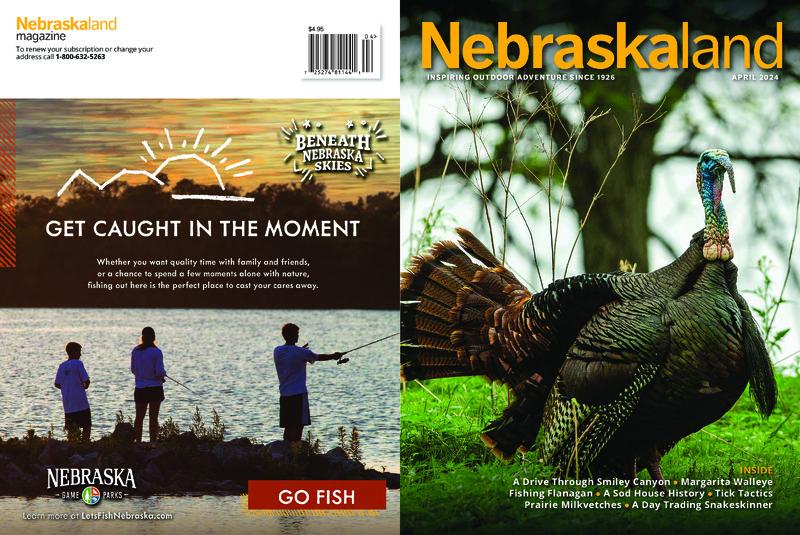
- Title:
- Volume 102, Issue 3, 2024
- Issue Name:
- April 2024
- Date Issued:
- 2024-04-01
- year:
- 2024
- month:
- April
- Season:
- Spring
- Publisher:
- Nebraska Game and Parks Commission
- Format:
- Periodical
- volume:
- 102
- issue:
- 03
- number:
- 102.03
- Decade:
- 2020s
- Type:
- Rights Holder:
- Copyright Nebraskaland Magazine/Nebraska Game and Parks Commission, all rights reserved.
- Extracted Text:
-
magazine
$4.95
To renew your subscription or change your
address call 1-800-632-5263
I N S P I R I N G O U T D O O R A DV E N T U R E S I N C E 1 92 6
A P R I L 20 24
INSIDE
A Drive Through Smiley Canyon O Margarita Walleye
Fishing Flanagan O A Sod House History O Tick Tactics
Prairie Milkvetches O A Day Trading Snakeskinner
2
Nebraskaland • April 2024
April 2024 •
Nebraskaland
3
Volume 102
April 2024
No. 3
FEATURES
20
SMILEY CANYON
28
OUTDOOR NEBRASKA
Story and photos by Justin Haag
What To Do in April
By Renae Blum
30
FISHING FLANAGAN
A Lake in the City
Story and photos by Jenny Nguyen-Wheatley
36
TICK TACTICS
40
NEBRASKA’S OBSCURE PRAIRIE MILKVETCHES
42
BUILDING A SOD HOUSE
Story and photos by Chris Helzer
Story and photos by Gerry Steinauer
By David L. Bristow, History Nebraska
DEPARTMENTS
8
12
46
56
58
Your Nebraska
In the Field
Mixed Bag
Portraits from the Past
The Last Stop
ON THE WEB
For more articles and
information, visit
NebraskalandMagazine.com
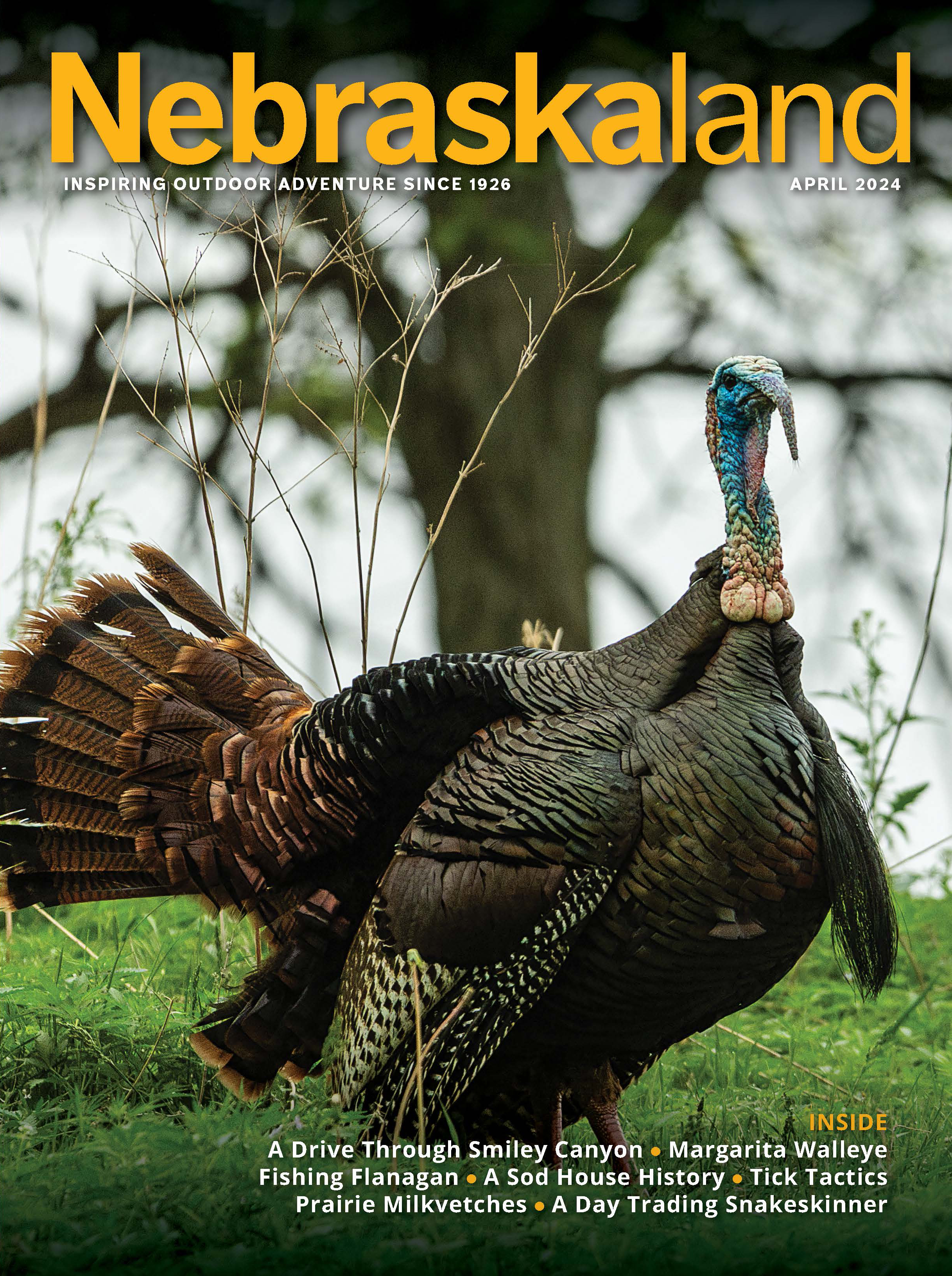
Cover: A tom turkey struts across a grassy hill in Cass
County. If you are unfortunate enough to shoot and
miss a bird like this, read our next-step tips on page 16.
JEFF KURRUS, NEBRASKALAND
This page: A greater prairie-chicken displays on a lek
at Burchard Lake Wildlife Management Area in Pawnee
County. ERIC FOWLER, NEBRASKALAND
4
Nebraskaland • April 2024
Nebraskaland (VOL. 102 / NO. 3 ISSN 0028-1964) is published monthly, except for the combined Jan./Feb. and Aug./Sept. issues, by the Nebraska Game and Parks Commission, 2200 N. 33rd
St., Lincoln, NE. Periodicals postage paid at Lincoln, Nebraska, and additional mailing offices. POSTMASTER: Send all UAA to CFS. (See DMM 507.1.5.2); NON-POSTAL AND MILITARY
FACILITIES: send address corrections to Nebraskaland, P.O. Box 30370, Lincoln, NE 68503-0370.
April 2024 •
Nebraskaland
5
Magazine Staff
magazine
Published by the Nebraska Game and Parks
Commission since 1926. The Commission is
dedicated to the conservation and protection
of all the state's natural resources and the
people who use them.
Communications Director Christy Firestone
Public Relations Manager Shawna RichterRyerson
Editor Jeff Kurrus
Associate Editor Jenny Nguyen-Wheatley
Regional Editors Eric Fowler, Julie Geiser,
Justin Haag
Contributing Editor Michael Forsberg
Regular Contributors Renae Blum,
Chris Helzer, Chris Masada, Todd Mills,
Ryan Sparks, Gerry Steinauer
Art Director Tim Reigert
Graphic Designer Mel Severin
Videographer Nick Sauvageau
Photo Librarian Jaclyn Cruikshank Vogt
Administration
Director Tim McCoy
Deputy Director Jim Swenson
Assistant Director Roger Kuhn
Commissioners
Chairman - Doug Zingula, Sidney
Vice Chairman - John Hoggatt, Kearney
2nd Vice Chairman - Donna Kush, Omaha
Nebraskaland Magazine Copyright 2024, all rights reserved.
Nebraskaland is available in audio from the Nebraska Library
Commission Talking Book and Braille Service, Suite 120, 1200 N St.,
Lincoln, NE 68508. 800-742-7691. Nebraskaland Magazine and the
Nebraska Game and Parks Commission reserve the right to reject
any advertising not in keeping with the agency mission.
Rates: $18 for one year; $33 for two years; $44 for three years.
Nebraska recipients must add appropriate sales tax. To subscribe call
1-800-NEBLAND (632-5263), or go online to:
NebraskalandMagazine.com.
Commission Offices
Conservation Officers
Headquarters/Southeast District Office
2200 N. 33rd Street Lincoln, NE 68503
Phone 402-471-0641
ADMINISTRATION (Lincoln)
402-471-5531
Travis Shepler, Jeff Clauson
Northeast District Office
2201 N. 13th St. Norfolk, NE 68701
Phone 402-370-3374
NORTHWEST (Includes counties covered)
Dan Kling (Lieutenant)
308-430-0572
Southwest District Office
301 E. State Farm Rd. North Platte, NE 69101
Phone 308-535-8025
Jerod Hahn (Sergeant)
Hunter Lee (Keith)
Brandon Wallace (Keith)
Jaden Porter (Keith, Garden)
Tyler Stueck (Keith)
Travis Schultz (Morrill, Cheyenne)
Bassett Office
524 Panzer St., Box 508 Bassett, NE 68714
Phone 402-684-2921
Kearney Office
1617 First Ave. Kearney, NE 68847
Phone 308-865-5310
EAST SUB-DISTRICT
WEST SUB-DISTRICT
Sean McKeehan (Sergeant)
Josh Widhelm (Scotts Bluff)
Justin Gress (Box Butte, Sheridan, Grant)
Jacob Stoinski (Sioux, Dawes)
402-471-5531
308-520-5539
308-280-4320
308-280-4488
308-289-2274
308-289-6260
308-279-1292
308-672-1824
308-279-9133
308-629-9335
308-615-9017
NORTHEAST (Includes counties covered)
Dale Davis (Lieutenant)
402-760-0712
NORTH SUB-DISTRICT
Ak-Sar-Ben Aquarium/Schramm Education
Center
21502 W. Highway 31 Gretna, NE 68028
Phone 402-332-3901
Jeff Jones (Sergeant)
John Bauer (Holt, Boyd)
Tyler Adelman (Rock, Brown, Keya Paha)
Jonathan Andreasen
402-762-5022
402-314-9257
402-314-4783
402-340-3981
Omaha Office
8495 Frederick Street, Omaha, NE 68124
Phone 402-595-2144
Mitch Johnson (Knox, Antelope, Pierce)
402-613-8612
OutdoorNebraska.gov
The Nebraska Game and Parks Commission does not discriminate
based on race, color, ethnicity, national origin, sex, pregnancy, sexual
orientation, gender identity, religion, disability, age, genetic information,
veteran status, marital status, and/or political affiliation in its programs,
activities, or employment. Any person who believes he or she has been
discriminated against in any program, activity, facility, or service,
should contact the Nebraska Game and Parks Commission, Lincoln, NE
402-471-0641, the Nebraska Equal Opportunity Commission, Lincoln,
NE 402-471-2024, TTY/TDD 800-642-6112; Director, Office of Diversity,
Inclusion and Civil Rights, U.S. Department of Interior, 1849 C Street,
NW, Washington, D.C. 20240.
6
Nebraskaland • April 2024
GETTY IMAGES
Circulation
For address changes and questions about your
subscription, call 800-632-5263
Advertising Sales Manager
For advertising information contact
Shane G. Gilster, 402-742-0125
Email: shanegilster@gmail.com
Pat Berggren, Broken Bow
Rick Brandt, Roca
Scott Cassels, Omaha
Ken Curry, Columbus
Dan Hughes, Venango
Northwest District Office
East Hwy. 2, Box 725 Alliance, NE 69301
Phone 308-763-2940
Beaver kits are born in April.
(Madison, Pierce, Stanton)
SOUTH SUB-DISTRICT
Cory Krause (Sergeant)
Kyler Prochaska (Platte, Colfax)
Matt Costello (Dodge, Colfax)
Kelbi Abke (Washington, Burt)
Mark McDonald (Dodge, Washington)
Nicholas Fix (Dixon, Dakota, Thurston)
402-380-6410
402-830-8278
402-317-4014
402-237-2537
402-805-2353
402-508-0261
CENTRAL (Includes counties covered)
Mike Thome (Lieutenant)
308-293-8746
NORTH SUB-DISTRICT
Doug Pollard (Sergeant)
Matt Brandt (Sherman, Howard)
Daryl Teter (Howard, Greeley, Merrick)
Klint Gill (Nance, Wheeler, Boone)
SOUTH SUB-DISTRICT
Matt Taylor (Sergeant)
Tim Williams (Hall, Hamilton, York)
Eric Javins (Adams, Clay, Webster)
Pat George (Harlan, Franklin, Phelps)
Ethan Teter (Buffalo, Kearney)
308-730-7050
308-202-0819
308-440-1863
402-613-5800
402-200-9597
308-380-7331
402-902-2017
308-920-2762
308-440-3847
SOUTHWEST (Includes counties covered)
Brian Piernicky (Lieutenant)
308-330-8780
NORTH SUB-DISTRICT
Hunter Pearson (Sergeant)
Frank Miller (Cherry, Hooker)
Greg Hesse
308-360-1817
402-389-0444
308-546-7464
Alex Hasenauer (Lincoln, Perkins)
Brandon O’Neal
308-660-4671
308-530-3157
(Hooker, Thomas, southern Cherry)
(Lincoln, McPherson, Logan)
SOUTH SUB-DISTRICT
Taylor Dixon (Sergeant)
Bryce Streger (Dawson, Gosper, Custer)
Kelsey Glodowski (Dundy, Hitchcock)
Sophia Gobber
(Chase, Dundy, Hayes, Hitchcock)
308-217-2108
308-537-0404
308-763-8226
308-222-0368
SOUTHEAST (Includes counties covered)
Stacey Lewton (Lieutenant)
402-890-7140
EAST SUB-DISTRICT
Heath Packett (Sergeant)
Russell Mort (Otoe, Johnson)
Rich Berggren (Douglas)
Brian Arp (Douglas, Sarpy)
Mike Luben (Saunders, Butler)
Bryan Adams
(Nemaha, Pawnee, Richardson)
WEST SUB-DISTRICT
Matt Seitz (Sergeant)
Dina Barta (Lancaster)
Luis Nuñez (Lancaster)
Mark Sullivan (Lancaster, Seward, Butler)
Trevor Stahlecker (Lancaster, Saline)
Curt Prohaska (Lancaster)
402-210-0888
402-209-1506
402-619-1355
531-530-9011
402-443-6392
402-429-1924
402-806-0915
402-890-6463
531-333-6093
402-741-0636
402-314-9641
402-470-1298
YOUR NEBRASKA
Steve Krout, Papillion
White Muskrat
Instagram Photos
Follow us @nebraskaland
and tag us in your photos
to be featured in an
upcoming issue.
Roger Richters, Utica
Center Pivot Winter
Jeffrey Z. Carney, Ashland
Eagle Food Fight
8
Nebraskaland • April 2024
April 2024 •
Nebraskaland
9
Brianna Nugent, Papillion
White-banded Crab Spider
Send your comments and
photos to:
Jeff Kurrus, Editor
Nebraskaland Magazine
P.O. Box 30370
Lincoln, NE 68503
or email Jeff.Kurrus@Nebraska.gov
Please include your postal address
and telephone number. Letters
may be condensed and edited.
Photographs are also welcome.
10
Nebraskaland • April 2024
April 2024 •
Nebraskaland
11
IN THE FIELD
TRAINING TIME
Mae, a Labrador retriever
puppy, readies herself for a
spring training session.
J FF KU
JE
JEFF
KUR
URRUS
RU NEB
RUS,
NE
NEBRAS
EBRAS
EB
RASKA
RASK
ALA
ALAN
AL
L
LAN
LA
AND
AN
12
Nebraskaland • April 2024
April 2024 •
Nebraskaland
13
IN THE FIELD
Matthew Marx, of Gretna, pulls a johnboat across Open Fields and Waters land after a morning turkey hunt and fishing trip.
JEFF KURRUS, NEBRASKALAND
BE OPEN TO OPEN FIELDS
By Jeff Kurrus
Hunting or fishing on Open Fields and Waters land requires
work. Sometimes a lot of it. Even so, looking for birds to hunt
and fishing holes to cast a line on a patch of OFW land should
be a spring rite of passage.
Follow these steps:
1. Search for accessible land in the newest installment of
Nebraska’s Public Access Atlas. There, you will find where
these lands are located and how they can be accessed.
2. Use some sort of mapping app, such as Google or OnX, on
your phone to scout the land before spending an ounce of gas
money. What you’re looking for are creeks, ditches and draws
with roosting timber for turkeys, either on the OFW land or
on adjacent land where talking a bird into walking across the
road is possible.
If fishing, how far is the parking area from the water? Too
14
Nebraskaland • April 2024
far for a kayak or small johnboat? Is the land accessible by
bank?
3. Once a spot is located, spend an afternoon scouting. Are
there bird signs — feathers, scat, tracks or birds themselves?
Also, is there a place where hunters or anglers regularly
park? These can be found by looking for any sort of human
remnants. You might just have the place to yourself.
4. On the day of your trip, be patient if others are around.
Spring birds are just as active at noon as early in the day.
Use a fellow hunter’s impatience to your advantage by not
leaving the woods before noon.
When fishing, be prepared to target various species and
bring along hiking boots to beat any traffic.
OFW lands remain underutilized by many hunters and
anglers, so don’t be one of them.
IN THE FIELD
JEFF KURRUS, NEBRASKALAND
AFTER THE MISS
By Jarrod Spilger
he scampered off, unscathed.
If someone tells me they’ve
Upon reflection, I still felt the
never missed a turkey, I
distance was good, but then
typically figure it’s because a)
spotted several branches
they haven’t shot very many
between the turkey and me
turkeys, or b) they’re lying.
that I hadn’t noticed before.
The reality is, it happens, and
That was the culprit. A few
the longer you hunt turkeys,
branches, sticks or even tall
the better your odds of missing
blades of grass or weed stalks
one. I’ve certainly missed more
are sometimes all it takes to
times than I’d care to admit
disrupt a pattern.
over the last three decades
Also,
consider
bird
of turkey hunting. When I
movement. To the uninitiated,
was younger, a miss would
turkey hunting involves
certainly derail me, but not
shooting at a stationary
anymore. Here are some ways
target, but veteran turkey
I’ve learned to manage my
hunters know better. Turkeys
misses.
rarely stand completely still,
First of all, if you shoot a
and if they take a step or two
shotgun with adjustable sights
at the last second, a miss is
or a scope, something might
almost inevitable, especially
have gotten knocked out of
with today’s tight-shooting
alignment. That’s why it’s
turkey chokes and loads.
so important to pattern your TOP: A hunter, out of arrows, watches a tom walk away.
If — or when — you miss,
shotgun before each season, BELOW: A small obstruction can lead to a wayward shot.
remember that patience
just like checking a rifle before JEFF KURRUS, NEBRASKALAND
and persistence are a turkey hunter’s two best friends.
hunting deer. If a miss does occur, go back to the patterning
Sometimes you don’t even have to wait a day or two to
board, check your sights or switch loads or chokes. Do
rectify a failed attempt. Like I saw during a hunt with my
whatever it takes to get back on target.
dad a few years ago, an early morning dud can quickly turn
If your trusty old shotgun is still trusty, analyze what
into a banner day still celebrated.
happened. Maybe some unseen obstacle was in the way.
Remember, you miss 100 percent of the shots you never
This happened to me a few seasons ago. I called in a
take. And if you do miss, simply keep trying.
gobbler and thought he was in range, but at the shot
16
Nebraskaland • April 2024
IN THE FIELD
JENNY NGUYEN-WHEATLEY, NEBRASKALAND
GRILLED ‘MARGARITA’ WALLEYE
By Jenny Nguyen-Wheatley
Try this recipe on the grill this spring or summer:
Walleye fillets are gently cooked in butter, loads of
garlic, spices and a splash of tequila. It’s fine to skip
the tequila if you’re avoiding alcohol. Those sensitive
to cilantro may exclude the herb as well.
I cooked the fish on the grill, but this recipe will be
just as tasty in the oven. This recipe also will work
with other white-fleshed fish, though cooking time
will vary. Try it with catfish, bluegill or crappie. Ocean
fish such as halibut, sablefish or cod will also do nicely.
Servings: 2
Prep Time: 10 minutes
Cooking Time: 20 minutes
Ingredients:
2 walleye fillets
Salt and pepper, to taste
1
⁄2 teaspoon of chili powder
1
⁄4 teaspoon of cumin
3 cloves of garlic, minced
1 tablespoon of fresh cilantro, chopped
Juice of half a lime, plus extra wedges for serving
Splash of tequila
2 tablespoons of cold butter, cut into small pieces
Half a serrano pepper, thinly sliced (optional)
•
•
•
•
•
•
•
•
•
•
18
Nebraskaland • April 2024
1. Preheat the grill to about 300° Fahrenheit, and
prepare it for indirect heat cooking.* Cut out a large
piece of heavy-duty aluminum foil and fold the edges
and corners to form a rim to keep liquids contained.
Spray foil with non-stick spray, and then place it onto
a rimless cookie sheet.
*This recipe may also be prepared in the oven. If you
go this route, skip the foil and prepare fish in a greased
baking dish. Don’t use a dish that is too big — fish
should fit snugly in one layer.
2. Lay walleye fillets in one layer in the foil “tray”
you just made. Season fish with salt and pepper,
and distribute chili powder, cumin, minced garlic and
cilantro on top of both fillets. Squeeze juice of half a
lime on top and add a splash of tequila. Dot with pieces
of cold butter.
3. Use the cookie sheet to transfer fish to the grill,
sliding the foil onto the grates. Close the lid and cook
for 20 minutes at 300° or until fish becomes flaky and
is cooked through. If the walleye starts browning too
quickly, move the foil “tray” to a cooler area of the grill.
4. Serve immediately with extra lime wedges on
the side and slices of serrano pepper garnished on top.
Spoon butter sauce over the fish. I like to serve this
dish with Mexican rice.
April 2024 •
Nebraskaland
19
Smiley Canyon
Story and photos by Justin Haag
A scenic drive at Fort Robinson State
Park has a colorful, and someƟmes
treacherous, history.
Smiley Canyon Road winds its
way through the Pine Ridge.
20
Nebraskaland
• April 2024
April 2024 •
Nebraskaland
21
S
miley Canyon Scenic Drive has
long allowed visitors to immerse
themselves in the grandeur of
the Pine Ridge without leaving
their vehicles. The winding road has
surely brought some smiles to drivers —
and, yes, some frowns in its early years.
Believed to have been named for a
family of Smileys that settled in the
vicinity in 1893, the drive is one of the
best ways to see the park’s bison herd,
pronghorn, mule deer, the occasional
bighorn sheep and an array of bird
species. The 5½-mile paved road climbs
about 900 feet from just west of Fort
Robinson State Park’s central campus
to the top of the ridge and its butte-top
vantages.
BELOW: A brown thrasher perches on
a pine branch in Smiley Canyon. The
canyon is a popular destination for
birdwatchers.
RIGHT: A blooming plum thicket and the
rising sun signify new beginnings where
the road courses along the canyon and
its deep ravine.
22
Nebraskaland
• April 2024
April 2024 •
Nebraskaland
23
Smiley Canyon Scenic Drive has a
colorful history, beginning with its
planning. Few who visit the drive today
realize what a challenging engineering
feat it was.
The road was not only born as a way
for locals to finally have a reliable route
between Crawford and neighboring
Harrison, but it also was part of a larger
concept with excitement propagating
well beyond northwestern Nebraska.
The road would be a vital link for what
was being billed as the Washington
Highway. Named for the nation’s first
president, the new automobile route
would connect the Atlantic to the Pacific
and provide a vital link for easterners to
visit Yellowstone National Park. Today,
it’s known as U.S. Highway 20.
Prior to Smiley Canyon Road’s
construction, locals traveled “two
miserable trails of the poorest sort which
followed White River and Soldier Creek,”
wrote one reporter.
In 1914, Col. Chas Thatcher, a national
road expert, visited northwestern
Nebraska while being tasked with
marking a route for the Washington
Highway. He wrote that he much
preferred creating a course along Soldier
Creek — long before it was the federal
wilderness area of today — instead of
Smiley Canyon. For reasons not found in
research for this article, the latter option
was chosen, though.
The road brought so much anticipation
that even the arrival of road equipment
in 1920 garnered headlines. Gov. Samuel
McKelvie visited the construction site in
1922.
The 2-mile canyon posed great
challenges for both drainage and grade.
Workers used 15 tons, that’s 30,000
pounds, of TNT for the removal of 65,000
yards of material to create the road bed.
About 20,000 yards of that was solid
rock.
About a month after its June opening,
the first of many vehicle crashes was
A buck pronghorn grazes near the
canyon’s lower entrance.
24
Nebraskaland
• April 2024
April 2024 •
Nebraskaland
25
reported in print. A man in a Paige
luxury car, believed to be a retired
Fort Robinson officer, “was found to
have crashed into the embankment
with such force as to drive the top
and windshield on top of the engine,
crushing the life out of the driver,”
wrote the Harrison Sun.
The winding road, with its steep
7-percent grade, became especially
treacherous to unfamiliar nighttime
drivers who speedily approached the
canyon from the relatively flat section
to the west. A prime example of the
road’s tendency to turn drivers’ smiles
to frowns occurred in October 1963.
“Smiley Canyon, the truckers’
nemesis, claimed two trucks and a
car in less than 48 hours in some sort
of record the past week,” a Crawford
Tribune reporter wrote, introducing
a tale of the two cattle haulers that
went off the road hours apart in nearly
the same spot, spilling a combined 123
head yearling steers and calves. The
drivers survived, but the 105 bovines
26
Nebraskaland
• April 2024
TOP: In the early years, the road’s three bridges were considered a contributing
factor to many fatal accidents. In the 1950s, they were replaced with culverts.
HISTORY NEBRASKA, RG1517
BOTTOM: The bison are a favorite photo subject of those traveling the road.
RIGHT: A horseback rider enjoys an outing on the Smiley Canyon Loop Trail, just
north of the road. Trails for non-motorized activity intersect with the road at six
places.
that weren’t killed in the crash had to
be rounded up in the rugged terrain.
After Smiley Canyon had claimed a
number of lives and countless dollars in
wrecked vehicles over more than four
decades, today’s much less perilous
route bypassing Smiley Canyon to the
south was completed in 1967. Billed
to be even more scenic than Smiley
Canyon, the 6-mile section was named
“Middleswart Pass” — a tribute to Tom
Middleswart, the district road engineer
from Bridgeport who designed the
route.
Later in 1967, with Fort Robinson’s
role as a state park in its infancy, the
Game and Parks Commission filed to
purchase the 640-acre tract of school
land encompassing the canyon to be
added to the park’s many attractions.
Today, the most challenging part of
the road allows only one-way traffic
uphill, lessening the chance of wrecks.
There is also no hiking or cycling
allowed in the section that goes
through the bison pasture. Visitors can
stop at a scenic overlook at the top of
the ridge to take in the 22,000-acre
park’s beauty.
Much of Smiley Canyon burned in a
1989 wildfire but retains scenic value.
There are also parking areas near a
historical marker and near the head of
Turtle Rock Trail, a popular pathway
that takes hikers, horseback riders,
cyclists and the park’s Jeep rides to the
top of the Cheyenne Buttes.
The dreams from the early 1900s
have been realized as U.S. Highway
20 stands as the nation’s longest
highway, spanning from Boston to
Newport, Oregon. In Nebraska, the
section between Valentine and the
Wyoming border has been designated
the Bridges to Buttes Scenic Byway.
Without fanfare, Smiley Canyon
reached its 100th year in 2023. While
it’s no longer a vital link to Yellowstone
or the coasts, it’s always worth a
short detour for those with a park
permit — as long as they don’t let the
animals and scenery distract too much
attention from the road. N
April 2024 •
Nebraskaland
27
Outdoor Nebraska
By Renae Blum
What To Do in April
Visit Merritt Reservoir
for International Dark
Sky Week
The doldrums of winter are behind us, and fresh signs of life
are all around. Here are some ways you can get outdoors and
experience it this month. N
Throughout the month | Merritt Reservoir
State Recreation Area
This year, International Dark Sky Week is April
2-8, and what better way to celebrate than by
experiencing Nebraska’s first International Dark
Sky Park? Merritt offers some of the darkest skies
in the world, making for spectacular stargazing.
During your stay, you can also enjoy boating,
picnicking, camping and some of Nebraska’s best
fishing. Learn more or book your campsite at
OutdoorNebraska.gov.
ERIC FOWLER, NEBRASKALAND
Celebrate National Frog Month by
listening for frogs calling
As weather allows; peak time is typically mid-March to early
June | The eastern half to eastern third of Nebraska
Fish pits and ponds for
largemouth bass
Just before dusk or in the early evening, head to wetlands, ponds and
marshy areas where you can hear the mating calls of different frog
species. Woodhouse’s toads make a nasally “waaahhh” sound like a calf
or sheep’s bleat, while cricket frogs make a “rik, rik, rik” sound like two
marbles hitting together. Boreal chorus frogs sound like a finger running
over a comb. Plains leopard frogs make a “chuck-chuck-chu-u-u-ck”
noise, and bullfrogs make the distinctive baritone “jug-o-rum” sound.
What can you hear? Frogs are sensitive to disturbances, so limit noise,
be patient and use a red filter on your flashlight to navigate to your spot.
As weather allows | Statewide
Warm days in early spring are an excellent time to catch big bass, as females
will feed heavily to prepare for spawning. Pits and ponds warm faster and
provide good bass habitat; you can find public waters along interstate lakes,
Fremont Lakes, Louisville and Bridgeport. Small reservoirs like Hedgefield and
Redtail lakes are options, too. Don’t be afraid to use big baits, reel slowly and
look for areas where the water will warm first — like a cove protected from the
wind or a north shoreline catching the sun’s rays. JEFF KURRUS, NEBRASKALAND
JEFF KURRUS, NEBRASKALAND
Hunt for morels at
Indian Cave
Archery turkey season
Season is March 25 – May 31 | Statewide
Few things are more challenging to chase on the
Great Plains than spring gobblers with a bow and
arrow. Enjoy the chance to get out there early and
have a more laid-back hunt. The birds will be less
pressured and likely easier to locate, and you’ll have
all season to punch your tag. A few tips for hunters:
Scouting is still important, don’t forget about public
lands, and warm afternoons can be fantastic times
to call in gobblers.
JUSTIN HAAG, NEBRASKALAND
28
Nebraskaland • April 2024
As weather allows; typically mid-April
through May | Indian Cave State Park
Indian Cave is a popular morel hunting
destination, with plenty of space to
accommodate foragers. Mushroom enthusiast
Chance Brueggemann recommends getting
creative and searching areas most people
won’t go — away from main roads or into
brushy areas. He finds most morels by elm
trees, ash trees or cottonwoods. Look for trees
that are dying or recently dead, and head
out after a good rain followed by some nice,
sunny days. ERIC FOWLER, NEBRASKALAND
April 2024 •
Nebraskaland
29
Fishing Flanagan
A Lake in the City
Story and photos by Jenny Nguyen-Wheatley
The black crappie population in Flanagan
Lake in Omaha is dominated by 8- to
10-inch fish, with opportunities for anglers
to catch 10- to 11-inch fish.
30
Nebraskaland • April 2024
April 2024 •
Nebraskaland
31
‘Y
ou call this a lake?” said my friend Hank Shaw as we
unloaded out of the truck on a weekday morning in April.
From the southwest parking lot near Fort and 168th
streets, Flanagan Lake in Omaha looked little more
than a pond. Hank didn’t know that the rest of the lake was
obscured, and I had forgotten it. The last time I was here,
the lake hadn’t been filled with water — construction of
Flanagan began in 2015 and finished in 2017.
Accustomed to ocean fishing along the coast of California
and Mexico — even commercial salmon fishing in Alaska —
Hank, then of Sacramento, California, scoffed at the new-ish
metro construction located just 15 minutes west from our
house. I chuckled sheepishly in response, not knowing if
I had blown my chance to impress a visitor or if it was just
Hank’s sense of West Coast superiority teasing.
Our guide Dean Thielen of DAB Fishing was already on
the lake. He waved to us from his Lund, and after customary
introductions near the boat ramp, the four of us began
flinging Gulp! minnows across the water. We worked the
deeper, south end of Flanagan near the dam first, slowly
floating back north toward the boat ramp and kayak launch.
Dean was informative, but not pedantic in his instruction.
And just because an angler might be a master on saltwater,
doesn’t mean they will instinctively know what to do on
freshwater, and vice versa. Dean reeled in several nice
crappie with practiced hands before Hank landed a four-inch
“ditch pickle” — a largemouth bass — his first fish of 2023.
My husband, Rick, followed up with a crappie. And I wouldn’t
catch my first fish — a crappie — until several moments later.
As expected during that time of year, the fish would be
lethargic at that deeper, colder end of Flanagan. So, we
abandoned that south side and trolled up toward the north
end, and that’s where the waterscape opened up.
“Whoa, this lake is a lot bigger than I thought,” Hank
admitted, sitting back and admiring the view and soaking in
the warmth of the spring sun.
For a metro-area lake, 225 acres of surface water at full
pool isn’t half bad. The surrounding land adds an additional
505 acres of green space, a playground and park area on
the northeastern side south of Ida Street, and over 5 miles
of paved trails. Despite being located in the middle of the
city and surrounded by homes, our time on the water was
peaceful. We delighted over the myriad of songbirds and
waterfowl that zoomed close as the boat slowly made its
How to Fish Flanagan Throughout the Year
By Dean Thielen
Bait - The No. 1 bait for
multiple species of fish is
a jig and a plastic, using
different sizes for the
different species of fish.
With bluegill, use a 1⁄64-ounce
jig with 1-inch Gulp!
minnow. For crappie,
move to a 1⁄32-ounce.
For bass, throw a
Ned rig, a mushroom jig
tipped with a short plastic
worm
or creature.
For crappie
and other
panfish, simply
put a jig and a bobber
about a foot, 2 feet or 3 feet
above that, depending on
the kind of habitat
you’re fishing. You
just twitch it back
slowly.
Pike and
bass
might
want
something with more
aggressive action,
like a spinner.
Crankbaits certainly
work.
Overall, I find plastics
and jigs to be much more effective in this part of the
country than crankbaits and
spinnerbaits because of what the food source is in
Flanagan. The jig will catch every fish in the lake,
including catfish. We’ve caught 36-inch pike on 1-inch
Gulp! minnows.
rocks and riprap at the end of May and into June. And
they’ll also be along the bottom of some of those flats.
Summer - After the spawn, figure out where food is
located. A lot of the food will be along the weed edges.
So, if you’re fishing from shore on Flanagan, it will be
tough during the summertime because the weeds get
thick. When temperatures get hot, usually in July and
August, the weeds start dying off, and then shoreline
fishing gets good again. But if you’re out on a boat,
focus on weed edges because a lot of fish will be there.
Flanagan also has a lot of timber. When temperatures
rise in the summer, the shade provided by timber
becomes valuable. Big horizontal logs are better than
vertical logs because they’ll provide a lot more shade.
Fall - After that, it’s basically looking at what the food
source is doing and what’s going on with the weeds.
The remaining vegetation will hold some weeds into
the fall, and as it totally dies off, so do the bug hatches.
So, the fish might move into the trees again if the trees
are providing cover and food. That can vary a little bit,
but not a lot. Spots that are good one year are typically
going to be good the next year.
Early Spring - When the water starts to warm up
in April, occasionally in March, fish will typically start
to move into the shallow coves and shallow bays and
stay there starting April through May. There’s a lot of
habitat in Flanagan, especially right in the bay down
from the boat ramp at the cove. There will be a lot of
fish there starting in April and through May and a little
bit into June.
Game and Parks fisheries biologists put in a variety of fish structure at Flanagan Lake, a few of which were “new” or unique to
those done before in past lake constructions. ERIC FOWLER, NEBRASKALAND
32
Nebraskaland • April 2024
Late Spring - After that, the fish will move out to their
summertime location to spawn. The crappie will spawn
in May. The bass will spawn at the end of May. The
bluegill spawn in June. Spawning areas will be along the
Hank Shaw of Minnesota holding a largemouth bass. Shaw
founded the Hunt, Gather, Cook website.
April 2024 •
Nebraskaland
33
Why Special Regs
at Flanagan?
By Jacob Werner, Fisheries Biologist
The Nebraska Game and Parks Commission
began implementing a 10-inch maximum length
limit for crappie and 8-inch maximum length limit
for bluegill and redear sunfish at Flanagan Lake
on Jan. 1, 2023. These limits are not only unique
to Nebraska, but as far as we know, are unique
to the country. The ultimate goal is to create a
“trophy” fishery.
Crappie in southeastern Nebraska tend to hit a
growth bottleneck at around 8-10 inches, where
they stack up in that range with few pushing past
the bottleneck to larger sizes. Similarly, bluegill
tend to stack up in the 6- to 8-inch range, with few
growing larger than 8 inches.
The thinking behind the regulation is that by
reducing the density of the most abundant size
groups of crappie, bluegill and redear sunfish, we
can increase the amount of resources available
for the remaining fish in the water body to
hopefully increase growth rates. And by releasing
fish that are over the limit, we retain those larger
fish in the water body.
So, we set up an experiment to test this
hypothesis through regulation. We want to find
out if we could push those fish populations into
ones that have higher proportions of bigger fish.
The goal is for anglers to be able to regularly
catch 9- to 10-inch bluegill and 13- to 15-inch
crappie at Flanagan. We don’t know if the
experiment will be successful, but we are
optimistic. We are just one year into a five-year
study, and we’ll continue to monitor the fishery
and collect data to see how these regulations
impact the fishery.
Fishing guide Dean Thielen holds a northern pike caught out of Flanagan Lake.
way through the submerged trees that dotted the length of
the lake, which provided fish structure.
At the north end of Flanagan, a wetland area could
be credited for much of the avian life we witnessed.
Although the wetland was primarily constructed
to slow down water and prevent siltation of the
reservoir, it also functions as a great place for wildlife
viewing, said Game and Parks southeast district fisheries
supervisor Aaron Blank.
Dean took us under the Ida overpass and to the very north
end of Flanagan, where his boat could go no farther past the
wetland. There, shallow water warmed by the sun created the
ideal conditions for active, hungry fish, and during the next
34
Nebraskaland • April 2024
several hours, picture-perfect, spring-fishing fun ensued. We
fished until 4 o’clock that day, steadily hooking into more than
100 fish: loads of nice black crappie — one possible Master
Angler-worthy specimen caught by Hank, several impressive
largemouth bass, some bluegill, one channel catfish and a
beautiful northern pike caught by Dean.
When we set out that morning, we’d agreed to only
catching and releasing fish, but by 3 p.m., Hank decided
he was hungry for a fish fry. So, we started throwing some
crappie in the livewell, which didn’t take long to accomplish,
considering how late in the day it was. We also threw back
several fish over the maximum length of 10 inches, a special
regulation that is unique not only to Nebraska but also to the
country (read sidebar page 35).
On the way home, we stopped by Walmart to pick up
a pack of Louisiana Fish Fry, frozen french fries and a
case of Pabst Blue Ribbon. I cooked our fish dinner on
the back deck that evening. It was nothing fancy — just
good Nebraska eating to end a productive spring day on
the water.
Flanagan took us all by surprise. N
The Nebraska Game and Parks Commission manages the
fishery at Flanagan Lake. The City of Omaha maintains the
lake’s facilities. The Papio-Missouri River Natural Resource
District operates the reservoir.
Fish survey of Flanagan Lake in March 2020.
JEFF KURRUS, NEBRASKALAND
April 2024 •
Nebraskaland
35
Tick Tactics
Story and photos by Chris Helzer
Just because ticks aren’t your favorite
creatures doesn’t mean you can’t admire
their life strategies.
I
found a deer carcass one April day while walking around my family
prairie. I’m not a trophy hunter, but I’m pretty sure my friends who are
would have been happy to see it beneath their tree stand the previous
fall. I don’t know how long the dead deer had been lying there. By the time
I found the carcass, it had been nearly completely stripped clean.
I approached the deer with my camera, hoping to find and photograph
any remaining carrion beetles or other invertebrates feeding on what
remained. What can I say? I’m a weird dude.
I did find a few beetles moving around, but not very many. While I was
photographing them, however, I noticed a dog tick perched high on an old
grass stem. Then I saw another one. And another. Once I started actively
looking for them, they were all over the vegetation near the carcass. There
were even a few on the deer itself.
LEFT: Deer skeleton at the Helzer family prairie near Stockham.
ABOVE: A tick perched on one of the antlers.
36
Nebraskaland • April 2024
April 2024 •
Nebraskaland
37
As I continued to spot ticks all around me, I did two things. First, I did a quick tick
check of my own body to confirm that I was still tick free. I was. Second, I tried to
come up with a hypothesis to explain what I was seeing.
There seemed to be two possibilities. One was simply that the ticks had been
on the deer while it was alive and had abandoned ship after its death. They’re tiny
creatures with tiny legs, so it might make sense that they hadn’t traveled very far
yet. It seemed possible, but none of the ticks I saw were engorged, which made me a
little skeptical that they’d all been attached to the deer when it had died.
My second hypothesis was more fun to ponder and also seems more likely to me.
What if the ticks had converged upon the deer carcass because it increased their
chance of encountering animals like coyotes or opossums who might show up to
feed on the carcass?
As far as I knew, ticks find their victims, known as hosts, by climbing up into
the vegetation and waiting for a creature to brush past them. They hold on to the
vegetation with some legs but keep their front legs free for latching onto passersby. Lurking in random locations seems destined to fail most of the time. Ticks must
have strategies for positioning themselves where they can increase their chances of
success. I was pretty sure I’d read something about ticks being most common along
well-used trails, for example.
While I wondered why the ticks were there, I photographed some of them. Later,
after returning home, I did some research to see if I could find any other reports of
ticks hanging out near dead animals. Sure enough, I found a few scientific journal
articles in which researchers reported sightings somewhat similar to mine.
Scientists have documented ticks hanging out around decomposing mice and
fish, as well as near a dead deer and a dead porcupine. In the case of the porcupine,
scientists — also known as fellow weirdos — located its carcass in May and had
spent about 15 minutes watching maggots and beetles on the carcass but didn’t
notice any ticks. Several weeks later, they returned to the same carcass and found
more than 300 dog ticks within a few feet of it. It seemed clear that the ticks had
been drawn to the dead porcupine.
None of the studies I read had definitive answers about why ticks might be
attracted to carcasses, but my favorite hypothesis was shared by several of the
articles. There was some discussion about whether the ticks might be attracted to
the smell of decay or to the carbon dioxide released by the decomposition. Either
way, the ticks seemed to sense the dead animals and moved toward them.
I can’t be sure the ticks I saw hadn’t just dropped off the deer when it died. Of
course, that’s a possibility. However, it makes a lot of sense to me that ticks would
have evolved to be attracted to dead animals that would, in turn, attract animals for
those ticks to attach to and feed on. If so, that’s a fantastic little life hack and a much
better alternative to simply climbing a random grass stem and hoping something
happens to walk by.
I’m guessing most people reading this aren’t huge fans of ticks. I can understand
how you might be discomfited to learn that ticks have strategies for increasing their
chances of encountering you in the wild. On the other hand, in this particular case,
the only creatures that need to worry are scavengers like coyotes and opossums and
weirdo photographers like me. N
TOP LEFT: The first tick I spotted on a
blade of grass nearby.
TOP MIDDLE: A tick on the hide of
the deer.
TOP RIGHT: A cosmopolitan
blue bone beetle feeding on the
remainder of the carcass.
BOTTOM RIGHT: A Dermestes beetle,
another scavenger insect.
Chris Helzer is the Nebraska Director of Science for The Nature Conservancy and is
based in Aurora. When he isn’t searching for obscure subject matter to photograph and
write about, he conducts research and captures lessons from the Conservancy’s land
management and restoration work.
Chris is a regular contributor to Nebraskaland Magazine, with his first story
appearing in 1995.
38
Nebraskaland • April 2024
April 2024 •
Nebraskaland
39
Nebraska’s Obscure
Prairie Milkvetches
Story and photos by Gerry Steinauer, Botanist
ildflowers are like wildlife in that the big, showy
species, such as sandhill cranes, mountain lions, roses
and gayfeathers, get all the notice and attention, while
small, less eye-catching species sadly go unnoticed.
A prime example of this are Nebraska’s 24 native milkvetch
(Astragalus) species. Most are rosette-forming plants with
colorful, clustered flowers that inhabit dry rock outcrops and
clay badlands in the Panhandle. Some are tall prairie plants
with spikes of large blue, purple or white flowers. These two
groups are the eye-catching milkvetches whose photos often
adorn wildflower guides.
Yet four others — ground plum, Platte River milkvetch,
Missouri milkvetch and lotus milkvetch — are short prairie
species that bloom in spring with smaller, less pretentious
flowers. These are often hidden among the prairie grasses
and are easily overlooked.
Milkvetches belong to the legume or pea family and are
characterized by five-petaled, pea-shaped flowers, compound
leaves with few to many leaflets and pods as fruits. The
species can be difficult to identify if only their similarappearing flowers and leaves are present. Fortunately, each
has a seed pod that is fairly distinct in size, shape or hairiness,
which greatly aids in identification. Yet, they still manage to
challenge botanists and nature photographers.
The pursuer of our obscure milkvetches must have
knowledge of each species’ specific prairie habitat and a keen
eye to find them. For the photographer, these plants are best
captured when in bloom, but the perplexed shutterbug may
have to return to the site in early summer and observe the
plant’s pods to correctly identify their subject.
Ground plum blooming in a moist tallgrass prairie in
Hamilton County. Native Americans used various decoctions
of the plant to treat sore throat, toothache and insect bites.
W
40
Nebraskaland • April 2024
statewide. Its whitish to lilac flowers, the petals tipped with
purple, appear in late April through May and are soon followed
by inch-long, green seed pods that lie on the ground. Native
Americans and settlers ate the young, tender pea-flavored
pods raw, cooked and pickled. Rodents, including prairie dogs
and mice, cache the dry, leathery pods and eat the seeds later.
Platte River Milkvetch
In early June 1820, Edwin James, botanist, geologist and
surgeon for the Long Expedition to the Rocky Mountains, first
collected Platte River milkvetch (A. plattensis) in Nebraska
along the Platte River in what is now either Dodge or Colfax
County. This plant is limited to relatively undisturbed
prairies throughout much of the state, excluding far eastern
Nebraska. Platte River milkvetch is similar in size and
appearance to ground plum and is often confused with it. The
species are most easily distinguished by their mature pods.
Platte River milkvetch pods are hairy and have a pointed tip,
while ground plum’s pods are smooth and blunt-tipped.
plant than the two previously described species, Missouri
milkvetch has a very short stem, and its leaves lie prostrate
on the ground. The plant’s leaflets are covered in short,
appressed hairs that give them a unique silvery or greenishgray hue. The flowers can be white but are usually rich purple
in color with a splash of white in the center of the upper petal.
The small pods are boat-shaped.
Lotus Milkvetch
In late June 1820, James collected lotus milkvetch (A.
lotiflorus) along the Platte River in what is now either Keith
or Lincoln County. This plant grows mostly in dry hilltop
prairies throughout the state, but is more common westward.
It is fairly tolerant of disturbance, such as heavy grazing, and
can inhabit degraded prairies. Lotus milkvetch is similar in
size to Missouri milkvetch, but distinguished from the latter
species by its green, more upright leaves and white to creamy
yellow flowers with purplish streaks in the center of the
petals. The small pods are crescent moon-shaped.
Ground Plum
Missouri Milkvetch
Ground plum (A. crassicarpus), also called buffalo bean,
is the largest and most common of our obscure milkvetches.
It grows in moist bottomland to dry hilltop prairies nearly
Missouri milkvetch (A. missouriensis) grows mainly on dry,
often sparsely-vegetated gravel, clay and loam soils in the
western half of the state. A more delicate and less upright
These four milkvetch species are so often unseen that the
only photographs of the largest and most common ground
plum grace the pages of wildflower guides. As beautiful as
these delicate wildflowers are, it is unfortunate. Come midApril, a search for them would be rewarding. N
Platte River milkvetch flowering mid-slope on a Platte River
bluff in Hamilton County. Seed pods from previous years are
visible in the lower left of the photo.
Missouri milkvetch growing on a dry ridgetop in Keya
Paha County. The plant accumulates selenium, but is
little grazed and not toxic to livestock.
Lotus milkvetch flowering on a dry Platte River bluff top in
Hamilton County. The white to creamy-yellow petals with
purplish streaks are key to identifying the plant.
April 2024 •
Nebraskaland
41
Building
a Sod House
By David L. Bristow, History Nebraska
uilding sod houses, especially when the wind blows, is
not quite as pleasant as being out buggy riding with
a girl,” wrote 20-year-old Swedish immigrant Rolf
Johnson in 1876. “One’s nose, eyes, mouth, ears and
hair gets full of loose dirt. OK! It’s bad!”
Living in Phelps County, young Rolf was learning soddiebuilding skills shared by many Nebraskans of his era. They
all faced a similar challenge — how do you build a home in
a place with few trees, and where imported lumber is either
unavailable or too expensive?
As with the earth lodges of Native peoples such as the
Pawnee, sod houses were a clever adaptation to local
conditions. Building one required not only a lot of hard work,
but also planning, skill and neighborly cooperation.
First, you had to find good sod from which to cut bricks.
A sod house may look like it’s made of dirt, but each brick
is held together by a tough, dense network of prairie grass
roots binding the soil. The savvy home builder searched
bottomlands near the water table for places where the roots
grew together in a mat. Roots were toughest in fall, but
builders rarely had the luxury of choosing the season.
Cutting sod required a team and a plow. It was best to use a
“cutting” or “grasshopper” plow that turned the sod over in a
long, neat ribbon that could then be cut into bricks. Plowing
virgin sod was hard work — people spoke of the tearing sound
the plow made as it sliced through the roots. It took about an
acre of sod to build a 12-by-14-foot house.
Rolf Johnson told of cutting bricks that were “2 feet long,
12 inches wide and 4 inches thick,” which were then hauled
to the construction site. Putting up walls required at least
two men, so it was common for neighbors to help each other.
Bricks were laid grass-side down so each layer could be
trimmed level.
Walls were usually two or three sods thick, staggered like
regular bricks (but without mortar), and every third or fourth
layer was laid crosswise to hold the wall together. Door and
A breaking or “grasshopper”
plow, distinguished by its
adjustable rods. Such a plow
turned the sod over in a
smooth ribbon for better sod
bricks. HISTORY NEBRASKA, 8902-1
window frames were held in place with wooden rods and
topped with long cedar poles to spread the weight and keep
the frames from buckling.
As the walls grew higher, the women shaved the interior
walls with a spade to keep them balanced and to close any
holes. (Interior walls were usually plastered as well.) Men
used a wagon as a platform from which to lay the upper
layers.
After reinforcing the base with planks, sod or even
concrete, it was time to build the roof — the most important
part. “If the roof failed, the house failed, for the endurance
of the walls depended ultimately on the protection of the
roof,” writes Roger Welsch in his book Sod Walls. While some
builders could afford shingled roofs, most soddies relied on a
sod roof.
A sod roof had the advantages of being cheap, a good
insulator and relatively fireproof. And it would keep you
dry in the hardest rainstorm … for a couple of hours. Then it
would drip for two or three days after the rain ended.
A good ridgepole was crucial — or better, several good
ridgepoles to distribute the weight. Heavy cedar beams
were excellent if you could find them, but lifting them into
place was difficult for a team of two or three men. The usual
method was to lay two poles against the eave wall and use
ropes to roll the beams into place. A combination of poles,
brush, hay and earth completed the roof.
Most families moved out of their soddies as soon as they
could afford a more spacious frame house. The sod house was
then repurposed as a farm building. Some are still standing
to this day. N
Visit History Nebraska’s website at history.nebraska.gov.
‘B
42
Nebraskaland
• April 2024
Heavy rains in 1887 caused Custer County widower George Barnes’s roof to collapse only 10 minutes after the
family was out of bed. HISTORY NEBRASKA, RG2608-0-1190
April 2024 •
Nebraskaland
43
An 1886 photo of the Leroy Leep family (West Union, Custer County) shows a gabled roof with three ridgepoles, plus a crooked
pole bracing the sod above a window frame. HISTORY NEBRASKA, RG2608-0-1019
The Peter M. Barnes place (Clear Creek, Custer County) shows how a farmstead developed. The family probably started out in
the dugout before moving into a better soddie, which was then expanded. HISTORY NEBRASKA, RG2608-0-1788
44
Nebraskaland
• April 2024
Building the sod house that served as Lakeland High School, Brown County, Nebraska, 1934.
April 2024 •
HISTORY NEBRASKA, RG4290-0-1505
Nebraskaland
45
MIXED BAG
WILD COLUMBINE
By Gerry Steinauer, Botanist
A Spring Wildflower of our State Parks
the flower. The upper half of the petal consists of a long, red,
backward-pointing spur. Five flaring, red, petal-like sepals
extend outward between the spurs.
The genus name Aquilegia comes from the Latin “Aquila,”
which means “eagle” and refers to the spurred petals
that resemble eagle talons. The upper end of the hollow
spurs secret nourishing nectar that attracts long-tongued
hummingbirds and hawkmoths that pollinate the flowers.
Pollen-gathering bumblebees also pollinate the flowers.
Native Americans prepared infusions from various parts
of wild columbine to treat heart trouble, kidney problems,
headaches, bladder problems and fever, and as a wash for
poison ivy. They also used the pulverized seeds as a love
charm and to detect bewitchment. Today, the plant is a
common ornamental in gardens, and here the sweet, nectarfilled flowers can be picked and eaten fresh or used to enhance
salads.
This spring, while hiking the woods in the above mentioned
parks, keep a sharp eye out for wild columbine and the many
other early-blooming wildflowers that grace these sites. You
will be amazed by their beauty.
Wild columbine’s large and unique flowers will allow park
visitors to easily locate and identify this spring wildflower.
Several of Nebraska’s state parks are showcases for spring
wildflowers and wild columbine (Aquilegia canadensis), also
called red columbine, is one of the most delicate and beautiful
of these early-bloomers growing in the parks.
This perennial is limited to our eastern- and northern-most
counties where it inhabits cool, moist deciduous woodlands
at the base of north- and east-facing slopes and ravine
bottoms. The best places to seek the wildflower are the
Missouri, lower Platte and Niobrara river bluffs and adjacent
hills, including those at Indian Cave, Platte River, Mahoney,
Ponca, Niobrara and Smith Falls state parks and Schramm
Park State Recreation Area.
The flowers first appear in late-April in the southeastern
counties and blooming continues through May in the
northern counties. The flowers are unmistakably unique. Set
atop the one-to two-foot-tall plants, the bell-shaped flowers,
up to two inches long, hang in loose, branching clusters. The
flowers have five petals. The lower half of each petal is yellow
and, combined, they form a column from which projects a
bundle of bright, yellow stamens, the pollen-forming parts of
46
Nebraskaland • April 2024
April 2024 •
Nebraskaland
47
MIXED BAG
48
Nebraskaland • April 2024
April 2024 •
Nebraskaland
49
50
Nebraskaland • April 2024
April 2024 •
Nebraskaland
51
MIXED BAG
HELEN BRAZEE
By Eric Fowler
Campground Host
How long have you been a campground host?
I started as a camp host in the year 2000, when I retired, but
we used to come out here and camp, from the mid-1970s all
the way until now. It was in the early 1970s when they made
this a park because of the interstate and the sandpits.
[Note: The sandpits or borrow pits along Interstate 80 were dug
for material to build the highway and its interchanges. Mel Steen,
director of the Game and Parks Commission when the freeway
was built, asked that the pits be dug in a way that would be more
useful as recreation areas and provide better fish habitat.]
We’d come every other weekend, as often as we could. I’d
take a half-day vacation from Pfizer, and we’d come Friday at
noon so we could get a spot. Now you’ve got to come Thursday
morning to get a spot on the weekends.
When did you lose your husband?
Glen died in 2017 on Dec. 7. Our anniversary was Dec. 5, and
we had 58 years, barely. Two days later he passed away. The
doctor said, “Helen, he’ll probably live another week.” And I
said, “I don’t think so,” because he couldn’t eat.
Mark [Clymer, the former superintendent] and I planted
three trees in 2017 in November, right up by the booth. I spent
two weeks out here in the motor home by myself because Glen
was in the nursing home. I’d have to put him in the nursing
home in order to get a break. My insurance would pay five
days, and I’d pay five days to come out here and play.
We planted those three trees in memory of Glen and my
son, Alan, and that bench I put there with the sandhill cranes.
Alan passed away same year Glen did in March. It wasn’t a
good year. That’s why I’m living it up now. You’ve got to take
every day to its fullest.
What made you volunteer to be a campground
host?
I always respected this park because Mark always kept it
as clean as he could and as nice as he could. I would pick up
trash and limbs and whatever I could find, even when I wasn’t
a camp host, because I wanted things to look nice. Or if the
bathroom was dirty, I would just take the toilet paper and
wipe the sinks off.
Then I said to him one day, “If you ever need someone to
work in the park when I retire, I’d sure like to.” And he said,
“Well, you’re hired.”
What are your other duties at the park?
I love planting trees and growing trees. We put mulch
around them and water them in. Sometimes I run the water
wagon and water all of the trees. I love doing that.
52
Nebraskaland • April 2024
I’ve even got my own weed eater — well, it’s kind of mine.
Laura got it for me because it was smaller. I can’t handle the
big ones the boys use. This one’s got a battery. I love it.
I used to ride my bike to clean the restrooms.
What do you like about the park?
It’s my favorite little park. It’s so peaceful. I could go over
there in my little camper at night, and it’s just wonderful to be
out of Lincoln.
I don’t enjoy the ones around Lincoln as much. They’re way,
way crowded all the time. This one’s always clean. Perfection.
And the beauty of it. The other night we had six deer that
came up behind the barn back there about 7:30 p.m., just
when it was almost dark. Crazy.
I’m at the park from April to November. I go home once a
month to get my mail. I basically live out here. It’s really a
comfortable little park. I call it my little jewel in the middle of
the country. Not a lot of people know about it unless they do
the internet and all that kind of stuff.
Do you hear the interstate?
Never. You get used to it. People off the interstate that have
never been here, the tent people, they don’t like that. That’s
why we’re trying to get more windbreaks.
That’s the only drawback that I’ve ever heard from anybody
is that the interstate is loud at night. I say just turn on your
fan or some kind of music or something to knock that out and
you won’t have any trouble.
Where do visitors to the park come from?
Helen Brazee sits in front of her camper at Windmill State Recreation Area in Buffalo County. She has been a campground host
at the park since 2000. ERIC FOWLER, NEBRASKALAND
We have a lot of locals from the Grand Island, Hastings and
Kearney areas, but you’d be surprised how many people come
in off the interstate, and they love it.
We had one couple this morning that stayed in a tent.
They were going back to Boone, Iowa. They’re very nice
people. They’ve been here before, and they love it. That’s
why they stop on their way back and forth. We have a
lot of people from back east that will stop here going
west and a lot of Colorado people that are going east.
my fingers and saw my first bobcat running across the path. It
was pretty interesting down there.
Windmill is one of two parks where
campground hosts stay the entire season.
Others are two-week stints. Which do you
prefer?
This is my fifth new motor home. We started with a used
pickup with a 9½-foot slide-in camper. We went all over
California and everywhere with that thing.
We got a really nice one we wanted to retire in. When Glen
got sick, he said, “We need to get rid of this motor home
because you won’t let me drive it anymore.” I said, “You can
drive it, but we need to get something smaller.” His foot
wasn’t working real good. We thought it was a stroke, but it
I wouldn’t like moving around. I knew when I retired that
this was going to be the one that I worked at, or hosted at.
But I wanted to try a couple of others, so I did Fort Kearny and
Rock Creek Station. That was fun. I got poison ivy between
How old are you?
I will be 84 in February. So I’ve been doing it for a while, 20plus years, and I love it. And I pray the Lord will give me one
more year. I’d like to have two, but I’ll just take it one at a time,
that’s all you can do. One year at a time, one season at a time.
Tell me about your camper.
was Parkinson’s. So he said, “Why don’t we trade it in and get
something you can drive?” So that’s exactly what I did. That’s
why it’s small, and I can handle it.
What are some of your favorite park
memories?
I have a lot of good memories in this park. There have been a
lot of interesting people. We had some people from Denmark.
They rented an RV in California, and they toured. They stayed
here three or four days, and it was just fun to talk to them
because they were from a different part of the world. We have
had some good Fourth of Julys out here.
It’s been just a pleasant place to work.
To read the complete interview, visit NebraskalandMagazine.
com. To learn more about Game and Parks’ Campground Host
program and to apply, visit https://outdoornebraska.gov/about/
give-back/help-in-a-park/campground-host/.
April 2024 •
Nebraskaland
53
54
Nebraskaland • April 2024
April 2024 •
Nebraskaland
55
PORTRAITS FROM THE PAST
Pheasant hunting near Greely, 1975
This picture was taken south of
Greely on opening day when we limited
out — one of our last good trips. We
started with our dads in the early 1960s
hunting at Verbas’s farm.
Our group left to right: Jim McDonald
(back), Bert Thompson, Terry Steele and
Bill Thompson; Ed Christensen (front),
Leroy Raabe and Bob Thompson. Gary
Geise took the picture.
Terry and Bill have passed away. Bert
Thompson is 99 and lives in O’Neil.
– Ed Christensen, Phoenix, Arizona
Carp fishing in Columbus,
1959
This picture is from Pawnee
Park in Columbus. Often the
Loup River would flood the
park in the spring, filling
the pond with carp. The
pond provided many days
of adventure to me and two
neighbors, Mark Shields and
Ronnie Braun.
Leave early morning after
paper route, then pack a lunch,
ride our bikes, and bring a
can of corn and poles to fish
off the bridge that went over
the pond. This must have
been a good day. There is still
a rock water fountain in the
park. Lunch always provided
a slippery climb to the top of
the fountain for a drink. Many
a good summer’s day spent at
Pawnee Park.
I would have been 9 or 10
since I have a July birthday.
– Steve Shadle,
South Sioux City, Nebraska
56
Nebraskaland • April 2024
Pheasant hunting in Pierce County, early 1980s
This picture was taken in the early ’80s in Pierce County, Nebraska, when pheasants were plentiful.
Left to right: Scott Lackas; Larry Lackas (Scott’s dad/my brother); Gary Fletcher; Gary’s dog, Mutt; my dog, Sam; Kevin
Culbertson (Larry’s son-in-law); and myself, Neil Lackas.
A good time was always had.
– Neil Lackas, Randolph, Nebraska
Little Hunters, Custer County, 1985
My dad’s deer is bigger than yours.
– Justin Stasburg,
Callaway, Nebraska
Send contributions to: Portraits from the Past, Nebraskaland Magazine, P.O. Box 30370, Lincoln, NE 68503-0370. Or e-mail to Tim.Reigert@Nebraska.gov.
Photos should show people enjoying Nebraska outdoor activities, such as camping, boating, hunting or fishing, and must have been taken before 2000. We will give
priority to unusual photos or activities. When possible, please include a story about the photograph and identify the people, places and approximate date it was
taken. Text may be edited and photos adjusted for reproduction. All photos will be returned.
April 2024 •
Nebraskaland
57
THE LAST STOP
The skin of a bullsnake, finely preserved in the day trading offices of Kurrus and Sons.
JEFF KURRUS, NEBRASKALAND
A DAY TRADING SNAKESKINNER
By Jeff Kurrus
Hiding behind an empty gumball machine on
my son’s bookshelf, I saw the snakeskin.
I couldn’t help but shake my head.
Created during COVID, the snakeskin was
one of many new-fangled hobbies the Kurrus
family began. Deer scorers; military tank
history experts; bird food creators; stock market
day traders. You name it, we were in.
Everything was fair game when the entire
family was home, with kids being schooled
online and never-before-uttered words like
Zoom and phrases like “CPE is on a run!”
becoming commonplace.
But the snakeskin creation was also an
example of common.
Riding gravel roads one afternoon in Cass
County, our family came across a recently
deceased bullsnake. We took it to the house
and, after a video or two, began our newest
hobby.
We rung the neck with a knife, then we
peeled the snake’s skin back with our hands.
58
Nebraskaland • April 2024
Once off, we placed it over an old broomstick
and generously rubbed table salt over the inside
of the skin. We left the skin like this for several
days, eventually rubbing the salt off, turning
the skin right-side out, and covering the outside
with Vaseline.
Now this is where you snakeskin aficionados
will shake your heads, telling me this is the
exact opposite of what we should do — how
there are much better pickling solutions than
Vaseline. Yet upon stumbling across the skin
again the other day, it was still shiny and in great
shape.
But that’s not where its discovery took me.
It reminds me that I had no idea what I was
doing when making a snakeskin, much like my
bank account reminds me I had no idea what I
was doing when I was memorizing stock tickers
in an effort to accelerate my disastrous day
trading ventures.
Yet I can’t help but smile when I think about
either.
April 2024 •
Nebraskaland
59
Position: 853 (10 views)