Volume 101, Issue 5, 2023
June 2023
- Identifier:
- nela.2023_101_05
- Title:
- Volume 101, Issue 5, 2023
- Issue Name:
- June 2023
- Date Issued:
- 2023-06-01
- year:
- 2023
- month:
- June
- Season:
- Spring
- PDF filename:
- NL_101.05_2023_Jun_Spreads_Entire.pdf
- Publisher:
- Nebraska Game and Parks Commission
- Format:
- Periodical
- volume:
- 101
- issue:
- 05
- number:
- 101.05
- Decade:
- 2020s
- Type:
- Rights Holder:
- Copyright Nebraskaland Magazine/Nebraska Game and Parks Commission, all rights reserved.
- Extracted Text:
-
magazine
$4.95
To renew your subscription or change your
address call 1-800-632-5263
I N S P I R I N G O U T D O O R A DV E N T U R E S I N C E 1 92 6
INSIDE
The Crankbait Canvas • Berries and Cherries
The Return of Wolves • Branched Oak Through the Seasons
Lake McConaughy Walleyes • Portraits from the Past
J U N E 20 23
Volume 101
June 2023
No. 5
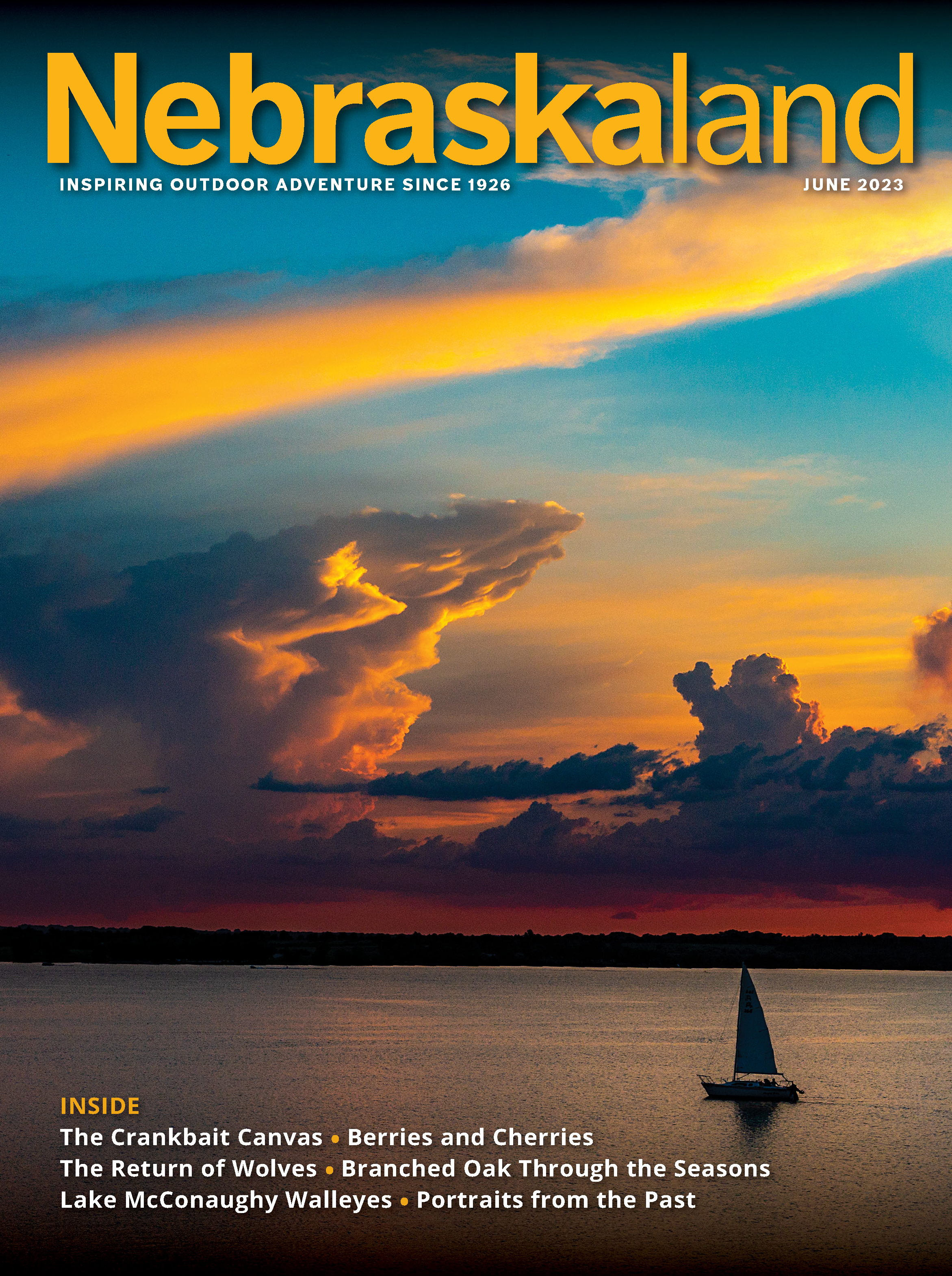
Cover: A sailboat crosses Branched Oak Lake near Malcolm at
C
ssunset. See the story on page 26.
ERIC FOWLER, NEBRASKALAND
E
T page: The setting sun illuminates a thunderhead beyond a
This
hilltop soapweed near Hyannis.
h
ERIC FOWLER, NEBRASKALAND
E
FEATURES
18
THE CRANKBAIT CANVAS
24
OUTDOOR NEBRASKA
26
34
38
44
50
Story and photos by Justin Haag
What to Do in June
By Renae Blum
BRANCHED OAK
Through the Seasons
Photos and story by Eric Fowler
CROSSING THE PLATTE,
‘THE MEANEST OF RIVERS’
By David L. Bristow, History Nebraska
FORAGING FOR WILD PLUMS,
CHERRIES AND BERRIES
Story and photos by Gerry Steinauer
A RETURN TO THE PLAINS
Wolves in Nebraska
By Sam Wilson
PROMISE OF WALLEYE
Lake Mac Study Fuels Changes to
Fisheries Management
By Julie Geiser
DEPARTMENTS
6
10
54
64
66
Your Nebraska
In the Field
Mixed Bag
Portraits from the Past
The Last Stop
ON THE WEB
Nebraskaland (VOL. 101 / NO. 5 ISSN 0028-1964) is published monthly, except for the combined Jan./Feb. and Aug./Sept. issues, by the Nebraska Game and Parks Commission, 2200 N. 33rd St.,
Lincoln, NE. Periodicals postage paid at Lincoln, Nebraska, and additional mailing offices. POSTMASTER: Send address changes to Nebraskaland, P.O. Box 30370, Lincoln, NE 68503-0370.
2
Nebraskaland • June 2023
For more articles and
information, visit
NebraskalandMagazine.com
June 2023 •
Nebraskaland
3
Magazine Staff
magazine
Published by the Nebraska Game and Parks
Commission since 1926. The Commission is
dedicated to the conservation and protection
of all the state's natural resources and the
people who use them.
Communications Director Christy Firestone
Public Relations Manager Shawna RichterRyerson
Editor Jeff Kurrus
Associate Editor Jenny Nguyen-Wheatley
Regional Editors Eric Fowler, Julie Geiser,
Justin Haag
Contributing Editor Michael Forsberg
Regular Contributors Renae Blum,
Chris Helzer, Chris Masada, Todd Mills,
Ryan Sparks, Gerry Steinauer
Art Director Tim Reigert
Graphic Designer Mel Severin
Photo Librarian Jaclyn Cruikshank Vogt
Administration
Director Tim McCoy
Deputy Director Jim Swenson
Assistant Director Roger Kuhn
Board of Commissioners
Chairman - Scott Cassels, Omaha
Vice Chairman - Doug Zingula, Sidney
2nd Vice Chairman - John Hoggatt, Kearney
Robert Allen, Eustis
Pat Berggren, Broken Bow
Rick Brandt, Roca
Ken Curry, Columbus
Donna Kush, Omaha
Circulation
For address changes and questions about your
subscription, call 800-632-5263
Advertising Sales Manager
For advertising information contact
Shane G. Gilster, 402-742-0125
Email: shanegilster@gmail.com
Conservation Officers
Headquarters and Southeast District Office
2200 N. 33rd Street / P.O. Box 30370
Lincoln, NE 68503-0370
Phone 402-471-0641 / Fax 402-471-5528
ADMINISTRATION (Lincoln)
Craig Stover (Administrator)
Duane Arp (Asst. Administrator)
Travis Shepler (Asst. Administrator)
Jeff Clauson (Asst. Administrator)
Northwest District Office
299 Husker Road / P.O. Box 725
Alliance, NE 69301-0725
Phone 308-763-2940 / Fax 308-763-2943
Northeast District Office
2201 N. 13th Street / Norfolk, NE 68701-2267
Phone 402-370-3374 / Fax 402-370-3256
Kearney Service Center
1617 First Avenue / Kearney, NE 68847-6057
Phone 308-865-5310 / Fax 308-865-5309
Bassett Service Center
524 Panzer Street / P.O. Box 508
Bassett, NE 68714-0934 / Phone 402-684-2921
Fax 402-684-2816
Omaha Service Center
8495 Frederick Street / Omaha, NE 68124-3054
Phone 402-595-2144 / Fax 402-595-2569
EAST SUB-DISTRICT
Jerod Hahn (Deuel, Garden, Grant)
Jaden Porter (Keith, Garden)
Tyler Stueck (Keith)
Travis Schultz (Morrill, Cheyenne)
Hunter Lee (Keith)
Brandon Wallace (Keith)
WEST SUB-DISTRICT
4
Nebraskaland • June 2023
308-520-5539
308-289-2274
308-289-6260
308-279-1292
308-280-4320
308-280-4488
Sean McKeehan (Sergeant)
308-672-1824
Hunter Pearson
308-360-1817
(Kimball, Banner, Scotts Bluff)
(Sheridan, Dawes, Grant)
Josh Widhelm (Scotts Bluff)
Jacob Stoinski (Sioux, Dawes)
Justin Gress (Box Butte, Sheridan, Grant)
308-279-9133
308-615-9017
308-629-9335
NORTHEAST (Includes counties covered)
Dale Davis (Lieutenant)
402-760-0712
NORTH SUB-DISTRICT
Jeff Jones (Sergeant)
402-762-5022
John Bauer (Holt, Boyd)
Tyler Adelman
402-314-9257
402-314-4783
(Knox, Cedar)
Jonathan Andreasen
402-340-3981
Mitch Johnson (Knox, Antelope, Pierce)
Mark McDonald (Dodge County)
402-613-8612
402-314-6165
(Madison, Pierce, Stanton)
The Nebraska Game and Parks Commission does not discriminate
based on race, color, ethnicity, national origin, sex, pregnancy, sexual
orientation, gender identity, religion, disability, age, genetic information,
veteran status, marital status, and/or political affiliation in its programs,
activities, or employment. Any person who believes he or she has been
discriminated against in any program, activity, facility, or service,
should contact the Nebraska Game and Parks Commission, Lincoln, NE
402-471-0641, the Nebraska Equal Opportunity Commission, Lincoln,
NE 402-471-2024, TTY/TDD 800-642-6112; Director, Office of Diversity,
Inclusion and Civil Rights, U.S. Department of Interior, 1849 C Street,
NW, Washington, D.C. 20240.
402-471-5531
402-471-5531
402-471-5531
402-471-5531
NORTHWEST (Includes counties covered)
Dan Kling (Lieutenant)
308-430-0572
(Rock, Brown, Keya Paha)
OutdoorNebraska.org
JUSTIN HAAG, NEBRASKALAND
Nebraskaland Magazine Copyright 2023, all rights reserved.
Nebraskaland is available in audio from the Nebraska Library
Commission Talking Book and Braille Service, Suite 120, 1200 N St.,
Lincoln, NE 68508. 800-742-7691. Nebraskaland Magazine and the
Nebraska Game and Parks Commission reserve the right to reject any
advertising not in keeping with the agency mission.
Rates: $18 for one year; $33 for two years; $44 for three years. Nebraska
recipients must add appropriate sales tax. To subscribe call
1-800-NEBLAND (632-5263), or go online to:
NebraskalandMagazine.com.
Commission Offices
Southwest District Office
301 E. State Farm Road
North Platte, NE 69101-0430
Phone 308-535-8025 / Fax 308-535-8028
A strawberry moon over the Pine
Ridge of Sioux County in June. The
strawberry moon is the first full
moon of the summer and is named
after the wild strawberries that
ripen this month.
SOUTH SUB-DISTRICT
Cory Krause (Sergeant)
402-380-6410
Kyler Prochaska (Platte, Colfax)
Matt Costello (Dodge, Colfax)
Kelbi Abke (Washington, Burt)
Nicholas Fix (Dixon, Dakota, Thurston)
402-830-8278
402-317-4014
402-237-2537
402-508-0261
(Cuming, Wayne, Stanton)
CENTRAL (Includes counties covered)
Mike Thome (Lieutenant)
308-293-8746
NORTH SUB-DISTRICT
Doug Pollard (Sergeant)
308-730-7050
Matt Brandt (Sherman, Howard)
308-202-0819
(Loup, Garfield, Valley)
Daryl Teter (Howard, Greeley, Merrick)
Klint Gill (Nance, Wheeler, Boone)
SOUTH SUB-DISTRICT
308-440-1863
402-937-3730
Matt Taylor (Sergeant)
402-200-9597
Tim Williams (Hall, Hamilton, York)
Eric Javins (Adams, Clay, Webster)
Pat George (Harlan, Franklin, Phelps)
Ethan Teter (Buffalo, Kearney)
308-380-7331
402-902-2017
308-920-2762
308-440-3847
(Thayer, Fillmore, Nuckolls)
SOUTHWEST (Includes counties covered)
NORTH SUB-DISTRICT
Ray Dierking (Custer, Thomas, Blaine)
Frank Miller (Cherry, Hooker)
Greg Hesse
308-870-0322
402-389-0444
308-546-7464
Alex Hasenauer (Lincoln, Perkins)
Brandon O’Neal
308-660-4671
308-530-3157
(Hooker, Thomas, southern Cherry)
(Lincoln, McPherson, Logan)
SOUTH SUB-DISTRICT
Brian Piernicky (Lieutenant)
308-330-8780
Bryce Streger (Dawson, Gosper, Custer)
Matt Andrews
308-537-0404
308-746-2418
Taylor Dixon (Dawson, Gosper)
Sophia Gobber
308-217-2108
308-222-0368
Kelsey Glodowski
308-242-9000
(Red Willow, Frontier, Hayes, Hitchcock)
(Furnas, Gosper, Frontier, Red Willow)
(Chase, Dundy, Hayes, Hitchcock)
(Dundy, Hitchcock)
SOUTHEAST (Includes counties covered)
Stacey Lewton (Lieutenant)
402-890-7140
EAST SUB-DISTRICT
Heath Packett (Sergeant)
402-210-0888
Russell Mort (Otoe, Johnson)
Rich Berggren (Douglas)
Brian Arp (Douglas, Sarpy)
Mike Luben (Saunders, Butler)
Bryan Adams
402-209-1506
402-619-1355
531-530-9011
402-443-6392
402-429-1924
(Cass)
(Nemaha, Pawnee, Richardson)
WEST SUB-DISTRICT
Dina Barta (Lancaster)
Luis Nuñez (Lancaster)
Mark Sullivan (Lancaster, Seward, Butler)
Trevor Stahlecker (Lancaster, Saline)
Matt Seitz (Gage, Jefferson)
Curt Prohaska (Lancaster)
402-890-6463
531-333-6093
402-741-0636
402-314-9641
402-806-0915
402-470-1298
YOUR NEBRASKA
Instagram Photos
Follow us @nebraskaland
and tag us in your photos
to be featured in an
upcoming issue.
6
Nebraskaland • June 2023
Gordon Warrick, Valentine
Fort Niobrara River Otters
June 2023 •
Nebraskaland
7
YOUR NEBRASKA
Lynette Hahne, Lincoln
Orange Burst
Jayson Alder, Omaha
Ducks on a Log
Send your comments and
photos to:
Jeff Kurrus, Editor
Nebraskaland Magazine
P.O. Box 30370
Lincoln, NE 68503
or email Jeff.Kurrus@Nebraska.gov
Please include your postal address
and telephone number. Letters
may be condensed and edited.
Photographs are also welcome.
Karen Linot, Gibbon
Melting Icicle
8
Nebraskaland • June 2023
June 2023 •
Nebraskaland
9
IN THE FIELD
JUNE BLOOMS
Soapweed (Yucca glauca)
blooms below the steep
sandstone ridge on the
north side of Cedar Canyon
Wildlife Management Area
near Gering.
JUSTIN
JUST
STIN HAAG,
HAAG,
G, NEB
BRASK
RASKALAN
ALAN
LAND
10
Nebraskaland • June 2023
June 2023 •
Nebraskaland
11
IN THE FIELD
Bumble bee on showy milkweed at Wildcat Hills State Recreation Area and Nature Center in Scotts Bluff County.
JUSTIN HAAG, NEBRASKALAND
CELEBRATING POLLINATOR WEEK
By Alie Mayes, Community Science Specialist
Most of us know what a pollinator is
— an animal that moves pollen within
a flower, or between flowers, in a way
that aids in plant reproduction. We also
understand pollinators are vital for the
health of ecosystems and humans.
It seems fitting that once a year we
dedicate a week to learn about and
celebrate these important creatures.
Here in Nebraska, we make a special
effort to promote and share our love
and excitement for pollinators during
Pollinator Week, which is June 19 to
25 this year.
Nebraska
Game
and
Parks
Commission hosts this celebration
with the help of partners that support
pollinator-themed events across the
state. Visit OutdoorNebraska.gov and
the webpage “Pollinator Week” to
find an event near you.
Game and Parks will host the
Nebraska Pollinator Quest, formerly
12
Nebraskaland • June 2023
the Pollinator Week Challenge, at that
time. Everyone is encouraged to take
pictures of pollinators and upload
them to the free iNaturalist app.
The Quest is a great place to start
celebrating these animals, but for
those who want to do more, here are
a few suggestions for ways you can
support pollinators year-round.
Increase Pollinator Knowledge
Through Community Science
Two pollinator projects are looking
for volunteers in Nebraska. Visit
OutdoorNebraska.gov to learn more
about the Nebraska Bumble Bee Atlas
and the monarch and regal fritillary
butterfly surveys and find out how
you can make a difference.
Cultivate Overlapping Blooms
When gardening for pollinators,
overlapping bloom times is essential.
Making sure something is always
blooming spring through fall will
ensure you are providing vital food
resources for pollinators. Find
resources at OutdoorNebraska.gov.
Leave the Leaves
Looking for a way to help pollinators
and do less yard work? Leaving the
leaves in your yard provides important
overwintering habitat for many
insect species, including pollinators.
Dead stems are also an important
overwintering shelter for native bees.
This month, join Nebraska Game
and Parks to celebrate Pollinator Week.
Attend an event or go on a Quest. And
keep supporting pollinators all year
with small actions that lead to big
impacts. With your help, Nebraska will
continue to have an amazing array of
pollinators to celebrate.
IN THE FIELD
These are three must-have apps for the outdoor enthusiast.
JEFF KURRUS, NEBRASKALAND
THREE OUTDOOR APPS
By Renae Blum
Wish your kids spent more time outdoors and less time in
front of a screen? It’s a common concern. Rather than cutting
out electronics completely, a phone can be a great tool in
helping spark a child’s curiosity and interest in the outdoors.
Give the three apps below a try. All are free, available on
both Google Play and the Apple App Store — and can enrich
your family’s experience of the outdoors.
Merlin Bird ID
Kids can explore their curiosity about birds with this easyto-use app, which helps with bird identification. Wondering
what birds you’re hearing? You can make a live sound
recording, and the app will suggest species in real-time. The
app can identify bird photos, too.
Don’t have a photo or sound recording? There’s also a Bird
ID Wizard which offers possibilities based on your answers
to simple questions. Check out the “Explore” section, too,
where you can browse a library of birds in your area, complete
with photos, sounds and maps.
Seek
Seek is another app that’s great for identifying what you
see outside. Simply open the camera tool, snap a photo
of the plant or animal you see, and the app will make an
14
Nebraskaland • June 2023
identification. You then have the option to read more about
the species and its range, similar species and the time of year
it appears. The more observations you make, the more badges
you’ll earn. You also can participate in monthly challenges.
Seek was designed for kids ages 9 to 11 and does not
require registration or collect any user data by default. It’s a
simpler version of the iNaturalist app and great for families
who want to explore the outdoors together.
Geocaching
This app is your gateway into a great outdoor family
activity — geocaching! Geocaching is a treasure hunt aided
by technology. The goal is to find caches, hidden containers
with a logbook and sometimes, small trinkets for trade,
which the app will help you discover. There are more than 3
million caches hidden worldwide, making opportunities for
geocaching fun nearly everywhere you go.
Geocaching can be a fun way to explore places in your
neighborhood you didn’t know about, or to have some added
fun on a vacation. Geocaches come in a variety of sizes and
difficulty levels; for the best family experience, focus on
caches with a low difficulty level (this is easy to do with the
free version of the app, which limits you to easier caches).
Kids of all ages can have fun helping locate caches.
IN THE FIELD
WILD TURKEY BBQ SANDWICHES
WITH SPICY SLAW
By Ryan Sparks
Everyone knows how delicious and
versatile wild turkey breasts are, but
some struggle to prepare meals from
the lower half of the bird: the legs and
thighs. This recipe is straightforward,
requires minimal prep and is a perfect
weeknight or summer barbecue meal.
With a saucy, tangy filling piled onto
a toasted bun, it is an ideal use for
the dark meat from any turkey. To
save time, both the barbecue sauce
and slaw can be made ahead. One
additional tip: If you choose to cook
the thighs in water, throw in a diced
onion, carrot, celery, bay leaf, parsley,
black peppercorns or whatever else
you have in your pantry for the last
few hours of cooking. When your
thighs are done cooking, strain the
water, and you now have a rich turkey
stock to use in the future.
Wild Turkey
2 wild turkey thighs (or legs)
Enough water or stock to cover
•
•
Spicy Slaw
1
⁄4 cup apple cider vinegar
2 teaspoons granulated sugar
1 teaspoon kosher salt
4 cups sliced green cabbage (about
half a small head)
1 large shallot or very small red
•
•
•
•
•
16
Nebraskaland • June 2023
•
•
onion, thinly sliced
1 large carrot, coarsely grated
1 jalapeno, seeded and thinly
sliced
Barbecue Sauce
2
⁄3 cup ketchup
1
⁄2 cup apple cider vinegar
1
⁄4 cup brown sugar
2 tablespoons honey
2 teaspoons smoked paprika
1
⁄2 teaspoon cumin
1 teaspoon kosher salt
1 teaspoon black pepper
•
•
•
•
•
•
•
•
Fixings
Mayonnaise
Hot sauce (optional)
Sandwich or hamburger buns
Pickles
•
•
•
•
1. Place the turkey thighs in a slow
cooker set on high. Add enough water
or stock to cover the meat and cook
until tender, around 5 hours (longer
for legs). The meat should easily flake
apart when shredded with two forks,
which is a good time to look for any
stray shot. While the meat is cooking,
make the slaw and barbecue sauce.
2. For the slaw, combine 1⁄4 cup
vinegar, sugar and salt in a small pot.
Cover the pot and heat until the sugar
dissolves.
Toss together cabbage, shallot,
carrot and jalapeno in a medium bowl.
Pour the hot vinegar mixture over the
slaw and toss to combine. Cover and
put in the fridge, tossing again before
serving.
3. Make the barbecue sauce by
combining all the ingredients in a
small saucepan over low heat and
whisk until the brown sugar and salt
have dissolved and the mixture comes
together. Taste it. If it is too sweet, add
more vinegar. Add hot sauce if you
want it spicier.
4. Next, place the shredded turkey
meat into a nonstick pan over mediumlow heat and pour in enough barbecue
sauce to the consistency you like.
Make it saucy.
5. To assemble the sandwiches, cut
each bun in half, spread a thin layer of
mayonnaise on each cut side, and place
them in a nonstick pan over mediumhigh heat. Cook until the buns are
toasted and warmed through. Spread
more mayonnaise on the bottom of the
bun along with extra hot sauce, and
then fill the buns with slaw, pickles
and turkey. Serve with additional hot
sauce, barbecue sauce and potato
salad. Stick a turkey feather in the
bun, and celebrate the wild turkey.
June 2023 •
Nebraskaland
17
The
Crankbait
Canvas
PainƟng baits is rewarding,
economical and fun.
Story and photos by Justin Haag
M
any a fly angler knows the satisfaction of catching
fish on a hand-tied masterpiece. For those more
inclined to cast and retrieve for pike, bass and
walleye, here is a way to emulate that remarkable
experience: painting crankbaits.
Quality crankbaits are some of the most expensive
products to tie to the end of a line. At $5-20 each, losing one
to a deep snag can put a damper on a day of fishing. Alas,
unpainted plastic crankbait blanks resembling many beloved
models are available online at $1 or less each. Simply put,
you can just add paint and hooks and get them to the water.
If you are like me, you may be reluctant to trust your limited
artistic abilities to something as important as catching a
fish. Thankfully, with crankbaits, an exquisite appearance is
not imperative.
The Art CriƟc
Even though I do not hold a degree in aquatic psychology,
I can safely surmise fish are not art critics. Just as I do not
place a lot of critical judgement on the appearance of a
cheeseburger at a fast-food restaurant when I’m hungry,
most fish seemingly do not closely scrutinize the details of
a moving crankbait. If something buzzes by that looks like
suitable prey and the fish is hungry, there’s probably not a
lot of internal debate, i.e. “I’d bite, but that orange on the
pectoral fin is a little too dark, and the design isn’t quite
symmetrical.”
Right: Assorted paints, tools, finished and unfinished lures.
18
Nebraskaland
• June 2023
June 2023 •
Nebraskaland
19
Kiera Haag uses an
airbrush to paint a
crankbait lure. Notice the
homemade cardboard
spray booth she’s using.
The quality of the paint job is more for self-satisfaction,
and for impressing others in the boat.
The EssenƟal Airbrush
With those factors in mind, I invested about $40 in the
favored tool of crankbait painters: the airbrush. It’s certainly
not a high-end model, but works well for the task. Thankfully,
I already had an air compressor in the garage to power it.
Another $20 for a set of assorted airbrush paints, and I was
on my way.
I’m partial to crankbaits that look like common prey in
nearby lakes — young-of-the-year bluegill, yellow perch,
pike and bass darting in and out of shallow vegetation, or
schools of shad rising to the water’s surface.
The college science professor who got me going on
this hobby noted that almost all vertebrates have a pale
underbelly. With that in mind, white makes a logical base
coat.
Adding colors above the belly is where the artistry begins.
With just a little practice, an airbrush can create the subtle
Painting over mesh material to creates a scale pattern.
KIERA HAAG
other items. My go-to is the material from a synthetic loofah
— you know, the sponge-like product found in many a bath
and shower.
Create stencils to paint in details such as fins and scale
patterns. Serious crankbait painters use stencils created by
a 3D printer, but one low-budget approach also works well.
By placing the actual crankbait blank on a copy machine,
the start of a true-to-size 2D stencil is created. Fins and such
can be cut from the paper image with an X-Acto knife, and
irregular black lines and spots such as those on a largemouth
bass or crappie, can be created with a wood burner (don’t set
the house on fire). Once the holes are made in the paper, just
hold the stencil over the crankbait while painting.
Starting with a white base coat and taped bill, the process
begins.
transitions between colors, as do the scales of fish.
A few common tricks can help make that clear piece of
plastic evolve into something resembling an aquatic creature.
Scales can be emulated by painting over mesh material
wrapped around the crankbait’s body and secured with a
clothespin or paper clip. Sure, you can buy mesh material,
but it also exists on a wide variety of surplus clothing and
20
Nebraskaland
• June 2023
Stencils are used to paint hard-edged details.
June 2023 •
KIERA HAAG
Nebraskaland
21
What the Fish Sees
One age-old crankbait question: Is it better to mimic
common prey or go for a non-life-like design. A visit to
the crankbait section at the sporting goods store makes
it obvious: “It depends.” Or, as the store would like you to
believe: “The more the better.”
Fish vision is said to be 80 percent less powerful than
terrestrial species just from the eyes being in contact with
water instead of air. Add other factors such as turbidity and
depth, and color becomes even less important.
However, with so many of Nebraska’s lakes being relatively
shallow, color may be a determining factor in coaxing a bite,
especially in waters that are clear.
All colors become less discernible the deeper the water
is — some more than others. Reds and oranges are the first
to become dull as light diminishes, followed by yellows
and greens. Blues and blacks are regarded to be best at
maintaining visibility in deep waters.
It may pay to have a bait that draws attention rather than
mimics other fish species. Sharp contrasts between colors
can make a bait stand out, such as the dark circle you see
painted on the side of many manufacturers’ brightly colored
baits. Wherever light reaches a bait, reflective finishes
of silver and gold may shimmer enough to catch a fish’s
attention.
With surface lures, such as poppers and frogs, experts
agree that color does not matter much. All that is seen from
below is a dark silhouette against a bright sky. Dang, it is fun
to paint frog patterns, though.
The Final Touches
Once the paint has been applied and dried, protect the
work with clear coat. Of course, commercial products are
available for this step — KBS Clear Diamond Finish seems
to be popular among serious bait painters. At the advice of
other crankbait artists who are in it more for utility, a suitable
alternative resides in the beauty section of Walmart. The
Sally Hansen Xtreme Wear clear nail polish gives the baits a
glossy finish and protects them at a reasonable price. And, I
like that it has Xtreme in the name.
Finally, add treble hooks. Choose hooks small enough that
do not catch on one another, or the line, during a cast. Also,
use hook sizes that allow the bait to move as intended. A
set of split-ring pliers will save your fingernails, coated with
Sally Hansen or not, while installing the rings.
With hooks installed, it’s time for the most important step
— presenting those masterpieces to the fish.
Be sure to pack the cooler with snacks and beverages
suitable for the opening of your prestigious art show. A beret
is optional. N
22
Nebraskaland
• June 2023
Black crappie with
hand-painted lure
caught at Box Butte
State Recreation
Area.
June 2023 •
Nebraskaland
23
Outdoor Nebraska
By Renae Blum
Take advantage of the long summer days and try the
activities below. Get ready for some good fishing and
photography opportunities, as well as fun park events.
N
What To Do in June
Magnificent
Moths,
Spectacular Skies
June 24, 9 p.m. – 12 a.m.
Merritt Reservoir State
Recreation Area
Discover the fantastic world of weird
and wonderful nighttime creatures,
while celebrating Merritt Reservoir’s
designation as an International
Dark Sky Park. Using night lighting
equipment, participants will
investigate the relationship between
dark skies and wildlife.
JAMIE BACHMANN
Photograph coneflowers
All summer long | Prairie coneflower found statewide
Coneflowers are a common sight in the summer, growing just about everywhere
in Nebraska. They are especially common in roadside ditches and prairies. These
flowers are resistant to heat and drought and bloom all summer long. They’re also
a top menu item for hungry butterflies, such as painted ladies. Get out and shoot a
photo of these blooms early and late in the day when there’s warm light.
Father’s Day weekend at a
state park
June 17-18 | Statewide
JEFF KURRUS, NEBRASKALAND
Nebraska’s state parks are a great place to celebrate Father’s Day.
Try grilling by the lake, swimming at a park pool, going boating or
taking Dad on a camping or fishing trip. The gift of time together
outdoors makes for great memories. JENNY NGUYEN-WHEATLEY, NEBRASKALAND
Enders Outdoor
Extravaganza
June 10, 7 a.m. – 10 p.m.
Enders State Recreation Area
Get ready for a day filled with outdoor fun.
Stretch your legs with a 5K run, browse the
craft show and tractor show, and sample
some food with Dutch-oven-cooking
demonstrations and a barbecue smoke-off.
Other activities include kayaking, a petting
zoo, outdoor games, live music and more.
Catfish fishing
All month | Statewide
May and June are two great months for
fishing any species anywhere in the state,
and that includes catfish, a warmwater
species. In June, these fish are active and
feeding. Sutherland Reservoir is one catfish
hotspot; others include Calamus, Merritt and
Box Butte reservoirs, as well as Branched
Oak and Lewis and Clark lakes. If you have
access, rivers are great choices, too. Use your
favorite bait; cut bait works especially well.
ERIC FOWLER, NEBRASKALAND
JENNY NGUYEN-WHEATLEY, NEBRASKALAND
24
Nebraskaland • June 2023
June 2023 •
Nebraskaland
25
Branched Oak
Through the Seasons
Photos and story by Eric Fowler
There is not a time of the year when
Branched Oak State Recreation Area
northwest of Lincoln isn’t busy. But
there’s also not a time of year when a
person can’t find their own little slice
of nature so close to the city.
26
Nebraskaland
• June 2023
June 2023 •
Nebraskaland
27
B
ranched Oak State Recreation Area is a
busy place. Especially in the summer.
Which makes sense considering the
1,800-acre reservoir is the largest body of
water within an hour’s drive of more than half
of Nebraska’s population.
On weekends from late-spring into fall,
the lake is abuzz with boats pulling skiers,
wakeboarders and tubers, and with personal
watercraft. When the wind chases those folks
off the water, the sailboats moored in the
Branched Oak Lake Marina or parked at the
Lincoln Sailing Club find a little more room to
maneuver.
The park’s three modern campgrounds can
be just as busy: show up with your RV Friday
evening, or even Thursday, and you’re likely to
find all 345 spots are already taken. Demand
isn’t as high for the 195 tent sites spread
throughout those three campgrounds and five
others. When summer heat sets in, the two
swim beaches are the place to be for many.
Picnic shelters in the day-use areas seldom go
unused on summer evenings.
Anglers fish the lake year-round, in open
water or through the ice. Many hope to hook one
of the big walleyes, wipers and flathead catfish
the lake holds. In the fall, waterfowl hunters set
decoys out on the lake and the creeks that feed
it, and pheasant, quail and deer hunters search
for game in the grasslands and woodlands that
comprise the 2,865-acre wildlife management
area and 1,000 acres of parkland surrounding it.
Birdwatchers flock to the area when bald eagles
arrive in numbers in late winter, to watch the
colony of bank swallows on the south shore in
the summer, and the rest of the year to view
many species of grassland, woodland and water
birds that spend all or part of the year there.
The park boasts nearly 17 miles of trails.
Some are groomed by local mountain bikers,
who zoom through the woods and grasslands
in Area 7. Horseback riders take care of a maze
of trails on the lake’s south shore, many of them
setting off for their ride from the equestrian
camp in Area 2. During the winter, crosscountry skiers never miss a chance to cut fresh
powder.
Skiers who prefer snow will find Branched
Oak to be a quieter place than those who prefer
water. But chances are they won’t have the area
to themselves, which can be the case at many
of the state’s parks. Not a day goes by that
you won’t find someone doing something at
Branched Oak. N
28
Nebraskaland
• June 2023
TOP LEFT: Mike Suding of Santa Barbara, California, and Steve Botts of
Ashville, North Carolina, relax at the South Shore campsite during a crosscountry bicycle trip.
BOTTOM LEFT: Brooke Talbott and her dog, Zena, of Lincoln, cross-country ski
on a trail on the lake’s south shore.
TOP RIGHT: Windsurfers like John Curry of Lincoln are happy when the
summer crowds are gone and the wind howls, riding the waves until the lake
freezes.
BOTTOM RIGHT: Rider Schulzkump of Lincoln tries to buck his brother,
Chaison, Jett Lofgren of West Point and Kade Kottman of Waverly from a
hammock in their families’ campsite in the South Shore campground.
June 2023 •
Nebraskaland
29
TOP LEFT: Chris Woerth of Lincoln rides
an eFoil, an electric-powered board that
rides above the water on a mast and
hydrofoil wing.
BOTTOM LEFT: Keith Kyle and Betty
Vehring of Howels, Dale and Kathy
Matter of Cedar Bluffs and Mike
Anderson of Blair ride their horses
along a trail above the lake in Area 14.
TOP RIGHT: Joel Tabor of Lincoln leads a
group of mountain bikers down a trail
in Area 7.
BOTTOM RIGHT: Halloween decorations
fill many of the campsites in the Middle
Oak Creek Campground during the
annual Branched Oak Spooktacular
each October.
30
Nebraskaland
• June 2023
June 2023 •
Nebraskaland
31
TOP LEFT: Nick Fricke and Zach
Schnell of Lincoln hunt ducks from a
brush blind they built on the bank of
Oak Creek at Branched Oak Wildlife
Management Area.
TOP RIGHT: Girls take part in the
Spooktacular dragon races during the
fall.
BOTTOM: A wakeboarder takes off on a
summer evening.
Branched Oak
Branched Oak State Recreation Area
features two beaches for swimming,
both modern and primitive campsites,
and trails for hikers or equestrians.
The park also offers a shotgun and
archery range and hunting. The marina
— located in the northeastern part of
the lake — offers boat rentals, fuel,
concessions, bait and a restaurant: The
Boat House Bar and Grill.
32
Nebraskaland
• June 2023
June 2023 •
Nebraskaland
33
Crossing the Platte,
‘the meanest of rivers’
By David L. Bristow, History Nebraska
his is our experience crossing Platte River; the meanest
of rivers — broad, shallow, fishless, snakeful, quicksand
bars and muddy waters — the stage rumbles over the
bottom like on a bed of rock; yet haste must be made
to effect a crossing, else you disappear beneath its turbid
waters, and your doom is certain,” so reads an 1862 emigrant
diary quoted by historian Merrill Mattes in his landmark
‘T
book, The Great Platte River Road.
Mattes writes that some travelers referred to the “Coast of
the Platte” because the broad river on its sandy bed looked
almost like an ocean shoreline in the distance. He quotes a
traveler named James Evans who saw the river swollen with
spring rains and snowmelt:
“From the sandhills, it had the appearance of a great inland
An artist’s rendition from Exploration and Survey of the Valley of the Great Salt Lake of Utah (1852).
1886 map showing where to ford the Platte.
34
Nebraskaland
• June 2023
HISTORY NEBRASKA, RG2102-1-5
HISTORY NEBRASKA, RG3351-0-26
Mormon emigrants ford the South Platte River near present-day Hershey, 1866.
June 2023 •
HISTORY NEBRASKA, RG3351-32
Nebraskaland
35
sea. It looked wider than the Mississippi … Judge my surprise
when I learned that it was only three or four feet deep …
The water is exceedingly muddy, or I should say sandy, and
what adds greatly to the singular appearance of this river,
the water is so completely filled with glittering particles of
micah or isinglass that its shining waves look to be rich with
floating gold.”
No bridges spanned the Platte during most of the overland
trail era. In 1876, the Camp Clarke Bridge (below) opened near
present-day Bridgeport. Spanning the North Platte River, the
2,000-foot wooden truss toll bridge served travelers during
the Black Hills gold rush.
How difficult was it to cross the Platte without a bridge?
The 1866 map on page 34 gives you some idea. The river was
notorious for its braided channel and patches of quicksand.
The map shows the best places to ford.
But some of the map’s labels are confusing to modern eyes.
What is Kearney City (lower left) doing south of the river
and west of the fort? And what’s this about Grand Island
being north of the fort? Kearney City, informally known as
Dobytown for its adobe buildings, was described by an 1860
visitor as a “gambling hell” populated by “as bad a crowd
of men and women as ever got together on the plains.” The
present city of Kearney was founded in 1872 north of the
river.
Grand Island, meanwhile, was a long island between
channels of the Platte. It was named “La Grande Isle” by 18th
century French traders. The city originally known as Grand
Island Station was founded the same year this map was
drawn, but well to the east.
Now, consider a 4-foot-high, 100-pound steamboat
anchor (right) from History Nebraska’s collection. In 1985,
Gloria Liljestrand-Barber found it mostly buried on her
parents’ farm near Brady. In the 1890s, a similar anchor was
discovered three miles away. Both anchors were not far from
the shifting channels of the Platte River.
Does this mean steamboats were navigating the Platte?
Legend has it that the steamboat El Paso traveled up the
Camp Clarke Bridge near present-day Bridgeport, looking south toward the Wildcat Hills.
36
Nebraskaland
• June 2023
river in 1852, but the story never seemed plausible to most
historians. Even shallow-draft steamboats of that era usually
drew at least 4 feet of water, but the Platte’s braided channels
were frustrating even in fur trade-era canoes or bullboats.
Apparently, the anchors arrived by train, not by steamboat.
In 1866, the army built a pontoon bridge near Fort McPherson,
and Civil War-era bridges used steamboat anchors to hold the
pontoons in place.
The Brady anchor, in other words, tells a story not of
steamboat travel, but of the transcontinental railroad and
of stagecoaches, freight wagons and other traffic along the
Great Platte River Road. And because Fort McPherson was
involved in military campaigns during the Indian Wars,
the anchor speaks to the conquest of the Plains and the
dispossession of Native tribes.
Like the anchor, the Platte River has many stories to tell.
Just getting from one side to the other was an adventure. N
Visit History Nebraska’s website at history.nebraska.gov.
This 4-foot-tall anchor weighs at least 100 pounds. It was
found in a hayfield near Brady. HISTORY NEBRASKA
HISTORY NEBRASKA, RG3289-0-24-A2
June 2023 •
Nebraskaland
37
Foraging for Wild Plums,
Cherries and Berries
Story and photos by Gerry Steinauer, Botanist
I
began foraging as a youngster in
small-town Millard in the 1960s.
On July mornings, my sister
Teri and I would hoof it down to
Grandma’s house to pick luscious
raspberries from fence line bushes, and
when playing along the local creek, my
friends and I often snacked on plump,
ripe mulberries.
Now much older, I still pluck wild
fruits whenever the opportunity arises
and strategically stock our shelves
with enough jars of wild plum syrup
and jam to feed an army. Regarding
Wild plum pie drizzled with cream.
Wild plums ripen on
the Peterson Wildlife
Management Area in
Sioux County.
38
Nebraskaland • June 2023
the latter, my wife says I get carried
away. I respond that foraging is in my
blood, and I can’t help myself. Modern
humans are descendants of huntergatherers, and the urge to forage is
ingrained deep in our genome. By
luck of the draw, I was born with more
foraging genes than most folks and
unabashedly express them.
I will also argue that it’s high time
others unleash their suppressed urge
to forage. Foraging is a great family
activity, an opportunity to introduce
children to Mother Nature. And in
times of high food prices, why not
stock your shelves with free, wild
food? Also appealing is the fact that
unlike many hobbies, foraging requires
little financial investment: All that is
needed is a bucket, sunscreen and for
the soft-handed, gloves for picking
berries growing on prickly bushes.
The web provides ample information
on how to clean and preserve your
harvest, as well as a plethora of recipes
to transform the fruit to wonderful
desserts and preserves.
Although Nebraska offers many
wild fruits to forage, I will focus
this short article on a few tasty
species that are easily identified, still
relatively common on the landscape,
and in many years, can be harvested in
abundance: wild plums, chokecherries,
sand cherries, raspberries, blackberries
and mulberries.
Wild Plums and Cherries
For jelly-makers, wild plums,
chokecherries and sand cherries
are heaven. They belong to the rose
family and more specifically the genus
Prunus, all having white flowers and
fleshy fruits surrounding a central pit.
Wild plum (P. americana) is a tall,
thicket-forming shrub found growing
along roadsides and in fencerows,
pastures and woodland edges. Its
dense clusters of flowers bloom in midApril before the leaves emerge, turning
the thickets into snowballs of white.
The oblong plums, up to an inch long,
ripen to a glossy deep red or purple
color in late summer. Inside the rather
thick skin lies a delicious orange pulp.
Native American children so loved
the plums that they picked the bushes
near their villages clean before the
fruits ripened. The tribes gathered
the ripe plums and sun-dried them,
either whole or pitted, for later use.
Euroamerican settlers reportedly
harvested plums by the bushel and
wagon-load for sauces, pies, puddings,
jelly and preserves.
I start making the rounds of the
plum thickets around my hometown
June 2023 •
Nebraskaland
39
Scott Wessel’s tasty dried chokecherry
patties.
of Aurora in mid-August. If the plums
are ripe, I return with a bucket.
Unfortunately, the early-blooming
flowers are sometimes nipped by frost
and produce no fruit. So in a good plum
year, I stock away as many preserves
as possible, stopping only when my
wife begins to question my sanity.
I spread the plums on newspapers
in our garage or porch for a few days
until all are fully ripe — soft to the
touch and juicy. I love eating them
fresh, popping one into my mouth
and biting through the skin to release
the sweet pulp before spitting out the
pit and rather tart skin. Unlike me,
Native children likely did not waste
the nutritious skin. My favorite use
for plums is to make jam or syrup,
which are great on buttery toast or as
a topping on cottage cheese, yogurt,
ice cream or pancakes. You can also cut
the plums in half, remove the pit and
made a wonderful wild plum pie.
Chokecherry (P. virginiana) is also
a tall, thicket-forming shrub that is
common statewide and grows in the
same habitats as the wild plum. The
flowers, which hang in distinguishing,
drooping clusters, appear in midApril through May, and the pea-sized
cherries ripen from red to blackishpurple in June and July. In many years,
the bushes are loaded with fruit that
can be picked by the gallon. A warning:
Picking the small cherries can be
rather tedious work. This is where
children can come in handy.
By harvesting the cherries, you will
be repeating an ancient tradition of
The aptly-named chokecherries are bitter when eaten fresh, but when sweetened with sugar, make wonderful jam,
jelly and sauces.
40
Nebraskaland • June 2023
Great Plains tribes who traveled many
miles to stream valleys where they
were abundant. There, “they went
into camp and worked at preparing the
cherries as long as they lasted … the
cherries were pounded to a pulp, pits
and all, on stone mortars, and after
being shaped into small cakes, were
laid out to dry in the sun [and stored for
later
late use],” wrote
ethnobotanist
eth
Melvin
R.
Me
Gilmore
in his
Gil
classic
1914
cla
book
bo Uses of
Plants
by the
Pl
Indians
of the
In
Missouri
River
M
Region.
The
R
dried
cherries,
d
along
with
a
dried and
pounded
bison meat
and boiled fat, were also used to make
pemmican, a long-lasting winter food
sealed in hide bags.
Recently, my friend Scott Wessel
of Bloomfield made chokecherry
patties using the method described
above, going as far as grinding the
cherries, pits and all, between stones,
but drying the cakes in a dehydrator
rather than in the sun. He said that
drying removed much of the cherries’
bitterness, which can cause your
mouth to pucker or even worse, as
the name implies, to choke when
eaten fresh. He described the cakes
as “a pleasant combination of sweet
and tart with a hint of almond.” The
drying also neutralizes the prussic
acid naturally found in the pits and
responsible for the almond flavor,
making the patties safe to eat.
Chokecherries were also a staple
fruit of early settlers. One of their
recipes was for marmalade, where
the cherries were mixed with an equal
quantity of wild plums or crabapples
to soften their bitterness. They also
preserved the cherries as jelly, juice
and wine. The latter helped many a
Plump, ripe sand cherries ready for picking. Sand cherries can be substituted in
any recipe that calls for sour cherries.
lonely settler pass the long winter
nights in a cold sod house.
Sand cherry (P. pumila) is a low
shrub with willow-like leaves that
forms open to dense thickets. In
Nebraska, it is most abundant in
the Sandhills, but also grows in
sand prairie statewide except in
southeastern counties. The flowers
bloom in clusters of two to four in
mid-April through mid-June, and the
fingernail-sized, dark-purple fruits
ripen in July and August.
In her 1993 book Wild
d
Seasons: Gathering and
Cooking Wild Plants
of the Great Plains, a
must read for serious
foragers, author Kay
Young wrote that
sand cherries produce
abundant crops about
every third year. The
cherries are a bit
bitter, less so than
chokecherries, and
are not bad when
eaten fresh, but they come to life when
sweetened with sugar and cooked.
According to Young, sand cherries
can be a substitute in any recipe that
calls for sour cherries, and her book
includes recipes for sand cherry pie,
juice, jubilee, jam, jelly and more.
In summer 2021, for some unknown
reason, the sand cherry crop was
exceptionally prolific in areas of the
eastern Sandhills. Wessel tipped me
off to this phenomenon and said the
cherries were bigger and sweeter than
normal
and that the sand
n
cherry pie he baked was
delicious. Based on my
past experience with
both sand cherries and
Scott, I thought he might
be
b stretching the truth.
A few days later, while
driving
through
the
d
Sandhills,
I caught a glimpse
S
of a cherry thicket in the
highway
right-of-way flush
hi
with
purple fruit. I pulled
wi
over,
ov emptied my water jug
June 2023 •
Nebraskaland
41
Unripe red and ripe black raspberries. Native Americans ate the berries fresh and
dried them in the sun for later use.
and filled it with cherries in a mere half
hour. The next day, I pitted the cherries
and froze some in quart jars for later
use. I baked the remaining cherries into
a pie using a pioneer family recipe that
Wessel had found online.
Following the recipe, I combined 1
cup of sugar and 2 tablespoons of flour,
then added 1 cup of heavy whipping
cream. I poured this mixture over 1
quart of pitted sand cherries, which I
had placed in an unbaked bottom pie
crust inside a baking dish. Next, I put
the top crust in place and baked the pie
at 375 degrees for about 40 minutes.
Dang, the pie was good: I kicked
myself for not picking a 5-gallon
bucket of the cherries.
Raspberries and
Blackberries
Black raspberry(Rubus occidentalis)
and two species of highbush
42
Nebraskaland • June 2023
blackberry (R. pensilvanicus and R.
allegheniensis) are other members of
the rose family found in Nebraska
that produce tasty fruits. The thicketforming shrubs are easily identified by
their arching, purplish, semi-woody
stems that bear curved thorns and
grow in similar sunny to partiallyshaded habitats.
Black raspberry is common over the
eastern half of the state. Its flowers
appear in late May and the berries ripen
in late June and early July. The lateblooming flowers are not susceptible
to late frosts, and the plants bear fruit
in most years.
In my humble opinion, raspberries
are the most divine-tasting of our
wild fruits. Unfortunately, you will be
hard-pressed to pick a pail full. From
a few nice thickets, however, you can
enjoy them fresh by the handful or
harvest enough for a few pints of jam
or batch of delicious muffins or scones.
Fortunately, the wild shrubs are easily
transplanted. We moved several plants
into our backyard that, when properly
pruned in winter, produces a good
crop the following summer. Cultivated
raspberries, usually a hybrid of
Nebraska natives and other species,
are available, and although the berries
are good, they lack the intense flavor
of wild berries.
The two species of highbush
blackberry, which are very similar
in appearance, grow in southeastern
Nebraska, mainly in counties bordering
the Missouri River. The shrubs flower
May through June, and the berries
ripen in slow procession to shiny black
in color late July through August.
Although generally larger in size,
blackberries trail behind raspberries
with regard to flavor. But don’t get me
wrong, they are still a treat to eat fresh
from the bush on a hot summer day. For
cooking, they can be used in the same
manner as raspberries: baked into
pies, muffins, scones and pancakes or
preserved as jams, jellies and sauces.
And who has not been tempted by
blackberry brandy or wine?
Blackberries are less abundant in
our state than raspberries, and finding
sites where they can be harvested in
abundance is a challenge. I have picked
sufficient berries for jam-making from
rocky pastures in Jefferson County
and the oak woodlands at Indian Cave
State Park in Nemaha and Richardson
counties.
Native Americans surely picked
both raspberries and blackberries
from these same areas, enjoying them
fresh and dried for winter use. Active
managers of the land, they often set
fire to eastern Nebraska woodlands to
limit tree densities and promote these
and other sun-loving, fruit-bearing
plants. In recent years, the Game and
Parks Commission has conducted
prescribed burns at Indian Cave to
enhance native plants and improve
wildlife habitat. A result of the
burning, blackberries and raspberries
have flourished in the park.
Mulberries
For foragers, a berry-laden white
mulberry (Morus alba) tree is easy
pickings. This species was introduced
to the eastern United States from its
native China in the early 1600s and
rapidly spread from there. A member of
the fig family, the tree is now common
in vacant lots, road ditches, pastures
and woodlands throughout eastern
and central Nebraska.
The mulberry’s tiny, green flowers
arranged in drooping catkins appear in
late April and May. The oblong berries
ripen in slow procession from green
to purplish-black in color throughout
June and July, providing a long harvest
season. The tree’s low, spreading
branches place the berries within easy
reach of foragers.
If harvesting a few juicy fruits to
eat fresh, or enough for a single pie,
hand picking will suffice. If you desire
sufficient berries for several pies or
freezing and later use, place an old
sheet or tarp under the tree and give a
branch a good shake. The ripe berries
will rain down on the sheet, along with
a few leaves, twigs and unripe berries
that you will need to remove.
Mulberries are often described as
Highbush blackberries growing in oak woodlands at Indian Cave State Park in
Nemaha County. Blackberries have increased in the park due to recent prescribed
fires.
blackberry-like in flavor with a hint
of vanilla. My unrefined taste buds
cannot discern these hints of flavor,
and for me, the berries taste uniquely
“mulberry-like.”
The
juiciness,
sweetness and flavor of the berries can
vary from tree-to-tree, and you may
have to sample fruit from several trees
to find the best berries. Mulberries
can be used alone or mixed with other
wild fruits in desserts, including pies,
cakes and cookies, and preserves
including jam, jelly and syrup. Young
wrote that tartness can bring out
the mulberry flavor, and she often
added gooseberries or rhubarb to her
mulberry desserts.
Whether seeking mulberries or
other wild fruits, Nebraska provides
ample opportunity to forage. The
benefits are many: you can relive your
hunter-gatherer past, explore a new
hobby, try new recipes and best of all,
treat yourself to nature’s sweetness. N
Maisie Shupe of Omaha, held by her
father, Sawyer, delights in her first
taste of mulberries.
June 2023 •
Nebraskaland
43
A Return
to the
Plains
A pack of wild gray wolves
cross a frozen lake in
Minnesota’s Boundary Waters
wilderness area.
JOEL SARTORE
Wolves in Nebraska
By Sam Wilson, Furbearer and
Carnivore Program Manager, Nebraska
Game and Parks Commission
he howls of wild wolf packs have been gone from
Nebraska for more than 100 years, but recently a few
dispersers walked hundreds of miles into the state to
return to plains where the species was once common.
Few wild animals hold a larger place in cultures around
the world than wolves. They are a symbol of the wild that
has inspired legends, lore, fear, reverence, myths, fairy tales
and books. They have been viewed as villains, heroes and
partners throughout the ages. Societies have put forth great
efforts to destroy or to restore this species.
When the first people arrived in North America, wolves
were living in fierce competition with a large suite of predators
including mountain lions, jaguars, brown and black bears,
coyotes, and now-extinct animals like sabertoothed cats,
giant short-faced bears, American lions and cheetahs, and
their distant relative the dire wolf. By the time Europeans
made their way to Nebraska, wolves were one of the few
survivors flourishing on prairies grazed by the world’s
greatest herds of large animals. Millions of bison roamed the
plains before settlement along with vast herds of elk and
pronghorn. And with these herds followed tens of thousands
of wolves. They hunt in unison as a pack and were one of
the most dominant forces on Nebraska’s prairies, following
herds and defending kills from grizzlies — the other powerful
predator of the time. This is the landscape that Meriwether
Lewis and William Clark observed in 1804 when the men
journeyed through Nebraska and other plains states.
T
44
Nebraskaland • April 2023
April 2023 •
Nebraskaland
45
Wolves are native to Nebraska and
were a familiar sight to people here
for thousands of years before William
Clark documented the expedition’s first
encounter with a wolf in Nebraska on
July 20, 1804. On that day, he wrote in
his journal that he killed an “emence
[immense] large yellow Wolf” near
the mouth of Weeping Water Creek in
present day Otoe County.
Since
that
encounter,
wolf
populations were steadily reduced via
elimination of their prey, including
the great bison, elk and pronghorn
herds. Settlers and explorers also
killed wolves directly for pelts and to
protect livestock at every opportunity.
Bounties were paid for dead wolves,
and hunting parties numbering in the
hundreds pursued wolves, coyotes and
other predators. They were trapped,
shot and killed by poisoning until the
last confirmed wolf in Nebraska was
captured near Oconto in Custer County
in 1913. This animal was mounted in
A mount of Nebraska’s last known wild wolf from the historical population is on
display at the Hastings Museum in Hastings, Nebraska. This animal was killed in
Custer County in 1913. COURTESY HASTINGS MUSEUM
More than five hundred men participated in a hunt in January 1913 near Elmwood, with 11 coyotes killed.
COURTESY HISTORY NEBRASKA
the Hastings Museum in Hastings,
Nebraska, and is still on display. Many
reports of wild wolves occurred over
the years since then, but none were
confirmed until a wolf from the Great
Lakes area was killed near Spaulding,
Nebraska, in 2002.
Present Distribution and
Dispersal to Nebraska
Buffalo Hunt. White Wolves attacking a Buffalo Bull – George Catlin 1844.
46
Nebraskaland • April 2023
Gray wolves are the largest canid and
had the widest historic distribution
of all mammals other than humans,
encompassing most of the northern
hemisphere including almost all
of North America, Europe and Asia.
While they once flourished across
most of North America, they are now
mostly relegated to dense forests near
the Great Lakes, the northern Rocky
Mountains, northern California and
the Pacific Northwest, Canada and
Alaska.
Wolves are capable dispersers and
Biology
Adult gray wolves are larger than
most common dog breeds, standing
about 30 inches high at the shoulder
and weighing 70-130 lbs. Despite the
name “gray wolf,” early explorers in
Nebraska described their fur color as
gray, dusky, white, brown, black and
yellow.
Wolves are predators that hunt
cooperatively in a pack allowing them
to focus on large herbivores like bison,
elk, moose and white-tailed and mule
deer. They are adaptable and will also feed on smaller animals, insects,
plant matter and scavenge when needed. Unfortunately for livestock
owners, and wolves themselves, they also sometimes depredate
livestock. Wolves in North America are not typically a danger for people.
Wolves are intelligent, cunning and highly social. They hunt in packs
averaging around eight wolves that consist of a dominant pair —
which produces pups for the pack and may mate for life — and their
subordinate offspring of various ages. It is essentially a family group
guided by the older parents. The dominant female has one litter of four
to eight young each year, often in a den dug into the soil. Older wild
wolves may live eight or more years.
April 2023 •
Nebraskaland
47
may leave the area where they were
born when they are 1–2 years old. They
can walk hundreds of miles looking
for new territories and mates. A recent
example of this ability to roam was a
wolf collared by Michigan Department
of Natural Resources that walked more
than 4,000 miles across Michigan,
Wisconsin, Minnesota, North Dakota
and then into Canada.
Mountain lions are the other native
large predator that dispersed back into
Nebraska over the past few decades. But
differences in distances to their source
populations make a similar comeback
story for wolves much more difficult.
Despite a similar ability for young
animals of both species to disperse,
wolves have a much longer path to
find their way here. The population
of mountain lions in the Black Hills of
South Dakota is only about 30 miles
from the Pine Ridge in Nebraska —
where the first lion population formed.
Wolves that disperse toward Nebraska
from Wyoming would have to walk
about 250 miles to reach our northwest
corner, while wolves from the Great
Lakes region would need to walk nearly
300 miles to reach the northeast corner.
Either way, wolves have proven that
they are very capable of covering
this distance, but it is a still a rare
occurrence.
Modern Confirmations
in Nebraska
The Nebraska Game and Parks
Commission has documented wild wolf
presence in Nebraska on five occasions
in modern times. This is not unique to
Nebraska as all our neighboring states
have also confirmed the presence of
dispersing wolves. The five that made
it to Nebraska were not collared or
ear-tagged so determining their origin
required genetic testing. Results
of those tests show the Great Lakes
population has been the source for all
five.
That Great Lakes population is larger
than the population in the northern
Rockies and they are similar distances
from Nebraska, so this result is not
surprising. All five confirmations were
made through wolves that had been
killed. Nebraska Game and Parks
Commission was able to obtain genetic
samples from these animals to confirm
their origin and determine that they
were wild and not wolf/dog hybrid pets.
The first modern confirmation was a
male wolf shot along the Boone County
and Greeley County line in 2002. Then
four more confirmations were made
between 2020 and 2022: 1) a male in Rock
County in November 2020, 2) a female in
Dodge County in January 2021, 3) a male
in Butler County in November 2021, and
4) a female in Custer County in January
2022. Despite these confirmations and
possibly additional animals that have
been to, or through, Nebraska but were
not confirmed, there is no evidence
of resident wolves or reproduction in
Nebraska.
While the exact paths these animals
walked is a mystery, it is remarkable
when you imagine the journey they
may have taken. Likely beginning
in the north woods of Minnesota,
Wisconsin, Michigan, or Canada (Great
Lakes region) where their genetics
suggest they were born. At some point
they walked away from the pack that
raised them. Heading south and west
until forests gave way to pastures and
corn fields in areas where there were no
more wolves to encounter. Eventually
Location and year of wolf confirmations from 2002 – Present. Male wolves are shown in blue, females in red.
48
Nebraskaland • April 2023
TIM REIGERT, NEBRASKALAND
they approached the Missouri River
and likely dealt with it as they had
most previous smaller rivers and
streams, by simply swimming across
as wolves are capable swimmers. They
would have walked day after day for
weeks or months to traverse hundreds
of miles in unfamiliar territory, eaten
deer, rabbits, mice, beavers, whatever
they could find along the way, and
eventually crossed into Nebraska from
one of our neighboring states.
Present Status and
Management for Wolves
in Nebraska
Wild wolves that come to Nebraska
are listed as federally endangered
and are therefore protected under the
authority of the U.S. Fish and Wildlife
Service (Service). Gray wolves were
previously taken off the Federal
Endangered Species list on January
4, 2021, after the Service determined
populations had been recovered. They
were not protected for more than a year
until federal protections were restored
in Nebraska and 43 other states
following a court order on February
10, 2022. Wolves may be killed only for
the immediate protection of a person.
Management of wolves is fraught
with challenges, even in western
states with huge tracts of public
lands. Nebraska is an agricultural
state and the second largest cattle
producer in the country. It is also more
than 98% privately owned. Because
of these factors, the Commission has
no plans to reintroduce wolves to
Nebraska. Any wolves that may enter
from adjacent states or pass through
Nebraska are currently federally
protected. The Commission will work
with the Service to monitor wolves
and respond to any wolf-related
conflicts that may occur.
If people have evidence of wild wolf
presence in Nebraska, they should
contact the U.S. Fish and Wildlife
Service or the nearest Nebraska Game
and Parks Commission office. N
Wolf Bounties in Nebraska
Wolf hunt near Glenville, Nebraska, in 1913.
“The larger number of claims coming into the [Nebraska] State
Auditor’s office for bounties on wolves and coyotes has led that official
to make an investigation,” said the New York Times on January 20, 1902,
“and he has arrived at the conclusion that the farmers and ranchers in
the western part of the State have gone into the business of breeding
these animals for the bounty market. In one instance it was found that
one farmer had raised more than 100 wolves last Summer from several
animals he had trapped and penned up for that purpose.
“Other cases were unearthed where from fifty to sixty of these animals
had been reared. In October and November they were killed and their
scalps presented for redemption at the office of the County Clerk of
each county. The State law authorized the County Clerk to pay $3 from
the county fund for each coyote or wolf scalp presented, and he certifies
the fact of payment to the Auditor, who pays $1 additional, making $4
for each wolf or coyote. The State Auditor declares that this pays better
than hog raising, and naturally the farmers have turned their attention
to this industry.
“The law was passed years ago when the wolf and coyote were great
foes of the cattle and sheep men. In the last ten years $150,000 has been
paid by the State alone as bounty. The Legislature of 1899 appropriated
$60,000 for the purpose, and of this amount $43,000 was immediately
demanded by holders of old claims. The remaining $15,000 was gone
within six months, and when the last Legislature appropriated $15,000 it
was at once swallowed up by holders of old claims.
“There are now on file with the Auditor claims aggregating $25,000,
and by the end of next year this figure will be doubled. These figures
indicate that instead of being killed off, the wolves are increasing. The
explanation is now simple.”
A new wolf bounty law, sponsored by James A. Douglas of Rock County,
took effect in 1905. It provided for a bounty of $5.00 for each wolf, $1.25
for each coyote, and $1.00 for each lynx killed.
The Lincoln Evening News of November 28, 1905, noted continuing
problems with wolf bounty claims under the new law.
The News said: “Some of the state officials charged with supervision
over the operations of the law are a little fearful that some of the county
clerks are not well enough versed in animal lore to know the difference
between the scalp of a yellow dog and that of a wolf, so that when John
Jones comes in with a few bits of raw fur and ears attached they are apt
to take the word of the claimant, as to the character of the creature from
which the trophies were taken.”
– Courtesy of History Nebraska
April 2023 •
Nebraskaland
49
Promise of
Walleye
Lake Mac Study Fuels Changes to
Fisheries Managment
Story by Julie Geiser
L
ake McConaughy is one of the
best fisheries in Nebraska for
many fish, including wiper,
smallmouth bass, channel catfish
and, especially, walleye. For the latter,
it is considered one of the best in the
Midwest. Maintaining the walleye
fishery, however, is complicated.
Recruitment is cyclical in most
walleye
waters,
with
strong
production years often followed by
poor ones, and McConaughy is no
exception. In Big Mac, anglers have as
good of a chance at catching a trophy
walleye as anywhere, but in recent
years have found fewer 15- to 20-inch
fish.
Nebraska
Game
and
Parks
Commission
is
investigating
this, and since 2015, fisheries
biologists have been working with
University of Nebraska at Kearney
Research is showing that walleye stocked as fingerlings might have higher survival rates than fry in
Lake McConaughy. ERIC FOWLER, NEBRASKALAND
Steve Frederick of Scottsbluff holds a trophy walleye he caught while fishing along
Kingsley Dam at Lake McConaughy near Ogallala.
ERIC FOWLER, NEBRASKALAND
50
Nebraskaland
• June 2023
researchers to find the reason behind
low recruitment.
Researchers collected young-ofthe-year walleyes between 2015 and
2018 and found that in each of those
years, 10 percent or less of the total
population was produced naturally.
Knowing increasing survival of
stocked fish was critical to improving
recruitment, the researchers also
collected baseline information on
predators, zooplankton and water
clarity. Combining this information
could then be used to develop a map
of locations where stocked fish would
have the best chance of survival.
In 2017 and 2018, immediately after
walleye were stocked, UNK researchers
and Game and Parks biologists
collected predator fish in areas where
walleyes were stocked, as well as
elsewhere in the lake, to determine
what species were present where. The
stomachs of those fish were pumped to
determine what they had been eating,
and then they were released back into
the lake. Researchers found every
predator in the lake was feeding on
young-of-the-year walleyes, and those
fish were most abundant in the middle
and lower reaches of the reservoir.
For the second part of the study,
researchers
focused
on
what
young walleye primarily eat: small,
aquatic
microorganisms,
known
as zooplankton. They sampled 48
locations along the north and south
shore of McConaughy when walleye
were stocked in 2018 and found
zooplankton size and availability
varied by month and location. This is
significant because previous studies
have shown fry will select smaller
species of zooplankton and fingerlings
will select larger ones.
A third piece of the research
focused on water clarity, another
important factor to walleye fry and
fingerling survival based on previous
research. Juvenile walleyes prefer
depths between 3 and 9 feet where
water tends to be more turbid. In
these conditions, they can see better
than other fish because of their eye
structure, and the turbidity can serve
as a cover, protecting them from other
sight-feeding predators. In 2018,
researchers measured water clarity at
locations throughout the lake when
walleye were stocked. Researchers
June 2023 •
Nebraskaland
51
University of Nebraska at Kearney researchers produced identified locations on Lake McConaughy where young walleye had
the lowest chance of predation, the most zooplankton to eat and the optimal water clarity. Combining factors produced this
map, which shows where stocked walleye have the best chances of survival. SEAN FARRIER, UNK
University of Nebraska at Kearney
researchers sampled alewife in Lake
McConaughy using gill nets.
LOGAN ZEBRO, UNK
52
Nebraskaland
• June 2023
found the reservoir was more turbid on
the west and south ends and clearer to
the north and by the dam.
From these findings, researchers
produced maps showing which
locations had the lowest chance of
predation, the most zooplankton, and
the optimal water clarity. They then
combined these maps to find locations
where stocked fish had the best
chances of survival.
Game and Parks biologists began
using this information in 2022 and also
tweaked their stocking protocol. Along
with 26 million fry and 1.3 million 1¼inch fingerlings, they stocked 280,000
1½-inch fingerlings. The latter were
stocked at a lower rate in the hatchery
ponds and kept there a week longer,
allowing them to grow larger. This
extra growing time got them closer
to the size when they could feed on
larval alewife instead of zooplankton,
in hopes of increasing their chances of
survival.
Biologists used a chemical to mark
fry and the larger fingerlings they
stocked in 2022. In the fall, they
collected 200 of these age-0 fish and
examined the otoliths to determine
which stocking they came from. That
examination of marked fish found the
survival of fingerlings to be greater
than fry. They are still working to
determine the origin of unmarked fish
by examining the microchemistry in
the otoliths to see if they came from a
hatchery or natural reproduction.
With
lower
reservoir
levels,
biologists aim to stock 20 million
walleye fry, 800,000 1¼-inch fish and
200,000 1¾-inch fish in 2023. Those
fish will again be marked, sampled
in the fall and analyzed to determine
contribution to the fishery. Results of
these assessments will guide future
stocking practices at the lake.
Researchers also are continuing
to explore other pieces of the
management
puzzle.
Knowing
zooplankton availability could be
affecting survival of stocked walleyes,
researchers have been looking into the
likely cause of declines: alewife. This
forage fish was introduced to the lake
in 1986 to supplement the gizzard shad
population that tended to be boom or
bust. Since their introduction, however,
zooplankton levels, especially the
larger species important in a young
After stocking walleye at Lake McConaughy, predator fish — including wipers — were caught and their stomachs flushed to
see if they had eaten the newly stocked fish. JULIE GEISER, NEBRASKALAND
walleye’s diet, have been noticeably
lower in the reservoir.
Researchers collected alewife at
locations throughout the lake within
48 hours of stocking walleye to
determine where they were and what
A team of researchers shock recently stocked walleye to measure their growth
and see what they have eaten. JULIE GEISER, NEBRASKALAND
they were eating. They found alewife
were feeding almost exclusively on
larger zooplankton and not walleye
fry, as suspected.
Alewife, however, have proven to
be a reliable food source for walleyes,
allowing them to grow fast and
fat. With populations presently at
historically high levels, however, it is
likely compounding the zooplankton
part of the management equation.
High alewife populations isn’t
making things easy on anglers either:
with more food than they can possibly
eat, the walleye that are swimming
in the state’s largest reservoir can be
difficult to catch at times.
Biologists hope these research
efforts can help identify the stocking
regimen that will help increase the
number of fish that grow big enough
to eat more alewife and tip the scales
in favor of fish and anglers alike —
keeping Lake Mac at the top of the
fisheries list and more fish on the end
of an angler’s line. N
June 2023 •
Nebraskaland
53
MIXED BAG
MISSISSIPPI KITE COMEBACK
By Julie Geiser
for sure why these kites are expanding their range, but tree
The Mississippi kite (Ictinia mississippiensis) is a small
and hedgerow plantings in the Great Plains have probably
raptor that many people don’t know about. After reading this,
contributed to them adapting to urban environments.
hopefully you’ll keep an eye on the sky as these graceful birds
Prior to the 1990s, the Mississippi kite was an infrequent
will leave you admiring them.
summer
visitor
to
The Mississippi kite
Nebraska. In 1991, kites
is about the size of a
were observed in Ogallala,
peregrine falcon; their
and the first confirmed
body length is about 13
nesting activities were
to 15 inches, with a 3-foot
documented in August
wingspan. They weigh
1994 when 11 birds
7 to 14 ounces. Both the
were counted, and two
male and female are
successful nests were
similar in appearance and
found.
have gray bodies with
Successful breeding has
dark gray to black tails
occurred in North Platte
and outer wings. Their
since 2012. Since then,
wings, which resemble a
A juvenile Mississippi kite watches and waits for its next meal.
the population has grown,
giant purple martin, are
JOEL JORGENSEN
with at least 21 birds
pointed, making them
reported in July 2021. Nesting has also occurred recently in
aerodynamic when in flight and catching food.
Scottsbluff, McCook and Lincoln. Reports from many other
Kites will glide, circle and perform acrobatic movements as
cities across the state have also increased in recent years.
they swoop in to catch large flying insects such as cicadas,
Mississippi kites typically gather in large flocks as they
grasshoppers, beetles, wasps, moths and dragonflies in their
prepare to migrate to warmer areas for the winter. These birds
sharp talons. Kites will also eat smaller birds, bats, frogs,
travel great lengths during their migration through several
toads and lizards. Sometimes, they will eat while in flight by
states before arriving at winter retreats in South America, in
transferring prey from their talons to their beak.
places as far as Brazil, Paraguay and Argentina.
Mississippi kites inhabit open wooded areas, wooded river
Because they travel through a number of states and
corridors and suburban areas. They nest in colonies, making
countries, the Mississippi kite is susceptible to many threats,
small, shallow, bowl-shaped structures built out of sticks.
including weather, exhaustion, starvation and disease.
The female lays one to three eggs, and both parents incubate
Currently, though, this species is thriving, but it is still
the eggs for about a month. Parents take turns feeding
important to protect them.
themselves when not incubating eggs, which is different
than other birds of prey. In other raptor species, the female
usually relies on the male to provide her with food as she
solely incubates the eggs.
Both Mississippi kite parents will also take care of their
young, first providing hatchlings with food regurgitated into
the nest and working up to solid foods as the young birds
grow older. At about four weeks, young birds begin climbing
on branches near the nest, and at five weeks, they will test
their wings and make their first flights.
During the mid-1900s, Mississippi kite populations
declined, but recently, the species expanded its breeding
range into new regions, including in many areas of the
Great Plains. This species is known to nest in the southern
U.S. from Arizona to northern Florida and into Illinois. More
A juvenile Mississippi kite sits in its nest located in Lincoln
recently, they’ve nested as far north as New Hampshire and
County. This bird is almost fully fledged and ready to fly.
JULIE GEISER, NEBRASKALAND
Connecticut, and now, Nebraska is on the list. It’s not known
54
Nebraskaland • June 2023
June 2023 •
Nebraskaland
55
MIXED BAG
DEKAY’S BROWNSNAKE
By Marissa Jensen
three and 41 young in the summer months. Newborn snakes
Nebraska is home to 29 species of native snakes with
can be as small as 4 inches in length.
each species claiming its own unique characteristics, habits,
Reptiles like Dekay’s brownsnake are ectothermic, meaning
and habitats. And for those who find themselves a little
they rely on outside heat sources to maintain body temperature.
squeamish about even the mere mention of snakes, we have
Because of this, during the months of late fall and winter when
the perfect one to introduce you to.
temperatures drop and days shorten, the Dekay’s brownsnake
The Dekay’s brownsnake (Storeria dekayi) is a nongoes through brumation to survive the cold. Brumation
venomous snake named in honor of the 19th-century
includes a dormant period for cold-blooded animals, such
naturalist and zoologist, Dr. James Ellsworth De Kay, who
as snakes. During
collected the first
this time, physical
known specimen.
activity drops off
With an average
and
metabolic
adult size between
processes slow down.
9 and 13 inches in
Brumation is not
length, the Dekay’s
devoid of all activity,
brownsnake
may
however, as the
resemble the No. 2
Dekay’s brownsnake
pencil you hold in
will
occasionally
your hand. Due to
rouse to drink or bask
their size, this small
if the temperatures
snake has a unique
warm.
appetite. The typical
As temperatures
diet for a Dekay’s
increase and the
brownsnake consists
the days lengthen,
of earthworms, snails
brumation comes to
and slugs. In fact, the
an end and the cycle
snake is equipped
will start all over
with a specialized
again.
tool: An acrodont
Historically, the
tooth structure on
Dekay’s brownsnake
the snake’s mandible
has been found
allows them to
primarily in the
remove snails from
The Dekay’s brownsnake is a non-venomous snake named after 19th-century
eastern region of
their shells before
naturalist and zoologist. MARISSA JENSEN
Nebraska. However,
they’re consumed.
a recent paper published by the University of Nebraska at
Additionally, due to their small size, the Dekay’s
Kearney took a closer look at the potential range extension
brownsnake falls victim to a variety of predators, including
for Dekay’s brownsnake in south-central Nebraska. Although
larger frogs and toads, birds and mammals. They’re quite
this species was previously known to occupy 16 counties
adept at hiding and are secretive in nature, which likely helps
across Nebraska, recent findings added seven new counties
avoid predation.
in south-central Nebraska to the Dekay’s brownsnake range.
Brown, or reddish-brown in color like their namesake,
These counties included Clay, Fillmore, Kearney, Nuckolls,
Dekay’s brownsnake often has a dark head and a white or
Seward, Thayer and York.
gray underbelly. Many will exhibit a light-colored stripe
The Dekay’s brownsnake can be found in woodland and
running down the length of their spine. This stripe may have
shrubby habitats around streams and have been documented
a paired line of black dots that run along the edge on both
in ecosystems and environments such as upland grasslands
sides. Additionally, a dark black spot is typically located
and row-crop agriculture. The next time you’re out on a hike
underneath each eye of the snake.
or standing in your garden, look closely. Maybe you’ll be
This species of snake is known as viviparous (giving birth
fortunate to spot this little, secretive snake.
to live young) and a female may have anywhere between
56
Nebraskaland • June 2023
June 2023 •
Nebraskaland
57
MIXED BAG
NORTH GRABLE POND RENOVATION
By Justin Haag
It may not have been in the plans,
but anglers this summer are enjoying
the latest improvement on the Fort
Robinson State Park fishing scene — a
renovation of the North Grable Pond.
Seven ponds were renovated
during the initial phase of the park’s
comprehensive aquatic habitat and
access improvements, but North
Grable was not included because it
already supported a healthy fishery.
As luck would have it, not long after
those seven projects wrapped up in
2020, a wooden dam board broke in
North Grable’s aging outlet structure
and all the water quickly drained from
the pond.
The Game and Parks Commission
turned misfortune into opportunity.
With the 1.7-acre pond drained, the
agency sought funding for a complete
renovation. They were successful and
the project was completed last fall.
Workers constructed a new outlet
structure, with durable aluminum
instead of wood, as well as a covered
fishing pier with wheelchair access.
They also deepened the pond and
created fish habitat of rock piles
and more than a half-dozen massive
cottonwood stumps harvested on-site.
The dam was fortified with packed
clay to avoid seepage.
North Grable is positioned at the
end of a chain of three ponds that
were once used by the now defunct
federal fish hatchery in Crawford.
The southernmost pond receives
cool spring water, and the water
naturally becomes warmer as it moves
northward through two dams to reach
North Grable. Nebraska’s diverse
fish species thrive at varying water
temperatures, a big consideration
when choosing what to stock.
Fisheries biologist Joe Rydell said
a surprise source of cool water has
created a little uncertainty about
North Grable, so temperature will be
monitored in coming months.
“We did open up some new springs
during the construction, so there’s
a chance that it could be troutsupporting,” Rydell said.
Rainbow trout were released in the
pond last fall to provide anglers with
an immediate harvest opportunity.
The pond also was scheduled to receive
largemouth bass, bluegills, yellow
perch and rock bass this year. When
those populations become established,
black crappies and channel catfish can
be added.
Rydell said the Grable ponds, as
well as the park’s streams and other
ponds, provide anglers diverse fishing
opportunities in a small area. The other
two ponds, comprising 4 acres, were
stocked with brook trout, tiger trout,
rock bass, bluegills, smallmouth bass
and rainbows following renovation.
They will soon receive cutthroat trout.
Other Fort Robinson ponds renovated
in recent years are the three Ice House
Ponds, the Cherry Creek Pond and
Cherry Creek Diversion Pond.
Funding for the North Grable project
was provided by the Game and Parks
Commission’s Aquatic Habitat and
Angler Access Fund and the federal
Sport Fish Restoration program.
North Grable Pond at Fort Robinson State Park begins to refill last fall after an aquatic habitat project.
58
Nebraskaland • June 2023
JUSTIN HAAG
June 2023 •
Nebraskaland
59
60
Nebraskaland • June 2023
June 2023 •
Nebraskaland
61
MIXED BAG
BRANCHED OAK HABITAT
By Eric Fowler
Salt Creek watershed that have suffered from siltation and
An innovative project to create artificial underwater
where there is little woody habitat left are prime candidates
habitat at Branched Oak Lake near Lincoln will benefit both
for these projects.
fish and anglers.
“Adding that in there gives a little bit of habitat for the
Fish like largemouth bass, crappies and bluegills love
fish and it concentrates fish for fishermen,” Blank said. “And
structure, especially submerged trees. As flood control
hopefully if you get enough of it added, you can start seeing
reservoirs age, this type of habitat declines. This lost habitat
some biological changes for our fish. If you can get aquatic
can be replaced with cedar trees or artificial structures.
insects and algae start to form on these structures, not only
Knowing this, Joe Petrzilka, a Lincoln area angler,
are you providing cover for the fish, you’re also providing a
approached Nebraska Game and Parks Commission fisheries
food source.”
biologist
Aaron
Blank had been
Blank with an idea.
wanting to do that
He had found he
type of project
could get partial
at Branched Oak
spools of PVC
for several years,
pipe that was left
but ice conditions
over from projects
hadn’t been safe.
such as running
“Of course, the
fiberoptic
lines,
year we get this
and because these
artificial stuff in
spools didn’t have
place we had good
enough tubing for
enough ice and were
another
project
able to get another
and were headed
200 cedar trees in
to the landfill, he
there,” Blank said.
could get them
Blank said he
for free. Petrzilka
prefers cedar trees
wanted to build a
because they are
few structures and
natural,
provide
place them in area
a more complex
lakes. Blank had a
structure and are
better idea: “If you Game and Parks biologist Aaron Blank and volunteer Sam Cowan load artificial
fish habitat in a boat before placing it in Branched Oak Lake. ERIC FOWLER, NEBRASKALAND
free, with many
can get PVC, lets
growing in grasslands around reservoirs where they aren’t
put together a big event and get a bunch of anglers together
wanted. But the artificial structures are easier to place from
and build 150 or 200 of these things. That will make the kind
boats and don’t snag anglers’ lures. So when they cost as
of impact we can study.”
little as the ones placed in Branched Oak — about $5 each, a
So last October, with the PVC Petrzilka acquired, the
fraction of the hundreds commercially produced fish habitat
5-gallon buckets and concrete mix provided by Game and
can cost — there is a place for those as well.
Parks, and the help of about 25 volunteers and staff, they
Blank said they are stockpiling more PVC that Petrzilka
built and sank 171 artificial “trees,” taller ones for deep water
has acquired and will put together another event at an
and shorter versions for shallow water, in the two bays on
Omaha-area lake this summer. Using electrofishing and
the north side of Branched Oak State Recreation Area.
sonar, biologists will try to get an idea of the species and
Fisheries staff places cedar trees in the lakebed of
number of fish using the structures.
reservoirs that are drained for Aquatic Habitat Program
He already knows fish are using them at Branched Oak.
projects, tying them together with cable and adding cinder
“I fished them a week later and I caught crappies off almost
blocks as anchors that will keep them in place when the lake
every one of those artificial structures,” he said.
refills. But they also do several brushing projects each winter,
Put some structure, any structure, in these older reservoirs,
dragging cedar trees onto the ice that are tied together and
and fish will find it. That’s good for the fish, and for anglers.
sink when the ice melts. The older reservoirs like those in the
62
Nebraskaland • June 2023
June 2023 •
Nebraskaland
63
PORTRAITS FROM THE PAST
Duck Hunting near York, 1985
My dad, Tom Cox, taught me to love the
great outdoors at a young age. Our time
together spent building our duck blinds
and watching the sun come up in the
mornings over the decoys are priceless to
me. He displayed extreme patience after
he introduced me to a duck call at a young
age, and I struggled to learn it and often
overcalled the birds. He passed away a few
years ago now, but as I often reflect on so
many of the life lessons he taught me, many
of them were centered around our time
together in the field. I am forever grateful
to my dad for getting me outdoors with him
and all the memories we shared in Nebraska
and South Dakota hunting together and with
family and friends.
– Chris Cox, Oro Valley, Arizona
Two Rivers trout lake,
circa 1984
My sons, Greg and
Bob Hladik, Jr. — nice
catch for junior anglers.
Today, Greg is an Omaha
firefighter/paramedic.
Bob is the sales manager
for a beer distributorship
in Missouri.
– Bob Hladik, Sr.,
Omaha
Hunting near Agate,
early 1900s
My grandfather, John
Wesley Warren, center
bottom row, with brothers
and neighbors near Agate,
Nebraska. He, along with
seven brothers and sisters,
homesteaded on the flats
south of Agate. Hunting
provided meat for their
family and some to sell.
– Jim Warren,
Gretna
Send contributions to: Portraits from the Past, Nebraskaland Magazine, P.O. Box 30370, Lincoln, NE 68503-0370. Or e-mail to Tim.Reigert@Nebraska.gov.
Photos should show people enjoying Nebraska outdoor activities, such as camping, boating, hunting or fishing, and must have been taken before 2000. We will give
priority to unusual photos or activities. When possible, please include a story about the photograph and identify the people, places and approximate date it was
taken. Text may be edited and photos adjusted for reproduction. All photos will be returned.
64
Nebraskaland • June 2023
June 2023 •
Nebraskaland
65
THE LAST STOP
A CATERPILLAR MORNING
By Chris Helzer
I’m very fortunate to be a photographer who rarely
works with assignments or deadlines. Instead, I take my
camera for a walk whenever the light is beautiful and
I’m in the mood to wander and explore. I don’t usually
have a preconceived idea of what I might find, and I like
it that way.
I was on a sandbar along the edge of the Niobrara
River. I’d chosen the location because I knew light would
hit it quickly after the sun broke above the horizon, but
also because I’d seen a lot of frogs, insects and flowers on
the same sandbar in previous years. Since I’d had prior
experience, I headed straight for a little pool of water
in the middle of the large island to see if there were any
frogs about. It seemed as good a place as any to start.
Before I got to the pool, however, I was distracted by
numerous little fuzzy caterpillars feeding on wetland
rushes. “Well,” I thought, “It looks like it’s going to be a
caterpillar morning!”
There were at least a dozen little critters, each between
1½ and 2 inches in length. Sunlight was reflecting
wonderfully off bundles of spiny hairs protruding
66
Nebraskaland • June 2023
from bright orange bands around their pale bodies. I
knelt down with my tripod and macro lens and tried to
photograph them from all angles.
One caterpillar in particular caught my interest
because it was actively eating, and its face was fully
visible near the chewed-off end of a leaf. I positioned my
tripod and camera so I was looking down into its huge,
mottled eyes. I’m pretty sure I gasped softly at that point
because I was so excited about the lighting. Not only
was the sun illuminating the eyes of the caterpillar, it
was also highlighting its hairs beautifully. The gorgeous
orange and white spines on the body were in soft focus
in the background, but the real winners were the long,
sproodly hairs framing its face. Yes, the word “sproodly”
is made up. I can’t help that it’s the best term to describe
those amazing hairs.
I did end up photographing a few other things on that
sandbar, including a cute little snail and a couple of
insects, but the lion’s share of my time was spent admiring
those caterpillars. I never did make it to that pool. That’s
OK — it had turned out to be a caterpillar morning.
June 2023 •
Nebraskaland
67
Position: 704 (16 views)