Volume 101, Issue 4, 2023
May 2023
- Identifier:
- nela.2023_101_04
- Title:
- Volume 101, Issue 4, 2023
- Issue Name:
- May 2023
- Date Issued:
- 2023-05-01
- year:
- 2023
- month:
- May
- Season:
- Spring
- PDF filename:
- NL_101.04_2023_May_Spreads_Entire.pdf
- Publisher:
- Nebraska Game and Parks Commission
- Format:
- Periodical
- volume:
- 101
- issue:
- 04
- number:
- 101.04
- Decade:
- 2020s
- Type:
- Rights Holder:
- Copyright Nebraskaland Magazine/Nebraska Game and Parks Commission, all rights reserved.
- Extracted Text:
-
magazine
$4.95
To renew your subscription or change your
address call 1-800-632-5263
I N S P I R I N G O U T D O O R A DV E N T U R E S I N C E 1 92 6
M AY 2 0 2 3
In
n this
this issue
issue
LI FE
FOLLOWS
WATER
N e b r a s ka ’s
We t l a n d s
INSIDE
Dotted Gayfeather • Bluegill Growth Rates
Memorial Stadium Turns 100 • Your Nebraska
Outdoor Nebraska • Portraits from the Past • The Last Stop
2
Nebraskaland • May 2023
May 2023 •
Nebraskaland
3
Volume 101
May 2023
No. 4
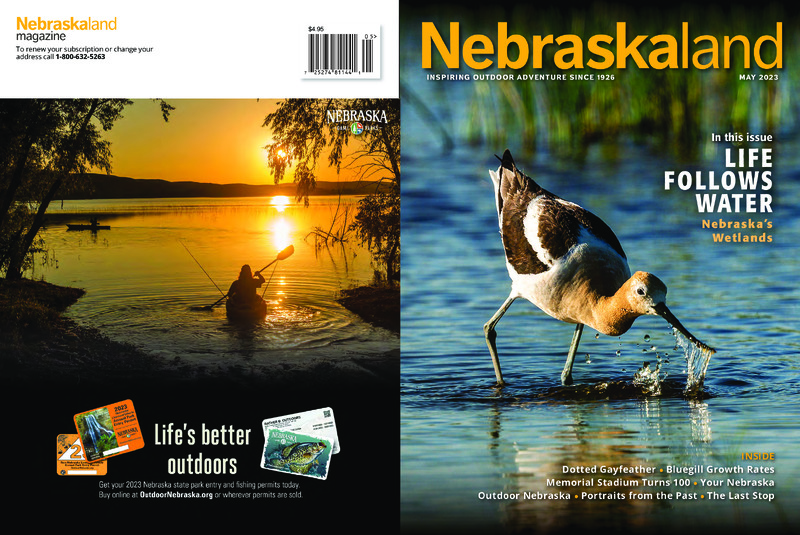
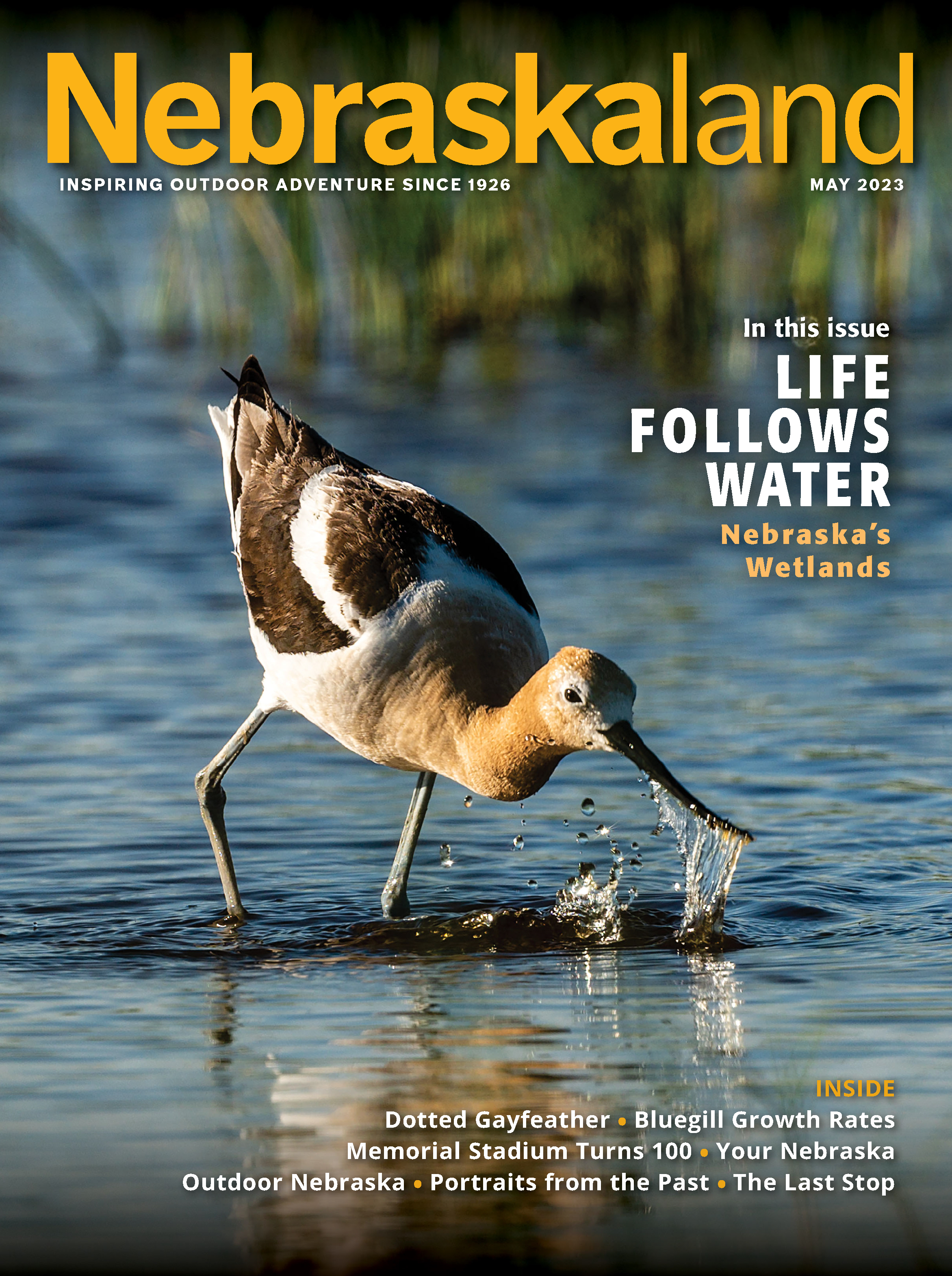
Cover: An American avocet wades through a wetland in the western
C
Nebraska Sandhills. See story on page 20.
N
MARIAH LUNDGREN
M
T page: A lone tree standing on a hilltop in Jefferson County is
This
ssilhouetted against a sky painted orange by the setting sun.
ERIC FOWLER, NEBRASKALAND
E
FEATURES
20
LIFE FOLLOWS WATER
30
OUTDOOR NEBRASKA
32
38
By Dakota Altman, Ethan Freese, Mariah Lundgren,
Grant Reiner and Brooke Talbott
What to Do in May
By Renae Blum
THE LIFE OF A PLOVER
1,500 Miles and Going
By Elsa Forsberg
BLUEGILL GROWTH RATES
How long does it take to grow an 8-inch bluegill?
Story and photos by Eric Fowler
40
MEMORIAL STADIUM TURNS 100
46
THE PERFECT WILDFLOWER
By David Bristow, History Nebraska
Why Dotted Gayfeather is a Contender
Story and photos by Chris Helzer
DEPARTMENTS
8
12
50
60
62
Your Nebraska
In the Field
Mixed Bag
Portraits from the Past
The Last Stop
ON THE WEB
For more articles and
information, visit
NebraskalandMagazine.com
Nebraskaland (VOL. 101 / NO. 4 ISSN 0028-1964) is published monthly, except for the combined Jan./Feb. and Aug./Sept. issues, by the Nebraska Game and Parks Commission, 2200 N. 33rd
St., Lincoln, NE. Periodicals postage paid at Lincoln, Nebraska, and additional mailing offices. POSTMASTER: Send address changes to Nebraskaland, P.O. Box 30370, Lincoln, NE 68503-0370.
4
Nebraskaland • May 2023
May 2023 •
Nebraskaland
5
Magazine Staff
magazine
Published by the Nebraska Game and Parks
Commission since 1926. The Commission is
dedicated to the conservation and protection
of all the state's natural resources and the
people who use them.
Communications Director Christy Firestone
Public Relations Manager Shawna RichterRyerson
Editor Jeff Kurrus
Associate Editor Jenny Nguyen-Wheatley
Regional Editors Eric Fowler, Julie Geiser,
Justin Haag
Contributing Editor Michael Forsberg
Regular Contributors Renae Blum,
Chris Helzer, Chris Masada, Todd Mills,
Ryan Sparks, Gerry Steinauer
Art Director Tim Reigert
Graphic Designer Mel Severin
Paper wasps begin building nests.
Photo Librarian Jaclyn Cruikshank Vogt
Administration
Director Tim McCoy
Deputy Director Jim Swenson
Assistant Director Roger Kuhn
Board of Commissioners
Chairman - Scott Cassels, Omaha
Vice Chairman - Doug Zingula, Sidney
2nd Vice Chairman - John Hoggatt, Kearney
Robert Allen, Eustis
Pat Berggren, Broken Bow
Rick Brandt, Roca
Ken Curry, Columbus
Donna Kush, Omaha
Circulation
For address changes and questions about your
subscription, call 800-632-5263
Advertising Sales Manager
For advertising information contact
Shane G. Gilster, 402-742-0125
Email: shanegilster@gmail.com
Nebraskaland Magazine Copyright 2023, all rights reserved.
Nebraskaland is available in audio from the Nebraska Library
Commission Talking Book and Braille Service, Suite 120, 1200 N St.,
Lincoln, NE 68508. 800-742-7691. Nebraskaland Magazine and the
Nebraska Game and Parks Commission reserve the right to reject any
advertising not in keeping with the agency mission.
Rates: $18 for one year; $33 for two years; $44 for three years. Nebraska
recipients must add appropriate sales tax. To subscribe call
1-800-NEBLAND (632-5263), or go online to:
NebraskalandMagazine.com.
Commission Offices
Conservation Officers
Headquarters and Southeast District Office
2200 N. 33rd Street / P.O. Box 30370
Lincoln, NE 68503-0370
Phone 402-471-0641 / Fax 402-471-5528
ADMINISTRATION (Lincoln)
Craig Stover (Administrator)
Duane Arp (Asst. Administrator)
Travis Shepler (Asst. Administrator)
Jeff Clauson (Asst. Administrator)
Southwest District Office
301 E. State Farm Road
North Platte, NE 69101-0430
Phone 308-535-8025 / Fax 308-535-8028
Northwest District Office
299 Husker Road / P.O. Box 725
Alliance, NE 69301-0725
Phone 308-763-2940 / Fax 308-763-2943
Northeast District Office
2201 N. 13th Street / Norfolk, NE 68701-2267
Phone 402-370-3374 / Fax 402-370-3256
Kearney Service Center
1617 First Avenue / Kearney, NE 68847-6057
Phone 308-865-5310 / Fax 308-865-5309
Bassett Service Center
524 Panzer Street / P.O. Box 508
Bassett, NE 68714-0934 / Phone 402-684-2921
Fax 402-684-2816
Omaha Service Center
8495 Frederick Street / Omaha, NE 68124-3054
Phone 402-595-2144 / Fax 402-595-2569
EAST SUB-DISTRICT
Jerod Hahn (Deuel, Garden, Grant)
Jaden Porter (Keith, Garden)
Tyler Stueck (Keith)
Travis Schultz (Morrill, Cheyenne)
Hunter Lee (Keith)
402-200-9597
Tim Williams (Hall, Hamilton, York)
Eric Javins (Adams, Clay, Webster)
Pat George (Harlan, Franklin, Phelps)
Ethan Teter (Buffalo, Kearney)
308-380-7331
402-902-2017
308-920-2762
308-440-3847
(Thayer, Fillmore, Nuckolls)
SOUTHWEST (Includes counties covered)
NORTH SUB-DISTRICT
Ray Dierking (Custer, Thomas, Blaine)
Frank Miller (Cherry, Hooker)
Greg Hesse
308-870-0322
402-389-0444
308-546-7464
308-660-4671
308-530-3157
(Hooker, Thomas, southern Cherry)
308-672-1824
Hunter Pearson
308-360-1817
SOUTH SUB-DISTRICT
Josh Widhelm (Scotts Bluff)
Jacob Stoinski (Sioux, Dawes)
308-279-9133
308-615-9017
(Red Willow, Frontier, Hayes, Hitchcock)
(Kimball, Banner, Scotts Bluff)
(Sheridan, Dawes, Grant)
NORTHEAST (Includes counties covered)
Dale Davis (Lieutenant)
402-760-0712
NORTH SUB-DISTRICT
Jeff Jones (Sergeant)
402-762-5022
John Bauer (Holt, Boyd)
Tyler Adelman
402-314-9257
402-314-4783
(Knox, Cedar)
Jonathan Andreasen
402-340-3981
Mitch Johnson (Knox, Antelope, Pierce)
402-613-8612
Cory Krause (Sergeant)
402-380-6410
Kyler Prochaska (Platte, Colfax)
Matt Costello (Dodge, Colfax)
Kelbi Abke (Washington, Burt)
Nicholas Fix (Dixon, Dakota, Thurston)
402-830-8278
402-317-4014
402-237-2537
402-508-0261
(Cuming, Wayne, Stanton)
Nebraskaland • May 2023
Matt Taylor (Sergeant)
Sean McKeehan (Sergeant)
SOUTH SUB-DISTRICT
6
308-520-5539
308-289-2274
308-289-6260
308-279-1292
308-280-4320
SOUTH SUB-DISTRICT
Alex Hasenauer (Lincoln, Perkins)
Brandon O’Neal
WEST SUB-DISTRICT
(Madison, Pierce, Stanton)
The Nebraska Game and Parks Commission does not discriminate
based on race, color, ethnicity, national origin, sex, pregnancy, sexual
orientation, gender identity, religion, disability, age, genetic information,
veteran status, marital status, and/or political affiliation in its programs,
activities, or employment. Any person who believes he or she has been
discriminated against in any program, activity, facility, or service,
should contact the Nebraska Game and Parks Commission, Lincoln, NE
402-471-0641, the Nebraska Equal Opportunity Commission, Lincoln,
NE 402-471-2024, TTY/TDD 800-642-6112; Director, Office of Diversity,
Inclusion and Civil Rights, U.S. Department of Interior, 1849 C Street,
NW, Washington, D.C. 20240.
402-471-5531
402-471-5531
402-471-5531
402-471-5531
NORTHWEST (Includes counties covered)
Dan Kling (Lieutenant)
308-430-0572
(Rock, Brown, Keya Paha)
OutdoorNebraska.org
CHRIS HELZER
CENTRAL (Includes counties covered)
Mike Thome (Lieutenant)
308-293-8746
NORTH SUB-DISTRICT
Doug Pollard (Sergeant)
308-730-7050
Matt Brandt (Sherman, Howard)
Daryl Teter (Howard, Greeley, Merrick)
Kyle Gaston (York, Polk, Hamilton)
308-202-0819
308-440-1863
402-719-6226
(Loup, Garfield, Valley)
(Lincoln, McPherson, Logan)
Brian Piernicky (Sergeant)
308-330-8780
Bryce Streger (Dawson, Gosper, Custer)
Matt Andrews
308-537-0404
308-746-2418
Taylor Dixon (Dawson, Gosper)
Sophia Gobber
308-217-2108
308-222-0368
Kelsey Glodowski
308-242-9000
(Furnas, Gosper, Frontier, Red Willow)
(Chase, Dundy, Hayes, Hitchcock)
(Dundy, Hitchcock)
SOUTHEAST (Includes counties covered)
Stacey Lewton (Lieutenant)
402-890-7140
EAST SUB-DISTRICT
Heath Packett (Sergeant)
402-210-0888
Russell Mort (Otoe, Johnson)
Rich Berggren (Douglas)
Brian Arp (Douglas, Sarpy)
Mike Luben (Saunders, Butler)
Bryan Adams
402-209-1506
402-619-1355
531-530-9011
402-443-6392
402-429-1924
(Cass)
(Nemaha, Pawnee, Richardson)
WEST SUB-DISTRICT
Dina Barta (Lancaster)
Luis Nuñez (Lancaster)
Mark Sullivan (Lancaster, Seward, Butler)
Trevor Stahlecker (Lancaster, Saline)
Matt Seitz (Gage, Jefferson)
Curt Prohaska (Lancaster)
402-890-6463
531-333-6093
402-741-0636
402-314-9641
402-806-0915
402-470-1298
YOUR NEBRASKA
Instagram Photos
Follow us @nebraskaland
and tag us in your photos
to be featured in an
upcoming issue.
8
Nebraskaland • May 2023
Roger Richters, Utica
Glorious Morning
May 2023 •
Nebraskaland
9
YOUR NEBRASKA
Send your comments and
photos to:
Jeff Kurrus, Editor
Nebraskaland Magazine
P.O. Box 30370
Lincoln, NE 68503
or email Jeff.Kurrus@Nebraska.gov
Please include your postal address
and telephone number. Letters
may be condensed and edited.
Photographs are also welcome.
Kirk Pridell, Papillion
Neighborhood Turkey
Chase Gronenthal, Elkhorn
Valentine Bison
Jim Gates, Worland, Wyoming
Northern Pike at Boxed Butte
10
Nebraskaland • May 2023
May 2023 •
Nebraskaland
11
IN THE FIELD
MORNING BATH
A blue-winged teal
shakes the water
droplets off his wings
at a Lincoln saline
wetland.
CHRIS
CHR
CHRI
SM
MASADA
ADA
DA
12
Nebraskaland • May 2023
May 2023 •
Nebraskaland
13
IN THE FIELD
Young birders playfully glass in all directions at the Nebraska Outdoor Education Center in Lincoln.
JEFF KURRUS, NEBRASKALAND
THE NEBRASKA BIRDING BOWL
By Olivia DaRugna
In celebration of Nebraska Bird Month, a new, free event
begins — the Nebraska Birding Bowl.
Simply register yourself or your team of bird lovers and do
what you already do this time of year — watch birds. Then
submit the birds you observe through eBird, a community
science platform that uses your observations to inform bird
conservation, for a chance to win prizes. Sounds like a pretty
good add-on to what you already love to do.
Categories
There are several categories to choose from when
registering:
• Fledgling Flock is for youth groups such as after school
programs, summer camps and scouts that want to
introduce kids to the amazing world of birds.
• Dabbling Birder is for those trying out birding for the
first time or those who enjoy more casual, laid back
birding.
• Backyard Birders is for households that enjoy observing
birds that come to their yard.
• Competitive Birder is for those who like to explore
different habitats and observe a wide variety of species.
14
Nebraskaland • May 2023
Prizes
No matter your skill level, you have a chance to win great
prizes.
• Fledgling Flock: Randomly selected teams will win a
birding group kit.
• Backyard Birder: A randomly selected team will win a
birdfeeder setup complete with a durable birdfeeder, pole
and birdseed.
• Dabbling Birder: A randomly selected participant will
win a pair of Vortex Diamondback Binoculars.
• Competitive Birder: The team that observes the most
species wins a $1,000 cash prize per team. The second
place team to observe the most species wins a $500 cash
prize per team. The third place team wins a variety of
prizes.
Winners will be announced in June.
There are endless opportunities to observe birds in Nebraska.
Visit birdtrail.outdoornebraska.gov/birdingbowl/ to see more
details and to register. This event is sponsored by the Nebraska
Game and Parks Commission, Audubon Great Plains, and the
Wild Bird Habitat Store.
IN THE FIELD
A killdeer with chicks in Dawes County.
JUSTIN HAAG, NEBRASKALAND
THE UBIQUITOUS PLOVER — KILLDEER
By Joel Jorgensen
Plovers are generally a group of shorebirds that typically
go unseen by the average person. Mountain and piping
plovers are both rare and state threatened with specific
habitat requirements. Other species like the black-bellied
and semipalmated plover occur briefly in our state during
spring and fall migration as they travel between breeding
and wintering sites. Of Nebraska’s seven species of plovers,
the killdeer is the only frequently encountered member of
the group and also happens to be the only one that does not
have ‘plover’ in its name.
The robin-sized killdeer is ubiquitous and often obvious
because it is often heard before seen. They are not only
among the most vocal of all shorebirds, but it is safe to say
they are also among the most vocal of all our birds. Their call
has been described as a shrill wail and is how this species got
its name because it superficially resembles the phrase “killdeeer.” Its namesake is not because of any pent-up hostility
toward antlered mammals.
Unlike other plovers, killdeer is flexible in the habitat
it uses. While it is a shorebird and routinely occurs along
shorelines, it is just as likely to be found in agricultural fields,
golf courses, ballfields and just about any large open area
with bare ground or very short vegetation.
Killdeer place their nest on the ground and have a
16
Nebraskaland • May 2023
propensity for favoring sites with some gravel, such as
the edges of parking lots and even gravel rooftops. Often
nests are near areas of human activity, and killdeer have no
problem letting human interlopers know their presence is
not appreciated.
If a person or other potential predator approaches too close
to its nest, killdeer is one species that will cleverly behave
as though it is injured. An adult bird will pretend to have a
broken wing to appear like easy prey, fiendishly luring an
intruder away only to fly away once the nest is no longer at
risk of being plundered.
Killdeer are among the earliest-arriving migratory birds
in spring with the leading arrivals crossing into Nebraska
by early March and sometimes even by late February. After
their breeding season wanes in mid- to late summer, birds
gather in flocks at wetlands, river sandbars and areas where
vegetation is kept nice and short by mowers in late summer
and fall. Almost all killdeer spend the winter south of
Nebraska, but a handful regularly winter downstream of
Lake McConaughy where water management and river
modifications provide open water even during the coldest
of weather.
Whatever the season, the killdeer is our most familiar
plover.
IN THE FIELD
Dandelion and honey fritters.
JENNY NGUYEN-WHEATLEY, NEBRASKALAND
DANDELION AND HONEY FRITTERS
By Jenny Nguyen-Wheatley
The first time I tested this recipe,
the fritters tasted a bit bitter. I got
lazy and left the sepals — the green
bottom part of a flower — which
can impart a bitter taste. This time,
I picked only the yellow parts and
discarded the sepals, and voila — no
bitter aftertaste! Picking dandelion
petals can get tedious, but you only
need a heaping cup’s worth. If you
have kids around, put them to work. A
little bit of green is unavoidable, and
that’s OK. You just want to make sure
to get most of it.
Servings: 6
Prep Time: 30 minutes
Cooking Time: 10 minutes
Ingredients:
1 heaping cup of dandelion
flowers, sepals (green parts)
removed
1 cup of all-purpose flour
•
•
18
Nebraskaland • May 2023
• ¼ cup of demerara sugar, or to
taste
• 1½ teaspoons of baking powder
• ⁄ to ½ cup of whole milk
• 1 large egg
• ½ teaspoon of poppy seeds
• Vegetable/canola oil for frying
1
3
Honey-Lemon Glaze
½ cup of honey
Grated zest of 1 lemon
2 teaspoons of lemon juice
•
•
•
1. In a deep-frying pan, heat oil
to 350° Fahrenheit. While the oil is
heating, combine dandelion flowers,
flour, sugar, baking powder and poppy
seeds in a bowl.
2. In a smaller bowl, lightly beat an
egg and 1⁄3 cup of milk. Add it to the
dry ingredients and stir to combine —
do not overwork the batter. Add more
milk if the mixture looks dry. The
mixture should neither be as runny
as pancake batter nor be as dense as
bread dough — look for a wet batter
that’s in between.
3. With a large spoon, drop batter
into the hot oil, making six equal-size
globs. Adjust heat as needed, trying
to keep the oil temperature between
300-325°. The fritters shouldn’t touch
while frying, so fry them in batches if
necessary. When the first side turns
golden brown, flip and fry the other
side. Use a toothpick to check for
doneness — if it comes out clean,
it’s cooked through. Drain on paper
towels or a cooling rack.
4. Combine glaze ingredients and
microwave for a few seconds to warm
through. Glaze the fritters all over.
Serve warm with leftover glaze on the
side. Since the fritter itself isn’t too
sweet, I like to spoon on more honey
with each bite.
May 2023 •
Nebraskaland
19
Life Follows Water
hat makes a wetland a wetland? In Nebraska, a
wetland is defined by three characteristics. One, a
wetland must have a prevalence of water-loving plants
adapted to grow in wet conditions. Two, the soil must
be developed in these wet conditions. Three, a wetland must
be saturated by water at some time during the growing season.
In Nebraska, there are five types of wetlands that fit these
W
characteristics: urban, playa, riverine, saline and sandhills,
yet each of these do more than fit a scientific description.
They provide life, not only for the myriad species that call
these unique landscapes home, but also for the people whose
work and personal lives are so intertwined with their day-today functions.
Because life follows water.
A Blanchard’s cricket frog rests on a lily pad in a backyard urban wetland in the heart of Lincoln.
DAKOTA ALTMAN
Researchers at the University of Nebraska–Lincoln prepare to install a floating treatment wetland at the Cooper YMCA
Retention Pond in Lincoln. Floating treatment wetlands filter chemical pollutants from fields, lawns and roadways. DAKOTA ALTMAN
Urban Wetlands
By Dakota Altman
When I started this project, the mention of urban wetlands
did not conjure thoughts of a pristine wetland ecosystem.
Concrete and uniformity were what came to mind. That all
changed when I realized the beauty urban wetlands bring to
a community of people and just how many plant and animal
species share these urban wetland spaces.
Urban wetlands are stepping stones in a garden; birds,
butterflies and more use wetlands, and a properly placed
20
Nebraskaland
• May 2023
wetland can provide opportunities such as walking, biking,
fishing, ice skating and, of course, observing wildlife.
Over an approximate 200-year span, Nebraska has lost
around 35% of its wetlands — 2,910,500 acres to 1,905,500
acres today. Much of the loss was contributed by major
transformations of landscapes, from expanding agricultural
productivity to the encroachment of townships and cities.
Yet this rate has lessened as more people are finding ways
to protect and restore wetlands. Through education and
on-the-ground collaboration with farmers, ranchers, city
residents and everyone in between, a future for Nebraska’s
wetlands looks a little brighter — even near the city lights.
ABOVE: Countless species, such as the familiar
bluet damselfly, spend much of their life in
wetlands. They represent what we are protecting
when wetlands are not taken for granted.
DAKOTA ALTMAN
LEFT: Urban wetlands in the 21st century have
gone through drastic changes. Oak Lake in Lincoln,
Nebraska, was once a beautiful saline wetland,
then a dumpsite, to now a home for wildlife and
recreation. This lesser yellowlegs searches for
invertebrates, and the capital of Nebraska can be
seen in the background. DAKOTA ALTMAN
May 2023 •
Nebraskaland
21
Playa Wetlands
By Ethan Freese
On a spring day, a normally dry depression along Interstate
80 was filled with water, and a massive group of snow
geese descended into the water below. This was my first
introduction to the Rainwater Basin, Nebraska’s largest
playa wetland complex.
Playas receive their water from rain and snowmelt, and
they are formed when wind scours out depressions, which
are often circular shaped, in relatively flat landscapes. Over
thousands of years the downward movement of water has
created a clay layer in the soil underneath. When wet, the
clay ponds water on the surface of the playa.
In spring, a playa wetland may be filled with a myriad of
migratory waterbirds. If you visit the same playa just a few
months later, however, the wetland may be completely dry.
Deep pits on marginal cropland, to concentrate the water,
undermine playa wetlands, as does sedimentation and
invasive species like red canary grass. Yet farmers, ranchers
and conservationists continue to work on playas so that the
thousands of species of animals that use these ecosystems
will have homes long into the future.
TOP: Nebraska’s playa wetlands and other wetlands in the state are a critical stopover point for whooping cranes during
spring and fall migration. There are currently less than 800 whooping cranes left in the wild. ETHAN FREESE
ABOVE, LEFT: While many of the plants found in playa wetlands thrive, including smartweed, their seeds are unable to
germinate underwater. Because of this, periodic dry cycles are necessary or these species would disappear. MARIAH LUNDGREN
ABOVE: Four playa complexes are found in Nebraska — the Rainwater Basin, seen here, Central Table Playas, Southwest Playas
and the Todd Valley Playas. Only 10% of the Rainwater Basin’s wetlands remain. ETHAN FREESE
BELOW: Playas are home to thousands of animal species, including common garter snakes.
ETHAN FREESE
ABOVE: Deep cracks form in the
soil of a playa wetland. When
water flows down these cracks,
it helps to recharge underlying
groundwater, including the
Ogallala Aquifer. ETHAN FREESE
LEFT: Blue-winged teal
researchers monitor this species
across their flyway from South
Dakota to Louisiana. The playas
in Nebraska provide a critical
stopover point for this species
and many other species of birds
and ducks. ETHAN FREESE
22
Nebraskaland
• May 2023
May 2023 •
Nebraskaland
23
Riverine Wetlands
By Grant Reiner
Because water is a necessity for all life, rivers have driven
the colonization and spread of human communities across
the globe, including Nebraska. Communities were built
around Nebraska’s river systems, allowing for easier travel,
access to potable and irrigation water, and habitat for wildlife
populations both above and below the surface.
With nearly 80,000 miles of rivers and streams in Nebraska,
each with riverine wetlands, these ecosystems support a
diversity of life and exemplify that everything is connected.
From river otters on a backwater slough of the North Platte
River to freshwater mussels in the Loup River system, these
wetlands are critical for so many species.
They support life, clean our sources of water, disperse
impacts of flooding, and are these beautiful, sometimes
underappreciated, landscapes and ecosystems. They may
stink at times, be super muddy and difficult to move through,
but once you take a step back, close your eyes, listen, breathe
and use all your senses to immerse yourself into these
riverine wetlands, there is no going back to looking at them
as merely mosquito-infested swamp. They are so much more.
A bluegill stands guard above its nest in a backwater slough of the North Platte River. Bluegill use the adjacent wetlands as
shelter while they are nesting. GRANT REINER
Nebraska’s riverine wetlands, including those along the North Platte River, get their water from three sources: snow melt in
the Rocky Mountains, ground water from the Ogallala Aquifer and other aquifers, and precipitation. DAKOTA ALTMAN
LEFT: This is one of the hundreds of waterfalls that
can be found in the spring-branch canyons along the
Niobrara River. The cold water supports particular
species that can survive only in this microclimate. Two
examples are aspen and birch trees, ice age remnants
that turn brilliant orange and yellow in fall.
MARIAH LUNDGREN
Interior least terns historically made
their nests along the sandbars of the
Platte River adjacent to wetlands.
Now, these federally threatened birds
can be found nesting in sand and
gravel operations as well as housing
developments. ETHAN FREESE
24
Nebraskaland
• May 2023
ABOVE: Nebraska Game and Parks fisheries biologists
are working to reintroduce pocketbook mussels into
a series of streams throughout Nebraska. Acting
as wetlands do, freshwater mussels can clean a
tremendous amount of water, which in return provides
cleaner water for humans and for the wildlife that rely
upon those water sources. GRANT REINER
May 2023 •
Nebraskaland
25
Saline/Alkaline Wetlands
By Mariah Lundgren and Brooke Talbott
One hundred million years ago, the North American
continent was inundated by ocean waters and formed a
vast, inland sea called the Western Interior Seaway. Fast
forward to now, and those salts from the inland sea remain
underground but are constantly being pushed to the surface
— right outside of Lincoln — by pressure from the Dakota
Aquifer. These are known as the saline wetlands.
They are now some of the rarest wetlands in the world.
In the last 150 years, over 80% of an estimated 20,000 acres
of saline wetland habitat has been destroyed by ditching,
draining and urban development.
Yet hope endures as rigorous restoration efforts are
underway, resulting in the reappearance of rare plant and
animal species adapted to live within the salt flats. One
of these species is the Salt Creek tiger beetle, a federally
endangered species found only in these saline wetlands.
But the efforts go beyond the beetle. With more wetlands,
there is more habitat for other species in these unique
ecosystems. More wetlands also means less flooding in the
city, reduced erosion, improved water quality and more
places for the curious to recreate — just a few miles from the
Capital city.
ABOVE: A feather suspended in the wind at sunset in a saline wetland. Many bird species rely on saline wetlands as stopover
habitats on their north and south migration journeys. ETHAN FREESE
BELOW, LEFT: Two Salt Creek tiger beetles mating on a salt flat in a saline wetland. Female Salt Creek tiger beetles require
specific soil moisture and salinity to lay their eggs. Once the eggs hatch, the larvae and eventual adults do not require such a
narrow range of soil salinity to survive. BROOKE TALBOTT
The warm, orange glow from the sun casts through clouds giving the saltwort an ethereal tone across a saline wetland at Little
Salt Creek Marsh near Raymond. Saltwort is an endangered plant species only found in saline wetlands. ETHAN FREESE
26
Nebraskaland
• May 2023
Madeline Cass, a local artist, photographs the salt crust at a
saline wetland north of Lincoln. DAKOTA ALTMAN
Species like muskrats at Marsh Wren Community
Wetland benefit from work by the city of Lincoln
and members of the Saline Wetlands Conservation
Partnership to keep saline wetlands around for future
generations. MARIAH LUNDGREN
May 2023 •
Nebraskaland
27
Sandhills Wetlands
By Mariah Lundgren
There is still a wildness that remains in the heart of the Great
Plains. The loss of prairies and wetlands is overwhelming, but
the Sandhills are a place of promise and refuge where 20,000
square miles of mostly intact mixed-grass prairie-covered
dunes reside. Beneath the ground lies the Ogallala Aquifer,
which holds nearly one billion acre-feet of water.
Wetlands in the Sandhills are found where the aquifer meets
the surface in the valleys and between the hills, along the
shorelines of the many rivers and streams, and on the edges
of lakes. Impressively, the Sandhills has more than one million
A marsh marigold in full bloom on a fen in the Nebraska
Sandhills. A fen is a wetland fed by groundwater, which helps
form the peat and muck soils that are indicative to fens.
ETHAN FREESE
acres of wetlands and is one of the last truly wild landscapes
left in the Great Plains.
Water is a critical resource for the people, plants and wildlife
inhabiting the Sandhills and those downstream who rely
on the Ogallala Aquifer for drinking water, crop irrigation
and other municipal uses. Ranchers and conservation
organizations manage the land through grazing, fire and
various other methods.
The Sandhills is the largest and most intact grassland left in
the world, remaining relatively untouched since the westward
invasion of European settlers. The sandy, porous soils make
row-crop agriculture challenging, unlike how much of the
Great Plains has turned to the plow. The amount of life and
wonder that remain in this precious landscape is remarkable.
A top-down view of an alkaline wetland in the western
Nebraska Sandhills. These wetlands are characterized by
their unusual chemistry and salt content, as shown by the
white crust in the image. MARIAH LUNDGREN
Wetlands are a critical part of the Sandhills, where more than one million acres can be found.
28
Nebraskaland
• May 2023
MARIAH LUNDGREN
An American avocet wades through a wetland in the
western Nebraska Sandhills. This beautiful bird frequents
shallow lakes and marshes, and they are particularly
keen on alkaline lakes and wetlands. MARIAH LUNDGREN
Ashley Forrester, an UNK graduate student, holds a mature
Blanding’s (right) and painted turtle (left) on a private ranch in
the Nebraska Sandhills. While Blanding’s turtles are listed as a
species of conservation concern in every state of their historic
range, they are thriving in the Sandhills due to the roadless
expanses and quantity and quality of wetlands. MARIAH LUNDGREN
Visit NebraskaWetlands.com for additional content.
May 2023 •
Nebraskaland
29
Outdoor Nebraska
By Renae Blum
Celebrate the beautiful weather and get outdoors. Here are
some entertaining ways to enjoy this time of year: watching
wildlife, fishing, visiting an outdoor expo and more. N
Free Fishing
and Park Entry
Day
May 20 | Statewide
During this annual event,
you can enjoy a Saturday of
fishing or state park activities
without the need to purchase
a fishing or park entry permit
for the day. It’s a perfect
occasion to give fishing a try,
or to visit a state park you’ve
always wanted to see. Make
a day of it and bring a picnic
basket!
What to Do in May
Third Annual Tyler
Vanderheiden
Memorial Run
May 20 | Cody Park in North Platte
or anywhere
Go on a run for a good cause! This annual
run is bringing awareness to mental
health and suicide prevention, and
proceeds benefit Nebraska state park
trails. You can choose from two distances,
2 miles or 5 miles, and run in-person at
Cody Park in North Platte or virtually from
anywhere in the world. Register online at
PlatteRiverFitness.com/PublicHealth.
ERIC FOWLER, NEBRASKALAND
Fort Kearny Outdoor Expo
May 13 | Fort Kearny State Recreation Area
This fun event gives people of all ages and experience levels the chance
to try their hand at archery, shooting sports, kayaking, rock climbing,
fishing and many other outdoor activities. Additionally, various exhibits
give visitors the chance to see Nebraska fish and wildlife species up close.
While a park permit is required, all activities are offered free of charge.
JEFF KURRUS, NEBRASKALAND
JULIE GEISER, NEBRASKALAND
Bluegill fishing at
interstate lakes
All month; best in late May | Central Nebraska
Just off Interstate 80 in central Nebraska, particularly
the Platte River Valley, lie several lakes that are popular
spots for anglers. They also have great opportunities
for bluegill this month, where they’ll be hanging out
in shallower water. To catch them, keep it simple — a
bobber, a small hook and a piece of nightcrawler is all
you need. JEFF KURRUS, NEBRASKALAND
Put out hummingbird
feeders
All month | Primarily eastern
Nebraska
It’s spring migration season for
hummingbirds, so now is a good time to put
out a feeder. A few things to remember: Clean
the feeder every two to four days, consider
buying an ant moat, and avoid pre-made
nectar mixes with red dye. Instead, make
your own, boiling water and adding sugar
until you have a mixture that is four parts
water, one part sugar. Store in the fridge.
ROBERT WINKLER
30
Nebraskaland • May 2023
May 2023 •
Nebraskaland
31
The Life of a Plover
1,500 Miles and Going
By Elsa Forsberg
I
zoom in again on my computer screen, just to make sure
the image is of a small shorebird called a piping plover.
Two plastic bands decorate the bird’s legs like bracelets,
one gray and one blue. The combination of different colored
bands serves as a coded name tag waiting to be deciphered.
Squinting at the blue band, I read the white engraved text.
56A.
I sit back and gape at my computer screen. I know that bird.
I held that bird in my left hand when I placed those bands on
his legs. Now he’s 1,500 miles away.
The last time I saw 56A was at a sand and gravel mine near
Louisville, Nebraska. There, I watched him successfully hatch
a nest of four chicks. That was in June. By July 27, plover 56A
made a successful migration all the way to Quintana Roo,
Mexico, where he happened to be spotted by another biologist.
That’s a pretty incredible journey for a bird that weighs only
50 grams. He’ll do it again in a matter of months, making the
return trip for the nesting season in the summer, when I hope
to set eyes on him again and know that he’s still alive.
As I record the sighting into a database, I wonder about
56A’s future. Will he return to nest in the same place next
summer? Will his chicks survive? What will be the next
chapter of his story?
Banding Plovers
Piping plovers (Charadrius melodus) are listed as threatened
on the federal and Nebraska state endangered species lists,
and they live extraordinary lives. In the summer, piping
plovers breed in a handful of regions across North America,
including Nebraska. The basics for a piping plover nest are
sand and water. Historically, that meant river sandbars.
However, piping plovers have also found places to nest off the
river: sand and gravel mines. As a by-product of the aggregate
mining process, the mines incidentally provide flat expanses
of sand surrounded by a small lake. With sand and water,
the piping plovers find a spot to lay their nest and forage
Piping plover 56A on a beach at the Área de Protección de
Flora y Fauna (APFF) Yum Balam in Quintana Roo, Mexico.
FRANCISCO CABB, APFF YUM BALAM
32
Nebraskaland • May 2023
May 2023 •
Nebraskaland
33
development near Schuyler. The neighborhood was pretty
for invertebrates at the water’s edge. Some mines become
quiet plover-wise that year, with 89’s nest the sole plover
lakeshore housing developments, which continue to host
residence amid the houses being built on the sand next door.
nesting piping plovers.
In the second week of May, 89 and his mate chose a
Amidst all the mining machinery and residential activity,
spot farthest from the home construction, dug a shallow
the plovers hatch and raise chicks that will hopefully boost
depression into the sand and settled in. For four weeks, the
the declining population. The Tern and Plover Conservation
pair took turns incubating four eggs and caring for their nest.
Partnership exists to help, facilitating cooperation between
During that time, the Partnership discovered them and placed
the sand and gravel companies, developers, homeowners
a protective predator exclosure and informative signage
and researchers at the University of Nebraska-Lincoln, the
around the nesting area. They also put colorful bands on 89’s
Nebraska Game and Parks Commission and the U.S. Fish
legs: metal, yellow and gray
and Wildlife Service. As a
on the left leg with light
graduate student at UNL, I
blue, green and green on the
work with the Partnership
right.
to protect and monitor
On a Monday in mid-June,
piping plovers, their nests
the eggs hatched. Eightyand chicks during the
nine
worked
together
summer until they migrate
with his mate to teach the
south.
chicks how to find insects
By using leg bands,
in the sand and how to hide
researchers keep track
from predators in the small
of plovers like 56A. With
shadows under cottonwood
only one year of records for
seedlings.
When
the
56A, we don’t know much
chicks were six days old,
about his life yet, but we
researchers weighed them
do know more about many
— each about 7.2 grams —
others. Most plovers from
and gave them leg bands of
Nebraska spend the winter
their own. Marking chicks
on beaches in the Gulf of
allows us to track the
Mexico and on the Atlantic
impact of plovers through
Coast. If someone spots
generations.
one of our piping plovers,
We don’t know much
the leg bands tell us which
about 89’s life in 2011 nor
bird it is. In the summers, I
2012. Our records pick
record which birds return,
ABOVE: Plover held in the author’s hands, recently
back up in 2013, when the
some of them raising their
captured from the nest for banding. KATE ASMUS
Partnership team found him
fourth or fifth brood of
OPPOSITE: A piping plover nest is a shallow bowl-like
depression
in
the
sand,
which
the
parents
line
with
pebbles.
on a Platte River sandbar
chicks in so many years.
Most plover nests contain 3-5 eggs. The speckled eggs blend in
near Ashland. While the
Each time someone sees a
with the sand, camouflaged from predators. ELSA FORSBERG
researchers didn’t identify
bird, we add another line to
89 with a nest that summer,
its story.
they observed him on the same sandbar three more times
Most of these stories are archived in a database and
between June and July. The sandbar is about 45 miles, as
compiled in TPCP’s annual reports at ternandplover.unl.
the plover flies, from 89’s prior summer spot in Schuyler,
edu. Over the years, with more than 800 birds banded, we
and likely quite a different environment than the lakeshore
have compiled a lot of data. But it isn’t just data that can
housing development. Instead of home construction and
be summarized in a table. They are the life stories of piping
human neighbors, 89 spent the summer of 2013 next to
plovers like 56A, who nest and raise chicks in unlikely places
rushing river waters.
and migrate more than a thousand miles to do it all over
By 2014, plover 89 was back on the nest. This time, he
again.
made his summer home at a third kind of habitat: a sand and
gravel mine. We don’t know what happened with 89’s nest
that year. By June 17, the nest disappeared a week before its
expected hatch date. Eighty-nine was still around by June 23,
Consider piping plover 89. Our first record of 89 comes
but no chicks were seen.
from 2010, when he raised a nest at a lakeshore housing
Piping Plover No. 89
34
Nebraskaland • May 2023
May 2023 •
Nebraskaland
35
A day-old piping plover chick found in the nest, about to be
weighed and receive leg bands. The white egg tooth, used to
help the chick break out of the shell, can be seen on the tip
of the beak. Plover chicks can leave the nest within 24 hours
of hatching and start foraging. ELSA FORSBERG
So far in his life, 89 has spent time in several nesting
habitat types: first a lakeshore housing development, then a
river sandbar, then a sand and gravel mine. The Partnership
identifies one other type of off-river nesting habitat:
transition sites, a stage during which an old sand gravel mine
becomes a lakeshore housing development. Eighty-nine
spent the summers of 2015 and 2016 at a transition site near
Ashland. As far as we know, he did not nest during those two
years.
But, one day in May 2017, the team spotted a plover at
this same transition site. Looking closer, the color band
combination read: light blue flag on the upper left leg,
yellow over gray on the lower left, metal band on the upper
right, green over green on the lower right. The researchers
continued to watch and observed the plover settle into a
specific spot in the sand. That’s when they knew: After two
years, 89 was back on the nest. This time, 89 paired with
36
Nebraskaland • May 2023
Plover 89 looks for marine worms and other invertebrates along the beach on Matagorda Island in Texas.
TAYLOR BENNETT, GULF COAST BIRD OBSERVATORY
an unbanded plover, and together, they incubated 4 eggs.
Interestingly, something happened with one of the eggs
in the second week, and the pair decided to remove it and
continue incubating the remaining three eggs.
On June 9, the researchers returned to find 89’s nest empty.
Eighty-nine and his mate were nearby protecting three
chicks. The nest hatched! All three chicks were banded and
named 738, 739 and 740. Eighty-nine and his partner took
care of their young for several weeks, and all three chicks
survived to fledge, earning their flight feathers for their first
migration.
Eighty-nine has not been seen in Nebraska since 2017.
However, we know that he is alive. While we aren’t sure
where 89 spends the summer months, we know where he
spends his winters. His first winter sighting was in 2018,
when a researcher spotted him on the Matagorda Peninsula
on the Gulf Coast of Texas. There, 89 spends much of his
time foraging for marine worms and insects in the wet tidal
sand without much disturbance from people. He returned in
2019, 2020 and 2021, where he was observed by the same
researcher each time.
In 2022, we received a report that 89 was back on the Texas
coast, having made the migration again. The researcher who
observed 89 attached a photo to the email. I opened the image
to find a plover and carefully matched the colored bands on
its legs.
The incredibleness of 89’s life hit me when I saw that
photo. Since he was banded as an adult in 2010, that meant
89 was at least 13 years old in 2022. That’s pretty old for a
piping plover, a species with an average lifespan of 5 years. In
those 13 years, 89 had three nests at three different nesting
site types and raised at least five chicks.
That’s quite a legacy to contribute to the declining
population of the threatened species. In seven summers,
89 experienced every nesting habitat that Nebraska had to
offer: a river sandbar, a sand and gravel mine, a lakeshore
housing development and a transition site. He’s been seen by
Partnership staff 18 times, and Texas coast researchers have
seen him 11 times.
Wherever 89 is resting his wings now, it isn’t the end of the
story. N
If you spot a banded piping plover (or any other bird), you
can help researchers by reporting the sighting to the USGS Bird
Banding Laboratory at pwrc.usgs.gov/BBL/bblretrv/.
May 2023 •
Nebraskaland
37
Bluegill Growth Rates
How long does it take to grow an 8-inch bluegill?
Story and photos by Eric Fowler
ound for pound, or perhaps more accurately, ounce for
ounce, bluegills put up a fight as good as any other
fish swimming in Nebraska’s waters. Their abundance,
the ease at which they are caught, and their quality as
table fare make them one of the most sought-after fish we
have. Creel surveys have shown that many anglers looking
for fresh fish for dinner often have a self-imposed minimum
length limit of around 8 inches.
Which begs the question: how long does it take to grow
an 8-inch bluegill? That depends on many factors, including
water quality, water body type, the other types of fish in
the lake and even genetics. In the right circumstances,
it can be fast. Sandhills lakes, some of the most fertile in
the state, produce 8-inch bluegills in four to five years. At
Lake Wanahoo, some fish reached a whopping 10 inches
four years after the initial stocking. A Nebraska Game and
Parks Commission study completed last year found that in
southeastern Nebraska flood control reservoirs, it could take
four to six years for bluegills to reach that length.
During their regular spring sampling using trap nets in
2021 and 2022, fisheries biologists collected five bluegills
P
in every 10-millimeter length category from four flood
control reservoirs that have been built or renovated within
the past seven years — Conestoga, Duck Creek, Flanagan
and Stagecoach — and four other established fisheries —
Czechland, Olive Creek, Swan 67 and Walnut Creek. In the
lab, they determined their age by looking at the fish’s scales
and their otolith, or ear bones, which both have annual
growth rings.
The results weren’t surprising, but it did give a more precise
breakdown in the differences in growth rates between new
and established waters.
“At age 2, it’s about the same,” Matthew Perrion, the Game
and Parks biologist who led the study, said of the growth in
new versus old lakes. “At age 3 and 4, the fish in recently
renovated lakes are growing faster.”
That faster growth meant that at age 4, bluegills in new
reservoirs were nearly 8 inches long, compared to 7 inches in
older reservoirs. “That’s important,” Perrion said.
The similarities in growth during the first two years
could be related to fish density. Those fish live primarily
on zooplankton, and there is only so much to go around.
Game and Parks fisheries biologists sampled five age classes of bluegills when they surveyed Stagecoach Lake in May 2022.
The fish ranged in length from 3 to 9 inches.
38
Nebraskaland • May 2023
Jerry Kane of Lincoln holds an 8-inch bluegill, the length
many anglers prefer to keep.
Biologists may stock fewer bluegills in these waters in the
future and see if growth rates of the younger fish increase.
At age 3 and beyond, fish feed on macroinvertebrates,
primarily aquatic insects. These critters thrive in timber and
terrestrial vegetation that is flooded when reservoirs fill, and
also in aquatic vegetation that sprouts in both waters. That
means there is plenty of habitat to produce food for the fish,
and plenty to go around.
Those habitats decline as reservoirs age, and fish growth
slows. At Swan 57, bluegills rarely, if ever, reach 8 inches.
With common carp present, no aquatic vegetation, and poor
water quality, there are few insects for them to eat. “They’re
a sight-feeding fish, too, and its super-turbid water, so they
can hardly see the food they’re trying to get,” Perrion said.
The findings reinforce the precept behind Game and
Parks’ Aquatic Habitat Program. “The overarching theme
is water quality,” said Aaron Blank, fisheries supervisor in
southeastern Nebraska. “If you have good water quality,
you’re going to have good bluegill growth. But usually, the
bluegill fishery is never going to be better than it is in those
first few years.”
The data also showed once bluegills hit 8 inches, no
matter the age of the reservoir, growth plateaus. That might
be another density-related bottleneck, with many fish
competing for the same food resource. It may also be that
the genetically superior, faster-growing fish are the first
to be harvested, leaving slower-growing fish to reproduce.
Flanagan Lake will be the first test in the state of an 8-inch
maximum length limit on bluegills, something biologists
believe will lead to more 9-inch and even 10-inch Master
Angler bluegills.
“If we’re producing 8-inch bluegills, we’re pretty darned
happy,” Blank said. “That’s what anglers prefer. I always tell
people to keep what you’re catching the most of. If for every
15 7-inchers you’re catching, you get one 8-incher, just keep
some 7 inchers.”
And that, he said, could lead to more hard-fighting, big
bluegills. N
Matthew Perrion uses tweezers to remove an otolith from
a bluegill, the growth rings on which show it to be a 3-yearold fish. As part of their growth study, biologists aged
bluegills using both otoliths and scales, and found they
often underestimated the age of older fish using scales. The
improved accuracy will make it their standard for aging
bluegills and other panfish.
May 2023 •
Nebraskaland
39
Memorial Stadium Turns 100
Memorial Stadium groundbreaking,
April 26, 1923. HISTORY NEBRASKA, RG2758-21-3
By David L. Bristow, History Nebraska
40
Nebraskaland
• May 2023
May 2023 •
Nebraskaland
41
hat’s the proper way to break ground for the new
home of the Cornhuskers? With a team and a plow, of
course!
University officials broke ground on Memorial
Stadium on April 26, 1923. An estimated thousand people
showed up to hear speeches and watch Chancellor Samuel
Avery ceremonially plow a furrow.
There was a recent precedent for this. A year earlier,
Governor Samuel McKelvie had plowed a furrow to break
ground for the new state capitol.
Naturally, these groundbreaking ceremonies were publicity
stunts, but they had a greater degree of authenticity than
modern-day groundbreakings in which executives don shiny
hardhats and turn over pre-dug dirt with golden shovels. Both
McKelvie and Avery had actual farming experience. McKelvie
was a farmer and cattleman who edited The Nebraska Farmer
before serving as governor. Avery’s parents had farmed near
Crete when he was growing up, and he was a professor of
agricultural chemistry before becoming chancellor.
In the 1920s, driving a horse-drawn plow was a way of
demonstrating that both the capitol and the football stadium
were connected to lives of ordinary Nebraskans, and that the
state’s leaders were proud of Nebraska’s agricultural identity.
The construction of Memorial Stadium was a risky move.
The wooden bleachers of Nebraska Field were torn down to
make way, but it was not clear that the new stadium would
be finished in time for football season — or that fundraisers
would bring in enough money to pay the contractors. They
would have to do it without tax dollars.
W
Memorial Stadium under construction, 1923.
No pressure here, freshmen! These signs adorned the
Temple building on the university campus, 1923.
HISTORY NEBRASKA, RG2758-21-3X
42
Nebraskaland
• May 2023
Fundraising began in 1920 for a grand World War I
memorial that was to include a museum, stadium and
gymnasium. But the economy fell on hard times in the early
1920s. The legislature not only refused to fund the project,
but cut the university’s operating budget. Meanwhile,
opposition mounted across the state as local groups and
American Legion chapters feared that fundraising for Lincoln
would make it that much harder to build their own local war
memorials.
The university scaled back its plans, dropping everything
but the 30,000-seat stadium. As head of the university’s
alumni association, a man named Harold Holtz led an
aggressive fundraising drive that used high-pressure tactics
on students, faculty, alumni and communities.
“On numerous occasions Holtz stated that none of the
students had been coerced into pledging, but the peer
pressure must have been tremendous,” writes Michelle Fagan
in a 1998 issue of Nebraska History. She goes on to describe
HISTORY NEBRASKA, RG2758-21-8
how Holtz and his team threatened and even sued people
who didn’t fulfill their pledges.
Was the stadium finished in time for the first home game
of the 1923 season? Close enough. Contractors warned that
they would not be held responsible for injuries when the
university opened the partly finished stadium on October 13,
1923. No fans were hurt amid the scaffolding — and a few
even climbed atop the unfinished upper balcony — but the
Oklahoma Sooners did not fare so well. The Sooners became
May 2023 •
Nebraskaland
43
the first team to lose a game at Memorial
Stadium, falling to the Huskers 24-0.
Memorial Stadium was officially dedicated
the following week, when Kansas played
Nebraska to a 0-0 tie. Notre Dame was the first
opponent to score in the new stadium, but one
touchdown wasn’t enough for Coach Knute
Rockne’s “Four Horsemen”-led team, which fell
to the Huskers 14-7 on November 10.
Who was the first team to beat Nebraska in
Memorial Stadium? It’s not easy to guess.
It was
Syracuse.
The
Orangemen
defeated the Huskers 7-0 on November
24, 1923, before an estimated crowd of
35,000. N
Visit History Nebraska’s website at history.
nebraska.gov.
RIGHT: Almost a year later, the outer walls are
nearly complete in this August 18, 1924 photo.
HISTORY NEBRASKA, RG2758-21-A
FAR RIGHT: November 1953. The stadium was
expanded and enclosed starting in the 1960s.
HISTORY NEBRASKA, RG2758-21-19
BOTTOM: An early view of the stadium, circa
1923-24. HISTORY NEBRASKA, RG2758-21-13
44
Nebraskaland
• May 2023
May 2023 •
Nebraskaland
45
The Perfect
Wildflower
Why Dotted Gayfeather
is a Contender
Story and photos by Chris Helzer
hat would you want if we were trying to design
the perfect wildflower? On my list of attributes, I’d
include beautiful blossoms, abundant resources for
pollinators, and an ability to spread itself around
the landscape — but not in an aggressive way. As a bonus,
it would be helpful if it could withstand drought and heavy
grazing pressure. We don’t want to have to coddle our perfect
wildflower, after all. It should be able to survive without any
extra effort from us.
Gosh, wouldn’t a plant like that be wonderful?
Yes, it is.
The incredible dotted gayfeather (Liatris punctata) doesn’t
get nearly enough attention, given its near perfection. Its
only flaw might be that it doesn’t do well in well-watered
productive conditions. It scoffs at dark fluffy humus and ample
soil moisture. Nutrients are for the weak. Dotted gayfeather
thrives best in dry dirt the color of faded leather work gloves.
Out here in the Plains, we survive on stubbornness and spite.
I’ve long appreciated dotted gayfeather, but my admiration
has grown even stronger in recent years as I’ve paid more
attention to its toughness and resilience. The species grows
abundantly in our family prairie in southern Hamilton
County, flourishing even on previously-farmed loess slopes
where mighty big bluestem tops out its growth below the
height of my knee caps. During periods of drought, it seems
to carry on as if nothing is happening, blooming prolifically
W
46
Nebraskaland • May 2023
Dotted gayfeather in drought-stricken restored prairie at the Nature Conservancy’s Platte River Prairies.
when most of its neighbors are wilted and brown.
Cattle will graze dotted gayfeather, but it’s far from their
first choice in most situations. It has stiff, narrow and
pointy leaves that must not scream out “dinnertime” to
cattle, though deer, pronghorn, and sheep think it’s pretty
tasty. Unless it’s grazed all the way to the ground, though,
the plant still tends to send up a flowering spike. Even more
impressively, after a long bout of heavy grazing ends, dotted
gayfeather often responds by shooting up extra flowering
stems the following year. Sometimes, those post-grazing
plants are humongous. I’ve counted more than 50 flower
spikes on a single plant in a prairie that looked like a pool
May 2023 •
Nebraskaland
47
Bumble bees, like this brown-belted one, are particularly drawn to the blossoms of dotted gayfeather, as seen at the Nature
Conservancy’s Platte River Prairies. The plant’s resilience makes it available regardless of weather, grazing or other challenges.
Dotted gayfeather produces numerous pink florets.
table a year before.
Stubbornness and spite. Drought doesn’t phase dotted
gayfeather and grazing just makes it stronger. If that’s not
the essence of the Great Plains, I don’t know what is.
At the same time, the toughness of dotted gayfeather
isn’t immediately obvious when you first encounter its late
summer showy flowers. Whomever long ago named the plant
after cheerful avian plumage wasn’t commenting on the
resilience of the plant in the face of stress. They were focused
on its prolific and beautiful blossoms, densely clustered along
48
Nebraskaland • May 2023
a long, slender stalk. The other common name for the plant
is blazing star, which aptly describes the shape and vibrance
of its florets. Dotted gayfeather is a conspicuously gorgeous
wildflower.
The flamboyant flowers of dotted gayfeather are more
than just window dressing. They attract numerous pollinator
insects to feed from the plants’ pollen and nectar. Bees, and
particularly bumble bees, are drawn to the blossoms in huge
numbers, along with butterflies and other insects. Of course,
those hungry pollinators also benefit from the fact that
dotted gayfeather can grow under stresses other plants can’t
handle. During times of drought, grazing, or other difficult
conditions, dotted gayfeather comes through for those who
depend upon it.
I’m not sure dotted gayfeather is the perfect wildflower.
There are a lot of contenders for that title, after all. Either
way, the plant is a wonderful combination of resilience and
beauty that’s worthy of admiration. If dotted gayfeather was
a person, we’d all want to hang out with them — or at least
watch them on TV. Tough, stubborn, and spiteful, but also
flamboyant and generous? Come on! Characters like that
make the world worth living in. N
Chris Helzer is the Nebraska Director of Science for the
Nature Conservancy and is based in Aurora.
When he isn’t searching for obscure subject matter
to photograph and write about, he conducts research and
captures lessons from the Conservancy’s land management and
restoration work.
Chris is a regular contributor to Nebraskaland Magazine.
May 2023 •
Nebraskaland
49
MIXED BAG
CAMPING ETIQUETTE FOR BEGINNERS
By Julie Geiser
Camping is a great way to enjoy
nature, recreate, and recharge, but
while you’re at a campground there
is always some etiquette to follow to
make sure everyone has a good time
every time.
Not Too Early or Too Late
Try to arrive at your campsite well
before dark. This gives you time to set
up camp while it’s still light out, which
is much easier than trying in the dark.
And when possible, don’t pack up and
leave too early in the morning.
A Little Privacy, Please
It’s okay to be friendly and meet
your weekend neighbors, but always
respect their camping space. Don’t cut
through occupied campsites; stay on
paths or roadways and give all your
camping neighbors some privacy at
their camping locations.
Limit the Shenanigans
Even though you’re on vacation, and
you may want to burn some midnight
oil around the campfire at night, be
respectful to others by abiding by
quiet time rules. Quiet hours in many
campgrounds are from 10 p.m. to 6
a.m. every day. You can still enjoy
the crackling of the fire but keep
the shenanigans down, turning off
generators and music and keeping
lights to a minimum.
Footprints
Leave only your footprints. Be
respectful of the area and the wildlife
by keeping food and trash picked up.
Dispose of waste in proper receptacles
and minimize your impact on wild
places. Pick up after others if needed.
For Human Consumption Only
Don’t feed the wildlife, for it
encourages them to return for more
food.
Always Extinguish
Never
leave your
campfire
unattended and keep fires at a
manageable size, preferably in fire
rings provided in the camping area.
Always completely extinguish or put
out your fire before you go to bed or
leave the area.
Leave the Firewood
Do not bring firewood with you.
Transporting firewood can spread
diseases and harmful insects such as
the emerald ash borer that destroys
trees and forests. Buy local firewood
and leave any unused firewood at the
campsite for others.
Minimal Barking Please
Camping with our four-legged
friends can be awesome and sometimes
difficult depending on the dog. Some
dogs are mellow and well-behaved,
while others are unruly. Always have
you dog on a six-foot leash to keep
them from wandering where they
shouldn’t be, and remember that no
one wants to smell or step in the
gifts your dog leaves behind. If your
dog is a barker, leave them at home
with a trusted friend or kennel. Don’t
leave dogs unattended to prevent any
mishaps from occurring.
Part of enjoying your adventure in
Nebraska’s great outdoors is making
sure the folks beside you are enjoying
it just as much as you.
Tent campers, like these at Smith Falls State Park in Cherry County, enjoy good neighbors.
50
Nebraskaland • May 2023
JULIE GEISER
May 2023 •
Nebraskaland
51
MIXED BAG
52
Nebraskaland • May 2023
May 2023 •
Nebraskaland
53
MIXED BAG
.410 TURKEYS
A TURKEY MULTITASK
option for getting kids into the turkey woods before they
Three years ago, I started taking my nephews turkey
can handle the kick of a larger shotgun. And now with the
hunting on our family farm during Nebraska’s youth season.
introduction of Tungsten Super Shot (TSS), ethical shots
The first year, they showed up excited and ready for opening
with a .410 extend out to 40-yards. TSS is over 50% denser
day the following morning. My brother-in-law had bought a
than lead, doubling the downrange energy and allowing
new 20-gauge shotgun and we set up a target so they could
hunters to drop three shot sizes with equal lethality. Dropping
get some practice. Eleven-year-old Cole shot first. When he
shot sizes means more pellets in each shell, 28% more to
pulled the trigger he was thumped backwards. With tears
be exact. The effectiveness of TSS played a large part in
in his eyes, he told us the recoil was too much. Excitement
changing Nebraska’s
quickly turned to
minimum shot size for
fear as he, and his
turkeys several years
nine-year-old brother
back. In fact, a threeAbe, didn’t know if
inch .410 shell loaded
they wanted to hunt
with #9 TSS shot will
anymore.
outperform many lead
Trying to find a
turkey loads of a larger
solution, we drove
shot size. These days,
to
Cabela’s
and
you could shoot your
purchased a heavy
first turkey with a .410
tripod that would
and never have any
help reduce the recoil.
reason to switch to a
Shooting was still
larger bore shotgun.
not a fun experience
It’s the reason many
for the boys, but it
gun manufacturers are
made it manageable,
now making turkeyespecially since we
specific
shotguns
switched to target
chambered in .410.
loads during practice,
These
shotguns
saving the higherare also generally
recoiling shells for the
inexpensive,
with
moment of truth. Abe
several models selling
was able to shoot his
for around $300. Also,
first turkey from the
don’t let the focus
tripod, although he
on turkeys fool you;
was nervous to shoot
they work great on
when the time came.
squirrels,
rabbits,
The next year, I did
quail, and pop cans.
some research and
Abe Lovewell of Maquoketa, Iowa, is all smiles after shooting his first
Expense has been
bought a .410 shotgun
longbeard. RYAN SPARKS
the main objection
specifically made for
leveled at TSS, with
turkey hunting. I could
some manufacturers selling boxes containing five shells
tell my nephews were skeptical, but with the first shot, Cole
for over $40. I agree that shells costing over $5 a piece are
center-punched the pop can he was aiming at. Better yet, he
expensive, but how many times is a youth hunter going
smiled and said it barely kicked more than the .22 rifle he
to shoot during a turkey season? If you practice with
hunted squirrels with. Abe quickly had a try and agreed. Even
considerably less expensive target loads, and save TSS shells
their younger brother Luke, age seven at the time, thought
for hunting, an extra $5-10 a season is well worth it to get
it was a piece of cake. Cole shot a pair of turkeys with it the
kids in the turkey woods without any fear or apprehension of
following week.
pulling the trigger.
The experience taught me that .410 shotguns are a great
The majority of the turkeys I’ve shot have come between
10 AM and 2 PM. Lunchtime is primetime, that time of the
day when more than a few gobblers find themselves alone
and insecurity begins to creep in.
Sometimes, though, it’s hard to stay in the woods that long.
From real-world obligations to simple impatience, it’s easy to
leave the woods and re-enter normal life during some of the
most productive turkey hunting hours of the day.
Here are a few ideas to keep you afield, just make sure
you’re occasionally calling as you multitask.
By Ryan Sparks
54
Nebraskaland • May 2023
By Jeff Kurrus
game of baseball. After a really nice hit up the middle by my
son and a controversial play at the plate, I pulled the box call
from my pocket and gave a scratch.
The tom’s reply was distant, so we continued the inning.
Yet when he gobbled again, we postponed the at-bat and
hunkered down. Ten minutes later, we were posing for photos
with the year’s first tom.
Find some reason to stay in the woods this time of year.
Shooting Lanes
If you’ll be hunting the same areas during deer archery
season, carry a handsaw in the woods and start cutting
shooting lanes. The same greenery you see in May will still
be there in early September. Also, clear brush along the path
to your stand so you can walk in quieter during the fall.
Cameras
This also remains a common-sense time to re-start your
trail cameras. Replace batteries and set the new cameras
along the shooting lanes you’re creating.
Tree ID
Knowing the difference between a mature bur oak,
cottonwood, walnut and the rest of the trees in the woods
will not only aid your deer hunting, but it will also help your
squirrel hunting. Knowing which trees will be dropping food,
and at what time, will help plan fall hunting trips.
Shed Hunt
Why not look for sheds while turkey hunting? I’m sure I’ve
ran off a bird or two traipsing through the woods, but I’m sure
I’ve killed many more just because I found something to do.
Shed hunting is one of those activities. Walk trails and also
look near fence and creek crossings.
Just Be
If your world is like everyone else’s I know, it’s in constant
motion. I know parents of young children, like myself, who
rarely have a quiet moment to themselves and retirees who
don’t even know how they ever held a job because of how
filled their lives now are. But in the turkey woods, you can
just be. Listen, watch, or close your eyes. I’ve been awakened
more than once by a gobble from a nearby tom.
On one of my best turkey hunts, my then 8-year-old son
and I found a broken tree limb and a couple of old walnuts
from the previous winter and started a very competitive
When turkey multitasking, hunters should always have a
box call nearby. For both its noise level and ease of use, it’s
an ideal call to periodically use when hunting. JEFF KURRUS
May 2023 •
Nebraskaland
55
MIXED BAG
56
Nebraskaland • May 2023
May 2023 •
Nebraskaland
57
58
Nebraskaland • May 2023
May 2023 •
Nebraskaland
59
PORTRAITS FROM THE PAST
Pheasant hunting, 1979
Pictured is my brother-in-law Kipp Petersen (left) and
myself with my Brittany spaniel, Rusty.
Taken in my backyard in Lexington in 1979 with five
pheasants. I was 26 years old and hunting pheasants
before the pivots came and changed the landscape of
pheasant hunting. I am 69 now and miss those good
old days.
– Jeff O’Donnell, Hastings
First deer, 1963
This is a photo of my dad, Wyman, and me taken in 1963. First deer taken for both of us! We were hunting in Nance County,
near Palmer. These two mule deer does were taken on the last day of the season. Back then, it was buck only, but you were
allowed to shoot a doe on the last day. I shot mine with a new Model 70 .270 Winchester and dad was shooting a standard,
un-altered 1903 Springfield 30-06 service rifle.
– Steve Stedman, Beatrice
Upland game hunting, 1983
Hunting with the McKeone clan, October,
1983, Cozad.
Pictured with birds are (top, left) Dave and
Shirley Martin from Florida, front row (left)
Mark, Joe, Tod, and Kert McKeone and Tom
Morrison who worked for Nebraska Game
and Parks and ran Buffalo Bill Scouts Rest
Ranch.
Joe McKeone was Dave Martin’s best friend
from high school in Hastings, class of ’48.
Two day hunt was one of the last for the
two, first for Shirley. Limited both days.
– David W. Martin, Hernando, Florida
Send contributions to: Portraits from the Past, Nebraskaland Magazine, P.O. Box 30370, Lincoln, NE 68503-0370. Or e-mail to Tim.Reigert@Nebraska.gov.
Photos should show people enjoying Nebraska outdoor activities, such as camping, boating, hunting or fishing, and must have been taken before 2000. We will give
priority to unusual photos or activities. When possible, please include a story about the photograph and identify the people, places and approximate date it was
taken. Text may be edited and photos adjusted for reproduction. All photos will be returned.
60
Nebraskaland • May 2023
Deer hunting near Alma, 1982
My dad, Charles Small, lived in
Alma and loved to hunt and fish.
In 1982 he took his grandsons
Denny and Mick deer hunting. The
photo shows that it was a success.
Denny lives in Kearney and Mick
in Hastings. They are my nephews.
Dad bagged his last deer in 1986
when he was 80.
– Gary Small, Vermillion,
South Dakota
May 2023 •
Nebraskaland
61
THE LAST STOP
THE PRAIRIE CHICKENFOOT PHOTO
By Gerry Steinauer
Several years ago I was taking closeup photos
of bird feathers, mainly those of game birds, for a
Nebraskaland photo spread. While photographing a
greater prairie chicken I took several shots of its feet,
and they looked interesting in the fading sunlight. I
thought that maybe I could tie one of them into the
photo spread, for the upper foot is feathered. The photo
did not make the cut, but Jeff Kurrus, Nebraskaland
editor, said he liked the photo: “Find a way to use it in
the magazine.”
The big question, however, was how? How does one
wrap a story around a photo of a prairie chicken foot?
I thought about doing a short natural history article
on prairie chicken feet. I discovered that the feathers
on the upper foot helps the native grassland bird
retain warmth during the cold of winter, the tooth-like
projections of skin on the toes help it walk on snow,
62
Nebraskaland • May 2023
and the long toenails are used for scratching and
digging for food, but that’s not enough information for
an article.
I then showed the photo to a hunting friend and
he suggested I do a photo spread on the feet of game
birds — ducks, geese and pheasants — similar to my
feather photo spread. I had my doubts that Kurrus
would go for a photo exhibit on birds’ feet, and to make
it a moot point, I never got around to photographing
other birds’ feet.
I was out ideas. Then, a while back, Kurrus
mentioned that he needed photos for “The Last Stop”
in future magazine issues. I started pondering and
the prairie chicken foot photo popped into my mind.
The Last Stop is a one-pager and includes little text; I
wouldn’t need much of a story.
Enjoy the photo.
May 2023 •
Nebraskaland
63
Position: 664 (17 views)