Volume 101, Issue 2, 2023
March 2023
- Identifier:
- nela.2023_101_02
- Title:
- Volume 101, Issue 2, 2023
- Issue Name:
- March 2023
- Date Issued:
- 2023-03-01
- year:
- 2023
- month:
- March
- Season:
- Winter
- PDF filename:
- NL_101.02_2023_Mar_Spreads_Entire.pdf
- Publisher:
- Nebraska Game and Parks Commission
- Format:
- Periodical
- volume:
- 101
- issue:
- 02
- number:
- 101.02
- Decade:
- 2020s
- Type:
- Rights Holder:
- Copyright Nebraskaland Magazine/Nebraska Game and Parks Commission, all rights reserved.
- Extracted Text:
-
magazine
$4.95
To renew your subscription or change your
address call 1-800-632-5263
I N S P I R I N G O U T D O O R A DV E N T U R E S I N C E 1 92 6
M A RC H 2 0 2 3
In this issue
Nebraskaland
2 0 2 2 Pho t o Con t e s t
2
Nebraskaland • March 2023
March 2023 •
Nebraskaland
3
Volume 101
March 2023
No. 2
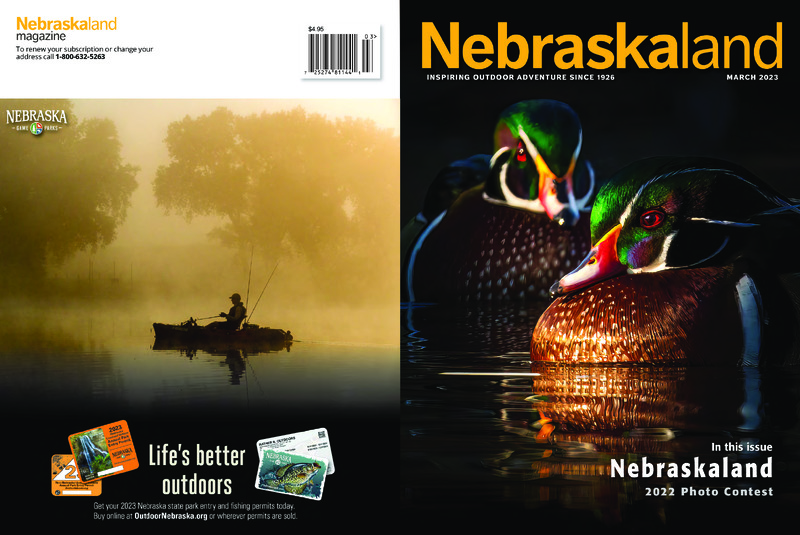
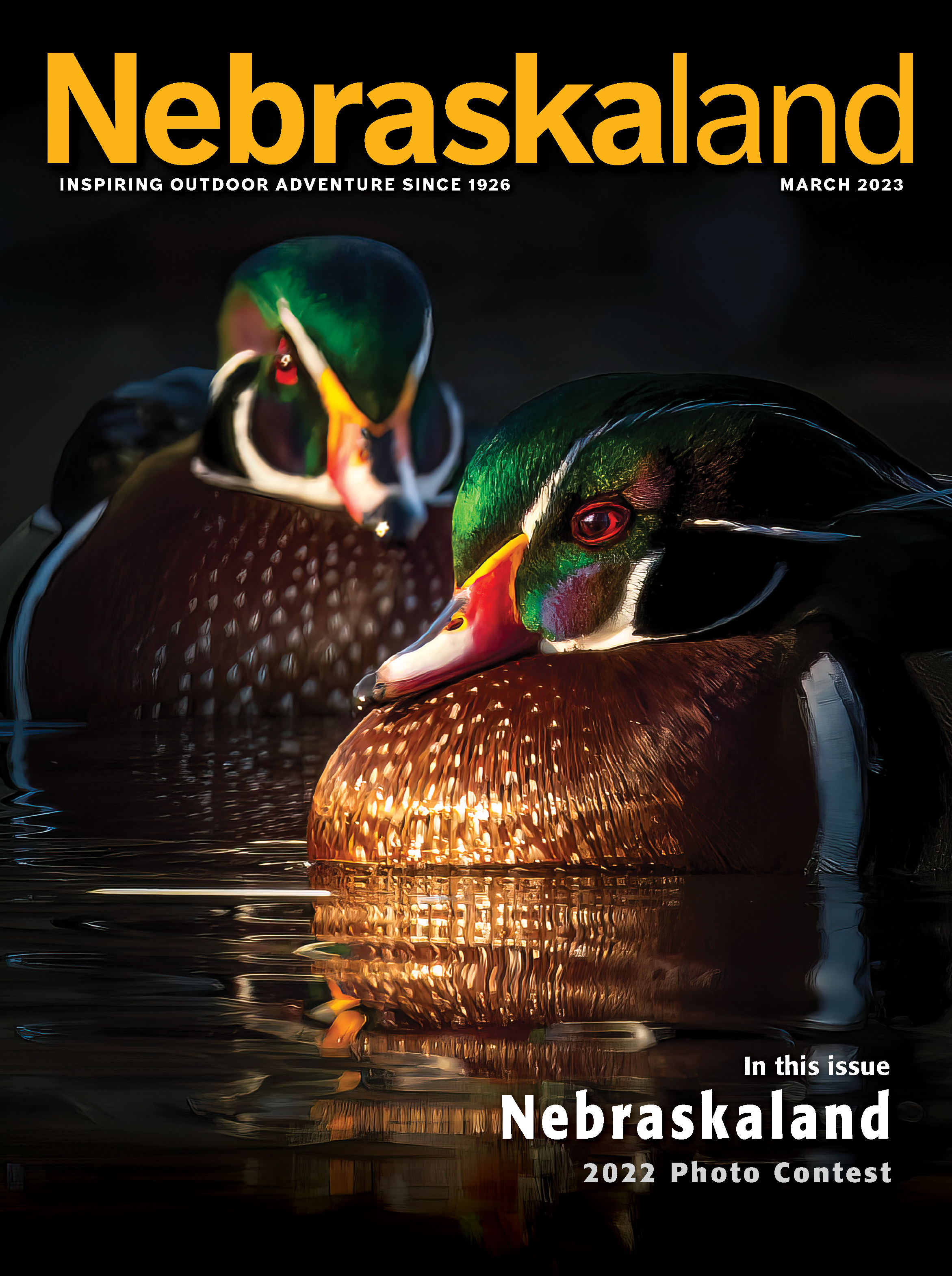
Cover: Roy Swoboda’s “Wonderous Woodies” image won
Best of Show in the 2022 Nebraskaland Photo Contest.
See page 18. ROY SWOBODA
This page: Sandhill cranes pass in front of a full moon
while returning to their roost on the Platte River in Hall
County. ERIC FOWLER, NEBRASKALAND
FEATURES
18
2022 PHOTO CONTEST
40
OUTDOOR NEBRASKA
42
Photos submitted by Nebraskaland Magazine readers
What to Do in March
By Renae Blum
TIMBERDOODLES ON THE PLAINS
How a forest-dwelling shorebird makes a
living in Nebraska’s prairies
Story by Joel Jorgensen
Photos by Eric Fowler
50
54
HOW NEBRASKA ENTERED THE
‘RADIO ERA’ A CENTURY AGO
By David L. Bristow, History Nebraska
FIVE TRIPS
To fishing right
By Jeff Kurrus
DEPARTMENTS
8
10
58
64
66
Your Nebraska
In the Field
Mixed Bag
Portraits from the Past
The Last Stop
ON THE WEB
For more articles and
information, visit
NebraskalandMagazine.com
Nebraskaland (VOL. 101 / NO. 2 ISSN 0028-1964) is published monthly,
except for the combined Jan./Feb. and Aug./Sept. issues, by the Nebraska
Game and Parks Commission, 2200 N. 33rd St., Lincoln, NE. Periodicals
postage paid at Lincoln, Nebraska, and additional mailing offices.
POSTMASTER: Send address changes to Nebraskaland, P.O. Box 30370,
Lincoln, NE 68503-0370.
4
Nebraskaland • March 2023
March 2023 •
Nebraskaland
5
Magazine Staff
magazine
Published by the Nebraska Game and Parks
Commission since 1926. The Commission is
dedicated to the conservation and protection
of all the state's natural resources and the
people who use them.
Communications Director Christy Firestone
Public Relations Manager Shawna RichterRyerson
Editor Jeff Kurrus
Associate Editor Jenny Nguyen-Wheatley
Regional Editors Eric Fowler, Julie Geiser,
Justin Haag
Contributing Editor Michael Forsberg
Regular Contributors Renae Blum,
Chris Helzer, Chris Masada, Todd Mills,
Ryan Sparks, Gerry Steinauer
Art Director Tim Reigert
Graphic Designer Mel Severin
Photo Librarian Jaclyn Cruikshank Vogt
Administration
Director Tim McCoy
Deputy Director Jim Swenson
Assistant Director Roger Kuhn
Board of Commissioners
Chairman - Scott Cassels, Omaha
Vice Chairman - Doug Zingula, Sidney
2nd Vice Chairman - John Hoggatt, Kearney
Robert Allen, Eustis
Pat Berggren, Broken Bow
Rick Brandt, Roca
Ken Curry, Columbus
Dan Kreitman, Wahoo
Donna Kush, Omaha
Circulation
For address changes and questions about your
subscription, call 800-632-5263
Advertising Sales Manager
For advertising information contact
Shane G. Gilster, 402-742-0125
Email: shanegilster@gmail.com
Nebraskaland Magazine Copyright 2023, all rights reserved.
Nebraskaland is available in audio from the Nebraska Library
Commission Talking Book and Braille Service, Suite 120, 1200 N St.,
Lincoln, NE 68508. 800-742-7691. Nebraskaland Magazine and the
Nebraska Game and Parks Commission reserve the right to reject any
advertising not in keeping with the agency mission.
Rates: $18 for one year; $33 for two years; $44 for three years. Nebraska
recipients must add appropriate sales tax. To subscribe call
1-800-NEBLAND (632-5263), or go online to:
NebraskalandMagazine.com.
Commission Offices
Conservation Officers
Headquarters and Southeast District Office
2200 N. 33rd Street / P.O. Box 30370
Lincoln, NE 68503-0370
Phone 402-471-0641 / Fax 402-471-5528
ADMINISTRATION (Lincoln)
Craig Stover (Administrator)
Duane Arp (Asst. Administrator)
Travis Shepler (Asst. Administrator)
Jeff Clauson (Asst. Administrator)
Southwest District Office
301 E. State Farm Road
North Platte, NE 69101-0430
Phone 308-535-8025 / Fax 308-535-8028
Northwest District Office
299 Husker Road / P.O. Box 725
Alliance, NE 69301-0725
Phone 308-763-2940 / Fax 308-763-2943
Northeast District Office
2201 N. 13th Street / Norfolk, NE 68701-2267
Phone 402-370-3374 / Fax 402-370-3256
Kearney Service Center
1617 First Avenue / Kearney, NE 68847-6057
Phone 308-865-5310 / Fax 308-865-5309
Bassett Service Center
524 Panzer Street / P.O. Box 508
Bassett, NE 68714-0934 / Phone 402-684-2921
Fax 402-684-2816
Omaha Service Center
8495 Frederick Street / Omaha, NE 68124-3054
Phone 402-595-2144 / Fax 402-595-2569
EAST SUB-DISTRICT
Jerod Hahn (Deuel, Garden, Grant)
Jaden Porter (Keith, Garden)
Tyler Stueck (Keith)
Travis Schultz (Morrill, Cheyenne)
Hunter Lee (Keith)
402-200-9597
Tim Williams (Hall, Hamilton, York)
Eric Javins (Adams, Clay, Webster)
Pat George (Harlan, Franklin, Phelps)
Ethan Teter (Buffalo, Kearney)
308-380-7331
402-902-2017
308-920-2762
308-440-3847
(Thayer, Fillmore, Nuckolls)
SOUTHWEST (Includes counties covered)
NORTH SUB-DISTRICT
Ray Dierking (Custer, Thomas, Blaine)
Frank Miller (Cherry, Hooker)
Greg Hesse
308-870-0322
402-389-0444
308-546-7464
308-660-4671
308-530-3157
(Hooker, Thomas, southern Cherry)
308-672-1824
Hunter Pearson
308-360-1817
SOUTH SUB-DISTRICT
Josh Widhelm (Scotts Bluff)
Jacob Stoinski (Sioux, Dawes)
308-279-9133
308-615-9017
(Red Willow, Frontier, Hayes, Hitchcock)
(Kimball, Banner, Scotts Bluff)
(Sheridan, Dawes, Grant)
NORTHEAST (Includes counties covered)
Dale Davis (Lieutenant)
402-760-0712
NORTH SUB-DISTRICT
Jeff Jones (Sergeant)
402-762-5022
John Bauer (Holt, Boyd)
Tyler Adelman
402-314-9257
402-314-4783
(Knox, Cedar)
Jonathan Andreasen
402-340-3981
Mitch Johnson (Knox, Antelope, Pierce)
402-613-8612
Cory Krause (Sergeant)
402-380-6410
Kyler Prochaska (Platte, Colfax)
Matt Costello (Dodge, Colfax)
Kelbi Abke (Washington, Burt)
Nicholas Fix (Dixon, Dakota, Thurston)
402-830-8278
402-317-4014
402-237-2537
402-508-0261
(Cuming, Wayne, Stanton)
Nebraskaland • March 2023
Matt Taylor (Sergeant)
Sean McKeehan (Sergeant)
SOUTH SUB-DISTRICT
6
308-520-5539
308-289-2274
308-289-6260
308-279-1292
308-280-4320
SOUTH SUB-DISTRICT
Alex Hasenauer (Lincoln, Perkins)
Brandon O’Neal
WEST SUB-DISTRICT
(Madison, Pierce, Stanton)
The Nebraska Game and Parks Commission does not discriminate
based on race, color, ethnicity, national origin, sex, pregnancy, sexual
orientation, gender identity, religion, disability, age, genetic information,
veteran status, marital status, and/or political affiliation in its programs,
activities, or employment. Any person who believes he or she has been
discriminated against in any program, activity, facility, or service,
should contact the Nebraska Game and Parks Commission, Lincoln, NE
402-471-0641, the Nebraska Equal Opportunity Commission, Lincoln,
NE 402-471-2024, TTY/TDD 800-642-6112; Director, Office of Diversity,
Inclusion and Civil Rights, U.S. Department of Interior, 1849 C Street,
NW, Washington, D.C. 20240.
402-471-5531
402-471-5531
402-471-5531
402-471-5531
NORTHWEST (Includes counties covered)
Dan Kling (Lieutenant)
308-430-0572
(Rock, Brown, Keya Paha)
OutdoorNebraska.org
Red fox pups are born now through
April. ERIC FOWLER, NEBRASKALAND
CENTRAL (Includes counties covered)
Mike Thome (Lieutenant)
308-293-8746
NORTH SUB-DISTRICT
Doug Pollard (Sergeant)
308-730-7050
Matt Brandt (Sherman, Howard)
Daryl Teter (Howard, Greeley, Merrick)
Kyle Gaston (York, Polk, Hamilton)
308-202-0819
308-440-1863
402-719-6226
(Loup, Garfield, Valley)
(Lincoln, McPherson, Logan)
Brian Piernicky (Sergeant)
308-340-6627
Bryce Streger (Dawson, Gosper, Custer)
Matt Andrews
308-537-0404
308-746-2418
Taylor Dixon (Dawson, Gosper)
Sophia Gobber
308-217-2108
308-222-0368
Kelsey Glodowski
308-763-8226
(Furnas, Gosper, Frontier, Red Willow)
(Chase, Dundy, Hayes, Hitchcock)
(Dundy, Hitchcock)
SOUTHEAST (Includes counties covered)
Stacey Lewton (Lieutenant)
402-890-7140
EAST SUB-DISTRICT
Heath Packett (Sergeant)
402-210-0888
Russell Mort (Otoe, Johnson)
Rich Berggren (Douglas)
Brian Arp (Douglas, Sarpy)
Mike Luben (Saunders, Butler)
Bryan Adams
402-209-1506
402-619-1355
531-530-9011
402-443-6392
402-429-1924
(Cass)
(Nemaha, Pawnee, Richardson)
WEST SUB-DISTRICT
Dina Barta (Lancaster)
Luis Nuñez (Lancaster)
Mark Sullivan (Lancaster, Seward, Butler)
Trevor Stahlecker (Lancaster, Saline)
Matt Seitz (Gage, Jefferson)
Curt Prohaska (Lancaster)
402-890-6463
531-333-6093
402-741-0636
402-314-9641
402-806-0915
402-470-1298
YOUR NEBRASKA
Instagram Photos
Curt Custard, Elmwood
Frog Dinner
Follow us @nebraskaland
and tag us in your photos
to be featured in an
upcoming issue.
Chuck Hackenmiller, Lincoln
Great-horned Owlet
Dan Senft, Lincoln
Golden Road
Send your comments and
photos to:
Jeff Kurrus, Editor
Nebraskaland Magazine
P.O. Box 30370
Lincoln, NE 68503
or email Jeff.Kurrus@Nebraska.gov
Please include your postal address
and telephone number. Letters
may be condensed and edited.
Photographs are also welcome.
8
Nebraskaland • March 2023
March 2023 •
Nebraskaland
9
IN THE FIELD
PINTAILS
Pintail ducks perform
courtship flights over
an ice-filled Platte
River in Hall County.
E
ER
ERIC
FOWLE
FOW
LER, NEB
LER
NEBRASK
RASK
ASK
KALAN
ALAND
10
Nebraskaland • March 2023
March 2023 •
Nebraskaland
11
IN THE FIELD
Gracie, the author’s Labrador retriever, fetches a green-winged teal from the Platte River ice.
JEFF KURRUS, NEBRASKALAND
CARING FOR YOUR AGING GUN DOG
By Todd Mills
It’s impossible to measure the heart of your hunting dog,
or in my experience, your retriever. Even more impossible is
measuring when you should shut down your dog, or in some
cases, manage them into their twilight years.
No matter how willing the heart is, the body will grow
weak. Long gone might be the days of the perfect water
entry, or the sunrise to sunset upland hunt. Managing your
own expectations and caring for your elderly dog will be the
key to extending those days in the field, or at best, enjoying
the company of others.
Here are a few ideas to help extend the hunting years for
your gun dog.
Keep the Weight Off
Much like us, as your gun dog ages, they burn fewer
calories and metabolism slows down. Feeding them the
same amount as you did when they were younger will lead to
weight gain. As my dogs get into the late single digit years,
I’ll pick dog food with a lower protein/fat content, especially
during the off season. Make sure to consult with your vet
as well to determine what the best option might be. Don’t
skimp when it comes to the quality of your dog’s food. Also,
determine your dog’s body type — shape and size can have
an impact on how many calories a dog needs. While most
dogs arrive at physical maturity around one, they may not fill
out until year five or later.
12
Nebraskaland • March 2023
Rest and Recuperate
Senior dogs take much more time to recover than their
younger versions. Giving your dog rest periods in between
hunts is crucial to allow them to hunt longer and avoid
injury. It becomes imperative that you learn to recognize the
signs of when your dog gets tired. Exhaustion may appear
in different forms, but normally, you’ll see a decline in how
aggressive they are when hunting. Sluggish, heavy panting
and lack of interest can be a sure sign to put your dog up and
give them rest.
Some dogs need more rest than others, so monitor their
energy levels each day to determine when it’s time to cut
them loose again.
Have a Backup Plan
With the exception of 3 months, I’ve had a hunting dog
every day for the last 40 years. I couldn’t hunt without one,
as it’s one of the many joys of my hunting experience. Be
prepared to break in a new pup as your senior dog enters the
last stage. Not only will that allow you to have a backup if
you lose your dog unexpectedly, but also provides some off
time for your seasoned veteran. Too many times I’ve seen
hunters wait too long and are miserable hunting without a
dog for a year or two. They’ll make great companions, and
in some cases, the young pup can learn the ropes from the
older dog.
IN THE FIELD
OF LIMPKINS AND SNAILS
By Joel Jorgensen, Nongame Bird Program Manager
A few years ago, if someone raised the possibility of a
limpkin reaching Nebraska, an appropriate response would
have been “when pigs fly.” That is because, not long ago,
limpkins were restricted to Central and South America,
the Caribbean and Florida. In North America, any limpkin
wandering north of the sunshine state would have been big
news. Over the past two decades, limpkins began to increase
in Florida and push a little farther north. Still, for the longest
time, the idea of a limpkin in Nebraska would still have been
unfathomable. It has only been within the last five years
that limpkins have done the
unthinkable and with each
passing year, their story
becomes more unbelievable.
Limpkins are an odd,
brown waterbird with white
spots. The species is related
to cranes and rails, and its
appearance falls somewhere
in between. Limpkins wade
in water, somewhat like a
heron or ibis, where they
hunt for preferred prey,
which is predominantly
large snails and mollusks.
However, the limpkin is
unique as there is no other
species like it in the world.
In 2017, limpkins were
reported in Louisiana with
other singletons making
appearances in Tennessee
and Virginia. In subsequent
years, the number of reports
north of Florida continued
to grow. By 2021, limpkins
were found breeding in
Louisiana and moving into Texas. Single birds also reached
Arkansas, Illinois and even Minnesota. In June 2022,
Karen Kader was birding at Chalco Hills Recreation Area in
Sarpy County and amazingly discovered Nebraska’s first
limpkin. Later the same day, Iowa recorded its first limpkin.
Nebraska’s limpkin remained in the state into October and by
then, multiple birds had been recorded in Iowa, Kansas and
many other nearby states. By late 2022, a limpkin popping
up anywhere in the eastern U.S. was no longer unexpected.
At one time, limpkins were at risk of being wiped out
in the U.S. because of unregulated hunting and wetland
loss. What could explain their recent and sudden break out
14
Nebraskaland • March 2023
from Florida? Could the birds be displaced by widespread
habitat destruction or drought in Florida? Or is this a case
of a population boom? Limpkins are a native bird, but their
story appears to be linked to the rapid spread of an entirely
different animal that is, in fact, an invasive species.
One preferred food of limpkins are large apple snails that
are native to Florida. However, another nonnative apple
snail species has been introduced and has spread rapidly
along the Gulf Coast. Limpkins will readily consume both
native and invasive apple snails and this new, abundant food
resource is likely fueling
the limpkin explosion. The
invasive apple snails are
cold sensitive and have not
spread north to Nebraska.
However, another large
snail, the Chinese mystery
snail, has been introduced
and has infested some
waters in Nebraska and
the Midwest.
The limpkin discovered
at Chalco Hills Recreation
Area spent most of its time
in an impoundment where
there was an abundant
supply of these Chinese
mystery snails, and several
observers that came to
see the limpkin observed
it devouring several large
helpings of these snails.
Invasive species are
generally
bad
news
for native species and
ecosystems, and invasive
PHOTO BY KAREN KADER
snails are no exception.
The fact that invasive species may be leading to population
increases and range expansion of a quirky, albeit interesting,
native bird is not necessarily anything to celebrate. What
remains to be seen is where this story ends.
If limpkins are now breeding in Louisiana, perhaps they
will spread all along the Gulf Coast where there is seemingly
substantial, suitable habitat and no shortage of invasive
snails. At a minimum, we can likely expect limpkins to
become a more frequent visitor to Nebraska. However, if the
last two years are any indication, the limpkin saga may still
have many more surprises in store. In short, pigs still can’t fly,
but limpkins can.
IN THE FIELD
Tough wild turkey thighs become tender after slow cooking in an apricot and bourbon sauce.
JENNY NGUYEN-WHEATLEY, NEBRASKALAND
APRICOT-BOURBON WILD TURKEY
By Jenny Nguyen-Wheatley
Servings: 4
Prep Time: 10 minutes
Cooking Time: 4 hours
Ingredients:
4 wild turkey thighs
Kosher salt, to taste
Freshly cracked pepper, to taste
2 tablespoons of olive oil
1 large onion, chopped
2 tablespoons of butter
1 teaspoon of fresh thyme leaves or ¼ teaspoon dry
1 bay leaf
4 cloves of garlic, minced
¾ cup of bourbon or whisky
2 cups of barbecue sauce (preferably one that
tastes more tart than sweet)
¾ cup of apricot preserves
¼ cup of water
¼ teaspoon of cayenne pepper
1 teaspoon of Worcestershire sauce
1 tablespoon of coarse ground mustard
Freshly chopped green onion/chives for garnish
Freshly prepared mashed potatoes
•
•
•
•
•
•
•
•
•
•
•
•
•
•
•
•
•
•
16
Nebraskaland • March 2023
1. Preheat oven to 300 degrees Fahrenheit. Pat wild
turkey thighs dry and season with salt and pepper.
Heat 2 tablespoon of olive oil in an enameled cast iron
pot over medium-high heat. (Do not use bare cast iron
because the acidity in the sauce will take on a metallic
taste.) Brown thighs on both sides, transfer to a dish
and then set aside.
2. Lower heat to medium. Add chopped onion and
butter to the pot. Sweat until translucent and slightly
browned, stirring frequently. Then add thyme, bay
leaf and garlic and stir for 30 seconds. Turn off the
burner and carefully pour in bourbon, and then after,
turn the heat back on. Reduce until the alcohol is
nearly completely evaporated, scraping the bottom
of the pot with a wooden spoon. Add barbecue sauce,
apricot preserves, water, cayenne, Worcestershire and
mustard, and whisk to combine.
3. Return browned turkey thighs to the pot. Transfer
pot to the oven and bake at 300 degrees, covered, for 3
to 4 hours or until turkey becomes tender; flip thighs
halfway through and add chicken broth or water if
sauce reduces too much. Serve thighs over hot mashed
potatoes with chopped green onion for garnish.
March 2023 •
Nebraskaland
17
2022
P ho t o
C o nt e s t
With more than 3,500 entries submitted through
Instagram, the 2022 Nebraskaland Magazine
Photo Contest once again drew a record number of
stunning images, forcing us to add an additional
category, Invertebrates, to our perennial categories
of Wildlife, Flora, Scenic and Recreation.
This year’s Best of Show winner, “Wondrous
Woodies,” by Roy Swoboda of Meadow Grove,
was taken on a slough near the Missouri River as
dawn was breaking. “I love photographing in Knox
County,” Swoboda said. “There are so many different
landscapes and animals to photograph there. This
pair slowly paddled toward me as I waited on the
shoreline, a sliver of sunshine truly making the
image for me.”
We thank everyone who participated and look
forward to seeing more of your great photographs in
next year’s contest.
Keep shooting.
Jeff Kurrus, Editor
Nebraskaland Magazine
BEST OF SHOW
Wondrous Woodies
Photo by Roy Swoboda, Meadow Grove
@wild.focus.photography
18
Nebraskaland • March 2023
March 2023 •
Nebraskaland
19
WILDLIFE
FIRST PLACE – Three of a Kind
Photo by Rick Rasmussen, Doniphan
@rick_s_rasmussen
20
Nebraskaland • March 2023
March 2023 •
Nebraskaland
21
WILDLIFE
SECOND PLACE – Whitetail Watch
Photo by Connie Rathbun, Omaha
@rathbun2682
THIRD PLACE – Walking on Sunshine
Photo by Rick Rasmussen, Doniphan
@rick_s_rasmussen
22
Nebraskaland • March 2023
March 2023 •
Nebraskaland
23
FLORA
FIRST PLACE – Celestial Purple Poppy Mallow
Photo by Tyler Moore, Omaha
@drtylermoore
24
Nebraskaland • March 2023
March 2023 •
Nebraskaland
25
FLORA
THIRD PLACE – Fairy Lamp
Photo by Lynette Hahne, Lincoln
@dennishloose
SECOND PLACE – Water Droplet on Western Salsify Seed
Photo by Roger Richters, Utica
@rogerrichters
26
Nebraskaland • March 2023
March 2023 •
Nebraskaland
27
SCENIC
FIRST PLACE – Chimney Rock — Spire to the Heavens
Photo by Jeffrey Z. Carney, Ashland
@carneyphotography1
28
Nebraskaland • March 2023
March 2023 •
Nebraskaland
29
SCENIC
THIRD PLACE – Out of the Past
Photo by Rick Rasmussen, Doniphan
@rick_s_rasmussen
SECOND PLACE – Magical Morning at Branched Oak
Photo by Lynette Hahne, Lincoln
@dennishloose
30
Nebraskaland • March 2023
March 2023 •
Nebraskaland
31
INVERTEBRATES
FIRST PLACE – Close and Personal
with a Paper Wasp
Photo by Sam Williams, Valentine
@pocket.macro
32
Nebraskaland • March 2023
March 2023 •
Nebraskaland
33
INVERTEBRATES
SECOND PLACE – Lasioglossum Cirque du Soleil
Photo by Tyler Moore, Omaha
@drtylermoore
THIRD PLACE – Bee on Coneflower
Photo by Roger Richters, Utica
@rogerrichters
34
Nebraskaland • March 2023
March 2023 •
Nebraskaland
35
RECREATION
FIRST PLACE – Duck Blind Kiss
Photo by Joel Jones, Lincoln
@joel_bo_jones
36
Nebraskaland • March 2023
March 2023 •
Nebraskaland
37
RECREATION
THIRD PLACE – Sunrise Toss
Photo by Jeff Mullinix, Columbus
@popupblindcompany
SECOND PLACE – On the Fly
Photo by Derrill Grabenstein, Lincoln
@de_grabenstein
38
Nebraskaland • March 2023
March 2023 •
Nebraskaland
39
Outdoor Nebraska
By Renae Blum
Spring has arrived. This month, you can look forward to some
marvelous photography and fishing opportunities. Don’t forget to
prepare for spring turkey season! N
What To Do in March
Take a boater
safety course
All month | Statewide
Boating season is approaching — it’s
a good time to prepare. If you were
born after Dec. 31, 1985, you need
to complete a boating safety course.
Several class options are available,
including an online format, so
head to OutdoorNebraska.org/
BoaterEducation to sign up.
ERIC FOWLER, NEBRASKALAND
Fish for stocked trout
All month | Statewide
Each spring, rainbow trout are stocked in city ponds and state park and
recreation area lakes across the state. Get out and take advantage of
them! Trout fishing is especially great for kids because they are relatively
easy to catch, so bring the family. Find the full stocking schedule at
OutdoorNebraska.org/FishStockingReports. JEFF KURRUS, NEBRASKALAND
Photograph Lake Minatare’s lighthouse
All month | Lake Minatare State Recreation Area
Lake Minatare’s landmark lighthouse was a beacon of hope in the dark days of
the Great Depression, built entirely of native stone between 1937 and 1939 by the
Veterans Conservation Corps Camp BR-1. Designed to simulate a lighthouse, it is
the only such structure in Nebraska. Take advantage of the warm light early and
late in the day to shoot a photograph of this unique place. JUSTIN HAAG, NEBRASKALAND
Prepare for spring turkey
season
All month | Statewide
Well ahead of spring turkey season, use the online
Public Access Atlas to find a place to hunt or
secure permission to hunt on private land. Then
get to know your hunting spot by walking it and
locating places where turkeys are likely to roost,
strut and feed. Also check through your gear,
including calls, clothes and vests, and get any
replacements early so you’re ready to go.
JENNY NGUYEN-WHEATLEY, NEBRASKALAND
40
Nebraskaland • March 2023
View migrating
waterfowl at
Branched Oak Lake
All month if lake not frozen over
With approximately 1,800 acres of water,
Branched Oak is the biggest reservoir in
Lancaster County, making it attractive
to migrating waterfowl when not frozen
over. Vast flocks of snow geese visit in
early March, as well as Canada and greater
white-fronted geese. Bring binoculars and
check it out!
ERIC FOWLER, NEBRASKALAND
March 2023 •
Nebraskaland
41
Timberdoodles on the Plains
How a forest-dwelling shorebird makes a living in Nebraska’s prairies
By Joel Jorgensen and Stephen J. Brenner
Photos by Eric Fowler
s winter’s grip begins to loosen in early March, one of
the first tangible signs of spring comes in the form of
one unusual bird’s evening courtship display. Along
with first returning flocks of geese, sandhill cranes and
a noticeable northward push of bald eagles, the American
woodcock is one of our earliest arriving migratory birds,
often laying claim to a small breeding site when snow is still
on the ground.
Limited information suggests woodcock has expanded
its range in Nebraska since settlement by Euro-Americans,
but what do we know about these birds and how they use
Nebraska’s diverse landscapes? And how far west have these
birds pioneered? Even though the woodcock is both a game
species and a species of conservation concern identified
by the Nebraska Natural Legacy Project, there never has
been a formal study directed on this species in Nebraska, or
anywhere in the Great Plains for that matter. Until now.
A recent study by the Nebraska Game and Parks
Commission, in partnership with Audubon Nebraska,
answered some of these questions and also revealed some
unexpected findings about this odd but fascinating species.
A
Migration and Mating
American woodcock, or timberdoodles as they are
sometimes called, can best be described as quirky and are
something of an oddity among their shorebird relatives.
Woodcock are related to birds like snipes, yellowlegs,
sandpipers and curlews. Yet all of these other species are
typically associated with shorelines, water and wetlands.
The woodcock, as the name implies, is in fact a forest or
woodland-dwelling shorebird. It has a peculiar appearance
with large eyes set back on its head and a long bill, adaptations
that help this bird locate its preferred prey — earthworms —
which it finds by probing in moist soil.
Woodcock primarily occur in the extensive forested
ecosystems of eastern North America. While several
resources and maps still place Nebraska outside of the
species’ regular breeding and migratory range, the western
extent of its range does, in fact, include eastern Nebraska.
Despite this westward expansion, woodcock numbers have
declined in eastern North America.
Upon their arrival from areas in the southern U.S., males
waste no time engaging in a courtship display. Taking place
briefly after sunset and often lasting not more than an hour,
the display involves the male making elaborate spiraling
flights with twittering wings above an open field. The male
eventually lands in a bare patch of ground, where it then
makes a series of loud, nasally “peent” calls. After calling,
the bird once again takes flight and repeats the display. Males
may also briefly display in the mornings before sunrise.
The woodcock’s spring courtship display is about the
only time during the year when this species makes its
presence known and allows itself to be detected. Just ask
any woodcock hunter about how easy it is to find these birds
in the fall: It’s a little tricky. Other than when males are
displaying, this cryptically colored bird usually stays hidden
in dense, shrubby vegetation or woodlands and is generally
most active in the morning and evening.
To Catch a Woodcock
Tracking animals to determine their movements and
answer questions about habitat use has undergone quite a
revolution in the last decade or so. For many years, biologists
were relegated to using radio tags that had limited range and
required researchers to be relatively close to their subject in
order to track the animal and determine its location. Satellite
transmitters using GPS technology have greatly improved
research capabilities. Not only can an animal be tracked
worldwide, location data collected by the satellite tags are
sent to a system of satellites that can be downloaded from
the comfort of one’s office. A shortcoming for many years,
though, is that satellite tags were quite large and heavy, two
A male American woodcock performs a courtship display in an open grassland at Branched Oak
Wildlife Management Area in Lancaster County.
42
Nebraskaland • March 2023
March 2023 •
Nebraskaland
43
While this scout-and-return method works best for
capturing birds in spring, it relies on males returning to the
same display location in successive nights to work. If a bird is
wary or dislikes changes to his display area, he may find a new
location to do his little dance. In addition, the weather needs
to cooperate, as wind and precipitation are not conducive for
capturing woodcock, and strong south winds might convince
a male to migrate north. Such uncertainties are nothing new
in wildlife studies, as wild animals rarely, if ever, follow the
expectations of the researchers who study them.
Despite these challenges, we not only became competent
in capturing woodcock, we were proficient at it by the end of
2022. We focused our efforts away from the Missouri River
Valley, trapping birds at wildlife management areas near
Lincoln, Norfolk, Genoa and Burwell. During early spring
2021, we captured six woodcock and deployed five satellite
transmitters. The following spring, we captured 10 woodcock
and deployed 10 additional satellite transmitters. With the
birds released and safely on their way, it was now a matter of
sitting back and waiting for data points to roll in.
Should I Stay or Should I Go?
Most migratory birds follow the typical pattern of spending
the colder months of the year in one place with favorable
conditions and then migrating some distance to breeding
areas, where they spend the warmer months. Usually these
three phases — wintering, migration and breeding — of a
bird’s annual cycle are discrete time periods characterized
by distinct behaviors. Woodcock, however, appear to blur
the lines. Although it might be expected that a woodcock
arriving in Nebraska and engaging in breeding activities in
spring might be here for the entire summer, data from our
satellite transmitters showed this is not always the case.
Joel Jorgensen, nongame bird program manager with the Nebraska Game and Parks Commission, and Stephen Brenner, an
avian ecologist in a partnership position with Audubon Nebraska and the Commission, set up mist nets to capture woodcock
at George Syas Wildlife Management Area.
Brenner holds a GPS transmitter weighing just 4 grams that
will be fitted on an American woodcock.
44
Nebraskaland • March 2023
characteristics that make it difficult to use this technology
on all but large bird species.
Satellite transmitters only recently became small enough
to place on a bird the size of an American woodcock. There
are strict standards and weight limits that must be followed
when placing any type of transmitter on a wild bird, rules that
ensure that birds are not harmed or impaired by research. The
one drawback of using these small transmitters is that they
have limited battery life and can only power the transmission
of two dozen or so specific point locations.
Satellite transmitters only become valuable if they can be
deployed on a bird, and that requires capturing a woodcock.
This is a challenge because of the bird’s secretive habits.
We trapped woodcock by identifying sites where birds were
displaying one evening, returning the next and placing
an array of finely-woven mist nets around the display
site. Returning birds caught in the nets were immediately
removed, and then weighed, measured, banded, outfitted
with transmitters and released.
Brenner holds a woodcock fitted with a GPS transmitter at George Syas WMA in Platte County last April.
March 2023 •
Nebraskaland
45
The area where woodcock were captured at Yankee Hill Wildlife Management Area is a mix of grassland and shrub habitat.
The males were displaying on a mowed area that serves as a maintenance road and fire break.
All of the woodcock we captured in Nebraska remained at or
near their capture sites for two weeks or more. After spending
some time in Nebraska, a majority of the birds undertook
substantial flights to points farther north, generally to the
extensive woodland areas of Manitoba, Ontario or northern
Minnesota. These are areas where the landscapes resemble
the classic forested woodcock habitats of their core range. Of
the 15 birds captured and outfitted, 11 of them migrated long
distances of 300 to 700 miles in a short amount of time and
settled in the north woods for the remainder of the spring and
summer.
Woodcock engaging in courtship behavior in Nebraska
in March and early April are clearly attempting to breed.
However, what became apparent is that these birds almost
certainly continued to engage in courtship and breeding
activity once they left the state after arriving at northern
sites. In addition, research from the eastern and southern
U.S. indicates that woodcock in Nebraska in March may have
already attempted to breed at points farther south during late
46
Nebraskaland • March 2023
January or February. Thus, woodcock may breed or attempt
to breed multiple times and at multiple locations during their
spring migration. Nebraska has only a handful of confirmed
breeding records, but successful breeding — a nest where
eggs hatch and young survive — in the state is apparently an
uncommon or possibly a rare event.
Irrigating Woodcock
Four woodcock we tagged remained in Nebraska during
the summer and lived in an environment different from the
so-called north woods, and quite different from our typical
understanding of what habitat is suitable for this species. In
eastern and central Nebraska, the landscape is a mosaic of
agricultural fields, grasslands and limited patches of woody
vegetation. The latter includes hedgerows planted decades
ago, as well as trees and shrubs along stream and river
corridors and those invading into remaining grasslands.
Perhaps one of the most interesting findings of our study is
Jorgensen and Brenner measure the wing of a woodcock at George Syas WMA before
attaching a GPS transmitter.
that during the summer, woodcock in Nebraska progressively
used irrigated agricultural fields. While woodcock routinely
use open areas, including fields, as nocturnal roosting sites,
our research showed woodcock using irrigated soybean and
corn fields during the day when they were likely feeding. This
behavior in Nebraska is quite different from what has been
observed in previous studies in eastern North America.
So why would woodcock seek out fields with center pivot
irrigation in the summer? The two summers we tracked
woodcock in Nebraska were very dry, and soils likely
became hard. In addition, with waning moisture levels,
earthworms likely retreated deep into the soil. In irrigated
fields with moist soil, earthworms likely remained near the
top, making them accessible to the woodcock and its long
probing bill.
Thus, it now appears quite possible that irrigated
agricultural fields serve as convenient, albeit unconventional,
feeding sites for woodcock choosing to spend the summer in
Nebraska. What remains unclear is whether woodcock would
be able to survive in Nebraska during a drought year without
irrigation. Why some woodcock travel to points north while
others chose to remain in Nebraska throughout their long
summer remains a mystery.
Sandhills Outpost and Grassland
Troubles
The Nebraska Sandhills is a landscape associated with
greater prairie-chickens and western meadowlarks, not
American woodcocks. And yet, at an isolated outpost near
Calamus Reservoir we were not only able to locate a displaying
woodcock, we were fortunate enough to capture this bird and
outfit it with a satellite transmitter. Furthermore, this bird
remained at this site throughout the summer, and even spent
a few evenings roosting in the pristine Sandhills grasslands
west of the reservoir. This is certainly a first in the history of
woodcock tracking and represents a remarkably western and
March 2023 •
Nebraskaland
47
“P
erhaps one of the most interesting findings of our study is that during the
summer, woodcock in Nebraska progressively used irrigated agricultural
fields. While woodcock routinely use open areas, including fields, as nocturnal
roosting sites, our research showed woodcock using irrigated soybean and corn
fields during the day when they were likely feeding.”
The male woodcock pictured on page 45 spent time feeding in this center-pivot irrigated soybean field south of
George Syas WMA from late June through August last year.
A male American woodcock performs a courtship display and calls in an open grassland at Yankee Hill WMA.
PHOTO BY JOEL JORGENSEN
atypical record for this species. The fact that woodcock occur
this far west in Nebraska is perhaps all the evidence that is
needed to demonstrate this species has expanded its range
here since Euro-American settlement.
At this point in the story, however, some interesting
questions arise. What is a forest-dwelling shorebird doing in
the largest remaining continuous grasslands in the world?
And why are Nebraska woodcock having to select unusual
habitats both during migration and during the summer in
the first place? Nebraska is many things, but it is hardly ever
described as forested, particularly prior to Euro-American
settlement and west of the Missouri River.
This apparent woodcock expansion in the Cornhusker
state coincides with a similar westward range expansion in
48
Nebraskaland • March 2023
Manitoba during the same period. Our satellite transmitter
data show that some birds tagged locally fly directly north to
Manitoba, indicating there is a possible link between range
expansion in Nebraska and central Canada. However, is the
range expansion of the American woodcock something to
celebrate, or should it cause concern?
Woodcock populations have indeed declined throughout
most of their range as modern forestry and land use practices
have reduced the extent of early-successional forests, a key
habitat requirement for the species. Expansion in Nebraska
has largely been driven by the expansion of woody vegetation
west along major river valleys. Woody invasion of grasslands
may have provided an opportunity for this species to
expand westward in the state, but for grassland ecosystems,
woody encroachment can spell trouble for grassland bird
populations, many of which are declining because of habitat
loss.
Fortunately, woodcock are unlikely to compete with any
grassland species given the rather large gaps between the
habitat, forage and environmental requirements of these
weird forest shorebirds and grassland birds. Seeing these
birds in such an unusual location offers a unique birding
experience, but additional westward spread of this species
in Nebraska will reflect an additional loss of grasslands.
Furthermore, wooded and shrubby areas in eastern Nebraska,
including those on wildlife management areas, seem to
be offering adequate habitat for this and other woodland
species.
A Pioneering Bird
As another winter gives way to spring, woodcock will
again return to sites in eastern and central Nebraska to
perform their curious courtship display. Certainly a few will
try to nest and summer in the state. Woodcock that come to
Nebraska are, in many ways, pioneers pushing the limits of
their existence, and this research has provided many new
revelations and information about the bird, both within the
state and beyond.
Keep an ear out early this spring, on the first calm and
mild evening just after the sun sets, for a nasally peent and
a twittering flight, for the story of woodcock in Nebraska is
certainly a unique and fascinating saga. N
March 2023 •
Nebraskaland
49
How Nebraska Entered the ‘Radio Era’ a Century Ago
By David L.
L Bristow,
Bristow History Nebraska
his is the era of radio,” wrote Addison Sheldon in the
June 1922 issue of The Nebraska Teacher. Sheldon was
the superintendent of the Nebraska State Historical
Society (today’s History Nebraska), and he looked at
events with an eye toward history.
“In future ages historians will scan the record to determine
when radio transmission became general and popular and
will fix the date not far from 1922. During the past months
transmission of speeches, concerts, weather and market
‘T
This ad for a short-lived Omaha manufacturer appeared in
the October 1922 issue of Radio News. INTERNET ARCHIVE, ARCHIVE.ORG
50
Nebraskaland
• March 2023
By 1924, the Burlington Railroad was broadcasting from its “Pure Bred Sires Special” train, shown here in Red Cloud.
Railroads sponsored traveling educational exhibits to promote the latest livestock
practices and technology; radio further extended their reach. HISTORY NEBRASKA, RG1431-0-4075
March 2023 •
Nebraskaland
51
The KCGH tower at the hospital in Wayne.
HISTORY NEBRASKA, RG3006.AM
news have spread until scarcely a village in Nebraska does not
have its group of radio outfits. Every night communications
from the Gulf Coast, the Atlantic and Pacific are caught by
enterprising radio experts.”
After years of experimental broadcasting, Nebraska’s first
commercial radio stations went on the air in 1922. Who was
the first?
The short-lived Omaha station WOU received its broadcast
license on Dec. 29, 1921, but had no regular broadcast
schedule. More significant was WAAW, which signed on the
air April 19, 1922. Owned by the Omaha Grain Exchange, it
broadcasted ag market news and originally had a broadcast
radius of a thousand miles.
But Dr. John Jensen, a physics professor at Nebraska
Wesleyan University in Lincoln, claimed that Wesleyan’s
WCAJ was the “oldest station in Nebraska.” While it was not
the first to receive a commercial license, Jensen argued that
WCAJ was on the air first, broadcasting market and weather
reports under an experimental license as radio station 9 YD
starting in October 1921.
The point was arguable, but no one disputed that Jensen
was a genuine Nebraska radio pioneer. Before founding
WCAJ, he had demonstrated a radio transmitter in his classes
in 1905 and put together a radio exhibit for the 1906 Nebraska
John Jensen at the controls of Nebraska Wesleyan’s WCAJ transmitter in 1921 or 1922.
52
Nebraskaland
• March 2023
HISTORY NEBRASKA, RG2158-0-1626
Early radio fans often collected
“QSL” cards from stations they
heard. They would write to the
station, saying they heard a
broadcast on a certain date, and the
station would reply with a card like
this one. The exchange helped radio
stations track their broadcast range.
HISTORY NEBRASKA, 3006.AM
State Fair.
Early radio stations were often founded
to promote an existing business, such as
a newspaper or an oil company. In Wayne
in 1926, Dr. A.S. Lutgen founded radio
station KGCH on the grounds of the city’s
first hospital — which Lutgen had founded
several years earlier. He bought a ship’s
“radio telephone” transmitter and hired a
young man named Merrill Shum to operate
the station.
Shum later recalled that KGCH broadcast
daily from 6:30 p.m. “until we ran out of
talent.” He supplemented live musical
acts with recorded music, plus educational
programming by college faculty. He once even broadcasted a
Wayne State football game, but without a remote microphone
he had to use runners relaying messages from the field to the
broadcast booth.
Relatively few people had radio receivers in the early years.
Radios were small, battery-operated and could be plugged
into headphones or an external speaker. Across the country,
manufacturers sprang up to meet the growing demand,
including the W. R. Cramer Company in Omaha, which billed
itself as “pioneer radio manufacturers.”
As with automobiles and many other new products, a
market that began with hundreds of local manufacturers
soon consolidated into a few giant corporations. By the end
of the 1920s, Radio Corporation of America (RCA) was the
hottest tech stock on Wall Street, rising to insane heights
until the stock market crash of October 1929. But even the
Great Depression couldn’t stop the growth of radio across
Nebraska and the nation. N
Breanna Fanta contributed research to this article. Learn
more about History Nebraska’s publications, including free
history emails, at history.nebraska.gov/publications.
History Nebraska does not have an Omaha-built Cramer
radio in its collection, but it has this 1928 Steinite, built in
Atchison, Kansas, and owned by a Lincoln man who opened
a radio store. HISTORY NEBRASKA, 8003-9
March 2023 •
Nebraskaland
53
Five Trips
to fishing right
By Jeff Kurrus
ot all fishing trips are
created equal, nor do they
need to be. Some are afterwork, two-hour jaunts in the
middle of the summer and others are
all-day ice-fishing affairs where the
mind, and body, are exhausted at day’s
end. And while each is pleasurable in
its own fantastic ways, these aren’t
the only types of trips to make. Some
require windshield time first. Here are
my favorites.
N
The Bite
The message boards fill up every
year telling anglers where the crappie
Nebraska’ss
Fishing Forecast
is invaluable for
planning your trips.
are biting, the bass are hitting and
where the wipers are running the
shallows. But you can also form your
own calendar. Where you caught fish
last year most likely will be where you
catch fish this year.
Doug
Steinke,
longtime
Nebraskaland contributor, rarely
misses the April and May wiper bite
out west, concentrating at Harlan
Reservoir, Lake McConaughy and all
points in between. Fisheries biologist
Daryl Bauer sees the muskie bite
at Merritt Reservoir the same way,
knowing he’ll be bank fishing for
trophies in May. Personally, I wait for
the hottest days of the year in July and
Johnson Lake SRA remains one of the premier spots in the state to watch
the Fourth of July fireworks show at night after fishing during the day.
JULIE GEISER, NEBRASKALAND
54
Nebraskaland • March 2023
chase channel
catfish with topwater plugs
at any number of eastern lakes and
reservoirs, including newly renovated
Conestoga. The lakes have cleared of
people but the action hasn’t.
More Than the
Fish
A trip like this often occurs when
family is involved, when a 24-hour-aday, 7-day-a-week trip is not desired
by everyone in the vehicle. But these
trips can still be memorable for all.
Do a search at OutdoorNebraska.
org for your favorite state park or
recreation area. The overwhelming
majority have fishable water. Compare
amenities with your family members
and fish when you can. If you’re
camping, early mornings are perfect
for solo excursions and an opportune
time to allow your significant other
to sleep in. Then, in the middle of the
day, go and sightsee together.
This time of year, the Omaha area
— and a destination like Two Rivers
Recreation Area just on the outskirts
— offers parkgoers opportunities to
fish for newly stocked rainbow trout
as well as experience unique lodging in
one of Two Rivers’ train cars. As spring
moves forward, lakes like Flanagan
and Prairie View can scratch the
fishing bug and easily be combined
with a trip to the Henry Doorly Zoo
or the GoApe course at Eugene T.
Fly angler Jason Langford
holds a wiper caught
in the Republican River
upstream of Alma.
DOUG STEINKE
March 2023 •
Nebraskaland
55
Mason and Josie Ley of Wayne play on a floating mat as their grandparents, Dave and Kaki Ley, and Roy Ley of
Lawrence, Kansas, relax on Leys’ pontoon boat on Lewis and Clark Lake. This Missouri River reservoir is a great
destination for summer fun and sauger and walleye fishing.
Mahoney State Park, where you’ll also
have a number of lodging options.
But the metro isn’t the only place to
have a fish-and-play trip in Nebraska.
Look no farther than visiting Valentine
this summer, fishing at the Valentine
National Wildlife Refuge, canoeing
down the Niobrara River and settling
in for the evening at Merritt Reservoir
State Recreation Area or Smith Falls
State Park. Or, just a few hours east
at Ponca State Park, play golf in the
morning, visit the on-site water park
in the afternoon, and then fish in the
evening at the park pond.
You’ll have as much fun not fishing
as you will wetting a line.
Stick and Stay
One of the first steps I make in the
spring is to view the latest Nebraska
Fishing Forecast. With information on
16 fish species in this season’s version,
it’s the perfect starting point to decide
56
Nebraskaland • March 2023
the fish you want to chase and what
size or amount you want to pursue.
Then, simply cross-compare these
fisheries with the state parks and
state recreation areas in that vicinity
for lodging options.
On my list this year:
Merritt Reservoir and Lake
McConaughy SRAs for walleye. Merritt
remains a walleye hotspot year after
year, even more so because of the cabin
accommodations on the reservoir.
You could fish a month straight and
never completely learn McConaughy,
and you have a multitude of camping
options on site.
In the southwest, look at both
Swanson and Elwood SRAs. Both top
the wiper list, and Elwood surveyed
more 20-inch-plus wipers than
anywhere in the state. They also have
tent and RV camping areas available.
I could also make arguments for
sticking and staying at Branched Oak
SRA for channel catfish, Calamus SRA
water that is manageable for the
species of fish you covet. Then, if the
fish aren’t cooperating, pretend you’re
fishing a gigantic waterbody and
move to a new location. But instead
of relocating to a new area at a lake,
simply grab a drink and some chips
at the nearest gas station and head
toward home. Stop at the next lake,
then rinse and repeat.
One last road trip is a modified
version, yet works the same way.
Several years back, Dad and I were
on another trip, this time to the Black
Hills, to trout fish. While we had a
multitude of successful days stream
fishing for brookies and rainbows,
it was the “break up the trip” stop
we made to the Valentine National
Wildlife Refuge when our afternoon
pit stop turned into one of the most
memorable trips we’ve ever had.
All the way until sunset, gigantic
northern pike chased our buzzbaits
across the water, a perfect exclamation
point for that road trip.
The Interstate 80 lake system provides the perfect one-day road trip
where multiple fish species, including smallmouth bass, can be targeted.
Isolation
Staying in the Sandhills, I have
found no better outdoor thrill than
driving down a two-track, knowing
there’s a gigantic lake over the next
hill but worried that — because of its
unrivaled beauty and uniquity — the
entire lake will be filled with bank and
for white bass and Lewis and Clark
SRA for sauger and walleye.
Read the forecast, find the hotspots,
and pack your tent.
Road Trip
My first road trip through Nebraska
occurred in 2001. With a john boat in
the back of the truck, my dad and I
plotted a map across the state where
we fished, drove, then fished some
more. It was five days of pure joy.
But a road trip doesn’t have to last
multiple days. A 4-hour drive, starting
at 3 a.m., from the metro could give
you and a partner 14 hours of daytime
fishing and much needed windshield
time on an Interstate 80 fishing trip
starting at smallmouth hotspot Fort
McPherson near Maxwell and ending
at Sandy Channel near Elm Creek.
Having participated in multiple
trips like this, the goal is to drive to
your farthest destination first, finding
The Valentine National Wildlife Refuge is one of Nebraska’s best fishing
locations because of its isolation and chance to catch quality fish,
including bluegills.
boat anglers, each fighting for a spot
to fish.
Why wouldn’t there be a long
waiting line to fish a lake in heaven?
Then, something even more magical
happens. There’s only one other boat
on the lake. You have one of the best
places in the country to fish all by
yourself.
That’s fishing in the Nebraska
Sandhills.
I’ve fished at the Valentine
National Wildlife Refuge when it
was 100 degrees, 0 degrees and every
temperature in between. I’ve caught
20-inch largemouth through the ice
and 40-inch pike through the summer
bulrushes. I’ve trolled for northern at
Clear Lake, caught trophy bluegill at
Pelican and couldn’t keep largemouth
off of my line at Duck.
And the entire time, I felt like my
partner and I were the last people on
the planet.
If you haven’t felt like the last person
on the planet while wetting a line, it
needs to be added to your bucket list.
There is no boat beside you. There is
no sharing.
Everything in the world is yours.
One of these Nebraska fishing road
trips will suit you perfectly. Just get in
the vehicle and drive. You might even
find out that sometimes one type of
trip quickly changes to another.
And for good reason. N
March 2023 •
Nebraskaland
57
MIXED BAG
58
Nebraskaland • March 2023
March 2023 •
Nebraskaland
59
MIXED BAG
60
Nebraskaland • March 2023
March 2023 •
Nebraskaland
61
MIXED BAG
RESOURCES FOCUS ON
NEBRASKA’S AMAZING
WETLANDS
By Ted LaGrange, Wetland Program Manager
When my oldest child was in
elementary school in the 1990s, I was
invited to give a class presentation on
wetlands. When I asked the students
if Nebraska had any wetlands and
whether any cool animals lived in
them, I was shocked to hear them say,
“No.”
They knew more about the
Everglades of Florida and the Amazon
of South America than they did about
wetlands in their own state.
I wanted to fix this and started a
project at Nebraska Game and Parks
to help address the problem; we wrote
and published a wetlands guide and
produced an educational video, as well.
The project was highly successful,
but, as happens, the materials became
outdated. At the same time, the ways
people consume information changed.
Fast forward to 2019 when a project
got underway to update outreach
and education products related to
wetlands. Our goal was to increase
awareness of the importance of
wetlands in Nebraska and to grow an
n
understanding of the need for wetland
conservation. In addition to updating
our Guide to Nebraska’s Wetlands, we
also created a new publication for kids
called Wetlandology and worked with
the Platte Basin Timelapse group at
the University of Nebraska-Lincoln to
create five documentary films. They
highlight Nebraska’s wetland types:
playa, sandhill, saline, riverine and
urban, and feature people, places
and animals who depend on them to
survive.
We wanted people to know:
Nebraska has more wetlands than
•
A serene evening scene across an Elkhorn River oxbow wetland at Wood Duck
Wildlife Management Area near Norfolk. TED LAGRANGE, NEBRASKA GAME AND PARKS COMMISSION
62
Nebraskaland • March 2023
any surrounding
state.
Wetlands are highly productive
and dynamic and are probably best
known for the diversity of fish, wildlife
and plants they support.
Wetlands provide important
habitat for 50 percent of our birds and
plants, 100 percent of our amphibians
and fish, a third of our mammals and
reptiles, and 70 percent of threatened
or endangered species.
Less well known, but certainly
as important, are the benefits that
wetlands serve in improving water
quality, recharging groundwater,
sequestering carbon, protecting us
from flood damage and providing
places to recreate.
In many places, Nebraska’s wetlands
have suffered losses and face ongoing
threats putting their benefits at
risk. We hope sharing these stories
about Nebraska’s wetlands will help
to improve the conservation of these
important areas.
Visit NebraskaWetlands.com to
check out these amazing new products
and stories. You will be pleasantly
surprised by what you discover.
•
•
Nebraska Game and Parks and
PBT coordinated this project with
the Nebraska Cooperative Fish and
Wildlife Research Unit at UNL, the
U.S. Environmental Protection Agency
and Ducks Unlimited. We also sought
input from 45 partner agencies and
organizations.
March 2023 •
Nebraskaland
63
PORTRAITS FROM THE PAST
Archery Deer Hunting in Boyd County, 1963
Pictured is my husband, Bill Lewis, with his bagged deer shot
on the family farm. Bill and I were high school sweethearts
and both graduated from Butte High School. My family and
I lived in Butte. Bill and his family lived on a farm between
Butte and Spencer. He was a student at UNL when he first
hunted with a bow. I think it was 1963, because he bought his
bow and other supplies using cream money he received for
milking his dad’s cows and doing the separating.
He enjoyed all kinds of hunting and fishing throughout his life.
– Sandra Lewis, Adams
Send contributions to: Portraits from the Past, Nebraskaland Magazine, P.O. Box 30370, Lincoln, NE 68503-0370. Or e-mail to Tim.Reigert@Nebraska.gov.
Photos should show people enjoying Nebraska outdoor activities, such as camping, boating, hunting or fishing, and must have been taken before 2000. We will give
priority to unusual photos or activities. When possible, please include a story about the photograph and identify the people, places and approximate date it was
taken. Text may be edited and photos adjusted for reproduction. All photos will be returned.
64
Nebraskaland • March 2023
Catfishing the Loup Canal, 1955
These catfish where caught out of the Loup Canal in Platte County in 1955. Pictured left to right are my Uncle David J.
Bauman, Grandpa John D. Bauman, known as “Goose,” Grandma Laura Bauman, John Sedlacek, and cousin Raymond Bauman.
Raymond is the only one alive and currently living in Omaha.
All I remembered my grandma saying was that they “tasted like pure mud.”
– Kirk Moural, Grand Island
March 2023 •
Nebraskaland
65
THE LAST STOP
UNIDENTIFIED
By Eric Fowler
Nebraskans are nice. That’s what people tell us. It’s
something we are proud of.
One of the best parts of my job is meeting nice people
while I’m out capturing photos of them enjoying the great
outdoors. Ninety-nine percent of the time, when I introduce
myself and ask if it’s okay if I photograph them, the answer
is “Sure. That would be great.” Conversations about their
experiences typically ensue, and often last for minutes. We
talk about how their outing is going, where they are from,
or how much they enjoy coming to whatever location we
happen to be in.
One of the worst parts of my job is keeping track of their
names. We try to get the names of everyone we photograph
and enter it in the metadata — the fancy name for where
information about a photo is stored in the digital file — so if
it ever runs in Nebraskaland, we can tell you who they are.
The go-to for much of my 34 years in journalism has been
the trusty reporter’s notebook, a 4x8-inch spiral bound
tablet that tucks nicely into my back pocket. The problem
is I’m a real slacker when it comes to cataloging photos. I
literally have stacks of those notebooks in my office, and
sometimes when I get around to cataloging a shoot before I
put it in our photo library, I can’t put my hands on the right
notebook.
I thought I had found the answer a few years ago when I
started recording a video of people telling me their names
and where they are from. That video would be stored in the
same folder on my computer as the still images. There’s no
way I could lose that.
66
Nebraskaland • March 2023
I found out the hard way late last year the method isn’t
foolproof. I was going through photographs from an icefishing trip to the Valentine National Wildlife Refuge from
two years ago (I told you I was a slacker). The bite was
slow for everyone on Hackberry Lake that day. But I’d seen
a family fishing a few hundred yards away go running to
check their tip-ups as flags went up more than once, and,
bored, grabbed the camera, headed their way and introduced
myself.
I seem to recall there were three generations in that party:
a grandfather, father, two older kids and two younger ones.
The younger ones were having a ball, especially when dad
loaded them into the ice sled and spun them in circles.
They had caught some northern pike, and some nice ones
at that. Their hot hole was next to the shore with barely a
foot of water under 6 or 8 inches of ice. They were using a
type of tip-up I hadn’t seen but now own several of. They
were Nebraska Nice and great photo subjects. And I have no
idea what their names are.
As we all know, technology is great … when it works. The
microphones built into DSLR cameras, you see, don’t handle
wind well. And mine was pointing straight into it. I can get
Josh and Jaydon out of that recording, but the rest is just
noise.
So if you happen to know these folks, please let me know
so I can put names with the faces in my metadata. In the
meantime, I’ll continue to try and come up with the perfect
workflow. Maybe I need to just turn back the clock and order
more notebooks.
March 2023 •
Nebraskaland
67
Position: 188 (37 views)