Volume 100, Issue 10, 2022
December 2022
- Identifier:
- nela.2022_100_10
- Title:
- Volume 100, Issue 10, 2022
- Issue Name:
- December 2022
- Date Issued:
- 2022-12-01
- year:
- 2022
- month:
- December
- Season:
- Autumn
- PDF filename:
- NL_100.10_2022_Dec_Spreads_Entire.pdf
- Publisher:
- Nebraska Game and Parks Commission
- Format:
- Periodical
- volume:
- 100
- issue:
- 10
- number:
- 100.10
- Decade:
- 2020s
- Type:
- Rights Holder:
- Copyright Nebraskaland Magazine/Nebraska Game and Parks Commission, all rights reserved.
- Extracted Text:
-
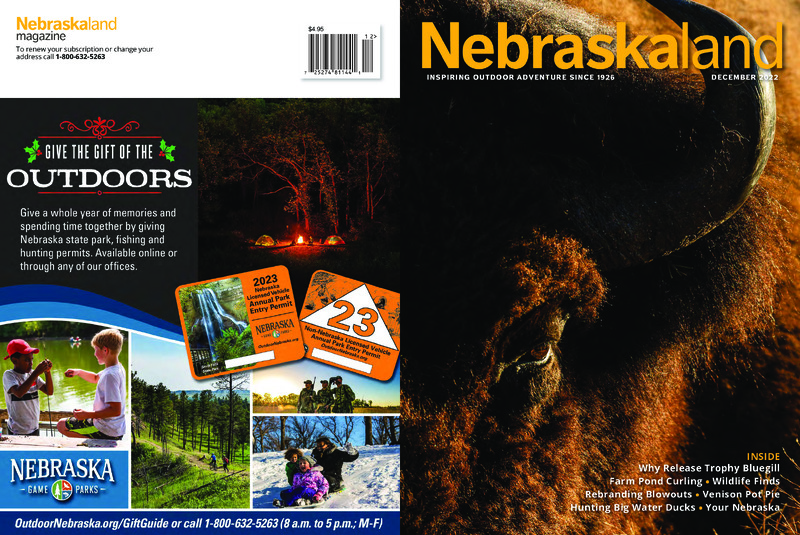
magazine
$4.95
To renew your subscription or change your
address call 1-800-632-5263
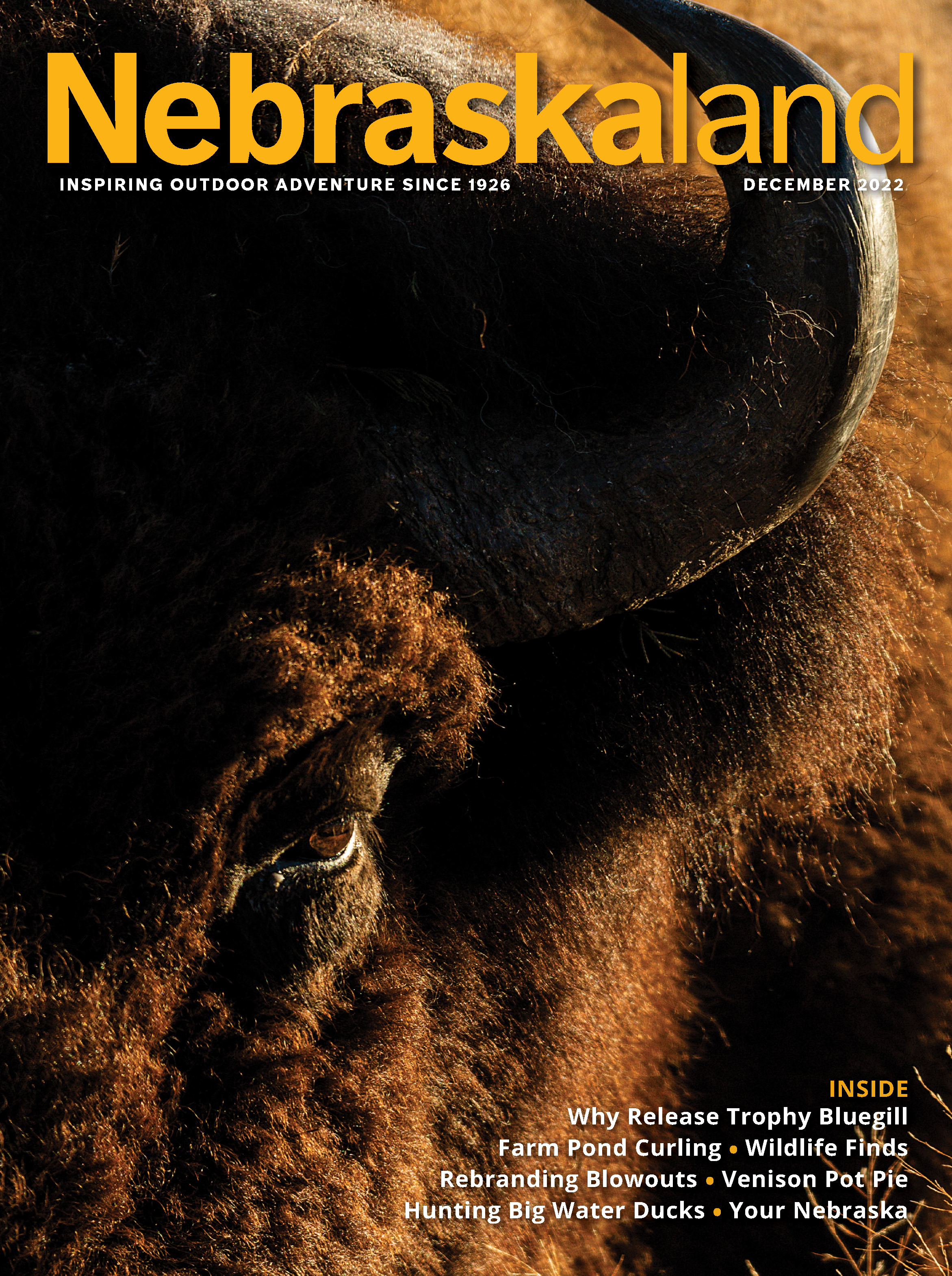
I N S P I R I N G O U T D O O R A DV E N T U R E S I N C E 192 6
D EC E M B E R 20 2 2
INSIDE
Why Release Trophy Bluegill
Farm Pond Curling • Wildlife Finds
Rebranding Blowouts • Venison Pot Pie
Hunting Big Water Ducks • Your Nebraska
Volume 100 No. 10
December 2022
Cover: An American bison at
C
FFort Niobrara National Wildlife
Refuge in Cherry County. Story
R
oon page 18.
JJUSTIN
U
HAAG, NEBRASKALAND
FEATURES
18
WILDLIFE FINDS
26
OUTDOOR NEBRASKA
T page: Air bubbles are
This
ttrapped beneath the ice
hanging above the White River
in Dawes County.
JUSTIN HAAG, NEBRASKALAND
By Jeff Kurrus
What to Do in December
By Renae Blum
28
REBRANDING BLOWOUTS
36
CROSSING NEBRASKA RIVERS
BY FERRY
40
Story and photos by Chris Helzer
By David L. Bristow, History Nebraska
ELK CREEK CURLING
Story and photos by Jeff Kurrus
DEPARTMENTS
6
10
44
54
58
Your Nebraska
In the Field
Mixed Bag
Portraits from the Past
The Last Stop
ON THE WEB
For more articles and
information, visit
NebraskalandMagazine.com
Nebraskaland (VOL. 100 / NO. 10 ISSN 0028-1964) is published monthly, except for the combined Jan./Feb. and Aug./Sept. issues, by the Nebraska Game and Parks Commission, 2200 N. 33rd
St., Lincoln, NE. Periodicals postage paid at Lincoln, Nebraska, and additional mailing offices. POSTMASTER: Send address changes to Nebraskaland, P.O. Box 30370, Lincoln, NE 68503-0370.
2
Nebraskaland • December 2022
December 2022 •
Nebraskaland
3
Magazine Staff
magazine
Published by the Nebraska Game and Parks
Commission since 1926. The Commission is
dedicated to the conservation and protection
of all the state's natural resources and the
people who use them.
Communications Director Christy Firestone
Public Relations Manager Shawna RichterRyerson
Editor Jeff Kurrus
Associate Editor Jenny Nguyen-Wheatley
Regional Editors Eric Fowler, Julie Geiser,
Justin Haag
Contributing Editor Michael Forsberg
Regular Contributors Renae Blum,
Chris Helzer, Chris Masada, Todd Mills,
Ryan Sparks, Gerry Steinauer
Art Director Tim Reigert
Graphic Designer Mel Severin
Photo Librarian Jaclyn Cruikshank Vogt
Administration
Director Tim McCoy
Deputy Director Jim Swenson
Assistant Director Roger Kuhn
Commissioners
Chairman - Pat Berggren, Broken Bow
Vice Chairman - Rick Brandt, Roca
2nd Vice Chairman - Robert Allen, Eustis
Circulation
For address changes and questions about your
subscription, call 800-632-5263
Advertising Sales Manager
For advertising information contact
Shane G. Gilster, 402-742-0125
Email: shanegilster@gmail.com
Ken Curry, Columbus
Donna Kush, Omaha
Scott Cassels, Omaha
John Hoggatt, Kearney
Doug Zingula, Sidney
Dan Kreitman, Wahoo
Nebraskaland Magazine Copyright 2022, all rights reserved.
Nebraskaland is available in audio from the Nebraska Library
Commission Talking Book and Braille Service, Suite 120, 1200 N St.,
Lincoln, NE 68508. 800-742-7691. Nebraskaland Magazine and the
Nebraska Game and Parks Commission reserve the right to reject any
advertising not in keeping with the agency mission.
Rates: $18 for one year; $33 for two years; $44 for three years. Nebraska
recipients must add appropriate sales tax. To subscribe call
1-800-NEBLAND (632-5263), or go online to:
NebraskalandMagazine.com.
Commission Offices
Conservation Officers
Headquarters/Southeast District Office
2200 N. 33rd Street Lincoln, NE 68503
Phone 402-471-0641
ADMINISTRATION (Lincoln)
Craig Stover (Administrator)
Duane Arp (Asst. Administrator)
Travis Shepler (Asst. Administrator)
Jeff Clauson (Asst. Administrator)
Northeast District Office
2201 N. 13th St. Norfolk, NE 68701
Phone 402-370-3374
Southwest District Office
301 E. State Farm Rd. North Platte, NE 69101
Phone 308-535-8025
Northwest District Office
East Hwy. 2, Box 725 Alliance, NE 69301
Phone 308-763-2940
Bassett Office
524 Panzer St., Box 508 Bassett, NE 68714
Phone 402-684-2921
402-471-5531
402-471-5531
402-471-5531
402-471-5531
NORTHWEST (Includes counties covered)
Dan Kling (Lieutenant)
308-430-0572
EAST SUB-DISTRICT
Sean Schultz (Sergeant)
308-760-0145
Jerod Hahn (Deuel, Garden, Grant)
Keith Jadlowski (Keith, Deuel)
Jaden Porter (Keith, Garden)
Tyler Stueck (Keith)
Travis Schultz (Morrill, Cheyenne)
308-520-5539
308-289-9580
308-289-2274
308-289-6260
308-279-1292
(Keith, Arthur)
WEST SUB-DISTRICT
Downy woodpeckers (like this male)
are a common sight at backyard suet
feeders in December.
ERIC FOWLER, NEBRASKALAND
Matt Brandt (Sherman, Howard)
Daryl Teter (Howard, Greeley, Merrick)
Kyle Gaston (York, Polk, Hamilton)
SOUTH SUB-DISTRICT
Matt Taylor (Sergeant)
402-200-9597
Tim Williams (Hall, Hamilton, York)
Eric Javins (Adams, Clay, Webster)
Pat George (Harlan, Franklin, Phelps)
Ethan Teter (Buffalo, Kearney)
308-380-7331
402-902-2017
308-920-2762
308-440-3847
(Thayer, Fillmore, Nuckolls)
SOUTHWEST (Includes counties covered)
Roger Thompson (Lieutenant)
308-530-3097
NORTH SUB-DISTRICT
Ray Dierking (Custer, Thomas, Blaine)
Frank Miller (Cherry, Hooker)
Greg Hesse
308-870-0322
402-389-0444
308-546-7464
308-660-4671
308-530-3157
(Hooker, Thomas, southern Cherry)
Sean McKeehan (Sergeant)
308-672-1824
Kelsey Glodowski
308-763-8226
Alex Hasenauer (Lincoln, Perkins)
Brandon O’Neal
Ak-Sar-Ben Aquarium/Schramm Education
Center
21502 W. Highway 31 Gretna, NE 68028
Phone 402-332-3901
Hunter Pearson
308-360-1817
SOUTH SUB-DISTRICT
Josh Widhelm (Scotts Bluff)
Jacob Stoinski (Sioux, Dawes)
308-279-9133
308-615-9017
(Red Willow, Frontier, Hayes, Hitchcock)
Omaha Office
8495 Frederick Street, Omaha, NE 68124
Phone 402-595-2144
NORTHEAST (Includes counties covered)
Dale Davis (Lieutenant)
402-760-0712
Kearney Office
1617 First Ave. Kearney, NE 68847
Phone 308-865-5310
(Kimball, Banner, Scotts Bluff)
(Box Butte, Sheridan, Grant)
(Sheridan, Dawes, Grant)
NORTH SUB-DISTRICT
Jeff Jones (Sergeant)
402-762-5022
John Bauer (Holt, Boyd)
Tyler Adelman
402-314-9257
402-314-4783
(Knox, Cedar)
(Rock, Brown, Keya Paha)
Jonathan Andreasen
402-340-3981
Mitch Johnson (Knox, Antelope, Pierce)
402-613-8612
(Madison, Pierce, Stanton)
OutdoorNebraska.org
SOUTH SUB-DISTRICT
Cory Krause (Sergeant)
402-380-6410
Kyler Prochaska (Platte, Colfax)
Matt Costello (Dodge, Colfax)
Kelbi Abke (Washington, Burt)
Nicholas Fix (Dixon, Dakota, Thurston)
402-830-8278
402-317-4014
402-237-2537
402-508-0261
(Cuming, Wayne, Stanton)
The Nebraska Game and Parks Commission does not discriminate
based on race, color, ethnicity, national origin, sex, pregnancy, sexual
orientation, gender identity, religion, disability, age, genetic information,
veteran status, marital status, and/or political affiliation in its programs,
activities, or employment. Any person who believes he or she has been
discriminated against in any program, activity, facility, or service,
should contact the Nebraska Game and Parks Commission, Lincoln, NE
402-471-0641, the Nebraska Equal Opportunity Commission, Lincoln,
NE 402-471-2024, TTY/TDD 800-642-6112; Director, Office of Diversity,
Inclusion and Civil Rights, U.S. Department of Interior, 1849 C Street,
NW, Washington, D.C. 20240.
4
Nebraskaland • December 2022
CENTRAL (Includes counties covered)
Mike Thome (Lieutenant)
308-293-8746
NORTH SUB-DISTRICT
Doug Pollard (Sergeant)
(Loup, Garfield, Valley)
308-730-7050
308-202-0819
308-440-1863
402-719-6226
(Lincoln, McPherson, Logan)
Brian Piernicky (Sergeant)
308-340-6627
Bryce Streger (Dawson, Gosper, Custer)
Matt Andrews
308-537-0404
308-746-2418
Taylor Dixon (Dawson, Gosper)
Sophia Gobber
308-217-2108
308-222-0368
(Furnas, Gosper, Frontier, Red Willow)
(Chase, Dundy, Hayes, Hitchcock)
SOUTHEAST (Includes counties covered)
Stacey Lewton (Lieutenant)
402-890-7140
EAST SUB-DISTRICT
Heath Packett (Sergeant)
402-210-0888
Russell Mort (Otoe, Johnson)
Rich Berggren (Douglas)
Brian Arp (Douglas, Sarpy)
Dan Evasco (Sarpy)
Mike Luben (Saunders, Butler)
Bryan Adams
402-209-1506
402-619-1355
531-530-9011
402-616-5961
402-443-6392
402-429-1924
(Cass)
(Nemaha, Pawnee, Richardson)
WEST SUB-DISTRICT
Dina Barta (Lancaster)
Luis Nuñez (Lancaster)
Mark Sullivan (Lancaster, Seward, Butler)
Trevor Stahlecker (Lancaster, Saline)
Matt Seitz (Gage, Jefferson)
402-890-6463
531-333-6093
402-741-0636
402-314-9641
402-806-0915
YOUR NEBRASKA
Instagram Photos
Follow us @nebraskaland
and tag us in your photos
to be featured in an
upcoming issue.
Thad Buster, Gretna
City Cicada
Jayson Alder, Omaha
A Heron Haven Green Heron
Breanne Jackson, Bennington
Eastern Fox Squirrel
6
Nebraskaland • December 2022
December 2022 •
Nebraskaland
7
YOUR NEBRASKA
Jayson Alder, Omaha
Limpkin at Wehrspann Lake
Send your comments and
photos to:
Jeff Kurrus, Editor
Nebraskaland Magazine
P.O. Box 30370
Lincoln, NE 68503
or email Jeff.Kurrus@Nebraska.gov
Pam Whisenhunt, Lincoln
Cattail Sunrise Over Oak Lake
8
Nebraskaland • December 2022
Please include your postal address
and telephone number. Letters
may be condensed and edited.
Photographs are also welcome.
December 2022 •
Nebraskaland
9
IN THE FIELD
WHITNEY LAKE
Early ice at Whitney
Lake in northwestern
Nebraska.
JUSTIN
JUST
IN
N HA
AAG,
AG N
NEB
EBRASK
R
RAS
ALA D
ALAN
10
Nebraskaland • December 2022
December 2022 •
Nebraskaland
11
IN THE FIELD
Spinning wing decoys are a must when hunting big water birds.
TODD MILLS
BIG WATER BIRDS
By Todd Mills
Late spring and early summer rains are a reason for hope
and optimism with the waterfowl crowd. For the hunter who
loves a small marsh and the challenges that come with it,
this could be the most important ingredient for success.
But for years like 2022, when drought has sucked up the
majority of small water and affected even larger bodies
of water, you must adapt and change or hang it up for the
season. For most, like myself, that’s not an option.
Hunting larger water and river systems can be challenging,
but if done right, it can provide you with some spectacular
hunting. It takes some adapting and a different approach.
Here are some tips that could lead to success in this, and
future, dry years.
Homework Is Not Optional
Unlike small marsh hunting, big water hunts require a
great deal of scouting before a plan can be put together. On
most big water trips, I’ll set aside an entire day to become
familiar with the area. It’s important to pay close attention
to wind direction and search areas where the birds can rest
comfortably out of the wind. Coves and areas around points
are optimal. And unlike a marsh hunt, your best gunning can
come midday. Often, I’ll find birds and wait until they go out
to feed or move before setting up. No need to be in a hurry,
especially if you have the area to yourself.
Go Big
Hunting big water or river systems can require an entirely
different decoy approach. Birds tend to raft in larger numbers
12
Nebraskaland • December 2022
and stick close together, especially later in the season
when cold temperatures hit. Larger spreads with an open
landing area tend to work best. Find a good landing zone on
the downwind side of your spread. If using goose decoys,
place your ducks on the back side, right in front of the kill
hole. Spinning wing decoys are a must here, especially on
sunny days. Birds crossing large bodies of water can see the
reflection for miles and will come to investigate. Whatever
the first group does, the rest will probably follow suit, so
don’t be afraid to make adjustments early with your spread.
Hide Away
Whether hunting from a boat or shore, the hide is crucial
on big water. Since you may be far from adequate cover,
you must make your hide blend into the background. If you
can find a bank to be under or plenty of natural cover like
grasses, rock piles or fallen timber, that would be optimal.
Even if your hide sticks out a little, it can work if it’s well
concealed. On a recent hunt we had an A-frame on ice with
open water in front. After covering it with surrounding cover,
the mallards didn’t hesitate to come in.
Safety First
Big water hunting can create some safety issues. Life
jackets when using a boat are a must, but often overlooked.
A simple survival kit, GPS, a signal flare or whistle, and extra
clothes can save the day. Weather, equipment failure and an
injury to yourself or your dog can leave you stranded and
uncomfortable. Plan for the best but prepare for the worst.
IN THE FIELD
Releasing trophy, male bluegill back into a lake — like this one from an eastern Nebraska farm pond — can help provide
excellent long-term fishing. JEFF KURRUS, NEBRASKALAND
DON’T STUNT
By Jeff Kurrus
It’s a tough concept for many to learn, especially
when panfishing. But if your goal is to catch trophy
bluegill today — and long into the future — then put
the biggest ones back.
“Bluegill biology is complicated,” said Daryl Bauer,
Nebraska Game and Parks Commission fisheries
biologist. “Your big males are your nest builders, your
guards. They grow extremely fast so they can defend
the nest and reproduce. You want these fish around.”
In contrary, added Bauer, there are other, smaller
males — with coloration similar to females — that
sneak onto the nests and fertilize eggs. The more of
these fish that reproduce, the better the chances are for
stunted fish in the future.
14
Nebraskaland • December 2022
“So, if you’re keeping those bigger fish,” said Bauer,
“then you’re choosing to harvest faster growing fish
and leaving the stunted ones in the lake.”
Catch a few fish before deciding what to harvest,
because fish size can be relative, and then harvest
the smaller males. You can also take some female
fish, but immediately release the trophies of both
sexes. For example, when fishing a Sandhills lake,
release anything larger than 9 inches. In an eastern
Nebraska lake, that 9-incher may be the biggest fish, so
concentrate on those in the 8-inch range.
The goal isn’t to start your fishing story with: “This
one time, we were keeping huge gillies.” Instead, do
your part to keep big bluegill in a lake for years to come.
IN THE FIELD
Add a couple anchovies into venison pot pie filling for better flavor.
JENNY NGUYEN-WHEATLEY, NEBRASKALAND
VENISON POT PIE
By Jenny Nguyen-Wheatley
Servings: 4
Prep Time: 15 minutes
Cook Time: 4 hours and 30 minutes
Ingredients:
1 pound of venison stew meat, cut
into 1-inch cubes
1 sheet puff pastry, thawed but
cold
Salt and freshly cracked pepper
4 tbs. all-purpose flour, separated
1 pound of baby bella mushrooms,
quartered
Cooking oil
1 medium onion, chopped
1 medium to large carrot, peeled
and large diced
2 anchovy filets packed in oil
1 tbs. tomato paste
3 cloves garlic, minced
½ cup pinot noir
1¾ cup brown stock
1 medium waxy potato, peeled
and large diced
2 sprigs of fresh thyme
•
•
•
•
•
•
•
•
•
•
•
•
•
•
•
16
Nebraskaland • December 2022
• 4 sprigs of fresh parsley
• 1 bay leaf
• ½ cup of frozen peas
• 1 egg, beaten
1. Preheat oven to 300° Fahrenheit.
Toss venison cubes with salt, pepper
and 1 tbs. of flour. Over medium-high
heat, heat a splash of oil in a small
enameled Dutch oven and brown
venison cubes in batches. Remove
venison and set aside. Add more oil
and brown mushrooms in batches
with a pinch of salt, and then remove
and set aside.
2. Lower heat to medium and add
onion, carrot and a pinch of salt,
adding more oil as needed. Sauté for
about 5-7 minutes to slightly brown
onion. Add tomato paste, garlic and
anchovy and sauté for about 1 minute.
3. Return venison and mushrooms to
the pot, along with any juices. Add the
remaining 3 tbs. of flour and cook for
about 2 minutes, stirring frequently.
Then stir in wine until thickened.
Next, add stock, potatoes, bay leaf,
parsley and thyme. Bring to a boil, and
then cover and transfer to a 300° oven.
4. Braise stew for 2½ to 3 hours, or
until venison becomes tender. Check
halfway through and add more stock
as needed; you want the ending stew
to be thick and saucy, but not dry.
When done, discard bay leaf, thyme
and parsley sprigs. Season to taste.
5. Turn up oven temperature to 425°.
Spray a 9-inch pie dish with cooking
spray. Transfer pie filling into the pie
dish and allow to cool for 30 minutes.
Then stir in frozen peas and cover
with a sheet of puff pastry — trim the
edges as needed. Brush egg on top and
bake in a 425° oven for 30-35 minutes
on the middle rack. Rotate the pie
dish halfway through for more even
browning. Allow pie to rest for at least
10 minutes before serving.
December 2022 •
Nebraskaland
17
Wildlife Finds
By Jeff Kurrus
A sharp-tailed grouse on a frosty fence at
Fort Niobrara National Wildlife Refuge in
Cherry County. JUSTIN HAAG, NEBRASKALAND
18
Nebraskaland • December 2022
December 2022 •
Nebraskaland
19
here is a true sense of
accomplishment when finding
winter wildlife. Whether by foot
or vehicle, being in the right place
at the right time to see Nebraska’s
majestic animals is thrilling.
“See anything?” friends and family
often ask on the return home, and
when successful, a story ensues about
the location, time and an educated
guess: “Why were they there?”
It can be an animal the viewer has
seen a thousand times, or a bucket list
creature seen for the first time, be it
big or small, on the east or west side of
Nebraska. Regardless, these are sights
viewers file away for the “This one
time, I saw a … ” conversations they
T
20
Nebraskaland • December 2022
always circle back to among friends.
The story often works its way back
to “Did they see you?” This one is
tricky.
Hunters rarely want their quarry
looking in their direction. If the animal
knows you’re there, there’s a good
chance they’re not coming any closer.
Some hunters even make it a point
not to make direct eye contact with
an animal.
Viewers want the exact opposite.
The thrill is when the white-tailed doe
looks over its shoulders at the person
with the binoculars or the sharp-tailed
grouse leaps onto a stretch of barbed
wire fence and faces the photographer
— ready to have its picture taken.
Nothing could be better.
Yet, when that pivotal moment
comes on a waterfowl flush, when
just enough sets of eyes become just
uncomfortable enough and the birds
fill the sky — even the most skilled
wildlife viewer wouldn’t be able to
help but admire watching their prized
find flying in the opposite direction. N
ABOVE: White-tailed deer near Nine
Mile Creek in Scotts Bluff County.
JUSTIN HAAG, NEBRASKALAND
OPPOSITE: Eastern fox squirrel in
Lancaster County.
ERIC FOWLER, NEBRASKALAND
A Virginia opossum bares its teeth on a dirt
road in Cass County. JEFF KURRUS, NEBRASKALAND
American bison at Fort Niobrara
National Wildlife Refuge in Cherry
County.
JUSTIN HAAG, NEBRASKALAND
22
Nebraskaland • December 2022
December 2022 •
Nebraskaland
23
Flocks of Canada and snow geese land in a Scotts Bluff County field.
JUSTIN HAAG, NEBRASKALAND
Seconds later, the birds take flight. JUSTIN HAAG, NEBRASKALAND
Bighorn sheep ram and ewe at Williams Gap
Wildlife Management Area in the Wildcat Hills
Region of Banner County.
JUSTIN HAAG, NEBRASKALAND
A mere 17 seconds after the first image was captured (top), the sky is filled with
Canada and snow geese. JUSTIN HAAG, NEBRASKALAND
24
Nebraskaland • December 2022
December 2022 •
Nebraskaland
25
Outdoor Nebraska
By Renae Blum
Don’t let the busy holiday season stop you from spending time outdoors.
Here are a few ideas to make your time outside count, from photography
opportunities to Christmas displays and birdwatching. N
What To Do in December
Squirrel hunting
Through Jan. 31 | Statewide
Winter can be one of the most
fun and rewarding times to hunt
Nebraska’s fox squirrels. Get
outside on a calm and sunny day
with family and friends to make
memories and bring home meat
for some delicious squirrel stew.
JULIE GEISER, NEBRASKALAND
Geocaching
Shoot photos at Fort Robinson
State Park
Throughout the month
All year | Statewide
Geocaching opportunities don’t stop in winter, though there are a few extra things
to consider. Make sure to dress for the weather, tell someone where you’re going,
and bring a small shovel for snow and a screwdriver to pry open frozen containers.
JEFF KURRUS, NEBRASKALAND
There’s never a bad time to take pictures at Fort Robinson. In early December,
park staff and the public team up to decorate Fort Robinson’s historical
buildings with Christmas lights, which are on display throughout the holiday
season. Arrive at dusk to get the best photos. This time of year also provides the
opportunity to enjoy the park’s stunning landscape and charismatic wildlife
outside of the busy tourism season. Grab a camera and have some fun.
JUSTIN HAAG, NEBRASKALAND
See Christmas lights at
Buffalo Bill’s home
Nov. 25 – Dec. 31 | Buffalo Bill Ranch State
Historical Park
See the historic home of Buffalo Bill lit up in a special
display. All month, the barn, grounds and mansion will
be decorated with Christmas lights. It’s free and easy to
simply drive by, but for the best experience, get out on
the grounds and walk around.
JULIE GEISER, NEBRASKALAND
26
Nebraskaland • December 2022
Christmas Bird Count,
Indian Cave State Park
Dec. 29, 9 a.m. – noon
Stay busy during Christmas vacation by
becoming a community scientist. Bird lovers
of all ages and experience levels are invited to
come help with this winter census of the park’s
birds. The day includes kids’ crafts and a soup
feed. Meet at the park office at 9 a.m.; for more
information, and to pre-register for the soup
feed, call the park at 402-883-2575.
ERIC FOWLER, NEBRASKALAND
December 2022 •
Nebraskaland
27
Rebranding
Blowouts
Sandhills blowouts
are perfect habitat
for visual predators
like robber flies
because there’s
little to obstruct
their view.
Story and photos by Chris Helzer
Grassland habitat doesn’t
always equal an abundance of
cover. Some of the most barren
places in the Sandhills attract a
lot of wildlife, including a broad
diversity of small creatures that
think bare sand looks pretty
dang hospitable.
28
Nebraskaland • December 2022
December 2022 •
Nebraskaland
29
Because they are nocturnal, kangaroo rats (below) are
rarely seen during the day but their tracks (above) and
burrowing activity illustrate their strong tie to Sandhills
blowouts.
Blowout penstemon is perhaps the best-known inhabitant of Sandhills blowouts, but the blowouts are also terrific habitat
for many animals.
lowouts in the Nebraska Sandhills need a better public
relations agent. They’re unpopular with ranchers,
who tend to focus on the reasonable fact that bare
sand contains very little cattle food. Among the other
residents of the Sandhills prairie, though, that negative
opinion is in the minority. Lots of smaller animals love them.
Most of those animals use blowouts as bonus habitat.
They’re a nice place to visit, even if they wouldn’t necessarily
want to live there. Blowouts can be a great place to bask in
the warmth of the sun, for example. Depending upon the
topographic location of blowouts, some can host temporary
pools of water after rains. Those can be very popular with
B
30
Nebraskaland • December 2022
animals that are either thirsty or seeking a quick bath.
Looking for a pleasant breeze on a warm day? Blowouts
were made for wind. For that matter, they were made by wind,
but it comes to the same thing. There is almost always at least
a little breeze blowing across the bare sand, unobstructed by
vegetation. At other times, of course, there’s so much wind
it reshapes the topography of the sand, filling in the tracks
of recent visitors and creating attractive ripples across the
surface of the blowout. It can be a little more challenging to
abide in a blowout during that kind of wind, but that’s when
a little burrowing or a retreat to the sheltered edges can be a
nice option.
There is surprisingly little written about the habitat use
of blowouts by animals. If you mention blowouts as habitat,
most people immediately think of the blowout penstemon,
or maybe blowout grass. Fewer people can name other plants
that live in or around blowouts, especially those without the
term “blowout” in their titles. There are lots of them, though,
including sandhill muhly, lemon scurfpea and painted
milkvetch. What about animals?
Kangaroo rats might be the best-known inhabitants of
blowouts and other patches of bare sand. Their tracks and
holes are easy to find around the edges of blowouts, where
they venture out at night to gather leaves, seeds and other
JON FARRAR, NEBRASKALAND
December 2022 •
Nebraskaland
31
the entrance and snag any potential prey that wanders too
close. As adults, many tiger beetles have a shiny metallic
sheen and use their speed and quickness to pursue and
capture prey within the broad expanses of sand.
In addition to blowout residents, lots of other animals visit
blowouts to enjoy the warmth of the sand, take advantage
of the open vistas (easy-to-spot prey or watch for potential
threats), or for other reasons. Toads, for example, are
commonly seen around blowouts, which helps explain why
the toad-eating hognose snake is also a frequent visitor.
Butterflies often hang out in the bare sand, too, either
basking in the sun or, sometimes, picking up minerals from
the sand or manure of other visitors. Lots of beetles make
tracks across the bare ground as well, including some species
that roll and bury balls of dung in the loose substrate.
Several species of band-winged grasshoppers are often
hanging around in blowouts. It’s easy to see why when you
look at their camouflaged bodies, which blend perfectly with
bare sand. When sitting still, a band-winged grasshopper
is almost impossible to spot until it moves. As adults, they
can fly to escape predators, often displaying colorful wings
and making a loud clacking sound that helps distract
anything trying to catch them. If they can cause enough of a
Many wasp species dig nest burrows in the middle of
blowouts.
distraction, they can then quickly land in a new location and
disappear into the background once more.
Robber flies are essentially six-legged, surface-to-air
missiles with huge eyes. They are commonly found in
blowouts, where they sit quietly until a small insect flies
into the air nearby, at which point the robber fly instantly
Lesser earless lizards are well adapted to the hot expanses of open ground in blowouts.
food. Some of that is for immediate consumption, but a lot
of it gets stored underground for later. Their burrow system
includes multiple entrances and exits. If you’re looking to dig
up a kangaroo rat to eat, savvy predators know to look for the
holes that are plugged up, not the ones that are left open.
Lesser earless lizards are also big fans of open sand. Their
tunnels can be found along the edges of blowouts and other
patches of bare ground, especially on south-facing slopes
that catch plenty of sunshine. They hunt the multitudes of
insects and other invertebrates looking to warm up in that
same sunshine. When threatened, they can scamper into
holes or vegetative cover or just quickly bury themselves in
loose sand.
Other animals make their homes in blowouts, too, but
most are small and easy to overlook. There are a number of
small sand wasps, for example, that dig nest burrows out
in the middle of vast expanses of sand. Those entrances
are often closed up by blowing sand, but the wasps have
an extraordinary ability to find and re-open their tunnels
anyway. That’s important, since females of some species
make numerous trips to and from those nest burrows carrying
32
Nebraskaland • December 2022
Toads are commonly seen in blowouts, probably drawn by
an abundance of insects.
flies for their kids to eat.
Several species of tiger beetle are commonly seen in the
exposed sand of blowouts. The larvae of some species make
tunnels in the same sand, where they position themselves at
Hognose snakes are often seen in blowouts, probably because of the abundance of toads — their favorite food.
December 2022 •
Nebraskaland
33
Eastern tailed-blue butterfly in a blowout.
Bandwing grasshoppers are well-camouflaged
against bare sand.
Intersecting highways of wildlife tracks crisscross blowouts, indicating the considerable activity that takes place
in those habitats.
launches and intercepts its prey in the air. The broad open
habitat of blowouts are perfect for this predatory approach
because robber flies can see potential prey in all directions, as
well as any possible threats.
From a distance, blowouts look empty and barren. Upon
closer inspection, however, they are full of activity, especially
during mornings and evenings. During the heat of the day,
34
Nebraskaland • December 2022
many of the animals that use blowouts have retreated
underground or into the cool shade around the edges of the
open sand. Even then, signs of the abundant and diverse
blowout community can be found in the tracks, burrows and
other evidence left in the bare sand. That is, unless the wind
is blowing.
Maybe blowouts just need a better name. The term
“blowout” can be positive in the case of a big sale at your
local mattress store, but usually carries a more negative
connotation. No one wants a blowout while driving, for
example. Some aspiring public relations firm could surely
come up with a more positive way to refer to these little
wildlife havens. Sand bowls? Wind scoops? Toad nooks? You
get the idea. N
The aptly-named big sand tiger beetle is just one of many
predators that hunt in blowouts.
December 2022 •
Nebraskaland
35
The Council Bluffs (Iowa)
Ferry in the territorial days,
illustration from Everett
Dick, The Sod-House Frontier
(1954).
HISTORY NEBRASKA, RG2401-0-3
Crossing Nebraska
Rivers by Ferry
By David L. Bristow, History Nebraska
e take bridges for granted, but river-crossing
Nebraskans mostly relied on ferries into the 20th
century. The ferry was a seasonal operation. When
the river iced over, you could simply drive your team
across, as long as you trusted the thickness of the ice.
During the westward migration along the Oregon, Mormon,
and California trails, emigrants first had to pay ferrymen to
take them across the Missouri River. Early ferries were rafts
propelled by poles or oars. Cable ferries were an improvement,
W
and “team boats” propelled by horses on a treadmill were
faster but less common.
Nebraska Territory opened to Euro-American settlement
in 1854. That year, former fur trader Peter Sarpy of Bellevue
bought a 165-ton steam ferry to better serve the expected
flood of settlers. Also that year, the Council Bluffs and
Nebraska Ferry Company built Omaha’s first brick building to
serve as the territorial capitol. It was an investment to ensure
continued ferry traffic.
A team boat was propelled by horses on a treadmill. Santee, Knox County. HISTORY NEBRASKA, RG2118-9-8
36
Nebraskaland • December 2022
December 2022 •
Nebraskaland
37
Transferring cars from a railcar ferry in Omaha, 1871. HISTORY NEBRASKA, RG2341-2-P19
In Omaha, ferry use did not end with
the construction of the Union Pacific
Railroad. The Missouri River remained
unbridged until 1872. A special
steamboat had a length of railroad
track running from bow to stern so it
could ferry railcars.
Along the Platte River south of
Schuyler, Moses Shinn and his son,
Dick, built a cable ferry in 1859.
Shinn’s Ferry used the river itself to
propel the ferryboat. It was a “reaction
ferry,” a type of cable ferry that angles
the boat so that the current pushes it
laterally. Bridle cables on either end of
the boat were attached to “travellers”
that would slide along the overhead
cable. The diagram (below) shows how
Automobiles crowd the deck of the City of Springfield between Springfield, SD, and Santee, NE, circa 1915.
HISTORY NEBRASKA, RG2865-2-1
An illustration showing how Shinn’s Ferry used the current to propel the boat. HISTORY NEBRASKA, RG3268-11-14
38
Nebraskaland
• December 2022
it worked.
To the west, the shallow Platte was
crossed only by fording until bridges
were built. Along the Missouri, ferries
for wagons and, later, automobiles,
remained in use long after railroad
bridges spanned the river. For
example, for many years, there was
no convenient way for southwestern
Iowa farmers to reach the South
Omaha stockyards with truckloads of
livestock. The Douglas Street Bridge
was the nearest crossing. Diesel or
gasoline-powered ferryboats, such
as the one shown above, provided
transport.
Despite demand, ferry businesses
struggled to survive in Bellevue.
Blame the ever-shifting channel and
banks of the Missouri River. A wellprepared landing could be rendered
unapproachable by shifting sandbars,
and building a new landing also meant
building a new road. The completion
of the South Omaha Bridge in 1936
finally rendered the Bellevue ferry
obsolete — a story similar to other
ferries shown here. N
Visit History Nebraska’s website at
history.nebraska.gov.
Bellevue ferry landing, June 14, 1924. HISTORY NEBRASKA, RG3097-8-1
December 2022 •
Nebraskaland
39
Elk Creek
Curling
Story and photos by Jeff Kurrus
T
here is a long list of ways to raise money. In the outdoor
world, it’s often banquets, auctions or raffles. Others
host fishing tournaments, shoots or competitions like
one-box hunts. One Johnson County resident, however, came
up with an entirely different plan to raise money to support
his community. Arlen Beethe, with the support of the Elk
Creek Men’s Club, had a thought: Why not introduce a 16th
century game made popular in Europe, combine friends,
family and absolute strangers to compete, and raise money
to help their neighbors?
“Every year the Elk Creek Men’s Club gives scholarships
to local kids,” Arlen said. “We raise money for the Johnson
County 4-H and offer help to any number of benefits. If
someone has an injury and needs some help — if something
needs funding — we try to raise it.”
And that’s how the Elk Creek curling event began.
“I had always enjoyed watching curling during the
Olympics,” said Arlen, “so I had this idea to do it on Main
Curlers, with brooms and beers in hand, stand near the "house" of the curling pitch, counting points.
Street in Elk Creek. But that didn’t work.”
“Well, that's not the exact way it started,” said Arlen’s
son, Cole, with a chuckle. “Originally, over a couple of years
talking in the Village Tavern, our local bar, the idea was to
use cow patties for a curling event. We’d freeze them, add
weights, and somehow fashion a handle to them.”
Luckily, this idea gave way to buying actual curling stones.
40 Pounds of Granite
Cole Beethe, perennial Johnson County curling
powerhouse, releases a stone.
40
Nebraskaland • December 2022
Curling, like every other sporting event, comes with a
list of terminology just about as long as a curling “pitch,”
the sheet of ice on which the game is played. The object of
curling, similar to shuffleboard, is to slide granite stones,
also called “rocks,” into a target area, or “house.” The path of
the stone is determined by its speed and team members who
sweep and brush the ice ahead of the stone with brooms in
order to influence its trajectory or “curl.”
The stones are heavy, weighing about 40 pounds, and
have a handle for the person releasing them. Arlen originally
searched online to find a set of less expensive stones — if
you’d call $2,000 less expensive — for sale in North Dakota.
“Friends of the family, Gary and Kathy Peters, went up
to get the stones from a guy who told us he had been an
Olympic judge at one time,” said Arlen. “After spending a bit
of time talking to the guy on the phone, I knew they were in
for a long conversation when they met him.”
Gary, chucking over the absurdity of the trip with his wife
to procure the rocks, recalls that half-day conversation 15
miles from the Canadian border. “He was selling us eight
stones along with a set of brooms. The guy kept saying, ‘You
might need this. You might need that.’ I wanted to tell him
this is going to be pretty crude where we do this.
“Then, a couple of years later,” Gary continued, “we
had a guy from western Nebraska reach out. He had some
stones we could use. So, for several years we’d borrow the
stones and cut him a check for letting us use them. But
our treasurer told us he wasn’t cashing the checks. When I
called him, he told me to just keep the stones. So now I have
two sets of curling stones in my basement. They get used
one day a year.”
The club shoots to have its curling fundraiser the second
Saturday in January, advertising mostly by word of mouth
December 2022 •
Nebraskaland
41
A Brief Curling History
At the Elk Creek curling event (above), the
participants release the heavy stones in a "by any
means necessary" style.
Morgan Kaster (left) releases a stone during the Elk
Creek curling event in Johnson County.
to adapt.
“We first held the event for a few years in an alley behind
the firehall in town,” said Arlen, “but you had to run a liner
and work pouring 50-degree water – hoping it would freeze.
It was a pain to get done. So six years ago, we moved it to
the pond. The ice can be a little rough, but once you get your
house set in, it works well.”
Farm Pond Fun
and Facebook. Gary and a host of others help set up. Kathy
prints out score sheets from online, and a group of club
members paint the scoring circles on the pond ice and keep
score of the event. And while the weather hasn’t always
cooperated — the ice never thickened enough a couple
of years — Arlen and his men’s club are always ready
42
Nebraskaland • December 2022
At the event last winter, no one wore curling shoes, pants
or gloves. Instead, the Johnson County farm pond curlers
dressed in anything from sneakers to boots, with overalls or
blue jeans.
Their attire, of course, didn’t affect their play. Some
participants maintained a level of professional form while
others used an anything-goes approach, shoving the rock
down the ice any way they could. For traction, players
planted a foot in front of a wooden 2x4 drilled into the ice.
And the pitch — it changed as the weather did, shortening
or lengthening as ice conditions changed, but the participants
didn’t seem to care. With their four-person teams, no one
pulled out their measuring tape to see if the area was the
45- to 46-meter length of a competition-size pitch, and even
fewer questioned the ice. Small puddles of water became
a brief concern midday, not because of the fear of falling
through the 8-inch ice, but because wet clothes in January is
rarely a good idea.
To play, the stones were released from the front edge of
a line called the hog, with extra bragging rights awarded to
those who could slide the farthest across the ice without
falling down, while still releasing the rock in the general
direction of the house. Points were awarded to the stones
closest to the center, and additional points were awarded
to teams for each stone that is closer than the best of their
opponents’. No points were awarded if teams are unable to
land a stone in the scoring area.
Cole’s teams have won all but one year, and while bragging
rights were won that day, the object of Elk Creek curling is
always fun.
And fundraising. They do this in the most unique way
possible — sliding giant stones across a frozen Nebraska
farm pond in January, in hopes of sending rocks to
the house. N
Above is the 16th century painting "Winter landscape
with a bird trap" by Pieter Bruegel the Elder, of
Belgium, which portrays a scene of a sport similar to
curling being played on frozen ponds.
The first recognized curling clubs were formed in
Scotland during the 19th century with international
competitions also being held during this century.
By the early 20th century, the game had reached
such notoriety it was included in the first Olympic
Winter Games in 1924. However, it was removed from
Olympic programming until gaining official medal
status in 1998 by the International Olympic Committee.
Nowadays, national and international competitions
take place on indoor rinks under carefully controlled
ice conditions, and more laid-back versions of this
popular winter sport are held throughout the world
on frozen waters, including at least one in Elk Creek,
Nebraska.
December 2022 •
Nebraskaland
43
MIXED BAG
SNOWED IN BY CHOICE
By Jeff Kurrus
Platte River State Park features a number of winter cabin accommodations.
There’s not a better winter destination in Nebraska than the mini-lodge cabins at Ponca State Park.
One of my most memorable family winter trips was to
Ponca State Park. We barely beat the snow storm there from
the metro, then spent the next two days not able or willing
to drive anywhere else. Instead, we hiked, snow-boarded and
ice-fished when we were outside, and when back inside our
mini-lodge, cooked, played board games and snuggled up
together in front of the fireplace. Those were some of the best
times I’ve had with my wife and children. I hope everyone
gets the chance to be snowed in at a Nebraska State Park.
Here are a few other places to get stuck this winter.
This time of year, one of Chadron State Park’s six duplexes
are the perfect getaway from the world until they close from
Jan. 2 through March 3. Catch up on some reading or take
inspiration from Thoreau — wooded buttes and canyons
will provide the solitude you need to get ink flowing. Feeling
extra feverish? Bring a camera to walk in one of Nebraska’s
most beautiful winter landscapes. Chadron State Park offers
6 miles of hiking trails, and with the Nebraska National
Forest adjacent, you’ll have access to another 100 miles of
scenic trails and back roads.
44
Nebraskaland • December 2022
JEFF KURRUS, NEBRASKALAND
JEFF KURRUS, NEBRASKALAND
With seven modern, two-bedroom cabins open through
the winter and situated right on the water, Lewis and
Clark State Recreation Area offers the perfect fish-and-stay
destination, where you can go from Vexilars and jigging rods
back to football and a warm dinner in minutes. All cabins at
Lewis and Clark have a covered patio, picnic table, outdoor
grill and campfire ring, and fill up quickly in the winter.
Recognized as two of eastern Nebraska’s most popular yearround destinations, Eugene T. Mahoney and Platte River state
parks offer various lodging options throughout the winter.
From hiking and sledding to bringing in your own holiday
decorations, these are two of the state’s best winter getaways.
Whether you come to ice fish, hike or to just relax, these parks
near the metro will make you feel miles away from the city.
Visit ReserveAmerica.com for more information on these and
other Nebraska winter lodging options. Reservations can be
made as far as a year in advance. Several parks also offer a
30% discount during certain days of the week — a great deal in
addition to a much-needed break from the real world.
The cabins at Lewis and Clark State Recreation Area overlook the reservoir, perfect for a fish-and-stay trip.
JEFF KURRUS, NEBRASKALAND
Winter lodging options at Eugene T. Mahoney State Park feature cabins (shown) and mini-lodges like Ponca State Park.
ERIC FOWLER, NEBRASKALAND
December 2022 •
Nebraskaland
45
MIXED BAG
HUNTING SEASON HABITAT MANAGEMENT
By Jeff Kurrus and Gerry Steinauer
You can’t hunt every day of the hunting season, although
some wives claim some years we try. To keep you occupied
on the days you don’t hunt, the following are a few ideas for
hunting season habitat management.
such as Tordon, to kill the root system. Use caution when
using the latter as it can move through the soil and kill nearby
desired trees. Information is available online regarding
appropriate herbicide use.
Maintaining Treeless Grasslands
Spraying Invasive Grasses
Game birds, such as pheasants, quail and prairie grouse,
prefer open, treeless grasslands. One simple, sure-fire fall or
winter management practice to improve game bird habitat
is cutting eastern red-cedars, from saplings to mature trees,
that have invaded your prairie, pasture or Conservation
Reserve Program field. Cut all stumps as close to the ground
as possible to prevent future damage to vehicles. If you are
aggressive and chainsaw many trees, you might consider
piling them for burning when there is a good snow on the
ground; snow will prevent the fire from escaping. And, since
it is the holiday season, ponder keeping a shapely tree for
decorating the house. Don’t worry, rumor has it that Santa
will leave presents even under an invasive cedar tree.
At this time of year, you can also cut invasive deciduous
trees, such as Siberian elm, autumn olive and honey locust,
from your grasslands. However, since these are re-sprouters,
you will have to immediately spray the cut stump with a
triclopyr herbicide, such as Garlon 3A, or picloram herbicide,
Invasion of grasslands by non-native, cool-season grasses,
such as smooth brome and Kentucky bluegrass, is a problem
throughout most of Nebraska. These mostly Eurasian grasses
often out-compete our native grasses and wildflowers, which
provide valuable food and cover for game birds.
Mid-fall through early winter is the best time to use
herbicide application to check these invaders. Wait to spray
until after a couple of hard frosts, which send native plants
into dormancy, but not the invasive grasses that remain
green and susceptible to contact herbicides.
Herbicide spraying can be done into late December; the
later you spray, the better the kill on the invaders and the
lower the odds of damaging natives. But here’s the catch, the
brome and bluegrass or other invasive grass must be green
when sprayed and the spraying must be done on the first of
at least two consecutive days when the temperature reaches
at least 50 degrees. On warm days, the plants are actively
photosynthesizing and will take the chemical down into
their roots ensuring effectiveness.
Small areas can be sprayed with
hand sprayers, but for larger plots, use
an all-terrain vehicle with a spray rig.
Unfortunately, most commercial sprayers
have winterized their equipment by the
time these grasses are prime for spraying.
Use a glyphosate herbicide such as
Roundup, at a rate of two quarts per
acre along with non-ionic surfactant and
ammonium sulfate. Spraying works best
if the field has been hayed or grazed
in late summer to remove excess thatch
that intercepts the herbicide, preventing
it from reaching green leaves.
Our final tip: Ease your work load by
persuading your hunting buddies to help
with the management. Tell them that
their work will mean more birds next year
and, as a further enticement, promise
that you’ll send them home with a free
Big bluestem and Maximilian sunflower provide excellent pheasant habitat in a
Christmas tree.
tallgrass prairie pasture. Prior to late fall spraying with a glyphosate herbicide,
followed by spring burning, this area of the pasture was dominated by nonnatives grasses. GERRY STEINAUER, NEBRASKALAND
46
Nebraskaland • December 2022
P H O T O
C O N T E S T
ENTER ON INSTAGRAM USING THE HASHTAG:
#nebraskaland2022
For a complete list of rules,
visit NebraskalandMagazine.com
December 2022 •
Nebraskaland
47
MIXED BAG
48
Nebraskaland • December 2022
December 2022 •
Nebraskaland
49
MIXED BAG
KHAPRA BEETLE
By Julie Van Meter, State Entomologist,
Nebraska Department of Agriculture
The khapra beetle (Trogoderma granarium) is an exotic
invasive insect pest of stored grain, grain products and
seeds. The beetle is one of the 100 worst invasive species
in the world, causing up to 70 percent grain damage when
present. It is currently not known to occur in the U.S., though
infestations have been found and eradicated a few times in
the last 80 years. Khapra beetles are regularly intercepted
at U.S. ports of entry in a variety of commodities including
seeds, spices, other foodstuffs, burlap bags, wooden crating
and other shipping containers.
Khapra beetles pose a significant threat to agriculture
in Nebraska, which is why the Nebraska Department of
Agriculture annually conducts khapra beetle surveys
statewide. The insect itself could cause significant economic
losses to the state by damaging stored grain, grain products
and seed. A khapra beetle establishment in the state would
also severely impact both interstate and international trade.
The khapra beetle is a tiny brown to black beetle covered
with fine hairs. Larvae are creamy white when young and
age to brown before pupating and are also covered in hairs.
50
Nebraskaland • December 2022
Khapra beetle larvae and adult.
MINISTRY OF AGRICULTURE AND REGIONAL DEVELOPMENT, BUGWOOD.ORG
PEST AND DISEASES IMAGE LIBRARY, BUGWOOD.ORG
Khapra beetle larvae can look very similar to other common
stored grain pests, and a microscope is used to confirm
identification.
Larvae are the primary cause of feeding damage. Complete
development from egg to adult can take from 26–220 days,
depending on environmental conditions. If temperatures
drop too low, or conditions become unfavorable, larvae can
enter diapause, where they become inactive and may remain
in this state for months or years.
The NDA annually conducts khapra beetle surveys across
the state to watch for this invasive pest. The survey focuses
on international markets that may stock khapra beetle host
materials which originate in foreign countries. High volume
grain and seed importers and exporters are also surveyed. To
date, all surveys have been negative.
For more information on the khapra beetle, visit
Aphis.USDA.gov/aphis/resources/pests-diseases/hungrypests/the-threat/khapra-beetle
December 2022 •
Nebraskaland
51
MIXED BAG
REPLACING THE OFFENSIVE
By Eric Fowler
While on a hunting trip in the Pine Ridge in northwestern
Nebraska in 2010, I photographed a picturesque butte in
northwestern Sheridan County. When I got back to the
office, I looked, as I often do, at the U.S. Geological Survey
topographical maps to see if it was named. I couldn’t believe
that, in the 21st century, a feature could still carry a name
that was both sexist and racist.
It no longer does. In September, the U.S. Department of
Interior announced the Board on Geographic Names had
approved the list of replacement names for federal use for
that feature, seven more in Nebraska and more than 650
across the country that included the term that historically
has been an offensive ethnic, sexist slur typically directed
toward Native American women. On USGS maps, the butte
in Sheridan County is now called Evening Star Butte.
Judi gaiashkibos, executive director of the Nebraska
Commission on Indian Affairs and a member of the Ponca
Tribe, applauded the move.
“Bravo! Finally,” she said.
“I have been called that word in my life, and it was never
said in a positive tone,” she said. “It was derogatory. As a
woman, as a native woman, and the mother of two daughters
and two granddaughters, I definitely find that it is really
disrespectful, and I absolutely think that it is inappropriate.”
Society has evolved, gaiashkibos said, and that is good.
Evening Star Butte in Sheridan County.
52
Nebraskaland • December 2022
And with what is happening in the United States in recent
years, it’s even more timely.
Other features containing the term include streams,
a mound, a reservoir, and a bend on the Missouri River
reservoirs in Dawes, McPherson, Richardson and Sioux
counties. There had been more. In 2000, then Gov. Mike
Johanns asked counties with features containing the term to
rename them. Gage, Holt, Knox, Saline and Sarpy counties
complied.
Nationally, several states have passed bills requiring the
term be removed from the names of more than 1,000 creeks,
summits, canyons and other features. But similar bills in
other states have failed, as did previous efforts by Native
Americans to convince the Board of Geographic Names to
remove the term. The board had, however, in the past 20
years considered 261 proposals to change the names of
individual features.
September’s move by the Board follows months of work
by the Derogatory Geographic Names Task Force, which
included representatives from numerous government
agencies. That effort produced a list of proposed changes,
which was reviewed by nearly 70 tribal governments. The
new names are immediately effective for federal use.
A complete list of names and a map can be found at
USGS.gov.
ERIC FOWLER, NEBRASKALAND
December 2022 •
Nebraskaland
53
PORTRAITS FROM THE PAST
Deer Hunting near Valentine, 1982
Pictured with the pickup is Kevin Thorton
on the left and Buzz DeNaeyer on the right
after retrieving the hunters and their deer.
– Robert Smith, Norfolk
Badger and skunk hunting, 1946
This is a photo of my father, Leonard Pelster,
taken at his farm in Elsie. He had just returned
from the service in 1946. He was successful in
shooting a badger and several skunks. Leonard
was also an avid pheasant hunter and shot two
albino pheasants, one he proudly displays in
his home in North Platte.
– Sally Borowski, Grant
Fishing at McConaughy, 1945
A picture of my mother, Ann
Richards, from Oshkosh, on the cover
of the Outdoor Nebraska magazine
from spring of 1945. She was
fishing at Lake McConaughy and
conservation officer Loron Bunney
took her photo.
– Barb Chadwick, Oshkosh
Coyote hunting by airplane, 1940s
John Zimmerman took the rest of the
men up in his airplane to chase and hunt
coyotes west of Gretna, near the Platte
River. They were very successful that day,
as you can see by all the coyotes hanging
on the wings of the plane. The men in the
hunt, from left to right: Henry Glisman,
Louie Steen, Bill Zimmerman, Henry Siert
(my grandfather), Clarence Schroeder,
and John Zimmerman.
– Bob Dickinson, Gretna
Send contributions to: Portraits from the Past, Nebraskaland Magazine, P.O. Box 30370, Lincoln, NE 685030370. Or e-mail to Tim.Reigert@Nebraska.gov.
Photos should show people enjoying Nebraska outdoor activities, such as camping, boating, hunting or
fishing, and must have been taken before 2000. We will give priority to unusual photos or activities. When
possible, please include a story about the photograph and identify the people, places and approximate date
it was taken. Text may be edited and photos adjusted for reproduction. All photos will be returned.
54
Nebraskaland • December 2022
December 2022 •
Nebraskaland
55
56
Nebraskaland • December 2022
December 2022 •
Nebraskaland
57
THE LAST STOP
SYMBOLIC DEFICIENCY
By Gerry Steinauer
Late one afternoon, the bison skull propped on a
chair in our dining room caught my eye. I liked how the
sunlight coming through the window cast the skull in
warm colors and created sharp shadows. I grabbed my
camera and snapped a few photos.
The skull is one of three bison skulls on display in
our house. It belonged to a bull bison purchased nearly
20 years ago from a southeastern Nebraska rancher for
butcher. I cleaned the skull and placed it on the chair.
Later, Grace, my wife, inserted a “cheap plastic vine” into
the killing bullet hole and draped it over the skull.
Later, while viewing the skull photographs, I was
reminded of Georgia O’Keefe’s paintings of cow skulls
I had seen in art books. O’Keefe was an American
modernist artist who lived from 1887 to 1986. I pondered
why she, like myself, was so infatuated with skulls. I did
a little reading.
O’Keefe’s interest in skulls began during a summer
visit to New Mexico in 1930, the year after a severe
drought littered the desert floor with bones. Fascinated
by the “stark elegance of the bones,” she collected cow
and horse skulls and shipped them back to New York
to paint. One authority said her paintings “attempt to
capture the inner essence and therefore true ‘reality’ of
58
Nebraskaland • December 2022
the thing … [and represent] the death and destruction
of the American landscape, or they can be viewed as
celebratory works that pay tribute to the animals that
first inhabited the Western landscape.”
Whoa! That is such deep symbolism — not what I
saw when I photographed my bison skull. To be honest,
I rarely notice or understand symbolism in art, movies
or literature. For example, Grace recently told me the
vine twining from the skull’s bullet hole symbolized “life
growing from death.” I totally missed that — I thought
she used the vine just to hide the hole.
One possible explanation for my “symbolic
incompetence” is that I was born without or with a
very small “symbolic lobe,” that little-known part of the
brain that recognizes and understands symbolism and
inspires artists such as O’Keefe. Or perhaps, unknown
to my conscious mind, deep in my subconscious I do
understand symbolism and my photographs are loaded
with it. Therefore, in reality, my bison skull photograph
represents the death and destruction of the great
American prairie and pays homage to its iconic creature,
the bison.
Hogwash. Who am I trying to fool? I took the photo
because, to my simple mind, it looked cool.
December 2022 •
Nebraskaland
59
Position: 798 (13 views)