Volume 100, Issue 5, 2022
June 2022
- Identifier:
- nela.2022_100_05
- Title:
- Volume 100, Issue 5, 2022
- Issue Name:
- June 2022
- Date Issued:
- 2022-06-01
- year:
- 2022
- month:
- June
- Season:
- Spring
- PDF filename:
- NL_100.05_2022_June_Spreads_Entire.pdf
- Publisher:
- Nebraska Game and Parks Commission
- Format:
- Periodical
- volume:
- 100
- issue:
- 05
- number:
- 100.05
- Decade:
- 2020s
- edition:
- Liftout
- Type:
- Rights Holder:
- Copyright Nebraskaland Magazine/Nebraska Game and Parks Commission, all rights reserved.
- Extracted Text:
-
magazine
$4.95
To renew your subscription or change your
address call 1-800-632-5263
I N S P I R I N G O U T D O O R A DV E N T U R E S I N C E 192 6
J U N E 20 2 2
INSIDE
Fishing Across Nebraska
Southwest Nebraska’s 1884 UFO
Snapping Turtle Hunt
Aerial Patterns
Volume 100
June 2022
No. 5
FEATURES
18
THE TURTLE FAMILY
The Rutten Family of Cedar Rapids
Pass on a Hunting Tradition
Story and photos by Jenny Nguyen-Wheatley
24
GUMWEED BONANZA!
28
FISHING THE INTERSTATE
46
OUTDOOR NEBRASKA
Photos and story by Chris Helzer
A Guide to the I-80 Lakes
What to Do in June
By Renae Blum
48
PATTERNS FROM ABOVE
56
SOUTHWEST NEBRASKA’S
1884 UFO
Photos and story by Eric Fowler
By David L. Bristow, History Nebraska
DEPARTMENTS
6
10
58
68
70
Your Nebraska
In the Field
Mixed Bag
Portraits from the Past
The Last Stop
ON THE WEB
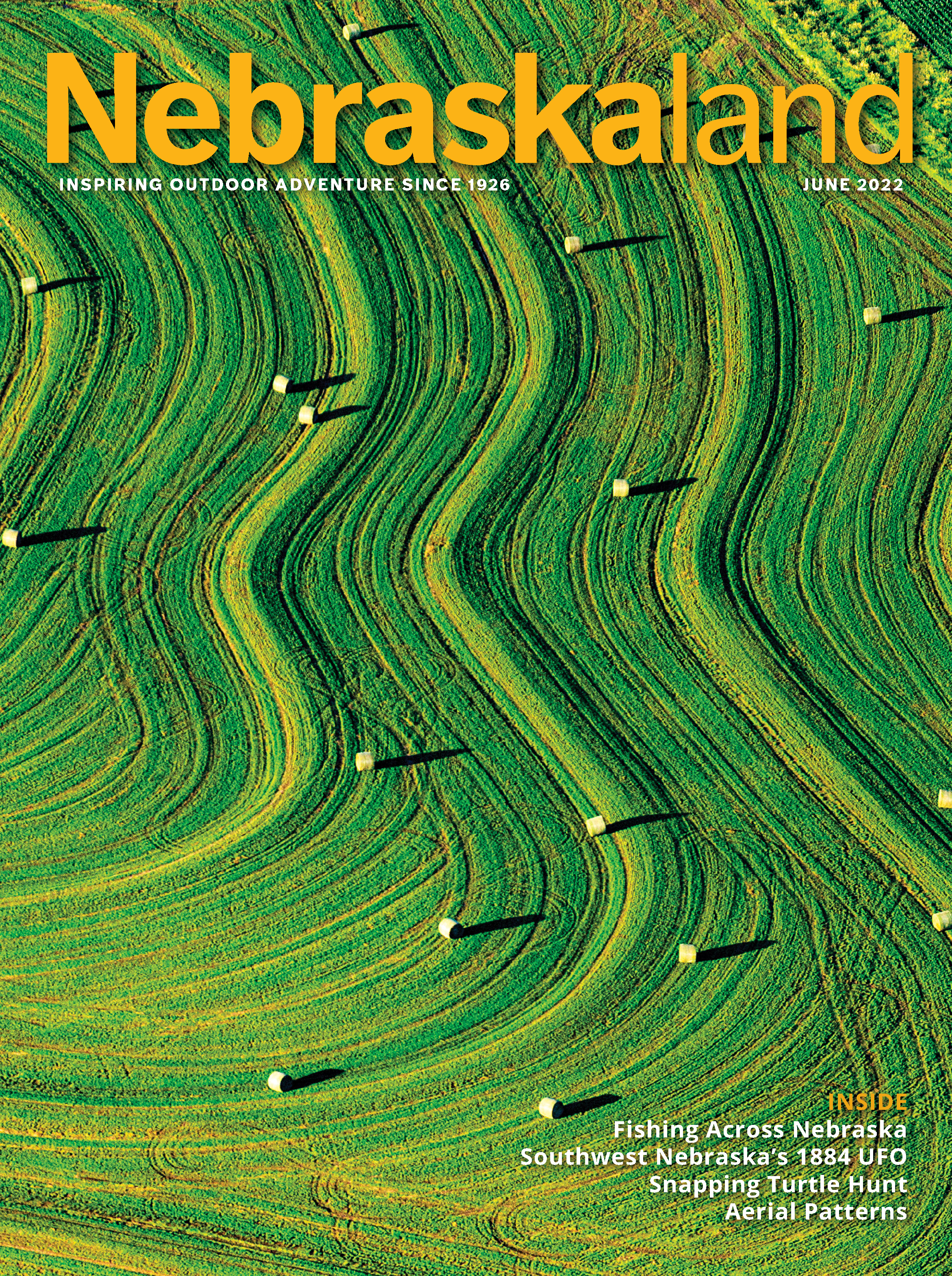
Cover: Round bales dot a
C
tterraced hay field in Gage
County. See the story on
C
ppage 48.
ERIC FOWLER, NEBRASKALAND
E
T page: A mid-June sun rises
This
bbeyond the rocky shoreline
and limestone and shale cliffs
at Lewis and Clark Lake SRA in
Knox County.
ERIC FOWLER, NEBRASKALAND
For more articles and
information, visit
NebraskalandMagazine.com
Nebraskaland (VOL. 100 / NO. 5 ISSN 0028-1964) is published monthly, except for the combined Jan./Feb. and Aug./Sept. issues, by the Nebraska Game and Parks Commission, 2200 N. 33rd
St., Lincoln, NE. Periodicals postage paid at Lincoln, Nebraska, and additional mailing offices. POSTMASTER: Send address changes to Nebraskaland, P.O. Box 30370, Lincoln, NE 68503-0370.
2
Nebraskaland • June 2022
June 2022 •
Nebraskaland
3
Magazine Staff
magazine
Published by the Nebraska Game and Parks
Commission since 1926. The Commission is
dedicated to the conservation and protection
of all the state's natural resources and the
people who use them.
Communications Director Christy Firestone
Public Relations Manager Shawna RichterRyerson
Editor Jeff Kurrus
Associate Editor Jenny Nguyen-Wheatley
Regional Editors Eric Fowler, Julie Geiser,
Justin Haag
Contributing Editor Michael Forsberg
Regular Contributors Renae Blum,
Chris Helzer, Chris Masada, Todd Mills,
Ryan Sparks, Gerry Steinauer
Art Director Tim Reigert
Graphic Designer Mel Severin
Photo Librarian Jaclyn Cruikshank Vogt
Administration
Director Tim McCoy
Commissioners
Chairman - Pat Berggren, Broken Bow
Vice Chairman - Rick Brandt, Roca
2nd Vice Chairman - Robert Allen, Eustis
Circulation
For address changes and questions about your
subscription, call 800-632-5263
Advertising Sales Manager
For advertising information contact
Shane G. Gilster, 402-742-0125
Email: shanegilster@gmail.com
Ken Curry, Columbus
Donna Kush, Omaha
Scott Cassels, Omaha
John Hoggatt, Kearney
Doug Zingula, Sidney
Dan Kreitman, Wahoo
Nebraskaland Magazine Copyright 2022, all rights reserved.
Nebraskaland is available in audio from the Nebraska Library
Commission Talking Book and Braille Service, Suite 120, 1200 N St.,
Lincoln, NE 68508. 800-742-7691. Nebraskaland Magazine and the
Nebraska Game and Parks Commission reserve the right to reject any
advertising not in keeping with the agency mission.
Rates: $18 for one year; $33 for two years; $44 for three years. Nebraska
recipients must add appropriate sales tax. To subscribe call
1-800-NEBLAND (632-5263), or go online to:
NebraskalandMagazine.com.
Commission Offices
Conservation Officers
Headquarters/Southeast District Office
2200 N. 33rd Street Lincoln, NE 68503
Phone 402-471-0641
ADMINISTRATION (Lincoln)
Craig Stover (Administrator)
Duane Arp (Asst. Administrator)
Travis Shepler (Asst. Administrator)
Jeff Clauson (Asst. Administrator)
Northeast District Office
2201 N. 13th St. Norfolk, NE 68701
Phone 402-370-3374
Southwest District Office
301 E. State Farm Rd. North Platte, NE 69101
Phone 308-535-8025
Northwest District Office
East Hwy. 2, Box 725 Alliance, NE 69301
Phone 308-763-2940
Bassett Office
524 Panzer St., Box 508 Bassett, NE 68714
Phone 402-684-2921
Kearney Office
1617 First Ave. Kearney, NE 68847
Phone 308-865-5310
Ak-Sar-Ben Aquarium/Schramm Education
Center
21502 W. Highway 31 Gretna, NE 68028
Phone 402-332-3901
Omaha Office
8495 Frederick Street, Omaha, NE 68124
Phone 402-595-2144
NORTHWEST (Includes counties covered)
Dan Kling (Lieutenant)
308-430-0572
EAST SUB-DISTRICT
Sean Schultz (Sergeant)
308-760-0145
Jerod Hahn (Deuel, Garden, Grant)
Keith Jadlowski (Keith, Deuel)
Jaden Porter (Keith, Garden)
Tyler Stueck (Keith)
308-520-5539
308-289-9580
308-289-2274
308-289-6260
(Keith, Arthur)
WEST SUB-DISTRICT
402-200-9597
Tim Williams (Hall, Hamilton, York)
Eric Javins (Adams, Clay, Webster)
Pat George (Harlan, Franklin, Phelps)
Ethan Teter (Buffalo, Kearney)
308-380-7331
402-902-2017
308-920-2762
308-440-3847
(Thayer, Fillmore, Nuckolls)
SOUTHWEST (Includes counties covered)
Roger Thompson (Lieutenant)
308-530-3097
NORTH SUB-DISTRICT
Ray Dierking (Custer, Thomas, Blaine)
Frank Miller (Cherry, Hooker)
Greg Hesse
308-870-0322
402-389-0444
308-546-7464
Alex Hasenauer (Lincoln, Perkins)
Brandon O’Neal
308-660-4671
308-530-3157
(Hooker, Thomas, southern Cherry)
(Lincoln, McPherson, Logan)
308-763-8226
Brian Piernicky (Sergeant)
308-340-6627
Josh Widhelm (Morrill, Scotts Bluff)
Jacob Stoinski (Sioux, Dawes)
308-279-9133
308-615-9017
Bryce Streger (Dawson, Gosper, Custer)
Matt Andrews
308-537-0404
308-746-2418
Taylor Dixon (Dawson, Gosper)
Sophia Gobber
308-217-2108
308-222-0368
(Box Butte, Sheridan, Grant)
NORTHEAST (Includes counties covered)
Dale Davis (Lieutenant)
402-760-0712
NORTH SUB-DISTRICT
Jeff Jones (Sergeant)
402-762-5022
John Bauer (Holt, Boyd)
Jonathan Andreasen
402-314-9257
402-340-3981
Mitch Johnson (Knox, Antelope, Pierce)
402-613-8612
(Knox, Cedar)
Cory Krause (Sergeant)
402-380-6410
Kyler Prochaska (Platte, Colfax)
Nicholas Fix (Dixon, Dakota, Thurston)
402-830-8278
402-508-0261
CENTRAL (Includes counties covered)
Mike Thome (Lieutenant)
308-293-8746
NORTH SUB-DISTRICT
Nebraskaland • June 2022
Matt Taylor (Sergeant)
Kelsey Glodowski
(Cuming, Wayne, Stanton)
4
SOUTH SUB-DISTRICT
308-672-1824
(Kimball, Banner, Scotts Bluff)
SOUTH SUB-DISTRICT
The Nebraska Game and Parks Commission does not discriminate
based on race, color, ethnicity, national origin, sex, pregnancy, sexual
orientation, gender identity, religion, disability, age, genetic information,
veteran status, marital status, and/or political affiliation in its programs,
activities, or employment. Any person who believes he or she has been
discriminated against in any program, activity, facility, or service,
should contact the Nebraska Game and Parks Commission, Lincoln, NE
402-471-0641, the Nebraska Equal Opportunity Commission, Lincoln,
NE 402-471-2024, TTY/TDD 800-642-6112; Director, Office of Diversity,
Inclusion and Civil Rights, U.S. Department of Interior, 1849 C Street,
NW, Washington, D.C. 20240.
JUSTIN HAAG, NEBRASKALAND
Sean McKeehan (Sergeant)
(Madison, Pierce, Stanton)
OutdoorNebraska.org
402-471-5531
402-471-5531
402-471-5531
402-471-5531
Ornate box turtles can be seen
crossing roads in the Sandhills;
watch for them.
Doug Pollard (Sergeant)
308-730-7050
Matt Brandt (Sherman, Howard)
Daryl Teter (Howard, Greeley, Merrick)
Trent Howard (Nance, Wheeler, Boone)
Kyle Gaston (York, Polk, Hamilton)
308-202-0819
308-440-1863
308-318-1273
402-719-6226
(Loup, Garfield, Valley)
SOUTH SUB-DISTRICT
(Red Willow, Frontier, Hayes, Hitchcock)
(Furnas, Gosper, Frontier, Red Willow)
(Chase, Dundy, Hayes, Hitchcock)
SOUTHEAST (Includes counties covered)
Stacey Lewton (Lieutenant)
402-890-7140
EAST SUB-DISTRICT
Heath Packett (Sergeant)
402-210-0888
Russell Mort (Otoe, Johnson)
Rich Berggren (Douglas)
Brian Arp (Douglas, Sarpy)
Dan Evasco (Sarpy)
Mike Luben (Saunders, Butler)
Bryan Adams
402-209-1506
402-619-1355
531-530-9011
402-616-5961
402-443-6392
402-429-1924
(Cass)
(Nemaha, Pawnee, Richardson)
WEST SUB-DISTRICT
Dina Barta (Lancaster),
Dudley Sorensen (Lancaster)
Mark Sullivan (Lancaster, Seward, Butler)
Trevor Stahlecker (Lancaster, Saline)
Matt Seitz (Gage, Jefferson)
402-890-6463
402-937-3422
402-741-0636
402-314-9641
402-806-0915
YOUR NEBRASKA
Instagram Photos
Follow us @nebraskaland
and tag us in your photos
to be featured in an
upcoming issue.
Jason Orton, Lincoln
A Pawnee Pelican Dinner
Robert Foster, Morrill
Panhandle Bluffs
Brad Schaefer, Omaha
Green-winged Teal
6
Nebraskaland • June 2022
June 2022 •
Nebraskaland
7
YOUR NEBRASKA
Dan Senft, Lincoln
Yankee Hill Lake
Denise Kent, Lincoln
Fox Mom and Pups
Gerald J. Huebert, Omaha
Tom Turkey
Send your comments and
photos to:
Jeff Kurrus, Editor
Nebraskaland Magazine
P.O. Box 30370
Lincoln, NE 68503
or email Jeff.Kurrus@Nebraska.gov
Please include your postal address
and telephone number. Letters
may be condensed and edited.
Photographs are also welcome.
8
Nebraskaland • June 2022
June 2022 •
Nebraskaland
9
IN THE FIELD
A FEW MORE CASTS
An angler fishes from a
kayak at sunset in front of
the marina at Branched Oak
State Recreation Area.
ERIC FOW
FOWLER,
LER, NEB
NEBRASK
RASKALAN
ALAND
D
10
Nebraskaland • June 2022
June 2022 •
Nebraskaland
11
IN THE FIELD
An out-of-shape dog can lead to physical problems and anxiety during the hunting season.
JEFF KURRUS, NEBRASKALAND
ALL-SEASON DOG TRAINING
By Todd Mills
Keeping your hunting dog in shape
during the summer can be challenging,
to say the least. With nothing to hunt,
and kids and family activities getting
in the way, it’s easy to neglect your
hunting companion. Unfortunately,
that can lead to frustration when fall
rolls around. An out-of-shape dog
can lead to handling issues as well as
physical problems — all can result in
anxiety, and in some cases, disaster.
Although keeping your dog in
hunting form may seem close to
impossible during the summer, getting
them ready to hunt isn’t. Try these
simple suggestions to help keep your
dog physically ready when it counts.
Weight Control
Inactivity can lead to weight gain,
and nothing will slow down your
dog like carrying extra pounds. Since
12
Nebraskaland • June 2022
your dog will be expending fewer
calories this time of year, switch to
maintenance food. Almost all types
of quality dog food have different
activity and calorie formulas. On
average, with a 50-pound dog, you
should avoid anything over 5 pounds
of weight gain during the off season.
Keep Them Steady
After a certain amount of down time,
your hunting dog will often think she’s
off the hook. Some just look for reasons
to break the rules, so this is the perfect
time for them to test your patience.
Short, structured training sessions
that reinforce the basic commands can
keep your dog steady when the season
arrives. Continually review sit, stay
and heel while providing distractions.
This can be done in your backyard,
in your living room or in the field. Do
this three times a week throughout
the summer months, and you’ll avoid
stressful moments when the bullets
are flying.
Partner With Others
Finding someone to run dogs with
can help hold both you and your dog
accountable. Some of my good friends
have come from the dog circuit, and
the ability to troubleshoot and bounce
ideas off each other is immeasurable.
Find a mentor or companion you can
get together with and work dogs.
Having someone to throw marks and
help with blind placement will not
only save you time, it also pays off
dividends in the long run.
Or, look for a dog training club close
by that you can join. If you run Labs,
the Missouri Valley Hunt Club near
Valley is a good option.
IN THE FIELD
A solar light illuminates a brick house and parking area on the south side of Conestoga State Recreation Area near Denton in
Lancaster County. ERIC FOWLER, NEBRASKALAND
SOLAR LIGHTS
By Eric Fowler
Any angler who likes fishing at night has figured out how
to navigate in the darkness, be it on the water or shore. But
you won’t find many boaters who wouldn’t prefer having a
light they could aim for when it’s time to head back to the
boat ramp.
Thanks to technological advances in LED lighting,
solar panels and batteries, the Nebraska Game and Parks
Commission has been able to install lights in several locations
around the state where getting them was previously cost
prohibitive or simply not possible due to the location.
Running an electrical line one-half mile to an improved
access on the south side of Conestoga Lake State Recreation
Area, for instance, would have cost $22,000 for the wire alone.
The solar light that was added during an Aquatic Habitat and
Angler Access Program project completed there in 2018 cost
$8,500.
The lights include an LED bulb, a solar panel and batteries.
Advances in LED lighting, which converts 90 percent of the
energy it uses into light and use one-fifth of the power to
create the same amount of light as the sodium- or mercuryvapor lights they are replacing, have made the combination
feasible. This efficiency brings the size and cost of solar
14
Nebraskaland • June 2022
panels and batteries required to power them down to a
practical level. Additionally, the LEDs last two to four times
as long.
Solar-powered lights have also been placed on the tips of
breakwaters protecting three bays and boat ramps at Lewis
and Clark Lake, and the marina bay at Sherman Reservoir.
“That’s a game changer,” said Jordan Katt, motorboat access
program coordinator with the Commission’s fisheries division.
“The rock can shift, so you can’t bury wire. That’s asking for
trouble.”
At Enders Reservoir, improvements to a low-water boat
ramp at the south end of the dam will include a solar light.
The issue there isn’t the cost of the wire, it is the fact that the
location is below the normal water line of the reservoir.
Locations of other lights include boat ramps on the
Missouri River at Indian Cave State Park, Burchard Wildlife
Management Area and Flanagan Lake in Omaha, and at a few
other locations in state parks and recreation areas.
Without the advancements, and the corresponding drop in
price that often comes with new technology, many of these
locations would remain in the dark.
“It’s giving us an opportunity to light it up,” Katt said.
IN THE FIELD
The Rutten family of Cedar Rapids shares their fried and steamed turtle recipe.
JENNY NGUYEN-WHEATLEY, NEBRASKALAND
ERNIE’S SNAPPING TURTLE
Recipe by Kim Rutten
Edited by Jenny Nguyen-Wheatley
Ernie was Kim and Ben Rutten’s
mother, who prepared the family’s
favorite meal of fried and steamed
snapping turtle before her passing in
2018. Below, Kim shares her mother’s
recipe the way it was taught to her.
See pages 18-23 to read Jenny’s story
on the Rutten family’s tradition of
hunting turtles.
The season for snapping turtles is
year-round, with a bag limit of five
turtles and possession limit of 10. Ben
Rutten recommends keeping snappers
between 8-30 pounds for meat.
Smaller turtles are not worth the
effort cleaning, and bigger individuals
should be left alone to breed. Those
wanting to learn how to butcher a
snapping turtle can watch Ben’s turtle
cleaning demonstrations at Ponca
State Park’s Missouri River Exposition
in the fall.
You don’t need to purge turtles
before you butcher them — that’s an
old wives’ tale, Ben said. But do trim
off all the yellow fat and mucoustype membranes, which can taste
16
Nebraskaland • June 2022
awful. There is little difference in
tenderness between a young and old
turtle. They’re all tough. The following
method of cooking will ensure falloff-the-bone meat. The Ruttens like
to serve turtle with potato salad and
beans.
Servings: 6
Prep Time: Overnight
Cooking Time: 3 hours and 30
minutes
Ingredients:
3 pounds of turtle meat on the
bone, cleaned and cut into smaller
pieces
All-purpose flour for dredging{
Kosher salt, to taste
Lard, for frying
½ cup of water
Brine
8 cups of water
½ cup of kosher salt
Special equipment: roaster pan, large
oven bag or foil
•
•
•
•
•
•
•
1. Combine 8 cups of water and ½
cup of kosher salt to make the brine.
Add turtle pieces and refrigerate for
no more than 8 hours. The longer you
brine, the saltier the meat will taste.
Then drain and rinse turtle pieces with
cold water.
2. Preheat oven to 325 degrees
Fahrenheit. Pat turtle pieces dry with
paper towels. Heat 1 inch of lard in
a frying pan over medium-high
heat. Dredge turtle pieces in lightly
seasoned flour — meat is salty already
from brining — and fry both sides in
hot lard until golden brown. Drain on
paper towels.
3. Next, place fried turtle in a roaster
lined with foil. Pour ½ cup of water
underneath the foil, cover and steam
in a 325-degree oven for 3 hours, or
longer, until tender.
Or, place browned turtle pieces in a
large oven bag and seal it closed. Set
the bag in a roaster pan, and pour in
½ cup of water into the pan. Cook
uncovered in a 325-degree oven for 3
hours, or longer, until tender. Serve
with your favorite sides.
June 2022 •
Nebraskaland
17
The Turtle
Family
The Rutten Family of
Cedar Rapids Pass on
a Hunting Tradition
Story and photos by
Jenny Nguyen-Wheatley
he Ruttens of Cedar Rapids do something that no one
else does: hunt snapping turtles with their bare hands.
Every summer, the Rutten “boys” — geared in old tennis
shoes, jeans and a T-shirt — ease down into the greasy,
stagnant oxbow lake on the flood-prone family property,
called “The Island.” Each man carries a pitchfork, while other
family members wait on the bank ready with gunny sacks.
Walking abreast, the hunters blindly poke at the odorous,
muddy water. The swamp is full of clay-like mud, snags and
vegetation, and the effort is slow going. They’re looking for
that familiar “thunk” sound — that’s when they know there’s
a snapper near their feet. The tone of a pitchfork tine bumping
against a turtle’s back is different than the sound that a log
would make, says Ben Rutten, the family’s patriarch. You only
T
From left to right: Scottie Kolm, Seth Schilousky, Todd Schilousky, Cody Schilousky, Jim Torres (Dead Meat videographer),
Kaine Schilousky, Bryce Schilousky and Solomon (Ben’s dog) at the Rutten family property, called “The Island.”
need to hear it once, then the sound becomes unmistakable.
When a snapper is located, heart-pounding excitement
ensues. The hunter who found it quickly applies gentle
pressure onto the turtle’s back with one foot — just enough
weight to pin down the animal and give others time to wade
up and help. Then comes the harrowing part: getting the
pitchfork underneath the turtle to lift it from the water and
grabbing it by the tail — and hopefully, not its agile, beak-like
head.
The Ruttens are only interested in snappers of a certain
size. Turtles less than 8 pounds are too small, and anything
over 30 pounds is breeding stock and thrown back. Those
that fit the criteria are carried onto the bank, where helpers
on land transfer them to the pickup truck. In Cedar Rapids,
18
Nebraskaland • June 2022
the Ruttens are known for throwing the best parties. That’s
why they hunt these aggressive reptiles. When cleaned
and cooked well, snapping turtle can be delicious, and the
Ruttens certainly know how to do it right.
Good to Eat
Turtle hunting started with Ben’s dad, Chic, and his uncle,
Maurice, in the late 1930s. As boys, they would go down to
the swamps along the Cedar River to catch turtles to bring to
an old man in town who ate them. One day, Chic and Maurice
decided to stick around to watch. The old man butchered
and cooked the turtles, and then he sent the boys home with
some to try.
“They ate it, and it was so good that they quit giving the
turtles to that old guy and started eating it themselves,” Ben
says, chuckling.
The hunting stuck. Almost 90 years later, Chic’s greatgrandchildren still hunt turtles near the Cedar River and
Beaver Creek. Ben and his younger sister, Kim Rutten
Schilousky, are making sure the tradition stays alive. For
Kim, the turtle hunts were always about family time. Her
dad took her along as soon as she was able to go with her
brothers: Ben, Sam, Dave and Jay.
“I went everywhere the boys went,” Kim says. “Although,
I’m sure that when my brothers got into high school, they
weren’t as happy to have me going — you know, dragging
your little sister with — but they never told me I couldn’t. We
June 2022 •
Nebraskaland
19
Turtle Party
The best places to look for snapping turtles are in bodies of stagnant water with duckweed and other vegetation on the
surface, says Ben Rutten. Hunt where the water is about 2 feet deep, because turtles can easily swim away in deeper areas.
always try to include the entire family on these hunts. Our
kids are raised the same way.”
Kim got into the swamp when she was a teenager, but
prefers to be “the bag lady” — running the gunny sack up and
down the bank wherever it’s needed. She also holds another
important job. Since the passing of her mother, Ernie, Kim has
taken over preparing the family’s favorite meal. The Ruttens’
steamed turtle recipe is tried and true. Anyone who is willing
to taste it will not be disappointed.
An Underutilized Resource
“A lot of people won’t try turtle just because of what it is.
It doesn’t sound good to eat something that comes out of a
muddy, stinky swamp,” Kim says.
The old adage that turtle tastes like shrimp, goat, pork,
fish, lamb, beef or chicken is not true. Thankfully, snapping
turtle meat is not the Frankenstein of the swamp. Instead,
it’s more like the pig – swamp pig. Slow-cooked the way the
Ruttens do it, the look and taste is akin to slow-cooked pork.
It’s chewing on the odd-looking reptile bones that screws
with your head.
For over 10 years, Ben has demonstrated snapping turtle
processing at the Missouri River Outdoor Exposition at
Ponca State Park, and his slot arguably draws in the largest
audiences each year.
At home, Ben can clean a turtle in under 5 minutes, but
20
Nebraskaland • June 2022
he takes it slow at Ponca. A turtle will butcher out about
half its weight, he says, so a 20-pound turtle will give you
approximately 10 pounds of meat and bone. He gets three
pieces from each leg and cuts the neck and tail in half so they
fit into the pan better. From one turtle, Ben can get 16 pieces
of meat. Despite the grisly sight, Ponca Expo goers — young
and old, male and female — continue to be mesmerized each
year. Many are even brave enough to try a piece of Kim’s
steamed turtle, and no one has ever had anything bad to say
about it. Ben thinks his demonstrations are popular because
they’re just different.
“It’s something people think they might want to do, because
they’ve all caught a turtle on a fishing pole once or twice, or
seen them crossing the roads. They think, ‘Well, if it’s worth
eating,’ then they might want to try it. It’s a resource that is
underutilized,” Ben says, although he’s not sure if anyone has
ever made the leap to actually go through with it. He has seen
many repeat audience members over the years.
“It’s a job to do it, and if you don’t clean them right, trim
them up good, they taste bad. And then you got to cook them
right, because they’re so tough. If you don’t steam them, then
you can hardly chew them,” he says. “I’m probably pushing
800 turtles that I’ve cleaned in my life.”
When the Ruttens were still throwing large parties, Ben
might clean 30-40 turtles a year. Now, he only cleans a few
each summer and can still put all his nephews to shame.
“I get tired of watching them so I do it,” he says.
The Ruttens’ “turtle parties” have become a part of Cedar
Rapids’ town lore. When Chic and Ernie Rutten were still
around and active, these gatherings were the social highlight
of the summer season. Ernie and a couple of other ladies in
town would fill three giant electric roasters full of turtle meat
to feed what seemed like the entire community. Kim and the
boys were expected to help in the garden and kitchen as soon
as they were able, but only the women cooked the turtle.
“When it came to the turtles, mom ended up frying most
of the day. I was probably 12 when I began helping with
that,” Kim says. “The recipe hasn’t changed much over the
years. That’s how mom taught us how to do it — just brown
it in lard. Tastes better when it’s in lard. Of course, she did
everything in lard.”
Once browned, Ernie would throw the pieces in a foil-lined
electric roaster and put water underneath the pan. The turtle
was covered with foil and steamed until done. Snapping
turtle meat is tough, regardless of age. Generally, it takes
three hours of steam time before the meat starts falling off
the bone. Then, it’s ready to eat.
The “quonset party” of ’75, the year before Kim graduated
high school, was the last big turtle party she remembers. A
When a snapping turtle is located, hunters have to be
careful to grab it by the tail and not its head.
The Rutten family removes all yellow fat from snapping turtle meat and allows it to sit in saltwater overnight.
June 2022 •
Nebraskaland
21
From left to right: Todd Schilousky, Cody Schilousky, Ben Rutten, Seth Schilousky, Scott Leysath (host of Sportsman Channel’s
Dead Meat), Bryce Schilousky, Kaine Schilousky, Greg Staub, Scottie Kolm and Crystal Hohn.
man who lived outside of town offered up his quonset for the
party. Kim’s parents brought all of their friends, and all the
guys who hunted invited their friends and family as well.
“We sat on hay bales and set up tables, and we brought all
the food in — salads and turtle and some other meat. And
we filled that quonset with people and danced and partied
all night,” Kim says. “There were four local guys who had a
band, and they came out and played, and we didn’t pay them
for any of it. They were there to party and have fun, too. It
was just a good time.”
And they went through a lot of turtle meat. Back in those
days, the Ruttens typically butchered 60-70 turtles per
year, and as far as Ben knows, they’re probably the only
family who hunts turtles with any consistency in the state.
They’ve hunted private swamps near Albion, Belgrade,
Primrose, Spalding and Fullerton. After so many years, all
the landowners know them. Turtle hunting isn’t like deer
hunting. They can come and go, leaving little trace, and no
one would mind.
Unfortunately, the days of the large turtle parties are gone.
Now, gatherings are much smaller family picnics at the old
house on The Island, typically after a hunt. Ben’s longtime
partner, Doris Kolm, also helps Kim with the cooking.
22
Nebraskaland • June 2022
“People don’t socialize like they used to anymore,” Kim
says, wistfully. “You try to set something up, and then it’s
‘gee, I got something going on.’ I miss it. Every now and then,
the older folks in town will mention it.”
Still, the family continues to enjoy the pastime. Although
many of the original turtle hunters have passed on, the reins
have been handed down to Kim, Sam and Jay’s children and
grandchildren.
A Rutten Tradition
Kim’s daughter, Crystal, helps with the cooking now and
even a couple of her nieces have tried walking the swamp
with the boys. Her oldest grandson and nephews, who have
tagged along since they were little, love to get in the swamp
and take part in everything. Kim’s younger grandchildren
enjoy the hunts, but they’re still at the stage of playing along
the edge and getting muddy.
“We always called it a ‘Rutten tradition’, but it’s more and
more coming down to my boys. Or, my boys are the ones
left who still go and do it, but they don’t care. They still call
themselves ‘Ruttens’,” Kim says.
Most parents might think that snapping turtles and
children don’t mix, but Kim is never worried. A snapping
turtle’s bite will hurt and leave a three-cornered cut, but it’s
nothing a little Epsom salt can’t fix, she says. No one has ever
come close to losing a finger. Kim is more concerned about
broken glass or barbed wire in the swamp.
“I was never worried about being bitten because Chic
always said that they didn’t bite underwater — which ain’t
true,” Ben says, laughing. “But I never got bit. I’ve been
clawed more than anything.”
Ben’s nephews have heard the same fib from Grandpa Chic,
and perhaps it’s this foolhardiness that gets a young man
going. However, not all hunters have been so lucky.
Ben recalled: “We went over to Uncle Dick’s in the spring
one time, when the turtles were coming up to lay eggs. It’s
always after a thunderstorm — I don’t know why — but it
always brings the turtles up to lay eggs. I think we picked up
about 20 turtles that day. Uncle Bud had two to three turtles
in a gunny sack and threw it over his back and one of them bit
him in the butt. Must’ve caught that nerve, because he went
down like a sack of rocks and couldn’t get up. It wasn’t real
funny to him, but the rest of us sure thought it was.”
Another fond memory: Ben’s dad had a collector’s permit,
and if he found snapping turtle eggs, he’d plant them
somewhere else to protect them from the raccoons. One year,
Chic hatched out over 120 of them and took them down to the
swamp. Today, Ben continues the practice. Even now on The
Island, when he ditches the crops for irrigation, he usually
finds a nest that the raccoons haven’t ransacked yet.
“I’ll go dig up the eggs and replant them. There are little
turtles out there every year. I took one to Ponca last year and
left it there,” he says.
Modern life offers a young person plenty of distraction.
Ben recognizes that today’s generation can’t hunt like he
and siblings used to, which was every weekend when they
were in high school. But he and Kim are hopeful the Rutten
tradition will continue.
“I think the boys will continue to hunt, and their kids
probably will, too,” Ben says. “The swamps are getting filled
in around here with all the flooding, but there are still a lot of
turtles around. They might not work as hard as we did, but
it’s still fun to go in and walk around. You see so many other
things — the muskrats and frogs and red-winged blackbird
nests. It’s just fun being out there.”
Ben is a retired Nebraska Game and Parks biologist, and his
nephew Seth is following the same path. Turtles aside, Kim and
Ben’s main hope is to instill appreciation for the outdoors in their
successors. It’s apparent that they’ve succeeded. N
See the Rutten family’s fried and steamed snapping turtle
recipe on page 16.
June 2022 •
Nebraskaland
23
Gumweed Bonanza!
Photos and story by Chris Helzer
A gray hairstreak
butterfly visits
a patch of
gumweed at
Chris Helzer’s
family prairie
south of Aurora.
s a short-lived plant, gumweed lives the life of a scrappy
and unfairly maligned opportunist. When grasses are
heavily grazed, a streambank erodes, or repeated travel
creates a trail of bare ground, curlycup gumweed
jumps up and says, “Hold my beer!” It can’t fight toe-to-toe
with perennial grasses, but if those grasses are temporarily
sidelined, gumweed can ably fill the space until the regulars
can return. As a reward for its service, we label it a “worthless
weed” and in some cases, actively mow it down or spray it
with herbicides.
Calling gumweed a weed is like getting angry at a substitute
teacher or backup quarterback because your favorite teacher
or player is sick or injured. Logically, we know we should be
grateful to them for stepping in, but change is hard, isn’t it?
Actually, the better analogy is this: Curlycup gumweed is the
cool uncle who came to babysit when your parents went to
Vegas for the weekend. You knew he wouldn’t be around for
A
24
Nebraskaland • June 2022
long and that you’d get to eat pizza and stay up late playing
video games while he was there.
My appreciation for curlycup gumweed has grown
over the years, but it really skyrocketed on a late summer
afternoon in 2019. I was working for a few days at the Nature
Conservancy’s Niobrara Valley Preserve on the north edge of
the Sandhills, and while doing butterfly surveys, I spotted a
few species flitting around a patch of gumweed along a trail
road in the prairie. As I came closer, I realized the butterflies
were just a tiny sample of the crowd of invertebrates hanging
around the flowers.
I grabbed my camera and tripod and spent a few minutes
stalking the butterflies, moths, bees, flies, grasshoppers,
crickets and beetles drawn to the pollen and nectar of
curlycup gumweed. As I photographed them, I realized I
wasn’t the only one taking advantage of the abundance of
insects. Several spiders were also hanging out among the
flowers, catching insects as they moved from blossom to
blossom. The whole circle of life was playing out in front of
me on this “worthless weed.”
Eventually, I had to get back to my real job, but I returned to
the same patch of gumweed in the early evening to continue
photographing the incredible diversity and abundance of
invertebrates. Between the 10 minutes earlier in the day and
about 45 minutes in the evening, I ended up with reasonable
photos of 14 species of animals. The actual diversity of
species using the flowers was much higher, though, since
most hopped, dropped or flew away before I could take their
picture.
My photographic inventory included two types of flies,
two beetles, two butterflies, a moth, a grasshopper and a
tree cricket that were all feeding on pollen and nectar. I
also photographed three kinds of wild bees, including one
kleptoparasitic species that lays its eggs in the nest of other
bees. In addition, I got photos of two types of spiders, one
using a web to catch prey and the other — a crab spider —
ambushing anything that came within range of its long front
legs. When I found the crab spider, it was feeding on a wasp
it had just caught, which became the 15th species on my list.
As all this was happening, I was surrounded by gorgeous
Sandhills prairie that stretched to the horizon in three
directions and the stunning Niobrara Valley just to the north.
The light was wonderful, and the wind was nearly calm. It was
a perfect opportunity to explore and photograph a huge and
spectacular place. Instead, I spent my time crawling around
in a patch of “weeds” the size of a couple of pickup trucks and
was completely enraptured. If you turn the page, you can see
the 14 invertebrate species I photographed that day. N
Chris Helzer is the director of science for the Nature
Conservancy in Nebraska.
June 2022 •
Nebraskaland
25
Cutworm moth
Long-horned bee
Pawnee skipper
Tree cricket
Cuckoo bee 1
Bee fly 1
Crab spider with wasp
Variegated fritillary
Cuckoo bee 2
Soldier beetle
Spotted orbweaver
26
Nebraskaland • June 2022
Blister beetle
Bee fly 2
Grasshopper
June 2022 •
Nebraskaland
27
Fishing the Interstate
A Guide to the I-80 Lakes
Ron Cox of Kearney fishes for largemouth bass in a borrow pit lake at Union Pacific State
Recreation Area at the Odessa interchange on Interstate 80. JON FARRAR, NEBRASKALAND
It’s 455 miles across Nebraska on
Interstate 80. That’s a long trip in a
vehicle, unless you decide to stop and
wet a line along the way. If so, there
are dozens of lakes within casting
distance of the interstate.
28
Nebraskaland • June 2022
The I-80 Lakes System
t’s 455 miles across Nebraska on
Interstate 80. That’s a long trip in a
vehicle, unless you decide to stop
and wet a line along the way. If so,
there are dozens of lakes within casting
distance of the interstate.
When I-80 was built, the route
with the fewest obstructions was the
flat Platte River Valley, but building
the interstate along the river was a
challenge because of high groundwater
I
Park Types
Along the I-80 corridor,
there are state parks,
state recreation areas
and wildlife management
areas owned by the
Nebraska Game and Parks
Commission — each with
their own amenities.
State Parks
State parks have the
most accommodations and
activities, including lodging
and modern campgrounds.
•
•
A park entry permit is
required for each vehicle.
State Recreation Areas
These spaces are not as
developed as state parks,
yet most provide camping.
•
• A park entry permit is
required for each vehicle.
State Wildlife Management
Areas
These areas are stateowned and managed for
wildlife, fishing, hunting and
trapping, and camping is
allowed unless otherwise
posted. Few areas have
amenities.
•
•
A park entry permit is not
required.
Fishing the Interstate
levels and no hills to provide fill
material. Wherever road builders
needed fill for an overpass or roadbed,
they took it from the valley floor.
Groundwater soon seeped into the
borrow pits.
Knowing this would happen,
engineers and fisheries biologists
collaborated to ensure the pits were
dug with fish and anglers in mind. The
result was the creation of more than
50 clear and productive fishing waters
now known as the “l-80 Lakes.” Forty of
them are open to the public with their
fisheries managed by the Nebraska
Game and Parks Commission.
This guide provides information
about these lakes from west to east.
While most of them are within sight of
Interstate 80 from Bushnell to Grand
Island, we have also included nearby
waters just outside of casting distance
from the interstate as well.
For a complete list of public waters
and current regulations, pick up a copy
of the annual Nebraska Fishing Guide.
Oliver Reservoir
This 270-acre, flood-control reservoir
on Lodgepole Creek is managed by the
South Platte Natural Resources District.
It has water levels that fluctuate
significantly, so boaters should be
cautious.
Fish species: Crappie, walleye,
channel catfish, northern pike, common
carp, muskellunge, tiger muskellunge.
Amenities: Concrete boat ramps,
wheelchair-accessible fishing pier, pit
toilets.
Directions: From Exit 8 at Bushnell,
go north on Link 53C about 2.5 miles to
Highway 30. Turn right and go 3.5 miles
east to the lake.
GPS coordinates: 41.231038,
-103.824122
• A Guide to the I-80 Lakes
Above: Lake Ogallala is a great place to fish, and features a new fishing dock that joins one bank to another at the
northwest angler access area. Anglers use this fishing location for trout, catfish, perch and carp. JULIE GEISER, NEBRASKALAND
Cover: A bluegill, one of the many species stocked in the I-80 lake system. ERIC FOWLER, NEBRASKALAND
Chappell Interstate Lake
When the interstate was built,
Lodgepole Creek was redirected
through a new channel to avoid
flooding problems. This left the old
channel cut off, creating an oxbow
lake that was made even larger when
additional material was excavated
later to be used for interstate
construction. The result was a clear,
30-acre lake owned by the city.
Fish species: Bluegill, largemouth
bass, crappie, channel catfish, yellow
perch.
Amenities: Concrete boat ramp,
restrooms.
Directions: From Exit 85 at Chappell,
go north a short distance and take the
first right to enter the park.
GPS coordinates: 41.083934,
-102.470537
Goldeneye
This 17-acre borrow pit pond
alongside I-80 is managed by the South
Platte NRD.
Fish species: Crappie, bluegill,
channel catfish, largemouth bass,
yellow perch.
Amenities: Rock boat ramp.
Directions: From Exit 107 at Big
Springs, go south 1 mile, turn right and
go 3 miles west on Road 6, then turn
right on Road 203 and go north 0.25
miles, cross I-80 and the lake is on the
right.
GPS coordinates: 41.040137,
-102.128224
Lake Ogallala and Lake
McConaughy SRAs
At 30,000 acres when full, Lake
McConaughy is the largest lake in
the state. Located below the dam is
650-acre Lake Ogallala. Together, the
lakes offer some of the best fishing
in Nebraska. Lake Mac is well known
for its walleye, and it also offers
exciting fishing for white bass, wipers,
smallmouth bass and other species.
Lake Ogallala is a tailwater fishery,
receiving cold water from Lake
McConaughy that allows it to support
trout, many of them trophy-size,
year-round. Trout also are caught
downstream from Lake Ogallala in the
Sutherland Supply Canal and the North
Platte River.
Fish species (McConaughy): Walleye,
wiper, white bass, channel catfish,
smallmouth bass, yellow perch,
northern pike, common carp, bullhead,
freshwater drum.
Fish species (Ogallala): Rainbow
trout, tiger trout, walleye, white bass,
channel catfish, yellow perch, wiper,
smallmouth bass.
Amenities: Concrete boat ramps, fishcleaning stations, restrooms.
Directions: From Exit 126 at Ogallala,
go north on Highway 61, following the
Lake McConaughy road signs through
town. Continue north on Highway 61
for about 9 miles to Lake McConaughy.
Continue on Highway 61 across
the dam and turn right, following
directional signs, to get to Lake Ogallala
A Guide to the I-80 Lakes •
Fishing the Interstate
East Sutherland WMA
The 27-acre lake comprises nearly all
the property and has been renowned for
its clear water.
Fish species: Smallmouth bass,
yellow perch, rock bass.
Amenities: Gravel boat ramp.
Directions: From Exit 164 at Hershey,
go south about 0.25 miles to West
Oregon Trail Road, turn right and go 3
miles west, then turn right on Lamont
Road and go 0.5 miles north, crossing
I-80 to the lake on the right.
GPS coordinates: 41.141637,
-101.059729
Hershey WMA
Anglers fish Lake McConaughy in Keith County at sunset.
ERIC FOWLER, NEBRASKALAND
SRA.
GPS coordinates: 41.200039,
-101.664155
Sutherland Reservoir SRA
Jim Einspahr and his daughter, Allie, fish off one of the fishing pads built in 2016 at
Birdwood Wildlife Management Area to allow bank anglers better fishing.
JULIE GEISER, NEBRASKALAND
Fishing the Interstate
• A Guide to the I-80 Lakes
This 3,000-acre reservoir is the first
canal reservoir downstream from lakes
McConaughy and Ogallala. It is used
for cooling of the Nebraska Public
Power District’s Gerald Gentleman
Station.
Fish species: Channel catfish,
walleye, white bass, wiper, yellow
perch, smallmouth bass, freshwater
drum.
Amenities: Concrete boat ramp,
accessible pier, fish-cleaning station.
Directions: From Exit 158 at
Sutherland, go south on Highway 25
1 mile, turn left on Tower Road. Follow
Tower Road around the east side of the
lake, over the canal and turn right to
enter the SRA. Alternative: Continue
south on Highway 25 about 4 miles to
the boat ramp on the southwest shore.
GPS coordinates: 41.102972,
-101.102336
At 53 acres, this is the largest I-80
lake in the state. It produces one of the
best I-80 lake fisheries, has a maximum
depth of 22 feet and is renowned for its
water clarity.
Fish species: Largemouth bass,
bluegill, channel catfish, rock bass,
flathead catfish, northern pike, walleye,
yellow perch.
Amenities: Concrete boat ramp, three
angler access platforms.
Directions: From Exit 164 at Hershey,
go south 0.1 miles to the first left turn,
then follow Oregon Trail Road for 0.2
miles.
GPS coordinates: 41.134559,
-100.998206
East Hershey WMA
This 20-acre lake’s fishery is
protected with catch-and-release
regulations for all species.
Fish species: Largemouth bass,
bluegill, redear sunfish, hybrid sunfish,
channel catfish, rock bass.
Amenities: Gravel boat ramp.
Directions: From Exit 164 at Hershey,
go south about 1 mile to West Antelope
Road. Turn left and go 5 miles east to
South Crane View Road, then turn left
and go about 0.5 miles north, crossing
the I-80 overpass. Turn right on West
South River Road and follow it a short
distance to the lake.
GPS coordinates: 41.125721,
-100.902549
Birdwood Lake in Lincoln County is among the sandpit lakes formed from the
excavation of sand and soil to build Interstate 80.
ERIC FOWLER, NEBRASKALAND
Birdwood WMA
The 20-acre lake is a local favorite
as it is near North Platte and offers
good fishing. Automobile access is not
allowed along the east and southeast
shorelines.
Fish species: Largemouth bass,
bluegill, channel catfish, rainbow trout
(stocked seasonally), common carp,
crappie, rock bass, yellow perch.
Amenities: Concrete boat ramp, five
angler access platforms.
Directions: From Exit 177 at North
Platte, go south on Highway 83 to
Walker Road. Turn right and go
3.5 miles west, then turn right on
Homestead Road. Go 0.6 miles
north, then cross the I-80 overpass
to the lake, which is on the left.
GPS coordinates: 41.116377,
-100.830203
North Platte I-80 Lake
This 27-acre lake is located within
the city-owned Iron Horse Park.
Fish species: Largemouth bass,
bluegill, channel catfish, yellow perch.
Amenities: Concrete boat ramp, six
A Guide to the I-80 Lakes •
Fishing the Interstate
Jared Lorenson ice fishes at Fremont
Slough WMA near North Platte. Lakes
along Interstate 80 provide fishing
opportunities throughout the year.
JULIE GEISER, NEBRASKALAND
fishing piers, kayak launch.
Directions: From Exit 177 at North
Platte, go south on Highway 83 to the
first traffic signal at Eugene Drive. Turn
left, and then left again to enter the
park.
GPS coordinates: 41.107564,
-100.761427
Lake Maloney SRA
Lake Maloney is the second canal
reservoir downstream from lakes
McConaughy and Ogallala. It is
approximately 1,600 surface acres. It
is used for the regulation of water used
by the Nebraska Public Power District.
Private residences line much of the
shoreline but boat access is good, and
bank angler access is available at the
inlet and outlet areas.
Fish species: Walleye, wiper, white
bass, channel catfish, common carp,
smallmouth bass, bluegill, crappie,
flathead catfish, freshwater drum.
Amenities: Two concrete boat
ramps, fish-cleaning stations, privately
managed marina.
Directions: From Exit 177 at North
Platte, go south 6 miles on Highway 83,
then turn west on South Maloney Drive
to the SRA.
GPS coordinates: 41.047742,
-100.769186
Fremont Slough WMA
Visible from I-80, this 30-acre lake
is a hidden gem to visitors as it is not
easily accessed. Vehicle traffic is limited
to the south shoreline and the southern
portion of the west shoreline.
Fish species: Largemouth bass,
bluegill, crappie, rock bass, channel
catfish, common carp.
Amenities: Concrete boat ramp, three
angler access platforms.
Directions: From Exit 179 at North
Platte, go south on Link 56G for 1 mile
to East State Farm Road. Turn left and
go 2.5 miles east until the paved road
makes a sharp right turn. Turn left onto
Shack Road (gravel). Drive north over a
canal bridge, then under I-80. Veer right
at a fork and go 0.3 miles to the WMA.
GPS coordinates: 41.096816,
-100.670083
Crystal Lake
This 7-acre lake provides a great
getaway site.
Fish species: Largemouth bass,
bluegill, redear sunfish, channel catfish.
Amenities: Primitive boat ramp.
Directions: From Exit 190 at Maxwell,
go north on Spur 56A 0.5 miles to West
Island Road. Tum left, and follow the
road, which parallels I-80, about 6 miles
west. Tum left on Novacek Road and
cross the overpass to the lake on the
south side of I-80.
GPS coordinates: 41.082672,
-100.618340
West Maxwell Rest Stop
This 7-acre pond is ringed with cattails
and is a good spot to catch bluegill.
Automobile access is restricted to the
northeast shoreline.
Fish species: Bluegill, channel
catfish, largemouth bass, common carp,
crappie, redear sunfish.
Amenities: Concrete boat ramp, two
angler access platforms.
Directions: From Exit 190 at Maxwell,
go north on Spur 56A 0.5 miles to West
Island Road. Go west 0.8 miles, then
turn left on Old Military Street and go
south 0.2 miles to the WMA.
GPS coordinates: 41.057193,
-100.542585
Fort McPherson
Many fish species can be caught along the I-80 lake system, including crappies.
JEFF KURRUS, NEBRASKALAND
Fishing the Interstate
• A Guide to the I-80 Lakes
The Nebraska Department of
Transportation owns this 30-acre lake.
Automobile access is restricted to the
southwest part of the property.
Fish species: Largemouth bass,
This lake at West Brady WMA is another sandpit lake formed by excavation of sand and soil to build the Interstate.
ERIC FOWLER, NEBRASKALAND
bluegill, redear sunfish, channel catfish,
rock bass, yellow perch, smallmouth
bass, crappie.
Amenities: Gravel boat ramp.
Directions: From Exit 190 at Maxwell,
go south on Link 56A and take the first
left turn to enter the area.
GPS coordinates: 41.048580,
-100.524390
Pawnee Slough WMA
This 30-acre lake, located away from
the interstate, was created when a
Highway 30 overpass was built west of
Maxwell. Public access is maintained as
a WMA, but NDOT owns the area. The
lake’s shoreline is less conformed than
many I-80 lakes and it has a maximum
depth of 10 feet. Vehicle access is limited
to the property’s northwest portion.
Fish species: Largemouth bass,
bluegill, redear sunfish, channel catfish,
tiger musky.
Amenities: Gravel boat ramp.
Directions: From Exit 190 at Maxwell,
go north on Link 56A 1.7 miles and turn
west onto West Maxwell Street and
continue 1 mile to lake entrance on the
south.
GPS coordinates: 41.083165,
-100.543198
Maxwell Rest Stop
Westbound I-80 travelers can fish the
5-acre lake at this rest area, operated by
NDOT. A paved walking path leads from
the rest area to the pond, located at the
west side of the area.
Fish species: Largemouth bass,
bluegill, channel catfish, crappie.
Amenities: Modern restrooms.
Directions: Located 3.5 miles east of
Exit 190 (Maxwell) at the westbound
I-80 rest area near milepost 194.
GPS coordinates: 41.036422,
-100.467729
West Brady WMA
This 6-acre lake’s fishery has catchand-release regulation for all species.
Vehicle access is restricted to the south
shoreline.
Fish species: Largemouth bass,
bluegill, channel catfish, crappie,
crappie hybrid, redear sunfish.
Amenities: Concrete boat ramp, two
angler access platforms.
Directions: From Exit 199 at Brady,
go north 0.5 miles to East Island
Road. Turn left and go 2.5 miles west,
crossing the I-80 overpass to the lake.
GPS coordinates: 41.016175,
-100.417342
Brady WMA
This 25-acre lake has a maximum
depth of approximately 14 feet. Vehicle
access is limited to the south shoreline.
Fish species: Crappie, crappie hybrid,
flathead catfish, channel catfish,
largemouth bass, bluegill, smallmouth
bass.
Amenities: Concrete boat ramp, three
angler access platforms.
Directions: From Exit 199 at Brady, go
south a short distance to the first left
turn into the WMA.
GPS coordinates: 40.998403,
-100.375828
West Gothenburg WMA
This 15-acre lake has a maximum
depth of approximately 17 feet. Vehicle
access is restricted to the east and
A Guide to the I-80 Lakes •
Fishing the Interstate
south shorelines.
Fish species: Largemouth bass,
bluegill, redear sunfish, channel catfish.
Amenities: Concrete boat ramp, two
angler access platforms.
Directions: From Exit 199 at Brady, go
north on Link 56D to Brady. Turn right
on Highway 30 and go 4.5 miles east.
Turn right on Overpass Road and drive
across the railroad tracks. The road is
just a few yards past mile marker 205.
The WMA is on the right.
GPS coordinates: 40.985679,
-100.301298
Jeffrey Reservoir WMA
This WMA allows access to a 900acre, canal-fed lake. Water elevation
is regulated by Central Nebraska
Public Power and Irrigation District
for hydroelectric power generation.
Lake contours and water level
changes make this reservoir difficult
to navigate. Much of the shoreline
is inaccessible to the public, as it is
privately managed.
Fish species: Crappie, channel
catfish, flathead catfish, bluegill,
walleye, white bass, wiper, freshwater
drum, common carp, sauger.
Amenities: Concrete boat ramp,
angler access platform.
Directions: From Exit 199 at Brady, go
3 miles south to Brady-Moorefield Road,
turn right and go 1.5 miles west to the
lake.
GPS coordinates: 40.954463,
-100.398272
East Gothenburg WMA
This 15-acre lake has received
shoreline clearing to improve bank
access.
Fish species: Largemouth bass,
crappie, redear sunfish, sunfish hybrid,
channel catfish.
Amenities: Articulated mat concrete
boat ramp.
Directions: From Exit 211 at
Gothenburg, go south on Highway 47 a
short distance to Willow Island Road.
Turn left and follow the road, which
parallels I-80, about 4 miles east to the
WMA.
GPS coordinates: 40.888257,
-100.106241
Willow Island WMA
This area has a 24-acre lake and
access to the Platte River.
Fish species: Largemouth bass,
bluegill, channel catfish, common carp,
The Tri-County Supply Canal snakes through the flooded canyons at the inlet to Jeffrey Reservoir in
Lincoln County. ERIC FOWLER, NEBRASKALAND
crappie, bullhead, gar.
Amenities: Primitive boat ramp.
Directions: From Exit 222 at Cozad,
go about 1 mile north to Highway 30.
Turn left and go about 5 miles west to
County Road 416. Turn left and go 1
mile south, crossing the I-80 overpass
to the lake.
GPS coordinates: 40.876829,
-100.070489
West Cozad WMA
Biologists electrofish at West Brady WMA to help manage the fishery.
JULIE GEISER, NEBRASKALAND
Fishing the Interstate
• A Guide to the I-80 Lakes
This 18-acre lake has clear water and
abundant aquatic vegetation.
Fish species: Largemouth bass,
bluegill.
Amenities: Primitive boat ramp.
Directions: From Exit 222 at Cozad,
go a half mile north on Highway 21 to
West 2nd Street. Turn left and go 0.25
miles west, then turn right on Road
225 and go 0.25 miles north. Turn left
on West Railroad Street and go 1 mile
west, then turn left and go 1 mile south
on Road 419, crossing the I-80 overpass
to the lake.
GPS coordinates: 40.855432,
-100.012030
Cozad WMA
This area has an 18-acre lake and
Platte River access.
Fish species: Largemouth bass,
bluegill, channel catfish, common carp,
yellow perch, rock bass.
Amenities: Articulated mat concrete
boat ramp.
Directions: From Exit 222 at Cozad, go
south on Highway 21 a short distance
to the first left turn.
GPS coordinates: 40.840620,
-99.985152
Johnson Lake SRA
Private homes around this 2,189acre lake limit shoreline access, but
bank anglers still can find good fishing
for walleye, white bass, and some big
channel catfish. The inlet on the west
side can be especially productive. Two
accessible fishing piers are available
along with near-water sidewalks
designed for angling. Near the inlet, a
breakwater has been retrofitted with
bank angler access features.
Fish species: Flathead catfish,
channel catfish, crappie, walleye,
sauger, white bass, wiper, smallmouth
bass, freshwater drum, common carp,
paddlefish, bluegill.
Amenities: Concrete boat ramp at
the inlet, fish-cleaning stations at the
inlet and outlet, modern restrooms, pit
toilets.
A Guide to the I-80 Lakes •
Fishing the Interstate
Amenities: Gravel boat ramp.
Directions: From Exit 257 at Elm
Creek, go south a short distance on
Highway 183 to the first right turn.
GPS coordinates: 40.687471,
-99.382925
Sandy Channel SRA
This SRA has six lakes, totaling 52
acres. The largest lake has excellent
water clarity and is often used by scuba
divers.
Fish species: Largemouth bass,
bluegill, channel catfish, rock bass,
crappie, yellow perch, common carp,
walleye (Lake 8), muskellunge (Lake 8).
Amenities: Concrete boat ramps on
lakes 2, 4 and 8; accessible fishing piers
on lakes 4 and 8.
Directions: From Exit 257 at Elm
Creek, go 2 miles south on Highway 183
and look for the park entrance on the
left.
GPS coordinates: 40.668388,
-99.379785
Sandy Channel SRA, a group of sandpits near the Platte River in Buffalo County, is open to camping and fishing.
ERIC FOWLER, NEBRASKALAND
Directions: From Exit 237 at
Lexington, go 8 miles south on
Highway 283.
GPS coordinates: 40.696509,
-99.871542
Darr WMA
This WMA includes a 13-acre lake
that provides quality largemouth bass
fishing.
Fish species: Channel catfish,
largemouth bass, bluegill, rock bass.
Amenities: Gravel boat ramp.
Directions: From Exit 231 at Darr, go
north on Road 428 to the first left turn.
Go 0.25 miles west on Road 756, then
tum left and go 0.1 miles south to the
WMA.
GPS coordinates: 40.785301,
-99.849407
Dogwood WMA
A bluegill swims at Lake No. 8 at Sandy
Channel State Recreation Area in Phelps
County near Elm Creek.
ERIC FOWLER, NEBRASKALAND
Fishing the Interstate
This WMA has two lakes and access
to the Platte River. The 8-acre east lake
is larger and offers better fishing than
the west lake as it isn’t affected by
floodwater as frequently.
• A Guide to the I-80 Lakes
Fish species: Channel catfish,
largemouth bass, bluegill, common
carp, grass carp.
Amenities: Articulated mat concrete
boat ramp.
Directions: From Exit 237 at
Lexington, go north on Highway 283 a
short distance and take the first right
turn, Heartland Road. Go 5.5 miles east
to County Road 439. Turn right and
go 2.5 miles south, crossing an I-80
overpass to the lake.
GPS coordinates: 40.698825,
-99.616631
Blue Hole WMA
This 37-acre lake has an active
channel of the Platte River flowing
through it, creating fishing
opportunities for a variety of species.
Fish species: Largemouth bass,
bluegill, channel catfish, crappie,
common carp.
Coot Shallows WMA
This 12-acre lake provides excellent
largemouth bass angling.
Fish species: Largemouth bass,
bluegill, channel catfish, crappie.
Amenities: Improved boat ramp.
Directions: From Exit 263 at Odessa,
go north on Link 10B about 0.7 miles,
then turn left on 11th Road and go 1.8
miles west to Daykin Road. Turn left.
The WMA is a short distance ahead on
the right.
GPS coordinates: 40.684382,
-99.293481
East Odessa WMA
This WMA has a 7-acre lake but
can be difficult to reach when the
minimum-maintenance access road is
wet.
Fish species: Largemouth bass,
bluegill, channel catfish.
Amenities: Platte River access.
Directions: From Exit 263 at Odessa,
travel south to the first left turn,
Wildwood Road. Follow this dirt road,
traveling parallel to I-80 for 4.5 miles to
the area.
GPS coordinates: 40.670505,
-99.164810
Kearney Eastbound I-80
Rest Area
A 1-acre pond can be found at this
NDOT rest area. Camping and boating
are not allowed.
Fish species: Largemouth bass,
bluegill, crappie, redear sunfish,
channel catfish.
Amenities: Modern restrooms.
Directions: From Exit 263 at Odessa,
go about 3 miles east on I-80 to rest
area.
GPS coordinates: 40.670577,
-99.157959
Cottonmill Lake
Owned by the City of Kearney, this
43-acre lake is open 7 a.m. to sunset
daily. It has excellent water quality and
provides a great family fishing spot.
Boating is restricted to 5 mph.
Fish species: Crappie, largemouth
bass, bluegill, channel catfish, northern
pike, walleye.
Amenities: Concrete boat ramp,
fishing jetties, modern restrooms.
Directions: From Exit 272 at Kearney,
go 1 mile north on Highway 44 to 11th
Street. Turn left and go 2 miles west
to 30th Avenue. Turn right and go 1
mile north to 24th Street. Turn left and
go about 1.3 miles west to Cottonmill
Avenue. Turn right and go 0.25 miles
north to the park.
GPS coordinates: 40.703619,
-99.146734
Kearney Westbound 1-80
Rest Area
This NDOT rest area has a 7-acre
Union Pacific SRA
This 15-acre lake has great shoreline
access and clear water.
Fish species: Largemouth bass,
bluegill, channel catfish, crappie, rock
bass.
Amenities: Gravel boat ramp, modern
restrooms.
Directions: From Exit 263 at Odessa,
go north a short distance on Link 10B to
the first right turn.
GPS coordinates: 40.678915, -99.253009
A young boy and his dad fish from the bank at Fort Kearny SRA.
JULIE GEISER, NEBRASKALAND
A Guide to the I-80 Lakes •
Fishing the Interstate
Three anglers fish from the bank at sunrise at Windmill State Recreation Area in
Buffalo County. BOB GRIER, NEBRASKALAND
pond with good fishing. Camping and
boating are not allowed.
Fish species: Largemouth bass,
bluegill, channel catfish, crappie, rock
bass.
Amenities: Modern restrooms.
Directions: From Exit 272 at Kearney,
go 2 miles west on I-80 to rest area.
GPS coordinates: 40.670782,
-99.122559
Kea West WMA
This WMA has an 8-acre lake
regulated as catch-and-release only for
all fish species. No camping.
Fish species: Smallmouth bass,
crappie hybrid, yellow perch.
Amenities: Concrete boat ramp.
Directions: From Exit 272, go 1 mile
north to 11th Street, turn left and go 1.3
miles west to Yanney Avenue. Turn left
and go about 1 mile south to the area,
which is on the left.
GPS coordinates: 40.671942,
-99.108871
Yanney Park Lake
This 20-acre lake in Yanney Heritage
Park is owned by the City of Kearney.
Fish species: Largemouth bass,
bluegill, channel catfish, crappie,
Fishing the Interstate
yellow perch, rainbow trout (stocked
seasonally).
Amenities: Wheelchair-accessible
dock, restrooms.
Directions: From Exit 272 at Kearney,
go 1 mile north to 11th Street, turn
left and go 1.3 miles west to Yanney
Avenue. Turn left and go 0.3 miles
south to the park on the left.
GPS coordinates: 40.679820,
-99.108578
Kea Lake WMA
This WMA adjacent to I-80 has a 20acre lake. No camping is permitted.
Fish species: Largemouth bass,
bluegill, channel catfish, redear sunfish,
crappie hybrid.
Amenities: Concrete boat ramp.
Directions: From Exit 272, go south
a short distance on Highway 44 to the
first right turn, drive through the motel
parking lot to get to the WMA parking
area.
GPS coordinates: 40.667720,
-99.087708
Archway Lakes
The Great Platte River Road Archway
Monument has four lakes totaling 30
acres open for public fishing. Lakes
• A Guide to the I-80 Lakes
Fishing pier at the inlet of Johnson Lake State Recreation Area in Dawson County.
range in size from 1 to 25 acres and
offer good opportunities for a variety of
species.
Fish Species: Lake 1 – Largemouth
bass, bluegill, channel catfish, crappie,
common carp, tiger musky, yellow
perch; Lake 2 – Smallmouth bass,
yellow perch; Lake 3 – Smallmouth
bass, black crappie, channel catfish;
Lake 4 – Smallmouth bass, rock bass.
Amenities: Gravel boat ramp on
Lake 1.
Directions: From Exit 275, go north
600 feet to East 1st Street. Turn left and
go 0.3 miles and then turn right into
parking area.
GPS coordinates: 40.670912,
-99.032741
Bufflehead WMA
This 15-acre lake is good for
largemouth bass. No camping is
permitted.
Fish species: Largemouth bass,
bluegill, channel catfish, rock bass,
yellow perch, common carp.
Amenities: Concrete boat ramp.
Directions: From Exit 275, go 0.25
miles north to East 1st Street, turn right
and go 300 feet east to Cherry Road.
Turn right and follow the road east 0.5
miles to the WMA.
GPS coordinates: 40.671124,
-99.018019
Fort Kearny SRA
There are seven small fishing
lakes totaling 21 acres with plenty of
shoreline access. All lakes offer good
fishing for largemouth bass, bluegill
and channel catfish. Fishing tackle can
be borrowed to use in the park.
JULIE GEISER, NEBRASKALAND
Fish species: Largemouth bass,
bluegill, channel catfish, crappie,
rainbow trout (stocked seasonally in
Lake 6).
Amenities: Fishing piers (Lakes 5, 6
and 7), modern restrooms.
Directions: From Exit 272, go south
on Highway 44 for about 2 miles to
Link 50A, turn left and go 5 miles east.
Turn left and go 1 mile north, following
roadside SRA directional signs. Or from
Exit 279, go 3 miles south on Highway
10 and 2 miles west on Link 50A.
GPS coordinates: 40.654568,
A Guide to the I-80 Lakes •
Fishing the Interstate
A smallmouth bass in a net at War Axe SRA in Buffalo County.
-98.989448
Bassway Strip WMA
Several small lakes are located within
this 6-mile long WMA, with the best
fishing at the 7-acre west lake.
Fish species: Largemouth bass,
bluegill, channel catfish, crappie,
common carp, bullhead.
Amenities: Concrete boat ramp,
Platte River access with kayak landing.
Directions: From Exit 279, go south
a short distance on Highway 10 to
the first left turn. Turn left and then
immediately turn left again. Follow the
road north and east 0.25 miles to the
parking area.
GPS coordinates: 40.686424,
-98.948675
Windmill SRA
There are six small lakes in the
park, totaling 23 acres, with ample
shoreline access. The lakes offer great
opportunities to catch largemouth bass
and bluegill, making the SRA a good
choice for families with young children.
Fish species: Largemouth bass,
bluegill, channel catfish, crappie,
rainbow trout (stocked seasonally in
Fishing the Interstate
JEFF KURRUS, NEBRASKALAND
Lake 2), common carp.
Amenities: Wheelchair-accessible
fishing deck (Lake 2), modern restrooms.
Directions: From Exit 285 at Gibbon,
go north a short distance on Link 10C to
the first right turn.
GPS coordinates: 40.706910,
-98.845325
War Axe SRA
This 14-acre lake is good for
smallmouth bass and walleye.
Fish species: Smallmouth bass,
walleye, channel catfish, bluegill,
redear sunfish, yellow perch.
Amenities: Modern restrooms.
Directions: From Exit 291 at Shelton,
turn north on Link 10D and take the
first right turn into the SRA.
GPS coordinates: 40.724548,
-98.735290
West Wood River WMA
This WMA has a 15-acre lake.
Fish species: Largemouth bass,
bluegill, channel catfish, crappie,
common carp.
Amenities: Gravel boat ramp.
Directions: From Exit 300 at Wood
River, drive south 0.3 miles on Spur
• A Guide to the I-80 Lakes
Larry Kurrus of Gretna fly-fishes at War Axe State Recreation Area in Buffalo County.
40D, turn right on a county road and go
1 mile west. Turn north on 140th Road
and cross the I-80 overpass. Turn left
and go 0.25 miles west on Binfield Road
to the lake. The parking area is another
0.2 miles west, on the left.
GPS coordinates: 40.756881,
-98.610638
Cheyenne SRA
This SRA has a 17-acre lake with
great shoreline access.
Fish species: Largemouth bass,
bluegill, crappie, channel catfish,
common carp.
Amenities: Gravel boat ramp, modern
restroom.
Directions: From Exit 300 at Wood
River, go north a short distance on
Highway 11 to the first left turn, which
will take you into the area.
JEFF KURRUS, NEBRASKALAND
GPS coordinates: 40.763152,
-98.593763
Alda Lake
NDOT owns this 12-acre lake.
Camping and boating are prohibited.
Limited parking is available at the
northwest corner of the lake.
Fish species: Largemouth bass,
bluegill, channel catfish, northern pike.
Amenities: None.
Directions: From Exit 305 at Alda,
turn north and drive a short distance to
the first right turn.
GPS coordinates: 40.802790,
-98.492013
Mormon Island SRA
Located just north of Exit 312,
westbound I-80 travelers get a view of
Mormon Island SRA as they approach
Sunrise glows pink and purple at Cheyenne State Recreation Area near Wood River
with the interstate overpass in the background. JEFF KURRUS, NEBRASKALAND
A Guide to the I-80 Lakes •
Fishing the Interstate
DROP PAGE
page 47
RV camping at the east lake at Mormon Island outside of Grand Island.
the exit.
There are three lakes located in the
SRA. The West Lake (42 acres) and
Middle Lake (20 acres) both provide
excellent shoreline access and are
conveniently located near the modern
RV campgrounds. The East Lake (35
acres) is only accessible by foot and has
poor shoreline access.
Fish species: West lake – Largemouth
bass, bluegill, channel catfish,
common carp, crappie, muskellunge,
walleye, yellow perch; Middle lake –
Largemouth bass, bluegill, channel
catfish, crappie, redear sunfish; East
lake – largemouth bass, bluegill,
common carp, crappie.
Amenities: Fishing pier (West Lake),
concrete boat ramps (Middle and West
Lakes), modern restrooms.
Directions: From Exit 312 at Grand
Island, go north a short distance on
Highway 281 to the first right turn into
the park.
GPS coordinates: 40.823675,
Fishing the Interstate
JEFF KURRUS, NEBRASKALAND
-98.377607
Grand Island Eastbound
Rest Area
There is a 6-acre lake on the west
end of this NDOT rest area open to
fishing. Camping and boating are
prohibited.
Fish species: Largemouth bass,
bluegill, channel catfish.
Amenities: Modern restrooms.
Directions: From Exit 312 at Grand
Island, go 3 miles east on I-80 to the
rest area.
GPS coordinates: 40.823106,
-98.327117 N
Fishing the Interstate: A Guide to the I-80 Lakes was printed in
the June 2022 issue of Nebraskaland Magazine, published by the
Nebraska Game and Parks Commission.
The Nebraska Game and Parks Commission does not discriminate based on
race, color, ethnicity, national origin, sex, pregnancy, sexual orientation, gender
identity, religion, disability, age, genetic information, veteran status, marital
status, and/or political affiliation in its programs, activities, or employment.
Any person who believes he or she has been discriminated against in any
program, activity, facility, or service, should contact the Nebraska Game and
Parks Commission, Lincoln, NE 402-471-0641, the Nebraska Equal Opportunity
Commission, Lincoln, NE 402-471-2024, TTY/TDD 800-642-6112; Director, Office
of Diversity, Inclusion and Civil Rights, U.S. Department of Interior, 1849 C
Street, NW, Washington, D.C. 20240.
• A Guide to the I-80 Lakes
JEFF KURRUS, NEBRASKALAND
“It doesn’t matter if the rod is or
isn’t bent. Time spent fishing is
time well spent.”
– Justin Morgan, 1747-1798
June 2022 •
Nebraskaland
45
Outdoor Nebraska
By Renae Blum
June is prime time for fishing, and activities at many state parks are in full
swing. So make the most of it. You could be picking up new nature knowledge
at a webinar, hiking a beautiful trail, attending a lighted boat parade and
more. See details below. N
Celebrate
National Trails
Day
June 4 | Statewide
With more than 600 miles of
trails, your Nebraska state parks
are a perfect place to celebrate
National Trails Day. Take your
pick from interpretive nature
trails, rugged mountain biking
trails, paved trails perfect for
a family stroll and more. Many
offer excellent wildlife viewing
opportunities, scenic vistas
and educational interpretive
signage. Find a trail near you at
OutdoorNebraska.gov/trails.
ERIC FOWLER, NEBRASKALAND
Visit Buffalo Bill Ranch
State Historical Park
Throughout the month | North Platte
Home of famed showman William F. “Buffalo
Bill” Cody, Buffalo Bill Ranch State Historical
Park recaptures the life and career of the
famed Army scout. Tour Cody’s mansion
home, browse memorabilia in the restored
barn, and enjoy camping, fishing, picnicking
and kayaking at the adjacent Buffalo Bill
Ranch State Recreation Area.
JULIE GEISER, NEBRASKALAND
What To Do in June
Attend Nebraska
Nature Nerd
Night
June 21, 7 p.m. CT | Virtual
Despite their lack of backbones,
invertebrate animals have
incredible adaptations, behaviors
and tricks up their sleeve when it
comes to surviving in the natural
world. Join Game and Parks
educators virtually as we explore
the secrets of these fascinating
creatures. Register online at
Calendar.OutdoorNebraska.gov.
JULIE GEISER, NEBRASKALAND
Attend National Marina Day celebration
June 18 | Lewis and Clark State Recreation Area, Crofton
Now in its fifth year, this fun event includes a fish fry, yoga, kayaking, hayrack rides,
hands-on activities for kids, archery, a fish-cleaning demonstration and more. Make
sure to stick around for the lighted boat parade in the evening. See
Calendar.OutdoorNebraska.gov for details.
ERIC FOWLER, NEBRASKALAND
Plan a time
to fish
Throughout the month | Statewide
May and June are the two best months
for fishing in Nebraska, for any species
and in any body of water. So make sure to
get out there and enjoy it! Resources like
the Fishing Guide and the 2022 Fishing
Forecast can help you plan your outing. Visit
OutdoorNebraska.org to view these and
other helpful resources.
JENNY NGUYEN-WHEATLEY, NEBRASKALAND
46
Nebraskaland • June 2022
June 2022 •
Nebraskaland
47
Patterns
From
Above
Photos and story
by Eric Fowler
fell in love with flying in small planes
when I was a little twerp, riding in the
back seat of one my dad was piloting.
My first foray into aerial
photography came during an internship
at Chadron State College. That
assignment was a big one: Photograph
the entirety of the Oregon and California
trails from Missouri to the West Coast.
Wow.
So when I joined the staff at
Nebraskaland Magazine 21 years ago, I
quickly raised my hand when the editors
were looking for someone to capture
aerial photos of the Lewis and Clark Trail
along the Missouri River. Ever since, I’ve
spent hundreds of hours — I wish I had
kept track — with my camera pointed
out the window of a Cessna, capturing
images for anyone at Game and Parks
who asked.
Most flight plans have involved
documenting Aquatic Habitat Program
projects for our fisheries division. But
there are always photo ops between the
lakes. Rivers, tree rows, crop fields and
highways contain or create interesting
patterns and lines on the landscape
below that beg to be photographed.
The perspective from 500 to a few
thousand feet is entirely different than it
is from the ground. It’s why some people
pay extra for a window seat when they
fly. And why my mantra is “You buy,
I’ll fly.” N
I
RIGHT: Light and dark lines in an alfalfa
field surround a wooded draw in Nance
County.
48
Nebraskaland
• June 2022
June 2022 •
Nebraskaland
49
TOP LEFT: The intersection of harvested
and standing crops in food plots,
grasslands and rows of trees and brush
create a patchwork on Pressey Wildlife
Management Area in Custer County.
BOTTOM LEFT: Terraces wrap around
a hilltop in a hay field in Washington
County.
TOP RIGHT: The meandering Calamus
River snakes its way though Calamus
WMA in Loup County.
BOTTOM RIGHT: In fall 2011, receding
floodwaters from the Missouri River
left a maze of sandbars on Schilling
WMA in Cass County, including one that
took on the appearance of a shark.
50
Nebraskaland
• June 2022
June 2022 •
Nebraskaland
51
Wind-deposited sand dunes stretch
out across a Sandhills pasture in
northwestern Loup County.
52
Nebraskaland
• June 2022
June 2022 •
Nebraskaland
53
TOP LEFT: Buffer strips and terraces
create a spiderweb pattern in a crop
field in Gage County.
BOTTOM LEFT: A swirl of sandbars
fades into the clear waters of Lake
McConaughy around a sandy point at
No Name Bay.
TOP RIGHT: An aerial photo shows
patterns in a cornfield, evidence of the
former course of the Elkhorn River near
Wisner in Dodge County. Meandering
rivers often change course, and crops
grow differently in the varied soil types
that remain in their former paths.
BOTTOM RIGHT: Tree groves and a low
spot form a smiley face in a cornfield
south of Plattsmouth in Cass County.
54
Nebraskaland
• June 2022
June 2022 •
Nebraskaland
55
Southwest Nebraska’s 1884 UFO
By David L. Bristow, History Nebraska
he story went like this: A
“blazing aerolite” crashed near
Benkelman in the southwestern
corner of Nebraska. Local
cowboys found metal machinery
scattered over the prairie, but the
intense heat kept them from getting
too close. Returning the next day, they
found the remains of an object “about
50 or 60 feet long, cylindrical, and
about 10 or 12 feet in diameter.”
That was how the Lincoln-based
Nebraska State Journal broke the news
on June 8, 1884, under the headline
“A CELESTIAL VISITOR.” The article
provided additional details and names
of multiple witnesses. In a separate
column, the Journal said the machine
might be from another planet “unless
the alleged facts are greatly magnified
or distorted.”
Two days later, the Journal reported
even stranger news: The wreckage
This photo of James D. Calhoun ran
with his obituary in the Nebraska State
Journal on July 18, 1915. Appropriately
for the portrait of a newspaper editor,
type is showing through from the
other side of the page.
Daily Nebraska State Journal,
June 8, 1884.
had dissolved in a rainstorm and
disappeared entirely.
It sounded almost like something
from a Jules Verne story.
Over the years, there were multiple
searches for remains of the object, but
the Journal finally exposed the story
as a hoax in 1927. According to former
assistant editor Horace Hebbard, the
story was the invention of managing
editor James D. Calhoun, who seemed
to think it was a good joke.
Pat Gaster of History Nebraska
investigated the story behind the story
in 2013. “Newspaper hoaxes have
probably been around as long as there
have been newspapers,” she wrote,
“but their popularity peaked during
T
56
Nebraskaland
• June 2022
the late 19th century. Journalists
sought to entertain as well as inform
readers — and fill space — with stories
that were wildly exaggerated and
sometimes complete fabrications.”
Calhoun, Gaster said, was well
known for his humorous tales and
storytelling. (He once had a weekly
newspaper column called “Nothing
But Lies.”) He apparently figured
that savvy readers would not fall for
obvious tall tales, and those who did
would make fools of themselves.
According to Hebbard, Calhoun’s
“celestial visitor” story fooled at least
one of the Journal’s own employees. A
man from the business office quickly
boarded a train, hoping to bring home
wreckage to exhibit for a fee. “He
was disillusioned when he arrived at
Benkelman and found no one who had
heard anything about the thing.” N
From Jules Verne,
From the Earth to the Moon
(1865). Some Nebraska
newspapers compared the
“blazing aerolite” story to a
chapter from
Jules Verne.
Read Pat Gaster’s complete article
at
History
Nebraska’s
website,
History.Nebraska.gov. Search “celestial
visitor.”
Nebraska State Journal Building
at Ninth and P streets in Lincoln,
sometime after 1881. History
Nebraska RG2158-248
June 2022 •
Nebraskaland
57
MIXED BAG
BEAR WITH ME A MOMENT…
By Roger Welsch
Maybe it’s just a habit of old romantics like me, but I like
to think that sooner or later, even the most unimaginative
Nebraskan must wonder — maybe while watching an old
movie or cruising along on Interstate 80 — what these Plains
must have been like before the white man came. We know
that many things have changed. The herds of bison that
stopped trains for hours and the clouds of passenger pigeons
that darkened the sky are gone.
But other relics have returned or, quite remarkably,
survived. Once again, we have river otters in Nebraska.
And eagles. There is hope for the whooping crane. Now and
then, an errant elk appears in the eastern part of the state or
moose appears far from where expected to amaze a motorist
or gardener in a central county.
Me, I wonder about bears. We know they were here. There
are legends about Big Bear Hollow on the Missouri River
between Macy and Winnebago that speak of both brown
or black bears and grizzlies. Bears were seen as mysterious
and terrifying creatures, even a form of being somewhere
between mankind and the animal world. A kind of Big Foot.
Omaha legends about Big Bear Hollow and stories of bears
carrying off Native women, recorded by Federal Writers field
workers 85 years ago, can be found in my book, Treasury of
Nebraska Pioneer Folklore.
The most impressive evidence of bears on the Plains are,
in my opinion, the many photos we have of tribal chiefs
and warriors wearing bear claw necklaces. It’s not just the
Chief Standing Bear, Ponca. 1829-1908.
PHOTO BY J. TAYLOR, CIRCA 1879
58
Nebraskaland • June 2022
size or number of the claws
that impressed me but even
more than that, knowing
how that bear was killed.
The reason those necklaces
were worn as such a badge
of honor was that the bear
was not, until fairly recently, taken down with a rifle at 200
yards, or bow and arrow at 10 yards, but with a spear — at
arm’s length. Imagine what a badge of courage those claws
represented.
Within ancient European cultures as well as North
American Indian tradition, a man who killed a bear and wore
its skin took on the very spirit of that bear and was to be
feared in battle as an incensed grizzly might be: a berserker
— a bearskin wearer.
A friend and I once watched some Inuit hunters go out on
the sea ice in far northern Greenland. My friend summed up
very well what we were witnessing: “We have Nike missiles
at Thule Air Base that can bring down huge bombers. But
there go the real men, out on the sea ice to kill whales with a
stick.” No wonder the Pawnee refer to themselves to this day
as “Chaticks Si Chaticks” — “Men Among Men.”
Roger Welsch is an author, humorist and folklorist. He is the
author of more than 40 books and has been contributing to
Nebraskaland Magazine since 1977.
A Pawnee Indian and his horse attacked by grizzly bears. Note the broken spear in
the bear’s side and a third bear in the background. WOOD ENGRAVING BY J. WILLIAMSON, 1860.
June 2022 •
Nebraskaland
59
MIXED BAG
Adult Japanese beetle.
DAVID CAPPAERT, BUGWOOD.ORG
JAPANESE BEETLES
By Julie Van Meter, State Entomologist
Nebraska Department of Agriculture
Japanese beetles (Popillia japonica) are exotic, invasive
insects first introduced to the United States around 1916, on
nursery stock. Since its introduction, the Japanese beetle has
become established in almost every state in the eastern half
of the country. It is a highly destructive insect, with both the
adult and grubs causing damage to plant roots, foliage and
flowers.
Japanese beetles have been found in many Nebraska
counties. Typically, a county is considered infested when
adult beetles have been caught in traps in the county for two
consecutive years, or when more than one life stage (an egg,
grub or adult) is confirmed in the same year. The Nebraska
Department of Agriculture has conducted trapping surveys
for the beetles for decades. For regulatory purposes, based on
survey results and the large number of counties confirmed as
infested, the state shifted to fully infested status under the
terms of the U.S. National Japanese Beetle Harmonization
Plan in 2021.
As Japanese beetles become more common across the state,
the prevalence of this pest has implications for nurseries that
ship out of state, along with homeowners making
60
Nebraskaland • June 2022
management
decisions.
Many states
require nursery stock shipped interstate to meet the
certification requirements found in the harmonization plan
or have Japanese beetle quarantines that prohibit or limit the
movement of nursery stock from infested areas. Nebraska
nursery stock may need special certification, in addition to a
regular nursery inspection and license, to meet other states’
entry requirements. This process may require soil sampling,
trapping surveys, inspections and/or chemical treatments.
The Nebraska Department of Agriculture’s Entomology staff
regularly work with nurseries to meet these certification
requirements.
Japanese beetles are known to move in infested nursery
stock. To prevent the spread of invasive species, purchase
only certified plants from licensed nurseries. Inspect plants
for evidence of pests before purchasing and putting in your
landscape.
There are a number of chemical options available for
managing Japanese beetles. Check with the Nebraska
Extension for additional Japanese beetle management
recommendations.
June 2022 •
Nebraskaland
61
MIXED BAG
VERSATILE VIOLETS
By Kellie Hayden
Gathering violets.
KELLIE HAYDEN
Viola sororia was my first forage,
and they’re still one of my favorites.
For many, violets signify the coming
of warmer days. It’s natural that after a
harsh winter and the promises broken
by false spring, we’d be drawn to such
bright chroma against the gradually
greening landscape.
V. sororia is native to eastern North
America. It can be found across
Nebraska in domestic spaces and is
common in the eastern third of the
state. This perennial tolerates sun and
shade, developing large populations
below trees or other, taller perennials.
V. sororia patches are also found in
the lawns of older homes, and the
occasional violet can even be spotted
growing in sidewalk cracks, earning
62
them the “weedy plant” label. This
species’ bloom period typically falls
within April - June.
Violets are easy for beginning
foragers to identify, and they can act
as a stepping stone to learning more
difficult forages. Since they can grow
in colonies, collecting a handful of
blooms is less likely to drastically
affect populations. This forage also
can be found in both rural and urban
settings, so regardless of where
someone lives, most Nebraskans don’t
have to travel far to find them.
In a couple of foraging books, I’ve
read that some view violets as a boring
forage; they don’t have a unique flavor
when compared to some sought-after
forages. While violets won’t send
anyone scrambling for more based
on flavor alone, V. sororia brings a
gorgeous splash of spring to virtually
any homemade dish — something
particularly helpful when you’re
looking to impress family or friends.
I love to top desserts with violets.
Any experienced baker knows that
Nebraskaland • June 2022
Baking with violets.
KELLIE HAYDEN
even the most carefully-crafted recipes
can look dull when the final product
is ready. Violets can visually elevate
homemade bakes with minimal cost.
As violets aren’t bursting with flavor,
no recipe adjustments are required
either.
When the bloom period is over,
ILLUSTRATION BY KELLIE HAYDEN
I step out of the car and feel that
the night’s cool air has started to lift.
Leatherman and foraging tin in hand,
I also grab the flannel haphazardly
tossed in the backseat a week ago. I
follow the shaded path, but it doesn’t
take long to find them. They’d be meek
and unassuming if not for their indigo
gemstone-like flowers spreading over
the sun-dotted forest floor.
A Perfect Forage to
Welcome Spring
A. Bloom colors include indigo,
purple, wine-red, white with purple
centers, and white.
B. Note the “spur” on the back of the
bloom, visible from the side.
C. Non-colorful flowers are not
present at the same time as
colorful blooms, but looking for
these when foraging leaves can
help with identification AugustOctober.
D. Violet leaves can vary in size, shape
and margin from one population
to another. Generally, leaves are
heart-shaped and have crenate, or
scalloped, margins.
E. Flowers and leaves alike rise from
the base of the plant.
F. The root system is usually a taproot
with smaller roots also present.
leaves can still be foraged. Violet
leaves can pair nicely and lighten
up some “heavier” autumn harvest
flavors. I enjoy adding V. sororia leaves
into kale, almond, goat cheese and
cranberry salads.
Ficaria verna (an invasive and
toxic species) isn’t normally found
in Nebraska, but its leaves look
somewhat similar. Exercise caution
and only forage what you can
positively identify.
An early-season flower, pollinators
rely on Viola species as a food source
when other plants aren’t yet blooming.
Violets are also the host plant of
fritillary butterflies — similar to how
monarchs need milkweed, fritillaries
need violets for survival. To maintain
quality habitat and to ensure others
can enjoy violets, take only what you
need. I collect one bloom for every 20
present.
June 2022 •
Nebraskaland
63
MIXED BAG
NEBRASKA BIRDING GUIDE WEBSITE LAUNCHES
By Olivia DaRugna, Watchable Wildlife Biologist
Birding opportunities are nearly endless in the expansive
and diverse state of Nebraska. From the spring and fall stream
of massive flocks of waterfowl to cranes and shorebirds
within the heart of the Central Flyway, to the multiple
contact zones where eastern and western bird species meet,
Nebraska is the perfect birding destination with over 400
species to observe.
Trying to decide where that next adventure will be can be
difficult with so many places to explore across the state. Let
the revamped Nebraska Birding Guide website help you decide.
This new website features detailed looks at 80 locations,
each offering excellent birding and other outdoor recreation
opportunities for the whole family to enjoy.
Explore the common and notable birds of the parks you
visit this summer, such as the Kentucky warbler at Platte
River State Park or black-billed magpies at Fort Robinson
State Park. Those new or getting back into birding can
find tips, tools and resources on the website to hone their
birding skills. Heading east? Visit the wooded Missouri
River corridors of Indian Cave or Ponca State Park and
be immersed in the beautiful music coming from colorful
Upland sandpiper.
64
OLIVIA DARUGNA, NGPC
Nebraskaland • June 2022
songbirds hiding in the tree canopies. Discover more birding
opportunities at locations across the state by visiting
NEBirdingGuide.org.
Moving west across Nebraska are unique wetlands
brimming with life. In June, the Rainwater Basin in south
central Nebraska is coming down from the large flocks of
waterfowl in early spring and peak shorebird migration in
May, but still, many birding opportunities are to be had in
this unique wetland system. Curious about what birds you
can expect to see in the Rainwater Basin? Want to find
new spots to visit, or curious about best ways to access
these sites? Refer to the Nebraska Birding Guide website for
answers. The website can help you keep track of where and
when to enjoy the many peak birding opportunities across
the state, like the waterfowl and shorebird migrations.
In north-central Nebraska lies the expansive Sandhills
covering 19,300 square miles. Over 300 birds have been
observed in this important ecological region that supports
both grassland-dependent and wetland species. Traveling
through this rolling landscape, you are bound to see a
variety of species, including upland sandpipers, trumpeter
swans, common nighthawks or maybe even a short-eared
owl. Discover on the website several birding locations in
the Sandhills that offer free opportunities to view greater
prairie-chicken and sharp-tailed grouse from viewing blinds
in the spring. Any nature enthusiast will appreciate the vast
and untouched beauty of the Sandhills ecological region.
To learn more about this fascinating landscape and other
ecological regions and habitats across the state, visit the
Nebraska Birding Guide website.
Summer is the perfect time to explore the Panhandle with
cool nights offering reprieve from the hot summer heat.
Use the Nebraska Birding Guide website to discover the top
birding locations in the Panhandle that offer chances of
seeing unique birds that are found nowhere else in the state,
such as western tanagers and cordilleran flycatchers. Learn
more about these and other top birding locations, the trails to
explore and the amenities they offer through the interactive
map on the website.
Wherever you are in Nebraska, amazing birding is not
far away. Explore the songbirds of the eastern tallgrass
prairie, the Central Platte Valley where over half a million
sandhill cranes congregate each spring, the Sandhills
where greater prairie-chickens display and the unique
topography and raptors in the west. There is such a
diversity of birds and landscapes for everyone to enjoy. Let
NEBirdingGuide.org inspire and help you plan your next
birding adventure.
June 2022 •
Nebraskaland
65
66
Nebraskaland • June 2022
June 2022 •
Nebraskaland
67
PORTRAITS FROM THE PAST
Trapping near Fremont,
1981
Mark Denny, at right,
and I were both from
Fremont and ran our
trapline in the mornings
before school. We did the
skinning in the evenings.
These raccoons and mink
were among the animals
we caught.
– Todd Bridgman,
Valley
Pheasant Hunt near Henderson,
York County, 1980
Hunting pheasants around Henderson
Nebraska in 1980 — back when the Big 8
was a powerful football conference.
Pictured from left is Stan (me) with my
Buffaloes shirt, John Martens and Wes
Friesen cheering on our beloved Huskers.
Prior to 1962, I lived in Emerson and
Allen. I grew up out here in Fort Morgan,
Colorado, before moving to Thornton in
metro Denver.
My friends and I loved hunting
pheasants and cheering on our football
teams, razzing each other about missed
shots and football games.
– Stanley Jensen,
Thornton, Colorado
Prairie-chicken Hunting near
Halsey, 1980
Lynn Berggren and his dad,
Myron Berggren, relax afer a
October 1980 morning walking
the hills near Halsey for prairiechickens and sharptails flushed
and retrieved by Lynn’s dog, Old
Bill.
– Kevin Berggren, Duluth,
Minnesota
Fishing near Eustis, Frontier County,
circa 1950
At right is my great-grandfather, A.T.
Wilson, who arrived in Nebraska in 1868 at
3 years old.
He is seen here after fishing for bluegill
and crappies with his two sons-in-law.
At left is Floyd Hecht, who married A.T.’s
daughter, Jessie Wilson. Floyd was the
manager of the Farmer’s Co-op and a judge
of Frontier County.
At center is son-in-law George Hollister,
who married daughter, Neva Wilson. He
was a disabled military veteran.
A.T. lived to be 100 years old.
– Jeanne Carver Malad,
Indianapolis, Indiana
72 Mallard Drakes on the Main Loup River,
1935
My grandfather, Lavern “Curly” Jacobsen, at
left, Virgil Welsh, at right, and Dr. Leschinsky,
taking the photo, shot 72 mallard drakes and one
goose on the Main Loup River between Palmer
and Fullerton. At that time, the limit was 35
ducks a piece.
Curly taught his children and grandchildren
to hunt, fish and love the outdoors. He served on
the Game Commission for a period of time and
was instrumental in the building of Sherman
Reservoir, even donating the water rights to the
project. Virgil owned Citizens Bank. Both resided
in St. Paul. Dr. Leschinsky was a dentist in Grand
Island.
– Shane Jacobsen, Park City, Montana
Send contributions to: Portraits from the Past, Nebraskaland Magazine, P.O. Box 30370, Lincoln, NE 68503-0370. Or e-mail to Tim.Reigert@Nebraska.gov.
Photos should show people enjoying Nebraska outdoor activities, such as camping, boating, hunting or fishing, and must have been taken before 2000. We will give
priority to unusual photos or activities. When possible, please include a story about the photograph and identify the people, places and approximate date it was
taken. Text may be edited and photos adjusted for reproduction. All photos will be returned.
68
Nebraskaland • June 2022
June 2022 •
Nebraskaland
69
THE LAST STOP
Time Outdoors is
Time Well Spent
It’s never a bad time
to take a young person
hunting.
The memories, and
smiles, you’ll remember
will last a lifetime.
BACK OFF
By Jeff Kurrus
From time to time I’m asked to shoot stock photographs for
our marketing department. Not only do we want to portray
hunters, anglers and other outdoor enthusiasts in a good
light, we also want to photograph folks in good camera light.
These shoots also allow us to capture images without
interrupting the weekend ventures of our users. If you’ve
ever been photographed by one of our Nebraskaland staff
members, it wasn’t for long. We try to get what we can
quickly, then disappear so you can enjoy your day.
So we hire models. Sometimes these are from talent
agencies, and other times they are people we know personally
who fit the criteria we need.
Whether the model is a professional or first-timer, it’s the
photographer’s job to get them comfortable. My tactics to do
this include silly jokes and stories, commands “not to smile”
and self-deprecating humor.
But on this particular day, I was failing. The photo subject
was someone I knew. She worked tremendously hard and
smiled every time I asked her to, but I kept telling myself
those weren’t the smiles I was used to seeing away from the
70
Nebraskaland • June 2022
camera.
So I tried to put myself in the mindset of a teenage girl on
her first photoshoot, with some gray-haired family friend
on the other side of the camera click-click-clicking his way
through hundreds of images.
What would I want if I was her? Probably to be left alone
for a minute or two.
So that’s what I did. I asked her to walk to the other side
of a field, about a hundred yards away. I swapped my wideangle lens for my telephoto and asked her to return.
Her face during that walk back was of pure happiness.
She was simply moseying her way through the field after a
“turkey hunt,” and the genuine smile I had sought for had
been found.
Photographing people is no different at times than
photographing wildlife. You have to constantly adjust,
keeping in mind the reason we use camo and our hide when
shooting wildlife is the same reason we take a few steps back
when photographing people.
We simply want them natural.
June 2022 •
Nebraskaland
71
Position: 252 (32 views)