Volume 98, Issue 6, 2020
July 2020
- Identifier:
- nela.2020_098_06
- Title:
- Volume 98, Issue 6, 2020
- Issue Name:
- July 2020
- Date Issued:
- 2020-07-01
- year:
- 2020
- month:
- July
- Season:
- Summer
- PDF filename:
- NL_98.06_2020_Jul_Spreads_Entire.pdf
- Publisher:
- Nebraska Game and Parks Commission
- Format:
- Periodical
- volume:
- 098
- issue:
- 06
- number:
- 098.06
- Decade:
- 2020s
- Type:
- Rights Holder:
- Copyright Nebraskaland Magazine/Nebraska Game and Parks Commission, all rights reserved.
- Extracted Text:
-
magazine
P.O.Box 30370
Lincoln, NE 68503
nebraskaland@nebraska.gov
To renew your subscription or change your
address call 1-800-632-5263
$4.95
July 2020
Platte River
State Park
Bike Trails
Nebraska’s
Great
Park
Pursuit
Visit Parks. Be Active. Win Prizes.
Volume 98
July 2020
M a y - O c t o b e r 3 1, 2 0 2 0
FEATURES
DEPARTMENTS
22
PRACTICE MAKES BETTER
30
OUTDOOR NEBRASKA
6
10
58
68
70
32
36
38
Explore Nebraska
parks with this free
statewide program.
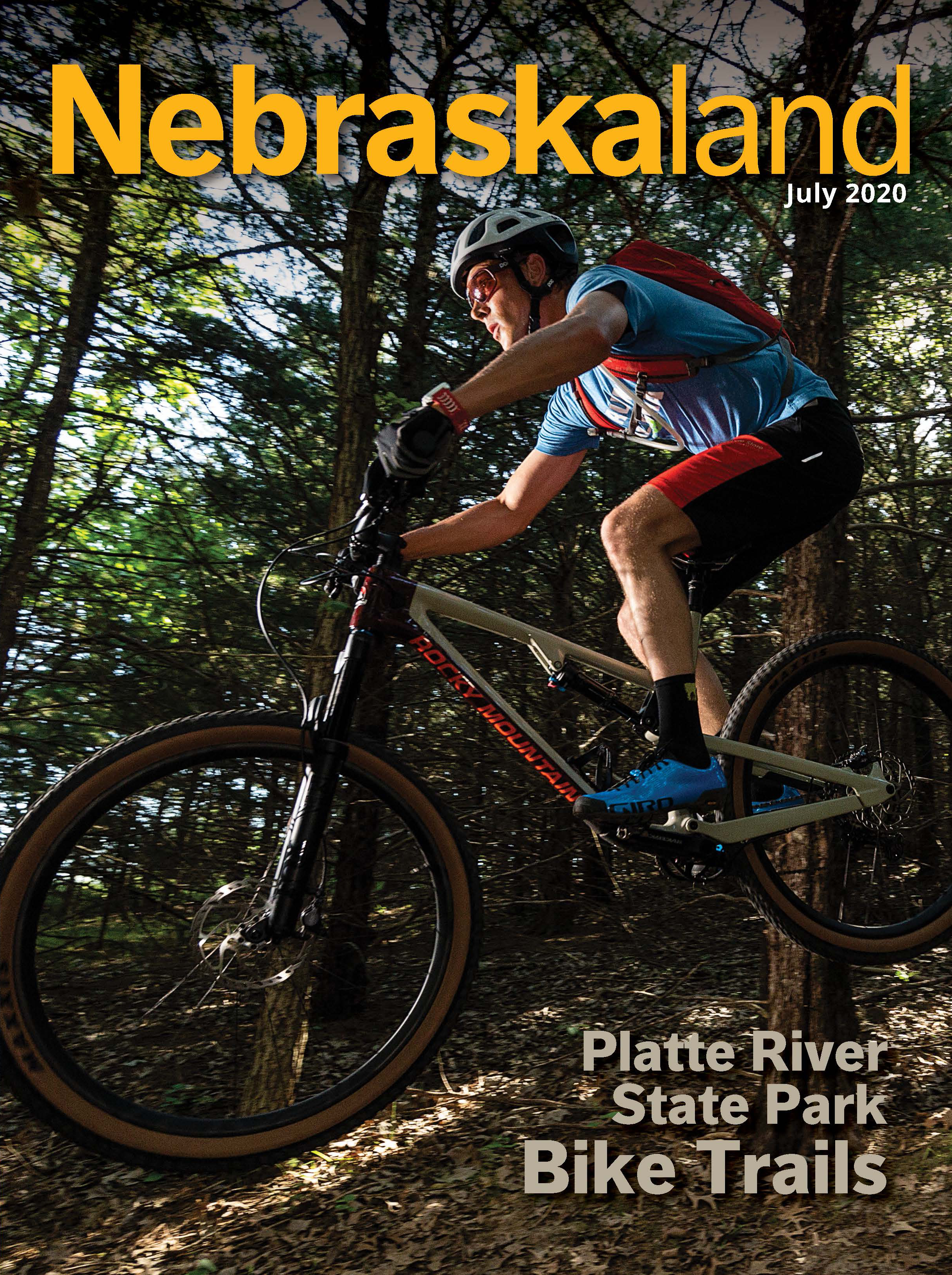
Cover: Colin Lodl of Omaha
flies off a flat ramp on the new
mountain bike trails at Platte River
State Park. Photo by Eric Fowler.
No. 6
Story and photos by Jenny Nguyen-Wheatley
What to Do in July
By Renae Blum
IT’S A WASP MANTIDFLY
Your Nebraska
In the Field
Mixed Bag
Portraits from the Past
The Last Stop
Story and photos by Chris Helzer
RIOT IN LOUP CITY
ON THE WEB
LAKE MCCONAUGHY STATE
RECREATION AREA
To see additional content including photos,
videos and additional articles, visit
Magazine.OutdoorNebraska.gov/digital.
By David L. Bristow, History Nebraska
By Julie Geiser
44
THOSE FIERY REDHEADS
48
TECHNIQUES FOR JULY BASS
50
PLATTE RIVER STATE PARK BIKE TRAILS
56
THE PERFECT TACKLEBOX
Story and photos by Justin Haag
Story and photos by Jeff Kurrus
Story and photos by Eric Fowler
Story and photo by Jeff Kurrus
Learn more and register
your team at NeGPP.org or
download our free app.
PHOTO BY JUSTIN HAAG
Nebraskaland (VOL. 98 / NO. 6 ISSN 0028-1964) is published monthly, except for the combined Jan./Feb. and Aug./Sept. issues, by the Nebraska Game and Parks Commission, 2200 N. 33rd St.,
Lincoln, NE. Periodicals postage paid at Lincoln, Nebraska, and additional mailing offices. POSTMASTER: Send address changes to Nebraskaland, P.O. Box 30370, Lincoln, NE 68503-0370.
Magazine Staff
magazine
Communications Director Christy Firestone
Public Relations Manager Shawna Richter-Ryerson
Published by the Nebraska Game and Parks
Commission since 1926. The Commission is
dedicated to the conservation and protection
of all the state's natural resources and the
people who use them.
Editor Jeff Kurrus
Associate Editor Jenny Nguyen-Wheatley
Regional Editors Eric Fowler, Julie Geiser,
Justin Haag
Contributing Editor Michael Forsberg
Regular Contributors Renae Blum,
Chris Helzer, Chris Masada, Ryan Sparks, Gerry
Steinauer
Three
e Program
m Categories::
Art Director Tim Reigert
Graphic Designer Mel Severin
Pathway
y Forr Grasslands
s
Photo Librarian Jaclyn Cruikshank Vogt
Administration
Director Jim Douglas
Deputy Director Tim McCoy
Commissioners
Chairman - Dan Kreitman, Wahoo
Vice Chairman - Pat Berggren, Broken Bow
2nd Vice Chairman - Rick Brandt, Roca
Robert Allen, Eustis
Donna Kush, Omaha
Scott Cassels, Omaha
Jim Ernst, Columbus
John Hoggatt, Kearney
Doug Zingula, Sidney
Circulation
For address changes and questions about your
subscription, call 800-632-5263
Advertising Sales Manager
For advertising information contact
Shane G. Gilster, 402-742-0125
Email: shanegilster@gmail.com
Conservation Officers
Headquarters/Southeast District Office
2200 N. 33rd Street Lincoln, NE 68503
Phone 402-471-0641
ADMINISTRATION (Lincoln)
Craig Stover (Administrator)
Duane Arp (Asst. Administrator)
Jeff Clauson (Asst. Administrator)
Travis Shepler (Asst. Administrator)
Southwest District Office
301 E. State Farm Rd. North Platte, NE 69101
Phone 308-535-8025
Northwest District Office
East Hwy. 2, Box 725 Alliance, NE 69301
Phone 308-763-2940
Bassett Office
524 Panzer St., Box 508 Bassett, NE 68714
Phone 402-684-2921
Kearney Office
1617 First Ave. Kearney, NE 68847
Phone 308-865-5310
Ak-Sar-Ben Aquarium/Schramm Education
Center
21502 W. Highway 31 Gretna, NE 68028
Phone 402-332-3901
Omaha Office
8495 Frederick Street, Omaha, NE 68124
Phone 402-595-2144
OutdoorNebraska.org
Any program that receives federal funding from the National Park
Service, or the United States Fish and Wildlife Service prohibits
unlawful discrimination on the basis of race, color, religion, age, gender,
marital status, national origin, age, disability or political affiliation. Any
person who believes he or she has been discriminated against in
any program, activity, facility, or service, should contact the Nebraska
Game and Parks Commission, Lincoln, NE 402-471-0641, the Equal
Opportunity Commission, Lincoln, NE 402-471-2024, TTY/TDD 402471-4693; United States Fish Wildlife Service, Civil Rights Coordinator,
4401 N. Fairfax Drive, Arlington, VA 22203; Director, Equal Opportunity
Program, U.S. Department of Interior, National Park Service, 1849 C
Street NW, Mail Code 0008, Washington, D.C. 20240-0001.
4
Nebraskaland • July 2020
Pathway
y Forr Precision
n Ag
g Conservation
Example
e acres:: Cropland,, CRP,, Corners,, Buffers,, Coverr Crops
Pathway
y Forr Community
y Habitat
Nebraskaland Magazine Copyright 2020, all rights reserved.
Nebraskaland is available in audio from the Nebraska Library
Commission Talking Book and Braille Service, Suite 120, 1200 N St.,
Lincoln, NE 68508. 800-742-7691. Nebraskaland Magazine and the
Nebraska Game and Parks Commission reserve the right to reject any
advertising not in keeping with the agency mission.
Rates: $18 for one year; $33 for two years; $44 for three years. Nebraska
recipients must add appropriate sales tax. To subscribe call
1-800-NEBLAND (632-5263), or go online to:
NebraskalandMagazine.com.
Commission Offices
Northeast District Office
2201 N. 13th St. Norfolk, NE 68701
Phone 402-370-3374
Example
e acres:: Rangeland,, Wasteland,, Pastureland
Enroll to benefit pheasants, quail, pollinators, and other wildlife.
402-471-5531
402-471-5531
402-471-5531
402-471-5531
NORTHWEST (Includes counties covered)
Dan Kling (District Supt.)
308-430-0572
Sean McKeehan
(Kimball, Banner, Scotts Bluff)
308-672-1824
Josh Widhelm (Morrill, Cheyenne)
308-279-9133
Kelsey Glodowski
(Box Butte, S 1/2 Sheridan, Grant)
308-763-8226
308-289-2274
Jaden Porter (Keith, Garden)
Kyler Prochaska (Dawes, Sheridan, Sioux) 308-430-3984
308-458-7650
Terry Brentzel (Deuel, Garden, Grant)
308-760-0145
Sean Schultz (Keith, Arthur)
308-289-9580
Keith Jadlowski (Keith, Deuel)
308-202-0140
Chance Vordeerstrasse (Keith)
NORTHEAST (Includes counties covered)
Tom Zimmer (District Supt.)
402-649-8053
402-760-0712
Dale Davis (Keya Paha, Brown, Rock)
402-340-3981
Jonathan Andreasen (Holt, Boyd)
402-508-0261
Nicholas Fix (Dixon, Dakota, Thurston)
402-719-6226
Kyle Gaston (Dodge, Colfax)
402-613-8612
Mitch Johnson (Knox, Antelope, Pierce)
402-762-5022
Jeff Jones (Knox, Cedar)
402-889-8508
Jon Reeves (Burt, Washington, Thurston)
Andrew Heyer (Pierce, Madison, Stanton) 402-613-2241
402-280-6410
Cory Krause (Cuming, Wayne, Stanton)
402-910-3366
Steve Oberg (Colfax, Platte)
Ethan Teter (Boating Officer-Dodge, Colfax) 402-620-8129
CENTRAL
Mike Thome (District Supt.)
Matt Taylor (Thayer, Fillmore, Nuckolls)
Mark Sullivan (Nance, Polk, Wheeler, Boone)
Matt Brandt (Sherman, Howard)
Greg Hesse (Buffalo, Kearney)
Tim Williams (Hall, Hamilton, York)
Doug Pollard (Loup, Garfield, Valley)
Eric Javins (Adams, Clay, Webster)
Pat George (Harlan, Franklin, Phelps)
Daryl Teter (Howard, Greeley, Merrick)
Example
e areas:: Parks,, Schools,, Retirementt Centers,, Community
y Green
n Space
308-293-8746
402-200-9597
402-741-0636
308-202-0819
402-440-3847
308-380-7331
308-730-7050
402-902-2017
402-705-9989
308-440-1863
SOUTHWEST (Includes counties covered)
Roger Thompson (District Supt.)
308-530-3097
Matt Andrews
(Furnas, Gosper, Frontier, Red Willow)
308-746-2418
Brian Piernicky
(Red Willow, Frontier, Hayes, Hitchcock)
308-340-6627
John Lee (Dundy, Chase, Hayes, Hitchcock)
308-414-1432
Brandon O’Neal
(Lincoln, McPherson, Logan)
308-530-3157
Alex Hasenauer (Lincoln, Perkins)
308-660-4671
402-266-1759
Owen Johnson (Dawson, Gosper, Custer)
308-870-0322
Ray Dierking (Custer, Thomas, Blaine)
402-389-0444
Frank Miller (Cherry, Hooker)
308-217-2108
Taylor Dixon (Dawson, Gosper)
Kevin Bergstrom (Boating Officer-Lincoln) 308-520-1031
SOUTHEAST (Includes counties covered)
Stacey Lewton (District Supt.)
402-890-7140
402-619-1355
Rich Berggren (Douglas)
402-616-5961
Dan Evasco (Sarpy)
402-210-0888
Heath Packett (Cass)
402-209-1506
Russell Mort (Otoe, Johnson)
402-890-6463
Dina Barta (Lancaster),
402-937-3422
Dudley Sorensen (Lancaster)
402-646-0420
Bryce Streger (Seward, Saline)
402-314-9641
Trevor Stahlecker (Lancaster)
402-853-3273
Scott Eveland (Lancaster)
402-806-0915
Matt Seitz (Gage, Jefferson)
402-443-6392
Mike Luben (Saunders, Butler)
Tree Removal
Program
m Highlights
i No cropping
g history
y necessary
y
i Annuall paymentt option
n
i Incentive
e payments
s
Shrub Management
Cover Crops
i 75--100%
% Cost--share
e
i 1 to
o 3--yearr contractt
Go to
o www.NebraskaPF.com
m to
o find
d outt more
e and
d to
o filll
outt an
n interestt form!
YOUR NEBRASKA
Instagram Photos
Follow us (@nebraskaland)
and tag us in your photos
to be featured in an
upcoming issue.
6
Nebraskaland • July 2020
Erik Johnson, Lincoln
Chadron State Park Sunset
July 2020 •
Nebraskaland
7
YOUR NEBRASKA
Karen Kutz Smith, Omaha
Lincoln County Burrowing Owl
Thomas D. Wiensch, Rhinelander, WI
Ashfall Rhino
Lacey Fiorelli, Broken Bow
Custer County Clouds
Send your comments and photos to:
Jeff Kurrus, Editor
Nebraskaland Magazine
P.O. Box 30370
Lincoln, NE 68503
or email Jeff.Kurrus@Nebraska.gov
Please include your postal address
and telephone number. Letters may be
condensed and edited. Photographs are
also welcome.
8
Nebraskaland • July 2020
July 2020 •
Nebraskaland
9
IN THE FIELD
PONDEROSA WILDLIFE
MANAGEMENT AREA
With a thunderstorm moving
in overhead, hoary vervain
and wilting purple coneflower
seem to be waiting for a dose
of moisture.
PHOT
HO O BY JUSTIN HAAG
HAA
10
Nebraskaland • July 2020
July 2020 •
Nebraskaland
11
IN THE FIELD
TIME WELL SPENT
THREATENED AND ENDANGERED:
THE COLORADO BUTTERFLY PLANT
By Gerry Steinauer
12
Nebraskaland • July 2020
only 12 plants. Several of the plant’s habitats had been
overtaken by the non-native and highly aggressive Canada
thistle. The moisture-loving plant’s collapse, however, was
due mainly to a drastic
decline in flows in Lodgepole
Creek caused by center-pivot
irrigation development, and
the associated decline in
its floodplain groundwater
levels. During the last few
decades, the creek has been,
literally, pumped dry.
Fortunately, the Colorado
butterfly plant’s fate in
Colorado and Wyoming is far
more encouraging, making it
one of the many successes
of the federal Endangered
Species Act. There, shortly
after the plant’s listing in
2000 as a threatened species,
the U.S. Fish and Wildlife
Service and its conservation
partners began efforts to
conserve its habitat. The city
of Fort Collins, Warren Air
Force Base and 11 ranchers
whose property contained
the butterfly plant signed
voluntary agreements to:
limit herbicide use near
plants, time haying to not
damage its flowers and seed pods, use prescribed fire and
managed grazing to maintain early successional habitat, and
maintain stream flows and groundwater levels. These efforts
were so successful that in 2019, the Colorado butterfly plant
was removed from the federal list of threatened species.
During surveys along Lodgepole Creek in 2018, seven
butterfly plants were found in a small area where overflow
from cattle tanks had saturated the floodplain soil. This
gives hope that a seedbank still persists along the creek,
and if its flows could be somehow restored, the plant may
yet survive in Nebraska. But for now, it remains a state
threatened species.
MAKE THE MOST OF
YOUR TIME TOGETHER.
Visit Nebraska’s State Parks
Learn more at OutdoorNebraska.org
BONNIE HEIDEL, WYOMING NATURAL DIVERSITY DATABASE
The Colorado butterfly plant is a High Plains rarity
restricted to a few counties in southeastern Wyoming,
northcentral Colorado and far western Kimball County,
Nebraska. Although it
has seen drastic declines
in Nebraska in recent
decades, in other parts of
its range, conservation of
the plant has been a model
of success.
A biennial to short-lived
perennial, the Colorado
butterfly plant (Oenothera
coloradensis) produces only
a leaf rosette its first year.
The following years, it
sends up flowering stems
reaching 2 feet tall. The
flowers have four pinkish
petals and long stamens
and style. In Nebraska, the
plant blooms in August,
and characteristic of the
evening primrose family
to which it belongs, the
individual flowers open
from late afternoon until
dawn. The butterfly plant is
mainly pollinated by nightflying moths.
The
finicky
plant
inhabits wet meadows and
other floodplain grasslands where a high water table keeps
soils constantly moist, but only at elevations of 5,000 to
6,400 feet. Furthermore, the butterfly plant grows only in
relatively open habitats created by disturbances, such as fire,
grazing and flooding. If the surrounding vegetation becomes
too dense, increasing competition for sunlight and other
resources, the plant falters.
In 1985, the butterfly plant was first discovered in Nebraska
when botanists also doing surveys in adjacent Wyoming
found about 2,000 plants growing in sandy and gravelly soils
in the Lodgepole Creek floodplain. Surveys in the early 2000s
found the plant in decline, and a 2008 survey documented
IN THE FIELD
NEBRASKA LAND FOR SALE
KNOX CO, NE - 737 AC.
Priced to sell! This diverse tract has something
for everyone. It is enrolled in a perpetual WRP
easement (Wetland Reserve Program) which will
help to preserve the quality habitat that makes
up this incredible recreational property. Views
from the bluff overlooking the Missouri River
along Highway 12 are going to be hard to beat.
Thick hardwood timber flows through the draws
and is loaded with beat down deer trails. Several
ponds are scattered along shelves down below
the ridgeline providing secluded water holes
for the wildlife. The southern portion of the
property boasts open views of the rolling native
grass-covered hills.
PHOTO BY JUSTIN HAAG
BUTLER CO, NE - 86.93 AC.
OUTLOOKS, WATCHES AND WARNINGS
By Martha D. Shulski
We are well into severe weather season here in Nebraska.
Severe thunderstorms with strong winds, damaging hail,
tornados, flash flooding and lightning – all of these hazards
are common in our little continental corner of the world.
On your local news channel, or if you’re like me and have
a NOAA weather radio, you have likely heard the terms
convective outlooks, watches and warnings many times
when it comes to severe weather.
Convective outlooks are issued by meteorologists at
the Storm Prediction Center, based in Norman, Oklahoma.
They determine daily which areas of the U.S. are at risk;
five categories ranging from marginal to high are used to
classify risk eight days out. As one would expect, the further
out in time, the more difficult it is to make an accurate risk
assessment. However, these outlooks tell us where to focus
our attention, and perhaps, also where to focus your camera
lens.
Watches are the next stage, and these generally cover
large multi-county areas issued hours ahead of time. When
a watch is issued, it tells you to be alert for specific hazards,
check for forecast updates and monitor the sky, and most
14
importantly know where to take shelter should hail, high
wind, flash flooding and/or a tornado occur. Whether on a
lake, river, pasture or forest, it is at this stage you identify
your safe place. This way, if a warning is issued, you know
where to go.
Warnings are issued by local National Weather Service
forecast offices, six of which do so for Nebraska, and
represents the time to take action. With a warning, severe
weather is either happening or imminent, and these boxes
cover a much smaller area (a few counties) and shorter
timeframe (minutes) than watches. Advanced weather apps
with radar are a good idea so you can track storm movement
and intensity as conditions can quickly change.
It is advisable to have a severe weather preparedness kit,
as you would a first aid kit. Water, nonperishable food, can
opener, flashlight, batteries, infant needs and personal hygiene
items are recommended. Part of this kit is a refresher on severe
weather terminology as preparedness is the best defense.
Martha D. Shulski, at the University of Nebraska-Lincoln, is
the director of the Nebraska State Climate office.
If you have been looking for huntable acres
that won’t break the bank, you’ve got to
see this one! Located just outside of Rising City, you’ll find this property nestled
among seemingly endless tillable acres.
This parcel was entered into a conservation
easement through the NRD for the primary
purpose of maintaining rangeland as well
as wildlife habitat. Grazing is still allowed
on the property as well as haying after July
15th. Hay next to the marshy areas in late
summer and give yourself the opportunity
to run floating and field decoys in the fall
for an irresistible waterfowl spread! You’re
not going to want to miss this opportunity!
CONTACT JASON OR LUKE TO LEARN MORE
ABOUT THESE AMAZING PROPERTIES
JASON SCHENDT | BROKER
LUKE WALLACE | AGENT
jason.schendt@whitetailproperties.com
luke.wallace@whitetailproperties.com
402.707.4885
402.340.6187
WHITETAILPROPERTIES.COM
Whitetail Properties Real Estate, LLC - DBA Whitetail Properties | In the States of Nebraska & North Dakota - DBA Whitetail Trophy Properties Real Estate LLC | Licensed in IL, MO, IA, KS, KY, NE & OK - Dan Perez, Broker | Licensed in AR, CO, GA,
MN, ND, SD, TN & WI - Jeff Evans, Broker | Licensed in FL, OH, NY & PA - Jefferson Kirk Gilbert, Broker | Licensed in TX & NM - Joey Bellington, Broker | Licensed in IN - Bill Minor, Broker | Licensed in AL, GA, LA, & MS - Sybil Stewart, Broker |
Licensed in TN - Chris Wakefield, Broker | Licensed in TN - Bobby Powers, Broker | Licensed in AR - Anthony Chrisco, Broker | Licensed in SC, NC & VA - Chip Camp, Broker | Licensed in NC - Rich Baugh, Broker | Licensed in MI - Edmund Joel
Nogaski, Broker | Licensed in WV - Debbie S. Laux, Broker | Licensed in ID, MT, OR & WY - Aaron Milliken, Broker
Nebraskaland • July 2020
NEB_Land_ad_5-20.indd 1
5/19/20 9:53 AM
PHOTO BY GERRY STEINAUER
IN THE FIELD
STINKHORNS – THE NAME SAYS IT ALL
By Gerry Steinauer
My first encounter with a stinkhorn mushroom was during
a college botany field trip. Our professor pointed out the
mushroom and then he had a few of us smell it. Its odor was
putrid, like rotting flesh.
The dune and common stinkhorn are widespread in
Nebraska, growing summer through fall in lawns, gardens
and grasslands. The mushrooms develop in an egg-sized
structure located just below the soil surface. The two
stinkhorns are identical in appearance except the common
stinkhorn’s egg is pure white, while the dune stinkhorn’s egg
is white with a purplish tinge.
The mushrooms erupt from the egg seemingly overnight,
growing up to 4 to 6 inches in a few hours. Once erupted, the
coating on the stinkhorns’ cap quickly breaks down into vilesmelling, spore-filled slime that attracts flies, beetles and
other insects. Some insects consume the slime while others
wade through it looking to lay their eggs. The foul smell
tricks them into believing they are depositing their eggs on
decaying flesh on which their larvae can feed.
Unlike other mushrooms, which have wind-dispersed
16
Nebraskaland • July 2020
spores, stinkhorn spores are insect-dispersed. The wideranging insects leave the mushrooms with spores stuck to
their feet or in their gut, which are later expelled in their
feces.
Though they are non-toxic, it is hard to imagine anyone
would eat stinkhorns, but in China and central Europe the
odorless eggs are considered a delicacy. Here, they are pickled
raw and often sold in markets under the name “devil’s eggs.”
One mushroom connoisseur described them as “delicious”
when sliced and fried like Wiener schnitzel. Others have a
less favorable opinion regarding the egg’s edibility.
Last summer, about 25 dune stinkhorns sprouted in our
front yard in Aurora. They were soon thick with flies and other
insects that, after a few days, had licked the mushrooms’
honey-combed heads clean of its sticky goo. They then
became less pungent and their caps faintly resembled a
morel mushroom in shape and color. At this stage, one could
envision a novice mushroom hunter mistaking a stinkhorn
for a delectable morel. It would be a mistake they made only
once.
Nebraska Game and Parks biologists shock and net fish from a
resting pool in a fish bypass built at Spalding Dam on the Cedar
River in Greeley County. The fish were caught and tagged as part
of a study to measure the effectiveness of the bypass.
We’re working to preserve beautiful Nebraska for years
– and generations – to come. #MakingItLast
July 2020 •
Nebraskaland
17
IN THE FIELD
PLAY
PLAY
PHOTO BY JUSTIN HAAG
EXPLORE
EXPLORE
LEARN
LEARN
NEBRASKA’S WOOD-PEWEES
By Joel Jorgensen
Sitting among friends and family at a wooded campground
is a great way to spend time during the summer. It is also an
opportunity to hear the simple song of a wood-pewee if you
pause from the conversation and listen closely.
Wood-pewees are drab brown, tyrant flycatchers closely
related to the more visible and sharply-colored eastern and
western kingbirds. Like their kingbird cousins, there is also
an eastern and a western wood-pewee. Unlike the kingbirds,
which both occur statewide, the wood-pewees are mostly
divided by the eastern and western portions of the state.
In other words, which wood-pewee’s song you’re hearing
depends on where your campground is located.
Prior to European settlement, the two wood-pewees’
ranges were disjunct. Eastern wood-pewee were breeders
in the woodlands of the east and western wood-pewees
were restricted to the limited forested lands of the west,
such as the Pine Ridge. As woodland vegetation spread,
especially along major river corridors such as the Platte,
each wood-pewee expanded their range toward the center of
the state. Now, these two species’ breeding ranges narrowly
18
Nebraskaland • July 2020
overlap in central Nebraska and this has led to instances of
hybridization between the wood-pewees.
The two wood-pewees appear nearly identical. They are
best distinguished from one another by voice and by range.
The eastern wood-pewee’s song is a plaintive whistled “peea-wee.” The western wood-pewee’s song is similar but the
latter syllable is downslurred and sounds like “pzzeeyeer.”
Mercifully, wood-pewees tend to sing at all hours of the day,
so you won’t have to get up at the crack of dawn on your
camping trip to hear one. All wood-pewees prey on insects
which they typically catch in mid-air by making short
flights from a favored perch. Wood-pewees are a Neotropical
migrant, arriving in a majority of the United States by May,
and they winter primarily in South America once breeding
has finished in August.
So while you enjoy those long summer days, take a moment
to add the simple songs of the wood-pewees to your outdoor
soundtrack.
Visit birdsofnebraska.org for more Nebraska bird information.
RELAX
RELAX
NNEEBBRRAASSKKA’A’SS
OOUT
UTDOOR
DOOR
Venture Parks
E.T.
E.T.Mahoney
Mahoney• •Platte
PlatteRiver
River• •Schramm
Schramm• •Louisville
Louisville
OutdoorNebraska.org/VentureParks
OutdoorNebraska.org/VentureParks
July 2020 •
Nebraskaland
19
PHOTO BY JENNY NGUYEN-WHEATLEY
IN THE FIELD
Online
Learning Resources
for All Ages
VENISON DIRTY RICE
By Jenny Nguyen-Wheatley
Servings: 6-8
Prep Time: 2 hours
Cooking Time: 30 minutes
Ingredients:
2 cups of uncooked long-grain white
rice (and required water)
3 ounces of deer liver, minced
1 pound of ground venison
2 tablespoons of olive oil, separated
Half a red bell pepper, ribs removed
and diced
Half a green bell pepper, ribs
removed and diced
2 ribs of celery, chopped
1 onion, chopped
1 jalapeno pepper, chopped
2 cups of chicken or game stock,
separated
2 teaspoons of paprika
½ teaspoon of garlic powder
½ teaspoon of dried thyme
1 teaspoon of dried oregano
2 tablespoons of butter
•
•
•
•
•
•
•
•
•
•
•
•
•
•
•
20
Nebraskaland • July 2020
• Kosher salt, to taste
• Lawry’s Seasoned Salt, to taste
• Cayenne pepper, to taste
• Freshly cracked pepper, to taste
• Scallions, freshly chopped
• Hot sauce, optional
1. Cook rice according to package
directions and allow to cool completely.
(Day-old rice that’s been refrigerated is
preferable).
2. In a large skillet, heat 1
tablespoon of oil over medium-high
heat. When it begins to smoke, add
the ground venison and minced deer
liver, flattening the meat out onto the
hot surface of the pan. Leave it alone
to caramelize for a couple of minutes,
and then break it up into small pieces
and stir to brown completely. Season
to taste with kosher salt and freshly
cracked pepper. Transfer to a bowl and
set aside.
3. In the same skillet, turn heat
down to medium and add remaining
oil. Add chopped onion, celery, green
bell, red bell and jalapeno peppers.
Season with a pinch of kosher salt and
sauté until all of the “veggies” soften
and become slightly caramelized,
about 5-7 minutes. Stir in paprika,
garlic powder, thyme and oregano. Add
½ cup of stock, scrape the bottom of
the pan with a wooden spoon and then
allow the liquids to boil and evaporate
almost completely.
4. Next, add the cooled rice and
cooked meat mixture into the skillet,
and stir well to combine. Stir in
remaining stock and allow moisture
to evaporate, stirring frequently. Stir
in butter until melted. Season to taste
with Lawry’s Seasoned Salt, cayenne
pepper and freshly cracked pepper.
Garnish with chopped green onion.
Serve with a vinegary hot sauce.
Both kids and adults will
stay busy and learn new things
with a wide range of free
educational activities, lesson
plans and resources now
available on our website.
Check us out today at
OutdoorNebraska.org/OnlineEducation
This one-stop compilation offers a variety of resources:
• Fun, age-appropriate lesson plans
• Citizen science projects
• Videos and chats
• Craft activities
• Wildlife identification guides
• Email experts for your nature questions
• Learning resources for all ages
• Facebook posts and updates
July 2020 •
Nebraskaland
21
PRACTICE
MAKES BETTER
STORY AND PHOTOS BY JENNY NGUYEN-WHEATLEY
I
’m 5 feet 2 inches, female, righthanded and left-eye dominant. Outof-the-box firearms typically don’t fit
me, and youth models have made poor
substitutes. As if learning to shoot
at a flying target, left handed, wasn’t
difficult enough – throw in an illfitting gun and it becomes a recipe for
frustration.
I took up shooting and hunting in my
early 20s. My husband, Rick, introduced
me to it, and since then, my journey
has been like a roller coaster, one that
broke down a lot and got stuck in
inconvenient places. I am satisfactory
with the rifle – decent enough to get
venison in the freezer, anyway – but
wing shooting was another story. The
most disappointing part was I really
wanted to be good at it.
If I had to pick between dozing off
in a deer blind or walking a pheasant
field, I’d choose upland hunting nine
times out of 10. There’s just something
about walking under big sky, toting an
over-under and following dogs that I
find more romantic than anything else.
Sadly, I let several failed attempts on
the range and in the field defeat me. I
didn’t touch my Beretta Whitewing for
years. That is – until I picked it up again
last summer.
In summer 2019, Rick and I received
an invitation to hunt grouse in western
Nebraska. The opportunity was too
good to pass up, and I’ll admit, the fear
of looking like a fool dug into my sides
the hardest. I asked around and got
connected with a shooting instructor
in Blair. I figured that with a few
pointers, I’d be up and running by the
fall. Alas, my journey toward becoming
a better upland hunter wasn’t as simple
as I’d hoped.
To put it simply: My gun was made
for a right-handed shooter, which
meant that in a left-handed shooter’s
hands, it was inaccurate.
Shooting coach Greg Preston said I
had two options: I could take a chance
and buy a left-handed gun or I could see
a gunsmith to modify what I already
have. After fruitless hours researching
left-handed shotgun options for
vertically-challenged women, which
were virtually nonexistent, I decided
it would be more economical to see a
local gunsmith.
Pictured is a Beretta Whitewing 20 gauge over-under shotgun.
22
Nebraskaland • July 2020
July 2020 •
Nebraskaland
23
Left: Gunsmith Stephen Reynolds working in his shop,
Midwest Gunstocks near Herman.
ANATOMY OF A SHOTGUN
Below: Pictured is a gunstock that Reynolds made for a lefteye dominant client to shoot right-handed.
Bird hunting is reflex, reactionary-type shooting, making gun fit paramount to success in
the field. Three gun fitting problems include the drop, cast and length of pull. The drop of a
shotgun determines whether your pattern lands high or low, whereas the cast determines the
right and left. The length of pull is the measurement between the trigger and the butt.
SIGHT
RIB
DROP AT HEEL
DROP AT COMB
BUTT
BARREL
TRIGGER
MUZZLE
FORE-END
ILLUSTRATION BY TIM REIGERT
STOCK
LENGTH OF PULL
CAST
Now that I had made the decision to “stick to my gun,” the
task of finding a willing, knowledgeable gunsmith turned
out to be surprisingly complicated. After what seemed like
a wild goose chase, the third gunsmith was the charm:
Stephen Reynolds at Midwest Gunstocks was the man. He
cut down my gunstock to shorten the length of pull, shifted
the gun’s cast to fit a left-handed shooter and stuck on foam
to temporarily heighten the comb to adjust my shotgun’s
drop. Stephen was also generous with his knowledge. He took
the time to explain what he was doing and kept in contact
with Greg throughout the entire process.
It was a solid month and a half from the time I
first met with Greg to when I was finally able to
hit targets over a trap house. I got in two shooting
lessons before my grouse hunt out west, fewer than
I had hoped, but still, I felt good about it. My gun
was finally shooting where my eye was looking,
and if I missed – which was often, still – then it was
on me. The difference was that I could actually see
where I was making mistakes and improve.
I had more fun on that September grouse hunt
than I had in a long time. I successfully connected
with my first sharp-tailed grouse and experienced
that heart-pounding, gut-wringing miss on my
only chance at a greater prairie chicken.
My shotgun recently went back to Stephen for
installation of a permanently raised cheek piece,
and I look forward to getting back out to the
shooting range this summer with Greg. But more
than ever before, I’m excited about this upcoming
upland season, and that’s because this time,
I’ll be ready. N
Stephen Reynolds is a master-class skeet shooter with 40
years of gunsmithing experience. Stephen modifies and
builds custom gunstocks out of his shop, Midwest Gunstocks,
near Herman. Contact Midwest Gunstocks at 402-208-8080.
Greg Preston is a master-class sporting clay shooter and
head coach of Blair’s high school trap team. He is a level
one National Sporting Clay Association instructor, an NRA
shotgun certified instructor and an Orvis-endorsed wing
shooting instructor. Greg is also a hunting guide at Pheasant
Bonanza.
I asked Stephen and Greg to provide insight on why practice
and fit is so important in wing shooting.
Gunsmith: Stephen Reynolds
What motivated you to become a gunsmith?
SR: I got into shooting because I had an interest. Then I
started realizing that you can’t give a 10-year-old grandpa’s
gun. Grandpa probably weighs 260 pounds and is 6 foot 2
inches – you can’t give his gun to an 80-pound wet kid, and
then laugh and take it away because the gun threw him on
his butt. I think that’s abuse. If you’re going to get people to
go out and shoot, you need to make sure that their tools are
Rick and Jenny Wheatley of Omaha sharp-tailed grouse hunting on
public access land near Minatare.
24
Nebraskaland • July 2020
July 2020 •
Nebraskaland
25
Reynolds helped Wheatley pattern her shotgun before and
after he modified her gunstock. The top target shows the
before pattern and the middle shows after.
right and the process is right.
Another thing that got me going is if you go to the local gun
store – there are guys that do hunt and shoot, but 99 percent
of the time, they’re often the same guys who would’ve sold
you golf clubs during the summer. It makes no sense to buy a
$2,000-$3,000 rig from someone who has no clue which end
of the gun they’re supposed to hold. That is a problem.
Seventeen percent of the country is also left-handed and
is overlooked by the shooting industry. Manufacturers are
trying to be better about it, but they really don’t want to
make left-handed guns. Honestly, manufacturers don’t want
to make super accurate guns. If they made them too accurate,
then you wouldn’t buy as many shells.
What mistakes do people make when they purchase a
shotgun?
SR: The biggest mistake is fit. If it doesn’t fit, it doesn’t hit.
If the gun isn’t looking where you are looking, I don’t care
how expensive or new that model is.
I had a guy come in with a $22,000 Krieghoff, and he said,
“I gotta get this figured out. My wife is [angry] at me. I bought
it because I thought it looked cool, but I can’t hit [anything].
26
Nebraskaland • July 2020
Julia Plugge of Lincoln pheasant hunting during a Becoming an Outdoors-Woman
event at Clear Creek Hunting Lodge in Bartlett.
My Browning shoots better than this gun.”
Second, if you can’t pronounce the name of the gun, there’s
a good chance you won’t be able to get parts for it. Make sure
you’re not buying a one-run gun.
Also, know whether you’re left- or right-eye dominant.
I do believe that if your eye is saying you’re a right-handed
shooter, then you should follow through with your right eye,
and vice versa.
When purchasing a shotgun, what should a buyer look
for?
SR: Look for length of pull when mounting the gun – do
you feel like you’re working for it or do you feel like it comes
to you? Are you fiddling your head too much to resettle the
gun? Look it over and make sure it’s in sound shape. A new
gun can have a cracked stock or a blemished barrel, which
can explode, crack or shatter.
Make sure you’re ready for the recoil. It’s rare, but ask if you
can test-fire the gun. This is the strangest business. You can
buy a car and test drive it, used or new, but to buy this $1,400
gun, you must purchase it to see if you like it, and then you
can’t return it. The industry has that wrong. Every gun that’s
sold should be allowed to be test fired.
How can a gunsmith help?
SR: I let the operator tell me what’s bothering them. The
gun can’t do any talking. I can’t feel what they feel. Is it
hurting you? Does it pop you in the chin? Does it rock your
shoulder too much?
Then I look at how the gun fits and where the pad is resting
on the shoulder. Before I do anything to the gun, I check
to see if the shooter has a flinch by asking them to shoot
with empty shells. If there’s a bad flinch, then we have to
clean that up before proceeding. There’s no one-size-fits-all
diagnosis for every person. You have to bring the patient in
and go over it.
July 2020 •
Nebraskaland
27
E. Butler] went up against Annie Oakley and failed. He ended
up marrying her. This is good inspiration for the new female
shooter. They have more than hope – they have someone
who has already done it.
How does gun fit translate to success in the field?
SR: Stop wasting shells and get your gun fitted. That’s my
slogan. Always pattern your gun. Then get shooting lessons,
which you shouldn’t take as a joke.
I’ve hunted big game and small game – I love all of it. I
always teach people that it isn’t the thrill of the kill. I don’t
want them to think about volume. I want them to think it’s a
one-shot gun. One shot, one kill. It shouldn’t take three shots.
Make it clean.
Shooting Instructor: Greg Preston
What is the No. 1 problem you see with hunters who
don’t spend enough time shooting before the season?
GP: Hunters who don’t spend time shooting in the offseason are not fluent and comfortable with their shotguns
during the hunting season. It’s like any other sport – practice
is what makes a good wing shooter. Shooting sporting clays,
such as trap and skeet, and making sure you learn good
shooting fundamentals is one of the best ways to become a
good bird shooter.
What are other mistakes?
GP: Another mistake I see in the field is that a lot of people
rush the shot. Take that split second to adjust your feet and
get to the leading edge of the bird. Take the time to make a
good mount with your gun, which will help you get into a
position where you will have plenty of swing and follow
through to make a good kill shot.
To warm up, take advantage of shooting clay targets before
a bird hunt. If available, hunting guides will often be more
than happy to offer instruction.
Also, kids change their shoes every six months, and the
same goes for their gun. Kids grow rapidly, and their body
mass and muscles are changing. You need to readjust the gun
to the shooter as he or she grows. Do a gun check and gun
fitting every six months, especially for youth shooters. For
women, we say they gain muscle. For men – well, we get fat.
Any tips for the female shooter?
SR: Every female shooter should look up the biography of
Annie Oakley and study it. That lady paved the road for every
woman in this world. She destroyed the men in her class and
was the best of the best.
In my years of teaching, I’ve found that women are
typically better operators. They can process better. They are
more detailed, and they listen. The world’s best shot [Frank
28
Nebraskaland • July 2020
In what ways can practicing at the range translate to
more success in the field?
GP: As a hunter, shooting sporting clays is a game that was
designed to help and improve the shooting skills of hunters
in the field. Sporting clays will help you become smooth and
comfortable with a shotgun. It will also help you understand
foot positioning when shooting targets at different angles
– whether it be a clay target or a live bird. The game will
also help a person develop a good mount and a good follow
through, which is crucial in bird hunting.
As a shooting coach, what’s the first thing you work on
with a new student?
GP: With a new student, I always discuss safety first, and
then I check to see if they are right- or left-eye dominant. Gun
fit is also important. A lot of people try to shoot a shotgun like
a rifle with one eye open. It’s always best to have both eyes
open when shooting a shotgun.
Shooting coach Greg Preston of Omaha instructing student Jager Leichleiter of Tekamah at a trap range in Blair.
What’s the most challenging aspect of shooting at a
flying target?
GP: The most challenging aspects are keeping your eye on
the target and not the barrel of the shotgun, and seeing how
much lead is needed to kill birds moving at different speeds –
whether it be a flushing bird such as a pheasant or quail, or
shooting at a crossing bird such as a duck or goose.
Is there a certain skill that new students find most
difficult to master?
GP: Every shooter is different, but I often find that people
don’t trust their own hand-eye coordination, which will
cause them to look at the barrel of the shotgun instead of
focusing on the target.
People also have trouble keeping their head down on the
gun, and then finally getting into position and mounting
before shooting. By practicing during the off-season, you
learn to trust yourself. You need to trust your lead hand. If
you’re a right-handed shooter, your lead hand is your left
hand, and vice versa. Trust that hand and follow with your
eye to lock in and pull away from the target to make a clean
shot.
How can an instructor help to improve a hunter’s
technique versus them practicing solo?
GP: A shooting instructor will help you pick out and fix
problems that you didn’t even know you had. They can help
simplify your movements and help you understand what
moves to make in different situations. They will also teach
you how to stand during hold points and break points of a
clay target. Practicing by yourself and not understanding
what you’re doing wrong or why you are missing will lead
you to develop bad habits. And for young shooters, it’s best
to start with an instructor so that doesn’t happen. After a
few lessons on clay targets, most people find that when they
go hunting, the skills that they learned will automatically
happen when a bird flushes.
How does a hunter or shooter get connected with an
instructor?
GP: You can find an instructor through the National
Sporting Clays Association or the National Skeet Shooting
Association websites. Or contact your local shooting range,
and they should be able to connect you with someone. If not,
contact me at 402-699-2317, and I will be able to provide
lessons or help you get connected with an instructor in your
area.
July 2020 •
Nebraskaland
29
Outdoor Nebraska
What To Do in July
By Renae Blum
Through October
Go horseback riding at Fort
Robinson State Park
SAILING IS POPULAR ON LEWIS AND CLARK LAKE SRA
PHOTO BY ERIC FOWLER
White bass are relatively easy to catch
even when temperatures heat up, making
them a popular summer game species.
Anglers should have good luck at Sherman
Reservoir; according to sampling reports,
it’s one of the best white bass fisheries
this year. The area also offers boating,
picnicking and several miles of hiking
trails.
WHITE BASS FISHING
PHOTO BY JENNY NGUYEN-WHEATLEY
Go boating at Lewis and Clark State
Recreation Area
Throughout the month
Fort Robinson State Park offers 22,000 acres of some of the best
horseback riding you will find, with breathtaking scenery and
marked trails. Trails on top of the buttes wind through pine trees and
open up to some amazing views. Both easy and challenging trails are
available; choose what you and your horse are ready for.
Throughout the month
Nebraska’s second largest lake, Lewis and Clark Lake is popular for boating.
The lake has lots of access points, is typically calm and large enough that
you can usually escape the crowds. Boating opportunities don’t stop at
Lewis and Clark; the lake also offers access to the Missouri River.
Ready your hunting
equipment
Look for monarch caterpillars
Throughout the month | Statewide
While July is a slow month for hunting,
you can prepare for a great hunt now
by cleaning, repairing, restoring and
organizing your hunting gear. You can also
replace batteries, waterproof tent blinds,
clean firearms, sharpen knives and check
your first aid kit.
Monarchs hatched in late July will make the 1,500-mile
journey to Mexico in September and October. View them
as caterpillars by searching for milkweed in prairies,
meadows, roadside ditches and grasslands. If you don’t see
caterpillars, don’t get discouraged; you can still appreciate
all the other species that use milkweed – on average there
are about seven of them at all times on a milkweed plant.
Nebraskaland • July 2020
HUNTING EQUIPMENT
PHOTO BY JENNY NGUYEN-WHEATLEY
Throughout the month | Statewide
30
A MONARCH BUTTERFLY CATERPILLAR ON A COMMON MILKWEED
PHOTO BY JEFF KURRUS
HORSEBACK RIDING AT FORT ROBINSON STATE PARK
PHOTO BY ERIC FOWLER
Summer’s long days are here, and it’s prime time
to enjoy green parks, cool water and nights
under the stars. Here are a few other ideas of
what to do this month. N
Fish for white
bass at Sherman
Reservoir
July 2020 •
Nebraskaland
31
It’s a Wasp!
It’s a Mantid!
It’s a Fly!
It’s a
Wasp
Mantidfly
Story and photos by Chris Helzer
32
Nebraskaland • July 2020
July 2020 •
Nebraskaland
33
D
o you remember being a kid and drawing beasts that
c
combined
the features of several different animals?
“L
“Look
what I made! It’s a creature with the head of a
lio the wings of a dragon and the body of a zebra!”
lion,
If a group of entomologists got together to play that
game, one of them might come up with something that looks
like the wasp mantidfly (Climacella brunnea).
“Look what I made! It’s a creature with the head of a lacewing,
the front legs of a mantis and the body of a paper wasp!”
The wasp mantidfly is most closely related to lacewings and
antlions. It is a predator that uses its praying mantis-style front
legs to capture small prey. In addition, it sometimes feeds on
liquids exuded by certain plants. Its wasp disguise likely helps
the mantidfly avoid being eaten by potential predators, since
most of those predators are savvy enough to recognize the
problems associated with trying to catch and eat a paper wasp.
Wasp mantidflies can be found across Nebraska and most of
North America, but they are commonly overlooked because of
their successful mimicry.
Female wasp mantidflies lay hundred of eggs in long rows
on leaves. When the eggs hatch, the larvae hang out until
they spot a passing spider. When that happens, they attempt
to attach themselves to the spider, and if successful, act as
parasites by feeding on the spider’s blood. However, the larvae
are really waiting for the spider to lay eggs, which are the main
food source of mantidfly larvae.
If a mantidfly larva ends up on a male spider, it will wait for
an opportunity to hop over to a female – often during mating.
The larva then allows itself to get wrapped up in the spider’s
silk-covered egg sac, where it can feed on those eggs and
tiny spiderlings at its leisure. Once it has eaten enough, the
mantidfly larvae creates its own silk covering as protection
while it metamorphs into an adult.
Despite being formidable predators, both as adults and
larvae, wasp mantidflies are harmless to humans. In fact, their
weak flying ability makes them easy to catch and observe, and
they’ll readily feed on flies or other small prey you provide for
them. The trick, of course, is to find a wasp mantidfly in the
first place. Most creatures that look like paper wasps really are
paper wasps, after all, and there can be risks to examining each
one closely enough to see if it’s faking. N
Antlion (above), praying mantis (below left) and paper wasp (below right).
Chris Helzer is a contributing editor to Nebraskaland.
34
Nebraskaland • July 2020
July 2020 •
Nebraskaland
35
Riot in Loup City
By David
d L. Bristow, History Nebraska
b k
oup City may be one of the last places you’d expect a riot.
But the central Nebraska town was not immune to bitter
conflict during the Great Depression.
By 1934 Nebraska had struggled for several years under
the combined weight of economic depression and prolonged
drought. President Franklin Roosevelt’s New Deal programs
were underway, but some people were turning to more radical
solutions. The Farm Holiday Association encouraged farmers
to withhold their products from the market in the hope
of driving up the prices they received. Some farmers even
temporarily blockaded highways in Nebraska and Iowa to
keep other farmers from selling.
Some of the Farm Holiday leaders had ties to other
radical leaders, such as Ella Reeve “Mother” Bloor, who
was a national speaker and organizer for the Communist
Party U.S.A. The 72-year-old Bloor led farmer strikes in
the Midwest and spent time in Nebraska. She and other
communists were highly critical of the New Deal, arguing
L
that it was
merely an
attempt to save
capitalism by
blunting its worst effects.
Loup City’s largest employer was the local Fairmont
Creamery. The company also operated a poultry plant where
female workers plucked chickens. Complaining of long hours,
low pay and bad working conditions, the “chicken pickers”
planned to strike.
Farm Holiday leaders, including Mother Bloor, organized
a Loup City rally in support of the strikers. It was set for
Flag Day, June 14. Truckloads of farmers from neighboring
counties arrived and gathered on the courthouse lawn.
Meanwhile, local business owners were alarmed that
“communist agitators” were coming to their community. The
local sheriff hastily deputized 40 extra men. They were said
to be young men who knew how to fight.
Demonstrators gather outside the creamery building. History Nebraska RG2543-4-17
36
Nebraskaland
• July 2020
A crowd gathers on the Sherman
County Courthouse lawn. History
Nebraska RG2543-4-19
Strike supporters hope to give speeches, but the gathering becomes a standoff.
History Nebraska RG2543-4-23
Both sides later accused the other of starting the brawl.
Somebody yelled “Hey, Rube!” – circus carny slang to call for
help in a fight – and the brawl was on. The men fought with
fists and blackjacks for the next 10 minutes or so. Within the
crowd a photographer managed to capture some of the chaos
without getting his camera smashed.
The fighting ended when somebody shouted, “They have
killed Burt Sell!” Sell, of Arcadia, was one of the Farm Holiday
men. He wasn’t dead but lay unconscious with a broken jaw.
Though it wasn’t clear who started the fight, only one
side faced legal consequences. Mother Bloor and eight other
strike supporters were convicted of inciting a riot. They were
fined $100 each and sentenced to 30 days in jail.
Today, a state historical marker on the Sherman County
Courthouse lawn says that the jail sentences “marked the end
of the attempt by the far left to organize farmers and workers
in Nebraska.” But that wasn’t the only thing that undermined
the Farm Holiday Movement. Another factor was the
popularity of the New Deal. The federal programs designed to
provide jobs, housing, Social Security and economic stimulus
were controversial, but in 1936, Nebraskans helped re-elect
Roosevelt, giving him 57 percent of the state’s vote. N
Visit History Nebraska’s website at history.nebraska.gov.
The fighting begins when somebody shouts, “Hey, Rube!” History Nebraska RG2543-4-22
July 2020 •
Nebraskaland
37
L a ke
M c C o n a u g hy
State
Recreation
Area
Big Changes at the Big Lake
early everything about Lake
McConaughy is big. At 30,000
surface acres, it is Nebraska’s
largest reservoir, its dam is among
the largest of its kind in the world, and
its fish grow to trophy proportions,
accounting for several state records.
Even its nickname, “Big Mac,” reflects
its size.
Located 8 miles northeast of
Ogallala, Lake McConaughy State
Recreation Area is known to most
Nebraskans
and
residents
of
neighboring states as a great place for
outdoor recreation. Lake Mac’s white
sand beaches and clear waters are
highly valued by those seeking outdoor
fun. The lake draws campers, boaters,
wind surfers, swimmers, picnickers,
scuba divers, hunters and anglers.
Located on the east side of Kingsley
Dam, Lake Ogallala is known locally
as “the little lake” and is small, gentle
and sedate at 320 acres. This state
recreation area is a well-known family
destination, renowned for its fishing,
birdwatching, camping and kayaking
opportunities. Though it lacks the
N
38
Nebraskaland
• July 2020
sandy beaches of its neighbor to the
west, its protected shoreline wards off
winds, providing visitors peace.
In 2016, the Nebraska Game and
Parks Commission approved the Lake
McConaughy/Lake Ogallala Master
Plan, a collaborative effort between
the Commission and state and local
stakeholders, to develop the parks for
the future and protect critical natural
resources.
Since
its
implementation
in
2017, Game and Parks has invested
more than $4 million in repairs and
improvements to the parks, upgrading
campground utilities, restrooms, boat
docks, angler access areas, and park
entrance stations, and improving
accessibility.
The
Commission
and
local
stakeholders
will
continue
to
make significant investments in
infrastructure and services. By
expanding recreational opportunities
and providing safe, family-friendly
outdoor experiences, our hope is to
bring this area into the future for the
next generation of park users. N
PHOTO BY ERIC FOWLER
By Julie Geiser
Sailboats and campers on the beach at Lake McConaughy State Recreation Area.
July 2020 •
Nebraskaland
39
TOP LEFT: Jamie Vasa, an Ogallala
native, holds a walleye caught at Lake
McConaughy SRA in Keith County.
TOP RIGHT: Lake visitors take
advantage of bank fishing in pursuit
of wipers, walleye and catfish at Lake
McConaughy SRA.
BOTTOM RIGHT: An aerial photo shows
campers lining the beach in the Arthur
Bay Area at Lake McConaughy SRA.
40
Nebraskaland
• July 2020
PHOTOS BY ERIC FOWLER
BOTTOM LEFT: One of the big draws
to Lake McConaughy is recreational
activities on the water; people come
from all over Nebraska to boat, tube,
fish and enjoy family fun at the big
lake.
July 2020 •
Nebraskaland
41
Infrastructure Upgrades
Future Development
Lake McConaughy
Additional improvements will include an improved
boat ramp with new amenities at Martin Bay,
enhancements to an existing ramp at Cedar View,
new campgrounds, parking areas, gate house
installations, showers, restrooms and more.
• Little Thunder, Lone Eagle and Cedar View
campgrounds have been upgraded with new utilities,
restrooms, tables, grills and more than 400 new trees.
Financial assistance from the Keith County Visitor’s
Committee made many of these projects possible.
Little Thunder has 8 full-service sites with
electricity, water and sewage, and 34 sites with newly
upgraded 50-amp electrical hookups and a new vault
latrine.
Lone Eagle has 84 full-service campsites with
electrical, water and sewer hookups and a new vault
latrine.
Cedar View now features 85 modern sites with
50-amp electrical and water hookups, along with 13
basic campsites. A new shower and restroom will be
installed in the near future.
New shower facilities have been installed at
Martin Bay with more planned in the near future. A
wastewater treatment facility was installed at Martin
Bay in 2019 to help facilitate increased visitation and
future expansion.
Contracted services, including refuse removal
and portable restrooms, have been expanded to
improve the quality of beach users’ experience.
Improvements have been made for beach
access along Shoreline Road. Walk-in, day-use areas
with new parking lots at multiple locations will
accommodate increased traffic. Improvements to
the road’s 18 beach access points will better facilitate
beach-bound vehicles.
A new gate house was installed at Cedar View
in an effort to help visitors with park questions
and to collect required fees to the area, along with
expanded operating hours at park gate houses.
•
•
•
PHOTO BY ERIC FOWLER
•
A new boat dock was installed at Lake Ogallala on
the west side, which features an accessible kayak
and canoe launch, the first of its kind in western
Nebraska.
The sheer size of Lake McConaughy allows boats of all
sizes to navigate its waters for fishing and recreation.
•
A hike and bike trail starts in the campground at Lake
Ogallala and leads park visitors on a 1.8 mile, one-way
trip to the diversion dam.
•
•
Lake Ogallala
•
The East Campground at Lake Ogallala has been
upgraded with new utilities and amenities, with
financial assistance from the Keith County Visitor’s
Committee, including 82 50-amp electrical pedestals,
a new shower facility and vault latrine.
Angler access improvements have been made in
the northwest corner of the reservoir, which features
an accessible peninsula along with a 160-foot floating
fishing bridge.
New boat docks were installed on the west side
of Lake Ogallala; the northern dock features an
accessible kayak and canoe launch – the first of its
kind in western Nebraska.
A new park gate house was installed in an effort
to help visitors with park questions and to collect
required fees to the area, along with expanded
operating hours at all park gate houses.
•
•
•
42
Nebraskaland
• July 2020
Danielle, left, and her sister, Trista Lamberty, of
Colorado proudly display a stringer of fish their family
caught at Lake Ogallala.
A 160-foot floating bridge connects a peninsula to the northwest shore of Lake Ogallala. A portion of the funds for
this angler access bridge was provided by the Central Nebraska Public Power and Irrigation District.
July 2020 •
Nebraskaland
43
Those Fiery
Redheads
B eau ty or b eas t, th is w ood p e c ke r
h as an eye- c atc h in g ap p ear a n c e
STORY AND PHOTOS BY JUSTIN HAAG
erial proficiency to swoop
and snatch prey from the sky.
Symmetrically arranged talons
for clinging to vertical surfaces and a
chiseled beak that hammers hardwood
surfaces at 1,000 times the force of
gravity. A long barbed tongue, three times
as long as that self-sharpening dagger-like
bill, for retrieving victims from deep within
a crevice. All that, and a fiery red head.
If readers were to consider that
description alone, they might assume it
applies to a mythical monster dreamed up
by a Hollywood scriptwriter. Instead, it is an
illustration of the red-headed woodpecker
(Melanerpes erythrocephalus), the handsome
bird affectionately referred to as the “flying
checkerboard” that can be found throughout
Nebraska.
With its stunning red, white and black
appearance, the red-headed woodpecker has
aptly assumed the role of a “spark bird” for
many birdwatchers. That is, a species that
sparks a person’s interest in nature. After
all, the bird has a range throughout the
continental United States east of the Rocky
Mountains, and the bright plumage on its
9-inch body can often draw attention from
vehicles as it clings to the sides of power
poles and fence posts.
Similar to all woodpeckers, redheads are
attracted to “snags,” the dead still-standing
A
trees that not only provide potential for
digging a nesting cavity, but also house
nutritious insects on and beneath the
wood’s surface and provide perches.
With
fossils
of the
red-headed
woodpecker dating back 2 million years,
the species has survived many challenges.
The overall population of red-headed
woodpeckers has sharply declined in recent
years because of habitat loss and changes to
the birds’ food supply, however. A number of
human-related actions have been harmful
to populations, and the Cornell Lab of
Ornithology reports the species has faced
a cumulative decline of 70 percent since
1966. It has occasionally been placed on
conservation watch lists and given “near
threatened” status.
Regardless, unlike many other regions
of North America, data shows the species
is doing well in Nebraska, especially the
western part of the state.
In nature’s kingdom, one species’ struggle
can serve as another one’s boon. Maladies
that kill off trees, such as Dutch elm
disease and chestnut blight, have helped
woodpecker populations thrive in those
areas. After large catastrophic wildfires in
the Pine Ridge of northwestern Nebraska,
the most recent of which was 2012, redheaded woodpeckers have become a familiar
sight among the blackened snags that
A red-headed woodpecker brings a dose of color to a burned stand of
ponderosa pine trees in northwestern Nebraska.
44
Nebraskaland • July 2020
July 2020 •
Nebraskaland
45
A red-headed woodpecker chick awaits a food delivery from
one of its parents. Both adult males and females have a role
in rearing young.
A red-headed woodpecker uses zygodactyl toes to cling to a
fence post. The arrangement of two toes forward, two toes
back, helps them grip sheer surfaces.
With its bold, bright plumage, the “flying checkerboard” is
considered a “spark bird” – one that sparks an interest in
nature.
A juvenile red-headed woodpecker, with a head of brown,
packs an insect into a crevice of a fence post in early August.
Redheads are one of four woodpecker species known to
store food.
remain – much like the proverbial blooming rose in a bed of
sand.
Joel Jorgensen, nongame bird program manager for the
Nebraska Game and Parks Commission, said red-headed
woodpeckers are drawn to such places and fires have the
potential to increase local populations, depending on the
severity. Research shows that fires not only create more
snags, but also can create more open forest stands for
flycatching. As long as fires do not destroy active nest
cavities, they can be beneficial.
“Dense woodlands are less desirable and host lower
densities of birds,” Jorgensen said. “So, a good fire can
produce a lot of primo red-headed woodpecker habitat, but if
it burns everything and there are no snags, there may be little
or no habitat left.”
Chaley Jensen of Scottsbluff, Nebraska’s education
coordinator for the Bird Conservancy of the Rockies, said no
red-headed woodpeckers were captured in nets in the first
seven years of the conservancy’s banding station at Chadron
State Park. However, one was caught two years after fire
burned through the park, and the station has captured and
banded seven others since. Perhaps the captures were just
coincidence, but those birds surely have used the burned
trees of the area.
With an increasing number of trees from the 2012 fires
decaying and falling to the ground, any boom brought by that
event may be on the downward slide. Regardless, there is still
a lot of forest remaining in the Pine Ridge, and undoubtedly
more wildfires to come – although land managers are
working to make them much less severe. Research shows
that prescribed burning can also have positive effects for
woodpeckers and many other species.
Adult males and females, which both help rear their young,
have the same conspicuous appearance, but chicks have
gray-brown plumage that serves as camouflage as they stick
their heads from the holes in dead trees waiting for parents
to deliver food.
While primarily insectivores, the redheads are the most
omnivorous of woodpeckers, with a diet that changes
throughout the year. It is one of four woodpeckers known to
store food and the only one known to cover stored food with
wood or bark. It often packs insects in crevices, sometimes
alive, to be eaten later.
Limiting use of insecticides and leaving dead trees
standing are among the best ways to help the species. As
with other woodpeckers, suet is the best attractant for
feeding stations. Nut-bearing trees attract them in winter,
but most Nebraskans are not apt to see the species then.
The red-headed woodpecker’s breeding range extends
throughout Nebraska, but only the southeastern corner of
the state is identified as wintering range. Jorgensen said
Indian Cave State Park in the state’s southeastern corner
provides birdwatchers the best bet for seeing one on public
land in colder months, but “abundance that time of year is
variable and linked to the supply of acorns.”
Many cavity-nesting birds and mammals that do not create
their own holes benefit from past work of the woodpeckers.
As with many of those cavity-nesters, nonnative European
starlings have been detrimental to populations of red-headed
woodpeckers by stealing nest sites.
Yet, in addition to insects, there are members of the
woodland community who surely see the red-headed
woodpecker not for its beauty, but rather as a feared menace.
They are ferocious defenders of their territory and have a
reputation for terrorizing nests of other birds within it, going
as far as puncturing or ejecting eggs.
In early colonial America, when small cornfields
and orchards were interspersed among woodlands, the
woodpecker was viewed as an agricultural pest and a twopence bounty was paid for each red head. With today’s large
fields and monoculture, damages are considered much less
and the bird has a more positive reputation.
The “flying checkerboard” may have a checkered history
and tough demeanor, but most surely agree that these birds
have a way of brightening our landscapes and certainly bring
a splash of color to roadsides and dead trees. N
46
Nebraskaland • July 2020
July 2020 •
Nebraskaland
47
Techniques for July Bass
Story and
d photos
h
b
by Jeff
ff Kurrus
July is the perfect time to fish for largemouth bass. Because of the heat, boat traffic on non-ski
lakes is often minimal and your chance to fish your favorite spots, especially in the middle of the
day, increases as the temperatures do. Whether new to dog-day fishing or a sweaty, seasoned
veteran, try a few of these techniques to increase your summertime success.
Tip 1: Night
Tip 2: Sleep In
“The night is where it’s at,” a longtime friend
always told me before I finally started to listen.
He was right. The sheer mystery of night fishing,
especially with a partner, makes it that much more
enjoyable. Fish weedless lures on unfamiliar waters
and open up your entire tacklebox at places you’ve
fished before. Usually, fish don’t hold as tight to
cover as they do during the daylight, so you might
be surprised what you find in the open water –
especially if there is underwater vegetation.
For the hundreds, if not thousands, of times I’ve
been on the water, I can count on one hand the
number of sunrise bites that blew me away. Quite
often, I feel as if I’m catching the same fish I would
have caught had I slept for an extra two hours.
However, there have been countless summer
sunsets when the fishing heated up to a frenzy.
While topwater options are always the norm in the
late afternoon, crankbaits and spinnerbaits can be
especially productive when fish aren’t hitting on top
as fast as you want.
Tip 3: Plastic Worm
Tip 4: Constantly Adjust
There are so many prey options in the water
in July. From insects and frogs to crayfish and
minnows, there is plenty to eat. But there’s nothing
that seems to get fish going more than an old
standard – the Texas-rigged plastic worm. Whether
fished slow and weightless to swimming it through
cattails and bulrushes, this weedless option has
worked for decades, and will continue to do so. Red
and black has been a family favorite for years at
lakes across Nebraska and the rest of the country.
Fishing in July is so much fun because the spawn
is over, autumn seems like a million days away, and
you can pattern fish on a daily basis – as long as
you’re willing to adjust. Pay attention to where you
catch each fish, where you don’t, and at what depth.
Last year while fishing in the Sandhills, my partner
and I blitzed largemouth bass above open water
submerged vegetation on Day 1, but couldn’t find a
fish in that same type of water Day 2. On that day,
they couldn’t have been in thicker bulrushes. Same
miserably hot weather conditions, different fish
locations.
Tip 5: Midday Topwater
Topwater isn’t restricted for twilight times. While bass
sometimes bury themselves in thick cover in the heat of
the day, they are still willing to violently attack nearby
prey if given the opportunity. Weedless creature baits,
frogs and the like will provide all the action you need
once you convince yourself that they’ll hit on top in the
middle of the day. Because they will.
Photo Captions:
Tip 1: Sunset can be the start of a July fishing trip,
not the end.
Tip 2: This was the only bass caught at Prairie
Queen Lake near sunrise this day. From 9 a.m. to
noon, we caught 25 more. We should have slept in.
Tip 3: When all else fails, go to the tried and true
Texas-rigged worm.
Tip 4: I watched Marty Hughes of Lincoln fish a
number of habitats at Lake Wanahoo before jigging
near the flooded timber and catching this big bass.
Tip 5: This Pibel Lake lunker hit near high noon
on a topwater frog imitation, destroying the entire
bait in the process.
48
Nebraskaland
• July 2020
July 2020 •
Nebraskaland
49
Platte River
State Park
Bike
Trails
Story and photos by Eric Fowler
Paul Sonksen of
Lincoln and others
take a log ride across
a ravine on the new
mountain bike trails
at Platte River State
Park.
50
Nebraskaland • July 2020
July 2020 •
Nebraskaland
51
M
ountain bikers have been riding the trails carved
into the bluffs at Platte River State Park for
decades, its hills and rocks providing a challenge
many yearn for, with the scenery providing the icing on the
cake. Now they have a new set of singletrack trails loaded
with unique features all for themselves as part of an addition
to the park that could become a mountain bike destination
for riders from across the country.
Along with 4.4 miles of new trails, mostly tailored to
intermediate and advanced riders, are features that include
stair-steps, drop-offs, a boardwalk, log rides, curved wall rides,
numerous switchbacks, a launch pad, flat ramps, low-water
crossings and table top ramps. A new access road on 358th
Street, a mile east of the park’s main entrance, leads to a new
parking lot and trailhead, which is equipped with a restroom
and a repair station. A skills track near the trailhead will help
riders test their abilities before heading out into the hills.
The new trails grew from the Nebraska Game and Parks
Commission’s Outdoor Venture Parks, an innovative publicprivate partnership, on a 46-acre addition to the east side
of the park, which now covers 510 acres. The addition was
completed in 2012 with the help of the Nebraska Game and
Parks Foundation. Construction of the trails began in the fall
of 2018 and, other than adding a few signs and two scenic
overlooks, is mostly complete.
Eighty percent of the project’s $700,000 cost will be
reimbursed by the Recreational Trails Program, a Federal
Highway Administration program that dedicates a portion
of fuel excise tax paid by off-road recreational vehicles for
trail development. A significant portion of the remainder of
the cost was covered by a donation by Lee Stuart of Lincoln
Trisha Kramer of Lincoln rides around an old oak tree that some speculate may have been bent as a sapling by
Native Americans to mark a trail.
Paul Hunter of Omaha tackles one of three curved wall rides
on the new trails.
52
Nebraskaland • July 2020
through the Lee and Debby Stuart Family Foundation, which
is funded by Lee’s grandfather, James Stuart.
The trails were designed and built by a contractor and laid
out to preserve the park’s terrain. Troy Nelson, an engineer
with the Commission, attended the International Mountain
Bike Association’s Trail Lab in Bentonville, Arkansas, to learn
more about sustainable trail design, with the goal of making
the trails more resistant to erosion caused by weather and
general use. Nelson was integral to construction, helping to
select enjoyable and safe trail sites for users. Some features
were moved, ensuring riders could see the obstacles in time
to decide if they wanted to go over or around them, and some
trails were rerouted to make uphill sections easier to ride.
Some trails in the area, including the popular Stone Creek
Trail, predate the park, having been part of the youth camps
that were there prior to the Commission acquiring the area
and opening the park in 1982. Mountain bikers likely found
their way to the trails soon after the heavy-duty, wide-tire
bikes, born in California in 1978, hit the production lines of
existing manufacturers and startups in the 1980s.
Paul Sonksen of Lincoln has been riding the park’s trails for
more than 25 years. When he started, he didn’t know about the
trails across Decker Creek on the east side of the park.
“There were a bunch of guys I didn’t even know that were
maintaining the trails and building more,” he said. “I was
riding the old trails over by the cabins in the main park. Then
one of the guys in the shop said, ‘Have you ridden east?’ They
called it the race route. He took me out and there were all of
these trails in here.”
About the time Sonksen started riding in the park, trails
advocacy group Trails Have Our Respect was formed – a local
chapter of IMBA. THOR members volunteer their time and
grab shovels, hoes, trimmers, chainsaws and any other tool
they might need to build and maintain trails in 11 locations in
and around Lincoln, Bellevue, Fremont, Lincoln and Omaha,
and Council Bluffs, Iowa. Sonksen is trail leader at Platte
River State Park for the group, which has helped create miles
of new trails and helps park staff with trail maintenance.
“They definitely take pride in helping maintain those
singletrack mountain bike trails,” said Adam Johns, park
superintendent, adding that without the help of the group,
“We probably wouldn’t have a park full of trails.”
The trails are used heavily, with only mud and deep snow
keeping riders at bay. As the trails became more popular with
mountain bikers, however, conflicts arose, especially with
the horse trail rides conducted during the summer months.
To access the trails on the park’s east side, riders needed to
use the same access road along Decker Creek, and the Owen
Bridge across it, as the horses did. “We’d meet the horses on
the trails and, for some reason, horses are scared of the bikes,”
Sonksen said. So from Memorial Day weekend through Labor
Day Weekend, trails were closed to bikers from 9 a.m. to 4 p.m.
Eliminating those trail conflicts was one of the driving
forces behind the project and one of the reasons Lee Stuart,
who is also involved in the Game and Parks Foundation,
helped fund it through his family’s foundation. Stuart grew
up in California in the same area where mountain bikes
July 2020 •
Nebraskaland
53
Chris Spargen of Louisville catches air off the launch pad.
originated. He bought his first mountain bike when he came
to the University of Nebraska-Lincoln in 1987, and it has been
one of his top outdoor pursuits ever since. He didn’t discover
the trails at Platte River State Park, however, until after he
returned to the state in 1997. “I’m a mountain biker, but I live
in Nebraska and guess what: There aren’t any mountains
around,” Stuart said. “But we’ve got some amazing mountain
biking here, including at Platte River State Park.”
Not being able to ride those trails during the day for much
of the spring and summer, however, was far from ideal for
Stuart and others who ride the trails. “It made it hard for guys
like me to get out on the weekend,” Stuart said.
With the expansion, the trails used for horse rides are now
for horses only, and the older trails will continue to be shared
by hikers and bikers. But the trails on the new addition are
for mountain bikes only. Stuart said he’s happy he was able
to play a small part in resolving that conflict and is glad more
people can get out on the trails and use the parks as a result.
When Sonksen and other THOR members heard Game and
Parks was building new trails, access and parking at the park,
“We were all for it,” he said. “Any added mileage is a plus.”
Sonksen and others in the group weighed in on features
and design, and continue to do so, suggesting changes
54
Nebraskaland • July 2020
Scott Bigelow of Lincoln takes a corner on the new trails.
Members of Trails Have Our Respect relax in the new
parking lot following their weekly ride.
where needed. “The features are great,” he said. “It will be
interesting. We’re riding it, and when you ride a trail for a
while, you find the line, so it’s going to need some altering.”
Word is getting out on the addition: The new parking lot
is sometimes full. “Hopefully it will put us on the national
mountain bike map,” said Johns. “We hope it becomes a
mountain bike destination, where somebody from Texas is
going to stop on their mountain bike trail tour and want to
spend the night and ride the trails and visit our stores and
help with our local economy.”
“It’s getting there,” said Sonksen, noting that IMBA
standards require 20 miles of trails to be a true destination.
The park now sits at 17.5 miles. “For Nebraska, it’s a lot of
miles, and a lot of elevation. It’s actually pretty good.”
Good enough that his friends from Colorado following his
rides on a fitness app are impressed to see he can get 1,500 to
2,000 feet of elevation change on a 12-mile ride. “You get a
workout here, that’s for sure.”
Stuart enjoys showing off the trails as well. “I take pictures
and videos and send them to my friends that I grew up with
in California and say: ‘Hey, this is what you think of when
you think of Nebraska, you think of cornfields. But look what
we’ve got!’” N
July 2020 •
Nebraskaland
55
The
Perfect
Tacklebox
Story and photo by Jeff Kurrus
"D
ad, why do you have so many empty tackle boxes?”
my 8-year-old son, Eli, asked me the other day while
cleaning out the shed.
“Because I haven’t found the perfect one for me yet,” I
responded, “and I’ve been looking for 35 years.”
It started with a double-sided Plano, I told him, that I
would frequently forget to clasp before overturning a pile
of crankbaits into the bottom of my family's childhood
johnboat.
To combat this issue, I bought a gray over-and-under unit
with lawn-mowing money that resulted in the same issue as
the box before – lures in the bottom of the boat when I got in
a hurry and opened the box before clasping the top trays in
place. Yet this box offered one unique difference from my first
– it had a tinted plastic top that looked really cool.
Following this box, I adopted a multi-tray box that would
amaze family and fellow anglers when I opened it up and
revealed a bevy of crankbaits, spinnerbaits and topwater
lures. Very few anglers are immune to the pause that follows
the opening of one of these boxes, their eyes looking for both
the familiar and exotic. As an aspiring fishermen and seeker
of attention, it was right up my alley.
Until its plastic hinges buckled under the weight of a
teenager’s graceful touch.
Next came a series of satchel-style, Indiana Jones-type
totes with plastic trays where I could not only strategically
categorize my tackle so my friends could awe in amazement,
but they could also marvel at the sheer volume of lure
options I had for fish.
56
Nebraskaland • July 2020
This style became my long-time go-to for out-of-town trips
to the Sandhills and beyond, taking up way too much room
in the johnboat and limiting any chance I had for bringing a
lunch along on my trips.
But this particular style did bring forth the advent of
the plastic tray in my life – a 9-by-14 inch container that is
always with me when I fish.
“Dad, that’s all you’re carrying?” Eli asked when he saw
this for the first time, unimpressed by the small collection of
spinnerbaits, crankbaits and soft plastics I was planning to
bring to the lake.
“That’s all I need,” I said. “If I can’t catch ‘em on what’s in
here, then it’s time to go and do something else."
He just shrugged, loaded up his six tackle boxes into the
boat and offered me a faint look of disgust as we climbed
into the truck.
I had never seen that look before, but I’m pretty sure my
dad did when I was growing up. N
July 2020 •
Nebraskaland
57
MIXED BAG
NEBRASKA WEATHER, WHETHER OR NOT
By Roger Welsch
A couple days ago a local television weather anchor
warned us of the potential for a hail storm that evening and
in his grim warning – unrealized, of course – he described our
impending doom with descriptions of potential hail the size
of peas, 50-cent pieces and tennis balls. This would be like
advertising steaks on a menu not as a 6-ounce, 10-ounce and
16-ounce, but as “the size of a shoe heel, an IHOP pancake
and T-ball home plate.” We need some standardization here,
folks, or at least stick with one gauge when forecasting hail
... maybe nothing but coins, or nothing
but fruit and vegetables, or even dog ears
– hail the size of Chihuahua ears, Toy
Boston Bull Terrier ears, Doberman ears
and beagle ears.
I’ve heard descriptions of snow as “the
size of BB shot” but is that double aught
or No. 4 shot? Snowflakes “as big as
pillow cases.” Ice crystals, pogonips (look
it up if you don’t believe me!), powder and
“crud.” This is not helpful. All too often
we wind up getting “2.5 inches of 30
percent chance of snow” or “4-foot drifts
of likely flurries.” And what of rain drops?
Sprinkles? Toad chokers? One-pint, twopint, three-pint drops? When does fog
transition into mist? Mist to drizzle?
What is the standard gauge for rain? Do
meteorologists stand out in storms and
watch rain drops pass through a template
for sizing like the one I use to size bolts? And where can I get
one of these tools?
Equally bewildering are temperatures, which this inquiring
mind would think to be the most measurable of weather
entities. But no, we have Fahrenheit, Celsius and Kelvin.
(Kelvin ... I can only guess that Hobbes has his own scale,
too.) Even sticking with Herr Fahrenheit’s gauging we get
“92 degrees and mild” and “24 degrees and mild.” And just
what the heck does “seasonal” mean in Nebraska, where it
has snowed every month but July. As if that were not enough
confusion, in the summer, we have a “heat index” to show us
how miserable we really should feel, and then in the winter
wind-chill index to do the same the other way. Why can’t at
least one forecaster give us summer wind chill and winter
heat index so we feel better instead of worse?
Don’t get me started on wind. I once put up a wind vane
here. A neighbor looked at it, shook his head, and said,
“That’ll never work in Nebraska, Rog. It only points in one
direction at a time!”
58
Nebraskaland • July 2020
Compounding all these unnecessarily imposed variations,
we live in Nebraska. I don’t know about you, but Nebraska
weather provides this born, grown and stayed Bug Eater
enough variety. But no. It’s not enough to put Continental
Climate – as satisfying as a “continental breakfast” – on
our plates. Every evening we are also dished up “averages,”
“typical” and “normal.” Hahahahahahahaha! “Average!” In
Nebraska! If there ain’t no crying in baseball there is most
assuredly no “average” in Nebraska. It’s merely another
device used to make the extremes all
the more so. What’s normal in Nebraska
is extremes. The only thing “average”
is what we don’t expect. A Nebraska
farmer was once asked how the corn
was doing over his way. He provided the
perfect Nebraska answer: “Not as good
as expected but then no one thought it
would be.”
A large proportion of my bibliography
consists of books and articles about
tall tales. That speaks not only to my
personal tastes in humor but to what I
believe to be a specialty of the region.
I have called it “reverse bragging,”
because Nebraskans seem actually quite
delighted when weather deals out its
worst. “Hot enough for you?” “That was
some wind last night, wasn’t it?” “So dry,
a catfish came up to our sprinkler to get
a drink!” Always said with a grin. I have long suggested that
our state motto should be “It could be worse.”
So, OK, I’m going to back my way out of this rant and
instead go with the flow. My Lakota name designates me as a
Contrary, because the wise Oglala who dubbed me commented
that I “laugh at things other people take seriously and take
seriously what other people laugh at.” And now that I think
about it, one of my favorite exhibits at the National Liars Hall
of Fame, once located here in Dannebrog, but now driven out
of business by professionals and specialists in mendacity,
was a box of golf balls the size of hailstones.
Yeah, that’s it. Let’s leave weather where it is and start
changing everything else to fit. Golf balls the size of hailstones.
“Why, that beagle’s ears are as big as the snowflakes that fell
at my place last January 15th!”
Hunters Helping
the Hungry
Donate when you buy any permit
or online at OutdoorNebraska.org/HHH
Roger Welsch is an author, humorist, folklorist and a
former essayist for CBS News Sunday Morning. He has been
contributing to Nebraskaland Magazine since 1977.
July 2020 •
Nebraskaland
59
MIXED BAG
Asian giant hornet (Vespa mandarinia).
XANTHE SHIRLEY, USDA-APHIS-PPQ
ASIAN GIANT HORNET
BECOMING A BIRDER – A LIFELONG HOBBY
In December 2019, two reports of Asian giant hornet
(Vespa mandarinia) were confirmed near Blaine, Washington.
These are the first confirmations of this invasive pest in the
United States. Due to these finds, the Washington State
Department of Agriculture will be conducting an extensive
survey for AGH in 2020. Any nests found will be eradicated.
Asian giant hornets, also called murder hornets, are large
insects, approximately 1.5-2 inches long. Their head is large
and yellow to orange. They have black eyes, a dark thorax
and a black abdomen with yellow/orange stripes.
The AGH nests primarily on the ground and can form large
colonies. AGH are predaceous, feeding on honey bees and
other insects. When feeding in groups, AGH can destroy an
entire honey bee hive in a very short time.
There is no evidence of AGH anywhere in the U.S. outside
of Washington. However, there are other large, brightly
colored wasps and hornets that could be confused for AGH.
The cicada killer (Sphecius spp.) and horntails (Tremex
spp.) are two large insects found in Nebraska that could be
mistaken for AGH.
The cicada killers are large, solitary, ground nesting wasps.
Birding is a hobby enjoyed by many across the world.
If you enjoy the outdoors, the pursuit of adventure and
science, along with quiet times in the woods, then birding
might be for you. Birding can become a lifetime pursuit. It is
appropriate for all ages, offering a pastime that will keep you
outside and discovering for years to come.
When I first started birding I didn’t have a clue about how
to get started. I began by looking for birds that I was familiar
with already, which were waterfowl. I started studying and
identifying them, and then I moved on to shore birds that
come through Nebraska in the spring. Slowly, I added to my
knowledge of birds with the help of field guides. A few good
books are The Sibley Guide to Birds, Birds of Nebraska Field
Guide and Stokes Field Guide to the Birds of North America.
The internet has made birding a lot easier compared
to when I first started. There are many apps available for
download that can help you identify birds from the field;
most of these apps help identify birds by region, size, color,
sound, photos and more. Some good apps include Audubon,
Merlin, Ibird Pro, Sibley, Peterson, eBird and Chirp O Magic,
and many of which are free.
Once you’ve obtained a few field guides and apps, you’ll
By Julie Van Meter, State Entomologist
Nebraska Department of Agriculture
need an inexpensive pair of binoculars. If later you decide to
delve deeper into birding, you may want to purchase better
binoculars and/or a camera to showcase the beauty of the
birds you find.
We are fortunate to have many places to find birds;
you’ll find various species of birds in unique landscapes
across Nebraska, including city parks, state parks,
recreation areas, wildlife management areas and nature
centers. There is also a Nebraska birding trails network at
nebraskabirdingtrails.com that offers many resources for
birders, such as ecological regions to go birding, maps and
birding links.
Start birding slowly. It’s easy to get overwhelmed. Putting
up a bird feeder and watering area in your yard will help
get you started. Find out what birds are in your area during
different times of the year by using location maps in field
guides and apps, then set out and see what you can find.
Take a friend with you or someone with birding knowledge
to make the experience more fun. Once you get going, you’ll
find that birding will become an activity that will constantly
pull you back outside to find more. You’ll learn to have a
better appreciation for birds.
PHOTO BY JULIE GEISER
WHITNEY CRANSHAW,
COLORADO STATE
UNIVERSITY, BUGWOOD.ORG
They commonly nest in loose
soil around homes and gardens,
and even flower pots, and are a
common sight in the summer.
Cicada killers are 1.2-2 inches
long, with a smaller head than Cicada killer
AGH. Their head and thorax
are yellow to orange, and their
abdominal bands are yellow.
Tremex, or horntails, are also
large, 1-1.5 inches long, with
yellow/orange and black markings. Horntail
These are wood borers and can
easily be distinguished from the AGH by their lack of the
typical “wasp waist” between their thorax and abdomen.
If you suspect you have found AGH in Nebraska, take a
picture and report the insect to the Nebraska Department of
Agriculture at agr.plant@nebraska.gov.
JESSICA LOUQUE, SMITHERS
VISCIENT, BUGWOOD.ORG
By Julie Geiser
A group of children birding at the Fort Kearny Outdoor Expo.
60
Nebraskaland • July 2020
July 2020 •
Nebraskaland
61
MIXED BAG
RECYCLING SPENT SHELLS
By Jarrod Spilger
Following a really good dove, duck or goose shoot, the
ground around your stand or blind will literally be littered
with numerous spent shotgun shells. Obviously, these empty
hulls need to be picked up, both to prevent litter and to be
respectful to the landowner, but what do you do with them
afterward?
Unless you reload, they probably just end up in the trash,
but that seems like such a waste. Here are a few ways to put
those discarded hulls to good use.
Shell Santa
Mojo Pick Stick
Post-hunt clean-up of empty
shotgun shells can take time, but
it’s worth it because it keeps the
landowner happy, polices the area,
and even prevents other hunters
from knowing where your hot
shooting spots are.
Mojo’s magnetic Pick Stick makes
shell pick-up quick and easy. Simply
extend the magnetic pole and it’ll
do the rest, attracting as many as
25 empties at a time. Then rake
the shells off the stick into a bag
or bucket. It beats bending down
to grab each shell and is especially
useful for retrieving empties out of
water.
Best of all, the Pick Stick is just
as handy on the trap range as it is
in the dove field or duck blind. Visit
mojooutdoors.com for more details.
62
Nebraskaland • July 2020
I’ve recently been making Shell Flags for both myself and
my hunting partners. Admittedly, this idea was inspired by
the large shotgun shell flag hanging on the clubhouse wall
at Crooked Creek Gun Club south of Aurora. I merely tweaked
the concept a bit to fit my space constraints.
The first needed supplies are 12-gauge shotgun shells
in the colors red, white and blue. Federal’s Top Gun Patriot
Target Load is a great choice since each box includes a
mixture of shells in these three colors. Otherwise, you’ll
have to do some mixing and matching yourself. Gamebore
and Rio both offer 12-gauge hulls in blue, while Federal Gold
Medal Grand shells come in white. An excellent source of red
shells is Winchester’s USA Game and Target load. Each shell
is stamped with “USA,” giving them a distinctively more
patriotic feel than plain red hulls.
I use an 8-by-10 shadow box to frame my Shell Flag because
that’s what was available locally at Hobby Lobby. Larger
shadow boxes could also be used or you could even make
your own custom-sized frame if so skilled. The downside
to my 8-by-10 box is that only nine red and white stripes
fit inside it, and the flag has a somewhat square rather
than rectangular shape. The upside is that the compact flag
will fit nicely on virtually any wall. My personal Shell Flag
occupies a patriotic space on my garage wall next to posters
of ducks and quail.
To make the flag, arrange the blue hulls in the top left
corner of the frame, and then alternate rows of red and
white shells to create the stripes. As indicated, the size of
the frame will determine how many stripes the flag has.
Use Gorilla Glue to ensure the shells stay in place. This last
item is important, because I’ve used other glues only to have
sections of the shells fall out. Save yourself some time and
aggravation by using Gorilla Glue to begin with.
PHOTOS BY JARROD SPILGER
Shell Flags
Several years ago, I saved all my spent shotgun shells for a
coworker who wanted them for a “project” she was working
on. By the end of the season, I’d given her bucketfuls of
shells, and she begged me not to give her any more!
Her project was making Shell Santa Christmas tree
ornaments, and she gave me one for my contribution of raw
materials. It adorns my Christmas tree each year. On the
shell, she painted a face with a white beard and topped it
off with a Santa hat made of folded-over festive fabric with
a jingle on the end and white pipe cleaner for the “fur” trim.
A simple piece of wire inserted into two holes near the top of
the hull allows the ornament to be hung from a tree branch.
Obviously, red hulls are more traditional, but you could
certainly use other colors to give your Santa Shell a unique
look.
Christmas Tree Lights
Another holiday use for discarded empties are shotgun
shell Christmas tree lights. For this project, gauge doesn’t
matter and all colors of shells are welcome – red, green,
yellow, blue, purple, white, whatever – the more colors the
better.
My dad made me a string of shotgun shell lights a few
years ago. First, he bought a strand of simple white lights.
Next, he punched out the primer from the base of each shell
to provide ventilation and dissipation of heat. Then, he
placed a shell over each white light, folding the crimp back
together to hold it in place.
The result is a festive strand of multi-colored lights that
gives the Christmas tree a folksy flair.
These are only three examples of repurposing empty
shotgun shells. By using your creativity and imagination,
you can probably think of more ways to turn what otherwise
would be trash into outdoor-themed art.
July 2020 •
Nebraskaland
63
MIXED BAG
CONNECT WITH US
For outdoor news and events,
subscribe to our
weekly e-newsletter.
Text “NGPC Newsletter”
to 468 311.
Or visit OutdoorNebraska.org
to sign up.
Follow us on your favorite social media
64
Nebraskaland • July 2020
July 2020 •
Nebraskaland
65
MIXED BAG
BACKYARD
PHOTOGRAPHY
By Gerry Steinauer
When the photography itch hits, I sometimes head to
picturesque Nebraska landscapes; my favorites include the
Niobrara River valley, the Wildcat Hills and Indian Cave State
Park. Sometimes, however, I fulfill my cravings by staying
close to home and taking photos in my own backyard. In
PHOTOS BY GERRY STEINAUER
this period of limited travel, it has been an outlet for fun and
creativity.
My methods are simple. In early morning and evening,
when the sunlight is warm and ideal for photos, I wander
about the yard with camera in hand searching for subjects.
Occasionally, I will bike to a nearby park. I shoot mainly closeups using a 105mm macro lens with a tripod or handheld with
the lens vibration reduction on.
My favorite haunt is our prairie garden. With about 40
species of native wildflowers and grasses, it is ideal for
photographing flowers, seedpods, leaf patterns and the many
insects that the plants attract. Our blooming fruit trees – we
have 14 crowded into our yard – and ornamentals, especially
lobelias and sedums, also attract an array of bees, bumble
bees, butterflies and other pollinators that I cannot identify.
Other backyard wildlife I have photographed include a
Woodhouse’s toad, a tree frog and even a rare albino squirrel.
If I had a telephoto lens, I would also pursue birds. Most
enticing are the colorful spring passerines that flit about our
trees and bushes and the turkey vultures that roost and wood
ducks that nest in the neighbors’ maple trees.
Being restricted to our yard has forced me to get creative.
My photo subjects have included lichens growing on tree
bark, sap dripping from trees, garden crops and frost patterns.
The last two wet summers our lawn and woodpile have been
flush with another photo subject – mushrooms. Lucky for me,
our chemical-free yard supports far more fungi species than
our neighbors’ more manicured lawns.
If you are into photography, I suggest you explore your own
backyard. You might find some interesting topics.
66
Nebraskaland • July 2020
nelottery.com
Must be 19. Please play responsibly. Nebraska Problem
Gambling Help Line: 833-BETOVER (238-6837).
July 2020 •
Nebraskaland
67
PORTRAITS FROM THE PAST
This is a photo of me, Henry (Hank) Topil, taken in
November 1968 when I was 16 years old. This was the first
year I was old enough to have a firearm deer permit. I was
asked by my older cousins, the late Tom Topil and Rich
Topil, to go hunting with them. Larry Skinner also hunted
with us. We hunted on private land south of Columbus on
Clear Creek and the South Channel. I harvested this 4-by-4
buck right at sun up on opening day. I can still remember
shaking with “buck fever.” I still enjoy hunting with my
sons, although we have switched more toward archery. I
enjoy reading Nebraskaland every month.
– Hank Topil, Rising City
Here is Claire Hirschman, Luthar Asbra, Chuck
Hirschman and Ron Hirschman on one more great deer
hunt around Laurel.
– Charles Hirschman, Coleridge
A limit of birds on a beautiful day near Laurel in Cedar County with, left to right: Mark Bressler from Wakefield,
Tom “TJ” Anderson (me) from Laurel and Bill Steinman from Emerson.
– Tom Anderson, Wynot
Here I am, going to look for a pheasant back in the fall of 1974. We didn’t need to wear helmets those days.
– Curt Koehler, Bee
68
Nebraskaland • July 2020
Pictured from left: my father
John Gilbert of Omaha, uncle
Jerry Gilbert of Bellevue and
uncle Jim Gilbert of Falls City.
The photo was taken between
1946 and 1950 near Randolph.
The three brothers were part
of a hunting party of six to
seven. Dad said the limit was
five roosters each.
They all grew up hunting,
fishing and trapping on a farm
near Rulo in the first half of
the 20th century.
– Mike Gilbert, Bellevue
Send contributions to: Portraits from the Past, Nebraskaland Magazine, P.O. Box 30370, Lincoln, NE 68503-0370. Or e-mail to Tim.Reigert@Nebraska.gov. Photos
should show people enjoying Nebraska outdoor activities, such as camping, boating, hunting or fishing, and must have been taken before 1990. We will give priority
to unusual photos or activities. When possible, please include a story about the photograph and identify the people, places and approximate date it was taken. Text
may be edited and photos adjusted for reproduction. All photos will be returned.
July 2020 •
Nebraskaland
69
PHOTO BY GERRY STEINAUER
THE LAST STOP
CALLING IN A DONKEY
By Gerry Steinauer
An evening in early May, two big tom turkeys were
gobbling and strutting in the pasture behind my motherin-law’s farm house. Having never photographed
displaying toms, this was my big chance. Luckily, my
camo, box call and hen decoy were still in my car from a
hunt, with a shotgun, a few days prior.
Early the next morning, I set my decoy in the pasture,
hid myself in a cedar row, readied my camera and started
scratching on my call. The turkeys were gobbling a few
hundred yards away behind a rise in the neighbor’s alfalfa
field. I was excited – this was going to be easy.
It was about an hour later, and still no turkeys, when I
heard rustling in the grass behind me. Slowly, cautiously
I turned my head and saw three, not turkeys, but donkeys
headed directly my way. Earlier, they had been grazing,
70
Nebraskaland • July 2020
along with the neighbor’s horse herd, at the far end of
the pasture. Either my calling or the decoy had attracted
them.
Two of the donkeys stopped short, but the third warily
approached the decoy and then settled into a nose-tonose stare down with it. Not surprisingly, the Styrofoam
fowl won the competition, when after a few minutes, the
donkey, its curiosity apparently satisfied, slowly backed
away and walked off with its buddies.
The toms never did show up. When I finally crawled
out of the cedars and looked, they were still in the alfalfa
strutting and fanning for three hens. With real ladies
present, my mediocre calling had little chance of enticing
them away. My photographic endeavor, however, was not
a complete loss. I did take my first ever donkey photo.
July 2020 •
Nebraskaland
71
Position: 412 (24 views)