Volume 97, Issue 9, 2019
November 2019
- Identifier:
- nela.2019_097_09
- Title:
- Volume 97, Issue 9, 2019
- Issue Name:
- November 2019
- Date Issued:
- 2019-11-01
- year:
- 2019
- month:
- November
- Season:
- Autumn
- PDF filename:
- NL_97.09_2019_Nov_Spreads_Entire.pdf
- Publisher:
- Nebraska Game and Parks Commission
- Format:
- Periodical
- volume:
- 097
- issue:
- 09
- number:
- 097.09
- Decade:
- 2010s
- Type:
- Rights Holder:
- Copyright Nebraskaland Magazine/Nebraska Game and Parks Commission, all rights reserved.
- Extracted Text:
-
magazine
P.O.Box 30370
Lincoln, NE 68503
nebraskaland@nebraska.gov
To renew your subscription or change your
address call 1-800-632-5263
$4.95
November
N
ovember 2
2019
019
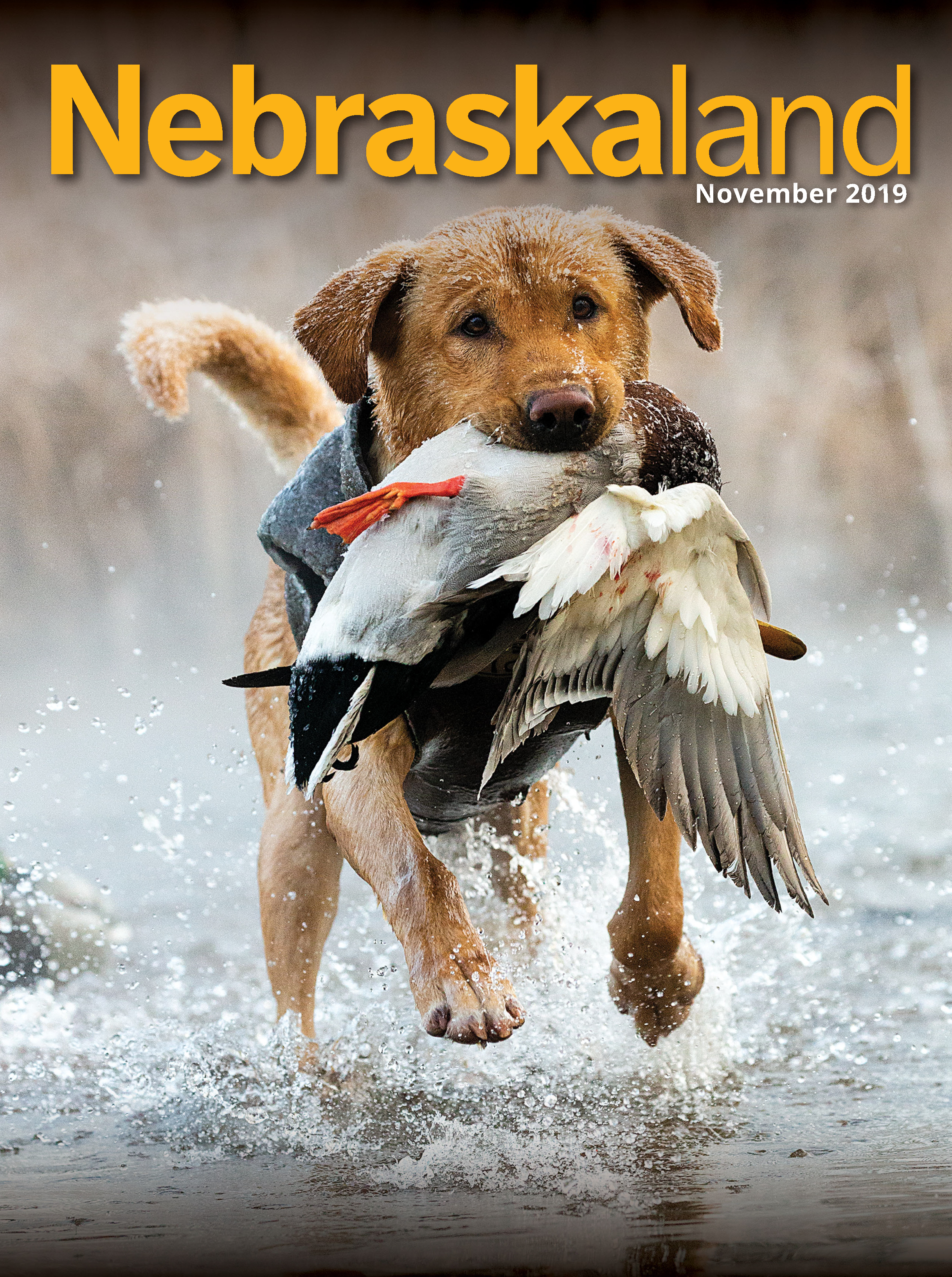
Cover: Spencer Holzfaster’s Labrador
Wriggs retrieves a mallard drake
during a hunt in Lincoln County.
Photo by Doug Steinke
Volume 97 No. 9
November 2019
FEATURES
LESSONS FROM CAT
COUNTRY
52
42
OUTDOOR NEBRASKA
56
44
THE BEAUTY OF BROWN
50
THE BIRTH OF THE SOUTH
OMAHA STOCKYARDS
20
Story and Photos by Justin Haag
What to Do in November
By Renae Blum
Photos and Story by Justin Haag
By John E. Carter, History Nebraska
CLEANING AND COOKING
PIKE
Story and Photos by Ryan Sparks
NOT WITHOUT WETLANDS
Infographic by Mel Severin
DEPARTMENTS
6
10
58
68
70
Your Nebraska
In the Field
Mixed Bag
Portraits from the Past
The Last Stop
ON THE WEB
PHOTO BY JEFF KURRUS
To see additional content including photos,
videos and additional articles, visit
Magazine.OutdoorNebraska.gov/digital.
Nebraskaland (VOL. 97 / NO. 9 ISSN 0028-1964) is published monthly, except for the combined Jan./Feb. and Aug./Sept. issues, by the Nebraska Game and Parks Commission, 2200 N. 33rd St.,
Lincoln, NE. Periodicals postage paid at Lincoln, Nebraska, and additional mailing offices. POSTMASTER: Send address changes to Nebraskaland, P.O. Box 30370, Lincoln, NE 68503-0370.
Magazine Staff
magazine
Communications Director Christy Firestone
Public Relations Manager Cara Pesek
Published by the Nebraska Game and Parks
Commission since 1926. The Commission is
dedicated to the conservation and protection
of all the state's natural resources and the
people who use them.
Editor Jeff Kurrus
Associate Editor Jenny Nguyen-Wheatley
Regional Editors Eric Fowler, Julie Geiser,
Justin Haag
Contributing Editor Michael Forsberg
Regular Contributors Renae Blum,
Chris Helzer, Chris Masada, Ryan Sparks,
Gerry Steinauer
Art Director Tim Reigert
Graphic Designer Mel Severin
Photo Librarian Jaclyn Cruikshank Vogt
Administration
Director Jim Douglas
Deputy Director Tim McCoy
Commissioners
Chairman - Robert Allen, Eustis
Vice Chairman - Dan Kreitman, Wahoo
2nd Vice Chairman - Pat Berggren, Broken Bow
Dick Bell, Omaha
Rick Brandt, Roca
Scott Cassels, Omaha
Jim Ernst, Columbus
Doug Zingula, Sidney
John Hoggatt, Kearney
Circulation
For address changes and questions about your
subscription, call 800-632-5263
Advertising Sales Manager
For advertising information contact
Shane G. Gilster, 402-742-0125
Email: shanegilster@gmail.com
Nebraskaland Magazine Copyright 2019, all rights reserved.
Nebraskaland is available in audio from the Nebraska Library
Commission Talking Book and Braille Service, Suite 120, 1200 N St.,
Lincoln, NE 68508. 800-742-7691. Nebraskaland Magazine and the
Nebraska Game and Parks Commission reserve the right to reject any
advertising not in keeping with the agency mission.
Rates: $18 for one year; $33 for two years; $44 for three years. Nebraska
recipients must add appropriate sales tax. To subscribe call
1-800-NEBLAND (632-5263), or go online to:
NebraskalandMagazine.com.
Commission Offices
Conservation Officers
Headquarters/Southeast District Office
2200 N. 33rd Street Lincoln, NE 68503
Phone 402-471-0641
ADMINISTRATION (Lincoln)
Craig Stover (Administrator)
Duane Arp (Asst. Administrator)
Jeff Clauson (Asst. Administrator)
Travis Shepler (Asst. Administrator)
Northeast District Office
2201 N. 13th St. Norfolk, NE 68701
Phone 402-370-3374
Southwest District Office
301 E. State Farm Rd. North Platte, NE 69101
Phone 308-535-8025
Northwest District Office
East Hwy. 2, Box 725 Alliance, NE 69301
Phone 308-763-2940
Bassett Office
524 Panzer St., Box 508 Bassett, NE 68714
Phone 402-684-2921
Kearney Office
1617 First Ave. Kearney, NE 68847
Phone 308-865-5310
Ak-Sar-Ben Aquarium/Schramm Education
Center
21502 W. Highway 31 Gretna, NE 68028
Phone 402-332-3901
Omaha Office
8495 Frederick Street, Omaha, NE 68124
Phone 402-595-2144
OutdoorNebraska.org
Any program that receives federal funding from the National Park
Service, or the United States Fish and Wildlife Service prohibits
unlawful discrimination on the basis of race, color, religion, age, gender,
marital status, national origin, age, disability or political affiliation. Any
person who believes he or she has been discriminated against in
any program, activity, facility, or service, should contact the Nebraska
Game and Parks Commission, Lincoln, NE 402-471-0641, the Equal
Opportunity Commission, Lincoln, NE 402-471-2024, TTY/TDD 402471-4693; United States Fish Wildlife Service, Civil Rights Coordinator,
4401 N. Fairfax Drive, Arlington, VA 22203; Director, Equal Opportunity
Program, U.S. Department of Interior, National Park Service, 1849 C
Street NW, Mail Code 0008, Washington, D.C. 20240-0001.
4
Nebraskaland • November 2019
402-471-5531
402-471-5531
402-471-5531
402-471-5531
NORTHWEST (Includes counties covered)
Jim Zimmerman (District Supt.)
308-641-6138
Kelsey Glodowski
(Box Butte, S 1/2 Sheridan, Grant)
308-763-8226
Sean McKeehan
(Kimball, Banner, Scotts Bluff)
308-672-1824
Dan Kling (Sioux, Dawes)
308-430-0572
Kyler Prochaska
(E 1/2 Dawes, N 1/2 Sheridan, W 1/2 Cherry)
308-430-3984
308-458-7650
Terry Brentzel (Deuel, Garden, Grant)
402-389-0444
Frank Miller (Cherry, Hooker)
308-279-9133
Josh Widhelm (Morrill, Cheyenne)
NORTHEAST (Includes counties covered)
Tom Zimmer (District Supt.)
402-649-8053
402-760-0712
Dale Davis (Keya Paha, Brown, Rock)
402-340-3981
Jonathan Andreasen (Holt, Boyd)
402-719-6226
Kyle Gaston (Dodge, Colfax)
402-613-8612
Mitch Johnson (Knox, Antelope, Pierce)
402-762-5022
Jeff Jones (Knox, Cedar)
Jon Reeves
(S 1/2 Thurston, Burt, Washington)
402-889-8508
Andrew Heyer (Pierce, Madison, Stanton) 402-613-2241
Cory Krause
(Cuming, Wayne, Stanton, Dodge)
402-380-6410
Steve Oberg
(Colfax, Platte, Madison, Stanton, Nance)
402-910-3366
Owen Johnson
(Dixon, Dakota, N 1/2 Thurston)
402-266-1759
Doug Pollard (Loup, Garfield, Valley)
308-730-7050
Ethan Teter
(Boating – eastern Nebraska)
402-620-8129
SOUTHWEST (Includes counties covered)
Roger Thompson (District Supt.)
308-530-3097
308-202-0819
Matt Brandt (Sherman, Howard)
308-380-7331
Tim Williams (Hall, Hamilton, Merrick)
Pat George
(Harlan, Franklin, Phelps)
308-920-2762
Matt Andrews
(Gosper, Furnas, Frontier, Red Willow)
308-746-2418
Brian Piernicky
(Red Willow, Frontier, Hayes, Hitchcock)
308-340-6627
John Lee (Hitchcock, Dundy, Chase, Hayes)
308-414-1432
Nicholas Fix (Keith, Perkins)
Bryce Streger (Keith, Arthur)
Sean Schultz (Keith)
Brandon O’Neal
(Lincoln, McPherson, Logan)
Alex Hasenauer
(Lincoln, McPherson, Logan)
Mike Thome (Dawson)
Ray Dierking (Custer, Thomas, Blaine)
Taylor Dixon
(Dawson, N 1/2 Gosper, N 1/2 Phelps)
Eric Javins
(Adams, Clay, Nuckolls, Webster)
Kevin Bergstrom
(Boating – central Nebraska)
Daryl Teter
(Boating – central Nebraska)
Greg Hesse
(Buffalo, Kearney)
308-289-0427
308-289-1169
308-760-0145
308-530-3157
308-660-4671
308-529-8146
308-870-0322
308-217-2108
402-902-2017
308-520-1031
308-440-1863
402-440-3847
SOUTHEAST (Includes counties covered)
Stacey Lewton (District Supt.)
402-890-7140
402-619-1355
Rich Berggren (Douglas)
402-616-5961
Dan Evasco (Sarpy)
402-210-0888
Heath Packett (Cass)
402-209-1506
Russell Mort (Otoe, Johnson)
402-200-9597
Matt Taylor (Thayer, Fillmore, Jefferson)
402-806-0915
Matt Seitz (Gage, Saline)
402-890-6463
Dina Barta (Lancaster)
402-937-3422
Dudley Sorensen (Lancaster, York)
402-314-9641
Trevor Stahlecker (Lancaster)
402-443-6392
Mike Luben (Saunders, Butler, Polk)
Scott Eveland
(Lancaster)
402-853-3273
YOUR NEBRASKA
Instagram Photos
Follow us (@nebraskaland)
and tag us in your photos
to be featured in an
upcoming issue.
Rebecca Johnson, Central City
Red Fox
“Crane Migration – Kearney”
Chris Pischel won the 2019
Nebraska State Fair Wild and
Scenic Photo Contest.
Brooke Talbott, Lincoln
Sunrise
Karen Kutz Smith, Omaha
Fontenelle Forest Tom
6
Nebraskaland • November 2019
November 2019 •
Nebraskaland
7
YOUR NEBRASKA
Neil Kirby, Elkhorn
Lewis and Clark Lake Sunset
Aaron Beckman, Norfolk
Eagle on the Elkhorn River
Emily Burch, Littleton, Colorado
Daybreak at Scotts Bluff
Bruce Condello, Roca
Double Rainbow Near Sutton
8
Nebraskaland • November 2019
Send your comments and photos to:
Jeff Kurrus, Editor
Nebraskaland Magazine
P.O. Box 30370
Lincoln, NE 68503
or email Jeff.Kurrus@Nebraska.gov
Correction: On page 8 of the
October issue, the woodpecker was
misidentified. It is a red-bellied
woodpecker. We regret the error.
November 2019 •
Nebraskaland
9
IN THE FIELD
DOUBLE TAKE
A whitetail doe and her
fawn cautiously walk
through a clearing as they
travel to their nightly
feeding area in Lincoln
County.
PHOT
PHOTO
HOTO BY JUL
JULIE GEISE
JULIE
GEISE
S R
10
Nebraskaland • November 2019
November 2019 •
Nebraskaland
11
IN THE FIELD
THREATENED AND ENDANGERED:
THE WESTERN PRAIRIE FRINGED ORCHID
By Gerry Steinauer
12
Nebraskaland • November 2019
We found a total of 595 plants at only 21 (32 percent) of the
sites. For the record, 2012 was a particularly droughty year,
and individual orchid plants may not flower in such stressful
years. Instead, these vegetative plants either do not produce
above ground growth or send up only one or two basal leafs,
which when concealed among the prairie grasses, are nearly
impossible to detect during surveys.
The sharp decline of the western prairie fringed orchid in
Nebraska’s tallgrass region in recent decades is distressing.
Hopefully, healthy populations of this beautiful and
intriguing species can be maintained in the semi-wilds of
the Sandhills.
Gerry Steinauer is a botanist for the Nebraska Game and
Parks Commission.
September 1, 2019 — January 31, 2020
Nebraska is an upland bird hunter’s paradise – the mixed bag capital of the
Great Plains – with diverse hunting opportunities, long seasons, great access
to public lands and high rates of hunter satisfaction.
Learn more about the second year of the slam and the prizes you could win at
PHOTO BY GERRY STEINAUER
The western prairie fringed orchid (Platanthera praeclara)
historically grew in moist tallgrass prairies and wet meadows
ranging from southern Manitoba south to Oklahoma,
including much of the eastern half of Nebraska. European
settlement, however, had an immediate impact on this
sensitive species.
An 1889 account from Kansas stated that “once school
children brought armfuls of the curious [orchid to their
teachers] … now they are seldom seen.” An 1898 Nebraska
account notes the orchid “was common in wet valleys of
the sandhills … also in [the tallgrass prairie region], where,
however, it is a disappearing species.” Since then, loss of
its prairie habitat, heavy livestock grazing, herbicides and
invasive plants have stressed the plant to the point where it
is now listed as both federally and state threatened.
The perennial orchid begins growth in early May and the
plant commonly reaches heights of 20 to 30 inches. Its 3- to
5-inch-long leaves are somewhat thickened with prominent
parallel veins. The lower lip of the large creamy white to
greenish flower is divided into three feathered lobes with the
other smaller petals and sepals forming a hood above. An up
to 2-inch-long nectar spur extends back from the lower petal.
The few to up to 25 flowers that occur along the elongate
inflorescence begin blooming in mid-June to early July,
depending on weather and location, with southern plants
flowering first.
The specialized flowers are designed for one purpose:
pollination by a few select species of nocturnal hawkmoths
(sphinx moths). Near dusk, the orchids release a sweet
fragrance to attract the wide-ranging moths. The whitefringed lip directs the moths to the spur with its rich nectar
deep within. The moth, while hovering in front of the flower
with its long tongue extended to feed, brushes against two
pollen-bearing structures called columns. At this moment,
two sticky balls of pollen become glued to the moth’s eyes
or head. When the moth leaves the flower, the columns
rotate, exposing the stigma (receptive female structure)
for pollination by a next visiting, pollen-carrying moth. A
decline in hawkmoths may be another reason for the decline
in orchid populations.
In 2012, the Nebraska Game and Parks Commission
resurveyed 65 prairies in eastern Nebraska and the Sandhills
where over the last few decades a total of 1,385 western
prairie fringed orchids were observed during prior surveys.
OutdoorNebraska.org/UplandSlam
November 2019 •
Nebraskaland
13
IN THE FIELD
PHOTO BY CHRIS HELZER
DON’T MESS WITH OIL BEETLES
By Chris Helzer
Among all the crazy life stories of all the crazy insects
in the world, the oil beetle ranks as an elite. The oil beetle
is a plant-feeding insect in the blister beetle family. As
with other blister beetles, the oil beetle produces a toxic
compound called cantharidin that is used to protect its
eggs from predation. In addition, when an oil beetle feels
threatened, it secretes a yellow substance from its leg joints
(of all places) that contains enough cantharidin to cause
immediate swelling and blisters to the skin of potential
predators. Don’t mess with oil beetles, people.
However, blister-inducing yellow goo is only a small part
of the oil beetle story. Oil beetles also go through a unique
process called hypermetamorphosis as they move from egg
to adult. Instead of hatching out of an egg as a slow fat grub,
oil beetle larvae are called triungulin, and look like tiny little
silverfish. It’s these speedy triungulin that take the oil beetle
story over the top.
Shortly after hatching, oil beetle triungulin cluster
together and emit a chemical that mimics the pheromone of
a female solitary bee (a bee that raises broods individually, as
opposed to in a colony with a queen, workers, etc.). Passing
male bees, sensing the female pheromone, descend upon
14
Nebraskaland • November 2019
the mass of triungulin to mate with it. Instead, the speedy
larvae crawl up onto the male bee and hang on tight. When
that male bee finally meets and mates with an actual female
bee, the triungulin quickly transfer to their new ride and
hitchhike back to the female’s nest.
Once they arrive, the triungulin hop off the female and
proceed to eat all the bee larvae in the nest, along with
the pollen and nectar the female had supplied her babies
with. Once they’ve destroyed the bee nest, the triungulin
transform into the kind of grub-like larvae usually associated
with beetles, and from there they pupate and turn into
herbivorous adult oil beetles.
If you ever find yourself reaching toward a fat flightless
black beetle, think carefully before you pick it up. If it’s an oil
beetle, you might soon find yourself suffering from painful
blistering skin. While you apply salve to your throbbing
fingers, though, remember that it could be worse. At least the
beetle’s larvae aren’t going to invade your home as a swarm
of baby-eating marauders!
Chris Helzer is the Nature Conservancy’s director of science
in Nebraska.
November 2019 •
Nebraskaland
15
IN THE FIELD
CANADA GEESE IN A FEBRUARY BLIZZARD IN SARPY COUNTY. PHOTO BY JEFF KURRUS.
BLIZZARDS
By Martha D. Shulski
In Nebraska we experience a wide range of hazardous
weather events. The throes of winter are approaching soon,
and with it comes the possibility of a blizzard. For travelers,
campers, hunters and anglers on the ice, such high impact
storms can be dangerous if not deadly.
Blizzards are characterized by reduced visibilities (less
than a quarter mile) due to falling and/or blowing snow. As
such, there must be sustained winds or frequent gusts on
the order of 35 mph or greater. When it’s winter and there’s
a hefty breeze, this combo generally leads to low wind chill
temperatures with a risk of cold exposure to humans and
animals.
Blizzards impacting Nebraska generally gain strength as
low pressure systems move east out of the Rocky Mountains,
sometimes termed Colorado Low. While eastern North
Dakota experiences the highest number of blizzards on
average in the U.S., we have our fair share of several per year.
Perhaps you remember the March 2019 storm that
impacted the Plains? Western and Central Nebraska felt the
brunt of the cold side of this storm with road closures, cattle
16
Nebraskaland • November 2019
losses and wind damage. Sometimes a series of these events
results in a doozy of a winter season.
Some seasons that stand out in our weather history are
2009-10 and 1948-49. The Schoolhouse Blizzard of 1888
(named so because of its deadly toll on schoolchildren
trekking home in the absence of warnings) even spawned
the formation of a Greater Nebraska Blizzard Club in 1940.
Now, of course, we have eyes from space (satellite), ears
from the ground (radar) and detailed weather forecasts from
trained meteorologists who can time, track and measure the
intensity of these winter storms. Research has even shown
that naming storms results in people paying closer attention
to those warnings.
If blizzard conditions are in the forecast, be sure and take
precautions. And if you’re like me, enjoy nature’s spectacle
from a warm shelter and wait until the storm passes to
venture outside.
Martha D. Shulski, at the University of Nebraska-Lincoln, is
the director of the Nebraska State Climate office.
IN THE FIELD
Sweet Tomato Sauce (directions to follow)
14 ounces canned tomatoes and their juice
2 tablespoons white sugar
1 tablespoon tomato paste
¼ teaspoon mustard powder
¼ teaspoon cinnamon
¼ teaspoon crushed red pepper (optional)
Salt and black pepper to taste
•
•
•
•
•
•
•
Directions:
Pastry
In a large mixing bowl or food processor, combine the flour
and salt. Cut the butter into the flour mixture with your
fingertips or a pastry blender until mixture resembles coarse
meal. Do not overwork. Stir in enough ice water to make the
dough come together.
Divide dough in half. Flatten each half into a round disc.
Wrap in plastic wrap and refrigerate for one hour.
VENISON TOURTIERE
Filling
Heat a large skillet over medium-high heat. Add olive oil
and butter. Add the meat a third at a time, allowing it to
brown. Season the mixture with salt and pepper. When small
bits of caramelized meat start to form, add the mushrooms,
onions, garlic, spices and grated potatoes. Reduce the heat to
medium and continue cooking for 5-10 minutes.
Add the white wine, scraping the bottom of the pan to
remove the tasty meat bits. Reduce the heat to low and
continue cooking until all the wine has evaporated. Taste the
tourtière filling and adjust the seasoning and spices as you
like. Let cool completely.
Assembly
Preheat the oven to 450 degrees. Lightly flour a work
surface and roll each pastry round into an 11-inch circle
approximately 1/8 inch thick. Using one pastry, line a 9-inch
pie plate. If the pastry is too soft, put it in the freezer for five
minutes.
Add the tourtière filling and cover with the second pastry
round. Crimp and seal the edges with the tines of a fork.
Brush the pastry with lightly beaten egg yolk and score the
top with a knife to allow steam to escape while baking.
Bake for 15 minutes at 450, and then reduce the
temperature to 350 and bake until the crust is golden brown,
about 35 minutes. Cover it with foil if the top browns too
quickly. Let rest for 10 minutes before serving. Serve with
sweet tomato jam.
Sweet Tomato Jam
Add all the ingredients to a small saucepan and bring to
a quick simmer. After the tomatoes have cooked for five
minutes, crush them with a whisk or wooden spatula. Turn
heat to low and continue to simmer, stirring occasionally
for 20-30 minutes until it has slightly thickened. Taste for
seasoning and refrigerate.
Ryan Sparks is a freelance outdoor writer and photographer.
See more of his work at sparksryan.com.
By Ryan Sparks
While living in Canada I was introduced to tourtière,
a French-Canadian meat pie. In Quebec, tourtière is
traditionally part of the Christmas and New Year’s Eve meal.
These days it’s made with a mixture of pork and beef, but
traditionally it was made with wild game like deer, moose,
and caribou. When I tried it for the first time I immediately
knew it was perfectly suited for venison. It is usually served
with a sweet tomato relish or jam. I’ve also included a recipe
for my version. I would be cheating you out of some fun if I
didn’t mention the French-Canadian tradition of using the
leftover pastry to make pets de sœur, a pastry filled with
butter, brown sugar, and maple syrup, which is rolled, sliced,
and baked and whose rough translation is “nun’s farts.”
•
•
•
•
18
Nebraskaland • November 2019
•
•
•
•
•
•
•
•
•
•
•
•
•
•
PHOTOS BY RYAN SPARKS
Servings: 6 generous
Ingredients:
Pastry
2¼ cups all-purpose flour
1¼ teaspoons salt
1 cup unsalted butter, still cold and cut into cubes
4-6 tablespoons ice water
Filling
1 tablespoon olive oil
1 tablespoon butter
1 pound ground venison
½ pound ground pork
Salt and pepper to taste
¼ pound cremini mushrooms, finely diced
1 onion, finely diced
4 garlic cloves, minced
¼ teaspoon ground clove
¼ teaspoon nutmeg
1 teaspoon allspice
1 teaspoon cinnamon
1 small potato, grated
½ cup white wine
Assembly
Flour, for rolling
1 egg yolk
•
•
November 2019 •
Nebraskaland
19
Lessons
from
Cat Country
STORY AND PHOTOS
BY JUSTIN HAAG
Thanks to research in the
Pine Ridge, we are gaining
knowledge about one of Nebraska’s
most criticized, treasured and,
of course, misunderstood
repatriates – the cougar.
R
eferred to as mountain lion, cougar and several other
names, Puma concolor has become one of the most
discussed wildlife species in the state. For all of that
talking, though, it seems there is always a need to dispel a
few myths and provide accurate information to the public
regarding the species.
Historical accounts of the species in Nebraska, while
sparse, date back to the Stephen H. Long expedition of 1819.
Along with so many other species, cougars disappeared
from Nebraska with Euro-American settlement. Not only
did early settlers slay predators at every opportunity, more
importantly they killed the predators’ prey. The decimation
of deer and other prey species in the late 1800s and early
1900s surely made Nebraska a less desirable place for
mountain lions to live.
The return of the mountain lion, not coincidentally, arrived
at about the same time Nebraska was realizing the return of
a flourishing deer population. As the Nebraska Game and
Parks Commission began offering plentiful antlerless-only
permits tags and bonus tags in the 1990s to manage the
burgeoning deer population that was once nearly extirpated,
20
Nebraskaland • November 2019
cougars also found harvest opportunities of their favorite
prey in Nebraska and began showing up to the party. The first
modern confirmation of a mountain lion in Nebraska came in
1991, marking the cats’ expansion from large populations
in bordering states where cougar and prey populations had
recovered because of protection by game laws.
In discussions of mountain lion numbers, biologists are
quick to point out that cougars do not adhere to any arbitrary
borders and Nebraska’s cats are part of a larger population
that extends to the Black Hills of South Dakota, the Rocky
Mountains of Colorado and Wyoming, and other points west.
In 1995, the Nebraska Legislature classified mountain
lions as game animals. A provision in state statute allows
individuals to kill mountain lions if they are threatening
their lives or property.
Game and Parks has established management programs
that meet those statutory obligations and are designed to
curtail negative interactions between humans and the cats,
and has gone to great lengths to gain public input about
the species, usually not having to work too hard to get it. It
▲ Mountain lion anatomy makes it an efficient
ambush, or stalking, predator, and it prefers to hunt
in areas of dense cover. Adult cats can bound 40 feet
while running and can leap 15 feet into a tree, but
their small lungs are not efficient for long chases.
Speed comparisons lend clues to their diet. A cougar
can “exit the chute” at 50 mph, but cannot sustain
that pace for long. In comparison, the rarely preyed
upon pronghorn, with their big throats and lungs,
can sprint more than 60 mph at long distances over
an open plain while the favored forest-loving whitetailed deer tops out at about 30 mph.
November 2019 •
Nebraskaland
21
seems everyone has an opinion on this species, ranging from
“get rid of them” to “just let them be.”
To help guide management decisions about the species,
Game and Parks has opted to take a scientific approach rather
than an emotional one. Biologists recognize the mountain
lion as an important part of Nebraska’s biodiversity, but
also strive to employ management strategies to maintain
resilient, healthy and socially acceptable populations in
balance with available habitat and other wildlife species
over the long term.
In 2015, Game and Parks ramped up its research efforts
under the direction of Sam Wilson, furbearer and carnivore
program manager. By capturing mountain lions and
equipping them with GPS tracking collars, researchers have
gained new insight into how this species is spending its time
in the Pine Ridge. The research has not only given Nebraska
officials a better idea of how many cats are in the area, but
also what they’re eating and how they are using the terrain.
By using both the revered and well-established markrecapture survey method coupled with modern genetic
surveys, Game and Parks has gained confidence in its
population estimates in the Pine Ridge. Remarkably, those
two methods came up with exactly the same number of cats
when the most recent population estimates were tabulated
in 2017. Both survey methods arrived at 59 individuals in the
Pine Ridge of Sioux, Dawes and Sheridan counties.
The population estimates and number of collared cougars
in the Pine Ridge provide a safeguard against overharvest
when hunting recommendations are made. Biologists do note,
however, that the population is always fluctuating. Mountain
lions reproduce, die and move in and out of the state.
Based on Game and Parks research, individual cats with
tracking collars have traveled as far as 20 miles in one day.
They have established breeding ranges in the Pine Ridge,
Niobrara Valley and Wildcat Hills, but with individual females
documented in southeastern Nebraska, Iowa, Missouri and
Tennessee, it is possible that cats will expand their home
ranges into other territories. Nebraska contains highly
suitable habitat along creeks and rivers from border to border.
Getting the Picture on Pumas
22
Nebraskaland • November 2019
This is the first cat photographed with the
camera trap system, thanks to a tip of her location
from Game and Parks wildlife staff in March 2015. My
hair may have stood on end when I returned to the
site and pulled up the images for viewing. From the
timestamp on the digital photos, I learned that she
returned about 45 minutes after I got the camera set
up and left the scene. Thankfully for me, mountain
lions typically keep their distance from people.
▼
The following material has been obtained with invaluable
assistance from Game and Parks’ wildlife division employees,
some who have moved on to other positions since the photos
were taken. Certain imagery was captured with camera in
hand, while some of the photos were snapped by a highresolution camera trap system with external trigger and
strobes.
Regardless of which side of the mountain lion issue one
stands, it seems there are no shortage of misunderstandings
about this elusive species. Thanks to the research in Nebraska
and elsewhere, we are continuing to answer questions that
will help all gain a better understanding.
▲ Fresh mountain lion kill sites are usually not
difficult to identify. This cat, photographed by
camera trap in Dawes County, killed a mule deer in
the upper right of the photo and dragged it under
the pine tree at the left. She then covered it with
snow, pine needles and other forest debris to create
a cache. Canids, such as coyotes on the other hand,
are much more sloppy eaters, scattering bones
around the area and not attempting to conceal the
remains. A mountain lion typically kills about one
deer per week, or may consume a number of smaller
prey such as porcupines, coyotes and turkeys.
November 2019 •
Nebraskaland
23
▼
▼
It’s hard to believe an animal that
looks like this may grow into something
capable of bringing down a bull elk, isn’t
it? Mountain lion kittens, also correctly
referred to as cubs, are born at just
over one pound with a spotted coat and
blue eyes. They get bigger. Adult female
mountain lions typically weigh in at 85-110
pounds, while toms are 120-180. They
measure 7-8 feet from nose to tail and 2-3
feet in height at the shoulder.
Researchers tag the kittens when they
are four to five weeks old – any earlier
and they put the kittens at risk, any older
and they are hard to catch. The kittens
are surprisingly docile during the process.
Dens are sometimes found tucked under
picturesque rock overhangs such as
this one, but more frequently under the
entangled branches of downed trees. The
spotted fur, which fades out over their first
year, makes for effective camouflage.
Nebraska has three documented populations of mountain lions
with reproduction, and cats often wander to other parts of the
state. Most of the state’s telemetry research on the species has been
conducted in the Pine Ridge of the state’s northwestern corner.
▼
For this 2016 photo, Game and Parks
biologist and cougar researcher Linsey
Blake helped me push, pull and drag
about 100 pounds of photo equipment
over a long stretch of downed, burned
timber in the Pine Ridge. It was one of
our first success stories in capturing
camera trap imagery with this system,
and not the last time the researchers
would go out of their way to assist my
goal of documenting their project.
24
Nebraskaland • November 2019
November 2019 •
Nebraskaland
25
▼ In 2015, Game and Parks staff members Mallory
Irvine, Laura McHale, Todd Nordeen, Micah Ellstrom
and Greg Schenbeck stand near the first cougar to
be trapped, immobilized and collared for research
in the Pine Ridge. Researchers employ traps or
dogs to capture mountain lions for collaring. The
traps are designed to do no harm to the animals.
When treeing a cat with dogs, researchers dart the
animal and take care in getting it down. Sometimes,
a staff member must climb a tree and lower the
immobilized cat off a limb into a safety net.
▲ People often mistake tracks of
large dogs for those of mountain
lions. Note that this cougar track
in the Sioux County snow has no
evidence of claw marks. Unlike
canid species, the big cats walk
with their claws retracted so they
are rarely visible in prints.
26
Nebraskaland • November 2019
November 2019 •
Nebraskaland
27
▼
Mountain lions are extraordinarily stealthy and
rarely seen in the wild, known to typically flee
or stay hidden when they sense humans. Fatal
attacks do happen on rare occasion, though, and
as this species re-establishes its range and humans
increase development within the same areas the
occasional encounter is sure to ensue. People living
in or visiting cat country are wise to learn about
the species, how to respond appropriately to their
presence and best methods for protecting domestic
animals. Dispersing young males, which are learning
to hunt and establish a territory, are the most usual
suspects when encounters occur with livestock and
people.
This uncollared cat, photographed in Sheridan
County, apparently watched me as I followed a
dragline in the snow to find a deer it had cached
at a creek bottom. Little did I know, until hearing
some scurrying, that it had had been watching me
approach its food. I watched the cat as it hurried
from its resting place to the top of the canyon and
saunter away on the ridgeline above. The indention
in the snow where the cat had been resting was just
15 steps away from me. The cat did what almost all
of them do in similar situations – chose to abandon
its groceries and flee human presence. I got this
photo later that night after anxiously setting the
camera trap near its food cache atop the frozen
creek.
In Case of an Encounter
Because of cougars’ secretive nature and
low density, they rarely interact with humans.
In the rare event of an encounter, follow these
guidelines.
● Do not approach a mountain lion.
● Leave the animal an avenue of escape.
● Stay calm, move slowly.
● Back away safely if you can. Do not turn your
back to the lion or start running.
● Raise your arms or backpack to appear larger.
● Lift up your children to prevent them from
running.
● If you are being attacked fight back. Mountain
lion have been successfully driven off with bare
hands. Use rocks, or whatever you can get your
hands on. Try to remain on your feet or get back
up if knocked down.
28
Nebraskaland • November 2019
November 2019 •
Nebraskaland
29
▼
▼
Take note of the ear tags in these two
photos. While the tags are the same, the
cat has certainly changed from one photo
to the other. Researchers occasionally
have multiple experiences with individual
mountain lions. I photographed this one
with Sam Wilson in August 2015 while it was
being tagged as a four-week-old kitten, and
17 months later when it was captured and
collared a few miles away as a young adult.
▼
Cougars rarely cooperate with
normal working hours. Here are
Game and Parks employees Linsey
Blake, Maria Baglieri and Greg
Schenbeck collaring a tranquilized
mountain lion at 12:46 a.m. in
the January 2017 darkness. As
of this writing, 14 cougars were
carrying working collars in the
Pine Ridge. Researchers have
installed collars many more times
than that, though. The total
number, which has been as high
as 17, fluctuates as transmitters
become inoperable, cats die and
researchers laboriously capture
and recollar cats.
30
Nebraskaland • November 2019
November 2019 •
Nebraskaland
31
▲ Linsey Blake and I placed a video camera trap near this
kitten while its collared mother was away from the den. If
mom is away, mountain lion kittens often chirp as the video
showed. Not a lot of research exists for mountain lion hearing,
but videos such as this beg questioning whether the mother
cougars’ ears are specially tuned to hear the frequencies
being emitted by the kittens’ chirps. To the unknowing
human, the chirps seem to be from a bird. See the video at
NebraskalandMagazine.com.
▲ Cougars are usually solitary animals – loners. Look closely, though,
and you will see two mountain lions in this photo – the tagged
mother cougar in the foreground, which had lost its tracking collar,
and one of its two kittens in the background. Trail camera photos of
female cougars with kittens nearing dispersal age have garnered a lot
of attention on social media in recent years, especially if the kittens
are old enough that people wrongly assume they are adult cats
“hunting in packs.”
Female cougars reproduce at 2-3 years old and may do so at any
time of the year – most often in warmer months. The litters average
2-4 kittens, as younger females usually give birth to smaller litters.
Kittens stay with their mothers for about a year and a half, so, at a
glance, can appear to be adults toward the end of that period. Figure
in a 90-day gestation period, and it works out to a litter of kittens
about every two years for each female if nature allows. Frequently,
though, the kittens do not survive, and the female will become
sexually receptive ahead of that schedule. In fact, toms are known
to kill kittens, especially those they did not father, in order to trigger
the female back into breeding.
32
Nebraskaland • November 2019
▲ Male cougars create a small mound using available dirt and
other materials, known as a scrape. This provides an elevated
post for the cat to mark its spot with urine. Scrapes provide
a way for toms to communicate with females, their potential
mates, and to warn other competing or intruding toms of
their presence. Because male lions are so territorial, direct
interactions often result in violence and perhaps death to the
weaker male. Scrapes allow communication and declaration of
territory boundaries without the risk of direct interactions.
November 2019 •
Nebraskaland
33
HOLDEN BRUCE, AT RIGHT, AND GUIDE DERIC ANDERSON, SEARCH FOR COUGARS IN SIOUX COUNTY IN
2014 DURING NEBRASKA’S FIRST OFFICIAL MOUNTAIN LION HUNT.
▼
Predators’ effects on biodiversity
are often misunderstood, as they
are perceived as bloodthirsty killers
that only take from the scene. While
the cats no doubt kill many deer and
other animals, potential benefits
from their existence must also be
realized. For instance, as a matter of
efficiency cougars often first prey upon
easily targeted ill or weak animals.
Consequently, the herd may benefit
from improved genetics and reduced
disease transmission. In addition,
recent research in the West has
shown that mountain lion kills can
be beneficial to many other species.
At this site in Sheridan County, blackbilled magpies and golden eagles
feasted on a cached white-tailed deer
– still leaving some for the cat to eat,
of course.
▼
Why a Hunting Season?
By Sam Wilson, Wildlife Biologist
The Nebraska Game and Parks’ management goal
for mountain lions is to maintain resilient, healthy,
and socially acceptable mountain lion populations
that are in balance with available habitat and other
wildlife species over the long term. Mountain lions
are a native species and part of the heritage of our
state, so we want to ensure they are around for
generations to come; however, our challenge is to
manage both the biological and the social aspects
of having mountain lions in Nebraska.
We manage populations of game animals such
as mountain lions through harvest seasons. Deer,
elk and turkeys are just a few examples of game
animals thriving with careful management that
includes hunting.
Game populations are evaluated annually to
determine what, if any, harvest should be allowed.
The basic premise is that when populations
increase, harvest levels can increase, and when
populations decrease, harvest can be reduced
or stopped. Management through hunting may
benefit the health of the species by reducing the
probability of disease events, territorial conflicts,
and starvation which may occur more often
when population levels are very high. Hunting
34
Nebraskaland • November 2019
also ensures the population is maintained at an
acceptable level for the people living in the area.
Mountain lion population estimates in the Pine
Ridge have increased dramatically over the last few
years, from 22 total animals (kittens and adults)
in 2014 to 59 during the 2017 survey. By 2017,
estimates of mountain lion density (the number of
animals in a given area) was much higher in the
Pine Ridge than densities in most western states
with a harvest season.
At the same time the population estimates
increased, we began experiencing problems with
livestock depredation. Public input from people
living in the Pine Ridge area indicated that the
population level was above what many landowners
were willing to accept. A carefully regulated harvest
season, with a limit on the number of mountain
lions harvested, allows Game and Parks to meet
the management goal of maintaining a resilient,
healthy, and socially acceptable population in the
Pine Ridge.
This is the same proven strategy that has allowed
other game species to thrive in Nebraska and
ensures mountain lions will remain in our state
for generations to come.
November 2019 •
Nebraskaland
35
Five genetic surveys of the Pine Ridge, dating
back to before the collaring project began,
have been extremely valuable for making
population estimates. Karen DeMatteo (at
left with Linsey Blake) has taught her dog,
Train, to be proficient at finding mountain
lion scat. Whether he’s in Nebraska or
Argentina, he’s good at it. Upon collecting
the scat (right), samples are swabbed and
sent to a lab for genetic analysis. DeMatteo,
Train and Game and Parks staff hiked
321.75 miles this year over rugged Pine
Ridge terrain (above). From those extensive
searches researchers have the opportunity
to obtain DNA from all cougars in the region
at a given time, aside from kittens in dens.
36
Nebraskaland • November 2019
November 2019 •
Nebraskaland
37
The researchers get plenty of exercise examining
clusters, which by nature are often in extremely
rugged terrain. Game and Parks employee Lauren
Toivonen (right), who joined the project this year,
shows off the carefully created tracks on her GPS
unit after investigating a site in Dawes County.
Until researchers find evidence, they closely
examine each nook and cranny of an area 100
meters in diameter with a path spiraling from
the center of the cluster. While Toivonen’s path
in the photo may look simple on the GPS unit, it
included a steep sandstone ridge on its east side
and a barbed-wire fence that was crossed eight
times – not to mention a large patch of poison
ivy. Studying mountain lions and their clusters
takes the researchers to some of the most remote,
beautiful, but difficult-to-access places in the Pine
Ridge in many kinds of weather.
While more than 75 percent of the prey
evidence found at the Nebraska cluster sites
have been of deer, the hair of which Maria
Baglieri is studying (above), occasionally
the monotony is broken by the discovery
of another species such as bighorn sheep
(opposite), as Linsey Blake and Baglieri are
examining. Despite traversing territory with
plentiful livestock, less than 1 percent of
the prey evidence discovered by Nebraska’s
researchers have shown evidence of cougars
preying on cattle or other domesticated
animals.
38
Nebraskaland • November 2019
November 2019 •
Nebraskaland
39
▼
A mountain lion investigates a
rock cranny in the Pine Ridge. At a
quick glance, the tail is a feature
that effectively differentiates the
appearance of a mountain lion
(especially a young one) from
a bobcat, the smaller wildcat
species in Nebraska. At 2-3 feet
long, the cougar’s long, muscular
dark-tipped tail makes up about
40 percent of its body length and
provides counter balance while
climbing and during quick turns
over uneven terrain. The bobcat’s
tail, in contrast, makes up less
than 10 percent of its body length
at five or six inches.
Learning into the
Future
Nebraska’s mountain lion research
is scheduled to continue. Critical
to that research is the cooperation
received from farmers, ranchers and
other landowners in the study area.
Whether it is allowing captures, cluster
examinations or trail cameras on their
property, landowner support and input
is always welcome to the efforts and
aids the research.
“Our mountain lion management
and research could not be successful
without their help and cooperation,”
Wilson said.
Even though Game and Parks has
gathered a wealth of information
about this remarkable species, there is
certainly more to learn. By combining
a variety of methods, both researchers
and the greater public can learn about
a species that gets a lot of attention by
many but is rarely seen. N
Landowners should immediately
contact their nearest Nebraska Game and
Parks Commission office if they find or
suspect livestock losses from mountain
lions.
40
Nebraskaland • November 2019
November 2019 •
Nebraskaland
41
Outdoor Nebraska
What To Do in November
By Renae Blum
Put on a jacket and get outdoors! You’ll find plenty out there to
refresh your senses and make memories, including wildlife
viewing, hiking and fishing. For details on the events listed
below, visit Calendar.OutdoorNebraska.gov. N
Work on the Take ‘em
Hunting challenge
Throughout the month | Statewide
PHOTO BY JEFF KURRUS
PHOTO BY JUSTIN HAAG
PHOTO BY JEFF KURRUS
With multiple hunting seasons in play, including deer,
turkey and pheasant, now is a great time to take part in
the Take ‘em Hunting challenge. Introduce, or reintroduce,
someone to hunting, snap a photo and share it with Game
and Parks for the chance to win prizes. Learn more at
OutdoorNebraska.org/takeemhunting.
Candlelight Tour
Nov. 2, Fort Atkinson
State Historical Park
Go on the Bighorn Sheep Hike
Fish for trout
Nov. 2, 10 a.m. | Wildcat Hills State Recreation Area
Throughout the month | Statewide
This hike is your opportunity to explore the habitat of the
Wildcat Hills’ bighorn sheep, with the chance at spotting them
in their natural surroundings. Staff will use radio telemetry to
try to pinpoint the bighorns’ location. It might be a long hike,
so come prepared with water, weather-appropriate clothing
and hiking shoes, and expect to hike uneven ground with tall
grass.
River Valley
Artisan Craft
Market
Nov. 2-3, Eugene T.
Mahoney State Park
View woodpeckers in your
backyard
Hike a wooded trail
42
Nebraskaland • November 2019
Throughout the month | Statewide
STOCK PHOTO
PHOTO BY MIKE FORSBERG
Throughout the month | Statewide
November is a good month for hiking. With foliage receding,
you’ll have a clearer view of the many species of wildlife out
and about at this time. Also, no need to worry about nettles,
gnats or ticks, but it remains a good idea to wear blaze orange
on these hikes.
Catch pan-sized rainbow trout where stocked,
and fish for rainbow, brook, brown and
cutthroat trout in flowing, spring-fed streams
that do not freeze. Catch all four species of
trout found in Nebraska, and you can earn the
Nebraska Trout Slam. See OutdoorNebraska.
org/troutslam for details.
To attract these beautiful birds, offer suet in special feeders or
net onion bags at least five feet from the ground. Adding a bird
bath and other kinds of food, such as peanuts and sunflower
seeds, will make your backyard even more attractive.
November 2019 •
Nebraskaland
43
The
Beauty
of Brown
Photos and Story by Justin Haag
I
had never really noticed how distinct the changes the seasons
bring to our Nebraska hardwoods and plant life until a November
trip to Florida many years ago.
After several days in the lush landscape of the Sunshine State,
my travel partners and I arrived in Omaha by airplane and set out
toward home on I-80. We were subjected to an incredible contrast of
color to what we had seen just hours before – a landscape primarily
dominated by browns instead of greens.
Towering cottonwoods (above) in Box Butte County take on a new
artistic appeal after their leaves have fallen.
Similar to the surrounding landscape, the camouflage coat of the
white-tailed deer (opposite) changes with the season. The reddishbrown hair of spring turns grayish-brown in the winter.
44
Nebraskaland • November 2019
November 2019 •
Nebraskaland
45
W
ith winter coming, though, all of that vegetation
knew it would not have enough light and water
to keep the food factory going, so it shut down
after one last treat of vibrancy. As chlorophyll broke down,
those greens turned to fantastic yellows and reds and
masked closure beneath a façade of brilliance.
Later, a leaf or two fell. Soon, they blanketed the ground,
becoming brown and leaving nothing but spindles of bark
above. Those trees and plants had entered their annual
slumber waiting for spring’s alarm clock to wake them, as
it seems had our senses. The stages come slowly enough to
save us from startling. We get our doses of color in snowfall,
ice and evergreen trees.
A rainbow over the Republican River in Red Willow County seems especially colorful after the leaves
have fallen.
A
dmittedly, the return to the Midwest seemed like a heavy
dose of blah compared to the vibrant scenes we had just
witnessed down south. In addition, it was quite dissimilar
to the scene the same vegetation had given us just weeks and
months before. For then, those green trees and plants were busy
using light and water to convert carbon dioxide to oxygen and the
sugar they need to live and grow.
46
Nebraskaland • November 2019
The propeller-like seeds of the green ash tree stand ready
to be carried by the winter wind.
November 2019 •
Nebraskaland
47
Having served its purpose under the lush cover of green
leaves, a long-abandoned nest seems more vulnerable come
winter.
The late afternoon sun casts shadows from Pine Ridge landforms in view from Metcalf Wildlife
Management Area.
Frost adds sparkle as a pair of
Canada geese (opposite) wade in
the mist of the North Platte River
near Melbeta.
O
f course, this is an annual process
– a progression as Nebraskan
as that corn that is husked
each fall. Throughout Nebraska, we’re
entering that brown stage once again.
Take to it with an attentive eye – it can
be beautiful. N
A common sight at Nebraska’s wetlands, the distinct seed
heads of cattail have attracted many photographers.
November 2019 •
Nebraskaland
49
The Birth of the South Omaha Stockyards
By John E. Carter, History Nebraska
y 1870 the cattle industry in western Nebraska was
booming. Thousands of head of Texas cattle came
either to meet the railroad for transportation to
Chicago markets or to be driven farther north to meet
the demands of military posts and Indian reservations.
During this decade large ranches grazed cattle on huge
tracts of government land. The high-quality grasses
produced high-quality beef, and demand for this Nebraska
product grew. By 1880 ranchers clamored for a stockyard in
Omaha. They were tired of their animals losing weight by
traveling the extra 500 miles from Omaha to Chicago. Lost
weight meant lost profits.
In 1883 Wyoming rancher Alexander Swan came to Omaha
to encourage local entrepreneurs to establish a stockyard.
The location was perfect. Omaha was surrounded by plenty
of grass and corn, and the Missouri River provided both
ample water and a swift moving stream to haul waste away
– a stark contrast to the slow-moving Chicago River that
regularly backed up with rank sewage, creating an immense
B
Grading the land ca. 1887. History Nebraska RG1085-77-1
50
Nebraskaland
• November 2019
health hazard.
Swan assembled a group of investors and acquired land
in what would become South Omaha. What began with a
single farm exploded into a huge enterprise. By the end of the
decade South Omaha was established as a major meat center,
and by 1956 Omaha was the largest meat producing city in
the world.
For something this big, very few pictures survive of its
birth. Here are a few that do survive.
It is hard to imagine the speed of the stockyard’s progress.
It began with the Frank Drexel farm (top right). The farm
encompassed 10 acres of land; the farmhouse, marked with
the arrow, served as the first exchange building.
Things moved at a breakneck pace. In 1886 developers
erected the elegant Stockyard Exchange Building. Between
1885 and 1887 four major meat packers – G. H. Hammond
(1885), Fowler Brothers (1886), Armour-Cudahy and Swift
(both 1887) – established major plants adjacent to the
stockyards.
The Frank Drexel Farm, ca. 1888. History Nebraska RG1085-24-11
In the photo at left, one gets a good sense of the frenzy of
building from the photograph of construction crews grading
the land in what would become the large pen areas. On
the horizon on the right of the image, one sees the array of
newly-built houses and stores, the birthing of the City of
South Omaha. To the left, the smokestacks and substantial
industrial buildings locate the packing houses.
The crews are using horse-drawn bucket scrapers to
bury an immense 8-foot-square wooden sewer. One of the
advantages of Omaha was its proximity to the Missouri,
and a structure like this would be necessary to deal with the
waste produced by the huge volume of livestock to come.
The railroads were key to the success of the stockyards,
and both the Burlington and Union Pacific developed lines
into South Omaha. In addition to horse-drawn scrapers,
crews brought in dirt on a line of railroad flatcars. On the last
car, a blade was positioned that was attached to a thick rope
running under the dirt and across all of the cars. When the
cars were in position the rope was pulled by a locomotive,
drawing the blade forward and neatly scraping the cars of
their loads. Stockyards construction was thus accomplished
with a mix of traditional methods and new technology.
South Omaha has long been known as a place of muscle and
sweat; it was born of the same stuff – all of this was going on
in a five-year stretch. It is no surprise at all that South Omaha
became the hub of an exploding Nebraska meat industry. N
This article was adapted from a piece that historian John
Carter (1950-2015) wrote for Nebraska History magazine in
2013. Visit History Nebraska’s website at history.nebraska.gov
The stockyards in 1925. The Livestock Exchange Building
completed that year still stands. History Nebraska
RG1085-7-15
November 2019 •
Nebraskaland
51
Pike
Almondine
I
Story and Photos by Ryan Sparks
stumbled across this recipe
while surfing and fishing North
Carolina’s Outer Banks. A woman
selling freshly caught fish out of
her home recommended the blackbellied rosefish her son had caught
that morning. Having never heard of
the fish before, I asked her how she
would cook it. She rattled off a list
of ingredients, but being in a remote
area with no grocery store we told her
we didn’t have much to work with.
Without a thought she went into her
kitchen and gathered everything in
a sack and gave it to us. I have her to
credit for the recipe. It has changed
a bit since then, but the bulk of the
recipe is hers. It will work with any
flaky white fish, but it’s perfect to
show off the boneless “backstrap” cut
filleted from a pike (see pages 60-61).
Servings: 4
Prep Time: 15 minutes
Cooking Time: 25 minutes
Ingredients:
4 tablespoons olive oil
6 tablespoons butter
Half a red onion, diced
6 garlic cloves, minced
4 russet potatoes, thinly sliced
1 pound green or yellow beans,
ends trimmed
½ cup slivered almonds
•
•
•
•
•
•
•
Taking the top fillet from a pike isn’t something most anglers are familiar with,
but anyone who tries it quickly realizes the genius in this technique.
• ¼ cup half and half
• 4 boneless “backstrap” (tail pieces
•
Pike are one of the most underrated fish swimming in Nebraska. They
are the complete package – fun to catch and delicious on the table.
52
Nebraskaland
• November 2019
will also work) pike fillets, patted
dry and salted
Salt and pepper to taste
1. Preheat the oven to 400 degrees F.
Toss the potato slices in a large bowl
with 3 tablespoons of olive oil, arrange
them on cooking sheet and sprinkle
with salt. Bake the potatoes for 10-15
minutes until they are cooked through.
While you wait for the potatoes to
cook, bring a large pot of salted water
to boil and blanch the green beans for
two minutes. Remove them to an ice
bath to stop the cooking and set aside.
In a sauté pan, melt 2 tablespoons
of butter over medium heat and cook
the red onion until it softens. When
it begins to look transparent, add the
garlic, slivered almonds, and blanched
green beans. Cover and turn the heat
to low.
In a frying pan or skillet, place 1
tablespoon of butter with 1 tablespoon
of olive oil over medium-high heat.
When the butter has melted, place
the pike fillets in the pan and let them
cook until most of the fillet has turned
white and the bottom has browned,
approximately 8 minutes. Carefully
flip the fillet and turn the heat to low.
By now the potatoes should have
finished cooking. Place them on the
top rack of the oven and turn the
broiler on high. Watch them until they
start to crisp.
Remove the fish to a plate and pour
the remaining juice into the sauté
pan with the green beans, adding the
half and half and an additional three
tablespoons of butter. The gelatin
released from the fish will bind the
sauce. Place the potatoes on a plate
and top with green beans and a pike
fillet. Season the sauce to taste and
then pour it over the fish, making sure
to include the almonds, red onion, and
garlic. N
Ryan Sparks is a writer and
photographer originally from Cass
County. To see more of his work visit
sparksryan.com.
November 2019 •
Nebraskaland
53
Cleaning a Pike to Remove Y-bones
3. Starting near the head,
run your knife along the
outside of the Y-bones,
working down along the
belly and continue toward
the tail until you reach
where you removed the top
fillet.
4. The Y-bones end as you
approach the tail. With practice
you will be able to feel where
they end with your knife. When
you reach this point, fillet the
meat from the tail as you would
on any other fish, removing the
skin from each cut.
The author prefers to eat small- to medium-sized pike because their flesh is firmer. It's also best to release
large fish for other anglers to enjoy. Pike like the one shown here are delicious to eat.
1. Begin by making a
downward cut behind the
head until you feel your
knife touch the spine,
then turn the knife and
follow the spine until you
reach the dorsal fin.
5. You will now have two
boneless tail fillets, two
boneless side fillets, and
the prized top fillet. Notice
the two cuts to the left of
the image. These are the
rib sections containing the
rib and Y-bones. Simmered
in liquid, you can flake
the meat from the bones
leaving no waste from
the fish. This flaked fish is
perfect for tacos, fish cakes,
or any other way you can
use flaky white fish.
2. Once you have removed
the top fillet you can see
the Y-bones in the center
of each side fillet. In this
photo, the tip of the knife
points to the Y-bones.
The Y-bones are the small
intricate bones that cause
many anglers to disregard
pike as a good eating fish.
As you can see, they are
easy to identify and work
around.
54
Nebraskaland
• November 2019
November 2019 •
Nebraskaland
55
Clean water? Flood protection? Wildlife habitat?
Not without wetlands
With waterfowl seasons upon us, duck and goose hunters
certainly appreciate the value of wetlands. But wetlands
do much more than provide habitat for ducks and geese.
One of the most productive ecosystems in the world,
wetlands host a variety of plant and animal species.
They also provide numerous other benefits, including
slowing runoff to reduce flooding and filter pollutants
and recharge groundwater, making their preservation
important to all of us.
Nebraska has diverse wetlands across the state, in
every county. There are many types of wetlands:
Wet Meadows
Oxbows
!
Forested
Swamps
Lakes
Playas
Marshes
What we lose...
...when we lose wetlands:
Sufficient
clean water
Diverse wildlife
Nebraska is unique in that it possesses
three major wetland complexes – the
Sandhills, the Rainwater Basin, and the
Platte River – that are of international
importance to wildlife. Wetlands play an
important role by providing habitat for
threatened and endangered species.
95%
of Nebraska drinking water comes
from groundwater, which is
naturally filtered by wetlands.
90%
River and Stream
Backwaters
Seep
Areas
Fens
Wetlands filter pollutants
from runoff and improve water
quality in streams and the
underground aquifer, reducing
the need for costly treatment.
100%
3,000,000
38%
of reptiles
2,000,000
1,000,000
0
Nebraskaland • November 2019
1800
1830
1860
1890
1920
$
of birds and plants
1950
1980
36%
of mammals
Conservation Programs
1972 Clean Water Act
1770
Streams and wetlands are major economic
drivers because of their role in hunting,
fishing, recreation, and agriculture. In the
Rainwater Basin landscape, every acre
generates $20 per year in revenue.
Protection from
disaster
Many wetlands slowly
release water into the ground
to recharge groundwater.
Sandhills and playa wetlands
recharge a significant portion
of the state’s Ogallala Aquifer.
Estimated acres of wetlands in Nebraska
Because of the Clean Water
Act, the Farm Bill, State Title
117, and other federal, state,
and local protections, we have
effectively slowed the rate at
which we are losing wetlands.
50%
of amphibians
Revenue in tourism and
hunting recreation
DESIGN AND GRAPHICS BY MEL SEVERIN
Only half the
world’s wetlands
remain intact.
56
Nebraska species relying on wetlands:
Groundwater recharge
Only 10% of the
Nebraska Rainwater
Basin playa wetlands
remain intact.
of the state’s threatened
and endangered
species, such
as piping plovers
and whooping cranes,
depend on wetlands.
of the continent’s sandhill crane
population uses the Platte River for roosting habitat.
Over the past 250 years, wetlands have declined at
an alarming rate, mostly due to land conversion.
Today, only 65%
of Nebraska’s
wetlands
remain intact.
70%
2010
Wetland conservation programs like the USDA’s Wetland Reserve
Easement Program (WRE, formerly called Wetlands Reserve
Program or WRP), provide alternatives for flood-prone cropland,
helping producers reduce input costs and maximize net farm
income. There are numerous other voluntary incentive programs
for wetland conservation provided by federal, state, and local
agencies. More than 100,000 acres have been conserved over the
past 25 years, through a variety of methods including protection,
restoration, management, inventory, research, and education.
Wetlands hold
water, making
flooding and soil
erosion less likely.
We need to continue to conserve
wetlands and maintain the funding
for conservation programs or we
will see a rapid decline once again.
LEARN MORE AT
NebraskaWetlands.com
November 2019 •
Nebraskaland
57
MIXED BAG
PHOTO COURTESY OF THE NEBRASKA TOURISM COMMISSION
VISIT NEBRASKA CITY
By Erin Lenz, Nebraska Tourism Commission
An exceptional town with loads of history and natural
beauty, Nebraska City can easily fill a weekend getaway.
First stop at Arbor Day Farm, which offers a long list of
activities, including seasonal apple picking, a discovery
ride through the woods and the Apple House Market full of
delicious treats. New in 2019 is TreeTop Village. Also, make
sure and take a tour through Arbor Lodge State Historical
Park – the original estate of J. Sterling Morton, the founder
of Arbor Day.
At Kimmel Orchard, pick your own peaches, apples and
pumpkins or browse the Apple Barn for local, seasonal
canned goods and treats. North of town on Highway 75
is Union Orchard, where you can take home a pie, apple
turnovers and apple-smoked sausage.
For history, step back in time at the Kregel Windmill
Factory Museum, and visit the only original intact windmill
factory museum in the U.S. This museum houses over 1
million artifacts including the original equipment used in the
production of the “ELI” windmills.
Then immerse yourself in the adventures of Lewis and
Clark at the Missouri River Basin Lewis & Clark Interpretive
Center, where the whole family can enjoy hands-on exhibits,
live re-enactments and hiking trails. Or stop at the Nebraska
City Museum of Firefighting and view one of the largest (and
oldest) collections of fire equipment in the state.
With so much to do in Nebraska City, you’ll need to stay
a night or two. Lied Lodge and Conference Center at Arbor
Day Farm offers beautiful lodge-style rooms with a gorgeous
58
Nebraskaland • November 2019
view of the grounds. Or stay overnight in a 130-year-old
Victorian-style home at Whispering Pines Bed & Breakfast,
where you can relax on the old-time porch swing, soak in
the outdoor hot tub or slumber in your room’s king-size bed.
Delicious homemade breakfast favorites include farm-fresh
egg frittata and orange-pecan crusted French toast.
For larger groups, check in to Camp Catron & Retreat
Center, where Eugene’s Adventure Course is open to the
public. This Girl Scouts facility offers a 16-element adventure
course that is nestled among the trees. The top level takes
visitors up 35 feet.
Head downtown for lunch at The Keeping Room and shop
in the boutique afterward for clothing, jewelry and décor.
Then stop for a drink at Dinty Moore’s, one of Nebraska’s
oldest historical bars with interesting Prohibition-era
stories to tell. Timber Dining Room in the Lied Lodge serves
breakfast, lunch and dinner, where you can look forward to
menu items such as orchard oatmeal made with Arbor Day
Farm apple cider or a Waygu burger for dinner.
While the fall season is one of the most beautiful times
to visit Nebraska City, there’s magic in the winter. Take
the Holiday Trolley Tour of Lights to see Nebraska City’s
light display or experience Arbor Lodge Mansion in its most
festive, holiday splendor.
Whether you’re visiting one of the museums in the
summer, picking apples in the fall or cozying up to a good
book at a bed and breakfast in the winter, Nebraska City is
perfect for every season.
November 2019 •
Nebraskaland
59
MIXED BAG
FIVE MUST-DOS FOR DEER SEASON
By Aaron Hershberger
60
Nebraskaland • November 2019
of coffee/hot chocolate
and never forget plenty
of snacks. If you don’t
have a permanent
blind, use a pop-up with
some extra orange on
it. Then you can even
add a portable propane
heater.
4)
Share
your
passion. Take someone
with you, even if it’s
just to observe. Hunts
are meant to be fun,
and spending time with
those you care about ensures there will
be memories beyond the shots fired.
5) Get pictures, or better yet, some
video. Living in the digital age you
are never far from your picture-taking,
film-making device, so capture these
PHOTO BY JEFF KURRUS
To experience the most from this
year’s firearm deer season, here are the
five things you have to do.
1) Find the does. The bucks are
doing just that and so should you.
Being 100 yards or so downwind of
several travel routes to/from bedding
areas can mean success in seeing the
deer you have been thinking about.
Just be cautious not to hunt in or too
near the bedding area, which could
send all deer out of the area.
2) Rattle, rattle and rattle some
more. It’s surprising how few rifle
hunters take the rattling antlers to the
woods. Just be ready to shoot when
deer do sneak in looking to tussle.
3) Hunt longer. Arrive early and stay
as long as you can. To do that you have
to be warm and comfortable. Bring
hand and foot warmers, a thermos
events while you can. The 2019 firearm
deer season only happens once.
Aaron Hershberger is an outdoor
education specialist with the Nebraska
Game and Parks Commission.
November 2019 •
Nebraskaland
61
MIXED BAG
WALK THIS WAY
By Monica Macoubrie
Just like the shape of its bill, a bird’s feet can tell us a lot
about its ecology and the habitat in which it lives. Birds do a
lot with their feet – they can perch, walk, preen, feed, carry/
hold objects and even swim. These animals are considered
digitigrade, meaning they generally walk on their toes, not
their entire foot like people do. Most birds have four toes, or
digits, while some species only have three. These digits are
arranged in many different ways.
Anisodactyl
(sparrow)
Anisodactyl
This is the most common digit arrangement of perching
birds, seen in robins, sparrows, jays and wrens. On these toes
the first digit (like your big toe) faces backward and the other
three digits face forward. These feet are extremely flexible,
and all four digits are independent. A tendon on the backside
of the ankle automatically flexes and locks the toes around
a perch, such as a branch. This is why you don’t see birds
falling out of trees when they are sleeping.
Semipalmate
(sandpiper)
Palmate
(tern)
Webbed Feet
The term “webbed” actually covers many different kinds
of birds and bird feet. The most common type of webbed feet
is palmate. In palmate feet, digit one is backward and digits
two, three, and four are connected by webbing. This webbing
is like a paddle for a canoe – it helps steer the bird and propels
them in the water. This is common in ducks, geese, gulls,
terns, loons and other aquatic birds.
Birds like herons, sandpipers and plovers have semipalmate feet. This means that the webbing is just reduced
compared to that of true aquatic birds. Here, these birds are
more waders than actual swimmers. The large surface area of
their toes helps them walk on soft surfaces near the water’s
edge so they can forage for food.
Raptorial
(hawk)
Zygodactyl
(woodpecker)
Zygodactyl
Zygodactyl feet resemble the letter “x.” Here, digits one
and four face backward while digits two and three face
forward. This foot shape is common in woodpeckers and
owls. The shape of these feet helps these birds climb up
and down and along the trunk of a tree. Owls use these feet
to hold onto their prey while eating, and also to help them
perch. One really neat characteristic is that zygodactyl birds
can rotate the fourth digit forward if they choose, giving
them more toes to grab onto their food.
62
Nebraskaland • November 2019
Raptorial
Like the name implies, raptorial feet are found on raptors
or birds of prey, such as eagles and hawks. The toes on these
feet are called talons. All talons, no matter the size, are curved
with sharp claws used to capture, kill and carry prey. This is
one reason raptors are such lethal hunters.
In the world of birds there are many other kinds of feet.
However, the ones described above are the most common to
Nebraska. A bird’s feet can teach us so much about the birds
themselves.
Monica Macoubrie is an outdoor educator with the Nebraska
Game and Parks Commission.
November 2019 •
Nebraskaland
63
MIXED BAG
STORIES OF STONE
By Roger Welsch
64
Nebraskaland • November 2019
more like boys, to prove themselves, to serve their people and
to find adventure. They would need at least one person of
experience who knew where such materials could be found
... pipestone at the quarries in what is now Minnesota, flint
to the southeast in Kansas or far more distant, and far more
dangerous mines to the northwest in what is now Wyoming.
The venture would require great courage and strength; the
small company would pass through territory other tribes
might be guarding zealously, where other young men were
eager to make their own names by driving out trespassers.
The travelers would have to be resourceful: while they would
be sent on their way perhaps with a new pair of moccasins
packed with dried meat, tallow and berries tied on a thong
around their waists, they would have to find and secure their
own for many weeks.
Then they would labor at the quarries to find and break loose
the best possible materials – laborious and dangerous work.
And then, perhaps the most harrowing part of the expedition,
the return home, now laden with pounds of stone “blanks,”
rocks weighing perhaps several pounds, carried hundreds
of miles while again moving as quickly as possible through
severe and perhaps hostile geography. Think about that a
moment: four or five people living off the land, far from home,
now laden with dead-weight burdens, on foot, and standing
on the banks of one of North America’s largest rivers, the one
we now call “Missouri.” They must now cross that immense
river, probably in a clumsy “bullboat,” a bowl-like craft quickly
crafted from a buffalo hide and willow withes – with rocks.
The contingent was surely welcomed home with great
celebration. They had accomplished the nearly impossible.
The community supply of vital materials was replenished.
And oh, there would be many stories told around the lodge
fires for moons to come.
And that’s what I think about when I handle ancient stone
tools, weapons or pipes. What stories those things could tell
around lodge fires! Lacking that, I hold them in my hands and
imagine the stories on my own.
“MANDAN VILLAGE” KARL BODMER (1809-1893) LIBRARY OF CONGRESS
Long ago on the hill behind our home here on the Middle
Loup River, I found a “mano” – a perfectly round, abraded,
clearly well-used stone for grinding and pounding. It is about
the size of a slightly small hamburger bun, a perfect fit for
my hand. It’s granite, a stone never found around here, except
in the form of artifacts like this, identified for me by an
archeologist as “pre-Pawnee,” a tool from a Plains tribe here
before the Pawnee as such.
When I handle ancient tools like these I wonder who used
them and how they lost them. I imagine that there was some
concern when valuable tools and weapons like these were
lost, but such losses must have been inevitable. An arrow or
spear point carried off by a wounded animal, perhaps, or like
blades and scrapers, lost in the messy process of butchering.
Tools were lost when lodges caught fire or were perhaps
destroyed in storms, floods or enemy raids. Sometimes, I’m
sure, items were simply dropped and lost. Items like large
mauls or even small grindstones like the one now on our
fireplace mantle might have been left at work sites for later
use, perhaps at a campsite that was only visited periodically,
because it couldn’t have been easy hauling around stones
and rocks when the only transporting carriers were dogs and
humans.
While I do wonder who the people were who made, used and
somehow lost stone artifacts, the question that really fires my
wonder is how the materials came to be where they are not
often found as a result of natural occurrences. Especially here
where I live, on the Central Plains. How did the granite that
was eventually worked into a mano come to be here, far from
natural sources of granite?
Well, my guess is that the stone might well have come
from the outwash or moraines dumped here by Pleistocene
glaciers. The great ice sheets did dump piles of rock here,
some that originated in far northern Canada, including
granite like that in the grindstone, but also fragments of
pipestone and flint too. The same minerals and rocks show up
in washouts in rivers like the North Loup, also the product of
the Ice Age glaciers. But rarely in quantities, qualities, sizes,
or predictable locations to make the manufacture of tools,
weapons, or ritual items like pipes in the number we still find.
So what happened when the best flint knapper in a Pawnee
village needed basic materials to make points, blades, awls or
scrapers? When an old man of the Omahas made it known
that he sure would like to have a good piece of pipestone so he
could replace the pipe the band needed for spring ceremonies
but that was lost or broken two winters ago? Someone had to
go get flint or pipestone.
This would be an opportunity for a few young men, perhaps
Roger Welsch is a folklorist, humorist and author who lives in
Dannebrog.
November 2019 •
Nebraskaland
65
MIXED BAG
P H O T O
C O N T E S T
ENTER ON INSTRAGRAM USING THE HASHTAG:
#nebraskaland2019
66
Nebraskaland • November 2019
For a complete list of rules,
visit NebraskalandMagazine.com
November 2019 •
Nebraskaland
67
PORTRAITS FROM THE PAST
This is my dad, Leo Kautzman, and me (on the way to school) in 1965, with our previous
night’s harvest from setting lines. He and my mother, Lois, were proprietors of the local meat
market. They worked long, hard hours Monday through Saturday, but, being a religious man,
he went to the Church of the Elkhorn River every Sunday that he could, as well as many
evenings! The big fish was a 12-pound, 5-ounce flathead.
– Tim Kautzman, Elkhorn
I took this picture in 1979 of our son, Ryan, at age 4. He is with his dad, Mick Gill, and our
golden retriever, Jake. They were cleaning frog legs and Ryan was surprised when the frog
jumped in his hand. They hunted pheasants with Jake for many years on our farm. We still
spend time enjoying hunting and fishing there near Fairbury.
– Doris Gill, Fairbury
Send contributions to: Portraits from the Past, Nebraskaland Magazine, P.O. Box 30370, Lincoln, NE 68503-0370. Or e-mail to Tim.Reigert@Nebraska.gov. Photos
should show people enjoying Nebraska outdoor activities, such as camping, boating, hunting or fishing, and must have been taken before 1980. We will give priority
to unusual photos or activities. When possible, please include a story about the photograph and identify the people, places and approximate date it was taken. Text
may be edited and photos adjusted for reproduction. All photos will be returned.
68
Nebraskaland • November 2019
November 2019 •
Nebraskaland
69
THE LAST STOP
PHOTO BY GERRY STEINAUER
GETTING BY
By Gerry Steinauer
In early September, I was checking the plums on our tree in
the side yard when I noticed sap had dripped from a wound
on the trunk, forming a stalactite shape with great colors.
“Pretty neat,” I thought. “I should take a photo of that.”
Located low on the trunk, the sap was shaded from the
warm, photogenic morning and evening sunlight and even
the harsher mid-day sun. My problem: how to get light onto
the sap to make its varied colors shine?
I tried my camera’s flash, but the light was too intense,
making the tree bark far too bright. My next thought was to
reflect sunlight onto the sap. I had recently lost my reflector,
so I grabbed the first, next best thing I could find that would
direct sunlight onto the sap – my Nebraska Game and Parks
25-year service award from a dresser top.
Shaped in the form of Nebraska, it had a shiny metallic
70
Nebraskaland • November 2019
front. While I worked the camera, my wife reflected a narrow
stream of sunlight off the Panhandle onto the sap. No go. In
the photos, the sap had an odd shine. A remote flash with a
soft box was probably the solution to my problem, but I do not
own one. I would have to photograph the sap in the shade.
My other problem was the background, our lawn washedout in bright sunlight. This needed to disappear. In my closet
hung a dull, green Game and Parks T-shirt. Perfect.
I draped this over the back of a lawn chair to form
a shaded, neutral background and took my photos. They
turned out decent, not spectacular, but it was the best I could
do with the tools at hand and I “got by.”
Gerry Steinauer is a botanist for the Nebraska Game and
Parks Commission.
November 2019 •
Nebraskaland
71
Position: 584 (19 views)