Volume 97, Issue 8, 2019
October 2019
- Identifier:
- nela.2019_097_08
- Title:
- Volume 97, Issue 8, 2019
- Issue Name:
- October 2019
- Date Issued:
- 2019-10-01
- year:
- 2019
- month:
- October
- Season:
- Autumn
- PDF filename:
- NL_97.08_2019_Oct_Spreads_Entire.pdf
- Publisher:
- Nebraska Game and Parks Commission
- Format:
- Periodical
- volume:
- 097
- issue:
- 08
- number:
- 097.08
- Decade:
- 2010s
- Type:
- Rights Holder:
- Copyright Nebraskaland Magazine/Nebraska Game and Parks Commission, all rights reserved.
- Extracted Text:
-
magazine
$4.95
P.O.Box 30370
Lincoln, NE 68503
nebraskaland@nebraska.gov
To renew your subscription or change your
address call 1
80
1-800-632-5263
Take Someone Hunting,
Win Prizes!
y 31, 2020
a
M
–
9
1
0
2
,
1
t.
unting! | Sep
h
f
o
y
jo
e
th
Share
Hunting is better with
or
company! Introduce –
reintroduce – a family
e thrill
member or friend to th
em on
of hunting and take th
bmit
your next trip. Then su
ure
a photo of your advent
tered
online and you’ll be en
izes!
to win a number of pr
LEARN MORE AT
OutdoorNebraska.org/TakeEmHunting
October
O
ct o ber 2019
2019
PHOTO BY ERIC FOWLER
Volume 97 No. 8
October 2019
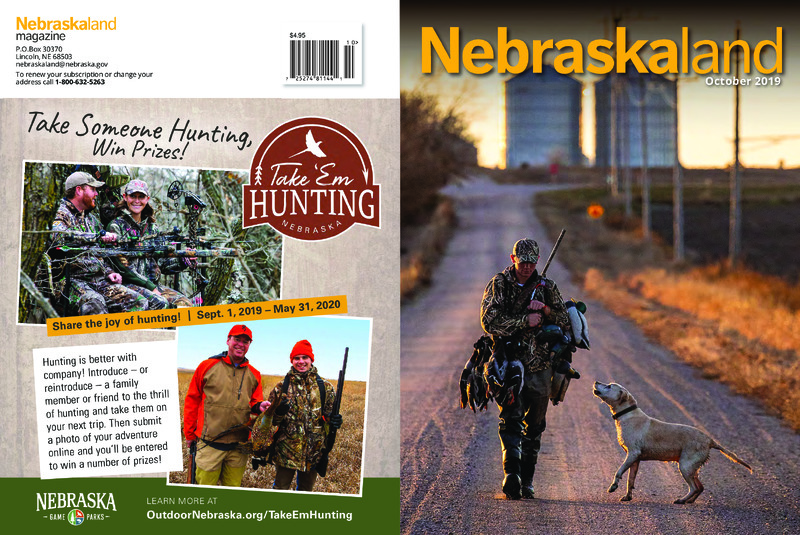
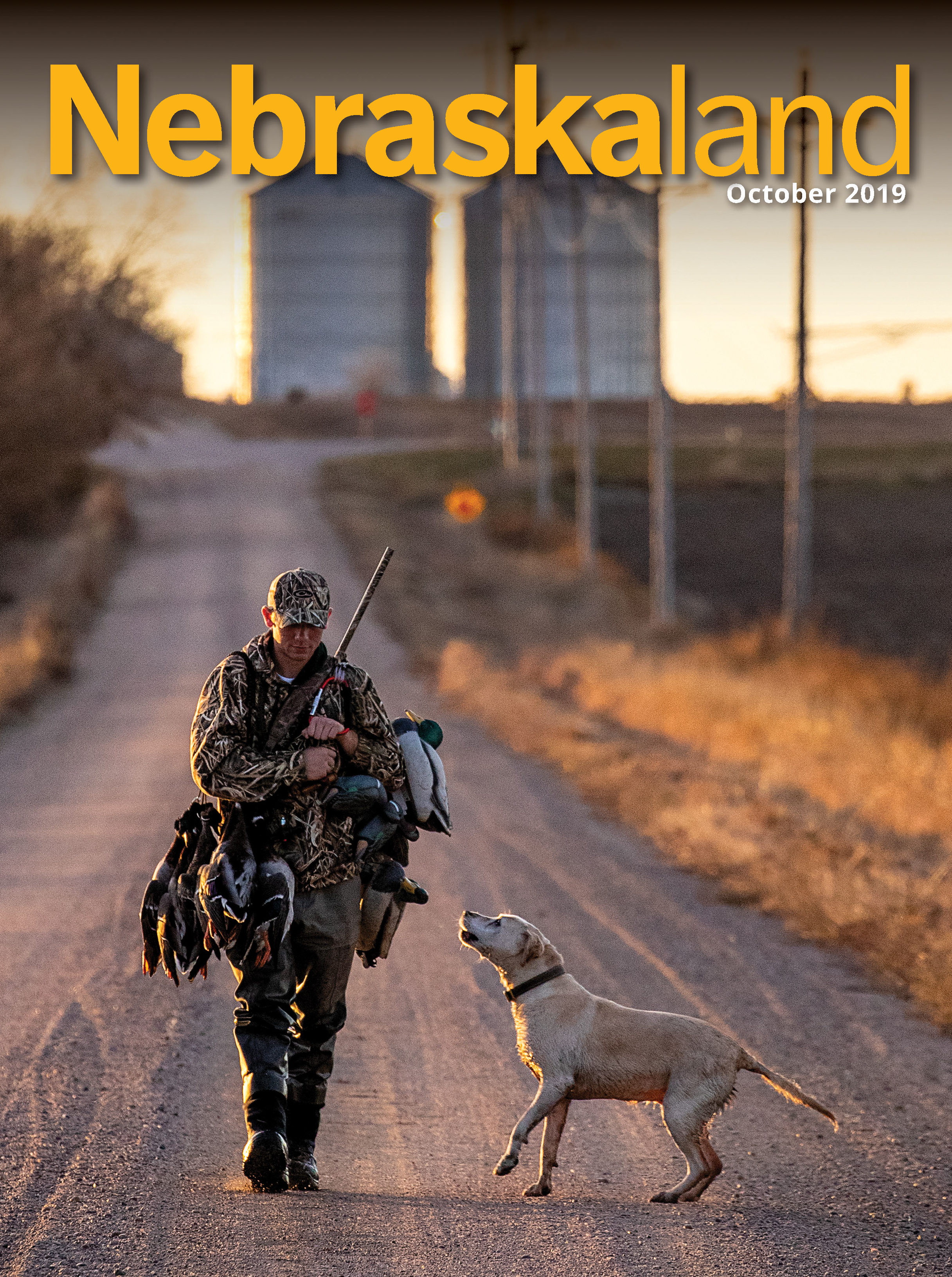
Cover: Blake Steinke and his dog,
Aspen, celebrate a successful
afternoon hunt on a basin in Hamilton
County. Photo by Doug Steinke.
FEATURES
DEPARTMENTS
20
6
10
50
60
62
THOUGHTS ON WATERFOWL
By Dr. Mark Vrtiska
Photos by Joel Jones
26
OUTDOOR NEBRASKA
28
FALL IN NEBRASKA
34
DON’T LET WOMEN VOTE
36
BREAKFAST IN THE BLIND
44
FINDING HISTORY
What to Do in October
By Renae Blum
By Nebraskaland Staff
If you want to keep drinking
By History Nebraska
Your Nebraska
In the Field
Mixed Bag
Portraits from the Past
The Last Stop
ON THE WEB
To see additional content including photos,
videos and additional articles, visit
Magazine.OutdoorNebraska.gov/digital.
Story and Photos by Jenny Nguyen-Wheatley
and Julie Geiser
in the Sandhills
Story and Photos by Mark Harris
Nebraskaland (VOL. 96 / NO. 8 ISSN 0028-1964) is published monthly, except for the combined Jan./Feb. and Aug./Sept. issues, by the Nebraska Game and Parks Commission, 2200 N. 33rd St.,
Lincoln, NE. Periodicals postage paid at Lincoln, Nebraska, and additional mailing offices. POSTMASTER: Send address changes to Nebraskaland, P.O. Box 30370, Lincoln, NE 68503-0370.
Magazine Staff
magazine
Communications Director Christy Firestone
Public Relations Manager Cara Pesek
Published by the Nebraska Game and Parks
Commission since 1926. The Commission is
dedicated to the conservation and protection
of all the state's natural resources and the
people who use them.
Editor Jeff Kurrus
Associate Editor Jenny Nguyen-Wheatley
Regional Editors Eric Fowler, Julie Geiser,
Justin Haag
Contributing Editor Michael Forsberg
Regular Contributors Renae Blum,
Chris Helzer, Chris Masada, Ryan Sparks,
Gerry Steinauer
Art Director Tim Reigert
Graphic Designer Mel Severin
Photo Librarian Jaclyn Cruikshank Vogt
Administration
Director Jim Douglas
Deputy Director Tim McCoy
Commissioners
Chairman - Robert Allen, Eustis
Vice Chairman - Dan Kreitman, Wahoo
2nd Vice Chairman - Pat Berggren, Broken Bow
Dick Bell, Omaha
Rick Brandt, Roca
Scott Cassels, Omaha
Jim Ernst, Columbus
Doug Zingula, Sidney
John Hoggatt, Kearney
Circulation Donna Robinson
For address changes and questions about your
subscription, e-mail donna.robinson@nebraska.
gov or call 800-632-5263
Advertising Sales Manager
For advertising information contact
Shane G. Gilster, 402-742-0125
Email: shanegilster@gmail.com
Nebraskaland Magazine Copyright 2019, all rights reserved.
Nebraskaland is available in audio from the Nebraska Library
Commission Talking Book and Braille Service, Suite 120, 1200 N St.,
Lincoln, NE 68508. 800-742-7691. Nebraskaland Magazine and the
Nebraska Game and Parks Commission reserve the right to reject any
advertising not in keeping with the agency mission.
Rates: $18 for one year; $33 for two years; $44 for three years. Nebraska
recipients must add appropriate sales tax. To subscribe call
1-800-NEBLAND (632-5263), or go online to:
NebraskalandMagazine.com.
Commission Offices
Conservation Officers
Headquarters/Southeast District Office
2200 N. 33rd Street Lincoln, NE 68503
Phone 402-471-0641
ADMINISTRATION (Lincoln)
Craig Stover (Administrator)
Duane Arp (Asst. Administrator)
Jeff Clauson (Asst. Administrator)
Northeast District Office
2201 N. 13th St. Norfolk, NE 68701
Phone 402-370-3374
Southwest District Office
301 E. State Farm Rd. North Platte, NE 69101
Phone 308-535-8025
Northwest District Office
East Hwy. 2, Box 725 Alliance, NE 69301
Phone 308-763-2940
Bassett Office
524 Panzer St., Box 508 Bassett, NE 68714
Phone 402-684-2921
Kearney Office
1617 First Ave. Kearney, NE 68847
Phone 308-865-5310
Ak-Sar-Ben Aquarium/Schramm Education
Center
21502 W. Highway 31 Gretna, NE 68028
Phone 402-332-3901
Omaha Office
8495 Frederick Street, Omaha, NE 68124
Phone 402-595-2144
OutdoorNebraska.org
Any program that receives federal funding from the National Park
Service, or the United States Fish and Wildlife Service prohibits
unlawful discrimination on the basis of race, color, religion, age, gender,
marital status, national origin, age, disability or political affiliation. Any
person who believes he or she has been discriminated against in
any program, activity, facility, or service, should contact the Nebraska
Game and Parks Commission, Lincoln, NE 402-471-0641, the Equal
Opportunity Commission, Lincoln, NE 402-471-2024, TTY/TDD 402471-4693; United States Fish Wildlife Service, Civil Rights Coordinator,
4401 N. Fairfax Drive, Arlington, VA 22203; Director, Equal Opportunity
Program, U.S. Department of Interior, National Park Service, 1849 C
Street NW, Mail Code 0008, Washington, D.C. 20240-0001.
4
Nebraskaland • October 2019
402-471-5531
402-471-5531
402-471-5531
NORTHWEST (Includes counties covered)
Jim Zimmerman (District Supt.)
308-641-6138
Kelsey Glodowski
(Box Butte, S 1/2 Sheridan, Grant)
308-763-8226
Sean McKeehan
(Kimball, Banner, Scotts Bluff)
308-672-1824
Dan Kling (Sioux, Dawes)
308-430-0572
Kyler Prochaska
(E 1/2 Dawes, N 1/2 Sheridan, W 1/2 Cherry)
308-430-3984
308-458-7650
Terry Brentzel (Deuel, Garden, Grant)
402-389-0444
Frank Miller (Cherry, Hooker)
308-279-9133
Josh Widhelm (Morrill, Cheyenne)
NORTHEAST (Includes counties covered)
Tom Zimmer (District Supt.)
402-649-8053
402-760-0712
Dale Davis (Keya Paha, Brown, Rock)
402-340-3981
Jonathan Andreasen (Holt, Boyd)
402-719-6226
Kyle Gaston (Dodge, Colfax)
Greg Hesse
(Greeley, Wheeler, Boone, S 1/2 Antelope)
402-843-6567
Mitch Johnson (Knox, Antelope, Pierce)
402-613-8612
402-762-5022
Jeff Jones (Knox, Cedar)
Jon Reeves
(S 1/2 Thurston, Burt, Washington)
402-889-8508
Andrew Heyer (Pierce, Madison, Stanton) 402-613-2241
Cory Krause
(Cuming, Wayne, Stanton, Dodge)
402-380-6410
Steve Oberg
(Colfax, Platte, Madison, Stanton, Nance)
402-910-3366
Owen Johnson
(Dixon, Dakota, N 1/2 Thurston)
402-266-1759
Doug Pollard (Loup, Garfield, Valley)
308-730-7050
Ethan Teter
(Boating – eastern Nebraska)
402-620-8129
SOUTHWEST (Includes counties covered)
Roger Thompson (District Supt.)
308-530-3097
308-202-0819
Matt Brandt (Sherman, Howard)
308-380-7331
Tim Williams (Hall, Hamilton, Merrick)
Pat George
(Harlan, Franklin, Phelps)
308-920-2762
Matt Andrews
(Gosper, Furnas, Frontier, Red Willow)
308-746-2418
Brian Piernicky
(Red Willow, Frontier, Hayes, Hitchcock)
308-340-6627
Statement of ownership and monthly circulation of
Nebraskaland Magazine
Owner and publisher: Nebraska Game and Parks
Commission
Editor: Jeff Kurrus
Headquarters of Publisher and Publication:
2200 N. 33rd St., Lincoln, NE 68503
Stockholders, Bondholders, Mortgage and
Security Holders: None
Average number of copies
of each issue during
preceding 12 months
Single issue
nearest to
filing date
A. Total Copies Printed
(net press run) ........................ 20,404 ........... 19,766
B. Paid Circulation
1. Mail subscriptions ............... 17,238 ........... 16,738
3. Single-copy sales ................. 2,000 ............. 1,927
C. Total Paid Circulation.............. 19,247 ........... 18,674
D. Free Distribution
by Mail ......................................... 350 ................ 342
D. Free Distribution
Outside the Mail .......................... 406 ................ 406
E. Total Free Distribution ................. 762 ................ 751
F. Total Distribution...................... 20,009 ........... 19,425
G. Copies Not Distributed ................ 395 ................ 341
H. Total ........................................ 20,404 ........... 19,766
I. Percent Paid and/or
Requested Circulation ................96% ............... 96%
John Lee (Hitchcock, Dundy, Chase, Hayes)
Nicholas Fix (Keith, Perkins)
Bryce Streger (Keith, Arthur)
Sean Schultz (Keith)
Brandon O’Neal
(Lincoln, McPherson, Logan)
Alex Hasenauer
(Lincoln, McPherson, Logan)
Mike Thome (Dawson)
Ray Dierking (Custer, Thomas, Blaine)
Taylor Dixon
(Dawson, N 1/2 Gosper, N 1/2 Phelps)
Eric Javins
(Adams, Clay, Nuckolls, Webster)
Kevin Bergstrom
(Boating – central Nebraska)
Daryl Teter
(Boating – central Nebraska)
Scott Eveland
(Boating – western Nebraska)
308-414-1432
308-289-0427
308-440-3847
308-760-0145
308-530-3157
308-660-4671
308-529-8146
308-870-0322
308-217-2108
402-902-2017
308-520-1031
308-440-1863
308-289-0017
SOUTHEAST (Includes counties covered)
Levi Krause (District Supt.)
402-949-0593
402-619-1355
Rich Berggren (Douglas)
402-616-5961
Dan Evasco (Sarpy)
402-210-0888
Heath Packett (Cass)
402-209-1506
Russell Mort (Otoe, Johnson)
William Krause
(Nemaha, Richardson, Pawnee)
402-274-8063
Matt Taylor (Thayer, Fillmore, Jefferson)
402-200-9597
402-806-0915
Matt Seitz (Gage, Saline)
402-890-6463
Dina Barta (Lancaster)
402-937-3422
Dudley Sorensen (Lancaster, York)
402-613-2312
Travis Shepler (Lancaster)
402-314-9641
Trevor Stahlecker (Lancaster)
402-890-7140
Stacey Lewton (Lancaster, Seward)
402-443-6392
Mike Luben (Saunders, Butler, Polk)
YOUR NEBRASKA
Instagram Photos
Follow us (@nebraskaland)
and tag us in your photos
to be featured in an
upcoming issue.
Karen Kutz Smith, Omaha
Ruby-throated Hummingbird
Opposite: Dina Barta, Lincoln
Great Horned Owl at Fontenelle Forest
Raptor Recovery
Alan Nash, Scottsbluff
Supper in the Fields
6
Nebraskaland • October 2019
October 2019 •
Nebraskaland
7
YOUR NEBRASKA
Bob Waldeisen
Northern Cardinal and a Redheaded Woodpecker
David Auman, Lincoln
Sandhill Cranes in Hall County
Brian Thomas, Papillion
Toadstool
Jessica Mikoloyck,
Scottsbluff
National Balloon
Championship, Mitchell
8
Nebraskaland • October 2019
Send your comments and photos to:
Jeff Kurrus, Editor
Nebraskaland Magazine
P.O. Box 30370
Lincoln, NE 68503
or email Jeff.Kurrus@Nebraska.gov
Please include your postal address
and telephone number. Letters may be
condensed and edited. Photographs are
also welcome.
October 2019 •
Nebraskaland
9
IN THE FIELD
FALL FOLIAGE
The trails at Platte River
State Park offer a barrage of
fall color this time of year.
PHOT
HOT
HOTO
TO BY
B JEF
FF KURRUS
KUR
RRU
RRUS
RUS
RUS
10
Nebraskaland • October 2019
October 2019 •
Nebraskaland
11
IN THE FIELD
THREATENED AND ENDANGERED:
THE UTE LADIES’-TRESSES
By Gerry Steinauer
12
Nebraskaland • October 2019
(June through mid-July). In late-summer hayed or grazed
meadows, the cutting or nipping of the orchid’s flower stalks
prevent seed production, which over time, would threaten its
survival at such sites.
Being at the extreme of the Ute ladies’-tresses range
reduces the odds that we will discover other populations of
the plant in western Nebraska. Adding to the difficulty, it
is a big landscape to survey for such a small orchid that is
choosey about its habitat.
PHOTO BY GERRY STEINAUER
The Ute ladies’-tresses (Spiranthes diluvialis) is an
eloquent little orchid with an intriguing name. The word
“Ute” because the plant occurs within the historic range
of the Ute Tribe in Colorado and Utah. The word “tresses”
because the many small, ivory-colored flowers, arranged in
spirals on the flowering spike, resemble the braids (tresses)
of a woman’s hair.
Listed as both a state and federally threatened species,
this rare, late-summer blooming perennial has a limited
range in Nebraska. A thousand or so individuals grow only in
alkaline wet meadows along a two-mile stretch of the upper
Niobrara River Valley in Sioux County.
Range-wide, the Ute ladies’-tresses has populations
scattered over the northwestern United States and southern
British Columbia where it grows in old oxbows, gravel bars,
wet meadows and seeps at elevations ranging from 4,300
to 7,000 feet. The Nebraska population is its easternmost
location.
The orchid was discovered in Nebraska in 1996 when a
botanist surveying for the plant in Wyoming’s Niobrara
Valley wandered across the border. In 1997, hoping to find
more populations, the Nebraska Game and Parks surveyed
alkaline and some freshwater meadows throughout the
Panhandle. No other Ute ladies’-tresses were discovered.
We did find the nodding ladies’-tresses (S. cernua) growing
in western Sandhills alkaline meadows and the uncommon
Great Plains ladies-tressses (S. magnicamporum) in one
alkaline meadow in the upper Pumpkin Creek Valley in
Scotts Bluff County.
Several factors may explain the Ute and other ladies’tresses’ sporadic distribution in Nebraska and range-wide.
For one, the orchids’ microscopic seeds can be wind-blown
for great distances allowing establishment in isolated
locations. In addition, ladies’-tresses form associations with
mycorrihzal soil fungi that infect the roots and aid in nutrient
and water uptake. In return, the orchids supply the fungi
with carbohydrates through photosynthesis. The tiny orchid
seeds, which lack endosperm (starch supply), are especially
dependent on fungal infection for germination and growth.
In short, the orchids can grow only in habitats also suitable
for their needed fungi.
The Ute ladies’-tresses’ distribution is also likely limited
by habitat management. In Nebraska, the plant grows
in meadows that are hayed or grazed in early summer
October 2019 •
Nebraskaland
13
IN THE FIELD
Take ‘Em Hunting
By Cara Pesek
PHOTOS BY JEFF KURRUS
A BB GUN BEGINNING
By Jeff Kurrus
Henry Matulka of Gretna went on his first hunting trip
when he was 5 years old. Without a driver’s license to operate
a vehicle, or his own money to purchase gear, he was reliant
upon someone taking him. That person was his dad, Tim.
With BB gun in hand, Henry continued to accompany
his dad on dove, waterfowl, deer, and turkey hunting trips,
waiting for the day he could pull the trigger on something
besides his Red Ryder lever action. That day came three
years later when he killed his first tom turkey with his dad
beside him, but Henry already knew that success afield is not
measured in the amount harvested.
“It’s fun,” he said with a shrug of the shoulders. “It’s never
been about shooting stuff.”
Tim agrees, which is why he involves his son in every
part of the hunt. “The preparation and strategy is the fun
stuff,” Tim said, his excitement reminiscent of Henry’s.
14
Nebraskaland • October 2019
“Anytime we start getting ready for a hunt, I feel like a kid
myself.”
From practicing with their duck and goose calls to cleaning
guns, Tim takes Henry through the entire process. Then
Henry goes even further.
“He’s always watching YouTube videos,” Tim said. “I
mean, he already knows more about some of this stuff than I
do. He’s always trying to learn.”
This is obvious when you’re around Henry. When he’s
belting out a hail call, you know he could call in a duck.
When he’s honking, you know geese will be listening. But
because it’s not always just father and son, Tim reigns him
in when they’re around larger groups of more experienced
hunters.
Yet that doesn’t mean an 11-year-old can’t act his age. “You
can’t expect a young kid to stay still in a blind for hours,” said
The Nebraska Game and Parks
Commission, along with Ducks Unlimited,
Pheasants Forever and Quail Forever, the
National Wild Turkey Federation and Plains
Equipment Group, is thrilled to announce a
new challenge for hunters beginning
Sept. 1.
The Take ‘Em Hunting Challenge
encourages hunters to take a pledge
to introduce someone new to hunting
during the 2019-2020 hunting seasons.
Those who take someone new hunting
can upload a photo of their hunting trip
to the Commission’s website and will be
registered to win great prizes including
a camo John Deere XUV590M crossover
utility vehicle from Plains Equipment Group
valued at $15,300; gift cards to Cabela’s
and Scheels, a Nebraska State Park stay,
shotguns, and outdoor gear all donated
by partners who are invested in recruiting
more hunters.
“Everyone learned to hunt from someone,
and they likely have wonderful memories
of those early hunting trips,” said Jim
Douglas, director of the Nebraska Game
and Parks Commission. “Here in Nebraska,
we are proud of our strong hunting
heritage. But in order for that heritage to
last, we must share it with others.”
Hunting is critical to future conservation
of our natural resources. Every time a
hunter buys a hunting permit or habitat
stamp, his or her purchase directly
funds programs that support habitat
conservation, hunting access, wildlife
Tim. “You got to let them move around. And you definitely
can’t force them to keep their head down the entire time
birds are working above a blind. How are you going to get
them excited if they’re not allowed to watch?”
Because Henry has been able to watch, this time of year –
like it does for so many hunters – comes with the feeling that
the blind is where you’re supposed to be. “I really like to fish,”
said Henry, who is on the water all through the summer, “but
because the hunting seasons are shorter, and you don’t get
to go as much, I just like it better. This time of year I get the
feeling that it’s time to shoot some ducks.”
But he’s not emerging from the truck after all the work is
done and everyone is climbing into a blind. He’s watching
the wind to see where they should set the decoys in relation
to the blind, and he’s advising his dad anytime he can about
how they can have a more successful hunt.
research and much more. Additionally,
excise taxes that hunters pay on firearms,
ammunition and other hunting equipment
generate an additional $1 billion for
conservation work each year. “It is crucial
that we recruit a new generation of
hunters to maintain our cherished natural
resources. The best thing a hunter can do
for conservation is to introduce someone
new to hunting,” said Douglas.
Hunting is a great way to spend time
outdoors, experience nature, unwind and
make memories with friends and family.
The Take ‘Em Hunting effort offers an extra
incentive for hunters to take someone
along for a hunt. Special youth seasons
are an especially great time to take
young hunters out. The challenges allows
participation in upland, waterfowl, deer,
turkey hunting and more.
Prizes will be given away throughout
the challenge until May 31, 2020, with
the grand prize utility vehicle winner
announced in June 2020. For
more information or to
take the pledge, visit
OutdoorNebraska.org/
TakeEmHunting.
And Tim will listen. When his son and hunting partner
has an idea, is getting cold, or has noticed the food supply
has been vanquished, they’ll make an adjustment to their
trip. Together.
Tim wants to pass along the same love for hunting as his
own father passed onto him growing up near Grand Island.
“My time in those Rainwater Basin marshes as a kid are some
of my fondest memories,” Tim said. “It’s why I do what I do
today.”
Henry’s 11-year-old take is similar. “I just like walking into
a marsh and going to hunt.”
All it seems Henry ever needed was someone to take him.
Which is exactly what happened.
For more information on youth hunting, including mentoring,
permits and seasons, visit OutdoorNebraska.org/hunting.
October 2019 •
Nebraskaland
15
IN THE FIELD
CEDAR CANYON NORTHWEST OF CRAWFORD, PHOTO BY BOB GRIER
FOG
By Martha D. Shulski
As author Olivia Dresher wrote, “Fog is rain that whispers.”
Fog is our opportunity to experience the mystical
environment of a cloud without ever leaving the ground. It
provides a picturesque backdrop for those wishing to capture
a moment in time. It is generally short-lived, which can make
capturing these moments somewhat tricky.
Fog can also, unfortunately, lead to automobile accidents
when visibility is significantly reduced. By definition, fog
causes a reduction in horizontal visibility to a distance of
about half a mile or less. One way we characterize clouds is
by their distance from the surface, therefore what makes fog
different than a cloud is simply altitude.
The normal recipe for a cloud includes three ingredients:
water vapor, a particle such as dust for the vapor to condense
onto, and an upward motion of air. In the case of fog, the
upward motion that would lead to cooling and condensation
of those water droplets is not actually necessary. There are
quite a few types of fog; the only thing that distinguishes
one type from another is how those droplets formed.
When winds are light, the skies above are clear and there
is a shallow layer of moist air at the surface, fog can occur
in the late evening through early morning. This is the time
of day when the air temperature dips close to the dewpoint
16
Nebraskaland • October 2019
temperature, or the temperature at which dew begins to
form. As the warmth of the day takes hold, these droplets,
termed radiation fog, normally make an exit and dissipate.
This type is normally seen in fall and winter.
Another common type is advection fog. Often seen over
cool waters, this fog occurs as moist air advects (a fancy
word for moves) over a cold surface. The vapor-rich air cools
and condensation occurs so that a cloud is formed.
On really cold winter days, fog also can form when water
vapor is added by either a natural or artificial source. This
could be a lake that has held onto some warmth or steam
from a power plant. And in the case when temperatures
are well below freezing, those supercooled water droplets –
water that exists in liquid form even when the temperature
is less than 32 F – can deposit on whatever surface they
contact.
The next time you’re emerging from the warmth of a cabin
into the crisp fall air, and you are met by stillness and the
translucent white blankets filling the depressions in the
landscape, soak in the fleeting whispering rain.
Martha D. Shulski, at the University of Nebraska-Lincoln, is
the director of the Nebraska State Climate office.
IN THE FIELD
PHOTO BY JARROD SPILGER
QUAIL CHOKES
By Jarrod Spilger
18
Nebraskaland • October 2019
making it much easier to connect with close-range quail,
especially those shot over a staunch pointer.
Open up this season and watch your quail hit rates improve.
Skeet Choke
Cylinder Choke
Diffusion Choke
ILLUSTRATIION BY ANDREW FAUGHN
Nebraska remains a great place to bag bobwhites, however
quail can be difficult to hit.
Even after all these years, the sudden explosion of a dozen
bobwhites at my feet still surprises me, even when my dog
is on point and I know the flush is imminent. I guess that’s
what makes quail hunting so fun.
To help connect with speedy quail, open up your shotgun’s
choke. This is easy in modern shotguns equipped with
screw-in choke tubes. (To open patterns in fixed-choke guns,
try a spreader load.) Most shotguns come with three tubes:
full, modified, and improved cylinder. The latter two are OK
for quail, but there are better options.
As my pointing dog, Phantom, gained experience and
held her points increasingly longer, my shots at quail
got increasingly closer. So, I started experimenting with
increasingly more open chokes. First, I switched to skeet,
which is more open than improved cylinder, favored by skeet
shooters, and a great all-around quail choke.
Eventually, I opened up even more to a cylinder choke,
which has no constriction since it measures the same as the
shotgun’s bore, and by the end of the 2017-2018 season, I
was using a diffusion or spreader choke. It creates a wide
open pattern almost immediately after leaving the gun,
October 2019 •
Nebraskaland
19
Thoughts on
Waterfowl
“
Waterfowl and their habitat is what I do, it’s why I wake up, it
defines me consciously or unconsciously.”
– Andy Bishop,
Rainwater Basin Joint Venture
BY DR. MARK VRTISKA
PHOTOS BY JOEL JONES
t’s just my humble opinion, but I believe those of
us involved in fish and wildlife conservation on a
professional level are “wired” a bit differently than the
rest of society. There’s some innate draw or attraction
to wild and natural things and places that is difficult to
explain, let alone understand. That attraction has led us
down a path of life that isn’t just a job or a career, but a
vocation that is inexplicably intertwined with our lives,
passions, and hobbies.
Those passions and hobbies manifest themselves
in a variety of ways, whether it be simple hikes up
secluded mountain trails, catching bluegill through the
ice, or observing a rare bird species to add to the life
list. Engaging in our favorite activities adds fuel to our
commitment to doing our jobs, but also reminds us of
that unspoken oath we took somewhere along the line
to conserve our natural resources.
The sight of ducks on cupped wings provides that
source of fuel for me. I never – ever – get tired of seeing
it, but when it happens on a gray November day over
my decoys, it’s a really good sight. If also in response to
my calling and they don’t flare when I raise my shotgun,
I
a truly marvelous one. That sight doesn’t occur often,
and I find it a bit evil in that it’ll set you on a trajectory
(obsession?) to see it again despite those early mornings
of slogging through soft-bottomed marshes only to
watch empty skies.
It’s probably strange then to know it wasn’t that
experience that engulfed me into the waterfowl
conservation world, but the sight of looking into a duck
nest on a Montana prairie that did it. However, two years
later after some of my colleagues took me duck hunting, it
seemed I was destined to be where I’m at today. I feel lucky
to be in a position to know that both of those experiences
are connected. I also carry a sense of responsibility that to
participate in one, I must have the other.
I’m now at the point in my life where I want my
grandkids and others to experience what I’ve
experienced in the marshes. Will ducks on cupped wings
elicit the same feelings in them? Will they understand
my work and my passion were connected as a means
to provide their kids with the same opportunity? I can
only hope and for now, simply relish their being in the
duck blind with me. N
Joel Jones is a freelance photographer living and working out of Lincoln, Nebraska.
A native of Halifax, England, Jones aspires to shed a positive light on the hunting
community through his photos. He loves to travel,
hunt and photograph the outdoors.
20
Nebraskaland • October 2019
October 2019 •
Nebraskaland
21
“
Long before a gun is in hand, I want my daughters to first
realize the value in exploring different landscapes and observing
wildlife up close. If they grow up to respect hunting, understand
conservation, and realize the critical connection between the two,
then I have done my job.”
– Angelina Wright, Ducks Unlimited
22
Nebraskaland • October 2019
“
Waterfowl have a way of connecting
people across both space and time. Playing a
role in the conservation of such a symbol is a
great way of tipping one’s hat to everyone they
ever have or ever will share a blind with.”
– Greg Wright, U.S. Forest Service
October 2019 •
Nebraskaland
23
“
There is a feeling of awe I get when thinking
about how these birds fly thousands of miles to be
at this very spot.”
– John Denton,
Ducks Unlimited
“
I picture a wetland filled with
mallards in the early morning
darkness ... the
unmistakable sound of wings
overhead.”
– Kyle Smith,
Nebraska Game and
Parks Commission
24
Nebraskaland • October 2019
“
Dogs ... I’ve hunted without them, but those hunts were not
complete. ”
– Scott Wessel,
Nebraska Game and Parks Commission
October 2019 •
Nebraskaland
25
Outdoor Nebraska
What To Do in October
PHOTO BY JENNY NGUYEN-WHEATLEY
By Renae Blum
October is a prime time to be outside, with more to offer than
just colorful leaves and Halloween festivities. Check it out! If
you’d like to learn more about the park events listed below,
visit Calendar.OutdoorNebraska.gov. N
Fall hunting
Throughout the month
| Statewide
Halloween in the
Hollow
Oct. 19, Ponca State
Park
Oct. 26, Ash Hollow
State Historical Park
PHOTO BY JENNY NGUYEN-WHEATLEY
Good hunting continues
this month. Take to the
field for the pheasant
opener on Oct. 26, and
enjoy other hunting
opportunities, such as
antelope, elk, turkey and
dove.
21st Annual
Hallowfest
Heritage Days at Fort Atkinson
PHOTO BY JULIE GEISER
Oct. 5-6 | Fort Atkinson State Historical Park
This special living history weekend includes traditional
buffalo processing and hide tanning, live snake
presentations, reenactments and period music played
on traditional instruments. See demonstrations of
Dutch oven cooking, view antique tractors, and try your
hand at old-fashioned apple pressing. Learn more at
wcheritagedays.org.
Dusty’s Pumpkin
Fest at the
Cody’s
Every Friday and
Saturday in October,
Buffalo Bill State
Historical Park
View and photograph
native sparrows
Throughout the month | Statewide
PHOTO BY JEFF KURRUS
Throughout the month | Various locations
From October to April, you can stay in select Nebraska state park cabins
and lodge rooms for 30 percent less than at any other time of year.
The discount applies Sunday – Thursday, excluding holidays. Book a
reservation online at OutdoorNebraska.org or by calling 402-471-1414.
26
Nebraskaland • October 2019
PHOTO BY JUSTIN HAAG
Take advantage of reduced
lodging rates
With about 18 species migrating through the state in
October, sparrows are one of the most visible groups of
birds this month. Most species can be found in brushy,
grassy areas. Not too excited about viewing sparrows?
Give them another look, suggests Game and Parks’
nongame bird program manager Joel Jorgensen. “Some
of these sparrows, once you get a close up view of them,
can be stunning,” he said.
October 2019 •
Nebraskaland
27
Fall
in Nebraska
PHOTOS
BY NEBRASKALAND STAFF
ABOVE: Late October light casts shadows on a
leaf and grass in Sarpy County. – Jeff Kurrus
RIGHT: Wild clematis decorates the foreground at
sunrise along White River Road in Sioux County.
– Justin Haag
28
Nebraskaland • October 2019
October 2019 •
Nebraskaland
29
ABOVE: Changing leaves at
Calamus Reservoir State
Recreation Area in Loup
County. – Eric Fowler
LEFT: The leaves of sumac
project their striking fall
appearance along Bone
Creek at Keller Park State
Recreation Area in Brown
County. – Justin Haag
RIGHT: Smith Falls State Park
near the Niobrara River in
Cherry County. – Jon Farrar
30
Nebraskaland • October 2019
October 2019 •
Nebraskaland
31
LEFT: Autumn light plays off
clouds above a lone tree along a
country road at sunrise in Chase
County. – Eric Fowler
BELOW: Trees and grasses show
their fall colors in the Ash Grove
area at Calamus Reservoir WMA
in Loup County.
– Eric Fowler
RIGHT: Leaves from a cottonwood
tree rest along the shoreline of
Smith Lake south of Rushville in
Sheridan County. – Justin Haag
The fall foliage at the following state parks are spectacular to see (peak times dependent on first frost):
Lodge State Park, Nebraska City (late
• Arbor
September to early October)
State Park, Chadron (mid-to-late October)
• Chadron
Fort
Robinson
• to mid-October)State Park, Crawford (mid-September
Cave State Park, Shubert (early-to-mid
• Indian
October)
32
Nebraskaland • October 2019
State Park, Niobrara (late September to
• Niobrara
mid-October)
T. Mahoney and Platte River state parks,
• Eugene
Ashland and Louisville, respectively (mid-October)
State Park, Ponca (early-to-mid October)
• Ponca
Smith
Falls
State Park, Valentine (late September)
•
October 2019 •
Nebraskaland
33
Don’t Let Women Vote
if you want to keep drinking
By David L. Bristow, History Nebraska
f you let women vote, will they take away your beer?
There was a time when many Nebraska men feared their
wives and daughters would do just that.
Nebraska ratified the 19th Amendment 100 years
ago, granting women the right to vote. The amendment
took effect in 1920 after it was ratified by the required threefourths of the states.
By then American suffragists had been campaigning for
women’s voting rights for more than 70 years. Nebraska
Territory’s first legislative session in 1855 included a prosuffrage speech by Amelia Bloomer. Many Nebraskans took
up the cause over the decades.
Letting women vote was controversial for a lot of reasons.
Even many women opposed it. Some feared it would upset
traditional gender roles, or believed that women were
unsuited for the rough-and-tumble of politics. Women were
seen as a civilizing and moral influence on men. Would that
status be lost if women became involved in the dirty dealing
of partisan politics?
Meanwhile, many women were involved in both the
suffrage and temperance movements. Temperance advocates
argued that America’s high level of alcohol consumption
I
Wilber, Nebraska, May 1, 1918. History Nebraska RG813-0-40
34
Nebraskaland
• October 2019
From The Woman Citizen, Feb. 8, 1919.
subjected women to needless poverty and domestic violence.
By the late 19th century, temperance groups favored
prohibiting alcohol entirely.
Traditional-minded men feared that politically active
women would drive them to drink – and then prevent
them from drinking. Nebraska’s brewers, distillers, and
saloon owners financially
supported
anti-suffrage
efforts in order to stop
Prohibition in Nebraska.
United States’ entry
into World War I in 1917
helped shift public opinion.
German immigrants made
up nearly a quarter of
Nebraska’s
population,
and most were strong
opponents of both suffrage
and prohibition. German
immigrants had founded
big Nebraska breweries
such as Metz, Krug, Storz,
Fremont Brewing Co., and
others. Wartime paranoia
threw suspicion on all
things German.
Before a women’s suffrage parade in Blair, July 11, 1914. History Nebraska RG1073-4
A 1917 limited-suffrage law allowed Nebraska women to
vote in some local elections – or would have, if it hadn’t been
tied up in court. Anti-suffragists used Nebraska’s referendum
law to challenge it. They gathered enough petition signatures
to suspend the law until a statewide referendum.
Suffragists suspected fraud. More than 18,000 of the
30,000 signatures had been gathered in Omaha. The river
city had long been notorious as a “wide-open” town full of
saloons, and it was ruled behind the scenes by crime boss
Tom Dennison.
The Nebraska Woman Suffrage Association demanded
to see the petitions and, sure enough, found whole pages of
signatures signed in the same hand, or listing fake addresses,
or signed with the names of dead men. It was never clear
exactly who was behind the fraud, but suffragists were
certain that “liquor interests” played a role.
But it was almost a moot point by the time the women won
their court case in June 1919. The 19th Amendment was on
its way to becoming part of the U.S. Constitution. By then
Nebraska’s statewide Prohibition law was already in effect
and the 18th Amendment (federal Prohibition) had been
ratified.
Prohibition came first, in other words. You couldn’t blame
women voters for it. The 18th Amendment was repealed in
1933, and Nebraskans voted to repeal statewide Prohibition
the following year. By that time most people thought
Prohibition had been a mistake – but they took for granted
that women voters should have a say in the matter. N
The exhibit Votes for Women: Nebraska’s Suffrage Story is
at the Nebraska History Museum in Lincoln through January 2,
2021. history.nebraska.gov
Fred Bargemann’s Saloon in Bancroft, before Prohibition.
History Nebraska RG3334-1-41
October 2019 •
Nebraskaland
35
Breakfast in the
Blind
By Jenny Nguyen-Wheatley and Julie Geiser
hen you’ve been up and dragging decoys since 4 a.m.,
you’re ready for some grub by the time the ducks
have flown and the midmorning lull begins. Whether you’re
hunting from a heated pit blind, camouflaged among the
reeds or lying in a small layout blind, there’s never a reason to
go hungry. Read on for ideas
beyond energy bars and good
old raisins and peanuts.
W
Kitchen-ready
Blind
PHOTO OPPOSITE BY JULIE GEISER, PHOTO THIS PAGE BY JENNY NGUYEN-WHEATLEY
36
Nebraskaland
• October 2019
Hunting from a heated
blind can be like staying
in a 5-star hotel. Not only
is it warm, spacious and
comes with all the bells and
whistles, you also have the
luxury of being able to eat an
actual breakfast. Even if the
ducks aren’t flying, there’s
always time for hot coffee,
eggs, bacon and shooting the
breeze.
Here are tips for prepping breakfast in the blind:
Whisk raw eggs ahead of time and store in a plastic
container to take to the blind. For scrambling, plan for two
eggs per person. Keep cold.
Dice any meat, onions, mushrooms and peppers ahead of
time and store in a separate container(s).
•
•
Pre-prepare food that can be easily reheated in the blind,
such as breads, biscuits and gravy.
Cook in a nonstick skillet for easy cleanup. Use a lid for
faster cooking on extra cold mornings.
Heat cleaning water while you are eating to save time.
If needed, use biodegradable
Campsuds for all your
washing needs.
Always follow food
safety guidelines at home
and in the outdoors.
Bring hand wipes and a
trash bag for easy cleanup.
For simpler, hot breakfasts,
try just-add-water meals,
instant oatmeal or breakfast
burritos. Keep a coffee/tea
kettle in the blind or fill a
thermos before you leave
home.
Younger
hunters
might appreciate hot cocoa.
See page 38 for Julie’s
recipe for biscuits and gravy.
•
•
•
•
•
Hunting on a Bucket
When hunting in natural cover, you will have to carry food
in your pack, bucket or sled. Choose high-energy but simple,
lightweight food. A few things to consider:
Be aware of noisy, bright-colored, reflective packaging
•
Opposite: Boni Edwards, front, and Linda Bauer talk over the steam of coffee and breakfast
cooking in the goose pit. They were participating in a Beyond Becoming an Outdoors-Woman
goose hunt in Lincoln County on a January morning.
Above: When hunting early in the season, guests will appreciate fresh fruit and vegetables from
your garden, if available.
October 2019 •
Nebraskaland
37
Spencer Brooks of Bennington, front, and Terry
Bisgard of Omaha enjoy a laugh over cooking
breakfast in a pit blind.
PHOTO BY JENNY NGUYEN-WHEATLEY
Duck Blind Biscuits and Gravy
by Julie Geiser
38
Nebraskaland
• October 2019
to whisk in more flour, a little at a
time, until gravy thickens to desired
consistency. Add salt and pepper
to taste.
If you’re unable to make gravy
from scratch, buy a dry, white gravy
packet and follow the directions.
Pour the sausage gravy into a
sturdy container to take to the
blind.
Eggs: In the blind, add whisked eggs into
a hot pan and scramble. When set, move
the eggs to the side of the pan, and then
pour in pre-made gravy to reheat. Place
•
•
•
•
biscuits on top of the eggs to warm them,
flipping once or twice.
This is a hearty breakfast – serve on paper
plates that won’t bend.
•
PHOTO BY JULIE GEISER
Biscuits: At home, prepare biscuits from
a box mix such as Bisquick, or for a quick
fix, buy refrigerated biscuits and bake
ahead of time. Pack in a hard container
so they don’t get smashed on the way to
the blind.
Gravy: The night before, brown a
package of sausage – I like Jimmy Dean’s.
Move the cooked sausage to one side of
the pan, and then add 2 cups of milk to
the sausage grease. Heat up the milk and
grease, and then add ½ cup of flour and
stir with a fork until the lumps are gone.
Next, stir in the sausage, and continue
that can blow your cover. Transfer food to a quieter,
more neutral-colored bag or container if necessary.
Bring a small trash bag to avoid accidental littering
on the marsh.
Use hand sanitizer before you eat. Jenny knows
a duck hunter who contracted giardia after wading
through a pond.
Use a dry bag to protect food from moisture.
Hard cheese keeps well in the outdoors. Babybel is
a favorite – the wax sealing provides some protection
from heat, being smashed in your pack and grimy,
bloodstained hands.
Jerky, summer sausage and meat sticks are high in
protein and heavily salted. They can last several days
without refrigeration, and if you’ve been sweating, will
help replace the sodium you’ve lost. See page 40 for
The sun rises over Elwood Reservoir as Kaleb Berggren
and his dog watch as decoys are set out.
October 2019 •
Nebraskaland
39
PHOTOS BY JENNY NGUYEN-WHEATLEY
Two duck hunters watch the sunrise
from a pit blind in Burt County.
Jalapeno and Pineapple Wild Game Jerky
by Jenny Nguyen-Wheatley
•
•
•
•
•
•
•
•
•
•
40
Nebraskaland
• October 2019
Directions: Remove silver skin and fat
off meat, and then slice meat against the
grain about ¼-inch thick. In a bowl, whisk
together pineapple juice and remaining
ingredients. Add the sliced meat to the
marinade, cover and refrigerate for 24
hours. Stir the meat occasionally.
Evenly space out meat strips on
dehydrator trays; do not allow any of
the pieces to touch or overlap. Turn the
dehydrator to 160 degrees Fahrenheit
and dry the meat until it bends and
cracks but does not break. Check meat
periodically to make sure that you do not
PHOTO BY JENNY NGUYEN-WHEATLEY
Ingredients:
2 pounds of venison round or skinless
Canada goose breast
1 cup of 100 percent pineapple juice
2 teaspoons of jalapeno powder
¼ cup of soy sauce
2 teaspoons of kosher/sea salt
¼ cup of Worcestershire sauce
½ cup of packed brown sugar
2 tablespoons of Wright's hickory
liquid smoke
1 teaspoon of garlic salt
½ teaspoon of Prague
powder #1 curing salt
overdry the jerky, which will turn it hard and
brittle. Dry time will depend on dehydrator
efficiency and personal preference. I took
mine off after 5 hours.
Jenny’s jalapeno and pineapple wild game jerky recipe.
Don’t forget to incorporate fiber into your diet. Throw a
bag of baby carrots, snap peas, celery sticks, etc., along with
to-go cups of hummus or peanut butter into your bag. Fruits
such as apples, bananas and easy-to-peel mandarin oranges
are portable and quiet to eat.
If all else fails, peanut butter and jelly sandwiches
require no refrigeration. They are packed with protein and
heart-healthy fats that will keep you feeling full.
These tips can apply to hunting from a boat or a layout
blind.
•
•
Haidar Kazem of Alvo pours a cup of hot tea from a
thermos while duck hunting at Pawnee Lake State
Recreation Area.
Layout Blind
Layout blinds don’t allow much room for movement, so
food must be packable, require little prep and not be messy.
Aside from granola, energy and candy bars, homemade
energy bites can offer a quick pick-me-up. See page 42 for a
no-bake energy bites recipe.
Wraps and pita sandwiches are alternatives to traditional
sandwiches. Pack pickled hardboiled eggs to eat on the side –
they are filling, high in protein and they keep well.
Snacks: Dehydrated and freeze-dried fruit complement
trail mix. Fruit leather and bars are also tasty.
•
•
•
October 2019 •
Nebraskaland
41
Boat Blind
Depending on your rig, hunting from a boat blind can get cramped and cold.
While you might not be able to cook a huge breakfast like you would in a large
ground blind, there is still some room for comfort. With your movements
hidden from keen-eyed birds and possibly enough space for a heater and small
stove, you have options.
A thermos can be easily packed into a boat – hot chili or homemade soup
goes far on a cold day.
Tuna/salmon pouches and meat spreads are convenient – bring crackers.
If a small camp stove is available, Mountain House makes convenient
freeze-dried breakfast in a can – just add boiling water, cover and then stir.
Breakfast burritos are our go-to for a hot, easy and filling meal. Fully
assemble the burritos at home and then double wrap in foil. When ready to
eat, heat through – still wrapped in foil – in a warm skillet or on top of your
blind’s heater grates, turning occasionally.
•
•
•
•
Feed Your Dog
Dogs digest food differently than humans. Although hunters shouldn’t
overfeed dogs before an outing, make sure you do give them something before
high-energy activity. More importantly, ensure your dog is fit and able before
the hunting season begins.
The occasional bowl licking in the blind is allowed, and maybe a few pieces
of sausage now and then – though dog-specific protein snacks are preferable.
Always provide water to keep dogs hydrated.
Gatorade helps maintain blood sugar levels during more intense hunts.
•
•
•
PHOTOS BY JENNY NGUYEN-WHEATLEY
Precook the filling at home and
breakfast burritos become a
cinch to make in the blind. They
require no plates and silverware,
therefore there’s little cleanup.
Monster Energy Bites
by Jackie Freeman
Jackie Freeman is a lifestyle coach in Bloomfield, Nebraska. These monster
energy bites are one of Jackie’s go-to snacks, whether she’s training to run
her third Boston Marathon or kayak racing on the Missouri River.
•
•
•
•
•
•
42
Nebraskaland
• October 2019
PHOTO BY JENNY NGUYEN-WHEATLEY
Ingredients:
1 cup of rolled oats
½ cup of peanut butter
¼ cup of raw honey
1
⁄3 cup of vanilla-flavored protein powder
2 tablespoons of mini M&Ms
1 tablespoon of mini chocolate chips
Directions: Mix ingredients together, roll into balls and store in zip-top
bags.
Hunting always works up a good appetite. Keep these tips handy for this
upcoming season. N
Ghost, a Labrador retriever
owned by Aaron Schroder of
Lyons, Nebraska, pines for
food while the photographer
eats her breakfast.
October 2019 •
Nebraskaland
43
FINDING
HISTORY
in the Sandhills
STORY AND PHOTOS BY MARK HARRIS
ong ago on grassy hills, a hunter
stalks a deer. Wearing skins
of the same animal, he loads a
thin-shafted spear onto a wooden
spear thrower. Rising from cover,
he whips the spear into a silent,
shallow arch. The stone spear
point strikes a mortal wound, but
the still-mobile deer bounds away
never to be found. Frustrated about
the loss of good meat and his prized
speckled brown point, the dejected
hunter heads home, belly growling.
Two thousand years later,
wearing a pink plaid shirt, black
sunglasses and a wide-brimmed
hat, UNL anthropology student
Jodi Enders walks a narrow
L
river’s shoreline in the Nebraska
Sandhills. Sweeping her eyes along
the base of a cutbank she spots a
thin, glossy stone edge jutting from
the sand, and the hunter’s spear
point is once again held by human
hands.
The prehistoric scenario is pure
imagination; the hunter could have
simply dropped the point, but Jodi
Enders surely was the next human
to see it.
This was no chance discovery.
Enders spotted the artifact after
walking 12 days in isolated regions
of the Nebraska Sandhills with a
dozen other anthropology students
on a quest to find human sites lost
Nebraska’s remote Snake River region holds remnants of ancient peoples dating back
10,000 years, but most artifacts will be hidden for eternity.
44
Nebraskaland
• October 2019
to history. Led by archaeologists
Rob Bozell and Courtney Ziska, and
by UNL Professor Phil Geib, this
University of Nebraska field school
targeted Nebraska’s little-known
Snake River, which discreetly rises
from underground springs 20 miles
south of Gordon, winds under two
remote highways and then enters
the Merritt Reservoir 60 miles east.
“We are trying to determine what
people were doing in the Sandhills
throughout human history, who
they were and when they were
here,” Bozell said. “To understand
this one needs data in the form of
artifacts. Projectile points, cutting
blades, hide scrapers and other
tools tell stories. Arrowheads can
tell you when, and pottery can be
linked with certain tribes.”
On massive ranches like that
of the Sasse family, 30 miles
southeast of Gordon, Bozell and
crew were the very first to conduct
systematic archaeological surveys.
“We found sites ranging from
1800s ranching all the way back
to 10,000 years ago,” he said. The
older discoveries place humans
here around the time when the
Sandhills first became habitable
after grasses took root in the onceshifting sands.
Though Nebraska’s Sandhills
provided ample game, it was void
of crucial tool-making stone. People
living here would have coveted the
tools they carried; acquiring more
lustrous flint meant travelling far.
West toward the Rockies was one
option, but rich pockets of high
quality stone also existed to the
east. Ancient people living in what
is now the Central Republican
Valley, or in Cass and Sarpy
counties, lived in virtual hardware
stores.
After thousands of years of
human inhabitance, the Sandhills
are heavily peppered with artifacts,
but most will never be found. “In
A bison neck bone is one of
many animal bones discovered
in an excavated Plains Apache
village, which existed in an era
when large animals were downed with
projectiles made from wood and stone.
October 2019 •
Nebraskaland
45
A stone drill (top), along with three stone arrow points, are among many artifacts
found. The darker obsidian point (middle) came from afar and was likely traded for.
by all 12 students, and a communal
dinner prepared by the ranch
family is devoured at day’s end.
Evenings are for socializing.
Lasting friends are made around
campfires while sharing adventure
stories and diving deep into topics
suited only for anthropology
fanatics. Blistered feet are cared
for. And then, often to the sound
of yipping coyotes, they retire into
tents hoping it won’t storm. At
dawn they rise and repeat. There
are more artifacts out there and
most have remained undiscovered
for a remarkably long time.
“We don’t find many artifacts
from the more recent nomadic
tribes,” said Bozell. “After the
1700s, Nebraska’s inhabitants
Plains Apaches once lived on this site along the Middle Loup River near Mullen, Nebraska. Carefully excavated artifacts
lend knowledge to their way of life during the 1600s.
this region most artifacts lie from
just under the surface to 30 feet
deep,” laments Bozell. “Less than
one percent of what’s out there is
above ground.” The eyes of a dozen
relentless anthropology students
better the odds, though. The sea
of grass reveals nothing, but everpresent gopher mounds expose
the sand, as do cutbanks and
cattle trails. Any exposed artifact
was likely long buried and then
unearthed by animals, people, or
erosion.
Ceaselessly scanning the ground,
the students trudge over rolling
46
Nebraskaland
• October 2019
terrain. Conversations are difficult
in search lines 20 meters apart, and
earbuds are not allowed. Strong
winds bring relief from loathed
deerflies, but the trade-off is blown
sand irritating eyes, ears and noses.
This daily grind catches many
students off guard. A few would
rather not be here, but they will
not graduate as an anthropology
major without a field school under
their belt. “Those of us who are
really obsessed with archaeology
don’t mind putting in the energy to
make these discoveries,” said UNL
junior Reagan Duranski of Lincoln.
“I sing songs in my head all day
and daydream of what I’ll do when
I get back home. I imagine taking
the longest shower ever and eating
whatever I want.”
Most students here are cityraised and new to outdoor
experiences, but becoming an
archaeologist means learning to
work all day under the sky – what
to pack, what to wear, which
snakes pose threats, what direction
thunderstorms are moving, and
orienteering without a cell phone.
Pitching a tent was a first for most,
or as in the case of one young
man, a second. “I practiced setting
it up in my garage,” he laughed.
All students are stunned by
the region’s endless hills, but
particularly wide-eyed was one
from New England, astonished by
the vastness of privately owned
ranches and the absence of human
structures and services. Two hours
round trip from stores, forgotten
personal items loom large. Those
who packed bug-bite cream
become saviors. Craved foods are
hopelessly distant – café lattes
are of another life. One bathroom
within the rancher’s home is shared
University of Nebraska anthropology student Michelle Hayes attentively sifts through
bucket-loads of dirt, hoping to spot artifacts.
October 2019 •
Nebraskaland
47
An arrow shaft straightener,
made from a bison rib bone, is
one of the more unusual finds
unearthed from the Plains Apache
camp.
in and transitioned through
the region over several
centuries.
Along the Middle Loup River
near what is now Mullen,
Nebraska, one mid-1600s
Plains Apache village thrived.
Originally discovered in 1947
by an advanced archaeological
team surveying for a potential
reservoir project, most of the
village remained unearthed until 71
years later when the student team
descended upon it with shovels,
trowels, and sifters.
Using ground-penetrating radar
and a magnetometer to locate best
areas to dig, the team first noticed
burned structural remains which
were once frameworks for small
dome-shaped houses that would
have been covered in hides, grass
or possibly clay. No one will ever
know if the structures burned
quickly
adopted
European
technology, abandoning stone
tools and pottery, leaving far fewer
artifacts to discover.”
Of those tribes that inhabited
the western Sandhills at one time
or another, most are familiar to
us, such as various Lakota (Sioux)
bands, Cheyenne, Comanche,
Arapaho, and Pawnee. But less
known to the average Nebraskan
are the Plains Apaches, who lived
48
Nebraskaland
• October 2019
during occupancy or by prairie fires
after the village was abandoned.
In precisely dug rectangular
trenches the team located
fireplaces and a diverse assortment
of stone artifacts. Nearby garbage
pits brimmed with bones from
bison, deer, antelope and small
mammals. Turtles were also on
the menu, as their numerous shells
revealed. A few pottery sherds
helped to identify the Plains
Apache tribe, while carbon dating
of the village’s organic matter
pinned down the era.
Originally from arctic Canada and
Alaska, the Plains Apaches began
migrating south over 1,000 years
ago. Their artifacts have also been
located along the Republican River
and westward to the foothills of the
Rockies, but the Mullen site seems
to be one of a handful that was an
actual village, likely consisting of
extended family bands. “Dozens
probably lived in this village on
and off for several years or even
decades,” Bozell said.
To live in the Nebraska
Back in the Lincoln lab, Talon O’Connor works to clean and label artifacts
found over the course of the summer’s field school.
Gathered around the fire late evenings, students like Will Roe talk about the day’s adventures. Fieldwork is a struggle for some.
Sandhills 400 years ago meant
bringing down bison and other
large game with wood and stone
tools. Bows and arrows or spears
with spear throwers were top
technologies. Butchering and hide
cleaning required stone blades
and scrapers, while bone awls and
stone drills were used to make
clothing.
Travel would have been grueling
in an era without horses, but
the Plains Apaches would have
journeyed far enough to encounter
surrounding groups and to trade
goods, which was possibly how
they acquired one unique little
arrowhead discovered within
the village. Made of shiny black
obsidian, it came from the Rockies
or the Southwest.
Although white people were
establishing their foothold on the
same landmass during this village’s
era, European influence was still a
world away. The steady trickle of
fur traders would be 100 years to
come – the systematic eradication
of Plains Indians another hundred
more. But the Plains Apaches
left Nebraska before white men
appeared, the last departing in the
early 1700s. Likely pressured by
the Comanche from the west or
the Pawnee from the east, they
eventually formed lasting alliances
with the Kiowa to the south.
Stark contrasts exist between
these hardy peoples who lived
in the Sandhills hundreds or
thousands of years ago and the
budding archaeologists examining
what they left behind. But to learn
about these long absent cultures is
to respect their rugged way of life
and to wonder, as did Jodi Enders
after discovering the spear point.
“How long were they out hunting
that day?” she asks. “How far did
they walk? What was their camp
like? What were they like?”
Artifacts yet to be discovered
may cause theories to shift, ever
correcting as the sciences do.
Beneath our feet they lay – 30 feet
or half-an-inch below fields and
roadways, beneath buildings and
backyards. You likely passed over
a stone artifact today. What of
our things will survive thousands
of years, and what of that will be
worth finding? And those distantfuture people studying the 21st
century ... what will they think of
us? N
Mark Harris is the associate
director of the University of
Nebraska State Museum.
October 2019 •
Nebraskaland
49
MIXED BAG
VALA’S PUMPKIN PATCH, PHOTO BY JEFF KURRUS
VISIT SARPY COUNTY
By Emerson Belitz, Nebraska Tourism Commission
Sarpy County, located in Nebraska’s metro area, is filled
to the brim with a wide variety of things to do, see and eat.
Fontenelle Forest in Bellevue is one of the state’s oldest
conservation organizations. With its nature hikes, stunning
boardwalk trails and new TreeRush Adventure course,
Fontenelle is the perfect way to experience the natural world.
Bellevue Berry & Pumpkin Ranch is a great place to spend
an October afternoon. This pick-your-own farm offers hayrack
rides, haunted attractions, trails and more. Or spend a day at
Vala’s Pumpkin Patch. With over 50 separate attractions,
from the Pumpkinapolis 500 Carts to the Haunted Trail and
Graveyard, you’re in for a whole day of family fun.
Take a trip to Gretna and visit the Schramm Education
Center. This newly renovated interactive exhibit features
23 tanks and aquariums and is home to the world’s largest
common snapping turtle, Big Snap Daddy.
Plan a full day at Papio Fun Plex located in Papillion.
Featuring go-karts, laser tag and more, an outing here is sure
to please younger family members.
Or, visit La Vista’s Beyond Golf to play indoors year round.
Whether you’re looking to practice during the off-season or
just have a little fun, Beyond Golf offers over 250 simulated
courses along with a bar and kitchen.
Sarpy County is home to many unique breweries, wineries
and distilleries, each with their own signature style. Sip on a
handcrafted malt whiskey at Cut Spike Distillery or a barrelaged ale at Lucky Bucket Brewing Company. Savor the taste
of a California red at Wine Cellar 510 or the award-winning
50
Nebraskaland • October 2019
flavor of Kros Strain Brewing’s Mosaic pale ale.
If you’re in search of great food at great prices, your next
stop should be For the Love of Food Truck in Bellevue.
Their menu, ranging from unique burritos to a legendary
watermelon salad, will turn you into a food truck groupie.
For fresh and delicious Japanese and Asian cuisine, head
over to Hutong Sushi & Grill in La Vista. They serve signature
items such as the Husker Roll, Nebraska Roll and La Vista
Roll in addition to an extensive menu of sushi dishes.
Visit We’ll Smoke U BBQ in Gretna and enjoy their selection
of pork, beef, turkey and chicken dishes, and make sure to try
out their delicious Big A$$ Nachos. This small family-owned
restaurant gives Kansas City barbecue a run for its money.
Then top off your meal at Springfield Drug & Soda Fountain
with a sundae, malt or traditional soda from the only true
soda fountain in Sarpy County.
Spend the night at your “home away from home” in
Papillion at Cordes Cottage. This renovated 100-year-old
house retains much of its original décor, and is a great place
for retreats, meetings or weekend getaways.
Sarpy County has multiple camping grounds that offer
everything from primitive camping to glamping. Check out
Falconwood Park Camping and Glamping, Walnut Creek Lake
Recreation Area and KOA Omaha. Sarpy also offers a variety
of more traditional hotels.
For more vacation destinations and ideas in Sarpy County,
see visitnebraska.com.
October 2019 •
Nebraskaland
51
MIXED BAG
NATURE’S WIND CHECKER - MILKWEED
By Ryan Sparks
52
Nebraskaland • October 2019
season while deciding where to
put a tree stand. It’s amazing
how often the wind seems
perfect, but not far downwind
the air is doing something
completely different.
I drilled a small hole into the
bottom of a pill bottle and stuffed
the seeds inside with the fibers
facing toward the hole, and then
secured the cap. When I want to
check the wind, I pull out several
seeds and release them into the
air. This practice has led to a new
understanding of the wind, and
I’ve moved several tree stands that are
now much more productive.
Milkweed is a native wildflower
important for bees and other nectarseeking insects, especially monarch
butterflies. In fact, monarchs lay
PHOTO BY RYAN SPARKS
Hunters obsess about the wind. Wind
can carry human scent long distances,
either alerting animals like deer and
elk to a hunter’s presence or wafting
scent away where they aren’t likely
to detect it. However, understanding
wind currents in hilly, broken terrain
can be incredibly frustrating. Hills and
thick stands of trees often create a
vortex of air, recirculating scent back
toward a hunter’s position. Luckily,
nature provides hunters with the
ultimate long-distance wind checker
– milkweed pods.
Milkweed pods contain hundreds
of tiny feather-like seeds that float
on the lightest air currents. Milkweed
plants rely on the wind to disperse
these seeds, so using them to visualize
downrange wind makes sense. I
especially like to use them before deer
their eggs on just one type of plant –
milkweed. By using milkweed pods to
check the wind, you’ll know exactly
what the wind is doing and help
spread a native wildflower, benefiting
both you and the ecosystem.
October 2019 •
Nebraskaland
53
MIXED BAG
TREE STAND SAFETY
By Julie Geiser
As you hit the field this deer season, be sure to keep tree
stand safety in mind. Every year hunters have accidents,
some fatal, when hunting out of a tree stand.
Before the season starts, here are some tips to consider:
Always check old tree stands for safety. Look at welds,
nuts and bolts to make sure they are secure.
Check all tree stand straps and replace any that are
weathered or frayed.
Always use a safety harness and life line when in a tree
stand; check these to make sure they are not weathered or
frayed and are in good working order.
All new tree stands come with a safety harness as part
of the tree stand – use it. Follow the directions on how to
correctly put it on. Another option is buying a vest-type
safety harness which is easier and faster to use. Use a
lifeline, which attaches to the tree above your head and is
tied off at the bottom of the stand. Lifelines are equipped
with a Prusik knot that attaches to the safety harness tether
with a carabiner. If a fall occurs, the knot will tighten itself
on the lifeline preventing the hunter from falling to the
ground.
•
•
•
54
Nebraskaland • October 2019
The Prusik knot
slides up and
down the lifeline
rope. Putting a
carabiner through the
loop allows you to attach
to your harness.
Know how to use the relief system
strap on the safety harness if you should
fall from a tree stand and are suspended. The
relief system takes pressure off the arteries in the groin area.
Practice hanging from a tree a couple feet off the ground
with a friend present to help you out if needed. Knowing how
it feels to hang, to get back into a tree stand, and to lower
yourself to the ground should you have a fall is a must.
Be sure to have a cell phone within reach to make a call
in case a self-rescue can not be accomplished, and always
inform a spouse or friend of your hunt plan so someone
knows where you will be and when you will return.
Don’t be a statistic this deer season; make your hunt a
memorable day by keeping safe.
October 2019 •
Nebraskaland
55
MIXED BAG
OF FLOODS AND FOSSILS
By Roger Welsch
There’s an old folktale here in Howard County that
during the 1890s we were in deep drought. So the Catholic
community of Loup City brought in a Bishop from Omaha
to pray for rain, but the more Protestant-inclined Dannebrog
hired instead a Pawnee “doctor” to perform rituals and
incantations to break the dry spell. Loup City wound up with
.23 inches the following week. In Dannebrog, Oak Creek ran
4 feet deep down Main Street. The story was funnier when
it wasn’t so close to the truth. Now the joke runs that over
the very wet spring and summer of 2019 people were seen
gathering gopher wood in cubit lengths.
Some towns in central Nebraska have been flooded at this
writing (August 2019) three times, in the span of only a few
months. In the past I have seen the quiet, lazy Middle Loup
River go all a-roar once in a springtime, perhaps with the
spring thaw, but so far this year I have seen it bank to bank,
snarling and roiling, on three different occasions. Bridges have
been washed away and highways threatened. Entire fields
have been washed out; old channels reoccupied by this river
that had always been quiet and predictable; sand, trees, and
wreckage of old buildings piled midstream or in abandoned
channels like pick-up sticks tossed onto a gaming table.
People who buy and sell land by the acre must be running
their calculators overtime. The southern boundary of our
parcel is the main channel of the Middle Loup, which means
we have maybe 10 acres less than we had six months ago.
An indication of how long it’s been since our river has
careened across the landscape like this can be found scattered
on some of the sandbars – bones and teeth of Pleistocene
animals long extinct suggest that some of the land now
washed away hasn’t been disturbed for 10, 20, or even 30
thousand years! Imagine that! Buffalo crossing the river on
the ice or perhaps over boggy sandbars during the last great
Ice Age were mired down and died, sand washed over the
remains. The river shifted beds perhaps as far as a quartermile in another direction, and there they lay undisturbed
until the floods of this last spring and summer, to be found by
modern kayakers, hikers, and canoers. And now they decorate
living room walls beside flat screen televisions.
Those old bones must be as mystified by where they now
find themselves as we are when we pick them up from the
white sandbars of the Middle Loup River. I think we should
make some noise about this. There are some states where
you can hunt pheasants, ducks, or deer, and maybe pull
trout from a clear water stream. Big deal! Here in Nebraska
we hunt elephants and giant bison and pull extinct camels
and horses from streams with strange names like Loup,
Platte, and Dismal. There are rumors that Game and Parks
will be limiting hunters to one woolly mammoth per season,
however. Seems fair!
SAMSTUKEL.COM
56
Nebraskaland • October 2019
October 2019 •
Nebraskaland
57
MIXED BAG
DRY SPOTTED TAIL CREEK ADDITION
By Justin Haag
Anglers, fish and a diverse set of wildlife will soon enjoy a
new stretch of trout stream in the western Panhandle.
Construction is underway to add nearly three-quarters of
a mile of trout stream on Dry Spotted Tail Creek just west
of Mitchell in Scotts Bluff County. The new stream section,
which is being constructed to receive water from the creek’s
existing straightened channel, will result in new wetland
habitat for many aquatic species and terrestrial wildlife on
the Platte River Basin Environment’s 1,360-acre Spotted Tail
wildland between Mitchell and Morrill.
Mark Porath, Aquatic Habitat Program manager for the
Nebraska Game and Parks Commission, said Dry Spotted
Tail Creek is one of the streams in the North Platte Valley
that demonstrates how water resources can benefit both
agriculture and wildlife habitats.
The creek itself, which has headwaters north of Mitchell, did
not necessarily have stream flow all the way to the North Platte
River until irrigation infrastructure was developed in the region
by early farmers. Porath said the active irrigation return flows
keep the water temperature cool enough to support rainbow
trout, a cold-water species, in the heat of the summer.
Unfortunately, the straightened channel has cut into the
soil about nine feet, consequently acting as a drain on the
surrounding wetland and lowering the water table.
Workers this summer created the new meandering stream
channel that was engineered to work with variable water
flows across Nebraska’s soils. By balancing erosion and
deposition, the new stream will maintain a higher water
level and restore the wetland habitat. The project is designed
to produce 25 acres of seasonal wetlands and 34 acres of
upland habitat.
The new channel will feature rocks and other habitat
structures. Late this summer, water was introduced to the
new stream to establish wetland vegetation. Next year,
workers will construct a permanent structure to divert the
bulk of the flow from the old channel to the new stream
section. This structure will be unique among Nebraska’s
trout waters because the new diversion will allow return
flows to continue down the old channel in a flood event,
preventing damage to the new section.
Porath said the project is a collaboration between the
Commission, Platte River Basin Environments, Trout
Unlimited, Ducks Unlimited and Pheasants Forever. Funding
for the project is provided by the Nebraska Environmental
Trust ($275,000), the Wildlife and Sport Fish Restoration
Program ($400,000), National Water-Quality Assessment
($100,000), Trout Unlimited ($39,000), Platte River Basin
Environments ($35,000) and Pheasants Forever ($2,000).
The team’s investment is sure to pay big dividends for
anglers, hunters and a wide variety of wildlife species.
PHOTO BY MATT LOOMIS
The new trout stream at Dry Spotted Tail Creek meanders to the North Platte River with water diverted from the old straight
channel.
58
Nebraskaland • October 2019
October 2019 •
Nebraskaland
59
PORTRAITS FROM THE PAST
These photos are from the 1950s and 1960s – coyote hunting in the Shubert area.
The sight dogs were carried in the back of our Chevy pickup truck in a compartment we
called the dog box (above photo). It was made to slide in the bed of the pickup and had
a trip rope attached to the spring-loaded doors in the back. When a coyote was deemed
close enough to release the dogs, the trip rope would be pulled. The dogs would then
attempt to catch and kill the coyote. Sight dogs were a cross between greyhound and
staghound. The greyhound provided the speed, and the staghound provided stamina
and strength.
My dad, Alfred Shafer, owned several sight dogs when I was growing up. Some of
the names of his dogs I recall were Spud, Blackie, Champ, Bill, Duke, and Smasher. We
usually had at least two dogs at a time. My Uncle Charlie (Shafer) also had sight dogs.
A minimum of three dogs were released at a time to catch a coyote. I remember one
time four dogs were released on two coyotes. The dogs split up in pairs and each pair
successfully caught a coyote.
Coyote hunting was an exciting activity for our family. I vividly recall two stories.
One was when I was about 10 years old. Dad and I walked out with four dogs to block a
section being walked by others to kick up coyotes. Dad held the collars of two dogs, and
assigned me to man the other two. His instruction was, “If a coyote comes, hold on to
the dogs until I tell you to release them.” Well, a coyote did appear and when the dogs
I was holding saw it, they bolted. Needless to say, I did not hold them back. The dogs
took off and my arms straightened out as they broke my grip. In the end all turned out
well – the coyote was caught.
Another time I was driving the pickup with Uncle Charlie riding shotgun. We were
trying to get ahead of a coyote to release the dogs. We had just made a turn to go up a
hill. Uncle Charlie said to me, “Hurry up!” I replied, “I have the gas pedal floor-boarded!”
He said, “I don’t care, get going!” We did make the catch that day.
The photo above shows (from left to right): Wayne Shafer, my brother; David
Harshberger, a friend; Terry Shafer, my cousin; and me – taken in 1960.
– Lonnie Shafer, York
Send contributions to: Portraits from the Past, Nebraskaland Magazine, P.O. Box 30370, Lincoln, NE 68503-0370. Or e-mail to Tim.Reigert@Nebraska.gov. Photos
should show people enjoying Nebraska outdoor activities, such as camping, boating, hunting or fishing, and must have been taken before 1980. We will give priority
to unusual photos or activities. When possible, please include a story about the photograph and identify the people, places and approximate date it was taken. Text
may be edited and photos adjusted for reproduction. All photos will be returned.
60
Nebraskaland • October 2019
October 2019 •
Nebraskaland
61
THE LAST STOP
PHOTO BY GERRY STEINAUER
A TATTERED ROSE
By Gerry Steinauer
Arriving late on a June evening, a quick reconnaissance of
our South Dakota farm revealed a patch of wild rose in prime
bloom in the prairie behind the house. I made a mental note
to return later with camera in hand.
That night, however, rain, cold and wind set in for two
days and my camera stayed in its bag. The morning of the
third day broke with still leaden skies, but with no rain
falling. I grabbed my camera and made my way to the roses.
Ah, the disappointment. The roses had not weathered
the storm well, their petals were torn and frayed and fading,
their anthers wet and withering. In other words, they did not
appear photogenic, but having been cooped up, I had a strong
urge to “photograph something.” I snapped a few quick
photos of the tattered roses.
Typically, I would have just walked away from such an
imperfect subject, as, like most wildflower photographers, I
seek only the freshest, most colorful and well-composed of
blooms and avoid the less than beautiful.
Let me describe the lengths I will go to capture the ideal
62
Nebraskaland • October 2019
wildflower photo, one that will make Nebraskaland readers,
or my friends, say “Oh, that’s nice.” Often I will walk a prairie
or woodland for half an hour searching for the “perfectlyarranged” flower or flower cluster to photograph, then wait
until evening or come back the next morning when the
sunlight is mellow and prime for picture taking. If a flower
is shaded, I sometimes use a reflector to illuminate it with
warm, appealing sunlight. And lastly, I frequently remove
overhanging grass blades, specs of dirt from a petal, or other
distracting objects that might taint an image.
While in the rain-soaked prairie, I held no illusions that my
rose photos would be praise-worthy. Later, however, when
I viewed them on my computer, I liked them. The flowers,
though weather-beaten and worn, were interesting; they had
character; and they told a story of a storm endured, likely a
more interesting tale than if unblemished.
The lesson of my tattered rose: perhaps in my photographic
endeavors, I should more often seek the typical, the flawed,
the weathered as, in reality, that’s what nature is.
October 2019 •
Nebraskaland
63
Position: 798 (13 views)