Volume 97, Issue 3, 2019
April 2019
- Identifier:
- nela.2019_097_03
- Title:
- Volume 97, Issue 3, 2019
- Issue Name:
- April 2019
- Date Issued:
- 2019-04-01
- year:
- 2019
- month:
- April
- Season:
- Spring
- PDF filename:
- NL_97.03_2019_Apr_Spreads_Entire.pdf
- Publisher:
- Nebraska Game and Parks Commission
- Format:
- Periodical
- volume:
- 097
- issue:
- 03
- number:
- 097.03
- Decade:
- 2010s
- Type:
- Rights Holder:
- Copyright Nebraskaland Magazine/Nebraska Game and Parks Commission, all rights reserved.
- Extracted Text:
-
magazine
$4.95
P.O.Box 30370
Lincoln, NE 68503
nebraskaland@nebraska.gov
To renew your subscription or change your
address call 1-800-632-5263
April 2019
Saving Wildlife
and Wild
Places
The Nebraska Wildlife Conservation Fund
works to connect people and nature through
education, research and habitat restoration.
Learn about the fund, the projects it
su
upports a
nd h
ow yyou
ou can h
elp att
supports
and
how
help
NebraskaWildlifeFund.org
g
Look for the Peregrine Falcon image on
your Nebraska tax return.
Volume 97
April 2019
No. 3
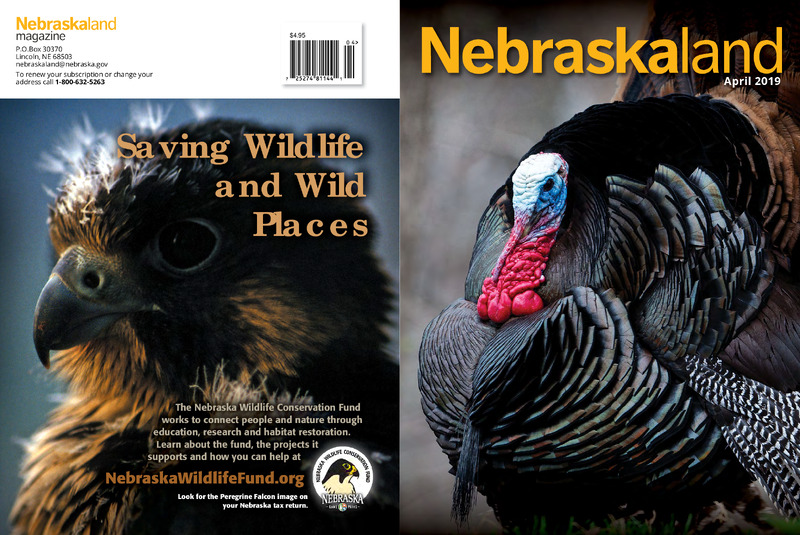
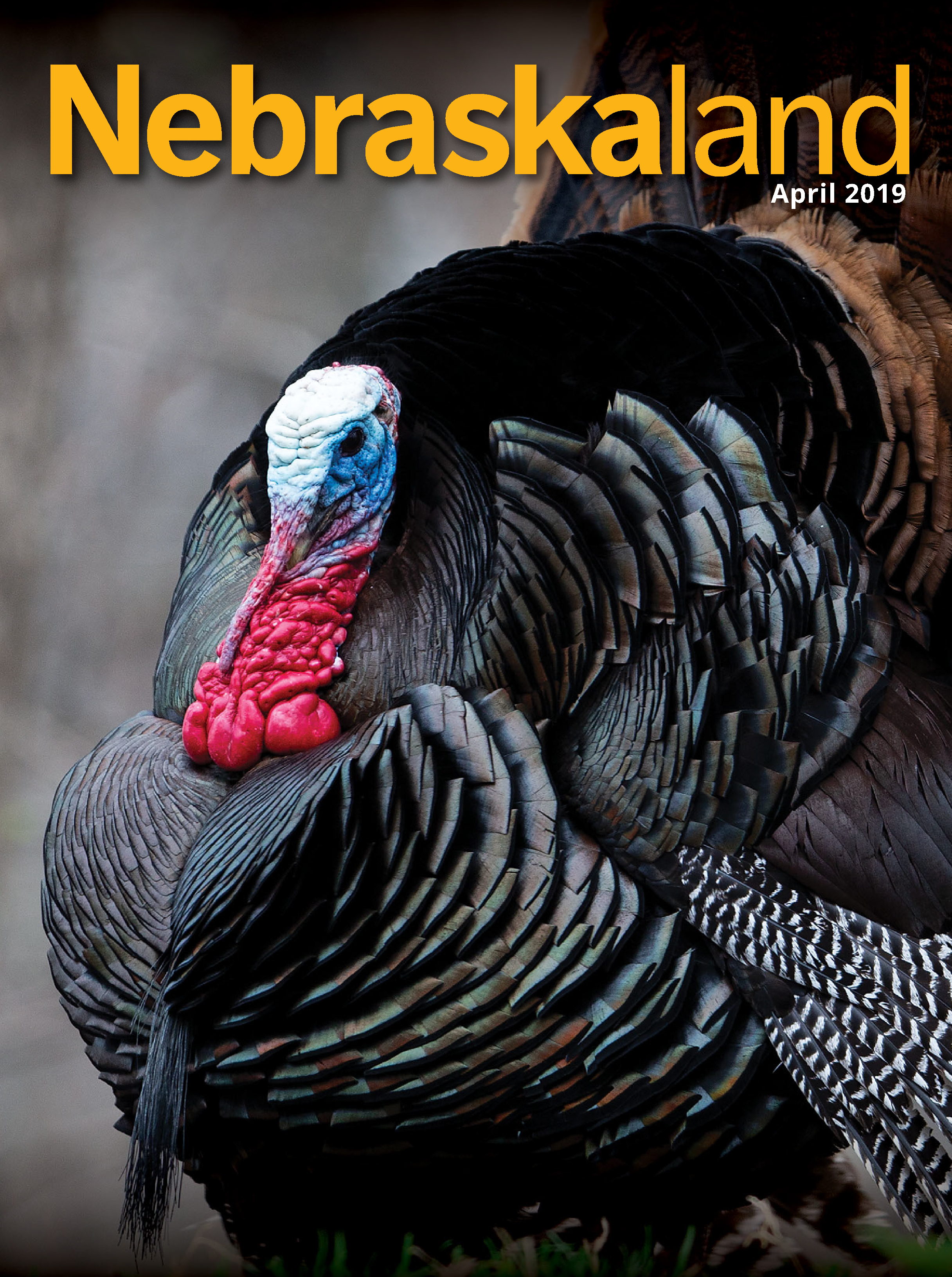
Cover: A tom turkey struts through a
forest in Cass County.
Photo by Jeff Kurrus.
FEATURES
22
UNVEILING THE MYSTERIOUS
MUSHROOMS of Indian Cave State Park
Story and Photos by Gerry Steinauer
28
OUTDOOR NEBRASKA
30
TURKEY TRIFECTA
36
PASQUE FLOWER JOY
38
DANCE PARTY
46
NEBRASKA AIRMAIL IN THE 1920S
50
A RARE BIRD
52
WALLEYE TROLLING 101
What to Do in April
By Renae Blum
Story by Ryan Sparks. Photos by Jeff Kurrus
Story and Photos by Chris Helzer
Story and Photos by Eric Fowler
By History Nebraska
and a rare opportunity
Story and Photos by Eric Fowler
Story and Photos by Jake Jadlowski
DEPARTMENTS
8
12
56
64
66
Your Nebraska
In the Field
Mixed Bag
Portraits from the Past
The Last Stop
ON THE WEB
To see more content, including photos,
videos and additional articles, visit
Magazine.OutdoorNebraska.gov/digital.
RADIO-COLLARED BIGHORN SHEEP AND LAMB AT CHADRON STATE PARK IN DAWES COUNTY. PHOTO BY JUSTIN HAAG
Nebraskaland (VOL. 96 / NO. 7 ISSN 0028-1964) is published monthly, except for the combined Jan./Feb. and Aug./Sept. issues, by the Nebraska Game and Parks Commission, 2200 N. 33rd St.,
Lincoln, NE. Periodicals postage paid at Lincoln, Nebraska, and additional mailing offices. POSTMASTER: Send address changes to Nebraskaland, P.O. Box 30370, Lincoln, NE 68503-0370.
4
Nebraskaland • April 2019
April 2019 •
Nebraskaland
5
Magazine Staff
magazine
Communications Director Christy Firestone
Public Relations Manager Cara Pesek
Published by the Nebraska Game and Parks
Commission since 1926. The Commission is
dedicated to the conservation and protection
of all the state's natural resources and the
people who use them.
Editor Jeff Kurrus
Associate Editor Jenny Nguyen-Wheatley
Regional Editors Eric Fowler, Julie Geiser,
Justin Haag
Contributing Editor Michael Forsberg
Regular Contributors Renae Blum,
Chris Helzer, Ryan Sparks, Gerry Steinauer
Art Director Tim Reigert
Graphic Designer Mel Severin
Photo Librarian Jaclyn Cruikshank Vogt
Administration
Director Jim Douglas
Deputy Director Tim McCoy
Commissioners
Chairman - Robert Allen, Eustis
Vice Chairman - Dan Kreitman, Wahoo
2nd Vice Chairman - Pat Berggren, Broken Bow
Dick Bell, Omaha
Rick Brandt, Roca
Scott Cassels, Omaha
Jim Ernst, Columbus
Doug Zingula, Sidney
Circulation Donna Robinson
For address changes and questions about your
subscription, e-mail donna.robinson@nebraska.
gov or call 800-632-5263
Advertising Sales Manager
For advertising information contact
Shane G. Gilster, 402-742-0125
Email: shanegilster@gmail.com
Nebraskaland Magazine Copyright 2019, all rights reserved.
Nebraskaland is available in audio from the Nebraska Library
Commission Talking Book and Braille Service, Suite 120, 1200 N St.,
Lincoln, NE 68508. 800-742-7691. Nebraskaland Magazine and the
Nebraska Game and Parks Commission reserve the right to reject any
advertising not in keeping with the agency mission.
Rates: $18 for one year; $33 for two years; $44 for three years. Nebraska
recipients must add appropriate sales tax. To subscribe call
1-800-NEBLAND (632-5263), or go online to:
NebraskalandMagazine.com.
Commission Offices
Conservation Officers
Headquarters/Southeast District Office
2200 N. 33rd Street Lincoln, NE 68503
Phone 402-471-0641
ADMINISTRATION (Lincoln)
Craig Stover (Administrator)
Duane Arp (Asst. Administrator)
Jeff Clauson (Asst. Administrator)
Northeast District Office
2201 N. 13th St. Norfolk, NE 68701
Phone 402-370-3374
Southwest District Office
301 E. State Farm Rd. North Platte, NE 69101
Phone 308-535-8025
Northwest District Office
East Hwy. 2, Box 725 Alliance, NE 69301
Phone 308-763-2940
Bassett Office
524 Panzer St., Box 508 Bassett, NE 68714
Phone 402-684-2921
Kearney Office
1617 First Ave. Kearney, NE 68847
Phone 308-865-5310
Ak-Sar-Ben Aquarium/Schramm Education
Center
21502 W. Highway 31 Gretna, NE 68028
Phone 402-332-3901
Omaha Office
8495 Frederick Street, Omaha, NE 68124
Phone 402-595-2144
OutdoorNebraska.org
Any program that receives federal funding from the National Park
Service, or the United States Fish and Wildlife Service prohibits
unlawful discrimination on the basis of race, color, religion, age, gender,
marital status, national origin, age, disability or political affiliation. Any
person who believes he or she has been discriminated against in
any program, activity, facility, or service, should contact the Nebraska
Game and Parks Commission, Lincoln, NE 402-471-0641, the Equal
Opportunity Commission, Lincoln, NE 402-471-2024, TTY/TDD 402471-4693; United States Fish Wildlife Service, Civil Rights Coordinator,
4401 N. Fairfax Drive, Arlington, VA 22203; Director, Equal Opportunity
Program, U.S. Department of Interior, National Park Service, 1849 C
Street NW, Mail Code 0008, Washington, D.C. 20240-0001.
6
Nebraskaland • April 2019
402-471-5531
402-471-5531
402-471-5531
NORTHWEST (Includes counties covered)
Jim Zimmerman (District Supt.)
308-641-6138
Kelsey Glodowski
(Box Butte, S 1/2 Sheridan, Grant)
308-763-8226
Sean McKeehan
(Kimball, Banner, Scotts Bluff)
308-672-1824
Dan Kling (Sioux, Dawes)
308-430-0572
Kyler Prochaska
(E 1/2 Dawes, N 1/2 Sheridan, W 1/2 Cherry)
308-430-3984
308-458-7650
Terry Brentzel (Deuel, Garden, Grant)
402-389-0444
Frank Miller (Cherry, Hooker)
NORTHEAST (Includes counties covered)
Tom Zimmer (District Supt.)
402-641-9590
402-760-0712
Dale Davis (Keya Paha, Brown, Rock)
402-340-3981
Jonathan Andreasen (Holt, Boyd)
402-719-6226
Kyle Gaston (Dodge, Colfax)
Greg Hesse
(Greeley, Wheeler, Boone, S 1/2 Antelope)
402-843-6567
Mitch Johnson (Knox, Antelope, Pierce)
402-613-8612
402-762-5022
Jeff Jones (Knox, Cedar)
Jon Reeves
(S 1/2 Thurston, Burt, Washington)
402-889-8508
Andrew Heyer (Pierce, Madison, Stanton) 402-613-2241
Cory Krause
(Cuming, Wayne, Stanton, Dodge)
402-380-6410
Steve Oberg
(Colfax, Platte, Madison, Stanton, Nance)
402-910-3366
Owen Johnson
(Dixon, Dakota, N 1/2 Thurston)
402-266-1759
Doug Pollard (Loup, Garfield, Valley)
308-730-7050
Ethan Teter
(Boating – eastern Nebraska)
402-620-8129
Nicholas Fix (Keith, Perkins)
Bryce Streger (Keith, Arthur)
Sean Schultz (Keith)
Brandon O’Neal
(Lincoln, McPherson, Logan)
Alex Hasenauer
(Lincoln, McPherson, Logan)
Mike Thome (Dawson)
Ray Dierking (Custer, Thomas, Blaine)
Taylor Dixon
(Dawson, N 1/2 Gosper, N 1/2 Phelps)
Eric Javins
(Adams, Clay, Nuckolls, Webster)
Kevin Bergstrom
(Boating – central Nebraska)
Daryl Teter
(Boating – central Nebraska)
Scott Eveland
(Boating – western Nebraska)
308-289-0427
308-440-3847
308-760-0145
308-530-3157
308-660-4671
308-529-8146
308-870-0322
308-217-2108
402-902-2017
308-520-1031
308-440-1863
308-289-0017
SOUTHEAST (Includes counties covered)
Levi Krause (District Supt.)
402-949-0593
402-619-1355
Rich Berggren (Douglas)
402-616-5961
Dan Evasco (Sarpy)
402-210-0888
Heath Packett (Cass)
402-209-1506
Russell Mort (Otoe, Johnson)
William Krause
(Nemaha, Richardson, Pawnee)
402-274-8063
Matt Taylor (Thayer, Fillmore, Jefferson)
402-200-9597
402-806-0915
Matt Seitz (Gage, Saline)
402-890-6463
Dina Barta (Lancaster)
402-937-3422
Dudley Sorensen (Lancaster, York)
402-613-2312
Travis Shepler (Lancaster)
402-314-9641
Trevor Stahlecker (Lancaster)
402-890-7140
Stacey Lewton (Lancaster, Seward)
402-443-6392
Mike Luben (Saunders, Butler, Polk)
SOUTHWEST (Includes counties covered)
Roger Thompson (District Supt.)
308-530-3097
308-202-0819
Matt Brandt (Sherman, Howard)
308-380-7331
Tim Williams (Hall, Hamilton, Merrick)
Pat George
(Harlan, Franklin, Phelps)
308-920-2762
Matt Andrews
(Gosper, Furnas, Frontier, Red Willow)
308-746-2418
Brian Piernicky
(Red Willow, Frontier, Hayes, Hitchcock)
308-340-6627
John Lee (Hitchcock, Dundy, Chase, Hayes)
308-414-1432
April 2019 •
Nebraskaland
7
YOUR NEBRASKA
Instagram Photos
Follow us (@nebraskaland)
and tag us in your photos
to be featured in an
upcoming issue.
Opposite: Connor Nichols,
Bellevue
Foggy morning feather in
Lincoln
Richard Jones, Gothenburg
Moon
Jessica Mikoloyck, Scottsbluff
Moose in the Wildcat Hills
April 2019 •
Nebraskaland
9
Steve Zechmann, Lincoln
White-tailed buck
Bart Torbert, Crawford
Hoarfrost
Ted Beedy, Nevada City, California
Mountain bluebird at Chadron State Park
Gordon Warrick, Valentine
River otters on the Niobrara River
10
Nebraskaland • April 2019
Send your comments and photos to:
Jeff Kurrus, Editor
Nebraskaland Magazine
P.O. Box 30370
Lincoln, NE 68503
or email Jeff.Kurrus@Nebraska.gov
Please include your postal address
and telephone number. Letters may be
condensed and edited. Photographs are
also welcome.
April 2019 •
Nebraskaland
11
IN THE FIELD
CEDAR WAXWINGS
Cedar waxwings sit in a
crabapple tree.
PHOT
OTO B
OTO
BY ERI
ER C FOWLER
FOWLER
W
WLE
WL
12
Nebraskaland • April 2019
April 2019 •
Nebraskaland
13
IN THE FIELD
TOPEKA SHINERS. PHOTO BY MICHAEL FORSBERG
THREATENED AND ENDANGERED:
THE TOPEKA SHINER
By Melissa Panella, Wildlife Biologist
It’s easy to get excited about a trophy-sized trout or bass,
but there are also many unique small fish to appreciate in
Nebraska. A fine example is the Topeka shiner (Notropis
topeka) which inhabits high-quality, small coolwater and
small warmwater prairie streams. The scales of the breeding
male are tinted from silver to gold in color, and the head and
fins are golden-orange. A dark lateral line extends from the
head to tail fin. This silver and gold beauty only grows to
about 2 to 3 inches long.
Topeka shiners are state and federally listed as endangered.
Their numbers have declined because much of their historic
habitat has been altered or degraded. In Nebraska, they are
only found in clear, calm water in pool-like habitat in Cherry
and Madison counties. These pools can be within the stream
or in habitats such as overflow pools and oxbows of the
river. Topeka shiners can survive in streams that only flow
14
Nebraskaland • April 2019
intermittently, provided that the pools can be sustained by
natural groundwater seepage.
Males occupy small spawning territories and are known
to chase other fish out of their area. You may find Topeka
shiners in proximity to green and orangespotted sunfish.
However, Topeka shiners are restricted in their ability to
disperse to new habitat because it is difficult for them to
make their way among streams.
Protection and enhancement of prairie streams where
Topeka shiners live is the best hope for the species. Stream
restoration efforts could also be beneficial but only in places
where there is permission to reintroduce them to those
locations. Clean, clear water is important to Topeka shiners.
Prevention of heavy silt and pollutants from contaminating
the stream is healthy for the fish and for maintaining water
quality that anyone can appreciate.
April 2019 •
Nebraskaland
15
IN THE FIELD
PHOTO BY CHRIS HELZER
GOATSBEARD
By Chris Helzer
Goatsbeard, aka western salsify (Tragopogon dubius), was
introduced to North America from Europe and Asia and has
spread across most of the continent. However, unlike some
introduced species, goatsbeard has not become an invasive
species that exerts its dominance by pushing other plants
out of the way. For the most part, goatsbeard has instead
inserted itself gracefully into the prairies and other natural
areas of Nebraska, adding attractive little highlights to our
landscapes.
As a biennial, goatsbeard spends its first year of life
as a grass-like rosette of leaves and blends well into its
surroundings. In its second season, however, it produces
spectacular yellow blossoms about the time spring is
transitioning to summer. Despite the beauty of its flowers,
goatsbeard is probably most recognizable to Nebraskans
16
Nebraskaland • April 2019
when it produces seed. Anyone who spends much time
outdoors is surely familiar with its fist-sized dandelion-style
seedheads, and many people reading this have probably
picked one and blown the seeds into the air.
Regardless if blown by wind or people, those seeds can
travel long distances, allowing goatsbeard to spread itself
far and wide. Goatsbeard is not a strong competitor with
most perennial plants, however, so it grows best where
its seeds can land on a patch of bare soil where nearby
plants are absent or weakened by drought, grazing or other
disturbances. While it is non-native and often characterized
as a weed, goatsbeard is almost never truly problematic;
it’s just kind of a bonus wildflower, introduced for our
enjoyment.
April 2019 •
Nebraskaland
17
IN THE FIELD
PHOTO BY JOEL G. JORGENSEN
LESSER BLACK-BACKED GULL
By W. Ross Silcock
Anyone who has painstakingly searched through a flock
of gulls in Nebraska in fall will understand how difficult it
is to pick out anything that isn’t a ring-billed or herring gull,
which have white heads and pale gray backs or “mantles.”
But a European invader, the lesser black-backed gull (LBBG),
has come to save us from monotony. The LBBG is a large
gull with dark gray or blackish adult or near-adult plumage
that thankfully stands out like a sore thumb in a flock of the
more common gulls. As the observers of the first Nebraska
LBBG stated: “The mantle and back were charcoal gray,
much darker than [those of] either the ring-billed or herring
[gull]”.
The first North American record of LBBG was in 1934,
and numbers have increased steadily since the 1970s, as the
European populations have increased. LBBGs, like other large
gulls, are beneficiaries of modern society, which produces an
abundance of food. Morsels leftover or thrown out in a fast
food parking lot or garbage dumps can be a substantial meal
for a scavenging gull. It is thought that since most North
American LBBGs are more dark gray than blackish, they
belong to the subspecies graellsi, which breeds in Greenland.
18
Nebraskaland • April 2019
The LBBG was first noted in Greenland in the 1980s, and
breeding was confirmed in 1990 in two locations in the
southwestern part of the island. Increasing numbers of these
Greenland birds are wintering in eastern North America, first
along the Atlantic Coast, and spreading since the 1990s into
interior North America.
Nebraska’s first report of LBBG was in 1992, an adult
discovered at Pawnee Lake State Recreation Area in
Lancaster County. The first with tangible evidence was
photographed in 1994 at Lake McConaughy in Keith County.
Since the mid-1990s, LBBG has become an expected spring
and fall migrant, and occurs occasionally in mid-summer and
mid-winter. Each spring and fall nowadays there are multiple
reports; in spring, 15 or more individuals are usually reported.
Gulls are ignored by a lot of people, reviled by others, but
sifting through flocks in early spring or late fall is a favorite
pasttime of serious birdwatchers. The addition of the LBBG
has added a bit of spice to otherwise dreary days.
Visit the Birds of Nebraska – Online (birdsofnebraska.org)
for more information about Nebraska birds.
April 2019 •
Nebraskaland
19
IN THE FIELD
VENISON BOLOGNESE
By Ryan Sparks
Servings: 6-8
Prep Time: 20 minutes
Cooking Time: 3-4 hours
Ingredients:
2 tablespoons olive oil
¼ cup butter
•
•
20
Nebraskaland • April 2019
• 1 medium yellow onion, diced
• 2 large carrots, peeled and diced
• 2 celery stalks, diced
• 4 garlic cloves, minced
• 1 cup diced pancetta – about 4½
•
•
•
•
•
•
•
ounces/125 grams (If you can’t
find pancetta, bacon works as a
substitute.)
1 teaspoon kosher salt
Freshly ground black pepper
2¼ pounds ground venison (I add
pork fat to my ground venison. If
you don’t, substitute ¼ pound of
venison with fatty ground pork.)
1 cup dry white wine
2 cups whole milk
1 can (28 ounces) San Marzano
tomatoes
1 cup venison broth (beef broth
can be substituted)
To Serve:
Freshly grated ParmigianoReggiano
Dried pappardelle or tagliatelle
•
•
PHOTOS BY RYAN SPARKS
Bolognese is a meat-based sauce
created in Bologna, Italy. Unlike its
bright red, tomato-based North
American counterpart, this sauce is
all about the meat. A true Bolognese
is slowly cooked to produce a thick
and silky sauce. This version uses
venison and is the perfect winter meal
to celebrate the hunt with friends. If
you have leftover Bolognese, mix it
with a béchamel sauce to make an
unbelievably good lasagna. One note
about the soffritto (mixture of onions,
carrots, and celery): take your time and
dice everything evenly small (1⁄4-inch
max). Put your knife skills to work and
ensure the mixture incorporates into
the sauce.
•
•
•
(any broad, flat pasta will work)
Fresh basil
Good olive oil
Butter
In a large pot or Dutch oven, add
the butter and the oil over medium
heat. Add the onion, carrot, celery,
garlic, and half of the salt. Sauté for 5
minutes until the vegetables are soft.
Add the diced pancetta and cook
for 10 minutes or until the pancetta
is golden.
Increase the heat to medium/
high and add a third of the venison,
stirring and breaking lumps with a
wooden spoon between each addition.
Adding the meat gradually allows
the moisture to evaporate, which
is how to caramelize meat properly.
When the first third of the meat is
beginning to caramelize, add a third
more. Stir to break lumps. Repeat with
the remaining meat. When the meat is
cooked and no lumps remain, continue
cooking for ten minutes.
You want the meat to become crispy
in spots. Bits of meat will stick to
the bottom of the pot, which you will
deglaze with the wine later. Watch
over the pan though – you don’t want
the meat to burn.
Pour the white wine into the pan.
With a flat wooden spatula, scrape
all the caramelized bits from the
pan. Push the meat around and be
sure to scrape it all off. By the time
you’re finished, the wine will have
evaporated.
Add the milk, tomatoes, beef
broth, remaining salt and a generous
grinding of black pepper. Bring to a
boil and then lower to a soft simmer.
Simmer gently for 1½ to 2½ hours,
stirring every half hour. The sauce is
ready when it has thickened and very
little liquid remains.
Add a generous amount of grated
Parmigiano-Reggiano, which boosts
the flavor and produces an incredibly
creamy result. Taste and adjust the
seasoning if needed.
Cook the pasta according to the
instructions on the package, then
drain and return to the pot.
Add the sauce and stir to coat. Divide
between bowls and garnish with your
choice of fresh basil, a pat of butter,
good olive oil, and more ParmigianoReggiano.
April 2019 •
Nebraskaland
21
Unveiling the
Mysterious Mushrooms
Chance Brueggemann in
oak woodlands at Indian
Cave beside a dryad’s
saddle mushroom. A
dryad is a tree nymph in
Greek mythology.
OF INDIAN CAVE STATE PARK
By Gerry Steinauer, Botanist, Nebraska Game and Parks Commission
PHOTO BY CHANCE BRUEGGEMANN
W
The rare rosy veincap grows on a hardwood stump at Indian
Cave State Park.
22
Nebraskaland • April 2019
A Mushrooming Hobby
In 2014, Brueggemann, who grew up in nearby Auburn and
attended Peru State College with a major in biology, began
working at Indian Cave as a temporary employee. His main
job was the onerous task of controlling invasive woodland
weeds. Now employed by the Northern Prairies Land Trust,
he is the park’s full-time woodland ecologist.
“I became interested in mushrooms during my second year
at the park,” Brueggemann said. “I’d be out working and see
all these amazing shapes and colors and began wondering
what these mushrooms were. I had no clue.”
He started taking photos and comparing them to those in a
borrowed field guide. He then bought his own field guides as
his interest increased.
It turns out, the 3,400-acre Indian Cave, located adjacent
to the Missouri River in Nemaha and Richardson counties,
was the perfect place for his mushrooming hobby. The
park receives about 33 inches of precipitation a year. In the
wooded hillsides, canopied by varied hardwoods including
oaks, hickories and other trees, that moisture helps create
ideal mushroom habitat. It is not a stretch to say the park
may support our state’s greatest mushroom diversity per
acre.
Brueggemann collects mushrooms for later detailed
examination, and for uncommon species, eventual deposit at
the University of Nebraska’s Bessey Herbarium. He dries the
herbarium specimens overnight in a standard fruit drier set
on low, preserving them for long-term storage.
When photographing or collecting mushrooms, he
also records habitat information which can aid in species
identification. Because many mushrooms grow only on or
near specific trees, soils or other habitats, he notes nearby
PHOTO BY GERRY STEINAUER
hen in the rugged, wooded bluffs of Indian Cave
State Park, Chance Brueggemann is always on the
lookout for mushrooms. Last summer, while hiking
with Chance, he would occasionally stop, point out a
mushroom and rattle off its scientific name, usually with an
added comment, such as “that one is parasitic on oaks” or
“I’ve eaten that one, it’s not bad.”
Mushroom identification is extremely difficult, and only
few Nebraskans can name more than the common edible
species. Considering Brueggemann has been studying
mushrooms as a hobby for only a few years, his knowledge
is impressive.
April 2019 •
Nebraskaland
23
What is a Mushroom?
24
Nebraskaland • April 2019
Brueggemann documented Nebraska’s first known blackstaining polypore mushroom at Indian Cave. Its flesh turns
black when bruised or injured.
The golden chanterelle is rare at Indian Cave State Park,
where it grows in association with oak trees. It is a highly
sought-after edible mushroom.
New Discoveries at Indian Cave
PHOTO BY CHANCE BRUEGGEMANN
PHOTO BY CHANCE BRUEGGEMANN
In his five years of mushrooming at Indian Cave,
Brueggemann has discovered 12 species never before
documented in Nebraska. Among these are the ringless
honey mushroom, a parasite on hardwood trees; the
cinnamon bracket (page 24), a saprophyte on dead
hardwoods, favoring hickories; the black staining polypore
(page 25), a parasite on oaks whose flesh turns black when
bruised; and the beautiful and delicious golden chanterelle
(page 25).
The latter has a “fruity aroma, reminiscent of apricots and a
mildly peppery taste.” At the opposite extreme of palatability
he has discovered the highly toxic and appropriately-named
destroying angel, a rather nondescript, white toadstool in
the genus Amanita whose members cause the majority of
deaths from mushroom consumption.
Most interestingly, perhaps, Brueggemann also discovered
Nebraska’s first known truffle (page 26) at Indian Cave.
In the fall of 2017, while raking leaves from a firebreak in
oak woods, he uncovered a strange orange mushroom from
just below the soil surface. “I had never seen anything like
it,” he said. “The mushroom was roundish, firm and had an
aroma reminiscent of rotten eggs. I took several photos and
documented its habitat.”
A few months passed before he got around to identifying
the mysterious fungi. He thought it might be a truffle, but
was skeptical as his field guides showed no truffles occurring
in our state. Long web searches for similar-looking truffles
and truffle-like mushrooms also proved fruitless.
Baffled, he took photos to Dr. Gerard Adams, a forest
pathologist at UNL, to see if he could identify the mushroom.
Drops of potassium hydroxide turn the flesh of the
cinnamon bracket purple, distinguishing it from other
bracket mushrooms which grow on hardwoods.
PHOTO BY CHANCE BRUEGGEMANN
Mushrooms are fungi, a group of
unicellular or multicellular spore-producing
organisms that feed on organic matter. In
addition to mushrooms, the fungi include
yeasts, molds and rusts. Defying traditional
belief, recent studies have found that fungi
are more closely related to animals than
plants.
Mushrooms, also known as macrofungi,
are a somewhat artificial and convenient
grouping of fleshy-bodied fungi with large
fruiting bodies visible to the human eye.
Macrofungi include the classic toadstools,
puffballs, morels, shelf fungi, cup fungi,
jelly fungi and many other groups.
Microfungi include yeasts, molds and rusts
and are visible only by the diseases, decay
and molding they cause.
Mushrooms are deceiving. What we see
– the toadstool or puffball, for example –
is only the organism’s short-lived fruiting
body, the tip of the mushroom iceberg so
to speak. A mushroom’s long-lived, main
body and feeding stage, the mycelium,
is hidden below ground or in other
substrates, such as decaying leaves and
logs.
The fruiting bodies form from nodules
on the mycelium. A toadstool is a fruiting
body with a stem and cap. The underside
of the cap has gills or pores in which
prolific microscopic spores develop. As
the cap ripens the spores fall and are
dispersed by the wind and rain.
Other mushrooms lack stems and
caps and therefore gills and pores.
In puffballs, for example, the spores
develop in the interior of the fleshy, ballshaped mushroom and are dispersed
as it degrades. Many outdoorsmen and
women are tempted to kick dried puffballs,
amused by the resulting spore cloud.
The mycelium is composed of a mass
of threadlike (one cell thick) hyphae that,
similar to plant roots, snake through
the soil or other substrate. Here, they
release enzymes and acids that break
down organic matter, mainly plant cells,
into simpler compounds they can ingest.
Hyphal strands can spread up to an inch
a day, sometimes forming huge mycelial
masses in the soil. The world’s largest
known organism is a fungus whose
mycelium spans roughly 2,400 acres of an
Oregon mountaintop.
24 hours, the spores fall from the drying cap, depositing a
color impression on the paper. This can be white or brown,
and sometimes yellow or even purple.
For those species requiring even finer observation, he
scrapes spores from the prints using a razor blade and places
them on a microscope slide. An added drop of dye illuminates
diagnostic micro-structures on the spores’ surface, such as
ridges, indentations and warts. Using a ruler imbedded in
the lens, he measures the spores, which can range from a
few thousandths to a few hundredths of an inch in length,
depending on species. The spores’ shapes, mostly oval to
round, are also telling.
A recently purchased microscope has taken Brueggemann’s
ever-increasing skills to a new level. His talents have grown
to the point where he recently helped lead a few mushroom
identification workshops at Hitchcock Nature Center in
Pottawattamie County, Iowa.
tree species and the substrate in which the mushroom is
growing, such as moist soil or rotting wood. He also records
the date, because just as plants flower at a certain time of
year, mushroom species fruit at specific times as well.
In the field, Brueggemann often “takes a good sniff and
nibble” of unknown mushrooms, though he avoids tasting
those from known toxic groups and always spits out the
nibble. “Mushrooms can have a distinct smell or taste that
are clues to identification,” he said. “Their odor can range
from earthy to fishy to sulfurous, while their taste can vary
from bland to sweet to spicy hot like a pepper.”
He also performs simple chemical tests. This involves
placing a drop of potassium hydroxide and/or ammonia on
a mushroom. The subsequent chemical reaction causes the
flesh of some species to change color. A drop of potassium
hydroxide on the cap of the ringless honey mushroom, for
example, will turn its flesh red, whereas the same chemical
placed on the closely-related and similar looking bulbous
honey mushroom results in no color change.
Some species can be determined only through examination
of their microscopic spores. At home, if needed, Brueggemann
makes spore prints to determine a mushroom’s spore color,
often a distinguishing characteristic. To make a print, he cuts
the mushroom’s cap from the stem and places it gill- or poreside down on a sheet of white or black paper. Usually within
April 2019 •
Nebraskaland
25
Mushroom Ecology
Nebraskaland • April 2019
new state records at Indian Cave alone attests to our state’s
lack of mycologists and surveys.
North America has roughly 10,000 known mushroom
species. The nearby states of Minnesota and Colorado have
both documented about 1,300 species, and Nebraska’s
mushroom diversity could be similar. Accurately determining
which mushrooms grow in Nebraska, let alone their abundance,
range, habitats, and conservation needs, will require
professionally trained mycologists, as well as other self-trained
amateurs with a passion for discovery like Brueggemann.
The widespread mica cap mushroom dissolves into a black
inky, spore-laden liquid when mature. They commonly grow
in clusters near or on rotting hardwood stumps or roots.
Resembling a creature from the ocean floor, the crowntipped coral mushroom can be found growing in moist areas
on decaying hardwoods spring through fall.
Stump puffballs, common in eastern Nebraska, eject spores
when pelted by raindrops or bumped by animals.
PHOTO BY GERRY STEINAUER
PHOTO BY CHANCE BRUEGGEMANN
At Indian Cave, Brueggemann has identified about 80
mushrooms to the species level. Others, such as the extremely
difficult “little brown mushrooms,” he can identify only to
the group level. In coming years, he expects to unearth many
more species in the park.
When asked how many mushroom species grow in
Nebraska, he said the answer to that question is unknown.
He explained that there have been no recent mushroom
surveys in our state, and that earlier collections made in
Nebraska, which reside at various herbaria here and in
other states, have never been evaluated for accuracy of
identification, nor tallied.
Complicating the situation, “we have no mushroom
experts in Nebraska, absolutely none,” said Bob Kaul, curator
at the Bessey Herbarium. “Mycology [the study of fungi] is a
dying field. Few universities now train field mycologists, and
many that are trained are plant pathologists who deal only
with fungi that are forest or crop pests.”
Although the Bessey Herbarium has more than 50,000
fungus specimens in its collections, the vast majority were
collected in the late 19th and early 20th centuries when
Nebraska colleges and universities employed mycologists.
“UNL hasn’t had a field mycologist on staff since the
1960s,” Kaul said. The fact that Brueggemann has found 12
PHOTO BY CHANCE BRUEGGEMANN
26
The Park’s Rich
Mushroom Diversity
PHOTO BY GERRY STEINAUER
Mushrooms have varied feeding habits.
Some species are parasites that feed on
living plant tissues, such as roots or tree
trunks. The highly delectable chicken of
the woods, for example, is parasitic on
oak trees, often growing at the base of the
trunk.
Other species – shelf-like oyster
mushrooms, for instance – grow and
feed on dead plant matter such as
downed logs and leaf litter. They break
down tough organic compounds, such
as cellulose, making its carbon, nitrogen,
and other minerals available to plants
and other organisms while building soils
in the process. Without these vital fungal
decomposers, the world would be awash in
dead plant material.
Mycorrhizal mushrooms, such as the
edible and much sought-after morels and
boletes, obtain carbohydrates through
mutually-beneficial associations with
plants, most often trees. Their hyphae
either form sheaths around a plant’s roots
or grow between the root cells and act as
root extensions bringing distant soil, water
and nutrients to the plant. In return, the
plants provide the mushrooms with sugars
produced through photosynthesis.
Nearly all plant species, from wildflowers
to trees to crops, have associations with
a few to many mycorrhizal fungi; the
survival of many plants depends on this
association. The rare western prairiefringed orchid that grows in eastern
Nebraska wet meadows, for example,
has microscopic seeds with no starch
reserve. In the soil, the seeds must first be
infected with mycorrhizal fungi before they
will germinate and grow. Until the plant
develops leaves to photosynthesize, which
takes several years, it is entirely dependent
on the fungi for food and water.
Prairie restorationists and foresters often
apply mycorrhizae to the seeds of prairie
plants or the roots of young trees before
planting to stimulate seed germination
and tree growth and survival. Among their
other values, some mushrooms contain
anti-viral, anti-bacterial and anti-cancer
agents useful in medicine. Some species
can break down environmental toxins
into non-toxic compounds and are being
used to purify toxic soils. The relatively
unstudied fungi surely have other values
waiting discovery.
He too was baffled, but had Brueggemann collect a specimen
of the fungus, which he sent to an out-of-state lab for DNA
analysis and comparisons that led to positive identification.
The tests showed the mushroom was the truffle Stephensia
shanorii, a little known species with no common name. It has
been collected only 10 to 15 times from deciduous woods in
Illinois, Maryland and Ohio, but never as far west as Nebraska,
leaving Brueggemann to wonder if other mysterious truffle
species are lurking in eastern Nebraska oak woodlands.
Truffles, which commonly grow under oaks and other
hardwoods, are strange in that their fruiting bodies are
stemless and remain underground. They emit potent odors
when ripe, a unique strategy among mushrooms to attract
animals, ranging from squirrels to bears. The animals dig
them up, ingest them and disperse their spores through their
feces.
Though their spore dispersal strategy is rather
unappetizing, some truffle species are considered culinary
delights. High-end restaurants pay hundreds of dollars a
pound for some North American truffles, while a single large
European white truffle, which can weigh several pounds, can
bring six figures. In areas of relative truffle abundance, such
as the Pacific Northwest, highly-trained dogs are used to
sniff them out.
It is unknown whether S. shanorii is edible, but judging
from its sulfurous odor it is unlikely.
Brueggemann unearthed Nebraska’s only known truffle,
Stephensia shanorii, while raking a fire-break in oak woods
at Indian Cave.
April 2019 •
Nebraskaland
27
Outdoor Nebraska
What To Do in April
By Renae Blum
Weather in April can be unpredictable. Nevertheless,
there are plenty of reasons to get outside. Here are just
a few.
Spring turkey shotgun
season
Morel
mushroom
hunting
Enjoy the best turkey hunting in the nation,
with plentiful and affordable permits, during
the 2019 shotgun and archery seasons. The
youth season opens April 6.
PHOTO BY JENNY NGUYEN-WHEATLEY
PHOTO BY JUSTIN HAAG
The search for this wildgrowing delicacy is on.
While morels are notoriously
fickle, they do favor certain
conditions, often emerging on
warm, sunny days following spring
rains. They grow in both moist
floodplains and upland woodlands,
and are often most plentiful at the
base of cottonwoods and elms that
have recently died.
Pope & Young Club
Biennial Convention
April 10-13
La Vista Hotel and Conference
Center, Omaha
PHOTO BY JENNY NGUYEN-WHEATLEY
Season typically begins
mid- to late April |
Statewide in woodlands
Starts April 13 | Statewide
Stay in a cabin or lodge room
Throughout the month | Various locations
April is the last month to take advantage of winter lodging
rates at a Nebraska state park. Rates are 30 percent less
than at any other time of year. Book a reservation online
at Outdoornebraska.org or by calling 401-471-1414. Some
restrictions apply.
Earth Day
Celebration
Turkey Calling
Clinic
April 13
Wildcat Hills Nature
Center, Gering
April 9
Nebraska Game
and Parks Outdoor
Education Center,
Lincoln
Fish for crappies
Throughout the month | Statewide
28
Nebraskaland • April 2019
Celebrate Arbor Day where it
all started
April 26-28 | Arbor Lodge State Historical Park
PHOTO BY ERIC FOWLER
PHOTO BY JEFF KURRUS
“April can be the best month for crappies because
of the pre-spawning concentrations,” said
Nebraska Game and Parks fisheries education
specialist Larry Pape. Pape recommended looking
for crappies gathering around structure such as
standing timber or breakwaters, and using live
bait, particularly small minnows, where allowed.
To find great places to fish, consult the 2019
Fishing Forecast, available at Outdoornebraska.
org/fishingforecast.
Celebrate the tree planter’s holiday where it all began at the
mansion home of Arbor Day founder J. Sterling Morton. Enjoy
free admission to the mansion April 26-28, and on Saturday
and Sunday you can also take in musical entertainment,
living history, local Arbor Day poetry and Arbor Day history.
April 2019 •
Nebraskaland
29
TURKEY
TRIFECTA
Story by Ryan Sparks. Photos by Jeff Kurrus
D
edicated turkey hunters dream
of completing a “grand slam,”
or killing a bird from each of the four
subspecies of the North American
turkey. To complete a grand slam, a
hunter might travel from Alabama to
Texas to South Dakota to Florida. As a
teenager, while enjoying the developing
turkey hunting in Nebraska, I dreamed
about this turkey hunting adventure,
but realized it would be a long time
before I could roam the country in
pursuit of turkeys. Instead, I devised a
different challenge.
I was already obsessively hunting
turkeys with a bow and conventional
shotgun, but when I spotted a used
muzzleloading shotgun for sale, I had
an idea. I realized that with Nebraska’s
three-bird limit I had the opportunity to
hunt turkeys with a bow, muzzleloading
shotgun, and conventional shotgun all
in one season. I had no idea what an
incredible experience it would be and
Because turkeys have such keen eyesight, archery hunting for these birds can be quite difficult.
how my adventures could help other
hunters challenge themselves as well.
Bows and Beards
Nebraska has turkey hunting so good that hunters have the opportunity to
harvest three birds with three different types of weapons.
30
Nebraskaland • April 2019
Bowhunting turkeys is more difficult
than hunting them with a shotgun for
two reasons. First, archery equipment
limits a hunter’s shooting range.
Second, and most importantly, a
bow must be drawn before shooting.
A turkey’s excellent eyesight is its
principal defense. They can see almost
as well as a hawk and don’t have to shift
their focus to see objects at different
distances clearly. Everything within
their field of view is always in focus.
With such a good sense of sight they
can notice the slightest motion.
To hide the movement of drawing,
archery hunters use natural blinds
constructed of branches, brush, and
grass or manufactured “pop-up” blinds
– so named because they unfold and
set up quickly. At the time, I used a
pop-up blind for its convenience, but I
now enjoy making impromptu natural
blinds and trying to draw when the bird
is looking the other direction.
The other major difference between
archery and shotgun hunting is that
archery season opens earlier, when
birds are less aggressive and sometimes
grouped in large flocks. As males
become more aggressive, they will part
ways, and flocks become smaller. This
makes calling more effective later in
the season because it’s easier to call in a
single turkey than an entire flock.
When turkeys are grouped together,
it’s a better strategy to make soft calls
to entice hens or set up along known
travel routes. As with all hunting, no
two situations are the same, but it’s
a good idea to start slow and soft and
gradually increase the volume and
aggression of your calling.
To prepare for my opening morning of
archery season, I hiked up a grassy fence
line to the top of a hill that overlooked a
field where I had seen turkeys feeding
the previous week. As the sun inched
downward, a group of birds made their
way into the field. One by one they
took flight and roosted in a group of
cottonwood trees for the night. I knew
the next morning they would glide
down the opposite side of the creek and
begin their day in the field below.
Well before sunrise, I stood atop the
same hill and listened as several hens
yelped from their roost and two toms
April 2019 •
Nebraskaland
31
to hide your movement. This style of
turkey hunting is called “run and gun,”
and it’s my favorite way to hunt turkeys.
The first week of my shotgun season
left me scratching my head. I wasn’t
having any problems finding birds, but
I couldn’t lure the toms away from their
hens. When hens are receptive to a tom’s
attention, it’s hard to compete with the
real thing. I had thought getting a turkey
with a regular shotgun was going to be
the easiest part of this challenge, but
the birds were proving otherwise. I tried
every strategy I could think of – locating
a roost and setting up near it in the
morning, actively calling and moving
quickly to cover lots of ground and
setting up on travel corridors waiting
for birds to pass by. Nothing worked.
Midway through the second week
of shotgun season a thick fog settled
in as I was walking back to the truck
after another unsuccessful morning.
I was hiking along the bottom of a
steep field edge when I saw three dark
shapes walking along the top of the
hill 100 yards in front of me. Using my
binoculars, I could just make out the
three jakes through the fog. They were
in the middle of a wide-open field, in
a hurry, and were moving toward the
neighbor’s fence line. I didn’t have time
to set up, so I moved as quickly as I
could, using the steep hillside to block
my movement from their view.
During my dash, I lost sight of the birds
but guessed they would be approaching
the fence soon. There were two steep
terraces between me and the top of the
hill, and I crawled toward the upper one
with a strutting tom decoy in hand. As I
reached the top of the rise, I raised the
decoy and made several soft purrs with
my mouth call. I slowly lifted my head
to look, but before I could see over the
terrace I heard fast crunching footsteps,
and the decoy exploded from my hand.
When the jakes saw the decoy, they
charged in prepared for a fight. Their
strength in numbers must have given
them courage, and the lead jake spurred
the decoy while I was trying to stay
out of sight. Fueled on adrenaline, I
stood and shot the closest bird where
he stood. As the other two ran away in
confusion, I sat down to collect myself.
It was one of the most memorable hunts
of my life.
Struts and Smoke
Having never hunted with a
muzzleloader, I practiced extensively
Finding roosting spots for turkeys is an excellent tool for knowing where to start hunting in the spring.
32
Nebraskaland • April 2019
them to see my decoys, I made several
soft yelps on a slate call to get their
attention. A hen responded loudly with
a challenging tone, and one of the toms
shifted on its branch to face me. I didn’t
make another noise, and 10 minutes
later the turkeys pitched off their roost
and landed 200 yards to the east.
The hens scratched and pecked in the
cut bean field, uninterested in my decoys,
and the toms followed suit. As the group
turned and began moving the other
direction, I made several loud yelps and
cuts. I knew this would either aggravate
or frighten the group, but it was my last
chance before they slipped away into the
timber. The loud calling infuriated the
lead hen, and she immediately turned
and ran my direction.
The other turkeys watched from afar
as she inspected my decoys, pecking
them and trying to figure out who had
been so insubordinate. Eventually, she
began feeding again. The other birds
sidled toward her. It seemed to take
them a lifetime to reach me, and each
step they took my heart beat faster.
One of the toms hesitantly hung back,
but the other strutted on the heels of
the last hen. When he was finally in
range I took a deep breath, drew my bow,
and took aim. The arrow struck home,
and the tom turned and ran toward the
timber, but he didn’t make it far before
collapsing in the bean stubble. The first
leg of my challenge was complete.
Stalk for Spurs
Hunting turkeys with a shotgun gives
you more mobility than bowhunting.
While bowhunting, you must conceal
yourself with a blind, but shotgun
hunting is more flexible as every tree
offers a place to hide, and aiming
involves a fraction of the movement
compared to drawing a bow. This allows
a shotgun hunter to move from place to
place, calling to locate active birds and
quickly setting up a decoy when they
respond. Also, you can sometimes stalk
within range of birds by using the terrain
PHOTO BY RYAN SPARKS
responded with thunderous gobbles.
Under the cover of darkness, I was able
to sneak within 100 yards of where the
birds were roosted. However, it was
dead still, and I was nervous they would
hear me setting up the blind. I was
glad I left plenty of time before sunrise,
because it took nearly an hour to get in
position, place my decoys, and unfold
the blind without creating too much
noise. Thankfully, the turkeys continued
calling, and their vocalizations helped to
cover any noise I made.
As the first glow of sunlight dimly
lit the field, I could barely make out
the turkeys in their roost. When I was
confident there was enough light for
The author poses after a hunt on his way to three birds with three different weapons.
April 2019 •
Nebraskaland
33
before the season. After patterning
the shotgun with a variety of shot
sizes and powder loads, I reached a
combination where I was comfortable,
but the shot would have to be 25 yards
or less. I was excited to try muzzleloader
hunting, because it would allow the
same mobility of conventional shotgun
hunting with the added challenge of
limiting my range. This decreased range
meant I was going to have to get a tom
to commit to the decoys and not hang
up in the distance.
After a long day of spotting turkeys,
gauging their direction of travel, and
trying to figure out how to snake along a
creek or follow a finger of trees to reach
them, I had yet to get in front of one.
However, I had watched two separate
toms use the same fence crossing. I
decided to settle in and spend the rest of
the afternoon within shooting distance
of the crossing. There were two gnarly
cedar trees to the west. Using hand
pruners and a folding saw I created an
opening at the base of the tree and
stuck the cut branches in the ground
in front of me. After creating my hide,
I placed a hen decoy 15 yards to the
left of me facing away. I did the same
with a strutting tom decoy at 10 yards
but turned him facing toward me. Toms
often approach hens from behind and
other males from the front. Setting
my decoys like this would shorten
the distance between myself and an
approaching tom by making him pass
between me and the decoys.
I spent the next hour making
occasional yelps with no response. It
had been a long day, and with the lack
of action I was beginning to nod off
when I heard the unmistakable spit of a
tom behind me. For those unacquainted
with this term, a tom will sometimes
make a “pfft” sound when it is excited
or angry. It almost sounds like a muffled
sneeze. Unlike a gobble which can be
heard from a long distance, if you hear
a spit it means a turkey is close by and
fired up. I suspected a tom had snuck
in behind me, so I shouldered my gun,
waiting for it to appear. Ten minutes
went by and I hadn’t heard anything
more, so I slowly turned and peered
through the tree, but couldn’t make
anything out.
Bridging my shotgun between my
shoulder and knee to free up my hands, I
used a slate call to make a few gentle purrs
and whines. These soft calls often bring
a bird the last few critical yards. From
the corner of my eye, I was surprised
to see the turkey approaching from the
Turkey hunters use a variety of calls, including slate calls, to lure in aggressive toms
looking for a mate.
34
Nebraskaland • April 2019
right instead of the fence crossing to my
left. He ducked between two strands of
barbed wire and accelerated his approach
until he was just out of range. Slowing,
he went into a strut and moved toward
the tom decoy. At this point he was only
10 yards in front of me and looking my
direction. When he turned to look at the
hen, I aimed at the base of his head and
pulled the trigger. A billow of smoke
erupted from the gun and I couldn’t see
what happened. Then I heard the sound
of wings beating the ground and raced
to my feet. As the smoke settled, I knelt
over the bird, having harvested three
birds with three different weapons in
one season.
A tom turkey goes into full strut
in Cass County.
The Good Old Days
This challenge made me realize
how good the turkey hunting was in
Nebraska. I had so much fun I made it
a tradition and was able to accomplish
the feat every year from 2007-2012
until I moved to attend graduate school.
Two of the years I even switched out
my compound bow for a recurve with
the same success.
Looking back, I couldn’t have been
luckier. I had no idea that Nebraska
was quickly developing the best turkey
hunting in North America. It led to a
passion that continues today and taught
me what it takes to be a successful
turkey hunter. More importantly,
it made me appreciate the amazing
hunting in my home state.
Since those days, turkey hunting
has only gotten better. The turkey
population has exploded over the last
decade, and now Nebraska has the
reputation of being a turkey hunting
destination and welcomes hunters
from around the world. With hunting
opportunities in every county, nearly
1 million acres of public access, three
permits available for the spring
season and two in the fall, it’s easy to
understand why. Making things even
sweeter, Nebraska’s spring season is
one of the longest in the country, so
there is plenty of time to challenge
yourself as well.
April 2019 •
Nebraskaland
35
Pasque Flower Joy
Story and Photo by Chris Helzer
T
he first time I discovered pasque flowers at the
Niobrara Valley Preserve was during the summer
of 2017, when my wife, Kim, and I were out hiking.
We were exploring the hills north of the river where
I’d previously spent little time, and I was shocked to find
hundreds of plants on the north-facing slopes of those hills.
The plants were well past blooming by that point and didn’t
even have any remnant seed heads left from their early spring
flowering period. I had to take a picture of a plant and send it
to Gerry Steinauer, heritage botanist with the Nebraska Game
and Parks Commission, to confirm my identification. Despite
more than 20 years of visiting the Niobrara Valley Preserve,
I had never seen a pasque flower, and now we’d discovered
more plants in one place than I’d seen in my entire life.
Pasque flowers are one my favorite prairie plants. This is
true even though I don’t live in a part of the state where they
grow, and I have only seen them in the wild a few times. I can
clearly remember the first time I ever saw pasque flowers in
bloom – it was in April 1996 at Fort Robinson State Park, and
the flowers were mostly buried under snow. More recently,
I found some plants blooming in the sub-alpine meadows
of the Colorado Rockies during a summer vacation trip.
Every other time I’ve found them, however, they had wilted
blossoms, were going to seed, or were well past blooming.
As a result, the discovery of hundreds of pasque flowers in a
place I visit regularly was a pretty exciting event.
As soon as we found the hordes of pasque flower plants
in 2017, I pledged that no matter what happened, I was
going to return and catch them in flower the next April. As
spring arrived, I was watching weather forecasts, scouring
social media for any posts about pasque flowers blooming,
and reaching out to colleagues in various locations, asking
what they were seeing. In the middle of the month, a couple
colleagues made a trip up to the Niobrara Valley Preserve,
and I sent them with a map, asking if they could take a few
minutes to check on “my” pasque flowers. They sent back a
cell phone photo of a single blooming pasque flower. It was go
time! When I checked the forecast, however, it was calling for
a winter storm, and about a foot of snow fell on the site the
next day. I stayed home and worried.
It was nearly two more weeks before I finally made my
way up to the Niobrara Valley Preserve. That was a long two
weeks, full of misgivings and doubt. Despite trying to assure
myself there was no way those plants were opening their
flowers beneath the snow, I was just sure I was somehow
going to miss out. I envisioned arriving for our April 30 staff
meeting to find only wilted petals and dried stalks. I drove up
36
Nebraskaland
• April 2019
extra early on the 30th, arriving
more than an hour before my
meeting was supposed to start.
As soon as my truck pulled to a
stop, I hopped out, unloaded my
ATV, and sped up into the hills,
my heart in my throat.
When I reached the ridge Kim
and I had walked the previous
summer, I spotted a small patch
of blooming pasque flowers and
breathed a huge sigh of relief and
joy. Twenty yards farther ahead,
I came around a small bend and
saw a patch that took my breath
away. I stumbled off the ATV,
dragging my camera bag behind
me, and dropped to the ground by
the nearest plant.
Call it serendipity, dumb luck,
or divine providence, but not only
was nearly every pasque flower
at the site in full bloom, the sky
was also filled with light clouds,
providing
gorgeous,
bright,
diffused light for photography. I
spent most of the next hour on
my belly, trying to shoot every
possible composition I could
conceive of – extreme close-ups,
portraits of individual plants, and
group shots of big flower patches.
I used every lens in my bag.
Eventually, I had to decamp and hurry back to headquarters
for my meeting, but when we had a break in the early evening,
I grabbed a few colleagues and went back out for more.
I’m sure there are readers who have seen bigger patches
of pasque flowers than what I’m describing, and for whom
seeing abundant pasque flowers is a regular, even mundane
part of their spring routine. Congratulations to you. For me,
that April 30 was a day I’ll remember for a long time, even
though I hope to return to the site many times in the future
when the flowers are blooming. I was flying high that day,
celebrating the beauty of the world and my good fortune. Of
course, the day is also memorable because the very next day
I broke my fibula, which required surgery and about two and
a half months of recovery, but that’s another story.
Even at only 6-8 inches tall, these pasque flowers added
tremendous color and texture to the otherwise brown
hills during late April at The Nature Conservancy’s
Niobrara Valley Preserve.
Pasque flower (Anemone patens)
is a perennial plant in the buttercup
family. Other common names include
wind flower and prairie crocus.
Every part of the plant is covered
with dense soft hairs, including the
flowers, which range in color from
pale blue to violet.
Those flowers measure about an
inch or two long and approximately
1½ inches across when open. Seeds
are arranged in a spherical shape,
and each seed is attached to a long
feathery plume. The seed head
closely resembles that of a clematis
plant.
Flowering can begin as early as late
March and continue as late as early
June, but peak bloom is typically
in April. Pasque flowers are often
the first plant to bloom in their
neighborhood, or at least the first
plant to produce relatively large,
showy flowers. Because of this, and
their overall attractiveness, they
are popular horticultural plants
and commonly used in gardens and
landscaping.
In the wild, pasque flowers are
found in scattered locations around
Nebraska, but are most common in
the northern Panhandle. They are
also found here and there across
most of the northern tier of counties
and a few other isolated places
around the state. Pasque flowers
usually grow in dry, often rocky soils
in prairies or open pine woodlands
and prefer full to partial sun.
Dance Party
STORY AND PHOTOS BY ERIC FOWLER
T
here are some things you just have to see to believe,
and others you have to hear. Few provide a treat to
both of those senses like watching prairie grouse perform
their courtship dances in the spring.
Sitting in a blind before first light, you will hear the
birds fly into the lek before you can see them. When
the greater prairie-chicken’s eerie, moaning call hits
your ears, you will wonder what kind of creature could
make such a noise, and then understand why their lek
is also called a booming ground. And even after you’ve
heard it, you still might not believe how much noise
can be made by a sharp-tailed grouse clicking its tail
feathers together. Sprinkle in the clucks, hoots, coos
and squawks, and it’s music to a birdwatcher’s ears, or
anyone’s for that matter.
Until darkness fades, you will strain your eyes until you
find the source of the sounds. When the subject is clear,
you might shake your head in wonder as you watch
male sharptails inflate the purple air sacs on their necks,
stomp their feet and dance in circles – or at the larger,
orange air sacs of the prairie-chicken and its upright
pinnae feathers. You will watch almost as intently as the
males watch each other when they crouch low to the
ground in a face-off. And you might wonder if any birds
ever lose an eye when they launch themselves in the air
and bare their claws at each other.
And they do it all just to try and get the girl, who will
occasionally pop in on the lek to check on the boys,
strolling through with a sense of indifference that causes
them to try even harder to impress her.
The dance begins in mid-March and will last into May
at a prairie near you. It’s something everyone should see
and hear. And you still might not believe it.
38
Nebraskaland • April 2019
April 2019 •
Nebraskaland
39
Top left: Brad Mellema of Grand Island photographs a sharptailed grouse lek from a public viewing blind on the Bessey
Ranger District of the Nebraska National Forest near Thedford.
Left and above: The pair of male sharptails sparring on the
previous spread and the grouse on this one were photographed
from the same blind. Males stomp their feet and dance in
circles, inflating purple air sacs on their necks, in an effort to
impress a mate.
40
Nebraskaland • April 2019
April 2019 •
Nebraskaland
41
Greater prairie chickens spar and display on a lek in front
of a public viewing blind on the Valentine National Wildlife
Refuge where Michigan photographers Al Charnley, at left,
and David Stimac spent time last spring. These grouse and
the one on the following spread were photographed within
yards of the blind.
42
Nebraskaland • April 2019
April 2019 •
Nebraskaland
43
5
●
6
●
3
●
4
●
1
●
2
●
4
●
1●
2
●
3
●
Viewing
Nebraska has two species of prairie grouse: the
greater prairie-chicken, found throughout central
Nebraska and in some locations in the southeast,
and the sharp-tailed grouse, found primarily in the
Sandhills and Panhandle.
Males begin to arrive on leks in late February
and remain into early May, but courtship displays
don’t begin in earnest until mid-March, and activity
peaks in mid-April. The best way to experience this
unique ritual is from a lek-side blind. A list of these
opportunities ranging from free, self-guided blinds
on public land, to guided blind visits packaged with
lodging and/or breakfast, follows.
Grouse arrive at leks well before sunrise. If you are
using a public blind, plan on being settled in at least
45 minutes before sunrise and staying until the birds
leave roughly 2 hours later so you do not disturb the
lek. If possible, visit the day before so it will be easier
to find your way in the dark.
Free Public Blinds
1 Bessey Ranger District, Nebraska National
●
Forest, Halsey/Thedford. Sharp-tailed grouse and
prairie-chickens. Two blinds available April 1, first
come, first served. 308-533-2257, fs.usda.gov/main/
nebraska/home
●
2 Burchard Lake WMA, Burchard. Prairie-
chickens. Two blinds, first come, first served.
402-335-2534
A male greater prairie-chicken raises its
pinnae feathers and inflates air sacs on its
neck in an effort to attract a mate on a lek
on the Valentine National Wildlife Refuge.
44
Nebraskaland • April 2019
3 Crescent Lake National Wildlife Refuge,
●
Ellsworth. Sharp-tailed grouse. One blind, by
reservation. 308-762-4893, fws.gov/refuge/Crescent_
Lake
4 N-CORPE, North Platte. Prairie-chickens. One
●
blind, March 18-May 3, reservations required.
308-534-6752 or 308-414-2140, ncorpe.org/wildlifeviewing
5 Oglala National Grassland, Nebraska National
●
Forest, Crawford. Sharp-tailed grouse. One blind,
reservations required Friday-Sunday, remainder first
come, first served. 308-432-0300, fs.usda.gov/main/
nebraska/home
6 Valentine National Wildlife Refuge, Valentine.
●
Sharp-tailed grouse and prairie-chickens. Two
blinds available April 1, reservations required.
402-376-3789 or 1889, fws.gov/refuge/valentine
Guided/Outfitted Trips
1 Big Blue Ranch, Burchard. Prairie-chickens.
●
402-865-4335, bigblueranch.com
2 Calamus Outfitters, Burwell. Sharp-tailed
●
grouse and prairie-chickens. Also host of annual
Nebraska Prairie-chicken Festival April 12-14, 2019.
308-346-4697, calamusoutfitters.com
3 Prairie-Chicken Dance Tours, McCook.
●
Prairie-chickens. 308-345-1200 Ext. 318,
prairiechickendancetours.com
4 Sandhills Motel and Glidden Canoe Rental,
●
Mullen. Sharp-tailed grouse and prairie-chickens.
308-546-2206, sandhillsmotel.com
April 2019 •
Nebraskaland
45
Nebraska Airmail in the 1920s
By History Nebraska
Albeit brief, the early era of Nebraska’s airmail flights
was known for open-cockpit planes and navigation by
landmarks, forced landings and commonplace crashes.
De Havilland DH-4 airmail planes at Omaha’s Ak-Sar-Ben
Field near 60th and Center streets, circa 1922. The DH-4 was
a British two-seat light bomber during World War I; the U.S.
Army Air Service also used them and the U.S. Postal Service
modified them for airmail service. HN RG3882-263-a
46
Nebraskaland
• April 2019
April 2019 •
Nebraskaland
47
A section of J. James Duffy’s map of the Chicago to Omaha route,
which he used as an airmail pilot in 1924. The line of flight is in blue,
and the circles near the line identify the emergency landing fields.
arly airmail pilots flew open-cockpit biplanes, navigated
by landmarks and simple maps, and landed in grassy
airfields. By 1930 their facilities and technology had
changed dramatically. What seems quaint in hindsight
was in fact a time of rapid change.
Airmail service began in 1918. The first route was between
Washington, D.C., and New York City. Regular coast-to-coast
airmail flights began in 1920.
Nebraska’s first airfields along the coast-to-coast route
were in North Platte and Omaha. Airmail pilots used Omaha’s
Ak-Sar-Ben Field (near the famous racetrack) until 1924,
when the Air Mail Service moved its operations to Offutt
Field at Fort Crook. Offutt Field was literally a field in those
days – no paved runways – and the army did little flying at
E
In 1919 the Post Office decided that North Platte would be
the best second airmail stop in Nebraska. HN RG2929-148
the time.
The de Havilland DH-4 was the standard airmail plane
during the early years. It began as a British two-seat light
bomber during World War I. Modified as an airmail plane,
the pilot sat in the rear cockpit, while the front cockpit was
enclosed to hold the mailbags.
Pilots navigated with simple maps and followed landmarks
such as railroads and rivers. The Platte River Valley has long
A Boeing 80A at Omaha Municipal Airport, June 5, 1930. Mayor Richard Lee Metcalfe stands in center. Boeing Air Transport
(today’s United Airlines) took over airmail flights in 1927 and introduced its tri-motor Model 80 the following year. More than
an airmail plane, the 80A carried 18 passengers in its heated, leather-upholstered cabin, where a stewardess attended to their
needs. HN RG 3882-1-25-1
Pilots Jack Knight, at left, and Clarence Lange model cold
weather flight suits, circa 1920. Knight became an Air Mail
Service legend in 1921 by flying an extra leg of the first
transcontinental night airmail flight. HN RG3882-266-a
48
Nebraskaland
• April 2019
U.S. Air Mail radio equipment, June 1924, probably at Offutt
Field rather than Ak-Sar-Ben. HN RG3882-1-622-1
been a preferred land route across Nebraska. Now it became
an aerial highway.
Forced landings and crashes were common, and pilots
were vulnerable to changes in weather. Fog was especially
deadly. Then as now, pilots had to see the ground in order to
land safely. They often carried flares to drop. That at least
marked ground level.
Nebraska’s first airmail fatality occurred near Marquette in
1928 when a pilot crashed into a tree. He had been flying low
to avoid headwinds. The pilot survived, but he was carrying
a passenger who did not.
Night flying added other risks. The Post Office staged its
first coast-to-coast round-the-clock flight on Feb. 22-23,
1921. Pilot Jack Knight flew in darkness from North Platte
to Chicago, following bonfires along the way. When the Post
Office began regular overnight flying in 1924, beacon lights
marked the route’s emergency landing fields.
Radio was another exciting new technology. Experiments
with two-way radios aboard airmail planes began roughly
the same time that consumers were starting to buy radio
receivers for their homes. In December 1923, Jack Knight
and a government radio engineer kept in touch with Omaha
for 100 miles, and checked in while passing Mead and Grand
Island. But it took several more years for radio to become
common on airmail planes.
This early era was brief. Boeing Air Transport (today’s
United Airlines) took over airmail flights in 1927. Three years
later, Boeing began carrying both mail and passengers in its
new tri-motor Model 80, a big metal-clad biplane with an
enclosed, leather-upholstered cabin in which a stewardess
attended to passengers’ needs. In just 10 years, much of what
we take for granted in aviation had gone from novelty to a
way of life.
Based on Kathleen Alonso, “Trail above the Plains: Flying
the Airmail through Nebraska from 1920 to 1930,” Nebraska
History (Winter 2018). See history.nebraska.gov
April 2019 •
Nebraskaland
49
A Rare Bird
and a rare opportunity
Story and Photos by Eric Fowler
ast spring, Chad Gideon, a friend of mine, called and told
me I needed to get down to his place on the Platte River
near Wood River ASAP: There were nine whooping cranes
hanging around the property he and his family
own. There were two problems. One, I was on the way to
the Sandhills, where I was meeting up with some folks to
photograph sharp-tailed grouse and prairie-chickens (see
page 38). And two, my luck dictates that these calls rarely
lead to photos, as by the time I arrive, the subject that spurred
the call is usually long gone. Not only that, but the river is
long and wide, the birds move, and the odds of being in the
L
right place for a photo are long.
But after three successful days on the grouse leks, I pulled
the plug on that shoot and headed south to test my luck.
I picked up Chad at his house in the afternoon and headed
for the river. We were walking down a trail to the crane
viewing blind he’d built on the banks a few years ago when
we spotted the white, red and black heads of two whoopers
through the vegetation of an island in the middle of the river
about 200 yards away. We watched from the blind for about 10
minutes, me snapping photos with my telephoto lens which,
even with my largest teleconverter attached, still wasn’t long
Whooping cranes fly above the central Platte River Valley last spring.
A pair of whooping cranes walk past an empty photo blind on the Platte River near Wood River.
50
Nebraskaland
• April 2019
enough, and definitely not sharp enough, for a quality photo.
But when you’re this close to one of the rarest birds on earth,
undetected, you snap away. And then we watched the story
of my life unfold as the birds walked within 50 yards of the
overnight photo blind I helped him build on that island last
year. Really? I’d spent several nights in that blind, sleeping
with the cranes. Had I known ...
The pair worked their way downriver, feeding in the
shallows and occasionally pausing to dance. When they were
well out of range, we moved to another blind my friends at
the Crane Trust granted me access to, hoping to see the other
seven whoopers. We did, hundreds of yards away on the far
bank.
The next morning we were back in the Trust blind, but the
seven whoopers were gone. We spotted the pair, but they
were far from Chad’s blind. He suggested we take a drive
down Shoemaker Island Road and there, feeding in a meadow
managed by the Platte River Recovery and Implementation
Program, we found the pair again. They must have felt sorry
for taunting me the night before. As we watched from the
truck, the pair took flight, flew right over us and started
circling, giving me several photo ops, some too close as I was
geared up for photos in the field and had no time to change.
With each pass they gained altitude. We watched with
binoculars until they were specks in the sky and then gone,
heading north to their next stop between the central Platte
River Valley and their breeding grounds in Canada.
This majestic species provided photo ops for many last
spring along the Platte. Still endangered, but numbering
more than 500 now after falling to 15 in the mid-1900s, there
will be more in the years to come. Maybe even when I’m in
Chad’s photo blind.
April 2019 •
Nebraskaland
51
Walleye
Trolling
101
L
Story and Photos by
Jake Jadlowski
ike most of us, I’ve fished for all
kinds of fish in a whole bunch of
different places. But regardless
of species and location, most of
the fishing I’ve done has been
centered around my rod, my lure and
me. Whether I’m flipping jigs for
largemouth bass or bottom bouncing
for walleye, most of my success or my
failure is mine alone. Like golf, there is
no guarantee that two guys using the
same ball and driver will hit a tee shot
that lands in the middle of the fairway.
Likewise, there is no guarantee that
two guys in the same boat, using the
same lure and tactics, will catch the
same amount of fish. I truly enjoy this
individual element of fishing.
But I’ve also learned that there is a
lot of fun to be had while fishing as a
part of a team, and trolling crankbaits
for walleye is the ultimate team sport.
It takes a team to manage the chaos
of running multiple lines, attaching
planer boards, changing out lures,
fixing giant tangles, switching motors,
controlling the boat, fighting the fish,
netting the fish, getting the boat back
on course and redeploying all the lines.
Success is shared, and it requires the
contribution of everyone on board.
When trolling crankbaits for walleyes,
it doesn’t matter if you reeled it in. It
feels like every fish is your fish, and it’s
a blast.
Unfortunately, failure is also
shared. And my team did a lot of that
before we got smart and upgraded
our equipment and developed a
system that was efficient enough to
occasionally fill up the livewell. Our
first attempts at trolling resulted from
a slow bottom-bouncing bite as we
tried to cover more water in order to
locate fish. This was fun. We found
that the bite could be fast and furious.
However, as we increased the amount
of time we spent trolling, we quickly
learned that our system was not good.
Hand rods resulted in varying rod tip
locations that altered the depth of our
lures. There was no way to know how
much line we had out. And even if we
did, we didn’t know how much line to
Keith Jadlowski (left), Brett Smith and Jake Jadlowski show off a stringer of
walleye at Lake McConaughy.
52
Nebraskaland
• April 2019
April 2019 •
Nebraskaland
53
Rod holders maintain and control more than one rod when trolling while also
allowing anglers a hands-free option.
let out to achieve a desired depth. And
even if we did, we had no idea how
much to let out to get a specific lure to
run at the depth we wanted. In short,
we didn’t know what we were doing
and even when we did catch fish, we
didn’t know how to repeat it.
All good lessons are learned by
errors. As we messed it up, we got
smarter. So to keep you from making
these same mistakes, here are a
handful of essentials for anyone
interested in getting out their box of
crankbaits and teaming up with some
buddies.
Rod Holders - In addition to being
able to maintain and control your rod
tip, these allow you to run more than
one rod and they keep your hands
free so that you can help a buddy get
untangled or land a fish.
Quick clips connect the angler’s line with the eye of the crankbait so that fast
changes can be made without having to retie each new lure.
In combination with the Precision Trolling app, using a line counting reel is the
most accurate way to determine the depth that a crankbait will run.
54
Nebraskaland
• April 2019
Line Counters - Getting crankbaits
to the target depth is a huge part of
finding success while trolling. The
depth that a given crankbait can
run depends on the amount of line
that you let out. The best way to
consistently keep the lure in the target
zone is to know exactly how much line
has come off your spool. Swapping out
a baitcasting reel for a line counting
reel is a must.
Precision Trolling App - Line
counters are awesome, but they don’t
tell you the whole story. They simply
tell you how much line has come off
the spool. They don’t tell you how
much line to let out to get a certain
crankbait to run at the depth that you
want. They don’t tell you how to adjust
that number when you change to a
different type of crankbait. And they
don’t tell you how the particular brand
of line, type of line, and pound test line
on your spool alters the depth that a
crankbait will run. But the Precision
Brett Smith holds this Nebraska walleye close to the camera after removing the crankbait from its sharp jaws.
Trolling app does. Simply enter the
line that you are using, the crankbait
that you have tied on, and the depth
that you want to achieve, and the app
instantly tells you how much line to
let out. Buy it in the App Store. A guy
could make a strong argument that it’s
the most important piece of equipment
in the boat.
Quick Clips - Once you are armed
with a line counter and the Precision
Trolling app, you’ve unlocked the
mystery of your crankbait box. Tie on
as many as you need to until the fish
tell you want they want. Better yet,
tie on a quick clip once and snap on
cranks as fast as your heart desires.
Lastly, don’t forget your camera.
In the event that you figure out the
right depth, the right speed, and the
right crankbait, you’re going to have a
pretty cool photo opportunity. In fact,
you may never want to tee it up by
yourself again.
Trolling Tips
• Before deploying or re-deploying your lines, make sure
your crankbait is running true in order to prevent tangles
and to ensure that your lure gets down into the strike zone.
• Don’t be afraid to experiment with different crankbait
types, sizes and colors. Eventually, the fish will tell you
what they want.
• Just because state fishing regulations may allow you to
use more than one rod doesn’t mean you have to. Keep it
simple until you figure out a system that works.
• Crankbaits are manufactured to create irresistible
action under the water. But don’t shy away from an
occasional jerk of the rod tip to vary the action and give
your lure some extra life.
• Maintaining a trolling speed between 2 and 3 mph is a
pretty good rule of thumb. But feel free to experiment with
slight speed adjustments or abrupt changes in speed to
entice strikes.
• Just because a given crankbait is capable of reaching
a maximum depth doesn’t mean the fish are at that
maximum depth. Experiment with different depths within
the water column to create strikes.
April 2019 •
Nebraskaland
55
MIXED BAG
PHOTO COURTESY OF THE NEBRASKA TOURISM COMMISSION
VISIT BROWNVILLE
By Erin Lenz, Nebraska Tourism Commission
When it comes to the art scene, Brownville provides
experiences from performing to theatrical to cultural arts.
Live music with an intimate setting, the Brownville Concert
Series brings to the area nationally acclaimed talent from
New York cabarets, Broadway, jazz, classic, bluegrass and
rock. Attend one of the dazzling 2019 performances, such as
the April Verch Band, a musical comedy journey titled “Diva
Moments” with Christina Bianco, captivating ballads from
the jazz-spiced chops of The Amazing Marilyn Maye and
more. You can also enjoy live theatre in Brownville at the
oldest repertory theatre in Nebraska, located in a century-old
church, The Brownville Village Theatre.
View a collection of American folk art at the Flatwater Folk
Art Museum, located in a beautifully renovated church. See
other forms of art represented throughout the town including
artist exhibits at the Schoolhouse Art Gallery & Nature
Center, functional stoneware pottery made using Nebraska
clay at New Earth Clay Pottery, and flame-blown glass work
created at River View Glass.
Hungry? Order food from a menu created with locally
produced items at Bluebird and after your meal, treat yourself
to a scoop of handcrafted Nebraska-made ice cream. Taste a
variety of wines while exploring the 100-year-old barn and
the turn-of-the-century, all brick cave at Whiskey Run Creek
Vineyard and Winery.
Learn more about the history of the area by taking a
historical tour throughout Brownville. Visit the Captain
Bailey House and Carson House, destinations included on the
National Register of Historic Places. The Governor Furnas
56
Nebraskaland • April 2019
House Museum, where Governor Furnas and his family lived,
documents historical activities and events related to historic
Brownville. Other historical stops in the town include a finely
preserved 1875 railroad depot and caboose at The Brownville
Depot and Railroad History Museum, Dr. Spurgin’s Dental
Office featuring antique dental tools and oddities, and an
original historic cabin – the 1854 Didier Log Cabin.
Enjoy the great outdoors and scenery of the Missouri River
with the Steamboat Trace Trail that spans 21 miles and
runs from Brownville to south of Nebraska City. Linking to
the Steamboat Trace Trail is the Whiskey Run Creek Nature
Trail that has more than 200 artistic displays, trees, shrubs
and flowers, and runs through Governor Furnas Arboretum,
an affiliate site of the Nebraska Statewide Arboretum that
provides eco-tourism, birding, garden tours and more.
Shop at Mary’s Emporium located in Brownville’s iconic
“October House” and browse through an eclectic blend of
new, estate and artisan jewelry and accessories. Relax and
unwind in the outdoor seating at the Brownville Market or
shop for coffee, candy, craft beers and more.
With all there is to do in the area, you’ll want to stay a
night or two. Stay in unique Brownville accommodations
at River Inn Resort, a bed-and-breakfast that floats on the
Missouri River. While you’re there, take a ride on The Spirit of
Brownville – a two-deck, 150-passenger excursion boat – to
take in all the natural beauty of the Missouri River.
Whether you’re looking to revel in the arts, try new wines or
learn about Brownville’s history, this charming small town will
instantly win you over, making you want to stay a little longer.
April 2019 •
Nebraskaland
57
MIXED BAG
GO APE
By Jenny Nguyen-Wheatley
Conquer your fears and take in Eugene T. Mahoney State
Park’s breathtaking views from a new perspective. Opening
April 11, Go Ape Treetop Adventure is the park’s latest outdoor
addition, allowing visitors to dangle among the birds and
journey across the park’s forest canopy by rope and zipline.
Go Ape will test your critical thinking, coordination,
balance and stamina as you navigate your way across
suspended obstacles, swings and exhilarating ziplines. Fun
and challenging for individuals and families, this high-ropes
course can also provide team building opportunities among
companies and groups.
Treetop Adventure usually takes 2-3 hours to complete,
and participants will be safely secured by harness at all
times. The course is open to anyone ages 10 and up. However,
participants must be at least 4 feet, 7 inches tall and weigh
no more than 285 pounds. Good physical fitness is required,
but no great deal of athleticism is necessary.
A state park permit is required to enter Mahoney State
Park. The cost is $49 per person for ages 16 and older, and $39
for ages 15 and under. For more information and reservations,
visit goape.com/locations/Nebraska/Ashland.
PHOTOS BY ERIC FOWLER
58
Nebraskaland • April 2019
April 2019 •
Nebraskaland
59
MIXED BAG
FORT ROBINSON STATE
PARK FISHING UPGRADES
UNDERWAY
By Justin Haag
Anglers visiting Fort Robinson State Park in coming
months may be disappointed to find some of their favorite
ponds without water, but are sure to enjoy the same places
in coming years.
The Nebraska Game and Parks Commission drained Grabel
Ponds and Cherry Creek Pond to make way for the first phase
of an Aquatic Habitat Program project to improve conditions
for fish and anglers at the two ponds, along with the Cherry
Creek diversion pond and the lower Ice House Pond.
The project will deepen the ponds, create aquatic habitat
features for fish, reshape embankments, install new outlet
structures and develop improved access for anglers. Plans
call for refilling the ponds and stocking fish by early fall.
Although some areas are closed for the construction, Fort
Robinson visitors may still find fish at Carter P. Johnson
Lake, Soldier Creek or the White River.
Joe Rydell of Alliance, Commission fisheries biologist,
said the ponds provide angling opportunities to countless
park visitors each year but are in need of an upgrade and
have untapped potential. Fed by coldwater streams and
springs, many of the ponds in the 22,000-acre park served
the Crawford National Fish Hatchery, constructed in the late
1920s.
Funding for the project is being provided by the state
Aquatic Habitat Stamp and the federal Sport Fish Restoration
Program.
GRABEL PONDS (ABOVE) AND ICE HOUSE PONDS AT FORT ROBINSON STATE PARK.. PHOTOS BY JUSTIN HAAG
60
Nebraskaland • April 2019
April 2019 •
Nebraskaland
61
MIXED BAG
62
Nebraskaland • April 2019
April 2019 •
Nebraskaland
63
PORTRAITS FROM THE PAST
My grandfather (left), Walter Adamson, and his father-in-law, Joe Edwards,
photographed around 1922 with coyote pelts and hounds from a hunt on the Adamson
Ranch in Cherry County in the Sandhills. The Dan Adamson family homesteaded in
the Sandhills and acquired the Diamond Bar in 1913, which Walter and Elvin Adamson
owned. This became part of the the Adamson Cattle Company, which is still owned and
operated by my brother, Marv Adamson, and his sons, Ryan and Jeff. The Edwards
Ranch, the site of the Lake Post Office (mail was delivered on horseback), is
now operated by the Ford family. Our dad was Elvin Adamson, who served
as a Game and Parks commissioner and was a state senator. Joe Edwards
and Dan Adamson were our great grandfathers.
– Marge Adamson Harris, Lincoln
Send contributions to: Portraits from the Past, Nebraskaland Magazine, P.O. Box 30370, Lincoln, NE 68503-0370. Or e-mail to Tim.Reigert@Nebraska.gov. Photos
should show people enjoying Nebraska outdoor activities, such as camping, boating, hunting or fishing, and must have been taken before 1980. We will give priority
to unusual photos or activities. When possible, please include a story about the photograph and identify the people, places and approximate date it was taken. Text
may be edited and photos adjusted for reproduction. All photos will be returned.
64
Nebraskaland • April 2019
April 2019 •
Nebraskaland
65
THE LAST STOP
BACK TO MERLIN
By Jeff Kurrus
The photographers at Nebraskaland Magazine shoot a lot
of photos. So many, in fact, that we must have a searchable
database to find our images. For us, this cloud-based system
is called Merlin and, at the time of publication, contains
212,604 images, with many more that have yet to be entered.
For an image to be in Merlin, it is culled from a larger group
of images and ID’d. Person, place, activity, etc., are recorded
so they can be easily searched. We also include animal
names and, when applicable, their scientific names.
So when I recently received the following letter from
reader Bob Zimmerman of Lincoln, I couldn’t help but smile
and cringe at the same time:
the dog breed Brittany is referred to as a Brittany Spaniel. The
American Kennel Club no longer refers to the breed as a spaniel
and hasn’t for close to 40 years. When this was changed, the
logic was that the Brittany pointed game and that was not
characteristic of any of the other spaniels. So the AKC dropped
spaniel and the breed is now referred to as the Brittany.
I’m hoping that bringing this to your attention will get the
minor offense corrected. I’ve got to admit, I always cringe and
grit my teeth when an outdoor publication incorrectly refers to
Brittanys as spaniels.
Similarly, the AKC breed name Pointer is correct. The breed is
not an English Pointer.{
Hi Jeff,
I’ve been a subscriber and collector of Outdoor Nebraska/
Nebraskaland Magazine for many years and have a collection
dating back to the 1930s. I’m also a long time Brittany owner,
occasional breeder and member of the American Brittany Club.
I’ve noticed a recurring error in Nebraskaland. Quite frequently
After a little research of my own, it looks like Mr.
Zimmerman is right. I’m sure glad Merlin has a correction
option for the 821 Brittany and pointer images I’ve
catalogued. One last note: the picture above is of a Brittany,
and was photographed at Pheasant Bonanza in Burt County.
See, I’m learning already.
66
Nebraskaland • April 2019
April 2019 •
Nebraskaland
67
Position: 769 (14 views)