Volume 97, Issue 1, 2019
January-February 2019
- Identifier:
- nela.2019_097_01
- Title:
- Volume 97, Issue 1, 2019
- Issue Name:
- January-February 2019
- Date Issued:
- 2019-01-01
- year:
- 2019
- Season:
- Winter
- PDF filename:
- NL_97.01_2019_Jan_Feb_Spreads_Entire.pdf
- Publisher:
- Nebraska Game and Parks Commission
- Format:
- Periodical
- volume:
- 097
- issue:
- 01
- number:
- 097.01
- Decade:
- 2010s
- Type:
- Rights Holder:
- Copyright Nebraskaland Magazine/Nebraska Game and Parks Commission, all rights reserved.
- Extracted Text:
-
$4.95
magazine
P.O.Box 30370
Lincoln, NE 68503
NebraskalandMagazine.com
To renew your subscription or change your
address call 1-800-632-5263
January-February 2019
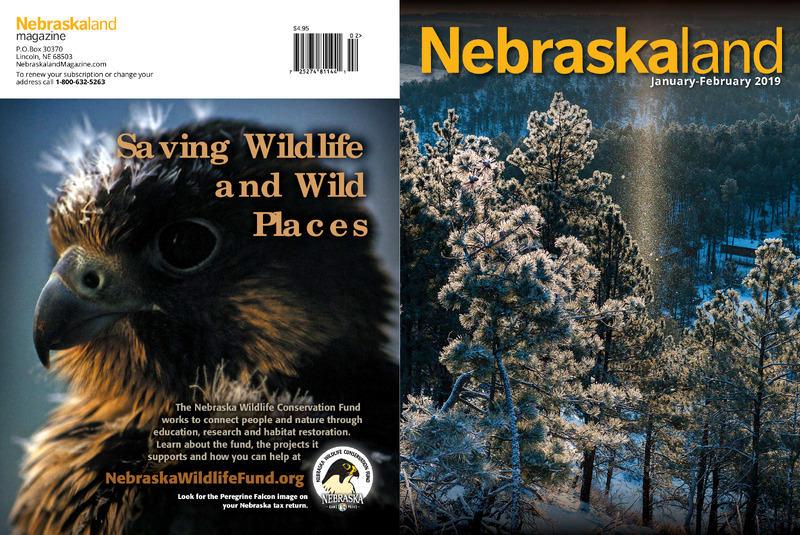
Saving Wildlife
and Wild
Places
The Nebraska Wildlife Conservation Fund
works to connect people and nature through
education, research and habitat restoration.
Learn about the fund, the projects it
su
upports a
nd h
ow yyou
ou can h
elp att
supports
and
how
help
NebraskaWildlifeFund.org
g
Look for the Peregrine Falcon image on
your Nebraska tax return.
Volume 97 No. 1
January-February
2019
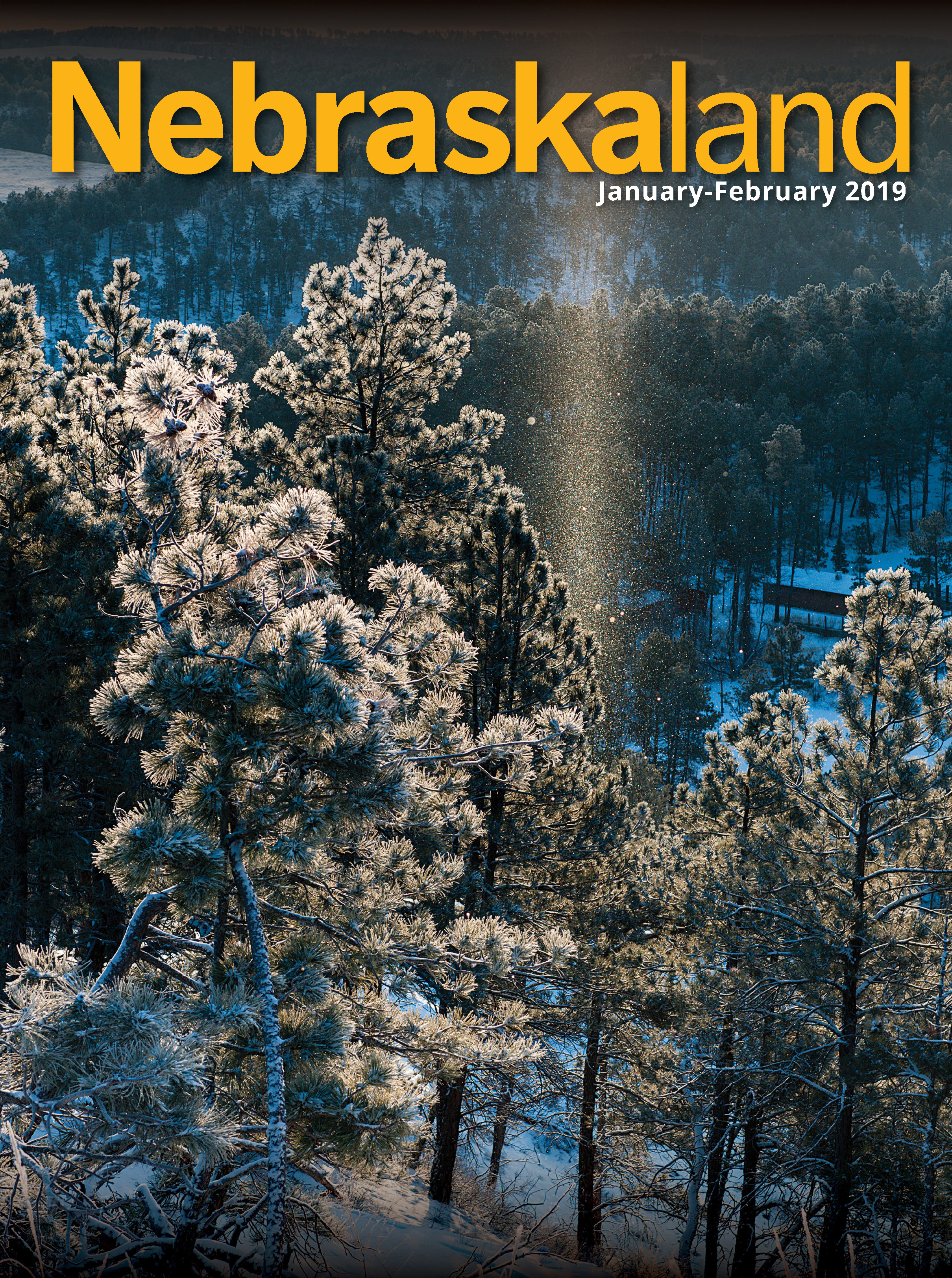
Cover: Hoarfrost covers the landscape and
drifts through the air on a bitter morning in
Chadron State Park in Dawes County. Photo by
Eric Fowler
FEATURES
20
AN ICE STORM FEAST
26
OUTDOOR NEBRASKA
28
2018 NEBRASKALAND
PHOTO CONTEST
Photos and Story by Chris Helzer
What to Do in January and February
By Renae Blum
Photos by Nebraskaland Magazine Readers
44
A HORSE RESCUE
46
THE NEBRASKA TABLE
On the Icy Missouri
By David L. Bristow, History Nebraska
Part 4 – Winter
By Ryan Sparks
DEPARTMENTS
7
12
56
60
62
Your Nebraska
In the Field
Mixed Bag
Portraits from the Past
The Last Stop
PHOTO BY JUSTIN HAAG
ON THE WEB
To see additional content including photos,
videos and additional articles, visit
Magazine.OutdoorNebraska.gov/digital.
Nebraskaland (VOL. 97 / NO. 1 ISSN 0028-1964) is published monthly, except for the combined Jan./Feb. and Aug./Sept. issues, by the Nebraska Game and Parks Commission, 2200 N. 33rd St.,
Lincoln, NE. Periodicals postage paid at Lincoln, Nebraska, and additional mailing offices. POSTMASTER: Send address changes to Nebraskaland, P.O. Box 30370, Lincoln, NE 68503-0370.
Magazine Staff
magazine
Communications Director Christy Firestone
Public Relations Manager Cara Pesek
Published by the Nebraska Game and Parks
Commission since 1926. The Commission is
dedicated to the conservation and protection
of all the state's natural resources and the
people who use them.
Editor Jeff Kurrus
Associate Editor Jenny Nguyen-Wheatley
Regional Editors Eric Fowler, Julie Geiser,
Justin Haag
Contributing Editor Michael Forsberg
Regular Contributors Renae Blum,
Chris Helzer, Ryan Sparks, Gerry Steinauer
Art Director Tim Reigert
Graphic Designer Mel Severin
Photo Librarian Jaclyn Cruikshank Vogt
Administration
Director Jim Douglas
Deputy Director Tim McCoy
Commissioners
Chairman - Dick Bell, Omaha
Vice Chairman - Robert Allen, Eustis
2nd Vice Chairman - Dan Kreitman, Wahoo
Rick Brandt, Roca
Pat Berggren, Broken Bow
Jim Ernst, Columbus
Norris Marshall, Kearney
Doug Zingula, Sidney
Scott Cassels, Omaha
Circulation Donna Robinson
For address changes and questions about your
subscription, e-mail donna.robinson@nebraska.
gov or call 800-632-5263
Advertising Sales Manager
For advertising information contact
Shane G. Gilster, 402-742-0125
Email: shanegilster@gmail.com
Nebraskaland Magazine Copyright 2018, all rights reserved.
Nebraskaland is available in audio from the Nebraska Library
Commission Talking Book and Braille Service, Suite 120, 1200 N St.,
Lincoln, NE 68508. 800-742-7691. Nebraskaland Magazine and the
Nebraska Game and Parks Commission reserve the right to reject any
advertising not in keeping with the agency mission.
Rates: $18 for one year; $33 for two years; $44 for three years. Nebraska
recipients must add appropriate sales tax. To subscribe call
1-800-NEBLAND (632-5263), or go online to:
NebraskalandMagazine.com.
Commission Offices
Conservation Officers
Headquarters/Southeast District Office
2200 N. 33rd Street Lincoln, NE 68503
Phone 402-471-0641
ADMINISTRATION (Lincoln)
Craig Stover (Administrator)
Duane Arp (Asst. Administrator)
Jeff Clauson (Asst. Administrator)
Northeast District Office
2201 N. 13th St. Norfolk, NE 68701
Phone 402-370-3374
Southwest District Office
301 E. State Farm Rd. North Platte, NE 69101
Phone 308-535-8025
Northwest District Office
East Hwy. 2, Box 725 Alliance, NE 69301
Phone 308-763-2940
Bassett Office
524 Panzer St., Box 508 Bassett, NE 68714
Phone 402-684-2921
Kearney Office
1617 First Ave. Kearney, NE 68847
Phone 308-865-5310
Ak-Sar-Ben Aquarium
21502 W. Highway 31 Gretna, NE 68028
Phone 402-332-3901
Omaha Office
8495 Frederick Street, Omaha, NE 68124
Phone 402-595-2144
OutdoorNebraska.org
Any program that receives federal funding from the National Park
Service, or the United States Fish and Wildlife Service prohibits
unlawful discrimination on the basis of race, color, religion, age, gender,
marital status, national origin, age, disability or political affiliation. Any
person who believes he or she has been discriminated against in
any program, activity, facility, or service, should contact the Nebraska
Game and Parks Commission, Lincoln, NE 402-471-0641, the Equal
Opportunity Commission, Lincoln, NE 402-471-2024, TTY/TDD 402471-4693; United States Fish Wildlife Service, Civil Rights Coordinator,
4401 N. Fairfax Drive, Arlington, VA 22203; Director, Equal Opportunity
Program, U.S. Department of Interior, National Park Service, 1849 C
Street NW, Mail Code 0008, Washington, D.C. 20240-0001.
4
402-471-5531
402-471-5531
402-471-5531
NORTHWEST (Includes counties covered)
Jim Zimmerman (District Supt.)
308-641-6138
Kelsey Glodowski
(Box Butte, S 1/2 Sheridan, Grant)
308-763-8226
Sean McKeehan
(Kimball, Banner, Scotts Bluff)
308-672-1824
Dan Kling (Sioux, Dawes)
308-430-0572
Kyler Prochaska
(E 1/2 Dawes, N 1/2 Sheridan, W 1/2 Cherry)
308-430-3984
308-458-7650
Terry Brentzel (Deuel, Garden, Grant)
402-389-0444
Frank Miller (Cherry, Hooker)
NORTHEAST (Includes counties covered)
Tom Zimmer (District Supt.)
402-641-9590
402-760-0712
Dale Davis (Keya Paha, Brown, Rock)
402-340-3981
Jonathan Andreasen (Holt, Boyd)
402-719-6226
Kyle Gaston (Dodge, Colfax)
Greg Hesse
(Greeley, Wheeler, Boone, S 1/2 Antelope)
402-843-6567
402-613-8612
Mitch Johnson (Knox, Antelope, Pierce)
402-762-5022
Jeff Jones (Knox, Cedar)
Jon Reeves
(S 1/2 Thurston, Burt, Washington)
402-889-8508
Andrew Heyer (Pierce, Madison, Stanton) 402-613-2241
Cory Krause
(Cuming, Wayne, Stanton, Dodge)
402-380-6410
Steve Oberg
(Colfax, Platte, Madison, Stanton, Nance)
402-910-3366
Owen Johnson
(Dixon, Dakota, N 1/2 Thurston)
402-266-1759
Doug Pollard (Loup, Garfield, Valley)
308-730-7050
Sean Schultz (Keith)
Brandon O’Neal
(Lincoln, McPherson, Logan)
Alex Hasenauer
(Lincoln, McPherson, Logan)
Mike Thome (Dawson)
Ray Dierking (Custer, Thomas, Blaine)
Taylor Dixon
308-760-0145
308-530-3157
308-660-4671
308-529-8146
308-870-0322
(Dawson, N 1/2 Gosper, N 1/2 Phelps)
308-217-2108
(Adams, Clay, Nuckolls, Webster)
402-902-2017
Eric Javins
SOUTHEAST (Includes counties covered)
Levi Krause (District Supt.)
402-949-0593
402-619-1355
Rich Berggren (Douglas)
402-616-5961
Dan Evasco (Sarpy)
402-210-0888
Heath Packett (Cass)
402-209-1506
Russell Mort (Otoe, Johnson)
William Krause
(Nemaha, Richardson, Pawnee)
402-274-8063
Matt Taylor (Thayer, Fillmore, Jefferson)
402-200-9597
402-806-0915
Matt Seitz (Gage, Saline)
402-890-6463
Dina Barta (Lancaster)
402-937-3422
Dudley Sorensen (Lancaster, York)
402-613-2312
Travis Shepler (Lancaster)
402-314-9641
Trevor Stahlecker (Lancaster)
402-890-7140
Stacey Lewton (Lancaster, Seward)
402-443-6392
Mike Luben (Saunders, Butler, Polk)
SOUTHWEST (Includes counties covered)
Roger Thompson (District Supt.)
308-530-3097
308-202-0819
Matt Brandt (Sherman, Howard)
308-380-7331
Tim Williams (Hall, Hamilton, Merrick)
Pat George
(Harlan, Franklin, Phelps)
308-920-2762
Matt Andrews
(Gosper, Furnas, Frontier, Red Willow)
308-746-2418
Brian Piernicky
(Red Willow, Frontier, Hayes, Hitchcock)
308-340-6627
John Lee (Hitchcock, Dundy, Chase, Hayes)
308-414-1432
308-289-0427
Nicholas Fix (Keith, Perkins)
308-440-3847
Bryce Streger (Keith, Arthur)
Nebraskaland • January-February 2019
January-February 2019 •
Nebraskaland
5
YOUR NEBRASKA
Instagram Photos
Follow us (@nebraskaland)
and tag us in your photos
to be featured in an
upcoming issue.
Becky Wright submitted this
image of gray tree frogs.
By Rebecca Johnson (@thecoloringtree):
“Photographing foxes may be my new favorite
thing. Especially when you’re hiding behind a
nearby tree, happily clicking away and one of
the fox kits decides to find out why the tree is
making such funny noises. So, he trots right
up to you and sits down an arm’s length away
and blinks up with his shiny brown eyes. And
for a moment, the world is just perfect.”
By Dakota Altman
(@dakotaltman): “A beautiful
common garter snake
gracefully navigates its way
through a blowout in the
warm light of a Sandhills
evening before being picked
up by curious herpers. Its
movements seem effortless,
using musculature and scales
to push against the sand
substrate and surrounding
vegetation.”
6
Nebraskaland
Ne
N
eb
brra
assk
ka
alla
an
nd
d • January-February
JJa
Janu
an
nu
uar
ary
y--Fe
Febru
bru
br
ua
ary
y 2019
20
01
19
Karen Kutz Smith submitted this
image of a swallowtail butterfly
on a purple coneflower.
January-February 2019 •
Nebraskaland
7
Lacey Fiorelli from Broken Bow
captured this photo at the
Custer County Fair during the
Bull Riding Classic.
By Paul Filsinger (@Paul_filsinger):
Taken at the Wildlife Safari Park by
Ashland.
By Jake Rogers (@jakerogersphoto)
Send your comments and photos to:
Jeff Kurrus, Editor
Nebraskaland Magazine
P.O. Box 30370
Lincoln, NE 68503
or email Jeff.Kurrus@Nebraska.gov
By Adam Hintz (@adamhintzlincoln): “The
sun scrapes a ridge of shadow across the
river valley. Every day is a promenade of
change. How will we cast our influence?”
8
Nebraskaland • January-February 2019
Please include your postal address
and telephone number. Letters may be
condensed and edited. Photographs are
also welcome.
IN THE FIELD
HORSES AT MAHONEY
Eugene T. Mahoney State
Park's long list of attractions
includes breathtaking scenery.
Here, horses graze in a pasture.
PHOTO
PHOT
O BY JEF
JEFF
F KURRUS
KURRUS
S
10
Nebraskaland • January-February 2019
January-February 2019 •
Nebraskaland
11
IN THE FIELD
FEMALE SCALESHELL MUSSEL, PHOTO BY CHRIS BARNHART, MISSOURI STATE UNIVERSITY
THREATENED AND ENDANGERED
THE SCALESHELL MUSSEL
By Melissa Panella, Wildlife Biologist
If you spend time along Nebraska’s lakes and rivers, you are
likely to come across the occasional large “clam” shell. These
are examples of our state’s native freshwater mussels. It can
be quite interesting to observe the unique shapes, sizes and
colors of the 29 species found in our state, although a few of
those are considered relicts, meaning only their shells, and
not the living mollusk that would normally reside within,
are detected. They have descriptive names like fawnsfoot,
pistolgrip, threeridge and pimpleback.
Freshwater mussels are completely aquatic. Seasonally,
many venture on a vertical migration to embed themselves
in the riverbed or lake substrate. They are cued to do this
when the water temperature begins to drop in the fall. During
winter, you may be able to see a freshwater mussel filter
feeding beneath the clear ice.
Freshwater mussels are often indicators of high water
quality, but large-scale stream modifications have resulted
in declines of many populations. The scaleshell (Leptodea
leptodon) is both a federal and state endangered species. In
Nebraska, it occurs only in the northeastern part of the state
in the Missouri River, but it is rarely found.
The study of mollusks is known as malacology. When I
recall first learning about freshwater mussels, I think of Dr.
12
Nebraskaland • January-February 2019
G. Thomas Watters, a malacologist, telling me that they need
divine intervention to reproduce successfully. This is because
they have a complex life cycle that requires a host fish to
complete the process. Somewhat like a parasite requires a
host to survive, a freshwater mussel requires a particular
type of fish to reproduce; however, the fish is unharmed in
this relationship. Some freshwater mussels even deceptively
bait their host fish to then spray them with glochidia (the
microscopic larval stage of the mussel). The “infected” fish
swims away, ultimately dispersing the juvenile mussels that
develop from the glochidia. Otherwise, the mussels would
be unable to disperse to new locations. The freshwater drum
(Aplodinotus grunniens) is the host fish of the scaleshell.
It is extremely challenging to locate scaleshells, and
experienced malacologists have been diving to look for them
without success. The population of scaleshells in our state is
believed to be small. Because of the species’ limited mobility,
any conservation efforts for the mussels would have to take
place directly at the sites where they occur.
Native freshwater mussels provide a service to us by
filtering and oxygenating bodies of water. They contribute
to cleaner water. Plus, they are really cool to find. Please just
watch out for the heelsplitter when you’re wading barefoot!
January-February 2019 •
Nebraskaland
13
IN THE FIELD
PHOTO BY JARROD SPILGER
FEBRUARY RABBITS
By Jarrod Spilger
With upland bird seasons closing Jan. 31, there’s
not much to hunt in February besides rabbits.
February is actually my favorite month to hunt
rabbits. I typically discourage my dog, Phantom,
from pursuing rabbits, often ignoring her rabbit
points so she remains focused on birds. But once
February rolls around, we have some fun.
Look for cottontails near brush piles or thick
shelterbelts. With a pointing dog, be prepared
to kick some brush to get rabbits moving. A
flushing dog will move them for you. Since most
shots are at running rabbits, I like to use a little
.410 shotgun.
Extra care must be taken when hunting rabbits
with dogs. Unlike birds, which fly when flushed,
a rabbit remains on the ground at dog level.
Always know your dog’s location before pulling
14
Nebraskaland • January-February 2019
the trigger. If in doubt, don’t shoot. Cottontails
tend to run in a circular pattern, so there will be
more opportunities soon enough.
Still-hunting solo through shelterbelts or
river bottoms with a scoped .22 rifle can also
be productive, especially if there’s snow on the
ground to make rabbits more visible. Plus, it’s
good practice for deer season.
Jackrabbits can be found in open pastures
year-round. Once flushed, they tend to run in a
straight line and keep going. A shotgun is a good
choice, and a 12-gauge is not too much gun, since
jacks can weigh up to eight pounds.
Nebraska’s rabbit season runs through the
end of February. For bored hunters, human and
canine alike, rabbits provide the perfect cure for
cabin fever.
January-February 2019 •
Nebraskaland
15
IN THE FIELD
PHOTO BY JUSTIN HAAG
THE RED-BREASTEDS ARE HERE
By W. Ross Silcock
Red-breasted nuthatches are favorite feeder birds for many
people – they are cute, colorful, active and entertaining. In
Nebraska, they are winter visitors mostly, although there are
small breeding populations in areas with conifers in northern
and western Nebraska, most notably the Pine Ridge.
Surprisingly, there are nesting records in the southeast for
Seward and Douglas counties and nesting may also have
occurred in Lancaster County.
This species is the only North American nuthatch that
regularly stages mass movements away from its breeding
range, usually due to diminished food supplies. Because of
this propensity for long-distance movements, it is the only
North American nuthatch to have made it as a vagrant
across the Atlantic Ocean. An indication of the magnitude
such movements can attain in parts of North America are
counts reaching 1,000 per day in Quebec. Occasionally, large
numbers show up during Nebraska winters, such events often
being referred to as “invasions,” “incursions” or “irruptions.”
It looks as though we are experiencing such an event
this winter. There have been many reports of red-breasted
nuthatches at feeders and in pine groves earlier during fall.
The first arrivals this fall in eastern Nebraska were on
time for most winters: single birds were in Douglas and
16
Nebraskaland • January-February 2019
Dodge Counties on Sept. 6-7. However, numbers climbed
rapidly; eight were at Holmes Lake in Lincoln the next day.
Since then, six to eight have been at Holmes Lake, when in
most winters one or two are found there. In Douglas County,
the best count so far is eight – at feeders on Monroe Street,
Omaha in November, and in Sarpy County, five were at the
Fontenelle Forest feeders in October.
In western Nebraska, numbers have been impressive
at feeders in or near pines. As many as 12 were at the Croft
family feeders nestled among ponderosa pines at the base of
the Wildcat Hills mid-October, and up to nine are attending
the feeders at the nearby Wildcat Hills Visitor Center. The best
counts usually occur in November and are in the range 13-16.
As the winter plays out it will be interesting to see if these
rather amazing numbers continue, or gradually decline
through the coldest weeks. Sometimes in spring there is a
return movement that may be detected over and above local
feeder numbers. Spring high counts usually occur in early
May. We’ll be watching.
Visit the Birds of Nebraska –
Online (Birdsofnebraska.org) for
more information on Nebraska
birds.
January-February 2019 •
Nebraskaland
17
IN THE FIELD
PHOTO BY JENNY NGUYEN-WHEATLEY
WILD WHAT'S UP
By Monica Macoubrie
As an environmental educator, I am asked countless
questions about wildlife, habitats, and plants. Occasionally
I know the answer, but now and then I have to do some
research. Nebraska Game and Parks now has an email
address (wildwhatsup@nebraska.gov) where people can
send their wildlife questions and get a response. Here are
some questions we have recently received.
Do fish freeze in the winter?
Fish are cold-blooded, which means that as the
temperatures drop, their metabolism dips as well. During
the extreme Nebraska winter, when there is a layer of ice
and snow on the rivers, streams, lakes and ponds, fish will
be less active and tend to stay toward the bottom. This layer
of ice and snow actually provides fairly good insulation to
retain the heat already in the water. Warm water will then
start to sink toward the bottom where groups of fish usually
gather for their winter rest. Some species will even burrow
themselves into the sediment for periods of time.
I see a lot of black squirrels; what species are they?
A lot of people in Nebraska have seen black-colored
squirrels, and have wondered if they are a new, or different
species. Actually no, they are just a common eastern fox
squirrel (Sciurus niger). These squirrels are usually a rustybrown color but can vary from silver-gray to even black.
The black squirrels that everyone is seeing lately are just
a different genetic variation – similar to how people have
different hair and eye colors.
18
Nebraskaland • January-February 2019
Armadillos are popping up more frequently, is Nebraska
just now getting them?
Yes, and no. Nebraska has records of male nine-banded
armadillos as far north as Ord, but we do not have established
records of females or babies. Armadillos don’t regulate their
body temperature well, so they are normally only found in
warmer climates (Texas, Oklahoma, etc.) However, for the
past few years, Nebraska has experienced rather mild winters
and extremely warm springs. This is causing armadillos
to survive in Nebraska, where they couldn’t previously. If
these animals become established, they could then become
permanent members of the mammal community in the state.
Do I need to worry about urban-dwelling red foxes?
In Lincoln, the population of urban red fox sightings has
increased. These small members of the canine family only
reach around 30 pounds at most, and often feed on rabbits,
birds and small mammals – such as squirrels and mice. People
often wonder if they should worry about their children being
attacked – the answer is no. Foxes do not attack humans,
and officials have not found any sick or diseased foxes. There
have been a few reports of foxes allegedly killing backyard
chickens and two unconfirmed reports of them attacking
pets. Pet owners need to be vigilant – don’t leave small pets
unattended, and don’t think a 4-foot-high fence will keep
foxes out of your chicken coop – they can easily jump that.
The ultimate goal is to gain a better understanding of these
elusive animals within our city limits.
January-February 2019 •
Nebraskaland
19
An
Ice Storm
Feast
Photos and story by Chris Helzer
I
woke up on the morning of January 17
with a clear plan of attack. The biggest ice
storm in a decade had ended the previous
evening, and the forecast had correctly
predicted clear skies and calm winds for the
post-storm sunrise. Road crews had worked
through the night, allowing me to slowly
and carefully make my way across Aurora
to a series of restored prairies along Lincoln
Creek. It was going to be an epic morning for
photography.
Orbs of ice encase the
now-empty flowers of
stiff goldenrod.
20
Nebraskaland • January-February 2019
Indiangrass seeds droop under the weight of their icy coating.
January-February 2019 •
Nebraskaland
21
H
owever, I didn’t
anticipate
how visually
overwhelming the icy
prairie was going to be
when I arrived. As the sun
peeked above the horizon,
the entire prairie began to
sparkle and glow, and I felt
like a dog chasing handfuls
of popcorn tossed in the
air. I wandered aimlessly
for about 10 minutes as
the sun continued to rise,
mildly panicking, unable
to decide where to point
my camera in the face
of the wonderful glittery
awesomeness. Finally, my
brain kicked in and I began
to sort and prioritize my
options. I pulled my wideangle lens out to capture
the sun shining through the
icy prairie vegetation while
it was still low enough to
do so. Once the sun rose
too high for that pursuit, I
switched to my macro lens
and settled in to capture
close-up images of the
glazed golden plants around
me.
Sunrise along Lincoln Creek turned the prairie into a glittering wonderland.
22
Nebraskaland • January-February 2019
January-February 2019 •
Nebraskaland
23
Jewels of ice-covered switchgrass seeds dangle in the
morning light.
W
A long frozen drop of
water extends from a
small reservoir of ice in
a grass leaf.
D
uring the next three hours or so, I was
surrounded by splendor, but it was a real
challenge to find subjects situated such
that I could actually make them into pleasing
images. Everything was sparkly and bright,
which made it difficult to find subjects without a
distracting glare behind them. I had the best luck
with seed heads or leaves that were isolated by a
few feet from neighboring vegetation. Then I could
either use shallow depth-of-field to blur out the
background or get low enough to frame my subject
against the clear blue sky.
24
Nebraskaland • January-February 2019
hile everything around me that
morning was gorgeous, a few plant
species seemed perfectly suited to
their crystal coatings. The fuzzy golden seeds
of Indiangrass, for example, caught the light
wonderfully when wrapped in ice, and ended up
in nearly one-third of all the photos I took that
morning. The panicled seed heads of switchgrass
were also fabulous, creating drooping clusters of
glittering globes, each encasing a tiny switchgrass
seed. A surprising addition was stiff goldenrod,
whose compact flower heads had lost most of
their fluffy seeds, but now were handsomely
enclosed by clear ice.
When I finally left the prairie, it wasn’t
because I ran out of beauty to photograph – it
was because I was emotionally spent. I felt very
much like I had just gorged myself on a fantastic
Thanksgiving meal, except that my brain was full
of goodness, rather than my stomach. The ice
melted away pretty quickly that afternoon, but
my memories from that day will stay with me for
a very long time.
A stiff sunflower seed
head carries an icy clear
coat.
January-February 2019 •
Nebraskaland
25
Outdoor Nebraska
By Renae Blum
Winter may be in full force, but there’s still outdoor fun to be had, whether your thing is hunting,
birdwatching, fishing, hiking, or just spending time with loved ones. Read on for some ideas on what to do
during these chilly months. To read about fun park events coming up, visit Calendar.OutdoorNebraska.gov.
Backyard Bird Feeding
Throughout the winter | Statewide
Food for birds may be scarce right now. Help our
feathered friends by setting up a feeder. Nebraskaland
Regional Editor Julie Geiser says that birds love to snack
on sunflower seeds, cracked corn, safflower seeds, Niger
or thistle seeds, peanut hearts and shelled, unsalted
and dry-roasted peanuts. Also, keep your feeders clean
to keep hungry birds from getting sick. “Wash your
feeders at least monthly in a light 9:1 water-to-bleach
solution, then rinse thoroughly and allow to air dry,”
Geiser says.
What To Do in January and February
Trout Fishing
Throughout the winter | Statewide
Check out Nebraska Game and Park’s
updated put-and-take rainbow trout
stockings at OutdoorNebraska.org for
your latest trout fishing possibilities.
“The same baits that work in open
water – small spoons, jigs and live bait
– also work through the ice,” writes
Nebraskaland Editor Jeff Kurrus. “Plus,
typical presentations used for panfish
through the ice will work well for trout,
too.” Streams across the state, such
as Long Pine Creek (pictured), can be
accessed as well.
Valentine’s Day Specials
Various dates | Various state parks
Valentine’s Day becomes a unique, outdoor-centric
experience at a state park. Enjoy the snowy woods
with a cabin or lodge room, take a quiet hike to see
winter’s beauty up-close or join the Great Backyard
Bird Count. Various parks offer Valentine’s Day
packages, including a special dinner at Platte
River State Park and lodging specials at Eugene T.
Mahoney and Ponca state parks.
Shootout at Salt
Creek
Jan. 6
Nebraska Outdoor
Education Center
Nebraskaland • January-February 2019
Feb. 11
Various Zones
Get Ready for Spring Turkey
First Day Hikes
Get a jump on spring turkey season and start planning this
winter. Outdoor Education Specialist Aaron Hershberger
recommends looking ahead and seeing what vacation
days you can lock in. Also, take a look through your gear,
including camera equipment. Take stock of what’s missing,
or what needs to be replaced or fixed. You can also use this
time to think about your goals – places you want to go and
milestones you want to achieve.
Walk off your Christmas ham and mashed potatoes on a First Day Hike.
Stretch your legs, see a state park dressed in its full winter splendor and
welcome in 2019. Fort Kearny State Recreation Area is one of our featured
destinations. For more locations, visit Calendar.outdoornebraska.gov.
Throughout the winter | Statewide
26
Light Goose
Conservation
Order Hunting
Begins
Jan. 1 | Various locations
January-February 2019 •
Nebraskaland
27
2018
P ho to
C o nt est
The 2018 Nebraskaland Magazine
Photo Contest drew in another year
of stunning images from your fellow
Nebraska photographers in the
categories of Wildlife, Flora, Scenic,
Recreation and Youth.
The Nebraskaland Magazine staff
found it difficult to pare down the
excellent images – especially the Best
of Show winner, which went to Liz
Garcia and her image, “The Birds and
the Bees.”
In addition, the Readers’ Choice
Award went to Chris Pischel for his
image, “Weathering the Test of Time.”
We thank everyone who participated
and made this exciting feature possible
in our magazine. We look forward to
seeing more of your great photographs
in next year’s contest.
Keep shooting.
BEST OF SHOW
The Birds and the Bees
Photo by Liz Garcia, Utica
28
Nebraskaland • January-February 2019
January-February 2019 •
Nebraskaland
29
WILDLIFE
SECOND PLACE – Mom and Kits
Photo by Karen Harris, Lincoln
FIRST PLACE – Deer at Chalco
Photo by Justin Pence, Omaha
THIRD PLACE – Looking Out at the World
Photo by Rechelle Pelzer, La Vista
30
Nebraskaland • January-February 2019
January-February 2019 •
Nebraskaland
31
FLORA
FIRST PLACE – Goat’s Beard Magic
Photo by Roger Richters, Utica
32
Nebraskaland • January-February 2019
January-February 2019 •
Nebraskaland
33
FLORA
SECOND PLACE – Sunflower Sunset
Photo by Jamison Thies, Lewiston
THIRD PLACE – Milkweed
Photo by Alexis Mendyk, Dannebrog
34
Nebraskaland • January-February 2019
January-February 2019 •
Nebraskaland
35
SCENIC
FIRST PLACE – The Heavens Above Montrose
Photo by Joseph McCarty, Monterey, California
SECOND PLACE – The Cloud
Photo by Jeremy Bower, Lincoln
THIRD PLACE – Rural
Summer Sunset
Photo by Jamison Thies,
Lewiston
36
Nebraskaland • January-February 2019
January-February 2019 •
Nebraskaland
37
RECREATION
FIRST PLACE – Little Moments
Photo by Joel Jones, Lincoln
38
Nebraskaland • January-February 2019
January-February 2019 •
Nebraskaland
39
RECREATION
SECOND PLACE – An Archery Trek
Photo by Amber Dubs, Ashby
THIRD PLACE – Apollo’s Mission
Photo by Jamison Thies, Lewiston
40
Nebraskaland • January-February 2019
January-February 2019 •
Nebraskaland
41
YOUTH
READER’S CHOICE
Weathering the Test of Time
Photo by Chris Pischel, Lincoln
FIRST PLACE – Wild Grass at Sundown
Photo by Corby Cannon, Silver Creek
42
Nebraskaland • January-February 2019
January-February 2019 •
Nebraskaland
43
A Horse Rescue
on the Icy
Missouri
By David L. Bristow, History Nebraska
ow did a valuable pacer (a horse used in harness
racing) nearly drown in the icy Missouri River in
January 1882? The story tells us something about
19th century life in a river city.
The story begins Jan. 22, when Omaha businessman
Clifton Mayne traveled to Council Bluffs for work. This wasn’t
as easy as it sounds. A railroad bridge spanned the Missouri
River, but it wasn’t open to wagon traffic. Mayne took the
“dummy train,” a train that went back and forth across the
bridge.
But how would he get around Council Bluffs? He could
walk or take the streetcar, but that wouldn’t do for a wealthy
man with a taste for fine horses. Mayne had some special
cargo loaded on the train: a light buggy that he used only on
special occasions, and his prized pacing horse, Oscar Phelps.
H
This was the 1880s equivalent of bringing a Porsche.
Mayne’s business took longer than expected and he missed
the dummy train’s westbound departure. No matter. He’d
just cross the river on the ice, as people had been doing since
before the bridge opened in 1872. The next day’s Omaha Daily
Bee tells what happened.
“When part way over, he observed some boys who were
skating making violent signs at him and stopped to see what
was wanted, when one of them came up and told him he was
driving on dangerous ground. On getting out and examining
the ice he found his horse’s fore feet within six inches of a
space where ice had been cut out and the new ice was so thin
that the boy who warned him readily broke it through with
his skate.
“Mr. Mayne then made a wide detour and had nearly
This circa-1920 harness race in Neligh was after Oscar Phelps’ time, but shows the kind of racing he did. History Nebraska RG2836-1818
44
Nebraskaland • January-February 2019
Travelers and workers often braved the icy Missouri River, just like these bridge workers near Rulo in 1886. History Nebraska RG2457-5-24
reached the Nebraska shore when suddenly his horse broke
through with his fore-feet. He got out and unhitching him
pulled the buggy back and then took the horse by the bit
and tried to get him on the solid ice. The animal, however,
floundered about so that he broke the ice in all directions
about him, letting himself and his owner down in the water.
Mr. Mayne scrambled out, but the horse worked himself
under the ice, all but his head, which rested on a cake of ice
which alone prevented him from being drowned.”
Oscar Phelps was in serious trouble. His unusual name
probably wasn’t a good omen. He may have been named
for a character in a syndicated 1880 short story in which a
young man using the alias “Oscar Phelps” is killed in a duel
Future Nebraska Governor James Boyd opened Omaha’s
first meatpacking plant in 1872. From Alfred Sorenson, Early
History of Omaha (1876), p. 242.
by a disguised woman seeking revenge. Or he may have been
named for the soon-to-be-defunct town of Oscar, in Phelps
County, Nebraska. Either way, he was in danger of being
pulled under the ice by the current.
Mayne ran for help. The nearest business was Boyd’s Pork
Packing House, Omaha’s original meatpacking plant, north of
present-day Lauritzen Gardens. Several plant workers came
with planks and ropes. For the next two hours they struggled
to rescue the horse while a crowd of some 500 onlookers
gathered along the riverbank.
It was dangerous and unpleasant work. Oscar was
floundering just below the spot where the plant discharged
its untreated waste directly into the river. And the plant was
no small operation, having slaughtered some 112,000 hogs
during the previous year. Omahans were used to living in a
smoky, smelly, and muddy city, but the Bee noted that the
“work was done in the face of sickening filth and stench.”
Meanwhile, other drivers and teams of horses crossed the
river that day, oblivious to the danger. It was how things had
always been done. The Bee recommended waiting for another
“cold snap.”
It was getting dark by the time Oscar was pulled from
the cold and filthy water “in a half dead condition.” But the
horse was tough as well as fast. He recovered and was later
sold to Mayne’s business partner. The following year the Bee
reported that Oscar Phelps was “winning some fast races
and high honors at Ohio fairs this fall.” Running on the soft
dirt of a track probably seemed easy after crossing rotten
river ice.
Visit History Nebraska’s website at history.nebraska.gov.
January-February 2019 •
Nebraskaland
45
The
Nebraska
Table
By Ryan Sparks
W
inter is a time for reflection, and if you’ve been
following along with the Nebraska Table you
have a lot to reflect on. You’ve foraged morel
mushrooms and stinging nettles. You’ve watched the
sunset from a deer stand. You’ve felt the rush of a covey
of quail as they burst from a fencerow. The best meals
capture these moments. They contain the essence of a
place, and each bite is made sweeter from the memory
of how it ended up on your plate. It connects you to the
land and gives you a better understanding of Nebraska.
Clayton Chapman of Omaha’s The Grey Plume
restaurant has spent a lifetime working with and
exploring the flavors of our region. No other chef
offers such a striking and emotional representation
of Nebraska. The menu at the Grey Plume is always
in flux and demonstrates Chapman’s nuanced
understanding of seasonality. If you’ve cooked any of
Chapman’s recipes from the previous three installments,
you know exactly what I’m talking about. I was happy
to interview him and learn about his approach to
working with local ingredients and producers.
How did you first become interested in working
with local food and ingredients?
I was looking for a way to reconnect, explore and
evolve the way I was cooking. There was a growing
realization from those first interactions with local
farmers and growers that the ideals of “local food”
encompassed so many of my own personal beliefs and
attitudes. I enjoyed the fact that there was a mutual
curiosity between the farmer and the chef. I was drawn
to the challenge of sourcing and cooking with the
46
Nebraskaland • January-February 2019
What are the benefits of working with
local foods?
Working with local food presents the
opportunity to align ourselves with the state
in a different way. It can provide a shift in
perspective. A different perspective not only
through a deeper understanding of where
and how our food is being produced or how
we can support our local economy, but it
also can cause a shift that translates through
the ways we want to engage and participate
with each other. We live in a world of such
disconnect, and it sometimes feels like we are
moving further and further from the source and
authenticity of many things. Working with local food
evokes meaning and it’s a powerful way we can connect
to our land, culture and community. Whatever you buy
“local,” it always has a story behind it and these food
stories can help us to connect, relate and learn from
each other. Isn’t that at the heart of sharing a meal?
PHOTO BY RYAN SPARKS
Part 4
Winter
seasons and creating a menu that highlighted
such thoughtful collaborations. Opening The
Grey Plume rooted in the philosophies of
sustainability and stewardship felt like the
most natural next step for me. These have
become the cornerstone of how and why I
cook.
What are local ingredients that home cooks
overlook?
Two ingredients come to mind: 1) Stinging nettles
can almost be found everywhere in Nebraska and they
are really versatile. You can braise them like collard
greens, wilt them like a spinach, wash repeatedly in
cold water for use in a salad, make tea, and soups.
2) Paw-paw is the midwestern version of a tropical
fruit. Native to Nebraska, the paw-paw tree grows
in southeastern Nebraska and its fruit has a very
short harvesting time, ripening in September or early
October. It has a creamy flesh with big seeds and it
tastes of pineapple and bubblegum. It’s delicious as an
ice cream or custard.
What is a year-round staple in your pantry?
Our house-churned butter is something we are never
without. We are fortunate to partner with Nebraska dairies to
bring us delicious cream that we culture, churn and squeeze
by hand.
How do you handle Nebraska’s long winter?
Canning, pickling and preserving. We dedicate a lot of
time in the summer and fall toward capturing Nebraska
fruits and vegetables in the height of their season. If they
grow it, we jar it and then reach for it to brighten up our
winter menus. So much so, we opened Provisions in the fall
of 2014; offering our house made preserved items, cured
meats and coffee in an everyday retail format.
What is the biggest misconception about the local
food movement?
Eating “local” and the “farm to table” concept may
have started out as a food trend but the momentum has
grown and it’s not going away. There is an awareness and
a consciousness that is out there now and it’s created a
powerful level of accountability for our food producers,
grocers and chefs that wasn’t there before. More and more
consumers are looking for local food options and are
expecting to see it on the shelves and menus. We have a
tendency to limit the scope and power of local food. Its reach
and representation goes far beyond local farmers markets. It’s
changing the way we think about agriculture, conservation,
nutrition and policies that define our city, state and country.
How has your experience sourcing local ingredients
and working with Nebraska farmers influenced your
understanding of Nebraska’s landscape?
It’s gratifying on many levels to be able to witness and
explore the passionate ways Nebraskans are producing
food. I’ve been able to spend time with ranchers in the
Sandhills and the Niobrara River Valley and have had daily
interactions with Omaha’s urban farmers. Nebraska has
this special duality of rural and urban farming and I think
it’s probably one of our greatest assets. Every producer
January-February 2019 •
Nebraskaland
47
You will find chef Chapman’s recipe for Honey Creek
Farm’s potato soup in the following recipes. Also featured
is nettle tea from Abigael Birrel, former executive chef at
Lincoln’s Hub Café, as well as Jenny Nguyen-Wheatley’s
elk stew and Jane Sparks’ bread pudding.
I hope you have enjoyed the recipes featured in
the Nebraska Table, but even more, I hope you have
discovered a new passion and developed a better
understanding of Nebraska. Nebraska is full of flavors and
experiences that can’t be purchased at a store. You have to
get outside, explore and find them.
Honey Creek Farm’s Potato
Soup
Many of us know how cold a Nebraska winter can
be – some years are colder than others and some years
are brutally cold. Growing up in this wonderful state, I
remember my mother making potato soup every winter.
The soup usually consisted of a beef broth made from the
roast beef from the night before, roast beef trimmings and
a ton of potatoes with carrots, onions and anything else
that was in the fridge. This recipe is a homage to that soup,
but in a different variation. Instead of using a broth base,
the soup is buttermilk and potato-based. The blood orange
adds a nice brightness of acidity, and the oxtail is a nice
variation of the roast beef I remember eating as a child.
Honey Creek Farm in Hancock, Iowa, produces amazing
potatoes for us year-round. The recipe is suitable for a
wide variety of potatoes, so please use what you have in
your kitchen. Rhizosphere Farm is in Bennington, and
we are fortunate that Matt and Terra are able to produce
onions for us into the winter season.
La Vigne Organics is a Certified Bio Dynamic and
Certified Organic citrus farm in Fallbrook, California,
where Helene Beck produces phenomenal citrus for us.
But like with any seasonal produce, things change with the
seasons. The blood orange in this recipe can be substituted
with any type of orange, but blood oranges are in high
season on the West Coast during our Nebraska winters.
Mark and Jill Schmitz own and operate Majinola Farm
or Majinola Ranch, a small wagyu cattle ranch in Panama,
Iowa. We are thrilled to work with them as our only beef
provider at the restaurant.
Servings: 2 large servings or 8 small portions
Prep Time: 1 hour
Cook Time: 13 hours
Potato Soup
Ingredients:
3 pounds heirloom potatoes, peeled and cut into
•
48
Nebraskaland • January-February 2019
•
•
•
•
•
•
•
•
1-inch pieces (We use Yukon gold at the restaurant.)
2 cups Burbach’s Dairy whole milk
2 cups buttermilk
1 yellow or white onion, julienned
3 sprigs fresh thyme
4 ounces spinach
4 ounces George Paul red wine vinegar
Kosher salt, to taste
Fresh cracked pepper, to taste
Place peeled, cut potatoes and onions into a pot with the
milk. Add thyme sprigs and season with salt and pepper.
Cook the potatoes on medium heat until they are tender
and add the buttermilk. Continue to cook the potatoes until
they are at a mashed-potato-like consistency. Remove the
thyme sprigs and add spinach to the potato mix, then place
in blender. Blend the potatoes until smooth. If you like a
thicker, chunkier soup you can leave the soup as is, once
partially pureed. If you would like a completely smooth
soup, pass the blended soup through a fine mesh sieve to
alleviate any chunks of unblended potato. Season to taste
with salt and pepper and add the George Paul vinegar.
Cipollini Onion
Ingredients:
4 cipollini onions, peeled and cut in half with the root
end still intact
1 ounce neutral cooking oil
1 ounce whole unsalted butter
Kosher salt, to taste
Fresh cracked black pepper, to taste
1 sprig fresh thyme sprig
½ ounce George Paul red wine vinegar
¼ ounce fresh chives or parsley, minced
•
•
•
•
•
•
•
•
Heat oil in pan and add cipollini onions. Sear the onions
on medium heat until they get a nice crust on one side.
Strain oil out of pan and add butter, thyme sprig, salt and
pepper. Continue to sauté the onions until butter foams
and then add about 1 ounce of cold water. Reduce until the
water evaporates and add the vinegar. Season to taste again
with salt and pepper. Add chives or parsley.
La Vigne Organics Blood Orange
Ingredients:
2 blood oranges, segmented and zested
•
Zest the orange. Cut off the top and bottom of the
orange so that it stands on one end without rolling.
Underneath the skin (that you segmented) there will be a
layer of white pith followed by the dark red color of the
orange. You want to cut down to the orange. After the
top and bottom are removed and the color of the orange
is exposed, start cutting down the sides of the orange to
expose the whole fruit. Discard the pith. You will be left
with your whole fruit, zest and pith removed. Using your
paring knife, cut out the individual segments of the fruit.
These are the small pieces of fruit between each of the
membranes. After segmenting all the fruit, set aside along
with the zest for later use.
PHOTO BY RYAN SPARKS
and grower is dealing with a unique set of challenges
depending upon where they are.
Among those I’ve worked with is a strong willingness
to collaborate to evolve our food system in Nebraska. It’s
a willingness that’s grounded not only in the ideals of
preservation but also innovation.
Majinola Farm’s Wagyu Beef Oxtail
Ingredients:
1 oxtail, cut into 2-inch sections
2 cups red wine
1 cup carrots, peeled and cut into ½ -inch dice
2 cups onion, peeled and cut into ½ -inch dice
1 cup celery, cut into ½-inch dice
1 bay leaf, fresh or dried
3 sprigs fresh thyme
24 ounces beef stock/beef broth
2 ounces neutral cooking oil
Kosher salt, to taste
Fresh cracked black pepper, to taste
•
•
•
•
•
•
•
•
•
•
•
Pour the wine over the oxtail and marinate overnight.
Once oxtail pieces have marinated, pull from the marinating
liquid (reserve the marinating liquid) and pat dry with paper
towels. Season the oxtail with salt and pepper. Heat a sauté
pan/large rondoux on the stove with medium heat and add
the neutral cooking oil. Sear the oxtail until golden on all
sides and place the oxtail in a baking dish. In the pan that
the oxtail was seared in, add all of the carrots, onions, celery
and sauté until you develop a nice dark color on the exterior
of the vegetable. Once vegetables are sautéed add the red
wine, beef broth and bay leaf to the pot and bring to a boil.
Pour liquid over the oxtail and bake in a 250-degree oven for
about 12 hours or until the oxtail meat comes off the bone
easily. Reduce the cooking liquid by ¾. Pull the meat off
the bone and fold in the reduced cooking liquid, chives and
blood orange zest (from above).
To assemble: In the bottom of the bowl, place a small
pile of the braised oxtail, two cippolini onions and 3 blood
orange segments. When ready to serve, pour the hot soup
over the top.
– Clayton Chapman
Nettle Tea
Chef Birrell sings the praises of wild nettles. Her spring
contribution featured a forged nettle pesto where she
suggested drying additional nettles to make an earthy tea
during the winter. If you didn’t manage to pick any nettles
or simply forgot to dry some, dried nettles can be found in
many health food stores. Besides being a welcomed taste of
summer, nettle tea is known for its numerous health benefits.
Servings: 1
Prep Time: 1 minute
Cook Time: 3 minutes
Ingredients:
1 teaspoon dried nettle leaves
Dash of honey (optional)
•
•
Place the dried nettles in a tea ball and
steep in boiling water for three minutes.
– Abigael Birrell
January-February 2019 •
Nebraskaland
49
PHOTO BY JENNY NGUYEN-WHEATLEY
Servings: 4-6
Prep Time: 15 minutes
Cooking Time: 3 hours
excess flour from elk meat and add meat to the hot oil (in
batches) and brown to form a nice crust. Set remaining flour
aside for a later step. Remove browned meat and set aside.
Ingredients:
3 pounds elk (or deer) stew meat, do not remove silver
skin
Salt and pepper to taste
5 tablespoons flour
1 onion, chopped
Cooking oil
3 ribs of celery, cut into large sections
1 bay leaf
1 teaspoon dried rosemary or fresh leaves, chopped
1½ cups dry red wine
2 tablespoons tomato paste
5 garlic cloves, smashed
2 quarts unsalted/low sodium elk or beef stock
2 large carrots, chopped into large pieces
2 parsnips, peeled and chopped into large pieces
2 turnips, chopped into large pieces
Flat leaf parsley for garnish
Add more oil to the pot. Add chopped onion, pinch of
salt, bay leaf, rosemary and celery and sauté until onion
turns translucent; lower heat if necessary to avoid
burning. Next, add the tomato paste, remaining flour from
step 1 and garlic, and sauté for 1 minute.
•
•
•
•
•
•
•
•
•
•
•
•
•
•
•
•
Preheat oven to 350 degrees Fahrenheit. Pat elk meat
dry with paper towels and toss with salt and pepper to taste
in a bowl. Then toss with the flour. In a Dutch oven, coat
the bottom with oil and heat over medium-high. Shake off
50
Nebraskaland • January-February 2019
Add wine and scrape the bottom of the pot with a wooden
spoon to release brown bits. Allow wine to simmer and
reduce by one quarter. Return browned elk stew meat to the
pot and pour in elk or beef stock. Stir and bring to a low boil.
Take off heat. Cover the opening of the pot with foil,
and then place the lid on top – the foil helps to slow down
moisture loss. Cook in a 350-degree oven for about 1
hour and 30 minutes. Then discard the foil and add the
carrots, parsnips and turnips and continue to cook covered
for another 30-45 minutes until meat
and vegetables become tender. Taste
for seasoning and garnish with freshly
chopped parsley. Serve with crusty bread.
This stew tastes better the day after.
– Jenny Nguyen-Wheatley
PHOTO BY RYAN SPARKS
Elk, Parsnip and Turnip Stew
Bread Pudding
This simple and hearty bread pudding is wonderful on a
cold winter night. It’s also a delicious way to use stale bread.
This has been a fixture in our family for generations. It’s
delicious as is, but adding a scoop of vanilla ice cream, a
splash of cream, or a dash of brandy doesn’t hurt.
Servings: 6
Prep Time: 10 minutes
Cook Time: Approximately 1 hour
Ingredients:
1-3 tablespoons butter
6 cups cubed bread (approximately 1 inch)
1
⁄3 cup raisins
2 eggs
1
⁄3 cup sugar
¼ teaspoon cinnamon
•
•
•
•
•
•
teaspoon salt
• ¼1 teaspoon
extract
• 2 cups wholevanilla
milk
•
Preheat the oven to 350 F.
Combine the raisins with the bread cubes and spread them
evenly in a lightly buttered casserole dish.
Combine eggs, sugar, salt, cinnamon, vanilla, and milk
and pour the mixture over the bread cubes.
Place the casserole dish in the oven, uncovered, along with
a baking dish filled with water. This helps
keep the pudding moist.
Bake for one hour or until the top is
nicely browned.
– Jane Sparks, author’s grandmother
January-February 2019 •
Nebraskaland
51
MIXED BAG
PHOTO COURTESY OF THE NEBRASKA TOURISM COMMISSION
VISIT GERING
By Erin Lenze, Nebraska Tourism Commission
Take some time, get off the beaten path and discover the
winter wonderland of Gering. Nature lovers, “foodies,” and
those who just want to relax will love what this charming
city in Nebraska has to offer.
Cozy up in a renovated 100-year-old barn at the Barn Anew
Bed & Breakfast. Located on the historic Oregon Trail, wake
up and enjoy a gourmet breakfast while admiring the view
of Scotts Bluff National Monument in the background. Rest
up in a room that defines comfort and hospitality at the
Monument Inn & Suites, located only a few minutes from
the Monument. Additional lodging options in Gering include
Cobblestone Hotel & Suites, Circle S Lodge and Arcadia Hotel.
Explore Wildcat Hills State Recreation Area & Nature
Center while you’re in the area. Enjoy hiking three miles of
nature trails through the canyons and bluffs of the area and
watch for wildlife. In the nature center, learn from interactive
displays and programs or admire the captivating view of the
park and valley below. Don’t forget to grab a souvenir from
the gift shop on your way out.
Spend a little extra time out in the cold at Scotts Bluff
National Monument. Drive or hike 1.6 miles up Saddle Rock
Trail to reach the top of the bluff that gives way to beautiful
views. Too cold outside for a hike? Walk around the visitor’s
center to learn from exhibits and an audiovisual program
chock-full of information.
52
Nebraskaland • January-February 2019
Itching to learn more about the pioneers who came before
us? Head to the Legacy of the Plains Museum located on the
Oregon Trail. Legacy of the Plains features state-of-the-art
interactive exhibits. Play games and answer questions on
flipboards throughout the museum to find out how you would
have survived as an emigrant on the trail, facing the many
hazards pioneers met. Bring the kids to experience exhibits
geared toward them such as milking a cow or kiddie-teepee theaters with interactive video of Oregon Trail
experiences.
Start your day off right with an omelet or all-you-caneat pancakes and French toast at The Mixing Bowl or wait
until lunch time and enjoy the pineapple express burger,
a house favorite. Warm your insides with a cup of coffee at
The Daily Grind Coffeehouse. Or stop by the Gering Bakery
and grab a made-from-scratch sweet. Gering Bakery has
been baking sweet treats using all fresh ingredients since
1950. For dinner, dive in to a home cooked meal at Log Cabin
Restaurant & Lounge and finish your night off with a beer at
The Union Bar.
From hiking to learning about the Oregon Trail to stuffing
your face with delicious bakery treats, you won’t be
disappointed that you got off the beaten path and took the
time to explore Gering.
January-February 2019 •
Nebraskaland
53
MIXED BAG
BUCKET LIST HUNTS
By Game and Parks Commission Staff
Nebraska’s diverse geography offers a wide range of
hunting opportunities. From grasslands to woodlands to river
bottoms, our state is home to a wide array of wildlife. Many
Game and Parks Commission staff can point to a favorite
hunt. Nebraskaland Regional Editor Eric Fowler details his
ultimate bucket list hunt, elk in the Pine Ridge, below:
“‘In Nebraska?’ That’s what many people will say when I
show them the photo of the bull elk I harvested in the Pine
Ridge in 2007. Not only does Nebraska offer elk hunting,
more than 80 percent of the hunters with bull tags harvest
an elk, and most of the bulls can truly be considered trophyclass. Sure the odds of drawing a permit are long, but it’s like
the lottery: Someone has to win.
As I recall, I was fairly calm as I lay on that hillside in
northeastern Dawes County, waiting for a bull elk I’d just
spotted to walk from behind a rise and present a clear shot.
Considering I’d waited 12 years to draw that permit, and that
I’d missed an opportunity from the same hillside five days
earlier, I’m surprised I was. After the shot … now that was a
different story. I was shaking and my heart was pounding.
Days of scouting, walking, glassing, calling and watching
elk, mostly on the wrong side of the fence, had paid off. My
once-in-a-lifetime hunt was over, and I had a beautiful bull
54
Nebraskaland • January-February 2019
to show for it.”
For more inspiration in planning your next hunting trip in
2019, read other bucket list hunts from Nebraska Game and
Parks staff at OutdoorNebraska.gov/bucketlisthunts/.
January-February 2019 •
Nebraskaland
55
MIXED BAG
KEEP ME WARM
MENTOR SOMEONE
Each year, the contributors to Nebraskaland Magazine
spend hundreds of hours outside in frigid temperatures.
There is no way to consistently battle this type of climate
without a game plan. For me, I eat multiple servings of
protein – including peanut butter and yogurt, before and
during my trips to increase my metabolism which, in turn,
increases body heat. Here are some thoughts from our staff.
Jenny Wheatley – “I use Hot Hands Foot Warmers instead
of their toe warmers, the ones that cover the bottom of your
feet. Also don’t wear too many layers of socks, which can
restrict blood flow to your feet.”
Eric Fowler – “Don’t get hot. Dress light going to your
location, then layer up from there. If you sweat, you’re going
to get cold.”
Daryl Bauer – “Keep your core and head warm and the rest
of your body will follow. Start with base layers of modern
synthetic underwear, and then layer on top of that. Wool
is great for outer layers – stays warm even if it’s wet, and
finish with an outermost layer that will break the wind. And
nothing beats real fur for warmth!”
Justin Haag – “Dress in layers and allow ample time to hike
to a given location.”
We all know someone, young or old, who would love an
outdoor experience of any type, such as hunting, fishing,
camping, cycling, hiking, or any of the myriad of outdoor
activities. Sometimes the most difficult step is that first one,
and many of us need that little push to get started.
We all have that one person who made a difference in our
lives, who asked us to go fishing or hunting or on some other
great outdoor adventure. I bet we all remember those first
times in our lives: the first time you saw that ring-necked
pheasant explode out of a patch of cover or the first time you
felt the pull of a fish on the end of your line.
We take many things for granted in our everyday lives.
We've experienced these things before. However, there are
countless others who have never had the chance to see those
many wonders of the great outdoors.
This makes a great opportunity for all of us! Ask someone
to go with you on that next pheasant hunt, fishing trip, or
whatever your next outdoor experience may be.
Here in Nebraska we are fortunate to have countless
outdoor opportunities available to us. There are many
organizations that can help you in this mentoring process.
Many of them already have programs that will assist you in
becoming a mentor for someone who is ready for that new
adventure.
By Jeff Kurrus
Courtesy of the Nebraska Safari Club
JUNIOR DUCK STAMP COMPETITION OPEN
It is not necessarily just youth that can benefit from
mentoring. There are many veterans, disadvantaged and
other adults who need a little assistance to get started. The
opportunities are endless!
So, take someone with you the next time you wet a line or
take your dog out to chase up a few birds. You will be passing
along our hunting, fishing and outdoor heritage. But best of
all, you will make friends for life.
Visit our website at nebraskasafariclubint.com, email at
nebraskas.safariclubint@gmail.com or call 402-214-8270.
By Justin Haag
MARGARET HOFF'S 2018 FEDERAL JUNIOR DUCK STAMP WINNER
Students in kindergarten through 12th grade will again
show off their skills as waterfowl artists during the Federal
Junior Duck Stamp Competition.
Each year, hundreds of entries from students throughout
Nebraska are judged at a public event in the Panhandle. This
year’s entries are due March 15.
Last year’s Nebraska competition was won by Margaret
Hoff, a 16-year-old artist from Alliance. Hoff created a
56
Nebraskaland • January-February 2019
watercolor of king eiders. It marked the third consecutive
year the contest was won by an image featuring the king
eider – a large sea duck that spends most of the year in
coastal marine environments and breeds on the Arctic tundra
in June and July.
The Junior Duck Stamp Conservation Program,
administered by the U.S. Fish and Wildlife Service,
provides students throughout the United States a learning
opportunity that combines both art and science. Artists and
wildlife educators visit schools to introduce the competition
and assist the students.
Each year’s winning entry is featured on the following
year’s Nebraska waterfowl stamp, a required purchase for
the state’s waterfowl hunters. It also moves on to compete
against other states’ winners and a chance to be chosen for
the national junior duck stamp – a collector’s item that is
available for $5.
For details about the competition, contact Lydia Patrick,
Nebraska’s contest coordinator, at lydia_patrick@fws.gov.
More information and contest guidelines may be found at
fws.gov/juniorduck.
January-February 2019 •
Nebraskaland
57
PHOTO COURTESY OF NEBRASKA SAFARI CLUB
Julie Geiser – “If I’m able to be in a blind situation, I always
pack in my Buddy Heater; it’s lightweight, easy to light and
warm. If in the elements, a stocking hat and neck gator is a
must so I don't lose body heat from my head and neck.”
Chris Masada – “Mittens are warmer than gloves. For
activities requiring dexterity, I wear convertible mittens
(fingerless gloves with mitten covers) or layer very thin, grippy
glove liners under mittens and remove mittens as needed.”
PHOTO BY ERIC FOWLER
Dress appropriately and you can handle any photo
assignment, even laying in a photo blind on a frigid, snowy
February day.
MIXED BAG
58
Nebraskaland • January-February 2019
January-February 2019 •
Nebraskaland
59
PORTRAITS FROM THE PAST
This is my late husband, Loren Gebers, fishing in 1980. He loved to fish from his
youth, since the family had a creek on their farm.
I was thrilled to take his picture with this "big catch."
– Inez Gebers, Johnson, Nebraska
Pictured is my father, Madison (Matt) Freeman on the far left, my grandfather Jesse Freeman in the
middle and my uncle Douglas Freeman on the far right. All were from Neligh and have since passed
away. The man in the uniform (game warden?) behind them is unidentified.
The year was 1945 and my father Matt was a soldier enlisted in the U.S. Army Air Corps. The war was
over but he was still under enlistment and stationed on the East Coast. My grandfather Jesse Freeman
applied for a permit to hunt deer in Nebraska. This was the first deer season since 1907 and Grandfather
was lucky enough to win one of the 500 permits issued. My father was granted temporary leave from
base, and he returned to Nebraska for a chance at a mule deer in the Bessey National Forest near Halsey.
The photograph is testament to his success! Father used a Winchester Model 94 lever-action rifle in
30-30 caliber. Later he had the head mounted and now, 73 years later, it hangs on my wall in Dallas.
– Mark Freeman, Dallas, Texas
60
Nebraskaland • January-February 2019
Great day of pheasant hunting in northeastern Nebraska around Laurel and
Dixon, back when 10-year CRP was great. There were lots of birds, friendships and
laughs. Left to right: Ron Hirschman, dog Duke, George Paidousis, Cortny Berg,
Steve Sorensen, unknown, Ryan Schear, me, Casimir Tluchausb, Tom Shear, and
dog Chelsey. Not pictured is Howard Lammers.
– Charles Hirschman, Laurel, Nebraska
Send contributions to: Portraits from the Past, Nebraskaland Magazine, P.O. Box 30370, Lincoln, NE 68503-0370. Or e-mail to Tim.Reigert@Nebraska.gov. Photos
should show people enjoying Nebraska outdoor activities, such as camping, boating, hunting or fishing, and must have been taken before 1980. We will give
priority to unusual photos or activities. When possible, please include a story about the photograph and identify the people, places and approximate date it was
taken. Text may be edited and photos adjusted for reproduction. All photos will be returned.
January-February 2019 •
Nebraskaland
61
THE LAST STOP
INSTAGRAM
By Jeff Kurrus
After an outdoor excursion, it’s common practice to share
a photo or two with family, friends and the people that made
that excursion possible in the first place – the landowners
and public land caretakers who believe in maintaining
quality habitat.
In recent months, I’ve added another recipient to the list –
Instagram. This app has more than 800 million active users,
including the entire staff at Nebraskaland Magazine, and is an
awe-inspiring motivator for the outdoor enthusiast.
Easy to use for both the photographer and the viewer, this
app has shown me the fine work that so many Nebraska
photographers are doing on a day-to-day basis.
62
Nebraskaland • January-February 2019
Personally, it’s allowed me to not only chronicle my time
afield, but also provide a landing spot for so many photos
that may never find their way to the pages of Nebraskaland
Magazine.
If you haven’t already, check it out.
Also, add a few more Nebraskaland photographers to
your list: @juliegeiser, @eric.fowler1, @ridgerunner308
(Justin Haag), @foodforhunters (Jenny Wheatley),
@prairieecologist
(Chris
Helzer),
@mforsbergphoto,
@1.ryan.sparks.1 and @jeff kurrus.
We’ll do our best to make sure you keep checking back for
more.
Position: 664 (17 views)