Volume 95, Issue 2, 2017
March 2017
- Identifier:
- nela.2017_095_02
- Title:
- Volume 95, Issue 2, 2017
- Issue Name:
- March 2017
- Date Issued:
- 2017-03-01
- year:
- 2017
- month:
- March
- Season:
- Winter
- PDF filename:
- NL_95.02_2017_Mar_Spreads_Entire.pdf
- Publisher:
- Nebraska Game and Parks Commission
- Format:
- Periodical
- volume:
- 095
- issue:
- 02
- number:
- 095.02
- Decade:
- 2010s
- Type:
- Rights Holder:
- Copyright Nebraskaland Magazine/Nebraska Game and Parks Commission, all rights reserved.
- Extracted Text:
-
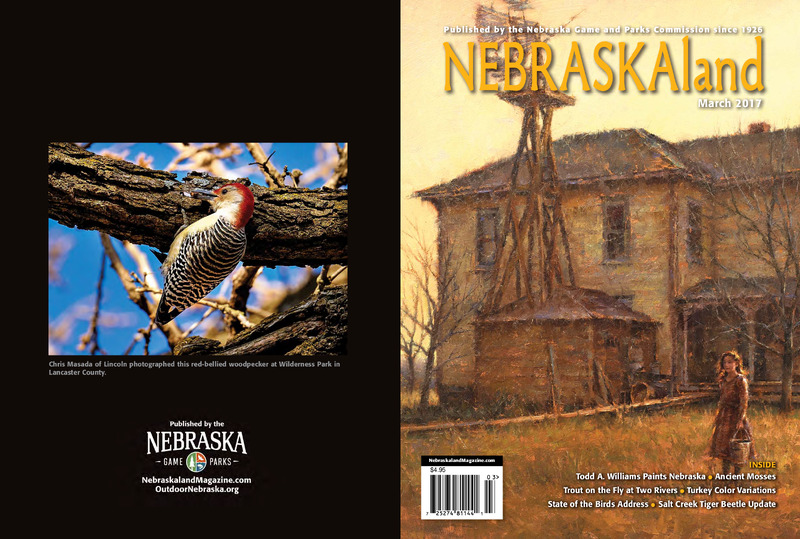
Publis hed by the Nebr a s k a Ga m e a nd Pa r k s C o m m is s io n si nc e 1926
NEBRASKAland
March 2017
Chris Masada of Lincoln photographed this red-bellied woodpecker at Wilderness Park in
Lancaster County.
NebraskalandMagazine.com
$4.95
INSIDE
Todd A. Williams Paints Nebraska ● Ancient Mosses
Trout on the Fly at Two Rivers ● Turkey Color Variations
State of the Birds Address ● Salt Creek Tiger Beetle Update
NEBRASKAland Magazine
Volume 95
●
No. 2
●
March 2017
F EAT U R ES . . .
24 The Spirit of Nebraska
2
BY JEFF KURRUS, PAINTINGS BY TODD A. WILLIAMS
34 Time Well Spent
What to do in March
BY RENAE BLUM
36 Bryophytes
Ancient and mysterious plants
STORY AND PHOTOS BY GERRY STEINAUER
40 Trout on the Fly at Two Rivers
STORY AND PHOTOS BY JEFF KURRUS
46 The State of Nebraska's Birds
BY JOEL JORGENSEN
I N S I D E T H I S I S S U E ...
46
●
Mixed Bag – The Muskrat, Travel to Smith Falls
State Park and Valentine, A Brief History of Footrests for
Nebraska Lawmakers in 1932, Mapping the Missouri, Bug
Banter, Bird Shifters, Upcoming Events, and more ........... 8
Page 49 – Let the Sun Shine In ................................... 55
Park Upgrades – Even Better Park Facilities ............ 56
Junior Journal – from Trail Tales for Kids................ 57
Portraits from the Past – Reader's Photos ............. 60
Nature Notes – Turkeys of a Different Feather .......61
In the Field – Salt Creek Tiger Beetle Update ........... 62
In the Kitchen – Rabbit Cacciatore ........................... 64
The Last Stop – Something...anything....................... 66
36
●
61
●
THROUGHOUT 2017, NEBRASKALAND MAGAZINE WILL
PUBLISH ARTICLES ASSOCIATED WITH THE STATE'S 150YEAR CELEBRATION. LOOK FOR THIS LOGO TO READ ABOUT
NEBRASKA'S RICH HISTORY AND VIEW OUR INTERACTIVE
DIGITAL EDITION FOR MORE INFORMATION.
This spring, answer them. Because few places offer the three permits, large
bird population, thousands of acres of public land and high hunter success
rates that make Nebraska one of the top turkey hunting states in the country.
Plan your hunt at OutdoorNebraska.org.
2 NEBRASKAland • MARCH 2017
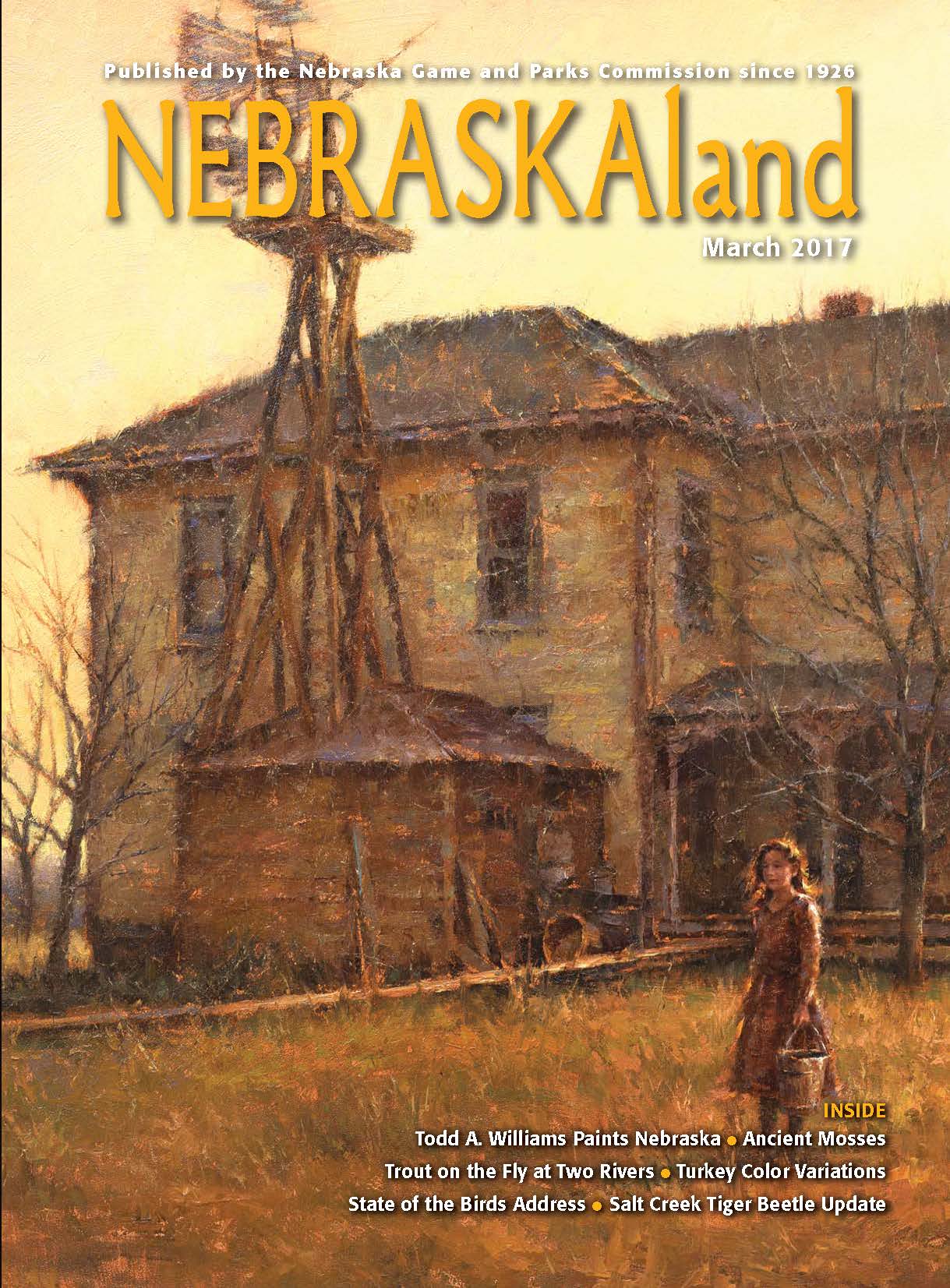
Cover: "Prairie-Settlers 1893" – Fillmore County was painted by
Todd A. Williams as part of his Legacy of Nebraska Project. See
story on page 24.
NEBRASKAland (VOL. 95 / NO. 2 ISSN 0028-1964) is published monthly, except
for the combined Jan./Feb. and Aug./Sept. issues, by the Nebraska Game and Parks
Commission, 2200 N. 33rd St., Lincoln, NE. Periodicals postage paid at Lincoln,
Nebraska, and additional mailing offices. POSTMASTER: Send address changes to
NEBRASKAland, P.O. Box 30370, Lincoln, NE 68503-0370.
40
●
MARCH 2017 • NEBRASKAland 3
Historical Markers Story
That is a great story about Butch
Springgate riding through the state
visiting the historical markers on his
bike. When I was traveling the state
with Physicians Mutual, I would go out
of the way to visit a site, learning a lot
of small pieces of history and of the
people who made and lived it.
Once again, great pictures!
G. E. Dave Fuller
Lincoln, Nebraska
Suz Swanson of Bennington sent this photo of a female house sparrow she saw at
the Old Market in Omaha.
"My work with the state
electrical division allows
me the opportunity to see
aspects of our state that
very few get to witness,"
said Todd Flick who sent
in this photo taken in West
Point.
Additional Visitor Spotted
Several readers pointed out the spider
in a photo of a trumpeter swan feather
on page 25.
This was not the intended visitor.
Readers who sent in this observation
included Bill Bolte, Brad Dietz,
Patty Flynn, Ron McDermott, Phyllis
O'Brien, Barbara Porter and Leo
Turner.
Lifetime Permit Winner Photo
Our family is a big supporter of the
Nebraska Game and Parks Commission
and all the things you guys do to
support hunters like us who have no
private ground to hunt, but still want to
enjoy this great state.
Whether it's hunting, fishing or
camping, the work you guys do has
made many options available to us
to use and enjoy and we greatly
appreciate that.
Thank you!
Steven Speck
North Platte, Nebraska
Jenny Barratt of Omaha took this photo of a bald eagle during a camping trip in
Plattsmouth.
4 NEBRASKAland • MARCH 2017
MARCH 2017 • NEBRASKAland 5
NEBRASKAland Magazine
Bethene Ralph of Bellwood sent us this Christmas day 2016 photo of a double rainbow.
Outdoor Plates
Phyllis Borman bought herself a
message plate as a retirement gift. Her
home along the Platte River near Gibbon
is an easy place to be a birder,
especially during the spring migration
when she and her husband, Dave, are
treated to the roar of thousands of
cranes and geese flying to and from the
river each morning and evening.
If you have a unique outdoor
message plate you would like to
share, or know someone who does,
e-mail a photo (high-resolution, JPEG
format only, please) along with your
hometown and a brief description of
the interests expressed on your license
plate to Eric.Fowler@Nebraska.gov.
Dutko's Pit Blind
I called Marga Dutko about the
picture and story in the Jan./Feb. issue
in Portraits from the Past about hunting
in Mike Dutko's pit blind. Marga is the
widow of Mike and still pretty spry for
an 80 plus year old. I've also hunted at
least a couple times in Mike's pit blind.
I so enjoy the magazine.
Leo Turner
Lisco, Nebraska
Jake Jadlowski of Ralston sent us a collection of GoPro photos from his waterfowl
season, including this image of Todd Mills’s Labrador retriever, Hope, retrieving a
mallard on the Platte River in central Nebraska.
Corrections: Randy Stutheit was
misidentified as Randy Winter on
page 60 of the Jan./Feb. 2017 issue.
We regret the error.
Send your comments to:
Jeff Kurrus, Editor
NEBRASKAland Magazine
P.O. Box 30370
Lincoln, NE 68503
or e-mail Jeff.Kurrus@Nebraska.gov
Please include your postal address and telephone number. Letters may be condensed
and edited. Photographs are also welcome.
Jadlowski also shared this image of Todd Mills of Gretna watching a retrieve from a
sandbar on the Platte River in central Nebraska.
6 NEBRASKAland • MARCH 2017
Any program that receives federal funding from the National Park
Service, or the United States Fish and Wildlife Service prohibits unlawful
discrimination on the basis of race, color, religion, age, gender, marital
status, national origin, age, disability or political affiliation. Any person
who believes he or she has been discriminated against in any program,
activity, facility, or service, should contact the Nebraska Game and
Parks Commission, Lincoln, NE 402-471-0641, the Equal Opportunity
Commission, Lincoln, NE 402-471-2024, TTY/TDD 402-471-4693;
United States Fish Wildlife Service, Civil Rights Coordinator, 4401
N. Fairfax Drive, Arlington, VA 22203; Director, Equal Opportunity
Program, U.S. Department of Interior, National Park Service, 1849 C
Street NW, Mail Code 0008, Washington, D.C. 20240-0001.
COMMISSIONERS
CONSERVATION OFFICERS
Director Jim Douglas
Commissioners
Chairman - Mark Spurgin, Paxton
Vice Chairman - Rex Fisher, Omaha
2nd Vice Chairman - Dick Bell, Omaha
Rick Brandt, Roca
Robert Allen, Eustis
Pat Berggren, Broken Bow
Jim Ernst, Columbus
Norris Marshall, Kearney
Dan Kreitman, Wahoo
ADMINISTRATION (Lincoln)
Craig Stover (Administrator)
Duane Arp (Asst. Administrator)
Jeff Clauson (Asst. Administrator)
MAGAZINE STAFF
Communications Director Christy Rasmussen
Editor Jeff Kurrus
Art Director Tim Reigert
Associate Editor Jenny Nguyen
Regional Editors Eric Fowler, Julie Geiser,
Justin Haag
Contributing Editor Michael Forsberg
Regular Contributors Chris Helzer, Gerry
Steinauer
Photo Librarian Jaclyn Cruikshank Vogt
Circulation Donna Robinson
For address changes and questions about
your subscription, e-mail donna.robinson@
nebraska.gov or call 800-632-5263
Advertising Sales Manager
For advertising information contact
Shane G. Gilster, 402-742-0125
Email: shanegilster@gmail.com
NEBRASKAland Magazine Copyright 2017, all rights reserved.
NEBRASKAland is available in audio from the Nebraska Library
Commission Talking Book and Braille Service, Suite 120, 1200 N St.,
Lincoln, NE 68508. 800-742-7691. NEBRASKAland Magazine and the
Nebraska Game and Parks Commission reserve the right to reject any
advertising not in keeping with the agency mission.
Rates: $18 for one year; $33 for two years; $44 for three years. Nebraska
recipients must add appropriate sales tax. To subscribe call
1-800-NEBLAND (632-5263), or go online to: NebraskalandMagazine.
com.
COMMISSION
C
CO
COM
OM
MMIS
MISSIO
S NO
OFFICES
FFICES
FF
FFI
S
Headquarters/Southeast District Office
2200 N. 33rd Street Lincoln, NE 68503
Phone 402-471-0641
Northeast District Office
2201 N. 13th St. Norfolk, NE 68701
Phone 402-370-3374
Southwest District Office
301 E. State Farm Rd. North Platte, NE 69101
Phone 308-535-8025
Northwest District Office
East Hwy. 2, Box 725 Alliance, NE 69301
Phone 308-763-2940
Bassett Office
524 Panzer St., Box 508 Bassett, NE 68714
Phone 402-684-2921
Kearney Office
1617 First Ave. Kearney, NE 68847
Phone 308-865-5310
Ak-Sar-Ben Aquarium
21502 W. Highway 31 Gretna, NE 68028
Phone 402-332-3901
Omaha Office
8495 Frederick Street, Omaha, NE 68124
Phone 402-595-2144
402-471-5531
402-471-5531
402-471-5531
NORTHWEST (Includes counties covered)
Jim Zimmerman (District Supt.)
308-641-6138
Sean McKeehan
(Cheyenne, Morrill, Box Butte)
308-279-9133
Scott Brandt
(Kimball, Banner, Scotts Bluff)
308-631-0663
Greg Hesse (Sheridan, Dawes)
308-760-3647
308-430-0572
Dan Kling (Sioux, Dawes)
Terry Brentzel (Deuel, Garden, Grant) 308-458-7650
402-389-0444
Frank Miller (Cherry, Hooker)
Andrew Heyer (Dawson, Gosper, Phelps) 402-613-2241
NORTHEAST (Includes counties covered)
Tom Zimmer (District Supt.)
402-649-8053
402-760-0712
Dale Davis (Keya Paha, Brown, Rock)
402-340-3981
Jonathan Andreasen (Holt, Boyd)
Mitch Johnson (Knox, Antelope, Pierce) 402-613-8612
402-762-5022
Jeff Jones (Knox, Cedar)
Owen Johnson
(Dixon, Dakota, N 1/2 Thurston)
402-266-1759
Jon Reeves
(S 1/2 Thurston, Burt, Washington)
402-889-8508
402-719-1108
Dan Roberts (Dodge, Colfax)
Cory Krause
(Cuming, Wayne, Stanton, Dodge)
402-380-6410
Steve Oberg
(Colfax, Platte, Madison, Stanton)
402-910-3366
308-730-7050
Doug Pollard (Loup, Garfield, Valley)
SOUTHWEST (Includes counties covered)
Roger Thompson (District Supt.)
308-530-3097
308-202-0819
Matt Brandt (Sherman, Howard)
308-380-7331
Tim Williams (Hall, Hamilton, Merrick)
Pat George
(Harlan, Franklin, Phelps)
402-705-9989
Matt Andrews
(Gosper, Furnas, Frontier, Red Willow)
308-746-2418
Brian Piernicky
(Red Willow, Frontier, Hayes, Hitchcock)
308-340-6627
308-289-0427
Nicholas Fix (Keith, Perkins)
308-289-1169
Bryce Streger (Keith, Arthur)
Brandon O’Neal
(Lincoln, McPherson, Logan)
308-530-3157
Alex Hasenauer
(Lincoln, McPherson, Logan)
308-660-4671
Dale Johnson (Kearney, Buffalo)
308-440-3847
308-529-8146
Mike Thome (Dawson)
Ray Dierking (Custer, Thomas, Blaine) 308-870-0322
John Lee (Hitchcock, Dundy, Chase, Hayes) 308-414-1432
SOUTHEAST (Includes counties covered)
Levi Krause (District Supt.)
402-949-0593
402-619-1355
Rich Berggren (Douglas)
402-616-5961
Dan Evasco (Sarpy)
402-210-0888
Heath Packett (Cass)
402-209-1506
Russell Mort (Otoe, Johnson)
William Krause
(Nemaha, Richardson, Pawnee)
402-274-8063
Dan Zuehlke (Gage, Saline)
402-806-9084
402-890-6463
Dina Barta (Lancaster)
402-890-6465
Doug Kramer (Lancaster)
402-937-3422
Dudley Sorensen (Lancaster, York)
402-613-2312
Travis Shepler (Lancaster)
402-890-7140
Stacey Lewton (Lancaster, Seward)
402-443-6392
Mike Luben (Saunders, Butler, Polk)
Matt Taylor (Thayer, Fillmore, Jefferson) 402-200-9597
Nebraska Wildlife Crimestoppers
1-800-742-7627
MARCH 2017 • NEBRASKAland 7
A Mammal Brief
Lindsay Rogers is an outdoor
education specialist with the
Nebraska Game and Parks
Commission.
By Lindsay Rogers
8 NEBRASKAland • MARC
MARCH 2017
PHOTO
O BY CH
HRIS MASADA
At about 20-25 inches long, the
muskrat (Ondatra zibethicus) is
significantly smaller than the
beaver, which comes in at
about 40-45 inches. The
muskrat also has a narrow,
flat tail, versus the beaver’s
characteristically wide, flat
tail. Both, however, are
found near water, including
rivers, lakes, streams and
wetlands, though muskrats
prefer more permanent
bodies of water.
Muskrats are so named
for their resemblance to
a large rat and the musky
odor released from their perineal glands, which is used for
communication between muskrats and to warn predators.
In contrast to muskrats' slow and cumbersome movement on land, they are extremely agile swimmers and
often retreat to the water to escape predators. Minks, owls and coyotes are no match for a muskrat’s ability to
quickly disappear underwater and remain there for more than 10 minutes. ■
MARCH 2017 • NEBRASKAland 9
Travelogue Sponsors
By Hannah Hundley, Nebraska Tourism Commission
Valentine
here is a beloved little town up in the northern region
of the state amid pine-topped ridges, waterfalls and
rolling sandhills. Some call it the “Heart City," and others
call it good ol’ Valentine.
just ca
In and around Valentine, there is adventure waiting at every
ing,
corner. Hiking, horseback riding, nationally acclaimed canoe
a
never
there’s
–
ng
tubing, kayaking, hunting, fishing, campi
dull moment. And it’s all wrapped up in the scenic beauty that
Cherry County is famous for.
Smith Falls State Park is only 20 miles east of Valentine, and
al
it harbors one of the many waterfalls tucked within the mystic
: it
though
all
waterf
any
just
isn’t
It
woods of the Niobrara River Valley.
state.
the
in
all
waterf
t
highes
the
it
g
stands at an impressive 70 feet, makin
bridge
truss
c
histori
a
across
is
falls
The only access to these spring-fed
in the still
that spans over the river, which proves to be just as breath-taking
river
the
of
stretch
e
76-mil
This
er.
of winter as it is in the fervor of summ
snowy
ul
peacef
and
cliffs
steep
with
winds through broad canyons lined
banks.
hills,
Valentine is in the center of a diverse region of quiet lakes, rolling
has
oir
Reserv
t
Merrit
s.
refuge
a national forest and two national wildlife
e;
walley
its
for
known
well
is
It
.
great opportunities for the ice-fisherman
bass,
outh
smallm
bass,
outh
however, the lake also boasts largem
muskellunge.
channel catfish, perch, crappie, bluegill, northern pike, and
l R.
Samue
0-acre
115,00
the
Bordering the Merritt Reservoir lies
bird,
game
upland
nt
excelle
offers
McKelvie National Forest. This area
Steer
the
in
tent
a
pitch
also
can
rs
waterfowl and deer hunting. Travele
ites in
Creek Campgrounds at one of the beautiful and secluded camps
the pines of the forest.
While in town, visitors will be
sure to check out the Centennial
Hall Museum – Valentine’s
historical landmark built in 1897, now
the oldest standing high school building in the
state of Nebraska. After getting a fix of history,
the smell of fresh baked goods from Auntie
D’s will lure travelers in for a nice hot cup of
coffee and a bite or two of something sweet.
Then, when it’s time to get a little more warm
and cozy, travelers can check in to the Blue
Moon Ridge Bed and Breakfast.
This lovely little B&B sits on 10
acres of canyon, surrounded by
100-year-old pine trees, with a
deck that overlooks the canyon,
making it the best place to
cuddle up and watch the
sunset over the Sandhills.
Valentine sure lives up to
its slogan: “Small town. Big
adventure.” ■
Smith Falls State Park waterfall
Auntie D'
Valentine s in downtown
ntinege
e
l
a
V
t
a
ng
fu
Ice Fiosnhai l Wildlife Re
Nati
10 NEBRASKAland • MARCH 2017
Valentine
MARCH 2017 • NEBRASKAland 11
Footrests for Nebraska Lawmakers,
1932
By the Nebraska State Historical Society
W
Senators make themselves comfortable in the “diabolically
contrived” chairs in 1947.
the designers of the senate and house furniture did their
best to keep the manufacturers of laws from enjoying their
accustomed comforts.
“Trenmor Cone of Douglas County, who recently tried out
the acoustics of the new house chamber by making a sample
speech there to an imaginary audience, has already voiced
his dissatisfaction. ‘These seats are so diabolically contrived
and set up,’ Cone says, ‘that a man can’t get his feet on his
own desk, and he can’t swing around to see what is going on
in the rear of the chamber. His only chance of getting a good
f
footrest
is to use the desk of his neighbor on one side or the
oother, and I’m afraid that won’t work very well.’
“However, the plan of making swivel chairs fast to the
ffloor has one advantage from the lawmaker’s standpoint.
It makes certain that he can lean back in his seat and go to
ssleep without any danger of tipping over, as has happened
nnot infrequently in former sessions. A dignified statesman
ddoesn’t like to be tumbled backwards on the floor in full
vview of his colleagues and the public. The arrangement,
too, gives the taxpayers assurance that members will not be
to
taking the chairs home with them at the close of the session.
ta
“Some solons will see a drawback in the fact that the
ffront of each desk does not rise far enough above the top
tto permit the attachment of a placard showing his name
to the people in the side and rear balconies. There will be
a nameplate on the front, which the presiding officer and
secretary or clerk can see, but that is all. It will be tough,
indeed, to get up and make a ringing speech, only to have
people in the audience asking: ‘Who is that
man?’ and answering each other: ‘I don’t
know.’ Legislators naturally don’t care to be
classed with children. They want to be seen,
heard, and known.” ■
Visit the Nebraska State Historical Society’s
website at nebraskahistory.org.
NSHS RG2141-38-4
e can’t tell you what bills your state senator is
supporting in Lincoln this month, but we can assure
you that your senator isn’t sitting in the legislative
chamber with his or her feet propped up on the desk.
We can’t say the same for earlier generations of Nebraska
legislators.
Prior to the first legislative session in the house and senate
chambers of the new state capitol, the Lincoln Star on
September 26, 1932, speculated about how the lawmakers
would adapt to their new quarters. (Nebraska had a
traditional two-house legislature until 1937.) Evidently it was
common for legislators meeting in the old capitol building to
rest their feet on their desks, but this indulgence would not
be possible in the new chambers, and some members were
not happy about it.
“Two very commodious and ornate halls have been
provided in the new capitol as permanent meeting places
for the Nebraska state senate and house of representatives,
which those bodies will occupy beginning with next winter’s
session. The rooms and their furnishings are far beyond
anything ever before used by a lawmaking assembly in this
state in point of convenience, luxurious appointments, and
decorative beauty; but some solons, no doubt, will discover
things to criticize and find fault with.
“One objection already advanced to the seating of the
chambers is that it will not be possible for legislators to get
their swivel chairs in position where they can comfortably
elevate their feet to the top of their expensive walnut desks.
This is because both the chairs and the desks are screwed
down fast to the floor, and the chair does not sit far enough
from the desk to permit its occupant to assume such a
posture.
“Also, the swivel part of the chair is fixed so as to turn
only half way around – that is, the sitter can swing to the
right or to the left, but cannot make a full circuit so as to
face backward. That prevents him from sticking his brogans
up on the desk just behind him. It just seems as though
NSHS RG2813-1947-107-5
A Brief History
The Nebraska House of Representatives meeting in the new capitol, 1933.
12 NEBRASKAland • MARCH 2017
MARCH 2017 • NEBRASKAland 13
Downsizing for Turkeys
By Jarrod Spilger
14 NEBRASKAland • MARCH 2017
will help tame recoil from magnum loads.
Also, consider switching to a tungstenbased non-toxic load, such as Hevi-Shot
or Federal Heavyweight. Tungstenbased shot is heavier and denser than
traditional lead shot. As such, it
provides better downrange energy
and penetration. With the proper
choke, 20-gauge tungsten-based
turkey loads are capable of
legitimately and cleanly taking
gobblers out to 40 or even 50 yards.
Don’t be afraid to downsize to
number 7s, either, with tungstenbased loads. Number 7s provide
both higher pellet counts and denser
patterns than number 6s, 5s, or 4s,
while their tungsten composition provides
plenty of downrange penetration and
knockdown power.
Youth, women and elderly turkey hunters will
especially benefit from toting a lighter, softer-shooting
shotgun into the spring woods. Maybe you, too, should
consider downsizing to a 20-gauge this upcoming season. ■
PHOTO BY JARROD SPILGER
With spring shotgun turkey season just
over a month away, we know you're
already checking spray patterns of
various guns. And while the versatile
12-gauge is undeniably the most
popular turkey-taking tool, many
hunters don’t realize the 20-gauge
can be just as effective. The key
is using the right choke and load
– which you can begin practicing
now on the range.
First, forget that full choke that
came with your gun and get a true
extra-full turkey tube to deliver the
maximum number of pellet strikes
to a gobbler’s head and neck vitals. A
20-gauge turkey choke in the .585- to
.575-inch range is a good place to start.
A 3-inch 20-gauge magnum is preferable
over a standard 2¾-inch round. Likewise, a
1¼-ounce charge weight should be the minimum, while
13⁄8- or 11⁄2-ounce payloads are even better. A soft-shooting,
gas-operated semi-auto, such as Winchester’s 20-gauge SX3,
MARCH 2017 • NEBRASKAland 15
Mapping the Missouri
By Renae Blum
Flowing for about 400 miles along Nebraska’s eastern
border, the Missouri River, along with the lands open to
public access along its banks, is a prime place for recreation
of all kinds: fishing, hunting, boating, canoeing, kayaking
and more. It’s also within easy reach for many of us: More
people live within an hour’s drive of the Missouri than any
other river (or lake) in the state.
If you’re planning a trip to the Missouri River or are
curious about what you can do there, one resource to
explore is the Missouri River Outdoor Recreation Access
Guide, an online, mobile-friendly interactive map created
by the Nebraska Game and Parks Commission. All 164
public access sites along the river are marked clearly, with
notes on boating, fishing, hunting, camping and wildlife
viewing opportunities at each site. The map is also a handy
navigational guide, showing river mile markers, proximity
to cities and other sites, and boat ramp locations in case of
emergency.
The mapping application is the product of more than
five years of work and input from more than a dozen
experts across Game and Parks’ various divisions. From
the beginning, the goal was to compile the vast amount of
information that staff had gathered over the years into one
place, so that users could see in a glance all their recreation
options in a particular area.
The application does more than simply share information.
It’s an example of storytelling mapping, a type of mapping
that incorporates narratives, images, video and
more to provide a closer look at
the map’s subject.
Mountain Pine
Beetle
By Julie Van Meter
State Entomologist, Nebraska
Department of Agriculture
A
Storytelling mapping was developed by ESRI, a software
company in the GIS geospatial community. Game and Parks
IT applications developer Trisha Schlake built the map using
ESRI’s new storytelling mapping templates, incorporating
NEBRASKAland photography and in-depth narratives
about recreational opportunities and various segments of
the Missouri. She also added links where users can access
guidebooks, reserve campsites and buy permits. Last spring,
Schlake entered the map in an international storytelling
mapping contest held by ESRI, winning first place in the
category of Travel, Destination and Recreation.
“The possibilities are almost endless on how we can use
this technology to share information,” said Game and Parks
Director Jim Douglas. “This interactive map really allows us
to help more people enjoy all aspects of the Missouri River.”
View the Missouri River Outdoor Recreation Access Guide
at maps.outdoornebraska.gov/MRRecreationGuide. ■
number of exotic, invasive pests
are causing problems in native and
urban forests across the country. Pests
like the emerald ash borer and gypsy
moth have killed millions of trees
since they were introduced and became
established in the United States. But
not all forest pests are exotic; some of
our native insects can cause serious
damage, too.
The mountain pine beetle
(Dendroctonus ponderosae) is one
example of a native insect pest causing
tremendous damage to trees. The
mountain pine beetle, or MPB, is
native to much of the western United
States, with the eastern range of this
pest butting up to the native pine stands
in western Nebraska. Several species
Presented by
of pines are attacked by the MPB,
including native ponderosa, limber,
and lodgepole pines and the introduced
Scotch pine.
The MPB is a small beetle, dark
brown or black beetle, 1⁄8 to 1⁄3 inch in
length. Adult beetles emerge from pine
trees in mid to late summer. Females
will bore into living trees, creating
galleries under the bark in which they
will lay their eggs. These galleries run
vertical and may be several feet long,
holding up to 100 eggs. Larvae hatch
from the eggs in roughly 14 days and
begin feeding. They tunnel at right
angles to the egg gallery, overwinter
under the bark, pupate and emerge from
the now dead tree the following summer
as adults, ready to infest a new tree.
Signs of beetle infestation include
pitch tubes on the trunk of trees,
which result from resin produced by
the tree pushing out where a beetle
has bored into a tree. Sawdust created
by beetle boring may collect in bark
crevices, and woodpecker damage
may be noticeable. Pine needles turn
yellow to red and ultimately the tree
dies, typically several months after
infestation.
The beetle feeding damage alone
doesn’t kill the tree. Blue-stain fungus
is carried on the bodies of MPB,
and as the beetle feeds, it spreads
the fungus throughout the tree. The
fungus disrupts the ability of the tree to
transport water, and the tree dies.
While the beetle is native to the
western United States it is not known
to occur in eastern and southern
pine forests. There is great concern
that should the beetle be introduced,
these forests could be decimated.
Firewood is one way that this
pest could easily be transported to
uninfested areas. Remember not to
travel with firewood; obtain it when
you get to your destination, and leave
any unburned firewood behind. Visit
dontmovefirewood.org for more
information on pests that move in
firewood. ■
PHOTO BY ERIC FOWLER
16 NEBRASKAland • MARCH 2017
Bug Banter
MARCH 2017 • NEBRASKAland 17
ILLUSTRATION BY TIM REIGERT
Layering for March
By Julie Geiser
Layering is one of the best ways for adapting to changing
weather conditions, especially in Nebraska during a month
like March, where the weather can change by the hour.
Knowing how to dress and what fabrics to look for to keep
you warm and dry will make outings more enjoyable.
Layering is about being versatile but effective and
involves dressing in a number of lightweight items that can
be put on or taken off as conditions or levels of activity
change. As you start your day you may be a little chilly.
However, as you move your body will produce heat, and
if you’re wearing too many layers you’ll get too hot and
start to sweat. Remove outer layers at the first sign of
overheating.
The first, or base, layer should wick sweat away from skin
and dry fast so you don’t get chilled. Synthetic materials
like polyester are great base layers for wicking and fast
drying. Wool/synthetic blends may be the best of both
worlds for wicking, fast drying and warmth. These layers
should fit snug, include tops and bottoms and come in light
to heavy weights for any activity or temperatures. Cotton,
because of its inability to dry quickly, should be avoided.
The mid layer offers warmth without adding
bulk. This layer consists of long-sleeved
polyester shirts, lightweight fleeces and
wool or synthetic pullovers or vests. In
addition, hybrid pants come in many
different fabrics that are worn over the
base layer and in extreme conditions
are worn under the shell pant layer.
In moderate conditions a base, mid
and outer layer may be all you need.
Insulating layers are worn over
mid layers in very cold conditions.
Jackets made from polar fleece,
pile fleece or Thinsulate materials
are warm. These synthetic materials
are breathable, moisture-wicking
and fast drying. Heavy Merino wool
sweaters or down vests or jackets can
be worn when conditions are extreme.
As temperatures warm or when you are
moving around a lot, this layer might be
put in your pack. Allowing for body heat to
escape and dissipate must be monitored as you
move. Once you stop moving you’ll need to add
this layer so you don’t get cold as sweat dries.
The shell, or outer, layer cuts wind and keeps you dry
in wet or snowy conditions. A good coat and pants are
your main protection from the elements. Waterproof and
breathable materials like Gore-Tex keep water out and
let sweat vapors escape. This final layer should be large
enough to fit over the rest of your layers so you may need
to buy a size larger than you normally wear.
Finally, always pack a stocking hat and gloves and don’t
forget your feet. Layering a moisture-wicking sock under a
wool-blend sock will keep your feet dry and warm. ■
18 NEBRASKAland • MARCH 2017
MARCH 2017 • NEBRASKAland 19
Lek Etiquette
By Julie Geiser
A truly unique outdoor experience lies in Nebraska’s
prairie grasslands, where courtship rituals of prairie
chickens and sharp-tailed grouse take place. The songs
and dances of these birds peak in the Sandhills and
prairies across the state late March through early May
each year.
In early spring, flocks of both species break into small
groups of separate sexes, marking the start of spring
courtship. Groups of males of each species arrive on
display grounds, referred to as leks, before sunrise each
day and vie for territory and the favor of females by
intimidating other males with vocal and visual displays.
Often confused for one another, the sharp-tailed grouse
is slightly smaller than the greater prairie chicken.
Sharptails have v-shaped markings on their breast, while
prairie chickens have a uniformly barred breast.
Each species also displays a different courtship ritual,
both of which are intriguing, spectacular phenomenons.
Prairie chicken displays begin with short running
episodes followed by abrupt stops and rapid footstomping. Males erect their pinnae (ear-like feathers) and
inflate their orange neck air-sacs. With wings drooped
and tails spread open, they produce a resonant booming
sound.
For sharp-tailed grouse, the display is an elaborate
combination of calls, rapid foot-stomping, clicking of
the tail and charges with wings drooped and tail erect.
To witness these displays, place a pop-up blind near the
edge of a lek. Scout for areas on a rise with short grass,
and ask around. Landowners usually know where birds
go from year to year and can lead you to areas to set up
blinds.
Additionally, several public areas have wooden-box
blinds available for viewing birds. ■
Free public areas that offer blinds include: The
Crescent Lake National Wildlife Refuge near Ellsworth,
by reservation, (308) 762-4893; Bessey Ranger District
of the Nebraska National Forest near Halsey, first-comefirst-served blinds, (308) 533-2257; Valentine National
Wildlife Refuge near Valentine, by reservation, (402)
376-3789 or (402) 376-1889.
Viewing From a Blind
•
Always view birds from a blind whenever
possible, and set up blinds well before sunrise to
avoid scaring the birds.
If viewing from a vehicle, also arrive well before
sunrise, do not drive on the lek, keep a good
distance from the lek, turn engine and lights off and
be still.
View birds close up with binoculars and spotting
scopes, and use telephoto lenses on cameras. Do
not approach the birds.
Be prepared to stay in a blind until the birds
leave the area, which could be several hours.
Silence electronics before entering the blind or
leave them at home. If photographing the birds, do
not use a flash.
Leave pets at home.
Always gain permission before viewing birds on
private property. Never trespass.
Wear warm clothing, footwear and layers. Spring
weather can be unpredictable and extremely cold.
Quiet outdoor wear is preferred so movements don’t
disturb the birds.
Wear dark clothing. Bright colors may disrupt
the birds.
Limit liquid intake as there are no bathrooms
available in most viewing blinds.
Tread lightly on lek areas and respect
boundaries. Most leks are near potential nesting
areas so follow trails when possible.
Small children may not be able to sit still and
quietly for two to three hours.
Predators may visit viewing areas; do not try
and warn the birds but let nature take its course.
•
•
•
•
•
•
•
•
•
•
•
•
Paid viewing blinds include: Prairie Chicken Dance Tours
near McCook, (308) 345-1200, prairiechickendancetours.com;
The Sandhills Motel and Glidden Canoe Rental near Mullen,
(308) 546-2206 or (888) 278-6167, sandhillsmotel.com;
Calamus Outfitters near Burwell, calamusoutfitters.com; and
Big Blue Ranch and Lodge near Burchard, bigblueranch.com.
PHOTO BY JULIE GEISER
20 NEBRASKAland • MARCH 2017
MARCH 2017 • NEBRASKAland 21
Native Plants
of the Midwest
by Jerry Kane
Contact the Nebraska Game
and Parks Commission
at 402-471-0641 or visit
OutdoorNebraska.
org for more
information. Visit
huntsafenebraska.org for a list
of hunter education classes and
boatsafenebraska.org for a list of
boating safety classes.
March 7
Ladies’ Handgun Skill Training
Club
Nebraska Game and Parks Outdoor
Education Center, Lincoln
March 3
Hiking Marathon Challenge
Ponca State Park (SP), Ponca
March 19
Clear Shot Firearms Concealed
Carry Class
Nebraska Game and Parks Outdoor
Education Center, Lincoln
March 3, 10, 17
Beginner Muzzleloader Class
March 21
Learn to Hunt Spring Turkey
Wildcat Hills Shooting Sports Complex, Workshop
Gering
Lincoln Park Fire Station, Hastings
March 4
Nature’s Engineers Educator
Workshop
March 25
National Archery in the Schools
Program State Tournament
Pioneers Park Nature Center, Lincoln
March 4, 11, 18
Beginner Archery Class
Speedway Sporting Village, Lincoln
March 25
Spring Turkey Hunting
Wildcat Hills Shooting Sports Complex, Archery spring turkey hunting season
Gering
opens
March 5
Shootout at Salt Creek
Nebraska Game and Parks Outdoor
Education Center, Lincoln
March 28
Learn to Hunt Spring Turkey
Workshop
March 6
Learn to Hunt Spring Turkey
Workshop
March 31
Muskrat and Beaver
Game and Parks Southwest District
Office, North Platte
22 NEBRASKAland • MARCH 2017
Nebraska Game and Parks Outdoor
Education Center, Lincoln
Trapping seasons close for muskrat
and beaver
By Mike Groenewold,
Park Horticulturist
Native Plants of the Midwest, A
Comprehensive Guide to the Best
500 Species for the Garden by
Alan Branhagen is an enjoyable
and informative book suitable for
everyone from casual gardeners to
professional landscapers who live in
the nation's midsection. Mr. Branhagen
describes his book very well in his
own introduction: “This book aims to
inspire readers to plant native plants
while learning how and where to
grow them successfully. I also aim to
explain why it is important to utilize
native plants in a landscape wherever
possible.”
en
Mr. Branhagen
utilizes the
first 70 pages
to review the
essential steps
to develop a
sustainable,
functional
and pleasing
garden. Then
he devotes
the remainder
of his book
to profiling
the attributes
and
character of
500 native plants; in most cases he
even explains how to grow them.
Throughout the book he also devotes
an ample and appropriate amount of
time promoting the important role that
plants play in supporting the web of
life, including both man and wildlife,
in our Midwest landscapes. As an
example, many of his plant profiles
highlight a list of pollinator species
the plant supports for both nectar and
shelter.
The book is not only informative.
Mr. Branhagen’s photography is
excellent to even stunning at times,
qualifying it in the category of a
“coffee table” book. It is a valuable and
interesting resource.
Available from Timber Press books
at timberpress.com. ■
Bird Shifters
By Lindsay Rogers, Wildlife Education Specialist
When we think of migrating birds, we often think of the long-distance migrants
such as the cliff swallow
tthat heads to South America.
Or the gray catbird which
ttravels to the Gulf Coast and
Central America. Then there
is the Arctic tern (not found
in Nebraska) which migrates
from its breeding grounds
in the Arctic to its wintering
grounds off Antarctica,
ttraveling a whopping 25,000
miles each way.
ARCTIC TERN
According to the American
Birding Association, 993 birds
have been recorded in North
America, and over half of
them migrate in some fashion.
But not all bird migration is
the same. There are, of course,
the long-distance migrants.
But there are numerous shortdistance migrants as well
– those species that migrate
from higher summer altitudes
to lower winter altitudes.
And there are the mediumdistance migrants, too – those
species that venture just south
of their breeding range for
the winter. I like to call these
migrants the “shifters.” For
DARK-EYED JUNCO
example, a dark-eyed junco
that spends its summer in North Dakota might migrate to Nebraska for the winter.
Or, an American robin found in Nebraska during the summer might migrate to
Oklahoma for the winter.
Other shifters include blue
jays, eastern and western
meadowlarks, common
grackles and American
goldfinches.
You may notice that
some species listed here are
found in Nebraska yearround, but because birds are
migrating, the individuals
you see over the course of
a year may change. Blue
jays you observe during the
BLUE JAY
summer months may be
different blue jays seen during spring and fall migration, and even other individuals
may be visiting your feeder during the winter. Starting in late February, Nebraska
sees an influx of migrating birds – both long-distance and medium-distance –
heading back to Nebraska. Take a pause from cleaning last fall’s leaves from the
yard and sweeping winter’s muck out of your garage to go on a birdwatching
adventure. Nebraska’s spring migration never disappoints. ■
NEBRASKAland
Visitor
Last issue’s winner of
the Visitor drawing was
Valerie Randall of Gretna, Nebraska,
who found the evergreen bagworm on
page 3.
Readers are encouraged to contact
NEBRASKAland within 10 days
after this issue’s publication with
the correct page number and name
of this issue’s “Visitor” – a critter
found in Nebraska. We will then
gather the correct entries and draw
one to win a NEBRASKAland mug.
To enter each month, write:
NEBRASKAland Visitor
2200 North 33rd Street
Lincoln, NE 68503
Or e-mail:
Tim.Reigert@Nebraska.gov
with “Visitor” in the subject line of
the message.
HINT: This issue’s visitor is not on
page 5, 15, 17, 23, 57, or 62.
The bagworm moth, (Theridopteryx
ephermaeformis) is a Nebraska
native that feeds on the foliage of a
wide variety of deciduous and evergreen plants. Evergreens, including
junipers, are particularly susceptible
to defoliation, and heavy infestations
may cause plant death. Bagworms
overwinter in the egg stage, in bags
created the previous summer by
female moths. Caterpillars emerge in
mid-May and June, and begin to
feed, constructing a new bag of silk
and foliage over their bodies. This
bag protects the caterpillar and is
up to 2” in length at maturity.
Adult male moths emerge in late
summer, and often their pupal casee
is visible sticking out of the bottom
m
of their bag. Female bagworm
moths lack wings and do not leave
their bags. After mating, the femalee
lays several hundred eggs inside
her bag and dies. The bag will
protect the eggs until
caterpillars emerge
the next spring.
Special thanks
to Julie Van Meter, State
Entomologist, Nebraska
Department of Agriculture.
MARCH 2017 • NEBRASKAland 23
The Spirit of Nebraska
By Jeff Kurrus
Painter Todd A. Williams celebrates Nebraska’s
sesquicentennial by creating paintings featuring the
state’s 93 counties.
24 NEBRASKAland • MARCH 2017
MARCH 2017 • NEBRASKAland 25
A
rtist Todd A. Williams is a storyteller.
He has been one since the age of
7, when he first started sharing his
art with his friends. It was a passion that
he followed into college, into a career as a
professional artist for Hallmark, and into his
current job as a full-time artist. His collections,
all done in oil and focusing on Italy, the
Rocky Mountains and Americana, invite the
viewer to wonder about these characters and
scenes.
In his latest collection, the Legacy of
Nebraska, the narrative is about us – our
lives and our history – across every one of the
state’s 93 counties. Williams, originally from
Central City, began the project in 2012.
In 2005 he started a series of paintings in
Vienna and Prague, eventually finishing
more than 50, some of which were completed
on-location and in the studio. He repeated this
method in 2007 in Italy, modeling his work
after the impressionistic and figurative work
of John Singer Sargent, a turn-of-the-century
American painter known for his portrait
work. He completed many works on-site, then
painted others once he returned to the U.S. off
26 NEBRASKAland • MARCH 2017
Previous Pages: “Reaping the
Harvest” – Keith County
Oil, 32 by 48 inches.
Opposite Page: Todd A. Williams
painting on location at Chimney
Rock National Historic Site.
Above: “End of Day” – Pierce
County
Oil, 12 by 16 inches.
Left: “Sandhill Cranes” – Buffalo
County
Oil, 24 by 30 inches.
MARCH 2017 • NEBRASKAland 27
Above: “James Moore, Pony Express
Rider” – Cheyenne County
Oil, 12 by 16 inches.
Opposite Page: “Early Harvest” –
Thurston County, Honoring Inshata
Theumba (Bright Eyes)
Oil, 30 by 20 inches.
28 NEBRASKAland • MARCH 2017
of sketches, memories and photos.
Then, in 2012, Williams decided that he wanted to
use this same method in his own state. “I wanted
to do a variety of periods and subjects to celebrate
Nebraska’s 150 years,” Williams said. “I wanted to
capture the spirit of Nebraska.”
Starting with his home county of Merrick,
and setting up a temporary studio in the former
boyhood home of writer and photographer Wright
Morris, he dove into the project that will debut at
the Nebraska State Historical Museum in Lincoln
on March 1, 2017. “This was exciting for me
artistically instead of being locked in to one type of
painting,” he said.
To accomplish this goal, Williams met with
Mike Smith, then-director of the Nebraska State
MARCH 2017 • NEBRASKAland 29
Historical Society, and shared the vision of his
project. “Because of some of the really fascinating
events that have happened in our state – like
the Oregon Trail and the Pony Express – I really
wanted the historical society’s involvement.”
Williams would then meet with representatives
from individual counties, including the local
historical society and sponsors, and discuss the
subjects that they thought represented their county
best. “We would narrow the subjects down to
about three choices,” Williams said. “From there
I’d look at the subject from an artistic perspective
while also wanting diversity as a whole. I didn’t
just want historical landmarks – I wanted variety,
which is why people are also featured.”
One of these people was an American Indian girl
in honor of Nebraska Hall of Famer Susette La
Flesche, a writer and artist of the Omaha tribe born
in 1847 whose father was a French fur trader and
whose American Indian name, Inshata Theumba,
meant “Bright Eyes.” Other people-related
paintings focused on Mari Sandoz in Sheridan
County and of attendees coming to hear Theodore
Roosevelt speak when he visited Dodge County in
1912.
Additional works, such as the Pawnee County
painting “Rock Island Station,” were based off of
a historical photo while others, like the aptly titled
“Familiar Scene” revealing a train pulling into a
town, are nostalgic of many Nebraska counties
across the state.
American bison are featured in Keya Paha
Top: “Familiar Scene” – Merrick County
Oil, 15 by 30 inches.
Bottom left: “Niobrara State Park” – Knox County
Oil, 9 by 12 inches.
Left: “Laura” – Sarpy County
Oil, 18 by 24 inches.
30 NEBRASKAland • MARCH 2017
MARCH 2017 • NEBRASKAland 31
County, as are sandhill cranes in Buffalo County. His Chimney Rock painting
representing Morrill County was reminiscent of a time when settlers spoke
about seeing this iconic landmark for the first time and felt like they had
made it to the West.
Yet there remains a personal touch to Williams’s work as well. “My two
interests are shooting pool and art,” Williams said with a grin. “I fell in love
with an old photo of the Lexington Hotel in Dawson County,” the result being
a romanticized version of this place and time.
This theme repeats itself throughout Williams’s work, work that he might
not have ever accomplished if not for a high school art teacher named David
Jorgensen. “I feel like I’ve been given a lot by my instructors, like Jorgensen,
who inspired me to go to college for art. At the time, when others were
like ‘How are you going to make a living being an artist?’ Jorgensen saw
something in me and told me I needed to pursue this. And now I just want to
inspire the next generation of artists in Nebraska.” ■
Top: “Lewis and Clark Expedition-1804” – Otoe
County
Oil, 15 by 30 inches.
Above left: “William Frederick (Buffalo Bill) Cody” –
Lincoln County
Oil, 20 by 16 inches.
Above right: “Mitchell Pass-Oregon Trail” – Scotts
Bluff County
Oil, 20 by 30 inches.
Opposite: “Swanson Lake” – Hitchcock County
Oil, 12 by 16 inches.
32 NEBRASKAland • MARCH 2017
Williams’s show, the Legacy of Nebraska, will feature
around 125 paintings spanning each of Nebraska’s
93 counties. Opening March 1, 2017, in Lincoln, the
exhibition will travel to nine museums across the state
in 2017. More information is available at
toddwilliamsfineart.com and ne150.org.
A portion of proceeds from the show will
be donated to the Nebraska 150.
For more information on Williams’s
work, including dates on upcoming
workshops, visit
toddwilliamsfineart.com.
MARCH 2017 • NEBRASKAland 33
SANDHILL CRANES ON THE PLATTE RIVER AT MARTIN’S REACH WMA PHOTO BY ERIC FOWLER
Time Well Spent
What to do in March
By Renae Blum
S
pring is finally here! Check out these suggestions for ideas on how to
make the most of this new season. For a complete list of upcoming events
across the state or for more information on any of the activities listed here,
visit Calendar.OutdoorNebraska.gov.
■
Archery Paddlefish
Applications
Spring Birding
Various dates and locations
March 1-14
PADDLEFISH PHOTO BY KEN BOUC
PHOTO BY KIMBERLY SHARPLES
Birding opportunities are plentiful in Nebraska this month. Start your
viewing of the sandhill crane spring migration at Fort Kearny State
Historical Park and Fort Kearny State Recreation Area, and join us for
birdwatching tours at Ponca State Park all month long during the Marsh
Madness celebration.
The Nebraska Game and Parks Commission
will be accepting applications for archery
paddlefish permits March 1-14. You can
apply online at the Game and Parks website
at Outdoornebraska.org or by mail. Permits
will be issued through a random drawing
based on preference points earned. See the
2017 Fishing Guide for more information.
Boater Safety Courses
Various dates and locations
Boating season is approaching – it’s a good time to prepare. If
you were born after Dec. 31, 1985, you are required to complete
a boating safety course to operate a motorboat or personal
watercraft in Nebraska. Visit boatsafenebraska.org for class
listings.
Speedway Sporting Village in Lincoln
National Archery in the Schools is an in-school curriculum
covering target archery for students in grades 4-12. More than
250 Nebraska schools have NASP as part of their physical
education curriculum and tens of thousands of students
participate each year. The annual state tournament is Nebraska’s
largest archery event. Join us on the 25th to see these talented
students compete.
34 NEBRASKAland • MARCH 2017
Events Held Statewide
JET SKIS AT LAKE MCCONAUGHY PHOTO BY ERIC FOWLER
March 25
March 1
NASP STATE TOURNAMENT PHOTO BY JENNY NGUYEN
National Archery in the
Schools State Tournament
Nebraska’s Birthday
Nebraska reaches a major milestone on March 1
– it turns 150. Celebrate by visiting the “Bridges:
Sharing our Past to Enrich the Future” photography
exhibit at the Great Plains Art Museum in Lincoln
now through March 25. The exhibit links history,
generations and cultures through stunning images
of each of Nebraska’s 93 counties. The photographs
were selected by a juried panel and will continue to
be displayed at various locations across the state
through Jan. 7, 2018, in a traveling
exhibit.
Other sesquicentennial events in March
include live theater, art exhibits, lectures,
youth programs, and even an indoor
equestrian world championship. Details
are at ne150.org.
MARCH 2017 • NEBRASKAland 35
Bryophytes
ancient and mysterious plants
By Gerry Steinauer, Botanist,
Nebraska Game and Parks Commission
B
ryophytes were the first land plants. Evolved from
green algae, they have occupied the Earth for over
400 million years. Also known as non-vascular
plants, the bryophytes include mosses, hornworts and
liverworts, and there are an estimated 17,000 to 20,000
species worldwide. Though most grow in moist temperate
and tropical climates, some species are adapted to extreme
environments, such as parched deserts and frozen tundras.
Until recently, botanists were a bit mystified by
Nebraska’s bryophyte flora. There had been few surveys
for these small, inconspicuous and hard-to-identify plants,
and exactly which species grew in our state and their
distribution and habitats were poorly understood. This is
changing, however, as over the last decade a few dedicated
Spore capsules of the toothed
plagiomnium moss (Plagiomnium
cuspidatum). The cap has fallen from
the capsule on the right and the spore
mass is about to emerge through
the peristome (ring of teeth) which
disperses the passing spores.
botanists have been
on a mission to better
understand our ancient and mysterious bryophytes.
The Search for
Bryophytes
Dave Sutherland is among the
handful of Nebraskans who can identify
bryophytes to the species level. A retired
DAVE SUTHERLAND
professor of biology and herbarium curator
at the University of Nebraska at Omaha, Sutherland’s
interest in mosses, hornworts and liverworts was stirred
PHOTOS ON THIS PAGE BY CRAIG ROTERMUND
The graceful chain moss (Leskea gracilescens), some of its leafy stems with stalked spore capsules, grows on a log at Glacier
Creek Preserve near Omaha.
36 NEBRASKAland • MARCH 2017
Mosses and
liverworts cloak
streamside rocks
in a springbranch
canyon on The Nature
Conservancy’s
Niobrara Valley
Preserve in Brown
County.
PHOTO BY GERRY STEINAUER
The Ancient Bryophytes
38 NEBRASKAland • MARCH 2017
This Dakota sandstone boulder in shaded oak woods in Jefferson County is habitat for several rock-loving moss species.
moss (Hedwigia ciliata) growing on the roof of an old
restroom. This was only the second collection of the
species in Nebraska. “Because their spores are wind-blown,
bryophytes can show up in unexpected places or have wide
distributions,” said Sutherland. “Many of our moss species,
for example, are also found in Europe and Asia.”
This past summer, the Nebraska Game and Parks
Commission assisted the bryophyte project by hiring botanist
Bob Steinauer to collect mosses in western Nebraska
habitats including North Platte River alkaline meadows,
Sandhills fens and seeps and Panhandle escarpments. He
found the highest moss diversity at Carter Canyon in the
western Wildcat Hills and on the Warbonnet Ranch in the
western Pine Ridge. Both are cool, high-elevation sites
for Nebraska and have varied moss habitats including wet
canyon bottoms, rock outcrops and pine and deciduous
woods. Several hundred specimens were collected during
the survey, among them the rare (for Nebraska) wiry fern
moss (Abietinella abietina), slender candlesnuffer moss
(Encalypta procera), rolled-leaf pigtail moss (Hypnum
revolutum) and hook-beak tufa-moss (Hymenostylium
recurvirostrum). The specimens were deposited at the UNO,
UNL and CSC herbariums.
“For botanists, collecting bryophytes is the easy part, but
some species are a real struggle to identify,” said Sutherland.
“You need a good compound microscope and a really good
set of eyes.” To identify most species one must distinguish
minute features with complex names, such as the peristome,
calyptra and perichaetial leaves, and tediously work through
technical keys. It is not a job for the untrained.
Although Sutherland and his cohorts found several new
PHOTOS ON THIS PAGE BY GERRY STEINAUER
One of the bryophytes’ primitive characteristics
is their lack of vascular tissues for transporting
water, sugar and nutrients. By comparison, the
more modern vascular plants, such as ferns
and flowering plants, have phloem and xylem
as transport tissues, which allow for larger and
upright growth. Bryophytes also lack true roots,
and instead have short, root-like anchoring
structures called rhizoids that aid in attachment
to rocks, trees and other surfaces. Lacking
roots, bryophytes must absorb water and
nutrients through their leaves or thalli (defined
below), explaining their preference for moist
environments. Another ancient characteristic:
mosses, hornworts and liverworts reproduce by
spores rather than seeds and lack flowers.
Mosses, similar to vascular plants, have stems
and leaves, though the former are short and
the latter but one-cell thick. Able to reproduce
vegetatively, most mosses grow in clumps or
mats of compacted individual plants. During the
warmth of summer, delicate, long-stalked spore
capsules rise above the leaves. Each capsule can
contain millions of microscopic spores that, when
released, become waifs in the wind traveling great
distances.
Hornworts are strange plants in that they
lack stems and leaves, and have a main body
consisting of a green, flat structure called a
thallus. Unique among plants, they have but a
single large, algal-like chloroplast in each thallus
cell which is responsible for photosynthesis.
Arising from the thalli are their namesake, hornshaped spore capsules.
Liverworts come in two forms. Some, similar to
hornworts, are thalloid, but most are leafy and
appear as flattened moss. The leafy forms are
distinguished from mosses by not having well
differentiated stems and leaves, and the latter
lack the thickened central midrib of moss leaves.
Liverwort spore capsules are of various forms. In
the genus Riccia, for example, the capsules are
imbedded in the thalli: in other genera, they are
stalked. The name “liverwort” is derived from the
liver shape of some thalloid types. ■
while he was a botany student at the University
of Washington. During his long career at UNO,
however, his expertise was in grasses, and in
2007 he coauthored The Flora of Nebraska
(vascular plants). Ten years ago, when
Sutherland retired, spare time allowed him to
rekindle his interest in non-vascular plants.
Over the last decade, Sutherland along with
Rob Harms, a former UNO graduate student
in biology, have taken numerous weekend
excursions throughout the state collecting
bryophytes. Of late, Nebraska botanists Bob
Kaul, recently retired from the University of
Nebraska-Lincoln, and Steve Rolfsmeier of
Chadron State College, have also taken a keen
interest in bryophytes. The foursome’s goal
is to document which bryophyte species grow
in Nebraska, their distribution, habitats and
abundance and to eventually publish a flora of
Nebraska’s non-vascular plants with a species
key, range maps and some illustrations. To date,
they have verified about 220 bryophyte species
for Nebraska. The majority are mosses.
Few botanists had previously studied
Nebraska’s non-vascular flora. In the 1940s,
Walter Kiener, a Swiss-born biologist with the
Nebraska State Game, Forestation, and Parks
Commission, undertook the first extensive
surveys for Nebraska bryophytes. Over his
career, Kiener was a prolific collector of not
only bryophytes, but also vascular plants and
lichens. The moss Splachnobyrum kieneri
was named in his honor. In the late 1970s and
early 1980s, then UNL botany student Steve
Churchill collected bryophytes in the central
Niobrara River valley in Brown, Keya Paha
and Cherry counties and elsewhere in the state
and first catalogued our state’s non-vascular
flora. Churchill went on to become a renowned
bryologist and is presently working in the
rainforests of Bolivia.
The central Niobrara valley, with its many
cool, spring-fed side canyons, is also among
Sutherland’s and Harms’s favorite collecting
sites. In the steep canyons, below a sheltering
canopy of paper birch and basswood,
continually damp streamside rocks and tree
trunks are cloaked in mossy greenness. Over
40 species of uncommon northern mosses
and liverworts grow in the valley’s unique
microclimate. Most are likely Ice Age relicts,
stranded here about 12,000 years ago as the
post-glacial climate warmed and the glaciers
retreated northward.
Closer to their homes in Omaha, Sutherland
and Harms also frequent Schramm Park State
Recreation Area on the Platte River bluffs in
Sarpy County, as its oak woods and calcareous
rock outcrops are prime moss habitat. Here,
they recently discovered Hedwig’s fringleaf
The umbrella liverwort (Marchantia polymorpha) grows
streamside on the Niobrara Valley Preserve. The flat green
structures are thalli, while the palm tree-shaped structures are
archegoniophores which contain the eggs.
moss species for the state during their recent surveys,
perhaps more important is what they did not find. “In the
1940s, Kiener collected 10 species of liverworts in the genus
Riccia growing on wet shorelines in Nebraska, but we have
found only three species,” said Sutherland. “Riccia frostii
he described as common throughout the state. We have
looked, but cannot find it. Maybe we are looking in the
wrong places, but my guess is that our aquatic systems are
changing. Perhaps agricultural chemicals have caused the
Riccias to vanish.” Many bryophyte species are sensitive to
water and air pollution and, like a canary in the coal mine,
their disappearance may be a warning that all is not well
with our environment. ■
MARCH 2017 • NEBRASKAland 39
A put-and-take rainbow
trout was caught with a
woolly bugger fly at Two
Rivers State Recreation
Area near Yutan.
TROUT ON THE
FLY AT
TWO RIVERS
Story and photos by Jeff Kurrus
There is a migration each March in
eastern Nebraska. Hundreds of anglers
flock to Two Rivers State Recreation
Area to fish. And for good reason.
I
t started with a photograph. While shooting the
trout fishing opener at Two Rivers State Recreation
Area near Yutan last spring, I introduced myself to
Dr. Pete Jessen, a dentist from Omaha, who had just
caught a nice put-and-take rainbow from the lake.
As my camera focused on the fish, my eyes became
directed toward the fly in the fish’s mouth. He told me
this fly was a woolly bugger, the same fly that was
written about by Ryan Sparks in our January/February
2017 issue, where Sparks noted: “The woolly bugger
has probably caught more fish species than any other
fly in existence.” After remembering my time with
Jessen near the lakeside months before, I was already
convinced this might be true.
I continued to watch Jessen and a legion of other fly
anglers cast from the east side of Lake No. 5, but it
wasn’t until I watched Jessen fish his woolly bugger
40 NEBRASKAland • MARCH 2017
MARCH 2017 • NEBRASKAland 41
beneath the surface that I began fishing
beneath the surface for any significant
amount of time myself.
I had watched him cast, then slowly strip
line back to him as he waited for his line to
dart left or right. Then he’d set the hook. He
was catching fish so fast that he frequently
took breaks, not wanting to finish his fourfish permit any earlier than he needed to,
even if he was permitted two more of these
daily $6 permits on site if he so desired.
Right after photographing the opener, I
called my dad, told him what I thought we
should try and picked up a couple of woolly
buggers from Scheels in Omaha. They
were less than a couple of bucks apiece.
My son, Eli, and I were at the lake the next
morning. Within a few casts into the open
water, the first fish slammed into my fly,
Top: Scott Marr of Omaha catches a rainbow trout
while fly fishing at Two Rivers State Recreation
Area’s Lake No. 5.
pulling drag from my reel.
By the time I had landed
it, I had instantly cured
my ice-fishing blues.
Three fish later and I was
back on the phone with
dad. He bought himself a
number of woolly buggers
of various colors, and we
returned to the east side
of Lake No. 5 with the
rest of the fly anglers the
following Saturday, two
permits in my hand.
Once again, the fish were there. A day
later, we had two more friends come with
us after sharing how much fun we had had.
Because neither of them had any fly fishing
equipment of their own, we loaned them a
Pete Jessen holds a nice rainbow
trout he caught while fly fishing at
Two Rivers State Recreation Area.
Right: Eighty-two-year-old Riley Marr of Omaha
nets a trout he caught on the fly at Two Rivers.
42 NEBRASKAland • MARCH 2017
MARCH 2017• NEBRASKAland 43
Fishing
at
Two Rivers
PHOTO BY LARRY KURRUS
Two Rivers SRA’s everpopular trout lake (Lake
No. 5) normally opens to
pay fishing on the second
Saturday of March and
remains open until July
1. Those with physical
disabilities can enjoy
the trout lake, too, as a
wheelchair-accessible
fishing pier is located at the
south end of the lake. The
restrooms located near the
lake are also wheelchairaccessible.
Regulations governing
the trout lake, including
fees and fish allowed per
tag, are posted on the
area. A valid Nebraska
fishing permit is required in
addition to the trout tag.
For more information on
fishing opportunities here
and at parks across the
state, visit the interactive
public fishing areas map
at Outdoornebraska.org.
This map provides detailed
information on available
species, regulations, public
boat ramps, fish cleaning
stations and handicappedaccessible boat ramps and
docks, among other features
in reservoirs, lakes, streams,
and rivers statewide. ■
Trout fishing at Two Rivers State Recreation Area is a cabin fever cure when it opens each March. Three
four-fish permits are available per day on site for $6 apiece.
pair of $20 fly-fishing combos that worked
just fine for someone looking to see if fly
fishing might interest him.
Now both friends have bought their own
rod and reel combos. It’s nearly impossible
not to after an initiation of Two Rivers
44 NEBRASKAland • MARCH 2017
trout. They’re aggressive, hard-fighting fish
that can be caught on any number of baits
and lures. Yet I prefer trout on the fly.
This month, I’ll be back at Two Rivers.
It’s already become my rite of passage in the
spring along with viewing the sandhill crane
migration. I long for the day when even more of
my friends and I are spread across the entire east
side of the lake. Until that day, however, I’ll be
more than happy to share the lakeside with folks
I’ve never met. Who knows? I may just learn
something that will change my life. ■
Two Rivers SRA
Two Rivers State Recreation Area
is located one mile south of Venice
off Highway 92 west of Omaha.
MARCH 2017• NEBRASKAland 45
The State of
Nebraska’s
Birds
N
ebraska’s birdlife is changing.
This is not a revelation nor is
it news. Nebraska’s birdlife
has been and is defined by change.
When the first European explorers
reached what is now Nebraska they
encountered an array of species that
included Carolina parakeets and
passenger pigeons.
A sighting of either species in
Nebraska seems exotic and fantasy,
since both have been extinct for about
a century. Side-by-side with continual
change, there is also constancy. Those
early explorers also encountered
Canada geese, American white pelicans,
and other species we commonly see in
Nebraska today. The song of the western
meadowlark that greeted the earliest
settlers still fills the soundscape across
much of the state on spring mornings.
Nebraska’s landscapes have
undergone dramatic change since
settlement by European Americans in
the 1800s. As humans changed habitats
in Nebraska, birds responded. For some
species, the changes result in habitat
opportunities which spur increases in
numbers and an expansion in range.
For other species, the changes result
in habitat loss, a decline in numbers
and a loss in range. Still other species
take the changes in stride and adapt to
the new habitats. Nebraska’s official
state bird list currently boasts 461 bird
species, and with so many species’
46 NEBRASKAland • MARCH 2017
populations going up, down and
sideways, it is difficult to know how
our birds are faring.
The North American Bird
Conservation Initiative annually
releases a report titled “The State of
the Birds,” which provides a broad
perspective of how birds are doing
on a continent-wide scale. Generally,
the reports paint a troubling picture
about the status of our birds. There are
conservation challenges that threaten
bird populations in North America and
around the world. However, national
trends may not always match those
on a state level. Thus, with all this
constancy and change, the time seems
right to review the “state of our birds”
in Nebraska.
The Breeding Bird Survey (BBS)
may be the most useful dataset that
provides trend information about
Nebraska’s breeding birds. The BBS
is a volunteer-based effort whereby
birders conduct road-based surveys. It
is coordinated by the U.S. Geological
Survey and it began in 1966. Of the 139
relatively common breeding species for
which the USGS provides population
size trend estimates based on BBS data
(1966-2013), 53 percent have shown
increases, 33 percent have shown
declines, and 13 percent have remained
relatively stable.
These results indicate the majority
of Nebraska’s bird species are doing
WESTERN MEADOWLARK BY JUSTIN HAAG
By Joel G. Jorgensen, Nongame Bird
Program Manager, Nebraska Game and
Parks Commission
MARCH 2017 • NEBRASKAland 47
reasonably well. However, the decline
of a third of Nebraska’s common
breeding birds indicates that there
are major conservation challenges in
Nebraska.
breeding in Nebraska in 2015 (Clay
County). It is not entirely clear why
these two species are now increasing so
dramatically.
A handful of other increasing species
are not included in the BBS analysis
because they are not numerous enough
to be detected in sufficient numbers.
The bald eagle is an example. Prior
to 1990, Nebraska hosted no nesting
pairs; in 2016, 159 active bald eagle
nests were counted. Trumpeter
swans are slowly increasing in the
Sandhills. Pileated woodpeckers have
infiltrated the largest woodland tracts
in southeastern Nebraska after being
absent for most of the 20th century.
Ospreys and sandhill cranes have
recently started nesting in the state.
Species slowly moving into the state
from the south are likely capitalizing
on habitat changes directly made by
humans as well as those brought about
by a warming climate; these species
include Mississippi kite, white-winged
dove, lesser goldfinch, and blue-gray
gnatcatcher.
Declining Species
Generally, grassland birds, and
in particular those requiring large
unbroken tracts of prairie, show the
biggest population declines. Brewer’s
sparrow, short-eared owl, loggerhead
shrike, eastern meadowlark, long-billed
curlew, grasshopper sparrow, and lark
bunting are all grassland dependent
species experiencing notable longterm declines. Land use changes have
reduced the expansive prairies that once
dominated the state; ongoing changes
are continuing to reduce and fragment
the remaining prairie tracts. The
absence of fire has allowed eastern red
cedar and other woody plants to invade
many of the remaining grasslands,
which makes the habitat unsuitable for
WHITE-FACED IBISES BY JULIE GEISER
NORTHERN CARDINAL BY JOEL JORGENSEN
but since the mid-20th century, their
numbers increased markedly and their
range expanded. During this same
time other wetland birds declined due
to habitat loss. If that wasn’t strange
enough, the similar-looking glossy
ibis is also rapidly increasing in North
America and Nebraska. This colonist
from the Old World was restricted to
the southeastern United States prior to
the 1980s. Nebraska recorded its first
glossy ibis in 1999, and they began
CLIFF SWALLOW BY JOEL JORGENSEN
48 NEBRASKAland • MARCH 2017
central and western Nebraska, it is the
most numerous resident bird species.
Changes in habitat have allowed
formerly absent species to expand their
ranges into Nebraska. Great-tailed
grackles moved north to the United
States from Mexico. Cattle egrets
traveled from Africa to South America
on their own and then moved north to
Nebraska. House finches spread from
native populations in the west and also
from introduced populations from the
east; they consolidated their range in
eastern Nebraska in the early 1990s
and now occur statewide. Populations
of other birds, such as wild turkeys
and Canada geese, have come back
strong thanks to conservation and
reintroduction efforts after being
decimated by unregulated hunting
following Euroamerican settlement.
Other species have benefited from
human-created nesting sites. Cliff
swallows were once restricted to
building their nests on rocky cliff
faces. Now these birds nest in large
numbers on the many concrete bridges
and culverts that span the state’s
rivers and streams. Eastern bluebirds
and tree swallows benefit from nest
boxes placed across the state by
individuals and organizations such as
Bluebirds Across Nebraska. Cooper’s
hawks seem to be thriving in the open
woodlands of residential neighborhoods
where some people concentrate their
preferred prey source – small birds – at
feeder stations.
While increases in some species
are easy to understand, there are a
few that are not easily explained.
White-faced ibises were once rare
in Nebraska and the Great Plains,
TRUMPETER SWANS BY ERIC FOWLER
As previously noted, population
increases and range expansions by
some species can be readily attributed
to environmental changes made by
humans. Since settlement by Europeans,
riparian woodlands expanded along
Nebraska’s river valleys largely because
fire and flooding has been suppressed.
A number of eastern species followed
the westward expansion of these
woodlands. Red-bellied woodpeckers,
great crested flycatchers, white-breasted
nuthatches, and northern cardinals were
all once restricted to eastern Nebraska
but moved west as habitat became
available and continue to push their
limits. These species now occur nearly
statewide, especially along major rivers
such as the Platte and Republican.
Other species are increasing in
numbers in Nebraska for a variety
of reasons. Rock pigeons, Eurasian
collared-doves and European starlings
are introduced, non-native species that
have become part of our avifauna. The
collared-dove arrived in our state as
recently as 1997, and since then no
other species has increased in numbers
or expanded its ranges as rapidly. In
many areas, particularly small towns in
EURASIAN COLLARED-DOVE BY JUSTIN HAAG
Increasing Species
MARCH 2017 • NEBRASKAland 49
SANDHILL CRANES BY ERIC FOWLER
there is no one easily-implementable
solution to overcome the loss of
habitat. Outlawing unregulated
shooting of birds in the early 1900s
and banning DDT in 1972 after its use
caused bald eagles, peregrine falcons
and ospreys populations to decline
were effective in reversing declines in
those species. Restoring and enhancing
habitats on the scale needed to bring
back populations of some declining
species is a big challenge, particularly
considering the increasing demands on
our resources. Also sobering are data
showing that downward trends have
accelerated in recent years for nearly
half of the declining species.
50 NEBRASKAland • MARCH 2017
species are also suffering notable
declines. Among this group are black
terns, northern pintails, marsh wrens,
eared grebes, American avocets, and
even the common American coot
(“mudhen”). Wetlands in certain
regions of the state, such as the
Sandhills, remain relatively intact and
provide excellent nesting habitat, but
the quantity and quality of wetlands in
other regions in Nebraska, such as the
Rainwater Basin, and outside of the
state, such as the Prairie Pothole region
of the Dakotas, have been reduced by
factors associated with surrounding
land use. As wetland quantity and
quality decline, so do the populations
of many of the birds who rely on these
important habitats.
Habitat loss is usually the most
important cause of bird species decline,
but it is not the only one. In the early
2000s, a novel disease was big news
as it first arrived in the United States
and spread across the continent. West
Nile virus was potentially lethal to
humans and affected many birds; some
species were especially susceptible to
West Nile virus. Raptors, black-capped
chickadees, and especially corvids
(jays, crows, and magpies) were hit
the hardest by West Nile virus. Very
likely, West Nile virus hurt black-billed
magpie populations in the state more
than any other species. While blackcapped chickadee populations and
others seem to be recovering from West
Nile virus, magpies continue to decline.
It is possible that magpies, which once
were found over all but far eastern
Nebraska, could disappear from the
Migrants and
Wintering Species
state in the not-too-distant future.
Interestingly, two introduced species
that once increased rapidly and quickly
became abundant statewide are among
the declining species. Ring-necked
pheasants have declined in numbers
along with native grassland birds.
House sparrows, which compete with
native songbirds and are considered
a pest species, have experienced big
population declines in Nebraska and
across their range in recent years.
House sparrows build their nests
on human structures, and the fact
that there are fewer farms and farm
buildings across the state may be one
BLACK-BILLED MAGPIE BY ROCKY HOFFMANN
SHORT-EARED OWL BY BOB GRIER
prairie specialists.
Particularly worrying is the fact
that Nebraska represents the core
breeding range for many grassland
species experiencing population
declines. Even though dickcissels,
western meadowlarks and lark buntings
remain common in Nebraska, their
overall numbers are shrinking. Other
prairie species with relatively small
breeding ranges are known to be
undergoing substantial declines. Two
small sparrow-like species, McCown’s
and chestnut-collared longspurs, have
declined by more than 80 percent
across their ranges, which include
small portions of western Nebraska,
over the last 40 years.
Similar to grassland species, wetland
explanation for their decline. However,
there is compelling evidence showing
house finches, a species mentioned
in the previous section, may be outcompeting house sparrows and causing
their decline.
The notion of halting and reversing
declines of some species seems
daunting; particularly for those
grassland and wetland species where
Only about half of the bird species
that occur in Nebraska breed here.
Most of the other species are transients
passing through as they migrate
between breeding and wintering
areas, while the rest may only spend
the winter in Nebraska. Migratory
habitat was once considered secondary
in importance to breeding habitat
by conservation managers, but
increasingly, we are recognizing that
quality stopover habitat for a migratory
bird is of tremendous importance.
Migration is a dangerous, energydemanding business so access to
safe migratory stopover habitat with
an abundance of food is critically
important. A bird that is unable to
refuel may not be able to continue its
migration. It may arrive in breeding
areas in poor physical condition or not
at all, and may not breed successfully.
If this scenario plays out with
increased frequency, a migratory bird’s
population will likely decline.
Nebraska landscapes and ecosystems
are nationally and internationally
renowned for their importance to
migrating birds, particularly in spring.
The spectacle of the sandhill crane
migration in the central Platte River
valley is an example. The Platte River
and the wetlands of the Rainwater
Basin are vitally important in
supporting mid-continental populations
of waterfowl, shorebirds and the
critically-endangered whooping crane.
But there are other lesser-known
Full Life Cycle Conservation and
Southern Wings Program
Migratory birds present
a conservation challenge
because they use specific
habitat over large geographic
areas. Because of this,
conservation efforts must
consider the full life and
annual cycles of birds to be
effective. Most of our bird
species, including those that
breed here, only spend a part
of their year in Nebraska. For
example, satellite telemetry
showed that female longbilled curlews may spend
as few as 8-12 weeks on
their nesting grounds in
the Nebraska Sandhills. The
rest of the year, curlews, as
well as many other birds,
are elsewhere, including
areas well south of the
United States. This means
that even if birds have
everything they need to be
successful during their time
in Nebraska, populations may
still be vulnerable to declines
because they may experience
stressors elsewhere. Thus,
focusing solely on the
needs of migratory birds in
Nebraska may not lead to
conservation success.
The Nebraska Game and
Parks Commission supports
and has been involved with
an innovative program called
Southern Wings, coordinated
by the Association of Fish
and Wildlife Agencies, since
2012. Nebraska, along with
several nearby states, has
provided seed money to
support fledgling conservation
efforts in the El Tokio Priority
Grassland Area in Nuevo Leon,
Mexico. The project works
with several ejidos – areas
Nuevo
Leon
of communal agricultural
land – to implement best
management practices
on the landscape, restore
degraded lands and monitor
the impacts on target species
that includes the long-billed
curlew, mountain plover
and burrowing owl. To date
more than 110,000 acres
of grasslands have been
restored or conserved. The
project has already improved
grasslands habitat that is
paying dividends for our
shared birds and the people
that depend on the land
for their livelihood and is a
model for future conservation
efforts. ■
MARCH 2017 • NEBRASKAland 51
Conservation Efforts
BUFF-BREASTED SANDPIPER BY JON FARRAR
MISSISSIPPI KITE BY JOEL JORGENSEN
species that rely on these stopover
habitats in Nebraska.
One of these species is the buffbreasted sandpiper, a shorebird that
spends the winter in southern South
America and breeds in the North
American Arctic. Nearly the entire
population of “buffies” stop over for a
few days in the eastern portion of the
Rainwater Basin during the middle of
May. Woodland migrants include
a diversity of warblers, vireos, orioles,
buntings and flycatchers that winter
in the Neotropics and nest in temperate
and northern boreal forests. Grassland
migrants include Sprague’s pipit and
Baird’s sparrow, two rapidly declining
species that nest in vast prairie regions
of the northern Great Plains and
winter in the southern United States
and Mexico.
52 NEBRASKAland • MARCH 2017
Threatened and
Endangered Species
Five state and/or federally threatened
or endangered bird species are known
to occur in Nebraska. Whooping
cranes, piping plovers, least terns,
and red knots are all on the federal
and state endangered species lists and
mountain plovers are on the state list.
Whooping cranes, with a population
of just over 300 birds, are only found
in Nebraska during spring and fall
migration, times that are especially
dangerous for a species that is critically
endangered. Red knots are migratory
shorebirds that rarely stop in our state,
so their status as a threatened species
has limited implications for Nebraska.
Piping plovers and least terns breed
across Nebraska and occupy habitats
of sparsely vegetated sand adjacent
to water in and along our major river
systems. Historically, these birds were
found on mid-stream river sandbars
in the Missouri and Platte rivers and
their tributaries. Today, human-created
environments, such as reservoirs,
aggregate mines and lakeshore housing
developments, support most of our
breeding populations of both species.
Piping plover numbers in the state have
generally remained stable during the
past few decades.
Least terns are being considered for
removal from the federal list because
their numbers along the lower reaches of
the Mississippi River, where a majority
of the population resides, are greater
than previously thought. The mountain
plover is a shorebird that inhabits dry
shortgrass prairies and generally avoids
water. Almost all mountain plovers in
Nebraska now nest in fallow agricultural
fields in the western part of the state
because these areas mimic naturally
disturbed areas that the birds prefer, but
a nest placed in an agricultural field is
at-risk of being incidentally destroyed.
As with piping plovers and least
terns, the fact that mountain plovers
are now nesting in human-dominated
environments presents challenges
and opportunities for conservation
practitioners [see page 53 sidebar].
It would be remiss to discuss the
state of Nebraska’s birds without
acknowledging the commitment of state
and federal agencies, non-governmental
organizations, and landowners to work
in partnership for the benefit of our
birds and wildlife. Notable among these
partnerships are statewide efforts to
return fire to the prairie landscape to
reduce the scourge of eastern red cedar
invasion and to promote the health of
prairies and grasslands. The Berggren
Plan is intended to increase ring-necked
pheasant numbers, and efforts to restore
habitat for that gamebird will benefit
native grassland species as well.
In the Rainwater Basin, Platte
River valley, Eastern Saline Wetlands,
Sandhills and elsewhere, people are
working in innovative ways to restore
and enhance wetlands in a manner that
is compatible with birds, wildlife and
agricultural production. Collectively,
these conservation efforts are having
positive impacts on the landscape and
are striving to achieve the goals of the
Nebraska Natural Legacy Project, which
is our state’s blueprint for wildlife
conservation and is focused on species
that are in greatest need of conservation.
Outlook
Change is a constant for Nebraska’s
birdlife, as it has been since before
settlement and will be forever. Emerging
trends make some future changes in
our bird populations predictable, but
without question, some future changes
will be unexpected. Observing how
birds respond and adapt to the perpetual
cycle of change is what makes birds
a never ending source of wonder and
intrigue. Despite the changes there are
constants; much of our birdlife is similar
to what Lewis and Clark and other early
explorers and settlers experienced.
As the human population grows and
we demand more from our natural
resources, some of our birds will
become increasingly at-risk and could
possibly become extirpated from our
state or even become extinct. Whether
legal protections, conservation efforts
and human innovation can find a future
balance whereby we preserve the
full complement of our avian natural
heritage remains to be determined. ■
Conserving Threatened and
Endangered Species in Human
Environments
Managing and protecting
threatened or endangered
species can be challenging
when those animals occur in
habitats that are also used
by humans. Legally-protected
species occupying private
lands or that occur in close
proximity to people can
create a burden or liability
for landowners and others.
Least terns and piping plovers
nest and raise their young at
aggregate mines, lakeshore
housing developments, and
on the beaches of one of
Nebraska’s most popular
recreation destinations, Lake
McConaughy. Successfully
protecting these birds, their
eggs, and young depends
on avoiding conflicts and
on working cooperatively
with stakeholders rather
than merely focusing on the
birds’ biology. At aggregate
mines and lakeshore
housing developments in
eastern Nebraska, this has
meant cooperation between
companies, developers
and regulatory agencies
through the Tern and Plover
Conservation Partnership. At
Lake McConaughy this has
meant adjusting how humanbird conflicts are addressed
in the face of an increasing
number of visitors coming to
the lake.
In Nebraska’s southwestern
panhandle, an effort to
work cooperatively with
landowners is being
implemented to protect the
state threatened mountain
plover. In this landscape,
mountain plovers nest in
fallow agriculture fields,
and their eggs are at-risk
of destruction from tillage
intended to control weeds.
The Bird Conservancy of
the Rockies successfully
leads an effort where they
work cooperatively with
80 farmers, and together
they locate and mark nests
before tillage operations
begin so that farmers can
avoid destroying nests. Since
2002, the partnership has
found and marked over 900
mountain plover nests in
agricultural fields.
Cooperating with, rather
than obstructing people is
proving to be the foundation
of conservation success in
these habitats. ■
MARCH 2017 • NEBRASKAland 53
Let the Sun Shine In
Look to the skies to keep yourself grounded.
By Roger Welsch
I
once mentioned in passing to a large class at the
University of Nebraska-Lincoln that I took special
pleasure driving west on Vine Street that morning
because I saw the sun coming up directly behind me,
straight down the middle line, and was reminded that
it was March 20, the spring equinox. I expected nods and
maybe some “Oh yeah! That’s right!” from the
class but instead got a puzzled silence.
Maybe it was the earlier hour of the
class. I tried again: “Equinox?
Anyone?” Nothing. The upshot
of the following discussion was
that few in the class had noticed
in their lifetimes, let alone that
spring, that the sun does not
rise (or for that matter set) at
the same place on the horizon
every day. But a few times a year
it does – the equinoxes when day
and night hours are the same, and the
winter and summer solstices when the
sun’s sweeps on the horizon are at their
extreme. These children of the New Age had
simply never noticed.
Well, I do. I joke that if I don’t keep the skies well
regulated and following their prescribed schedules, who
will? Actually, it’s the other way around: I like to note
the cosmic passages in their regularity so that I can keep
my own life well grounded. Observing such near eternal
landmarks (skymarks?) remind me that whatever my own
agenda (change furnace filters spring and fall, remember
Linda’s birthday and our anniversary, service the car when
the odometer is only a thousand miles or so past where
the sticker on the windshield says I should have done it,
that sort of thing), my concerns are trivial compared to the
grander workings of the universe, from Orion’s march across
the winter sky to the cycles of the moon and sun. Or even
the slightly smaller but equally remarkable and apparently
eternal workings closer to our eyes and lives – the first
burring of the cranes, nightlong honkings of geese headed
north, or returning south, the sudden awareness that the
big maple at our front door is suddenly abuzz with tens of
thousands of bees going at their annual spring work, the
morning I wake up and step into the yard to hear … nothing,
and the rather sad knowledge that by some secret signal the
birds have all decided in what is an apparent unanimous vote
it’s time to head south and leave the strange two-leggeds
bound to Earth to hear only crow calls for a few months.
I used to have three stakes set up in the hills above our
house, so arranged that if I stood at dawn at one of them I
would see the sun rise up directly behind another, main post
54 NEBRASKAland • MARCH 2017
some hundred yards distant depending on whether it was one
of the solstices or an equinox. It was a small exercise, a little
tougher getting up there in December than June, but it is a
good time to contemplate the great workings of this world,
this tiny blue ball whirling through space. Now I observe
the same from the comfort of another vantage point in the
house, having marked the house with curious little
ceramic symbols made for the purpose by
my daughter, Joyce. I know that at the
winter solstice, as I sit in my lounge
chair enjoying my first coffee and
the morning news, the moment
the sun breaks the horizon, a ray
will streak through the kitchen
window, cross the dining room,
and illuminate a small mark
on the fireplace just behind my
right shoulder. And I smile. Yep,
everything’s on schedule. The
world is still in orbit and spinning
at roughly the right rate, tilting just a
bit, as is proper. At sunset on the solstices,
Sol’s last ray comes in the back window and
for just a moment lights the small sun-face Joyce made
for the east wall. All through the house are little tokens
reminding me what to expect as long as all is well with the
universe, and like the rooster who nods his approval and
satisfaction when he crows and the sun comes up, I like to
think I have something to do with some involvement in the
Grand Mechanism.
Over the millenniums mankind has assigned many names
to the Grand Regulator of this complicated watchwork
but I have chosen to refer to it with the Old Pawnee term
“Tawadahat” or “This Immensity,” because that’s about the
limit to my ability to understand and describe what it’s all
about. Just as when I stood on the hill and watched the sun
come up yet once again behind that central fence post a
football field away, just as I now see the dagger of light hit
that spot on the fireplace, just as I think every time I step
into the backyard and see the planets and stars aligned in the
brilliant Nebraska sky, the only words I can come up with
to describe my awe are the same ones the Pawnee came up
with centuries ago: This Immensity. ■
Roger Welsch is an author, humorist,
folklorist and a former essayist for CBS
News Sunday Morning. He is the author
of more than 40 books, including his most
recent “Why I’m an Only Child and Other
Slightly Naughty Plains Folktales” available from University of Nebraska Press.
MARCH 2017 • NEBRASKAland 55
junior journal
from NEBRASKAland‛s Trail Tales magazine for kids
Parks Upgrades
Improvements will be seen throughout the state park system.
interesting notes for readers of all ages
By Margot DesRocher
by Lindsay Rogers and Donna Schimonitz
S
oon, if not already, vacationers
throughout Nebraska and the rest
of the country will make a trip
to one (or more) of Nebraska’s
77 state parks and recreation
areas. Here are a few upgrades that will
welcome these travelers.
At Ponca State Park the 57-yearold pool was replaced with a zero
depth entry pool, splash pad and new
restrooms and showers.
A duplex-style lodge that combines
historical features with modern
amenities, designed to replicate a series
of officer’s quarters, was constructed at
Fort Robinson State Park in 2015.
Durable pre-fabricated concrete
restrooms and shower houses were
installed between 2014 and 2016 to
replace older facilities.
Electrical upgrades were installed
•
•
•
•
at Lake Ogallala, Lake Maloney,
Calamus, Lake Minatare, Medicine
Creek, Merritt Reservoir and Swanson
state recreation areas and at Niobrara
State Park.
Angler access improvements were
put in place at Jenny Newman Lake at
Platte River State Park.
Road improvements, including
resurfacing of parks roads and new
surfacing at the equestrian camping
area and the road to the boat ramp,
were completed at Indian Cave State
Park.
At Sandy Channel State Recreation
Area, rock-surface camping pads were
installed, along with new grills and
picnic tables in conjunction with lake
and boat access improvements.
Upgrades were made at Dead
Timber State Recreation Area,
•
•
•
•
including new grills and picnic tables,
and vault toilets were installed and the
picnic shelter was repainted.
The Wildcat Hills Outdoor
Shooting Complex was created, which
includes a rimfire range, archery range,
air rifle range and a trap/skeet range.
At Chadron State Park, the audio
visual system and lighting at the group
meeting facility were upgraded with
the installation of new audio visual
equipment and acoustic treatment.
These upgrades were made possible
by a combination of legislative
appropriations, park revenue, aquatic
habitat funds, donations and other
funding sources. ■
Wildlife in the Nebraska State Capitol
•
By Roxanne Smith, Tourism Supervisor, Office of the Nebraska Capitol Commission
ebraska’s Capitol was designed
to house the state government
and also tell stories about Nebraska.
Hartley Burr Alexander, a University of
Nebraska professor, was asked to tell
Nebraska’s story, with the themes of
these stories being nature, people and
government. Artist Hildreth Meiere was
asked to create mosaics, or pictures,
made with little pieces of tile, in the
floors and ceilings of the Capitol to tell
Nebraska’s stories.
The story of nature and animal life
in Nebraska begins in the rotunda
N
•
To see a complete list of upgrades
and their funding sources, visit
Outdoornebraska.org/parksprojects.
Wolf - In Vestibule
historic Native American life in
Nebraska. Native people believed
animals had special powers. In the
colorful carved doors of the chamber,
a native man and woman are shown
standing on animals whose special
power they wanted. The woman with
a baby on her back stands on a turtle
because turtles lay many eggs and the
women wanted to have many babies
to help the tribe grow big and strong.
The man stands on an otter a symbol
of good medicine, or good fortune,
which helped the hunters find bison
and food for the tribe.
Inside the chamber, the ceiling
mosaics feature animals along with
the daily activities of the tribe. These
animals symbolize four elements of
nature: soil, water, magic/fire, and air.
As you can see, there truly is a wild
side to the Nebraska state capitol.
On your next trip to Lincoln, come
take a look!
floor. Some of the animals in the floor
mosaics lived in the inland sea that
covered Nebraska hundreds of millions
of years ago. These animals include
crinoids, a trilobite, an ammonite, and
a plesiosaur. In addition to the sea
creatures, there are early insects,
amphibians and dinosaurs in the floor
mosaics. Other prehistoric animals
pictured in the rotunda floor are land
mammals, rhinoceros, three-toed
horses and mammoths.
The theme of the Vestibule, or main
entrance room of the Capitol, is “Gifts
of Nature.” In the ceiling mosaics,
agricultural crops and domestic animals
are shown. Around the outside of the
ceiling, wild animals of Nebraska are
pictured. The wild animals featured in
the mosaics in the Vestibule ceiling
include the grizzly bear, field mouse,
badger, hawk, opossum, white-tailed
deer, skunk, fox, duck, mink, pronghorn,
brown squirrel, otter, prairie dog, jack
rabbit, owl, elk, ground squirrel, coyote,
buffalo, beaver, cougar, bald eagle,
wolf, bobcat and raccoon.
The East Legislative Chamber
(Warner Chamber) has pictures of
Draw With Dots
Follow the dots in numeric order to
identify the animal artwork found in
the vestibule of the Nebraska State
10
8 9
Capitol.
NATURE CALENDAR
7
12
Mourning cloak butterflies can be
seen flying around on warm days:
Early March
30
3
33
1
13
27
29
26
32
2
14
31
25
15
35 34
37 36
38
39
40
Answer: Cougar
Oak trees produce catkins:
Late March through late April
28
24
21
20
16
23
22
17
19
18
MARCH 2017 • NEBRASKAland 57
D. Schimonitz
56 NEBRASKAland • MARCH 2017
Mountain short-horned lizards
emerge from hibernation:
Late April to early May
5
4
Mourning cloak photo by Getty Images
PHOTO BY JENNY NGUYEN
Visitors play at the newly opened Ponca State Park Aquatic Center in Dixon County.
Wild turkey courtship:
Mid-March through April
11
6
58 NEBRASKAland • MARCH 2017
MARCH 2017 • NEBRASKAland 59
Turkeys of a Different Feather
Unique trophies in our turkey populations.
By Justin Haag
▲
This picture was taken in October
1941 on the Gunder Qualset Ranch
on Beaver Creek, west of District
18 school house near Petersburg,
Nebraska.
Standing next to the car (left to
right) is my uncle Omer Qualset and
my brothers Bob and Billy Hamilton,
ready to head out for a hunt.
As I remember, we liked to hunt
the local Sandhills blowout ponds
for early ducks before they froze
over. On a blustery day with lots
of ducks in the area many hunters
would be scattered throughout the
hills on these ponds. Those hunters
would keep the ducks moving from
pond to pond so hunting could be
good for several hours. Uncle Omer
prided himself on getting two ducks
with one shot. Memories of those
days of our youth will linger forever.
– W. C. Bill Hamilton,
Ankeny, Iowa
60 NEBRASKAland • MARCH 2017
turkey photos on the “Afield and Afloat” blog of the
NEBRASKAland website, I received submissions from
as far east as Lincoln. While it was fascinating to see the
smoke-phase photos, the most striking of the bunch was an
erythritic bird harvested in the Pine Ridge near Chadron. The
color variations of those birds are remarkable. Lusk also was
impressed by a jet-black turkey harvested in Custer County
in spring 2016 by an Oklahoma hunter.
With spring turkey season approaching, hunters will be
enjoying the pursuit of Nebraska’s gobblers, regardless of
their plumage. With skill and a little genetic happenstance,
some of the birds approaching their blinds could be among
the smoky-gray, red, black or white variety. ■
PHOTO BY SCOTT JUSTICE
Send contributions to: Portraits from the Past, NEBRASKAland Magazine, P.O. Box 30370, Lincoln, NE 68503-0370. Or e-mail to
Tim.Reigert@Nebraska.gov. Photos should show people enjoying Nebraska outdoor activities, such as camping, boating, hunting or fishing, and must have
been taken before 1980. We will give priority to unusual photos or activities. When possible, please include a story about the photograph and identify the
people, places and approximate date it was taken. Text may be edited, photos adjusted for reproduction. All photos will be returned.
O
ne of Nebraska’s greatest wildlife management
success stories is that of the wild turkey. Although
wild turkeys became absent from the state’s
landscape by 1915, reintroductions of birds
beginning midway through that century have resulted
in booming populations throughout the state. Nebraska now
boasts birds with characteristics of three different subspecies,
and the many hybrids, that were released – Merriam’s, Rio
Grande and Eastern. Now, even within flocks of those birds
a specimen will occasionally stand out.
While photographing turkeys throughout the Panhandle,
I’ve been fortunate on several occasions to stumble upon
a gray or white turkey mixed among the flocks. The birds,
which may be mistaken as domestics or albinos to casual
observers, are most likely the result of genetics, say turkey
experts.
Because of recessive genes and mutations, as many as
four unique color variations from common plumage may
be found in the wild – the smoke-phase or smoky-gray,
erythritic or red phase, melanistic or black phase, and
albinos.
Of those color variations, smoke-phase turkeys, which
are predominately gray or white, are the most common and
especially stand out when among a group of dark-feathered
birds. The appearance of smoke-phase, technically known as
leucistic, turkeys differ, but most have variation of light and
dark within their feathers just as normal looking wild turkeys
do.
Is it possible that some “Butterballs” are running with the
wild crowd?
Interbreeding between wild and domestic birds may occur
on occasion, but the great majority of the birds derive from
wild turkeys, said Jeff Lusk, the Nebraska Game and Parks
Commission’s upland game program manager. One estimate
says one percent of any given wild turkey population will be
smoke-phase, but the percentage is certain to be higher or
lower depending on a flock’s genetics. A group of about 90
birds that I photographed last winter had three smoke-phase
birds.
Hunters often harvest birds with these unique colorations
if the opportunity arises, and Lusk said they shouldn’t feel
guilty for doing so. It should be noted, however, that the
great majority of smoke-phase turkeys are hens so are only
game during the fall season.
“While these birds may be rare, they aren’t like an
endangered species,” he said. “The recessive genes that
create these colorations are not considered to be favorable to
the bird’s or the flock’s survival.”
While all of my photos of smoke-phase turkeys have been
found in northwestern Nebraska, I know they exist in other
parts of the state.
After putting out a call for smoke-phase wild
Smoke-phase, or smoky-gray, wild turkeys (top photo), run with
a flock on a wheat field near Whitney in Dawes County.
This erythritic bird (bottom photo) was harvested in the Pine
Ridge near Chadron.
MARCH 2017 • NEBRASKAland 61
Salt Creek Tiger Beetle
Final recovery plan for endangered insect includes timeline and price tag.
By Eric Fowler
T
62 NEBRASKAland • MARCH 2017
about 30 percent of the 1,110 acres along Little Salt, Rock,
Haines Branch and Oak creeks that the Service in 2014
deemed habitat critical for recovery of the Salt Creek tiger
beetle.
Numerous restoration projects have been completed,
including one in 2016 at the mouth of Little Salt Creek on
the NRD’s Marsh Wren property that peeled the bank away
to create a shelf along the creek near a saline seep. Similar
work done previously on Shoemaker Marsh north of Lincoln
was quickly colonized by tiger beetles.
These creek-side seeps, which offer the moist, saline
soils tiger beetles require during their entire life cycle
are, with one exception, the only places tiger beetles are
currently found. They are, however, a dangerous place for
beetles, as spring flooding can easily wash away
the underground burrows in which beetles
spend most of their two-year life
cycle.
Partners hope to do more
in the salt flats where
the insect historically
thrived. This habitat,
once mostly barren
ground dotted with
salt-loving plants
like the endangered
saltwort, and where
water levels varied
from year to year
and seasonally, is now
often too dry, not salty
enough or choked by
vegetation.
Another project at Marsh
Wren, the first of its kind,
will address these issues and test
the findings of a recent study of saline
groundwater by students from the University
of Nebraska-Lincoln, another partner in the tiger beetle
recovery program. Last year, sediment was removed from
two degraded wetlands and a well was installed. Saline
water will be pumped into those wetlands starting this
summer, a move partners hope will replicate conditions
created by saline springs that no longer flow to the surface.
“If you can get that salinity back in the soils, that’s going
to take care of some of your vegetative problems, because
not all of the plants can handle that type of an environment,”
said Tom Malmstrom, Natural Resources Coordinator for the
partnership in a joint position funded by the Commission,
NRD and City of Lincoln.
The partnership will also begin implementation of the
Upper Little Salt Creek Saline Wetlands plan. Based on
PHOTOS BY ERIC FOWLER
he final plan to guide the recovery of the endangered
Salt Creek tiger beetle was approved by the U.S. Fish
and Wildlife Service in January. The plan formalizes
the recovery strategy and puts a $30 million
estimated cost on the work that, if completed, experts
believe would remove the small, predatory insect from the
endangered species list in 30 years.
One of the rarest insects in the North America, numbering
about 300 adults last summer, the Salt Creek tiger beetle is
currently only found along a four-mile stretch of Little Salt
Creek north of Lincoln. It makes its home in the equally rare
saline wetlands. Once covering 20,000 acres in Lancaster
and Saunders counties, these wetlands, barren salt flats, and
the springs that fed them led to the development of a salt
processing industry which spawned the settlement
of Lincoln. After more than a century of
agricultural and urban development
and stream modifications,
just roughly 35 to 40 acres
remains that is capable
of supporting the Salt
Creek tiger beetle.
Continuing to
conserve and restore
the wetlands that
remain is a key part
of the plan, and most
of the estimated $30
million price tag.
“There’s nothing
earthshaking in that
recovery plan,” said Bob
Harms, a USFWS biologist
at the agency’s Wood River
office overseeing Salt Creek
tiger beetle recovery. “We didn’t
wait for a recovery plan to start doing
recovery on the tiger beetle.
“But it’s not cheap. It’s land acquisition and restoration,
and a lot of these places are highly degraded.”
Work to preserve saline wetlands began even before the
Salt Creek tiger beetle was added to the state’s endangered
species list in 2000. It was federally listed in 2005. Leading
the work is the Saline Wetlands Conservation Partnership,
formed in 2003 by the Nebraska Game and Parks
Commission, Lower Platte South Natural Resources District,
City of Lincoln and The Nature Conservancy. Together,
the partners have purchased about 1,530 acres from willing
sellers. Another 900 acres have been protected from
development under conservation easements through
the USDA Natural Resources Conservation Service’s
Wetland Reserve Program. Combined, this land includes
An aerial photo of the Arbor Lake Complex, owned by the city of Lincoln, looking south along North 27th Street toward Interstate
80 on the edge of Lincoln, shows the work that has been done to restore saline wetlands to benefit the Salt Creek tiger beetle and
other wildlife. It also shows a channelized stretch of Little Salt Creek, at right, that is home to the insect but once held many more.
recent surveys of the condition, vegetative cover, soil
properties and hydrology of wetlands on publicly-owned
properties in the watershed, the plan will prioritize and guide
restoration efforts on those lands.
More suitable habitat is needed to test the success of
the captive breeding and rearing program researchers have
developed and appear to have mastered in recent years at the
Lincoln Children’s Zoo and Henry Doorly Zoo in Omaha.
Begun in 2011 with dismal results, they are now able to
produce more larvae than they can handle: 1,300 in 2015 and
900 in 2016.
Their goal will be to produce 800 larvae each year,
according to Mike Fritz, natural heritage biologist with the
Commission. Some will be released in the spring or fall,
while others will be reared to adults, which will be released
to breed in the wild. This summer, a mark and recapture
study will measure survival of adults in the wild, and
monitor population response the following year.
To date, captive-reared beetles have only been released
to supplement existing populations. Partners know they
need to begin releasing them in unoccupied areas that
once held beetles to meet the delisting criteria outlined
in the final recovery plan. The insect will be downlisted
from endangered to threatened when there are three wild
populations numbering between 500 and 1,000 individuals
each in three recovery areas. When three additional
populations are established, including one in a fourth
recovery area, and those wild populations remain stable for
10 years, the species may be delisted.
“We’ve got a long ways to go,” Harms said.
Having the final recovery plan in place should make
it easier to obtain funding for habitat acquisition and
restoration, including more from the Fish and Wildlife
Service, Harms said.
“The Fish and Wildlife Service is supposed to protect
these species, but most important is for us to restore the
habitat and ecosystems in which these species reside,”
Harms said. “That’s the saline wetland system.”
The benefits of the work go far beyond the Salt Creek tiger
beetle, Harms said. The streams, wetland and uplands around
them provide habitat for other wildlife. And most sites are
also open to the public, some for hiking and birdwatching,
some for hunting and some for all of these activities. Several
sites have primitive nature trails. Two – Arbor Lake and
Shoemaker Marsh – often serve as outdoor classrooms for
university and other students.
“There are going to be a lot of environmental amenities
that people can appreciate and enjoy when this is all over,”
Harms said. “There already are. And a lot them came to be
because of the Salt Creek tiger beetle.” ■
MARCH 2017 • NEBRASKAland 63
Rabbit Cacciatore
An Italian hunter-style meal.
By Jenny Nguyen
C
hicken cacciatore is the more
familiar dish, but did you know
that cacciatore means “hunter”
in Italian? I’ve been making
it with rabbit, and I think it’s
finally living up to its name.
Skip the fried rabbit and give this a
try. How does fork-tender rabbit slowly
simmered in tomato gravy with herbs,
wine and mushrooms sound?
Servings: 4
Prep Time: 15 minutes
Cooking Time: 2½ hours
Ingredients:
1½ pounds of rabbit
Kosher salt
Freshly cracked pepper
¼ cup of all-purpose flour
3 tablespoons of olive oil,
separated
1 medium onion, chopped
8 ounces of mushrooms, sliced
2 large cloves of garlic, minced
½ cup of red wine (not sweet)
•
•
•
•
•
•
•
•
•
cups of diced ripe tomatoes
• 32 sprigs
• 1 bay leafof fresh thyme
• Reduced-sodium chicken broth,
• about 2 cups
tablespoon of capers
• 1Chopped
parsley
•
1. Preheat oven to 325 degrees F. Cut
rabbit into serving-size pieces. Remove
thick layers of silver skin from rabbit,
but don’t worry about getting it all. Pat
dry with paper towels and sprinkle with
salt and pepper, to taste.
2. Over medium-high heat, heat 1
tablespoon of olive oil in a large pan
with a lid. Lightly dredge seasoned
rabbit in flour, shaking off excess.
Brown meat on both sides until
golden brown. Move rabbit to a
plate and set aside.
3. Lower heat to medium. Add onion
and a pinch of salt to the pan; add
more oil if necessary. Sweat onion for
5 minutes, stirring occasionally, then
add mushrooms with a pinch of salt.
Brown mushrooms on both sides, about
5-7 minutes. Add garlic, thyme,
and bay leaf, and cook for 30
seconds. Do not allow garlic
to brown.
4. Pour wine into the pan
and allow it to simmer until mostly
evaporated. Add diced tomatoes to
the pan and then return rabbit to the
pan. Pour in enough chicken broth to
submerge the rabbit halfway. Cover the
pan with aluminum foil and then fit the
lid onto the pan as tightly as you can.
5. Bake rabbit cacciatore in a
325-degree oven for about 2 hours or
until tender. Check halfway through to
make sure there’s still sufficient liquid
– if not, add more broth. Thirty minutes
before taking dish out of the oven,
remove the aluminum foil and replace
lid to allow some steam to escape to
thicken sauce. Taste cacciatore sauce
for seasoning. Garnish with chopped
parsley and capers. Serve rabbit pieces
over pasta, rice or
potatoes. ■
This recipe
and photograph
originally appeared
on Jenny’s Food
for Hunters blog at
foodforhunters.com.
PHOTO BY JENNY NGUYEN
64 NEBRASKAland • MARCH 2017
MARCH 2017 • NEBRASKAland 65
Something...anything
I
n the January/February issue of NEBRASKAland Magazine, Julie Geiser wrote a story entitled “A Year
Outdoors” that we knew would spark immediate debate among readers for those outdoor pursuits we failed to
include in that article. What I didn’t realize is how quickly I would forget the simplest message of all for the
coming months that this piece regarded – get outside and do something. Anything.
I was reminded of this while going through photos from March of 2016. I knew I would come across fishing
photos and wasn’t disappointed, immediately uncovering trips for both farm pond crappies and Two Rivers State
Recreation Area put-and-take trout, but what I forgot about was my family trip to Fontenelle Forest and their
annual Fairy Faire event.
I couldn’t help but laugh at the photos of bright and colorful “fairies” walking through
these eastern Nebraska woodlands giving flower petals to children along the way, and the
very Blair Witch-like fairy houses that my children, as well as a host of other kids, were
making with fallen branches and leaves.
It was one of those perfectly gloomy, yet oh-so-bright, March days that I look forward to
every year, where the possibilities remain endless for finding something to do in nature.
Jeff Kurrus
January 30, 2017
66 NEBRASKAland • MARCH 2017
MARCH 2017 • NEBRASKAland 67
Position: 769 (14 views)