Volume 95, Issue 1, 2017
January-February 2017
- Identifier:
- nela.2017_095_01
- Title:
- Volume 95, Issue 1, 2017
- Issue Name:
- January-February 2017
- Date Issued:
- 2017-01-01
- year:
- 2017
- Season:
- Winter
- PDF filename:
- NL_95.01_2017_Jan_Feb_Spreads_Entire.pdf
- Publisher:
- Nebraska Game and Parks Commission
- Format:
- Periodical
- volume:
- 095
- issue:
- 01
- number:
- 095.01
- Decade:
- 2010s
- edition:
- Liftout
- Type:
- Rights Holder:
- Copyright Nebraskaland Magazine/Nebraska Game and Parks Commission, all rights reserved.
- Extracted Text:
-
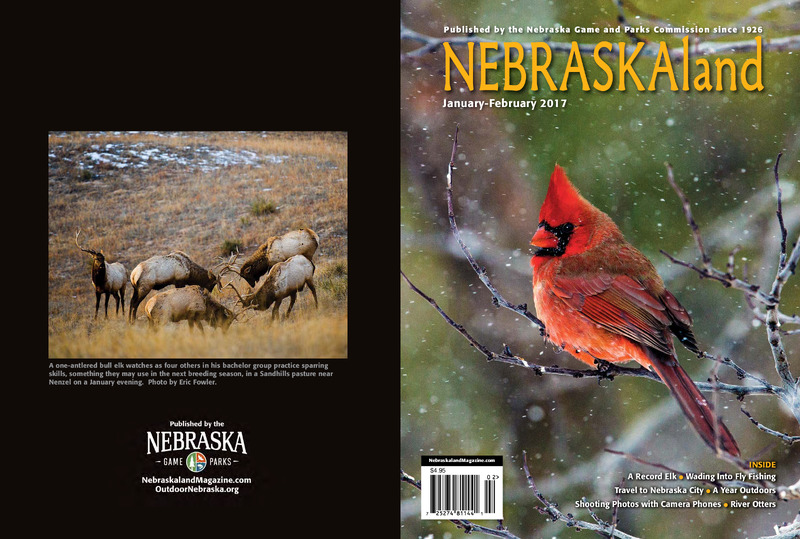
Publis hed by the Nebr a s k a Ga m e a nd Pa r k s C o m m is s io n si nc e 1926
NEBRASKAland
January-February 2017
A one-antlered bull elk watches as four others in his bachelor group practice sparring
skills, something they may use in the next breeding season, in a Sandhills pasture near
Nenzel on a January evening. Photo by Eric Fowler.
NebraskalandMagazine.com
$4.95
INSIDE
A Record Elk ● Wading Into Fly Fishing
Travel to Nebraska City ● A Year Outdoors
Shooting Photos with Camera Phones ● River Otters
NEBRASKAland Magazine
Volume 95
●
No. 1
●
January-February 2017
F EAT U R ES . . .
22 Camera Phones
2
BY ERIC FOWLER AND JEFF KURRUS
30 Time Well Spent
What to Do in January and February
BY RENAE BLUM
32 A Year Outdoors
A Guide of What do Do and Where to Go in Nebraska
BY JULIE GEISER
54 Riding Through History
BY KYLIE KINLEY
60 14-year-old's Elk a Record
STORY AND PHOTOS BY ERIC FOWLER
62 Wading In
Learning to Fly Fish in Nebraska
62
●
BY RYAN SPARKS
I N S I D E T H I S I S S U E ...
Mixed Bag – River Otters, Travel to Nebraska City, A
Brief History of Beer Making in Nebraska, Snow Goose
Guns, Feeding Birds, Upcoming Events, and more ........ 10
Conservation Corner – Trumpeter Swans .............. 69
In the Field – Sleep-in Quail Hunting ........................ 70
Nature Notes – Burls .......................................71
Wilderness Workshop – Winter Birding .............74
Portraits from the Past – Reader's Photos ............. 76
In the Kitchen – Venison Loin................................... 80
The Last Stop – Ice Tracks ........................................ 82
22
●
54
●
THROUGHOUT 2017, NEBRASKALAND MAGAZINE WILL
BE PUBLISHING A NUMBER OF ARTICLES ASSOCIATED WITH
THE STATE'S
150-YEAR CELEBRATION. LOOK FOR THIS LOGO
THROUGHOUT THESE PAGES TO READ ARTICLES ASSOCIATED
WITH
NEBRASKA'S RICH HISTORY, AND VIEW OUR
INTERACTIVE DIGITAL EDITION FOR MORE INFORMATION.
Cover: A male cardinal perched in a redbud tree south of Grand
Island in Hall County. Photo by Rick Rasmussen.
NEBRASKAland (VOL. 95 / NO. 1 ISSN 0028-1964) is published monthly, except
for the combined Jan./Feb. and Aug./Sept. issues, by the Nebraska Game and Parks
Commission, 2200 N. 33rd St., Lincoln, NE. Periodicals postage paid at Lincoln,
Nebraska, and additional mailing offices. POSTMASTER: Send address changes to
NEBRASKAland, P.O. Box 30370, Lincoln, NE 68503-0370.
2 NEBRASKAland • JANUARY-FEBRUARY 2017
32
●
JANUARY-FEBRUARY 2017 • NEBRASKAland 3
Mike Beelaert of Orchard photographed this white-tailed buck and
doe on Nov. 9 near the Niobrara River in northern Holt County.
Karen Kader of Omaha captured this photo of egrets at
Lake Wanahoo last April.
Jason Wendt of
Ashland took this
photo of the Platte
River Valley from atop
the observation tower
at Eugene T. Mahoney
State Park.
90-year-old Visitor Winner
Dear Mr. Reigert –
What a pleasant surprise arrived in
my mail yesterday – your letter and the
NEBRASKAland mug – in response to
my entry in the "Visitor" contest in the
November issue of NEBRASKAland
Magazine!
I am indeed a nonagenarian, but still
very active and for that I am deeply
grateful.
I have no idea how long we (my late
husband and I) have been subscribers
to the magazine but it's been years. I
see the magazine has been published
since 1926 – that makes it 90 years old,
too!
At any rate, thanks for choosing me
to be a winner. I'll keep looking for the
"visitor" in future issues!
Gratefully,
Adelene Vock
Nebraska City, Nebraska
Kelly Keogh of Springview calls this photo "Foggy Autumn Morning Overlooking the
Niobrara River." The photo was taken at the Fort Niobrara Wildlife Refuge.
Adelene, It was my great pleasure
informing you that you had won
the visitor mug contest. We thank
you and hope you continue reading
NEBRASKAland for many more years.
Tim Reigert, Art Director
Aaron and 6-year-old AJ Beckman sent this camera trap coyote image from
Madison County.
14-year-old Cheyanne
Graves
off Aurora
C
G
shot this white-tailed buck on the opening
weekend of the firearm season. Send your
deer-hunting images to nebtrailcam@
gmail.com for possible inclusion in a
future issue of NEBRASKAland Magazine.
4 NEBRASKAland • JANUARY-FEBRUARY 2017
Paul Julian of Hastings took this photo of joggers at Hastings Lake in Adams County.
County
JANUARY-FEBRUARY 2017 • NEBRASKAland 5
NEBRASKAland Magazine
COMMISSIONERS
CONSERVATION OFFICERS
Director Jim Douglas
Commissioners
Chairman - Mark Spurgin, Paxton
Vice Chairman - Rex Fisher, Omaha
2nd Vice Chairman - Dick Bell, Omaha
Dr. Kent Forney, Lincoln
Robert Allen, Eustis
Pat Berggren, Broken Bow
Mick Jensen, Blair
Norris Marshall, Kearney
Dan Kreitman, Wahoo
ADMINISTRATION (Lincoln)
Craig Stover (Administrator)
Duane Arp (Asst. Administrator)
Jeff Clauson (Asst. Administrator)
MAGAZINE STAFF
Congratulations to Nathaniel Johnson for his image "Looking for the Sun," the winner of the Reader's Choice Award for the 2016
NEBRASKAland Magazine Photo Contest.
Outdoor Plates
While it may require more thought
to interpret than others, the plate Neal
Kratochvil of Columbus has on his
truck shows his passion: “Want to
Hunt.” Regardless of how many new
vehicles, or license plates, Kratochvil
has, his message remains the same.
If you have a unique outdoor
message plate you would like to
share, or know someone who does,
e-mail a photo (high-resolution, JPEG
format only, please) along with your
hometown and a brief description of
the interests expressed on your license
plate to Eric.Fowler@Nebraska.gov.
Communications Director Christy Rasmussen
Editor Jeff Kurrus
Art Director Tim Reigert
Associate Editor Jenny Nguyen
Regional Editors Eric Fowler, Julie Geiser,
Justin Haag
Contributing Editor Michael Forsberg
Regular Contributors Chris Helzer, Gerry
Steinauer
Photo Librarian Jaclyn Cruikshank Vogt
Circulation Donna Robinson
For address changes and questions about
your subscription, e-mail donna.robinson@
nebraska.gov or call 800-632-5263
Advertising Sales Manager
For advertising information contact
Shane G. Gilster, 402-742-0125
Email: shanegilster@gmail.com
NEBRASKAland Magazine Copyright 2017, all rights reserved.
NEBRASKAland is available in audio from the Nebraska Library
Commission Talking Book and Braille Service, Suite 120, 1200 N St.,
Lincoln, NE 68508. 800-742-7691. NEBRASKAland Magazine and the
Nebraska Game and Parks Commission reserve the right to reject any
advertising not in keeping with the agency mission.
Rates: $18 for one year; $33 for two years; $44 for three years. Nebraska
recipients must add appropriate sales tax. To subscribe call
1-800-NEBLAND (632-5263), or go online to: NebraskalandMagazine.
com.
COMMISSION
C
CO
COM
OM
MMIS
MISSIO
S NO
OFFICES
FFICES
FF
FFI
S
Corrections: In the December, 2016
issue on page 18, Alexandra Mayes,
who is holding Creighton Scott's
artwork, is misidentified. We regret
the error.
Send your comments to:
Jeff Kurrus, Editor
NEBRASKAland Magazine
P.O. Box 30370
Lincoln, NE 68503
or e-mail Jeff.Kurrus@Nebraska.gov
Please include your postal address and telephone number. Letters may be condensed
and edited. Photographs are also welcome.
Sabrina Nicholson of Curtis took this photo of horses and sunflowers south of Moorefield. "I was out trying to capture the
wildflowers when I saw these beauties!" Nicholson said.
6 NEBRASKAland • JANUARY-FEBRUARY 2017
Any program that receives federal funding from the National Park
Service, or the United States Fish and Wildlife Service prohibits unlawful
discrimination on the basis of race, color, religion, age, gender, marital
status, national origin, age, disability or political affiliation. Any person
who believes he or she has been discriminated against in any program,
activity, facility, or service, should contact the Nebraska Game and
Parks Commission, Lincoln, NE 402-471-0641, the Equal Opportunity
Commission, Lincoln, NE 402-471-2024, TTY/TDD 402-471-4693;
United States Fish Wildlife Service, Civil Rights Coordinator, 4401
N. Fairfax Drive, Arlington, VA 22203; Director, Equal Opportunity
Program, U.S. Department of Interior, National Park Service, 1849 C
Street NW, Mail Code 0008, Washington, D.C. 20240-0001.
Headquarters/Southeast District Office
2200 N. 33rd Street Lincoln, NE 68503
Phone 402-471-0641
Northeast District Office
2201 N. 13th St. Norfolk, NE 68701
Phone 402-370-3374
Southwest District Office
301 E. State Farm Rd. North Platte, NE 69101
Phone 308-535-8025
Northwest District Office
East Hwy. 2, Box 725 Alliance, NE 69301
Phone 308-763-2940
Bassett Office
524 Panzer St., Box 508 Bassett, NE 68714
Phone 402-684-2921
Kearney Office
1617 First Ave. Kearney, NE 68847
Phone 308-865-5310
Ak-Sar-Ben Aquarium
21502 W. Highway 31 Gretna, NE 68028
Phone 402-332-3901
Omaha Office
8495 Frederick Street, Omaha, NE 68124
Phone 402-595-2144
402-471-5531
402-471-5531
402-471-5531
NORTHWEST (Includes counties covered)
Jim Zimmerman (District Supt.)
308-641-6138
Sean McKeehan
(Cheyenne, Morrill, Box Butte)
308-279-9133
Scott Brandt
(Kimball, Banner, Scotts Bluff)
308-631-0663
308-760-3647
Greg Hesse (Sheridan, Dawes)
308-430-0572
Dan Kling (Sioux, Dawes)
Terry Brentzel (Deuel, Garden, Grant) 308-458-7650
402-389-0444
Frank Miller (Cherry, Hooker)
NORTHEAST (Includes counties covered)
Tom Zimmer (District Supt.)
402-649-8053
402-760-0712
Dale Davis (Keya Paha, Brown, Rock)
402-340-3981
Jonathan Andreasen (Holt, Boyd)
Mitch Johnson (Knox, Antelope, Pierce) 402-613-8612
402-762-5022
Jeff Jones (Knox, Cedar)
Owen Johnson
(Dixon, Dakota, N 1/2 Thurston)
402-266-1759
Jon Reeves
(S 1/2 Thurston, Burt, Washington)
402-889-8508
402-719-1108
Dan Roberts (Dodge, Colfax)
Cory Krause
(Cuming, Wayne, Stanton, Dodge)
402-380-6410
Steve Oberg
(Colfax, Platte, Madison, Stanton)
402-910-3366
Randy Pomplun
(Nance, Greeley, Wheeler, Boone)
308-550-0489
308-730-7050
Doug Pollard (Loup, Garfield, Valley)
SOUTHWEST (Includes counties covered)
Roger Thompson (District Supt.)
308-530-3097
308-202-0819
Matt Brandt (Sherman, Howard)
308-380-7331
Tim Williams (Hall, Hamilton, Merrick)
Pat George
(Clay, Adams, Nuckolls, Webster)
402-705-9989
308-920-0367
Rich Routh (Franklin, Harlan, Phelps)
Matt Andrews
(Gosper, Furnas, Frontier, Red Willow)
308-746-2418
Andrew Heyer (Dawson, Gosper, Phelps) 402-613-2241
Brian Piernicky
(Red Willow, Frontier, Hayes, Hitchcock)
308-340-6627
308-289-0427
Nicholas Fix (Keith, Perkins)
308-289-1169
Bryce Streger (Keith, Arthur)
Brandon O’Neal
(Lincoln, McPherson, Logan)
308-530-3157
Alex Hasenauer
(Lincoln, McPherson, Logan)
308-660-4671
308-440-3847
Dale Johnson (Kearney, Buffalo)
308-529-8146
Mike Thome (Dawson)
Ray Dierking (Custer, Thomas, Blaine) 308-870-0322
SOUTHEAST (Includes counties covered)
Levi Krause (District Supt.)
402-949-0593
402-619-1355
Rich Berggren (Douglas)
402-616-5961
Dan Evasco (Sarpy)
402-210-0888
Heath Packett (Cass)
402-209-1506
Russell Mort (Otoe, Johnson)
William Krause
(Nemaha, Richardson, Pawnee)
402-274-8063
402-806-9084
Dan Zuehlke (Gage, Saline)
402-890-6463
Dina Barta (Lancaster)
402-890-6465
Doug Kramer (Lancaster)
402-937-3422
Dudley Sorensen (Lancaster, York)
402-613-2312
Travis Shepler (Lancaster)
402-890-7140
Stacey Lewton (Lancaster, Seward)
402-443-6392
Mike Luben (Saunders, Butler, Polk)
Nebraska Wildlife Crimestoppers
1-800-742-7627
JANUARY-FEBRUARY 2017 • NEBRASKAland 7
A Mammal Brief
By Lindsay Rogers
8 NEBRASKAland • JANUARY-FEBRUARY 2017
PHOT
HOTO
O BY BOB GRIER
G
The river
otter (Lontra
canadensis) is
the largest
member of the weasel
family in Nebraska, ranging from
35-52 inches long. It weighs from 11-30 pounds,
with males weighing more than females. Several Nebraska species
Lindsay Rogers is an outdoor
education specialist with the
look like the northern river otter, including mink and beaver. Although
Nebraska Game and Parks
they're also in the Mustelidae family, mink are significantly smaller.
Commission.
The range of the northern river otter extends throughout Canada and the
United States. They are found along waterways, lakes and wetlands.
In Nebraska, river otters can be found along all major river systems.
River otters are opportunistic and will eat foods that are most available. Fish make up the greatest portion of
the otter’s diet, followed by crayfish. Other foods include amphibians, insects, small mammals and birds. In clear
water, river otters use their excellent swimming ability to capture fish by sight and direct pursuit. In murky water,
they use their whiskers to locate prey by movement.
River otters communicate using several methods. Vocalizations include chirps, growls, whistles and screams.
They also communicate through scent marking using a pair of scent glands located at the base of their tails. And
finally, they communicate through body language, including touch and posture.
River otters tend to be active at night, although in undisturbed areas they may be active during the day.
Anyone fortunate enough to observe an otter in the wild will not likely forget its playful, inquisitive nature or its
graceful swimming ability. ■
JANUARY-FEBRUARY 2017 • NEBRASKAland 9
Travelogue Sponsors
By Hannah Hundley, Nebraska Tourism Commission
Nebraska City
n year means new Nebraska adventures! Travelers
new
a eager to embrace the chill of these winter months
are
a make their way to Nebraska City, home of Arbor
and
Historical Park and Arboretum. Arbor Lodge
S
dgee State
Lodg
Lo
Lodg
Lodge
encompasses more than 65 acres of hilly, wooded land at the
The
edge of the city, just a few miles west of the Missouri River.
snow.
of
t
blanke
a
under
park is full of unmatched beauty, even
Arbor Lodge is the original estate of J. Sterling Morton – the
founder of Arbor Day. It was on this property that Sterling and
his wife initiated their vision for a greener, more tree-filled
around this area and throughout Nebraska on
world. It is estimated that nearly 1 million trees were planted
Morton family lived is still in use today. With its
the first Arbor Day in 1872. The historic mansion where the
ts, visitors love
52 rooms of authentic furnishings and countless historic artifac
ons.
occasi
l
specia
for
out
it
touring this timeless home or renting
up the Arbor
Just beyond the Mansion’s doorsteps, thousands of trees make
chipped
woode
ird-mil
two-th
the
hike
can
Day Farm Tree Adventure. Guests
After
forest.
the
of
heart
the
into
trail, following the South Table Creek
elves at the
crossing over two rustic timber bridges, guests will find thems
climb and
can
they
which
,
House
Tree
base of the 50-foot tall Exploratory
season is
winter
The
rs.
wonde
d
woode
look out among the vast stretch of
draped
snowwith
s
tunitie
oppor
photo
an ample time for bird watching and
tree canopies overhead.
retreat
After enjoying a brisk day of outdoor adventures, travelers can
the
in
ing
shopp
some
and
cocoa
indoors and warm up with a little hot
made
wines
fruit
and
white
red,
Apple House Market. Guests can sample
the
at
rds
vineya
and
ds
orchar
the
with grapes and other fruit grown in
farm.
Lied
Less than a mile away from the Arbor Day park grounds is the
With
.
Center
rence
Confe
&
Lodge
an onsite restaurant and lounge,
timbered guest rooms, and an
Olympic-sized indoor pool and spa, this
grand lodge makes for the perfect weekend getaway.
Many couples choose Nebraska City
as their Valentine’s Day destination.
The Lied Lodge offers an anniversary
package, which includes an intimate
dinner for two, an overnight stay
and a deluxe breakfast the next
morning.
Between the refreshing
amenities, countless outdoor
activities and the peaceful
stillness of nature, Nebraska
City is the place to be this
season. ■
Arbor Lodge in winter
Apple Hou
Day Farm se Market at A
rb
le entry
y
t
s
k
c
a
d
Adiroant Lied Lodge
hall
10 NEBRASKAland • JANUARY-FEBRUARY 2017
Nebraska City
Statue of Morton, the
ffounder of Arbor Day
or
JANUARY-FEBRUARY 2017 • NEBRASKAland 11
A Brief History
were ready for market. Thinking that it might be interesting
to the many who drink this healthful beverage, we asked Mr.
Boehm to tell us the modus operandi.”
Touring a Nebraska Brewery in 1877
Boehm proceeded to describe the beer-making process,
pretty
much the same as today except for the convenience
By the Nebraska State Historical Society
afforded by modern equipment. Barley was mixed with
mall, local breweries have become increasingly popular water and left to sprout, then dried, roasted, and ground,
in recent years, although a look into Nebraska’s past
producing malt. The malt was boiled and the resulting liquid
reveals that the idea is not new. Many towns, including
drawn off, strained, boiled again with hops, cooled, and then
Grand Island, had them in the 19th century. One reason fermented. “Once into the fermenting tubs, it stands from 17
was that the lack of refrigerated transport systems precluded
to 20 days, after which it is again racked off into hogsheads,
shipping unpasteurized beer long distances from large,
where it stands 3 or 4 weeks or longer, when it is again
distant breweries. In Grand Island’s case, the community’s
racked off into kegs and is ready for use.”
strong German heritage was another reason that a brewery
The article more fully described the State Central
would be well-supported. The editor of the Grand Island
Brewery’s plant: “The main building is about 30 x 60 feet,
Times on April
two stories high, with
12, 1877, reported
a large addition on
on his tour of the
the west side devoted
to horse power used
city’s State Central
in grinding malt and
Brewery, “through
running large force
the kindness of its
pumps. In the main
proprietor George
part is the furnace
Boehm.”
and kettle, mash tubs
“We first went into
and cooler, and the
the cellar, which is 22
hoisting apparatus
x 56 feet, where we
for raising kegs from
found 35 hogsheads
the cellar. Mr. Boehm
with a capacity of
informed us that he
250 barrels, nearly
used 350 kegs, and
all full of the creamy
his business was
liquid undergoing
increasing to such an
the different stages
extent that he would
of fermentation.
be compelled to
Everything
order more shortly.
was arranged
At present he has
systematically, and
at least 10,000
kept scrupulously
gallons of beer on
neat and clean. In
hand ... In bringing
order to keep the
the establishment
temperature of the
cellar up to the
to its present state
desired point during
of perfection, he
the summer months, a
has expended about
rack has been built in
$12,000, and will
the center calculated
continue to improve
as time progresses.
to hold twenty tons
He superintends
of ice. A glance at the
every department
thermometer, which
himself and his
Mr. Boehm watches
reputation is that
carefully, showed the
Fremont Brewing Company Lithograph, undated.
of one of the best
mercury to be down
[to] almost freezing, in which temperature it is expected to
brewers in the state. It will repay anyone to
visit the brewery and ‘take it in,’ as we did,
keep it, if 850 tons of ice he has on hand will do it. The last
and we guarantee them a pleasant time and
hogshead that we inspected, and which was almost large
courteous treatment.” ■
enough for a dwelling house, contained Bock Beer, which
is about twice as strong as the ordinary article, and much
older, the quality of which the boys will have an opportunity
Visit the Nebraska State Historical Society’s
of tasting on Bock Beer day, May 1. Near the ice rack were
website at Nebraskahistory.org.
piles of kegs of beer that had ‘gone through the mill’ and
S
NSHS RG7294-4082
NSHS RG2294-48
Mattes Brewery, Nebraska City, 1900. The large wagon is loaded with beer kegs, the smaller one with beer cases containing bottles
of “Otoe Chief” beer.
12 NEBRASKAland • JANUARY-FEBRUARY 2017
JANUARY-FEBRUARY 2017 • NEBRASKAland 13
A 150-Year Story
By Renae Blum
Nebraska became a state on March
1, 1867, and this year will celebrate its
sesquicentennial. In honor of this milestone,
the Omaha World-Herald has come out with
a new book, “Nebraska: 150 Years Told
Through 93 Counties,” by World-Herald
reporter and editor David Hendee. This
handsome coffee table publication illustrates our state’s story
through an appealing mixture of words and images, going
county by county, starting with Adams and ending with
York. Nebraska’s counties are its “building blocks,” Hendee
writes, and deserve our particular attention as a unique way
of understanding where we live and where we came from.
The first thing you notice upon opening these pages are
the photographs. Colorful and dramatic, they bring life to
events, people and places that the reader may not be aware
of. Equally stunning is Hendee’s reporting. He devotes equal
attention and journalistic skill to every county, digging into the
facts behind famous legends and well-known stories, people
and places. You’re certain to come away surprised by what
you’ve learned – for example, that there’s a tree in Ponca State
Park that was a seedling in 1644, making it two centuries
older than Nebraska. This dive into storytelling through words
14 NEBRASKAland • JANUARY-FEBRUARY 2017
and images makes
for an engaging,
rewarding read.
You can order
a copy online at
OWHstore.com or
by phone at 402444-1014. It also
is available in The
World-Herald’s
lobby and at local
bookstores. ■
JANUARY-FEBRUARY 2017 • NEBRASKAland 15
Snow Goose Guns
PHOTO BY JARROD SPILGER
By Jarrod Spilger
Spring snow goose season provides Nebraska waterfowlers
more time afield. However, it takes specialized guns to bring
down high-flying snows. Here are some ways to trick out
your shotgun to save the tundra.
Unplugged gunning of spring snows is allowed during the
conservation order, so you aren’t limited to only three rounds
as during the regular season. Magazine extensions can up
your shot count to seven, eight or even 10 rounds. Carlson’s
(choketube.com) offers affordable extensions for many
popular shotgun models. So do RCI-XRAIL (xrailbyrci.com)
and Nordic Components (nordiccomp.com), including hard
to find extensions for Benelli’s Super Vinci.
A fast-shooting semi-auto will make the most of all
those extra shots. Plus, there’s the added benefit of reduced
felt-recoil, especially with gas-operated models. That’s
an important consideration when rapidly firing multiple
magnum rounds.
After nearly two decades of spring hunting, long-lived
snows have become extremely wary. Shots are typically long,
even when birds decoy. Improved Modified or Light Full
chokes provide tighter patterns than Modifed or Improved
Cylinder. They also perform better with high-velocity loads
Common upgrades for snow goose guns include high-capacity
magazine extensions and long-range choke tubes, such as
these from Muller, Rob Robert's, and Carlson's.
and larger steel shot sizes, like BB or BBB, than a true Full
choke. A Full choke can actually over-constrict high-speed
non-toxic loads and create erratic, blown patterns. Try
specialty tubes, such as Carlson’s Cremator Long Range,
Muller’s Passing, or Rob Roberts’ T3, for better downrange
performance.
The ultimate snow goose rig may be Mossberg’s 930 Snow
Goose. This gas-operated semi-auto is ready to go right out
of the box and features white camo and a 13-round magazine
extension. ■
Feeding Birds
By Julie Geiser
The placement of feeders and seed type will determine the
type of birds you will attract to your feeders. There are two
things to consider when you wish to discourage certain types
of birds at your feeders: food and feeder.
Stop offering the food that the pest birds seem to consume
most eagerly. For blackbirds this may be corn or mixed seed.
For doves, it's mixed seed, containing milo, millet, wheat,
and other grains. To discourage house finches, shorten the
perches on your tube feeders, or order a special house-finchPHOTOS
PHOT
OS BY
BY JEFF
JEFF KURRU
K
URRUS
URRU
S
KURRUS
A Northern cardinal on a platform feeder.
Black-capped chickadee on a tube feeder.
16 NEBRASKAland • JANUARY-FEBRUARY 2017
pproof feeder that has the feeding holes below the perches.
G
Goldfinches and siskins will hang upside down to feed, but
m
most house finches won't.
As for feeders, stop offering food on the ground or on
la
large platform feeders to discourage doves and blackbirds.
T
Tube and satellite feeders are hard for them to negotiate.
T
To discourage house finches, offer a limited amount of
bblack-oil sunflower seed in a small satellite feeder, one that
cchickadees, nuthatches, titmice and goldfinches can visit one
aat a time. Goldfinches, siskins, and other finches love thistle
oor niger seed and black-oil sunflower seed. ■
JANUARY-FEBRUARY 2017 • NEBRASKAland 17
Expired and Used Tags
What to do with those big and small
game permits and stamps?
By Julie Geiser
As all big game hunters know, you must have a permit
before legally hunting in Nebraska. Once you harvest,
check in your deer, elk or antelope, and process the meat,
some hunters wonder what to do with that expired big game
permit.
According to Duane Arp, assistant division administrator
in the law enforcement division for the Commission, “Once
an animal is checked in and after the hunter has returned
home, they do not have to retain their permit, and the hunter
can throw it away or save it if desired.”
During the nine-day firearm deer season in November,
hunters must check in their deer at a check station; this
includes archery deer hunters that hunt in this season. At
the check station hunters will be given a metal seal that
is typically placed in the ear of a doe or on the antlers of
a buck. The seal does not have to be kept with the deer;
however, the seal is proof of legal harvest. The paper
permit is cancelled and given back to the hunter after the
appropriate information is filled out and recorded. Arp
recommended keeping the seal either on the antlers or with
the mount if the deer is to be mounted.
After the firearm season big game hunters need to use the
Telecheck system to check in big game.
Telechecking is simple and available 24 hours a day, 7
days a week by calling the toll free number at 844-279-4564
or by going online at Outdoornebraska.org/Telecheck.
Once an animal is checked, Arp said, “Nebraska Game
and Parks has the necessary information for management
and enforcement purposes, so hunters no longer need the big
game permit.”
Some people throw their permits away; others shred
them as permits have the hunter’s name, address and other
information on them, while other hunters choose to keep
their permits for nostalgia, a reminder of the hunt perhaps.
Arp has seen many permits over the years and stated that:
“Many hunters collect permits and stamps. The collection of
the federal waterfowl stamp is a great example of collectors
and many displays of past stamps. Some collections have
sold for monetary value. Many hunters have collected
permits and stamps over the years for different reasoning;
sentimental reasons to illustrate the number of years he
or she has supported the sport, comparison in costs, and
comparison in design could be a few examples.” ■
PHOTO BY JULIE GEISER
Hunters collect permits for a variety of reasons, including nostalgia, cost-comparison and to view designs through the years.
18 NEBRASKAland • JANUARY-FEBRUARY 2017
JANUARY-FEBRUARY 2017 • NEBRASKAland 19
Attention Educators!
By Lindsay Rogers
Today, children are more likely to know Pokémon characters than native plants.
They are more likely to spend spare time indoors than outside, and they're more
likely to feel uncomfortable outside than their parents' generation. Yet, countless
studies have shown that children who spend time outdoors develop better problem
solving skills, increase their ability to focus and show improved academic
performance. Additionally, children who spend time in nature are usually more
physically active, less stressed and display better social-emotional skills.
However, when looking at many early childhood programs and elementary
classrooms, we see little learning taking place outside. Often, teachers lack the
confidence to take groups of children outside because they have not been trained
to integrate nature into their curriculums.
The goal of the Nebraska Game and Parks Commission’s Growing Up WILD
Program is to help early childhood educators engage their students in learning
through nature and the outdoors. Educators who attend a Growing Up WILD
workshop will gain the necessary skills to take children outside for meaningful
learning experiences. Additionally, workshop participants receive the Growing
Up WILD: Exploring Nature with Young Children curriculum and activity guide
which is filled with interdisciplinary, age-appropriate lessons that utilize nature as
an integrating concept.
To learn more about Nebraska’s Growing Up WILD Program, visit
Nebraskaprojectwild.org; to find an upcoming workshop, click on “View
Scheduled Workshops.” Follow the Nebraska Project WILD page on Facebook for
updates, ideas and other related resources. ■
by Jerry Kane
Contact the Nebraska Game and
Parks Commission at 402-471-0641 or
visit OutdoorNebraska.org for more
information. Visit huntsafenebraska.
org for a list of hunter education
classes and boatsafenebraska.org for
a list of boating safety classes.
Ponca State Park (SP), Ponca; Platte River
SP, Louisville; Chadron SP, Chadron;
Eugene T. Mahoney SP, Ashland; Buffalo
Bill Ranch State Recreation Area (SRA),
North Platte; Fremont Lakes SRA, Fremont;
Wildcat Hills SRA, Gering; Ash Hollow
State Historical Park (SHP), Lewellen; Fort
Kearny SRA, Kearny; Buffalo Bill Ranch
SHP, North Platte.
January 1
Light Goose Hunting Statewide light
goose hunting season closes
January 4
Growing Up WILD Workshop Lincoln
January 1-5
Christmas Bird Count
Indian Cave SP, Shubert
January 7
Concealed Carry Class
Nebraska Game and Parks Outdoor
Education Center, Lincoln
January 8
Shootout at Salt Creek
Nebraska Game and Parks Outdoor
Education Center, Lincoln
January 8
Duck and Coot Hunting
Duck and coot hunting seasons close in
Zone 3, Low Plains and High Plains Units
January 9
Spring Turkey Hunting First day of
spring turkey hunting permit sales
January 9-29
Duck and Coot Hunting
January 14
Cold Day, Warm Hearts
Eugene T. Mahoney SP, Ashland
January 15
Deer Hunting
Youth, Landowner, Season Choice and
River Antlerless, and Gifford Point WMA
deer hunting seasons close
January 19
Crow Hunting Special Public Health
Hazard Order crow hunting closes
January 19
Growing Up WILD Workshop Lincoln
January 31
Hunting Seasons Close For:
November late doe/fawn antelope, fall
turkey, pheasant, quail, partridge, grouse
and squirrel
February 4
Birds and Binoculars
Eugene T. Mahoney SP, Ashland
February 4-12
White-fronted Goose Hunting
White-fronted goose hunting season
February 5
January 20
Cowboy Poetry and Music Jam
Dark Goose Hunting Dark goose hunting Bowring Ranch SHP, Merriman
season closes in North Central Unit
January 20
Commission Meeting
Nebraska Game and Parks Commission
meeting, Lincoln
January 20
Crow Hunting
Crow hunting season opens statewide
January 21
Sausage Making Class
Fort Atkinson SHP, Fort Calhoun
January 25-February 12
Light Goose Hunting
Statewide light goose hunting season
January 25
Growing Up WILD Workshop Chadron
January 26
Growing Up WILD Workshop Omaha
Duck and coot hunting seasons in Zones 2 January 26
Project WILD and Aquatic WILD
and 3, High Plains Unit
Educator Workshop Chadron
20 NEBRASKAland • JANUARY-FEBRUARY 2017
February 10
Growing Up WILD Workshop Lincoln
February 12
Dark Goose Hunting
Dark goose hunting season closes in East,
Platte River, Panhandle and Niobrara units
February 13
Light Goose Light Goose Conservation
Order hunting begins
February 11
Pheasants Forever State Habitat
Meeting Kearney
February 28
Cottontail and Jackrabbit Hunting
Cottontail and jackrabbit hunting seasons
close
February 28
Hunting and Trapping Seasons Close
For: Bobcat, raccoon, Virginia opossum,
long-tailed weasel, mink, red fox, gray fox
and badger hunting and trapping seasons
close
Last issue’s winner of
the Visitor drawing was
Peg Haenfler of Sidney, Montana,
who found the Southern black widow
spider on page 12.
Readers are encouraged to contact
NEBRASKAland within 10 days
after this issue’s publication with
the correct page number and name
of this issue’s “Visitor” – a critter
found in Nebraska. We will then
gather the correct entries and draw
one to win a NEBRASKAland mug.
To enter each month, write:
NEBRASKAland Visitor
2200 North 33rd Street,
Lincoln, NE 68503.
Or e-mail:
Tim.Reigert@Nebraska.gov
with “Visitor” in the subject line of
the message.
HINT: This issue’s visitor is not on
page 15, 21, 41, 45, 49.
Nebraska is home to the Southern
black widow (Latrodectus mactans)
and the Western black widow spider
(L. Hesperus). The female southern
black widow is very distinctive,
with a shiny black body and red
hourglass shape on the underside of
the abdomen. The hourglass of the
Western black widow may be less
distinct, appearing like two triangles
or even a blotch. Males typically
lack the hourglass shape, though
may have red spotting, and are
smaller than females. These spiders
are reclusive, preferring protected
spaces such as wood piles, storage
areas and garages. Black widow
spiders produce a web to entangle
prey. Once a fly or other insect is
caught, the spider rushes down to
wrap it in silk and inject it with
venom. The venom contains a
neurotoxin, which can be
ne
ddamaging to humans,
tthough
deaths are
rare.
PHOTO BY LINDSAY ROGERS
January 1
First Day Hike
NEBRASKAland
Visitor
Lucy Wacker challenges herself to climb as high as she can while visiting Lewis &
Clark State Recreation Area near Crofton.
Special thanks
to Julie Van
V Meter, State
Entomologist, Nebraska
Department of Agriculture.
JANUARY-FEBRUARY 2017 • NEBRASKAland 21
Camera
Phones
The resolu
resolution, features and image quality of cameras in
smart phones has improved exponentially in recent
sma
years. The Samsung Galaxy S6 that captured this
y
yea
snowy
scene at Branched Oak Lake boasts a 16
s
n
megapixel image.
m
Phones have changed
in many ways, and one
of those that outdoor
enthusiasts can capitalize
on is their cameras.
A nice rainbow trout caught on a fly rod at
Two Rivers State Recreation Area near Yutan.
Samsung Galaxy S5.
By Eric Fowler and Jeff Kurrus
T
he staff at NEBRASKAland
Magazine occasionally takes
some time off, and sometimes
we find ourselves staring at an
amazing photo opportunity without our
professional digital SLR cameras. A
few years ago, that meant we had no
chance of capturing it. Developments
in cell phone camera technology,
however, have changed all of that.
The sensors, lenses and software
that drives these cameras are capable
of creating images with quality that
can rival those from cameras costing
thousands of dollars. In addition,
enhancing camera phone-made images
with various filters, colors and HDR
effects have made them user and
viewer friendly.
However, these “phone” cameras
still have limitations. They don’t have
the optical zoom of a digital SLR
or even a point-and-shoot. And the
digital zoom, which uses software to
zoom or simply crops an image, makes
them inferior for work that typically
requires a telephoto lens, such as
wildlife photography. The flash is also
a problem because of its small size and
location and relation to the lens. And
the lenses aren’t as tack sharp as the
Nikon and Canon lenses of today or the
Zeiss’ lenses from days gone by.
Yet, basic rules of photography still
reign supreme when trying to create
images with a camera phone. Having
nice light and a unique composition
can make images captured with a
phone just as interesting as those takenn
with a digital SLR.
On the following pages are a few
images we’ve taken with our phones,
ones that each of us have no doubt
shown friends and families with the
same pride as we have with our long-
lens
equipment. So
keep in mind the most important
photography tip of all: the best
camera is the one you have at the
moment. And thanks to our phones,
we all have one. ■
PHOTO BY JENNY NGUYEN
22 NEBRASKAland • JANUARY-FEBRUARY 2017
PHOTO BY JEFF KURRUS
PHOTO BY JENNY NGUYEN
LEFT: Fort Atkinson State Historical Park
in Fort Calhoun hosts a period luncheon.
The meal was completely prepared by
open-hearth cooking. iPhone 5.
ABOVE: Water towers stand tall at
Fort Robinson State Park in Crawford.
iPhone 5.
JANUARY-FEBRUARY 2017 • NEBRASKAland 23
PHOTO BY ERIC FOWLER
PHOTOS BY ERIC FOWLER
ABOVE: A quick limit of pheasants on a lateseason hunt warrants a quick photo to send to
friends. Samsung Galaxy S6.
TOP LEFT: Dew glistens on a trumpeter swan
feather left on the bird’s nest at Cottonwood
State Recreation Area in Cherry County.
Samsung Galaxy S6.
PHOTO BY ERIC FOWLER
LEFT: Sunset over Cottonwood State Recreation
Area, an image captured using the panorama
mode. Samsung Galaxy S6.
24 NEBRASKAland • JANUARY-FEBRUARY 2017
JANUARY-FEBRUARY 2017 • NEBRASKAland 25
PHOTO BY JENNY NGUYEN
PHOTO BY ERIC FOWLER
ABOVE: Fossils are still being unearthed in the
Hubbard Rhino Barn at Ashfall Fossil Beds State
Historical Park near Royal. iPhone 5.
LEFT: Eli Kurrus is all smiles as he holds up a
rainbow trout at Two Rivers State Recreation Area.
Samsung Galaxy S5.
PHOTO BY JEFF KURRUS
PHOTO BY JEFF KURRUS
OPPOSITE, TOP: The setting sun backlights
Rosinweed in a prairie at Pawnee Lake State
Recreation Area. Samsung Galaxy S6.
OPPOSITE, BOTTOM: During an early-morning run
at Eugene T. Mahoney State Park near Ashland,
this photograph of an adult and child fishing was
captured. Samsung Galaxy S5.
26 NEBRASKAland • JANUARY-FEBRUARY 2017
JANUARY-FEBRUARY 2017 • NEBRASKAland 27
PHOTO BY ERIC FOWLER
ABOVE: Clouds reflect the sunset
above Bull Canyon in the Wildcat Hills
in Banner County. Droid Mini.
PHOTO BY JENNY NGUYEN
LEFT: Rain during a kayaking trip on
the Missouri River near Running Water,
SD. iPhone 5.
PHOTO BY CHRIS MASADA
PHOTO BY JENNY NGUYEN
LEFT: Sandstone caps on clay pedestals
are captured in the waning late afternoon
light in the Badlands of Nebraska. iPhone
6 Plus.
28 NEBRASKAland • JANUARY-FEBRUARY 2017
ABOVE: In the summer, blooms of bush
morning-glory grow alongside Highway
20 near Crawford. They greet visitors
traveling to Fort Robinson State Park.
iPhone 5.
JANUARY-FEBRUARY 2017 • NEBRASKAland 29
Time Well Spent
What to do in January and February
By Renae Blum
N
PHOTO BY JENNY NGUYEN
ature is dressed in her winter colors, providing a spectacular view for
those staying at a park cabin or lodge. Chilly though it might be, the
outdoors holds plenty of rewards in January and February: hunting, ice
fishing, sledding, ice skating and walks in pristine, quiet landscapes. For a
complete list of upcoming events across the state, or for more information on
any of the activities listed here, visit Calendar.OutdoorNebraska.org.
■
First Day Hikes
Discover Ice
Fishing Clinics
Ash Hollow State Historical Park, Buffalo Bill Ranch State Historical Park, Chadron State Park, Eugene T.
Mahoney State Park, Fremont Lakes State Recreation Area, Platte River State Park and Ponca State Park
Celebrate the start of a new year by taking a stroll through some of Nebraska’s most beautiful landscapes. These guided hikes are
the perfect opportunity to burn off holiday calories, reconnect with family, get outdoors and explore new – or familiar – places.
Various dates and locations
in January
Winter Lodging at
Chadron State Park
Learn the basics of ice fishing or pick up
a few new tips at free ice fishing clinics at
Lake Wanahoo State Recreation Area in
Wahoo and Yanney Park Lake in Kearney.
Ice anglers of all skill levels can receive
guidance on techniques, equipment, bait and
safety. These events are particularly suitable
for beginners and families. For dates and the
latest information on these clinics, visit the
Family Fishing Nebraska page on Facebook.
PHOTO BY JEFF KURRUS
Jan. 1
For the first time ever, Chadron State Park will have several lodging
options open all winter long. This gorgeous park in the western part
of the state offers a great spot for a remote winter getaway, and
guests are invited to bring ice fishing equipment, cross country skis
or snowshoes and explore. For information or to make a reservation,
call 402-471-1414.
Open Hunting Seasons
Various dates
Make sure to get out and hunt before several seasons
close at the end of January, including fall turkey,
pheasant and grouse. Light goose and dark goose
hunting is also available, as well as duck hunting in
different parts of the state. Get in your season’s choice
deer hunting before Jan. 15.
Valentine’s Day Specials
Eugene T. Mahoney State Park and Ponca
State Park
PHOTO BY JUSTIN HAAG
PHOTO BY DON CUNNINGHAM
30 NEBRASKAland • JANUARY-FEBRUARY 2017
PHOTO BY JENNY NGUYEN
Escape the typical hustle and bustle and spend Valentine’s Day
in a relaxed, private setting. Mahoney State Park will offer a
dinner and lodging package, with special rates and a romantic
meal. Ponca State Park will also offer special rates, as well as a
complimentary breakfast for those who have cabin reservations.
Valentine’s Day also coincides with Ponca’s Great Backyard Bird
Count, during which citizen scientists are encouraged to record
all the birds they see, making Ponca a particularly appropriate
Valentine’s destination for bird watchers. For more information or
to make a reservation, call 402-471-1414.
JANUARY-FEBRUARY 2017 • NEBRASKAland 31
NEBRASKAland Magazine’s
A YEAR
OUTDOORS
N
e
ebraska
is home to wide-open prairies,
d
deciduous forests and the iconic Sandhills.
T
These varied landscapes host diverse plant
and animal species – and they lend themselves
to diverse opportunities for those who love the
outdoors, too.
Whether you are interested in ice fishing, deer
hunting, catching crawdads, camping, hiking
or attracting hummingbirds to your backyard
garden, this special section provides those who
love the outdoors with a month-by-month guide
to a sampling of all there is to do outdoor in
Nebraska. It’s not a complete guide – that would
fill a book – but it’s a place to start for anyone who
loves spending time outdoors in Nebraska.
32 NEBRASKAland • JANUARY-FEBRUARY 2017
A 2017 Guide of What to Do and
Where to Go in Nebraska
JANUARY-FEBRUARY 2017 • NEBRASKAland 33
N
e
ebraska’s
outdoor recreation options are
d
diverse and almost endless, stretching from
b
border to border and numerous enough
to fill every weekend of the year. From ice fishing,
hunting, sledding and hiking in the winter to those
dog days of the summer, when the fishing, camping,
or paddling of a Nebraska river can be at its best, there
is never a moment in Nebraska where a person can
honestly say, “I just can’t find anything to do in the
outdoors.”
On the following pages are some of our favorite
activities throughout the year, a month-by-month
checklist of special moments and new adventures just
waiting for you to try.
JANUARY
January 1
Participate in a First Day Hike at
a Nebraska state park (SP). Guided
hikes will be organized in several
state parks. Visit Outdoornebraska.
org/winterfest for a complete list.
•
Mid-January
See if you can spot trumpeter
swans concentrating in wintering
areas around the state. While
they spend most of their time in
secluded locations on private land,
the majestic birds can sometimes
be found at Lake Ogallala and
Calamus Reservoir state recreation
areas (SRAs). The birds are skittish,
so watch from a distance.
•
At the Computer
•
All year – Visit NebraskaBOW.org to Register for a Becoming an
Outdoors-Woman workshop. BOW workshops are a place where
women of all backgrounds and ages gather to learn more about the
outdoors in a non-intimidating, friendly environment.
• Take a youngster ice fishing
for the first time. Go on a warm
weekend and you can find plenty
of holes cut by other anglers that
are still open or easy to open with
a hand auger.
•
Renew your hunting, fishing and
park permits for the new calendar
year.
•
•
Look for white-tailed deer in
areas with thermal cover, including
evergreen trees and big bluestem
grass.
NEBRASKAland Magazine’s • A YEAR OUTDOORS
Give a tax
deductible donation
to the Wildlife
Conservation Fund on
your tax form or at
Shopoutdoornebraska.ne.gov.
•
• May – Sign up for a Fun Run at a Nebraska State Park.
• Early June – Visit Outdoornebraska.org for Outdoor Skills Camp
information.
• Late July – Visit Outdoornebraska.org for a complete list of small and
big game fall hunting seasons.
• Late September – Visit Outdoornebraska.org for a list of scheduled
deer hunting workshops.
• Early October – Look for trout stocking dates across the state at
Outdoornebraska.org.
• Mid-October – Visit Outdoornebraska.org for a list of Halloween
activities planned at several state parks.
Early March – Visit Outdoornebraska.org for spring turkey hunting
workshop dates.
NEBRASKAland Magazine’s • A YEAR OUTDOORS
FEBRUARY
Mid-February
Pick a spot for sandhill crane
viewing, as these majestic birds
begin migrating through Nebraska
and the central flyway to their
northern breeding grounds in the
upper United States, Canada and
as far north as Siberia. Cranes
can be viewed at the following
locations: Crane Trust Nature and
Visitor’s Center near Alda, Iain
Nicolson Audubon Center at Rowe
Sanctuary near Gibbon, Fort Kearny
State Historical Park (SHP) and
SRA, Buffalo Bill Ranch SRA, and
North River Wildlife Management
Area (WMA). Birds remain in
central Nebraska until mid-April.
For more viewing locations, visit
Nebraskaflyway.com.
•
•
Grab your camera as millions
of ducks and geese flock to
wetlands across Nebraska. To
find the highest concentrations,
check the wetland condition
report at Outdoornebraska.org/
waterfowlchecklist.
•
Take a drive through the Loess
Canyon area south of Brady and
Maxwell to view and photograph
cedar waxwings, mountain
bluebirds, Townsend’s solitaires,
robins, and turkeys in canyon areas
with cedar trees.
•
View eagles concentrating on
lakes, reservoirs and rivers that
have ice and open water as they
follow the early movement of
waterfowl heading north. Viewing
areas are available at Lake Ogallala
and the J2 Powerhouse near
Johnson Lake.
•
Put out backyard bird feeders to
attract resident and migrating birds.
NEBRASKAland Magazine’s • A YEAR OUTDOORS
•
While hiking through Nebraska
forests, look for white-tailed deer
antler sheds along game trails, in
ditches and near fences. Antlers
can be gathered at public and
private lands throughout Nebraska.
Be sure to ask permission before
entering private property.
•
Dust off your bow for the
upcoming spring archery turkey
season. Visit Outdoornebraska.org
for season dates.
NEBRASKAland Magazine’s • A YEAR OUTDOORS
MARCH
Early March
Retrieve your rod and reel as
catfishing begins in reservoirs after
ice-out. Fish deadbait with winterkilled gizzard shad you can pick
up from windswept shorelines,
especially from a north-facing
side on a warm spring day, or
in the upper ends of reservoirs
where shallow water warms
the quickest. Top spots include
Lake McConaughy and Calamus
Reservoir, but any reservoir can be
productive. Check out the fishing
forecast at Outdoornebraska.org to
find the ones with the best catfish
populations.
•
Mid-March
Mark your calendar as Two
Rivers Trout Lake is open for the
season. Fish can be caught on fly
rod and spinning tackle.
•
Applications
Visit Outdoornebraska.org for more
information regarding the following
application periods:
•
• June - Deer, antelope, and elk draw
unit application period.
• July - Apply for permits for the October
paddlefish snagging season.
• August - Send reservations in for waterfowl blinds at Clear Creek
WMA near Lewellen. The drawing is the first week of October.
March - Apply for permits for the
June archery paddlefish season.
•
Attend the Harlan White Pelican
Watch, March 1- April 15 at Harlan
County Reservoir. Bird watchers
and photographers will enjoy these
tours. For more information, visit
Harlantourism.org.
• View migratory birds at Ponca
State Park’s Marsh Madness event.
NEBRASKAland Magazine’s • A YEAR OUTDOORS
•
•
Look for sales on hunting and
fishing equipment at outdoor
retailers and online auctions and
second-hand sites.
Take a kid hunting. There is no
age requirement to hunt turkeys
in Nebraska and permits are
reasonably priced for youth under
16 years of age.
NEBRASKAland Magazine’s • A YEAR OUTDOORS
•
Look for morel mushrooms after
early spring rains or snow followed
by warm, sunny conditions with
night temperatures above 50
degrees. Sunny, south-facing
slopes can produce mushrooms
early in the season. Moist wooded
areas near dying or dead elm or
ash trees, old apple orchards and
timbered areas along rivers and
streams are good places to find
morels. Recently burned woods
have been cited as good producing
areas as well.
APRIL
Early April
Pattern your shotgun for the
upcoming spring turkey season.
•
•
Head out to Box Butte, Calamus,
Lake McConaughy, Merritt and
Sherman reservoirs and Harlan
County Lake to catch spawning
walleyes at night casting or trolling
crankbaits on the dam faces.
Late April or early May
Fish for white bass as this openwater predator starts spawning at
reservoirs around the state. Fish
instinctively swim upriver to spawn,
making any place where water
flows into a reservoir the best bets
to cast jigs on light line. Locations
includes Lonergan and Otter
Creek inlets at Lake McConaughy
and the North Platte River above
it when water is high; Gracie
Creek inlet and the Calamus River
above Calamus Reservoir; canal
inlets at Sherman, Davis Creek
and Sutherland reservoirs and
Lake Minatare, Lake Maloney and
Johnson Lake.
•
April to early May
Spend a sunrise watching
the unique courtship dances
of sharp-tailed grouse
and prairie chickens, and
listening to the sounds that
accompany the display.
Public viewing blinds are
available at Burchard Wildlife
Management Area, Valentine
National Wildlife Refuge,
Crescent Lake National
Wildlife Refuge and the
Nebraska National ForestBessey Ranger District.
•
•
Try your luck at spotting a
whooping crane – the famously
elusive species arrives in Nebraska
at this time of year. Your best
bet location-wise is the Platte,
Loup or Niobrara rivers. Report
any sightings to Game and Parks
(402-471-0641), U.S. Fish and
Wildlife Service (308-379-5562),
or The Crane Trust’s Whooper
Watch hotline (1-888-399-2824).
Emails may be submitted to joel.
jorgensen@nebraska.gov.
NEBRASKAland Magazine’s • A YEAR OUTDOORS
Late April
Begin catching largemouth
bass along areas with emerging
vegetation, along drop-offs and
rip-rap areas of lakes and ponds.
I-80 Lakes give ample opportunity
for bass anglers. Camp at Windmill
SRA near Gibbon, which has six
lakes to fish, or at Mormon Island
SRA near Grand Island, which has
perfect spring camping and bass
fishing.
•
•
Pick up nightcrawlers after a
spring rain to use for fishing.
•
Plant pollinator gardens that
have blooming flowers from June
until the frost to support monarch
butterflies and other pollinators.
•
View shorebirds, including
ibises, at Buffalo Bill Ranch SRA,
sandhill lakes and playas and the
Valentine Wildlife Refuge. Pelicans
can be found at Calamus Reservoir
SRA, Lake Ogallala SRA, Sutherland
Reservoir SRA, Lake Maloney SRA
and Harlan County Reservoir.
•
Turkey hunt or fish on an Open
Fields and Waters area.
NEBRASKAland Magazine’s • A YEAR OUTDOORS
•
•
Take note – it’s piping plover
nesting season, and during this
time portions of the beach at Lake
McConaughy will be closed to keep
the area safe for this endangered
species.
Bowfish for carp in various
waters, including rivers, ponds and
lakes/reservoirs across Nebraska.
•
Visit a bird-banding station,
including Wildcat Hills SRA and
Chadron SP, in coordination
with the Bird Conservancy of the
Rockies. Visit Birdconservancy.org
for more information.
•
Drive carefully!!
Deer herds are
dispersing.
•
Grab your binoculars, as more
than 90 percent of the world’s buffbreasted sandpiper population are
staging in the eastern portion of
the Rainwater Basin. During their
peak migration, this shorebird
and others, including Hudsonian
godwits, greater yellowlegs and
Wilson’s phalaropes, visit wetlands
and the shorelines of rivers,
streams and ponds throughout the
state.
MAY
Early May
Begin planting large, landscape pollinator
plantings either in the spring or fall. Spring
pollinator plantings may be seeded from April
through mid-May. Pollinator mixes include a
wide diversity of plants to ensure the bees,
butterflies, moths and beetles that rely on
them have food throughout the season.
Fall seeding using pollinator mixes can also
be sown from November through the winter.
Visit Nebraskapf.com to learn more about
pollinator mixes and find a Farm Bill biologist
near you for more information.
•
•
Organize the spring’s first fish fry
with family and friends, who will
all suggest that more fishing trips
are in order after tasting pan-friend
fillets.
• Look for Free Park Entry and
Fishing Day.
•
Experience history at Ashfall
Fossil Beds.
•
•
Visit a Nebraska state park as
the summer season kicks off on
Memorial Day weekend.
Fish flooded timber that rings
western reservoirs. Irrigation
reservoirs are usually full this time
of year, recharging after irrigation
drawdown from the previous
summer.
•
Find crappies on their spawning beds as
this spring bite begins.
Mid-May
Attend the Outdoor Expo at Fort Kearny
SRA. The event showcases the state’s vast
number of fun outdoor activities, meeting the
needs of anyone interested in the outdoor
lifestyle, regardless of age or experience.
•
NEBRASKAland Magazine’s • A YEAR OUTDOORS
Late May
Catch bluegill on spawning beds
with a flyrod and popping bug.
•
• Watch for turtles crossing roads
as females migrate to lay eggs.
•
Visit Niobrara State Park for
buffalo cookouts, Humanities
Nebraska programs and National
Park Service programs.
NEBRASKAland Magazine’s • A YEAR OUTDOORS
•
Spend a summer day lounging
on a sandbar. There are numerous
state parks and recreation areas
and wildlife management areas
across the state on the Platte,
Loup, Niobrara and other rivers that
provide public access points. With
water being diverted for irrigation,
river levels are low, leaving plenty
of places to park your lawn chair.
•
Enjoy the camping season
as it enters full swing at one of
Nebraska’s many state parks or
recreation areas open to camping.
•
Tune your bow and start
shooting for the upcoming archery
deer and fall turkey seasons.
JUNE
Early June
On the first Saturday of the
month, walk, bike or run on one of
Nebraska’s many trails, including
the Cowboy Trail, in celebration of
National Trails Day. Then, continue
this trend throughout the rest of
the year.
•
JULY
Mid-June
Head to a shotgun range to
sharpen your skills before fall
hunting seasons begin.
•
Early July
Check the outdoor calendar
at Outdoornebraska.org for July
Fourth celebrations at various parks
statewide.
•
• Walk through a prairie and
photograph wildflowers. You
•
Catch carp using a fly rod on
mulberry imitations in Platte River
systems.
• Visit Rock Creek Trail Days at
Rock Creek Station State Historical
Park.
Late June
Put out trail cameras along
game trails for upcoming deer
season.
can find wildflowers blooming in
prairies throughout the state from
mid-April until the cold sets in by
November, but for the most variety,
go in June.
•
Hunt for edible wildflowers,
including purslane, prickly-pear
cactus pads and fruit, and wild
grapes. Read Kay Young’s book
Wild Seasons for more information.
•
•
Late July
Stargaze at Merritt Reservoir
State Recreation Area, one of the
nation’s top locations for viewing
the night sky.
•
Find monarch butterfly eggs on
milkweed plants, and track their
metamorphosis from egg through
the caterpillar stages to a butterfly.
The entire process takes about 4-6
weeks for the monarchs laying eggs
in Nebraska.
•
Swim at the aquatic centers at
Eugene T. Mahoney and Ponca
state parks, or at the pools at
Chadron, Fort Robinson, and Platte
River state parks.
•
Tube, kayak, or tank down a
river throughout the state, including
the Niobrara, Calamus and Elkhorn.
NEBRASKAland Magazine’s • A YEAR OUTDOORS
•
Watch for great blue herons
fledging. Their rookeries are easily
identified as a grouping of large
nests in the tops of tall trees near
water, including Lake Ogallala SRA
and Jeffrey Lake WMA.
•
Build a sand castle at Lake
McConaughy’s annual Kites and
Castles event.
NEBRASKAland Magazine’s • A YEAR OUTDOORS
SEPTEMBER
Early September
Visit Grove Lake in northeastern
Nebraska for a combo trip of
mourning dove , squirrel, whitetailed deer, rabbit, pike fishing and
fly rod trout fishing at Verdigre
Creek.
•
AUGUST
Mid-August through October
Catch a bullfrog with a
youngster. Walk the banks at night
with a bright flashlight and have
one person shine the light into a
frog’s eyes while the other person
grabs the frog.
•
•
Late August to Labor Day
weekend
Visit the Nebraska Game and
Parks Commission’s Outdoor
Encounter, including an aquarium,
shooting gallery, archery range and
many interactive activities at the
Nebraska State Fair.
•
Early September – Find a public
location that has doves on it.
•
•
Fish the fall walleye bite at
lakes across the state, including
traditional hotspots Lake
McConaughy, Merritt, Sutherland
Reservoir, Lake Maloney and
Sherman Reservoir state recreation
areas.
Late-September through October
Go clamming if southwest
reservoirs are lowered for
maintenance on boat ramps, shore
lines and docks. Locations include
Lake Maloney Reservoir SRA, Jeffrey
Lake WMA and Johnson Lake SRA.
Clams can also be found in the TriCounty Canal system if water levels
are drawn down, and provide an
interesting meal when purged
several days before cooking.
•
Attend the Missouri River Expo
at Ponca State Park, where more
than 85 hands-on outdoor activities
are featured.
•
August to September
Find gulls feeding on schooling
baitfish and jig for white bass below
them at reservoirs such as Lake
McConaughy, Calamus and Enders.
Put out feeders to attract
migrating hummingbirds.
•
•
Prepare for upcoming hunting
seasons by looking at trail camera
photos, sharpening knives,
gathering shells and cartridges and
researching new recipes.
Mid-September through October
Visit areas with elk populations
to hear the majestic elk bugle. Elk
let out these calls as challenges
to other bulls during the breeding
season. Good places to hear them
are from high points along county
roads in the Pine Ridge and Wildcat
Hills, especially near crop fields
where herds are feeding at night.
•
•
•
Boat and fish at Calamus
Reservoir SRA and tank, tube or
canoe the Calamus River.
Go for a hike with a butterfly
guidebook in hand, as thousands
of swallowtails, painted ladys,
monarchs and numerous other
butterfly species complete their
life cycle in the native prairies of
Nebraska.
NEBRASKAland Magazine’s • A YEAR OUTDOORS
•
Introduce a youngster to
hunting by chasing squirrels in
mature forests statewide.
•
Net crawdads if there are water
draw-downs on the canal system,
which normally stretches from
Paxton to North Platte. Visit
Nppd.com for draw-down dates.
•
Get yourself and your dogs in
shape for upcoming upland and
waterfowl seasons.
NEBRASKAland Magazine’s • A YEAR OUTDOORS
OCTOBER
Early October
Look for mushrooms, including
turkey tail, chicken of the woods,
giant puffballs and oyster, as well
as black walnut, hazelnut, chestnut
and hickory tree nuts, in eastern
Nebraska in the fall.
•
Late-October
Check out the schedule for
youth pheasant hunts across the
state. Visit Nebraskapf.com for
details.
•
Book a state park cabin at a 30
percent discount Sunday-Thursday
from Oct. 1 to April 30 (excluding
holidays). Cabins are available year
around at Mahoney, Platte River,
Ponca, Lewis & Clark, Niobrara
and the duplex units at Chadron.
Contact the state park reservation
call center at 402-471-1414 or
online at Outdoornebraska.org.
•
NEBRASKAland Magazine’s • A YEAR OUTDOORS
Throughout the year, Nebraska’s nine historical parks host a number of
events, including living history demonstrations. For a complete list and
more information, visit Outdoornebraska.gov/statehistoricalparks/
Arbor Lodge
State Historical Park
Fort Atkinson
State Historical Park
2600 Arbor Ave., Nebraska City, NE 684100015, 402-873-7222
201 S 7th St., Fort Calhoun, NE 68023-0240,
402-468-5611
Ash Hollow
State Historical Park
Fort Hartsuff
State Historical Park
P.O. Box 70, Lewellen, NE 69147-0070,
308-778-5651
• Sight in rifles for deer season.
• Go on a drive to see autumn’s arrival.
Fall colors are cascading across the state
from the northwest to the southeast,
particularly along the Missouri River
corridor. Hotspots for hikers, bikers and
vehicle viewers include Ponca, Indian
Cave, Eugene T. Mahoney and Platte River
state parks. Fort Kearny Hike/Bike trail,
Johnson Lake SRA trail, Smith Falls SP and
Fort Robinson SP also have spectacular
displays.
State Historical Parks
82034 Fort Ave., Burwell, NE 68823-9801,
308-346-4715
Ashfall Fossil Beds
State Historical Park
86930 517th Ave., Royal, NE 68773-5052,
402-893-2000
Bowring Ranch
State Historical Park
Fort Kearny
State Historical Park
1020 V Rd, Kearney, NE 68847-9804,
308-865-5305
Rock Creek Station
State Historical Park
Hwy 61, Merriman, NE 69218-0038,
402-684-3428
57426 710th Rd., Fairbury, NE 68352-5550,
402-729-5777
Buffalo Bill
State Historical Park
• Photograph garden spiders and
webs on hikes and in your own
2921 Scouts Rest Ranch Road, North Platte,
NE 69147-0070, 308-535-8035
backyard.
NEBRASKAland Magazine’s • A YEAR OUTDOORS
NOVEMBER
Early November
Order hunting and fishing
permits and NEBRASKAland
Magazine subscriptions online
for holiday gift giving at
Outdoornebraska.org.
•
•
Get tickets for Fort Robinson’s
Historical Christmas Dinner held
the first Saturday in December.
•
Choose a bird to hunt, including
ducks, geese, pheasants, prairie
chickens and even crows.
DECEMBER
•
Visit the Sandhills for grouse
hunting
and ice
fishing
at the
Nebraska
National
Forest
near
Halsey.
Mid-November
Drive carefully – the deer rut is
underway.
•
•
Fish coldwater streams for trout
in the Panhandle and Verdigre
Creek in the northeast and fish for
largemouth bass chowing down
before winter statewide.
NEBRASKAland Magazine’s • A YEAR OUTDOORS
•
Ice skate at Eugene T. Mahoney
State Park’s outdoor rink.
NEBRASKAland Magazine’s • A YEAR OUTDOORS
•
See bighorn sheep in rut in
the Pine Ridge, including at Fort
Robinson and Chadron state parks.
•
•
Bring a sled, skis or snowshoes
and take advantage of Nebraska’s
snow-covered parks.
Purchase a Nebraska Habitat
Stamp. Monies from habitat stamp
sales keep wildlife management
areas going in Nebraska for
hunters, bird watchers and
photographers.
•
Help conservation efforts by
participating in Christmas Bird
Counts across the state. Find more
information at Outdoornebraska.
org.
•
Celebrate the season
at a Nebraska state
park. Several state
and historical parks
are decorated for the
holidays and offer
seasonal activities this
month, including the
Light Up the Fort event
at Fort Robinson State
Park and Winterfest, at
Ponca and Eugene T.
Mahoney state parks.
Visit Outdoornebraska.
org for more details.
A Year Outdoors was written by Julie Geiser, photographed by the NEBRASKAland Magazine staff and printed in the
January-February 2017 issue of NEBRASKAland Magazine, published by the Nebraska Game and Parks Commission.
Any program that receives federal funding from the National Park Service, or the United States Fish and Wildlife Service prohibits unlawful discrimination on the basis of race, color, religion, age, gender, marital status, national
origin, age, disability or political affiliation. Any person who believes he or she has been discriminated against in any program, activity, facility, or service, should contact the Nebraska Game and Parks Commission, Lincoln, NE
402-471-0641, the Equal Opportunity Commission, Lincoln, NE 402-471-2024, TTY/TDD 402-471-4693; United States Fish Wildlife Service, Civil Rights Coordinator, 4401 N. Fairfax Drive, Arlington, VA 22203; Director, Equal
Opportunity Program, U.S. Department of Interior, National Park Service, 1849 C Street NW, Mail Code 0008, Washington, D.C. 20240-0001.
NEBRASKAland Magazine’s • A YEAR OUTDOORS
JANUARY-FEBRUARY 2017 • NEBRASKAland 53
Riding Through History
By Kylie Kinley, Nebraska State Historical Society
B
utch Springgate is the grand
champion of Nebraska’s biggest
scavenger hunt.
If you’ve driven on a Nebraska
highway, you’ve played it yourself.
But while you might have passed one
or two of Nebraska’s historic markers,
or even stopped by a couple dozen of
them, Springgate has you beat.
He’s been to more than 500.
On a motorcycle.
“We like to say that the
motorcycle is closer to the horse and
buggy days because you aren’t in an
air-conditioned car, and you get to
travel the back roads,” Springgate said.
“So we make a point of doing that.”
Springgate, who lives in Fremont,
has spent the last eight years visiting
historical markers on his Yamaha
motorcycle. Sometimes he brings
along friends, but
PHOTO BY JUSTIN HAAG
Butch Springgate of Fremont has visited more than 500 historical markers across the state of Nebraska. Springgate travels during
three seasons for this passion, then organizes all that he has seen and learned in a collection of binders at his home.
has ever traveled was on the way to
see the Grand Duke Alexis marker in
Hayes County.
“It’s two and a half miles of
no-maintenance roads. I’m going one
mile per hour, holding my feet out and
bouncing,” Springgate said. “So we’re
riding through baking flour-type dirt
eight inches deep. It moves like water
waves and covers us. Then, covered
up by this dirt are rocks a little smaller
than a volleyball. We made it to the
marker, and when we got back, I said,
‘I’ve never done this before, but I am
kissing the pavement.’ And we did. We
actually kissed the pavement.”
But Springgate assures that the ride
to a historical marker is worth it – no
matter what.
“I was glad we got to it, though,” he
said. “Nice rolling hills and farmland.
No traffic, very quiet.”
Other adventures include a snapped
clutch cable, seeking shelter from a
tornado under the tables of a Gordon
PHOTO COURTESY OF BUTCH SPRINGGATE
PHOTOS BY ERIC FOWLER
he’s visited many markers alone.
The only markers he hasn’t seen are
the handful that local organizers and
the National State Historical Society
have put up since last summer. He’ll
visit those this summer and fall.
Springgate’s first marker was the
Massacre Canyon marker near Trenton
in Hitchcock County, which he
visited in late 2008. Springgate is a
quality control techn
technician for 3M in
lon weekends, and
Valley, so using long
nine
at the longest, nine-day
trips, his
con
quest has been continuous
except
for a year he took off because of
shoulder surgery. He has logged
20,000 miles of rriding, and his
longest historical marker ride was
1,500 miles.
Springgate’s ddedication to
record-keeping and staying
organized has m
made his
summer-centered
summer-center hobby last all
year long.
“My winter activity is
putting everything
into books
every
and getting things
updated,”
th
he said.
Springgate
Springgat meticulously
documents all of his rides
and subsequent
subseq
adventures.
He has a ggrowing
collection of binders with
photos of every single
marker, along
with where
a
and when
whe they were
taken. He
H also has a
map with
wit black dots for
the locations
of every
loca
marker and silver dots
for every
eve marker he’s
visited.
visited
But the photos in
the binders
don’t
b
show the adventures
that lead to a
successful
marker
succ
find.
find
One
O of the worst
roads
roa Springgate
Springgate and his Yamaha motorcycle are pictured near Chimney Rock in
Morrill County.
Springgate’s binders
of markers.
54 NEBRASKALAND • JANUARY-FEBRUARY 2017
JANUARY-FEBRUARY 2017 • NEBRASKALAND 55
“To anyone who might hear my story, I would urge them to, if at all possible,
This historical marker at Fort Robinson State Park chronicles the history of Barracks Row.
“The road was dry and arid,”
Springgate said. “I was looking up
trying to see if the cemetery was on
the next hill, and I wasn’t looking at
the road. And then suddenly I hit
PHOTO BY AMY KUCERA
Pizza Hut, and a muddy wipeout on a
lonely road in Webster County.
During the latter, Springgate was
on a solo journey and searching for a
historical marker at a cemetery.
This historical marker, detailing the history of a German prisoner of war camp during
World War II, is located in Fort Robinson State Park in Dawes County.
56 NEBRASKALAND • JANUARY-FEBRUARY 2017
wet clay.”
The bike went sideways, and both
Springgate and his motorcycle were
thrown into the mud.
“I couldn’t lift the motorcycle, so
I was stuck,” he said. He had no cell
ph
phone
reception, so he walked two
m
miles
to the nearest farm. No one was
ho
home.
So he walked two more miles. No
on was home there either. But just as
one
he turned away from the door, a pickup
pu
pulled
into the driveway – where it
im
immediately
stopped.
“I was in all-black leather with
a do-rag and just covered in mud,”
Sp
Springgate
said. “I took off my jacket
and
an helmet and put them in a little pile
and
an walked out to the pickup, which
had
ha just stopped in the driveway. I
explained
ex
what had happened and said,
‘So
‘S I kind of have a problem.’ The
farmer
fa
looked me from head to toe and
said,
sa ‘Yes, you do, son.’”
The farmer and his teenage sons
got
go Springgate’s bike unstuck with
the
th four-wheeler, and then even
accompanied
ac
him to see the marker.
The farmer said he hadn’t even known
it was there.
He was also impressed with
Springgate’s navigational skills.
“‘This county has been in a drought
for two years and somehow, son, you
found the only mud puddle in the
county,’ he said to me,” Springgate
related. “After feeling mad and
embarrassed, and getting covered in
mud, his humor made getting back on
the road a lot less stressful.”
He still has a mud spot on his gear
that he couldn’t wash out.
“That clay is real permanent,”
Springgate said.
But the Webster County farmer
isn’t the only one who doesn’t know
about the history in his backyard.
Springgate hopes to use his hobby to
encourage others to get out and explore
PHOTO BY ALEX WILES
PHOTO BY BOB GRIER
visit the markers and not just read about them on their phones,” Springgate said.
“Nebraska history comes to life when you are reading the marker story while
standing on the actual location of the historical event.”
Historical markers are located in all corners of the state, including this one in Papillion.
Springgate uses a map of Nebraska to pinpoint each historical marker location, and the more than 500 he has visited, statewide.
JANUARY-FEBRUARY 2017 • NEBRASKALAND 57
“I can’t imagine leaving your loved
one like that,” Springgate said. “These
people were in the middle of nothing.”
Springgate doesn’t just take a photo
and leave. He carries a knife to clear
away weeds and debris if a marker
needs it.
“Then we read the marker, thank the
servicemen if that’s applicable, and if
it’s a cemetery, we say a little prayer.
We try to be as respectful as possible,”
Springgate said.
Springgate’s motorcycle is not just
connected to his love of his history.
It’s also connected to a deep sense of
patriotism.
“I had a full Uncle Sam suit – I even
cut my beard like Uncle Sam’s – that I
wore with American flags on my bike,”
Springgate said. “People in the parks
would stop what they were doing to put
their hands over their hearts. They were
even saluting me. I was so humbled at
that. I just get chills even talking about
it now.”
He is also a member of the Patriot
Guard Riders.
“You wear a patch on your upper
left of your jacket, and one time a
mother comes up to me and thanks
me, and I’m like, ‘No, thank you for
what your son does and what you and
your family do,’” Springgate said. “As
part of the junior high and high school
crowd, I was one of the worst ones for
saying, ‘The war is terrible and the
military is terrible.’ As I got older, I
thought I needed to make up for it, so I
joined the Patriot Guard. I was never a
protestor, but in my mind I was cruel.
I see these young people now and I’m
inspired by them.”
Springgate’s interest in meeting
people and hearing their stories has led
to a strict no-GPS policy. He and his
friends rely on maps and local guides.
“If I can’t find one, I check in at the
local gas station. They seem to know
everything,” Springgate said. “When I
bring in the maps, a whole group tries
to help. People ask me, ‘Why don’t
you just use GPS?’ and I tell them, ‘I
wouldn’t have met you if I used GPS.’
We want to do it low-tech and meet
people.”
Springgate said he often seeks police
PHOTO BY BUTCH SPRINGGATE
Nebraska’s history.
“To anyone who might hear my
story, I would urge them to, if at all
possible, visit the markers and not
just read about them on their phones,”
Springgate said. “Nebraska history
comes to life when you are reading
the marker story while standing on the
actual location of the historical event.”
His best example is the Republican
River Flood of 1935 marker in Furnas
County.
“Reading the marker narrative and
looking behind the marker at the
horizon, then turning around seeing
the opposite horizon distance, really
gives you scale of how vast and deep
the flood was where you are standing.
Awesome experience,” Springgate said.
Springgate said one of the markers
that touched him the most is the
Rebecca Winters marker in Scotts Bluff
County. Winters died from cholera en
route to Utah in 1852. Lacking wood or
stone, a family friend took the rim of a
wagon wheel and etched her name on
it. Visitors can still see the wagon rim
tombstone today.
PHOTO BY ALEX WILES
Springgate said one of the markers that touched him most is the Rebecca Winters marker in Scotts Bluff County.
The Fort Omaha historical marker is located in northern Douglas County on one of Metropolitan Community College’s campuses.
58 NEBRASKALAND • JANUARY-FEBRUARY 2017
officers, firefighters, postal workers
and sanitation workers to help him find
a marker if it’s missing. Springgate
has also been responsible for finding a
marker that was later restored to public
view.
The O.K. Store marker in Hall
County was moved because of
State Fair Park construction. When
Springgate tried to find it and failed,
employees spent three weeks trying to
locate it. When they did, they called
him and he came back out to take a
photo. They’ve since re-installed the
marker.
“They said they were embarrassed
it had gotten shuffled to storage,”
Springgate said. “They said they would
put it up because of me, and later they
called and said they had. I just thought,
‘Wow, I made a difference.’”
Finding a marker moved or missing
does happen occasionally. Nebraska’s
historical marker program is the
result of several programs working
together. The first state-sponsored
Nebraska historical marker was
dedicated at Fort Calhoun on May 21,
1961. Other markers were installed
to commemorate the Oregon Trail or
other local history events and places.
However, the Nebraska legislature
decided in 1957 that recognizing
Nebraska’s historic sites uniformly
and accurately was important for
both historic record and tourism. The
Nebraska legislature passed a bill that
helped shape the program into what
it is today. Local initiatives identify,
create and fund the markers, while the
NSHS edits and works with a foundry
to make the markers, and the Nebraska
Department of Roads installs the
markers.
The markers are made of white or
silver text on a dark blue background
with the seal of the State of Nebraska
and the words “Nebraska Historical
Marker.” The markers range from large
signs with two posts to one-post signs
that lay nearly flat on a pedestal. Their
costs range from $1,750 to $5,100
depending on size.
“The majority are in really good
shape,” Springgate said. “It makes me
very disappointed when I see bullet
holes. There was gang graffiti on one in
Douglas County that wasn’t six months
old. But some are just gorgeous, the
way they take care of them. Some have
spotlights and flowers and flags or
white lattice fences.”
Springgate’s bike is in the shop to
get it ready for more marker hunting
this summer.
“The group of guys I ride with, we
always talk about how ‘it’s the journey,
not the destination,’” Springgate said.
“Me, I like to have a destination. But
my destination doesn’t have to be set
in stone.”
He’s right.
His destinations are set
in aluminum. ■
2017 marks Nebraska’s
150th anniversary as a
state.
JANUARY-FEBRUARY 2017 • NEBRASKALAND 59
14-year-old’s Elk a Record
A bull elk harvested by a Seward girl near Crawford in September is not
only the new non-typical record for Nebraska, it also ranks 16th in the
all-time world records maintained by the Boone and Crockett Club.
Story and photos by Eric Fowler
H
annah Helmer’s bull was officially scored at 430
6/8 on November 30 by Nebraska Game and Parks
Commission wildlife biologist Randy Winter. That topped
the previous mark of 409 7/8 taken by Dana Foster of
Ogallala in Garden County in 2008. The 14-year-old and her
father, Joel, watched the process. She repeatedly posed for
photos with the antlers as a steady stream of people stopped
to see the world-class trophy, continuing a busy two months
after the story of her hunt and photos went viral.
“It was really cool,” Hannah said. “It’s never happened to
me before.”
It hasn’t happened to many, and few likely figured it
would happen in Nebraska. The top 20 of non-typical
American elk listed in the 13th edition of Records of
North American Big Game is dominated by mountain
states. Nebraska will be the third state that doesn’t fit that
description, joining Pennsylvania and North Dakota, and will
match Colorado, Idaho, Utah, Wyoming, Washington, and
New Mexico, all of which have one entry in the current nontypical top 20. Arizona has seven. Scores are calculated by
adding a series of measurements of the length and mass of
an animal’s antler beams and points.
When Randy Stutheit of the Nebraska Game and Parks Commission completed the official score sheet for a bull elk harvested
by Hannah Helmer of Seward, he opened the 13th edition of Records of North American Big Game, the records maintained by the
Boone and Crockett Club, to find its score of 430 6/8 put it 16th in all-time list of non-typical American elk.
Hannah Helmer of Seward was all smiles after harvesting what would become the new Nebraska state-record non-typical American
elk in the Pine Ridge near Crawford on the opening morning of the firearm elk season September 24.
60 NEBRASKAland • JANUARY-FEBRUARY 2017
Once native to the Plains, elk were extirpated from
Nebraska by the 1880s, food for hungry settlers. By 1900,
they were gone from 90 percent of their historic range, with
fewer than 100,000 remaining in the Mountain West. In the
late 1960s, elk from Wyoming became established in the
Pine Ridge near Chadron. There are now between 2,000 and
3,000 found in the state, mostly in the Pine Ridge, Wildcat
Hills, Niobrara River Valley, and the Loess Canyons south of
near North Platte. Annual hunts have been held since 1995.
Hannah was one of 14 to draw a general bull permit in the
Hat Creek Unit. In all, there were 111 bull permits and 210
cow permits issued to the general public and landowners in
Nebraska in 2016.
“I think this is a very big deal for Nebraska,” said Winter.
“A lot of people don’t even think of Nebraska when they
think of elk, let alone Boone and Crockett-class animals of
that size. I think it’s going to surprise sportsmen all over the
place when they see a Nebraska elk making the top 20 in the
all-time Boone and Crockett records.”
Joel Helmer said they were simply hoping to get Hannah
a good bull and have a good hunt. They called a small 5x5
bull to within 50 yards on opening morning, but Hannah
wasn’t able to get a clear shot. A half hour later, Joel’s friend
blew on his elk call when the bull stepped into a clearing,
and when this 8x7 bull stopped and bugled its reply, Hannah
made a perfect shot to its vitals at just over 200 yards.
Her father, an official scorer for Boone and Crockett who
has harvested two bulls himself, knew the elk was huge
but didn’t tell Hannah how big until after the shot. They
had watched the bull from more than 1,000 yards the night
before, and were way off when they guessed it would be in
the 350 class. “His body was so stinking big that I wasn’t
thinking 400,” Joel said. “You don’t even want to think 400
class. That’s ridiculous.”
When they saw it that morning, “I about came unglued I
was shaking because I just knew he was world class at that
point.”
Hannah admits she had thought her dad’s 260-class bull
was big, and knew this was much bigger. “I was just trying
not to focus on that, though. I was just trying to focus on
getting where I was supposed to shoot him.”
“It seemed so unreal,” Hannah said of the moment that
followed. “I’m like, I can’t believe that I shot this.”
Joel had been applying for a Nebraska elk permit every
year since 2007, and had been putting his two sons in as
well. This was the first time he entered Hannah in the
drawing. It was only the second big game animal she’d
harvested, the first being a white-tailed buck in 2015.
Hannah’s smile in the field photos, and again when the
scoring was complete, tells the story. So does her father’s.
“As a lifelong hunter, this is the best thing that’s ever
happened to me and I didn’t even shoot it. I’d rather she
did.”
Joel had green scored the bull at 428 1/8 inches after the
hunt. The score could change again. Hunters who harvest
trophies of this class are invited to the Boone & Crockett
Club’s triannual Big Game Awards event, the next of which
will be held in 2019, to be scored by a panel of judges.
She may well headline the Generation Next banquet at
the convention, an event held to recognize the youths who
harvest the top new entries in the record books.
This is definitely one of them. As a Boone and Crockett
official simply put it when Winter called to give him the
news on the score: “Wow.” ■
JANUARY-FEBRUARY 2017 • NEBRASKAland 61
Wading In
Learning to Fly fish in Nebraska
By Ryan Sparks
W
misconceptions will find that Nebraska
has a number of wonderful fly fishing
opportunities.
Gearing Up
A common reason many people
never fly fish is because they are
intimidated by the equipment. I
remember my first attempt to purchase
a fly rod. The salesperson bombarded
me with terminology about rod weight
and length, line types, leader taper,
tippet material and casting techniques.
Needless to say, I was overwhelmed
and resigned myself to going home and
PHOTO BY DOUG STEINKE
hen most people
think of fly fishing,
they imagine an
angler wading
in a blue-ribbon
trout stream, fussing over which fly
most accurately resembles the insects
hovering in the air. While there is
nothing wrong with this mental image,
it is unfortunate that most people
never experience fly fishing because of
complicated jargon or the belief that fly
fishing is only for trout and takes place
in locations far from home. Those who
are willing to break away from these
When most people think of fly fishing, they imagine anglers trout fishing in places like
Colorado, Montana and Alaska. Yet great fly fishing can occur right here in Nebraska.
62 NEBRASKAland • JANUARY-FEBRUARY 2017
doing my own research. I eventually
ordered a beginners fly fishing kit, and
over 10 years later I can frankly say
that fly fishing is much simpler than it
is often made out to be.
To get started fly fishing in
Nebraska, keep things simple. Start
with either a 5 or 6 weight rod, a good
middle-of-the-road rod that can be used
for anything from bluegill to northern
pike. The “weight” of a rod does not
mean how much it weighs, but rather, it
corresponds to the weight of the line it
is designed to cast. Unlike conventional
fishing where the angler catapults a
heavily weighted lure, fly anglers use
the weight of the line to cast their flies.
Fly lines come in line weights ranging
from 1-14, which correspond to both
the size of the fly you intend to use and
the size of the fish you are targeting.
For example, a 5 weight rod would be
paired with a 5 weight line and so
on.
Trout anglers often agonize over
which size leader to use. A leader
is the nearly invisible transition of
line connecting the fly to the fly line.
Luckily, for the vast majority of fish
in Nebraska, tapered leaders and tippet
are not necessary. If you use 10-pound
test for the bass at your local fishing
hole, use 10-pound test as your leader
material. Seven feet will usually
suffice. Not only do you not need to
worry about what leader to use, but
you will find that the monofilament
line spooled on your bass reel is much
PHOTOS BY DOUG STEINKE
Fly fishing presents a unique set of challenges, one of which is the stereotype that
it’s only for trout. Nebraska has a plethora of fly fishing opportunities that are only
limited by your imagination and ingenuity. Every fish in your local waters can be
caught with a fly rod. Here’s how to get started.
Terry Kruse shows
that getting the
correct leverage
on a fish in current
doesn’t always
mean “rod tip high.”
PHOTOS BY JEFF KURRUS
shoot through the air and lay out on the
water in a straight line. Most beginners
focus too much on the movement of
the rod and don’t pay enough attention
to abruptly stopping the rod. You can
power the rod as hard as you can, but
all your effort is wasted if you can’t
transfer the energy to the fly line. The
second error that most beginners make
is not moving the rod tip in a straight
line; if your rod tip moves straight,
so will your line. If it dips and
arcs, your line will follow and
soon become snarled in the trees
and grass behind you.
The plain truth is that you
aren’t going to learn to cast
by reading about it: find
an open area where you
PHOTO BY JUSTIN HAAG
Learning the basics and practicing is the key to becoming a successful caster. The basic overhead cast consists of two motions,
beginning with the fly line in front of the caster (left), moving into a backward cast (middle) and back into a forward cast (right).
Scott Johnson fly fishes for trout at the Soldier Creek Wilderness Area in Dawes
County.
less expensive than pre-made tapered
leaders and spools of tippet. Once you
become more comfortable with fly
fishing you can begin making your
own leaders that are customized to the
species you are targeting and the waters
you fish.
Casting
64 NEBRASKAland • JANUARY-FEBRUARY 2017
line with your target. Every other
cast you make while fly fishing is a
variation on this basic cast. Once you
are proficient at an overhead cast, you
can move on to a roll cast, double haul
and shooting line.
A fly angler’s box will
contain a number of
flies specific to various
scenarios, collected
over a series of years.
Getting on the Water
Now that you understand the basics
of casting, learn to fly fish on a body
of water you are familiar with. If
you know a spot where you have
consistently caught bluegill or bass,
those same fish will be just as willing
to take a fly. Starting out, keep your fly
selection very simple – buy a handful
of woolly buggers for general use, and
a few specialized flies for the types of
fish you enjoy catching. The woolly
bugger has probably caught more
fish species than any other fly
in existence. I have personally
caught bluegill, crappie, bass,
trout, walleye, pike, catfish,
and even carp on a woolly
bugger. Once you become
accustomed to casting and
catching fish on your
woolly bugger, you can
branch out and try
other flies. Below,
you will find
a speciesspecific
guide
to the
most
PHOTO BY DOUG STEINKE
Perhaps the No. 1 reason people are
intimidated by fly fishing is the anxiety
of learning to cast. Yet, learning to
cast is one of the great pleasures
of fly fishing, for a good caster is
rhythmic and makes it look effortless.
A bad caster is dangerous, cracking
the fly line like a whip and wrapping
themselves and anyone around them
in a tangle of line. However, once you
understand what a fly rod needs to do
in order to make a proper cast, learning
becomes much easier.
Fly rods need to do a number of
things to work correctly – bend,
abruptly stop and travel in a straight
line. When the rod bends during a cast,
it loads energy into the rod which is
later transferred to the fly line. This
transfer occurs when the rod is stopped
at the end of a cast, allowing the line to
can
practice.
A lake or
pond with
an open
area along
the shore is
perfect, but
a grass lawn or
field also works
great. It is also
sensible to leave the
fly off at first, and
practice with just the fly
line to make sure you don’t
inadvertently hook yourself.
The basic overhead cast
consists of two motions, a
backward cast and a forward cast.
Begin by stripping around 15 feet
of line off your reel and putting it in
front of you. Next, lift the line off the
ground using your forearm and then,
using your wrist, flick the line behind
you and continue to move the
rod back until it is in line with
your ear. At this point,
make an abrupt stop and
pause for a moment to
allow the line to unfurl
behind you. Starting
out, it is helpful to
watch the line in order
to perfect your timing.
Once the loop in your
line has straightened out
behind you, make a smooth
acceleration forward and
stop the rod again when it is in
JANUARY-FEBRUARY 2017 • NEBRASKAland 65
your finger as
you go.
Alex Gonzales fly fishes for bluegill at Walnut Creek Recreation Area in Sarpy County
near Papillion.
common fish you will encounter in
Nebraska. Remember, if it can be
caught, it can be caught on a fly rod.
Bluegill
Bluegill are present in nearly every
body of water in Nebraska, and their
aggressiveness makes them an easy
catch for anglers. As warmer weather
heats the shallows, bluegill begin
to move toward shore. When water
temperatures near 60 degrees, bluegill
can often be found at the first major
drop-off along shallow areas. Use a
weighted fly, such as a woolly bugger
or swimming nymph, and count the
fly down as it sinks through the water
column. When the fly reaches the
desired depth, begin retrieving the fly
with short, quick strips. Watch the tip
of your fly line for any movement
that indicates a strike.
Remember the
depth at which
you catch
each fish
and repeat
along the
length of the drop-off.
As water temperatures climb into
the 70s, bluegill will begin to spawn.
At this time, fish can be found in very
shallow water, often in less than a foot.
Hyper-aggressive males guard their
spawning beds, and virtually any cast
that hits the water will produce a fish.
This is the perfect situation to learn to
fly fish because even novice anglers
can have great success.
My favorite technique during the
spawn is to use a floating foam spider
in combination with a small bead head
fly such as a hare’s ear or a pheasant
tail nymph. Tie the nymph off of the
bend of the hook of the spider so that
it suspends just off of the bottom.
Bluegills will either slash the spider
off of the surface or take the nymph
encroaching on their bed. If the fish
take the nymph, the spider will be
pulled under the surface, effectively
acting as your bobber. Huge numbers
of bluegill can be caught during the
spawn, but only the largest fish need
to be put “on the reel.” Continue to
“strip” in line to land the fish, pinning
the line against the rod handle with
Woolly bugger
66 NEBRASKAland • JANUARY-FEBRUARY 2017
Royal wulff
Largemouth bass
are an aggressive species
that are happy to eat anything they
can fit in their mouth. Often the key to
catching bass is simply to get a fly in
front of them and make it look alive.
Bass are similar to bluegill in that
they will move to the first major
drop-off adjacent to spawning areas
as warm spring air begins to heat the
water. Bass will usually be the first
fish in a body of water to spawn, with
bluegill and other species moving
in afterward, often taking up the
same beds made by bass. The
largest bass will be the first to
spawn as water temperatures
approach 60 degrees.
Smaller
bass
will continue
moving in as water
temperatures climb.
The same tactics used
Sparks’
foam
for bluegill will work
hopper
for bass; just upsize
your presentation to
make your offering more
attractive. A streamer-style fly seven
inches long is not too large for bass.
Bunny leeches, deceivers, Clouser
minnows and the ever present woolly
bugger are all effective flies for bass.
When the dog days of summer
arrive, there’s no more exciting way
to fish than casting topwater flies
to shaded areas along the shoreline.
Dahlberg divers and deer hair poppers
are both productive fly patterns.
Don’t be surprised when a large bass
explodes on your fly, creating a huge
disturbance on the water and inhaling
your fly off of the surface.
Crappie
Often ignored by fly anglers, crappie
are a prime example of a species more
readily caught on the fly. Crappies
prefer to “eat up,” attacking their prey
from below. If you look closely at the
shape of a crappie’s mouth, you can
actually see how they are built for
this style of feeding. Their jaw line
rises upward at a steep vertical angle,
extending until parallel with their
eyes. This aids them in feeding as they
PHOTO BY DOUG STEINKE
PHOTO BY JEFF KURRUS
Bass
What starts as an inexpensive fly rod and reel combo quite often turns into a vehicle that looks like this – rods and reels for every
situation, waders and wading boots, nets and a host of other gear.
track baitfish above them. Fly anglers
have a natural advantage because flies
sink slowly and can be suspended at
a desired depth for extended periods.
Additionally, flies glide through the
water, just like natural forage species
– nothing in nature crashes vertically
through the water. Detecting strikes
while the fly is dropping is easy; just
watch the tip of your fly line for any
movement. If it twitches, set the hook
quickly. Once you have caught a few
fish you should be able to pinpoint the
exact depth in the water where fish are
suspended. Crappie can be very color
selective, so having a large variety of
colors can sometimes be the key.
Trout
While you won’t find trout in every
body of water in Nebraska, they are
closely associated with fly fishing for a
reason. Trout are the number one species
in the world pursued with a fly rod. Fly
fishing was created with trout in mind,
and originally evolved to meet the
needs of the trout angler.
Casting weightless dry flies like elk hair
caddis or parachute adams that imitate
hatching insects and float naturally on
the current of a stream or river is the
quintessential picture of fly fishing.
On heavily pressured water, wild
trout can be extremely picky and
catching them is a feat of technical
ability. In places trout are stocked, they
can be extremely naïve and are easily
caught.
Most of the trout found in Nebraska
are stocked, and your best bet at
catching them is to check the Nebraska
Game and Parks Commission’s
stocking schedule. Doing so not only
gives you a good location to try, but
also provides a reliable window of time
to pursue this otherwise elusive fish.
Many people rush to arrive as fish
are being dumped in the lake, and they
do catch a few fish with this strategy.
However, it is usually best to wait a
day or two for the trout to acclimate to
their new environment.
Once they have settled in and begin
to get hungry they are
more easily caught.
Stocked fish are
conditioned to
eating food
pellets on
the surface
from their
rearing
in fish
hatcheries, so big dry flies are usually
the ticket.
Try a stimulator or a royal wulff, and
if the trout aren’t willing to eat on the
surface, tie on a flashy woolly bugger
or a bright colored San Juan worm.
Don’t forget that trout make great table
fare. Perhaps nothing is better than the
smell of a freshly caught trout cooking
over a campfire.
Putting It All Together
Not only is fly fishing fun, immersive
and challenging, but it can also be more
effective than conventional fishing in
certain situations. Learning to fly fish
will give you another trick up your
sleeve when fishing conditions are
tough. Keep this in mind, and know
that learning to fly fish does not mean
abandoning whatever form of fishing
you previously enjoyed. Instead, it
should enrich the fishing you already
do. I constantly find myself using fly
fishing tricks in my conventional fishing
and vice versa. In the end, fly fishing is
just another form of fishing – one that
is infinitely enjoyable and can become a
lifelong passion. ■
Ryan Sparks is a freelance writer and
photographer who can be found trying
to catch anything that swims with a fly
rod or chasing after his pointer, Tippet.
His writing and photography can be
found at Flywatermedley.com.
Cohen’s baby bird
JANUARY-FEBRUARY 2017 • NEBRASKAland 67
Conservation Corner
Movement of Trumpeter Swans in the Sandhills
Commission researchers use GPS to follow an at-risk species.
By Mark Vrtiska, Ph.D., Waterfowl Program Manager
A
How You Can Help
The Commission’s swan
study was funded by the
Wildlife Conservation Fund,
the agency’s primary money
source for nongame and at-risk
species inventory, research and
management projects.
The Conservation Fund is
supported primarily through
donations. You can learn
more about the fund or
make a tax-deductible gift at
Nebraskawildlifefund.org.
Donations
can also be
made through
the nongame
“checkoff”
box located
on state
income tax
forms.
68 NEBRASKAland • JANUARY-FEBRUARY 2017
PHOTOS BY ERIC FOWLER
s we busted through the thick
cattails and bulrushes along
a private Sandhills lake, we
were instantly surprised as
the family group of trumpeter
swans was right in front of us. The
surprise appeared mutual, as the swans
hesitated for a moment – I’m sure
wondering just where the heck the
big airboat had come from – and then
swiftly scattered in different directions.
We swung the boat around, and went
after one of the adults. He managed to
juke us once, but on the second pass I
managed to swing the dip net over his
head and pull him in the boat.
The capture of this trumpeter swan
was part of a Nebraska Game and
Parks Commission project examining
swan movements from breeding
areas in the Nebraska Sandhills to
wintering areas there and in other
parts of the state, and the places they
stop in between. Additionally, little is
known about fidelity to wintering and
Above, left to right: Mark Vrtiska, Heather Johnson, and Zac Brashears band trumpeter
swans in the Sandhills. Below: A GPS neck collar is fitted to a swan.
breeding sites. Information obtained
from the study will assist managers in
conserving habitat for trumpeter swans,
a tier-one species in the Nebraska
Natural Legacy Project.
The project began in July 2014 when
three adult female swans were captured
and fitted with neck collars equipped
with solar-powered Global Positioning
System (GPS) transmitters. The project
has continued with an additional 23
swans being captured and fitted with
the special neck collars. The GPS
collars allow for accurate locations
of swans as they move about on their
often remote habitats
Initial indications are that the
movement of swans depends on
whether the swans have had young
during the breeding season or are nonbreeders. Non-breeders appear to move
more and farther than breeding swans.
The most significant movement was a
non-breeding swan that wintered near
the Kansas-Oklahoma border near
the town of Buffalo in northwestern
Oklahoma in 2015, 400 miles from
where it was captured.
Collared swans wintered on a
number of different rivers and creeks
in Nebraska. Swans wintered on the
Snake, South, Middle, and North
Loups, North and central Platte,
Calamus, and Dismal rivers. Swans
also used Boardman, Blue, Brush,
Goose, Gordon, Gracie, James, and
Whitehorse creeks and Calamus
Reservoir. The females returned to
their respective breeding wetlands in
early February and resided on or near
those sites through
April. ■
Mark is the
Waterfowl Program
Manager with the
Nebraska Game and
Parks Commission.
JANUARY-FEBRUARY 2017 • NEBRASKAland 69
Sleep-in Quail Hunting
Burls
Hunters may want to take their time when hunting cold winter mornings – the birds do.
A Peculiar Wood Oddity
By Jeff Kurrus
By Mike Groenewold, Horticulturist
A
s winter nights get colder,
bobwhite quail coveys offer the
protection these birds need to
survive. Coveys will average
14 birds in the late fall and
early winter, and their numbers begin
to decrease afterward to about 10 birds
by February. The birds will congregate,
tails in and beaks out, so they can see
ground predators approaching from
all directions. This system also allows
equal thermal protection for each bird.
But what does this mean for hunters?
The birds may stay in these tight
formations until well after daylight.
When they do eventually move, it
will be to feed in nearby fields, their
movements spreading their scent across
the snow, ice and grass. It is only
once these birds begin to move that a
pointing dog has a legitimate chance at
locating a covey.
This is the reason that many seasoned
quail hunters are sitting in a coffee
shop around sunrise when they’re
planning to hunt instead of fighting
what could be the equivalent of looking
for a needle in a haystack. They will
let the sun rise for a couple of hours,
and then enter the field around 9 or 10
a.m. after birds have not only moved
and left scent, but have also given them
time to leave tracks.
Any bird hunter who has hunted in
the snow allows the dog to work a bit
slower, and a bit longer, where there
A
are fresh bird tracks. Which, in turn,
leads to more covey rises and a dog
that stays interested even longer by
getting into birds quicker.
So now is the time to sleep in. Be a
little lazy and have that extra cup of
coffee. If you can hold out until midmorning, you will witness more covey
rises during your late-season quail
hunting trips. ■
For more information on quail
hunting or to get your 2017 permit,
visit Outdoornebraska.org.
Left to right: Bobwhite quail and quail
tracks, hunter Brian Sparks shooting, and
English pointer Jake, all in Cass County.
JANUARY-FEBRUARY 2017 • NEBRASKAland 71
PHOTO
PHOT
O BY MIKE
MIKE GROENEWALD
GROENE
GROENE
OENEWALD
WALD
PHOTOS BY JEFF KURRUS
70 NEBRASKAland • JANUARY-FEBRUARY 2017
ll things in nature interest me, especially
peculiar oddities that sometimes
defy explanation. In my work as a
horticulturist, arborist and forester
for the Nebraska Game and Parks
Commission’s parks division, I often like to
think of myself as a scientist, knowing for
the most part that there is sound science that
explains how, why and where trees grow. And
then again, sometimes I like to observe trees,
and especially wood, from a purely aesthetic
prospective, knowing there might be some
unexplainable reasons why trees and their wood
are so beautiful.
OK, it’s true, I can get a little nostalgic about
wood. I blame it on my dad, who injected
sawdust in my veins at a young age when he
taught me how to drive my first nail. Since then
I have cut, glued and sanded wood into many
useful and not-so-useful objects. I like to think
of it as a passion; on the other hand, my wife
believes I have a slight addiction. “You just
have to make something out of wood every
winter, don’t you!” As of yet, I have not sought
counseling and continue to hoard scraps of
wood like my wife does shoes.
Burls are one of the peculiar wood oddities
that I enjoy observing during my work
assisting our park superintendents in managing
This large burl was recently discovered on a 65-year old cottonwood at
Johnson Lake State Recreation Area near Lexington, Nebraska, and additional
their woodlands and landscapes. We often
burls have been discovered on trees at this park.
see them growing on cottonwood and other
species throughout the state. Burls are bulbous
protrusions occurring on branches, stems or
threaten the life and property of our park visitors. Upon
trunks in many sizes, and some are quite large. A burl
arrival to examine this tree, I immediately noticed the large,
develops on a tree undergoing some form of stress such as an beautiful burl that had swollen the tree’s basal diameter
injury, virus or fungus. Environmental factors or hormonal
to nearly six feet. It was an awesome organism, but
imbalances are also possible causes.
unfortunately this one exhibited obvious evidence of decay.
Burls are always covered with bark and usually contain
Sad to say, after admiration and photos I began to safely fell
sound wood. Inside a burl the structure always illustrates
this tree with our largest chainsaw to safeguard the adjacent
contorted growth patterns that give the wood beauty and
campsites.
even value to some species. Wood turners in particular
As Tim and Jennifer, his helper, began to haul away the
collect burls to fashion beautiful bowls and vases on their
chunks of wood I had cut into loadable pieces, I once again
lathes. Burls do not appear to harm a tree, and as of this
turned nostalgic wondering what I could chisel out of these
writing, I know of no proven theory for what causes these
big hunks of wood. However, I soon returned to my senses
wood oddities.
knowing the wood was far too large for
Recently I encountered one of the largest burls I have ever
me to handle and haul away to my tiny
observed in our Nebraska parks. Tim Boyle, superintendent
workshop, but maybe next time. ■
of Johnson Lake State Recreation Area, called my attention
to a particular cottonwood (pictured above) after inspecting
Mike Groenewold is Park Horticulturist
his campgrounds for possible hazardous trees. As beautiful
with the Commission. Mike has led the
and useful as they are, trees, like all living things, decline
Park Landscape Services Program since
in old age and their dead branches and stems can certainly
1989 and is an avid woodworker.
72 NEBRASKAland • JANUARY-FEBRUARY 2017
JANUARY-FEBRUARY 2017 • NEBRASKAland 73
NOVEMBER 2015 • NEBRASKAland 73
Lifers in the Dead of Winter
shared and assistance is given to
birders looking for help with species
identification.
Klaphake also enjoys joining friends
at their homes to watch feeders,
drinking coffee and hot cider and plan
trips in the coming months.
His best advice for the winter
months: “If you don’t go out and look,
you’re not going to see anything.” ■
For some bird species, Nebraska is the southern part of their migration from the great north.
PHOTO BY MARK E. DAVIS
74 NEBRASKAland • JANUARY-FEBRUARY 2017
Three trumpeter swans glide through the water at sunset at Levi Carter Park in Omaha
on Jan. 6, 2013. At this time of year, waterfowl flock to open water as they migrate
through the area.
A white-crowned sparrow perched on a
branch. The winter months are the best
time to see white-crowned sparrows,
which live in Canada during the summer
months.
as they have open water, he said.
Bald and golden eagles also
congregate near open water. While
some are now nesting in the state,
many others migrate south, following
waterfowl and wintering at spots such
as Branched Oak Lake, near Lincoln,
Sutherland Reservoir State Recreation
Area, just 30 minutes west of North
Platte, Gavins Point Dam on the
Nebraska and South Dakota border
near Yankton and Lake McConaughy/
Lake Ogallala near the dam.
There were 118 documented eagle
nests in the state in 2016, according to
Klaphake. Those numbers don’t include
nests that may go undocumented on
private land, he said.
Despite a warm fall leading up to
this winter, there are no guarantees for
numerous sites with open water, said
Joel Jorgensen, Nebraska’s nongame
bird program manager.
“Things can change quickly,”
Jorgensen observed.
When the water freezes over, you can
wait and dream of spring. Or you can
search pine rows for owls, including
snowy owls; or winter finches,
including white-winged crossbills that
feed exclusively on white spruce cones.
Rough-legged hawks come down from
Mark E. Davis is
a native Nebraskan
who studied
journalism at
the University of
Nebraska and is a
novice, but devoted,
birder.
Canada to hunt the prairies along with
other resident raptors. It’s also a good
time to see Harris’ sparrows and pine
siskins – the only time they visit this
far south, according to Jorgensen.
Jorgensen suggests frequenting parks
that feed birds during the winter, such
as Wildcat Hills State Recreation Area,
near Gering.
About 85 million Americans
participate in birdwatching, according
to the most recent National Survey on
Recreation and the Environment by the
USDA’s Forest Service.
And the sport, whether active
or passive, is growing thanks
to technological advances in
communication and photography.
A pine siskin feeds on black oil sunflower
seeds at a feeder. Winter is your best
chance to see pine siskin, which migrate
to the Midwest during the winter months.
When Klaphake started
getting serious about
birding more than 35
years ago, the only
way to find out if rare
birds were spotted was
by word or mouth or by
calling the Bird Line.
“We could call once
a week and listen to a
recorded message about rare
birds in the area. But it meant
the sighting could have been five
days earlier and it was probably
long gone by the time you made
the call,” Klaphake said.
Now birders can log in to
sites such as Ebird.org and
explore reports throughout
the day to plan trips armed
with affordable digital
cameras and long lenses. Or
those wanting to be notified
about bird sightings in the
state can subscribe to Nebirds.
org, a public group of more than
1,200 Nebraska birders that offers
notifications by email when a rare
bird is observed.
There is also a public Facebook
group called Birding Nebraska
in which Jorgensen, Klaphake
and many birders, from novice
to experienced, are members.
Photos are
Many Canada
geese are yearround residents of
Nebraska – many
more migrate south
to the state to take
advantage of open
water.
JANUARY-FEBRUARY
JJA
ANU
NUA
NUAR
AR
RYY-FE
FEB
EBR
BRU
UA
A
ARY
RY
R
Y 2017
201
017 • N
NE
NEBRASKAland
EBR
BRA
AS
SKA
KA
Ala
lan
la
nd
d 75
75
PHOTO COURTESY OF THE OMAHA WORLD-HERALD
A male downy woodpecker perching on a limb on a sunny winter morning. Downy
woodpeckers are year-round residents of Nebraska.
PHOTO BY MARK E. DAVIS
Year-round residents, including the
northern cardinal, downy woodpecker,
black-capped chickadee and tufted
titmouse, flock to feeders filled with
black oil sunflower seeds and suet.
Migrants from the north, like the darkeyed junco, white-throated and whitecrowned sparrow and purple finch join
in.
Many birders use the time reading,
researching birds online or organizing
photos and notes from the previous
year. For them, the passion for birding
doesn’t fade; it just moves closer to
home.
But Klaphake knows the freeze of
winter brings many opportunities to see
wonderful birds otherwise unavailable
in the state. And his first stop during
winter’s freeze are spots with open
water.
Along with Canada geese and
other waterfowl, recent sightings of
trumpeter swans and an occasional
tundra swan have been exciting birders
visiting Carter Lake, near Eppley
Airport in Omaha. They’ll stay as long
PHOTO BY MARK E. DAVIS
A
rare bird alert last winter sent
birders from across the state to
search Omaha’s Forest Lawn
Cemetery hoping for a glimpse
of a rare bird in Nebraska, the
pine grosbeak.
For Clem Klaphake, it was a once-ina-lifetime opportunity.
Klaphake, a dedicated birder from
Bellevue, doesn’t often respond to
these alerts. He knows they can end in
frustration. But he had to give this one
a try, despite the size of the cemetery.
This time, luck was on his side. He
and dozens of other birders enjoyed
opportunities to see the grosbeak,
which stayed into late January. For
Klaphake, it was a lifer – the first time
the 75-year-old had seen the species.
“I’ll probably never see one again,”
Klaphake said.
As the jet stream sweeps cold air
from Canada to Nebraska, many birders
retreat to the indoors to enjoy watching
hardy backyard birds that flock to
feeders outside kitchen windows and
patio doors.
PHOTO COURTESY OF THE OMAHA WORLD-HERALD
By Mark E. Davis
▲
Pictured is Doyle Shaffer (left) from Millersburg, Ohio, and
myself. We were home on leave from the U.S. Air Force and
spent October 1953 hunting ducks on Stinking Water Creek
north of Enders. Not pictured is my dad and brother who helped
us get our limit of 20 mallards.
I have purchased a Nebraska hunting license every year
since I was 16 – I am now 84.
– Stanley Spahn, McCook, Nebraska
▲
I was 25 when this picture was taken on Thanksgiving,
1971.
19
We had been hunting in the early morning on the Platte River near Lisco in Mike
Dutko’s
D
pit blind. Mike was a well-known Lisco waterfowl hunter who was featured
in the March 1967 NEBRASKAland Magazine. The goose population made hunting
more
m
of a challenge than compared to today. In fact, in December of the following year
the
th daily bag limit was reduced to one.
After this hunt, we returned to the house, cleaned the geese and settled in to watch
the
t “Game of the Century” with No. 1 Nebraska defeating No. 2 Oklahoma for the
national
n
championship. That made this day one of the most memorable dual sporting
events
e
in one day. My sons, Brant and Kevin, and friends from the Lincoln-Omaha
area
a
have come back to hunt with me every year since the 1980s.
Over the years, NEBRASKAland has featured many great stories
See the 1967
S
and photos representing our state extremely well. I have been a pleased subscriber for 40 years. Keep up the
sstory with Mike
great work.
Dutko online
D
– Terry Hamaker, Lewellen, Nebraska
–click here.
–
▲
This is my dad, Clynard
Harmon, and my uncle, Charlie
Brown, at Morrill where we
lived. Uncle Charlie farmed
near Westerville. Uncle Charlie
and family visited most years
in the fall for deer hunting – or
pheasant and duck hunting. This
was 1953.
My husband’s work took us
out of state for a few years –
but when he retired from Mobil
after 30-plus years in St. Louis,
Missouri, we moved back to “the
good life” in Nebraska.
– Naomi Brunz,
Sutherland, Nebraska
Send contributions to: Portraits from the Past, NEBRASKAland Magazine, P.O. Box 30370, Lincoln, NE 68503-0370. Or e-mail to
Tim.Reigert@Nebraska.gov. Photos should show people enjoying Nebraska outdoor activities, such as camping, boating, hunting or fishing, and must have
been taken before 1980. We will give priority to unusual photos or activities. When possible, please include a story about the photograph and identify the
people, places and approximate date it was taken. Text may be edited, photos adjusted for reproduction. All photos will be returned.
76 NEBRASKAland • JANUARY-FEBRUARY 2017
JANUARY-FEBRUARY 2017 • NEBRASKAland 77
78 NEBRASKAland • JANUARY-FEBRUARY 2017
JANUARY-FEBRUARY 2017 • NEBRASKAland 79
Venison Loin with Wild Mushroom Salad
Treat your dinner guests to a taste of the woods.
By Jenny Nguyen
M
Servings: 4
Prep Time: 1 hour
Cooking Time: 30 minutes
Ingredients:
Venison loin, about 2 pounds
Kosher salt
Fresh coarse ground pepper, to taste
1 tablespoon of olive oil
1 package of mixed greens with arugula
Thinly sliced red onion
1 tomato, diced
French vinaigrette (Brianna’s brand)
Goat cheese, optional
Morel mushrooms or other, fresh or dried
Splash of cognac, whiskey or brandy
Shallots, thinly sliced
Chives, chopped
Butter
Steak sauce, optional
•
•
•
•
•
•
•
•
•
•
•
•
•
•
•
Directions:
1. Remove all silver skin from venison loin. Allow meat
to rest at room temperature for 1 hour prior to cooking.
This will help the meat cook more evenly, especially if
you’re aiming for medium rare. If using dried mushrooms,
80 NEBRASKAland • JANUARY-FEBRUARY 2017
PHOTO BY JENNY NGUYEN
y brother, Ngoc, came out to visit
me in November. As a Californian,
he’s had little opportunity to enjoy
wild game, so I promised him that we
would feast. But I also didn’t want to
spend hours cooking in the kitchen while there
were other things to do and see near Omaha.
On the night he arrived, I served this dish
along with a charcuterie and cheese board,
French bread and chilled rosé wine. Cooked to
medium rare, this venison loin and mushroom
salad recipe is simple, light and will allow your
dinner guest(s) to truly taste the venison. Ngoc
has also never had morels before, so this dish
was a small taste of wild Nebraska. (In case
you’re wondering, the mushrooms were dried,
and I’ve been saving them for a special occasion
such as this, but any mushroom will do.) And if
you’re making this dish in the spring, perhaps
you can also find wild dandelions and asparagus
to truly make this a completely hunted and
foraged meal.
Sorry about the vague measurements. For
recipes like these, I use what we have on hand and stretch
the ingredients as necessary. Nothing has to be exact –
season to your liking.
pour boiled water over mushrooms. Mushrooms should
reconstitute in about 20 minutes. Drain and pat mushrooms
dry before cooking.
2. Pat venison dry with paper towels. Sprinkle kosher
salt and pepper all over loin. Over medium high heat, heat
olive oil in a pan large enough to accommodate meat. When
oil is nice and hot, sear venison loin for about 2 minutes
on all four sides, plus the two ends, to get a nice crust all
over. You’ll have to use tongs to keep the loin upright while
searing. Once browned, loosely wrap loin in foil to rest for 5
minutes. (Cooking times may vary depending on loin size.)
3. In the same pan, add butter. Add sliced shallot and
cook until soft, about 2-4 minutes. Add mushrooms and
sauté until mushrooms have given up most of their moisture
and are slightly browned, 5-7 minutes. Add a splash of
cognac, whiskey or brandy and cook until alcohol is mostly
evaporated. Take off heat, season with salt and pepper and
chopped chives. Add a little more butter.
4. Toss greens, tomato, red onion and French vinaigrette.
Taste and add salt, pepper and sugar to
your salad as necessary. Crumble goat
cheese with a fork (your hands will melt
the cheese and make it too gooey) and
sprinkle on top of salad. Slice venison
loin into medallions and serve with the
salad and mushrooms. ■
This recipe and photograph originally
appeared on Jenny’s Food for Hunters
blog at Foodforhunters.com.
JANUARY-FEBRUARY 2017 • NEBRASKAland 81
Ice Tracks
T
his photo marks one of my first attempts at landscape imagery as a NEBRASKAland photographer, a shot
before sunrise at Box Butte Reservoir State Recreation Area in early February 2013. There’s nothing
special about it, and to my knowledge it’s never been used for anything but this article. There’s something
about the scene, however, that always seems to catch this ice angler’s eye as he’s scrolling through our
collection of images. It is especially eye-catching on a late November day as I eagerly await ice to form
and pave the way for another season of my favorite winter activity.
With one look, it makes me think of the many sounds I’ve come to cherish: the irregular revving of a twostroke engine as another hole is drilled. The scraping of a sled being pulled across the ice. The crunching of the
cleats as they do their best to grip the slick surface. Laughter between friends and relatives as it travels over the
expanse of frozen water. And, yes, even the popping sound of that ice expanding and contracting that is always
sure to result in wobbly knees for the hard-water rookie.
While this photo conveys evidence of such cherished human activities, it also expresses the certain serenity
of winter mornings. This time of year, one surely savors quiet beginnings in the crisp, cold air which has a way
of clearing the mind with each breath. The way sunlight reflects off the ice and snow and alerts the senses. The
way such quiet seems to amplify any sounds that nature serves up – perhaps the honking of geese, the howl of a
coyote or the whistle of the wind.
Most of all, this image marks the beginning of another day at a place I love. It’s a place
where young and old race to flagged tip-ups to see what’s on the other end of the line. It’s
where a mess of panfish or walleye will be harvested with various degrees of luck and skill to
be later shared at the contrasting warmth of a dinner table. In the end, it’s just a photo from
one of Nebraska’s many places available to enjoy our tradition of pursuing game fish below
the surface, whether on hard water or soft.
Justin Haag
Nov. 30, 2016
82 NEBRASKAland • JANUARY-FEBRUARY 2017
JANUARY-FEBRUARY 2017 • NEBRASKAland 83
Position: 704 (16 views)