Volume 94, Issue 8, 2016
October 2016
- Identifier:
- nela.2016_094_08
- Title:
- Volume 94, Issue 8, 2016
- Issue Name:
- October 2016
- Date Issued:
- 2016-10-01
- year:
- 2016
- month:
- October
- Season:
- Autumn
- PDF filename:
- NL_94.08_2016_Oct_Spreads_Entire.pdf
- Publisher:
- Nebraska Game and Parks Commission
- Format:
- Periodical
- volume:
- 094
- issue:
- 08
- number:
- 094.08
- Decade:
- 2010s
- Type:
- Rights Holder:
- Copyright Nebraskaland Magazine/Nebraska Game and Parks Commission, all rights reserved.
- Extracted Text:
-
Publis hed by the Nebr a s k a Ga m e a nd Pa r k s C o m m is s io n si nc e 1926
NEBRASKAland
October 2016
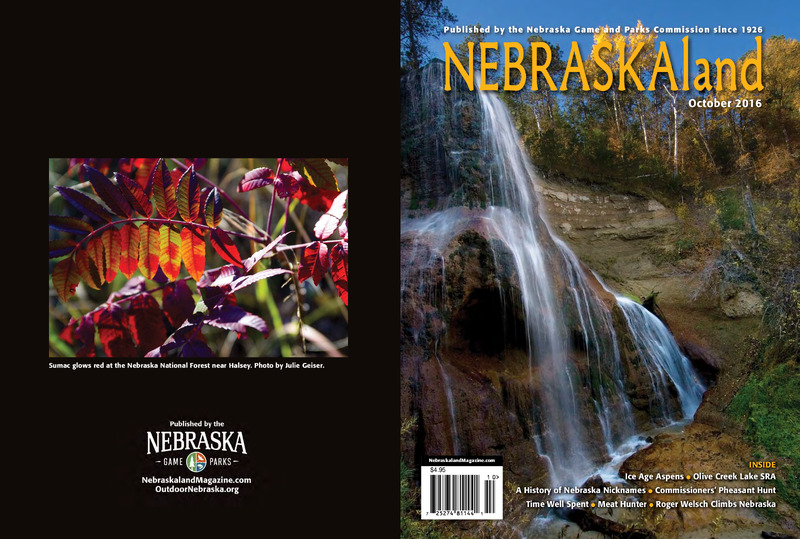
Sumac glows red at the Nebraska National Forest near Halsey. Photo by Julie Geiser.
NebraskalandMagazine.com
$4.95
INSIDE
Ice Age Aspens ● Olive Creek Lake SRA
A History of Nebraska Nicknames ● Commissioners’ Pheasant Hunt
Time Well Spent ● Meat Hunter ● Roger Welsch Climbs Nebraska
NEBRASKAland Magazine
Volume 94
●
No. 8
●
October 2016
F EAT U R ES . . .
24 Aspens – Ice Age Relicts in Nebraska
B E F
34 On Becoming a Meat Hunter
2
Y RIC OWLER
BY GERRY STEINAUER
36 Commissioners' Hunt
BY JENNY NGUYEN AND JULIE GEISER
42 Olive Creek Lake SRA
STORY AND PHOTOS BY ERIC FOWLER
48 Time Well Spent – What to Do in October
BY RENAE BLUM
50 Hunting Behind Hounds
BY JENNY NGUYEN
I N S I D E T H I S I S S U E ...
36
●
Mixed Bag – Southern Flying Squirrels, Travel to
Brownville, a Brief History of Nicknames, Stocking Up,
Heritage Days in Washington County, Non-toxic Shot for
Pheasants, Upcoming Events and much more................. 10
In the Field – Wandering Elk .................................... 60
Page 49 – Welsch Climbs Nebraska ............................ 62
Along the Road – Partnership Benefits .................... 65
Outdoor Update – Trail Cam Deer Gallery ...........68
Portraits from the Past............................................ 74
In the Kitchen – Crawfish Bisque ............................. 76
The Last Stop – Imperfection ................................... 78
O N TH E W EB . . .
24
●
50
●
WHEN YOU SEE THIS SYMBOL IN THE PAGES OF
N
NEBRASKALAND MAGAZINE, VISIT
NEBRASKALANDMAGAZINE.COM AND VIEW OUR INTERACTIVE
DIGITAL EDITION FOR MORE INFORMATION.
D
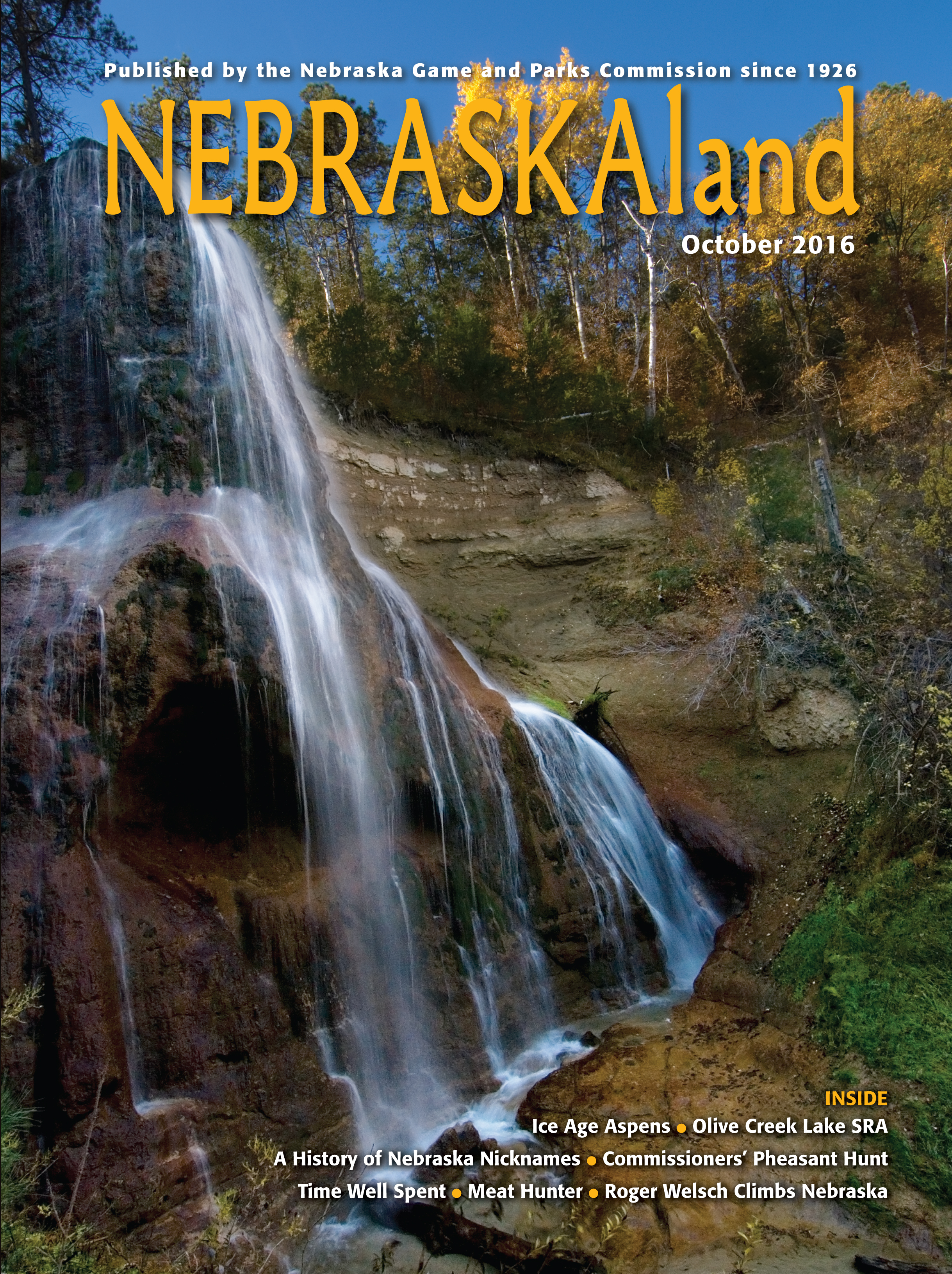
Cover: Aspens in their fall color tower above the falls at Smith
Falls State Park in Cherry County. Photo by Eric Fowler.
NEBRASKAland (VOL. 94 / NO. 8 ISSN 0028-1964) is published monthly, except
for the combined Jan./Feb. and Aug./Sept. issues, by the Nebraska Game and Parks
Commission, 2200 N. 33rd St., Lincoln, NE. Periodicals postage paid at Lincoln,
Nebraska, and additional mailing offices. POSTMASTER: Send address changes to
NEBRASKAland, P.O. Box 30370, Lincoln, NE 68503-0370.
2 NEBRASKAland • OCTOBER 2016
42
●
OCTOBER 2016 • NEBRASKAland 3
Outdoor Plates
Gaylan Abood’s administrative
assistant thought he hunted so much he
should have a plate that quantified it.
The Elkhorn man grew up in Lexington
shooting rabbits and squirrels with
his .22-cal. rifle and now hunts about
everything Nebraska has to offer,
including quail, pheasant, ducks, geese,
turkey, deer and varmints.
Joni Hart of Gillette, Wyoming, came across this "rainbow scarab," a colorful dung beetle, walking through her alfalfa field in
Crawford.
Ron Bilstein of Battle Creek submitted this trail camera photo of a tom turkey in
full strut.
Steve Kelsay of Auburn cut his teeth
on farm pond bass at a young age, but
later turned his attention to walleyes
and has since spent many days and
dollars chasing “Ole Marble Eyes” on
reservoirs in Nebraska and elsewhere.
Kathryn Katz sent us this image entitled "Friday Night Lights."
This photo was taken
in June near the MoPac
trailhead in Lancaster
County by Tony Rouse of
Lincoln.
Tim Roddy of Omaha started hunting
in his 20s and quickly became obsessed
with training his Labrador retrievers
and hunting pheasants and quail. He
now counts deer and turkey hunting
among his pursuits.
If you have a unique outdoor
message plate you would like to share,
or know someone who does, e-mail
a photo of it (high-resolution, JPEG
format only, please) to Eric.Fowler@
Nebraska.gov, along with your name,
hometown and a brief description of
the interests expressed on your license
plate.
4 NEBRASKAland • OCTOBER 2016
Richard Jones submitted this photo of NEBRASKAland's March 2015 cover.
OCTOBER 2016 • NEBRASKAland 5
"I enjoyed a nice outdoor
photography workshop led by
Eric Fowler from NEBRASKAland
Magazine in Lincoln. A
thunderstorm passed by during
the class. When the workshop
was over, I was treated to a
rainbow. I drove down the street
a few blocks to find a small field
with a rolled haystack for a nicer
foreground for the photo," said
George McCoy of Omaha.
Bruce Thiel captured this sunset photo at Holmes Lake in
Lancaster County.
Mike Benkis of Omaha photographed these kayakers at Zorinsky Lake.
6 NEBRASKAland • OCTOBER
R 2016
OCTOBER 2016 • NEBRASKAland 7
NEBRASKAland Magazine
COMMISSIONERS
CONSERVATION OFFICERS
Director Jim Douglas
Commissioners
Chairman - Mark Spurgin, Paxton
Vice Chairman - Rex Fisher, Omaha
2nd Vice Chairman - Dick Bell, Omaha
Dr. Kent Forney, Lincoln
Robert Allen, Eustis
Pat Berggren, Broken Bow
Mick Jensen, Blair
Norris Marshall, Kearney
Dan Kreitman, Wahoo
ADMINISTRATION (Lincoln)
Craig Stover (Administrator)
Duane Arp (Asst. Administrator)
Jeff Clauson (Asst. Administrator)
MAGAZINE STAFF
Colleen
Childers off G
Grand
C
ll
Child
d IIsland
l d took
k this
hi
photo of a bobwhite quail. "This guy stood
and posed for me for a good five minutes!"
Childers said.
Dan Swanson sent in this image of what he thinks is a bird or bat from a camera
in Box Butte County.
Statement of ownership and monthly circulation of
NEBRASKAland Magazine
Owner and publisher: Nebraska Game and Parks
Commission
Editor: Jeff Kurrus
Headquarters of Publisher and Publication:
2200 N. 33rd St., Lincoln, NE 68503
Stockholders, Bondholders, Mortgage and
Security Holders: None
Average number of copies
of each issue during
preceding 12 months
Single issue
nearest to
filing date
A. Total Copies Printed
(net press run) ........................ 21,368 ........... 21,424
B. Paid Circulation
1. Mail subscriptions ............... 18,163 ........... 18,047
3. Single-copy sales ................. 2,224 ............. 2,255
C. Total Paid Circulation.............. 20,398 ........... 20,313
D. Free Distribution
by Mail ......................................... 278 ................ 278
D. Free Distribution
Outside the Mail .......................... 406 ................ 406
E. Total Free Distribution ................. 684 ................ 689
F. Total Distribution...................... 21,082 ........... 21,002
G. Copies Not Distributed ................ 286 ................ 422
H. Total ........................................ 21,368 ........... 21,424
I. Percent Paid and/or
Requested Circulation ................96% ............... 96%
Send your comments to:
Jeff Kurrus, Editor
NEBRASKAland Magazine
P.O. Box 30370
Lincoln, NE 68503
or e-mail Jeff.Kurrus@Nebraska.gov
Please include your postal address and telephone number. Letters may be condensed
and edited. Photographs are also welcome.
In July, Tiara Brown of
Omaha snapped this photo
of a lone paddle boarder at
Zorinsky Lake at sunset.
8 NEBR
NEBRASKAland
N
NE
EBRAS
BRA
BR
AS
SKA
K la
land
land
d • OCTOBER
OCT
CTOB
OBER
OBER
ER 2016
2016
01
16
Any program that receives federal funding from the National Park
Service, or the United States Fish and Wildlife Service prohibits unlawful
discrimination on the basis of race, color, religion, age, gender, marital
status, national origin, age, disability or political affiliation. Any person
who believes he or she has been discriminated against in any program,
activity, facility, or service, should contact the Nebraska Game and
Parks Commission, Lincoln, NE 402-471-0641, the Equal Opportunity
Commission, Lincoln, NE 402-471-2024, TTY/TDD 402-471-4693;
United States Fish Wildlife Service, Civil Rights Coordinator, 4401
N. Fairfax Drive, Arlington, VA 22203; Director, Equal Opportunity
Program, U.S. Department of Interior, National Park Service, 1849 C
Street NW, Mail Code 0008, Washington, D.C. 20240-0001.
Communications Director Christy Rasmussen
Editor Jeff Kurrus
Art Director Tim Reigert
Associate Editor Jenny Nguyen
Regional Editors Eric Fowler, Julie Geiser,
Justin Haag
Contributing Editor Michael Forsberg
Regular Contributors Chris Helzer, Gerry
Steinauer
Photo Librarian Jaclyn Cruikshank Vogt
Circulation Donna Robinson
For address changes and questions about
your subscription, e-mail donna.robinson@
nebraska.gov or call 800-632-5263
Advertising Sales Manager
For advertising information contact
Shane G. Gilster, 402-742-0125
Email: shanegilster@gmail.com
NEBRASKAland Magazine Copyright 2016, all rights reserved.
NEBRASKAland is available in audio from the Nebraska Library
Commission Talking Book and Braille Service, Suite 120, 1200 N St.,
Lincoln, NE 68508. 800-742-7691. NEBRASKAland Magazine and the
Nebraska Game and Parks Commission reserve the right to reject any
advertising not in keeping with the agency mission.
Rates: $18 for one year; $33 for two years; $44 for three years. Nebraska
recipients must add appropriate sales tax. To subscribe call
1-800-NEBLAND (632-5263), or go online to: NebraskalandMagazine.
com.
COMMISSION
C
CO
COM
OM
MMIS
MISSIO
S NO
OFFICES
FFICES
FF
FFI
CES
S
Headquarters/Southeast District Office
2200 N. 33rd Street Lincoln, NE 68503
Phone 402-471-0641
Northeast District Office
2201 N. 13th St. Norfolk, NE 68701
Phone 402-370-3374
Southwest District Office
301 E. State Farm Rd. North Platte, NE 69101
Phone 308-535-8025
Northwest District Office
East Hwy. 2, Box 725 Alliance, NE 69301
Phone 308-763-2940
Bassett Office
524 Panzer St., Box 508 Bassett, NE 68714
Phone 402-684-2921
Kearney Office
1617 First Ave. Kearney, NE 68847
Phone 308-865-5310
Ak-Sar-Ben Aquarium
21502 W. Highway 31 Gretna, NE 68028
Phone 402-332-3901
Omaha Office
8495 Frederick Street, Omaha, NE 68124
Phone 402-595-2144
402-471-5531
402-471-5531
402-471-5531
NORTHWEST (Includes counties covered)
Jim Zimmerman (District Supt.)
308-641-6138
Sean McKeehan
(Cheyenne, Morrill, Box Butte)
308-279-9133
Scott Brandt
(Kimball, Banner, Scotts Bluff)
308-631-0663
308-760-3647
Greg Hesse (Sheridan, Dawes)
308-430-0572
Dan Kling (Sioux, Dawes)
Terry Brentzel (Deuel, Garden, Grant) 308-458-7650
402-389-0444
Frank Miller (Cherry, Hooker)
NORTHEAST (Includes counties covered)
Tom Zimmer (District Supt.)
402-649-8053
402-760-0712
Dale Davis (Keya Paha, Brown, Rock)
402-340-3981
Jonathan Andreasen (Holt, Boyd)
Mitch Johnson (Knox, Antelope, Pierce) 402-613-8612
402-762-5022
Jeff Jones (Knox, Cedar)
Alex Thomas
(Dixon, Dakota, N 1/2 Thurston)
402-241-7615
Jon Reeves
(S 1/2 Thurston, Burt, Washington)
402-889-8508
402-719-1108
Dan Roberts (Dodge, Colfax)
Cory Krause
(Cuming, Wayne, Stanton, Dodge)
402-380-6410
Steve Oberg
(Colfax, Platte, Madison, Stanton)
402-910-3366
Randy Pomplun
(Nance, Greeley, Wheeler, Boone)
308-550-0489
308-730-7050
Doug Pollard (Loup, Garfield, Valley)
SOUTHWEST (Includes counties covered)
Roger Thompson (District Supt.)
308-530-3097
308-202-0819
Matt Brandt (Sherman, Howard)
308-380-7331
Tim Williams (Hall, Hamilton, Merrick)
Pat George
(Clay, Adams, Nuckolls, Webster)
402-705-9989
308-920-0367
Rich Routh (Franklin, Harlan, Phelps)
Matt Andrews
(Gosper, Furnas, Frontier, Red Willow)
308-746-2418
Andrew Heyer (Dawson, Gosper, Phelps) 402-613-2241
Brian Piernicky
(Red Willow, Frontier, Hayes, Hitchcock)
308-340-6627
308-289-0427
Nicholas Fix (Keith, Perkins)
308-289-1169
Bryce Streger (Keith, Arthur)
Brandon O’Neal
(Lincoln, McPherson, Logan)
308-530-3157
Alex Hasenauer
(Lincoln, McPherson, Logan)
308-660-4671
308-440-3847
Dale Johnson (Kearney, Buffalo)
308-529-8146
Mike Thome (Dawson)
Ray Dierking (Custer, Thomas, Blaine) 308-870-0322
SOUTHEAST (Includes counties covered)
Levi Krause (District Supt.)
402-949-0593
402-619-1355
Rich Berggren (Douglas)
402-616-5961
Dan Evasco (Sarpy)
402-210-0888
Heath Packett (Cass)
402-209-1506
Russell Mort (Otoe, Johnson)
William Krause
(Nemaha, Richardson, Pawnee)
402-274-8063
402-806-9084
Dan Zuehlke (Gage, Saline)
402-890-6463
Dina Barta (Lancaster)
402-890-6465
Doug Kramer (Lancaster)
402-937-3422
Dudley Sorensen (Lancaster, York)
402-613-2312
Travis Shepler (Lancaster)
402-890-7140
Stacey Lewton (Lancaster, Seward)
402-443-6392
Mike Luben (Saunders, Butler, Polk)
Nebraska Wildlife Crimestoppers
1-800-742-7627
OCTOBER 2016 • NEBRASKAland 9
Southern Flying Squirrel
PHOTO BY JOEL SARTORE
A Mammal Brief
By Lindsay Rogers,
Outdoor Education Specialist
Glaucomys Volans
Contrary to their name, these
small mammals cannot fly but
rather glide between trees.
Found in hardwood forests –
like those along the Missouri
River in extreme southeastern
Nebraska – flying squirrels scamper
to the top of a tall tree and leap then
glide to the next tree. They are nocturnal
creatures and spend much of their day sleeping in cavities and nest boxes among the trees. Like most tree
squirrels, flying squirrels are omnivores that eat nuts, seeds berries, insects and occasionally eggs.
Southern flying squirrels are excellent “flyers” due to a large, fur-covered membrane which extends
between their forelimbs and hind limbs and serves as their "wings." They also have a large flat tail which
serves as a “rudder.” When they jump from the top of a tree, they extend their limbs to create a parachute,
thus the gliding rather than flying.
Young flying squirrels are born naked and remain under their mother’s care for 65 days – an unusually
long time for a mammal of this size. Young do not become entirely independent for four months and may
stay as a family unit throughout the winter months. ■
10 NEBRASKAland • OCTOBER 2016
OCTOBER 2016 • NEBRASKAland 11
Travelogue Sponsors
By Hannah Hundley, Nebraska Tourism Commission
Brownville/Indian Cave
is an eerie current making its way down the Missouri
h
here
It’s rising up along the banks of Nebraska’s eastern
R
River.
and trickling into the towns and woodlands of the
b
border
One of these towns is the beloved Brownville, Nebraska.
area O
area.
Brownville has embraced its historic duty by preserving many
of its original homes and buildings that were constructed when
it was just an old port town in the mid-1800s. These include the
town’s Carriage House and the Train Depot. One of Brownsville's
eight museums is the notable Captain Bailey House. There are
e it
rumors that the doors in the house will not stay closed becaus
to be poisoned by a
said
was
who
,
captain
War
is haunted by the ghost of the old Civil
jealous neighbor.
was sealed on
If the restless spirit of Captain Bailey, or any others whose ill fate
travelers
een,
Hallow
of
wake
the
in
handle
this town’s soil, become too much to
er
discov
will
visitors
Here,
Park.
State
can drive 16 miles south to Indian Cave
s.
carving
an
Americ
Native
toric
prehis
ious
unusual geological features and myster
t
vibran
of
show
ate
elabor
an
on
puts
it
as
n
The park is most remarkable in autum
d
Haunte
annual
park’s
the
enjoy
friends
and
reds, oranges and yellows. Families
as hayrack
Hollow each October, which includes light-hearted activities such
games.
and
carving
in
pumpk
t,
contes
rides, a spooky campsite decorating
d the
beyon
go
tions
destina
these
Scarecrows and caramel apples aside,
art
many
its
with
ity
creativ
fosters
ville
typical traditions of the season. Brown
plays
four
on
puts
r
Theate
Village
ville
galleries and bookstores. The Brown
. As for the wine
and one musical every year for those in need of a little drama
four acres
on
sits
Winery
&
rd
connoisseurs, Whiskey Run Creek Vineya
for
makes
barn
ar-old
110-ye
rustic
right off the town’s main street. Their
Cave
Indian
s,
seeker
ure
advent
r
the perfect tasting room. For the outdoo
ack rides to
State Park has everything from hiking and biking trails to horseb
winter.
the
cross-country skiing and sledding in
With the rush of a scary story in one
hand, and the serenity of falling leaves in
the other, it’s no wonder visitors are drawn to this area. ■
The Captain Bailey House
Brownville
Whiskey R
un Creek
Halloween at Indian Cave
campgrounds
ve at Park
i
r
d
r
o
l
o
Fall can Cave State
Indi
12 NEBRASKAland • OCTOBER 2016
OCTOBER 2016 • NEBRASKAland 13
A Brief History
Nebraska Nicknames
By James E. Potter, Nebraska State Historical Society
T
14 NEBRASKAland • OCTOBER 2016
The Lincoln Tree Planters minor league baseball team in 1907. Below, cartoon depicting Lincoln sportswriter “Cy” Sherman
reflecting on Nebraska nicknames, from the 1939 Almanac for Nebraskans published by the Federal Writers Project.
account, the man responded, “Oh, everything is gone up
there. The grasshoppers have eaten the grain up, the potato
bugs ate the ‘taters all up, and now the inhabitants are
eating the bugs to keep alive.” Some newspaperman heard
the comment and published it as a joke. Other sources
attribute the nickname to the Nighthawk, a bird with a
voracious appetite for bugs.
MacMurphy argued that the Territorial Pioneers and other
groups should promote “Tree Planters” as the official state
nickname “and say goodbye to the Bug-eaters forever.”
Their efforts succeeded when the legislature, on April 4,
1895, passed a resolution declaring Nebraska “The Tree
Planter State” in honor of its role as the originator of Arbor
Day. Nevertheless, the University of Nebraska football team
used the “bug eater”
nickname until about
1900 when Lincoln
sportswriter Charles H.
“Cy” Sherman started
referring to the team
as “the Cornhuskers,”
a name that quickly
caught on. At that time
harvesting corn by hand,
“corn husking,” was a
central feature of Nebraska life;
lif today
d it
i is
i a quaint
i andd
dimly-remembered remnant of our agricultural past. ■
NSHS 7294-7017
7294
729
4 7017
4-7017
4-70
he selection in 2005 of a final design for the Nebraska
quarter, winnowed from thousands of suggestions
Nebraskans submitted, reminded us of just how seriously
we take the symbols and slogans that represent our state
to outsiders. Do we want to be remembered for some unique
physical landmark, such as Chimney Rock (which ended
up being chosen for the quarter), or for some historical
milestone, such as the first homestead in the United States
or as the home of Arbor Day? Perhaps we’d like to call
attention to our political innovations, such as the unicameral
legislature or our publicly-owned power system. Is being
recognized primarily as a college football powerhouse a plus
or minus? Should we present ourselves as looking back into
the past, or forward into the future? Similar issues come up
each time our license plates are redesigned.
In Nebraska’s early years, it had to overcome the label
assigned by the early explorers: “The Great American
Desert.” It soon became apparent that this perception was
faulty but even now, we who live here know that not every
part of Nebraska is suited by climate or landscape for
agriculture, particularly without irrigation. And a New Yorker
driving through the Sandhills might think the "desert" label
still applies, though we know the region as the world’s best
cattle country. We also realize that Nebraska is not entirely
flat, but tell that to travelers who never leave I-80.
Nicknames have often revealed how Nebraskans perceived
themselves, or were perceived by others. We have been
blessed (or cursed) with various nicknames, including “Bug
Eaters,” “Tree Planters” and “Cornhuskers.” Nebraska has
had two official state names: “The Tree Planter State” (18951945) and “The Cornhusker State” (1945-present). From
1956 through 1965, the license plate carried the motto, “The
Beef State,” but it was never an official state name by act of
the legislature.
Apparently “Squatters” was the earliest nickname applied
to Nebraskans, according to a July 21, 1860, article in the
Omaha Weekly Nebraskian. This term undoubtedly surfaced
because many early Nebraska settlers moved onto their
claims before the land had been surveyed. Although being
called squatters was not very flattering or inspiring, other
state nicknames of that era arguably were worse. How
about the South Carolina Weasels, the Illinois Suckers, the
Alabama Lizards, the Georgia Buzzards, the Missouri Pukes
or the Mississippi Tadpoles? Several state nicknames in 1860
were the same as today, for example, the Wisconsin Badgers,
Michigan Wolverines and Iowa Hawkeyes.
By the later years of the 19th century, “Bug Eaters” had
replaced “Squatters” as the unofficial Nebraska nickname.
According to John A. MacMurphy, secretary of the Nebraska
Territorial Pioneers Association writing in November 1894,
the bug eater appellation may have originated during the
grasshopper invasions of the 1870s. An easterner came to
Nebraska to visit relatives and, on his return home, was
asked about conditions here. According to MacMurphy’s
NSHS RG2
RG2158-2080
RG2158
158-2080
158158
2080
NSHS RG2
RG2758-103-3
RG2758
758-103
758758
103-3
103103
3
The 1900 University of Nebraska football team. No longer the Bugeaters, this was the first NU team to be called Cornhuskers.
James E. Potter (1945-2016) was the senior research
historian at the Nebraska State Historical Society.
OCTOBER 2016 • NEBRASKAland 15
Stocking Up
By Paula Hoppe, Certified Master Naturalist
The harvest is upon us, and the combines are out in the
field bringing in the ripe crops. Gardens are bursting with
produce that we preserve for the coming winter. Wildlife are
also taking advantage of this season of bounty, preparing for
the leaner days of winter or their coming migration. They
spend more time foraging afield, and the open canopies and
farmland of fall afford us a clearer look at their habits.
• Fall wildlife viewing can be as easy as looking out
your window at the backyard bird feeder. Birds increase
consumption as winter approaches, and many of the extra
seeds are taken and hidden in “caches” under bark, in needle
clusters or even in man-made crevices. Blue jays are able to
carry food in their throat in an area called the “gular pouch."
With 2 or 3 in the pouch, one in the mouth, and another in the
tip of the beak, they may leave the feeder with 5 or 6 seeds
which they secrete away.
• Eastern fox squirrels are
busy gathering and storing nuts,
but you also may observe them
gathering leaves. They prefer
to nest in tree cavities and will
use the leaves to line the nest
in preparation for the winter
weather to come. If suitable
cavities are not available, squirrels may
also construct nests (called “dreys”) made
entirely of leaves, which can be seen in
the tops of trees as the fall progresses.
• The white-footed mouse has small
cheek pouches that can hold close to a
teaspoon of food. Prairie voles stockpile as
much as two gallons of tubers and roots at
a time in underground chambers near
their nests.
• Look for deer as they are out
browsing in the fields and along
shelterbelts at dawn and dusk. Acorns
are plentiful in the fall, and a favorite,
but the main source of food for deer
are leaves, twigs and fruits of shrubs
and trees.
• Beavers are busy stockpiling
branches for the coming winter, and
the well-worn paths to and from their
lodges are easily observed.
• Many animals migrate southward
as winter approaches, and increased
eating is important to sustain them
on their journey. Though we often
associate migratory behavior with
birds, migrant species are diverse,
and include some bats, dragonflies, monarch butterflies and
others.
With cooler weather and fewer insects to deal with, fall is
an amazing time to get outside and watch as the wildlife of
Nebraska prepare for the coming of winter. ■
16 NEBRASKAland • OCTOBER 2016
OCTOBER 2016 • NEBRASKAland 17
Heritage Days
Celebration Coming to
Washington County
Cannon firing at Fort Atkinson.
PHOTO COURTESY BOBBIJANDERSON.COM
By Renae Blum
Washington County – just north of Omaha – has
much to be proud of. First, it has a rich history.
Early settlers at Fort Atkinson established
Nebraska’s first school, farm, hospital and library
for the soldiers and their families. The fort itself
played a major role in regulating the western
fur trade. Then there are the people – strong, warm, friendly
and ready to come together to make something great happen.
All of that will be on display during the Washington
County Historical Association’s inaugural Heritage Days
celebration on Oct. 1 and 2, located at Fort Atkinson and in
neighboring Fort Calhoun. Produced in partnership with the
Nebraska Game and Parks Commission and many others,
Heritage Days will be a weekend filled with food, music,
activities for all ages, ways to see and experience the area’s
early history, and plenty of shows – tractors, quilts, antiques
and crafts. Expect hands-on activities, as well.
“We want to make this event as interactive as possible,”
said organizer Pam Daly.
Early on Oct. 1, guests can take a hot air balloon ride
to see an aerial view of the path early settlers took as they
followed the footsteps of Lewis and Clark. Living history
interpreter Wade Davis will give a presentation using clips
from the 2015 Oscar-winning movie, The Revenant, about
fur trader Hugh Glass, who spent time at Fort Atkinson.
Other highlights include demonstrations of rope making,
candle making, and muzzleloading; a presentation on early
meat curing; and performances by the Rivertown String
Band.
Activities will take place at both Fort Calhoun and Fort
Atkinson State Historical Park, with trolleys shuttling
visitors from place to place.
Daly is amazed at how the county and community have
rallied together to create what promises to be a signature
attraction for this part of the state.
“It all goes back to the original pioneer spirit echoing
around here,” she said. “That was how people survived, in
joining together as a community to create something. We
want to show people what that looks like.”
To see a full list of the weekend’s events, visit
wcHeritageDays.org.
Getting Jiggy
With It
By Daryl Bauer
18 NEBRASKAland • OCTOBER 2016
PHOTO BY DARYL BAUER
As water cools in the fall, baitfish in Nebraska
reservoirs school up and begin to move toward
deeper waters. Warm afternoons can still pull baitfish
shallow, but the general trend is for those baitfish
to move toward more stable, deeper waters as fall
progresses. A variety of big predator fish follow
them, and if you are an angler, you want to be there
too.
Some of those baitfish, especially gizzard shad,
become stressed and begin to die as the water cools.
Vertical-jigging with a variety of artificial baits is
an excellent imitation of those stressed, fluttering
baitfish upon which walleyes, northern pike, channel
The author with a channel catfish from Merritt Reservoir caught while
vertical jigging.
catfish, wipers and other predator fish gorge.
The key is to jig as vertically as possible below the
boat. Experiment with jigging strokes ranging from only
stroke a fish will just be there.
a few inches to several feet. The flutter as the bait falls is
A variety of jigging spoons have been favorites for vertical
usually what triggers fish to bite, so allow the bait to fall
jigging, but blade baits can be equally effective. Do not be
freely while still staying in contact with it. When done right,
afraid to experiment with rattle baits or vertical jigging baits
strikes can be detected, but at times on the next upward jig
used for ice-fishing. ■
OCTOBER 2016 • NEBRASKAland 19
Non-toxic Shot for Pheasants
By Jarrod Spilger
S
20 NEBRASKAland • OCTOBER 2016
PHOTO BY JARROD SPILGER
ome of Nebraska’s best pheasant habitat is located on waterfowl
production areas (WPAs) and wildlife management areas (WMAs)
which require the use of non-toxic shot.
Steel duck loads will get the job done, but consider downsizing a bit
for better results on roosters. Smaller shot sizes, like number 3s, 4s or 5s
provide greater pattern density than larger No. 2 shot. Likewise, 3-inch
magnums are fine for waterfowl, but a 2¾-inch shell typically holds
enough pellets to effectively bag pheasants – with significantly less
recoil.
While regular round steel shot used to be the only game in town,
pheasant hunters today thankfully have more options, including a trio of
non-toxic loads designed specifically for gunning roosters.
The first is Federal Prairie Storm FS Steel. It has a 50/50 payload
of round steel and banded Flitestopper steel pellets for improved
penetration on heavily feathered birds, like pheasants. The second is
Winchester Blind Side Pheasant, which has a full payload of cubedshaped Hex steel shot for increased knockdown power.
Finally, there’s Hevi-Metal Pheasant, which has a 50/50 payload of
regular steel and tungsten-based Hevi-Shot pellets. This might be the
ultimate option, since the Hevi-Shot component (being denser than steel or even lead) provides maximum penetration and
energy, even at a distance.
All three loads are priced similarly and have high velocities ranging from 1,400 to 1,600 feet per second.
Cornfields and CRP tracts may be the obvious places for finding pheasants, but don’t overlook those cattail-rimmed
wetlands and the grassy uplands surrounding them on WPAs and WMAs in the non-toxic zone. ■
Ponca State Park's Hallowfest is a
popular event in northeastern Nebraska.
by Jerry Kane
Contact the Nebraska Game and
Parks Commission at 402-471-0641
or visit outdoornebraska.org for more
information. Visit huntsafenebraska.
org for a list of hunter education
classes and boatsafenebraska.org for
a list of boating safety classes.
September 30 - October 2
Autumn Harvest Art Show
Eugene T. Mahoney State Park (SP),
Ashland
September 30 - October 2
Becoming an Outdoors-Woman
Workshop Ponca SP, Ponca
October 1-31
Paddlefish Snagging season in
October 8
Duck and Coot Hunting seasons
specific area of Missouri River
open in Zones 2 and 4
October 2
Muzzleloader Antelope Hunting
October 8
Fall Harvest Game Day Fort Kearny
season closes
State Recreation Area (SRA), Kearney
October 2
Shootout at Salt Creek Nebraska
October 8
Halloween is Brewing Eugene T.
Game and Parks Outdoor Education
Center, Lincoln
Mahoney SP, Ashland
October 2, 9, 16, 23
Living History Arbor Lodge SHP,
Nebraska City
October 3
Haunted Hayrack Ride registration
begins, Ponca SP, Ponca
October 3, 10, 17, 24
Outdoor Skills Club Nebraska Game
October 1
and Parks Outdoor Education Center,
Crow Hunting season opens statewide Lincoln
October 8-9
Youth Waterfowl Hunting season in
Zone 1
October 8-23
Firearm Antelope Hunting season in
specific units
Nebraska Game and Parks Outdoor
Education Center, Lincoln
October 1-2
Youth Waterfowl Hunting season in
Zones 2 and 4
Nebraska Game and Parks Outdoor
Education Center, Lincoln
October 5, 12, 19, 26
Explore Archery Nebraska Game
and Parks Outdoor Education Center,
Lincoln
October 6, 13, 20
Explore Archery Nebraska Game
October 22-23
Youth Waterfowl Hunting season in
October 10
Columbus Day Commission offices
closed; Nebraska Game and Parks
Outdoor Education Center is open
October 11
Upland Bird Hunting Workshop
Nebraska Game and Parks Outdoor
Education Center, Lincoln
and Parks Outdoor Education Center,
Lincoln
Atkinson State
Historical
Park (SHP),
Fort
Calhoun
October 7
Ogallala
Trick or Treat at the Town Indian Cave
October 15
SP, Shubert
Duck and Coot Hunting seasons
October 7, 8, 14, 15
open in Zone 1
Mansion Candlelight Tour Buffalo Bill
October
15
Ranch SHP, North Platte
Pink Pumpkin Walk Indian Cave SP,
October 7, 14, 21
Shubert
Families on Target Nebraska Game
October 15
and Parks Outdoor Education Center,
Jack-O-Lantern Junk and Craft
Lincoln
Market Indian Cave SP, Shubert
October 7, 14, 21, 28
October 15
Explore Gun Safety Nebraska
Trick or Treat By the Buses Indian
Game and Parks Outdoor
Education Center, Lincoln
October 8
Dark Goose Hunting season
opens in North Central Unit
October 8
Light Goose Hunting
October 12, 26
Bird Walk Lake McConaughy SRA,
Cave SP, Shubert
October 15
Trunk or Treat Calamus Reservoir SRA,
Burwell
October 15
Living History Rock Creek Station
regular season opens
statewide
SHP, Fairbury
season opens statewide
Outdoor Education Center, Lincoln
October 16
Clear Shot Firearms Concealed
October 8
White-fronted Goose Hunting Carry Class Nebraska Game and Parks
22 NEBRASKAland • OCTOBER 2016
October 22
Pumpkin Carvers Calamus Reservoir
October 8, 15
Hallowfest Ponca SP, Ponca
October 1-2
Living History Weekend Fort
Kayaking a pond
at a Becoming an
Outdoors-Woman
workshop near
Halsey.
Nebraska Game and
Parks Board of
Commissioners meeting, Ponca
SP, Ponca
SRA, Burwell
October 8, 15, 22
October 4, 11, 18, 25
Advance Tickets Sales Begin for
Best Shots Rifle Marksmanship for Halloween Decorating and Costume
Haunted Hollow, Indian Cave SP, Shubert Ages 10-16 Nebraska Game and Parks Contests Indian Cave SP, Shubert
Outdoor Education Center, Lincoln
October 1
October 9
Archery Fun Shoot Nebraska Game
Rendezvous and Muzzleloader
October 4, 18
and Parks Outdoor Education Center,
Women’s Introduction to Handguns Sight-In Platte River SP, Louisville
October 1
Critter Corner: Nocturnal Animals
October 21
October 8, 14, 15, 21, 22
Haunted Hollow Indian Cave SP, Shubert
October 1
Lincoln
NEBRASKAland
and
Visitor
Zone 3
October 22-23
DeSoto October Muzzleloader Deer
Hunting season
October 22-23
Youth Pheasant, Quail and Partridge
Hunting season statewide
October 23
Archery and Firearm Bull Elk Hunting
seasons close
October 23
Antlerless Elk Hunting private land and
public land seasons close
October 25
Deer Hunting Workshop
Nebraska Game and Parks
Outdoor Education Center,
Lincoln
October 26
Deer Hunting Workshop
October 29
Pheasant, Quail and Partridge
Hunting seasons open statewide
October 29
Haunted Halloween at the Hollow
Ash Hollow SHP, Lewellen
October 30
Dove (all species) Hunting season
closes
October 31
Eurasian Collared-dove Only
Hunting season opens
October 31
Raccoon and Virginia Opossum
Hunting seasons close
October 31
Dark Goose Hunting season
opens in East, Platte River,
Panhandle and Niobrara
Units
October 31
Bullfrog season
closes
Ak-Sar-Ben Aquarium, Gretna
October 27
Duck and Coot Hunting
seasons open in Zone 3
October 27
Deer Hunting
Workshop
Chadron State
College, Chadron
October 27
Dutch Oven Cooking Workshop
Nebraska Game and Parks Outdoor
Education Center, Lincoln
October 28-31
Camp & Treat Red Willow
Reservoir SRA, McCook
October 29
Haunted Halloween Hike Night
Windmill SRA, Gibbon
Pheasant hunting in Holt and
Antelope counties.
Last issue’s winner of
the Visitor drawing was
Janelle Downing of Norfolk,
Nebraska, who found the gypsy moth
on page 2.
Readers are encouraged to contact
NEBRASKAland within 10 days
after this issue’s publication with
the correct page number and name
of this issue’s “Visitor” – a critter
found in Nebraska. We will then
gather the correct entries and draw
one to win a NEBRASKAland mug.
To enter each month, write:
NEBRASKAland Visitor
2200 North 33rd Street,
Lincoln, NE 68503.
Or e-mail:
Tim.Reigert@Nebraska.gov
with “Visitor” in the subject line of
the message.
HINT: This issue’s visitor is not on
pages 4, 19, 23, 45, or 84.
The Gypsy moth (Lymantria
caterpillar
dispar) is an exotic, invasive
species that was first introduced
to the U.S. in 1869. A man
intentionally brought egg
masses to Massachusetts from
France and attempted to raise
the caterpillars in his backyard.
But some escaped and became
established in the neighborhood.
Although they are not known to
occur in Nebraska, they now
infest 20 states in the northeast
infe
aand Midwest. Male moths are
brown with feathery
antennae, while females
female are white and unable to
have five pairs of
fly. Caterpillars
C
blue dots
d and six pairs of red dots
down their back. Caterpillars feed
on the foliage of more than 300
species of plants, but especially love
oaks. This feeding defoliates the
oaks
trees,
and multiple years of
t
infestations
can result in
male
tree death.
Special thanks
t
to Julie Van
Meter, State
Entomologist,
S
Nebraska Department of
Agriculture.
OCTOBER 2016 • NEBRASKAland 23
Aspens
Ice Age Relicts in Nebraska
By Eric Fowler
I
in diameter, compared to 10 inches for
bigtooth. The leaves of mature trees
are nearly round with toothed edges.
Larger teeth on bigtooth leaves give
that species its name. The propensity
of quaking aspen leaves to flutter and
hum in even the slightest breeze are
the basis for that species’ name. The
thin bark of quaking aspen is white
or shades of white mixed with gray,
green or yellow, with distinctive black
knots and horizontal
scars. Bigtooth bark is
similar except for its
olive-green hue. As
trees mature, the bark
thickens, especially at
the base, and turns gray
and rough with vertical
grooves, often leaving
only the upper reaches
of the trunk and small
branches white and
smooth.
Aspens are either
male or female, and
produce seed heads
called catkins that are
pollinated by the wind.
In regions where both
species are found,
they are known to
hybridize. But despite
being prolific seed
producers, the species
rarely grows from them.
Aspens are a clonal
species, sending up
sprouts or suckers from
a shallow root system
Two species of aspen
that develop into stems
trees, members of the
Dew glistens on aspen leaves at Smith Falls State Park near Valentine.
or trees. These stems
deciduous willow or
remain connected by the
poplar family, are found
roots, and entire aspen stands can be
Aspens are fast-growing, with both
in North America, growing mostly in
made up of a single clone. The largest
dry, colder regions with cool summers. species typically reaching heights of
known clone of quaking aspens is also
60 to 80 feet. Quaking aspens have
The quaking aspen is the most widely
believed to be the largest organism
distributed tree on the continent,
larger trunks, measuring up to 2½ feet
f there were a hall of fame for
fall color, aspen trees would have
been inducted on the first ballot.
The tree’s ability to turn entire
mountainsides shades of yellow, orange
and red draws throngs of people to
places where the trees grow, especially
in the Mountain West.
While not nearly at the same scale,
you can see the vivid golden hues
of aspens, contrasted against their
brilliant white bark,
each fall without leaving
Nebraska. That fact
comes as a surprise
to many who assume
the patches of yellow
leaves they see sparkling
in the forest in the
fall are simply ash or
cottonwoods or other
more common trees
completing their annual
cycle. These small stands
are scattered across
northern Nebraska, some
in seemingly unlikely
places. There were once
more, many more. Those
that remain are relicts
that have persisted since
the last Ice Age, hanging
on as the climate in
Nebraska changed.
growing throughout Canada, in the
northeastern United States from the
Dakotas east as far south as Indiana
and Nebraska, in the Mountain West,
mostly at higher elevations, and in
other places like the Black Hills. The
bigtooth aspen is found throughout
southeastern Canada and the
northeastern U.S. No native stands are
known to grow in Nebraska, and the
closest populations are in central Iowa.
24 NEBRASKAland • OCTOBER 2016
PHOTOS BY ERIC FOWLER
Aspen
Biology
Golden aspen leaves
glow in the morning
sun at Smith Falls
State Park. The park
and neighboring land
are home to 12 stands
of a hybrid between
bigtooth and quaking
aspen.
OCTOBER 2016 • NEBRASKAland 25
Landscaping with Aspens
spen trees can provide a colorful addition to the landscape around a
home or acreage, but they aren’t right for every yard. Where they do fit,
one variety with roots in Nebraska is proving to be a better choice for
the climate here, throughout the Great Plains and beyond than others with
origins in the mountains.
Because of the way aspens grow, sending out roots laterally that then
send up shoots vertically, planting one tree can result in many. For that
reason, Justin Evertson, assistant director of the Nebraska Statewide
Arboretum, said he is hesitant to recommend them as an ornamental
landscape tree. “I’ve heard more than one person cursing all of these root
sprouts coming up everywhere,” he said. They are better suited for a park,
school or acreage, Evertson said, where sprouts can be left to form a
stand.
A good variety to plant in Nebraska is Prairie Gold TM Aspen, which
was first propagated in the 1970s from cuttings taken from a relict quaking
aspen stand near Leigh by the late Allen Wilke, a nurseryman from
Columbus. Todd Faller of Faller Nursery in York and others received some
of those cuttings from Wilke, and raised and sold them. While a member
of the Nebraska Statewide Arboretum board, Faller worked with J. Frank
Schmidt & Son Co., a national wholesale nursery in Oregon, to trademark
the variety and introduce it in the 2008 Great Plants for the Great Plains
program. Schmidt now has exclusive rights to produce Prairie Gold, and
returns a portion of the sale of every tree to the Nebraska Statewide
Arboretum.
The tree, which can grow 30 to 40 feet high and 15 feet wide, can be
planted in anything from moist sandy soil to shallow rocky soils to clay.
It appears to handle heat and humidity better than other varieties, and
is also more resistant to drought and disease. Faller said he’s sold trees
to homeowners in Oklahoma, Texas, Arkansas, Alabama, Kentucky and
Georgia, and they appear to be doing well. “What has been surprising is
we’ve put it in areas where people want to have aspen, but they’ve never
dreamt of growing aspen,” Faller said. He’s heard it is even doing better on
the Colorado Front Range than aspens from that state.
Even with the native varieties, aspens used in the landscape grow better
in the drier climate of western Nebraska. ■
A
PHOTO BY JUSTIN HAAG
A stand of quaking aspen grows beneath a cliff along West Ash Creek in the Nebraska National Forest near Crawford.
26 NEBRASKAland • OCTOBER 2016
in moist soils, and require plenty of
sunshine. They readily colonize areas
disturbed by fire or other means. Those
same disturbances help maintain a
stand, which will respond with a flurry
of suckers, the strongest of which weed
out the others to become trees. While
aspens can dominate an area, they
are often replaced by shade-tolerant
conifers like pines, which eventually
will shade out the aspens.
Ice Out
Two million years ago, glaciers
covered the eastern quarter of
Nebraska, as evidenced by the boulders
that litter the countryside. But it was
the end of the last Ice Age and the
Pleistocene epoch to which Nebraska’s
aspens can be traced.
The Wisconsonian Glaciation, the
last advance of the Laurentide Ice
Sheet that began 85,000 years ago,
covered all of Canada and most of the
northern United States, barely crossing
Nebraska’s northeastern border.
Nebraska was a much colder place
then. Forests here, and in points as
far south as Texas, were dominated
by spruce and other species that now
comprise the boreal forest that spans
Canada and parts of the northeastern
U.S. When the glaciers began to retreat
about 12,000 to 15,000 years ago, the
climate warmed and dried, the boreal
forest species shifted northward, and
Nebraska’s landscape evolved into the
diverse mix of forest and prairie found
here today. But where boreal species
found refuge, they survived.
One such place is the Pine Ridge.
Large stands of quaking aspens were
once found in the rugged, forested
hills of northwestern Nebraska, finding
suitable growing conditions in the
deep, cool drainages. Periodic wildfires
kept ponderosa pines in check that
PHOTO BY ERIC FOWLER
in the world. Made up of 40,000
individual trees, Pando, Latin for “I
Spread,” covers about 106 acres on the
Fishlake National Forest in Utah and
weighs an estimated 13 million pounds.
While individual trees can live about
150 to 200 years, Pando is estimated
to be 80,000 years old. As older trees
die, they fall and make room for new
sprouts. The clonal growth makes it
difficult to contain or kill the tree,
which is considered a weed in some
portions of its range.
A pioneering, early-successional
species, aspens grow in a variety of
soils from sand to rock, doing best
Quaking aspen are among the many trees growing in the five-acre Earl G.
Maxwell Arboretum on the University of Nebraska-Lincoln East Campus.
OCTOBER 2016 • NEBRASKAland 27
and was stimulated and revealed by the
wildfire that burned through that area
in 2012.
The largest aspen stand in Nebraska
covers several acres of Nebraska
National Forest property near the
Hudson-Meng Research and Education
Center north of Crawford. That stand
has been fenced to protect it from
grazing cattle. With help from the
Rocky Mountain Elk Foundation, the
fenced area was recently expanded to
allow the clone to spread even farther.
State and federal foresters aren’t
certain of the status of most stands in
the Pine Ridge. “They could all stand
a little more aspen care,” said Fred
McCartney, a fuels reduction specialist
with the Nebraska Forest Service
in Chadron, who has helped a few
landowners with cost-share programs
to rejuvenate their stands and would
like to help with more.
The most visited native aspens in the
state grow in a mile-long stretch of the
Niobrara River in and around Smith
Falls State Park in Cherry County, a
segment that is part of the Niobrara
National Scenic River. A dozen stands
of these survivors, a unique hybrid
cross of quaking and bigtooth aspen,
grow in the cool, moist spring-branch
canyons on the south side of the river
alongside paper birch, another Ice Age
relict, ponderosa pines and burr oaks.
Some are on private land upriver from
the park, others downriver on The
Nature Conservancy’s Niobrara Valley
Preserve. The stands are in poor health,
suffering from encroachment and
shading by other trees, disease, insects,
browsing and warming temperatures.
Much work has been done during the
last decade to rejuvenate them, and
more will come. (See sidebar on Page
32-33.)
McIntosh collected leaves from the
Smith Falls aspens, as well as from
11 other stands across the state, one in
the Loess Hills at Stone State Park in
Sioux City, Iowa, and one in the Black
Hills, for genetic testing completed
by a U.S. Forest Service laboratory.
The DNA testing found that all of
the aspens at Smith Falls originated
from a single clone. More recent
samples collected for a University
of Minnesota study and subjected to
more in-depth tests found that there
are three genotypes found among the
12 stands, according to Nick Deacon,
a post-doctorate researcher leading the
study. From this, researchers speculate
that the original clone was separated
by erosion as the Niobrara Valley
deepened, and three remaining clones,
which have since been further divided,
have been around long enough to
develop their own characteristics.
Other scattered stands of quaking
aspen persist in places much less
hospitable to the species, leaving trees
that are much shorter and smaller than
those found elsewhere. One is found
on the Bessey Ranger District of the
PHOTOS BY ERIC FOWLER
A relict stand of quaking aspens grows on the edge of Dewey Marsh on the Valentine National Wildlife Refuge in the Sandhills.
would have outcompeted aspens for
sunlight. After settlement, with fires
controlled, pines expanded. In the
shade of those pines, cottonwood,
green ash, American elm, hackberry,
willow, boxelder and other deciduous
trees replaced aspens in the
creekbottoms. Where they weren’t
outcompeted by other trees, grazing
of suckers by cattle, deer and elk has
limited regeneration.
Today, scattered stands of aspens
are found throughout the Pine Ridge in
Sioux, Dawes and Sheridan counties.
Buffalo Bruce McIntosh, an ecologist
with the Western Nebraska Resources
Council, has been working for many
years to map and preserve aspens in
Nebraska. He believes there are about
40 native aspen stands in the region,
including one on land he manages in
West Ash Creek. Others are found on
public land in the Pine Ridge Ranger
District of the Nebraska National
Forest, in places like East Ash and
Bordeaux creeks. Still more are known
28 NEBRASKAland • OCTOBER 2016
to exist on private land.
There are also several stands of
aspens in the region that were planted
from cuttings taken from a native clone
on the Ponderosa Wildlife Management
Area (WMA) near Crawford. Lon
Lemmon, who spent 40 years as a
biologist with the Nebraska Game
and Parks Commission on the area
before retiring 10 years ago, grew
up on the area, where his father and
partner ran cattle before selling it to the
Commission in 1966. At that time, the
aspen stand, located in a draw in the
southern portion of the area, contained
only five or six mature trees. Lemmon
said once cattle were removed, a
flourish of suckers sprouted. In the
late 1960s and early 1970s, he and
others started digging them and moving
them to other locations on the Pine
Ridge in what he called a “seat of the
pants” operation. At least two of those
planted stands persist on the Ponderosa
WMA, one on Gilbert Baker WMA
north of Harrison and one on Metcalf
WMA north of Hay Springs. The
native stand has also spread from the
bottom of the draw more than 50 yards
up the north-facing slope, and now
contains numerous stems that cover
a half acre. “They can do it pretty
good if something don’t eat them up,”
Lemmon said.
Another planted stand is growing
on the banks of Soldier Creek on the
west edge of Fort Robinson State
Park. McIntosh and a team of college
students helped the Commission plant
about 300 aspens in the drainage
following the wildfire that burned
through the area in 1989. Only these
survived a flood that followed in 1991.
A small native stand is also found on
Gilbert Baker WMA, but is suffering
from encroachment by pines and other
trees. Greg Schenbeck, a biologist
with the Commission, said they are
making plans to thin competing trees
to rejuvenate the stand. At Metcalf,
Schenbeck said staff recently found
another aspen tree that may be native
Short, scrubby quaking aspens grow among soapweeds on a north-facing slope in the Sandhills on the Bessey Division of the
Nebraska National Forest near Halsey.
OCTOBER 2016 • NEBRASKAland 29
are now sold as Prairie Gold Aspen and
now grow in yards, parks and acreages
across the country (see sidebar on Page
27).
There are other odd aspen stands
in pastures in Cherry and Sheridan
counties. There are likely more on
private land in the Sandhills and Pine
Ridge and elsewhere that have gone
unnoticed or unreported.
“Each stand is unique and they’ve
evolved to fit the geology and
geography of the area,” McIntosh said.
Like most, Robert Kaul, Curator
and Research Professor in the botany
division at the University of Nebraska
State Museum, assumes that most of
Nebraska’s aspens are Ice Age relicts
that have “just hung on for about
10,000 years after the ice melted.” But
he also wonders if the stands scattered
in the Sandhills may have grown from
seeds that blew in during one of several
occasions during that period when the
dunes were actively shifting. “But you
know, nobody has any real data on
that. It’s just a guess,” Kaul said.
There may soon be some data to
back up the theory, at least for the
aspens at Smith Falls. Deacon said the
researchers involved in the University
of Minnesota study hope analysis of
cuttings taken from hybrid aspens at
Smith Falls and from bigtooth and
quaking aspen stands across Nebraska
as well as on the edges of their ranges
in South Dakota, Iowa, Minnesota
and Wisconsin will reveal when the
hybridization occurred, something that
is believed to have happened when the
species’ ranges overlapped during the
Ice Age.
Time Will Tell
How long Nebraska’s aspens will
persist is anyone’s guess. Across
the West, foresters have been noting
the decline of aspens for decades,
pointing to reduced fire frequency
and heavy browsing by elk, deer and
other large ungulates. Others say the
species expanded with the logging
that followed settlement and is
simply returning to its pre-settlement
level. In recent years, however, the
widespread, rapid dieback of aspens,
something foresters have dubbed
Sudden Aspen Decline, has taken
a larger toll. Foresters theorize that
(Left) A fallen aspen leaf rests on a rotting
log in a spring-branch canyon at Smith
Falls State Park. (Above) The white bark
of a quaking aspen growing near West
Ash Creek in the Pine Ridge carries black
scars from injuries.
widespread drought stressed trees,
making them vulnerable to pathogens
and insects. Affected stands don’t seem
to be regenerating through shoots like
healthy aspen clones normally do.
With warmer, dryer weather
predicted as climate change progresses,
some worry the die-off will continue
and worsen. The University of
Minnesota study is testing theories on
both aspen species and the Smith Falls
hybrid in their greenhouses in St. Paul.
“So the question is, are all of these
things just hanging on and maybe on
their way out, as some people think, as
the climate warms?” Kaul said.
Time will tell. But they are unique
enough that some will continue to
sustain the few stands there are in
Nebraska. And maybe, since they’ve
made it this far, they will continue to
provide a golden splash of color to the
landscape each fall. ■
OCTOBER 2016 • NEBRASKAland 31
PHOTO BY JUSTIN HAAG
PHOTO BY ERIC FOWLER
30 NEBRASKAland • OCTOBER 2016
Nebraska National Forest in Thomas
County near Halsey. The 94,000acre district is mostly Sandhills, but
contains the largest hand-planted forest
in the country. In the southwestern
corner of the forest, about 20 scrubby
aspens, none much more than 10 feet
tall or 6 inches in diameter, grow
on a north-facing dune. Cattle graze
the pasture, but there is regeneration
among the stand, with both suckers and
young trees present. A similar stand
grows on another north-facing slope on
private land west of the forest, but has
been is declining since deep ruts left
by grazing cattle severed the clones’
roots. Schenbeck stumbled on the stand
while conducting grouse research in
the 1980s. “I was really surprised,” he
said. “That’s the first one that I even
knew about in the Sandhills.” Cuttings
from one of these stands are believed
to have been used to start another near
the forest’s main campground.
On the Valentine National Wildlife
Refuge, there are two stands of aspens.
One grows on a flat right to the edge
of a marsh near Watts Lake, with two
thick stands of small, straight stems,
and some larger ones between, the
largest of which is about 20 feet tall.
The other grows at the base of a southfacing dune on the edge of the Dewey
Marsh, with about 80 trees, all 15 to 20
feet in height but of varying age.
Other stands of quaking aspens have
been recorded in the Nebraska State
Museum from Blaine, Colfax, Holt,
Richardson and Thurston counties. The
latter was collected in 1944 along a
stream that once appeared on maps as
Aspen Creek. None are believed to be
alive today, presumably lost to pressure
from other tree species and agriculture.
The stand in Colfax County grew
next to a spring-fed creek in a draw
near Leigh. In the 1970s, the late Allen
Wilke, a nurseryman from Columbus,
took cuttings from the stand, which
wasn’t far from the farm where he
grew up. His son, Evan, visited the
stand about 30 years ago. “The trees
were probably a foot in diameter and
40 feet tall,” he said. “There was a
grove of quite a few of them on the
east-facing bank of the ravine where
they didn’t get the hot afternoon
exposure.” A single standing trunk is
all that remains of the stand, but those
cuttings Wilke and others propagated
Aspens at Smith Falls
A
project
pr
rojec
ojec
oj
ect th
tthat
at b
at
began
egan
eg
an a
as
s an effort
eff
ffor
for
ortt to
to rrejuvenate
ejuv
ej
uven
ven
enat
ate
te an
a
and
nd
d
pres
ser
erve
v 1
ve
2 rrelict
elict stands of aspen trees in and
preserve
12
around Smith Falls State Park grew into something
much larger that improved forest and grassland
health throughout the park. It also spurred research
that can guide future management and is providing
interesting genetic background for these unique hybrids.
Nebraska Game and Parks Commission horticulturists
began recognizing the problem facing the aspens at Smith
Falls, a hybrid between quaking and bigtooth aspens, even
before the park opened in 1992. With natural fires controlled,
invasive eastern red cedars were spreading through the
forest understory and into adjacent grasslands, and in some
places ponderosa pines had become too dense. This was
the case not only in the park, but throughout the entire
Niobrara River Valley, 76 miles of which below Valentine was
designated in 1991 as a National Scenic River. The forest is
comprised mainly of pine and oak, but a 30-mile reach that
includes Smith Falls also includes stands of paper birch, a
relict of the boreal forest, one of six ecosystems that meet
here in what is considered a biological crossroads. Within
that reach, aspens are known to grow only within a onemile segment from just above the 200-acre park to the bend
below it.
Cedars and pines growing beneath and above the
aspens inhibited the growth and survival of suckers, limiting
g
regeneration
in the stands, most of which consist of onlyy
Many of the mature trees in aspen stands at Smith Falls State
Park are in poor health, losing canopy and dying.
32 NEBRASKAland • OCTOBER 2016
few old
old trees.
tree
tr
eess.
ee
s. Commission
Commiss
miss
mi
ssio
ion
io
on staff
staf
st
afff cleared
aff
clea
cl
eare
red
re
d cedars
ceda
ce
dars
da
rs from
fro
rom
m
a few
beneath some stands in the mid-1990s. A decade later, the
National Park Service took an interest in the aspens, and
a partnership between the agencies and others was born,
along with a plan to do more.
Starting in 2008, staff from both agencies, as well as
volunteers, used chainsaws to clear cedars and brush from
beneath the aspen stands on the park, as well as those on
adjacent land owned by The Nature Conservancy (TNC) and
by Fred Krzyzanowski, who leases the land for Smith Falls
State Park to the Commission.
Knowing the aspens and the rest of the forest would
benefit from a prescribed fire, the Commission sought and
received $60,000 in grants from the Nebraska Environmental
Trust, and additional funding from the Nebraska Forest
Service, to hire a contractor to thin unwanted trees that would
have made any burn unsafe. A skid-steer-mounted shear and
grinder cleared every cedar that could be reached in 2010
and 2011. Additional work was done by hand in places the
shear couldn’t reach. The work reduced forest density by 50
percent or more. After scratching burn plans for two years
because of weather that was either too dry or too wet, a TNC
crew was finally able to burn the 65 acres that had been
thinned in Smith Falls and another 3 miles of their Niobrara
Valley Preserve downriver to Brewer Bridge.
The results of both the thinning and the fire have been
beneficial for the aspens, resulting in a substantial flush of
su
uc
suckers
beneath the stands. Further work has been done to
pro
pr
protect
those suckers from browsing deer by erecting fence
exc
exclosures
beneath the stands. A Park Service-funded study
by James Robertson, a graduate student at the University
by
of South
S
of
Dakota, found that browsing severely limited the
gro
growth
and survival of suckers that were not protected by
fen or slash piles left when the stands were cleared.
fence
B the news is not all good for the Smith Falls aspens.
But
Ro
Robertson’s
study examined the health of 10 of the 12 stands
in 2013
2
in
and 2015, and found 80 mature trees, including dead
or dying trees in all size classes. He found that the smaller,
or
you
younger
stands are stable to improving, but the older trees
in larger
l
in
stands continue to lose canopy and die, presumably
the effect of competition for limited resources. Robertson
the
sai the conditions are similar to the Sudden Aspen Decline
said
occ
occurring
across the range of quaking aspen, especially at
the edges of their range, that is believed to be the result of a
the
cha
changing
climate.
A recent U.S. Geological Survey study documented
wa
warming
temperatures in the spring-branch canyons along
the river. The cool, moist microclimate in those north-facing
the
can
canyons
has supported paper birch, but that species is also
in decline,
d
in
a problem believed to be caused by drought and
wa periods in early spring followed by late freezes.
warm
A study currently underway at the University of Minnesota
wil help determine if those same weather factors are
will
affe
affecting
aspens. Hybrid aspens grown in greenhouses
fro cuttings taken at Smith Falls, as well as quaking and
from
big
bigtooth
aspens collected elsewhere in the northern Plains,
are being subjected to extended drought and late freezes,
are
con
conditions
expected to increase, to see how each species
res
responds.
Nick Deacon, a post doctorate researcher leading
the work, which also includes a genetic study of aspens from
th
the
Ne
Nebraska,
South Dakota, Iowa, Minnesota and Wisconsin,
Flagging tape marks an aspen sprout in a stand above the falls at Smith Falls State Park after cedars and other trees were cleared to
promote suckering.
said
id results
lt are expected
t d nextt year and
d will
ill h
help
l managers
know how the stands might react to the changing climate.
Other forestry experts brought into the fray have pointed to
other causes for declining aspen health, including oystershell
scale, a condition caused by an insect that forms a hard shell
on the bark while feeding beneath it.
Work continues to preserve the aspens. TNC crews have
been clearing cedar trees throughout their 56,000-acre
Niobrara Valley Preserve, and planned to do more thinning
in their aspen grove this summer. Commission staff hope
they can help conduct additional prescribed burns in the
park every 5 or 10 years to both stimulate aspen growth
and control cedar regrowth. Managers also hope a thinner,
healthy forest void of ladder fuels will help slow a wildfire
like the one that burned 74,000 acres of the Niobrara Valley
downstream in 2012.
The park is certainly better for the work. “From a
recreational standpoint, you couldn’t see the forest for
the trees,” said Mike Groenewold, horticulturist with the
Commission. “It was daunting to anyone that might want to
walk through there. Now the woodlands are much more open
and user-friendly. That will benefit wildlife, too. We’ve created
sunlit openings where grasses and forbs are coming back
where they were once too shaded for anything to grow.”
No one knows whether the aspens, which survived drastic
climate change since the last ice age, will persist. But
managers will continue to look for ways to control the things
they can.
“Aspens in Nebraska are a unique relict of a bygone era,”
said Groenewold. “There are so few groves remaining in
the central Niobrara River Valley that it certainly seemed
worthwhile to try to bring them back or at least sustain what
we have left as a representative of this resource.” ■
Commission employee Guy Mclaughlin installs a fence to protect
aspen suckers from browsing deer at Smith Falls State Park.
OCTOBER 2016 • NEBRASKAland 33
On Becoming a Meat Hunter
While many deer hunters pursue trophy bucks
bucks, others preferr hharvesting
arvesting young bucks
bucks,
does and fawns for the fine quality of their meat.
Fatless venison steaks, cut from
the hind quarters of a doe.
By Gerry Steinauer, Botanist
Large does are a choice target for
meat hunters.
PHOTO BY JON FARRAR
venison than me, and under his tutelage
I learned these arts. My conversion to
meat hunter had begun.
Prior to this, I, like many others, was
not a big fan of venison. It was too dry
and rangy flavored for my raised-onbeef tastes. Bob’s first lesson: when
butchering a deer, remove every last
speck of fat from the meat, for it tastes
nasty. Luckily, deer fat is located on
the outside of the muscle groups, not
marbled throughout the meat like on
beef, and therefore, removable. On
front and hind quarters, for example,
using a sharp knife, we separated the
muscle groups and cut them from
the bone, then tediously trimmed
the layers and globules of fat
from the meat. The roasts were
then wrapped individually in
cellophane and then a layer of
freezer paper before freezing to
prevent freezer burn. Not until
thawed and ready for use did
we cut the roasts into hearty,
thick steaks.
Bob also knew the benefits
of a good marinade (see
sidebar for our favorite
recipe), and I was soon
marinating my up-to-aninch-and-a-half-thick steaks
in the spicy brew for up to 24
hours before grilling or pan
frying. Poking the marinade
deep into the meat with a fork
several times during the soaking
allowed the acidic vinegars to
further break down muscle fibers,
increasing tenderness. A good
marinade also enhances the meat’s
flavor, while hiding the last vestiges
of that “wild, deer taste.” Sometimes
I forego the marinade and roll the raw
steaks in a mixture of onion powder,
garlic powder, poultry seasoning, salt
and pepper, forming a thick coating.
Prepared in this fashion, the steaks
come off the grill with a flavorful black
crust that contrasts with a juicy, pink
interior.
Another error of my youth: I would
fry or grill my lean deer steaks at a
high temperature to well-done shoe
leather. Again it was brother Bob who
taught me not to cook venison beyond
medium-rare or medium. Overcooking
the fatless venison makes it tough and
brings out the wild flavor. I favor slow
grilling at a low temperature over rested
charcoals, while occasionally basting
the meat with marinade. The result is
a juicy, tender steak – “worthy of the
finest of restaurants” in the words of one
dinner guest.
I now also age my deer, letting them
hang in the coolness of my garage for
four or five days before butchering.
During the aging process, which all
store-bought beef goes through, natural
enzymes in the muscles break down
fibers enhancing tenderness and flavor.
If temperatures in the garage rise above
55 F, increasing the chance of bacterial
growth, or there is a threat of the meat
freezing, I will immediately butcher the
animal. I age my deer with the skin off;
others leave the skin on. When aged,
even the large muscle groups from the
upper legs make good steaks. I cube
for stew meat or grind for burger only
the meat from the lower legs, neck and
scraps.
In recent years, I have found that deer
hunting with a gun and bullet, rather
than bow and arrow, compensates for
my buck fever, and I have managed to
bring down a couple somewhat larger
bucks – nothing overly praise-worthy.
Honestly, I found the meat of these 21⁄2year-old bucks rather tough and tangy.
Like my brother before me, I now target
young bucks (11⁄2 years in age), does,
and in times of plentiful deer, even
fawns, the most tender-meated of all
deer. Driven by gastronomical interests,
my conversion to meat hunter is now
complete. ■
Gerry Steinauer
is a botanist for the
Nebraska Game and
Parks Commission
and has been writing
and photographing
for NEBRASKAland
for over 25 years.
Bob’s Delicious
Deer Marinade
Ingredients:
¼ cup soy sauce
¼ cup red wine vinegar
2 tbsp of balsamic vinegar
2 heaping tbsp Dijon Chardonnay
mustard (or other mustards)
2 tsp Worcestershire sauce
1 tsp black pepper
3 cloves crushed garlic
A dash or two of habanero sauce
(to taste)
½ cup olive oil (add last)
•
•
•
•
•
•
•
•
•
PHOTO BY GERRY STEINAUER
34 NEBRASKAland • OCTOBER 2016
Not selective about his quarry, he shot
fawns, does or bucks, whatever first
wandered into his sights. He was also
a more refined butcher and chef of
PHOTO BY GERRY STEINAUER
I
remember it well. It was Thanksgiving
morning of my sophomore year of
college. I had just arrowed my firstever deer on my aunt and uncle’s place
on the Elkhorn River. Back at our house
in Millard, when I popped the trunk of
my American Motors Ambassador to
show the gathered family my harvest,
the first words I heard were those of my
laughing brother-in-law: “Jeez Gerry,
you shot a dog!” Actually, it was a
fawn.
Though the critic deflated my
festive mood, it taught me a
valuable lesson: “If seeking
praise, shoot a bigger deer,
preferably one with antlers.”
For several hunting seasons
following, I tried to fulfill
those expectations, but was
hindered by a bad case of
buck fever. Whenever an
antlered deer approached
my stand, my heart pounded
uncontrollably and my mind
and body functioned as if
seized by delirium tremens.
My arrows faithfully sailed
high, low or wide, and once
even shook right off the rest.
Annoyed by the whizzing arrows,
the bucks would faithfully trot off,
their waving white tails signaling
“better luck next time.” In my youthful
years of bow hunting, I did manage to
bag one basket buck at close range and
a few does and fawns – I maintained
better composure when antlers were not
visible.
After graduate school and a few
years working out-of-state, I returned
to Nebraska and began muzzleloader
hunting with my older brother, Bob, in
the rolling pastures and woods around
our ancestors’ hometown of Steinauer
in Pawnee County. Bob was a more
experienced and skilled hunter than
me, and also a verified meat hunter.
Using a fork, mix the ingredients in
a bowl. Place the steaks in the bowl
making sure the meat is covered by
the marinade. Marinate the steaks
from a few to up to 24 hours (keep the
steaks refrigerated during the process).
Occasionally poke the marinade into
the meat using a fork. Once marinated,
the steaks can be grilled or pan fried.
When grilling, baste the steaks once
or twice with leftover marinade. This
recipe also works well for grouse,
pheasant and other wild game.
Aged, marinated and slow-grilled deer steaks will impress dinner guests.
OCTOBER 2016 • NEBRASKAland 35
Commissioners’
Hunt
Rooster Roundup Shows Bird
Numbers on the Rise
By Jenny Nguyen and Julie Geiser
O
ut to prove that Nebraska still has great pheasant
hunting, Game and Parks Commissioners created
the “Rooster Roundup” in 2015 to see for
themselves the state of public pheasant hunting
in Nebraska. Led by the late Commissioner Lynn
Berggren of Broken Bow, who was an avid pheasant hunter
and a strong proponent of aggressive habitat management for
these birds, several walk-in public hunting areas across the
state were chosen for this experiment. Commissioners Robert
Allen and Dick Bell also joined the effort.
The purpose of the Roundup was to tell a story about
36 NEBRASKALAND • OCTOBER 2016
PHOTO BY JENNY NGUYEN
Commissioner Robert Allen hunts
at Grove Lake Wildlife Management
Area near Royal with his black
Labrador retriever, Moon, and French
Brittany, Cate.
how planting suitable habitat can help increase upland bird
populations and thus allow for hunting success on public
lands. The commissioners believe in the “if you build it, they
will come” concept. Good habitat will hold birds. And if you
have birds, hunters will come and continue to pass on the
tradition.
Rooster Roundup hunts took place over November and
December in 2015. The commissioners traveled to several
locations to hunt birds: Sherman Reservoir State Recreation
Area (SRA) and Wildlife Management Area (WMA) near
Loup City, Davis Creek Reservoir WMA south of North
Loup, Verona Wetlands Complex near Aurora, Grove Lake
WMA and CRP lands near Royal, and Elk Point Bend WMA
near Ponca. Biologists and habitat managers accompanied the
commissioners on these hunts, and they discussed their work
to increase bird numbers in their specific areas.
The hunters found success at every location. Furthermore,
a recent annual hunter harvest survey confirmed what the
commissioners experienced on their outings – that pheasant
and quail populations are recovering from the harsh drought
of 2012.
“This is an exciting time to be an upland game hunter in
Nebraska,” said Karie Decker, the Commission’s interim
wildlife division administrator. “To see such large increases
in upland bird harvests shows that our pheasant and quail
populations are rebounding and that hunters are taking
notice.”
Good Habitat, More Birds
According to the Nebraska Game and Parks
Commission’s most recent annual hunter harvest survey,
pheasant harvest increased by 26 percent, from an estimated
OCTOBER 2016 • NEBRASKALAND 37
Feeney, the biologist responsible for managing Sherman
Reservoir WMA, the location of the Rooster Roundup’s first
stop on Nov. 10, 2015.
“Milo is a drought tolerant crop that provides needed
protein and carbohydrates for upland birds,” Feeney said.
This upcoming season is expected to produce similar
results. Early reports indicate that 2015-16 overwinter
survival was good for upland game in Nebraska, and
both April and July Rural Mail Carriers Surveys showed
population levels similar to last year.
Rooster Roundup
PHOTO BY JENNY NGUYEN
Commissioner Robert Allen’s black Labrador, Moon, retrieves
a bobwhite quail at Grove Lake WMA.
38 NEBRASKALAND • OCTOBER 2016
131,423 birds in 2014 to 166,285 in 2015. And quail harvest
was up by 73 percent, with 52,947 birds harvested in 2014
compared to 91,147 in 2015. The same survey also showed
that resident small-game permit holders increased by 2
percent while nonresident permits spiked upwards by 23
percent.
Populations of pheasants and quail in Nebraska have
increased due to several factors. First, most areas of the state
experienced relatively mild winters in recent years, which
resulted in high overwinter survival. Second, timely rains
early in the spring stimulated growth of native grasses and
forbs, creating prime nesting cover for both pheasants and
quail. Following the hatch, a good number of insects and
plant seeds were available for chicks to advance them into
adulthood. Finally, this quality habitat provided sufficient
cover and food sources, which carried the birds through cold
winter months.
The commissioners saw bird numbers consistent with the
harvest increases while hunting during the Rooster Roundup.
They also saw great habitat. At many WMAs, planting food
plots, grazing, light disking, burning and cedar tree removal
are some tactics public land managers have used to improve
pheasant habitat on their areas. Disturbances such as these
create bare ground, stimulate annual grasses and broadleaf
plants, and improve habitat diversity, which are key factors
in producing and holding pheasants.
“Milo food plots provide a good food source along with
cover and winter loafing areas for birds and deer,” said Mark
The Berggren Plan
At Sherman Reservoir SRA and WMA in central
Nebraska, Commissioner Berggren commented repeatedly on
The untimely death of Lynn Berggren in February
the amount of cover, food plots and other plantings he saw.
shocked the outdoor community. He was in the midst of
He was amazed by the number of pheasants and quail on the serving his final year on the Commission.
area. Sherman offers about 3,600 acres of public land that
not only holds pheasants and quail, but also many turkeys
and deer. The commissioners and their guests bagged six
pheasants and five quail at this location.
The second Rooster Roundup trip took place on Nov. 13
at the Verona Complex, a Ducks Unlimited property located
near Aurora. In just four hours, the commissioners saw at
least 15 birds. At lunch in a nearby restaurant, a patron told
the commissioners that this was the best pheasant hunting
season he has experienced in 10-12 years.
“If you’re limited to hunting public ground versus not
having access to private ground, you shouldn’t have any
hesitations,” said Commissioner Allen of the hunt in Aurora.
“It was perfectly good hunting. You will have the chance to
bring home birds.”
The hunt at Davis Creek WMA on Nov. 25 was a great
example of locals coming together to work toward a common
cause: building habitat, increasing pheasants, and passing on
traditions. Jim Conn, Pheasants Forever (PF) coordinating
wildlife biologist, said management efforts at Davis Creek
were made possible by the rallying efforts of passionate
locals such as Charles Beebe and John DeRiso, as well as
volunteers from the Cedar River Ring Necks PF chapter.
“It’s a team effort,” Beebe said. “NGPC, Pheasants
Forever, and volunteers have all helped by donating seed,
drills, equipment and time to make improvements to Davis
Creek.” And it’s all for the purpose of passing on the hunting
tradition to others.
The final hunts in the Rooster Roundup series spanned
two days, Dec. 16-17, in northeastern Nebraska. On the first
day, commissioners hunted Grove Lake WMA and CRP
fields near Royal. Minutes into the hunt, they bumped up 30
quail. By the end of the day, six pheasants and six quail were
bagged. That day, Commissioner Berggren said he hunted
some of the best pheasant habitat he has ever seen.
The last hunt happened the next day at Elk Point Bend
WMA, 1,600 acres of public property north of Ponca State
Park. Elk Point Bend is a good example of how pheasants
thrive in grassland habitats, where managers have blended
high diversity prairie restorations and large blocks of annual
weeds. Now with early successional habitat, plants such as
kochia, Russian thistle, sunflowers, hemp, and foxtail thrive Commissioner Lynn Berggren hunts at Grove Lake WMA.
there, and the pheasants love it, according to Scott Wessel, a NGPC’s Berggren Plan was named in his honor.
OCTOBER 2016 • NEBRASKALAND 39
PHOTO BY JENNY NGUYEN
PHOTO BY JENNY NGUYEN
Commissioner Dick Bell hunts for pheasants at the Verona Wetlands Complex south of Aurora. This Ducks Unlimited property offers
nearly 1,000 acres of public access lands.
Commission northeast district manager.
“Every six feet, there’s a roosting site,” Berggren said,
as he emerged from the end of the field. “There’s poop
everywhere.”
The hunters shot four roosters but must have seen at least
150 birds at Elk Point Bend.
Overall, the commissioners were impressed with the
birds and habitat they saw on the Rooster Roundup. They
advised that a good dog is essential to hunt public land, “but
the opportunity in Nebraska to hunt pheasants is out there,”
Berggren said.
To achieve this goal, the five-year plan will work to grow
Nebraska’s pheasant populations and increase hunter access
to lands with abundant pheasants. Other objectives include
increasing the pool of potential pheasant hunters with focus
on youth, and improving the funding and policy related to
the goal of improving pheasant hunting.
In late July, John Laux was hired as the Commission’s
upland habitat and access program manager. This position
will help coordinate the delivery of the Berggren Plan and
the agency’s other upland game bird conservation efforts
across the state. Laux will also work to expand the Open
Fields and Waters Program to increase public hunting access
RIGHT: Mark Feeney, Mike Bell, Butch
Smith, Commissioner Lynn Berggren, and
Commissioner Robert Allen pose after
their upland hunt at Sherman Reservoir.
BELOW: Josh Kounovsky pats his black
Labrador retriever, Hutch, for a job well
done during the commissioners’ Rooster
Roundup hunt in northeastern Nebraska.
Kounovsky is a NGPC wildlife biologist.
PHOTO BY JULIE GEISER
“During his tenure as commissioner, Lynn was an ardent
supporter and advocate for wildlife conservation, habitat
management, and improving opportunities to enjoy the
outdoors,” said Nebraska Game and Parks Director Jim
Douglas. “Lynn served with passion, dedication and was
always looking for innovative ways to better serve the
public.”
Though gone too soon, Berggren’s legacy lives on.
Inspired by his commitment to pheasants, The Berggren Plan
was unveiled by the Commission earlier in 2016 and aims
to produce the best pheasant hunting experience possible for
most hunters.
on private lands throughout Nebraska. Stationed in Alma where he
previously worked as a Commission private lands biologist over
the past seven years, Laux is excited about his new role and hopes
to hit the ground running.
“We have a lot of great things going on right now in Nebraska.
I’m excited to be a part of this comprehensive, science-based effort
and can’t wait to see what the future holds for upland game birds
in Nebraska,” Laux said.
According to Laux, producing more pheasants in today’s
agricultural landscape is no easy task. Modern farming practices
and advances in agricultural technology have drastically reduced
the availability of suitable pheasant habitat throughout much of
Nebraska and other surrounding states.
“We recognize that we can’t increase pheasant numbers
everywhere in Nebraska, so we have to be realistic. There are some
things we can influence and other things we cannot,” Laux said.
As a result, the Berggren Plan will focus specifically on
manageable factors, and work will be concentrated in areas of the
state where it will be most effective – where habitat, hunter access,
and community support come together.
Rooster Road Trip
PHOTO BY JENNY NGUYEN
40 NEBRASKALAND • OCTOBER 2016
Commission staff look forward to sharing the Berggren Plan
with the greater Pheasants Forever community, and they will have
a chance this season.
Lynn Berggren’s idea for the Rooster Roundup was modeled
after Pheasant Forever’s annual Rooster Road Trip, which
traveled to Nebraska in 2013 and 2014. This year, staff from the
PF headquarters in Minnesota will return to Nebraska to hunt in
November. If the Rooster Roundup results are any indication,
Nebraska public lands are expected to show these PF hunters a
great time this fall. ■
To read the entire Berggren Plan, visit outdoornebraska.
gov/pheasantplan. Search for public hunting areas at maps.
outdoornebraska.gov/publicaccessatlas/. Follow Rooster Road
Trip news in November at pheasantsforever.org/rooster-road-trip.
aspx.
OCTOBER 2016 • NEBRASKALAND 41
Olive Creek Lake SRA
Photos and story by Eric Fowler
Olive Creek Lake State Recreation Area and Wildlife
Management Area is a quiet place on most mornings.
It’s even quieter in the fall. During the summer, it draws
visitors from nearby towns like Kramer, Crete, Hallam and
Wilber, as well as city folks from Lincoln. Some come for
the day and a picnic. Others, including a cadre of Scout
groups, come to pitch a tent or park a camper. They have
to rough it a bit: there are no electrical hookups at the
least developed of the Salt Valley lakes, which is exactly
what many are looking for.
Above: Fall colors reflect on the lake at Olive Creek Lake State Recreation Area.
Opposite: Seeds emerge from a milkweed pod in a grassland at Olive Creek.
42 NEBRASKAland • OCTOBER 2016
OCTOBER 2016 • NEBRASKAland 43
Come to wet a line on a fall morning
and your only competition might be a
great blue heron fishing the shallows. But
chances are you’ll see plenty of anglers.
Olive Creek has one of the best largemouth
bass populations of all the Salt Valley
lakes in terms of size and numbers. It also
produces channel catfish and bluegills and
has a growing crappie population, all of
which are benefitting from the improved
water quality provided by a 2001 Aquatic
Habitat Program project.
Above: Dew sparkles on the web of a
banded garden spider in a grassland at
Olive Creek.
Left: Michael Spellman of Lincoln fishes
from a breakwater.
Olive Creek Lake SRA
Opposite: The sun rises over a snag in
Olive Creek Lake.
Olive Creek Lake SRA is located 1.5 miles
east of Kramer. Draining 8.2 square miles
on the south tributary of Olive Branch
Creek, this reservoir covers 175 acres.
On-site facilities include two picnic areas
and two primitive campgrounds. Boating is
allowed, but speed is limited to 5 mph. No
live baitfish are allowed. A Nebraska Park
Entry Permit is required for entry.
44 NEBRASKAland • OCTOBER 2016
OCTOBER 2016 • NEBRASKAland 45
In the 400-plus acres of
grasslands, food plots and tree
rows around the lake, hunters
pursue quail and pheasants. In
the numerous larger woodlots,
they’re after deer, turkey,
rabbits and squirrels. A few
pack in a bag of decoys and
hunt ducks and geese.
Whatever your reason for
coming, it’s worth it. ■
Left: Bobby Nelson of Omaha combs a food plot and brush
in search of pheasants and quail.
Below: Morning dew glistens on bright red sumac leaves.
Opposite: Sun streams into a woodland at Olive Creek Lake
SRA.
46 NEBRASKAland • OCTOBER 2016
OCTOBER 2016 • NEBRASKAland 47
Time Well Spent
What to Do in October
By Renae Blum
A
utumn lovers, this is your month. From putting the finishing touches on your
Halloween costume, to sipping a warm beverage and spotting bursts of autumn
color, this is definitely a time of year to savor. For a complete list of upcoming events
across the state, or for more information on any of the activities listed here, visit
calendar.outdoornebraska.gov. ■
PHOTO BY ERIC FOWLER
Fall Color
Viewing
Statewide
PHOTO BY ERIC FOWLER
Enjoy autumn to the fullest by
taking a drive this month to
see the spectacular show that
Nebraska’s trees are putting
on. The entire Missouri River
corridor is a good place to start,
including Indian Cave State Park,
Platte River State Park, Ponca
State Park, Schramm Park State
Recreation Area, Louisville State
Recreation Area and Eugene
T. Mahoney State Park. Other
locations across the state
include Merritt Reservoir State
Recreation Area, Chadron State
Park and Medicine Creek State
Recreation Area.
Halloween at a State Park
Various dates and locations
You can celebrate Halloween at a state park almost every weekend this month. Bring
the family for costume contests, pumpkin carving, campground decorating, crafts
and haunted hayrack rides.
Fall
Hunting
Seasons
Various dates,
Statewide
Learn to Hunt
Workshops
Did
id you know
k
that
h Nebraska’s
b k ’
state parks and recreation areas
offer a 30 percent discount on
lodging Oct. 1 through April
30? Special rates are available
Sunday – Thursday, excluding
holidays. Fall and winter are
both beautiful in Nebraska, and
guests during these seasons get
to see the park in a different,
more peaceful light.
PHOTO BY JULIE GEISER
PHOTO BY ERIC FOWLER
48 NEBRASKAland • OCTOBER 2016
PHOTO BY JEFF KURRUS
Learn to Hunt workshops teach
strategies, gear and techniques that
will sharpen your hunting skills. Four
workshops are available, each focusing
on a particular game species, such as
grouse and deer.
PHOTO BY JEFF KURRUS
Various dates and locations
Late October means the
pheasant season opener,
and the outlook for
upland bird hunting is
excellent this fall. Among
the many other seasons
opening in October are
firearm pronghorn and
many waterfowl seasons.
For a complete list of
species and dates, visit
outdoornebraska.gov/
huntingseasons.
Special Rates for
Parks Lodging
OCTOBER 2016 • NEBRASKAland 49
Hunting Behind Hounds
Nebraska and Iowa’s Foxhunting Club
M
y summer tan breeches blocked the winter chill like
a sieve. Hands trembling, I reluctantly peeled off
my insulated riding gloves to tack up my mount,
Josie, a beautiful black Paint and Percheron cross; my fat,
gloved fingers kept slipping while trying to work with the
fine leather pieces of her bridle. It’s amazing how difficult
tacking up a horse becomes when your heart is trying to
beat its way out of your chest. Looking around, it seemed as
though everyone else was mounted and ready.
“Dear, aren’t you supposed to tack up your horse from the
left side?” asked my significant other, standing to the side,
smiling and excited for me to experience my first fox hunt,
with camera ready.
“Oh – yeah.”
“Are you nervous?”
I meekly nodded, but played it cool, and secretly let out a
nervous, icy breath as I frantically moved to the other side
of Josie. My soul quivered as I made the final adjustments to
her girth before mounting.
Then the trailer door opened and out poured the hounds
of the North Hills Hunt (NHH). Their high-pitched, excited
cries rang out into the white, February landscape. Curious
and constantly working, they moved to and fro between
riders and horses, noses to the ground. Some rolled and
played in the snow, while others waited intently with
eyes shining, ears listening and tails alert, anticipating the
huntsman’s first command.
While foxhounds are working, or hunting, no one in the
field should speak to them, instructed Carine Stava, my
trainer and Josie’s owner at the Farm at Butterflat Creek, as I
watched the scene unfold before me.
The huntsman sat on a bay horse, impressively appointed
in a scarlet coat, white breeches and tall, black boots. He
held a whip in one hand, his reins in the other, and a golden
(brass) hunting horn gleamed while wedged between the
buttons of his bright red coat. Other riders, collectively
called “the field,” were dressed similarly, either in red or
black coats, some decorated with special buttons and collars,
depending on rank and gender.
The field moved to the side to give the huntsman and the
hounds the right of way. Carine gave me a quick pep talk
before leaving me to her working student, who would be
my guide for the duration of the hunt. Because it was my
first hunt, I would ride with the gate group – a slower-paced
group that requires no jumping. Carine, as field master, led
first flight, the fastest-moving group that would follow the
huntsman’s and hounds’ every move, and jump over any
fences – called coops – as necessary.
And with just two quick notes from his horn, huntsman
and hounds moved off, signaling the beginning of the day’s
hunt. The field followed quietly behind at a respectful
distance. It was a scene from a different decade – a
different age. Whatever happened in the next three hours, it
was going to be unlike anything I’ve ever experienced in my
life.
By Jenny Nguyen
Better than Bleachers
Most people don’t realize that foxhunting is a spectator
sport. Only one person does any hunting, and that’s the
huntsman and the hounds. Aside from the staff, a few
specially appointed members who ride under the direction of
the huntsman, the field’s job is to basically watch the hounds
work, and to stay out of their way as much as possible. It’s
like watching your favorite sport, but you’re following the
players on horseback. But, it’s a lot more than that –
foxhunting is not a leisurely trail ride. It is not a walk in the
park. Foxhunting, in the best way that I can describe it, is
heart-pounding, “Oh my, God – I’m going to die” controlled
chaos, punctuated by breathtaking views of countryside,
excellent camaraderie, awesome parties, and at the end
of a long morning, truly learning the value of a brave and
dependable horse. And after a time, when you
finally get over the possibility of dying as
you’re flying at 40 miles per hour across
PHOTO BY RICK WHEATLEY
50 NEBRASKAland • OCTOBER 2016
OCTOBER 2016 • NEBRASKAland 51
PHOTO BY RICK WHEATLEY
this part of the world.
Though coyotes can be hunted yearround in both Nebraska and Iowa,
NHH coincides its hunting season with
that of the United Kingdom to keep
with tradition: October through March.
This is also advantageous for several
reasons in the Midwest. During this
time of year, the crops have been taken
out and the ground is typically frozen,
making landowners more apt to allow
riders on their property. Furthermore,
the cooler weather is much more
suitable for the horses and hounds to
work.
Foxhunting may be perceived by
some as unethical or unfair. (For all
intents and purposes, I will continue
to refer to the sport as foxhunting.) In
truth, it is nothing for a healthy coyote
or fox to outrun and outsmart a pack
of hounds. And though fox hunters
do celebrate a successful kill, it is an
uncommon occurrence, and often the
old, sick or dying fall into this trap.
Several hunts may span between actual
kills.
Rather, the thrill of the chase is
what keeps the heart racing. To be
able to watch the huntsman’s skill,
to appreciate a well-bred pack of
hounds doing what they were born to
do, to chase a worthy and respectable
opponent, and to be able to witness it
all from a good horse – pure muscle
and power underneath you – is what
brings hunters back year after year.
North Hills Hunt’s pack consists of a crossbreed between American and English foxhounds. Donovan is one of 40 hounds and was
named after Donovan Ketzler, former president of the Dehner Boot Co. in Omaha and one of NHH’s founding members in 1964.
52 NEBRASKAland • OCTOBER 2016
In 2015, Kruger took over as
huntsman after NHH’s former
huntsman accepted a position in
California. He grew up hunting
pheasants, and his family always kept
bird dogs. “It was so amazing to watch
them work for hours in the cold, kneedeep snow. I was used to watching only
one or two dogs hunt, but to see 30-40
hounds at a time, working as a team, is
incredible,” Kruger said.
It may take a few seasons to learn all
the nuances of hunting, to look ahead
and understand what the huntsman
is doing, what the hounds are doing,
and reading the field and the wind. If
you’ve ever watched a hunting dog
work, it is a thing of beauty. But to
hear the chorus of hounds, in full cry,
on a golden fall or winter morning is a
rhapsody.
Never mind the English countryside.
Foxhunting will open up your
understanding of the American
countryside – its colors, its sounds, its
subtleties, and its romance – in ways
that only sitting on top of a horse could
tell.
A Coyote for a Fox
At the NHH clubhouse and kennels
currently located in Missouri Valley,
Iowa, coyotes and foxes that gave
memorable chase are immortalized
as wall mounts or trophies. Whereas
other hunts on the East Coast and
overseas chase the iconic red fox, NHH
primarily chases the plains coyote, a
predator that is much more abundant in
PHOTO BY RICK WHEATLEY
the plains, catapulting over fences to
keep up with the rider in front of you,
you’ll look up and notice the hounds.
Crossbreeds between the American
and English foxhound, the North Hills
Hunt’s hounds are high-energy, hardy
and have the stamina to run for hours
with few breaks.
“When I first joined the North Hills
Hunt, I was so focused on trying to
stay on my horse and just keep up!”
said David Kruger, a long-time member
of NHH. “I honestly couldn’t tell you
if they had hounds out working – that
we were chasing – or if we were all
just riding and jumping at what felt like
Mach speed. By the end of my first
season, as riding became easier, I was
able to watch the hounds work and that
was when I truly became hooked.”
Coops are placed over wire fencing to allow horses and hounds quick, safe passage
between different properties to keep up with game. New member Jennifer Mlocek of
Madrid, Iowa, and her horse, Noor, jump over a coop in Cumberland, Iowa.
Safe Rider
Program
By David Kruger,
NHH Huntsman
T
he Safe Rider Program
runs every August and
September, and it is open
to everyone. It’s a great
opportunity for riders to meet
the club and learn about
foxhunting. The idea came to
me once I knew I would be
taking over as huntsman for
North Hills Hunt. In the past, I
noticed that many riders, myself
included, would show up out-ofshape physically and mentally at
the beginning of each season.
Often, our horses were out-ofshape as well after having spent
all summer out in pasture.
The Safe Rider Program is
offered at no cost and takes
place at different riding facilities
in the Omaha and Des Moines
areas. At the beginning of each
session, we usually spend
about 30 minutes going over
safe riding tips and information
about foxhunting. After, we ride
in groups, and riders are free
to work on areas they feel they
need the most improvement.
This may include riding different
terrain, schooling over various
types of jumps, practicing
water crossings and more. For
prospective members, the Safe
Rider Program is also a great
opportunity for horse and rider
to adjust to riding outside of the
ring and with a big group.
We always finish with dinner
and old-time foxhunting stories.
We meet a few times in August
and when September arrives,
we kick up the program until
the season opens in October.
Session dates and times vary
from year to year. For more
information on the 2017 Safe
Rider Program, contact David
Kruger, davidkruger@hotmail.
com.
OCTOBER 2016 • NEBRASKAland 53
Youth
Hunting
By Carine Stava,
NHH Honorary
Secretary
T
riding techniques across fields of
variable terrain, animal welfare
and to watch for wildlife. Eagles,
turkeys, pheasants, owls, rabbits,
deer, raccoons, coyotes and foxes
are some of the animals they may
see. If we do rouse up a coyote –
oh, the thrill of the chase!
For more information on youth
foxhunting, contact Carine Stava,
lcstava@gmail.com.
The author trains at The Farm at Butterflat Creek in Bennington, Nebraska, a hunter/
jumper facility that specializes in foxhunting with the North Hills Hunt.
54 NEBRASKAland • OCTOBER 2016
As with many sports, alcohol has
a special place in foxhunting, and no
hunt is complete without breakfast.
Called the “stirrup cup,” a small cup of
port wine is presented to riders before
every hunt, and if we’re lucky, a kind
volunteer from the membership may
warm the wine with mulling spices,
which is especially delicious on a cold,
winter morning.
The stirrup cup is an old, foxhunting
tradition, but it is also referred to as
liquid courage. It is not uncommon
to feel nervous before a hunt, and the
little bit of alcohol does help to ease
the senses and to calm the nervous
shakes. Some riders believe that it
also helps to numb the impact of an
unplanned dismount.
And then during breaks, a vehicle
manned by volunteers – dubbed the
“whoopee wagon” – provides more
drinks, usually beer, and snacks mid-hunt.
Many riders also carry a personal flask.
Hunting makes for hungry riders.
Being the fair-weather rider that I am,
the thoughts that usually go through
my head by the second hour of a hunt
are: “I’m wet. I’m cold. I can’t feel my
feet anymore. Can we go eat now?”
This is when hunt breakfasts come into
play, and they always taste rewarding
after a challenging morning. Always
after untacking, grooming and feeding
the horses and hounds, we show up
to breakfast, often disheveled and
tired. Breakfast is usually held in a
Morton building or barn and the food is
provided by rider(s) who volunteered.
Fresh quiches, pasta, beef and noodles,
hot soup and hearty chili are popular
items during this cold time of year.
Hunt breakfast is also time to
sport – I haven’t ordered them
m
since.
The Horse
I’ve talked a lot about
the foxes and the hounds,
but for me, the true hero
is the horse (or pony) that
carries you safely across the
rough, grassy sea. A good
fox hunter is brave, levelheaded and has the stamina
This photo w
as taken in 19
to carry a rider for miles
69. One of N
Hunt’s founde
orth Hills
rs, Taylor Sn
at high speeds. They will
ow became th
first master
of foxhound
e hu
s
an
d first huntsm nt’s
merely shrug at traffic,
an.
pay 30-40 hounds running
circles around their legs
action. They attack all
no mind, jump everything you ask them
obstacles willingly. And their ears perk
to, go wherever you ask them to and
up when they hear the hounds speak.
remain calm amid chaos. What’s more,
Good fox hunters know their job,
a huntsman’s, field master’s, or staff’s
and if you trust them to do it, they’ll
horse can do all those things, but twice
keep you safe and carry out their duties
better.
with the utmost sincerity. These horses
Quality fox hunters are rare, and I
are rare, beautiful creatures, inside and
will go so far as to argue that the best
out. There are few things in the world
ones also love their jobs. These horses
so honest and pure.
want to be up front and stay with the
PHOTO BY RICK WHEATLEY
PHOTO BY RICK WHEATLEY
Breakfast and Brew
socialize, discuss the morning’s hunt
and thank generous landowners for
allowing the club access to their
property and facilities. And sometimes,
we have breakfast at a restaurant where
we are able to mingle with the locals
and thank them for welcoming us into
their communities.
In Burwell, Nebraska, you will find
an old picture of fox hunters among an
impressive wall of rodeo queens and
bull and bronc riders at the Northside
Bar and Grill. The Rodeo Inn always
greets NHH with a “Welcome Fox
Hunters” message on their hotel sign
every fall and spring. And we wouldn’t
know what to do with ourselves if the
chefs at the Sandstone Grill weren’t
around to cater our delicious hunt
breakfasts and cocktail parties – they
cook up some of the best food west of
Grand Island.
At my first hunt in Burwell, after I
had jumped my very first coops in the
field with Carine’s approval, I felt so
full of myself that I ordered a basket
of calf fries at the Northside Bar and
Grill. But foxhunting is a humbling
PHOTO BY
RICHARD VO
GES
he future of foxhunting rests
on our youth and it is our
responsibility to teach the next
generation about conservation
and the love the outdoors. Every
season, North Hills Hunt hosts
junior hunts to introduce the sport
of foxhunting to local youth. This
year, junior hunt dates are Nov. 5
and 6.
Junior hunts are slower-paced,
and young riders are taught
foxhunting basics and etiquette,
respect for land and landowners,
Master of Foxhounds David Keffeler of Bennington, Nebraska, raises his stirrup cup to the photographer at last season’s opening
hunt in Missouri Valley, Iowa. Opening and closing hunts are two of the most well-attended events of the season.
OCTOBER 2016 • NEBRASKAland 55
Nancy Evans (left) of
Ashland, Nebraska, and
John Kruger and Mary
Lynn Forst of Arlington,
Nebraska, ride alongside
hounds in Persia, Iowa.
PHOTO
PHOT
O BY RIC
RICK
K WHEATL
WH
WHEATLEY
EATLEY
EATL
EY
Tally Ho!
To “view” is to actually see a coyote
or fox, which I finally did at closing
hunt last March. It was the perfect
ending to my first season with NHH.
Someone yelled “tally ho” and the
next thing I knew, the field master and
her horse bolted away. I looked up and
56 NEBRASKAland • OCTOBER 2016
saw the most big, beautiful coyote.
And a split second later, realizing what
happened, my earnest pony, Harry
Potter, who is always looking for
any excuse to fly, shot after the field
master’s horse like a rocket.
It was a drafty morning in March.
My eyes teared behind my Ray-Bans
while I held on for dear life as we
galloped into the wind across the cut
corn field. The air stung as it rushed
past my cheeks. The deafening sound
of the wind boomed inside my ears.
But the coyote just loped along,
unconcerned and almost teasing, as we
gained upon his heels, for the hounds
were running in a different direction,
chasing the trail of another scent. That
coyote escaped into the trees, while
another appeared at the top of a hill,
gazing down upon us, out of reach.
Huntsman Dave Kruger called back
the hounds with a long, mournful note
from his horn. The field circled back
and took a break at the bottom of a
slope, exchanging swigs of warming
liquor from flasks that were kept safe
inside our coats. We laughed and talked
about how awesome that was, and as
we looked up – too late, we viewed
another coyote casually padding across
the landscape. Someone jokingly said
“tally ho!” But no one moved. We
just sat on our horses and admired the
animal as it disappeared beyond the
hill.
Blessings
Foxhunting is an adrenaline rush, a
drug, unlike anything else. It’s cracking
good fun, and the thrill of the hunt just
becomes part of your blood.
It a sport of pride, guts and humility
– pride in honing your abilities as a
horseman, the guts to execute those
OCTOBER 2016 • NEBRASKAland 57
Join NHH
By Monte Antisdel, Luke
Matranga and David Keffeler,
NHH Masters of Foxhounds
T
PHOTO BY JENNY NGUYEN
he love of horses and hounds
led to the development of
the North Hills Hunt club in the
Loess Hills outside of Omaha. A
small group of enthusiastic horse
owners, which included Taylor
Snow, owner of Snow Co., and
Donovan Ketzler, owner of the
Dehner Boot Co., were some of
its first members. Snow became
the first master of foxhounds and
the first huntsman.
The North Hills Hunt started
in the late fall of 1964 when
an unofficial hunt was held at
Allan and Ann Mactier’s home
in Omaha with just two hounds.
The first pack of hounds was
obtained in 1965, and in January
of 1966, NHH held its first
official hunt. In 1968, NHH was
recognized by the Masters of
Foxhounds Association – the
governing organization for
foxhunting clubs in the U.S. and
Canada.
The sport is called foxhunting
but because of the tremendous
increase in the coyote population
in Nebraska and Iowa, it has
become more of the sport of
“coyote chasing!”
As a member of the North
Hills Hunt, you will establish
friendships that will last a
lifetime. Whether you become
a member to ride your horse or
to hunt or to just watch hounds
work in the countryside on a
beautiful morning, you will love
the camaraderie of NHH. NHH
has grown from a few riders and
their families to over 100 different
members. You might find yourself
riding next to a general from
Offutt Air Force Base, a doctor,
school teacher, businessman,
housewife, attorney, etc. NHH is
dedicated to riding to hounds,
combining the traditions of
a time-honored sport with
Midwest-friendly camaraderie.
Foxhounds anxiously wait in the trailer before a hunt in Burwell, Nebraska.
PHOTO BY RICK WHEATLEY
North Hills Hunt member Pam Stone of West Des Moines, Iowa, serves
port to riders during a hunt in Burwell. The “whoopee wagon” team
follows the hunt by vehicle to provide emergency support, snacks and
libations.
58 NEBRASKAland • OCTOBER 2016
North Hills Hunt’s mission is to
recruit and educate people in the art
and science of foxhunting with horses
and hounds consistent with IRS 501(c)
(3) rules, promote conservation of
land and game dedicated to the sport,
preserve the traditions of the sport
and seek to expand its acceptance, and
maintain a viable pack of foxhounds
in a fiscally responsible manner. Visit
northhillshunt.com for more info.
PHOTO BY RICK WHEATLEY
hard-earned skills out in the field, and
the humility – and fear – in knowing
that you may come off and get hurt, but
loving the sport enough to get back on
to hunt another day anyway.
English writer James Delingpole
wrote in the Telegraph after his hunt last
Boxing Day:
“I came home caked in mud, legs like
jelly and half-cut on a mixture of sloe
gin, cherry brandy and Whisky Mac.
And as usual I offered up two silent
prayers of gratitude – the first for my
having survived another suicidal day
in the saddle; the second for my good
grace in having discovered – albeit
rather late in life – the greatest sport on
God’s green earth.” ■
Hunters ride away on a country road in Persia, Iowa, in February 2014.
OCTOBER 2016 • NEBRASKAland 59
Wandering Elk
Displaced bulls on the move.
By Gerry Steinauer, Botanist
I
60 NEBRASKAland • OCTOBER 2016
a radio collar so the pair was easily
tracked on their over 700-mile trek.
They first strayed into north-central
South Dakota, where they swam
Lake Oahe, before turning northeast
eventually reaching Fargo, North
Dakota, before hightailing it back to the
Park, arriving the following January.
Nic Fryda, a Commission wildlife
biologist stationed in Kearney, receives
several reports each year of out-ofplace elk. “Most calls come in from
September through November during
the rut. The elk may be around earlier,
but stay hidden in unpicked cornfields,
where they can cause crop damage.”
Over the years, Fryda has observed
that the elk often show up in the same
general areas, likely the result of the
animals following the same wooded
stream valleys, such as those of the
Platte or Loup rivers, during their
eastward ventures. In the fall of 2014,
the owner of the pasture where Greg
and I saw the elk called Fryda and
reported a bull elk, likely the same
individual. He said the elk was chasing
and generally harassing his cattle, and
seemed especially captivated by one
particular cow. When female elk cannot
be found, the lustful young bulls will
turn their attention to cattle of the
female persuasion. Using their antlers,
overly zealous bulls will sometimes
push and gouge the beef cows in an
effort to herd them. Several years ago,
an elk in Scotts Bluff County killed
two cows by puncturing their lungs.
Another problem for ranchers is that, in
their herding, the elk will keep thirsty
cattle away from stock tanks and other
water sources.
Cow elk are occasional roamers.
The urge that drives them is unknown,
but if several settle in an area new
resident herds can establish. Presently
a new herd appears to be forming
along the Dismal River near Halsey
National Forest in the central Sandhills.
Wandering elk will likely continue to
push the frontiers of their Nebraska
range, reclaiming lost territory. ■
PHOTO BY GERRY STEINAUER
t was October of 2015 on the way
to a Sandhills grouse hunt. We had
just passed Urwiller’s Melon Patch
on Highway 2 east of Ravenna
when my buddy Greg blurted out
“Holy %&* there’s an elk!” We pulled
over. Sure enough, a few hundred yards
away in pasture amongst a herd of
Angus cows was a five-by-five bull elk.
Two other cars of gawkers stopped,
and though we watched the elk for about
15 minutes in plain sight, he seemed
oblivious to our presence, seemingly
preoccupied by the cattle. I had heard
stories of wandering elk in eastern
Nebraska, even once saw hoof prints on
a Platte River sandbar near Wood River,
but I had never before seen one.
Elk were once common throughout
Nebraska, but by the late 19th century
they were extirpated by unregulated
hunting. In the 1950s and 60s a few
elk started showing up in northwestern
Nebraska, likely drifters from Wyoming
herds. From these pioneers our elk
population has steadily grown to about
3,000 animals with established herds in
the Pine Ridge (our largest population),
Wildcats Hills, central Niobrara River
valley, upper Missouri River valley and
the Loess Canyons of Lincoln County.
“Wandering elk from our western
herds can show up almost anywhere
in eastern Nebraska,” said Kit Hams,
Nebraska Game and Parks Commission
big game program manager. “A few
years ago one was killed in a collision
on West O Street in Lincoln and
recently one was seen near Omaha.
They are usually young bulls. During
the rut, the bigger bulls are very
territorial and beat up on their young
rivals often driving them from the
herd. Sometimes they start roaming
long distances in search of females, but
usually return to the herd once the rut
is over.”
A most notable elk journey began in
late August of 1987 when two young
bulls jumped a six-foot high fence at
Theodore Roosevelt National Park in
far western North Dakota. One carried
Map showing Nebraska’s range of established elk herds.
OCTOBER 2016 • NEBRASKAland 61
Hillier Than Hillary, Tenser Than Tenzing:
Nebraska Mountaineering
PHOTO BY JUSTIN HAAG
Ol’ Rog Finds Vertical Nebraska.
By Roger Welsch
Y
The author mounts an assault on the Dannebrog Dump.
Panorama Point in Kimball County is the highest natural point in
Nebraska.
the Bridgeport Volunteer Fire Department had had to raise
ladders and ropes and pluck this poor dumb folklorist off of
the top of Jail Rock. I have a feeling I would have made the
front page of newspapers all over the Panhandle.
The moral(s) of the story is, climb Nebraska. It’s worth
the trouble. But don’t even
think about Jail Rock. And if
you’re as old and out of shape
as I am, you’d best restrict your
Nebraska mountain climbing to
a summer assault on the north
face of Panorama Point. ■
Roger Welsch is an author,
humorist and folklorist. He has
appeared in NEBRASKAland
Magazine since 1977.
OCTOBER 2016 • NEBRASKAland 63
PHOTO
PHOT
O COURTE
CO
COURTESY
URTESY
URTE
SY OF
OF THE
THE AUTHOR
AUTHOR
R
that the view is worth the climb. When I was a geology
student at the University of Nebraska-Lincoln I climbed
and spent a night on top of Scotts Bluff with some fellow
students, a truly memorable experience, again with stunning
views. Now there’s a road to the top and any sissy can get
easily to where we struggled with backpacks and camp gear.
Still – worth the drive.
Blackbird Hill overlooks the Missouri River not far from
Macy on the Omaha Reservation but is sacred in Omaha
tribal legend and belief and is not available to the public;
a public overlook near the site, however, is available near
Decatur. I was fortunate enough to be taken to the Hill on
foot by an Omaha kinsman almost 50 years ago.
I recommend these climbs … okay, hikes … to anyone
who seriously calls himself or herself a Nebraskan, with the
usual cautions that even the most gentle of these scarps can
be slippery in rain, snow or ice, while some of the western
hills still provide burrows for rattlesnakes, and if you have
the kind of grace and conditioning I have, sooner or later
you’re almost certain to suffer a twisted ankle or aching back
for your effort.
But like a true storyteller, I’ve been saving the best of my
mountain climbing tales for last. No kidding, I still have
bad dreams about this one, am a bit embarrassed, but know
how much more embarrassed I could have been if my much
overworked guardian angel had taken the day off. I was
camped near Bridgeport for some reason I don’t recall and,
rising at dawn, decided to check on an old Indian legend I
had heard about Courthouse Rock. (The same story is told
about many other western Plains prominences but I had
heard it most often about Courthouse Rock.) The story was
that a large band of one tribe (I heard Lakota) had cornered
a hunting party of another tribe (in my versions Pawnee)
on top of the wedge-shaped sandstone landmark. During
the night the trapped, and almost surely doomed party, cut
up their clothing and made ropes, and let themselves down
the steep southern cliff of the rock, leaving the would-be
besiegers surprised the next day when they found they had
nothing in their snare.
Watching for snakes, I easily climbed the north slope
of the Courthouse, crawled out to the edge of the top, and
looked down the long, deep drop to the valley below. First,
I was startled to find myself looking directly into two other
very intense eyes about 20 feet below me, a golden eagle, the
first I had seen. Next I was struck by how high I was above
the valley, causing me to doubt the plausibility of the ancient
legend. Finally I was stunned by the beauty of the valley
below me. Legend or not, the view was worth the climb.
I turned my eyes then to the east and another wonderful
sight, Courthouse Rock’s companion, Jail Rock. Wow. I sat
atop Courthouse a long time admiring the valley and … Jail
Rock. Upon reaching my car, I looked again at Jail Rock.
(I could hear a faint voice saying, “No, Rog. Don’t do it.
Please don’t be stupid. Get in your car and drive. You did
what you wanted to do. Now go home. No. No! No!”)
I clambered to the base of Jail Rock. I looked up the
deep eroded grooves in its side. Hmmm … I think I could
climb this. And I did. It was now well past noon and I was
hot and sweaty but feeling pretty smug once I stood on the
remarkably small, relatively flat top of Jail Rock. I looked
back at Courthouse Rock, getting a new perspective and
again feeling downright adventurous and accomplished.
And over there, toward Scotts Bluff I see … uh-oh … a
big, angry, growling thunderhead. And it’s moving fast. In
my direction. Well, uh, time to do something I hadn’t given
much thought to: getting back down.
There is a thing about climbing. Going up is hard of
course, but you can see what is in front of you because there
it is, right in front of your eyes. But going down a vertical
PHOTO BY ERIC FOWLER
62 NEBRASKAland • OCTOBER 2016
Courthouse and Jail rocks in Morrill County.
PHOTO COURTESY OF THE AUTHOR
ou can see it in the set of my jaw, the straining
muscles of my well-toned arms, and by the
determination in my sky-blue eyes: It’s me against
gravity and the unyielding verticality of one
of Nebraska’s alpine challenges. It’s me or the
mountain. Only one of us will be victorious, only one remain
unconquered.
Okay, okay – I couldn’t find any photos of my mountain
climbing days so Linda and I drove out to the Dannebrog
dump and took this picture but it’s sort of, kind of, a lot like,
what I was in my prime, especially if Linda had used her
“narrow-angle” lens like I told her to.
You wouldn’t know it by looking at me now but there
really was a time I climbed mountains. I summitted (that’s
mountaineering talk) five of Colorado’s “14ers,” mountains
over 14,000 feet in altitude. I climbed alone, which would
usually be seen as pretty stupid but I did none of what is
called “technical” climbing – ropes, pitons (spikes driven
into rock or ice to hold ropes), crampons (spiked footgear
for hard ice), sleeping in a hammock slung thousands of
feet over open space. None of that. I walked up long paths
above the tree line, gasping for air, and pushing my Plains
physiology far beyond what it wanted to do. There was a
lot of rock and ice, cold and snow, and I truly loved it. Or
perhaps echoing Dorothy Parker’s famous line about writing,
“I hate writing. I love having written.” The climbing was
agony, but remembering it after the aches had worked off,
maybe sitting at our fireplace with a snifter of good bourbon
and telling my adventures where there was no one around to
check the accuracy of my details, was glorious. And now, in
my seniority, the memories of my climbs.
As for Nebraska, my climbing conquests are a good deal
more modest, consisting mostly of getting up on backless bar
stools and increasingly getting up our own stairs to bed every
night. But a couple nights ago I spent some time musing
about memorable Nebraska climbs. There is the highest spot
in Nebraska, Panorama Point in Kimball County, towering
5,429 feet above sea level (that’s more than a mile, folks!),
from the heights of which you can see, oh, a long ways. I’ve
been there, and I’m a guy who’s afraid of heights, so you can
do it, too.
I’ve scaled Happy Jack Hill, which really does have a
glorious outlook over the North Loup River, not far from
here, above the Chalk Mines at Scotia. (And which I think
is the prominence that figures centrally in James Fenimore
Cooper’s The Prairie.) When I was much younger I
frequently climbed Sioux Lookout southeast of North Platte
and with a lovely view of the Platte Valley. There used to be
a much vandalized statue at the summit, but even without
cliff means your eyes can’t see a thing. You need to see with
your toes, a notably poor way to get a perspective. In fact, as
I looked around the grooves reaching the top of Jail Rock,
I couldn’t even tell which one I came up. Sooo … what if I
start down one, and it doesn’t reach to the bottom and I am
stuck half way, unable to go either up or down? On the other
hand, the longer I stand here contemplating my stupidity, the
closer the storm is coming, seething with lightning and now
… spatters of huge rain drops on the rock. As dull-witted
as I seemed to be at that moment, I could still understand
that the longer I stood here, the more danger there was
from lightning and the more slippery that vertical rock was
getting.
I honestly don’t believe I’ve ever been that frightened in
my life except maybe twice when courting Linda and once
when meeting her father for the first time (he was at the
kitchen table sharpening knives). But I took a chance, picked
a possible downward exit, and slowly, painfully, drenched
in sweat, fear, and rain, finally reached the bottom, where
I used up a lifetime of prayers of gratitude. To this day I
try to imagine what humiliation there would have been if
Along the Road
New Partnership Benefits
Two Rivers State Recreation Area
Organizations unite to make state parks accessible to those with disabilities.
By Renae Blum
I
64 NEBRASKAland • OCTOBER 2016
OCTOBER 2016 • NEBRASKAland 65
PHOTO COURTESY OF GOODWILL OMAHA
n the summer of 2015, a team of YouthBuild
AmeriCorps members gathered at Two Rivers
State Recreation Area and rolled up their
sleeves to help make the park more accessible
for visitors. From May to August, the young
team members built an American with Disabilities
Act approved camping pad, repaired concrete in
front of the concessions stand and pitched in on
smaller projects.
The successful project was the fruit of a
partnership between the Nebraska Game and Parks
Commission, ServeNebraska and the Cornhusker
Motor Club Foundation, with the goal of making
Nebraska’s state parks and recreation areas more
accessible to those with disabilities.
The partnership meets common goals for
everyone involved. One of Cornhusker Motor
Alyssa Beebe (left) and Francisco Moreno (right) of Omaha put finishing
Club Foundation’s overarching missions is
touches on a handicap-accessible camping pad.
to support tourism in Nebraska, which this
group through each step of the process, and two Game and
partnership achieves. The Foundation has also funded
Parks facility maintenance technicians periodically joined the
numerous improvement projects for Game and Parks in the
workers.
past. ServeNebraska encourages volunteerism across the
“The Two Rivers project was different for us because we
state and supports Nebraska’s AmeriCorps members, who
were working with a lot of time constraints,” Beebe recalled.
spend hundreds of hours every year volunteering in local
“Concrete sets fast. When that concrete truck shows up, it’s
communities. ServeNebraska Executive Director Cathleen
game on.”
Plager knew that YouthBuild Omaha was looking to give its
Mike Jelinek, facility maintenance manager for Game and
AmeriCorps volunteers more experience in finished concrete
work, and Game and Parks needed concrete help. Everything Parks, visited the group from time to time to check on its
progress. He was impressed.
fit.
“All of them worked very hard,” he said. “And the finished
Representatives from these groups met last spring to form
product turned out really well.”
the partnership, and Plager still remembers the feeling of
Seeing the completed project was exciting for the workers.
excitement shared by everyone as the meeting concluded.
“I know that they were very proud of this,” Beebe said.
“We could all see so much potential coming out of this,” she
“They brought people out to take pictures and posted photos
said.
The Cornhusker Motor Club Foundation provided $40,000 on social media.”
For Beebe and Simodynes, it was rewarding to see how
to be dispersed over a two-year period, while ServeNebraska
the YouthBuild AmeriCorps workers were affected by the
coordinated the workforce of AmeriCorps volunteers. The
experience. The young people gained real-world working
volunteers belong to YouthBuild Omaha, a program of
experience, connected with Game and Parks staff and were
Goodwill Industries of Eastern Nebraska and Southwest
exposed to a different part of Nebraska – a state recreation
Iowa.
area. Many began returning on weekends to camp and swim.
“YouthBuild participants are 17 to 24 years old,” said
“It was a very impactful project,” Beebe said.
Alyssa Beebe, a construction trainer with YouthBuild.
With this success in their pocket, staff at Game and Parks,
“Generally they have not completed high school, so they
ServeNebraska and the Cornhusker Motor Club Foundation
are working toward getting their GED. When they are not in
eagerly look forward to their next project together. Whatever
GED classes, they are on construction sites getting various
it will be, it’s sure to make Nebraska a better place for
certifications and learning skills that will help them in the
everyone. ■
working world.”
Making the 20-by-65-foot camping pad and smaller
To learn more, visit: cornhuskerfoundation.org, serve.
picnic pad was a learning experience for nearly all involved.
nebraska.gov, nationalservice.gov, youthbuild.org and
YouthBuild construction trainer Tom Simodynes coached the goodwillomaha.org.
66 NEBRASKAland • OCTOBER 2016
OCTOBER 2016 • NEBRASKAland 67
Trail Cam Deer Gallery
Setting out and checking trail cameras has become a yearly tradition for hunters and families across
the state. Below are a few of our favorites. Continue to send your own images of all Nebraska
species to nebtrailcam@gmail.com.
Connor Dethlefs sent in this photo of four white-tailed deer on
the Middle Loup near Rockville in Sherman County.
Kris Coburn caught this mule deer buck on camera chasing
does in Hayes County.
Joss Linse sent in this photo of two white-tailed does fighting
west of Springview in Keya Paha County.
Bill Bolte sent in this photo of two white-tailed deer fighting on
the Robert Rubaha farm south of Central City.
68 NEBRASKAland • OCTOBER 2016
TJ Anderson sent in this picture of white-tailed bucks from a
trail camera in northern Dixon County.
OCTOBER 2016 • NEBRASKAland 69
70 NEBRASKAland • OCTOBER 2016
OCTOBER 2016 • NEBRASKAland 71
NOVEMBER 2015 • NEBRASKAland 71
72 NEBRASKAland • OCTOBER 2016
OCTOBER 2016 • NEBRASKAland 73
Upper Left: June 29, 1948. My father, Loren Lorenzen, with a nice
stringer of black crappies caught from Johnson Lake. The fish were
caught on a jig and minnow from the face of the dam. The picture was
taken by life-long friend John Hatfield – both from Neligh, Nebraska.
Upper Right: August 1959. Pictured is a typical catch of channel
catfish from the Elkhorn River in Antelope County with my father Loren
(right) and his brother Lyle Lorenzen. The image was taken at Lyle’s
farm near Neligh. My father would wade the Elkhorn drifting baits
along high banks, log jams or drop-offs. The tackle of choice was a
South Bend bamboo fly rod.
Left: Here is a catch of northern pike, 11 lb and 15 lb, by my father
Loren from Branched Oak Lake in August of 1973. He would wade
fish with floating Rapalas or Rebels.
A meal of pike was a delicious “fish boil.” My father’s recipe was
simple – bring salt water to a boil, cut pike into chunks, remove the
“Y” bones, and add red potatoes and onions.
– Terry Lorenzen, Omaha, Nebraska
Send contributions to: Portraits from the Past, NEBRASKAland Magazine, P.O. Box 30370, Lincoln, NE 68503-0370. Or e-mail to
Tim.Reigert@Nebraska.gov. Photos should show people enjoying Nebraska outdoor activities, such as camping, boating, hunting or fishing, and must have
been taken before 1980. We will give priority to unusual photos or activities. When possible, please include a story about the photograph and identify the
people, places and approximate date it was taken. Photos will be returned.
74 NEBRASKAland • OCTOBER 2016
OCTOBER 2016 • NEBRASKAland 75
Crawfish Bisque
No lobster? No problem.
By Jenny Nguyen
I
PHOTO BY JENNY NGUYEN
think one of the most underutilized
wild food sources in our state is
crawfish. Most Nebraskans consider
them bass bait, but in other parts of
the country, crawfish is a delicacy.
October is the time to catch them, but
sadly, I have no tips to give you. Refer
back to Julie Geiser’s story “Crawfish
Catch and Cook” published in our Oct.
2014 issue for helpful hints.
This recipe was inspired by lobster
bisque – one of my favorite soups.
Crawfish taste like mini lobsters,
so I found that it worked great as
an alternative. Due to space, I have
shortened this recipe to include storebought seafood stock instead of
homemade crawfish stock. The seafood
stock will work just as well and save
time. But if you’re still interested in
learning how to utilize the crawfish
shells to make your own stock, visit
foodforhunters.com – just search
“Crawfish Bisque.” If you end up
catching only a few crawfish, this soup
is also a good way to stretch the meat.
The Midwestern version of a classic seafood soup, this bisque is made of Nebraska
crawfish meat, savory vegetables, fresh herbs and heavy cream.
Servings: 4-6
Prep Time: 30 minutes
Cooking Time: 1 hour and 30 minutes
Ingredients:
1 pound of cooked crawfish tail meat, peeled and
deveined
3 tablespoons of butter
1 large yellow or white onion, chopped
1 cup of carrot, chopped
1 cup of celery, chopped
6 cloves of garlic, minced
5 tablespoons of tomato paste
5 tablespoons of flour
6 cups of seafood stock
1
⁄2 cup of cream sherry
1 teaspoon of smoked paprika
2 sprigs of fresh thyme
Cayenne pepper, to taste
Kosher salt, to taste
3
⁄4 cup of heavy cream
Chopped parsley or chives for garnish
Cracked pepper
•
•
•
•
•
•
•
•
•
•
•
•
•
•
•
•
•
1. Heat seafood stock in a separate pan, covered. In a
large pot, melt the butter over medium-high heat. Add onion,
76 NEBRASKAland
d • OCTOBER
R 2016
carrot, celery, garlic, a pinch of salt and sauté for 5 minutes
or until the onions are cooked and translucent. Add tomato
paste and sauté for another 1 to 2 minutes, being careful not
to burn the paste. Then sprinkle the mixture with flour, stir
and sauté for 1 minute.
2. Add the heated seafood stock, cream sherry, paprika,
thyme and cayenne to the flour mixture. Cook for 30
minutes over medium-low heat, stirring occasionally to keep
the bottom from burning.
3. After 30 minutes, or when vegetables have softened,
discard the thyme. Then transfer mixture into a blender
and pulse until smooth. Do this in batches to avoid splatter.
Return blended soup into the pot and season with salt to
taste. If you find the consistency too thick, add more stock to
thin out the soup. If you have no more stock, water is okay.
Next, stir in heavy cream. Use listed measurements or stir in as
much as you would like. Taste for seasoning again.
5. Keep the crawfish tails whole or give them a rough
chop. Ladle soup into bowls, and then
sprinkle with crawfish meat, parsley
and cracked pepper. If desired, warm
the crawfish meat in melted butter
beforehand. ■
This recipe and photograph originally
appeared on Jenny’s Food for Hunters
blog at foodforhunters.com.
OCTOBER 2016 • NEBRASKAland 77
Imperfection
P
hotos like this don’t often make the cut, and for good reason. In an ideal world, the
pheasant’s mouth is closed and there isn’t a patch of grass covering the dog’s eye –
grass that should have been removed by a more conscientious photographer.
Also, the image was captured in the late morning, away from that golden light that
the first hour or two allows and then, just as quickly, takes away, even at the end of
October.
However, despite these downfalls, when I came across this image today I couldn’t help but
get a slight chill. I began to think about the day it was taken, a beautiful Saturday morning
during the combined hunting and football seasons, when photo excursions such as these start
with jackets and, usually by 11 a.m. kickoff, end with T-shirts.
I also remember the German wirehair pointer’s owner, Leo Bowman of Lincoln, who was
guiding young hunters on what was the start of their hunting careers. His
patience and smile were infectious.
Lastly, I remember the sound of the gravel roads to and from my house
after this shoot, how summer’s dust in the rearview mirror had all but
disappeared and the entire world held such great possibility for that day –
even if I had failed to remove that unsightly piece of prairie grass from in
front of the dog’s eye. For fall was just starting.
Jeff Kurrus
August 5, 2016
78 NEBRASKAland • OCTOBER 2016
OCTOBER 2016 • NEBRASKAland 79
Position: 842 (11 views)