Volume 94, Issue 7, 2016
August-September 2016
- Identifier:
- nela.2016_094_07
- Title:
- Volume 94, Issue 7, 2016
- Issue Name:
- August-September 2016
- Date Issued:
- 2016-08-01
- year:
- 2016
- Season:
- Summer
- PDF filename:
- NL_94.07_2016_Aug_Sep_Spreads_Entire.pdf
- Publisher:
- Nebraska Game and Parks Commission
- Format:
- Periodical
- volume:
- 094
- issue:
- 07
- number:
- 094.07
- Decade:
- 2010s
- Type:
- Rights Holder:
- Copyright Nebraskaland Magazine/Nebraska Game and Parks Commission, all rights reserved.
- Extracted Text:
-
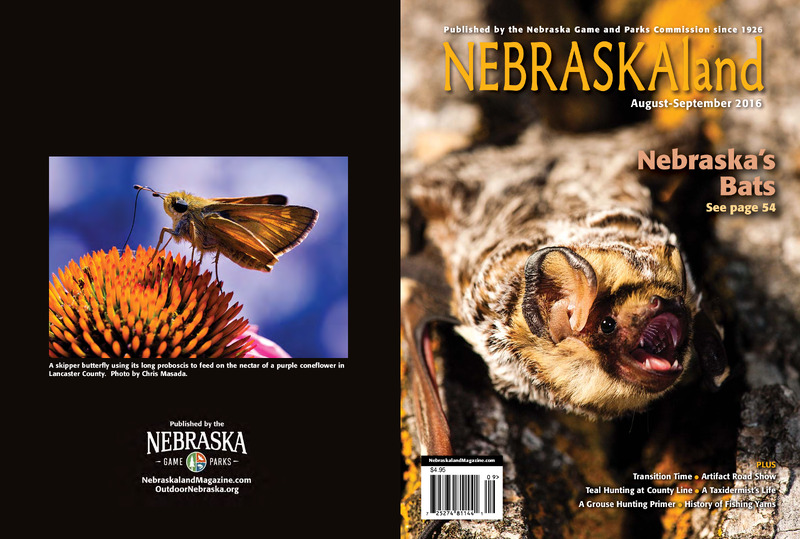
Publis hed by the Nebr a s k a Ga m e a nd Pa r k s C o m m is s io n si nc e 1926
NEBRASKAland
August-September 2016
Nebraska’s
Bats
See page 54
A skipper butterfly using its long proboscis to feed on the nectar of a purple coneflower in
Lancaster County. Photo by Chris Masada.
NebraskalandMagazine.com
$4.95
PLUS
Transition Time ● Artifact Road Show
Teal Hunting at County Line ● A Taxidermist’s Life
A Grouse Hunting Primer ● History of Fishing Yarns
NEBRASKAland Magazine
Volume 94
●
No. 7
●
August-September 2016
F EAT U R ES . . .
26 Habitat Artists
S
P
C H
30 A Life of Taxidermy
2
TORY AND HOTOS BY HRIS
ELZER
STORY AND PHOTOS BY SARAH KOCHER
36 Time Well Spent – What to Do in August-September
BY RENAE BLUM
38 Teal Hunting – Shooting Limits at County Line
S
R W
,
J
N
44 Grouse Hunting
TORY BY ICK
BY JULIE
HEATLEY PHOTOS BY ENNY
GUYEN
GEISER
46 Transition Time
BY JEFF
KURRUS
52 Getting the Point
STORY AND PHOTOS BY JUSTIN HAAG
54 Nebraska's Bats
STORY AND PHOTOS BY ERIC FOWLER
30
●
I N S I D E T H I S I S S U E ...
Mixed Bag – Bobcats, Travel to Grand Island, a Brief
History of Fishing Yarns, Fatbiking, Spider Hunting at
Night, Browning's Sweet 16, Testing for Zebra Mussels,
Bug Banter, and much more ............................................ 10
Wilderness Workshop – The Texas Rig ................ 66
Junior Journal – from "Trail Tales" for kids ............. 68
Page 49 – Urban Neighbors ......................................... 69
Nature Notes – Pollinator Gardens............................ 70
In the Field – Dove Hunting the Fringe ..................... 72
Along the Road – State Fair Time............................ 76
Outdoor Ed – Snake Defense ..................................... 77
Portraits from the Past............................................ 78
In the Kitchen – Stuffed Grouse Breast .................... 80
The Last Stop – Going Batty! ................................... 82
NEBRASKAland (VOL. 94 / NO. 7 ISSN 0028-1964) is published monthly, except
for the combined Jan./Feb. and Aug./Sept. issues, by the Nebraska Game and Parks
Commission, 2200 N. 33rd St., Lincoln, NE. Periodicals postage paid at Lincoln,
Nebraska, and additional mailing offices. POSTMASTER: Send address changes to
NEBRASKAland, P.O. Box 30370, Lincoln, NE 68503-0370.
2 NEBRASKAland • AUGUST-SEPTEMBER 2016
44
●
36
●
54
●
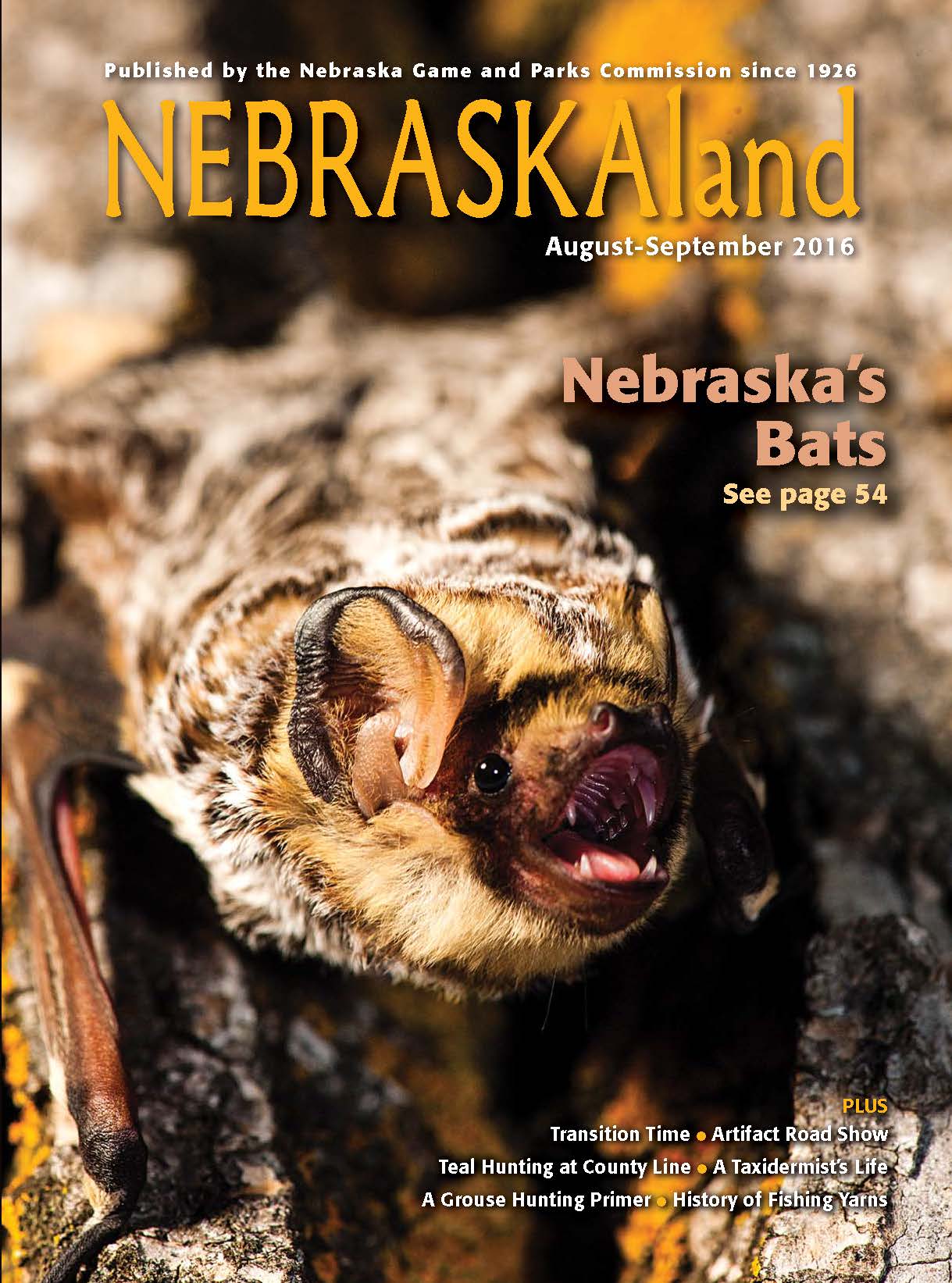
Cover: A hoary bat clings to a cottonwood tree along Soldier Creek at
Fort Robinson State Park. Photo by Eric Fowler.
AUGUST-SEPTEMBER 2016 • NEBRASKAland 3
An Open Letter to Hunting
By Erin Diegel
This composite photo art of a 1961 Chevrolet Impala was submitted by Richard Jones of Gothenburg.
Suz Swanson shot this photo near her parents' home in Hastings.
4 NEBRASKAland • AUGUST-SEPTEMBER 2016
I am a single mom of three
children, enjoy everything
outdoors, and before 2014, had
never given hunting a second
thought. I had never used a bow,
never shot a gun, and I even went
14 years without eating meat.
I remember it like it was
yesterday. I was on my first ever
online date with a guy named
Eric, and he spoke the words “I
am a bowhunter.” I immediately
flinched. Unsure and completely
raw, I agreed to exchange some
golf lessons for some shooting
lessons. What was this hunting
stuff all about?
Little did I know at the time, but
my life changed forever. Big game
draw deadlines, land access, Pope
and Young, bugling, books about
elk and deer, the rut, date nights
with Eric to Cabela’s, tree stands,
rangefinders, grunt calls, bows,
arrows, 3D targets, fletchings,
guns, bullets, .243’s, shotguns,
and camo – so, so much camo.
After 18 months, three arrows,
two bullets and a lot of hard work,
I wish to express my gratitude to
the hunting industry and what it
stands for. I have said goodbye to
the city girl vegetarian, and hello
to a new way of life.
Thank you hunting for
educating me.
Tiara K
Kush
Omaha
this photo
Standing
Bear L
Lake
June ""after
Ti
h off O
h ttook
k thi
h t att St
di
B
k iin J
ft an ugly
l
line of storms passed through the area."
Casey J. Koltz photographed this dragonfly on the Upper Dugout Creek north of
Bridgeport.
Bruce Thiel of Lincoln sent in this photo of Mayberry Wildlife Management Area
just east of Burchard.
AUGUST-SEPTEMBER 2016 • NEBRASKAland 5
Dan Walter caught these bobcats on his trail camera on the Niobrara River
southeast of Gordon.
Mark Deane photographed this blue jay feeding
during the winter in Papillion.
Jim Gross of Burwell captured this trail cam photo on public land in Loup County.
A Girl Scout Thank You
Dear Nebraska Game and Parks
Commission,
Girl Scouts in Nebraska
recently wrapped up the 2016
Girl Scout Cookie Program. In
recognition for the achievement of
selling 500 or more boxes of Girl
Scout Cookies, girls could choose
from a list of incentives that are
in line with our mission and our
programming.
For the first time, we offered
Girl Scouts a Nebraska Game and
Parks Commission park permit,
and it was our most popular
incentive this season!
Thank you for helping Girl
Scouts encourage Nebraska
girls and their families to head
outdoors and explore their state.
Denise M. Moore
Girl Scouts Spirit of Nebraska
Bruce Thiel submitted this
photo of the Filley Stone
Barn outside Filley in Gage
County.
Ryan Jones of Seward took this photo of fox kits on a friend's farm in Seward County.
6 NEBRASKAland • AUGUST-SEPTEMBER 2016
AUGUST-SEPTEMBER 2016 • NEBRASKAland 7
NEBRASKAland Magazine
Mel Flick captured this pheasant photo south of Morrill.
Outdoor Plates
Matt Hover of Omaha has been
hooked on pheasant hunting since he
first tagged along with dad and grandpa
at age 5 about 35 years ago. Nearly
every fall weekend he can be found
following his German shorthaired
pointer through fields in southwestern
or northeastern Nebraska with friends
and family.
If you have a unique outdoor message
plate you would like to share, or know
someone who does, e-mail a photo of
it (high-resolution, JPEG format only,
please) to Eric.Fowler@Nebraska.
gov, along with your name, hometown
and a brief description of the interests
expressed on your license plate.
Photo Contest for Readers
As you may have noticed, we receive
a lot of great photos from our readers.
Some of these are published each
month in our "From Our Readers"
section, but we also want to bring
attention to our annual photo contest,
which is accepting submissions now
with winners to be published in our
December 2016 issue.
See our ad on page 79 for more
details, and continue to send in
your photos through Facebook and
e-mail for possible inclusion in
NEBRASKAland.
Happy Shooting.
-Editor
Send your comments to:
Jeff Kurrus, Editor
NEBRASKAland Magazine
P.O. Box 30370
Lincoln, NE 68503
or e-mail Jeff.Kurrus@Nebraska.gov
Please include your postal address and telephone number. Letters may be condensed
and edited. Photographs are also welcome.
8 NEBRASKAland • AUGUST-SEPTEMBER 2016
CONSERVATION OFFICERS
ADMINISTRATION (Lincoln)
Craig Stover (Administrator)
Duane Arp (Asst. Administrator)
Jeff Clauson (Asst. Administrator)
MAGAZINE STAFF
Corrections: In the last issue (July
2016), the purple loosestrife photo on
page 28 should have been credited to
Bob Grier, not Michael Forsberg.
-Editor
"End of the road sunset" taken in Pawnee County by Bill Phillips of La Vista.
COMMISSIONERS
Director Jim Douglas
Commissioners
Chairman - Mark Spurgin, Paxton
Vice Chairman - Rex Fisher, Omaha
2nd Vice Chairman - Dick Bell, Omaha
Dr. Kent Forney, Lincoln
Robert Allen, Eustis
Pat Berggren, Broken Bow
Mick Jensen, Blair
Norris Marshall, Kearney
Dan Kreitman, Wahoo
Any program that receives federal funding from the National Park
Service, or the United States Fish and Wildlife Service prohibits unlawful
discrimination on the basis of race, color, religion, age, gender, marital
status, national origin, age, disability or political affiliation. Any person
who believes he or she has been discriminated against in any program,
activity, facility, or service, should contact the Nebraska Game and
Parks Commission, Lincoln, NE 402-471-0641, the Equal Opportunity
Commission, Lincoln, NE 402-471-2024, TTY/TDD 402-471-4693;
United States Fish Wildlife Service, Civil Rights Coordinator, 4401
N. Fairfax Drive, Arlington, VA 22203; Director, Equal Opportunity
Program, U.S. Department of Interior, National Park Service, 1849 C
Street NW, Mail Code 0008, Washington, D.C. 20240-0001.
Communications Director Christy Rasmussen
Editor Jeff Kurrus
Art Director Tim Reigert
Associate Editor Jenny Nguyen
Regional Editors Eric Fowler, Julie Geiser,
Justin Haag
Contributing Editor Michael Forsberg
Regular Contributors Chris Helzer, Gerry
Steinauer
Photo Librarian Jaclyn Cruikshank Vogt
Circulation Donna Robinson
For address changes and questions about
your subscription, e-mail donna.robinson@
nebraska.gov or call 800-632-5263
Advertising Sales Manager
For advertising information contact
Shane G. Gilster, 402-742-0125
Email: shanegilster@gmail.com
NEBRASKAland Magazine Copyright 2016, all rights reserved.
NEBRASKAland is available in audio from the Nebraska Library
Commission Talking Book and Braille Service, Suite 120, 1200 N St.,
Lincoln, NE 68508. 800-742-7691. NEBRASKAland Magazine and the
Nebraska Game and Parks Commission reserve the right to reject any
advertising not in keeping with the agency mission.
Rates: $18 for one year; $33 for two years; $44 for three years. Nebraska
recipients must add appropriate sales tax. To subscribe call
1-800-NEBLAND (632-5263), or go online to: NebraskalandMagazine.
com.
COMMISSION
C
CO
COM
OM
MMIS
MISSIO
S NO
OFFICES
FFICES
FF
FFI
CES
S
Headquarters/Southeast District Office
2200 N. 33rd Street Lincoln, NE 68503
Phone 402-471-0641
Northeast District Office
2201 N. 13th St. Norfolk, NE 68701
Phone 402-370-3374
Southwest District Office
301 E. State Farm Rd. North Platte, NE 69101
Phone 308-535-8025
Northwest District Office
East Hwy. 2, Box 725 Alliance, NE 69301
Phone 308-763-2940
Bassett Office
524 Panzer St., Box 508 Bassett, NE 68714
Phone 402-684-2921
Kearney Office
1617 First Ave. Kearney, NE 68847
Phone 308-865-5310
Ak-Sar-Ben Aquarium
21502 W. Highway 31 Gretna, NE 68028
Phone 402-332-3901
Omaha Office
8495 Frederick Street, Omaha, NE 68124
Phone 402-595-2144
402-471-5531
402-471-5531
402-471-5531
NORTHWEST (Includes counties covered)
Jim Zimmerman (District Supt.)
308-641-6138
Sean McKeehan
(Cheyenne, Morrill, Box Butte)
308-279-9133
Scott Brandt
(Kimball, Banner, Scotts Bluff)
308-631-0663
308-760-3647
Greg Hesse (Sheridan, Dawes)
308-430-0572
Dan Kling (Sioux, Dawes)
Terry Brentzel (Deuel, Garden, Grant) 308-458-7650
402-389-0444
Frank Miller (Cherry, Hooker)
NORTHEAST (Includes counties covered)
Tom Zimmer (District Supt.)
402-649-8053
402-760-0712
Dale Davis (Keya Paha, Brown, Rock)
402-340-3981
Jonathan Andreasen (Holt, Boyd)
Mitch Johnson (Knox, Antelope, Pierce) 402-613-8612
402-762-5022
Jeff Jones (Knox, Cedar)
Alex Thomas
(Dixon, Dakota, N 1/2 Thurston)
402-241-7615
Jon Reeves
(S 1/2 Thurston, Burt, Washington)
402-889-8508
402-719-1108
Dan Roberts (Dodge, Colfax)
Cory Krause
(Cuming, Wayne, Stanton, Dodge)
402-380-6410
Steve Oberg
(Colfax, Platte, Madison, Stanton)
402-910-3366
Randy Pomplun
(Nance, Greeley, Wheeler, Boone)
308-550-0489
308-730-7050
Doug Pollard (Loup, Garfield, Valley)
SOUTHWEST (Includes counties covered)
Roger Thompson (District Supt.)
308-530-3097
308-202-0819
Matt Brandt (Sherman, Howard)
308-380-7331
Tim Williams (Hall, Hamilton, Merrick)
Pat George
(Clay, Adams, Nuckolls, Webster)
402-705-9989
308-920-0367
Rich Routh (Franklin, Harlan, Phelps)
Matt Andrews
(Gosper, Furnas, Frontier, Red Willow)
308-746-2418
Andrew Heyer (Dawson, Gosper, Phelps) 402-613-2241
Brian Piernicky
(Red Willow, Frontier, Hayes, Hitchcock)
308-340-6627
308-289-0427
Nicholas Fix (Keith, Perkins)
308-289-1169
Bryce Streger (Keith, Arthur)
Brandon O’Neal
(Lincoln, McPherson, Logan)
308-530-3157
Alex Hasenauer
(Lincoln, McPherson, Logan)
308-660-4671
308-440-3847
Dale Johnson (Kearney, Buffalo)
308-529-8146
Mike Thome (Dawson)
Ray Dierking (Custer, Thomas, Blaine) 308-870-0322
SOUTHEAST (Includes counties covered)
Levi Krause (District Supt.)
402-949-0593
402-619-1355
Rich Berggren (Douglas)
402-616-5961
Dan Evasco (Sarpy)
402-210-0888
Heath Packett (Cass)
402-209-1506
Russell Mort (Otoe, Johnson)
William Krause
(Nemaha, Richardson, Pawnee)
402-274-8063
402-806-9084
Dan Zuehlke (Gage, Saline)
402-890-6463
Dina Barta (Lancaster)
402-890-6465
Doug Kramer (Lancaster)
402-937-3422
Dudley Sorensen (Lancaster, York)
402-613-2312
Travis Shepler (Lancaster)
402-890-7140
Stacey Lewton (Lancaster, Seward)
402-443-6392
Mike Luben (Saunders, Butler, Polk)
Nebraska Wildlife Crimestoppers
1-800-742-7627
AUGUST-SEPTEMBER 2016 • NEBRASKAland 9
Bobcat
By Lindsay Rogers, Outdoor Education Specialist
PHOT
TO BY JEF
JEFF
F KURRUS
KURRUS
A Mammal Brief
Lynx rufus
Named for their short, “bobbed” tail, bobcats are the
most widely spread native cat species in North America.
They are found throughout Nebraska in a variety of
habitats, but are most common in areas where hunting and
escape cover is near, such as forests, wetlands and edge
habitat. They are not often seen, but fur harvest records
indicate their populations have remained at a high level since
greatly expanding during the late 1990s.
This elusive species is fairly small, ranging in length from
19 to 48 inches. They are amazing hunters, taking prey ranging
Eric
Eri
Er
ic - this
ic
th
hiis is
s rready
ea
ad
dy
y tto
o
from rabbits to deer. In typical cat fashion, they stalk their
work
wo
w
orrk
k up
up
prey and pounce when ready, killing with a bite to the
neck or head.
Bobcats typically mate in early spring with young born in
mid-summer. The young remain with their mother for about
eight months until they disperse to find their own territory. Bobcats are solitary animals.
Several females may establish territories within a male’s larger territory.
Bobcats are most vulnerable to predators when young. Adult bobcats are typically
capable of defending themselves or escaping most native predators. ■
10 NEBRASKAland • AUGUST-SEPTEMBER 2016
AUGUST-SEPTEMBER 2016 • NEBRASKAland 11
Travelogue Sponsors
By Angela White, Nebraska Tourism Commission
Grand Island
Island is Nebraska’s largest city outside of the Omaha
r
rand
a Lincoln metro area. The town was named after the
and
LaGrande Ille, referring to a large nearby island in
F
French
Plate River. During the spring, a sandbar just south of Grand
the Plat
Island is home to one of the largest crane roosts in the world.
More than 80 percent of the world's population of sandhill cranes
converge on the Platte. Millions of migrating ducks and geese
also arrive with them.
Those who love to learn about history and agriculture will also
want to visit the Stuhr Museum and Raising Nebraska. The
r history. The newly renovated Stuhr
award-winning Stuhr Museum is an incredible way to relive pionee
an interactive children's area. The museum
Building houses permanent history displays, an art gallery, and
act as pioneers,
is also home to a 1890s railroad town. Costumed interpreters
g in the mill
craftin
ntile,
merca
the
in
cooking on wood stoves, selling wares
holiday
and
ls
Festiva
shop.
mith’s
and hammering horseshoes in the blacks
celebrations are held year-round.
foot exhibit
Interested in agriculture? Raising Nebraska is a 25,000 square
water
from
–
angle
every
from
designed to let people see agriculture
from
conservation to soil health, from animal well-being to food safety,
and open
free
is
ska
Nebra
Raising
g
Tourin
economic impact to global hunger.
well as
as
p.m.,
p.m.-4
1
and
oon
a.m.-n
to the public Monday-Friday from 9
oon.
a.m.-n
10
from
the second Saturday of the month
r Park.
Grand Island is also home to the Nebraska State Fair and Fonne
y and
midwa
ic
fantast
a
rts,
conce
of
The annual fair features a great variety
in
uled
sched
are
rts
conce
r
popula
of
agricultural competitions. A variety
2016
The
und.
year-ro
and
fair
the
the Heartland Events Center during
features
State Fair will run from Aug. 26 through Sept. 5. Fonner Park
h early
throug
bruary
mid-Fe
from
live thoroughbred horse races daily
the
in
d
Locate
asting.
simulc
May, along with year-round nationwide
ska
Nebra
The
urse,
Conco
Park
r
Fonne
Racing Hall of Fame is filled with racing
memorabilia.
Those looking for a place to stay while in town will
Grand Island
find a variety of options from campgrounds to
comfortable hotels. Named for the winter stopover
mon
rm
used by Mormon emigrants heading westward, Morm
and
Island State Recreation Area offers comfort
of
conveniences to campers and other travelers on I-80, as part
ped
develo
areas
these
of
Nebraska's unique "Chain of Lakes." The first
near
SRA
ill
Windm
was Mormon Island. This area and companion
Gibbon are the most intensely developed.
to
Grand Island also offers a diverse selection of restaurants sure
Texas
like
ouses
steakh
please any craving. Dining options range from
and just
T-Bone Steakhouse to Japanese cuisine at Fuji Steakhouse
line
chains
al
nation
about everything in between. A plethora of
and
Merchandise Mile along Highway 281. Fast food, ethnic food
this
in
stores
many
the
of
diners can all be had within a few blocks
owned
locally
,
unique
with
shopping district. Downtown is peppered
which
restaurants like Wave Pizza Company and Banzai Beach Club,
s
burger
great
serves
serves gourmet pizzas, and Sin City, which
. ■
nd.com
andIsla
VisitGr
to
and breakfast. For more information go
State Fair
Sin City
at the
g
n
i
h
t
i
BlackrsmMuseum
Stuh
12 NEBRASKAland • AUGUST-SEPTEMBER 2016
AUGUST-SEPTEMBER 2016 • NEBRASKAland 13
Long before Photoshop, photographers had many darkroom tricks for doctoring photos, as in this early-twentieth century postcard
by Nebraska photographer John Nelson (1864-1942). NSHS RG3542-141-4
A Brief History
Those Fish Stories
By the Nebraska State Historical Society
I
mprobable fishing yarns have been around as long as
fish and fishing. The Norfolk Weekly News-Journal in
the summer of 1907 reported an escalating series of such
tales from Verdigre, Neligh and Valentine. The NewsJournal on July 26, 1907, found clues in these “fish stories”
to the national character of Americans, particularly those in
the West.
The News-Journal printed: “It is a rule of human thought
that man constantly goes through the process of setting first
one goal for his achievement, gaining that goal and then
advancing the pegs to aim at further on and up ... Striking
examples of this desire to accomplish always more and
more, to move always further and further along the route
of advancement in thought and action, has been found here
in northern Nebraska within the past few days. Those fish
stories have furnished the example.
“A few days ago a Verdigre dispatch in these columns told
of a remarkable fish catch in the Verdigre creek. A small fish
had been drawn out of the water when a very large catfish
came along and swallowed the little three-pound fish and
was hooked. After a struggle the monster catfish was landed.
Steak from the catfish was enjoyed in a Verdigre restaurant
for supper that night. The story had the ring of truth and the
14 NEBRASKAland • AUGUST-SEPTEMBER 2016
fish editor of The News cordially believes that it happened.
But that is neither here nor there.
“Western America is not satisfied to stand still. To remain
stationary is retrogression, and the West goes forward. Came
a story from Neligh next day. A much bigger fish had been
caught at Neligh. First a small fish was hooked. On this as
bait another hit. Then came the monster third fish to swallow
both the other two. A man was drawn clear across the stream
in trying to land the mammoth catch. It was a fish story pure
and simple. But as a fish story it was a clever yarn. And fairy
tale though it was, credit must be given to Neligh for the
progressive spirit which prompts men to risk their all for the
sake of going on and up.
“But even that was not enough. The further west you go
the more progressive the people, according to popular theory.
And the impression apparently had reasonable foundation.
Valentine is located a couple hundred miles west of Neligh.
Both are in Nebraska. But it took Valentine to set a new
mark. Captain McCloud was fished out of the river. He was
hanging to a clothes line rope. What was first thought to
be a drowning person proved to be a catfish weighing 102
pounds. Was it true? Ask the cook. So shrewd a westerner
as Dr. Warner of Butte asked The News if it were true. The
sporting editor throws up his hands at the query. It sounded
well. And at all events, true or untrue, it was seeing Neligh
and Verdigre and going them one better. Surely Valentine
paid to sit in the game.” ■
Visit the Nebraska State Historical Society’s website at
NebraskaHistory.org.
AUGUST-SEPTEMBER 2016 • NEBRASKAland 15
The 2016 Nebraska Passport Travel Program
Testing with
Drones By Craig Allen
The Call of the Road
Z
PHOTOS BY JENNY NGUYEN
Jim Higgins of UNL's NIMBUS aerial robotics lab prepares a drone for
flight to test for zebra mussels at Offut Lake.
16 NEBRASKAland • AUGUST-SEPTEMBER 2016
To test for zebra mussels, a drone has been fitted with a pump and
filtration system that captures immature mussels.
aquatic invasive
species from
spreading to
other waters.
Current
sampling
methods for
the invisible
aquatic larvae
of mussels
are time
consuming,
expensive and difficult.
If the technology proves successful, unmanned aerial
vehicles (UAV) – commonly known as drones – could be
deployed at lakes around Nebraska to sample for zebra
mussels more quickly and efficiently.
At the University of Nebraska-Lincoln, biologists from
the School of Natural Resources have been working with
computer scientists and engineers of the NIMBUS Lab to
develop UAV-based sampling techniques for zebra mussels.
These techniques were tested at Offut Lake, and were
successful in detecting zebra mussel larvae.
The UAV was modified to include a pump and filtration
system, allowing set amounts of water to be cycled through a
very fine filter to capture the immature mussels. At the same
time, variables such as water temperature and flow can be
measured. The UAV can easily sample multiple locations at
different depths, and includes GPS capabilities. They also do
not require decontamination because the UAV itself does not
come into contact with water.
If successful, UAV technology will help facilitate the
work of biologists such as Allison Zach, the coordinator
of the Nebraska Invasive Species Council, and personnel
of the new Aquatic Invasive Species
Program at the Nebraska Game and Parks
Commission. ■
The 2016 Nebraska Passport program kicked off with
a record number of travelers participating during the first
two months. Travelers from 214 Nebraska communities
have hit the road to discover new places and destinations
that were unknown to them before. Travelers from 20 other
states and 2 other countries are also experiencing 80 of the
best attractions in Nebraska, from fascinating makers on the
"How It’s Made" tour to the culinary delights on the "Order
Up!" tour. The top three destinations receiving the most
visitor traffic thus far are Indigo Bridge Books in Lincoln,
Missouri River Basin Lewis and Clark Visitor’s Center in
Nebraska City, and Eat restaurant in Dodge.
Many participants have submitted their Passport adventure
stories at NebraskaPassport.com/Adventures/, highlighting
various stops on the program. Ivy, from Omaha, said this
about Bootleg Brewers in Taylor:
“A 6-mile drive off the main highway through gorgeous
rolling pastures and we were in awe over the most adorable
little cabins and fantastic modern-industrial brewery and
tavern. We were delighted by the owners, their down-to-earth
nature, and just the overall “cool” factor…Bootleg Brewers
is the Cheers of the prairie! Such an awesome stop!”
Deb, from Atkinson, said this about the Potter Duckpin
Bowling Alley, featured on the "Earth + Sky" tour:
“There are not enough characters available to write how
impressed we were with the Duckpin Bowling Alley, our
gracious hosts and the town of Potter. Potter is a cute little
town with many interesting small shops. We can hardly wait
to make another trip out to the Panhandle and spend more
time there … we will visit again soon.”
To receive a copy of the 2016 Nebraska Passport, email
info@NebraskaPassport.com with your name, mailing
address and the number of booklets you’d like to receive.
More information can be found on NebraskaPassport.com.
Safe travels! ■
PHOTO COURTESY OF DEPARTMENT OF TOURISM
ebra mussels are a non-native invasive species that
have invaded much of North America. If present,
they can take over aquatic areas quickly: a female
zebra mussel can produce as many as one million eggs per
year. Transportation of watercraft and supplies that have not
been properly cleaned, drained and dried is often how this
undesirable species is spread.
The species alters communities of small phyto- and
zooplankton (tiny plants and animals), and effects can
cascade up food chains and alter lakes and rivers in
fundamental ways. Waters may become more clear, but more
prone to toxic algae outbreaks, and desirable fish species
may be reduced.
Additionally, they can clog power plant and industrial
intakes. The economic impact of zebra mussels is estimated
to be in the billions of dollars in the next 10 years.
In Nebraska, zebra mussels have been found in Offutt Air
Force Base Lake in Bellevue, Lewis and Clark Lake, the
Missouri River below Gavins Point Dam, and just this year
were rediscovered in Lake Zorinsky in Omaha. Biologists
and managers are working to keep zebra mussels and other
Craig Allen is a professor for the
Nebraska Cooperative Fish & Wildlife
Research Unit at the School of Natural
Resources, UNL.
AUGUST-SEPTEMBER 2016 • NEBRASKAland 17
PHOTO BY ??????????????????????????
Fatbiking
By Carl Gauger
The back roads of the Nebraska Sandhills have always been
off limits to cyclists. Even a mountain bike’s knobby 2-inchwide tires sink into the sand, leaving you, quite literally,
spinning your wheels. However, with the advent of “fatbikes,”
purpose-built mountain bikes with 4- to 5-inch-wide tires, a
cyclist can float over sand, snow and rough terrain with far
less effort than on a traditional bicycle. The wide, knobby,
low-pressure tire, a disadvantage on smooth pavement or
gravel roads, enables you to get the traction you need to
propel yourself across the often soft and blown-out back roads
of the Sandhills. Here are a handful of essentials that you need
to know in order to have a good time.
Flat Protection - The Sandhills are riddled with sandburs,
and riding a traditional tube and tire setup is a recipe for
disaster. Talk to your local bike shop about setting your bike
up “tubeless,” a method that involves latex sealant inside of
your tire rather than a tube. It fills holes as the punctures are
created. Through years of riding this way in the Sandhills, I’ve
never had a flat despite pulling hundreds of thorns from my
tires. A less effective but cheaper alternative is to use a selfsealing tube, such as the Slime brand.
Low Pressure - This is key to maintaining traction in the
sand, even with a 4 or 5-inch tire. Run as low as 5 to 7 psi,
which will leave your tire soft and squishy, but will keep you
hooked up even in loose sand.
Moisture Content - Unlike other types of off-road cycling,
recent rain is your friend. The more moisture content in the
sand, the firmer it is and better traction you will get.
Take Your Time - Don’t expect to cover the same distance
you would on a traditional bike. Fatbiking on sand is slow
going, so take time to pause and look around! Because you’re
quieter than a vehicle, and covering far more ground than on
foot, fatbikes are ideal for taking in landscapes and viewing
wildlife.
Location - The best public places in the Sandhills to ride
fatbikes are Nebraska National Forest at Halsey and Samuel
R. McKelvie National Forest near Valentine. Detailed maps
are available from the Forest Service. Fresh water from
windmills, public facilities and campgrounds make these areas
ideal for exploration by fatbike. ■
18 NEBRASKAland • AUGUST-SEPTEMBER 2016
AUGUST-SEPTEMBER 2016 • NEBRASKAland 19
ve...
a
h
.
.
!"
st.
"Mu weet 16
S
By Paula Hoppe, Certified Master
Naturalist
Spider hunting is probably not
something most of us think about, but
something that the kid in each of us
needs to try. It doesn’t take any special
equipment: just take a flashlight or
headlamp – and perhaps a little courage
– and head out into the dark jungle of
your back yard at night.
With your flashlight positioned near
or just above your eyes, (the location
of the flashlight is important) look out
across the grass. A small, bright green
glow or “eyeshine” in the grass means
you have spotted a spider, and he is
looking right back at you.
Most spiders have eight eyes, and
their configuration can give you a
clue as to what kind of spider you are
observing, though this can be difficult to
discern in the field. Two large eyes, with
a small one on either side over a row of
four smaller eyes is a good indication
you’ve encountered a wolf spider.
Wolf spiders, Nebraska’s largest
PHOTO BY JOEL SARTORE
Night Lights
The wolf spider is Nebraska's largest spider,
and while its eyes shine black in studio photos
like this one, its eyes glow green when shined
with a flashlight at night.
spiders, are just one of a number of
spider families that hunt or forage at
night. These predators have an iridescent
20 NEBRASKAland • AUGUST-SEPTEMBER 2016
layer
called
the tapetum
lucidum located
just behind the retina.
retina
This reflective layer bounces light back
onto the photoreceptors in the retina,
permitting them to see well in dim light.
This, along with sensing vibrations,
helps wolf spiders locate prey.
A tapetum lucidum is also found in
some mammals and birds, producing
that familiar glow we’ve all seen in car
headlights alerting us to the presence
of deer, raccoons and other nocturnal
prowlers.
While spiders’ eyes glow green,
the eyes of moths and June bugs are
revealed as little sparks of red or
orange.
Spiders are beneficial neighbors, and
as you gaze around you may be amazed
to see the number of tiny predators that
are patrolling your backyard quietly
doing their job, keeping you safe from
overwhelming numbers of pesky
insects. ■
16'
1
6' for 2016
By Jarrod Spilge
Spilger
Although the 16-gauge
16
used to be a popular shotgun
chambering, this classic
c
gauge has recently fallen out
of favor, largely due
du to a scarcity of ammunition and its
exclusion from the target sports.
All that changed this year when Browning
“reintroduced” the 16-gauge, “Sweet Sixteen,” A5. While
that name may be familiar
f
to many, this new A5 is not the
Auto-5 of old.
The original Auto-5
Auto was a long-recoil operated autoloader,
wherein the entire barrel
b
moved rearwards upon firing to
cycle the action. The
Th new A5 is inertia operated. A stout
spring inside the bolt
bo compresses upon firing to move the
bolt and cycle the action. This is the same system found
on Benelli autoloaders,
autol
but Browning’s Sweet Sixteen is
the only inertia powered 16-gauge available.
To feed the Sweet
S
Sixteen, Browning also introduced
a line of 16-gauge target and hunting loads this year.
Personally, I own a 16-gauge Remington 870 Wingmaster
which I’ve used on
o everything from ducks and doves to
turkeys and trap.
I also inherited
inh
my maternal grandfather’s old
16-gauge S
Stevens single-shot when he passed
away. He used
us it to hunt game birds in his younger
years, as well as to protect the chicken coop from
mammalian raiders on his farm near Farwell.
This spring,
sprin gunsmith Wade Bentley of Cairo
restored the
th old single-shot, which had a missing
firing pin and cracked stock. I hope to use
Grandpa’s gun on rabbits and maybe even quail
Grandp
this fall.
fal
After all, 2016 is the perfect year to
rediscover the 16-gauge. ■
red
NPS Turns 100
By Eric Fowler
On August 25, the National Park Service
will celebrate its 100th anniversary. The
movement to protect the nation’s special places
aces began
long before that, but it continues today with the same
mission as the bill signed by President Woodrow
Wilson that was meant “to conserve the scenery
and the natural and historic objects and the wild life
therein and to provide for the enjoyment of the same
in such manner and by such means as will leave them
unimpaired for the enjoyment of future generations.”
Soon after Euro-Americans began pushing
westward, and the words and images of writers, artists
and photographers like John Muir, George Catlin and
William Henry Jackson describing the wonders they
found in their new country spread, citizens began to
push for the preservation of those magical places.
The movement led to the Yosemite Valley becoming
a California state park in 1864, and later a national
park, and Yellowstone becoming the world’s first
national park in 1872.
Created to care for those parks and more than 30
others that had been established by 1916, the National
Park Service now oversees a system that covers more
than 84 million acres and is comprised of 410 sites
with 28 different designations. These include 128
historical parks or sites, 81 national monuments, 59
national parks, 25 battlefields or military parks, 19
preserves, 18 recreation areas, 10 seashores, four
parkways, four lakeshores, and two reserves. More
than 300 million people visited these sites in 2015.
In Nebraska, there are three national monuments, a
national scenic river, a national recreational river and
four national historic trails. Several Nebraska state
parks, state historical parks and state recreation areas
are located along the trails and scenic and recreational
river segments.
Many parks will hold special events to
commemorate the centennial. For more information
on the Park Service, go to NPS.org or
FindYourPark.com. ■
The National Park Service in Nebraska
• Agate Fossil Beds National Monument, Harrison
• Homestead National Monument, Beatrice
• Scotts Bluff National Monument, Gering
• Chimney Rock National Historic Site, Bayard
• Niobrara National Scenic River, Valentine to
Newport
• Missouri National Recreational River, South Dakota
to Niobrara and Gavins Point Dam to Ponca
• Lewis and Clark National Historic Trail, Missouri
River, Rulo to South Dakota
• Mormon National Historic Trail, Omaha to
Wyoming
• Oregon and California National Historic Trails,
Fairbury to Wyoming
AUGUST-SEPTEMBER 2016 • NEBRASKAland 21
Bug Banter
By Jerry Kane
A nationwide panel of energy, business and conservation
leaders on March 2 released its recommendations on how to
avert the nation’s growing endangered species crisis, according
to the Association of Fish and Wildlife Agencies (AFWA).
The The Blue Ribbon Panel, co-chaired by former Wyoming
Gov. David Freudenthal and Bass Pro Shops founder John
Morris, determined that using a portion of revenues from
energy and mineral development on federal lands and waters
to fund state-based conservation could address conservation
needs for thousands
of species.
An annual
investment of $1.3
billion from these
development revenues
into the unfunded
Wildlife Conservation
Restoration Program
would allow state fish The swift fox, the smallest wild canine living in North America, can reach
speeds up to 25 mph and lives in Nebraska's shortgrass prairies.
and wildlife agencies State:
Endangered
to proactively
Federal: not listed
manage these species,
reducing taxpayer costs and the regulatory red
tape that comes when species are listed under the
federal Endangered Species Act.
Annual allocations of dollars to the states
Piping plovers are found along shorelines,
would help address the gap in funding for wildlife
on mud flats and sand flats. In Nebraska,
they can be found along the Platte River
conservation. Traditionally, state fish and wildlife
east of Lake McConaughy, and lower
agencies, such as the Nebraska Game and Parks
reaches of other major rivers.
Commission, have been funded by sportsmen
State: Threatened
Federal: Threatened
through license fees and excise taxes on hunting
and fishing equipment and motorboat fuels. These
funds support game species and conservation activities, but wildlife agencies also have
The Salt Creek tiger beetle is one of the
responsibilities for restoring at-risk species' populations, education and keeping common
world’s rarest insects, with very limited
species common, all of which is largely unfunded.
habitat. It is known to occur only in
States are poised to take action should the Blue Ribbon Panel be successful. Every state
Lancaster and Saunders Counties in
Nebraska, just north of Lincoln.
has a wildlife action plan. Collectively, these plans identify 12,000 species in greatest need
State: Endangered
for conservation efforts.
Federal: Endangered
Nebraska’s wildlife action plan, the Natural Legacy Project, identifies 89 species of
greatest conservation
need. Of these, more
than two dozen species
of plants and animals
in Nebraska are listed
as threatened or
endangered.
If funded, Nebraska
would collaborate with
partners and landowners
to implement proactive,
voluntary projects to
enhance our grasslands,
The pallid sturgeon is a long-lived fish that matures slowly. Pallid
The small white lady's slipper is a
sturgeon can live more than 40 years, reach 5 to 6 feet in length and
combat invasive
perennial orchid found in native, wet
weigh up to 65 pounds. In the Missouri River along the Nebraska border,
species,
restore
meadows.
they rarely exceed 10 pounds.
wetlands and improve
State: Threatened
State: Endangered
Federal: not listed
Federal: Endangered
our woodlands. ■
How to Quarantine
Emerald Ash Borer
T
he Nebraska Department of
Agriculture confirmed the first
find of emerald ash borer (EAB)
in the state on June 8. This invasive
beetle was discovered in ash trees at
Pulaski Park in Omaha by arborists
with the City Parks Department. A
second infestation was confirmed in
Greenwood on June 17. Nebraska
becomes the 27th state to confirm an
EAB infestation since it was first found
in Michigan in 2002.
“While it is unfortunate that we have
confirmation of the pest in Nebraska,
it is not unexpected, considering the
close proximity to confirmed pest
infestations in Iowa, Missouri and
Kansas,” said NDA Director Greg
The Nebraska EAB
working group offers the
following suggestions:
• Prevent the spread
of EAB by using locally-sourced
firewood, burning it in the same county
where you purchased it. Infested
firewood can easily transport EAB and
other invasive pests.
ed
• Only high value ash tress located
within 15 miles of a known infestation
tation
should be considered for treatment.
nt.
Trees that are experiencing
declining health should be
considered for removal.
If you feel you have located ann
EAB infestation, please report it to the
Nebraska Department of Agriculture
at 402-471-2351, the Nebraska Forest
Service at 402-472-2944 or your local
USDA office at 402-434-2345.
Additional information on EAB,
including the quarantine information,
can be found on the NDA website at:
NDA.Nebraska.gov/Plant/Entomology/
EAB/. For Nebraska specific
recommendations and guidelines on
EAB, visit EABNe.info. ■
PHOTO BY JON FARRAR
22 NEBRASKAland • AUGUST-SEPTEMBER 2016
By Julie Van Meter
State Entomologist, Nebraska
Department of Agriculture
Ibach. “The Nebraska Department of
Agriculture, along with the United
States Department of Agriculture, the
Nebraska Forest Service and members
of the Nebraska EAB Working Group
have been preparing for the possibility
this pest would enter the state.”
NDA has issued a quarantine
covering Cass, Dodge, Douglas, Sarpy
and Washington counties, which
prohibits the distribution of all ash
nursery stock originating within the
quarantine area, and regulates the
movement of all hardwood firewood
and mulch, ash timber products and
green waste material out of the infested
counties.
The quarantine is intended to aid
in the prevention of human-assisted
spread of the pest into uninfested areas.
A USDA quarantine is also expected,
and NDA and USDA staff will work
with the public and impacted industries
to ensure compliance with the
quarantines. NDA staff will continue
to set and monitor EAB traps and
conduct visual surveys across the state
to identify additional infestations.
PHOTO BY ERIC FOWLER
PHOTO BY KEN BOUC
Funds for Wildlife
PHOTO BY BOB GRIER
PHOTO BY JOEL JORGENSEN
Presented by
AUGUST-SEPTEMBER 2016 • NEBRASKAland 23
Dove hunting at Grove Lake WMA
August 4
Family Fishing Event Holmes Lake,
Lincoln
August 5
State Park Summer Speaker Series:
By My Teeth Chadron SP, Chadron
by Jerry Kane
Contact the Nebraska Game and
Parks Commission at 402-471-0641
or visit OutdoorNebraska.org for more
information.
Lake, North Platte
August 1
Squirrel season opens
August 5
Bighorn Sheep Final day for lottery
August 5
Family Fishing Event Iron Horse Trail
applications
August 1
August 5, 12, 26, September 2
Outdoor Skills Club Nebraska Game and
Explore Gun Safety and Technique
Parks Outdoor Education Center, Lincoln
August 1
Growing Up WILD Workshop St.
Thomas Lutheran Church, Omaha
August 2
Family Fishing Event Prairie Queen
Recreation Area, LaVista
August 2
Pollinators Workshop City Hall, Bassett
August 2
Growing Up WILD Workshop ESU 16,
North Platte
August 2
Explore Bowhunting Nebraska Game
and Parks Outdoor Education Center,
Lincoln
August 2, 9, 16, 23, 30
Introduction to Competition Rifle
Shooting Nebraska Game and Parks
Outdoor Education Center, Lincoln
August 12-14
Ponca Pow-Wow Niobrara SP, Niobrara
August 12-14
Becoming an Outdoors-Family Camp
Fort Kearny SRA, Kearney
August 13
Rimfire Steel Plate Fun Shoot Platte
River SP, Louisville
August 13
Hooked for Life Youth Fishing Event
Swanson Reservoir SRA, Trenton
August 13, 27, September 10, 24
Fishing Clinic Two Rivers SRA, Waterloo
August 14
Family Fishing Event Terry’s Pit,
Nebraska Game and Parks Outdoor
Education Center, Lincoln
Terrytown
August 6
Raptor Recovery Two Rivers SRA,
August 14
3-D Archery Shoot Red Willow SRA,
Waterloo
McCook
August 6
Family Fishing Event Red Willow
August 15
Elk private land antlerless season opens
Reservoir SRA, McCook
August 6
Waterfowl Hunting Safety Workshop
Niobrara SP, Niobrara
August 6
Critter Corner: Aquatic Mammals
Nebraska Game and Parks Outdoor
Education Center, Lincoln
August 6
Family Fun Night Red Willow SRA,
August 15
Bullfrog season opens
August 16
Pollinators Workshop Public Library,
Norfolk
August 18
Meeting Nebraska Game and Parks Board
of Commissioner, Broken Bow
McCook
August 18
Bighorn Sheep drawing for lottery permit
August 6-7
Living History Fort Atkinson State
August 20
Antelope archery season opens
Historical Park (SHP), Fort Calhoun
Aug. 2, 16
August 20
Women’s Firearm Series: Introduction August 6 - September 3
Nebraska Nurses Association 5K Run/
to Handguns
Archery Fun Shoot Nebraska Game and Walk Lake Minatare SRA, Minatare
Nebraska Game and Parks Outdoor
Education Center, Lincoln
August 3
Family Fishing Event Mormon
Island State Recreation Area
(SRA) Lake No. 1, Grand
Island
Parks Outdoor Education Center, Lincoln
August 6 - September 3
Buffalo Cookout and Entertainment
Fishing for bass at
Wood Duck WMA
Chadron
September 2
National Park Service Presents:
Missouri National Recreation
River – A National Park Niobrara SP,
Niobrara
Sept. 2, 9, 16, 23, 30
Families on Target Nebraska Game
and Parks Outdoor Education Center,
Lincoln
September 3
Fish Fry and Fireworks Indian Cave
and Parks Outdoor
Education Center, Lincoln
September 11
Family Fishing Event Zoo Pond,
Scottsbluff
September 12
American Paint Horse Association
Trail Ride Fort Robinson SP, Crawford
SP, Shubert
September 15
Fall Turkey hunting season opens
September 3
Critter Corner: Ducks Nebraska
September 15
Bull Elk archery hunting season
Game and Parks Outdoor Education
Center, Lincoln
September 3-4
Living History Fort Atkinson SHP,
Fort Calhoun
September 3-5
Living History Fort Kearny SHP,
Kearney
September 3-11
Early Teal hunting season in High
Plains Zone
September 3-18
Early Teal hunting season in Low
Plains Zone
September 4
Sidewalk Chalk Art with Bird and
opens
September 16
Great Park Pursuit final day of
participation in and postmark deadline
September 16
Mainly Marathon Chadron SP,
Chadron
September 17
Antelope muzzleloader hunting
season opens
September 17-18
Missouri River Outdoor Expo
Ponca SP, Ponca
September 24
Bull Elk firearm hunting season opens
September 24
Elk public land antlerless hunting
1 p.m. Central Time
September 4
National Park Service Special
Event Niobrara SP, Niobrara
September 24
Woodcock hunting season opens
September 5
Labor Day Nebraska Game and Parks’
September 24
Nebraska Youth Smallbore
Silhouette Invitational Pressey WMA,
August 22, 24
August 8
Introduction to Civilian Marksmanship
Fall Turkey permits available beginning at Program Platte River SP, Louisville
Robinson SP, Crawford
Nebraska Game
and Parks
Outdoor
Education
Center,
Lincoln
September 2
State Park Summer Speaker
Series: Celebrate National
Archaeology Month Chadron SP,
Emerald Ash Borer Program, Niobrara
SP, Niobrara
August 3, 10, 17, 24
Beyond BOW
August 12
Summer Shooting Family Fishing Event Fort Kearny SRA,
Series: Shotguns Kearney
August 4
Outdoor
Photography
NEBRASKAland
and
Visitor
Archery, Season Choice, River
Antlerless Private Land Only, Statewide
Whitetail Buck, Gifford Point Wildlife
Management Area (WMA), Youth, and
Landowner deer hunting seasons open
Niobrara SP, Niobrara
August 3
Family Fishing Event August 11-14
Recharge Lake, York
The Trotter’s Performance Fort
Platte River State
Park (SP), Louisville
August 20
Tandy Leather/Animal Hides and
Leather Two Rivers SRA, Waterloo
September 1
August 12
Growing Up WILD Workshop Harrison
Elementary School, Omaha
Aug. 12
Project WILD workshop
Harrison Elementary School, Omaha
August 12
State Park Summer Speaker Series:
The Magical Ecological Mystery Tour
Fort Robinson SP, Crawford
24 NEBRASKAland • AUGUST-SEPTEMBER 2016
August 26
Pollinators Workshop Ponca SP, Ponca
Aug. 26
Movie in the Park
Calamus Reservoir SRA, Burwell
August 26 - September 5
Nebraska State Fair Grand Island
September 1
Hunting Seasons Open for cottontail,
jackrabbit, dove, snipe, grouse, rail,
raccoon and opossum
September 1
Niobrara-Verdigre High School Cross
Country Invitational
Niobrara SP, Niobrara
district offices and service centers
closed
September 8, 15, 22
Rifle Shooting Series Nebraska
Game and Parks Outdoor Education
Center, Lincoln
September 10
Night Owl 5K Run/Walk Niobrara SP,
Niobrara
September 10
Family Fishing Event Barnett Park,
McCook
Sept. 10
Women on Target Nebraska Game
season opens
Oconto
September 24-25
Competitive Horse Trail Riding
Indian Cave SP, Shubert
September 25
Living History Arbor Lodge SHP,
Nebraska City
September 30 - October 2
Autumn Harvest Art Show Eugene
Last issue’s winner of
the Visitor drawing was
Ginne Pracher of Sturgis, South
Dakota who found the loosestrife
beetle on page 28.
Readers are encouraged to contact
NEBRASKAland within 10 days
after this issue’s publication with
the correct page number and name
of this issue’s “Visitor” – a critter
found in Nebraska. We will then
gather the correct entries and draw
one to win a NEBRASKAland mug.
To enter each month, write:
NEBRASKAland Visitor
2200 North 33rd Street,
Lincoln, NE 68503.
Or e-mail:
Tim.Reigert@Nebraska.gov
with “Visitor” in the subject line of
the message.
HINT: This issue’s visitor is not on
pages 5, 16, 19, 20, 22, 23, 25, 36,
46, or 70.
This small, brown to tan insect
ct is
a Galerucella beetle (Galerucella
la
calmariensis). Originally from
Europe, it was purposely introduced
ucedd
to North America for use as a
biological control agent to suppress
purple loosestrife (Lythrum
salicaria), a noxious weed in many
states including Nebraska. Adult
beetles overwinter in the soil or leaf
litter and emerge in spring to feed
on purple loosestrife, giving leaves
a shot hole appearance. Females lay
eggs on the loosestrife, and larvae
emerge and begin feeding. Initially
larvae feed at shoot tips, then move
on to leaves and stems. The leaff
feeding creates a window-pane
effect, with soft tissue eaten butt
veins and the upper epidermis layer
left intact. All this feeding reduces
plant growth and vigor, inhibits
flowering, and weakens the plant,
allowing native plants to better
allow
compete and
reestablish.
T. Mahoney SP, Ashland
September 30 - October 2
Becoming an Outdoors-Woman
Workshop Ponca SP, Ponca
Special th
thanks to Julie Van
Meter, State Entomologist,
M
Nebraska Department of
Agriculture.
AUGUST-SEPTEMBER 2016 • NEBRASKAland 25
Habitat
Artists
Story and photos by Chris Helzer
C
attle are seen by some people as big, dumb, ugly
brutes that just stomp around and eat every plant
they see. In fact, as many wildlife biologists know, a
cow can actually be an incredible habitat artist. A regular
No mower can be as selective as cattle can be as they pick out
the plants they do and don’t want to graze.
26 NEBRASKAland • AUGUST-SEPTEMBER 2016
Micowlangelo or Jackson
Bullock. Vincent Van
Cow? Georgia O’Beefe?
The artistry of cattle
helps meet the needs of
the diverse ecological
communities that live
in grasslands. Every
animal species (including
invertebrates) has its
own individual habitat
preferences. Some species
seek out tall, dense
vegetation, some like
their vegetation short
and sparse. Other species
look for something
in between – or need
multiple habitat types,
depending upon the time
of season. By providing
a variety of habitat
patches representing
the entire spectrum of
vegetation structure types,
land managers create
hospitable places for most
wildlife and invertebrate
species to live. Ideally,
the habitat structure of
each patch changes from
year to year, resulting
in a kind of shifting mosaic of habitat patches across the
landscape.
Mowing and burning are important strategies for wildlife
managers, but both are mostly non-selective. When a
prairie is mowed or burned, all the vegetation is affected
simultaneously, and the overall habitat structure is fairly
homogenous. Cattle, despite derogatory comments to the
contrary, are smarter than a mower blade, and make choices
about which plants they eat. They are very good at selecting
the most nutritious plants at any particular time, so while
they might have general preferences, their diet selection
changes day by day. In June, for example, a cow might chew
big bluestem plants right down to the ground, but in late
summer when big bluestem is less tasty, the same cow will
ignore it in favor of other options. It’s not unusual for a cow
to walk past sunflowers for months without giving them a
second glance and then spend a whole morning eating every
Cattle can help wildlife managers maintain plant diversity for pollinators and other wildlife by selectively grazing grasses,
tipping the competitive balance toward wildflowers as seen at The Nature Conservancy’s Platte River Prairies.
sunflower they see. Sometimes it can be hard to tell whether
that kind of behavior reflects a smart diet or just an artist’s
temperament. Regardless, selective grazing by cattle results
in a patchiness no mower can create.
While it can be hard to predict the day-to-day dietary
choices of individual cows, the overall grazing behavior of
a herd is predictable enough that a land manager can set up
grazing regimes aimed at specific wildlife habitat objectives.
Perhaps the most useful grazing treatment for wildlife
habitat is aggressive season-long grazing in a pasture
followed by a couple years of rest. The repeated grazing of
plants throughout the entire growing season does a couple
important things. First, it creates and maintains a short
vegetation structure that is valuable for a number of species.
Fire and mowing can create short structure, too, but the
result is temporary because vegetation starts growing back as
soon as the treatment ends. Second, grazing the same plant
repeatedly weakens it enough that it can take a year or more
to regrow its root mass. In the meantime, the loss of vigor by
intensively grazed plants – especially grasses – temporarily
opens up space for a profusion of ‘weedy’ plants. The
resulting combination of short, weak grasses and tall, broadleaved plants might be the most valuable and uncommon
habitat structure in grasslands. It creates excellent broodrearing habitat for grouse, quail and other grassland birds. It
also provides favorable conditions for many insect, mammal
and reptile species.
The stocking rate in a season-long intensive grazing
pasture determines which plants will be grazed and how
much of each plant is consumed. A light stocking rate
allows cattle to be picky about their diet, and they eat only
the best parts of their favorite plants. Under higher stocking
AUGUST-SEPTEMBER 2016 • NEBRASKAland 27
Above: The combination of short grass and tall wildflowers is excellent habitat for quail, pheasants, insects, reptiles and many
other species. Only grazing can create that kind of habitat architecture.
Below: It might not look like it, but this cow is creating art.
rates, cattle eat more of each plant,
but also broaden their diet to include
plants they wouldn’t necessarily eat
under a lower stocking rate. When a
large proportion of a plant is clipped
off, it needs a longer recovery period
than it would if only its leaf tips were
grazed, and recovery takes even longer
if that plant is grazed repeatedly
over several months. That recovery
period, highlighted by the kind of
temporary weedy growth mentioned
earlier, is incredibly valuable for many
wildlife species, and also sustains
plant diversity because it favors
both dominant plants and those that
flourish only when those dominants are
suppressed.
The differing impacts from various
stocking rates give land managers
incredible flexibility in how they
use cattle to manipulate habitat.
Sometimes, even just the walking
paths and patchy grazing by a few
cows across a large area can improve
habitat for wildlife that don’t thrive
when vegetation gets too dense. A
28 NEBRASKAland • AUGUST-SEPTEMBER 2016
This area was grazed intensively a few years prior to this photo, but given time to recover, the grasses reasserted their dominance.
While some wildlife need this kind of heavy cover, many prefer a more patchy vegetation structure.
slightly higher stocking rate can result in most grasses being
grazed but only a small proportion of wildflowers, creating
a heterogeneous vegetation structure while leaving plenty of
blossoms for pollinators. Under even higher stocking rates,
most plants are grazed fairly intensively, and it can take
them a year or more to regain their previous vigor.
Cattle grazing can also be used as a very focused treatment
to suppress invasive or overly dominant plant species by
repeatedly clipping them off during their peak growing
season. Smooth brome, reed canarygrass and other invasive
grasses, for example, can form monocultures with very little
wildlife habitat value. Because those grasses grow primarily
in the spring, intensive spring grazing can keep them short
and sap their energy. If cattle are removed as the growth
period of those grasses is ending, summer grasses and
wildflowers can grow unimpeded, take advantage of those
weakened plants and become more abundant. Although
the impact of this kind of grazing treatment is temporary –
brome and canarygrass vigor returns within a year or two
– applying intensive spring grazing every several years can
diversify the plant community and improve wildlife habitat.
Using cattle as wildlife artists is still a growing field (so
to speak), and land managers continue to learn how best to
use bovine tendencies to create quality habitat. However, a
few keys to success have emerged. First, it is important to
manage a particular patch of habitat differently from year
to year to maintain diverse populations of both animals
and plants. Second, it is important to periodically graze an
area hard enough that it temporarily weakens the dominant
grasses. Grazing rotations in which cattle leave a pasture
before they graze the vegetation very short create landscapes
in which habitat conditions don’t vary much from place
to place. More aggressive grazing, followed by long rest
periods, provides better habitat contrast between pastures
and better wildlife diversity. In addition, the recovery
periods after intensive grazing often include the kind of
temporary ‘weediness’ that is so valuable to many wildlife
species.
As is common with other artists, most cattle are not
appreciated for their good taste until after they are dead.
While it’s true that chronic overgrazing can degrade the
quality of grasslands, it’s unfair to paint all cattle with the
same brush. Cattle can create unique and valuable habitat
conditions for wildlife that may be impossible through any
other means. Please, don’t udderestimate their value. ■
Chris Helzer is the Director of
Science for The Nature Conservancy
in Nebraska. He has been a
contributor to NEBRASKAland
since 1994. Chris blogs at
prairieecologist.com.
AUGUST-SEPTEMBER 2016 • NEBRASKAland 29
A Life of
Taxidermy
Story and photos by Sarah Kocher
O
f all the titles they could go by –
fixer, hairdresser, mixed media
sculptor, zoologist, mortician –
the people who take apart and rebuild
animal bodies tend to stick to just one:
taxidermist. According to Lincoln
taxidermist JD Oenbring, this name
is a pretty accurate one, because
in Greek, “taxi” means “to
move” and “derma”
translates to “skin.”
For these
professionals,
the challenge
is similar to
that of the
Six Million
Dollar
Man:
take apart
something
fragile and
temporary
and build
it back
together as an
indestructible
substitute. It
becomes exactly
as it was before
but, somehow, is
simultaneously completely
different.
In doing so, the processes of
taxidermy and replica creation turn a
body that was not meant to last forever
into something with an incredible shelf
life. Like an artist, each taxidermist’s
work turns out differently than the rest.
Like a scientist, though, the general
steps are widely respected and
followed with precision and attention
to detail.
When You Bag a Bird
Oenbring grew up on a
farm where her parents
raised show birds, so
her specialization
in the flightinclined and
feathered
began with
peacocks.
Since
then, she’s
worked
her way
to turkeys,
ducks,
pheasants
and geese,
among others.
For all of
these birds, the
process is the
same, and it starts
the way many other jobs
do: with paperwork. Each
bird is tagged to keep up with state
and federal regulations as well as for
Oenbring’s personal organization. Once
a mounting pose has been chosen,
Oenbring skins the bird out with one
cut from the wishbone to the vent, right
30 NEBRASKAland • AUGUST-SEPTEMBER 2016
JD Oenbring smooths the feathers down to get a better feel for how this pheasant fits onto its form.
along the belly line where the feathers
don’t grow. The wing bones and leg
bones are cleaned of meat and emptied
of marrow with a pick. She holds the
skin, now floppy and shapeless, to
a wheel that looks like a wire bottle
brush on steroids. It serves much the
same purpose, too, degreasing the skin
and removing fat like the world’s most
aggressive steel wool.
The bird is then cleaned at least three
times with Dawn dish soap, which
works just as well for taxidermists as
it does for baby seals rescued from
oceanic oil spills.
“At this point, it’s almost like being
a hairdresser for feathers,” Oenbring
said. She then blow-dries the skin,
leaving the feathers fluffy and the
skin slightly wet to maintain some
stretch. This skin is then adhered to
the body form, which is made entirely
from foam. Initially, taxidermists used
papier-mâché or wrapped hay bundles
to build the body, but now the foam
comes out of a taxidermist’s mold or
in the shape of a form that is massproduced and ordered from a catalog.
Next, Oenbring uses epoxy to sculpt
the eye rings and finesse the shape of
the head.
“Sometimes they [the heads] run
too big, too small … one size doesn’t
fit all,” Oenbring said. Instead, the
taxidermists use these plastic molds
as a rough shape to begin with,
paring it down or building it up to
fit the specific skins with which they
are working. The wing structures,
however, are filled with clay, and if
the bird is to be mounted in a flying
position, Oenbring pushes a wire up
through the wing along the bone line,
simultaneously giving it structure and
flexibility.
As the skin dries, its colors fade.
While the feathers don’t require any
extra care, any portion of skin showing,
especially the feet and fleshy areas
around the eyes, have to be painted to
better mimic the bird’s coloration while
alive.
The head, body and tail are all
prepared separately and then brought
together at the end for presentation,
like an ornately complicated threepiece jigsaw puzzle.
When You Mount a Mammal
“A fair amount of taxidermy is just
problem-solving,” Omaha taxidermist
Branden O’Hare said. “You’re always
just fixing one thing after the other.”
AUGUST-SEPTEMBER 2016 • NEBRASKAland 31
A bobcat hide, tagged and treated, waits for its turn under Branden O’Hare’s careful
eye.
O’Hare shows off his jaw and mouth molds, which he uses to add more texture and
realism to an animal.
Branden O’Hare investigates the fit of an eye socket as he works on a hunter’s deer. No two deer are alike, so part of O’Hare’s
job is sculpting the generic deer forms in places where hides may differ from deer to deer. On this one, it’s the eye socket.
In this way, stuffing and mounting
predators – O’Hare’s specialty – and
deer is a puzzle with a similar process
to that of a bird’s.
O’Hare, operator of O’Hare’s
Taxidermy, began to master these
processes in a high school art class,
when he set about restoring his
grandpa’s 50-year-old battered deer
mount that had been shot in Nebraska’s
first ever deer season in 1951. He
grew up loving hunting and art, and by
meshing both together, taxidermy was
a natural fit.
Mammals with fur or hair are a
tag-team effort between taxidermists
32 NEBRASKAland • AUGUST-SEPTEMBER 2016
and tanners. O’Hare will clean and
salt-dry the hide, but then it is sent
to a tanner for the treatment it needs
to be workable and sustainable.
While O’Hare acknowledges that this
exportation slows turnaround, the
quality, he says, is worth it.
Once the hide returns, though,
O’Hare still has some fine-tuning to do.
He thins the areas around eye sockets,
lips and the nose.
“You get it so thin you can see light
through it,” O’Hare said. However,
the majority of the manipulation
required is done to the forms the pelt
is stretched over. O’Hare said cats are
often quite noticeably off, a distinction
attributable to inaccurate or ill-fitting
cat skulls, specifically.
“Somebody just sculpted this bobcat
form, so it’s an artist’s representation
of a bobcat,” O’Hare said. To
counteract this problem in his own
work, O’Hare has several casts he has
made from previous conservation work
that serve as points of reference for the
cats he mounts now.
His reference collection doesn’t end
with casts; an accurate anatomy is
only one aspect of an animal’s life-like
qualities. Each mount also has what
Columbus taxidermist Daryl Keyes
calls “attitude.” O’Hare replicates this
attitude with a plethora of referential
pictures: closed-mouthed cats, growling
cats, alert cats, pouncing cats, sitting
cats, cat ears, cat eyes, cat paws,
and on and on. Hairless cats make
especially good references because
they show off every muscle and fold
of skin.
The process for deer is identical:
tan hide, edit form, add artistic details.
All three taxidermists refer to deer as
the “bread and butter” of taxidermy.
O’Hare says he will do a deer a day
during deer season.
“Everyone thinks taxidermy is great
AUGUST-SEPTEMBER 2016 • NEBRASKAland 33
Daryl Keyes works with pins and plastic to protect the delicate fins as he finishes a fish mount.
The taxidermist’s bouquet: JD Oenbring’s turkeys wait for a body to complete them.
fun, kind of like art class and all that,
but the reality is, a lot of it is in the
prep,” O’Hare said. “It’s just a lot of
getting ready to mount things.”
the coloration of different fish varies
so much even within species, these
reference photos help Keyes choose
how to best recreate the fish’s details.
“You have to build all of that from a
blank canvas, so if you have a picture,
you have a road map to follow,” Keyes
said.
Keyes, who owns and operates
Pheasant Hollow Taxidermy, started
taxidermy as a teenager by taking a
correspondence course through the
mail; he started with birds, shooting
starlings with his BB gun to give
himself something to practice on. Since
then he has expanded, working his way
through apprenticeships and hobby
The same is not true for fish.
taxidermy into his own business. He
says that when it
comes to fish, the
post-mount paint
work takes most
of the project’s
time.
Similar to
other animals,
the skin is
removed from
the fish meat, but
with a fish, the
skin is “carded”–
tacked to foam
boards to dry
out and stabilize.
Because a high
percentage of
JD Oenbring specializes in birds, which means she has quite the
When You Fight a Fish
(and Win)
a fish is water, the fish skin shrinks
noticeably more than other animals.
The fish’s face and fins, then, must be
rebuilt carefully.
Once the fish is dry and its shape
and size have been mostly restored,
the scales are sealed so the paint
doesn’t soak in and Keyes begins
immortalizing the fish. A fish’s color
is actually drawn from the skin, and
the scales add iridescence. Therefore,
to restore the shimmer and color of
the mount, Keyes uses metallic, pearl
and powder paints as well as makeups,
chalks and charcoal for painting and
scale-tipping.
“I try to put some art into my fish
especially,” Keyes said.
However, Keyes’ fish customers
have a second option; for catch-andrelease anglers or people fishing far
away, all that’s needed is a picture.
Replicas are built from high-quality
forms ordered based on the fish you
caught but, for whatever reason,
don’t want to bring in. To create
these replicas, Keyes also consults a
plethora of reference photos. Because
The Hunter’s Role
For Keyes, O’Hare and Oenbring, the
work begins after the animal is already
dead. For their customers, however,
the work begins the second an animal
steps into their crosshairs or hooks onto
their lines. Hunters are well aware that
meat can spoil, but few remember that
the rest of the animal is perishable, too,
O’Hare and Oenbring said.
“Treat it like you would a steak,”
Keyes said. “Don’t drive it around in
the back of your truck for three days.”
O’Hare agreed: “The fresher it is when
I get it, the better off it is,” he said.
Once an animal is dead, it needs to
go into a freezer as quickly as possible.
For fish, this is because they lose
their color as soon as they die. For
mammals, freezing is smart because
the bacteria that causes an animal’s
hair to fall off prefer a wet and warm
environment. Freezers, on the other
hand, are cool and dry.
Oenbring recommended wrapping
your animal in heavy-duty plastic to
avoid freezer burn. Keyes said fish do
best in a wet towel or old shirt, which
freezes as a hard cast and protects
the delicate carcass from any damage
incurred by moving.
Doing It Right
Despite the calculations, the
preparations and the science of it all,
taxidermy still offers many challenges.
The perils of working with once-live
creatures are that imperfections are
run-of-the-mill. The feathers fall out.
The hide is damaged.
“The general public doesn’t
understand how long it takes to do
taxidermy,” Keyes said. “It’s timeconsuming, tedious work and our
materials are very expensive.” Keyes
estimated that 90 percent of his
customers come in during two months,
and the rest of the year is playing
catch-up.
“I think the two biggest complaints
that most customers have are ‘It takes
too long’ and ‘It costs too much,’”
Keyes said.
But, as O’Hare said, taxidermy is
problem-solving. And each of these
three, it seems, wouldn’t have it any
other way, because according to
Oenbring, their exact, quality work is
a chance to make something that could
be creepy become something beautiful
instead.
“I feel like people can tell the
difference,” O’Hare said. “People can
tell when they’re
done right.” ■
Sarah Kocher
is Editor-in-Chief
at the Augustana
Mirror in Sioux
Falls, SD. This is
her fourth story in
NEBRASKAland.
collection of duck forms to choose from.
34 NEBRASKAland • AUGUST-SEPTEMBER 2016
AUGUST-SEPTEMBER 2016 • NEBRASKAland 35
Time Well Spent
What to Do in August-September
By Renae Blum
W
ith the end of summer in sight, make sure to enjoy every last bit of sunshine.
Below are a few ways you can experience the official end of summer and
beginning of fall to the fullest. For a complete list of upcoming events across the state,
or for more information on any of the activities listed here, visit
Calendar.OutdoorNebraska.gov. ■
PHOTO BY BOB GRIER
Pollinator
Workshops
Aug. 2, 16, 26
Various Locations
Pollinators – bees, butterflies,
beetles and other critters that
pollinate plants – are responsible
for one out of every three bites
of food we eat. They are also
worth nearly $20 billion to the
U.S. economy annually. At
these workshops, you’ll learn
more about these fascinating
creatures, as well as how to
make a pollinator garden.
Hunting Seasons Open
Various Dates
Statewide
PHOTO BY JUSTIN HAAG
August and September hold opening dates for hunting various species. For a complete list, visit OutdoorNebraska.org/
HuntingSeasons.
Labor Day
Weekend
Sept. 3-5
Various Locations
Ponca Tribe of Nebraska
Powwow
Aug. 14
Niobrara State Park
PHOTO BY ERIC FOWLER
36 NEBRASKAland • AUGUST-SEPTEMBER 2016
PHOTO BY JUSTIN HAAG
Traditionally, powwows celebrated the fall harvest, successful hunts,
and all the births, deaths and weddings of tribe members during the
previous year. They were also gathering places for relatives, friends
and other tribes. At this modern powwow, join with the Ponca Tribe of
Nebraska in celebrating their heritage. This family-friendly event will
include traditional drumming, dancing and singing, with the chance
for you to join in the festivities.
Over Labor Day Weekend, you can catch
living history demonstrations at Fort
Kearny State Historical Park and Fort
Atkinson State Historical Park. You can
also watch fireworks and eat fresh fish
at Indian Cave State Park, enjoy a buffalo
cookout at Niobrara State Park, and try
out a sidewalk chalk art project while
learning about the emerald ash borer at
Niobrara State Park. Check the calendar
for additional events.
AUGUST-SEPTEMBER 2016 • NEBRASKAland 37
Teal Hunting
Shooting Limits at County Line
Story by Rick Wheatley and photos by Jenny Nguyen
As I was standing thigh-deep in the marsh, watching the stars
reluctantly give way to the pink in the eastern sky, I could hear ducks
in the distance calling out their greetings to a new day. I imagined
how many times this scene has played out before me: the human
hunter, waiting to take his game to feed his family and community. The
equipment may be different, but the ducks, the people and the sunrises
are still the same.
The morning sun peeps over the horizon as Jim Shaw
of Lincoln scans the still-dark sky for teal at County
Line Waterfowl Production Area in September 2015.
Located in York and Fillmore counties, the WPA is part
of Nebraska’s Rainwater Basin region.
38 NEBRASKAland • AUGUST-SEPTEMBER 2016
AUGUST-SEPTEMBER 2016 • NEBRASKAland 39
I was there to continue a family tradition of
hunting teal on opening day with my cousin
Keith Brown and his son, Pete. Keith – now 79
– is the reason I hunt waterfowl. He is a duck
hunter of the highest order, having decades
of waterfowling under his belt. He not only
loves the hunt but is also a true conservationist
fighting for water rights in this area we were
hunting, the Rainwater Basin.
I am from California but often visited Nebraska
as a child with my parents for vacation. My
father, Joe, was from Falls City and from an
early age I knew I belonged here in this state.
But as I grew older, life got in the way of my
dreams. Whenever I spoke with Keith, he
would always tell me that I needed to come
back and hunt with him. So after yearly trips
of coming back to Nebraska to hunt in the fall
as an adult – which always seemed too short
– I made the permanent move in 2013. And I
haven’t looked back since.
40 NEBRASKAland • AUGUST-SEPTEMBER 2016
TOP LEFT: Keith Brown of Lincoln
(left) and Rick Wheatley of Omaha
set up a small duck spread in the
dark.
TOP RIGHT: Teal and other birds
zoom and zig-zag over the marsh at
County Line Waterfowl Production
Area after sunrise.
OPPOSITE: Bryan Grove (left), Keith
Brown and Pete Brown of Lincoln try
to identify incoming birds.
AUGUST-SEPTEMBER 2016 • NEBRASKAland 41
That day at County Line, we were about to reap the rewards of Keith’s
and the Friends of the Rainwater Basin’s hard work. My first year in 2014
was a learning experience as I had never hunted teal before then. As
the sun rose, birds catapulted across the sky. We crouched low in the
reeds, looking skyward and in they came like mini fighter jets buzzing
all around us from different directions. These small ducks took me by
surprise with their speed and low-flying acrobats, and it took a few
shells before I connected with my first bird. As I picked it up, I proudly
showed it to Keith, and he smiled and said, “There’s more where that
came from.”
The 2015 opener was no different. With the morning light, the birds
came in, and being rusty from months of no shooting, I took several
shots before downing my first bird of the season. By mid-morning, we
all had our teal. But more importantly, I felt that I was now a permanent
part of my family’s tradition. ■
TOP LEFT: The seeds of smartweed, a
common wetland plant, are eaten by
many waterfowl species, including teal.
BOTTOM LEFT: The author, Rick Wheatley,
walks through the marsh at County Line
Waterfowl Production Area.
OPPOSITE: Female green-winged and
blue-winged teal are kept dry in a floating
sled. Teal are some of the tastiest
waterfowl that Nebraska has to offer.
Remember to keep game as clean, dry
and cool as possible for best table fare.
County Line Waterfowl
Production Area
County Line Waterfowl Production Area is
located half in York County and the other
half in Fillmore, 3 miles south and 2.5
miles east of McCool Junction. It totals
406 acres, including 224 acres of wetland
and 182 acres of upland habitats.
42 NEBRASKAland • AUGUST-SEPTEMBER 2016
AUGUST-SEPTEMBER 2016 • NEBRASKAland 43
Grouse
Hunting
Hunting the Hills
Most of the prairie grouse’s range
in Nebraska is in the Sandhills region
covering the northwestern and northcentral parts of the state. These rolling
hills are not for the faint of heart and
hunters should be in good physical
condition to conquer Sandhills hunting.
The physical hardships of grouse
hunting, however, are paid off by
stunning views along with a bagged
bird or two.
Part of a successful hunt is
recognizing good bird habitat, using
the time of day to your advantage and
access to hunting areas that have ample
habitat. These will help cut down the
number of footsteps a hunter takes.
Look for moderately thick, shin- to
knee-high grass in hill valleys and
areas where there are broad-leaved
plants and insects – food sources for
birds. Hillsides and tops should have
tall grasses and shrubs, such as plum,
chokecherry, poison ivy and wild rose.
Crop grounds and pivots can also
produce birds feeding on corn, wheat,
milo, grasshoppers, crickets and other
insects and forbs. Later in the season,
mid-October on, look for birds feeding
A primer for the prairie grouse
season in Nebraska
in harvested crop fields and areas with
wild rose hips, poison ivy berries, cedar
berries and any remaining insects.
Early Season Hunting
Some of the best hunting is early in
the season as the birds haven’t been
hunted much and the weather is sunny
and warm.
“Use weather conditions to your
favor – temperature, wind, sun and the
time of year will determine where you
look for birds,” said Lance Hastings,
Nebraska Game and Parks Commission
wildlife district manager in North Platte
and an avid prairie grouse hunter. “I
have my best luck early in the season
when it’s sunny, hot, with some breeze
or wind. Mid-to-late morning if it’s hot
and breezy, I hunt areas with shade and
out of the wind. Shade can consist of
abrupt elevation change [topography],
a single cedar tree or an immature
shelterbelt, a lone deciduous tree, plum
thickets, or tall grass shading some
bare sand. I use the topography of the
hills to determine where I walk to find
birds, never walking in a straight line.
“Based on my hunting experience,
I find sharptails in the higher, more
abrupt terrain with rougher, larger
hill ranges, and find prairie chickens
in more rolling, gentle, sloping hills.
There are areas in Nebraska with
primarily prairie chickens, areas with
primarily sharptails, and areas with
both species present in the same areas
of the Sandhills,” Hastings added.
Birds can be found feeding in valleys
with good habitat and low-to-mid
northern hillsides in the early mornings
and from mid-afternoon to sundown.
44 NEBRASKAland • AUGUST-SEPTEMBER 2016
Mid-day you will find birds loafing
along higher ridges, and early in the
season birds will keep cool under plum,
poison ivy, and chokecherry patches
and take advantage of shady spots with
cool breezes on warm days.
Late Season Hunting
As the weather cools and winter
nears with temperatures consistently
dropping below 40 degrees, look for
birds on southern slopes, downwind
from ridges as they will sun themselves
and feed on any remaining insects that
will be attracted to thicker weeds or
shrubs and the warm sun.
TJ Walker, a district wildlife manager
with the Commission, tries to approach
birds that are feeding on insects by
walking with the wind and circling out
and around the thicker weedy spots
then coming back over the ridge. “You
can also walk cross-wind, following the
base of or part way up a slope to the
areas where birds are finding insects.”
Another tactic Walker uses is
pass shooting. “Once the fall crops
get harvested, find a spot between
extensive rangeland and a field of corn
stalks, bean stubble or other possible
winter food sources. Go out in the
evening and watch for prairie grouse
flying into the field one to two hours
before sunset and back out of the field
after sunset. The next morning return to
the spot where they crossed the fence
and hunker down in the grass or weeds
and wait for some pass shooting.”
Walker’s final tip is to “Watch your
leads and try to hit them out in front
of you or after they pass by. The birds
are flying faster than they look as
they approach. If you end up shooting
upward you will more than likely shoot
behind them.”
On windy, colder days birds will
spend the afternoons congregating in
areas out of the wind, preferably with
some sun just below ridge tops.
Right after a snow, groves of
hardwoods and cedars are good
locations to target grouse. They like to
sit in the trees, and if it’s sunny in the
mornings, they’ll soak up all the sun
they can get and search for food. Look
for food sources that will be easily
available and not covered by snow to
find birds.
Dogs in the Field
A good dog is an asset for the upland
bird hunter as downed grouse can
be difficult to find in heavy cover.
Marking locations where you see birds
go down can lower the odds of losing
them, but a hunting dog is instrumental
in finding lost birds.
Sandburs and cactus can be hard on
dogs’ feet in the Sandhills; a set of dog
boots will help your four-legged friend
in the field. Porcupines and rattlesnakes
may also be encountered when hunting.
Keep an eye on your dog’s behavior;
persistent barking and jumping back
and forth in one area is usually a sign
of trouble. Be prepared for incidents
by carrying tweezers and needle-nose
pliers to remove cactus or quills.
Snake vaccinations for your dog can
be administered earlier in the year to
prevent reactions to rattlesnake bites.
Lastly, be sure to bring water for your
dog, especially early in the season
when weather is generally hot.
Julie and Tom Geiser’s dog, Annie, poses with bagged grouse on a pickup tailgate in
the sandhills area of the Nebraska National Forest in Thomas County.
Guns, Loads and Laws
Most hunters use 12- or 20-gauge
shotguns with improved cylinder and
modified chokes early-to-mid season.
Birds haven’t been hunted and aren’t
spooked so they usually don’t flush
until you’re in range. Warm days and
windy days may provide closer shots.
Use shot-shells loaded with 11⁄8-ounce
of No. 6 or No. 7 shot.
Late-season birds will most likely
be taken at longer ranges. Shooting an
unplugged semi-automatic or pump
shotgun this time of year gives hunters
a well-needed advantage. During the
winter birds will form groups, which
means more eyes are on the look-out
and birds have generally been hunted,
making them leery. When longer shots
are needed pull out the full choke and
heavier shot loads. Non-toxic shot is
required when hunting on waterfowl
production areas, national wildlife
refuges and some state wildlife
management areas, as posted.
Nebraska is divided into east and
west zones by U.S. Highway 81 for
prairie grouse hunting, each with their
own daily bag and possession limits.
The east zone requires a special grouse
permit, while the west does not. Season
dates are from Sept. 1, 2016 through
Jan. 31, 2017 for both zones.
There are many public lands on
which to hunt prairie grouse; hunting
is allowed in season on all state
wildlife management areas, some state
recreation areas and many federal lands
unless otherwise posted. Some special
regulations may apply on federal
refuges. Hunters need a Nebraska
hunting permit and habitat stamp to
hunt upland game. Grouse may be
hunted from 30 minutes before sunrise
to sunset. ■
More information about regulations
and places to hunt are found in the
2016 Hunting Guide and the 2016
Public Access Atlas, both available in
print or at outdoornebraska.org.
Field Care
The early season can be quite
warm in Nebraska making it
essential to field dress and cool
birds quickly to prevent spoilage.
Bring a cooler of ice for the ride
home and stuff the dressed body
cavity with ice to keep the meat
flavorful.
When transporting grouse, hunters
must leave the head or one leg
attached for identification while in
the field or for the ride home.
AUGUST-SEPTEMBER 2016 • NEBRASKAland 45
PHOTOS LEFT AND RIGHT BY JULIE GEISER, MIDDLE BY ERIC FOWLER
P
rairie chickens and grouse
inhabit remote areas hidden
within mile after mile of
rolling prairie hills and
grasslands punctuated by an occasional
windmill, hay meadow, shrub thicket
or cedar tree grove blended in the
landscape. For those willing and able to
walk several miles for birds, it’s a hunt
made of peaceful scenery and lasting
memories.
By Julie Geiser
Transition
Time
By Jeff Kurrus
F
PHOTO BY JUSTIN HAAG
rom August through September, a world
of transition occurs throughout Nebraska,
a transition that is witnessed by outdoor
enthusiasts as they make their own shifts
to welcome in the new season’s beauty and
abundance.
ABOVE: The stock-still water of a pond reflects
the colors of autumn at Gilbert-Baker Wildlife
Management Area north of Harrison.
PHOTO BY JUSTIN HAAG
46 NEBRASKAland • AUGUST-SEPTEMBER 2016
PHOTO BY JUSTIN HAAG
OPPOSITE: Late-blooming flowers such as the
viscid aster attract a bevy of activity from sixlegged visitors such as the bumble bee and
Colorado plains soldier beetle.
LEFT: For many mammals, such as this bachelor
herd of pronghorn on the Oglala National
Grassland, the coming of fall brings the annual
challenge of finding mates and passing genetics
to a new generation.
AUGUST-SEPTEMBER 2016 • NEBRASKAland 47
T
he dog-days of summer see most anglers waiting for the earlyand late-day hours to wet a line, but a few die-hards will look
for fish hiding under mats of aquatic vegetation when the sun
is at its highest point.
Some will venture into the heat on foot or two wheels, hiking and
biking on trails throughout the state. Others are content to explore
backroads in the comfort of air conditioning. But all will find the
many botanical wonders produced during spring and summer and a
scene that changes by the day.
PHOTO BY JUSTIN HAAG
BOTTOM RIGHT: With the
landscape abuzz with a wide
variety of insects and other
creatures, fish have become
accustomed to getting their
food from resources above
the water’s surface. Anglers
are wise to follow the cue and
mimic such top-water prey.
OPPOSITE: Marty Hughes, of
Lincoln, fishes from a kayak
at Wanahoo State Recreation
Area in Wahoo in Saunders
County.
PHOTO BY JUSTIN HAAG
PHOTO BY JEFF KURRUS
48 NEBRASKAland • AUGUST-SEPTEMBER 2016
TOP RIGHT: As mornings
and evenings become cooler,
the look and feel of a trusted
firearm goes along with the
allure of autumn’s splendor as
hunters take to the field.
AUGUST-SEPTEMBER 2016 • NEBRASKAland 49
J
ackets are now needed for early morning
walks to see still-blooming asters,
sunflowers, and sumac that has started
to turn red. Soon, frost will arrive, first in
the northwestern corner of the state, and in
some years in the east by September’s end.
Autumn, and the cascade of color that it
brings, has begun. ■
PHOTO BY ERIC FOWLER
O
TOP LEFT: Often the first hint
of the approach of fall, sumac
glows red at Branched Oak
Lake SRA/WMA near Malcolm.
BELOW LEFT: Raptors such
as the red-tailed hawk seek
rodents and other small
prey, building reserves
for upcoming journeys
southward.
RIGHT: The spiraled hairlike achenes of mountain
mahogany at Wildcat Hills
State Recreation Area near
Gering are among the visual
wonders that greet the eye
this time of year.
PHOTO BY JUSTIN HAAG
PHOTO BY JUSTIN HAAG
50 NEBRASKAland • AUGUST-SEPTEMBER 2016
thers remain close to the
water, keeping cool on
the beach or in the pool,
or occasionally abandoning their
kayak on a paddle down a river or
across a lake.
When Labor Day weekend
arrives, summer lovers fight on
a bit longer, reluctant to park
the boat just yet, while hunters
embrace the parade of opening
days for pronghorn, deer, squirrel,
grouse and other seasons.
AUGUST-SEPTEMBER 2016 • NEBRASKAland 51
Getting the Point
Story and photos by Justin Haag
The Artifact Road Show is helping researchers learn more
about the distant, and not-so-distant, past of the Great Plains.
A
bout 10,000 years ago, a man chipped away at a piece
of stone with a goal in mind. With each strike, he
carefully crafted a tool that would play a critical
role in his survival. If his knapping skills were up to par he’d
be able to deliver a fatal strike to a bison and help provide
nourishment to himself and others in his tribe.
That prehistoric hunter would surely be amazed to see his
handiwork again subjected to a high level of attention by the
scientists on this day who have temporarily set up shop at
the Trailside Museum of Natural History at Fort Robinson
State Park. No doubt, the modern technology at the Artifact
Road Show would look vastly unfamiliar to someone from
such primitive times.
With high-tech imaging equipment, the researchers are
making a three-dimensional digital replica of the artifact
and recording all of its vital data. As the artifact arrives
along with many other pieces belonging to the collection
of a nearby rancher, students use its shape and other
characteristics to categorize the spearhead as a Scottsbluff
point – one of dozens of different types of projectiles that
have been found throughout the High Plains. At another
station, laser beams record every dimple and dent on the
point and record them to a computer. At another location, a
camera records high-resolution photographs. While all that
is happening, the rancher is being interviewed at another
station. By the time the rancher leaves the building with his
collection of artifacts, the researchers will have everything
they need to examine this artifact and others into perpetuity
and add to an increasing body of knowledge about those
who inhabited the Northern Plains and Midwest hundreds
and thousands of years ago.
The artifact is just one of thousands that have been
recorded during the past few years by the Artifact
Road Show sponsored by the University of Nebraska
Archaeological Field School and the National Grasslands
Visitors Center.
The road show began in 2013 after conversations between
Dennis Kuhnel of the U.S. Forest Service and Dr. Matthew
Douglass, a professor of anthropology at the University
of Nebraska-Lincoln. They were looking for a way to
involve students in research, formalize a documentation
process for artifacts and build an oral history for regions of
Nebraska and South Dakota. So far, the project has included
University of Nebraska students enrolled in the field school,
master’s degree students and graduates who are employed by
52 NEBRASKAland • AUGUST-SEPTEMBER 2016
the U.S. Forest Service.
The concept of the event is similar to the popular
PBS television series, “Antiques Roadshow,” in which
locals bring in cherished heirlooms for appraisal as the
show travels throughout the United States. While these
archaeologists do not assign a monetary value to the artifacts
brought in by collectors and private landowners, they’re
answering questions about their age and who might have
Matthew Douglass and Amy Sobotka photograph a projectile
point brought in by a local rancher using a turntable
photogrammetry rig. Here the artifact is photographed from
multiple angles to allow a 3D reconstruction to be created.
created them.
Perhaps most importantly, through this collaboration with
locals, the researchers are covering a lot of uncharted ground
for such study. Douglass notes that most archaeological
work in Nebraska has been completed on public lands,
which amount to less than 2 percent of the state’s total area.
That leaves a huge area undocumented.
Whether the setting is the Trailside Museum, which
houses the Clash of the Mammoths and other prized fossils,
or the community center at a small town such as Mullen, the
show gathers important information. Each projectile point
that is recorded helps add to the knowledge of the people
who once lived on this land now known as Nebraska.
Interesting patterns have already emerged. The arrow
and spear points from collections in northwestern Nebraska
and the Sandhills range from those 10,000-year-old points
to much newer historic metal trade points manufactured by
Europeans and Euro-American blacksmiths and later copied
by the natives.
“From the collections we have seen so far, we are
noticing two time periods where we have very few points,”
he said. “These ‘gaps’ correspond to massive droughts in
the Great Plains and suggest that private collections might
help scientists to understand the relationship between
cultural and environmental history in our state.
The two most notable gaps are from extensive periods
of drought 8,500 years ago and just over 700 years ago.
Research has shown that the latter event, known as the
Medieval Warm Period, was dry enough to move dunes in
the Sandhills.
“It’s not surprising that we’re seeing gaps, but it’s really
neat to see that the work being done with geologists is
backed up by the projectile points of collectors,” Douglass
said.
Douglass said they are able to age the points by comparing
shapes and other characteristics to those that have been
collected among radiocarbon dated materials at other dig
sites. Reference manuals, which have been created from that
information, have been developed to aid identification.
Equally important to the items used by the historic peoples
who inhabited the region are the stories that go along with
their discovery, and other historical narratives. Along with
collecting data about the artifacts, the project has been
interviewing locals to build a collection of information about
the history and development of the High Plains as we know
it today.
The interviews focus on homesteading, early farm and
ranch history, and personal accounts of life on the Great
Plains. Some are recorded with people who have been
suggested as experts of the region, others are with people
who have just walked through the door.
“Through stories, we are gaining important information
related to early settlement, the conditions affecting the
success or failure of homesteads, and the impact of rainfall
and drought cycles on this process,” Douglass said.
The project’s website is still in development, but people
may see “a small sampling” of several hundred images and
oral histories at Unl.edu/plains/your-united-states-nationalgrasslands.
While the focus so far has been in the Sandhills and Pine
Michael Chodoronek shows a point brought in by a local
rancher and its virtual representation from recording through 3D
laser scanning during the Artifact Road Show at Fort Robinson
State Park.
The 3D laser scanner records a projectile point during the
Show, sponsored by University of Nebraska Archaeological
Field School and the National Grasslands Visitors Center.
Ridge regions, the program is just hitting its stride and
researchers are entertaining invitations to set up their show
at locations throughout the state. They’re reaching out to
Nebraska’s many small museums and historical societies
hosting an Artifact Road Show event. They’d also like
to work with school teachers who want to involve their
students in archaeology.
Just as the peoples of 10,000 years ago surely learned
their chances of success were greatly improved with the
cooperation of their fellow tribesmen, Douglass knows the
success of this project hinges on the involvement of others.
In that spirit, he’s encouraging people across the state to
become involved in the Artifact Road Show. They can watch
their local news for an upcoming road show, or contact him
or Kuhnel to arrange a location.
“We’re the researchers and we’re working really hard
to learn about the history, but it’s the people who live
throughout the state that know so much about things
we’ve never seen or heard of,” he said. “It’s through their
collaboration that this is able to happen.” ■
AUGUST-SEPTEMBER 2016 • NEBRASKAland 53
Nebraska’s
Story and photos by Eric Fowler
Threats ranging from disease to wind turbines
are driving research that is allowing researchers
to learn more about this unique mammal.
I
f you’re like most people, you
assume the winged creatures
flitting through the sky at dusk
from spring through fall are birds.
Some are, mostly swallows. But if you
take a closer look, you’ll notice some
have a different shape and wingbeat
than birds. If you could get a really
close look, you’d see they have hair,
not feathers. And you might get a slight
case of the creeps when you realize
they are not birds, but bats.
More numerous and better known
in parts of the country where there
are more caves and mines, bats are
common throughout Nebraska, with 11
species either living here year-round
or migrating through the state, and two
other species with few records that
were likely wayward travelers.
The most common, big brown bats,
which are actually quite small at a half
to three-fourths of an ounce, are found
statewide. They are often the ones you
see darting through the evening sky,
especially in older neighborhoods,
where you may have them roosting
in your attic or even find one in your
house. Others are commonly seen
above rivers, streams and ponds, or in
woodlands. Bats provide a valuable
service: an individual can eat hundreds
of insects in a single night, providing
billions of dollars of benefits to
agriculture by controlling crop pests
and reducing the number of mosquitoes
we swat on a summer evening.
But all is not well with bats. Whitenose syndrome, which is caused by a
non-native fungus, has been decimating
populations of hibernating, caveroosting bats in the eastern United
States since it was first discovered in
2006. It was first detected in Nebraska
in 2015. The disease has led to federal
protection of the northern long-eared
bat, which is fairly common both in
eastern Nebraska and in the eastern
United States and was listed as
threatened in 2015. It has pushed the
Indiana bat, an eastern species which
has been listed as endangered since
1967, to the edge of extinction.
The growth of wind energy is also a
threat. The massive rotating blades of
the turbines strike and kill flying bats,
with losses the greatest in areas where
populations are high and when bats are
migrating.
Yet compared to other mammals,
and even birds, little is known about
bats. It is difficult to study such a small
mammal which mostly roosts in dark,
hard-to-reach places, and is active
only when flying at night. The recent
threats to populations and advances
in technology, however, have helped
boost bat-related research throughout
the country. This is adding greatly to
the knowledge base as researchers try
to firm-up a baseline from which they
can see what effect, if any, these threats
will have on bats, and how that may
affect the natural world around us.
54 NEBRASKAland • AUGUST-SEPTEMBER 2016
After dropping in for a drink, a
hoary bat flies from a springfed creek in the bottom of Bull
Canyon in the southern Wildcat
Hills in Banner County.
AUGUST-SEPTEMBER 2016 • NEBRASKAland 55
Nebraska’s Bat Species
YEAR-ROUND RESIDENTS
Big Brown Bat
Year-round residents and Nebraska’s
most common bat. Commonly roost
in attics, barns and other buildings,
as well as large, hollow trees.
Summer female nursery colonies
average about 100 bats. Females
have one or two young per year.
Hibernate in caves, mines, cellars,
storm sewers and buildings that stay
above freezing. Often take flights on
warm winter nights to drink.
Keith Geluso, a professor at the University of Nebraska at Kearney, removes a big brown bat from a mist net he set above Soldier
Creek at Fort Robinson State Park as part of a population survey of bats in the Pine Ridge he conducted for the U.S. Forest Service.
Bat 101
Bats are the only mammals in the
world that truly fly. They navigate the
skies on wings that possess a bone
structure resembling a human arm and
hand. Stretched between elongated
finger bones to its hind legs, and
between its legs, is a thin membrane of
elastic skin that forms the wing surface
when a bat’s arms and fingers are
extended. Extending from the leading
edge of the wing is a clawed thumb
that, with its hind feet, allows a bat to
cling and climb. Bats fly well and can
make rapid changes in flight to catch
insects or avoid obstacles. To drink,
they swoop down over a stream, pond
or stock tank, open their mouths and
skim water from the surface.
They navigate the night skies not
with vision, but with echolocation.
Many species emit high-frequency
sounds and, with their sensitive ears,
listen for the echoes that bounce
back from objects in front of them, a
technique man has replicated in sonar.
During the day most species roost in
mines, caves, trees, buildings, cracks in
rock faces or other tight, dark places.
Some forest species such as red and
hoary bats are happy to roost in trees in
broad daylight.
The smallest of Nebraska’s bats, the
eastern pipistrelle and western smallfooted bat, weigh about one-sixth of
an ounce, equal to that of a nickel, and
have a wingspan of about 8 inches. The
largest, the hoary bat, can weigh up to
11⁄4 ounces and has a wingspan of 13
inches. A bat’s body is covered with
soft, dense fur. Some have furred tails
they can wrap around their bodies to
conserve heat.
Bats are warm-blooded mammals
that give birth to live young and nurse
them with milk. Bats mate in the fall,
winter or early spring. Females of some
species delay fertilization by storing
the male’s sperm until they ovulate in
late winter or spring. Gestation lasts
one to two months. Females can carry
their young to new roost sites until
they can fly on their own at about four
weeks of age, and wean them by six
weeks. Some species form maternity
colonies of a handful to hundreds of
thousands of bats.
Some people say bats are just winged
mice. But unlike mice and most small
mammals, which live short lives and
reproduce rapidly, most bats produce
just one young per year, some up to
four, throughout their lives. They can
56 NEBRASKAland • AUGUST-SEPTEMBER 2016
live 10 to 20 years, and the oldest
known bat lived to age 35.
While a few of the world’s 1,100
species of bats eat fruit, nectar,
blood, fish or small mammals, most,
including all of Nebraska’s species
and nearly all of the 50 or so found
in the United States, are insectivores.
As such, bats found in colder climates
such as Nebraska have two methods
of surviving the months when insects
are not available. Some hibernate,
primarily in caves or mines, from midfall until insects emerge in the spring.
Others migrate to warmer climates,
returning in the spring.
As is the case with wild animals,
Nebraska is a crossroads for bats.
While some are found statewide,
including the resident big brown bat,
others are at the eastern or western
edge of their range here. The resident
long-legged bat, for example, is found
only in the Pine Ridge. The ranges of
some bats, like many other mammals,
are shifting. The migratory evening
bat, once found only in southeastern
Nebraska, is spreading westward along
the forests that have grown along rivers
since fire was controlled and rivers
dammed.
In summer, most bats roost in
Little Brown Bat
Found in the eastern quarter of
Nebraska, along the North Platte
River in extreme western Nebraska,
in the Pine Ridge, and along the
Niobrara River. Roost primarily in
buildings. Females have one young
and form nursery colonies that can
contain hundreds or thousands of
individuals. Hibernating bats have
not been found in the Pine Ridge
and researchers believe that some
might winter in caves in the Black
Hills. Commonly found hibernating in
mines in eastern Nebraska.
Northern Long-Eared Bat
Found in eastern Nebraska, along
the Niobrara River across northern
Nebraska and in the Pine Ridge, and
also occurs along the Republican
River. Roosts under peeling bark and
in cracks of dead or live trees, and
occasionally in buildings. Nursery
colonies may contain dozens of
females. Females have one young.
Known to hibernate from October
to March in caves and mines, but
recent findings suggest they may
also hibernate in cracks in cliffs.
Tricolored Bat
Formerly known as the Eastern
pipistrelle, found mostly near
limestone quarries in Cass and
Sarpy counties, but some have been
captured along the Niobrara River
in Cherry County, in Dixon County,
and from Happy Jack Chalk Mine
in Greeley County. Hibernate in
mines, rock faces and attics. Roost
in trees in summer. The smallest
of Nebraska’s bats, weighing onesixth of an ounce, equal to a nickel.
Females bear twins.
Fringed Bat
The relatively few records of this
western species are from the
Pine Ridge, Wildcat Hills and Pine
Bluffs areas in western Nebraska.
A year-round resident of the Black
Hills, and likely Nebraska as well.
Elsewhere it is known to breed, roost
and hibernate in caves, mines and
buildings, but recently researchers
have found them roosting in
ponderosa pine trees in the Pine
Ridge. Females have one pup.
Western Small-Footed Bat
Western species found primarily in the
Panhandle, but some have been
captured along the North Platte River, in
central Nebraska near Halsey and
along the Niobrara River. Found in
northwestern Kansas and may be
present along the Republican River
in southwestern Nebraska. Roosts in
rock crevices, in buildings and under
the peeling bark of trees. Hibernates
in caves and mines. Females have
one young.
Long-Legged Bat
Western species found only in the
Pine Ridge. Females have one pup
and form nursery colonies in tree
cavities, under bark, in buildings
and in rock crevices. Hibernate in
caves and mines, likely in the Black
Hills, but some may also winter in
northwestern Nebraska.
MIGRATORY SPECIES
Hoary Bat
The largest of the bats found in
Nebraska at 1.25 ounces. Solitary
animals roost in the leaves or bark
of trees or in other vegetation. Found
statewide from May to October. Many
more migrate through state to and
from points north. It has the largest
range of all North American bats,
stretching from Argentina and Chile
to the boreal forests of northern
Canada, and is most common in the
northwestern United States and the
Plains. Females usually have one
pup but can have as many as four.
Eastern Red Bat
Found in a variety of wooded
habitats across Nebraska, including
riparian and urban forests, the Pine
Ridge, Wildcat Hills and Niobrara
River valley. Colored orange to rusty
red. Roosts in foliage of trees and
other vegetation. Begins arriving in
late April and most are gone by lateOctober. Recently found to winter
under the leaf litter on the forest floor
in locations as close as Missouri.
Females have two to five pups.
Evening Bat
Found only in southeastern
Nebraska 20 years ago, this species
is expanding its range westward
along wooded river corridors,
and is now found along the entire
Republican River and the Platte
as far west as Buffalo County.
Females form nursery colonies in
hollow trees, under tree bark and in
buildings, and have twins. Present
in Nebraska from April to lateSeptember.
Silver-Haired Bat
Once believed to only pass through
Nebraska in the spring and fall, the
species is now known to breed in
southeastern Nebraska, the Pine
Ridge, and along the North Platte
River. Some may even hibernate
here in trees, buildings, mines
and caves, but there are no winter
records of the species here. Roosts
under bark and in cracks in trees,
and in sheds, garages and barns.
Females bear twins.
OTHER SPECIES
Townsends Big-Eared Bat
The only Nebraska record of this
cave and mine-dwelling species
common in the western United
States came from the Pine Ridge in
Sheridan County in 1972. A yearround resident of the Black Hills
in South Dakota and also found
in eastern Wyoming, researchers
suspect there may be a few of this
hard-to-net species in cave-like holes
scattered around the badlands of
Toadstool Geologic Park, the Pine
Ridge or the Wildcat Hills. Females
have one pup. Its very large ears are
distinctive.
Brazillian Free-Tailed Bat
This colonial species is native to
the southern United States, where
it congregates in large numbers
in caves in places like Carlsbad
Caverns National Park in New
Mexico, where visitors can watch
them pour out of the cave at night as
they leave to feed on insects. Fewer
than 10 of the species have been
found in Nebraska, likely young that
lost their way during migration. ■
AUGUST-SEPTEMBER 2016 • NEBRASKAland 57
White-nose Syndrome
A western small-footed myotis huddles in the bark of a cottonwood tree in the Pine
Ridge.
places much warmer than their winter
hangouts, especially females. They find
their way into attics, hang among the
leaves of trees, or crawl into the cracks
of cliffs or under tree bark. Some have
night roosts in trees or cliffs, where
they take breaks between nighttime
feeding sessions.
Their appetite for night-flying insects
is ravenous, and that alone is their
primary value to the ecosystem in
temperate climates such as ours. Bats
eat everything from large moths and
beetles to tiny mosquitoes and gnats,
with some species showing at least a
seasonal preference for certain types of
insects. They are capable of consuming
40 to 100 percent of their body
weight in a single night of feeding,
which might amount to thousands of
mosquitoes or more than one hundred
moths. A single colony of 150 big
brown bats in Indiana was estimated to
eat nearly 1.3 million insects each year.
The one million little brown bats lost to
white-nose syndrome in the northeast
would have consumed 700 to 1,450
tons of insects annually.
Some of the insects bats consume,
including flying moths and beetles that
are the adult forms of crop pests such
as the European corn borer, the western
bean cutworm and three species of
corn rootworm, can cause substantial
losses in crop fields. A recent study
estimated the insect control provided
by bats to be worth more than $3.7
billion per year, and possibly as
much as $53 billion, to agriculture
in North America. This estimate was
based on the increased yields farmers
could attain, and the reduced costs
of pesticides that would have to be
applied if bats were not present, and
even reducing the fungal diseases that
are spread by insects.
The benefits of insect control by
bats may have a public health benefit
as well. West Nile virus, first detected
in the U.S. in 1999, has sickened tens
of thousands of people and killed
more than 1,800 in the United States,
including 67 in Nebraska. Now the
Zika virus, which can cause defects to
infants born by women infected during
pregnancy, is spreading around the
globe. Both are spread by mosquitoes,
which are consumed en masse by bats.
58 NEBRASKAland • AUGUST-SEPTEMBER 2016
In the winter of 2005-2006, bat
biologists were called into action
when people began finding dead and
dying hibernating bats in a cave in
New York with a white fuzz on their
nose and other parts of their bodies.
The following winter it was found in
four more caves. The culprit was soon
identified as a fungus and the disease
took on the name of the outward signs
of infection: white-nose syndrome.
Since then, white-nose syndrome
has spread rapidly throughout the
eastern United States and Canada. The
fungus that causes it was first detected
in Nebraska in 2015. And this year, it
made a quantum leap to the state of
Washington, the 29th state in which it
was documented. The disease invades
and ingests the skin of hibernating
bats and causes them to wake more
frequently during the winter, sometimes
flying outside their hibernaculum or
clustering near the opening, all of
which depletes the fat reserves needed
to survive winter. To date, the death
toll is estimated at more than 6 million
bats. In some caves, the floors were
literally carpeted with carcasses, and
losses ranged from 70 to 100 percent.
In New York state, the disease reduced
the population of little brown bats by
an estimated 90 percent. Throughout
the northeast, the northern long-eared
bat declined by up to 99 percent.
The latter led the U.S. Fish and
Wildlife Service to list the northern
long-eared bat as a threatened species.
The agency chose not to designate
roost trees or hibernacula, the places in
which they hibernate, as critical habitat
for the species, a move that would
have required special management
considerations. Threats to those
habitats were not the problem, the
agency determined. It was the fungus
that causes the disease.
The fungus thrives in the cool
moist conditions present in caves and
persists in the soil. It is believed to
have hitchhiked here on the clothes or
shoes of people who visited caves or
mines in Europe or Asia, where native
bats have become resistant to it. Man
likely helped it make the jump over
the Rocky Mountains or across the
Pacific to Washington as well. Bats
have taken care of the rest, spreading
the fungus from cave to cave and state
to state in their day-to-day or seasonal
movements.
The disease has been found to affect
seven species of hibernating bats,
including four found in Nebraska: the
northern long-eared, little brown, big
brown and tricolored bats. The fungus
that causes it has been found on five
other species, two of which, the silverhaired and eastern red bat, are found
here. The symptoms are not always
visible, and not all infected individuals
perish. Monitoring has shown some
cases of bats surviving infection, and
population declines have slowed or
stopped in some locations, giving
researchers hope that bats had or are
developing a resistance to the fungus.
Some species, like the big brown bat,
are more resistant to the disease than
others. And while the northern longeared bat may be among the most
susceptible, the disease has placed the
Indiana and gray bats, which both were
listed as endangered prior to the arrival
of white-nose syndrome, at risk of
extinction.
No deaths or outward symptoms
of the disease have been found in
Nebraska, where the only positive
sample came from an abandoned,
century-old, underground gravel mine
in Cass County. But researchers have
only tested for it in four locations.
As of yet, they have not been able to
obtain access to huge underground
limestone mines in Cass County which
historically held large populations of
roosting and hibernating bats.
Researchers are looking for ways
to fight the fungus. The logistics
of deploying any panacea that may
be found to all hibernacula makes
winning that fight unlikely, and most
researchers expect it to continue its
westward march and eventually spread
throughout North America.
Wind Power
Another major threat to bats rose
from the horizon before white-nose
syndrome arrived, but has increased
greatly since 2006: wind energy. The
generating capacity in the United States
has risen nearly six-fold since then to
more than 61,000 megawatts, and there
are now about 49,000 wind turbines
operating in 40 states, including 890 in
University of Nebraska at Kearney student Cody Dreier swabs a tricolored bat for
white-nose syndrome. The bat and others were collected as they hibernated in Happy
Jack Chalk Mine near Scotia and returned there after testing.
Nebraska.
While wind energy has reduced the
country’s dependence on fossil fuel,
there has been an environmental cost.
The rotating blades of the turbines,
some 130-feet long, can reach speeds
of 179 mph and have been found to
kill passing birds and bats. A recent
study estimated between 140,000 and
328,000 birds are killed annually.
Another study estimated 600,000 bats
die each year, a conservative number
that only looked at deaths during
migratory periods. In both cases,
the estimates were based on ground
surveys beneath the turbines. Most
bats are killed when they are struck by
rotating turbine blades, but a few die
from by the respiratory trauma caused
by the sudden drop in air pressure
around the blades.
The highest rates of bat mortality
have been recorded at wind farms
in the Appalachian Mountains in
Tennessee and West Virginia, where
bat populations are high. Surveys at
wind farms in Nebraska turned up
comparably fewer bats, but most are
located in open grasslands where there
are far fewer of the winged mammals.
The migratory hoary bat is killed
by wind turbines more than any other
species. Researchers speculate they
may be attracted to insects that are
found near the turbines, that they
confuse the towers as trees and attempt
to roost there, or that some other
feeding or mating behavior is involved.
In many cases, companies have
Condensation covers the fur of a
tricolored bat hibernating in Happy Jack
Chalk Mine near Scotia.
been willing to work with regulatory
agencies to monitor bat and bird
mortality with pre- and postconstruction surveys, including in
Nebraska, where most voluntarily
complied with requests by the
Game and Parks Commission to do
such monitoring, which is ongoing.
Researchers looking for ways to reduce
bat mortality are finding possible
solutions. Studies have shown that
rotating the blades of the turbines so
AUGUST-SEPTEMBER 2016 • NEBRASKAland 59
Mike Fritz, a biologist with the
Nebraska Game and Parks
Commission, searches the
ceiling of an abandoned, centuryold gravel mine in Cass County
for hibernating bats to test for
white-nose syndrome.
60 NEBRASKAland • AUGUST-SEPTEMBER 2016
AUGUST-SEPTEMBER 2016 • NEBRASKAland 61
A northern long-eared bat takes flight after emerging from a gap in a cabin wall at Catron Camp and Retreat Center, a Girl Scout
camp near Nebraska City. This bat and others established a maternity colony, the first documented in Nebraska, in the space
between the walls of several of the cabins and came and went through a 1 centimeter wide opening. They continue to use the site.
they are parallel to the wind and barely
spin when wind speeds are below the
level at which they are capable of
generating electricity – about 7.5 mph
– can reduce mortalities by 30 percent.
Another study said increasing those
operating speeds to 18 or 20 mph cut
bat losses by 40 to 90 percent. The
decline is due to most bats flying when
wind speeds are low.
Such adjustments are now being
required by the U.S. Fish and
Wildlife Service at facilities where
not doing so could harm threatened
and endangered species such as the
Indiana and northern long-eared bat.
In keeping with the “green” image
of the renewable energy industry, the
American Wind Energy Association,
with support of many of its members,
has agreed to voluntarily make these
operating adjustments during the fall
migration.
Research
The threats to bats from wind
energy and white-nose syndrome have
exponentially increased the amount
of funding for and research being
conducted on bats in Nebraska and
elsewhere. Previously, most studies in
Nebraska were conducted by university
professors that had such an interest
in the flying mammals that they often
funded the projects themselves.
Those researchers include the
husband and wife team of Cliff Lemen
and Patricia Freeman, both retired from
the University of Nebraska-Lincoln,
who continue to work in bat research
and monitoring funded by the Nebraska
Game and Parks Commission, the U.S.
Fish and Wildlife Service, the schools
and others. Also heavily involved
is Keith Geluso, a professor at the
University of Nebraska at Kearney who
began his bat research as a boy with
his father, Ken Geluso, who is retired
from the University of Nebraska at
Omaha but continues to help his son
and others on bat research. Jeremy
White, a faculty member at UNO, who
also studied there under Ken Geluso, is
also involved. While Geluso works in
western Nebraska and the others in the
east, they all work together on some
labor-intensive projects.
Numerous graduate and
undergraduate students at all three
universities, including several working
under Craig Allen at the Cooperative
Fish and Wildlife Research Unit at
UNL, and Mike Fritz, a Game and
Parks Commission nongame biologist,
are working on bat studies as well.
Until recently, Nebraska research
has mostly involved using mist nets to
catch bats coming to water to drink at
night, or by crawling into caves and
62 NEBRASKAland • AUGUST-SEPTEMBER 2016
mines to survey hibernating or roosting
bats. These surveys continue to add to
what is known about the distribution
of Nebraska’s bat species, and has
provided evidence of the expansion of
the range of some species, including
the evening bat, which Keith Geluso
didn’t find along the Platte River near
Kearney when he moved there in 2006
but now catches regularly.
When threats to a species appear,
however, so does funding for more
intensive research and the use of hightech and costly methods. With a grant
obtained by the Commission through
the Fish and Wildlife Service, Lemen,
White and Freeman worked on a twoyear radio tracking study of northern
long-eared bats at Fontenelle Forest
in Bellevue, where Ken Geluso began
surveying bats more than 20 years
ago. Tiny transmitters were glued to
the backs of 15 bats in Oct. 2014 with
hope of confirming the belief that the
species was hibernating in mines near
Weeping Water and Louisville, where
specimens were collected in the 1960s
and 70s.
The bats stayed at Fontenelle longer
than expected, some into November.
Two tagged bats shrugged off the cold
and simply didn’t leave their roost
trees for seven straight nights. Most
bats outlasted the battery life on their
transmitters, which last just 10 to 20
days. Researchers conducting grid
surveys by air but couldn’t locate the
few that left before their batteries died,
but at times they a single bat.
In the second year of the study, they
abandoned the air search and set out
a line of data loggers connected to
receiving antennas on towers, and set
the transmitters on 21 bats to work only
at night, doubling battery life. One bat
was recorded near Weeping Water two
and a half hours after it left Fontenelle
Forest, a 25-mile journey.
The study had many challenges and
leaves questions unanswered. The
range of the transmitters is three miles,
but is only a half mile in woodlands,
where the bats live. And the signal it
emits can’t be heard when the bats are
underground. So they don’t know if the
bat they recorded near Weeping Water
entered a mine or kept flying. And they
don’t know if others went to the mines
without passing the data loggers, to
other points in Nebraska, or flew down
the Missouri River and left the state.
A larger sample could have provided
better results, but funding limited the
number of transmitters that could be
used.
Keith Geluso and his UNK students
are in the second year of their own
radio tracking study in the Pine Ridge
to identify the summer maternity roosts
of species that are rare in Nebraska or
being affected by white-nose syndrome
in the east. Funded by the Game and
Parks Commission and the U.S. Forest
Service, the study tagged 20 bats in
2015 and 40 bats this summer.
The first year, the little brown bats
they tagged all returned to roost in the
attics of buildings at Fort Robinson
State Park or in downtown Crawford,
even one that was captured six miles
away, a movement that surprised
Geluso. The long-legged bat roosted
in cliff faces. A few of the northern
long-eared bats they tracked roosted
in live cottonwood trees along creeks.
Most other bats roosted under the
peeling bark of ponderosa pine snags,
of which there are plenty following
massive wildfires in the region in 2006
and 2012. Some individuals roosted
alone while others of the same species
roosted in a group with 5 or 10 other
females. One female moved its baby to
a new tree every night. The information
may help guide future management
by the U.S. Forest Service and the
Commission.
Lemen and Geluso are leading
another study at Happy Jack Chalk
mine near Scotia that is implanting
PIT Tags under the skin of bats that
hibernate there, mostly tricolored bats.
The tiny, glass-encased microchips
contain a unique code that can be read
at close range, and are widely used in
wildlife research and by veterinarians
to identify individual animals. Readers
at entrances to the mine, which has
6,000 feet of honeycombed caverns,
record when bats come and go. The
data they collect will help researchers
better understand when the bats use the
mine. They are also putting arm bands
on the bats they collect at Happy Jack,
and in other locations around the state,
and are surprised at the low recapture
rates, leaving them to wonder where
else the animals could be going.
Listen Up
Allen and his UNL students are using
another high-tech tool in bat research,
acoustic recorders, to get a big-picture
view of the movements and habitat
selection of bats. Since 2014, they have
been placing ultrasonic microphones
capable of recording the echolocation
calls of bats in numerous locations
around the state. Using software, they
can look at the frequency and shape of
the calls to help identify species.
One study, funded by the Nebraska
Environmental Trust, has set a grid
of 21 recorders that stretches roughly
from Crete to Nebraska City and Leigh
to Blair with the intent of learning
when migratory bats arrive and leave
the area. The recorders, placed on grain
elevators, the observation towers at
Platte River and Eugene T. Mahoney
state parks and other structures, have
Researchers attach a radio transmitter to a northern long-eared bat captured at
Fontenelle Forest in Bellevue in 2014, part of a Game and Parks Commission-funded
study to determine where the species, which was listed as threatened in 2015, was
hibernating.
AUGUST-SEPTEMBER 2016 • NEBRASKAland 63
the entire agricultural
landscape. The UNL
recorders placed in
agricultural areas,
however, are recording
a greater number of bat
calls than anticipated.
Another study,
funded by the Nebraska
Department of Roads,
deployed 52 detectors
across the state in 2015
to look for the northern
long-eared bat. The
work, which sampled
377 locations for six
nights each, confirmed
the range that previous
sampling with mist nets
had defined: eastern
Nebraska, along the
lower Platte River and
along the Niobrara
River west into the
Pine Ridge. In 2016,
the same 52 detectors
are being deployed for
a week in five different
one-square-mile areas
within the range to better
understand how the
species uses different
habitats, including forest
Hundreds of big brown bats roost in gaps between concrete
sections of an abandoned building at Camp Ashland, a
and water. The results
Nebraska National Guard facility near Ashland.
will help the Department
avoid bats during
construction projects.
shown there are indeed peaks in
A third acoustic study, funded by
activity in the late summer and fall
the Commission, will look at the
when bats are migrating. This fall, a
distribution and habitat selection of
high-intensity survey will put more
recorders in a smaller area, which could all bats in Nebraska, deploying 20
stationary and three mobile detectors
allow researchers to determine the
in 38 different locations. This data will
speed and direction of the migration.
be used for the new North American
Early data showed that microphones
placed farther off the ground may better Bat Monitoring Plan, a nationwide
effort to collect data using acoustics,
detect the movements of high-flying
summer maternity colony and winter
migrating bats. Some microphones
hibernacula surveys to identify
recorded up to 1,400 calls in a single
population trends in all species on
night, which could represent a few
local, regional and range-wide levels.
bats making many passes or many bats
Nebraska is one of the first states to
passing by. In 2015, a total of 580,000
implement the program.
bat calls were recorded from April to
UNL students will also be probing
November.
cracks and crevices with specialized
Among the findings, the acoustic
cameras to search for maternal roosts.
recorders may lend credence to the
The acoustic detectors can do
study that places the value of bats
something researchers armed with
to agriculture in the billions. Some
mist nets cannot: be in the field night
question whether those findings, based
after night throughout the entire year,
on a small sample area near prime bat
and be in many places at once. But the
habitat, could be extrapolated across
64 NEBRASKAland • AUGUST-SEPTEMBER 2016
microphones are only able to record
bats that fly within 25 to 50 meters,
so while they can sample a larger
area than mist nets, it is still relatively
small.
While the technology has been in
use for more than 20 years, recent
advancements, especially in software,
improved its accuracy. Still, the
technology is far from perfect when
it comes to identifying species. The
calls of some species are difficult to
discriminate from others, and even the
species that are believed to be easy to
identify have varied calls. A study by
Lemen, Freeman, White and a UNO
student found that the four software
programs used by bat researchers agree
on the identification only 40 percent of
the time.
Some researchers, and even the
creators of the software, worry this
will lead those using the technology to
draw the wrong conclusions. Because
they are not foolproof, many believe
acoustic data should always be backed
up with netting, especially to confirm
the presence of a species not normally
found in an area. But researchers admit
mist netting surveys are also biased, as
they sample a minute area and some
species are harder to catch than others.
That said, Lemen, Freeman and
White are using acoustic recorders
themselves, sometimes simply to find
the best places to set out their nets.
In 2015, they used them to test a
hypothesis that may be leading them to
a new finding on northern long-eared
bats.
This forest species is known to
primarily hibernate in mines and caves,
which begged the question as to why
they are found along the Missouri,
Niobrara, and Republican rivers and in
the Pine Ridge, but not the Platte River.
None of these areas have the typical
hibernacula, but all have plenty of
woodland habitat, and all but the Platte
have rocky cliff faces.
Hypothesizing the bats were using
cracks and crevices in these cliffs and
rock faces, the researchers deployed
their acoustic detectors in numerous
areas across the state and found two
rocky areas being used by northern
long-eared bats, one near Ponca and
another along the Little Blue River in
Thayer County.
This fall and winter, they will use
acoustic recorders and, if they can
secure funding, an infrared camera, to
try and pinpoint the exact cracks the
bats are using in the limestone cliffs
near Ponca. If they can find the cracks,
they will use harp nets to catch bats,
and place data loggers in the cracks to
measure and record temperature and
humidity and see if the conditions are
conducive to the fungus that causes
white-nose syndrome.
They won’t be entirely surprised
if the species is using cracks as
hibernacula, as the species is often
found in cracks within the mines in
which it hibernates. But it would be
new information on this highly-studied
species, and if the conditions in the
cracks don’t support the fungus, it
could provide a refuge for the species
across the Great Plains and even in the
cave-rich east.
What We Don’t Know
Thanks to current and past research,
Nebraska is far ahead of many states
when it comes to what is known about
its bats. But researchers readily admit
they know little about these unique
night-flying mammals, and new
findings continue to show they don’t
even know how much they don’t know.
They don’t know, for instance, where
the resident little brown and western
small-footed bats that inhabit the Pine
Ridge in the summer hibernate in the
winter. Or if red bats seen emerging
from the leaf litter on the forest floor
at Indian Cave State Park last February
were wintering there or just early
migrants. And no one has spent much
time to see if bats are roosting or
hibernating in storm sewers in cities
and towns across Nebraska, as they are
known to do elsewhere.
They don’t know if the losses
from white-nose syndrome will be
long lasting nationally, or if it will
even affect bats in Nebraska. Or if
wind turbines will have a lasting
effect on hoary bat populations, of
which researchers really have no firm
estimate.
They don’t know if a reduction in
bat numbers will lead to an increase
in insect populations and the problems
that come with them, or if they will
find that while bats do indeed eat a
massive amount of insects, including
mosquitoes, that they don’t really
control them.
A large-scale test of these questions
is underway where bat populations
have been decimated in the Northeast,
and the answer could come into focus
in the coming years.
Researchers do know, however, that
bats will be slow to recover from these
losses due to their low reproductive
rates, and that is what scares them.
It’s all something to think about
when you’re out for a walk at dusk and
look up and see what you now know is
a bat darting through the sky, gobbling
up insects. If you hadn’t been thinking
about it already. ■
The author would like to thank
Patricia Freeman, Mike Fritz,
Keith Geluso, Cliff Lemen,
Jeremy White, Michael Whitby and
Bob Harms for providing most of
the information that was the basis
for this article, and their assistance
in gathering the photographs that
accompany it. Thanks also goes to
landowner Rodney Vrtatko, Amy Dirks
of the Nebraska National Guard and
Rob Anderson at Catron Camp and
Retreat Center for allowing access
to photo locations, to Jeff Dale of
TRLCam.com for providing the
equipment used to capture the photos
of bats in flight, and to Steve Frederick
for assistance in equipment setup.
Hundreds watch as Nebraska Wildlife Rehab, Inc. volunteer Scott Hansen releases a big brown bat during Bats Over Omaha at the
Joslyn Art Museum in May. About 250 bats that had been taken from buildings where they weren’t welcome and then cared for
through the winter were released during the educational festival, which draws around 1,000 people each year.
AUGUST-SEPTEMBER 2016 • NEBRASKAland 65
Fishing the Texas Rig
A tried-and-true way to catch bass.
By Julie Geiser
A
PHOTOS BY JULIE GEISER
vid bass anglers most likely
know all about the Texas rig.
Newbies to the fishing world
may want to try this simple yet
tried and true rig for bass, too.
The Texas rig is simple to set up and
easy to use – it’s also my go-to set up
when nothing else will catch bass. I use
this rig all times of year, with winter
being somewhat of an exception, but I
have caught fish in open water during
the winter months with this rig, too.
For the beginner, start by sliding a
bullet weight on the line, and then tie
a 5/0 or 6/0 size off-set hook – EWG
(extra wide gap) or my favorite, a
Keeper™ hook – to the line, and thread
your favorite plastic onto the hook.
Use larger hooks for longer plastics
and smaller hooks for smaller plastics.
I poke a hole through the plastic then
sink the hook back into the plastic
for a virtually weedless presentation.
For bass fishing I use at least 6- to
Using a Texas-rigged plastic worm is
effective at catching largemouth bass.
The Texas rig needs a bullet weight, off-set hook, and the angler’s choice of soft
plastics. The bait can be fished weedless, and is a go-to for many largemouth bass
anglers throughout the year.
10-pound test line and a medium action
rod.
Once you get started using the Texas
rig you can add variations to your bass
fishing tricks. Behind the weight add a
bead onto the line as a noise attractor.
When skipping worms into areas where
you don’t want a big splash or don’t
want the weight and plastic to separate
under water where you know you’ll
hang up, keep the weight next to the
nose of the worm by using rubber
bobber stops.
The weedless presentation lets you
fish a worm faster through large areas
such as ledges, weed lines, weed beds
or trees. The weight may hang up on
rocks but it’s a great way to feel the
bottom and the bite. Fishing this setup is easy: with the rod tip down pull
up about two or three feet, then reel in
the slack as you lower the rod tip and
do it over and over feeling the weight
hit bottom as you go. Sometimes fish
hammer the presentation, while other
bites are subtle, almost feeling like a
snag. When you’re not sure if it’s a bite
gently pull up on the line and hope the
big one doesn’t release the worm. If
there is tension, set the hook.
Changing up the speed of the lure
presentation can be done if bass aren’t
hooking. Let the worm do its work
by slowly fluttering to the bottom
if a faster presentation isn’t getting
bites. Let the worm sit on the bottom
66 NEBRASKAland • AUGUST-SEPTEMBER 2016
for a few minutes, then give it a few
short jerks and allow it to settle again,
tempting fish to bite. Then continue
lifting and lowering the line.
Changing plastics is another way
to trick bass that won’t bite. Keep the
Texas rig but change worm colors,
tail patterns or switch to crayfish or
frogs.
During the spring and early
summer the bite is on most of the day.
Bass will actively feed, coming out of
the cold semi-hibernation they’ve been
in. Fishing shallows, weed beds and
lines, structure, ledges and trees will
produce bass. When summer heat takes
its toll, the bite will taper off during
the heat of the day with mornings and
evenings producing the best bite. Fish
can still be caught using the Texas rig
by fishing deeper, shady areas.
Fall will find fish feeding to fatten
up for the slower winter months ahead.
Fall is a great time to fish with the
Texas rig – they are eager to bite and
will be in about the same areas as
spring bass.
When there is open water during
the winter months fish can still be
caught but worm presentations are
slowed down, allowing fish to get up
the gumption to feed in colder water.
On warmer and sunny winter days fish
the shallows where bass will be at the
water surface catching some sun before
retreating to deeper waters. ■
AUGUST-SEPTEMBER 2016 • NEBRASKAland 67
from NEBRASKAland‛s Trail Tales magazine for kids
Urban Neighbors
Letting wild stay wild.
By Adam Jones, Watchable Wildlife Biologist
68 NEBRASKAland • AUGUST-SEPTEMBER 2016
PHOTO COLLAGE BY TIM REIGERT
W
hen I was a kid growing up in town, my parents
had several bird feeders and other wildlife
feeding stations placed around our backyard. I
remember one night, while watching television, I
heard a loud, guttural growl followed by a strung
out “hiss” outside the kitchen window. Compelled by natural
curiosity and childhood bravery, I went to the window and
turned on the outside lights. What I saw still resonates in
my mind. My dad had built a small feeding platform for
the many squirrels that lived in our wooded yard. However,
on this night, and on this platform, there were two large,
ferocious looking creatures sitting together eating. One was a
large, hunch-backed, black-masked animal with a ringed tail
and intense, black eyes while the other was a gray, rat-tailed
creature that was so ugly it was cute with jaws opened wide
showing many sharp teeth, dining together on this feeding
station. It seems as though my parents, wanting to get rid
of our dinner left-overs, were putting scraps of food on this
platform which brought in these nocturnal opportunists.
The large raccoon, and its smaller opossum companion,
looked up when the light was turned on, saw me watching
from the window, and in what I can only describe as a “shrug
of the shoulders,” they continued to feast. It seems that the
easy, tasty food was more than enough reward to keep them
from scurrying into the night. Paying no heed to me, they
would hiss and growl at each other yet continued to eat in
short, wary bursts. For the next hour or so I watched these
two take turns eating.
This is my earliest memory of watching urbanized wildlife
really interact with each other and people. Although they
appeared to be relatively calm, and tolerant of each other, my
parents would not let me outside to watch these wild animals
any closer. It was only later in life that it occurred to me that
they continued eating despite the fact I was observing them
because they were habitualized to their human dominated
environment. In other words they were so used to being
around people and our homes and businesses that the “fear”
response had lessoned. A simple light did not send them
running for the woods.
This behavior has been evolving slowly for centuries as
human activity continues to spread into the natural, wild
environment. Although these still wild animals no longer
appear to fear humans, they are still wild. This lack of fear
allows people a glimpse into their wild world, and provides
enjoyment and wonder to those watching. However, it can
also lead to human-wildlife interactions that are not so
enjoyable.
People are encouraging human-wildlife interactions, and
this can be a positive experience. Gardens invite wildlife;
people love birds and squirrels, among other creatures, and
entice them into their backyards with feeders. These areas
have become resource zones that expand the imaginary
boundaries between the wild and domestic. These are shared
territories that both wildlife and humans consider to be home.
We want our encounters with wildlife to be on our
terms, but this is becoming more difficult in urbanized
environments. It is one thing to have a feeder in your yard,
but what happens when you feed a wild animal from your
hand? You may walk away with an invaluable experience
to hold close for the rest of your life. However, if that same
animal were to come up to your neighbor’s kid expecting
the same result, this may become a harrowing experience
that will haunt the kid forever. Many love all wildlife in our
backyards, but when gardens start to get eaten, some people
want to trap, relocate or even kill these animals.
Over the years since that first encounter with that masked
intruder and his rat-tailed cohort, I have become aware of
the ever shifting balance between enjoying a glimpse into
the “wild world” of my backyard and the effects my wild
neighbors and I impose upon each other, both positive and
negative.
Urban wildlife have become accustomed to the ease of
our artificial feeding methods. Humans and animals are
both creatures of habit. I know exactly which aisles to hit at
the grocery store so I can shop faster, because after a long
work-filled day I want to use as little energy as possible to
shop and eat. The same efficiency can be said for our wild
neighbors. They know where and when to visit particular
areas depending on their food needs, and will return day
after day as long as the market is still open.
I take it as a compliment that many types of wildlife use
my backyard, and I try to provide habitat for them. I respect
them, however, and let them stay wild.
Living with wildlife can be a bit of a
compromise. Some years, my fruit trees
and vegetables have bites already taken
from them when I harvest, but I feel this
is a small price to pay in my relationship
with wildlife and for the enjoyment it
affords me. ■
AUGUST-SEPTEMBER 2016 • NEBRASKAland 69
Make Your Own Pollinator Garden
Help protect vitally important, struggling species.
By Renae Blum
•
•
the
recommended
th minimum
miinimum
i
recommenddedd dose
dose and
andd
avoid flowering plants and host plants.
As for herbicides, try spot-treating or
hand-pulling weeds.
And lastly, remember that the
little things count. “You don’t have
to own 500 acres of land to make a
meaningful difference,” said Lindsay
Rogers, Nebraska Game and Parks
wildlife education specialist. “If I plant
five milkweed plants in my yard in the
middle of Lincoln, or put out a pot of
flowering plants on the balcony at my
apartment, I’m making a difference.” ■
•
•
PHOTO BY BENJAMIN VOGT
species, rare species and modern
dern
hybrid flowers, especially those with
“doubled” flowers. Your local garden
center and extension office can help
you shop for local seeds and native
plants.
Provide shallow water sources.
Pollinators need water as much as we
do. Set out a couple of shallow dishes
in the shade.
Get a bit messy. Beauty is in the
eye of the beholder. And, although they
may not be beautiful to you, dandelions
are gorgeous to many pollinator
species. They’re the first
thing to bloom in spring
and are rich in nectar.
Patches of bare soil,
brush piles and dead tree
branches for nesting are
great as well.
Cut back or
eliminate insecticides
and herbicides. Pesticides
kill or harm most insects,
not just the nuisance
ones. If you must, spray
on dry, calm nights, use
PHO
PHOTO BY JENNY NGUYEN
D
o you like chocolate? How
about coffee? Anyone up for
some apples or almonds? If
you answered “yes” to any
of these questions, then you
need pollinators. Pollinators, including
bees, butterflies, birds, ants and many
other species, play a critical role in our
food production, economy and natural
landscapes. Although small, these
species are responsible for pollination
– a process of transferring pollen from
one plant to another, allowing for new
seed production. In fact, one in three
bites of our food can be attributed to
pollinators.
Without pollinators we wouldn’t
have peppermint, tea or many varieties
of fruits and nuts. Even meat and dairy
products require pollinators – leaf
cutter bees and honeybees pollinate
alfalfa, which is a major source of
food for cattle. Pollinators are worth
nearly $20 billion to the U.S. economy
annually and keep the delicate food
web in balance.
Recently, though, pollinators have
been struggling. Habitat loss, disease
and pesticides have contributed to their
falling numbers. The good news is that
by helping pollinators expand their
habitat, you can be part of the solution.
This space could be a backyard, land
around a business or school or land
enrolled in the Conservation Reserve
Program (CRP) – nearly any space
where you can plant freely can be put
to work for the benefit of pollinators.
What should you put there? Here are
some tips.
Variety, variety, variety. Plant a
wide variety of flowering plants with
differing colors, petal shapes and
blooming seasons. Blooming times are
especially important – pollinators need
nectar-producing flowers continuously
from April to October, covering their
entire life cycle.
Go local. Native and local plant
species are most attractive to bees
and caterpillars and as host plants
for larvae. Stay away from invasive
•
PHOTO BY BENJAMIN VOGT
•
70 NEBRASKAland • AUGUST-SEPTEMBER 2016
Nearly any space that can be planted freely, like this garden on private land in
Lancaster County, can be beneficial to pollinators.
AUGUST-SEPTEMBER 2016 • NEBRASKAland 71
Dove Hunting the Fringe
Sometimes the best spots are far from the crowds.
By Jeff Kurrus
O
n more than one dove hunting
opener, I have walked up to a
public shooting area and felt as
if I were in line for a Husker
football game. Then, once
daylight would come, I’d see hunters
surrounding a sunflower field, with
even more hunters taking spots in the
middle, to shoot doves as they come to
feed. It’s not a scenario I necessarily
enjoy. Not only because I don’t always
Dead
feel safe, but also because I don’t think
it’s always an effective way to shoot
birds, especially if there is fringe to
hunt close by.
What I look for are paths to and from
feeding areas. These might be grass
fields, forest edges or even a nearby
pond. Because the hunters on the field
are going to keep birds stirred up by
shooting, I have the opportunity to get
some shots on the fringe. It often takes
Tree
me a bit of walking to find the perfect
spots to set up, but it’s worth the hike
to make sure I not only stay safe, but
get some opening day shooting in.
Think about this method the next
time there are more than a few hunters
on a public field. And remember, the
birds are coming from somewhere. Just
make sure you’re placing yourself in
those spots, and you’ll get all the opening day shooting you could want. ■
Wooded Edges
Grass
Pond
Sunf
Grass
lowe
Emp
ty
r Fi
el
d
Cro
p F
iel
d
Dead
Tree
Gra
ss
lt
be
r
te
el
Sh
Emp
ty
When there are more
people than birds on
a public hunting field,
look for fringe areas
(numbered positions
for example) near
feeding sources and
you’ll find birds.
Cro
el
Sh
72 NEBRASKAland • AUGUST-SEPTEMBER 2016
ILLUSTRATION BY TIM REIGERT
te
rb
el
t
p F
iel
d
AUGUST-SEPTEMBER 2016 • NEBRASKAland 73
74 NEBRASKAland • AUGUST-SEPTEMBER 2016
AUGUST-SEPTEMBER 2016 • NEBRASKAland 75
NOVEMBER 2015 • NEBRASKAland 75
Along the Road
PHOTO BY RICHARD JONES
State Fair Time
“Step up – one and all!”
By Jerry Kane
S
T
PHOTO
PHOT
O BY JEF
JEFF
F KURRUS
KURRUS
Bobbie the Barker is the official mascot of the Nebraska State Fair.
She answers questions and tells stories.
h Cleaning
Cl
i and
d Cooking
C ki
• FiFish
Methods - Aug. 27 and
Sept. 3, 2 p.m.
Adopt an Outdoor Buddy
by the Central Nebraska
Humane Society - Aug. 28,
10 a.m.
Waterfowl Hunting and
Calling - Aug. 28, 2 p.m.
PHOTO BY ERIC FOWLER
•
Calling - Sept. 3, 1
• Turkey
p.m.
Cooking with Kids
• Outdoor
- Sept. 4 and 5, 10 a.m.
Harrison Wooden of Grand Island, under the watchful eye of instructor Scott Howard,
takes aim in the archery range at the Nebraska Game and Parks Commission Outdoor
Encounter at Nebraska State Fair in Grand Island.
76 NEBRASKAland • AUGUST-SEPTEMBER 2016
nakes bite. At least that’s what everyone believes.
And for the most part everyone is right. Because think
about it: if you were limbless, how would you defend
yourself? You’d bite, right? It’s all you have – a mouth
and teeth. So when push comes to shove and the snake
you just backed into a corner runs out of options, it’s going
to bite. Any animal would. But this is not a snake’s first
choice.
By losing their limbs snakes have evolved many ways
to deal with provocation. In general, a snake employs any
one or a combination of three behaviors: warn, defend
and escape. Escape is the ultimate goal, and if it can be
accomplished without difficulty the other two will be
avoided. But if not, snakes have interesting tools to dissuade
would-be harassers.
The ultimate warning is the rattlesnake’s rattle. Everyone
knows it, and its message is quite clear: don’t tread on me.
But did you know that nearly all agitated snakes rattle their
tails as a warning? Rattlesnakes are better at it because they
actually have a “rattle,” but the behavior of rattling the tail
is very common. Odd, since snakes cannot hear airborne
sounds.
Other snakes make warning sounds using different tools.
In Africa the saw-scaled viper rubs its scales together to
make a loud rasping sound. Closer to home, the bullsnake
is one of the loudest. Like all snakes it has a tube in its
mouth – the glottis – that helps it breathe while eating. But
bullsnakes have a membrane that splits their glottis, so when
air passes through it a loud hissing sound emerges. For this
to work the snake’s mouth has to be open, which is another
common defense display. The open mouth and loud hiss are
a quite effective warning system.
Some snakes try to make themselves look bigger. Cobras
are masters at this, spreading their neck ribs to form a hood.
Our native hog-nosed snakes have similar abilities. In fact
one of the local names for them is the “spreading adder.”
Snakes like coral snakes use bright colors to warn
predators that they’re dangerous. Harmless snakes like milk
snakes mimic coral snakes, gaining protection by having
similar colors. The ring-necked snake here in Nebraska is a
drab grayish-green color, yet when attacked it will coil its
vibrant red tail and display it, warning predators that they
probably don’t want to eat it.
Warnings like this are used to prevent attackers from
actually apprehending snakes. But when they fail, snakes
resort to defending themselves. While biting is a defense
behavior there are others. When seized, nearly all snakes
tend to discharge their cloacal contents. What does that even
mean? It means they defecate all over their assailant – also
called musking (yes, like a skunk). Nothing is going to want
to eat them after that. But the hog-nosed snake takes it to
a different level. Not only does it defecate (supported by a
A bullsnake opens its mouth and hisses as a warning.
Water snakes like this diamond-backed water snake can flatten
their necks to appear larger.
PHOTOS BY DAN FOGELL
Game and Parks
Events at the Fair
All events will be held at the
Nebraska Building’s Outdoor
Campground area. For more
information on all events at
the State Fair, visit
Statefair.org.
Snakes do more than bite.
By Dan Fogell
he Nebraska Game and Parks Commission will
return to the Nebraska Building for the 2016
Nebraska State Fair with a full schedule of
activities for the whole family.
Popular features and activities including an
indoor archery range, indoor air gun range, kids’ Nerf gun
range, 6,000-gallon aquarium featuring Nebraska fish,
bighorn sheep exhibit, NEBRASKAland Magazine photo
display, indoor and outdoor meandering streams, outdoor
playground, kids’ games, demonstrations and more will be
back in 2016. New this year is a kids’ educational outdoor
fort.
Nebraska Game and Parks staff and volunteers will
give a variety of presentations over the course of the fair
on topics, including turkey calls, fish cleaning, outdoor
photography, pollinator gardens and outdoor cooking with
kids, among others.
The Nebraska State Fair takes place in Grand Island
Aug. 26 through Sept. 5. For more information on
Nebraska Game and Parks activities and features, as
well as for a full schedule of demonstrations, visit us at
OutdoorNebraska.org. ■
•
The Best Defense?
This eastern hog-nosed snake is playing dead to avoid being
eaten.
cloacal “pop” that is reminiscent of flatulence), but it flips
itself onto its back, hangs its tongue out of its mouth, and
feigns death.
Some snakes skip the warning and defense steps and go
straight to escape but may still be caught by the tail as they
slither away. Snakes cannot lose and grow back tails like
lizards, but they can quickly turn and twist their bodies until
their tail breaks off. It never grows back, and the snake has a
stub tail, but it keeps its life.
Lots of things want to eat snakes, and these behaviors
evolved so snakes could escape scenarios where they might
become meals. Sometimes they work. Sometimes they don’t.
So in the end the best action is to simply leave – as quickly
as possible. As you encounter snakes during your outdoor
activities, watch whatever show they put on but then watch
them safely slide away. ■
AUGUST-SEPTEMBER 2016 • NEBRASKAland 77
NEBRASKAland
P H O T O
C O N T E S T
FOR COMPLETE CONTEST RULES AND ENTRY, GO TO...
NebraskalandMagazine.com/photocontest
▲ This photo was published in the Wilber Republican newspaper, Nov. 2, 1961, p. 1. Pictured L to R are Robert Havel (my grandfather), Saline
County Sheriff John Tesar, and James Kohel. They shot the first legal deer during the first 5-day rifle deer season in Saline County. The deer
were taken 2 miles east and 2 miles south of Wilber on the Stanley Jiskra farm.
– Russell Ripa, Lincoln, Nebraska
▲
This photo was taken on the west end of Harlan
County Dam in 1975. Hans DeVry and LaVerne
(Curley) Jacobsen. My father, LaVerne, was on the
Game Commission in the 1950s. He, Hans, and
Virgel Welsh [the photographer?] hunted mostly
on the Middle Loup river near St. Paul
– Vernella Pettijohn, Axtell, Nebraska
Send contributions to: Portraits from the Past, NEBRASKAland Magazine, P.O. Box 30370, Lincoln, NE 68503-0370. Or e-mail to
Tim.Reigert@Nebraska.gov. Photos should show people enjoying Nebraska outdoor activities, such as camping, boating, hunting or fishing, and must have
been taken before 1980. We will give priority to unusual photos or activities. When possible, please include a story about the photograph and identify the
people, places and approximate date it was taken. Photos will be returned.
78 NEBRASKAland • AUGUST-SEPTEMBER 2016
AUGUST-SEPTEMBER 2016 • NEBRASKAland 79
Stuffed Grouse Breast
A simple yet delicious way to prepare any type of grouse.
By Julie Geiser
H
Servings: 4
Prep Time: 15 minutes
Cooking Time: 50 minutes
Ingredients:
8 boneless grouse breasts from four grouse
3 tablespoons of butter or margarine
8 slices of bacon
8 toothpicks
1 box of stuffing mix
•
•
•
•
•
Velouté Recipe
2 tablespoons of butter or margarine
2 tablespoons of flour
¾ cup of chicken broth
¼ cup of heavy whipping cream
Salt and pepper to taste
White wine to taste
•
•
•
•
•
•
80 NEBRASKAland • AUGUST-SEPTEMBER 2016
PHOTO BY JULIE GEISER
unting game birds is a big part of my life
and coming up with recipes to fix them
goes along with the territory. I like to
dabble in the kitchen and always try to
prepare game with ingredients that will
complement their natural flavor, not just mask the
game. Knowing that not everyone likes the wild
game flavor, I also want recipes to taste good so
others can enjoy the flavor as well.
Grouse has its own flavor, but is much like
chicken only with a darker meat. It’s tender and can
be prepared numerous ways; I like grouse in pot
pies, dumplings, breaded and fried, baked whole,
and I really like anything that has a gravy or sauce
along with it.
The recipe below has a creamy velouté sauce that
is made easily with the dish. Don’t let the fancy
name scare you. Velouté (veh-loo-TAY) is a French
name for a white sauce that is stock based and thickened
with a white roux, which is a mix of flour and fat or butter
cooked over low heat and used as a thickening agent. Velouté
is one of the five “mother sauces” that most of the classic
French sauces are derived from. Knowing how to prepare
a velouté gives a base to work from to prepare many other
sauces by adding a few different ingredients. What you see
below is my version; as stated I like to dabble so you never
know what will be thrown into the mix.
Adding bacon to almost any game is always a hit. After
all, who doesn’t like bacon? The grease also keeps meat
tender and adds flavor. Stuffing in this dish adds to the
natural flavor of the meat while giving it a little seasoned
kick.
After a day walking the Sandhills for grouse, this recipe
will be sure to please and is simple to prepare.
1. Start by washing the breast meat, making sure any shot
is removed before moving forward. Separate the tender or
smaller backside of the meat off the breast. Lightly sear the
breast meat on each side in three tablespoons of butter. Pat
extra butter off with a paper towel. Set meat aside.
2. Prepare stuffing mix according to the directions on
the box. If you have time and would rather make your own
stuffing mix it will add to the homemade quality of this dish.
I use a box mix when I do not have extra time.
3. Once the stuffing is complete lay two pieces of bacon
out on the table side-by-side. Place one piece of breast
meat in the center of the bacon. Place about one-half cup of
stuffing mix on top of the breast meat. Place another piece of
breast meat on top of the stuffing to create a sandwich. Wrap
the bacon around the grouse and secure each bacon slice
with a toothpick.
4. Place the bacon-wrapped grouse in a baking dish and
cover with aluminum foil. Bake for 35 minutes. When there
is 15 minutes left for the grouse to bake, start preparing the
velouté sauce, that way it’s warm and ready to serve when
the grouse is done. Melt the butter in a small sauce pan.
Stir in the flour, salt and pepper. Microwave the broth and
whipping cream on high for 1 minute. The warm mix will
help blend it into the butter and flour so it’s not lumpy. Cook
the mixture over medium heat, stirring
constantly until it is thick and bubbly,
about 6-7 minutes. I love a sweet, white
Moscato wine, and I dump a few dashes
into this recipe to suit my taste.
5. Remove the foil from grouse and
bake for another 15 minutes. Place onto
a plate, spoon a helping of velouté sauce
over each serving and enjoy. ■
AUGUST-SEPTEMBER 2016 • NEBRASKAland 81
Going Batty
W
ay back in high school, we often asked our calculus teacher why we needed to learn the mindless drivel he was
feeding us. He assured us we would use it. “Whatever,” we said. Even if I would’ve believed him at the time, I
never would have guessed I’d use that mumbo jumbo to set up a camera trap to photograph bats in flight.
Photographers have been using camera traps of some sort to capture wildlife on film since George Shiras
pioneered the technology in the early 1900s. The pre-packaged trail cameras used by hunters and more advanced
systems used by professionals have come a long way from his tripwires and magnesium flash powder.
When I started working on a story on bats, I set the bar high, hoping to use a camera trap to photograph a bat drinking
from a water hole. Before I could set my trap, however, I knew I had some numbers to crunch. You can’t simply focus on the
spot where the beam crosses the water. You have to take into account the lag time between when the bat trips the “wire” and
when the camera actually fires. That’s .043 seconds. So how much air does a bat cover in that time? That depended on how
fast they fly, which depended on the species, and whether or not they slowed down to drink. I settled on the low end at 20
feet per second, and figured a bat would cover 10 inches before I got my first photo. My handy smartphone app told me my
depth of field would be about 2 feet at f/16 with my 80-200 zoom pulled back to 80 mm. So I figured I’d get two photos in
the 1/10th of second the bat would be in focus, which meant my flashes could indeed keep up. Whew! Are you still with me?
So off I went to a wide spot in a spring fed creek in the bottom of Bull Canyon, a fabulous piece of real estate in western
Nebraska, where I was told I would find plenty of bats. I donned waders, set two cameras in the middle of the creek, strobes
around it, and the infrared trigger across it. I hung my hat on a plastic post I stuck in the creek bottom, set my focus and
exposure and headed across the road to camp. Steaks a friend and I had brought weren’t even done cooking when the flashes
started popping. The next morning, I stuck the memory cards in the computer and found the setup worked perfectly, except
for the one thing. Of the 64 bats I captured in flight that first night, only five were flying the right direction, leaving me with
a pile of photos of blurry bat butts.
I moved the cameras to the other end of the pond, but gremlins ruled the shoot the next two nights, at some point jumping
in front of the trigger and causing the cameras to fire until the memory cards were full. I caught them and reset in the rain
the third night, but the little devils came back afer I crawled back in the tent and again left me with a thousand blank frames.
Despite going batty from the technical difficulties, I captured about 20 usable frames of 13 different bats. None were
drinking and in focus, but they’ll do just fine. And I’m sure Mr. Ayres will be happy hear this: You were right.
Eric Fowler
June 24, 2016
82 NEBRASKAland • AUGUST-SEPTEMBER 2016
AUGUST-SEPTEMBER 2016 • NEBRASKAland 83
Position: 820 (12 views)