Volume 94, Issue 4, 2016
May 2016
- Identifier:
- nela.2016_094_04
- Title:
- Volume 94, Issue 4, 2016
- Issue Name:
- May 2016
- Date Issued:
- 2016-05-01
- year:
- 2016
- month:
- May
- Season:
- Spring
- PDF filename:
- NL_94.04_2016_May_Spreads_Entire.pdf
- Publisher:
- Nebraska Game and Parks Commission
- Format:
- Periodical
- volume:
- 094
- issue:
- 04
- number:
- 094.04
- Decade:
- 2010s
- edition:
- Liftout
- Type:
- Rights Holder:
- Copyright Nebraskaland Magazine/Nebraska Game and Parks Commission, all rights reserved.
- Extracted Text:
-
Publis hed by the Nebr a s k a Ga m e a nd Pa r k s C o m m is s io n si nc e 1926
NEBRASKAland
May 2016
Chadron
State Park
After the Fire
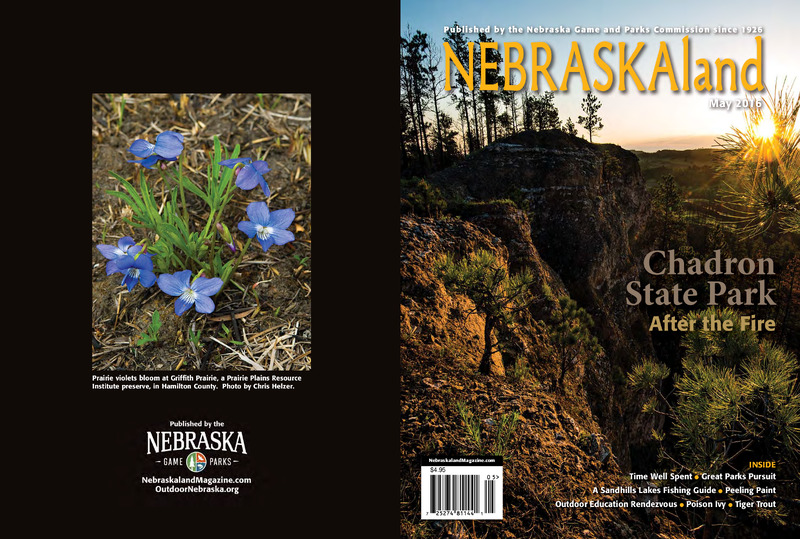
Prairie violets bloom at Griffith Prairie, a Prairie Plains Resource
Institute preserve, in Hamilton County. Photo by Chris Helzer.
NebraskalandMagazine.com
$4.95
INSIDE
Time Well Spent ● Great Parks Pursuit
A Sandhills Lakes Fishing Guide ● Peeling Paint
Outdoor Education Rendezvous ● Poison Ivy ● Tiger Trout
NEBRASKAland Magazine
Volume 94
●
No. 4
●
May 2016
F EAT U R ES . . .
22 Still Smoking
S
P
J
H
32 Time Well Spent – What to Do in May
R
B
34 Fishing the Sandhills
E F
56 Rendezvous by the River
S
P
J
N
60 Peeling and Rusting
P
S
J F
66 Jakes Hunting Toms
2
TORY AND HOTOS BY USTIN
AAG
BY ENAE LUM
BY RIC OWLER
TORY AND HOTOS BY ENNY
GUYEN
HOTOS AND TORY BY ON ARRAR
STORY AND PHOTOS BY JENNY NGUYEN
68 Poison Ivy – Nebraska's Most Irritating Plant
BY JOE ZENTNER
34
●
I N S I D E T H I S I S S U E ...
Mixed Bag – Fox Squirrels, Travel to Gothenburg,
Growing Pumpkins, Nebraska City's Pontoon Bridge,
Spring Wildflowers, Upcoming Events and More...........8
Page 49 – "Nebraska's Unseen Majority" ................... 73
Nature Notes – Tiger Trout in Nebraska .................. 74
In the Field – Lakes Back in Business ....................... 76
Outdoor Education – Saving the Regal Fritillary ... 77
Parks & Places – The Great Parks Pursuit................ 78
Portraits from the Past ..................................82
In the Kitchen – Morels and Parmesan Linguine.....84
The Last Stop – Buzzing About May ........................ 86
60
●
68
●
O N TH E W EB . . .
WHEN YOU SEE THIS SYMBOL IN THE PAGES OF
N
NEBRASKALAND MAGAZINE, VISIT
NEBRASKALANDMAGAZINE.COM AND VIEW OUR INTERACTIVE
DIGITAL EDITION FOR MORE INFORMATION.
D
NEBRASKAland (VOL. 94 / NO. 4, ISSN 0028-1964) is published monthly, except
for the combined Jan./Feb. and Aug./Sept. issues, by the Nebraska Game and Parks
Commission, 2200 N. 33rd St., Lincoln, NE. Periodicals postage paid at Lincoln,
Nebraska, and additional mailing offices. POSTMASTER: Send address changes to
NEBRASKAland, P.O. Box 30370, Lincoln, NE 68503-0370.
2 NEBRASKAland • MAY 2016
22
●
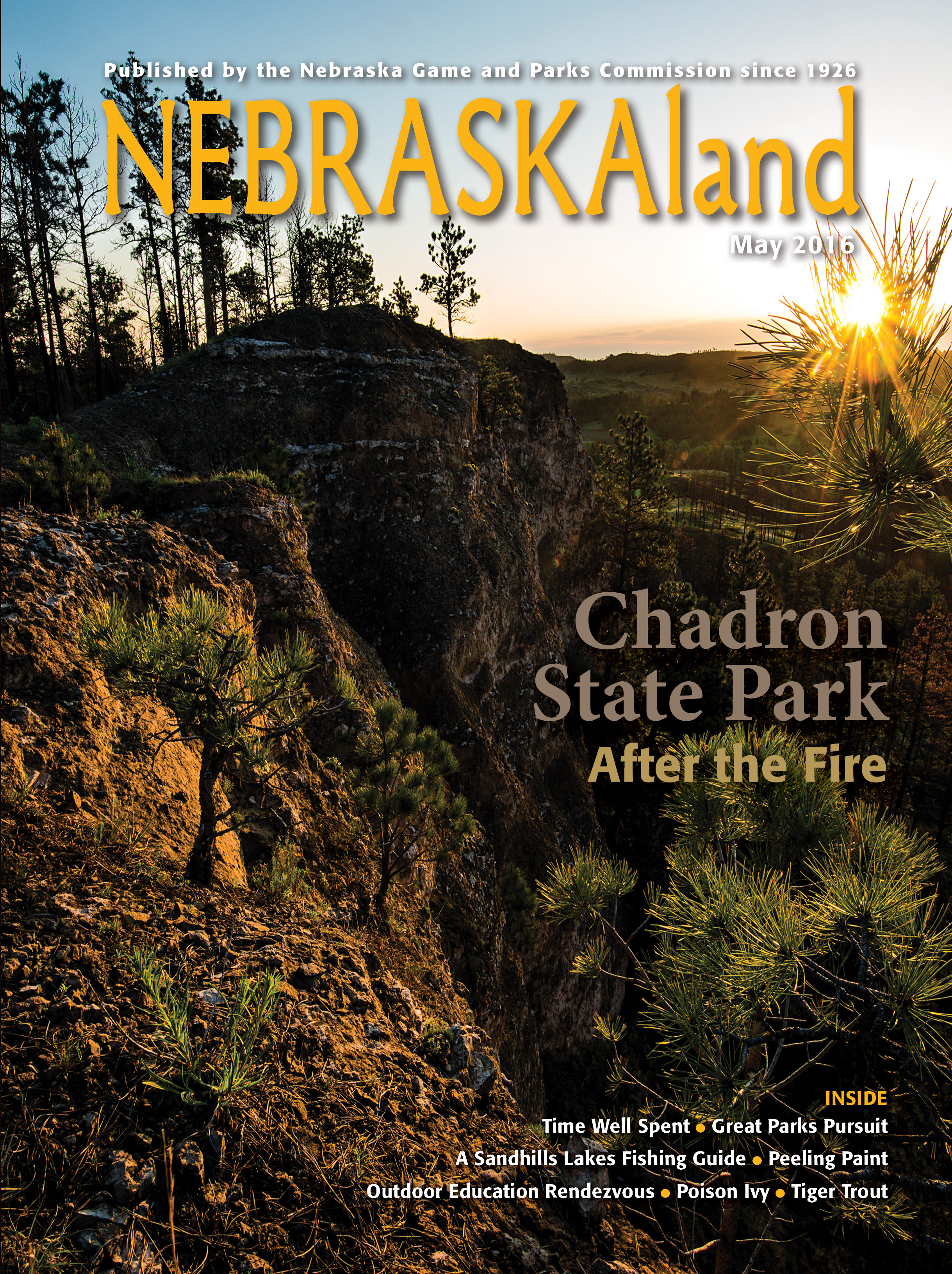
Cover: The sun rises over the pine-studded rocky terrain at Chadron State
Park. In its 95th year, Nebraska’s first state park continues offering breathtaking Pine Ridge scenery. See story on page 22. Photo by Justin Haag.
MAY 2016 • NEBRASKAland 3
Deer Carcass Disposal
Mark Kimball of Callaway,
Nebraska, recently sent Nebraska
Game and Parks Commission
Big Game Program Manager Kit
Hams a question about where
hunters could legally dispose
animal carcasses after a hunting
trip. Here is Kit's response:
Zach Hanson sent this image of Schramm Park State
Recreation Area taken at midnight in late February.
Casey Mitchell shared
this photo on Facebook
of Yankee Hill Lake near
Denton.
Jennifer Swain photographed this bobcat behind her
house southeast of North Platte.
Mark,
Once you have taken a carcass
home, the only legal method of
disposal is on private land with
permission of the landowner or
in your trash can, assuming your
commercial trash hauler will take
it. The local landfill is usually
an option also, which I have
routinely used in Lincoln.
Private land disposal is legal
with permission of the landowner.
However, once you take a carcass
home from public land you cannot
take it back to any public area.
With small carcass remains
(turkey, deer leg bones for
example) I just bury them in my
garden. They eventually break
down, but the leg bones last many
years. (They make good row
markers!)
When I harvest a deer, I usually
leave the spine, ribcage and
hide where I killed it and carry
the quarters and head out to my
vehicle as is legally required. I
usually try to hide the ribs, spine
and skin from view (not visible
by a road or trail and not in a
creek). Coyotes usually find the
parts and consume much of the
remains. This method is both legal
and natural and generally good
for soil, birds, scavengers, insects,
microorganisms and vegetation.
Richard Jones took this photo of a barn and star trails at Haythorn Ranch in
Maxwell.
Kirk Noller caught this coyote on a trail camera in February northeast of Kearney.
Brent Rising sent in this image of a stare-off between a white-tailed deer and a
raccoon from a trail camera in Douglas County.
4 NEBRASKAland • MAY 2016
MAY 2016 • NEBRASKAland 5
NEBRASKAland Magazine
Kathy Chase submitted these two photos from her travels across Nebraska. The top image is Robert Knapp of Ord, also known as
"Mr. Bob," at Fort Hartsuff State Historical Park. The windmill image below was taken in Valley County south of Ord.
Outdoor Plates
Dennis Coats of Hastings can fish,
as his plate implies, and he does often
with his son, both close to home in
sandpit lakes along Interstate 80 and
occasionally in far flung locales such as
Mexico, Canada and Alaska, more so
now that he’s recently retired.
If you have a unique outdoor
message plate you would like to share,
or know someone who does, e-mail
a photo of it (high-resolution, JPEG
format only, please) to Eric.Fowler@
Nebraska.gov, along with your name,
hometown and a brief description of
the interests expressed on your license
plate.
Free Fishing and Park Entry Day!
Don't forget that on May 21 there
are no fishing permits or park entry
permits required. So go out to a park
and fish ... for Free!
COMMISSIONERS
CONSERVATION OFFICERS
Director Jim Douglas
Commissioners
Chairman - Mark Spurgin, Paxton
Vice Chairman - Rex Fisher, Omaha
2nd Vice Chairman - Dick Bell, Omaha
Dr. Kent Forney, Lincoln
Robert Allen, Eustis
Pat Berggren, Broken Bow
Mick Jensen, Blair
Norris Marshall, Kearney
Dan Kreitman, Wahoo
ADMINISTRATION (Lincoln)
Craig Stover (Administrator)
Duane Arp (Asst. Administrator)
Jeff Clauson (Asst. Administrator)
MAGAZINE STAFF
Communications Director Christy Rasmussen
Editor Jeff Kurrus
Art Director Tim Reigert
Associate Editor Jenny Nguyen
Regional Editors Eric Fowler, Julie Geiser,
Justin Haag
Contributing Editor Michael Forsberg
Regular Contributors Chris Helzer, Gerry
Steinauer
Photo Librarian Jaclyn Cruikshank Vogt
Circulation Donna Robinson
For address changes and questions about
your subscription, e-mail donna.robinson@
nebraska.gov or call 800-632-5263
Advertising Sales Manager
For advertising information contact
Shane G. Gilster, 402-742-0125
Email: shanegilster@gmail.com
NEBRASKAland Magazine Copyright 2016, all rights reserved.
NEBRASKAland is available in audio from the Nebraska Library
Commission Talking Book and Braille Service, Suite 120, 1200 N St.,
Lincoln, NE 68508. 800-742-7691. NEBRASKAland Magazine and the
Nebraska Game and Parks Commission reserve the right to reject any
advertising not in keeping with the agency mission.
Rates: $18 for one year; $33 for two years; $44 for three years. Nebraska
recipients must add appropriate sales tax. To subscribe call
1-800-NEBLAND (632-5263), or go online to: NebraskalandMagazine.
com.
COMMISSION
C
CO
COM
OM
MMIS
MISSIO
S NO
OFFICES
FFICES
FF
FFI
CES
S
Correction: On page 6 of our April
magazine, we incorrectly captioned a
photo by reader Gary Panzer as two
bull elk in a field north of Scottsbluff.
These should have been labeled as
mule deer.
-Editor
Send your comments to:
Jeff Kurrus, Editor
NEBRASKAland Magazine
P.O. Box 30370
Lincoln, NE 68503
or e-mail Jeff.Kurrus@Nebraska.gov
Please include your postal address and telephone number. Letters may be condensed
and edited. Photographs are also welcome.
Any program that receives federal funding from the National Park
Service, or the United States Fish and Wildlife Service prohibits unlawful
discrimination on the basis of race, color, religion, age, gender, marital
status, national origin, age, disability or political affiliation. Any person
who believes he or she has been discriminated against in any program,
activity, facility, or service, should contact the Nebraska Game and
Parks Commission, Lincoln, NE 402-471-0641, the Equal Opportunity
Commission, Lincoln, NE 402-471-2024, TTY/TDD 402-471-4693;
United States Fish Wildlife Service, Civil Rights Coordinator, 4401
N. Fairfax Drive, Arlington, VA 22203; Director, Equal Opportunity
Program, U.S. Department of Interior, National Park Service, 1849 C
Street NW, Mail Code 0008, Washington, D.C. 20240-0001.
6 NEBRASKAland • MAY 2016
Headquarters/Southeast District Office
2200 N. 33rd Street Lincoln, NE 68503
Phone 402-471-0641
Northeast District Office
2201 N. 13th St. Norfolk, NE 68701
Phone 402-370-3374
Southwest District Office
301 E. State Farm Rd. North Platte, NE 69101
Phone 308-535-8025
Northwest District Office
East Hwy. 2, Box 725 Alliance, NE 69301
Phone 308-763-2940
Bassett Office
524 Panzer St., Box 508 Bassett, NE 68714
Phone 402-684-2921
Kearney Office
1617 First Ave. Kearney, NE 68847
Phone 308-865-5310
Ak-Sar-Ben Aquarium
21502 W. Highway 31 Gretna, NE 68028
Phone 402-332-3901
Omaha Office
8495 Frederick Street, Omaha, NE 68124
Phone 402-595-2144
402-471-5531
402-471-5531
402-471-5531
NORTHWEST (Includes counties covered)
Jim Zimmerman (District Supt.)
308-641-6138
Sean McKeehan
(Cheyenne, Morrill, Box Butte)
308-279-9133
Scott Brandt
(Kimball, Banner, Scotts Bluff)
308-631-0663
308-760-3647
Greg Hesse (Sheridan, Dawes)
308-430-0572
Dan Kling (Sioux, Dawes)
Terry Brentzel (Deuel, Garden, Grant) 308-458-7650
402-389-0444
Frank Miller (Cherry, Hooker)
NORTHEAST (Includes counties covered)
Tom Zimmer (District Supt.)
402-649-8053
402-760-0712
Dale Davis (Keya Paha, Brown, Rock)
402-340-3981
Jonathan Andreasen (Holt, Boyd)
Mitch Johnson (Knox, Antelope, Pierce) 402-613-8612
402-762-5022
Jeff Jones (Knox, Cedar)
Alex Thomas
(Dixon, Dakota, N 1/2 Thurston)
402-241-7615
Jon Reeves
(S 1/2 Thurston, Burt, Washington)
402-889-8508
402-719-1108
Dan Roberts (Dodge, Colfax)
Cory Krause
(Cuming, Wayne, Stanton, Dodge)
402-380-6410
Steve Oberg
(Colfax, Platte, Madison, Stanton)
402-910-3366
Randy Pomplun
(Nance, Greeley, Wheeler, Boone)
308-550-0489
308-730-7050
Doug Pollard (Loup, Garfield, Valley)
SOUTHWEST (Includes counties covered)
Roger Thompson (District Supt.)
308-530-3097
308-202-0819
Matt Brandt (Sherman, Howard)
308-380-7331
Tim Williams (Hall, Hamilton, Merrick)
Pat George
(Clay, Adams, Nuckolls, Webster)
402-705-9989
308-920-0367
Rich Routh (Franklin, Harlan, Phelps)
Matt Andrews
(Gosper, Furnas, Frontier, Red Willow)
308-746-2418
Andrew Heyer (Dawson, Gosper, Phelps) 402-613-2241
Brian Piernicky
(Red Willow, Frontier, Hayes, Hitchcock)
308-340-6627
308-289-0427
Nicholas Fix (Keith, Perkins)
308-289-1169
Bryce Streger (Keith, Arthur)
Brandon O’Neal
(Lincoln, McPherson, Logan)
308-530-3157
Alex Hasenauer
(Lincoln, McPherson, Logan)
308-660-4671
308-440-3847
Dale Johnson (Kearney, Buffalo)
308-529-8146
Mike Thome (Dawson)
Ray Dierking (Custer, Thomas, Blaine) 308-870-0322
SOUTHEAST (Includes counties covered)
Levi Krause (District Supt.)
402-949-0593
402-619-1355
Rich Berggren (Douglas)
402-616-5961
Dan Evasco (Sarpy)
402-210-0888
Heath Packett (Cass)
402-209-1506
Russell Mort (Otoe, Johnson)
William Krause
(Nemaha, Richardson, Pawnee)
402-274-8063
402-806-9084
Dan Zuehlke (Gage, Saline)
402-890-6463
Dina Barta (Lancaster)
402-890-6465
Doug Kramer (Lancaster)
402-937-3422
Dudley Sorensen (Lancaster, York)
402-613-2312
Travis Shepler (Lancaster)
402-890-7140
Stacey Lewton (Lancaster, Seward)
402-443-6392
Mike Luben (Saunders, Butler, Polk)
Nebraska Wildlife Crimestoppers
1-800-742-7627
MAY 2016 • NEBRASKAland 7
Fox Squirrel
By Lindsay Rogers
Liin
nd
dsa
say Ro
Roge
Roge
gers
rs is
an
n outdo
utdo
ut
door
or educa
duca
du
cati
tion
ti
on
speccia
sp
iali
l st wit
ith
h th
t e
Nebr
Ne
ebr
bras
aska
as
ka Gam
ka
ame
e an
and
Parrk
Pa
ks Co
Comm
mmis
issi
ssi
ssion
ion
on.
Sciurus niger
PHOT
PHOT
TO BY ROC
ROC
CK
KY HOFFM
OFFM
FM
MANN
AN
NN
A Mammal Brief
Named for
their large,
bushy tails
– reminiscent
of a red fox’s
tail – fox
squirrel are found
across Nebraska in a
variety of habitats.
They prefer open
forested areas, but are
often found in urban areas.
Although fox squirrels are a true tree squirrel, they spend much of their time on the ground searching
for food. At any sign of danger, they will immediately seek refuge in nearby trees. They feed on plant
material such as buds, bark and nuts. They are distinguished from other tree squirrels, such as the
gray squirrel, by their larger size and color. Fox squirrels are typically more rusty colored with orange
underparts while the gray squirrel is more gray with white underparts; both fox and gray squirrels have
black morphs. ■
8 NEBRASKAland • MAY 2016
MAY 2016 • NEBRASKAland 9
Travelogue Sponsors
By Julie Geiser
Gothenburg
he town of Gothenburg brings visitors to one of the most
ting displays of history in miles. Dubbed the Pony
in
interes
s Capital of Nebraska, it is loaded with glimpses of
Expres
Ex
past.
ti
times
The Pony Express consisted of relays of men who rode horses
carrying saddlebags of mail across a 2,000-mile trail for faster
communication with the west during the threat of the Civil War.
24,
The service opened April 3, 1860, and only lasted until Oct.
the
for
need
the
ended
line
ph
Telegra
1861, when the Pacific
y
riders. Gothenburg has two Pony Express stations - the Midwa
ette station in Ehmen Park. The station in
Macch
Sam
the
and
nburg
Gothe
of
south
site
on its original ranch
the Oregon Trail southwest of Gothenburg
the park was used as a fur trading post and ranch house along
before it was used as a Pony Express station.
its Swedish
Named after Goteborg, Sweden, this small town is noted for
er from
heritage, founded in 1882 by dreamer Olof Bergstrom, a minist
s the opportunity
Goteborg. The Gothenburg Historical Museum offers visitor
and memorabilia.
to see the town’s beginnings with railroad displays, photos,
ng an authenThe Sod House Museum is a time capsule of pioneer life featuri
pioneer families.
tic replica of an early sod home reflecting hardships faced by
to create
In the early 1890s a 10-mile canal was dug from the Platte River
ed electricity
a reservoir named Lake Helen, which provided water-power
factories to
and in return brought a brass foundry, flour mills and other
the lake was
Gothenburg. After 1893 the industry boom days ended and
ished lake
primarily used for agricultural irrigation. Today the newly refurb
trail, and a
and recreation area has excellent fishing, a 2.5-mile exercise
gave their
Veteran’s War Memorial to commemorate local residents who
lives in WWI, WWII, and the Korean and Vietnam wars.
and
Lafayette Park, adjacent to Lake Helen, provides campsites
showers under a shelter of trees with
scenic views of the lake.
Traveling through Gothenburg visitors may drive
on part of the original Lincoln Highway. The coast-tocoast roadway connected New York to San Francisco;
Gothenburg
at Gothenburg the highway crossed the river bridge
and followed a narrow road, which is still visible, as
it continued west on the south side of the river. In
1930 the Lincoln highway was rerouted onto what is
nine scenic
now Highway 30. The Lincoln Highway is one of Nebraska’s
Platte.
North
to
nburg
Gothe
from
today
d
byways and can be travele
with
relax
city,
small
this
in
history
the
all
After a day of discovering
le
18-ho
rated
ally
nation
A
Club.
Golf
a round of golf at Wild Horse
putting
range,
driving
a
feature
links
the
,
course open to the public
to
and chipping green, a pro shop and snack bar. When it’s time
le
availab
cabins
edroom
four-b
new,
has
retire for the day Wild Horse
by reservation.
Other places to visit include the Ehmen Park Arboretum, the
annual rodeo, the Swedish Crosses Cemetery, Walker’s Steak
House and Nebraska Barn and Grill. Plan your trip by visiting
Gothenburgdelivers.com.
Pony Express Reenactment
Sod House
Golf
e
s
r
o
H
d
Wil
10 NEBRASKAland • MAY 2016
Museum
Club
MAY 2016 • NEBRASKAland 11
NSHS, RG2294-71
A pontoon bridge (also known as a floating bridge) that crossed the Missouri River near Nebraska City. The V-shaped portion could
swing open for boats or flowing ice.
A Brief History
Nebraska City's Pontoon Bridge
From the Nebraska State Historical Society
R
12 NEBRASKAland • MAY 2016
vehicular bridge was finally realized on Oct. 14, 1930 with
the opening of the Waubonsie Bridge. Long gone, but not
entirely forgotten, was the innovative pontoon bridge that
had briefly seemed the answer to the Missouri River problem
at Nebraska City. ■
Visit the Nebraska State Historical Society’s website at
Nebraskahistory.org.
NSHS, RG2294-72
ivers were major travel barriers for most of human
history. Crossing a large river meant an expensive
ferry ride, or driving a team across the ice in winter,
and there was no crossing at all during floods or the
spring breakup of the ice. One of the more creative attempts
at a solution occurred in Nebraska City in the late 1880s.
Congress chartered the Nebraska City Bridge Company
in the early 1870s, but by summer 1888 only the new
Burlington Railroad bridge spanned the Missouri River there.
Everybody else still had to use a ferry. A man named Col. S.
N. Stewart of Philadelphia proposed to build a pontoon toll
bridge if the community would subsidize its construction.
Local leaders agreed.
The pontoon bridge was estimated to have cost about
$18,000 and opened to much fanfare on Aug. 23, 1888.
Not only was it said to be the first pontoon bridge across
the Missouri River, but it was also the largest drawbridge
of its kind in the world. The pontoon section crossing the
main channel was 1,074 feet long with a l,050-foot cribwork
approach spanning a secondary channel between an island
and the Iowa shore. The roadway, including two pedestrian
footways, was 24.5 feet wide. Opening the “draw” (the
V-shaped portion that could swing open for boats or flowing
ice) provided a 528-foot-wide passage.
While the bridge operated successfully during ice-free
months or when the river was not unusually high or low,
the capricious Missouri soon created problems. It became
increasingly clear that a permanent wagon bridge was still
needed. In the spring of 1890 city leaders began planning an
election to vote bonds to build one. Stewart responded by
threatening to remove the pontoon bridge.
Voters approved the bridge bonds in July; the courts
initially upheld them against a series of legal challenges
mounted by the Burlington Railroad. The Burlington claimed
it had acquired the Nebraska City Bridge Company’s original
charter to build the railroad bridge and, therefore, the
railroad was entitled to the bonds. Stewart then announced
that he had sold the pontoon bridge to parties in Atchison,
Kansas. On Nov. 13 the pontoons were sent down the river
toward the bridge’s new home. A month later, the U.S.
District Court ruled the bridge bonds invalid, and Nebraska
City was back where it had started.
In 1891 the Burlington laid planks beside the tracks across
the railroad span so it could be used as a toll bridge for
non-railroad traffic. Nebraska City’s dream of a permanent
Near the pontoon bridge, the Burlington Railroad bridge was not
open to wagons or pedestrians.
A Wildflower
Walk
PHOTO BY JON FARRAR
By Paula Hoppe
It’s time for a walk. The winds of
winter, which held us captive with
their bite, have been subdued by the
bluster of spring breezes. All around
the browns and grays of the late winter
landscape are melting into the greens
of spring, and flowers have begun to
cast aside their winter blankets of dry
leaves and grasses.
Amble down the woodland path
and you will find Dutchman’s breeches,
with their delicate fern-like foliage, and
flowers resembling small pantaloons
hung out to dry. May-apple rises from
the forest floor; its single blossom
nodding beneath two leaves. Tiny
delicate fawn lilies linger, and downy
blue violets abound, the latter being the
meadow anemone and marsh-marigold.
The tall arching stems of Solomon’s
seal are easily found statewide. White
and yellow water-crowfoot grow with
their feet in the water, the cup-like
flowers rising above the surface.
So, take a stroll, smell the moist
spring earth and discover the diverse
blooms of May. ■
Plains wild indigo
•
PHOTO BY JON FARRAR
PHOTO BY JON FARRAR
Marsh marigold
PHOTO BY GERRY STEINAUER
Prairie larkspur
only food source for fritillary butterfly
larvae.
A little diligence may be needed
tto find the plants blooming in prairies
tthis month. Plains phlox hugs the
ground, and Rocky Mountain pussytoes in west and central Nebraska
rarely eclipse 6 inches. The plainleaf
pussy-toes found in eastern portions
of the state, however, may rise to a
respectable 15 inches. Also blooming
this month are white and plains wild
indigo, prairie larkspur, and ground
plum. The 5-inch yellow flower of
the Plains evening primrose portends
warmer days to come, its ephemeral
blossom reflecting the sun in miniature.
Wet soils, creek banks and sloughs
yield their own beauties, including the
rare small white lady’s-slipper orchid,
•
PHOTO BY JUSTIN HAAG
PHOTO BY MIKE FORSBERG
May-apple
•
Fawn lily
14 NEBRASKAland • MAY 2016
White water-crowfoot
MAY 2016 • NEBRASKAland 15
Growing
Pumpkins
Many pumpkins in Nebraska are planted this month in preparation for Halloween.
ripe pumpkins throughout the duration
of the fall season.
July and August are maintenance
months: for the Helgoths, this means
spraying the pumpkins with fungicides
and bug sprays, fertilizing them,
weeding the fields and irrigating. Hintz
and her family mow, weed and hoe
their land by hand. When September
and October roll around, the vines dry
and the patches open for customers to
snip off and take home tokens of 10
months of work.
It’s not all vines and easy times,
though. Both the Helgoths and Hintzs
grow pumpkins in three separate fields
to ensure hail doesn’t damage the
entire crop. Additionally, the sheer
manpower of growing pumpkins can be
a challenge.
“Every one gets clipped by hand,”
Connie said. The stems have to be just
right, so each pumpkin must receive
individual attention when it’s time
to cut them off and haul them to the
patch.
Finally, there’s the competition factor
– not between humans and humans, but
between humans and crows, raccoons
and cows. The cows, perhaps, come out
on top; according to Hintz’s grandson
and worker Jared, when the crows and
raccoons ruin the pumpkins for sale,
the cows get the leftovers.
Eventually, though, pumpkin season
arrives, and we will have plenty to
choose from. Hintz cultivates 8 acres
of pumpkins, and the Helgoths have a
40-acre spread which in a good year
yields 20,000 pounds of pumpkins per
acre.
If you’re doing it right, you’ll choose
one this fall that’s firm and solid with
a stem that’s thick, green and sturdy. If
you’re in it for a jack-o'-lantern, don’t
buy too early, and don’t park it on the
concrete – the pumpkin will suck up
the moisture housed in the concrete and
rot faster.
For the Goldilockses of pumpkin
pickers, the effort required for the
perfect pumpkin is worth it. The same
is true for the Helgoths and the Hintzs;
growing pumpkins is a labor of love
that, in the end, can’t be squashed. ■
PHOTO
PHOT
O BY JEF
JEFF
F KURRUS
KURRUS
S
16 NEBRASKAland • MAY 2016
PHOTO
PHOT
O BY SAR
SARAH
AH KOCHE
K
KOCHER
OCHER
OCHE
R
By Sarah Kocher
Pumpkin pickers and Goldilocks
have one thing in common: everything
has to be just right. Because the
right size, color and texture for each
pumpkin picker is so important,
choosing the right pumpkin can be
quite a task.
Imagine, then, trying to grow enough
perfect pumpkins for hundreds of
guests.
As a strictly October squash,
commercial pumpkins are 10 months
of work for two months of payoff. As
soon as one Halloween is over, the
next is already on the radar.
According to Helgoth’s Pumpkin
Patch owner and grower Chuck
Helgoth, the winter is spent ordering
seed for the next year. At Helgoth’s,
located in Saint Libory, Nebraska,
this includes ordering 28 varieties of
pumpkins, including eight standard
varieties as well as 20 “ornamentals,”
ranging in color, size and shape. Seeds
cost the Helgoths between $150-200
per acre.
The ground is prepared for these
seeds in May, and soil samples are
taken to ensure its composition is
favorable for pumpkins. Like any plant,
the pumpkin requires a certain soil pH
to grow properly, usually between 6
and 7, and fertilizer is used to bring
the soil closer to a point that pleases
pumpkins.
“You’ve got to treat it kind of like a
corn crop,” Helgoth said. “We don’t just
throw the seed around and walk away.”
The Helgoths also plant in the month
of May and run through the first week
of June. Connie Hintz, owner of Poppy’s
Pumpkin Patch in Norfolk, plants
several different times during the spring
window. After all, with such a relatively
short and specifically defined period of
time in which to sell the product, the
pumpkins need to be ready at different
intervals. Plant them all too early and
they’ll spoil before Halloween. Plant
them all too late and the customers
will have to choose between green and
greener pumpkin preemies. With an
even spread, the pumpkins can mature at
different times, offering patch customers
MAY 2016 • NEBRASKAland 17
This Month is
for the Birds
Pelicans stand along the shore of Merritt Reservoir State Recreation Area.
In its seventh year, the Nebraska Passport program is
continuing to grow and capture the curiosity of travelers.
In a state with plenty of space to explore and discover, the
Nebraska Tourism Commission has once again selected 80
stops to help you connect to the place we call home. Some
of these stops are well-known institutions such as the Joslyn
Art Museum, Scotts Bluff National Monument, and Chimney
Rock. However, other stops will find you uncovering some
hidden gems in the state – small businesses such as Corner
Nook in Blue Hill or The Swiss Baker in Doniphan, cultural
hubs such as the Pawnee Art Center in Dannebrog, and
communal gathering places such as Joe Camera in Alma or
4th Street Coffee House in Stromsburg – each with a unique
story to tell. You’ll find yourself in places you’ve never
been before, because this year, the program features 23 new
communities.
In the words of 2015 Nebraska Passport participant Keri
McLandsborogh, “Thank you for 80 more reasons to debate
anyone who claims we live in fly-over country!”
We look forward to seeing you on the road this summer,
enjoying the 2016 Nebraska Passport program. Drive on.
To order your passport booklet, email
info@nebraskapassport.com with your name, mailing
address, and the number of passport booklets requested. For
more information, visit Nebraskapassport.com. ■
PHOTO COURTESY OF DEPARTMENT OF TOURISM
18 NEBRASKAland • MAY 2016
The Call of the Road
PHOTO BY JUSTIN HAAG
By Lindsay Rogers
What’s on your to-do list today?
How about biological control of
mosquitos, grasshoppers and other
insects? Or, seed dispersal of numerous
plants including raspberries, cedar,
ground plum and prairie rose? Maybe
you plan to provide food for hundreds
of different species across Nebraska. If
you are like me, none of these critical
ecosystem services are on my to-do list
today (or any day). Thankfully we have
birds to do all this important work.
Without birds, many of our
ecosystem functions would fail. We
rely on birds to keep food webs, seed
dispersal, pollination and biological
control working – all for free. So,
let’s take a moment to celebrate these
critical species. May is designated
as Nebraska Migratory Bird Month,
and across the state, conservation
organizations and agencies have
worked together to plan events, classes
The 2016 Nebraska Passport
Travel Program
and festivals for all Nebraskans
to attend. Join us by finding an
event in your area on the Nebraska
Migratory Bird Month website,
Nebraskabirdmonth.org.
Black Cow Fat Pig restaurant in Norfolk on the Order Up! Tour.
MAY 2016 • NEBRASKAland 19
by Jerry Kane
April 30-May 1
Living History Fort
Atkinson State Historical
Park (SHP), Fort Calhoun
May 1-22
Roger G. Sykes
Outdoor Heritage
Education Complex
May 7
Take Pride in America
Day Cleanup at Verdon
Lake State Recreation
Area (SRA), Verdon
May 7
Fort Kearny Outdoor
Expo Fort Kearny SRA,
open on weekends, Platte
River State Park (SP),
Louisville
Kearney
May 2
Archery Paddlefish
Permits remaining
Game and Parks Outdoor
Education Center, Lincoln
following draw available
for sale
May 2, 16
Hunt Safe Session
Roger G. Sykes Outdoor
Heritage Education
Complex, Platte River SP,
Louisville
May 3
Women’s Introduction
to Handguns Nebraska
Game and Parks Outdoor
Education Center, Lincoln
May 3, 10, 17
Outdoor Skills Club
Nebraska Game and
Parks Outdoor Education
Center, Lincoln
May 3, 17
Ladies Day at the
Range Nebraska Game
and Parks Outdoor
Education Center, Lincoln
May 3, 10, 17, 24
Best Shots Rifle
Marksmanship Nebraska
Game and Parks Outdoor
Education Center, Lincoln
May 4, 11, 18, 25
Beyond BOW Handgun
Class Roger G. Sykes
Outdoor Heritage
Education Complex,
Platte River SP, Louisville
May 6-7
Toast Nebraska Eugene
T. Mahoney SP, Ashland
May 7
Archery Fun Shoot
Nebraska Game and
Parks Outdoor Education
Center, Lincoln
Public Access on the Platte
Contact the Nebraska Game and Parks
Commission at 402-471-0641 or visit
OutdoorNebraska.org for more
information. Visit HuntSafeNebraska.org for a list of
hunter education classes and BoatSafeNebraska.
org for a list of boating safety classes.
May 7
Critter Corner Nebraska
May 21
Kids’ Fishing Event
Fremont SRA, Fremont
May 21
Free Fishing and Park
Entry Day event at
Lake 6, Fort Kearny SRA,
Kearney
May 21
Free Fishing Clinic
Platte River SP, Louisville
May 8
Mother’s Day Buffet
May 21
Free Park Day
Barbecue and Kids’
Fishing Day Fort
Fort Robinson SP,
Crawford; Ponca SP,
Ponca; Platte River SP,
Louisville
May 22
3-D Archery Shoot Red
May 8
Family Fishing Event
Zoo Pond, Scottsbluff
May 11
Introduction to
Shotguns and Trap
Shooting Roger G.
Sykes Outdoor Heritage
Education Complex,
Platte River SP, Louisville
May 14
Hooked for Life Kids
Fishing Event Red
Robinson SP, Crawford
Willow SRA, McCook
May 24
Family Fishing Event
Holmes Lake, Lincoln
May 26
Fishing Formula for
Success Nebraska
Game and Parks Outdoor
Education Center, Lincoln
May 27
Fort Robinson Inn
Restaurant opens for
Willow SRA, McCook
season, Fort Robinson
SP, Crawford
May 14
Bio Blitz 2016 Niobrara
May 27
Take Aim at Summer
SP, Niobrara
May 14
Rimfire Steel Plate
Challenge Fun Shoot
Roger G. Sykes Outdoor
Heritage Education
Complex, Platte River SP,
Louisville
Nebraska Game and
Parks Outdoor Education
Center, Lincoln
May 28
Migratory Bird Day
Indian Cave SP, Shubert
May 28-30
Living History Fort
Kearny SHP, Kearney
May 14-15
Becoming an
May 28-Aug. 14
Outdoors-Family Camp Roger G. Sykes
for the hearing impaired
Outdoor Heritage
Platte River SP, Louisville
Education Complex
open daily, Platte River
May 21
SP, Louisville
Free Fishing and Park
Entry Day no fishing
May 31
or park entry permits
Spring Turkey
required this day
May 16-June 3
Eligible landowners may
apply for one elk permit
20 NEBRASKAland • MAY 2016
seasons close
By following a few simple guidelines,
your boat will be ready year-round.
Keep Your Boat
Ready
By Brian Robinson
B
We all know how weird Nebraska
weather can be, regardless of the
w
month. Some anglers, like myself, will
m
ffish year-round. Therefore, keeping
yyour boat ready at all times is critical
tto fishing success.
The first, and most obvious, part of
tthis equation is keeping your motor at
tthe ready. After every use, clean, drain
aand dry your motor completely. I will
ttrim it up and down several times to
m
make sure the motor’s drained and also
ppull the drain plug so the boat drains.
IIf ever in cold water, always keep your
motor in the water to prevent freeze up.
m
The other major aspect is treating
tthe fuel system. I will add carefully
measured fuel stabilizer to the tank
m
whenever fueling up to make sure all
w
system components are treated. You
nnever know when it may sit longer than
yyou planned due to weather.
Right before it gets cold in the fall, I
aalso like to check my lower unit oil too,
tto make sure it’s lubricated properly.
Last, keep your batteries charged
tthroughout the year, and you’ll be
rready whenever it’s time to fish. And if
yyou stay on top of these larger issues
tthroughout the year, winterizing your
bboat will be a breeze when the time
ccomes. ■
By Evan Barrientos
The Platte River fascinates me. Maybe it's my instinctive attraction to water.
Maybe it's the languid flow that relaxes me. Or maybe I'm surprised by how
beautiful it is because no one ever seems to talk about exploring the Platte. It's
hard to take a trip in Nebraska without driving over the Platte, yet how often do
we stop and see what's below those bridges?
Part of the problem is that there's so little public access to the Platte. I know of
a few observation decks and two tiny trails along its banks, but the vast majority is
private property. Although the watercourse is considered public access, the minute
you put your foot on the riverbed you are trespassing! This is such a shame because
in my opinion the Platte is one of the greatest recreation opportunities Nebraska has
to offer. On a sunny weekend its banks are my favorite place to sit and read, and
every time a friend visits I make sure to bring him or her to a sandbar for a picnic. I
have access to private land along the river, but most people aren’t so lucky.
Fortunately, if you don't own a section of the Platte the best recreation
opportunity is still available to you: kayaking. I kayaked on the Platte twice last
summer and it remains one of my favorite Nebraskan memories. When there's
enough water for a decent flow you can cover 20 miles in an afternoon while
hardly paddling. And boy was I surprised by how beautiful the scenery was! I
expected the river to be bordered by corn fields, but the section between Gibbon
and Wood River is actually surrounded by trees, creating the feeling that you are
far, far away from it all. No other place in southern Nebraska has given me that
feeling of peace and solitude. Kayaking the Platte requires having two cars to
shuttle and renting kayaks if you don't own them, but it is well worth the trouble.
The Platte River has a long history of sustaining Nebraska’s society and
agriculture, yet we alter it, diminish its flows, and ignore it. But if more people
had a meaningful connection to it maybe we would treat it better. I challenge you
to find your own special place or activity on the river. Get to know this wonderful
resource if you haven't yet. The Platte deserves it. ■
Public access to the Platte:
Louisville State Recreation Area, Louisville
Platte River State Park, Louisville
Two Rivers State Recreation Area, Waterloo
Platte River Landing, Valley
The Crane Trust Visitor Center, Alda
Alda Road and Shoemaker Island Road (observation deck), Alda
Audubon Center at Rowe Sanctuary, Gibbon
Lowell Road and Elm Island Road (observation deck), Gibbon
Buffalo Bill State Recreation Area, North Platte
Cody Park, North Platte
Riverside Park, Scottsbluff
•
•
•
•
•
•
•
•
•
•
•
NEBRASKAland
and
Visitor
Last issue’s winner of
the Visitor drawing was
Ronn Hampton of Omaha,
Nebraska, who found the water strider
on page 74.
Readers are encouraged to contact
NEBRASKAland within 10 days
after this issue’s publication with
the correct page number and name
of this issue’s “Visitor” – a critter
found in Nebraska. We will then
gather the correct entries and draw
one to win a NEBRASKAland mug.
To enter each month, write:
NEBRASKAland Visitor
2200 North 33rd Street,
Lincoln, NE 68503.
Or e-mail:
Tim.Reigert@Nebraska.gov
with “Visitor” in the subject line of
the message.
HINT: This issue’s visitor is not on
pages 17, 21, or 77.
Water striders (Family Gerridae)
are a familiar sight to anyone who
has spent time near a farm pond
or quiet stream. These insects
appear to skate along the surface
of the water, immune to gravity.
Water striders have thousands of
tiny, water-repellent hairs on their
toes, or tarsae, which prevent the
insects from breaking the surface
tension of the water, keeping the
insects high and dry. Water striders
are predators, hunting for insects
and spiders as they glide across the
water surface. They may appear
to have only four legs, but like all
adult insects, they actually have six.
The front pair of legs are relatively
short, held under the head, and
used to grab prey. The longer
middle and hind pairs are used for
locomotion, and are easy to see
spread out on
the water
surface.
Special thanks to Julie Van
Meter, State Entomologist,
Nebraska Department of
Agriculture.
MAY 2016 • NEBRASKAland 21
Nebraska’s first state park remains
a hot spot for summer travelers – in
a good way.
Story and photos by Justin Haag
Morning sunlig
ght
h ill
llum
um
min
nat
ates
ess a rid
e
i ge
g top
p
high above
e a jee
eep
ep tr
t ai
aill a
att Cha
h d
drron
n Sta
tate
te Park.
te
arrk.
k.
A wildfi
fire entterred the
e par
ark
k in
n 201
012
but it
i cou
ould
ld
dn’
n’tt ta
t ke awa
ay all
alll th
a
hat
at mak
kess
t e pl
th
p ac
ace
e so spe
peci
cciial
al..
22 NEBRASKAland • MAY 2016
MAY 2016 • NEBRASKAland 23
A rainbow serves as the backdrop to ponderosa pines in Chadron State Park which survived the 2012 wildfires. The area in the
distance burned by wildfires in 2006.
t’ easy to see why this site along U.S. Highway
t’s
3385 was chosen to be Nebraska’s first state park 95
yyears ago. Nestled in the Pine Ridge along what is
nnow known as the Gold Rush Scenic Byway, the
11,000-acre Chadron State Park boasts of rocky ridges
ooverlooking pines in one of the state’s most scenic
regions.
regions From the moment highway travelers catch a glimpse
of the pond fed by a cold-water stream, they are often lured
by its serenity. Once discovering the park’s many other
attributes they’re sure to stay and return often.
Not every moment of the park’s storied past have been
a model of tranquility, however. In 2012, wildfires roared
across the Pine Ridge, charged into the park and scorched
a majority of its signature ponderosa pines. As those fires
worked to incinerate much of the character of the Pine
Ridge, many worried about the fate of Nebraska’s first state
park. Selling the park to visitors after the fires became more
challenging. After hearing media reports, a lot of people
were under the impression that Chadron State Park was
ruined and planned their summer travels to different locales.
Most of the visitors to the park shortly after that incident
were just arriving out of curiosity.
In the spring following the fires, however, the lush
green of native green grasses replaced the charred turf and
served as a harbinger for better days ahead. While the fire
no doubt took its toll on the forest, many healthy towering
ponderosa pines remain, and previously unseen vistas have
become visible where blackened trees have been removed.
24 NEBRASKAland • MAY 2016
Furthermore, the park still offers a wide range of amenities
and activities for travelers. Those visitors who came out of
curiosity were soon returning for recreation.
“A lot of visitors are surprised to see the park doing as
well as it is when they come here,” said Gregg Galbraith, the
park’s superintendent since 2014. “It really is thriving. We
have just as much or more to do here as we always have and
the park still has incredible aesthetic value.”
While workers have been cleaning up blackened timber
from areas of the park, they’ve also been busy making it
attractive to visitors in other ways.
Staying Busy
Perhaps the most noticeable improvement to the park is to
its two-acre pond. The lagoon’s dilapidated outlet structure
prompted officials to drain it in fall 2013, and it remained
empty until April 2015. Many park visitors were upset about
the pond remaining dry for that long, but you won’t hear
many complaints now that the project is complete. As a
remedy to decades of sedimentation, the pond was deepened
from 4 to 14 feet. Since the water and fish were reintroduced
to the pond last spring appreciative anglers of all ages have
walked the banks of the pond casting for its ample supply
of rainbow trout – not to mention the occasional brown or
brookie in nearby Chadron Creek. Families not only have
enjoyed fishing pursuits but have pedaled on the park’s
paddleboats.
After a renovation to the park’s
popular two-acre pond,
visitors enjoy pedaling the calm
waters. Anglers also enjoy pursuing
its ample supply of rainbow trout.
MAY 2016 • NEBRASKAland 25
This bighorn sheep (Ovis canadensis) ram
is among the park’s frequent visitors.
The pond isn’t the park’s only
water attraction receiving recent
improvements. The swimming pool,
with its high vantage point on one of
the park’s hillsides, has long provided a
respite to visitors looking to cool off in
a relaxing setting. Visitors returning to
the pool this summer will notice fully
renovated bath houses, which have
been modernized and follow guidelines
of the Americans with Disabilities Act.
The park’s disc golf course, added in
2013, is developing a great reputation
among players. Designed by Jake
Rodiek, an assistant superintendent
at the time who was once a junior
world champion disc golfer, the course
capitalizes on the park’s naturally
rugged terrain and open greenspaces. It
will soon be expanded from nine to 18
baskets, providing an ideal location for
both casual play and tournaments.
Also in the works is an archery trail
with 14 targets. Archery has long been
Jayce Hoffman of Chadron rides the lead “thoroughbred” in the Hippity-Hop Horse
Race near the park’s Trading Post. The race is a popular children’s event during the
park’s annual anniversary celebration each June.
Under a summer sun, the author’s daughter Kiera leaps from a diving board at the park’s swimming pool. Recent upgrades to the
pool’s bath houses will make it an even more popular attraction this summer.
26 NEBRASKAland • MAY 2016
MAY 2016 • NEBRASKAland 27
have made much of the forest within
the park a lot healthier than it is in
other areas of the Pine Ridge where
suppression of wildfires has resulted
in thick stands of ponderosa pines
susceptible to catastrophic damage. The
park in the 1990s was one of the first
places to take an active approach to
thinning, and that work has received a
lot of credit for firefighters being able
to stop the flames of the 2012 wildfires
from traveling farther east.
While some trees have been planted
by Boy Scouts and park employees,
foresters are hopeful they can maintain
the islands of green pines – somewhat
of a challenge. Many of the battleweary trees have become susceptible to
destructive Ips beetles, for instance.
More welcomed creatures have also
moved back into the park, however.
It’s common for park visitors to get a
look at bighorn sheep which love the
high country west of the park. Other
common visitors are white-tailed deer,
wild turkeys and mallards and a wide
Children enjoy an afternoon of sledding at Chadron State Park. The park’s newly designated sledding hill attracted visitors
throughout the winter.
available at the park’s activity center,
the Trading Post, and the new course
will build upon that popularity.
After the snow falls families have
begun congregating at the park’s upper
elevations where staff last year cleared
a hillside especially for sledding.
“The sled run was really a hit this
winter,” Galbraith said. “Because the
terrain was naturally suited for such an
activity, it didn’t cost us a lot of money
to create. We just cleared the area, put
up signage and the people came.”
Active visitors also enjoy facilities
for tennis and sand volleyball, as well
as a vintage baseball field. Walkers
28 NEBRASKAland • MAY 2016
and runners can often be seen on the
park’s paved roads or its system of
about 15 miles of trails. The park may
be explored by guided horseback rides,
mountain bikes or foot. In the winter,
cross-country skiers take to the trails.
The park also features playground
equipment, shelters and grills, making
it a great place for dining outdoors.
Bedding Down
Whether “roughing it” in the tent
or kicking back in a fully furnished
cabin, visitors to Chadron State Park
enjoy a wide range of options for
a good night’s rest. The furnished
cabins constructed by the Civilian
Conservation Corps early last century
have hosted generations of visitors.
Those looking for more modern
facilities often stay in the park’s
duplexes. A group facility nearby
provides a place for a wide range of
get-togethers, including meetings,
family reunions and weddings.
Last but not least is the park’s
campground, which has developed a
reputation for its laid-back relaxing
atmosphere. It has sites with and
without electrical hookups, as well as
showers, laundry facilities, playground
equipment and a dump station. Half of
the sites may be reserved online while
the others are first-come, first-served.
Back to Nature
While the forest may not look like it
did five years ago, Chadron State Park
still features numerous islands of green
pines and a healthy stand of hardwoods
along the creek bottom. Each spring
brings green grass and blooming
wildflowers among some of the state’s
best scenery.
Thinning efforts, in conjunction
with the Nebraska Forest Service,
Shell-leaf penstemon (Penstemon grandiflorus) blooms on a rocky ridge top in the
park. Hikers of the park’s extensive trail system are sure to enjoy natural wonders of
various shapes and sizes.
MAY 2016 • NEBRASKAland 29
western Nebraska’s prime attractions,
and with its location just nine miles
from Chadron, is a great place to set up
camp or visit for the day. Nearby are
the wealth of Pine Ridge attractions,
such as the expansive Nebraska
National Forest and Fort Robinson
State Park. South Dakota’s Black Hills
are just an hour’s drive to the north.
Despite a setback or two, Chadron
State Park remains a favorite
destination for families looking for a
relaxing getaway in the beautiful Pine
Ridge. With so much going for it, no
wonder its flame continues to burn
bright. ■
Cabins and Camping at Chadron
ABOVE: The park’s
campground provides
modern amenities in a serene
setting. The park also has
cabins to rent.
LEFT: Amanda Filipi of
Gering, Nebraska Game
and Parks Commission
education specialist, presents
a program on Dutch-oven
cooking. A summer series of
educational programs gives
park visitors an opportunity
to learn outdoor skills and
natural history.
OPPOSITE: A pair of tom
Merriam’s turkeys look for
hens from a high point in
the park. As a location for
an annual bird banding
station, many smaller
feathered species have been
documented in the park.
30 NEBRASKAland • MAY 2016
range of other bird life. Each fall,
the Bird Conservancy of the Rockies
operates a banding station from the
Sawmill Shelter, capturing scores of
red crossbill, spotted towhees and
other species that are common in the
park. The first-ever dusky flycatcher to
be banded in the state was processed
there in 2013. Prized species such as
mountain chickadees, pine warblers,
red-naped sapsuckers, Stellar’s jays
and lesser goldfinches also have
been captured by the banders. The
park also has a new butterfly garden
and naturalists provide informative
programs throughout the summer.
Still a Hot Spot
Regardless of the challenges
Nebraska’s first state park has faced
in its first 95 years, it remains one of
Chadron State Park has overnight accommodations to suit a
wide variety of travelers. It offers reservations for cabins and
half of the electrical campsites up to one year in advance.
The remaining campsites are available first-come, first-served.
Guests can plan vacations, check for availability and make their
reservations online 24 hours a day, seven days a week or can
call the Nebraska State Parks reservation call center at 402471-1414, Monday through Friday between 9 a.m. and 6 p.m.
CT.
22 cabins available for rental. They are air-conditioned,
heated and furnished with blankets, towels, stoves,
refrigerators, silverware and cooking utensils.
70 camping pads with 20- and 30-amp electrical hookups,
as well as 18 primitive
sites. Amenities for
campers include showers,
Chadron
dump station, laundry,
picnic tables, grills and a
State Park
playground for the kids.
•
•
Chadron State Park is located
9 miles south of Chadron.
MAY 2016 • NEBRASKAland 31
Time Well Spent
Fort Kearny
Outdoor Expo
May 7
Fort Kearny State Recreation
Area
What to Do in May
By Renae Blum
M
ay is a prime month for outdoor adventure. School is nearly out, and activities at
Nebraska parks are in full swing. Read on to learn how you can be part of the fun.
For a full list of events and descriptions, visit Calendar.OutdoorNebraska.gov. ■
Free Park Entry and
Fishing Day
Toast Nebraska
Wine Festival
May 21
May 6-7
Statewide
Eugene T. Mahoney State Park
Enjoy a Saturday of fishing or state park activities
without the need to purchase a fishing or park entry
permit for the day. See the online calendar for all
park events scheduled for this day.
If interested in lodging,
contact 402-471-1414 or visit
Nebraskastateparks.reserveamerica.
com for availability.
BioBlitz
Parks with Cabins:
Various Locations
Team up with other community members
on guided walks to find and identify
as many species of flora and fauna as
possible. Be prepared to tromp through
weeds and forest and get muddy in
streams. Data collected will be used
by scientists and citizen scientists
for various conservation research
projects in Nebraska. Get details at
OutdoorNebraska.gov/BioBlitz.
PHOTO BY JEFF KURRUS
32 NEBRASKAland • MAY 2016
May 14 and 21
PHOTO BY JEFF KURRUS
If you visit a park, don’t forget that
you’ll need a park entry permit.
Sample wines and hard ciders from
more than 200 Nebraska wineries while
enjoying live music, wine education
sessions, and a variety of food, artisan
and craft vendors. To buy tickets, visit
ToastNebraska.com. A limited number
of Mahoney cabins, lodge rooms and
campsites are available for guests; call
402-882-2448 to book your stay.
PHOTO BY JEFF KURRUS
Stay in a Cabin
• Chadron State Park
• E.T. Mahoney State Park
• Fort Robinson State Park
• Lewis and Clark State Rec Area
• Niobrara State Park
• Platte River State Park
State Park
• Ponca
Two
Rivers
State Rec Area
• Medicine Creek
State Rec Area
•
PHOTO BY JEFF KURRUS
Join Fort Kearny in celebrating the
Expo’s 10th anniversary. Participate in
sports such as archery, kayaking, fishing
and target shooting. Other activities
include a lumberjack show; historic
reenactments; a fishing kayak and bow
package giveaway; and presentations
on falconry, outdoor cooking and antler
scoring. All activities are free with a valid
Nebraska park permit. More information
is available at OutdoorNebraska.gov/
FortKearnyOutdoorExpo.
MAY 2016 • NEBRASKAland 33
E
v
veryone
wants to get away when they go fishing, but who would have
th
thought the fishing could be this good in the middle of nowhere?
— Joe Rydell, Alliance, Angler and Nebraska Game and Parks
Commission Fisheries Biologist, Fisheries Division
Fishing the
SANDHILLS
A Guide to Nebraska’s Sandhills Lakes
Bluegills and other panfish are
what draw many anglers to
Sandhills lakes, whether they’re
fishing open water or through
the ice.
Photo by Eric Fowler.
34 NEBRASKAland • MAY 2016
T
NEBRASKAland Magazine • Fishing the Sandhills
PHOTO BY ERIC FOWLER
Pockets of open water behind the cattails that ring most Sandhills lakes
are almost always worth a cast with a topwater lure or spinnerbait,
including this one Steve Frederick of Scottsbluff is fishing at Hackberry
Lake on the Valentine National Wildlife Refuge. Extremely fertile by their
nature, Sandhills lakes produce panfish, including bluegills (below), in
quantity and quality, making them popular among ice anglers.
thrive with the abundant food and cover. Unlike reservoirs
and ponds, which have a narrow band of highly productive
water around their shorelines, nearly every acre of a
Sandhills lake supports fish.
Anglers may curse the abundance of aquatic vegetation
found in Sandhills lakes, especially in the summer when it is
seemingly impossible to retrieve a lure without it becoming
fouled by weeds, and frequent stops to clean the vegetation
from the props of “weedless” electric trolling motors are
required. But those anglers need to remember that when
they fish other waters, they target these “weeds” because
they know that’s where the bass, pike and panfish are most
often found. In Sandhills lakes, the target is simply much
bigger. If you can’t handle the weeds, fish early, from April
to June, and come back in the fall, when weeds start to die
back and fish are gorging themselves for winter.
The ring of vegetation that surrounds the entire shoreline
of most lakes makes bank fishing impossible. Those who
don waders can reach the outside edge of the cattails, or
pockets of water within them, on several lakes, but footing
can be difficult and in some cases the bottom is too soft to
wade. When winter arrives, however, ice-up is the great
equalizer that opens a lake to all anglers. And because
of the shallow nature of the lakes, they are quick to freeze,
providing ample opportunity. On many lakes, the heaviest
pressure and harvest of fish comes in the winter.
Many anglers are drawn to the Sandhills by the obscurity
and isolated nature of the lakes. While only 40 are open to
public fishing, they see far less boat traffic than you will
find on most Nebraska reservoirs. There are no marinas, no
shorelines ringed by cabins, and only a handful of lakes even
have campgrounds. Roads are sparse and often rough, and
you will see far more cattle than cars and people. All but two
lakes have a 5 mph speed limit, and some allow only electric
motors, so you won’t find yourself listening to the drone of
Jet Skis and speed boats all day. Wildlife is abundant. Spend
the night and you will swear you’ve never seen so many
stars. And while the broad vistas and absence of trees bother
some Easterners, many people find the view from the top of
a ridge, where you can seemingly see forever, exhilarating.
Even if you don’t have a lake to yourself, which you
sometimes do, the peace, quiet and solitude breeds a sense
of having your own private fishing hole in the middle of the
wilderness.
Between that and excellent fishing, you now have two
reasons to visit.
PHOTO BY ERIC FOWLER
alk
a to anglers who have fished them, and they
may
m tell you that Sandhills lakes are like no
other
othe lakes you’ve fished. And while the words may
literally
liter
be true, as the makeup of these lakes is
truly unique, the reasoning behind the words can
vary widely, even if it applies only to the fishing.
For some, the draw is northern pike. While not all
Sandhills lakes hold pike, these shallow waters are some
of Nebraska’s best habitats for the toothy predator, and the
only waters where they can consistently reproduce. For
other anglers, it’s both the size and number of largemouth
bass the lakes can hold. Still others are drawn by the size
and number of panfish. As with pike, Sandhills lakes are the
only in Nebraska that contain self-sustaining populations of
yellow perch. Perch, bluegills and crappies can grow fast
and fat in these lakes, which are as fertile as any lake on the
planet.
There are, indeed, no lakes like those in the Sandhills in
this hemisphere and perhaps in the world. They are natural
lakes, but they aren’t fed by surface runoff like ponds and
reservoirs elsewhere in Nebraska or natural lakes found
in other states. Nearly every drop of rain that falls in this
19,000-square-mile area of grass-stabilized sand dunes
goes straight down into the Ogallala Aquifer. These lakes,
and countless wetlands, are simply locations where the
landscape dips below the surface of the aquifer.
Rarely will you find water deeper than 10 feet in a
Sandhills lake, and in some the maximum depth might be
only 3 feet. Of the 1,640 lakes 10 acres or larger, 86 percent
are too shallow or alkaline to support fish. In the ones that
do, the year-round movement of groundwater keeps the
water fresh, preventing winter and summer kills due to
loss of oxygen that hamper fish production in other types
of lakes that are this shallow, and also keep the lakes cool
enough to support fish like pike and perch. The lake levels,
and often the fish populations, follow those of the water
table. When it drops, die-offs can and do occur in Sandhills
lakes. When it rises, good fishing will follow.
Shallow, clear water also allows sunlight to reach the
bottom of even the deepest parts of most Sandhills lakes,
producing an abundance of zooplankton and phytoplankton,
the tiny animals and plants that are the foundation of the
aquatic food web. It also promotes the growth of smartweed,
pondweed, coontail and other aquatic vegetation. These
plants are the basis for the abundant invertebrates such
as damselfly and dragonfly nymph, snails and
leeches that panfish and young bass and pike
feast and thrive on. Most lakes are ringed by
marshlands, with dense stands of cattails
and bulrushes rising from the shallows.
These features are what make
Sandhills lakes produce fish
in both quantity and
quality, especially
panfish,
which
Fishing the Sandhills • NEBRASKAland Magazine
Northern Pike
Pike fishing picks up at ice-out, but can start slow. While
the fish will take lures, they are often sluggish in the stillcold water, making smelt fished on the bottom or under a
bobber, a good approach. As the water warms, weedless
spoons, such as a Johnson Silver Minnow and spinnerbaits
in yellow, black, chartreuse or white are the favorite lures of
many anglers. Large Mepps spinners and Daredevil spoons,
both staples for pike anglers elsewhere, and shallow-diving
crankbaits will work early in the year before vegetation
becomes too thick, or in deeper water where the weeds don’t
reach the surface. Soft plastics, including swim baits, rubber
worms and creature baits, can be effective when pike are
finicky.
Tooth-proof leaders are recommended whenever you’re
fishing for pike. While steel leaders are most commonly
used, they can affect the bite when water is clear, which
it often is early in the year before algae blooms begin. In
that case, lighter wire leaders are best. While pike can still
bite through heavy fluorocarbon line, its use can be the
difference between getting bites or not. Baitcasting rods and
reels and strong, braided line can be invaluable when you
want to keep hooked fish out of the vegetation.
Anglers should start their search for pike near vegetation,
especially isolated stands of bulrushes, cattails, smartweed
and pondweed. The weeds may not be immediately visible.
Early in the year, pike might be lurking in the tops of 2-foot
tall weeds in 6 feet of water waiting for dinner to swim by.
Don’t be afraid to spend time casting to what may appear to
be “open” water to search for these fish. As spring moves
towards summer, when pike are in search of cooler water,
they may be found in these weeds even farther from shore.
In the winter, the use of tip-ups for pike can be both
effective and entertaining. Countless variations allow a smelt
and a treble hook to be held on or near the bottom directly
beneath the hole. When a pike grabs the bait and swims off,
a flag is tripped by the free-wheeling spool of line, eliciting
a call of “Flag up!” among friends and a race to the hole.
Pike typically cruise slowly around the lakes in search of
food all winter. A line of tip-ups extending from the shore
towards the middle of the lake can intersect their route.
Largemouth Bass
Largemouth bass take a bit longer to become active than
pike, but a warm spell will send them into action early in
the spring. Look on the north bank first. Bass spawn in the
weedy shallows of Sandhills lakes when water temperatures
hit the mid-60s in May. Getting to them can be a challenge.
Look for pockets of open water tucked in the cattails that
ring the lakes.
The rest of the year, bass are often found around the
edges of the lakes, especially in gaps in the cattails, but
they can also be found anywhere there is an isolated patch
PHOTO BY JENNY NGUYEN
How to Fish the
Sandhills
Albert Allen of Ainsworth admires a largemouth bass he landed from his kayak at Tower Lake on Yellowthroat Wildlife
Management Area.
PHOTO BY JEFF KURRUS
Northern pike, like this one caught at Clear Lake on the Valentine National Wildlife Refuge, can be caught in many Sandhills lakes.
NEBRASKAland Magazine • Fishing the Sandhills
of vegetation, be it a stand of bulrushes or a patch of
smartweed or pondweed.
Soft plastics, such as Texas-rigged rubber worms fished
through the vegetation on the bottom can be extremely
effective. While the lakes are shallow, these rigs may require
a half-ounce weight – more than most people normally use
– to get through the thick vegetation.
Spinnerbaits can be retrieved through or just above
lighter vegetation, or along the edge of it. Shallow diving
crankbaits, such as a Mann’s Baby-1 Minus, are also just as
useful here as they are on other waters if you can find edges
and pockets of open water where they can be effectively
fished. Topwater poppers and plugs can work well in the
spring and later in the year when fished along weedlines or
in open pockets.
In heavier vegetation, topwater frogs, Johnson Silver
Minnows and other weedless lures are the only baits you can
possibly fish, but ones that bass will readily take. Skilled
anglers might even be able to keep a buzzbait on top of the
weeds.
Lure color selection for bass is similar to pike. Dark colors
work best on soft plastics, and yellow, black, chartreuse
and white are typically the best colors for spinnerbaits and
buzzbaits. Tip those or your Silver Minnow with a plastic or
pork trailer to add scent and action and to allow for a slower
retrieve if fish aren’t overly aggressive.
Heavy baitcasting tackle and strong braided line are
almost a must when fishing here, as the vegetation bass
often head for when hooked is never far away. And
be prepared to lose many rigs in lakes
that also hold pike unless you tie
your rig with a wire or
fluorocarbon
leader.
Bass fishing can be
good well into the
fall, and at times can
be good through the
ice, when fish may
be as likely to
take a Gulp
minnow on
a tip-up as
a teardrop
and
waxworm
on a jigging pole.
Fishing the Sandhills • NEBRASKAland Magazine
Bluegill
Yellow Perch
Black Crappie
Bluegills, yellow perch and crappies grow fast and fat in
Sandhills lakes and are the main draw for many anglers.
Bluegills in Sandhills lakes spend most of their time
in cattails, bulrushes, smartweed, pondweed and other
vegetation, where they have the most cover from hungry
bass and pike and plenty of food. Use Mepps spinners,
Johnson Beetle Spins or Blakemore Roadrunners to search
for fish along the edge of the vegetation. If you find
fish, toss out a jig tipped with a piece of nightcrawler or
PowerBait worm or waxworm under a bobber and you may
be able to pull several fish from a school.
Bluegill spawning beds are harder to find in Sandhills
lakes than elsewhere due to the thick vegetation that rings
most lakes. But if you find an open patch of sandy shoreline
in late May, be sure to fish it. During this time of year and
at other times when water is clear, a high vantage point from
your casting deck and polarized sunglasses can allow you to
sight fish for bluegills.
Yellow perch can be
caught using the same
tactics as bluegill
through much
of the year.
They
are,
NEBRASKAland Magazine • Fishing the Sandhills
PHOTO BY ERIC FOWLER
Panfish
Guided by their dog, anglers cast toward the shoreline on a calm spring morning on Dewey Lake on the
Valentine National Wildlife Refuge.
however, a more nomadic species and more likely to be
found in deeper water that may even be free of vegetation.
Crappies will spawn in the shoreline vegetation in May and
fishing during this time can be excellent. The rest of the
year they are found near vegetation in deeper, open water.
Minnows aren’t allowed in many lakes, but where permitted
they are the preferred bait for crappies and perch.
Light spinning or spincasting tackle or a fly rod is
sufficient for panfish in the Sandhills. Weedy lakes aren’t
unfishable, they just require a change in tactics. When
vegetation gets thick, a fly rod allows you to cast a dry fly
to places you’d never be able to retrieve a jig through. A
long cane pole or spinning rod can also be used to probe the
weeds for panfish. Drift or motor slowly across the thick
vegetation and cast a fly or drop a jig and crawler into any
hole in the weeds big enough to fit one in, and it will often
hold fish. You can also cast a slip-bobber to these holes. If
you catch one fish from a hole, you’re likely to catch more.
Don’t limit your search to the shoreline. In the summer, you
may find larger pockets of open water in the middle of a
lake. These deeper spots might also offer the cooler water
fish are looking for in the heat of summer.
The search for bluegills through the ice begins where it
always does: near vegetation. Early in the winter they may
be found in shallow water near cattails. Later, they may
move to deeper water. Look for patches of bulrushes poking
through the ice or for the leaves of pondweed frozen in the
ice. A teardrop and waxworm is the best bait through the ice.
Finding fish is the hardest part. If you’re not catching fish,
move.
Other Species
A handful of Sandhills lakes hold other species, including
channel catfish, muskellunge, walleye, sauger and saugeye.
The tactics you use for those species won’t differ much from
what you use in other waters.
Walleye and sauger have done well in some Sandhills
lakes through the years, and biologists are now stocking
saugeye, which like sauger tend to do better in turbid water,
to see if they do better. While anglers often target those fish
on drop-offs and points in large reservoirs, those underwater
structures are much more subtle in the Sandhills. Anglers
often catch them when targeting perch or crappies with jigs
or live bait rigs. Those targeting walleye sometimes fan-cast
small perch-colored crankbaits along weedlines at sunrise
and sunset, as perch are the main prey of this species in
these lakes.
Muskies can be caught in much the same way as northern
pike, but these fish are few in number and harder to find.
Lakes with harder bottoms support channel catfish. A
nightcrawler and stink or blood bait fished on the bottom
work as well here as in other reservoirs. If the lake bottom is
weedy or mossy, use a bobber to keep your bait just above it.
Fishing the Sandhills • NEBRASKAland Magazine
Public Sandhills Lakes
The Sandhills Region
Shell Lake
WMA
●
●
1 W
Walgren Lake SRA
●
● Cody
Cottonwood
Lake SRA
Gordon ●
Hay
Springs
Merriman
Public Sandhills lakes are scattered throughout north-central
Nebraska. The following list details them by county from west to
east. Unless otherwise stated, boats are limited to 5 mph and can
leave no wake.
Valentine
●
●
Rushville
Lord
Lakes
Walgren
Lake
SRA
Bassett
●
Alliance
Newport
●
●
Long
Pine
Home Valley Lake
Smith
Lake
WMA
●
●
Ainsworth
Merritt
Reservoir
Atkinson
●
O’Neill
Tower Lake
CottonwoodSteverson
Lake
WMA
●
●
Lakeside ●
Ellsworth
Frye
Lake
WMA
Long Lake SRA
Hyannis
Cozad
Lake
Twin
Lakes
WMA
Willow
Lake
WMA
East Hyannis Lake
●
Mullen
●
Clear
Lake
Overton
Lake
Swan Lake
Goose
Lake WMA
113 Acres. Sheridan County, 3E, 3S of Hay Springs. Bluegill,
Bullhead, Channel Catfish, Crappie, Largemouth Bass, Northern
Pike, Walleye, Yellow Perch.
While this lake isn’t technically a Sandhills lake, it looks, acts
and fishes like one, and you can see the Sandhills from there, so
we’ll include it. The lake filled in 2015 after a dry period sapped
its water level. It offers good perch, bluegill and bass fishing, and
with a hard bottom, an excellent population of channel catfish.
A few big flathead catfish, survivors from fish stocked years
ago, still swim there, too. The east half of the lake is private and
no bank access is allowed. Wheelchair-accessible fishing pier,
concrete boat ramp, primitive campground, stone picnic shelter,
pit toilet.
Thedford
●
DeFair Lake WMA
Brewster
●
Bartlett ●
Burwell
●
PHOTO BY JUSTIN HAAG
●
●
Taylor
Oshkosh
The sun rises over an ice-covered Smith Lake.
BOTTOM MAP BY TIM REIGERT. TOP MAP BY TRISHA SCHLAKE-IT GIS APPLICATIONS DEVELOPER.
●
The Sandhills is a 19,000-acre area of
grass-stabilized sand dunes that covers
one fourth of Nebraska and is rich in
ranchland. Between the dunes, wetlands
fed by groundwater cover 1.3 million acres,
including about 1,600 natural lakes 10 acres
or larger, 225 of which support fish.
Ogallala
North Platte
●
2 S
Smith Lake WMA
●
290 Acres. Sheridan County, 23S of Rushville. Bluegill,
Bullhead, Crappie, Largemouth Bass, Northern Pike, Yellow
Perch.
Smith Lake has long been an excellent panfish lake, producing
big bluegills and bass and abundant perch. An Aquatic Habitat
Program project in the late-1990s used a dredge to provide
depths of 10 to 12 feet in the center of the lake, lessening the
likelihood of winterkill. Like other lakes with good water quality,
Smith has always had abundant vegetation. That took a new turn
recently when curly-leaf pondweed appeared at the lake in 2015,
the first occurrence in the Panhandle. Common in eastern lakes,
this submersed vegetation thrived at Smith, covering all of the lake
in depths of 6 feet or less and making boating and fishing difficult.
Handicap-accessible concrete boat ramp, primitive camping, pit toilet.
3 S
Shell Lake WMA
●
160 Acres. Cherry County, 3N, 4E, 8N of Gordon. Bluegill,
Channel Catfish, Crappie, Largemouth Bass, Northern Pike,
Yellow Perch.
LEON SPANGLER OF EWING REELS IN A NORTHERN PIKE AT GOOSE LAKE.
NEBRASKAland Magazine • Fishing the Sandhills
Fishing the Sandhills • NEBRASKAland Magazine
6 H
Home Valley Lake
●
220 Acres. Cherry County, 30N, 2½E, 1N of Hyannis.
Bluegill, Common Carp, Crappie, Largemouth Bass,
Walleye, Yellow Perch.
Part of Cottonwood-Steverson WMA, there is no road
to this lake so access is limited to those wanting to portage
from Cottonwood Lake. In the summer, that could mean
dragging a kayak or float tube over a narrow ridge. The lake
gets much more pressure in the winter, when ice anglers are
allowed to take snowmobiles and ATVs across the ice on
Cottonwood and Steverson lakes and over the hill to Home
Valley. The lake holds a decent perch population and some
nice bass, but also has carp and is turbid.
7 L
Lord Lakes (U.S. Forest Service)
●
PHOTO BY JENNY NGUYEN
Kayaks are an excellent way to fish Sandhills Lakes, including Tower Lake on Yellowthroat Wildlife Management Area.
243 Acres. Grant County, 1N, 1½E of Hyannis. Bluegill,
Channel Catfish, Crappie, Largemouth Bass, Walleye,
Yellow Perch.
Since it was renovated in 2002, this lake has become one
of the better panfish lakes in the Sandhills, producing good
numbers and size of perch, crappies and bluegills. With
abundant vegetation and the food that comes with it, fish
are well fed. Fishing can be excellent in May and June. No
live baitfish can be used or possessed. Primitive boat ramp,
primitive campground, pit toilet.
4 C
Cottonwood Lake SRA
●
9 E
East Hyannis Lake (Avocet WMA)
●
PHOTO BY JUSTIN HAAG
680 Acres. Cherry County, 30N, 2E of Hyannis. Bluegill,
Common Carp, Crappie, Largemouth Bass, Muskellunge,
Saugeye, Walleye, Yellow Perch.
With a maximum depth of 20 feet, Cottonwood Lake
is one of the deepest in the Sandhills. Steverson is more
typical, with depths of up to 7 feet. Connected by a narrow
channel, the pair are practically one lake. The lakes were
acquired in 1997 and renovated soon after, but carp found
their way back in and have reduced water clarity and the
amount of vegetation. Still, a few walleyes persist, and
there are a few muskies and abundant small crappies.
Concrete boat ramp, primitive camping on Steverson Lake.
Snowmobiles and ATVs allowed on ice.
ne of the attributes that makes Sandhills lakes
such great fisheries can also make them
extremely difficult to fish in the summer: weeds.
The shallow depths and excellent water quality of
the lakes typically leads to an abundance of aquatic
vegetation. Cattails, bulrushes, smartweed, pondweed,
coontail and other plants host a myriad of snails,
insects and other critters panfish such as bluegills and
yellow perch feed upon. Where there are panfish, big
predators such as northern pike and largemouth bass
can also thrive.
Some lakes, however, can have so much vegetation
that by mid-summer it can be almost impossible to
motor a boat or retrieve a lure through it all. But that
doesn’t mean they are unfishable. There will almost
always be an edge to the weedline, or at least small
pockets in the weeds, that you can pull a fish out of.
And you can always use weedless topwater lures or
a fly rod to fish on top of the vegetation. As for getting
to those spots, if your electric motor won’t pull you
through the weeds, try using a push pole to get around.
A kayak or canoe will skim over the top of even the
thickest vegetation, and well timed strokes will keep
your paddle weed free.
And if all that is too much for you, go early or late
in the year. The most vegetated lakes don’t get
overly choked until June or July. And in the fall, when
temperatures cool, weeds start to die back. That also
happens to be the time when fish are feeding hard
to get ready for winter. And many places offer the
opportunity to do some grouse or archery deer hunting
early in the fall, or waterfowl or pheasant hunting later.
O
120 Acres. Grant County, 1E of Hyannis. Yellow Perch.
There is no boat ramp on this shallow lake, where aquatic
vegetation hampers summer fishing. Primitive camping.
PHOTO BY ERIC FOWLER
5 C
Cottonwood-Steverson Lake WMA
●
NEBRASKAland Magazine • Fishing the Sandhills
Frye Lake WMA
8 F
●
Shell Lake is an excellent fishery and as such gets fished
hard. It holds good pike, a few crappies, small bluegills and
perch. An Aquatic Habitat Program project in the
late-1990s used a dredge to deepen a portion of the lake to
up to 9 feet, lessening the likelihood of winterkill. With no
carp and excellent water quality, it also has abundant aquatic
vegetation and is very difficult to fish in the summer. It gets
plenty of pressure through the ice in the winter. Primitive
boat ramp, primitive campground, pit toilet. Snowmobiles
and ATVs allowed on ice.
34 Acres. Cherry County, ½E, ½S of Merriman. Bluegill,
Channel Catfish, Crappie, Largemouth Bass, Northern Pike,
Hybrid Bluegill/Green Sunfish, Yellow Perch.
This is one of two Sandhills lakes with no speed limit for
boats. Aquatic vegetation hampers summer fishing. Primitive
campground, pit toilets, playground and shelter.
Kiera Haag of Chadron holds a bluegill she caught from
Cottonwood Lake State Recreation Area near Merriman.
15 Acres. Cherry County, McKelvie National Forest,
9W of Merritt Reservoir. Bluegill, Crappie, Largemouth
Bass, Yellow Perch.
These three small connected lakes offer quality bass. A
primitive boat ramp is found on the east side of the east
lake. The other two lakes are accessible by foot and best
fished in waders, float tubes and kayaks. USFS Steer Creek
Campground and Merritt Reservoir SRA campgrounds nearby.
Embrace the Weeds
DeFair Lake WMA
10 D
●
70 Acres. Grant County, 1E, 2S, ½E of Hyannis. Black
Crappie, Yellow Perch.
Boat access is difficult on this shallow, weedy lake.
Primitive boat ramp, primitive camping.
Long Lake SRA
11 L
●
155 Acres. Brown County, 8½W, 21S of Ainsworth.
Bullhead, Channel Catfish, Common Carp, Northern Pike,
Yellow Perch.
Long Lake can be good for catfish, but has plentiful
carp and few other gamefish. With little use and limited
recreational opportunities, the Commission long ago
suspended maintenance at the 80-acre State Recreation Area
on the south side of the lake. Access road is accessible by
trucks only. While primitive camping is allowed, there are
no amenities.
Vegetation at Goose Lake near Bartlett.
Clear Lake
12 C
●
200 Acres. Brown County, 19S, 9W, 1N of Ainsworth.
Bluegill, Crappie, Largemouth Bass, Yellow Perch.
This private lake has a long history of excellent fishing
and has been home to a fishing club for decades. The need
to eradicate carp that found their way into the lake in 1999
led to a unique partnership between the Game and Parks
Commission, New Clear Lake Club, U.S. Fish and Wildlife
Service (FWS), North Central Resource, Conservation
Fishing the Sandhills • NEBRASKAland Magazine
Boat Ramps
he shallow nature of Sandhills lakes, and the
variability of water levels from year to year, makes
constructing boat ramps that function a challenge.
Wherever possible, the Commission and the U.S.
Fish and Wildlife Service, which manage the Crescent
Lake and Valentine National Wildlife refuges, have built
concrete ramps. These may be poured concrete, or an
articulated design that links concrete blocks with cables.
Where the accompanying list notes there is a primitive
ramp, rock or gravel has often been added to shore up
the sandy lakebed. In some cases, however, including
several on the Valentine Refuge, a launch is nothing
more than a gap in the cattails that is wide enough to
back a boat trailer into.
When water levels are high, it is possible to launch
larger boats on even some of the primitive ramps.
When levels are low, however, the shallow nature of
the lakes make it a challenge to get even a small boat
in the water on the best ramps, and four-wheel-drive
vehicles are required. In these cases, smaller is better,
and light boats that can be thrown in the back of a truck
or winched onto a tilt trailer from a foot of water are not
only your best bet, they’re your only one. Many who
have found themselves backing 20 yards into the lake
hoping to find water deep enough to float their boat
have also found themselves looking for someone with
20 yards of chain or tow rope.
In some lakes, getting to the boat launch might even
require four-wheel drive, or at least a vehicle with high
clearance, as some lakes are at the end of a two-track
trail road. Which isn’t a bad thing.
T
13 W
Willow Lake WMA
●
400 Acres. Brown County, 18½S, 12½W, 1N of
Ainsworth. Bluegill, Crappie, Largemouth Bass, Yellow
Perch, Walleye.
Willow Lake was renovated in 2013 and has seen very
high growth rates for perch and is producing quality bass
and bluegill as well. Walleye were stocked in 2015. With
depths of up to 10 feet, it is one of the deeper Sandhills
lakes. Primitive boat ramp, primitive camping. Snowmobiles
and ATVs allowed on ice.
14 T
Tower Lake (Yellowthroat WMA)
●
755 Acres. Brown County, 12½S, 1½E of Ainsworth.
Bluegill, Crappie, Largemouth Bass, Yellow Perch.
This U.S. Fish and Wildlife Service-owned lake is
consistently one of the best fisheries in the region, producing
some big crappies, perch and bluegills and excellent bass.
The west lake is open to ice fishing only and the east is open
year round. Boat access is via a primitive ramp in a ditch
connecting the lakes. Access can be difficult in low water
but is better since the ditch was dug out in recent years.
Electric motors or non-powered boats only. Daytime access
only.
15 C
Cozad Lake (South Pine WMA)
●
18 S
Swan Lake
●
235 Acres. Holt County, 26S, ½W of Atkinson. Bluegill,
Channel Catfish, Crappie, Largemouth Bass, Yellow Perch.
A renovation in 2006 removed the carp from this private
lake leased for fishing, and it has historically been a good
bass and panfish lake. Biologists suspect a winterkill in
2014-15 is the reason behind reduced numbers of fish and
have been restocking perch, bluegills and bass to help the
populations recover. While it does have significant algae
blooms in the summer, its depths of 10 to 12 feet keep
areas free of submersed vegetation throughout the summer.
A four-wheel-drive is recommended for the primitive boat
ramp located on the lake’s north shore. All other access by
permission only.
19 G
Goose Lake WMA
●
237 Acres. Holt County, 18N, 5E of Bartlett. Bluegill,
Largemouth Bass, Northern Pike, Yellow Perch. While it
was one of the first lakes purchased by the predecessor of
the Game and Parks Commission, Goose Lake didn’t shine
as a fishery until renovations removed carp in 1990 and
again in 2003.
The troublesome carp have once again found their way
back into the lake, and fish populations and angler success
have declined enough in recent years that another renovation
is planned, possibly as soon as 2016. Until that happens,
anglers can still find a few northern pike and panfish. After
it does, fishing is expected to be excellent once again.
The south arm of the lake is shallower than the main lake.
An island and several points expand the amount of shoreline
vegetation anglers can ply for pike and bass. The lake
doesn’t suffer from low water problems like other Sandhills
lakes thanks to a well that can be used to maintain water
levels when needed. Northern pike between 28 and 34 inches
in length must be released, a protected slot limit designed to
keep pike in this heavily-fished lake.
Abundant vegetation makes the lake nearly impossible
to fish in the summer. In 2015, another aquatic plant,
Eurasian watermilfoil, found its way into the lake, making
it even worse. The non-native invasive plant, which spreads
rapidly, forms dense mats, hampers fishing and can grow
from a small fragment of stem or leaf. To prevent its spread
to other waters via boats and trailers, which is likely how
it arrived, the lake was closed to the public in the fall of
2015. Biologists plan to use chemicals to control Eurasian
watermilfoil in 2016, but the effectiveness of the effort will
determine when the lake reopens to summer fishing. (It
did open to ice fishing in 2015-16). Concrete and primitive
boat ramps, primitive campground. Snowmobiles and ATVs
allowed on ice.
80 Acres. Brown County, 11S, 2W of Long Pine. Bluegill,
Largemouth Bass, Yellow Perch.
Drought and low water have hampered this lake and its
normally good bluegill population in recent years, but it
still holds some big largemouth bass and some perch and
bluegill. Deeper water is found in the east half of the lake.
The west half is private, but anglers can float across a fence
line dividing the lake to fish from a boat (no bank fishing is
allowed on west half) when water levels are high enough.
Concrete boat ramp, primitive camping.
PHOTO BY JUSTIN HAAG
16 T
Twin Lakes WMA
●
The primitive boat ramp at Shell Lake near Gordon.
17 O
Overton Lake
●
135 Acres. Holt County, 21S, 5E of Newport. Common
Carp, Bluegill, Largemouth Bass, Yellow Perch.
This shallow, private lake is leased for ice-fishing and
open December 1 - March 15 only. Fishing is currently
poor due to carp entering the lake during high water in 2011
and winter-kill caused by low water in 2013. Biologists
are considering renovating and restocking the lake, but no
timetable has been set. All other access by permission only.
PHOTO BY JUSTIN HAAG
& Development, and the Sandhills Task Force and the
renovation of the lake in December 2012. The partnership
also led to an agreement that opened the lake to the public.
Anglers will find excellent water quality and good fish
populations, with keeper-sized fish expected in 2016. A
public boat ramp will be completed by summer 2016.
Anglers need to follow the signs to access location. No live
baitfish allowed, no camping.
North Lake: 105 Acres. South Lake: 82 Acres. Rock
County, 16S, 2½E, 2S of Bassett. Bluegill, Common Carp,
Crappie, Largemouth Bass, Northern Pike, Yellow Perch.
These lakes are hampered by abundant carp, but work to
install fish barriers and renovate the watershed and lakes
should be complete in 2016. Twin Lakes has provided
excellent perch, crappie, bass and pike fishing in the past,
and is expected to do so again when that work is done.
Planning is underway to construct new boat ramps on both
lakes to replace the primitive launches. Primitive camping.
Jake Perkins of Alliance shows off one of the big bluegills he caught at Smith Lake Wildlife Management Area south of Rushville.
NEBRASKAland Magazine • Fishing the Sandhills
Fishing the Sandhills • NEBRASKAland Magazine
Smith Lake
22
2
PHOTO BY ERIC FOWLER
MAP BY TRISHA SCHLAKE-IT GIS APPLICATIONS DEVELOPER
23 Island Lake
24
4Crane Lake
21
Blue Lake 2
20
Crescent Lake WMA
An aerial photo shows Crescent Lake and the Crescent Lake Wildlife Management Area (at right), Blue Lake (left) and Island Lake
(top right) and others on the Crescent Lake National Wildlife Refuge north of Oshkosh.
hunting, ATVs, horses, fires or littering are allowed. The
area is closed to access during the November firearm deer
season. Please stay on the road, follow the rules and close
all gates to ensure the landowners renew the lease. Primitive
boat launch, small boats recommended. For questions on
road conditions, call 308-763-2940.
Crescent Lake Area
20 C
Crescent Lake WMA
●
982 Acres. Garden County, 22N of Oshkosh. Bluegill,
Common Carp, Crappie, Largemouth Bass, Muskellunge,
NEBRASKAland Magazine • Fishing the Sandhills
21 B
Blue Lake
●
311 Acres. Garden County, 22N of Oshkosh. Bluegill,
Common Carp, Crappie, Largemouth Bass, Smallmouth
Bass, Yellow Perch.
This private lake is open to the public thanks to an
easement across private land via a 2.7 mile trail road. The
lake has been producing quality panfish since it opened to
the public in 2011. With depths of up to 20 feet, it won’t be
choked by vegetation in the summer. While some carp found
their way into the lake during high water in 2010, fishing is
expected to be good for at least the next 10 years. The lake
is open only to fishing and only during daylight hours. The
access road, which is closed at times due to snow or wet or
dry conditions, requires a four-wheel-drive. No camping,
Crescent Lake National Wildlife
Refuge, U.S. Fish and Wildlife Service
Garden County, 24N of Oshkosh.
22 S
Smith Lake
●
225 Acres. Bluegill, Crappie, Largemouth Bass, Yellow
Perch.
Open to fishing November 1 - February 15, this lake is
popular among ice anglers and a few hardy souls who wade
fish for big largemouth bass before ice-up.
23 IIsland Lake
●
711
11 Acres. Bluegill, Common Carp, Crappie, Largemouth
Bass, Walleye, Yellow Perch.
This shallow lake is the only lake on the refuge that is
open year round. Named for the island in the south half of
the hourglass-shaped lake, it offers good fishing for bass and
panfish. There are three primitive boat launches on the lake,
and the main ramp on the south side also includes a wildlife
viewing deck.
24 C
Crane Lake
●
128 Acres. Yellow Perch.
Open to fishing November 1 - February 15 only, this
shallow lake is popular among ice anglers but regularly
suffers from winterkill and did recently. The Commission
PHOTO BY JUSTIN HAAG
The three lakes on the Crescent Lake National Wildlife
Refuge open to fishing have long been worth the drive on
miles of bumpy roads for anglers. But because they were
a long way from everywhere, many looking for more than
a day trip crossed them off their list because camping was
not allowed. That changed when the Commission opened
Crescent Lake Wildlife Management Area on the south
edge of the refuge in 2011, and with it, public access to
Crescent and Blue lakes. Anglers are now making Crescent
Lake WMA their base camp on multi-day trips to the area,
allowing them to hit any or all of the lakes in search of the
best bite. Lodging is also available at Blue Creek Lodge,
7 miles south of the lakes.
Unlike their neighbors on the refuge, Crescent and Blue
lakes allow live baitfish and gas motors with a 5 mph,
no-wake limit. Only electric motors and non-powered boats
are allowed on Island Lake. No boats, kayaks or even float
tubes are allowed on Crane and Smith lakes. Dead smelt is
allowed.
The refuge is open one hour before sunrise to one hour
after sunset. For more information on the refuge, visit
FWS.gov/Refuge/Crescent_Lake.
Northern Pike, Sauger, Saugeye, Yellow Perch.
The second largest of all Sandhills lakes, Crescent Lake
and the adjacent Blue Lake opened to the public in 2011
after a long-running effort to lease land access to these
public waters. The lakes were renovated in 2008 to remove
carp that had left the lakes void of vegetation. That effort
wasn’t entirely successful and, combined with a partial
winterkill of gamefish in 2012-13, carp have regained
a foothold. Biologists are hoping to control the carp by
stocking more northern pike, muskellunge, saugeye and
sauger, and the lake is expected to offer good fishing for a
number of years. Primitive camping is allowed in the upper
parking lot. Concrete boat ramp, pit toilet.
Ben Shaw of Parks pulls a perch through the ice at Blue Lake.
plans to stock yellow perch and possibly black crappie in
the lake in 2016, and it should produce keeper-sized fish by
2019 if water levels stay high and it doesn’t suffer another
die-off.
Fishing the Sandhills • NEBRASKAland Magazine
27H
Hudson Lake
Camping and Other
Amenities
26
T
Big Alkali WMA
Ballard’s
Marsh WMA 25
Watts
Lake
32
29
MAP BY TRISHA SCHLAKE-IT GIS APPLICATIONS DEVELOPER
30
Duck Lake
36 Clear Lake
37 Willow Lake
35Dewey Lake
Valentine Area
●
26 B
Big Alkali WMA
●
842 Acres. Cherry County, 16S, 4W, 1½S of Valentine.
Bluegill, Channel Catfish, Common Carp, Crappie,
Largemouth Bass, Northern Pike, Saugeye, Walleye, Yellow
Perch.
Big Alkali Lake has an excellent channel catfish
population, and has a few big crappies, walleyes and
northern pike. The Commission stocked saugeye in the
lake in 2015, hoping to provide yet another predator to help
control carp and to provide additional angling opportunities.
Primitive campsites are strung along a portion of the north
shore of the lake, but for decades anglers and hunters have
also been enjoying the rustic cabins at Big Alkali Fish
Camp. The resort also offers an RV campground, showers,
fish cleaning station, a small store and a battery charging
service. The cabins and other facilities were renovated
in 2006 by the Commission, which leases the site to an
operator. A concrete boat ramp is protected from south
winds by a breakwater. Pit toilet. Snowmobiles and ATVs
allowed on ice.
27 H
Hudson Lake
●
160 Acres. Cherry County, 15S, 8W, 1N of Valentine.
Bluegill, Bullhead, Green Sunfish, Largemouth Bass,
Yellow Perch.
This private lake is open to the public for daytime ice
fishing from December 1 - February 29 only.
PHOTO BY ERIC FOWLER
motors are allowed on Big Alkali,
Rat and Beaver lakes and Ballard’s
31
Marsh, giving anglers an option if
West Long Lake
they’re up for the weekend and the
34 Pelican Lake
wind is too much for their electric
motor to handle. Big Alkali is one
of two Sandhills lakes, and the only
one in the Valentine area, that doesn’t
limit boats to 5 mph.
The refuge is only open from
sunrise to sunset, and camping is not
allowed. Camping is available nearby
at Big Alkali Lake WMA, Ballard’s
Marsh WMA and Merritt Reservoir
28R
Rat and Beaver WMA
SRA. Cabins are available at Big
Alkali Fish Camp, Lord Ranch Resort
and Merritt Trading Post, and there
are several motels in Valentine.
Use and possession of live baitfish
is prohibited on all of the lakes in the area except Big Alkali.
Dead smelt is allowed. On the refuge, possession of fish
Nine lakes on the Valentine National Wildlife Refuge are
not taken from refuge waters is unlawful. Where there are
open to fishing. Four more public lakes – Ballard’s Marsh,
northern pike on the refuge, only fish 28 inches or shorter
Big Alkali, Rat and Beaver – are located adjacent to the
may be kept.
refuge. For many Nebraska anglers, that variety and the
For more information, visit FWS.gov/Refuge/Valentine.
chance to catch northern pike and big panfish makes “the
refuge” the place to fish in the Sandhills.
25 B
Ballard’s Marsh WMA
A few of the lakes on the refuge are large by most
70 acres. 20S of Valentine. Crappie, Northern Pike.
standards: Pelican Lake covers 798 acres and is more than
With more cattail marsh than open water, this shallow,
three miles long. Considering only electric motors are
allowed, they can seem much larger if your battery gives out heavily vegetated lake is better known for its duck hunting.
But it also holds some pike and crappies and can be fished
or you push your luck and don’t get off the water when you
early or through the ice. Primitive boat ramp, primitive
see a storm approaching. Anglers need to keep this in mind
campground, pit toilet.
or risk getting stranded on the wrong side of the lake. Gas
NEBRASKAland Magazine • Fishing the Sandhills
PHOTO BY JEFF KURRUS
33 Hackberry Lake
Rice
Lake
La
ake
k
he distance between the home of many Nebraska
anglers and the nearest Sandhills lake often begs
for a multi-day trip. Due to the remoteness of most
of these lakes, however, there are often few, if any,
amenities available, including those for anglers willing
to camp.
Camping is allowed on all Nebraska Game and
Parks Commission state recreation areas and
wildlife management areas. SRAs are typically more
developed, with picnic tables, water hydrants, pit toilets
and mowed campsites. A few WMAs offer some or all
of those same amenities, and are mowed periodically to
make them more tent-friendly, and even include a fire
ring or two and some picnic tables.
At most WMAs, however, you will simply pitch your
tent next to the parking lot, or park your camper in it,
and fend for yourself. This is what you can expect if
you’re visiting one of the lakes in the accompanying
list that offers “Primitive Camping,” so plan on bringing
everything you need, including water for drinking and
dishes.
Areas with more amenities include Ballard’s Marsh,
Big Alkali Lake, Frye Lake, Goose Lake, Shell Lake,
Smith Lake and Willow Lake WMAs and Cottonwood
Lake and Walgren Lake SRAs. Big Alkali Fish Camp is
the only resort on the banks of a Sandhills lake offering
a campground with RV hookups. It also offers primitive
cabins and showers, or campers can rough it in a few
primitive sites along the lakeshore adjacent to the
resort. While these areas may offer a few campsites
with picnic tables, someone may beat you to them if the
bite is on, so it’s still a good idea to pack heavy.
Big Alkali also offers something you won’t find at any
other lakes in the Sandhills: a place to charge your
deep-cycle trolling motor battery. Anglers should bring a
spare battery or two for a weekend trip.
Open campfires are allowed only where the
Commission has provided fire rings. Apart from that,
fires must be contained in stoves, grills or fireplaces.
Camping isn’t allowed on either of the National
Wildlife Refuges, however, or on any of the private
lakes on this list that are open to public fishing.
Those who don’t like roughing it do have other options.
Cabins are available near several Sandhills lakes, and a
town with a motel is typically within 30 miles.
28 R
Rat and Beaver WMA
●
450 Acres. Cherry County, 30S, 7W of Valentine.
Bluegill, Crappie, Largemouth Bass, Redear Sunfish, Yellow
Perch.
Rat and Beaver lakes were renovated in 2014 and with
The primitive campground at Big Alkali Lake near
Valentine.
Fishing the Sandhills • NEBRASKAland Magazine
Down with Carp
he common carp has been
making a mess of lakes,
reservoirs, rivers and streams
since it was first brought to the
Unites States and later Nebraska
from Europe in the late 1800s. Once
established, they can ruin a fishery,
and have done just that to many in
the Sandhills.
Carp are bottom feeders that stir up
sediments and cloud the water. The
aquatic vegetation that is the base of
the food web doesn’t grow well, if at
all, in muddy water. And sight-feeding
gamefish like pike, bass, bluegill and
perch, unable to find what little food
is left, grow slow and stay skinny.
Eventually, there will be few gamefish
left. Some Sandhills lakes have been
infested with carp for so long that not
even cattails grow in the shallows.
While carp are bad news for gamefish and some anglers search for lakes without
Without vegetation, the lakes are also them, others, including Joe Rydell of Alliance, appreciate the fight carp put up when
of little value to waterfowl and other
they hook one while fishing for other species, as he did at Blue Lake. Still, other
wildlife.
anglers target carp with their fly rods or with bow and arrow, and a growing number
For decades, the Game and Parks
are making trips to the Sandhills in search of the non-native fish.
Commission’s fisheries division has
rotenone and allowing biologists to use less of it. Where
been using rotenone to remove carp from lakes. This
structures aren’t present, managers use high-capacity
chemical kills gill-breathing organisms, including gamefish,
pumps to lower a lake prior to a renovation, or wait until
but by the time biologists choose that route, few gamefish
drought lowers the levels naturally.
remain. With carp removed, waters clear quickly, aquatic
Work is underway on several of these types of projects
vegetation rebounds and the gamefish stocked into the
in the Sandhills, the largest of which is at the Valentine
“new” lakes grow fast and fat.
National Wildlife Refuge. Nine of the 36 lakes on the
Unfortunately, it can be hard to kill carp in the Sandhills.
refuge are open to fishing. Six of them, along with another
These natural lakes are fed by groundwater, and springs
lake not open to fishing, are connected, including the five
bubbling up from a lake bottom can provide a refuge
largest fishing lakes, covering nearly 3,500 surface acres
from the chemical for carp. It is also difficult to get the
combined. A joint project between the Commission, its
chemical mixed into every ounce of water that permeates
Aquatic Habitat Program and the U.S. Fish and Wildlife
the cattails and marshy areas around the lakeshore. Also,
Service is underway to improve existing or build new water
many of these lakes are connected by small streams and
control structures between the lakes to prevent movement
man-made ditches that run out of one lake, through a wet
of carp between them. A major piece of the puzzle – a
meadow or marsh and into another lake and eventually
new fish barrier below Willow Lake, the last in the system
a river. Carp first found their way into some lakes by
– is in place. When other barriers are completed, the
swimming up or down these streams during times of high
partners plan to perform a systematic top-down renovation
water, and often do so again following a renovation.
of the lakes, timing it so anglers will always have several
Biologists have understood this fact of life in managing
lakes to fish.
Sandhills lakes, but feel that even if they have to re-treat
Another major project is installing barriers to keep carp
a lake in 10 or 15 years, the good fishing in the interim
out of Twin Lakes WMA in Rock County, which were
makes the effort and expense worthwhile. Often, they
renovated in March 2016.
stock lakes with predators like northern pike, muskellunge
There is no guarantee any of these extra steps will
or walleye, which have been shown to help control carp
work. Historic rainfalls sent water over the barriers
populations, extending that timeline.
installed at Goose Lake WMA prior to a 2003 renovation,
In recent years, however, biologists have brought
allowing carp to re-enter the lake. It is tentatively set to
engineering to the battle in hopes of making the next
be renovated again in 2016. And unbeknownst to some
renovation of a lake the last. Barriers that allow water but
anglers, that bucket of crappie minnows they buy at the
not carp to pass are being installed on streams below
bait-shop often includes young carp, which is why the use
lakes to keep carp from swimming back up. And when
of live baitfish is prohibited at newly renovated lakes.
lakes are renovated, so are their watersheds, ensuring
Even without guaranteed success, the return on
that carp won’t come downstream.
investment for fish and anglers, as well as hunters and
Water control structures built to keep water in lakes
fowl, is high enough that biologists will continue to do
often allow managers to let water out, or can be modified
whatever they can to get carp out of Sandhills lakes and
to do so. With lower lake levels, water and carp are drawn
keep them out.
out of the shoreline vegetation, ensuring none escape the
Because of the invertebrates they support, bluegills and other fish are often found in and around aquatic vegetation in Sandhils
lakes, which in this photo includes pondweed and coontail.
carp removed and barriers constructed to keep them out, the
lakes now boast excellent water quality and vegetation is
returning. The fish are growing and reproducing rapidly and
should reach keeper-sized proportions in 2017. A 12-inch
minimum length limit placed on yellow perch should provide
trophy potential, but it may be 2018 before fish reach that
size. Monitoring in the years to come will determine if the
regulation is successful and will remain in place. The lakes
are connected by a narrow bottleneck. Beaver, the western
lake, is the deeper of the two, reaching 12 feet in places,
compared to 6 or 7 feet on Rat. A primitive boat ramp
serving both lakes is located on the south side of Rat Lake
on land leased from the Rat and Beaver Sportsman’s Club,
and anglers are asked to park within the designated areas
only. While the WMA includes 240 acres of public land,
all of it is located on the north side of the lake and only
accessible by boat. The entire south shore is private land,
and no bank fishing or other access is allowed.
Valentine National Wildlife Refuge,
U.S. Fish and Wildlife Service
Cherry County, 16S, 6W, 8S of Valentine.
29 R
Rice Lake
●
47 Acres. Bluegill, Largemouth Bass, Yellow Perch.
Rice Lake is only 6 feet deep when water levels are
highest and extremely prone to winterkill when drought
NEBRASKAland Magazine • Fishing the Sandhills
takes up to half of that depth. The drought in the 2000s
killed the lake, but it was restocked in 2010 and 2011 and
is now producing keeper-sized fish. Access is by foot only
from the parking lot at Duck Lake, a three-fourths of a mile
walk. Anglers generally fish Rice Lake with waders, float
tubes or through the ice.
30 D
Duck Lake
●
66 Acres. Bluegill, Bullhead, Largemouth Bass, Yellow
Perch.
This lake is blessed with exceptionally clear water and
can be a very productive panfish lake, boasting bluegills 10
inches or longer and yellow perch 12 inches or longer.
31 W
West Long Lake
●
62 Acres. Bluegill, Largemouth Bass, Northern Pike,
Yellow Perch.
This long, narrow lake has always provided quality
bluegill and perch fishing, especially during the winter
months, as it does have excessive vegetation during the
summer.
32 W
Watts Lake
●
230 Acres. Bluegill, Largemouth Bass, Yellow Perch.
This lake was renovated in 2015 and the response by
vegetation and fish was rapid. Anglers can expect to see
keeper-sized panfish in 2017. Biologists did not stock
PHOTO BY JUSTIN HAAG
PHOTO BY ERIC FOWLER
T
Fishing the Sandhills • NEBRASKAland Magazine
Paid Advertisement
northern pike or muskie in Watts following the renovation in
hopes of making it a quality panfish and bass lake.
●
33 H
Hackberry Lake
680 Acres. Bluegill, Common Carp, Largemouth Bass,
Northern Pike, Yellow Perch.
Hackberry was renovated in 2004, but carp have found
their way back into the lake. While it remains a fair fishery,
it could be renovated in the near future to remove carp, as it
is at the top of a series of lakes. Marshy areas on the north
bank, especially in the eastern third, can be difficult to get
a boat in but often hold bass and can be fished with waders
and from a kayak. Restroom at refuge sub-headquarters.
34 P
Pelican Lake
●
798 Acres. Bluegill, Bullhead, Common Carp, Largemouth
Bass, Northern Pike, Yellow Perch.
The longest of the refuge lakes at more than 3 miles,
Pelican is very productive and holds trophy bluegill, perch
and pike. Like Hackberry, Pelican lies at the top of the
system and may be renovated in the near future to remove
carp.
35 D
Dewey Lake
●
550 Acres. Bluegill, Common Carp, Largemouth Bass,
Northern Pike, Yellow Perch.
The east half of this lake is deeper than the west, which
gets choked with vegetation early in the summer. An island
and stands of cattails form a peninsula that separates the two
halves. That area and the marshy areas on the east and west
ends of the lake can be productive.
To Pike or Not to Pike?
ommission biologists don’t stock northern pike
in every Sandhills lake. While some anglers love
fishing for these toothy, hard-fighting predators,
the presence of pike in a lake may hamper panfish
populations, which makes other anglers despise them.
Studies have found that pike can reduce both the
abundance and size of yellow perch. Pike don’t have as
great of an effect on bluegills.
Pike are sometimes stocked in lakes to help control
common carp, and according to studies on the
Valentine National Wildlife Refuge, are fairly good at it,
able to keep the fish from overpopulating and ruining a
fishery.
Yet in cloudy water, this sight-feeding fish isn’t at its
best and can appear skinny. Nebraska being on the
southern edge of the species range also affects its
longevity, and while some fish reach trophy size, most
don’t live long enough.
When Commission biologists restock a lake following
a renovation, they look at several factors when they
decide whether or not the stocked fish will include
pike. Often, it comes down to geography. If there is a
good pike lake nearby, the lake may only get bass and
panfish. That provides something for all anglers.
C
425 Acres. Black Crappie, Bluegill, Common Carp,
Largemouth Bass, Northern Pike, Yellow Perch.
This lake holds some big pike but is hampered by carp.
It is the deepest of the lakes, reaching 14 feet when at full
pool. Deep water can be found along the north bank, and the
marsh on the east end can be productive.
37 W
Willow Lake
●
353 Acres. Black Crappie, Bluegill, Common Carp,
Largemouth Bass, Northern Pike, Yellow Perch.
A road was built around the east end of this lake in 2015
to construct a water control structure and fish barrier to
replace one that washed out years ago. However, plans
currently call for that road to be for maintenance only,
meaning anglers will still have to walk in from a parking
area on the south side. An abundance of carp and low water
levels have left few gamefish in this lake, but once renovated
it should provide excellent fishing, as it has in the past, and
be worth the effort to drag in a kayak or float tube. ■
PHOTO BY STEVE FREDERICK
36 C
Clear Lake
●
Author Eric Fowler with pike caught at Dewey Lake near
Valentine.
This guide was written by Eric Fowler, with
assistance from Nebraska Game and Parks
Commission fisheries biologists, many of whom
are directly involved in managing Sandhills lakes,
including Al Hanson, Joe Rydell, Zac Brashears, Andy
Glidden, Jeff Schuckmann, Phil Chvala, Daryl Bauer
and Dave Tunink. Past work on fishing the Sandhills
by longtime NEBRASKAland Magazine staffer Ken
Bouc was also an invaluable resource.
Fishing the Sandhills was printed in the May 2016 issue of NEBRASKAland Magazine, which is published by
the Nebraska Game and Parks Commission.
For more information, contact Commission fisheries staff in Alliance, 308-763-2940, Bassett, 402-684-2921, or
Norfolk, 402-370-3374. Additional copies of this publication can be requested by calling the Commission’s
Fisheries Division at 402-471-5552. Cover photo, Hackberry Lake, Valentine National Wildlife Refuge, by Jeff Kurrus.
MAY 2016 • NEBRASKAland 55
Rendezvous by the River
Niobrara State Park in Knox County will
will host
its fifth Outdoor Education Rendezvous on
May 6.
By Jenny Nguyen
S
State Park Superintendent Mark Rettig. Judging by the melted marshmallow-andchocolate-smeared smiles each year, the students heartily approve. Outside of the
Rendezvous, many of these students don’t receive much opportunity to engage in
activities such as fishing, pellet gun shooting, archery or riding a horse.
“We try to encourage parents and guardians to participate, too. We want to kick
start the interest in kids getting outdoors but it really helps when we can
trigger that in the adults, too – lots of these kids don’t have driver’s
licenses,” Rettig said.
Kids running freely up and down the hills, shrieks of
excitement after catching their first fish, the proud looks
on faces after successfully shooting at 3D targets with a
ince 2011, the Outdoor
Education Rendezvous at
Niobrara State Park kicks off
with a resounding shot from
a muzzleloader rifle, while
volunteers from the Ponca Tribe
bless the day by drum, prayer
and song. About 700 children arrive
per year, hailing from schools as far
west as Butte, east as Hartington, south
as Tilden, and as far north as Bon
Homme, South Dakota. This year, 22
schools are expected on May 6. On this
gorgeous spring day by the Niobrara
River, children, alongside parents and
teachers, will enjoy a fun day of handson outdoor learning, exercise, sun and
fresh air.
The Rendezvous is about creating
firsts: introducing kids to the outdoors
and keeping them there, said Niobrara
Elle Brazel (left) and Lilie
Grashhorn, both of Wausa
Public School’s pre-kindergarten
class, visit Jon Morgenson’s
table of skulls and rocks at
Niobrara State Park’s Outdoor
Education Rendezvous.
PHOTOS BY JENNY NGUYEN
56 NEBRASKAland • MAY 2016
MAY 2016 • NEBRASKAland 57
A young girl winces at her first catch – a bluegill.
Before fishing in Niobrara State Park’s pond, students first learn how to tie knots and cast a fishing pole.
bow and arrow, and the amazement
in flying a kite for the first time
– these are all sights that make an
outdoor educator proud. The students
are eager, and at each station they
gather ‘round and listen intently to
local volunteers and educators who
come to share their knowledge on the
prairies and wetlands; archaeology;
American Indian history; mammal,
bird, amphibian and insect biology;
woodcraft; early American folklore and
Wildlife biologist Jeff Borchers teaches a student how to shoot a bow and arrow at 3D
targets.
58 NEBRASKAland • MAY 2016
much more. The Rendezvous welcomes
all grade levels.
“We don’t select a particular grade,
such as only fourth-sixth grade or
just junior high. We feel like we have
enough to offer to everybody,” Rettig
said.
Lisa Muhs, kindergarten teacher
a Pierce Elementary School, has
at
t
taken
her students to the Niobrara
R
Rendezvous
for many years. She
a
appreciates
all the age-appropriate
a
activities
offered and the event’s laidb
back
setting. The Rendezvous does
n lock down schools to specific
not
s
schedules
– groups are free to choose
a
activities
as they please.
“Some of our favorites have been
f
flying
kites, riding horses, shooting
p
pellet
guns, hiking the trails, and last
y
year,
watching the live bird release and
l
listening
to the Ponca tribe sing and
d
dance
to the beat of their drums,” Muhs
s
said.
“This absolutely free event features
s
staff
and presenters who have always
b
been
extremely helpful, organized,
friendly
f
and informed. We have never
been
b
disappointed when attending the
Niobrara
N
Rendezvous, except for the
fact
f that we can’t stay longer.”
Similar to other events that happen
at state parks, the Rendezvous relies heavily on staff and
volunteers, especially those in the northeastern district. It’s
an all-hands-on-deck kind of event, each year requiring
about 120 bodies to run programs, set up, teardown, prepare
lunches, provide security, other support, first aid, and more.
Wildlife and fisheries biologists and law enforcement from
all corners of the district, and some from other districts,
come to offer their services, while employees from other
parks leave their stations for a day to help out. Volunteers
from nearby Niobrara are also crucial to the Rendezvous’
success. All work tirelessly, though they do not go
unrewarded.
Dan Sutherland, park superintendent at Willow Creek
State Recreation Area, has helped with the Rendezvous since
day one. He sees it as an opportunity for staff to positively
impact the next generation and to pass on a little bit of what
they know and love.
“I have never felt so rewarded for being so tired,”
Sutherland said. “Seeing the pure joy on a young face after
they’ve caught a squirming trout or after having shot a
bullseye with a bow and arrow or pellet gun for the first time
is time very well spent.”
Offering over 40 master naturalist programs taught by
local talent, Rettig is comfortable with the current size of
the Rendezvous. However, parking is an issue on this busy
day, and he and staff are working to improve parking so the
event can expand. Averaging 700 kids now, Rettig hopes
attendance will reach 1,000 in the near future.
“It’s all about getting kids back outdoors, getting
unplugged from their computers, and taking advantage of
that swing set in their backyards or state park or a wooded
area or getting out fishing. The Niobrara Rendezvous is a
great place to make family memories. It’s something that
they’ll remember forever – the first time they went fishing
with mom and dad, grandpa or grandma,” Rettig said.
The Rendezvous is a safe and encouraging environment
for kids to pick up new outdoor hobbies, and with all
the different programs offered – from fishing to outdoor
photography to wetland and grassland programs – staff and
volunteers ultimately hope to introduce these young students
to different career paths in wildlife conservation for the
future. ■
Horseback riding is offered at Niobrara SP’s Outdoor Education
Rendezvous. Summer wranglers return to help at the May event
to kick off the new park season.
If your school would like to be included on the Outdoor
Education Rendezvous invitation list, contact Niobrara State
Park at 402-857-3373.
Lodging and Amenities
All 20 cabins at Niobrara State Park have
undergone major renovations, including new
carpet, doors, windows, siding, and roofs. New
TVs have been put into every cabin. The lodge
is available for rental, whether for weddings
or family
reunions.
The Buffalo
Niobrara
State Park
Cookout
Pavilion
may soon
be open for
rental as well.
l.
MAY 2016 • NEBRASKAland 59
Peeling and
Rusting
The Old and Forgotten
Photos and story by Jon Farrar
ome years back I spent most
of a day with a rancher in the
middle of Cherry County,
probably as far away from
any town as is possible in
Nebraska. We walked fencelines
and talked about hedge posts –
crooked and skinny line posts,
five- and six-inch corner and gate
posts, and how long they last
before rotting – and then we went
to the kitchen, a kitchen as wellkept as the ranchstead, for coffee
and cookies. The conversation
drifted. The rancher said he could
not understand why magazines,
including NEBRASKAland,
published photographs of
dilapidated barns and rundown
ranchsteads rather than wellkept farm and ranch buildings. I
knew the answer, my answer – a
photograph of a barn with a door
hanging on one hinge and most
of the paint peeled off is visually
more interesting to the eye than a
sheet-metal pole barn. Old barns
and other old buildings are awash
with patterns and compositions.
But I didn’t say what I thought
was the answer to his question.
Metal machine sheds replace
barns because they are cheaper
and easier to maintain and few,
if any, farmers need a hay mow
S
60 NEBRASKAland • MAY 2016
any more. Today, farms run
on diesel fuel, not the labor of
horses. Few farms have milk
cows. The days of a patch of
this crop here and patch of that
crop there are gone. There are
horizon-to-horizon fields of corn
and soybeans. Gone are cob and
coal sheds, cotton cake sheds
and hen-houses. Some farmers
and ranchers keep their old barns
out of nostalgia, or respect for
their parents or grandparents
who were proud of their barns.
Perhaps some remember stories
their grandparents told of wedding
dances in swept-clean hay mows
that went on until the sun was
rising, and of children wrestling
in the so-soft prairie hay left in
the corners until they fell asleep.
A few old barns and houses are
lovingly restored at a cost in the
thousands of dollars. But most
old barns are long gone or rotting,
sagging, leaning, waiting for a
wind to push them over – even
propped up by long two-byfours. There are broken windows.
Pigeons have moved in. Maybe
there is a barn owl nest in a corner
of the mow. The galvanized-tin
cupola on the roof’s ridgeline with
a crowing rooster weathervane
is askew. Or there is no crowing
MAY 2016 • NEBRASKAland 61
rooster at all – it went to an antique
store and was sold.
Some barns, when they were beyond
saving, were burned – cremated –
the remains pushed into a hole and
covered. Some were burned by smalltown fire departments for practice.
Structural lumber was salvaged from
the best of them – better quality lumber
than sold today. Was wood harder then,
denser, more pounds per two-by-eight,
not fast-grown lumber from tree farms?
Or did it harden with age?
62 NEBRASKAland • MAY 2016
Why are photographers drawn to
deteriorating, rusting, rotting and
decaying old buildings? Are they
a metaphor for our own lives? Our
inevitable decline? I’ve known old
couples who saw they could make
it to the end without painting their
house one more time. Perhaps it was
a new house when they moved in.
They were so proud to own it, along
with the bank. Perhaps it was their
first house. Where they raised their
children. Where babies were born and
old people died. Where once it was
“home.” Where grown children and
their families returned for large and
raucous Fourth of July and Christmas
celebrations. Where there were more
places to hide Easter eggs than the
grandchildren had who lived in town.
Now the hinges on the screen door to
the mud-porch are rusted and squeak
because no one has oiled them for
years. The door handles children once
kept polished by their constant comings
and goings are dull.
It’s much the same with small towns
– slowly dying. Buildings rotting and
decaying. Towns that once had three
service stations, a feed-and-seed store,
a car dealership, two grocery stores,
hardware store, lumberyard and other
businesses sold just about everything
small-town people and farmers or
ranchers needed. And now the towns
have a bank, tavern, and convenience
store. Even the main street buildings
are neglected. There is no new paint.
The building’s protective shells are
wearing away as an act of erosion. The
structure of the building is starting to
fail – soaked by years of rain and snow
and sun. Big black carpenter ants chew
studs into pulp. Nails that once held
the frame together are rusted down to
hardly anything. Box elder bugs gather
on September days where there is rot
around windows and doors. Basking in
the last warmth of summer, probing for
a breach in the wall so they can move
inside for the winter.
Once, almost every small town had
a crib-style wooden grain elevator
protected by sheet-metal exteriors.
If they did not perish in a fire they
were invincible against the weather
and aging. But once one nail and then
another rusted and the corner of one of
the metal sheets opened a small gap,
the wind relentlessly pried, pried until
another nail and another nail gave free
and eventually the sheet was shed. And
then another sheet. And then another
sheet, exposing the stacked two-byeights or two-by-sixes to rain and rot.
MAY 2016 • NEBRASKAland 63
Eventually they were torn down and
a part of the rural Nebraska landscape
vanished, replaced by rows of concrete
tubes.
Huge advertising signs painted on
the brick sides of warehouse district
buildings are faded so they can hardly
be read anymore. Vines crawl up the
unpainted stucco exteriors – their
tendrils creeping into any crevice and
opening the wall to moisture, freezing
and thawing. They pry apart the
concrete – just as plant roots can split
a granite boulder given an opening and
time.
Some used to say that each wrinkle
on a face and each gray hair on a head
64 NEBRASKAland • MAY 2016
was earned by passing through life
– enduring hardships, manual labor,
raising a family on not enough money,
suffering great disappointments and
losses. Perhaps it is the same for old
barns, old houses and old small-town
buildings, in their own sort of way
– their peeling paint, cracked wood,
rusting tin and moss-covered wooden
shingles. They served their purpose. ■
Jon Farrar was senior editor at
NEBRASKAland Magazine when
he retired after 42 years with
the Nebraska Game and Parks
Commission. He is now writing
historical Sandhills fiction.
MAY 2016 • NEBRASKAland 65
Jakes Hunting
Toms
Story and photos by Jenny Nguyen
Eight youth hunters enjoyed a rare opportunity to hunt wild turkeys in Ponca State
Park. They received one-on-one instruction and a fun weekend stay at the park.
T
he Nebraska Game and Parks
Commission, the National Wild
Turkey Federation and Scheels teamed
up again this year to sponsor a youth
turkey hunt hosted at Ponca State Park
in April. Eight youth hunters – five
boys and three girls – received the
opportunity to hunt turkeys in the
park’s prime hunting grounds and
adjacent lands opened up by private
landowners. Dubbed the Ponca Bluffs
Jake Hunt, this hunt is targeted toward
northeastern Nebraska youth who have
little opportunity to hunt but show
strong interest. This is the second year
that Ponca State Park has opened up
its forests and fields to youth turkey
hunters; the first youth turkey hunt
happened in April 2014.
Northeastern Nebraska conservation
officers spearheaded this event, with
tremendous support from Ponca
State Park staff, Commission wildlife
division employees and local NWTF
chapter members. Conservation officers
selected youth from local hunter
education class enrollments. Names of
kids who showed interest in learning
how to hunt but had few opportunities
to do so were entered in a drawing,
but only eight names were chosen to
maintain safe and quality hunting in the
park. A great step toward achieving the
Commission’s goals of developing new
hunters, the Ponca Bluffs Jake Hunt
also fell in line with NWTF’s “Save
the Habitat. Save the Hunt” 10-year
plan to create 1.5 million new
hunters.
The National Wild Turkey Federation and Scheels presented turkey hunting gear to youth during the NWTF banquet at Ponca State
Park on Friday evening before the weekend’s hunts.
66 NEBRASKAland • MAY 2016
“Our youth mentor hunts have
been really effective in getting kids
– who don’t have the opportunity to
hunt – out in the field for a quality
hunt and getting them outdoors,”
said Tom Zimmer, supervisor for
the Commission’s law enforcement
division in Norfolk. “It’s sad to say that
we can’t reach all of the kids out there
who have an interest in hunting every
year, but that’s what we’re working
toward.”
Youth hunters had the opportunity
to stay in the park’s comfortable
lodges, receive one-on-one instruction
on turkey hunting from mentors, and
attend the NWTF chapter banquet on
Friday night before taking to the field
with their mentors to hunt on Saturday
and Sunday. NWTF also donated oneyear memberships to each participating
youth, and in partnership with Scheels,
the kids were sent home with their own
hunting gear and clothing including
hats, knives, camo shirts, masks and
jake decoys to encourage them to
continue hunting at home, said Dennis
Conger, a regional director for NWTF
in Nebraska.
Ten conservation officers worked the
event, offering mentorship and behindthe-scenes support such as setting up
blinds, getting meals for the weekend
brought in, gathering equipment,
transporting kids to and from hunting
spots and being available for anything
that came up, Zimmer said.
On Saturday morning, youth
participated in classes on gun safety,
patterning a shotgun, live shooting and
turkey calling. They went out to hunt
with their mentors Saturday evening
and Sunday morning; any turkeys
harvested would be field dressed by
mentors with hands-on assistance
from youth hunters. Most hunters
stayed within the park’s areas, but
permission was also obtained from two
landowners nearby, said Ponca State
Park Superintendent Jeff Fields.
In 2014, Conner Day of Newcastle
and Dylan Dendinger of Hartington
shot their first turkeys. Abbe Morton
of Hartington and her mentor Jamie
Bachmann, a Commission outdoor
education instructor, had an exciting
Sunday morning hunt when they called
in an angry hen that brought in three
other birds, including a nice tom,
during the last half hour of the hunt.
Conservation officer Alexandra Thomas mentored Charlie Winkelbauer during the 2014
Ponca Bluffs Jake Hunt. On Saturday morning, hunters learned gun safety, how to
pattern a shotgun, live shooting and turkey calling.
Overwhelmed with excitement, Abbe
had an unfortunate miss.
“Are you disappointed?” Jamie
asked.
“Well – yeah,” Abbe said, her voice
lowered.
“But there are other emotions
happening, too, right?”
“Yeah, of course,” Abbe said, with
a pensive look on her face. “When
you shoot, you don’t even feel the
shotgun kick.” Her heart was beating
so quickly.
“You’re going to be so hooked now
because you were so close,” Jamie
replied.
Abbe nodded and said she
already had plans to go turkey
hunting with her father the following
week.
In addition to turkey hunting,
conservation officers and Ponca State
Park staff have also offered December
muzzleloader deer hunts to northeastern
Nebraska youth. Both programs have
been rewarding, Zimmer said. Some
kids come in quiet and shy, but they
leave with newfound confidence, pride
and the spark necessary to pursue a
lifelong passion for hunting. ■
MAY 2016 • NEBRASKAland 67
Poison Ivy
Nebraska’s Most Irritating Plant
F
PHOTO BY NEAL RATZLAFF
or instigating itches, blisters,
rashes and general discomfort,
few plants can compete with
poison ivy. Although a fortunate few
persons are immune to poison ivy’s
deleterious effects, more than half
the population experiences physical
reactions after coming in contact with
the plant. The unpleasant results of a
“brush” with poison ivy may last for
days, weeks or even months.
Poison ivy has been irritating people
for a long time. In 1609, English
adventurer Captain John Smith gave
the plant its apt name. He thought it
resembled English ivy in appearance,
but went on to observe that “the plant
causes abominable itchynge (sic).”
Poison ivy is a member of the
Cashew family (Anacardiaceae).
Many Nebraskans have heard of
three “poison” members of this
family: poison ivy (Toxicodendron
radicans), poison oak (Toxicodendron
toxocarium) and poison sumac
(Toxicodendron vernix).
POISON IVY is identified by its three
distinct leaves and can grow as a
ground cover, shrub or vine.
68 NEBRASKAland • MAY 2016
Of the three plants, poison ivy is
the most widespread and the only one
found in Nebraska. It grows in most
types of terrestrial habitat, including
swamps, forests and fields. Poison
ivy can grow in full sun, as well as in
nearly full shade. Preferred habitats
include forest edges and recently
disturbed open fields.
Poison ivy grows in various ways. As
a ground cover, it spreads outward and
creates a knee-high thicket of foliage.
As a freestanding shrub, it can grow as
tall as two feet in Nebraska, with one
stem and several side branches.
As a vine, poison ivy uses brown
aerial roots to attach itself to the sides
of trees or other objects. In this form,
poison ivy reaches its greatest size. It is
not uncommon to find vines as thick as
your arm growing on trees.
“Leaves of three, let them be.” This
rhyme pertains to the identification
of poison ivy and poison oak. Poison
ivy has compound leaves; that is, each
leaf is made up of distinct parts called
leaflets. There is one leaflet at the
end of the leaf stalk and two leaflets
opposite each other below the first.
This is known as a trifoliate pattern.
The two lower leaflets have very
short stalks and are shaped like
mittens.
The shape, color and texture of poison
ivy leaflets vary. Poison ivy’s trademark
leaf triads in Nebraska are green in the
spring, and remain that color throughout
the summer. Although the color of its
berries is sometimes mentioned as a
way of identifying the plant, fruit color
is not as reliable as leaf identification.
Also, the berries appear at the end of
the growing season – not helpful for
identifying poison ivy in the spring.
Another wild vine – Virginia creeper
– is sometimes mistaken for poison ivy.
However, Virginia creeper usually has
five leaves to a branch rather than three,
PHOTO BY DOUG CARROLL
By Joe Zenter
FALL FOLIAGE of poison ivy at Boyer Chute National Wildlife Refuge in Washington County.
and its leaves are more toothed than
those of poison ivy. Virginia creeper
is not only harmless, but makes for
beautiful fall foliage. The second half of
that last statement is also true of poison
ivy. The green of the plant’s leaves
in summer yields to brilliant reds,
yellows and oranges in the fall. Their
autumnal brilliance is due to pigments
characteristic of the Cashew family.
Poison ivy fruits are clusters of
tiny, pumpkinlike seeds with an offwhite rind. The fruits also contain the
chemical irritant urushiol, but that
does not stop birds from eating them.
Typically, the seeds pass through
avian digestive tracts unharmed,
making birds agents for the widespread
dispersal of poison ivy seeds.
Urushiol is far more problematic
for humans. Poison ivy rash involves
allergic dermatitis caused by contact
with the substance. Urushiol is a
colorless oil that oozes from any cut
or crushed part of the plant, including
stem and leaves. Simply brushing
against a plant may not cause a
reaction. On the other hand, a person
may develop dermatitis without ever
coming into direct contact with poison
ivy. Sticky and virtually invisible,
urushiol can be carried on the fur of
animals, garden tools, golf balls, or on
any object that has come into contact
with a broken plant. After exposure
to air, urushiol turns brownish-black,
making it easier to spot.
Urushiol is highly potent. It’s
estimated that the amount needed to
make 500 people itch would cover the
MAY 2016 • NEBRASKAland 69
POISON OAK also has three leaves, and is found on the
West Coast and in states southeast of Nebraska.
head of a pin. The resin is stable and long lasting – it can
stay active for as long as five years on a dead plant.
Once it touches human skin, urushiol begins to penetrate
in a matter of minutes. Individuals who are highly sensitive
to the chemical will experience a reaction in the form of a
linear rash (sometimes resembling insect bites) within 12 to
24 hours. Blisters and severe itching will follow redness and
swelling. After a few days, the blisters become crusted and
begin to scale. The rash can affect any part of the body, but
especially areas where the skin is thinner and more sensitive
to ivy sap. Soles of the feet and palms of the hands are
thicker and therefore less susceptible.
The severity of reaction varies from person to person
and may also change from year to year for some people.
Severe reactions include swelling in the throat, dizziness,
weakness and breathing problems. If you experience extreme
itching, or if infection sets in, seek medical attention. And
remember: you can have an allergic reaction to poison ivy
even if you never leave your house. Anything or anybody
that has come into contact with poison ivy can spread
it. Agents for spreading urushiol include clothing, tools,
sporting goods and pets.
Contrary to popular belief, though, you cannot get a
poison ivy rash from someone else’s rash or blisters. The
liquid inside your blisters is not urushiol but fluids your
body has produced in an attempt to prevent the worst effects
of exposure. Still, breaking the blisters is not recommended
because it could prevent healing and lead to scarring.
Treatment
POISON SUMAC is found along the Mississippi River and
swampy areas in the southeastern part of the country.
JEWELWEED was used by American Indians to counteract
the effects of contact with poison ivy.
70 NEBRASKAland • MAY 2016
The best preventative for poison ivy is to avoid it. Don’t
touch the plant or walk through it. If you must walk through
poison ivy, step on the plants with the sole of your shoe and
always wear long pants.
The plant’s almost invisible oily resin sticks to most
surfaces, and can even be carried in the wind or in smoke
when it is burned. Standard barrier creams offer little
protection against poison ivy. If you have had a brush with the
plant, wash all exposed areas of your body with cold, running
water as soon as you can reach a stream, lake or garden hose.
If possible, also clean with soap. If you do this within five
minutes of exposure, the water will neutralize or deactivate
the urushiol in the plant’s sap and keep it from spreading to
other parts of the body.
Jewelweed, which typically grows near poison ivy, was
used by American Indians to counteract the effect of contact
with poison ivy, nettles and other skin rashes. Three to five
feet tall with oval, rounded leaves, jewelweed is most easily
identified by its trumpet-shaped flowers, which hang from
the plant like necklace pendants. The juice from crushed
leaves and stems were used to help prevent a poison ivy rash
or lessen its effects.
After returning home, rinse all clothing outside with a
garden hose before bringing it into the house, where resin
can easily be transferred to rugs or furniture. Since urushiol
can remain active for months, it is important to wash all
camping, hiking and hunting gear that may be carrying the
resin.
If you do develop a rash, avoid scratching the blisters.
VIRGINIA CREEPER, also found in Nebraska, is not only harmless to humans who come into contact with it, but makes
for beautiful foliage throughout the year, especially in the fall when it turns brilliant reds, oranges and yellows.
Cool showers will help ease the itching, and over-thecounter preparations, such as calamine lotion, help relieve
mild rashes. Soaking in a tepid bath with an oatmeal or
baking soda solution is recommended to dry oozing
blisters.
In severe cases, corticosteroid drugs can halt the reaction
to urushiol if administered promptly. A physician may
prescribe a steroid cream containing hydrocortisone to be
applied to poison ivy lesions four to six times a day.
Removing Plants
The most effective way to kill young poison ivy plants is
to pull them up by the root or dig them up (of course, when
doing so, always wear gloves). The most effective time to
remove poison ivy is from May through July. Dispose of the
dead plants by chopping into small pieces and burying them,
and then wash the gloves that were used or dispose of them
as well.
It is possible we may experience outbreaks of poison ivy
infection more than ever before due to global warming.
The greenhouse gas carbon dioxide is a major factor in
promoting global warming. Increased carbon dioxide
emissions are facilitating the flourishing of nuisance plants
around the globe, including poison ivy, and also increasing
urushiol concentrations and its potency.
However, removing poison ivy isn’t always necessary,
especially if the plant grows where it won’t bother anyone.
Even if poison ivy grows in an area where people could
come in contact with it, a prominently displayed warning
sign may be the most practical measure.
The Benefits of Poison Ivy
Although poison ivy causes many of us discomfort, the
plant does have some merit. For example, many birds,
including warblers, woodpeckers, bluebirds, vireos,
sapsuckers, thrushes and quail eat poison ivy berries.
Rabbits, deer, muskrats and other mammals also eat the
fruit, in addition to the stems and leaves with no ill effects.
Thick stands of poison ivy provide cover for small wildlife,
and the plant’s ability to thrive in disturbed habitats makes it
valuable in protecting soil from erosion.
Poison ivy doesn’t have to get under our skin. With some
preventive measures, we can easily identify and avoid the
plant. Knowing its benefits, we can learn to coexist with
poison ivy when fishing, hunting or engaging in other
outdoor pursuits and even respect it as another aspect of
Nebraska’s natural beauty. ■
Joe Zentner is a retired professor and a freelance writer.
His articles have appeared in both regional and national
magazines.
NEBRASKAland Magazine would also like to thank
horticulturalists Mike Groenewold and Jon Morgenson
and botanist Gerry Steinauer for their assistance with this
article.
MAY 2016 • NEBRASKAland 71
Nebraska’s
Unseen Majority
The story of the Nahurac.
By Roger Welsch
I
’ve spent a good part of my long life
among my Indian friends – Omaha, Lakota
and over the past 25 years the Pawnee.
On occasions when the Pawnee give a
traditional prayer, they include blessings
for us two-leggeds, the four-leggeds who share
this earth with us and often nourish us, the
creatures that fly above us in the skies, those
that swim in the waters and those that crawl
along the ground, and – here’s the part I find
particularly interesting – those that live
beneath us, often unseen, under our feet and
beneath the earth.
I suppose the inclusion of those we seldom see (and
sometimes despise or fear) comes from a perceived kinship
since many tribal creation stories tell of mankind’s emersion
from under the earth, through specific, tribally identified
canyons, crevasses and caves. The Christian story too traces
our origin to the earth after all. “From dust ye came, etc.”
As a result, just as Native peoples often hold all creatures
in high regard because of their particular perspective – the
eagle, for example, from so high above or the crow always
headed toward something they are determined to visit but
that we can’t even see – many tribes hold special regard for
lowly ant hills and are careful not to disturb the tiny mounds
because the small creatures that built them live a secretive,
often completely unknown life deep in the soil and therefore
probably know things we do not. In fact, the Pawnee like
to note that the mounds of anthills are for all the world like
miniature earthlodges, much like the ones the Pawnee once
built here along Nebraska rivers.
Large and small, the subterranean dwellers are understood
by the first Nebraskans to have special wisdom that we
may well want to pay attention to, both the small like ants,
worms, cicadas, snakes, and spiders, and larger, under-earth
dwellers like moles, groundhogs, badgers, prairie dogs,
beaver and muskrats. The Indian understanding was (and to
a large degree still is) that all creatures know things we do
not and should therefore be respected and learned from, but
particularly mysterious are the goings-on under the earth
where they are only rarely seen.
The Nahurac, or Animal Council, is believed to hold
regular sessions where the very ways and workings of all
life on earth are considered and decided – what the weather
will be, how crops will fare, who will be victorious and who
will fall, whether game will be abundant or sparse, the entire
fate of individuals and whole nations. Representatives of
the animal world are all in attendance at such gatherings –
bear, mountain lion, buffalo, wolf, eagle and owl, crow and
snake, and, yes, the creatures from beneath the earth, too,
72 NEBRASKAland • MAY 2016
Animal Council, sketch by G. Th. Rotman 1922.
and they all participate in making decisions that affect all
life on the earth. (Some non-Indians may find it curious that
animals would decide such matters but honestly, wouldn’t
you rather leave such things up to a wildlife conclave than to
Congress?!)
And those meetings of the Nahurac are understood to be
called to order deep in the earth, under specific sacred hills
in Nebraska like Guide Rock on the Republican River, or
the Pahuka, high bluffs, one on the Cedar River immediately
north of Fullerton, another and perhaps the principal one on
the south side of the Platte River opposite Fremont. Entry to
the subterranean meeting place is believed to be made through
a deep pool in the adjacent river or through an opening hidden
behind large cedar trees at the foot of the cliff.
Do modern Native Americans really believe in such things
as the Nahurac Animal Council and their meetings in deep
caves far under the earth? Well, people have been known
to believe stranger things. Me, I respect the people who tell
me such things and besides, I’ve always had high regard for
animals in general, even ants and I do what I can to avoid
damaging their laboriously constructed earthlodges. Any of
the many nocturnal and underground creatures that populate
this place we’ve lived on the past 26 years have my respect
because they are so skilled at remaining unseen.
As for other subterranean dwellers like the groundhogs
that seem determined to destroy our buildings or moles that
delight in making a mess of our lawn … well, I’ve written
here at other times what I think about them. I guess there
has to be someone that troublesome and contrary in any
legislative meeting including the animal
council, and who knows? In the Nahurac
those ne’er-do-wells may have only a 9
percent approval rating, too. ■
Roger Welsch is an author, humorist
and folklorist. He has written for
NEBRASKAland Magazine since 1977.
MAY 2016 • NEBRASKAland 73
Tiger Trout in Nebraska
Stocking Tiger Trout
A new and uniquely beautiful species.
To date, tigers have been
stocked in the following water
bodies:
By Julie Geiser
T
rout anglers across the state will
now have a new quarry to hook
as newly released tiger trout are
thriving in Nebraska waters.
These unique and beautiful
trout have been raised from eggs at
Rock Creek State Fish Hatchery near
Parks, Nebraska, and they have been
stocked at several locations with more
stockings to come.
Tiger trout have occurred naturally
in Nebraska showing up in some of the
Pine Ridge streams where both wild
brook trout and brown trout are found.
Once cross-bred a sterile hybrid is
produced.
Tiger trout have the flashy copper
and golden hue of a brown trout
crossed with the markings of a brook
trout, resulting in a uniquely patterned
Rock Creek Lake
500
Blue Creek
1500
Lake Ogallala
4226
Lake Ogallala
4039
Bessey Pond
500
Lake Ogallala
2033
White River
750
Two Rivers
500
Alliance Golf Course 400
Wood Reserve Ponds 600
Rock Creek Lake
563
Tiger trout swim on the
rocky bottom of the White
River near Crawford.
Future stocking locations:
Fort Kearny SRA
100
North Fork, Dismal River 1500
Blue Creek
1500
Recent tiger trout stockings
at Rock Creek SRA, near the
hatchery, Bessey Pond at the
entrance of the Nebraska
National Forest, and Lake
Ogallala SRA at the base
of Lake McConaughy
SRA will give anglers
opportunities for catching
tiger trout. Eventually
some tiger trout may go
down the canal system
from Lake Ogallala.
The triploid rainbow trout
currently in Lake Ogallala
that have moved down the
canals thrive with plenty of
forage. Tiger trout are expected
to do the same, and as they grow
new state records will be created.
Many anglers have been fishing
for tiger trout at Lake Ogallala with
success.
Blue Creek near Crescent Lake
National Wildlife Refuge has been
stocked with tiger trout at several
locations. Fishing on the White River
can be done at Fort Robinson State
Park and there are several miles of
Open Fields and Water public access
areas on the river south of the park.
PHOTO BY JUSTIN HAAG
74 NEBRASKAland • MAY 2016
1/04
1/06
1/12
1/13
1/28
1/29
2/29
3/10
3/22
3/22
3/22
the different locations we’ve released
them.”
Walker is enthused about the
widespread opportunity for everyone
to catch a tiger trout. “Tiger trout are
a fish that can be caught by die-hard
fly anglers or spin fishing anglers.
I call them a user-friendly fish. You
can throw flies, spinners or jigs at
them, and they’ll hit many different
presentations.”
Making memories is one of the
reasons for the addition of tiger trout
in Nebraska waters. Tiger trout are
not a common fish. They are more of
a bucket-list fish and are typically an
overlooked species by many anglers.
Commission fisheries biologists
thought it would be something different
for Nebraska anglers to catch.
PHOTO BY JULIE GEISER
A tiger trout is stocked
at Lake Ogallala in Keith
County.
and colorful fish.
The first rod and reel state record
tiger trout was caught from Soldier
Creek in 2006 and the current record
tiger trout was taken in March 2016
from Rock Creek State Recreation
Area weighing 1.19-pounds and 15 1/8
inches long.
Anglers will have a fight on their line
with these fish, especially when they
reach maximum size. The aggressive
tigers are known to hit about any bait
you throw at them. They could grow as
large as 20 pounds – similar to brown
trout – in the right conditions.
“We don’t know how big they will
get in Nebraska,” said Hal Walker, fish
production manager of Rock Creek
State Fish Hatchery. “We’ll have to
see as time goes on how they do in
Lake number five at Two Rivers SRA
near Waterloo, Nebraska, has plenty
of trout fishing for anglers of all ages.
More tiger trout will be stocked in
other Nebraska creeks, rivers and water
bodies later this year.
If you like a fight on the line and
love catching trout, now is your chance
to try at a new
state record
tiger trout,
make new
memories,
and cross off
a bucket-list
fish in the
process. ■
MAY 2016 • NEBRASKAland 75
Lakes Back in Business
Saving the Regal Fritillary
Burchard Lake Leads the Way.
In Awareness of Endangered Species Day.
By Eric Fowler
By Kristal Stoner
M
I
Ready to Fish
West Gothenburg, Brady, West Brady, West Maxwell,
Fremont Slough, Birdwood and Hershey wildlife
management areas in Lincoln County: AAP and SFR
project. Built new handicapped-accessible boat ramps and
one or more fishing nodes and/or piers, at least one of which
is accessible, on these sandpit lakes along Interstate 80. Also
cleared shoreline on southeast corner of Hershey WMA lake
to improve angler access.
Prairie Queen Recreation Area, Papillion: New 135-acre
flood control reservoir built by the Papio-Missouri River
Natural Resources District and SFR, with fish habitat design
help from Commission. Opened in 2015. Anglers will find a
few 8-inch bluegills and redear sunfish and 9-inch crappies
this year and lots of small largemouth bass, some reaching
15 inches.
Kramper Reservoir, Danish Alps SRA, Hubbard: New
219-acre flood control reservoir built by the Papio-Missouri
River Natural Resources District and SFR, with fish habitat
and other area amenity design help from Commission.
Opened in 2015. Anglers will find a fair number of 8-inch
bluegills and high numbers of largemouth bass, most in the
11- to 13-inch range with some exceeding 15 inches.
Clear Lake, Brown County: A public private partnership
with help from AHP and SFR renovated this private lake late
in 2012 and opened it to the public. A new public boat ramp
will be completed by summer 2016 and anglers can find
keeper-sized panfish and bass
Willow Lake WMA, Brown County: Renovated in 2013
lake is producing quality bass, bluegill and perch.
Works in Progress
Work is underway or compete at the following lakes, but
fish need more time to grow to keeper-sized proportions.
Conestoga Lake, Emerald; Lake Helen, Gothenburg; Rat
and Beaver Lake, Valentine; Watts Lake, Valentine; Twin
Lakes, Rock County; Bowman Lake, Loup City. ■
For a list of other recently completed
F
projects now offering good fishing, visit
p
NEBRASKAlandMagazine.com/2016/04/FishHabitat
N
prairie for the benefit
of regal fritillaries and
many other species.
You can be a part
of the restoration
and conservation of
this species. While
habitat is improved,
there is an urgent
need to have a more
accurate regal fritillary
population count.
The regal fritillary
has not been listed
yet, so an accurate
population count will
be critical as the U.S.
Fish and Wildlife
Top: a Regal Fritillary resting in a Gage County meadow.
Service decides if
this butterfly should be Bottom: Regal fritillary butterfly (Speyeria idalia) on hoary
vervain (Verbena stricta) at The Nature Conservancy’s
considered threatened Dahms Tract.
with extinction. If you
enjoy a slow walk
be used to determine the current
through a prairie on a warm summer
population levels in Nebraska and
day, consider conducting a regal
archived to better recognize population
fritillary survey. The surveys are
changes in the future. Learn more at
Outdoornebraska.gov about how you
simple, and the regal fritillary is one of
can be a part of restoring royalty to the
the easier butterflies to identify.
prairies. ■
The information you collect will
MAY 2016 • NEBRASKAland 77
PHOTO BY CHRIS HELZER
76 NEBRASKAland • MAY 2016
A new boat ramp, breakwaters, and numerous rock and tree
pile and gravel beds built for fish habitat are visible in an aerial
photo taken of Burchard Lake WMA before it refilled.
n awareness of Endangered Species
Day on May 20, Nebraskans
should know that we have a “royal”
species that is getting harder to
find. It is not a king or queen, but
rather a delicate regal fritillary. The
regal fritillary (Speyeria idalia) is a
large orange and black butterfly that
can be seen flitting above the prairie
grasses in mid-summer. It can be found
across Nebraska, but is more abundant
in the eastern half of the state. The regal
fritillary is a prairie specialist, and is
even considered an indicator species of
quality native prairie. This is because
as caterpillars, they will feed only on
violets, but as adults, they need a variety
of nectar flowers to survive and thrive.
Unfortunately, the regal fritillary
is declining. The regal fritillary has
become so rare that on April 19,
2013, the U.S. Fish and Wildlife
Service received a petition to list the
regal fritillary under the Endangered
Species Act. Their decline is largely
due to the loss of prairie habitat. Most
of the prairies that remain today are
small and fragmented, with additional
habitat loss certainly possible. These
butterflies do not migrate and have
limited dispersal ability, so at isolated
sites when something eliminates all the
regal fritillaries, that site is unlikely to
become recolonized.
The regal fritillary is not alone. In
Nebraska, we have 27 animal and
plant species that are already listed
as threatened or endangered, but
endangered does not mean extinct. As
more people take action to restore
wildlife and their habitats, populations
of these rare species can rebound.
For the regal fritillary, there is hope.
In cooperation with partners, prairies
are being restored with high diversity
seed mixtures. Vigor and health are
being restored to existing prairies
through prescribed burning, removing
encroaching cedar trees and avoiding
pesticide use. Biologists are working
on both public and private lands to
restore larger, continuous blocks of
PHOTO BY GEORGE SCHADE
uch to the delight of boat anglers who haven’t
been on the water there since 2011, Burchard
Lake, one of southeastern Nebraska’s top fisheries,
is again open for business following a drawdown
for an Aquatic Habitat Program project that was
extended by drought.
The 8-foot drawdown of the 26-foot deep, 150-acre
reservoir in Pawnee County began in 2012 to replace the
60-plus-year-old, leaking outlet structure. While the lake was
down, the Game and Parks Commission built a sediment
dam across the north arm of the lake to improve already
excellent water quality, spread tons of gravel in the shallows
to create or enhance existing spawning beds for bluegill,
crappies and largemouth bass, piled rock in strategic
locations for fish habitat, and spread rock in the shallows to
protect and heal portions of the shoreline that were being
eroded by wind-driven waves. The agency also built a new
boat ramp and a large breakwater to protect it that doubles as
a fishing pier, four fishing nodes that will help bank anglers
get closer to deep water and a new latrine. Bass clubs, which
hold many tournaments at the lake, cut and piled trees in the
lakebed to attract fish.
The work was completed in July 2013 and the lake
reopened to bank and kayak anglers, but it wasn’t until
heavy rains filled the reservoir in 2015 that boats could get
back on the lake. What made it slow to refill is what makes
the water quality, and the fishing, so good there: a watershed
that is 80 percent grass slows runoff but keeps it clean.
Surveys last year showed fish weathered the drawdown
fine, with the usual good numbers of largemouth bass, with
some over 20 inches in length, plentiful bluegills with fish to
9 inches and good numbers of crappie, especially in a year
class in which fish are now up to 11 inches.
The extended drawdown did have a positive effect. Trees
and vegetation that grew in the lakebed are now flooded and
provide additional habitat for fish and the aquatic organisms
they feed upon.
The project at Burchard was one of many that have
been completed, are underway or are planned through the
Commission’s Aquatic Habitat Program (AHP) and Angler
Access Program (AAP). Using funds paid by anglers, as well
as matching funds from other programs including the federal
Sport Fish Restoration (SFR) and more than 60 other partners,
the program has spent $64 million to improve aquatic habitat
and fishing access at 105 Nebraska waters since its inception
in 1996.
Most projects rehabilitate aging reservoirs where fishing
had declined and need 3 or 4 years for restocked fish to
reach keeper size. Others improve access on waters where
the fishing was good but boat and bank access was not. The
Commission also has been heavily involved in the design of
fish habitat in new reservoirs.
The Great Parks Pursuit
An annual adventure for the entire family.
By Renae Blum
PHOTO BY JUSTIN HAAG
78 NEBRASKAland • MAY 2016
PHOTO
PHOT
O O BY JULIE
JULIE GEISER
JU
GEISE
EISER
S R
I
weekend plans. We get
f on your next trip to a Nebraska park you spot someone
standing at an upright post with paper and pencil in hand, people from all across
the spectrum.”
don’t be surprised. This summer, thousands of people
He estimates that
will head out in teams in search of posts like these,
last year about 500
winning prizes and having fun along the way.
teams registered,
It’s all part of the Great Park Pursuit, an annual challenge
leading to more than
by the Nebraska Game and Parks Commission and the
9,400 park visits. It’s
Nebraska Recreation and Park Association. Now in its
Great Park Pursuit marker at
a win-win situation:
ninth year, the Great Park Pursuit encourages Nebraskans
Lake Maloney.
guests have fun
to get out and explore their home state, along with all the
exploring new places, and their hosts get to show off new
wonderful recreational opportunities it offers.
facilities and park offerings.
“Nebraska is more than flat areas you drive by on the
“There are really cool things across the state that
interstate. It has tremendous recreational diversity,” said
people don’t know about, and the Great Park Pursuit is an
program organizer Bob Hanover. “There’s almost no end to
the outdoor opportunities people can learn about. Bring your opportunity to see them firsthand,” Hanover said. “We have
a lot of people call us up and say they’ve recently added
fishing pole or kayak or RV on an outing and experience it
something new to their area that they want to share with
for yourself.”
others. Maybe it’s a recently added handicap-accessible
Here’s how it works: Between May 1 and Sept. 16,
fishing pier, or a new educational exhibit. The Great Park
participants are encouraged to explore as many official GPP
Pursuit is an opportunity for towns across Nebraska to gain
sites across Nebraska as they wish, collecting an impression
exposure to new projects that they’re proud of.”
of a post located at each site. Each impression they mail in
Registration for teams is now open at NEGPP.org.
counts as an entry into a drawing for dozens of prizes. The
Participation and registration are free. Twenty Great Park
grand prize is an outdoor recreation package worth $1,500.
Pursuit sites are offered, along with a traveling “bonus” post
It’s not just about collecting impressions, though. Great
marked with the program mascot, Parker the Frog. Register
Park Pursuit sites – which range from state park areas, to
now, and you, too, can visit parks, be active and win prizes
NRD properties, to city and county parks, and even some
through the Great Park Pursuit challenge. ■
federal properties – are varied and interesting spaces to
explore with family and friends.
In past years, program sites
have included places such as
Ash Hollow State Historical
Park, Pioneers Park in Lincoln
and Zorinsky Lake in Omaha.
These sites often encompass fun
spaces like horse riding trails,
swimming areas, playgrounds,
hiking trails and campgrounds.
NEGPP.org has over a dozen
descriptions of activities you
can engage your kids in while
exploring these outdoor spaces,
including making leaf and
flower pressings and identifying
different kinds of animal tracks.
“We have great participation,”
Hanover said. “The average age
of a participant is approximately
22, which means we’re getting a
great mix of families who go out
on these trips together. We get a
The stone shelters at Wildcat Hills State Recreation Area provide great views for a family
lot of couples as well who make
outing. Enjoying the view is Kirk and Heather Hayes of Scottsbluff, along with daughters
Atley Watson and Reagan Churchill.
these excursions part of their
MAY 2016 • NEBRASKAland 79
80 NEBRASKAland • MAY 2016
MAY 2016 • NEBRASKAland 81
NOVEMBER 2015 • NEBRASKAland 81
▲ From left: Gary Aylor and dog Dina, Harlan Mertes,
Gary Bedea, Ron Hollandsworth, dog Nan and Carolyn
Hollandsworth. Picture taken by Harlan’s wife, Beverly.
Pheasant hunting around Bloomfield in Knox County in 1967.
Gary Aylor’s dog was one of the finest dogs I ever hunted with.
– Gary Bedea, Table Rock, Nebraska
▲
Pictured here
are my good friends
Gerald Walrath and
Irwin Noble of Akron.
Typical pheasant hunt
in the Akron-Loretto,
Nebraska, area in the
late 1940s. Hens were
still legal. We hunted
a lot together in those
days during WWII in
the Sandhills area
west of Petersburg.
Our ranch was located
one mile south of the
District 18 School
House on the south
side of the Beaver
Creek.
– Bill Hamilton,
Ankeny, Iowa
Send contributions to: Portraits from the Past, NEBRASKAland Magazine, P.O. Box 30370, Lincoln, NE 68503-0370. Or e-mail to
Tim.Reigert@Nebraska.gov. Photos should show people enjoying Nebraska outdoor activities, such as camping, boating, hunting or fishing, and must have
been taken before 1980. We will give priority to unusual photos or activities. When possible, please include a story about the photograph and identify the
people, places and approximate date it was taken. Photos will be returned.
82 NEBRASKAland • MAY 2016
MAY 2016 • NEBRASKAland 83
Morel Mushrooms and
Parmesan Linguine
Earthy wild mushrooms, savory Parmesan cheese, butter and
fresh parsley is one of my favorite combinations in the world.
By Jenny Nguyen
I
Prep Time: 15 minutes
Cooking Time: 30 minutes
Servings: 4
Ingredients:
1 pound of uncooked linguine pasta
Morel mushrooms, rinsed and halved or quartered
lengthwise
6 cloves of garlic, minced (or more – can’t have too
much garlic, in my opinion!)
1 large shallot, finely chopped
2 tablespoon of fresh Italian flat leaf parsley, chopped
1 tablesoon of extra virgin olive oil, plus extra
5 tablespoons of Kerrygold salted Irish butter (or
regular)
Grated Parmesan cheese, to taste
Grated zest of one lemon
Kosher salt and freshly cracked pepper
•
•
•
•
•
•
•
•
•
•
1. Bring a large pot of water to a boil; add a generous
84 NEBRASKAland • MAY 2016
pinch of salt to
the water. Follow
package directions
to cook pasta to al dente.
Drain pasta but reserve cooking liquid for later use.
2. In a large pan, heat up 1 tablespoon of olive oil and
1 tablespoon of butter over medium heat. Add shallot and
cook until translucent, but do not brown. Turn up heat to
medium-high and add morel mushrooms and a pinch of salt.
Sauté until mushroom soften and have given up most of
their moisture; I prefer mushrooms to be browned so I may
PHOTOS BY JENNY NGUYEN
enjoy pasta, but I don’t like the creamy stuff. Red sauce,
I’ll eat up readily, but the white creamy stuff – not
my thing. Instead, I throw together a more buttery and
herby pasta at home that is quick and easy, making it
perfect for days when I don’t have lots of time to spend
in the kitchen. For the base, all you need is pasta, butter,
lots of Parmesan cheese, garlic, olive oil and fresh parsley.
As for the other ingredients, I throw in what I have on
hand – leftover chicken, turkey, sautéed shrimp, sausage or
whatever. Maybe I’ll add in a little bit of fresh thyme or red
pepper flakes.
This time of year, however,
the morel mushroom is the star
ingredient. This is one of my
absolute favorite ways to prepare
morels. The combination of fresh
parsley, meaty mushrooms, salty
Parmesan cheese and good Irish
butter just sings spring to me. If
you’d like your pasta a tad bit
creamy, then mix in some heavy
whipping cream.
Don’t worry too much
about measurements, though,
because this recipe can be
adjusted to your taste. In fact,
the measurements here are just
guesses. Cook to your liking and
enjoy.
cook them in batches to get a better sear. Once mushrooms
are cooked, add garlic and cook for 30 seconds until garlic
becomes aromatic but do not brown, stirring frequently.
3. Turn down heat to medium-low. Add 4 tablespoons
of butter to the mushrooms and wait until it melts. Toss in
cooked pasta, Parmesan cheese, freshly chopped parsley and
lemon zest. Loosen up pasta by tossing in
a bit of the reserved pasta water and lots
of olive oil. Add salt and pepper to taste.
Heat pasta thoroughly and serve with
more Parmesan sprinkled on top. ■
This recipe and photograph originally
appeared on Jenny’s Food for Hunters
blog at Foodforhunters.com.
MAY 2016 • NEBRASKAland 85
ELK IN VELVET AT GILBERT-BAKER WMA
Buzzing About May
T
here’s something beautiful to be found all year long in Nebraska, but few months strike the senses
as much as this one does.
The late Tom Allan, a renowned Omaha World-Herald roving reporter who wrote about our
state’s small towns in the column Nebraska Byways for decades, once likened the imagery of
Nebraska’s landscape in May to a boy with a new buzz cut. Regardless of what you consider to be
fashionable for hair, you have to respect Allan’s sentiment which he expressed after one of his round trips
from east to west. Despite an occasional late blast of winter, a journey across Nebraska in May is sure to
satisfy one’s affinity for eye candy.
May is when Nebraska drops its shagginess of winter and puts on a shiny new coat – a coat warm
enough on many days that you need not wear one. Vibrant colors progressively pervade the paint-bynumber spaces previously filled with dormant browns. Elk and deer carry around a fuzzy set of growing
antlers as green grass and a growing number of wildflowers pop up around their feet.
May is a time when many things become possible. It’s when we anglers are in high gear chasing fish
we’ve dreamed about during winter. It’s when morel hunters tromp the woods to bag their quarry and
turkey hunters work to trick that gobbler. May compels people to leave their homes and find a park. We
photographers are challenged to capture such splendor but enjoy every moment of trying. As the month
goes on, it seems each step is more apt to bring something of beauty to the eye.
As the school year winds down and children – surely some of them boys with
new buzz cuts – wait anxiously for that last bell to ring, we share their excitement.
For many, at that point, the classroom moves from a place with four walls to a bog
of frogs, and a fishing rod replaces the pencil. The month of May takes over as the
teacher.
This is a month in which we should all feel like kids again. May we never
outgrow the excitement that it brings, nor the desire to be outside to enjoy it.
Justin Haag
March 25, 2016
This spring, answer them. Because few places offer the three permits, large
bird population, thousands of acres of public land and high hunter success
rates that make Nebraska the best turkey hunting destination in the country.
Plan your hunt at OutdoorNebraska.org.
86 NEBRASKAland • MAY 2016
MAY 2016 • NEBRASKAland 87
Position: 664 (17 views)