Volume 93, Issue 9, 2015
November 2015
- Identifier:
- nela.2015_093_09
- Title:
- Volume 93, Issue 9, 2015
- Issue Name:
- November 2015
- Date Issued:
- 2015-11-01
- year:
- 2015
- month:
- November
- Season:
- Autumn
- PDF filename:
- NL_93.09_2015_Nov_Spreads_Entire.pdf
- Publisher:
- Nebraska Game and Parks Commission
- Format:
- Periodical
- volume:
- 093
- issue:
- 09
- number:
- 093.09
- Decade:
- 2010s
- Type:
- Rights Holder:
- Copyright Nebraskaland Magazine/Nebraska Game and Parks Commission, all rights reserved.
- Extracted Text:
-
Publis hed by the Nebr a s k a Ga m e a nd Pa r k s C o m m is s ion si nc e 1926
NEBRASKAland
November 2015
A Year
for
Pheasants
See Page 20
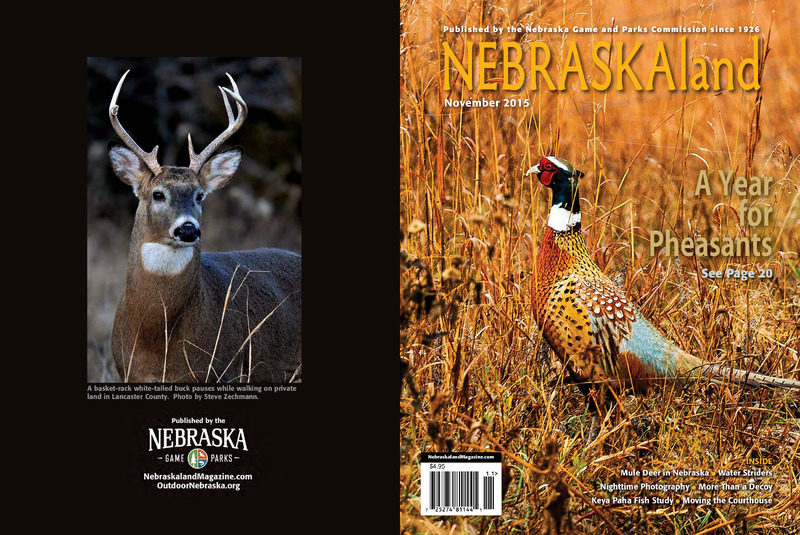
A basket-rack white-tailed buck pauses while walking on private
land in Lancaster County. Photo by Steve Zechmann.
NebraskalandMagazine.com
$4.95
INSIDE
Mule Deer in Nebraska ● Water Striders
Nighttime Photography ● More Than a Decoy
Keya Paha Fish Study ● Moving the Courthouse
NEBRASKAland Magazine
Volume 93
●
No. 9
●
November 2015
38
●
F EAT U R ES . . .
20 A Year for Pheasants
BY JEFF KURRUS
24 Mulies
STORY AND PHOTOS BY ERIC FOWLER
36 Water Walker
STORY AND PHOTO BY JUSTIN HAAG
38 Night Moves – after dark photography
B J
H
44 More Than a Decoy
Y USTIN
AAG
STORY BY CALLIE RIETFORS, PHOTOS BY BRAD MOSER
46 Glacial Relicts in the Keya Paha
BY JENNY NGUYEN
50 Time Well Spent – What to do in November
BY CARA PESEK
I N S I D E T H I S I S S U E ...
Mixed Bag – North American Deer Mouse, Travel
to Norfolk, Moving the Courthouse, Cover Your Hide,
Searching for Gold, the White Mole, Sharp-shinned Hawks,
Upcoming Events and more .....................................6
From the Fieldbook – My First Deer .................52
24
●
Portraits from the Past ..................................58
In the Kitchen – Venison Kebabs ........................60
The Last Stop – Ponca on My Mind ....................62
O N TH E W EB . . .
WHEN YOU SEE THIS SYMBOL IN THE PAGES OF
N
NEBRASKALAND MAGAZINE, VISIT
NEBRASKALANDMAGAZINE.COM AND VIEW OUR INTERACTIVE
DIGITAL EDITION FOR MORE INFORMATION.
D
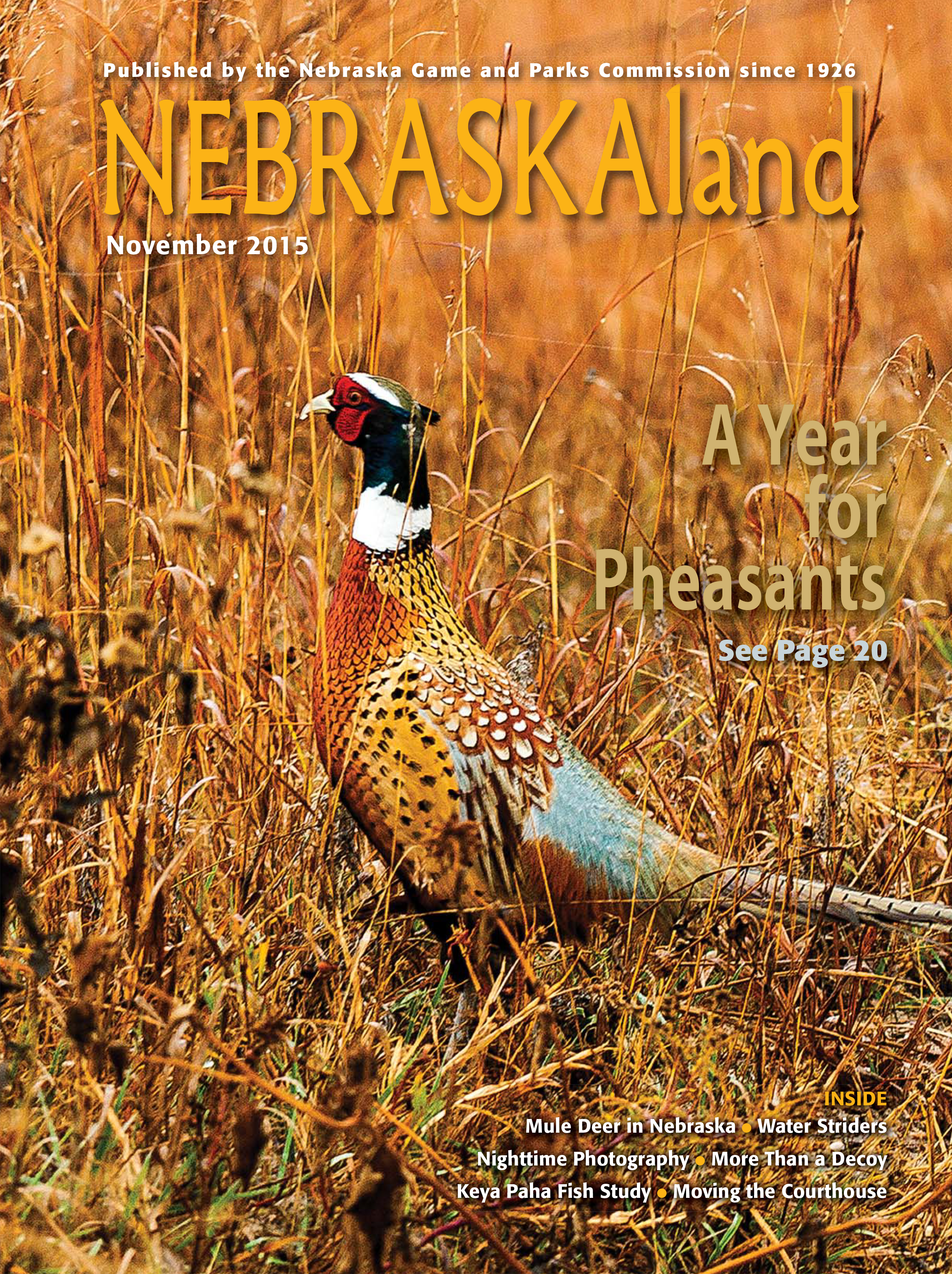
Cover: A rooster pheasant runs through a mix of grass near
Calamus Reservoir State Recreation Area northwest of Burwell.
See the story on page 20. Photo by Eric Fowler.
NEBRASKAland (VOL. 93 / NO. 9, ISSN 0028-1964) is published monthly, except
for the combined Jan./Feb. and Aug./Sept. issues, by the Nebraska Game and Parks
Commission, 2200 N. 33rd St., Lincoln, NE. Periodicals postage paid at Lincoln,
Nebraska, and additional mailing offices. POSTMASTER: Send address changes to
NEBRASKAland, P.O. Box 30370, Lincoln, NE 68503-0370.
2 NEBRASKAland • NOVEMBER 2015
20
●
NOVEMBER 2015 • NEBRASKAland 3
NEBRASKAland Magazine
Two year old Tripp Williams holds up a bluegill he caught
Two-year-old
while fishing at Chappell Lake. Photo by Cindy Williams.
From My 1867 Studio Camera
I travel back to Nebraska often and photograph using my
old studio camera from 1867. I use 8x10 film and scan the
negatives digitally outputting them. This photo of a round
barn was shot in Webster County.
Shane Booth
Fayetteville, North Carolina
Outdoor
O
td
Plates
Pl t
Jeff Guinae of Omaha shows his
preference for bird dogs on his license
plate, and spends the fall following
them through fields and along creek
bottoms in search of pheasant and
quail.
If you have a unique outdoor
message plate you would like to
share, or know someone who does,
e-mail a photo (high-resolution, JPEG
format only, please) along with your
hometown and a brief description of
the interests expressed on your license
plate to Eric.Fowler@Nebraska.gov.
Stunning Magazine
We recently received an email
about NEBRASKAland Magazine. My
husband and I were absolutely amazed
at the gorgeous photography in this
email. Loved the landscape and the
animals, and the winter scenes. Just
stunning!
Betsy and Jim Conway
Omaha, Nebraska
COMMISSIONERS
CONSERVATION OFFICERS
Director Jim Douglas
Commissioners
Chairman - Dr. Kent Forney, Lincoln
Vice Chairman - Rex Fisher, Omaha
2nd Vice Chairman - Mark Spurgin, Paxton
Robert Allen, Eustis
Dick Bell, Omaha
Lynn Berggren, Broken Bow
Mick Jensen, Blair
Norris Marshall, Kearney
Dr. Mark Pinkerton, Wilber
ADMINISTRATION (Lincoln)
Craig Stover (Administrator)
Duane Arp (Asst. Administrator)
Jeff Clauson (Asst. Administrator)
MAGAZINE STAFF
Communications Director Christy Rasmussen
Editor Jeff Kurrus
Art Director Tim Reigert
Associate Editor Jenny Nguyen
Regional Editors Eric Fowler, Julie Geiser,
Justin Haag
Contributing Editor Michael Forsberg
Regular Contributors Chris Helzer, Gerry
Steinauer
Photo Librarian Jaclyn Cruikshank Vogt
Circulation Donna Robinson
For address changes and questions about
your subscription, e-mail donna.robinson@
nebraska.gov or call 800-632-5263
Advertising Sales Manager
For advertising information contact
Shane G. Gilster, 402-742-0125
Email: shanegilster@gmail.com
NEBRASKAland Magazine Copyright 2015, all rights reserved.
NEBRASKAland is available in audio from the Nebraska Library
Commission Talking Book and Braille Service, Suite 120, 1200 N St.,
Lincoln, NE 68508. 800-742-7691. NEBRASKAland Magazine and the
Nebraska Game and Parks Commission reserve the right to reject any
advertising not in keeping with the agency mission.
Rates: $18 for one year; $33 for two years; $44 for three years. Nebraska
recipients must add appropriate sales tax. To subscribe call
1-800-NEBLAND (632-5263), or go online to: NebraskalandMagazine.
com.
COMMISSION
C
CO
COM
OM
MMIS
MIS
SSIO
S ON OFFICES
SI
OFFI
FF CES
FF
C S
Headquarters/Southeast District Office
2200 N. 33rd Street Lincoln, NE 68503
Phone 402-471-0641
Correction: The October issue
incorrectly listed the Aug-Sept. issue's
Visitor on page 29. It should have
been listed on page 47.
-Editor
Send your comments to:
Jeff Kurrus, Editor
NEBRASKAland Magazine
P.O. Box 30370
Lincoln, NE 68503
or e-mail Jeff.Kurrus@Nebraska.gov
Please include your postal address and telephone number. Letters may be condensed
and edited. Photographs are also welcome.
Lindsay Anderson took this photo
of her husband Travis and their dog
Goose during a teal hunt near Tamora,
Nebraska.
4 NEBRASKAland • NOVEMBER 2015
Any program that receives federal funding from the National Park
Service, or the United States Fish and Wildlife Service prohibits unlawful
discrimination on the basis of race, color, religion, age, gender, marital
status, national origin, age, disability or political affiliation. Any person
who believes he or she has been discriminated against in any program,
activity, facility, or service, should contact the Nebraska Game and
Parks Commission, Lincoln, NE 402-471-0641, the Equal Opportunity
Commission, Lincoln, NE 402-471-2024, TTY/TDD 402-471-4693;
United States Fish Wildlife Service, Civil Rights Coordinator, 4401
N. Fairfax Drive, Arlington, VA 22203; Director, Equal Opportunity
Program, U.S. Department of Interior, National Park Service, 1849 C
Street NW, Mail Code 0008, Washington, D.C. 20240-0001.
Northeast District Office
2201 N. 13th St. Norfolk, NE 68701
Phone 402-370-3374
Southwest District Office
301 E. State Farm Rd. North Platte, NE 69101
Phone 308-535-8025
Northwest District Office
East Hwy. 2, Box 725 Alliance, NE 69301
Phone 308-763-2940
Bassett Office
524 Panzer St., Box 508 Bassett, NE 68714
Phone 402-684-2921
Kearney Office
1617 First Ave. Kearney, NE 68847
Phone 308-865-5310
Ak-Sar-Ben Aquarium
21502 W. Highway 31 Gretna, NE 68028
Phone 402-332-3901
Omaha Office
8495 Frederick Street, Omaha, NE 68124
Phone 402-595-2144
402-471-5531
402-471-5531
402-471-5531
NORTHWEST (Includes counties covered)
Jim Zimmerman (District Supt.)
308-641-6138
Sean McKeehan
(Cheyenne, Morrill, Box Butte)
308-279-9133
Scott Brandt
(Kimball, Banner, Scotts Bluff)
308-631-0663
308-760-3647
Greg Hesse (Sheridan, Dawes)
308-430-0572
Dan Kling (Sioux, Dawes)
Terry Brentzel (Deuel, Garden, Grant) 308-458-7650
402-389-0444
Frank Miller (Cherry, Hooker)
NORTHEAST (Includes counties covered)
Tom Zimmer (District Supt.)
402-649-8053
402-760-0712
Dale Davis (Keya Paha, Brown, Rock)
402-340-3981
Jonathan Andreasen (Holt, Boyd)
Mitch Johnson (Knox, Antelope, Pierce) 402-613-8612
402-762-5022
Jeff Jones (Knox, Cedar)
Alex Thomas
(Dixon, Dakota, N 1/2 Thurston)
402-241-7615
Jon Reeves
(S 1/2 Thurston, Burt, Washington)
402-889-8508
402-719-1108
Dan Roberts (Dodge, Colfax)
Cory Krause
(Cuming, Wayne, Stanton, Dodge)
402-380-6410
Steve Oberg
(Colfax, Platte, Madison, Stanton)
402-910-3366
Randy Pomplun
(Nance, Greeley, Wheeler, Boone)
308-550-0489
308-730-7050
Doug Pollard (Loup, Garfield, Valley)
SOUTHWEST (Includes counties covered)
Roger Thompson (District Supt.)
308-530-3097
308-202-0819
Matt Brandt (Sherman, Howard)
308-380-7331
Tim Williams (Hall, Hamilton, Merrick)
Pat George
(Clay, Adams, Nuckolls, Webster)
402-705-9989
308-920-0367
Rich Routh (Franklin, Harlan, Phelps)
Matt Andrews
(Gosper, Furnas, Frontier, Red Willow)
308-746-2418
Andrew Heyer (Dawson, Gosper, Phelps) 402-613-2241
Brian Piernicky
(Red Willow, Frontier, Hayes, Hitchcock)
308-340-6627
308-289-0427
Nicholas Fix (Keith, Perkins)
308-289-1169
Bryce Streger (Keith, Arthur)
Brandon O’Neal
(Lincoln, McPherson, Logan)
308-530-3157
Alex Hasenauer
(Lincoln, McPherson, Logan)
308-660-4671
308-440-3847
Dale Johnson (Kearney, Buffalo)
308-529-8146
Mike Thome (Dawson)
Ray Dierking (Custer, Thomas, Blaine) 308-870-0322
SOUTHEAST (Includes counties covered)
Levi Krause (District Supt.)
402-949-0593
402-619-1355
Rich Berggren (Douglas)
402-616-5961
Dan Evasco (Sarpy)
402-210-0888
Heath Packett (Cass)
402-209-1506
Russell Mort (Otoe, Johnson)
William Krause
(Nemaha, Richardson, Pawnee)
402-274-8063
402-806-9084
Dan Zuehlke (Gage, Saline)
402-890-6463
Dina Barta (Lancaster)
402-890-6465
Doug Kramer (Lancaster)
402-937-3422
Dudley Sorensen (Lancaster, York)
402-613-2312
Travis Shepler (Lancaster)
402-890-7140
Stacey Lewton (Lancaster, Seward)
402-443-6392
Mike Luben (Saunders, Butler, Polk)
Nebraska Wildlife Crimestoppers
1-800-742-7627
NOVEMBER 2015 • NEBRASKAland 5
A Mammal Brief
By Lindsay Rogers
Peromyscus maniculatus
The United States is home to 15
different species of deer mice. All have
white feet, white undersides and brown-gray
sides and back. Most have extremely long tails – sometimes as long as the individual’s
head and body combined.
The North American deer mouse is the most common of all deer mice species in North
America. They can be found in a wide variety of habitats including grasslands, forests and
even urban areas, but should not be confused with the common house mouse.
Although often believed to be a nuisance species, deer mice are ecologically extremely
important. They provide food for numerous species – hawks, owls, foxes, snakes, bobcats
and skunks to name a few.
Deer mice eat mainly seeds, such as acorns and nuts, but also eat insects. In cooler
climates, such as Nebraska, deer mice will cache food during fall months. ■
PHOTO BY JOEL SARTORE
North American Deer Mouse
Lindsay Rogers is an outdoor education specialist
with the Nebraska Game and Parks Commission.
6 NEBRASKAland • NOVEMBER 2015
NOVEMBER 2015 • NEBRASKAland 7
Travelogue Sponsors
By Jenny Nguyen
Norfolk
visiting Norfolk will most likely hear about how the
n
nyone
city
c was named. In 1881, settlers proclaimed their village
to be called “Norfork” for its location on the north fork
h Elkhorn River. Postal authorities, assuming the word had
off the
been misspelled, changed it to “Norfolk.” Many locals still call
their city by its intended name.
My first “home” in Nebraska, Norfolk holds a special
place in my heart. Though small by most standards, with
a population of nearly 25,000, Norfolk is still considered
the “big city” to surrounding communities in northeastern
Nebraska, a sentiment not unfounded. A friendly, thriving
Norfolk
community, you’ll find gems in this small town.
Street,
Johnny Carson’s childhood home still sits on 306 S. 13th
scoft,
while city pride endures for being the birthplace of Thurl Raven
iastic
enthus
the voice behind "Tony the Tiger." Norfolk residents are
unity
comm
supporters of the arts: The Johnny Carson Theatre holds
events, plays and concerts year-round and so does Divots
k
Conference Center, located on the west side of town. The Norfol
hosts
and
Arts Center offers weekly classes for children and adults
31.
its fun Soup ‘R Art show every winter – 2016's date is Jan.
&
For a special dining experience, check out Sakura Sushi
or
Steakhouse or Black Cow Fat Pig. For a more casual lunch
BBQ,
dinner, my favorites are Michael’s Cantina, Smokin’ Stan's
tried
Tienda Leon and the SandBar & Grill. Though I have not
it, the Vietnamese Noodle House opened earlier this year. For
a quick bite in the morning, Delight Donuts makes amazing
se
ham and cheese croissants, but you must arrive early becau
everything goes quickly.
Looking for a cozy place
to hang out on New
Year’s Eve? I’ve always had
a fun time at the Office Bar, which features
an up-and-coming musical artist/band almost weekly.
Fishing
Norfolk is not short on outdoor events and activities either.
the
also
is
which
Park,
Lake
w
Skyvie
at
r
popula
and picnicking is
July
of
Fourth
g
amazin
most
the
and
rts
conce
er
site of free summ
ouka
fireworks show I’ve seen in my life, the Big Bam Boom. TaHaZ
is also
Park, a smaller, quieter area, is stocked with catfish yearly and
the place where the Cowboy Trail begins in Norfolk.
a
For fishing, Willow Creek State Recreation Area in Pierce is
convenient drive north. Wood Duck (Stanton), Oak Valley (Battle
Creek) and Yellow Banks (Meadow Grove) wildlife management
areas are popular destinations for hunters.
For more information
on Norfolk, check out
Visitnorfolkne.com.
k
Fishing at Skyview Lake Par
Soup 'R A
rt Craft Sh
s
run
l
i
a
r
T
y
o
b
The Cogw
rfolk
o
N
h
u
o
thr
ow
The Vietnamese Noodle
House is a recent addition
to Norfolk's dining options.
NOVEMBER 2015 • NEBRASKAland 9
NSHS, RG2956-33
RG
RG2956
2956-33
33
NSHS,
NSHS, RG3152-3-19
The county courthouse was moved 20 miles from Hemingford to Alliance on July 3, 1899.
Inset, this limestone and brick courthouse replaced the original in 1913.
A Brief History
Moving the Courthouse
By David Bristow,
Nebraska State Historical Society
M
ost Nebraska counties have had a county seat fight
at one time or another. Sometimes it determined
which towns survived and which folded. In the
Panhandle, for example, Nonpareil became the first
seat of Box Butte County when the county was organized in
1886, but lost the prize to Hemingford in 1891. You won’t
find Nonpareil on your state highway map.
Several years later Hemingford lost out to Alliance. But
Hemingford had the courthouse and it seemed wasteful to
build a new one in the new county seat. So they picked it
up and moved it. This wasn’t as impossible as it sounds – it
wasn’t a stone-and-brick courthouse. Still, it required some
hard work and help from the Burlington Railroad.
The railroad had reached Alliance in 1888, platting the
town on land purchased from the state by the Lincoln Land
Company, an auxiliary of the railroad. The company also
built the courthouse in Hemingford and leased it to the
county. After Alliance became the county seat, the company
offered to move the courthouse 20 miles to its new location.
They contracted with a house mover from Lincoln and gave
him 30 days to get the job done. After 10 days he informed
the company that it couldn’t be done in time. He hadn’t
moved the building more than 20 feet.
10 NEBRASKAland • NOVEMBER 2015
Now the Lincoln Land Company was in a bind. They
had contracted with the county to move the courthouse
and have it ready for use by July 15, 1899. The Burlington
Railroad saved the day. J. H. Phelan, superintendent of the
railroad’s Wyoming division, offered to move the courthouse
on a flatcar. Phelan’s letter to the Lincoln Land Company
describes the results:
“Dear Sir: Referring to your message of June 30th asking
for information concerning the moving of the court house –
The building was safely hauled from Hemingford to Alliance
and is now on the way from the track to its permanent
location. As you know the building is fifty feet long by forty
wide[,] two full stories in height with a heavy truss roof and
constructed with a heavy hard pine frame. As there were two
cuts to pass through the building was raised on timbers high
enough to clear the banks and when ready to start it was
fifty feet from the railroad track to the top of the deck on the
building. The weight of the building was estimated at 100
tons… Six hours after leaving Hemingford the building was
clear of the track in Alliance…. Yours truly, J. H. Phelan,
Superintendent.”
In 1913 the county replaced the traveling courthouse
with a solid, limestone-and-brick Beaux Arts-style edifice
that still serves the county and is listed on the National
Register of Historic Places. It is a grand building, and
perhaps more importantly is too big and heavy to simply
haul away. ■
Visit the Nebraska State Historical Society’s website at
Nebraskahistory.org.
NOVEMBER 2015 • NEBRASKAland 11
Paid Advertisement
12 NEBRASKAland • NOVEMBER 2015
NOVEMBER 2015 • NEBRASKAland 13
Nebraska Bird Library
By Jeff Kurrus
For a few years, I had the opportunity to write migration
reports for Ducks Unlimited Magazine. I’d place a quick
call to guides, weekend warriors and biologists across the
country to give hunters the most up-to-date information on
duck and goose locations across various regions.
Once I had the information I needed, I would always ask
one more question: are there any tips I should pass along
to hunters? More than any other answer, by far, was that
hunters should focus on “their hide.” These exact words were
repeated in nearly every conversation, and explains how
important this simple camouflaging tip should be to hunters.
Waterfowl focus on movement, so make sure your
silhouette is broken up and, if possible, camouflage yourself
from head to toe, including your face and hair. From face
masks to face paint, hunters use an array of techniques
to mask themselves. Even the bill of a ball cap can work
wonders in your hide.
The main aspect to remember: if you can see incoming
Sharp-shinned Hawk
PHOTO BY JEFF KURRUS
Cover Your Hide
ducks and geese clearly, there’s a good chance they can see
you clearly as well.
Eliminate this pitfall, and the flaring of birds, by
concentrating on your hide now. ■
PHOTO BY ERIC FOWLER
By Eric Fowler
It wasn’t long ago that I didn’t bother wearing cleats
when I ventured onto the ice. Part of me figured I had good
balance and was young and nimble enough that I didn’t need
them. The other part of me is cheap/frugal and didn’t want to
buy another set of creepers that might work as poorly as the
first I owned.
But when it took weeks for my back to get back to normal
after falling on my butt while ice fishing a few years ago, I
figured finding some cleats that worked might be cheaper
than a hospital bill. I’ve been through a few pairs since,
but don’t think I’ll need another now that I have a pair of
STABILicers Maxx. Made by Stabil in Biddeford, Maine,
the cleats have two things going for them that others I’ve
tried did not. First, they actually fit on my oversized pac
14 NEBRASKAland • NOVEMBER 2015
boots and boot-foot waders. Second, they stay on.
That second point doesn’t hold true for the elastic rubber
creepers I’ve tried. I’ve had those fall off while simply
walking across the ice. I left another in the mud at the
bottom of the pond where I goose hunt when I stepped in
the hole we’d opened in the ice to set decoys in. We kept
that hole open for a while last year, and I was in and out of
it often to clear slush ice. While one of my STABILicers
Maxx slipped off the toe of my boot once, it didn’t find
a permanent home in the muck because the straps that
wrapped around my ankle kept it there. Those same heavyduty nylon straps will no doubt hold up better than rubber if
I ever accidentally swipe the blade on my ice auger across
one while I’m fishing. (Anyone need one elastic creeper?)
I don’t know if I’ll use them enough to wear out the 17
case-hardened metal cleats that adorn
the bottom of each flexible sole.
But postmen and others who work
outside in the winter appreciate the
fact that the cleats are replaceable,
adding long-term durability and
value to STABILicers.
A few of my blind mates now have
a pair of STABILicers after losing
their elastic creepers in the mud
last winter. If you want a pair for
yourself, or you would like to check
out their full product line (which
includes models meant to slip over
running shoes for you crazy folks
who like to stay overly active yearround), visit the Stabil website at
32north.com. ■
Song or calls: A high “ke-ke-ke-ke.” Often
heard near nest.
Description: Sexes similar. Slate blue above,
white with rust-colored cross-barring below.
Differentiated from similar Cooper's hawk by
a square, rather than rounded, tail. Tail is often
notched. Crown and back are not strongly
contrasting. Immatures are brown above, white
with brown streaking below. Females are larger.
Habitat: Found in areas of fairly dense forest.
Prefers woods with a mix of coniferous trees.
Where in Nebraska: Uncommon to occasional
winter visitor and spring migrant across the state.
Thought to nest in the forests along the Missouri
River Valley.
Field Notes: Often familiar to backyard birders,
as sharp-shins will make meals of small birds
visiting feeders.
Fun Facts: Sharp-shinned hawk parents will
give prey to whichever of their young reached
them first while in flight. ■
To learn about more birds visit:
NebraskaBirdLibrary.org.
PHOTO BY JUSTIN HAAG
Product Review: STABILicers Maxx
Sponsored by
y
NOVEMBER 2015 • NEBRASKAland 15
My Photo Tip:
Searching for
Gold
The White Mole
the smartest move in a thunderstorm
but photographers sometimes forget
these things when the light is good),
and twice found rainbows. Neither
rainbow had the full-blown color
and intensity I’d hoped for. But what
happened as the sun approached the
horizon and its rays began bouncing
off the bottom of the clouds above me,
however, made up for it, lighting up
the landscape and eastern sky with the
warmest light I’d ever seen. My chase
that day lasted four hours, with sweet
light coming and going as the
clouds shifted. The last
10 minutes were indeed
golden. ■
By Jenny Nguyen
Ellis Graverholz of Ashland has had it with
moles. This small, burrowing mammal leaves
unsightly mounds of dirt in his flower beds,
and the nonstop tunneling annoys him terribly.
In constant search of earthworms and white
grubs, the moles have left yellow veins on his
otherwise pristine lawn; their burrowing kills
the roots of vegetation and trees.
Very few people have actually seen a mole,
as they rarely come to the surface. Moles are
normally covered in velvety brownish gray fur
and have oddly huge front paws for digging.
Though nearly blind, moles do have tiny eyes
that are protected by skin and fur. And their
powerful sense of smell allows them to quickly
locate and catch food underground. A mole will
eat up to 70 to 100 percent of its body weight
each day, which explains why they cause so
Ellis Graverholz of Ashland found a white mole while trapping for them in his
yard. Moles can cause extensive damage to lawns and flower beds.
much damage to people’s yards.
“You try your best to keep your lawn looking
actually leucistic, the condition when cells responsible for
nice. When you get one mole, two or three show
up – he brings all his cousins and relations to come and help. pigmentation do not function correctly. This was indicated
by the dark patches on the mole’s fur– albinos are pure
They are a real nuisance,” Graverholz said.
white.
In an effort to save his lawn, Graverholz has been using
Though not albino, leucistic moles are still rare.
specialized mole traps to control the local population. He
Graverholz has been keeping the white mole in his chest
has caught many moles in the 67 years he’s been married
freezer, and despite his past run-ins with the species, he may
and kept a garden, but Graverholz has never seen a white
mole until this summer. Thought to be albino, the mole was
honor this special find by having it stuffed. ■
For more photography
tips see our article on
page 38. You can also
purchase a copy of our
book "Photographing
Nebraska" by visiting
NebraskalandMagazine.
com and searching under
"publications."
Hunter Survey
Project Starts
even better experiences in the years to
come.
So, if you see a “Hunter Survey”
sign on a vehicle out there, tell us: how
would you rate your hunting experience
today? ■
For more information, visit
Snr.unl.edu/fishhunt.
PHOT
HO
OTO B
BY JEF
JEF
FF K
KURRUS
RU
PHOTO BY ERIC FOWLER
16 NEBRASKAland • NOVEMBER 2015
By Caitlyn Gillespie
Hunters often know what makes the
perfect hunting spot – whether it’s the
location, the habitat or an abundance
of game. Each year, Nebraska's Public
Access Atlas provides hunters with the
information they need to find a place
to hunt on wildlife management areas,
waterfowl production areas and private
properties enrolled in the Open Fields
and Waters program.
Publicly available lands are often
paid for or leased using funds from
hunters and anglers, but how often do
hunters actually use those places? And
are they providing the experiences that
hunters are looking for?
Until recently, we had little way of
knowing where people were going and
why. Now, with the help of hunters
throughout the state, researchers at the
University of Nebraska-Lincoln, in
collaboration with the Nebraska Game
and Parks Commission, are seeking
to understand exactly what it is that
creates that perfect hunting experience
in Nebraska.
To do so, the first thing they need
to do is count. Researchers survey
areas across the entire state, checking
parking areas on hundreds of public
sites during hunting seasons. Public
access sites seem to be important – last
year, they counted over 39,000 cars –
but some properties are more popular
than others.
So to truly know what hunters think,
they go straight to the source: in-person
interviews will tell researchers what
types of game people are seeking,
where else they are hunting and the
reasons why they chose that site. The
information hunters provide over the
next two years of the project will help
managers improve the opportunities
that are already out there, and provide
PHOTO
PHOT
O BY JEN
JENNY
NY NGUYE
N
NGUYEN
GUYEN
GUYE
N
By Eric Fowler
I can’t remember if he wrote it or
told me, but long-time NEBRASKAland
staffer Jon Farrar once said it best.
When it comes to photography, “Light
is everything.” It is, especially when it
comes to nature photography.
Good light, the sweet, warm type you
most often see in the minutes before
or after sunrise or sunset, can make
a good photo great. Some call it the
golden hour, or the magic hour. When
the sun is near the horizon, the light is
diffused by the atmosphere. Nature’s
filter reduces the contrast of the scene,
opening the shadows and reducing the
intensity of the highlights, and often
adding an orange cast to the scene. All
of these factors make a photo “sing,” as
I like to say.
Those types of photographs are what
the staff here strives to capture. They
are why we often see both ends of the
day when we’re in the field, why we
ask our story subjects to get up early
and stay up late. Doing so doesn’t
guarantee good light.
There have been many times when I
crawled out of bed well before dawn,
driven and hiked to a location where
I wanted to see the sun rise, and then
wished I would’ve stayed in bed when
I was greeted by a cloudless sky and
watched the light quickly go cold.
But there have been other times when
the magic hour lasted for two or
three.
And then there are rare occasions
like an evening I experienced on the
Valentine National Wildlife Refuge in
July. As storms rolled through, I found
myself chasing rainbows, hoping the
sun would peek through the scattered
clouds in the western sky, light up the
lush green grass and the raindrops to
the east and create a colorful arch in
the sky. I followed the storm, running
up hilltops for a good perspective (Not
NOVEMBER 2015 • NEBRASKAland 17
New Acres
Made Available
in Open Fields
and Waters
Program
by Jerry Kane
PHOTO
PHOT
O BY JUL
JULIE
IE GEISE
GEISER
G
EISER
EISE
R
Jake Koenig from North Platte took this mule deer during the archery season soon
after the canyon properties became available to the public.
Contact the
Nebraska Game
and Parks
Commission
at 402-471-0641
or visit OutdoorNebraska.
org for more information.
Visit HuntSafeNebraska.
org for a list of hunter
education classes and
BoatSafeNebraska.org
for a list of boating safety
classes.
November 1
from the NWTF, provided payments
to landowners to obtain access in the
region.
Parking is available along the county
roads and all access to the properties
is walk-in only. Hunters pursuing big
game are responsible for removing
all harvested game from the property.
Boundaries have been posted on each
site and are visible from the road and
from within the properties.
The OFW canyon access sites are
published in the 2015 Public Access
Atlas, copies of which are free and
available at Commission district
offices and local vendors. The atlas
is also on the Nebraska Game and
Parks Commission website at
Outdoornebraska.org. ■
Late Doe/Fawn antelope hunting
season opens
2015
PUBLIC ACCESS ATLAS
FOR WA
LK-IN HU
NTING, TR
AND FIS
APPING,
HING IN
NEBRAS
KA
Most 2016 annual permits and
stamps available for purchase at
OutdoorNebraska.org
November 9
November 1
November 9, 16, 23
First Steps Pistol
November 2
November 14-15
Cornucopia of Crafts
November 2
Christmas Dinner Tickets
Nebraska Game and Parks Outdoor
Education Center, Lincoln
Eugene T. Mahoney SP
November 14-22
Tickets go on sale for Historical
Christmas Dinner at Fort Robinson
State Park (SP), Crawford
November firearm deer hunting season
and Restricted Statewide Buck deer
hunting season
November 3, 17
Ladies Day at the Range
November 15
Nebraska Game and Parks Outdoor
Education Center, Lincoln
First segment of crow hunting season
closes
November 16
November 5
Backyard Bird Habitat
Special Public Health Hazard Order
crow hunting opens
Attracting Birds in Winter, Nebraska
Game and Parks Outdoor Education
Center, Lincoln
November 22
November 7
Oh Deer, Deer Workshop
November 24
Muzzleloader Deer Hunting
Workshop Nebraska Game and Parks
Wildcat Hills SRA and Nature Center,
Gering
November 7
Candlelight Tour
PHOTO BY JULIE GEISER
18 NEBRASKAland • NOVEMBER 2015
Nebraska Game and Parks Outdoor
Education Center, Lincoln
November 12
Basic Bird Identification
Woodcock hunting season closes
The
Atlas
h new 2015
201 Public
P bli Access
A
Al
features public access areas throughout
Nebraska.
Rail hunting season closes
Hunting and trapping seasons open for
raccoon, Virginia opossum, long-tailed
weasel, mink, red fox, gray fox and
badger
ed by:
Learn
earn
arn more
morree at
m
a Outdo
OutdoorN
d orNeb
orNeebraska
aska
aska.o
ska.o
.org
.or
.oor
org
November 8
Shootout at Salt Creek Old West
Action Shooting
Nebraska Game and Parks Outdoor
Education Center, Lincoln
November 1
Funding support provid
Roger G. Sykes Outdoor Heritage
Education Complex, Platte River SP,
Louisville
November 1
Muskrat and beaver
trapping seasons open
The Open Fields
and Waters Progr
of the Nebraska
am is a joint
Game and Parks
Commission and project
valued partners.
This atlas valid
through July 2016
.
November 8
Veterans Appreciation Day
Fort Robinson SP longhorn and
buffalo sale, Crawford
Outdoor Education Center, Lincoln
November 27-29
Fort Atkinson State Historical Park,
Fort Calhoun
Roger G. Sykes Outdoor Heritage
Education Complex open to the public,
Platte River SP, Louisville
November 7-8
Pioneer Longrifle Rendezvous
November 28
Christmas in the Woods
Indian Cave SP, Shubert
Ponca SP, Ponca
PHOTO BY JENNY NGUYEN
By Julie Geiser
In Sept. 2015 more than 8,825 new
acres of rough canyon land was made
available to hunters as part of the Open
Fields and Waters (OFW) Canyon
Access Initiative.
The Nebraska Game and Parks
Commission, working with the
National Wild Turkey Federation
(NWTF), came up with the initiative
to offer increased access to the Loess
Canyon region in Lincoln County.
These canyons are a biologically
unique landscape that provide optimal
habitat for turkeys, white-tailed deer,
mule deer and elk.
Previously there had been limited
sites within the region open to the
public, including Wapiti and Cedar
Valley wildlife management areas. Now
access to this landscape is available
to hunters wishing to pursue game in
canyon terrain.
Federal dollars raised through an
excise tax put on guns, ammo and
hunting equipment called the PittmanRobertson Act provided funding for
part of the Canyon Access Initiative.
Those funds, along with donations
NEBRASKAland
and
Visitor
Last issue’s winner of
the Visitor drawing was
Mike Holtzen of Yutan, Nebraska,
who found the crane fly on page 36.
Readers are encouraged to contact
NEBRASKAland within 10 days
after this issue’s publication with
the correct page number and name
of this issue’s “Visitor” – a critter
found in Nebraska. We will then
gather the correct entries and draw
one to win a NEBRASKAland mug.
To enter each month, write:
NEBRASKAland Visitor
2200 North 33rd Street,
Lincoln, NE 68503.
Or e-mail:
Tim.Reigert@Nebraska.gov
with “Visitor” in the subject line of
the message.
HINT: I'm not even giving a hint
this month it's so easy to find.
Crane flies may look like giant
mosquitoes, and both are true
flies in the order Diptera, but
crane flies are much larger and
do not bite or sting. They make
up a large family, Tipulidae, with
more than 1,500 species of crane
flies found in North America.
Crane flies can be recognized
by their long, brownish-gray
bodies, extremely long, thin legs,
and single pair of slender wings,
which may have a span of up
to three inches. Crane flies go
through complete metamorphosis:
egg, larva, pupa, and adult.
Larvae are often aquatic, typically
found on stream bottoms, though
some species are terrestrial and
found in the soil. Most larvae feed
on detritus, and play an important
role in
i breaking
down organic matter.
The larvae
l
are also
attractive to
fish, and can be
collected
and used
coll
for bait.
Special thanks to Julie Van Meter,
State Entomologist, Nebraska
Department of Agriculture.
NOVEMBER 2015 • NEBRASKAland 19
A Year for Pheasants
Tips For Hunting Roosters This Season
Story by Jeff Kurrus
W
ith pheasant season opening
October 31 and numbers
up statewide more than 55
percent since 2014, it’s an excellent
time to start walking fields. But which
fields do you choose? How do you
walk them? And what other tips are
going to separate you from the other
hunters afield?
Read on to find these answers from
some experienced hunters throughout
Nebraska.
Mark Vrtiska
Hunting the Rainwater Basin
Scott Miller
Pheasants can be found statewide, with the highest concentrations in the
southwestern region.
20 NEBRASKAland • NOVEMBER 2015
More times than
not, birds run in
front of you as you
walk a field. And
at the end of that
field, the birds stop
and will usually
wait until flushed. I
have always taught
my boys to stay focused at the very end
of the walk so they can flush birds in
these “funnel” areas.
We also look for small pockets of
fireweed located within or bordering a
crop field. These are hot spots.
Ruger, a black Labrador retriever,
retrieves a fallen rooster at Pheasant
Bonanza Hunt Club and Kennel in
Tekamah.
Gerry Steinauer
Hunting South-central Nebraska
I always like to
hunt from about
10:00 to 2:00,
when the birds are
settled into mid-day
loafing cover and
will sit tighter. In
the morning they
are out feeding and
jumpy, and they often go back out to
feed in late afternoon. I like to walk tall
grasses or weed patches next to crop
fields, especially corn. In a big grassy
field I will pick out the weed patches
to walk. Birds will feed in the weed
patches and hang around their edge
or in them. I like to hunt warm, calm,
sunny days – the birds seem to sit tight
on such days.
PHOTO BY JENNY NGUYEN
PHOTO BY JEFF KURRUS
Hunting Southwestern Nebraska
PHOTO BY JENNY NGUYEN
We look for
some sort of plant
diversity in the
field itself. We look
for different forbs,
weeds, grasses, to
give pheasants more
than one habitat.
We also try not to
say a word. What you’re hunting is
a little turkey. And you wouldn’t go
out in the woods being loud hunting
turkeys, especially birds getting a little
pressure. People will slam car doors
and start yapping. One time I was duck
hunting in the Rainwater Basin. It was
glass that day – really quiet. I heard
guys pull up in their truck. I could hear
them once they got out talking, and
I was a half-mile away. At the same
time, I saw pheasants coming out the
other end of the field they were going
to walk, a lot of them, and were birds
these guys were never going to see.
Fence lines are good places to look for pheasants, where roosters feel the pinch and
are pressured to flush out the sides.
NOVEMBER 2015 • NEBRASKAland 21
TJ Walker
Hunting Southwestern Nebraska
One thing I’ve
learned watching
hunters and hunting
pheasants myself
is that hunters tend
to become more
predictable as the
season moves on,
always walking the
same routes through fields. I can tell
you that while pheasant behavior is
also somewhat predictable, their “antipredatory” responses aren’t. Hunters
that mix it up a bit – zig-zagging their
trail, stopping to listen for 30 seconds,
looping back around here and there –
will have more luck, especially later
in the season. And if you are hunting
alone with a dog, let the dog lead the
way. They know where to go.
Another thing would be to resist
the temptation to “hurry” to the end
of the field when late season birds are
flushing out of the end of the field you
are hunting. You are not going to catch
up with them, and those aren’t the birds
you are going to shoot. And truth be
told (with radio telemetry and GPS
data to support it) you are probably
hurrying past as many birds as you are
seeing flush, and those “tight sitters”
are the ones you have a chance at.
Need to Know
season starts on
• Pheasant
October 31st this year (2015)
and ends on January 31st,
2016.
are legal to hunt
• Pheasants
statewide.
Jerrod Burke
bag limit is three
• Daily
roosters. Number of pheasants
Hunting Southwestern Nebraska
in your possession is a total of
12 (including your daily).
are required (if age 16 or
• You
older) to have a small game
PHOTO BY JENNY NGUYEN
Pheasants are
“edge birds.” It
doesn’t take large
blocks of habitat or
an army of hunters
to put birds in the
bag.
Unless the
weather has been
especially harsh or there has been a
lot of hunting pressure you will likely
find the most birds on the edges of
fields close to food sources. Focusing
on many small patches of habitat that
fit the “edge” standard often times
produces more birds, especially early in
the season.
A gun dog runs through the field during the 2013 Pheasants Forever Rooster Road Trip
in Holt and Antelope counties.
permit as well as a Nebraska
habitat stamp to hunt
pheasants.
education can be taken
• Hunter
online at Huntsafenebraska.
org.
Mark Davis
Hunting Eastern Nebraska
PHOTO BY JEFF KURRUS
Instead of walking down cut winter wheat field rows, while hunting pheasants alter
your routes, including walking across the rows.
22 NEBRASKAland • NOVEMBER 2015
For more information on pheasant
hunting, visit OutdoorNebraska.org.
PHOTO BY JENNY NGUYEN
Before your hunt,
with an unloaded
shotgun, tape a
small flashlight
to the end of the
barrel. Pick a place
on the wall and
practice bringing
your gun to your
shoulder with the flashlight on.
This will help you get used to the
proper position for the gun when raised
in a hurry. The flashlight gives you an
idea how close you are to your target.
Also, when on the practice range, use
a hand thrower instead of an electronic
clay pigeon thrower. A hand thrower is
less likely to be consistent – more like
true hunting. My friends and I take turns
throwing runners, left and right, high and
low in an effort to confuse the shooter. It
makes for a fun competition. ■
Gun dog trainer Aaron Phillip Schroder of Tekamah hunts with German shorthaired pointers “Charlie” and “Remington,” and “Rio,” a
Labrador retriever, on a Conservation Reserve Program (CRP) field near Homer.
NOVEMBER 2015 • NEBRASKAland 23
Mulies
The past, present and future of mule
deer in Nebraska.
Story and photos by Eric Fowler
F
rom his bed near a Sandhills
ridgetop, a lone mule deer buck
could see for miles any danger
that might approach in front
of him. Only with a keen eye could
you see him from a distance, his buff
coat blending perfectly with the grass.
With the wind at his back, he could
smell anything that came from behind.
And those big ears, the ones that give
him his name, constantly turning this
way and that, could hear my footsteps
crunch through the dry grass at 30
yards. When they did, in a matter of
seconds, he shot from his bed, bounded
over the hill like he was on a rocketpowered pogo stick and disappeared
into the wide open countryside, not
even having the courtesy to stop and
look back, as his brethren often do, and
give me one more photo op.
Nebraska, with its diverse geographic
changes from west to east, is on the
edge of the mule deer’s range. The
Sandhills and its wide-open spaces
are perfectly suited for mule deer, as
are many other places throughout the
western two-thirds of the state where
the species thrives. In fact, there
were more mule deer in Nebraska a
few years ago than there ever were
– a notable feather in the cap of
conservation considering there were but
25 left a little more than 100 years ago
– and biologists expect the population
to reach that point again soon.
But in some areas, the species merely
survives as habitat changes continue
to redefine the edge of its range. And
even in some strongholds like the Pine
Ridge, other factors, including disease,
24 NEBR
24
N
NE
NEBRASKAland
EBR
BRAS
ASKA
KAla
land
nd • NOVEMBER
NOV
VEMBE
EM
MBER
BE
ER 2015
20
015
5
have reduced the population, grabbing
the attention of wildlife managers,
landowners and hunters who want to
ensure the future of this icon of the
plains.
Those Ears
The mule deer (Odocoileus
hemionus) is one of two species of deer
that roam the Nebraska countryside.
The other, the white-tailed deer, can be
found statewide with greatest densities
in the east and along rivers and
streams. The mule deer prefers wideopen spaces and is found throughout
the western half of the state and a
few more in the larger expanses of
grassland in the eastern half.
While the black-tailed deer
found in the northwestern parts of
North America is considered to be
a subspecies of mule deer, it may
actually be the source. Recent DNA
studies have led researchers to
speculate that black-tailed bucks bred
with white-tailed does to produce mule
deer following the last ice age between
7,000 and 15,000 years ago.
The species have three easily
recognizable differences, the first
being the ears: a mule deer’s are about
25 percent larger. The species’ tail
and rump differ as well. A whitetail’s
white rump is nearly covered when its
bushy tail, the top of which is colored
the same as its body, is down. When
alarmed, that tail is raised as a white
flag. A mule deer’s tail is small and
white with a black tip, almost always
down and doesn’t cover the deer’s
A mule deer doe and fawn survey the landscape at sunset from a Sandhills ridgetop in Cherry County.
white rump. While not easy for some
to recognize, a mule deer buck’s antlers
are different, too. Unlike a whitetail,
which has points rising from a single
main beam, a mule deer’s antlers
branch into two forked beams, giving
a typical mature buck four points per
side, five if it has brow tines.
Those antlers are sometimes used
as sparring weapons during the fall
breeding season as bucks stake claim to
dominance over a herd. During the rut,
which runs from October to December,
bucks don’t mark their territories with
scrapes and rubs like whitetails do.
Instead, they roam the countryside
searching for does, occasionally
stopping to flail their antlers against
a tree or shrub, the noise of which
signals dominance to other bucks.
A few does are in estrus and ready
for breeding in October. If they are
not bred, they will go through up to
three more 28-day estrus cycles until
they are. Breeding is one of the biggest
differences between Nebraska’s deer
species. About 60 percent of whitetails
are bred in their first fall, compared
to only 7 percent of mule deer. Those
yearling white-tailed does occasionally
have twins, and regularly do the rest
of their lives. Mule deer are much less
likely to have twins. These differences
have made it easy for whitetails to
expand their range and numbers, and
also make it difficult for mule deer
populations to grow.
Most mule deer fawns are born in
June, about 200 days after breeding,
weighing 5 to 7 pounds. To help
protect them from predators, especially
coyotes, they are camouflaged with
white spots on their coat, are relatively
scentless and spend their first few
weeks laying in tall grass or brush.
They begin eating grass and other
vegetation at about three weeks and
are weaned at four months. They begin
traveling with their mothers in August,
and stay with them until the following
spring when does are preparing to
deliver their next fawn. By November,
fawns weigh about 70 pounds. While
weight varies with age and diet, a 3
½-year-old buck will weigh about 200
pounds and a doe 125. Mule deer can
live to the age of 10 or so in the wild,
and up to 20 years or more in captivity.
Most male fawns grow button antlers
their first year. Antler development
begins in the spring for mature bucks.
By September, they begin to rub the
soft velvet covering, which contains
blood vessels that fuel antler growth.
In winter, bucks shed their antlers and
soon begin growing another set.
History
The range of mule deer across
Nebraska has declined from historic
times, and even from the middle of the
last century. Lewis and Clark reported
an abundance of white-tailed deer
along the Missouri River in eastern
Nebraska. Their first report of a mule
deer came near the mouth of Ponca
Creek in Knox County. Trappers
reported seeing both species in the
1800s. Emigrants on the Oregon Trail
saw few deer of any kind along the
Platte and North Platte rivers between
Grand Island and Scotts Bluff County,
and ate all they found.
James Clyman, a mountain man
who explored the mountain West in
the 1820s, was part of an Oregon Trail
wagon train in 1844. “Supped on a
most dlecious [sic.] piece of venison
NOVEMBER 2015 • NEBRASKAland 25
Mule Deer Buck Harvest by County
0
1-5
6-10
11-25
26+
Adult bucks harvested per 100 square miles in 2014. Source: Nebraska Game and
Parks Commission.
from the loin of a black tailed buck
…” Clyman wrote in his journal after
shooting a mule deer while camped in
the Gering Valley near Scotts Bluff.
The following day, he wrote of the
Wildcat Hills: “where these hills were
finely stored with game Such as Black
tailed deer antelope mountain sheep
& some times Buffalow [sic.], elk and
grisled bear.”
Reports of deer from other settlers
The mule deer was first recognized and
accurately described by Lewis and Clark
but not formally described until 1817.
It was first mentioned on Sept. 5, in the
vicinity of the Niobrara River, when the
descriptive term “black-tailed deer” was
applied to several deer seen by one of
the crew members.
Illustration from The deer of all lands, 1898, Richard
Lydekker.
26 NEBRASKAland • NOVEMBER 2015
in Chase County can presume to be
of mule deer. The easternmost report
came from Dakota County, and a
1957 report by the Nebraska Game,
Forestation and Parks Commission, the
precursor to the Nebraska Game and
Parks Commission, lists Nance County
as the southeastern extent of its range.
Still expanding their range at the time,
they may not have been present in all
of the areas they inhabit now.
Settlers needed food to survive on
the plains, and deer proved to be an
easy target for those wanting to feed
their families or for meat to sell on
the market. Their numbers surely had
dwindled by 1880. Winter that year
was harsh, and deer succumbed to
storms, hungry settlers and wolves.
Soon, few deer, be it whitetails
or mulies, remained. A survey in
Sioux County in 1901 noted that the
mule deer was rare, or even extinct.
Myron Swenk, in his 1907 report “A
Preliminary Review of the Mammals of
Nebraska” for the Nebraska Academy
of Sciences, wrote that a few whitetails
remained in the Pine Ridge, but the
mule deer had disappeared. The only
other mention of mule deer was of 25
found in Thomas and Hooker counties.
It was that same year that the Nebraska
Legislature, which in 1873 had
restricted the harvest of deer to four
months in the fall and winter and in
1897 to only November and December,
closed the season on deer, elk,
antelope and beaver altogether.
Sporting velvet covered antlers in early June, a trio of mule deer bucks feed in a crop field on the edge of the forest in Dawes
County at sunset. Bucks often hang in bachelor groups outside the rut.
With that protection, and likely with
some movement of deer into Nebraska
from surrounding states, deer numbers
slowly increased. Surveys in the winter
of 1939-40 estimated between 2,000
and 3,000 deer, mostly mule deer, were
found in the Pine Ridge and a few
more in the Platte and Niobrara River
valleys, but few, if any, elsewhere.
While whitetails had been the last deer
standing in the Pine Ridge, most of the
forest there had been cut for building or
fuel, and only the steepest slopes were
still timbered, making the region more
suitable to mule deer.
By 1945, the population had grown
enough in the central Sandhills that
deer were causing damage to trees and
leaving an extensive browse line on
the Bessey Division of the Nebraska
National Forest near Halsey. In
response, the state held its first modern
deer season. Five hundred permits were
issued and 361 deer harvested, all but
two of which were mule deer.
Despite the herd growth to that
point, a March 1949 report by the
Commission showed that wildlife
biologists had much to learn about deer
management. “On the basis of present
knowledge, there are no indications
that the deer population of Nebraska
will reach numbers great enough to
warrant a statewide open season such
as those in some states where many
thousands of animals are harvested
annually. Deer range in Nebraska will
probably not support such numbers.”
In the fall of 1949, the state’s second
hunting season offered 1,500 permits
for all or parts of six western and
northwestern counties. All 910 deer
harvested were mule deer. The area
open to hunting increased gradually
each year after that, and by winter
1955-56, deer had found their way
to every county in the state, and in
1956, the total harvest was about
6,500. Nearly half of the harvest that
year came from Pine Ridge, but that
wasn’t enough to appease landowners
who were being overrun by a rapidly
expanding herd. Desperate to get deer
numbers in check, biologists issued
5,000 permits for each of two seasons
in 1957. Hunters harvested 4,709 mule
deer and 46 whitetails.
That rapid growth and liberal harvest
occurred in other regions as well, and
by 1961, the entire state was opened to
deer hunting.
Because most mule deer live in
remote locations where there are
few roads, they are difficult if not
impossible to count, but biologists
estimate there are 75,000 mule deer in
the state today.
Changes in
Habitat
Mule deer roam throughout much
of western North America, living in
tundra, mountains, prairies and deserts
from Alaska, if you include the blacktailed subspecies, to the Baja Peninsula
and from Texas through the Dakotas
and northwest into Canada and the
edge of the Yukon Territory. Much of
that country, including Nebraska, looks
like it did when white man first visited
more than 200 years ago, or even when
deer were nearly extirpated 100 years
ago.
Nebraska was, for the most part, a
treeless sea of grass, with western and
Sandhills streams like the Loup and
Dismal supporting a mix of buckbrush,
plums, chokecherries and other shrubs
that make up a large part of the diet of
the mule deer, a browser that nibbles
on leaves and twigs in the fall and
winter and eats primarily forbs in the
spring and summer, grazing a little on
grass throughout the year.
That diet changed, however, when
pioneers started tilling Nebraska’s soils
and raising corn, wheat, beans, alfalfa
and other crops. For the mule deer,
NOVEMBER 2015 • NEBRASKAland 27
Wearing their scruffy summer coats in late May, a mule deer doe and yearling cross a field of crop stubble in Hayes County. While
center pivots have proliferated much of southwestern Nebraska, the ruggedness of this canyon-laced country has preserved mule
deer habitat, and the species is doing well. In other parts of the state, agriculture has replaced mule deer.
this has been good news and bad. The
good news is that the crops offered a
high-energy food source that improved
breeding success and winter survival,
a factor that helped speed up their
recovery in the state. Where there are
crop fields, especially corn or wheat,
adjacent to broad grasslands, you are
sure to find mule deer nearby.
But the conversion of native
grasslands to cropland consumed large
swaths of the mule deer’s native habitat
and pushed the edge of their range
west. Mule deer were found as far east
as Stanton County in the 1950s, and
from Holt County west, mule deer
outnumbered whitetails. By the mid1970s, that line had shifted westward
to a line between Harlan and Cherry
counties, a fact due to both a decline in
mule deer and an increase in whitetail
numbers.
In the mid-1980s, some cropland
was returned to grass through the
USDA Conservation Reserve Program,
restoring some habitat for mule deer.
These grasslands have proven to be
valuable as fawning areas, escape and
winter cover and for food when planted
to mixtures rich with forbs. High crop
prices during the past decade, however,
have led to decreasing enrollments
in the program and the loss of nearly
28 NEBRASKAland • NOVEMBER 2015
half of the 1.4 million acres that were
enrolled at the peak in Nebraska. In
areas where extensive conversion
occurred, mule deer numbers have
declined.
There are still mule deer in many
areas there once were, just fewer of
them. Small populations live in isolated
grasslands as far east as Stanton and
Polk counties.
The control of historic wildfires
and flooding has also been good and
bad for mule deer. Ponderosa pine
forests in the Pine Ridge, Wildcat
Hills and Niobrara River Valley, cedar
forests in canyons in southwestern
and central Nebraska, and woodlands
in the bottomlands and in the hills
near the Missouri and Platte rivers
have expanded their reach and grown
more dense. Where cedar trees have
grown too thick for a mule deer’s
liking, especially along the Keya
Paha, Niobrara and Missouri rivers in
northeastern Nebraska and in the Loess
Canyons of central and southwestern
Nebraska, the species’ range has been
further reduced, a trend that continues
in some places and is being abated
in others. In the open grasslands,
plant diversity has been reduced
in the absence of fire and through
herbicide use and grazing. While deer
and livestock can coexist, grazing
also reduces plant diversity and the
amount of forbs. Overgrazing can ruin
grasslands for cattle and deer.
Disease Concerns
The greatest threats to mule deer
in Nebraska today are diseases and
parasites that were not found here
historically: chronic wasting disease,
brainworm, EHD and chewing lice.
EHD, epizootic hemorrhagic disease,
was first identified in New Jersey in
1955, and has been seen in most states
east of the Rocky Mountains since.
Transmitted by a biting midge, it
causes fever, hemorrhaging of internal
organs and, in most cases, death.
The disease is present at some levels
each year, typically appearing in late
summer, but is exacerbated by drought,
which concentrates deer at remaining
water sources, where midges can easily
spread the virus from one deer to the
next.
The first severe outbreak of the
disease in Nebraska killed 30 to 40
percent of the state’s deer in 1976.
Severe drought across Nebraska in
2012 fueled another outbreak that
trimmed a third of the herd, mostly
whitetails. While the disease primarily
affects whitetails, it can and does kill
mule deer, with losses in some years
greater among mulies. Bighorn sheep,
pronghorn and elk can also be affected
by the disease.
The opposite is true for brainworm,
which has little effect on its principal
host, the white-tailed deer, yet is
fatal to mule deer. The parasite lives
a complicated life cycle that begins
in the brain of a deer. There, the
worms lay eggs that move through the
bloodstream to the lungs, where they
hatch and grow. When deer cough, the
larvae can be sprayed onto grass. It
can also be swallowed by the deer and
passed in mucous covering its feces.
Once on the ground, larvae attach to
the foot of a passing snail and continue
to develop in this intermediate host.
When these snails are inadvertently
eaten by browsing or grazing deer, the
larvae penetrate the deer’s stomach,
migrate through its nervous system
to the brain, develop into worms and
restart the cycle.
In whitetails, the brainworm remains
mostly in the meninges, the membrane
surrounding the brain. In mule deer,
elk, moose and sheep, however, it
enters the brain and spinal cord,
causing neurological damage. Because
an infected animal often walks in
circles, the affliction is sometimes
referred to as whirling disease. Deer
may also lie on the ground and spin
in circles, or simply show no fear
of humans. It is believed to always
be fatal in these species. A dramatic
decline in moose numbers in Minnesota
has been attributed to the disease.
Brainworm has moved from the
East Coast through the Midwest.
The first documented case in mule
deer came from Nebraska in a 1997
surveillance effort by the Commission.
Biologists received about 30 reports
a year of deer exhibiting the disease
until 2008, when reports began to
climb. In 2009, they investigated 133
reports of sick mule deer, many of
them in central Nebraska, with testing
of many confirming brainworm as the
culprit. Mule deer numbers dropped
in many parts of the state in the years
that followed, and biologists believe
brainworm was the cause. The number
of cases has declined in the past few
years.
Chewing lice (Bovicola tibialis)
first appeared in Washington in 2003,
when the state began receiving reports
of hair loss among black-tailed deer, a
subspecies of mule deer. It is believed
to have come to North America on
fallow deer imported to game farms
from Europe. It soon moved to mule
deer – populations in Washington have
dropped 30 to 50 percent since its
arrival – and has spread east throughout
most of the mule deer range, appearing
in Nebraska in 2009.
Not having evolved together, this
foreign louse overproduces in mule
deer. It causes an allergic reaction
to which the deer itch and scratch,
causing hair loss, a decline in body
condition, infections, hypothermia and
death. While there were numerous
reports of the lice after their arrival in
Nebraska, they have subsided, and it is
yet to be known the long-term effects it
will have on mule deer in Nebraska.
The same is true for chronic wasting
disease (CWD), a neurological disease
that causes a spongy degeneration
of the brains of infected deer, elk
and moose that leads to emaciation,
abnormal behavior, loss of bodily
functions and eventually death. First
recognized in captive mule deer in a
Colorado research facility in 1967, the
condition wasn’t identified until 1978,
when researchers linked it to a group
of diseases known as transmissible
spongiform encephalopathies (TSEs)
that also includes scrapie in sheep
and goats and bovine spongiform
encephalopathy (BSE) in cattle, also
known as “mad cow disease.” It is
caused by a prion, an abnormal protein
that has been found to persist in the
environment.
CWD appeared in 1979 in a similar
Wyoming research facility that had
traded research animals with the
Mule deer does walk through a grassland on the rim of the Snake River canyon in
Cherry County.
NOVEMBER 2015 • NEBRASKAland 29
While the bounding gait of a
mule deer, known as stotting,
can carry a deer 15 feet in a
single leap, it is much slower
than the sprint of a startled
whitetail.
The free-roaming nature of mule deer and the vast landscape they live in requires that hunters, especially bowhunters like John
Griess of Ogallala, pictured here on a hunt in Arthur County, resort to spot-and-stalk techniques to get within range.
Colorado lab. The first positive tests
in the wild came from Colorado: elk
in 1981 and mule deer in 1985. It is
now found in captive and wild deer
and elk in 24 states and two Canadian
provinces. Nebraska began testing
for the disease in 1997, and its first
positive case came in 2000 from a
mule deer in Kimball County. In all,
48,000 deer and elk have been tested in
Nebraska, with 286 positives from 28
counties in the western two-thirds of
the state, with the highest rates in the
northwestern corner of the Panhandle,
parts of Kimball County and an area of
the Sandhills southeast of Alliance. The
natural movement of deer, especially
the dispersal of yearling bucks from
their home range each spring, is fueling
the spread of CWD and other diseases.
Many states, including Nebraska,
have tried to reduce deer herds to
slow the spread of the disease, with
little success. Prevalence rates in
some parts of Wyoming have reached
50 percent of hunter-killed, roadkilled and targeted animals. Deer
can carry the disease for several
years before showing symptoms, and
many, especially bucks, are harvested
before they reach the age where the
disease becomes prevalent. Biologists
in Nebraska believe that CWD will
continue to spread across the state
and will remain a threat to deer and
30 NEBRASKAland • NOVEMBER 2015
elk populations for the foreseeable
future. Nebraska stopped testing for the
disease in 2012 when federal funding
was lost. Commission biologists will
resume testing during this year’s
firearm season, with plans to collect
samples from hunter-harvested deer
at check stations in northeastern
Nebraska. In the years to come, testing
will rotate between regions, allowing
biologists to track changes in the
distribution and prevalence rates of
infection.
Some states have taken other steps
to stop the spread of CWD. These
include bans on feeding and baiting
deer, which artificially concentrates
the animals and makes them more
susceptible to infection, something
that is also true with brainworm. Bans
on the movement of captive wildlife,
which is believed to have been a major
factor in the spread of the disease, have
been implemented by some states.
In others, powerful lobbying efforts
of game farm interests have rebuffed
attempts to enact restrictions that could
help slow the spread.
Management
Hunters have long been the best tool
wildlife managers at the Commission
have for controlling deer herds, which
if left unchecked often outgrow
their welcome with landowners by
causing damage to crops and stack
yards. But managing mule deer has
been a complicated task in Nebraska.
Populations vary greatly from one deer
management unit to the next, and even
within a unit, and the presence of both
white-tailed deer and mule deer further
complicates the issue.
Mule deer could be considered easy
to hunt by some. Whitetails sprint
away from danger when disturbed,
often never to be seen again. On the
other hand, mule deer are known for
their seemingly slower stotting gate,
in which all four hooves push off the
ground simultaneously, sending the
deer bounding away in leaps that can
easily take them over a fence and cover
up to 15 feet. Often, mule deer will
stop after covering 100 yards, give or
take, and turn to get a better look at
what they were running from. That
makes them extremely susceptible
to today’s high-powered and even
muzzleloading rifles.
Hunters in 2014 harvested 9,200
mulies, with deer coming from all 18
of the state’s deer management units.
That was up from 2013, when 8,600
deer were taken, the first time since
1983 the total had dipped below 9,000,
but down from the 2008 record of
11,787. Whitetail harvest surpassed
that of mule deer in 1973 and in 2014
NOVEMBER 2015 • NEBRASKAland 31
totaled 42,000, considerably lower than
the record of 77,000 in 2010.
Mule deer buck harvest has averaged
about 8,000 per year for the past 20
years, and in recent years, the age
structure of harvested bucks has
increased steadily. With older bucks in
the population, hunters have become
more selective than they once were.
In 2014, 80 percent of the mule deer
bucks harvested were age 2½ or older
and 46 percent age 3½. Just 10 years
ago the percentages were 63 and
21, respectively. Even in what some
consider the heyday of mule deer in the
state, the 1960s and 1970s, less than
40 percent of the bucks harvested were
age 2 or older.
Most of the mule deer harvest comes
from the 10 management units that
cover the western two-thirds of the
state. In all but four units, mule deer
doe harvest is not allowed except by
hunters with landowner or statewide
youth permits. In theory, the population
as a whole should grow in these units,
and the number of mature bucks should
grow if buck permits are unchanged.
In five management units in eastern
Nebraska considered on the edge of
the mule deer’s range, however, that
growth has not been seen despite
restrictions on doe harvest for most of
the past two decades.
One of those units, the Keya Paha
unit in north-central Nebraska, was
the first to test species-specific harvest
regulations in 1971. After several
years of not allowing mule deer doe
harvest on firearm permits, biologists
didn’t see the increase in mule deer
buck numbers they had hoped for. The
restriction did work as intended when
reinstituted in 1999, with herd growth
allowing buck harvest to increase to a
record 424. But numbers soon began
to drop, and have continued to do so,
falling to a 20-year low of 145 despite
doe harvest averaging fewer than 20
per year for the past 16 years.
This decline, according to biologists,
indicates there are other factors
inhibiting mule deer populations, with
habitat loss to grassland conversion
and tree encroachment being the likely
culprits. The situation is the worst in
the Republican management unit in
south-central Nebraska, where mule
deer harvest has plummeted from 855
in 1997 to 87 last year, with most of
those coming from the western edge of
that unit. The Calamus East, Loup East,
Keya Paha and Missouri units have all
experienced a recent downward trend
in buck harvest after reaching record
harvests in 2008. Doe harvest in those
units has been minimal for the past
20 years. The lack of species-specific
doe harvest regulations may have
contributed to a decline in mule deer
in the Pine Ridge. In the late 1990s
and again in the mid-2000s, the state
was flush with deer and landowner
complaints of crop damage. While
whitetails were the primary source of
complaints throughout much of the
A pair of young mule deer bucks spar playfully in a pasture near the Snake River in Cherry County. Mature mule deer bucks
occasionally fight to the death in an effort to establish dominance over the herd during the rut.
A mule deer bucks sniffs a doe to see if she is ready to be bred in a Sandhills pasture
in Arthur County.
32 NEBRASKAland • NOVEMBER 2015
state, especially the east and along
rivers, mule deer were also causing
trouble, just as they had been in the late
1950s. In response, the Commission
greatly increased the number of
antlerless deer permits it issued,
including adding bonus tags to most
buck permits.
The Pine Ridge unit contains nearly
200,000 acres of public land – more
public land than any other region
in the state – including rugged,
forested canyons in the Nebraska
National Forest, several state wildlife
management areas and Fort Robinson
State Park, and the wide-open Oglala
National Grassland. This makes the
region a big draw to hunters, including
nonresidents, who purchased more
than one-third of the regular permits
sold in the unit in 2014, the highest
percentage of all units, and have been
happy to add antlerless permits to fill
their freezers. The number of mule deer
does taken on these permits, however,
was much higher than anticipated
by biologists. Mule deer doe harvest
had averaged 320 from 1996 to 2003,
jumped to 691 in 2004 and 735 in
2005, and remained above 300 until
2013. Buck harvest in the unit peaked
at 1,021 in 2007, but fell to a modern
low of 581 last year. Seeing the
decline, biologists implemented new
regulations in 2011 that prohibited
the take of antlerless mule deer on all
state and federal land in the region.
With little change in deer numbers, in
part due to poor recruitment caused by
drought in 2012, they expanded that
restriction to the entire unit in 2014,
cutting the antlerless mule deer harvest
to just 48.
Biologists believe CWD and EHD
losses may be higher in the Pine Ridge
than in other units. And mountain
lions, a predator that in recent years has
established a resident population and
is found in higher numbers here than
elsewhere, are no doubt contributing to
mule deer mortality, but to what extent,
no one is certain.
On the other end of the spectrum is
the Frenchman management unit in the
southwestern corner. Disease doesn’t
appear to be as big of a problem in
this region, and mule deer are doing
well. More than 2,200 mule deer were
harvested in the unit in 2014, nearly
double the next highest unit. That
includes about 350 does, the most of
any unit. Many of the does came from
a subunit in the western portion of the
Frenchman, where mule deer are doing
so well that antlerless season choice
permits are being issued. The creation
of that subunit followed a unit-wide cut
in doe permits in 2004, which helped
the population grow and boosted the
number of mature bucks in the harvest
to 90 percent, many of which reach
trophy quality.
NOVEMBER 2015 • NEBRASKAland 33
The Frenchman unit is also at the
heart of another management strategy
biologists have employed since 2010 in
this and three other units – the Platte,
Buffalo and Republican – deemed part
of the Mule Deer Conservation Area.
High permit demand in the Frenchman
unit was increasing, leading many
hunters who didn’t draw a permit for
the November firearm season to pick
up a muzzleloading rifle and a permit
for that December season. In response,
a special permit is now required to
harvest mule deer bucks in these units
which allows hunters to choose the
season in which they hunt. Archery
was initially included.
It’s Complicated
Mule deer are browsers,
preferring to nibble on leaves
and buds of deciduous trees,
forbs and even the needles of
ponderosa pines.
34 NEBRASKAland • NOVEMBER 2015
Nebraska’s mule deer don’t face
some of the dire problems they do
in other states. Urban sprawl, and
its accompanying development, has
pushed deer out of the lowlands of the
foothills of Colorado – from Colorado
Springs to Denver to Fort Collins – and
degraded their habitat in the mountain
valleys where they wintered. In
Wyoming, an increasing network of
roads servicing oil and gas wells has
brought more noise to once quiet wild
lands, fragmented habitat and made it
easier for hunters to get to deer.
Some deer do move between summer
and winter range in Nebraska. Two
does in a CWD-related study of radiocollared deer in western Nebraska
moved 60 miles between their winter
range near the North Platte River in
Morrill County and their summer range
in the Sandhills southeast of Alliance,
where they went to birth their fawns.
In the mountain states, however,
seasonal migrations from the high
country to wintering areas at lower
elevations are often fraught with manmade hazards, most notably busy
highways. Few Nebraska winters are
harsh enough to cause direct losses to
mule deer, which sometimes starve in
the mountains when heavy snow covers
food.
There are plenty of factors in
play that affect our state’s mule
deer, though. Widespread shooting
and poisoning of coyotes and other
predators during much of the last
century helped boost mule deer herd
growth. These days, coyotes prey
Mule deer does are less likely to have twins than whitetails, and breed at a later age,
contributing to a species productivity that is roughly one-third less.
on deer enough that biologists see
increased recruitment when outbreaks
of mange cut coyote numbers.
Grasslands continue to be converted
to cropland, both native and those
enrolled in the CRP. Drought can cut
fawn production and survival.
Massive wildfires in the Pine Ridge
and Niobrara River Valley may provide
a boost to mule deer herds. Pine forests
along the Niobrara had become so
overgrown that mule deer were seldom
found in the canyons above the river.
They are starting to move back, taking
advantage of the flush of grasses and
forbs that are growing there. While not
as overgrown, the fires also opened up
heavily forested expanses of the Pine
Ridge. Biologists believe previously
mentioned issues have slowed the
recovery of mule deer in these areas,
but that numbers will begin to climb.
In the western edge of the Pine Ridge,
it appears as though some mule deer –
and elk – moved to greener pastures
in Wyoming immediately after the fire
and did not return.
Clearing of cedars in the Loess
Canyons in southwestern Nebraska
has restored some mule deer habitat,
but not yet at a large enough scale to
greatly influence mule deer numbers.
Apart from habitat loss, biologists
can only speculate how much any of
these factors are affecting the state’s
mule deer, and why they are doing so
well in some units and poorly in others.
In hopes of finding answers to these
questions, Commission biologists have
proposed a multi-year study that would
track mule deer does and fawns and to
determine survival rates, habitat use
and seasonal movements. If funding is
approved, the study, the most intensive
to date of mule deer in the state, would
begin in 2017.
Already underway is an aerial winter
survey of the Pine Ridge and adjacent
grasslands in northwestern Nebraska
that aims to get a more reliable
estimate of the mule deer population
from which upward or downward
trends can be based. Next year will be
the third year for the five-year project.
Wildlife managers have seen a
growing desire by many landowners
to protect mule deer, whether their
numbers are trending upward or
downward. In some places where
numbers haven’t changed, individuals
who not long ago were saying there
are too many mule deer are now saying
there aren’t enough. Few use the
opportunity to harvest a mule deer doe
on a landowner permit.
As is the case wherever a species’
range ends, managing its numbers is a
complicated issue. But mule deer have
persisted. And with the likelihood that
the remaining grassland habitats will
persist, especially the Sandhills, mulies
will continue to be a fixture on the
plains of Nebraska, perched high on a
hilltop, surveying the landscape. ■
Information for this report was
provided by Nebraska Game and
Parks Commission wildlife division
staff, including: Kit Hams, Big Game
Program Manager; Todd Nordeen, Big
Game Disease & Research Program
Manager; District Managers Tom
Welstead, Lance Hastings and Pat
Molini, and biologist Ben Rutten.
NOVEMBER 2015 • NEBRASKAland 35
Water Walker
Story and Photo by Justin Haag
A common insect has a highly uncommon characteristic.
D
uring a hike in the Pine Ridge
Ranger District of the Nebraska
National Forest, I had my eyes
peeled for big mammals. I knew elk
were in the area, and it was my goal
to bring home some nice photos of
Nebraska’s largest big game animal.
After a while, with the sun rising
high in the sky, I figured I had struck
out on getting any interesting photos
that day. As the trail crossed Bordeaux
36 NEBRASKAland • NOVEMBER 2015
Creek, however, a different creature
caught my eye – albeit, at just one
half-inch long, a fraction of the size.
With sunlight barely projecting through
the trees of the forest onto the stream,
a group of common insects were
scurrying on the surface of a small pool
along the bank in the fashion of hockey
players on ice. I’d seen this insect with
its mosquito-like appearance countless
times without giving it much attention,
but in this light they looked especially
interesting. I put down the big lens
and opted for the 100mm macro. For
the next half-hour or so, I took a prone
position along the creek’s edge to get
the best angle on these fascinating
insects.
Most commonly referred to as water
striders, the insects are from the family
Gerridae in the order of Hemiptera.
They go by other names, including
water skippers and the biblical
reference “jesus bugs.” There are more
than 1,700 species of gerrids and they
are commonly seen throughout the
continental United States and other
locations throughout the world.
Because of their ability to walk on
water, water striders have been the
subject of ample research. Their highly
adapted legs and distributed weight
allow them to capitalize on the surface
tension of water to float. Surface
tension is created where liquid meets
air because water molecules attract
to each other better than they do to
molecules in the atmosphere above.
In essence, it’s like an extremely
thin elastic membrane that covers the
water’s surface.
The bugs can be ferocious. While
their diet includes dead insects, the
living also can become a target.
Mosquito larvae or an injured
terrestrial insect such as a dragonfly
can fall prey to their quick movements,
front claws and the sharp, beak-like
rostrum designed to suck up body
juices. The striders’ ability to scurry,
with the middle set of legs designed for
propulsion and rear legs for steering,
keeps them from becoming prey
themselves.
The legs, of course, are the subject of
much of the microscopic research. Not
only does the weight distribution from
their proportionally long appendages
help keep them afloat, but hairs on
those limbs repel water by holding air
between each. Amazingly, the insect
can carry up to 15 times its body
weight without sinking.
Prior to the early 2000s, scientists
thought the ability to walk on water
was from wax secreted on the insects’
legs. Chinese researchers discovered
the hairs, drawing special interest
from those who want to create waterresistant textiles and innovative aquatic
devices.
No, I didn’t come home with any elk
photos that day. But, when the light is
right interesting photo subjects come
in all shapes and sizes. With its unique
abilities, this is one insect that deserves
to be photographed. ■
A water strider walks on the water of
Bordeaux Creek in the Nebraska National
Forest.
NOVEMBER 2015 • NEBRASKAland 37
Night Moves
Some of the best images these days are being captured after dark.
PHOTO BY ERIC FOWLER
From atop the Red Cloud Buttes near Fort Robinson, an orange moon
can be seen rising over Whitney Lake between Chadron and Crawford.
Nikon D3s, 500 mm lens, 1/30 second at f/4.0, ISO 400, aperture, tripod.
By Justin Haag
N
PHOTO BY ERIC FOWLER
ot long ago, nightfall meant putting the
camera away until sunrise for even the
most skilled photographers. Today, though,
the fun is increasingly just beginning when
the sun goes down.
Vast improvements in the capability
of digital cameras to work in low-light
conditions are helping photographers
capture scenes that a few years ago were
nearly impossible to record. In a state
that boasts dark skies as one of its great
attributes, these developments come to
the delight of shutterbugs – our staff
included. From Nebraska’s wide expanses
of open grasslands and rugged topography
in the west, to dazzling cityscapes and
shimmering waters of the east, the
possibilities for night photography abound.
Of course, photographers have long been
capturing images at night, dating back
to the first moon photo in 1840. The task
hasn’t been as easy or economical as it is
today, however.
A campfire, the Milky Way and the distant lights of Lincoln illuminate the sky and Platte River at Two Rivers State Recreation Area near
Venice on a summer night. Nikon D4, 24-70 mm lens, 20 seconds at f/2.8, ISO 1600, manual, tripod.
38 NEBRASKAland • NOVEMBER 2015
NOVEMBER 2015 • NEBRASKAland 39
PHOTO BY JUSTIN HAAG
PHOTO BY JEFF KURRUS
The Coyote mini-lodge at Ponca State Park in northeastern Nebraska shines bright in the
November night, lit by a handheld flash. Canon 1DX, 24-70 mm lens, 33 seconds at f/5.6, ISO
400, bulb, tripod.
The cameras’ ISO
number, which
measures the
sensitivity of the
camera’s sensor, an
equivalent to what was
film speed in the predigital days, is perhaps
the industry’s greatest
development in recent
years. Today, entrylevel cameras have
sensitivities four to
eight times higher than
the ISO 3,200 digital
SLRs sported a decade
ago, and produce
images that are
usable at those high
settings. One of the
newest releases can be
Light painting by the photographer, and the coincidental glow from a passing train in the distance, accentuate the moon-like scene at Toadstool Geologic Park north of Crawford. Nikon D800, 28-70 mm lens, 15 seconds at f/5.6, ISO 6400, manual, tripod.
40 NEBRASKAland • NOVEMBER 2015
PHOTO BY JUSTIN HAAG
PHOTO BY JUSTIN HAAG
Campers at the inlet of Lake Minatare State Recreation Area fish by the light of lanterns on a calm summer night. Nikon D4, 70-200 mm lens,
1.6 seconds at f/4.5. ISO 5000, manual, tripod.
boosted to ISO 409,600,
making it capable of
processing night scenes
better than the naked
eye does. Consequently,
captivating images of
the Milky Way spanning
across the summer’s
night sky are becoming
increasingly common.
Still, there’s more to
night photography than
just picking up a camera
and snapping a photo,
and it helps for people
to know how to adjust
settings. Generally, it’s
good to start with a
shutter speed of 15 to 30
seconds, an ISO above
A light with an adjustable color temperature gives a dead tree at Whitney Lake
Wildlife Management Area a stark appearance before sunrise. Nikon D800,
16-35mm lens, 15 seconds at f/5.6, ISO 140, manual, tripod.
NOVEMBER 2015 • NEBRASKAland 41
PHOTO BY ERIC FOWLER
5000 and an aperture of 5.6 or
wider. With such long exposures,
a tripod is a must. Manual focus
is often required, as most lenses
still have a hard time searching
for the focal point in low light.
Carrying a flashlight will help
you focus and paint the scene. It
may also keep you from falling
in a hole, tripping over a log or
becoming spooked by all the
things that go bump in the night.
Despite a few obstacles, we’re
increasingly seeing the light in
regards to night photography.
With such rapidly developing
technology, we’ll surely look
back at this article and laugh at
how we were taken with today’s
offerings. For capturing images
at night, it seems the sky is no
longer the limit. ■
Lightning bolts crash over Ogallala during a summer thunderstorm.
Nikon D3, 18-135 mm lens, 13 seconds at f/9.0. ISO 200, manual, tripod.
PHOTO BY ERIC FOWLER
PHOTO BY ERIC FOWLER
The photographer’s red headlamp and a flash pop illuminates his tent under a starry sky in the Wildcat Hills. Nikon D7100, 16-35 mm
lens, 30 seconds at f/4.0, ISO 3200, manual, tripod.
42 NEBRASKAland • NOVEMBER 2015
Young hunters toast a successful Sandhills deer hunt with flaming marshmallows over a campfire. Nikon D3, 20-35 mm lens, 2 seconds at f/4.0,
ISO 800, aperture, tripod.
NOVEMBER 2015 • NEBRASKAland 43
More Than a Decoy
their wings to fly; the owls spending
their time eating leftovers, sleeping,
grooming each other and watching
cars pass by from their barn window
vantage point.
In late April, Moser snapped a
picture of one of the fledglings leaning
its head against the fake owl, its eyes
halfway closed. After that the chick
was gone. The last picture Moser took
of the owls shows a parent that had
returned to the nest with a mouse,
discovering that there were no longer
any chicks left to feed.
Moser’s photography equipment and
Story by Callie Rietfors, photos by Brad Moser
P
est control is a challenge for
every gardener, especially
preventing damage caused by
rabbits. As great horned owls are
predators of rabbits, many garden
supply stores sell realistic owl decoys.
Brad Moser of Hickman purchased
several of these life-sized great horned
owl decoys to deter rabbits from his
44 NEBRASKAland • NOVEMBER 2015
flower beds. He placed them around his
barn, putting one in the barn’s upper
window.
In January he noticed a great horned
owl flying in and out of the barn, and
a month later he spotted two heads
popping up through the barn’s top
window. Although Moser had heard
owls on his property before, he’d
never seen them nesting in his barn – it
seemed that the decoy had attracted
them.
Through binoculars or the lens of
his camera, Moser observed the owls
perching next to the decoy, even
leaning against it. “The mom might
have been using the fake owl to guard
the chicks while out hunting,” Moser
speculated.
Intrigued by the new residents,
Moser set up an infrared camera near
the owls’ nest to capture their flying
patterns and feeding process. For the
next few months, Moser photographed
the owls’ behavior: the two adults
bringing mice, snakes, and rabbits to
the two chicks; the owlets exercising
experience enabled him to observe the
owls’ behavior, but he credits the fake
owl for drawing them to his barn. Not
only did Moser gain insight and respect
for the birds of prey but he also acquired
additional protection for his flower beds.
Though the owls have left, the decoy
remains, and Moser hopes that the owls
will return to the nest next year. ■
Callie Rietfors is a freelance writer in
Denton. This is her second feature for
NEBRASKAland Magazine. Her first,
“Flying Saucers,” appeared in the
June 2015 edition.
A great horned owl flies from photographer Brad Moser’s barn, where an owl decoy
had been placed, near Hickman.
NOVEMBER 2015 • NEBRASKAland 45
Glacial Relicts
in the
Keya Paha
“E
vast spruce forests that
reached southward as far as
Kansas. Rising temperatures
transformed the landscape,
resulting in the Great Plains.
“That’s what gave us the
landscape that we have today.
The trees are gone due to the
fire regime, but still, in a few
places like along the north
facing slopes of the Niobrara
River, you find little groups
of aspen trees that are glacial
relicts,” Gerdes said. Ice Age
survivors, aspen have been
able to persist in cold pockets
in Nebraska – micro habitats
that have provided conditions
needed for this cold-tolerant
species to linger.
However, Gerdes was not
particularly interested in trees
as far as her master’s project
at SDSU was concerned.
Instead, the trees were a good
story to set the stage for her
chasing three special little fish.
Special Fish
SOUTH DAKOTA
MAP BY CASSIDY GERDES
NEBRASKA
Much like the aspens, species of glacial fish have also
been able to endure in cold pockets where local factors allow
for cooler, more northern-like conditions to persist. In the
Keya Paha Watershed, which begins in Todd County, South
Dakota, and extends into Boyd County, Nebraska, Gerdes
and a small team of technicians set out to find and study
three of those species in the summer of 2013 and 2014.
The Keya Paha Watershed has a unique glacial relict
population of stream fish. SDSU researchers sampled three
tributary streams in the watershed’s instream habitat distribution.
46 NEBRASKAland • NOVEMBER 2015
PHOTO BY ?????????????
Keya Paha
County
PHOTO BY JENNY NGUYEN
verything around us, that we’re driving through
right now, would’ve looked much like the Rocky
Mountains,” said Cassidy Gerdes, a South Dakota
State University (SDSU) graduate student, as
we traveled west through
northeastern Nebraska.
Gerdes was referring to the last
Ice Age, when massive sheets of
ice came plowing through eastern
Nebraska about 12,000 to 14,000
years ago, creating an exceptionally
cold climate on the glacier’s edge
that allowed for coniferous forests to
grow. Four thousand years later, the
glaciers retreated, and drier conditions
CASSIDY GERDES
gave way to fire, incinerating the
PHOTO BY JENNY NGUYEN
By Jenny Nguyen
Research technician Miles Arnette from SDSU takes depth and velocity measurements in one of the transects in a Keya Paha
Watershed stream. Cassidy Gerdes follows behind to record habitat measurements, including substrate and temperature.
Finescale dace, northern redbelly dace
and pearl dace were the targeted glacial
relict species in the researchers’ three
study streams in the watershed. The
populations there are on an island.
“These species of dace are very
common in Minnesota, Wisconsin, and
all the way up to the northeast part of
the country and up to Canada,” Gerdes
said. “But that’s their main range,
and then there’s this gap where you
don’t find them again until you get to
basically the Sandhills of Nebraska
and then across the border into
South Dakota. The fish should have
disappeared when the glaciers receded,
and yet, “we’ve got here in Nebraska
and South Dakota this really unique
pocket where these fish have remained
and that’s solely because these streams
sit over the Ogallala Aquifer.”
Typical Great Plains streams are
“flashy,” meaning that they often run
dry and flood on a fairly frequent
basis, providing unstable environments.
Where these fish still exist, however,
those prairie streams receive a constant
influx of ground water from the
aquifer, which not only buffers their
tendency to go dry or to flood, but also
buffers temperature, providing the fish
with living conditions similar to their
habitat farther north.
As peripheral species in Nebraska
and South Dakota, dace are at higher
risk of extirpation than those fish that
live in the main northern populations.
This spurred the South Dakota Game,
Fish and Parks and the Nebraska Game
and Parks Commission’s Natural
Legacy Project to partner in applying
for SD State Wildlife Grant program
funding, which would be used to
continue efforts in understanding the
fishes’ distribution and environmental
NOVEMBER 2015 • NEBRASKAland 47
Northern Redbelly Dace
Finescale Dace
Northern Redbelly and FInescale Dace Hybrid
needs. Although the fishes also exist throughout the
Sandhills, the Keya Paha Watershed was chosen for the
study because of the unique opportunity to collect data in
two states. Wildlife action committees decided to give this
project to a master’s student.
Gerdes, who was going back to school to earn her
master’s degree, chose this study for her research project,
which would be conducted through SDSU. The university’s
objective was to build upon a previous student’s work, Eli
Felts, who updated the statuses of the species by sampling
fish throughout several watersheds in South Dakota in 2011
and 2012.
“What Eli noticed when he was out there, for the most part,
was that the fish were few and far between, but once in a
while there were lots of them,” Gerdes said. “The Keya Paha
Watershed, with its spring-fed streams, really stood out as an
important stronghold for these species’ population.” However,
Felts only sampled in South Dakota. It made sense to expand
the study to include the streams on the Nebraska side.
The Questions
Furthering Felts’s work, Gerdes is studying why these
species of dace were abundant in certain locations and
absent from others. SDSU Associate Professor Dr. Katie
Bertrand hypothesized that barriers and unsuitable habitat
were playing a role, and she recruited Gerdes to test those
hypotheses, with the help of seven other graduate students,
and dozens of undergraduate researchers in the Bertrand lab
group.
“In research and stream management now, ‘barrier’ is our
sexy buzzword because a lot of streams, especially streams
in the Great Plains, are ‘flashy.’ They are very rarely stable
environments, and so most of the fish that have adapted to
living in these streams have adapted to recolonizing after a
catastrophic event, but in order to recolonize a place, they
have to be able to move up and down the stream,” Gerdes
said. In the Great Plains, barriers are more often than not
culverts. Generally, there is a road every single mile that
cuts across a stream, and in order for that road to cross a
stream, a culvert is built.
48 NEBRASKAland • NOVEMBER 2015
“A little fish can jump about twice its body length,”
Gerdes said. Culverts that are placed too high are beyond
the jumping capacity of these fish, hindering their ability
to move up and down the stream. “Even though we have
a whole stream for them to live in, if they can’t get to 60
percent of it, we’re slowly losing species. We want to look
at barriers pretty closely and try to gain an understanding of
how that is affecting population distribution.”
Gerdes sampled each Friday, Saturday and Sunday from
mid-May through the end of August in 2013 and 2014. Her
team counted and measured fish at every kilometer along
the entirety of the study streams, from the headwaters to the
confluence where each stream dumped into the Keya Paha
River in South Dakota. “Very few projects involve sampling
an entire stream. Most projects pick spots here and there,
and you get a snapshot of the stream and also a snapshot
in time,” Gerdes said. To sample the entirety of the study
streams was the university’s idea to better understand how
the fish were using the length of the streams, and perhaps
how they moved throughout them at different times of the
year. The researchers also paid special attention to habitat
features.
“We had information from farther north, things that the
fish tended to like, certain temperatures, cool water – we
knew that. We knew they like pool habitat. They also tend
to coexist with beavers. But that’s several states away. And
our streams are different than those streams. We needed to
nail down what they needed in Nebraska and South Dakota,”
Gerdes said.
The Findings
Outfitted with a backpacker electrofishing unit, nets and
measurement tools, Gerdes and her team were relentless in
collecting, measuring and counting fish. They kept sheets
upon sheets of habitat notes. In the end, the researchers were
able to locate populations of pearl and northern redbelly
dace, but were unable to detect finescale dace within the
three study streams. However, they did see good numbers
of a hybrid between finescale and northern redbelly. These
hybrid populations are typically female. Interestingly, these
ALL FISH PHOTOS COPYRIGHT:© 2013 SOUTH DAKOTA GAME, FISH AND
PARKS DEPARTMENT AND THE SOUTH DAKOTA BOARD OF REGENTS
Pearl Dace
female populations, called gynogens, are clones of the
previous generation.
After the sperm – most typically from a northern redbelly
male – initiates development in the egg, the egg kicks out
the male’s genetic material so that every egg the female
hybrid lays is a clone of herself. The original hybridization
between northern redbelly and finescale dace was not recent,
but perhaps occurred during post glaciation when the species
became “scrunched” or conditions somehow became just
right for this phenomenon to occur.
“It’s common for hybrids to make up a significant portion
of the species assemblage, even without the presence of the
finescale parental species,” Gerdes said. “Though they’re
hybrids and therefore fall short of a species status, these
hybrids are typically found co-existing with these other relict
species, and their presence still may serve as an important
indicator of the quality and condition of those stream
systems.”
Though Gerdes is still in the writing and data analysis
phase of research, ultimately she hopes her data will give
a clearer picture of the distribution and habitat preferencess
of the target species within the study streams of the Keya
Paha Watershed. Furthermore, much like Felts’s research
that spawned Gerdes’s research, John Lorenzen, one of thee
technicians that assisted in sampling during the first summer,
mer,
has continued on to begin his own research.
“John is building fish ladders to attach to culverts. He had
a season where he just lab tested them and tried different
widths and designs to see which was most passable. Now
they’re being field tested, and it is super cool. It’s neat to see
how the initial project has built up for more,” Gerdes said.
The Land and People
Though the fish were interesting, the field work was
memorable for many other reasons. Before sampling, Gerdes
and her researchers spent a lot of time knocking on doors.
All three study streams were located on private land, and
gaining permission from landowners to access those streams
was crucial in getting the study off the ground.
“At first, I think they thought we were crazy, and then
they just thought we were really weird, and then they started
to ask questions about it. Water is always a contentious
issue in this part of the world. And so for us to show up in a
government vehicle and they don’t know us from Adam and
say, ‘Hey, can we go catch fish in your stream?’ was really
a huge leap of trust. Some people were really uncomfortable
with it at first, but we were open about what we were
doing the whole time,” Gerdes said. Thanks to generous
landowners, Gerdes was able to gain sufficient access and a
comprehensive picture of all three streams.
Prior to this study, Gerdes had no background in fisheries
biology. But as a farm bill wildlife biologist with Pheasants
Forever, she does know landowners. “As wildlife biologists,
as stream ecologists, as fisheries biologists, we are wired to
go out and work with people to do projects that benefit both
the landowner and the wildlife,” Gerdes said.
Gerdes recalled an older landowner name Viola Keszler.
“She said, ‘You betcha. You can go and sample in the
stream, but sit down and have a visit for a while.’ We
wandered through the backyard with her son and her
grandson and we stood in the backyard for three or four
hours, talking.
“About halfway through, she looked at us and said – after
she had told us a lot about her family and the place, ‘You
know, a lot of times I worry about who’s going to tell our
story.’ I know it kind of resonated with us that day.
“Learning about the fish was cool – the more we learn
about them, the more unique and spectacular they become.
That they’ve been able to persist for thousands of years as
the whole landscape around them dramatically changed
is incredible. But the place where these fish are located
is completely special in its own right. And it all worked
together.” ■
Blacknose Shiner
G
erdes also sampled for the blacknose shiner,
which existed in abundance in prairie streams
before the settlement of the Great Plains and is
an important indicator species of high water
quality. Completely intolerant to turbid water and
pollution, and requiring clean, cool and welloxygenated streams to live in, the blacknose
shiner’s range has shrunken considerably
compared to their historic range in South Dakota
and Nebraska.
“There are so few of them left,” Gerdes said.
“We found six of them, which weren’t even in our
study streams. They were in a stream to the west
of our study streams and all we were able to do
was get a presence record from that. But it’s good
to know that they’re there.”
Little research was conducted on the blacknose
shiner in the southern portion of its range while it
was still a common species. Though they remain
abundant in their northern range in southern
Canada from Saskatchewan to Nova Scotia, this
species of minnow is disappearing in its southern
range, which historically extended south to
Missouri and Ohio.
“Although the water in the streams may be
passable for the dace, maybe it had degraded just
enough to where it was past the threshold for the
blacknose shiner,” Gerdes said.
NOVEMBER 2015 • NEBRASKAland 49
Time Well Spent
What to do in November
By Cara Pesek
O
ne can only spend so much time in a deer stand this month, a month
perfect for a wide range of outdoor endeavors as long as you bring your
jacket with you. Here are a few to try. ■
PHOTO BY JENNY NGUYEN
Celebrate an
Old-fashioned
Christmas
Outdoors
Nov. 28
Ponca State Park, Ponca
See Fort Atkinson in a Different Light
PHOTO BY JENNY NGUYEN
Enjoy lighted hayrack rides, refreshments
and other family activities at Ponca
State Park’s annual holiday kickoff event
beginning at 9 a.m. This is the first of many
holiday activities taking place at Nebraska’s
state parks throughout the season. Bring
your cross-country skis, hiking boots and, of
course, cameras, and take advantage of the
many activities amid beautiful scenery this
park has to offer.
Nov. 7
Fort Atkinson State Historical Park, Fort Calhoun
Take a candlelight tour of Fort Atkinson State Historical Park on Saturday, Nov. 7. This popular annual event guides visitors
on a first-person dramatization of fascinating historical events that took place at the fort. For tickets or more information, visit
Fortatkinsononline.org.
Learn the Basics
of Birding
Take Advantage of Fall Fishing
Nov. 5, 12
Statewide
All Month Long
50 NEBRASKAland • NOVEMBER 2015
PHOTO BY JUSTIN HAAG
A series of workshops at the Outdoor
Education Center in Lincoln will help new
birders learn the basics. Learn how to
attract birds to your backyard this winter
during the first of these workshops on
Thursday, Nov. 5. Learn about basic bird
ID on Thursday. Nov. 12. Both workshops
run from 6:30 to 8:30 p.m.
PHOTO BY JEFF KURRUS
Nebraska Game and Parks
Outdoor Education Center,
Lincoln
Think fishing is just
for spring, summer
and ice? Think again.
Between summer and
ice-up, fish species
such as northern pike
are hungry getting
ready for winter. It’s
a lot like fishing in
spring, but you will
want to use bigger bait
to imitate the forage
species that has had all
summer to grow.
Stay in a Cabin
Cabins at state parks and
recreation areas will offer a
30 percent discount in the
off-season, from SundayThursday and excluding
holiday time periods, from
October to April.
If you are interested
in lodging, contact
402-471-1414 or visit
Nebraskastateparks.
reserveamerica.com for
availability.
NOVEMBER 2015 • NEBRASKAland 51
My First Deer
That Darn Tickle
Start a lifelong memory during this fall's season.
Make your own cough muffler and suppress that noise while hunting.
By Jeff Kurrus
By Julie Geiser
W
A
hat happens when a cliché is also the truth?
Those who have never deer hunted are often
told by those who do that it’s unlike any other
outdoor passion – where long durations of
extreme silence and monotony are suddenly
filled with excitement so great that you can’t stop your
entire body from shaking.
Below are a few examples of hunters who have
experienced these same feelings, those who still remember
everything about their first deer – where they hunted, who
they were with, and the entire story behind the shot.
So if you find yourself contemplating whether this year
is the year to start deer hunting, contemplate no further.
There’s no better time to start. ■
At the age of 33, Jon Watts was quite proud of his first deer on
private land in Custer County.
Submit your first deer photos to Nebtrailcam@gmail.com.
nxious hunters rise early and head to their favorite
hunting spot. They get settled in and wait for their
quarry to pass by and then it happens, a tickle in the
throat or a cough from a cold that won’t go away.
Trying to hold it in or taking a drink of water and
praying the cough goes away isn’t enough – the only way to
remedy the cough is to let it out, giving up your location to
wildlife within a large radius around you.
Using cough drops gives some relief but gives off a
menthol scent that deer will notice for yards; coughing in
your coat will work, but then you risk giving your location
away with arm movements and the sound may still travel.
The answer, my friends, may lie in the purchase of a
cough muffler or silencer. When I first saw this device, I
thought “what a gimmick!” But I went ahead and bought
it anyway – it was on clearance, and I’m a sucker for
accessories.
After trying the cough muffler deer hunting, I was a
believer – it really did work. Sneezing and clearing my
throat while turkey hunting was also much quieter when
using the cough muffler.
Cough mufflers are
durable and pocket size. Theyy can
be worn with a lanyard and are extremely
lightweight and disassemble for easy cleaning.
After some trials, I’ve come up with my own version of a
cough silencer. Using a vitamin or Ibuprofen bottle, one can
be assembled in minutes with minimal supplies: a bottle,
cotton, drill, bit and cording.
Drill a hole using at least a 3⁄16 drill bit; any smaller and the
air will not pass through the cotton and bottle. Place the hole
near the top of the bottle where the downward curve starts.
If the hole is drilled near the bottom of the bottle, hands and
fingers may cover it while in use.
Once the hole is drilled, pack cotton balls in the bottle to
suppress the cough noise. After a few uses you will want to
change the cotton to prevent moisture and mold from building
up in the bottle. Using a piece of foam cushion cut to fit the
bottle is better; after use simply wash in soapy water and
air dry before putting back in the bottle. Drill a hole in the
bottle lid for a cording lanyard, allowing the bottle to be worn
around the neck – otherwise carry in a pack or pocket.
Use the homemade cough muffler by taking off the cap
and coughing into the opening of the bottle, keeping your
lips sealed around the edges. ■
Julie Geiser is a regional editor for NEBRASKAland and
public information officer at the North Platte office.
Josh Oswald was all smiles after his first deer in Sheridan
County near Rushville on Nov. 15, 2014.
Archer Katie Griess shot her first deer on Sept. 13, 2015 in
Fillmore County.
52 NEBRASKAland • NOVEMBER 2015
Marcus Rand shot his first deer on Nov. 17, 2014 on private land
in Cass County.
PHOTOS BY JULIE GEISER
HOLE
The author's homemade cough muffler was made easily with
just a few common items.
NOVEMBER 2015 • NEBRASKAland 53
54 NEBRASKAland • NOVEMBER 2015
NOVEMBER 2015 • NEBRASKAland 55
The Harvest
It's pickin' season for all.
By Roger Welsch
O
Roger Welsch is an author, humorist
and folklorist. He has appeared in
NEBRASKAland Magazine since 1977.
PHOTO BY BILL HAGER
ne of the many things I love aboutt Nebraska is that
we have seasons, and just about the time you’re sick
and tired of one, another comes along. Summer,
winter, spring … they all have their drama, but
for me autumn is the most impressive. And it’s
all because of harvest. The roads and fields are full of
huge alien machines lurching along in rolling clouds of
dust and debris, an almost invisible helmsman in a sealed
environment pod somewhere among the churning wheels and
flailing levers. I’m not a farmer … I don’t have the spine or
optimism to place bet on Nebraska’s fickle ways … but I am
fascinated by the explosion of energy and commotion that
comes along every year about this time.
I once met a neighbor on the highway, headed to the grain
elevator with a load of corn, and behind him was his wife
driving another load. I wondered how that must feel … to
grasp victory at last after long months of watching the sky,
markets, drought and flood, the wacky ways of man and
weather, and at last be hauling the result of his labor and
worry to market. So the next time I saw him, I asked him
that very question. I listed some of the things I knew he had
had to get through to celebrate that triumph … insects, hail,
wind, fire, too dry, too wet, too … well, in Nebraska it could
be too much of almost anything … and asked, “What does it
feel like when you finally take the crop in and know that this
year you won.” His response set me back but taught me more
about farming than I’d ever read in books: “Rog, I haven’t
cashed the check yet.”
That’s it. In farming you never declare victory. No sense in
tempting the gods.
Linda and I have a tree farm, but the truth is, this place is
a word farm and when a crop fails, it doesn’t take much to
replant. As Linda once explained when a friend (a farmer!)
wondered aloud how I make money writing, “Rog can use
the same words over and over … but he has to put them in
dif
different order every time.”
But
B it’s not as if I live without agricultural experiences
even without farming. Finally this year we dodged that
ev
usual late spring freeze that annually takes our plums and
chokecherries. We didn’t get enough rain (we never do) but
rains came along in a fairly timely manner so we had hopes
of gathering sage and sweet grass. Wild grapes and hops
cones hung in clusters off our back porch arbor. Finally, I
began to think, this was going to be my year.
Shoulda knowed. Deer got the plums, raccoons harvested
our chokecherries. Wind got the mulberries. Late autumn
heat took the hops and sweet grass. Cardinals got the
grapes. Hail pounded the sage into the ground. Deer jumped
the fence and ate Linda’s burning bush and my cherished
weeping mulberry.
Clamus, garlic chives, daylilies … not this year.
At least I had the comfort of knowing that like it or not,
I was at least in this way a farmer. That point was made all
the clearer when one morning I found a pile of coyote scat (a
polite word for, uh, well – you know) up the hill behind the
house. I’ve written before on page 49 about my fascination
with the, uh, gift that coyotes leave around here, providing a
vivid insight into what life as a coyote must be. So I returned
the next day to the scene of the crime hoping to see what
Mr. Coyote’s diet had been over the past few hard-scrabble
weeks.
Again I was too late; someone else got to the harvest
before I did. Two dung beetles were already reducing my
scientific sample to skeletal remains of hair, bone and plant
fibers and were busily rolling their prizes off to a safe place
before some natural calamity robbed
them of their harvest. Which may
say more about life in Nebraska and
farming than is appropriate for mixed
company. ■
56 NEBRASKAland • NOVEMBER 2015
NOVEMBER 2015 • NEBRASKAland 57
▲ From left, Mike Larson, Paul Larson, Ben Siebler and
Jeff King pose with four opening day limits of pheasants
shot on private land near Prague in Saunders County in
1972.
– Paul Larson, Fremont, Nebraska
▲
Pictured is my father, George Tibbetts,
on the left and his friend, Joe Humpal.
They had a good day duck hunting on
the Loup River near Ravenna. I think it
must have been around 1920.
He had returned from Europe, where
he had fought in the First World War. He
passed away in 1966.
– Tib Henderson,
Springfield, Nebraska
Send contributions to: Portraits from the Past, NEBRASKAland Magazine, P.O. Box 30370, Lincoln, NE 68503-0370. Or e-mail to
Tim.Reigert@Nebraska.gov. Photos should show people enjoying Nebraska outdoor activities, such as camping, boating, hunting or fishing, and must have
been taken before 1980. We will give priority to unusual photos or activities. When possible, please include a story about the photograph and identify the
people, places and approximate date it was taken. Photos will be returned.
58 NEBRASKAland • NOVEMBER 2015
NOVEMBER 2015 • NEBRASKAland 59
Apricot and Curry Venison Kebabs
A slight alternative from a Namibian recipe.
By Jenny Nguyen
O
ccasionally, people send recipes
to me to try, and typically, they
come from hunters residing
within the United States. But
a few years ago, a recipe for
oryx, a species of African antelope,
popped up in my inbox. To my pleasant
surprise, the correspondence came from
Martenique Scott, a hunt guide at the
Omuwiwe Hunting Lodge in Namibia.
Martenique said that it was one of her
favorite recipes, one that the lodge
often serves to guests out of its kitchen.
Looking at the list of ingredients, I
knew it was a good one.
This is an adaptation of Omuwiwe’s
“Sweet Curry Oryx Sosatie;” sosatie
is basically kebab in South Africa. I
used white-tailed deer, but any kind of
venison or red-meat game would work
– even waterfowl. You may omit the
beef fat, but I wouldn’t. The fat basted
the surrounding venison, keeping it
moist. And once slightly charred, it also
added a sweet, rich flavor to every bite.
Servings: 4
Prep Time: at least 4 hours
Cooking Time: about 10 minutes
Ingredients:
Marinade
1 tablespoon of oil
1 large onion, chopped
1 cup of white wine vinegar
1 cup of water
2 tablespoons of sugar
2 tablespoons of mild yellow curry
powder
1 teaspoon of kosher salt
4 tablespoons of apricot preserves
½ tablespoon of turmeric
1 tablespoon of corn starch
1-2 tablespoons of water
Kebab
1½ to 2 pounds of venison roast
1 large onion, cut into large chunks
¼ pound of beef fat trimmings,
cubed small
about 12 wooden skewers,
presoaked
•
•
•
•
•
•
•
•
•
•
•
•
•
•
•
1. In a medium saucepan, heat 1 tbs.
of oil. Fry chopped onion until softened
and slightly golden. Then add all other
marinade ingredients, except the corn
starch and water. Bring to a boil, and
then simmer for 15 minutes. In a small
bowl, whisk 1 tbs. of corn starch into
1-2 tbs. of water, making sure there are
no lumps. Add the slurry to marinade
and mix well. Simmer marinade for
another 5 minutes, or until thickened.
Allow to cool completely.
2. Clean venison roast of all silver
skin and fat. Cut into 1½-inch cubes.
In a medium size bowl, combine cubed
venison and beef fat. Add ¾ of the
cooled marinade and mix well with
your hands. Reserve the rest of the
marinade for basting. Marinate for 4
hours, covered in the refrigerator.
3. Remove meat from the fridge 1
hour prior to grilling to allow the meat
to come to room temperature. Place
onion, meat and fat onto skewers.
Arrange on a hot grill and cook about
3-5 minutes on each side, or until about
medium-rare to medium. Baste kebabs
with remaining
marinade. ■
This recipe
and photograph
originally appeared
on Jenny's Food
for Hunters blog at
Foodforhunters.com.
PHOTO BY JENNY NGUYEN
60 NEBRASKAland • NOVEMBER 2015
NOVEMBER 2015 • NEBRASKAland 61
Ponca on My Mind
"M
adeline told me earlier today that her favorite season was fall,” my wife Laura said
during a recent car ride.
“Mine too,” I replied, thinking of sitting in the deer stand.
“She said it's because she gets to go to Ponca.”
Ponca. Ponca. Ponca. It’s all I’ve been questioned about for the last few weeks from
friends who make our annual post-Halloween pilgrimage to the northeast to visit our favorite
Nebraska state park. When are we going? Who’s going? How many are going? And now my
6-year-old was starting.
“She said she loves when we have our pumpkin-carving contest,” Laura added, “and you know
Eli wants to go back to the playground.”
And Matt, Kevin, and Jeff’s respective families want to fish at the trout lake, while Betsy and
Terry want to do nothing more than sit in the cabin and enjoy the comings and goings of all who
have ventured with us.
I guess when I say that Ponca is a park for everyone, I have no better proof
than looking at my own family and remembering the checklist of activities
that we just have to accomplish each time we visit.
And I wouldn't change a thing.
Jeff Kurrus
September 19, 2015
62 NEBRASKAland • NOVEMBER 2015
NOVEMBER 2015 • NEBRASKAland 63
Position: 704 (16 views)