Volume 93, Issue 5, 2015
June 2015
- Identifier:
- nela.2015_093_05
- Title:
- Volume 93, Issue 5, 2015
- Issue Name:
- June 2015
- Date Issued:
- 2015-06-01
- year:
- 2015
- month:
- June
- Season:
- Spring
- PDF filename:
- NL_93.05_2015_Jun_Spreads_Entire.pdf
- Publisher:
- Nebraska Game and Parks Commission
- Format:
- Periodical
- volume:
- 093
- issue:
- 05
- number:
- 093.05
- Decade:
- 2010s
- Type:
- Rights Holder:
- Copyright Nebraskaland Magazine/Nebraska Game and Parks Commission, all rights reserved.
- Extracted Text:
-
Publis hed by the Nebr a s k a Ga m e a nd Pa r k s C o m m is s ion si nc e 1926
NEBRASKAland
June 2015
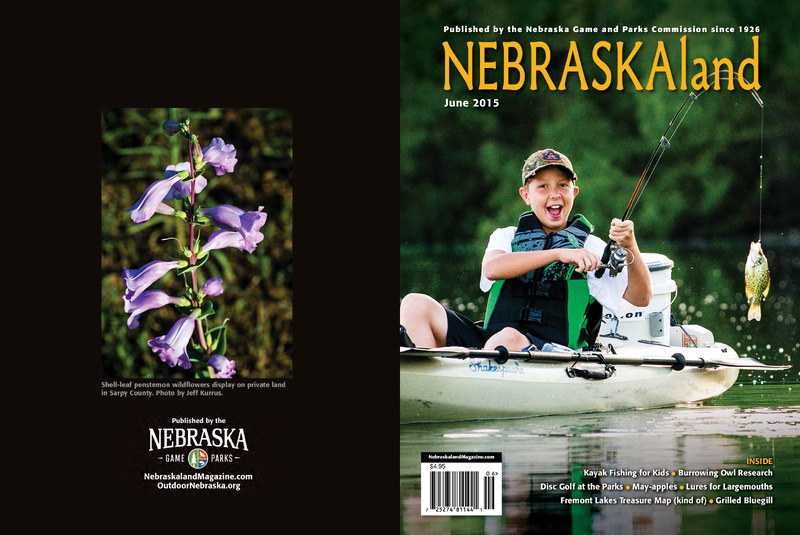
Shell-leaf penstemon wildflowers display on private land
in Sarpy County. Photo by Jeff Kurrus.
NebraskalandMagazine.com
$4.95
INSIDE
Kayak Fishing for Kids ● Burrowing Owl Research
Disc Golf at the Parks ● May-apples ● Lures for Largemouths
Fremont Lakes Treasure Map (kind of) ● Grilled Bluegill
NEBRASKAland Magazine
Volume 93
●
No. 5
●
June 2015
F EAT U R ES . . .
24 Backpacks in the Burrow
STORY AND PHOTOS BY JUSTIN HAAG
30 Flying Saucers
BY CALLIE RIETFORS
on My Mind
32 Nebraska
P
S
M
F
HOTOS AND TORY BY
ICHAEL ORSBERG
40 Search for Treasure – at Fremont Lakes SRA
BY JEFF KURRUS
42 Kayaks and Kids
STORY AND PHOTOS BY JUSTIN HAAG
48 The Wrong Side of Sunflowers
wers
STORY AND PHOTOS BY CHRIS HELZER
50 Ten Ways to Catch this Finicky Fish
24
●
STORY AND PHOTOS BY JEFF KURRUS
52 May-apple – a plant of many names
STORY AND PHOTOS BY GERRY STEINAUER
I N S I D E T H I S I S S U E ...
30
●
Mixed Bag – Armadillos, Crete’s Time Ball, Vacationing
in 1909, The Immortal Turtle, Sandpipers, Trail Running,
Goat Heads, Upcoming Events and more .....................6
Wilderness Workshop – Photos in the Parks .......54
Page 49 – Burrowing Cows .................................57
Portraits from the Past ..................................58
In the Kitchen – Grilled Whole Bluegill ...............60
The Last Stop – Counting Flowers by the Wall .......62
50
●
O N TH E W EB . . .
WHEN YOU SEE THIS SYMBOL IN THE PAGES OF
N
NEBRASKALAND MAGAZINE, VISIT
NEBRASKALANDMAGAZINE.COM AND VIEW OUR INTERACTIVE
DIGITAL EDITION FOR MORE INFORMATION.
D
NEBRASKAland (VOL. 93 / NO. 5, ISSN 0028-1964) is published monthly, except
for the combined Jan./Feb. and Aug./Sept. issues, by the Nebraska Game and Parks
Commission, 2200 N. 33rd St., Lincoln, NE. Periodicals postage paid at Lincoln,
Nebraska, and additional mailing offices. POSTMASTER: Send address changes to
NEBRASKAland, P.O. Box 30370, Lincoln, NE 68503-0370.
2 NEBRASKAland • JUNE 2015
48
●
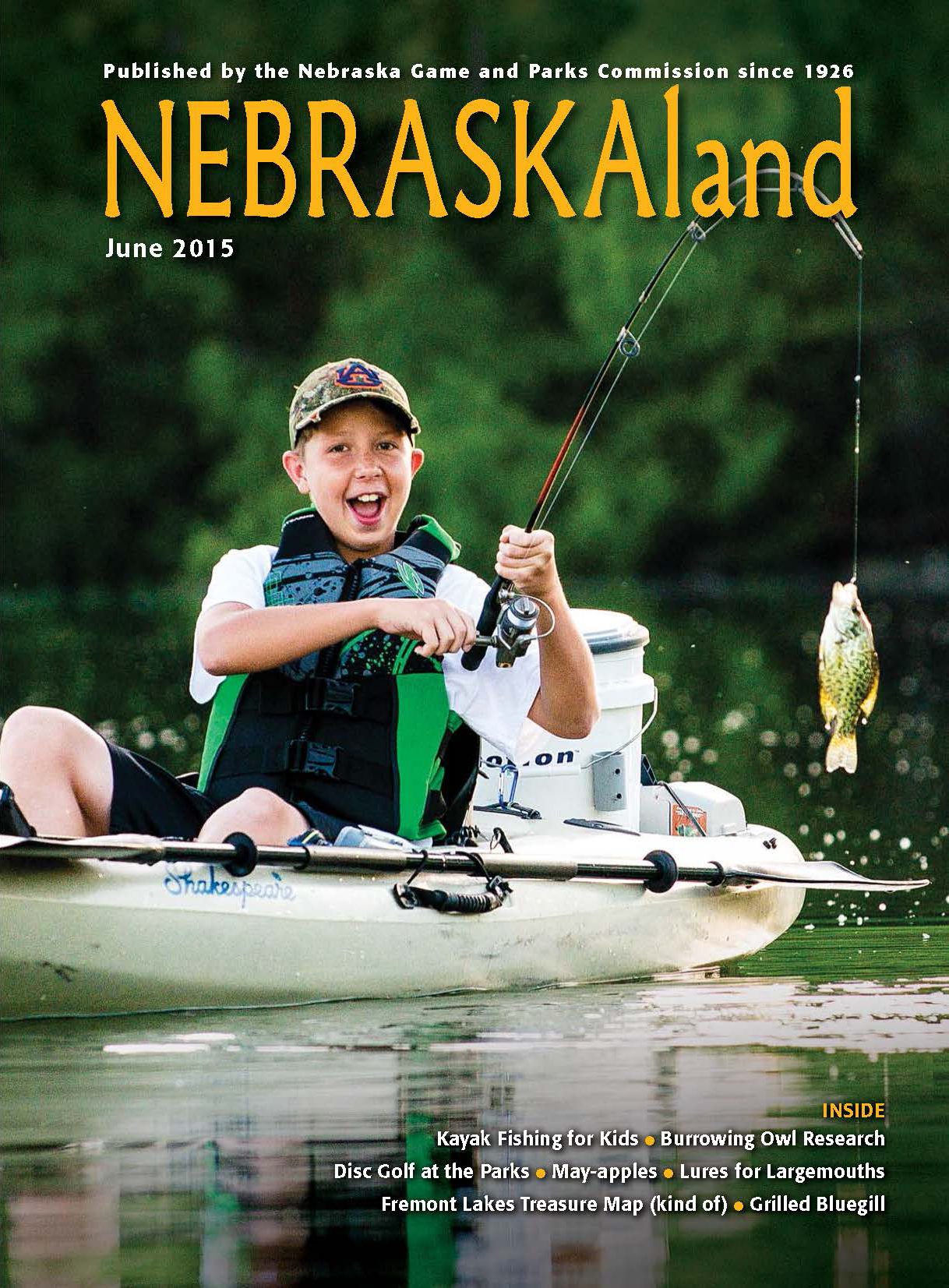
Cover: Sawyer Haag reels in a crappie while fishing from a kayak at the
Chadron City Reservoirs. Photo by Justin Haag.
JUNE 2015 • NEBRASKAland 3
Six-year-old Charlie Caldwell of Lincoln
holds up his first turkey, which he shot
on private property near Ainsworth.
Patrick Bryan captured “Reaching the Sky” near Gretna, where the Milky Way is rarely
seen due to light pollution.
Tanner Podraza, of Columbus,
shot this photo during a January,
2015 goose hunt in Polk County.
He used an app called snapseed
to create the painterly effect.
A Cultural Misunderstanding
I wanted to share with you an
interesting true story about windmills
that was told to me back in the 1980s
by a friend of mine. The friend had a
visitor come to Nebraska from Boston.
As the Bostonian had never been to
Nebraska before, they took a drive to
rural areas. The Bostonian commented,
“It was really nice of the farmers to put
fans in the pastures to keep the cows
cool.”
Mary Konz Morris
Omaha, Nebraska
Outdoor Plates
For more than 30 years, Arnie
Hoffman of Valentine has displayed his
lifelong passion for crappie fishing on
his vehicle. Now 86, he still fishes for
slabs year-round, whether the water is
soft or hard.
If you have a unique outdoor
message plate you would like to
share, or know someone who does,
e-mail a photo (high-resolution, JPEG
format only, please) along with your
hometown and a brief description of
the interests expressed on your license
plate to Eric.Fowler@Nebraska.gov.
Message in the Magazine
Now, you can send a message
to NEBRASKAland Magazine at
Facebook.com/nebraskalandmagazine
and your comment or photograph may
appear on these pages.
–Editor
Correction
Regarding the article on Chief
Standing Bear Symposium that appears
in the May issue, according to tribal
historical records, Lewis and Clark first
encountered the tribe near what is now
Niobrara. Also, the Fort Laramie Treaty
gave the tribe’s land to the Great Sioux
Nation, which led to the land going to
the Yankton Sioux Tribe, rather than the
Santee Sioux Tribe. We regret the errors.
Send your comments to:
Jeff Kurrus, Editor
NEBRASKAland Magazine
P.O. Box 30370
Lincoln, NE 68503
or e-mail Jeff.Kurrus@Nebraska.gov
Please include your postal address and telephone number. Letters may be condensed
and edited. Photographs are also welcome.
Any program that receives federal funding from the National Park
Service, or the United States Fish and Wildlife Service prohibits unlawful
discrimination on the basis of race, color, religion, age, gender, marital
status, national origin, age, disability or political affiliation. Any person
who believes he or she has been discriminated against in any program,
activity, facility, or service, should contact the Nebraska Game and
Parks Commission, Lincoln, NE 402-471-0641, the Equal Opportunity
Commission, Lincoln, NE 402-471-2024, TTY/TDD 402-471-4693;
United States Fish Wildlife Service, Civil Rights Coordinator, 4401
N. Fairfax Drive, Arlington, VA 22203; Director, Equal Opportunity
Program, U.S. Department of Interior, National Park Service, 1849 C
Street NW, Mail Code 0008, Washington, D.C. 20240-0001.
4 NEBRASKAland • JUNE 2015
COMMISSIONERS
CONSERVATION OFFICERS
Director Jim Douglas
Commissioners
Chairman - Dr. Kent Forney, Lincoln
Vice Chairman - Rex Fisher, Omaha
2nd Vice Chairman - Mark Spurgin, Paxton
Robert Allen, Eustis
Dick Bell, Omaha
Lynn Berggren, Broken Bow
Mick Jensen, Blair
Norris Marshall, Kearney
Dr. Mark Pinkerton, Wilber
NORTHWEST
Officer
City
Jim Zimmerman (S) Gering
MAGAZINE STAFF
Communications Director Christy Rasmussen
Editor Jeff Kurrus
Art Director Tim Reigert
Associate Editor Jenny Nguyen
Regional Editors Eric Fowler, Julie Geiser,
Justin Haag
Contributing Editor Michael Forsberg
Regular Contributors Chris Helzer, Gerry
Steinauer
Photo Librarian Jaclyn Cruikshank Vogt
Circulation Donna Robinson
For address changes and questions about
your subscription, e-mail donna.robinson@
nebraska.gov or call 800-632-5263
Advertising Sales Manager
For advertising information contact
Shane G. Gilster, 402-742-0125
Email: shanegilster@gmail.com
Greg Hesse
Scott Brandt
Dan Kling
Frank Miller
Sean McKeehan
Terry Brentzel
Phone (308)
(office) 763-2940
(cell) 641-6138
Rushville
760-3647
Gering
631-0663
Harrison
430-0572
Valentine
402-389-0444
Bridgeport
279-9133
Oshkosh
458-7650
SOUTHWEST
Officer
City
Phone (308)
Roger Thompson (S) N. Platte (office) 535-8025
(cell) 530-3097
Ray Dierking
Brkn. Bow
870-0322
Michael Thome
Cozad
529-8146
Matt Andrews
Elwood
746-2418
Dirk Greene
Imperial
882-0015
Dale Johnson
Kearney
440-3847
Brian Piernicky
McCook
340-6627
Brandon O’Neal
N. Platte
530-3157
Nicholas Fix
Ogallala
289-0427
Bryce Streger
Ogallala
289-1169
Rich Routh
Rep. City
920-0367
Tim Williams
Grand Is
380-7331
Pat George
Kenesaw
402-705-9989
Matt Brandt
Loup City
202-0819
Andrew Heyer
Cozad
402-613-2241
Alex Hasenauer
Wellfleet
660-4671
NORTHEAST
Officer
Tom Zimmer (Sup.)
City
Norfolk
SOUTHEAST
Officer
Levi Krause (Sup.)
William Krause
Mike Luben
Dan Zuehlke
Heath Packett
Darin Gress
Douglas Kramer
Dina Barta
Stacey Lewton
Dudley Sorensen
Russell Mort
Dan Evasco
Rich Berggren
Travis Shepler
City
Louisville
Auburn
Colon
Cortland
Eagle
Hebron
Lincoln
Lincoln
Lincoln
Waverly
Nebr. City
Papillion
Waterloo
Lincoln
Phone (402)
949-0593
274-8063
443-6392
806-9084
210-0888
768-8665
890-6465
890-6463
890-7140
937-3422
209-1506
616-5961
619-1355
613-2312
Ak-Sar-Ben Aquarium
21502 W. Highway 31 Gretna, NE 68028
Phone 402-332-3901
ADMINISTRATION
Officer
Craig Stover (Adm.)
Duane Arp (Ass.)
Jeff Clauson (Ass.)
City
Lincoln
Lincoln
Lincoln
Phone (402)
471-5531
471-5531
471-5531
Omaha Office
8495 Frederick Street, Omaha, NE 68124
Phone 402-595-2144
Nebraska Wildlife Crimestoppers 1-800-742-7627
NEBRASKAland Magazine Copyright 2014, all rights reserved.
NEBRASKAland is available in audio from the Nebraska Library
Commission Talking Book and Braille Service, Suite 120, 1200 N St.,
Lincoln, NE 68508. 800-742-7691. NEBRASKAland Magazine and the
Nebraska Game and Parks Commission reserve the right to reject any
advertising not in keeping with the agency mission.
Rates: $18 for one year; $33 for two years; $44 for three years. Nebraska
recipients must add appropriate sales tax. To subscribe call
1-800-NEBLAND (632-5263), or go online to: NebraskalandMagazine.
com.
COMMISSION
C
COM
CO
OM
OMMIS
MIS
SSIO
SION O
SI
OFFICES
FF CES
FF
FFI
CES
S
Headquarters/Southeast District Office
2200 N. 33rd Street Lincoln, NE 68503
Phone 402-471-0641
Northeast District Office
2201 N. 13th St. Norfolk, NE 68701
Phone 402-370-3374
Southwest District Office
301 E. State Farm Rd. North Platte, NE 69101
Phone 308-535-8025
Northwest District Office
East Hwy. 2, Box 725 Alliance, NE 69301
Phone 308-763-2940
Bassett Office
524 Panzer St., Box 508 Bassett, NE 68714
Phone 402-684-2921
Kearney Office
1617 First Ave. Kearney, NE 68847
Phone 308-865-5310
Phone (402)
(office) 370-3374
(cell) 649-8053
Dale Davis
Bassett
760-0712
Steve Oberg
Columbus
910-3366
Daniel Roberts
Fremont
719-1108
Randy Pomplun
Fullerton
308-550-0489
Jeff Jones
Hartington
762-5022
Jon Reeves
Kennard
889-8508
Doug Pollard
Ord
308-730-7050
Alex Thomas
Ponca
241-7615
Cory Krause
West Point
380-6410
Jonathan Andreasen O’Neill
340-3981
Mitch Johnson
Wausa
613-8612
JUNE 2015 • NEBRASKAland 5
A Mammal
Brief
Armadillo
Lindsay Rogers
is an outdoor
education
specialist with
the Nebraska
Game and Parks
Commission.
By Lindsay
Rogers
6 NEBRASKAland • JUNE 2015
PHOTO BY JOEL SARTORE
Of the 20 species
of armadillos in
the world, only one
– the nine-banded
armadillo – extends
into the United States.
This species has been
expanding its range in
recent years to more northern
and eastern regions including
southern Nebraska. It is easily
recognizable with its bony armor
covered in leathery skin.
This suit of armor helps protect adult
armadillos from predators including foxes, bobcats and raptors; juvenile
armadillos do not yet have a hard, bony shield and thus are more likely
to be preyed upon. Provided there is food and water, they can easily adapt to a
variety of habitats including forests, prairie and wetlands. They feed primarily on insects
including ants and termites. ■
JUNE 2015 • NEBRASKAland 7
Travelogue Sponsors
The metal
all
time
tim
eb
ball
all
91-2CIETY RG24
ORICAL SO
STATE HIST
NEBRASKA
By David Bristow
Crete
32
f there’s one artifact that sums up the early history of Crete,
ska, it’s the time ball at Doane College. What does a
Nebra
N
time
tim ball do? Think of the New Year’s Eve ball drop at Times
in New York City. Do you ever wonder why they drop a
Square
Squ
large ball at the stroke of midnight?
Time balls were once found in large cities and seaport
harbors. A large metal ball on a pole would drop at noon,
allowing ships and businesses to set their clocks to Standard
Time, the nationwide system of time zones that began in 1883.
but
Railroad whistles usually served this function in the interior,
Crete was an oddity.
to raise the 56-pound
Every day, a Doane College student would crank a windlass
the tallest
metal ball — painted black and sectioned like an orange — atop
Crete
vatory
Obser
ll
Boswe
nearby
inside
clock
building on campus. A special
nt. It
sent an electrical signal to release the ball at just the right mome
Col.
of
liking
the
to
much
very
and
e,
was all very modern and precis
Thomas Doane.
er
Doane, of Cape Cod, Massachusetts, was a railroad civil engine
n of
versio
prairie
a
into
Crete
make
to
and leading citizen who wanted
ering
consid
you
e
surpris
may
that
a New England town—something
The
Crete’s Mediterranean name and Czech and Latino ethnicity.
was
ball
time
the
and
plan,
the
of
Eastern-staffed college was part
another coastal import.
Time balls became obsolete when time signals could be
ll
transmitted by radio, but Doane’s ball is still kept inside Boswe
e.edu/
(Doan
ideals
early
town’s
Observatory, a reminder of the
boswell-observatory).
Another part of the New England vision for Crete involved
planting a lot of trees. Today the 300-acre Doane campus
—arguably the prettiest
campus in the state — is also
designated the Osterhout Arboretum, home to
more than 160 species of trees and shrubs.
the form
Around town, you’ll find more recent beautification efforts in
a mural
d
painte
Easton
Echo
of murals. In 1992, local artists Geoff and
then
Since
Crete.
of
history
the
on their downtown building representing
art
Public
.
murals
d
issione
comm
dozens of other property owners have
became a Crete thing to do.
s lakes
The town is also fortunate to have a half-dozen public-acces
em
Bluest
and
Creek
Olive
within a few miles east. Two of these,
nser,
Lake, are state recreation areas; smaller lakes include Merga
at
Guide
Fishing
2015
the
Tanglewood, Teal and Wild Plum. Check
OutdoorNebraska.ne.gov.
Crete is also just 10 miles southeast of Spring Creek Prairie
walking
Audubon Center, an 850-acre tallgrass prairie sanctuary with
on.org).
.audub
prairie
gcreek
(Sprin
trails, native grasslands and wetlands
Center
ing
Skydiv
Crete
er
For something more daring, consid
and
(Skydivecrete.com) at the airport east of town. It offers tandem
of
view
good
a
have
You’ll
ers.
solo dives and training for beginn
Crete while dropping like a time ball. ■
Doane College photo from 1900
One of dow
murals. ntown Crete’s
m
any
PHOTOS BY DAVID BRISTOW
t
idge a
r
b
s
s
u
r
t
HistodriocPark.
Tuxe
JUNE 2015 • NEBRASKAland 9
NSHS, RG3183-3-41
Along the creek at Long Pine.
A Brief History
Vacationing on a Budget
in 1909
By Patricia C. Gaster,
Nebraska State Historical Society
“W
here to spend my vacation is
a problem which hundreds of
Omaha minds are puzzling
over just now,” said the
Omaha Daily News on July 18, 1909,
in a discussion of budget vacations
within the state. The News told its
readers that a fine vacation trip could
be had in Nebraska at little cost: “Go to
any railroad ticket office and they will
give you a list of vacation trips that can
be made at an expenditure of $10 to
$50.”
The News suggested Lake
Quinnebaugh, near Tekamah, to
fishermen looking for a bargain: “The
railroad fare for the round trip is only
$1.68 and you can get at some farm
house a week of the very best board—
chicken and fish, and butter and eggs
and milk—for $6. That leaves $2.32 to
spend for snakebite medicine, tobacco,
reading matter and other incidentals.”
Long Pine in Brown County was
also said to be a low-cost vacation
destination within the state. People
This photograph of boating in Long Pine Lake was depicted on a hand-tinted
hand tinted postcard
from 1927. From private collection.
10 NEBRASKAland • JUNE 2015
From Ainsworth Star-Journal
Star-Journal,
l April 26
26,
1945.
had long noticed the special features
of Pine Creek canyon. The town’s
early entrepreneurs had big ideas
about capitalizing on the potentially
medicinal properties of the waters of
the creek, a tributary of the Niobrara
River.
In 1910, the year after the Daily
News article on budget vacation
destinations was published, three
entrepreneurs formed the Long Pine
Amusement Park, a health and vacation
resort that would become one of the
most developed and longest lasting
of all amusement parks in Nebraska.
The resort drew travelers, first by rail
and later by automobile, to stay in
cabins beside Long Pine Creek and
enjoy outdoor recreation and live
entertainment. The area remains a busy
summer vacation spot today, home to
Long Pine State Recreation Area as
well as privately owned facilities. ■
JUNE 2015 • NEBRASKAland 11
Paid Advertisement
12 NEBRASKAland • JUNE 2015
JUNE 2015 • NEBRASKAland 13
Nebraska Bird Library
Sponsored by
y
Northern Cardinal
PHOTO COMPOSITE BY JEFF KURRUS
Song or calls: Variable loud, liquid “cue
cue cue,” “cheer cheer cheer” and “purty purty
purty.”
Description: Conspicuous crest, and large,
cone-shaped reddish bill. Male is bright red
overall with a black face and throat. Female is
buffy-brown to buffy-olive and has a red tinge
on wings, crest and tail. Juvenile is similar
to female but browner overall and has a dark
brown bill.
Habitat: Forest edges, brushy forest openings,
parks and residential areas with shrubs and low
trees, second-growth woods and riparian forests.
Where in Nebraska: Common permanent
resident in eastern Nebraska, becoming
uncommon to occasional westwardly.
Apparently absent from the western Sandhills
and the Pine Ridge area.
Fun Facts: Northern cardinals are the only
species in Nebraska with a red beak and both
the male and the female sing (unlike most
songbirds). ■
To learn about more birds visit
NebraskaBirdLibrary.org.
Bowfishing Mentor
Program
By Jenny Nguyen
14 NEBRASKAland • JUNE 2015
PHOTO BY JENNY NGUYEN
Fishing combined with the thrill of hunting and archery
shooting, bowfishing is one of the fastest growing outdoor
activities in the country. Many hunters do it during the offseason, and it’s a fun activity for fishermen during the hot, dog
days of summer. If equipped correctly, bowfishing can also be a
fast-action sport at night.
Interested in learning how to bowfish but don’t know where
to start? Sign up for the Bowfishing Mentor Program at Ponca
State Park this June. The course will be taught over four nights,
June 4, 11, 18 and 19 from 6-8:30 p.m. You will learn basic
bowfishing skills, including knowledge on archery equipment;
how to find, identify and shoot fish; and cleaning and cooking
fish.
The program is limited to 25 registrants, and students must
be 10 years old as of January 1, 2015. Program is free and
most gear will be provided, sponsored by the Nebraska Big
Game Conservation Association and the Nebraska Game and
Parks Commission. Participants should bring insect repellent,
sunscreen and polarized sunglasses.
Ponca State Park is located at 88090 State Spur 26E, Ponca,
NE, 68770. To register, contact Nick Tramp, nicktramp@
myunitedagent.com. ■
Wyatt Verzani of Martinsburg shoots a carp while bowfishing
by Ponca on the Missouri River with mentor Zack Hammack.
JUNE 2015 • NEBRASKAland 15
Sandpiper
Counterculture
By Callie Rietfors
Trail running offers many benefits, such as softer
surfaces to reduce the risk of injury and a more
relaxing atmosphere than a crowded gym. For a better
trail running experience, it’s important to choose
the appropriate gear. The Greater Omaha Area Trail
Runners (G.O.A.T.z) recommends the following for trail
running, from apparel to nourishment:
Shoes suitable for the terrain.
Lightweight merino wool socks for moisturewicking and temperature regulation.
Clothing for anticipated weather.
Running waistband (like FlipBelt or SPIbelt).
A handheld water bottle or a hydration pack for
longer runs.
Energy gels (such as Tailwind) or sports drinks for
Runners participate in a trail running race at Schramm Park State
carbohydrates and electrolytes to replace salt lost
Recreation Area in Sarpy County.
through sweating.
A lubricant like Body Glide or Vaseline for blister
and chafing protection.
A flashlight, headlamp or knuckle light for early
Baby wipes.
morning or nighttime runs.
Cell phone or emergency contact and basic information.
Bug spray.
A watch for pace (some include GPS as well as heart
Sunscreen. ■
rate and distance tracking. Smartphones also have
Callie Rietfors is a freelance writer living in Omaha. See
running apps with these features).
more of her work on page 30.
By Chris Helzer
The upland sandpiper was given the perfect descriptive
name. Members of the species scorn the banks of wetlands,
lakes and rivers inhabited by “regular” sandpipers, preferring
instead to feed and nest in grasslands far from any water.
Lest the world fail to notice their brazen countercultural
behavior, upland sandpipers stand prominently on tall fence
posts or power poles and perform high, noisy flight displays
no one can ignore. If upland sandpipers were people, they’d
probably grow scruffy beards, wear fedoras, brew their own
beer and brag about their collection of old vinyl records.
While it’s fun to make light of the peculiar habits of
upland sandpipers, there is no denying their strength or
stamina. Any bird that makes annual flights from South
America to the Great Plains of North America deserves
respect. As with many of our summer birds, we tend to think
of upland sandpipers as a Nebraska species, but they actually
spend three quarters of each year in Argentina, Uruguay or
southern Brazil, and only use Nebraska prairies as a summer
home. Upland sandpipers leave South America in midMarch and head north, usually returning to the general area
from which they were hatched. Most of that nesting habitat
is in the northern Great Plains, where upland sandpipers
are considered to be characteristic birds of expansive
grassland landscapes. However, there are also scattered
populations in the northeastern United States – in sites such
as blueberry farms, airports and abandoned strip mines.
They were historically found in the northwestern U.S. as
well, but it is now a rare and exciting occurrence for birders
to see “uppies” there anymore. Nebraska has very strong
populations of upland sandpipers in the Sandhills and other
large prairies elsewhere in the state – especially those with
areas of fairly short vegetation structure.
•
•
•
•
•
•
•
•
•
PHOTO BY CHRIS HELZER
•
•
•
•
PHOTO BY JEFF KURRUS
13 Essentials for Trail
Running
16 NEBRASKAland • JUNE 2015
Nests are built on the ground and typically filled with four
eggs. The young are precocial, meaning they can leave the
nest very shortly after hatching and follow their parents on
a search for insects to eat. Surviving nestlings will grow to
approximately 12 inches long with a 26-inch wingspan, but
weigh only about six ounces.
Their distinctive shape makes upland sandpipers easy for
amateur birdwatchers to identify, as does their behavior.
Males perform loud flight displays in which they fly with
quick short wing beats and call out a series of upward
ranging “chck” notes ending in a whistle that sounds just
like a male construction worker’s wolf whistle at a passing
woman. Another identifying feature of upland sandpipers is
that when they land on a post or other prominent perch, they
tend to hold their long wings upright for a moment or two
before daintily folding them away.
Nebraskans should feel a sense of pride when they see
uppies perched on fence posts or hear their long wavering
call from across the open prairie. An abundance of upland
sandpipers is a great indication that the prairie landscape
is still sufficiently large and intact to support most other
grassland bird species as well – an attribute that is becoming
less common around the country today. Keep an eye out
for this eccentric and ostentatious creature during your next
summer drive through the Sandhills or other large grassland
landscapes, and give them a polite Nebraska finger wave as
you pass by. ■
A regular contributor, Chris Helzer lives in Aurora and
is the Eastern Nebraska Program Director for the Nature
Conservancy. See more of his work on page 48.
JUNE 2015 • NEBRASKAland 17
Fi
Fishing
Ca
Camp
Game
G
By Jeff Kurrus
While not
W
revolutionary
re
iin its roll-theddice and move
aacross a board
framework, tthe questions
in the Fishing Camp board game are
for the entire family and arranged in
four skill levels, from beginner to longtime angler. So it quickly has become
a game in my house where Dad and
daughter can still fish, even if there’s
a thunderstorm outside. For more
information, visit EducationOutdoors.
net. ■
NEBRASKAland
P H O T O
C O N T E S T
FOR COMPLETE CONTEST RULES AND ENTRY, GO TO...
NebraskalandMagazine.com/photocontest
Roughing It
From the Halsey trip: Dylan (on the right)
and Derrick Tegtmeier.
By Dylan Tegtmeier
Outside
Together
S
N E B R
A
S K
A
By Lindsay Rogers
As parents, we all want the best for
our children. We want to make sure they
are learning, that they are happy (most
of the time) and that they are healthy.
Healthy meals, exercise and new
learning opportunities are all important,
and one of the best ways to raise healthy
kids is to get them outside.
Research shows that children who
are actively engaged in the outdoors
perform better on standardized tests.
More importantly, children who
learn while outside develop better
problem-solving skills – something that
everyone, no matter their career, needs.
Reduced stress levels, more energy
and fewer behavior problems are all
benefits of an active lifestyle outdoors
for children (and adults), and spending
just 30 minutes a day outside in your
backyard or state recreation area can
lead to better sleep and reduced obesity.
But, what is the best way to get
children to explore the world around
PHOTO BY ERIC FOWLER
18 NEBRASKAland • JUNE 2015
boughs to keep you off the ground and a limb of the tree
to hold the center of your tarp. Slope the roof/sides at an
angle (to keep away melting snow), and tuck in the edges
of the tarp everywhere you can to keep the wind out.
Bring someone with you for safety and to keep warm.
The biggest key to success while “roughing it” is
knowing your limits. Don’t expect to tackle Chadron
State Park for a week in January if you haven’t practiced
in your own backyard first. Try a little “roughing it” this
year and get back in nature.
Visit OutdoorU.org and start your own pathway to
exciting and memorable experiences in the outdoors. ■
PHOTO BY DYLAN TEGTMEIER
ometimes it is great to be in nature. If you want to
enjoy every inch of nature, the park and the camping
experience, “roughing it” can give you that freedom.
Let’s say you want to explore Indian Cave State Park
this June. You don’t need to pack everything (including
the kitchen sink), just a good backpack and some preplanning will do. Check weather conditions and touch
base with the park office to line up the 2-3 day trip.
Pack clothes, a hammock and mosquito net, a space
blanket and black heavy-duty binder clips, a water bottle,
cooking pot, rope or 550 paracord, flashlight and some
food. Don’t forget the toilet paper, whistle, and first aid
kit. Flint and dryer lint (fire starter) are a must (as is
the ability to start fires with flint). Indian Cave is home
to several fruit trees like paw paw, mulberry and black
cherry, and many ground plants are edible if you are
positive on plant ID. There are plenty of trees to tie a
hammock to at Indian Cave. If it rains, use your backpack
as your pillow and wrap your hammock with your space
blanket. Use the clips to hold your blanket tight in case
of heavy wind.
The Nebraska National Forest near Halsey in January is
challenging. Extreme temperature and weather changes,
beautiful sunrises and sunsets and the stars are amazing.
The packing list is about the same, other than warmer
clothes, gloves, ear muffs, etc. Replace the hammock
and mosquito net with a good sleeping bag and tarp, and
bring high-calorie food to help in staying warm. Dress
smart and hike smarter. Sleep under a pine tree. Use pine
Lillie Beach was one of many kids in group of Malcolm familes who camped at Indian
Cave State Park in April and were unfazed by rain that dampe
them? Join them. Try creating
a scavenger hunt together; find
something in nature that starts with
every letter of the alphabet. Or, start a
tree identification journal with one leaf
from every tree you find.
Another idea is to plant a pollinator
garden. With a few inexpensive seed
packets you will make memories with
your children and also provide habitat
for pollinators such as bees, butterflies
and beetles.
Getting outside is not hard and what
you do outside doesn’t have to be
either. Time outside together is time
well spent. ■
JUNE 2015 • NEBRASKAland 19
Puncturevine
We’ve all heard stories about turtles
living a long time. Charles Darwin
brought a tortoise from the Galapagos
Islands to England that lived to be
179 years old. Snapping turtles have
been accurately estimated to be more
than 75 years old. And box turtles can
easily live more than 100 years. In
fact, as turtles grow older they don’t
show any apparent signs of ageing,
a phenomenon known as “negligible
senescence.” How can this be? Are
turtles immortal?
Young turtles are vulnerable, but
once they reach adulthood turtles
have a certain set of traits that give
them a “survivorship advantage.”
The most obvious: turtles have a hard
20 NEBRASKAland • JUNE 2015
By Dan Fogell
shell that protects them when they
pull themselves inside, a strategy so
successful that the largest turtles in
the world have no natural enemies
(although not all turtles have hard
shells). While this reduces their
predation risk it doesn’t necessarily
explain their near immortality.
Turtles are ectotherms (“coldblooded”) with very slow metabolic
rates – especially if they hibernate
every year. Some hibernating water
turtles go months without oxygen,
reducing metabolic activity to almost
nothing. Reduced metabolic activities
contribute to longevity. Think of it as
making your car last longer by driving
it less frequently. But other ectotherms
may not live nearly as long as turtles,
so what else could it be?
The secret is in their cells. Normally,
when cells divide a certain number of
times their chromosomes can become
sort of worn out and unstable. This can
interrupt gene function and ultimately
results in cellular senescence, which
leads to all those signs of ageing
that we all dread. Turtle cells do not
senesce when they divide. Because of
this, turtles rarely die of old age. They
can be hit by cars, killed by predators
The lines in a turtle’s shell are like growth
rings on a tree and can often give you
an idea of a turtle’s age. This ornate box
turtle is at least 20 years old.
PHOTOS BY DAN FOGELL
This large common snapping turtle is
about 40 years old and might easily live
for another 50-60 years.
brings life to new plants. During dry
periods, the seeds may remain dormant
and viable in most conditions for three
to seven years. The seeds are easily
distributed as the burs adhere to tires,
shoes, clothing, fur and feathers of
animals. ■
By Julie Geiser
It’s that time of the year
when so many of us are
outside, and that inevitable
“What is that?” is asked when
a tick undesirably appears on
our body.
To appropriately remove a
tick, use fine point tweezers
or a tick removal tool to grasp
the tick by the head or mouth,
located next to the skin. Do
not grab the tick by the body; doing this will cause the tick
to secrete fluids into its host. Once you have the tick by the
head, gently pull the tick straight out. If you must remove
the tick with your fingers use a tissue or leaf to avoid contact
with infected tick fluids.
A tick must feed on a host 36 to 48 hours before being
able to transmit disease, so remove the tick as soon as
possible. Try not to prick, crush or burn the tick as it may
release infected fluids or tissue into the host. Trying to
smother the tick with petroleum jelly, alcohol or nail polish
will also increase the chances of transmitting disease.
Once the tick is removed wash your hands, and disinfect
the tweezers and bite site. It is a good idea to make your
own tick removal kit including fine point tweezers, antiseptic
and a roll of clear tape or a small bag to seal ticks in. Keep
the tick enclosed in the tape or bag in case an illness occurs;
it can then be tested for disease.
While disease is rare, if there is any illness it usually starts
with a rash three to 30 days after the bite. The rash appears
as a solid red expanding rash or blotch, or a central spot
surrounded by clear skin that is ringed by a red rash that
looks like a bull’s-eye.
Accompanying the rash in the early stages will be
symptoms including fatigue, generalized achiness, headaches
and swelling of lymph glands near the bite. Later a victim
may have enhanced symptoms like pain in the joints, stiff,
aching neck, tingling or numbness in the extremities, sore
throat, changes in vision, fevers and severe fatigue.
In the case of a tick bite, be prepared to remove the tick
and clean the site of the tick bite to protect yourself and your
loved ones from long-term illness. ■
Send Us Your Trail Cam Photos!
Ron Bilstein of Battle Creek sent this
photo of a curious white-tailed buck
staring into a game camera.
The only real sign of old age that turtles
show is the smoothing of their shell over
time. This painted turtle has a shell that
has lost most of its growth rings.
and get injured or infected, but as they
get older they really don’t grow old.
Think about this when you see a
giant snapping turtle, because that
turtle may have watched Lewis and
Clark make their way up the Missouri
River. ■
PHOTOS BY JULIE GEISER
The Immortal Turtle
Safe Tick Removal
PHOTO BY JULIE GEISER
By Julie Geiser
Puncturevine, goathead, bullhead
or Mexican sandbur – whatever you
call it, we all know its impact once
lodged in tires and the bottoms of feet.
A summer annual, the puncturevine
or tribulus terrestris is a mat of
broadleaves with an extensive root
system that grows almost anywhere
countrywide. The foliage of this
menace plant can be toxic to livestock,
especially sheep, when eaten in high
quantities and causes external and
internal injury to grazing animals.
The green to reddish brown stems
spread from the crown of the plant
bearing many ground-covering
branches, some stretching more than
three-feet long. Leaves or cotyledons
are divided into three to seven opposite
pairs of leaflets. Yellow flowers
typically occur in Nebraska late June
through September –
the small quarter-inch
flowers are produced
where the stem and
leaf stalk meet and
eventually become
the fruit or burs.
The fruit matures
into four or five green
nutlets, each with two
spines and several
shorter counterparts.
As the nutlets mature
they turn brown
and woody before
splitting apart. Inside
each nutlet are three
to five seeds.
One plant could produce 200 to
5,000 seeds in a season and on larger
plants, 10,000 or more seeds. The seeds
will ripen in six months to a year with
germination during spring and summer
the following year. Warm, wet weather
Please submit your trail camera photos by
e-mail to: nebtrailcam@gmail.com. Also
include any information that will help explain
your photo.
Use fine point tweezers or a tick removal kit when bitten by one
of these disease-carrying insects.
JUNE 2015 • NEBRASKAland 21
by Jerry Kane
June 1
Underwater spearfishing
season begins at Box Butte
Reservoir and on private
waters
June 1, 15
Pistol League
Platte River State Park (SP),
Louisville, 402-471-5547
June 2, 3
Outdoor Chef Junior (2nd)
and Outdoor Chef (3rd)
Nebraska Game and Parks
Outdoor Education Center
(NOEC), Lincoln, 10 a.m.,
402-471-6141
June 6
6 Hours of Darkness
Adventure Race Branched
June 8-26
Oak State Recreation Area
(SRA), Raymond, 6 p.m.,
raceregister.net
June 9
Family Fishing Event
June 6
Photographer’s Workshop
Wildcat Hills SRA and Nature
Center, Gering, 308-436-3777
June 6
ColorFoam 5K
Eugene T. Mahoney SP,
Ashland, 402-944-2523
June 6
Fish and Chip Golf and
Fishing Tournament
June 2-4
Explore Archery Day Camp Willow Creek SRA, Pierce,
NOEC, Lincoln, 9 a.m.-4 p.m.,
403-471-6141
June 2
Family Fishing Event
Skyview Lake, Norfolk, 6-8 p.m.
June 3
Family Fishing Event
Pawnee Park East Pond,
Columbus, 6-8 p.m.
June 3, 10, 17, 24
Beyond Becoming an
Outdoors-Woman (BOW)
Archery Class Platte River
SP, Louisville, 402-471-5547
402-644-7402
June 6-7
Living History
Fort Atkinson State Historical
Park (SHP), Fort Calhoun,
402-468-5611
Weeping Water Gun Club,
402-471-5547
Johnson Park Lake, Fremont,
6-8 p.m.
June 9, 23
Best Shot Camp
June 13
Free Family Shooting Event
NOEC, Lincoln, 10 a.m.,
402-471-6141
June 16
Pony Express Re-ride
Fort Kearny SHP, Kearney,
308-865-5305
June 16
NOEC, Lincoln, 6:30-8:30 p.m., Pony Express Re-ride
403-471-6141
Rock Creek Station SHP,
Fairbury, 402-729-5777
June 10
Family Fishing Event
Benson Pond, Omaha,
6-8 p.m.
June 11
4-H Horse Camp
Fort Robinson SP, Crawford,
308-665-2900
June 16
Family Fishing Event Walnut
Creek Reservoir, Papillion,
6-8 p.m.
June 17
Family Fishing Event
Bowling Lake, Lincoln, 6-8 p.m.
June 11
June 17
Big Game Hunter Day
Beyond BOW Dutch Oven
Camp NOEC, Lincoln, 10 a.m., Cooking NOEC, Lincoln,
402-471-6141
6 p.m., 402-471-6141
Platte River SP, Louisville,
402-234-2217
June 21
Father’s Day Fishing Tournament
Niobrara SP, Niobrara, 9 a.m.,
402-857-3373
June 17
Camp Chef Outdoor
Cooking Workshop
June 21
Family Fishing Event
June 21
Sod House Sunday Arthur Bowring
Terry’s Pit, Terrytown, 4-7 p.m.
Shubert, 402-471-5427
4:30 p.m., 402-471-5547
June 6-7
Rock Creek Trail Days
June 12
National Park Service
Program Niobrara SP,
June 20
Carp-O-Rama Branched Oak
Sandhills Ranch SHP, Merriman,
10 a.m.-5 p.m., 308-684-5305
SRA, Raymond, 8 a.m.-1 p.m.
June 23
Family Fishing Event
Rock Creek Station SHP,
Fairbury, 402-729-5777
Niobrara SP, Niobrara,
402-857-3373
Niobrara, 7 p.m., 402-857-3373
June 13
National Park Service
Special Event Discover the
Real Missouri River, Niobrara
SP, Niobrara, 10 a.m.,
402-857-3373
June 12-13
Ash Hollow Pageant
June 8, 10
Ash Hollow SHP, Lewellen,
Rimfire Sporter Rifle Clinic 308-778-5651
Platte River SP, Louisville,
402-471-5547
June 8-26
Residents and nonresidents
may apply for one deer permit
in any draw unit. Residents
and eligible landowners may
apply for one buck or eithersex antelope permit in
available units.
June 12-14
Intertribal Gathering
Fort Robinson SP, Crawford,
308-665-2900
June 13
High 5 Relay Run
Eugene T. Mahoney SP,
Ashland, 402-944-2523
June 20
YMCA Dirty Bird Mud Run
Ponca SP, Ponca, 402-755-2284
June 20
Ride the Ridge
Fort Robinson SP, Crawford,
308-665-2900
June 20
Living History
City Pond, North Platte, 6-8 p.m.
June 22-25
Explore Bowhunting Day Camp
NOEC, Lincoln, 9 a.m.-4 p.m.,
403-471-6141
June 24
Family Fishing Event
Cottonmill Lake, Kearney, 6-8 p.m.
Rock Creek Station SHP,
Fairbury, 402-729-5777
June 25
Family Fishing Event
June 20, 27
Buffalo Cookout
Mormon Island SRA Lake No. 1,
Grand Island, 6-8 p.m.
Niobrara SP, Niobrara, 6 p.m.,
402-857-3373
June 26
National Park Service Program
June 20-21
Bugs and Bones Weekend
Niobrara SP, Niobrara, 7 p.m.,
402-857-3373
Ponca SP, Ponca, 402-755-2284
June 27-28
Becoming an Outdoors Family
Camp Two Rivers SRA, Waterloo,
June 21
Father’s Day Buffet
Fort Robinson SP, Crawford,
308-665-2900
June 21
Father’s Day Fish Fry
Ponca SP, Ponca, 402-755-2284
NEBRASKAland
and
Visitor
Last issue’s winner of
the Visitor drawing was
Will Cleavenger of Richland,
Washington, who found the honeybee
on page 54. Readers are encouraged
to contact NEBRASKAland within 10
days after this issue’s publication
with the correct page number and
name of this issue’s “Visitor” – a
critter found in Nebraska. We will
then gather the correct entries and
draw one to win a NEBRASKAland
Magazine mug.
To enter each month, write:
NEBRASKAland Visitor
2200 North 33rd Street,
Lincoln, NE 68503.
Or e-mail:
Tim.Reigert@Nebraska.gov
with “Visitor” in the subject line of
the message.
HINT: This issue’s visitor is not
on pages 7, 12, 21, 23, 32-33, or 35.
By Jenny Nguyen
Going from gambrel to grinder is
quick, but not the best way to get juicy,
quality ground meat. Think about these
tips as you gear up for the fall.
Cold meat: Unchilled meat is
pliable, making the grinder smear the
meat (and fat) instead of cutting it,
resulting in a mealy, pulpy texture.
First, remove silver skin and cut meat
into one- to two-inch cubes. Spread
pieces on parchment-lined baking
sheets, cover with plastic wrap and
freeze for one hour, until firm but not
frozen.
Clean and cold instruments: Chill
the tray, auger, blade and plates in the
freezer until you’re ready to grind.
Always sanitize instruments thoroughly
before and after each use.
Add fat: For juicy, flavorful burgers,
meatballs, meatloaf etc., add 20
percent of partially frozen, cubed pork
trimmings or bacon ends to venison.
Grind together for uniform distribution
of fat.
Plate sizes: Use the large plate for
course grind, which is ideal for burgers
and meatballs. Use the smaller plate for
sausage.
Small batches: To avoid freezer
burn and oxidation (discoloration),
grind meat right before use. Freeze
large pieces of roasts in vacuum-sealed
bags. When you’re ready, take a piece
out, partially defrost it and cut it into
smaller pieces, and then grind. Freshly
ground venison always tastes better
than pre-ground meat that has been
sitting for months. ■
402-471-5547
June 30
Hunt Camp
NOEC, Lincoln, 9 a.m.-4 p.m.,
402-471-6141
PHOTO BY JENNY NGUYEN
June 13
Chadron State Park’s 94th
Anniversary Event
Chadron SP, Chadron,
308-432-6167
22 NEBRASKAland • JUNE 2015
June 21
Father’s Day Buffet
NOEC, Lincoln, 5:30 p.m.,
402-471-6141
June 6-7
Scheels 3-D Archery
Stanton Lake, Falls City, 6-8 p.m. Tournament Ponca SP,
Ponca, 402-755-2284
June 4
Beyond BOW Beginning
June 6-Aug. 2
Canoe Wehrspann Lake,
Swimming pool open daily,
June 6
Ladies’ Day at the Range
Residents may apply for one
elk permit
June 12
June 6-7
Beyond BOW Platte River
Pioneer Longrifle
Canoe Trip
Rendezvous Indian Cave SP, Schramm Park SRA, Gretna,
June 4
Family Fishing Event
Omaha, 402-471-5547
Tips for
Grinding Game
Contact the Nebraska Game and Parks Commission at 402-471-0641 or visit
OutdoorNebraska.org for more information.
Visit HuntSafeNebraska.org for a list of hunter education classes and
BoatSafeNebraska.org for a list of boating safety classes.
The honey bee (Apis mellifica)
was introduced from Europe into
the United States in the early 1600s.
Since that time, honey bees have
become established throughout the
country and are very important
to agriculture. Nebraska officially
recognized the honey bee as the
state insect in 1975. Honey bees
are excellent pollinators, but not
the only ones. The U.S. is home to
nearly 4,000 native bees, and other
insects including beetles,
butterflies and moths, and even
animals like birds and bats,
pollinate flowers. Attract
pollinators to your landscape by
planting a variety of flowering
plants to offer blooms throughout
the season. In addition to providing
a food source, these plantings also
offer shelter and nesting sites.
Pollinators will also benefit
if you provide a shallow
water source and reduce
or eliminate the use of
pesticides.
Special thanks to Julie Van Meter, State
Entomologist, Nebraska Department of
Agriculture. Photo from Thinkstock.
Bugguide.net is a popular site for identification.
JUNE 2015 • NEBRASKAland 23
Backpacks in the
Burrow
Scotts
Bluff
County
Sheridan County
Garden County
Story and photos by Justin Haag
Devices worn on the backs of burrowing owls are
uncovering surprises about the small bird’s behavior.
W
hen David Johnson was
11 years old, he had an
unforgettable experience
while camping in southern Minnesota.
Under a moonlit sky, Johnson quietly
stared above from his sleeping bag as
a small owl landed atop his pup tent.
For the next 20 minutes, the young
naturalist watched the silhouette of
the small bird through the canvas
fabric as it vigorously vibrated with
each distinct whinnying call it made.
Johnson was certainly fascinated by
what he would later learn was an
Eastern screech-owl, but didn’t know
then that the experience would steer
him toward a lifetime of studying owls,
and eventually to owls in prairie dog
towns of Nebraska and other states of
the West and the High Plains.
“I didn’t choose owls, they chose
me,” Johnson said, reliving his
camping story while working near a
prairie dog hole in Sheridan County
last June.
Coming to Nebraska
David H. Johnson, director of the Global Owl Project and staff researcher for the
University of Idaho, about to release a banded and locator-fitted burrowing owl.
24 NEBRASKAland • JUNE 2015
Johnson, a staff researcher at the
Idaho Cooperative Fish and Wildlife
Research Unit at the University of
Idaho, has been studying the migration
of burrowing owls over their range in
western North America. The research
team began work in Nebraska for the
first time in 2014, the third year of the
effort.
The burrowing owl prefers shortgrass
prairie to forest, taking up residence in
earthen holes usually created by other
animals, most notably prairie dogs. The
open country of western Nebraska is on
An adult burrowing owl, equipped with a geo-locator, at a prairie dog colony adjacent to Walgren Lake State Recreation Area
in Sheridan County.
the eastern edge of the owl’s range.
Last summer, Johnson and his
assistant, Kelsey Jarvis, established
study sites in the Panhandle near
Mitchell, Hay Springs and Crescent
Lake National Wildlife Refuge. Those
sites are now included among 16
locations in 10 states and two Canadian
provinces.
The owls are about nine inches
tall and weigh less than six ounces.
Females are slightly larger and heavier
than the males.
Johnson traps the birds, takes their
measurements and equips most of them
with small geo-locators. The devices,
which are worn like backpacks with
straps around the wings, record the
amount of ambient light every five
minutes. If Johnson can catch the birds
the following year, he can use the
device’s data to determine the time
of sunrise and sunset each day of its
journey. From that, he can estimate the
owl’s latitude and longitude throughout
its trip. At 3.2 grams, the devices are
light enough that even the small males
can carry them.
A few of the heaviest female owls
get larger solar-powered satellite
transmitters for their backpacks. Those
units allow the researchers to track the
birds in real time throughout the year.
At six grams, the satellite units weigh
almost twice as much and cost much
more than the geo-locators.
Big Trips and Small
Johnson and his fellow researchers
are learning a lot from the data. For
instance, males and females migrate
differently, probably because of their
roles in spring and summer.
While males from South Dakota,
Idaho and Colorado migrated south,
some deep into central Mexico, the
research revealed that others from
The geo-locator is just 3.2 grams and
records the amount of ambient light at
the owl’s location every five minutes.
JUNE 2015 • NEBRASKAland 25
Johnson uses the “burrow cam,” a semi-rigid hydraulic hose with camera pushed down the hole to get a live view of the owlets
from his video monitor.
Oregon surprisingly went north to
Washington for the winter.
“In order to be successful, males
need a good burrow and a territory. If
they’re really good hunters, they don’t
have to travel south and come all the
way back north again,” he said. “If they
can tolerate the winters and they’re
good hunters, then they’ll stay local.”
On the other hand, thus far, all
females moved south to find milder
conditions and build up reserves for the
taxing months ahead. After all, when
spring arrives they require enough
energy to lay seven to 11 eggs. After
a 22-day incubation period they must
care for their brood.
26 NEBRASKAland • JUNE 2015
It’s a Dangerous
Place
Johnson believes life has gotten
harder for burrowing owls as their
habitat has gotten smaller and become
more fragmented with agriculture and
land development.
“Now there are some owls here and
some owls there, but they might be 30
or 40 miles apart,” he said. “It’s a little
bit troubling because we know that
they like loose colonies and yet they
want to be together. With individual
sites that are far apart, what are your
odds if you’re a male trying to attract
a mate?”
He also said the owls have better
chances of survival when they have
strength in numbers. If an owl senses
danger, it can warn other nearby
neighbors.
“That way not each of them has to be
on red alert status all the time,” he said.
“If you’re a small owl, it’s a dangerous
place. Having neighbors helps you.”
A Bird in the Hand
Catching wild owls for the study has
taken a bit of ingenuity and some late
nights. When nesting activity is spotted
at a burrow, the researchers place a sixinch square tube about 18 inches long
over the hole so the birds must
Johnson’s assistant, Kelsey Jarvis, takes measurements of an owl at a trapping site. With
pass through it to get to the
declining habitat, the measurements are key in the development of artificial burrows for the owls.
nest. Angled swinging doors
at each end of the tube, in the
periodic rounds into the wee hours
fashion of a regular live trap, ensure
Upon hearing the sound, the male is
to equip the owls with their new
that any bird entering is unable to exit.
tricked into believing another male
backpacks. Some sites are better than
Females are compelled to enter and
is staking a claim for his burrow. He
others. The Sheridan County prairie
exit the burrow to tend to young, so it’s soon angrily paces outside the burrow
dog colony near Walgren Lake State
not too hard to get them in the trap. It
in taunting fashion, sometimes even
Recreation Area, for instance, is one of
takes another level of trickery to get
dragging his wings like a strutting tom
the males, however.
turkey. After a couple of minutes he’s
the best with eight nest sites over 160
acres.
While the male is out hunting
had enough and enters the burrow to
for voles and other small mammals
evict the imagined unwelcome visitor.
to feed the family, a digital music
He becomes trapped.
player is placed inside the burrow
A bird entering the trap is a scene
In addition to placing the high-tech
with a recorded version of the male’s
Johnson hopes happens several times
units on the owls, the researchers also
territorial “coo-cooo” call on loop.
a night as he and his assistant make
A Better Burrow
JUNE 2015 • NEBRASKAland 27
The heaviest birds, which are females, get larger solar-powered satellite transmitters that provide real time location data.
take measurements of the burrow
itself. Artificial burrows, created
using average measurements of holes
the owls choose for nesting, can help
combat the decline of nesting habitat.
Johnson’s team has found that most
burrows are three meters long and have
a dead end to them.
“In the absence of prairie dogs or
badgers, and at places where there are
no other options, artificial burrows can
work,” Johnson said.
To get a better idea of what’s going
on in the burrow, Johnson invented
a “burrow cam” using semi-rigid
hydraulic hose. By pushing the camera
down the hole, he can get a live view
of the owlets from his video monitor.
The Payoff
Johnson’s research results in detailed location data for burrowing owls. Interestingly, one owl banded last year in Nebraska made a
stop-over near a site in Mexico named Tecolotes -- which translates to “owl” in English.
28 NEBRASKAland • JUNE 2015
Overall, the research is helping
answer questions about a non-game
species that Nebraska hasn’t studied
extensively, said Matt Steffl, the Game
and Parks northwestern district wildlife
manager who helped find potential
sites and gain permission for Johnson’s
research.
“There has been a fair amount of
research on the burrowing owls in
states west of us,” Steffl said. “Since
we are on the edge of their range we
don’t know if the birds that nest here
migrate to the same or similar locations
as the more western populations or if
they have their own migration corridor
to a completely different winter home.”
With June upon us, Johnson is
entering the final chapter of his project
and is making rounds to his sites to
recover data from the geo-locators.
The satellite transmitters have already
given valuable information. Seventeen
of the 22 female owls with satellite
transmitters were in Mexico this
January, and seven owls that were
fitted with satellite backpacks in
other states made their way through
Nebraska on their journey. Two
of the three females that received
satellite transmitters in Nebraska have
been tracked south of the border.
Interestingly, one made a stop-over
near a site named Tecolotes – which
translates to “owl” in English – before
ending up in central Mexico. It has
since returned to Nebraska and at
last report in April was about 15
miles northwest of its 2014 burrow
at Diamond Bit, a Platte River Basin
Environments site south of Mitchell.
From the screech-owl of his youth
to the burrowing owls of Nebraska’s
prairie, Johnson has studied and taken
fascination with a wide array of owls
during his career. Johnson’s research
is developing a better understanding
of this small bird of the shortgrass
prairie, one of 12 owl species found in
Nebraska and more than 230 varieties
living throughout the world. Of so
many choices, perhaps the burrowing
owl should feel fortunate that this
researcher chose it for study. Or, did
the owl choose the researcher? ■
See
S more photos and a video from
this
story at NEBRASKAland Digital.
t
JUNE 2015 • NEBRASKAland 29
Flying Saucers
By Callie Rietfors
Disc golf provides inexpensive outdoor entertainment for everyone.
W
ith more than 70 disc golf courses in Nebraska,
you’ve probably seen chain baskets scattering the
landscape in parks statewide. Though commonly
referred to as “Frisbee golf,” disc golf is played with the
objective of getting the disc into the target hole in as few
throws as possible. You can play any time – alone or with a
group – and the activity provides both exercise and outdoor
entertainment.
Getting Started
PHOTO BY JUSTIN HAAG
PHOTO BY JEFF KURRUS
Like traditional golf clubs, discs come in a variety of brands
and models.
Throwers tee off at a disc golf tournament at Chadron State Park in northwestern Nebraska.
for a list of Nebraska’s disc golf sites, which includes an
18-hole course at Eugene T. Mahoney State Park near
Ashland, a nine-hole course at Chadron State Park in the
Pine Ridge and a nine-hole course at Fort Kearny State
Recreation Area.
Each of these parks also offers camping and a host of
other year-around activities. More information on each can
be found at Outdoornebraska.org.
Tournament information for more seasoned throwers is
available at Pdga.com. ■
PHOTO BY JUSTIN HAAG
Aaron Brooker of Kearney has been playing disc golf
for 16 years and likens it to another course-related passion.
“I like it for the opportunity to be outside and challenge
myself. Disc golf poses the same challenges as golf for a
fraction of the cost.”
All you need to play is a disc and comfortable shoes.
Begin with a starter pack to become familiar with the
different types of discs. Like a golf club set, discs come in
a variety of plastics, weights and dimensions for skill level,
speed, throwing distance and accuracy or curve. Several
web-based and local retailers sell discs, such as Birdie30
Disc Golf and Volo Disc Sports of Lincoln and Scheels in
both Lincoln and Omaha. The Omaha company Teeboxx
Chadron State Park features a nine-hole disc golf course in one
of the state’s most beautiful regions – the Pine Ridge.
PHOTO BY JEFF KURRUS
PHOTO BY JEFF KURRUS
even has a disc vending machine at
Seymour Smith Park.
Disc golf courses are typically
nine or 18 holes, but Lincoln has a
27-hole course at Roper Park – one of
the oldest in Nebraska. While 18-hole
courses demand increased exercise and
offer more of a challenge, nine-hole
fairways can be played in under an hour.
Start by visiting Nebdisc.wordpress.com
Blake Needles of Omaha participates in a disc golf tournament at Eugene T. Mahoney State Park near Ashland.
30 NEBRASKAland • JUNE 2015
JUNE 2015 • NEBRASKAland 31
Nebraska
on My
Mind
Photos and story
by Michael Forsberg
When I was a
kid, Dad would
always honk the
horn of our intrepid
Volkswagen 412
as we would cross
the state line back
into Nebraska from
wherever it was
we had been during
our summer family
vacations.
A Rocky Mountain bee plant
opens like a blooming firework,
revealing a visiting ladybug, on
the Sandhills prairie in July.
32 NEBRASKAland • JUNE 2015
JUNE 2015 • NEBRASKAland 33
Last light of a crisp autumn day makes the Sandhills appear like rolling waves of grass
in a prairie sea.
I
remember waiting on the edge of my seat, peering
through the windshield as the landscape began to change
to familiar territory, scanning the distant horizon for the
“Nebraska - The Good Life” sign. Once my eyes locked on
they would not waiver, and somehow Dad would always
time it just right and honk the horn exactly at the moment
we would speed by it with a sudden rush of wind. With us
safely back in the Cornhusker State, I would breathe a sigh
of relief. We had made it. We were home.
I still feel that way about Nebraska today. As a father, I
am pleased to have passed the tradition onto our kids. And
to be honest, even when I am traveling alone I still honk
the horn.
As a photographer I travel a lot. I have been lucky
enough to spend time in many places and with many
people across the Great Plains and beyond. But there is
always just a little more skip in my step when I cross back
into the state where I was born and raised. Nebraska never
is far from my mind.
Most of us have our own habitat of the heart: a place
where we have set our roots deep, whether it be the woods,
the mountains, the coast, the desert or the prairie. In a
sense, the land shapes who we are and what we value. For
those of us cut from the fabric of the Great Plains with its
wide horizons, Nebraska is our home. But few can truly
appreciate its beauty or value from the interstate or from
an airplane window seat.
34 NEBRASKAland • JUNE 2015
A sandhill crane lands with its flock to spend the quiet of the day on a secluded reach of the Platte’s south channel in late March.
A monarch butterfly (above) seeking sweet nectar alights on an Indian blanket flower in the sandsage prairie near Red Cloud. Like
a bride’s veil, Fort Falls (left) flows through the diverse spring branch canyons of Fort Niobrara National Wildlife Refuge in early
October.
JUNE 2015 • NEBRASKAland 35
S
o when people from elsewhere ask me to explain
Nebraska I usually start by saying if you drive
the state east to west border to border you will
travel roughly 430 miles and gain over 4,000 feet.
I say that even though some think that Nebraska is
a monotonous land of corn and beans; there may be
more ecological communities in this state than any
other to the East Coast, and within Nebraska’s etcha-sketch geographical boundary in the center of the
nation is a biological crossroads where many eastern
and western species meet.
In its dry western panhandle there are sweeping
high plains, wedding cake-shaped buttes and
ponderosa pine studded escarpments. In the
humid east, there are rumpled carpets of rolling
hills, tallgrass prairie remnants and the broadshouldered woodland bluffs
of the Missouri. Within its
midsection are the Nebraska
Sandhills, the largest intact
prairie grassland left on
the continent. Running
north to south are rivers
that line up like rungs on a
ladder – the Niobrara, the
Loups, the Republican, and
the Platte. And beneath all
of it are aquifers like the
mighty Ogallala and its
fossil water, a treasure box
of liquid gold beneath our
A Western meadowlark perched
on a yucca plant sings its
feet.
melodious song ushering in
summer across the state.
And it’s not just the
land but its the people
and their connection to the land. Here in Nebraska
people wave because we are friendly. We discuss
the weather with as much regularity as we discuss
what’s for dinner. We measure rainfall in the
hundredths of an inch, and we can identify clouds
by their shapes.
36 NEBRASKAland • JUNE 2015
A bouquet of wildflowers (above) grows on the ridge of a sandstone butte in the Wildcat Hills of the Nebraska Panhandle.
JUNE 2015 • NEBRASKAland 37
A faint two-track road lined with gayfeather bends through virgin tallgrass prairie at Pawnee Prairie Wildlife Management Area in
southeastern Nebraska.
E
arlier this spring while in the Nebraska Sandhills, traffic was stopped on a two-lane
highway while a ranch family moved a herd of cows and calves across the road to
another pasture. It was a nice afternoon, so many folks got out of their vehicles to talk
with each other, or rolled down their windows while listening to the radio broadcast
of the Nebraska Cornhusker spring football “game,” which with over 70,000 fans in
attendance had temporarily formed the third-largest population center in the state. While
we waited for the cattle train to pass, occasionally I would hear above the din a string of
rattling notes and would look up into the dome of blue sky and see chevron-shaped flocks
of sandhill cranes that had just left the Platte Valley, winging northward on migration.
38 NEBRASKAland • JUNE 2015
L
ater that day when I got to my destination I needed to stretch my legs. I grabbed
my binoculars and a camera and took a brief walk back out along the same ribbon
of highway, bordered by miles of rolling prairie as far as the eye could see. Only three
vehicles came down the road that hour, and all three drivers stopped to make sure that
my truck hadn’t broke down and that I was OK. Each time when I told them what I
was doing they would nod with approval, smile and wave me on my way. They all had
Nebraska plates.
There is no place like Nebraska.
■
JUNE 2015 • NEBRASKAland 39
Search for Treasure
at Fremont Lakes SRA
PHOTOS BY JEFF KURRUS
By Jeff Kurrus
OK, there might not be any buried treasure, but after a recent chat with Fremont Lakes
Superintendent Bill Booth, we’re sure you’ll find something on this map to entice you to
one of Nebraska’s most enjoyable state recreation areas. From a secluded hiking trail to a
secret spot for bluegill fishing, we have the place for you.
6
7
●I
●
P
8
30
K
●
K
●
Q
●
F
●
H
●
F
●
A
●
●I
Boasting 20 sandpit lakes, Fremont Lakes
State Recreation Area offers a variety
of activities. From watersports such as
windsurfing (above, left) to relaxing with
the family at a swim beach (above, right),
Fremont has everything a family could ask for
during a summer vacation.
30
3a
3
4
G
●
3
2
5
1
Fremont
Lakes SRA
West Military
Avenue
KEY
A
●
B
●
C
●
D
●
●
E
This picnicking spot is an
oft-forgotten family reunion
locale, perfect for large, lowkey gatherings.
Get off the beaten path here
to find birds. On Lake No.
10, birding is especially
good for migrating waterfowl
at ice-out.
Wake up early to see the
park’s best sunrise location.
Campsite No. 210 or on
the back deck of the group
lodge is ideal for capturing
sunset photos.
Brushpiles for crappies can
be found throughout the
park, but these are annual
hotspots.
●
Year after year, largemouth
bass are plentiful in these
areas.
G
40 NEBRASKAland • JUNE 2015
●
I
●
K
●
L
●
J
M
●
N
●
Other bluegill bed locations
can be found in lakes
throughout the recreation
area, but these are consistent
locales every year.
O
●
●
Q
●
P
The legendary muskellunge
can be caught on these
waters, with each lake
boasting fish above 36
inches and getting bigger.
Need a hamburger or ice
cream? Stop here for a treat.
If camping and fishing is
your desire, look no further.
If camping and watersports
is your choice instead,
you’ve found your summer
destination.
Camp here if you’re not
sure of your weekend
plans – great for socializing
with new friends or reading
a book on the waterfront.
Host a family reunion or
wedding, preferably near
sunset.
Watch fireworks on the 4th
of July at these locations.
This bullhead-stocked lake is
aimed directly at introducing
youngsters to fishing.
R
●
Morel mushrooms can go
from the ground to the grill
here.
S
●
Take the little ones to this
shallow-water beach, which
is perfect for toddlers.
T
●
This high-energy beach fills
quickly during the summer
days.
U
●
These low-pressure fishing
holes are perfect for the
canoe or kayak angler.
1–20
Lake numbers.
S
E ●
●
N
●
Mili
tary
9
B ●
F
●
C
R ●
C
●
M ●
●
O
●
L
●
D
●
P
●
F
R
●
●
B
●
B
●
N
●
G
●
Ave
nue
10
16
6
17
●I
11
1
U
●
G
●
L
●
P
●
T
●
H
J
●
●
U
E
●
●
12
15
18
19
9
13
14
U
●
MAP BASE ARTWORK BY ANDREW FAUGHN
F
●
Big catfish move into these
shallows in the late summer
afternoons.
H
●
Wes
t
Any guests coming from the
north, east, or south go west
of Fremont two miles on
Highway 30, and then head
south at County Road 19 into
the park. Guests coming from
the west will turn right and go
south on County Road 19
approximately two miles west
of Fremont into the park.
20
Bring your binoculars for
wildlife viewing on these
trails.
JUNE 2015 • NEBRASKAland 41
Kayaks and Kids
Story and photos by Justin Haag
Why should adults have all the fun
when it comes to kayak fishing?
n 2008, my son, Sawyer, was 5
years old and the kayak fishing
craze was in its infancy in western
Nebraska. When I mentioned to
friends and family that I was going
to buy a kayak to take my son fishing, it
was met with some skepticism. Back
then, the word “kayak” most commonly
invoked a mental image of daredevils
paddling through whitewater in a Rocky
Mountain stream.
Those fears subsided and kayaks have
become common on Nebraska waters
and elsewhere, as many have been
enticed by the benefits of simplicity
and economy. The sit-on-top kayak
was a great investment for my family,
and we now have two of the vessels.
Now 12, my son has spent many hours
both riding with me and paddling solo,
and I’m certain he’s caught more fish
from atop the plastic than he has while
walking the shoreline. My younger
daughter has also spent considerable
time aboard with me.
Kayak fishing with children requires
many considerations, among the first of
which is kayak selection. I didn’t go out
and buy the first kayak I found. During
research, I discovered the Malibu
PHOTO BY JUSTIN HAAG
Sawyer Haag displays a channel catfish that he caught fishing from a kayak at Carter P. Johnson Lake at Fort Robinson State Park.
An anchor can be an invaluable tool for kayak anglers of all ages. The author’s
homemade system features a hand reel to quickly raise and lower a folding two-pound
anchor. A trolley system – a loop of rope clipped to the front and rear of the hull with
carabiners and a ring tied between – allows the anchor to be positioned on either end
of the kayak. “Tie” it to the stern to have the wind at your back and the bow to have the
wind in your face, but never from the side.
42 NEBRASKAland • JUNE 2015
Pro Explorer. Its major selling point
was the Gator Hatch, a front storage
compartment access cover that doubles
as a rear-facing seat for children. The
hatch has allowed me to have face-toface conversations with my younger
passenger while I paddle to the good
fishing spots, and conveniently bait
many a hook and untangle a lot of line
while we’re there – just as dads are
supposed to do.
When my son outgrew the hatch
seat, it was time to get him his own
kayak. What’s the right age to let a
child fish solo? Sawyer was 8, but it
all depends on the kid. You want your
young paddler to be enthusiastic and
independent enough to go alone, yet
capable of making and executing good
decisions on the water.
Of course, all the usual tips for
going outdoors with children apply:
bring water, snacks, sunscreen, proper
clothing and footwear. Boaters of
non-motorized vessels don’t require
certification in Nebraska, but it’s a good
idea to use the experience as a teaching
opportunity. Visit BoatSafeNebraska.org
and the Nebraska Boating Guide for
regulations and safety tips.
PFD for Them and Me
It can’t be said enough – wear the
jacket. Kids age 12 and under are
required to wear one, but I wear one,
too. I want to be safe, lawful, and ready
if a rescue situation arises. This is one
area it doesn’t hurt to splurge a little.
It’s important that the vest not only
meets safety requirements, but that it’s
comfortable and even looks good so the
child doesn’t mind wearing it.
Drop Anchor
A small anchor is invaluable when it
comes to fishing. Without one, even a
light breeze will make it hard to fish.
An anchor will keep your kayak from
drifting into trouble spots, especially
while landing and handling fish. Use
one with caution, though. It’s important
to have a trolley system that allows you
to “tie” the anchor to the stern or bow
without leaving your seat in the middle.
An anchor dropped from the side of the
vessel puts you broadside to the waves,
leaving you, at best, all wet from the
JUNE 2015 • NEBRASKAland 43
Let your young angler hone skills while the kayak is parked in the driveway. A little
practice on land will go far from curbing any anxiety they might meet on the water.
splashing waves or, at worst, capsized.
I prefer the stern set-up, as it allows me
to fish with the wind to my back.
Keep it Calm and Fish On
Introduce children to kayak fishing
when the weather is calm and
comfortable. When the wind picks up
and the temperature drops, go ashore.
A bad experience during youth can be
discouraging, and there’s plenty of time
for them to be gung ho in the elements
when they get older.
Also, stay away from places with
a lot of motorboat traffic: big wakes
can be scary for kids and adults, not
to mention the risk of problems that
might arise if someone, be it a young
paddler or speedboat driver, isn’t paying
attention.
Paddle Power
Those Darn Snags
It’s hard to part with a beloved lure,
but no piece of merchandise is worth
capsizing. On a calm day, a child can
paddle to the other side of a snag and
free it.
At the first sign that Sawyer is
struggling, though, I tell him to keep
the anchor down until I can get there
to help, or I simply tell him to grab the
clippers and snip the line.
Holding the Rod
Unless you have a fancy pedalpowered kayak, you need a place to
put your fishing rod while paddling.
Many kayaks come equipped with
rod holders. Just make sure there’s a
secure place to put the rod that isn’t too
difficult to reach, no matter how long
your arms are.
Practice Makes the Paddler
Don’t let your children’s first solo
kayaking experience be all trial by
water. When it comes to dropping the
anchor, casting and switching between
paddle and rod, let them hone their
skills while the kayak is parked in the
driveway. This practice will go far in
curbing any anxiety that might meet
them on the water.
With a little forethought and
preparation, kayak fishing will open
opportunities for both you and your
children. Not only is it a cost-effective
way to get on the water, but it can
also bring some independence to a
child – not to mention some fish to
the deck. ■
PHOTO BY ERIC FOWLER
Select the right paddle for your young
angler. It should certainly be a paddle
made for kayaking, with blades at both
ends, and the right length for a young
paddler to handle with ease. The perfect
shaft length will depend on the height
of the paddler and the width of their
kayak. Manufacturers and retailers will
have charts to help you choose.
Sawyer Haag shows off a trout
he caught while fishing from
a kayak at the Chadron City
Reservoirs.
Kayaks easily carry anglers over and through aquatic vegetation, giving them easy access to open pockets in the shallows where
fish often hide, such as this one on Hackberry Lake at the Valentine National Wildlife Refuge.
44 NEBRASKAland • JUNE 2015
JUNE 2015 • NEBRASKAland 45
Fish-finding from
the Kayak
FISHFINDER
SLIT
I
Getting the Signal
’m always hesitant to add too many modern conveniences to
my sit-on-top kayak, mainly because I bought it with notions of
purist simplicities. My portable fish-finder, however, is always
welcome when I’m on the water, whether it is January or June. I
own the Lowrance x67c, a model that works both for ice-fishing
and the open water.
For several seasons, I situated the fish-finder and its carrying
case between my legs and dropped the transducer over the side.
It worked fine, but the cord sometimes got in the way of paddling
and the loose transducer didn’t give accurate readings while the
vessel was moving.
With a little searching on the Internet and some inventiveness, I found
a better way – one that tidies things up and gets me a better reading of
what’s below. Keep in mind, while the basics of this article are universal,
it is a custom job that will have to be tailored to your equipment.
Mount it Up
A fish-finder bracket, created by a manufacturer such as Scotty
or Ram, will allow you to remove the fish-finder’s main unit after
a day on the water by simply unplugging it. The base, installed
with the manufacturer’s instructions, can also be used to attach a
variety of other accessories, such as a rod holder. If the bolt holes
don’t match up, as was my situation, a little sawing and drilling on
a piece of plastic cutting board from your local retailer’s kitchen
section result in a fine adapter.
ROD
HOLDER
FOR
MOUNT
PLASTIC
CUTTING
BOARD
Drill, Baby, Drill
In order to get your cables to where they need to go, drill a hole
in the top of your kayak. (I know, it’s painful.) I used a 3/8-inch
drill with a 1-inch hole saw. One could get messy with silicone
caulk for this purpose, but I find that a slit half-way through a
foam practice golf ball reasonably ensures water doesn’t get below
the deck through the cable hole.
A fish finder’s transducer emits and receives signals to
detect the depth – and hopefully, fish – below a boat.
While they are easily attached to the outside of a fishing
boat’s transom, hanging one from a kayak is a challenge.
There are countless off-the-shelf and homemade
methods that can be found online, including brackets
that clamp to the side or rear of the craft. Thankfully, a
transducer’s signal can pass through a kayak’s plastic hull.
So like many anglers, I opted for a liquid-filled, internal
mount made from PVC, reducing drag and leaving one
less thing for my fishing and anchor lines to get tangled
in.
The design I chose uses a short section of PVC pipe, a
coupler and a cap. Measure your transducer to determine
the size of PVC you will need. Find a location in your
kayak for your transducer that will not be disturbed by
paddles and other items. (I put mine under the seat.)
Glue the PVC coupler to the hull using Loctite plastic
epoxy. A little light sanding helps ensure a strong,
watertight bond. To create the top of the housing, cement
a short length of the pipe inside the cap and cut a vertical
slit to allow it to slide over the cable.
Filling the housing with liquid removes the air and
ensures a good signal. If your craft will never be subjected
to freezing temperatures, use water. I used vehicle washer
fluid for its antifreeze properties. Wrap the seam with
waterproof duct tape and put a dab of silicone caulk at
the cable’s entry to seal the housing and keep the fluid
from leaking during the open-water fishing season. When
that ends and you’re ready to hit the ice, the transducer
and sonar unit are easily removed.
SILICONE CAULK
DUCT
TAPE
EPOXY
CABLE FROM FISHFINDER (UNPLUGGED)
Juicing Up
You don’t need a big, deep-cycle battery to power your
fish finder and other electronics. I use a small, sealed,
rechargeable 12-volt battery that I stow in the hatch
between my legs. If your kayak is prone to taking in
water, put your battery in a watertight container.
FOAM PRACTICE GOLF
BALL TO SEAL HOLE
ONE-INCH HOLE, DRILLED
(PAINFUL? YES.)
CABLES TO
FISH-FINDER
FISH-FINDER REMOVED
FOR PHOTO CLARITY
46 NEBRASKAland • JUNE 2015
A water-filled transducer housing can be built from PVC pipe and
glued to the inside of your kayak’s hull.
Bon Voyage
Go find some fish! If you’re like me, electronics don’t ensure
a successful fishing trip, but they will at least show you what
you’re not catching ■
On the Ball: Foam
practice golf balls are
great, inexpensive
accessories for siton-top kayak owners.
Not only will they
serve as a seal
around cords (see
page 46), but they
also work great as
plugs for the scupper
holes. To keep your
hind end dry, push
them into the holes
beneath your seat.
JUNE 2015 • NEBRASKAland 47
The Wrong Side
of Sunflowers
Story and photos by Chris Helzer
S
unflowers may be the most distinctive and
characteristic wildflowers of the Great Plains. They
are big and showy, and they follow second-grade
art rules for how flowers should look – a dark round
center surrounded by long petals. However, there are
two sides to every sunflower blossom: the familiar, bright
and attractive front side, and the hidden and lackluster back
side, scorned by most painters, photographers and young
crayon artists.
If you look at any book cover, calendar or coffee mug
featuring a sunflower, it almost always showcases the “face”
of the flower. It must be the most recognized flower face
in the world. The front of the sunflower is also where the
action is. It’s where bees come to gather pollen and nectar,
and where – later in the season – birds and other wildlife
come to harvest large nutritious seeds. In comparison, the
backside of a flower must be pretty dull, right?
Actually, a sunflower’s reverse side is both aesthetically
The traditional view: stiff sunflower
(Helianthus pauciflorus) flower at
Lincoln Creek prairie restoration in
Aurora.
48 NEBRASKAland • JUNE 2015
pleasing and full of activity. Overlapping layers of
beautifully-intricate green bracts (phyllaries) cover the center
of the flower, and the petals are just as pretty from behind as
from the front. In fact, because sunflower blossoms usually
face the sun, the light passing through their translucent
petals produces a wonderful and warm glow. The penchant
for sunflowers to track the sun also means that the backside
of flowers is a good place for small creatures to hide.
Insects, particularly, can often be found there – taking refuge
from the hot sun or hiding from hungry predators. Ants have
an additional reason to swarm the flip side of sunflowers.
Annual sunflowers produce sweet “extra floral” nectar that
attracts the predatory ants as an apparent strategy to protect
the flower from tiny herbivores (see NEBRASKAland
January-February 2013 issue, page 6.)
The next time you’re hiking through a prairie in late
summer, surrounded by the bright faces of sunflowers, take
a minute to step around to the other side of a few plants. In
The backside of stiff sunflower
at the Nature Conservancy’s
Platte River Prairies.
addition to seeing a different side of this charismatic plant,
you’re also likely to spot a variety of small creatures you
would otherwise have missed. Maybe those small creatures
know something you (and your favorite second-grader)
don’t. ■
Note: To some landowners, all sunflowers are lumped
together as “weeds.” That characterization is both
inaccurate and unfair. In fact, of Nebraska’s nine species
of native sunflowers, seven are perennial plants and only
Maximilian sunflower (Helianthus
maximiliani) at the Nature
Conservancy’s Platte River Prairies.
two are annuals. The two annual species are weedy, only in
that they can quickly establish in disturbed areas (heavily
grazed pastures, crop fields, or after drought has weakened
surrounding vegetation), but they are not aggressive, and
quickly diminish in abundance as nearby perennial plants
regain their vigor. Nebraska’s perennial sunflowers are
not aggressive either, and both annuals and perennials
play important roles in their ecosystems, especially as food
sources for pollinators, seed-eating wildlife, and foraging
deer and other large herbivores (including livestock).
Annual sunflowers (Helianthus
annuus) at the Nature Conservancy’s
Platte River Prairies.
JUNE 2015 • NEBRASKAland 49
Ten Ways
to Catch this Finicky Fish
Story and photos by Jeff Kurrus
L
argemouth bass, America’s most popular sport fish,
can be caught in a variety of ways. Most anglers
view these options as falling into a few distinct lure
categories, including crankbait, spinnerbait, soft
plastic and topwater. But sometimes the fish don’t
cooperate and you’re not sure what to next. Let this be your
guide:
Topwater Scum Frog
This time of year, many
Nebraska lakes have a
large amount of aquatic
vegetation. Fish this lure
at any time of day on the
edge of the vegetation
or right in it. Using lowstretch braided line is a
must to retrieve fish that strike through the vegetation and
then bury themselves in it.
Lucky 13
For many anglers, these lures
made by Heddon for more
than 50 years have gone
out of fashion. However,
they’re a marvel because
they can trigger a strike when
fished as a topwater popper
or reeled slowly just beneath the
surface, giving them the action of a swimbait.
Skimming Spinnerbaits
Fishing these right beneath
the surface, where you can
still see them, is a technique
to be used when fish are
lurking below the surface in
vegetation, waiting to ambush
whatever swims by. You can
also lift your rod tip and allow
the lure’s blade to slap the water’s
surface. Begin reeling as soon as
your lure hits the water.
Ultralight
Downsize your rig and fish
near the edge of vegetation
with any number of smaller lures,
including in-line spinners and beetle
spins. What won’t hit a larger lure might hit a
smaller one. It’s worth a try.
Weightless Worm
Texas-rigging a worm with no weight is an excellent
way to increase your lure’s action and keep your bait in a
fish’s strike zone longer. Use this technique around woody
structure and in creek channels.
50 NEBRASKAland • JUNE 2015
Crippling
Crankbaits
Even if you
can’t possibly retrieve
a crankbait through
vegetation, casting one into
holes in vegetation, then twitching
the lure, is a great way to trigger a strike. If you have any
lures with broken lips, use them here instead of your best
lures and you won’t be as worried about losing one in the
cabbage.
Open-water Crankbaits
If you’re fishing
one of the many
Nebraska lakes
thick with
vegetation, it’s worth
a few long casts with a
crankbait in open water to see
if there are bass suspended above
deep vegetation.
Match the “Hatch”
While it’s nearly taboo to keep a largemouth north of
Kentucky, it is legal on many waters in Nebraska. Cut open
the belly of one to see what they’re eating. You might just
be surprised by how many crawfish parts you find. You
might also be surprised at how tasty it is when you fry or
grill the fish for dinner.
Go Unconventional
Fish topwater lures at noon. Tie on the lure hidden away
in the bottom of your tackle box that has never caught a
fish. These and any other cockamamie ideas you might have
should be tried when the fish just aren’t active. All you’re
looking for is one strike. Or will you keep doing what isn’t
working?
Timber Cranks
Just because you’re
near riprap or some other
underwater structure,
don’t shy away from
floating crankbaits
because you fear them getting
hung up. Just watch your line
when you’re reeling. When the line’s entry point stops
moving closer as you retrieve, know that your lure is about
to hit an obstruction. Simply hesitate until your lure floats
above the obstruction, then begin reeling again. Quite often
the bass will strike as the lure rises above. ■
JUNE 2015 • NEBRASKAland 51
May-apple
a plant of many names
By Gerry Steinauer, botanist
May-apple, shown here growing at Indian Cave State Park, has a long
g
history of medicinal use. Extracts from the plant were once the main
ingredient in the popular laxative Carter’s Little Liver Pills (right).
52 NEBRASKAland • JUNE 2015
“Toxicologists may deem it an error,
To imbibe of May-apple Madeira.
But if the list was complete
Of the toxins we eat,
Perhaps we would all die of terror.”
— Botanist James A. Duke
T
here is a plant that grows in
the deciduous woodlands
on Missouri River bluffs in
southeastern Nebraska with so many
common names it befuddles even the
most retentive botanist. Settlers in
Ohio called the plant “parasols” due
to its umbrella-shaped leaves, and
the early French in Missouri named
it “citron sauvage,” meaning wild
citron, due to the fruit’s resemblance
to that of the Old World citrus (Citrus
medica). Other regional names include
Indian-apple, hog-apple, devil’s
apple, mug-apple, wild lemon, yellow
berry, wild jalap, peca, raccoon-berry,
American wild mandrake, duck’s
foot, umbrella plant and maypop. As
early as the 1730s, Carolinians were
referring to the plant as May-apple,
because it bloomed in May. For
reasons unknown, this name gained
favor and is the most widely used
today.
May-apple (Podophyllum peltatum)
is a perennial, which spreads via long,
creeping rhizomes, often forming
expansive colonies. In Nebraska, these
plants are found mainly on moist,
low slopes
p and bottoms. In April, the
stems, topped with
w folded, conicalshaped leaves,
leaves emerge from the
soil, resembling
resembli miniature tepee
villages on the forest floor.
Plants can eventually reach 18
inches in height, the single
stem forking
into two, longfor
petioled leaves. Strangely,
non-flowering
plants have
non-fl
just one
o leaf.
Each
Ea plant has but a large
and beautiful single flower
with six to nine creamcolored,
fleshy petals.
col
The
Th flower’s primary
pollinators
are bees
p
and
a bumblebees. The
blossom’s placement
– on a drooping stalk
hidden below the leaves – is odd, as
most insect pollinated flowers are
exposed and well-advertised. Another
enigma is their odor, described as “very
fragrant” to “nauseous.” “I am always
forcibly reminded of a bad case of
ozaena when inhaling their perfume,”
wrote the doctor and ethnobotanist
Charles F. Millspaugh in 1887. Since
ozaena is defined as a chronic disease
of the nose characterized by a foulsmelling nasal discharge, this is a
rather uninviting appraisal of a flower’s
fragrance.
May-apple’s namesake fruit is a
one- to two-inch long, plum-shaped
berry that ripens in July and August,
becoming “tender to the touch, like
a kiwi” with a lemon color and
fragrance. A Delaware study found box
turtles the primary consumer of the
fruits and seed disperser. When seeds
pass through an animal’s acidic gut, it
often enhances germination. The name
raccoon-berry infers that these night
roamers also feed upon the fruits, as
do squirrels, opossums, chipmunks and
ground-dwelling birds.
Opinions vary as to the fruit’s value
for human consumption. The 19th
century Harvard botanist Asa Gray
described them as “mawkish, eaten
by pigs and boys,” while the early
20th century botanist, from the same
institute, Merritt Lyndon Fernald stated
they are relished by most individuals,
but peculiar in flavor. The berries’
flavor has been likened to that of
strawberries, tomatoes and paw-paws,
another deciduous woodland fruit.
Today, the fruits are used to make
jelly and jam, and popular in some
regions are May-apple drinks, juice
and Madeira wine. Mother Earth News
recently published a May-apple recipe
for “the most delicious summer punch
this side of the Garden of Eden!”
But beware when harvesting Mayapples. All parts, except the ripe fruits,
are toxic to humans; a mere touch of
the roots and rhizomes can cause a
rash or blistering. Even the seeds are
poisonous to humans and only the pulp
of ripe berries should be consumed raw
or cooked. Further caution, over-eating
the ripe fruit can have a laxative effect,
while the unripe fruit is a particularly
powerful bowel cleanser. Perhaps the
name “devil’s apple” was conceived
by some misguided soul who partook
of the unripe fruit and suffered the
consequences.
Native Americans apparently favored
May-apples. “The Cherokee, Delaware,
Iroquois, Menomini, Meskwaki, Osage,
Penobscot, and Ojibwa ate the fruits
fresh, cooked, or mashed and made
[them] into small cakes that were dried
for future use. As needed, the cakes
were soaked in warm water, cooked
as a sauce, or mixed with corn bread,”
wrote Daniel F. Austin in his 2004
book Florida Ethnobotany.
Properly prepared and dosed,
eastern tribes also used May-apple
as a medicinal plant. “The Cherokee
used Podophyllum to treat intestinal
worms, rheumatism, ulcers and sores,
and as a laxative and spring tonic,”
stated Austin. The Delaware’s name
for the plant was maskiichtew, maashk
meaning “defecate” and kiich meaning
“causes.” The Iroquois used the plant
as a pesticide, soaking corn seeds in it
before planting. The Menomini used
it to kill insects on cultivated plants.
Austin also mentions accounts of
Natives committing suicide by eating
May-apple roots, and solemnly noted
“because the roots are purgative,
emetic, and irritating, that would be an
excruciating way to die.”
As folk remedies, early EuroAmericans used preparations from
May-apple rhizomes, roots and
leaves as a purgative, liver-cleanser
and de-wormer, and also to treat
jaundice, constipation and venereal
diseases, among other afflictions.
Modern research has discovered
healing compounds concentrated
in the plant’s roots and rhizomes.
Podophyllin, a resinous powder
obtained by precipitating an alcoholic
tincture of the rhizomes, is used in
a cream to treat genital warts, while
alpha-peltatin and beta-peltatin
are laxatives. Podophyllotoxin has
immunostimulatory and anti-cancer
properties, as it prevents cell division,
and is a precursor of synthetic drugs
used to treat testicular and small cell
lung cancer and rheumatoid arthritis.
Presently, the roots and rhizomes used
to make these drugs are wild harvested,
though someday field plantings of
May-apples may permit extensive
production. Perhaps the plant of many
names may become the plant of many
cures. ■
May-apple’s fleshy petals surround
a central ovary and ring of yellow
stamens.
The Root of
the Problem
In 1752, the Virginia Gazette
published the following recipe
to cure dry-gripes (bowel
pains). “Take a sufficient
Quantity of May-Apple Roots,
wash and boil them in clean
Water, till the Quintessence
of Virtue is received into the
Water, then drain off the Water,
and put Molasses with it, let
the Proportion be one-third
Part Molasses, and two-thirds
Water, boil it over a gentle
Fire and stir it often, then cool
it and put it into a Bottle and
keep for Use. Take care not to
give too much; give about four
Spoonfuls to a Man or Woman,
and if it does not work in four
Hours, give a Spoonful or two
more, and repeat it three hours
after, ‘til it does work.”
JUNE 2015 • NEBRASKAland 53
Photographing Nebraska's State Parks
Public areas offer a variety of photographic opportunities.
By Eric Fowler and Jeff Kurrus
F
rom the first-time point-and-shooter to the
photographer with National Geographic-esque
aspirations, Nebraska’s state park system is the perfect
place to capture your next memorable image. With
eight parks statewide, as well as 59 state recreation
areas spread across the state, there’s no more varied place to
photograph. Here are a few more reasons why:
Scenery
Among the many qualifications that must be met before
a property can become a state park is its scenic value.
The eight parks certainly have that. Stand on the overlook
at Niobrara State Park and look out across that river and
the Missouri at sunrise or sunset, or on a ridgetop trail at
Chadron State Park where you can see miles of ponderosa
pine forest, and you’ll agree. Your photos will, too.
A broad, colorful view at Indian Cave State Park.
Variety
Within a park or from one to the next, you will find a wide
variety of subjects to frame in your viewfinder. Take Smith
Falls State Park near Valentine, for example. In less than a
mile, a nature trail takes you across the Niobrara River to the
state’s highest waterfall, along and over spring-fed streams,
uphill past hardwoods, birch, aspen and ponderosa pine
trees and into the Sandhills. If you can’t find a pretty picture
there, you’re not trying.
Wildlife
A morning drive through Eugene T. Mahoney State Park
near Ashland, a walk down the park’s miles of trails, or an
evening spent on the deck of the cabin you rented for the
night will often put you face-to-face with deer and other
wildlife. And because they’re so used to seeing people, and
only limited hunting is allowed, they won’t turn tail and run
as soon as they see you, giving you more time to compose
and click. You might find the same at other state parks. Or
you can stop by Fort Robinson State Park and have a decent
chance of photographing every big game animal that lives in
our state: white-tailed and mule deer, elk, bighorn sheep and
pronghorn.
A photo hike along Stone Creek at Platte River State Park.
They're Yours
54 NEBRASKAland • JUNE 2015
PHOTOS BY ERIC FOWLER
With a park entry permit on your car’s windshield, you
are free to come and go as you please, as often as you’d
like. That’s why the park system was created. And part of
the reason the state’s taxpayers make a small contribution
to the system: to ensure people have a special, wild place to
visit. But users pay the majority of the costs to acquire and
maintain these parks. So when you set out on a photo hike
and bring home a wall-worthy image, you can tell people,
“that’s my place.” Visit OutdoorNebraska.org for more
information on state parks. ■
A white-tailed deer at Eugene T. Mahoney State Park.
JUNE 2015 • NEBRASKAland 55
Burrowing Cows
Sometimes the domesticated animals trigger the wildest experiences.
By Justin Haag
W
ith camera in hand,
I’ve had the pleasure
of encountering an
incredible wide variety
of animals. Each
species is special in its own way
and a joy to photograph. There’s
one animal from a shoot last
summer I wish I’d never met,
however.
In photographing burrowing
owls for the story in this month’s
magazine, I had every advantage.
Thanks to David Johnson’s
research, I knew exactly where a
nest was located and what day the
chicks would be emerging from
the old prairie dog hole.
My daughter and I had fun
setting up a blind near the burrow
and I anticipated returning soon
to get some great photos. For bird
A red Angus bull pushes over a photography blind at a prairie dog colony on private property
photography, my favorite set-up
after evicting the photographer.
consists of four grass blind sheets
piled over a light frame. It creates
something of a cave for the photographer, getting him on the stay and brace for what might become a great tale of
birds’ level and providing concealment … from most critters. airborne journey or make like a chicken and head to the
truck. Yeah, I abandoned ship.
On a beautiful June morning a couple days later, I
As I walked away from the blind, the bull hurried toward
assumed my prone position below the grass sheets well
it, lowered his head and quickly turned the blind upside
before sunrise. It was positioned in a place where the rising
down with one nudge. He turned his gaze toward me and my
sun would be at my back, hopefully projecting nice light on
camera equipment. It was as if he was saying, “Next time,
the little owls.
it’s you, buddy.”
With each passing minute, the animal community came
With the territory claimed, the rest of the herd closed in
alive. Prairie dogs barked while long-billed curlews and
and added further insult to my effort. Turns out the grass
meadowlarks foraged nearby. Then, the big moment arrived.
sheets are palatable to cattle. Who knew? As they munched
First, an adult owl emerged from the den, shortly followed
away at my hiding spot and the bull staring me down, I had
by three of the newest members of the burrowing owl
little else to do but head to the truck and call it a day.
population. Excitement! Click, click, click …
A smarter man would have left well enough alone, but I’m
Then, after I’d fired off just a few frames, something else
a NEBRASKAland photographer. I gave it a couple more
emerged. In my preparation, there was one variable I hadn’t
tries in coming days under the increasingly shrinking sheets
given much consideration: Prairie dogs often share space
of grass, only to be evicted both times by the protective
with cattle.
brute. On our last tango, he stood bellowing at the fence,
While clicking away at the owlets, I heard some snorting
behind me. With a beautiful sunrise at its back stood my new as near to my truck as he could get, as I
walked the long way around to get in
bovine adversary, staring straight at me, pawing at the dirt
the cab.
with slobber falling from his snout. It was a red Angus bull,
Nicely played, Ol’ Red. Nicely played.
adding some bellowing to let me know he meant business.
In case you’re keeping score from our
Had I not feared for my life, I could have composed a
“first rodeo,” it was Ol’ Red 3, Justin 0.
great photo of the scene. Having been to a fair number of
And, believe me; this photographer isn’t
rodeos, however, visions of the “Coors Man in the Can”
looking for another go-round with this
became most prominent in my head. As the bull started
particular animal. ■
trotting toward me, I quickly pondered a couple of choices:
56 NEBRASKAland • JUNE 2015
JUNE 2015 • NEBRASKAland 57
▲
Two brothers having their picture taken in a photo studio in
Dodge, Nebraska. Pictured (left to right) is Bernard (Barney) and
Lewis Schulte (my father) on the right.
They lived on a farm in Dodge. When they returned home with
their rabbits their parents (Engelbert and Mary) took them to
have their picture taken.
Barney was born in 1906 and Lewis in 1908.
I believe the picture was taken in 1916 or 1917.
We do enjoy reading NEBRASKAland Magazine.
– Darlene A. (Schultz) Wees, Papillion, Nebraska
▲ Thi
This iis a photo
h t off myselflf (left)
(l ft) and
d my b
buddy,
dd Joseph
J
h
Vacanti, on the Platte River west of Louisville State Park in
1961. We hunted out of my dad's blind and it was rare to
see Canada geese in eastern Nebraska. That morning we
spotted three coming down the river and gave them a call –
they turned and came right over our decoys, wing out feet
hanging, looking like bombers. We got all three. Joe shot his
first goose that day and was so excited he was shaking and
then vomited. We laughed so hard I started shaking. What a
memory that was – we still laugh about it to this day. Joe lives
in Texas and plays golf. At 77, I still hunt ducks and geese.
– Herman J. Stock,
Omaha, Nebraska
▲
The picture was taken in 1957. Left to right is myself,
Ann, Karen, Uncle Oliver and dad Myron Berggren.
Growing up we looked forward to visiting our grandparents'
summer home on Lake Irene near Alexandria, Minnesota.
Trips were planned for the bass and walleye opener,
sometimes Fourth of July and always before school started.
The sounds and smells of squeaky oar locks, wooden
boats and the fish cleaning shack will remain with me
forever.
– Lynn Berggren,
Broken Bow, Nebraska
Send contributions to: Portraits from the Past, NEBRASKAland Magazine, P.O. Box 30370, Lincoln, NE 68503-0370. Or e-mail to
Tim.Reigert@Nebraska.gov. Photos should show people enjoying Nebraska outdoor activities, such as camping, boating, hunting or fishing, and must have
been taken before 1980. We will give priority to unusual photos or activities. When possible, please include a story about the photograph and identify the
people, places and approximate date it was taken. Photos will be returned.
58 NEBRASKAland • JUNE 2015
JUNE 2015 • NEBRASKAland 59
Grilled Whole Bluegill
Small fish are better eaten whole.
By Jenny Nguyen
S
PHOTO BY JENNY NGUYEN
trong fighters and
willing biters,
bluegills are fun
to catch and also
good eating. With
sweet white meat and
also firm, these small
fish can be filleted, but
they can also be eaten
whole, which I prefer.
These seven- to eightinch bluegills I caught
through the ice this
winter were perfect for
the grill, and they took
to marinating well. If
you’d like, you can also
stuff them with fresh
herbs.
Having to eat around
fish bones should not
be a deterrent to eating
whole fish. Although it
requires a tiny bit more
effort to enjoy, I prefer
whole fish to fillets. Not
only can you get to meat
that you would’ve missed
if you had filleted the
fish, but the skin and
bones help to keep the
fish sweet and succulent.
Whole fish also makes
for a more beautiful presentation and
preparing it that way allows you to
appreciate the fish for what it is. We
know that red meat is much more than
a slab of protein in a Styrofoam tray
wrapped in plastic. Fish are no different
– they have bones and they have heads.
They are more than the indiscernible,
perfect, boneless fillets we see at the
grocery story, which we as anglers, for
some reason, emulate religiously with
our own catch. So in the kitchen, I try
to get away from doing the same things
over an over again. Prepared whole
fish is rustic, and it’s real. I don’t mind
dinner staring back at me, because then
I know exactly what I’m eating.
Lastly, be sure to remind your guests
about the bones. Bluegills are fairly
60 NEBRASKAland • JUNE 2015
easy to eat, but their bones can be
small. If you’re not skilled at picking
around bones, stay clear of the rib area.
Servings: 2
Prep Time: 2 hours and 10 minutes
Cooking Time: 10 minutes
Ingredients:
6 pan-size bluegill, gutted and
scaled
1 jalapeno pepper
2 large cloves of garlic, minced
¼ teaspoon of chili powder
1 lime, juiced
lime wedges for serving
1 tablespoon of cilantro, chopped
¼ cup of olive oil
2 green onions, minced
salt and pepper, to taste
•
•
•
•
•
•
•
•
•
•
1. Roast jalapeno
pepper under the
broiler or over a fire
until charred all over,
turning often. Place in
a zipper storage bag or
in a small bowl covered
with a tea towel or
plastic wrap to cool;
the steam will allow the
charred skin to release.
Once cool, scrape off
the charred skin and cut
off the stem. Mince the
jalapeno.
2. In a small bowl,
combine roasted
jalapeno, garlic, chili
powder, lime juice,
cilantro, olive oil and
green onion. Pour
mixture into a gallonsize zipper storage bag.
3. Rinse bluegills
under cold water and pat
dry with paper towels.
Score both sides of each
fish three times. Scoring
helps the marinade
penetrate the meat, and
it also allows for even
cooking, especially on
bigger, thicker fish.
Sprinkle salt and pepper on both sides
of the fish, then place fish in the bag
with the marinade. Massage bag to
distribute marinade, then allow fish to
marinate for 2 hours in the refrigerator.
4. Prepare grill half an hour before
cooking. To avoid sticking, scrub
heated grill grates thoroughly. Grill
bluegills for 3-5 minutes on each
side over direct heat, or until cooked
through. Serve with
lime wedges and a cold
Mexican cerveza. ■
This recipe and
photograph originally
appeared on Jenny's
Food for Hunters blog
at Foodforhunters.com.
JUNE 2015 • NEBRASKAland 61
Counting Flowers by the Wall
T
hey look good in any light. When driving by the Red Cloud Buttes at Fort Robinson
State Park near Crawford it’s hard not to stop for a photo. When tourism season is at its
peak, it seems more common than not to see visitors pulled off to the shoulder of U.S.
Highway 20 to snap a photo of those majestic sentinels which steeply rise about 450
feet above the main park and form something of a wall.
I, too, am often attracted by those buttes with camera in hand. I’ve photographed them in
winter, summer, spring and fall, from above and below, from near and far.
Just before sunrise on a June morning, I decided to hike toward the buttes. It didn’t take
long to find something worth photographing. June is prime time for wildflowers in the Pine
Ridge, and at my feet were scores of bright yellow blooms among the grasses.
Not only did those flowers provide a nice accent for the picturesque scene, but they’re
aptly named for such a location. They were Erysimum asperum, commonly known as western
wallflower. Western wallflower? Yes, in this scene I would say that’s what they are. Is there a
better place for a flower of such a name to grow?
Justin Haag
April 22, 2015
62 NEBRASKAland • JUNE 2015
JUNE 2015 • NEBRASKAland 63
Position: 511 (21 views)