Volume 93, Issue 1, 2015
January-February 2015
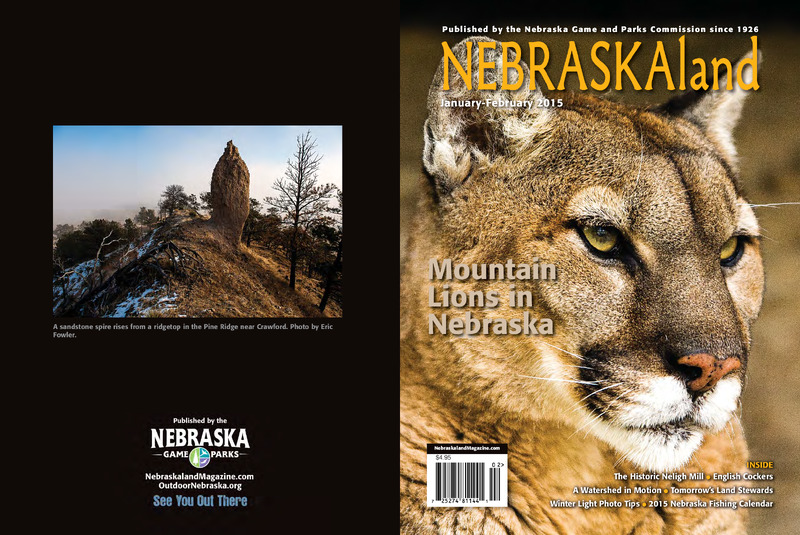
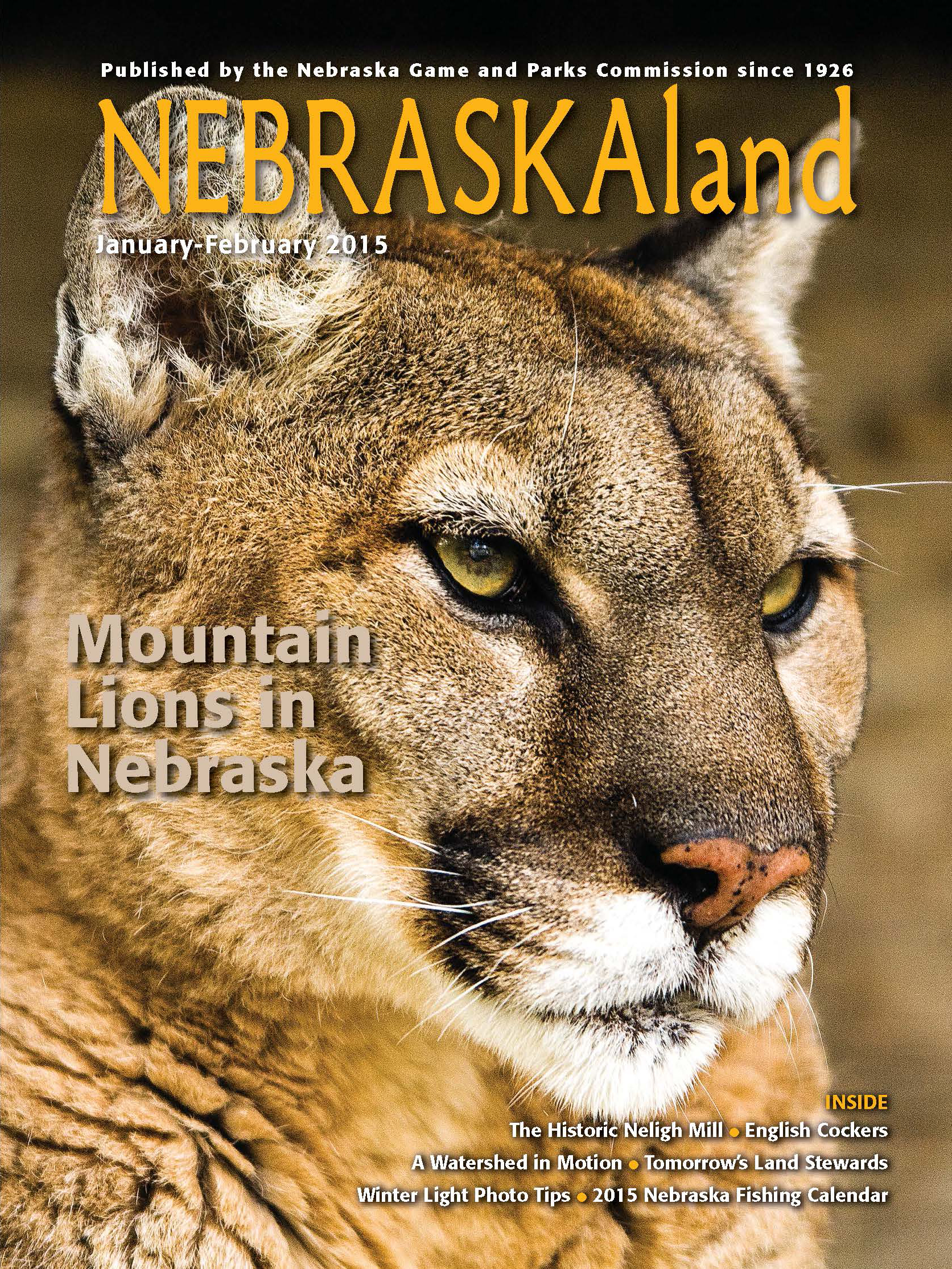
- Identifier:
- nela.2015_093_01
- Title:
- Volume 93, Issue 1, 2015
- Issue Name:
- January-February 2015
- Date Issued:
- 2015-01-01
- year:
- 2015
- Season:
- Winter
- PDF filename:
- NL_93.01_2015_Jan_Feb_Spreads_Entire.pdf
- Publisher:
- Nebraska Game and Parks Commission
- Format:
- Periodical
- volume:
- 093
- issue:
- 01
- number:
- 093.01
- Decade:
- 2010s
- edition:
- Liftout
- Type:
- Rights Holder:
- Copyright Nebraskaland Magazine/Nebraska Game and Parks Commission, all rights reserved.
- Extracted Text:
-
Publis hed by
y the Nebr a s k a Ga m e a nd Pa r k s C o m m is s io n si nc e 1926
NEBRASKAland
January-February 2015
A sandstone spire rises from a ridgetop in the Pine Ridge near Crawford. Photo by Eric
Fowler.
Mountain
Lions in
Nebraska
NebraskalandMagazine.com
$4.95
INSIDE
The Historic Neligh Mill ● English Cockers
A Watershed in Motion ● Tomorrow’s Land Stewards
Winter Light Photo Tips ● 2015 Nebraska Fishing Calendar
NEBRASKAland Magazine
Volume 93
●
No. 1
●
F EAT U R ES . . .
January-February 2015
38
●
16 Nebraska’s Historic Neligh Mill
B T
R. B
22 Farmers for Conservation
Y HOMAS
UECKER
STORY AND PHOTOS BY JEFF KURRUS
24 Seeing a Watershed in Motion
Time-lapse Project Enters Its Fourth Year
STORY AND PHOTOS BY MICHAEL FORSBERG
30 Demystifying Mountain Lions
AN INTERVIEW WITH SAM WILSON
38 That Lap Dog Can Hunt
STORY AND PHOTOS BY ERIC FOWLER
42 Fish Here Now
The 2015 Nebraska Fishing Calendar
BY DARYL BAUER AND JEFF KURRUS
D EPARTM EN T S . . .
Comment .........................................................4
Mixed Bag.......................................................6
Page 49 ..........................................................53
Wilderness Workshop ...................................54
Portraits from the Past ..................................56
Junior Journal................................................58
In the Kitchen ...............................................60
Wine & Dine Guide ......................................61
The Last Stop ................................................62
42
●
24
●
O N TH E W EB . . .
WHEN YOU SEE THIS SYMBOL IN THE PAGES OF
N
NEBRASKALAND MAGAZINE, VISIT
NEBRASKALANDMAGAZINE.COM AND VIEW OUR INTERACTIVE
DIGITAL EDITION FOR MORE INFORMATION.
D
Cover: Mountain lions are one of Nebraska’s most fascinating
animals. See story on page 30. Photo by Joel Sartore.
NEBRASKAland (VOL. 93 / NO. 1, ISSN 0028-1964) is published monthly, except
for the combined Jan./Feb. and Aug./Sept. issues, by the Nebraska Game and Parks
Commission, 2200 N. 33rd St., Lincoln, NE. Periodicals postage paid at Lincoln,
Nebraska, and additional mailing offices. POSTMASTER: Send address changes to
NEBRASKAland, P.O. Box 30370, Lincoln, NE 68503-0370.
2 NEBRASKAland • JANUARY-FEBRUARY 2015
16
●
JANUARY-FEBRUARY 2015 • NEBRASKAland 3
COMMISSIONERS
CONSERVATION OFFICERS
Director Jim Douglas
NORTHWEST
Officer
City
Jim Zimmerman (S) Gering
Commissioners
Chairman - Lynn Berggren, Broken Bow
Vice Chairman - Jerrod Burke, Curtis
2nd Vice Chairman - Dr. Kent Forney, Lincoln
Dr. Mark Pinkerton, Wilber
Rex Fisher, Omaha
Mark Spurgin, Paxton
Mick Jensen, Blair
Dick Bell, Omaha
Norris Marshall, Kearney
Kevin Fortina sent us this photo of a family of woodchucks
near his home in Valley.
Photographer Jon Cockerham, of Lincoln, sent this night
photo of Bowling Lake in the fog.
MAGAZINE STAFF
ABOVE: My grandson, Brady Chilewski, of Arcadia took this
picture while helping to fight a fire near the Arcadia Diversion
Dam. Approximately 2,000 acres were burned during the twoday fire last March. BELOW: Sisters Jordan (left) and Taylor
Hopp hunt with Citori (middle) on Mark and Bridget Vaughn’s
Farm west of Alliance in Box Butte County.
Dan Eby of Lexington displays
his love for walleye fishing on
his vehicle.
If you have a unique outdoor
message plate you would like
to share, or know someone
who does, e-mail a photo (highresolution, JPEG format only,
please) of it to Eric.Fowler@
Nebraska.gov, along with your
name, hometown and a brief
description of the interests
expressed on your license plate.
Correction: In the December 2014
Portraits of the Past photo, Hank
Lokke was misidentified as Terry
Rasmussen. The corrected version is
on page 56 of this issue.
-Editor
Send your comments to:
Jeff Kurrus, Editor
NEBRASKAland Magazine
P.O. Box 30370
Lincoln, NE 68503
or e-mail Jeff.Kurrus@Nebraska.gov
Please include your postal address and
telephone number.
Letters may be condensed and edited
for clarity. Photographs are welcome
and will be returned.
Any program that receives federal funding from the National Park
Service, or the United States Fish and Wildlife Service prohibits unlawful
discrimination on the basis of race, color, religion, age, gender, marital
status, national origin, age, disability or political affiliation. Any person
who believes he or she has been discriminated against in any program,
activity, facility, or service, should contact the Nebraska Game and
Parks Commission, Lincoln, NE 402-471-0641, the Equal Opportunity
Commission, Lincoln, NE 402-471-2024, TTY/TDD 402-471-4693;
United States Fish Wildlife Service, Civil Rights Coordinator, 4401
N. Fairfax Drive, Arlington, VA 22203; Director, Equal Opportunity
Program, U.S. Department of Interior, National Park Service, 1849 C
Street NW, Mail Code 0008, Washington, D.C. 20240-0001.
4 NEBRASKAland • JANUARY-FEBRUARY 2015
Greg Hesse
Scott Brandt
Dan Kling
Frank Miller
Sean McKeehan
Terry Brentzel
Communications Director Christy Rasmussen
Editor Jeff Kurrus
Art Director Tim Reigert
Associate Editor Amy Kucera
Regional Editors Eric Fowler, Julie Geiser,
Justin Haag, Jenny Nguyen
Contributing Editor Michael Forsberg
Regular Contributors Bill Hager, Chris Helzer,
Lisa Knopp, Gerry Steinauer
Circulation Donna Robinson
For address changes and questions about
your subscription, e-mail Donna.Robinson@
Nebraska.gov or call 800-632-5263
Advertising Sales Manager
For advertising information contact
Shane G. Gilster, 402-742-0125
Email: shanegilster@gmail.com
Phone (308)
(office) 763-2940
(cell) 641-6138
Rushville
760-3647
Gering
631-0663
Harrison
430-0572
Valentine
402-389-0444
Bridgeport
279-9133
Oshkosh
458-7650
SOUTHWEST
Officer
City
Phone (308)
Roger Thompson (S) N. Platte (office) 535-8025
(cell) 530-3097
Ray Dierking
Brkn. Bow
870-0322
Michael Thome
Cozad
529-8146
Matt Andrews
Elwood
746-2418
Dirk Greene
Imperial
882-0015
Dale Johnson
Kearney
440-3847
Brian Piernicky
McCook
340-6627
Brandon O’Neal
N. Platte
530-3157
Nicholas Fix
Ogallala
289-0427
Bryce Streger
Ogallala
289-1169
Rich Routh
Rep. City
920-0367
Tim Williams
Grand Is
380-7331
Pat George
Kenesaw
402-705-9989
Matt Brandt
Loup City
202-0819
Andrew Heyer
Cozad
402-613-2241
Alex Hasenauer
Wellfleet
660-4671
NORTHEAST
Officer
Tom Zimmer (Sup.)
City
Norfolk
SOUTHEAST
Officer
Levi Krause (Sup.)
William Krause
Mike Luben
Dan Zuehlke
Heath Packett
Darin Gress
Douglas Kramer
Dina Barta
Stacey Lewton
Dudley Sorensen
Russell Mort
Dan Evasco
Rich Berggren
Travis Shepler
City
Louisville
Auburn
Colon
Cortland
Eagle
Hebron
Lincoln
Lincoln
Lincoln
Waverly
Nebr. City
Papillion
Waterloo
Lincoln
Phone (402)
949-0593
274-8063
443-6392
806-9084
210-0888
768-8665
890-6465
890-6463
890-7140
937-3422
209-1506
616-5961
619-1355
613-2312
Ak-Sar-Ben Aquarium
21502 W. Highway 31 Gretna, NE 68028
Phone 402-332-3901
ADMINISTRATION
Officer
Craig Stover (Adm.)
Duane Arp (Ass.)
Jeff Clauson (Ass.)
City
Lincoln
Lincoln
Lincoln
Phone (402)
471-5531
471-5531
471-5531
Omaha Office
8495 Frederick Street, Omaha, NE 68124
Phone 402-595-2144
Nebraska Wildlife Crimestoppers 1-800-742-7627
NEBRASKAland Magazine Copyright 2014, all rights reserved.
NEBRASKAland is available in audio from the Nebraska Library
Commission Talking Book and Braille Service, Suite 120, 1200 N St.,
Lincoln, NE 68508. 800-742-7691. NEBRASKAland Magazine and the
Nebraska Game and Parks Commission reserve the right to reject any
advertising not in keeping with the agency mission.
Rates: $18 for one year; $33 for two years; $44 for three years. Nebraska
recipients must add appropriate sales tax. To subscribe call
1-800-NEBLAND (632-5263), or go online to: NebraskalandMagazine.
com.
COMMISSION
C
COM
OM
OMMIS
M SIO
SION O
SI
OFFICES
F CES
FFI
ES
S
Headquarters/Southeast District Office
2200 N. 33rd Street Lincoln, NE 68503
Phone 402-471-0641
Northeast District Office
2201 N. 13th St. Norfolk, NE 68701
Phone 402-370-3374
Southwest District Office
301 E. State Farm Rd. North Platte, NE 69101
Phone 308-535-8025
Northwest District Office
East Hwy. 2, Box 725 Alliance, NE 69301
Phone 308-763-2940
Bassett Office
524 Panzer St., Box 508 Bassett, NE 68714
Phone 402-684-2921
Kearney Office
1617 First Ave. Kearney, NE 68847
Phone 308-865-5310
Phone (402)
(office) 370-3374
(cell) 649-8053
Dale Davis
Bassett
760-0712
Steve Oberg
Columbus
910-3366
Daniel Roberts
Fremont
719-1108
Randy Pomplun
Fullerton
308-550-0489
Jeff Jones
Hartington
762-5022
Jon Reeves
Kennard
889-8508
Doug Pollard
Ord
308-730-7050
Alex Frohberg
Ponca
241-7615
Cory Krause
West Point
380-6410
Jonathan Andreasen O’Neill
340-3981
Mitch Johnson
Wausa
613-8612
JANUARY-FEBRUARY 2015 • NEBRASKAland 5
Wild Focus –
The Red Fox
6 NEBRASKAland • JANUARY-FEBRUARY 2015
PHOTO
PHOT
O BY JUSTIN
JUSTIN HAAG
By Lindsay Rogers
Red foxes are found across North
America. In Nebraska, they occupy
a wide range of habitats including
forest, prairie, farms and urban areas.
Contrary to popular belief, red
foxes are omnivores. They eat
primarily mice, rabbits, insects and
fruit. They often have two dens – a
main den used for birthing and
rearing young, and an emergency
den reserved if the primary den is
compromised.
Adult foxes can be killed by
coyotes, but this is more often for
territory than food. Territory marking
is evident through their scent which
is similar to a skunk, but sweeter.
Young are preyed upon by hawks
and larger mammals. Mating season
varies widely based on geographic
location – January-February in the
southern range and February-April
in the north. A classic red fox sign is
scat in the middle of a trail. ■
JANUARY-FEBRUARY 2015 • NEBRASKAland 7
Bailey Yard’
d s Golden
d’
en
n Spi
Sp ke Tow
wer and
n Vi
Visit
sitor
o Center
Travelogue Sponsors
By Julie Geiser
North Platte
ocated in west-central Nebraska, North Platte offers
oc
plenty
pl
p
l
of activities for travelers on Interstate 80 and
Highways
H
Hi
30 and 83. Whether you’re a hunter, angler,
camper, boater or history buff, North Platte has
entertainment for all.
Lake Maloney State Recreation Area (SRA), just south
of North Platte, offers camping, fishing and more. Kansas
Point near the inlet area of the lake offers RV hookups and
tent camping. The main camping area near the outlet offers RV and tent
camping with no amenities, but great access to boat ramps, swimming, boating,
North Platte
kayaking and a playground for the kids. Anglers will find walleye, bass, catfish,
wipers, bluegill, crappie and white bass for fishing all year.
For a Wild West treat visit Buffalo Bill’s Ranch State Historical Park
and SRA. The ranch preserved by the Nebraska Game and Parks
Commission shows the home and history of William Cody and his
Scout’s Rest Ranch Barn. Cody’s Victorian home takes sightseers
back in time as they view classic photos and possessions of the
Cody family. The Barn features Wild West Show posters, historical
relics, horse tack and more. The tucked away SRA has RV hookups
and tent camping along the North Platte River, with hiking trails,
horse-back riding and access to fishing, paddling or tubing.
The Lincoln County Historical Museum tells the historical
significance of west-central Nebraska and the Platte River Valley.
The Pawnee, Arapaho, and Sioux all lived in this area and the
Oregon, Mormon and California trails all ran through it. The
North Platte Canteen, which served 6 million troops during
World War II, is one of the best legacies of North Platte.
Hunting can be done at
eight Wildlife Management Areas and
Open Fields and Waters lands within 30 minutes from
North Platte providing hunters with waterfowl, upland game, turkey and
deer hunting.
June is the prestigious NEBRASKAland DAYS celebration. The weeklong event has everything from the PRCA Rodeo, parade, antique cars,
food, concerts a carnival and much more.
North Platte is also home to the largest railroad classification yard in the
he
world. Union Pacific’s Bailey yards covers 2,850 acres for a total length
h
of eight miles. Bailey Yard handles 10,000 railroad cars a day.
For a birds-eye view of the yards head to The Golden Spike Tower
and Visitor Center and view the action from the tower platforms.
The Visitor Center includes Union Pacific Railroad and Nebraska
memorabilia, educational displays and a gift shop.
Lastly, downtown North Platte has shops with one-of-a-kind gifts
and décor. Take a break with a favorite coffee or latte at the Espresso
o
Shop, then finish the day at Grain Bin Antique town and enjoy winee
from Feather River Vineyard located in the Loess Hills south of
North Platte. Feather River Vineyard introduces visitors to awardwinning wines and the antique town made from wooden grain bins
is packed full of antique deals. ■
Fishing at Lake Maloney
Buff
HistoarliocaBl ill’s Ranch St
a
Park and
SRAte
op in tte
h
S
o
s
s
e
r
The Etsopwn North Pla
down
NEBRASKAland • DECEMBER 2014
8
JANUARY-FEBRUARY 2015 • NEBRASKAland 9
A Brief History
Monarch’s Sad Fate
By Patricia C. Gaster, Nebraska
State Historical Society
EXPLORE NEBRASKA’S PAST
$29/year – Includes 4 issues
of Nebraska History and
4 of Nebraska History News
www.nebraskahistory.org/magazine
402-471-3270
facebook.com/pages/Nebraska-State-Historical-Society
NEBRASKA STATE HISTORICAL SOCIETY RG3004.PH190
T
he sad end of a retired member
of Buffalo Bill Cody’s Wild West
was announced by the Omaha
Daily Bee on December 5, 1906.
However, the article, headlined “Death
Warrant for Monarch,” referred not to
a human, but to an animal. Monarch,
“the finest specimen of buffalo ever
in captivity,” was considered too
dangerous for Riverview Park, his
home in Omaha since leaving the
Wild West, and he was soon to be
slaughtered.
The Bee said: “Monarch was raised
by Buffalo Bill and carried with him
through all the countries of Europe,
but he became unmanageable and as it
took a large part of the gate receipts of
the Wild West show to square away the
depredations which were occasioned
by this immense buffalo, Colonel Cody
decided to sell him. He was sold to the
city of Omaha for $300 and was placed
This detail from a poster for Buffalo Bill’s Wild West depicts men on horseback and
running buffalo.
in Riverview park.”
However, Monarch behaved so
badly there, rushing at the fences and
threatening to trample spectators,
that he was reportedly sold back to
Wild West agent William McCune.
By December 13 the Bee reported
that Monarch had been purchased
by William Buthorn, owner of the
Heidelberg Cafe, who planned
to slaughter the animal, and gave
Omaha’s mayor, “Cowboy Jim”
Dahlman, the dubious honor of
shooting him. The Bee noted:
“The mayor did not fail. He
planted himself some thirty feet from
the animal, leveled his big rifle and
fired. Monarch turned to look for
a second at his slayer, then walked
around in a circle just once, dropped
to the ground and died within ten
minutes without writhing. Mr.
Buthorn will have the head mounted
and placed in the Heidelberg and the
meat he will sell.”
Monarch may have passed from
the scene, but stories of his exploits
during his Wild West days appeared
in the press. In a particularly
memorable incident in Germany,
according to the Bee, Monarch “got
loose, and, rushing through a small
general store, scattered the china
and other things exhibited for sale.
He went right through the store and
was cornered in a lot at the rear,
10 NEBRASKAland • JANUARY-FEBRUARY 2015
with no way of escape except to go
back through the store. When the little
German storekeeper was asked what
the damage was he bobbed his head
up from behind the counter, where he
had dodged for safety, and shouted,
‘Nothing, nothing, if you will only take
the brute away!’” ■
Trophy Hunting for Shed Antlers
By Dylan Tegtmeier
B
uck season is closed, but you’ve
still got buck fever? Shed
hunting is a great way to get back
out into the woods.
Deer and elk grow and shed their
antlers every year. Often times, when
antlers are left in the woods over
the summer, factors such as time,
mice, squirrels and other rodents will
eat them for their valuable calcium
content.
Studies have shown that each deer
sheds its antlers at about the same
time it did the previous year, and this
antler drop is the result of declining
testosterone levels which weaken
the base of the antler. This timing
varies from geographic location, and
usually starts in late December in
the north and March or April in the
southern end of the deer’s range. A
deer will also generally drop both
antlers within 3 days of each other.
Here are some helpful tips to get
some bones in your hands:
• After the rut, the only thing a
big buck will care about is food and
sleep, so target those food hot spots
and well secluded south-facing
beds.
• As a hunter, you already
understand that deer will not frequent
an area if you keep spooking them
away from it. Glass your feeding
areas and bedding spots from a good
distance and check to see if any deer
have antlers. If there are still antlers
up, wait for another day to check the
spot.
• Travel corridors and obstacles
are great places to find antlers.
Remember, if the antlers are loose
and the buck is moving around, a
little jostling could easily knock
an antler loose. So check fence
crossings and ditches.
• Go
shed hunting
after a fresh
dusting of
snow. A small flurry is even enough
to show new tracks, and following
these will generally lead you to
freshly dropped antlers.
• Bring your family, friends and
favorite four-legged companion.
These extra eyes will help, but
sharing your appreciation for the
outdoors is much more valuable than
a few bones you might find. ■
Visit OutdoorU.org and start
your own pathway to exciting and
memorable experiencess
SKILL LEVEL:
in the outdoors. Get
outside and see what Beginner ✔
Intermediate
the Nebraska Outdoorss
Advanced
has for you.
Omaha mayor Jim Dahlman in cowboy garb.
NSHS RG2990.PH0-1
JANUARY-FEBRUARY 2015 • NEBRASKAland 11
Nebraska Bird Library
Sponsored by
y
American Goldfinch
12 NEBRASKAland • JANUARY-FEBRUARY 2015
PHOTO BY JON FARRAR
Song or calls: Song is prolonged jumble of short trills
and thin twitters. “Per-chic-oree” flight notes.
Description: Breeding adult male is bright yellow
overall with a black cap, black wings and black tail; white
wing bars, with upper bar being the widest; and yellow
shoulder patch. It has a white rump and undertail coverts.
Female is duller overall; olive above; lacks black cap and
yellow shoulder patch with white undertail coverts. Winter
adults are even duller; either brownish or grayish above;
male may show some black on forehead; and white wing
bars are more prominent. Immatures are similar to winter
adults but wing bars are buffier.
Behavior: Has erratic, “roller coaster” flight pattern.
Habitat: During the fall and winter birds are often
found foraging in fields of tall weeds. Breeding usually
occurs in rather open grassy areas, farmsteads, swamps
and other areas where thistles and cattails are abundant.
Where in Nebraska: Common permanent resident
across the state. Winter populations vary from year to year.
Fun Facts: Sometimes known as the “wild canary.”
American goldfinches are the only bird in the finch family
that molts twice a year including the breeding season. ■
To learn about more birds visit
NebraskaBirdLibrary.org.
JANUARY-FEBRUARY 2015 • NEBRASKAland 13
First Day Hike
by Jerry Kane
Contact the Nebraska Game and Parks Commission at
402-471-0641 or visit OutdoorNebraska.org for more information. Visit
HuntSafeNebraska.org for a list of hunter education classes and
BoatSafeNebraska.org for a list of boating safety classes.
January 1 First Day Hike, Ponca State
Park (SP), Ponca, 8 a.m., 402-755-2284
January 2 Indoor 3-D Archery Target
Showcase, Nebraska Game and Parks
Outdoor Education Center, 4703 N. 44th
St., Lincoln, noon-8 p.m., 402-471-6141
January 2-3 Roger G. Sykes Outdoor
Heritage Education Complex open, Platte
River SP, Louisville, 10 a.m.-4 p.m.,
402-234-2217
January 2, 9, 16, 30 Handgun
Workshop, Nebraska Game and Parks
Outdoor Education Center, 4703 N. 44th
St., Lincoln, 6-7:30 p.m., 402-471-6141
January 3 Duck and coot hunting
seasons close in Zone 3, Low Plains Unit
January 3 Yule Log Quest, Platte River
January 16 Discover
Ice Fishing Clinic,
Environmental Resource
Center, Yanney Heritage
Park, Kearney, 6-9
p.m., 402-471-5447
January 16-18
Women’s Wellness
Weekend, Ponca SP, Ponca, 402-755-2284 January 31 Grouse hunting season
closes
January 17 Discover Ice Fishing Clinic,
January 31 Squirrel hunting season
Yanney Lake, Yanney Heritage Park,
closes
Kearney, 1-4 p.m., 402-471-5447
January 19 Special Public Health Hazard January 31 Scoring Workshop for
Order crow hunting closes
Boone and Crockett, Pope and Young,
Muzzleloader, State Citation, Nebraska
January 20 Crow hunting season opens Game and Parks Outdoor Education
statewide
January 22 Novice Predator Hunting
SP, Louisville, 3 p.m., 402-234-2217
Workshop, Nebraska Game and Parks
Outdoor Education Center, 4703 N. 44th
January 4 Youth Basic Rifle Introduction, St., Lincoln, 7:30-9 p.m., 402-471-6141
Nebraska Game and Parks Outdoor
Education Center, 4703 N. 44th St.,
January 24 Cold Day, Warm Hearts
Lincoln, 1-2:30 p.m., 402-471-6141
and Family Fun, Eugene T. Mahoney SP,
Ashland, 3-6 p.m., 402-944-2523
January 4-25 Duck and coot hunting
seasons in Zone 2, High Plains Unit
January 24–February 8 Light goose
regular hunting season
January 8 Green Scoring Your Trophy,
Nebraska Game and Parks Outdoor
January 25 Duck and coot hunting
Education Center, 4703 N. 44th St.,
seasons close in Zone 3, High Plains Unit
Lincoln, 6:30-8:30 p.m., 402-471-6141
January 25 Cowboy Poetry/Music Jam,
January 10 Ice Bowl disc golf
Arthur Bowring Sandhills Ranch State
tournament, Eugene T. Mahoney SP,
Historical Park, Merriman, 2-7 p.m.,
Ashland, 1-4 p.m., 402-944-2523
308-684-3428
January 10 Discover Ice Fishing Clinic,
January 29 River Otters in Nebraska:
CenturyLink Lake, Eugene T. Mahoney SP, A Success Story, Nebraska Game and
Ashland, 1-4 p.m., 402-471-5447
Parks Outdoor Education Center, 4703 N.
44th St., Lincoln, 7-8:30 p.m.,
January 12 First day of spring turkey
402-471-6141
hunting permit sales
January 31 November Late Doe/Fawn
January 15 Youth, Landowner, Season
antelope hunting season closes
Choice and River Antlerless, and Gifford
Point WMA deer hunting seasons close
January 31 Pheasant, quail and
partridge hunting seasons close
January 15 Nebraska Game and Parks
Commission board meeting, Lincoln
January 31 Fall turkey hunting season
closes
January 16 Dark goose hunting season
closes in North Central Unit
A Winter
i
Reading
di
By Amy Kucera
Nebraska State Historical Society’s Eyewitness at
Wounded Knee (Richard E. Jensen, R. Eli Paul and John E.
Carter) is an extensive compilation of historic photographs
paired with modern essays that investigate the December
1890 massacre of the Lakota people by the 7th Cavalry of
14 NEBRASKAland • JANUARY-FEBRUARY 2015
Center, 4703 N. 44th St., Lincoln, 8 a.m.-8
p.m., 402-471-6141
January 31–February 1 White-fronted
goose hunting season
February 1 Super Bowl Sunday MiniLodge Package, Ponca State Park (SP),
Ponca, 402-755-2284
By Amy Kucera
Creating a New Year’s resolution can be
a walk in the park, particularly if you to
kick it off with the annual tradition of a
First Day Hike.
Hosted by America’s State Parks
in celebration of the New Year, the
organization encourages a walk in the park
in a national initiative to connect people to
the outdoors through a winter walk in the
wild.
Though most First Day Hike treks
throughout parks are unguided, there are
more than 600 events organized across the
country, including one scheduled at Ponca
State Park near Ponca.
The benefits of a hike outdoors are both
instantaneous and long-term, and exercise
has been proven to improve and maintain
On January 1, Ponca State Park
overall health and can lead to a longer life. (pictured) will be hosting a First Day
Hike event.
With more than 41,725 miles of trails
existing in America’s State Parks, you don’t
need to go far to make stepping through a scenic state park part of your new year.
Be creative. Combine it with snowshoes or cross-country skis for an adventure, or
invite a two- or four-legged friend and ensure your First Day Hike won’t be the
last.
Find a hike near you at Firstdayhike.com. ■
February 8 Dark goose hunting season
closes in East, Platte River, Panhandle
and Niobrara units
February 9 Light Goose Conservation
Order hunting begins
February 11-14 Valentine’s Special,
Eugene T. Mahoney SP, Ashland,
402-944-2523
February 12 Introduction to Trapping,
Nebraska Game and Parks Outdoor
Education Center, 4703 N. 44th St.,
Lincoln, 6-8 p.m., 402-471-6141
February 14-15 Birds and Breakfast
hike and identification workshop, Ponca
SP, Ponca, 402-755-2284
February 28 Cottontail and jackrabbit
hunting seasons close
February 28 Bobcat, raccoon, Virginia
opossum, long-tailed weasel, mink, red
fox, gray fox and badger hunting and
trapping seasons close
the U.S. Army at Wounded Knee Creek.
The collection, featuring more than 130
30
images by photographers George Trager
and Clarence Grant Morelodge, leaves
one stunned with emotions as silent and
raw as the snow that appeared on the
cold ground where so many were slain.
Learn more at Nebraskahistory.org. ■
Explore the trails at Nebraska State Parks.
E
NEBRASKAland
and
Visitor
October’s winner of the
Visitor drawing was
Bella Poppe of Hastings, Nebraska,
who found the apple maggot fly on
page 55. Readers are encouraged to
contact NEBRASKAland within 10
days after this issue’s publication
with the correct page number and
name of this issue’s “Visitor” – a
critter found in Nebraska. We will
then gather the correct entries and
draw one to win a NEBRASKAland
Magazine mug. To enter each
month, write:
NEBRASKAland Visitor
2200 North 33rd Street,
Lincoln, NE 68503.
Or e-mail:
Tim.Reigert@Nebraska.gov
with “Visitor” in the subject line of
the message.
HINT: This issue’s visitor is not
on page 12, 15, 58 or 63.
The apple maggot fly is a fruit
fly, less than ¼" in length, and
native to North America. As the
name suggests, this insect is a
pest of apples, but also infests
other fruits including hawthorns,
cherries and plums. Adult flies
have a black body, dark red eyes,
and white stripes on the abdomen.
Their wings are transparent, with
distinct black bands that aid in
identification.
Adults emerge from the soil in
summer, and begin to feed and
mate. Females cut a slit into fruit
with their ovipositor and lay a
single egg per slit. Fly larvae,
or maggots, are white, legless
creatures that feed inside the
fruit, causing the infested part to
become brown and mushy. The
larvae eventually exit the fruit,
drop to the ground, and
pupate, before emerging
as adults the next
summer.
Special thanks to Julie Van Meter, State
Entomologist, Nebraska Department of
Agriculture.
Bugguide.net is a good site for identification.
JANUARY-FEBRUARY 2015 • NEBRASKAland 15
Nebraska’s
Historic
Neligh Mill
F
lour milling was one of
the earliest and most
important industries
to develop in Nebraska.
Early settlers needed
mills to grind their wheat
and corn into flour and
cornmeal, and also create
a market for local cereal
grains. Early mills were
often operated in conjunction
with a sawmill to cut timber
into dimensional lumber. By
providing needed services,
JOHN D. NELIGH
mills began community centers
in newly settled areas, and
were a necessity for any
fledgling townsite.
During the first years
of settlement, most
Nebraska mills used
water for motive power.
Settlers naturally followed
the water courses inland
and mill building followed.
Additionally, early developers
and town boosters touted
the available water power
NEBRASKA STATE HISTORICAL SOCIETY, N418.9-5
By Thomas R. Buecker
NEBRASKA STATE HISTORICAL SOCIETY, N418.9-112
The Neligh Mill, brush dam, flume and penstock are all visible in this 1884 photograph.
This early view shows the mill penstock with its 10-foot fly wheel that turned a 1-inch
wire cable drive to power mill machinery.
16 NEBRASKAland • JANUARY-FEBRUARY 2015
of Nebraska’s rivers that could power
numerous mills, factories, and other
industrial enterprises. The Elkhorn
River, flowing some 200 miles through
northeastern Nebraska, was believed
by some promoters to be a source of
unlimited water power.
In 1872, a small party of men from
West Point in Cuming County traveled
up the Elkhorn to see the country
above Norfolk. One of the sightseers
was John D. Neligh, a manufacturing
entrepreneur and founder of West
Point, Nebraska. The party stopped at a
promising townsite in central Antelope
County and noted its water power
potential. In October Neligh went to
Omaha and bought the land from the
Omaha and Northwestern Railroad
Company.
By early 1873 Neligh had his new
townsite surveyed and platted, and
built a dam on the river to power a saw
mill. William B. Lambert, an associate
of Neligh’s from West Point, arrived
and opened the first store. Lambert is
credited with naming the new town
“Neligh.” Realizing the importance of
having a flouring mill, John D. arranged
for the burning of brick to build a
substantial two-story mill building, 38
by 45 feet in size with full basement.
Unfortunately, Neligh’s involvement
with his town was short-lived. Due to
financial reverses, he was forced to
suspend work on the mill. In April of
1874 he sold most of the townsite and
unfinished mill building to William
Lambert and his partner William C.
Gallaway for $13,000. Gallaway, a
native of Virginia, was a mover and
shaker. He finished the mill, which
restored local confidence that had been
shaken by Neligh’s departure. With
improvements to the water power and
milling machinery all installed, the
Neligh Mill began full operation on
September 10, 1874. Although the
building was large enough to hold six
sets of stone buhrs, the mill at first
only had two runs of stone buhrs,
later increased to four.
Neligh intended his mill to do both
custom or “exchange” work and
merchant work. At custom mills, the
farmer traded or exchanged his wheat
for an established amount of flour, or
he could have his grain milled, with
the miller charging a certain amount
of wheat for his fee. On the other
hand, merchant mills were bigger
operations, where owners or proprietors
openly purchased wheat to produce
larger amounts of flour for commercial
sale. Merchant mills sold flour by the
wagonload to distant customers and
filled government contract orders.
Successful mill operations depended
on a reliable, steady power source. The
key to water power use was to maintain
an adequate water head, or the height
of water backed up by a dam. The
Neligh Mill
Neligh Mill is located on N Street at
Wylie Drive in Neligh. Open Memorial
Day through Labor Day (Tuesday through
Saturday – 10 a.m. to 5 p.m., Sundays –
1 p.m to 5 p.m.) Closed all state holidays
in the off-season. Admission: $3 for
adults. Children with adults are free.
Fees are waived for Nebraska State
Historical Society members.
For more information, contact:
Neligh Mill State Historic Site
PO Box 271
Neligh, NE 68756-0271
402-887-4303; harv.ofe@nebraska.gov
JANUARY-FEBRUARY 2015 • NEBRASKAland 17
for wheat on its north side. The new
machinery increased their daily flour
production to 140 barrels (at the time
a barrel equaled 196 pounds and was
the standard measure unit of flour).
Apparently a new era of mill success
loomed ahead.
Regardless of machinery, mills had
to be kept running to make a profit.
The prosperity of a water-powered mill
depended on the operator’s ability to
keep the water source in harness. Year
after year, high rises of the Elkhorn
River brought Gallaway and Lambert
heavy expenditures to maintain brush
dams, settled flumes and flood damage
to the levees that were necessary to
enclose the mill pond. Unfortunately,
weeks of labor and hundreds of dollars
of expensive repairs could be washed
out in a day.
During periods when the mill was
shut down, Neligh merchants noted a
decline in business. Two months after
the mill’s flume washed out in October
1881, the local paper noted, “Stoppage
of the mill has had a depressing effect
on the business of Neligh.” For many
farmers, with no mill to visit, there was
no reason to come into town.
W. C. Gallaway was an ambitious
businessman and sought other
opportunities. In addition to building
Water power improvements seen in this 1903 view
include the permanent dam and a second penstock
added to generate electricity. Beginning with
the Gilman ownership, all mill outbuildings were
painted red.
NEBRASKA STATE HISTORICAL SOCIETY, N418.9-17
was geared to a 10-foot flywheel
mounted above the back wall of the
penstock. The flywheel transmitted
power to the shafting in the mill
basement via a one-inch Roebling
steel wire cable. The mill dam initially
created a four-foot fall, which was
gradually raised as more machinery
was added that required additional
horsepower. By 1880 the dam’s eight
foot height created 66 horsepower.
Because the mill was on the higher
north bank of the river it never suffered
flood damage, although the dam, flume
and penstock were washed out or
damaged many times.
The mill enjoyed immediate success
from local and distant patrons. Because
there were no mills to the west or
south, customers came 50 miles or
more from those directions. The mill
also did large business with the cattle
ranchers along the upper Elkhorn and
on the Niobrara, shipping hundreds
of loads of flour and feed to those
points. By October 1875 Gallaway and
Lambert shipped flour to merchants
at Columbus, Yankton in Dakota
Territory, and other points up the
Missouri River. In 1878 the mill landed
18 NEBRASKAland • JANUARY-FEBRUARY 2015
a contract with the Indian Department
for 12,000 sacks of flour for the
Dakota reservations. According to one
newspaper, “between 350 and 400
wagon loads” were needed to deliver
the contract.
To fill large contracts, the mill
was run day and night. The Fremont,
Elkhorn & Missouri Valley Railroad
arrived in Neligh in 1880, opening new
markets in eastern Nebraska, Lincoln
and Omaha. April 1885 brought a
government contract for 343,000
pounds of flour for the Pine Ridge
Indian Reservation. Contract work was
done in addition to filling orders for
their regular customers in local trade
areas.
During the 1880s the new steel
roller process began to replace stone
buhrs to grind wheat into flour. With
the new method and improved sifting
machinery, the amount of flour made
from a bushel of wheat was increased
20 to 30 percent. In 1886 Gallaway and
Lambert had the Neligh Mill converted
to the new process and installed seven
stands of double rollers. They also
built a warehouse addition to the mill
and a 25,000 bushel storage elevator
his milling operation. Always boosting
local business enterprise, the Neligh
paper assured confidence in the new
ownership, and reminded its readers:
“The property has been in such [poor]
condition, and the uncertainty hanging
over it has been such, for some
years, that it has not been so helpful
in drawing trade.” S. F. Gilman’s
purchase brought new prosperity and
growth to a major component of the
town’s economy.
To oversee the Neligh operation,
Gilman brought in Joseph W. Spirk, his
efficient manager of the Pierce Mill.
Spirk quickly refurbished the mill,
and built an additional warehouse and
10,000 bushel elevator for corn storage.
Over the next 10 years he continued to
improve the Neligh plant, constructing
a permanent dam and improved flume,
as well as installing a larger turbine.
Building improvements included
expanded warehouse and elevator
storage.
Under Gilman’s ownership merchant
sales and contract work dominated
production, with the mill running 24
hours a day, six days a week. Large
contracts were received from the
Indian Department for flour and bran
for reservation use. Military contracts
sent Neligh flour and cornmeal to
The mill complex, circa 1891. The main mill building, wooden
elevators and office all survive today.
NEBRASKA STATE HISTORICAL SOCIETY, N418.9-4
higher the dam, the more power
created. “Fall” is the change in vertical
elevation over the course of a stream
or river. Because Nebraska is relatively
flat with low stream fall, dams backed
up water farther upstream, creating
larger mill ponds. In locations where
water courses provided lower fall,
horizontal water turbines were used
to generate mill power. Turbines were
made of iron, with gates around the
turbine to control the amount of water
passing through.
In addition to the turbine, the main
components of water power were the
head-gate, flume and penstock. A
head-gate at the upper end of the mill
race governed the amount of water
that entered the race (flume) from the
mill pond. The flume, built of strong
planking, was the conduit to carry
water to a penstock at the end of the
flume, which housed the turbine. To
escape the penstock, the water passed
down through the submerged turbine
and turned its impellor to create motive
power, before discharging back to the
river or stream.
The Neligh Mill was powered by a
64-inch Leffel water turbine, which
lumber yards in Neligh and Ewing,
he also owned elevators and mills
in Elgin and Oakdale. In 1891 he
added a mansard-type roof to create
a third story on the Neligh Mill to
hold more sifting machinery. But for
Gallaway, the road ahead was rocky.
The next year Lambert left the firm,
and Gallaway bought out his holdings.
However, it soon became evident he
was financially over-extended, and
one by one his other businesses were
disposed of.
The hard times of the 1890s took
its toll on the Neligh Mill’s fortunes.
In 1894 Gallaway sold the mill to
Henry Griffith, who apparently had
no experience in operating a roller
mill business; three years later the
mill was sold at a sheriff’s sale. It was
purchased by Gallaway’s two sons,
which essentially returned control of
the mill, for a brief time, back to their
father.
In December 1898 the mill was
again put in the sheriff’s hands.
Several days later it was reported that
Stephen F. Gilman of Davenport,
Iowa, had bought the Neligh Mill.
Gilman, a capitalist and successful
mill proprietor who owned flour mills
at Pierce and Valentine, intended to
make Neligh Mill the central unit of
JANUARY-FEBRUARY 2015 • NEBRASKAland 19
NEBRASKA STATE HISTORICAL SOCIETY, N418.9-95
High water in 1914, during the last years of water power use.
NEBRASKA STATE HISTORICAL SOCIETY, N418.9-26
The Neligh Mill work force about 1911. Philander DeForest “P. D.” Thompson, middle of front row, worked at the mill from 1877 until
the day he died in 1925. He lost his right arm in a mill accident in 1886.
army posts in Alaska, Hawaii and
the Philippines; stateside installations
included places such as Fort Washakie
in Wyoming, Fort Crook (today’s
Offutt Air Force Base) and Fort
Robinson.
At the same time commercial flour
was sent to domestic locations from
Wyoming to Pennsylvania and south
to Atlanta and into Florida. Also, for
several years overseas commercial
shipments were made to agents in Hull,
England. Success followed success: the
amount of flour shipped out of Neligh
rose from 700 railcars in 1908 to 875
in 1911. By 1915 the mill’s flour
capacity was rated at 500 barrels per
day, making it one of the eight largest
flour mills in the state.
By the turn of the century, some mill
companies used their water power to
generate electricity for commercial
sale. In 1900 the Neligh Mill built
a small light plant to provide local
customers with electric light service,
and also pump water for city use.
Several years later, Elkhorn water
power was replaced by gasoline, then
diesel engines, to produce electricity,
alternate power sources that could also
be used to power the mill in times of
water power loss. With the growing
demand for municipal light and power,
in 1915 a larger brick power house
20 NEBRASKAland • JANUARY-FEBRUARY 2015
was built on the east side of the mill
building to house a 225 horsepower
diesel engine and plant. Just before
it was completed, S. F. Gilman died,
leaving the capable J. W. Spirk as the
proprietor.
World War I kept the mill bustling,
with military orders amounting to
30 percent of its flour production.
Due to government control, flour
substitutes such as cornmeal had to
be manufactured, and the mill was
crowded with orders from other mills
which lacked the machinery to produce
such substitutes. Throughout the war
years the mill was powered entirely by
the light plant engine.
In 1919 a last attempt was made to
harness water power. A new flume
and penstock were built and the river
restored to its main channel. However
the flood of 1920 again diverted the
river and the mill abandoned water
power, relying thereafter on diesel
and later electrical power. Finding it
increasingly difficult to operate two
separate businesses, the mill company
sold the light plant and electrical
operation to a power company.
Under Spirk’s management the
Neligh mill survived the hard times of
the 1920s and the Great Depression
of the 1930s, both of which forced
many Nebraska mills out of business.
In 1930 the mill was granted state and
federal licenses to become a terminal
warehouse grain storage facility. In
September of 1938 the S. F. Gilman
Mill Company came to an end, and the
Neligh Mill was incorporated with J.
W. Spirk as president.
World War II brought an increase in
flour production, but never again to the
1900-1915 levels. With an antiquated
milling plant and rising competition
from larger milling companies, the
mill ceased to grind flour in the
1950s. Although the Neligh Mill
stopped producing wheat flour, none
of the flour grinding and processing
machinery was removed. The mill
remained in business as a grain storage
facility. It also continued to mix
pancake flour and grind, mix and sell
livestock feeds. In 1954 a plant was
installed to mix molasses with feed for
local cattle producers. But the glory
days of the old mill were over.
As time passed, the mill declined
as a functioning business. During the
early 1960s the grain elevators were
sold off; all that remained of the Neligh
Mill Company was the small office
building and a silent milling plant.
But local interest grew to preserve
what was an important part of the
town’s prosperity and pride. In 1970
long-time employees Jay Ames and
Adina Vidstedt, who purchased the mill
company after Sprik’s death in 1947,
sold the property to the Nebraska State
Historical Society. In 1975 the Society
opened the renovated mill to the public
as one of its historic sites.
Visitors to the mill can visit the
office building and view displays in
the 1886 warehouse and 1915 light
plant. But when they enter the mill
proper, they will see the milling plant
looking the same as it did to William
Gallaway, P. D. Thompson and Joe
Spirk well over a century earlier,
with roller stands, flour packers and
elevators to move grain and flour to
shifters on the second and third floors.
In the basement, huge drive shafts with
pulleys and leather belts powered all
the machinery above. On the outside
a 1922 boxcar stands on the railroad
siding below the towering wheat and
corn elevators. Toward the river below
the reconstructed flume and penstock
housing a 64-inch turbine can be seen.
The Neligh Mill is the best
example of a 19th century roller flour
mill remaining in the state. It also
symbolizes an industry that once
brought prosperity to a developing
Nebraska. ■
Tom Buecker was curator at the Fort
Robinson Museum for 26 years. Prior
to that he spent eight
years at the Neligh
Mill State Historical
Site. He now lives in
Lincoln and works at
the Nebraska History
Museum.
JANUARY-FEBRUARY 2015 • NEBRASKAland 21
Farmers for Conservation
Story and photos Jeff Kurrus
Todd and Kristen Eggerling of Crete demonstrate on a daily basis that smart farming
and ranching can lead to increased wildlife.
A
2009 Leopold Conservation
Award sign is displayed
proudly near the road in
front of Todd and Kristen Eggerling’s
house near Crete. The award, given
to the couple after an application
process detailing every aspect of the
Eggerling’s conservation practices,
seems only like a beginning when
speaking with this conservationpassionate family.
“This land has been in our family
since 1873,” said Kristen. “It was
homesteaded to my family, and every
generation – my parents, grandparents,
and great-grandparents – all had the
same idea of conservation. All of us
want to make the land better than
when we got it so it will be here for
generations, be productive and people
can make a living on it.”
The “making a living” aspect is what
truly makes the Eggerling’s work so
innovative. Too often nowadays there
seems to be two separate camps: those
who farm or ranch and those who
conserve. With this point of view, there
is no middle ground. However, the
Eggerlings have found a way to do both.
Smart Farming
The Eggerlings farm about 1,200
acres, usually rotating between
soybeans and corn, and manage about
1,000 acres of pasture ground and 500
more acres of meadow and grasslands.
Their positive land practices start
with many techniques typically used
throughout the farming community.
They terrace their fields for erosion
control, including field borders and filter
strips as a way to prevent end rows.
But that’s just the beginning.
“My dad was the first in Lancaster
County to no-till farm,” Kristen proudly
said, “and also one of the first to use
biosolids from the waste treatment plant
for fertilizer. He was doing controlled
burns way before people even knew
what they were. Before it became cool
to be an environmentalist, it’s just what
we did. Then Todd wanted to make it
even better than it was before.”
Todd grew up near Milford, and his
family farm was more of a conventional
row crop operation, but his mindset
clearly matched with practices already
in place by Kristen’s family. “There is
Todd and Kristen Eggerling pictured on their land near Crete.
22 NEBRASKAland • JANUARY-FEBRUARY 2015
a huge philosophy in agriculture that
you have to make as much as you can
make now,” Todd said. “But if you
push your land to make more money
this year, then you’re planning on that
same money next year and relying on
it the following year. Once you get into
that mindset, you become reliant on
that money to survive. Then you can’t
make any positive changes to the land.”
Positive changes on the Eggerling’s
land come from constant observation
of what is working and what is not. An
agronomist helps them monitor soil
nutrients so they know how much and
when to apply fertilizer. The Eggerlings
monitor their water usage just as
stringently. “We use irrigation as an aide
to get us to the rainfall,” said Kristen,
“not as a replacement for rainfall.”
“What we do is not more physical
work,” Todd said. “It’s more keeping
track of things.” Both Todd and
Kristen contend that it’s not a lot of
work to make a field border or put a
moisture sensor in the ground, but the
management aspect is. And it costs
money – at least in the short-term.
“When you create that field border,
you take land out of production,” said
Kristen. She added that many people
farm ditch to ditch, and cut down trees
and farm that. These farmers also apply
anhydrous ammonia, used to supply
nitrogen as a fertilizer, without a
thought to what the ground needs.
“It costs on the front-end to do what
we do,” said Todd, “but if you can
prevent an environmental disaster, then
you’re money ahead.”
They also end up money ahead with
their no-till practices. “When Dad
stopped conventional tillage practices,
he did so because it was less time he
had to spend in the field with much
less equipment,” said Kristen. “You
don’t burn diesel fuel and you’re not
compacting the soil with all those trips
across the field. You’re also conserving
The Eggerlings’ tallgrass prairie, which just had cattle grazing on it last summer, was filled with pheasants during a recent winter
walk, displaying that ranching, farming and wildlife can co-exist.
moisture, for every time you work the
soil you lose an inch of rainfall.”
But their farming practices are by no
means perfect. “We had a 7-inch rain a
month ago, and no matter what we do
with terraces and no-till, we have soil
movement,” said Todd. “It’s not good.
We have to think what we could have
done better. We can’t do everything, but
we can try to recognize our mistakes so
we don’t make them again.”
The Award
The Eggerlings learned about
the Leopold Conservation Award
through their membership in Nebraska
Cattlemen. They had to answer five
open-ended questions about their
farming and ranching practices, and
had to pull references from everything
they had done through the years.
The Eggerlings have worked on
research projects with the University
of Nebraska Extension to see what
no-till does to the soil; the Extension,
Department of Environmental Quality
and Environmental Protection Agency
with the planning, development
and implementation of their
vegetative treatment systems; and
the Environmental Trust, U.S. Fish
and Wildlife Service and others on
a myriad of conservation-related
projects on their land. “It goes back to
the Leopold conservation ethic,” said
Kristen, “that conservation is part of
everything we do.”
Plus, the award is a record of the
work they have done. “Whether we
won or not, it was really cool to put
that information together,” said Kristen.
“We want our kids, and their kids, and
their kids to have this land, and we
want people to know that agriculture
and wildlife can co-exist.”
This last wish was quite evident
when walking with the Eggerlings
through their virgin prairie. Pheasant
after pheasant rose from the tallgrass,
grass that had just been grazed by cattle
throughout the entire summer. They
have also placed land in a conservation
easement, preventing any development
to it in perpetuity.
“You’ll also see someone else
making more money down the
road,” added Todd, “so it becomes
competitive in nature. There are
people who think you can’t afford to
let financial opportunities go, and we
think that more opportunities will come
if you handle yourself appropriately.
I work and let everything flow rather
than chase something.”
By using this mindset, the Eggerlings
remain adaptive with their land
practices. How they grazed last year
may not work this year, and there
may be a more effective way to farm
now than yesterday. “But if you have
a narrow focus,” said Todd, “you lose
the idea that agriculture, wildlife and
grasslands can co-exist.”
By keeping an open mind, the
Eggerlings are accomplishing this goal
every single day. ■
The Leopold Conservation
Award, presented by the Sand
County Foundation, honors
outstanding private landowners,
including farmers, ranchers, and
foresters, who have enhanced
the natural resources on their
lands through science and ethics.
Those interested in applying
should contact the Foundation at
Sandcounty.net.
Nebraska’s Leopold Award
winners are as follows: 2014
– Pelster Family; 2013 – Beel
Family; 2012 – Buell Family;
2011 – Mathewson Family;
2010 – Kalkowski Family; 2009
– Bluestem Valley Farms; 2008
– A.B. Cox; 2007 – Rod & Amy
Christen; 2006 – Wilson Ranch.
JANUARY-FEBRUARY 2015 • NEBRASKAland 23
Seeing a Watershed in Motion
Timelapse Project Enters Its Fourth Year
Platte Basin Timelapse project
co-founders Michael Farrell and Michael
Forsberg (2nd and 3rd from left) were
among many presenters at the Water for
Food 2014 Global Conference in Seattle,
Washington.
Story and photos by Michael Forsberg
PHOT
PHO
PHOT
OT
O
TO B
BY
Y CR
CRA
C
RAIIG
RA
G CHAND
HAND
HA
ANDLER/
A LER/
LER
R UNIV
UN ERSI
ERS
S TY
Y OF NE
NEBRAS
BRAS
R KA-L
KA
K
A-LINCO
LINCO
NCO
COL
CO
LN
LN
After three years and nearly one million images, the Platte Basin Timelapse
project is leveraging the power of photography and storytelling to share stories
of the river and build community around a watershed.
Last winter, the Platte Basin Timelapse team snowshoed in
to replace camera parts at a time-lapse camera and film Lake
Agnes in winter. Lake Agnes is a headwaters for the North
Platte River along the Continental Divide in northern Colorado.
24 NEBRASKAland • JANUARY-FEBRUARY 2015
JANUARY-FEBRUARY 2015 • NEBRASKAland 25
Nebraska Game and Parks biologist Lauren Dinan and field technician Lindsay Green monitor a nesting colony of least terns
and piping plovers at a Western Sand and Gravel Company location near Ashland, Nebraska, near the Platte River.
O
n a frigid late winter day in 2011 along the Platte
River at Audubon’s Rowe Sanctuary, a single switch
was flipped to “on” inside a waterproof camera
housing, and the Platte Basin Timelapse (PBT)
project officially began. The idea, to place a small
army of digital 35mm cameras throughout the Platte Basin
which stretches roughly 900 river miles from mountains to
plains in parts of three states, would try to tell the journey of
where our water comes from and document this watershed in
motion for several years.
Now, nearly four years later and, with a tremendous
network of support, the project continues to chronicle the
river in photographs, and has captured and archived almost
one million images. There have been some failures and
successes. It hasn’t been easy, and we are far from being
done.
The cameras have captured amazing single images all by
themselves: beautiful sunsets and lightning strikes, winter
storms and torrential rainfall, herds of cattle and blizzards
26 NEBRASKAland • JANUARY-FEBRUARY 2015
of geese. They have captured sequences of both natural and
human engineered processes unfolding on the land over
months and years at a time: floods and historic drought,
sandbar movements and eroding banks, crop rotations of
irrigated corn and soybeans, massive roosts of migrating
cranes, and no doubt many other moments we have yet to
discover, or have the eyes or knowledge to see.
Over its course, the project has solved large technical
issues, built a wireframe behind the scenes to direct, store
and manage the images which also serve as visual data,
and has collaborated with the Raikes School of Computer
Science at the University of Nebraska to create a software
program that helps search and sort the massive collection of
images.
If the first three years were dedicated to placing cameras,
building partnerships, and refining technologies, the next
years are focused on building content around these cameras
to add context and answer what we call the “so what?” What
can we do with these images to help forward appreciation
Top: Since reintroduction efforts by the
Nebraska Game and Parks Commission
in the 1980s, river otters have made a
significant comeback to the rivers and
streams of the Platte Basin in Nebraska,
especially along the central Platte.
Middle: Native cutthroat trout in the
uppermost reaches of the Platte Basin
in Colorado find refuge in high alpine
lakes and streams, above physical
barriers such as waterfalls where other
trout species such as brooks, rainbows
and browns cannot reach.
Bottom: Biologists working with
the Tern and Plover Conservation
Partnership in the Lower Platte River
Valley hold a day-old least tern in their
hand that they have just banded for
future identification.
JANUARY-FEBRUARY 2015 • NEBRASKAland 27
PBT web producer Steven Speicher describes the project’s new web-based multimedia storytelling platform to a group of
participants at the Water for Food 2014 Global Conference in Seattle, Washington.
and understanding of the Platte River and its immense
90,000 square mile basin moving forward? Can we leverage
the tremendous power of photography and storytelling to
chronicle a river and build community around a watershed?
To that end, a growing PBT team has created a web-based
platform to deliver in-depth multimedia journalism exploring
The project’s time-lapse cameras are Nikon DSLRs tethered to custom designed technologies in waterproof housings. The first
generation (left) images were downloaded by hand and solar power was stored in batteries. Several generations later (right),
capacitors are used to store power rather than batteries, and about half the camera systems are delivering images daily to servers
by cellular modem.
28 NEBRASKAland • JANUARY-FEBRUARY 2015
the stories of water through the lens
of science, agriculture, wildlife,
recreation, urban and industrial use.
We are working with educational
experts to bring the project into the
classroom by creating content that
will be used in lesson plans that can
In late summer 2013, this view from a PBT camera at Audubon’s Rowe Sanctuary in
be folded into educational curriculum
central Nebraska shows a dry river bed. A few weeks later, the same camera captures
with a grant from the Nebraska
the Platte swelling out of its banks after major rains and flash floods in the South
Environmental Trust. And we are
Platte watershed along the Colorado Front Range eventually made its way downstream
and through the state of Nebraska.
beginning fieldwork to create a feature
documentary film with Nebraska
challenges will exist underneath the growing specter of
Educational Television about the Platte
climate change.
Basin that synthesizes wildlife and people with ecology and
Here in Nebraska, the story of all living things starts
economy, and is intended for a national public television
audience.
and stops with water, and those stories are almost always
By 2050, the world will need to feed its estimated 9 billion personal. The Platte is our river and it is part of a shared
people with less water and fewer resources. In Nebraska, we watershed. In a sense, water is our never-ending story here
will need to practice and continue to evolve precision-based
in the Plains, and we must appreciate, understand and protect
agriculture. We will need to be vigilant and effective at
it for our sake and for our children’s future. ■
keeping grass in grasslands and protecting both our soils and
our biodiversity. We will need to pay attention not only to
To learn more about the project, visit
the quantity of water in our rivers, but the quality and timing Plattebasintimelapse.com. Michael Forsberg, a
of river flows, and understand the precious groundwater
Lincoln native, is a longtime contributing editor
connections that sits quietly beneath our feet. And all these
to NEBRASKAland Magazine.
JANUARY-FEBRUARY 2015 • NEBRASKAland 29
S
Sam
Wilson, th
Wil
the state’s
t t ’ program manager for
f furbearers
f b
and
d
carnivores, answers the questions everyone wants to know about
mountain lions in Nebraska.
30 NEBRASKAland • JANUARY-FEBRUARY 2015
Mountain lion photographed by
Robin Poluch along the Dismal River
in Nebraska in 2009.
JANUARY-FEBRUARY 2015 • NEBRASKAland 31
W
Q:
What is the history and present status of
mountain lions in Nebraska?
Mountain lions are native to Nebraska but were eliminated
from the state by the end of the 1800s. Mountain lion
populations in neighboring mountain states increased as
prey species recovered, bounties for killing mountain lions
ended and states started managing mountain lions as game
animals during the 1960s-1970s. This management as a
game animal with limited harvest allowed mountain lion
populations to increase and expand out to nearby habitat in
Nebraska, South Dakota and North Dakota. In Nebraska, the
first modern mountain lion confirmations occurred in 1991,
when tracks were found and a female was shot in the Pine
Ridge. In 1995, the Nebraska Legislature classified mountain
lions as a game animal, which means the species can only
be hunted under rules prescribed by the Commission. Yearround protection under game law allowed the recolonization
of suitable habitat in Nebraska over the last two decades.
We now have breeding populations in three areas: the Pine
Ridge, Niobrara River Valley and Wildcat Hills, and we
typically have a few mountain lions roaming other parts of
the state as well.
Q:
P
Public
perception ranges from “the Game
and Parks Commission stocked mountain
a
llions” to “the Game and Parks Commission
wants to eliminate them.” What is the
w
Commission’s goal in mountain lion management?
Well, we didn’t stock them and the agency does not intend
to eliminate them. The Commission’s goal is to maintain
mountain lion populations in Nebraska over the long-term as
we do with all game animals.
Mountain lions are a native species and part of the heritage
of our state, so we want to ensure they are around for
generations to come; however, our challenge is to manage
the biological and social aspects of having mountain lions
in Nebraska. We manage populations of game animals such
as mountain lions through harvest seasons. Deer, elk and
turkeys are just a few examples of game animals thriving
with careful management that includes hunting. Game
populations are evaluated annually to determine what, if any,
harvest should be allowed. The basic premise is that when
populations increase, harvest levels can increase, and when
populations decrease, harvest can be reduced or stopped.
This careful management is what has allowed many of these
game species to be so successful over the long-term.
Nebraska’s Mountain Lion Scat Survey
O
ne of the fundamental questions in managing a
species is “How many are there?” Given that wild
animals often try hard not to be seen or heard, wildlife
scientists have spent decades developing survey methods
that yield reliable results. The key to these state-of-theart methods is to count the animals that are seen or
heard and, using mathematical principles, also estimate
those that were not detected. These sophisticated
approaches are particularly needed to accurately count
species such as mountain lions that are notoriously wideranging and elusive.
Nebraska’s mountain lion scat survey uses one such
modern approach. For several weeks in May and June, a
specially trained dog is used to search as much potential
habitat as possible for mountain lion droppings, or scats.
The collected scats are sent to a genetics lab to confirm
which are from mountain lions and, when possible, to
identify individual mountain lions, their gender and
in some cases, even their age. A reliable estimate of
population size can then be calculated for the area
searched that accounts for both those animals that were
identified as well as additional animals that are likely
present in the population.
Commission biologists conducted such surveys in the
Pine Ridge of northwestern Nebraska in 2010, 2012 and
2014, and in the central Niobrara River Valley east of
Valentine in 2014 only. This summer’s survey resulted
in the collection of 43 verified cougar scats, 38 of which
were found in the Pine Ridge. The remaining five were
found in the central Niobrara Valley.
In all, 278 miles were searched in 2014 during 40 days
of hiking. The 2014 survey encompassed nine more
days and 80 more miles in the Pine Ridge than the 2012
survey. Nine of the 40 days were spent in the Niobrara
Valley, resulting in the first extensive survey of that area.
Lab results identified 12 individual mountain lions in
Q:
PHOTO BY JUSIN WAMBOLD
T
The female mountain lion harvested in the
P
Pine Ridge was wearing an ear-tag placed
b
by researchers in the Black Hills. Is it
ccommon to find a female mountain lion so
far from where it was born?
A male mountain lion cub in captivity.
32 NEBRASKAland • JANUARY-FEBRUARY 2015
Females obviously must have dispersed to create the
three populations we have now. It really just shows that
our mountain lion populations are part of a larger regional
population where animals are continually mixing. We are on
the eastern edge of a population of thousands of mountain
Karen DeMatteo works with Train, her scat-finding Chesapeake
Bay retriever.
PHOTOS BY JUSTIN HAAG
hen delivering
presentations
about mountain
lions, the Nebraska Game
and Parks Commission’s Sam
Wilson begins by saying he has
a four-pronged explanation
about how the state’s most
SAM WILSON
controversial cat arrived in the
state in the 1990s. Then, laughs
ensue when he shows a photo of a mountain lion
with arrows pointing to each of its four feet.
Beyond the humor, Wilson discusses the science
behind the Commission’s efforts to manage this
species. It’s an area where he has much experience.
Wilson has fulfilled the role of furbearer and
carnivore specialist at Game and Parks for more
than a decade. During that time, he has worked
extensively with Nebraska’s mountain lion
population, heading up innovative population
studies, verifying sightings and educating the public
about the species. He’s participated in conferences
and workshops on mountain lion science and
management across the western and midwestern
United States, and he’s worked with biologists
from neighboring states to better manage regional
lion populations.
A lifelong hunter and trapper, Wilson received
his bachelor’s degree from the University of
Nebraska-Lincoln, where he studied fisheries and
wildlife. He received his Masters of Science through
the University of Nebraska while working with
scientists from the Nebraska Cooperative Fish and
Wildlife Research Unit.
NEBRASKAland recently sat down with Wilson
to answer some commonly asked questions about
this elusive and at times controversial carnivore.
At Metcalf Wildlife Management Area north of Hay Springs, Nick
Zaczek, a National Wild Turkey Federation cooperative forester
for the Game and Parks Commission, places scat into a bag for
future study.
the Pine Ridge during the survey, including seven females
and five males. An additional 17 Pine Ridge scats were
identified as mountain lion, but did not contain enough
genetic material to identify a particular individual. The
total Pine Ridge population, including those that were
likely present but not identified, was estimated at 22
lions during May and June of 2014, including adults and
mobile young. This is the same number estimated in 2012
for the Pine Ridge, though births, deaths and movements
of animals in and out of the region undoubtedly resulted
in a different mix of individuals between the two years.
Three individuals were detected from scats collected in
the Niobrara Valley during 2014, including two females
and one male. The data, however, were not extensive
enough to estimate a total population size for the area.
Beyond the scat survey, a trail camera photo of a
female with two kittens was verified this year from the
Wildcat Hills south of Scottsbluff, the first confirmation of
reproduction there. Additional mountain lions likely roam
the remainder of the state, but numbers for them are
difficult to estimate due to the elusive nature of young
dispersing animals that are constantly on the move.
As with all wildlife, mountain lion populations are
never static from one year to the next. The Commission
will continue to use the best available science to monitor
this challenging species. ■
JANUARY-FEBRUARY 2015 • NEBRASKAland 33
Mountain Lion Mystery:
The Population of Yesteryear
Distribution and Recent Expansion of
Mountain Lions
By Justin Haag
H
MAP DATA PROVIDED BY THE COUGAR NETWORK – COUGARNET.ORG
Established Range
Confirmations outside of
established range (1990 to
the present)
Confirmations are made through physical evidence of mountain lions including tracks, a live captured or dead cougar, photographs
and DNA evidence.
lions that stretches from the northern plains to the Pacific
Ocean. There are a few hundred mountain lions in Wyoming
and South Dakota within a hundred miles of the Pine Ridge,
so females – which typically disperse shorter distances –
can make it from those populations from time to time. The
farther you get from established populations, the fewer
female dispersers you’re likely to get, so we would expect
females to reach the Niobrara and Wildcat Hills populations
less often.
Q:
T latest population estimate for the Pine
The
Ridge Unit was unchanged from the 2012
R
e
estimate. Given that three mountain lions
were harvested in that unit, and a number
w
of mountain lions were killed by vehicles or other
means, why didn’t the population estimate go
down?
The simple answer is that populations of animals are
always changing. Populations grow with each new birth
and they decline with every death. There are some animals
that leave populations and some that come in from other
areas. It wouldn’t be very accurate only to subtract animals
without also accounting for additions through births and
34 NEBRASKAland • JANUARY-FEBRUARY 2015
immigration.
The timeframe is also very important to consider. There
were two years between the 2012 population estimate and
the 2014 survey (see sidebar, page 33), so the population
likely grew from births or immigration and then declined
back down to 22 after mountain lions were harvested or
killed by other means by the time we conducted our 2014
survey. It is important to make clear that our most recent
population estimate only applies to the timeframe that the
survey took place May and June 2014. The further away
you get in time the more likely it is that the population has
changed from births, deaths, immigration and/or emigration.
Q:
W did the Commission decide to hold
Why
a hunting season for mountain lions in
Nebraska?
N
When the Nebraska Legislature classified the mountain
lion as a game animal in 1995, it signaled to the
Commission that hunting of the species should be allowed
if the population was large enough to sustain a harvest.
This is the same criteria we use for any other species on the
state’s game animal list, from deer to bobcats to pheasants.
State statutes also identify the Game and Parks Commission
istory tells us that the presence of mountain
lions in Nebraska is nothing new. Just how many
of them in past centuries roamed the land that
has become the Cornhusker State remains much a
mystery.
Cougars certainly were present in the region prior
to settlers and market hunters extirpating various
species of wildlife in the late 1800s and early 1900s.
Historians and biologists expect they were likely
restricted to steep or forested areas where they could
escape from wolves – which were the dominant
predator of the Great Plains. The big cats also prefer
heavy cover for hiding and stalking their prey.
Even today, the elusive nature of the animal makes
population estimates a challenge. Because Native
Americans and European settlers certainly weren’t
employing science such as DNA analysis from scat
surveys, we’re left only to conjecture from writings
and tales from the period.
Before and during European settlement of
Nebraska, encounters were sometimes, albeit
rarely, documented. Sam Wilson, manager of the
Commission’s carnivore and furbearer program, has
collected a number of historical accounts that point
to the presence of cougars.
In the 1964 book Mammals of Nebraska, author
Knox Jones Jr. identified a dozen locations from the
Pine Ridge eastward to the Missouri River Valley, in
which historical records of mountain lions existed.
as the appropriate agency to set hunting seasons, so it
was our responsibility to weigh the evidence and make
a decision. But we also understood that any decision we
made about mountain lion hunting would be controversial,
because people have a wide range of views about how large
carnivores should be managed, and emotions can run high.
Our job is to find the most reasonable middle ground to
protect the species’ long-term persistence in the state while
allowing some appropriate level of hunting opportunity
along the way.
Q:
How did the Commission decide what kind
of hunting season was appropriate?
Mountain lions have been hunted in most
western
t
states
t
for a long time, so we were able to examine a
number of published studies about how populations respond
to different levels of harvest. South Dakota had also amassed
a lot of excellent data from hundreds of radio-collared lions
in the Black Hills about harvest rates, as well as birth and
death rates that was very useful. We know populations in
For instance, his research shows that a female
nursing two kittens was killed in the Pine Ridge north
of Hay Springs in the winter of 1884.
News accounts from the period may have been
prone to brevity and exaggeration, but stories
of cougar encounters can be found in yellowed
newspapers. A one-sentence description from the
Sioux County Herald in 1886, for instance, tells of a
230-pound mountain lion (huge by any standards)
being killed near O’Neill.
A one-paragraph story from the same publication a
year later tells the following story of a cougar being
killed in Sheridan County by Wm. Long, about two
and a half miles south of Rushville along a road on
a creek, noting “The beast measured about nine feet
from nose to the tip of the tail.”
James Hanson of Chadron, a renowned historian of
the fur trade, notes that records of commerce from
St. Louis, “where almost all furs from the region
passed,” have scant evidence of cougar pelts in the
fur trade during the 1800s. However, the scarcity of
cougars in those records might not be directly related
to their abundance, particularly if they weren’t highly
sought after by fur traders who spent their energies
pursuing more plentiful and lucrative pelts such as
that of the beaver.
How many cougars roamed the Plains of yesteryear
will surely remain a mystery. What we do know is
that the big cats have returned, making plenty of
headlines and history these days, and will surely be
studied by future generations. ■
our Pine Ridge and the Black Hills are well-connected by
immigrating individuals, so the South Dakota studies were
particularly relevant. This, coupled with the population
estimates from our Pine Ridge scat surveys (see sidebar,
page 33), and other local data we collected, gave us enough
information to make a solid, science-based recommendation.
We also listened to public input to help identify the
appropriate middle ground for our specific objectives. When
taking into account the proposed objectives as well as public
input, the decision was made to maintain lion populations
where they currently occurred, but to slightly reduce their
numbers.
Given that this was our inaugural hunting season,
we added several safeguards to minimize the chance of
unexpected consequences. First, we closed the Wildcat Hills
and central Niobrara River Valley to hunting, because it
appeared breeding populations were emerging there, but we
lacked the data to calculate an appropriate harvest. Next, we
established a strict quota of no more than two females that
could be harvested in the Pine Ridge. We know the harvest
of adult females has more potential to affect short-term birth
JANUARY-FEBRUARY 2015 • NEBRASKAland 35
rates in the population, so the regulations took that into
account.
Lastly, the hunting season was set for only one year, 2014,
so that following the initial season, we would have ample
opportunity to adjust future regulations as necessary. To
date, no decision has been made regarding mountain lion
hunting seasons for 2015.
Q:
I 2014, permits to hunt mountain lions
In
iin Nebraska were issued for the first time.
What does the Commission do with that
W
money?
m
All money received from the sale of mountain lion hunting
permits has been invested right back into research and
management of mountain lions. This funds a portion of our
genetic and trail camera surveys as well as other work we do
while managing mountain lions.
Q:
W
What action is the Game and Parks
C
Commission taking to keep its mountain
llion management strategies current?
By Justin Haag
Q:
F
Y have gathered trail camera
You
photographs from the public and
p
Commission staff through the years. How
C
many have you received and how have
m
those been helpful?
We have been using trail cameras to document mountain
lion presence for a number of years. We are presently
working on large-scale, systematic trail camera surveys
designed to detect changes in mountain lion distribution and
document reproduction. The trail camera photos we receive
from the public in particular are extremely helpful. We have
more than 150 photos of mountain lions from trail cameras
over the years. Some of the highlights have been the first
photos of females with kittens since that’s pretty much the
ultimate proof of a resident population in each new area. I
certainly want to encourage everyone out there to contact us
if they get pictures of mountain lions. ■
Addition contributors to this story include Cara Pesek and
Scott Taylor.
Discover more about mountain lions.
D
Nebraska Distribution of Mountain Lions
36 NEBRASKAland • JANUARY-FEBRUARY 2015
MAP DATA PROVIDED BY NEBRASKA GAME AND PARKS COMMISSION
Areas of suitable
habitat with
resident breeding
populations
ew animals spark debate like Puma
concolor. People can’t even agree
on what to call it – monikers include
cougar, mountain lion, puma and
catamount. Most experts, including
Nebraska Game and Parks furbearer
and carnivore program manager
Sam Wilson, agree on some basic
attributes. Here’s what the evidence
shows on some widely discussed
and often misunderstood topics
concerning cougar behavior.
Cougars spend most of the day
conserving energy at rest but by
nature are wanderers, moving
nocturnally and traveling most
frequently at dusk and dawn. While
females with kittens usually stay
within a few miles of their young,
other adults – especially males –
have been known to relocate at a
distance of 20 miles in one night.
Home ranges vary from as little as 21
square miles among females to 350
square miles or more with males. In
July 2011, officials confirmed that a
mountain lion killed by automobile in
Connecticut had trekked more than
1,500 miles from the Black Hills of
South Dakota.
While most cougar litters are born
An adult cougar takes its own picture walking through a camera trap at night in the
Black Elk Wilderness in western South Dakota. Scientists have learned a single cat
in late spring or summer, a female
requires a home range of 50 to 100 square miles, and can eat up to one deer a week.
cougar can go into estrus at any time
of year and therefore will mate and
give birth during any month. Cougars
porcupine. The amount of prey they kill varies. Research
are least likely to have dependent
with GPS tracking technology has shown that each female
young during winter and early spring according to
research from South Dakota. Litters, which usually consist cougar without kittens require a deer or the equivalent
every 16 days. A female cougar with three 15-month-old
of 2-3 kittens, are born after a three-month gestation
kittens may require a deer every three days. The standard
period. The kittens disperse between 1½ to 2 years of
estimate is about a deer (or deer-sized meal) a week per
age. The dispersing “transients,” as they’re known, are
adult mountain lion. Cougars’ effect on an ungulate herd,
the most likely cougars to have encounters with humans.
These young cats are notorious for stumbling into danger, such as deer, is largely determined by the overall health
of the potential prey’s population and the availability of
and are frequently killed by resident adult males of their
alternate prey.
own species in territorial quarrels.
Cougars are highly efficient predators and have become
Cougar populations are always in flux with births
feared by many humans. Cougars present a very small
and deaths and lions moving in or out of a region. The
threat to humans – smaller than most realize. There
population in the Pine Ridge and other parts of Nebraska
have been three human mortalities in North America as
is simply an extension on the eastern edges of a greater
a result of interactions with mountain lions since 2000,
mountain lion population (of tens of thousands of
fewer deaths than from any of the following causes: dog
animals) stretching from the northern Plains states of
attacks, snakes bites, lightning strikes, and bee stings.
Nebraska, South Dakota and North Dakota to the Pacific
Research has shown that cougars predominantly seek
Ocean. At any given time, there are several hundred lions
prey chosen from learned behavior and avoid others. ■
in Wyoming and South Dakota that are within a normal
dispersal distance of Nebraska’s populations.
Sources: Nebraska Game and Parks Commission;
Cougars are considered to be hypercarnivores. While
Behavior of North American Mammals, a Peterson
they will eat grass as a means to rid parasites and hair
Reference Guide, authored by Mark Elbroch and Kurt
from their digestive tracts, they most frequently feed
Rinehart; and Managing Cougars in North America,
on animals, especially deer. They also eat elk, bighorn
edited by Jonathan Jenks.
sheep and numerous smaller animals, a favorite being
JANUARY-FEBRUARY 2015 • NEBRASKAland 37
PHOTO BY MICHAEL FORSBERG
The Commission
Th
C
is working on a more geographically
comprehensive approach for mountain lion management. As
I mentioned, mountain lions move freely between Nebraska
and neighboring western states, so I have worked closely
with biologists from South Dakota and Wyoming to share
information regarding mountain lion management and
research. We will continue to work closely with biologists
Cougar Life
from those areas to make sure our management decisions
fit within what is happening in the larger region. We are
also evaluating additional research that would add to our
knowledge about mountain lions in Nebraska.
That Lap Dog
Can Hunt
Story and photos by Eric Fowler
Switch from springer spaniels to English cocker
spaniels takes Crete man down different road in life.
T
wenty years ago, after reading
about English cocker spaniels
and their prowess as bird
dogs in an outdoor magazine,
David Williams was intrigued enough
to pay a visit
to a
breeder.
A springer man to that point,
Williams didn’t expect to leave with
a puppy. But as luck would have it,
that’s exactly what happened. The
decision would lead him down paths
to new friends and Pearl, a dog that
in 2013 became a national field trial
champion.
Springers to Cockers
Williams got his first dog, a springer
spaniel, in the early 1970s while he
was living in Denver. He drove that
dog and others back to his home town
of Crete to hunt pheasants and quail on
opening day and during the holidays,
and chased them around fields in
eastern Montana, Kansas and the
Dakotas from October through January.
He had parlayed his philosophy
degree from Doane into a career
as a spray plane pilot, and his
work kept him in
Nebraska for part of
the year.
But it was done by
the time pheasant
season opened
and didn’t start
again until long
after it ended,
so he had plenty
of time to hunt.
“You get
spoiled that
way,” he said
with a grin.
His last
springer was
too old to
hunt in the
[fall of] 1989. At the time, he figured
he’d change things up and get a
pointing dog. But he spent that fall
hunting with friends who had setters
and pointers and decided it wasn’t the
same as hunting with a flushing dog.
With a pointer, he said, you are just
going for a walk while the dog is off
doing its own thing. When the dog
finds a bird, you hope it’s still there by
the time you find the dog.
“When you hunt with a flushing dog,
you and the dog have to be connected
all the time. It’s just a much more
intense experience, where you and the
dog are working together and you’re a
team, and you’re kind of guiding the
dog where you want to go until the
dog hits scent. And then the dog is in
charge and away you go.”
He had decided he’d get another
springer when he read articles Field
and Stream and Outdoor Life had done
about Walt Cline, a preacher from
Morrill, who was breeding cocker
spaniels from imported English field
lines. Williams was one of hundreds
who called Cline to learn more. When
they first talked, Cline didn’t have any
puppies for sale, but Williams was
intrigued enough to hop in his Piper
Pacer on New Year’s Day in 1990 and
fly up to check them out.
“He had dogs working and I was
pretty taken with them,” Williams said.
“He had a little puppy there he thought
he had sold and somebody backed out
on it. So I’d gone up there with the
idea I was going to just look at these
things and I came home with a puppy.
“That was my first one, Zeke. He
was smarter than I was.”
David Williams’ English cocker spaniel, Pearl, brings a
rooster pheasant to hand on a hunt last winter.
38 NEBRASKAland • JANUARY-FEBRUARY 2015
English Cockers
Anyone who has the predisposed
notion that cocker spaniels are just
yippy couch dogs will learn otherwise
soon after a hunt begins.
“They’ll go,” Williams said. “They
really have incredible stamina and a
lot of that comes from the fact that
they’re awful strong, but also they’re
just not moving around the mass. A
lot of people look at those little dogs
and think, ‘Ah, that dog’s going to be
walking at heel after 20 minutes. But
it’s not that way.
“They seem to be eternal optimists.
They’ll keep hunting even when
you’ve got nothing and you haven’t
shown them any scent.”
English cocker spaniels average 30
pounds and stand about 16 inches tall
at the shoulder. They work through a
field with endless energy, bounding or
burrowing their way over or through
the cover as necessary, their big floppy
ears appearing to be wings at times.
When a bird is down, they’ll bring it to
hand. Even a six-pound sage grouse.
Only in a few circumstances, such
as a swampy cattail marsh with a mud
bottom, does a cocker’s size put it at
a disadvantage to a larger breed like a
Labrador retriever. “But you put it in
a patch of thick woods with brambles
and overgrown with vines and that kind
of stuff, it’s going to thrive because it’s
going to get in and under a lot of the
stuff that a bigger dog would have to
try to crash through,” Williams said.
That’s the type of cover woodcock
live in, which is what these dogs
were bred for. In the prairie, thicker
cover might suit a bigger dog better,
Williams said. But on the other hand,
when the cover is so thick that any size
dog will have to crash through it, a
smaller dog has to crash through less.
And put a cocker in that marsh when
it’s frozen over, and it can follow the
tunnels beneath the cattails. “A smart
dog will adapt itself to the cover it
finds itself in,” Williams said.
The same goes for a hunter working
a flushing dog in thick cover. “If you
can’t see the dog, that’s a problem,”
Williams said. But the problem applies
to dogs big and small. “When you get
in that stuff up over your head, I might
lose my dog at 8 yards and you might
not lose yours until 12 yards, but we
Pearl doesn’t often slow down when in the field, but will stop for an occasional drink.
still both lost our dogs.”
If his hearing wasn’t so bad,
Williams would use a beeper collar
or bell to keep track of Pearl. Instead
he just avoids tall, thick CRP fields,
especially on windy days when he not
only can’t see the dog, he can’t hear it
or tell where it is by watching the grass
move.
While the cocker spaniel’s popularity
as house pets resulted in the hunting
ability being bred out of most dogs,
the qualities that make the dog a good
pet were not bred out of hunting lines.
“There’s a lot of time you spend with
these dogs that you’re not hunting or
trialing or doing any of those things,
you’re just living with the dog, having
it as a pet,” Williams said. “And they
just make wonderful pets.
“I hate to admit it but Pearl sleeps
on the bed. And she lives in the house.
Yet you can still take the dog out and
hunt it in Montana for a week if that’s
what suits you. There are not a whole
lot of breeds you can treat that way.
The more human contact they have the
better they seem to do.
“They’re an upbeat kind of dog they
kind of always seem to be happy about
everything.”
Williams said cockers have the
reputation of being a little mischievous
and always up for a little trouble. That
does make them a challenge to train
compared to springer spaniels. “It’s
been said that springers are like the
enlisted men of the spaniel world,
Williams said. “You ask them to do
something and they say ‘Yes sir!’ and
go right about it. A cocker, you ask
them to do something and they think
they’re officer material, so they might
think they have a better idea than you.”
But Williams said dog breeds are
like religion and politics. “People get
their preferences and that’s it: ‘This is
the best dog that ever was,’” he said. “I
don’t pretend to be that way with these
cockers, but they amuse me. I’m kind
of partial to spaniels and a springer
might serve me better, but I find
cockers more amusing. They make me
laugh a little more.”
Field Trials
Williams never entered his springers
in a field trial. He says he wasn’t smart
enough back then. “Basically, field
trialing takes a real talented dog with
that little extra bit of polish on it,” he
said.
But soon after he got Zeke, he
discovered trials were a great way to
extend the hunting season, and an even
JANUARY-FEBRUARY 2015 • NEBRASKAland 39
better incentive to keep your dog well
trained.
The problem was, there weren’t
any trials for English cockers. The
breed lost favor in England for various
reasons in the 1950s and by the 1960s,
the decline in breeding stock there
led to a shortage in the U.S. and the
end of its field trail series. That was
until 1993, when Williams and other
“black sheep” in the Rocky Mountain
Springer Spaniel Club who owned
cockers decided that they wanted to do
more than train their dogs at the club
and help at the springer trials. So they
put together a cocker trial that drew
dogs from around the country. In the
years that followed, more cocker trials
sprung up, and a national trial returned
in 1998 after a 35-year hiatus.
Williams took Zeke and the cockers
that followed – Reba, Ace and Pearl,
who he bought in 2004 from Paul
McGach, a nationally-known breeder
and trainer in North Dakota – to a
few trials, but didn’t get serious until
he retired in 2010 and moved back
home to Crete with his wife, Nancy,
a Lincoln native. “Mostly through the
years, I’ve trialed casually and hunted
seriously,” Williams said.
Part of the reason was there aren’t
enough English cockers in the country
to warrant the number of events the
pointing breeds host. “You’ve got to
be committed to putting in a lot of
windshield time to go hit them,” said
Williams.
When he started out, he would
hit a few trials in Texas, California,
Colorado, Montana and North Dakota
in the spring. Now he’s added an
Airstream trailer and has been to trials
on both coasts and most in between.
He’s never gone to any of the trials
held in the fall. “Then it’s time to go
chase wild birds,” he said.
While Williams said Reba was the
best cocker he’s had (she started late
and won a field championship at age
10), it was Pearl that benefitted from
his experience and the extra time
available to spend on the circuit that
retirement offered.
Nationals
The National Cocker Championship
field trial is open to any dog that places
in a local trial within the previous
three years. Pearl made her first
appearance at the nationals in 2008 and
was eliminated after the third round.
She returned in 2011 and lasted one
more round. In 2012, she received a
certificate of merit, putting her in the
The only disadvantage to hunting over a cocker is slight: the dogs are hard to keep
track of in tall grass.
40 NEBRASKAland • JANUARY-FEBRUARY 2015
top eight.
Despite the improvement, Williams
said he went to the 2013 national
field trial near Bismarck, North
Dakota, “with high aspirations but low
expectations. Winning it would be
great, but no one expects to. At least
I didn’t expect to. I just figured it’s a
long shot when you’re running against
that many dogs, all quality dogs.
Everything in the trialing game has to
fall just right to win something like
that. You can have the best dog there
and things don’t work out for you quite
right and you end up with nothing. I
went there with the goal to just finish
the trial.”
In cocker field trials, handlers set
out on foot to follow their dogs in
search of two planted birds. Dogs that
pass a bird, fail to sit or stand after a
bird is flushed and shot, flush a bird
off another course, retrieve another
dog’s bird or fail to retrieve, are out.
Dogs that pass those tests are judged
in how hard they work through the
cover, their scenting ability and how
they use the wind, how they handle
and other attributes. Dogs run two at a
time through two rounds, and the best
advance to the final. In nationals, there
are five rounds, followed by a water
retrieve. Judges will start to weed out
dogs they feel aren’t qualified after
the first two rounds. Of the 72 dogs
entered in the 2013 championship,
Pearl was one of only 10 that made it
to the final round. One of those decided
it didn’t want to go in the water on that
day, leaving nine.
When it was over, Williams knew
Pearl did well but had no idea how
well when the awards ceremony began.
In the end, she left with the Guns
Award, chosen by the gunners as the
dog they’d most like to hunt over, and
the national title.
“I was quite surprised,” he said.
“I was just amazed. It’s like a lot of
things. It would be great if it happened,
but you never really think it will.”
At age 9½, Williams thought that
was Pearl’s last chance. In human
years, by popular theory, she was in
her 60s. It speaks to her bloodlines,
particularly Pearl’s mother, which
produced two other national
champions, one of them in Canada, and
a national point champion, he said.
It almost was her last chance. Last
While a rooster may seem larger than Pearl, she has no trouble retrieving them through the tall grass.
spring, when they were out for a walk
in the country, Pearl ran in front of a
vehicle and was hit, but escaped with
only minor injuries. Williams guesses
she took off chasing a turkey, the only
thing she won’t hold steady for.
But she came close to winning it all
again last fall at the national trial in
Pennsylvania. “I thought for a while
we had chance of repeating, but in the
fifth series things kind of fell apart ,”
he said. “So it didn’t come to pass, but
we had fun.”
It’s About the Dogs
Williams has fun with all of his dogs.
Two dogs already share time with Pearl
in the field: Peddi, a 4-year-old female,
and Ori, a 1½-year-old male whose
bloodlines go back to Zeke and Pearl’s
father. Neither is ready for field trials,
but Peddi is close.
He figures having dogs is why he
still hunts pheasants, quail and other
upland birds. Growing up, he was
one of about eight boys in Crete who
hunted together, for whom opening day
of pheasant season was like Christmas
morning, maybe better. As far as he
knows, Williams said he’s the only one
who still hunts. It could be family and
other committments and interests got in
the way. But Williams wonders if it is
because none of them ever had dogs.
“It’s the dog that takes you hunting,”
Williams said. “Once you don’t have
one, you think, ‘I don’t know. It’s cold
out there. I don’t think I’ll go today.’”
And since he’s begun field trialing,
he’s met a whole new set of friends
that have afforded an assortment of
travel opportunities for their Airstream.
He and Nancy have made trips to
California and up the west coast to
Oregon and Washington the last two
years to visit friends and family and go
to trials. Williams has hunted across
the country with people he’s met at
trials, including a recent trip to chase
Mearn’s quail near the Mexican border
in Arizona, and, on the way back from
the 2013 national trial, a 400-mile
detour to hunt woodcock in northern
Michigan.
“It’s funny how your life turns
on these events,” he said of the
circumstances that sent him home
with Zeke. “But I think that going up
and getting that dog basically changed
my whole life in terms of the fact that
almost of the people I hang out with
now stem from the fact that I got that
dog.”
A little dog. But one that could
hunt. ■
JANUARY-FEBRUARY 2015 • NEBRASKAland 41
Fish Here
Now
The 2015 Nebraska Fishing Calendar
By Daryl Bauer and Jeff Kurrus
When and where should I fish? These questions have been asked
as long as anglers have been wetting hooks. While weather, wind
and time of year factor into the first question, the simplest and
most important answer is “when you have time to go.” Regarding
where you should fish, we’ve given you a starting point with
NEBRASKAland Magazine’s 2015 fishing calendar. Now it’s up to you
to see if we’re right.
January
Start your fishing calendar big. Really big. Now that good
ice can be found statewide, it’s time to tackle Nebraska’s
biggest waters through the ice.
Merritt Reservoir
Mixed Bag
42 NEBRASKAland • JANUARY-FEBRUARY 2015
Ice usually doesn’t last long at this southwestern reservoir,
but when it’s there take advantage of it. It’s a numbers game
at Swanson, with wipers, channel catfish and walleye being
caught. Fish with the same jigging spoons and tailspinners
you use during the summer, no more than ½ ounce in size.
Sherman
Crappie
Use the same jigging strategies that you would at Merritt
this month, but cover more water. With less underwater
structure, fish at Sherman are much more nomadic. Be
ready to move with them. Where should you start? Look
for everyone else. If you’re the last person on earth, fish the
brush piles in the arms, drop-offs and humps throughout the
lake. Locate these areas with topographic maps that can be
found at OutdoorNebraska.org/gisapps.
Sleeper
Mid-winter can be a lull on the ice-fishing calendar, even
more so on smaller bodies of water. Look for big lakes, such
as Branched Oak, which has good numbers of crappie more
than 10 inches. Drill a lot of holes, for underwater structure
is scarce, and concentrate along the dam when all else fails.
Sherman Reservoir is one of Nebraska’s top
crappie fisheries, but anglers might need to
cover a lot of water to find fish, making an
ATV an asset when that water gets hard.
PHOTO BY ERIC FOWLER
A perennial favorite, Merritt has pike, big bass, walleye,
crappie, yellow perch and even an occasional trophy channel
catfish. Therefore, you have several options. Jig deep-water
timber in the old Snake River channel and Boardman Creek
for crappies using your favorite 1⁄16 to 1⁄32 ounce jig or jigging
spoon. Use tungsten jigs because they have a greater density
than lead. Keep your sizes relatively large, 3⁄8 to 1⁄2 ounce, to
get down to the desired depths, which could be up to 40 feet,
for walleye and channel catfish trophies.
Look for bluegills and
Chubby
largemouth bass on one
Darter
of the lakes’s three
arms with jigs tipped
with waxworms and run
tip-ups for pike using
smelt or live
chubs.
Swanson
White bass
JANUARY-FEBRUARY 2015 • NEBRASKAland 43
You never know what the Nebraska winter is going to give
you, especially this month. Be prepared to fish on ice or
open water.
fish moved out of the lake and if production
will lower due to poorer water quality. Take
a look for yourself and hope the crappie
fishing is anything close to how it was last
winter.
Summit Lake
Bluegill
March
This northeastern hotspot is perfect for the new or aged
ice angler. Look for bluegills next to green vegetation or its
myriad of brushpiles, many of which are located near the
lake’s six larger breakwaters, using two-pound test line or
less with 1⁄64-ounce jigs.
Verdigre Creek
Rainbow Trout
For the fly-fishing purist, it’s a bead-head nymph bite.
For the rest of us, put on a Berkley trout worm or half a
nightcrawler and start drifting.
Valentine National Wildlife Refuge
Mixed Bag
First ice and last ice are the best times of year to fish hard
water at the refuge. Start on Pelican, Dewey and Hackberry
lakes for bluegills and yellow perch, but be prepared to see
a northern pike or fat, beautiful largemouth as well. Because
you’re able to use up to five lines per person, set up three
or four tip-ups for pike with frozen smelt on a quickstrike
rig with a steel leader and keep a jigging pole in one or both
hands with a 1⁄32 ounce teardrop and a waxworm for panfish.
One-pound plus bluegill are a possibility. Note: you may
need to upsize with your lure choices due to the stain of
Sandhills lakes.
Sleeper
Last year was a banner ice-fishing year at Lake Wanahoo.
However, flooding in 2014 has some anglers curious if any
Lure Choices
By Jeff Kurrus
44 NEBRASKAland • JANUARY-FEBRUARY 2015
Ogallala
Rainbow Trout
Stay flexible when fishing Lake Ogallala
during the late-winter warming trends that
March always gives us. Start with hard
lures – spoons, in-line spinners and small
crankbaits – but be ready to downsize to
other baits like nightcrawlers, salmon or
trout eggs or PowerBait. For fly-anglers, try
a white streamer, but also know that these
trout are eating midge larvae year-round.
It’s always a good go-to pattern.
Lake McConaughy
Northern Pike
Look for Lake Mac’s good population of
big northerns in bays on the lake’s upper
end. Last year, Otter Creek was hot, but
there are also other bays on the north side
of the lake worth trying. Catch these fish
on smelt or suspend crankbaits or even
spinnerbaits on warm afternoons.
Lakes on the Valentine National Wildlife Refuge are perennial favorites for ice anglers searching for bluegills (above) and northern
pike. In eastern Nebraska, small reservoirs such as Wildwood Lake (below) can be productive for bluegills, crappies and channel catfish.
Tri-County Canal
Sauger
Above Johnson Lake, cast for sauger with a jig and a
minnow, or Gulp minnows, near each of the canal’s check
dams.
Sleeper
While at Lake Mac chasing trophy toothies, try for big
channel catfish in those same areas by fishing smelt on the
bottom. You can also use winter-killed gizzard shad on
wind-blown shorelines. This can also work for pike.
April
Because the weather can be so inconsistent in the spring,
think both warm and coldwater species this month.
PHOTO BY ERIC FOWLER
PHOTO BY JUSTIN HAAG
M
atch the hatch is
another one of
fishing’s most common
tips. But it remains a
steadfast technique, year
after year. When you’re
seeing two-inch alewives,
ize W
hen b
ullllffrogs start
find lure choices of similar size.
When
bullfrogs
croaking at dawn and dusk, imitations are great starting
points. Crawfish should also be an angler favorite,
especially when they can be found on nearly every
water body in the state. Lastly, when cleaning fish
spend a few moments to check stomach contents. This
may help you land a few more fish the next day on the
water when yesterday’s strategies aren’t working so
well.
Search for coldwater species this month
when the ice is starting to disappear and
warmwater fish are still inactive.
PHOTO BY ERIC FOWLER
February
I-80 Lakes
Largemouth Bass
Look for trophy, pre-spawn bass early in the year on
the I-80 lakes, as well as private sandpits and even Open
Fields and Waters lakes. Begin on the north shorelines and
JANUARY-FEBRUARY 2015 • NEBRASKAland 45
Whitney Lake
Crappie
Expect good numbers and nicesized fish at Whitney this spring. They
shouldn’t be difficult to catch at this
time of the year. Use a bobber and a
minnow or your favorite jig and target
any sort of shallow-water cover.
Sleeper
Papio D-4, in north Omaha, is a great
largemouth bass and bluegill fishery.
It’s not accessible to big boats, but is
a perfect place to drag your john boat,
canoe, or belly boat if you don’t mind
the 250-yard walk.
PHOTO BY ERIC FOWLER
May
In May, go fish somewhere. That’s
the most important thing to do. Where
to go and what to catch is a matter of
preference. Here are a few options.
Lake McConaughy and
Merritt Reservoir
Walleye
PHOTO BY ERIC FOWLER
Ogallala native Jamie Vasa has lived in three countries in the past 10 years, but has
spent most of his spring and summer in recent years patterning walleye on Lake
McConaughy.
northwest corners for these areas may warm up a bit quicker
than the rest of the lake. Start slow and low with your
presentations, whether using soft plastics, spinnerbaits or
crankbaits, and make adjustments to your retrieve speed and
depth as the fish dictate.
Numbers are the name of the game this month at this
northwestern reservoir. A simple spinnerbait presentation
near flooded trees will draw constant strikes from small
pike, with the possibility of a big fish also mixed in. Run
your lures right beneath the surface to watch the action.
46 NEBRASKAland • JANUARY-FEBRUARY 2015
Goose Lake
Northern Pike
Fish for this Sandhills lake’s high numbers of hammer
handles and big northerns now before it becomes too weedy.
Pike can be caught later in the summer, but it’s much
tougher to fish. Find open water pockets and you’ll find fish.
Elwood Reservoir
Wipers
Look for feeding activity on the surface early and late in
the day and cast topwater chugbugs and stickbaits. If the
water isn’t boiling, cast jigs, swimbaits and crankbaits on
windy shorelines.
Sleeper
Davis Creek has a large amount of crappies more than 10
inches. Fish brushpiles with a bobber and minnow or jig.
June
The year’s best open water fishing continues, both on big
and small waters. Fish your favorite lake this month, and
also consider these below.
Merritt Reservoir
Muskie
Mark June 16 on your calendar this year, when the new
moon awakens the state’s best muskie fishing. Water is high
in June, and many species of fish will be in weedbeds and
flooded willows feeding on alewives. And muskies will be
feeding on them. Upsize your tackle to target these monsters.
Mid-sized Reservoirs
Bluegill
Look for bluegill beds by walking shorelines at a number
of smaller reservoirs, including Maskenthine, Maple Creek
and Summit SRA. This is a great time for the new fly angler
to tie on a popping bug and watch hungry bluegills strike on
top. For the veteran, put a nymph on a dropper behind your
popper, which then becomes a strike indicator.
Rock Creek
Largemouth Bass
Use your favorite techniques, from topwater offerings
PHOTO BY JEFF KURRUS
Box Butte
Northern Pike
Even we couldn’t decide which
one would be best this month. Expect
big numbers and big fish on both.
At Lake Mac, troll or drift to cover
water, as spinners and nightcrawlers
are traditional favorites. Also try 2to 3-ounce spinnerbaits through the
flooded timber or along the face of
the dam in depths of 20 feet or more.
At Merritt, the water will be near full
pool, creating flooded willow trees
and smartweed beds. Fish with slip
bobbers and leeches or crawlers, or
cast traditional largemouth bass and
northern pike lures that imitate alewives
in these same areas.
Anglers can get lost searching for bass, bluegills and crappies in a forest of dead, standing trees that cover about 90 acres of 662acre Lake Wanahoo, one of Nebraska’s newest reservoirs, near Wahoo.
Fly-fish for bluegills with an assortment of topwater
poppers this month at Nebraska’s smaller reservoirs, including
Maskenthine and Maple Creek.
JANUARY-FEBRUARY 2015 • NEBRASKAland 47
Sleeper
Don’t wait for dawn or dusk on farm ponds to catch
largemouth this month. Topwater frogs at high noon, even
on windy days, work great near vegetation.
August
You only have a few more weeks of extreme heat left. You
may be one of few on the water, so take time to learn a new
lake.
Harlan County Lake
Mixed Bag
Fish for white bass by setting out floating lights at night.
The lights attract plankton, which attracts shad, which attract
white bass. Fish near the dam with a minnow and prepare
for strikes just out of range of your lights. Stick around and
also drift for channel catfish using bloodbait or fresh shad.
PHOTO BY ERIC FOWLER
The 20 sandpits at Fremont Lakes State Recreation Area provide a variety of angling opportunities, including many locations where
you can fish from your lakeside campsite.
July
to slow-rolling spinnerbaits, to catch largemouth at this
southwestern lake this month. A good place to start is near
any visible structure.
These are the dog days, when air conditioning often
sounds better than sweating on the lake all day. But
for those who don’t mind the heat, there are plenty of
underwater rewards.
Sleeper
Don’t rely on Merritt alone for musky fishing. Wagon
Train, Fremont Lake No. 20 and L.E. Ray near Grand Island
are worth trying, especially when you may be the only one
muskie fishing there. Fish above 40 inches can be found in
each of these.
Calamus Reservoir
White Bass
White bass numbers are fantastic at this reservoir. Look
for gulls and surface feeding early and late in the day. Drop
into deeper water for vertical jigging, watching your depth
finder for schools of shad.
Lewis & Clark
Mixed Bag
PHOTO BY JUSTIN HAAG
Stockings of cutthroat trout on Open Fields and Waters
properties along the White River west of Fort Robinson State
Park have provided another unique opportunity for anglers.
48 NEBRASKAland • JANUARY-FEBRUARY 2015
Troll for walleye, sauger and white bass with crankbaits
close to the bottom across river channels and drop-offs.
Try lead core line to get your lures deeper. Your main focus
is covering water, so use the two lines per person you’re
allowed. When you’re tired of trolling, look for smallmouth
bass along the riprap dam, entrances to coves, and other
breakwaters with downsized crankbaits and spinners.
Swanson
Wipers
Go deep in open water by jigging, casting or trolling. Use
cast nets to match the size of the lake’s shad, and increase
size of your lure choices through the summer as the shad
will grow as well.
White River
Trout
Use floating grasshopper patterns for browns and
cutthroats on the White River at Fort Robinson State
Park. Seven miles of river to the south of the park are also
accessible through the Open Fields and Waters Program.
Simply walk the bank and look for feeding fish.
Fishing Forecasts
By JJeff
B
ff K
Kurrus
he Nebraska Game and Parks
Commission’s yearly fishing
forecast is a must-have for every
angler’s tackle box, even when
the survey year has passed.
By studying the year-by-year
statistics at the surveyed lakes,
you can get an idea of the
production you might experience
at a lake from previous data.
For example, if a lake’s walleye
production year to year reveals
high numbers of fish and a strong
percentage of big fish, like Lake
McConaughy, then one can expect
good success as long as no other
factors have interrupted the lake’s
consistency, such as low water levels.
So don’t just keep these surveys
for a year and then pitch them. This
information can be valuable years after a
survey has been conducted.
T
View the 2015 Fishing Forecast.
V
Missouri River
Catfish
Fish the channelized portion from South Sioux City to
Rulo for blue, channel and flathead catfish. Use fresh cut
bait, such as a silver carp, and try behind wing dikes along
the river. Because you’re fishing for 100-pound fish and
there is constant current and a lot of snags, tackle up.
Sleeper
Use the same drifting techniques from Harlan for channel
catfish at Calamus and Merritt reservoirs.
September
When many anglers become hunters this time of year, hit
the water for one of fishing’s most productive months.
Missouri River
Smallmouth Bass
Now go to the unchannelized stretch of the Missouri River
above Niobrara for the state’s best smallmouth fishing. The
Missouri River offers many different types of structure and
habitat to fish, including sandbars, riprap and vegetation.
You could fish it for a lifetime and never learn it all. So pay
attention to where you catch each fish and look for similar
structure. Boat ramps are found at Verdel Landing, Niobrara
and Sunshine Bottoms.
Fremont Lakes
Mixed Bag
Pond hop these 20 sandpit lakes for a number of species,
including largemouth bass, bluegill and even muskies this
month. If fishing is slow at one lake, drop your john boat in
the one down the road. Rapalas are good starting lures for
bass, and all species will bite a beetle-spin. Target drop-offs
and shoreline structure.
Northeast Reservoirs
Largemouth bass
Those still on the water can chase numbers at Buckskin
Hills Lake. Also take a look at Chalk Rock, Powder Creek
and Norfolk’s Skyview Lake.
Sleeper
Pond-hopping can also be done using the same strategies
from Fremont on sandpits at Bridgeport, Fort Kearny,
Louisville, Mormon Island, Sandy Channel, Two Rivers and
Windmill state recreation areas.
October
Try something different this month, with ideas of
providing food for the dinner plate as well as chasing some
of the state’s most elusive trophy fish.
Trout Ponds Statewide
Rainbow Trout
Each fall and spring, the Nebraska Game and Parks
Commission stocks fry-pan sized trout in lakes throughout
JANUARY-FEBRUARY 2015 • NEBRASKAland 49
PHOTO BY JEFF KURRUS
As chunks of ice float on the water, anglers fish for sauger with
jigs and minnows at the Gavins Tailwaters during late fall and
winter.
PHOTO BY ERIC FOWLER
Harlan County Lake near Alma annually ranks as one of the state’s top white bass fisheries, especially in late summer.
the state. Find the list of lakes by searching “Stocking
Reports” at OutdoorNebraska.org. Once you’re on the water,
start with a small crankbait, spoon or spinner. If you’re
getting strikes but no fish, you can catch them on anything
from nightcrawlers to corn. Berkley makes PowerBait that
looks and smell just like the pellets these fish were raised
on. Fish these on the bottom or below a bobber, and expect
to vary your depth to find these 10- to 12-inch eaters.
Branched Oak Lake
Flathead Catfish
The No. 1 way to catch flats is live bait. Catch white
perch or sunfish during the afternoon and move your boat
next to flooded trees near nightfall, where flatheads will be
concentrated. Bank anglers can bounce crankbaits off the
bottom along the lake’s rocky shorelines.
Grove Lake
Northern Pike
The rainbow trout-fed trophies in Grove are fat and
happy. There aren’t many fish, but some 40-inch plus fish
are possible using a variety of artificial lures, including
spinnerbaits. Or, use creek chubs or white suckers on quick
strike rigs. Just do us one favor: put these trophies back in
50 NEBRASKAland • JANUARY-FEBRUARY 2015
the water when you’re done snapping photos so we can all
have some fun.
Sleeper
With the water starting to cool, again take a look at Lake
Ogallala’s trout. This can be an ace in the hole for fall.
November
Die-hards come out the month before ice, and for good
reason. There are some gems left to fish before hard water
arrives.
follow. Vertical jig with slab spoons and blade baits on the
downsides of humps and other contour changes. Look for
bait balls on the depth finder, and experiment with different
lure colors. A subtle change of depth or lure choice can be
the difference between a mess of fish and no fish at all.
Gavins Tailwaters
Sauger
Jigs and minnows rule this time of year in the tailwaters.
Bladebaits are also good, but expect to find underwater
snags.
Sleeper
Pine Ridge Streams
Trout
Sight fish Soldier Creek, Squaw Creek and others for
brook trout with either crawlers or nymphs. These fish are
very spooky, so don’t wear bright colors and keep your
distance. If you can get a bait to them, you’ll catch fish.
Lewis and Clark Lake
Walleye
As the water cools, prey moves deeper and big fish
Try the cooling pond at Sutherland Reservoir for channel
catfish by tightlining on the bottom with your favorite stink
bait. Make sure you bring your lawnchair.
December
For ice anglers, there’s nothing better than first ice.
When it comes, especially in recent years in Nebraska,
is anyone’s guess. When it does appear, here are a few
places to start.
Valentine National Wildlife Refuge
Mixed Bag
Use the same last ice techniques you did in February as
soon as you have four inches of good ice.
Crescent, Blue and Island lakes
Panfish
Located on or adjacent to the Crescent Lake National
Wildlife Refuge, these Sandhill lakes are prime spots for
bluegill and perch. Be sure to check the Fishing Guide for
special access rules and fish each using the same techniques,
targeting the edges of shallow weed beds with panfish
tackle.
Farm Ponds
Mixed Bag
Because bass and bluegills are warmwater fish, they are
most active at first and last ice and will be active in the same
locations. If you want to target bass, upsize to jigging spoons
or chubby darters.
Sleeper
Travel northwest to Smith Lake for panfish and pike
through the ice. Try jigs for bluegills and crappies and
Rippin’ Rap lures and jigging spoons for northern pike.
Anglers will also use dead smelt, because northerns eat a lot
of dead fish during the winter and early spring.
Now you’re set, a year’s worth of vacation and after-work
plans taken care of. Let the fishing, and debating, begin. ■
JANUARY-FEBRUARY 2015 • NEBRASKAland 51
Whittling Away at the Cold
Deerstand shivers can become a big problem for hunters of any age, especially if near poison ivy.
By Jeff Kurrus
N
othing good can come from the cold. Well, almost
nothing.
I get cold when I hunt. Not a tad bit
uncomfortable cold, but real, I-think-they-may-findme-dead-here cold. Especially in the mornings in
the period right before the sun rises. I pray for clear days,
with no concern if I’m going to kill anything or not. I just
want to survive.
I eat before I go, wear moisture-wicking materials,
have Hot Hands and Toasty Toes covering my body like
electrodes, and put my top layer of clothes on at the deer
stand, and still I freeze.
But it’s not the cold that actually bothers me the most. It’s
the thought of what happened to me in the cold one day as a
boy that truly gives me the shivers.
I was deer hunting in Yazoo, Mississippi, one afternoon
and quickly became bored. At 10 years old, this doesn’t take
long, so I pulled out my hunting knife and began to carve on
a branch hugging the side of the tree. Come to find out, this
was no ordinary branch.
You could call it more of a vine, but it took the place of
actually trying to kill a deer as I wiled away the afternoon
concentrated on my woodshop project. Well, my little
fingers got cold, as one’s will in the woods, and there is still
no pair of gloves in the world (sorry Cabela’s) that takes the
place of pulling a double Al Bundy right in the stand and
fighting through three layers of non-moisture wicking cotton
to the spot between my legs.
Ah, warmth.
Ten minutes later, and I was back to whittling.
I alternated these hand positions for the rest of the
afternoon, carving on this now sappy vine and keeping my
hands warm between my legs. Not one deer showed up, but I
survived the cold. Which was, as a kid, all I was supposed to
do in the first place.
The discomfort started around bedtime, the feeling that
something just wasn’t right down low. I thought about
the whittling, I did, but poison ivy didn’t grow in the fall
(everyone knew that, right?), so I was fine.
By the next morning, I was still 10 years old from the
waist up, but a battle-weary man from the waist down.
The itching, and accompanying pain, was awful. But at
four hours away from home and on a Sunday morning,
Dad decided that we should hunt instead. “Just keep your
hands out of your pants,” he said, taking me back into the
field once again. On a even colder day. You can guess what
happened next – with both cold finger tips and an insatiable
itching to blame.
On Monday morning, it was straight to Dr. Pender’s
office. Oh, yes, Dr. Pender. The one person who knew
my childhood body more than my own mother. From the
emergency visit after I slid down a handrail with my hands
Poison ivy grows in woods, fields and along roadsides and
riverbeds in the form of ground cover, a small shrub or a
climbing woody vine.
behind my head to know what it felt like to rack myself (it
really hurts) to the countless “turn and cough” moments
(what actually is a hernia?), Pender knew the real me more
than anyone.
By the time I got back home, after one more day of
hunting, the poison ivy – yes, it can get you in the colder
months – had spread across my body and was beginning to
close both of my eyes. So much for hand washing.
A shot to the rump, and a week of Calamine, and I was up
and running – looking, sort of regrettably, like a 10-year-old
again.
Nowadays, there is no whittling on branches, or pulling
vines off of trees. All my deer stands are on the edges of
fields in short grass, and turning off the alarm clock at 5 a.m.
sounds a lot better than freezing by 6 a.m. on those too-cold
mornings.
Regardless of how quickly the time would pass with just a
little whittling. ■
JANUARY-FEBRUARY 2015 • NEBRASKAland 53
Photography in Winter Light
Later mornings and earlier evenings make winter's sun ideal.
By Chris Helzer
S
ure, it’s cold outside, and all the
flowers are dead and gone, but
winter is a great time for outdoor
photography. Many wildlife
species are still active during the
winter, snow and ice can be fantastic
photo subjects and backdrops, and
intrepid and creative photographers can
even turn dead plants into interesting
images. Most importantly, winter light
is some of the best of the year, and
shouldn’t be wasted!
Outdoor photographers know that
quality images depend upon good light.
Early and late day light is often the
best because the low angle of the sun
creates interesting shadows and warm
colors. During the height of summer,
that low sun angle usually occurs for
only an hour or so in the mornings and
evenings, and the sun blasts down from
high in the sky during the rest of the
day. However, during winter months,
the tilt of the earth provides for low sun
angles – and great photography light –
for much of the day.
If you do venture out in the snow,
remember that your camera may work
against you if you aren’t careful.
Cameras assume that anything bright
white should be toned down to a nice
medium gray. That’s helpful when
you’re photographing gray subjects in
bright sunlight, but pretty frustrating
when you’re trying to show off the
brilliant whites of snow or ice. If
you can, set your camera to manual
exposure and “open up” your aperture
a stop or two (let more light in) to
compensate for your meter’s hijinks.
12/10/2009, 10:33:52 AM
If your camera doesn’t
have a full manual setting,
it may still allow you to
adjust the exposure in one
way or another. (Just be
sure to figure out how to
do that before you get into
the field. You won’t want
to be fumbling around with
your camera while an eagle
and otter wrestle over a fish
on a snow-covered frozen
river!) If all else fails, try metering off
of something fairly neutral toned (blue
sky, tan coveralls, or brown grass)
hold the shutter release button halfway
down, reframe the shot, and then take
the picture.
There are a couple more tips to keep
in mind when taking your camera for
a winter hike. First, cold temperatures
are hard on camera batteries. Carry an
extra battery in your pocket, and when
the one in your camera dies, swap it
for the warmer one. Second, when you
bring your camera inside after a few
hours in the frosty air, keep it sealed
in the camera bag until it warms up
to prevent condensation from forming
inside.
Yes, winter weather can be frightful.
On the other hand, do you really want
sit on your old couch and watch re-runs
of old westerns or mid-season college
basketball all day? I didn’t think so.
There is a big beautiful natural world
out there waiting for you to photograph
it. Stand up, grab a thermos of your
favorite hot drink, dig out your old
coveralls, and get out there and shoot.
You’ll be glad you did. ■
12/13/2010, 10:46:17 AM
54 NEBRASKAland • JANUARY-FEBRUARY 2015
2/21/2011, 2:24:14 PM
3/4/2014, 10:54:51 AM
Chris Helzer is an
ecologist with The
Nature Conservancy
in Aurora and
writes The Prairie
Ecologist blog.
He has been a
NEBRASKAland
contributor since
1994.
JANUARY-FEBRUARY 2015 • NEBRASKAland 55
▲
Picture taken winter of '86 with me and Hank,
a dog owned by my hunting partner, Terry
Rasmussen, in northern Howard County. Hunted
there in the '50s to the '80s. Great times.
– Henry "Hank" Lokke,
Omaha, Nebraska
▲
August Blenderman (left) and Henry A.
Heumann (right) are pictured after a two-day
shoot on the Platte River near Elm Creek,
Nebraska.
– Bob Basoco, Lincoln, Nebraska
Send contributions to: Portraits from the Past, NEBRASKAland Magazine, P.O. Box 30370, Lincoln, NE 68503-0370. Or e-mail to
Tim.Reigert@Nebraska.gov. Photos should show people enjoying Nebraska outdoor activities, such as camping, boating, hunting or fishing, and must have
been taken before 1980. We will give priority to unusual photos or activities. When possible, please include a story about the photograph and identify the
people, places and approximate date it was taken. Photos will be returned.
56 NEBRASKAland • JANUARY-FEBRUARY 2015
JANUARY-FEBRUARY 2015 • NEBRASKAland 57
junior journal
from NEBRASKAland‛s Trail Tales magazine for kids
interesting notes for readers of all ages
by Lindsay Rogers and Donna Schimonitz
The Twilight Zone
Which Are We?
Crepuscular, Nocturnal, and Diurnal
Circle the correct letter beside
the Nebraska wildlife.
Monica Keep, Nebraska Project WILD
D = Diurnal, N = Nocturnal, C = Crepuscular
animals you may see are opossums,
moths, badgers, bats, amphibians,
mice, and owls.
Owls have great eyesight, but they
rely more on their hearing for hunting.
An owls’ ears are asymmetrical on
their heads, with the right ear being
higher than the left ear. This gives
them amazing depth perception.
They also have eye tubes instead of
eyeballs; this allows their eyes to let
in as much light as possible, even in
complete darkness.
CREPUSCULAR
Crepuscular means being active at
dawn and dusk, right before the
sun sets, and right before the sun
comes up.
Animals in Nebraska that are
considered crepuscular are deer,
rabbits, coyotes, foxes, and mosquitos.
Rabbits are a great example of
crepuscular animals. These creatures
are preyed upon by several animals
in Nebraska, so, they have adapted
to coming out at twilight and dawn.
Whether animals are diurnal,
nocturnal, or crepuscular, they have
adapted to fit their needs, and
adapted to hunting their food.
American Robin
Thinkstock
D N C
Big Brown Bat
D N C
Justin Haag
Raccoon
Ken Bouc
D N C
Dragonfly
D N C
Thinkstock
ebraska has a large biodiversity
of animals that may be awake
or active during different parts of the
day. Humans are considered diurnal,
but some activities may make us be
nocturnal, instead. This means that
we are adapting to certain situations
just like animals do.
DIURNAL
This is a word that most people
aren’t familiar with, but you should
know it, because it’s what most
people are. Diurnal means active
during the daytime. Remember
diurnal starts with the letter “d”
and so does daytime.
Diurnal animals have adapted to
being out in the daytime because
their main way of hunting is through
their vision.
Some Nebraska animals that you
may see out during the daytime are
squirrels, songbirds, butterflies, turtles,
hawks, snakes, prairie dogs, and
burrowing owls.
NOCTURNAL
Nocturnal means being active at night.
Remember nocturnal starts with the
letter “n” and so does the word
nighttime. Some Nebraska nocturnal
Cottontail
D N C
Bob Grier
N
NATURE CALENDAR
Leopard Frog
■ Canada geese search for mates:
D N C
Thinkstock
February through mid-April
■ Look for evidence of animals
■ Smallmouth salamanders emerge
after winter hibernation:
Late February through early March
58 NEBRASKAland • JANUARY-FEBRUARY 2015
American Elk
Eric Fowler
February through April
D N C
ANSWERS: American Robin (D), Big Brown Bat (N), Raccoon (N),
Dragonfly (D), Cottontail (C), Leopard Frog (N), American Elk (C).
■ Mink begin breeding:
American mink photo by Thinkstock
feeding on twigs and saplings:
December through February
JANUARY-FEBRUARY 2015 • NEBRASKAland 59
Venison Neck Irish Stew
Don't grind neck meat. Stew it.
By Jenny Nguyen
T
his venison neck Irish stew is one of my favorite
dishes to prepare in the winter. Instead of cutting
up neck meat into pieces, filet both sides of the
deer to get two large pieces for two meals. Any
visible fat on the surface is removed. Because it is
nearly impossible to remove every bit of fat that is found
throughout the neck, the little bit left over does add a distinct
taste to this dish, and it is a taste that I can appreciate.
Though I have never eaten a mature, rutting buck before,
I would imagine that the neck meat from a young buck or
doe would be more suitable for this preparation. While some
people like the taste of deer fat, others do not. Keep in mind
that later season deer will usually carry more fat on their
bodies to combat colder temperatures.
Additionally, an animal’s flavor is
also influenced by what it ate before
it died. For example, deer that forage
on weeds, twigs and shrubs in western
states will taste different compared to
Midwest deer that spend most of their
lives feeding on corn, soybeans and
acorns. I think we are quite lucky in
Nebraska to able to hunt such well-fed
deer, which equates to better-tasting
venison at the table.
Sprinkle thyme over layered ingredients.
•
•
•
•
•
•
•
•
•
60 NEBRASKAland • JANUARY-FEBRUARY 2015
PHOTOS BY JENNY NGUYEN
Servings: 4
Prep Time: 15-20 minutes
Cooking Time: 21⁄2 hours
Ingredients:
1
⁄4 cup of all-purpose flour
3 pounds of venison neck,
deboned and visible fat
removed
2 large onions, chopped
3 carrots, sliced
4 red potatoes and 4 baby Yukon An Irish-style stew with tender venison and hearty vegetables.
potatoes, halved
1
⁄2 teaspoon of dried thyme
31⁄2 cups of heated beef stock (or deer stock if you
and bake in a 325°F oven for 21⁄2 hours.
have it)
3. Once tender, shred venison neck into smaller pieces.
2 tablespoons of chopped fresh parsley, for garnish
Add more salt and pepper, to taste. Ladle meat and
Salt and pepper, to taste
vegetables into individual bowls and garnish with chopped
parsley. ■
1. Preheat oven to 325°F. Remove as much fat as you
can from venison neck and large areas of silver skin, and
This recipe and photograph originally
then rinse under cold water and pat dry with a paper towel.
appeared on Jenny's Food for Hunters blog
Season venison well with salt and pepper, and then dredge
at Foodforhunters.com.
well in flour. Lay meat flat in a baking or casserole dish.
2. Next, layer ingredients on top of the venison in this
R
Read
Jenny's NEBRASKAland blog
order: onion, carrot and potatoes skin side up. Sprinkle in the
""Midland Musings."
thyme and pour in hot beef stock. Cover with aluminum foil
JANUARY-FEBRUARY 2015 • NEBRASKAland 61
Behind the Scenes
A
t my first NEBRASKAland Magazine staff meeting in 2006, I was sitting in the room with more than 150 years of
writing and photography experience with Kenny Bouc, Jon Farrar, Eric Fowler, Mike Forsberg, Bob Grier,
Rocky Hoffmann and others. And everyone there, myself included, was taking direction from
Sarah Johnson, the magazine’s photo librarian.
The job of a photo librarian is to manage photos. And in a publication such as NEBRASKAland, where pictures
reign supreme, it’s a lofty job. Sarah was responsible of managing the organization of millions of images for us, including
where and when they were taken and, if it was a plant or animal, who to talk to in order to correctly identify the species.
You would figure that a person in this position would be constantly cranky, but Sarah was surprisingly upbeat nearly all the
time. But if you’re weren’t appropriately ID’ing photos, you got a talking to. If you weren’t culling hard enough, you got a
talking to.
And if you weren’t sending her enough pictures of animal butts, you got a talking to.
See, Sarah had very few requirements as a colleague, but she did find humor in both outhouse photos and animal
backsides. So, as a staff, we did our best to oblige on both.
And nothing was better than to see the smile on her face when we had captured the perfect image, hind end or otherwise.
But now Sarah has moved on. She is the head librarian at the Geneva Public Library, and Jaclyn Vogt has filled her old
position.
But if I know Sarah like I think I do, she’ll thumb through this publication and laugh when she gets to this page, until she
starts reading. Then she’ll be embarrassed and I might get a scolding phone call.
On that day I hope to be in the field, capturing the many miracles occurring daily in the Nebraska outdoors … and
whatever else will make Jaclyn laugh.
Because the photo librarian is definitely a person you want on your side.
Jeff Kurrus, November 11, 2014
62 NEBRASKAland • JANUARY-FEBRUARY 2015
JANUARY-FEBRUARY 2015 • NEBRASKAland 63
Position: 213 (35 views)