Volume 92, Issue 4, 2014
May 2014
- Identifier:
- nela.2014_092_04
- Title:
- Volume 92, Issue 4, 2014
- Issue Name:
- May 2014
- Date Issued:
- 2014-05-01
- year:
- 2014
- month:
- May
- Season:
- Spring
- PDF filename:
- NL_92.04_2014_May_Spreads_Entire.pdf
- Publisher:
- Nebraska Game and Parks Commission
- Format:
- Periodical
- volume:
- 092
- issue:
- 04
- number:
- 092.04
- Decade:
- 2010s
- Type:
- Rights Holder:
- Copyright Nebraskaland Magazine/Nebraska Game and Parks Commission, all rights reserved.
- Extracted Text:
-
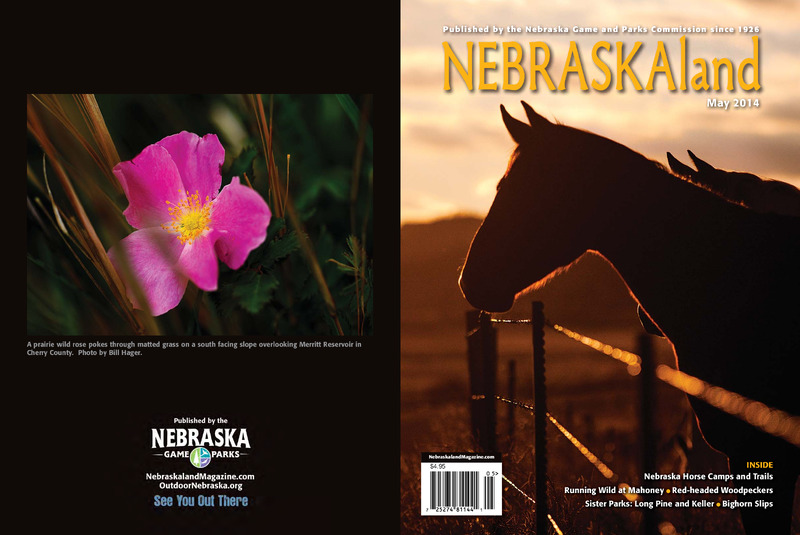
Publis hed by
y the Nebr a s k a Ga m e a nd Pa r k s C o m m is s ion si nc e 1926
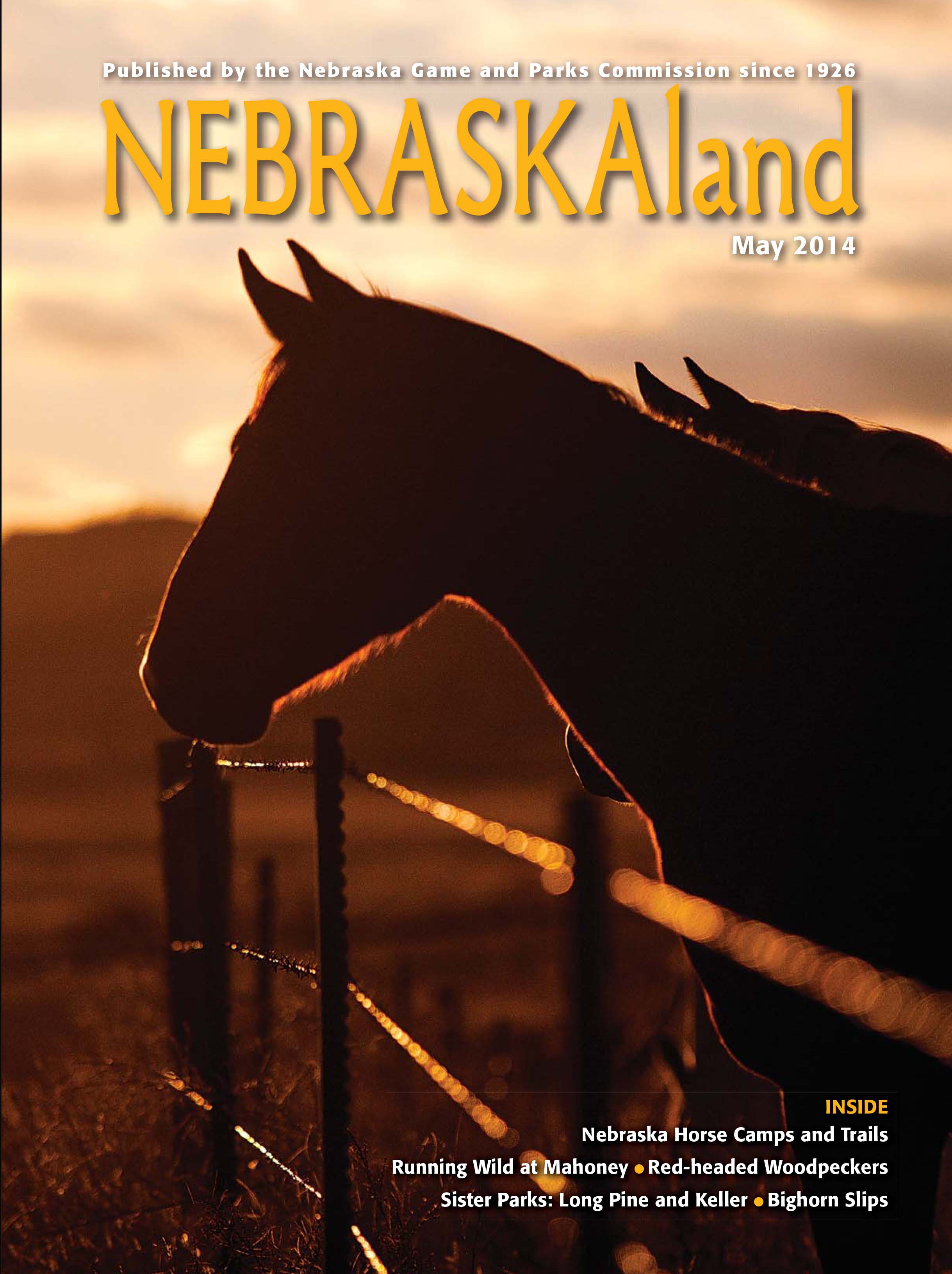
NEBRASKAland
May 2014
A prairie wild rose pokes through matted grass on a south facing slope overlooking Merritt Reservoir in
Cherry County. Photo by Bill Hager.
NebraskalandMagazine.com
$4.95
INSIDE
Nebraska Horse Camps and Trails
Running Wild at Mahoney ● Red-headed Woodpeckers
Sister Parks: Long Pine and Keller ● Bighorn Slips
Sponsored by
NEBRASKAland
Photo Contest
rom town square to square acre, every bit of
Nebraska holds a new discovery. We welcome all
photographers, no matter the age or skill level, to
share with us your visions of Nebraska.
Open to all subscribers,
your photo entry in the
contest qualifies you for the
chance to be published in
NEBRASKAland Magazine,
as well as win great prizes
from Rockbrook Camera
and the Nebraska Game and
Parks Commission.
YOUTH CATEGORIES
Age 13-17
Age 12 and under
ADULT CATEGORIES
Birds
Mammals
Landscapes
Flora
Reptiles, Amphibians and
Invertebrates
Outdoor Recreation
Reader’s Choice
Best in Show
COMPLETE CONTEST RULES AND ENTRY:
www.nebraskalandmagazine.com/photocontest
Go directly to the online entry
G
fform and enter the contest.
2 NEBRASKAland • MAY 2014
ENTRY FEE is a subscription to
NEBRASKAland Magazine.
NEBRASKAland Magazine
Volume 92
●
No. 4
●
May 2014
F EAT U R ES . . .
22 Bighorns – A Life on the Edge
TEXT AND PHOTOS BY JUSTIN HAAG
24 Good Life, Great Rides
BY AMY KUCERA
30 The Tower of the Four Winds
BY ERIN SOLHEIM
32 Long Pine and Keller
T
P
J
N
36 The Redheads
EXT AND HOTOS BY ENNY
GUYEN
BY WILLIAM BEACHLY
38 Pound for Pound – Fighting Nebraska’s Fish
TEXT AND PHOTOS BY JEFF KURRUS
44 Runners Gone Wild
TEXT BY KRISTAL STONER, PHOTOS BY JEFF KURRUS
36
●
D EPARTM EN T S . . .
Comment .........................................................6
Mixed Bag.......................................................8
Outdoor Update.............................................46
Nebraska Attractions .....................................47
Page 49 ..........................................................49
Classifieds .....................................................50
Portraits from the Past ..................................54
In the Kitchen ...............................................55
The Last Stop ................................................56
44
●
22
●
O N T H E W EB . . .
When you see this symbol in the pages
W
oof NEBRASKAland Magazine, visit
N
NebraskalandMagazine.com and view our
iinteractive digital edition for more information.
NEBRASKAland (VOL. 92 / NO. 4, ISSN 0028-1964) is published monthly, except
for the combined Jan./Feb. and Aug./Sept. issues, by the Nebraska Game and Parks
Commission, 2200 N. 33rd St., Lincoln, NE. Periodicals postage paid at Lincoln,
Nebraska, and additional mailing offices. POSTMASTER: Send address changes to
NEBRASKAland, P.O. Box 30370, Lincoln, NE 68503-0370.
4 NEBRASKAland • MAY 2014
38
●
Cover: H
C
Horses greet the
h sunrise
i ffrom their
h i pasture at F
Fort R
Robinson
bi
S
State
Park near Crawford. See story on page 24. Photo by Jenny Nguyen.
MAY 2014 • NEBRASKAland 5
then back the boat into the lake. Plenty
of crappie were caught that day and
added to more memories of fishing and
hunting with my father.
Pictured (left) are me, my father
Elwood “Mick” Dede, and his greatgrandson Brody Smith.
Terry Dede
Norfolk, Nebraska
Pet Pheasant
I have raised many pheasants, but I
never had one like this one. He would
eat out of my hand and follow me
around the farm wherever I went. One
day when I got in my pickup to leave,
he jumped on my hood.
Keep up the great work!
Darrin Duba
Ogallala, Nebraska
Loaded Grandpa
Had to send this photo of my 87-year
old father that my brother brings down
from South Dakota to go crappie
fishing every year. Over the years, it’s
been increasingly hard for him to walk
the shore or get in the boat. We found
the solution for easy loading, just have
him sit in loader and into the boat and
Destination: Missed
Just read and enjoyed the
“Destination: Nebraska” article from
the March 2014 issue. I think you
missed a few: Callaway’s Kite Festival
over the Labor Day weekend, Nebraska
City’s Applejack Festival in September,
and in my hometown of Hastings,
Prairie Loft’s Flatwater Music Festival
at the end of June.
Kathy Rysiew
Hastings, Nebraska
Ole’ Blue Eyes
Would you please give the
information below to Jenny Nguyen?
She might be interested in how Bandit
came to have blue eyes and their
historical significance.
Horse traders call blue eyes in a
horse “glass eyes,” and a horse with
glass eyes brings a higher price in the
sale barn. Forgotten in the bid calling
and gavel-pounding of the auction
ring is the true value of a pinto pony
or horse with those rare, blue eyes.
A descendant of the Spanish Barb
brought to America in the 1600s,
Elwood “Mick” Dede gets loaded before fishing with son (left) Terry Dede and greatgrandson Brody Smith of Norfolk.
6 NEBRASKAland • MAY 2014
always been a mug.
As always, you all do a great job
with the magazine. I love the digital
edition as well!
Scott Cooper
Stillwater, Oklahoma
the pinto is our first wild mustang.
Indians in Nebraska lands first captured
their wild mustangs from 1700-1725
and began breeding for stamina,
camouflage and hunting ability. They
found these qualities in a blue-eyed
pinto having both ears brown and
with brown across the top of the head,
sort of a cap. Plains Indians called it
“Medicine Cap.” U.S. Calvary dubbed
it “War Bonnet.”
The Sioux, Cheyenne, Blackfeet and
Comanches thought the blue-eyed pinto
with a medicine hat was sacred, giving
the warrior great power in battle. They
aggressively bred for this war horse.
There are no pure pintos left. Even
the term “pinto” means something
different in our language today. But the
strain endures. When you are privileged
to look into the clear blue eyes of a
brown and white pinto with pink skin
having some semblance of a medicine
cap, like that of Bandit, you are richly
and with rarity, rewarded a true glimpse
into history.
Brenda Flinn
via e-mail
Visitor Origin?
It looks like the visitor insect this
month is a robber fly (diogmites) on
page 30.
This is a fun activity every month,
and I invariably learn about all kinds of
other bugs during my Google search.
Several minutes of learning usually
follows the “Ooooh, what is that bug?”
when I’m looking through lists of
candidates.
I apologize if you’ve covered this
recently, but I think people would find
it interesting if you had a small article
about the origin of this contest. I’ve
always wondered how long you’ve
been doing this, who came up with
the idea and why, and if the prize has
Thank you Scott for your kind words.
We have been doing this contest since
a box elder bug first appeared in the
December, 2009 issue.
The idea originated from our
contributing editor Michael Forsberg.
If I remember correctly, he mentioned
seeing it in another magazine (perhaps
Scientific America?) where they used
the same image (an ant?) and hid it
every month for readers to find.
We thought about this and decided
that we like to make things hard for
ourselves and so we wanted to do a
different bug/critter every issue and
then draw a winner from entries for
a prize – which has been a
mug.
The very first
mugs were done at
Walmart and had the
box elder on them and
said “NEBRASKAland
Visitor” on them (see
accompanying image). These were
not ideal and so we decided to use the
same NEBRASKAland mugs from the
Gift Catalogs – first the black ones,
and now the ones with the ram’s head.
Thank you again for writing and for
reading NEBRASKAland Magazine.
Tim Reigert
NEBRASKAland Art Director
Send your comments to:
Jeff Kurrus, Editor
NEBRASKAland Magazine
P.O. Box 30370
Lincoln, NE 68503
or e-mail Jeff.Kurrus@Nebraska.gov
Please include your postal address and
telephone number.
Letters may be condensed and edited
for clarity. Photographs are welcome
and will be returned.
Any program that receives federal funding from the National Park
Service, or the United States Fish and Wildlife Service prohibits unlawful
discrimination on the basis of race, color, religion, age, gender, marital
status, national origin, age, disability or political affiliation. Any person
who believes he or she has been discriminated against in any program,
activity, facility, or service, should contact the Nebraska Game and
Parks Commission, Lincoln, NE 402-471-0641, the Equal Opportunity
Commission, Lincoln, NE 402-471-2024, TTY/TDD 402-471-4693;
United States Fish Wildlife Service, Civil Rights Coordinator, 4401
N. Fairfax Drive, Arlington, VA 22203; Director, Equal Opportunity
Program, U.S. Department of Interior, National Park Service, 1849 C
Street NW, Mail Code 0008, Washington, D.C. 20240-0001.
COMMISSIONERS
CONSERVATION OFFICERS
Director Jim Douglas
NORTHWEST
Officer
City
Jim Zimmerman (S) Gering
Commissioners
Chairman - Lynn Berggren, Broken Bow
Vice Chairman - Jerrod Burke, Curtis
2nd Vice Chairman - Dr. Kent Forney, Lincoln
Dr. Mark Pinkerton, Wilber
Rex Fisher, Omaha
Mark Spurgin, Paxton
Mick Jensen, Blair
Dick Bell, Omaha
Norris Marshall, Kearney
MAGAZINE STAFF
Communications Director Christy Rasmussen
Editor Jeff Kurrus
Art Director Tim Reigert
Associate Editor Amy Kucera
Regional Editors Eric Fowler, Julie Geiser,
Justin Haag, Jenny Nguyen
Contributing Editor Michael Forsberg
Regular Contributors Bill Hager, Chris Helzer,
Lisa Knopp, Gerry Steinauer
Photo Librarian Sarah Johnson
Circulation Donna Robinson
For address changes and questions about
your subscription, e-mail Donna.Robinson@
Nebraska.gov or call 800-632-5263
Advertising Sales Manager
For advertising information contact
Shane G. Gilster, 402-742-0125
Email: shanegilster@gmail.com
NEBRASKAland Magazine Copyright 2014, all rights reserved.
NEBRASKAland is available in audio from the Nebraska Library
Commission Talking Book and Braille Service, Suite 120, 1200 N St.,
Lincoln, NE 68508. 800-742-7691. NEBRASKAland Magazine and the
Nebraska Game and Parks Commission reserve the right to reject any
advertising not in keeping with the agency mission.
Rates: $18 for one year; $33 for two years; $44 for three years. Nebraska
recipients must add appropriate sales tax. To subscribe call
1-800-NEBLAND (632-5263), or go online to: NebraskalandMagazine.
com.
COMMISSION
C
COM
OM
OMMIS
M SIO
S ON O
SI
OFFICES
F CES
FFI
ES
S
Headquarters/Southeast District Office
2200 N. 33rd Street Lincoln, NE 68503
Phone 402-471-0641
Northeast District Office
2201 N. 13th St. Norfolk, NE 68701
Phone 402-370-3374
Southwest District Office
301 E. State Farm Rd. North Platte, NE 69101
Phone 308-535-8025
Northwest District Office
East Hwy. 2, Box 725 Alliance, NE 69301
Phone 308-763-2940
Bassett Office
524 Panzer St., Box 508 Bassett, NE 68714
Phone 402-684-2921
Kearney Office
1617 First Ave. Kearney, NE 68847
Phone 308-865-5310
Omaha Office
1212 Bob Gibson Blvd. Omaha, NE 68108
Phone 402-595-2144
Ak-Sar-Ben Aquarium
21502 W. Highway 31 Gretna, NE 68028
Phone 402-332-3901
Greg Hesse
Scott Brandt
Dan Kling
Frank Miller
Sean McKeehan
Terry Brentzel
Phone (308)
(office) 763-2940
(cell) 436-7561
Rushville
760-3647
Gering
631-0663
Harrison
430-0572
Valentine
389-0444
Bridgeport
279-9133
Oshkosh
458-7650
SOUTHWEST
Officer
City
Phone (308)
Roger Thompson (S) N. Platte (office) 535-8025
(cell) 530-3097
Ray Dierking
Brkn. Bow
870-0322
Michael Thome
Cozad
529-8146
Matt Andrews
Elwood
746-2418
Dirk Greene
Imperial
882-0015
Dale Johnson
Kearney
440-3847
Brian Piernicky
McCook
340-6627
Brandon O’Neal
N. Platte
530-3157
Nicholas Fix
Ogallala
289-0427
Bryce Streger
Ogallala
289-1169
Rich Routh
Rep. City
920-0367
Tim Williams
Grand Is
380-7331
Pat George
Kenesaw
402-705-9989
Matt Brandt
Loup City
202-0819
Andrew Heyer
Lexington 402-613-2241
Alex Hasenauer
North Platte
660-4671
NORTHEAST
Officer
Tom Zimmer (Sup.)
City
Norfolk
SOUTHEAST
Officer
Levi Krause (Sup.)
William Krause
Mike Luben
Dan Zuehlke
Heath Packett
Darin Gress
Douglas Kramer
Dina Barta
Stacey Lewton
Dudley Sorensen
Robert Finke
Russell Mort
Dan Evasco
Rich Berggren
Travis Shepler
City
Louisville
Auburn
Colon
Cortland
Eagle
Hebron
Lincoln
Lincoln
Lincoln
Waverly
Milford
Nebr. City
Papillion
Waterloo
Lincoln
Phone (402)
949-0593
274-8063
443-6392
806-9084
210-0888
768-8665
890-6465
890-6463
890-7140
937-3422
947-1363
209-1506
616-5961
619-1355
613-2312
ADMINISTRATION
Officer
Craig Stover (Adm.)
Duane Arp (Ass.)
Jeff Clauson (Ass.)
City
Lincoln
Lincoln
Lincoln
Phone (402)
471-5531
471-5531
471-5531
Phone (402)
(office) 370-3374
(cell) 649-8053
Dale Davis
Bassett
760-0712
Steve Oberg
Columbus
910-3366
Daniel Roberts
Fremont
719-1108
Randy Pomplun
Fullerton
308-550-0489
Jeff Jones
Hartington
762-5022
Jon Reeves
Kennard
889-8508
Doug Pollard
Ord
308-730-7050
Alex Frohberg
Ponca
241-7615
Cory Krause
West Point
380-6410
Jonathan Andreasen O’Neill
340-3981
Mitch Johnson
Bloomfield
613-8612
Nebraska Wildlife Crimestoppers 1-800-742-7627
MAY 2014 • NEBRASKAland 7
Killer Flowers
8 NEBRASKAland • MAY 2014
PHOTO BY CHRIS HELZER
By Chris Helzer
Thistles, despite
their reputation
with many
landowners, are
not all noxious
weeds. In fact,
half of the 10
thistle species
in Nebraska
are native
wildflowers,
and both the
native and
non-native
species are
of great
value to
many
insects
and wildlife
species.
Thistle flowers
are one of the
most important
sources
of nectar for
pollinator insects.
For example,
goldfinches, other
birds and numerous insect
species rely on thistle seeds
as a major food source. While thistles
might not be the most popular of plants
among people, they are a universal
bonanza of goodness for animals. Or at
least that was the story I told everyone
until I started finding evidence of
something a little less friendly.
Over the last couple years, I’ve been
noticing quite a few dead and dying
insects stuck to the lower portions of
thistle flowers, especially on Flodman’s
and wavy-leaf thistles. At first, I
thought the insects were being impaled
by the numerous spines on that part
of the plant, but they weren’t. Instead,
they were trapped by a very sticky
substance on the surface of the flower
itself. The more I’ve looked, the more
dead insects I’ve found. Ants are by far
the most common victim, but I’ve also
seen flies, bees, spiders and others.
Because I’m a scientist, I’ve
been wondering if thistles gain any
evolutionary advantage from having
sticky
flowers. It’s
possible the death
of all those insects is just
an unfortunate accident,
but I suspect not. After
discussing this with several
colleagues, there are two theories I
like best, though there are lots of other
possibilities.
The first theory is that the stickiness
helps prevent ants from stealing nectar
from thistle flowers. Because ants like
to eat nectar but don’t carry pollen to
other flowers, they essentially steal
nectar from thistle flowers without
providing anything in return. Trapping
those ants before they crawl up to
the nectar might help ensure an
abundance of nectar for insects that
actually provide pollination services.
The second theory is that the adhesive
Two ants and a bee are stuck to the sticky
portion of a Flodman’s thistle flower in a
Hamilton County prairie. The ants were
probably trapped on their way toward the
nectar-producing portion of the flower.
The unfortunate bee likely saw the
underside of the flower as a safe place
to spend the night out of sight
from predators.
substance helps
deter attacks from beetles, flies or other
seed-eating insects trying to lay eggs
on or burrow into the thistle head. It
would make sense that a thistle would
benefit from trapping those insects
before they can get to the seeds.
Regardless of why the flowers are
sticky, I’ve had to change the story I
tell about thistles. Now, I explain that
thistle flowers are both a provider of
bountiful food and a perilous death
trap. And really, that’s a better story
anyway. ■
MAY 2014 • NEBRASKAland 9
Dog Etiquette
By Cristina Woodworth
By Amy Kucera
Aurora:
Tour a Prairie Town
ocated a few miles north of Interstate 80, Aurora invites
o
ttravelers to slow down and explore the unique history and
aattractions in this charming prairie town.
Th
The Twin Cottonwoods Memorial is all that remains of the
trees that were a landmark at the site that was platted and
named Hamilton County seat in 1871. Constructed in
1884-85, the Hamilton County Courthouse and Square
includes a historic bandstand and Veteran’s Memorial walkway.
The Plainsman Museum focuses on the history of central Nebraska from
1860-1950 and includes a replica sod house and log cabin, miniature main
street reproduction and agricultural building that houses a large collection
of vintage farm machinery, horse-drawn implements and
automobiles.
The Edgerton Explorit Center teaching museum, built
in honor of famed inventor and former resident Dr.
Harold Edgerton, inspires all ages to have a hands-on
experience through live science demonstrations.
The Prairie Plains Resource Institute has been
celebrating the land and its people since 1980 and
recently planted its 10,000th acre of high-diversity
local ecotype prairie. Their beautiful Charles L.
Whitney Education Center, a remodeled barn
featuring classrooms with lab space, library, gallery
and more, is on its final phase of construction on the
Griffith Prairie Preserve.
Three city parks, Refshauge, Cole and Streeter,
also offer a variety of outdoor recreation
opportunities.
Before you
leave, fill up at
Espressions
Cafe and
Deli with
fresh pastries and the best
cup of coffee in town.
To plan your visit, go to
Cityofaurora.org.
Edgerton Explorit Center
Espression
Aurora
a
Dutch Oven Tips
s Coffee sho
Hamilto
10 NEBRASKAland • MAY 2014
This historic barn
became the Charles L.
Whitney Education
Center.
• If steam is escaping
out of your Dutch oven
while cooking, you are
either cooking with too
much heat or your lip is
not properly seated. This
will result in dry or burnt
food. Try reseating your lid
or removing some coals to
remedy this problem.
• It is wise to cook over
hot coals instead of an open
flame, because not only
are the coals a much more
efficient heat source, they also tend to not leave a black
film of creosote on your cook ware.
• To cook top notch, flavorful meats in a Dutch oven,
start by adding oil, bacon or other high fat content to the
bottom of your oven, then add meat and use this hot oil
to sear the meat on all sides to lock in the natural flavor.
Then drain off the fat drippings and continue seasoning
and cooking your meat to perfection.
Join our community at OutdoorU.org. Hone your skills,
set goals and challenge your friends. ■
MAY 2014 • NEBRASKAland 11
PHOTO BY JEFF KURRUS
ouse
ourth
C
y
t
n
u
o
nC
p
By Nebraska Outdoor U!
Dutch oven cooking not only provokes thoughts to
colonial day cooking, but its results are unrivaled around
the camp fire. Here are a few tips to get you started.
• When purchasing a Dutch oven, look for ovens that
are pre-seasoned and have a lip/brim on the lid so you
can remove the lid without letting any coal slide into your
food. They should also have three legs, which will allow
your oven to set steady and level with coals under it.
• Never use soap when cleaning your Dutch oven,
because it will remove the seasoning. Do not use metal
utensils, as they could scrape the seasoning off; a good
wooden spoon works best.
• Use the size of your oven as a guide for the amount
of charcoal briquettes you need to cook with. Place
two more than the size of the oven on top and two less
on the bottom at 300 degrees Fahrenheit. Example: a
12-inch oven should have 14 briquettes on the top and 10
on the bottom; this will allow the food to cook evenly.
Then add a brick on top and bottom for every 25 degree
temperature increase.
• When baking breads, pizzas or pies, place a tortilla in
the bottom of the oven to prevent scorching.
PHOTO BY JEFF KURRUS
House pets are allowed at all
Nebraska State Park campgrounds, but
it is the responsibility of pet owners to
be sure they are aware of all policies
and regulations before they visit an
area.
State parks have restrictions on which
buildings and cabins pets are allowed
to enter. Pets cannot be left unattended
and must be restrained by a leash at least 6 feet long. Be sure
to check that your pet’s identification tags include contact
information and all shots are up to date.
Avoid high-use times at campgrounds if your pet isn’t wellaccustomed to meeting strangers and other animals. This
would include summer weekends, holiday breaks and during
other special events at state parks and recreation areas.
Introduce yourself and your pet to your campsite neighbors
when you arrive. Let them know that your pet is well-behaved
and won’t cause any problems during their stay. See if they
have any concerns, such as allergies, that might make you use
extra caution with your pet during your stay.
Find the nearest 24-hour veterinarian or animal hospital to
your campsite just in case something happens. After your trip,
you should also thoroughly check your pet for ticks or other
insects they might have picked up over the weekend. ■
A Brief History
The Republican River
Flood of 1935
By David Bristow, Nebraska State
Historical Society
Flood waters rushed down the
Republican River Valley on the
morning of May 31, 1935, after a
day of torrential rains. Eyewitnesses
described a wall of water three to eight
feet tall, moving 10 miles per hour
when it passed Trenton. Soon the river
was running bluff-to-bluff. More than a
hundred people died before the waters
subsided two days later. It remains
one of the worst natural disasters in
Nebraska history.
Some of the most dramatic photos
of the flood come from the Nebraska
Power & Light Company plant in
McCook, where forty men were
trapped on the roof. The first warning
came at 4 a.m., when workers were
called in to fill sandbags to protect the
power plant. As the hours passed, the
men couldn’t keep up with the rising
water.
“Word was received from the chief
dispatcher’s office that the water
had risen at a rate of two feet in 10
12 NEBRASKAland • APRIL 2014
minutes in Culbertson,” plant worker
Louis B. Wolf recalled. Even so, local
businessmen pleaded for the men “not
to let the plant go down regardless of
what happens.”
So the men stayed. They shut down
power to the city at 10:50 a.m. As the
water rose, some men climbed to the
roof, but others were trapped inside.
The men on top tore a hole in the roof
so everyone could climb up. “We saw
a crowd of people on the banks some
400 feet away, our wives, mothers,
fathers and friends,” Wolf writes.
“Under normal conditions, we could
have conversed, but the loud roar of the
water made it impossible.”
The swift current prevented anyone
from swimming to shore. But how
long would the building withstand the
torrent of water?
Someone came up with a plan to use
the power lines that connected the plant
to dry land. First, someone shot the
insulators off one of the wires. “To this,
a large rope was attached and we on
the roof pulled it to the power plant,”
Wolf writes. “A telephone cable car and
land-line were brought over on the rope
so that we could pull the cart to and
from the land.”
“Two men were thus transferred from
the roof to the land. As we were about
to start the third man the water washed
out the poles and the employee [Robert
French] on the H frame near the plant
dived into the flood. By his skillful
swimming, he succeeded in reaching
a point near land about one-fourth of
a mile below, where he was thrown a
rope and rescued.”
There were no more rescue attempts
that day. The men waited on the roof
until the water receded the following
day. Then they “waded out to a sandbar
near the cooling tower, a large boat
was brought to us and from then on,
trips were made taking seven or eight
men each time until we were all landed
safely on land.”
Many other flood stories don’t have
such a happy ending. Marlene Wilmot’s
two-volume history, Bluff-to-Bluff:
The 1935 Republican Valley Flood, is
full of eyewitness accounts of homes
and lives lost, close calls and daring
rescues. To prevent another such flood,
the federal government built six dams
(five in Nebraska) on the Republican
and its tributaries to provide flood
control, irrigation and recreation. It’s
something to think about next time
you’re boating or fishing at one of
southwestern Nebraska’s reservoirs. ■
RG1992AM-7 NEBRASKA STATE HISTORICAL SOCIETY
Employee Paul Wilson pulls himself hand over hand to the power plant, bringing a hand line for a telephone cable car to rescue the
men.
Southern Flying Squirrel
By Tim Riley
The southern flying squirrel is
found in the eastern deciduous
forest along the Missouri River
from the far southeastern corner
of the state north to Nebraska
City (see range map on right).
Although considered endangered
and protected in Nebraska, their
populations are considered healthy
in many eastern states. Nebraska is
considered to be on the periphery of the range of this species.
“This fact combined with their need for mature mast producing woodlands
means that Nebraska has probably never been critical for the species’s overall
population,” said Sam Wilson, furbearer and carnivore program manager for the
Nebraska Game and Parks Commission. “What decline there has been is likely
due to deforestation for conversion to agriculture, firewood, building materials,
etc. But again, this is not likely a species that had a historically large presence in
our mostly prairie state.”
Research that has been conducted has been limited due to the fact that the
overall population is secure and a few of the larger habitats they likely depend
on are mostly stable, including the western edge of several species of oaks and
hickories in eastern Nebraska at Indian Cave State Park and the Missouri River
bluffs near Rulo.
Nebraska can never expect large populations of flying squirrels unless the loss
of habitat is dramatically reversed and forested areas are expanded. ■
MAY 2014 • NEBRASKAland 13
Neighborhood Nesting Mallards
By Mark Vrtiska, PhD
Mallards are a ubiquitous species
of wildlife, and each spring, reports
of hens nesting near houses or in
gardens come into our offices. Urban
environments sometimes provide
suitable nesting cover. If you discover a
mallard has a nest in your yard, please
observe these rules:
Leave them alone. The hen, nest and
eggs are federally and state protected.
Do not attempt to touch, move or
capture the hen or ducklings. While
against the law, the results of such
attempts also often result in negative
consequences for the hen, nest or
ducklings. Unfortunately, urban areas
are not a good choice for mallards to
locate their nest and hatch their eggs.
Let nature take its course and perhaps
a better choice will be made by the hen
next spring.
Do not place water, food or other
material near the nest site. Water dishes
and food only serve as attractants to
other species of wildlife or people to
PHOTOS BY JEFF KURRUS
the nest site.
Mallard eggs typically hatch after
28 days of incubation. If the nest is
in a confined area, provide an escape
route by leaving open a gate to allow
ducklings to exit. ■
Mark Vrtiska removes duck eggs near a house in Lincoln as a mallard hen looks on.
Man Cave
By Julie Einspahr
My husband, Ron Einspahr, has a man
cave in a building right outside of our back
door. He has decked it out with trophy deer,
fishing equipment and racing memorabilia.
In addition, his family owned Clint’s Tavern
in Hildreth for three generations, so the man
cave has fluorescent beer signs, a tavern
sign and commemorative beer mugs hung
around the ceiling among other collectibles.
It also has a TV system that projects onto
a retractable 96-inch screen and a second
smaller TV. There is a fully stocked bar with
antique soda fountain bar stools, and between
the man cave and house is a small patio with a
smoker, gas grill and hot tub.
Do you have a man cave photo to share?
Submissions must be outdoor-related to be considered.
Please send high-resolution images to jenny.nguyen@
14 NEBRASKAland • MAY 2014
nebraska.gov, along with your name, a brief description
of your man cave, your city or town of residence, and best
contact information. ■
MAY 2014 • NEBRASKAland 15
PHOTO BY ERIC FOWLER
Camp Tips
Mike Streeter takes aim at the Nebraska Game and Parks Commission’s
Outdoor Education Center firearm range.
Outdoor Education Center
Opening By Eric Fowler
The Nebraska Game and Parks Commission Outdoor Education
Center, the state’s newest indoor shooting park, will open to the
public June 7.
Located in Helen Boosalis Park at 44th and Superior Streets in
Lincoln, the new 17,700-square-foot center features a 25-yard,
10-lane firearm range; a 25-meter, 32-lane archery range; and three
classrooms, all of which will be open to the public 50 weeks a year.
An existing outdoor range at the park includes an Olympic target
range and a walk-through course.
The center will also be home to the Commission’s Hunter and
Boating Education programs. Staff will be housed in offices there,
and volunteer instructors will be able to access the building on nights
and weekends for their classes.
Those classrooms will also open to the archery range, providing
room for the spectators that will show up to watch the regional and
national archery tournaments the range is expected to host.
The Outdoor Education Center is a partnership between the
Commission and the City of Lincoln, with additional funding
provided by the Easton Foundation.
Hourly fees will be charged for both ranges. Annual individual and
family passes are available to one or both ranges. The classrooms and
ranges can also be rented for special group events or banquets.
For more information on the Outdoor Education Center, go to
OutdoorNebraska.org and visit the Education page.
Education by the Numbers: 2013
Thanks to all the volunteers who make hunter education and safety
possible in Nebraska. Here are a few numbers to show their benefits:
• 1,403: Number of volunteer instructors, with 75 new firearm hunter
education instructors and 38 new bowhunter education
instructors.
• 521: Hunter education classes, with 6,423 firearm education and
1,667 bowhunter education students certified.
13,274:
Hours worked by volunteer instructors.
•
$278,758:
Value of volunteer time. ■
•
16 NEBRASKAland • MAY 2014
By Nebraska Outdoor U!
As we all head out
camping this summer,
here are a few tips and
tricks to try out while you
are enjoying the great
outdoors:
• Repel mosquitoes by tossing some sage
on your camp fire. A few stocks of sage
will produce a pleasant smelling smoke for
you to enjoy, but this smoke is an amazing
mosquito repellent too.
• Wash your clothes at camp using a
plunger and a five gallon bucket. This
works a lot like mixing Kool-Aid in a
pitcher. You need to cut out the inner cuff
of the plunger and cut four 2-inch squares
out of the bowl of the plunger to allow
water movement. Then, if your bucket has
a lid with a hole in it, you can slide the
plunger handle through the lid and place
the lid on your bucket to wash your
clothes.
• Use an empty laundry detergent bottle
as a water dispenser for washing your
hands. If you’re really creative, you can rig
up a soap and paper towel holder on this
too.
• Old tic tac containers make perfect
spice containers. Just label them with a
piece of tape and they will stack away
nicely in your cooking department.
• Try crescent rolls on a stick. Just wrap
the dough around a stick of your choice
and cook it over the fire.
• Use a used plastic Folgers coffee can to
hold toilet paper. Just poke a hole through
the lid and the bottom so you can loop a
rope through, cut a slit in the side to feed
the toilet paper through and then hang this
rope loop on a tree branch while you take
care of business.
• Bring foam floor tiles for your tent floor.
Whether you sleep on an air mattress and
like something softer than roots and rocks
to walk on, or you sleep on the bare floor
and like a bit of insulation from the cold
ground, using those colorful foam floor tiles
from your preschool days in your camping
arsenal is genius. And they stack well in
your car.
Live your outdoor life. Join the Nebraska
Outdoor U! community at OutdoorU.org.
Hone your skills, set goals and challenge
your friends. ■
Nebraska Bird Library
y
Sponsored by
Rose-breasted Grosbeak
Song or calls: Sharp, squeaky “eek.” Long, liquid, robinlike song.
Description: Very large, grayish-white triangular bill.
Male has black head and back; rose red breast; white
underparts, wing bars, and rump. Rose red wing linings are
visible in flight. Female is brown and sparrow-like; white
eye stripe; yellowish wash on streaked breast. Yellow wing
linings are visible in flight.
Behavior: Mating pairs appear affectionate during
courtship, with birds often touching beaks.
Habitat: Relatively open deciduous forests on floodplains,
slopes and bluffs. Does not require dense understory as does
black-headed grosbeak.
Where in Nebraska: Common spring and fall migrant
and summer resident in eastern Nebraska. Hybridizes with
black-headed grosbeaks in western Nebraska.
Fun Facts: The male rose-breasted grosbeak participates
in nest incubation for about one-third of the time, while the
female sits overnight. When the parents switch turns they
sing quietly to each other and the male continues his song
even after he is incubating. The male also tends fledged
young while the female builds a second nest. ■
To learn about more birds visit:
NebraskaBirdLibrary.org.
MAY 2014 • NEBRASKAland 17
By Eric Fowler
By Eric Fowler
Northern pike have been swimming
in Lake McConaughy since biologists
stocked them around the time the
reservoir on the North Platte River
began filling in 1941. But judging
by fish sampling data, angler reports
and the 10 pike that topped 36 inches
in length or 10 pounds to qualify for
Master Angler there in 2013, the current
population may be the best since.
That doesn’t mean there are a lot of
the toothy critters in the lake. “[The pike
population] is low compared to walleye
and other game fish species, but there
are still enough that people who want to
target them can, at certain times of the
year, find them and have success,” said
Darrol Eichner, fisheries biologist for
the Game and Parks Commission.
A pair of bald eagles that has nested
at Lake Wanahoo State Recreation
Area since 2011 has built a new nest a
mile north of their old one, a move that
will open a bit more water to anglers
this summer.
The eagles’ original nest was located
southeast of the boat ramp in trees that
lined Sand Creek and were flooded
when the reservoir was built. The birds
had the place to themselves that first
year and part of the second, as the lake
didn’t open until April of 2012. When
it did open, the area around the nest
was closed to all public access, from
December 1 to July 15, in accordance
with the Bald and Golden Eagle
Protection Act, which prohibits killing
or even disturbing eagles, including
those on a nest. In three years
at the site, the pair fledged five
young.
Last October, the birds built a
new nest in the wetland complex
north of County Road O, which
crosses the inlet to the lake. In
January, the nest blew down, but
in just a week, the pair had the
nest rebuilt, and by early April,
they were tending to an unknown
number of chicks (eagles typically
lay from one to three eggs).
Joel Jorgensen, the Nebraska Game
and Parks Commission’s nongame bird
program manager, said he wouldn’t
want to speculate as to whether the pair
moved to get away from the activity at
the lake. “Eagles sometimes just move
Softshell Turtles
PHOTO BY DAN FOGELL
Dear NEBRASKAland readers,
hell
We found the following facts about softs
too.
do
you
hope
We
g.
estin
inter
es
turtl
Sincerely,
Mrs. Elvers’s Kindergarten Class,
Bess Streeter-Aldrich Elementary
es in NE,
There are two types of softshell turtl
hell.
softs
spiny
and
h
the smoot
in the water,
Softshell turtles live almost always
s.
scale
have
but they do not
the sand in
When hunting, they bury themselves in
eyes and
their
only
with
the bottom of the water,
ed.
nose expos
coldAll turtles, including softshells, are
blooded vertebrates.
to help
A softshell turtle neck is really long
defend itself.
because of
A softshell turtle moves well in water
has front and
it
se
becau
and
shell
its
of
shape
the
back webbed feet.
under
Softshell turtles hibernate in the mud,
the ice, during
winter.
They breathe
from their butts.
Turtles do not
have teeth.
Softshell
turtles can grow
to about 20 inches
•
•
•
•
•
•
•
•
•
•
long. ■
18 NEBRASKAland • MAY 2014
to a new nest.”
“The new site is potentially the most
visible nest in eastern Nebraska, so we
do want to make sure, because it’s so
close to the road, that people stay out
of the exclusion zone and that they’re
not walking out there to get photos.”
The closure will limit some
waterfowl, turkey and upland game
hunting opportunities open to youth
through the Commission’s PATH
Program, and some fishing below the
wier on the inlet. But most anglers
will surely trade the latter
for the 30 or so acres of
timber in which they
will now be able to jig
for crappies and cast
for bass.
There were 102
active bald eagle
nests in Nebraska
in 2013. ■
Rodiek with
his trophy
pike, which he
released.
Jamie Vasa of Ogallala holds a
37-inch northern pike caught July
2013 while trolling spinnerbaits and
crankbaits over submerged trees at
Lake McConaughy.
The rise, Eichner said,
can be attributed to years of
declining water levels that led
to a new record low lake level
in 2004 and thousands of acres
of trees, brush, cockleburs
and smartweed growing on
the exposed lakebed. When
the lake began refilling and
that structure was inundated, the
handful of brood fish in the reservoir
took advantage of ideal spawning
conditions, especially in 2008 and
2009.
As long as the lake stays high enough
to keep bays full and trees flooded,
that’s where anglers should start to
Heavy Recycling
By Justin Haag
Jake Rodiek of Chadron created a buzz across the state and
beyond when he caught, and released, what experts say could
have topped the state’s record northern pike. If Rodiek would
have harvested the fish and had it examined by Game and
Parks officials, his name might be in the record books.
Killing fish is not what Rodiek does, though. During the
past few years, Rodiek has become a proponent of Recycled
Fish, a national organization that promotes
catch-and-release. To spread the message
of selective harvest, Rodiek has spoken
to groups of college students, sports show
attendees and Cabela’s shoppers about
the benefits of letting the big ones go. The
big fish lay more eggs and pass on better
genetics. What’s a good example of selective
harvest? Of the 2,500 fish Rodiek estimates
he landed last year, he kept nine perch. Few
catches have given an opportunity to spread
the message like the monster pike, though.
Rodiek hooked the 45-inch northern in
public water in northwestern Nebraska
on January 28. He said the lunker put up an
unconventional fight, zipping a lot of line from the
tip-up at first, but then rolling over – literally
because of previous monofilament entanglements
and hooks still attached to the fish.
When Rodiek reached below the 12 inches of ice
to pull it from the eight-inch hole, he removed its
hooks, took a few measurements and snapshots, and
released the fish. “Even before I got it out of the water, I
was saying to myself, ‘It’s a nice fish but it’s definitely going
back,’” he said.
look for these structure-oriented fish.
The best bites Eichner heard of last
year were the following: in the heat of
summer, when anglers were boating up
to 30 pike a day trolling over the tops
of submerged trees; a fall bite along the
face of Kingsley Dam; and a year-long
bite in Otter Creek Bay. ■
Daryl Bauer, Game and Parks fisheries biologist, said the
weight of pike varies greatly and it’s hard to be certain if
Rodiek’s fish exceeded the record. At least one chart says the
fish’s length and 27½ -inch girth would have put it at about
three pounds heavier than the state record. But the record,
which has stood since 1997, was two inches longer.
Regardless, Rodiek may have gotten more attention because
he released the fish than if he had kept it. News of Rodiek’s
catch spread quickly on Field & Stream and NEBRASKAland
websites and countless social media and message boards.
His fishing partner that day, Jason Clark of Papillion, helped
the story go viral by shooting and posting a video of the
catch.
Rodiek, a native of Amherst who recently graduated from
Chadron State College, became an assistant superintendent at
Chadron State Park in 2013. While a college student, Rodiek
spearheaded the school wildlife club’s annual ice fishing
tournament at Box Butte Reservoir State Recreation Area,
where he also spread the Recycled Fish message. He and his
fellow students distributed live-release bags for fish to be kept
breathing until after weigh-ins so they could be released.
Not having his name attached to the state record doesn’t
bother him, he says. He knew the rules when he released the
fish and likes having a chance to catch it when it’s bigger.
He’s most pleased about the attention brought to the Recycled
Fish cause, hopefully inspiring others to follow his lead.
And where exactly was the big pike caught? Count
NEBRASKAland among the media who have honored
Rodiek’s request to not release the name of the lake where the
fish still swims. He’s afraid of the pressure it would bring to
the body of water.
In the Recycled Fish spirit of conservation, keeping our
mouths shut seems to be the least we can do. We’ll be waiting
to see how big the fish is, and what is done with it, the next
time it’s caught. ■
MAY 2014 • NEBRASKAland 19
PHOTO BY ERIC FOWLER
Big Mac Pike
PHOTO BY ERIC FOWLER
Bald Eagles Relocate
by Jerry Kane
Contact the Nebraska Game and Parks Commission at 402-471-0641 or
visit OutdoorNebraska.org for more information.
Visit HuntSafeNebraska.org for a list of hunter education classes and
BoatSafeNebraska.org for a list of boating safety classes.
May 1
The Great Park Pursuit
May 10
Lymphomathon
begins, statewide, Negpp.org
Eugene T. Mahoney SP,
Ashland, 402-944-2523
May 1-3
Cornhusker Trap Shoot
Doniphan,
Cornhusker-trap.com
May 3
Catfish Classic Fishing
Tournament
Lake McConaughy State
Recreation Area (SRA),
Ogallala, 308-284-8800
May 3
Kids’ Fishing Day
May 10
Family Fishing Event
Fort Kearny SRA, Kearney,
308-865-5305
SRA, 402-783-3400
May 11
Mother’s Day Buffet
Mother’s Day Buffet
May 3
Fort Robinson SP, Crawford,
Take Pride in America Day 10:30 a.m.-2 p.m.,
308-665-2900
Cleanup at Verdon Lake
SRA, Verdon, 9 a.m.,
May 16-18
402-883-2575
Beyond Becoming an
Outdoors-Woman
May 3-4
Explore Fort Robinson, Fort
Living History
Fort Atkinson State Historical Robinson SP
Park (SHP), Fort Calhoun,
May 17
402-468-5611
Run Wild
Eugene T. Mahoney SP,
Ashland, 402-944-2523
Eugene T. Mahoney State Park May 17
(SP), Ashland, 402-944-2523
Wildlands Day
May 3-4
Becoming an Outdoors
Family
Camp for hearing impaired,
Platte River SP, Louisville,
402-471-5547
May 7, 14, 21, 28
Beyond Becoming an
Outdoors-Woman
Handgun class, Platte River
SP, Louisville, 402-471-5547
May 8-9
Outdoor Discovery
Program
Wildcat Hills Nature Center,
Gering, 308-436-3777
Official opening of summer
state park activities
May 24-26
Living History
Niobrara SP, Niobrara,
402-857-3373
May 28
Family Fishing Event
Halleck Lake, Papillion
May 29
Family Fishing Event
Holmes Lake, Lincoln
May 30
Nebraska Game and Parks
Board of Commissioners
meeting, Alma
Fort Kearny SHP, Kearney,
308-865-5305
May 31
May 24-August 10
Roger G. Sykes Outdoor
Heritage Education
Complex Open daily, Platte
May 31
Lucky Bucket Brewing 7K
River SP, Louisville,
402-471-5547
May 24-September 1
Horseback Trail Rides
Niobrara SP, Niobrara,
402-857-3373
May 24-26
Buffalo Burgers
Indian Cave SP, Shubert,
402-883-2575
May 25
Sidewalk Chalk
Art
Spring turkey seasons close
Eugene T. Mahoney SP,
Ashland, 402-944-2523
May 31-June 1
Living History
Fort Atkinson SHP, Fort
Calhoun, 402-468-5611
Rediscovering the Prairie
By Amy Kucera
From eastern Montana to the western edge of Missouri, Robin Walter and
Sebastian Tsocanos will traverse the 1,370 miles between these Great Plains
states this summer – entirely on horseback. With scheduled stops along the route,
including a ride in Nebraska from the Sandhills to Lincoln, they aim to bring
public attention to the critical role of grassland conservation in North America.
Join their journey at Rediscovertheprairie.org. ■
Send Us Your Trail Cam Photos!
entry permits required this day 3373
May 17
Barbecue and Kids
Fishing Derby
Fort Robinson SP, Crawford,
308-665-2900
May 17
Kids’ Fishing Day
Victoria Springs SRA,
Anselmo, 10 a.m.-6 p.m.,
308-749-2265
May 9
Outdoor Educational
Rendezvous Niobrara SP,
May 17-18
Living History
Fort Atkinson SHP, Fort
Calhoun, 402-468-5611
May 10
May 19-June 6
Fort Kearny Outdoor Expo Eligible landowners may
Fort Kearny SRA,
308-865-5305
May 24
John and Susan McNeill
Musical Performance
May 25
National Park Service
Campground Program
By Cristina Woodworth
There may one thing that
cyclists around Nebraska love
almost as much as riding their
bikes: Mexican food.
Omaha’s weekly “Taco Ride”
and Lincoln’s “Nacho Ride” have
continually grown in popularity
“Tacos? We’ll be right over.”
over the past several years, with the
Omaha ride averaging between 700 and 1,000 people every Thursday evening.
Taco Ride participants leave from the Wabash Trace Nature trailhead in Council
Bluffs and ride about 10 miles to the Mineola Steakhouse for tacos and drinks.
The ride takes place year-round.
Similarly, the Nacho Ride leaves from the East Mopac trail off of 84th Street in
Lincoln every Tuesday around 5:30 p.m. Cyclists ride about 10 miles to the One
Eyed Dog Saloon in Eagle to gorge on giant plates of nachos. The Nacho Ride
usually runs from early May to mid-October. ■
Niobrara SP,
May 17
Niobrara,
Free Fishing and Park
Entry Day No fishing or park 402-857-
Fort Kearny SRA, Kearney,
308-865-5305
Niobrara, 402-857-3373
Open house, Platte River SP
Niobrara SP, Niobrara,
May 10
Take Pride in America Day 402-857-3373
Cleanup at Branched Oak
May 24
Ponca SP, Ponca, 11 a.m.Valentine State Fish Hatchery, 1 p.m., 402-755-2284
Valentine, 10 a.m.,
May 11
402-376-2244
May 3-4
Toast Wine Festival
May 23
Roger G. Sykes Outdoor
Heritage Education
Complex
Bicycling for
Tacos
apply for one elk permit.
This heron was captured on Shane and Nancy Claeys’s farm pond
in northwestern Washington County in August.
Please submit your trail camera photos by e-mail to:
nebtrailcam@gmail.com. Also include where you’re from and any
information that will help explain your photo.
NEBRASKAland
Visitor
Last issue’s winner of
the Visitor drawing was
Rob Mercer of
Stanton, Nebraska, who found
the robber fly on page 30.
Readers are encouraged to contact
NEBRASKAland within 10 days
after this issue’s publication with
the correct page number and name
of this issue’s “Visitor” – a critter
found in Nebraska. We will then
gather the correct entries and draw
one to win a NEBRASKAland
Magazine mug. To enter each
month, write:
NEBRASKAland Visitor
2200 North 33rd Street,
Lincoln, NE 68503.
Or e-mail:
Tim.Reigert@Nebraska.gov
with “Visitor” in the subject line of
the message.
HINT: This issue’s visitor is not
on page 7, 8, 9, 11, 21, or 36.
This orange and black insect with
bristly legs is neither a mosquito
nor wasp; it is a robber fly, in the
family Diptera. This robber fly is
of the genus Diogmites, possibly
D. neoternatus. There are roughly
1,000 species of robber flies in
North America, and several are
common in Nebraska. Robber flies
prefer dry, open habitats such as
prairies and open woodlands. They
are predaceous and considered to
be beneficial, because they feed on
other insects. Robber flies catch
insects in flight, and use their
piercing-sucking mouthparts to
inject saliva into their prey. This
saliva paralyzes the
prey
p and breaks
down their
insides.
ins
The robber
fly is then able to
suck up the
now liquefied
contents
conten of the prey.
Special thanks to Julie Van Meter,
State Entomologist, Nebraska Department of
Agriculture. Visitor image by Eric Fowler
Bugguide.net is a good site for identification.
20 NEBRASKAland • MAY 2014
MAY 2014 • NEBRASKAland 21
Text and photos by Justin Haag
To survive, the bighorn sheep relies heavily on
its footwear. But slipping is just one danger
facing this species in Nebraska.
A
Certainly.
bighorn sheep lives life
The sandstone, or “butte rock,”
on the edge from the day
of their Panhandle ranges affords
it’s born. It all starts when
good traction but can easily break
bighorn ewes choose ledges
of cliffs to give birth, the best away if subjected to too much force.
Thankfully for the
places to keep fawns
sheep, the fall is usually
safe from predators.
not high enough in
That steep terrain
Nebraska’s buttes and
provides the first line of
canyon walls to cause
defense against bodily
mortal damage to the
harm for the rest of the
sturdy animal’s dense
bighorns’ lives. Lambs
bone structure.
learn to scurry up and
“It does happen, but
down the cliffs in the
we haven’t witnessed
first few weeks of life, a
that to be the cause of
remarkable sight. With
mortality in our herds,
split hooves specially
although we have
adapted for climbing,
suspected it in a few
bighorns can easily
incidents,” said Todd
traverse terrain that
A Bighorn’s hoof.
Nordeen, Game and
other species wouldn’t
Parks northwestern district wildlife
dare, especially in a hurry. Among
manager. “They’re good at getting
North America’s big game, only
around our landscape.”
mountain goats do it better.
In the upper elevations of the Rocky
The secret is in the hoof’s design.
Mountains, sheep scurry up and
A close look reveals roughened pads
down rock-solid cliffs made of firmer
toward the rear that conform to the
material, such as granite. While the
terrain, and cleated outer edges good
granite is less likely to break away, a
for snagging rock protrusions. As
slip during a chase from a predator
those cleated edges break off, new
can result in a deadly fall of hundreds
growth replaces it.
of feet.
Nebraska’s Panhandle, a native
Wildlife officials quickly point out
range in which sheep have been
that the greater threat to the Nebraska
reintroduced, is rugged but not quite
herds is disease transmission
as extreme as the terrain native to
potentially triggered from interactions
some herds.
with domestic sheep. The primary
Do the nimble critters ever slip?
22 NEBRASKAland • MAY 2014
Bighorn sheep fawns scurry up and down a steep rock formation in Sioux County
under the watchful eye of an ewe with a tracking collar.
culprit, pasteurella pneumonia, has
reduced some populations by as
much as 50 percent following an
outbreak. Some bighorns have had
bouts in recent years with epizootic
hemorrhagic disease, more commonly
known as EHD, similar to Nebraska’s
deer populations.
Many of the sheep captured near
McGrew during the Game and Parks’
collaring and relocation project in
February (see page 46) had hoof
sloughing, a deformity that is a
symptom of EHD. The good news,
though, is that the sheep were healthy
at the time of capture, indicating that
they were able to fight off the malady.
That bodes well for herd genetics.
The introduction of diseases carried
by domestic sheep is just one way man
has taken a toll on bighorn populations
throughout history. Overhunting and
habitat loss were big reasons for the
species disappearing from the state in
the early 1900s. An occasional sheep
also becomes road kill.
Another potential threat to bighorn
populations that wildlife officials are
watching closely is the natural return
of the cougar to the state. Cougars,
along with coyotes, bobcats and golden
eagles, are considered natural predators
to the bighorn and other Nebraska
ungulates. Two radio-collared sheep in
the Pine Ridge have died, one in 2007
and another in 2013, from this age-old
predator-prey relationship between
cougars and ungulates, officials have
confirmed.
“Outside of disease events, bighorns
probably experience an estimated 10
to 15 percent natural mortality which
involve slips, road kills, old age and
predation,” Nordeen said, noting that
no substantial data exists for how
Nebraska’s bighorns die.
Regardless of how some perish, the
bighorns and their growing Nebraska
population can hold their hooves high.
They have proven to hold their own
while scampering around the state’s
most rugged terrain. ■
MAY 2014 • NEBRASKAland 23
Good Life,
Great Rides
Nebraska Horse Camps and Trails
By Amy Kucera
NORTHWEST
Fort Robinson State Park (SP),
Crawford*
There’s room to roam with more
than 20 miles of trails in the
exquisite Pine Ridge scenery of the
park’s 22,000-plus acres. Once a
quartermaster remount depot, at
one time holding 12,000 horses
for mounted cavalry regiments,
boarding is available in the historic
stables. Stay overnight in the fullyfurnished former officer’s and
enlisted men’s quarters, dating
from 1874 to 1909. Modern
and primitive campsites are also
available.
PHOTO BY JENNY NGUYEN
Pine Ridge National Recreation
Area, Chadron
Trek through the incredible
beauty of the Pine Ridge region
amongst buttes and ponderosa
pines covering 80 miles of trails
managed by the U.S. Forest
Service. At the Roberts Trailhead
and campground, primitive
camping and corrals are available.
The Outrider Trailhead, located
north of Chadron State Park’s
main entrance, includes primitive
camping and corrals, as well as
access to Black Hills Overlook
Trailhead, Forest Service Road and
Deadhorse Road and Trailhead.
Additional Trailheads include East
Ash, West Ash, Coffee Mill, Soldier
Creek, Spotted Tail and Strong
(*Denotes NGPC properties)
24 NEBRASKAland • MAY 2014
PHOTO BY JENNY NGUYEN
F
rom a moonlit ride along the riverside, to a deep canyon
descent into forested bluffs, witnessing the beauty of
Nebraska from the saddle is an exhilarating experience.
W
Withh accommodations for both the two- and four-legged,
the following locations offer a glimpse of the myriad of riding
opportunities to be had throughout the state, which include
diverse terrain, unique wildlife viewing opportunities and the
wide horizon lines that make Nebraska worth riding.
Remember, trail and camp availability is subject to change. In
many locations, reservations, fees and a park entry permit may
apply. Certified weed-free hay is required at certain locations.
As always, be sure to call before you haul and leave only your
hoofprints behind. ■
MAY 2014• NEBRASKAland 25
PHOTO BY JENNY NGUYEN
Canyon. The nearby Chadron Creek
Ranch Wildlife Management Area
(WMA)* provides more open riding
possibilities and primitive camping.
Soldier Creek Wilderness Area,
Crawford
The 7,794 acres of Pine Ridge
escarpment operated by the
U.S. Forest Service consists of
ponderosa pine covered ridges
with areas of native grassland on
15 miles of trails, in addition to
open riding. Primitive camping
available.
NORTH-CENTRAL
Big Canyon Inn and Trail,
Springview
Enjoy scenic vistas and wildlife
viewing opportunities while
26 NEBRASKAland • MAY 2014
traversing through the 20 miles
of trails along high bluffs, deep
canyons and clear streams that
wind through Niobrara River
country. Camp in comfort nearby
the corrals and large barn, which is
complete with loft, restroom and
kitchen facilities. Bed and breakfast
accommodations are also available.
Larrington’s Guest Cottage and
Trails, Springview
Stay in a modern cottage with
fully-furnished rooms that overlook
a Niobrara River canyon trail in
a remote surrounding. Barn and
corrals available.
Samuel R. McKelvie National
Forest, Valentine
Ride the Merritt Reservoir and
stay at the Steer Creek primitive
horse camp, named for the nearby
stream. With more than 116,000
acres of forest open to riding,
numbered windmills prevent you
from getting lost.
Cowboy Recreation and Nature
Trail, Norfolk to Valentine
The nation’s largest rail-to-trail
conversion has 195 of 321 miles
completed on a spectacularly
scenic stretch. Many communities
along the trail offer camping along
the route.
NORTHEAST
*Lewis and Clark State Recreation
Area (SRA), Crofton
Travel 6.5 miles of heavily wooded
and scenic trails overlooking Lewis
and Clark Lake. The designated
PHOTO BY JENNY NGUYEN
There is room to roam at Fort Robinson SP, with more than 20 miles of trails in the Pine Ridge scenery at Nebraska’s largest state park.
campground includes corrals and
primitive camping with restrooms.
Discovery Trails Ranch at Devil’s
Nest, Bloomfield
The historical hideout of Jesse
James includes more than 1,100
acres of open riding on varied
terrain along Lewis and Clark Lake.
Primitive camping with showers
and restroom available.
*Niobrara SP, Niobrara
Open riding on 120 acres at the
designated primitive equestrian
camp delivers spectacular scenery
and wildlife viewing opportunities
on the confluence of the Niobrara
and Missouri rivers. One mile of
trail is designated for horseback
and 2.1 miles of the Railroad
Bridge Trail located nearby.
Riding the scenic trails in the state is an activity suitable for both young and old.
Turkey Creek Ranch, Newcastle
Ride through more than 20 miles
wooded ravines, open prairie and
spring-fed streams along Missouri
River bluffs. Primitive camping
and furnished cabins available,
including a beautifully secluded
spot overlooking the Missouri River.
*Willow Creek SRA, Pierce
Trot along 8 miles of trail around
the lake. Both modern and
primitive equestrian camping
available at this peaceful setting.
CENTRAL
Bessey Ranger District of the
Nebraska National Forest, Halsey
With wildlife and windmills
abound on 90,444 acres of gently
rolling Sandhills combined with
20,000 acres of hand-planted
trees, Nebraska’s largest forest is
a unique riding experience near
the Dismal River. The Natick and
Whitetail horse camps offer a
primitive camping experience with
stalls and corrals.
MAY 2014• NEBRASKAland 27
Switzer Ranch, Burwell
Take a scenic Sandhills stroll on
more than 10,000 acres of the
working ranch along the Calamus
River. The Calamus Outfitters offer
guided rides, an indoor riding
arena and horseback lessons at the
ranch. Modern cabins and primitive
camping are available for overnight
stays with corrals and water
available.
SOUTHEAST
*Branched Oak SRA, Malcolm
Meander through the open
grasslands for spectacular views
of the lake and surrounding
wilderness of the park,
encompassing 5,595 acres and
over 3 miles of horse trails in the
Salt Valley. The newly constructed
equestrian camp features modern
and primitive camping, an
accessible mounting ramp, hitching
posts and corrals, as well as a
mounting block to assist people
with disabilities. The Branched Oak
Marina and restaurant on site is
open seasonally.
Camp Moses Merrill, Linwood
Explore 6 miles of horse trails on
568 acres along the high bluffs
south of the Platte River. Stay at
the modern campground, owned
and operated by the American
Baptist Church.
*Indian Cave SP, Shubert
Journey high above the Missouri
River on over 13 miles of trails. The
designated equestrian camp offers
horse corrals, a picnic shelter and
primitive camping. Additional trails
are opened during competitive trail
rides held each summer at the park.
*Pawnee Lake SRA, Emerald
Travel more than 1,800 acres,
including 6 miles of trail, along
the second largest lake in the
Salt Valley. Modern and primitive
camping available.
*Rock Creek Station State
Historical Park (SHP), Fairbury
A former Pony Express site, ride 6
miles of trails in the historic park
where they celebrate Rock Creek
Trail Days the first weekend of
June. Stay at the adjacent Rock
Creek Station SRA for primitive and
modern camping with horse corrals
available.
PHOTO BY ERIC FOWLER
Bader Memorial Park, Chapman
With 270 acres of diverse property
that includes 7 ponds, enjoy a
ride through the tallgrass prairie,
wetlands and cottonwood forests
near the Platte River. Primitive and
modern campsites available at this
picturesque park.
*Two Rivers SRA, Venice
Located near seven sandpit lakes
along the Platte River, this popular
destination for outdoor enthusiasts
offers modern and primitive
camping, including a night in a
restored Union Pacific caboose.
SOUTHWEST
Above: Fred and Karen Steffen of
Crofton ride horse trails at the South
Shore Area at Lewis and Clark SRA.
Right: Barb Simmons (left) of
Bellevue, a member of the Eastern
Nebraska Driving Society, gives
carriage rides around the horse camp
at Two Rivers SRA.
PHOTO BY ERIC FOWLER
PHOTO BY ERIC FOWLER
28 NEBRASKAland • MAY 2014
*Swanson Reservoir SRA, Stratton
After a day riding (and fishing),
cozy up at the Spring Canyon
Campground for modern and
primitive camping or go for a
luxurious night at nearby Lakeview
Lodge, complete with large
common room, kitchen and stone
fireplace.
Opposite: Riders cross the bridge
over Rock Creek toward the
reconstructed Oregon Trail outpost at
Rock Creek Station SHP.
V
View
the Nebraska Horse Trails
Guide for complete information
G
and more great locations to ride.
a
MAY 2014• NEBRASKAland 29
The Tower of the Four Winds
By Erin Solheim
W
30 NEBRASKAland • MAY 2014
including the “hoop of the world” represented by the many
circular symbols found throughout the park. The directional
pedestals, for example, embody a passage in Black Elk
Speaks:
“[T]hese four ribbons hanging here on the stem [of a pipe]
are the four quarters of the universe. The black one is for the
west where the thunder beings live to send us rain; the white
one for the north, whence comes the great white cleansing
wind; the red one for the east, whence springs the light and
where the morning star lives to give men wisdom; the yellow
for the south, whence come the summer and the power to
grow.”
Because of its physical location, the park has seen its share
of wind activity. Some of the most tortuous winds I’ve ever
experienced have been at the top of this hill. In every season,
the winds here have been powerful and whispered to me
small secrets of meaning. With constant reminders through
the art of the statue and pedestals, it’s difficult for me to
forget the symbolism and purpose of this park.
In Neihardt’s letter to the park board in 1973, he said that
“I sincerely approve of the Black Elk-Neihardt Park with
its symbol of Universal Man stretching his arms over the
Missouri River Valley. This will be one of many inspiring
signs of a new social ascent. Black Elk longed for this day to
come.” In many ways, the culture of Blair has been silently
motivated by this statue overlooking us. As Professor Bill
Thomsen, artist and minister who inspired the tower mosaic
and pedestals, said, “The tower symbolizes what we have
been writing about and dreaming about for so long, trying to
weld people together in peace and compassion.”
But in many ways, the Tower of the Four Winds hasn’t
seen many admirers other than the families that come to walk
the perimeter and enjoy the view. For many native Blairites,
the cross statue seems unimportant – only a small part of the
scenery that seems as if it has always existed. But it would be
foolish to disregard what both Neihardt and Thomsen had in
mind when they created their work as inspired by Black Elk:
to change the world with peace and inspiration.
As much as the Tower of the Four Winds has gone
unnoticed through the lives of many affected by it, it has
become my personal haven. I only wish that everyone would
stop to appreciate this pinnacle of Nebraskan soil and inspire
others to rethink the other unnoticed and omnipresent powers
that are all around us. There’s another quote from Black Elk
Speaks that easily summarizes what I’ve learned from this
park; it is a prayer from Black Elk for us:
“Grandfather, all over the world the faces of living ones
are alike. In tenderness they have come up out of the ground.
Look upon your children with children in their arms, that
they may face the winds and walk the Good Road to the Day
of Quiet.” ■
PHOTO BY JENNY NGUYEN
ind is an omnipresent power that has a forgotten
significance in our lives. In many ways wind
holds us captive. But without this magnificent and
unseeable force, life would be impossible.
My personal connection with wind began as a youth at
the Tower of the Four Winds, the top of my little world in
Blair, Nebraska. Learning about the science and symbolism
of why wind is important, I became deeply interested in the
significance of wind.
First, there is the science. We can’t see wind, albeit for the
dust that sometimes assaults us, but there’s an uncanny effect
air flow has on this planet. Earth’s many life forms rely on
elements such as carbon dioxide and oxygen, and would be
helpless without the wind to move these elements.
Without it, rain from the oceans couldn’t make the journey
necessary over mountains and into the Heartland. The
convectional flow of wind, with cool air being pushed under
fronts of hot air, moves rain clouds nearer crops in the Great
Plains. Wind also takes a large role in the reproduction of
many of the world’s plants. The pollen and seeds from trees
and other plants could not find enough fertile land wherein to
root without wind. A world without wind would be stagnant.
Wind is dangerous and compelling, especially in the central
United States’s Tornado Alley. Add a winter storm and the
worse sort of weather is created. Uprooting trees, spreading
wildfires – wind can turn any storm dangerous. But it also
has a practical interest, particularly in Nebraska. It can be
utilized as an alternative form of energy used to help electrify
not only our state, but the world.
There is also a religious significance to wind documented
throughout history. Greek and Egyptian religions have
separate wind gods, with many of these gods specializing in
inspiration of some sort. Aeolious, for example, is the Greek
wind god that would send his servants, the directional winds,
to bring divine inspiration to artists and important members
of society. The English Romantic poets sentimentalized
ancient archetypal representations of wind, such as in Percy
Shelley’s “Ode to the West Wind.” And Plains Indian oral
histories, with ties to the land of Nebraska, hold some of the
most interesting wind stories ever encountered.
In Blair, the Tower of the Four Winds is the name of
the giant cross located in Black Elk-Neihardt Park. From
this point, one can see across the valley, over the Missouri
River and into Iowa. The world looks enormous from such a
perspective. Watching the sun rise and set there has been one
of the most beautiful, silent joys of my life.
The giant cross and the mosaic pedestals representing each
cardinal direction are spread out on a circular paved walking
trail and commemorates author John G. Neihardt and the
subject of his highly acclaimed book Black Elk Speaks, which
recounts the tales of Oglala Lakota holy man Black Elk and
preserves the history, visions and traditions of Black Elk’s
tribe.
Everything in this park holds a special symbolism,
The Tower of the Four
Winds is located in Blair’s
Black Elk-Neihardt Park.
Erin Solheim is a freelance writer living in Omaha. This is
her first essay in NEBRASKAland Magazine.
MAY 2014 • NEBRASKAland 31
Long Pine Creek and
Water Laws
By Gene Zuerlein, Assistant Division
Administrator, Environmental Services Division
Two of
Nebraska’s
hidden gems
L
ong Pine Creek is a south bank tributary
to the Niobrara River that runs through the
state recreation area. Long Pine and Pine Glen
wildlife management areas are also located
along its banks. Not only is Long Pine Creek
one of the top two trout streams in Nebraska,
the creek is historically significant in that the
first ever instream flow appropriations under
Nebraska water law were granted for it in 1989
after the Legislature passed LB 1106 in 1984.
The appropriations amount to 50 cubic
feet per second in the upper reach and 60
cubic feet per second in the lower reach. The
purpose of the scientific justified flows is to
sustain the natural reproducing rainbow and
brown trout populations, which are highly
sought after by anglers.
According to Jeff Schuckman, northeast
fisheries manager for the Nebraska Game and
Parks Commission, flows in our streams are
dictated by precipitation and groundwater
seepage. Instream flow appropriations only
exist on 2% of Nebraska’s fishable streams
and rivers, so they are very important
in sustaining these public trust natural
resources for all citizens. The instream flow
appropriation on Long Pine Creek helps fish
and wildlife and ensures people will be able
to enjoy this resource for many years to come.
Text and photos
by Jenny Nguyen
Caroline, Ava, Ron and Hayden Rech from Blair tube at Long Pine State Recreation Area in Brown County.
f you’re going to camp at one, then you might as well
s
swing
by the other. Located just 12 miles apart, Long
P and Keller state recreation areas (SRA) are often
Pine
t
thought
of as sister-parks to Ainsworth and Long
P locals. Tucked away where corn ends and pines
Pine
a gullies grow, both areas are secret diamonds
and
i north-central Nebraska along Highway 20. You
in
either have been going for years, or stumbled upon
them while on your way to somewhere that you no longer
remember – because your rest stop, now new discovery,
turned out to be that much better than your original
destination.
32 NEBRASKAland • MAY 2014
Long Pine SRA
“It’s a little gem that’s hidden,” said Janice Rech from
Blair, who has been coming to Long Pine SRA for years
and now camps with her husband and children. “People
from around here know about it, but most of the state
doesn’t even know that it’s here. It hasn’t changed in 20
years.”
With a tent pitched only inches away from the picturesque
Long Pine Creek, Rech and her family enjoy coming out
to the peace and relaxation of the outdoors. They arrive
every summer to tube on Long Pine Creek, sleep under the
stars, catch their limit in trout and make s’mores and
memories with family and friends. During these busy
months, laughter and the sounds of park-goers having a
good time ascend from every campsite, along with curls
of campfire smoke and a happy bark or two from fourlegged companions.
Long Pine SRA has been managed by the Commission
since the early 1960s, and since then has offered a quiet
sanctuary where back-to-basics campers can truly escape.
Although its 29 campsites have no electrical hookups,
campers have little risk of spending their weekends next
to any noisy, tricked-out RVs. Furthermore, the SRA
totals 153 acres and also features short hiking trails, yearround trout fishing, and is a great place for picnicking and
wildlife viewing. For those trekking via the Cowboy Trail,
Long Pine is a great place for cyclists and hikers to stop and
rest for the night.
In addition to naturally reproducing brown and rainbow
trout, Long Pine Creek is supplementally stocked with 900,
10 to 11 inch, rainbow trout per year in lots of 300 before
Long Pine and Keller
state recreation
areas are located just
12 miles apart in
Brown County, and
are both perfect rest
stops on the way to and from
the Sandhills – or destinations
in themselves.
Long Pine and
Keller SRAs
MAY 2014 • NEBRASKAland 33
three big holidays – Memorial Day, Fourth of July and Labor
Day. Fishing is great year-round, but the creek is busiest
during the weekends in warmer months, both with fishermen
and tubers. For the angler seeking solitude, weekdays are best,
while fall and winter trout fishing can also be pleasant.
Additional fishable sections of Long Pine Creek can also
be found at Long Pine Wildlife Management Area (WMA), a
160-acre section adjacent to the SRA open to hunting.
Keller SRA
Largemouth bass, bluegill, channel catfish and trout can be
caught at Keller SRA’s five ponds.
At Long Pine SRA, the Rice family,
with dad Kyle, son Kolbi, grandfather
Larry and grandmother Linda, make
s’mores while park superintendent
Dave Harlan looks on in the back.
34 NEBRASKAland • MAY 2014
If you get off Highway 20 and drive north on 183, you’ll
find Keller SRA just 9 miles out. Hugging nearly one mile
of Bone Creek, Keller totals 197 acres and is nestled among
rugged bluffs and oak, pine and cedar trees. Camping and
fishing are big draws here, but with additional amenities than
Long Pine SRA. Keller was first opened in 1986 and offers
25 all-weather camp pads with electrical hookups, primitive
campsites and day-use amenities.
Dustin Craven, a Nebraska resident originally from
Arkansas, commented on the area while visiting with wife
Lindsay and son Hunter for the first time. “It reminds me
of camping in Arkansas and a little bit of Colorado,” said
Craven. “When you’re in this area, it’s like you’re out of
Nebraska. It’s different from the rest of
the state.”
Keller is also known for its five
fishing ponds offering both warmand cold-water fish species, including
largemouth bass, bluegill, channel
catfish and trout; catfish are stocked
every other year. Access to ponds 1
and 2 is available north of the park
from the county road west off Highway
183. Anglers can access ponds 3, 4
and 5 via a footbridge that provides a
scenic view over Bone Creek.
In addition to the SRA, 640 acres
of wildlife management area abuts
the park on its southern edge. Keller
School Lands WMA, added in 1985, is
an additional gem among hunters and
wildlife viewers who will find a bounty
of small and big game. ■
V
View
the Keller SRA brochure for
sspecifics on park amenities.
Bill Flesher – Campground Host
Longtime campground host Bill Flesher often brings his woodworking art for
visitors, especially kids, to see at Keller SRA.
S
ome visitors come out to picnic or fish for the day, while
others stay for the weekend. And then there are those
special few who return year after year. Bill Flesher is one of
those few, returning every year to Keller SRA since 1986 as a
campground host. “When we implemented the Campground
Host Program, Bill and his wife Barb were one of the first
to step forward and take on the duties. Barb passed away
last year so Bill is by himself now,” said Dave Harlan, park
superintendent at Keller.
As a longtime camp host, Bill is known among Keller visitors
for his love of woodworking, a hobby he started shortly after
retirement in 1962. “The wife said, ‘If you retire, you got to
have something to do because you’re not going be hanging
over my shoulder all the time,’” said Bill, chuckling.
The Fleshers would often show up in their RV, filled with
Bill’s handmade, realistic renditions of trains and vintage
automobiles for the entire park to see. “He makes about every
piece of his projects from wood and most of the woods are
exotic from South America,” said Harlan. “They are a real hit for
kids.”
Although Barb is now gone, Bill, now 81, will continue to
return to Keller every summer to carry out his camp host duties.
Responsibilities include greeting campers and answering
visitor questions, being accessible to campers for comments
and complaints, assisting in campground registrations and
reservations, performing park maintenance duties, contacting
park staff and law enforcement in emergencies and providing
other much-needed support to park staff.
Thanks to volunteers like the Fleshers, parks such as Keller
SRA receive the help they need during busy months.
F
Find
for more information on the Nebraska Game and Parks
Commission’s Campground Host Program.
C
MAY 2014 • NEBRASKAland 35
The Redheads
By William Beachly
36 NEBRASKAland
36
NEB
NE
NEBR
BR
RAS
ASKA
KA
Alla
and
nd • MAY
MA
M
AY 2014
2014
4
ARTWORK BY MICHELE FARRAR
PHOTO BY ADRIAN OLIVERA
I
was growing up in Lincoln.
It was a childhood memory retained “as bright as
yesterday” in the “unseen artist’s loft” of Eiseley’s mind.
He had found a woodpecker, apparently dead on the ground,
behind his house and picked it up to admire its red head
and black-and-white feathers. It might have contacted an
electric line and been stunned, but only temporarily, because
it revived and hopped to the corner of the house. There it
“began to ascend in true woodpecker fashion – a hitch of
grasping feet, the bracing of the tail, and then, wonder of
wonders, the knock, knock, knock of the questing beak
against our house … somewhere amidst the obscure timber
loft of my head that persistent hammering still recurs. Did
it stay because it was my first glimpse of unconsciousness,
resurrection, and time lapse presented in bright color? I
don’t know.”
The red-headed woodpecker is a member of one of the
most specialized orders of birds, the Piciformes. Their
X-like toe arrangement is diagnostic and critical to their
firm grasp of tree trunks, but it is in their head that we find
anatomical specializations for excavating cavities in wood to
both retrieve hidden insects and create nesting holes. Their
heavy beak has a shock-absorbing articulation with the skull,
while the peculiar, muscle-sheathed horns of the hyoid bones
operate a tongue capable of extending four times the length
of the beak. The red-feathered hood is worn by both male
and female, and plays a role in species recognition because
woodpeckers don’t “sing” like passerines, and probably
in aggressive defense of nest cavities
(imagine that red head and formidable
beak zooming straight at you).
Drumming is typically a declaration of
territory and may be done by both sexes
of a mated pair. Studies have shown that
their aggressiveness helps them compete
for limited nest cavities against the
likes of European starlings that have so
impacted our native bluebirds. Because
bluebirds cannot excavate cavities on
their own, they depend on woodpeckers
that continually make new holes to nest
in.
In many ways, redheads have
benefited from the spread of suburbs
in Midwestern towns where a variety
of non-native oaks are planted in wellspaced arrays. Meanwhile, our native
oaks that once occurred in open savannas
The red-bellied woodpecker tongue (pictured) has a hard, barbed tip for impaling
or scattered along stream banks have
larger insects and coated with sticky saliva for gathering small insects. Conversely,
been encroached on by fast-growing
the red-headed woodpecker’s tongue is not barbed. Instead, the red head has hairlike
elm and ash trees with smaller, windprocesses on its tongue possibly adapted for a more general diet, which includes
flying insects during the summer.
borne seeds. Woodpeckers are good
t was one of those winter days that remind us of purity
and essence, when vision seems clear yet distances are
illusory. Cross-country skiing through a foot of soft,
fresh powder in the absolute stillness of Indian Cave
State Park where we were the only human intruders, my
wife spotted something in the middle of the untracked
whiteness of a clearing: something dark, small and moving.
As we slowly approached, its red head seemed like a totally
new and unnatural color in a world of gray and white, save
for the contrasting deep blue of the vaulted sky.
The woodpecker had evidently landed there, not realizing
the snow depth, and could not find enough air beneath its
wings to take off. It seemed exhausted, though we could see
no emotion in that dark eye. On that day, in that lighting, its
colors were so bright it seemed not to belong as a natural
object. Yet the woods there were as likely to be the work of
this bird’s ancestors, and similar birds that carry and cache
seeds, as the many other environmental forces that created
this wonderland of oak and hickory.
With clumsy, mitten-bound hands, I gently lifted the bird
from the snow and placed it in the hood of my wife’s parka,
and we silently swished ahead. Minutes later, the bird must
have warmed up, and with a flurry it emerged from the
hood and took flight, a spirit released, into the edge of trees
with confident, purposeful, powerful strokes. I envied those
strokes as I attempted to keep my slow, rhythmic motion
through the snow and was reminded of a similar episode of
resurgent life witnessed by the young Loren Eiseley when he
A banded red-headed woodpecker at Audubon’s Spring Creek Prairie in Denton, Nebraska.
at exploiting “mast years” when big-seeded trees produce
acorns, hickory nuts or walnuts in abundance and they hoard
and cache this bounty. Since the last Ice Age, oaks, beeches,
and American chestnut provided many opportunities in
Eastern woodlands for seed-caching species like jays and
woodpeckers, just as mature pine forests in the west offered
abundant pine nuts. The red-headed woodpecker seems to
be an edge-dweller whose native range followed the Prairie
Peninsula eastward. But over the last century, disease and
harvesting of these hardwoods has shifted the balance
toward shade-tolerant softwoods such as maple that do not
have hard seeds suitable for caching.
Early reports of red-headed woodpeckers in Nebraska
were mostly from the southeastern or northwestern counties,
but now the bird may be found nesting statewide. This trend
no doubt can be attributed to the spread of trees along rivers
and in farmyards, coupled with the abatement of prairie
fires. However, there is increasing evidence that suppression
of the fires that created the oak-savanna ecotone in eastern
Nebraska is hurting redheads. All hole-nesting birds depend
on a resource of dying mature trees, and the incipient ash
disease could result in a temporary opportunity for additional
nests, however this would only be one aspect of their overall
requirements and wouldn’t guarantee a population increase.
In fact, many birds that rely on insects during the nesting
season, such as redheads, can find that their anticipated
resource boom came too early as a result of climate change.
This pattern has been documented already in birds of
European forests and the Missouri Ozarks. The redhead
typically nests in June, later than its relative the red-bellied
woodpecker, and could face a scarcity of insects during
the critical time it needs to feed its nestlings. Annual bird
counts show that red-headed woodpeckers have declined
sharply in the Midwest since the 1970s, while the red-bellied
woodpeckers, favoring more dense forest growth, have
steadily increased.
The red-headed woodpecker is a remarkably adaptable
species. It can employ short-distance migration to track
resources, and can oftentimes complete a second nesting
effort in the summer if its first nest fails. I would like to
see this magnificent bird inspire all of us to consider the
re-creation of the bur oak savanna of times past. Pawnee
Prairie Wildlife Management Area presents one such
opportunity, and perhaps those corners left by center pivots
could create a multitude of other areas where a bur oak
could be planted. There would, no doubt,
be other native species that would benefit
as well. ■
William Beachly is a biologist
at Hastings College. His last
NEBRASKAland article, “Sojourn at
Rock Glen,” appeared in October, 2011.
MAY
MA
AY 2014
20
014
4 • NEBRASKAland
NE
EB
BRA
ASK
SKA
Alan
nd 37
Pound for Pound
Fighting Nebraska’s Fish
J
ooining an ongoing debate in
the angling world is easy.
th
From arguing the best rod
F
aand reel combos to how
to appropriately cook any
nnumber of fish species,
fi
finding a fellow angler with
whom you can agree to disagree has
never been simpler. But a quick search
through one of the web’s many angling
forums will reveal one debate that has
raged on as long as any other – what
game fish fights the hardest?
A fish’s biologic makeup, especially
body shape, and genetics have a lot
to do with how hard a fish fights. No
one knows this better than Nebraska
Game and Parks Commission fisheries
biologist Daryl Bauer, recipient of
126 Nebraska Master Angler awards
covering 16 species of fish.
Bauer uses his biology background
to his advantage when catching any
number of fish species throughout
the state, and has some interesting
information to share about why certain
fish fight the way they do.
Channel/Flathead Catfish
“Catfish are bulldogs,” said Bauer.
“When they start shaking that head back
and forth, you’re in for a fight.” As a
river species, a catfish is known for
its extreme endurance and prolonged
battles.
Text and photos by Jeff Kurrus
LARGEMOUTH BASS are one of Nebraska’s most popular
sportfish, even though other fish, pound for pound, are better fighters.
38 NEBRASKAland • MAY 2014
Daryl Bauer, Nebraska Game and Parks
Commission biologist, has caught 126
Master Angler fish, receiving his fair
share of experience landing this state’s
trophy fish species.
MAY 2014 • NEBRASKAland 39
CATFISH, like this flathead surveyed at Branched Oak Lake, offer some of Nebraska’s most sustained fights.
THE BIG DRAW WITH LARGEMOUTH BASS is how they will often rise to
the surface when fighting, putting on an aerial show for anglers.
40 NEBRASKAland • MAY 2014
Often staying deep, an angler will
feel strong head shakes without many
quick-burst escape attempts. It’s not
that their moderately streamlined body
can’t move quickly, it’s just that their
makeup determines a different way to
fight.
“Catfish are more vascularized,”
said Bauer. “They have more blood in
their muscle tissue, allowing them to
fight aerobically versus anaerobically”
(See sidebar on page 43). “The more
aerobic a fish is, the longer the fight
will last.”
Genetically, their riverine background
also creates an endurance fighter that
can cover long distances when hooked,
and even in still water this fish will look
for current to feed and spawn. However,
a catfish caught in the Missouri River
is still going to fight better, pound for
pound, than one caught at your local
farm pond because they are constantly
using their muscles in a river
habitat.
There aren’t many differences
between channel and flathead catfish.
Channels have an overbite that allows
them to pick up food from the bottoms
of lakes while flatheads have an
underbite conducive to their desire to
BLUEGILLS are acrobatic fighters who use their body shape to maneuver through vegetation to escape predators and
anglers.
feed looking upward. Regardless of which one is hooked, an
angler better hold on tight, especially if it’s a big fish.
Largemouth/Smallmouth Bass
For many anglers, the mystery behind fishing is often not
knowing what’s on the other end of the line. But largemouth
bass, America’s most popular sportfish, often provide
anglers the added excitement of being able to see some of
the fight above the water’s surface – however short that
fight might be.
“Because they have white meat, they get tired quick,”
Bauer said. Bass are anaerobic fighters: they have short
bursts of energy and then have to rest. But these short bursts
can be magical. “It’s a natural behavior for a largemouth
bass to jump,” said Bauer. “They don’t know the difference
between a hook and a bluegill caught in their throat, which
is where the jumping comes into play. They are trying to rid
themselves of it.”
But what about the smallmouth, you ask? “Ounce
for ounce and pound for pound, the gamest fish that
swims,” some have written of one of the most celebrated
fighting fish there is. “While there’s not a lot a difference
between and largemouth and smallmouth,” said Bauer, “a
smallmouth’s ancestry as a river fish and body shape do
make them better fighters than largemouths.”
Bluegill/Crappie
“When you’re panfishing, you’re always fighting against
the fish’s flat side,” said Bauer. “The resistance is because
of the fish being perpendicular to you.” With white meat
like a bass, panfish fights are extremely short. If you’re
looking for an endurance fighter, this isn’t it – unless you’re
casting an ultralight.
Crappie do differ slightly to bluegill because their body
shape is not as rounded, and they are more prone to swim
like an open-water fish capable of longer runs.
Northern Pike/Muskellunge
“Bluegills and northern pike are at the extremes of the
body shape continuum,” said Bauer. “While bluegill are
built to pull you in circles, pike are built for drag racing.”
MAY 2014 • NEBRASKAland 41
“you can immediately tell the difference
as soon as you set the hook, because the
wipers will usually make that initial run.”
Rainbow Trout
“Catching a big rainbow trout is
fantastic,” said Bauer. And for good
reason. Rainbow trout are a red-meated
river fish, resulting in the perfect
combination of strength and endurance.
With the ability to migrate upstream long
distances to spawn, rainbow trout are
similar to catfish in how they stay down,
but also compare to wipers with their
long, powerful runs.
Known for their aerial maneuvers
when small, they jump less as they age.
But the underwater runs remain part of
one of freshwater fishing’s most prized
fights.
N
NORTHERN PIKE are meant for drag racing, using short, quick bursts of energy to evade anglers.
These short, quick bursts of energy are all determined by this fish’s
streamlined body shape and its white meat.
They fade quickly because of the lactic acid they build up after each
run, and need to rest much like a person who has just run a sprint. By
the time they get near the boat, they will often have built up enough
energy for one last massive head shake. If an angler can weather this
storm, the fish will be landed.
ot all fighting fish are equal, but
the task with trying to come up
with a scientific answer to “What is
Nebraska’s best fighting fish?” is
daunting. There are just so many factors
to control when evaluating the poundfor-pound strength and swimming speed
between fish.
But that still won’t stop anglers from
comparing fish. So while the debate for
favorite fighter will continue as long as
lines are getting wet, the answers to why
they fight the way they do remain just as
fascinating. ■
Body Shape
Bluegills and northern pike are at the extreme ends of the
body shape spectrum in Nebraska waters. Because of the
northern pike’s slender build, they receive very little resistance
when moving through the water, allowing increased speed.
Other species, including largemouth bass and wipers, are in
the middle zone of the fish list, while a bluegill’s round build
doesn’t allow for tremendous burst speed, but it can maneuver
quickly and at extreme angles to escape in dense vegetation.
An Aerobic Workout
While many body processes differ between fish and humans,
some, including aerobic versus anaerobic respiration, are similar.
To translate this to fish, let’s first look at humans and exercise.
Aerobic exercise – think running for an extended amount of
time – leads to an increased breathing and pulse rate as your
body pumps oxygen to your muscles through your blood to
sustain energy. Anaerobic exercise – think running sprints –
doesn’t require the body to continue blood flow to muscles. A
short burst of energy is all that is needed.
Fish with a larger respiratory and circulatory system have
more blood in their muscle tissues, giving them the ability to
fight aerobically, which results in longer fights. These dark-meat
species include channel catfish and rainbow trout. In addition,
these fish also have more stored energy in fats and oils in their
bodies, contributing to their increased stamina. However, these
fish can only fight hard for so long before they suffer from
respiratory or metabolic acidosis. A fish that fights itself to this
point would be “played out.”
Other fish such as walleye have less blood flow through their
muscle tissue. These species will put up short, intense fights,
but tire quickly and take longer to refuel. These battles start
strong but often end suddenly.
Walleye/Yellow Perch
These excellent-tasting, white-meated, open-water species fish are
more prone to display short bursts when fighting. However, walleye
are known for their head shakes, with experienced anglers knowing
that larger arcs of the shake translate to larger fish.
“When people tell me that walleye aren’t great fighters,” said Bauer,
“I usually needle them by saying you have to catch one more than 15
inches to respect their fighting ability.” But both of these species still
can’t be compared to any of Nebraska’s red-meat species, including
wipers.
Wipers/White Bass
RAINBOW TROUT could be, pound for
pound, Nebraska’s best fighting fish.
42 NEBRASKAland • MAY 2014
“Because open water is safe for them, wipers are known for their big
runs,” said Bauer. Made of red meat similar to a catfish, wipers offer
epic fights. There will be little jumping from this fish, and finding
cover is not a desire – getting as far away from danger as possible
is.
While a bit broader, white bass are similar to wipers except for one
critical difference: “At times when you’re catching both,” said Bauer,
WALLEYE are not
known as great fighters,
but trophy fish can still
put up a battle with their
propensity for head
shaking when hooked.
MAY 2014 • NEBRASKAland 43
Runners Gone
Wild
LEFT: Derek Bierd of Omaha participated in last year’s
Run Wild 5K donning a horse’s head.
BELOW:
O Educational items,, including
g bird claws,, live animals
and archery tutorials, were enjoyed by all ages.
Text by Kristal Stoner, photos by Jeff Kurrus
Last June, nearly 200 people participated in the Nebraska Game
and Parks Commission’s “Run Wild” event to help threatened
and endangered species. On May 17, participants can once again
celebrate Threatened and Endangered Species Day by running or
walking for wildlife at Eugene T. Mahoney State Park near Ashland.
A 10K, 5K and 1-mile fun run are available, with participants
receiving a T-shirt and pool pass to Mahoney’s aquatic center.
Proceeds benefit the Nebraska Wildlife Conservation Fund, which
works to save Nebraska’s wildlife and wild places, with special
emphasis on Nebraska’s threatened and endangered species.
Register now at RunWildNE.org.
Participants were able
to get their face painted
before the races.
Runners began the 1-mile fun run at last June’s “Run Wild” event in a blur of costumes and color.
44 NEBRASKAland • MAY 2011
Ethan Hardi
n of Lincoln
warmed
up before hi
s run.
Gabrielle Stoner (left) and Megan McCormick (right) of Lincoln were all smiles before the race.
MAY 2011 • NEBRASKAland 45
Bighorn Intrastate Transfer
Travel Nebraska with the Passport Program
When looking for bighorn sheep to supplement one Nebraska herd, officials didn’t have far to go.
The Passport Program returns with new tours this summer.
By Justin Haag
By Angela White, Media/Public Relations Manager, Nebraska Tourism Commission
A
A
46 NEBRASKAland • MAY 2014
PHOTO BY JUSTIN HAAG
mong Nebraska Panhandle’s
rocky buttes and canyon
country, it’s only appropriate to
surpass milestones.
During five different
occasions, Nebraska Game and Parks
Commission officials have looked to
other states and Canada to find and
capture bighorn sheep to release in
their reintroduction efforts. In February,
they didn’t have to leave their home
state to do it.
Game and Parks contracted a
helicopter crew to capture 26 sheep at
the Hubbard Gap region of the Wildcat
Hills which were moved by agency
staff to Fort Robinson State Park and
the Bighorn Wildlife Management
Area (WMA), to the west and east of
Crawford, respectively. Staff members
moved the sheep, five of which were
rams, to their new homes in three
livestock trailers.
The project marked the first to
move bighorn sheep from one area
of Nebraska to another. The 26 sheep
were among the latest to be fitted
with tracking collars and ear tags to
help agency staff keep tabs on the
animals’ location and better manage
their populations. Fourteen others were
captured, collared, tagged and released
back to the Wildcat Hills. Samples
taken from the animals help biologists
better determine the herds’ health. An
additional 26 bighorns at the Cedar
Canyon WMA south of Gering were
captured, processed and immediately
released back to that location.
Bighorn sheep were native to
the butte country of the Nebraska
Panhandle, but disappeared from the
landscape in the early 1900s because
of disease, habitat loss and unregulated
hunting.
A herd was reintroduced to Fort
Robinson in 1981, where it was
released after several years of captivity.
Release efforts in 2001, 2005, 2007
and 2012 have resulted in a sheep
population that resides in areas of
the Pine Ridge between Harrison and
Chadron State College students Riley Garey of Curtis, at left, and Jody Mitteis of
Ashton lead the stretcher carrying bighorn ewe from the helicopter to the processing
site.
Chadron, and the Wildcat Hills south of
Gering and east to McGrew.
Todd Nordeen, the Commission's
northwestern district wildlife manager,
said the species has thrived in most
areas, but has struggled in others.
The fact that the sheep populations in
Nebraska are now able to supplement
struggling herds with sheep from
another area of the state is a success
story in itself, he said.
“We’ve had our ups and downs with
disease issues and so forth, which has
set back some of these populations,”
Nordeen said. “Fortunately, down in
the Hubbard Gap region of the Wildcat
Hills those sheep have done better than
the ones at Fort Robinson.”
The success of herds in the Wildcat
Hills prompted Game and Parks to
offer one bighorn hunting permit for
2014, the first time since 2011.
Prior to the captures, the two
bighorn herds in the Wildcat Hills were
estimated at 210 animals, while the
three herds in the Pine Ridge numbered
175. Before the new arrivals, the Fort
Robinson herd had dwindled to an
estimated 27 sheep.
single book can take you from one of Nebraska’s
most unique grocery stores to one of its most
exquisite hotels this summer.
The Circle C Market, built and run by students
at Cody-Kilgore High School, and Magnolia
Hotel, a boutique hotel that will remind you of something
you could find in New York City, are two stops on the
Nebraska Tourism Commission’s 2014 Passport
Program.
The Passport Program began in 2010 and has hosted over
200 stops around Nebraska, featuring attractions, restaurants
and lodging facilities from all parts of the state. This year the
program will feature 80 stops, on 10 themed tours, including
new tours on top quilting destinations, patriotic and military
sites and one that will outline the history of transportation
in the state. The program allows participants to experience
things they may not otherwise, says Kathy McKillip,
Nebraska Tourism Commission Executive Director.
“Almost 20,000 people participated in the passport program
last year. It’s a fantastic way to encourage locals and visitors
to get out and explore new places and create new memories,”
said McKillip. “In fact, 97 percent of participants reported
that they visited sites they never knew existed.”
The program targets the peak season for traveling, with
the program beginning on May 1 and ending on September
30. Participants receive a passport book in which they
acquire stamps from each stop. Prizes are given to those who
complete all the stops on an individual tour or a mix of stops
from all the tours.
For each completed tour, participants receive a Nebraska
Passport T-Shirt. For 20 completed stops, an individual
can receive 20 $1 Nebraska Lottery Scratch tickets, for 40
completed stops, a digital picture frame and for all 80 stops,
a Pebble Smartwatch.
In addition, anyone who completes all 80 stops or shares
their experience online and sends it in with their book will
be entered into a drawing for a 60-inch Plasma TV. All
participants 19 and older who turn in a book with at least
one stamp will be entered into an additional drawing for 300
$1 Nebraska Lottery scratch tickets.
Passport books can be pre-ordered by sending an email
with contact information to info@nebraskapassport.com or
picked up at any designated passport stop when the program
begins May 1. ■
The sheep are doing well after the
move, say those who are tracking them.
It’s another success story in Nebraska’s
effort to establish free-ranging bighorn
sheep populations in areas they
historically roamed.
But the project wasn't easy. Game
and Parks wildlife staff members
in Alliance prepared for months.
Contributions from nearly a half dozen
conservation organizations helped
finance the projects while volunteers
aided in the transfers.
The animals were caught by a
California-based helicopter crew.
Animal and human safety is always
paramount as the pilot steers the
aircraft over and around obstacles to
get a shot for the gunner, who stands
ready with one leg inside the cockpit
and one out. As the net flies from the
rifle and over each running sheep,
wildlife officials are one step closer to
reaching objectives.
It is, after all, through the helicopter
crew’s help and the work of countless
others at lower altitudes that
Nebraska’s big game conservation
efforts continue to soar. ■
MAY 2014 • NEBRASKAland 47
As the Twig is Bent
So goes this proverbial saying about
how early influences effect a child.
By Roger Welsch
L
Register online at NeGPP.org
48 NEBRASKAland • MAY 2014
ast summer my buddy Mick called
to say that he was coming out to
spend a day at our 19th-century log
house in the river bottoms, which was
nothing new since he has done that often
over the last 40 years. What was unusual this time was that
he was bringing along his 7-year-old grandson, Xavier. I
know how to keep Mick amused: build a campfire, throw on
some buffalo liver, make sure there’s cold beer in the cooler,
pull up a couple camp chairs, problem solved … but Xavier
is a kid who is growing up in the city. His life revolves
around television, the web, video games, cars, museums,
school, a refrigerator, flush toilets … you know, those things
some people call civilization.
I’ve had some experience with this kind of thing, trying to
convince a city kid about the pleasure of going flushless in
the wilderness, that yes, out here in the middle of nowhere
we just step behind a tree whenever nature calls, as it were,
solve the problem. But what of all the other things in his
world? What should Mick and I be doing to make sure he
wasn’t bored out of his mind during his hours here? My
children sometimes threatened contacting social services
when I insisted we spent blizzardy nights in the cabin,
listening to the wind howl, stoking the stove, hauling wood
in and ashes out, and trying to think up more names of who
we’d have supper with if we had a choice of anyone from
American history. Oh, I guess we had fun, but there was also
some relief in their voices when it was time to load up the
van and head back to Lincoln.
But somewhere along the line I had forgotten what those
of you who know and love the outdoors already have figured
out: Mick and I didn’t have to do a thing to keep him busy.
Our biggest problem was convincing him that he would have
to bring any new discoveries to us to wonder over because
we were not going to get up once again and make our way
down to the slough to identify yet another bug, rock, flower
or dinosaur bone. (Note: Xavier assured us that every bone
he found that day, and there were a lot of them, were indeed
dinosaur bones.)
And at the end of the day we had to convince the X-Man
that yes, it really was time to go home, that really, his
mother expected him home by bedtime, that no, he couldn’t
stay just one more hour (while at the same time assuring
him that he is welcome any time and for darn sure would
be spending many more hours in the river woods before he
became an old man like Mick and me), and that yes….
And here was the good part for him: he was perfectly
welcome to take home the antler, rocks, interesting sticks,
the raccoon skull, colorful leaves and odd pieces of iron he
had found and accumulated in a pile at the campfire. And
we assured him
that of course his
mother would
be pleased to
display it all
prominently in the front room.
At first Mick tried the old routine of “You can take one
rock, one bone and one stick home,” but quickly caved in as
he realized that oh, what the heck, okay, the antler. And yes,
the old .22 cartridge casing. Okay, the cicada shell he found
on the porch railing. And the Kentucky coffee bean pod.
But no, not the deer poop that Uncle Roger says are “smart
pills.”
Uncle Roger has bought a veritable library of nature books
for the boy because I think while curiosity like his is natural
enough and complete enough that it doesn’t need a LED
screen or interpretive plaque to make it worthwhile, I also
know that fertile ground like Xavier’s mind is the perfect
place to plant the seeds of a love of nature and learning that
will bear a rich harvest later in life. I know it worked for me.
Never mind (and I’m sure Xavier doesn’t) that he got home
with a tick attached in a particularly disturbing place on his
torso, or that he got a minor burn from a hot wienie stick,
or that he arrived home so dirty he had to take two baths, or
that he was so tired he slept all the way home. Xavier didn’t
need any books, tools or equipment to discover the wonder
of nature. For him it was as obvious as a new bicycle under
the Christmas tree.
Nor did he need to know what the lesson plan said he
was supposed to learn that day or how it would help him
make a living or what the bottom line for that day’s lesson
was. What was important to him, his grandpa Mick and his
Uncle Roger were the last words he said as he piled into
Mick’s pickup truck for the long trip home
to his mother with his scientific inventory
of bones, rocks, sticks and other treasures:
“Grandpa, this was my best day ever!” ■
Roger Welsch is an author, humorist
and folklorist. He has appeared in
NEBRASKAland Magazine since 1977.
MAY 2014 • NEBRASKAland 49
BOOKS/PUBLICATIONS/VIDEOS
NEBRASKA WILDFLOWERS. It’s back. Out of print
for 21 years, the second edition of Jon Farrar’s Field
Guide to Wildflowers of Nebraska and the Great Plains
is now available. This 6-inch by 91/8-inch paperback
is a must have for anyone interested in learning more
about wildflowers in Nebraska and the Great Plains
region and makes a great gift. Richly illustrated with
color photography and ink drawings. To order this
publication or to learn about other great gift ideas, visit
NebraskalandGifts.com or call (800) 742-0056.
EXPLORE NEBRASKA art, history, culture and the
great outdoors with a subscription to Nebraska Life
Magazine. One year (six issues) for $24 or two years (12
issues) just $44.00. Phone (800) 777-6159 or write us at
206 W Norfolk Ave, Norfolk NE 68702-0819. or visit
NebraskaLife.com. Makes a great gift.
BOATS/BOATING
ATTENTION: BORN IN 1986 OR AFTER: you
are required to complete a Boating Safety Course in
order to operate a boat or jet ski. Go to: http://
www.outdoornebraska.ne.gov/boating/guides/boating/
bgeducate.asp and click on Outdoor Calendar for a list of
classes in your area.
DOGS
DUCKDAWG RETRIEVERS - Raising exceptional
yellow and black Labradors. 30 month written health
guarantee. Duckdawg.com North Platte, NE (308) 5343659.
PREMIER GUNDOGS TRAINING KENNEL, Inc:
Nebraska state licensed gundog training kennel specializing
in training programs for waterfowl and upland hunting
retrievers, spaniels, pointing Labradors and all gundog
pointing breeds. Dale-Kris Taylor (402) 787-2048,
Premiergundogs.com.
FLATLANDER KENNELS INC, Scottsbluff, Nebraska.
This region’s premier full-time retriever training facility
for the serious hunter or AKC and HRC hunt tester. Trainer
of NE, CO, KS and SD’s first and only GRHRCH’s!
50 NEBRASKAland • MAY 2014
Training, puppies and stud dogs available for
all levels of hunt tests and gun dogs. Chris
Jobman (308) 249-0707, Flatlanderkennels.com.
FISH/FISHING
FISH FOR SALE. Catfish, largemouth bass, smallmouth
bass, perch, crappie, bluegill, walleye, rainbow trout,
grass carp, minnows. Pleasant Valley Fish Farm, 72645
U.S. Highway 83, McCook, NE 69001. (308) 345-6599.
NEBRASKA LAKE MANAGEMENT. Biological lake
surveys, fish stocking, rough fish control, lake aeration,
algae control, aquatic weed control. Rob Hofpar, Aquatic
Biologist, licensed, insured and qualified. (402) 784-6005
Valparaiso - (888) 850-2460 Nelakes.net.
WILLOW LAKE FISH HATCHERY: Serving all your
pond and lake stocking needs since 1956. Bluegill,
Hybrid Bluegill, Crappie, Perch, Bass, Catfish, Wiper,
Walleye, Minnows, Crawdads, Bullfrogs, Koi. We also
sell Aerators and other Pond Products. 402-463-8022
Hastings Ne. www.willowlakefishhatchery.com.
FOOD/GIFTS/HOME
HOMEBREWING/BEER AND WINEMAKING.
Fermenter’s Supply, 8410 K Plaza, Suite #10, Omaha,
NE 68127. Phone orders only, (888) 655-2739. Advice
line (402) 593-9171. Fermenterssupply.com.
GUIDES/OUTFITTERS
CANOE - KAYAK - TUBE RENTALS on the
beautiful Niobrara River with Dryland Aquatics
at Sparks, Nebraska. Your Niobrara River Specialist.
(800)
337-3119.
Drylandaquatics.com,
info@
drylandaquatics.com.
VACATIONS/RESORTS
THE OLDE MAIN STREET INN. A historic bed and
breakfast listed in the National Register of Historic Places.
Beautiful dining room with fireplace. Headquarters for
General Nelson Miles, Wounded Knee Incident, 1890-91.
115 Main Street, Chadron, NE 69337 (308) 432-3380.
Chadron.com/oldemain.
BIG BLUE RANCH & LODGE - Enjoy fishing,
horseback riding, hunting and prairie chicken viewing on
working cattle ranch in Southeastern Nebraska. Beautiful
log lodge with fireplaces, kitchens & big covered
porches, overlooks 20 acre lake. www.bigblueranch.com
(402) 865-4335.
BLUE CREEK LODGE - Oshkosh, NE. 13,000-acre
farm and ranch resort. Located by Crescent Lake National
Refuge and State WMA. First-class lodging, fishing and
hunting, boat rentals, waterfowl, upland bird, coyote
and mule deer hunting, family reunions, meetings and
getaways. Visit Bluecreeklodging.com or call (308) 7729912.
STONE’S COUNTRY CABIN: Open year-round,
minutes from Harlan County Reservoir. Fully furnished
two bedroom, w/d and full kitchen. Families, hunters and
anglers are welcome. (308) 799-4475 or (308) 920-0027.
Harlancountymeatprocessors.com/html/stones_country_
cabin.html
TAKE AN IN-STATE vacation this summer! With
affordable rates and locations with a view, visit a Nebraska
state park or recreation area. Go to OutdoorNebraska.org
and click on State Parks to look at the multiple options
available to you and make reservations at state park
facilities located across Nebraska.
WANTED
WANTED – VOLUNTEER INSTRUCTORS. Interested
in making a difference? Get involved in teaching the
next generation of hunters. Call Mike Streeter at
(402) 471-6134, or e-mail mike.streeter@nebraska.gov.
Classified Rates: 85¢ per word, minimum $15.
Closing: First business day six weeks before issue
date. Classified ads are accepted on a first-come,
first-served, space-available basis. Classified
Ads, NEBRASKAland Magazine, P.O. Box 30370,
Lincoln, NE 68503-0370. Telephone (402) 471-5473.
Fax: (402) 471-1984. E-mail: ngpc.ads@nebraska.
gov.
MAY 2014 • NEBRASKAland 51
Sponsored by
52 NEBRASKAland • MAY 2014
MAY 2014 • NEBRASKAland 53
Stretch Your Morels with Pizza
Morel Mushroom, Leek and Shallot Pizza.
By Jenny Nguyen
F
▲
Pictured is my Dad, Ron Mack, with some
mallards that we shot in the late 70’s west
of Petersburg. This was a common scene
for my brother and I, as we spent nearly
every fall weekend with Dad hunting in and
around the Sandhills. Dad loved hunting
around Petersburg his entire life and
passed that passion on to his children and
grandchildren. He recently passed away at
nearly 80 years old and I can safely say that
I never met anyone who could outshoot him
and his Browning A5.
– Randy Mack,
Paoli, Pennsylvania
▲ Attached is a picture of my grandfather
William Burton Brandt after a successful
hunt. This was the second annual Broken
Bow one box hunt in 1962. The hunters in the
picture are (standing, left to right) Senator
Leroy Bahensky from Palmer, Senator Boots
Gottschalk from Columbus (the two standing
on the right are the guides that I could not
identify). The three kneeling are (left to
right) Senator Bill Moulton from Omaha, my
Grandfather William B. Brandt from Unadilla
and Senator Julius Burbach from Crofton. My
Grandpa Bill loved the outdoors and hunting.
My best memories when I was young were
him and my father cooking fresh caught fish
over an old woodstove. I now take my three
boys fishing and we cook fish on that same
old woodstove.
– Barry Brandt, Unadilla,
Groundhog Capital of Nebraska
Send contributions to: Portraits from the Past, NEBRASKAland Magazine, P.O. Box 30370, Lincoln, NE
68503-0370. Or e-mail to Tim.Reigert@Nebraska.gov. Photos should show people enjoying Nebraska
outdoor activities, such as camping, boating, hunting or fishing, and must have been taken before 1980. We
will give priority to unusual photos or activities. When possible, please include a story about the photograph
and identify the people, places and approximate date it was taken. Photos will be returned.
54 NEBRASKAland • MAY 2014
Servings: 4
Prep Time: 30 minutes
Cooking Time: 30 minutes
Ingredients:
• 4 to 5 large morel mushrooms or
equivalent, sliced into bite-size pieces
shallot, sliced thinly
• 13 large
tablespoons
butter
• 2 to 3 sprigs ofoffresh
thyme,
•
snipped
of dry white wine
• splash
1
leek
stalk,
white and light green
•
parts sliced and washed thoroughly
of garlic, minced
• 12 clove
tablespoons of artichoke
•
antipasto or spread
• sliced fresh mozzarella cheese, to
taste
Parmesan cheese, to taste
• grated
1
teaspoon
of chives, chopped
• salt and freshly
ground pepper, to
•
taste
• thin crust pizza crust, homemade
or store-bought.
PHOTO BY JENNY NGUYEN
or many in Nebraska,
springtime means morel
mushroom hunting,
a honeycomb-like
fungus that is prized by
cooks and mushroom hunters
everywhere. Morels were one
of those items that I drooled
over at my local Whole Foods
store in California but could
never afford, dried and sold
in 1 ounce packages for as
much as $25! At the store, I
would look at them longingly
through cellophane – these
wrinkly little brown things that
held so much promise. Then I
would sigh and put them back
on their hook to continue my
shopping, but this time trying
extremely hard to pretend that
I never saw them.
Then I got to Nebraska to learn that
people can collect them by the bucket,
which made me flip a little – just a little.
1. Heat oven according to storebought pizza crust directions, or for
your own homemade pizza dough
recipe. Heat 1 tablespoon of butter in a
medium sauce pan over medium heat.
Add sliced leeks, garlic, salt and pepper
to taste. Cover and cook for 7-10
minutes, or until leeks are tender. Stir
occasionally and do not burn.
2. In a sauté pan, heat 2 tablespoons
of butter over medium-high heat.
Add sliced mushrooms to hot butter
and sauté for 2-3 minutes, or until
mushrooms begin to soften, stirring
frequently. Add shallots, thyme and a
splash of white wine and cook until
wine evaporates and shallots begin to
caramelize, stirring frequently. Add salt
and pepper, to taste. Take off heat and
set aside.
3. Evenly spread artichoke spread
onto pizza crust. Lay mozzarella
slices over the spread, then cooked
leeks and morel mushroom-shallot
mixture. Grate Parmesan cheese over
pizza and cracked pepper, to taste.
Then bake pizza accordingly or until
cheese is fully melted and pizza crust
is cooked.
Tip: I used Trader Joe’s Artichoke
Antipasto, but any artichoke spread
will do. Buy a spread/dip with
artichokes as the main ingredient,
not a chip dip that’s made with mostly
cream. You can also make your own
artichoke spread by tossing together
some chopped canned artichokes
(drained), minced garlic, lemon juice,
extra virgin olive oil, salt and pepper.
Or if you don’t like artichokes, pesto
will work.
4. When pizza is done, grate more
Parmesan cheese on top and sprinkle
chopped chives over pizza. Slice and
serve.
This recipe and photograph
originally appeared on Jenny’s blog
Foodforhunters.com.
R
Read
Jenny's
NEBRASKAland
N
blog "Midland
b
Musings" to see
M
other stories from this
NEBRASKAland Regional
Editor.
MAY 2014 • NEBRASKAland 55
Wind and Wire
P
hotography has the unique power to move us and hold us still, all at once. The same
could be said for wind and wire.
In a wave of westward settlement that occurred on the Great Plains in the late
1870s, the first windmills dotted the landscape just as barbed wire debuted and soon
stretched across the wild expanse – quintessential components of the American frontier
contained in the steel of rotating blades and razor edges. Both technologies dramatically
altered the homesteader's relationship to the land, one vastly different from the Plains Indian
tribes already inhabiting the area.
Although these pioneer emblems have stood strong for many generations, the Great Plains
has certainly changed. In less than 150 years, these grasslands would become an endangered
landscape.
Luckily, a step outside my door will still find me in native prairie. It is in these rare
remnants where photographs become moments to harvest solitude and history. In this
instance, it is the twisted fence that now confines only an old Aermotor wailing softly in the
frost.
Amy Kucera, Associate Editor
March 6, 2014
56 NEBRASKAland • MAY 2014
MAY 2014 • NEBRASKAland 57
58 NEBRASKAland • MAY 2014
MAY 2014 • NEBRASKAland 59
Position: 704 (16 views)