Volume 91, Issue 10, 2013
December 2013

- Identifier:
- nela.2013_091_10
- Title:
- Volume 91, Issue 10, 2013
- Issue Name:
- December 2013
- Date Issued:
- 2013-12-01
- year:
- 2013
- month:
- December
- Season:
- Autumn
- PDF filename:
- NL_91.10_2013_Dec_Spreads_Entire.pdf
- Publisher:
- Nebraska Game and Parks Commission
- Format:
- Periodical
- volume:
- 091
- issue:
- 10
- number:
- 091.10
- Decade:
- 2010s
- Type:
- Rights Holder:
- Copyright Nebraskaland Magazine/Nebraska Game and Parks Commission, all rights reserved.
- Extracted Text:
-
Publis hed by the Nebr a s k a Ga m e a nd Pa r k s C o m m is s ion si nc e 1926
NEBRASKAland
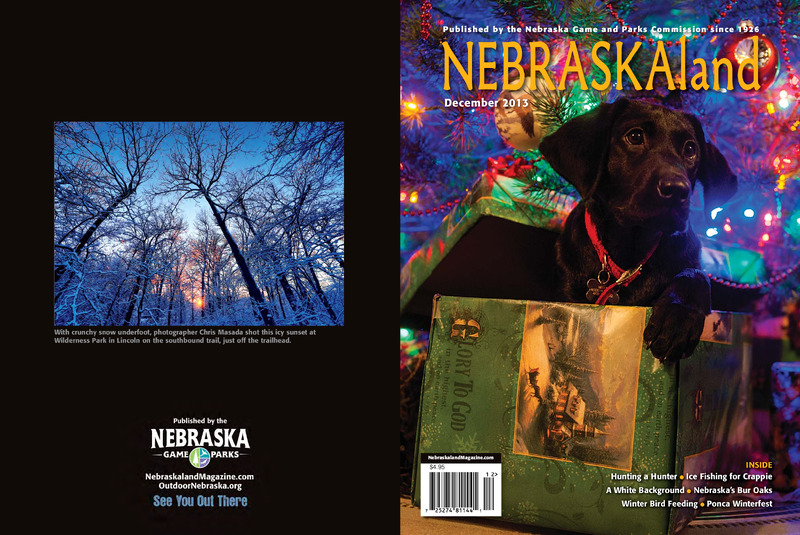
December 2013
With crunchy snow underfoot, photographer Chris Masada shot this icy sunset at
Wilderness Park in Lincoln on the southbound trail, just off the trailhead.
NebraskalandMagazine.com
$4.95
INSIDE
Hunting a Hunter ● Ice Fishing for Crappie
A White Background ● Nebraska’s Bur Oaks
Winter Bird Feeding ● Ponca Winterfest
NEBRASKAland Magazine
Volume 91
●
No. 10
●
December 2013
F EAT U R ES . . .
16 Winter Bird Feeding
BY JENNY NGUYEN
22 Ponca’s Winterfest
BY AMY KUCERA
24 Bur Oak – A Hardy Native Tree
TEXT AND PHOTOS BY GERRY STEINAUER
30 Novices and Experts...
of Winter Crappie Fishing
TEXT AND PHOTOS BY JEFF KURRUS
32 A White Background
TEXT AND PHOTOS BY JEFF KURRUS AND ERIC FOWLER
38 Hunting a Hunter
16
●
TEXT AND PHOTOS BY JEFF KURRUS
D EPARTM EN T S . . .
Comment .........................................................4
Mixed Bag.......................................................6
Product Reviews ...........................................44
Junior Journal................................................45
Classifieds .....................................................46
In the Kitchen ...............................................47
Portraits from the Past ..................................48
Page 49..........................................................49
The Last Stop ................................................50
Gift Collection 2014 .....................................51
24
●
O N T H E W EB . . .
When you see this symbol in the pages
W
oof NEBRASKAland Magazine, visit
N
NebraskalandMagazine.com and view
oour interactive digital edition for more
information.
NEBRASKAland (VOL. 91 / NO. 10, ISSN 0028-1964) is published monthly, except
for the combined Jan./Feb. and Aug./Sept. issues, by the Nebraska Game and Parks
Commission, 2200 N. 33rd St., Lincoln, NE. Periodicals postage paid at Lincoln,
Nebraska, and additional mailing offices. POSTMASTER: Send address changes to
NEBRASKAland, P.O. Box 30370, Lincoln, NE 68503-0370.
2 NEBRASKAland • DECEMBER 2013
32
●
Cover: While puppies sometimes make a great Christmas gift, keeping
them wrapped and under the tree isn’t easy. Photo by Eric Fowler.
Opposite: A pair of antique ice skates hang from Eugene Cromwell’s barn
door in Nance County. Photo by Jeff Kurrus.
DECEMBER 2013 • NEBRASKAland 3
A Visitor Letter
I know this is going to sound like the
way I start every email, but I just got
back into town and found this month’s
issue of NEBRASKAland. As usual, I
flip through the magazine looking at
this month’s goodie to read and for the
visitor. On page 13, I saw a number of
them in the pictures: an ant, monarch,
termites, spiders, lady bug, etc. But I
bet it’s the metallic green and yellow
beetle that’s crawling off those pictures
you are looking for this month. Am I
right?
The 6th graders at Edison School
in Omaha enjoy the magazine as well
as I do. I take it to the classrooms
when I finish and the kids go through
it page by page. I use many of the
articles to expose them to different
aspects of the outdoors. I will also take
them on excursions about 4 to 6 times
a year. We’ve been to Rock Creek
Station, Ashfall, Homestead National
Monument, DeSoto, Squaw Creek,
etc. I try to expose them to as many
different varieties of outdoor activities
as I can. We fish, look for mushrooms,
skeletons, butterflies, flowers, draw,
take photographs, etc. It’s all about
getting the next generation interested
or we won’t have an outdoors to enjoy.
Thanks for the wonderful job you all
do.
Steve Tyler
Omaha, Nebraska
Portraits from the
“Huskers” Past
That was a neat
picture in the
August/September
issue of Allen
Zikmund with all
those fish. It might
be noted that 73
years ago “the kid
from Ord” became
one of the all-time heroes
off Nebraska
h
N b k
football. He caught the pass and ran for
a touchdown that put the Cornhuskers
ahead of Stanford in the 1941 Rose
Bowl.
We old-time fans of the Huskers
cherish the memories of all those
Saturdays played by those all-Nebraska
teams of our youth.
Ramon D. Hansen
Carthage, New York
4 NEBRASKAland • DECEMBER 2013
COMMISSIONERS
CONSERVATION OFFICERS
Director Jim Douglas
NORTHWEST
Officer
City
Jim Zimmerman (S) Gering
Commissioners
Chairman - Norris Marshall, Kearney
Vice Chairman - Lynn Berggren, Broken Bow
2nd Vice Chairman - Jerrod Burke, Curtis
Dr. Mark Pinkerton, Wilber
Dr. Kent Forney, Lincoln
Rex Fisher, Omaha
Mark Spurgin, Paxton
Mick Jensen, Blair
Ron Stave, Waterloo
MAGAZINE STAFF
This photo of the Niobrara River in Brown County, by Angela Carroll of Lincoln,
won first place in the “Wild and Scenic Nebraska” class at the 2013 State Fair.
Congratulations to Angela.
Dustin Lorenson shot this photo of sunflowers at Little Salt Creek Wildlife Management
Area in Lancaster County.
Hawk in the Bird Bath
This photo was taken when the
temperatures were in the very high 90s
to 100 degrees.
We had just got home from church
and I looked out and saw this hawk in
the bird bath – all wet but just sitting
there. I got the camera with a 300 mm
lens and took a series of photos through
the window, though they were not too
good. My daughter took the camera
and walked around the house to the
backyard corner and was able to get a
couple of shots before he or she took
off.
This is possibly a sharp-shinned but
most likely a Cooper’s hawk. I have
not seen the bird back yet.
Rich Ryan
Omaha, Nebraska
Send your comments to:
Jeff Kurrus, Editor
NEBRASKAland Magazine
P.O. Box 30370
Lincoln, NE 68503
or e-mail Jeff.Kurrus@Nebraska.gov
Please include your postal address and
telephone number.
Letters may be condensed and edited
for clarity. Photographs are welcome
and will be returned.
Pat Barnes shot this photo of bull elk in velvet at Fort Niobrara National Wildlife
Refuge in Cherry County.
Any program that receives federal funding from the National Park
Service, or the United States Fish and Wildlife Service prohibits unlawful
discrimination on the basis of race, color, religion, age, gender, marital
status, national origin, age, disability or political affiliation. Any person
who believes he or she has been discriminated against in any program,
activity, facility, or service, should contact the Nebraska Game and
Parks Commission, Lincoln, NE 402-471-0641, the Equal Opportunity
Commission, Lincoln, NE 402-471-2024, TTY/TDD 402-471-4693;
United States Fish Wildlife Service, Civil Rights Coordinator, 4401
N. Fairfax Drive, Arlington, VA 22203; Director, Equal Opportunity
Program, U.S. Department of Interior, National Park Service, 1849 C
Street NW, Mail Code 0008, Washington, D.C. 20240-0001.
Editor Jeff Kurrus
Art Director Tim Reigert
Associate Editor Amy Kucera
Regional Editors Eric Fowler, Julie Geiser,
Justin Haag, Jenny Nguyen
Contributing Editor Michael Forsberg
Regular Contributors Bill Hager, Chris Helzer,
Lisa Knopp
Photo Librarian Sarah Johnson
Circulation Donna Robinson
For address changes and questions about
your subscription, e-mail Donna.Robinson@
Nebraska.gov or call 800-632-5263
Advertising Sales Manager
For advertising information contact
Shane G. Gilster
Phone: 402-742-0125
Email: shanegilster@gmail.com
NEBRASKAland Magazine Copyright 2013, all rights reserved.
NEBRASKAland is available in audio from the Nebraska Library
Commission Talking Book and Braille Service, Suite 120, 1200 N St.,
Lincoln, NE 68508. 800-742-7691. NEBRASKAland Magazine and the
Nebraska Game and Parks Commission reserve the right to reject any
advertising not in keeping with the agency mission.
Rates: $18 for one year; $33 for two years; $44 for three years. Nebraska
recipients must add appropriate sales tax. To subscribe call
1-800-NEBLAND (632-5263), or go online to: NebraskalandMagazine.
com.
COMMISSION
C
COM
OM
OMMIS
M SIO
S ON O
SI
OFFICES
F CES
FFI
ES
S
Headquarters/Southeast District Office
2200 N. 33rd Street Lincoln, NE 68503
Phone 402-471-0641
Northeast District Office
2201 N. 13th St. Norfolk, NE 68701
Phone 402-370-3374
Southwest District Office
301 E. State Farm Rd. North Platte, NE 69101
Phone 308-535-8025
Northwest District Office
East Hwy. 2, Box 725 Alliance, NE 69301
Phone 308-763-2940
Bassett Office
524 Panzer St., Box 508 Bassett, NE 68714
Phone 402-684-2921
Kearney Office
1617 First Ave. Kearney, NE 68847
Phone 308-865-5310
Omaha Office
1212 Bob Gibson Blvd. Omaha, NE 68108
Phone 402-595-2144
Greg Hesse
Scott Brandt
Heath Packett
Dan Kling
Frank Miller
Sean McKeehan
Phone (308)
(office) 763-2940
(cell) 641-6138
Rushville
760-3647
Gering
631-0663
Eagle
402-210-0888
Harrison
430-0572
Valentine 402-389-0444
Bridgeport 308-279-9133
SOUTHWEST
Officer
City
Phone (308)
Roger Thompson (S) N. Platte (office) 535-8025
(cell) 530-3097
Ray Dierking
Brkn. Bow
870-0322
George Sund
Cambridge
655-0028
Michael Thome
Cozad
529-8146
Terry Brentzel
Oshkosh
458-7650
Matt Andrews
Elwood
746-2418
Dirk Greene
Imperial
882-0015
Dale Johnson
Kearney
440-3847
Brian Piernicky
McCook
340-6627
Brandon O’Neal
N. Platte
778-7486
Nicholas Fix
Ogallala
289-0427
Bryce Streger
Ogallala
289-1169
Rich Routh
Rep. City
920-0367
NORTHEAST
Officer
City
Tom Zimmer (Sup.) Norfolk
Dale Davis
Steve Oberg
Daniel Roberts
Randy Pomplun
Jeff Jones
Jon Reeves
Tim Williams
Pat George
Doug Pollard
Alex Frohberg
Cory Krause
Phone (402)
(office) 370-3374
(cell) 649-8053
Bassett
760-0712
Columbus
910-3366
Fremont
719-1108
Fullerton
308-550-0489
Hartington
762-5022
Kennard
889-8508
Grand Is
308-380-7331
O’Neill
340-0787
Ord
308-730-7050
Ponca
241-7615
West Point
380-6410
SOUTHEAST
Officer
Levi Krause (Sup.)
William Krause
Mike Luben
Dan Zuehlke
Darin Gress
Douglas Kramer
Dina Barta
Stacey Lewton
Dudley Sorensen
Robert Finke
Russell Mort
Dan Evasco
Rich Berggren
City
Louisville
Auburn
Colon
Cortland
Hebron
Lincoln
Lincoln
Lincoln
Waverly
Milford
Nebr. City
Papillion
Waterloo
Phone (402)
949-0593
274-8063
443-6392
806-9084
768-8665
890-6465
890-6463
890-7140
937-3422
947-1363
209-1506
616-5961
619-1355
ADMINISTRATION
Officer
Craig Stover (Adm.)
Duane Arp (Ass.)
Jeff Clauson (Ass.)
City
Lincoln
Lincoln
Lincoln
Phone (402)
471-5531
471-5531
471-5531
Nebraska Wildlife Crimestoppers 1-800-742-7627
Ak-Sar-Ben Aquarium
21502 W. Highway 31 Gretna, NE 68028
Phone 402-332-3901
DECEMBER 2013 • NEBRASKAland 5
2012 Even Too Dry for
Grasshoppers
Nebland Flashbacks
PHOTO BY JUSTIN HAAG
By Justin Haag
Nebraskans probably won’t hear many complaints about the
population decline of one type of creature that occurred on the High
Plains this summer.
While grasshoppers usually thrive in drought, it appears the
dry conditions of 2012 actually were too extreme for many of the
familiar jumping insects to reproduce.
Entomologist Mathew Brust of Chadron, a college professor
who studies rangeland grasshopper populations closely, said many
species of grasshoppers that are usually common were virtually
nonexistent this summer.
Grasshopper species that Brust call “forb generalists,” which feed
on a variety of plants, were especially in great decline. Brust said
the spring of 2012 had a strong hatch, but mortality rates among
both immature and adult insects were extremely high – likely
the result of the hot and dry conditions which left grasshoppers
and other animals searching for moisture and nutrition. Fewer
grasshoppers likely resulted in fewer eggs laid for the 2013 brood,
he said.
A few species, which feed on drought-hearty grasses such as
buffalograss and blue grama, did increase in 2012, he said.
“Virtually all other species declined significantly,” Brust said.
“What this clearly shows is that species composition of rangeland
grasshoppers is of major significance as each species responds
differently to a particular set of conditions.”
He also noted declines
in other species that
he studies, namely
butterflies and tiger
beetles.
The decline in
grasshoppers is
welcomed by many
farmers and ranchers, who have been challenged to grow grass and crops in
the extreme conditions. While grasshoppers in abundance can certainly throw
an ecosystem out of balance and become a pest, scientists say they do have
redeeming qualities.
In the right numbers, grasshoppers are valued as a component of a balanced
ecosystem. They are a vital component of the food chain as many animals – and
some humans – consume the hoppers as a high protein food source. ■
NEBRASKAland Magazine has
been known to feature covers
with a holiday theme, as seen
in December of 1970. Images of
each featured story hang from
ornaments on a frosted tree.
One article, “Santa’s For Real,”
is the true story of Christmas on a
snowbound train written in 1925 by
by Will M. Maupin.
6 NEBRASKAland • DECEMBER 2013
DECEMBER 2013 • NEBRASKAland 7
Send Us Your Trail
Cam Photos!
Text and photos by Justin Haag
Pine Ridge Winter
Please submit your trail camera photos by e-mail
to: nebtrailcam@gmail.com. Also include where
you’re from and any information that will help
explain your photo.
n SP
Fort Rob and Chadro
Ice fishing
Bea
coffee
Broker
8 NEBRASKAland • DECEMBER 2013
shop
at Box Bu
tte SRA
Suitable Sleeping
Bags for the Season
Making Sure Your
Muzzleloader Fires
By Nebraska Outdoor U!
When enjoying the outdoors, no one wants to lay
down for the night and wake up a popsicle the next
morning, or vice versa and wake up drenched in sweat.
The proper sleeping bag for the season makes all the
difference. Sleeping bags come in a myriad of different
styles, shapes and characteristics. These steps will help
you understand which bag you need, and when.
Shape does matter, because the amount of circulating
air in your sleeping bag determines the temperature. A
rectangular bag is nice for the summer, and a mummy
style bag will keep you warm in the winter.
Synthetic or Down filling material will not only
affect the warmth of the sleeping bag but also the
weight and size too. Down is super lightweight for the
space it takes up, but if it gets wet it loses its warming
power easily. Synthetic filling is heavier, performs
well in moist conditions and is much easier to care for
compared to down; though it also lasts less than half the
life of down insulation.
Construction of the bag will influence its warming
power too. Baffles are the sewn compartments of
insulation in the sleeping bag. Vertical baffles make for
a comfortable cool bag for warmer weather trips, and
horizontal baffles make up great 3-season, warm bags
suitable for a variety of trips.
Visit OutdoorU.org and start your own pathway to
exciting and memorable experiences in the outdoors.
Get outside and see what the Nebraska outdoors has
for you. ■
By Nebraska Outdoor U!
Cleaning muzzleloading firearms clears the barrel
el of
fouling, oils or preservatives and eliminates potential
ial
obstructions to loading or firing safely. Below are
a few tips for the different parts of your gun once
you remove the barrel, nipple and flash hole insert.
Barrel- Immerse the breech end in a bucket of
soapy water. Using a cleaning patch, swab the boree
thoroughly with the soapy solution until the water
comes out clean. Flush the inside of the barrel withh hot
water, then run several dry patches through the barrel
rel to
htly
completely dry. Finally, swab the barrel with a lightly
oiled patch to prevent corrosion.
all
Nipple and Flash Hole Insert- Scrub with a small
brush to remove all fouling from the channels and the
threads. Rinse thoroughly in clean, hot water and then
hen dry.
Lock- Remove from the stock, then scrub it withh soapy
water. Next, rinse the lock in hot, clean water and dry.
Other Metal Parts- Lightly oil the moving parts andd
the surface of the metal to prevent corrosion. Avoid oiling
the face of the frizzen or getting oil on the flint or the
leather padding for the flint. Too much oil is worse than
not enough, so use the gun oil sparingly.
Stock- Clean any powder residues from the stock with
a soft brush and cloth. Use water or oil on the stock only
if a severe problem exists. Scratches may be treated with
boiled linseed oil (thinned with turpentine or mineral
spirits) or with a commercial stock finish. Do not soak
the stock with gun oil, for it may destroy the wood.
Lastly, store the firearm in a secure, dry area with
a stable temperature and controlled access for safety.
Storing the muzzleloader with the muzzle down allows
any excess oil to drain out of the barrel, preventing oil
damage and ensuring your gun fires the next time the
trigger is squeezed. ■
DECEMBER 2013 • NEBRASKAland 9
IILLUSTRATION BY TIM REIGERT
he picturesque buttes, ponderosa pines
h
and grasslands of the Pine Ridge in the
an
n
northwestern corner of the state transform
to a w
winter wonderland after Jack Frost’s arrival,
making it an excellent getaway for people seeking
fun in the cold.
The National Oceanic and Atmospheric
Administration’s Climatic Data Center reports that
Chadron, in the heart of the Pine Ridge, receives
more annual snowfall than any other city in the
state on record at 42.7 inches. That total is more
than double that of many Nebraska cities.
The long list of activities includes hunting, ice
fishing, snowshoeing, sledding, cross-country
skiing, wildlife viewing or just taking in the sights. Be
sure to bring a camera.
The region has become known for its population of big game
animals, including pronghorn, deer, elk and bighorn sheep. Whether
chasing northern pike at Box Butte Reservoir State Recreation
Area, or crappie at Carter P. Johnson Lake, ice anglers are sure to
enjoy their time on the hard water.
With hiking trails and scenic vistas, Chadron State Park
and Fort Robinson State Park serve as an excellent base for
winter visitors. Although the parks’ lodging is closed from late
November through mid-April, campsites with electrical hookups are available. From charming bed-and-breakfasts to modern
motels, Chadron and Crawford also offer accommodations
with advantageous winter
rates.
After the cheeks turn
red, warm up at one
of the region’s quaint
coffee shops, such as the Bean Broker,
Cleo’s Daily Grind and Daylight Donuts in Chadron or the
Perennial Haus in Crawford.
When night comes, enjoy a sports contest or fine arts
production at nearby Chadron State College, gather with
friends at one of the bar-and-grills, or just cozy up in your
room.
One bit of warning: Travelers should watch road
condition reports and weather forecasts carefully as
Mother Nature can be especially fickle in this country.
For more
information, visit
Chadron
DiscoverDawesCounty.
com, Chadron.com,
OutdoorNebraska.org
and Csc.edu.
Chris Coburn sent in this photo from his
leased ground in Hayes County, which is
also a mule deer conservation area. “Does
on parade,” he wrote in his caption.
Hot
Additions
Log barracks at Fort Robinson, built in 1883.
Christmas at
Fort Robinson, 1882
10 NEBRASKAland • DECEMBER 2013
blind and had to wear dark glasses for
some time after that. One year later
I was promoted to first sergeant of
Troop H.” ■
For more information, go to
Nebraskahistory.org/books.
Christmas Bird Count
By Amy Kucera
Before the early winter bird census known as the Christmas Bird
Count was proposed by ornithologist Frank Chapman, the holiday
custom was to divide into locations and kill every bird in sight,
including non-game species. As the awareness of natural resource
conservation arose, these side hunts were replaced with bird counts, a
tradition that continues today.
The first annual Christmas Bird Count was conducted on Christmas
day 1900, with 27 birders in 25 locations. Since then, it has grown
to become the largest and oldest citizen science event in the world.
Sponsored by the National Audubon Society, thousands of volunteers
have endured a variety of weather conditions to participate in organized
count circles, led by experienced birdwatchers. Data compiled from
each area is valuable for researchers and used to study the health,
habitat and status of bird populations, in addition to guiding future
conservation actions.
This year, the 114th annual Christmas Bird Count will take place
December 14 to January 5. For more information and to participate in a
count near you, visit Birds.audubon.org/christmas-bird-count. ■
PHOTO BY RICK RASMUSSEN
By Lori Cox-Paul and James W.
Wengert, Nebraska State Historical
Society
Fort Robinson provides the
following holiday story of devotion
and courage. It can be found in A
Frontier Army Christmas, published by
the Nebraska State
Hist
Historical Society.
Mar
Martin J. Weber,
an ol
old soldier,
rem
remembered:
“De
“December 1882
then a corporal
in T
Troop H,
Fif
Fifth Cavalry,
Iw
was ordered
to report to the
qu
quartermaster at
F
Fort Sidney, the
nnearest railroad
ppoint, to get
tthe Christmas
go
goods for the Fort.
A ddriver
i
and
d a six
i mule
l team were
detailed for the purpose.”
Weber carried out his orders and
headed back to Fort Robinson.
“The weather had turned cold and frost
began to fly through the air indicating
a storm. The next morning the storm
broke in all its fury, a regular blizzard
raging. We had to head into the storm.
We made Camp Clarke where the
Sidney-Black Hills Trail crossed the
North Platte River.
“The bridge tender and his wife
advised us to stay until the storm
passed. As much as we disliked to
leave the snug quarters and hot meals,
we bid them goodbye and headed into
the storm.
“We got to the Running Water stage
station the night of the 23rd. Here we
had hay for mules and horses and a
warm place to cook our supper. How
good that hot coffee tasted. It gave us
new life and courage for the last twenty
miles of our journey.
“The stage had broken the trail to the
top of Breakneck Hill; the storm had
passed, the fort only five miles away.
We got safely down the Breakneck,
crossed White Clay Creek, and broke
trail across the valley, arriving at the
fort on the 24th.
“When I passed the officers’
quarters, the kiddies were all out
running up and down the walks. When
they saw me, they began to shout,
‘The Christmas wagon has come!’
Hearing them the officers and men
came out. They could hardly believe it
until the teamster drove his six weary
mules up and we began to unload the
Christmas goods. Even the officers
were willing to help.
“So old Santa arrived, and there was
a Merry Christmas after all had given
up hope of seeing either. I was snow
RG1227-43-2 SFN95613_2 NEBRASKA STATE HISTORICAL SOCIETY
A Brief History
By Cristina Woodworth
Instant hot chocolate has
been a staple hot beverage
choice at campsites around
the country for years.
Campers can try adding
some of the following ingredients to
kickstart their cocoa and give their taste buds
something to rave about.
Mix up a fresh cup of hot chocolate and
then try adding:
• Caramel: Stir in a spoonful of your
favorite caramel sauce for an even sweeter
ter
take on your hot chocolate drink.
• Peppermint stick: Adds a great new
flavor to your traditional brew. Use a
candy cane during the holiday season forr
added spunk.
• Chili powder: Sounds odd but
tastes great. The perfect amount of
zip and sweetness makes chili powder andd cocoa good
partners.
• Cinnamon: About ½ of a teaspoon of cinnamon is sure to
add some spice to your drink. It goes well with the holidays as
well.
• Coffee: Add some coffee or espresso to your instant hot cocoa if you need a little more of a pick-me-up. Coffee makes
your hot chocolate seem like more of an adult drink too.
• Peanut butter: A classic flavor combination – just make sure it melts all the way in before sipping.
• Pumpkin: Plop a few spoonfuls of canned pure pumpkin into your next mug of hot chocolate. Tastes even better if you
top it off with whipped cream and a dash of nutmeg.
• Orange zest: Cut up some strips of an orange peel and let them soak in your mug for a few minutes before drinking. The
citrus taste and scent are a delightful addition. ■
DECEMBER 2013 • NEBRASKAland 11
By Cristina Woodworth
Once Nebraska’s winter winds
start to howl and snowflakes begin to
blanket the ground, many campers may
choose to pack away their tents and
sleeping bags for the season.
There are still cozy ways to enjoy all
the outdoor activities the state has to
offer, though, by booking a cabin for a
weekend sledding getaway or full week
of family festivities.
There are five Nebraska recreation
areas that offer cabin rentals yearround: Eugene T. Mahoney State Park,
Platte River State Park, Ponca State
Park, Lewis & Clark State Recreation
Area and Niobrara State Park.
Most of these parks have a fair
amount of weeknight availability
during the winter season. Some parks
even offer a 30 percent discount on
winter cabin reservations made for
Sunday through Thursday nights.
Weekend visitors looking for a cabin
stay are also usually able to find one,
although some of the bigger cabins,
especially at Mahoney State Park, tend
to get booked further in advance.
Over holiday breaks, especially
Christmas and New Year’s Eve, open
cabins at Nebraska’s state parks are
sometimes difficult to find. Holiday
reservations for cabins at Mahoney and
Platte River state parks generally need
to be made an entire year in advance.
Cabin sizes range from Mahoney’s
Skiing Cross
Country
six-bedroom deluxe structures and
Ponca State Park’s four-bedroom minilodges and earth-friendly two-bedroom
green cabins. Almost all of the state
park cabins offer amenities such as
wireless internet, cable television, full
kitchens, modern bathrooms and living
areas.
Visitors wanting to snag a cabin at
the last minute should never assume a
state park or recreation area is already
full. Always check online or call the
reservation customer service center
to make reservations or to check the
availability at certain parks.
Don’t settle for staying at home all
winter. Get out and enjoy the comfort
and rustic atmosphere of sleeping in
one of Nebraska’s state park cabins. ■
PHOTO BY JEFF KURRUS
By Cristina Woodworth
Across the state, visitors can
discover a new winter passion
by strapping on a pair of crosscountry skis and gliding across
snow-packed fields, through
peaceful woods and around frozen
lakes.
Cross-country skiing differs
from traditional downhill
skiing in that the ski boots
generally only attach to the
ski at the toes, allowing skiers
more heel movement to help
propel themselves forward.
Cross-country skiing involves a
technique similar to the movement used when ice skating
and is known to be a great cardiovascular workout to be
taken advantage of during the winter months.
In the Panhandle, Fort Robinson and Chadron State
Park are both popular cross-country ski options with each
offering groomed ski trails as well as off-trail possibilities.
Experienced skiers can enjoy the steep pine-covered buttes
while beginners can first try out the area’s more gently
sloping hills.
The bluffs and steeper areas located along the Missouri
River corridor also offer a variety of challenges for skiers
at Ponca State Park near Ponca and Indian Cave State Park
near Falls City. Many of the hiking and horseback riding
trails in these areas are re-opened for cross-country skiing
during the winter months, providing miles of skiing weaving
through woods and across open meadows.
Eugene T. Mahoney State Park, near Ashland, is another
popular cross-country skiing destination in eastern Nebraska,
WHITE RIVER TRAIL NEAR FORT ROBINSON STATE PARK, PHOTO BY BOB GRIER
Cabin Rental
with several looping ski trails kept up during the winter
season and many more acres open for off-trail exploration
around the park.
Other ski areas across the state include Lake Maloney
State Recreation Area near North Platte, Fort Kearny State
Recreation Area near Kearney and Wildcat Hills State
Recreation Area near Gering.
Many other outdoor areas are also open to cross-country
skiers as well. Visitors should call beforehand to get the
most up-to-date snow and trail information for their state
park or recreation area of choice.
Skiers new to the sport will find cross-country ski, boot
and pole rentals available at several places across the
state including the University of Nebraska at Omaha and
University of Nebraska-Lincoln recreation centers. Snow and
Sun Sports in Scottsbluff and Moose’s Tooth in Lincoln also
sell skis and other snow equipment.
Nebraska may lack mountain ranges, but skiing is still
certainly a winter option for park visitors across the state. ■
Silicone Gun Clothss
12 NEBRASKAland • DECEMBER 2013
PHOTO BY JU
LIE GEISER
By Julie Geiser
After a day in the field your firearm can be
wet from incremental weather, a condition not
good for any gun’s wood or metal surfaces. But
in the field cleaning can be done simply and
inexpensively with a silicone cloth purchased
from any sporting goods store or online – costs
range from $4 to $8.
Easily carried in a coat or pant pocket, the
cloth provides the ultimate in rust prevention
and is a must for finger print removal on all
firearm surfaces.
While a more thorough cleaning will be neededd at home, a silicone cloth is a
great way to take care of your gun until you can get there. ■
DECEMBER 2013 • NEBRASKAland 13
... And Your
Bat Caves
Contact the Nebraska Game and
Parks Commission at
402-471-0641 or visit
OutdoorNebraska.org for more
information. Visit HuntSafeNebraska.
org for a list of hunter education
classes and BoatSafeNebraska.org
for a list of boating safety classes.
December 1
Cornucopia of Crafts, Eugene T. Mahoney
SP, Ashland,
9 a.m.-5 p.m., 402-944-2523
December 1 Bobcat hunting and trapping
season opens
December 1, 21-22, 26-30
Roger G. Sykes Outdoor Heritage Education
Complex open to public, Platte River SP,
Louisville, 10 a.m.-4 p.m., 402-471-5547
December 1-31 Antlerless elk hunting
season
December 1-31 Muzzleloader deer hunting
season
December 7 Fort Robinson SP Historical
Christmas Dinner, Crawford, 308-665-2900
December 13 White-fronted goose hunting
season (first segment) closes
December 14 Christmas Bird Count,
Ponca SP, 402-755-2284
December 16 Snipe hunting season closes
December 16 Application period begins
for Prairie Unit mountain lion permits
December 17 Duck and coot hunting
Do you know where this Nebraska photograph was
taken? See answer at the bottom of page 15.
PHOTO BY JEFF KURRUS
November 28-February 18 Winterfest,
Ponca State Park (SP), Ponca, 402-755-2284
Show Us Your Man Caves ...
By Jenny Nguyen
Think you have the best man
cave in the state? NEBRASKAland
is looking for the most decked
out, unique and jaw-dropping man
caves in all 93 counties. Send us
photos of your sanctuary and it
may be featured in the magazine or
online. Ladies, you’re welcome to
send submissions, too!
Show us where you hang out
with the boys (or girls), where
you contemplate your next hunt
and where you proudly display
all your accomplishments in the
field. Photos can be of your garage,
basement, office, attic, workshop,
cabin or any space that you go to
for escape – we’re talking game
mounts, fish mounts, fur rugs,
hanging pelts, unique signs and
posters, gun displays, game tables,
outdoor gear and equipment, and of
course, lots of camo!
Submissions must be outdoorrelated to be considered. Please
send high-resolution images to
jenny.nguyen@nebraska.gov, along
with your name, a brief description
of your man cave, your city or
town of residence, and best contact
information. ■
December 17 Duck and coot hunting
season in Zone 4 closes
December 24 Duck and coot hunting
season in Zone 1 closes
December 25 Christmas Day, Game and
Parks offices closed
Conservation Area and Statewide Whitetail
Buck deer hunting seasons close
14 NEBRASKAland • DECEMBER 2013
PHOTO BY JEFF KURRUS
season closes
December 31 Archery, Mule Deer
numbers [in the
winter],
i t ] bbutt if we can find
fi d some we
can monitor for white nose and better
understand a bat’s winter ecology in
Nebraska in general,” Geluso said.
Bats enter their hibernacula as early
as September and exit in May. Geluso
and other researchers believe the best
potential to find larger hibernating
populations lies in mines and quarries
in southeastern Nebraska.
If you know of such a site, contact
one of the following:
Keith Geluso, University of
Nebraska at Kearney, 308-440-3430,
gelusok1@unk.ed.
Trish Freeman, University of
Nebraska-Lincoln, 402-472-6606,
pfreeman1@unl.edu.
Mike Fritz, Nebraska Game and
Parks Commission, 402-471-5419,
mike.fritz@nebraska.gov.
Jeremy White, University of
Nebraska at Omaha, 402-554-3294,
jeremywhite@unomaha.edu. ■
Omaha WorldHerald Partner
Site Launched
season in Zone 2 Low Plains and High
Plains (first segment) closes
December 31 Archery antelope hunting
PHOTO BY KE
ITH GELUSO
by Jerry Kane
By Eric Fowler
Researchers know that eight of
the 13 species of bats found in
Nebraska likely hibernate here
during the winter months. What
researchers would also like to
know, however, is how many
bats there are and where.
Nebraska has few natural
caves where bats could
hibernate. But these unique
mammals are known to overwinter
nter in
houses, quarries, mines and sewers.
Researchers have an interest in locating
bat hibernacula to gather baseline
date on wintering populations before
white-nosed syndrome, a disease that
has killed millions of hibernating bats
in eastern North America, arrives.
Caused by a white fungus that appears
on the muzzle and other body parts
of hibernating bats, it was first
documented in New York in 2006 and
has spread rapidly across the eastern
United States and Canada and is now
found as far west as Minnesota, Iowa
and Oklahoma.
“Any kind of information on possibly
where there’s a cave or hole would be
great,” said Keith Geluso, a University
of Nebraska at Kearney biology
professor who has researched bats and
his currently studying the small number
of tricolored bats that hibernate in the
Happy Jack Chalk Mine near Scotia.
“Bats may not be here in huge
NEBRASKAland
Visitor
By Amy Kucera
Nebraska Game and Parks
Commission has partnered with the
Omaha World-Herald to create the new
website: GoOutdoorsNE.com.
The site features a mix of outdoor-related content from the Commission,
NEBRASKAland and Omaha World-Herald staff, including the latest interactivee
digital edition of NEBRASKAland, as well as news alerts, social media updates,,
access to outdoor forums, trophy board for hunters, photo galleries, videos, links
and more. Content is updated daily. ■
Last issue’s winner of
the Visitor drawing was
Kyle Held of Elkhorn,
Nebraska, who found the
dogbane beetle on page 13.
Readers are encouraged to contact
NEBRASKAland within 10 days
after this issue’s publication with
the correct page number and name
of this issue’s “Visitor” – a critter
found in Nebraska. We will then
gather the correct entries and draw
one to win a NEBRASKAland
Magazine mug. To enter each
month, write:
NEBRASKAland Visitor
2200 North 33rd Street,
Lincoln, NE 68503.
Or e-mail:
Tim.Reigert@Nebraska.gov
with “Visitor” in the subject line of
the message.
HINT: This issue’s visitor is not
on page 6, 15, 52, or 53.
The dogbane beetle is a beautiful
native insect that shimmers like a
tiny blue-green jewel. This
iridescence is caused by thousands
of tiny plates that cover the beetle.
As light hits the plates, it is
reflected back to the viewer. The
colors seen, which can range from
greens and blues to reds and golds,
depend on the angle of the viewer.
Adult dogbane beetles feed on the
foliage of dogbane and milkweed,
while larvae feed on the plant roots.
The sap of these plants contains
chemicals toxic to many insects.
However, the dogbane beetle is
not affected by the toxin, instead
storing it in its body and releasing
it when threatened to ward
off predators.
pred
The beetle’s
showy co
coloration may also
deter predators, while
det
iitss ability to suddenly
it
drop from a leaf offers
dro
a quick escape to
aavoid being eaten.
Special thanks to Julie Van Meter,
Specia
State
e En
ntomolog
Entomologist,
Nebraska Department of
Agr
gric
iculture Visitor
Vi
Agriculture.
image by Chris Helzer.
Bugguide.net is a good site for identification
LINCOLN’S DINOSAUR MUSEUM AND HEARTLAND HAUNT
See You Out There... But Where?
DECEMBER 2013 • NEBRASKAland 15
By Jenny Nguyen
L
ooking out my window last
winter, I would say that the
birds were confused as I was.
Spring was late in coming,
and the robins, not knowing whether
to start their spring nesting, hung idly
by my apartment complex looking for
whatever food they could find. It had
been a month and a half past the last
day of winter, and I was still seeing
birds outside being thrashed about in
the cold, icy wind. Perhaps I saw my
own frustrations in their struggle to
survive this seemingly never-ending
chill that I took conscious note on
how hard long winters must be on
birds.
Like us, birds are warm-blooded
creatures. They must maintain constant
body temperatures within a normal
range in order to survive. Flight,
especially, requires a considerable
amount of energy – energy that birds
must get from what they eat. Sudden
drops in temperature and sudden
snowstorms, like what we experienced
towards the end of this last winter
season, can catch birds off-guard and
unprepared. During these severe times,
keeping well-stocked bird feeders
around can be especially helpful to our
feathered friends.
Bird Food Basics
There are many different types of
bird feed available on the market, so
many that it can be overwhelming and
confusing to a novice bird enthusiast.
The important thing to remember
for winter is that birds require high
amounts energy in order to sustain their
high metabolism, therefore feed that
is rich in fat is more desirable. This
includes nuts and seeds that contain
high oil contents and actual fat like
suet or vegetable shortening.
Although there is no such thing
as the perfect bird seed mix, the
consensus among birders is that black
oil sunflower seeds, peanut kernels,
white proso millet and Niger thistle
are most preferred by a wide variety
of wild birds. Providing a good variety
of seed will allow you to help as many
birds as possible in addition to being
able to attract as many birds to your
backyard. When it’s too cold to be
outside, just watching all the different
colored birds that come by your bird
feeder is a nice change from looking at
the same dull winter scene.
Actual seed preferences will vary
depending on the time of year, the
types of birds present, temperature,
moisture and rainfall, and the location
of feeders relative to nearby water
and other food sources. The best way
to find out is to experiment and see
what types of feed will work best in
your area. Your local bird specialist or
pet shop can also provide you with a
wealth of information on feed and all
the types of feeders you can get.
Here are some common bird feeding
options as well as their pros and cons.
You should include at least five or six
of these seeds in your feeders to attract
a variety of birds. Feeders should also
be placed in locations that are out of
the wind and harsh weather.
Blue jays mainly feed on nuts and seeds, using their strong beak to crack acorns.
16 NEBRASKAland • DECEMBER 2013
PHOTO BY RICK RASMUSSEN
Invite a variety of visitors to your
backyard this season.
DECEMBER 2013 • NEBRASKAland 17
SUET AND VEGETABLE SHORTENING
are excellent sources of energy for birds in the winter. Suet is raw animal fat that
you can feed whole to birds or it can be rendered down to make suet cakes that
incorporate both fat and seeds. Suet is sold in the meat section of some grocery
stores, but if you ask, your butcher might even give it to you for free. One
disadvantage in using raw suet is that it can go rancid, and for that reason, some
people prefer to render it down to make suet cakes or they will use vegetable
shortening instead. Rendered suet and vegetable shortening will last much longer,
especially during breaks of warmer weather. Commercially-made suet cakes are
also sold in stores.
BLACK OIL SUNFLOWER SEEDS
should be the primary component in any bird feed mix. Ideally, it should
make up 75 percent of the seeds you offer birds. Easy to crack open and
high in energy-rich oils, over 40 different bird species will eat black oil
sunflower seeds, including chickadees, purple finches, pine siskins, blue
jays, northern cardinals, evening grosbeaks, mourning doves, dark-eyed
juncos and more. However, constant clean-up will be needed at any active
bird feeding station containing sunflower seeds. A cleaner alternative
would be to offer hulled sunflower hearts or chips, which are preferred by
smaller birds like white-throated sparrows, American goldfinches and house
finches.
PEANUT KERNELS OR PEANUTS IN THE SHELL
are popular among a variety of birds, including blue jays, woodpeckers,
tufted titmice, sparrows, red-winged blackbirds, indigo buntings, northern
cardinals, gray catbirds, black-capped chickadees, purple finches,
goldfinches, wild turkeys, American robins, nuthatches, wrens, doves,
ravens and more. Peanuts are high in fat, protein and vitamins needed for
birds to survive through the winter. Peanut hearts, the tiny chips left behind
when peanut halves are broken, are great for smaller birds.
WHITE PROSO MILLET
NIGER THISTLE
18 NEBRASKAland • DECEMBER 2013
A white-breasted
nuthatch (left)
and a red-bellied
woodpecker (right)
dine at the feeders at
Ponca State Park.
DECEMBER 2013 • NEBRASKAland 19
PHOTO BY JENNY NGUYEN
is highly popular among American goldfinches, in addition to being able to
attract other species like redpolls, mourning doves, dark-eyed juncos, North
American sparrows, red crossbills and indigo buntings. However, it is one
of the more expensive wild bird foods available. A potential problem with
thistle is that it can easily mold or go rancid in wet weather.
ALL SEEDS PROVIDED BY THE WILD BIRD HABITAT STORE WWW.WILDBIRDHABITATSTORE.COM
is common in many ready-made bird seed mixes found at the store. They are
cheaper than other seeds available. Although they are popular among wild
birds like bobwhite quail, northern cardinals, mourning doves, purple finches,
dark-eyed juncos, North American sparrows, towhees, wild turkeys, blue jays
and ring-necked pheasants, they are also attractive to the non-native house
sparrow and brown-headed cowbird. House sparrows outcompete native song
birds for nesting areas, while cowbirds displace native bird species by laying
their eggs in songbirds’ nests. White proso millet is fine in a pinch, but if you
want to attract a wider variety of wild birds to your feeder and fewer house
sparrows, stick to black oil sunflower seeds although it may be a little more
expensive.
CORN
is eaten by many types of birds. Cracked corn is well liked by species such as
blackbirds, bobwhite quail, indigo buntings, northern cardinals, doves, ducks,
finches, pheasants, sparrows, wild turkeys and woodpeckers. However, cracked
corn will also attract problem species including house sparrows, brown-headed
cowbirds and starlings. Shelled corn or corn still on the cob is popular among
bigger birds such as ring-necked pheasants and wild turkeys, but the problem
is that squirrels also love it, too. Whole corn kernels are not a preferred feed
among birders because they are too big and hard for most small birds to digest.
SAFFLOWER
can be a great alternative to black oil sunflower seeds. Cardinals, rosebreasted grosbeaks, chickadees, nuthatches, mourning doves, house finches
and white-throated sparrows love safflower while house sparrows and
starlings don’t seem to touch it.
SQUIRREL PROBLEM
For many bird feeding enthusiasts, squirrels can be a nightmare. Feed such as black oil sunflower seeds, nuts, corn and suet
are just as attractive to squirrels as they are to birds. Oftentimes, squirrels will scare or chase birds away and consume large
quantities of feed, leaving little behind. They can also damage feeders by chewing through plastic or wood. To minimize the
impact of squirrels, there are a variety of squirrel resistant bird feeders and accessories like spinners and baffles available.
Squirrels can also jump long distances of 10 feet or greater, so make an effort to keep feeders away from trees, wires and
porches that can make it easy for squirrels to launch from. Offering seeds that squirrels don’t eat, such as Niger thistle
and safflower, will also help reduce seed lost. And because squirrels are sensitive to the heat of peppers and birds are not,
another trick is to add cayenne pepper or similar spices to bird feed – just don’t rub your eyes afterwards.
A NEWFOUND HOBBY
With this basic knowledge,
you are now ready to start bird
feeding. In addition to online
sources, there are several bird
feeding experts throughout the
state that can further assist you
with feed selection, feeders and
general wild bird facts, including
the Wild Bird Habitat Store
in Omaha and Lincoln, Wild
Birds Unlimited Nature Store in
Omaha and For the Wild Birds
in Bellevue and Omaha.
This winter, pick up bird
feeding. You never know what
kind of visitors will come
calling. ■
20 NEBRASKAland • DECEMBER 2013
1. Cut twine into about 10-inch pieces.
Tie twine to the top of the pinecones
and make a loop for hanging. With a
spoon, spread vegetable shortening all
over the sides of the pinecones, making
sure to pack it into all the crevices.
Work in aluminum pans or rimmed
baking sheets for easy clean-up.
2. Next, pour a handful of bird seed
mix into the aluminum pan or baking
sheet. Roll the pinecones in the bird
seed, and then use your fingers to
fully pack and incorporate the seeds
into the shortening. Pack as much
seed as the shortening can hold in all
the pinecones’ crevices. Afterwards,
stick raisins and/or dried cranberries
throughout.
Cora Heemstra makes homemade seed cake bird feeders during
the Birds and Breakfast event at Ponca State Park.
PHOTOS BY JENNY NGUYEN
Madeline Heemstra glasses through the back window at Ponca State Park’s Resource and
Education Center during the Great Backyard Bird Count.
ird feeders come in all shapes
and sizes, but they don’t have
to be complicated to serve
their purpose. For a fun indoor winter
activity, make pinecone bird feeders
with your children. This is easy and
cheaper than buying commercially
prepared suet cakes at the store. Once
assembled, set these bird seed cakes
out, then go back inside and watch. This
is a great opportunity for you and your
family to learn about the wild birds of
Nebraska.
What You’ll Need: medium to large
size pinecones, twine, vegetable
shortening, bird seed mix, raisins or
dried cranberries, scissors, disposable
aluminum pans or rimmed baking
sheets lined with foil or parchment
paper, and spoons.
3. Once done, hang your pinecone
seed cakes outside and watch for
feathered visitors.
DECEMBER 2013 • NEBRASKAland 21
Ponca’s Winterfest
By Amy Kucera
C
loaked in a fresh cover of early winter snow, a
spectacular solitude filled the frosted woodlands
and high bluffs of Ponca State Park. But the
stillness didn’t last long.
Footprints and fruitcakes soon lined the frozen ground
during the pinnacle event of the season known as Winterfest,
a celebration that encourages guests to rekindle wintertime
traditions – as well as create anew – in the great outdoors.
During the Fruitcake Fling competition, visitors were invited
to toss loaves baked with millet and sunflower seeds, which
doubled as a gift of food to the feathered residents of the
2,400 acre park.
Under a stone shelter, the steam of mulled cinnamon
cider rose from the cups of competitors, keeping warm with
wassail before competing in a series of challenges on a
quest to locate the yule log, a traditional custom in European
culture adapted to include an obstacle course and kindling
hunt for kids.
Once teams completed each challenge, they were
presented clues leading to the location of the yule log. After
an exciting discovery, the decorated Austrian pine was
pulled from the forested hills by horse and cut by hand-saw.
Together with kindling bundles, the log pieces – save one
for next year – fueled the flames of the celebratory bonfire.
According to earlier tradition, this practice was meant to
bring good luck throughout the year. Awards were presented
and more laughs and wassail shared around the glowing
blaze.
Families also gathered indoors within the Missouri
National Recreational River Resource and Education Center
for wreath making, card and cookie decorating, popcorn
and pine cone crafts, student art show displays and family
photographs by the fireplace. An open house in an adjacent
mini-lodge featured refreshments of wine and cheese.
Adorned in blue and silver costume, an elf with sparkled
eyes, known as the Winter Sprite, greeted and assisted
visitors throughout the celebration.
As dusk settled in, guests wrapped in blankets and boarded
a lighted hayrack to ride to the park’s tri-state overlook for a
serene scene of the Missouri River Valley under winter’s icy
spell, only to return to the bustle of cooks in the kitchen and
soup smells of homemade chili, chicken noodle and oyster
stew. R.P. Smith of Broken Bow shared his humorous brand
of cowboy poetry and wintertime tales from the Pine Crest
Ranch to the delight of the crowd.
While the bonfire smoke faded into the night sky amid the
glow of decorative lights, smiles radiated from those
still lingering, reflecting on their first Winterfest
experience, with a promise that it won’t be their
last.
And so the tradition continues. ■
Ponca Winterfest
Events Calendar
November 30 - December 28 Homemade Holidays
Special discounts at the park gift shop, free hot
chocolate and wassail, lighted hayrack rides and more.
December 4 Hometown Holidays Christmas Parade
Caroling, horse-drawn sleigh rides, tree-lighting,
decorated floats and a visit from Santa Claus are
features of the Christmas Parade in downtown Ponca.
December 14 Christmas Bird Count
Track feathered friends for the National Audubon
Society’s annual count. Free chili feed for participants at
noon.
December 21 Winter Solstice Wine & Cheese Tasting
Sample tastes of the season, including flavored coffee
and sparkling cider, and enjoy last-minute holiday
shopping with special discounts at the park gift shop.
December 28 3K Snow Run, Yule Log Quest & National
Championship Fruitcake Fling
Teams compete in challenges to locate the yule log in
the park, as well as other outdoor activities including a
snow run, bonfire and competition fruitcake toss.
January 1 First Day Hike
Ring in the New Year along park trails and end the trek
with hot cider and cookies.
January 5 National Bird Day
See for yourself why the park was declared an
“Important Bird Area” by the National Audubon
Society, with guided avian adventures and educational
programs for all ages.
February 2 Super Bowl Sunday Mini-Lodge Package
Football fans can enjoy watching the big game with
family and friends in a beautiful mini-lodge setting with
complimentary food and firewood.
February 14-18 Birds & Breakfast
Especially for love birds, this Valentine’s Day lodging
package coincides with the Great Backyard Bird Count
and includes everything a couple needs to enjoy a
cozy mini-lodge stay with complimentary breakfast
on Saturday, special bird viewing opportunities,
guidebooks and more.
22 NEBRASKAland • DECEMBER 2013
NEBRASKAland • DECEMBER 2013 23
PHOT
OT
TO BY DOU
DOUG
G CARROL
CAR
L
Ponca State Park’s Winterfest brings guests out for
an evening hayrack ride through the park.
Regularly scheduled park events include a sledding hill,
groomed cross-country ski trails, winter crafts, bird, wildlife
and tracks identification, critter corner, guided hikes and
more.
Bur Oak
A Hardy Native Tree
Text and photos by Gerry Steinauer, Botanist
L
24 NEBRASKAland • DECEMBER 2013
the young oak shot upward until its
crown was beyond reach of browsers
and damage by fire. The mature oak
survived droughts from the 1700s and
1800s more prolonged than the Dust
Bowl, and countless wind and ice
storms. It also escaped the settlers’
ax that felled many oaks, perhaps its
wide trunk dissuaded ax-wielding
homesteaders.
By any measure, the
Bellevue bur oak is a
magnificent specimen
and exemplifies
the characteristics
attributed to
this species –
adaptable, sturdy,
and above all,
resilient.
PHOTO BY MICHAEL FORSBERG
ast spring I ventured to Bellevue
to see Nebraska’s largest bur
oak. As I eyed the mighty
giant, I was awestruck. At 70 feet its
spreading crown draped the 1950s,
wood-sided house and nearly the entire
backyard in which it was rooted. Its
stout trunk, a staggering 18 feet in
circumference, rose and split into
three main branches: each
of these as thick as the
trunks of many stately
oaks.
The oak was old,
at least 300 and
possibly 400 years
in age. Had Otoe
Indian children
played below
the tree while
their mothers
gathered fallen
acorns? Had
members of
the Lewis and
Clark Expedition
paused in its shade
while exploring
the area in July of
1804? Certainly, nowextinct passenger pigeons
had once flocked among its
branches as bison and elk grazed
nearby.
The oak’s short trunk and spreading
lower branches testify that it had
matured in open prairie, for in forests,
sparse sunlight forces trees to grow
rapidly skyward, forming tall and
straight trunks. As a seedling in prairie,
the oak faced fierce competition
from dense, sod-forming grasses
and frequent nipping by rabbits and
deer. As a sapling, prairie fires likely
scorched the oak, but it sprouted each
time from protected, below ground
buds. Taking advantage of a period
with no fires and few browsers,
The
Ancient
OakHickory
Forest
“The ancient oakhickory forest was
immense and spectacular,”
wrote Thomas Bonnicksen in
his 2000 book America’s Ancient
Forests. “This was not a
forest of lofty trees with
great trunks. Some trees
were indeed large, but
it was mostly a forest
of relatively small trees
in open woodlands
or scattered through
grasslands ... . It was
spacious and sunny
because the trees stood apart, and it
seemed as big as it was. Early travelers
who saw this ancient oak-hickory
forest for the first time stood breathless
at the scene. Not only because it
At 70 feet in height and with a trunk circumference of 18 feet, this mighty Bellevue bur oak was crowned a
Nebraska Champion Tree in 2005.
looked like an artist’s rendition of the
perfect landscape, but also because of
the animals that teemed within it and
gave it life.”
At the time of Euroamerican
settlement, oak-hickory forest
ccovered some 132 million acres of
tthe Midwest forming a wide belt
bbetween the Great Plains grasslands
to the west and more humid forests
to the east. Far eastern Nebraska lay
at its western frontier.
Nebraska’s semi-arid climate is
N
only marginal for tree growth. Far
onl
southeastern Nebraska averages 33
inches of precipitation a year, whereas
areas of the Panhandle average only 16
inches. By comparison, eastward, areas
of the oak-hickory forest average more
than 40 inches of annual precipitation.
Our stream and river valleys, however,
are sheltered from drying prairie winds,
their north- and east-facing slopes
partially shaded from the desiccating
summer sun, and their waters raise
the local humidity making a more
favorable environment for tree growth
than adjacent uplands.
Predictably, the valley of the
Missouri River and its lower tributaries
support Nebraska’s most extensive
growth of deciduous trees. In his 1965
book Native Vegetation of Nebraska,
famed University of Nebraska plant
ecologist J.E. Weaver split our state’s
oak-hickory forest into three plant
community types. The Red Oak-Linden
Community occupies protected slopes
and ravines along major streams in far
eastern Nebraska, while the Black OakShellbark Hickory Community is found
on slightly drier sites south of Omaha.
Although, a component in these two
types, bur oak reaches dominance in
Weaver’s Bur Oak-Bitternut Hickory
Community that inhabits drier slopes,
hilltops and river terraces. The term
woodland, rather than forest, may best
describe this community for woodlands
have fewer trees and a more open
canopy than forests, thus more sunlight
reaches the ground.
In southeastern Nebraska, chinkapin
oak, hackberry, green ash and other
tree species grow with bur oak and
bitternut hickory in this community,
though in less abundance. Westward
and northward, along our major rivers,
the less drought-tolerant species,
including bitternut hickory, begin to
drop out. On the Niobrara River in
Brown County, for example, basswood,
black walnut and ironwood grow
on low slopes in this type, but near
Valentine, a mere 50 miles westward,
only the drought hardy bur oak
remains.
Occasionally, bur oak woodlands
are found far from Nebraska’s major
stream valleys. In the Bohemian
Alps of Butler, Saunders and Seward
counties, for example, bur oaks grow
on rolling hills, formerly amidst a sea
of prairie, though now mostly bordered
by cropland. Our westernmost bur oak
stand is isolated in Hitchcock County’s
DECEMBER 2013 • NEBRASKAland 25
An old bur oak grows on a ridgetop at Indian Cave State Park. Its short trunk and spreading lower branches testify that it
had matured in open prairie.
deep and rugged Bur Oak Canyon.
Here 300 to 400 trees survive along
a two-mile stretch of the dry canyon
nearly 100 miles west of other bur
oaks in the Republican River Valley.
Possibly, these trees are relicts of a
post-Ice Age period 11,000 to 9,000
years ago, when Nebraska’s climate
was cool and moist and bur oaks and
other deciduous trees occupied much
of our state, or they are more recent
migrants to the area.
A Wide-ranging,
Adaptable Species
From eastern Nebraska, bur oak
ranges northwestward through the
26 NEBRASKAland • DECEMBER 2013
western Dakotas and into southeastern
Saskatchewan, from there eastward
to southern Quebec and then
southwestward to the Texas Gulf
Coast. Bur oak is the most common
and widespread of our state’s six
native oaks. A malleable growth form
allows it to grow in diverse habitats.
On a moist, deep-soiled Missouri
River terrace at Ponca State Park, for
example, forest-grown, long-trunked
bur oaks tower to near 80 feet in
height. Whereas, westward, on sandy
Niobrara River blufftops in Cherry
County, short-trunked, gnarled bur
oaks reach only 15 to 20 feet tall.
On the Black Hills’ low northern
flank, shrub-like bur oaks eke out an
existence on dry, rocky prairie. By
comparison, the species can reach 130
feet tall in eastern Midwest states.
Fast-growing, deep and extensive
roots allow bur oak to survive periodic
Plains drought. First year taproots can
penetrate the soil nine inches before the
first leaves unfold, and by fall reach a
depth of five feet. In 1932, Weaver’s
graduate student Joseph Cramer
excavated the entire root system of a
65-year old eastern Nebraska bur oak.
The 37-foot tall oak’s main taproot
reached 14 feet in depth and it had
64 other main roots greater than two
inches in diameter, some up to 15 feet in
length. The roots’ weight nearly equaled
that of the tree’s above ground growth.
A stand of black oak on the Missouri River bluffs in Richardson County. These forest
trees have tall, straight trunks and few lower branches.
Having evolved in fire-prone
environments, bur oak is well adapted
to Nebraska’s prairie landscape where
lightning and Indian-set fires were once
common. The tree’s outer bark, up to
1½ inches thick, protects the sensitive
inner cambium from flames and heat.
If top-killed by the heat of intense fires,
small to medium-sized bur oaks can
resprout from the trunk base or lateral
roots. For example, in 2012 the raging
wildfire in the central Niobrara River
Valley scorched the bark off the trunks
or otherwise top-killed numerous bur
oaks, and many are now sprouting new
growth from the base.
Bur oak seedlings and saplings
also can resprout when top-killed,
and if repeatedly burned, the saplings
can develop grubs – large, burl-like
growths at the soil surface. Given
several years of fire-free growth, and
using energy stored in grubs and roots,
saplings can bolt to a height where safe
from all but the most severe fires.
Bur oak’s leathery leaves, after
falling, remain dry, curl and become
highly combustible. When conditions
are dry, Nebraska’s oak woods
will burn any time after leaf fall to
spring green-up. Oak leaf-carried
fires are generally slow-moving,
with flame heights of a foot or less.
By comparison, the leaves of elms,
ironwood and other fire-intolerant
species are thin, easily dampened when
on the ground and far less combustible.
Woodlands dominated by these species
burn sporadically at best, except when
extremely dry.
Without fire, fast-growing, fireintolerant trees and shrubs invade the
oak subcanopy and cast a dense shade.
Oak acorns will germinate under the
invaders, but their sunlight-requiring
seedlings usually wither and die in a
few years. Oak seedlings develop into
saplings and then adults only in open
woodlands or woodland edges. In a
dense Iowa oak woodland where only
two percent of full sunlight reached
the woodland floor, for example, oaks
did not regenerate. In adjacent thinned
and burned stands, however, with 14
DECEMBER 2013 • NEBRASKAland 27
Bur Oak Acorns
A prescribed fire in oak woodlands at Indian Cave State Park burns through the night.
Fire thins small trees and shrubs and promotes oak regeneration.
28 NEBRASKAland • DECEMBER 2013
Humans and Bur Oak
Midwestern Indian tribes burned
oak woodlands for many reasons: to
promote a lush growth of grasses and
wildflowers that sustained game, to
maintain their openness for ease of
travel and hunting, and to keep fireintolerant trees at bay as maintaining
oak dominance ensured abundant
acorn crops, a vital food. Euroamerican
settlers, the first arriving in eastern
Nebraska in the mid-1800s, wisely
continued to burn oak woods. They
set fire to the woods less frequently,
but for many of the same reasons as
the Native Americans. By the mid1900s, however, wildland fire had
unfortunately attained a negative
image, and burning of our oak woods
all but ceased. Initially, bur oak
responded positively to reduced fire,
saplings quickly developed into trees
and oaks spread into adjacent prairie.
Lack of fire, though, eventually
became detrimental to oak woodlands
as fire-intolerant and shade-loving trees
invaded.
For settlers, forests and woodlands
provided scarce lumber, fenceposts
and fuel to heat their homes and for
cooking. Of the bur oaks first felled
were the bottomland stands on rich,
farmable soils and with long-trunked
trees that produced prime lumber. As
the rate of settlement increased in the
late-1800s, so too did the demand for
farmland, lumber and fuel. Eventually,
the only trees to escape the ax were
those on steep or otherwise inaccessible
sites.
Exemplifying the extent of early
logging, an Iowa survey found that
only about 300 white oaks on public
lands predated 1850. In Nebraska,
commercial harvesting of oak stands
continued into the mid-1900s; however,
harvesting has recently decreased as
the lumber value of and demand for
our trees has declined.
Some oak stands have recovered
from logging as many trees resprouted
after cutting and more sunlight in cut
stands promoted oak regeneration.
Aerial photographs from the 1930s
and 1940s of Indian Cave State Park,
for example, show areas of clear
cut oak timber, some of which were
being farmed. These fields, later
abandoned, have reverted, in part, to
oak woodlands.
Domestic livestock have at sometime
grazed most of our oak woodlands.
The free-ranging cattle of early settlers
probably had little effect on woodland
flora, as their grazing somewhat
mimicked that of native ungulates. But
the hogs of these settlers did damage
young trees and other vegetation while
rooting for acorns, roots and other foods.
With the introduction of barbed
wire in the late-1800s, however,
fenced herds did overgraze bur oak
woodlands. In recent decades, though
livestock grazing of oak stands has
decreased, high deer populations have
resulted in over-browsing.
In her 2008 book The Emerald
Horizon – The History of Nature
in Iowa, Cornelia F. Mutel wrote
“Where
land [woodlands]
“W
is heavily
overgrazed,
h
soil
so compaction, erosion,
and
an reduced organic
matter
and fertility cause
m
injury
to trees. …With
in
the
t animals’ browsing
aand trampling, tree
seedlings decrease in
number, and eventually
ceases.
tree reproduction
reprod
Native wildlife vanishes. The more
discriminating wildflowers disappear
or decline in abundance.”
Many of Nebraska’s oak woodlanddependent plant species, including
Texas sedge, yellow lady’s-slipper
orchid and Turk’s cap lily, are now
uncommon or rare. The Turk’s cap
survives only as vegetative clones that
never flower or set seed in the overly
shaded woods. Several wildlife species
that require open oak woodlands,
including the timber rattlesnake,
southern flying squirrel and wood
thrush, are also in decline.
Recently, a few Nebraska
landowners and conservation groups
have begun restoring bur oak
woodlands. They are controlling exotic
plants, such as garlic mustard and
amur honeysuckle, thinning invading
fire-intolerant trees, and perhaps, most
importantly, setting prescribed fires in
Nebraska Champion
Tree Program
I have always been captivated by really big trees. Whether this
be the neighbor’s stout willow I climbed as a child; the giant,
creek bank cottonwood on my aunt and uncle’s farm under
which I hunted squirrels as a teenager; and now, the old-growth
oak and black walnut stands at Indian Cave State Park through
which we run prescribed fires on sunny November days.
Other Nebraskans seem equally fascinated by large trees as
evidenced by the popularity of the Nebraska Champion Tree
Program. Administered by the Nebraska Forest Service, the
program’s mission is to promote public awareness of Nebraska’s
forest and tree resources by searching
for and recognizing our state’s largest
trees. More than 80 trees, including
native and non-native species, have
been crowned champions. Examples
include a massive 82-foot tall (16.7foot trunk circumference) black oak
growing in woods near Barada in
Richardson County and a 100-foot tall
(22.5 foot trunk circumference) silver
maple (photo right) located in Beatrice’s
Chautauqua Park.
Nebraska’s largest known tree was an
eastern cottonwood growing southeast
of Seward. This one time state and
national champion cottonwood measured a resounding 36.7
feet in circumference, 85 feet in height, and with an average
crown spread of 107 feet. Unfortunately, the old timer died in
2007 and its top national spot was
Visit the Nebraska
V
taken by a Kansas cottonwood.
Forest Service for more
F
Champion Tree information.
C
The program uses rules
established by the national
American Forests’ Big Tree Program. Champion trees are
determined on a point system. One point is awarded for every
inch of trunk circumference, one point for each foot of height
and a quarter point for each foot of average crown spread.
Directions on how to measure and nominate a tree, and a list
of Nebraska’s champion trees, are located on the Nebraska
Forest Service website at Nfs.unl.edu.
PHOT
HO
O O BY JON
JO MOR
MORGENS
GENS
N ON
The flowers of bur oak appear in May when
its leaves are just beginning growth. The male
flowers occur in slender, four- to five-inch long
catkins that hang in loose clusters on the previous
year’s twigs. The small and inconspicuous female flowers are
in groups of one to four on young shoots. The acorns ripen in
the fall of their first year (red and black oak acorns ripen in
their second year) and have a rough, frilled cap or cup, hence
the name “bur,” covering about a third of the acorn, though
sometimes nearly the entire nut. Acorn size generally decreases
northward and is usually larger on shade-grown trees than those
in sun. Nebraska’s largest bur oak acorns are less than one inch
in diameter, while Texas acorns can reach a monstrous two
inches across.
Oaks produce large acorn crops every few years. Known as
masting, this process overwhelms seed predators and ensures
survival of some nuts. White-tailed deer, turkeys, squirrels, mice,
jays, woodpeckers and other wildlife relish bur oak’s nutritious
acorns. Fall caching by rodents and birds help disperse acorns
and burial increases germination rates. Rodents can carry acorns
up to 500 feet from source trees, while blue jays can airlift small
acorns up to 2½ miles from parent trees.
Bur oak acorns have little or no dormancy and most germinate
soon after falling in September and early October. This first fall,
they initiate only taproot growth.
percent full sunlight, oaks regenerated,
and grasses, sedges and wildflowers
flourished. In dense-shaded woods,
younger oaks are not replacing older
oaks when they die.
NEBRASKAland Magazine will honor selected Nebraska champion
trees in an upcoming series of articles covering the history of the
tree and natural history of its species.
the fire-starved woods. Among these
are the Game and Park Commission’s
Ponca and Indian Cave state parks,
both located on the Missouri River
bluffs.
Bur oak woodlands without
committed long-term management,
however, will continue to decline. As
Native Americans once helped sustain
oak woods through burning, human
actions again are needed if bur oaks are
to endure. ■
DECEMBER 2013 • NEBRASKAland 29
Novices and Experts...
of Winter Crappie Fishing
Text and photos
by Jeff Kurrus
o
ost hobbies
c
can become
a
as complicated
a
as you want to
make
make them.
the
Winter crappie
fishing is no different. While it
is one species that ice fishing
novices can successfully target,
it is the same species that can
become nearly impossible to
catch by anyone but the most
experienced angler. Whichever
end of the spectrum you find
yourself, here are a few tips to
help you pull a stringer of slabs
from under hard water.
Catching crappies through the ice can be both easy
and a challenge, offering both novices and experts
plenty of practice.
30 NEBRASKALand • DECEMBER 2013
Novices
The first step is to find underwater structure, especially
trees. In a study at Tennessee’s 57,920 acre Lake Barkley,
researchers revealed that each acre of underwater structure
averaged 1,530 crappies while each area without structure
contained only 319 crappies. Nebraska Game and Parks
Commission Fisheries Biologist Daryl Bauer agrees:
“Crappies love woody cover, any time of year. On any body
of water, that is always a good place to start.”
If you fished a lake during the summer, you’ll know where
the flooded trees or brush piles can be found. If you didn’t
make notes or are on new water, don’t fret. On some lakes,
especially new ones, the tops of flooded trees poke through
the ice for all to see. On others with good, clear ice you can
look down and see them for yourself. Drill holes above or
next to the structure and fish. Also, don’t limit yourself to
submerged timber: rock faces of dams, weed lines and the
edges of creek channels are also good places to find crappies.
Tackle is simple. Start with a spinning reel and 4-pound test
line. If you want to be active, tie a 1⁄16-ounce or smaller jig on
your line. If you want to relax, tie on a No. 8 hook, split shot
and slip bobber. If the regulations allow them, a live minnow
works best for crappies. If they don’t, artificial minnows
by Gulp, wax worms or dead minnows will do. Crappies
sometimes rise up and lift your bait rather than tug on your
line. A pencil-shaped float on your bobber rig or a spring
bobber on your jigging pole will help detect these bites.
Because crappies are a schooling fish, pay attention to how
deep the fish are. If you find crappies and don’t like their size,
jig deeper as bigger fish are often just below the smaller ones.
Overall, the bites may be subtle, but the fight is not, making
crappie a great starting point for anyone new to ice fishing.
Experts
One of the first aspects separating ice crappie novices from
experts is knowing what a subtle bite feels like. While this
may be difficult for many, it all starts in one place – knowing
where the fish are. Some of the best ice anglers around know
that they often have to drill a lot of holes to find fish, just like
you often have to pull anchor and move when fishing open
A flasher is a sonar system that provides depth information and
reveals the presence of fish or underwater structure.
Ice angler Marcus Dryak with a crappie caught at Merritt
Reservoir in Cherry County.
water. If there have been fish there before, there will be again
so experienced ice anglers will return later.
Second, have GPS coordinates on every piece of structure
that holds fish, and know specifically what the depth of that
structure is. Then, turn on your flasher, a sonar system that
provides depth information and reveals the presence of fish or
underwater structure, and see what depths fish are schooling.
If you’re looking for big crappies, you’ll have to do your
research to get on a lake that has potential for producing slabs.
Once on this lake, look for isolated cover next to deep water,
because these places are often too small to hold the masses of
smaller crappies but can be occupied by a few large crappies,
and are often overlooked by other anglers.
When selecting a lure, use a jig color just slightly lighter
than the water color, and as winter progresses and the water
clarity increases, move to smaller jigs. Fish plastic jigs for a
more subtle approach and feather jigs for more lively moment.
A minnow will also provide increased movement.
Then, when all else fails, use these same strategies at night.
Becoming an expert is not an overnight endeavor. But
by paying attention to every single catch, one will slowly
transition from beginner to veteran so that every time you’re
on the ice, the fish are always biting. ■
The author would like to thank OutdoorU!, Daryl Bauer
and Eric Fowler for their expertise with this story.
DE
D
DECEMBER
ECE
EMB
BER 2013
201
0 3•N
NEBRASKAland
EBRA
EB
RASK
RA
KAl
Alan
nd 31
1
A White
Background
By Jeff Kurrus and Eric Fowler
32 NEBRASKAland • DECEMBER 2013
PHOTO BY JEFF KURRUS
W
ABOVE: The toboggan run at Eugene T.
Mahoney State Park in Cass County is
a wintertime must for all ages. With a
short, slower hill for less experienced
sledders and a long, faster hill for
adrenaline junkies, it’s an all day snow
activity once the ground turns white.
S a sledding video from the
See
ttoboggan run at Eugene T.
Mahoney State Park.
M
RIGHT: Shooting Canada geese with a
shotgun or camera is more fun when
doing so during a snowstorm.
PHOTO BY JEFF KURRUS
e often forget what it was like to be 10
years old watching snowflakes fall from
the sky for the first time each year. Even
before they hit the frozen ground, we’re already
calculating the extra time it’s going to take to get
to the office. Some of us have become snowbirds
without ever flying south.
But while many are immediately begging for
spring, others are basking in winter whites. We
marvel at how blue the sky looks after a fresh fallen
snow, and how every species of wildlife walking the
fringes of our lives seemingly stand out for all to see.
Cross-country skiing, sledding, snowshoeing, ice
fishing – these are the activities that require our
atmosphere to freeze. But anything we do outside
– cutting a new trail on a hike through fresh
snow, following the dog through a snow-covered
grassland in search of pheasants, or sitting in a
tree stand over a deer trail – stands out in our
minds when cast against a white background.
When the world turns white, spend a moment
to be an adult, tackling the extra chores that snow
inevitably adds to the to-do list. Then revert to
your childhood and enjoy the season. Start by
locating the sled that will carry you down the hill
the fastest. Then try not to smile all the way down.
Be a kid again. That should be your job right now.
Your real job? Take a snow day and worry about
it tomorrow. ■
DECEMBER 2013 • NEBRASKAland 33
PHOTO BY JEFF KURRUS
ABOVE LEFT: When all of a pheasant’s
colors are cast against a white
background, you’ll have dreams about
that flush for months. Nothing in the
outdoors is better than a late season
rooster hunt, like this one in Platte
County.
LEFT: Destined for the fry pan but first
flash frozen on a bitterly cold January
day, crappies and bluegills lay on the
ice at Lake Wanahoo State Recreation
Area near Wahoo.
PHOTO BY ERIC FOWLER
34 NEBRASKAland • DECEMBER 2013
PHOTO BY ERIC FOWLER
RIGHT: Trail horses drink from a stock
tank off Smiley Canyon Road at sunrise
at Fort Robinson State Park near
Crawford.
DECEMBER 2013 • NEBRASKAland 35
PHOTO BY ERIC FOWLER
ABOVE: The sun sets over a snowcovered Sandhills landscape at
Ballard’s Marsh Wildlife Management
Area near Valentine.
LEFT: A youngster has Platte River
State Park’s Stone Creek to himself
after a March snowstorm.
RIGHT: Wildlife are easier to view from
the field or the road during a snowy
winter, including this white-tailed
deer chewing on a tree limb in Sarpy
County.
PHOTO BY JEFF KURRUS
PHOTO BY ERIC FOWLER
36 NEBRASKAland • DECEMBER 2013
View
additional winter activity
V
photos
by NEBRASKAland field
p
sstaff.
DECEMBER 2013 • NEBRASKAland 37
Hunting a Hunter
B
efore Chris Pokorny and his
hunting partners leave Omaha
and head for the Sandhills
each winter to hunt coyotes, a
tradition that began in 1995, Pokorny
sends a checklist to his friends. The list
includes common sense items, such as
food and cold weather gear.
But a closer look reveals that he
is not planning an ordinary hunt, as
electronic calls, air current testers
and camouflage for all possible
weather conditions are also required.
What is not on the list, however, are
Pokorny’s rules that must be followed
if accompanying him on his annual
hunt. For Pokorny and his friends
are chasing a predator who has been
chased for hundreds of years. And the
predator knows it.
Hunting coyotes is a constant challenge, as Nebraskan
Chris Pokorny’s preparations reveal all too well.
Rule No. 1:
Understand Your
Quarry
38 NEBRASKAland • DECEMBER 2013
PHOTO BY JON FARRAR
Text and photos
by Jeff Kurrus
Successful hunters and anglers would
immediately agree with this statement,
but the imperative becomes more
difficult when hunting an animal that
is seldom seen and always adapting.
Coyotes are found in every state, save
Hawaii, and their range is larger than
that of any other North American
animal.
They live in the grasslands, deserts
and mountains. They can sleep day or
night, and they have no specific food
requirements. In a recent study, it was
found that white-tailed deer comprised
the greatest portion of coyote diets
in the Black Hills, South Dakota,
region, while small and medium-sized
mammals composed more of the diet
in prairie regions of the central United
States. However, coyotes will change
their diet, which can also include birds,
invertebrates and vegetation throughout
the year in response to changing prey
availability.
They will also alter their travel
routes depending on humans. When
trapping is intensified, said former
coyote control officer for the U.S. Fish
and Wildlife Service Charles Cadieux,
coyotes somehow let others know
where traps are set.
In another example, an experiment
by researcher Stuart Ellins separated
two sets of coyotes he was raising. He
fed one group untainted sheep, and
the other sheep laced with lithium.
The group subjected to the lithium
became very sick while the other group
went about business as usual. When
he combined the groups in the same
cage, none of the coyotes would eat
sheep meat, tainted or not. This led
Ellins to conclude that some sort of
communication was occurring between
the animals, allowing them to avoid
future harm.
However, even when coyote
extermination practices have been
enacted, they have produced curious
results. For example, Kansas
Hear a classic coyote howl.
Chris Pokorny blows a cow horn howler
call at nightfall hoping to hear a coyote
howl back.
maintained a bounty for 93 years
before concluding that the system had
failed to reduce the number of coyotes.
Michigan paid $1.9 million in bounties
from 1935 to 1970 and just as many
coyotes were killed in the first year of
the program as the last.
Coyotes will hybridize with dogs,
gray wolves and red wolves, move
young to and from multiple dens
throughout their home range, and even
change their killing strategies if met
DECEMBER 2013 • NEBRASKAland 39
“Impose fifty-dollar bounties, and [the
coyote] population grows. Increase the
number of hunters, and it has larger litters.
Send in more sharpshooters, taking aim from
helicopters, and the animal begins breeding
in its first year of life, rather than waiting
until it is close to two.”
– Catherine Reid, from Coyote
In prone position, Pokorny waits for a coyote to appear. His movement is minimal as he eyes the snow-colored valleys
in front of him.
with obstructions. When protective
collars were added to the necks
of sheep in one study, researchers
reported coyotes moving to the side of
their neck to kill.
They move well in snow, have been
known to use highways, rivers, lakes
and the ocean as a travel corridor
up and down the coasts, and have
been seen in large metropolitan areas
throughout the continent. If larger
carnivores, including gray wolves,
dominate an area, they move. If there is
an influx of food in an area, such as an
increase in the number of mice, hares,
or dead ungulates following a harsh
winter, they have larger litters and their
numbers increase. If food is sparse,
they have smaller litters.
They are the ultimate survivor, as
Pokorny knows, making hunting them
a challenge and delight for he and his
friends.
40 NEBRASKAland • DECEMBER 2013
Rule No. 2: Know
Your Wind and
Terrain
Pokorny’s hunting party in the winter
of 2012 consisted of he, Roy Richters
from Utica and Luke Niedbalski from
Loup City. The more people that are
included, the more the group has to
be careful with their positioning to
ensure they are not seen or smelled
by coyotes. Not only must Pokorny
make sure he approaches and sets up
downwind from where he expects
a coyote to appear, he must also
pay attention to thermals, and the
possibility they could carry his scent
up or downhill from his position at
different times of the day.
Therefore, Pokorny refuses to
simply pull a hand full of grass from
the ground and throw it into the air.
Instead, he carries milkweed seeds,
which reveal the air currents for as far
as the drifting seed can be seen. If the
wind isn’t right, it’s a complete waste
of time to even try and set up and a
new plan is formed.
Rule No. 3: Create
an Advantage
The large plastic container in the
back of Pokorny’s truck houses his
array of camouflage hunting clothes,
each set aligned with the climate he
may face. With snow camo from
head to toe, he’s prepared to change
to brown as a Sandhills warming
trend in the middle of a hunt erases
the white. Gloves, facemask … the
works – creating an advantage is of
pivotal importance when hunting an
animal that sees much better than the
one holding the high-powered rifle,
especially in low light.
Pokorny will set up a quarter to
half mile from where he expects the
coyotes to be from a vantage point
where he can view all avenues of
approach, including downwind. Quite
often a coyote will approach from the
downwind side.
Once everyone is in position and
uses their two-way radios to report
their readiness back to the other
group members, the electronic caller
or mouth call sequence begins, both
mimicking the sound made by injured
small mammals, usually rabbits. The
advantage of an electronic call is that
the sound can be positioned away from
the hunter and reduce the chance of a
coyote seeing any hunter movement.
With mouth calls, the sound can be
varied, making the calling even more
realistic.
Pokorny shot this coyote with his .22-250 after using an electronic caller in Thomas
County.
DECEMBER 2013 • NEBRASKAland 41
Coyote (Canis latrans) Fact Box
Size: Average weight for males is 20 to 35 pounds, while
females is 15 to 30 pounds.
Coat: Color varies. From gray to reddish brown. Melanistic
coyotes are rare.
Life Expectancy: In the wild, up to 14 years.
Range: Entire continental United States, including Alaska,
and throughout many areas of Canada. National Geographic has
reported that populations could be at an all-time high.
Reproduction: Gestation lasts approximately 63 days. Average
litter size is 6, but will vary depending on population density
and food availability the previous winter.
Feeding Habits: Opportunistic, generalist predators. Consumes
fruit and insects to large ungulates and livestock.
Nebraska status: Southeastern population recovering after
mange outbreak. Sporadic mange still witnessed across state.
Before moving to their next set, Luke Niedbalski (left) from Loup City, Roy Richters from Utica and Pokorny strategize after
their first kill.
Rule No. 4: Be
Prepared
Pokorny or someone else calls for at
least 15 minutes and sometimes more
than an hour, and the group has seen
coyotes respond from more than a mile
away. Lying prone or sitting against a
small cedar tree, Pokorny holds his gun
in ready position, bipod steadying it as
he scans the scene in front of him, his
eyes the only thing moving.
As the animal approaches within
shooting range, the hunter will bark
loudly to get the coyote to stop, then
shoot. Weapon of choice for this group
is the .22-250 in open country and
a 12-gauge with No. 4 buckshot or
42 NEBRASKAland • DECEMBER 2013
copper-coated BBs in heavy timber.
Even after the shot, the group remains
still. As long as his group uses slow,
deliberate movements, then there’s
always a chance of calling in a second
animal.
Rule No. 5:
Shhhhhhh
Humans have a very distinct way of
communicating – talking – and coyotes
know it, for they’ve heard these voices,
and witnessed the impending results,
for a long time. Between the years
of 1937 and 1981, the U.S. Fish and
Wildlife Service received an average
of 80,000 coyote scalps per year. In
addition, coyote hunting contests in
various states, including Nebraska,
brought the estimated number of
coyote deaths to 1,000 each day.
So, when his vehicle tops a hill on
the way to the next hunting location,
Pokorny’s lights are extinguished as
they slowly drive to a stopping point.
From there, Pokorny and his group
communicate with a series of hand
signals, lip reading and two-way radio
whispers. They will not be “made”
before they walk to a hunting spot.
And even if they have a good year
hunting coyotes, even if they discover
something this season that they can use
to their advantage the next year, the
coyote will always be one step ahead.
As J. Knox Jones Jr. wrote in Mammals
of Nebraska, “The methods to kill
coyotes have been varied and have met
with varying success, but despite all
efforts the species persists.”
Which is all the more reason for
Pokorny and his friends to hunt this
year – because they never really know
what to expect each time they oh-soquietly exit their vehicles. ■
Read Chris Helzer’s “The Value
of Predators” in the next issue of
NEBRASKAland Magazine.
View
an additional photo gallery of
V
images
from this hunt.
i
DECEMBER 2013 • NEBRASKAland 43
from NEBRASKAland‛s Trail Tales magazine for kids
Christmas Gift Ideas for Kids
These items probably aren’t on their Christmas lists, but they should be.
By Jeff Kurrus
I
f you’re tired of buying toys for your
kids that will be replaced by more toys
in a month, consider a few of these
nature-related options sure to start a
learning opportunity as well.
Start with the Bedol Water Clock. Never
needing batteries or electricity and rarely
needing water once you fill it up, the
clock’s makers boast about its reduced
carbon footprint and conservation
of energy. These are subjects to talk
to your family about, possibly even
beginning an introduction to reducing
your own footprint in other ways. Prices
start around $20. Visit Bedol.com
While it may not seem like a logical gift for a youngster, pick up an
Adventure Medical Kit and peruse its contents with your budding outdoor
enthusiast. With clearly labeled pockets and instructions on how to treat
various injuries, these kits become not only a practical addition to your
nature adventures but a teaching tool about safety for your children. The kits
range in price from $26.00 to $125.00 and are available at Bass Pro Shops,
Cabela’s, Dick’s Sporting Goods, Scheels and at AdventureMedicalKits.com.
For your next purchase, think a little bit about yourself, but
not too much. Fisherman Eyewear has the ideal frames for your
outdoor lifestyle. Light and polarized, these frames come in 29 styles
and 3 lens shade options, ranging from $15 to $40 and available at
FishermanEyewear.com. The price will help you during this holiday season,
but can also start a conversation about eye protection with little people who
may like to spend even more time outside than you do.
The holidays
holi
would not be the holidays for kids if a game wasn’t
unwrapped. Make sure when you do it is Snipe Hunt, an indoor/
unwra
outdoor hide and seek game from the folks at EducationOutdoor.net
outdo
priced around $25. Their concept is simple: you hide the batteryprice
operated snipe and turn your little one loose to find it. After 2½
ope
minutes, the snipe will start to chirp. After 5 minutes, its eyes
m
start to blink. But do be
st
pprepared for one thing:
your child won’t be the
only one finding the
snipe. They’ll want to
see if you can find it
too.
When they’re finished with these gifts, top the morning
off by giving a gift that may not seem like much now, but
they’ll thank you later for it – a NEBRASKAland Recycled
Journal Book. With 100 sheets of lined pages, record your
outdoor memories together for one of the least expensive
gifts you’ll give all year – $7. ■
44 NEBRASKAland • DECEMBER 2013
DECEMBER 2013 • NEBRASKAland 45
ATTRACTIONS/EVENTS
NEBRASKA SAFARI CLUB 2014 fundraiserAerospace Museum- Ashland, January 24 & 25, 2014.
Guides, Outfitters, Seminars and 2 nights of auctions.
Visit Scinebraska.com for more information.
for the serious hunter or AKC and HRC hunt tester. Trainer
of NE, CO, KS and SD’s first and only GRHRCH’s!
Training, puppies and stud dogs available for
all levels of hunt tests and gun dogs. Chris
Jobman (308) 249-0707, Flatlanderkennels.com.
BOOKS/PUBLICATIONS/VIDEOS
FISH/FISHING
NEBRASKA WILDFLOWERS. It’s back. Out of print
for 21 years, the second edition of Jon Farrar’s Field
Guide to Wildflowers of Nebraska and the Great Plains
is now available. This 6-inch by 91/8-inch paperback
is a must have for anyone interested in learning more
about wildflowers in Nebraska and the Great Plains
region and makes a great gift. Richly illustrated with
color photography and ink drawings. To order this
publication or to learn about other great gift ideas, visit
NebraskalandGifts.com or call (800) 742-0056.
FISH FOR SALE. Catfish, largemouth bass, smallmouth
bass, perch, crappie, bluegill, walleye, rainbow trout,
grass carp, minnows. Pleasant Valley Fish Farm, 72645
U.S. Highway 83, McCook, NE 69001. (308) 345-6599.
EXPLORE NEBRASKA art, history, culture and the
great outdoors with a subscription to Nebraska Life
Magazine. One year (six issues) for $24 or two years (12
issues) just $44.00. Phone (800) 777-6159 or write us at
206 W Norfolk Ave, Norfolk NE 68702-0819. or visit
NebraskaLife.com. Makes a great gift.
NEBRASKA SAFARI CLUB wild game cook book.
Culinary Chef Daryl put together 136 “critter recipes” of
all fields 308-324-5186 to purchase $15.00 plus shipping.
DOGS
DUCKDAWG RETRIEVERS - Raising exceptional
yellow and black Labradors. 30 month written health
guarantee. Duckdawg.com North Platte, NE (308) 5343659.
FLATLANDER KENNELS INC, Scottsbluff, Nebraska.
This region’s premier full-time retriever training facility
CRESCENT LAKE FISHING – Blue Creek Lodge,
located seven miles south of the best panfishing in the
Sandhills of Nebraska. The lodge offers bass boat rentals
for your fishing excursions and a five-star lodge with
additional fishing and hunting on the property. Visit
Bluecreeklodging.com or call (308) 772-9912.
FOOD/GIFTS/HOME
HOMEBREWING/BEER AND WINEMAKING.
Fermenter’s Supply, 8410 K Plaza, Suite #10, Omaha,
NE 68127. Phone orders only, (888) 655-2739. Advice
line (402) 593-9171. Fermenterssupply.com.
GUIDES/OUTFITTERS
CANOE - KAYAK - TUBE RENTALS on the
beautiful Niobrara River with Dryland Aquatics
at Sparks, Nebraska. Your Niobrara River Specialist.
(800)
337-3119.
Drylandaquatics.com,
info@
drylandaquatics.com.
REAL ESTATE
LORD RANCH RESORT; 393 acres of Hunter and
Angler’s Paradise for $1.5 million. 5 bedroom house
VACATIONS/RESORTS
THE OLDE MAIN STREET INN. A historic bed and
breakfast listed in the National Register of Historic Places.
Beautiful dining room with fireplace. Headquarters for
General Nelson Miles, Wounded Knee Incident, 1890-91.
115 Main Street, Chadron, NE 69337 (308) 432-3380.
Chadron.com/oldemain.
BIG BLUE RANCH & LODGE – Enjoy fishing,
horseback riding, hunting, hiking and birdwatching on
working cattle ranch in southeastern Nebraska. Beautiful
log lodge with fireplaces, kitchens and big covered
porches, overlooks 20 acre lake. Bigblueranch.com (402)
865-4335.
BLUE CREEK LODGE - Oshkosh, NE. 13,000-acre
farm and ranch resort. Located by Crescent Lake National
Refuge and State WMA. First-class lodging, fishing and
hunting, boat rentals, waterfowl, upland bird, coyote
and mule deer hunting, family reunions, meetings and
getaways. Visit Bluecreeklodging.com or call (308) 7729912.
STONE’S COUNTRY CABIN: Open year-round,
minutes from Harlan County Reservoir. Fully furnished
two bedroom, w/d and full kitchen. Families, hunters and
anglers are welcome. (308) 799-4475 or (308) 920-0027.
Harlancountymeatprocessors.com/html/stones_country_
cabin.html
Classified Rates: 85¢ per word, minimum $15.
Closing: First business day six weeks before issue
date. Classified ads are accepted on a first-come,
first-served, space-available basis. Classified
Ads, NEBRASKAland Magazine, P.O. Box 30370,
Lincoln, NE 68503-0370. Telephone (402) 471-5473.
Fax: (402) 471-1984. E-mail: ngpc.ads@nebraska.
gov.
The Versatile Pheasant
Panko and Herb Crusted Pheasant with Sorrel
Cream Sauce
By Jenny Nguyen
C
ompared to other game species, pheasant is less
intimidating to eat, especially for those new to
eating wild game. It has its own flavor and texture
of course, but for the most part, it tastes a lot like
chicken. Its mild, light meat makes it versatile,
allowing it to take on all sorts of flavors as well as being
able to slip in and out of many different kinds of cuisines. If
you can make something with chicken, chances are, you can
probably make it with pheasant – provided that you adjust
your cooking techniques accordingly to compensate for its
leanness. If you don’t plan on marinating or brining your
pheasant breasts, or if you’re like most hunters who breast
them out without the skin, dredging them in Panko bread
crumbs and frying is one way to keep them moist.
For this recipe, herbs like rosemary and thyme that
classically pair well with chicken are also perfect for
pheasant. Sorrel, a tangy herb used extensively in Europe –
most notably France – is incorporated into a creamy sauce
that adds a lemony brightness to this dish. Sorrel is not often
seen in grocery stores, but a quick peep on Google will tell
you that it’s extremely easy to grow in any garden. This
sorrel cream sauce is not only great with poultry, but also
fish. It can make a fantastic alternative to tartar sauce.
Servings: 4
Prep Time: 20 minutes
Cooking Time: 15-20 minutes
Ingredients:
4 pheasant breasts
2 eggs, lightly beaten
¼ cup of all-purpose flour
1 cup of Panko bread crumbs
leaves from 5 sprigs of fresh thyme
½ teaspoon of fresh rosemary, finely chopped
1 teaspoon of kosher salt, plus more to taste
vegetable oil and/or butter for frying
•
•
•
•
•
•
•
•
Sauce:
of sorrel leaves, packed
• 2½cups
tablespoon of butter
• 1 large
shallot, peeled and finely chopped
• ½ teaspoon
of all-purpose flour
• ½ cup of heavy
cream
• kosher salt and freshly
ground pepper, to taste
•
1. To make the sauce, wash sorrel thoroughly. Remove the
center ribs and stems, then give the leaves a rough chop and
set aside. Next, melt ½ tablespoon of butter in a saucepan over
medium-low heat. Add shallot and sauté until softened, about
2-3 minutes. Then add sorrel leaves and a pinch of salt. Stir
often until leaves are wilted and tender, 5-10 minutes.
46 NEBRASKAland • DECEMBER 2013
PHOTO BY JENNY NGUYEN
PREMIER GUNDOGS TRAINING KENNEL, Inc:
Nebraska state licensed gundog training kennel specializing
in training programs for waterfowl and upland hunting
retrievers, spaniels, pointing Labradors and all gundog
pointing breeds. Dale-Kris Taylor (402) 787-2048,
Premiergundogs.com.
NEBRASKA LAKE MANAGEMENT. Biological lake
surveys, fish stocking, rough fish control, lake aeration,
algae control, aquatic weed control. Rob Hofpar, Aquatic
Biologist, licensed, insured and qualified. (402) 784-6005
Valparaiso - (888) 850-2460 Nelakes.net.
with 5 cabins, barn, car port, utility shed and garage.
Has 2 working windmills, regular clients, room for
livestock, sub-irrigated Sandhills meadow with beautiful
panoramic views. Ideal for stargazing, birding and
hunting including deer, turkey, doves, ducks, geese,
etc. Just 3 miles from Valentine National Refuge. Visit
Lordranchresort.com or call (402) 376 5984.
2. Next, whisk in ½ teaspoon of all-purpose flour to the
wilted sorrel. Cook this mixture, which will turn into a paste,
for 2 minutes and stirring often. Then whisk in ½ cup of
heavy cream and bring the sauce to a simmer. Do not boil.
Simmer to desired consistency then take off heat. Season
with salt and pepper to taste and set aside, covered.
3. Lay 1 pheasant breast between two sheets of plastic
wrap. With a mallet, flatten pheasant breasts until about ¼½ inch thick and repeat with the others. Season all sides with
salt and pepper to taste and set aside.
4. In a dish or bowl, combine Panko bread crumbs, thyme,
rosemary and 1 teaspoon of salt. Then dredge flattened
breasts in this order: flour, egg and Panko. Next, deep fry or
pan fry coated pheasant breasts until thoroughly cooked and
golden brown all over, about 2-3 minutes each side. I like to
pan fry in a combination of both butter and vegetable oil.
5. Reheat sorrel cream sauce over low heat. Add more
heavy cream to loosen sauce, if desired. Check
seasonings. Spoon sauce over breasts or serve
on the side. Serve immediately with your
favorite side dishes. To reheat leftover
pheasant, bake in a 400 degree Fahrenheit
oven for 5-10 minutes. They will crisp right
up again. ■
R
Read
Jenny's blog "Midland
Musings" to see other recipes from
M
tthis NEBRASKAland regional editor.
DECEMBER 2013 • NEBRASKAland 47
▲
Pictured in this 1973 photo are, from left to right, Carl Jacobs,
Hank Matsamura, Dan Youngblade (my father) and Bill Chauncey.
The photo was most likely taken by Paul Fee. All were from the Sioux
City, Iowa or Newcastle, Nebraska area and hunted regularly in
northeast Nebraska. This group had at least one and often two quail/
pheasant hunting trips per season to the Grand Island (Hall County)
area. In the mid-80s they hunted closer to Beatrice and Elk Creek
(Johnson County). I was fortunate to join the group in the mid-80s
after graduating from college as I had a good dog, was a decent safe
shooter and knew how to play pitch!
In 2011, Dan Youngblade (my father) and Paul Fee, the last two
living members of this group, and myself traveled to the Elk Creek/
Tecumseh area for their 45th, my 24th, consecutive yearly hunt. In the
last week of the 2012 season, Paul Fee and myself did exactly what
my father wanted us to do – loaded the dogs and headed south to the
Tecumseh area. We said hello to many friends, saw a few covey of
quail (actually got a couple), and raised a glass or two in memory and
honor of this group.
A special thanks goes out to all the Nebraska farmers and
landowners who have provided us with such great hunts and
memories. In many cases we now talk with sons and daughters of
those whose relationships were created years ago by this group. The
quail and pheasant numbers have not been as strong in recent years
but this trip is more about going to "southern" Nebraska, the beauty of
working your dogs and the friendship created by the experience. I am
already looking forward to our trip next year.
– Dan Youngblade II, Sioux City, Iowa
▲
This is a picture of my grandfather E.R. (Sam) Wright and his
hunting partner, J.F. O'Halloran, in 1921. This picture appeared in
Outdoor Life Magazine in the February 1921 issue. The hunt took
place on Hackberry Lake – but on the back of the photo it is labeled
"Hackberry Rice beds." I am unfamiliar with the term "rice beds."
– Richard Swett, Kearney, Nebraska
Send contributions to: Portraits from the Past, NEBRASKAland Magazine, P.O. Box 30370, Lincoln, NE 68503-0370. Or e-mail to
Tim.Reigert@Nebraska.gov. Photos should show people enjoying Nebraska outdoor activities, such as camping, boating, hunting or
fishing, and must have been taken before 1980. We will give priority to unusual photos or activities. When possible, please include a story
about the photograph and identify the people, places and approximate date it was taken. Photos will be returned.
48 NEBRASKAland • DECEMBER 2013
Meat of the Matter
A plea for sausage that can't be ignored.
By Roger Welsch
W
hen I was a child my parents called me
Fleischfresser (“meat-eater,” but in the way that
wolves eat meat!) when they weren’t calling me
Rotznase … which means, well, uh … let’s leave
it at “runny nose.” I mostly got over that nose
problem but I am still a dedicated carnivore. In one of my
books I did a partial inventory of meats I have eaten and it
is enough to make St. Francis and PETA weep. The point is,
I want to make it clear that I enjoy meat – of course, beef.
I mean, good grief, this is NEBRASKA! But lest I offend
anyone, please know that I also enjoy pork, poultry, fish, lamb,
and … well, whatever else you want to throw into the mix.
The operative word there is “mix.” I would like to propose
that our State meat be declared by popular acclaim to be…
[drum roll, please]… SAUSAGE! You heard me right –
sausage! Given a choice between a good sausage and yet
another predictable steak or pork chop, I’ll take sausage, the
best and wurst of all options. Think about it: you can go into
just about any Nebraska small town and in the local café or
chophouse find yet another superb cut of beef or pork, turkey
or chicken. It might be tender or it might be tough, done the
way you like it or burned to a crisp. But it’s still the same.
I realize there’s something to be said for continuity. Linda
and I make regular trips to the Boelus Gold Nugget for
steaks or the Dannebrog Tavern for superb prime rib. It says
something about this wonderful nation of ours that even a
couple of plain old country folks can eat like royalty. But my
grandparents came from the German colonies along the Volga
River in Russia and there’s no avoiding the fact that they were
peasants. My parents were migrant sugar beet workers in their
youth, and later advanced up the ladder to factory worker
(for Dad) and maid and cook (Mom). But little Rotznase is
thoroughly, admittedly, and quite proudly peasant. As my
father used to say, “Roger, some people’s forefathers came to
this country on the Mayflower. Yours came on the Burlington.”
And peasant = sausage. The folks up the castle ate the
steaks and prime rib, the loins and roasts. Down on the farms
where the animals grew, they ate what was leftover when
the high-falutin’ folks were done. And as often as not, those
discards and table scraps were converted into another culinary
delight – sausage. And delights they are. Unlike almost any
other meat dish, sausages come in a variety that bedazzles
even the most fertile imagination. There isn’t room on this
page to list the kinds of sausages I have delighted in – the
usuals … beef and pork, but also venison, duck blood, potato,
wild boar, goose, muskrat and unidentifiables that shall remain
unidentified. (Look up a recipe for Linda’s people’s specialty,
Jaternice. I rest my case.) Sausages come flavored with
peppers, anise, garlic, caraway, gunpowder, squirrel tail hair,
etc., etc., etc., and I do mean et cetera. Go ahead and look at
your usual menu for consistency, but for adventure and real
lip-smackers, it’s sausage!
In my traveling days I made a point when cruising the main
drag of some even the smallest Nebraska town to look for the
grocery store and head for the meat counter. Off the top of my
head, I remember the meat market at the north end of the main
street in Clarkson, Markey’s in Gering, Cetak’s in Ord, Lone
Wolf sausage in Eustis (“Sausage Capitol of Nebraska!”),
Karpisek’s in Wilber, Werts market in St. Edward, on and
on and on. I was never disappointed. Even our cities boast
gourmet joys like Stoysich’s in Omaha. It may take some
looking because the sausages may be only a side offering in
an Asian market or bodega, with products designed primary
for a specific, small, and local community. That means it is
the most interesting food they have … but you have to be a
special breed of outsider to go looking for it. (Don’t forget
to look for huge jars or vats of sinister liquids in which float
pickled sausages that look for all the world like … oh never
mind.)
These days I don’t get around much, however, but that
doesn’t mean I can’t go to Maschka’s sausage market just
down the road in Ashton or my favorite, Twin Loups in
St. Paul, not only for old favorites like bratwurst, polish
wursts, Jaternice, liverwurst, or increasing great Mexican and
Honduran sausages as these markets hire new Americans and
wisely turn them loose to produce the wonderful sausages of
their homelands.
Of course presentation is an important part of any fine
repast. Any food worth the attention of the sophisticated diner
deserves an appropriate elegance upon serving. No, not fine
china or silver setting with finger bowls, for Pete’s sake! For
sausage the very best context is a campfire, mustard if you
really want to get fancy, a tin cup of cheap beer, and some
good friends, preferably also of peasant stock.
My friends, NOW you are eating!
Before you bother to write a letter of complaint, believe
me, I KNOW the sausage in your town is the best, and how
could I dare not mention it? Not only is there only so much
room on this page, there is a limit to the room in my freezer,
and a severe shortage of storage in my brain. I have almost
certainly enjoyed sausage in your town too, and I hope to be
back soon again. So please forgive me. My intention here
is not to send people to St. Paul, or Eustis, or Stoysich’s
(although that sure would be a good idea if you’re anywhere
in the neighborhood!) but to recommend that everyone make
a point of seeking out interesting sausages
wherever they are in Nebraska. Most of
all I would like to receive information of
that rarest of all Nebraska sausages – one
that isn’t a savory delight. ■
Roger Welsch is an author, humorist,
folklorist and sausage-eatin' peasant
living in Dannebrog, Nebraska.
DECEMBER 2013 • NEBRASKAland 49
W
NE
NEBRASKALAND BUCKET
HATS Made with recycled material,
tth
h
these
hats are environmentally
ffrri
ri
friendly.
They have a chin cord,
cco
o
contrasting
brim and band binding
w the NEBRASKAland logo
with
em
em
embroidered.
K
Khaki-Olive
– $14 NBHK-1000
St
St
Stone-Khaki
– $14 NBHS-1000
Sii
S
S, M, L, XL
Sizes:
W
NE
NEBRASKALAND
STAINLESS TUMBLER
Just a Leaf
A
s NEBRASKAland photographers, it’s an understatement to say that we shoot a
lot of photos. Some find their way to print. Most don’t. That’s part of the reason
I try to post photos to social media as I go along. Through that venue, at least my
friends get to see them before they’re filed away to collect “cyberdust” in a digital
repository.
When I hastily posted the above photo with the caption, “Just a leaf,” I received a
Facebook reply from my friend Joyce Hardy, a college biology professor. Her comment:
“Not just a leaf! An amazingly crafted factory that functions very effectively for
photosynthesis! Now that it is done, the plant is recapturing all nutrients possible. The lack
of chlorophyll production allows these beautiful carotenoids to show through. They were
there, but hidden by the green chlorophyll before. Great picture!”
My science-minded friend’s comment served as a reminder that in matters of nature there’s
always much more to it than what meets the eye. Much more than just a leaf, indeed.
NEBRASKALAND MUG
This large, 14-ounce, tan ceramic mug features
a bighorn ram and the NEBRASKAland logo.
Ceramic Mug – $6 MUG-2013
Set of 4 – $20 MUG-2014
This auto friendly,
double-walled 16-ounce
stainless tumbler has
a twist-on lid and
push button closure.
NEBRASKAland logo
printed on side.
Tumbler – $10 NST-1000
W
NE
NEBRASKA
N
ALAND
L BO
OOK
OK
RECYCLED JOURNAL
100 sheets of lined recycled
1
ed paper
ed
pap
ape
err
with recycling symbol printed
w
ted
te
ed on
on
each page. Elastic pen loop
e
op and
an
a
nd
cclosure. Includes important
nt contacts
cont
co
ontac
nta
nt
accts
ts
page and 3-year calendar.. Size
p
Size
Si
izze
e
5.62" by 7". NEBRASKAland
5
an
nd
d
llogo
lo
o debossed on front cover
ovver
er
((cardboard).
Makes a great gift.
M
Recycled Journal Book
R
$7 RJB-1000
$
Justin Haag, Regional Editor, NEBRASKAland Magazine
October 18, 2013
W
NE
2014 NEBRASKALAND CALENDAR
The NEBRASKAland Calendar is a lasting reminder
to friends and relatives – whether near or far away –
of you and home. Spectacular, full-color, all-Nebraska
photos highlight every month. A tremendous value.
$9.95 CAL-2014
50 NEBRASKAland • DECEMBER 2013
DECEMBER 2013 • NEBRASKAland 51
NEBRASKA LIFETIME PERMITS
A great gift for grandchildren or graduates!
Treat someone special to the gift that lasts a lifetime . . . a N
Ne
Nebraska
eb
brras
ras
a ka
Lifetime Permit. Available to Nebraska residents and nonresidents,
it is the ultimate gift for any hunter or angler and an investment in the
e
future. All funds go into escrow, with the interest used to help supportt wildlife
ilild
ld
and fisheries management programs.
Get
G
et a tthree-year
hree year ssubscription
ubscription ttoo ssave
ave tthe
he m
most!
ost!
Now you can save 70% off the cover price
of NEBRASKAland when you subscribe
for three years! Don’t miss out on this
award-winning magazine about Nebraska!
Lifetime Hunt Lifetime Fish
Get it for yourself and send it to the special people
e
on your gift list. Every issue is filled with
breathtaking photographs and informative,
enter taining articles about Nebraska’s outdoor
activities, history, parklands, people and wildlife.
e..
e
$18 for one year SUB-2901
Lifetime Hunt/Fish Lifetime Fur Harvest
es
stt
Residents
Residents
Residents
Residents
(0-5 years old) $148.50
(6-15 years old) $219
(16-45 years old) $300
(46+ years old) $219
(0-5 years old) $307.50
(6-15 years old) $366.50
(16-45 years old) $446
(46+ years old) $366.50
(0-5 years old) $425.50
(6-15 years old) $573
(16-45 years old) $699
(46+ years old) $573
(0-5 years old) $148.50
(6-15 years old) $219
(16-45 years old) $300
(46+ years old) $219
Nonresidents
Nonresidents
Nonresidents
(0-16 years old) $738.50
(17+ years old) $1,181
(0-16 years old) $632
(17+ years old) $951
(0-16 years old) $1,251.50
(17+ years old) $1,871
Lifetime Habitat Stamp
$400
Lifetime Waterfowl Stamp
(Great value – 64% off the cover price – 10 issues)
$100
$
$33 for two years SUB-2902
W
NE
(Better value – 66% off the cover price – 20 issues)
$44 for three years SUB-2903
(Best value – 70% off the cover price – 30 issues)
The
T
he A
Award-Winning
ward-Winning Outdoor
Outdoor Magazine
Magazine
Just For Kids
Four colorful, 16-page issues of
Trail Tales per year, featuring
puzzles, games, drawings, photos
and interesting articles about nature,
Nebraska and the outdoors. Send
Trail Tales to a youngster, just $8 for
one year or $15 for two school years.
2014 ANNUAL HUNT AND FISH PERMITS
TS
Hunting for just the right gift for your
special hunter? Fishing for the perfect
present for your favorite angler?
Hunting and fishing permits are
passports to outdoor fun, and the
ideal gifts for that hard-to-buy-for
outdoor enthusiast on your list.
Prices include agent issuing fee.
PERMIT
Resident Hunt and Fish Permit .................. $40
40
Resident Hunt Permit .................................. $14
4
Resident Fish Permit .............................. $28.50
50
0
Nonresident 2-day Hunt* ............................ $56
56
Nonresident Hunt Permit ............................ $81
Nonresident Fish Permit ........................ $60.50
W
NE
This stamp is required of resident hunters
and trappers age 16 and over and all
nonresidents. Not required for resident
hunters and trappers age 69 and over or
resident veterans age 64 and over who hold
a valid veteran or senior hunt/fish permit.
Permits will be mailed after November 1, 2013. Three- and five-year permits also
available online. *Valid for two consecutive days of upland game or waterfowl
hunting during the same calendar year.
$8 for one year SUB-2920
$15 for two years SUB-2921
(4 issues each year)
Note: Printed with your annual permit - see
image above.
W
NE
Reading
R
Re
eadin
ad
din
ing material
ma
m
atte
ate
erriia
all for
for
or the
the
he whole
who
hole
hole
e family
fam
amiilly to
to enjoy!
en
njjo
oyy! Get
Ge
G
et both
bo
b
oth
th publications
pu
ub
blilica
lica
attiion
ons
ns shipped
ship
sh
pp
pe
ed to
to one
one
e address
add
ddrre
essss and
an
nd
d save!
sa
$40 for two years SUB-2926 (you save $8.00!)
(20 issues of NEBRASKAland Magazine and 8 issues of Trail Tales Magazine - two years worth)
NEBRASKALAND LOCKING KNIFE
Genuine Schrade Old Timer® knife features a stainless
steel locking blade etched with the NEBRASKAland
llo
logo
ogo
go a
and
nd
d a Derlin
De
errlliin
in handle.
hand
ha
ndle
e. A unique
un
un
g
gi
gift
ift
ft ffor
ft
or the
or
th
he
e outdoor
out
utdo
td
do
oor
or enthusiast
ent
nth
hu
u
on
o
n yyour
ou
o
our
ur list
lilisstt and
and
nd priced
prriicce
e
b
be
belo
below
elo
low su
low
ssuggested
ugg
gges
ge
esste
te
rre
retail.
eta
tail.
ill.
$1
$
$17
17
MI
M
MIS-1922
IS
S--
FIELD GUIDE TO
WILDFLOWERS OF
NEBRASKA AND THE
GREAT PLAINS
Out-of-print for 21 years,
this classic, time-honored
favorite has been updated
and reprinted. 384 pages,
279 color photos, two
color maps, 83 drawings,
6” by 91/8”, paperback.
$29.95 PUB-2729
2014 NEBRASKA
PARK PERMIT
Visit more than 80
beautiful state park and
recreation areas across
the state.
Annual Park Permit – $25
25
5
Duplicate Park Permit – $
$1
$12.50
12 5
50
0
22014
014 WIILDLIFE
LDLIFE HA
ABITAT
BITAT ST
TAMP
AMP
Habitat Stamp – $20
W
NE
2014 NEBRASKA MIGRATORY
WATERFOWL STAMP
This stamp is required for all nonresident waterfowl
hunters and all resident waterfowl hunters
age 16 and over. Not required for resident hunters age
69 and over or resident veterans age 64 and over who
hold a valid veteran or senior hunt/fish permit.
Note: Printed with your annual permit - see image
above.
Waterfowl Stamp – $5
NEBRASKA GAME AND PARKS BUCKS COUPONS
The perfect gift for all outdoor enthusiasts, these “bucks”
may be used to purchase any Nebraska Game and Parks
Commission merchandise, including subscriptions and
permits. Available only in booklets with five $5 certificates.
$25 MIS-1919
These certificates will be accepted by all Nebraska Game and Parks offices where Nebraska Game and Parks
goods and services are sold. These certificates cannot be exchanged for cash.
Knife shown actual size
52 NEBRASKAland • DECEMBER 2013
call toll-free
1-800-742-0056
DECEMBER 2013 • NEBRASKAland
To see additional permits (and to order permits online) go to OutdoorNebraska.org
53
2014 Gift Collection Order Form
To order: mail this form to the address below, fax it to (402) 471-1984, call toll-free 1-800-742-0056 using your VISA or MasterCard, or go to NebraskalandGifts.com.
Charges for hunting and fishing permits will appear on credit card statements as separate transactions from other purchases.
For delivery by Christmas, orders must be received by December 19, 2013.
Your Name
Address
City/State/Zip
Phone (8 a.m. – 5 p.m.)
Permits Permits good for their calendar year. For example, a 2014 permit expires December 31, 2014
Please provide the following information about the people for whom any fishing and/or hunting permits
are ordered on this form or on another sheet of paper. The last four digits of a permit holder’s Social
Security Number (SSN) are required for all hunting and fishing permits.
NEBRASKA PARK PERMITS
QTY
Name
Last 4 digits SSN
Address
PARK PERMIT TYPE
FEE
Annual Park Permit`
$25
Duplicate Park Permit
$12.50
TOTAL AMOUNT
City/State/ZIP
Date of Birth: Month
Weight
Day
Year
Sex
Hair Color
Height
HUNTING AND FISHING PERMITS
Eye Color
QTY
TYPE OF PERMIT(S)
Name
Last 4 digits SSN
Address
City/State/ZIP
Date of Birth: Month
Weight
Day
Year
Sex
Hair Color
Height
Eye Color
TYPE OF PERMIT(S)
PERMITS & STAMPS
2013
2014
Resident Hunt and Fish Permit ......................$40.00 ❏
$40.00 ❏
Resident Hunt Permit ....................................$14.00 ❏
$14.00 ❏
Resident Fish Permit .......................................$28.50 ❏
$28.50 ❏
Resident Fur Harvest Permit .........................$16.00 ❏
$16.00 ❏
Nonresident Fish Permit .................................$60.50 ❏
$60.50 ❏
Nonresident 2-day Hunt .................................$56.00 ❏
$56.00 ❏
Nonresident Hunt Permit ..............................$81.00 ❏
$81.00 ❏
Migratory Waterfowl Stamp ............................$5.00 ❏
$5.00 ❏
Habitat Stamp (required with all hunting permits) .......$20.00 ❏
$20.00 ❏
TOTALS
Lifetime Hunt Permit .............................................see previous page
Lifetime Fish Permit ..............................................see previous page
Lifetime Hunt and Fish Permit .............................see previous page
NEBRASKAland Magazine Subscriptions
For subscriptions to NEBRASKAland Magazine,
please call toll-free 1-800-632-5263
or go online to
NebraskalandMagazine.com
Lifetime Fur Harvest Permit.................................see previous page
Lifetime Habitat Stamp .................................................. $400.00 ❏
Lifetime Nebraska Waterfowl Stamp ............................ $100.00 ❏
Prices include agent issuing fee where applicable. No sales tax on permits and stamps.
TOTAL PERMIT ORDER $
Enter this total on the PERMITS and STAMPS line below.
Gift Items Enter totals for gift items below on line A
Nebraska residents please add state and local sales tax on the following items.
QUANTITY
ITEM NUMBER
ITEM DESCRIPTION
Mail order form with your payment to:
NEBRASKAland Gifts
P.O. Box 30370, Lincoln, NE 68503-0370
PAYMENT METHOD
❏ Check
❏ Money Order
❏ VISA
Credit Card Number
Security code (3 digits on back of card)
Expiration Date
Daytime Phone
❏ MasterCard
Shipping and Handling Charges
for Mail and Fax Orders
$0.01 – 0.99 ................................... $0.70
$1.00 – 4.99 ................................... $2.50
$5.00 – 10.99 ................................. $3.95
$10.01 – 25.00 ............................... $5.95
$25.01 – 50.00 ............................... $7.95
$50.01 – 75.00 ............................. $10.15
$75.01 – 100.00 ........................... $10.95
$100.01 and over............................FREE
Shipping and handling not required for
subscriptions.
For overseas shipping please call about
extra mailing fees that may apply.
COLOR
UNIT PRICE
TOTAL AMOUNT
(A) GIFT ITEMS $
SHIPPING & HANDLING CHARGES $
See accompanying text box
SUBSCRIPTIONS $
SALES TAX $
PERMITS & STAMPS $
TOTAL ALL ITEMS $
For additional orders provide information on another sheet of paper. Please provide complete mailing information for items to be sent to additional addresses.
Order online at NebraskalandGifts.com (more items available online - some 90% off!)
DECEMBER 2013 • NEBRASKAland 55
Position: 769 (14 views)