Volume 91, Issue 9, 2013
November 2013
- Identifier:
- nela.2013_091_09
- Title:
- Volume 91, Issue 9, 2013
- Issue Name:
- November 2013
- Date Issued:
- 2013-11-01
- year:
- 2013
- month:
- November
- Season:
- Autumn
- PDF filename:
- NL_91.09_2013_Nov_Spreads_Entire.pdf
- Publisher:
- Nebraska Game and Parks Commission
- Format:
- Periodical
- volume:
- 091
- issue:
- 09
- number:
- 091.09
- Decade:
- 2010s
- Type:
- Rights Holder:
- Copyright Nebraskaland Magazine/Nebraska Game and Parks Commission, all rights reserved.
- Extracted Text:
-
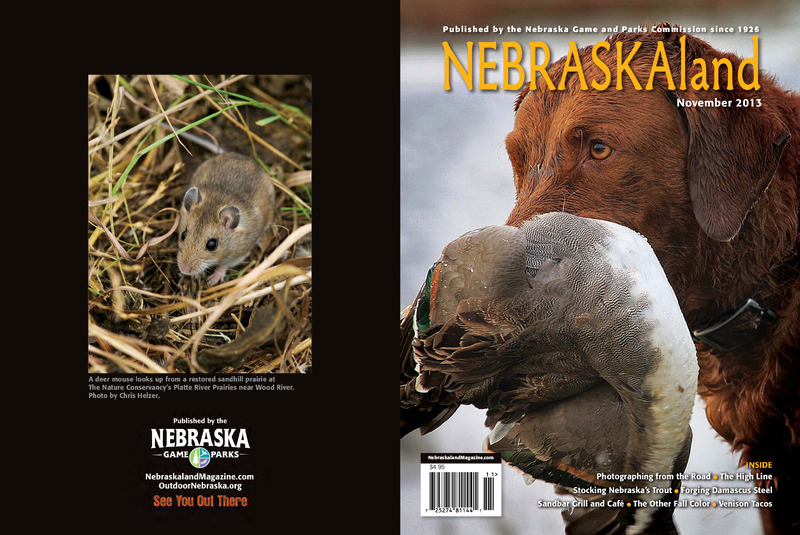
Publis hed by the Nebr a s k a Ga m e a nd Pa r k s C o m m is s ion si nc e 1926
NEBRASKAland
November 2013
A deer mouse looks up from a restored sandhill prairie at
The Nature Conservancy’s Platte River Prairies near Wood River.
Photo by Chris Helzer.
NebraskalandMagazine.com
$4.95
INSIDE
Photographing from the Road ● The High Line
Stocking Nebraska’s Trout ● Forging Damascus Steel
Sandbar Grill and Café ● The Other Fall Color ● Venison Tacos
NEBRASKAland Magazine
Volume 91
●
No. 9
●
November 2013
F EAT U R ES . . .
16 Photo Poachers
BY JEFF KURRUS AND ERIC FOWLER, PHOTOS BY STAFF
22 On the High Line
BY LISA KNOPP
24 Raising Trout
TEXT and PHOTOS BY JENNY NGUYEN
30 Folding Steel
TEXT and PHOTOS BY JULIE GEISER
34 The Grass is Sometimes Greener
TEXT AND PHOTO BY JEFF KURRUS
36 Another Year at the Sandbar
Grill and Café
TEXT AND PHOTOS BY ERIC FOWLER
16
●
D EPARTM EN T S . . .
Comment .........................................................4
Mixed Bag.......................................................6
Nature Notes .................................................42
In the Kitchen ...............................................43
Outdoor Business ..........................................44
Wilderness Workshop ...................................45
Classifieds .....................................................46
Portraits from the Past ..................................48
Page 49..........................................................49
The Last Stop ................................................50
Gift Collection 2014 .....................................51
24
●
O N T H E W EB . . .
When you see this symbol in the pages
W
oof NEBRASKAland Magazine, visit
N
NebraskalandMagazine.com and view
oour interactive digital edition for more
information.
NEBRASKAland (VOL. 91 / NO. 9, ISSN 0028-1964) is published monthly, except
for the combined Jan./Feb. and Aug./Sept. issues, by the Nebraska Game and Parks
Commission, 2200 N. 33rd St., Lincoln, NE. Periodicals postage paid at Lincoln,
Nebraska, and additional mailing offices. POSTMASTER: Send address changes to
NEBRASKAland, P.O. Box 30370, Lincoln, NE 68503-0370.
2 NEBRASKAland • NOVEMBER 2013
22
●
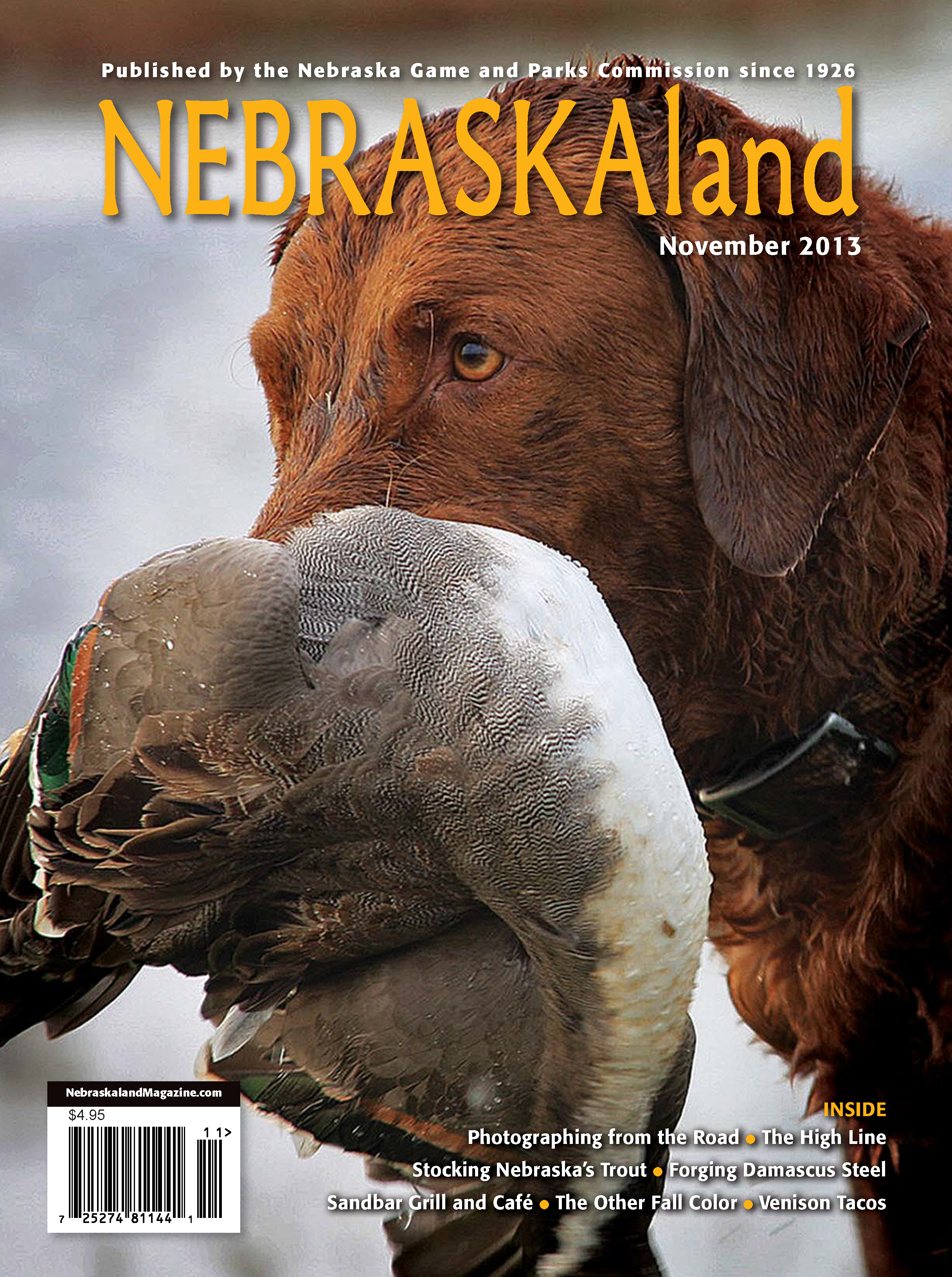
Cover: Daisy, a female Chesapeake Bay Retriever, retrieves a drake
Northern pintail during a Rainwater Basin waterfowl hunt in Fillmore
County. Photo by Zach Cunningham.
Opposite: The stove in Delbert Rathman’s hunting blind cranks out a
tasty breakfast every day, and keeps burning to take the edge off a cold
morning. Read the story on page 36. Photo by Eric Fowler.
NOVEMBER 2013 • NEBRASKAland 3
Indian Cave
I really enjoyed your feature on
Indian Cave in the October issue. I
have a real fondness for that park as I
feel I helped to make it a park. When
I was in high school, I worked two
summers there before it was a park.
We were the first work crews to go in.
We cleared the roads of dead, fallen
trees one season. The next year we
began putting up boundary fences. It
was hard work in the heat but I look
back on it now as a good experience.
Rod Kehlenbeck
Springfield,
p g
, Nebraska
The other day we found this female
imperial moth in our driveway.
– Marion Ball, E-mail
a piece of cloth he dangled the tidbit in
front of this “master angler” frog, who
watched it for a couple of seconds and
then attacked it. I don’t know who was
more startled. Thanks for all you do for
promoting our state.
Larry Bornschlegl
Hastings, Nebraska
C
Chris
Masada of Lincoln took this photograph of muskrats at Holmes
Lake in Lincoln.
L
Turkey Hunting with Dogs
Enjoyed the short excerpt on turkey
hunting with dogs. Ken McEwen and
I used to use our Labs quite often for
turkeys in southeastern Nebraska.
While hunting pheasants
and quail down south
we would often run into
turkeys Many
Man times we actually got
turkeys.
points from our Labs on turkeys buried
in the tallgrass prairie. My Lab Blaze
especially loved to retrieve downed
turkeys. We have many fond memories
of those hunts. The Labs also helped
find birds that were crippled that we
would have lost.
Steve Tyler
Omaha, Nebraska
Snake at the Lake
This summer my son and I went
out to Burchard Lake to do some bass
fishing. We were driving in just west
of the boat docks when we saw a large
snake on the road. I thought it was a
bull snake at first but as I got out of the
truck to see, I was shocked. The hair
on the back of my neck stood up just
for the sound this guy was making.
Tim Horner
Lincoln, Nebraska
Visitor
Looks like someone’s going to have
escargot with plank grilling. Is that
not a snail on the left plank on page
48? What a variety of articles in your
magazine. It seems to get better every
month!
G. E. Dave Fuller
E-mail
Hungry Frog
While fishing, my grandson, Josh
Bornschlegl, saw a bullfrog and wanted
to catch it. With a pole, small hook and
4 NEBRASKAland • NOVEMBER 2013
COMMISSIONERS
CONSERVATION OFFICERS
Director Jim Douglas
NORTHWEST
Officer
City
Jim Zimmerman (S) Gering
Commissioners
Chairman - Norris Marshall, Kearney
Vice Chairman - Lynn Berggren, Broken Bow
2nd Vice Chairman - Jerrod Burke, Curtis
Dr. Mark Pinkerton, Wilber
Dr. Kent Forney, Lincoln
Rex Fisher, Omaha
Mark Spurgin, Paxton
Mick Jensen, Blair
Ron Stave, Waterloo
MAGAZINE STAFF
Editor Jeff Kurrus
Art Director Tim Reigert
Associate Editor Amy Kucera
Regional Editors Eric Fowler, Julie Geiser,
Justin Haag, Jenny Nguyen
Contributing Editor Michael Forsberg
Regular Contributors Bill Hager, Chris Helzer,
Lisa Knopp
Photo Librarian Sarah Johnson
Circulation Donna Robinson
For address changes and questions about
your subscription, e-mail Donna.Robinson@
Nebraska.gov or call 800-632-5263
Advertising Sales Manager
For advertising information contact
Shane G. Gilster
Phone: 402-742-0125
Email: shanegilster@gmail.com
NEBRASKAland Magazine Copyright 2013, all rights reserved.
NEBRASKAland is available in audio from the Nebraska Library
Commission Talking Book and Braille Service, Suite 120, 1200 N St.,
Lincoln, NE 68508. 800-742-7691. NEBRASKAland Magazine and the
Nebraska Game and Parks Commission reserve the right to reject any
advertising not in keeping with the agency mission.
Rates: $18 for one year; $33 for two years; $44 for three years. Nebraska
recipients must add appropriate sales tax. To subscribe call
1-800-NEBLAND (632-5263), or go online to: NebraskalandMagazine.
com.
COMMISSION
C
COM
OM
OMMIS
M SIO
S ON O
SI
OFFICES
F CES
FFI
ES
S
Headquarters/Southeast District Office
2200 N. 33rd Street Lincoln, NE 68503
Phone 402-471-0641
Northeast District Office
2201 N. 13th St. Norfolk, NE 68701
Phone 402-370-3374
Send your comments to:
Jeff Kurrus, Editor
NEBRASKAland Magazine
P.O. Box 30370
Lincoln, NE 68503
or e-mail Jeff.Kurrus@Nebraska.gov
Please include your postal address and
telephone number.
Letters may be condensed and edited
for clarity. Photographs are welcome
and will be returned.
Any program that receives federal funding from the National Park
Service, or the United States Fish and Wildlife Service prohibits unlawful
discrimination on the basis of race, color, religion, age, gender, marital
status, national origin, age, disability or political affiliation. Any person
who believes he or she has been discriminated against in any program,
activity, facility, or service, should contact the Nebraska Game and
Parks Commission, Lincoln, NE 402-471-0641, the Equal Opportunity
Commission, Lincoln, NE 402-471-2024, TTY/TDD 402-471-4693;
United States Fish Wildlife Service, Civil Rights Coordinator, 4401
N. Fairfax Drive, Arlington, VA 22203; Director, Equal Opportunity
Program, U.S. Department of Interior, National Park Service, 1849 C
Street NW, Mail Code 0008, Washington, D.C. 20240-0001.
Southwest District Office
301 E. State Farm Rd. North Platte, NE 69101
Phone 308-535-8025
Northwest District Office
East Hwy. 2, Box 725 Alliance, NE 69301
Phone 308-763-2940
Bassett Office
524 Panzer St., Box 508 Bassett, NE 68714
Phone 402-684-2921
Kearney Office
1617 First Ave. Kearney, NE 68847
Phone 308-865-5310
Omaha Office
1212 Bob Gibson Blvd. Omaha, NE 68108
Phone 402-595-2144
Greg Hesse
Scott Brandt
Heath Packett
Dan Kling
Frank Miller
Sean McKeehan
Phone (308)
(office) 763-2940
(cell) 641-6138
Alliance
760-3647
Gering
631-0663
Eagle
402-210-0888
Harrison
430-0572
Valentine 402-389-0444
Bridgeport 308-279-9133
SOUTHWEST
Officer
City
Phone (308)
Roger Thompson (S) N. Platte (office) 535-8025
(cell) 530-3097
Ray Dierking
Brkn. Bow
870-0322
George Sund
Cambridge
655-0028
Michael Thome
Cozad
529-8146
Terry Brentzel
Oshkosh
458-7650
Matt Andrews
Elwood
746-2418
Dirk Greene
Imperial
882-0015
Dale Johnson
Kearney
440-3847
Brian Piernicky
McCook
340-6627
Brandon O’Neal
N. Platte
778-7486
Nicholas Fix
Ogallala
289-0427
Bryce Streger
Ogallala
289-1169
Rich Routh
Rep. City
920-0367
NORTHEAST
Officer
City
Tom Zimmer (Sup.) Norfolk
Dale Davis
Steve Oberg
Daniel Roberts
Randy Pomplun
Jeff Jones
Jon Reeves
Tim Williams
Pat George
Doug Pollard
Alex Frohberg
Cory Krause
Phone (402)
(office) 370-3374
(cell) 649-8053
Bassett
760-0712
Columbus
910-3366
Fremont
719-1108
Fullerton
308-550-0489
Hartington
762-5022
Kennard
889-8508
Grand Is
308-380-7331
O’Neill
340-0787
Ord
308-730-7050
Ponca
241-7615
West Point
380-6410
SOUTHEAST
Officer
Levi Krause (Sup.)
William Krause
Mike Luben
Dan Zuehlke
Darin Gress
Douglas Kramer
Dina Barta
Stacey Lewton
Dudley Sorensen
Robert Finke
Russell Mort
Dan Evasco
Rich Berggren
City
Louisville
Auburn
Colon
Cortland
Hebron
Lincoln
Lincoln
Lincoln
Waverly
Milford
Nebr. City
Papillion
Waterloo
Phone (402)
949-0593
274-8063
443-6392
806-9084
768-8665
890-6465
890-6463
890-7140
937-3422
947-1363
209-1506
616-5961
619-1355
ADMINISTRATION
Officer
Craig Stover (Adm.)
Duane Arp (Ass.)
Jeff Clauson (Ass.)
City
Lincoln
Lincoln
Lincoln
Phone (402)
471-5531
471-5531
471-5531
Nebraska Wildlife Crimestoppers 1-800-742-7627
Ak-Sar-Ben Aquarium
21502 W. Highway 31 Gretna, NE 68028
Phone 402-332-3901
NOVEMBER 2013 • NEBRASKAland 5
By Gerry Steinauer, Botanist
Rare plants are not always found in pristine native
habitats. In Nebraska, the Highway 13 right-of-way
in Pierce County is home to the state’s largest known
population of the threatened white lady’s-slipper
orchid (Cypripedium candidum). The
once-common orchid has
been driven from its
wet meadow habitat in
eastern Nebraska by its
sensitivity to livestock
grazing and haying and
is now found in only a few
relatively disturbance-free
sites.
The beautiful lady’s-slipper
can attain a foot in height,
and often grows in tight, multi-stemmed clumps. The lower
petals are fused, forming the namesake slipper-shaped
pouch. The blooms can be seen mid-May through mid-June.
The fruit is a capsule containing thousands of microscopic
seeds which are wind and water dispersed.
Orchid Survey
THINKSTOCK
Though biologists have known of the existence of the
Highway 13 orchids since the 1990s, the first comprehensive
survey of the population was conducted by staff of the
Nebraska Department of Roads and the Nebraska Game
and Park Commission in May of 2011. This year in June,
additional areas of the right-of-way were examined. The
surveys were conducted during the orchid’s peak bloom as
non-flowering orchids are
difficult to find among tall
grasses.
Nearly 500 orchids
were found to be scattered
along a six-mile stretch of
the highway. The grassy
right-of-way receives
little mowing and is not
grazed, and though not
ideal habitat, the orchids
survive there. Sometime
in the past, the orchids
From this image we can see why
likely established here by
it is called “lady’s-slipper.”
seed from plants in nearby
meadows. Orchids still exist in a single hayed meadow
bordering the right-of-way and none are known from
adjacent grazed meadows. Plants do not occur in the rightof-way where it borders cropland. Perhaps hot, early summer
winds blowing off the then bare fields make the adjacent
right-of-ways unsuitable for orchids, or herbicide drift from
the fields have killed plants.
Conserving a rare plant in a highway right-of-way is
challenging. Knowing the exact location of the orchids,
however, allows the Department of Roads to avoid the plants
6 NEBRASKAland • NOVEMBER 2013
PHOTO BY JON FARRAR
Roadside Orchids
when mowing, spraying
noxious weeds and doing
maintenance work. In 2012, an early spring prescribed
burn, prior to orchid emergence, was conducted on a 2-mile
stretch of the right-of-way containing the lady’s-slipper. The
fire reduced accumulated plant litter that can hinder orchid
growth and set back non-native grasses, especially smooth
brome, which competes with the orchid and other prairie
plants growing in the right-of-way.
In the future, additional prescribed fires will likely be
conducted in the right-of-way to benefit the orchids. Also,
the Highway 13 orchids may someday serve as a source of
plants or seeds for establishing new populations in more
natural habitats. For now, the white lady’s-slippers continue
to survive along Highway 13; in today’s human-altered
landscape they cannot be choosey about where they call
home.
Wildlife Conservation Fund
The Wildlife Conservation Fund is the Nebraska Game
and Parks Commission’s primary funding source for
inventory, research and management of Nebraska’s plant
and animal species of concern, such as the white lady’sslipper, as the monies the Commission receives from the
sales of hunting, fishing and trapping permits and habitat
stamps fund only game species projects. An added benefit,
the Conservation Fund allows the Commission to secure
other monies for species of concern, such as U.S. Fish and
Wildlife Service State Wildlife Grant dollars, by providing
the required match. Other recent Conservation Fund
supported projects include a swift fox census in Panhandle
grasslands, a study to determine bat migration patterns
in southeastern Nebraska, and a study to identify timber
rattlesnake distribution and woodland habitat needs in the
southeastern corner of the state.
The Wildlife Conservation Fund is supported primarily
through donations, and you can learn more about
the fund or make a tax-deductible gift to the fund at
NebraskaWildlifeFund.org. Donations can also be made
through the nongame “check-off” box located on state
income tax forms. ■
NOVEMBER 2013 • NEBRASKAland 7
Five Free Camping Apps to Try
By Cristina Woodworth, Freelance Writer
Going camping used to mean unplugging from all the technological gadgets of
everyday life. However, smartphone apps have enhanced the outdoor experiences of
many users, including the Nebraska State Parks Pocket Ranger (Droid and iPhone)
app. Here are a few others to explore next time you’re sitting around the campfire.
• 101 Camping and Outdoor Recipes (Droid): Say goodbye to hot dogs on a stick.
This app features everything from frying pan cookies to honey mustard grilled chicken.
n.
AllTrails
(Droid
and
iPhone):
Find
a
nearby
hiking
trail
in
your
area
and
examine
•
its length, difficulty and rating by other app users.
• Knots Guide (Droid): How do you tie that bowline knot again? Click on this app
for helpful instructions, complete with photographs, for more than 80 different knots.
• Google Sky Map (Droid): Don’t question any longer what stars or planets are
above your campsite. Point your device upward and view an interactive map of
constellations and galaxies – a perfect companion for stargazers. ■
by Amy Kucera
Cabins for “Hunters”
his autumn, retire to one of our state park or
h
recreation areas after a long day of hunting
re
with your camera or other weapon of choice.
w
Here
He
re aare a few to desinations to consider on your
next road trip:
Wildlife viewing
Lewis and
Fort Robinson
State Park
g
ntin
u
h
e
m
a
g
Upland
8 NEBRASKAland • NOVEMBER 2013
View the Public
Access Atlas for
more hunting and
viewing locations.
Clark Lak
State Park
e cabins
Lewis
and Clark
Lake State
Recreation
Area
Medicine Creek State
M
Recreational
R
e
Area
Campsite Setup
Let the Fall Games Begin
By Nebraska Outdoor U!
While most campsite basics seem like common sense,
it is surprising how many folks nowadays overlook
them. Here’s a small list to run through when setting up
camp:
• Fear the flood. If the grass is greener in the low
lying spot, it could be because water funnels there
when it rains. It would be wise not to set up camp on
that spot.
• Watch out for widow-makers. If there are a lot of
dead tree branches on the ground and many more dead
branches above your campsite, you’d be wise to take
these hints and set up camp elsewhere, because a good
rain or strong wind could bring more branches down out
of that tree.
• Positioning yourself downwind is for hunting, not
camping. If the weather forecasts north winds
all weekend, don’t pick a campsite on the south side
of your fire pit, because the wind will blow all your
smoke and possibly some ashes right in your front
door.
• Thievery in the woods. Though it might seem nice
to camp right next to the water, this is usually a common
raccoon highway. Simply look for tracks and don’t
leave any food or sweet smelling items out at camp, as
raccoons, opossums and skunks have a sweet tooth and
might pay you a visit.
• Have fun. Do things that everyone will enjoy, tell
stories, relax and soak up the beauty and peace of the
outdoors.
For more information about camping, equipment and
outdoor experiences, check out Nebraska Outdoor U!
at OutdoorU.org and click on the YouTube link at
the bottom of the page. Get outside and see what the
Nebraska outdoors has for you. ■
By Julie Geiser
Turn your cabin or campsite
into a friendly playing field
this fall with the following
games:
• Have a “Find the Biggest
Pinecone” contest.
• See how many different
fall colors you can find.
• Make a camp scarecrow from old clothing and fallen
dead leaves.
• Spend an hour before your trip researching what’s
at a particular park or recreation area, then create a
scavenger hunt. For even more fun, especially at a place
with a lot of families, invite other campers to join the
game.
Visit us at OutdoorU.org for more information. ■
ILLUSTRATIONS BY TIM REIGERT
Book a cozy cabin at Niobrara State Park in
Niobrara and awake to a spectacular sunrise over
the confluence of the Niobrara and Missouri rivers.
The National Audubon Society has designated the
park an “Important Bird Area,” where more than
250 species have been sighted. The nearby 4,500acre Bazile Creek Wildlife Management Area also
provides ample wildlife viewing potential and is open
to deer and waterfowl hunting.
Continue on Highway 12 to Lewis and Clark Lake State
Recreation Area near Crofton for excellent hunting and fishing
opportunities, and rustic, log-style cabins as an overnight oasis.
Waterfowl, small game, and deer hunting are permitted.
Moving southwest to Medicine Creek Wildlife Management
Area near Cambridge will provide some of the finest mixed bag
hunting in the state,
with deer, upland game
and waterfowl hunting
available. Just south, the
recently built cabins
at Medicine Creek
State Recreation Area
provide the comforts
of home.
Take it back a
century at historic
Fort Robinson State Park, where you
won’t forget your stay in the former cavalry officer’s quarters
in the exquisite Pine Ridge countryside. In all directions is
publicly accessible hunting land, including Ponderosa and
Peterson wildlife management areas to the east.
Visit OutdoorNebraska.org for up-to-day information
on hunting regulations in each of these publicly
accessible
Niobrara
areas.
NOVEMBER 2013 • NEBRASKAland 9
Getting the Picture
on Swift Fox
The (Shot) Gun That
Won the West
By John E. Carter, Nebraska State
Historical Society
Historians talk about the guns that
won the West and conjure up a Colt
revolver or a Winchester lever action
rifle. But neither of these were the gun
that won Nebraska.
I can see the hackles rise on the
necks of modern recreational shooters
who favor the cowboy action tradition,
but in Nebraska the simple utilitarian
shotgun, like the one we see in the
photo above, was the firearm of choice.
A shotgun could be used to harvest
game from large animals to small fowl.
If you needed a weapon for personal
defense, which most people did not, a
shotgun was a perfectly adequate tool
for the task.
But don’t take my word for it. Be
the historian yourself. In 2000 the
Nebraska State Historical Society
received a grant from the Library of
Congress to digitize and place online
10 NEBRASKAland • NOVEMBER 2013
the Solomon D. Butcher collection of
over 3,000 photographs taken between
1886 and 1912. You can find the
photographs on the Library’s amazing
American Memory website. Just
Google “Prairie Settlement” and you
will easily find it.
Go to the keyword search and look
for “rifles,” “pistols” and “shotguns”
and see for yourself.
Butcher’s photographs are a good
sampling of what Nebraska looked like
in its formative days. He photographed
both homesteaders and ranchers at a
critical time.
If you are interested, you can also
check out hunting, fishing and other
outdoor activities. Enjoy this powerful
window on Nebraska’s past. ■
For more information, go to the
Nebraska State Historical Society’s
website at Nebraskahistory.org.
Solomon Butcher’s 3,000-photo “Prairie
Settlement, Nebraska” collection is
available at the Library of Congress
American Memory website,
Memory.loc.gov/ammem.
PHOTO COURTESY OF THE NEBRASKA STATE HISTORICAL SOCIETY
A Brief History
PHOTO
PHOT
O BY JUS
JUSTIN
TIN HAAG
A family outing near Custer County, 1889.
By Justin Haag
As North America’s smallest wild
species in the dog family, perhaps it’s
not surprising the swift fox can be
overlooked. Thanks to a pilot project
that hopes to gain momentum this fall,
however, researchers are hoping to learn
even more about these often elusive
mammals.
In October, trail cameras baited
with skunk scent were placed at points
throughout 24 of the state’s westernmost
counties. The project, led by Lucia
Corral, a doctoral degree candidate at
the University of Nebraska in Lincoln,
is the primary component of her fouryear study of the swift fox and other
wild canids in Nebraska.
The swift fox, not much larger than a
housecat, is at home in the Panhandle’s
shortgrass prairies. There, they spot
predators from a distance and retreat to
their earthen dens. An abundant supply
of insects and small mammals keep
adults and their pups fed.
With this joint project of the Nebraska
Cooperative Fish and Wildlife Research
Unit and the Nebraska Game and Parks
Commission, Corral hopes to answer
why swift foxes have not chosen to
occupy what seems to be suitable habitat
in other parts of the state, particularly
the southwestern corner.
Swift foxes inhabit grasslands from
South Dakota to Texas, yet are found
in just 40 percent of the area that they
once called home. In the 1930s, control
programs for predators nearly caused
swift foxes to go extinct. A good portion
of swift foxes’ historical range also has
been developed for agriculture and other
purposes. They are also food for larger
predators such as coyotes.
The region being studied is bordered
on the east by Sheridan, Grant,
Arthur, Lincoln, Gosper and Furnas
counties. Placing dozens of cameras
lured with skunk scent in the project’s
26,000-square-mile region is no small
task. To lessen the burden, Corral
recruited help from students studying
wildlife at Chadron State College and
UN-L. The students from western
Nebraska are a major asset to the project
not only for their legwork, but also
because they have obtained access to
private lands near their homes.
The Nebraska Wildlife Conservation
Fund is helping fund the research
through its nongame checkoff program,
and additional funding will be sought in
the coming months from the Nebraska
Environmental Trust.
When complete, data will have been
collected for fall and spring – two
periods of 10 consecutive days each.
With a good start this fall, the project
will begin in earnest in the spring and
wrap up sometime in 2017.
The photos obtained from the trail
cameras will not only offer clues about
the presence of swift foxes, but also will
garner information about other species
that may be affecting their population.
In addition, to get to the scent stations,
the foxes and other animals pass through
contraptions with brushes that obtain a
fur sample. DNA from the hair will be
used to learn about the foxes’ genetics.
Corral, a native of Guatemala, began
studying the swift fox after coming to
the United States as an international
Fulbright Scholar. She is hoping
the research will result in better
management decisions for swift fox and
other canid species.
Teresa Frink, who leads the wildlife
management program at Chadron
State, said the project is giving her
students invaluable hands-on experience
in wildlife management. It will also
complement swift fox studies her
students have completed in recent years.
By collaborating with Sam Wilson,
the Commission’s furbearer and
carnivore program manager, the
Chadron State students have set and
monitored scent stations in northwestern
Nebraska. Aside from similar scent
stations placed in the recent past,
however, no extensive swift fox studies
have occurred in Nebraska since a pair
of UN-L researchers used traps and
radio collars to examine the species in
1991, Wilson said, making him excited
to have this data. ■
NOVEMBER 2013 • NEBRASKAland 11
Affects of EHD
MISSISSIPPI MAP TURTLE
way to the eye and actually contact the
eye socket. But on the Mississippi map
turtle, the wide yellow stripes curve all
the way around the back and bottom of
the eye so that the smaller yellow lines
cannot contact the eye socket.
Another feature of Mississippi map
turtles, though not always, are eyes
with a completely white iris that have
no line passing through it, while the
false map turtle nearly always has a
line through the iris – which is usually
gold to light brown rather than white.
Mississippi map turtles have only
been found along the lower reaches of
the Missouri River south of Nebraska
City, but false map turtles are found
Dan Fogell is an instructor at
Southeast Community College. He has
contributed to
NEBRASKAland
since 2006 and
is the author of
A Field Guide
to Reptiles and
Amphibians of
Nebraska.
Exploring Nebraska’s Biodiversity
By Lindsay Rogers, Wildlife Education Specialist
Nebraska is a biodiversity rich state. We are home to
more than 450 species of birds, 95 mammals, 106 fish, 61
amphibians and reptiles and nearly 1,500 plants. In addition,
there are more than 28,000 species of insects and thousands
of crustaceans, arachnids and mussels.
Some of this biodiversity is represented with a 30-foot
long photographic mural entitled “Explore Nebraska’s
Biodiversity” currently featured at the Lincoln Children’s
Museum until November 17. The exhibit features 102
different native species, with each photo ranging in size
depending on their biomass in the ecosystem. Although elk
are large animals, there are relatively few of them in our state.
So, their image is small. Grasshoppers, on the other hand, are
small, but there is a large number of them living in Nebraska.
So, their image is large.
In addition to the wall mural, there are several handson components at the exhibit. Visitors can compare their
“wingspan” to that of Nebraska bird species, see if they’re as
tall as a prairie plant, or inspect bones, furs and insects with
magnifying lenses and microscopes.
The exhibit was created by the Nebraska Natural Legacy
Program with funds from the Nebraska Environmental Trust.
Visit LincolnChildrensMuseum.org for more information. ■
PHOTO BY JEFF KURRUS
12 NEBRASKAland • NOVEMBER 2013
FALSE MAP TURTLE
PHOTOS BY DAN FOGELL
By Dan Fogell, Herpetologist
To Missouri River boaters they are a
familiar sight. Basking on logs, stumps
and sandbars and diving whenever
they are approached, map turtles are
the most common turtles on the river.
Primarily river turtles, map turtles
also live in oxbow lakes, ponds and
reservoirs near large rivers where they
feed on a variety of foods including
mollusks, arthropods, worms, fish
and even fruits and seeds. They have
enormous, paddle-shaped back feet that
easily propel them through strong river
currents.
Nebraska has two varieties of map
turtles: the false map and Mississippi
map turtles. Both are similar in
general appearance with an olive green
to light brown colored skin and carapace
(top shell), a low-spined keel down
the center of the carapace, numerous
thin yellow lines on their head, neck
and legs, and markings on the carapace
that look like the contour lines on a
topographic map – which is how they
got their common name. The differences
between them are subtle.
False map turtles have two wide
yellow stripes on top of the neck that
extend to the head and then angle
behind the eyes, but not far enough
to curve around the bottom of the eye
sockets. This allows the smaller yellow
stripes on the neck to extend all the
throughout the Missouri River and its
associated waterways from Rulo to
South Dakota.
During winter, map turtles bury
into soft substrates under the water
to hibernate, emerging when warm
spring weather arrives but sometimes
basking during winter months if air
temperatures are warm. Male map
turtles are smaller than females and
are easily distinguished by their
exceptionally long front claws, which
they use to hold on to mates. Breeding
occurs in the fall but females will not
lay eggs until the following summer.
Like all turtles, map turtles dig
nests – usually on sandy banks with
low-growing plants but sometimes in
completely open areas. Interestingly,
female false map turtles return to the
same nesting sites every year, which
also happen to be their own hatching
sites – a behavior known as natal
homing and also seen in sea turtles.
Eggs hatch later in the same year, and
hatchling turtles often stay buried for a
few days while they absorb the last of
the nutrients from their yolk. ■
PHOTO BY ERIC FOWLER
Nebraska’s Map
Turtles
By Eric Fowler
Epizootic Hemorrhagic Disease (EHD) was not the problem
this summer that it was in 2012, when it killed about one-third
of the state’s white-tailed deer. But deer hunters will continue
to see the effects of the disease this fall, possibly even before
they get to the field due to permit reductions in most units for
the November Firearm and other seasons.
By comparing harvest data from the 2012 deer seasons to
others, Nebraska Game and Parks Commission biologists
estimated the number of deer that died from EHD ranged
from 17 to 45 percent in all management units except the
Frenchman in southwestern Nebraska.
In order to allow the white-tailed herds to slowly rebuild,
firearm deer permits were reduced 10 to 20 percent in all deer
management units except Frenchman Whitetail, Plains and
Upper Platte. Additionally, Season Choice Area permits were
cut 10 to 40 percent and bonus antlerless white-tailed tags
were eliminated from many firearm and season choice units,
as well as archery, muzzleloader, youth and Statewide Buck
permits, a 60 percent reduction overall.
Kit Hams, the Commission’s big game program manager,
said most hunters will see the same number of deer as last
year. Severe drought concentrated deer at remaining water
sources in 2012, contributing to the EHD die-off. With more
normal rainfall this year, “deer should be redistributed across
the landscape,” Hams
said.
Hunters harvested
60,830 deer in
Nebraska in 2012,
down 30 percent
from the year before.
Hams said it will take
three to five years for
deer populations to
recover. “Having said
that, we’re looking
at quite a few areas
where we don’t want
the number of deer
we had in 2011,”
he said, adding that
landowners who
still feel their deer
population is too high This season, most hunters should see
the same number of deer as in 2012.
should continue to
allow hunters to harvest white-tailed does.
The November Firearm Deer season opens November 16.
With the reduction in permits, some units are expected to sell
out earlier than last, when 14 of 22 units were filled before
opening day. Permits are available at Commission offices
and online at OutdoorNebraska.org. ■
NOVEMBER 2013 • NEBRASKAland 13
Send Us Your Trail Cam Photos!
By Dick Turpin
Just as antlers
represent the
memory of a
successful deer
hunt, spring turkey
hunters enjoy displaying the bird’s
beard. Here’s a little craft idea that
preserves that gobbler’s growth – a
turkey beard momento.
Take that casing you shot that bird
with and punch that primer out on
the top with a long nail and hammer.
It leaves you a good hole to put your
strapping in because that’s the next
thing you’re going to do.
Tie a loop knot in it and leave
yourself enough loop to make a hanger
with it and then you’re going to take
a little piece of wire or a long nail or
something and you’re going to shove
by Jerry Kane
Contact the Nebraska Game and
Parks Commission at
402-471-0641 or visit
OutdoorNebraska.org for more
information. Visit HuntSafeNebraska.
org for a list of hunter education
classes and BoatSafeNebraska.org
for a list of boating safety classes.
Marian Langan sent in this photo of a badger at Spring Creek
Prairie Audubon Center, south of Denton in Lancaster County.
November 1
November Late Doe/Fawn antelope
hunting season opens
November 1 Hunting and trapping
seasons open for raccoon, Virginia
opossum, long-tailed weasel, mink,
red fox, gray fox and badger
Please submit your trail camera photos by e-mail to:
nebtrailcam@gmail.com. Also include where you’re from and
any information that will help explain your photo.
November 1 Muskrat and beaver
trapping seasons open
permits and stamps available for
purchase at OutdoorNebraska.org
November 4
Woodcock hunting season closes
November 4
Tickets go on sale for Historical
Christmas Dinner at Fort Robinson
State Park (SP), 308-665-2900
November 9 Virginia and sora rail
hunting season closes
November 11
November 15 First segment of
crow hunting season closes
November 16 Special Public Health
Hazard Order crow hunting opens
November 16-24 November firearm
deer hunting season
November 17 Fort Robinson SP
longhorn and buffalo sale, Crawford,
308-665-2900
November 29-December 1
Cornucopia of Crafts, Eugene T.
Mahoney SP, Ashland, 402-944-2523
November 29-February 28
Winterfest, Ponca SP, Ponca,
402-755-2284
14 NEBRASKAland • NOVEMBER 2013
Epoxy
and
beard
See a video
of how to make a turkey
beard momento.
Where to Bury the Rest?
By Julie Geiser
From big game animals
such as deer to small game
and waterfowl, many hunters
have the same question –
where do I dispose game
animal carcasses? “The
best way to address this is
check with your local city
or town to see what the
regulations for disposing
of game carcasses is for
each different jurisdiction,”
said Jeff Hoffman,
assistant wildlife division
There are options for disposing game animal
administrator with the
remains in Nebraska, but none that allow the
dumping of carcasses on public areas, including
Nebraska Game and Parks
state recreation or wildlife management areas.
Commission.
Joel Davies of Waste
Connections of Nebraska from Lincoln
Department of Environmental Quality
said, “We would prefer the animals
(NDEQ) would prefer they be buried at
be bagged and placed in curbside
least four feet below the surface of the
containers to prevent our staff from
ground and 300 feet away from ponds,
having to handle the carcasses – our
springs or lakes to lower the possibility
hydraulic trucks should be left to
of spreading a disease.
handle this kind of disposal.”
To see more of NDEQ’s
Private landowners can also dispose
recommendations, visit
remains on their land, but the Nebraska Deq.ne.gov/Publica.nsf/pages/06-201. ■
According to the Farm Services Agency, Nebraska led the nation in the amount
of land converted to cropland in 2011 and 2012 by 102 percent to the next closest
state. In 2012 alone, 54,876 acres were converted from grassland to cropland – an
alarming rate concerning the future of the state’s flora and fauna. ■
See You Out There... But Where?
PHOTO BY JENNY NGUYEN
All Game and Parks offices closed
in observance of Veterans Day;
Ak-Sar-Ben Aquarium open
Wood
plug or
sawdust
mixed
with
glue for
filler
A Dubious Distinction
PHOTO BY JEFF KURRUS
November 1 Most 2014 annual
this loop down into
the casing out
through the primer
hole.
Next you’re
going to get a little
dowel plug as a
spacing thing and
push it down
against the knot,
then what you do
is fill the rest of
the shell with five
minute epoxy and
you’ve got yourself a
little piece of
memorabilia.
I wonder if an old
turkey like me could
grow a beard that
long? ■
Do you know where this Nebraska photograph was taken?
See answer at the bottom of page 15 (right).
NEBRASKAland
Visitor
Last issue’s winner of
the Visitor drawing was
Lonnie Shafer of
Exeter, Nebraska, who found
the terrestrial snail on page 48.
Readers are encouraged to contact
NEBRASKAland within 10 days
after this issue’s publication with
the correct page number and name
of this issue’s “Visitor” – a critter
found in Nebraska. We will then
gather the correct entries and draw
one to win a NEBRASKAland
Magazine mug. To enter each
month, write:
NEBRASKAland Visitor
2200 North 33rd Street,
Lincoln, NE 68503.
Or e-mail:
Tim.Reigert@Nebraska.gov
with “Visitor” in the subject line of
the message.
HINT: This issue’s visitor is not
on page 5, 7, 15, 34 or 35.
This creature is a bit different
than previous visitors. It is not
an insect, but a mollusk, related
to clams. It is a terrestrial snail,
living on land instead of in water.
Snails can be found virtually
worldwide, and have staying
power – snails have been found in
the fossil record going back more
than 500 million years.
Snails are an important part
of a healthy ecosystem. Snails
feed on plants, fungi, and other
organic debris, which recycles
organic matter and assists with
soil formation. They are also an
excellent source of calcium, often
eaten by birds that need calcium
for egg shell formation. Terrestrial
snails can be found across
Nebraska. Look for them
in protected areas under logs
or vegetation where the
humidity is
relatively high.
Special thanks to Julie Van Meter,
State Entomologist, Nebraska Department of
Agriculture. Visitor image by Chris Helzer.
www.bugguide.net is a good site for identification
GREAT PLATTE RIVER ROAD ARCHWAY, KEARNEY
Turpin
Time
NOVEMBER 2013 • NEBRASKAland 15
F
PHOTO BY JEFF KURRUS
An often practiced,
but rarely talked about,
photographerr’s secret.
A white-tailed doe raises her head
in an attempt to smell a roadside
photographer at Ponca State Park.
iind
ndd 10
1 photographers, and four of them will
admit
admit to shooting wildlife, scenics or some other
subject from the blacktop. Talk shop over a couple
of beers and nachos one day after sunset, and
that number will increase to 10 out of 10. “Oh
yeah, there was this absolutely beautiful sunrise
I couldn’t pass up one morning,” the story
will start, and conclude with the photographer
reasoning, “Well, everybody does it.”
Photographers shoot from the road, and for good
reason. Some of Nebraska’s most scenic spots
can be found roadside – from Brownlee Road in
Cherry County to various spots along highways 2,
20, 275 and beyond. Plus, many wildlife species,
including white-tailed and mule deer, have grown
accustomed to the thousands of vehicles that pass
by them each day.
PHOTO BY ERIC FOWLER
16 NEBRASKAland • NOVEMBER 2013
PHOTO BY JEFF KURRUS
A tom turkey gobbles
along Highway 31 in
Sarpy County.
By Jeff Kurrus and Eric Fowler
The sun sets over the North Platte River at Ash Hollow State Historical Park near Lewellen. The road may be a two-track trail,
but your vehicle is the quickest way to get to a vantage point with an interesting foreground when a good sky is brewing.
NEBRASKAland • NOVEMBER 2013 17
PHOTO BY ERIC FOWLER
Strange mailboxes and
decor can make great
photo subjects. This
mailbox was found
alongside a gravel road
north of Lynch in Boyd
County.
Despite being in Nebraska for only a short time each year, sandhill cranes may be the state’s most popular species to
photograph from the road.
PHOTO BY JUSTIN HAAG
PHOTO BY JENNY NGUYEN
18 NEBRASKAland • NOVEMBER 2013
With more than 96,725 miles of
public roads in Nebraska, including
nearly 10,000 miles on Nebraska’s state
highway system, there are roadside
photographic opportunities statewide.
However, not all public roads and the
photographic opportunities they safely
present are equal.
For example, an average of 41,242
vehicles crossed the Platte River Bridge
on Interstate 80 between Lincoln and
Omaha each day in 2012. While there
could certainly be some great photos to
be had at this spot, it obviously would
A jackrabbit readies to bolt toward a ditch in Dawes
County. Able to reach speeds of 40 miles per hour,
jackrabbits can exceed the speed limit of many roads.
NEBRASKAland • NOVEMBER 2013 19
Bighorn sheep can often
be seen from the highways
and dirt roads around Fort
Robinson State Park and
Crawford. Stay in your vehicle
and they sometimes seem to
pose for the camera.
PHOTO BY JUSTIN HAAG
PHOTO BY ERIC FOWLER
A Blanding’s turtle crosses a paved road at Merritt Reservoir State
Recreation Area in July. Loss of habitat and a high number of predators
has caused Blanding’s turtles to be considered endangered in Nebraska.
20 NEBRASKAland • NOVEMBER 2013
not be the safest place to
stop for them.
A better place would be
a narrow ranch road in
the Sandhills, where you
wonder if you would see
another car if you waited all
day. But whether you’re on
a busy highway or in remote
corners of the state, you still
need to exercise caution.
Therefore, keep these tips in
mind when photo poaching:
Pull completely off the highway when you see an image you want to
capture. Or better yet, drive a bit farther and look for a county road to turn
onto.
Never stop near a hilltop, where traffic coming from behind could easily
rear-end your vehicle.
If you’re slowly cruising back roads in search of wildlife, always be
courteous and pull over and let other vehicles pass.
Don’t block driveways.
Use your vehicle’s hazard lights when you stop.
There are some roads where it is impossible to safely stop for a photograph.
So don’t. Instead, use a common sense approach to road hunting with your
camera. What you want to go home with is a beautiful photo, not an accident
report. ■
NEBRASKAland • NOVEMBER 2013 21
On the High Line
By Lisa Knopp
I
PHOTO BY JON FARRAR
22 NEBRASKALAND • NOVEMBER 2013
PHOTO BY IWAN BAAN © 2009
the Meatpacking District, West Chelsea and Hell’s Kitchen –
n August my 21-year-old daughter, Meredith, moved
while others offered spectacular views of more distant sites:
to Manhattan, New York, for graduate school. In lateTo the west, the remains of Pier 54 and the Hudson River; to
September, I visited her. For four days, we explored
the east, a massive and turreted Gothic Revival building, an
the island on foot – Chelsea, Greenwich Village, Soho,
Episcopal seminary, with the Empire State Building rising
Little Italy, Chinatown, Koreatown, Spanish Harlem (where
above it in the distance.
Meredith lives) and the Upper West Side, where she goes
Our fellow “hikers” strolled along the path, stopping to
to school. Everything was paved and gray, or so it seemed –
the only nonhuman creatures I notice were pigeons, sparrows listen to the little jazz combo, the tuxedoed cellist or to
stand in long lines for the restrooms. Some hikers basked
and dogs, and most of the trees, shrubs and flowers we
in the late-September sun at the Diller – von Furstenberg
saw were growing in pots. Yet the crowds and streams
Sundeck, while others bought ice fruit pops, coffee, pastries,
of people were the most diverse and dazzling I’d ever seen.
gelato, tacos, art and jewelry from vendors set up in the
On my last afternoon in the city, Meredith took me to
Chelsea Market Passage, that part of the former Nabisco
the High Line – an elevated spur of the former New York
factory through which the trains once ran. “Hiking” gear
Central Railroad which had been converted into an aerial
included high heels and sandals, suits, dresses and shorts.
greenway. In the 1930s this track had been the ingenious
“This is how New Yorkers hike,” quipped Meredith. “It’s so
solution to a vexing problem: the high number of traffic
grounded, so earthy.”
and pedestrian accidents at street-level railroad crossings
Most hikers had their sights set on the distant river; The
on Manhattan’s crowded Lower West Side. The 13 miles
Standard, High Line Hotel, which straddles the High Line;
of elevated tracks passed through the center of blocks
or the young women in swimsuits, raucously partying
rather than over 10th Avenue, and the trains tunneled
on a nearby rooftop. Many photographed the brash gold
through the second or third stories of such buildings as Bell
billboard just feet from the railing, an advertisement for
Laboratories, Western Electric, the Nabisco factory and
a parking garage that advised us to
various refrigerating companies and
“stop praying . . . God’s too busy to
meatpacking plants.
find you a parking spot.” While these
Because of the growth of interstate
surroundings were indeed fascinating,
trucking and the related decrease in
there was something nearer that drew
rail traffic in the 1960s, the southern
my attention: Approximately 300 plant
portion of the line was abandoned
species grow on the High Line, most
and demolished. In 1980, the last
of which are New York natives that
train ran on the High Line. Local
had thrived along the derelict tracks.
property owners wanted the weedy,
I stopped to admire the light blueneglected tracks demolished, but
purple petals of the wild petunias, the
preservationists successfully fought
crimson blossoms and puckery leaves
to save this remnant of Manhattan’s
of firetail mountain fleece, and the
industrial past. On June 8, 2009, the
brilliant orange-red foliage of grace
High Line opened to the public as a
smokebush. But with the exception of
city park.
an elderly couple in Birkenstocks and a
Meredith said several of her new
group of about a half dozen Japanese,
friends had raved about the High Line
no one else seemed to be paying much
as a good place to hike and spend
attention to the plants.
an afternoon. When she said “hike,”
In the Gansevoort grasslands at
I figured I should change out of my
the southern end of the park, the
khakis and ballet shoes into jeans,
point where the tracks end abruptly
tennis shoes and a hat. “You’re good
because of the 1960s demolition, I
just the way you are,” she assured me. Little bluestem growing in Nebraska.
photographed Meredith sitting on a
We took the subway to 14th Street.
bench in a small grove of birch trees while wearing her
There at the end of the street was a 30-foot-high ribbon of
steel and concrete held aloft by big steel columns, all topped hiking gear: a purple turtleneck, a brocade scarf loosely
knotted near her neck and knee-high leather boots. Just
with a wispy cloud of green. We climbed the stairs and
as we turned to head north again, a clump of rust-colored
stepped onto a path made of wide concrete paving planks
grass with fluffy, silvery seed heads grabbed my attention.
that suggested a rail bed, lined on each side with a thin strip
“Little bluestem,” I whispered, “what are you doing here?”
of trees, shrubs and flowers. The rusty pieces of the track
Back home in Nebraska this prairie grass seemingly
had been left in place as a reminder of the park’s history.
grows everywhere – at Pioneers Park, on the University of
Some views opened up to the immediate neighborhoods –
An aerial view from Gansevoort Street to West 13th Street, looking south of the High Line.
Nebraska-Lincoln and Omaha campuses, in curbside gardens
in my neighborhood or in a construction site near my house
where it will soon to be replaced with fescue grass.
I wanted to tell the other hikers about this remarkable
prairie grass. I wanted to tell them how its dense fibrous root
system plunges five to eight feet, which makes it relatively
drought resistant, and that it’s nutritious forage for grazers,
both native bison and introduced cattle. I wanted to tell them
that little bluestem willingly grows on moist soil, where
it forms an open or loose sod mat, and on drier or rockier
soils and in heavily grazed areas, where it grows in wellspaced bunches. During the growing season, the plant’s
basal shoots and foliage are blue-green; in the autumn, the
grass is coppery, with silvery seed heads and fuzzy spurs.
Willa Cather wrote that when the autumn sun fell on little
bluestem, “the red grass made all the great prairie the color
of wine stains.”
Later I would read that while little bluestem is most
prominent in the Great Plains, it also grows in each of the
lower 48 states except Nevada and Oregon. Little bluestem, a
New York native, had grown wild near the abandoned tracks
of the High Line.
As I knelt down for a closer look, I thought about what
solace the presence of this prairie grass might provide for
people who’d moved from the Great Plains to Manhattan.
At the High Line, those transplants can enjoy the hardiness
and delicacy of Nebraska’s state grass and its nearby
prairie associates – big bluestem compass plant and prairie
dropseed. At the High Line, they can imagine themselves
under bigger skies and with far
fewer people, buildings, billboards, excellent restaurants
and cars.
It’s good that places such as the High Line exist. When I
meet someone who has recently moved to Nebraska from
some eastern place and I see a longing in her eyes for the
hillier, wooded landscape of her former home, I take her to
the arboretum at Arbor Lodge, the Nebraska City estate of
J. Sterling Morton, founder of Arbor Day. There we walk
in shade cast by beech, bald cypress, tulip poplar, and horse
chestnut – each one so out of place, each one so lovely to a
displaced Pennsylvanian or Virginian.
Since my daughter seems to have found the place on
earth where she belongs and since the reality of 1,300 miles
separating us may well become unbearable for me, someday
I, too, may move to New York City. Then, on autumn days
I’ll climb to the High Line, that thin ribbon of wildness
in the sky, and remember where I came from and how at
summer’s end, my home place was once covered with grass
the color of wine. ■
Lisa Knopp is an award-winning American
essayist and author of introspective short stories,
essays and creative nonfiction. She teaches
creative nonfiction at UN-O and has been
contributing to NEBRASKAland since 1992.
NOVEMBER 2013 • NEBRASKALAND 23
Raising Trout
A Nebraska Stocking Story
Text and photos by Jenny Nguyen
t is just another day for Joe Cassidy,
fish culturist supervisor at the
Grove Trout Rearing Station in
Royal, making his rounds along the
East Branch of Verdigre Creek and
stocking 200 nicely-sized rainbow trout
for local anglers to enjoy.
Stocking Verdigre Creek is a weekly
chore for Cassidy and others at the
rearing station, but it is just one of
many public and private ponds, lakes
and streams statewide that will receive
more than a quarter of a million trout
from the Nebraska Game and Parks
Commission this year alone. Still,
Nebraska would hardly be considered
a trout fisherman’s paradise. Due to a
lack of proper coldwater streams and
habitat, opportunities for serious anglers
to fish for truly wild trout are limited.
But it would be a mistake to discount
these species for that reason. Although
not the most prized fish in Nebraska,
trout have always been here, for nearly
as long if not longer than Nebraska has
I
been a state. As one of the earliest fish
to be introduced and stocked, trout do
have a story and place here.
The Old Days
In the summer of 1873, that story
began. A Union Pacific locomotive,
on course to haul live fish from New
Hampshire and Massachusetts to
California, crashed at the bridge over the
Elkhorn River east of Fremont, dumping
a United States Fish Commission
carload of 300,000 exotic fish, including
brook trout, into the Elkhorn River. This
stocking, although unintentional, would
be the beginning of an ongoing effort to
bring more trout fishing opportunities to
Nebraska.
In 1881, the Gretna Fish Hatchery,
the state’s first and now a museum at
Schramm Park State Recreation Area,
was purchased by the Nebraska Fish
Commission. Daryl Bauer, Commission
fish and wildlife program manager, said,
The original building that was the first of the state’s hatcheries, the Gretna Fish
Hatchery was located at the current Schramm Park State Recreation Area.
24 NEBRASKALAND • NOVEMBER 2013
Depending on size requests and stocking date, Grove Trout Rearing Station can grow trout as quickly as one inch per month
with heavy feeding and optimal water temperatures between 60 and 65 degrees Fahrenheit.
“As soon as we had that hatchery, we
were raising trout and stocking them.” A
year later, brook trout were introduced
into streams near South Bend, North
Platte and Sutton, and a pond north
of Omaha, as recorded in A History
of Nebraska’s Fisheries Resources by
David J. Jones. Rainbow trout were
introduced in 1886, brown trout in 1889
and cutthroat trout in 1904.
Additionally, lake trout, native to
Canada and the Great Lakes, were
also introduced to Nebraska in 1886.
Flipping through the yellowed pages of
Jones’ 1963 book, Joe Cassidy chuckled
as he pointed to a section about this fish.
“Lake trout can grow to huge sizes,
but a lot of times when you catch them
in Canada, you catch them in 80 to
90 feet of water. And here, they were
stocking them in a Sandhills lake that
was probably only about 8 feet deep,”
said Cassidy, clearly amused. “A lot of
stocking didn’t make sense. They also
used to stock brook trout in some of the
craziest places. There was no scientific
method to stocking back then.”
That was only one example of
the state of fisheries science, or the
lack thereof, at the time. Technology
was primitive and major challenges
included figuring out how to raise the
fish, keeping them alive and hauling
them to the lake or stream where they
would be released.
Dean Rosenthal, assistant
administrator in the Commission’s
Fisheries Division in charge of the fish
production section, said that the lack
of a commercially prepared trout diet
and proper aeration would have been
a couple of the limiting factors to fish
Frank Holub’s illustration of the train wreck that derailed on the bridge over the
Elkhorn River near Fremont in 1873.
NOVEMBER 2013 • NEBRASKALAND 25
Rainbow trout eggs incubating at the Calamus Fish Hatchery.
health, survival and growth rates.
Actually getting fish in the water
was also a challenge due to the lack of
established roads in most areas. Fish
were then hauled by train and horsedrawn wagons. “They were transported
in milk cans and water aeration was
done by hand using a can to dip and
pour water,” said Rosenthal.
Since then, technology in trout
production has improved considerably.
“We’re state-of-the-art now,” said
Bauer. “Everything is regulated,
monitored and treated – whatever needs
to be done to maximize production.
Those guys in fish culture, especially in
trout production, have been doing it for
so long that they have it all figured out.
It’s come a long way.”
The Egg Trade
Trout now reproduce naturally in
some streams where water is cold
enough year-round and proper habitats
exist. In East Verdigre Creek, brown
trout are thriving, and perhaps a “little
too well,” said Cassidy. “Browns
sometimes will dominate rainbows and
outcompete them for food and habitat,
because we used to get a lot of natural
rainbow reproduction, too.”
26 NEBRASKALAND • NOVEMBER 2013
waters throughout western Nebraska.
Trout hatched at Calamus head to
Grove when they reach about 3 to 4
inches in length and head to eastern
Nebraska waters when they are grown.
Statewide trout stocking plans are
organized by fisheries biologists each
year. Depending on each individual
request for the number and size of
trout, and the location and date of the
stocking, the hatcheries and rearing
station must raise the trout accordingly
in order to make each delivery date.
“We’re raising fish out here for 18
months down the road,” said Cassidy.
“We don’t want them too big because
then they take up too much room
and too much food and the cost is
expensive. We also don’t want them to
be too small because then people don’t
want to catch them.”
Urban Fishing
The highly anticipated trout
stockings that happen every October
and spring are always crowd pleasers.
In recent years, the number of trout
stocked in urban areas has increased
dramatically. “This helps us recruit
kids and other people who haven’t
fished in the past,” said Cassidy. “And
that’s kind of coincided with all the
family fishing clinics we have now.
Little towns love this urban trout thing,
especially South Sioux City comes to
mind. They go crazy about it. Since
we started doing it, some schools have
integrated it into their curriculums. The
kids will go out and adopt a lake and
do some studies on it.”
A lot of the trout strains used,
especially for the rainbows, are
purposely chosen because they’re not
as wild, making them easy to catch.
Additionally, these urban waters do not
stay cold enough to keep trout alive
year-round, and about 80 percent of
all trout stocked are caught by anglers.
Most of the ones that aren’t caught die
when the water warms. But in some
lakes, like Grove Lake, trout become
food for other toothy game fish like
northern pike and even a few others
survive to a larger size.
Present Challenges
As well-oiled of a machine as trout
production has become, the program
isn’t without its challenges. Water
flow, especially, is now as low as it
has ever been due to drought and an
increasing number of surrounding
irrigation pivots. Being spring and
creek fed, Grove Trout Rearing Station
and Rock Creek Fish Hatchery now
have to look to liquid oxygen injection
and aerators to supplement the water
going through their facilities.
“Before, we had so much flow
that we never had to worry about
oxygen,” said Cassidy at the Grove
Trout Rearing Station. “Even if the
“But where in time does one draw the line on what was
’native?’” asked Daryl Bauer, Commission fish and wildlife
program manager. “Prior to Euro-American settlers tends
to be the popular definition, and that is fine, but if you start
looking for records of ‘native’ fish back then, it is hard to
figure out what fish were present. Early records describe
fish and may give names to some, but they were not the
same names we use today and there were few drawings, no
photographs and very few voucher specimens. If you
ask other biologists, I am sure you will get different
opinions.”
Even with all the anecdotal evidence, the possible
existence of an early northeastern Nebraska trout specimen
sitting somewhere in the Smithsonian basement, and the
possibility that fish could have moved long distances up
and down the Missouri watershed before dams were built,
said Bauer, the native status of cutthroat trout in Nebraska
remains inconclusive.
Doug Kapke pipes out dead trout
hatchlings at the Calamus Fish Hatchery.
The rainbow trout (Oncorhynchus
mykiss) is identified by the pink lateral
band.
The brook trout (Salvelinus fontinalis) is
identified by the small black spots on the
entire tail, dorsal fins and side, and by the
pink lateral band.
Brown trout (Salmo trutta) are marked by
prominent spots, often red or orange and
accented with halos.
Cutthroat trout (Oncorhynchus clarkii)
vary widely in size and coloration.
NOVEMBER 2013 • NEBRASKALAND 27
FISH ART BY JOSEPH TOMELLERI
they passed through what is now
northeastern Nebraska in August of
1804. “At a point just south of the
present location [of] Sioux City, the
expedition collected fish ... Lewis and Clark listed them
as pike, bass, salmon, red-horse, catfish, and a perch,”
wrote Jones, suggesting that the “salmon” that Lewis
and Clark collected were trout.
In 1880, Samuel Aughey, Professor of Natural
Science at the University of Nebraska, “reported
catching a cutthroat trout from both Aowa Creek and
Bow Creek, small tributaries of the Missouri River now
located in Dixon County,” continued Jones.
In an unpublished 1942 thesis by R.E. Johnson,
Jones found what the author claimed were reports of
early settlers in the White River region and near Long
Pine Creek catching what they thought were cutthroat
trout.
The Importance of Being “Native”
The history of trout in Nebraska is an ambiguous
one. Since the rainbow trout is native only to the
rivers and lakes west of the Rocky Mountains,
brown trout came from Europe, and brook trout
originated from eastern United States, only the
cutthroat could have been native to Nebraska. Yet
while David J. Jones lists the cutthroat trout as a
native fish in his book A History of Nebraska’s
Fisheries Resources, this claim is still up for debate,
even among biologists.
Early records of fish were anecdotal, found in
both technical and non-technical literature. The
earliest reference to trout in Nebraska came from the
journal entries of the Lewis and Clark Expedition as
In Long Pine Creek, browns are
reproducing consistently and rainbows
have also been successful. Both species
are also reproducing in numerous
streams in the Pine Ridge and the
North Platte River Valley. Rosenthal
said that Bordeaux Creek and other
streams in the Pine Ridge also have
reproducing populations of brook
trout. Still, these areas are remote to
the majority of the state’s residents.
For that reason, the Commission raises
and stocks trout in many more waters,
including those in urban areas to meet
angler demand for trout.
Like other game fish species in
Nebraska, the thousands of trout eggs
the Commission hatches each year come
from a variety of sources, including
trades with other states. “We’ll trade
other species of fish in return for those
trout eggs,” said Rosenthal. “With the
federal system, what we do in return for
getting trout eggs is provide assistance
to the Gavins Point National Fish
Hatchery during their paddlefish and
pallid sturgeon collection.”
Once in hand, eggs are taken to the
Rock Creek Hatchery near Parks and
to the Calamus Fish Hatchery near
Burwell. Except for a few Pine Ridge
streams that receive 5-inch fish, most
trout stay in a rearing station until they
are 9 to 11 inches in length, big enough
to go straight to a frying pan. Rock
Creek raises their fish all the way to
keeper-size, before they are stocked in
Keeper-size rainbow
trout are stocked in East
Branch Verdigre Creek in
Royal every week,
year-round.
oxygen was low, it didn’t matter
because the water turned over a lot.
Now with low flows, temperature goes
up and the ability for the water to hold
oxygen goes down.” Not only that,
September being the driest month of
the year is also when Grove rears the
bulk of its fish in order to make the
October trout stockings. During these
hotter and drier months, staff must
strategically handle the trout in order
to reduce stress on fish, preserve fish
health and prevent disease outbreaks.
Other challenges include an
increasing number of FDA restrictions
on the types of drugs that can be
used to treat fish, staff reductions,
and predators such as blue herons,
kingfishers, osprey, raccoons and
mink. “Twenty years ago, a stocking
challenge was finding remote stocking
locations in the Pine Ridge or Sandhills,
traveling through pastures, blowouts
and streams,” said Cassidy. “Today’s
challenge is maneuvering the fish
stocking trailer through city traffic.”
The Future for Trout
After several years of no stockings,
cutthroat trout, possibly the state’s only
native trout (see sidebar on page 26),
are now being raised and stocked again
in Nebraska waters. Presently, Blue
Creek in the North Platte River Valley
and the White River in the Pine Ridge
will receive cutthroats raised at Grove
in 2013. If anglers take a liking to the
fish and the trout do well, more waters
could receive fish in future years.
Furthermore, a trout stream
enhancement plan is currently
underway with the goal of increasing
the quantity and quality of trout fishing
opportunities in those coldwater
streams identified in the Commission’s
booklet, Trout Fishing in Nebraska’s
Streams. Nebraska may not have the
abundance of trout habitat like those
in New York or Montana, but there
are some existing coldwater streams
in the state that are conducive to
holding trout. The Commission’s
objectives include enhancing these
existing streams, improving access
to both public and private coldwater
streams that are already open to public
fishing, and increasing the availability
of private coldwater streams to public
fishing through the Open Fields and
28 NEBRASKALAND • NOVEMBER 2013
Matt Lundstrom from Omaha trout fishes in Long Pine Creek. He has been coming to
Long Pine since he was 6 years old. He is now 30.
Waters Program or purchasing them
using available or new funding sources.
A Continuing Heritage
Although not considered a prime
trout fishing destination, trout fishing
in Nebraska represents its own set of
ideals. It’s an example of the mindset
and mission of Nebraska fishery in a
nutshell: to provide as many unique
fishing opportunities to as many people
as possible. Whether you are a beginner
or an experienced angler, Nebraska
trout fishing serves a higher purpose
than just being an easy, fun catch. Sure,
it’s a meal and a good
time, but it exists as an
easy way to encourage
folks, young and old, to
stay connected to the
outdoors and to keep
this Nebraska heritage
alive. ■
R
Read
“Trout
FFishing in
Nebraska’s
N
Streams.”
S
NOVEMBER 2013 • NEBRASKALAND 29
Folding
Steel
Visit the Lincoln County Historical
Museum and you might see
metalsmith William Fanter
creating Damascus-bladed knives
much like metalsmiths have for
centuries.
Text and photos by Julie Geiser
T
he legend of Damascus steel has intrigued
historians and metalsmiths for centuries. Gleaming
Damascus swords were said to be able to cut a
piece of silk in half as it would fall to the ground
and chop through normal blades or rock without
losing its edge. Intrigued with this history, William Fanter
of North Platte began teaching himself how to forge metal in
30 NEBRASKALAND • NOVEMBER 2013
1982 and Damascus
in 1985, yet his
blades were far from
Damascus quality.
But they soon would
be.
“My first attempt
was a very crude
looking blade that I
cut from a piece of
steel with a torch and
ground down,” Fanter
said during a blade-making session in the Lincoln County
Historical Museum’s Two River Blacksmith shop, a building
he purchased in 2003 and has been working from ever since.
Nowadays, however, Fanter has the process down to a fine
art.
For a current project, Fanter is using two metals – rake
teeth and leaf spring. Because rake teeth has a high carbon
content and leaf spring has low carbon content, the two
metals can be combined to create a desired blade that is both
hard and durable. He starts with four alternating layers of
metal – two layers of rake teeth and two layers of leaf spring
– and places them in a 2,350-degree furnace, or forge, to
heat.
When the metals have a golden-buttery glow from the
ABOVE: Fanter cleans the hot metal after hammering it with a steel brush to get any debris or slag off the metal,
then flux or borax is generously sprinkled on the hot metal to seal any joints off from oxygen.
OPPOSITE: Tongs are used to hold the cut billet while Fanter gives the blade its curves with his hammer and anvil.
forge’s temperature, Fanter uses a device known as a trip
hammer to combine the metals together. As the heated
metal, or billet, is hammered it stretches and bends. If Fanter
sees that the billet is becoming too bent in any direction,
or if too much hammering is producing weak spots in the
metal, he switches from the trip hammer to an anvil and a
hand-held hammer, which is what the early smiths would
have used for the entire hammering process, to straighten the
billet.
“It’s really nice to be able to heat up some metal and
hammer it out for about an hour or so,” Fanter said, speaking
of the process as a stress reliever. “You’re usually better off
than when you started.”
After each hammering, Fanter removes the hot metal
debris, or slag, with a steel brush, then generously sprinkles
flux or borax on the hot metal to seal any joints or folds
from oxygen. He then places the billet back into the fire to
be heated and hammered until it is three-eighths to one-half
inch thick.
Fanter then cuts the billet in two pieces, grinds one side of
each piece until shiny, and welds both together – shiny sides
touching – in a process called folding. Once the metal is
folded, forging is repeated for the amount of folds he wants.
For this blade, Fanter will fold the billet seven times – giving
the blade a total of 512 layers (see sidebar on page 33).
Modern-day bladesmiths have at least 300 layers per
blade – the minimum amount of layers for a Master Smith
rating with the American Bladesmith Society.
NOVEMBER 2013 • NEBRASKALAND 31
The Origins of
Damascus
Damascus made from
ingots of wootz steel is
the form of Damascus
that has caused so much
interest and controversy
over the centuries. As
early as 300 B.C. wootz
sword blades were
made popular in India
and the Middle East.
Wootz was extracted
from raw iron ore and
melted in tightly sealed
crucibles along with
carbon bearing material,
such as charcoal, woody
biomass and leaves.
During the heating
process, the metals
absorb carbon from the
charcoal and/or plant
material resulting in
an alloy that, when
cooled, slowly produces
a material with visible
crystalline structure
of varying carbide
contents. Forging the
material into a cast
sword blade altered
the crystalline structure
into the waving or water
pattern that Damascus
steel is known.
The finished blades with their custom-made handles are truly amazing pieces of work. Each blade has its own unique, beautifully
etched Damascus pattern.
The billet is then hammered on the anvil until it’s onequarter inch thick, and both sides of the metal are ground
until all the low places are even. The billet is cut an inch
over the desired blade length, and anvil-hammered again to
form the knife curves and tang, or handle, of the blade.
Once the blade is hammered into a final shape, Fanter
uses a flat sander to smooth the metal. It is heat treated in
a kiln at 1,450 degrees and given an oil bath to quench the
hot blade, provide flexibility and harden the metal. The final
heating process of tempering, when Fanter heats the blade
to around 450 degrees for an hour or two depending on the
blade’s size and thickness, removes brittleness and imparts
toughness in the newly-formed knife.
With the blade now ready for its finishing touches, Fanter
hand sands and etches the blade to create the beautiful
Damascus patterns. To etch the blade, Fanter places it in
an acid mix of five parts water to one part ferric chloride
for about eight minutes, then soaks the blade in a baking
32 NEBRASKALAND • NOVEMBER 2013
soda and water solution to neutralize it. The acid eats at
the low carbon metal faster than the high carbon metal
which brings out the Damascus patterns. Fanter checks
the pattern to see if he likes it, and repeats the etching
steps as needed.
With the blade completed, Fanter adds a custom-made
handle from antlers, ivory, bone or decorative woods. By the
time the blade reaches its final destination, Fanter will have
about 40 hours in this particular project. Some blades will
have upwards of 90 hours of craftsmanship in each finished
piece.
“As a bladesmith, you eat, sleep and live knives,” Fanter
said. Always thinking of new designs, it has become an
inseparable part of his life, “Sometimes I even dream about
them at night.
“There is a great sense of accomplishment that comes
from making every blade,” Fanter said, as there should be
for the collection he’s creating. ■
An Equation for
Folding Steel
To receive a Master Smith
rating from the American
Bladesmith Society, each blade
must have at least 300 layers.
When Fanter started his most
recent blade with four layers,
two each of rake teeth and leaf
spring, each fold doubled the
layers:
Fanter, standing in front of his blacksmith shop, holds the billet he is working on. A
leaf spring, rake tooth and other metals used to create his one-of-a kind blades lean
against the shop door.
1st fold – 4 metals x 2 = 8 layers
2nd fold – 8 x 2 = 16 layers
3rd fold – 16 x 2 = 32 layers
4th fold – 32 x 2 = 64 layers
5th fold – 64 x 2 = 128 layers
6th fold – 128 x 2 = 256 layers
NOVEMBER 2013 • NEBRASKALAND 33
The Grass is Sometimes Greener
Text and photo by Jeff Kurrus
An Out-of-State Deer Hunter Finds a New Home
“I
ROBBIE GAIA of Oakland, Tennessee, found a new home during a 2012 white-tailed deer hunt in Nebraska.
34 NEBRASKALAND • NOVEMBER 2013
t’s different up here,” said
lifelong friend Robbie Gaia
after his first afternoon of
firearm deer hunting last
November. “Rolling hills,
wide open land – I just don’t see
that back home. But I also don’t see a
wind that never stops blowing, even at
nightfall, and a cold that instantly turns
your fingers numb when you take your
gloves off.”
All are attributes of a place I had been
trying to convince him to hunt for years.
But each season, a nice rub or scrape
on his leased land in Tennessee would
keep him from doing so – until he took
the plunge last November. However, it
wasn’t your typical out-of-state hunting
trip in search of a big buck. He elected a
doe hunt instead, mainly because of its
price.
But we both knew this hunt would
never be about big buck bag shots. For
him, it was about seeing the places that I
had told him about for years. For me, it
was scouting places for him even more
than myself, and hoping each second
that his gun would go off before mine.
For both of us, it was about spending
time with a lifelong hunting partner, and
adding to 30-plus years of stories told
and re-told, this time in person instead of
over the phone.
On the afternoon of our second day
of hunting in Cass County, however, I
was getting nervous. Neither of us had
seen a deer and each minute without
a gunshot made my fingernails even
shorter – until I squeezed the trigger
on a small buck imagining Robbie’s
smile two ridges over. The next morning
he returned the favor shortly after
sunrise on a doe standing broadside,
and then watched does the rest of the
morning without the first thought of
shooting.
“It’s different up here,” he repeated
on the hike back to the truck. “You just
have so many good places to hunt on
private land,” he said. “You can’t find
these back home.”
Tell that to some hunters in Nebraska,
and they’ll remind you it’s hard gaining
access to any portion of the 98 percent
of the state that is privately owned.
But that’s how an outsider can provide
a unique perspective. “Ninety-eight
percent,” he said. “Wow, that’s a big
number. Even more reason to knock on
doors. You’re bound to have someone
grant you permission.”
Especially in a place, I added, where
white-tailed deer are often seen as a
nuisance. But landowners have been
burned before, so just because deer are
eating crops doesn’t mean you’re going
to gain permission.
It’s a numbers game … and a
reputation game. You have to go in
the off-season in plain clothes and
ask to hunt, I told him. Then tell
them they don’t have to worry about
any bullets flying because you prefer
to bow hunt. On top of that, no bucks
are needed, because does will suit you
just fine. After this start, keep your nose
clean and there’s an excellent chance
you’ll get invited back to hunt with the
weapon of your choice.
All this did was make Rob shake
his head as we reached the truck, put
away our gear and slowly drove down
a farm road to retrieve his Nebraska
trophy. Then I completedly floored
him.
“Plus, when you hunt in Nebraska,”
I said, “your food plots are already
planted.”
He looked out the window at the
leftover corn stalks to his right and the
harvested beans to his left and smiled –
the kind of look one gets when they’ve
just begun a relationship with a person,
or place, that will continue for a very
long time. ■
See more information on the
S
sstate’s season choice doe permits
and their availability.
a
NOVEMBER 2013 • NEBRASKALAND 35
Text and photos by Eric Fowler
At age 84, with a full set of artificial knees and
hips, Delbert Rathman rarely misses a day in
his Platte River sandpit blind. But having put
plenty of birds in the freezer, he’s not afraid to
pass on the chance to take a goose and just
watch them fly by.
N
early every morning, from
the day duck season opens
to the day goose season
closes, Delbert Rathman is
in his blind on a Platte River sandpit
south of Wood River. It’s a quarter
mile hike from where he parks, most
of it through a pasture. For the rest, he
may slog along the shallow edge of the
lake, dragging his gear in a floating
sled, or take the high road through
cattails. He sets out 100 or so decoys,
floaters in the deeper water and full
bodies and shells in the shallows or on
a sandbar. He usually has company,
but on many days he does this work
alone. Sometimes he even shoots a bird
or three. Other times, he just calls the
birds into gun range and watches them
fly away, cooks breakfast, shoots the
bull with whoever joined him for the
day and heads home for lunch.
In most ways, Rathman is just like
36 NEBRASKALAND • NOVEMBER 2013
a select few of the thousands of other
waterfowl hunters in Nebraska who
are passionate about the sport to the
point of addiction. But he is far ahead
of nearly all of those hunters in two
categories: age and hardware. He’s
been hunting this stretch of the Platte
for the past 60 of his 84 years, and
he’s doing it with a full set of artificial
knees and hips.
Life of a River Rat
Rathman was born on February 20,
1929, in a rural farmhouse on the Platte
River south of Alda. His father, half
Danish and half German, was born on
a farm northwest of Grand Island, but
was conceived in Germany, giving him
a free boat ride to America in the 1880s.
His mother was also born to German
immigrants, some of the earliest
homesteaders in the Grand Island area.
Delbert Rathman scans the sky for geese while setting out decoys in front of his sandpit blind near Wood River last season.
One of seven children including a
sister who died at birth, Rathman’s
parents didn’t speak English. “Das
schmeckte ziemlich gut,” he said as
he finished his last sip of coffee on
a January morning in the blind last
winter, German for “That tasted pretty
good.”
“I couldn’t talk English when I
started school,” he said. “It was all
German. I couldn’t even count to 10.”
His family moved to Alda briefly
when Rathman was a boy, and then
to another riverside farm a few miles
west and closer to Wood River, where
he lived for 30 years. He worked and
played on the river so much his friends
dubbed him “River Rat” in high school,
a nickname he still carries.
Rathman started hunting pheasants,
waterfowl and coyotes with his father, a
professional trapper, when he was about
12. He didn’t get to hunt over them, but
he remembers his father’s call ducks,
kept as farm pets and used on the river
to pull in birds, a practice banned
in 1935. He learned to shoot with a
Winchester Model 12 16 gauge. He’s
always been good shot, even besting
the state’s top trapshooters as a young
man.
But he’s not built like he was when
he was throwing hay bales around as a
teen and entertaining an offer to play
minor league baseball for the Brooklyn
Dodgers Oklahoma farm team in 1947.
Corn prices were high enough that two
truckloads would buy a new pickup, so
he stayed on the farm, helped his father
paint houses on the side, and played
town team ball.
Rathman was a farmer, but had plenty
of other jobs, including painting with
his father and then on his own. He even
raised thoroughbreds and raced them at
Fonner Park from 1958 until the early
1980s.
“I didn’t get married ‘til I was 34
because I liked to hunt too well,”
Rathman said jokingly. “I was too
busy.”
The secret to hunting as much and
for as long as Rathman has is, of
course, an understanding wife. Jan
and Delbert will celebrate their 50th
anniversary November 16. Not only
is Jan understanding, she adds the
sense of humor of a stand-up comic
when talking about her beau’s hunting
addiction.
Jan said she didn’t know Delbert
hunted or gambled when they married.
On their honeymoon in Las Vegas in
November of 1963, he was a perfect
gentleman, spending every moment
with her and not one at the tables. Back
home, Jan’s mother was burned in an
accident and ended up in the hospital,
NOVEMBER 2013 • NEBRASKALAND 37
“Back in them early days, in the ‘40s and
‘50s, you’d shoot a lot of ducks,” Rathman
said. “And every time a bunch of ducks
came in you’d say, ‘See if there’s any geese
coming’ before you’d shoot the ducks.”
and Delbert insisted they go home to be
with her. On their way home, President
John F. Kennedy was assassinated.
They stopped to watch the news, but
Delbert continued to urge Jan to get
home to her mother. It wasn’t until they
pulled in the driveway that Jan learned
about Delbert’s other love.
“He picked up the suitcases and takes
them in the house and he sets them
down and he goes out the back door,
gets his gun and his waders and away
he’s gone. And I haven’t seen him since
in the fall,” she said, eliciting laughter
from the waterfowl hunters gathered at
her dining room table last February for
post-hunt cocktails and hors d’oeuvres,
a tradition they’ve dubbed Happy Hour.
“It took me a little while to get used to
it, but I finally accepted it. What else
can you do?
“I do like that he can do it, I really
do,” she continued. “I’m glad that he’s
well enough that he can get out there
and do that kind of stuff because if he
was just sitting in here in the house I’m
afraid we’d kill each other. Only I don’t
shoot, so I’d have to use a knife or a
rope or something.”
Ten years younger and recently
retired as a rural mail carrier, Jan said
she has to put up with Delbert more
in the summer. “He’s pretty good. He
just lays around and doesn’t get in
the road. He keeps busy, too. He can
fix anything, do anything … he can
paint anything and one of these days
he’s going to start painting for me.
But there’s always another season that
comes that he can’t do it.”
Delbert pointed out that he did
give up deer and elk hunting after he
married, giving in to Jan’s pleas to
“stop shooting Bambi’s mommy and
daddy.”
When she tried to convince him that
geese mate for life and shooting one
meant the other would be alone, he told
her, “I know – that’s why I shoot both
of them.”
Rathman packs a cell phone to the blind, texting and talking with other hunters up and down the river to keep tabs on the geese.
Game Changers
Rathman blows his call at a passing flock.
38 NEBRASKALAND • NOVEMBER 2013
After spending a few seasons not
far upriver, Rathman has been hunting
the same piece of ground for 60 years.
Plenty has changed in waterfowling
and the Platte in that time.
“In the early ’50s, you could stand
on the bank and see all the way across
the river,” he said. “You’d see a few
trees on the towheads, but not very
many. Now it’s nothing but trees and
grass.
“And it used to be shallow. You never
needed chest waders. You never found
a deep stream and there wasn’t very
many places deeper than your knees.”
Rathman isn’t wearing chest waders
these days for two reasons. He doesn’t
need to wade that deep to set out
decoys in the sandpit and “it’s too hard
for me to get them on and off,” he said
with a laugh.
The sandpit Rathman hunts now
didn’t exist when he started hunting
here: it was a byproduct of the
construction of Interstate 80 in 1962.
However, the din of the traffic whizzing
by, more of it each year, still isn’t
enough to drown out the sound of a
distant Canada’s honk.
A flood filled in part of the lake in
1967, but dredging and the construction
of a dike have kept the river mostly
at bay since. Floods have taken three
or four of Rathman’s blinds, and the
ever-changing river has necessitated
the relocation of others in order to hunt
near water. Moving a blind often meant
redesigning it, and they have grown
with time. Rathman used to be proud
of his simple 4-by-8-foot “hunting”
blinds, calling the cavernous haunts
of other hunters “party blinds.” Now
he has one of those, too, with plenty
of extra room for gear, but not going
so far as building a “kitchen” in the
back. No, Rathman’s stove is still at his
feet, letting him cook, call and shoot
from the same seat. An old friend liked
Rathman’s cooking so much he dubbed
the blind the Sandbar Grill and Café.
What he shoots has certainly
changed. “Back in them early days,
in the ’40s and ’50s, you’d shoot a lot
of ducks,” Rathman said. “And every
time a bunch of ducks came in you’d
say, ‘See if there’s any geese coming’
before you’d shoot the ducks. And you
were lucky to see a bunch of geese in a
week. Nowadays, you look and see the
geese coming and say, ‘See if there’s a
bunch of ducks coming.’ It’s just turned
around.”
Rathman remembers seeing goose
numbers start to climb in the early
1980s and says they haven’t stopped
climbing since. Duck hunting was at
NOVEMBER 2013 • NEBRASKALAND 39
its peak in the early
1970s. It can still be
good, he said, but
only for a few days
“and that’s it. It’s over. I don’t know
where they go. Maybe they’re out
west, but they’re not here, and I don’t
know what the deal is.”
He’s watched other game
populations rise from his river blind,
too. “There used to be very few deer
and you’d very seldom see one,” he
said. “And there were no turkeys.”
Having plenty of both now has
certainly contributed to the increase
in the price of river land and hunting
leases. Recently the landowners where
Rathman hunts have begun charging
for the rights. Few people paid for
leases when Rathman started hunting.
If landowners didn’t hunt the river
themselves,
they had friends who did.
“There was still a blind every
quarter mile or so, just like there is
now,” Rathman said.
“I had a chance to buy river ground
the next field over,” he said. “He tried
his darndest to sell it to me for darn near
nothing and I didn’t buy it. There were
two or three places I could’ve bought
… but, I thought, who wants river
ground? That would’ve been money
well invested.”
That regret is up there with not
knowing what happened to the wooden
decoys he used when
he started hunting
with his dad. And selling the Cyrus
Black goose decoys he had when
he started hunting. Made in Kearney
from wire and burlap and highly
sought after collectibles today, Rathman
sold his Blacks more than 20 years ago
to buy a spread of the latest and
greatest decoys. “Them decoys
is worth a lot of money and here
I got rid of them. I got rid of a
lot of them.”
Rathman has hunted through the
move to steel shot and seen the
introduction of acrylic duck and goose
calls, high-priced flocked head decoys,
neoprene waders, Gore-tex rainwear and
more. But one thing that hasn’t changed
is his passion for waterfowling, which is
enough to
get him out of
bed every
morning,
sometimes as early as 4 a.m.,
without an alarm.
He’s shared his passion with more
than one young hunter, including Bill
Gideon, who shot his first goose from
Rathman’s blind at the age of 20. That
introduction is now spilling down
generations. Several times each season,
Gideon’s sons, Matt and Chad, who
are as enthusiastic about the sport as
Rathman, host him in their blind or sit
in his, often joined by their kids. “We’re
still getting tips and tactics,” Matt said.
Those tips include how it’s important
to set decoys facing into the wind when
it’s really blowing, but any direction
when it’s not, and to shoot the farthest
bird in the flock with your first shot,
because the close one will still be close
for your second.
“We learn something every time,”
Chad added.
In Dog Years
With one goose in the water and another on its way, Rathman keeps firing at a passing flock.
40 NEBRASKALAND • NOVEMBER 2013
Age has slowed Rathman a bit. Until
he turned 70, he only hunted in a blind
he’d built on the river. But common
sense told him the blind on the sandpit
was a shorter walk that didn’t require
wading through moving water or a boat
ride.
He has plenty of company in the
blinds on weekends, but rarely on
weekdays. Rathman sold his farm and
retired in 1994. The rest of the crew
still has to work. Jan would prefer he
didn’t hunt by himself, but doesn’t stop
him.
“I guess it’s just the toughness in
the old German,” he said. “I do most
of this to keep myself in halfway good
shape so I can live a little longer. All
these guys I hunt with say they’ll never
get to my age and hunt. They say
‘We’ll never make it.’”
Both up there in years, Rathman and his black Labrador retriever Buddy aren’t afraid
to go after a downed goose in the cattails.
Rathman tells them if they take care
of themselves like he has, they will. “I
never did smoke in my life and I think
that had a lot to do with it,” he beamed.
“And my mom told me when I was 15
or 16 ‘I’d just as soon you drink a beer
as drink pop.’ So I never did drink pop,
but I never drank that much beer either.
I think that had a lot to do with my
health.”
Yet he hasn’t had a perfect bill
of health. Between 1994 and 2001,
Rathman had both knees and hips
replaced and added triple bypass
surgery for good measure. He’s also
had surgeries to repair carpal tunnel
syndrome in both hands and a double
hernia.
But other than arthritis, he’s fit
as a fiddle. At a recent physical,
Rathman’s doctor said he was as
healthy as a 60-year-old. “I’ll hunt ‘til
the Lord takes me away,” he said. “Or
when Buddy dies. Then I might quit,
too.”
Buddy, Rathman’s black Labrador
retriever, is 9 or 10 years old and
will likely be his last dog. Rathman
gladly adopted him from an impatient
Colorado pheasant hunter who was
fed up with the dog not honoring his
pointer and didn’t appreciate Buddy’s
retrieving ability. “He does good for his
age,” he said. “He’s probably retrieved
300 geese or more out of this blind.
“He’s got 3 years left in him. Me? I
don’t know.”
Rathman is ready for the day when
his time on earth ends. He’s picked
out his casket – an American flag and
bald eagles on one end, a black Lab
holding a mallard in its mouth on the
top, and lined with camouflage cloth.
The pallbearers, his nephews, will
wear camouflage shirts. He expects
many attending the funeral will wear
them too, just like they did for his 80th
birthday party.
Until that day comes, “I’ll be coming
down every day with the dog and cook.
I don’t care if nothing’s flying. Then
I’ll go home at noon or 1. And I’ll do
that every day.”
And sometimes, if you’re 84 and
you’ve taken untold numbers of ducks
and geese, when a flock of 75 lesser
Canada geese circles the blind twice
before sunup, gliding mere feet over
your head on one pass, you just let
them keep flying. “I don’t shoot a lot
of them,” Rathman said. “I just like to
watch them.” ■
NOVEMBER 2013 • NEBRASKALAND 41
Saving What's Left
Venison Taco in a Bag
A call for environmental education.
A wild game, no-mess version of the crunchy taco.
By Joel Sartore
By Jenny Nguyen
I
T
42 NEBRASKAland • NOVEMBER 2013
and how our actions affect the bigger picture, it’ll soon be
game over.
The truth is, when we save nature, we’re actually saving
ourselves. We need pollinating insects to produce crops. We
need grass and trees to filter our water and air. The list goes
on. But there’s no time to lose.
From here on out, it will take an educated, energetic
populace to treasure and preserve what’s left of nature. A
good start would be mandatory environmental education
in schools, and that should include field trips, something
children will remember years after the bell rings.
A revival is possible at any age, though. Look again at that
elegant bird draped over a young man’s back. Its ghostly call
still resonates, to me at least.
Perhaps that Victorian era hunter has done us an enormous
favor after all. ■
Joel Sartore is an environmental photojournalist for
National Geographic Magazine and a Fellow of the National
Geographic Society. You can see his work at JoelSartore.com
and PhotoArk.com.
here are certain foods that
I hesitate to eat in public,
and crunchy tacos are one
of them. They fall apart
in your hands, the filling
always finds a way onto your
(white) shirt, the grease
and salsa dribble all over the
place, and let’s not forget the
mountain of dirty napkins that
accumulate before your eyes. It’s
completely barbaric – or maybe
it’s just me.
For all those reasons, this is
why I love this recipe. You get
all the flavors of a crunchy taco,
but in a disposable, no-mess
tortilla chip bag. It’s perfect for
dinner, lunch, parties, tailgating,
and yes, even deer camp. For
me, it’s a nice change from all
those hotdogs and hamburgers
I normally eat at outdoor
gatherings.
And the great thing about
using venison for taco meat is that you
don’t have to deal with the hassle of
draining any fat. Considerably lower
in fat, calories and cholesterol, ground
venison is much healthier than ground
beef. Of course, please mind your
taco toppings if you are worried about
eating healthy – and that goes for other
dishes, too. Eating healthy doesn’t
count when you take something as lean
as venison and cook it in a whole stick
of butter.
So for this hunting season, mix up
your camp menu and try Venison Taco
in a Bag. It’s easy and quick, perfect
for all your impatient and hungry
hunting friends after they come back
from sitting in their blinds. They
could even take the bags to eat while
hunting, but I’m not sure how the deer
in the area would feel about being able
to catch the scent of their late uncle
buck again – gloriously wafting in the
autumn breeze like once before, but
this time accompanied by an unsettling
bouquet of chili powder, paprika and
continued crunching.
PHOTO BY JENNY NGUYEN
t’s the 1880s in the Platte River Valley. The man
doesn’t look like much. He’s barely five feet tall,
in his 20s and of modest means. He’s had a big
day though, and has made a fateful decision; to
spend real money to have a formal studio portrait
made with his two prize possessions: a 10 gauge
shotgun and the whooping crane he’s just killed with
it.
Even then, the whooper was rare, and odds are
this guy knew it. Before photography was even
invented, large birds were targeted heavily by market
hunters hoping to sell their oversized primary
feathers for writing quills, but by the late 1800s the
"white crane" was so rare that this one was simply
shot as a trophy before someone else got it farther
up the flyway. The Tragedy of the Commons would
eventually reduce this most elegant of species to just
21 birds in the wild.
If you take a look at early hunting regulations, it’s
not hard to see how they came so close to extinction.
Wildlife was viewed as inexhaustible at first, with
shocking possession limits, if there were limits at
all.
But that was way back when, a time when there
were virtually no laws protecting our nation’s
wildlife. We’ve made a lot of progress since then.
Perhaps too much progress.
While our hunting rules are mostly where they
need to be these days, those of us who spend our
lives afield know that habitat loss is the ultimate
driver of extinction. In the recent wake of $7 corn,
the conversion of prairie and even woodlands to row crops
in our state has accelerated mercilessly, creating damage no
hunting regulations can repair.
So what can?
A Natural Renaissance.
Today each generation is less connected to the land than
the one before. Kids spend hours each day sitting in the
dark, hypnotically staring at glowing screens. You can’t
blame them really. They can’t miss what they don’t know
about, and they certainly won’t rally to save it.
My parents made sure I didn’t miss out. Between my
mother’s love of birds and my father taking me fishing
or hunting nearly every weekend, I learned to appreciate
Nebraska’s forests, meadows and streams, along with every
living thing in them. How many children today have the
same experience?
Getting your kids outside, whether it’s to hunt, fish,
camp or just walk, is critical from this day forward. This
means that parents must be willing to turn off the siren song
of electronics now and again. Without at least a passing
understanding that we’re all connected to the natural world,
Servings: 4
Prep Time: 10 minutes
Cooking Time: 10-15 minutes
Ingredients:
1 lb. of ground venison
1 tbs. of vegetable oil
1 tbs. of chili powder
½ tbs. of ground cumin
1 tsp. of cornstarch
½ tsp. of kosher salt, plus more to
taste
¾ tsp. of paprika
½ tsp. of ground coriander
¼ tsp. of dried oregano
cayenne pepper, to taste
½ cup of water
4 single-serving bags of Nacho
Cheese Doritos, or your favorite variety
of tortilla chips
Taco fixings: salsa, shredded
cabbage, crumbled queso fresco cheese,
chopped cilantro, diced tomatoes, diced
onion, diced avocado, etc.
•
•
•
•
•
•
•
•
•
•
•
•
•
Directions:
1. In a small container, combine taco
spices: chili powder, cumin, cornstarch,
salt, paprika, coriander, oregano and
cayenne pepper. Mix well and set aside.
Or, if you’re really pressed for time,
or just lazy, you can use a ready-made
taco seasoning packet from the store.
2. In a medium skillet, heat 1 tbs.
of vegetable oil over medium heat.
Add ground venison and cook until
browned.
3. Next, stir in seasoning mix and
½ cup of water to the skillet. Simmer
until almost all the liquids have
absorbed and evaporated, stirring
often. Then take off heat and adjust
seasonings. Keep in mind all the salt
that’s already in the cheese, chips and
salsa.
4. Snip off one side of each Doritos
bag. Finally, add
venison taco
meat and all your
favorite taco
fixings. ■
Jenny Nguyen
cooks, fishes and
most recently dove
hunts.
NOVEMBER 2013 • NEBRASKAland 43
Photographing the Other Fall Color
Interstate 80 fence project reducing deer collisions along Platte River corridor.
The rich colors of prairie shine long after the last leaves have fallen.
By Eric Fowler
By Eric Fowler
W
F
44 NEBRASKAland • NOVEMBER 2013
This white-tailed buck picture was one of 12,532 images of deer
captured during a study on the I-80 fences and underpasses.
all can be a magical time for
photography. But when the last
of the golden leaves fall from
the trees, some photographers
find themselves wishing for a
white Christmas … or Thanksgiving or
any day for that matter … and waiting
impatiently for spring and the return of
green to the forest.
But wonderful fall color can be
found long after the leaves fall. In fact,
the trees aren’t even the first vegetation
to put on an autumnal display. Native
grasses win that race, and prairies can
provide stunning photo subjects well
into winter.
“Grasses hold their gold color pretty
well – native ones, anyway – well into
the winter unless they get squished
down by snows,” said Chris Helzer, an
ecologist with The Nature Conservancy
and also a nature photographer. “Big
bluestem and little bluestem are
probably the best for the nice rich
reds, but Indiangrass, switchgrass, and
even prairie cordgrass also have good
color. Forbs such as round-headed bush
clover and sunflowers – and many
others – provide good texture as dark,
interestingly-shaped accents.”
Native grasses can be especially
colorful when soaked with morning
dew and can glow when backlit by the
early or late-day sun. Large ungrazed
Sandhills pastures and places like the
Valentine National Wildlife Refuge
provide a seemingly endless canvas
of color. But the smaller native and
restored grasslands Helzer manages
along the Platte River in central
Nebraska, remnants of tallgrass prairie
managed by the National Audubon
Society in southeastern Nebraska,
sandsage prairie in southwestern
Nebraska, mixed grass prairie in the
Panhandle, and even a small patch of
native grasses in the city can provide
interesting photo subjects.
The reds of big bluestem.
So instead of waiting for the first
snow to fall, grab your camera and find
a prairie – for fall color isn't over quite
yet. ■
Canada geese were among 16 species of wildlife photographed
by trail cameras during the study.
and one for every 104 licensed drivers, twice the national
average.
Hygnstrom hopes to work with the Department of Roads
to identify other stretches of highway in the state where
the number of deer-vehicle collisions is high and develop
a threshold on where measures to warn drivers or keep
deer off highways might be warranted. In the case of this
stretch of I-80, the fence was effective and worth the
cost.
“Without question it saved thousands of dollars in damage
to personal property and may have even saved human lives,
not to mention the number of deer’s lives,” he said.
“Our data back up this conclusion, and the testimonials
of people I know who drive back and forth between Omaha
and Lincoln have all said there aren’t deer dead along the
roadway anymore. For me this has been really a feel-good
project that has provided a great public service to the people
of Nebraska.” ■
PHOTOS BY ERIC FOWLER
ith both the breeding and hunting season
underway in November, deer have more on
their mind than watching for cars, making it
the worst month for deer vehicle collisions and
road-killed deer in the state. But thanks to a
Nebraska Department of Roads project that built fences
and six wildlife underpasses along 4.3 miles of Interstate
80 on both sides of the Platte River, the odds of hitting a
deer with your vehicle in that stretch have been reduced
dramatically.
A University of Nebraska-Lincoln study of the $1.4
million project looked at 14 years of deer-vehicle collision
data and found the number of deer killed per mile along
that busy stretch of interstate between Exit 426 (Eugene T.
Mahoney State Park) and Pflug Road dropped from 72 per
year to just five per year after the fence was completed in
2011, an 82 percent reduction. Additionally, the number of
deer-vehicle collisions dropped 52 percent.
The area, with its wooded bluffs along the river, also
happens to have some of the highest deer densities in
the state. “Lots of cars and trucks going fast do not mix
well with deer,” said Scott Hygnstrom, a wildlife damage
specialist in the UN-L School of Natural Resources and
coordinator of the research project led by student Aaron
Hildreth.
The study also deployed 16 infrared game cameras to
document how deer responded to the construction of the
fence and underpasses. In the 31⁄2 years the cameras were
active, they captured 12,532 images of deer, 11,901 in
underpasses and 631 moving around the ends. The
cameras also photographed raccoons, Virginia opossums,
coyotes, red fox, bobcats, striped skunks, badgers, house
cats, groundhogs, eastern cottontail rabbits, Canada geese,
wild turkeys, great blue herons, barred owls and even
mice.
Hygnstrom said the movement around the ends of the
fences was not surprising, and that data also shows that
deer-vehicle collisions increased in those areas as well.
“That means we may have some modifications to do to those
fences like maybe adding a wing to the ends to divert deer
away from the road,” he said.
The number of deer using the underpasses declined after
the fence was completed, but Hygnstrom said that is likely
due to an outbreak of epizootic hemorrhagic disease (EHD)
in 2012 which killed about one-third of the white-tailed deer
in the area.
Nationally, the number of vehicles on the roads and the
collisions with wildlife is increasing each year with 1.4
million such accidents reported in 2009. About 150
people died and vehicle damage was estimated at $1.1
billion. Nebraska reported nearly 13,000 deer-vehicle
collisions in 2011, up 324 percent from 10 years earlier
PHOTOS COURTESY OF UN-L SCHOOL OF NATURAL RESOURCES
Helping Deer and Drivers
Bruce Switzer and Bob Price cross a foggy Sandhills prairie north of Calamus Reservoir.
NOVEMBER 2013 • NEBRASKAland 45
BOOKS/PUBLICATIONS/VIDEOS
FISH/FISHING
NEBRASKA WILDFLOWERS. It’s back. Out of print
for 21 years, the second edition of Jon Farrar’s Field
Guide to Wildflowers of Nebraska and the Great Plains
is now available. This 6-inch by 91/8-inch paperback
is a must have for anyone interested in learning more
about wildflowers in Nebraska and the Great Plains
region and makes a great gift. Richly illustrated with
color photography and ink drawings. To order this
publication or to learn about other great gift ideas, visit
NebraskalandGifts.com or call (800) 742-0056.
GET YOUR FISHING PERMIT online today! Don’t
wait until tomorrow to enjoy Nebraska’s great outdoors
by going fishing with the family. To purchase a permit
from the comfort of your own home, go online to
OutdoorNebraska.org and click on Purchase a Permit
under Licenses and Fees.
EXPLORE NEBRASKA art, history, culture and the
great outdoors with a subscription to Nebraska Life
Magazine. One year (six issues) for $21 or two years
(12 issues) just $38. Phone (800) 777-6159, write us at
206 W Norfolk Ave, Norfolk NE 68702-0819 or visit
NebraskaLife.com. Makes a great gift.
NEBRASKANS ARE READING “The Boys of
Bloomfield: How They Survived the Great Depression
and Won WWII.” $18.50, Ramon D Hansen, 109 Thorpe
St., Carthage, NY 13619.
DOGS
DUCKDAWG RETRIEVERS - Raising exceptional
yellow and black Labradors. 30 month written health
guarantee. Duckdawg.com North Platte, NE (308) 5343659.
PREMIER GUNDOGS TRAINING KENNEL, Inc:
Nebraska state licensed gundog training kennel specializing
in training programs for waterfowl and upland hunting
retrievers, spaniels, pointing Labradors and all gundog
pointing breeds. Dale-Kris Taylor (402) 787-2048,
Premiergundogs.com.
FLATLANDER KENNELS INC, Scottsbluff, Nebraska.
This region’s premier full-time retriever training facility
for the serious hunter or AKC and HRC hunt tester. Trainer
of NE, CO, KS and SD’s first and only GRHRCH’s!
Training, puppies and stud dogs available for
all levels of hunt tests and gun dogs. Chris
Jobman (308) 249-0707, Flatlanderkennels.com.
46 NEBRASKAland • NOVEMBER 2013
FISH FOR SALE. Catfish, largemouth bass, smallmouth
bass, perch, crappie, bluegill, walleye, rainbow trout,
grass carp, minnows. Pleasant Valley Fish Farm, 72645
U.S. Highway 83, McCook, NE 69001. (308) 345-6599.
NEBRASKA LAKE MANAGEMENT. Biological lake
surveys, fish stocking, rough fish control, lake aeration,
algae control, aquatic weed control. Rob Hofpar, Aquatic
Biologist, licensed, insured and qualified. (402) 784-6005
Valparaiso - (888) 850-2460 Nelakes.net.
CRESCENT LAKE FISHING – Blue Creek Lodge,
located seven miles south of the best panfishing in the
Sandhills of Nebraska. The lodge offers bass boat rentals
for your fishing excursions and a five-star lodge with
additional fishing and hunting on the property. Visit
Bluecreeklodging.com or call (308) 772-9912.
FOOD/GIFTS/HOME
HOMEBREWING/BEER AND WINEMAKING.
Fermenter’s Supply, 8410 K Plaza, Suite #10, Omaha,
NE 68127. Phone orders only, (888) 655-2739. Advice
line (402) 593-9171. Fermenterssupply.com.
GUIDES/OUTFITTERS
CANOE - KAYAK - TUBE RENTALS on the
beautiful Niobrara River with Dryland Aquatics
at Sparks, Nebraska. Your Niobrara River Specialist.
(800)
337-3119.
Drylandaquatics.com,
info@
drylandaquatics.com.
REAL ESTATE
LORD RANCH RESORT; 393 acres of Hunter and
Angler’s Paradise for $1.5 million. 5 bedroom house
with 5 cabins, barn, car port, utility shed and garage.
Has 2 working windmills, regular clients, room for
livestock, sub-irrigated Sandhills meadow with beautiful
panoramic views. Ideal for stargazing, birding and
hunting including deer, turkey, doves, ducks, geese,
etc. Just 3 miles from Valentine National Refuge. Visit
Lordranchresort.com or call (402) 376 5984.
VACATIONS/RESORTS
THE OLDE MAIN STREET INN. A historic bed and
breakfast listed in the National Register of Historic Places.
Beautiful dining room with fireplace. Headquarters for
General Nelson Miles, Wounded Knee Incident, 1890-91.
115 Main Street, Chadron, NE 69337 (308) 432-3380.
Chadron.com/oldemain.
BIG BLUE RANCH & LODGE – Enjoy fishing,
horseback riding, hunting, hiking and birdwatching on
working cattle ranch in southeastern Nebraska. Beautiful
log lodge with fireplaces, kitchens and big covered
porches, overlooks 20 acre lake. Bigblueranch.com (402)
865-4335.
BLUE CREEK LODGE - Oshkosh, NE. 13,000-acre
farm and ranch resort. Located by Crescent Lake National
Refuge and State WMA. First-class lodging, fishing and
hunting, boat rentals, waterfowl, upland bird, coyote
and mule deer hunting, family reunions, meetings and
getaways. Visit Bluecreeklodging.com or call (308) 7729912.
STONE’S COUNTRY CABIN: Open year-round,
minutes from Harlan County Reservoir. Fully furnished
two bedroom, w/d and full kitchen. Families, hunters and
anglers are welcome. (308) 799-4475 or (308) 920-0027.
Harlancountymeatprocessors.com/html/stones_country_
cabin.html
Classified Rates: 85¢ per word, minimum $15.
Closing: First business day six weeks before issue
date. Classified ads are accepted on a first-come,
first-served, space-available basis. Classified
Ads, NEBRASKAland Magazine, P.O. Box 30370,
Lincoln, NE 68503-0370. Telephone (402) 471-5473.
Fax: (402) 471-1984. E-mail: ngpc.ads@nebraska.
gov.
NOVEMBER 2013 • NEBRASKAland 47
The Warmest Place on My Body
Drastic times call for drastic measures.
By Jeff Kurrus
▲
▲ So this is what a grouse looks like. It was fall of 1967 and my dad
Myron, Uncle Oliver, friend Maurice Sullivan and I made our first trip
to Halsey forest. Myron was told there were plenty of grouse and
would be a good way to extend the hunting season. As is typical to
most newcomers, we got lost on our first walk through the hills. We
pitched a tent in the campground, but later advanced to a motor
home on weekends for the next 25 years.
▲
My sisters Ann, Karen and I hold up an 11-pound walleye our dad
Myron caught at Harlan County Dam. Dated July 4, 1961, the trailer
in the background was Uncle Oliver's parked at Jack & Bill's Marina.
Jim Bishop Sporting Goods in Republican City had a biggest fish
contest and dad received a fillet knife for second place that year.
– Lynn Berggren, Vice Chair, Nebraska Game and Parks
Commission, Broken Bow, Nebraska
▲
This is the way pheasant
hunting was in 1963. We got
our limit in pheasants during the
morning hunt opening day.
This picture was taken in
Hartington. The man on the
right hand top corner was Paul
Moody of Hartington. He, with his
two sons, hosted a group from
Omaha for the weekend. I am
pictured middle row, second from
the left. I was 25 at the time.
– Larry Maschka,
Omaha, Nebraska
Send contributions to: Portraits from the Past, NEBRASKAland Magazine, P.O. Box 30370, Lincoln, NE 68503-0370. Or e-mail to
Tim.Reigert@Nebraska.gov. Photos should show people enjoying Nebraska outdoor activities, such as camping, boating, hunting or
fishing, and must have been taken before 1980. We will give priority to unusual photos or activities. When possible, please include a story
about the photograph and identify the people, places and approximate date it was taken. Photos will be returned.
48 NEBRASKAland • NOVEMBER 2013
W
PHOTO
PHOT
O BY JEFF
JEFF KURRUS
KURRUS
This pheasant hunt took place in 1965 north of Litchfield. My dad
Myron, Uncle Oliver, friend Maurice Sullivan and I harvested seven or
eight birds on the first walk of the morning. Typically we would hunt
until noon and then heat up canned stew for lunch.
ith the opening of pheasant season on October 26
this year, many hunters will be protecting their
dogs, and themselves, from the perils of warmweather hunting. As both dogs and hunters pant,
there will be many wishes for the colder days of
winter ahead.
Except from me.
Being an upstanding Southern gentleman, I have
exhaustedly, probably to your chagrin, accounted in
the pages of NEBRASKAland my lack of desire to step
into the outdoors when the temperatures fall below my
tropical standards. And while this should definitely be
understandable to those snowbirds who winter in states
below the Mason-Dixon, I also have one more reason for my
disdain for all things frozen: January 15, 2007.
Before daylight that morning, I was sitting in the wellheated truck with University of Nebraska-Lincoln assistant
baseball coach Andy Sawyers on the land of Kevin Brandl
near Columbus. We had worked for weeks trying to line up
a day when he could break away from off-season workouts,
and despite the weather we were not going to cancel our
hunt – weather that dropped six inches of snow the night
before, featured sub-zero temperatures and added 30-mph
winds for good measure.
“What do you think?” asked Andy.
“It’s your call,” I said, praying for bacon and eggs at
a local diner instead. “We’ll see how your dog does. I’ll
be fine.” But I was lying, and not even for the reason I
originally thought.
Not 100 yards into our walk, I was already sweating as
I tried to keep up through foot-high snowdrifts. But my
camera gear was not as warm as my batteries froze up
immediately.
Because I was less than six months into my tenure at
NEBRASKAland, failure was a huge motivator on a day-today basis. When I began at the magazine, I was given two
rules by our staff. One, stay out of the office. There are no
photos to be made in the office. Two, when you come back
to the office, you better have photos or you won’t get to
leave the office again.
But with a frozen camera, I was done before my day had
even started and the conditions didn’t act as if they were
going to let up anytime soon. So I pulled the batteries from
the camera and put them in my pocket. No luck. Then I held
them in my pocket with still no good fortune. But Andy’s
pointing Lab Drake was all over birds from the get-go, so
I had to repeatedly remove my hands pretending to take
pictures with no thought of interrupting Andy's one chance
to hunt this season.
Until a childhood deer hunting idea came to mind.
Every little boy learns where the warmest part of his body
is during those frosty deer stand mornings, and uses this area
as a last resort in extreme circumstances for the rest of his
life. So if it was a good enough spot for frigid finger tips, it
would be for camera batteries as well. So I placed them in
my boxer briefs and prayed for the best.
Andy’s dog continued to work and I continued to follow,
which is the last strategy any photographer uses when
covering an upland hunt. If possible, you must stay even
with your story subject or even in front of the person,
angling out of shotgun range but trying to catch a shot of a
bird between the hunter and the camera lens. It makes for
a lot of jogging and high-stepping, but it’s part of the game
when covering an upland hunt. No one wants to repeatedly
see photos of the back of a hunter.
But there was no reason for this level of hustling, as I
could only pretend to take pictures … and sweat.
“Sweat,” I thought, and while this will be an unfortunate
thought for you it was golden for me. I reached in my pants,
pulled out the batteries, and put them in the camera and hit
the switch.
The camera fired up immediately. Game time. So for the
next 8 hours I made more than 1,000 photos of Andy’s hunt,
from angles I found interesting to mock-ups that art director
Tim Reigert had drawn for me, shots he had never seen
in our publication before. Even today, it’s one of my most
memorable shoots … for even more reasons than frozen
batteries.
Nowadays when the temperature drops this time of year,
I remember that it can always be a little bit colder. Both by
my memories from this hunt as well as the tiny, but sensitive,
spot on the bridge of my nose that appeared after that 2007
hunt with Andy reminding me of this fact.
Frost nip. A sensitive spot of skin I still watch closely
on sunny summer days and freezing winter ones, and a
reminder that I had absolutely no idea what I was getting
into that day when I stepped from the truck. In more ways
than one.
And if my camera batteries could speak, I’m definitely
sure they would agree as well. ■
NOVEMBER 2013 • NEBRASKAland 49
W
NE
NEBRASKALAND BUCKET
HATS Made with recycled material,
tth
h
these
hats are environmentally
ffrri
ri
friendly.
They have a chin cord,
cco
o
contrasting
brim and band binding
w the NEBRASKAland logo
with
em
em
embroidered.
K
Khaki-Olive
– $14 NBHK-1000
St
St
Stone-Khaki
– $14 NBHS-1000
Sii
S
S, M, L, XL
Sizes:
W
NE
NEBRASKALAND
STAINLESS TUMBLER
Not Too Close
G
etting close to wildlife is the object of many photographers … and for good reason.
Publications throughout the world are falling in love with GoPro and camera trap
technology, and some will pay handsomely to those photographers who repeatedly
deliver in-your-face images.
But there remains a right way to do it. It’s an idea that I have learned from the
ideals of photographers like Michael Forsberg, who spends an exhaustive amount of time
making sure he makes photos we want to see without invading the space of animals beyond
reason.
These are ideals that I think of each time I’m showing the photo to a group of students or
aspiring outdoor photographers. The opossum, frozen in its most famous defense mechanism,
is a creature I can easily teach to by telling about its life as North America’s only marsupial
and its thousands of years on this continent.
So, in one respect, it’s the type of photo I’m proud of: an image that our next generation
of learners as well as the readers of NEBRASKAland Magazine can learn from. But I also
remember the images I usually don’t show viewers of this opossum, the ones where I moved
in too close, causing it to bear its teeth because its first defensive stand obviously wasn’t
enough for this rabid photographer.
I wasn’t in camouflage and I wasn’t in a blind. I was using the mammal’s protective
strategies against itself, knowing that if I immediately ran at the creature it
might just do what I wanted it to do – freeze.
But now, through the work of Forsberg and others, I’ve learned that
there’s a better way to photograph wildlife – that the “as close as possible”
game is one that all photographers must judge when trying to capture that
oh-so-perfect image.
Because our purpose is to preserve wildlife, not terrify it.
Jeff Kurrus, Editor, NEBRASKAland Magazine
September 6, 2013
50 NEBRASKAland • NOVEMBER 2013
NEBRASKALAND MUG
This large, 14-ounce, tan ceramic mug features
a bighorn ram and the NEBRASKAland logo.
Ceramic Mug – $6 MUG-2013
Set of 4 – $20 MUG-2014
This auto friendly,
double-walled 16-ounce
stainless tumbler has
a twist-on lid and
push button closure.
NEBRASKAland logo
printed on side.
Tumbler – $10 NST-1000
W
NE
NEBRASKA
N
ALAND
L BO
OOK
OK
RECYCLED JOURNAL
100 sheets of lined recycled
1
ed paper
ed
pap
ape
err
with recycling symbol printed
w
ted
te
ed on
on
each page. Elastic pen loop
e
op and
an
a
nd
cclosure. Includes important
nt contacts
cont
co
ontac
nta
nt
accts
ts
page and 3-year calendar.. Size
p
Size
Si
izze
e
5.62" by 7". NEBRASKAland
5
an
nd
d
llogo
lo
o debossed on front cover
ovver
er
((cardboard).
Makes a great gift.
M
Recycled Journal Book
R
$7 RJB-1000
$
W
NE
2014 NEBRASKALAND CALENDAR
The NEBRASKAland Calendar is a lasting reminder
to friends and relatives – whether near or far away –
of you and home. Spectacular, full-color, all-Nebraska
photos highlight every month. A tremendous value.
$9.95 CAL-2014
NOVEMBER 2013 • NEBRASKAland 51
NEBRASKA LIFETIME PERMITS
A great gift for grandchildren or graduates!
Treat someone special to the gift that lasts a lifetime . . . a N
Ne
Nebraska
eb
brras
ras
a ka
Lifetime Permit. Available to Nebraska residents and nonresidents,
it is the ultimate gift for any hunter or angler and an investment in the
e
future. All funds go into escrow, with the interest used to help supportt wildlife
ilild
ld
and fisheries management programs.
Get
G
et a tthree-year
hree year ssubscription
ubscription ttoo ssave
ave tthe
he m
most!
ost!
Now you can save 70% off the cover price
of NEBRASKAland when you subscribe
for three years! Don’t miss out on this
award-winning magazine about Nebraska!
Lifetime Hunt Lifetime Fish
Get it for yourself and send it to the special people
e
on your gift list. Every issue is filled with
breathtaking photographs and informative,
enter taining articles about Nebraska’s outdoor
activities, history, parklands, people and wildlife.
e..
e
$18 for one year SUB-2901
Lifetime Hunt/Fish Lifetime Fur Harvest
es
stt
Residents
Residents
Residents
Residents
(0-5 years old) $148.50
(6-15 years old) $219
(16-45 years old) $300
(46+ years old) $219
(0-5 years old) $307.50
(6-15 years old) $366.50
(16-45 years old) $446
(46+ years old) $366.50
(0-5 years old) $425.50
(6-15 years old) $573
(16-45 years old) $699
(46+ years old) $573
(0-5 years old) $148.50
(6-15 years old) $219
(16-45 years old) $300
(46+ years old) $219
Nonresidents
Nonresidents
Nonresidents
(0-16 years old) $738.50
(17+ years old) $1,181
(0-16 years old) $632
(17+ years old) $951
(0-16 years old) $1,251.50
(17+ years old) $1,871
Lifetime Habitat Stamp
$400
Lifetime Waterfowl Stamp
(Great value – 64% off the cover price – 10 issues)
$100
$
$33 for two years SUB-2902
W
NE
(Better value – 66% off the cover price – 20 issues)
$44 for three years SUB-2903
(Best value – 70% off the cover price – 30 issues)
The
T
he A
Award-Winning
ward-Winning Outdoor
Outdoor Magazine
Magazine
Just For Kids
Four colorful, 16-page issues of
Trail Tales per year, featuring
puzzles, games, drawings, photos
and interesting articles about nature,
Nebraska and the outdoors. Send
Trail Tales to a youngster, just $8 for
one year or $15 for two school years.
2014 ANNUAL HUNT AND FISH PERMITS
TS
Hunting for just the right gift for your
special hunter? Fishing for the perfect
present for your favorite angler?
Hunting and fishing permits are
passports to outdoor fun, and the
ideal gifts for that hard-to-buy-for
outdoor enthusiast on your list.
Prices include agent issuing fee.
PERMIT
Resident Hunt and Fish Permit .................. $40
40
Resident Hunt Permit .................................. $14
4
Resident Fish Permit .............................. $28.50
50
0
Nonresident 2-day Hunt* ............................ $56
56
Nonresident Hunt Permit ............................ $81
Nonresident Fish Permit ........................ $60.50
W
NE
This stamp is required of resident hunters
and trappers age 16 and over and all
nonresidents. Not required for resident
hunters and trappers age 69 and over or
resident veterans age 64 and over who hold
a valid veteran or senior hunt/fish permit.
Permits will be mailed after November 1, 2013. Three- and five-year permits also
available online. *Valid for two consecutive days of upland game or waterfowl
hunting during the same calendar year.
$8 for one year SUB-2920
$15 for two years SUB-2921
(4 issues each year)
Note: Printed with your annual permit - see
image above.
W
NE
Reading
R
Re
eadin
ad
din
ing material
ma
m
atte
ate
erriia
all for
for
or the
the
he whole
who
hole
hole
e family
fam
amiilly to
to enjoy!
en
njjo
oyy! Get
Ge
G
et both
bo
b
oth
th publications
pu
ub
blilica
lica
attiion
ons
ns shipped
ship
sh
pp
pe
ed to
to one
one
e address
add
ddrre
essss and
an
nd
d save!
sa
$40 for two years SUB-2926 (you save $8.00!)
(20 issues of NEBRASKAland Magazine and 8 issues of Trail Tales Magazine - two years worth)
NEBRASKALAND LOCKING KNIFE
Genuine Schrade Old Timer® knife features a stainless
steel locking blade etched with the NEBRASKAland
llo
logo
ogo
go a
and
nd
d a Derlin
De
errlliin
in handle.
hand
ha
ndle
e. A unique
un
un
g
gi
gift
ift
ft ffor
ft
or the
or
th
he
e outdoor
out
utdo
td
do
oor
or enthusiast
ent
nth
hu
u
on
o
n yyour
ou
o
our
ur list
lilisstt and
and
nd priced
prriicce
e
b
be
belo
below
elo
low su
low
ssuggested
ugg
gges
ge
esste
te
rre
retail.
eta
tail.
ill.
$1
$
$17
17
MI
M
MIS-1922
IS
S--
FIELD GUIDE TO
WILDFLOWERS OF
NEBRASKA AND THE
GREAT PLAINS
Out-of-print for 21 years,
this classic, time-honored
favorite has been updated
and reprinted. 384 pages,
279 color photos, two
color maps, 83 drawings,
6” by 91/8”, paperback.
$29.95 PUB-2729
2014 NEBRASKA
PARK PERMIT
Visit more than 80
beautiful state park and
recreation areas across
the state.
Annual Park Permit – $25
25
5
Duplicate Park Permit – $
$1
$12.50
12 5
50
0
22014
014 WIILDLIFE
LDLIFE HA
ABITAT
BITAT ST
TAMP
AMP
Habitat Stamp – $20
W
NE
2014 NEBRASKA MIGRATORY
WATERFOWL STAMP
This stamp is required for all nonresident waterfowl
hunters and all resident waterfowl hunters
age 16 and over. Not required for resident hunters age
69 and over or resident veterans age 64 and over who
hold a valid veteran or senior hunt/fish permit.
Note: Printed with your annual permit - see image
above.
Waterfowl Stamp – $5
NEBRASKA GAME AND PARKS BUCKS COUPONS
The perfect gift for all outdoor enthusiasts, these “bucks”
may be used to purchase any Nebraska Game and Parks
Commission merchandise, including subscriptions and
permits. Available only in booklets with five $5 certificates.
$25 MIS-1919
These certificates will be accepted by all Nebraska Game and Parks offices where Nebraska Game and Parks
goods and services are sold. These certificates cannot be exchanged for cash.
Knife shown actual size
52 NEBRASKAland • NOVEMBER 2013
call toll-free
1-800-742-0056
NOVEMBER 2013 • NEBRASKAland
To see additional permits (and to order permits online) go to OutdoorNebraska.org
53
2014 Gift Collection Order Form
To order: mail this form to the address below, fax it to (402) 471-1984, call toll-free 1-800-742-0056 using your VISA or MasterCard, or go to NebraskalandGifts.com.
Charges for hunting and fishing permits will appear on credit card statements as separate transactions from other purchases.
For delivery by Christmas, orders must be received by December 19, 2013.
Your Name
Address
City/State/Zip
Phone (8 a.m. – 5 p.m.)
Permits Permits good for their calendar year. For example, a 2014 permit expires December 31, 2014
Please provide the following information about the people for whom any fishing and/or hunting permits
are ordered on this form or on another sheet of paper. The last four digits of a permit holder’s Social
Security Number (SSN) are required for all hunting and fishing permits.
NEBRASKA PARK PERMITS
QTY
Name
Last 4 digits SSN
Address
PARK PERMIT TYPE
FEE
Annual Park Permit`
$25
Duplicate Park Permit
$12.50
TOTAL AMOUNT
City/State/ZIP
Date of Birth: Month
Weight
Day
Year
Sex
Hair Color
Height
HUNTING AND FISHING PERMITS
Eye Color
QTY
TYPE OF PERMIT(S)
Name
Last 4 digits SSN
Address
City/State/ZIP
Date of Birth: Month
Weight
Day
Year
Sex
Hair Color
Height
Eye Color
TYPE OF PERMIT(S)
PERMITS & STAMPS
2013
2014
Resident Hunt and Fish Permit ......................$40.00 ❏
$40.00 ❏
Resident Hunt Permit ....................................$14.00 ❏
$14.00 ❏
Resident Fish Permit .......................................$28.50 ❏
$28.50 ❏
Resident Fur Harvest Permit .........................$16.00 ❏
$16.00 ❏
Nonresident Fish Permit .................................$60.50 ❏
$60.50 ❏
Nonresident 2-day Hunt .................................$56.00 ❏
$56.00 ❏
Nonresident Hunt Permit ..............................$81.00 ❏
$81.00 ❏
Migratory Waterfowl Stamp ............................$5.00 ❏
$5.00 ❏
Habitat Stamp (required with all hunting permits) .......$20.00 ❏
$20.00 ❏
TOTALS
Lifetime Hunt Permit .............................................see previous page
Lifetime Fish Permit ..............................................see previous page
Lifetime Hunt and Fish Permit .............................see previous page
NEBRASKAland Magazine Subscriptions
For subscriptions to NEBRASKAland Magazine,
please call toll-free 1-800-632-5263
or go online to
NebraskalandMagazine.com
Lifetime Fur Harvest Permit.................................see previous page
Lifetime Habitat Stamp .................................................. $400.00 ❏
Lifetime Nebraska Waterfowl Stamp ............................ $100.00 ❏
Prices include agent issuing fee where applicable. No sales tax on permits and stamps.
TOTAL PERMIT ORDER $
Enter this total on the PERMITS and STAMPS line below.
Gift Items Enter totals for gift items below on line A
Nebraska residents please add state and local sales tax on the following items.
QUANTITY
ITEM NUMBER
ITEM DESCRIPTION
Mail order form with your payment to:
NEBRASKAland Gifts
P.O. Box 30370, Lincoln, NE 68503-0370
PAYMENT METHOD
❏ Check
❏ Money Order
❏ VISA
Credit Card Number
Security code (3 digits on back of card)
Expiration Date
Daytime Phone
❏ MasterCard
Shipping and Handling Charges
for Mail and Fax Orders
$0.01 – 0.99 ................................... $0.70
$1.00 – 4.99 ................................... $2.50
$5.00 – 10.99 ................................. $3.95
$10.01 – 25.00 ............................... $5.95
$25.01 – 50.00 ............................... $7.95
$50.01 – 75.00 ............................. $10.15
$75.01 – 100.00 ........................... $10.95
$100.01 and over............................FREE
Shipping and handling not required for
subscriptions.
For overseas shipping please call about
extra mailing fees that may apply.
COLOR
UNIT PRICE
TOTAL AMOUNT
(A) GIFT ITEMS $
SHIPPING & HANDLING CHARGES $
See accompanying text box
SUBSCRIPTIONS $
SALES TAX $
PERMITS & STAMPS $
TOTAL ALL ITEMS $
For additional orders provide information on another sheet of paper. Please provide complete mailing information for items to be sent to additional addresses.
Order online at NebraskalandGifts.com (more items available online - some 90% off!)
NOVEMBER 2013 • NEBRASKAland 55
Position: 922 (4 views)