Volume 91, Issue 7, 2013
August-September 2013
- Identifier:
- nela.2013_091_07
- Title:
- Volume 91, Issue 7, 2013
- Issue Name:
- August-September 2013
- Date Issued:
- 2013-08-01
- year:
- 2013
- Season:
- Summer
- PDF filename:
- NL_91.07_2013_Aug_Sep_Spreads_Entire.pdf
- Publisher:
- Nebraska Game and Parks Commission
- Format:
- Periodical
- volume:
- 091
- issue:
- 07
- number:
- 091.07
- Decade:
- 2010s
- Type:
- Rights Holder:
- Copyright Nebraskaland Magazine/Nebraska Game and Parks Commission, all rights reserved.
- Extracted Text:
-
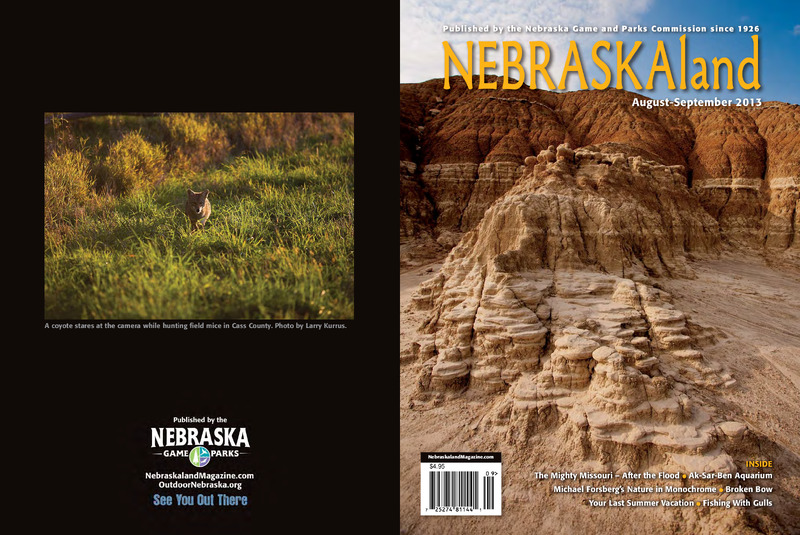
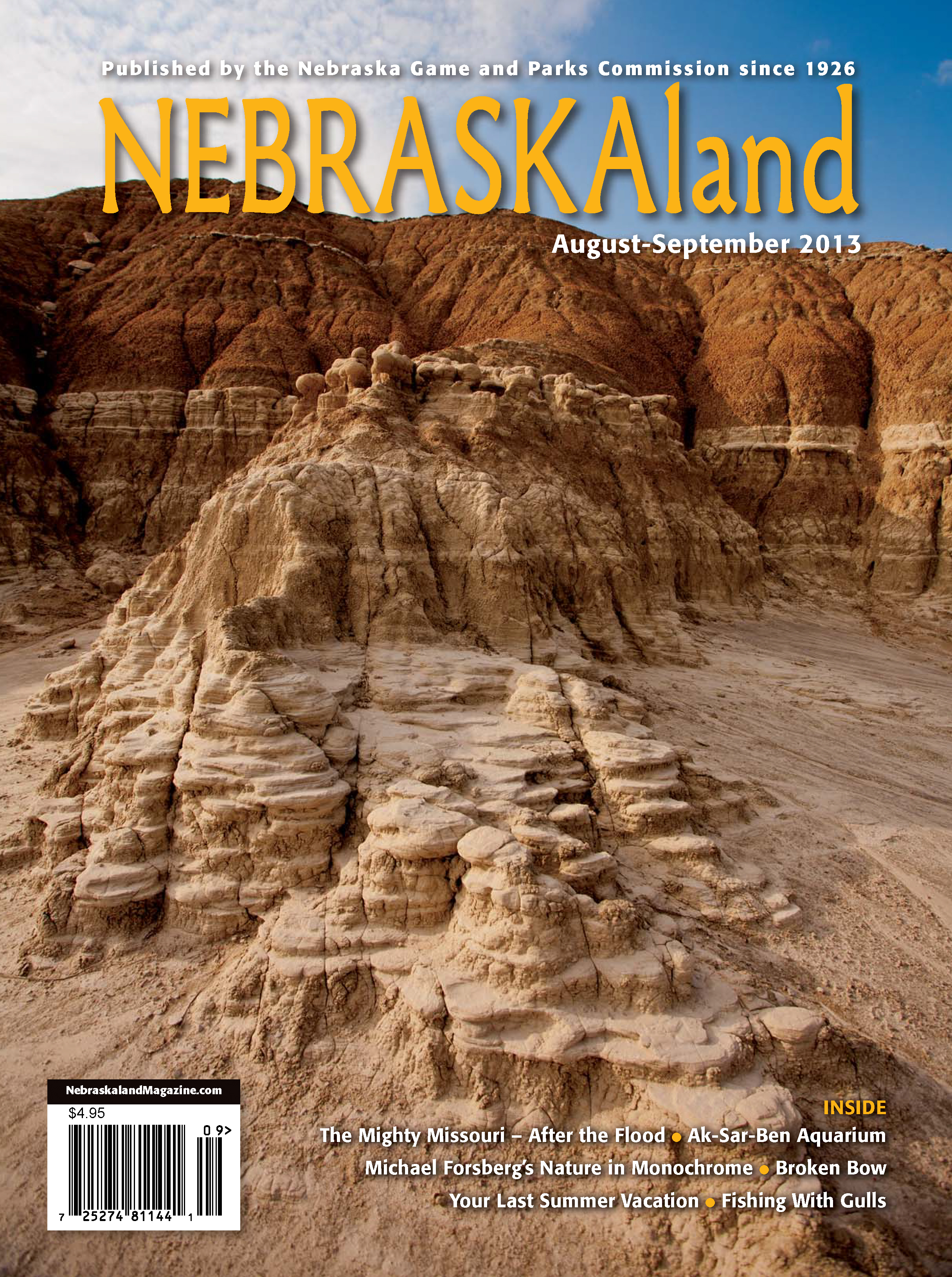
Publis hed by the Nebr a s k a Ga m e a nd Pa r k s C o m m is s ion si nc e 1926
NEBRASKAland
August-September 2013
A coyote stares at the camera while hunting field mice in Cass County. Photo by Larry Kurrus.
NebraskalandMagazine.com
$4.95
INSIDE
The Mighty Missouri – After the Flood ● Ak-Sar-Ben Aquarium
Michael Forsberg’s Nature in Monochrome ● Broken Bow
Your Last Summer Vacation ● Fishing With Gulls
NEBRASKAland Magazine
Volume 91
●
No. 7
●
August-September 2013
F EAT U R ES . . .
14 Nature in Monochrome
PHOTOS AND TEXT BY MICHAEL FORSBERG
22 Free to Roam
BY JUSTIN HAAG
24 Feathered Fish Finders
T
P
E F
28 What Now?
EXT AND HOTOS BY RIC OWLER
Analyzing the Aftermath of the Missouri River Flood
TEXT AND PHOTOS BY ERIC FOWLER
38 Your Last Summer Vacation
T
J K
,P
E F
44 Ak-Sar-Ben
EXT BY EFF
URRUS
HOTOS BY RIC OWLER AND JEFF
KURRUS
Aquarium and Outdoor Education Center
44
●
TEXT BY LINDSEY CHIZINSKI, PHOTOS BY JEFF KURRUS
48 Just Passing Through Broken Bow
TEXT AND PHOTOS BY JENNY NGUYEN
D EPARTM EN T S . . .
Comment .........................................................4
Mixed Bag.......................................................6
In the Kitchen ...............................................52
Page 49..........................................................53
Classifieds .....................................................54
Portraits from the Past ..................................56
Wilderness Workshop ...................................57
The Last Stop ................................................58
24
●
38
●
O N T H E W EB . . .
Art Meets Taxidermy
BY OLIVIA JOHNSON
Grand Island taxidermist Dustin Harrie provides
a very personalized option for his clients. Visit
NebraskalandMagazine.com to read this essay.
NEBRASKAland (VOL. 91 / NO. 7, ISSN 0028-1964) is published monthly, except
for the combined Jan./Feb. and Aug./Sept. issues, by the Nebraska Game and Parks
Commission, 2200 N. 33rd St., Lincoln, NE. Periodicals postage paid at Lincoln,
Nebraska, and additional mailing offices. POSTMASTER: Send address changes to
NEBRASKAland, P.O. Box 30370, Lincoln, NE 68503-0370.
2 NEBRASKALAND • AUGUST-SEPTEMBER 2013
48
●
Cover: Toadstool Geologic Park, located 30 miles north of Fort Robinson
State Park, is a great location for a day trip when staying at the Fort during
a late summer vacation (see the story on page 38). Photo by Jeff Kurrus.
Opposite: Black-eyed susans fill the frame in a roadside ditch in Sarpy
County. Photo by Jeff Kurrus.
AUGUST-SEPTEMBER 2013 • NEBRASKALAND 3
Susie Kelley photographed this “upside
down” bald eagle on the Flying V Ranch
near Niobrara on December 31, 2012. The
bird remained in this position for quite
some time scouring a nearby treeline for
movement, said Kelley, before eventually
flying away.
NEBRASKAland Visitor Letters
We want to thank all 36 readers
who sent e-mails and letters for last
issue’s visitor, a soldier beetle, that
was on page 8. See page 15 for the
winner, rules and this issue’s hint.
PHOTO COURTESY OF KANE MILLER
Max Meyer, of St. Paul, watches dad work
cows near Ericson in May. Photograph by
Brittni Meyer.
Thanks for a great issue of
NEBRASKAland Magazine this month.
I enjoyed the “Boiled Omelets” brief;
something my friends and I have
prepared many times during Niobrara
tubing trips. Also, I can’t wait to try
the recipe for Philly cheesesteak duck
rolls – my family, friends, and are avid
duck hunters, and I am always looking
for new, tasty ways to prepare flying
liver. Finally, I enjoyed the article
about Nebraska lifetime permits. My
wife and I just had the enjoyment of
a new son being born April 24. I plan
to purchase a lifetime hunt and fish
combo permit so he can grow up, right
by my side, enjoying what the outdoors
has to offer. While reading this article I
When Warren and Ann Wooledge of
Lincoln load the kayaks on the roof
of their car in the spring, they stay
there all summer, coming off for quick trips to any of the Salt Valley
lakes or bigger adventures to the Niobrara River or other Nebraska
waters, or beyond the borders to the Boundary Waters Canoe Area in
Minnesota. There’s no better way to experience nature, Warren says,
and brags about it frequently.
If you have a unique outdoor message plate you would like to share
or know someone who does, e-mail a photo (high-resolution, JPEG
format only, please) of it to Eric.Fowler@Nebraska.gov, along with your
name, hometown and a brief description of the interests expressed on
your license plate.
4 NEBRASKALAND • AUGUST-SEPTEMBER 2013
noticed a “visitor” on page 38.
I have also attached a few pictures of
the 30-foot custom duck boat my uncle,
cousins and I hunt from at Santee.
Nothing beats putting out decoys while
my uncle brews coffee for us. Then,
as the sun rises and birds start flying,
my uncle spins around in his chair and
fires up the stove. He fries up fresh
scrambled eggs from his farm, mixed
with sausage and hashbrowns.
At that moment, after some
successful shooting, we sit back down
to watch the sun come up and admire
the ducks hanging in front of us. Then
the smell of breakfast hits your nose,
and you realize you are far away from
everything – hunting with your family
and friends. At that point, life can’t get
much better.
Kane Miller
Omaha, Nebraska
First glance at the insect on page
8 of your July issue brought to mind
boxelder, milkweed and assassin. I’m
somewhat leaning toward the assassin
bug. I’ll eagerly await your next issue.
Thanks for a wonderful magazine. I
spent a week over the Memorial Day
holiday visiting family and friends in
the central and southeastern parts of
the state. Next trip back will be lots of
camping and fishing. My itinerary is
coming from issues of your magazine.
R.M. Barclay
Petaluma, California
Several species of soldier beetles
are found in Nebraska, including
the margined soldier beetle
(Chauliognathus marginatus), hidden
in last month’s issue, and the very
similar looking goldenrod soldier
beetle (C. pennsylvanicus). The
margined soldier beetle can often be
found feeding on pollen and nectar,
and pollinating flowers, in the spring
and summer. While most beetles
have hard outer wings, those of the
soldier beetles are soft and leathery,
and they are sometimes referred to
as leatherwing beetles. But don’t let
the soft wings fool you, these beetle
have a hidden defense. They produce
a toxin unpalatable to most other
animals. Typical margined soldier
beetles are orange with a black stripe
on the pronotum (“neck”), and a spot
near the rear of each wing, but they
can be highly variable. Some may
appear nearly all black, and others all
orange. They may be confused with
lightning bugs, another soft winged
beetle. But the head of a lightning
bug appears hidden when viewed from
above, and the head of the soldier
beetle is visible. Margined soldier
beetle larvae are predaceous, hatching
in the summer to feed on aphids,
grasshopper eggs and other soft
bodied insects. They overwinter
as pupae in the soil and leaf
litter to emerge as adults in
the spring.
Special thanks to Julie Van Meter, State
Entomologist, Nebraska Department of
Agriculture. Visitor image by Chris Helzer.
www.bugguide.net is a good site for identification
Send your comments to:
Jeff Kurrus, Editor
NEBRASKAland Magazine
P.O. Box 30370
Lincoln, NE 68503
or e-mail Jeff.Kurrus@Nebraska.gov
Please include your postal address and
telephone number.
Letters may be condensed and edited
for clarity. Photographs are welcome
and will be returned.
Any program that receives federal funding from the National Park
Service, or the United States Fish and Wildlife Service prohibits unlawful
discrimination on the basis of race, color, religion, age, gender, marital
status, national origin, age, disability or political affiliation. Any person
who believes he or she has been discriminated against in any program,
activity, facility, or service, should contact the Nebraska Game and
Parks Commission, Lincoln, NE 402-471-0641, the Equal Opportunity
Commission, Lincoln, NE 402-471-2024, TTY/TDD 402-471-4693;
United States Fish Wildlife Service, Civil Rights Coordinator, 4401
N. Fairfax Drive, Arlington, VA 22203; Director, Equal Opportunity
Program, U.S. Department of Interior, National Park Service, 1849 C
Street NW, Mail Code 0008, Washington, D.C. 20240-0001.
COMMISSIONERS
CONSERVATION OFFICERS
Director Jim Douglas
NORTHWEST
Officer
City
Jim Zimmerman (S) Gering
Commissioners
Chairman - Norris Marshall, Kearney
Vice Chairman - Lynn Berggren, Broken Bow
2nd Vice Chairman - Jerrod Burke, Curtis
Dr. Mark Pinkerton, Wilber
Dr. Kent Forney, Lincoln
Rex Fisher, Omaha
Mark Spurgin, Paxton
Mick Jensen, Blair
Ron Stave, Waterloo
MAGAZINE STAFF
Editor Jeff Kurrus
Art Director Tim Reigert
Regional Editors Eric Fowler, Julie Geiser,
Justin Haag, Jenny Nguyen
Contributing Editor Michael Forsberg
Regular Contributors Bill Hager, Chris Helzer,
Lisa Knopp
Photo Librarian Sarah Johnson
Circulation Donna Robinson
For address changes and questions about
your subscription, e-mail Donna.Robinson@
Nebraska.gov or call 800-632-5263
Advertising
For advertising information contact
Donna Robinson, Circulation
Phone: 402-471-5490
E-mail: ngpc.ads@nebraska.gov
NEBRASKAland Magazine Copyright 2013, all rights reserved.
NEBRASKAland is available in audio from the Nebraska Library
Commission Talking Book and Braille Service, Suite 120, 1200 N St.,
Lincoln, NE 68508. 800-742-7691. NEBRASKAland Magazine and the
Nebraska Game and Parks Commission reserve the right to reject any
advertising not in keeping with the agency mission.
Rates: $18 for one year; $33 for two years; $44 for three years. Nebraska
recipients must add appropriate sales tax. To subscribe call
1-800-NEBLAND (632-5263), or go online to: NebraskalandMagazine.
com.
COMMISSION
C
COM
OM
OMM
MIS
ISSIO
SIION O
SI
OFFICES
F CES
FFI
FF
ES
S
Headquarters/Southeast District Office
2200 N. 33rd Street Lincoln, NE 68503
Phone 402-471-0641
Northeast District Office
2201 N. 13th St. Norfolk, NE 68701
Phone 402-370-3374
Southwest District Office
301 E. State Farm Rd. North Platte, NE 69101
Phone 308-535-8025
Northwest District Office
East Hwy. 2, Box 725 Alliance, NE 69301
Phone 308-763-2940
Bassett Office
524 Panzer St., Box 508 Bassett, NE 68714
Phone 402-684-2921
Kearney Office
1617 First Ave. Kearney, NE 68847
Phone 308-865-5310
Omaha Office
1212 Bob Gibson Blvd. Omaha, NE 68108
Phone 402-595-2144
Greg Hesse
Scott Brandt
Heath Packett
Dan Kling
Frank Miller
Phone (308)
(office) 763-2940
(cell) 641-6138
Alliance
760-3647
Gering
631-0663
Eagle
402-210-0888
Harrison
430-0572
Valentine 402-389-0444
SOUTHWEST
Officer
City
Phone (308)
Roger Thompson (S) N. Platte (office) 535-8025
(cell) 530-3097
Ray Dierking
Brkn. Bow
870-0322
George Sund
Cambridge
655-0028
Michael Thome
Cozad
529-8146
Terry Brentzel
Oshkosh
458-7650
Matt Andrews
Elwood
746-2418
Dirk Greene
Imperial
882-0015
Dale Johnson
Kearney
440-3847
Brian Piernicky
McCook
340-6627
Brandon O’Neal
N. Platte
778-7486
Nicholas Fix
Ogallala
289-0427
Bryce Streger
Ogallala
289-1169
Rich Routh
Rep. City
920-0367
NORTHEAST
Officer
City
Tom Zimmer (Sup.) Norfolk
Dale Davis
Steve Oberg
Daniel Roberts
Randy Pomplun
Jeff Jones
Jon Reeves
Tim Williams
Pat George
Doug Pollard
Alex Frohberg
Cory Krause
Phone (402)
(office) 370-3374
(cell) 649-8053
Bassett
760-0712
Columbus
910-3366
Fremont
719-1108
Fullerton
308-550-0489
Hartington
762-5022
Kennard
889-8508
Grand Is
308-380-7331
O’Neill
340-0787
Ord
308-730-7050
Ponca
241-7615
West Point
380-6410
SOUTHEAST
Officer
Levi Krause (Sup.)
Sean McKeehan
William Krause
Mike Luben
Dan Zuehlke
Darin Gress
Douglas Kramer
Dina Barta
Stacey Lewton
Dudley Sorensen
Robert Finke
Russell Mort
Dan Evasco
Rich Berggren
City
Louisville
Bridgeport
Auburn
Colon
Cortland
Hebron
Lincoln
Lincoln
Lincoln
Lincoln
Milford
Nebr. City
Papillion
Waterloo
ADMINISTRATION
Officer
Craig Stover (Adm.)
Duane Arp (Ass.)
Jeff Clauson (Ass.)
City
Lincoln
Lincoln
Lincoln
Phone (402)
949-0593
308-279-9133
274-8063
443-6392
806-9084
768-8665
890-6465
890-6463
890-7140
937-3422
947-1363
209-1506
616-5961
619-1355
Phone (402)
471-5531
471-5532
471-0480
Nebraska Wildlife Crimestoppers 1-800-742-7627
Ak-Sar-Ben Aquarium
21502 W. Highway 31 Gretna, NE 68028
Phone 402-332-3901
AUGUST-SEPTEMBER 2013 • NEBRASKALAND 5
PH
PHOT
HOT
OTO BY ER
ERI
E
RIC FOWLER
FOWLER
WL
LER
ER
R
he August 1979 issue of NEBRASKAland
featured this advertisement for the Nebraska
State Fair’s entertainment. Held August 31
to September 9, the 1979 fair boasted a
commendable lineup of entertainers for its
guests. A few of them included Kenny Rogers,
Willie Nelson and The Oak Ridge Boys.
Advance tickets could be purchased by mail,
and all concerts were held in the Bob Devaney
Sports and Entertainment Complex, about
which the ad was sure to mention the lure of air
conditioning.
Thirty-four years later, the Nebraska State
Fair’s scene is much different, most notably
its move to Grand Island in 2010. Headlining
entertainment at the 2013 fair, which will be
held August 23 to September 2, includes Trace
Adkins, Eli Young Band, Mel Tillis and Chicago.
T
U.S. Fish and Wildlife Service Proposes to Revise Critical
Habitat for the Salt Creek Tiger Beetle
Courtesy of the U.S. Fish and Wildlife Service
The U.S. Fish and Wildlife Service is seeking public input on
a proposed revision of critical habitat for the rare Salt Creek tiger
beetle (Cicindela nevadica lincolniana), listed as endangered in
2005 under the Endangered Species Act (ESA). While only a few
hundred beetles remain in three small populations in Nebraska on
less than 35 acres, this revision will guide conservation efforts for
the species, which includes proposed critical habitat for 1,110 acres
of saline wetlands.
The beetle is unique to Nebraska’s eastern saline wetlands, the
most limited and endangered wetland type in the state. Habitat
loss associated with urbanization, road construction, stream
channelization and agricultural development has greatly reduced
the species’ numbers and distribution, making it vulnerable to
extinction.
In 2010, the Service designated 1,933 acres of critical habitat
for the beetle along Little Salt Creek and Rock Creek in Lancaster
County. As a result of a 2011 settlement agreement, we propose to
revise critical habitat to include saline wetlands along Little Salt
Creek, Rock Creek, Oak Creek and Haines Branch Creek that are
functioning saline wetlands or have the potential to be restored to
that capacity.
This designation of 1,110 acres is smaller than the previous
designation, but contains sufficient suitable habitat to support
recovery of the species, and includes two additional stream
corridors that were not previously included which could support
Salt Creek tiger beetle populations in the future. The goal of this
designation is to support at least six populations of Salt Creek tiger
beetles in the future. This designation will accommodate growth
of existing populations and reintroduction of additional tiger beetle
populations, as well as protect dispersal corridors and support
sufficient prey insects to ensure adequate food for the species.
The Service has opened a 60-day period to allow the public and
stakeholders an opportunity to comment on this proposal until
August 5, 2013. During that time, the Service will also seek peer
review from qualified members of the scientific community to
ensure that our final decision is based on solid science. A copy
of the proposed rule and more information on how to submit
comments can be found at Fws.gov/mountain-prairie/species/
invertebrates/saltcreektiger/index.htm or by contacting the Nebraska
Ecological Services Field Office at 203 West 2nd Street, Grand
Island, Nebraska 68801 or 308-382-6468. ■
6 NEBRASKALAND • AUGUST-SEPTEMBER 2013
AUGUST-SEPTEMBER 2013 • NEBRASKALAND 7
What’d You Say?
by Jeff Kurrus
Royal
PHOTO BY JENNY NGUYEN
Create history of your own or view
some of Nebraska’s most interesting
history? That’s the quandary you’ll find
when visiting the Royal area this time of the
year. Therefore, give yourself a couple of days
and do both.
First, drop a boat into 50-acre Grove Lake and
search for northern pike in the 40-inch plus range. One
of the state’s best trophy pike fisheries, it may take no more
than a spinnerbait to land the fish of a lifetime.
But if that fish doesn’t come during the morning,
visit Green Gables Restaurant in nearby Orchard to contemplate the
afternoon’s plans, which are numerous. You could re-visit
Grove in search of toothy critters, largemouth bass or pan fish, trout fish
at Verdigre Creek, or, if it’s September, go for an
afternoon dove hunt.
A dove hunt at Grove Lake Wildlife Management Area (WMA)
has provided me some of my fondest memories of the area. While
you may have to spend a little time locating the flight paths of these
often hard-to-hit game birds, you definitely have time to locate them
by prime shooting time in the last hour. If you’re visiting with a
group of friends and can’t decide, half fish and half hunt. Someone
will have a great story to tell when you re-group to primitive camp
at the WMA.
Then, on the way back home the following day, drop by
Ashfall State Historical Park and its, among other attractions,
17,500 square foot Hubbard Rhino Barn, where 3-dimensional
skeletons of large prehistorical animals are displayed. Plus,
you’ll be able to witness paleontologists working to uncover
even more alongside curator Mike Voorhies. For more
information, including park
hours, visit Ashfall.Unl.edu.
Lastly, suggest this trip to
a friend. I bet they’ll be just
as impressed as you.
Nick Tramp wears hearing protection at
the .22 rifle range at Ponca State Park.
8 NEBRASKALAND • AUGUST-SEPTEMBER 2013
PHOTO
PHOT
O BY BOB PELKEY
PELKEY
Jenny Nguyen
With so many brands of ear
protection products on the market, it
can be difficult to choose which one
is right for you. And as consumers
in the recreational market, we often
mistake higher price tags for better
quality. According to Garry G. Gordon,
audiologist and CEO of E.A.R. Inc.,
“Price doesn’t always mean that the
more you pay for something that
it’s better. The critical thing is that
ear protection has to fit and be worn
properly at the time of the exposure.”
When hunting or shooting, hearing
protection should never be overlooked.
Sound intensities beyond 85-90
decibels can be detrimental. To gain an
appreciation for the sound of gunfire,
a simple .22-cal. rifle, depending on
the length of the cartridge, comes in at
around 140 decibels.
How do the foam, disposable
earplugs stack up to more expensive
models? “With the disposables, if you
get them in your ear properly, they do
work. But a lot of times you see people
wearing earplugs that are sticking
halfway out,” said Gordon. Even
if the box says that it’s got a Noise
Reduction Rating (NRR) of 30-31,
that’s laboratory data and assuming you
get the earplugs in properly.
The consequences if you don’t?
Hearing loss and tinnitus (ringing of the
ears), plus having to shell out four to
six thousand dollars for a set of hearing
aids that actually work. Instead, use the
disposables properly or do additional
research to locate the right type of
protection for you. Regardless of your
choice, do not fire a weapon without
keeping your hearing in mind. ■
Lower Platte River plover observed overwintering along the Gulf Coast of Florida.
A Celebrity Piping Plover
Lauren Dinan
A small town Nebraskan has
become a star in south Florida. What
started out as a typical rough-ntumble childhood with three brothers
and sisters at a small-town housing
development in Dodge County,
Nebraska, has become anything but
typical for this … piping plover.
Yes, the celebrity is a piping plover
and is quite possibly the most popular
Nebraskan in Florida these days. This
plover hatched on June 13, 2011 and
was banded as a three-day old chick
by a research group lead by the Tern
and Plover Conservation Partnership
and the Commission’s nongame bird
program.
The piping plover color-banding
project along the lower Platte River
system began in 2008 with a total of
187 chicks and 73 adults banded to
date. This piping plover was one of
31 plover chicks banded along the
lower Platte River in 2011, but has
made sure to make his color band
combination known wherever it goes.
It was last observed on a lower
Platte River sandbar in Nebraska as
a 30-day old fledgling in late July
2011 before heading south on its first
migration. The next time this plover
was observed was in November 2011
on Bunche Beach near Fort Myers,
Florida – 1,300 miles away from its
home in Nebraska. During the winter
of 2011-2012 this photogenic plover
made itself well known at Bunche
Beach to local birdwatchers and
visiting wildlife photographers. It was
reported on the same beach 15 times
from November, 2011 to April, 2012.
It was not observed in Nebraska
during the summer of 2012, but was
reported back at Bunche Beach,
Florida in August, 2012 and has been
reported there 12 times this winter.
Other plovers color banded along the
lower Platte River in Nebraska have
been seen overwintering on beaches
surrounding the Gulf of Mexico and
Atlantic Coast from the southern tip
of Texas to the Florida Keys and up
the Atlantic Coast to South Carolina –
feathered ambassadors for Nebraska.
This piping plover has been
observed and reported more than any
of the 260 plovers banded along the
lower Platte River. While only two
years old, this plover’s ambition took it
from life in a small Nebraska town to
fame in Florida. The question remains,
will it ever feel a tug pulling it back its
small town Nebraska roots and return
to Dodge County to raise a family of
its own? If so, hopefully viewers will
continue to photograph this star and
share the news with all of us. ■
AUGUST-SEPTEMBER 2013 • NEBRASKALAND 9
NEBRASKA STATE HISTORICAL SOCIETY
Patricia C. Gaster
In the days before air
conditioning, getting a good
night’s sleep during the heat
of summer was sometimes a
problem. One obvious solution
was to sleep outdoors. The
Norfolk Weekly News-Journal
on August 3, 1906, reported
that many residents of that city
pitched tents in their yards
and spent sweltering summer
nights under canvas. The NewsJournal said:
“In many of the lawns of the
city today there are pitched
good-sized white canvas tents,
within which are cots that hold
Two couples seated in front of their tents sometime between 1907 and 1917.
in slumber every night tired
human frames that enjoy the
coolness of out-of-doors, tired brains that find absolute rest in the stimulating night air and hungry lungs that fairly eat up the
ozone that is to be had in larger quantities than are possible within doors.”
Sleeping outdoors wasn’t considered old-fashioned. In fact, it “has only been in vogue here for two or three years” and
was winning many new converts.
“‘How do you feel since sleeping out of doors?’ was asked of a man who has been at it for some weeks. ‘Much better,’ he
said. ‘I sleep more soundly, get more rest and wake up in the morning feeling like a prizefighter. Indoors I had a hard time
getting to sleep before midnight and I was awake at 5 in the morning. In the tent I drop to sleep the minute I strike the cot
and never wake up until I am called.’
“‘To what do you attribute the change?’
“‘Better air and more of it. In a room you get only what air can creep in through two or three windows at the most, and
that comes largely in draughts so that you don’t dare get it directly. In the tent it is all fresh air, there are no such things as
draughts and you inhale good, fresh, life giving ozone all night long. I am going to keep at it until the snow flies, and I know
I shall feel much hardier and much better in every way for it.’” ■
PHOTO
COURTESY
NEBRASKA
PHOT
O COURTE
CO
URTESY
URTE
SY OF
OF THE
THE NEBRAS
NE
BRASKA
BRAS
KA STATE
STATE FAI
FAIR
R
A Brief History —
Beating the Heat in 1906
The Nebraska State Fair
Olivia Johnson
In 2010 it was big news when the
Nebraska State Fair moved to Grand
Island after 109 years in Lincoln.
Although mixed feelings surfaced, the
event is experiencing major success
that only seems to be increasing.
When asked if they would
recommend the fair to family and
friends, 93 percent said yes in 2010,
94 percent in 2011 and 95 percent in
2012.
Joseph McDermott, executive
director of the fair, stated, “The vast
majority of people who come to the
fair in Grand Island are excited about it
and like what they see and feel they are
getting value for their dollars. The first
three have been spectacular. We know
we need to keep the programming fresh
Thermacell Outdoor Lantern
10 NEBRASKALAND • AUGUST-SEPTEMBER 2013
a caring, sharing and volunteering
community and the Nebraska State
Fair volunteers are a good example
of why that is true. Volunteers greet,
welcome, provide directions and assist
fair staff and talent. Last year, there
were approximately 900 volunteers
who donated more than 12,000 hours
of their time.”
If you’re unsure about visiting the
fair, McDermott said this: “It’s an
entirely different fair and fairgrounds.
There’s entertainment at every corner,
and some of the best food around.
There’s just a lot to see and do, and
it’ll take you more than a day to do
it.”
Whether you’ve been to the fair in
Grand Island every year since its move,
or if you haven’t seen it yet, visit this
year August 23 to September 2. ■
they approached the blind’s
mesh windows. Whenever I
stepped away from the blind, I
was attacked. I was sold. The
following summer I thought
the skeeters might pick me
up and carry me back to their
nest while walking across a
wet meadow to a spot where
I hoped to photograph elk
cows and calves feeding in the
evening. As soon as I plopped
my chair down in a fencerow
to wait, the invisible force field
the Thermacell provides took
effect and I didn’t see another skeeter
until the sun set and I headed back to
the truck.
Now I can use the lightweight
lantern, with 8 LEDs powered by 4 AA
batteries, to cast a light on whoever
is
i sitting
i i across the
h table
bl enjoying
j i a
wonderful summer evening with me on
the deck or at the lake, or to illuminate
the fish-cleaning table. And I won’t
have to wash off bug spray DEET
when I call it a night. ■
AUGUST-SEPTEMBER 2013 • NEBRASKALAND 11
PHOTO BY ERIC FOWLER
Eric Fowler
I’ve had the chance to test a new
version of a product I’ve sworn by
since 2008, and the Thermacell Outdoor
Lantern measures up just as good as the
original, keeping mosquitoes at bay on
my deck in Lincoln and on another in
Minnesota while providing enough light
to see my dinner.
Thermacell products use a butane
flame to heat a pad impregnated
with a patented allethrin, an artificial
version of a natural insecticide found in
chrysanthemum flowers. I first followed
a friend’s recommendation and picked
up a Thermacell while doing photo
blind work on the Platte River, hoping
to catch a river otter. I was amazed to
see the mosquitoes instantly turn tail as
and the facilities clean and
well maintained to keep people
coming back, and that’s our goal
every year.”
And the facilities have certainly
proven to be one of the new location’s
most redeeming qualities. “We were
able to design the fairgrounds from
scratch,” McDermott added. “Due
to this we have one of the premier
fairgrounds in the country.” The
facilities also get used for other
purposes during the off-season,
including a national convention last
March.
Another factor that has improved
with the move is the large group of
volunteers organized by the Grand
Island Chamber of Commerce. Cindy
Johnson, president of the Chamber,
stated, “Grand Island is known as
Czechs in Nebraska: A Heritage that Lives On
PHOTO BY HEIDI HOFFM
O
AN, LINCOLN JOURNA
NAL STAR
12 NEBRASKALAND • AUGUST-SEPTEMBER 2013
PATH
Eric Fowler
About 11,000 acres on 40
sites scattered throughout
Nebraska provide a unique
opportunity to introduce
youths to hunting and
fishing through the Passing
Along the Heritage program
(PATH).
Only youths age 17 or
under can hunt these areas.
This allows their mentors to
focus their attention solely
on teaching, safety and
making the hunt enjoyable.
Mentors can wet a line with
the youths at the fishing
sites. The properties can
be reserved, so the youth
and mentor can be assured
that they will have the
field, woods or waters to
themselves for the day.
“We’ve got a lot of good
areas and they don’t have
Bill Hancock and his son
son, Billy
Billy, hunt pheasants on a
PATH site at Lake Wanahoo State Recreation Area.
much hunting pressure,”
said Caroline Hinkelman,
who oversees the program as public access coordinator with the Nebraska Game
and Parks Commission. “We’ve gotten a lot of good feedback from mentors who
have taken youth out. They come back year after year because they are seeing a
lot of wildlife and harvesting the species they went for.”
The sites are located in the Panhandle, south-central and southeastern Nebraska,
including several on the Platte River, and offer deer, wild turkeys, upland game
or waterfowl hunting. Seven sites located at Lake Wanahoo State Recreation Area
north of Wahoo get the most use, but Hinkelman said there is room for many
more youths on the remaining areas.
PATH is a partnership between the Commission, the National Wild Turkey
Federation, the National Shooting Sports Foundation and the landowners who
open their land to youths for the program.
The sites are listed and can be reserved on the Commission’s web site. The days
of the week or times of the years each site is open may also vary. To learn more,
visit OutdoorNebraska.org and search for PATH. ■
PHOTO
PHOT
O BY ERIC
ERIC FOWLER
FOWLER
By Olivia Johnson
Nebraska is one of the most “Czech” places you’ll
find – well, outside of the Czech Republic, of course.
Between April and October each year there is a Czech
festival occurring somewhere in the state almost every
month. Since they began arriving in Nebraska around the
end of the nineteenth century, Czechs have left a lasting
effect on the livelihood of many people and communities
across the state that’s still present today.
Czechs began immigrating to Nebraska between
1860 and 1880 for various reasons. Life was difficult in
Czechoslovakia due to political and religious conflicts,
lack of personal freedom, overpopulation and poor soil for
farming. According to David Biroczi in his writing on the
Czech presence in modern America, “Many Czechs were
convinced to emigrate in their homeland by American
railway agents who looked for people to settle along the new
railways.”
However, many Czechs were specifically drawn to
Nebraska for other reasons. Rose Rosicky writes in her
1929 book, A History of Czechs in Nebraska, that Czech
newspapers played a major role in bringing Czechs to
Nebraska. These papers promoted “good” areas and were
a gateway through which the non-English speaking Czechs
could find desirable areas in the U.S. And, as many Czechs
had an agricultural background and desire, they were led to
Nebraska.
Rosicky also mentions several perks
available to the Czech immigrants.
There were laws in place that allowed
the new immigrants to obtain
tracts of land by following
government
regulations.
The Homestead Law, for example, allowed Czechs who
lived on a piece of land for six months to purchase it for
$1.25 an acre. Once Czechs arrived in Nebraska and became
settled, they wrote to their family and friends back home
encouraging them to join, which led to an even greater
number of immigrants.
“Nebraska, of all our states, contains the largest number
of Czech farmers of the first generation (born in Europe),
or one-fifth of all who live in the United States. This is in
accordance with the report of the Immigration Commission,”
Rosicky stated in her book. Dr. John A. Habenicht wrote a
history of Czechs in the U.S. in 1904 and estimated 57,000
Czechs living in Nebraska. He broke down his distribution
by counties, which showed the highest number of Czech
families residing in Butler, Colfax, Douglas, Saline and
Saunders counties. Over a century later, Habenicht’s
calculations still stand as fairly accurate.
The various chapters of the Nebraska Czechs Incorporated
still annually hold vibrant cultural festivals across the state.
Perhaps the most well known of these festivals, Wilber
Czech Days, always kicks off the first weekend in August.
Wilber, the Czech Capital of the U.S. as designated by
Ronald Reagan in 1987, has a population of about 2,000, but
that expands to roughly 40,000 during its festival each year.
The festival sponsors the Miss Czech-Slovak U.S. Pageant,
and offers plenty of traditional music, dancing, and food,
like beloved kolaches which are baked by the thousands.
Beyond the festivals, hints of Czech heritage are statewide.
Many Nebraskans have Czech last names that have endured
through the generations and continue to carry on. The
University of Nebraska-Lincoln has continued to offer Czech
as a foreign language for more than 100 years. Dedicated
students, instructors and the Czech Language Foundation
have ensured the endurance of the unique language program.
Being both a proud Czech and a proud Nebraskan has
proven to go hand-in-hand for many. It takes a special
heritage to endure so strongly throughout
so many decades, and as festivals like
Wilber Czech Days only seem to
be growing each year, the future
continues to look bright for the
Czechs of Nebraska. ■
What You Should Probably Read
Jeff Kurrus
“There are few topics that lend themselves to bothh
a serious examination and playfulness,” writes Bill
Adler, Jr. in his opus to every birder who has spent
time trying to thwart squirrels away from feeders.
In his book, Adler is assisted by biologists,
historians and practical birders who share knowledgee
about squirrels to educate and entertain the reader.
While not as funny as it wants to be in parts,
Outwitting Squirrels is relevant in its ability to
teach about these cunning creatures. ■
AUGUST-SEPTEMBER 2013 • NEBRASKALAND 13
Center Shot – Setting Your Bow for Perfection
by Jerry Kane
Contact the Nebraska Game and Parks Commission at 402-4710641 or visit OutdoorNebraska.org for more information. Visit
HuntSafeNebraska.org for a list of hunter education classes
and BoatSafeNebraska.org for a list of boating safety classes.
August 1
Squirrel hunting season
opens
August 10
The Night Sky Stargazing
Event at Wildcat Hills Nature
●1
Center, Gering, 308-436-3777
August 1
Fish for Millions Winners to August 13
be announced
Family Fishing Night
Lake Halleck, Papillion,
August 3
6-8 p.m.
Buffalo Cookout Niobrara
State Park (SP), Niobrara,
August 14
6 p.m., 402-857-3373
Beyond Becoming an
Outdoors-Woman
August 3
Shotgun class, Platte River
National Park Service
Outdoor Event, Niobrara SP,
Niobrara, all day,
402-857-3373
SP, Louisville, 6-9 p.m.,
402-471-5547
August 15
Family Fishing Night
August 3-4
Living History Fort Atkinson Holmes Lake, Lincoln,
August 28
Beyond Becoming an
Outdoors-Woman Shotgun
class, Platte River SP,
Louisville, 6-9 p.m.,
402-471-5547
State Historical Park (SHP),
Fort Calhoun, 402-468-5611
6-8 p.m.
August 4-9
Nebraska Star Party
Bullfrog season opens
August 30
August 16
Stargazing Eugene T.
Nebraska Game and Parks
Board of Commissioners
meeting, Valentine, 8 a.m.
Merritt Reservoir State
Recreation Area (SRA),
Valentine,
402-376-3320
August 5
Pistol League Platte River
August 15
Mahoney SP, Ashland,
dusk-11 p.m., 402-944-2523
August 16-17
Women in the Outdoors
SP, Louisville, 402-234-2217
Platte River SP, Louisville,
402-471-5547
August 7
Family Fishing Night
August 17
Color for a Cause 5K Run
Birdwood Lake, North Platte,
6-8 p.m.
Fort Kearny SRA, 9 a.m.,
Familyadvocacynetwork.com
August 8
Family Fishing Night
August 18
3-D Archery Shoot Lake
Mormon Island SRA, Lake
No. 1, Grand Island, 6-8 p.m.
McConaughy SRA, Ogallala,
308-289-6509
August 8-10
Music Jamboree Lake
August 20
Minatare SRA, Minatare,
308-783-2911
Archery antelope hunting
season opens
August 9
National Park Service
August 21
Beyond Becoming an
Outdoors-Woman Shotgun
Campground Program,
Niobrara SP, Niobrara,
7 p.m., 402-857-3373
class, Platte River SP,
Louisville, 6-9 p.m.,
402-471-5547
August 9-11
August 23
Northern Ponca Pow-wow National Park Service
Niobrara SP, Niobrara,
402-857-3373
August 9-11
Becoming an OutdoorsFamily Workshop Fort
Kearny SRA, Kearney,
402-471-5547
August 30-September 3
Hobie Fleet 61 Regatta
Lake McConaughy SRA,
Ogallala, 303-359-4275
August 31
Buffalo Cookout Niobrara
SP, Niobrara, 6 p.m.,
402-857-3373
SP, Niobrara, 8 p.m.,
402-857-3373
September 14
Feathered Friends Birding
Hike Wildcat Hills Nature
Center, Gering, 308-436-3777
September 14-15
Walleye Tournament Lake
McConaughy SRA, Ogallala,
308-726-2368
September 15
Statewide fall turkey hunting
season opens
September 15
August 31-September 1
Living History Weekend
Fort Atkinson SHP,
402-468-5611
September 16
September 1
Sidewalk Chalk Art
Niobrara SP, Niobrara,
10 a.m., 402-857-3373
Final day of participation in
the Great Park Pursuit
September 21
Muzzleloader antelope
hunting season opens
September 1
September 21-22
Hunting seasons open for
Missouri River Outdoor
many small game species.
Visit OutdoorNebraska.org for Expo Ponca SP, Ponca,
402-755-2284
complete list.
September 21-22
September 7-October 12
Applejack Festival and Fine
Roger G. Sykes Outdoor
Heritage Education Complex Arts Show, Arbor Lodge
open Saturdays and Sundays,
Platte River SP, Louisville,
10 a.m.-4 p.m.,
402-234-2217
August 24
Lewis and Clark Heritage
Day Ponca SP, Ponca,
September 13
Stargazing Eugene T.
14 NEBRASKALAND • AUGUST-SEPTEMBER 2013
September 14
Night Owl 5K Run Niobrara
Multiple big game archery
seasons open. Visit
OutdoorNebraska.org for
complete list.
Campground Program,
Niobrara SP, Niobrara,
7 p.m., 402-857-3373
402-755-2284
By Nebraska Outdoor U!
Finding the “Center Shot” of your bow isn’t just about finding the exact center
of the bow. For a correct center shot, make sure the center of your arrow rest lines
up with the path your string travels when you release it.
Hang a string on your target with a weight on the bottom so it is perfectly up
and down. Place a small sticker towards the top of your string for something to
aim at. Using your existing 20-yard pin, step back 20 yards from the target and
shoot an arrow at the sticker. Don’t
worry about where the arrow hits.
Move straight back to 30 yards and
using your 20-yard pin, shoot an arrow
at the sticker. Repeat this process at 35
and 40 yards making sure that you are
using your 20-yard pin and firing at
the sticker.
More than likely your arrow pattern
will look like “/” or “\” (see figure
1). Pick a direction (in or out), and
move your arrow rest 1/16th of an inch
and start the process over. If after the
second round of shooting your arrows
are getting a straighter “|” great, keep
moving the arrow rest in that direction.
If not, move the arrow rest in the
opposite direction. The goal is to have
all of the arrows form a parallel line to
the weighted string.
When the arrows you shoot are
parallel to the string (see figure 2),
lock down your arrow rest (see figure
3). You have now found the correct
center shot for your bow and your
shooting style. Now, adjust your
windage on your sights so that the
arrows are hitting the string. If your
arrows are to the left of the string,
move your sight to the left. If your
arrows are to the right of the string,
move your sight to the right. Once
your arrows are hitting the string,
lock down your windage adjustment
on your sight. Your center shot and
windage are set for your bow and how
you shoot.
Remember, just because you set the
center shot for your target arrows, it
doesn’t necessarily mean it will be the
same for your hunting arrows. You
may want to try this with one practice
broadhead to make sure that your
center shot is still the same.
Visit us at OutdoorU.org for more
information. ■
Mahoney SP, Ashland,
dusk-11 p.m., 402-944-2523
SHP, Nebraska City,
402-873-7222
September 28-29
Becoming an OutdoorsFamily Adventure
Camp
Camp Kateri, McCool
Junction, 402-471-5547
●2
●3
NEBRASKAland Visitor
Winner and Hint
Last issue’s winner of
the Visitor drawing
was Robert Chalouple off
Lincoln, Nebraska, who found
the soldier beetle on page 8.
Readers are encouraged to contact
NEBRASKAland within 10 days
after this issue’s publication with the
correct page number and name of
this issue’s “Visitor” – a bug found
in Nebraska that just happened to
find its way onto one of the pages.
We will then gather the correct
entries and draw one to win a
NEBRASKAland Magazine mug.
To enter each month, write:
NEBRASKAland Visitor
2200 North 33rd Street,
Lincoln, NE 68503.
Or e-mail:
Tim.Reigert@Nebraska.gov
with “Visitor” in the subject line of
the message.
HINT: This issue’s visitor is not
on page 5, 6, 44, or 58.
AUGUST-SEPTEMBER 2013 • NEBRASKALAND 15
Nature in Monochrome
A Different Photographic Option
Photos and text by
Michael Forsberg
E
arly
aar
r this spring I was standing in a
pphoto
ph
h blind along the Platte River
w
a
watching
cranes return for a midday
rrespite
re
e
to drink, loaf and bathe. The
sc
ceen
ne was
ne
waas D
scene
Disney-like but the light was anything
but – a harsh squinting noon sun with no clouds.
As a photographer I knew a color photograph
would wash out and fail miserably in this
situation, so I was content to just be present
among these ancient birds.
Then I remembered the digital camera I was
using had a “monochrome” setting (many digital
cameras do today) that would render the scene in
black and white. I had never tried it before and had
nothing to lose so I switched over to the “MC”
setting on the Nikon, took a shot and looked at the
back of the camera. Interesting. I took another, then
another. In this high contrast light of sun, water and
shadow I was beginning to look at these birds I have
photographed a million times in a way I never had
before.
Now the images were no longer about their gray
bodies against the blue sky or the tawny-colored
prairie grasses along the banks or the scarlet red
accent of their foreheads. It was about how their thin
lines organized themselves on the river, the intricate
textures in their wings and how their prehistoric
forms looked descending from the blank sky above.
When one crane flew over the top of the blind nearly
blocking out the sun I shot a picture that revealed
all the layers of feathers on the underwings of the
bird in a brand new way. I knew I had stumbled onto
something special and a new tool of expression.
Sandhill crane in flight, Platte River Valley, central Nebraska.
Eurasian collared dove and starlings, Utica.
16 NEBRASKALAND • AUGUST-SEPTEMBER 2013
AUGUST-SEPTEMBER 2013 • NEBRASKALAND 17
Like most species, humans are hard-wired to live in a world
of color, and scientists believe human sight can distinguish
roughly 10 million colors and tones.
So if we are hard-wired this way, why does a black and
white image have such appeal?
Perhaps it is because sometimes the picture is not about
color at all. Sometimes it is simply the interplay of light and
shadow that in turn accentuates pattern, texture, contrast
and form. Perhaps it forces us to look at the content of a
photograph where color could otherwise be a distraction.
Perhaps a black and white image forces us to look at the world
in another way.
Mushrooms and fallen logs in springtime, Indian Cave State Park.
Turkey vultures on a grain silo, Geary County, Kansas.
18 NEBRASKALAND • AUGUST-SEPTEMBER 2013
Black and white was the way early photographers
and explorers brought us our first glimpses of the
untamed wilderness and native cultures in the
American West. It was the way photographers of
the Farm Security Administration in the 1930s
documented the Dust Bowl years. It brought us the
harsh reality of World Wars I and II and the Korean
War. Even after color increasingly leaked onto
the scene with photographers like Larry Burrows
documenting the Vietnam War in the 1960s and
becoming commonplace by the early 1970s with the
Black-footed ferret at night on a prairie dog town,
Buffalo Gap National Grassland, South Dakota.
AUGUST-SEPTEMBER 2013 • NEBRASKALAND 19
Western painted turtle
tracks heading to water,
Nebraska Sandhills.
help of color TV, black and white was still often the
choice of photojournalists who could shoot it in low
light conditions or communicate a starker reality
that forced us to look squarely at the photograph’s
content and cause us to think.
Today, black and white digital photography is
increasingly being used as a tool in wildlife work,
even at night when color doesn’t matter with the
use of infrared. From a practical standpoint, now
you can give up your noon nap under a shade
tree when the light is harsh and shoot images all
day long from before sunrise to after sunset which
for those obsessed by photography can be both a
blessing and curse.
Maybe legendary black and white photographic
landscape masters such as Ansel Adams and
Elliot Porter, or documentary photographers like
Yousaf Karsh, would roll over in their graves
with the novice simplicity of pushing a button
and recording a black and white image instantly
in a digital frame. Pushing a button is certainly
not a substitute for the high craft and artistry
of traditional black and white photography that
helped move policy and public sentiment for some
of the most important issues of our time, such as
Adams’ conservation work in the Sierra Nevada.
Nor does it substitute for the high end digital
darkroom work converting color to black and
white that is being done by many photographers
today.
But there is something to be said about
capturing a black and white image in an instant
whether it’s a bison roaming across a wide prairie
or a painted turtle making track art in the sand.
At the very least, black and white opens a window
into another form of visual expression available
to all of us who carry a camera in hand, and can
lead us on a new visual journey of simplicity,
appreciation and discovery in what often is not a
black and white world. ■
Bison bull in a prairie at twilight, Nebraska Sandhills.
20 NEBRASKALAND • AUGUST-SEPTEMBER 2013
AUGUST-SEPTEMBER 2013 • NEBRASKALAND 21
Free to Roam
By Justin Haag
T
he saying goes that good fences make good
neighbors. Depending on the type of fence, that
adage can also apply to the wild animals that share
the land.
As European settlers spread westward throughout
the American West in the 1800s, so did fences. Those
barriers have played a critical role in the nation’s success,
but often have been a hindrance to the daily movements
and seasonal migrations of wild species that once roamed
without obstruction.
A Gruesome Death
pronghorn have been found dead beneath snow after they
encountered an impassable length of woven wire during
blizzards.
Schenbeck said a lot of woven wire fences were
constructed in the early 1900s for grazing domestic sheep,
but like sheep production, the amount of woven wire fence
continues to decline. While woven wire continues to be
phased out in many places, much still stands.
Getting ‘Friendly’
PHOTO BY MARK WOLLESEN
22 NEBRASKALAND • AUGUST-SEPTEMBER 2013
Barbed
Barbed
42"
Maximum
Smooth
16"
The ideal wildlife-friendly fence consists of a smooth bottom wire, approximately 16 inches from the ground; two barbed wires above
that, the first about 22 to 23 inches from the ground and the second 30 to 31 inches; and on top, a smooth wire 40 to 42 inches from
the ground. The top wire should have increased visibility. Options include covering this top wire with PVC or flagging it.
Proponents of such a design say it not only helps wildlife,
but usually does a good job of holding cattle. Schenbeck
noted that most of the cattle producers in northwestern
Nebraska are cow-calf operators with mainly heifers and
calves on their land. If a calf makes its way under the fence,
it will usually return to its mother without much trouble,
Schenbeck said.
Commission staff members say wildlife safety is just one
consideration to building a fence, and will occasionally
stray from their guidelines. Along roads with high traffic,
for instance, they will often yield to human safety and put a
barbed wire on the bottom instead of smooth.
“Common sense has to prevail along with the wildlife
considerations,” Schenbeck said.
Regardless of design, Nordeen said it’s important for wires
to be tight. Loose wires with their probability of wrapping
around wildlife and livestock are especially problematic.
Another component for building an effective wildlifefriendly fence is visibility, and special measures can be taken
in areas with frequent animal movements. A length of plastic
pipe threaded over the top wire helps make the fence more
noticeable for deer and elk, two species known for having
poor depth perception. Making a fence more visible not only
helps large hoofed species but also aids birds – especially
species of night-flying raptors that frequently collide with
wires while pursuing prey.
Some might assume a tall fence is best for deterring
elk, but officials say a shorter one may trigger elk to jump
over the obstruction instead of charging through or leaning
against it. Braided cable instead of single-strand wire at the
top will help the fence withstand a collision with an elk’s
back legs.
“Adult elk are lazy and big, and they’ll drop their hind
legs and bust those top two wires a lot,” Nordeen said.
to rebuild or replace fence that was destroyed or damaged in
the 2012 wildfires.
“There are many considerations besides wildlife when
it comes to building fence. We just hope that folks will
keep wildlife and big game in mind when thinking about
fencing,” Schenbeck said.
Whether or not a good fence has the power to make a
good neighbor, Nebraska wildlife officials are doing their
best to at least make them friendlier. ■
PHOTO BY JUSTIN HAAG
“Wildlife-friendly fence,” as it has been named, gives
big game animals a better chance at moving between areas
It’s not surprising that wildlife officials promote the
without harm or excess spent energy. It also results in less
benefits of installing fence designed with the movement
maintenance costs for the landowners. If a fence is designed
of wildlife in mind. They have
with wildlife movement in mind,
observed the carcasses of countless
big animals are less likely to
animals that jumped short and died
damage the fences.
a slow death hanging with their legs
However, officials are quick to
wrapped in the top wires of a fence.
point out that there is no one-size“We get a lot of calls to pull
fits-all answer when constructing
wildlife out of fences and a lot
wildlife-friendly fences. The written
of this suffering could have been
standards vary between federal
avoided if the fence would have
and state agencies, and what’s best
been constructed a little differently,”
in one area may not work well in
another.
said Greg Schenbeck, a Nebraska
In eastern Nebraska, one of the
Game and Parks Commission
biologist who works in the Pine
major considerations is the sizable
Ridge wildlife management
population of white-tailed deer and
headquarters near Crawford.
a high volume of vehicle traffic,
Not only is entanglement a
prompting officials to experiment
consideration, but also is the extra
with tall meshed fence along
effort animals expend to negotiate
Interstate 80 with crossings at road
A ewe bighorn sheep stands trapped in a
fences, especially during winter
underpasses. In the more sparsely
barbed-wire fence in northwestern Nebraska.
when they need to conserve energy. Commission staff often get called to respond to
populated Panhandle, wildlife
animals stuck in fences.
Having a fence easier to negotiate
officials deal with movements of
helps animals conserve energy,
a wider range of large animals,
including two species of deer, pronghorn, bighorn sheep, and
whether it is a heavy late pregnancy doe or a recently born
one of the most challenging species of all, elk.
fawn that has to cross through or under a fence to keep up
with its mother. Deep snow only makes fence passage more
Todd Nordeen, the Commission’s northwest district
wildlife manager, said his staff usually builds fence with
difficult.
a smooth bottom wire 16 to 18 inches from the ground, a
Posing perhaps the greatest challenge to wildlife is woven
wire, also known as “sheep fence.” Woven wire fence
space that allows for pronghorn to follow their instincts to
employs both vertical and horizontal strands in a mesh
crawl under. The top wire is placed about 40 inches high, a
pattern, allowing only relatively small animals to cross
jumpable height for most big game animals. The fence has
through the small square gaps instead of jumping the fence.
just one or two middle wires, placed at least one foot below
Such an obstacle may prolong a herd’s stay at one location.
the top to reduce chances of catching legs during an animal’s
At least twice in recent decades, large herds of Nebraska
jump.
12"
ILLUSTRATION BY TIM REIGERT
Wildlife-friendly fence helps animals move between
habitats while reducing maintenance costs.
Smooth (increase visibility - shown here covered in PVC pipe)
A Spirit of Cooperation
Commission employees continually gain awareness of
what works best by putting designs to practice in wildlife
management areas and other agency properties throughout
the state. They often work with neighboring landowners
by using cost sharing programs to install fence. In the Pine
Ridge, for instance, the agency is working with landowners
A deer carcass hangs on a fence along Sowbelly Road in Sioux
County. As deer cross conventional barbed-wire fences, their
hind legs often become entangled, rendering them helpless and
ensuring a slow and painful death. Nebraska Game and Parks
Commission officials encourage the installation of
wildlife-friendly fence designs.
AUGUST-SEPTEMBER 2013 • NEBRASKALAND 23
Feathered
Fish Finders
Gulls often lead to hungry white bass
Text and photos by Eric Fowler
F
ishing can be a shot in the dark,
especially if you don’t possess
one of those fancy, schmancy
HD fish finders with side scan
sonar and GPS. Okay, even
if you have one of those electronic
gizmos, it’s still a crap shoot. You cast
or troll where you think there are fish,
hope they will see your bait or lure
and then actually be hungry enough
to eat it. We wouldn’t blindly throw
bullets into the woods hoping to get a
deer, but with fishing, it’s that mystery,
and the thrill that comes when we do
occasionally outsmart the fish, that
keeps us coming back for more.
There is, however, one surefire case
when there is no doubt where the fish
are and if they’re hungry: the annual
feeding frenzy that occurs on many
large Nebraska reservoirs when white
bass are feeding on the surface. At
times it is such a melee that the water
appears to boil. You almost pity their
quarry – the gizzard shad – which are
being attacked from below by the bass
and, on some days on some lakes, from
above by hungry gulls, feathered fish
finders which might as well be a neon
sign flashing the message: “Fish Here!”
The top-water action starts in late
July, when the young-of-the-year
gizzard shad, now one to two inches
long, form large schools in deeper,
open water. Not ones to miss an easy
meal, most of the predators stocked
in these reservoirs follow the schools
of shad throughout the dog days of
summer. One such predator, the white
bass, also has a propensity to form
large schools. When these schools of
shad and white bass meet, the action
can be fast and furious.
Schooling white bass will surround
a school of shad and either push them
to shore or to the surface of the lake.
Witness this phenomenon and you will
sometimes see the frightened baitfish
leaping out of the water in an attempt
to escape. When things get really
serious, the bass might even follow,
launching their entire bodies, but
more often just their backs, above the
surface.
On a calm day, these boils can be
visible from a long distance. If you’re
in the mood for a tasty dinner or just
some fun, get there quick. The action
might last for only seconds, but when
the bass are really on their game, it can
last for several minutes. When gulls,
primarily ring-billed and herring gulls,
are getting in on the action from their
elevated vantage points, you can spot
the action from miles away through
binoculars.
When the action is on top, approach
the edge of the school with your
electric motor and send lures you can
throw a mile into the fray. Kastmasters
are a favorite spoon and Rat-LTraps are a good crankbait. Don’t go
barreling into the middle of the school
with your gas motor. Not only will you
push the fish down, you risk getting
one of those aforementioned lures in
the ear from an annoyed fellow angler.
There are plenty of fish that aren’t
on top, too. Vertically jigging slab
spoons on the edge of a surfacing
school can provide fast action. Tie
a marabou jig two feet or so above
your spoon and you can often double
your fun and catch two fish at once.
24 NEBRASKALAND • AUGUST-SEPTEMBER 2013
Anglers troll through a flock of gulls feeding on gizzard shad pushed to the surface by schooling white bass near
Harlan County Dam. When gulls are working the surface like this, the fishing is hard to beat.
There are several Nebraska companies
building and selling slabs, half- to
two-ounce chunks of lead with treble
hooks on one or both ends, and other
more sophisticated lures built to do the
same thing, including Patterson’s Reel
Bait of Seward, with its Fergie Special
and Lytle’s Secret Lure both designed
by Nebraska fishing guides, and John
Boy Lures of Ogallala. The bait shop
at your lake of choice will be stocked
with the local favorite and tell you
which color has been hot.
There isn’t a better bet right now
for white bass than Harlan County
Lake. Last year, more white bass
were harvested there – an estimated
112,000 – than in the rest of the state’s
reservoirs combined. More fish than
that were caught and released. Second
place went to Calamus Reservoir with
16,000 fish, a total that was considered
good but not as good as it can be.
“This year was a great year for white
bass,” said Don Lewton, a retired baitshop owner in Republican City, after
what he considered a slow day on
Harlan last August that only produced
a half-dozen keeper-sized fish among
30 or so he and fishing partner Roger
Foster caught. “Everybody caught
hundreds of white bass. Of course they
caught a lot of small ones, but they
don’t care. As long as they’re catching
fish they’re just happier than hell.”
Lewton said the only thing anglers
haven’t been able to consistently count
on at Harlan these days is the flocks of
gulls to point them to fish. “We used
to chase them all over the lake and the
fish would be boiling on top of the
water,” Lewton said. “We would get
Best Bets for White Bass
White bass can be found in most of the irrigation reservoirs in central and western
Nebraska, but Harlan County Lake, hands down, was the state’s top white bass water
in 2012. Among the rest, here are the best bets. Each of these State Recreation Areas
offers campgrounds and other amenities.
Reservoirrr::
• Calamus Reservoir:
Reservoirr:
r:
• Enders Reservoir:
McConaughyyy::
• Lake McConaughy:
Reservoirr:
r:
• Swanson Reservoir:
Othersss::
• Others:
AUGUST-SEPTEMBER 2013 • NEBRASKALAND 25
gulls. Fishing picks up in May when white
bass spawn in one of two places on most
reservoirs: the rivers, streams or canal inlets
that feed the reservoir or the rock rip-rap of
the dam. After the spawn, white bass will
disperse throughout a lake. In July, they will
school up and start chasing shad, and will
continue to do so into September, sometimes
even October. This is when, like most anglers,
Lewton starts searching the depths of Harlan
with his sonar, looking for schools of shad.
Wherever those are found, there are white
bass to be had, and maybe even a wiper,
walleye or catfish. Often, Lewton finds them
in 13 to 15 feet of water.
The likely places to look for these schools
are near ledges, points and wind-blown shores
where water currents concentrate plankton
that the shad feed on. “If you know the lake
pretty good you know where the drop offs
are,” Lewton said. “Most of the time, if the
wind ain’t blowing, the things will stay right
on a ledge and then you can just anchor right
down there and jig for them and catch all of
the white bass you want.”
Other anglers prefer to troll crankbaits or
spinner rigs to find the white bass. Others drift
to find fish.
However you find the fish, you will often
find lots of them, which is one of the factors
that makes white bass an excellent “family
fish.” Being able to see the action on top, and
being able to catch a lot of fish, is more than
enough to keep all but the most ardent gamers
interested. ■
Don Lewton lands a white bass
while fishing with Roger Foster
on Harlan County Lake last
summer.
tired of catching fish.”
Brad Newcomb, the Nebraska Game and
Parks Commission’s southwest district fisheries
manager, said a good gizzard shad hatch can
lead to less action on top, and that may be what
has been happening at Harlan in recent years.
With plenty of shad to eat, the white bass don’t
have to work as hard and don’t push as many to
the surface. But they’re still there.
The gull action, if it is happening, is typically
best from early- to mid-morning, Lewton said.
It doesn’t take long for a flock to draw a crowd
of anglers. “Invariably there’s got to be one guy
that’s got to plow right through the middle of
them and spook them down and then you got to
wait for them to come up again,” Lewton said,
lamenting the ethics of some who can cost other
less zealous anglers fish.
But there are also plenty of other ways to
catch white bass that don’t require following the
White bass await the fillet knife on the cleaning
table at Lewton’s home.
26 NEBRASKALAND • AUGUST-SEPTEMBER 2013
Bomber slab spoon
Bucktail jig
Acme Kastmaster
Rat-L-Trap
Heddon Sonar Flash
Reel Bait Lytle’s Secret Tail Spinner
When white bass aren’t working the surface, anglers can find them by searching the
depths for schools of gizzard shad.
Reel Bait Fergie Special
AUGUST-SEPTEMBER 2013 • NEBRASKALAND 27
What Now?
Text and photos
by Eric Fowler
Analyzing the Aftermath of
the Missouri River Flood
ABOVE: Floodwaters above and below
Omaha show as blue on this Landsat 5
image captured on June 30, 2011, the
same day the photo at left was captured,
showing those waters backed up behind
the levees protecting Omaha’s Eppley
Airfield.
River is channelized and armored banks
contain its flow to a narrow navigation
channel, bottomland flooding occurred
once again. Between Ponca and
Omaha, there are only a handful of
agricultural and municipal levees to
contain the floodplain. At Fort Calhoun,
water covered the entire 5-mile wide
floodplain.
From Omaha to its mouth at St.
Louis, federal or private agricultural
levees line most of both sides of the
Missouri River. Below the Platte River,
flooding between the levees is nothing
new, spilling over its banks in 2008 and
2010. But the levees weren’t designed to
hold back this much water for this long,
and several breached. Two breaches at
Hamburg and Percival, Iowa, allowed
water to cover most of a 20-mile long
stretch of floodplain, spanning its entire
7-mile width in spots.
Rearranging Things
F
or more than 100 years, man has
been trying to tame the Missouri
River. They’ve dammed it,
channelized it and wrapped it
with levees, hoping to shackle it
enough that its nickname, the Mighty
Mo, no longer fits. Two years ago, with
record runoff raging down its course,
the river once again showed everyone
who’s boss.
Much was written about the
$2 billion in losses sustained to farms,
homes, roads, businesses, parks and
other floodplain belongings. Many
called it damage, and when it affected
real property, the term did fit. But
what the river did to the land was not
damage. Spilling over its banks and
carving away land here and piling it
there is what a meandering river like
the Missouri is supposed to do. These
natural processes are life to the river
28 NEBRASKALAND • AUGUST-SEPTEMBER 2013
and the fish, wildlife and plants that
live around it, as natural as the water
that feeds them. And in some cases, the
flood was actually good.
Same Flood, Different Result
Six dams built on the mainstem
Missouri River were designed to handle
massive runoff from rain and snowmelt
in the Plains and Rocky Mountains.
Officials with the U.S. Army Corps
of Engineers, which manages the
reservoirs and river system, were
prepared to handle most of it in 2011.
But no one was prepared for the year’s
worth of rain that fell in the upper basin
states of Montana, Wyoming and the
Dakotas that May. And rain kept falling
in June.
The record runoff required the Corps
to release more than twice as much
water through those dams than ever
before, and continue those releases for
months.
Between Fort Randall Dam and
Lewis and Clark Lake, water filled
almost the entire valley from bluff
to bluff. Between Gavins Point Dam
and Ponca, there was little overbank
flooding. Those two reaches are
unchannelized and semi-natural.
Below Ponca, where the Missouri
Below Fort Randall and Gavins
Point dams, which hold back sediment,
clean water rushing through the dams
during the 2011 flood scoured the bed
of the unchannelized reaches of river
below them, piling sand in massive
sandbars 10 feet above the normal
waterline.
In 2010, there was an estimated
400 acres of suitable sandbar nesting
habitat for the federally endangered
interior least tern and the threatened
piping plover between Fort Randall
Dam and Ponca. During the flood, there
was almost no habitat other than two
AUGUST-SEPTEMBER 2013 • NEBRASKALAND 29
sandbars in the upper end of Lewis
and Clark built by the Corps at great
expense to benefit terns and plovers.
Now, the Corps estimates there are
more than 9,000 acres of sandbar
habitat.
Similar to previous record flows in
1997, which also created thousands of
acres of sandbars, terns and plovers
responded with excellent nesting
success due in part to a drop in
predation that comes when nests are
spread out. Annual surveys estimating
the number of chicks fledged in 2012
were up 40 percent for terns and
73 percent for plovers from 2010,
stemming a downward trend that
mirrored reduced acres of bare sandbars
to the erosive action of the river and
vegetation encroachment.
But the river’s scouring action was
not all good news. Because it degraded
the bed of the river, sand piled above
the waterline or flushed downstream,
causing water levels to drop 10 feet
or more in some areas. Boat ramps
Floodwaters still filled the bottomland forest north of Omaha as the leaves turned
in late September, 2011. Leaves on some flooded trees turned much earlier in the
summer, a sign of the stress they were under.
30 NEBRASKALAND • AUGUST-SEPTEMBER 2013
at Sunshine Bottoms and Mulberry
Bend became inaccessible during low
flows. The Ferry Landing boat ramp
near Niobrara was also closed because
the access road was washed out by the
flood.
Other effects aren’t as easy to see,
including the lowering of the water
table in the valley which, for the most
part, matches the level of the river. In
the Verdel, Niobrara and Bazile Creek
areas, where sediment buildup below
the mouth of the Niobrara River has
caused groundwater levels to rise since
Gavins Point Dam was built in 1955,
some wetlands are now dry.
The eight-foot drop at Ponca State
Park was one of three things that
affected two backwaters that had been
restored there. Lower river levels meant
less water in the backwater, making
them less welcoming for fish. The flood
also filled portions of the backwaters,
including the mouths, with sand, making
the north backwater, depending on the
level of the river, “more of an oxbow
lake than a backwater,” according
to Jeff Fields, Ponca State Park
superintendent. The most visible change
following the flood was a new chute
cut by floodwaters now connecting the
north and south backwaters.
Of bigger concern now at Ponca
State Park, however, is the future of
the boat ramp. The main channel of
the river, which hugged the Nebraska
shore at the park before the flood, has
shifted to the South Dakota side of
the river, leaving a massive, half-mile
long sandbar in front of the ramp.
Commission officials are concerned the
sandbar will migrate downstream and
fill the shallow channel in front of the
ramp, making it unusable. Therefore,
plans are being made to build two
ramps at the park later this year, one
in the riverbottom campground and the
other at the canoe launch at the upper
end of Elk Point Bend 5 miles north of
the main park.
Just as the sandbar at Ponca could
move, the river, in time, will again
rearrange the others, moving sand back
to the bottom of the main channel.
This will bring the “normal” water
level back up, but it may not recover
completely. Some of the sediment from
above Niobrara is now part of the delta
in the upper end of Lewis and Clark
Lake and now extends a half-mile or
Flows through Gavins Point
Dam hit a record 160,000 cubic
feet per second on May 28,
2011, and stayed there for four
months. The thunderous roar
and churning boil of water
rushing through the floodgates
drew throngs of spectators to
the tailwaters area throughout
the summer.
more farther into the lake than it did
before the flood. And some of the
sediment from above Ponca was flushed
into the channelized reach and is now
on the floodplain below Sioux City.
Farther downstream, however, the
river carried a larger sediment load,
much of it sand and soil scoured from
riverbanks it pushed against and fields
it rushed over. Cottonwoods lining the
banks or crossing bends stopped sand
like snow fences, leaving massive drifts
as deep as the water was high. The fan
of sand spread out across miles-wide
bends, including Boyer Bend near Blair,
where Boyer Chute National Wildlife
Refuge is located. Below the Platte
River, which continually feeds sediment
to the Missouri, the splay of sand
was massive at places like Schilling
Wildlife Management Area and below
levee breaches. The U.S. Geologic
Service estimated at least 67,500 acres
of bottomland were covered with at
least a foot of sand.
In most cases, the sand deposited
on the floodplain was plowed back
into crop fields and it was business as
usual for farmers in 2012. However,
where sand was piled too high to plow
through, some farmers went to great
expense to remove it. But there is some
land that may never be farmed again,
especially places where the river flowed
swiftly across the floodplain. Ten miles
north of Nebraska City on the Iowa side
of the river, two holes scoured inside
the levee are each more than 100 yards
wide, measure a combined 1½ miles
in length, and average 15 feet in depth.
Other scour holes are up to 50 feet
deep.
The flood did create quite a bit
of this type of shallow water habitat,
something the Corps and its state
partners like the Commission have been
working hard to restore in the river’s
channelized reach. The Corps is also
creating more, strategically excavating
to rebuild levees to create wetlands
while leaving the scour holes.
A Corps project below Decatur had
lowered the height of a revetment, the
rock and pilings protecting the outside
of a bend, to allow water to flow over
it, erode the bank and create shallow
water habitat behind it. The flood,
however, washed out several hundred
feet of that bankline and scoured a
hole more than 30 feet deep. While
repairing the revetment and restoring
the adjacent navigation channel, the
Corps is attempting to keep as much of
this new habitat connected to the river
as possible.
Chutes and backwaters restored
through the Corps’ Missouri River
Mitigation Program were affected
by the flood in both good and bad
ways in the channelized river. Chutes
paralleling the river, such as Hamburg
Bend Wildlife Management Area
(WMA) near Nebraska City and Kansas
Bend WMA near Peru, were widened
so much it affected navigation. The
Corps is now rebuilding inlets to
restrict the flow, which Gerald Mestl,
Missouri River program manager with
the Commission, said is a good thing.
“The chutes actually got too big
and the velocities and the depths were
approaching what you would see out in
the main channel,” Mestl said. “That’s
not what we’re interested in from a
habitat standpoint. We want diversity.”
Portions of chutes perpendicular
to the river’s flow silted in and will
have to be reopened. This was the case
at Schilling WMA near Plattsmouth,
where the first task was to rebuild the
inlet that was washed out. The inlet to
the backwater, which was also silted in,
also had to be reopened.
AUGUST-SEPTEMBER 2013 • NEBRASKALAND 31
Snags line a submerged sandbar in the
Missouri River near Ponca State Park
last August. The flood washed numerous
trees in the river, providing valuable fish
habitat and creating countless sandbars.
This bar, however, threatens to close the
park’s boat ramp.
more expected. The stress will make
trees susceptible to disease and insects,
and their weakened root systems will
make them apt to topple in high winds,
While the Missouri no longer
functions like a natural river, the erosion a fate many already suffered. Trees
and deposition that occurred during the with bases surrounded by sand and silt
2011 flood are a natural riverine process may slowly smother. Drought in 2012
that will benefit flora and fauna at least certainly added to the stress. “It’s such
a slow process that it wouldn’t be out
on a local scale.
“Rivers are constantly destroying and of line to say that a decade from now
you could still be seeing some of those
creating habitat at the same time,” said
impacts,” Herbst said.
Gene Zuerlein, assistant administrator
Numerous dead trees were removed
with the Commission’s environmental
from Ponca State Park’s riverbottom
service division who has worked on
campground and from other city and
Missouri River issues for decades.
“That helps with the succession of plant state park and recreation areas along the
river – 2,000 from N. P. Dodge Park in
communities.”
That succession is perhaps most
Omaha alone – due to the hazard they
could pose.
visible in the forest, particularly the
The loss of some trees is welcomed.
trees carved from flooded banks and
Eastern red cedar was easily killed by
deposited somewhere downstream. But
the floodwaters. In some cases, so was
while many trees like cottonwood, ash,
Russian olive. But managers aren’t sure
elm, sycamore, mulberry, willow and
what will sprout in their wake.
others adapt to occasional flooding,
Grasslands were also affected, with
the 2011 flood was too much. Graham
Herbst, a community forestry specialist species including switch grass, Indian
grass and big and little bluestem,
with the Nebraska Forest Service,
which are more suited to uplands,
has seen losses ranging from 20 to 60
being smothered. So were wetlands. In
percent in floodplain forests, with even
Life on the Beach
32 NEBRASKALAND • AUGUST-SEPTEMBER 2013
Cottonwoods are adapted to grow
and thrive in harsh riverbottom systems.
To reproduce, their fluffy, cotton-like
seeds that set sail from the treetops
each spring must land in moist, bare
ground. Often, this germination
occurs as water recedes following
high flows or flooding. But with the
Missouri confined to its banks, few
new cottonwoods were sprouting along
the river in Nebraska, especially in the
channelized reaches, leaving few trees
to replace the aging ones that are now
found on the floodplain.
There are plenty of cottonwoods
sprouting now, and their growth was
almost unheard of. In a joint project
between the Nature Conservancy
the Niobrara area, the flood set back
cattails, phragmites and reed canary
grass that had overtaken much of the
riverbottom between Verdel and Lewis
and Clark Lake. But those changes
weren’t as noticeable to the untrained
eye thanks to the flush of plant growth
that occurred in 2012.
Many pioneering plant species rely
on the natural succession that begins on
the bare sand that rivers deposit either in
their normal function or during floods.
Cottonwoods are a prime example. This
native tree is the keystone species on
the floodplain forest. Young dog hair
stands provide shrubby structure that
benefit species like belles vireo. Old,
mature trees provide nesting, perching
and roosting areas for bald eagles, wild
turkeys, great blue herons and the like.
When the trees die, the snags are prime
habitat for cavity nesters. When they are
washed from the banks by natural river
processes and stick in the riverbed, they
slow the river’s flow below them and
allow sandbars to form. This shallow
water habitat, and the food chain that
blossoms from the submerged trees, is
vital for fish.
Cottonwood seeds found
exactly what they wanted
in a narrow band of soil
on the sand-covered
floodplain at Boyer Chute
National Wildlife Refuge
near Fort Calhoun as seen
here in July of 2011.
and the Nebraska Forest Service,
Tyler Jahnke is studying cottonwood
regeneration by cultivating trees under
varied conditions near Nebraska City,
mostly relying on irrigation to germinate
seeds. He was surprised after the
floodwaters receded in October to find
tiny cottonwood seedlings sprouting on
the highest sand piles. By the summer
of 2012, some of those trees had topped
6 feet in height. By the end of the 2012
growing season, some were more than
14 feet tall.
“What’s neatest about that is this
happened in the year of probably the
most severe drought on record and
somehow, in this sandy area which
is going to be the driest, most harsh
Life of a River
he Missouri River in 2011 was
simply doing what it has always
done. Historically, the river
spilled out of its banks almost every
year, sometimes more than once.
There are three primary sources
of runoff in the Missouri River
Basin, which covers one-sixth of
the United States. The first comes
in early spring, when snow melts
on the plains. The second is spring
rainfall on the plains. The third is
runoff from snowmelt in the Rocky
Mountains. Before massive dams
were built, and even since, any one
of the three could cause spring rises
on the Missouri or its tributaries.
These yearly rises came and went
quickly, though.
Rising and falling flows shape
meandered rivers like the Missouri.
These rivers wind their way across
their valley, carving sand and soil
from one bank and depositing it
on another. Eventually, as these
bends became wider and the river
looped back on itself, it would take a
shortcut during high flows, charting
a new course and leaving an oxbow
lake in its wake.
The riverbed constantly shifted too,
bringing sand and sediment from the
bottom of the river and its banks and
building sandbars to just beneath
the waterline. These sandbars are
constantly moving downstream, only
to be replaced by another, and when
river levels dropped in the summer,
which they always did on the historic
Missouri, it would leave a wealth of
exposed sandbars above the water
line.
Fish, wildlife and plants adapted to
the cycles of rising and falling water
levels and thrived in the dynamic
that was constantly creating and
destroying habitat at the same time,
leaving a maze of sandbars, side
channels, chutes, backwaters and
oxbow lakes throughout the valley.
Because of our encroachment
onto the floodplain, today’s Missouri
River is dramatically changed. Dams
store runoff and meter out flows
throughout the year to support
navigation and other purposes,
compressing the high and low flows
and, for the most part, erasing the
threat of flooding. The dams also
trap sediment that is needed to
rebuild sandbars in the river below
them. Below Sioux City, armored
banks keep the river confined
to something that more closely
resembles a canal. Below Omaha,
when it does top its banks, levees
confine the flooding to a narrow
floodway.
AUGUST-SEPTEMBER 2013 • NEBRASKALAND 33
environment you’re going to have, these
little, itty, bitty cottonwood seeds were
able to germinate and grow, whereas we
had areas we were actively irrigating
and we couldn’t get that kind of effect.
Nothing that I’ve done yet has been able
to replicate the efficiency with which
nature did it on its own.”
Succession is also a natural part
of the rest of the floodplain plant
community. Wherever the flood piled
sand or scoured holes, annuals like
sunflowers, smartweed, cockleburs,
pigweed and mare’s tail took hold and
flourished, creating a habitat that had
mostly disappeared on the river.
“When you think about it, the
annuals are what produce seeds for these
birds to eat, and annuals were always
a large component of these floodplains
that flooded frequently,” said Tom
Cox, manager of the DeSoto National
Wildlife Refuge (NWR). “They show
up as a result of disturbance and that
has really been pretty positive from a
wildlife perspective.”
However, one concern following the
flood is saltcedar expansion along the
unchannelized river. After the flood,
colonies of the invasive shrub grew both
in size and range said Scott Wessel, a
biologist in the Commission’s habitat
partners section in the region.
The succession will continue. In
time, grasses will colonize these sandy
areas and there will be fewer forbs.
Some of the cottonwoods will persist
and grow big and tall. Cattails and
rushes will colonize some scour holes.
“It will take time for cattails to come
back, but they will,” Wessel said,
adding that lower water tables could
limit their recovery in some areas.
But without periodic floods, which
aren’t likely to happen again in some
reaches for many years, the early
successional habitat will again disappear
from the river.
red starts, and yellow throats, all of
which appeared to be nesting in greater
numbers on the refuge following a year
of no reproduction.
Mammals may not have responded
as positively, especially white-tailed
deer, which were forced to higher
ground. Managers saw deer gather at
the north end of the horseshoe inside
DeSoto Lake when a levee broke and
sent water across the area and left the
deer to swim north to dry ground. The
flood hit when fawns were young,
and there were reports of some that
died. When the water receded and deer
returned in the fall of 2011, they again
left because there was no food.
Commission biologists saw similar
movement of deer out of flooded areas
all along Nebraska’s portion of the
Missouri. In areas where there was little
As was the case with people, many
if any regrowth in the forest understory
wildlife were displaced by the flooding. in 2012, leaving little browse for deer,
Some perished. But the benefits
the deer have yet to return.
provided by new habitat could outweigh
Whether fawn loss during the flood
the losses, especially for birds.
was significant to affect the population
At DeSoto, pheasants and quail took will never be known. Kit Hams, the
advantage of the food, Cox said. So did Commission’s big game program
neotropical birds such as Harris and
manager, said biologists don’t survey
other sparrows, dickcissels, goldfinches, deer or monitor harvest on a scale
Wildlife
Sunflowers were among
the many annuals
growing from the sand
covering Boyer Chute
NWR in July, 2012.
34 NEBRASKALAND • AUGUST-SEPTEMBER 2013
By the Numbers
The Missouri River Flood
of 2011
• Previous Record: 70,000 cubic feet
per second (cfs), 1997. Releases
topped that mark May 28, 2011, and
dropped below it September 28.
• 2011 Peak: 160,000 cfs, enough
to drain the 492,000 acre-foot
capacity of Lewis and Clark Lake in
1½ days.
• Normal Summer releases: 32,000
cfs
Already well-populated with white-tailed deer, the wooded bluffs on the edge of the
Missouri River Valley, including those in north Omaha, became home for even more as
deer were forced from their flooded bottomland homes.
small enough to accurately gauge such
effects.
Many more deer were killed by
epizootic hemorrhagic disease (EHD)
in 2012, especially along rivers. Cox
estimated the population at DeSoto to
be half of what it was prior to the flood.
The flood did provide new
wetland habitat for waterfowl along
the channelized Missouri, including
everything from the scour holes to
expanded eddies behind wing dikes.
While annual mid-winter surveys by
Commission staff and the U.S. Fish
and Wildlife Service don’t show it, nor
are they designed to, the added habitat
may even be boosting waterfowl use
of the river. Cox said at one count
last fall, more than 50,000 ducks were
using new wetlands on the refuge,
some created by the flood and others
by management changes that restored
historic wetlands in areas that had been
farmed, well above previous counts.
This spring, the refuge hosted 272,000
ducks and geese, including more snow
geese than they’ve seen in seven years,
and a record 284 bald eagles.
Fisheries
Nothing benefits more from a flood
than fish. When a river spills over
its banks, the vegetation it inundates
becomes food, nutrients that provide
a spark at the base of the aquatic food
chain that carries a fire to the top.
Microorganisms thrive, which provides
more food for small or young fish –
which in turn provide more food for
big fish – and for big filter-feeders like
paddlefish.
Some fish evolved to spawn on the
floodplain, laying eggs on vegetation
in still water. When the eggs hatch,
the young find food and refuge from
the current, giving them a chance to
grow up a bit before they follow the
receding water back into the river.
By then, the natural flows of a river
would be reduced, providing plenty of
slow moving water for fish to grow.
In untamed rivers, this process repeats
itself almost every year.
In these respects, the flood of 2011
was not natural. And as such, not
all fish benefitted. During the flood,
Commission crews set nets in or pulled
trawls through floodplain areas that
included crop fields under 10 feet of
water. Some nets found hundreds of
baby channel catfish. Others found
numerous young paddlefish, but nets
weren’t needed to witness their prolific
spawn: reports of hoards of spoonbills
cruising the surface came from both the
channelized and unchannelized reaches.
But Mestl said most of the fish that
were spawned during the flood were
not found by sampling crews in 2012.
Flows simply remained too high for
too long, he speculated. “It was always
fast,” said Mestl. “There was just no
place for these young fish to get out of
the current.
“And it was such a total abnormal
duration, so we didn’t have this
reduction in flows that normally
• Flood of 1952: 396,000 cfs. Crest
of 40 feet.
• 2011: 217,000 cfs. Would have
been 313,000 without the six
mainstem dams. Crest of 36 feet.
Flood stage of 29 feet. Flows of
104,000 cfs topped flood stage
June 1 and stayed there until
September 10. Flows were above
200,000 cfs for an entire month.
• 61 million acre feet, most in 114
years of records, 26 percent more
than the previous high in 1996.
• 49 million acre feet: total runoff
from March 1 to July 1 was double
the norm. Inflow would have
exceeded the capacity of the Corps
reservoirs had they started empty.
• 1 million acres flooded below Fort
Peck Dam in Montana, with nearly
half of that in the reach flowing past
Nebraska, including land in South
Dakota, Iowa and Missouri.
• 4,200 people displaced.
• 3,600 homes and 300 other
structures damaged or destroyed.
• $2 billion total losses.
• $1.5 million in losses on Nebraska
Game and Parks Commission
properties, $500,000 reimbursement
expected from FEMA.
occurs after a few weeks. It just lasted
and lasted and lasted. It was on the
floodplain from 80 days around Sioux
City to over 170 days below the Platte,
and flows were high throughout the
fall.”
Mestl said year-old paddlefish
rarely show up in nets, so the verdict
is still out on their survival, but early
indications are good. But there was no
spike in the number of native minnows
and chubs like was seen after floods in
1993 and 1997.
What did fare well during the flood
AUGUST-SEPTEMBER 2013 • NEBRASKALAND 35
PHOTO
PHOT
O BY JEF
JEFF
F KU
K RRUS
US
S
Rebuilding
There was and still is plenty of
rebuilding to do after the flood. On 11
Commission properties, losses totaled
$1.5 million. Work has ranged from
rebuilding washed out roads to removing
piles of sand. Where possible, structures
such as outhouses were moved before
the flood. So were electrical hookups in
campgrounds. Some that could not be
moved and were washed away are still
waiting repair funding.
At Schilling WMA, much of the land
rented to farmers that also provided field
hunting opportunities for geese was
covered with sand. Of that, 125 acres
can’t be farmed. A road along the Platte
Thousands of young-of-the-year channel catfish were surveyed by Commission crews
River to its mouth on the Missouri will
in flooded crop fields near Plattsmouth in 2011.
be restored to maintain access.
Mark Rettig, superintendent at
below Gavins Point Dam. A 107-pound Niobrara State Park, hopes to have
was older fish. Endangered pallid
paddlefish, another new record, snagged the road to the east end of the popular
sturgeon and the common shovelnose
below Gavins didn’t travel quite as far, Railroad Trail, which follows an
sturgeon sampled in 2012 were fat,
having been tagged below Fort Randall abandoned rail line across a Niobrara
Mestl said. “They were in the best
Dam in 1992 when it weighed 49
River bridge and along the Missouri on
condition we’ve ever seen, which is
pounds and likely having spent most
the park’s northern edge for 2.5 miles,
good because they have more energy
of its time since in Lewis and Clark
repaired this summer.
stored to put into reproductive efforts
Lake. Droves of walleyes and sauger
But Commission and other land
and growth.”
were flushed through the reservoirs as
managers are mindful of rebuilding
Other native fish, including sauger,
well.
structures in the floodplain. At Boyer
channel catfish and buffalo, were also
“Even this spring people are
Chute NWR, for example, a concrete
in good condition during the flood.
However, the improved body condition targeting walleye and sauger in eastern hiking trail on the island that was
covered with several feet of sand in the
of fish in the river may not last, at least Nebraska,” Mestl said. “Prior to the
flood, that was unheard of for decades.” flood will not be reopened. Cox said the
in the channelized river. Length-toThose walleyes and other sight
refuge was closed five times by flooding
weight ratios of catfish were already
feeders may benefit from another
in 2010 and the constant maintenance
reduced in 2012 compared to 2011.
byproduct of the flood that could hurt
required by the trail is simply not a good
It had declined even more for
native species: improved water clarity.
use of funding.
native river species like paddlefish
Mestl said the flood apparently flushed
Restoring habitat is also a question
and sturgeon that made up the greatest
a considerable amount of clay and silt
people are answering differently.
percentage of fish trapped in newly
out of the system, and the cleaner water Some with land enrolled in the USDA
created lakes on the floodplain. That
will benefit non-native river fish.
Wetlands Reserve Program would like
could be because those fish were built
The flood also washed an immense
to reseed associated grasslands that were
to live in moving water, or because
number of trees into the river.
killed in the flood. “They are taking their
there was too much competition for
Historically the meandering Missouri
chances on when the next significant
food. But Mestl said as those species
flood arrives, which it will,” said Scott
decline, the number of native gamefish River was choked with snags, trees
felled both by everyday flows and
Luedtke, biologist in the Commission’s
like bluegills, crappies and largemouth
raging floods. These fallen trees would habitat partner’s section. Reseeding
bass found in those habitats will
provide not only breaks in the current
would be expensive, and the early
increase. Those species can still be
and refuge for fish, but in a sand-based successional habitat created will be just
found in restored backwaters where
river the only hard surfaces in which
as valuable to birds, he said. At Boyer
they had been thriving prior to the
aquatic insects like caddis flies could
Chute, Cox said they plan on letting
flood.
live. Before the flood, some snags
cottonwoods, sedges and grasses more
The flood also brought a host of
could be found in the unchannelized
suited to riverbottom grasslands and
new fish into Nebraska’s portion of
river but few below it. There are more
meadows take over the island rather than
the Missouri. Wide open floodgates
today, even in the channelized reach,
reseeding grasslands.
flushed countless fish out of upstream
Even levee reconstruction is being
reservoirs into Nebraska waters. A new and will provide short term benefits to
looked at differently. Levees that
state record Chinook salmon that came the fishery and a long term source of
breached near Hamburg and Percival,
downriver from the Dakotas was caught carbon for the entire food chain.
36 NEBRASKALAND • AUGUST-SEPTEMBER 2013
Iowa, were realigned slightly when
repaired. A more dramatic shift was
made to the Copeland Bend levee near
Nebraska City that likely would have
failed had the upstream section near
Percival not gone first. By moving
this levee back from 1,000 to 2,500
feet from its previous location both
above and below Highway 2, persistent
seepage and flooding issues, and the
cost of fixing them, will be lessened
and the flood stage at the location will
be reduced. Future improvements to
Highway 2, a major artery between
Nebraska and U.S. Interstate 29 in Iowa,
including possibly raising the road bed
and lengthening the bridge or installing
box culverts under the road, will lower
the flood stage even more by removing
the choke point caused by the previous
bridge and levee alignment.
An extreme example of a chokepoint
are the levees protecting Eppley Airfield
on Omaha’s northern edge and the
one across the river protecting Council
Bluffs, which leave only a 1,500-foot
wide floodway for all of the river’s
flows to pass. This likely caused water
to back up above Omaha and contributed
to the bluff-to-bluff flooding at Fort
Calhoun.
There is no room to move these metro
levees back, but moving them elsewhere
is part of something Mestl and Zuerlein
have been promoting in recent years:
an erodible habitat corridor that would
restore 203,000 acres of riverine habitat
between Sioux City and the Nebraska/
Kansas state lines to lessen flooding and
benefit fish and wildlife.
Currently the floodway between
the levees is narrower, and can carry
much less water, than the 3,000 to
5,000 foot width called for under the
federal legislation that authorized the
levee construction. With levees set back
farther, it would “let the river be a river,”
Zuerlein said.
Zuerlein said the dams for years
provided a false sense of security to
those near the river, encouraging people
to build on the floodplain and making
restoring the ecosystem even more
difficult. There may never be another
flood like 2011 that requires so much
water to be released from the dams, but
there are sure to be others caused by
heavy rains below them.
Repairing and paying for flood
damage over and over, especially to
maintain a navigation channel for a
handful of barges to use each year, does
not make sense, Zuerlein said. What
does is making changes that allow
the system to handle floods without
repetitive taxpayer bailouts.
“I think we need to learn to
appreciate a river a little more and
learn to live with them instead of trying
to control them at all cost,” he said.
“They’re trying to build levees so they
can get every square inch for farms
and cities. But the river needs a certain
amount of space too, especially to help
with flood risk reduction.
“The river is trying to talk to us
and tell us what it needs and we’re not
listening.” ■
The author would like to thank many
with the Commission and others for
information they provided for this story,
including Jeff Fields, Kit Hams, Pat
Molini, Nick Hoberg, Jeff Hoffman, Scott
Luedtke, Mike Remund, Mark Rettig,
Tom Welstead, Scott Wessel and Josh
Wilhelm.
The Game and Parks Commission is allowing the U.S. Army Corps of Engineers to borrow soil from Peru Bottoms Wildlife
Management Area to rebuild the levee along the area. The result will be wetlands that fill with groundwater when flows on the
Missouri River are high, likely in the spring, as well as a diversity of plant life.
AUGUST-SEPTEMBER 2013 • NEBRASKALAND 37
Your Last
Summer
Vacation
Where to go and what to
do when summer wanes
By Jeff Kurrus
TOP: The Nebraska Balloon & Wine
Festival, which will be August 9-10 just
south of 204th and Q streets in west
Omaha five miles east of Two Rivers State
Recreation Area, features a live band,
games for the kids, wine tasting and hot
air balloons.
BOTTOM: Anglers may be treated to fog
rising off the Missouri River on a cool
summer morning. Base your trip out of
Ponca or Niobrara state parks or Lewis
and Clark State Recreation Area.
PHOTO BY ERIC FOWLER
38 NEBRASKALAND • AUGUST-SEPTEMBER 2013
PHOTO BY JEFF KURRUS
I
t’s your last hurrah, the final time for making a
memory before school rolls back around and your
weekends are filled by games at Memorial Stadium
and watching the leaves brighten above you. Don’t get
me wrong, autumn is one of Nebraska’s finest times
to be outdoors. But the last summer vacation could be
even better. It’s when sunsets last for hours on days
that never seem to end. These are the times that your
friends and family, for years to come, start their stories
with “Do you remember that time?”
How will you remember yours? If you’re not sure,
visit some place new this summer to find out, or even
re-visit one of your favorite spots that has yet to cross
your windshield this year. And bring your camera.
You’ll want to make sure these trips are recorded for
years to come. ■
AUGUST-SEPTEMBER 2013 • NEBRASKALAND 39
PHOTO BY JEFF KURRUS
PHOTO BY ERIC FOWLER
TOP: The Lindeken Pool at Fort Robinson
State Park gives visitors a place to cool off
when summer heats up.
BOTTOM LEFT: Mace Fowler holds up one
of the rocks at Toadstool Geologic Park.
Such photos are a requirement of any trip
to the badlands area a short drive from
Fort Robinson.
PHOTO BY ERIC FOWLER
40 NEBRASKALAND • AUGUST-SEPTEMBER 2013
TOP RIGHT: There 42 county fairs held
sometime in August, including the Sarpy
County Fair July 31 to August 4.
PHOTO BY ERIC FOWLER
PHOTO BY ERIC FOWLER
LEFT: Climbing the Lincoln Journal Tower
to watch the sunset is the perfect way to
end a day at Platte River State Park.
RIGHT: Having a fishing pond in your
backyard is just one reason to rent a mini
lodge at Ponca State Park.
AUGUST-SEPTEMBER 2013 • NEBRASKALAND 41
PHOTO BY ERIC FOWLER
PHOTO BY JEFF KURRUS
TOP LEFT: Ryan Hawley of Gretna brings
a northern pike to the boat at Box Butte
State Recreation Area near Hemingford.
PHOTO BY JEFF KURRUS
PHOTO BY ERIC FOWLER
BOTTOM LEFT: Abby Caldwell of Kansas
City, Missouri, rides Trooper at Eugene T.
Mahoney State Park.
42 NEBRASKALAND • AUGUST-SEPTEMBER 2013
LEFT: Visitors take a paddleboat for one
last spin around the pond at Chadron
State Park at sunset.
TOP RIGHT: One of the nation’s best
zoos, the Henry Doorly in Omaha,
features 130 acres of animal exhibits,
including jellyfish displays.
For More Information
For more information about
these and other Nebraska parks,
call 1-800-826-PARK (7275)
and leave your name, complete address and request. You
may also call a park directly
or look up information about
Nebraska parks on the web at
OutdoorNebraska.org.
AUGUST-SEPTEMBER 2013 • NEBRASKALAND 43
Ak-Sar-Ben
Aquarium and Outdoor
Education Center
By Lindsey Chizinski, Photos by Jeff Kurrus
N
ext time you’re traveling
Interstate 80 in eastern Nebraska,
hop off the Gretna exit and head
south on Highway 31. The scenery
on this winding road can’t be beat,
especially in autumn when the trees are
bright with color and turkey and whitetailed deer are always seen. Then,
about six miles down the road you’ll
spot a sprawling stone building nestled
into the base of the Platte River bluffs,
and you’ve reached your destination
– the Ak-Sar-Ben Aquarium Outdoor
Education Center.
First, sit for a few minutes in the
shade of the patio to view the activity
in the butterfly garden. Once indoors,
grab some public-use binoculars and
do a little bird watching from the
expansive windows that face Schramm
Park State Recreation Area.
Continue your visit at the Aquarium
by viewing a diverse group of aquatic
species including painted turtles
basking on a log, yellow mud turtles
keeping their cool in the water and bull
frogs trying their best to escape into the
lobby. A tour guide on-site can help
you identify each of the species.
Then take a stroll through the
Aquarium and its 12 tanks displaying
32 Nebraska species, including
prehistoric gar, behemoth blue catfish,
invasive Asian carp, and several game
species including largemouth bass,
bluegill, northern pike and crappie.
University of Nebraska-LIncoln herpetologist Dennis Ferraro teaches during a snake demonstration at Ak-Sar-Ben Aquarium.
PHOTO BY STEVE ZECHMANN
Clubs at the Aquarium
On the first Tuesday night
of each month, the Schramm
Park Photography Club meets
at the Aquarium to discuss
style, equipment and view
the work of other local
photographers. “The club is
for those wanting to sharpen
their skills in capturing
the beauty that surrounds
them,” said president
Steve Zechmann. “Join us
in learning about camera
settings, composition, lighting
and many other techniques.”
All skill levels are welcome.
Also at the Aquarium, the Cornhusker Fly Fishers meet the third Wednesday
night of each month to discuss fly fishing, fly tying and outdoor conservation.
The group also brings in nationally known fly-fishing experts, offers casting
tutorials and provides other activities for people of all ages.
For more information about either program, contact the Aquarium at
402-332-3901.
44 NEBRASKALAND • AUGUST-SEPTEMBER 2013
Plus, sequestered in its own tank,
you’ll see what could be the most
gigantic snapping turtle you’ve ever
laid eyes on.
In the adjacent classroom, a variety
of amphibians are on display as well as
an impressive collection of Nebraska
bird species. In addition, furbearer
pelts, skulls and scat can be viewed
while your young ones immediately
explore the touch table and its variety
of bones and other animal artifacts.
After the table, kids can then curl
up in a beanbag chair with a book
from the nature library, crawl inside
a tent and work on a puzzle or put on
a show with a menagerie of wildlife
puppets. While the kids let loose with
their imaginations, parents can pull up
a rocking chair and thumb through a
field guide to prepare for a hike on the
nature trails at Schramm Park.
Kids and adults alike can then study
an assortment of aquatic and terrestrial
insects under magnification at the
microscope station. On weekends, you
may even be surprised by a classroom
full of snakes on display, courtesy of
Dennis Ferraro and the University of
Nebraska-Lincoln. Other weekends
may offer lure making or fish printing
activities for the family.
One final peek around the corner will
reveal the World Herald Auditorium,
which offers viewings of nature and
wildlife films and hosts seasonal
workshops that cover topics ranging
from Nebraska camping destinations to
sausage making.
Additionally, the facility hosts
monthly meetings of the Schramm
Park Photo Club and the Cornhusker
Northern pike are one of the 32 species of native Nebraska fish
featured at the Aquarium.
AUGUST-SEPTEMBER 2013 • NEBRASKALAND 45
Schramm Park State Recreation Area
I
n 1882, the Gretna Fish Hatchery, the state’s
first hatchery, was opened to raise trout and
salmon on the current Schramm Park State
Recreation Area site. In 1914, the original hatch
house was replaced by the building that still
stands. In 1974, this building was phased out
by the Nebraska Game and Parks Commission
and the land was transferred to the Parks
Division, combining the structure with 277
adjoining acres willed to the Commission
by E.E. Schramm, a geology professor at the
University of Nebraska, for a total of 331 acres
and the area’s current namesake.
Schramm has long been a great picnicking
spot for visitors, but the area also offers
a three-mile hiking trail of rolling hills, a
geologic display, wildflower viewing in the
spring and summer and wildlife viewing yearround, and ponds next to what is now the Fish
Hatchery Museum to feed carp, Canada geese
and other waterfowl.
Naturalist Nicole Bekker works with students at the Aquarium.
Fly Fishers and hosts bird-banding
demonstrations conducted by the
Fontenelle Nature Association.
Lastly, tourism guides offer live
animal presentations and fishing trips
to school groups, and are available on
weekends and throughout the summer
to assist visitors. “The Aquarium and
Schramm Park can be a fun place
to visit for people of all ages, and I
invite everybody to come learn about
Nebraska’s aquatic and wildlife world,”
said Aquarium Director Tony Korth.
Drop by to experience the Aquarium
for yourself, but not before visiting
OutdoorNebraska.org or calling
402-332-3901 for seasonal hours of
operation. ■
Ak-Sar-Ben Aquarium
and Schramm Park
A white-tailed deer runs at Schramm Park.
While camping is not allowed at Schramm,
nearby Louisville State Recreation Area, just
five miles east, allows RV and tent camping,
and the combination of both Ak-Sar-Ben
Aquarium and Schramm Park gives visitors
an inexpensive day’s worth of activities both
indoors and out.
Autumn colors line the three-mile nature trail at
Schramm.
Schramm’s Fish Hatchery Museum shines red during a winter storm in eastern Nebraska.
A banded white-breasted nuthatch feeds near the Aquarium’s bird viewing window.
46 NEBRASKALAND • AUGUST-SEPTEMBER 2013
AUGUST-SEPTEMBER 2013 • NEBRASKALAND 47
Just Passing Through
Broken Bow
B
roken Bow was actually named for a broken bow, and they
have the pieces to prove it. The Custer County Museum houses
pieces of a discarded bow, probably Pawnee. The bits of old wood
might not look like much, but how many towns can display the thing
after which they were named?
Wilson Hewitt, an early homesteader, had applied for the location
of a post office on his place. Approving the location, the government
rejected Hewitt’s first three suggested names as being too similar
to names previously approved. Remembering a bow recently found
nearby, Hewitt then submitted the name “Broken Bow,” which the
Post Office Department readily approved.
This area was the center of what eventually came to be known
as the Sod House Frontier. As homesteaders began to enter
this largely treeless region, they made their first homes of prairie
sod, which they cut into strips. Early churches, schools and some
business places were also made of sod. Homesteaders used sod to
construct corrals, henhouses, corn cribs, wind breaks and even pig
pens. One enterprising Custer County resident even constructed a
full two story sod house
while others were usually
a single story or story
and a half.
As the region became
more settled, Broken
Bow grew, and in 1882
became the county
seat of Custer County.
That same year, Mr.
Jess Gandy donated
the sites for the county
courthouse and city
square.
B
Pioneer Beginnings
Located in the Sandhills along Highway 2 in the heart of
Custer County, this small town of roughly 3,500 surprised
48 NEBRASKALAND • AUGUST-SEPTEMBER 2013
me. Celebrating its 134th birthday, Broken Bow has aged
considerably well – its now vibrant business community
starkly contrasting the scenes in Solomon Butcher’s black
and white photographs of the town’s early pioneer days.
Butcher’s collection (see sidebar, page 49), which deftly
captured the grim, hard faces of the area’s earliest settlers
posing in front of their crudely built sod homes and
dugouts, can be visited at the Custer County Museum in
town.
The earliest recorded settlers were the Garringer brothers,
Jesse and Edmund, who arrived in the fall of 1878. They
were followed by others soon after, planting themselves on
the banks of the historic Muddy Creek.
After three rejections by the Federal Post Office, the right
name finally came to local postmaster Wilson Hewitt (see
sidebar) after his young sons Ed and Fred brought him an
old, broken Indian hunting bow that they’d found nearby.
On November 4, 1879, the first post office, a simple dugout
on the creek bank, opened with the name of “Broken Bow.”
It was also then that the community officially found its
name.
The early pioneers of Broken Bow lived in a place
that was rarely easy and always
unforgiving. Too often when it rained,
it flooded. When the wind came, it
blew relentlessly. But the residents
stayed and business continued. It was
the railroad that followed the pioneers
into town, and not the other way
around.
“Back breaking work,” wrote
Emerson Purcell, one of the earliest
Top: A Burlington engine pulls the first train to arrive in Broken Bow.
Bottom: The Kilpatrick brothers were contractors during the construction of a
railroad to Deadwood, Dakota Territory.
AUGUST-SEPTEMBER 2013 • NEBRASKALAND 49
TEXT AND PHOTOS FROM THE NEBRASKA STATE HISTORICAL SOCIETY
roken Bow was quiet the Wednesday afternoon I
arrived. People went about their business walking
in and out of the many shops, salons and boutiques
in the old brick buildings that lined the four sides
of the main town square. Planters of colorful spring flowers
sat at almost every storefront, with the red, white and blue of
Old Glory fluttering closely by.
An old man passed me on his tricycle, smiling at me
gingerly. Another man crossed a beaten street of red
cobblestone. In the middle of the square, a lady rested on a
park bench by the picturesque town bandstand, shaded by
large, green trees.
If you lingered here long enough you’d hear the distant
roaring of diesel engines, the click-clacking sound and low
whistling coming from the old railroad line that runs straight
through town day and night. You’ll also see that Broken
Bow is small-town Americana at its best.
CUSTER COUNTY HISTORICAL SOCIETY
Text and photos by
Jenny Nguyen
Broken Bow
B
frontier newsmen who wrote for the
Custer County Republican, the first
publication to appear in Broken Bow
in 1882. Purcell’s Custer County Chief
– which still exists today – would buy
out the Republican a few years later,
but memories of working with his
first employer as a journalist said a lot
about the town’s early wild west days.
"Custer was a cow country
where cowboys shot up the town at
occasional intervals. The bundle of
ready prints (patent insides as they
were called), came by stage from
Kearney. The stage also brought a few
jugs of whiskey and its arrival each
evening was the signal for another
wild night in Broken Bow, in which
the editor for whom I worked was an
enthusiastic participant.
"A checkless pay-day made rigid
economy necessary. My brother
[William G. Purcell] and I slept in
the sod office and ate our meals from
a grub box which my mother on the
homestead [near Merna] always kept
well filled. Two years later the railroad
came. Towns sprang up overnight.”
City Cafe and Westside Bakery are two worthy stops in Broken Bow.
Not a Drive
Through Town
Visit the Boneyard Creation Museum to view its fossils and replica displays.
I was immediately charmed by
Broken Bow during my trip west. Its
friendly citizens, attractions and deeply
rich history and culture provided a
passing traveler a reason to stop. I
visited shops and parks, dined at the
Bonfire Grill and stayed at the historic
Arrow Hotel. The next morning, I ate
at the charming Prairie Grounds Café
& Gifts before continuing my trip with
only one more desire – to stay just a
little longer.
Residents say that the town square
comes alive Thursdays with a farmer’s
market and a live band playing at the
1916 bandstand. But before leaving
I did venture into the Custer County
Historical Museum and the Sandhills
Journey Scenic Byways Visitor
50 NEBRASKALAND • AUGUST-SEPTEMBER 2013
Babyback ribs at the Bonfire Grill.
Prairie Grounds Café & Gifts in Broken Bow with Chelsie Fox (left),
Dustin Myers and Barb Myers.
Center – a little red barn located on the eastern edge of town
on Highway 2.
Home to the Custer County Fair and Free Pit BBQ in July,
One Box Pheasant Hunt in November, the Festival of Lights
Parade in December and a part of Nebraska’s 330-mile Junk
Jaunt in September, Broken Bow can make a great weekend
destination for the entire family during these festive times of
the year.
Outdoor recreation opportunities also include the Broken
Bow Aquatic Center, fishing at Melham Lake, the Nebraska
One Box Gun Club shooting facility, golfing at the Broken
Bow Country Club, Tomahawk Park and rodeo events
all summer at the Custer County Fairgrounds and Equine
Center.
If you’re a traveler passing through, stop and stay for a
while. If you’re looking for a quick weekend getaway, give
this quaint little town a look. There will be more than a few
things to keep you busy. ■
Broken Bow’s town square gazebo was completed on July 4, 1916, costing a total of $275.
AUGUST-SEPTEMBER 2013 • NEBRASKALAND 51
Wiper Steamed in Grape Leaves
Of Birds and Bees
This month let’s stay away from the fryer.
Lessons in life from Dannebrog.
By Jenny Nguyen
By Roger Welsch
S
PHOTOS BY JENNY NGUYEN
Wiper fillets showing the bloodline.
L
bloodline is also a great
indicator of its freshness,
especially for those who like
to buy fish from the store. The
redder it is, the fresher the
fish. If it’s brown, stay away.
Once the bloodline is
removed, grape leaves can
be found at a local market. I
found jars of preserved grape
leaves at a local Hy-Vee
store in Norfolk; they were
by the olives. As for wine,
I recommend 14 Hands’
Chardonnay.
Servings: 2
Prep Time: 20 minutes
Cooking Time: 20-30 minutes
Ingredients:
12 ounces of wiper fillets,
cut into serving size pieces
8 ounces of grape leaves,
canned or fresh
sea salt or kosher salt, to taste
freshly cracked pepper, to taste
extra virgin olive oil
1 lemon, thinly sliced; extra for
garnish
4 cloves of garlic, roughly chopped
¼ cup of cilantro, finely chopped
dried red pepper flakes, to taste
¼ cup of dry white wine, like
Chardonnay or Pinot Gris
•
•
•
•
•
•
•
•
•
•
1. Preheat oven to 350° F. Boil a pot
of water. One by one, blanch preserved
grape leaves in water for about
3 seconds. Lay leaves on a
plate or bowl as you blanch. If
using fresh grape leaves, blanch
for 5 seconds or until grape
leaves begin to soften. Tip: Use
a skimmer.
2. In a large baking dish big
enough to lay fish flat in one
layer, cover the bottom and
sides with half of the grape
leaves, glossy (top) side up.
You should have at least 2
layers of grape leaves covering
52 NEBRASKALAND • AUGUST-SEPTEMBER 2013
the baking dish. Brush a generous
amount of olive oil on the leaves.
Sprinkle salt and pepper over the
leaves.
3. Trim off any dark areas on fish,
including the bloodline, and discard.
Rinse remaining fish in cold water and
pat dry with paper towels. Lay the fish
on top of the grape leaves in the baking
dish. Sprinkle red pepper flakes, salt
and pepper, chopped cilantro and garlic
over fish. Drizzle with a little olive oil.
Place lemon slices over each piece of
fish.
4. Pour white wine into the baking
dish, but not directly over the fish.
5. Finally, cover the fish with the
other half of the grape leaves, glossy
side down.
6. Bake fish in a 350° F oven for
20-30 minutes, or until fish is cooked
through and flaky. Depending on the
thickness of your fish, cooking time
will vary.
7. Once done, discard grape leaves
and spent lemon slices. Serve fish over
your favorite rice medley or couscous.
Garnish with lemon wedges. Enjoy
with the rest of your wine! ■
et’s put up a bird feeder. That
way we will have the delights
of lovely little creatures in our
own backyard, right outside
the window! Uh huh. Sure.
Yeah. At this very moment, as I write
these words, I see a couple downy
woodpeckers, a flicker, some juncos,
and a cardinal working on a seed
block and a suet cage not five feet
from my nose, through the window of
my office. It is a pleasant thing, if a
constant distraction from what I should
be doing, but for darn sure it’s not as
simple as the people who sell feeders
and seed would have you believe.
I’m not as fussy as some so I have
no problem with sparrows and blue
jays eating the expensive stuff meant
for doves and cardinals. In fact, I
rather like blue jays because they are
cousins to my favorites, the crows. We
solved the problem of jays wasting a
half-pound of seed to get at the quarter
ounce of stuff they prefer by putting
out seed in the form of solid blocks
the size of livestock salt blocks. We
have adjusted to the occasional kestrel
that picks off a smaller bird by way of
a quick lunch on the fly. I was even
willing to accept the snake I once
spotted slithering up the trumpet vine
outside my office window to bag a
sparrow at the feeder. Linda not so
much.
But then things start to get really
difficult. As much as I love the crow
family with whom we share this
ground, I feed them well away from
the house because I have heard way too
many stories about crows figuring out
where the food is kept and then making
a real pest of themselves, going so far
as to knock on windows or even ring
doorbells (!) to remind their caterers
that it is way past meal time.
We put our feeders outside the yard
fence because we learned that our
dogs’ gastric woes were a result of
the ingestion of bits of seed and suet
that fell to the ground. Squirrels then
proceeded to eat all the sunflower seeds
out of the feeder, throw the rest of the
seeds onto the ground, and then moved
on to dismantling the suet cages to get
at those yummies. For a while we were
amused that once they got their paws
greasy, they had to perform Cirque du
Soleil gymnastics to get up the metal
pole, but that got to be expensive
entertainment. The much larger night
shift – raccoons and possums – then
took interest in the Welsch All You
Can Eat Buffet and proceeded to tear
up whatever the squirrels neglected.
Had enough? Well, we had too but
that wasn’t the end of this simple
exercise in feeding our feathered
friends. Occasionally stray livestock
from a neighbor who considers fencing
to be a chore beneath her dignity came
visiting, so we had sheep, horses,
and cows at our fence, agitating the
dogs into a frenzy. The first time we
saw a turkey at our feeder, we were
charmed. But when he invited 50 of
his best friends and we discovered
that we were one of Nebraska’s major
turkey growers, without the part about
marketing or eating, and Linda was
buying birdseed in 50-pound bags, our
Audubon instincts began to fade.
But this year we finally think we
have seen it all. Linda put out seed
one morning, only to find it all gone
by noon. And the feeder beset with
thousands of … honeybees. Now, I
used to keep bees and have always
been fascinated by them, so I was glad
to see them return to this place after a
decades-long absence. But … what was
their fascination with our bird feeder?
And who was gobbling up all our
expensive seed? It didn’t take long or
much observation to see precisely what
was going on: the bees were kicking
out all the seed to get at the few kernels
of cracked corn in the seed mix.
What? Huh? Bees? Corn? I guess it
makes sense: corn is a sweet grain. I
use cobs to smoke hams. Up in town,
Holly makes jelly out of cobs. There
is the whole debate about corn sugars
and syrup. I thought maybe it was
just something our birdseed, or the
feeder, that attracted the bees but then
I mentioned this to Jerry, our neighbor
across the highway and he sputtered
… Yeah! They were having the same
problem with bees in their birdfeeder.
In my constant pursuit of knowledge,
I corresponded with University of
Nebraska-Lincoln Professor and
Graduate Chair of the Department of
Entomology Marion Ellis about the
birds and bees. After a false start – that
was not the question about the birds
and bees that I had in mind – Ellis told
me that bees aren’t thinking critters
and are simply interested in collecting
powdery material that resembles flower
pollen, which sometimes turns out to
be grain dust, or even fireplace ash. He
says the bees will leave the bird feeder
alone and head for the flowers once
they blossom.
I am grateful to Ellis, but I beg
to differ with him about bees not
being bright enough to figure out the
difference between flower pollinating
and corn. I know how I feel when
sweet corn first shows up at the St.
Libory produce stands and the beds
of pickup trucks scattered around the
countryside. As Garrison Keillor once
wrote, “Sex is good, but not as good
as fresh sweet corn.” Now, there is a
lesson about the birds and bees! ■
AUGUST-SEPTEMBER 2013 • NEBRASKALAND 53
ILLUSTRATION BY TIM REIGERT
tep AWAY from the fryer. Let’s
try something different.
The inspiration for this dish
came from an old newspaper I
found online. I don’t remember
what the newspaper was called, but it
had a section that was filled with all
sorts of ethnic recipes submitted from
its readers. Scanning through, a brief
mention of baking sole in grape leaves
caught my attention. I am a big fan of
fried fish, but sometimes, variety can
be a pleasant surprise.
The original recipe I found did not
allude to any origin, but I immediately
interpreted it as Mediterranean due to
the use of grape leaves. For this recipe,
you can use any white-fleshed fish you
have on hand, including white bass,
crappie, catfish or walleye. I chose
wiper because I find its flesh more
meaty and substantial compared to a
more delicate fish like crappie. But
before we begin cooking, first remove
the fish’s bloodline.
This is the remnants of the fish’s
circulatory system. Removing it can
significantly improve the taste of a fish
you once thought tasted “fishy.” For
smaller, milder fish like crappie, I don’t
bother with cutting out the bloodline.
But with fish like wiper or catfish,
I always do. Bleeding these fish by
cutting their gills before tossing them
on ice can also improve the taste.
To remove the bloodline, simply
use a fillet knife to slice off the darker
flesh. Looking at the color of a fish’s
BOOKS/PUBLICATIONS/VIDEOS
NEBRASKAland SUBCRIBERS: To avoid missing any
issues, PLEASE send address changes to NEBRASKAland
Magazine to Outdoornebraska.ne.gov/nebland/contact/
changeaddress.asp, email donna.robinson@nebraska.gov
or contact us at 800-632-5263.
NEBRASKA WILDFLOWERS. It’s back. Out of print
for 21 years, the second edition of Jon Farrar’s Field
Guide to Wildflowers of Nebraska and the Great Plains
is now available. This 6-inch by 91/8-inch paperback
is a must have for anyone interested in learning more
about wildflowers in Nebraska and the Great Plains
region and makes a great gift. Richly illustrated with
color photography and ink drawings. To order this
publication or to learn about other great gift ideas, visit
NebraskalandGifts.com or call (800) 742-0056.
Training, puppies and stud dogs available for all levels of
hunt tests and gun dogs. Chris Jobman (308) 249-0707,
Flatlanderkennels.com.
FISH/FISHING
GET YOUR FISHING PERMIT online today! Don’t
wait until tomorrow to enjoy Nebraska’s great outdoors
by going fishing with the family. To purchase a permit
from the comfort of your own home, go online to
OutdoorNebraska.org and click on Purchase a Permit
under Licenses and Fees.
FISH FOR SALE. Catfish, largemouth bass, smallmouth
bass, perch, crappie, bluegill, walleye, rainbow trout,
grass carp, minnows. Pleasant Valley Fish Farm, 72645
U.S. Highway 83, McCook, NE 69001. (308) 345-6599.
VACATIONS/RESORTS
THE OLDE MAIN STREET INN. A historic bed and
breakfast listed in the National Register of Historic Places.
Beautiful dining room with fireplace. Headquarters for
General Nelson Miles, Wounded Knee Incident, 1890-91.
115 Main Street, Chadron, NE 69337 (308) 432-3380.
Chadron.com/oldemain.
BIG BLUE RANCH & LODGE – Enjoy fishing,
horseback riding, hunting, hiking and birdwatching on
working cattle ranch in southeastern Nebraska. Beautiful
log lodge with fireplaces, kitchens and big covered
porches, overlooks 20 acre lake. Bigblueranch.com (402)
865-4335.
NEBRASKA LAKE MANAGEMENT. Biological lake
surveys, fish stocking, rough fish control, lake aeration,
algae control, aquatic weed control. Rob Hofpar, Aquatic
Biologist, licensed, insured and qualified. (402) 784-6005
Valparaiso - (888) 850-2460 Nelakes.net.
BLUE CREEK LODGE - Oshkosh, NE. 13,000-acre
farm and ranch resort. Located by Crescent Lake National
Refuge and State WMA. First-class lodging, fishing and
hunting, boat rentals, waterfowl, upland bird, coyote
and mule deer hunting, family reunions, meetings and
getaways. Visit Bluecreeklodging.com or call (308)
772-9912.
NEBRASKANS ARE READING “The Boys of
Bloomfield: How They Survived the Great Depression
and Won WWII.” $18.50, Ramon D Hansen, 109 Thorpe
St., Carthage, NY 13619.
CRESCENT LAKE FISHING – Blue Creek Lodge,
located seven miles south of the best panfishing in the
Sandhills of Nebraska. The lodge offers bass boat rentals
for your fishing excursions and a five-star lodge with
additional fishing and hunting on the property. Visit
Bluecreeklodging.com or call (308) 772-9912.
STONE’S COUNTRY CABIN: Open year-round,
minutes from Harlan County Reservoir. Fully furnished
two bedroom, w/d and full kitchen. Families, hunters and
anglers are welcome. (308) 799-4475 or (308) 920-0027.
Harlancountymeatprocessors.com/html/stones_country_
cabin.html
DOGS
FOOD/GIFTS/HOME
DUCKDAWG RETRIEVERS - Raising exceptional
yellow and black Labradors. 30 month written health
guarantee. Duckdawg.com North Platte, NE (308) 5343659.
HOMEBREWING/BEER AND WINEMAKING.
Fermenter’s Supply, 8410 K Plaza, Suite #10, Omaha,
NE 68127. Phone orders only, (888) 655-2739. Advice
line (402) 593-9171. Fermenterssupply.com.
PREMIER GUNDOGS TRAINING KENNEL, Inc:
Nebraska state licensed gundog training kennel specializing
in training programs for waterfowl and upland hunting
retrievers, spaniels, pointing Labradors and all gundog
pointing breeds. Dale-Kris Taylor (402) 787-2048,
Premiergundogs.com.
GUIDES/OUTFITTERS
MILL IRON CABINS: Near beautiful Verdigre NE.
Minutes away from the Missouri River, Lewis & Clark
SRA, and Ash Falls Fossil Beds. These fully furnished
cabins w/AC, kitchen, and bedrooms are nestled in
private woodlands. Bird-watching, fossil and arrowhead
hunting are just a hike away. Families, Anglers, Hunters
and other recreationists are welcome. Phone 402-6687488 or facebook.com/Mill.Iron.Cabins.
EXPLORE NEBRASKA art, history, culture and the
great outdoors with a subscription to Nebraska Life
Magazine. One year (six issues) for $21 or two years
(12 issues) just $38. Phone (800) 777-6159, write us at
206 W Norfolk Ave, Norfolk NE 68702-0819 or visit
NebraskaLife.com. Makes a great gift.
FLATLANDER KENNELS INC, Scottsbluff, Ne. This
region’s premier full-time retriever training facility for
the serious hunter or AKC and HRC hunt tester. Trainer
of NE, CO, KS and SD’s first and only GRHRCH’s!
CANOE - KAYAK - TUBE RENTALS on the
beautiful Niobrara River with Dryland Aquatics
at Sparks, Nebraska. Your Niobrara River Specialist.
(800)
337-3119.
Drylandaquatics.com,
info@
drylandaquatics.com.
54 NEBRASKALAND • AUGUST-SEPTEMBER 2013
Classified Rates: 85¢ per word, minimum $15.
Closing: First business day six weeks before issue
date. Classified ads are accepted on a first-come,
first-served, space-available basis. Classified
Ads, NEBRASKAland Magazine, P.O. Box 30370,
Lincoln, NE 68503-0370. Telephone (402) 4715473. Fax: (402) 471-1984. E-mail: ngpc.ads@
nebraska.gov.
AUGUST-SEPTEMBER 2013 • NEBRASKALAND 55
Out of Reach? – Carry Your Camera Along
Capture more photos with better preparation.
By Bob Grier
C
▲ Pictured are my grandpa Eddie (left), my father Homer King and my uncle Harlan, of Newman Grove, Nebraska. They caught these
paddlefish on the Missouri River below Gavins Point Dam. We think this picture is from the early 1950s. One of my fondest memories is of my
father taking my brother and I fishing for bullheads in Goose Lake near Chambers, Nebraska.
My father, Homer King, loved to hunt antelope. In Nebraska, he hunted on the Oglala National Grasslands and on a ranch west of Alliance.
This picture (top right) is from the early 1960s and we think these antelope were taken on a ranch on the Sioux/Box Butte county line.
– Justin W. King, Columbus, Nebraska
▲
Perch and largemouth
bass taken in 1949 by
Glen Beerline (left), a
senior at Alliance High
School, and myself, Allen
Zikmund, a coach and
teacher at same school.
We used dried minnows
for bait – first soaked two
days in a strong solution
of salt, then dried in the
sun on brown paper –
making them tough and
rubbery.
We fished at Black
Steer Lake, one of many
in the Sandhills north of
Oshkosh.
When back home in
Alliance we went up and
down the street giving
fish to our friends. They
always asked “Are they
cleaned?”
Beerline is deceased
after teaching and
coaching in California for
several years. I am retired
from Kearney State
College after teaching, coaching football and serving as athletic director for
over 32 years.
We fished many of these lakes between 1947 and 1953 with great success.
– Allen Zikmund, Kearney, Nebraska
▲ This is a picture of my dad, George, and older brothers,
Bill (left) and John. My dad shot these two big Canadas at
Stevensons Lake west of Petersburg around 1967 or 1968.
– Pete Fritton, Norfolk, Nebraska
arry your camera with you
wherever you go is the most
basic intention of every
photographer but also one of
the simplest, most rewarding
practices that we often forget or
overlook. I can’t guess the number of
times I’ve encountered beautiful light
with great subjects, including wildlife
and dramatic landscapes, and the
camera was out of reach or even worse,
sitting in the camera bag at home.
The enjoyment of using our cameras
to add to the photographic record of
family, friends and the places we visit
isn’t really the difficulty here – it is
those seemingly unimportant and often
“routine” activities that can catch us
flat-footed.
The white-tailed doe and her fawns
shown here is a perfect example of a
great moment captured only because
the camera was within reach and preset
for immediate use.
September in the Pine Ridge was
lovely, the sunlight was softened by
a thin layer of high clouds, and fall
color along the Ridge’s creeks and
canyons was in the beginning stages.
During a routine trip between Chadron
and Alliance for a news assignment, I
detoured slightly to drive the interior
loop road within Chadron State Park.
Parking the vehicle near the tennis
courts, I heard the loud rattle of a
riding mower working along Chadron
Creek. It really didn’t seem like the
time for a photo opportunity.
Then I noticed a white-tailed doe
standing less than 100 yards away
along the tree line, obviously watching
the nearby mower as it moved back
and forth. I glanced again at the mower
then back to the doe. Then, from
nowhere, the deer’s two spotted fawns
appeared and began feeding.
The camera, a 35mm digital single
lens reflex fortunately fitted with a
200mm lens and a 1.4X teleconverter
for a combined focal length of 280mm,
was on the passenger seat, the driver
side window was already down and
it took only a second or two to raise
the camera to eye level. The camera
was set to the “TV” (shutter preferred)
mode of auto exposure and capturing
the image was instantaneous. Almost
as quick, the mower turned and
approached the fawns and doe and they
vanished into the timber.
Try to have your camera available
as often as possible. A small padded
camera bag takes up too little room to
be left at home. Some photographers
think it is a matter of luck to capture
images like the two fawns feeding at
Chadron State Park. You can improve
on that luck by keeping the camera
close at hand. ■
PHOTO BY BOB GRIER
Send contributions to: Portraits from the Past, NEBRASKAland Magazine, P.O. Box 30370, Lincoln, NE 68503-0370. Or e-mail to
Tim.Reigert@Nebraska.gov. Photos should show people enjoying Nebraska outdoor activities, such as camping, boating, hunting or
fishing, and must have been taken before 1980. We will give priority to unusual photos or activities. When possible, please include a story
about the photograph and identify the people, places and approximate date it was taken. Photos will be returned.
56 NEBRASKALAND • AUGUST-SEPTEMBER 2013
AUGUST-SEPTEMBER 2013 • NEBRASKALAND 57
Grasshopper
Photographing insects takes a lot of patience. A high percentage of potential subjects
hop or fly away before I even get in position for a photo. This photo was taken while I was
working my way back to my truck after an early morning in a local prairie. When I spotted
this grasshopper, I slowly spread my tripod legs and positioned my camera several feet away
and took a very mediocre picture from that distance. Then I nudged the tripod forward and
shot again. During the next few minutes, I kept shooting and nudging until I was finally
close enough to fill the whole frame with the grasshopper’s face. He sat perfectly still as if
he was posing for the photo. He even looks like he’s smiling – in a demented sort of way.
One of the great things about close-up photography is that it allows me to see details I
wouldn’t otherwise have noticed. In this photo, I love the grasshopper’s hinged leg – it
reminds me of a child’s plastic toy. I also like being able to see one of the grasshopper’s
ocelli, or simple eyes. It’s the little round dimple located between, and a little below, the
bases of the antennae. There are two more located above each antennae, but they’re hard to
see in this photo. Until I started photographing insects, I didn’t realize how many species
have at least a few of these “extra” eyes.
I’m not sure why this particular grasshopper allowed me to get so close to it – a lot of his
cousins hadn’t been so accommodating. When I saw him, I was dripping wet from both dew
and sweat, and getting really tired of swatting mosquitoes. It would have
been easy to just keep walking back to my truck and its air conditioned,
mosquito-free comfort, but I decided to try one more time.
I’m glad I did.
Enjoy Fall on the Missouri
Reserve your cabin or campsite today
Online at www.outdoornebraska.ne.gov
Or by calling (402) 471-1414
Nebraska State Parks.
Chris Helzer
September 28, 2011, Lincoln Creek Prairie, Aurora.
v
See You
Out There
58 NEBRASKALAND • AUGUST-SEPTEMBER 2013
Where memories are made.
AUGUST-SEPTEMBER
A GUST
AU
GU
UST
ST-S
T-S
-SEP
EP
PTE
T MB
MBER
ER
E
R 2013
201
013 • NEBRASKALAND
013
NEBR
NEBR
NE
BRAS
RASKA
AS
A
SKA
KALA
LAND
ND
N
D 59
9
Position: 664 (17 views)