Volume 91, Issue 5, 2013
June 2013

- Identifier:
- nela.2013_091_05
- Title:
- Volume 91, Issue 5, 2013
- Issue Name:
- June 2013
- Date Issued:
- 2013-06-01
- year:
- 2013
- month:
- June
- Season:
- Spring
- PDF filename:
- NL_91.05_2013_Jun_Spreads_Entire.pdf
- Publisher:
- Nebraska Game and Parks Commission
- Format:
- Periodical
- volume:
- 091
- issue:
- 05
- number:
- 091.05
- Decade:
- 2010s
- Type:
- Rights Holder:
- Copyright Nebraskaland Magazine/Nebraska Game and Parks Commission, all rights reserved.
- Extracted Text:
-
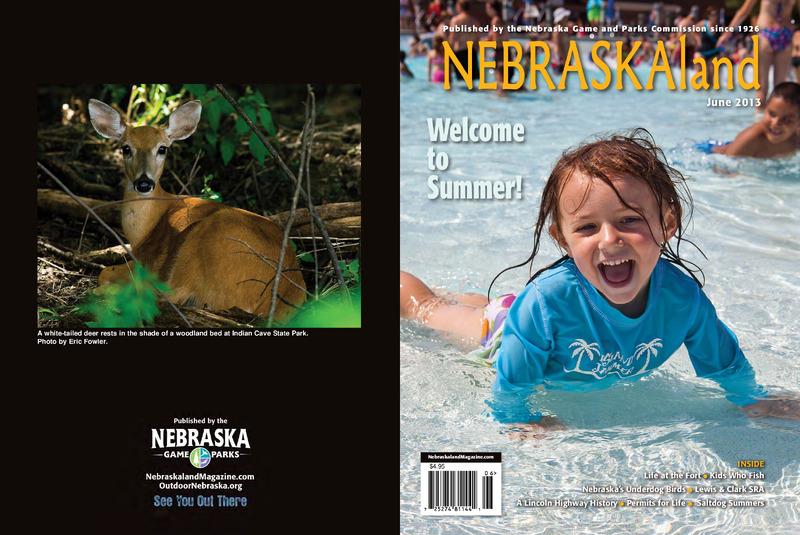
Publis hed by the Nebr a s k a Ga m e a nd Pa r k s C o m m is s ion si nc e 1926
NEBRASKAland
June 2013
Welcome
to
Summer!
A white-tailed deer rests in the shade of a woodland bed at Indian Cave State Park.
Photo by Eric Fowler.
NebraskalandMagazine.com
$4.95
INSIDE
Life at the Fort ● Kids Who Fish
Nebraska’s Underdog Birds ● Lewis & Clark SRA
A Lincoln Highway History ● Permits for Life ● Saltdog Summers
NEBRASKAland
Volume 91
●
No. 5
●
June 2013
F E AT U R E S
14 Life on Soapsuds Row
This story of historical fiction details life at Nebraska’s
Fort Atkinson in 1823.
TEXT BY DOMINIQUE WORTHING, PHOTOS BY BOBBI ANDERSON
20 Through a Child’s Eyes
Nothing is more genuine than the smile on a child’s face
when they’re fishing. BY JEFF KURRUS
24 Know Your Grassland Birds
These prairie underdogs are worth looking for and
learning about. TEXT AND PHOTOS BY CHRIS HELZER
30 A Night at the Old Ballpark
Evenings with the Lincoln Saltdogs at Haymarket Park
are a treat. TEXT BY JERRY KANE, PHOTOS BY JEFF KURRUS
34 The Lincoln Highway – A Centennial Celebration
Construction of the country’s first transcontinental
highway began a century ago. BY JULIE GEISER
38 As I Grow Up
With a youth lifetime hunting permit and a $5 turkey
permit, 13-year old Jaci Tubbs is starting a passion that
will last a lifetime. TEXT AND PHOTOS BY JEFF KURRUS
40 Lewis & Clark – A Summer Profile
30
●
Less than three hours from both Lincoln and Omaha,
Lewis & Clark SRA offers visitors lots, or little, to do.
TEXT AND PHOTOS BY JEFF KURRUS
D E PA RT M E N T S
Comment ................................................................... 4
Mixed Bag................................................................. 8
Nature Notes ............................................................44
In the Kitchen ..........................................................45
Classifieds ................................................................46
Portraits from the Past .............................................48
Book Review ..........................................................49
The Last Stop ...........................................................50
24
●
34
●
Cover: All ages enjoy the outdoor activities Nebraska offers, including
swimming at Eugene T. Mahoney State Park (SP), watching living history at
Fort Atkinson (see page 14) and visiting Lewis & Clark Lake (see page 40).
Photo by Jeff Kurrus. Opposite: Tour wrangler Olivia Joyce of Crawford
cozies up with dog Belle at Fort Robinson SP. Photo by Mark Harris.
NEBRASKAland (VOL. 91 / NO. 5, ISSN 0028-1964) is published monthly, except for the
combined Jan./Feb. and Aug./Sept. issues, by the Nebraska Game and Parks Commission,
2200 N. 33rd St., Lincoln, NE. Periodicals postage paid at Lincoln, Nebraska, and additional
mailing offices. POSTMASTER: Send address changes to NEBRASKAland, P.O. Box 30370,
Lincoln, NE 68503-0370.
2 NEBRASKALAND • JUNE 2013
40
●
JUNE 2013 • NEBRASKALAND 3
Richard Wright of Lincoln photographed
this white pelican at Stagecoach Lake.
First Elk
My son, Zac, is 12 and this year was
his first putting in for a Nebraska elk tag,
and he had very good fortune with this
bull. Elk hunting has been huge in my
family for years, and Zac is the fourth
generation in our family to field dress an
elk with my grandpa’s knife.
It’s very cool to see Nebraska’s
youth in the outdoors. Zac is quite an
accomplished hunter for turkey, deer,
and antelope – he lives for it. Seems
like only yesterday I was carrying my
3-year-old on my shoulders up and
down the river as he watched me set
traps and tell me what I did wrong.
Funny thing was, a few times even at
that age he was right.
Jess Hurlbert
Holdrege, Nebraska
NEBRASKAland Flashback Identified
I don’t remember what the lion said
back then but I was taken aback when I
saw that the young shirtless man
was none other than my kid brother,
Marty Henderson, now residing in
Texas.
Ron Peterson
Cortland, NE
NEBRASKAland Visitor Letters
We want to thank all 70 readers
who sent e-mails and letters for last
issue’s visitor, a nymph grasshopper,
that was on page 52 (see page 13 for
the winner, rules and this issue’s hint).
Hello from the Inland Empire
of the Pacific Northwest! My
NEBRASKAland just arrived. I so love
Marion Ball of Arlington, Nebraska
recently shot this photo of a banded
goose near the nest at Summit Lake SRA
near Tekamah.
the pictures and stories. They bring
back such good memories of Waco,
which is hometown for this Idahoan. I
haven’t been able to find the ‘visitor’
in the last few months, but today it
looks like you have a grasshopper on
page 52 at the bottom right.
Thanks again for bringing Nebraska
back to my house.
Dennis Tracy
Grangeville, Idaho
Grasshoppers (and this grasshopper
nymph) are common insects in
Nebraska, with nearly 100 species
found throughout the state. While
a nuisance pest to the average
homeowner, grasshopper feeding
can result in serious damage to crops
and pastures. The grasshoppers that
swarmed the prairies in the late
1800s were devastating to the settlers,
wiping out crops and denuding
pastures.
Their populations and the amount
of damage caused can fluctuate
greatly from year to year, depending
on environmental conditions. Cool,
wet weather in spring can cause
nymph die-off, while dry conditions
may result in larger populations and
greater feeding damage.
Grasshoppers have three life stages:
egg, nymph (immature), and adult.
Most grasshoppers overwinter in the
egg stage, though some overwinter
as nymphs. Females lay their eggs
in the soil in late summer or fall,
and nymphs emerge in spring and
immediately begin to feed. Nymphs
then go through several molts before
becoming adults, continuing to feed.
However, homeowners often do not
notice damage, or high grasshopper
numbers, until mid to late summer,
when grasshoppers move
into yards as they leave
drying pastures and
fields.
Special thanks to Julie Van Meter, State
Entomologist, Nebraska Department of
Agriculture. Visitor image by Chris Helzer.
www.bugguide.net is a good site for identification
Christy Christiansen of Ashland
developed a passion for hunting
years ago, and after spending a
dozen years as a volunteer Hunter
Education Instructor she turned that passion into a career as an Outdoor
Education Specialist with the Game and Parks Commission. She enjoys
bowhunting deer and turkey with her husband and four children.
If you have a unique outdoor message plate you would like to share
or know someone who does, e-mail a photo (high-resolution, JPEG
format only, please) of it to Eric.Fowler@Nebraska.gov, along with your
name, hometown and a brief description of the interests expressed on
your license plate.
4 NEBRASKALAND • JUNE 2013
The visitor is a narrow-winged sand
grasshopper on page 52 in the bottom
right hand corner. I have been getting
this magazine for a couple of years
now and it is always getting better.
I really liked the stories about the
bighorn sheep and the follow-ups.
Tad Naiberk
David City, Nebraska
You probably already know that
UNL has a 142 page pdf publication
called “Grasshoppers of Nebraska.”
You can Google it for free and it gives
descriptions, range maps, pictures of
the adult hoppers and other good stuff.
John Hannah
Columbus, Nebraska
Send your comments to:
Jeff Kurrus, Associate Editor
NEBRASKAland Magazine
P.O. Box 30370
Lincoln, NE 68503
or e-mail Jeff.Kurrus@Nebraska.gov
Please include your postal address and
telephone number.
Letters may be condensed and edited
for clarity. Photographs are welcome
and will be returned.
Any program that receives federal funding from the National Park
Service, or the United States Fish and Wildlife Service prohibits unlawful
discrimination on the basis of race, color, religion, age, gender, marital
status, national origin, age, disability or political affiliation. Any person
who believes he or she has been discriminated against in any program,
activity, facility, or service, should contact the Nebraska Game and
Parks Commission, Lincoln, NE 402-471-0641, the Equal Opportunity
Commission, Lincoln, NE 402-471-2024, TTY/TDD 402-471-4693;
United States Fish Wildlife Service, Civil Rights Coordinator, 4401
N. Fairfax Drive, Arlington, VA 22203; Director, Equal Opportunity
Program, U.S. Department of Interior, National Park Service, 1849 C
Street NW, Mail Code 0008, Washington, D.C. 20240-0001.
COMMISSIONERS
CONSERVATION OFFICERS
Director Jim Douglas
NORTHWEST
Officer
City
Jim Zimmerman (S) Gering
Commissioners
Chairman - Ron Stave, Waterloo
Vice Chairman - Norris Marshall, Kearney
2nd Vice Chairman - Jerrod Burke, Curtis
Dr. Mark Pinkerton, Wilber
Dr. Kent Forney, Lincoln
Lynn Berggren, Broken Bow
Rex Fisher, Omaha
Mark Spurgin, Paxton
Mick Jensen, Blair
MAGAZINE STAFF
Associate Editor Jeff Kurrus
Art Director Tim Reigert
Regional Editors Eric Fowler, Julie Geiser,
Justin Haag, Jenny Nguyen
Contributing Editor Michael Forsberg
Regular Contributors Bill Hager, Chris Helzer,
Lisa Knopp
Photo Librarian Sarah Johnson
Circulation Donna Robinson
For address changes and questions about
your subscription, e-mail Donna.Robinson@
Nebraska.gov or call 800-632-5263
Advertising
For advertising information contact
Donna Robinson, Circulation
Phone: 402-471-5490
E-mail: ngpc.ads@nebraska.gov
NEBRASKAland Magazine Copyright 2013, all rights reserved.
NEBRASKAland is available in audio from the Nebraska Library
Commission Talking Book and Braille Service, Suite 120, 1200 N St.,
Lincoln, NE 68508. 800-742-7691. NEBRASKAland Magazine and the
Nebraska Game and Parks Commission reserve the right to reject any
advertising not in keeping with the agency mission.
Rates: $18 for one year; $33 for two years; $44 for three years. Nebraska
recipients must add appropriate sales tax. To subscribe call
1-800-NEBLAND (632-5263), or go online to: NebraskalandMagazine.
com.
COMMISSION
C
COM
OM
OMM
MIS
ISSIO
SIION O
SI
OFFICES
F CES
FFI
FF
ES
S
Headquarters/Southeast District Office
2200 N. 33rd Street Lincoln, NE 68503
Phone 402-471-0641
Northeast District Office
2201 N. 13th St. Norfolk, NE 68701
Phone 402-370-3374
Southwest District Office
301 E. State Farm Rd. North Platte, NE 69101
Phone 308-535-8025
Northwest District Office
East Hwy. 2, Box 725 Alliance, NE 69301
Phone 308-763-2940
Bassett Office
524 Panzer St., Box 508 Bassett, NE 68714
Phone 402-684-2921
Kearney Office
1617 First Ave. Kearney, NE 68847
Phone 308-865-5310
Omaha Office
1212 Bob Gibson Blvd. Omaha, NE 68108
Phone 402-595-2144
Greg Hesse
Scott Brandt
Heath Packett
Dan Kling
Frank Miller
Phone (308)
(office) 763-2940
(cell) 641-6138
Alliance
760-3647
Gering
631-0663
Gordon
360-0682
Harrison
430-0572
Valentine 402-389-0444
SOUTHWEST
Officer
City
Phone (308)
Roger Thompson (S) N. Platte (office) 535-8025
(cell) 530-3097
Ray Dierking
Brkn. Bow
870-0322
George Sund
Cambridge
655-0028
Michael Thome
Cozad
529-8146
Terry Brentzel
Doniphan 402-469-5795
Matt Andrews
Elwood
746-2418
Dirk Greene
Imperial
882-0015
Dale Johnson
Kearney
440-3847
Brian Piernicky
McCook
340-6627
Brandon O’Neal
N. Platte
778-7486
Nicholas Fix
Ogallala
289-0427
Rich Routh
Rep. City
920-0367
NORTHEAST
Officer
City
Tom Zimmer (Sup.) Norfolk
Dale Davis
Steve Oberg
Daniel Roberts
Randy Pomplun
Jeff Jones
Jon Reeves
Tim Williams
Pat George
Doug Pollard
Alex Frohberg
Cory Krause
Phone (402)
(office) 370-3374
(cell) 649-8053
Bassett
760-0712
Columbus
910-3366
Fremont
719-1108
Fullerton
308-550-0489
Hartington
762-5022
Kennard
889-8508
Neligh
929-0051
O’Neill
340-0787
Ord
308-778-7101
Ponca
241-7615
West Point
380-6410
SOUTHEAST
Officer
Levi Krause (Sup.)
Sean McKeehan
William Krause
Mike Luben
Dan Zuehlke
Darin Gress
Douglas Kramer
Dina Barta
Stacey Lewton
Dudley Sorensen
Robert Finke
Russell Mort
Dan Evasco
Rich Berggren
City
Louisville
Ashland
Auburn
Colon
Cortland
Hebron
Lincoln
Lincoln
Lincoln
Lincoln
Milford
Nebr. City
Papillion
Waterloo
Phone (402)
949-0593
521-0159
274-8063
443-6392
806-9084
768-8665
890-6465
890-6463
890-7140
937-3422
947-1363
209-1506
616-5961
619-1355
ADMINISTRATION
Officer
Craig Stover (Adm.)
Duane Arp (Ass.)
Jeff Clauson (Ass.)
City
Lincoln
Lincoln
Lincoln
Phone (402)
471-5531
471-5532
471-0480
Nebraska Wildlife Crimestoppers 1-800-742-7627
Ak-Sar-Ben Aquarium
21502 W. Highway 31 Gretna, NE 68028
Phone 402-332-3901
JUNE 2013 • NEBRASKALAND 5
Wanahoo Pike Survey
Nebraska Outdoor U!
By Olivia Johnson
Nebraskans wanting to learn more about the outdoors now have an opportunity
that’s more accessible than ever before. Nebraska Outdoor U! is a free, webbased, hands-on learning opportunity available to anyone interested in developing
and improving his or her outdoor skills.
Launched in January of 2012 by the Nebraska Game and Parks Commission and
University of Nebraska-Lincoln Extension, NOU! grew from the Commission’s
20-year plan to recruit, develop and retain (RDR) hunters and anglers, and had
enrolled 1,800 by the end of the year. The program operates with four paths of
study: hunting, camping, fishing and shooting sports. Scott Stuhr, who has been
developing the program since 2009, describes it as a self-study school class. “We
have some learning opportunities online and then have some quizzes thrown in
to celebrate the new knowledge,” he said. “Then it is up to the participant to get
involved outdoors, but we do try to get people involved in the programs that are
already out there.”
Participants’ progress is tracked online and when a level is completed they
receive an incentive to congratulate them and to keep their motivation flowing.
There are six levels in each pathway, and people can sign up for the program at
any time. NOU! works to cater to all ages and ability levels, and participants can
work at their own pace and choose how far they go in the program.
Stuhr couldn’t be any more passionate about the development and future of
this program. “There are major health benefits to being outdoors, and habitat
development requirements built into the program to benefit our natural resources,”
he said. “The program allows people to try something they haven’t before, or just
get more involved in spending time outdoors. It is great for families and groups to
do together. The benefits are endless.”
For further information and to enroll in NOU!, visit the program’s website at
OutdoorU.org. ■
PHOTOS BY JEFF KURRUS
See You Out There... But Where?
Do you know where this Nebraska photograph was taken?
See answer at the bottom of page 13.
6 NEBRASKALAND • JUNE 2013
By Jeff Kurrus
Northern pike were first
stocked in Lake Wanahoo in
2010, and from recent survey
results they are doing quite
well. During a one-week period
in March, Nebraska Game
and Parks Commission
fisheries biologists and
volunteers used trap nets to
capture 828 pike. Most of the
northern pike captured were
23 to 24 inches, but some
pike reaching 34 inches were
seen.
The captured northerns were
tagged to obtain a population
estimate, and to estimate
growth and survival in Lake
Wanahoo. Biologists estimate
there are currently 1,745
northerns in Lake Wanahoo,
with the growth and survival
estimates to come once the
data is analyzed.
Northern pike are catch
and release at Lake Wanahoo
and the use of live bait is
prohibited at the lake. If you
catch a tagged northern at
Lake Wanahoo, please leave
the tag in the fish and record
the tag number. Tag numbers
can be reported to
ngpc.fishtags@nebraska.gov
or 402-471-7647. ■
JUNE 2013 • NEBRASKALAND 7
Send Us Your Trail Cam Photos!
by Julie Geiser
In the Middle of the Fun
Whether you’re fresh from the field or the
water – or simply passing through west-central
Nebraska – Paxton has plenty of history and fun
for the family.
PHOTO BY BOB GRIER
PHOTO
FOWLER
BY ERIC
8 NEBRASKALAND • JUNE 2013
Please submit your trail camera photos by e-mail to:
nebtrailcam@gmail.com. Also include any information that
will help explain your photo.
BY JULI
E GEIS
ER
Don’t let Paxton be a drive-through town.
Stop, eat, and see what this little jewel has
to offer. You might be surprised.
Clint Burge set up his camera at the backwaters of the family
farm between Cheney and Walton and captured this coyote
photo on April 6, 2012, at 7:05 A.M.
Bob Grier
Looking closely at photography
blogs on the internet, there seems to be
a quiet but growing realization that film
and digital cameras may come and go
as the technology rapidly changes, but
good lenses can stand the test of time.
All photographers should make note of
this.
Even the least expensive
interchangeable lens digital cameras
available today often use that same
brand’s pre-digital lenses. Perhaps
surprising, many older film camera
lenses are available on the used
market at reasonable prices, and
inexpensive lens mount adapters are
now available that allow photographers
to mix and match lenses and cameras
brands.
PHOTO
at Ole’s Big
Ole’s Big Game Steakhouse and Lounge – View the exotic animal mounts
you enjoy
while
t,
Game Steakhouse and Lounge taken by its founder, Rosser “Ole” Hersted
breakfast, lunch or supper.
ir
Sutherland Reservoir – Only 17 miles east of Paxton, this 3,000-acre reservo
and
fall,
the
in
features migrating wildlife in the spring, upland and waterfowl hunting
Trail
Oregon
fishing and camping all year. Also bring your clubs for the nearby 9-hole
Golf Course.
Windy Gap Grill – This historic pass divides the North and South
Platte River valleys. It was created by the wagon wheels of Kinkaiders
who settled in the Sandhills north of Paxton, trying to make a new
start on parcels of land given to them by the government. Also stop
at the Windy Gap Grill and its rib eye steaks cut fresh daily.
5 Trails Winery – “The Fun Starts at 5!” is owner John Gamet’s
slogan. With wine tasting and purchasing on-site as well as meats,
cheeses, pizza, and chocolate to enhance your tasting experience,
he’s telling the truth.
Peppers and More Smokehouse – For the road, drop in and
try some of the best home-smoked sausages and cheese around
and take some snacks on your way out of town.
Lake McConaughy – Camp for
a day or vacation for a week,
Nebraska’s largest lake is only
20 minutes away from Paxton.
While summertime is usually
for fishing, boating or relaxing
on the beach, also think about
visiting the Bald Eagle Viewing Center at Lake
Ogallala just below Lake Mac this upcoming fall.
IE GEISER
PHOTO BY JUL
Paxton
Old Lenses
This winter, on a trip to the Grand
Canyon in Arizona, I carried one of
these so-called “legacy” lenses from
the early 1980s. The 28-year old lens,
a Minolta 28mm-135mm zoom, is an
A mount – the same lens mount as
the latest line of Sony camera bodies.
The lens offers full auto focus and
auto exposure, and is substantially less
expensive than buying new glass for
that brand of camera.
Having several older lenses in the
bag provides a way to save a dollar or
two, but even better is the satisfaction
of using a nearly 30-year old optic that
has stood the test of time and continues
to produce excellent sharpness, contrast
and beautiful colors. ■
JUNE 2013 • NEBRASKALAND 9
Boiled Omelets
10 NEBRASKALAND • MAY 2013
weren’t exactly excited about getting
rid of ground, but the benefits below
the project in the [Missouri River]
bottomlands for the general public and
the local town of Hubbard due to the
recreation coming in – they’re all pretty
excited.” ■
Register for the Run Wild 10K for
adults or 1-mile children’s fun run
at Mahoney State Park on June 1 at
RunWildNe.org. Gear up with your
own antlers and tail, with proceeds
benefitting the Nebraska Wildlife
Conservation Fund.
Boiled omelets don’t look as appetizing as one you might get at your favorite greasy
spoon. But this method isn’t about presentation, it’s about not doing dishes in camp.
The great thing about this recipe is
not only can everyone get their omelet
made-to-order, you can cook them all
at once, as long as you have a pot big
enough.
How long it takes to cook your
omelet will vary. One egg and a little
cheese, something you might get a
finicky Cub Scout to eat, could be done
in 5 minutes. Add four or five eggs and
the works like I do and it might take 10
or 15 minutes. Use tongs or a gloved
hand to grab the edge of the bag and
pull it out. I don’t like runny eggs, so
when it’s firm, it’s done. If you want
to double check, open the bag and cut
through the center of the eggs to test it.
When it is ready, cut the bag open
and dump the contents on a paper
plate, eat it with a plastic fork and
wash it down with a plastic cup of
milk or juice. When you’re finished,
toss it all in the trash and go fishing.
Because like I said, I hate doing dishes.
Especially when there is dinner to
catch. ■
News From the Field
PHOTO BY ERIC FOWLER
By Jenny Nguyen
Northeastern Nebraska currently
awaits an exciting new project in
Dakota County. Known as the Pigeon/
Jones Creek Watershed, the $17
million Papio-Missouri River Natural
Resources District (NRD) project
will provide numerous recreational
opportunities to residents in addition
to curbing the community’s longtime
challenges with sedimentation, erosion
and flooding. The project accounts for a
total of 20,316 acres and is projected to
open to the public by spring of 2016.
Terry Schumacher, Land and Water
Programs Coordinator of the PapioMissouri River NRD, said, “It’s a
multi-purpose project. You’re getting
the flood control and the sedimentation
control, but you’re also getting the
recreation, habitat and the fisheries.
And I think you’re going to see a lot of
use out of the site once it’s completed.”
Named after local outstanding
conservationist Vince Kramper,
Kramper Lake is one of the project’s
main recreational features. With 228
acres of water and a surrounding park
of 595 acres, recreational opportunities
at Kramper Lake will include
“no-wake” boating, fishing, five miles
of hiking and biking trails, 10 miles
of equestrian trails and separate RV,
equestrian and tent campgrounds;
hunting opportunities are still in
question. Reminiscent of the hilly
Danish homeland of immigrants who
originally settled in the area, the NRD
Board of Directors voted to name the
surrounding park the Danish Alps
Recreational Area.
Fishing opportunities will include
largemouth bass, bluegill, black
crappie, catfish and walleye, with
a handicapped-accessible fishing
pier as one of the lake’s special
features. As a partner, the Nebraska
Game and Parks Commission has
contributed $825,000 of Sport Fish
Restoration and Motor Boat Access
Program funds into the project. Other
partners include the Nebraska Natural
Resources Commission, the Nebraska
Environmental Trust, the Nebraska
Department of Environmental Quality
and Dakota County.
“You don’t talk to too many people
around here who aren’t excited about
this project,” said Lowell Roeber, the
Pigeon Jones Watershed Coordinator
of the Papio-Missouri River NRD. “It
brings something that benefits a lot of
different people. There were some who
PHOTO BY ERIC FOWLER
PHOTO BY LOWELL ROEBER, PAPIO-MISSOURI RIVER NRD
New Lake, Recreation Area
Coming Soon in Dakota County
Eric Fowler
For no good reason, I hate doing
dishes when I’m camping. Well, to be
honest, I hate doing them when I’m
home, too. But since I go camping
to relax, it’s usually cereal or rolls or
something else cold to start the day.
That changed at a Cub Scout campout
a few years ago, when I learned how
to cook an omelet with no cleanup
required: Just boil it in a Ziploc bag.
Yes, I know: I was late to the boiled
omelet party. But for those who are even
later than me, it’s amazingly simple.
Start by bringing a kettle of water to
a boil over the campfire or cook stove.
If you’re in a hurry, bring your turkey
fryer. While you’re waiting, crack eggs
into a freezer bag, seal the bag and
scramble the eggs. Open it back up
and add whatever ingredients you like
in your omelet: bacon, sausage, ham,
cheese, onions, green peppers … you
name it. Squeeze the air out of the
bag, seal it, mix it up, toss it in the
boiling water and watch it float as it
cooks.
• Clean, Drain & Dry - boaters and
anglers are reminded to help keep
Nebraska’s water free of invasive
species like zebra mussels by practicing
three simple steps. First, when you
leave the water, take time to clean any
weeds and mud off the outside of your
boat, motor and anchor. Second, be
sure to drain all water out of all live
wells, boat wells and bilge pumps.
Third, allow dry out time for your boat
before returning to a lake.
• Fishing for Millions - through July
7, 2013, anglers who catch specially
tagged fish can receive merchandise
and cash worth up to $2 million at
the following Nebraska waters: Box
Butte, Calamus, Harlan County, Lake
McConaughy, Merritt, Sherman,
Summit, Wagon Train, Walnut Creek,
and Wehrspann. Visit Cabelas.com to
register.
• Cornhusker Trapshoot - visit
Cornhusker-Trap.com for a list of
winners of this 2013 competition and
its record 2,253 participants. ■
JUNE 2013 • NEBRASKALAND 11
by Jerry Kane
Contact the Nebraska Game and Parks Commission at 402-471-0641 or visit OutdoorNebraska.
org for more information. Visit HuntSafeNebraska.org for a list of hunter education classes and
BoatSafeNebraska.org for a list of boating safety classes.
June 1
Run Wild 10k Run
June 7
Big Game App
christy.christiansen@
nebraska.gov or 402-471-5547
E.T. Mahoney State Park
(SP), RunWildNe.org
Final day of first big game
application period.
Cowboy Trail
June 7-9
Intertribal Gathering
June 15
Psychowpath Mountain
Bike Series
Family Fishing Event
Yanney Park Lake, Kearney,
10:30 a.m.-1 p.m.
Scheels 3-D Archery
Tournament
Ponca SP, Ponca,
402-755-2284
Fishing is Fun Water Expo
Lake McConaughy State
Recreation Area (SRA),
Ogallala, 308-284-8800
Fort Robinson SP, Crawford,
308-665-2900
June 8
Wild About Raptors
Workshop
Wildcat Hills Nature Center,
Gering, 308-436-3777
Nebraska High School
Bowhunter 3-D
Championships
Norfolk Archery Range,
402-368-5588/402-329-4500
Big Mac Shut Up and Fish
Walleye Tournament
National Park Service
Outdoor Event
Lake McConaughy SRA,
Ogallala, 308-355-2321
Niobrara SP, Niobrara, all
day, 402-857-3373
In the Spirit of
Children Fish and Chip
Tournament
Craft Fair
Willow Creek SRA, Pierce,
402-329-4053
June 1-2
Living History Weekend
Fort Atkinson State
Historical Park (SHP), Fort
Calhoun, 402-468-5066
Rock Creek Trail Days
Rock Creek Station SHP,
Fairbury, 402-729-5777
June 3
Pistol League
Platte River SP, Louisville,
6-9 p.m.,
christy.christiansen
@nebraska.gov or
402-471-5547
June 4
Family Fishing Event
Skyview Lake, Norfolk,
6-8 p.m.
Family Fishing Event
Pawnee Park East Pond,
Columbus, 6-8 p.m.
June 5
Beyond BOW
Handgun Class: Introduction
to Handguns.
Platte River SP, Louisville,
6-9 p.m., christy.christiansen
@nebraska.gov or
402-471-5547
Johnson Lake SRA
Elwood, 9 a.m.-4 p.m.,
308-785-2685
June 12
Family Fishing Event
Fremont Lakes SRA No. 3,
Fremont, 6-8 p.m.
Beyond BOW
Handgun Class: Women’s
Handguns.
Platte River SP, Louisville,
6-9 p.m., christy.christiansen
@nebraska.gov or
402-471-5547
June 13
Family Fishing Event
Benson Park Pond, Omaha,
6-8 p.m.
June 14
Ash Hollow Historical
Pageant
Ash Hollow SHP, Lewellen,
308-778-5651
National Park Service
Campground Program
Ponca SP, Ponca,
Psycowpath.com
Chadron SP Anniversary
Day
Buffalo Cookout
June 15-16
Bugs and Bones
Weekend
Ponca SP, Ponca,
402-755-2284
June 16
Father’s Day Fish Fry
Ponca SP, Ponca, 11:30 a.m.1 p.m., 402-755-2284
Father’s Day Fishing
Tournament
Niobrara SP, Niobrara,
402-857-3373
3-D Archery Shoot
Lake McConaughy SRA,
308-289-6509
Father’s Day Buffet
Fort Robinson SP,
308-665-2900
June 17-21
Shooting Skills Camp
For ages 11-15.
South Central 4-H Center,
Republican City,
402-471-6144
June 18
Pony Express Re-ride
Fort Kearny SRA, Kearney,
308-865-5305
Family Fishing Event
Walnut Creek Reservoir,
Papillion, 6-8 p.m.
June 19
Family Fishing Event
Niobrara SP, 402-857-3373
Bowling Lake, Lincoln,
6-8 p.m.
June 14-15
Family Fish and Camp
Beyond BOW
Memphis SRA, Memphis,
6-8 p.m.
Becoming an OutdoorsFamily Workshop
Memphis SRA, Memphis,
Banking on the Refuge
Chadron, 308-432-6167
Niobrara SP, Niobrara,
6 p.m., 402-857-3373
Handgun Class: Cleaning and
Sighting in.
Platte River SP, Louisville,
6-9 p.m., christy.christiansen
@nebraska.gov or
402-471-5547
PHOTO BY JEFF KURRUS
Bridge Ribbon Cutting.
Norfolk, 9:00 a.m.
June 20
Growing Up WILD
Workshop
Atonement Lutheran Church,
4530 N. 85th St., Omaha,
7-9 p.m., lindsay.rogers
@nebraska.gov
June 22
Carp-O-Rama
Pawnee SRA, Emerald,
8 a.m.-1 p.m.
June 23
Sod House Sunday
Arthur Bowring Sandhills
Ranch SHP, Merriman,
8 a.m.-5 p.m., 308-684-5305
June 24-27
Aquatic Skills Camp
For ages 14-18.
Eastern 4-H Center, Gretna,
402-471-6144
June 25
Family Fishing Event
Birdwood Lake, North Platte,
6-8 p.m.
June 26
Family Fishing Event
Cottonmill Lake, Kearney,
6-8 p.m.
Beyond BOW
Handgun Class: Fun with
Handguns.
Platte River SP, Louisville,
6-9 p.m., christy.christiansen
@nebraska.gov or
402-471-5547
June 27
Family Fishing Event
Mormon Island SRA No. 1,
Grand Island, 6-8 p.m.
June 28
National Park Service
Campground Program
Niobrara SP, 402-857-3373.
Jeff Kurrus
In Nebraska, the wind is going
to blow – especially in wide-open
locales like the lakes at the Valentine
National Wildlife Refuge. I’ve gotten
used to it, but some days I just don’t
feel like trying to keep a boat straight.
But no worries. The most productive
adjustment I have made when fishing
for species like largemouth bass and
northern pike is one I’ve been using
since childhood – bank fishing.
Bank fishing is especially productive
at a place like the Refuge due to the
vast amount of good fishing close to
the shore. For example, at the boat putin at Clear Lake last summer, I watched
a pair of friends try to navigate whitecapping waters while I waded out mere
feet and casted black spinnerbaits as
far as I could, taking advantage of the
shallow flat near the put-in. The result?
More northern pike than two men in
the boat mustered, including several
fish above 30 inches.
But Clear Lake isn’t the Refuge’s
only bank option. Hackberry, with
its immense amount of shallow water
bulrushes, is also an excellent place
to wade through the muck and fish
any open pocket of water you can
find for pike or largemouth bass.
Lure choices for these fish are
similar. Stay weedless as much as
you can, using floating soft plastics
and spinnerbaits that will work
through the rushes with little incident.
Also make sure you have a pair
of chest waders with you and an
extra change of clothes just in case
you step into a hole or venture out
a little deeper than you originally
intended.
Lastly, wear a personal flotation
device (PFD) if you plan on wading
at all. It’s hard enough walking in
open water without coming across
obstructions. Try doing this tromping
through hundreds of yards of bulrushes
and it’s a matter of time before you fall.
Just make sure you have a PFD to help
pick you back up. ■
NEBRASKAland Visitor
Winner and Hint
Last issue’s winner of
the Visitor drawing
was Kevin Kleinschmit of
Fordyce, Nebraska, who found the
nymph grasshopper on page 52.
Readers are encouraged to contact
NEBRASKAland within 10 days
after this issue’s publication with the
correct page number and name of
this issue’s “Visitor” – a bug found
in Nebraska that just happened to
find its way onto one of the pages.
We will then gather the correct
entries and draw one to win a
NEBRASKAland Magazine mug.
To enter each month, write:
NEBRASKAland Visitor
2200 North 33rd Street,
Lincoln, NE 68503.
Or e-mail:
Tim.Reigert@Nebraska.gov
with “Visitor” in the subject line of
the message.
HINT: This issue’s visitor is not
on page 4, 5, 7, 23, 29, 50, or 51.
MEMPHIS LAKE SRA NEAR MEMPHIS
12 NEBRASKALAND • JUNE 2013
JUNE 2013 • NEBRASKALAND 13
F
ort Atkinson, established in 1820 on the
recommendation of the Lewis and Clark
Expedition, was the first U.S. military post west
of the Missouri River. But there were more
than soldiers at a post so important to the
early fur trade, river traffic and Indian relations.
Carpenters, coopers, Indian agents, blacksmiths and the
like were stationed on these grounds near Fort Calhoun,
with many of these running multiple duties including
defense of the fort.
Also on this list were women, who worked as cooks, cleaners,
and, in writer Dominique Worthing’s historical fiction below,
laundresses. Worthing’s character, Sarah Field, tells of the day-today operations on the frontier, a behind-the-scenes look at how
laundresses and others spent their time at Fort Atkinson.
Fort Atkinson State Historical Park,
located in Washington County, hosts
living history demonstrations throughout
the spring and summer months each
year. The complete 2013 schedule is as
follows: From 10 a.m. to 5 p.m. on May
4 and May 5; June 5 and 6; July 6 and
July 7; August 3 and 4; August 31 and
September 1; and October 5 and 6. On
these days, volunteers portray life at an
1820s military fort.
April 22, 1823
My hands no longer bleed when I attempt to write. The ointment I purchased at
the sutler store seems to be doing its job. The warmer weather and rain seem to
help as well. The endless cycle of washing through the frigid winter left my hands
in a horrible condition, nearly any task left them cracked and bleeding. The first
day the path to the stream was clear of ice was enough to make me laugh aloud
for joy.
Winter is finally over, and the whole fort is occupied with preparation for
the growing season. We are such a large outfit that the keeping of the fields
has outranked military drills on more than one occasion. There are nearly one
thousand persons associated with Fort Atkinson, and it would seem nearly an
equal amount of dogs, pigs, and cattle occupy the premise.
April 27, 1823
IMAGE OF GENERAL HENRY ATKINSON RG2411-178 NEBRASKA STATE HISTORICAL SOCIETY
14 NEBRASKALAND •JUNE 2013
My neighbor, Molly Fitzgerald, has taken a turn for the worse. She has always
been prone to illness since I have known her, but now she is unable to leave
her bed. Her husband is a noncommissioned officer and they have two young
children, Samuel and Laura. Mrs. Henry, a middle-aged widow who lives in the
cottage on the opposite side of Molly, and I have been taking turns caring for
Molly and her children. It seems as though we may soon care for her children
permanently.
April 29, 1823
We buried Molly Fitzgerald in the fort cemetery this morning. Mrs. Henry will
become the children’s caregiver for the time being. Mr. Fitzgerald has taken to
heavy drinking.
May 3, 1823
If I never see a pair of dirty trousers again I will be an infinitely happier woman.
May 5, 1823
Today is the one year anniversary of my father’s death. Since his passing, I
have received six offers of marriage, the most recent of which came from Molly
Fitzgerald’s husband. While I deeply care for Molly’s children, I cannot begin to
imagine being married, especially to my dead friend’s husband.
JUNE 2013 • NEBRASKALAND 15
May 21, 1823
This morning, while gathering water at the stream for today’s washing,
I fell and cut my right leg just below my knee. The gash required three
stitches. The doctor was quick to warn me of the potential for infection. It
would seem I will not be able to dance at the upcoming ball.
May 24, 1823
Even without the ability to dance, yesterday evening’s ball was a lovely
party to attend. Indeed, watching other’s dance is far more enjoyable in
some respects. My leg shows no signs of infection thus far. Mrs. Henry
and I have come to an agreement, she gathers the water for both of us so I
may stay clear of the stream until my leg is healed, and I have taken over
her mending, allowing me to spend more time sitting down rather than
hobbling around on my feet.
May 28, 1823
My leg is still sore, but continues to heal well. I paid a short visit to the
doctor and he is happy with my progress.
June 1, 1823
Summer is upon us and so are the violent storms that accompany this
season. Last night the sky seemed to be brighter than day more than it was
night. Despite the heavy rain and wind the crops and livestock are still in
good order, although a few chickens have been reported missing.
The other women on Soapsuds Row whisper that I am crazy. Many of them
would accept the first offer of marriage they received. Having made the journey
from New York to Fort Atkinson with the sixth infantry at age twelve, and seeing
firsthand the hardships faced by military families, I believe that I am able to
survive on my own much better than with a husband and children in tow.
May 9, 1823
It has been announced that there will be a ball in two weeks’ time to celebrate
the arrival of spring. All the women at the fort spend every moment that is not
consumed with work preparing for the festivities. I welcome the distraction
this party offers from our daily routine, and fortunately my hands have almost
completely healed, so there is little chance of getting blood on my good dress.
In other news, it has been discovered that another laundress has been selling
alcohol to the men illegally. There is no word yet on what her punishment will be.
May 18, 1823
The other women wonder why I have no intention of marrying. A young
woman in my position, they say, could have her pick of the finest bachelors at the
fort. Certainly I could have married after my father’s untimely death. Many other
women in my place would have married. Yet it should also be apparent, if one
was to look around the fort, why I have chosen not to marry.
Life here, while quite civilized for such an isolated place, is never far from
danger; who knows when we may receive orders to move even further into the
territory. Disease is ever present, claiming both adults and children, and there is
always the threat of an Indian attack. Also, there is no guarantee your marriage
will be a union of trust and security. Today another soldier was court-martialed
for beating his wife, and unfortunately, this type of situation is not as uncommon
as one would hope.
16 NEBRASKALAND •JUNE 2013
JUNE 2013 • NEBRASKALAND 17
Many of the laundresses seem to lack
basic understand of both subjects. I
wish that more of the laundresses were
as interested in learning to read and
write as Mrs. Henry.
June 18, 1823
The most shocking event occurred
today. A keel boat, by the name of
Yellow Stone Packet arrived bringing
members of the William Ashley fur
trading company who were fleeing an
Indian attack from up further up the
Missouri river. Several members were
wounded and taken directly to the
hospital. It is rumored that more than
a dozen fur traders died in the initial
attack by the Ree. The main mission of
the Yellow Stone Packet was to deliver
a message from William Ashley
himself to Colonel Leavenworth asking for assistance to fend off the attackers.
The sixth infantry is to prepare for campaign immediately; these are direct
orders from the Colonel.
June 19, 1823
Every laundress in the fort is twice as busy as usual in preparation of the
infantry’s departure. Many women split their time between the hospital and
laundress work, helping with the injured from the Yellow Stone Packet.
June 20, 1823
Today they buried one of the men from the Yellow Stone Packet. Colonel
Leavenworth and the sixth infantry are anxious to leave for the north. It is
believed that the Colonel will be taking around two-hundred men with him.
June 21, 1823
June 3, 1823
My leg continues to heal. Although I am capable of safely making my way to
and from the stream Mrs. Henry continues with our arrangement. I believe she
would rather draw water than use a needle, her poor eyesight makes mending a
difficult task.
June 10, 1823
My leg is now fully healed. Mrs. Henry was sad to end our arrangement, but
the long hours of light make mending a much easier chore. Molly Fitzgerald’s
children, who were nearly always as sickly as their mother before her death, seem
to thrive in Mrs. Henry’s care. Mr. Fitzgerald does very little for them accept give
Mrs. Henry a small sum of money to raise them, and so they are left completely
to her instruction.
June 13, 1823
Mrs. Henry has seen me writing in my journal and asked me to teach her to read
and write. Samuel, the older of the Fitzgerald children will begin to attend the fort
school this autumn, and Mrs. Henry wishes to be able to assist him in his studies.
18 NEBRASKALAND •JUNE 2013
Colonel Leavenworth, a little
over two-hundred men, and thirty of
the Yellow Stone Packet survivors
departed for the north to fend off the
Ree and offer aid to the rest of the
William Ashley fur trading party.
Many of the women were crying as
the keel boats disappeared from sight.
It will most likely be months before
we see them return, and who knows
how many will return at all. Whether
a blessing, or a curse, there will be
significantly less laundry in the coming
weeks. ■
Dominique Worthing is a freelance
writer living in Omaha.
Bobbi Anderson is a fine art, digital
artist/photographer living in Blair.
To see more of her work, visit
Bjaimaging.com.
JUNE 2013 • NEBRASKALAND 19
Through a Child’s Eyes
By Jeff Kurrus
When we see kids fishing, we see ourselves and how we used to see fishing,
as nothing more than a hook, bobber, and time spent near the water. The
mystery of what was lurking beneath the surface always weighed heavy in our
thoughts.
We may not remember what we ate for dinner last Saturday, but we still
remember the day the big one got away, and the emptiness we felt when our
line went slack. We also remember the desire we had to wet a line once again.
We say kids nowadays spend too much time watching television and playing
video games, but we’re short-sighted in our thinking. Given an iPad or cell
phone when we were young, we may have done the same. Some of us did, and
can even tell you what Pong and Atari were.
PHOTO BY JEFF KURRUS
PHOTO BY ERIC FOWLER
Nolan Yaren of Brussels, Belgium concentrates during a cast attempt at a Lancaster County pond.
20 NEBRASKALAND • JUNE 2013
While her sister, Carryonna, stays focused on the task at hand, Tavaris Valdase keeps her eyes on a photographer closing in on her
fishing spot at Holmes Lake.
JUNE 2013 • NEBRASKALAND 21
As adults watching these anglers, we root
Lainey Kathol of Omaha holds a trout at Two
Rivers SRA while big sister Margaret looks on.
PHOTO BY ERIC FOWLER
But what always got us away from
Reina Ayer of Bellevue recoils as a largemouth bass she caught from Jenny
Newman Lake flops on the end of the line as she poses for a photo during
the 2012 Outdoor Discovery Program at Platte River State Park.
PHOTO BY JEFF KURRUS
PHOTO BY ERIC FOWLER
22 NEBRASKALAND • JUNE 2013
Whisper Bernhardt-VanWinkle of Gering holds
a crayfish she caught – and named Fred – while
fishing at Lake Minatare SRA.
PHOTO BY JEFF KURRUS
PHOTO BY ERIC FOWLER
Gracie Bernhardt-VanWinkle
of Gering waits for a bite at
Lake Minatare SRA.
Keegan Hollins takes a break from ice fishing with his
parents, Matt and Kami, to make snow angels on the
ice at Holmes Lake in Lincoln.
inside was the adventure of outside.
What always led us back to the
water was the thought that there
were monsters lurking beneath the
calm surface, waiting for the perfect
bait, the perfect presentation.
To catch these monsters, kids of all
ages become concentrators. Those
whose focus is so in-tune with
their next cast that they have zoned
everything out – from a campfire
breakfast to a hike to the ice cream
shop at the marina. If a child even
thinks there’s a chance that a fish
will take their bait, then they’re fine
right where they are.
PHOTO BY JEFF KURRUS
PHOTO BY ERIC FOWLER
PHOTO BY JEFF KURRUS
Harry St. Pierre Schneider and father
Steve of Las Vegas smile after catching a
largemouth bass at a Cass County pond.
because we want them to see, and feel, the same
way we did when we were that age. We also
want them to eventually hold a fish in their
hands, because smiles from children with a fish
are genuine. They’re not forced smiles associated
with school picture day. They’re a combination of
accomplishment and surprise.
These smiles are waiting to be made all across
Nebraska on any given day throughout the year.
All that’s needed is for you to add the water. ■
Madeline Kurrus of Gretna hides behind a bluegill
she proudly caught at a private Sarpy County pond.
Mera Greene of Omaha keeps her distance from a rainbow trout she caught
while fishing at the Ponca State Park pond.
JUNE 2013 • NEBRASKALAND 23
Know Your
Grassland Birds
Text and photos by Chris Helzer
I
write a lot of NEBRASKAland articles about underdogs.
During the last several years, I’ve covered topics such
as spiders, moss, grasshoppers, thistles and wasps. In an
upcoming issue, I have a fascinating article about moths.
Yes, moths.
For the most part it’s easy to understand why those
underdogs aren’t always familiar to or appreciated by the
general public. Insects are small and hard to see, thistles are
spiny and spiders are pretty creepy. I get it. However, this
article is about birds. Everyone likes birds, right?
So why is it that so few people have ever heard of lark
sparrows, dickcissels, bobolinks or most other grassland
bird species? Okay, most of those species are small and drab
colored, and they tend to live in the middle of large open
areas – you’re not likely to find them in your backyard or
down at the city park. On the other hand, when you’re in a
prairie, grassland birds are usually the easiest animals to see.
Other animals such as coyotes, deer and badgers may be
bigger, but you don’t actually see them very often. As long
as you’re willing to take a short walk into a prairie, you can
always find grassland birds.
Meadowlark chicks peer out of a nest in a prairie near Alda.
24 NEBRASKALAND • JUNE 2013
Most grassland birds nest right on the ground. The others
build elevated nests in a clump of grass or other prairie
vegetation, but those nests are almost always less than
waist high (your waist, not the birds’). It might seem crazy
that grassland birds don’t nest up in trees where they’re
less accessible to many predators. However, trees are not
that common in most prairies, so that would limit nesting
opportunities. Plus, nesting in one of only two or three
trees in a prairie would be a lot like hanging out a sign that
says, “Hey, Predators – look here for free food!” Instead,
grassland birds rely on a needle in a haystack approach.
Most of them prefer to nest in the middle of relatively large
prairies, presumably because that gives predators a lot of
area to cover if they’re searching for nests.
Within a prairie, grassland bird species choose their
nesting sites based on vegetation structure. Upland
sandpipers and horned larks like to nest in short grass, while
Henslow’s sparrows and sedge wrens prefer sites with tall,
dense vegetation. Others fall somewhere in the middle,
including grasshopper sparrows, which thrive in moderatelyshort grazed pastures. Some, including grouse and northern
bobwhite, are special cases, and use a variety of habitat
types at different times of year. Because birds are so mobile,
they can easily find new nesting locations each year if the
habitat changes, but they may also return to the same site
year after year if it doesn’t.
Most grassland birds set up and defend well-defined
territories. Males regularly patrol and sing from various
perch sites that define their span of control. If you watch
a singing male for 10 or 15 minutes, you’ll notice him
flying and singing from the same perches over and over.
His neighbors are doing the same thing, ensuring that their
territories (and females) are safe from any brash young
male that might be waiting to take advantage of a lapse in
attention.
Most grassland nesting birds are long-distance migrants,
and a number of them travel as far as South America for the
winter. Scientists know relatively little about what happens
during migration, including what kind of habitat those
birds use during that time. Radar and other technologies
are slowly helping discover the routes taken by migrating
birds, but where they sleep and feed along the way is still
largely a mystery. Of course, not all prairie birds disappear
from Nebraska over the winter. Greater prairie chickens,
sharp-tailed grouse, and northern bobwhite all stick around,
Most grassland bird nests, including this meadowlark nest, are right on the ground.
though they tend to travel around locally in relatively large
groups. Western meadowlarks can be seen all winter long
too, though it’s not clear whether they are the same birds
that nest here or northern birds that see Nebraska as a milder
alternative than North Dakota or Manitoba.
Nebraskans should really get to know the bird species
that live in the predominant land cover of our state. Many
of those bird species are relatively unknown even to serious
birdwatchers, let alone the casual nature enthusiast. That’s
an unfortunate situation for the birds as well as the people
who are missing out because grassland birds could use a
little attention. Most species of prairie-nesting birds are
experiencing population declines across North America –
some at an alarming rate – and they and their habitats are
in great need of protection. As a public service to the
people of this great state, and to the birds that need your
conservation attention, I humbly submit the following
introduction to a few of the bird species we share Nebraska’s
grasslands with.
Western Meadowlark
If there is a characteristic bird of Nebraska’s prairies,
it’s the meadowlark. It’s easy to see – often perched on a
fencepost, displaying its bright yellow breast and distinctive
black necklace. The song is truly melodic, and has been
described in detail within many works of art and literature.
It’s no wonder the western meadowlark was chosen as
Nebraska’s state bird.
There are actually two species of meadowlark in the
state, the western and the eastern. As the names imply, they
are somewhat segregated by geography, but they have a
large area of overlap as well. They are not distinguishable
by looking at them, but their songs are very different; the
western’s song is longer and with more clear tones than the
eastern meadowlark’s shorter and more whistle-like tune.
Both species tend to prefer vegetation that’s not overly tall,
and do well in many grazed pastures. Where the two overlap
in range, eastern meadowlarks tend to nest in lower, wetter
sites than do westerns.
Meadowlarks nest right on the ground, weaving together
a grass nest that has a partial roof over the top to help shield
it from view. Within that nest, they lay creamy white eggs
with dark streaks. When flushed from the nest, the adult
meadowlark often takes off with a noisy fluttering flight
with the apparent hope of luring predators from the nest
by imitating an injured bird that would make easy prey.
Because both the male and female look identical (at least
to humans) they are both well camouflaged, but only the
female incubates the eggs – probably because the male often
has more than one female within his territory. No wonder he
sings so loudly.
JUNE 2013 • NEBRASKALAND 25
Bobolinks winter in the Pantanal region of Argentina,
B
Brazil, and Paraguay, so they make annual migrations of
nnearly 10,000 miles each way. Much of that flight is over
w
water, which is quite a navigational and athletic feat for a
ssmall bird. They migrate and winter in large flocks, and –
llike dickcissels – can be a major pest to farmers along the
w
way, especially those with rice fields. Here in Nebraska,
iit’s easy to tell when the breeding season is over and the
ssouthward migration is beginning because bobolinks start
hhanging out in larger groups and stop defending territories.
O
Our prairies are certainly much quieter and less lively after
tthey leave.
A female bobolink bears almost no resemblance to a male, but
is well camouflaged for sitting on her nest.
A male dickcissel sings in a flowery prairie with wild bergamot
flowers in the background.
This dickcissel nest contains three blue dickcissel eggs
and four speckled eggs laid by a marauding brown-headed
cowbird.
Dickcissel
Because of its yellow breast and black markings,
you could be forgiven for mistaking a dickcissel for a
meadowlark at a distance. When you see them side by
side, however, dickcissels are only about half the size of
a meadowlark. When they sing, they further distinguish
themselves from meadowlarks because the dickcissel’s song
has none of the meadowlark’s melody. The dickcissel’s
name comes from its largely toneless “dick siss siss
siss” song. But that namesake tune is only one of several
common variations that can be heard around the state, some
26 NEBRASKALAND • JUNE 2013
of which are so different from each other they are hardly
recognizable as belonging to the same species. Regardless of
tune, however, all songs have the same insect-like buzz and
are relatively short and repetitive. It’s the kind of song you
might not notice upon first wading into the prairie; it can seem
like part of the overall background noise of a healthy prairie
full of insects and other creatures. But once you realize
the loudest of those noises is the song of a community of
dickcissels, the effect is like being in a bus full of children
singing “Ninety-nine bottles of beer on the wall.”
Dickcissels prefer to nest in areas with tall vegetation and
lots of wildflowers or weedy plants. They, along with redwinged blackbirds, are different from most other grassland
birds in the state in that they don’t seem to mind nesting in
fairly small or narrow grasslands. As a result, dickcissels
are often seen in road ditches and grassed waterways within
crop fields – as well as in any other grassland with the
right kind of vegetation structure. While it seems ironic
for birds nesting in small predator-prone habitats, the nests
of both dickcissels and red-winged blackbirds are actually
pretty easy to find. (They do at least weave them into the
vegetation a couple feet off the ground.) When a female
dickcissel is sitting in her nest, her well-camouflaged back
helps hide her nest within a clump of vegetation. But when
the female flushes at the approach of a blundering human
(or presumably other large animals) the bright blue eggs she
leaves behind in the nest are really easy to see.
While the decline in population numbers of dickcissels
could easily be blamed on North American habitat losses
and the species’ apparent poor ability to hide their nests,
scientists think farmers in Venezuela bear a share of the
responsibility as well. Dickcissels flock up in large numbers
during the winter and can do significant crop damage in
South American fields. As a result, they are seen as pests
by farmers, and frequently chased out of fields by noise
makers and other strategies. Now and then, whole flocks are
sprayed with pesticides by frustrated farmers. Fortunately
for Nebraska, we still have abundant populations of this
noisy but charming little bird, and because they feed mainly
on abundant grassland insects in our state, no one seems
bothered by their presence.
Male bobolinks are mostly black, with white patches on their
wings and beige feathers on the back of their heads.
Bobolink
Bobolinks stand out in a crowd. From a distance, they
look like small blackbirds that are missing the back of their
heads. In reality, the back of their head is covered with
beige-colored feathers, but it creates an odd look to be sure.
However, well before you’re close enough to see bobolinks,
you will probably hear their song, which sounds exactly like
R2D2 from the Star Wars movies. (Don’t believe me? Do a
web search for “bobolink song” and see for yourself.)
If you hear one bobolink singing, chances are you’ll
hear a couple more join in before the first finishes its song.
Male bobolinks often cluster their territories together in hay
meadows, alfalfa fields or moderately grazed pastures. The
proximity of the birds’ territories means that each bobolink
can usually see and hear several others, and they always
seem to have something to say to each other. Many times
they’ll even sing while flying – an unusual trait among birds.
The overall effect of this is pretty entertaining; a bunch of
partial-headed black birds flying around singing like robots
(droids, actually).
Female bobolinks look nothing like males, but – similar
to female red-winged blackbirds – are instead well
camouflaged with streaks of numerous shades of brown.
While a male bobolink looks like a small blackbird, a female
looks more like a tall sparrow. A male will often have more
than one female nesting in his territory, but he has a hard
time keeping them within his boundaries. When a female
bobolink takes to the sky, at least two or three males will
shoot after her and chase her until she lands again – and
she doesn’t necessarily land in the same territory she took
off from. Presumably, this means there is a fair amount of
fooling around going on – something that is probably an
advantage for the female because she can produce offspring
from several sires and hedge her genetic bet, so to speak.
A grasshopper sparrow sings from a rose bush in a Platte River
prairie near Wood River.
Grasshopper Sparrow
Grasshopper sparrow populations are declining elsewhere
in the United States, but they are still abundant in Nebraska.
Because they thrive in pastures that are cropped fairly short,
they have abundant habitat here. Grasshopper sparrows don’t
usually nest in the smallest of grasslands, but are likely to
be in any prairie larger than about 20 acres. However, while
they may be in most Nebraska prairies, that doesn’t mean
you’d necessarily notice them there.
In appearance, grasshopper sparrows are about as
nondescript as a bird can be. Both males and females are
a drab brown with few distinctive markings. They’re not
JUNE 2013 • NEBRASKALAND 27
Henslow’s sparrows are usually found in thatchy prairies. The contrast between the olive head and brown back distinguishes them
from grasshopper sparrows.
unattractive – they just don’t have any characteristics that
draw your eye. On the other hand, if you make your living
by hiding yourself and your nest from predators, being
nondescript is probably not a bad thing.
Grasshopper sparrow males are plenty vociferous, but
even their song is unlikely to draw your attention unless
you know what to listen for – and you can still hear high
frequency sounds. The name “grasshopper sparrow” comes
from the insect-like quality of its song, which sounds like a
series of short chips and long buzzes. Most often, the tune
sounds something like, “cheep chip bizzzzzzzzzzzzzzzzzzz.”
Not exactly a head turner. On the other hand, once you’ve
picked out a grasshopper sparrow’s song, you’ll be surprised
how many you hear as you walk around Nebraska’s
grasslands.
Henslow’s Sparrow
If grasshopper sparrows are nondescript, Henslow’s
sparrows are nearly undetectable. They are actually slightly
more distinctive in coloration than a grasshopper sparrow
– you can tell the difference between the two species by
looking for the contrast between the olive head and the
brown back on a Henslow’s sparrow. (Hey, I did say slightly
more distinctive). What makes Henslow’s sparrows harder to
find than grasshopper sparrows, however, is their (so-called)
song, which sounds, in its entirety, something like,
“zizzidick!” Not exactly the kind of sound you’d particularly
notice in a prairie full of buzzing insects, singing birds, and
rustling grass. Even more frustrating to birders trying to
check the Henslow’s sparrow off their life list is that males
don’t usually even sit up on a perch to sing – they just stay
hunkered down in the vegetation and say “zizzidick!”
Speaking of nests, the Henslow’s sparrow may have
the most difficult nest to find among all of the grassland
birds – at least for us bumbling humans. I’ve heard a lot of
28 NEBRASKALAND • JUNE 2013
Henslow’s sparrows during my time in Nebraska prairies,
but although I frequently come across the nests of many
other bird species, I’ve never seen a Henslow’s sparrow
nest. They apparently take full advantage of the tall, thatchy
vegetation where they nest. Even researchers who spend
most of their summer looking find very few Henslow’s
sparrow nests. As a result, we don’t know much about their
reproductive success, but scientists assume that the biggest
reason for their low population numbers in most parts of the
U.S. is more related to the scarcity of tall, thatchy prairies
than to predation.
If you live in eastern Nebraska, there may be Henslow’s
sparrows near you. They are particularly abundant in the
southeastern quarter of the state, but can be found at least
as far west as Red Cloud and along the Platte River west of
Grand Island. If you want to find one, you’ll probably have
to go out and focus hard on listening for their song – you’re
not likely to notice the song if you’re doing other things
or listening for other birds at the same time. If you hang
out long enough in a large prairie that hasn’t been burned,
mowed, or grazed much in the last several years, and you’re
both lucky and a good listener you might just get to hear its,
ahem, spectacular song. Zizzidick!
but are most abundant in the western portions. Lark sparrows tend to nest
in relatively sparsely vegetated habitats with patches of bare ground and
scattered small bushes or trees to perch on. They may build their nest
on the ground or in a short tree or shrub, sometimes taking over the old
nest of a mockingbird or brown thrasher. Lark sparrows often nest close
together, so if you see or hear one, there are likely others close by.
During courtship, there is much strutting, hopping around, and flashy
displaying of tails and wings. Also, the males frequently engage in flying
battles with five or more competitors, trying to beat each other up with
their gorgeous wings. Interestingly, once courtship is over, lark sparrows
prefer to walk rather than hop as they move around on the ground – an
unusual trait among songbirds.
Lark sparrows winter in the southern Great Plains and the deserts of
northern Mexico and breed throughout most of the U.S., minus the far
eastern and western states. Their populations have been declining in the
eastern portions of their range, but they are still abundant in Nebraska’s
Sandhills and panhandle prairies. That means that if you’re hiking around
in the grasslands of western Nebraska, you’ll have ample opportunity to
stop and admire the look and sound of these magnificent birds.
If you haven’t had the opportunity to get to know these and other
grassland birds, they’re easy to find. Sure, you’ll have to get out of
town and into the open grasslands where trees are few and grasses and
wildflowers rule. On the other hand, if you live in Nebraska and don’t do
that on a fairly regular basis, you’re not really living in Nebraska,
are you? ■
Lark Sparrow
For a sparrow, the lark sparrow is spectacularly gaudy – for
a sparrow. Its head is decorated with patches and stripes of
rusty brown, black and white, it has white tips on the corners
of its long rounded tail, and a black spot in the middle of
its pale breast. Over the top, really. As if to accentuate its
showy appearance, the lark sparrow also has one of the
prettier and more extravagant songs of all sparrow species –
one that is difficult to describe, but easy to recognize again
once you’ve heard it.
In Nebraska, lark sparrows can be found across the state,
This slightly bedraggled lark sparrow caught breakfast in a dewy prairie at
The Nature Conservancy’s Niobrara Valley Preserve north of Johnstown.
Conservation
Implications
I
n many ways, grassland birds are the
perfect ambassadors for prairie. While
most are not particularly flashy, they
are relatively accessible, engaging and
musical. As such, they can help draw
people out into the prairie who might
not otherwise do so. Once out in the
middle of the grassland, those novice
prairie naturalists have the opportunity
to meet many hundreds of other species
(plants, insects, mammals, reptiles and
amphibians) that are equally fascinating
but are only visible to those adventurous
enough to go looking for them.
Grassland birds are in need of
conservation, but so are all the other
species they share the prairie with.
Because birds are tied mainly to
vegetation structure and prairie size,
they can live in just about any kind of
grassland (brome fields, Conservation
Reserve Program [CRP] lands, and
tame grass pastures, as well as native
prairies). Protecting those grasslands is
difficult, especially when commodity and
land prices are both high, but they’re
relatively easy to rebuild when prices
and public sentiment swing back in their
favor.
Unfortunately, most prairie species are
much more specialized in their habitat
needs, and can only survive in high
quality unplowed native prairies – or
restored prairies that have especially
diverse plant communities. Protecting
healthy native prairies is even more
difficult than maintaining brome pastures
and CRP, and rebuilding them once
they’ve been converted to row crops or
other land uses is extremely difficult.
The complex ecological processes
(pollination, soil nutrient cycling and
storage, etc.) in a diverse prairie
community are vital to the survival of
the myriad plant, animal and insect
species that live there, but also to all of
us who depend upon grasslands for food,
recreation and livelihoods.
Grassland birds thrive in healthy native
prairies too, but they’re not a good
indicator of that prairie’s health. Birds in
native prairie are kind of like toppings on
ice cream. The ice cream tastes better
with toppings, but it’s the ice cream
that’s most important. As we focus on
conservation of Nebraska’s grasslands,
it’s important that we remember that
while bird conservation is important, it’s
not the end game. Birds can be great
ambassadors for nature, but they are
only a tiny component of the ecological
systems we need to protect and
conserve.
JUNE 2013• NEBRASKALAND 29
By Jerry Kane
Photos by Jeff Kurrus
t was a warm August evening in Lincoln, and
the calendar would flip to autumn in just over a
week. Football season had almost arrived – but
not quite. That night the Lincoln Saltdogs were at
home, playing host to the Sioux Falls Pheasants in
an American Association baseball game.
This was not a unique scene; the same thing is
playing out at ballparks large and small all across
the country, and has been for decades. Sodas, hot
dogs, popcorn, cold brew, cotton candy, furry team
mascots, between-inning entertainment – they are
all essential equipment, just like the bats, balls and
gloves. A wild scramble for a home run ball past the
outfield fence is every bit a part of baseball as a hitand-run play or hitting the cut-off man.
A youngster
enjoys the
festivities both
on and off the
field.
30 NEBRASKALAND • JUNE 2013
Saltdogs mascot Homer
works his way to the fans in
the upper deck.
his is family-friendly
entertainment.
Parents quenched
their children’s thirst with
a soda and appeased
their desire for sugar
with cotton candy,
then took them to the
playground beyond
the right field fence to
let them burn off that
energy. The team mascot
(how hot it must be in
that costume in August)
was a magnet for young
children. What 7-year-old
wouldn’t want to highfive a big, smiling, floppyeared dog named Homer?
Two boys watch the game from
behind the fence, wishing they
were on the field themselves.
(from left to right) Lily,
mom Diana and Kate
McPike from Lincoln
watch the Saltdogs
game from the berm at
Haymarket Park.
JUNE 2013 • NEBRASKALAND 31
ardcore fans were there for the baseball. It’s
more fun for them to spout their baseball
jargon – backdoor slider, Texas Leaguer, chin
music, Mendoza line – at the park than at home in
front of the television. It’s also where fans could see
their red, white and blue sport. It helps when those
are your team colors, but it really sings when your
uniforms are adorned with the stars and stripes like
the Saltdogs wore on this evening. Baseball is also
“us versus them,” the good guys against the bad guys.
And the good guys even wore white hats that night.
Wilberto Ortiz chats
with the catcher
from the opposing
team before
stepping into the
batter’s box.
2013 Saltdogs Home Schedule
May 23
7:05 PM Winnipeg Goldeyes
May 24
7:05 PM Winnipeg Goldeyes
May 25
7:45 PM Winnipeg Goldeyes
May 26
2:05 PM Winnipeg Goldeyes
May 27
7:05 PM El Paso Diablos
May 28
7:05 PM El Paso Diablos
May 29
7:05 PM El Paso Diablos
June 7
fter three hours, another game was history.
Families rolled up their blankets strewn picnicstyle on the grassy berm and collected their
sleepy-eyed children. The grounds crew then put their
baby – the playing field – to bed for another night.
While the home team lost 8-6 on this night, it was
no matter. For the Saltdogs, another tomorrow was
only a day away. Because in baseball, there’s always
tomorrow. ■
7:05 PM Sioux City Explorers
June 8
7:05 PM Sioux City Explorers
June 9
5:05 PM Sioux City Explorers
June 13
7:05 PM Kansas City T-Bones
June 14
7:05 PM Kansas City T-Bones
June 15
7:05 PM Kansas City T-Bones
June 16
5:05 PM Kansas City T-Bones
June 17
7:05 PM Sioux City Explorers
June 18
7:05 PM Sioux City Explorers
Left-handed pitcher
Moises Melendez
follows through
after a pitch to the
plate.
June 19
7:05 PM Sioux City Explorers
June 28
7:05 PM El Paso Diablos
June 29
7:05 PM El Paso Diablos
June 30
2:05 PM El Paso Diablos
July 2
7:05 PM Fargo-Moorhead RedHawks
July 3
6:05 PM Fargo-Moorhead RedHawks
July 4
7:05 PM Fargo-Moorhead RedHawks
July 5
7:05 PM Fargo-Moorhead RedHawks
July 10
7:05 PM Amarillo Sox
July 11
7:05 PM Amarillo Sox
July 12
7:05 PM Amarillo Sox
July 13
7:05 PM Amarillo Sox
July 15
7:05 PM Gary South Shore Railcats
July 16
7:05 PM Gary South Shore Railcats
July 17
7:05 PM Gary South Shore Railcats
July 23
7:05 PM Trois-Rivieres Eagles
July 24
7:05 PM Trois-Rivieres Eagles
July 25
7:05 PM Trois-Rivieres Eagles
July 26
7:05 PM Sioux Falls Canaries
July 27
7:05 PM Sioux Falls Canaries
July 28
5:05 PM Sioux Falls Canaries
August 6
7:05 PM Sioux Falls Canaries
August 7
7:05 PM Sioux Falls Canaries
August 8
7:05 PM Sioux Falls Canaries
August 9
7:05 PM Gary South Shore Railcats
August 10
7:05 PM Gary South Shore Railcats
August 11
5:05 PM Gary South Shore Railcats
August 16
7:05 PM Rockland Boulders
August 17
7:05 PM Rockland Boulders
August 18
2:05 PM Rockland Boulders
Outdoor Night at Haymarket Park
Fans enjoy an evening
of baseball and
ballpark food.
32 NEBRASKALAND • JUNE 2013
On August 8, the Saltdogs will host outdoor night, with local
outdoor organizations sharing information with the public. The
Nebraska Game and Parks Commission will be raffling half-price
youth lifetime hunting and fishing permits, creating the type of night
that Saltdogs owner and Nebraska Game and Parks Foundation
chairman Jim Abel loves to see. “The role of the Foundation is to
provide the opportunity for people to enjoy the Nebraska outdoors,
including hunting, fishing, and camping. The half-price youth lifetime
permits are just one more way to accomplish these goals.”
JUNE 2013 • NEBRASKALAND 33
The Lincoln Highway
A Centennial Celebration
The Lincoln Highway marker is on the left as “Welcome to Omaha” greets visitors at the Douglas Street Bridge.
By Julie Geiser
I
After paving the Indianapolis Motor
Speedway with brick and starting the
Indianapolis 500, he came up with the
idea of a $10 million, coast-to-coast
graveled highway in 1912. Henry Ford
had just made automobiles affordable
for the common man, who deserved
a better road to drive them on. Such a
road would spur economic growth and
tourism throughout the country.
PAGES 32-33 UNIVERSITY OF MICHIGAN LIBRARY
LINCOLN HIGHWAY DIGITAL IMAGE COLLECTION
n the early 1900s the roads in the
United States consisted of dirt –
rutted, bumpy and dusty during dry
times, muddy and virtually impassable
when wet. Automobiles were new, and
for most people, the only concern was
getting to town, not across the country
or even the state.
Carl Fisher, however, was an
innovator and had a broader vision.
This photo, taken in 1926 between Kearney and Gibbon, shows the method used for
graveling the Lincoln Highway - piling the gravel along the side and drawing in one to
two inches at a time.
34 NEBRASKALAND • JUNE 2013
The government had yet to enter the
highway business, and Fisher knew
that to get the country on board for this
great project he would need backers
and looked first to others in the auto
industry who could benefit most. He
found Frank Seiberling, the president
of Goodyear, and Henry Joy, president
of the Packard Motor Car Company,
large financial contributors who
would play key roles in the highway’s
development.
Joy was chosen to lead the Lincoln
Highway Association when it was
founded in 1913. It expanded on
Fisher’s idea and began to promote not
just a graveled highway, but a paved
one, linking the coasts. Fisher led a
caravan through the western United
States to explore possible routes on
existing roads.
The caravan passed through
Colorado and Kansas, but that fall the
Association bypassed those states and
opted for the shortest route between
New York City and San Francisco,
covering 3,389 miles and crossing 12
states, including Nebraska.
On Halloween night in 1913,
cities across the United States held
a simultaneous celebration to kick
off the first transcontinental highway
project, which would become known
as The Main Street Across America.
Nebraskans celebrated the Lincoln
Highway project with the rest of
the country. There were symphony
performances, luncheons, fireworks,
parades, bonfires and speeches about
the benefits of the highway that would
stretch 485 miles from Omaha to
Bushnell, mainly following the Platte
River Valley and the Union Pacific
Railroad line.
Yet it would be years before the
highway was paved. There were
sections of dirt, sand and pasture
marked only by posts, poles and handpainted signs. The Lincoln Highway
Association could not afford to pave
the road itself, but it did pave “seedling
miles” in remote areas so people
could see first-hand the benefits of
traveling on concrete roads. Joy hoped
people would then put pressure on the
state and local governments to finish
constructing the highway in their state.
Several cities in Nebraska, including
Elkhorn, took it upon themselves to
do just that and used tax dollars to
pave portions of the route. A 3.6 mile
section of brick highway built in 1920
remains a reminder of what it took to
build the Lincoln Highway. Anyone
who drives the bricks east from
Highway 31 along the south side of the
Union Pacific Railroad will get a taste
of what it was like to drive it.
There are other reminders of the
Lincoln Highway you can visit today
in Nebraska as well, including three
blocks of original bricks in Fremont
west of 10th and Broad Street and
two blocks of Main Street in Shelton.
There is also a tree-lined avenue in
Duncan along with an original Lincoln
Highway marker, one of 2,400 placed
by Boy Scouts on September 1, 1928,
to officially mark and dedicate the road
to its namesake, President Abraham
Lincoln.
At Overton, an original Lincoln
Highway bridge remains between the
Union Pacific Railroad and Highway
30. One can still follow the “stair
steps,” the zig-zag route the highway
took from Gothenburg to North Platte.
Bypassing those stair steps was one
of several changes that came when
most of the Lincoln Highway became
U.S. Highway 30 in the 1920s. Another
significant change in Nebraska came in
1930, when the route shifted north to
Carl G. Fisher, Vice President, Lincoln
Highway Association
Camp at an SRA
T
here are 20 state parks and
recreation areas to visit within
10 miles of the Lincoln Highway
route through Nebraska, including
the following camping spots near
the Kearney celebration July 1:
State Recreation Area
•• Windmill
Fort Kearney State Recreation
Area and State Historical Park
Pacific State Recreation
• Union
Area
• War Axe State Recreation Area
JUNE 2013 • NEBRASKALAND 35
UNIVERSITY OF MICHIGAN LIBRARY, LINCOLN HIGHWAY DIGITAL IMAGE COLLECTION
Blair from Omaha. There had already
been other big changes to the route
of the Lincoln Highway nationally,
including the addition and removal of
a dogleg through Denver, Colorado in
the initial years of the project.
In 1935, the final part of the Lincoln
Highway to be paved in Nebraska was
completed near North Platte.
A ribbon-cutting ceremony officially
opened a 30-mile stretch of road,
and the headline in the November
6, 1935 Omaha World-Herald read,
“Lincoln Highway Now Hard-
Surfaced Across State; North Platte
Celebrates.” Nebraska’s first border-toborder, paved highway was complete,
consisting of 323 miles of concrete
paving and 139 miles of oiled gravel.
By the 25th anniversary of the
Lincoln Highway in 1938, all but 42
miles of the highway had been surfaced
with material better than gravel.
But its legacy – spawning state and
federal highway systems, including
the Interstate Highway System, and
allowing Americans to experience the
freedom of the open road – was set. ■
PHOTO BY JEFF KURRUS
Built in 1920, a 3.6 mile section of brick highway east of Highway 31 in Elkhorn gives current drivers an idea of what it was like to
ride on the Lincoln Highway.
36 NEBRASKALAND • JUNE 2013
UNIVERSITY OF MICHIGAN LIBRARY, LINCOLN HIGHWAY DIGITAL IMAGE COLLECTION
Campers at an Omaha campground by the Lincoln Highway in 1923.
Celebration
T
he centennial of the Lincoln
Highway, set for this summer,
is sure to bring back memories of
an era where “tin lizzies” and other
motorcars traveled the roads. Cars
were full of families traveling to
town from rural areas and many
people were choosing the city life
where electricity and radios were
new technology. “Newsies” were on
street corners selling the daily news
to those shopping at department
stores and shops on Main Street.
Car and history buffs alike will
have a great time reliving the
experience in Kearney at the
official Lincoln Highway Centennial
celebration July 1. Hosted by the
Lincoln Highway Association at the
Great Platte River Road Archway, a
museum spanning Interstate 80 that
explores the Lincoln Highway, the
Oregon Trail and other key pieces
of U.S. history that connected a
country, the celebration will include
a parade of vintage Packards and
other events.
As a lead-up to the celebration,
auto tours will start June 21 in
New York City and June 22 in San
Francisco and follow the original
Lincoln Highway route to Kearney,
arriving June 30 to kick off a host of
events beginning downtown on the
bricks, including food, music, silent
movies and a Lincoln Highway era
show and shine that is expected to
draw regional and national clubs and
cars from 1913 through the 1950s.
“This is a national celebration
and it is an honor to have Kearney
host the event,” said Sarah Focke
of the Kearney Visitors Bureau,
who expects people from across
the country and even the world to
attend the event. “This is the time
for Nebraskans to shine and to be
proud of our history and culture in
the state.”
For more information about the
Lincoln Highway or the Centennial
Celebration in Kearney, NE visit:
Visitkearney.org
Lincolnhighwaynebraskabyway.com
Lincolnhighwayassoc.org
A graveled section of the Lincoln Highway between Hershey and North Platte in 1923.
JUNE 2013 • NEBRASKALAND 37
As I Grow Up
Text and photos by Jeff Kurrus
After winning a half-price youth lifetime
permit and taking advantage of Nebraska’s $5
youth turkey permits, 13-year-old Jaci Tubbs
is starting a passion that will last a lifetime.
h were 75 turkeys in this
here
field the other day,” said
fi
fa
father Jim Tubbs of Lincoln
to his 13-year-old daughter
durin a recent turkey hunt near
Jaci during
Denton. However, while there were
turkeys seen the morning of the hunt,
not a single one came within bow
range of where she and her dad were
hunting. But no worries – with a $5
turkey permit in one pocket and a
lifetime small game hunting permit
in her other, that morning was just a
continuation of a life in the outdoors
for this young lady.
“She drew her own name during a
raffle with the Prairie Bowmen in 2007
for the half-priced lifetime small game
permit,” said Jim, also a volunteer
mentor with the Nebraska Game and
Parks Commission. However, it wasn’t
until she was 11 that she wanted to
start hunting with dad. “When she
asked me if she could go I told her it
was time to buy her a shotgun – but
she declined,” he said.
“If I can’t bow hunt with you I’m not
hunting,” Jaci told him. “I don’t like
loud noises.”
From that point forward, Jim had
a new hunting partner – the same
person who had been his shooting
partner since she was 5. “She started
with a Brave recurve bow at that
young age,” Jim said, “then I got her
a Stacy compound.” By the time she
was officially able to start shooting in
the Nebraska Archery in the Schools
Program (NASP) in fourth grade, Jaci
had been shooting with her dad for
several years. Her experience quickly
showed.
As a sixth grader she was the NASP
state runner-up in the elementary
division, and followed that with a state
title in the 2013 junior high division as
a seventh grader against more than 80
other shooters. In May, she took this
title on the road and competed with
10,000 other shooters at the NASP
national tournament in Louisville,
Kentucky.
But as much as she likes competition
shooting, the mornings in a hunting
blind keep pulling her back. “I get
more excited hunting than shooting
targets,” she said. “Probably because
my targets move when I’m hunting.
I’ve even been shaky.” Ironically, she
wasn’t shaky at all when shooting
for an additional $1,000 scholarship
during a NASP shoot-off at the state
competition in March, a contest she
won for all female age brackets.
Yet hunting remains different.
Although she has been going with dad
for years, she’s still waiting for her first
archery kill of any kind. And while
it’s probably not the right time
for her to be thinking about
shooting small game with her
bow yet – perhaps there’s a
rabbit hunt in her future – that
day may soon come.
If so, she’ll have the lifetime
permit to do it. ■
JUNE 2013 • NEBRASKALAND 39
Permits for Life
By Jane Gustafson
Created in 2006, the half-price
youth lifetime permit program
was the brainchild of a former
Nebraska Game and Parks
Commissioner who created an
endowment with the Nebraska
Game and Parks Foundation.
Donations to the fund are
accepted each year, and in 2012,
former Director Rex Amack
secured a three-year, $50,000
annual commitment of support
from Cabela’s.
The program provides Nebraska
youth, age 15 or younger, the
opportunity to obtain a lifetime
hunting and fishing permit
with half of the cost being paid
by the Foundation. Lifetime
combination hunting/fishing
permits, fur harvester permits,
habitat stamps and the Nebraska
waterfowl stamp are also
options for program winners.
Since 2006, a total of 2,775
lifetime permits have been
awarded to Nebraska youth
through this program. Winners
have come from all counties
across the state. Including a
conservative estimate of federal
matching funds, the lifetime
value of the Foundation’s to-date
$500,028 investment in the
program is $3,154,953.
In addition to public drawings at
Commission events statewide,
conservation organizations
and events focused on outdoor
pursuits can apply to hold
drawings or use these half-price
permits in raffles as fundraisers
for their activities. To learn
more about this program, visit
OutdoorNebraska.org or contact
Jane Gustafson at
jane.gustafson@nebraska.gov.
LEWIS & CLARK
A SUMMER PROFILE
Watching the sun set
lakeside is one of the
time-honored traditions
at Lewis & Clark SRA.
Text and photos by Jeff Kurrus
“I
t was beautiful,” friends will tell you following
their vacation to any number of Nebraska
destinations. But that’s never enough for you
and your family. For you always follow this
statement with a question: “What did you do
while you were there?”
If the destination is Lewis & Clark State
Recreation Area (SRA), then you may want to sit
down to hear their answer. It will take some time.
CAMPING AND CABINS
With 10 lakeside cabins that sleep seven people
each and more than 200 campsites available, Lewis
& Clark SRA offers room for those who want to
relax in a furnished home setting, take their RV
homes with them, or throw a tent in the trunk and
sleep under the stars.
At each cabin located in the Weigand-Burbach
Jessica Hilbert and son Oliver from Omaha play on a blanket outside one of Lewis & Clark SRA’s 10 lakeside cabins.
40 NEBRASKALAND
NEBR
NE
BRASKALA
KA
ALA
LAND
ND • JUNE
JUN
UNE
E 2013
2013
JUNE
JU
UNE
N 2013
2013
3 • NEBRASKALAND
NE
EBR
BRAS
ASKA
KALA
LAND
LA
ND 41
1
WILDLIFE VIEWING
Above: With 23,000 surface acres of water, Lewis & Clark affords
visitors the opportunity to fish, ski and sail.
Below: Anglers fish and relax on one of the breakwaters at the
Weigand-Burbach area.
area of the park, there are two bedrooms, modern
kitchen, outdoor grill, and campfire ring. It’s a
perfect place for a large gathering of family and
friends.
The campgrounds at Weigand-Burbach are great
for families looking to meet new friends at the next
campsite. However, if isolation is your desire, try
looking at the Bloomfield or Miller Creek areas for
an overnight stay. Or, come for the day and visit
these locations or even South Shore and its 4-mile
long hiking, biking or equestrian trail overlooking
the original Lewis and Clark campsites from 1804.
Unless you would rather be on the water instead
of looking at it.
FISHING AND WATERSPORTS
The Lewis & Clark area offers a unique
opportunity because the lake itself is a renowned
walleye and smallmouth bass fishery, with hotspots
for both species near Gavins Point Dam and
the upper ends of the lake. However, these
aren’t the only species to be caught, as sauger,
42 NEBRASKALAND
NEBR
NE
BRASKALA
KA
ALA
LAND
ND • JUNE
JUN
UNE
E 2013
2013
Late afternoon drives in and near the park, with
an ice cream cone from the Weigand-Burbach
marina in hand, give families the opportunity to
see wildlife. Plus, the more roads that are driven,
the more scenic vistas overlooking the lake can be
viewed.
OTHER ATTRACTIONS
1
●
3
4●
●
5
●
2
●
1
●
Niobrara State Park (42 miles) - Offers cabins,
camping, wildlife viewing, scenic vistas for hiking,
and horseback riding.
2
●
Ponca State Park (60 miles) - Includes minilodges and rustic cabins, camping, wildlife viewing,
hiking and an interpretive center.
3
●
Lewis & Clark Center - Operated by the U.S.
Army Corps of Engineers, this visitor center gives
a spectacular view of Lewis & Clark Lake, Gavins
Point Dam and the Missouri River. The center also
includes exhibits about the Missouri River, including
geology, early exploration and settlement, and the
construction of the dam.
BASEMAP (ESRI), MAP BY TRISHA SCHLAKE, NGPC
largemouth bass, bluegill, crappie and catfish are
also available.
In the tailrace below the dam, various fish
species can be caught throughout the year. On the
lake itself, bank anglers can also take advantage of
several breakwaters on the south side of the lake
that give anglers access to both shallow and deep
water.
The deep water of the lake, 45 feet at its
maximum, and its 23,000 surface acres is also
valuable for the myriad of water sports that brings
visitors from throughout the entire region. With
a lake stretching more than 15 miles at full pool
and boat ramps at Weigand-Burbach, Bloomfield,
Miller Creek, and South Shore, skiing, sailing and
the like remain some of the biggest draws of the
lake, which is less than three hours from Lincoln
and Omaha.
4
●
Lakeview Golf Course - This 9-hole, 2,925 yard
public course is both scenic and affordable for the
golfer in your family. For more information, visit
CroftonLakeview.com.
5
●
Argo Hotel - Located 10 miles south in Crofton,
the Argo celebrated its 100th anniversary in 2012
and is listed on the National Register of Historic
Places. With a period-style restaurant on-site, it is a
must-see for anyone wanting to take a step back in
time.
To make a cabin or campground reservation at
Lewis & Clark SRA, Niobrara SP or Ponca SP, visit
Nebraskastateparks.reserveamerica.com.
RELAXING
A vacation is not complete without being as
lazy as humanly possible at least some of the time.
Opportunities abound at Lewis & Clark SRA for
these non-activities, including shaded waterfront
reading spots all along the south side of the lake
near the cabins, campground, swimming area,
playground or marina.
Hopefully this answers a few of your questions.
But don’t take my word for it. ■
CAMPING AT LEWIS & CLARK
Campground - 150 paved
• Weigand-Burbach
pads, 52 non-electrical sites, 30/50 amp electrical
•
•
•
hookups, dump station and public showers. Tent
camping sites also available.
Bloomfield area - 36 camping pads with 30 amp
electrical hookups and public showers.
Miller Creek - primitive camping area.
South Shore - day-use only.
JUNE
JU
UNE
N 2013
2013
3 • NEBRASKALAND
NE
EBR
BRAS
ASKA
KALA
LAND
LA
ND 43
3
Let’s Share the Sand
Philly Cheesesteak Duck Rolls
Aiding terns and plovers at Lake Mac.
A new twist on the classic Philly cheesesteak sandwich.
By Joel Jorgensen
By Jenny Nguyen
I
distinctly remember the first time
I had a real Philly cheesesteak
sandwich. I was sitting on the steps
outside of the King of Prussia
Mall, ravenously admiring a big,
fat hoagie in my hands. The smell
of hot chipped steak, caramelized
onions and melted cheese wiz escaped
into the nippy New England air. Fast
forward a few years later, I returned to
Philadelphia a second time to discover
the Philly cheesesteak egg roll –
crunchy, cheesy and savory delights
that would change my perception of
Philly’s beloved sandwich forever.
Now, as someone who eats wild
game regularly, I am constantly
thinking of new ways to cook it. As
much as I love the old, tried and true,
discovering new ways to enjoy game
can often be just as satisfying. This
is one of my favorite ways to prepare
wild duck, especially with the special
dipping sauce. I hope you enjoy it.
Servings: 2, about 6 egg rolls
Prep Time: 15 minutes (plus 2-3 days if
you want to brine* the duck)
Cooking Time: 30 minutes
Ingredients:
1/2 lb. wild duck breasts (brined,
optional)
1/4 cup onion, thinly sliced
1 green onion, white and light green
parts thinly sliced
3-4 splashes Worcestershire sauce
kosher salt and freshly ground
pepper, to taste
1 tbs. olive oil for sautéing
egg roll wrappers (store bought)
provolone cheese slices, about 6
1 egg, beaten
vegetable/corn/peanut oil for frying
Dipping Sauce:
3/4 cup ketchup
1/2 tsp. powdered mustard
2 tbs. brown sugar
Tabasco sauce, to taste
•
•
•
•
•
•
•
•
•
•
•
•
•
•
1. Slice duck breasts thinly against
the grain.
PHOTO BY JENNY NGUYEN
44 NEBRASKALAND • JUNE 2013
habitat.
Piping plovers
and interior least
terns nest together
on expanses of
bare or sparsely
vegetated sand near
water. Nests blend
in perfectly; the
eggs appear not
much more than
A piping plover performs the broken wing display.
errant small rocks
and both species’
tiny chicks are similarly camouflaged
to recreationists, and it is very easy for
and vulnerable, a problem when prime
people to unknowingly step on a nest
nesting habitat is also attractive to
or chick if they choose to not respect
people for recreation.
the law and go beyond a sign into a
When beaches are crowded, the
nesting area.
situation puts people and birds together
Unleashed dogs, which are not
and can create conflicts. In some of
allowed under park rules, also cause
these situations, particularly those on
problems. When people destroy nests
the East Coast, conflicts have become
or chicks, or harass adult or young
bitter between bird protection efforts
piping plovers or least terns, “take”
and recreational interests and led to
occurs under the federal ESA and the
heated arguments, vandalism and even
state Nongame and Endangered Species
death threats.
Conservation Act – a violation of state
At Lake McConaughy, both species
and federal law. It is a problem when
were discovered nesting in the late
even one “take” event occurs, and the
1970s (piping plover) and 1980s
issue escalates if “take” occurs with
(least tern), and the area has become
some frequency or pattern.
important in supporting regional
Recreationists can greatly influence
populations, particularly for piping
the future of Lake McConaughy and
plovers. Management efforts to
whether the beaches can support both
protect the birds are implemented by
protected species and recreation.
the lake’s owner, Central Nebraska
Protection measures can only be
Public Power and Irrigation District.
effective if park visitors give piping
Specifically, Central, in coordination
plovers and interior least terns their
with the U.S. Fish and Wildlife
space by looking out for signs and
Service and the Nebraska Game and
staying out of the areas cordoned or
Parks Commission, erect fences,
fenced off for the birds. This is one
psychological barriers and signs
conflict we can avoid if we
intended to inform recreationists of
collectively and
areas off limits to humans – places
proactively work
occupied by a nesting least tern, piping together and share
plover or their young chicks.
the sand. ■
While these efforts can be successful
as long as recreationists follow the
Joel Jorgensen
rules, it takes a very small proportion
is the Nebraska
of the more than 800,000 people who
Game and Parks
visit Lake McConaughy each year to
Commission’s
create conflicts at the lake. The areas
Nongame Bird
cordoned off for the birds are appealing Program Manager.
PHOTO BY JOEL JORGENSEN
I
magine yourself on a summer day
arriving at Lake McConaughy for
a fun-filled weekend with friends
and family. You head to the beach
with your gear (don’t forget the
sunscreen!) and have the sand all to
yourself. Well, almost. You notice
a small, sand-colored bird behaving
as though it is injured. Being a kind
person, you stop to consider the poor
bird’s plight. Then, you see a sign next
to you with a caricature resembling the
very bird you are observing and the
words “keep out” plainly written in
white type on a red background.
You have walked into a complex
situation that is several things.
Biologically, you are witnessing the
struggle for survival – an adult piping
plover defending its nest or young
chicks by feigning an injury to lure
a perceived predator away. From a
conservation perspective, you are
witnessing a concerted effort by several
agencies to keep human recreationists
from harming nesting piping plovers.
Legally, you are on the frontlines
of the larger question of balancing
endangered species’ management with
human interests.
The Endangered Species Act (ESA)
is a federal statute and the Nebraska
Nongame and Endangered Species
Conservation Act is a state statute that
makes imperiled species’ protection a
priority. Piping plovers are state and
federally listed as threatened while
interior least terns, which also nest
at Lake McConaughy, are state and
federally listed as endangered.
Anyone watching the news knows
that the protection of threatened and
endangered species occasionally results
in conflicts. While details of each
situation differ, the general theme is
species’ protection competing with
human interests. More often than
not, the other human interest is a
perfectly valid one (fishing, enjoying
an afternoon on the beach or pitching
a tent); it merely competes with a
threatened or endangered species or its
Serve your duck rolls with savory mustard, ketchup, brown sugar and Tabasco sauce.
2. In a pan, heat 1 tbs. olive oil
over medium-high heat. Sauté
sliced onion until translucent, about
5 minutes. Sprinkle a little salt over
onion to help draw out moisture.
Then, add the sliced duck breasts
and green onion and sauté until the
meat is browned. Add 3 to 4 splashes
of Worcestershire, salt and pepper
to taste. Drain the mixture of all
liquids and allow to cool. Hot liquid
will ruin the egg roll wrappers when
assembling.
3. Lay 1 egg roll wrap on a clean,
dry surface with a corner pointing
towards you. It should look like a
diamond from where you stand. Place
1 provolone cheese slice in the middle
of the wrap and then place some of the
cooled duck mixture atop the cheese
slice, as if you’re filling a burrito. Do
not overfill.
4. Snugly fold the corner closest to
you. Brush the side corners with beaten
egg and fold them in. Finally, brush
the top corner with egg and roll up the
entire egg roll. Make sure everything is
well sealed. Repeat until you run out of
duck mixture.
5. Heat 1-2 inches of oil in a
saucepan, just enough so the egg
rolls won’t touch the bottom of the
pan. When the oil is hot, fry egg rolls
about 1 minute on each side until
browned. Drain fried egg rolls on
paper towels.
6. To make dipping sauce, simply
mix ketchup, powdered mustard, brown
sugar and Tabasco sauce in a bowl.
* To brine: Bring 4 cups water, ¼
cup kosher salt and ¼ cup brown sugar
to a boil. Cool completely before
brining duck breasts in a nonreactive
bowl; slice duck breasts for more
effective blood leeching.
Cover and store in the refrigerator.
Replace brining liquid with ice water
the next day and refrigerate. Repeat for
up to 3 days. Drain
duck and dab
with paper towels
to dry. ■
Jenny Nguyen is
a NEBRASKAland
Magazine regional
editor based in
Norfolk.
JUNE 2013 • NEBRASKALAND 45
BOOKS/PUBLICATIONS/VIDEOS
SUBCRIBERS: To avoid missing any issues, PLEASE
send address changes to NEBRASKAland Magazine to
Outdoornebraska.ne.gov/nebland/contact/changeaddress.
asp, email donna.robinson@nebraska.gov or contact us
at 800-632-5263.
NEBRASKA WILDFLOWERS. It’s baaack ... ! Out
of print for 21 years, the second edition of Field Guide
to Wildflowers of Nebraska and the Great Plains is
now available. This 6-inch by 91/8-inch paperback is a
must have for anyone interested in learning more about
wildflowers in Nebraska and the Great Plains region and
makes a great gift. To order this publication or to learn
about other great gift ideas, visit NebraskalandGifts.com
or call (800) 742-0056.
EXPLORE NEBRASKA art, history, culture and the
great outdoors with a subscription to Nebraska Life
Magazine. One year (six issues) for $21 or two years
(12 issues) just $38. Phone (800) 777-6159, write us at
206 W Norfolk Ave, Norfolk NE 68702-0819 or visit
www.NebraskaLife.com. Makes a great gift.
“BECOMING AN OUTDOORS-WOMAN” cookbook.
150 pages containing a variety of recipes, including
traditional home cooking along with Dutch oven and wild
game. $9.75 plus $2.50 shipping. Call (402) 471-5482, or
go online to NebraskaBOW.com.
DOGS
of NE, CO, KS and SD’s first and only GRHRCH’s!
Training, puppies and stud dogs available for all levels of
hunt tests and gun dogs. Chris Jobman (308) 249-0707,
www.Flatlanderkennels.com.
FISH/FISHING
GET YOUR FISHING PERMIT online today! Don’t
wait until tomorrow to enjoy Nebraska’s great outdoors
by going fishing with the family. To purchase a permit
from the comfort of your own home, go online to
OutdoorNebraska.org and click on Purchase a Permit
under Licenses and Fees.
FISH FOR SALE. Catfish, largemouth bass, smallmouth
bass, perch, crappie, bluegill, walleye, rainbow trout,
grass carp, minnows. Pleasant Valley Fish Farm, 72645
U.S. Highway 83, McCook, NE 69001. (308) 345-6599.
NEBRASKA LAKE MANAGEMENT. Biological lake
surveys, fish stocking, rough fish control, lake aeration,
algae control, aquatic weed control. Rob Hofpar, Aquatic
Biologist, licensed, insured and qualified. (402) 784-6005
Valparaiso - (888) 850-2460 www.nelakes.net.
CRESCENT LAKE FISHING – Blue Creek Lodge,
located seven miles south of the best panfishing in the
Sandhills of Nebraska. The lodge offers bass boat rentals
for your fishing excursions and a five-star lodge with
additional fishing and hunting on the property. Visit
www.bluecreeklodging.com or call (308) 772-9912.
FOOD/GIFTS/HOME
DUCKDAWG RETRIEVERS - Raising exceptional
yellow and black Labradors. 30 month written health
guarantee. www.duckdawg.com North Platte, NE (308)
534-3659.
PREMIER GUNDOGS TRAINING KENNEL, Inc:
Nebraska state licensed gundog training kennel specializing
in training programs for waterfowl and upland hunting
retrievers, spaniels, pointing Labradors and all gundog
pointing breeds. Dale-Kris Taylor (402) 787-2048, www.
premiergundogs.com.
FLATLANDER KENNELS INC, Scottsbluff, Ne. This
region’s premier full-time retriever training facility for
the serious hunter or AKC and HRC hunt tester. Trainer
HOMEBREWING/BEER AND WINEMAKING.
Fermenter’s Supply, 8410 K Plaza, Suite #10, Omaha,
NE 68127. Phone orders only, (888) 655-2739. Advice
line (402) 593-9171. www.fermenterssupply.com.
GUIDES/OUTFITTERS
CANOE - KAYAK - TUBE RENTALS on the
beautiful Niobrara River with Dryland Aquatics
at Sparks, Nebraska. Your Niobrara River Specialist.
(800) 337-3119. www.drylandaquatics.com, info@
drylandaquatics.com.
VACATIONS/RESORTS
THE OLDE MAIN STREET INN. A historic bed and
breakfast listed in the National Register of Historic Places.
Beautiful dining room with fireplace. Headquarters for
General Nelson Miles, Wounded Knee Incident, 1890-91.
115 Main Street, Chadron, NE 69337 (308) 432-3380.
www.chadron.com/oldemain.
BIG BLUE RANCH & LODGE – Enjoy fishing,
horseback riding, hunting, hiking and birdwatching on
working cattle ranch in southeastern Nebraska. Beautiful
log lodge with fireplaces, kitchens and big covered
porches, overlooks 20 acre lake. www.bigblueranch.com
(402) 865-4335.
BLUE CREEK LODGE - Oshkosh, NE. 13,000-acre
farm and ranch resort. Located by Crescent Lake National
Refuge and State WMA. First-class lodging, fishing and
hunting, boat rentals, waterfowl, upland bird, coyote
and mule deer hunting, family reunions, meetings and
getaways. Visit: www.bluecreeklodging.com or call
(308) 772-9912.
STONE’S COUNTRY CABIN: Open year-round,
minutes from Harlan County Reservoir. Fully furnished
two bedroom, w/d and full kitchen. Families, hunters
and anglers are welcome. (308) 799-4475 or (308)
920-0027. www.harlancountymeatprocessors.com/html/
stones_country_cabin.html
MILL IRON CABINS: Near beautiful Verdigre NE.
Minutes away from the Missouri River, Lewis & Clark
SRA, and Ash Falls Fossil Beds. These fully furnished
cabins w/AC, kitchen, and bedrooms are nestled in
private woodlands. Bird-watching, fossil and arrowhead
hunting are just a hike away. Families, Anglers, Hunters
and other recreationists are welcome. Phone 402-6687488 or facebook.com/Mill.Iron.Cabins.
Classified Rates: 85¢ per word, minimum $15.
Closing: First business day six weeks before issue
date. Classified ads are accepted on a first-come,
first-served, space-available basis. Classified
Ads, NEBRASKAland Magazine, P.O. Box 30370,
Lincoln, NE 68503-0370. Telephone (402) 4715473. Fax: (402) 471-1984. E-mail: ngpc.ads@
5 MONTHS, 10 TOURS, 80 STOPS . . .
WHAT WILL YOUR ADVENTURE BE?
The 2013 Nebraska Passport is your chance to get out and explore
the state, win great prizes and come home with new stories to tell.
What are you waiting for? Create your adventure today.
Get the details at
NebraskaPassport.com.
888-444-1867, DEPT. 3NMP
Nebraska Tourism Commission
46 NEBRASKALAND • JUNE 2013
JUNE 2013 • NEBRASKALAND 47
1
●
4
●
What the River Carries
Encounters with the Mississippi, Missouri, and Platte.
By Elizabeth Mack
2
●
3
●
▲ I inherited one of my mother’s old picture albums in 2005. I don’t
remember ever seeing any of these pictures as I was growing up.
I am 82 years old now and I can remember my dad talking about
hunting on the Groves Ranch when he was younger. Some of these
pictures were taken before he was married in 1925. This is how they
used to hunt ducks. Dad said the limit was 25 ducks per day then. I
numbered the pictures on the back and will try to tell you what little
I know about each.
1. Taken in the mid 1920s, my granddad, my father, his brother,
their brother-in-law, and a friend of the family usually made up the
hunting party. Model Ts were the mode of transportation.
2. Picture of the Groves Ranch house in the background. This
ranch was located outside Bingham.
3. This is a better picture of the ranch buildings. Notice the lake
in the background. It almost came up to their house. Dad said there
were lakes like this all through the hills. Their mode of hunting was
5
●
6
●
to sit on the end of a small lake and pass shoot, keeping the ducks
moving from one lake to another.
4. This is the way they camped. The man in the tent is my
grandfather, Charles Waugh, from Valley. The other two are my
uncles.
5. This is Fred Larson of Omaha on left. My granddad Charles in
center, and my uncle Joe Wardell of Washington, Nebraska.
6. My dad, Donald Waugh of Valley, is in the center with all the
boys from the Groves family helping him hold up their game.
My dad used to talk of these hunts all through his lifetime, but I
did not realize the scope of them until I found these pictures. The
Groves family lost their ranch in the Depression years so the hunting
trips ended before I was big enough to get involved. I never did know
how my dad and granddad got involved with this ranch family, but I
know they enjoyed every trip.
– Richard W. Waugh, Valley, Nebraska
Send contributions to: Portraits from the Past, NEBRASKAland Magazine, P.O. Box 30370, Lincoln, NE 68503-0370. Or e-mail to
Tim.Reigert@Nebraska.gov. Photos should show people enjoying Nebraska outdoor activities, such as camping, boating, hunting or
fishing, and must have been taken before 1980. We will give priority to unusual photos or activities. When possible, please include a story
about the photograph and identify the people, places and approximate date it was taken. Photos will be returned.
48 NEBRASKALAND • JUNE 2013
A
well-informed and inspired
collection of essays by Lisa
Knopp, What the River
Carries: Encounters with the
Mississippi, Missouri, and
Platte explores these three rivers of
our landscape with the reverence of an
inhabitant and the detailed precision of
a historian and geographer.
In the first section of the collection,
“Part I: The Mississippi,” Knopp
recounts the forced surrender of land
along the Mississippi from the Sauk,
Meskwaki (Fox) and Ho-Chunk
(Winnebago) tribes that become
Burlington and Catfish Bend, Iowa.
We learn of the legend of “Old Moe,”
a two to three hundred-pound flathead
catfish who supposedly lives deep in
Burlington’s river bottoms. Fishermen
attempted to pull Old Moe out with
“two hundred yards of one-thousandpound-test nylon rappelling rope”
connected to “the hitch of a four wheel
drive pick-up.” Whether the tales are
true or legend is left to the reader.
An undercurrent of the Mississippi’s
ecological problems is always present,
as Knopp suggests that attempts to
control the river with levees offers
what many believe is “a false sense
of security that encourages risky
development,” as the levees produce a
“higher and faster” river flow, creating
a recipe for disaster, as many along the
rivers have come to learn.
Weaving personal stories of family
with the history behind prehistoric
American Indian burial mounds,
Knopp takes the reader on a journey
in “Mound Builders,” as she recounts
a trip with her aging mother to
Effigy Mounds National Monument
in Northeast Iowa. Although the
history behind the construction of the
1,500-year-old mounds is fascinating,
the real story is of family: children
growing and leaving home; aging
parents and parents that have passed;
and contemplations on the passage of
time.
In “Part II: The Missouri,” Knopp
finds the Missouri a “familiar stranger,”
unlike the Mississippi that she grew
up to know intimately. But her
stranger vantage point is deceiving,
as she becomes a learned expert
through interviews and painstaking
research. “This wasn’t a geography
I had chosen,” Knopp says, as she
begins her Missouri River journey
in St. Louis, attempting to uncover
exactly where Lewis and Clark
began their own Missouri journey
some 200-odd-years earlier. In “The
Overlook,” we see the once-wild river
reshaped by shortsighted intervention
into a “relatively controlled and
predictable river,” resembling more of
a “drainage ditch” than free-flowing
river, a cautionary tale of the outcomes
of insinuating our desires upon a
landscape.
As we travel further into Part II,
“Missouri River Music” details the
heritage of the river, from Conor
Oberst and the burgeoning Indie
scene in Omaha to Kansas City’s jazz
district, where jam sessions were an
“undammed, unchannelized river,
meandered, looped, braided …”. The
essay recalls perhaps the first EuroAmerican musician to play along the
banks of the Missouri, Pierre Cruzatte,
Lewis and Clarks’ keelboat oarsman.
The groups’ journal keepers tell of
Cruzatte’s evening fiddle-playing as the
expeditioners danced and sang.
Part II concludes with the poignant
“Restorations” at Boyer Chute National
Wildlife Refuge, where the Corps is
working to restore the river and provide
habitat for endangered species. In this
personal and compelling essay, Knopp
parallels the refuge’s restoration with
her own troubled son’s restoration that
being around nature provides.
In “Part III: The Platte,” the writer
describes this river as one she is
coming to know as a relocated
inhabitant. Knopp recalls on first seeing
this river it seemed more a creek with
its shallow, flat bottom, often running
dry, a river that seemed to creep more
than rage.
But as the writer travels deeper
into the river, learning more about the
diversity of the Platte River region
(boasting a more diverse flora between
eastern and western Nebraska than
between eastern Nebraska and New
England) she admits a newfound
respect for a river that she has grown
to love.
The collection concludes with
“Meanderings,” originally published in
NEBRASKAland, which brings nature
– and a “Phantom River” – right to
the author’s Lincoln front door after
a raging storm. Throughout these
detailed and often intimate portraits,
Knopp urges readers to consider their
relationship to the landscapes they love,
or landscapes they might want to learn
to love. “Growing to love a landscape
is similar to growing to love a person.
Both require time and intention, if one
is to develop and sustain a love that is
deep and committed,” Knopp writes.
By understanding the narratives of
the rivers that run through the land
we inhabit, perhaps it is possible to
understand ourselves a bit better. We
are all sojourners in any landscape
we inhabit, and Knopp’s informed
essays show the importance of being a
respectful caretaker. ■
Lisa Knopp’s What the
River Carries is available
at bookstores throughout
Nebraska and at
Amazon.com.
JUNE 2013 • NEBRASKALAND 49
May 1 - Sept. 16, 2013
Crab Spider
I
needed some photos of bees for a project I was working on.
Unfortunately, bees – as the saying goes – are really busy. This makes
them hard to photograph, and I spent a long hour one hot summer
afternoon chasing them around with very little to show for it. Just as I was
about ready to stomp off in disgust, I spotted this crab spider hanging out
on a prairie clover flower. Artistically, I liked the composition of the image.
Philosophically, I liked the idea that the spider was trying to do the same
thing I was – capture a bee.
The difference, of course, was that I just wanted photos, but the spider
wanted a meal. I guessed the spider had been trying for a lot longer than I
had, and it made feel a little sheepish about quitting. Crab spiders like this
one hunt by sitting still on a flower, knowing that a pollinator insect will
eventually come. That habit of sitting still (not to mention their poor eyesight)
makes them relatively easy to photograph, and this one was no exception. It
was nice to know I wasn’t going to go home empty-handed.
After I photographed the spider, I decided to follow its example and try just
a little longer to get a good bee photo. Fifteen minutes
later, I finally managed a couple decent images of bees
feeding on some nearby prairie clover flowers. Then
I gave up and headed for my air-conditioned vehicle,
feeling good that persistence had paid off.
I hope it worked for the spider too.
Chris Helzer
April 17, 2013
50 NEBRASKALAND • JUNE 2013
JUNE 2013 • NEBRASKALAND 51
Position: 736 (15 views)