Volume 91, Issue 4, 2013
May 2013
- Identifier:
- nela.2013_091_04
- Title:
- Volume 91, Issue 4, 2013
- Issue Name:
- May 2013
- Date Issued:
- 2013-05-01
- year:
- 2013
- month:
- May
- Season:
- Spring
- PDF filename:
- NL_91.04_2013_May_Spreads_Entire.pdf
- Publisher:
- Nebraska Game and Parks Commission
- Format:
- Periodical
- volume:
- 091
- issue:
- 04
- number:
- 091.04
- Decade:
- 2010s
- Type:
- Rights Holder:
- Copyright Nebraskaland Magazine/Nebraska Game and Parks Commission, all rights reserved.
- Extracted Text:
-
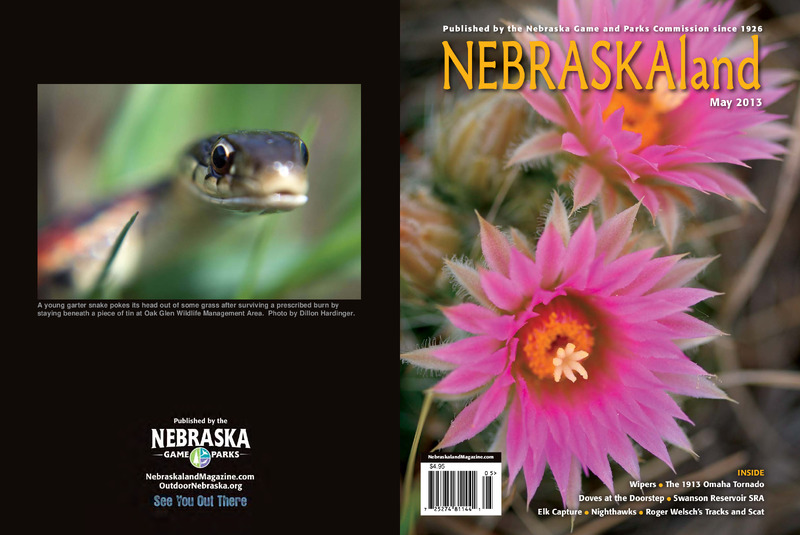
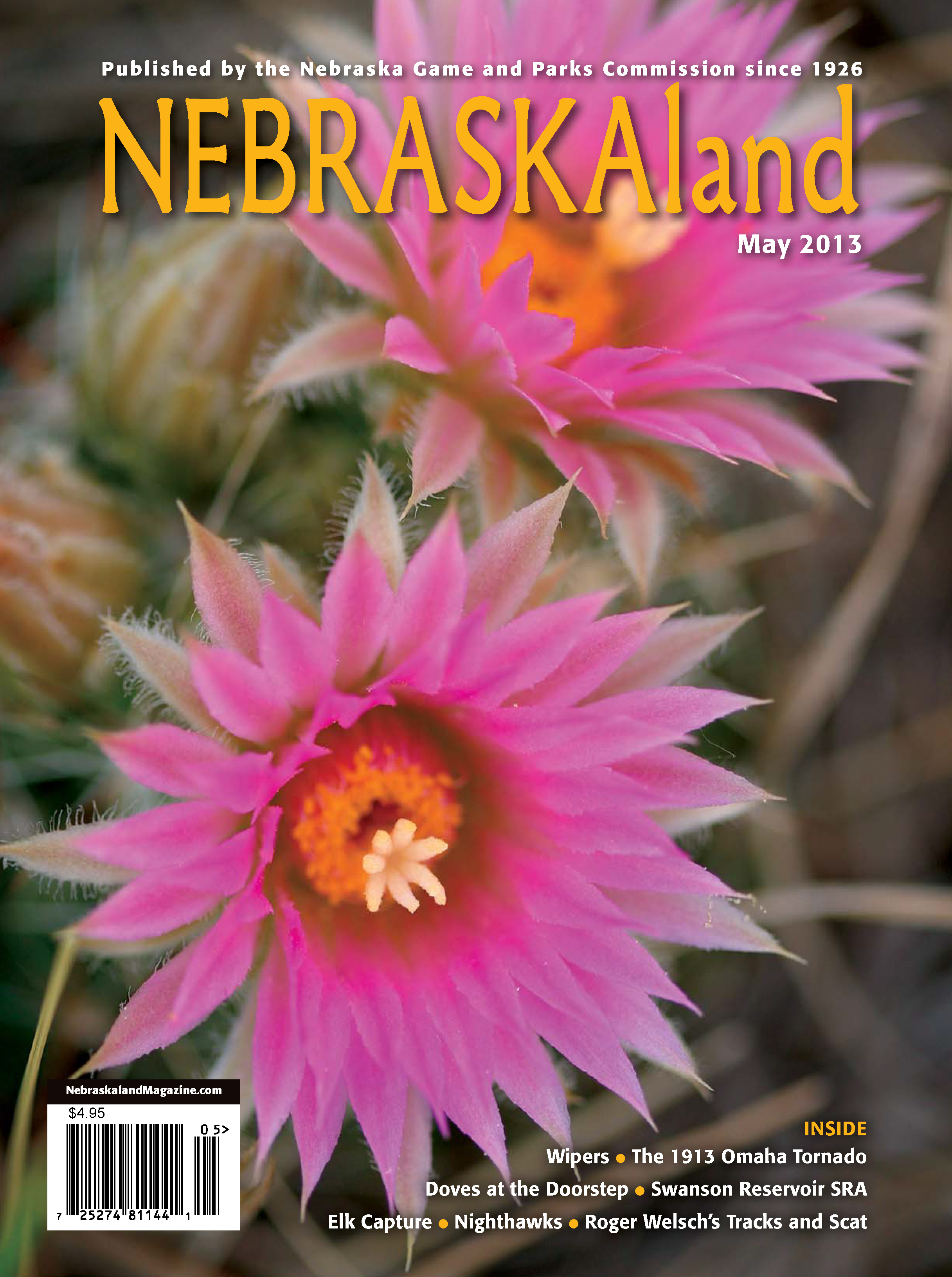
P u b l i s h ed b y t h e Neb ra s ka G a me a n d Pa rks Commi s s i o n s in c e 1926
NEBRASKAland
May 2013
A young garter snake pokes its head out of some grass after surviving a prescribed burn by
staying beneath a piece of tin at Oak Glen Wildlife Management Area. Photo by Dillon Hardinger.
NebraskalandMagazine.com
$4.95
INSIDE
Wipers ● The 1913 Omaha Tornado
Doves at the Doorstep ● Swanson Reservoir SRA
Elk Capture ● Nighthawks ● Roger Welsch’s Tracks and Scat
NEBRASKAland
May 2013
F E AT U R E S
18 Tornado of 1913 – Omaha’s Easter Storm of Destruction
Few people had any warning when a tornado-laden storm
struck and caused mass destruction. BY MARGIE LUKAS
22 Wipers – Chasing the Devil Fish
Disdain turns to appreciation as a “walleye guy” learns to
appreciate the challenge of chasing wipers.
TEXT AND PHOTOS BY DOUG STEINKE
28 Common Nighthawk
A grassland ground nester, the common nighthawk has
also been known to nest in cities on flat-graveled roofs.
TEXT AND PHOTOS BY MICHAEL FORSBERG
30 Swanson – Sometimes Down but Never Out
An irrigation reservoir dependent on the vagaries of the
weather, Swanson Reservoir always has much to offer.
TEXT AND PHOTOS BY ERIC FOWLER
36 Bagging the Big Ones
A helicopter capture crew helps biologists with elk and
bighorn testing and monitoring project. BY JUSTIN HAAG
40 Doves on the Doorstep
A chance occurence results in a front row glimpse into
the life and times of a mourning dove family.
TEXT AND PHOTOS BY BILL HAGER
22
●
D E PA RT M E N T S
Comment ................................................................... 4
Mixed Bag................................................................. 8
Outdoor Business .....................................................44
Classifieds ................................................................46
In the Kitchen ..........................................................48
Page 49 ....................................................................49
Nature Notes ............................................................50
Portraits from the Past .............................................52
The Last Stop ...........................................................54
30
●
18
●
Cover: A purple pincushion cactus flower blooms in the Sandhills north of
Grand Island. Opposite: A damselfly sits on a blade of grass with early
morning dew covering its body. Photos by Luke Kathol.
NEBRASKAland (VOL. 91 / NO. 4, ISSN 0028-1964) is published monthly, except for the
combined Jan./Feb. and Aug./Sept. issues, by the Nebraska Game and Parks Commission,
2200 N. 33rd St., Lincoln, NE. Periodicals postage paid at Lincoln, Nebraska, and additional
mailing offices. POSTMASTER: Send address changes to NEBRASKAland, P.O. Box 30370,
Lincoln, NE 68503-0370.
2 NEBRASKALAND • MAY 2013
28
●
MAY 2013 • NEBRASKALAND 3
Black Squirrel
I had a chance to harvest a black
squirrel last year while hunting south of
Minden and recently got it back from
my taxidermist. I remember reading a
story about black squirrels a few years
ago in NEBRASKAland Magazine.
I live in Minden and there are a lot
of black squirrels in town. They are
also starting to get further out in the
country. I harvested this one about
10 miles southwest of Minden.
Thought this would be a good picture
to share with others. I enjoy reading the
magazine every month. Thanks.
John Hlavinka
Minden, Nebraska
Whoopers
Wanted to share this photo (below)
that I had sent to Joel Jorgensen
(the Nebraska Game and Parks
Commission’s Nongame Bird Program
Manager) while reporting the sighting
of these five whooping cranes. I work
as a deputy sheriff with Howard
County and while on a call observed
the birds land on the Middle Loup
River near Centura High School.
I knew they were rare, as I always
look for them in flocks of cranes – I bet
I’ve looked at thousands of migrating
sandhill crane flocks in hopes of seeing
a white whooping crane in the flock.
These are the first whooping cranes I
have ever seen and it was exciting.
Mike Hoff
Elba, Nebraska
A Hunting Bond in the Great
Nebraska Outdoors
This is a story of three young
Nebraskan men with a deep love of the
great outdoors and a passion for the
vast hunting opportunities Nebraska
offers. The friendship began several
years ago when Brian Piernicky,
Erick Wickman and I found ourselves
working together in Chadron and
discovered a mutual love for the
outdoors and hunting. Working around
our busy work and family schedules,
we began taking advantage of the
hunting opportunities northwestern
Nebraska had to offer, ranging from
spring turkeys to squirrels, doves,
waterfowl, big game with various types
of weapons and starting over with
spring turkey hunting again.
Eventually Brian moved to
southwestern Nebraska to begin a new
career, but with his move came new
hunting opportunity. Brian located
some prime turkey hunting property,
which gave us a chance for a friendly
reunion and the opportunity to archery
hunt Nebraska’s quality gobblers. LateMarch found the three of us in our
blinds near McCook, bows in hand and
listening to the loud rumble of turkeys
gobbling in two nearby roost trees, a
sound loud enough to send shivers up
your spine.
The first day led to great encounters
and some near misses, which was no
fault of the turkeys, but we reaped
success (and then some) on the second
day, bagging four toms. To top it off,
I later found out my bird will be the
new Nebraska state archery record
for Merriam turkeys, according to
the National Wild Turkey Federation
(NWTF) – a great feeling since Erick
already had the Nebraska shotgun
record for the Rio Grande sub species.
An even better feeling was the fact I
still hit the turkey after accidentally
shooting an arrow through Erick’s
expensive ground blind, which he later
forgave me for.
All in all, it was a very special day
as this was my first turkey and my
first successful bow hunt. The state
record is nice, but good times with
good friends in good ol’ Nebraska is
more important to me than any record
ever will be. I will always be thankful
for the memories and friendships I
have gained while exploring the great
Nebraska outdoors.
Bryan Linegar
Chadron, Nebraska
COMMISSIONERS
CONSERVATION OFFICERS
Director Jim Douglas
NORTHWEST
Officer
City
Jim Zimmerman (S) Gering
Commissioners
Chairman - Ron Stave, Waterloo
Vice Chairman - Norris Marshall, Kearney
2nd Vice Chairman - Jerrod Burke, Curtis
Dr. Mark Pinkerton, Wilber
Dr. Kent Forney, Lincoln
Lynn Berggren, Broken Bow
Rex Fisher, Omaha
Mark Spurgin, Paxton
Mick Jensen, Blair
MAGAZINE STAFF
Editor Doug Carroll
Associate Editor Jeff Kurrus
Art Director Tim Reigert
Regional Editors Eric Fowler, Julie Geiser,
Justin Haag, Jenny Nguyen
Contributing Editor Michael Forsberg
Regular Contributors Bill Hager, Chris Helzer,
Lisa Knopp
Photo Librarian Sarah Johnson
Circulation Donna Robinson
For address changes and questions about
your subscription, e-mail Donna.Robinson@
Nebraska.gov or call 800-632-5263
Advertising
For advertising information contact
Donna Robinson, Circulation
Phone: 402-471-5490
E-mail: ngpc.ads@nebraska.gov
NEBRASKAland Magazine Copyright 2013, all rights reserved.
NEBRASKAland is available in audio from the Nebraska Library
Commission Talking Book and Braille Service, Suite 120, 1200 N St.,
Lincoln, NE 68508. 800-742-7691. NEBRASKAland Magazine and the
Nebraska Game and Parks Commission reserve the right to reject any
advertising not in keeping with the agency mission.
Rates: $18 for one year; $33 for two years; $44 for three years. Nebraska
recipients must add appropriate sales tax. To subscribe call
1-800-NEBLAND (632-5263), or go online to: NebraskalandMagazine.
com.
COMMISSION
C
COM
OM
OMM
MIS
ISSIO
SIION O
SI
OFFICES
F CES
FFI
FF
ES
S
Headquarters/Southeast District Office
2200 N. 33rd Street Lincoln, NE 68503
Phone 402-471-0641
Northeast District Office
2201 N. 13th St. Norfolk, NE 68701
Phone 402-370-3374
Southwest District Office
301 E. State Farm Rd. North Platte, NE 69101
Phone 308-535-8025
Northwest District Office
East Hwy. 2, Box 725 Alliance, NE 69301
Phone 308-763-2940
Bassett Office
524 Panzer St., Box 508 Bassett, NE 68714
Phone 402-684-2921
Kearney Office
1617 First Ave. Kearney, NE 68847
Phone 308-865-5310
Omaha Office
1212 Bob Gibson Blvd. Omaha, NE 68108
Phone 402-595-2144
Greg Hesse
Scott Brandt
Heath Packett
Dan Kling
Frank Miller
Phone (308)
(office) 763-2940
(cell) 641-6138
Alliance
760-3647
Gering
631-0663
Gordon
360-0682
Harrison
430-0572
Valentine 402-389-0444
SOUTHWEST
Officer
City
Phone (308)
Roger Thompson (S) N. Platte (office) 535-8025
(cell) 530-3097
Ray Dierking
Brkn. Bow
870-0322
George Sund
Cambridge
655-0028
Michael Thome
Cozad
529-8146
Terry Brentzel
Doniphan 402-469-5795
Matt Andrews
Elwood
746-2418
Dirk Greene
Imperial
882-0015
Dale Johnson
Kearney
440-3847
Brian Piernicky
McCook
340-6627
Brandon O’Neal
N. Platte
778-7486
Nicholas Fix
Ogallala
289-0427
Dennis Thompson
Ogallala
289-0755
Rich Routh
Rep. City
920-0367
NORTHEAST
Officer
City
Tom Zimmer (Sup.) Norfolk
Dale Davis
Steve Oberg
Daniel Roberts
Randy Pomplun
Jeff Jones
Jon Reeves
Tim Williams
Pat George
Doug Pollard
Alex Frohberg
Cory Krause
Phone (402)
(office) 370-3374
(cell) 649-8053
Bassett
760-0712
Columbus
910-3366
Fremont
719-1108
Fullerton
308-550-0489
Hartington
762-5022
Kennard
889-8508
Neligh
929-0051
O’Neill
340-0787
Ord
308-778-7101
Ponca
241-7615
West Point
380-6410
SOUTHEAST
Officer
Levi Krause (Sup.)
Sean McKeehan
William Krause
Mike Luben
Dan Zuehlke
Darin Gress
Douglas Kramer
Dina Barta
Stacey Lewton
Dudley Sorensen
Levi Krause
Robert Finke
Russell Mort
Dan Evasco
Rich Berggren
City
Louisville
Ashland
Auburn
Colon
Cortland
Hebron
Lincoln
Lincoln
Lincoln
Lincoln
Louisville
Milford
Nebr. City
Papillion
Waterloo
Phone (402)
949-0593
521-0159
274-8063
443-6392
806-9084
768-8665
890-6465
890-6463
890-7140
937-3422
949-0593
947-1363
209-1506
616-5961
619-1355
ADMINISTRATION
Officer
Craig Stover (Adm.)
Duane Arp (Ass.)
Jeff Clauson (Ass.)
City
Lincoln
Lincoln
Lincoln
Phone (402)
471-5531
471-5532
471-0480
Nebraska Wildlife Crimestoppers 1-800-742-7627
Ak-Sar-Ben Aquarium
21502 W. Highway 31 Gretna, NE 68028
Phone 402-332-3901
4 NEBRASKALAND • MAY 2013
MAY 2013 • NEBRASKALAND 5
at their visitor. I don’t believe it’s a
mosquito – if it is, the folks in the tent
may want to buy more insect repellent.
Steve Tyler
Omaha, Nebraska
Litter Experiment
I read about your litter experiment
in the April issue of NEBRASKAland
Magazine and want to commend you
for putting forth the effort of picking
up trash during your fishing travels.
What a great idea – all you need is
a small plastic bag and to pick up any
trash you wander upon. It’s not much,
but a little bit every time adds up.
I’ve turned my son onto this idea
and he’s now managed to fill his entire
tackle box with fishing equipment,
including a rod holder, stringer, lures,
weights, many hooks, a spool of fishing
line, power bait and bobbers.
I always take a plastic grocery sack
with me and fill it up with very little
effort. Many of my fishing buddies
now do the same. I encourage everyone
to pass the word on.
Monte Deatrich,
Thornton, Colorado
NEBRASKAland Visitor Letters
Well, this was definitely a tough
one. Of all 42 readers that sent e-mails
and letters for last issue’s visitor, only
one identified it correctly – a stiltlegged fly on page 9 (see page 17
for the winner, rules and this issue’s
hint). Here are some of the wonderful
responses we received:
First of all, thanks for the mug – it’s
displayed in my office for all to see. I
finally got drawn after all these months
of looking for the visitor in your great
magazine. This month it’s on page 9
and appears to be sitting on the tent
of the couple looking out the entrance
6 NEBRASKALAND • MAY 2013
I have found the visiting insect in
the April issue of your magazine. It is
sitting on the tent up in the corner of
page 9. It seems to be a Stilt-legged
fly. I didn’t find much information
about this critter, but the scientific
name I saw most often is rainieria
antennaepes, and they seem to like
damp places where there is detritus to
eat. I shall have to watch for these this
summer, as I don’t know that I have
ever seen one before.
This issue has some great photos and
interesting articles in it. My husband
found the instructions for making a
blind and the info on turkeys helpful.
And I enjoyed the article and photos
about old elevators. The healing plants
article is right up my alley ... I have
saved it for later.
Solveig Knott
Grand Island, Nebraska
The visitor is on the top of page 9. I
do not know its identity. Do you have
any instructions on how to use www.
bugguide.net, that is suggested on
page 5 as a good site for
identification. I go there
often to try to figure out
the visitor and seldom
come away with any
success.
Also, I see Jon Farrar is not
listed as Senior Editor any longer under
magazine staff. Is he retired?
Lonnie Shafer
Exeter, Nebraska
Lonnie: www.insectidentification.org
is another good site. Senior editor
Jon Farrar retired last November after
42 years with the Commission.
– Editor
It’s really hard to admit that I have
never been able to find the hidden bug,
but when NEBRASKAland arrived
yesterday, I did make that comment.
My daughter, who was visiting
from Norfolk (the one in Virginia –
pronounched NAH-fk, or something
like that), asked what I meant. I
explained. She asked if they were in
the ads and I told her they could be
anywhere. She took the magazine and
in less than two minutes, pointed to
the ant/termite-like insect at the top of
page 9. In the words of Charlie Brown,
“AARRRRGGG!”
Suzanne Beerthius
Alexandria, Virginia
Stilt-legged flies are members
of the family Micropezidea. They
are a true fly, in the same order as
house flies, mosquitoes, crane flies
and horse flies. This insect gets its
common name from its very long legs.
Stilt-legged flies often hold their front
legs up so they look like antennae, in
what is believed to be mimicry of a
wasp or ant. This behavior is likely a
defense mechanism. They also have a
somewhat narrowed abdomen, again
likely intended to appear wasp- or
ant-like. Little is known about the
feeding habits of this family of flies.
The larvae are maggots, and usually
feed on decaying vegetation, though
some species will eat specific plants
or even dung. Adults likely also feed
on decaying vegetation or organic
matter, though some are
predaceous. Adults may be
present throughout most
of the summer. They prefer
moist habitats, so watch
for them near water or
wooded areas.
Our mixes are designed by wildlife experts to
maximize the success of both the planting
and the wildlife.
Our mixes meet all the requirements
of conservation programs and are at the
best prices available.
Special thanks to Julie Van Meter, State
Entomologist, Nebraska Department of
Agriculture. Visitor image by Chris Helzer.
www.bugguide.net is a good site for identification
Send your comments to:
Doug Carroll, Editor
NEBRASKAland Magazine
P.O. Box 30370
Lincoln, NE 68503
or e-mail Doug.Carroll@Nebraska.gov
Please include your postal address and
telephone number.
Letters may be condensed and edited
for clarity. Photographs are welcome
and will be returned.
Any program that receives federal funding from the National Park
Service, or the United States Fish and Wildlife Service prohibits unlawful
discrimination on the basis of race, color, religion, age, gender, marital
status, national origin, age, disability or political affiliation. Any person
who believes he or she has been discriminated against in any program,
activity, facility, or service, should contact the Nebraska Game and
Parks Commission, Lincoln, NE 402-471-0641, the Equal Opportunity
Commission, Lincoln, NE 402-471-2024, TTY/TDD 402-471-4693;
United States Fish Wildlife Service, Civil Rights Coordinator, 4401
N. Fairfax Drive, Arlington, VA 22203; Director, Equal Opportunity
Program, U.S. Department of Interior, National Park Service, 1849 C
Street NW, Mail Code 0008, Washington, D.C. 20240-0001.
MAY 2013 • NEBRASKALAND 7
Youth Bass Tourney Returns
Here is a list of upcoming
outdoor events across
Nebraska.
For more information
about these and other
events, visit the
calendar page at
OutdoorNebraska.org.
PHOTO BY JEFF KURRUS
Fort Atkinson State
Historical Park, 402468-5611
May 4
Catfish Tournament
May 19
Walleye Tournament
Lake McConaughy
State Recreation Area,
contact Darrell Morrow
at 308-778-5879
Lake McConaughy
State Recreation Area,
contact Troy Bosard at
308-255-2105
May 11
Outdoor Discovery
Program
May 19
3D Archery Shoot at
Lake Mac
Fort Kearny State
Recreation Area, 308865-5305
Lake McConaughy
State Recreation
Area, contact Dennis
Dahlkoetter at 308-2896509
Living History
Weekend
Ponca State Park,
402-755-2284
Fort Robinson State
Park, 308-665-2900
May 18
Summit Campground
Grand Opening
Event
PHOTO BY ERIC FOWLER
8 NEBRASKALAND • MAY 2013
May 18
Free Park Entry/Fish
Day Events
No park permit of
fishing permit required
this day, and special
events will be held
across the state. Visit
the calendar page at
www.OutdoorNebraska.
org to see what’s
happening in your area.
Ponca State Park, 402755-2284
May 12
Mother’s Day Buffet
Outdoor Discovery Program
Outdoor fun awaits families at
the Family Outdoor Discovery
Program at Fort Kearny State
Recreation Area on May 11.
This spring celebration of
Nebraska’s outdoors is free and
runs from 9 a.m. to 4 p.m.
Among the activities available
for all ages and experience levels are shooting sports (shotgun, 3-D
archery, aerial archery and air rifle), kayaking, fishing, dog field
activities, campground games, sling shots and trapping. In addition,
you can compete in a s’mores eating contest, learn about Nebraska’s
mountain lions and pot plants for Mother’s Day. Participate in select
activities for a chance to win gift cards.
All of the activities are free, but a park entry permit is required is
required to enter. ■
May 4-5
2nd Annual Outdoor
Cooking Camp
Weekend
Summit Lake State
Recreation Area, 402468-5611
May 18-19
Western NE Bass
Tournament
Lake McConaughy
State Recreation Area,
contact Matt Vollman at
407-659-2358
May 23
Growing Up WILD
Educator Workshop
Southeast Community
College, Lincoln
Campus 6:30 p.m. –
8:30 p.m.
Registration required.
Contact lindsay.
rogers@nebraska.gov
May 25-27
Memorial Weekend“Living History” at
the Fort
Fort Kearny State
Historical Park, 308865-5305
Walleye Tournament
June 1
Run Wild 10K and
1-mile run
Lewis and Clark State
Recreation Area, visit
NebraskaWalleye.com
for more info.
Eugene T. Mahoney
State Park, visit
NebraskaWildlifeFund.
org for more info.
PHOTO BY JEFF KURRUS
Jeff Kurrus
On July 27 the Nebraska Game and Parks Commission (NGPC)
will host one of the year’s most intriguing outdoor events for both its
participants and the general public – the 3rd Annual Nebraska State
High School Fishing Tournament.
On that
day at Harlan
County
Reservoir in
south-central
Nebraska,
two-person
teams of
Nebraska 9th
through 12th
graders will
compete for
a spot in the
regional bass 2012 winners Matt Neiburg (left) and Zach Madsen with
fishing tourney boat captain Bill Warrick of Blair at Summit Lake SRA.
this fall.
The event starts at 6 a.m. with a rules and safety meeting and the
competition ends at 1 p.m., followed by a weigh-in. There is no cost
to participate if you register before the tournament date, however,
all anglers 16 years of age and older must have a current Nebraska
Fishing Permit. In addition, there is no admission fee for spectators
at this event, which is definitely worth watching.
“Not only is fishing a fun hobby,” said the NGPC’s Larry Pape,
“but this is a great opportunity for high schoolers to be involved in
a competitive sport beyond traditional athletics. Competitive fishing
is growing in popularity in high schools and colleges around the
nation, and some colleges even offer it as a sanctioned sport with
scholarship opportunities. Participation in Nebraska has more than
doubled in two years, and there is room for more.”
For more information on the event and instructions on how to
register, visit fishingnebraska.wordpress.com, or call Larry Pape at
(402) 471-5447. ■
Boating Safety – A Few Reminders
By Olivia Johnson
As the temperature rises, boaters all over Nebraska are
anxious to hit the water. Whether you’ve been operating
a motorboat for years, are new to the activity or are just a
passenger, keeping a few simple things in mind while you’re
on the water can make your experience safer and more
enjoyable. (Not to mention help you avoid unwanted fines!)
In order to operate a motor boat, all persons born after
December 31, 1985 must be at least 14 years of age and
have successfully completed the Nebraska boating safety
class and be in possession of the certification card. Classes
are held frequently throughout the state for a very minimal
fee. Go to BoatSafeNebraska.org to sign up and view class
dates/times in your area. Once you receive your certification
card, it is good for use in all states and Canada.
Every vessel must have one wearable flotation device
per person on board, plus one throwable flotation device.
Children under 13 in a boat and jetskiers must wear a
lifejacket at all times. Fact: Most boating-related fatalities
are due to drowning and can be prevented by wearing
a lifejacket. Nebraska Boating Law Administrator Herb
Angell said, “In this day and age with modern technology
there’s no reason why people don’t wear lifejackets. They’re
comfortable, stylish, and don’t get in the way of any activity.
Even people wanting a tan can wear a fanny pack-style
inflatable lifejacket.”
Just like driving a motor vehicle under the influence of
alcohol, it is illegal to operate a motorboat with a blood
alcohol content (BAC) of .08 or higher.
“Sometimes fishermen don’t consider themselves to be
boaters,” said Angell. Regardless of purpose, all motorboat
operators must follow
the same laws. Fact:
The Game and Parks
Fisheries Division
completed a survey that
showed 60 percent of
anglers fish from boats.
These are only a few
friendly reminders
and this list is not
comprehensive. For
additional, detailed
information, pick
up a copy of the
2013 Boating
Guide, or view it
online at http://
outdoornebraska.
ne.gov/boating/pdfs/
boatguide.pdf. ■
MAY 2013 • NEBRASKALAND 9
Send Us Your Trail Cam Photos!
by Carol Henderson
Fremont
RUS
PHOTO BY JEFF KUR
The weather is warm, the sky is blue, let’s head to Fremont...
Enjoy the great outdoors: Tucked among thick stands of cedar,
willow and cottonwood next to the Platte River, Fremont Lakes State
Recreation Area, aka “The Lakes,” offers wide expanses of ankle-deep
sand for castle-making and simple relaxing around 20 sandpit lakes,
as well as a designated water-skiing lake for when you want the wind
in your hair. The area has plenty of camping spots available, good
fishing, ample bird-watching opportunities and miles of tree-lined
hiking trails to enjoy. http://nebraskastateparks.reserveamerica.com
For a thrill: If you’re ready for a break from all that camping, fishing
er airboat features a NASCAR engine
or bird-watching, make a reservation for an airboat ride. The 10 passeng
and plenty of ear protection for riders. brysonsairboattours.com
Amy and Richard Burdine sent in this picture of three bobcats
on their property near Lewellen. The third cat is hard to make
out – only part of it can be seen on the left side of the log.
Fremont is not all about water, however – take time to check out
the city’s sophisticated side...
Getting started: The old Post Office on Broad Street has plenty
of literature about the area, but the building alone, featuring terrazzo
floors, high ceilings and classic architectural touches, is worth a stop
itself. Note: The building is closed on weekends. Information about
the area can also be found at visitfremontne.org.
BY RAD
ER
PHOTO
Y
GRAPH
Dining: My lunch stop was at J’s Steakhouse
for one of Nebraska’s best hot roast beef sandwiches. Real mashed
in
potatoes, thin slices of tender roast beef and fresh green beans sautéed
dessert
for
brulee
crème
crunchy
,
Creamy
butter with shallots and bacon.
. . . oh my!
By Olivia Johnson
Each year volunteers play an
important role in providing hunter
and bowhunter education courses and
events for youth across Nebraska. Last
year proved to be no exception. Below
are some noteworthy facts and figures
from 2012:
• 511 classes and field days were
held by volunteer instructors on behalf
of the Nebraska Game and Parks
Commission. Of those, 364 classes
were for firearm education and 147
were for bowhunter education.
• 1,339 instructors were involved in
teaching these events.
• 14,460 hours were donated by these
instructors. Valued at $21 an hour,
that’s $303,660 worth of time donated.
Both the number of active instructors
and number of hours donated increased
from 2011 to 2012.
A total of 8,917 people attended
these classes and field days, with
6,980 at firearm events and 1,812 at
bowhunting events. ■
PHOTO
Must see: The May Museum, home of the Dodge County
Historical Society at 1643 Nye Street features a massive whitecolumned portico and was once the residence of Theron Nye,
one of Fremont’s founders. Color-drenched gardens and a
replica of the Nye’s first log cabin home are also situated on
the expansive grounds. The hour-long, docent-led tour does
not disappoint (and might remind you of a fictional grand
house called Downton Abbey). Admission is just $5 for adults
and $1 for students to visit one of America’s grand houses.
maymuseum.com
Don’t miss: Fremont’s downtown is still a vibrant shopping
destination for furniture, bakery treats, gifts,
clothing and fine dining. But Fremont is perhaps
best known as eastern Nebraska’s Antique
Capital. Four large stores offer an amazing array
of books, furniture and memorabilia. Allow
plenty of time to peruse each one.
Please submit your trail camera photos by e-mail to:
nebtrailcam@gmail.com. Also include any information that
will help explain your photo.
By the Numbers – Hunter
Education in 2012
5 MONTHS, 10 TOURS, 80 STOPS . . .
WHAT WILL YOUR ADVENTURE BE?
The 2013 Nebraska Passport is your chance to get out and explore
the state, win great prizes and come home with new stories to tell.
What are you waiting for? Create your adventure today.
Get the details at
NebraskaPassport.com.
PHOTO
888-444-1867, DEPT. 3NMP
OL
BY CAR
Nebraska Tourism Commission
SON
HENDER
MAY 2013 • NEBRASKALAND 11
Little Bluestem - Nebraska’s State Grass
Gerry Steinauer, botanist
The shortest bill in Nebraska Legislative history reads
“Little bluestem known as Andropogon scoparius, is hereby
declared the official state grass of Nebraska.” The vote on
this 1969 bill was likely unanimous, for what Nebraska
senator would oppose honoring little bluestem – a hardy,
productive yet beautiful prairie grass native to every county
and legislative district in the state?
Beyond Nebraska’s borders, little bluestem (now named
Schizachrium scoparium) ranges far and wide across most
of southern Canada, throughout all the Lower 48 states and
extends south to central Mexico. Variability in phenology
and growth form allow this adaptable grass to inhabit
a variety of climates and plant communities, including
northern woods, everglade flatwoods, mesquite shrublands
and, of course, prairie.
A warm-season perennial grass, little bluestem most often
grows in tight, erect clumps, reaching three feet in height
on favorable sites. Below ground, dense and fibrous roots
penetrate to depths of four to eight feet while searching
for precious moisture. On wetter sites it may form an open
sod with short rhizomes (horizontal underground stems)
connecting small tufts.
In Nebraska’s eastern tallgrass prairie, little blue is
abundant but plays second fiddle to big bluestem and Indian
grass. In our dry Panhandle prairie, blue grama, needle-andthread, and blackroot sedge outrank little blue in abundance.
It is in our central loess mixed-grass prairie and Sandhill
prairie where our state grass rises to prominence. Here, on
shallow soils, steeper slopes, and ridge tops it often forms
thick stands, with wildflowers and other prairie grasses
surviving only in narrow gaps between bluestem plants.
As an abundant forage grass, little bluestem pumps untold
dollars into our state’s ranching economy. When at peak
Nebland Flashbacks
Run Wild 10K
growth in early summer, little bluestem’s leaves are tender,
nutrient-rich and much sought after by livestock. As the
seeds mature in late summer, the foliage becomes dry and
coarse, with nutrient levels and palatability dropping. When
not sufficiently grazed or occasionally burned or hayed, little
bluestem plants accumulate excessive old leaves and stems
that thwart livestock from reaching the new growth.
The autumn foliage of little bluestem is a striking purplered, and many writers and photographers have succumbed
to the allure of bluestem-cloaked hills and plains. “The red
of the grass made all the great prairie the colour of winestains…. . And there was so much motion in it; the whole
country seemed, somehow, to be running,” penned Willa
Cather in My Antonia. Cather’s classic 1918 novel is based
on her childhood in the mixed-grass prairie country of
Webster County and the “red grass” of which she writes is
surely little bluestem. If the renown Cather chose to honor
little bluestem with such fine prose, certainly it deserved the
title of “official state grass of Nebraska.” ■
In the February 1967 issue of NEBRASKAland Magazine, this photo ran with
an article on the Lincoln Children’s Zoo.
When the zoo first opened in 1965, the only sound Leo had was just a
mechanical roar. Later his recording was changed to: “Hi, boys and girls! I’m
Leo the Paper Eating Lion. Paper! Paper! Paper! I just loooove paper!”
Does anyone remember what the dummy in the jail used to say? Send us a
letter or e-mail.
State Recognized by DU
PHOTOS BY CHRIS HELZER
12 NEBRASKALAND • MAY 2013
Ducks Unlimited recently recognized
the Nebraska Game and Parks
Commission (NGPC) for significant
contributions to conserving waterfowl
breeding habitat in Canada. The award
commemorated NGPC’s milestone
$1 million investment in critical nesting
habitat in Canada.
“The Nebraska Game and Parks
Commission recognizes the critical
value of Prairie Canada for waterfowl
that migrate through Nebraska,” said
NGPC Director Jim Douglas. “None of
this would be successful without our
great working partnership with Ducks
Unlimited Canada and the contributions
and support from our duck hunters with
funds from the Nebraska waterfowl
stamp. The ability of DU Canada to
leverage funds and efficiently put
conservation on-the-ground benefits all
of Nebraska’s waterfowl hunters.”
The state grants program was started
by the Association of Fish and Wildlife
Agencies to support migratory bird
conservation, and contributions are
matched by DU Inc. and DU Canada,
as well as the North American
Wetlands Conservation Act. Through
this match, Nebraska’s $1 million
investment has resulted in $5 million
in conservation work being done in
Canada. ■
To help celebrate National Trails
Day and Nebraska’s wildlife, on June 1
Eugene T. Mahoney State Park is
hosting numerous outdoor activities,
including two “Run Wild” races – a
chip-timed 10k race and a 1-mile
children’s fun run for runners 12 years
and younger – where participants are
encouraged to dress like wild animals.
Registration proceeds support the
Nebraska Wildlife Conservation Fund,
one of the primary sources of funding
for research and education about
Nebraska’s at-risk species. Prizes will
be awarded to race winners and for
best costume. The 1-mile registration
includes a free children’s t-shirt and
a pass to the park’s wave pool. In
addition, each group of young runners
from the same address will get the
book “Have You Seen Mary?” by
NEBRASKAland’s Jeff Kurrus.
No registrations will be accepted
the day of the event, and registration
costs go up the closer you are to the
May 24 deadline. For more information
or to sign up (each participant needs
to be signed up individually), visit
NebraskaWildlifeFund.org. ■
CRP Signup
From May 20 through June 14,
landowners can offer to enroll land
in the Conservation Reserve Program
(CRP). Those with CRP contracts
expiring this September may also
submit offers.
CRP rental rates have risen in many
Nebraska counties, some considerably,
so contact your local Farm Service
Agency for more information.
Accepted contracts for this CRP signup
will begin October 1, 2013. ■
MAY 2013 • NEBRASKALAND 13
A Plum House
Great Park Pursuit
Junior Duck Stamp Winner
Jeff Kurrus
“Where there are plum thickets, there are quail,” a bird hunter
once told me, and he was right. Plum thickets provide multiple
purposes for bobwhite quail and are too often in short supply,
with the rising price of corn and some farmers’ ever-increasing
desire to plant fencerow to fencerow.
First, plum thickets grow soft, fleshy fruits consisting of sugar
that provides high levels of energy for birds during the month of
September. But it’s more important what they do the rest of the
year – providing shade for hens and their broods, as well as cover
against predators. Although plum thickets can be five to 12 feet
tall and provide perches for raptors, their thick structure makes
these thickets virtually inaccessible to those raptors despite the
bare ground underneath.
However, these thickets still need to be maintained. First, fire
should be used to manage them, as a plum thicket full of grass
has little or no value for quail. Second, they should be much
larger than you probably think – a bare minimum of 1,500 square
feet in size, three to five feet in height, and away from trees.
But instead of trying to establish a new thicket, which can take
about 10 years, we should first work toward maintaining the
thickets we currently have in our fencelines and field edges by
using better management tactics today. ■
By Olivia Johnson
The increasingly popular Great Park Pursuit is back
in action in 2013. This outdoor adventure encourages
awareness of Nebraska’s various outdoor recreation
opportunities as well as a healthy lifestyle.
Venture to as many of the 20 Great Park Pursuit
locations across Nebraska as you like between
May 1 and September 16. Once at a designated site,
search for a special nature impression and trace it
with a pencil onto a Park Page. The more impression
tracings you collect, the better chance you have at
winning a prize! A new prize system will be going
into effect this year that will include even more
prizes.
How to join the fun:
• Gather your friends and family to create a team,
and then register online.
• Choose one of the designated parks on the GPP
website and print the official Park Page.
• Follow the clues on the Park Page to locate the
park’s nature impression.
• Continue visiting other GPP locations.
• Mail in your completed Park Page(s) to be
entered in prize drawings.
Best of Show at this year’s Nebraska
Junior Duck Stamp Art Contest was
awarded to Clair Rush of Tecumseh.
A 17-year-old student at JohnsonBrock High School, Rush’s colored
pencil drawing of a wood duck
pair was selected from nearly 400
entries received from all across the
state. Her drawing was then entered
in the National Junior Duck Stamp
Competition that was held April 19 at
the U.S. Fish and Wildlife Service’s
National Conservation Training Center
in Shepherdstown, W.Va. The winner
of the national junior duck stamp
competition received $5,000, a trip to
Summit Lake Campground Grand Opening
PHOTO BY JEFF KURRUS
14 NEBRASKALAND • MAY 2013
Natural Seeding
Natural resource officials in northwest Nebraska are
turning to one of the oldest forms of seed dispersal to replace
some of the countless trees and shrubs that were burned in
the 2012 Pine Ridge forest fires.
Blocks containing seeds of native trees and shrubs soon
will be fed to the region’s wild animals, which are expected
to “deposit” the seeds in remote areas of the region’s rugged
landscape.
Shelley Steffl of Chadron, the Nebraska Game and Parks
Commission wildlife biologist leading the effort and pictured
at right forming seed blocks, said the project is intended to
move seeds to the most remote areas of the Pine Ridge and
complement future forest rehabilitation efforts.
Eight hundred of the blocks have been
created. The blocks contain seeds for
12 native species of trees and shrubs,
including deciduous varieties such as
Rocky Mountain maple, and conifer
species, like ponderosa pine. The
ingredients are listed on a biodegradable
label that quickly falls apart when
exposed to moisture.
Steffl said one of the greatest
challenges of the project was coming up
with a recipe that contains the right ratio
of molasses and livestock mineral to
keep the blocks from falling apart.
A grant from the Nebraska
Environmental Trust was used to
help with a portion of the funding
needed for the project. The blocks are
available to landowners for $3 per
block. Landowners who want to be
placed on a list for the seed blocks
may contact Steffl at 308-432-6190 or
Do you know where this Nebraska photograph was taken?
visit the Upper Niobrara White Natural
See answer at the bottom of page 17.
Resources District, 430 E. Second St. in
Chadron. ■
See You Out There... But Where?
MAY 2013 • NEBRASKALAND 15
PHOTO BY JEF KURRUS
On May 18, Summit Lake State Recreation Area
near Tekamah is hosting a grand opening for its
newly constructed Bob Eckdahl Campground.
Activities for all ages will be available from 9 a.m.
to 3 p.m., including a bounce house, train ride, face
painting, pony rides, a fishing clinic and outdoor
games. A hotdog cookout will also be available from
11 a.m. to 1 p.m., followed by speakers and a ribboncutting ceremony. In the evening a live auction will
be held at the nearby No Wake Bar and Grill to help
raise funds for a new wheelchair-accessible fishing
pier and a new shower house at the lake.
The new campground, which features 19 camping
pads with 50 amp electrical hookups, was named
for the park’s longtime superintendent, who passed
away in 2007. The new campground, as well as
upgrades to the 11 sites already existing at Summit
Lake SRA, was funded by the Nebraska Game and
Parks Commission, the local NRD, the Burt County
Recreational Preservation Committee, and local
donors.
If someone would like to donate to the live auction
or the projects themselves, contact Jason Grof at
402-374-1727. ■
Information for next year’s contest
will be posted on the U.S. Fish and
Wildlife Service internet homepage at
duckstamps.fws.gov. ■
PHOTO BY JUSTIN HAAG
For more detailed information and to register, go
to the Great Park Pursuit’s website: negpp.org. Also
be sure to ‘like’ the Facebook page, as it’s the place
where new information is posted first. ■
the nation’s capital along with
a parent and/or art teacher,
and their artwork will be used
to make the 2013-2014 Junior
Duck Stamp. Proceeds from
the sale of the Junior Duck
Stamps, which cost $5, support
conservation education across
the country.
Junior Duck Stamp designs
are judged in the K-3, 4-6,
7-9, and 10-12 grade groups,
from which three first place,
second place and third place
winners, as well as sixteen honorable
mention awards, are chosen. The Best
of Show is then chosen from the first
place winners from all age groups.
After the Spawn
Turpin Time
Devin Sobotka of Lincoln Southeast High School set a state record
with 290 points at this year’s Nebraska National Archery in the
Schools Program (NASP) state tournament held March 23 in Lincoln
en route to winning the boy’s title, while Kora Shedenhelm of Omaha
Mater Dei Academy repeated as the top girl scorer in the meet with
284 points.
The tournament drew 460 elementary, middle school and high
school archers from 23 schools and was this year’s culminating event
in the state for NASP, a physical education curriculum that has spread
across the nation.
The following teams qualified for the NASP national tournament
May 10-11 in Louisville, Ky., by winning a state championship or
meeting a score requirement:
High School Division – Omaha Mater Dei Academy and Lincoln
North Star; Middle School Division – Lincoln Pound; Elementary
Division – Lincoln Pound.
In addition, all top-five individual finishers in each division also
qualified for nationals. ■
Daryl Bauer
Right now the walleye spawn is
winding down on most Nebraska
waters. Although some Nebraska
anglers believe the spawn period offers
their best opportunity of the year to
catch walleyes, especially big walleyes,
I believe they are wrong. Admittedly,
the concentration of spawning walleyes
on the face of the dams on most
Nebraska reservoirs gives anglers an
opportunity to fish where there are a
lot of adult walleyes. Out of all those
fish, there will be a few that will take a
bait, usually the smaller male walleyes,
but occasionally one of the big girls.
Logan Moore of Roca with a walleye
caught at Johnson Lake.
However, most walleyes during the
spawn period have things other than feeding on their minds.
Once spawning rituals are finished, walleyes need to begin feeding to replenish
energy reserves. They need to eat. Couple that with the fact that the amount of
natural prey is at its lowest point during the spring, and you have the perfect
scenario for the best walleye fishing of the year: Hungry, active fish searching for
limited prey. Some of the best walleye fishing each year for both numbers of fish
and for big fish starts after the spawn and lasts into early summer.
After completing spawning, walleyes scatter throughout Nebraska reservoirs.
With the numbers of natural prey at a minimum, walleyes will feed on a wide
variety of prey, mostly small fish. At this time walleyes may be found from
one end of a water body to the other, from shallow water to deep water and
everywhere in between. Anglers should try to cover lots of water, check a variety
of depths and habitats, and use a variety of presentations to find and catch postspawn walleyes. Early in this period, it is typical to catch a walleye here and there
from a variety of areas and on a variety of baits. Later on fishing patterns will
become more consistent as the walleyes form schools and feed more consistently
in predictable areas.
All of the traditional live bait, trolling presentations and lures will catch
walleyes from post-spawn right into summer. Many of those tactics are very
effective ways to cover water and find fish. But keep in mind, especially
immediately after the spawn, that waters will still be relatively cool and that
many species of prey most likely will be found in shallow, warmer water. So look
for active walleyes in relatively shallow water, and in cover and habitat that may
be more effectively fished by casting jigs, crankbaits and swimbaits. ■
Dick Turpin
Here’s a couple
tips for when
you’re outdoors
so you can enjoy
yourself fishing and
not get pestered.
To repel mosquitoes:
• Use fabric softener sheets (the
Buoyant brand). Just wipe on and go.
• Take one vitamin B-1 (Thiamin
Hydrochloride 100 mg.) tablet a day
April through October
For stings/bug bites:
• Household ammonia is great for
stopping the itch of bug bites and the
pain of stings. Get a small container,
like one that eye drops come in, fill it
with household ammonia, and keep that
with you fishing.
For tick removal:
• Don’t ever use a match or nail
polish – those things will likely get the
tick to regurgitate infected fluids. Use
tweezers (on the head, not the body)
and gently pull straight upward. ■
Take Pride in America Day
PHOTO BY DOUG CARROLL
Take Pride in America Day, a nationwide effort to encourage
volunteers to improve parks, lakes and wildlife areas, will be
May 4 this year and officials at Branched Oak and Verdon Lake
state recreation areas (SRA) are looking for volunteers at each of
those areas.
At Branched Oak SRA, volunteers are needed to paint, pick up litter
and prune or remove trees that have grown in unwanted areas. For
more information or to register for the event, which runs from 9 a.m. to about 4 p.m., call 402-783-3400.
Some of the work needed at Verdon Lake SRA includes cutting trees, chipping wood, cleaning and painting restrooms,
picking up trash, cleaning grills and painting and repairing picnic tables. This event also runs from 9 a.m. to 4 p.m., and
lunch will be provided. For more information or to register, call Indian Cave State Park at 402-883-2575. No park entry
permit is required for volunteers at either location. ■
Outdoor Cooking Camp at Ponca State Park
16 NEBRASKALAND • MAY 2013
techniques, fish preparation,
canning venison, jerky making
and dehydration, making
strawberry preserves and dutch
oven cooking.
Special nature-inspired
programs for youth run
concurrent with adult courses
and include campfire cooking
and safety, food art, a wild
edibles hike and more.
Camp cost is $50 for adults
and $35 for youth 12 and under,
which includes instruction in
all courses, program food and
materials, and five meals. A
discount of 30 percent off all
lodging is available to camp
participants, as well as a gift
shop discount.
For more information or to
register, contact the park at
402-755-2284. A park entry
permit is required. ■
PHOTOS BY ERIC FOWLER
Enjoy a delicious and
educational weekend during the
2nd Annual Outdoor Cooking
Camp scheduled for May 3-5 at
Ponca State Park.
The interactive camp includes
a variety of specialty courses
with hands-on instruction, as
well as the opportunity to meet
fellow cooking enthusiasts during
a barbeque and bonfire, group
cookout and wine and cheese
social.
Courses include campfire
cooking, wild game sausage
making, smoking meat
and backyard BBQ, grilling
NEBRASKAland Visitor
Winner and Hint
Last issue’s winner of
the Visitor drawing
was Solveig Knott of
Grand Island, Nebraska, who found
the stilt-legged fly on page 9.
Readers are encouraged to contact
NEBRASKAland within 10 days
after this issue’s publication with the
correct page number and name of
this issue’s “Visitor” – a bug found
in Nebraska that just happened to
find its way onto one of the pages.
We will then gather the correct
entries and draw one to win a
NEBRASKAland Magazine mug.
To enter each month, write:
NEBRASKAland Visitor
2200 North 33rd Street,
Lincoln, NE 68503.
Or e-mail:
Tim.Reigert@Nebraska.gov
with “Visitor” in the subject line of
the message.
HINT: This issue’s visitor is not
on page 2, 6, 7, or 50.
SCHRAMM PARK STATE RECREATION AREA
PHOTO BY JEFF KURRUS
State NASP Results
MAY 2013 • NEBRASKALAND 17
Tornado of 1913
Omaha’s Easter Storm of Destruction
By Margie Lukas
A woman stares at the aftermath of the 1913 Omaha tornado.
18 NEBRASKALAND • MAY 2013
BEE PUBLISHING CO. OMAHA PENDING
BOSTWICK-FROHARDT COLLECTION, THE DURHAM MUSEUM
O
maha, 1913: James C. Dahlmen,
“Cowboy Jim,” was mayor;
ice and coal were delivered to
homes; potatoes sold for 15
cents a peck; and riding the
street car cost a nickel.
March 23rd of that year, Easter
Sunday, began “balmy” with the sun
often breaking through the cloud
cover. By evening Omaha would suffer
what the National Weather Service
calls, “The darkest day in Nebraska
severe weather history.” At least seven
tornados would move across Nebraska
and Iowa, injuring hundreds and killing
seven people in Ralston, 20 in Council
Bluffs, and 140 in Omaha.
It was an era before civil defense
sirens and Doppler radar screens. Most
Omahans were just sitting down to
their Easter dinner and were caught
without warning when the twister
struck at 5:45 p.m. Others heard the
tornado’s rumbling approach minutes
before its arrival, and one man
described to an Omaha Bee newspaper
reporter that the air just before the
tornado hit was “a lurid brass-yellow
luminous atmosphere.”
Crossing the city diagonally, the
massive F4 twister touched down
around 50th and Center and headed
northeast. The path of destruction was
nearly a quarter of a mile wide and four
and a half miles long, destroying one
of Omaha’s most densely populated
areas. Homes in lower regions, as well
as expensive mansions on the hills
such as Josyln Castle, were heavily
damaged or destroyed. The Omaha
Bee said of the twister: “It invaded the
hovel and palace, the dwelling of the
wage worker, and the mansion of his
employer.”
A.L. Green, who worked at Orkin
Brothers’ department store, told a
reporter: “It came like a rushing and
roaring torrent of water. It came from
This graphic, originally published in the Omaha Bee, paints a horrific picture of the
Omaha tornado with its skull imagery and its statistical information following the
storm.
This postcard from Omaha’s devastating tornado reads, “As tornado appeared after
passing 38th St. Omaha, Mar. 23rd- 1913.”
MAY 2013 • NEBRASKALAND 19
BOSTWICK-FROHARDT COLLECTION, THE DURHAM MUSEUM
This panoramic photo shows homes
on the southwestern edge of Omaha
along Leavenworth and 49th streets,
including this one blown from its
foundation. Twelve people lost their lives
in this vicinity. On the hill at right is the
University of Nebraska Medical College
building.
Four coffins with tornado victims lay on a
flatbed wagon following the Idlewild Pool
Hall collapse at 24th and Lake streets in
Omaha.
20 NEBRASKALAND • MAY 2013
own lives from ruptured gas lines.
An estimated 600 to 800 homes were
left in rubble. Another 2,000 were
severely damaged. The homeless count
was in the thousands. Hastily-painted
signs on scrap wood were tacked
to demolished buildings, telling the
homeless where they could go for food
and shelter. Trinity Cathedral opened
its doors and took in 300 women and
children. Methodist Hospital at 36th
and Cuming had many of its windows
blown out but continued to receive
victims, filling its hallways with injured
people.
One of the locations with the highest
death toll was Idlewild Pool Hall at
2307 N. 24th St. The establishment
was destroyed and the owner and 13
customers were killed by falling debris
and smoke inhalation. Pictures taken
the next day show a crowd of what
might be 200 onlookers, standing
around the site in heavy coats and
hats as body after body is pulled free.
Some of the bodies were carried to
Obee’s Funeral Parlor, others to what
is now the Black Heritage Museum at
22nd and Lake. Across the street from
Idlewild, Nathan Krinski, his wife and
all five of their children perished in
their home.
That Monday, the morgues were
grisly places as crowds came looking
for loved ones. Bodies were stretched
out across the floors, many of them
so broken and burnt they were
unrecognizable. Throughout the day
people continued to press through,
hoping not to find their loved ones.
Even those who couldn’t identify
bodies, who still had hope their loved
ones lived, left grieving over what
they’d seen. Hospitals experienced
the same flocks of anguished people
demanding to see those brought in,
hoping to find family members still
alive.
When the funerals began a few days
later, the morgues had to coordinate
the times so there were enough hearses
and so the cemeteries could handle
the workload. Pictures from back then
show long lines of black hearses, drawn
by horses plodding toward final resting
places. ■
BOSTWICK-FROHARDT COLLECTION, THE DURHAM MUSEUM
the south and passed right by us to
the east. I went to my attic window
immediately afterward and saw fires
bursting forth from homes along the
path of the storm. I could see five fires
burning at once, three to the south of
me, one southeast and one northeast.”
As many as 50 fires broke out in the
aftermath. Most homes were heated by
woodstoves, fireplaces or coal-fueled
boilers. When these were destroyed,
burning embers blew and the frame
houses, now reduced to kindling, were
ignited. Even stoves that remained
standing were smothered in debris,
which ignited. Ruptured gas lines
were another source of fire. So many
calls came to the fire department the
firemen could not respond to them all.
The streets were buried in trees, poles
and debris, forcing firefighters to pick
their way through on foot, carrying
their hoses on their backs. Most of the
homes where fires broke out – often
with people trapped inside – were
smoldering heaps in a few short hours.
Ambulances and hearses met
the same obstructions as the fire
department, and the injured and dead
were carried out on makeshift gurneys.
All lights were out, so through the
night rescuers used torches to search
for victims, despite the threat to their
Nebraska Educational Television has
produced a documentary titled “Devil
Clouds: Tornados Strike Nebraska”
that will air May 2 at 12:00 a.m. on
NET2, as well as on May 29 at 9
p.m. on NET1/HD. Or watch online
at http://netnebraska.org/interactivemultimedia/news/devil-cloudstornadoes-strike-nebraska.
MAY 2013 • NEBRASKALAND 21
WIPERS
Chasing the Devil Fish
Photos and text by Doug Steinke
As a walleye tournament guy, I hated wipers
for the wasted time their strikes could cost
me. My opinion changed, however, once I
started targeting these powerful fish.
F
or 20 years I only fished for
walleyes – I was a walleye tourney
guy. The loads of bait and tackle I
sorted every spring on the dining room
table (much to my wife’s dismay) were
specially devised to catch the glory
fish, the good fish. But there was a
bad fish that also roamed the waters I
plumbed with lures – a white devil fish
with no respect for natural law. The
wiper.
Some fishermen will tell you the
Chris Jackson was one of the pioneers
in developing techniques for consistently
catching large wipers at Lake
McConaughy.
22 NEBRASKALAND • MAY 2013
wiper will eat all the other fish in
the lake and hates tackle as well.
Panic would often ensue once the
word “WIPER!” was called out on
a “walleye” boat, because you knew
there was a good chance after it hit
your outside trolling rod that it would
take the lure and scream away with
the line, swimming in a sideways,
twirling movement intent on entangling
all four of your rods, even attacking
your neighbor’s boat head-on as well
(Ok, that may be a stretch), only to
ssomehow get off the line. The next 30
m
minutes of valuable tournament time
w
would then be spent untangling the
m
mess of lines, rods and lures, muttering
““Those bleeping, devil fish.”
However, after realizing how much
ffun fighting wipers was (at least when
w
walleye tournament money wasn’t
oon the line!), I decided to see what it
w
would take to catch them on a regular
bbasis and my attitude towards them
qquickly changed. While chasing
w
walleyes is largely finesse fishing,
w
wipers are pure power fishing, with no
ttip-toeing or finesse about it.
So with the help of a few
aaccomplished wiper anglers, what
ffollows is some “inside” information
oon how to consistently catch these
aamazing fish from ice-out to ice-up.
There are some obvious techniques, but
I’ll also touch on some that are a little
out of the box.
Whether you cast or troll it in shallow or deep water, my most versatile “go to” bait for wipers
in all seasons is the No. 10 Rapala X-Rap in purple, blue and olive.
March/April
At a time when most people are
concentrating on the nightly walleye
spawn, you should be searching the
shallows during the day for wipers.
The key to finding wipers after iceout is warm water. The warmer the
water in early spring, the more likely it
is to attract baitfish and the predators
that are sure to follow. But where do
you find it?
“During March and April you want
to find calm water – you don’t want
wave action,” said North Platte native
Chris Jackson. “With wave action
this early in the year, what you get
is a mixing effect where the warm
shallow water is mixing with cooler,
deeper water. That doesn’t mean you
can’t catch fish on windy days, it’s
just smarter to target the calmer water.
For example, say you have a 20 mph
northwest wind – I look to fish the
northwest corners of bays or the north
side of the lake.”
The exact water temperature plays
a huge role as well. “A surface temp
of 50 degrees is my magic number,”
said Jackson. “If I get on the water in
the morning, and my locator reads 45
degrees and the air temp is going to
be reaching 70 degrees that day, then I
know it is only a matter of time before
we will start catching fish. Conversely,
I’ve had the complete opposite work
against us. While we were catching fish
in calm conditions, a south wind started
and blew waves into the area we were
fishing. Within an hour our surface
water temp dropped below 50 degrees
and the bite died.”
Following Jackson’s advice, friend
Rich Turch and I set out on Lake
McConaughy on a mid-April day
to see if we could duplicate his past
success. He didn’t lead us astray – we
started catching wipers on jigs, but by
far the most productive lures we used
were stick baits and the hands down
winner was a No. 10 Rapala X-Rap in
olive, purple and blue colors. There
really wasn’t a wrong way to retrieve
it – you could impart a “reel-pausereel” action or a steady retrieve. The
important thing was to keep searching
and looking for calm, warmer water.
Usually where we found one fish,
others were with it.
Jake Latendresse, past owner of Al
and Dee’s Cedar Vue store at Big Mac,
has discovered a not so conventional
pattern on that lake as well. Four
years ago we were talking about earlyseason fishing and he told me about a
fly-fishing pattern he had discovered,
“Doug, it is like fishing for bonefish in
the Florida Keys,” he said, just before
giving me the details.
“Spring fishing can be divided up
in two parts, early and late. Early
spring wiper fishing can start much
earlier than most anglers might think.
Conventional wisdom gets everyone
going in early May, but I have caught
wipers with fly gear as early as March
MAY 2013 NEBRASKALAND 23
1
17th.
That was an exceptionally warm
sspring and, as you can probably guess,
we were catching them in two to five
w
ffeet of water. Late spring usually starts
oon Cinco de Mayo (May 5th). The first
time we had one of those unbelievable
ti
ddays was, in fact, May 5th, and we
la
landed 30 wipers over six pounds,”
ssaid Latendresse.
The key to unlocking the wiper
mystery, he said, is a combination of
m
ffour variables similar to any fishing
ssuccess: location, depth, presentation
aand color. “It took us four or five hours
to find the fish (the day he and his
bbuddies caught all the big wipers). We
hhunted along bank ledges, in the rocks,
even in the trees. We eventually
got lucky and bumped into a sixppound wiper on an inside corner
oof a sandy, prominent point,” he
ssaid, which followed along the
lines of Chris Jackson’s advice.
li
““Basically the location offered a
calm, warm, shallow water area that
ca
was tight to a deep saddle along the
w
feeding shelf. I believe the inside
fe
corner
position offered an ambush
co
and
an cornering effect. But even more
microscopically,
90 percent of the
mi
fish we landed came in the transition
zone as the fly would drop off the
zon
edge of the small shelf.”
edg
The retrieve is just as important
T
as the
th location, said Latendresse.
to be a sustained stripping
“It needs
n
action, but allow the fly to fall all the
actio
way to the bottom on the initial cast. I
believe it replicates a minnow darting
belie
in a linear direction, trying to run from
predators, and the wipers key in on
that. So, I’d cast onto the shelf, let it
fall and just start stripping 12 inches
at a time in a sustained motion. We
tried dozens of flies among an array
of colors, sizes and shapes, but the
most successful color, shape and size
became very clear – a chartreuse and
white clouser minnow. Hands down,
it outperformed every fly, spinner, jig
and crankbait in the early spring.”
May/June
Three ways to catch wipers: Fish
stickbaits in shallow water, as shown
by Rick Turch; fly-fish using minnowimitating flies, such as a clouser
minnow, with Jin Choi; and troll
crankbaits at night, with Mike Reilly.
24 NEBRASKALAND • MAY 2013
As the month of May rolls around,
Davis Creek Reservoir near the town
of North Loup provides another great
wiper bite. Each year starting in April,
water from the Loup River is diverted
into the reservoir for summer irrigation
Blake Steinke casts a spinnerbait onto a break along a shallow sandbar. Wipers routinely push
schools of bait against these sharp breaks near sundown at Lake McConaughy.
needs, raising the lake level as much
as 40 feet by early June. As the
water rises it inundates the emerging
vegetation and willows surrounding
the lake and the baitfish head for this
cover, followed by the lake’s wipers.
As opposed to early spring, May into
June is the time to look for wave action
into steep points and shoreline breaks
or cups. A jig and crawler, plastic grub,
spinnerbait or X-Rap are my lures of
choice at this point. It’s really easy
to develop a pattern on Davis Creek
because there are so many bays and
fingers. If you are catching fish on an
inside cup of a southwest-facing point
with submerged willows, there are
many similar geographic areas at Davis
Creek to fish.
June/July
As late spring into summer arrives,
alewives, the major sources of a
wiper’s diet at Lake McConaughy,
start to spawn. At Big Mac, one of the
most effective ways to catch wipers
is dip-netting alewives. An important
note here is that you cannot use a
cast net until July 1, but the use of a
dip net is permissible. Simply net the
alewife when they are spawning in the
rocks (easier said than done), hook the
fish behind the dorsal fin and throw it
out on an 18-inch leader with an egg
sinker. Sometimes you can also be
successful simply by letting the bait
swim with very little weight. In a boat,
drifting a live alewife along the dam or
off of sand points can be deadly.
On days when shallow baitfish are
nowhere to be found or he doesn’t want
to bother with live bait, avid fisherman
Greg Wright of Alda keeps a back-up
plan. “Top-water and spinner baits are
my go-to bait on Big Mac in June once
the alewife spawn starts on the dam
and rocky points,” he said.
“Most people who target wipers
during the summer do so because of the
fish’s ability to fight and the chance to
be a part of one of the iconic top-water
feeding frenzies the fish are known
for,” said Wright. “This bite is typically
centered around McConaughy’s other
forage fish, gizzard shad. When that is
my goal, my time in the boat is focused
towards overcast days or periods of
low light (dawn and dusk) on sunny
days, especially in July. Nebraska’s
frequent evening thunderstorms cut
many evening bites short, so I like
to watch the forecast or focus on the
morning for guaranteed action.
“Wipers and white bass often feed
together during the summer, and while
white bass are fun, they don’t offer
the excitement of the 10-pound plus
hybrids,” said Wright. “For that reason,
being picky in bait selection and
school selection is important. I bring
binoculars and scan for large groups
of feeding gulls and terns near bays
and shorelines adjacent to the deeper
main lake. These birds often indicate
where shad are pushed to the surface
by feeding predators. In some Nebraska
MAY 2013 NEBRASKALAND 25
Steinke and Miles Rerucha throw Twister Tails into emerging vegetation at Davis Creek, an easy way to catch wipers in late-spring.
of his favorite ways to catch these fish
waters, many feeding frenzies may
all of the rods in the boat are hit at
midday is to search deep water areas
happen at once, but not all contain
once.”
near where fish feed in the evening by
large wipers. As I turn off the gas
trolling bright or metallic crankbaits at
motor and use the quieter electric to
various depths.
approach the fish, I listen for distinctly
“On my locator, the long slashes
louder strikes. Big wipers hitting the
As many fishing shows on television
in and around large clouds of bait
surface have a sound all their own,
preach, fall is the time of year that all
and when I hear a sound
fish put on feed bags. And
similar to a clap rather than
while there are periods of
a subdued splash, I know
feeding frenzies, often there
wipers are present. From this
are so many young of the
year baitfish swimming
point it’s almost easy – cast
around that fishing can be
large, shad-colored (white,
tough at times.
black, silver) top-waters
such as Storm Chug-Bugs
Electronic fish locators are
or Heddon Zara Spooks
a huge advantage because
to feeding fish, retrieve
wipers may be using the
aggressively and be prepared
entire water column this
for a fish. Large, five-inch
time of year, suspending
plus baits can help deter
anywhere from the surface
smaller fish, but be willing
all the way down to depths
to size down or throw
of 60 feet. While tooling
subsurface jigs or suspending
around watching my locator,
crankbaits as the feeding
however, I’m not looking
frenzy subsides. These same Moments after capturing this screen shot at Elwood Resevoir, I
for long lines of baitfish –
tactics applied from the shore caught this wiper. White bass are the arcs near the surface.
I’m looking for bait balls
of many reservoir inlets can
– “basketballs” – on my
are a sure sign of feeding fish. I use
offer fantastic fishing as well.”
locator. Usually a large, linear mass of
lead-core or snap-weights to get baits
Just because you can’t see wipers
baitfish indicates “comfortable” fish,
feeding doesn’t mean that they aren’t,
similar in profile to the baitfish being
while small bait balls indicate ones that
said Wright. The “feeding frenzy” is
targeted to the proper depth. Trolling
are nervous. Add to that large “hooks”
the final culmination of a much longer
speeds sometimes exceed three mph
which indicate predator fish chasing the
feeding event that begins as large
to help cover water, as the fish may be
baitballs and things are looking good.
wipers surround schools of baitfish
widely scattered. The reward can be
I’m going to use Elwood Reservoir
before they ever reach the surface. One well worth the wait, since sometimes
as an example: Upon leaving the boat
September/October
26 NEBRASKALAND • MAY 2013
ramp I have three rods at the ready,
rigged with a Lytle’s Secret Lure, a
vertical jigging spoon and an umbrella
rig – an interesting, yet frustrating
lure. Umbrella rigs are wire setups that
allow anglers to fish multiple lures at a
time on one rod. In Nebraska however,
fishermen are allowed only two lures
with hooks per pole. So if you are
throwing a five-lure umbrella rig here,
three of the lures must be hookless.
The fish will generally go after larger
baits, so I use three 4-inch dummy
swimbaits and two 6-inch swimbaits
with hooks. What is great about this
lure setup is that you can cover a lot of
area in a short amount of time. Then
the frustration begins. My experience
fishing with this rig is that five baits
will always get you more hits than
using just two. The downside to the
bigger presentation is that you’ll get
hits on your dummy baits almost 50
percent of the time. And when you’re
getting the violent type of hits this bait
produces, you’re left wondering just
how big that fish was.
At Elwood the first place I target are
the main lake points directly southwest
across from the dam. I’ll first fan-cast
the points and trees with the umbrella
rig. While doing this I’ll keep looking
at my locator. If fish appear on or just
off the bottom, or if I see small bait
balls, I’ll drop the vertical spoon down
to those depths. I’m always keeping
an eye on the lake surface as well. As
soon as I see fish breaking the surface,
I’ll take off towards them, making
sure to keep the boat just on the fringe
of casting range. Here is where I can
throw a 1- to 1 ½-ounce Lytle out to
60 yards and reach those breaking fish
without spooking them. It is as simple
as casting in the crashing mass and
pumping the rod. After the surface bite
ceases I’ll ease up to where they were
and use my locator to see if there are
fish chasing bait below. If so, I’ll drop
the jigging spoon to the depth where
I’m seeing the bigger arcs. What I find
typically is that the white bass will still
be near the surface, wipers midway
down and walleyes on the bottom.
This is not a hard and fast rule, but it
happens more times than not. This past
fall, the pattern started in late-August
and held all the way into December,
just before ice up.
When preparing this article I took
You don’t have to have a boat to catch wipers at Lake McConaughy – casting from
shore at sunrise and sunset is quite popular and can be very effective.
it as almost a quest to prove wiper
fishing was worth the effort. I spent the
majority of 2012 specifically targeting
and hunting down wipers, as I have
walleyes for years. Wow, was it ever
an eye-opener. I must confess I’m
now a convert to the simple thrill of
wiper fishing. Most of my high-end
jigging rods with 4-pound fluorocarbon
are now set aside in favor of cheaper
IM6 rods, 20-pound braid and good
baitcasting reels. After I was able to
find consistent patterns, I’d take out
some of my diehard walleye friends to
show them how I was catching these
fish. They’d cast, pop the surface lure a
couple of times then the lure would get
smashed and zzzzzzzzzzzzzzzzzzzzzzzzzz
zzzzzzzz would go the drag until, more
often than not, the fish would be gone
and my buddy would slowly look back
at me with a smile; the type of smile
like they just got ambush-kissed by the
prettiest girl in high school and were
left standing alone on the dance floor.
Yeah, that type of goofy smile. The
type of smile I had when Chris Jackson
took me wiper fishing that first time. ■
MAY 2013 NEBRASKALAND 27
Common
Nighthawk
Text and photo by Michael Forsberg
A
With nicknames like the “bullbat,” “pisk” and “willo’wisp,” the common nighthawk is the largest of three
nighthawk species found in North America. Its genus name,
Chordeiles, loosely translates to “music in the evening.” Its
loud peeeent– like call, given in flight, can easily be heard
far across the prairie or high above the city on a summer
evening.
The common nighthawk is an aerial specialist that can
sustain long flights hunting the flying insects, ranging from
tiny ants to large moths, that are its prey. Crepuscular –
meaning active at dusk and dawn when light levels are low
– the nighthawk is most active at twilight, but will also feed
on cloudy days or at night in urban areas where the bright
lights of a city or outdoor stadium attract swarms of nightflying insects.
Weighing in at less than three ounces, the nighthawk is
more than nine inches long with a wingspan of nearly two
feet. Its large eyes allow it to hunt in low light. Although
its beak is small, its mouth gapes wide when inhaling prey
on the wing. Like falcons and swifts, its slender body,
long wings and slightly notched tail allow it great aerial
maneuverability in the windy, open country where it resides.
Often described as having an erratic, bounding flight, the
nighthawk can appear bat-like on the wing.
Darker above and lighter below,
nighthawks are cryptically-colored
with intricate patterns of blacks, golds,
browns and grays. These earth-tone
colors so closely resemble the bare
branches of the trees, weathered fence
posts or surface of the ground where
they prefer to perch or roost that they
can hide in plain sight while at rest
during the day.
The common nighthawk’s range
extends from high desert grasslands
to coastal floodplain to certain urban
settings across most of the United
States. In Nebraska its range extends
nearly statewide. Long-distance
migrants that winter in South America,
common nighthawks move south in
flocks as days grow colder and insect
populations wane. During fall migration
their numbers in Nebraska usually peak
Common nighthawks prefer to build their ground nests on flat-pebbled ground near
healthy grasslands, where insects are plentiful.
in early September and they are gone
hike through a shortgrass prairie in early summer
can lead to interesting surprises. I was on a ranch
near Kimball and had just crested a small hill to
scan the horizon for pronghorn does that might
be giving birth to their fawns. I set my backpack
down on a rocky knob, pulled out my binoculars
and took one, then two, steps forward when suddenly a dark,
slender bird with falcon-like wings exploded off the ground
at my feet.
I had nearly stepped on a nighthawk and her two eggs,
which were so well camouflaged that they were barely
detectable against the pebbled soil where they lay. In fact,
when I looked back down after watching the bird angling
away in a low zigzag flight across the prairie, I couldn’t
find the eggs again even though I knew they were cradled in
pebbles just inches away.
The common nighthawk (Chordeiles minor) is part of the
goatsucker family, a reclusive group of birds more often
heard than seen. They include the nighthawks and nightjars,
with names like the common poorwill, whip-poor-will and
chuck-will’s widow. These are mysterious birds that exist
in the shadows, can hide in plain sight with their cryptic
coloration, and primarily make their living hunting winged
insects at night or on the edges of day.
28 NEBRASKALAND • MAY 2013
Cryptically-colored, with intricate patterns of blacks, golds, browns and grays, common nighthawks so closely resemble the bare
branches of trees, weathered fence posts and ground that they can often hide in plain sight while at rest during the day.
by mid-October. In the spring, they usually show up in large
numbers around mid-May.
During breeding season, territorial males can be heard
flying across the sky at dusk, calling out with nasally, singlenoted peents, or seen buzzing the air with their spectacular
display dives, showing off for their respective mates.
Nighthawks are ground nesters that find flat-pebbled
surfaces where they can create a simple scrape in the ground
in which to cradle the eggs. In the countryside they nest in or
near healthy grasslands where insects are plentiful. But they
have also become city dwellers where flat-graveled roofs of
buildings serve as nest sites, sometimes even nest colonies,
providing easy hunting access to the insects drawn to city
lights and billboard signs at night.
Both parents share incubation duties and the raising of the
young. The female lays one to three mottled eggs, which
will hatch in 16-22 days. The young are fed a steady diet of
insect protein and grow quickly. They are capable of simple
flight by 10 days and fledge in less than three weeks.
The common nighthawk has been declared the 2013 Bird
of the Year by the American Birding Association, giving
needed attention to this species and its life history, which in
some aspects are still poorly understood, especially on its
wintering grounds.
Today the common nighthawk, like many other opencountry birds, is declining in many parts of its range.
Scientists point to continued grassland habitat loss in
the country, a shift from older tar and graveled roofs
to smoother rubberized surfaces in the city, continued
insecticide use that decreases its food source, and collisions
with cars as they hunt along roadways, as the reason. In
Canada the common nighthawk is a threatened species. In
the U.S., it is listed as a species of special concern in several
eastern states.
While watching a baseball game under the lights in
Lincoln last summer, I happened to look up and see a pair of
nighthawks spiraling up in ascending circles. After reaching
a certain altitude in the darkness, they would fold their
wings and dive towards the splash of light over the ballfield,
the loud, buzzing whoosh of air rushing through their wings
as they pulled up sounding like someone unzipping a huge
zipper on a coat. I doubt anyone else noticed the birds, but
to me the big show was not out on the diamond. It was up in
the twilight sky. ■
MAY 2013 • NEBRASKALAND 29
Sometimes Down but Never Out
Text and photos by Eric Fowler
Nik Johanson unhooks a largemouth bass caught from the
flooded trees in the upper end of Swanson Reservoir on a
picturesque spring evening.
early-1980s, but with inflows from the Republican reduced
due to extensive groundwater development in the basin,
the reservoir has only filled three times since then, the
last time being in 1997. The irrigation district is planning
on using what water it can this summer as drought and
legal wrangling between Kansas and Nebraska over the
Republican’s water continues, which means lake levels
could approach the record low set in 2002. But even if
that happens, Swanson will still be the biggest lake in the
neighborhood – a mile wide and three
miles long, with roughly 2,500
surface acres. And the lower
water levels should make the
fishing, which has been excellent, even
better.
Finding the Fish
The swim beach on the south end of Trenton Dam is one of the busiest spots at Swanson Reservoir on any summer weekend.
30 NEBRASKALAND • MAY 2013
can rarely be considered busy, even when the walleye, white
bass, largemouth bass and other fish in the lake are really
biting. And lately they have been.
Swanson’s Birth
Covering 5,000 acres at full pool, Swanson is the largest
of the four Bureau of Reclamation reservoirs in southwestern
Nebraska that arose from a desire to both develop an
irrigation system for the area and to prevent another
catastrophic flood like the one that ravaged the Republican
River Valley in 1935 and killed 110 people. Authorized
by the Flood Control Act of 1944, Swanson Reservoir was
completed in 1953.
Built on the Republican, Swanson catches the runoff from
8,600 square miles in Colorado, Kansas and Nebraska, and
combined with Enders, Medicine Creek and Red Willow
reservoirs on the river’s tributaries, it helps irrigate 45,000
acres of cropland in the Frenchman-Cambridge Irrigation
District.
There probably won’t be much water to deliver this year,
however. Swanson filled nearly every year through the
MAY 2013 • NEBRASKALAND 31
FISH ART BY DUANE RAVER, UNITED STATES
FISH AND WILDLIFE SERVICE
ucked
u
away in southwestern Nebraska, Swanson
Reservoir
R
State Recreation Area has plenty
to offer, especially if you’re into hunting and
fishing.
fi
Those attractions, combined with the
lake’s
la
clear waters, a shady campground and
sand
sa beaches, draw folks from near and far.
Many
come from neighboring towns, including
M
Stratton
at the
S
h lake’s upper end, Trenton at the dam, and
McCook, located a few miles down the road. Even more
come from Kansas, 12 miles south of the lake, and Colorado,
especially Denver, four hours to the west. Even so, the lake
When irrigation reservoir levels drop
and stay there for a few years instead
of coming back up each year, cottonwoods,
willows and other vegetation grow on the exposed
lakebed. When lake levels eventually rise and
flood the trees, it provides a spark at the base
of the aquatic food chain that eventually increases the
number of game fish at the top.
This is exactly what happened at Swanson in
recent years, and it changed the way anglers fish
the lake. In years past, anglers spent most of their time
looking for fish on underwater points and other structure,
such as the dam, or they searched for schools of shad in
the open water during the summer and the accompanying
open-water predators that fed on them, such as walleyes,
white bass and wipers. For the past few summers, however,
anglers who wanted to find fish needed to head into the trees
that were still flooded. With multiple species spread out
amidst more than a thousand acres of flooded trees, fishing
could be tough, but it was great for the fish, increasing
productivity, survival and growth of all species in the lake,
especially walleye, white bass, channel catfish, crappies
and largemouth bass.
Prior to last year, annual fish sampling by Nebraska Game
and Park Commission biologists has pegged Swanson as one
of the top four walleye lakes in the state as far as number of
fish. Last year it dropped to ninth, but numbers still remain
very good.
“The good news is that 80 percent of the fish in that
walleye population are 15 inches or more,” said Caleb
Huber, a North Platte-based biologist who manages
Swanson, referring to the excellent chance of catching
keeper-sized fish.
Good walleye fishing tends to draw a crowd, and Swanson
was no exception. “The word got out on how good the
walleye fishing was there, especially back in the trees, and
people came from a long ways away to catch them,” said
Tyler Nelson, Swanson SRA’s superintendent.
A similar story can be told of white bass, Swanson’s
bread-and-butter fish, with numbers better than most lakes as
well as a good chance at a big fish. The lake is also managed
to maintain a relatively small number of large wipers (white
bass/striped bass hybrids), but last year’s sample included
more 20-inch-plus wipers than any other lake in the state.
On the catfish front, Huber said his crew sampled more
A few thousand acres of clear water
draws boaters from near and far to
Swanson Reservoir each summer.
channel catfish in the lake last year than biologists have
since 1999, including plenty more than big enough for a fry
pan. Swanson Reservoir also offers anglers a chance at a
blue catfish, more of an open-water predator than channels.
Stocked there for the first time in 2008, the blues are now
in the 18-inch range, and in the years to come, biologists
expect a unique trophy fishery to develop.
While biologists don’t specifically sample the lake for
crappies, they know the species has been doing very well
following the lake’s rise. So have largemouth bass, a species
more dependent on shoreline cover and not often found in
great numbers in the state’s irrigation reservoirs. But bass
fishing has been so good that like walleye anglers, bass
enthusiasts have been traveling long distances to throw
top-water and spinner baits in the flooded timber. “The
largemouth fishing has been crazy there,” Huber said.
“We’ve had angler surveys down there the last four years,
and some guys were catching and releasing 60 or 70 bass
a day.”
Fishing starts picking up at Swanson in early spring, when
catfish start becoming more active and begin slurping up any
food they can find along windswept shorelines or where the
50 Years at Swanson
Nearly 50 years ago, when Mel Campbell was
looking for a place to settle down and raise his
family, he chose Stratton – largely for nearby
Swanson Reservoir and the hunting and fishing it
offered. He never left.
Campbell had moved from one construction job
to the next for about eight years after finishing
high school, but when his first child was about
ready to start school and he was offered a job at
the Stratton co-op, he and his wife decided to put
down roots there.
“This happened to be one of the best hunting and
fishing spots around,” said Mel.
He had plenty of background knowledge on
Swanson, having fished there since the day it
opened. “I was in high school over in Curtis,”
Campbell said. “We made little pilgrimages down
here. Played a little hookey and did a little fishing.
We couldn’t miss the opening.”
The last three of their seven children were born
in Stratton. Any “down time” Mel had was spent
fishing and hunting. “It takes a lot of fish and
white-tailed deer to feed seven kids,” he said.
Campbell taught all of his children to fish and
hunt, both for fun and food. None were hooked
by the fishing bug harder than daughter Nancy
(Campbell) Christensen, who now lives in Imperial
and uses her days off from work to fish as often as
possible with her now-retired father.
“If we’re not fishing we’re talking about fishing,”
32 NEBRASKALAND • MAY 2013
Nancy said. “We’ll fish one day and the next day
we’ll call and rehash it for a half hour.”
Nancy’s husband, children, brothers, sisters, and
nieces and nephews might think the two are a
little too into fishing. “We stay too long,” she said
sheepishly.
Nancy keeps a log of their trips and catches. The
two are competitive on that front. “We each have
our days. Most of the time it’s pretty close, fish for
fish, but some days are a butt kicking,” she said
with a laugh.
Their fishing is different than when she was
growing up. “We didn’t have a boat until I was in
high school,” Nancy said. “We fished from the bank
and we did a lot in our waders. And a lot of fishing
off the dam – we lived off the dam.”
And the lake is different now. Mel said it used to
refill each year following the irrigation drawdown.
Now there are times when it stays down for a few
years, allowing trees to grow in the lakebed. When
the water rises and floods those trees, that’s where
you’ll find the fish, along with Mel and Nancy.
With Mel at the helm and Nancy sitting on the
bow pushing aside tree branches, the pair plows
into the midst of the thickest stands, dropping jigs
and minnows into holes and usually coming out
with a basket of crappies, bluegills, white bass or
walleye, throwing back a few largemouth bass and
catfish in the process. “We call it bushwhacking,”
said Nancy.
Mel and Nancy’s fishing
usually starts in the
spring along the dam.
They don’t fish often in
the heat of the summer,
but when they do it’s
often at night from the
dam. “We catch walleyes,
and when they move out
the white bass move in,”
Mel said.
“We used to catch
white bass by the
bucket,” said Nancy. “We
were always hungry for
fish.”
The father and daughter
duo hit it hard again in
the fall when fish move
back into the shallows,
Nancy Christiansen shows off a crappie she pulled from the flooded trees last
often drifting or vertical
May at Swanson Reservoir, where she has fished with her father, Mel Campbell,
jigging for walleyes and
since she was old enough to hold her own fishing pole.
crappies. If the lake
doesn’t ice up, they
Good enough that Nancy would prefer to stay
might even drag the boat out and fish on Nancy’s
tight lipped about the fishing. “I don’t brag about
birthday in January.
it ‘cause I don’t want ‘em coming here,” she said,
Like others who frequent Swanson, there’s plenty
smiling.
to like about the fishing. “It’s got a lot of variety,”
Of course, they do keep coming, just like her
said Mel, and his daughter agreed. “It’s a good ol’
father has for 50 years.
lake,” she said.
MAY 2013 • NEBRASKALAND 33
More than 4,000 acres of land
surrounding Swanson Reservoir
are open to hunting. The
cottonwood forest at the upper
end of the lake is prime whitetailed deer and turkey habitat.
river enters the lake.
Next up are walleye, which begin their pre-spawn feeding
binge in April near the dam. After the spawn, walleyes
spread out throughout the lake. Lately they’ve been heading
where most of the food is: the flooded trees. That’s also
where the lake’s crappies will be found most of the year, but
in the spring and fall that bite can be good along the dam.
There are a large number of gizzard shad in the reservoir,
and in June and July, when game fish start feasting on the
young-of-the-year shad, fishing can be tough. Some anglers
cruise the lake, watching their sonar for schools of shad, and
then cast or troll for the white bass and walleye that follow
them. In late summer, anglers can usually follow flocks of
gulls feeding on shad chased to the surface and have good
luck casting or jigging for the white bass suspended below
them. Catfishing is typically good at the west end of the
reservoir in mid- to late summer, too.
Fish move back into the shallows and the bite picks up in
the fall. Last summer it was very good for crappies on the
dam. It’s not often that the lake freezes solid enough to icefish, but when it does, ice-fishermen are often rewarded with
walleyes and crappies.
With water levels expected to fall once irrigation season
begins in June, Swanson will likely be a different fishery
by summer’s end. Huber expects anglers to find fish along
the edge of the trees that remain submerged, but once the
water recedes beyond the tree line, anglers will need to
revert to tactics they haven’t used for a few years – targeting
underwater structures. Fish should be concentrated, though,
Huber said, and finding them might not be hard. Which
is good and bad: “When those fish get sucked out of the
trees it makes them easier to catch,” Huber said. “But while
34 NEBRASKALAND • MAY 2013
anglers will be successful, we’ll probably see a drop in fish
numbers.”
Eventually the lake will rise again, just as it always has,
and the cycle will be repeated.
Room to Relax
At the end of a day on the water, many anglers retreat
to the Spring Canyon Campground at Swanson, where
they are joined by others who simply come to play in the
water, riding personal watercraft, water-skiing, swimming
or sunbathing. Located in the southeastern corner of the
reservoir, Spring Canyon offers plenty of shady spots near
both the swim beach – a very popular spot on a hot summer
day – and Good Life Marina, the lake’s concessionaire
that features a store, restaurant, gas, permits and bait and
tackle. When the lake is up, boaters can tie up to docks in
the bay next to the marina. Across the lake, the Macklin
Bay Campground offers a hilltop view of the reservoir.
Combined the two campgrounds offer 54 gravel RV pads
with electricity, and another 150 without.
As they do at other irrigation reservoirs, some people
eschew campgrounds and park their camper or pitch their
tent at the water’s edge. The long stretches of beach near
Trail 3 and Trail 7 are popular spots among this crowd.
There will be much more elbow room in those areas this
summer, thanks to Commission crews who brought in heavy
equipment this past winter to grub out the trees that grew on
the lakebed during the last drawdown. Approximately two
miles of shoreline were cleared around Trails 3 and 7 and
between the swim beach and Spring Canyon Campground.
That will leave plenty of room for boaters to take a break
the Commission’s share in the field at
harvest as wildlife food and cover.
The land around the lake draws plenty
of hunters from Denver, especially those
in search of deer and turkey. Nelson has
also run into plenty of deer hunters from
the southeastern United States. Taylor
said some people may consider hunting
pressure to be heavy, but not the out-ofstate hunters he’s talked to. “I guess it
just depends on what you’re used to,” he
said. Apart from the firearm deer season
and the opening weekend of pheasant
and spring turkey seasons, however,
“It’s really easy to find a sizable chunk
of land to yourself,” said Taylor, “and
there are some pretty good-sized areas
where if a guy wants to get out and hike
he can really get away from it all.”
There is also good pheasant and
The shady Spring Canyon Campground is popular among lake visitors.
quail hunting around the lake, but the
lake’s WMA doesn’t get nearly as much
from a day of water-skiing. “They opened up a lot of space,”
pressure as does the private CRP in the area that enrolled
said Nelson.
in the Commission’s Open Fields and Waters program.
Last summer’s drawdown left three of the lake’s boat
Pheasant hunting at Swanson should get even better in the
ramps out of service, but the one off Trail 3 remains
future thanks to several projects being planned through the
in service and is expected to stay there all summer. A
Commission’s Focus on Pheasants initiative and Pheasants
breakwater built alongside that ramp the last time the
Forever’s Habitat Share program. Small game hunters will
lake was down will help protect it from the westerly
find no shortage of rabbits or squirrels around the lake, and
wind, making getting off the water easier when a summer
hunters at Swanson have excellent success on waterfowl,
thunderstorm blows in.
whether hunting from a shore blind or a boat blind in the
shallows. “Even when the lake is down, it’s still a huge body
of water and holds quite a few birds,” said Taylor.
Most of the 4,000 acres of public land surrounding the
reservoir are open to hunting, including portions of the SRA
and the 2,800-acre Wildlife Management Area. In reality,
there is more land to hunt than that thanks to the lake not
So while the water may be down at Swanson this year, the
filling in recent years.
number of things people can do is not. It will continue to
The upper reaches of the former lakebed has ideal habitat
draw folks from near and far in search of fish, game and
for white-tailed deer and wild turkey. Work began in 2005
fun. ■
to remove Russian olive, Siberian elm, eastern red cedar and
saltcedar, all invasive trees, to make it even better habitat.
“Those invasive trees really outcompete a lot of our more
desirable native vegetation,” said Chad Taylor, district
wildlife manager for the Commission. “We were cutting
Russian olives out here before it was the cool thing to do.”
The result is a cottonwood savannah with mature trees
big enough to hang a tree stand on and a healthy grassland
beneath them. The project, which started on the west end
of the property and continues east towards the dam today,
is being done with the help of the National Wild Turkey
Federation.
There is also plenty of wildlife habitat surrounding the
lake. Most of the hills above the lake’s high-water mark
are native mixed-grass prairie, and on the south side one
can find a piece of Sandsage prairie, a biologically unique
landscape that has been greatly reduced since settlement.
The Mule Deer Foundation has helped fund projects to
improve those habitats, and in several areas dryland wheat,
White-tailed deer are a prime draw for hunters visiting Swanson.
milo and alfalfa are grown by sharecroppers, who leave
Hunting Opportunities
Still Lots to Do
MAY 2013 • NEBRASKALAND 35
Bagging the
Big Ones
By Justin Haag
A helicopter crew helped wildlife officials capture Nebraska elk
and bighorn sheep this past February, and data obtained from the
tracking collars placed on the animals should help new management
strategies take flight.
36 NEBRASKALAND • MAY 2013
while the pilot and gunner left to capture another animal, if
needed. If a second animal was captured, the gunner exited
the helicopter to complete the ground work while the pilot
returned to the first location. The gunner and handler can
swap jobs and often do.
Mark Shelton, the New Zealand native who was the pilot
for February’s operations, said animal safety is a paramount
concern during their projects. One of the greatest challenges,
he said, is identifying from the air the animals biologists
want to capture. The pilot must develop a keen eye for
indicators such as horn or antler growth and numbers on
existing collars.
“Out of a group of sheep, there are usually only one or
two that are the right sex or age or have the right collar for
what you are targeting,” he said.
What happened once the animals were down was different
for elk and sheep. The elk were captured using a tranquilizer
gun, while the sheep were captured by a small net fired out
of a customized single-shot, break-action pistol. The net
gun wasn’t used with the much bigger elk, as they are too
dangerous to handle while conscious. After fitting the elk
with a blindfold, the handler attached an ear tag and GPS
Donnie Wickerham of Native Range Capture Services hobbles a
cow elk that had been sedated by a tranquilizer dart shot from a
helicopter at Fort Niobrara National Wildlife Refuge in February.
Five elk were captured and fitted with GPS tracking collars that
will allow biologists to monitor the herd currently roaming the
refuge and surrounding private land.
PHOTO BY ERIC FOWLER
H
unters who have drawn a tag for elk or bighorn
sheep know it can sometimes be a challenge
to track down these prized big game animals,
so for a recent wildlife management project
the Nebraska Game and Parks Commission
wildlife biologists used a helicopter wildlife capture crew to
“bag” some of them.
Armed with tranquilizer darts and net guns, this past
February the crew of California-based Native Range Capture
Services buzzed the steep hillsides of the Fort Niobrara
Wildlife Refuge and the buttes of Fort Robinson State Park
on consecutive mornings in search of elk and bighorns,
respectively. The crew captured five elk on the first day of
the project and nine bighorns the next.
Capturing animals from a helicopter requires experience
and a variety of skills for the three-man flight crew. The
pilot must locate and then get and stay within gun range
of the fleeing animals while simultaneously navigating the
rugged, tree-studded country they call home. While this is
happening, the gunner leans from the cockpit with one foot
on the helicopter’s landing skid, taking aim while the craft is
moving up and down and side to side.
Once the animal is down, the pilot lands close to the
animal if there is level ground. That was rarely the case
in the Nebraska captures, where rough terrain required
the pilot to hover on a hillside close enough for one of his
crew mates to bail out. If there was only one animal down,
the handler would get out and begin work with the animal
PHOTO BY ERIC FOWLER
PHOTO BY JUSTIN HAAG
The Native Range crew returns to the processing station at Fort Robinson with two
bighorn sheep slung beneath the helicopter. The sheep were tested for disease and
fitted with radio collars and ear tags.
Hanging from a helicopter piloted by Mark Shelton, David Rivers of Native Range Capture Services takes aim at an elk on the
Fort Niobrara National Wildlife Refuge in February.
38 NEBRASKALAND • MAY 2013
them loose. All of the elk and bighorns
made it through the process without
injury.
Todd Nordeen, district wildlife
manager for the Commission’s Alliance
office, said he was pleased with the
results of both projects, noting that they
will help biologists better manage the
two species in their respective regions.
Nordeen said between 150 and 200
elk may be living within a 50-mile
radius of Valentine, but nobody knows
for sure how many there are. The
six collared elk in the area – one had
been captured and collared two weeks
prior to the helicopter effort – are now
“moles” that will allow biologists to
locate those animals from the ground
or air and count any others that are
with them. This will give officials a
better idea of how many wild elk are
living around Fort Niobrara. Some of
the captive elk the refuge housed for
decades have already been removed
and fences lowered to wildlife-friendly
heights. When the wild elk population
reaches a certain threshold, the
remainder of the captive elk will be
removed and the refuge will be opened
to elk hunting. It has already been
opened to some deer hunting.
As for the bighorns, the population
around Fort Robinson has struggled
in recent years because of bouts with
pasteurella pneumonia, so tracking the
sheep more closely will help officials
monitor the herd’s health. About half
of the area’s 30 to 35 sheep, which
numbered as many as 130 less than a
decade ago, now have tracking collars.
“Over time we’ll analyze all the
data these collars are giving us and
use it to help identify such factors as
movements, distribution, home range,
population levels and herd health,” said
Nordeen.
The cost of the $14,000 project
was shared between the Commission,
U.S. Fish and Wildlife Service and
conservation organizations such as the
Rocky Mountain Elk Foundation, the
Nebraska Big Game Society, and the
Iowa Foundation of North American
Wild Sheep.
Bighorn sheep and elk are native to
Nebraska, but lost their presence in
the state between the 1880s and early
1900s. Elk started making their way
back into Nebraska’s Pine Ridge from
Wyoming in the 1960s. Reintroduction
efforts for bighorns began at Fort
Robinson in 1981 and sheep have since
been reintroduced to other locations in
the Pine Ridge and Wildcat Hills. ■
To see video of the bighorn and elk
capture project, go to YouTube.com
and type Nebraska elk and bighorn
trapping in the search box.
PHOTO BY JUSTIN HAAG
tracking collar to each animal and took
a hair sample for later genetic testing
before injecting a reversal drug to
counteract the sedative.
A lot more work was involved with
the bighorns. After capturing a sheep –
and sometimes two – in the fired net,
the helicopter landed and the handler
hurried to untangle and blindfold the
sheep to calm it. It was then loaded
into a special bag, tethered to the
helicopter and airlifted to a processing
station at the base of the Red Cloud
Buttes, an option possible because of
their smaller size and preferred because
of the additional tests biologists
wanted for the sheep. At the station,
Commission personnel, veterinarians
and 10 students from Chadron State
College took hair, blood, fecal and
saliva samples for later analysis,
fitted them with ear tags and GPS or
conventional radio collars, and turned
Commission staff, veterinarians and Chadron State College students work with a
bighorn ewe at the processing station at Fort Robinson.
MAY 2013 • NEBRASKALAND 39
Doves
on the
Doorstep
Text and photos by Bill Hager
As luck would have it, last August a pair of
doves built a nest in a potted house plant left
out on our front porch. What followed over
the next couple of weeks was an enjoyable
and educational experience.
The first egg hatches and a
mourning dove chick emerges.
40 NEBRASKALAND • MAY 2013
MAY 2013• NEBRASKALAND 41
Two weeks after the second egg was laid, both hatched. Born
with only small, hairlike feathers, the chicks would remain
perfectly still for long periods of time in their nest.
As the young mourning doves finished fledging they started perching on the railing during the day, only returning to their nest at
night. Although they were now nearly fully grown, one of the parents would still often join them in the nest at night.
Only three days after the nest was built, there were already two
small, off-white eggs in it.
I
n late-August of last year my wife, Patty, set one of our
house plants out on the front porch with the intent of
bringing it back inside a few days later. The orchid must
have had something special about it, however, as the next
morning we noticed a bird nest had been built in the pot
overnight.
Turned out the nest belong to a mourning dove, probably
one of the many birds that frequent our backyard bird
feeders. It seemed odd that a bird would be building a nest
so late in the year, but after doing some research we found
out doves can have up to six clutches per nesting season.
Since the plant and nest were only a few feet from our
front door and within arm’s reach of the doorbell button, I
moved a potted fig tree outside to help conceal the nest from
direct view of people coming on and off the porch.
Anxious to see what would happen, we started peeking
through the front window whenever we thought about it
to check the nest. On the second day there was already an
egg; by the third, there were two. Now that we had eggs we
started counting off the days until they would hatch. Doves
typically take 14 days to hatch.
In addition to the mini-jungle I had built on the porch, I
stationed a camera near the front window so I could snap a
few pictures of the nest area each day. It appeared both the
male and female were tending the nest.
As the days went by, the night-time temperatures
continued to get colder and I was concerned when I would
42 NEBRASKALAND • MAY 2013
The chicks grew amazingly fast – ten days after hatching, the
young doves were already about the same size and coloration
as their parents.
Fifteen days after hatching, the chicks started leaving their
potted plant nest and exploring the world around them.
peek out the window in the morning and see the nest
unattended. While checking the nest one morning I noticed
the neighbor’s cat stalking around the porch below the table
where the orchid pot sat. With the nest only a few feet off
the ground, I figured it was only a matter of time before Ol’
Chloe would be on it. In a neighborhood full of loose cats
y
young
chicks developed and grew quickly on their
p
parents
“milk” – a regurgitated secretion from the
lining
li
of the parents’ crop that is gradually replaced
by
b seeds. I found it interesting how quiet and
inactive
in
they were in the nest, and how the adults
would
w
sit on them both day and night even when
the
th chicks were nearly full grown. After several
weeks
w
the chicks began leaving the nest, perching
on
o the porch railing during the day and in the nest
at night. They also spent time on the ground near
the
th porch, beneath some bushes. Throughout this
post-fledge
p
period we watched the young doves
mature.
m
We were not the only ones watching,
however,
h
as there was always one parent on the
n
neighbor’s
roof, providing stationary overlook and
d
daily
feedings.
Eventually the dove family blended into the flock
Three weeks after hatching, the youngsters were completely on their own.
of about 30 doves that fed daily from our feeders
and children, it had been my goal to divert attention from
and stayed around the rest of the fall and winter.
the porch, but now, within days of the anticipated hatch,
In addition to what we learned from reading about doves,
I needed to do something to protect the nest. So I built a
we also learned a few other things from being around them
temporary 4-foot-high fence enclosure around my small
so much: The adult on the nest tolerated me being within
porch jungle, leaving an opening on one side for the doves
inches of it as I built the jungle and erected the fence; and
to enter and exit. I also talked to my neighbors, giving them
juvenile doves appear to be very flight proficient almost
a head’s up as to what was going on, showing them some
immediately, whereas other bird species, such as robins and
pictures of the doves on the nest and asking them to please
western kingbirds, take more time to learn how to fly.
keep their cats and kids away from it for a few more weeks.
Like other occasions where birds have nested in and
With that done, we felt pretty good about the doves being
around our yard, this was an enjoyable and educational
able to complete their task of pulling off another clutch.
experience to watch.
A few days later we witnessed the hatching and soon had
Next time, however, we hope we won’t need a fenced
two very large baby doves. Over the next few weeks the
jungle on the front porch. ■
MAY 2013• NEBRASKALAND 43
What’s Your Life Worth?
Self-inflating life jackets provide compact, comfortable answers to excuses for PFD haters.
By Eric Fowler
N
ationally, about three-fourths of all people who die
in boating accidents die from drowning. Of those,
85 to 90 percent likely would have lived had they
simply been wearing a life jacket. Last year, five
of the eight people who died in Nebraska boating
accidents drowned. None of the drowning victims were
wearing a life jacket.
It’s a safe bet that none of those victims
planned on drowning. That’s why
Herb Angell, the Nebraska Game and
afety
Parks Commission’s top boating safety
ar
officer, recommends all boaters wear
a life jacket while on the water evenn
if regulations don’t require them too
(although a boat must carry one
lifejacket per person onboard,
only children age 12 and under,
water skiers, tubers and jet skiers
must wear them while on the
water).
And Angell has heard all
of the excuses for not wearing
them: “They’re too hot.
They’re too scratchy. They’re
uncomfortable. They’re messing
up my tan lines … Just every
excuse you can think of.”
The self-inflating life jacket
takes those excuses away,
Angell said, and is becoming
more popular every year.
“It’s comfortable, it’s kind
of stylish – I think it’s the answer
people were looking for,” he said.
There are three basic styles of
the product starting at around
$80. The most popular is
worn over the shoulders
like a horse collar, with a
strap to hold them around
your torso. Another style
integrates that same
premise into coats
or vests designed for
hunters and anglers. The
third is a belt pack style
that is worn around the
waist and requires the air
bladder to be pulled over
your head after it inflates.
The life jackets are inflated by
a built-in CO2 cartridge and can
44 NEBRASKALAND • MAY 2013
be repacked and recharged. Some inflate automatically when
immersed as water dissolves a small tablet and triggers the
firing mechanism that releases the gas. Automatic models
can also be inflated by pulling a ripcord, which is the only
way manual models inflate.
The automatic models, excluding the belt pack, provide
one benefit the manual versions do not: they will inflate and
turn a person upright who has been knocked unconscious.
“We hear people say, ‘Well, I’m a good swimmer,’ but even
Olympic-type swimmers would drown if they got knocked
unconscious,” Angell said.
Good swimmers could also succumb to hypothermia and
drown before they can make it to shore if they go overboard
in cold water, which can drain your energy in a matter of
minutes. The rest of us might not make it to shore on a hot
summer day. That’s
why Angell wants
everyone to wear a
PFD, whether it’s
an inflatable or one
of many styles of
inherently buoyant
foam vests, while on
the water.
While they have
only recently gained
popularity, selfinflating life jackets
were patented in
1928 by a U.S.
inventor. They were
soon standard issue
for U.S. and English
airmen, who dubbed
them the Mae West,
for the resemblance
they gave the wearer
to the buxom blonde actress.
A 1966 Herter’s catalog offered a cigarette packagesized self-inflating life preserver for $2.97. Cabela’s Inc,
Nebraska’s homegrown outdoor retailer, has carried then for
decades and offers five models in its current branded line.
Yet Dan Schoening, Cabela’s floatation product specialist,
said it wasn’t until the U.S. Coast Guard approved the autoinflating models about 15 years ago that sales of the product
really took off. “It seemed like customers were hesitant
to buy a life jacket that required them to manually inflate
it with the pull of a cord if they were in the water,” said
Schoening.
Self-inflating life jacket sales have really taken off in
the last three years, something Schoening attributes to the
visibility of the product, especially among professional
anglers and others wearing them on TV.
Self-inflating life jackets are only approved for boaters
age 16 and older, and they are not recommended for tubing,
kayaking, jet skiing, water skiing or other cases where the
chances of getting wet are good, or for people who can’t
swim.
But Angell is happy to see more boaters wearing them.
“It’s great for fishing or for just cruising around,” he said.
“Sometimes you even forget you have it on. But they work
and you can bet your life that they’ll keep you afloat.” ■
Herb Angell is such a believer in self-inflating life jackets that he took a plunge into Lincoln’s Holmes Lake with his hands cuffed
behind his back and his ankles tied with duct tape to demonstrate their reliability. Two seconds after he hit the water, the device had
inflated and brought him back to the surface .
Outdoor Skills Camp
July 7-12, 2013 – State 4-H Camp
National Forest, Halsey, NE
(Session #415)
Cost: $350
2013 Outdoor Skills Camps
Be a Wild Child!
For ages 11-15
July 14-20, 2013 – Eastern 4-H Camp
203 CAMP DATES AND LOCATIONS
South of Gretna, NE (Camp #521)
Cost: $445
All camps have limited spaces and fill up quickly.
Membership in 4-H is not required.
Shooting Skills Camp
Youth Outdoor Skills Camps are a joint venture between the
Nebraska Game and Parks Commission and Nebraska 4-H.
June 17-21, 2013 –
South Central 4-H Camp
Alma, NE (Session #607)
Cost: $345
Questions? Contact:
Register Online:
Nebraska Game and Parks Commission
Phone: 402-471-6144
aaron.hershberger@nebraska.gov
http://4h.unl.edu/camp/
Aaron Hershberger
Payment due at registration.
Cancellation Policy:
Any cancellations must be made more than
14 days before the start of camp.
All cancellations are subject to a $25 processing fee.
Other Information
All participants must preregister. A confirmation
email will be sent to you from the 4-H Camp with
further information. Campers who want
to bunk together must register together.
www.OutdoorNebraska.org
MAY 2013 • NEBRASKALAND 45
BOOKS/PUBLICATIONS/VIDEOS
SUBCRIBERS: To avoid missing any issues, PLEASE
send address changes to NEBRASKAland Magazine,
http://www.outdoornebraska.ne.gov/nebland/contact/
changeaddress.asp, email donna.robinson@nebraska.gov
or contact us at 800-632-5263.
NEBRASKA WILDFLOWERS. It’s baaack ... ! Out
of print for 21 years, the second edition of Field Guide
to Wildflowers of Nebraska and the Great Plains is
now available. This 6-inch by 91/8-inch paperback is a
must have for anyone interested in learning more about
wildflowers in Nebraska and the Great Plains region and
makes a great gift. To order this publication or to learn
about other great gift ideas, visit NebraskalandGifts.com
or call (800) 742-0056.
EXPLORE NEBRASKA art, history, culture and the
great outdoors with a subscription to Nebraska Life
Magazine. One year (six issues) for $21 or two years
(12 issues) just $38. Phone (800) 777-6159, write us at
206 W Norfolk Ave, Norfolk NE 68702-0819 or visit
www.NebraskaLife.com. Makes a great gift.
“BECOMING AN OUTDOORS-WOMAN” cookbook.
150 pages containing a variety of recipes, including
traditional home cooking along with Dutch oven and wild
game. $9.75 plus $2.50 shipping. Call (402) 471-5482, or
go online to www.NebraskaBOW.com.
DOGS
DUCKDAWG RETRIEVERS - Raising exceptional
yellow and black Labradors. 30 month written health
guarantee. www.duckdawg.com North Platte, NE (308)
534-3659.
PREMIER GUNDOGS TRAINING KENNEL, Inc:
Nebraska state licensed gundog training kennel specializing
in training programs for waterfowl and upland hunting
retrievers, spaniels, pointing Labradors and all gundog
pointing breeds. Dale-Kris Taylor (402) 787-2048, www.
premiergundogs.com.
FLATLANDER KENNELS INC, Scottsbluff, Ne. This
region’s premier full-time retriever training facility for
the serious hunter or AKC and HRC hunt tester. Trainer
of NE, CO, KS and SD’s first and only GRHRCH’s!
Training, puppies and stud dogs available for all levels of
hunt tests and gun dogs. Chris Jobman (308) 249-0707,
www.Flatlanderkennels.com.
FISH/FISHING
GET YOUR FISHING PERMIT online today! Don’t
wait until tomorrow to enjoy Nebraska’s great outdoors
by going fishing with the family. To purchase a permit
from the comfort of your own home, go online to www.
OutdoorNebraska.org and click on Purchase a Permit
under Licenses and Fees.
FISH FOR SALE. Catfish, largemouth bass, smallmouth
bass, perch, crappie, bluegill, walleye, rainbow trout,
grass carp, minnows. Pleasant Valley Fish Farm, 72645
U.S. Highway 83, McCook, NE 69001. (308) 345-6599.
NEBRASKA LAKE MANAGEMENT. Biological lake
surveys, fish stocking, rough fish control, lake aeration,
algae control, aquatic weed control. Rob Hofpar, Aquatic
Biologist, licensed, insured and qualified. (402) 784-6005
Valparaiso - (888) 850-2460 www.nelakes.net.
CRESCENT LAKE FISHING – Blue Creek Lodge,
located seven miles south of the best panfishing in the
Sandhills of Nebraska. The lodge offers bass boat rentals
for your fishing excursions and a five-star lodge with
additional fishing and hunting on the property. Visit
www.bluecreeklodging.com or call (308) 772-9912.
FOOD/GIFTS/HOME
HOMEBREWING/BEER AND WINEMAKING.
Fermenter’s Supply, 8410 K Plaza, Suite #10, Omaha,
NE 68127. Phone orders only, (888) 655-2739. Advice
line (402) 593-9171. www.fermenterssupply.com.
GUIDES/OUTFITTERS
CANOE - KAYAK - TUBE RENTALS on the
beautiful Niobrara River with Dryland Aquatics
at Sparks, Nebraska. Your Niobrara River Specialist.
(800) 337-3119. www.drylandaquatics.com, info@
drylandaquatics.com.
VACATIONS/RESORTS
THE OLDE MAIN STREET INN. A historic bed and
breakfast listed in the National Register of Historic Places.
Beautiful dining room with fireplace. Headquarters for
General Nelson Miles, Wounded Knee Incident, 1890-91.
115 Main Street, Chadron, NE 69337 (308) 432-3380.
www.chadron.com/oldemain.
BIG BLUE RANCH & LODGE – Enjoy fishing,
horseback riding, hunting, hiking and birdwatching on
working cattle ranch in southeastern Nebraska. Beautiful
log lodge with fireplaces, kitchens and big covered
porches, overlooks 20 acre lake. www.bigblueranch.com
(402) 865-4335.
BLUE CREEK LODGE - Oshkosh, NE. 13,000-acre
farm and ranch resort. Located by Crescent Lake National
Refuge and State WMA. First-class lodging, fishing and
hunting, boat rentals, waterfowl, upland bird, coyote
and mule deer hunting, family reunions, meetings and
getaways. Visit: www.bluecreeklodging.com or call
(308) 772-9912.
STONE’S COUNTRY CABIN: Open year-round,
minutes from Harlan County Reservoir. Fully furnished
two bedroom, w/d and full kitchen. Families, hunters
and anglers are welcome. (308) 799-4475 or (308)
920-0027. www.harlancountymeatprocessors.com/html/
stones_country_cabin.html
TAKE AN IN-STATE vacation this spring and summer
or start making vacation plans for next fall! Close to
home, affordable rates and locations with a view – visit
a Nebraska state park or recreation area this year, even if
only for a few days. Go to OutdoorNebraska.org and click
on State Parks to look at the multiple options available
and to make reservations at state park facilities located
across Nebraska.
Classified Rates: 85¢ per word, minimum $15.
Closing: First business day six weeks before issue
date. Classified ads are accepted on a first-come,
first-served, space-available basis. Classified
Ads, NEBRASKAland Magazine, P.O. Box 30370,
Lincoln, NE 68503-0370. Telephone (402) 4715473. Fax: (402) 471-1984. E-mail: ngpc.ads@
Visit the Nebraska Prairie Museum in Holdrege
Bring your family, bring your friends, and make plans to visit the Nebraska
Prairie Museum in Holdrege. See original photos of the Buffalo Bill’s Wild
West show, cars and implements from the turn of the century, and the
world famous WWII German POW Interpretive Center. There are over
65,000 feet of interior exhibits for you and the family to stroll through.
Be one of the many visitors who exclaim, “This is the finest museum I
have ever visited!”
Hours: Mon - Fri, 9 am-5 pm • Sat - Sun, 1-5 pm
Group Rates Available
OF THE PHELPS COUNTY HISTORICAL SOCIETY
N. Hwy 183 • Holdrege, NE 68949-0164 • 308-995-5015 • www.nebraskaprairie.org
46 NEBRASKALAND • MAY 2013
Helping to build a better Nebraska.
Since 1993 the Nebraska Lottery has raised over $477 million for its beneficiaries. These funds have provided more than
49,000 college scholarships, helped save critical wildlife habitat and assisted in building new facilities at the Nebraska State Fair.
nelottery.com Must be 19. Please play responsibly. Compulsive Gambling Help Line: 800-GAMBLER.
MAY 2013 • NEBRASKALAND 47
Something Tastes Fishy
The Voodoo of Doodoo
What fish should we be eating?
Uncovering the mysteries of scat – a different kind of reading list!
By Jeff Kurrus
By Roger Welsch
T
O
he best-tasting fish has long been debated among
consumers, but which is the best one for you to eat?
Because that’s debatable as well, here are several
findings worth considering the next time you’re
thinking about health and fish. First, however, a little
background: Using nutritional information from the web
site Self Nutrition Data (nutritiondata.self.com), I took a
look at some of the most consumed fish in Nebraska, a list
that included largemouth bass, carp, yellow perch, sunfish
(pumpkinseed), rainbow trout, northern pike, and walleye. I
stayed away from crappie for one reason: I couldn’t locate
any serving sizes consistent with the other species detailed.
Serving sizes, by the way, brought up another issue with
this search: In my quest for uniformity, an 85-gram serving
size was chosen because it was the one measurement used
for the majority of the fish listed, yet it equals about ¾ of a
cup. That isn’t a whole lot of fish. Just something to keep in
mind as you read the numbers and estimate how many fish
fillets you have at a setting.
Lastly, all the information presented is from raw fish.
Whether you broil, boil, fry or bake it, keep in mind that any
oil you’re making the fish swim in drastically changes things
as well. Enjoy the findings:
walleye-69, northern pike-75, sunfish (mixed
• Calories:
species)-76, yellow perch-77, channel catfish-81,
largemouth bass-97, rainbow trout-101, carp-108
Fat: northern pike-0g, sunfish-0g, walleye-0g,
• Saturated
yellow perch-0g, carp-1g, channel catfish-1g, largemouth
bass-1g, rainbow trout-1g
•
Cholesterol: northern pike-33mg, channel catfish49mg, rainbow trout-50mg, carp-56mg, sunfish-57mg,
largemouth bass-58mg, walleye-60mg, yellow perch-77mg
rainbow trout-26mg, northern pike-33mg,
• Sodium:
channel catfish-37mg, carp-42mg, yellow perch-53mg,
Northern pike are tasty and good for you, with fewer calories
than nearly all Nebraska game fish.
48 NEBRASKALAND • MAY 2013
Grilled fish are a healthier alternative to fried fish, regardless of
species.
largemouth bass-59mg, sunfish-68mg, walleye-84mg
channel catfish-14g, carp-15g, walleye-15g,
• Protein:
largemouth bass-16g, northern pike-16g, sunfish-16g,
yellow perch-16g, rainbow trout-17g
(% of daily recommendations): walleye-0%,
• Calcium:
channel catfish-1%, carp-3%, northern pike-5%,
rainbow trout-6%, largemouth bass-7%, sunfish-7%,
yellow perch-7%
C: (% of daily recommendations) walleye-0%,
• Vitamin
channel catfish-1%, sunfish-1%, carp-2%, yellow perch2%, rainbow trout-3%, largemouth bass-3%, northern
pike-5%
In addition, here are some additional findings comparing
store-bought fish to their natural brethren.
There are considerably more calories (115 versus 81) in
farmed versus wild catfish. Plus, the wild version has a bit
more protein (14 versus 13 grams), less sodium (37mg versus
45mg), and less fat (2g versus 6g). However, farmed catfish
does have slightly less cholesterol (40mg versus 49mg).
Farmed versus rainbow trout results are similar to catfish,
with the farmed version having more calories (117 versus
101), more fat (5g versus 3g) and slightly more sodium
(30mg versus 26mg) and protein (18g versus 17g).
Comparing one of the market’s most purchased fish,
farm-raised salmon, and Nebraska’s most coveted wild
fish, walleye, there is no comparison. One, walleye has
considerable less calories (69 versus 177) and fat (1g versus
11g). However, walleye does have more cholesterol (60mg
versus 47mg) and sodium (84mg versus 50mg) but less
protein (15g versus 17g) than salmon.
So there you go – something to think about before you
head to the water this year. Catch-and-release fishing is
fine, even preferable in some places and situations, but this
information might help you decide what to bring home
should you prefer catch-and-eat fishing. ■
ne of the real joys of living in the country and along
a Nebraska river is keeping track of heavy traffic –
not on the nearby highway, but on the two-rut road
down to our river cabin. Tracks in snow, dust or
mud (I remember the days of muddy roads!) show
quite vividly that we humans are the least of this small plot
of land’s many inhabitants. In fact, I have learned to get out
early after a snowfall to do my track identifications because
only a few hours after a snow or rain there are so many
tracks and paths that it is impossible to tell who was going
where … raccoons, deer, possums, skunks, turkeys, coyotes,
fox, rabbits, squirrels and the owners of a lot of tracks I have
yet to identify.
Tracks and, well, uh … other “sign” of animals passing
through, if you catch my drift. Raccoon leavings reveal
vividly what wild fruits and berries are in season. Coyote
scat tells other stories – lots of stories, in fact. I always get
a laugh out of Mr. Coyote’s gifts left right in the middle of
the river road: hair, feathers, bones, grass, seeds, teeth … is
there anything a coyote won’t eat?
As I’ve written here before, these days I am fascinated by
a family of crows that occupies the area around our home
place, but after two years of careful observation I am as
baffled by them as ever. Sometimes my somberly dressed
crow friends come on the run when I head for the bottom
road with scraps for them; other times they don’t bother with
my offerings until many hours later. One day they’ll greet to
me like a long-lost friend; the next day they flee in panic as
if I were their worst enemy.
Another crow mystery is that I have never seen their
droppings anywhere in the area where I throw scraps
for them, so I wrote my brother-in-crowdom, Michael
Westerfield, and asked him what crow poop looks like. He
helpfully suggested I park overnight under a crow roost tree
and said I would soon get the answer to my question. Turns
out crows pretty much repaint, as it were, any area beneath
where they chose to sit a while.
While I am going to “pass” on Westerfield’s suggestion, I
also recall a time our rural mail carrier was driving his route
when a bald eagle flew low and slow over him and saluted
him with a, ummm, “paint ball” demonstration. After the
mailman was done with his own deliveries (of a different
kind, luckily!), he parked in front of the town tavern and
invited us all to view the avian work of art on his car. It was
indeed wonderful to behold.
During our conversation I mentioned to Mr. Westerfield
that someone should write a book to answer questions
like mine, you know … a field guide of sorts. Then, as
I considered this possibility, I remembered that while
searching the web for even the most obscure bits of
information, I always find to find what I’m looking for. In
fact, as often as not, I find more than I’m looking for.
So I looked.
And sure enough,
I found some web
sites specifically
designed to identify wildlife scat
(look on Google for “Animal
Tracking Scat Analysis,” “Scat,
Droppings, and Feces Identification
Key,” or “Scat Identification Photo Albums”).
Also, as it turns out, there’s no shortage of field guides
precisely like the one I imagined in a fanciful moment.
Really – there are books about animal poop. Is this a
wonderful world or what?! So, if you have the same kind
of perverse curiosity I do, look for: “Scats and Tracks of
the Great Plains” by James C. Halfpenny; “Mammal Tracks
and Scat: Life-Size Tracking Guide” by Lynn Levine and
Martha Mitchell; “Animal Tracks” by Olaus J. Murie and
Mark Elbroch (this is a Peterson Field Guide and is up
to the quality we expect in those publications – including
excellent photos rather than drawings, which are used in
the other guides); “The Encyclopedia of Tracks and Scats”
by Len McDougall (a larger format book and therefore not
as convenient as a field guide); and an utterly useless book
unless you are trying to identify walrus, wombat, or plankton
poop, but with a title I can’t resist – Matt Pagett’s “Who Shat
That? A Pocket Guide to Poop Identity.”
I can imagine other possible directions for those of us
with this, er, basic interest in wildlife. My sporting friends
all belong to organizations that promote their particular
interested … Ducks Unlimited, Pheasants Forever, Eternal
Trout, Bottomless Breadsticks, that kind of thing … so
maybe we scat fans should organize and promote our
pursuits. How long will it be before Cabela’s markets
decoys guaranteed to lure rare species into providing new
specimens for scat hunters? When will we see a movie like
“The Big Year” about the first scat scout to find armadillo
poop in Nebraska, or complete a life-list of 500 certified scat
identifications? Or how about this – I like Westerfield’s book
'An Introduction to the Language and Culture of Crows”
because it includes a CD of crow calls. Need I say more,
other than “Ewwwww???”
(Well, yes, I do need to say one more thing – all joking
aside, don’t try this at home, and if you do pursue the
science of poopology, at least be careful: Wear gloves, use
tools and wear protective glasses and a nose and mouth mask
when sorting around in critter poop. This is risky business
because of the pathogens in it. What’s more, biologists warn
to never tamper with raccoon poop because even skin contact
can lead to serious health problems. On the other hand, I am
sure that there are many of my readers (wife Linda comes to
mind) who need no warnings to leave poop right where you
find it. To some, that inclination seems to come naturally. ■
MAY 2013 • NEBRASKALAND 49
Detecting Invasive Insects
Survey traps to be used at state parks to look for potential pests.
By Julie Van Meter, State Entomologist, Nebraska Department of Agriculture
I
west of Nebraska, and also North
Carolina, Pennsylvania, Tennessee
and Virginia. TCD is a pest complex
involving the walnut twig beetle
(Pityophthorus junglandis), which
carries a fungus (Geosmithia morbida)
that causes cankers that ultimately kill
the walnut tree. The beetles carry the
fungus on their bodies, and when they
emerge from logs and firewood, spread
the fungus to uninfested trees. Black
walnut is a valuable timber and nut
wood in the state, and the nuts are also
an important food source for Nebraska
wildlife. In order to protect Nebraska’s
walnut resource, NDA enacted a
quarantine prohibiting the movement
of some walnut products, including
green wood,
burls and logs,
and all hardwood
firewood from
known infested
states. Lindgren
funnel traps,
which look like
a series of black
funnels suspended
from a pole or
tree, will be used
to monitor for the
beetles.
In addition to the NDA quarantine
prohibiting hardwood firewood from
states known to be infested with TCD,
the federal government has quarantines
in place regulating firewood from areas
infested with EAB and gypsy moth.
NDA encourages the use of locally
harvested firewood for campfires and
asks that campers not bring wood with
them – get it when you arrive and leave
behind any firewood you don’t use.
These simple steps will help protect
our state from the introduction of
invasive species. For more information
on NDA’s plant pest surveys, please
visit its web site at www.agr.ne.gov. ■
This is Julie’s third article in
NEBRASKAland Magazine. She also
writes the “Visitor” on page 5.
May 1 - Sept. 16, 2013
KENNETH E. GIBSON, USDA FOREST
SERVICE, BUGWOOD.ORG
WILLIAM A. CAROTHERS, USDA FOREST
SERVICE, BUGWOOD.ORG
50 NEBRASKALAND • MAY 2013
EAB
traps are
very large,
bright purple
triangles
resembling
box kites,
and are hung
high in ash
trees. The
traps are
baited with
an attractant
and coated with a sticky substance that
‘traps’ the insect on contact. Traps will
be set starting in April and will remain
up until late-August.
Another invasive species of concern
here is the European gypsy moth
(Lymantria dispar). Gypsy moth
caterpillars feed on a wide variety
of broadleaf trees, and repeated
infestations can weaken and kill
trees. The moth infests states east
of, and including, Wisconsin and
Illinois. The species is not established
in Nebraska, but hitchhiker moths
are occasionally caught in traps.
Females will lay eggs on many things,
including vehicles, outdoor furniture
and firewood, and adults are known
to hitchhike on vehicles, which makes
parks and campgrounds a prime target
for surveys. This year NDA will
set and monitor approximately 900
traps statewide. Traps are made from
wax-covered
cardboard,
are about 10
inches long by
five inches tall,
and triangular
shaped. Traps
will be placed
in deciduous
trees in April
and remain until fall.
In 2006, a new pest killing black
walnut trees, thousand cankers
disease of black walnut (TCD), was
identified in Boulder, Colorado. Since
then, it has been found in most states
PHOTO BY DR McCARTHY
nvasive species are a serious threat
to Nebraska and could potentially
cause millions of dollars in damage
to the state’s agricultural, landscape
and natural resources. The
Nebraska Department of Agriculture’s
(NDA) Entomology Program conducts
annual surveys across the state to
monitor for the possible introduction of
invasive species. The earlier an invasive
species is detected, the better the odds
that it can be successfully eradicated,
or that a management plan can be
developed to limit its impact.
State parks and campgrounds are
often targeted for pest surveys because
they have a relatively high risk for
inadvertent invasive pest introductions.
Visitor vehicles and firewood are
prime pathways for the introduction of
invasive species, and the more visitors,
the higher the risk. Therefore the NDA
will set and monitor various insect
traps across the state in 2013, including
at select state parks and campgrounds.
These will include traps for emerald
ash borer, gypsy moth and thousand
cankers disease of black walnut.
Visitors may notice some of these traps
while exploring their favorite park
or camping area, but while they may
cause a few second looks, the traps
pose no danger to humans.
Emerald ash borer (Agrilus
planipennis) is an exotic beetle from
Asia, first discovered in the U.S. in
2002. It attacks all species of ash trees
(Fraxinus spp.), and larval feeding
under the bark can kill the tree within
five years. The spread of emerald ash
borer (EAB) is often associated with
the movement of infested firewood,
which puts campgrounds at high risk
for introductions. EAB is now known
to infest 18 states, including Iowa,
Kansas and Missouri, plus parts of
Canada. It has not yet been found in
Nebraska, but due to recent finds in the
Kansas City area, nearly 400 traps will
be set in Nebraska as part of a joint
trapping program between NDA and
the USDA.
▲ In your April 2011 “Portraits from the Past” department there was a poster (right)
advertising Webster County’s 12th annual wolf hunt. This picture of me and my dad, Stine
Lukas, is with a coyote that Dad got on that hunt in 1946. I remember they would take us
out in stock trucks and let everyone off a little ways apart. It was the biggest hunt of all, as I
remember. I only made it about halfway to the roundup and got a ride the rest of the way. I
guess it was Dad’s lucky day, as he also won $10 at the roundup. That was a lot back then.
My brother, Charles, now has the Winchester Model 12 that Dad is holding. It is still like new,
and they were one of the best.
– Larry Lukas, Lincoln, Nebraska
▲
Enclosed is a photo taken in 1944.
From left to right are my uncle,
Frank Johnson; my father, Walt
Johnson; and a neighbor, Doyle
Carr. The picture was taken at the
Johnson homestead, located three
miles northeast of Newport in Rock
County. The two dogs are English
springer spaniels.
My father was an avid
outdoorsman and harvested a nice
mule deer buck in 1999 at the age
of 95.
– Jack Johnson,
Bennet, Nebraska
Send contributions to: Portraits from the Past, NEBRASKAland Magazine, P.O. Box 30370, Lincoln, NE 68503-0370. Or e-mail to
tim.reigert@nebraska.gov. Photos should show people enjoying Nebraska outdoor activities, such as camping, boating, hunting or fishing,
and must have been taken before 1980. We will give priority to unusual photos or activities. When possible, please include a story about
the photograph and identify the people, places and approximate date it was taken. Photos will be returned.
52 NEBRASKALAND • MAY 2013
MAY 2013 • NEBRASKALAND 53
Something to Shoot For – Fun
G
rowing up in Nebraska, I’ve been exposed to a variety of outdoor sports, but through my youngest offspring
last year I was exposed to another when Kiley decided she wanted to try trapshooting.
You should first know that while Kiley has been exposed to the outdoors as much as her brothers – her
first deer (a buck bigger than any I’ve ever taken, as she’s quick to point out) was shot while sitting on my
lap – she had not had much experience with a shotgun. So it was a learning experience, to say the least.
When she broke only five out of 50 “rocks” at her first meet, she didn’t seem overly concerned, as she hadn’t had
much practice. Being of a competitive nature, however (for better or worse, it’s a family trait that’s not going away
anytime soon), her eyes got a little wet after shooting an identical score the second week and I could tell she was
wondering if this was a good idea after all. She slowly got better, however, and her scores started creeping up. By
no means was she challenging for top honors, but at least her name was no longer at the bottom of the scoring list.
Then came time for the big meet all young Nebraska trapshooters look forward to – the Cornhusker Trapshoot
aka “state” or “Doniphan,” for the town where the meet is held. Literally thousands of youths across the state, as
well as some beyond its borders, spend weeks preparing for this annual event. Kiley was understandably nervous
about shooting on such a big stage so, believing her biggest problem was overthinking things, I printed out four
simple suggestions the night before and taped them to her stock of her gun.
She kind of laughed the next day when she saw what I had done, but didn’t seem to pay much attention to it when
it came time to shoot. I watched her miss the first couple of targets and start to get frustrated. Finally she took her
first real look at the sheet, nodded to herself and broke the next rock. She looked at the sheet again, waited her turn
and powdered the next target. Turning, she looked back at me and grinned as I gave her a thumbs up.
Now, I’m not going to say she broke every other target she shot at that day – my advice
wasn’t THAT good, it essentially was a simplified version of what her coaches had been
telling her all spring – she finally stopped worrying so much about failing and started
enjoying the challenge of shooting a moving target. She’d hit several rocks in a row, then look
back at me and smile. She’d miss some and shrug. Mostly she had fun, which, after all, is
what shooting and being outside is all about.
I know where we’ll be this spring. Hope to see you at Doniphan.
Doug Carroll
April 2, 2013
54 NEBRASKALAND • MAY 2013
MAY 2013 • NEBRASKALAND 55
Position: 820 (12 views)