Volume 91, Issue 1, 2013
January-February 2013
- Identifier:
- nela.2013_091_01
- Title:
- Volume 91, Issue 1, 2013
- Issue Name:
- January-February 2013
- Date Issued:
- 2013-01-01
- year:
- 2013
- Season:
- Winter
- PDF filename:
- NL_91.01_2013_Jan_Feb_Spreads_Entire.pdf
- Publisher:
- Nebraska Game and Parks Commission
- Format:
- Periodical
- volume:
- 091
- issue:
- 01
- number:
- 091.01
- Decade:
- 2010s
- edition:
- Liftout
- Type:
- Rights Holder:
- Copyright Nebraskaland Magazine/Nebraska Game and Parks Commission, all rights reserved.
- Extracted Text:
-
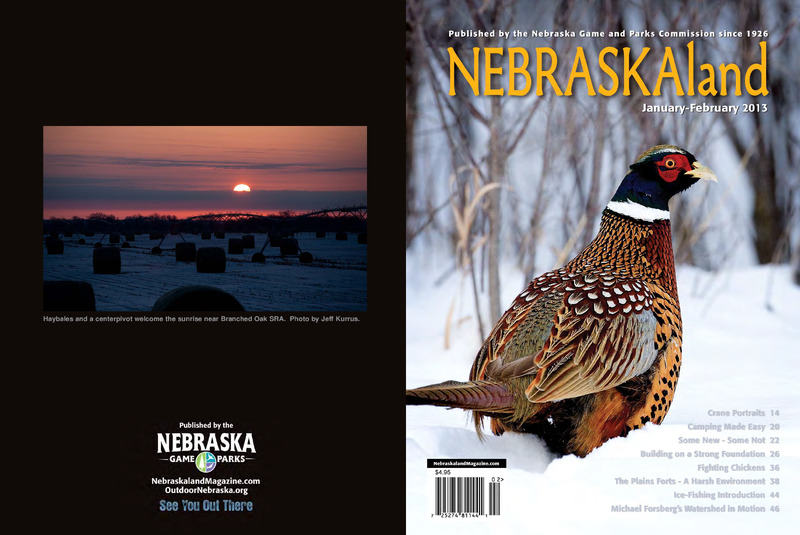
Haybales and a centerpivot welcome the sunrise near Branched Oak SRA. Photo by Jeff Kurrus.
Crane Portraits 14
Camping Made Easy 20
Some New - Some Not 22
Building on a Strong Foundation 26
Fighting Chickens 36
The Plains Forts - A Harsh Environment 38
Ice-Fishing Introduction 44
Michael Forsberg’s Watershed in Motion 46
Volume 91, Number 1, January-February 2013
14 A Lens on Cranes
A profile of Doniphan photographer Rick Rasmussen.
BY JEFF KURRUS
20 Camping Made Easy
Preparing a family camping trip is easy, as long as you
only pack the essentials. BY MATTHEW MARX
22 Something Old Something New?
A look at today’s hunting industry and its “new” apparel.
BY JEFF KURRUS
Our Heritage, Focusing on the Future
26 Preserving
Through donations, the Nebraska Game and Parks
Foundation makes the good life better. BY DOUG CARROLL
36 What are You, Chicken?
A greater prairie chicken and sharp-tailed grouse square
off in the Sandhills. TEXT AND PHOTOS BY MICHAEL FORSBERG
38 The Plains Forts – A Harsh Environment
A fort assignment throughout history could be a death
sentence in more ways than one. BY JOHN D. MCDERMOTT
14
●
44 Ice-Fishing Intro
Start ice-fishing today with minimal gear. BY JORDAN KATT
in Motion
46 Watershed
A NEBRASKAland update of the Platte Basin Time-lapse
Project. TEXT AND PHOTOS BY MICHAEL FORSBERG
Comment ................................................................... 4
Mixed Bag................................................................. 6
From the Fieldbook..................................................52
Junior Journal...........................................................53
Classifieds ................................................................54
Portraits from the Past .............................................56
Page 49 ....................................................................57
The Last Stop ...........................................................58
22
●
36
●
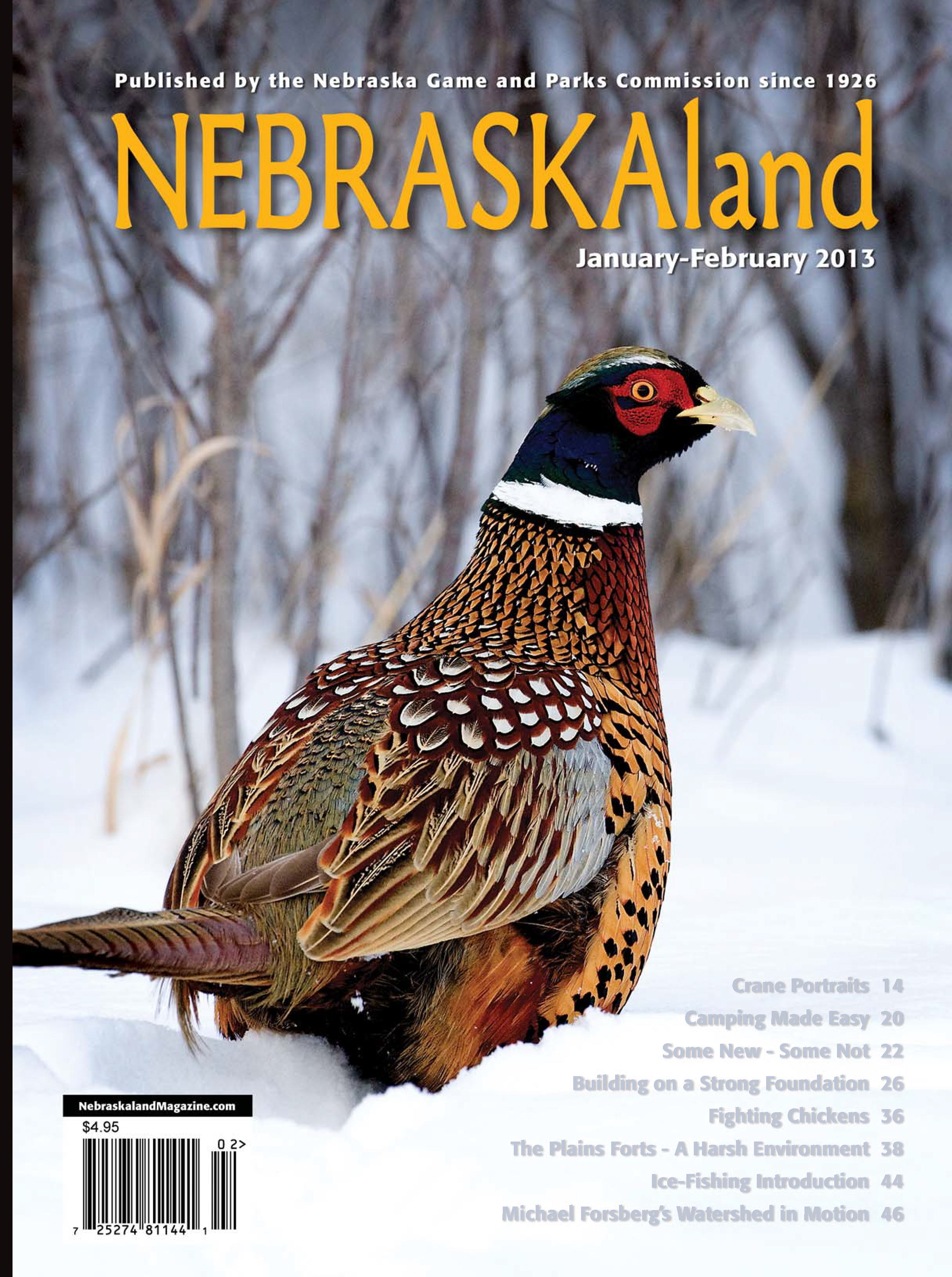
Cover: A rooster pheasant walks through snow in Hall County. Photo by
Rick Rasmussen. To see more of his work, turn to page 14.
Opposite: A rusty hinge shines in Sarpy County. Photo by Jeff Kurrus.
NEBRASKAland (VOL. 91 / NO. 1, ISSN 0028-1964) is published monthly, except for the
combined Jan./Feb. and Aug./Sept. issues, by the Nebraska Game and Parks Commission,
2200 N. 33rd St., Lincoln, NE. Periodicals postage paid at Lincoln, Nebraska, and additional
mailing offices. POSTMASTER: Send address changes to NEBRASKAland, P.O. Box 30370,
Lincoln, NE 68503-0370.
2 NEBRASKALAND • JANUARY-FEBRUARY 2013
38
●
JANUARY-FEBRUARY 2013 • NEBRASKALAND 3
cut out and send to my mom. :-)
Thank you,
Solveig Knott
Grand Island, Nebraska
Hi, I found a bug on page 8 of the
December NEBRASKAland magazine.
I believe it is a cricket.
We enjoyed the update on the
bighorn sheep in the Pine Ridge area –
hope there are more follow up stories
on them.
Janelle Downing
Norfolk, Nebraska
Birdbath Bluebirds
I looked out the window on a cold
day last January, and saw this colorful
gathering at our bird bath, so I ran
for the camera. Our cabin is in south
Keya Paha County and we have eight
bluebird boxes at different places
on our land. We like to think that
these bluebirds hated to leave their
birthplace, even though the weather
was not at all warm. We certainly
enjoy all the stories and pictures from
the Sandhills in your magazine.
Rosemary and Mel Thornton
Lincoln, Nebraska
Events Sidebar
I have enjoyed the insertion of
the “Upcoming Events” sidebar
every month in the magazine. It is a
great way to highlight outdoor-and
history-related activities across the
state. Thanks for that addition to the
magazine!
Ken Steinbeck
Grand Island, Nebraska
Bringing Out the Best
As a decades-long enthusiast
reading NEBRASKAland (and Outdoor
Nebraska), just wanted to tell you how
much your magazine is appreciated.
First and foremost it captures what is
unique about Nebraskans’ conservation
and care for the unique land God has
given us.
Your articles bring out the best of
what it means to live, work, and play in
Nebraska.
Thanks to the entire staff for the
insights the articles offer and the great
pictures which educate and bring back
fond memories. Thank you and God
Bless,
Bruce Block
Spanaway, Washington
NEBRASKAland Visitor Letters
We want to thank all 76 readers
that sent e-mails and letters for last
issue’s visitor, a cricket that was on
page 8 (see page 13 for the winner,
rules and this issue’s hint). Here are
some of the wonderful responses we
received:
As I do every time my new
NEBRASKAland arrives, I searched
first for the little visitor of the month.
The December visitor almost slipped
by unnoticed since he is so small and
could have been hiding among the
evergreen branches on page 8. But his
friends and relations have visited us
many times, big ones and little ones
often chirping when we are trying
to sleep, or rustling around under a
newspaper. He is a little (perhaps
young) field cricket ... bugguide.com
listed him as Gryllus Pennsylvanicus
and he is definitely a male as there is
no ovipositor. If the evergreen in the
picture on page 8 is still planted, the
little fellow might find something to
eat in the planter ... some leaf litter or
something else organic. Otherwise, I
should let him go outside in my garden
... there is plenty of that stuff out there.
Time to actually READ my
magazine now, looks like some good
articles ... love the photos of the
bighorns ... and lots of good photos to
4 NEBRASKALAND • JANUARY-FEBRUARY 2013
The insect that is new in this month’s
magazine is a cricket and it is found
on page 8. We have enjoyed your
magazine for years and now several of
our adult “children” also look forward
to their subscription, especially those
that now live out of state. Thanks for
the fun – great publication!
J. Conrad Huerta
Cozad, Nebraska
This month’s visitor is on page 8
along the left hand side and halfway
down. We have a cricket. Really
enjoyed this month’s copy. Love to
follow the saga of the bighorns that
have been reintroduced in Nebraska.
Also the snowy owl – saw one last year
up at Desoto NWR.
I also wanted to tell you about an
unexpected but very welcomed visitor
for Thanksgiving this year. When I
awoke Thanksgiving morning I looked
out, as I doing every morning, at the
small lake across from our home in
southwest Omaha near Gretna. Much
to my surprise I saw a trumpeter swan.
We’ve seen a number of them in
Wyoming, Montana, Canada, and even
Iowa, but this was the first I’ve seen in
Nebraska let alone almost in my front
yard.
Keep up the great work.
Steve Tyler
Omaha, Nebraska
Crickets are members of the
Orthoptera family, along with
grasshoppers and katydids. They
have enlarged back legs designed
for jumping, two pairs of wings on
their abdomen and can range in
color from green to brown to black.
Their chirping is one of their most
distinctive features, and they do it in
order to communicate. Depending on
species, the chirping noise is made
by rubbing their wings together or
by rubbing a wing to a leg. Males
chirp to attract females, and females
pick mates based on which chirp
they prefer. Chirps may also indicate
danger is near. Chirping becomes
very noticeable in the fall because the
adults are mating and the females are
laying eggs before they die. Females
lay their eggs in the soil, where
they remain throughout the winter.
The young crickets, called nymphs,
emerge in the spring. Crickets will eat
a wide variety of foods, from plants
and organic matter to insects. Inside
your house they may also munch on
clothing and other fabrics. Generally,
minimizing hiding places and some
well-placed sticky traps can take care
of most cricket problems in the home.
Or, take the approach that some other
societies have; consider the
cricket singing in your
basement a sign of
good luck and
enjoy it.
Special thanks to Julie Van Meter, State
Entomologist, Nebraska Department of
Agriculture. Visitor image by Chris Helzer.
www.bugguide.net is a good site for identification
Send your comments to:
Doug Carroll, Editor
NEBRASKAland Magazine
P.O. Box 30370
Lincoln, NE 68503
or e-mail Doug.Carroll@Nebraska.gov
Please include your postal address and
telephone number.
Letters may be condensed and edited
for clarity. Photographs are welcome
and will be returned.
Any program that receives federal funding from the National Park
Service, or the United States Fish and Wildlife Service prohibits unlawful
discrimination on the basis of race, color, religion, age, gender, marital
status, national origin, age, disability or political affiliation. Any person
who believes he or she has been discriminated against in any program,
activity, facility, or service, should contact the Nebraska Game and
Parks Commission, Lincoln, NE 402-471-0641, the Equal Opportunity
Commission, Lincoln, NE 402-471-2024, TTY/TDD 402-471-4693;
United States Fish Wildlife Service, Civil Rights Coordinator, 4401
N. Fairfax Drive, Arlington, VA 22203; Director, Equal Opportunity
Program, U.S. Department of Interior, National Park Service, 1849 C
Street NW, Mail Code 0008, Washington, D.C. 20240-0001.
COMMISSION
CONSERVATION OFFICERS
Director Jim Douglas
NORTHWEST
Officer
City
Jim Zimmerman (S) Gering
Commissioners
Chairman - Ron Stave, Waterloo
Vice Chairman - Norris Marshall, Kearney
2nd Vice Chairman - Jerrod Burke, Curtis
Dr. Mark Pinkerton, Wilber
Dr. Kent Forney, Lincoln
Lynn Berggren, Broken Bow
Rex Fisher, Omaha
Mark Spurgin, Paxton
Mick Jensen, Blair
Greg Hesse
Scott Brandt
Heath Packett
Dan Kling
Frank Miller
MAGAZINE STAFF
Editor Doug Carroll
Associate Editor Jeff Kurrus
Art Director Tim Reigert
Regional Editor Eric Fowler
Contributing Editor Michael Forsberg
Regular Contributors Bill Hager, Chris Helzer,
Lisa Knopp
Photo Librarian Sarah Johnson
Circulation Donna Robinson
For address changes and questions about
your subscription, e-mail Donna.Robinson@
Nebraska.gov or call (800) 632-5263
Advertising
For advertising information contact
Donna Robinson, Circulation
Phone: (402) 471-5490
E-mail: ngpc.ads@nebraska.gov
NEBRASKAland Magazine Copyright 2013, all rights reserved.
NEBRASKAland is available in audio from the Nebraska Library
Commission Talking Book and Braille Service, Suite 120, 1200 N St.,
Lincoln, NE 68508. (800) 742-7691. NEBRASKAland Magazine and
the Nebraska Game and Parks Commission reserve the right to reject any
advertising not in keeping with the agency mission.
Rates: $18 for one year; $33 for two years; $44 for three years. Nebraska
recipients must add appropriate sales tax. To subscribe call
1-800-NEBLAND (632-5263), or go online to: NebraskalandMagazine.
com.
COMMISSION OFFICES
Headquarters/Southeast District Office
2200 N. 33rd Street Lincoln, NE 68503
Phone (402) 471-0641
Northeast District Office
2201 N. 13th St. Norfolk, NE 68701
Phone (402) 370-3374
Southwest District Office
301 E. State Farm Rd. North Platte, NE 69101
Phone (308) 535-8025
Northwest District Office
East Hwy. 2, Box 725 Alliance, NE 69301
Phone (308) 763-2940
Bassett Office
524 Panzer St., Box 508 Bassett, NE 68714
Phone (402) 684-2921
Phone (308)
(office) 763-2940
(cell) 641-6138
Alliance
760-3647
Gering
631-0663
Gordon
360-0682
Harrison
430-0572
Valentine (402) 389-0444
SOUTHWEST
Officer
City
Phone (308)
Roger Thompson (S) N. Platte (office) 535-8025
(cell) 530-3097
Ray Dierking
Brkn. Bow
870-0322
George Sund
Cambridge
655-0028
Michael Thome
Cozad
529-8146
Terry Brentzel
Doniphan (402) 469-5795
Matt Andrews
Elwood
746-2418
Dirk Greene
Imperial
882-0015
ale Johnson
Kearney
440-3847
Brian Piernicky
McCook
340-6627
Dudley Sorensen
N. Platte
530-0016
Nicholas Fix
Ogallala
289-0427
Dennis Thompson
Ogallala
289-0755
Rich Routh
Rep. City
920-0367
NORTHEAST
Officer
City
Tom Zimmer (Sup.) Norfolk
Dale Davis
Steve Oberg
Daniel Roberts
Randy Pomplun
Jeff Jones
Jon Reeves
Tim Williams
Pat George
Doug Pollard
Cory Krause
Phone (402)
(office) 370-3374
(cell) 649-8053
Bassett
760-0712
Columbus
910-3366
Fremont
719-1108
Fullerton (308) 550-0489
Hartington
762-5022
Kennard
889-8508
Neligh
929-0051
O’Neill
340-0787
Ord
(308) 778-7101
West Point
380-6410
SOUTHEAST
Officer
Sean McKeehan
William Krause
Mike Luben
Dan Zuehlke
Darin Gress
Douglas Kramer
Dina Barta
Stacey Lewton
Levi Krause
Robert Finke
Russell Mort
Dan Evasco
City
Ashland
Auburn
Colon
Cortland
Hebron
Lincoln
Lincoln
Lincoln
Louisville
Milford
Nebr. City
Papillion
Phone (402)
521-0159
274-8063
443-6392
806-9084
768-8665
890-6465
890-6463
890-7140
949-0593
947-1363
209-1506
616-5961
ADMINISTRATION
Officer
Craig Stover (Adm.)
Duane Arp (Ass.)
Jeff Clauson (Ass.)
City
Lincoln
Lincoln
Lincoln
Phone (402)
471-5531
471-5532
471-0480
Kearney Office
1617 First Ave. Kearney, NE 68847
Phone (308) 865-5310
Omaha Office
1212 Bob Gibson Blvd. Omaha, NE 68108
Phone (402) 595-2144
Nebraska Wildlife Crimestoppers 1-800-742-7627
Ak-Sar-Ben Aquarium
21502 W. Highway 31 Gretna, NE 68028
Phone (402) 332-3901
JANUARY-FEBRUARY 2013 • NEBRASKALAND 5
January 7
Project WILD Workshop
A free Growing Up WILD educator
workshop for early childhood
educators will be held from 6 p.m. to
9 p.m. on January 7 at First Lutheran
Church, 3601 Dakota Ave in South
Sioux City. For more information or
to register, e-mail Jamie.Bachmann
@Nebraska.gov.
Ants With a Sweet Side
Chris Helzer
Ants are voracious predators. A single ant, armed with sharp mandibles and
an indomitable will, is a formidable opponent and a swarm of attacking ants can
easily subdue prey much larger than themselves (think of wolves working together
to bring down a moose, but with lots more wolves.) You don’t pick a fight with
an ant.
Ants, however, are much more than simple killing machines. They have
complex social lives and perform multiple services for the ecological communities
around them, including seed dispersal and several important soil formation
processes. Perhaps more surprisingly, however, ants have a sweet tooth.
Because they like sugar, ants can often be seen on flowers, searching for the
sweet nectar within. In some cases ants can move pollen from flower to flower
as they feed, but they are generally less effective pollinators than their fuzzier
cousins, the bees. While flowers are the most obvious source of nectar for ants,
some plants also exude a sweet liquid called extrafloral nectar through glands
located on leaves, stems or other plant parts. For example, sunflowers often have
numerous ants crawling around them, feeding on little clear droplets of sugary
sap. At least on some days, a keen observer can find ants on just about every
sunflower plant in a prairie.
There are numerous scientific studies on ants and extrafloral nectar, but exactly
what the plants and ants each get from the interaction is not completely clear.
Ants, of course, get something sweet to eat, but what do the plants get out of
it? One theory is that attracting lots of ants to crawl around on you helps repel
herbivores that might otherwise be happily be munching away on your leaves and
stems (again, don’t pick a fight with an ant). A second possibility is that plants
produce extrafloral nectar as a way to distract ants from feeding on the nectar in
flowers – leaving more of that nectar for bees and other pollinator insects that
better help the plant produce viable seeds.
The evidence seems to support both theories, so it’s likely that both are true,
at least for some plant species. In either case, plants have “figured out” how to
manipulate ants by taking advantage of their sweet tooth. Pretty smart for a plant
… yep, you don’t pick a fight with a sunflower.
6 NEBRASKALAND • JANUARY-FEBRUARY 2013
January 19
Fly Tie-in
The Cornhusker Fly Fishers club
is hosting a “tie-in” Saturday,
January 19 from 10 a.m. to 2 p.m
at the Ak-Sar-Ben Aquarium. Club
members will be tying fishing flies
with hooks, fur and feathers as
they answer questions from the
public. For more information call the
aquarium at (402) 332-3901.
February 6
Rainwater Basin Joint Venture
Meeting
The Rainwater Basin Joint
Venture will host its 18th annual
Informational Seminar beginning at
9 a.m. on Wednesday, February 6 at
the Hastings Hotel and Convention
Center. A $25 registration fee,
payable at the door, covers all
sessions, snacks, and a buffet
lunch. Landowners and agriculture
producers in the Rainwater Basin
are invited to register free of charge.
To register, please send an e-mail by
January 31 to Shanda.spurgeon@
ne.usda.gov; include name,
organization (if applicable), and
mailing address. Or phone (402) 4636771, ext. 112.
February 24
Cowboy Poetry and Music Jamm
Bowring Ranch State Historical Park
is hosting a “Cowboy Poetry and
Music Jamm” February 24 beginning
at 1:30 p.m. MST. No admission is
charged to this event and everyone
is welcome to attend. For more
information call (308) 684-3428 or
e-mail diane.burress@Nebraska.gov.
PHOTO BY CHRIS HELZER
Here is a list of upcoming outdoor
events across Nebraska.
For more information
about these and
other events, visit
the calendar page
at www.Outdoor
Nebraska.org.
Darn That Fog
Eric Fowler
Waking to a
landscape covered
in hoarfrost is a
photographer’s
dream. Hoarfrost’s
creation is a simple
combination of water vapor in the
air and cold temperatures. The vapor
source, however, can range from
atmospheric fog to steam fog rising
from water that is warmer than the air
above it.
You can’t always look at the forecast
and plan for it, but it doesn’t take
a degree in meteorology to know
that when overnight lows dip to -16
degrees, you can bet the farm that’s
much colder than the water temperature
of the Snake River below Merritt
Reservoir, and that steam fog would be
rising from Snake Falls.
So where most folks saw doom and
gloom in that forecast for a January
day in 2011, I saw opportunity and
planned a morning hike to Snake Falls
on my way back from a trip to western
Nebraska.
I could see the steam fog rising
from the canyon when I parked on the
highway. When I stepped through the
pines into the canyon above the falls, I
was met by waves of it billowing from
the falls below.
by Jeff Kurrus
Omaha’s Old Market
Rain, snow, ice. 60-degree sunny days, or 10-degree
frigid ones. So goes another Nebraska winter,
unpredictable at every moment. Regardless of the
forecast, however, Omaha’s Old Market is the perfect
way to spend a wintry day.
Start with lunch at the Twisted Fork and their
pitchfork ranch meatloaf, the Indian Oven and their
Tandoori Chicken, M’s Pub and the lamb burger, your
choice cooked in front of you at Asian Mongolian BBQ,
or any of the dozens of other fine or
casual dining
options.
PHOTO BY ERIC FOWLER
PHOTO BY JEFF KURRUS
Then shop
hop, starting
in the Old
Market
Passageway on
11th and Howard streets
on those bitter days and outside along Howard on
those Indian summer afternoons. Or, because
we know how important photographs are to all of our
NEBRASKAland readers, walk over to 11th and Harney
streets and visit Nebraska photographer Tom Mangelsen’s
Images of Nature Gallery.
Finish your day by eating again, bypassing your earlier
restaurant choice and picking somewhere new. When
you get home, email me at jeff.kurrus@nebraska.gov
where you went and what you ate. I’m always looking
for somewhere
new. And I have
no problem with
you ordering
for me. –JK
I went right to work, but only a
few frames into this shoot I learned
a valuable lesson I should’ve seen
coming after watching my breath frost
up my glasses on the quarter-mile
hike in: When steam fog is coating
everything around the falls in hoarfrost
and you make yourself part of the
scenery and stay there long enough,
you and your camera will soon be
covered with hoarfrost as well. I
began to notice weird highlights on
the camera’s liquid crystal display
(LDC) 14 frames into the shoot. I spun
the camera and found the culprit: ice
crystals on the lens. With no Nikonapproved ice scraper on hand and
no way to warm the lens, there was
no quick solution to the problem.
Thankfully I’d carried a second camera
body and lens. Spinning the tripod
away from the falls as I waited for
the rising sun to peek into the canyon
prevented the second camera lens from
suffering the same fate as the first –
wish I would’ve thought of that sooner.
There probably aren’t many
opportunities for you to run into a
similar problem in Nebraska but keep
my story in mind. And don’t forget to
hold your breath when you’re looking
through your camera’s viewfinder in
the cold – my LCD was so frosted up
I could barely see it well enough to
realize I had a problem. That one gets
me every winter.
The Same Old Same
Looking over the tickets
written in 2012 year by
Nebraska conservation officers,
it’s kind of interesting (and
sad) to see how every year the
same offenses keep occurring:
No park entry permit;
hunting/fishing/trapping without
a permit; improperly equipped
vessel (not enough lifejackets
normally); possession of illegal
size game fish; hunting/fishing/
trapping without permission;
no registration/symbols/
improper registration; hunting
with aid of artificial light from or
attached to a vehicle; loaded
shotgun in or on a vehicle; and
overharvest of fish or game.
No one likes receiving or
writing tickets, but these
regulations exist for a reason,
and all outdoorsmen and
women should know and
follow them. Game and fish
laws exist to help protect
these finite resources and to
ensure all hunters and anglers
have equal access to them
– violators are essentially
stealing from the rest of us.
Other regulations help ensure
people’s safety (such as life
jacket requirements), protect
private property rights and,
because these activities are
largely self-funded, help ensure
that money is available to fund
hunting, fishing and boating
opportunities. That’s why it’s
important that everyone pays
their fair share
for permits,
licenses
and boat
registrations.
– Duane Arp,
Conservation
Officer, Lincoln
JANUARY-FEBRUARY 2013 • NEBRASKALAND 9
A Look Back – January 1974
Outdoor cartoons are a favorite
of many sportsmen, often relating
reality and absurdity to entertain.
In the January 1974 issue of
NEBRASKAland, readers were
given a rare treat of multiple
cartoons instead of just the one that
sometimes appeared.
From the editorial side, I understand
these were being used as “filler,”
finishing a page whose text or
photos didn’t flush. While this was
probably a slight inconvenience
for the staff attempting to complete
these pages, readers, even those viewing them nearly 40 years
later, are thankful for a little more than the usual dose of comic
relief.
News Item?
10 NEBRASKALAND • JANUARY-FEBRUARY 2013
See You Out There... But Where?
Do you know where this Nebraska photograph was taken?
See answer at the bottom of page 13.
JANUARY-FEBRUARY 2013 • NEBRASKALAND 11
PHOTO BY JEFF KURRUS
A record 103 active bald eagle nests
were recorded in Nebraska in 2012,
surpassing the previous record of 90.
“Even though we say the recovery
of the bald eagle in the United States
and Nebraska has been remarkable,
it truly has been amazing,” said Joel
Jorgensen, nongame bird program
manager for the Nebraska Game and
Parks Commission.
Park of the jump in recorded eagle
nests may be due to additional survey
efforts said Jorgensen: “After a couple
of years of less intense focus, in
2011 and 2012 we spent a few days
surveying areas that had not been
checked for a few years, so it did not
come as a surprise that those areas
were harboring additional nests.”
Bald eagles nested historically in
Nebraska but were extirpated around
1900. The number of early nests were
few and it is possible that bald eagles
are more common now than before
settlement by European Americans.
Most bald eagle nests are concentrated
along Nebraska’s major rivers.
PHOTO BY BILL HAGER
Joel Jorgensen
When does remarkable become
ordinary? Perhaps when discussing
the bald eagle’s status in Nebraska
in recent years. Ravaged by illegal
hunting and DDT in the early to mid20th century, bald eagles were at the
risk of extinction.
By the 1960s there were fewer
than 500 breeding pairs in the lower
48 states. Then came the banning of
DDT in 1972, which eliminated a
major roadblock hindering the species’
population recovery.
Since then, the number of bald eagle
pairs has increased to more than 12,000
in the lower 48 states. In 1991, the
first active modern bald eagle nest was
discovered in western Douglas County,
the first breeding site since this species
was extirpated from Nebraska near the
year 1900.
One nest in 1991 grew to 20 by
2000, remarkably expanding their
breeding range throughout the state.
By 2011 there were 90 active nests in
Nebraska, and in 2012 the number of
Send Us Your Trail Cam Photos!
nests increased to 103. The amazing
part of this increase is that bald eagles
are not like ducks or other gamebirds
that lay large clutches of eggs each
breeding season.
Instead, eagles are large raptors
with slow rates of reproduction. If
one nesting attempt fails, they usually
do not try again for that year and the
opportunity is lost. But as for right
now, there seems to be more successes
than failures, a trend that will continue
to be reported in future issues of
NEBRASKAland.
Ice-fishing Seminar at E.T. Mahoney State Park
A Rainbow Winter
A free ice-fishing clinic is being held January 12 at Eugene T. Mahoney State
Park’s CenturyLink Lake from 1 to 4 p.m. Participants will receive instruction
from the Nebraska Game and Parks Commission in ice-fishing technique,
equipment, bait and safety.
Anglers are encouraged to bring their own equipment; however, a limited
amount of equipment, as well as bait and hot cocoa, will be provided to all
participants.
Participants must register by January 4. Call the Ak-Sar-Ben Aquarium at
402-332-3901 or e-mail lindsey.chizinski@nebraska.gov.
Jeff Kurrus
For great eats and fun fights through
the ice, look at the NGPC’s put-andtake rainbow trout stockings. The
same baits that work in open water –
small spoons, jigs and live bait – also
work through the ice. Plus, typical
presentations used for panfish through
the ice will work well for the trout too.
Visit the NGPC’s up-to-date fish
stocking report at OutdoorNebraska.
org. The catchable-size rainbows
stocked in October throughout the state
can still be caught through the winter.
Plus, multiple lakes have been stocked
in the last month, offering a
very tasty option for
an ice-covered
cookout.
Scott Lubischer of Lincoln enjoys
hunting, fishing and the outdoors,
especially in the fields and on the
Missouri River in Knox County, so
much that his mother-in-law thought his license plate should show it.
If you have a unique outdoor message plate you would like to share
or know someone who does, e-mail a photo (high-resolution, JPEG
format only, please) of it to Eric.Fowler@Nebraska.gov, along with your
name, hometown and a brief description of the interests expressed on
your license plate.
12 NEBRASKALAND • JANUARY-FEBRUARY 2013
Rex Adams sent NEBRASKAland this unique photo of a
turkey in Gage County from the fall of 2011.
Please submit your trail camera photos by e-mail to:
nebtrailcam@gmail.com. Also include any information that
will help explain your photo.
Turpin Time
Dick Turpin
Is there a message
from the past or
a tiny piece of
memorabilia in
your gun stock?
You know this old
10-gauge double means a lot to me
because it was given to me by Jimmy
Span. Jimmy Span has since passed
away but this gun belonged to his
granddad and Jimmy knew that I was
a friend of his granddad … lived right
across the street from him. Well one of
the things I first noticed was … a lot
of these old guns … your granddad’s
old gun … the model 12 he left in the
family may have the same thing …
they have a hollow place in the stock
…they’d put shot in there to keep it
from kicking or they might put a note
or some little trinket in there, so I’m
going to check this old gun because …
lookie there … there’s a note … “Don’t
you have anything better to do?” Ya
think I’ve been had here? ■
NEBRASKAland Visitor
Winner and Hint
Unusual Pronghorn
Gayle Verbeck of Ogallala waited
with great anticipation for the October
13 start of last fall’s firearm pronghorn
season and was rewarded with this
unusual trophy.
After seeing but not being able to
harvest a good buck around Sidney
the opening weekend, Verbeck was
northeast of Chappell hunting his way
back to Ogallala when he came over
a hill and spotted this strange-looking
buck standing next to a doe that was
laying down.
Verbeck got out his spotting scope for
a closer look at the buck, which “looked
like he had a black basketball around
his head.” After conferring with his son
Jeff, Verbeck made a good stalk on the
buck and was able to cleanly harvest the animal.
Verbeck said he was “elated” to have shot such an animal and plans to have it
mounted. His right horn rough scored 17 inches with a 5 ½ -inch base, while the
left horn measured 17 inches with a six-inch base.
“Life is good in outdoor Nebraska,” said Verbeck.
Last issue’s winner of
the Visitor drawing
was Dan Tesar of
DeWitt, Nebraska,
who found the cricket on page 8.
Readers are encouraged to contact
NEBRASKAland within 10 days
after this issue’s publication with the
correct page number and name of
this issue’s “Visitor” – a bug found
in Nebraska that just happened to
find its way onto one of the pages.
We will then gather the correct
entries and draw one to win a
NEBRASKAland Magazine mug.
To enter each month, write:
NEBRASKAland Visitor
2200 North 33rd Street,
Lincoln, NE 68503.
Or e-mail:
Tim.Reigert@Nebraska.gov
with “Visitor” in the subject line of
the message.
HINT: This issue’s visitor is not
on page 5, 6, or 53.
DURHAM MUSEUM, OMAHA
Bald Eagles Surpass Milestone
JANUARY-FEBRUARY 2013 • NEBRASKALAND 13
A Lens on
Cranes
By Jeff Kurrus
Photos by Rick Rasmussen
Left: Sandhill crane preening before
heading out to feed.
Above right: Sandhill cranes coming
back to their roost at sunset.
14 NEBRASKALAND • JANUARY-FEBRUARY 2013
In 2008, contributing editor Michael
Forsberg, as he has been known to do,
contacted NEBRASKAland about
Doniphan-based photographer Rick
Rasmussen. “He’s good,” Forsberg
said, quickly prompting us to introduce
ourselves to this lifelong Nebraskan.
As we came to find out, Forsberg was
right. Upon first glance, two thoughts
about Rick’s work were immediately
evident: One, his sense of light and
composition was exciting as the subjects
he shot, namely birds, seemingly popped
from the page. Two, NEBRASKAland
would never have enough room in its
52-page format to accommodate all of his
photographs. So we immediately started
using what we could so the rest of the
world could get a glimpse of what we were
viewing each time he sent more images.
JANUARY-FEBRUARY 2013 • NEBRASKALAND 15
Sandhill crane on alert.
Rick’s photographic careerthstarted in
1971, while he was still in 8 grade. “I
took a photography class at that time,
developing and printing in black and
white,” he said. “I was shooting with a
Kodak Pony camera my grandfather gave
me that still sets on a shelf in my office.”
His interest continued through high
school, drawing ire from his four sisters
anytime he turned the family bathroom
into a dark room, and has remained steady
in his adult years as his life now revolves
16 NEBRASKALAND • JANUARY-FEBRUARY 2013
Sandhill cranes making way for a deer crossing the Platte River.
around scoping out potential blind sites,
studying tree lines, scouting riverbottoms
and analyzing sunrise and sunset angles –
bringing his wife Lori with him anytime he
can.
“On one of our first dates,” she said, “we
army-crawled into a photo blind on the
Platte River as the sun came up on a roost
of 10,000 cranes.”
Rick has traveled to the polar regions a
total of 10 times in his life to photograph,
but his favorite subjects remain Nebraska
Cranes fly low over the river during the low light of a late-winter evening.
JANUARY-FEBRUARY 2013 • NEBRASKALAND 17
Sandhill crane cooling off on a warm March afternoon.
hunting deer and elk each year …
well, except for this past fall as
he left his bow at the house and
spent his autumn ground-blind
mornings with a camera in hand.
Knowing the type of beautiful
work he’s capable of producing, we
(and the local deer population) are
glad he did. ■
To see more of Rick's work, visit
www.platteriverphotography.com.
A sandhill crane pulls out an errant feather while standing in a shallow river channel.
wildlife, including the cranes and
numerous other species of birds this
state has. “In January of 2009, when
he returned from a trip to Antarctica,”
said Lori, “he was so excited about
fresh snow and pheasants on our land
that he sat for several mornings in his
18 NEBRASKALAND • JANUARY-FEBRUARY 2013
blind photographing roosters instead of
processing penguin pictures.”
Once a waterfowl hunter, Rick now hunts
with his camera, his unique perspective
permeating from his photographs as he
captures the expressions of various birds so
beautifully. But he remains an avid archer,
A frisky crane plays catch with a piece of river vegetation.
JANUARY-FEBRUARY 2013 • NEBRASKALAND 19
Camping Made Easy
By Matthew Marx
F
Easy Meals
Pack Light
20 NEBRASKALAND • JANUARY-FEBRUARY 2013
PHOTO BY ERIC FOWLER
or many Nebraskans, camping
to be said for comfort while camping,
when you need them.
means “car camping,” with the
but separate comfort from decadence:
When selecting a tent for car
objective of packing everything
An air mattress, extra pillow and heavy camping, buy a good quality, threeyou need, family included, in the
quilt are comfortable. A television,
season tent from a reputable company.
portable air conditioner and electric
family sedan and heading to an area
(A four-season tent is for winter
cappuccino maker are decadent. Part of backpacking, and will probably be too
state park. I remember helping my
father pack our rusty green Datsun with the fun of camping is not having every
hot for general use.) Resist the urge,
an old canvas tent, tattered
however,
ow
to buy the ‘deluxe’
blankets, miscellaneous
mo
model with three rooms
and a doggie door. Those
kitchen utensils, coolers
tent
and paper grocery bags full
tents look great, but usually
req
of hot dogs and buns for a
require an engineering
deg
weekend getaway for our
degree to assemble, and
whe
family of four. By the time
when the wind is blowing
and the rain is spitting, easy
we departed the house, there
tent assembly is a godsend.
was often little room left for
Buy quality and keep it to
the passengers.
one simple room. It is useful,
Once we arrived at the
park, we’d locate our
how
however, to buy a larger
camping spot and begin
tent than the manufacturer
unpacking the car. Next
reco
recommends – a four-person
we’d start looking for some
tent will indeed fit four
necessary but forgotten item
people, but that’s probably
peo
and have to hop back in and
laying shoulder to shoulder
layi
start the inevitable journey
with little room left for gear.
wit
Hot dogs and marshmallows cooked over an open fire are
back to town with my
If you
y have four people in
camping essentials, and can be accomplished with little gear.
fuming father. In retrospect I
your group, buy the sixrealize that most of our mistakes were
comfort of home. Learning to be happy or even eight-person tent. You’ll be
the result of taking too much of the
with less stuff is a great lesson for kids, grateful for some elbow room.
wrong stuff and not being organized.
A full-sized air mattress is usually
even if just for a weekend. Having the
This type of experience is not
basics and being well-organized makes necessary for adults to sleep in comfort
limited to the past, or even to my own
things efficient, which can free up time and is well worth the bulk, but buy
family – whenever I camp with my
one with a built-in, battery-powered
to do what you went to the park for
friend Terry’s family, I’m amazed at
inflator. Foot-pumps are a reliable
in the first place – to have fun hiking,
what they bring: groaning suitcases, a
fishing, relaxing and getting away from option, but that method takes almost
computer, stacks of DVDs, a fan and
as much time to fill the mattress as
the daily grind.
portable air conditioner, elaborate camp
using simple breath, which I wouldn’t
Organization is paramount if you
lounge chairs, a meat smoker and a hot want to be able to find what you are
recommend unless you plan on passing
chocolate machine (just in case). What
out as soon as you’re done inflating it.
looking for when you need it. If you
results is an inefficient mess. The next
are weekend camping with kids, limit
time you go car camping, try these
their clothes and personal items to
suggestions if you’d like an easier
one or two duffel bags. The same rule
experience.
applies to you. Shared items are best
Keep meals basic, tasty and as easy
kept in see-through plastic bins with
as possible. A hot dog on a green
snap-on lids. Pack these in the car first. stick over an open fire is a classic,
Put nonperishable food in cloth grocery and frankly it’s more fun to cook that
Each person has his or her own
bags and pack these around the bins.
way when camping anyway. You can
individual needs that should be
Avoid the impulse to simply cram
simply use needle-nose pliers from
respected, but most simply take too
everything in haphazardly – it creates a your tackle box to carefully maneuver
much unnecessary stuff. There’s much
mess and makes it harder to find things an almost fully opened tin of beans,
Tent campers at Branched Oak State Recreation Area.
corn, or soup onto some coals from the
fire to heat up the contents (flip the lid
open and stir often to evenly distribute
the heat; flip the lid down when not
stirring to keep out debris and ash.)
Hamburgers and steaks can also be
a good option if your campsite has a
permanent charcoal grill, which many
Nebraska state parks do (don’t forget to
bring some charcoal and lighter fluid if
necessary).
If you need to bring a stove, the
standard green suitcase-style made
by Coleman is a reliable standby
if properly maintained. One skillet
and one pot will usually suffice, and
consider cooking meals that only
require boiling water, since that makes
it easy to do clean-up. If everybody in
your group is responsible for his or her
own ceramic mug, basics such as soup,
boil-in-bag rice, foil-pouch Indian
meals, instant oatmeal, or powdered
hot cocoa are easy. Extravagant meals
are wonderful, but I like to keep the
high-end gourmet cooking for at-home
dinner parties.
Try to limit your cold storage to
one cooler for food and one cooler
for drinks. Instead of ice in my food
cooler, I use frozen water (or Gatorade)
bottles, frozen water-heavy fruit such
as grapes or pineapple chunks, and
frozen hotdogs to keep things cold.
This works better than loose ice-cubes,
which melt and get into even the most
carefully-zipped baggies and plastic
containers. Loose ice will work fine for
the drink cooler, though.
Essentials
There are some things you will
want to take with you on almost every
camping trip, and forgetting them can
mean a journey back to town. Other
than a tent, air mattress, blankets,
pillows and clothes, this basic gear is
versatile and usually has multiple uses:
a sharp knife, metal spoon, lighter
or matches, medications (including a
pain-reliever), Nylon cord (paracord),
flashlight, bandana, towel, first-aid kit,
multi-tool, bug spray, sunscreen and
toilet paper. For basic comfort and ease
I usually take these items as well: wet
wipes, gallon-sized zip bags, cutting
board, garbage bags, headlamp, can
opener, water jug, small plastic basin,
and ear plugs (especially if you tent
with snorers!).
A successful camping trip is one
where everybody has fun enjoying the
outdoors and creating new memories
with family and friends. If you pack
light and bring the right gear, you’ll
find you won’t miss the extras. And
if you keep organized, you’ll be able
to find what you need when you need
it. ■
Matthew Marx is an English
instructor at the University of
Nebraska-Omaha.
His last feature for
NEBRASKAland
Magazine was
“Family Camping in
Nebraska State Parks”
in the April 2010
issue.
JANUARY-FEBRUARY 2013 • NEBRASKALAND 21
Something Old
Something New?
By Jeff Kurrus
A layman’s look at today’s hunting industry reveals that while some gear is truly
revolutionary, the only thing “new” about many items is brighter packaging.
R
Something Old
In a March 2011 NEBRASKAland article by Jon Farrar,
he repeats the often-made statement that “there is nothing
new under the sun” when describing the ghillie suit, a piece
of hunting apparel that has been commercially marketed for
more than 100 years yet only within the last 20 years has
drawn considerable interest from hunting catalogs. “For the
first time ever,” read the 2003-2004 Cabela’s catalog, “we
are offering the extraordinary concealment of a ghillie suit in
a lightweight, streamlined version.”
But not-so-new isn’t limited to camouflage suits. Knives
are another example. The most oft-repeated claim is “our
knife is the sharpest,” but besides a backside gut hook for
deer hunters, pull out a 20-year-old knife and it will not look
much different than a hunter’s knife today. Rifle cartridges
haven’t changed much either. Read a ballistics book
published in the 1980s and the numbers won’t look much
different than they do now, as manufacturers repeatedly try
to re-invent the wheel looking for the magic bullet.
22 NEBRASKALAND • JANUARY-FEBRUARY 2013
PHOTO BY JEFF KURRUS
obo-ducks, ghillie
suits, and zombie
bullets. This is the
hunting world where we
live, where technology
and marketing flood the
sportsman from all directions,
a cornucopia of options for
hunters who, throughout
time, have pursued game
using hand-loaded guns,
trash-bag decoys and, Godforbid, cotton trousers. But
through all this industry’s
new-fangled advances, a look Zombie scopes by Leupold can
back reveals that while some be found on retailer shelves.
hunting accessories are truly
revolutionary, others have been on the market again and
again – the only change being brighter packaging.
And the guns these bullets come from have maintained
their same basic actions as well. For rifles, the lever, bolt
and semi-automatic options remain supreme, while shotguns
have long relied on the pump, semi-automatic and breakaction models for consumers. No gun manufacturer is trying
to convince you that a “new” action should be used because
the few that do exist seemingly fit every type of hunter.
The one hunting-related item that doesn’t fit every
hunter, however, is the ice cooler. “Keeps ice for 10 days!”
manufacturers boast. Yes, you may have one ice particle
left in your cooler after 10 days if the cooler stays in a dark
corner of the garage and is only opened in the middle of
the winter. Coolers have become so unfortunate that many
manufacturers are now selling their “vintage” lines.
However, where other advances have been made, mostly
in the barrage of 20th century plastics, are items that many
hunters would also rather stay vintage – namely hunting
calls. In this arena, waterfowl and turkeys are top sellers, yet
grunt calls for deer have also picked up in popularity during
the past 20 years. But they have all been around for much
longer. In a 1966 Herter’s catalog, the following statement
was made regarding a grunt call: “Calling deer, like calling
moose, is nothing new and has been successfully done by
professional hunters, Indians, and guides for centuries.”
Yet there is nothing regarding calls that has truly
captivated the hunting industry. Crude models for all game
species have been concocted by any manner of inventors
and non-inventors through the years, down to the desperate
hunter who first shock gobbles a turkey with his mouth and
continues to refine this method for years to come. Sure, calls
have become more water-resistant and easier to use for the
newcomer, but a call is a call is a call. As long as it sounds,
feels, and looks exactly like the hunter wants it to.
With all the changes in the hunting industry, a few things
stay the same – namely popular shotgun models and actions.
This 1951 Remington Wingmaster ad (right) is selling a
shotgun that doesn’t look much different from one
you could buy today – yet was sold at a fraction
of today’s price.
JANUARY-FEBRUARY 2013 • NEBRASKALAND 23
Your
Favorite
Inventions?
Doesn’t Make
Scents
While scent eliminators fill the
shelves at outdoor retailers and receive
ve
e
a lot of press these days, they are nott
new. In a 1966 Herter’s catalog, the
advertisement for Herter’s famous buck
uck
deer lures reads: “Kills all human scent
nt
even with a down wind. Completely takes
ake
es
away a deer’s caution. [Used] by Indians
ans
for centuries.”
Herter’s (above)
shows one type
of scent sold
in 1969, which
doesn’t look
much different
than those sold
today (left).
Headlamps are a mainstay
f many hunters, making
for
low-light scenarios easier to
manage and navigate. But is
it one of your favorites? Is
something else so necessary
tthat it never leaves your gear
bag? If so, email me at
jjeff.kurrus@nebraska.gov and
let me know
w what
I should also
o
be carrying
to the
woods
with me.
Something New?
24 NEBRASKALAND • JANUARY-FEBRUARY 2013
wouldn’t be complete without talking about technology and
how it has changed nearly everything for a large number of
hunters. While there are some traditionalists still scouring
the fields for game, many others, myself included, use
Google Earth to locate hunting spots, read online migration
reports before planning a waterfowl trip, or rely on a GPS
when walking to or from an unfamiliar hunting locale. Trail
cameras also fall on this list, especially ones with infrared
flash and megapixel counts that would make digital SLRs
from five years ago look archaic – until the next model
comes along to replace them as well.
Conclusion
Hunting has never been more specialized. From
camouflage to magazines, the entire industry is geared to
each, individual person. The once-a-year pheasant hunter
or the every-weekend waterfowler can find everything they
need to pursue their outdoor desires. And there remains at
least one guarantee in this industry regardless of what desire
one does pursue – there will always be another Therma-cell,
floating gun case, rangefinder, or more affordable version of
night vision awaiting the consumer wanting the newest of
the new.
And the best part of it all – as long as these “new”
inventions keep appearing, whether they’ve never been
seen in such shiny packaging or truly never seen before, the
Pittman/Robertson Act will allow us, the hunters, to benefit
each and every time the next creature from the underworld
is threatening our way of life – as long as there is a company
advertising the only bullets that can kill it. ■
PHOTO BY JEFF KURRUS
State-of-the-art is a misnomer – always has been.
Anything leading the pack right now, such as the lighter,
stronger boots arriving on the market during the summer
months, will be replaced by another lighter, stronger version
15 minutes later. Plus, “new” can also appear in the form of
new advertisement, including Hornady’s “Zombie Bullets”
to capitalize on the pop culture trend of zombie hunters.
Therefore, “new” becomes such a tricky word in the
outdoor world because even a small tweak can classify an
item as revolutionary. Take hand-warmers, for example.
Various versions of these limb savers have been used for
many years, yet most used liquid chemicals to activate.
Some current versions, in contrast, contain ingredients
such as iron, carbon and water, and experience a chemical
reaction when they come in contact with oxygen, producing
heat without the chance of fire.
The fundamental idea of camouflage is not new either.
Examples of hunters and soldiers trying to blend into
their surroundings has been chronicled for centuries, yet
the wearing of camouflage clothes that attempt to match
perfectly to a hunter’s surroundings is relatively new.
While companies like Jim Crumley’s Trebark, Bill Jordan’s
Realtree, and Toxey Haas’s Mossy Oak emerged from the
simple thought of matching the hunting backgrounds of
where these hunters spent their time, the further expansion
of this idea has been anything but simple. By carrying twigs,
dirt, and leaves from the woods to the factory, camouflage
clothing became more than a way to blend into an outdoor
scene, it became defined by the word “pattern.” Then, the
Mossy Oak Company managed to find the one aspect of
all outdoor scenes that could be replicated regardless of
location – shadows. Thus there is a shadow-based pattern for
just about every location and season imaginable.
Clothing provides another example. Heavy, uncomfortable
wool was replaced by inventor Eddie Bauer’s down jacket
in 1936, where he took a light, waterproof, cushioned
resource to re-invent waterproof clothing. But it was during
camouflage’s inventive heyday of the 1970s and 80s that
various companies combined camouflage with practicality,
most notably W.L. Gore and Rowena Taylor’s waterproof
and breathable Gore-Tex invention in 1976, Thinsulate’s
appearance in 1978, and the Malden Mills Company’s 1981
introduction of fleece. But the invention of Under Armour
by former athlete Kevin Plank in 1995 to replace cotton as
a base layer once again revealed that there will always be
something lighter, stronger or altogether different.
Take H.W. Allen’s compound bow as another example.
While his 1969 invention was crude compared to current
bows, even having triangular wheels, his invention set the
stage for the constant tweaking of bows, much like the 1969
Baker Tree Stand, whose patent has spawned any number of
climbing, hanging and ladder stands for hunters.
It also stands to reason that decoys would steadily improve
through the years. Better paint and better appearance have
always been the norm. But the motion-wing decoy is
altogether different. “It’s probably the one piece of hunting
equipment that truly changed the face of waterfowl hunting
forever,” said Commission waterfowl biologist Mark
Vrtiska. Combining the concepts of call birds and pull
strings, motion-wing decoys emerged as early as 1999, but
became internationally known when a company named Mojo
came on the scene in the early 2000s.
And, of course, all the changes in hunting apparel
A December 1987 ad in Petersen’s Hunting Magazine attempts
to sell electric mittens, a precursor to today’s modern batterypowered electric gloves, socks, jackets ... .
The outdoor magazine industry perfectly represents the specialization of all things hunting,
including manufacturers’ attempt to cater to every hunter in every hunting situation. ,
JANUARY-FEBRUARY 2013 • NEBRASKALAND 25
PHOTO BY ERIC FOWLER
I
f you love Nebraska’s natural beauty, wildlife, wide
open spaces and unique recreational resources, the
Nebraska Game and Parks Foundation is a perfect
way to
t show your appreciation—and ensure that others
continue to enjoy Nebraska’s outdoors today and for
generations to come.
The Nebraska Game and Parks Foundation was
established to accept tax-deductible contributions of cash,
corporate gifts, personal property, life estates and real
estate to enhance the work of the Nebraska Game and
Parks Commission—necessary work that simply cannot be
accomplished with limited state funds.
The Nebraska Game and Parks Foundation is an
organization of Nebraskans for Nebraskans—focused on
the future of parks, wildlife management and conservation
in our state. Your tax-deductible contribution to the
Foundation—in any amount—helps care for and preserve
the outdoor resources that make Nebraska special.
26 NEBRASKALAND • JANUARY-FEBRUARY 2013
Preserving
Our Heritage,
Focusing on the
Future
JANUARY-FEBRUARY 2013 • NEBRASKALAND 27
F
o those that love Nebraska’s natural beauty,
or
w
wildlife, wide open spaces and unique recreational
resources, contributing to the Nebraska Game and
re
Parks Foundation is a perfect way to show their
P
ap
appreciation and ensure that others continue to
enjoy
j Nebraska’s
N b
outdoor legacy for generations to
come.
About the Foundation
10 cabooses
converted into
cabins at Two
Rivers State Recreation
Area near Venice, road
improvements and picnic
shelters at Louisville
State Recreation Area and
lighted tennis courts at
Fort Robinson State Park
near Crawford. Since
then, the Foundation has
assisted on a wide variety
of Commission projects
and worked closely with
it to identify and fund
key projects, such as the
reintroduction of bighorn
sheep back to their
native habitat in western
Nebraska.
According to chairman
and Lincoln businessman
Jim Abel, the mission of the Foundation is to “… support
the priorities and projects of the Nebraska Game and Parks
Commission that will help promote wildlife, parks and all
the outdoor activities that go with them – in general, the
outdoor life in Nebraska. That’s why I think our work is
so important – we help facilitate projects that benefit all
Nebraskans.”
Creating Legacies
Funding from the Foundation built this Bobcat mini-lodge at
Ponca State Park.
Arthur Bowring Sandhills Ranch State Historical Park
represents much of what the Nebraska Game and Parks
Foundation is all about – creating a legacy for future
generations to enjoy and learn from.
Eva Kelly Bowring was a widowed mother of three and
NEBRASKALAND Magazine • NEBRASKA GAME AND PARKS FOUNDATION
PHOTO LEFT BY BOB GRIER, OPPOSITE PAGE PHOTO BY JEFF KURRUS
Nebraskans enjoy one of the best state
parks systems in the nation, but it hasn’t
always been that way. In the mid-1970s
the National Campers Association
harshly judged Nebraska’s state
parks as “no showcase and in need of
improvements.”
The problems weren’t, however, due
to a lack of effort on the part of the Nebraska
Game and Parks Commission – budget restrictions were
squeezing the organization. As a result, Nebraska’s park and
recreation system began to show signs of deterioration and
prospects for new development were dim.
Thankfully, through the encouragement and support of
a group of visionary Nebraskans, the Nebraska Game and
Parks Foundation was established in 1983 to enhance the
work of the Nebraska Game and Parks Commission – work
that simply cannot be done with limited state funds (state
tax dollars cover well below 13 percent of the agency’s
overall budget). The Foundation is a conduit through which
individuals, corporations and organizations can channel
monies and property into the purchase of park and wildlife
lands, to help the Commission build campgrounds and
cabins and provide other greatly needed facilities and
improvements.
Nebraska Game and Parks Foundation board members
are dedicated volunteers. All donations are used for Game
and Parks Commission projects. In its first two years, the
Foundation underwrote acquisition and construction costs of
nearly $2.5 million for park improvement projects including
Foundation money helped fund the installment of water control structures and low level diking at Kiowa WMA in Scotts Bluff County.
working as a traveling saleswoman when her car broke down
near Merriman, and local homesteader Arthur Bowring
stopped to help. After the chance meeting, they started to
date, eventually marrying and settling down on his Bar-99
ranch near Merriman. While helping her husband make
their ranch a very successful operation, Eva got interested
in politics and later became the first Nebraska woman
appointed to serve in the U.S. Senate.
Upon her death in 1985, Eva Bowring donated the land
to the Nebraska Game and Parks Foundation, requesting it
be named after her late husband so that his name and legacy
would continue to survive on the land that they loved – a
common theme among many Foundation donors. The
ranch came with stipulations, however – it had to remain a
working ranch, property tax payments had to continue to be
made to the county, and the ranch’s prize Hereford herd had
to be maintained.
The Foundation accepted the ranch and leases it to the
Commission to operate as the Arthur Bowring Sandhills
Ranch SHP. Expenses associated with the ranch continue to
be paid by the Foundation, and the income derived from the
ranch lease is used for development and maintenance of the
ranch and for other park sites in western Nebraska.
ROGER G. SYKES OUTDOOR HERITAGE
EDUCATION COMPLEX
When Missourian Rodney Rames passed away a few
years ago, he left a part of him in Nebraska. Having lived
part of his life in the Cornhusker State, the gracious donor
still had fond memories of it and the outdoor opportunities
NEBRASKA GAME AND PARKS
FOUNDATION •2013
NEBRASKALAND
Magazine
JANUARY-FEBRUARY
• NEBRASKALAND
29
Through the Foundation, the initial purchase of 425 acres
of land was made at a cost of $539,000 and additional land
was later purchased at a cost of $132,000. In addition to the
land itself, grants and funds passed through the Foundation
have led to many of the enhancements made to the park,
everything from expanding the lodge, to building an activity
center and the family aquatic center. Ultimately, 80 percent
of the funds required for this $18 million showcase were
raised through private donations through the Foundation;
those donations continue to provide dividends, providing
thousands of Nebraskans recreational opportunities and
building memories that last a lifetime.
PHOTO BY DOUG CARROLL
YOUTH HALF-PRICE LIFETIME PERMIT
PROGRAM
Using a large donation from an anonymous donor, in 2005
the Foundation began its Youth Lifetime Permit Program
to engage more youth in the outdoors, hunting and fishing.
A series of drawings for Nebraska residents age 15 and
younger are held at special events across the state. Winners
can purchase a lifetime hunting and fishing permit for a
Nebraska resident aged 15 or younger at half price, with the
Foundation funding the other half.
Since the program’s inception, the Foundation has helped
pay for approximately 2,500 lifetime permits and hopes to
grow this popular program as more funds become available.
The wave pool is a great place to cool off and relax while visiting Eugene T. Mahoney State Park and it, like much of the park, was
largely funded through donations given to the Foundation.
LAND DONATIONS
Land donations are a great way to ensure that the property
and habitat you’ve cared for and about is protected in the
future. For instance, Eugene and Soffia Polhemus of Phelps
County have created a life estate that transfers 720 acres of
land to the Foundation to be used perpetually as a wildlife
management area upon their and their three children’s
deaths. This life estate entitles the Polhemus and their
children to the use, possession and all rents and profits made
from the land throughout their lifetime.
Similarly, O. John Emerson of Oakdale left 160 acres of
rural Holt County land to the Foundation upon his death in
2003 to be used as wildlife habitat. The land was designated
as the O. John Emerson Wildlife Management Area and
managed for wildlife habitat until 2010, at which point it
was gifted to the Commission by the Foundation.
PROTECTING THROUGH EASEMENTS
The Foundation also helps the Nebraska Land Trust
purchase voluntary conservation easements on private
land habitat. This land preservation tool protects land from
potential future development and helps landowners protect
their property for future generations. Recent donations from
the Foundation helped protect 1,700 acres in Dawes and
Sioux counties that is important habitat for elk and bighorn
sheep and which serves as a key travel corridor between
sprawling public lands in the area, including Chadron State
Park.
Money from the Foundation has also been used to help
protect land along the Lower Platte River corridor, including
land that borders Schramm Park State Recreation Area.
“Thanks to support from the Foundation and caring
landowners, people who hike the nature trail at Schramm
will never have to worry about a subdivision coming into
view across the fenceline,” said Dave Sands, executive
director of the Nebraska Land Trust.
Celebrating Successes
Probably the largest and best-known project that the
Foundation has undertaken is Eugene T. Mahoney State Park
(SP), the crown jewel of Nebraska’s park system. Situated
high on the bluffs above the Platte River midway between
Lincoln and Omaha, Mahoney SP is one of the state’s
premier attractions – and would not be there but for the
Foundation.
NEBRASKALAND Magazine • NEBRASKA GAME AND PARKS FOUNDATION
PONCA STATE
PARK
Nestled in
the Missouri
River bluffs and
wetlands that form Nebraska’s northeastern border,
Ponca State Park has long been a haven for people
and wildlife alike. However demand for cabins at the park
usually far outpaces supply.
Fortunately, contributions through the Foundation have
recently enabled the Commission to greatly increase the
lodging options at this magnificent park. Fifteen minilodges are now available at the park with four bedrooms
and two full baths, and two “green” strawbale construction
cabins each featuring two bedrooms. These are in addition
to the park’s 14 log-style, rustic cabins. The Foundation
also funded the purchase of additional wetlands along the
river and habitat developments to create an ideal home for
waterfowl, deer and many other animals, including muchneeded spawning habitat for the pallid sturgeon.
FORT ROBINSON
Fort Robinson is western Nebraska’s premier state park
and a historic outpost that served from the days of the Indian
Wars until after World War II. The Foundation is in the
process of fund-raising for a project to construct a replica
of the fort’s old officers’ quarters that will be used for
overnight lodging. As of late 2012, approximately $969,000
has been raised to fund the design and construction of this
project.
PHOTO BY ERIC FOWLER
it had afforded him. So in his will Rames left an estate gift
to be used by the Foundation for capital improvements
or acquisitions to support programs directed towards the
outdoors, hunting and conservation.
Thanks to his generosity and a large donation from an
anonymous donor from Omaha, in 2011 the Roger G. Sykes
Outdoor Heritage Education Complex opened at Platte River
State Park near Louisville. Featuring an archery range with
a shooting tower, a 50-yard small-bore rifle range, an indoor
10-meter pellet gun range and a shotgun range, this shooting
complex will serve as a way to introduce youth to the
shooting and hunting sports for years into the future.
“We think we can triple that program,” said Abel. In
recent years private donors and partners such as
Cabela’s have made additional investments in our
outdoor future by helping fund this important
initiative.
In much the same way that support given
to Mahoney SP has grown beyond the
original investment, the donations
used to help purchase lifetime
permits grow multiple times -every dollar used to purchase
the permits can be used to
match grant money available
to Nebraska from federal
excise taxes levied on
certain hunting and
fishing equipment,
and each permit sold
qualifies the state
for a larger portion
of the grant funds.
The Foundation’s popular youth half-price lifetime permit
program has grown over the years and is a great way to help get
youth interested in hunting and fishing.
ASHFALL STATE HISTORICAL PARK
Under these 360 acres of rangeland, purchased by the
Foundation in 1986, lies a treasure trove of prehistoric
animals buried by volcanic ash 10 million years ago.
Located near Royal, Ashfall’s internationally significant
paleontological find is a historical treasure that the
Foundation helped protect for generations to come.
NEBRASKA GAME AND PARKS
FOUNDATION •2013
NEBRASKALAND
Magazine
JANUARY-FEBRUARY
• NEBRASKALAND
31
FORT ATKINSON STATE HISTORICAL PARK
The Foundation helped raise most of the funds
for reconstruction of the entire fort as well as
construction of a visitor’s center and council
house.
KELLER PARK STATE
RECREATION AREA
Land to create a new park was
donated through the Foundation by
Neal and Pauline Keller –197 acres
of pristine land on Bone Creek. The
park opened in 1986, complete with
camping facilities.
PLATTE RIVER STATE
PARK
Located within a 50-mile
radius of over half the state’s
population, Platte River State
Park is a major park facility
in eastern Nebraska. The Owen
Foundation, through the Game and
Parks Foundation, gave $425,000 for
15 modern housekeeping cabins at the
park, and another $150,000 from the
Foundation provided a water treatment
plant and utility improvements.
Land recently purchased adjacent to Platte
River State Park in Cass County is typical of the role the
Foundation plays in helping the Commission fulfill its
mission: “Without the Foundation’s help, this native forest
area likely would have been developed and lost forever.
It was just another example of the Foundation playing an
instrumental role in preserving key natural properties,” said
Roger Kuhn, Commission park division administrator.
ROCK CREEK STATE HISTORICAL PARK
This showcase of Oregon Trail and Pony Express history
received its visitor center, campground and picnic areas and
acquired additional acreage through the Foundation
“The pennies, nickels and dimes of schoolchildren are
as important as help from our most successful corporate
enterprises.”
Eugene T. Mahoney, former director of the Nebraska
Game and Parks Commission, spoke these words when the
Foundation was first established and they have proven true.
The Foundation was established to accept tax-deductible
contributions to enhance the work of the Nebraska
Game and Parks Commission, and over the years these
thoughtful gifts have come in every size and type – from the
aforementioned nickels and dimes to fragile natural areas,
unique historic places, much-needed wildlife habitat and
sizeable cash donations for park and recreational facilities.
Contributions are tax deductible and can be designated
to a particular project or area of the state. Many gifts have
come as memorials to loved ones who had a particular love
for nature or a certain area, such as the Bowring Ranch.
Others are meant to help improve or create opportunities for
other citizens and youth to enjoy the great outdoors.
Contributions can take many forms – direct contributions
of cash or gifts, either as an individual or corporation;
bequests of cash, land or property in a will; conservation
easements; life estates; real estate; trusts; or split life
insurance.
“If someone has an interest in outdoor heritage, recreation
and conservation, and wants to honor a family member or
help continue the outdoor legacy, the Foundation will help
facilitate a gift to make that happen,” said Abel.
Looking for Help
Thanks to the generosity of Nebraskans and gracious
donors, the Nebraska Game and Parks Foundation has been
a resounding success. While it has accomplished a great
deal since its inception, the list of needs remains long.
In these days of ever-increasing costs and ever-tightening
agency budgets, the Foundation is needed more than ever for
the Nebraska Game and Parks Commission to continue to
provide the services and outdoor recreation opportunities for
Nebraska’s citizens and visitors. To that end, the Foundation
welcomes participation and contributions by all Nebraskans
in helping fulfill its worthy cause.
For more information, or to contribute to the Foundation,
call Jackie Wrieth, the Foundations executive director, at
(402) 939-3830; or Jim Abel, president/chairman, at (402)
434-1703. Mail correspondence can be sent to:
Nebraska Game and Parks Foundation
c/o Jackie Wrieth
P.O. Box 24470
Omaha, NE 68124-0470
www.nebraskagameandparksfoundation.org
The Nebraska Game and Parks Commission and the
Nebraska Game and Parks Foundation thanks our donors
and all Nebraskans for your dedicated support of our mission
of stewardship of the state’s fish, wildlife, park and outdoor
recreation resources in the best long-term interest of the
people and those resources. ■
NEBRASKALAND Magazine • NEBRASKA GAME AND PARKS FOUNDATION
PHOTO LEFT BY ERIC FOWLER, OPPOSITE PHOTO BY JEFF KURRUS
Foundation money helps support all types of Commissionrelated outdoor activities, including birdwatching.
Ways to Give
Foundation money has played a key role in helping bring bighorn sheep back to their native habitat in western Nebraska.
NEBRASKA GAME AND PARKS
FOUNDATION •2013
NEBRASKALAND
Magazine
JANUARY-FEBRUARY
• NEBRASKALAND
33
PHOTO BY ERIC FOWLER
Roger G. Sykes Outdoor Heritage Education Complex at Platte River State Park near Louisville.
“Preserving Our Heritate, Focusing on the Future” was printed in the January-February 2013 issue of
NEBRASKAland Magazine, published by the Nebraska Game and Parks Commission.
Additional copies of this publication can be requested by contacting Nebraska Game and Parks Foundation,
P.O. Box 24470, Omaha, NE 68124-0470
Any program that receives federal funding from the National Park Service, or the United States Fish and Wildlife Service prohibits unlawful discrimination on the basis of race, color, religion, age, gender, marital status, national
origin, age, disability or political affiliation. Any person who believes he or she has been discriminated against in any program, activity, facility, or service, should contact the Nebraska Game and Parks Commission, Lincoln, NE
402-471-0641, the Equal Opportunity Commission, Lincoln, NE 402-471-2024, TTY/TDD 402-471-4693; United States Fish Wildlife Service, Civil Rights Coordinator, 4401 N. Fairfax Drive, Arlington, VA 22203; Director, Equal
Opportunity Program, U.S. Department of Interior, National Park Service, 1849 C Street NW, Mail Code 0008, Washington, D.C. 20240-0001.
NEBRASKALAND Magazine • NEBRASKA GAME AND PARKS FOUNDATION
JANUARY-FEBRUARY 2013 • NEBRASKALAND 35
What are You,
Chicken?
Text and photos by Michael Forsberg
T
here have been times in the Nebraska
Sandhills where I have sat in a blind
photographing prairie chickens on their
display grounds (aka “leks”) while off in
the distance I could hear the cooing cries
and rapid tail-rattling of sharp-tailed grouse
displaying on leks of their own. There have
also been times where, while photographing
sharptails, I could hear the distinctive booming
calls of the greater prairie chicken courting
females down the valley at the dawn of a
new day. Never did I think, however, that I
would see both species on the same lek,
much less photograph them in the same
frame.
Greater prairie chickens and sharptailed grouse are closely related and
native to our prairie grasslands. They
are similar in size and shape, but have key
physical differences: The sharptail is lighter
in color with a sharp-pointed tail and a purple
neck sac that inflates during courtship display,
while the prairie chicken has a rounded tail
and its neck sac is yellowish orange, revealed
when it lifts its long, draping pinnae feathers
up like horns during its
display.
d
In general, greater
prairie
chickens are
p
birds
of the tallgrass
b
prairie
that expanded
p
their
range westward
t
along
with Euroamerican
a
settlement,
taking
s
Greater Prairie Chicken
advantage
of cultivated
a
grains for forage until more intensive
agricultural development began to eliminate
their habitats altogether. Today in Nebraska
the greater prairie chicken is at the western
limit of its range.
36 NEBRASKALAND • JANUARY-FEBRUARY 2013
The sharp-tailed grouse is a bird of open
country and has a much larger geographic
range, ranging from the desert Southwest to
near the Arctic tundra in Alaska. The Great
Plains race of the sharptail
found in Nebraska is
near the eastern limit of its range and has
retreated north and westward from agricultural
settlement and development, preferring
large areas of native intact grassland mostly
unhindered by man.
In Nebraska the two species overlap their
ranges, especially in the Sandhills, where
enough healthy grassland habitats remain for
both species to survive.
A friend who had invited me to join him on
a prairie chicken lek he regularly photographs
had mentioned that a male sharptail grouse
sometimes shows
up to display.
That day we
were lucky
– as dawn’s
first light hit
the horizon
that early
April morning, there he was, standing as if
he belonged among about a dozen booming
male greater prairie chickens, ready to battle as
the veil of night was lifting from the stage.
While the prairie chickens were standing
with tails erect, wings drooped and heads
low to the ground, airsacs blown out like
balloons making their telltale “oooa-hooooom”
sound, the sharptail was cooing and bowing,
stamping its feet, rattling its tail and dancing
with wings outstretched like a kid playing
airplane, weaving in and out of the prairie
chickens as if taunting them. All the while the
prairie chickens seemed to ignore him, acting
like disinterested adults.
The sharptail tried to enter the interior of the
lek where the two dominant males resided,
but quickly realized his error as he was chased
away. He then settled on stalking the west
end of the display ground, trying to pick a
fight. When two female chickens entered the
stage the males went wild, displaying reached
a fevered pitch, and the sharptail could no
longer be denied. One prairie chicken finally
squared off with him and for the next hour
they were locked in place, kicking, biting,
flutter jumping and otherwise taunting each
other over an invisible boundary line drawn in
the grass.
According to biologists, such interactions
between species probably occur regularly
where ranges overlap but are not common.
The two species are known to mate and
will occasionally produce hybrid offspring.
During the last Nebraska Game and Parks
Commission comprehensive spring grouse
survey done a few years
ago, 240 leks were
identified and four of
them were used by both
species.
About an hour after
sunrise, a northern
harrier flew over the lek
and the prairie chickens
Sharp-tailed Grouse
scattered into the
surrounding hills. But the sharptail remained
a moment longer, seemingly quite proud of
himself being the last one on display, awash in
the limelight of the morning sun before finally
winging away. ■
JANUARY-FEBRUARY 2013 • NEBRASKALAND 37
The Plains Forts
A Harsh Environment
By John D. McDermott
I
n perspective, the United States
Army had an almost impossible
task to perform during the last
half of the 19th century. It had an
effective strength of something
less than 15,000 men, yet at the height
of the Indian Wars it manned 136 forts,
posts, camps and cantonments, 16
arsenals and armories, three training
facilities for recruits, and one engineer
depot. Troops guarded some 3,000
miles of frontier and an equal length
of seacoast. They scouted thousands
of long, weary miles in uncharted
territory. Besides its role as the agent
of empire, the army physically attacked
the wilderness, building forts, roads
and bridges, at times conducting
extensive farming operations and
gathering some of the first scientific
data on the great hinterland. Troops
guarded railroads and telegraph
lines and escorted paymasters’ and
quartermasters’ trains. They guarded
parties engaged in surveying railway
and boundary lines and public lands.
Military posts were the focal points in
the effort to protect succeeding waves
of trail emigrants, miners and settlers
from actual or threatened attack by
Indians and other unfriendly parties,
to guard lines of transportation and
communication linking East and West
and points in between, and to act as
a buffer between the Indians of the
plains and their unlawful tormentors.
Beyond this, the officers, their wives
and the soldiers of the frontier army
were the arbiters of white civilization,
possessing a strong need for expressing
Euroamerican values through such
means as education, recreation, the
“Winter on the Plains – A Terrible Experience in the Teeth of a ‘Norther.’” From Richard
I. Dodge, Our Wild Indians. Dodge, a career officer, writes of a February expedition
along the Republican River in which some of Capt. John Mix’s men were overcome
with cold and refused to go on, even at the point of Mix’s revolver. “The captain finally
put up his pistol, and falling upon them with the flat of his sabre, belabored them into
the ranks, and brought all in safely to the post.”
38 NE
38
N
NEBRASKALAND
BRAS
BR
ASKA
AS
KALA
KA
LAND
LA
ND
D • JJANUARY-FEBRUARY
ANUA
ANUA
AN
UARY
RY-F
RY
-FEB
-F
-FEB
EBRU
RUAR
RU
UAR
ARY
Y 20
2013
13
arts and relations with Indians and
frontiersmen. Making the mission
more difficult for the 19th century
army on the western plains was the
environment: physical, meteorological,
and harmfully occupied, and
complicated and intensified by the
strict regimentation of the army that
rewarded sameness and frowned on
innovation. Or to put it another way –
their environment could be frustrating,
unrelenting, noxious, infectious and
lethal. In coping with the environment
in this sense, the men and women who
served in and with the frontier army
often relied on humor to cover their
fears and dismay.
Officers who left posts in the East
had a big adjustment to make when
they came West, and their colleagues
did not necessarily make it easier for
them. In the late 1860s some advice for
soldiers
going to the frontier appeared
s
in
i the Army and Navy Journal, the
principal
military newspaper of the
p
period:
p
“Altogether we have to advise each
of
o the fellows who are to come here
this
t fall, to do as follows:
1st. Make your will.
2nd. Get your life insured. We could
recommend
a certain company on
r
Broadway,
but then people might think
B
this
t was an advertisement.
3nd. Bring enough money to pay
your
own funeral expenses.
y
4th. Have a first-class obituary of
yourself
prepared for insert in the
y
Army
and Navy Journal, by some New
A
York
Bohemian, for people out here
Y
haven’t
the time or the genius to write
h
them.
t
5th. Don’t ever expect to return, but
say
s your adieus as you would if you
had been selected for a ‘forlorn hope.’
6th. Get your regimental adjutant
to intercede to prevent you being sent
here. Argue that these fellows can’t be
The Battle of the Rosebud, June 17, 1876, in which Lakotas and Cheyennes fought General George Crook’s troops to a bloody draw.
The artist captures the usual stereotypes of war between whites and Indians. For soldiers of the era, battle was a rare event. From
Richard I. Dodge, Our Wild Indians: Thirty-Three Years’ Personal Experience Among the Red Men of the Great West (1884).
expected to have any desire for a return
to society. They (we) might as well
stay because they (we) are used to it.
You will find this arrangement will
work beautifully, it being already
in practice in about four artillery
regiments.”
Officers going to the frontier had to
travel light and be prepared to move
to the next assignment quickly. In
1868, a veteran offered good advice
to those going west. He recommended
that each should bring with him a good
mess chest, well-furnished for four or
six persons, a good roll of bedding,
a mattress, a few comfortable camp
chairs, and a trunk filled with a good
supply of clothes for a least one year.
Before leaving, he should give his
measurements to a good tailor and boot
maker so that he could replenish his
wardrobe by order at any time. Also
recommended were a table spread or
two, a few curtains, some cloth suitable
for covering furniture, and a roll of
carpeting. In conclusion, he stated that
an officer would never regret bringing
any small articles of luxury that his
taste suggested, for he would find very
little difficulty in taking them with him
from station to station.
Quarters at frontier posts were never
lush, especially in the beginning, and
army regulations complicated matters.
They provided that when an officer
reported for duty at any post, he could
select the quarters of any officer junior
to himself for his residence. This
could sometimes become a fast game
of musical chairs. Here is a situation
described at Fort Buford:
“Recently a captain, next in rank to
the senior captain at the post, arrived
here to take command of his company,
having been absent from it two or
three years. He chose the quarters of
a captain who was junior to him in
rank. This captain in turn displaced
another captain. He ranked out a
first lieutenant, who turned out the
quartermaster, also a first lieutenant.
He chose the quarters of the adjutant,
also a first lieutenant, and he ousted
a second lieutenant. Before, however,
the adjutant had time to move, a first
lieutenant of cavalry returned to duty
at the post who outranked him, and
who chose the quarters the adjutant had
selected, the latter officer, therefore,
had to choose again and there upon
took the quarters of a second lieutenant
of cavalry who then displaced a second
lieutenant of infantry, who in turned
outranked a junior second lieutenant of
the post. The removals are in process
of execution, and within two weeks
another first lieutenant will arrive for
duty, and he outranks a half dozen of
the officers now present, and is likely
to set them moving again.”
Another disadvantage was the lack
of opportunities for men and women
with varied interests. William Bisbee,
who as a junior officer served at Fort
Phil Kearny in 1866, remembered the
situation:
“These earlier days of army life
in the Indian Country west of the
Missouri River and northwest to the
Canadian border line, from the 60s
to the 90s, were likened by one of
my contemporary friends as “a waste
of 25 years of our early existence,”
and oblivion apart from civilizing
participation or influences: no society
affiliations, club associates or, in
fact, any educational advantages: no
libraries or lecture features, few books
and oftentimes lapses of months,
without newsprints or in touch with the
JA
JANUARY-FEBRUARY
ANU
N AR
ARYY-FE
YFEBR
FE
B UA
BR
UARY
RY 2
2013
0 3 • NE
01
N
NEBRASKALAND
EBR
B AS
BR
ASKA
KALA
LA
AND
N
39
NEBRASKA STATE HISTORICAL SOCIETY 1517-119-2
Soldiers of the Eighth Infantry inside
barracks at Fort Robinson.
4 N
40
NE
NEBRASKALAND
EBR
BRAS
A KA
AS
ALA
AND • JAN
JANUARY-FEBRUARY
ANU
AN
NUARY
Y-FEB
EBRUAR
ARY
AR
Y 20
2013
13
of the legs. Buffalo mittens, and the
customary cavalry uniform, completed
the costume. These ‘extras’ had to
be furnished by ourselves, and cost
considerable.”
Summer had its own enchantments.
Besides sunstroke and dehydration,
hail was a threat. Fort Laramie on the
west and Fort Robinson on the south
are not far from the center of hail
activity in the United States. Records
at Fort Laramie indicate that severe
hailstorms destroyed gardens and
repeatedly broke all windows on the
north side of its many buildings. These
ice pellets could also be lethal – the
Army and Navy Register reported in
1888 that a hailstorm near Fort Custer,
Montana, had been severe enough to
knock a soldier off his horse, kill a
large number of calves and colts, and
literally beat to death an old Indian
woman who had been caught while out
gathering wood.
In the Southwest, summer conditions
were even worse because of the heat.
One observer wrote in 1869:
“I have even heard complaints made
that the thermometer failed to show
the true heat because the mercury
dried up. Everything dries: wagons
dry, men dry, chickens dry; there is no
juice left in anything living or dead, by
the end of the summer ... mules, it is
said, can only bray at midnight; and I
have heard it hinted that the carcasses
of cattle rattle inside their hides, and
that snakes find a difficulty in bending
their bodies, and horned frogs die of
apoplexy. Chickens hatched at this
season, old Fort Yumers say, come out
of the shell ready cooked; [and] bacon
is eaten with a spoon ... .”
If the climate was not bad
enough, there were creatures that
could make life miserable for the
initiate. Mosquitoes earned the most
exaggerated mention. According to one
Wyoming victim, who referred to them
as “Platte Valley birds,” they were “as
blood thirsty as starved tigers.”
“Bars are no protection,” a soldier
declared, “as they easily tear them out,
or lift up the edge and come under.”
More seriously, however, the effects
of numerous mosquito bites could be
lethal. One soldier at a western post
who went AWOL while under the
influence was found dead the next
day. Swarms of mosquitoes had bitten
him mercilessly. An officer’s wife
reported: “There he lay in the sagebrush, where liquor had overcome
him. But the mosquitoes had gotten
in their deadly work and had literally
sucked the life from his body. It was
bloated and practically bloodless – a
bitter temperance lesson to the garrison
men.”
Another, more dangerous, discomfort
were rattlesnakes. Lt. William Bisbee
found them plentiful on his way to Fort
Phil Kearny in July of 1866, reporting
that “killing the reptiles with whips
and revolvers was one of our daily
amusements.” One afternoon in 1879,
soldiers at Fort Fred Steele, Wyoming
Territory, killed 73 rattlesnakes a
short distance from the post. Even
more upsetting was the tendency of
the serpents to seek shelter in human
habitations. A soldier from Fort
Harker, Kansas, told of killing three
rattlesnakes found warming themselves
by the fire in his log and sod cabin in
February of 1867.
Fleas also seemed to abound,
particularly in places were humans had
lived for a time. Mrs. Andrew S. Burt,
the wife of the commanding officer of
Fort Laramie in 1888, pasted a clipping
in her cookbook describing Dr.
Hazen’s method for getting rid of fleas:
“Set a lighted candle in a dish of
water in the middle of the room. The
fleas, attracted by the light, will hop
in, and in the morning, the dish will
present the appearance of Pharaoh and
his host drowned in the Red Sea. It
is more effective than Persian or any
other powder. It is strategy, my boy,
and the fleas never learn it till it is too
late.”
Mary Rippey Heistand had another
means of treatment. At Camp Poplar
River in Montana, the post was infested
with sand fleas, the buildings having
been built on the site of an abandoned
Indian village. She described about her
method as follows:
“Four or five times a day I have
undressed myself when fleas were
torturing me. It was my custom to
spread a white blanket to stand on as
I removed my clothing. I was thus
enabled to see the annoyances—
tiny only in size—against the white
blanket, and on it their legs tangled
and made them an easy prey in their
turn. The process was slow, as I
NEBRASKA STATE HISTORICAL SOCIETY RG1227-43-2
outside world: no theatres or refining
amusement halls of the present day
life.”
But army women were not daunted.
They organized. As one wife put it,
“We did not stagnate. Though we
were far from civilization. A reading
club was started by the ladies, and we
kept up with the publications of the
day: lectures were given by the officers
and a good deal of undeveloped
talent was brought out in some good
private theatricals. A string band was
formed in the regimental band and
they gave concerts so that in the winter
months there was always something
to be done, and the summer there
were horseback riding, picnics and
excursions in the surrounding country.”
The first thing one had to deal
with in carrying out the mission was
the natural environment. The Great
Plains is part of a geographical habitat
stretching from Canada to Mexico,
bounded on the east by the 100th
Meridian and on the West by the
Rocky Mountains. It is semi-arid,
receiving less than 20 inches of rainfall
a year. It is, generally speaking,
scarce in wood and surface water,
often windy, and registers extreme
temperatures of heat in
the summer and cold in the winter,
creating a new context for the word
“survival.”
Among frontier soldiers, the
Wyoming climate was often a topic
of conversation. A private soon to
leave Fort Townsend in Washington
Territory to serve at a post in Wyoming
wrote a letter to a friend about his
expectations, which was published
in the Army and Navy Register. He
wrote, “We are told that during the
winter in Wyoming the snow is six
and seven feet deep, and that the
thermometer frequently runs down to
40 and 50 degrees below zero, and
that during the daily blizzards it is
necessary to carry heavy weights in
our pockets to keep from being blown
away.”
Tongue in cheek aside, a midcentury Wyoming blizzard was nothing
to make light of. For example, a
detachment of the 11th Ohio Volunteer
Cavalry went to South Pass late in
1863; upon their return through Platte
Bridge Station, they ran into a bad
snowstorm. The troops finally made
it to Fort Laramie, but, as one of the
party reported in a letter to his uncle,
“two of the men were so badly frozen
that they died in a few hours. Nearly
every man froze either his feet, hands,
or ears.” A soldier of the Sixth West
Virginia Volunteer
Virg
Cav
Cavalry, serving
at Fort
F Caspar
of
in winter
w
186
1865-66, has
left us a detailed
account of what
acc
is was like to
suffer from the
suf
effects of cold.
eff
“Pvt. George
“P
Holliday went to
H
the mountains
th
with a party to
w
cut wood that
cu
November. On
N
the way back
th
hhe took a short
ccut that ended
uup causing him
tto reach the
ppost later than
tthe rest of the
pparty. His legs
hhad no feeling
below the knees. ‘I was soon met by
some men who had came to help me
in,’ he wrote in a reminiscence. ‘The
men at the camp had snow-water
melted, turpentine ready, and the
minute I arrived they ripped leggins,
boots and socks, from top to toe, and
peeled them off, and my feet, which
were badly frozen, were put to soak in
two large camp kettles of water. And,
oh the pain I experienced after the frost
came out of those feet. Tongue cannot
describe it. For six long weeks I laid in
my bunk or hobbled on crutches, and
did not have to haul any more wood
that winter. But I was not the only one
frozen that day. Several other men had
their feet, ears, fingers and toes, badly
frosted, from which they were laid
up some time, and I may say in my
own case now, after lapse of 17 years,
I still suffer from the effects of that
freezing.’”
Troops soon learned to prepare for
the bitter cold. They began augmenting
their own uniforms. According to
Holliday:
“We had been providing ourselves
with the customary winter outfit of
clothing, which consisted of a wolf
skin, or buffalo cap, buffalo skin
overshoes with leggins attached
which reached to the knees and then,
fastened by long buckskin strings,
was allowed to hang down the side
1883 log barracks at Fort Robinson, Nebraska. Founded as Camp Robinson in 1874, the fort served the army until 1948.
JANU
JA
JANUARY-FEBRUARY
NUA
NU
ARYRYY FE
FEBR
BRUA
BR
UARY
UA
RY 2
2013
01
13 • NE
NEBRASKALAND
EBR
BRAS
ASKA
ASKA
KALA
LAND
LA
ND 41
NEBRASKA STATE HISTORICAL SOCIETY RG2278-19-7
Soldiers resorted to killing their exhausted mounts for food during Gen. George
Crook’s 1876 campaign against the Lakota.
until they came in force one night and
attempted to carry us off bodily ... .
Charge after charge they made which
we successfully repulsed with a trifling
loss of blood on our side. At length
they changed their tactics, and one
much larger than the others advanced
to the attack alone; ... we were rapidly
losing strength and thought our time
had come – we remembered that our
life was not insured, and all actions of
it seemed to pass in rapid succession
before us; thought upon our home and
those dear ones that were anxiously
waiting our return and we determined
to struggle to the bitter end; at length
fortune favored us and by a brilliant
maneuver we were enabled to place our
opponent on his back and plunging a
knife into him finished him. The rest
were apparently thunderstruck and
stood unable to do anything but gaze,
so taking advantage of their surprise
we seized our blankets and once more
fled.”
Food was also a problem at frontier
posts. Taking a great deal of criticism
was the hard bread, used especially
on patrols or campaign. Called “hard
tack,” and usually baked in three-bythree-inch squares, the dense biscuit
or cracker had great powers for
survival and longevity. One soldier of
the 1860s claimed that a friend had
seen some that were stamped 1812
A.D.. Following the Civil War many
thousands of these were on hand,
42
2 NE
NEBRASKALAND
EB
BR
RAS
A KA
KALA
AND
D • JJANUARY-FEBRUARY
AN
A
NUA
U RY
RY-F
Y-F
-FEB
EB
E
BRU
UA
AR
RY 20
RY
2013
013
3
of the vegetable than he wanted. This
characteristic led to a story of a soldier
eating his ration raw and nearly dying
from swelling after taking a drink of
water. During the Civil War, soldiers
commonly referred to the mixed
product as “desecrated” vegetables or
“baled hay.”
One officer who undesiccated his
potatoes described the result as “a
dirty brook with all the dead leaves
floating around promiscuously.” Cooks
achieved the best results by making
soup of the vegetable, improving the
taste by adding meat. As a result of
testing, the commanding general of
subsistence in 1858 recommended
that desiccated potatoes and mixed
vegetables be introduced as part of the
ration, to be issued twice per week in
lieu of beans and rice.
One of the problems with the usual
army diet was that it lacked fresh
fruits and vegetables and other sources
of Vitamin C; consequently, scurvy
was always a winter threat. A soldier
writing in the Cheyenne Daily Leader
described the effects of the disease:
“The feet of some swell to an
enormous size, their flesh becomes
soft and flabby, and assumes blue and
yellowish tints, while if you press
the part affected with your finger, on
withdrawing it the impression will
remain. Other patients become fearfully
emaciated. Teeth fall out and gums
become sore in every case.”
In 1859, Assistant Surgeon Edward
W. Johns at Fort Laramie gave his
patients watercress to treat the disease
until all was consumed. Then he tried
to give cactus juice to the troops, but
they would take it only when mixed
with whiskey.
These, then, were a few of the
problems that confronted the men who
served at the many camps, outposts,
stations and forts on the Great Plains
during the Indian Wars of the West.
Why, then, did the men and the women
who followed them serve in the frontier
army, despite its trials and travails, its
isolation and its usually incondite life?
In the case of enlisted men, it might be
one of many reasons, such as economic
betterment, career training, a chance to
learn the language, flight from criminal
prosecution, disappointment in love,
a desire to see the open spaces, or a
free ride to the proximity of mining
NEBRASKA STATE HISTORICAL SOCIETY RG0951-24
shook each garment before laying it
aside. Sometimes when the insects
came to light they escaped with an
agility unequaled, jumping clear of the
blanket. At one time I was put to bed
with fever induced by these miserable
insects. They had tormented me so that
I scarcely knew what I was doing; my
temperature arose and I collapsed. The
physician pronounced my malady ‘flea
fever.’”
A companion of the flea was the
bedbug. One soldier in Nebraska found
his match: “I was chasing bed bugs all
night,” he wrote. “They would come
around in the night with lanterns to find
a nice place to bite you. They would
not come singly but in battalions. Some
were large and strong; they had hair on
their backs.”
In 1864, a soldier newspaper at Fort
Union, North Dakota, printed this
account:
“We have seen them – seen them
in battalions – seen them in divisions
and in army corps, and they were of
all sizes from the smallest, four which
can stand on the head of a pin, up to
the size of a mud turtle. We have seen
them regularly organized – thoroughly
drilled – and apparently in a good state
of discipline; at first they would throw
out a few foragers who would wait
very quietly until we were asleep when
they would draw what blood they could
carry and go quietly off. For the sake
of maintaining peace we submitted
and
a the parsimonious army, suffering
b
budget
cuts, decided to use them until
exhausted.
In 1861, Gerhard Stullken
e
of
o the 9th Wisconsin Battery Light
A
Artillery
visited Fort Kearny on the
way
w to Denver, and drew a few barrels
of
o hard tack. “It was hard and looked
hard,”
he wrote, “[and] it had probably
h
lain
l here for years, and worms had
eaten
holes through it. This ... was
e
soldiers’
fare on the plains, hard
s
tack
and sowbelly, as we called it.
t
Sometimes
we would break the hard
S
tack
with the axe and soak them over
t
night,
then fry them in the morning and
n
sometimes
we would throw them in hot
s
grease
and fry them awhile; this would
g
make
them brittle so we could eat
m
them.
The crackers were about as large
t
as
a a man’s hand and some were as hard
as a shingle. I know; I took one along
one morning on the march to nibble on
the way. I chewed till I got tired, then
threw it down and the cannon wheel
went over it without breaking it. Soon
after the cannon wheel went over an
old buffalo head and crushed it all to
pieces.”
Another much discussed item of
soldier fare was introduced into the
army in 1856. Fort Laramie was an
experiment station for testing the
new product marketed by Chollet &
Company and labeled “desiccated
vegetables.” One army study explained
that, “As desiccated vegetables, the
water is in large part removed, the
bulk correspondingly reduced, and
the liability to injury from variations
of heat and atmospheric moisture
overcome.”
According to the study, vegetables
were “thoroughly cleaned, sliced, dried
in a current of heated air, weighed,
seasoned, and pressed with a hydraulic
press into compact form, sealed in tin
cases and enclosed in wooden boxes.”
A block of the concentrate one-foot
square and two inches thick weighed
seven pounds and contained vegetables
for a single ration for 112 men. Among
those vegetables eventually available
in desiccated form were potatoes,
cabbage, turnips, carrots, parsnips,
beets, tomatoes, onions, peas, beans,
lentils, celery and green peppers.
The concentrate had amazing
regenerative powers, and more than
one novice found that soaking a
generous piece in water made more
A cavalryman from “Nebraska’s Own” Fifth U.S. Cavalry at Fort McPherson, near
present-day North Platte. NSHS RG0951-24
districts. During the Civil War, many
were motivated by patriotism or a wish
to take advantage of generous bounties
offered by some state and localities.
For officers, it may have been a family
tradition, an opportunity to exercise
leadership, the thrill of a wilderness
adventure, a means of supporting a
wife and children, a desire to act as an
agent of white-European civilization.
Whatever the reasons, officers and
enlisted men on the plains did their
duty under difficult conditions, and we
remember them for it. ■
John D. McDermott of Rapid City,
South Dakota, has written several
articles on military topics for Nebraska
History. His 11th book, “Red Cloud’s
War: The Bozeman Trail, 1866-1868,”
will appear this fall. This article
was presented as a paper at the Fort
Robinson History Conference held
April 23-25, 2009.
This article was reprinted with
permission from the Nebraska State
Historical Society’s Nebraska History
Magazine, a quarterly, illustrated
magazine that explores Nebraska’s
history and culture through original
articles and
historical
images from
the NSHS’s
extensive
collections.
Subscribers
receive
Nebraska
History plus
a quarterly
newsletter.
To learn
more, visit
nebraskahistory.org/magazine
ory.org/magazine
or call toll free at 1-800-833-6747.
JA
JANUARY-FEBRUARY
ANU
UARYAR
A
RY F
FE
EBRUA
ARY 2
2013
0 3 • NEBRAS
01
NEBRASKALAND
A KA
ALA
AND
D 43
4
ICE FISHING
INTRO
BAITS FOR FISH
Wax worms, meal worms and
artificial lures are great for catching
small panfish and trout.
A combination of a jighead or
teardrop with a live worm also
works well.
Small and medium-size minnows
work well on crappie and perch,
while medium and large minnows
(or small bluegill) also entice bass,
walleye, pike and other big fish.
By Jordan Katt, Fisheries Biologist,
Nebraska Game and Parks Commission
F
or those of you anglers whose
wintertime recreation includes
watching In-Fisherman videos or
staring out the window while cleaning
your summertime fishing equipment,
postpone these viewings and cleanings
and start your first season of ice-fishing
instead.
If you’ve never ice-fished because
you didn’t think you had the equipment
to do so, you’re probably cleaning most
of that equipment right now.
For it doesn’t take a lot of tackle to
start catching fish on hard water – only
certain necessities that will leave you
out in the cold if you choose to leave
home without them.
Here is that list:
SPUDS AND AUGERS
A spud bar (a chisel-like blade) can
be used to make holes in the ice.
An auger (hand or powered) makes
the job easier with the use of sharp
blades. Be sure to have an extra set of
blades if you’re using a hand auger.
BLUEGILL
RODS AND REELS
You can use any fishing rod you
have around, including broken.
Shorter ice-fishing specific rods can
be purchased.
Tip-ups are generally used when
targeting large fish, such as northern
pike, walleye or largemouth bass.
RAINBOW TROUT
Tip-ups are greatt ffor ttargeting
Ti
ti
llarge fi
fish.
h
WHITE CRAPPIE
ICE-FISHING SAFETY
PROPER CLOTHING
Layers of noncotton clothing work
best. Wool, fleece and polypropylene
are fabrics good for keeping you warm
and dry. Do not use cotton clothing.
Good rubber boots with felt liners
are perfect to keep water out and
warmth in. Bring extra wool socks.
Hats are necessary to keep body
warmth in.
Gloves are also needed. Fingerless
Glomitts or half-finger styles are great
for tying knots. Be sure to bring an
extra pair.
44 NEBRASKALAND • JANUARY-FEBRUARY 2013
LARGEMOUTH BASS
A gas-powered auger is a handy tool
for cutting holes quickly,
offering anglers ease-of-use and mobility.
WALLEYE
Ice-fishing cleats
NORTHERN PIKE
JANUARY-FEBRUARY 2013 • NEBRASKALAND 45
FISH ART BY JOE TOMELLERI
This graphic, provided by the Minnesota Department of Natural Resources, reminds
anglers how much ice is needed before walking, or riding, across a lake.
OTHER SAFETY EQUIPMENT
Ice picks should be worn around
your neck in case you need to grip the
ice and pull yourself out of the water.
Ice creepers or cleats are great
to help you keep your balance and
traction on the ice.
Life Jackets are always good to
wear regardless of ice thickness.
YELLOW PERCH
Watershed in Motion
An update of the Platte Basin Timelapse Project
By Michael Forsberg
I
n the June 2012 issue of
NEBRASKAland Magazine, readers
were introduced to the Platte Basin
Time-lapse Project (PBT), a collaboration
between numerous private and public
partners, including the Nebraska Game
and Parks Commission. The project uses
A time-lapse camera captures
water from the North Platte River
(right) moving down an irrigation
canal. The water is delivered to
cropfields located south of GeringScottsbluff in the North Platte
River Valley.
Background: This timelapse
camera image shows Lake
Ogallala and the spillway from
Kingsley Dam. From here, the
water heads east to serve a variety
of interests downstream.
time-lapse camera technology to help put
the Platte River watershed in motion
and show how water moves through this
vast basin, which stretches more than
600 miles from west to east, drops 13,000
feet in elevation from its highest point
along the Continental Divide, and drains
The Platte Basin Time-lapse Project (PBT) currently has 38 cameras placed at a variety of locations throughout the 90,000-squaremile Platte River Basin. The project encompasses parts of three states: Wyoming, Colorado and Nebraska. Each camera is
recording images every hour of daylight throughout the year for several years. From these still images, time-lapse videos are being
constructed with the help of students at the University of Nebraska - Lincoln, setting the watershed in motion.
46 NEBRASKALAND • JANUARY-FEBRUARY 2013
JANUARY-FEBRUARY 2013 • NEBRASKALAND 47
In November 2012, Jeff Dale and Michael Farrell install a time-lapse camera along with rancher Sara Sortum on the Switzer Ranch
in the eastern Sandhills. In April 2012, the lake in the background was full. This camera will record changing lake levels and
wildlife use over time.
roughly 90,000 square miles across parts
of Wyoming, Colorado and a large part of
Nebraska.
Each camera tells a different story and
is programmed to take a photograph every
hour of daylight throughout the year for
several consecutive years. Today nearly
40 timelapse cameras are in place and the
project’s goal of 45 cameras anchored in the
landscape is nearly complete.
48 NEBRASKALAND • JANUARY-FEBRUARY 2013
Since July 2012, nine additional cameras
have been installed along the North Platte
watershed, including a stretch that focuses
primarily on irrigation water delivery
between the Whalen Diversion Dam near
Fort Laramie, Wyoming, and Kingsley
Dam at Lake McConaughy north of
Ogallala.
In the South Platte watershed, cameras
have been placed along the Front Range in
The first time-lapse image (above) shows what the confluence of the Platte and
Missouri rivers looked like at Schilling Wildlife Management Area near Plattsmouth
during the flood of 2011. The second image shows the same view a year later.
Colorado to explore the urban use of water
in the Denver area, and in a remote canyon
along the north fork of the Poudre River
northwest of Fort Collins that harbors
a wide diversity of wildlife species and
provides critical habitat and movement
corridors between the mountains and the
plains.
In the Nebraska Sandhills, two cameras
were added late last fall on a ranch north
of Burwell – one camera is trained on a
Sandhills lake to watch its water levels
fluctuate over time and record migratory
bird use; the second is documenting tree
removal on a cedar-choked hillside and its
restoration back to prairie.
Along the Lower Platte from Eugene
T. Mahoney State Park to Schilling
Wildlife Management Area at the Platte’s
confluence with the Missouri, cameras
JANUARY-FEBRUARY 2013 • NEBRASKALAND 49
This time-lapse camera image (above) from the central Platte River at the Plum Creek site near Overton shows what the bank
looked like in early summer 2011. Just over a year later the south bank has eroded away and is completely out of the frame.
are beginning to use wireless and cellular
technologies to test the remote transfer of
image data.
Since the first camera was installed
nearly two years ago, roughly 150,000
images (and counting) have been taken,
capturing everything from river processes
such as sandbar movement and bank
erosion, to the cycle of the seasons on
both prairie lands and agricultural fields.
50 NEBRASKALAND • JANUARY-FEBRUARY 2013
Perhaps the most compelling story,
however, has been documenting the cycle
from extreme wet to extreme drought as it
has unfolded the past two years.
In 2011, the Platte Basin “bathtub” was
full, thanks to above-average snowpack in
the Rockies in the winter of 2010-11 and
above-average precipitation the following
spring. There was ample water in the
system, filling the river bank to bank and
These time-lapse camera images of the central Platte taken at Audubon’s Rowe Sanctuary (above left) and the Lied Hiker Biker
Bridge near South Bend along the Lower Platte (above right) show the river at high water in the summer of 2011 after record
snowmelt from the Rockies and heavy rains in the spring throughout most of the basin. The images below them show the same
scenes a year later during the extreme drought that gripped the region in 2012.
reservoirs to near capacity for most of the
year. In 2012, the opposite was true. Well
below-average snowpack in the mountains
and little precipitation in the plains has left
most of the Platte Basin thirsty for water,
with extreme drought gripping the region.
As the Platte Basin Time-lapse Project
unfolds in 2013, its focus will increasingly
shift to building content on an evolving
website with the help of University of
Nebraska- Lincoln students, using timelapse photography and other visual media
as the key tools to help raise awareness
about our water resources, forward
education and research efforts, and
otherwise monitor the pulse of the Platte
River, this critical lifeline in our state. ■
Michael Forsberg is a professional nature photographer
and contributing editor to NEBRASKAland. To see more of
Mike’s images, go to www.michaelforsberg.com.
JANUARY-FEBRUARY 2013 • NEBRASKALAND 51
from NEBRASKAland‛s Trail Tales magazine for kids
You Hunt With That Dog?
Even with good intentions, sometimes a hunting companion chooses you.
By Gerry Steinauer, Botanist, Nebraska Game and Parks Commission
O
52 NEBRASKALAND • JANUARY-FEBRUARY 2013
TOP PHOTO BY CHRIS HELZER, BOTTOM PHOTO BY GERRY STEINAUER
line of corgis, as she has no interest in livestock or herding
ne cold day last December, my pheasant hunt
but loves chasing cottontails and has a unique “yip” when
over, I walked out of the grassy field and onto the
on one’s trail. Possibly, corgis are just adaptable dogs – my
gravel road, my faithful hunting dog at my heels. A
brother-in-law hunts coons with his big male corgi, which is
truck pulled up, and while chatting with the hunter
Callie’s half-brother.
inside, I waited for the inevitable
Callie is good at finding cripples but
question. It soon spilled from his lips:
doesn’t retrieve them – with those short legs
“You hunt with that dog?”
she can’t lift the bird off the ground or haul
The dog referred to was Callie, my
it through cover. On two occasions, however,
stump-legged, long-bodied, fox-faced
when I have dropped roosters into irrigation
Welsh Pembroke corgi – not your typical
ponds, she has swam out and brought the
hunting dog. In a world where bird hunters
birds back to shore. Another limitation with
pride themselves on the breed and pedigree
corgis as hunting dogs is deep snow – Callie
of their hunting dog, whether it black
once chased a wounded rooster into a soft
Lab, Brittany spaniel or wirehair, I have
snow drift where they both became stuck,
received a lot of grief about my nontypical
she only a few feet from the rooster and
hunting companion.
yipping like mad. Several times I have had
Callie came to me twelve years ago as
to carry her out of snow-packed marshes.
a puppy, an unexpected gift from a friend.
Fortunately, she fits perfectly in my game
Her first year, I took her pheasant hunting
pouch, tolerates the ride and, weighing about
with me just for the exercise. I never
20 pounds, is not an overly heavy load.
expected her to be a hunter, though in the
For several years I ventured up to South
back of my mind I may have been hopeful.
Gerry with Callie
Dakota to pheasant hunt with my friend,
She showed no real interest in hunting –
Jarren Kuipers. His parent’s farm dog, a
her one encounter with a pheasant was
Jack Russell terrier named T-bone, would
barking and growling at a downed rooster,
go bonkers when we showed up in hunting
which had my hunting buddies roaring
attire. Describing T-bone as hyper is an
with laughter. Their Callie jokes were
understatement: In the truck or car on the
relentless and sometimes even humorous
way to a hunt he bounced around like a
… “When do the legs come in on that
ricocheting bullet. Like Callie, T-bone
dog?” That’s the biggest caterpillar I have
had no formal training in bird hunting and
ever seen!” “Watch out, that pheasant is
lacked a hunting pedigree (Jack Russells
going to attack her!”
were originally bred for fox hunting and,
Then on opening day of her second year,
later, badger digging), but took naturally
unexpectedly, Callie trailed and found
to pheasant hunting. Though no bigger
two crippled roosters buried in the grass –
than a tom cat, skinny as heck and shortshe had figured out the game and caught
haired, T-bone was tough as nails. He
the hunting bug. From then on each fall
could bust through tall grass or iced-over
morning she watches anxiously, hoping
cattail marshes all day, flushing pheasants
I grab my shotgun from the hall closet
and occasionally finding wounded birds.
so she can rush for the back door. Over
Wintery Dakota days didn’t faze him. His
the years, as her hunting abilities grew,
one bad habit, besides being excitable – he
the jokes have become somewhat less
Jarren with T-bone
considered skunks fair game. I once saw him
frequent.
dive into an old badger hole and, after a quick growl, come
Callie is best at tracking pheasants. When afield she
shooting out like a rocket, his face covered with green stink.
ranges close, nose to the ground, and when the trail of a
After a little gagging, puking and rubbing himself nearly
pheasant is crossed the chase is on. When the trail is hot,
clean on bean stubble, he was back to hunting in short order.
it is amazing how fast her short legs can move – when the
I can imagine what those high-dollar South Dakota
weather is warm, I sometimes opt for tennis shoes rather
hunters, in their fancy pickups with their fine hunting dogs,
than hunting boots just to keep up. Her interest in bird
thought when they drove by and saw Jarren and me hunting
hunting seems odd, as corgis were bred in Wales primarily
behind a corgi and Jack Russell: “Poor saps can’t even
for sheep and cattle herding, but also for varmint killing and
afford a hunting dog!” ■
rabbit hunting. Perhaps Callie comes from a rabbit hunting
JANUARY-FEBRUARY 2013 • NEBRASKALAND 53
BOOKS/PUBLICATIONS/VIDEOS
NEBRASKA WILDFLOWERS. It’s baaack ... ! Out of
print for 21 years, the second edition of NEBRASKAland
senior editor Jon Farrar’s Field Guide to Wildflowers of
Nebraska and the Great Plains is now available. This 6 by
91/8-inch paperback is a must have for anyone interested in
learning more about Nebraska’s wildflowers and makes
a great gift. To order this publication or to learn about
other great gift ideas, visit NebraskalandGifts.com or call
(800) 742-0056.
MAKES A WONDERFUL GIFT! – Published since
1926, NEBRASKAland Magazine is a nationally
recognized, award-winning magazine of choice
for thousands of readers throughout the nation.
For those loved ones here and away, give the gift that
keeps giving year-round. Order a gift subscription today
– only $18 for one year (10 issues), or save by ordering
two- or three-year subscriptions. Call (800) 632-5263 or
subscribe online at NebraskalandMagazine.com.
Nebraska state licensed gundog training kennel specializing
in training programs for waterfowl and upland hunting
retrievers, spaniels, pointing Labradors and all gundog
pointing breeds. Dale-Kris Taylor (402) 787-2048, www.
premiergundogs.com.
FLATLANDER KENNELS INC, Scottsbluff, Ne.
Nebraska’s premier full-time retriever training facility for
the serious hunter or AKC and HRC hunt tester. Trainer
of NE, CO, KS and SD’s first and only GRHRCH’s!
Training, puppies and stud dogs available for all levels of
hunt tests and gun dogs. Chris Jobman (308) 249-0707,
www.Flatlanderkennels.com.
GERMAN SHORTHAIRS AND BRITTANYS:
Very close-working hunters that point and retrieve
naturally. Awesome stud dog service available. Puppies
occasionally. We “HUNT” our dogs on “WILD” birds.
We can train your dog. Plum Thicket Kennels for
40 years. Elm Creek, NE. Doc & Jared Nelson, (308)
987-2294.
FISH/FISHING
EXPLORE NEBRASKA art, history, culture and the
great outdoors with a subscription to Nebraska Life
Magazine. One year (six issues) for $21 or two years
(12 issues) just $38. Phone (800) 777-6159, write us at
206 W Norfolk Ave, Norfolk NE 68702-0819 or visit
www.NebraskaLife.com. Makes a great gift.
FISH FOR SALE. Catfish, largemouth bass, smallmouth
bass, perch, crappie, bluegill, walleye, rainbow trout,
grass carp, minnows. Pleasant Valley Fish Farm, 72645
U.S. Highway 83, McCook, NE 69001. (308) 345-6599.
“BECOMING AN OUTDOORS-WOMAN” cookbook.
150 pages containing a variety of recipes, including
traditional home cooking along with Dutch oven and wild
game. $9.75 plus $2.50 shipping. Call (402) 471-5482, or
go online to www.NebraskaBOW.com.
NEBRASKA LAKE MANAGEMENT. Biological lake
surveys, fish stocking, rough fish control, lake aeration,
algae control, aquatic weed control. Rob Hofpar, Aquatic
Biologist, licensed, insured and qualified. (402) 784-6005
Valparaiso - (888) 850-2460 www.nelakes.net.
DOGS
CRESCENT LAKE FISHING – Blue Creek Lodge is
located seven miles south of some of the best panfishing
and ice fishing in the Sandhills of Nebraska. The lodge
offers bass boat rentals for your fishing excursions and
a five-star lodge with additional fishing and hunting on
the property. Visit www.bluecreeklodging.com or call
(308) 772-9912.
PLUM CREEK KENNEL. German Shorthairs, stud
service, puppies and started dogs. Training for all
pointing breeds. Specialize in training the handler as
well as the dog. Wayne Clark, Percival, IA 51648 (402)
304-1074 or (712) 529-4309, clarks1@iowatelecom.net.
DUCKDAWG RETRIEVERS - Raising exceptional
yellow and black Labradors. 30 month written health
guarantee. www.duckdawg.com North Platte, NE (308)
534-3659.
PREMIER GUNDOGS TRAINING KENNEL, Inc:
FOOD/GIFTS/HOME
HOMEBREWING/BEER AND WINEMAKING.
Fermenter’s Supply, 8410 K Plaza, Suite #10, Omaha,
NE 68127. Phone orders only, (888) 655-2739. Advice
line (402) 593-9171. www.fermenterssupply.com.
54 NEBRASKALAND • JANUARY-FEBRUARY 2013
GUIDES/OUTFITTERS
CANOE - KAYAK - TUBE RENTALS on the
beautiful Niobrara River with Dryland Aquatics
at Sparks, Nebraska. Your Niobrara River Specialist.
(800) 337-3119. www.drylandaquatics.com, info@
drylandaquatics.com.
OUTDOOR EQUIPMENT
IS PERFORMANCE IMPORTANT? For the finest
canoes and accessories look to Great Plains Canoe Co.,
205 Main, Springfield, NE 68059. Phone (402) 253-2000.
VACATIONS/RESORTS
THE OLDE MAIN STREET INN. A historic bed and
breakfast listed in the National Register of Historic Places.
Beautiful dining room with fireplace. Headquarters for
General Nelson Miles, Wounded Knee Incident, 1890-91.
115 Main Street, Chadron, NE 69337 (308) 432-3380.
www.chadron.com/oldemain.
BIG BLUE RANCH & LODGE – Enjoy fishing,
horseback riding, hunting, hiking and birdwatching on
working cattle ranch in southeastern Nebraska. Beautiful
log lodge with fireplaces, kitchens and big covered
porches, overlooks 20 acre lake. www.bigblueranch.com
(402) 865-4335.
BLUE CREEK LODGE – Oshkosh, NE. 13,000-acre
farm & ranch resort. Located by Crescent Lake National
Wildlife Refuge and State WMA. First-class lodging;
ice -fishing; hunting and fishing boat rentals; waterfowl,
upland bird and coyote hunting; reunions, meetings
and getaways. Visit www.bluecreeklodging.com or call
(308) 772-9912.
Classified Rates: 85¢ per word, minimum $15.
Closing: First business day six weeks before issue
date. Classified ads are accepted on a first-come,
first-served, space-available basis. Classified
Ads, NEBRASKAland Magazine, P.O. Box 30370,
Lincoln, NE 68503-0370. Telephone (402) 4715473. Fax: (402) 471-1984.
E-mail: ngpc.ads@nebraska.gov.
JANUARY-FEBRUARY 2013 • NEBRASKALAND 55
Peace on the Plains
Why Dick Cavett and others find the Plains so peaceful.
By Roger Welsch
▲
This photo was taken in the fall of
1972 after a successful deer hunt
near my parent’s farm between the
Platte and Loup rivers, three miles
south of Columbus. The people in the
picture are my father, Cyril Zoucha;
my brother, Rick Zoucha, left; and
myself, Randy Zoucha. My father
enjoyed deer hunting, both with rifle
and bow, and instilled his passion
with us at an early age. I, Rick and
my older brother, Ron, enjoy deer
hunting to this day and thank him for
his good example.
– Randy Zoucha, Lincoln, Nebraska
▲
A picture of a successful pheasant
hunt in the fall of 1978. We were
hunting private ground, mostly
fencerows, around Bruning. Back
row from left is Keith Hunt and Ray
Clayton. Front row from left is Charles
Hunt, Ben Hunt, and Danny Helmick.
Not pictured is Lawrence Helmick.
– Betty Clayton, Lincoln, Nebraska
56 NEBRASKALAND • JANUARY-FEBRUARY 2013
to head northwest into the wonderful
wilderness of Nebraska’s Sandhills,
I felt I had done my job as Captain
Nebraska (“Defending Our State From
Fanciness Wherever and Whenever It
Might Arise”).
Then I realized I had undertestimated
both my town and what Cavett, this
Nebraska boy gone to the degenerate
East, had grown used to. We stood
there talking for a quarter hour or so
and then Dick grabbed Martha’s arm
why it is that we who live here love
what one detractor called “this hulking
giant” so much. Showing to others
what we love about Nebraska is a
good and natural thing. But even more
importantly, when we have visitors to
our state we can use their reactions to
remind us why we love this place.
Now, months after Dick and
Martha’s visit, Linda and I still
remember and smile about that day,
when we rediscovered something
A peaceful but wet Dannebrog around 1896.
and said, “Listen!” We listened. To
nothing. There was not a sound. And
a wide smile spread across our guests’
faces because that is precisely what
Dick was hearing and drinking in.
Linda and I then realized that they were
finding real joy in the silence, utterly
different from the constant roar they
had grown used to in New York City.
Then Dick asked Linda, “Where is
everyone?” Being a woman of smalltown Nebraska, she stated the obvious,
“We are everyone.”
The usual rationale for promoting
tourism in Nebraska is profit. And
that’s fine. But I would like to suggest
a couple more reasons, one fairly
modest, the other quite substantial.
First, we need to bring people here,
especially ex-patriots like the Cavetts,
to tell the former and remind the latter
important about Nebraska that we had
almost forgotten. We were reminded
again of the relative peace in our lives,
the tranquility of good and ample
food, the pleasure of laughter and good
company, and the safety of an empty
village main street.
You know ... The Good Life. ■
Roger Welsch is an author, humorist
and folklorist. For years he was a
regular guest on
CBS’s Sunday
Morning with Charles
Kuralt. Welsch
resides in Dannebrog,
Nebraska, with his
wife, Linda. He
has appeared in
NEBRASKAland
Magazine since 1977.
JANUARY-FEBRUARY 2013 • NEBRASKALAND 57
KANDRA HAHN
Send contributions to: Portraits from the Past, NEBRASKAland Magazine, P.O. Box 30370, Lincoln, NE 68503-0370. Or e-mail to
tim.reigert@nebraska.gov. Photos should show people enjoying Nebraska outdoor activities, such as camping, boating, hunting or fishing,
and must have been taken before 1980. We will give priority to unusual photos or activities. When possible, please include a story about
the photograph and identify the people, places and approximate date it was taken. Photos will be returned.
N
ot long ago my classmate
(Lincoln High, not Yale!) Dick
Cavett and his lovely bride
Martha came to visit us in
Dannebrog. I learned long ago
that the worst thing we in Nebraska
can do when entertaining people like
the Cavetts is to try to impress them
with our cosmopolitan sophistication.
(As if Dannebrog, Nebraska, offers
that option!) But I still find people
around here who feed visiting Danes
our version of Danish food
(not even close!) in an effort,
I suppose, to make them feel
at home. Wrong idea. What
people want to see in Nebraska
is … well … NEBRASKA!
So Linda and I took Dick
and Martha to the town
tavern for lunch and were
lucky enough to find that the
lunch special for the day was
meatloaf. I love meatloaf,
always have, but one of the
distinctions at the Dannebrog
tavern is that when you
order meatloaf, you don’t
get a piece of meatloaf –
you get meatloaf! Oh, and
mashed potatoes. In my book
“Everything I Know About Women…”
I tried to explain one of the great truths
of human behavior by pointing out to
female readers that it is not elegant
parfums [sic], fancy face paint or lacy
undies that charm men into the terrors
of commitment. No, resistance to that
fatal step is overcome first, most and
best by … mashed potatoes. Mashed
potatoes will do the job every time.
When Sue brought the plates of
meatloaf slabs and spud mountains
to our table, I began to worry about
Dick’s state of health. His eyes glazed
over, his shoulders went slack, and the
smile on his face said “ecstasy.”
And when we had left the tavern
with the usual wheelbarrow full
of leftovers and were standing in
Dannebrog’s main street saying our
farewells as Dick and Martha got ready
Filling the Balloon
A
t some point each calendar year, I re-visit photographs to do more than cull – I see what
I need to work on and start forming a list of Nebraska locations I want to shoot the
following year. But sometimes my work gets delayed when I become transfixed with a
particular photo. In past years the culprits have been a retrieving retriever and a way-tooclose image of a snapping turtle. Animals, and their expression-filled faces, are always
great fodder for someone who loves to look at photographs.
However, sometimes you just can’t beat a good ol’ human or two to provide those expressions
for you. None ever so clear than the family I photographed at the Wine and Balloon Festival last
summer in Omaha trying to get a balloon afloat. When viewing the photo, the operator’s face is
priceless, excitement and concentration emerging as he watches 20-foot
flames mere inches away. Or even the small child’s fascination, and
perhaps horror, at the rising shine and heat emitting from the balloon.
And while I become so engaged with this photo, I have two thoughts
that always creep to the front of my consciousness. One, the cup of
water in the kid’s stroller seems to ironically glare at me from the
orange of the fire. And two, moments later, after a brief gust of wind, I
had to move the child and stroller away from the balloon.
The child’s parents were very thankful.
Jeff Kurrus
November 27, 2012
58 NEBRASKALAND • JANUARY-FEBRUARY 2013
Position: 842 (11 views)