Volume 90, Issue 6, 2012
July 2012
- Identifier:
- nela.2012_090_06
- Title:
- Volume 90, Issue 6, 2012
- Issue Name:
- July 2012
- Date Issued:
- 2012-07-01
- year:
- 2012
- month:
- July
- Season:
- Summer
- PDF filename:
- NL_90.06_2012_Jul_Spreads_Entire.pdf
- Publisher:
- Nebraska Game and Parks Commission
- Format:
- Periodical
- volume:
- 090
- issue:
- 06
- number:
- 090.06
- Decade:
- 2010s
- edition:
- Liftout
- Type:
- Rights Holder:
- Copyright Nebraskaland Magazine/Nebraska Game and Parks Commission, all rights reserved.
- Extracted Text:
-
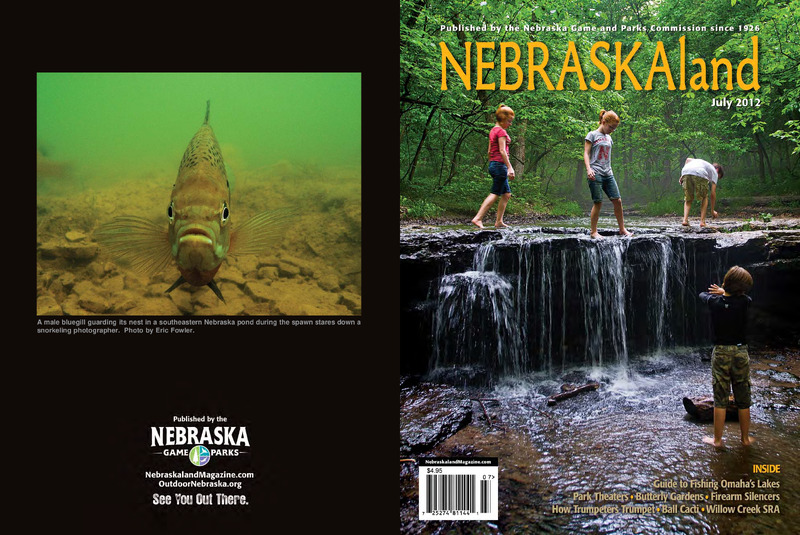
A male bluegill guarding its nest in a southeastern Nebraska pond during the spawn stares down a
snorkeling photographer. Photo by Eric Fowler.
Volume 90, Number 6, July 2012
14 Willow Creek
Reservoir near Pierce offers fishing, boating, camping
and trails. TEXT AND PHOTOS BY ERIC FOWLER
18 How Trumpeters Trumpet
Trumpeter swans have the loudest calls of all
swimming birds – here’s why. TEXT AND PHOTOS BY JON FARRAR
20 Little Theaters on the Prairie
Beat the heat with a stop at Eugene T. Mahoney and
Fort Robinson state park theaters this summer.
BY DOMINIQUE WORTHING
22 Fishing the Metro
A guide to fishing Omaha’s lakes and
waterways. TEXT AND PHOTOS BY JEFF KURRUS
32 Silencers – Quite Firearms for Sportsmen
In the early 1900s, these were touted as a way to not
disturb the neighbors. TEXT AND PHOTOS BY JON FARRAR
36 Nebraska’s Ball Cacti
These three species are relative scarce, small in size and
covered with a veil of prairie grass. BY GERRY STEINAUER
38
●
38 Butterfly Gardens – bringing wildlife into the backyard
Planting these species will attract a variety of wildlife to
your backyard. TEXT AND PHOTOS BY PASQUALE MINGARELLI
18
●
Comment ................................................................... 4
Mixed Bag................................................................. 6
Parks & Places .........................................................42
Outdoor Update........................................................43
Outdoor Education ...................................................44
Classifieds ................................................................46
Portraits from the Past .............................................48
Page 49.....................................................................49
The Last Stop ...........................................................50
32
●
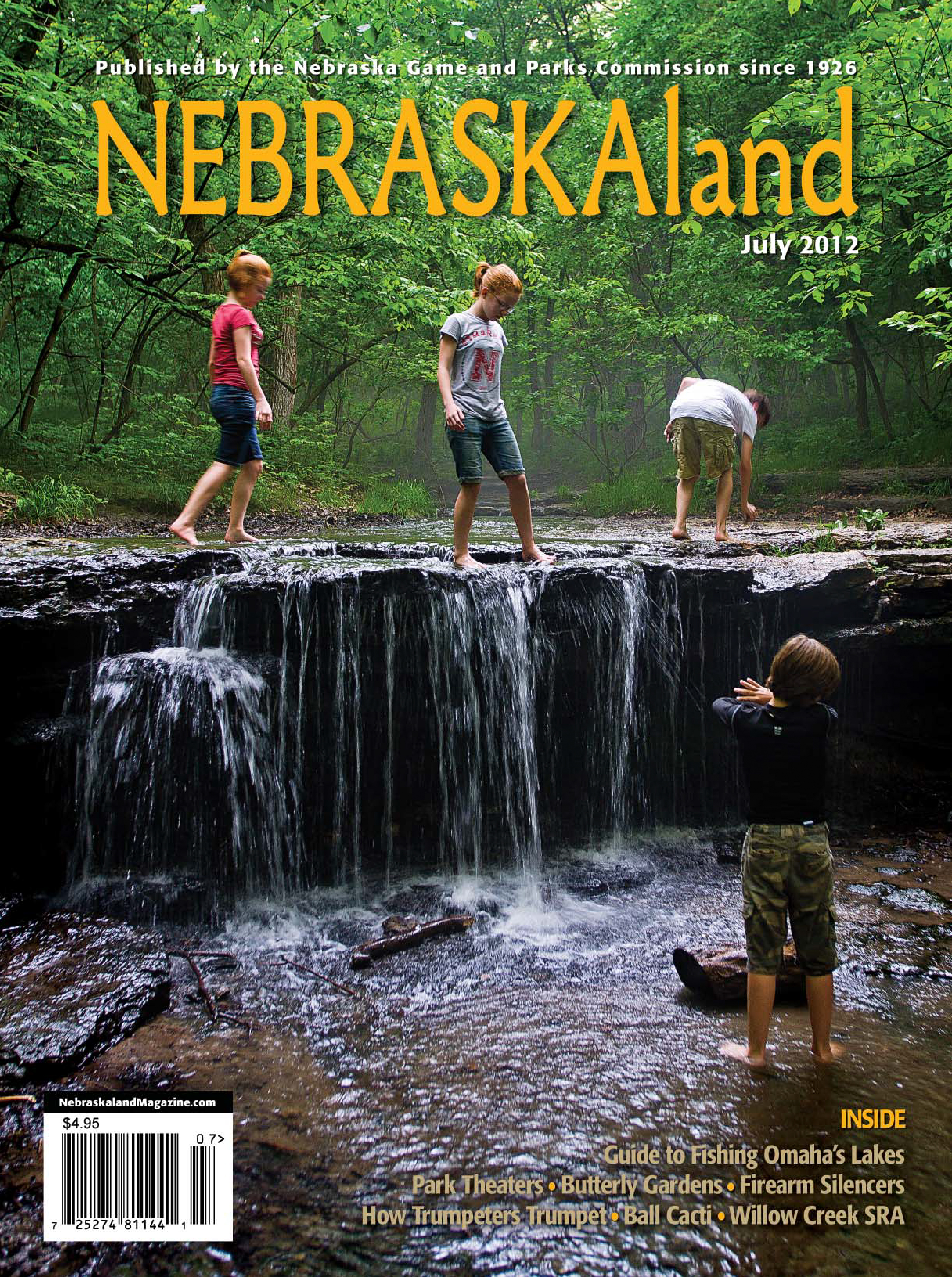
Cover: (Clockwise from left) Madison and Morgan Kempkes of Omaha
and Damian and Devin Thompson of Akeny, Iowa, play in the falls of
Stone Creek at Platte River State Park. Photo by Eric Fowler.
Opposite: A road winds through towering ponderosa pines in the
Nebraska National Forest south of Chadron. Photo by Eric Fowler.
NEBRASKAland (VOL. 90 / NO. 6, ISSN 0028-1964) is published monthly, except for the
combined Jan./Feb. and Aug./Sept. issues, by the Nebraska Game and Parks Commission,
2200 N. 33rd St., Lincoln, NE. Periodicals postage paid at Lincoln, Nebraska, and additional
mailing offices. POSTMASTER: Send address changes to NEBRASKAland, P.O. Box 30370,
Lincoln, NE 68503-0370.
2 NEBRASKALAND • JULY 2012
36
●
JULY 2012 • NEBRASKALAND 3
past May. The moment was priceless
because his brother, Cole, netted it
and Brody’s mouth was wide open.
Their grandparents, Mark and Glenda
Fletcher, bought them both a lifetime
hunting and fishing license two years
ago. Brody was only two and Cole was
four! They think it’s awesome that they
will always have it.
Katie Graham
McCook, Nebraska
NEBRASKAland Visitor Letters
We want to thank all 73 readers
that sent e-mails and letters for last
issue’s visitor, a Salt Creek tiger
beetle that was on page 31 (see page
11 for the winner, rules and this issue’s
hint). Here is one of the wonderful
responses we received:
Summit Lake Goose Eggs
We found this goose nest at the very
end of the jetty at Summit Lake this
spring.
The goose had made her nest on the
very end of the jetty, and we didn’t
see the pair until we were right on top
of them. Both flew off but came back
later and Mom even sat by the nest
while we were fishing.
Marion Ball
Arlington, Nebraska
Cicada Picnic
I really enjoy NEBRASKAland and
read it cover-to-cover each month.
There are always great articles and
fantastic photos about the greatest state
in the union! I always get a kick out of
finding the Nebraska Visitor as well! I
had an interesting encounter with one
of these visitors last summer. While my
family and I were camping at Calamus
Reservoir we found a cicada on our
picnic table in the process of shedding
its skin. I took a series of photos as
the creature emerged from its shell. I
thought you might find it interesting.
Thanks,
Gary Bales
Lincoln, Nebraska
Young Master Angler
Our four-year-old son, Brody,
caught his first master angler fish,
a wiper, at Red Willow Lake this
I found the visitor in this June issue
on page 31 (upper righthand corner)
it looks like a tiger beetle (Cicindela
punctulata) according to bugguide.com
and the article about tiger beetles on
page 40 of the same issue.
My family and I REALLY enjoy
NEBRASKAland Magazine, from the
great articles and photography to the
fun of looking for the visitor. Each
issue always has something of interest
for everyone to read. As junior storm
chasers, we loved the article on storms
this month – thanks!
As a hunter safety instructor I often
uses this magazine to illustrate how
the Nebraska Game and Parks system
works on much more than just hunting
and fishing. It’s a great teaching tool!
Randel Schnebel
Norfolk, Nebraska
Nebraska is home to a unique
insect, the Salt Creek Tiger Beetle
(Cicindela nevadica lincolniana); in
fact Lancaster County is now the only
home of this critically endangered
insect. But this ½ inch long, metallic
brown to olive green-colored beetle
is not the only creature in the state
at risk of being lost. Nebraska
recognizes 27 plant and animal
species as threatened or endangered
under the Nebraska Nongame and
Endangered Species Conservation
Act, and many of these species
are also federally recognized. The
whooping crane, piping plover and
pallid sturgeon are examples of wellknown protected species in the state.
But others, including the American
burying beetle, blowout penstemon,
and scaleshell mussel are also at-risk
species. The loss of any of these
species results in a
void in the ecosystem
and a reduction in
diversity, the
consequences
of which are
unknown.
Special thanks to Julie Van Meter, State
Entomologist, Nebraska Department of
Agriculture. Visitor image by Eric Fowler.
www.bugguide.net is a good site for identification
Send your comments to:
Doug Carroll, Editor
NEBRASKAland Magazine
P.O. Box 30370
Lincoln, NE 68503
or e-mail Doug.Carroll@Nebraska.gov
Please include your postal address and
telephone number.
Letters may be condensed and edited
for clarity. Photographs are welcome
and will be returned.
Any program that receives federal funding from the National Park
Service, or the United States Fish and Wildlife Service prohibits unlawful
discrimination on the basis of race, color, religion, age, gender, marital
status, national origin, age, disability or political affiliation. Any person
who believes he or she has been discriminated against in any program,
activity, facility, or service, should contact the Nebraska Game and
Parks Commission, Lincoln, NE 402-471-0641, the Equal Opportunity
Commission, Lincoln, NE 402-471-2024, TTY/TDD 402-471-4693;
United States Fish Wildlife Service, Civil Rights Coordinator, 4401
N. Fairfax Drive, Arlington, VA 22203; Director, Equal Opportunity
Program, U.S. Department of Interior, National Park Service, 1849 C
Street NW, Mail Code 0008, Washington, D.C. 20240-0001.
4 NEBRASKALAND • JULY 2012
COMMISSION
CONSERVATION OFFICERS
Director Jim Douglas
NORTHWEST
Officer
City
Jim Zimmerman (S) Gering
Commissioners
Chairman - Ron Stave, Waterloo
Vice Chairman - Norris Marshall, Kearney
2nd Vice Chairman - Jerrod Burke, Curtis
Dr. Mark Pinkerton, Wilber
Dr. Kent Forney, Lincoln
Lynn Berggren, Broken Bow
Rex Fisher, Omaha
Mark Spurgin, Paxton
Mick Jensen, Blair
MAGAZINE STAFF
Editor Doug Carroll
Associate Editor Jeff Kurrus
Art Director Tim Reigert
Senior Editor Jon Farrar
Regional Editor Eric Fowler
Contributing Editor Michael Forsberg
Regular Contributors Bill Hager, Chris Helzer,
Lisa Knopp
Photo Librarian Sarah Johnson
Circulation Donna Robinson
For address changes and questions about
your subscription, e-mail Donna.Robinson@
Nebraska.gov
or call (800) 632-5263
Marketing/Advertising
For advertising information contact
Larson Enterprises
e-mail dave@larsonent.com
or call (515) 440-2810
NEBRASKAland Magazine Copyright 2012, all rights reserved.
NEBRASKAland is available on audio cassette from the Nebraska
Library Commission Talking Book and Braille Service, Suite 120, 1200 N
St., Lincoln, NE 68508. (800) 742-7691. NEBRASKAland Magazine and
the Nebraska Game and Parks Commission reserve the right to reject any
advertising not in keeping with the agency mission.
Rates: $18 for one year; $33 for two years; $44 for three years. Nebraska
recipients must add appropriate sales tax. To subscribe call
1-800-NEBLAND (632-5263), or go online to: NebraskalandMagazine.
com.
COMMISSION OFFICES
Headquarters/Southeast District Office
2200 N. 33rd Street Lincoln, NE 68503
Phone (402) 471-0641
Northeast District Office
2201 N. 13th St. Norfolk, NE 68701
Phone (402) 370-3374
Southwest District Office
301 E. State Farm Rd. North Platte, NE 69101
Phone (308) 535-8025
Northwest District Office
East Hwy. 2, Box 725 Alliance, NE 69301
Phone (308) 763-2940
Bassett Office
524 Panzer St., Box 508 Bassett, NE 68714
Phone (402) 684-2921
Kearney Office
1617 First Ave. Kearney, NE 68847
Phone (308) 865-5310
Omaha Office
1212 Bob Gibson Blvd. Omaha, NE 68108
Phone (402) 595-2144
Greg Hesse
Scott Brandt
Heath Packett
Dan Kling
Frank Miller
Phone (308)
(office) 763-2940
(cell) 641-6138
Alliance
760-3647
Gering
631-0663
Gordon
360-0682
Harrison
430-0572
Valentine (402) 389-0444
SOUTHWEST
Officer
City
Phone (308)
Roger Thompson (S) N. Platte (office) 535-8025
(cell) 530-3097
Ray Dierking
Brkn. Bow
870-0322
George Sund
Cambridge
655-0028
Michael Thome
Cozad
529-8146
Terry Brentzel
Doniphan (402) 469-5795
Matt Andrews
Elwood
746-2418
Dirk Greene
Imperial
882-0015
Jerry Pecha (Sup.) Kearney (office) 865-5327
(cell) 293-3551
Dale Johnson
Kearney
440-3847
Brian Piernicky
McCook
340-6627
Dudley Sorensen
N. Platte
530-0016
Nicholas Fix
Ogallala
289-0427
Dennis Thompson
Ogallala
289-0755
Rich Routh
Rep. City
920-0367
NORTHEAST
Officer
City
Tom Zimmer (Sup.) Norfolk
Dale Davis
Steve Oberg
Daniel Roberts
Randy Pomplun
Jeff Jones
Jon Reeves
Tim Williams
Pat George
Doug Pollard
Cory Krause
Phone (402)
(office) 370-3374
(cell) 649-8053
Bassett
760-0712
Columbus
910-3366
Fremont
719-1108
Fullerton (308) 550-0489
Hartington
762-5022
Kennard
889-8508
Neligh
929-0051
O’Neill
340-0787
Ord
(308) 778-7101
West Point
380-6410
SOUTHEAST
Officer
Sean McKeehan
William Krause
Mike Luben
Dan Zuehlke
Darin Gress
Douglas Kramer
Dina Barta
Stacey Lewton
Levi Krause
Robert Finke
Russell Mort
Dan Evasco
City
Ashland
Auburn
Colon
Cortland
Hebron
Lincoln
Lincoln
Lincoln
Louisville
Milford
Nebr. City
Papillion
Phone (402)
521-0159
274-8063
443-6392
806-9084
768-8665
890-6465
890-6463
890-7140
949-0593
947-1363
209-1506
616-5961
ADMINISTRATION
Officer
Craig Stover (Adm.)
Duane Arp (Ass.)
Jeff Clauson (Ass.)
City
Lincoln
Lincoln
Lincoln
Phone (402)
471-5531
471-5532
471-0480
Nebraska Wildlife Crimestoppers 1-800-742-7627
Ak-Sar-Ben Aquarium
21502 W. Highway 31 Gretna, NE 68028
Phone (402) 332-3901
JULY 2012 • NEBRASKALAND 5
Worm or Snake?
Dan Fogell
What if I told you there was a snake in Nebraska that was bi-colored – one solid
color on its back and one solid color on its belly – and that those colors are purple
and pink? Would you believe me? Maybe you’d even like snakes just a little bit
more if you knew they came in prettier colors than the boring old earth tones that
most Nebraska snakes sport. Well it’s true – in the deciduous forests of southeast
ernNebraska, there is just such a snake: It’s small – not more than a foot long –
and it’s purple and pink.
There are many snake species in Nebraska that your average citizens – and
maybe even avid naturalists – may never see. One of them is the half-purple and
half-pink western worm snake. Worm snakes get their name because they look
like worms (at least their bellies do) and because they eat worms. They are what
we in the business call fossorial. This means they live the majority of their lives
underground, which is why naturalists and even those of us who deliberately
search for them have a hard time finding one. Like all fossorial snakes, they have
small eyes and their scales are extremely smooth and very shiny. They have a
bright iridescence in their scales which in a certain light makes them look like
they have rainbow colors. I’ve never seen one bite, but to defend themselves they
will try to stab you with their unusually sharp tail, which might feel like a bite.
Contrary to what some people may say, there are no snakes that have “venomous”
tails, so if you’re lucky enough to find a worm snake, just let it stab you. You will
be fine.
Just like the invertebrate they are named after, worm snakes prefer moist soil,
so when the dry conditions of a Nebraska summer arrive, worm snakes dive deep
underground to follow the moisture. But in early spring when rain comes more
frequently, these beautiful little snakes may be found under rocks and logs and
might even venture out into the open. Their motivation for such risky behavior
is breeding – males and females will find each other, breed and then go back
underground to find food. Females will lay eggs a few weeks after breeding,
usually beneath very large rocks or in some underground chamber. By midsummer, the tiny baby worm snakes will have hatched. At about an inch and a
half long, they are small enough to coil up on a quarter and still leave a little room
to see the coin.
Anytime it rains, especially if the rain is heavy, these secretive little serpents
may return to the surface to feed on the earthworms that are also out in the
rain. To look for one, you’ll have to visit woodland habitats along the rivers of
southeastern Nebraska. Search beneath logs, under rocks and even in the leaf
litter. If you find what looks like an earthworm, look again – you may have
uncovered one of Nebraska’s most handsome snakes.
Here is a list of
upcoming outdoor
events across
Nebraska.
For more
information
about these
and other
events,
visit the
calendar page at
www.OutdoorNebraska.org.
July 1 - 31
Paddlefish Snagging
Applications Period
Apply now for Nebraska
paddlefish snagging permit. For
more information, pick up a 2011-12
Nebraska state fishing guide.
July 13-15
Fur Trade Days
Visit Chadron State Park and take
part in canoe and paddleboat races,
among other things. Call the park at
308-432-6167 for more information.
July 14
Lake Maloney “Carp-o-Rama”
Visit Lake Maloney SRA for the
first Carp-o-Rama held at this
beautiful lake area. Staff will be on
hand to offer fishing tips, fried carp
samples and more. The event is free,
but a park entry permit is required.
July 14
Bighorn Sheep Hike
Come hike and learn about
bighorn sheep and research being
conducted on them in Nebraska.
Preregister by calling the park office
by July 7th.
July 15-20
Nebraska Star Party
Want a great view of the night
sky? Then visit the 19th annual
Nebraska Star Party at Merritt
Reservoir. For more infomation
call (402) 376-3320 or visit www.
nebraskastarparty.org.
July 28
State High School Bass Fishing
Tournament – Summit Lake
7 am - 1 pm. This bass fishing
tournament is open to high school
students who have registered
on The Bass Federation/Student
Angler Federation web site at
highschoolfishing.org.
For more information, contact
Larry Pape at 402-471-5447, larry.
pape@nebraska.gov.
The western worm snake is one of Nebraska’s prettiest (and most unusual) snakes.
6 NEBRASKALAND • JULY 2012
Send Us Your Trail Cam Photos
8 NEBRASKALAND • JULY 2012
PHOTO BY ERIC FOWLER
Eric Fowler
TernCam is up and running online
for a second year, allowing visitors
to keep tabs on a pair of interior least
terns nesting on a sandpit near Ord.
The solar-powered camera, a project
of the Tern and Plover Conservation
Partnership, uploads still photos via
cellular phone every second.
The pair has three eggs in the nest.
When those hatch, the camera will
be moved to another nest, providing
viewing into July. To view it, go to
www.ternandplover.unl.edu.
Dominique Worthing
When looking at the July 1977
edition of NEBRASKAland, one
article stands out immediately:
“The Legend of Pahuk” by former
staffer Ken Bouc. In it Bouc
recounts the little known tale of
Neapolis, the would-be Nebraska
capitol that never came to pass,
and the sacred Pawnee site
called Pahuk where it was to be
built.
In 1857, legislation was
introduced to move the territory’s
capitol from its then location,
Omaha, to a new city called
Neapolis. The location picked
for the new capitol was along
the Platte River, not too far
from current-day Fremont.
This was not a popular idea in
Omaha, and a large number of
Omahans opposed the idea, their
opposition sometimes becoming
violent. Eventually the plan for
Neapolis was dropped due to the
opposition from many residents.
From an interview with Pawnee
ethologist Dr. M. R. Gilmore,
Bouc explains the importance of
Pahuk to the Pawnee people as
the origin of their medicine mens’
healing powers. In 1927, several
individuals pushed for Pahuk to
become a historic site; however,
the site was never approved and
the land remains privately owned.
To read “The Legend of Pahuk”
go to NebraskalandMagazine.com
and click on “A Look Back.”
TernCam Back Online
This leaping raccoon image was captured by Matt Lovejoy’s
trail camera near his Central City home. Sent in by Bill Bolte.
Please submit your trail camera photos by e-mail to:
nebtrailcam@gmail.com. Also include any information that
will help explain your photo.
Hunters Helping the Hungry Donations
Hunters and nonhunters alike can donate to fund the new Hunters Helping the
Hungry program, which encourages hunters to give harvested deer to participating
processors to feed Nebraskans in need.
Donations can be made by going to OutdoorNebraska.org or when filling out a
big game application form. The following Omaha businesses have already donated
a combined $30,000: the Metropolitan Utilities District, Northern Natural Gas,
Tenaska Marketing Ventures, CBSHome, Woods Brothers Realty, HomeServices
of America, Inc., and HOME Real Estate, as well as the David Scott Foundation.
Donated funds will cover deer processing and other costs. Hunters Helping the
Hungry was created in April with the Nebraska Legislature’s passage of LB 928.
JULY 2012 • NEBRASKALAND 9
10 NEBRASKALAND • JULY 2012
See You Out There ... But Where?
Herbicides
may be required
to control it if it has
established extensive
colonies.
The aggressive advance by invasive
exotic plants clearly demonstrates
we do not know enough about the
intricate relationships in our native
plant communities to be tinkering with
them. For most exotic species already
introduced, it is like closing the barn
door after the horse has bolted – the
best that can be done is minimizing the
damage. Gerry Steinauer’s article, “The
Exotic Mennace” in the June 2002
NEBRASKAland is worth reading for
more information on invasive plants.
Deer Permits on Sale July 9
Eric Fowler
After two years of record antlerless
white-tailed deer harvest, including a
total of 39,283 taken in 2011, biologists
are reducing some, but not all, of the
pressure on whitetail does in the 2012
deer hunting season.
Gone in 2012 is the Earn-A-Buck
regulation, which required deer hunters
in the Missouri, Elkhorn, Wahoo and
Blue Southeast management units to
check in a doe before they could check
a buck during the November firearm
season.
Harvest pressure on whitetails
will continue through the new River
Antlerless Unit, which will target
antlerless whitetails on 1,800 miles
of riverbottoms across the state.
Hunters who purchase this special $11
permit can follow the season choice
framework, which allows them to hunt
during any of the seasons – archery,
muzzleloader, or firearm – with the
Do you know where this Nebraska photograph was taken?
See answer at the bottom of page 11.
Can you find the goose as well?
weapon allowed during that season.
These permit holders will also be the
only hunters allowed to use a firearm
during the October 1-10 firearm deer
season. The Commission will also
continue to issue bonus tags in many
management units as well as season
choice permits, which have been
restructured to match the management
unit boundaries.
Statewide archery permits are
once again valid in the Mule Deer
Conservation Area (MDCA), which
includes the Buffalo, Frenchman, Platte
and Republican units. Other special
regulations remain in the MDCA to
help bolster mule deer numbers.
Permits in most management units
go on sale July 9 at Commission
permitting offices and online at
OutdoorNebraska.org. A drawing was
held in June for permits in a handful of
high-demand deer units, as well as for
elk and pronghorn units. Any permits
remaining in those units will also go on
sale July 9.
JULY 2012 • NEBRASKALAND 11
PHOTO BY JEFF KURRUS
Jon Farrar
Move over purple loosestrife
and musk thistle – you might have
company in the realm of flowering
plants brought here from halfway
around the world and now running
away with abandon where not
welcome. Once commonly used in
roadside plantings after construction
work, dame’s rocket (Hesperis
matronalis) is on the Nebraska Weed
Control Association’s “Watch List
Weeds.” Although not a significant
problem here yet, it is in states to the
east and musk thistle was in Nebraska
for years before becoming a problem.
Some now-invasive species, like
dame’s rocket, were intentionally
introduced because of their beauty.
Smooth brome from Europe has been
extensively used in the U.S. to control
erosion along roadways, and reed
canary grass used for erosion control in
waterways and to increase tonnage of
hay in wet meadows. Neither of those
grasses, though, provides the quality
of forage or wildlife habitat found on
native grasslands. Other non-native and
now problem plants – such as leafy
spurge – were accidentally introduced.
Steven I. Apfelbaum, ecologist with
Applied Ecological Services and author
of the Restoring Ecological Health to
Your Land series, has written of dame’s
rocket: “Left unchecked, this beautiful,
yet lethal plant will wreak havoc on the
natural environment, threatening the
survival of native plants and degrading
habitat and water quality.” He notes
that dame’s rocket appears to produce
chemicals preventing or reducing the
growth of other plants, enabling it
to quickly form dense monocultures
within a few years of colonization.
Apfelbaum was among the first to
raise concerns about the ecological
and economic havoc that reed canary
grass would likely have on natural
landscapes.
In small patches, dame’s rocket
can be controlled by pulling and
burning the plant (if all of the roots are
attached). Because it is a short-lived
perennial that spreads principally by
seeds, annual mowing before seeds
are set will probably control colonies.
PHOTO BY ERIC FOWLER
Dame’s Rocket
Boyer Chute After 2011
Kimberly Stuhr
Move over Big Bird, you’re not the only one that has a
nest worth squawking about. Our national symbol, the bald
eagle, builds a nest that any raptor would envy. A typical
nest measures five to six feet in diameter, is three feet deep,
and can weigh up to two tons. Now that’s a nest.
Nebraska’s state parks and recreation areas are great
places to visit throughout the year, but they can be especially
good locations to celebrate the Fourth of July. What better
place to spend the day while waiting for night to fall and the
fireworks show to begin?
Special events are planned at three parks: Ft. Kearny State
Historical Park will have a living history day showing what
life was like in 1860s civilian and soldier camps; Ponca
State Park will be having a dutch oven cobbler and ice
cream social; and Fort Robinson State Park will have a noon
barbeque following the July 4th parade in Crawford.
Vistors to seven state recreation areas will be allowed
to touch off fireworks on Independence Day this year:
Branched Oak State Recreation Area (SRA) near Malcolm,
Fort Kearny SRA near Kearney, Fremont SRA near
Fremont, Two Rivers SRA near Venice, Memphis SRA near
Memphis, Pawnee SRA near Emerald and Wagon Train
SRA near Hickman. Fireworks can be used from 8 a.m.
to midnight on July 4 only, and only in designated, signed
areas. The use of fireworks elsewhere or at other times on
state areas is prohibited.
Only fireworks approved for sale in Nebraska by the
State Fire Marshal are permitted and visitors are required
to dispose of expended fireworks in appropriate containers.
Visitors are also cautioned to use extra care with fireworks
when dry conditions and fire hazards exist.
New Cabins at Medicine Creek State Recreation Area
PHOTO BY ERIC FOWLER
Celebrate Independence Day at a Park
PHOTO BY ERIC FOWLER
Not Your Average Nest
Four new lakefront cabins opened in May at Medicine Creek State Recreation
Area north of Cambridge. Located in the Shady Bay Campground, the fullyfurnished, two-bedroom cabins are air-conditioned and feature a covered deck
overlooking the lake. Linens and kitchen utensils are provided. The cabins,
which rent for $85 per night plus tax, will be open through Dec. 31 and then
reopen on April 1, 2013. Reservations can be made up to one year in advance
at OutdoorNebraska.org or by calling 402-471-1414.
PHOTO BY DOMINIQUE WORTHING
Dominique Worthing
Well suited to survive the 2011
flood, Boyer Chute National Wildlife
Refuge (NWR) was one of the first
areas along this stretch of the Missouri
River to reopen after the floodwaters
receded. Trees are down and some still
standing are dead, but many valiant
cottonwoods are still hanging on. The
area’s Catfish pier was lost in the
flooding and some parking lots and
roads are still buried in sand, but the
refuge remains.
An aerial view of Boyer Chute NWR
from Google Maps shows a swath of
sand which tells the tale of where the
floodwater spilled over the river’s
banks and flowed overland: it starts on
the north end of the area and covers
nearly all of Boyer Bend both east and
west of the chute.
As you head down County Road 34
towards Boyer Chute NWR, you can
see the full extent of the flooding
before you reach the refuge. It starts
as a hazy line on the horizon where
black fields give way to nothing but
sand. Drifts of the fine sediment pile
up against street signs and telephone
poles like snow. Strong Nebraska
winds frequently pull a layer off the
ground and into the air, creating a mini
sandstorm.
Parts of the refuge are still closed to
driving due to affects of the flooding,
but the refuge is again open to the
public for day use, including fishing.
On one day this spring, down near the
water’s edge where blowing sand was
less of an issue, children ran along
sandbars checking their fishing poles,
while adults stayed closer to the bank.
A giant tree remains lodged in the
middle of the chute, its roots pointing
skyward, one of many left there when
waters receeded. Many more lie on
the chute’s banks where they were
deposited by floodwaters. While
the refuge land east of the chute is
accessible on foot by crossing the
area’s bridge, all sections of the road
north of the main entrance gate will
remain closed indefinitely.
If you want to see the effects of the
2011 Missouri River flooding, while
perhaps catching some fish, visit Boyer
Chute NWR. Just 20 minutes north
of Omaha, it’s a good reminder of
nature’s power. ■
NEBRASKAland Visitor
Winner and Hint
Last issue’s winner of
the Visitor drawing was
Blake Sears of Crete,
Nebraska, who found
the Salt Creek tiger beetle on
page 31. Readers are encouraged to
contact NEBRASKAland within 10
days after this issue’s publication
with the correct page number and
name of this issue’s “Visitor” – a
bug found in Nebraska that just
happened to find its way onto one of
the pages.
We will then gather the correct
entries and draw one to win a
NEBRASKAland Magazine mug.
To enter each month, write:
NEBRASKAland Visitor
2200 North 33rd Street,
Lincoln, NE 68503.
Or e-mail:
Tim.Reigert@Nebraska.gov
with “Visitor” in the subject line of
the message.
HINT: This issue’s visitor is not
on page 3, 4, 5, 38, 40, or 41.
Wherspann Lake, Omaha
12 NEBRASKALAND • JULY 2012
JULY 2012 • NEBRASKALAND 13
Willow Creek
Walks and Watersports Rule this Park
Photos and text by Eric Fowler
There’s plenty to do at Willow Creek State Recreation Area (SRA) near
Pierce, including the usual activities such as fishing and water skiing, but one
attraction in particular makes this popular northeastern Nebraska destination
unique: an eight-mile-long, crushed limestone hike, bike and horseback trail that
encircles the lake and leads to town.
This 700-acre flood control reservoir opened in 1984 and has been drawing
visitors in droves ever since. Powerboaters can fly around the eastern half of the
lake to their hearts content, but speeds are limited on the western half, providing
a retreat for anglers. Walleyes, crappies and channel catfish are the main staples,
but anglers may also hook bluegills, largemouth bass, northern pike or some of
the recently added wipers and white bass. Seven breakwaters, two accessible to
wheelchairs, give bank anglers equal access to deep water.
Opposite: A boat pulls into the dock as the sun sets on a beautiful summer day at Willow Creek SRA near Pierce.
Above: The Shoemaker and Grossman families of Omaha enjoy breakfast in the campground, bikes ready to hit the trail.
14 NEBRASKALAND • JULY 2012
JULY 2012 • NEBRASKALAND 15
The modern campground on the lake’s southern
shore offers 100 pads, most with electricity and
all with plenty of shade just a short distance from
the beach. A two-year-old equestrian campground
offers 10 stalls, each with electrical hookups, a
corral and more than enough room to park a horse
trailer, a welcome addition to the group horse
camp that was already available. After Labor
Day weekend, portions of the 900 acres of public
land surrounding the lake are open to hunting.
Pheasants, quail, cottontail rabbits and dove
are found around the lake, and waterfowl on it.
Archery deer hunting is allowed, and archers can
also hone their skills at the lake’s 14-target walkthrough archery range.
A few miles of mowed trails crisscross the
uplands on the western end of the lake, so there’s
plenty of room to roam here, whether you’re on the
water or the trail. ■
Above: Brian and Kerri Edins and their
children, Jake and Kallie, are regulars on
the limestone trail that leads from their
home in Pierce to the lake.
Left: Labs love to retrieve, and Terry
Terrill’s dog, Mac, is no exception. Try
as he may, however, he seldom gets his
teeth on a crappie reeled in by his Pierce
master.
Right: Casey and Carly Sutherland laugh
as Maggie Brahmer jumps from a tube at
the lake’s swim beach.
Located about 15 miles northwest of
Norfolk, Willow Creek SRA has 700 acres
of water and 100 camping pads.
16 NEBRASKALAND • JULY 2012
JULY 2012 • NEBRASKALAND 17
How
Trumpeters
Trumpet
Text and photo by Jon Farrar
U
nlike most man-made
machines – which are soon
obsolete, broken or require
updates – most animal
designs, flesh and blood
machines, are so good
they change little over hundreds of
thousands of years. The tracheas of
trumpeter swans are a case in point.
Trumpeters are year-round Nebraska
residents, nesting in Sandhills lakes
and marshes. They are the largest
waterfowl species native to North
America and have the loudest calls of
all swimming birds.
The trachea is the tube in the throat
and mouth of an animal that connects
the lungs to the larynx. It is kept open
by cartilaginous rings, allowing an
animal to breathe, hence it is also
called a windpipe. All vertebrates
Unlike most tracheas, which
follow the straightest, shortest
line, a trumpeter swan’s
windpipe winds through its
breastbone.
(animals with internal skeletons) have
tracheas, except for a rather obscure
group of primitive fish called dinosaur
eels native to the Nile River that gulp
air at the surface of the water. It is
because of air forced from the lungs
and out the trachea that we humans can
sing, talk and whistle.
The extraordinarily long necks
of swans probably evolved to
accommodate what they feed on and
where it is found. Trumpeters feed
principally on the foliage of aquatic
vegetation, both submerged and
emergent, and the tubers of plants such
as arrowhead and cattail. Like puddle
ducks, they extend their necks as far as
possible to feed underwater, or tip-up
so they can reach a few inches deeper.
Their long necks require equally long
tracheas, which on the surface might
seem enough to explain the loud and
penetrating calls of trumpeters, but as
Paul Harvey used to say on his radio
program: “And now the rest of the
story.”
Measurements of the trachea lengths
of different species of swans have
been commonly made from preserved
specimens, after the trachea had dried
and shrunk in length. The following
are the best measurements I can find,
presumably from fresh specimens
of some species with long tracheae:
Whooping crane, 58 inches; trumpeter
swan, 50 inches; Canada goose, 44
inches; whistling swan, 35 inches;
sandhill crane, 23 inches; and snow
goose, 14 inches. The trachea of
trumpeters is said to be three times
larger in volume than expected for a
bird of its size.
But length alone does not account
for the trumpeter’s hornlike calls. The
tracheas of most creatures are rather
straightforward affairs, adhering to
the principal that the shortest distance
between two points is a straight line.
That principal is flagrantly ignored
by trumpeters and some other groups
of birds, such as cranes. The tracheas
of most swans, including trumpeters,
are extraordinarily long, and in
addition to the natural curve of the
neck have an S-shaped loop in the
body. The trumpeter’s trachea is so
long it winds through the trumpeter’s
breastbone. The difference between
the tracheas of most birds and those of
trumpeter swans is like the difference
between a trumpet and a trombone.
The trumpeter’s trachea is similar to
the looping trombone, suggesting the
species was named for the quality of its
calls and not the shape of its trachea, or
it would have been called the trombone
swan.
But there is more than trachea length
and loops explaining the resonant and
far-carrying calls of trumpeters. Most
animals, including most birds and
mammals, have a larynx, “the voice
box,” at the top of the trachea with
vocal cords. Passage of air through the
larynx produces sounds. Trumpeter
swans, though, have a syrinx located
at the base of the trachea deep within
the bird’s breast. This unique, bony
structure is surrounded by an air sac.
Think of the syrinx and air sac as the
resonating chamber of a cello or guitar.
But length alone does not account for the trumpeter’s hornlike calls. The tracheas
of most creatures are rather straightforward affairs, adhering to the principle that
the shortest distance between two points is a straight line.
Trumpeters can vary the loudness and
pitch of their utterances not only by
the volume of air passing through the
syrinx, but also by varying tension on
its elastic, vibrating membranes.
Ornithologists have identified several
different trumpeter calls, each meaning
something different to other swans.
Some calls are aggressive, telling other
trumpeters or other species (such as
Canada geese and pelicans) interested
in nesting in the trumpeter’s territory
that that part of the marsh is already
claimed. Others calls are used by pairs
as recognition calls. Trumpeters have
an alarm call when a threat is detected,
to warn a mate or young; calls used
to maintain family or flock cohesion;
and soft, nasally calls uttered with
bills closed. Once eggs are down and
incubation underway, a pair of swans
becomes mostly silent, not wanting
to attract attention to the nest, except
during the “triumph display.” When the
female (called the pen) leaves the nest
to feed after covering the eggs with
nest material, the male (the cob) stands
guard nearby. When the female returns
they usually perform the triumph
display – facing each other, quivering
their wings and trumpeting loudly.
So why do trumpeter swans need
to be so loud? Answers are mostly
speculation: Some ornithologists
suggest the loud, resonant, farreaching calls are useful in attracting
and keeping mates. Others have
proposed that the loud calls intimidate
predators. That most birds with
unusually long tracheae nest in marshy
sites where vegetation is dense, so
vocal communication is especially
important, has been offered as another
possibility, but there are many species
of waterbirds that nest in the same
environments and do not seem to need
to trumpet their presence.
The only other swan known to occur
in Nebraska, and rarely, is the tundra
swan. It has a distinctive woo-woowoo or oo-OO-oo call often compared
to that of a snow goose. The principal
call of a trumpeter, the one usually
heard when they are on the wing, has
been described in numerous ways – a
hollow, nasal honking; the sound of
a French horn; resonant, loud and
trumpetlike; a single short toot on a
trumpet, repeated and often in series
of two to three notes sounding like
do-do-doo; or a two note call sounding
like oh-OH with the emphasis on
the second syllable. However it is
described, once heard it is never
forgotten and sends a tingle up the
spine of those listening.
As Paul Harvey would say at this
point: “And now you know the rest of
the story.” ■
To hear a recording of a trumpeter’s
call, go to Allaboutbirds.org/guide/
Trumpeter_Swan/sounds.
THE BIRDS OF MINNESOTA BY THOMAS S. ROBERTS
18 NEBRASKALAND • JULY 2012
JULY 2012 • NEBRASKALAND 19
little theaters on
the prairie
Plays at the Parks
T
Two
off the
th N
Nebraska
b k G
Game and
dP
Parks
k C
Commission’s
i i ’ state
t t parks offer a different
type of entertainment than is found at most parks – theater productions. Both offer
shows throughout the summer that will entertain the entire family.
A visit to Eugene T. Mahoney and Fort Robinson state parks isn’t all about fun in the sun.
Beat the heat with a stop at one of these state park theaters this summer.
By Dominique Worthing
PHOTO BY DOUG CARROLL
even starts, and after Thanksgiving
writer John Burkhart and artistic
director D. Chapelle begin writing the
scripts for the upcoming season. Their
scripts are finalized by March, when
search for actors begins. By April
rehearsals are in full swing.
“We have been very lucky over
the past 20 seasons to be able to cast
some very talented actors from the
University of Nebraska – Lincoln
theater department,” said Chapelle.
“Anyone is welcome to audition for the
shows, but the schedule for the summer
seems to work out better for university
students. We perform three shows
through the summer on Tuesdays,
Wednesdays, Fridays, Saturdays, and
Sunday matinees. During the last
part of the season we do two shows a
night. For many of them, our shows
become their summer jobs as we share
a percentage of the ticket sales with the
It’s all about the melodrama as the cast of this year’s “Peril on the Plains” tries to
discover just “whodunit” at Eugene T. Mahoney State Park.
20 NEBRASKALAND • JULY 2012
actors. In the last few years we noticed
that a few of our actors were guests at
the theater when they were kids.”
Audience participation is very
important to Mahoney’s melodramas
– visitors are encouraged to cheer
for the hero, sigh at the heroine, boo,
hiss, and throw popcorn at the villain,
and participate in the traditional
intermission sing-along, which includes
but is not limited to: “Daisy Bell
(Bicycle Built for Two),” “You are my
Sunshine,” and “I’ve been Workin’ on
the Railroad.”
“The three words that I think of
regarding our production budget
are reuse, recycle, and repurpose,”
Chapelle said when asked about the
cost of running the theater. “We are
very lucky as far as production costs
go, because we are in partnership with
Nebraska Game and Parks. Game and
Parks builds our sets for us, we paint
and decorate, and provide costumes
and programs. It isn’t easy doing
shows that grandkids to grandparents
and everybody in between can enjoy,
but over the years it’s become second
nature to us.”
Preparations for each season at Fort
Robinson’s Post Playhouse begin very
similarly: Preproduction begins in the
fall – season tickets to the Playhouse
are popular Christmas gift items, so the
creative team is proactive in getting
the season lineup polished before the
holidays. During the winter and early
spring months, Tom Ossowski, the
theater’s artistic director, visits several
states for auditions and callbacks,
seeing up to 900 actors at one
conference. Once the final choices are
made for casting, it’s time to purchase
the advanced royalties – because the
Post Playhouse does not produce
original musicals, it must purchase the
Fort Robinson State Park’s
Post Playhouse
Over the
past 20 years
John Burkhart
has written ten
scripts for the
Kountze Theater
Melodramas, and
D. Chapelle has
contributed 39.
Fort Rob’s Post
Playhouse was
founded in 1967 and
has performed 170
productions over the
years.
Five shows are in
rotation there this
summer:
Three shows are
in rotation this summer:
Oklahoma
Godspell
Grease
A Year with Frog and Toad
Broadway Gold: A Cabaret
Goodbody’s Gold
Robbers Roost
Peril of the Plains
For performance times/dates and to place a
reservation, go to:
www.melodrama.net/park.htm
royalties for every show it performs.
The actors arrive in the middle of May
and rehearsals begin immediately.
For performance times/dates and to place a reservation,
go to:
www.postplayhouse.com
This year “Oklahoma” was the
first production to open, followed
“Godspell,” “Grease,” then “A Year
PHOTO COURTESY OF POST PLAYHOUSE
N
ebraska state parks offer tons
of fun activities for parkgoers
to enjoy, but two parks offer
something that many visitors may
not be aware of: high-quality theater
productions that will entertain the
entire family.
At Eugene T. Mahoney State Park
(SP) near Ashland, the summer just
isn’t the same without piano music,
chase scenes through the audience, and
popcorn being thrown at the villains
during melodramas at the Denman and
Mary Mallory Kountze Theater. Some
400-plus miles northwest of Mahoney
SP, musicals are the ticket at Fort
Robinson State Park’s Post Playhouse.
While most of the performances at
these theaters occur during the summer
months, preparation for each season is
a year round affair.
At Mahoney SP, planning for next
season begins before the current season
Eugene T. Mahoney State Park’s
Kountze Theater
The guys sing about betting on horse races in this scene from Fort Robinson’s Post
Playhouse production of “Guys and Dolls” in 2008.
with Frog and Toad,” and finally
“Broadway Gold: A Cabaret.”
“We have 80 performances this
season,” said Ossowski. “Matinees are
very popular since people often travel
a long distance to get to the Playhouse,
and we’ve even added a Saturday
morning performance at 10 a.m. that’s
geared towards families with younger
children.”
This year marks the 45th anniversary
of the theater program at the Post
Playhouse. With more performances
than ever before, the Playhouse is
making its mark on theater in the
western half of the state and continues
to be a popular draw.
“Call ahead for reservations,”
advised Ossowski, “we’d hate to have
to turn anyone away.” ■
Dominique Worthing
is a freelance writer/
photographer living in
the Omaha area. This is
her first contribution to
NEBRASKAland.
JULY 20112• NEBRASKALAND 21
T
h intent of this guide is to provide current and potential new Omaha
he
m
metro anglers information about locations near their homes where they
ccan fish whenever they have an hour of free time during their busy
sschedules.
— Dave Tunink, Assistant Division Administrator, Fisheries Division
NEBRASKAland Magazine’s
Fishing the
Metro
A Guide to Omaha’s Lakes and Waterways
By Jeff Kurrus
Quality bluegills are available at many
Omaha-area lakes both by light tackle
and on a fly, as shown here.
22 NEBRASKALAND • JULY 2012
F
i
ishing
excursions lasting
m
multiple days are some of
n
nature’s most pleasureable
aactivities. Yet sneaking out after
a long day of work runs a close second.
And since so many people live and work
in or near Omaha, the purpose of this
guide is to provide current and potential
metro anglers information about locations
where they can fish whenever they have
a moment in their busy schedules. For a
moment may be all one needs to provide
a memory for a lifetime – especially with
the excellent fishing in these waters.
G
L
A
11
●
Boys Town
7
●
R
6
●
Chalco
S
P
5 M
Miller Park Pond
●
4 acres- 30th Street and Redick Avenue in Omaha. Bluegill,
channel catfish and largemouth bass.
Notes: This small pond in north Omaha has good water
quality and solid panfishing for introducing youngsters.
4 ●
●
3
Bellevue
28
●
27
Offutt ●
Air Force
Base
River
Springfield
R
8
●
2 acres- 42nd and Q streets. Bluegill, channel catfish,
largemouth bass and seasonally stocked rainbow trout.
Notes: This easy-to-find fishery off Q Street features an
underwater shoal where big fish are frequently found, and
good shoreline access for wheelchairs.
La Vista
15
●
29
10
●
●
Papillion
18
●●
16
12
●
Richfield
A
1 acre- 32nd Avenue and Center Street. Bluegill, channel
catfish, crappie and largemouth bass.
Notes: Excellent water quality and clarity make this a
great little pond. Lots of small crappie and catfish are the
norm, but some big bluegill can also be found.
4 H
Hitchcock Park Pond
●
Ralston
19
●
S
3 Hanscom
H
Park Pond
●
Bluegill (pictured), channel catfish and largemouth bass are
species usually stocked throughout Omaha. Some waters will
also have crappie and seasonally stocked rainbow trout.
Missouri
E
●2
●
1
Pacific Street
West Center Street
20 ●
21
●
5
●
Omaha
Dodge Street
iver
D
72nd Street
17
●
Platte R
N
9
●
S
72nd Street
U
23
●
4 acres- 45th Street and Ames Avenue at Fontenelle
Boulevard. Bluegill, channel catfish and largemouth bass.
Notes: Poor water quality brought on by filamentous
algal growth due to high nutrients makes fish hard to catch,
especially once temperatures rise during the late spring.
River
O
Gretna
U
13
●
Bennington
D
4 acres- 72nd Street at Military and Ames Avenue
intersection in Omaha. Bluegill, channel catfish, crappie,
largemouth bass and seasonally stocked rainbow trout.
Notes: Even though Benson is fished pretty hard, light
tackle, including small jigs and spinners, can keep the young
ones interested for quite awhile with the panfish.
2 Fontenelle
F
Park Pond
●
●●
25
Venice
A
Alex Gonzales with a largemouth bass caught on the fly at
Walnut Creek Reservoir in Papillion.
ouri
Bennington Road
24
●
Waterl
Waterloo
22
●
S
1 Benson
B
Park Pond
●
14
Elkhorn River
King
Lake
Valley
Each of the waters under this subhead have the following
special restrictions: Children under 16, adults with a child
actively fishing, and adults 65 and older permitted to fish. In
addition, only bank fishing is permitted on these waters.
Also, while most waters in the Omaha metro have a
21-inch minimum on largemouth bass, refer to the fishing
regulations for the most up-to-date guidelines.
Miss
●
26
For the Young and Young
at Heart
La Platte
iver
Y
R
latte
P
Towl Park near West Center and 93rd streets is a small, scenic lake that offers good panfishing,
making this destination a perfect spot to take children.
MAP BY TRISHA SCHLAKE, NEBRASKA GAME AND PARKS COMMISSION
NEBRASKAland Magazine • FISHING the METRO
Note: all locations are approximations
FISHING the METRO • NEBRASKAland Magazine
6 T
Towl Park Pond
●
11 L
Lawrence Youngman Lake
●
1 acre- West Center and 93rd streets (enter at Paddock
Road traffic light). Bluegill, channel catfish, green sunfish,
largemouth bass and seasonally stocked rainbow trout.
Notes: Towl is a small, scenic lake that can’t be seen from
West Center Street. If you’ve never pulled into the parking
lot you wouldn’t even know it was there. Teach a young one
fly rod basics at this lake where the panfish aren’t too picky.
60 acres- 192nd Street and West Dodge Road in west
Omaha. Bluegill, channel catfish and largemouth bass.
Features concrete boat ramp and fishing pier.
Special Restrictions- Boats restricted to 5 mph (no wake).
Notes: Officially opened in the spring of 2011, Youngman
allows bass anglers to catch a large number of small fish
right now with a rare big fish mixed in. However, aquatic
vegetation during the spring and summer does make the
shallow edges difficult to fish more than a foot beneath the
surface. Counter this by looking for fish in deeper water or
working weedless baits on or near the surface.
7 W
Walnut Grove Park Pond
●
1 acre- Q Street across from Millard South High School east
of 156th Street. Bluegill, channel catfish and largemouth
bass.
Notes: A beautiful setting amongst mature black walnut
trees, this little pond is small but a sleeper you must fish.
12 M
Midlands Lake
●
Many of the following waterbodies are Omaha fishing
staples. However, consider some of the ones you haven’t
fished before, because there are some gems on this list. Each
of these destinations is open to all anglers.
11 acres- North of Washington and Capehart roads in
Papillion’s Shadow Lake subdivision. Bluegill, channel
catfish and largemouth bass.
Special Restrictions- Boats restricted to 5 mph (no wake).
Notes: Parking is available on portions of the streets
adjacent to the lake. While there is no boat ramp, john boat
or float tube access is available by a short walk to the lake’s
edge. Midlands is also adjacent to Shadow Lake.
8 C
Carter Lake
●
13 P
Papio D-4
●
Fishing For All
315 acres- In Levi Carter Park at Abbott Drive and Carter
Blvd near Omaha’s Eppley Airport. Bluegill, channel
catfish, common carp and largemouth bass. Features
concrete boat ramps, a wheelchair-accessible pier and a
lake contour map available at OutdoorNebraska.org.
Open 5 a.m. to 11 p.m.
Special Restrictions- All boats allowed, but regulations
specify that the east arm has a no-wake, 5 mph speed limit.
Notes: A rehabilitation project is in full swing at Carter
Lake, but while under construction the fishery is already
established and open. Carter will be a very productive
fishery far into the future, with excellent water quality,
improved angler access and increased aquatic vegetation.
Don’t shy away from the vegetation during the summer
months, however. While more challenging to fish, exploding
bass and bluegill populations have made it very worthwhile.
Multiple breakwaters at Glenn Cunningham make this lake a
perfect camp-and-fish destination for families in the metro.
30 acres- ¼ mile north of Highway 36 and 98th Street in
northwest Omaha. Bluegill, channel catfish, green sunfish
and largemouth bass.
Special Restrictions- Walk-in access only. Electric and
non-powered boats allowed.
Notes: Located just north of Cunningham Lake and
Highway 36, Papio D-4 is a newly renovated lake fed by
Papio Creek. A perfect float tube lake, D-4 can also be
accessed by boat if one is inclined to make the 250-yard
drag from the road to the water’s edge. Featuring aquatic
vegetation, rip rap, flooded timber and excellent water
quality, that drag might just be worth it. Or fish it from
D-4’s two jetties or the walking path surrounding the lake.
14 P
Prairie View Lake
●
42 acres- 2 miles west of Bennington at 180th Street and
Highway 36. Bluegill, channel catfish and largemouth
bass. Features concrete boat ramp and a lake contour map
available at OutdoorNebraska.org. Open 6 a.m. to 10 p.m.
Special Restrictions- Boats restricted to 5 mph (no wake).
Notes: Gets a lot of boat pressure every day but there
are also lots of nooks to find fish by water or walking. A
definite largemouth gem just north of the Omaha city limits.
15 S
Schwer Park Pond
●
2 acres- West Centennial Road west of 84th Street in
Papillion. Bluegill, channel catfish, crappie and largemouth
bass.
Special Restrictions- Bank access only.
Notes: Schwer has some nice crappie and largemouth bass,
9 G
Glenn Cunningham Lake
●
390 acres- 96th and State streets. Bluegill, bullhead, channel
catfish, common carp, crappie, largemouth bass and walleye.
Features concrete boat ramp, camping opportunities, and
a lake contour map available at OutdoorNebraska.org.
Open 5 a.m. to 11 p.m.
Special Restrictions- Boats restricted to 5 mph (no wake).
Notes: Renovated in 2007, Cunningham offers anglers the
opportunity to catch numbers, with an occasional big fish.
Breakwaters (jetties) allow bank anglers to take advantage of
fishing-holding structure on both sides of the lake. Walleye
and aggressive largemouth bass are available, and the lake is
known as a great carp fishery, making Cunningham a great
multispecies option in the metro.
There is also an adjacent wetland to Cunningham on the
north side of Highway 36. While shallow and sedimentladen, there is bank and john boat/float tube access just north
of the Highway 36 and 92nd Street intersection. Lastly,
Papio D-4 is also nearby, located on the west side of 92nd
Street across the street from the wetland.
Lake Halleck
10 L
●
Quality largemouth can be found at multiple Omaha hotspots.
NEBRASKAland Magazine • FISHING the METRO
4 acres- East of South Washington (84th) Street on East
Lincoln Street in Papillion. Bluegill, channel catfish,
largemouth bass and seasonally stocked rainbow trout.
Special Restrictions- Bank access only.
Notes: Halleck is the perfect walk-around lake for folks of
all ages. Frequent Nebraska Game and Parks Commissionsponsored family fishing nights are held here due to
accessibility and ability to catch fish.
Because of Lake Halleck’s abundant shoreline access, the Nebraska Game and Parks Commission frequently uses this lake for its
family fishing nights. For more information about this program, visit OutdoorNebraska.org and click on Fishing.
FISHING the METRO • NEBRASKAland Magazine
surrounding the entire lake with nearby access to the water.
The grass surrounding the lake is tall, but there are some
foot trails leading to the water’s edge. There is also parking
on the northeastern and northwestern sides of the lake.
While there is no boat ramp, dropping a small john boat or
float tube in it would be ideal for this urban fishery. Rip rap,
aquatic vegetation and bank structure can be found.
17 S
Standing Bear Lake
●
Newly re-opened Zorinsky Lake features a wheelchairaccessible fishing pier.
and nearly all of them are accessible by those willing to
walk in the short grass around the lake.
16 S
Shadow Lake
●
30 acres- North of Washington and Capehart roads in
Papillion’s Shadow Lake subdivision. Bluegill, crappie and
largemouth bass.
Special Restrictions- Boats restricted to 5 mph (no wake).
Notes: Shadow features a concrete walking trail
135 acres- 132nd and Military streets in north Omaha.
Bluegill, channel catfish, common carp, crappie, freshwater
drum, largemouth bass, walleye and seasonally stocked
rainbow trout. Features concrete boat ramp and a lake
contour map available at OutdoorNebraska.org.
Special Restrictions- Boats restricted to 5 mph (no wake).
Notes: Standing Bear is on the Nebraska Game and Parks
Commission’s list for future renovation projects. In the
meantime, old-timers familiar with the fishery catch some
really nice fish here.
18 W
Walnut Creek Reservoir
●
100 acres- South of 96th Street and Highway 370 in
Papillion. Bluegill, channel catfish, largemouth bass
and redear sunfish. Features concrete boat ramp and a
wheelchair-accessible fishing pier and island. Open 6 a.m. to
10 p.m.
Special Restrictions- Boats restricted to 5 mph (no wake).
Notes: A lake in its prime, it can give up large numbers
or large fish. Early mornings and late afternoons can be
spent catching bass on scum frogs and other topwaters, as
well as redear sunfish on a variety of small tackle options.
Meanwhile, late risers can target the deep woody structure
throughout the lake for multiple species. In addition, deep
water structure is available near the wheelchair-accessible
locales. This lake was designed for fish habitat and for
anglers, and it’s a treasure because of this design.
19 Wehrspann
W
Lake
●
245 acres- 156th Street and Giles Road in southwest Omaha.
Blue catfish, bluegill, bullhead, channel catfish, crappie,
largemouth bass and walleye. Features concrete boat ramp
and wheelchair-accessible pier. Open 6 a.m. to 10 p.m.
Special Restrictions- Boats restricted to 5 mph (no wake).
Notes: It is no surprise that Wehrspann is one of the
Metro’s most popular fisheries. With seemingly unlimited
shoreline access and fish-structure features, the opportunity
to catch multiple fish species at Wehrspann is available
during each visit. Plus, a sediment dam on the upper end of
the lake provides strong water quality all year long.
There is also an adjacent wetland to Wehrspann on the
north side of Highway 370 at the Gretna exit where bank,
john boat or float tube access is available for multiple
species, including the possibility of bluegill, bullheads, green
sunfish and largemouth bass.
20 Whitehawk
W
Lake
●
30 acres- 192nd and F streets in west Omaha. Bluegill,
channel catfish and largemouth bass.
Special Restrictions- Walk-in access only from a small
parking lot southeast of the lake.
Notes: Whitehawk is a fishbowl of sorts, with very little
structure above or beneath the water. Fish the visible contour
breaks around the entirety of the lake for active fish. Lots of
smaller largemouth are present, but Whitehawk also has a
big fish or two in its waters. A perfect bank lake for the kids,
a float tube angler, or two buddies wanting to carry a john
boat 200 yards to the water’s edge.
21 Zorinsky
Z
Lake
●
255 acres- 156th and F streets in west Omaha. Bluegill,
channel catfish, common carp, crappie, largemouth bass,
redear sunfish and walleye. Features concrete boat ramp and
a wheelchair-accessible fishing pier. Open 5 a.m. to 10 p.m.
Special Restrictions- Boats restricted to 5 mph (no wake).
Notes: Zorinsky is on its way back after a zebra mussel
outbreak closed its gates from fall of 2010 to its official
re-opening on April 28, 2012. For the next several years,
Zorinsky should have a life similar to other rehabilitated
lakes – large numbers of small fish early transitioning to an
overall excellent fishery, with the chance to catch all species
and sizes within a few years.
River Access
A largemouth bass angler fishes multiple cover options at Walnut Creek Reservoir in Papillion.
NEBRASKAland Magazine • FISHING the METRO
This guide would be incomplete if it didn’t mention river
access for those looking to wet a line in moving water.
Below are the put-in locales for Omaha’s rivers, including
those fish species most commonly caught and any special
regulations at each.
Allysa Beyersdorf shows off a largemouth bass caught from
Wehrspann Lake as dad Gary looks on.
22 G
Graske Crossing
●
Southeast corner of Elkhorn River and West Dodge Road
(Skyline Drive exit), accessing Elkhorn River.
Common species caught: buffalo, bullhead, channel catfish,
common carp, flathead catfish and shovelnose sturgeon.
Features canoe launch area. Open April 1 to November 1,
6 a.m. to 10 p.m.
23 N
NP Dodge Park
●
11000 North River Road, accessing Missouri River.
Common species caught: buffalo, channel catfish, common
carp, crappie and flathead catfish.
Features concrete boat ramp available for Missouri River
access. Open 5 a.m. to 11 p.m. daily.
24 W
Waterloo River Access
●
S h
Southeast
corner of Elkhorn River and West Maple Road,
accessing Elkhorn River.
Common species caught: buffalo, bullhead, channel catfish,
flathead catfish and shovelnose sturgeon. Features canoe
launch area.
FISHING the METRO • NEBRASKAland Magazine
Throughout the Omaha area there are multiple fisheries with scenery as nice as the fishing, including Papillion’s Schwer Park Pond.
Very Limited Access
Despite its size, the public water jetty at Bennington Lake
receives a lot of local fishing attention, and for good reason.
Bennington Lake
25 B
●
P bli access only permitted on jetty located ½ mile west of
Public
168th Street at the intersection of Highway 36 and Newport
Landing. Bluegill, channel catfish and largemouth bass.
Check Back Soon
For the most up-to-date information on the following
destinations that are either under construction or repair,
visit OutdoorNebraska.org.
26 E
Elkhorn Crossing River Access
●
252nnd Street and Bennington Road, accessing Elkhorn River.
Common species caught: channel catfish, common carp,
flathead catfish, and shovelnose sturgeon.
Features camping area and canoe launch area. Open April 1
to November 1, but currently closed for repair.
27 H
Haworth Park Pond/River Access
●
1 acre- Payne Drive north of Highway 370 in Bellevue
adjacent to Missouri River. Bluegill, channel catfish and
largemouth bass in pond. River access is also present, with
the following species commonly caught: buffalo, channel
catfish, common carp, crappie and flathead catfish. Features
camping area and concrete boat ramp owned by City of
Bellevue.
Notes: As of publication date, Haworth Park is closed
until further notice because of flood damage. Visit the
City of Bellevue web site at Bellevue.net for the latest
information.
Kramer Park Lake
28 K
●
7 acres- North of Highway 370 at Missouri River bridge.
Bluegill, channel catfish and largemouth bass.
Notes: As of publication date, Kramer Park Lake is
closed until further notice because of flood damage. Visit
the City of Bellevue web site at Bellevue.net for the latest
information.
29 W
West Papillion No. 5 Lake
●
135 proposed acres- 126th and Cornhusker Road in
Papillion.
Notes: Construction begins in summer/fall of 2012 and
the fishery is expected to open in 2014. Will feature concrete
boat ramp, various breakwaters, underwater shoals, fish
attractors, standing trees and abundant shoreline access for
anglers. Planned to be a 5-mph no wake lake, this fishery
will be stocked with bluegill, channel catfish and largemouth
bass.
With reporting by Daryl Bauer, Jeff Chin, Lindsey
Chizinski, Jeff Jackson, Jo Momsen, Mark Porath, Steve
Satra, Katie Stacey, Dave Tunink and Greg Wagner.
For families wanting a list of Omaha city parks
that have picnic shelters, open space and other
activities for youth, visit CityofOmaha.org/parks and
click on Find a Park.
In addition, while fishing throughout the Metro
consider staying at E.T. Mahoney SP, Louisville SRA,
Platte River SP, or Two Rivers SRA. While there, take
the little ones fishing at waters locaat each of these
camping and/or lodging destinations.
Fishing the Metro was printed in the July 2012 issue of NEBRASKAland Magazine, which is published by
the Nebraska Game and Parks Commission. Text and photos by Jeff Kurrus. Design by Tim Reigert.
For more information, contact the Commission’s Omaha office at 402-595-2144 or Greg.Wagner@nebraska.gov.
Additional copies of this publication can be requested by calling the Commission’s Fisheries Division at 402-471-5552.
Cover photo: Lawrence Youngman Lake, Omaha
Any program that receives federal funding from the National Park Service, or the United States Fish and Wildlife Service prohibits unlawful discrimination on the basis of race, color, religion, age, gender, marital status, national
origin, age, disability or political affiliation. Any person who believes he or she has been discriminated against in any program, activity, facility, or service, should contact the Nebraska Game and Parks Commission, Lincoln, NE
402-471-0641, the Equal Opportunity Commission, Lincoln, NE 402-471-2024, TTY/TDD 402-471-4693; United States Fish Wildlife Service, Civil Rights Coordinator, 4401 N. Fairfax Drive, Arlington, VA 22203; Director, Equal
Opportunity Program, U.S. Department of Interior, National Park Service, 1849 C Street NW, Mail Code 0008, Washington, D.C. 20240-0001.
FISHING OMAHA’S LAKES
Silencers
Quiet Firearms for Sportsmen
By Jon Farrar
Y
ou ever notice how one thing
often leads to another? When
I researched the ghillie suit
article for the March 2011
NEBRASKAland, I delved
a bit into snipers because the
British army was the first to
use ghillie suits for snipers
and surveillance during the
Second Boer War (18991902) in South Africa.
Snipers got me thinking
about gun silencers, and so
I dug out a long ignored
folder labeled “Silencers”
out of a file cabinet.
In it was a photocopy
of a May 1910 article in
Outer’s Book called “The
Silencer’s Development”
and photocopies of display
ads from early-1900s
sporting magazines pitching
Maxim gun silencers. One
advertisement showed a man
in his pajamas leaning out an
open window, aiming a rifle, with a
silencer attached, at a weasel about to
invade his hen house. Another showed
a man in his living room shooting at
a target in his fireplace, a dog sound
asleep on the rug at his feet, implying
firing the gun was silent (or the dog
was old and deaf). Such advertising
illustrations suggested the silencers
were intended for target shooting
or pest control. I’ve not found an
advertisement suggesting they were
meant for hunting, but they no doubt
were.
32 NEBRASKALAND • JULY 2012
Hiram Percy Maxim
A Prodigious Inventor
Hiram Percy Maxim (1869-1936) is
generally credited with being the first
to invent and commercially market
firearm silencers. He was the son of Sir
Hiram Stevens Maxim, who invented
the first fully-automatic machine
gun, and nephew of Hudson Maxim,
who developed high explosives and
ballistic propellants. Henceforth in
this article, Maxim will refer to
Hiram Percy. He graduated from
the Massachusetts Institute of
Technology with a degree in
mechanical engineering at
the age of 16. His interests
ranged widely – he was
among the first to design
an automobile powered
by an internal combustion
engine, founded the
American Radio Relay
League (ham radio
operators), was a pioneer
in designing gliders,
and his firearm silencer
designs were the model for
automobile mufflers.
During his lifetime he
held 59 patents, but none of
his inventions drew as much
attention and acclaim as did his
firearm silencer, better known later
as “suppressors” as they did not really
make firing a firearm silent, only
significantly reduced the noise level
by trapping and slowing the release
of gases inside the gun’s muzzle. The
Maxim silencer consisted of a metal
cylinder that screwed onto the gun
barrel. Inside the cylinder were small
chambers separated from each other by
metal rings or baffles, with holes in the
center slightly larger than the diameter
of the cartridge caliber. The chambers
captured escaping gases that created
OUTER’S RECREATION, OCTOBER 1921. OPPOSITE PAGE PHOTO COURTESY U.S. LIBRARY OF CONGRESS
In the early decades of the 1900s, silencers for rifles and pistols were much touted in
outdoor magazines, usually for target practice or dispatching unwanted vermin without
disturbing the neighbors.
JULY 2012 • NEBRASKALAND 33
through the silencer. It was probably
not until the development of shot cups
for shotshells that a shotgun silencer
was feasible. Shotgun silencers are
used in some European countries
today; and improved models are
being developed. Most are long and
cumbersome, reduction of muzzle blast
not significant, and so they are unlikely
to be extensively used by sportsmen.
Military Employment
the muzzle blast and also functioned
as a flash suppressor. The silencer was
also said to reduce firearm recoil, a
claim marketed with a photograph of
Maxim’s nine-year-old, 62-pound son
firing a “service rifle with a recoil of
75 pounds.” Maxim formed the Maxim
Silencer Company in 1908, filing for a
patent that same year.
“The sensations of surprise
and astonishment with which the
shooting world at first received the
announcement of an invention claimed
to effectively muffle the nerve-racking
report of high-power rifled arms, has
given place to a feeling of satisfaction
now that the device has made good,”
an unattributed article in the May 1910
issue of Outer’s Book reported.
Initially, Maxim only made silencers
for long guns. A September 1, 1912
34 NEBRASKALAND • JULY 2012
article in the Omaha World-Herald
by outdoor writer Sandy Griswold
noted the following: “Because of the
power he realized its use would place
in the hands of crooks, Hiram Maxim,
inventor of the silencer, refused
to permit its public sale for use on
handguns.”
Interestingly, the impetus for
Griswold’s article was the presentation
of a play then showing in Omaha
called Within the Law: “...there is
represented on the stage for the first
time in theatrical history a murder by
pistol in which there is not the slightest
sound at the discharge of the bullet
nor the thinnest veil of smoke when
the trigger of the revolver is pressed,”
Griswold reported. “This pistol is
causing much excitement and curiosity
among the sportsmen and shooters
of the country as there is now a new
sporting shotgun in embryo of the
same kind.”
Griswold wrote that Maxim had
designed the handgun silencer
especifically for the play and that the
Maxim silencer was regarded by police
authorities throughout the world as
“the deadliest weapon ever conceived
because it permits the killing of a
person while practially minimizing the
possibility of detection of the murderer
... .” Maxim obviously reversed his
position, as subsequent advertisements
showed silencers built for handguns.
As for Griswold’s prediction of
silencers for shotguns, that apparently
never happened, at least for many
years. The principal problem with
a shotgun silencer was that many
pellets, not just one cartridge, passed
Quiet-Shooting Sportsmen
One of Maxim’s principal pitches to
civilian sportsmen was that the sound
reduction made target shooting more
pleasant and allowed shooting where
it would otherwise be objectionable. It
was billed as “a gentleman’s method
of target shooting.” It seems Maxim
intentionally suggested no uses for a
silencer beyond that, knowing buyers
would conjure up their own reasons.
The National Firearm Museum
in Fairfax, Virginia has the Model
1894 Winchester lever-action rifle
equipped with a silencer that belonged
to Theodore Roosevelt. Their website
noted the Roosevelt estate was on the
North Shore of Long Island, and he
used the rifle to “clear the estate of
varmints” and that his neighbors, such
as the DuPonts and the Tiffanys, surely
appreciated not hearing the crack of
Teddy’s rifle while taking their tea.
There was concern by game
departments that silencers, also
functioning as a flash suppressor,
would be employed by poachers but
prohibition on their use for hunting
apparently was never widespread.
Some habitually poor shots might have
seen the silencer as a way to get a
second, third or fourth shot at a deer, as
the muzzle blast of the first shot would
not spook the animal. Walnut-robbing
squirrels could also be relatively
quietly dispatched in town.
Gangsters
By the late-1920s and early-1930s,
the public’s attitude toward firearms
in general was changing. During
Prohibition, gangsters and guns
became a public concern and in 1934,
the federal government passed the
National Firearm Act, which banned
short-barreled shotguns and rifles,
and machine guns. It did not make
silencers illegal but placed a heavy tax
on owning one. Interest in them never
regained a following among sportsmen
after the 1930s, but Maxim was
apparently selling enough to justify
continuing to advertise in outdoor
magazines. Suppressors are banned in
some states, but 39 states, including
Nebraska, allow private ownership.
Permits are issued by the U.S. Bureau
of Alcohol, Firearms, Tobacco and
Explosives.
The principal drawback of a
suppressor, even the more sophisticated
ones manufactured today, is that
they only reduce sound: They cannot
totally eliminate the crack of a bullet
being fired, but makers of modern-day
suppressors claim they do make it more
difficult for game animals to “read the
noise,” often allowing a second or third
shot be taken.
Judging from ads and articles now
appearing in sporting magazines and on
the Internet, it seems some hunters are
embracing the use of suppressors. What
goes around comes around. ■
FIELD AND STREAM, NOVEMBER 1925
FIELD AND STREAM, OCTOBER 1918
The military immediately showed an
interest in the silencer and conducted
extensive tests. The Outer’s article
stated that the invention: “…modifies
and eliminates the disagreeable and
disturbing feature of modern military
small arms and renders it possible to
so readjust the age limits for military
service that hundreds of thousands
of fighting units may be added to the
service roll; healthy men, long past
the age limit for active field service
and boys in their teens might in
dire emergencies be utilized to man
fortifications, leaving the more active
troops for the more arduous duties of
the tented field.” It was also mentioned,
tongue in cheek, that with the reduced
recoil, firearms could be used by “the
more militant of our suffragettes …
without discomfort.”
The Army immediately saw the
silencer as a valuable tool for snipers.
“A cool calculating rifleman of the
modern school having the instincts and
training of a hunter, and equipped with
long range rifle, telescope sights and a
Maxim silencer, by taking advantage
of natural cover, might easily locate
himself in a position where almost
immune from danger he could silence
a battery or compel a regiment of
the enemy to change position,” the
Outer’s article trumpeted. In spite
of glowing, but questionable, results
from military testing, the silencer
failed to be embraced as standard field
equipment before and during World
War I, although the Army did buy
Maxim silencers designed for the U.S.
Springfield Model 1903 being used by
the infantry at that time.
JULY 2012 • NEBRASKALAND 35
Nebraska’s
Ball Cacti
By Gerry Steinauer, Botanist
D
uring my wanderings afield
I’m always subtly pleased to
stumble upon one of Nebraska’s
three species of ball cacti: the purple
pincushion cactus, Missouri pincushion
cactus, or nylon hedgehog cactus.
When not revealed by large and showy
(but short-lived) flowers, these cacti
can easily elude the botanist because
of their relative scarcity, small size
and covering veil of prairie grasses.
In contrast, Nebraska’s three species
of prickly pear cacti – little, bigroot
and plains – are more widespread,
abundant and taller, so more frequently
encountered. These cacti have
cylindrical or flattened stems divided
into segments or pads in contrast to
the undivided, round or oblong-shaped
stems of ball cacti.
Cacti are adapted to survive in
dry environments. Their perennial,
evergreen stems are highly modified
and thickened for water storage and
to conduct photosynthesis, which is
accomplished by the leaves in nearly
all other plants. Cactus leaves have
evolved into spines to limit water loss
to parched air and prevent browsing by
a variety of animals, from pronghorns
Missouri pincushion cactus
36 NEBRASKALAND • JULY 2012
to grasshoppers. The shallow, fibrous
roots can absorb moisture from the
slightest of rainfalls.
The purple pincushion cactus
(Coryphantha vivipara) is the most
widespread, common and largest of
our ball cacti, and grows in sandy or
gravelly Sandhills and mixed-grass
prairie over the western three-fourths
of the state. Its stems are solitary, the
largest nearly three inches in diameter,
often clumped, and sometimes forming
mounds. They are covered with
tubercules (swollen protuberances),
each bearing four brownish central
spines surrounded by 12 to 20 white or
gray, shorter radial spines. The species
name “vivipara” means “producing
live young” – a reference to the basal
tubercules ability to root and form new
plants.
In June, one to several large, up to
two-inch-wide, flowers appear from
the base of the upper tubercules. The
many waxy, sharp-tipped, vibrant pink
to magenta petals surround a center of
yellow-orange anthers and the slightly
taller, white, comb-shaped stigmas.
Individual flowers last only a portion
of a single day and so are rarely seen.
IIn late summer, the green, fleshy, cupsshaped fruits form. The fruits can be
uup to an inch long and are packed with
many tiny, reddish brown seeds in a
m
ssweet, edible pulp.
Plains Indians collected the fruit in
llate summer, eating it fresh or roasting
iit to burn off spines. The Cheyenne
((whose names for the plant were
““matahesono” and “mataha”) boiled the
ffruit either fresh or after drying.
For modern cooks, the smaller
ffruits of pincushion cactus are less
ddesirable for making jellies, syrups and
ssauces than those of the larger-fruited
pprickly pears. Prehistoric Indians in
Nylon hedgehog cactus
southwest Texas also ate the flowers
of pincushion cactus, as revealed by its
pollen being found in fossilized human
excrement. There is no evidence that
historic Plains tribes consumed the
flowers.
The Missouri pincushion cactus
(Coryphantha missouriensis) when not
in bloom is the most inconspicuous
of our ball cactus, its stems often
barely rising above the soil surface.
It grows in rocky, sandy or clayey
soils of mixed-grass prairie, often
on hilltops and ridges, only in the
northwestern fourth of the state, where
it is uncommon. The species was first
collected from the high hills of the
Missouri River, most likely in what is
now the state of North Dakota; hence,
the name “Missouri,” and not because
it grows in the state with that name.
In his 1983 book, Jewels of the
Plains, South Dakota rancher and
botanist Claude Barr wrote that the
Missouri pincushion cactus “prepares
for winter ... by reducing its volume by
half and withdrawing to ground level.
With the warmth of spring it quickly
becomes turgid and by late-May bears
a ring of light straw or orange-tinted
blossoms abut its center. Its near-white
spines are soft and readily handled.
This kind occasionally attains a
diameter of two-and-a-half inches. It
sometimes forms clusters. The flowers
arise from the bases of the teatlike
extensions [tubercules], and the small,
round, green fruits form in summer to
Purple pincushion cactus
ripen in April of the following year
in a charming display of crimson or
bright scarlet. These catch the eye
of northward migrating birds and
soon disappear.” Plains Indians also
ate fruits of the Missouri pincushion
and the Comanche reportedly used
its spines as “instruments to punish
unfaithful wives.”
The nylon hedgehog cactus
(Echinocereus viridiflorus) is
Nebraska’s third species of ball cacti.
Echinos is Greek for “hedgehog” and
viridiflorus is Latin for “with green
flowers.” It grows in extremely rocky
or gravelly mixed-grass prairie in
southwestern counties and is rare in
the state. I have never encountered
this species in the wild in Nebraska
– the photo on the opposite page
was taken in a South Dakota rock
garden. Stems are usually solitary and
only occasionally on mature, healthy
plants are the stems clumped. These
bear low tubercules on vertical ribs,
a characteristic that distinguishes the
hedgehog cactus from the pincushion
cactus. The dense, varied-colored
spines, attractive on new growth, occur
in horizontal light and dark bands and
sometimes obscure the stem. The name
“nylon” refers to the pattern formed
by these dense, narrow-rowed spines,
which resembles the lines on women’s
nylon stockings.
Barr wrote “the color of the flowers
is an unimpressive yellow-green if
the season is warm and dry, but in
a cool, wet period it is a clear, pale,
and luminous traffic-signal green,
startling at first acquaintance.” Unlike
the pincushion cactus, the flowers of
the hedgehog cactus arise from lower,
older parts of the stem. The green,
spiny fruits are small, less than onehalf-inch tall, and likely unpalatable to
human and wildlife alike. Similar to the
Missouri pincushion cactus, hedgehog
cactus stems shrivel and flatten with
the onset of autumn.
The showy flowers of ball cacti make
them targets for poaching, which is
strongly discouraged as it can reduce
or eliminate local populations. Overall,
however, human activities may be
less a threat to ball cacti than many
other Nebraska wildflowers. Their dry,
usually sandy or gravelly, often hilly,
prairie habitats are mostly unsuitable
for farming. Sharp spines spurn grazing
livestock. Lastly, adapted to a dry
climate, including prolonged drought,
these cacti may survive well under
future climate change. ■
Gerry Steinauer
is a botanist for
the Nebraska
Game and Parks
Commission and
has been writing
and photographing
for NEBRASKAland
Magazine for more
than 20 years.
JULY 2012 • NEBRASKALAND 37
Butterfly Gardens
bringing wildlife into the backyard
Text and photos by Pasquale Mingarelli
“T
here is always a surprise,” said Verla Shaner, speaking
about the butterfly garden she cares for at Heron
Haven, a Omaha nature area near her home. “A newly
opened flower, maybe a robin digging in the dirt looking
for a worm, a wren singing in the Miss Kim lilac or even a
butterfly.”
Wherever there is wildlife there are people who try to
attract it using various methods, including putting out a salt
block to attract deer to hanging bird feeders. But there’s
another way that involves a bit more work and passion –
planting and cultivating plants that attract wildlife and cause
it to stay around. Some people have even transformed their
entire yard into a flowering paradise. These people are often
those wildlife enthusiasts who are most passionate about
Lepidoptera – butterflies.
Butterfly gardens are a great way to bring a little bit of
A monarch butterfly feeds on a domestic sunflower.
38 NEBRASKALAND • JULY 2012
color and wildlife activity into any backyard. According to
Steve Spomer, an entomology research technologist at the
University of Nebraska – Lincoln, more than 200 species of
butterflies have been recorded in Nebraska. There are also
plenty of native and non-native species of plants commonly
used in landscaping that these butterflies sip nectar from,
so building a butterfly garden seems like a natural thing to
do. In addition to butterflies, these plants will also attract
hummingbirds, cardinals, goldfinches and many other
species of birds.
Building a garden can be easy: One can simply plant
zinnias in the corner of a yard that will attract plenty of
different species, such as monarchs, painted ladies and
cabbage whites. However, a serious butterfly enthusiast
might want to place dozens of different annual and perennial
plants throughout a backyard landscape.
Nancy Scott of Bellevue has a beautiful butterfly garden
that has been certified as wildlife habitat by the National
Nancy Scott refills a
hummingbird feeder,
which butterflies also
enjoy.
JULY 2012 • NEBRASKALAND 39
Verla Shaner works at Heron Haven
constructing a dry stream bed.
Wildlife Federation. She says if
someone is interested in starting a
garden for butterflies, they should
put in not only flowering plants for
the adults, but host plants for the
caterpillars as well. Scott plants
greenery such as dill, milkweed and
even broccoli as
host plants for
caterpillars of
black swallowtails,
monarchs and
cabbage butterflies,
respectively.
She also noted
that spraying
insecticides will kill
off the “good” and
the “bad” insects
indiscriminately, a
fact backed up by
Carolina mantis on allium in a butterfly garden.
UN-L’s guide to
butterfly gardens:
“It is difficult to have a successful
down the need to water. In fact, she
built a dry creek bed in Heron Haven’s
butterfly garden where insecticides are
garden. She did this by placing smallin use.”
to medium-sized landscaping boulders
Shaner, who transformed a quarter
acre of land into a spectacular butterfly in two rows roughly two feet apart.
Between them she placed a strip of
garden at Heron Haven, adds that one
weed-stopping material covered by
should not use fertilizers either – she
smaller river rock. These rocks and
believes they leave salts in the soil
boulders provide a place for butterflies,
and don’t necessarily result in more
which are cold-blooded, to sun
butterflies anyway.
themselves. Pathway stepping stones
Shaner says her use of numerous
can also fill the same need – just be
native plants and mulch helps keep
Nancy Scott began to transform the landscape in her backyard to attract butterflies and other wildlife back in 1986.
40 NEBRASKALAND • JULY 2012
Snowberry clearwing hummingbird moth on butterfly bush.
careful when walking on them early in
the day.
Although the plants themselves may
not need much water, butterflies need
moisture on occasion. Scott suggests
taking an old pot, filling it with dirt
to a couple inches from the top, then
burying it. The water that settles in it
will not sink into the ground, giving
butterflies a place to drink. A birdbath
may also be used.
Probably the most importance
A skipper butterfly on a zinnia flower.
decision to make when
building a butterfly
garden is what plants
to include. Native
plants are a good
place to start, and
Shaner recommends
coneflowers,
sunflowers, phlox,
cleome and rudbeckia.
As for nonnative
plants, she recommends
hibiscus, Russian sage,
butterfly bush, zinnias,
hollyhocks and lantana.
A grey hairstreak sits on a zucchini leaf. Their caterpillars
eat bean flowers so they often visit vegetable gardens.
Both she and Scott use
a mix of perennials and
annuals.
When asked what she and others get
To keep flowers blooming Scott
out of having a butterfly garden Scott
says it’s a good idea to deadhead
replied: “The joy of the experience and
flowers by removing dead or dying
to see wildlife in your own backyard
blossoms off the stems to encourage
and knowing you were responsible
additional blossom growth. Shaner
for bringing them. You can see all the
and Scott both leave the dead foliage
movement and the garden feels alive.
alone during the winter season – this
It’s a fun place to be.” ■
protects the perennials that lay dormant
underground, and seeds left in the dried
Pasquale Mingarelli
flowerheads provide winter food for
is a photography
many species of birds. The layers of
instructor at
vegetation can also provide protection
Metropolitan
for caterpillars and mourning cloak
Community College
butterflies that Spomer says overwinter in Omaha and
as adults. He says mourning cloaks
has appeared in
can be seen flying around as early as
NEBRASKAland since
February.
April 2009.
JULY 2012 • NEBRASKALAND 41
2012 Nebraska State Park Summer Schedule
N
ebraskans have more than 80
state park areas to enjoy this
summer. These parks offer
a variety of activities for all
ages. A park entry permit is
required for all vehicles entering these
park areas.
•
Arbor Lodge State Historical Park
(SHP) – Nebraska City, 402-873-7222.
Mansion open April 14-Oct. 28, 11
a.m.-5 p.m.
•
Arthur Bowring Sandhills Ranch
SHP – Merriman, 308-684-3428.
Ranch home tours and visitor center
open May 26-Sept. 3, MondaySaturday, except closed Wednesdays,
10 a.m.-4 p.m. and Sundays, noon-4
p.m.
•
Ashfall Fossil Beds SHP – Royal,
402-893-2000. Open daily, Memorial
Day weekend through Labor Day
weekend. Call for additional open days.
•
•
Buffalo Bill Ranch SHP – North
Platte, 308-535-8035. House and barn
open March 19-May 25, MondayFriday, 10 a.m.-4 p.m.; May 26-Sept. 3,
open daily, 9 a.m.-5 p.m.
• Calamus State Recreation Area
(SRA) – Burwell, 308-346-5666.
Fishing tournament dates to be
announced; Nebraska Junk Jaunt, Sept.
22-23.
• Chadron State Park (SP) – Chadron,
308-432-6167. Housekeeping cabins
available from mid-April to midNovember. Group camp/conference
facility and modern campground with
showers available. Fur Trade Days,
July 13-15.
•
•
Fort Atkinson SHP – Fort Calhoun,
402-468-5611. Visitor center and
buildings open daily, 10 a.m.-5
p.m., May 26-Sept. 3. Living history
demonstrations, 10 a.m.-5 p.m., July
2-3, July 30-Aug. 1, Aug. 4-5, Sept.
1-2.
•
Fort Hartsuff SHP – Burwell, 308346-4715. Buildings and grounds open
April 1-Sept. 30, 8 a.m.-8 p.m., closed
on weekends. Gift shop open May
26-Sept. 3, Saturdays and Sundays, 10
a.m.-5 p.m. or by appointment.
•
Fort Kearny SHP and SRA –
Kearney, 308-865-5305. Open daily
May 19-Sept. 12, 9 a.m.-5 p.m.; 1860s
soldier and civilian encampment and
living history demonstrations July 4, 7
and Sept. 1-3; Family Fishing Night,
Aug. 10.
•
Fort Robinson SP – Crawford,
308-665-2900. Museums, restored
buildings, modern and primitive
camping, cabin and lodging facilities
available from mid-April to midNovember. Restaurant open daily from
Memorial Day weekend through Labor
Day weekend. Art Show, July 2-4; Fort
Robinson Fourth of July Celebration,
July 4; American Paint Horse
Association Trail Ride, Sept. 3-8.
•
Indian Cave SP – Shubert,
402-883-2575. Family crafts and
trail rides available, living history
demonstrations, May-October;
Brownville Freedom Day Celebration
and Fireworks, July 4; Buffalo Cookout
and Fireworks, Sept. 1.
•
Lake McConaughy SRA – Ogallala,
308-284-8800. Beach Cleanup, July 7;
Hobie Tropical Dreams Regatta, July
14-15; Dam Run, July 28; Kites and
Castles, July 28; Hobie Mac Attack
Regatta, Aug. 31-Sept. 3.
Champion Mill SHP – Enders,
308-882-5860. Exhibits open to public
Saturdays and Sundays from 8 a.m.noon and 1-5 p.m., May 26-Sept. 3.
Merritt Reservoir SRA – Valentine,
402-376-3320. Nebraska Star Party,
July 15-20.
• Eugene T. Mahoney SP – Ashland,
402-944-2523. Restaurant open year-
Niobrara SP – Niobrara, 402-8573373. Modern housekeeping cabins
available year-round availability. Horse
42 NEBRASKALAND • JULY 2012
•
•
trail rides, May 26-Sept. 3; swimming
pool open daily, 1-6 p.m., June 2-Aug.
5; swimming pool open on weekends,
subject to lifeguard availability,
Aug. 6-Sept. 2; buffalo cookout and
entertainment July 7, 14, 21, 28, Aug.
4, Sept. 1; Nebraska Humanities
Program July 21, Sept. 1; National
Park Service programs July 7, 14, 21,
28, Sept. 1-2.
•
• Platte River SP – Louisville, 402234-2217. Modern housekeeping
Pawnee SRA – Emerald, 402-7962362.
cabins available year-round. Tepees
and camper cabins also available.
Horseback trail rides, swimming
pool, craft center, paddle boat rentals
available; May 26-Sept. 3; Holiday
buffet, July 4, Sept. 3.
•
Ponca SP – Ponca, 402-7552284. Modern and primitive camping
available. Housekeeping cabins
available May-October. Outdoor
education programs Memorial DayLabor Day; Archery Sight-In, Sept.
8-9.
•
Rock Creek Station SHP –
Fairbury, 402-729-5777. Visitor center
and buildings open daily, 10 a.m.-5
p.m., May 7-Sept. 23.
•
Two Rivers SRA – Waterloo, 402359-5165. Caboose cabins available
May 1-Sept. 30.
•
• Wildcat Hills SRA – Gering, 308436-3777. Summer day camps at
Victoria Springs SRA – Anselmo,
308-749-2235.
Nature Center, July-August. Nature
Center weekend events: Bighorn
Sheep Hike, July 14; Outdoor Skills
Workshop, July 28; Awesome
Amphibians and Rough Reptiles, Aug.
11; Moonlight Hike, Aug. 31
•
Willow Creek SRA – Pierce, 402329-4053. ■
For more information, contact the
individual area (phone numbers shown
on this page) or visit OutdoorNebraska.
org.
Work will continue this summer to repair damage caused by 2010 Elkhorn River flood
By Eric Fowler
I
t took 14 years to complete the transformation of all
195 miles of abandoned Chicago & Northwestern
Railroad line between Valentine and Norfolk into the
Cowboy Trail. But in 2010, just months after the last
segment was complete but before the corks could be
popped to celebrate the feat, it only took a few days of
flooding along the Elkhorn River, albeit flooding of historic
proportions, to undo enough of that work to spoil the party.
By summer’s end, however, all but one major repair
will be complete on the hike/bike trail, which reopened
last June with three major detours and a few miles of
rough spots. Officials from the Nebraska Game and Parks
Commission, which manages the Cowboy Trail, as well as
the 20 communities along it and the Nebraska Department of
Tourism, expect trail enthusiasts from across the country to
resume their descent on the nation’s second longest rails-totrails project.
“There is a clientele out there that
searches out these trails all over the United
States,” said Duane Westerholt, state trails
coordinator with the Commission. “It’s a
challenge for them to ride these trails.”
Flooding damaged 22 of the 73 miles of
the trail between O’Neill and Norfolk that
DUANE WESTERHOLT
follows the Elkhorn River.
What had been the busiest section of the trail, the segment
between Battle Creek and Norfolk, is expected to reopen this
month (July). In May, a new bridge was installed across the
Elkhorn River between the communities, replacing the aptly
named Broken Bridge, which was washed out by the June
2010 flood. A washout upstream of the bridge that chewed
away a portion of the bank and 200 feet of trail has also
been repaired.
A mile-long segment between Neligh and Oakdale that
saw extensive damage to the trail surface and has been
open but extremely rough will be resurfaced this summer,
as well other sections of trail that saw minor damage that
included surface washouts or saw the crushed limestone
surface washed away. These segments of the trail will be
closed for short periods of time while work is being done.
The Commission will announce these closures through news
releases and on its Facebook and Twitter pages.
Work has yet to begin on the most heavily damaged
section of trail southeast of Clearwater. There, the Elkhorn
River chewed away more than 200 feet of the riverbank and
adjacent pasture and an 1,100 foot segment of the trail, and
washed out two bridges. Westerholt said a consultant will be
hired to study the damaged segment and repair options, but
no timetable has been set for the work. In the meantime, trail
users can bypass the area on a 3.3 mile-detour along county
roads and U.S. Highway 275.
Repair work is being funded by the Federal Emergency
Management Agency, the Recreational Trails Program of
the Federal Highway Administration, and the Commission’s
Cowboy Trail Maintenance Cash Fund.
Completing this 195-mile segment has been a priority
since work began on the trail in 1996. But the work is far
from complete. The abandoned rail line stretches west of
Valentine to Chadron. No timetable has been set for work on
that segment of the trail. If it is completed, the Cowboy Trail
would cover 321 miles, 84 more than the Katy Trail State
Park in Missouri, the nation’s longest rail trail.
But second place on that list has already generated
considerable interest among trail enthusiasts, a few of which
traversed the entire completed segment as soon as it was
complete in the fall of 2009.
The route traverses two uniquely different ecosystems: the
farm country of the Elkhorn River valley to the east of Long
Pine and the ranch country of the Sandhills to the west. At
Valentine, visitors are treated to an expansive view of the
Niobrara River as they cross a quarter-mile long truss bridge.
In communities along the route, trail users will find many
plenty to see and do, including small-town restaurants
with home-style cooking, an old-time soda jerk, historic
train depots and one of two drive-in movie theaters still in
operation in Nebraska.
Two of those communities – O’Neill and Neligh – are
capitalizing on the health benefits offered by the trail with
special markers along the trail to encourage residents to walk
for exercise.
“It’s good for the quality of life for the people in those
communities,” Westerholt said. ■
Tyson Construction crews swing the first of two segments of
bridge into place over the Elkhorn River on the Cowboy Trail
west of Norfolk.
JULY 2012 • NEBRASKALAND 43
PHOTO BY ERIC FOWLER
Ash Hollow SHP – Lewellen, 308778-5651. Visitor center open May
26-Sept. 3, Friday-Sunday, 9 a.m.-4
p.m. and open Monday-Thursday by
appointment only. Park grounds open 8
a.m.-5 p.m., April 1-Oct. 31.
round. Stargazing, July 27, Aug. 24,
Sept. 21, dusk-11 p.m.
Popular Stretch of Cowboy Trail Reopens
Getting Families Outside
How the Great Park Pursuit got our family outside and away from the computer last summer.
By Kurt Runestad, teacher and dad
A
fter reading Richard Louv’s Last Child in the
Woods a couple of years ago, I’ve tried to be more
purposeful about getting our kids (daughter Avery
is 4, son Owen is 15 months) outside. Several of
Louv’s points really resonated, particularly his
observation that most outdoor play is open-ended and
requires creativity, whereas many games, parent play, and
certainly all video/online activities, are one-directional,
usually resulting in defined outcomes (like a loss or victory).
Kids playing outside have to create activities within a much
less structured environment, as kids have been doing for
generations. Most parents that I know hope that the Internet,
texting, and video games will not entirely eliminate outside
play from American childhood.
That’s why the Nebraska Game and Parks “Great Park
Pursuit” (GPP) resonated with me, and why Avery and I (my
wife Carly and Owen also participated in several) visited 10
of the 20 parks in the GPP last year. I teach at a local college
and get more family time in the summer than during the
school year, so the timing worked out perfectly for us. We
had a great time doing the GPP!
On a crisp early June weekday, both of the kids and I
spent a very relaxing day at Pawnee State Recreation Area
for our first GPP outing of the summer. With Owen in a
child-carrying backpack, we took a hike to find the GPP post
and then continued exploring. We ate some wild raspberries
and mulberries, looked for bugs, then went fishing (no luck)
and swimming before eating a picnic and heading home,
tired but satisfied. Avery chose the pace and activities of the
day. Like most 4-year-olds she loves to be in charge, so that
was a pleasure for her. And, frankly, for me too – what do I
care what we do first, last or at all?
Kurt, Avery, Ella and Cornell at Fort Robinson State Park.
44 NEBRASKALAND • JULY 2012
In mid-summer the whole family visited Fort Atkinson
State Historical Park near Fort Calhoun, where it was
reenactment day; many volunteers were dressed in period
costumes, teaching visitors what fort life was like in the
19th century. It was a very hot day, so even the kids got
a real sense of how hard that might have been, and Carly
and I enjoyed learning about some of the Lewis and Clarkrelated history of the fort and the area. All of the volunteers
were very informative, interactive and kid-friendly. The
homemade lemonade (with real lemons!) was a highlight
for the kids. Avery was so taken by the experiences we had
at Fort Atkinson that when we visited Fort Kearny State
Historical Park a month later (it too has a stockade, so looks
roughly similar), she asked “Where are all the people who
live here, Daddy?” and “Do they have lemonade?”
Each park has its own special memory for our family.
Mincks Park in York provided the longest walk from
parking lot to post of any of the GPP parks that we visited.
We learned what cottonwood trees and seeds were at the
Plum Creek Trail near Seward, and Avery has pointed
out cottonwood seeds several other times throughout the
summer. On Labor Day weekend we caught our only fish of
the GPP (three very small bluegill, which we threw back) at
Louisville State Recreation Area, after taking a hike along
the river where we closely examined a caterpillar, spider,
and snail, all on the same dead tree.
Just in case I’ve made this entire thing sound like a “Leave
It to Beaver” perfect family story, let me assure you that
doing all of these things with kids as young as ours is
challenging. Both kids cried and whined the entire way to
Lousville on Labor Day weekend – the longest 50-minute
drive of the summer. (My wife, God bless her, took the brunt
of it since she was in the backseat with them trying to keep
things quiet.) I forgot the sunscreen when we visited
Homestead National Monument – ugh, one of the hottest
days of the summer. And after a long late-summer day of
doing three GPP en route to Colorado, I asked Avery,
“What was your favorite thing today? We did three Great
Park Pursuits, we had a picnic at Ft. Kearny, you’re staying
in a hotel with Daddy tonight in Ogallala, and tomorrow
we’re going to see Lake McConaughy, the biggest lake
in Nebraska! What’s your FAVORITE thing out of all of
those?” She replied, “Watching my movies.” (Yes, she gets
to watch DVDs on car rides, especially long ones.)
Sigh … well, there’s always next year to get her as
convinced as I am.
Thanks Nebraska Recreation and Park Assocation and the
Nebraska Game and Parks Commission – we hope you will
continue to offer this great program. We also hope that many
families take advantage of it. Any motivational tool to help
families get outside more and be on our computers less is
life-improving and soul-enhancing. ■
JULY 2012 • NEBRASKALAND 45
BOOKS/PUBLICATIONS/VIDEOS
NEBRASKA WILDFLOWERS. It’s baaack ... ! Out of
print for 21 years, the second edition of NEBRASKAland
senior editor Jon Farrar’s Field Guide to Wildflowers of
Nebraska and the Great Plains is now available. This 6 by
91/8-inch paperback is a must have for anyone interested
in learning more about Nebraska’s wildflowers. To order,
visit NebraskalandGifts.com or call (800) 742-0056.
EXPLORE NEBRASKA art, history, culture and the
great outdoors with a subscription to Nebraska Life
Magazine. One year (six issues) for $21 or two years
(12 issues) just $38. Phone (800) 777-6159, write us at
206 W Norfolk Ave, Norfolk NE 68702-0819 or visit
www.NebraskaLife.com. Makes a great gift.
MAKES A WONDERFUL GIFT! – Published since
1926, NEBRASKAland Magazine is a nationally
recognized, award-winning magazine of choice.
For those loved ones here and away, give the gift that
keeps giving year-round. Order a gift subscription today –
only $18 for one year (10 issues). Call 1-800-632-5263 or
subscribe online at NebraskalandMagazine.com.
“BECOMING AN OUTDOORS-WOMAN” Cookbook.
150 pages containing a variety of recipes, including
traditional home cooking along with Dutch oven and wild
game. $9.75 plus $2.50 shipping. Call (402) 471-5482, or
go online to www.NebraskaBOW.com.
DOGS
PLUM CREEK KENNEL. German Shorthairs, stud
service, puppies and started dogs. Training for all
pointing breeds. Specialize in training the handler as well
as the dog. Wayne Clark, Percival IA 51648 (402) 3041074, 712-529-4309, clarks1@iowatelecom.net
DUCKDAWG RETRIEVERS - Raising exceptional
yellow and black Labradors. 30 month written health
guarantee. www.duckdawg.com North Platte, NE (308)
534-3659.
PREMIER GUNDOGS TRAINING KENNEL, Inc:
Nebraska state licensed gundog training kennel specializing
in training programs for waterfowl and upland hunting
retrievers, spaniels, pointing Labradors and all gundog
pointing breeds. Dale-Kris Taylor (402) 787-2048, www.
46 NEBRASKALAND • JULY 2012
premiergundogs.com.
FLATLANDER KENNELS INC, Scottsbluff, Ne.
Nebraska’s premier full-time retriever training facility for
the serious hunter or AKC and HRC hunt tester. Trainer
of NE, CO, KS and SD’s first and only GRHRCH’s!
Training, puppies and stud dogs available for all levels of
hunt tests and gun dogs. Chris Jobman (308) 249-0707,
www.Flatlanderkennels.com.
GERMAN SHORTHAIRS AND BRITTANYS.
Very close working hunters that point and retrieve
naturally. Awesome stud dog service available. Puppies
occasionally. We “HUNT” our dogs on “WILD” birds.
Plumthicket Kennels for 40 years. Elm Creek NE. Doc &
Jared Nelson: 308-987-2294.
GREAT PLAINS POINTER RESCUE Nebraska: Visit
the GSPs and pointers in need of homes or volunteer to
help foster. www.greatpointers.org.
FISH/FISHING
FISH FOR SALE. Catfish, largemouth bass, smallmouth
bass, perch, crappie, bluegill, walleye, rainbow trout,
grass carp, minnows. Pleasant Valley Fish Farm, 72645
U.S. Highway 83, McCook, NE 69001. (308) 345-6599.
NEBRASKA LAKE MANAGEMENT. Biological lake
surveys, fish stocking, rough fish control, lake aeration,
algae control, aquatic weed control. Rob Hofpar, Aquatic
Biologist, licensed, insured and qualified. (402) 784-6005
Valparaiso - (888) 850-2460 www.nelakes.net.
GET YOUR FISHING PERMIT online today! Don’t
wait until tomorrow to enjoy Nebraska’s great outdoors
by going fishing with the family. To purchase a permit
from the comfort of your own home, go online to www.
OutdoorNebraska.org and click on Purchase a Permit
under Licenses and Fees.
CRESCENT LAKE FISHING - Blue Creek Lodge,
located seven miles south, now offers boat rentals. 5-star
lodge, hunting, fishing, lodging. (308) 772-9912. www.
bluecreeklodging.com.
FOOD/GIFTS/HOME
HOMEBREWING/BEER
AND
WINEMAKING.
Fermenter’s Supply, 8410 K Plaza, Suite #10, Omaha,
NE 68127. Phone orders only, (888) 655-2739. Advice
line (402) 593-9171. www.fermenterssupply.com.
GUIDES/OUTFITTERS
CANOE - KAYAK - TUBE RENTALS on the
beautiful Niobrara River with Dryland Aquatics
at Sparks, Nebraska. Your Niobrara River Specialist.
(800) 337-3119. www.drylandaquatics.com, info@
drylandaquatics.com.
OUTDOOR EQUIPMENT
IS PERFORMANCE IMPORTANT? For the finest
canoes and accessories look to Great Plains Canoe Co.,
205 Main, Springfield, NE 68059. Phone (402) 253-2000.
REAL ESTATE
LOG HOME FOR SALE on 10 acres with Metal
Building near Ainsworth. Access to hunting and fishing
on four lakes and 80 acres of land. Call: (402) 841-2167.
VACATIONS/RESORTS
TAKE AN IN-STATE vacation this summer! Close,
affordable rates and locatons with a view – visit a Nebraska
state park or recreation area. Go to OutdoorNebraska.org
and click on State Parks to look at the multiple options
availabe to you and make reservations at state park
facilities located across Nebraska.
THE OLDE MAIN STREET INN. A historic bed and
breakfast listed in the National Register of Historic Places.
Beautiful dining room with fireplace. Headquarters for
General Nelson Miles, Wounded Knee Incident, 189091. 115 Main Street, Chadron NE 69337 (308) 432-3380.
www.chadron.com/oldemain.
BIG BLUE RANCH AND LODGE - Enjoy fishing,
unting, hiking, birdwatching and ranch adventures on
2,000+ acre cattle ranch in southeastern Nebraska.
Beautiful log cabin, with fireplaces, kitchens and
big covered porches, overlooks 20-acre lake. www.
bigblueranch.com (402) 730-3643.
HUNTER AND FISHERMAN PARADISE: Located
on Elwood Reservoir. 1,300+ acres of wildlife,
trophy-size fish – wipers, walleye, muskies, perch,
catfish and crappie. Nebraska’s best kept secret for hunting
– duck, turkey, deer and quail. Cabins, rooms, tent and
camper-spot campgrounds with full hook ups (30
amp, 50 amp). Call (308) 440-4993 or visit www.
elwoodcampground.com
BLUE CREEK LODGE – Oshkosh, NE. 13,000-acre
resort. Located by Crescent Lake National Refuge and
State WMA. Lodging, boat rentals, fishing, hunting,
reunions and getaways. (308) 772-9912. www.bluecreek
lodging.com.
WANTED
WANTED – VOLUNTEER INSTRUCTORS. Interested
in making a difference? Get involved in teaching the
next generation of hunters. Call Mike Streeter at (402)
471-6134, or e-mail mike.streeter@nebraska.gov.
Classified Rates: 85¢ per word, minimum $15.
Closing: First business day six weeks before issue
date. Classified ads are accepted on a first-come,
first-served, space-available basis. Classified
Ads, NEBRASKAland Magazine, P.O. Box 30370,
Lincoln, NE 68503-0370. Telephone (402) 4715473. Fax: (402) 471-1984. E-mail: ngpc.classifieds
@nebraska.gov.
It’s EASY to make RESERVATIONS
for your favorite
NEBRASKA STATE PARKS
Online at
www.OutdoorNebraska.org
or by calling (402) 471-1414
JULY 2012 • NEBRASKALAND 47
Snake Bitten
Sometimes I should just keep my mouth shut.
By Jeff Kurrus
“W
▲ This picture (left) was taken around 1942 at a lake near Pilger. It may have been taken on their senior sneak day or just a weekend outing.
From left: my mom, Virginia Musser; Phyllis Krutz; Bob (don’t know his last name); and last two other unknown gentlemen. The boat looks a
little small for the number of people in it, and I see they are not wearing life jackets. I am a little surprised my mom was in the boat, as she
was never very adventurous.
The second photo is of a family outing. I believe it was taken along the Elkhorn River, south of Pilger. This was a fishing and picnicking
excursion. I believe the picture was taken by my mom, Virginnia Musser Bahm, as she is not in the photo. From left: my grandfather, John
Bahm; my dad, Elmer Bahm; a family friend, Orville Strong; my uncle, Leonard Bahm; my uncle, Raymond Hipp; my aunt, Helen Hipp; and
my grandmother, Clara Vilmeer Bahm. In front on the righthand side is Orville’s wife, Betty Grenz Strong; and my aunt, Mary Bahm Hipp,
holding my older brother, Merle Bahm. The photo was taken about 1948.
Even after I, my younger brother and our cousins were born, we all continued to have such picnics and fishing trips along the Elkhorn. Note
also in the pictures that they had made use of old bamboo cane poles and so did we.
– James Bahm,
Norfolk, Nebraska
▲
This picture shows us after returning home
from Sidney after another super wonderful duck
hunt at our blind on the North Platte River, east of
Broadwater in December 1973. We shot our limits
in just a few hours, as swarms and swarms of birds
were always flying in those years. From left: Matt
Bartels (9 years old, used a .410 shotgun); Mark
Bartels (13 years old, used a 20-gauge shotgun);
my brother George Jr.; and myself Bob Bartels.
In those years it was nothing to shoot 500 to 600
birds per season. Very memorable years which we
will never forget. Nebraska no doubt was the best
state on our midwest region for hunting and seeing
birds. Thank you. We read your NEBRASKAland
Magazine all the time.
– Bob Bartels, Sidney, Nebraska
hat if she gets bit by a snake?” Laura asked as I
told her my and Madeline’s afternoon plans.
“Bit by a snake? Are you kidding me?” I asked.
“I’m outside all the time and have never been bit
by a snake. Actually, I’m not sure I know anyone
who has been bit by a snake.”
It was a conversation I couldn’t believe I was still in, one
that had started too many minutes before after I telling Laura
my plans of taking our daughter Maddie to the swim beach
at Two Rivers State Recreation Area after school.
“Swim beach?” she repeated. “By what water?”
“A lake at Two Rivers.”
“Maddie isn’t going to swim in a lake.”
“Huh? Why not?”
“Who do you know who has swam in a lake?” she asked.
“Who do I not know?” I responded. “Every person I know
has swam in a lake at one time or another. For that matter,
you ski Laura. So you also swim in lakes.”
And that was the clincher – even though questions about
snakes would appear moments later, I knew I had her. How
could her hand-sanitizing self argue with the fact that she too
swims with the fishes.
“Don’t ever come home if she gets hurt,” she finished.
“Yes, Commish,” I replied, walking out the front door.
(FYI: the term “Commish” was recently added to the family
lexicon because, after being grumpy one afternoon following
a long day at work, Laura fined me $200 for my “negative
attitude.” I appealed, but she declared herself commissioner,
judge and jury, and my appeal was immediately denied).
When we arrived at the swim beach, there were only two
other families there. Maddie took her sand pail, shovel and
plastic toy crocodile and went to the water’s edge.
Meanwhile, I pulled out my fly rod and began making
casts to the water adjacent to the swimming area. Five
minutes in ... really, just five minutes in... a northern
water snake began swimming across the water toward the
swimming area.
“Look Maddie, a snake,” I said.
“Ooooooooooh, a snake,” she replied. “Can you catch it
for me, Daddy?”
“I’ll try,” I said, casting a popping bug across the snake
and pulling the bait over its back. There was no way I was
going to hook the snake until, well, it happened.
“Yay!” Maddie yelled, “Daddy caught a snake.”
“Yay,” I morosely replied.
I reeled the snake in, all the while trying to remember how
Dad had taught me how to pick them up behind their head.
Remember I apparently did not, however, for as I moved
my hand in position it turned and clamped down. Quite
immediately I then knew at least one person who had been
bit by a snake.
“Soooooo pretty,” Maddie said, not noticing the blood
running down my arm. “Can I hold it?” she asked.
“You can pet it,” I replied, removing the snake’s small,
but painful, fangs from my hand. “But I’ll keep holding it.”
Minutes later we released the snake with no ill-effects, and
we stayed at the park for multiple hours, encountering no
other man-eating reptiles.
And good for me that we didn’t. After being fined again
for what the Commish deemed a “near moment experience,”
I’d have to take out a loan or get a part-time job to keep up
with these payments.
By the way, anyone know if Dan Fogell needs an
assistant? ■
ILLUSTRATION BY TIM REIGERT
Send contributions to: Portraits from the Past, NEBRASKAland Magazine, P.O. Box 30370, Lincoln, NE 68503-0370. Or e-mail to
tim.reigert@nebraska.gov. Photos should show people enjoying Nebraska outdoor activities, such as camping, boating, hunting or fishing,
and must have been taken before 1980. We will give priority to unusual photos or activities. When possible, please include a story about
the photograph and identify the people, places and approximate date it was taken. Photos will be returned.
48 NEBRASKALAND • JULY 2012
JULY 2012 • NEBRASKALAND 49
A
s important as rod and reel, my camera has become an essential fishing tool since my
beginnings at NEBRASKAland. In fact, given the choice of extra lures versus extra
lenses, I’ll take lenses every time. Because of these choices, I probably have more fishing
photographs than any other subject I cover.
However, despite these images, consistent action shots have always evaded me. Hearing
of my troubles, old-school photographers passed along stories of “fishing sticks,” where caught
fish would essentially be connected to a pole and held in place where the photographer could
experiment with shutter speeds, f-stops and the like to get the oh-so-right action shot.
But when I photograph anglers, I remember that my partner’s principal goal is to catch fish –
not monkey around with a photographer. So when I shoot the only request I make is to have the
angler let me know when they have a fish on so I can put down my rod and pick up my camera.
Yet this process has had a very slow learning curve because of how fast fish are when they’re
hooked and jumping from the water. After many trips I still didn’t have anything to show my
friends. I could tell they were quickly losing confidence and I was feeling the pressure to actually
come home with something ... anything.
Finally, after deleting nearly every action photo I had tried to make, I went to Doug Carroll and
asked his opinion. I explained that no shutter speed seemed fast enough, and no appropriate f-stop
gave a wide enough depth of field to accomplish my goals.
“What if you bounce a soft flash off of the fish?” he asked, and little did I know how that one
question would change everything.
My yearly successes turned into monthly, and my monthly to daily.
Nowadays, with my camera set on 5.6, 1,000-2,500, with a 400 ISO I can
make the photos I want. As long as my Speedlite Flash is also connected and I
take a practice shot of my partner in the boat. If it looks nice on them, the fish
will also look nice.
Guess who’s feeling the pressure now?
Jeff Kurrus
June 11, 2012
50 NEBRASKALAND • JULY 2012
Position: 704 (16 views)