Volume 90, Issue 5, 2012
June 2012
- Identifier:
- nela.2012_090_05
- Title:
- Volume 90, Issue 5, 2012
- Issue Name:
- June 2012
- Date Issued:
- 2012-06-01
- year:
- 2012
- month:
- June
- Season:
- Spring
- PDF filename:
- NL_90.05_2012_Jun_Spreads_Entire.pdf
- Publisher:
- Nebraska Game and Parks Commission
- Format:
- Periodical
- volume:
- 090
- issue:
- 05
- number:
- 090.05
- Decade:
- 2010s
- Type:
- Rights Holder:
- Copyright Nebraskaland Magazine/Nebraska Game and Parks Commission, all rights reserved.
- Extracted Text:
-
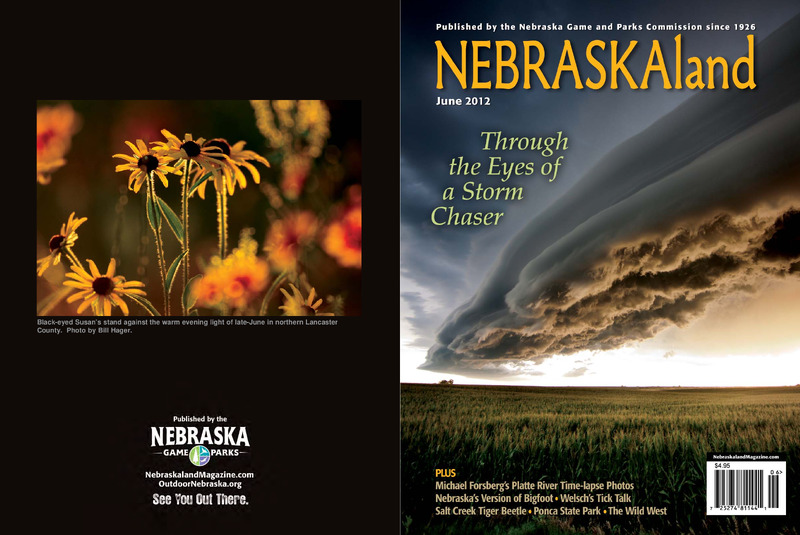
Black-eyed Susan’s stand against the warm evening light of late-June in northern Lancaster
County. Photo by Bill Hager.
Volume 90, Number 5, June 2012
12 Chapters from the Platte
Time-lapse photography project documenting landscape
changes along Platte River. TEXT AND PHOTOS BY MICHAEL FORSBERG
18 The Elusive 12-inch Crappie – Nebraska’s Version of Bigfoot
What does it take to have good crappie fishing here in
Nebraska? TEXT AND PHOTOS BY JEFF KURRUS
22 Through the Eyes of a Storm Chaser
A life-long interest in weather turns into a career of
documenting storms. BY KRISTIN FRIESEN, PHOTOS BY RYAN MCGINNIS
28 Nebraska’s Needlegrasses
With sharp, self-planting heads, needlegrasses are a wellnamed plant. BY GERRY STEINAUER
30 Ponca Park – Pick Your Passion
With a vibrant naturalist program, Ponca State Park truly is
“Where People and Nature Meet.” BY JEFF KURRUS
34 The Wild West – Keeping the American legend alive
Wild West exhibitions started by Buffalo Bill and others
continue to keep the spirit of the West alive. BY ELIZABETH MACK
40 Beetles on the Brink
34
●
Captive breeding now part of Salt Creek tiger beetle
recovery efforts. TEXT AND PHOTOS BY ERIC FOWLER
Comment ................................................................... 4
Mixed Bag................................................................. 6
Nature Notes ............................................................46
Outdoor Update........................................................47
Junior Journal...........................................................48
Page 49.....................................................................49
Classifieds ................................................................50
Portraits from the Past .............................................52
The Last Stop ...........................................................54
12
●
18
●
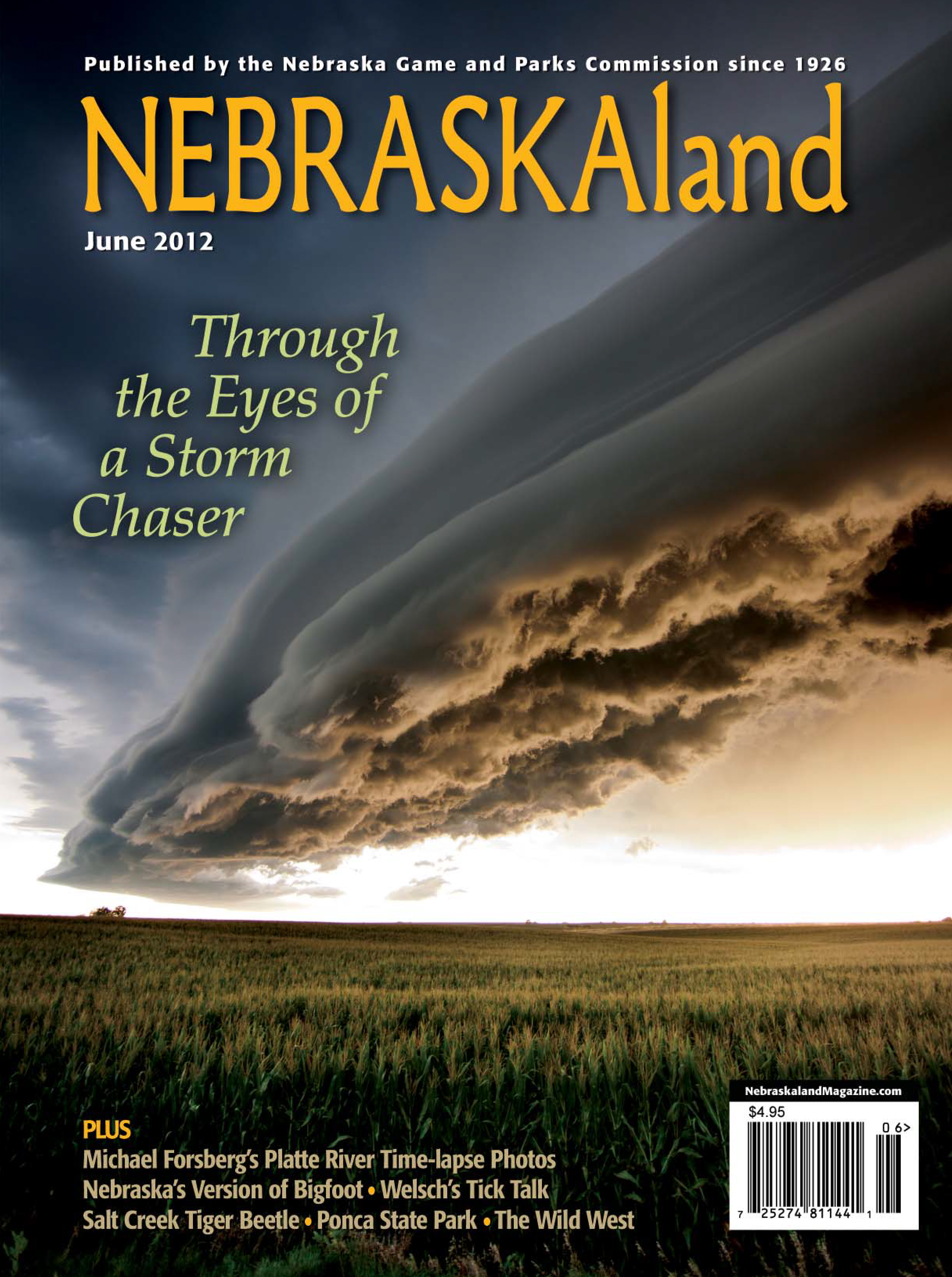
Cover: An arcus cloud over a cornfield just north of Kearney. An arcus
cloud is a low, horizontal cloud formation caused (in this case) by cold
winds rushing outward from a thunderstorm. See story on page 22. Photo
by Ryan McGinnis.
Opposite: A Henslow’s sparrow at The Nature Conservancy’s Caveny
Tract along the central Platte River. Photo by Chris Helzer.
NEBRASKAland (VOL. 90 / NO. 5, ISSN 0028-1964) is published monthly, except for the
combined Jan./Feb. and Aug./Sept. issues, by the Nebraska Game and Parks Commission,
2200 N. 33rd St., Lincoln, NE. Periodicals postage paid at Lincoln, Nebraska, and additional
mailing offices. POSTMASTER: Send address changes to NEBRASKAland, P.O. Box 30370,
Lincoln, NE 68503-0370.
2 NEBRASKALAND • JUNE 2012
30
●
JUNE 2012 • NEBRASKALAND 3
into the perfect shooting position and
got his gun loaded. Once he was ready,
I started doing some light calling.
I wasn’t able to set up a decoy
because the gobbler was only about
200 yards away in clear sight, but once
he heard my calls, the tom walked
toward us until he was 100 yards
straight across the field from us. I
called again and he took a left turn and
came straight to us as if on a string. It
was so cool to be there whispering in
my son’s ear to take the safety off and
then “Wait, wait, wait … ok, shoot.”
The entire experience took maybe
five minutes. I am afraid Josh will
now think bass fishing will mean to
throw a lure in and immediately catch a
10-pound bass!
Daron Smith
Murray, Nebraska
Start ‘em Young
Just wanted to share a couple of
photos that I took recently. One is of
my husband, Jeremy, and our 2-yearold son Ben, ice-fishing at Frye Lake.
The other is of Ben with his first
pheasant – my husband was carrying
him in a backpack when they shot it,
and since Ben wouldn’t be quiet after
that (too excited), it was the only one
they got that day!
Thanks!
Amanda Hankla
North Platte, Nebraska
Hooked for Life
My son, Joshua Everett, shot his first
turkey in Cass County on the opening
day of youth turkey season – April 7,
2012. The hunt was pretty incredible,
and he is hooked for life.
When I got Josh to where we were
going to set up that morning, I spotted
the gobbler before we even had a
chance to sit down. I got Josh down
and had to continue to encourage him
to move slow and be quiet as he got
4 NEBRASKALAND • JUNE 2012
Young Master Angler
Attached is a photo of my 13-yearold son, Levi, and the 44-inch,
36-pound, 4-ounce catfish he caught
this April at the Lake Maloney inlet.
Levi was using a worm for bait and
caught the fish with a big catfish pole
that his grandpa had just bought him.
A 250-pound friend of Levi held him
down in his chair while he reeled it
in! This is Levi’s third Master Angler
award – he received one for an 8-pound
wiper and one for a 8½-pound drum,
all caught from the Lake Maloney inlet.
Kim Simmons
North Platte, Nebraska
NEBRASKAland Visitor Letters
We want to thank all 39 readers
that sent e-mails and letters for last
issue’s visitor, a red long-horned
milkweed beetle that was on page 51
(see page 11 for the winner, rules and
this issue’s hint). Here are some of the
wonderful responses we received:
When I come home to find
NEBRASKAland in my mailbox, I
have to sit in the truck and scan the
pages front to back, wowing at the
photographs and getting an idea of
what I can look forward to reading
later. The history articles often top
the list, along with the “Oh, I want to
go there” ones. That milkweed beetle
nearly crawled out from the inside back
cover as I put the issue down so I could
drive on up the lane.
I subscribe to several midwestern
state-conservation magazine. None are
better than yours.
Diane Ipsen
Vinton, Iowa
The visitor on the top right corner of
the last page appears to be a longhorn
milkweed beetle Tetraopes basalis
(basalis).
I teach 7-12 science at Loup City
High, have my wildlife class do a bug
collection every year and it seems that
this is one of the more popular beetles
they enjoy finding. Some have even
preserved them in epoxy mounts using
Enviro-tex 50 coat that look very nice,
using slick plastic containers for molds.
I have enjoyed this magazine for
many years as I am also a hunter/
bowhunter ed instructor, and look
forward to each edition. Thanks
Jason Obermiller
Loup City, Nebraska
Thank you, Jason, for all you do to
help promote outdoor education!
– Editor
The visitor is in the upper righthand
corner of page 51.
Each month when NEBRASKAland
arrives it’s a competition between me
and my parents as to who can find it
first. Usually it ends up being my mom
(just because she gets the mail and
has a head start) but I’m proud to say
that this month I received the bragging
rights!
The whole family loves the magazine
and we thank you for the friendly
competition each month.
Katelin Lusch
Plattsmouth, Nebraska
The red milkweed beetle (Tetraopes
tetrophthalmus) is a common native
longhorn beetle found on milkweed
plants. Adult beetles are red to
reddish-orange, with 11 black spots,
black antennae and legs, and a body
length of about ½ inch. The milkweed
beetle has four eyes; their antennae,
which may be as long as their body,
are located between the two pairs of
eyes. Female beetles lay their eggs
on stems of the milkweed plant, near
the ground. The larvae hatch and
burrow into the stems, overwintering
in the roots. The larvae pupate in the
spring and emerge in mid-summer as
adults to start the cycle over. When
the beetles feed on the milkweed, they
ingest toxins found in the plant. The
bold coloring of the red milkweed
beetle is intended to warn predators
that the beetle is not a good meal.
Ignoring the warning and eating
a beetle may cause the
predator to get a stomach
ache, even throw up,
and be less likely to
eat another beetle in
the future.
Special thanks to Julie Van Meter, State
Entomologist, Nebraska Department of
Agriculture. Visitor image by Chris Helzer.
www.bugguide.net is a good site for identification
Send your comments to:
Doug Carroll, Editor
NEBRASKAland Magazine
P.O. Box 30370
Lincoln, NE 68503
or e-mail Doug.Carroll@Nebraska.gov
Please include your postal address and
telephone number.
Letters may be condensed and edited
for clarity. Photographs are welcome
and will be returned.
Any program that receives federal funding from the National Park
Service, or the United States Fish and Wildlife Service prohibits unlawful discrimination on the basis of race, color, religion, age, gender,
marital status, national origin, age, disability or political affiliation. Any
person who believes he or she has been discriminated against in
any program, activity, facility, or service, should contact the Nebraska
Game and Parks Commission, Lincoln, NE 402-471-0641, the Equal
Opportunity Commission, Lincoln, NE 402-471-2024, TTY/TDD 402471-4693; United States Fish Wildlife Service, Civil Rights Coordinator,
4401 N. Fairfax Drive, Arlington, VA 22203; Director, Equal Opportunity
Program, U.S. Department of Interior, National Park Service, 1849 C
Street NW, Mail Code 0008, Washington, D.C. 20240-0001.
COMMISSION
CONSERVATION OFFICERS
Director Jim Douglas
NORTHWEST
Officer
City
Jim Zimmerman (S) Gering
Commissioners
Chairman - Ron Stave, Waterloo
Vice Chairman - Norris Marshall, Kearney
2nd Vice Chairman - Jerrod Burke, Curtis
Dr. Mark Pinkerton, Wilber
Dr. Kent Forney, Lincoln
Lynn Berggren, Broken Bow
Rex Fisher, Omaha
Mark Spurgin, Paxton
Mick Jensen, Blair
MAGAZINE STAFF
Editor Doug Carroll
Associate Editor Jeff Kurrus
Art Director Tim Reigert
Senior Editor Jon Farrar
Regional Editor Eric Fowler
Contributing Editor Michael Forsberg
Regular Contributors Bill Hager, Chris Helzer,
Lisa Knopp
Photo Librarian Sarah Johnson
Circulation Donna Robinson
For address changes and questions about
your subscription, e-mail Donna.Robinson@
Nebraska.gov
or call (800) 632-5263
Marketing/Advertising
For advertising information contact
Larson Enterprises
e-mail dave@larsonent.com
or call (515) 440-2810
NEBRASKAland Magazine Copyright 2012, all rights reserved.
NEBRASKAland is available on audio cassette from the Nebraska
Library Commission Talking Book and Braille Service, Suite 120, 1200 N
St., Lincoln, NE 68508. (800) 742-7691. NEBRASKAland Magazine and
the Nebraska Game and Parks Commission reserve the right to reject any
advertising not in keeping with the agency mission.
Rates: $18 for one year; $33 for two years; $44 for three years. Nebraska
recipients must add appropriate sales tax. To subscribe call
1-800-NEBLAND (632-5263), or go online to: NebraskalandMagazine.
com.
COMMISSION OFFICES
Headquarters/Southeast District Office
2200 N. 33rd Street Lincoln, NE 68503
Phone (402) 471-0641
Northeast District Office
2201 N. 13th St. Norfolk, NE 68701
Phone (402) 370-3374
Southwest District Office
301 E. State Farm Rd. North Platte, NE 69101
Phone (308) 535-8025
Northwest District Office
East Hwy. 2, Box 725 Alliance, NE 69301
Phone (308) 763-2940
Bassett Office
524 Panzer St., Box 508 Bassett, NE 68714
Phone (402) 684-2921
Kearney Office
1617 First Ave. Kearney, NE 68847
Phone (308) 865-5310
Omaha Office
1212 Bob Gibson Blvd. Omaha, NE 68108
Phone (402) 595-2144
Greg Hesse
Scott Brandt
Heath Packett
Dan Kling
Frank Miller
Phone (308)
(office) 763-2940
(cell) 641-6138
Alliance
760-3647
Gering
631-0663
Gordon
360-0682
Harrison
430-0572
Valentine (402) 389-0444
SOUTHWEST
Officer
City
Phone (308)
Roger Thompson (S) N. Platte (office) 535-8025
(cell) 530-3097
Ray Dierking
Brkn. Bow
870-0322
George Sund
Cambridge
655-0028
Michael Thome
Cozad
529-8146
Terry Brentzel
Doniphan (402) 469-5795
Matt Andrews
Elwood
746-2418
Dirk Greene
Imperial
882-0015
Jerry Pecha (Sup.) Kearney (office) 865-5327
(cell) 293-3551
Dale Johnson
Kearney
440-3847
Brian Piernicky
McCook
340-6627
Dudley Sorensen
N. Platte
530-0016
Nicholas Fix
Ogallala
289-0427
Dennis Thompson
Ogallala
289-0755
Rich Routh
Rep. City
920-0367
NORTHEAST
Officer
City
Tom Zimmer (Sup.) Norfolk
Dale Davis
Steve Oberg
Daniel Roberts
Randy Pomplun
Jeff Jones
Jon Reeves
Tim Williams
Pat George
Doug Pollard
Cory Krause
Phone (402)
(office) 370-3374
(cell) 649-8053
Bassett
760-0712
Columbus
910-3366
Fremont
719-1108
Fullerton (308) 550-0489
Hartington
762-5022
Kennard
889-8508
Neligh
929-0051
O’Neill
340-0787
Ord
(308) 778-7101
West Point
380-6410
SOUTHEAST
Officer
Sean McKeehan
William Krause
Mike Luben
Dan Zuehlke
Darin Gress
Douglas Kramer
Dina Barta
Stacey Lewton
Levi Krause
Robert Finke
Russell Mort
Dan Evasco
City
Ashland
Auburn
Colon
Cortland
Hebron
Lincoln
Lincoln
Lincoln
Louisville
Milford
Nebr. City
Papillion
Phone (402)
521-0159
274-8063
443-6392
806-9084
768-8665
890-6465
890-6463
890-7140
949-0593
947-1363
209-1506
616-5961
ADMINISTRATION
Officer
Craig Stover (Adm.)
Duane Arp (Ass.)
Jeff Clauson (Ass.)
City
Lincoln
Lincoln
Lincoln
Phone (402)
471-5531
471-5531
471-5531
Nebraska Wildlife Crimestoppers 1-800-742-7627
Ak-Sar-Ben Aquarium
21502 W. Highway 31 Gretna, NE 68028
Phone (402) 332-3901
JUNE 2012 • NEBRASKALAND 5
Creighton Prep Shooter Wins Cornhusker Cup
Nick Zuerlein of Omaha Creighton Prep won the Cornhusker Cup this year as
the overall champion at the 43rd Cornhusker Trapshoot.
Zuerlein shot 192x200 over two days and led the Creighton Prep Blue squad
to the overall team title as well. The team, which shot 940x1,000, also included
Ryan Glow, Andrew Pavlic, James Vasko and Brandon Metzler.
“We’re shooting for team medals,” Zuerlein said. “Individual titles are just icing
on the cake. It’s more about shooting with friends I have shot with for so many
years, and having a good time.”
Zuerlein spoiled Cody Newlun’s bid to repeat as the overall champion.
Newlun, shooting for Hastings 4-H No. 1, took second place with a 191x200 after
defeating teammate Adam Florian in a shoot-off.
Cory Sorahan of Grand Island High won the girls’ overall championship,
shooting a 188x200.
The Omaha Marian Blue team captured the overall girls’ team title, shooting a
859x1,000. Team members were Kelsey Genoways, Savannah Uden, Lori Nevole,
Maddie Worth and Anna Vasko.
The Hastings No. 1 team of Newlun, Florian, Zach VanBoening, Cole Fisher
and Marcus Long shot an 859x1,000 to win the 4-H team championship.
During the junior high portion of the trapshoot, Casey Petersen of the Western
Nebraska 4-H trap team in Mitchell won top honors with a score of 99x100 on
16-yard targets. The Norris No. 1 team of Cole Anderson, Ian Kernes, Dylan
Osterhaus, Logan Armkneckt and Terran Goering won the junior high team title
with a score of 456x500.
There were 1,273 shooters competing in the senior high division of this year’s
Cornhusker Trapshoot and 780 junior high competitors. The event, the largest
youth trapshoot in the nation, is hosted by the Nebraska Game and Parks
Commission and the Nebraska Trapshooting Association.
Send Us Your Trail Cam Photos!
Here is a list of
upcoming outdoor
events across
Nebraska.
For more
information
about these
and other
events,
visit the
calendar page at
www.OutdoorNebraska.org.
June 1 - August 12
Fort Robinson Post Playhouse
To purchase tickets or view the
schedule of shows, visit the website
at: www.postplayhouse.com.
June 2-3
Rock Creek Trail Days
Historical interpretations and a
buffalo stew cookout Saturday.
Contact the park at (402) 729-5777 or
ngpc.rock.creek.station@nebraska.
gov.
June 2-3, June 30-July 1
Fort Atkinson Living History
Volunteers portray life at an
1820s military fort. Contact the
park at (402) 468-5611 or ngpc.fort.
atkinson@nebraska.gov.
June 8-10
12th Annual Intertribal Gathering
Pow Wow at Fort Robinson State
Park near Crawford. Contact the
park at (308) 665-2900 or ngpc.fort.
robinson@nebraska.gov.
June 9
Wildflower Walk at Wildcat Hills
9 am - 12 pm. Contact the nature
center at (308) 436-3777 or ngpc.
wildcat.hills@nebraska.gov.
June 16
Outdoor Skills Workshop for Men
Experience real hands-on skills
at Platte River State Park. Contact
Christy Christiansen at (402) 4715547 or christy.christiansen@
nebraska.gov.
June 26
Free Fishing Clinic at Mahoney
Ron Bilstein of Battle Creek sent us this photo of a coyote with
a cottontail rabbit in its mouth.
Please submit your trail camera photos by e-mail to:
nebtrailcam@gmail.com. Also include any information that
will help explain your photo.
6 NEBRASKALAND • JUNE 2012
10 am - 2 pm. Hosted by Go
Fishing Omaha. Instruction on
equipment, water safety and actual
fishing. Equipment is furnished
by Go Fishing Omaha for each
participant. Valid fishing permits
required for persons over 15.
Contact Carl “Catfishman” Brown at
(402) 681-6265 or oldcatfishman@
cox.net.
Turtles and Frogs Oh My!
Common Lambsquarter: Not Just a Weed!
Kimberly Stuhr
You most likely pluck this common
invader out of your vegetable garden
or flowerbed on a routine basis. But
common lambsquarter is actually an edible, tasty, and
nutritious vegetable. In
fact, it has more vitamins
and minerals than most
domestically cultivated
green leafy vegetables,
including spinach.
Similar to dandelion
greens, lambsquarter
has an earthy, mineral
rich flavor that is
wonderful steamed
or added raw to salads.
Lambsquarter greens were a
staple among Native American
tribes; Lewis and Clark ate them
along the trail; and early settlers
ground the seeds into flour.
Lambsquarter is extensively
cultivated and consumed in northern
India as a food crop. In Asia and
Africa it is fed to livestock. Some
American Indians used it to make
green dye for their bows and arrows.
And for centuries the Chinese have
turned the hardened stems into
walking sticks. Lambsquarter is also
a traditional African medicinal plant,
used to relieve stomach aches and to
treat burns and itches.
Lambsquarter was once thought to be
a native of Europe and Asia. However,
archaeological studies show that
seeds were stored and used by Native
Americans during the 16th century.
Likewise, European archaeologists
8 NEBRASKALAND • JUNE 2012
have found seeds mixed with
conventional grains in storage pits and
ovens at Iron Age and Roman sites.
The seeds have even been found
inside the stomachs of Danish
bog bodies. Thus, the native
range of lambsquarter is
obscure due to extensive
cultivation and because
it readily hybridizes
with similar species.
It’s no surprise that
the USDA PLANTS
Database considers
lambsquarter both
native and introduced.
After you learn to
identify lambsquarter, you
may be surprised to find it
growing all around you. But
after you prepare a batch of the fresh
leaves and stems, the biggest surprise
may be just how much you enjoy the
taste of this plant that you previously
considered a weed.
Lambsquarter Fritters
2 cups wilted, chopped greens
1 1⁄4 cups dry fine breadcrumbs
(reserve 1⁄4 cup to coat patties for
frying)
1
⁄2 cup Italian cheese
1
⁄4 cup finely chopped onion
2 eggs
1
⁄2 tsp. salt
1
⁄4 tsp. pepper
Healthy dash of cumin
until wilted. Let cool, squeeze out
excess water. Coarsely chop and then
fluff in a bowl. Add eggs and mix.
Add salt, pepper, cumin, cheese and
onions, mix thoroughly. Add 1 cup
breadcrumbs and mix. If mixture seems
dry, add a small amount of water; if
wet, add extra breadcrumbs. Form
into patties and coat with reserved
breadcrumbs. Fry fritters in olive oil to
a golden brown. Makes eight fritters.
Special thanks to nature enthusiasts
Jarel Vinduska for the original recipe,
and to Connie Anderson for testing and
tweaking the recipe.
Lambsquarter eaves are highly variable
ranging from triangular- to diamondshaped, and somewhat toothed to mostly
smooth. They are light green on top with
a distinctive white scale on the underside.
Flowers are green and very small,
growing in dense clusters at the tips of
the main stems and at branch junctions.
Flowers blossom from June to September
producing tiny fruits that contain tens of
thousands of even smaller black seeds.
Stems are green with purplish streaks.
Plants grow three to four feet tall.
The Ak-Sar-Ben Aquarium Outdoor
Education Center will host a display of
turtles and frogs the first weekend of
each month this summer.
Educators from the Nebraska Game
and Parks Commission will show and
discuss Nebraska’s common frogs and
turtles from noon to 4 p.m. each day,
answering any questions that visitors
might have. The public is invited to see
and touch these animals up close, while
learning how they survive in the wild.
The aquarium is located in Schramm
Park State Recreation Area, south of
Gretna. For more information about the
program or the aquarium, call 402-3323901.
Jerry Merwald of Omaha chose
his message plate about 10
years ago for his fondness of flyfishing, which has taken him from
coldwater streams in the Nebraska
Sandhills to the Rocky Mountains to
Alaska, and the pattern that any self-respecting fly angler should have
in their box to match the afternoon hatch. When he gets a thumbs up
on the road, he knows he’s met another angler.
If you have a unique outdoor message plate you would like to share
or know someone who does, e-mail a photo (high-resolution, JPEG
format only, please) of it to Eric.Fowler@Nebraska.gov, along with your
name, hometown and a brief description of the interests expressed on
your license plate.
Gather approximately 3⁄4 gallon of
fresh young greens, discard tough
stems. Wash thoroughly and steam
JUNE 2012 • NEBRASKALAND 9
10 NEBRASKALAND • JUNE 2012
Million Dollar Fish
Top Fishing Equipment Brands for 2011
The Nebraska Game and Parks
Commission has teamed up with
Cabela’s to sponsor the “Wanna Go
Fishing for Millions?” promotion, in
which anglers can catch tagged fish to
win cash and prizes.
In April the Commission tagged fish
in Box Butte, Calamus, Cunningham,
Harlan County, Lewis and Clark,
McConaughy, Merritt, Swanson,
Wagon Train and Wehrspann
reservoirs. Tagged species include
largemouth bass, smallmouth bass,
white bass, wipers, walleye and
channel catfish.
Between May 5 and July 8, anglers
who catch tagged fish can receive
cash and merchandise worth $50 to
$2 million. Anglers must be at least
18 years old to be eligible and register
at cabelas.com/fishformillions or at a
Cabela’s store before catching a tagged
fish.
Tagged fish must be caught legally,
and to receive a prize, the angler must
take a digital photograph of the fish
with the tag intact before removing
the tag. The photo, tag number and
information regarding the details of the
fish and catch location must be entered
into the cabelas.com/fishformillions
web site. Anglers should retain the
tags, as the grand prize winning tag
must be provided to Cabela’s. Only one
tag number may be claimed per day.
Prizes will be awarded at the end of
the promotion and include up to 907
Cabela’s gift cards, 100 rod and reel
combos, 50 line and bait packages, 50
pairs of sunglasses and two Ranger
boats outfitted with Evinrude 250HP
outboard motors.
There also will be a grand prize
worth $1 million if the tag is among
the first 10 tags redeemed nationwide,
$100,000 if it is from the 11th to the
100th tag redeemed, and $10,000 if
it redeemed after the 100th tag. If a
participant is a current user of the
Fish Recon smart phone application
or downloads the Cabela’s Fish
Recon application at least two days
before catching a tagged fish, he or
she will qualify to double the grand
prize. Those not wanting to download
the application can send Cabela’s a
postcard as explained on the web site.
FERNANDINA BEACH, Fla. Southwick Associates’ AnglerSurvey.
com announced the brands and
products anglers purchased most
frequently in 2011. This list has been
compiled from the 29,495 internetbased surveys completed by anglers
who volunteered to participate last year
in AnglerSurvey.com polls.
In 2011, the top brands included:
• Top rod brand:
Shakespeare (9.6%
of all purchases)
all purchases)
• Top tackle box
brand: Plano (45.8%
of all purchases)
• Top landing net
brand: Frabill (24.5%
of all purchases)
• Top fishing knife
brand: Rapala
(25.2% of all
purchases)
• Top reel
Largemouth bass remain the number
one targeted species of freshwater fish,
with 52% of fishing activity targeting
largemouth bass.
• Top fishing line
Great Park Pursuit Open
brand: Shimano
(21.4% of all purchases)
producer: Berkley
Trilene (13.1% of all purchases)
• Top hard bait
brand: Rapala
(21.8% of all purchases)
• Top soft bait
brand: Zoom (15.2%
of all purchases)
• Top spinner bait brand: Strike King
(16.4% of all
purchases)
• Top sinker
brand: Generic
(28.8%), Bullet Weights (12.1% of all
purchases)
• Top fly rod brand: Orvis (10.4% of
all purchases)
• Top Fly Reels
brand: Orvis (16.5% of all purchases)
• Top fly combo
brand: Cabela’s
(31.5% of all
purchases)
• Top fly line
brand: Scientific
Angler (3M)
(23.8% of all
purchases)
• Top fly leader
brand: Rio (28.9% of
Teams can still register for the Great
Park Pursuit, which is back for its fifth
year of encouraging healthy outdoor
lifestyles through visits to Nebraska
parks located across the state. The
rewards include increased awareness of
recreational opportunities and a chance
to win prizes, including three grand
prizes with a retail value of $1,000
each.
Participants have 20 local, state
or federal parks to visit from May 1
through Sept. 17. At each park, they
follow clues to locate a post where they
make a tracing of a nature impression.
They then mail in the tracings,
reflecting the total number of parks
visited. Entry into prize drawings are
based on the number of impressions
collected. Participants (individuals or
teams) can register online at negpp.
org or request a packet and registration
form by calling 402-471-5425.
Select a park from the 20 available
on the Locations page at the web site,
then print off the page and take it to
that park. Follow the clues on the park
page to locate a post. Make a tracing of
the impression, and then plan your next
Pursuit park trip.
The Pursuit is hosted by the
Nebraska Game and Parks Commission
and the Nebraska Recreation and
Park Association. Last year 3,368
participants on 765 teams took part in
the program.
Turpin Time
Dick Turpin
Man, I think I’m
in heaven, but I’m
not…the sign out
front said Chadron
State Park. Established in 1921, I’m
not surprised that Chadron became
Nebraska’s first state park. Towering
ponderosa pines dominate this park.
Miles of trail lace the area. With an
altitude that in places approaches 5,000
feet, you can usually keep your cool
even on warm summer days. You can
expect all the amenities and activities
typically found in a major state park…
cabins and camping…horses and
hiking…pedaling and paddling…tennis
and tanning. And history? The fur trade
era of this nation once thrived in this
region. Just east of Chadron, a replica
outpost and museum is considered one
of the best on the subject.
For a refreshing outdoor experience,
come to Chadron State Park and in
relax in its majestic beauty. I still think
it’s heaven. ■
NEBRASKAland Visitor
Winner and Hint
Last issue’s winner of
the Visitor drawing was
Diane Ipsen of Vinton,
Iowa, who found the
red long-horned milkweed beetle
on page 51 (see her letter on page 4).
Readers are encouraged to contact
NEBRASKAland within 10 days
after this issue’s publication with the
correct page number and name of
this issue’s “Visitor” – a bug found
in Nebraska that just happened to
find its way onto one of the pages.
We will then gather the correct
entries and draw one to win a
NEBRASKAland Magazine mug.
To enter each month, write:
NEBRASKAland Visitor
2200 North 33rd Street,
Lincoln, NE 68503.
Or e-mail:
Tim.Reigert@Nebraska.gov
with “Visitor” in the subject line of
the message.
HINT: This issue’s visitor is not
on page 5, 7, 40-45, 47, or 49.
JUNE 2012 • NEBRASKALAND 11
Chapters
from the
Platte
“By the end of 2012, a total of 45 time-lapse
cameras will in operation, each taking a photo
every daylight hour of each day, 365 days a year,
for what we hope are several years to document
changes on the landscape and put this elegant and
complex river system in motion.”
By Michael Forsberg
I
t was a cold, snow-covered
day along the Platte River
in early March 2011 when
a team that included Michael
Farrell, a veteran producer for
NET television; Jeff Dale, a
camera technology expert; Bill
Hager, a Lincoln-based nature
photographer; and myself
flipped the switch on the first
camera setup we had installed as
part of a multi-year effort to do
time-lapse photography of the
Platte River Basin.
One year later, 24 time-lapse
cameras have now been installed
across the basin, from as high
as 11,000 feet above sea level at
Lake Agnes near the Continental
Divide in northern Colorado,
to Pathfinder Dam in eastern
Wyoming, to the confluence of
the Platte and Missouri rivers at
Schilling Wildlife Management
Area near Plattsmouth. By the
12 NEBRASKALAND • JUNE 2012
●2
●1
The calm before the storm – evening light bathes a windmill stock tank in the Nebraska Sandhills on the University of Nebraska’s
Gudmundsen Research Ranch north of Whitman. The Platte River Basin derives its water from three key sources: snowmelt from
the Rocky Mountains, precipitation from our region’s weather and climate, and groundwater-fed springs, seeps and streams from
the immense Ogallala Aquifer that lies beneath much of the state.
●4
●2
●
6
●5 ●1
●3 ●7
Photographer and field advisor Bill Hager installs a custom-built, time-lapse camera
system on a pasture fence at Mormon Island. This camera, in place since March
2011, is focused on a wet meadow slough in a large prairie grassland hydrologically
connected to the Platte River. The resulting time-lapse photos have revealed seasonal
changes in water levels, grassland growth and grazing, and use by cranes, waterfowl
and shorebirds during migration.
The Platte River Basin drains 90,000 square miles of Wyoming, Colorado and Nebraska and includes habitats from from alpine
tundra to floodplain. The numbers on this map correspond to the time-lapse camera locations indicated on each photo in this story.
JUNE 2012 • NEBRASKALAND 13
●3
●3
●3
14 NEBRASKALAND • JUNE 2012
end of 2012, a total of 45 timelapse cameras will in operation,
each taking a photo every
daylight hour of each day, 365
days a year for what we hope
are several years to document
changes on the landscape and
put this elegant and complex
river system in motion.
Roughly 90,000 square
miles in area, the Platte River
Basin gets its water from three
key sources: snowmelt in the
Rockies, groundwater from
the immense Ogallala Aquifer
that lies beneath Nebraska, and
precipitation in the form of rain
and snow from our region’s
weather. Each camera put in
place helps tell a different
chapter in the story of water
and its contribution to the Platte
River system.
The Platte Basin Time-lapse
project (PBT) is supported
by a collaboration of private
and public partners, with
numerous cooperators such as
the Nebraska Game and Parks
Commission. By following that
proverbial drop of water from
the top of the watershed all the way through the
system, PBT’s vision is to help us better understand
where our water comes, the natural and man-made
processes that move it through the system, and to
further scientific research and education.
The resulting time-lapse videos allow us to
see this complex river system in motion and in
short snippets can show viewers both natural and
man-made processes on the landscape that may
take months or years in real time: from flood and
drought cycles to the changing of the seasons,
formation of sandbars or the spread of invasive
species, restoration of a wetland to grazing
management of a grassland, the delivery of water
to a crop field, and the ebb and flow of water in a
reservoir.
Over the course of this last year, the project’s
cameras have been mounted on everything from
fence posts to pine trees, granite cliff faces to
observation towers. There have been challenges:
One camera was lost to flooding, spiders have
made webs over the lenses, and birds have used the
camera structures as perches and pooped on solar
panels, to name a few.
These cameras will act as long-term
environmental monitoring instruments, not just
making pretty pictures but recording visual data
that can be linked up with other information such as
weather and stream-gauge data – even water quality
measurements.
As these images are collected and time-lapse
A time-lapse camera mounted on Eugene
T. Mahoney State Park’s observation
tower between Lincoln and Omaha
captures an overview of the Lower
Platte River and its wooded bluffs and
floodplain. The Lower Platte is mostly
fed by groundwater from the Loup River
Basin, which drains a large portion of the
Nebraska Sandhills and enters the Platte
near Columbus. This location is also very
near Lincoln’s well field, where the city of
250,000 draws its water supply.
Completed in 1909, Pathfinder Dam and Reservoir holds 1.2 million
acre feet of water. It was the second major project undertaken by
the U.S. Bureau of Reclamation, and is part of a series of dams and
reservoirs that feed agriculture, municipal and power generation uses
along the North Platte River in eastern Wyoming. During “normal
conditions,” water enters Fremont Canyon through the dam’s needle
valve outlet (top). During the spring and summer of 2011, however,
above average snowpack and precipitation in the North Platte
watershed resulted in water running over Pathfinder spillway for only
the fourth time in history (bottom).
●4
●4
JUNE 2012 • NEBRASKALAND 15
This bird’s-eye view from a research
tower at Audubon’s Rowe Sanctuary
looks upstream and includes a major
roost for sandhill cranes each spring.
With above average water levels,
time-lapse imagery here since early
March 2011 has helped reveal the
dynamic nature of sandbar formation
and sediment transport within the
“Big Bend” reach of the Central Platte
between Kearney and Grand Island.
●5
●5
●7
●6
videos are made, they are uploaded to a dedicated
web site to be shared with the public. Over time,
the interactivity of the web site will increase, and
we hope to build both a citizen science component
and provide a forum for students and citizens to
show and tell their own stories about the river and
this basin they call home. ■
16 NEBRASKALAND • JUNE 2012
●5
Editor’s Note: The Platte Basin Time-lapse
Project will be featured at the Lake McConaughy
Visitor and Water Interpretive Center beginning
in early summer with a large, touch screen
interactive display.
To learn more about the project, visit,
www.plattebasintimelapse.com.
Left: The Lake Agnes time-lapse camera in northern Colorado is the project’s furthest west and highest camera placement at
11,000 feet above sea level. Above: The furthest east time-lapse camera is at Schilling Wildlife Management Area near Plattsmouth,
anchored in place at the confluence of the Platte and Missouri rivers. During the 2011 flood, the water level rose higher than where
area manager Neal VanWinkle’s hands are holding the ladder. Fortunately, the installation remained in place.
JUNE 2012 • NEBRASKALAND 17
The Elusive 12-inch
Crappie
While trophy crappie are
common in private waters
throughout Nebraska,
multiple factors
influence their scarcity on
public areas.
Nebraska’s Version of Bigfoot
By Jeff Kurrus
The crappie is an oft-discussed species in Nebraska
due to the state’s inability to produce consistent
trophy crappie fisheries in its public waters. Here are
answers why this is the case, and how you can help.
The Problem
First, the primary purpose for the
majority of our reservoirs, where most
of our crappies are found, is irrigation.
That means we don’t have the stable
water conditions that many of those
waters south of the border have.
Second, Kansas’ reservoirs, overall, are
larger compared to ours. With this size
usually comes enough bays and fingers
to supply good habitat. In addition to
stable waters and more habitat, their
growth rates are faster than ours.
But enough about Kansas. Let’s
talk more specifically about what
is not working here. First, in the
small- to medium-sized reservoirs
of eastern Nebraska, the crappie
numbers are strong but there aren’t
18 NEBRASKALAND • JUNE 2012
enough largemouth bass to stabilize the
populations. Plus, there is more fishing
pressure in this region of the state.
Combine these two points and it’s easy
to see why we have few slab crappie.
A Biologist’s
Confessions
“I can’t give you
any easy answers on
Nebraska’s crappie
issues,” said Daryl
DARYL BAUER
Bauer, a fisheries
biologist with the Nebraska Game and
Parks Commission. “What I can do is
tell you how complicated the problem
is.”
Ideally there would be higher
largemouth bass densities in our
reservoirs to control each year-class
of crappie, said Bauer, and with fewer
crappie the survivors would grow fast.
This scenario is often seen in the many
farm ponds across the state that have
excellent crappie fishing.
In order to help make up for the
low number of bass in some waters,
biologists often turn to length limits to
help manage the size and number of
PHOTO BY JEFF KURRUS
A
ttention all Nebraska crappie
fishermen: Let’s go ahead and
get it out the way. You know it
and we know it: Kansas generally has
better crappie fisheries than Nebraska.
But why? And how can you, our
faithful anglers, help? Let’s briefly
discuss why Nebraska has to play
second fiddle to the Sunflower State, at
least when it comes to crappies.
JUNE 2012 • NEBRASKALAND 19
Nebraska’s ability to have stable
populations even more. “Black crappies
do better in clean, clear water with lots
of vegetation, while whites do better
in murky water and reservoirs with
flooded timber,” said Bauer.
It would seem simple then, to just
match the type of water with the type
of fish that will do best there, but
there are a couple of reasons why it
isn’t: First, “bucket biologists” – those
anglers who feel compelled to stock
fish themselves – often add their own
fish to the equation with little regard
(or knowledge) of how it will affect a
fishery. Second, fluctuating water levels
and surrounding environmental factors,
including erosion, can alter a given
waterbody considerably throughout a
year, affecting the habitat needs of each
species.
Lastly, when both black and white
crappie are in the same waters, they
hybridize, further complicating this
seemingly endless dilemma.“We just
don’t have ideal conditions for either
species,” said Bauer. “We’re stuck in
the middle.”
Biology of a Slab
Exclusively found in North America, the crappie is one of the nation’s most
popular sport fish due to their palatability and catchability. They belong to
the sunfish family, Centrarchidae, which also includes largemouth bass and
bluegills, and contain two distinct species – the black and white crappie.
While a novice might assume they can be differentiated by color, this often
is not an adequate way to distinguish the two. Instead, the most reliable
method is to count the dorsal fin spines. While blacks normally have seven
or eight, whites will have six, or maybe even five, spines.
Crappies are found in all of the lower 48 states, as they have been
introduced throughout the country. Originally black crappie were found
in the eastern United States, while white crappie extended from eastern
South Dakota to New York, then south to Alabama and Texas. There is also
another difference between the two: While black crappie tend to grow
slower than their white brethren, a black crappie of equal length to a white
will weigh more.
Each spring, crappies move into the shallows to spawn when the water
nears 56 degrees. Males build the nest, not unlike others in the sunfish
family, near some sort of underwater cover. Nests can be found anywhere
from one foot of water down to 20 feet in depth.
The female then enters the nest and can lay as many as 180,000 eggs.
She can also produce eggs multiple times during the same spawning period.
The eggs will hatch in two to four days, and the fry will then be guarded by
the male for several days before they leave the nest. Their diet consists of
aquatic insects, tiny crustaceans and eventually small fishes. By their second
or third summer, these fish will be sexual mature until they die, on
average, within the next couple of years.
PHOTO BY JEFF KURRUS
What You Can Do
Eight- to ten-inch crappie are abundant at many lakes throughout the state, including
this one caught at Wehrspann Lake in eastern Nebraska. Only with some restraint, and
ideal spawning conditions, can Nebraska produce more trophy fish each year.
crappie in a given body of water, with
mixed results.
“These fish live hard and die young,”
said Bauer. “That’s why fast growth is
so important – they may only live four
or five years. So length limits haven’t
had a lot of success.”
One contradiction, however, is
Sherman Reservoir – while also an
irrigation reservoir and thus prone
to fluctuation throughout the year,
Sherman is consistently full each May
and features a number of bays and
coves. Crappies head into these areas
each spring to spawn, and the lake has
a low enough density of fish that some
10- to 12-inch crappie can be caught
there.
Such situations aren’t consistent
across the state, however, and are
even further complicated because
of the differences between black
and white crappie. These two
species, differentiated on sight only
by knowledgeable anglers, have
contrasting habitat needs that hinder
How can you help? Throw a fish
or two back when you’re catching
big ones. Yes, I know this is tough,
considering how well breaded crappie
fillets go with a side of hushpuppies,
but that’s what needs to be done.
“Any given year, any one of the
Salt Valley lakes will have excellent
crappie fishing,” said Bauer. “But then
word will get out, it will get pounded
by anglers, and then the crowd will
move on to the next lake.” Such intense
pressure often ruins a crappie fishery
for several years, if not forever.
It’s a vicious cycle for crappie
anglers, but one that can be managed
with a little restraint. It doesn’t stop
at managing crappie either – don’t
remove trophy bass from reservoirs
with large populations of crappie. Take
a picture instead. Those big bass help
control the population of small crappie,
giving others a chance to grow up.
It’s a matter of common sense and a
common goal. Both the biologists and
anglers want the same thing – big, fat
slabs the size of a dinner plate, with
half the gas it takes to drive south of
the border. ■
Catching
Crappie Now
Let’s not get complicated: Those
same weedlines, contour breaks,
and pieces of flooded timber
where other fish species can be
found are also perfect for finding
crappies. Jigs of various sizes,
including 1⁄16- to ¼-ounce, can
be fished with a rubber, Gulp!,
or live trailer. Fish these with
light spinning tackle using a slip
bobber, vertical jigging, or simply
casting and reeling to find fish.
Once you find fish, either move
until you find the size of fish
you’re looking for, or adjust your
gear size and color in search of
larger or more fish. It’s as simple
as these few techniques, and is a
great way to introduce a young or
novice angler to fishing. Crappie
are often caught in bunches
because they travel in schools,
and there’s no better way to
show new anglers a good time
than actually catching fish. Plus,
it’s just not that hard for them to
get started by themselves.
The white crappie
is distingished from
the black by its
fewer (5 or 6)
dorsal spines.
On average,
rage,
black crappie
rappie grow
slower than their
white counterparts
ounterparts but will
usually weigh more at an
equal length.
ength.
FISH ARTWORK BY JOSEPH TOMELLERI
20 NEBRASKALAND • JUNE 2012
JUNE 2012 • NEBRASKALAND 21
Through the Eyes of
a Storm Chaser
By Kristen Friesen
Photos by Ryan McGinnis
A
The Center for Severe Weather Research’s “Doppler on Wheels” radar truck scans a storm in the Nebraska Panhandle on June
5, 2009, during Project Vortex 2. This radar truck gathers data near tornadoes in an effort to discover why some storms form
tornadoes and others don’t.
22 NEBRASKALAND • JUNE 2012
as young boy of six or seven, Ryan
M
McGinnis informed his parents that,
w
wh
when he grew up, he was either going
t be a storm chaser or ride on the
to
bback
ba
ackk off the
th
he garbage
g
truck smashing garbage. Not
long afterwards, his father got him a subscription
to “Storm Track” – a storm-chasing magazine
published at the time that focused on storm chasers,
but also had stories aimed at children. To say he
was hooked would be an understatement – even his
childhood diary is full of weather-related records.
For McGinnis, however, weather has always
been far more than child’s play, and despite always
being sent to the basement over is objections by his
“safety-conscious” parents whenever the sky turned
the color of split pea soup, his interest in stormy
weather continued to grow.
Not surprisingly, McGinnis began his college
career majoring in meteorology … until he realized
that field was “mostly calculus” and that by
following that career path he would likely end up
sitting behind computer screens, doing forecasting.
Turns out that desks, for weather-smitten folks such
as McGinnis, are nearly as confining as basements.
Perhaps inspired by sentences beginning with
“It was a dark and stormy night,” McGinnis then
headed to the University of Nebraska – Kearney
to major in English. He also bought a camera and
began, in his own words, “shooting like crazy.”
By the time he graduated in 2001 (and before he
switched to a digital camera) he had more than 500
rolls of film containing photos of storms, urban
panoramas and candid shots tucked away in a closet.
Official degree and trusty camera in hand, he then
spent the next few years working at the Lincoln
Journal Star doing digital touchups, which put him
in the path of creative people, stunning photography
and ultimately a career change.
Despite all the storm-chasing he was doing in
his free time, McGinnis still found time to chase
Jasmin, now his wife of four years, with whom
he had worked at Kearney’s Country Kitchen. It
was Jasmin’s support (and regular paycheck) that
allowed McGinnis to turn his storm-chasing hobby
into an actual profession by photographing storms
and selling the images.
“The first time I realized I could make a go of this
was back in 2007,” said McGinnis, “when someone
from Germany wanted my photos to advertise their
cameras.”
In addition to the large number of cameras, lenses
and computer hardware and software that he needs
for his work, his annual business expenses include
roughly 15,000 miles on his vehicle, as well as
spontaneous (and sometimes lengthy) time away
from home.
McGinnis can still remember his first chase in
Kearney – a real “monster storm” in mid-June,
2002.
“I went up to the local gas station, filled up with
gas, drove north out of town, then overshot and
drove right into five-and-a-half inch hail, which
Project Vortex 2 participant Josh Barnwell sits at the radar data
control inside a “Doppler on Wheels” radar truck.
These computer screens both control and display all
the data acquired by the vehicle’s instruments.
JUNE 2012 • NEBRASKALAND 23
basically totaled my Honda Civic,” he said. One large hailstone,
estimated to be at least the size of a baseball, hit the top of his
car so hard that his dome light ended up in the backseat. OK, so
his work also requires regular brushes with danger.
“There is a kind of science to what storm chasers do,”
McGinnis explained. “You have to understand a bit about
weather and forecasting in order to see really good storms to
keep yourself out of a lot of trouble.”
In order to find the best storms – and avoid being caught in
the worst – McGinnis relies on a cocktail of sources and several
different weather-model websites to do his own forecasting.
Two of his favorites are the National Oceanic and Atmospheric
Administration’s (NOAA) weather website (www.noaa.gov/)
and the National Severe Storms Laboratory site (www.nssl.
noaa.gov/).
McGinnis’s hobby turned profession has now taken him all
over the Midwest and has allowed him to meet a variety of
people in the “chasing community,” including people from
Left: A tornado spins in the distance near
Deer Trail, Colorado, June 10, 2010. This
tornado was studied by Project Vortex 2.
Above: A squall line approaches a
farm in north-central Kansas, May 26,
2006. A squall line is a long line of
thunderstorms, sometimes several
hundred miles in length, that usually
produces heavy winds, rain and hail.
Opposite: A white tornado photographed
near O’Neill on May 29, 2004. Tornadoes
sometimes appear white when they are
illuminated by the sun and are seen from
the west.
24 NEBRASKALAND • JUNE 2012
all over the world who come to the U.S. simply for
the thrill and experience of being part of the most
informed chases.
In 2009, McGinnis was given the opportunity to
follow along with Project Vortex 2, an $11 million
project funded by the National Science Foundation
and NOAA to study how and why tornadoes develop.
The project, which pulls together more than 60 people,
50 vehicles and 10 radar trucks “led by a bunch of
PhDs, ” only rolls around once every 10 to 15 years.
So the little boy who simply wanted to watch storms
JUNE 2012 • NEBRASKALAND 25
A low precipitation (LP) supercell with a tornado spins in the distance near Deer Trail, Colorado, June 10, 2010. An LP supercell is a
type of rotating storm with little precipitaion. This tornado was studied by Project Vortex 2.
26 NEBRASKALAND • JUNE 2012
Despite his success and vast experience, the
sheer magnitude of the storms he chases still makes
McGinnis feel “absolutely humbled” and very
aware of the danger inherent to his work:
“It’s not my goal to get close to tornadoes – the
closer you get to the tornado, the less you’re able
to see the entire storm,” he said. “It’s my goal to
take good pictures
of good storms.” ■
Editor’s note:
To see more of
McGinnis’s
photos, visit
bigstormpicture.
com, where he
also blogs about
his storm-chasing
adventures.
PHOTO BY LANETTE EPPS
has now morphed into a man “logistically interested
in how scientists gather information.”
Still living in Kearney, McGinnis continues to
chase storms whenever the opportunity presents
itself and markets his work. Some of his photos
are sold as wall art, while others have been used in
textbooks, advertising and to market such things
as the IMAX movie “Tornado Alley.” Talk of
putting one of his images on the side of a bus in
Boston has McGinnis absolutely tickled, because it
would allow that particular storm to “move” again,
while helping to illustrate a Great Plains storm for
an audience that may never had had a chance to
experience one themselves.
“A storm can be twice as tall as Mount Everest,
and while people here have seen it, people on the east
coast may never have,” said McGinnis. “What’s
hard to capture in words through pictures can do
the storm justice.”
Storm chaser and IMAX director Sean Casey’s “Tornado Intercept Vehicle 2” parked off the road at Interstate 80 Exit 285
near Gibbon on May 29, 2008. Casey had just intercepted the tornado that struck Kearney.
JUNE 2012 • NEBRASKALAND 27
Nebraska’s
Needlegrasses
By Gerry Steinauer, Botanist, Nebraska Game and Parks Commission
PHOTO BY KEN BOUC
T
hree species of needlegrass grace Nebraska’s prairies.
They are distinguished from other native grasses by
their elongate, needle-tipped seed heads with long
trailing awns, an ingenious design for self-planting.
Needle-and-thread (Stipa comata) thrives in Sandhills and
mixed-grass prairie over the western two-thirds of the state.
Porcupine grass (Stipa spartea), a tallgrass species, ranges
over the eastern half of Nebraska and extends westward
only along the cooler northern tier of counties. Green
needlegrass (Stipa viridula) prefers dry, often clayey soils
of prairies and open woodlands nearly statewide, but is
absent from areas of the south and east and is most abundant
northward.
Needlegrasses have an ancient history in Nebraska.
Fossilized seeds of Berriochloa, the likely ancestor of our
present day needlegrasses, have been found in late Miocene
(11 to 5 million years ago) deposits in Nebraska, including
th
those
at Ashfall Fossil Beds in
Antelope
A
County. Here paleontologists
discovered
d
Berriochloa seeds in the
oral
o cavities and rib cages of fossil
rhinos
(Teleoceras). The seeds were
rh
part
p of the rhinoceroses’ final meal.
Soon
after dining the rhinos, gathered
S
by
b a pond, were overcome, buried
and
a preserved by smothering clouds
of
o volcanic ash from a cataclysmic
eruption
e
in the Rocky Mountains.
RHINO FOSSIL AT ASHFALL
Porcupine seed heads (above) are designed for self-planting.
28 NEBRASKALAND • JUNE 2012
The eloquent, yet functional, awns of modern
needlegrasses arise from the top of the lemna, the lowermost
of two protective bracts tightly enveloping the seed. On
needle-and-thread, this awn (the thread) can be seven inches
long, the upper portion loosely coiled. The straight awns of
porcupine grass are up to six and a half inches long. Green
needlegrass awns are only one to one and a half inches
long and distinctly bent in the middle. Needlegrass awns
are composed of two separate strands, which on mature
seed heads dry at varying rates in response to changes in
temperature and moisture, such as the evaporation of a
morning dew, causing them to twist and coil. When seed
heads fall to the ground, often landing tip first, the twisting
drills them into the soil. The slightly curved, pointed tips
(less so on green needlegrass) act as auger bits to help seed
heads drill into the soil, and a collar of long, thick, retrose
(backward-facing) hairs behind the tip prevent them from
exiting the soil. Seed burial increases germination rates and
protects seeds from prairie fire and predation (mice and
other rodents are fond of the large, nutritious seed grains of
needlegrasses).
Needlegrasses begin growth in early spring and flower in
late spring and early summer. Livestock readily graze them
spring through fall, though needle-and-thread and porcupine
grass are avoided while bearing seed heads as they can lodge
in the mouth or face of grazers, bore in and abscess. The
treatment is to open and drain the abscess. The seed heads
can also entangle in sheep’s hair, degrading the quality of
the wool and penetrating the skin. If hayed, needle-andthread
and porcupine grass are harvested before seed heads
t
develop.
Green needlegrass seeds are not troublesome for
d
livestock.
l
When collecting needle-and-thread or porcupine grass
seeds
for prairie restorations, we strip handfuls of seed heads
s
from
plants, align the tips, and clip the awns with pruning
f
shears
– otherwise the stored seed heads will twist into a
s
gnarled,
unplantable mass. While collecting, my brother
g
once
had a porcupine grass seed head wedge itself under his
o
thumbnail.
Unable to remove it, it bore deeper and festered
t
painfully
until surgically extracted. A co-worker, with the
p
bad
b habit of using porcupine grass seed heads as makeshift
toothpicks
while wandering the prairie, once accidentally
t
swallowed
one that imbedded deep in his throat causing a
s
distressing
infection and swelling. A large dose of antibiotics
d
was
w required to relieve his suffering.
Ethnobotanist Melvin R. Gilmore, in his 1912 book,
Uses of Plants by the Indians of the Missouri River Region,
reported that Indian children used porcupine seed heads
as throwing darts. The straight awns and heavy seed of
porcupine grass make its seed heads a more effective dart
than those of the coil-awned and lighter seeded needle-andthread or the short-awned green needlegrass. For
those wishing to continue this Indian tradition, pull about
20 nearly ripe seed heads from plants, arrange them in a
tight bundle with tips aligned, grasp the bundle in the
middle and fling it into the back of an unsuspecting target.
From a distance of five feet or less the darts will penetrate
the shirt and stick lightly in the skin, causing only a shortlived tinge of pain often accompanied by the utterance of a
profanity.
A one- to two-inch diameter bundle of nearly ripe
porcupine grass seed heads with tips aligned and tightly
bound around the lower awns with string or rubberband
will dry into a contorted, artful display. When my motherin-law’s elderly friend viewed such a display on a china
cabinet (a gift from me) she exclaimed with dismay: “That’s
a terrible grass! My dad made me dig it out of our pastures
as a kid.” Though disliked by some, needlegrasses deserve
admiration for their unique adaptations that allow these
beautiful grasses to make the prairie their home. ■
Right: By early summer, the seed heads of green needlegrass
are well developed, as in this South Dakota prairie restoration.
Below: Neede-and-thread growing in a Sandhills prairie located
in Brown County.
JUNE 2012 • NEBRASKALAND 29
KAYAKER AND AERIAL PHOTO BY ERIC FOWLER
PHOTO BY JEFF KURRUS
PHOTO BY JEFF KURRUS
JUNE 2012 • NEBRASKALAND 31
30 NEBRASKALAND • JUNE 2012
PHOTO BY JEFF KURRUS
PHOTO BY ERIC FOWLER
HORSEBACK AND AERIAL PHOTO BY ERIC FOWLER
32 NEBRASKALAND • JUNE 2012
JUNE 2012 • NEBRASKALAND 33
The Wild West
Keeping the American Legend Alive
By Elizabeth Mack
For a month past the great event to which all our citizens were looking forward was
the appearance of the Cody and Carver combination, with their original and novel
Nebraska show, entitled the “Wild West.”
– The Omaha Daily Bee, May 21, 1883
T
Prairie
P ii
Exhibition” (he was careful not to use
the word “show” in the title, as he
argued the performances were “reality
itself”) and others like them served as a
way to satisfy the public’s fascination
with the West. Even as early as the
late 1880s, Cody and others believed
the West was dying, and that his
exhibitions were a way to keep it alive.
According
to Sarah Blackstone, author
Accord
of Buckskins,
Bullets and Business,
Buck
by the time
Cody’s shows were at the
t
height of
o their popularity in the early
1890s,
1890s “all but four of the Western
territories
had become states, the
terri
last Indian uprising had been
quelled,
and there were four
qu
transcontinental
railroads.”
tr
Settlers
were coming west by
S
the thousands, and for Buffalo
Bill, these exhibitions served
to not only entertain, but to
quell what was becoming
known as “frontier anxiety.”
Many Americans became
concerned, believing the free
land was nearly gone, and
feared its disappearance would
change society. The belief that
the
t frontier had ended created
a nostalgia that spurred many
Americans
to wonder what they
Am
had missed by not going west.
The Wild
W West shows satisfied their
craving for adventure.
Cody’s
Cody exhibitions, which thrilled
audiences
audienc with displays of shootouts,
stagecoach
robberies and Indians on
stageco
foot
f t racing against horses, glamorized
the West. According to Paul Reddin,
author of Wild West Shows, these
elaborate “re-enactments” satisfied
a cultural need for Americans who
COURTESY OF NEBRASKA STATE HISTORICAL SOCIETY
34 NEBRASKALAND • JUNE 2012
public’s imagination. What was, and
continues to be, the attraction to these
shows and the Wild West?
Cody’s “The Wild West, Rocky
Mountain,
and
PHOTO BY PASQUALE MINGARELLI
he newspaper excerpt above
describes the first ever Wild
West exhibition of William
F. “Buffalo Bill” Cody,
performed in Omaha to an
enthusiastic crowd. Along with Cody
ody
was his one-time partner, Doc Carver,
ver,
and their large troupe of performers,
rs,
including Capt. A.H. Bogardus (U.S.
.S.
champion trap shooter), as well as
numerous Pony Express riders
and Sioux, Omaha and Pawnee
Indians (Chief Sitting Bull and
Annie Oakley would later join
the troupe) and even a small
herd of buffalo. The newspaper
reported “no less than 8,000
persons were present to witness
the opening” of Cody’s
extravaganza, a substantial
number even by today’s
standards.
Buffalo Bill’s re-enactments
were the first in a long line
of Wild West exhibitions that
served to keep the legend of the
outlaws and gunslingers alive;
more than 80 companies have beenn
documented to operate in the late
19th and early 20th centuries, and
these re-enactments continue to thrive
rive
today. On any given weekend across
oss
the country, re-enactment troupes
depict the era of the rough-and-tumble
mble
cowboy hero. Though America’s
history boasts many interesting and
unique periods, it is the era of wild,
western cowboys – roughly 1860
to 1890 – that seems to capture the
In Buffalo Bill’s Wild West show posters, the Congress of Rough Riders were always highlighted as great hunters, expert
equestrians and skilled sharpshooters. The posters – and word of mouth – were the primary forms of advertisement at the time.
Even today, modern reenactors often try to keep the legends of the Wild West alive by dressing in period dress (left) and using
replicas of period weaponry as they recreate famous gunfights or popular heroes of the time.
JUNE 2012 • NEBRASKALAND 35
COURTESY OF NEBRASKA STATE HISTORICAL SOCIETY
COURTESY OF UN-O CRISS LIBRARY
Many Wild West exhibition posters often depicted heroic riders coming to the rescue of white settlers from the “savage Indians,” as
shown here. The show’s depiction of Indians reinforced inaccurate stereotypes that followed Native Americans into 20th century
films.
This Omaha Daily Bee clipping reports
Buffalo Bill’s 1883 opening exhibition a
“sensation.” The show was over three
hours long and thousands attended.
36 NEBRASKALAND • JUNE 2012
wanted to see the conquest of the
country as a grand accomplishment
filled with drama and excitement:
“Characterizing the winning of the
Plains frontier as easy and peaceful
would have minimized something that
Americans wanted to see as heroic.”
It would have been difficult (and
boring) to show a farming family
raising a cabin and planting crops –
Americans needed a larger-than-life
hero to represent the epic “conquering”
of the Plains, and the dashing and
adventurous Buffalo Bill Cody fit the
bill. Cody’s “National Entertainment”
advertised “Object Lessons” and
“Educational Exhibitions” but Buffalo
Bill’s realistic portrayals of the West
were often so mingled with myth, it
became impossible to differentiate
between the two.
These myths of the Wild West began
with the minstrel shows and popular
music in the 1840s. During this period,
American showman P. T. Barnum
exhibited Indian chiefs, dances and
an array of Wild West displays in his
museums before he became known
for his circus. The myths grew bigger
and more exaggerated when the dime
novel took off in the late-1850s. These
novels captured the public’s fascination
with sensational tales of violence and
heroics – cowboys versus Indians,
lawmen versus outlaws, settlers versus
predatory cattlemen. One of the most
successful of these dime novels was
Ned Buntline’s series on William
Cody. Buffalo Bill Cody - King of the
Bordermen was the first of 550 titles
featuring the hero. Bill Cody decided to
promote his own now widely popular
legend, and after a brief stint in the
theater began to form his traveling
Wild West exhibitions.
At the height of its popularity,
Cody’s Wild West show performed
to a crowd of 18,000 at Chicago’s
World’s Fair in 1893. At the same
fair, a scholar declared in a speech
that “The frontier has gone.” This was
the beginning of the end of the Wild
West shows. Cody’s exhibition closed
up for good in 1913, partly due to
the advent of the motion picture. The
first narrative film ever in 1903, The
Great Train Robbery, was inspired by
the robbing of a Union Pacific train
by Butch Cassidy’s Hole in the Wall
Gang. Other exhibitions continued with
mixed success for another decade, but
the characters lived on. Even though
the Wild West shows were dying
off, the shaping of the mythological
American hero continued in paintings,
dime-novels and film. Buffalo Bill
became the most often-portrayed
western hero in re-enactments and on
screen.
“It’s embedded in Americans’
psyche. When we see those characters
riding the range, taming the horses,
saving the farm or ranch, it touches on
our basic emotions of not only survival,
but that we can make a difference,”
said J. B. Tyson, Nebraska filmmaker
and film studies specialist. “It comes
down to the basics of good versus evil.
Even though the idea of the Wild West
and its heroes is based in legend and
surrounded by myth, the desire to be
that hero is real.”
Even though these shows slowly
came to an end, they created a passion
for western-style entertainment, and the
contemporary rodeo is a direct result
of Cody’s Wild West exhibitions.
Though informal rodeos existed in the
1820s and 1830s, competitive rodeo
emerged after the Civil War, and often
Wild West shows introduced rodeo
exhibitions into their acts. The only
difference is Buffalo Bill’s and other
shows hired performers instead of
prize-money contestants. Professional
rodeo had an explosion of popularity
in the decade after World War I, and
in many cases, “rodeo” seemed to
be substituted for “Wild West” as a
more popular drawing card. Today’s
rodeos often intermingle westernstyle re-enactments with competition.
North Platte’s NEBRASKAland Days
Wild West Re-Enactments –
Nebraska to Arizona
Nebraska
Rock Creek Trail Days – Fairbury, Nebraska. First weekend in
June.
Railroad Days – Railroad heritage at Durham Western Heritage
Museum, Lauritzen Gardens, Union Pacific Railroad Museum, The
Historic General Dodge House and RailsWest Railroad Museum in
Omaha, Nebraska. July.
Grand Duke Alexis Rendezvous – Russian Czar, Alexander II, the
Grand Duke Alexis visited Nebraska in 1872 for a buffalo hunt led
by Buffalo Bill Cody, General George Custer, and General Phil
Sheridan. This celebration includes storytelling from the “actual”
characters and other events at Camp Hayes Lake, Hayes Center,
Nebraska. September.
NEBRASKAland DAYS – Buffalo Bill Rodeo, The Frontier Revue,
Heritage Festival and more. North Platte, Nebraska. June.
The Great Platte River Road Archway – Kearney, daily.
•
•
•
•
•
Outside Nebraska
of the Gunfighters – Yuma, Arizona. January.
• Gathering
Last Stand Re-enactment & Little Bighorn Days – Hardin &
• Custer’s
Crow Agency, Montana. June.
Bill’s Wild West Days – Sheridan, Wyoming. June.
• Buffalo
Wild
West
– Much Ado About Nothing or . . . A Whole
• Lotta Fussin’Shakespeare
over Nothin’ – American West Heritage Center, Logan
Utah. Weekends in July.
came out of Buffalo Bill’s “Old Glory
Blowout,” which celebrated the Fourth
of July in 1882 and is argued to have
been the first rodeo in the country.
Cheyenne Frontier Days is another
immensely popular example, going
strong since 1897.
Another legend that lives on in
re-enactments is Wild Bill Hickok.
Rock Creek Station, located on the
outskirts of Fairbury and established
along the Oregon Trail as a stage and
Pony Express stop, is where Hickok
began his gunslinging career in what is
known as the “McCanles Massacre.”
In 1980, the Nebraska Game and
Parks Commission began to develop
Rock Creek Station as a state historical
park. Today, the park hosts “Rock
Creek Trail Days” the first weekend of
June, an event that boasts living history
demonstrations, stagecoach rides,
trick roping demonstrations, a buffalo
stew cookout and re-enactments of the
McCanles-Hickok shootout.
“We do basket weaving,
blacksmithing, loom weaving and
other period-specific demonstrations,”
said Judy Weers with the Rock Creek
Station Visitors Center and Museum,
“but the shootouts with the re-enactors
are always the most popular.”
Harlin Krueger, along with his
wife Carol and a band of about 15
volunteers, form the Old West Theater
Group, a band of re-enactors who
perform the famed McCanles shootout
that set Wild Bill Hickok’s reputation
in motion, at Fairbury’s Trail Days:
“We not only recreate the actual
shootout that took place here, but we
also reenact the Pony Express changing
of the mochila.” These mochilas (from
the Spanish word for “knapsack”)
were thrown over the saddle and held
in place by the weight of the rider,
and the mail pockets (cantinas) were
padlocked. Only two minutes were
allowed at a station, so changing of the
Pony Express’s mochila became an art
unto itself.
“I got started in cowboy action
shooting and that got us started doing
the re-enactments,” said Krueger.
JUNE 2012 • NEBRASKALAND 37
Myth of the Savage Indian
COURTESY OF NEBRASKA STATE HISTORICAL SOCIETY
history to younger kids.
“Kids will come up to us after a
performance and ask if we’re ‘real’
cowboys. We get a chance to educate a
new generation,” he said.
The era portrayed by Wild West
Creations’ cowboys is the lawless era
after the end of the Civil War, which
according to the troupe, was dominated
by diverse personalities of law abiding
and lawless men and women settling
the untamed land.
“Part of the charm of the old west, as
viewed through our eyes, has always
been the colorful characters of those
days,” says Deb Skinner, director of
marketing for Wild West Creations.
“We find that live performances of the
old west history are the best way to
bring the west alive.”
Americans are not the only audience
hungry for a taste of our rough and
rowdy history. Wild West re-enactment
groups are widely popular in England
and other European countries. One
large troupe meets every weekend in
their own “Western” town in England.
Nestled in the Kent countryside outside
of London is the town of Laredo, an
Annie Oakley and the
Role of Women
Though arguably the first female superstar,
sharpshooter Annie Oakley’s (nicknamed “Watanya
Cicilla” or “Little Sure Shot” by fellow performer Sitting
Bull) presence in Buffalo Bill’s Wild West shows was
not the result of Cody or other management wanting to
recognize the role of frontier women. After auditioning
in 1884, they decided the show had no position for her
until sharpshooter A. H. Bogardus left unexpectedly.
Oakley auditioned again and was hired, so having
her was more a result of an unplanned hiring than
any inclination of Cody or management to include a
white woman in the show. Cody’s later autobiography
included little mention of any contributions of women
– the “winning of the West” was still believed to be a
strictly male accomplishment.
38 NEBRASKALAND • JUNE 2012
“We’re getting older so we don’t
do as much as we used to, but the
re-enactments are extremely popular.”
Buffalo Bill and Wild Bill Hickok were
both famed Pony Express riders before
they became famous gunslingers.
Another popular troupe of
re-enactors is Wild West Creations out
of Omaha. Frank Murcek, a.k.a. Wyatt
Earp, along with his brother, Steve,
and a band of outlaws, stage shootouts,
bank and train robberies, and will even
perform a shotgun wedding if needed.
“When I was young, I grew up with
the western on TV, so I’ve always
had a love for cowboys like John
Wayne, Roy Rogers and Gene Autry,”
says Murcek. “In 1958, of the top 10
programs on TV, seven of them were
westerns. Now there are none. So for
us, it’s the nostalgia, and what we do in
the re-enactments is bring this part of
COURTESY OF NEBRASKA STATE HISTORICAL SOCIETY
Many Oglala Sioux tribe members traveled with Cody’s Wild West troupe, but often wore costumes from tribes other than their own
during the shows’ performances.
Ned Buntline, Buffalo Bill and
Texas Jack; 1872.
Scholars believe that negative stereotypes of Native Americans grew out
of the same dime novels and Wild West shows that glamorized the cowboy
and gunfighters. William Cody is said to have greatly respected and admired
the great Indian chiefs, featuring them prominently in his shows as noble
warriors, though in many of his exhibitions, Cody featured Native Americans
as wild savages attacking whites – with Cody and his Rough Riders riding
in to save the day. Some of the re-enactments included the Lewis and Clark
Expedition, Battle of Little Bighorn and many battles from the Plains wars.
Other performances depicted were “Attack on Setter’s Cabin” and “Attack
on the Emigrant Train,” where natives were defeated by the brave settlers.
Custer’s Last Stand was staged with actual survivors of the melee. All were
paid for their performances and also made side money signing autographs
and photographs after the show.
Native Americans taking part in Cody’s show included:
Sitting Bull (who never actually performed in any re-enactments)
Black Elk
Geronimo
Rains in the Face (reported as the man who killed Custer)
Standing Bear
Most of the Native Americans used in the shows came from the Pine
Ridge Reservation and were Oglala Sioux, but had to represent themselves
from multiple tribes. Many of the Native Americans used the shows as a way
to advance recognition of Indian lives, as well as an avenue to be “useful
and productive” citizens. Both Standing Bear and Black Elk discuss their
experiences in the Wild West shows in their respective autobiographies, “My
People the Sioux” and “Black Elk Speaks.”
“authentic” Wild West town complete
with twenty-six period-correct
buildings lit by oil lamp, cowboys and
saloon girls, stagecoaches and hitching
posts. Colin Winter, Laredo’s resident
spokesperson, believes the popularity
of the Wild West for outsiders is
rooted in childhood nostalgia: “I think
it goes back to when we were young
– we were always playing cowboys
and Indians. I always watched the old
films with Roy Rogers, Lone Ranger
and Cisco Kid – we had some great
adventures.”
J.B. Tyson believes America’s
vibrant history not only crosses cultural
boundaries, but geographic boundaries
as well: “A rich history has the ability
to intertwine geography and capture the
imagination of any generation.”
The old West conjures up images of
cowboys and Indians, six-shooters and
spurs, John Wayne and Roy Rogers.
Who hasn’t, at some time in their
childhood, slung a holster over their
hips and challenged the neighbor kid
to a quick draw? Even though the Wild
West is now only a faint memory, the
Wild West exhibitions have created a
lasting image of the American West.
Although the shows are based largely
on myth, they have helped in some
ways to preserve part of the history
of the American frontier, including the
colorful characters of the legendary
time. As the public continues to remain
enthralled with the long-vanished
rugged frontier and its inhabitants,
re-enactments live on to capture the
strength and spirit of the wild, wild
West. ■
Historical information was taken
from Wild West Shows by Paul
Reddin; The Wild West: A History of
the Wild West Shows by Don Russell;
Buckskins, Bullets and Business by
Sarah Blackstone; Outside American;
Race, Ethnicity, and the Role of the
American West in National Belonging
by Dan Moos.
For more information on Wild West
Creations, go to wildwestcreations.net.
Visitors to England can find the town
of Laredo 25 miles outside of London,
or visit their web site at laredo.org.uk.
JUNE 2012 • NEBRASKALAND 39
Captive breeding now part of
Salt Creek tiger beetle recovery
Text and photos by Eric Fowler
A
fter spending most of the past
year in the comforts of climatecontrolled incubators at the
Lincoln Children’s Zoo and Omaha’s
Henry Doorly Zoo, eleven larvae of
the endangered Salt Creek tiger beetle
were released into the real world in
early May. This month the captive
breeding program that produced those
larvae will reset in hopes of rearing
and releasing even more next year and
making headway toward the recovery
of the species, one of the rarest in
North America.
The captive breeding program is
currently helping supplement the
three known existing populations of
this half-inch-long, metallic brown to
olive green insect that lives only along
moist stream banks and muddy areas
free of vegetation that are associated
with equally rare saline wetlands
in Lancaster County. If successful,
this program could help reestablish
populations at other locations.
Historically, saline wetlands
comprised about 65,000 acres of the
Salt Creek watershed, an abundance
that spawned a short-lived salt industry
and led to the founding of Lincoln.
As the city grew, however, more than
90 percent of these wetlands were lost
40 NEBRASKALAND • JUNE 2012
to development and to channelization
and bank stabilization of creeks. As
the beetle habitat plummeted, so did
the number of beetles. Their range is
now the smallest of any insect in the
United States: All known populations
are found along a seven-mile stretch of
Little Salt Creek on the north edge of
Lincoln. At three other locations where
beetles were once found – another site
along Little Salt, on Rock Creek near
Ceresco and at Capitol Beach on the
western edge of Lincoln – none have
been seen since at least 1999.
Steve Spomer, a University of
Nebraska-Lincoln entomology research
technologist involved in Salt Creek
tiger beetle research since the 1990s,
found just 318 insects during his
annual survey in 2011, nearly double
the number he found in 2008 but less
than half of the 2003 count.
Repeated flooding along Little
Salt Creek washed away the insects’
burrows, causing the 2008 decline,
but there are other threats, including
contaminated runoff, which could
significantly affect the population. Such
vulnerability was the impetus for the
Nebraska Game and Parks Commission
adding the insect to Nebraska’s list of
endangered species in 2000. It gained
protection of the federal Endangered
Species Act in 2005.
Threats to the Salt Creek tiger beetle
also launched the captive breeding
program and many other research
projects at UN-L to study the species’
life cycle. “It became evident that
we could be in the same boat as the
California condor where it was possible
that with a couple of really catastrophic
events we could actually lose the beetle
in the wild, so we decided it was time
to start looking at captive rearing,” said
Mike Fritz, natural heritage zoologist
with the Commission.
Federal grants obtained by the
Commission were used to fund the
UN-L life history research, which
began in 2001. There is still much to
be learned about the process, which
isn’t easy considering the insect spends
the first two years of its life as larvae
in underground burrows and lives only
six to eight weeks above ground as an
adult, all in locales with very specific
requirements.
In 2010, the captive rearing program
grew into a cooperative effort between
the U.S. Fish and Wildlife Service, the
Commission, UN-L, and the Lincoln
and Omaha zoos. Sixty-seven larvae
propagated at UN-L were moved to
incubators at the Lincoln Children’s
Zoo, resulting in nine larvae being
released in May 2011.
In June 2011, soon after adult insects
began to emerge and during the peak
of the breeding season, 15 pairs were
collected from the healthiest population
and taken to the Henry Doorly Zoo for
● Adults emerge in lateMay or early-June and
feed, breed and lay eggs
until they die six to eight
weeks later.
● Eggs hatch into larvae
in two weeks.
● Insects remain in larval
stage for next two years,
going through three instar
growth stages until they
pupate and emerge as
adults.
JUNE 2012 • NEBRASKALAND 41
ILLUSTRATION BY TIM REIGERT
Stephy Hanigan, a keeper at the Lincoln Children’s Zoo, returns a vial containing a
captive-bred Salt Creek tiger beetle larva to an incubator after feeding it fruit flies.
Salt Creek tiger beetles captured along Little Salt Creek north of Lincoln mate in a lab in the Henry Doorly Zoo in Omaha last June.
Salt Creek tiger beetles emerge in early-June and spend their entire six- to eight-week
adult lifecycle feeding and breeding. Left: As if watching from a cave entrance, a
tiger beetle stands in a deer track in the mud along Little Salt Creek last June. Below:
University of Nebraska-Lincoln researcher Steve Spomer uses a sweep net to capture
a tiger beetle for the captive breeding program as Bob Harms, a U.S. Fish and Wildlife
Service biologist from Grand Island, watches.
also allows researchers to spread the
risk of experimenting with variables
such as temperature, lighting, moisture
and salinity.
Spomer said the University
experimented with keeping beetles
throughout their life cycle – the
original goal of the program and one
still on the table for the future – but
saw few adults emerge, and only one
at the same time wild beetles were also
emerging. That fact and research with
other species of tiger beetles, which
found more success releasing larvae
mid-life rather than releasing adults, is
why the program is centered on larvae.
This year, researchers will be
intensively monitoring the larvae that
are released. Weekly visual inspections
will record changes in burrow size,
which will show whether the larvae
breeding. The same will be done early
this June.
“It’s kind of a balancing act because
you have to have enough adults to get
enough eggs to have the larvae for
rearing, but at the same time you don’t
want to deplete the wild population to
the point where you’re going to make it
crash,” said Fritz.
Adult males are kept with the
females for 10 days to ensure
successful mating, and females kept
for two weeks before being returned to
the wild. The insects breed throughout
their entire adult life, with females
laying 40 to 50 eggs, so some wild
reproduction may also occur before or
after they are captured.
In captivity, females lay their eggs
in petri dishes filled with a special
mixture of saline soil similar to what
females would select in their natural
habitat. The eggs hatch into larvae
about two weeks later, at which point
they are carefully moved into soil-filled
vials. Half of the larvae are then sent to
the Lincoln Children’s Zoo, ensuring
that if an incubator or something else
were to fail in one location, an entire
year’s effort is not lost.
Larvae are fed live crickets or fruit
flies daily. A predator at each stage of
42 NEBRASKALAND • JUNE 2012
its life, the tiger beetle larvae wait at
the top of their burrows, their heads
filling the opening, and ambush any
prey that comes close, grabbing it with
their toothy mandibles and pulling it
into their burrow.
In the wild, when temperatures begin
to drop and days become shorter in the
fall, Salt Creek tiger beetle larvae seal
off the ends of their burrows and begin
hibernation. When temperatures and
the amount of light increase around
April, larvae open their burrows and
become active once again.
These conditions are replicated
in the incubators, and it is during
this period of increased activity that
the captive-reared larvae are being
removed from the vials and returned
to the saline wetlands, where they will
spend another year before pupating into
adults just prior to their emergence.
While researchers have been
experimenting with captive rearing for
about a decade, a perfect procedure has
yet to be developed – of the more than
100 eggs laid in Omaha last year, only
27 developed into larvae.
“We’re just really scratching our
heads over that one, trying to figure out
why that happened,” said Spomer. “We
never get as many larvae as we have
are surviving and growing. High-tech
monitoring equipment will record the
soil temperature and moisture 12 to
18 inches below the ground, the depth
of most larval burrows.
“We don’t know what the
temperature of those burrows is over
the winter,” Fritz said, noting that
while the frostline might reach three
feet in some locations, groundwater
circulation likely keeps beetle habitat
much warmer. “So if we’re keeping
them in the lab at 40 degrees, is that
too warm? Are they using up their
energy reserves? Is that why we’re
getting mortality at the lab? But we
don’t know what the mortality is in the
wild, either.”
The information they gather may
uncover factors that can be used to
increase success in the captive-rearing
eggs. We never have. There’s always
the problem that some eggs are infertile
or they die from other reasons – we
really don’t know. But last year seemed
to be worse than normal.”
With more people now involved
in the process, however, there are
more heads to scratch, something Bob
Harms, the Grand Island-based FWS
biologist overseeing the Salt Creek
tiger beetle project, hopes will lead to
increased success. “We’re evolving,”
he said. “It made sense to have a lot of
people who would have some expertise
involved, because then you put all
these people together and you have
this synergy where one person thinks
of this and one thinks of that. We’re
trying to come up with a recipe for
how to rear Salt Creek tiger beetles.
There are lots of unknowns, so we have
to move forward and try things.”
Researchers don’t know how many
eggs develop into larvae for wild
beetles. Likewise, they don’t know
how many larvae typically survive the
first winter, but they were happy with
the 40 percent survival rate they had
this year. With both eggs and larvae,
they are confident survival is higher in
the lab, where they can ensure eggs and
larvae don’t dry out. The partnership
JUNE 2012 • NEBRASKALAND 43
program.
For now, captive-reared larvae will
only be released at locations where
there are currently wild beetles,
supplementing and hopefully bolstering
those populations. With so few larvae
available, there is too much risk in
releasing them on previously occupied
sites and hoping both male and female
larvae survive a year in the wild and
find each other following emergence.
Researchers may place traps over
the burrows next spring to capture
any adults that emerge, which would
provide a true measure of survival and
success but could also put those adults
at risk of exposure to weather they
could otherwise escape. Knowing that
number, however, will tell researchers
how many breeding pairs they would
need to ensure they will have enough
adults emerge if and when they are
ready to reintroduce larvae to other
areas that have supported beetles in the
past.
Historically, Salt Creek tiger beetles
could move throughout the basin, but
UN-L research has shown that beetles
today don’t move more than a half
mile. The gaps between occupied and
unoccupied habitat are much greater.
“They aren’t necessarily going to go
and colonize new areas,” Harms said.
“We’ll have to help them along by
doing a reintroduction.”
In the meantime, Salt Creek
tiger beetle numbers as a whole are
climbing. Some of that growth could
be attributed to restoration work done
at Frank Shoemaker Marsh, a saline
wetland on North 27th Street on Little
Salt Creek acquired by the city of
Lincoln in 2003. That work included
creating or restoring five seeps along
the creek to serve as beetle habitat.
In 2011, Spomer found beetles on
all but one of those sites, and the 78
individuals he found was double the
2010 survey.
“That’s been very encouraging,” he
said. “Hopefully we can mimic that at
Arbor Lake.”
Arbor Lake, also located on
Lincoln’s north edge, is a saline
wetland owned by the Commission.
Restoration work there was completed
this spring. As was the case at
Shoemaker Marsh and elsewhere
in the Salt Creek Basin, members
of the Saline Wetland Conservation
Partnership, which includes the
Commission, FWS, UN-L, LPS-NRD,
Lincoln and the Nature Conservancy,
are guiding the work. Other habitat
work in the basin includes using
mechanical or chemical means to
control vegetation that is encroaching
on the open stream banks the beetles
require.
A captive reared Salt Creek tiger beetle larvae is released into a man-made hole along Little Salt Creek in May.
44 NEBRASKALAND • JUNE 2012
Salt Creek tiger beetle eggs are visible in the bottom of a petri dish filled with special saline soil. As they do in the wild, captivebred females use their ovipositor to lay their eggs one-quarter to one-half inch beneath the surface of the soil.
While changes in habitat can have
measurable effects on tiger beetle
populations, both positive and negative,
the rise and fall in beetle numbers is
part of the cyclic nature of insects. “All
insects are that way,” Spomer said. “It
can be a factor of weather conditions,
flooding, drought, prey availability,
parasites … there’s a lot of different
factors.”
But to Spomer and others working
with the beetles, there is still concern
due to the fact that the number of
insects at some sites within a larger
population has continued to drop, and
the species can’t afford to have such
losses to continue. “Usually when you
see fluctuations in insect numbers,
it’s an entire population, not so much
in little local pockets,” Spomer said.
“There could be environmental factors
or something going on there that we
don’t know about that causes these
fluctuations.”
Those isolated declines place
urgency on both habitat restoration
work and the captive breeding
program, but the work isn’t just for the
tiger beetle, it’s for the health of their
habitat, both the saline wetlands and
Little Salt Creek, which are used by
other wildlife species as well.
“The Salt Creek tiger beetle is an
indicator of the health of the saline
wetland system,” said Harms. “And
wetlands are important to people
because they provide a lot of beneficial
things like flood control and aesthetics.
And I know that’s important because
there’s a lot of support for the
restoration of lands like Shoemaker
Marsh and Arbor Lake, and a lot of
people that go out there to use the trails
and go birdwatching.
“Wetlands provide those functions
and the tiger beetle will help us decide
whether or not the wetland is healthy
and will continue to provide those
functions.”
Harms is optimistic the captive
breeding program will help restore
this indicator species. “I can see the
beginnings of something that’s going
to come together, I really can. I think
that there’s a good future for rearing
and reintroduction. We’ve still got a lot
of questions we have to answer, but I
think we can do better next year.” ■
Keeper Isacc Powell checks on breeding tiger beetles in
Omaha’s Henry Doorly Zoo last June.
JUNE 2012 • NEBRASKALAND 45
Dark Days for Black Walnut
By Gerry Steinauer, NGPC Botanist
By Julie Van Meter, State Entomologist, Nebraska Dept. of Agriculture
This member of the sunflower family has many benefits.
O
breeding season, male dicksissels sing
from atop the lofty stems, proclaiming
their domain. Young game birds and
other wildlife seek refuge from aerial
predators, storms and the scorching
summer sun under cup plant’s leafy
canopy. Deer browse the young, tender,
nutrient-rich leaves.
Cup plant’s composite flower heads,
set on stalks atop the plant either singly
or in clusters, bloom from mid-July
through August. The heads are 21⁄2
to 31⁄2 inches across, with 20 to 30
yellow, petal-like seed-producing ray
florets surrounding central disc flowers.
Bees, butterflies, other insects and
hummingbirds collect copious pollen
from the long-blooming and plentiful
flowers. In fall, goldfinches flock
to cup plant to feed upon its plump,
sunflowerlike seeds.
Cattle and sheep graze cup plant’s
young leaves. When grown in pure
stands in the upper Midwest, fertilized
and cut for hay, the low-maintenance
New disease poses significant threat to state’s walnut trees.
N
cup plant can produce forage of
equal quality and quantity to alfalfa.
Furthermore, cup plant is well adapted
to cold winters and wet springs –
conditions that often kill alfalfa. Cup
plant silage has comparable value to
that of corn silage.
Native Americans cut the stem tops
of cup plant to collect its resinous sap,
enjoyed as chewing gum. The gum
reportedly eased nausea and vomiting
and freshened the breath. Cup plant’s
young leaves make tasty greens,
either fresh or cooked. In modern
medicine, chemical extracts from the
plant are used to lower cholesterol
and triglyceride levels in blood, as
antiseptics and in healing burns.
Cup plant is easily grown from
seed, available from seed dealers or
harvested from wild plants in autumn.
As a landscaping plant, cup plant can
be aggressive, spreading by seed and
rhizome, and may not be suitable for
all gardens. ■
ebraska’s black walnut trees
(Juglans nigra) are under
threat from a new pest called
Thousand Cankers Disease
of Walnut (TCD). Several
years ago, tree experts in the Boulder,
Colorado area noticed an unknown
disease killing off black walnut trees in
the city’s urban forest. This ultimately
led to the discovery of TCD. Once the
diagnosis was in place, other western
states that had recently experienced
black walnut die-off were able to
determine that TCD was the culprit
in many of those instances. This pest
has not been found in Nebraska, but
is causing great concern because of
the potential damage it could wreck
on the state’s black walnut trees. TCD
has been found in Arizona, California,
Colorado, Idaho, Nevada, New Mexico,
Oregon, Utah and Washington to the
west of Nebraska, and Pennsylvania,
Tennessee and Virginia to the east.
PHOTO BY BILL WHITNEY
A colony of cup plant (yellow flowers) growing in a tallgrass prairie restoration in Hamilton County provides good wildife habitat.
46 NEBRASKALAND • JUNE 2012
KATHY KEATLEY GARVEY, UC
DAVIS DEPT OF ENTOMOLOGY
Causes and Symptoms
TCD is caused by a combination of
the walnut twig beetle (Pityophthorus
juglandis) and a fungal disease
(Geosmithia morbida). The walnut twig
beetle is native to the southwest U.S.,
where it is a minor pest of Arizona
walnut (Juglans major). The fungus is
likely also native. The fungal spores
are carried on the body of the beetle,
and infect the tree as the beetle tunnels
through the bark. Each infection site
becomes a small canker. These small
cankers grow and coalesce, creating
very large cankers which girdle the tree
and ultimately kill it. Tree death may
occur in as little as three years after
initial infection.
The walnut twig beetle is very
small, attacking
Despite their very
small size, the
walnut twig beetle
could devastate
Nebraska’s walnut
trees.
branches and even the trunk of black
walnut trees. Because of their small
size, their exit holes are extremely
difficult to see. It is easier to look for
the disease symptoms, which include
yellowing and thinning of the tree
canopy, and wilting of foliage. Dark
cankers form under the bark, around
the beetle’s tunneling, and may cause
a dark stain on the bark surface. It is
difficult to differentiate many of these
symptoms from other causes, such as
drought.
Branch die-back and canopy thinning are
symptoms of a possible TCD infestation.
NED TISSERAT, COLORADO STATE
UNIVERSITY, BUGWOOD.ORG
ne of my most reliable morel
mushroom hunting spots is
a large colony of cup plant
(Silphium perfoliatum). The
mushroom’s finicky mycelia
(the underground vegetative portion of
the fungus) likely feed upon the cup
plants’ roots. Besides being a host for
a delectable mushroom, cup plant, like
numerous other native plant species,
has many values for humans and
wildlife alike.
A member of the sunflower family,
cup plant is a perennial that grows in
moist prairies, open woodlands and
road ditches over the eastern fourth of
Nebraska. Its stout, square stems often
reach over six feet tall and the species
spreads via rhizomes, creating dense
colonies. The plant’s large, opposite
leaves clasp the stem, forming cuplike
depressions that fill with rainwater;
hence the name.
Songbirds drink from and bathe
in the water-filled cups. During the
KAREN SNOVER-CLIFT, CORNELL UNIVERSITY, BUGWOOD.ORG
The Many Values of Cup Plant
At Risk
The native range of black walnut
extends from the east coast through
the South and Midwest, to the eastern
edge of the Plains states. In Nebraska,
black walnut can be found in eastern
parts of the state, primarily in riparian
areas. This includes forests along the
Missouri River and rivers and streams
leading into the central part of the
state. Black walnut is very important
to the native ecosystem in Nebraska.
The nuts are utilized by many animals,
from squirrels to turkey to deer, for
food. The caterpillar of the beautiful
Luna butterfly (Actias luna) is just
one of several native insects that feed
on walnut foliage. Additionally, black
walnut is a high-value timber product.
Nebraska produces approximately one
million board feet of walnut lumber
each year, valued at roughly $3.5
million dollars, and has an annual nut
crop that adds approximately $1.2
million to the state’s economy. Should
TCD become introduced to Nebraska,
the results could be devastating.
The Nebraska Department of
Agriculture (NDA) is working in
conjunction with the Nebraska Forest
Service to survey for TCD across the
state. The focus is on high-risk sites,
such as campgrounds, saw mills, and
walnut plantations. Because black
walnut is such a high-value wood, there
is an increased risk that when infested
trees are cut down, the wood may be
Removing the bark from an infected
branch exposes twig beetle galleries
surrounded by dark cankers.
moved to new areas. The beetles could
then emerge from the wood to infest
new areas. Because of this, NDA has
enacted a TCD quarantine, prohibiting
the movement of certain items,
including walnut trees, wood and
all hardwood firewood, from known
TCD infested states. The full text of
the quarantine and a list of specific
regulated articles can be found at www.
agr.ne.gov.
Firewood is recognized as an
excellent means of transporting plant
pests from one location to another,
and walnut firewood could easily
bring TCD into Nebraska. Other
pests, such as emerald ash borer
and Asian longhorn beetle, could
also be transported this way, so help
protect our state’s trees by leaving
your firewood at home, purchasing
what you need at your destination, and
leaving any unused firewood for the
next camper. Also, as you visit your
favorite campgrounds and parks, and
hunting and fishing spots, take a few
minutes to check out the walnut trees
in the area. Contact NDA at (402) 4712351 for more information on the TCD
quarantine or to report any symptoms
of TCD. ■
JUNE 2012 • NEBRASKALAND 47
from NEBRASKAland‛s Trail Tales magazine for kids
Tick Talk
The most disgusting and dispicable of God’s creatures is native to Nebraska and “vexacious.”
By Roger Welsch
T
he principal value of the tick is as a ready and
profound theological argument in any situation where
someone suggests that all God’s creatures have a
value and function. That’s it. That’s the only thing a
tick is good for. Tick mommies don’t even like tick
babies. Tick babies aren’t cute like almost every other baby
anything. Next to ticks, crawdads are gorgeous.
I have never figured out why the Egyptians didn’t suffer
a plague of ticks when they were being divinely inspired
to release the Jews from captivity. Frogs, locusts, rivers
of blood, drought, flood … big deal. A dozen ticks would
have sent the Hebrew people on their way along with their
backpacks full of sandwiches and cold beer.
For some real fun, let’s talk about what the worst thing is
about ticks. Yes, they carry disease, they are disgusting, they
cause injuries, they are disgusting … I already said that?
Well, that’s how disgusting they are. But the worst thing
about ticks and the reason I am thinking about them today
as I write this is that they are vexacious (a word I invented
just now specifically for ticks because they deserve a special
word) when and where they aren’t. Few other vexations can
make that claim.
Sometime last night, about 2 a.m., I got a creepy feeling
along the back of one leg. If you have spent any time in
the Nebraska outdoors, you know that feeling. It’s always
somewhere you can’t reach or see, which in my case is
an area growing daily by the acre. I felt around, did a
quick review of my mental wart chart so I didn’t wind
up removing a substantial part of my anatomy, quickly
identified and dismissed a couple cookie crumbs from my
bedtime snackie, and found what I was pretty sure was
neither me nor edible. I clamped down and reached to turn
on the bed lamp. Reaching and turning on requires both
my hands and here I was, trying to keep a grasp on what I
presumed was a disgusting body invader, so of course by
the time I had the light on, covers off, and hand lifted for
inspection … there was nothing there.
Well, not exactly. There was … something. There was
the creepy feeling that somewhere in that bed with me was
a tick. Suddenly every fiber of my being was tuned to the
slightest feeling, tickle, touch, bristle, hair, fiber … each
rising in my imagination to the certainty of a tick.
About 6 a.m. I got a stronger radar reading of a bogey
at about six o’clock, if you catch my drift. And I caught
something. This time I got the light turned on, and there the
ugly booger was. I had him, but now I had to maintan my
grasp, roll over, grab the little medicine container of rubbing
alcohol I keep bedside for just this purpose, and get it open
– which even when I am not wrestling with a tick can be a
daunting exercise. Eventually I got it opened, did the quick,
deft gymnastic required to get a tick between finger and
thumb sited over that little jar and convinced that this would
48 NEBRASKALAND • JUNE 2012
be a good time to bail … and there he was suffering what
I hoped was an excruciating death. (Please note – Linda
tells me I am gruff and fearsome when in a snit or fury. I
am actually a pussycat and don’t even like to see a cricket
missing one leg, like the one currently sharing my bathroom
with me. But ticks … that’s different).
But that’s not the end. A tick out of sight, or even out of
luck, is not a tick out of mind. Now I have what I call “tick
fever,” the constant feeling that somewhere on this ample
geography there’s one of that deceased tick’s relatives, intent
on taking over where his cousin failed. The moment I begin
to forget that blasted night visitor, I will find another one
somewhere on my person and the cycle will start all over
again.
Like I said, it’s not even a matter of ticks being creepy
where they are … they are creepy even where they aren’t. ■
During a recent hospitalization Rog
was tested for Lyme disease ... fortunately
negative. Less auspiciously he was found
positive for Parvo. Now his dogs won’t talk
to him and his wife, Linda, is suspicious.
He reports that the worst part is a nagging
urge to chase cars and bite at tires.
JUNE 2012 • NEBRASKALAND 49
BOOKS/PUBLICATIONS/VIDEOS
NEBRASKA WILDFLOWERS. It’s baaack ... ! Out of
print for 21 years, the second edition of NEBRASKAland
senior editor Jon Farrar’s Field Guide to Wildflowers of
Nebraska and the Great Plains is now available. This 6 by
91/8-inch paperback is a must have for anyone interested
in learning more about Nebraska’s wildflowers. To order,
visit NebraskalandGifts.com or call (800) 742-0056.
EXPLORE NEBRASKA art, history, culture and the
great outdoors with a subscription to Nebraska Life
Magazine. One year (six issues) for $21 or two years
(12 issues) just $38. Phone (800) 777-6159, write us at
206 W Norfolk Ave, Norfolk NE 68702-0819 or visit
www.NebraskaLife.com. Makes a great gift.
MAKES A WONDERFUL GIFT! – Published since
1926, NEBRASKAland Magazine is a nationally
recognized, award-winning magazine of choice.
For those loved ones here and away, give the gift that
keeps giving year-round. Order a gift subscription today –
only $18 for one year (10 issues). Call 1-800-632-5263 or
subscribe online at NebraskalandMagazine.com.
“BECOMING AN OUTDOORS-WOMAN” Cookbook.
150 pages containing a variety of recipes, including
traditional home cooking along with Dutch oven and wild
game. $9.75 plus $2.50 shipping. Call (402) 471-5482, or
go online to www.NebraskaBOW.com.
DOGS
PLUM CREEK KENNEL. German Shorthairs, stud
service, puppies and started dogs. Training for all
pointing breeds. Specialize in training the handler as well
as the dog. Wayne Clark, Percival IA 51648 (402) 3041074, 712-529-4309, clarks1@iowatelecom.net
DUCKDAWG RETRIEVERS - Raising exceptional
yellow and black Labradors. 30 month written health
guarantee. www.duckdawg.com North Platte, NE (308)
534-3659.
PREMIER GUNDOGS TRAINING KENNEL, Inc:
Nebraska state licensed gundog training kennel specializing
in training programs for waterfowl and upland hunting
retrievers, spaniels, pointing Labradors and all gundog
pointing breeds. Dale-Kris Taylor (402) 787-2048, www.
50 NEBRASKALAND • JUNE 2012
premiergundogs.com.
GUIDES/OUTFITTERS
FLATLANDER KENNELS INC, Scottsbluff, Ne.
Nebraska’s premier full-time retriever training facility for
the serious hunter or AKC and HRC hunt tester. Trainer
of NE, CO, KS and SD’s first and only GRHRCH’s!
Training, puppies and stud dogs available for all levels of
hunt tests and gun dogs. Chris Jobman (308) 249-0707,
www.Flatlanderkennels.com.
CANOE - KAYAK - TUBE RENTALS on the
beautiful Niobrara River with Dryland Aquatics
at Sparks, Nebraska. Your Niobrara River Specialist.
(800) 337-3119. www.drylandaquatics.com, info@
drylandaquatics.com.
GERMAN SHORTHAIRS AND BRITTANYS.
Very close working hunters that point and retrieve
naturally. Awesome stud dog service available. Puppies
occasionally. We “HUNT” our dogs on “WILD” birds.
Plumthicket Kennels for 40 years. Elm Creek NE. Doc &
Jared Nelson: 308-987-2294.
IS PERFORMANCE IMPORTANT? For the finest
canoes and accessories look to Great Plains Canoe Co.,
205 Main, Springfield, NE 68059. Phone (402) 253-2000.
FISH/FISHING
FISH FOR SALE. Catfish, largemouth bass, smallmouth
bass, perch, crappie, bluegill, walleye, rainbow trout,
grass carp, minnows. Pleasant Valley Fish Farm, 72645
U.S. Highway 83, McCook, NE 69001. (308) 345-6599.
NEBRASKA LAKE MANAGEMENT. Biological lake
surveys, fish stocking, rough fish control, lake aeration,
algae control, aquatic weed control. Rob Hofpar, Aquatic
Biologist, licensed, insured and qualified. (402) 784-6005
Valparaiso - (888) 850-2460 www.nelakes.net.
GET YOUR FISHING PERMIT online today! Don’t
wait until tomorrow to enjoy Nebraska’s great outdoors
by going fishing with the family. To purchase a permit
from the comfort of your own home, go online to www.
OutdoorNebraska.org and click on Purchase a Permit
under Licenses and Fees.
CRESCENT LAKE FISHING - Blue Creek Lodge,
located seven miles south, now offers boat rentals. 5-star
lodge, hunting, fishing, lodging. (308) 772-9912. www.
bluecreeklodging.com.
FOOD/GIFTS/HOME
HOMEBREWING/BEER AND WINEMAKING.
Fermenter’s Supply, 8410 K Plaza, Suite #10, Omaha,
NE 68127. Phone orders only, (888) 655-2739. Advice
line (402) 593-9171. www.fermenterssupply.com.
OUTDOOR EQUIPMENT
REAL ESTATE
DIAMOND B TROUT RESORT. Orchard, Nebraska.
Choice of green or A-frame cabins and lodge. Owners
wish to retire. Secluded, private, shady. Springfed
ponds. Serious inquiries call 1-800-974-3002. www.
diamondbtroutresort.com.
LOG HOME FOR SALE on 10 acres with Metal
Building near Ainsworth. Access to hunting and fishing
on four lakes and 80 acres of land. Call: (402) 841-2187.
VACATIONS/RESORTS
THE OLDE MAIN STREET INN. A historic bed and
breakfast listed in the National Register of Historic Places.
Beautiful dining room with fireplace. Headquarters for
General Nelson Miles, Wounded Knee Incident, 189091. 115 Main Street, Chadron NE 69337 (308) 432-3380.
www.chadron.com/oldemain.
BIG BLUE RANCH AND LODGE - Enjoy fishing,
unting, hiking, birdwatching and ranch adventures on
2,000+ acre cattle ranch in southeastern Nebraska.
Beautiful log cabin, with fireplaces, kitchens and
big covered porches, overlooks 20-acre lake. www.
bigblueranch.com (402) 730-3643.
HUNTER AND FISHERMAN PARADISE: Located
on Elwood Reservoir. 1,300+ acres of wildlife,
trophy-size fish – wipers, walleye, muskies, perch,
catfish and crappie. Nebraska’s best kept secret for hunting
– duck, turkey, deer and quail. Cabins, rooms, tent and
camper-spot campgrounds with full hook ups (30
amp, 50 amp). Call (308) 440-4993 or visit www.
elwoodcampground.com
BLUE CREEK LODGE – Oshkosh, NE. 13,000-acre
resort. Located by Crescent Lake National Refuge and
State WMA. Lodging, boat rentals, fishing, hunting,
reunions and getaways. (308) 772-9912. www.bluecreek
lodging.com.
WANTED
WANTED – VOLUNTEER INSTRUCTORS. Interested
in making a difference? Get involved in teaching the
next generation of hunters. Call Mike Streeter at (402)
471-6134, or e-mail mike.streeter@nebraska.gov.
NEBRASKA STATE PUBLICATIONS and history
magazines from 1885-1958. Archival Books, 335 N
William Ave, Fremont NE 68025. (402) 721-9438 or
tretrove@yahoo.com
Classified Rates: 85¢ per word, minimum $15.
Closing: First business day six weeks before issue
date. Classified ads are accepted on a first-come,
first-served, space-available basis. Classified
Ads, NEBRASKAland Magazine, P.O. Box 30370,
Lincoln, NE 68503-0370. Telephone (402) 4715473. Fax: (402) 471-1984. E-mail: ngpc.classifieds
@nebraska.gov.
It’s EASY to make RESERVATIONS
for your favorite
NEBRASKA STATE PARKS
Online at
www.OutdoorNebraska.org
or by calling (402) 471-1414
JUNE 2012 • NEBRASKALAND 51
▲ This is a picture of my dad, Albert Johnson. The goose he is holding was won at a trapshoot at Bristow in the early ‘30s. Two men were
behind railroad ties and when they had the trap loaded they’d hold up a red flag to tell the shooters they were ready. That’s how I got
interested in shooting. I was a member of Spencer Gun and also Lincoln Gun Club.
The other picture is, left to right: Bud Johnson (myself), Cayton Ring and Phillip Hamond. These ducks were shot at Hodge’s Point on the
Missouri River at Sunshine Bottoms on a windy day. They would fly low over Hodge’s Point.
– Bud Johnson,
Lincoln, Nebraska
▲
I am sending a picture and article of albino coyotes killed
by myself and a friend, September 24, 1940. I received an
original picture from the museum after they were mounted
and on display.
Below is an article from the Chambers Sun, dated
September 26, 1940.
PAIR OF ALBINO COYOTES CAUGHT
The outstanding coyote capture in the county and possibly
in the United States was made last Tuesday September 24 in
the hill country south of Chambers. They ran down and killed
two albino coyotes, one male and one female.
On rare occasions one albino coyote is seen, but never
before had a pair been caught together, according to Mr.
Sichter of the Nebraska State Museum at Lincoln.
Gordon Watson brought the rare specimens to town and
called the State Museum to see if they cared to have them.
So glad were they to get them that they sent Mr. Sichter after
them immediately. The animals will be stuffed and put on
display at the museum in Lincoln.
Mr. Watson says that he had seen one running on the
prairie near his place several times, but did not know that
there were two of them until Tuesday. Mr. Howe caught one
and Mr. Watson the other. At the time that they were caught
they were several miles apart.
– Wesley Howe, Fremont, Nebraska
Send contributions to: Portraits from the Past, NEBRASKAland Magazine, P.O. Box 30370, Lincoln, NE 68503-0370. Or e-mail to
tim.reigert@nebraska.gov. Photos should show people enjoying Nebraska outdoor activities, such as camping, boating, hunting or fishing,
and must have been taken before 1980. We will give priority to unusual photos or activities. When possible, please include a story about
the photograph and identify the people, places and approximate date it was taken. Photos will be returned.
52 NEBRASKALAND • JUNE 2012
JUNE 2012 • NEBRASKALAND 53
H
aving spent a career piloting Army helicopters, my fondness for birds, especially raptors,
is apparent in my work as a photographer. The in-flight ability of our avian brothers and
sisters is nothing short of miraculous. Besides the marvel of flight, some of their other
displayed behavior amazes me as well.
The osprey is one of my favorite raptors to observe and photograph. In recent years
I’ve watched and photographed these birds fish on the North Platte, Niobrara, Snake and Loup
rivers in Nebraska. The female osprey is usually larger than the male and will have darker
markings on the chin, breast and neck, while the male will appear to be almost all white in those
areas.
To capture this shot I spent a fair amount of time waiting, watching the nest from a distance.
My goal was to photograph behavior at the nest and hopefully one of the adults with a fish. In the
quiet hours spent waiting, I couldn’t help but notice how alert the female on the nest was. From
the low position in the nest she kept a keen watch on me in my hide, and also on birds flying
overhead. It was this keen awareness that helped me get this shot.
When the female raised her head and stared to the east, which she had not done before, I slid
my eye behind the eyepiece of my Nikon and put my finger on the shutter button. A second later
the male osprey appeared at the edge of the nest with a half-eaten fish. Once on the nest, the male
dropped the fish and took over the incubation duties while the female immediately got up, grabbed
the fish and flew off to a nearby perch to have breakfast.
As I looked back at the multiple frames of images from this sequence, it
struck me that these two ospreys, who are likely paired for life, are really a
team. The half-eaten fish on the other hand, gave new meaning to breakfast in
bed.
Bill Hager
April 29, 2012
54 NEBRASKALAND • JUNE 2012
Position: 798 (13 views)