Volume 89, Issue 8, 2011
October 2011
- Identifier:
- nela.2011_089_08
- Title:
- Volume 89, Issue 8, 2011
- Issue Name:
- October 2011
- Date Issued:
- 2011-10-01
- year:
- 2011
- month:
- October
- Season:
- Autumn
- PDF filename:
- NL_89.08_2011_Oct_Spreads_Entire.pdf
- Publisher:
- Nebraska Game and Parks Commission
- Format:
- Periodical
- volume:
- 089
- issue:
- 08
- number:
- 089.08
- Decade:
- 2010s
- Type:
- Rights Holder:
- Copyright Nebraskaland Magazine/Nebraska Game and Parks Commission, all rights reserved.
- Extracted Text:
-
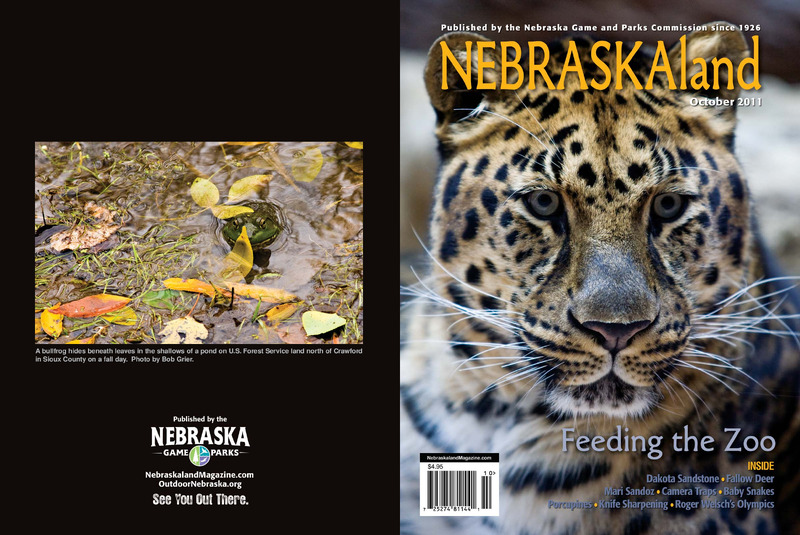
A bullfrog hides beneath leaves in the shallows of a pond on U.S. Forest Service land north of Crawford
in Sioux County on a fall day. Photo by Bob Grier.
Volume 89, Number 8, October 2011
12 Feeding the Zoo
Arranging dinner for 121,475 guests on a day-to-day basis is
an extremely daunting task. TEXT AND PHOTOS BY JEFF KURRUS
18 Multi-tasking on the Refuge
Hunting, fishing and beautiful scenery – it’s all for the taking
during a fall mult-tasking trip to the Valentine National
Wildlife Refuge. PHOTOS AND TEXT BY ERIC FOWLER
22 The North American Porcupine
Often known for their quills, other traits also make these
Nebraska mammals intriguing. TEXT AND PHOTOS BY MICHAEL FORSBERG
24 Sojourn at Rock Glen
In Nebraska is a place just as wondrous as the Painted
Desert of Arizona. TEXT BY WILLIAM BEACHLY, PHOTOS BY ADRIAN OLIVERA
30 Camera Traps
These additions to a photographer’s toolbox reveal glimpses
of wildlife not often seen. TEXT AND PHOTOS BY MICHAEL FORSBERG
36 Fallow Deer – Their Life and Times in Nebraska
Euroasian fallow deer were introduced along Beaver Creek
in the eastern Sandhills by ranchers in 1939 and 1940,
putting in motion the only time hunting a free-ranging,
exotic, big game species has been legal in the state.
TEXT AND PHOTOS BY JON FARRAR
Comment . . . . . . . . . . . . . . . . . . . . . . . . . . . . . . . . . 4
Mixed Bag . . . . . . . . . . . . . . . . . . . . . . . . . . . . . . . . 6
In the Field . . . . . . . . . . . . . . . . . . . . . . . . . . . . . . .42
Nature Notes . . . . . . . . . . . . . . . . . . . . . . . . . . . . . .43
Wilderness Workshop . . . . . . . . . . . . . . . . . . . . . . .44
Parks and Places . . . . . . . . . . . . . . . . . . . . . . . . . . .45
Classifieds . . . . . . . . . . . . . . . . . . . . . . . . . . . . . . . .46
Portraits from the Past . . . . . . . . . . . . . . . . . . . . . . 48
Page 49 . . . . . . . . . . . . . . . . . . . . . . . . . . . . . . . . . .49
The Last Stop . . . . . . . . . . . . . . . . . . . . . . . . . . . . . 50
24
●
22
●
18
●
30
●
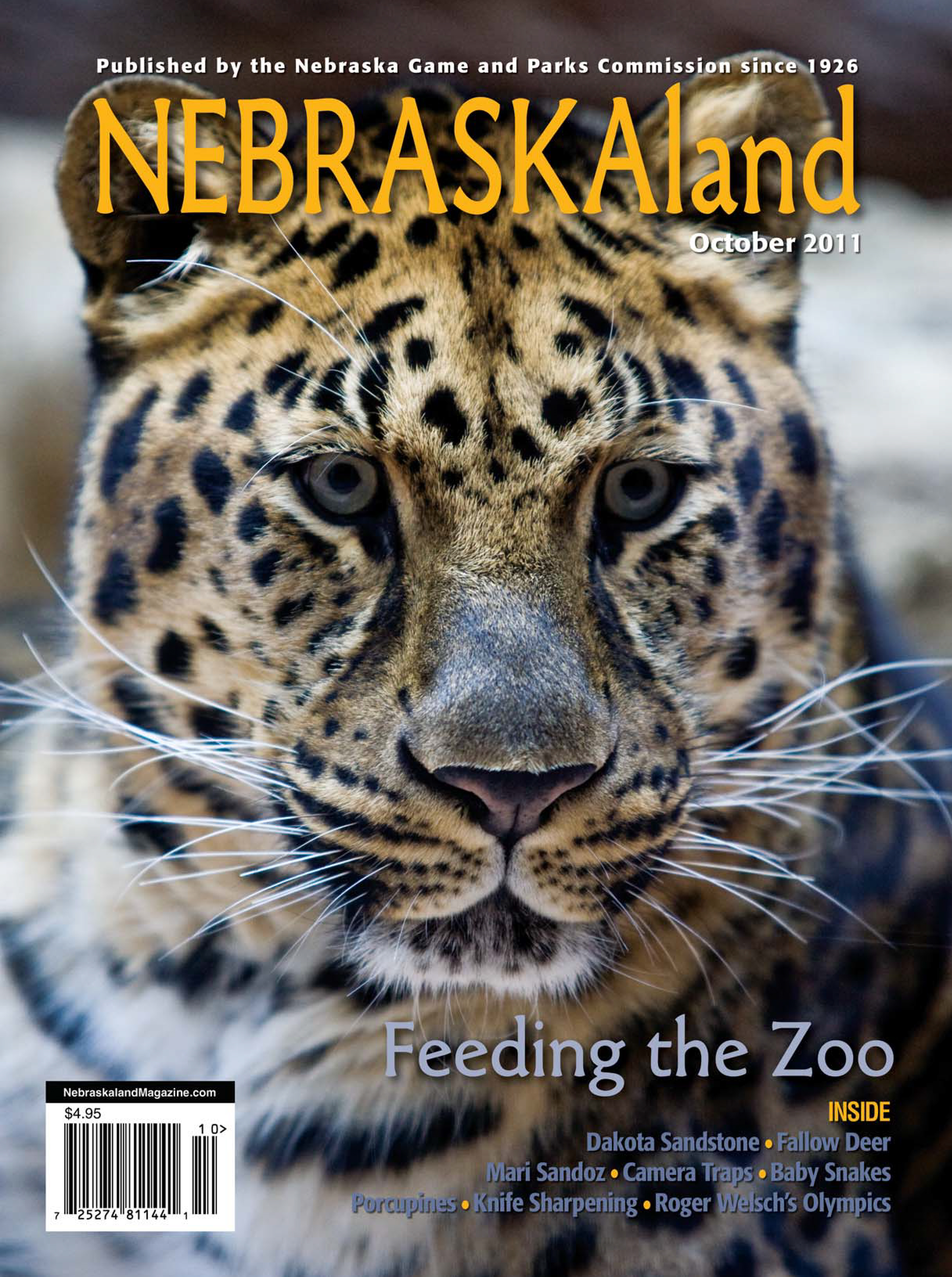
Cover: The Amur leopard at Omaha’s Henry Doorly Zoo is one of many
challenges the staff face during feeding time at this eastern Nebraska
destination. See story on page 12. Photo by Jeff Kurrus. Opposite: The
photographer’s black laborador retriever, “Captain Tall Roy McGillycuddy,” on
a foggy early fall morning afield in the Sandhills. Photo by Bill Hager.
NEBRASKAland (VOL. 89 / NO. 8, ISSN 0028-1964) is published monthly, except for the
combined Jan./Feb. and Aug./Sept. issues, by the Nebraska Game and Parks Commission,
2200 N. 33rd St., Lincoln, NE. Periodicals postage paid at Lincoln, Nebraska, and additional
mailing offices. POSTMASTER: Send address changes to NEBRASKAland, P.O. Box 30370,
Lincoln, NE 68503-0370.
OCTOBER 2011 • NEBRASKALAND 3
to Nebraska for about 20 consecutive
years to hunt pheasants and often did
quite well, as you can tell by this
photograph.
Taken in 1991, the photo shows (left
to right): Roger Disterhaupt of
Ellisville, Missouri; Clem Disterhaupt
Jr. and Sr., both of Atkinson, Nebraska;
and Lonnie and Dan Disterhaupt, also
of Ellisville. Also pictured are Slick
and Gunne, two German shorthair
pointers, as well as Zeke, a golden
retriever.
Clem and Betty Disterhaupt
Stuart, Nebraska
Moth Girls
On the morning of August 12th, my
wife Jennifer and our two oldest girls
(Madeline, 5, and Anna, 3) discovered
these two moths in our front yard in
what appears to be a mating position.
We explained that they were just
"resting" and would fly away again
when they regained their strength. We
have never seen insects like this and are
unsure as to their identification. The
girls thoroughly enjoyed looking them
over up close and were kind enough to
pose for a few pictures.
Our girls are always on the lookout
for new bugs, frequently showing us
insects that we seem to routinely
overlook. Our entire family enjoys
looking through and discussing your
great magazine. The girls especially
love the "bug" and animal pictures.
Keep up the great work!
Jeff McChesney
Omaha, Nebraska
What your family found was a pair of
polyphemus moths, very beautiful and
large North American members of the
family Saturniidae, the giant silk moths.
Polyphemus have an average wingspan
of six inches and can range in color
from a light to dark brown. They are
commonly found throughout much of
North America.
– The Editor
“Show Me” The Pheasants
We have subscribed to
NEBRASKAland for a number of
years and thought you might be
interested in seeing this photo.
The “Missouri Disterhaupts” came
Correction
The infrared photo of a deer that
appeared in “Caught on Camera” in
the August-September issue of
NEBRASKAland was improperly
credited – it was actually shot by Tom
Menze of York. We apologize for the
mistake.
Kudos for Aug/Sept Issue
What a great issue. I always find
some things to enjoy in each issue but
this one was full of winners.
Jon Farrar's article (“A History of
Grouse Hunting”)was absolutely great.
My mother’s family was raised in
Cherry County and from about 1947
to 2011 I have been involved in
experiencing the ups and downs of the
grouse and prairie chicken saga.
Thanks for such a great report.
Gary Wiles
Sunrise Beach, Missouri
Statement of ownership and monthly circulation of
NEBRASKAland Magazine
Owner and publisher: Nebraska Game and Parks
Commission
Editor: Doug Carroll
Headquarters of Publisher and Publication:
2200 N. 33rd St., Lincoln, NE 68503
Stockholders, Bondholders, Mortgage and
Security Holders: None
Average number of copies
of each issue during
preceding 12 months
The “Missouri Disterhaupts” came to Nebraska to hunt pheasants for about
20 consecutive years.
4 NEBRASKALAND • OCTOBER 2011
Single issue
nearest to
filing date
A. Total Copies Printed
(net press run) ........................26,022 ............25,349
B. Paid Circulation
1. Single-copy sales..................2,897 ..............2,914
2. Mail subscriptions ..............22,089 ............20,720
C. Total Paid Circulation ..............25,028 ............23,669
D. Free Distribution
by Mail ........................................240 ................240
D. Free Distribution
Outside the Mail ..........................408 ..............1,108
E. Total Free Distribution ..................648 ..............1,348
F. Total Distribution ......................25,676 ............25,017
G. Copies Not Distributed ................346 ................332
H. Total ........................................26,022 ............25,349
I. Percent Paid and/or
Requested Circulation ................97%................93%
NEBRASKAland Visitor Letters
We want to thank all 32 readers
that sent e-mails and letters for last
issue’s visitor, a pseudoscorpion that
was on page 3 (see page 11 for the
winner, rules and this issue’s hint).
Pseudoscorpions are in the class
Arachnida and the order
Pseudoscorpiones – their scientific
name, however, is more difficult to
identify, since there are more than 200
species of pseudoscorpions in North
America. They are small, yellowish-tan
to black creatures, generally less than
1
/5 of an inch in length. They are not
an insect, but an arachnid, and are
closely related to spiders, mites and
ticks. They resemble a scorpion, as the
common name suggests, but do not
have a stinging tail – in fact, they are
harmless to humans. They can live in
a variety of habitats, from grasslands
and forest floors to the dark space
under a sink, often preferring moist
habitats. They are predacious, feeding
on ants, mites and small insects.
Their peipalps – the large claw-like
appendages – have a venom gland
within the claws, which help subdue
their prey. The female
lays around 30
eggs, which she carries
beneath her body. After the
eggs hatch, she will carry
the young on her back for
several days, before they go
off on their own.
COMMISSION
CONSERV
CONSERVATION OFFICERS
Director Rex Amack
Deputy Director Jim Douglas
Commissioners
Chairman - Mick Jensen, Blair
Vice Chairman - Ron Stave, Waterloo
2nd Vice Chairman - Norris Marshall, Kearney
Jerrod Burke, Curtis
Dr. Mark Pinkerton, Wilber
Dr. Kent Forney, Lincoln
Lynn Berggren, Broken Bow
Rex Fisher, Omaha
Mark Spurgin, Paxton
NORTHWEST
Officer
City
Jim Zimmerman (S) Gering
MAGAZINE
MAGAZINE STAFF
STAFF
Editor Doug Carroll
Associate Editor Jeff Kurrus
Art Director Tim Reigert
Senior Editor Jon Farrar
Regional Editor Eric Fowler
Contributing Editor Michael Forsberg
Regular Contributors Bill Hager, Chris Helzer,
Lisa Knopp
Photo Librarian Sarah Johnson
Circulation Donna Robinson
For address changes and questions about
your subscription, e-mail
Donna.Robinson@Nebraska.gov
or call (800) 632-5263
Marketing/Advertising
For advertising information contact
Larson Enterprises
e-mail dave@larsonent.com
or call (515) 440-2810
NEBRASKAland Magazine Copyright 2011, all rights reserved.
NEBRASKAland is available on audio cassette from the Nebraska
Library Commission Talking Book and Braille Service, Suite 120, 1200 N
St., Lincoln, NE 68508. (800) 742-7691. NEBRASKAland Magazine and
the Nebraska Game and Parks Commission reserve the right to reject any
advertising not in keeping with the agency mission.
Rates: $18 for one year; $33 for two years; $44 for three years. Nebraska
recipients must add appropriate sales tax. To subscribe call
1-800-NEBLAND (632-5263), or go online to:
NebraskalandMagazine.com.
COMMISSION OFFICES
Headquarters/Southeast District Office
2200 N. 33rd Street Lincoln, NE 68503
Phone (402) 471-0641
Northeast District Office
2201 N. 13th St. Norfolk, NE 68701
Phone (402) 370-3374
Special thanks to Julie Van Meter, State
Entomologist, Nebraska Department of
Agriculture. Visitor image by Chris Helzer.
www.bugguide.net is a good site for identification
Send your comments to:
Doug Carroll, Editor
NEBRASKAland Magazine
P.O. Box 30370
Lincoln, NE 68503
or e-mail Doug.Carroll@Nebraska.gov
Please include your postal address and
telephone number.
Letters may be condensed and edited
for clarity. Photographs are
welcome and will be returned.
Southwest District Office
301 E. State Farm Rd. North Platte, NE 69101
Phone (308) 535-8025
Northwest District Office
East Hwy. 2, Box 725 Alliance, NE 69301
Phone (308) 763-2940
Bassett Office
524 Panzer St., Box 508 Bassett, NE 68714
Phone (402) 684-2921
Kearney Office
1617 First Ave. Kearney, NE 68847
Phone (308) 865-5310
Omaha Office
1212 Bob Gibson Blvd. Omaha, NE 68108
Phone (402) 595-2144
Greg Hesse
Scott Brandt
Heath Packett
Frank Miller
Dan Kling
Phone (308)
(office) 763-2940
(cell) 641-6138
Alliance
760-3647
Gering
631-0663
Gordon
360-0682
Valentine (402) 389-0444
Harrison
430-0572
SOUTHWEST
Officer
City
Phone (308)
Roger Thompson (S) N. Platte (office) 535-8025
(cell) 530-3097
Ray Dierking
Brkn. Bow
870-0322
George Sund
Cambridge
655-0028
Michael Thome
Cozad
529-8146
Terry Brentzel
Doniphan (402) 469-5795
Matt Andrews
Elwood
746-2418
Dirk Greene
Imperial
882-0015
Jerry Pecha (Sup.) Kearney (office) 865-5327
(cell) 293-3551
Dale Johnson
Kearney
440-3847
Dudley Sorensen
N. Platte
530-0016
Nicholas Fix
Ogallala
289-0427
Dennis Thompson
Ogallala
289-0755
Rich Routh
Rep. City
920-0367
NORTHEAST
Officer
Tom Zimmer (Sup.)
Dale Davis
Steve Oberg
Daniel Roberts
Randy Pomplun
Jeff Jones
Jon Reeves
Pat George
Doug Pollard
Tim Williams
Cory Krause
Phone (402)
(office) 370-3374
(cell) 649-8053
Bassett
760-0712
Columbus
910-3366
Fremont
719-1108
Fullerton
550-0489
Hartington
762-5022
Kennard
889-8508
O’Neill
340-0787
Ord
778-7101
Neligh
929-0051
West Point
380-6410
SOUTHEAST
Officer
Duane Arp (Sup.)
City
Gretna
Sean McKeehan
William Krause
Mike Luben
Dan Zuehlke
Darin Gress
Douglas Kramer
Dina Barta
Stacey Lewton
Levi Krause
Robert Finke
Russell Mort
Dan Evasco
Jeff Clauson
City
Norfolk
Phone (402)
(office) 332-2965
(cell) 521-0194
Ashland
521-0159
Auburn
274-8063
Colon
443-6392
Cortland
806-9084
Hebron
768-8665
Lincoln
890-6465
Lincoln
890-6463
Lincoln
890-7140
Louisville
949-0593
Milford
947-1363
Nebr. City
209-1506
Papillion
616-5961
Waterloo
658-7057
ADMINISTRATION
Officer
City
Ted Blume (Adm.)
Lincoln
Craig Stover (Asst.) Lincoln
Phone (402)
471-5531
471-5532
Nebraska Wildlife Crimestoppers 1-800-742-7627
Ak-Sar-Ben Aquarium
21502 W. Highway 31 Gretna, NE 68028
Phone (402) 332-3901
Under federal and/or state law, discrimination is prohibited on the basis
of race, color, religion, age, gender, marital status, national origin,
disability or political affiliation. If you think you have been discriminated
against in any program, activity or facility by the Nebraska Game and
Parks Commission or want more information, contact the Commission in
Lincoln, NE, at (402) 471-0641 or the Equal Opportunity Commission,
Lincoln, NE, (402) 471-2024, TTY/TDD (402) 471-4693).
OCTOBER 2011 • NEBRASKALAND 5
PHOTO BY PASQUALE MINGARELLI
Here is a list of
upcoming outdoor
events across
Nebraska.
For more
information
about these and other
events, visit the calendar page at
www.OutdoorNebraska.org.
October 1
Living History Event
Fort Atkinson State Historical Park.
Call (402) 468-5611
October 1-2
Autumn Harvest Show
View some of the finest art in the
country from many reputable and
nationally known artists from around
the Midwest.
Eugene T. Mahoney State Park.
Call (402) 944-2523
The Bob Kerrey Pedestrian Bridge is in downtown Omaha near the Qwest Center.
Overlooking the Missouri
Pasquale Mingarelli
One of Nebraska’s newest man-made attractions has become a venue to view
one of Nebraska’s most recent natural events. During the 2011 summer months
hundreds, sometimes thousands, of people daily walked onto the Bob Kerrey
Pedestrian Bridge to view the Missouri River flood.
According to Melinda Pearson, Director of Omaha Parks and Recreation, the
bridge, which connects Omaha to Council Bluffs, Iowa, is the “perfect vantage
point” for curious onlookers to observe the flood. Pearson said that the bridge,
completed in 2008, is safe and was built to withstand a flood. She also added that
in preparation for the coming flood, in May the bridge was inspected by HNTB,
the engineering and architectural firm that built it.
For those who have not had a chance to observe this historic flood, this vantage
point is a place to witness it’s effects.
October 1-2
2nd Annual Heritage Farm Weekend
Event focuses on "passing-on"
many of the traditional skills and
techniques of a small family farm.
Ponca State Park.
Call (402) 755-2284
October 2, 9, 16
Living History Event
Arbor Lodge State Historical Park.
Call (402) 873-7222
October 8, 15
Hallowfest
Haunted hayrack rides, pumpkin
rolling and carving contest, a
campsite decorating contest and
much more. Ponca State Park.
Call (402) 755-2284
See You Out There ... But Where?
October 8, 15, 22
Halloween Decorating Contest
At the RV Campground.
Indian Cave State Park.
Call (402) 883-2575
October 29
Fall Festival at Wildcat Hills
Pumpkin roll competitions, pumpkin
carving contest, fall crafts and much
more. Wildcat Hills Nature Center.
Call (308) 436-3777
6 NEBRASKALAND • OCTOBER 2011
PHOTO BY RUSS WILKIE
Do you know where this Nebraska photograph was taken?
See answer at the bottom of page 11.
November 7
Ticket Sale for Annual Historical
Christmas Dinner
Fort Robinson State Park.
Call (308) 665-2900
found in New Jersey, Illinois, Massachusetts and, most
recently, Ohio in 2011. The beetle has been eradicated from
Illinois, but infestations
Julie Van Meter, State Entomologist
persist in the other areas.
Summer has changed into fall, and many
The USDA has enacted
of you will be heading out into fields and
quarantines of the
woods to hunt, view the changing leaves, or
infested areas to prevent
just enjoy the outdoors. While you are out
the artificial movement
there, you have a great opportunity to help
of the pest to uninfested
monitor the state’s trees for evidence of invasive pests.
areas. These quarantines
NEBRASKAland ran an article about the Emerald ash
include prohibitions on
borer (EAB) in the May 2011 issue, which included
the movement of
information on how to identify signs and symptoms of
Asian longhorned beetle larva.
hardwood firewood from
possible EAB infestations. That article resulted in readers
infested areas because,
submitting numerous reports of suspected EAB-infested
much like EAB, ALB can easily be transported in firewood.
trees. Fortunately, after follow-up visits by trained staff, it
The Asian longhorned beetle is a large, beautiful beetle.
was determined that none of the trees were actually infested
Adult beetles are approximately 3/4 inch to 11/2 inch in length.
with EAB. But the response highlighted the great
opportunity for citizens to assist state and federal agencies in They have a shiny black body with white spots, very long
monitoring for exotic and invasive pests. While staff with the black antennae with white bands, and feet that may appear
Nebraska Department of Agriculture, Nebraska Forest
bluish in color. The larvae are creamy white and grub-like,
Service, Nebraska Game and Parks
and grow rather large before
Commission, and USDA are always
pupating.
monitoring for invasive species,
Signs of an ALB infestation
homeowners and outdoor
include large round exit holes,
enthusiasts like you also play an
up to 3/8-inch in diameter, bark
important role in protecting our state
niches chewed by the females
from invasive pests. New infestations
when they lay their eggs, and
of invasive pests are often discovered
coarse, sawdust-like frass on the
by citizens who notice declining
ground and branches. Trees
trees or observe a strange new
infested with ALB may exhibit
creature. Such finds increase the
branch or crown die-back.
odds that an infestation can be
Adults, which are present
eradicated, and prevent further
mid-summer through fall, tend
Adult beetles and the egg niches chewed by the
spread of the pest.
to
stay on or near the tree from
female beetle, which deposits an egg in each niche.
Unfortunately, EAB is not the only
which they emerged. Repeated
exotic, invasive pest threatening
infestations will eventually
Nebraska’s trees. Another emerging threat is the Asian longresult in tree death. Nebraska has several species of trees that
horned beetle (ALB). ALB (Anoplophora glabripennis) was
could be infested by ALB, including maples, box elder, elm,
first discovered in the United States in 1996, in New York. It
birch and ash.
likely was introduced to the U.S. in untreated solid wood
ALB has not been found in Nebraska, but there is concern
packing material. Since that initial find it has also been
that it could be introduced to the state, especially through
infested firewood. So the next time you are out among the
trees, remember that you have an opportunity to help protect
our tree resources from invasive pests. Take a few minutes to
look at the trees around you and determine if the trees have a
healthy canopy. Dead branches, die-back and early leaf drop
may indicate pest problems. Look for large emergence holes
on the upper branches and trunk that may indicate an ALB
infestation, or frass accumulating in the branch crotches or
base of the tree. If you see an adult beetle, try and capture it
or take a picture. Report any suspected ALB infestations to
the Nebraska Department of Agriculture at (402) 471-2351
or the USDA at (402) 434-2345.
Asian longhorned beetle emergence holes on a Norway maple.
The round exit holes can be up to 3/8-inch in diameter.
For more information on ALB, visit
www.beetlebusters.info. Finally, to help protect all our
trees from invasive pests, buy locally harvested firewood at
your camping destination, and don’t bring leftover firewood
home with you.
“Useful, with a pleasant degree of fish odor”
BY DA RYL L. BAU E R
Fall is my favorite time of year to
fish. The crowds begin to clear out
after Labor Day and as hunting
seasons begin there is less and less
competition. Less fishing pressure
results in fish that are easier to
catch and ones with more consistent
feeding patterns. The weather in the
fall will still fluctuate between relatively
hot and relatively cold, but it tends to
be far less schizophrenic than our
spring weather.
As a result, fish movements and
activity tends to be more predictable.
Best of all, fish will feed heavily into
the fall to prepare for the long cold
winter and the spawning season to
come next spring (egg and milt
development requires a lot of energy
and most of our fish begin developing
next year’s eggs and milt in this
year’s late summer and fall). The
abundance of natural prey usually
wanes from the summer’s peak as we
progress into fall and fish that are
actively feeding in the presence of
reduced numbers of natural prey
means good things for anglers!
• Catching Numbers - Big Water
PHOTOS CENTER AND UPPER RIGHT: KENNETH LAW, USDA APHIS PPQ, BUGWOOD.ORG
DENNIS HAUGEN, USDA FOREST SERVICE, BUGWOOD.ORG
Asian Long-horned Beetle
Many of our panfish start heading
toward deeper water where they will
be bunched up and easy to catch
once we get first ice, but not a lot of
folks target them in the fall. If a person
can find the crappies schooling up in
deeper water in the fall, the fishing
can be fantastic. Sherman Reservoir
would be a good one to try, as well as
Oliver and Whitney out west. There
should be a bunch of crappies in
Harlan nearing 10 inches and larger
by this fall and the white bass there
will still be chasing shad; maybe on
the surface in the afternoons and
evenings, in deeper water during the
day.
Catching Numbers - Small Water
On a warm, fall afternoon the
bluegill fishing can still be excellent
on Nebraska pits and ponds across
the state, including our interstate
lakes. In October we will be stocking
catchable-size, 10-inch rainbow trout
in a variety of heavily-used park and
urban waters across the state. Find
the list of those stockings and take
the kids fishing. ‘Crawlers work well
•
for the put & take trout as well as a
position to present live or artificial
variety of GULP! and PowerBaits;
they will take flies too and are curious baits or flies.
enough to strike small spoons,
Not Caring What You Catch
spinners and crankbaits.
I will keep returning to some of the
same waters for this multi-species
Catching Big Fish
This is really where it is at in the fall – theme, including Merritt Reservoir.
big predator fish and the best time of While there, a person could catch
year to catch them. Casting or trolling everything from a variety of panfish to
bass, pike, walleye, muskies and
crankbaits or swimbaits on our large
some big channel cats. Elwood is
reservoirs will work for walleyes,
another water body that has always
wipers, flatheads, largemouth bass,
been an excellent multi-species
pike, muskies and any other
fishery, while Box Butte offers a
predators that swim in those waters.
McConaughy would be a good one to variety of panfish as well as bass,
walleyes and lots of pike. There are
try for a walleye-of-a-lifetime as well
as some big wipers and maybe even others, but if a person stays flexible
while fishing those waters they should
a big smallmouth bass. Merritt will
be able to catch something any time
also produce some big walleyes in
of year, including fall.
the fall as well as pike, bass and
•
•
maybe even a state record-size
muskie. Water levels have recovered
at Elwood and that would be a good
bet for some big wipers, maybe a
muskie, or big walleye. Branched Oak
will produce some big flatties,
especially in early fall, as well as
some big walleyes and wipers. As we
progress into late fall and the baitfish
and predators move deeper, switch to
vertical jigging spoons, tail-spinners
or blade baits where baitfish schools
congregate in deeper water.
• Best Bet
I love to fish for big fish, and it does
not bother me to put in some time if I
know the payoff could be big. I do a
lot of that fishing in the fall and when
I am doing that I try to pick waters
that have big fish potential and fish
them hard!
Some of our waters with the best
big fish potential, with the best bet for
a big payoff, would be places like
McConaughy, Merritt, and Branched
Oak. There are some really big fish
Trying Something New
swimming in those waters and if you
Spend some time hiking and
put in your time this fall you could
exploring some small trout streams in catch some that would surprise even
the Pine Ridge. Brook trout can be
yourself!
found in some of those waters, and in
How’s that? You know I could fish
the fall, brookies, which are beautiful every day of the year and would love
all the time, will be in spectacular
to be able to spend all fall following
spawning colors. The color of the fish my own advice!
will be matched by the fall beauty of
the Pine Ridge buttes and stream
“The best time to fish is when
bottoms. The fish can be spooky, but
you
have time to fish.” — D.L.B.
they can be caught, sneak into
•
8 NEBRASKALAND • OCTOBER 2011
OCTOBER 2011 • NEBRASKALAND 9
Walnut Creek Reservoir is a high-use lake in the metro area.
The panfishing is good and there are large channel catfish that
people rarely fish for. Plus, most area anglers practice catch and
release bass fishing from both the shore or from bass boats, and
there can be a dozen boats at any one time fishing this 100-acre
lake.
Last May, during the spawn, I witnessed one angler with a fishing
pole and walking stick wading through the shallows. He was using a
bobber-nightcrawler rig and had several bluegill on his stringer. He
would slowly move from spot to spot, intently watching for something.
I moved on, but awhile later I found what he'd been looking for –
large female black bass laying on their beds. I was amazed to see
him drop his fishing pole and bring his walking stick up and using two
hands stab into the water. He put all his weight into it and just stood
there. After a bit he began dragging his walking stick and a mass of
lake vegetation towards shore. Once there from the mess he pulled
out a large bass. His walking stick turned out to be a
five-pronged spear!
The black bass, a five-pounder bulging with eggs,
measured 21 inches. But no more, it could not be
released back into the lake. Damages for this
master angler size bass were several hundred
dollars. The bass poacher also had his walking stick
seized where it now sits at the Aksarben Aquarium's
law enforcement office.
– Dan Evasco, Conservation Officer, Papillion
10 NEBRASKALAND • OCTOBER 2011
Refuge Opens To Hunting
Erica Hengelfelt
Since its conception
in 1910, over 100
million people in the
United States have
been involved with
the Boy Scouts of
America, either as
boyscouts or
volunteers. Scouts across the nation
celebrated the organization’s first
centennial last year.
Festivities crossed a wide spectrum,
from small parties with local troops to
large galas at Ellis Island and in
Washington, D.C. The highlight of the
celebration, however, was a candlelight
rededication ceremony that took place
at the National Scout Jamboree, said
Renée Fairrer, BSA National Manager
of Public Relations.
Though 100 years of Scouting have
come and gone, the BSA thinks its
future is looking brighter than ever.
According to Fairrer, there are two
significant ways the organization is
planning to impact youth in the future.
The first is to address some of the
health issues that plague young people,
and the second is through its merit
badge program.
“In 2011 we will introduce a new
program called ScoutStrong that focuses
on healthy living with an eye on issues
related to childhood obesity,” Fairrer said.
The BSA will also introduce new
booklets to its well-established merit
badge program. New merit badges will
include an emphasis in robotics,
inventing and geocaching. Additional
badges in search-and-rescue and video
game design are to be made available
in the near future.
“Technology is everywhere, and
young people use it in almost every
aspect of their lives,” said Fairrer.
To ensure that members can use
technology to enhance the Scouting
experience, the BSA has provided apps
for smart phones, merit badge books
for e-readers and uniforms that
accommodate small electronics like
cell phones and mp3 players.
Scouts, alumni and parents
everywhere eagerly anticipate the next
100 years of this beloved national
organization.
Eric Fowler
A portion of the Fort Niobrara
National Wildlife Refuge opened to
archery and muzzleloader deer hunting
this fall, and in the years to come, it
will open to elk hunting as well.
More than 5,000 acres north and
Nebland Flashbacks
In the Fall 1953 issue of Outdoor
Nebraska, gun safety was the
theme of the back cover. Shown
here are four (of the six) Will Eisner
gun hunting safety illustrations.
These ads were distributed to
state agencies throughout the
country, and today the poster
versions of these illustrations are
somewhat rare.
Eisner (1917-2005) was an
American comic writer/artist and
creator of “The Spirit.”
west of the Niobrara River, primarily
wilderness area, are now open to
hunters who obtain a free access permit
from the refuge headquarters. No hunting
will be allowed during the November
firearm deer season.
Access to the steep wooded canyons
will be limited to foot and horse from
one of five designated parking areas on
the west edge of the open area, and to
canoes, which can be launched at
Cornell Dam and taken out at Berry
Bridge, a private outfitter access point.
Like all federal wilderness areas, any
form of mechanical transportation,
including wheeled game carts, is
prohibited.
“Its going to be a fairly challenging
hunt, for the most part,” said refuge
manager Steve Hicks. “I don’t think it
will be for everybody but I think it will
be a rewarding hunt for those who put
in the work. I think if I do it and get
something, I’ll hike down to the river
and take it out by canoe.”
The refuge has a good population of
white-tailed deer, including some trophy
bucks, as well as a few mule deer,
Hicks said. Elk that roamed the
wilderness area behind a high fence
have been culled and the fence lowered.
When the free-ranging elk population
in the area reaches a certain threshold,
the refuge will be opened to elk hunting.
Eventually, captive elk south and east
of the river will be culled and more
land opened to hunters.
Regulations and access permit
applications are available online at
www.fws.gov/fortniobrara/hunting.html
or by calling (402) 376-3789.
Butch Gathye of Gretna truly believes
there is no place like Nebraska, and
carries his rod and gun across the
state pursuing deer in the Pine Ridge,
fish at Lake McConaughy and the
Valentine National Refuge, turkeys in the southeast and his favorite, pheasants
in the northeast. He’s had his message plate for more than 12 years.
If you have a unique outdoor message plate you would like to share, or
know someone who does, e-mail a photo (high-resolution, JEPG format
only, please) of it to Eric.Fowler@Nebraska.gov, along with your name,
home town, and a brief description of the interests expressed on your
license plate.
New Book From Sartore
NEBRASKAland contributor Joel
Sartore’s newest book, “Lets Be
Reasonable,” is a collection of essays
and photographs chronicling his time
covering topics around the world for
both National Geographic and CBS
News Sunday Morning.
While NEBRASKAland readers are
familiar with Sartore’s unique and witty
voice, many readers know Sartore only
for his photographs. This collection,
however, will further reveal that
Sartore’s words are just as important,
and entertaining, as his images.
To order a signed copy, visit
joelsartore.com.
NEBRASKAland Visitor
Winner and Hint
Last issue’s winner of
the NEBRASKAland
Visitor drawing was
Jerry Hendrych of
Geneva, Nebraska, who found the
peusdoscorpion on page 3.
Readers are encouraged to contact
NEBRASKAland within 10 days
after this issue’s publication with the
correct page number and name of
this issue’s “Visitor” – a bug found
in Nebraska that just happened to
find its way onto one of the pages of
our publication.
We will then gather the correct
entries and draw one to win a
NEBRASKAland Magazine mug.
To enter each month, write:
NEBRASKAland Visitor
2200 North 33rd Street,
Lincoln, NE 68503.
Or e-mail:
Tim.Reigert@Nebraska.gov
with “Visitor” in the subject line of
the message.
HINT: This issue’s visitor is not on
page 5, 13, 15, 27, or 31.
Victoria Springs State Recreation Area, east of Anselmo.
Walking Stick
Scouting the Next 100 Years
OCTOBER 2011 • NEBRASKALAND 11
Feeding the Zoo
Text and Photos by Jeff Kurrus
The What, How and When of Dinnertime
at Omaha’s Henry Doorly Zoo
P
LANNING A THANKSGIVING
MEAL FOR FAMILY AND
FRIENDS, even if you are
disliked by most of your relatives and
only a few attend, can be a daunting
task. And that event only happens once
a year. Think about planning a similar
meal for 121,475 guests and the mind
swirls with complications. It would
take an army to prepare that many
meals – but that’s what one of the
world’s most famous zoos, Omaha’s
Henry Doorly Zoo, does daily. Those
who work there, however, may tell you
that feeding that many “guests” is not
the hardest part of their job – knowing
what to feed the animals is the biggest
ongoing challenge for the zoo’s
dedicated staff.
What to Feed
“We don’t know the nutritional
requirements for the vast majority of
exotic species,” said zoo nutritionist
Cheryl Morris. “We know the
requirements for the domestic horse,
cow, dog and cat, because there has
been decades of research dedicated to
these findings, but the best we can do
with our exotic animals is understand
their natural history and extrapolate
back to our domestics.” Because
tigers are similar to domestic cats, for
example, the nutritionists start with the
domestic cat’s diet.
“Obviously tigers are eating raw meat
in the wild,” said Morris. “Therefore,
most zoos feed all captive cats raw
Omaha's Henry Doorly Zoo’s collection size, including all the fish in the aquarium, the
penguins (pictured) and the coral, is 121,475 – most of which have to be fed daily.
Excluding the aquarium and invertebrates, the number shrinks to 8,475 specimens.
12 NEBRASKALAND • OCTOBER 2011
Zoo Numbers
Each week, the following foods
are consumed by the zoo’s
animal collection:
10,000 pounds of mixed
greens
2,500 pounds of raw meat
1,260 hard-boiled eggs (of
which 95% are hand-peeled)
1,200 pounds of apples
1,200 pounds of bananas
1,000 frozen rodents
1,000 pounds of mackerel (for
the sea lions)
750 pounds of carrots
600 pounds of sweet potatoes
meat, regardless of species.” Where
the knowledge gap appears, however,
is what nutrients a wild cat’s diet
contains. “We know what animals eat
in the wild, but we know little about
why they eat certain foods and for what
nutritional reason.”
Because of this knowledge gap, many
small exotic cat species in captivity,
including servals, bobcats and caracals,
develop health concerns thought to be
nutritionally related. As a result, Morris
and her staff experiment with grain-free
domestic cat foods, raw beef diets and
whole prey to determine digestibility
and gastrointestinal tract health for
these species. Yet the zoo’s research is
not limited to cat species.
In 2005 research began that looked at
the effects their diet had on the zoo’s
giraffe herd. Testing the animals every
six months, staff sought to determine
what effects the food they were fed had
on the amount of fatty acids, calcium
Zoo Laboratory
The zoo’s nutrition laboratory,
located in the Bill and
Berniece Grewcock Center for
Conservation and Research,
was created in 2006 to monitor
and improve the diets of the
zoo’s inhabitants. Containing
state-of-the-art equipment
used to measure such things
as protein, fat and dietary
fiber, the primary purpose of
the lab’s technology is focused
on how the zoo-formulated
diets are being digested by
various species at the Henry
Doorly Zoo. Lab results are
shared with other stakeholders
in the exotic animal community
to help provide better health
and well-being to animals
globally. The lab also monitors
quality control in the food they
are feeding the animals.
“When we get a new batch of
hay, for example,” said Morris,
“we check it for protein and
fiber content to make sure it
meets our qualifications of
where we want it.”
and phosphorous in the giraffes’ blood.
In another example, the zoo’s nutrition
department conducted numerous
experiments with the insect diets of
information on
plant species that
lemurs consume in
the wild. Because
the zoo added a
lemur display in
its Expedition
Madagascar exhibit
that opened in
2010, such research
is vital to preserving
this very popular
zoo attraction.
“Based on what
they consume in the
wild and the
nutrients they
consume, we can
start to match diets
with our captive
Although nutritionists have studied cat diets for decades,
collection,” said
including those for the puma, little is known worldwide
Morris.
regarding the optimal diet for cats to maintain ideal health.
The answers to
many of the zoo’s nutritional questions
its amphibian population, with the
lie in one of the its most precious
long-term goal of understanding the
commodities – excrement. “Every
nutritional requirements for those
nutrient that an animal eats and
threatened species worldwide.
everything that an animal excretes is
Furthermore, following the opening of
measured,” said Morris. “We do so to
the zoo’s butterfly and insect building
know what the animal is using from
in 2008, studies immediately revealed
that diet. If we’re feeding a diet that
that the addition of amino acids and
protein in the form of pollen lengthened has the same amount of protein from
two different sources, we’ll measure
the lives of the zoo’s butterflies.
the excrement to see if one protein
The Henry Doorly Zoo’s research is
amount is larger in one versus the other
also not limited to the confines of its
diet.” If so, then Morris will know what
walls – the zoo has a collaborative
protein is being more efficiently used
experiment currently underway in
instead of being excreted.
Madagascar where its molecular
However, there always remains
geneticists are collecting nutrient
one special consideration regarding the
menu at the zoo, regardless of how
efficient or healthy a particular diet is.
“We can create a diet with excellent
nutrient requirements, but if the
animals won’t eat it, then the diet is no
good,” said Morris. “We have to take
palatability into serious consideration
with our diets.”
or five monkeys in the jungle, they may
eat the same diet.”
The difficulty of feeding their
collection this way, however, is the
social dynamics that emerge within
these groups. “A lot of times we create
a balanced diet, but the dominant animals
in a group will end up consuming the
food items they want the most and
leave the rest,” said Morris. These
dominant animals, such as primates,
may then become overweight because
they seek out the food items high in
sugar, leaving only the leftovers for the
other animals.
Weight problems also have to be
considered in the zoo’s cat population.
“Some of our cats are overweight or
too thin because they are old,” said
Morris. “Cats that wouldn’t typically
live 20 years in the wild are living that
long in captivity.” Other health problems
can appear as well, such as renal disease
and kidney problems not uncommon in
domestic cats. To combat these and
other issues that can occur throughout
the zoo’s collection of wildlife, staff
design specific diets for these health
concerns and perform frequent medical
examinations, including measuring
weight and taking blood samples.
The zoo also assigns body condition
scores for its animals, deciding
whether an animal is under, ideal or
overweight and adjusting their diet as
needed.
“It’s challenging to manage their
diets,” said Morris, “especially in our
mixed species displays like the South
American display located in the
Kingdoms of the Night exhibit, where
we have sloths, monkeys and armadillos
in the same area.” Aside from making
sure the animals get what they need
nutritionally, staff must also make
sure each animal doesn't
receive
Above: The sea dragons and seahorses exhibited in the Scott Aquarium consume
live mysis shrimp as dietary staples, making them some of the most
expensive animals in the zoo to feed.
Below: Members of the zoo’s prairie dog colony consume a diet consisting of
fresh produce, seeds, nuts and a commercial feed made for rodents.
something toxic to them. “We have had
animals allergic or sensitive to certain
foods,” said Morris. “What is truly the
allergen, however, we may never
know.”
On the other hand, because of the
unique digestive systems that giraffes
have, for example, they can eat some
toxic materials, certain alkaloids, that
humans can’t. Many zoo animals can
eat raw diets because they digest them
so quickly, as opposed to human
digestive systems that would be
bombarded by bacterial infections. Yet
these diets are constantly monitored.
“We’ve had interns that do nothing
more than watch an exhibit all day for
several weeks to see which animals
were eating what and how these
animals are reacting to what they eat.”
When this information is
reported back to Morris and
her staff, adjustments
are made
regarding a particular animal’s diet.
The zoo’s meat and blood diet comes
from Central Nebraska Packing in
North Platte, and its fruit and
vegetables come from the same local
vendors that sell to supermarkets and
restaurants. “Our meat diets cost about
$1 per pound, while hay is 11 cents
per pound,” said Morris. “While a
white rhinoceros may eat more than
100 pounds of hay per day, it costs a
lot more during a year to feed our
carnivorous cats.”
The zoo also buys a lot of enrichment
foods, including yogurt, baby food,
Ramen noodles and other pastas, at
local supermarkets. “We use these
foods for foraging,” said Morris. “We
try to stimulate their environment and
promote species-
In the Kitchen
Lemur species housed in Expedition Madagascar consume diets consisting of high fiber
fruits, vegetables, fresh foliage and often some oatmeal.
14 NEBRASKALAND • OCTOBER 2011
Six full-time employees and up to
20 volunteers make up the zoo’s
kitchen staff, working 365 days a year
to prepare more than 500 diets for
Henry Doorly’s collection of wildlife.
It could be worse – at least they’re not
making up a meal for each collection
member: “Most of our diets are for
groups,” said Morris. “If there are four
OCTOBER 2011 • NEBRASKALAND 15
PHOTO BY LAURA HESFORD
The author and his daughter Madeline feed budgies at the Henry Doorly Zoo. These
birds are also fed a custom-made seed mix, fresh produce and grasses.
of the larger inhabitants of the zoo,
such as the pygmy hippopotamus and
the rhinoceros, are dangerous not
because they are aggressive but
because of their large size. Care,
regardless of species, is therefore
always taken to follow feeding and
safety protocols with all the animals.
Purpose
appropriate foraging behaviors by
scattering these foods. We’ll hide food
or put food in devices that the animals
have to manipulate to get out.” Zoo
staff also scatter insects, mainly live
crickets, for the same purpose.
Primates, foxes and rodents all enjoy
pursuing live crickets in logs and trees
for enrichment, while some cats,
including the Siberian tigers and snow
leopards, will periodically receive a
frozen rabbit for enrichment – but they
are given these treats very, very
carefully.
Feeding
Above: The Henry Doorly Zoo has the nation’s largest inland aquarium. Left: Most of the
snakes in the zoo’s collection, including the centralian python, are fed frozen rodents two
to four times per month.
16 NEBRASKALAND • OCTOBER 2011
“We have some large cats that can be
really scary, and we also have large
cats that will flop over and act like
they’d love a good belly rub,” said
Morris. “In either case, there’s nothing
predictable about any of the exotic
animals we have here. If the bars
weren’t between us, we’d certainly be
in trouble.”
Because all of the zoo’s cats are
dangerous to feed, staff never go in the
cage with these animals. Trained to
shift to certain locations upon request,
the tigers are watched very closely by
keepers to ensure safety. With these
cats, and many other animals at the
zoo, two staff members must be present
to make sure the proper doors are shut
and locked so their cages can be
cleaned and food presented.
But the cats aren’t the zoo’s only
dangerous inhabitants: All of the Henry
Doorly’s snakes that are venomous in
the wild are still venomous in captivity,
and many of its primates, even the
small ones, can become aggressive
with keepers or other members of their
social group during feeding time. Some
A myth persists that the Henry
Doorly Zoo’s purpose is to capture,
breed and release animals back into the
wild. While Henry Doorly does have
one of the world’s largest frozen zoos,
with semen from thousands of animal
species stored, release is not its goal.
Conservation is.
“We spend time studying nutrition
with our captive populations so we can
better manage those populations not
only in captivity, but the wild as well.”
said Morris. By studying how certain
animal species react to particular
plants, such as bamboo for example,
the zoo can potentially aid ecologists in
saving these plant populations, thus
conserving plants and animals alike.
Morris and her staff share nutrition
information through publications,
manuals and contact with other zoos
and professional organizations, including
the Nutrition Advisory Group to the
Association of Zoos and Aquariums.
Plus, the zoo works with locals in the
community, including the school
systems, to ensure that information
regarding animal survival is relayed to
the masses.
“Life expectancy is very species
specific here,” said Morris. “We do so
much work with our diets so we can
keep these animals alive here longer in
an effort to educate the public. While
we obviously have a role of displaying
wildlife, we have a larger role in
conservation, which is our most
important responsibility.” ■
Nearby Parks
If you’re wanting to visit the zoo
and stay at a nearby park, there
are a few options. Two state
parks (E.T. Mahoney and Platte
River) and two state recreation
areas (Two Rivers and
Louisville) are close by. For
more information and to
make reservations, visit
www.OutdoorNebraska.org.
OCTOBER 2011 • NEBRASKALAND 17
W
e have become a nation of multi-taskers. We do as many
things as we can at once, often while driving, and
seldom do any of them well. But when you take a fall trip to the
Valentine National Wildlife Refuge – or any other Nebraska
locale offering prime late-season fishing and early-season
hunting – multi-tasking can save a weekend.
Cast-and-blast opportunities begin in earnest when grouse
season opens in September. The opening of duck season in early
October adds yet another hunting option. Some day, on a whim
and a great weather forecast, I’ll pack rod and gun and head to
the refuge for the pheasant opener and have a third. Archery
deer hunters have a fourth.
The hunting options are good to have for guys like me who
live five hours from this slice of heaven: Wind, rain and even
snow – but mostly wind – can scuttle a day or even an entire
trip on the water. Which is too bad, because the fall bite for
northern pike, largemouth bass and even perch and bluegills can
be epic. But in the Sandhills, if it isn’t blowing, you’d better
fish now. You can always hunt when it starts blowing again. ■
Above left: Hawley casts for pike on
Clear Lake on the first evening of an
October trip. It was the only time we saw
the sun all weekend.
Left: Hawley and Gregg Sweley of
Scottsbluff walk the ridge above Clear Lake
in search of sharp-tailed grouse on a
September afternoon. The view from the
top is reason enough to hunt sharpies, but a
grouse hunt around Duck, Rice or Watts
lake in October is also a great way to scout
for the next day’s duck hunt.
After a long day of hunting and fishing,
Hawley (right) and I relax around a fire
at the Big Alkali WMA campground.
Camping isn’t allowed on the refuge, but
Alkali and Ballards Marsh WMA provide
primitive options near the refuge for
hunters and anglers, who can also opt for
cabins at Big Alkali Fish Camp and Lord
Ranch Resort, or make the 20-mile drive to
Valentine each day.
OCTOBER 2011 • NEBRASKALAND 21
The North M
American
Porcupine
Text and photos by Michael Forsberg
These seldom-seen mammals, known for
their association with woody country, also
live in tundra, desert and prairie habitats.
While their quill-related reputation precedes
them, other traits also make these Nebraska
residents quite fascinating.
A porcupine rests among the rocks of the Niobrara breaks in
Sioux County.
22 NEBRASKALAND • OCTOBER 2011
any years ago, a rancher friend, his youngest son,
and I stood on the edge of a high bluff overlooking
the upper Niobrara River Valley in the Nebraska
Panhandle – a stark, yet beautiful, country where water,
weather and time have shaped sedimentary layers of rock
into wedding cake-shaped buttes, box canyons and rolling
expanses of treeless shortgrass prairie.
It was an early summer evening, and we were glassing for
raptor nests pinned on clay-colored cliff faces far across the
valley. What wandered into our field of view instead was a
porcupine and its young cub, not yet half the size of its
mother, waddling along in the shadows of a small canyon
directly below us.
Nearly blonde in color, the pair were heading to the
terminus of the canyon along a well-worn cattle trail that
connected the green belt of river wetlands below. After
cutting across a patch of blue grama and evening primrose
they reached their destination, a rock slide at the base of a
steep bluff that fortified the entrance to their cave-like den.
The adult and its youngster lingered outside the den entrance
for a moment looking back out across the valley, then
disappeared into the shadow.
Before that day, I knew of porcupines as creatures of the
woods, but here they were in a rugged grassland landscape
where the nearest tree was a grove of cottonwoods a halfmile down the valley and beyond that, the dark brow of the
Pine Ridge escarpment peering over the northern horizon
some 15 miles away.
The North American porcupine (Erethizon dorsatum)
belongs to a family of 12 mostly South American rodent
species and is the only one found as far north as the
United States. Primarily creatures of coniferous and mixed
woodlands, porcupines are also found in tundra, desert and
even prairie habitats, and can live in altitudes from sea level
to timberline. Their broad geographic distribution stretches
across much of the northern and western United States and
Canada, from interior Alaska to northern Mexico. In Nebraska,
they are typically found in the western half of the state.
The porcupine is the second largest rodent found in North
America after the beaver. Stout in appearance with a small,
dark head, dark eyes and adorned with its long, signature,
yellow-blonde quills, a porcupine can be two to three feet
in length from nose to tip of tail. Adults typically weigh
between 15 and 30 pounds.
Equipped to climb trees, a porcupine’s feet have padded,
pebbly soles for grip, a muscular tail for balance, and strong,
long-curved claws. Yet they are adept on the ground and are
even capable swimmers, their hollow quills providing an
extra layer of buoyancy.
A porcupine’s 30,000 or so protective spines, or quills, are
stiff hollow hairs three inches or more in length with barbed
tips across the body except on the underbelly. Underneath
the quills are long, coarse guard hairs that in turn protect the
soft dark underfur that provides warmth in the harsh climates
in which they live.
When threatened, porcupines defend themselves by
turning their hind end towards their intruders, erecting their
After dark, a porcupine walks through a camera trap on a fallen log spanning Steer Ranch near Lynch.
quills and lashing out with their well-armed tails.
Porcupines have few natural predators, but most creatures
that successfully hunt porcupines learn to flip them over to
expose their unquilled underbelly. Natural predators include
fishers in the north woods, and coyotes, bobcats, cougars
and great horned owls throughout the rest of their range.
Mostly nocturnal, slow moving and with poor eyesight,
porcupines are frequent road kill victims – vehicles likely
account for more mortality annually than any natural
predation in areas also frequented by man.
Porcupines are considered solitary creatures except during
brief mating encounters in the fall and mothers with their
young. After a seven-month gestation period, a single
porcupine cub is usually born in late-April or May. The cub
is born precocial, meaning fully furred, with open eyes,
erupted teeth and the ability to walk, climb and defend itself
almost immediately. The cub is weaned quickly and able to
feed on its own in a couple weeks, but typically remains
with its mother into the fall season.
During the summer, both a porcupine’s food choices and
home range expands. Vegetarians, they wander widely
foraging mostly on the ground seeking out new succulent
stems of grasses, sedges and wildflowers, along with fruits,
tubers, seeds and other items later during the growing season.
In the winter, a porcupine’s home range shrinks
considerably. They do not hibernate, but they seldom
wander far from their den site, and will sometimes den
communally to conserve energy. In the cold season, they
den near trees and feed almost exclusively on the inner bark,
or cambium, of trees and shrubs. They have a taste for
wood and a unique ability in their digestive system to digest
cellulose most other mammals cannot. They may feed on
parts of a single tree for weeks, as evidenced by a tree with
a girdled trunk and bark-stripped branches. But like most
species, winter is a lean time and they typically lose
considerable weight before spring.
Porcupine are long-lived, highly intelligent creatures that
can live 10 years or more in the wild. In certain locations,
porcupines have proven to be a nuisance, with a taste for
corn, rubber, wood, salt and certain glues used in
construction. Long ago, statewide bounties were issued on
porcupines. Today, thankfully those bounties are gone, as
local control of problem individuals is sufficient.
For most people, admiration for the porcupine’s many
talents and the unique role they play in the natural world as
harvester, pruner and grazer far outweigh the challenges they
sometimes pose to people and their property. Porcupines are
keenly adapted creatures and are well-suited for the
myriad habitats in which they live both here on
the Great Plains and across North America. ■
Michael Forsberg is a professional nature
photographer and contributing editor to
NEBRASKAland. To see more of Mike’s
images, go to www.michaelforsberg.com.
OCTOBER 2011 • NEBRASKALAND 23
Sojourn at Rock Glen
Essay by William Beachly, Hastings College
Photos by Adrian Olivera
“I’ve admired these same colors in the Painted Desert of Arizona, and here
in miniature is a place just as wondrous.”
O
ver half a century ago, Loren Eiseley ushered in his
book, The Immense Journey, with his exploration of
a crack in the ground he called the “slit” – “A narrow
crack worn by some descending torrent begun secretly, far
back in the prairie grass, and worked itself deeper and deeper
into the fine sandstone that led by devious channels into the
broken waste beyond.” Seekers of an ‘Eiseleyesque’
experience, a baptism of sorts, sometimes find ourselves in
the wilderness, peering into the slit, knowing the land will
yield some new insights, each unique to the viewer. This I
why I explored the slit.
It is mid-June in a prairie remnant in southeastern
Nebraska. Everything seems to be in a timeless pause.
I relish in this utter silence, absolutely no human sign other
than the minimum maintenance road that brought
me here. The stillness forces me to pause, to
quiet the normal buzz that comes from
between the ears, and to notice that
the plant I just brushed against
has reacted. Its leaves are slowly
folding together like an
attitude of prayer. Lowly in
stature, its stems are topped
by pink balls of flowers like
pom-poms. The pink of
these flowers draws my
attention to other pinks in
the green sward – pink
quartzite rocks and pink clays
exposed where this little gulley
runs.
There are some rounded gravels too,
probably washed from that road, but
ultimately washed down from the Rockies and
mined from the Platte or one of its precursors to be spread to
neat one-mile grids over an unruly landscape. But unlike
these river gravels, the hard quartzite is more angular and
edgy, and some are as large as watermelons. These are
part-and-parcel of the layer we call glacial till. Parcels
indeed, for they have traveled hundreds of miles to get here.
The pink quartzite from the Sioux uplift of South Dakota,
and the gray granites scraped by a glacier’s whim from the
craton, the heart of our continent, exposed in Minnesota.
Scanning up from the gulley I see some are actually boulders
emerging from the sod. Their true dimensions as secret as
those of an iceberg one could only guess at from the surface.
24 NEBRASKALAND • OCTOBER 2011
Not far from here, just east of Fairbury, I visited the
largest such ice age “erratic” known in Nebraska. The farmer
who pastured the rocky land around it may have appreciated
the shade it afforded his livestock, but one day a fellow from
the city offered him $1,000 to haul it away. Today, these
glacial boulders are yard trophies to break the bluegrass
monotony of suburbia. But the farmer’s son was suffering
from asthma so the money was welcome and he sold the
boulder. But no technology of those times could budge that
boulder, and it sits today where the glacier decided it should
sit.
But more colors return my attention to the here-and-now
of the gulley. Native rock is rarely exposed in loess-covered
Nebraska. Here not only the stones bring colors, but the
clays are a Neapolitan blend of white, pink and
green, with some orange, gray and brickish
red as well. These are complex oxides,
hydroxides, sulfates and carbonate
versions of iron, aluminum and
silica. Salt-and-pepper mottled
wolf spiders dart over the tiny
fractal patterns of erosion
that dissect the clay sides of
the gulley. I’ve admired
these same colors in the
Painted Desert of Arizona,
and here in miniature is a
place just as wondrous and
strange because of the
juxtaposition of lush green
grasses. There are two
complementary aspects that exemplify
the beauty of Nebraska and the Great
Plains. One is the vastness – the extent of the
horizon, the passage of immeasurable cloud wraiths both
formless and formed, the mirage of distance and perspective.
The other is the peculiar – those rare places that reveal some
circumstantial intersection of erosion, bedrock or water.
These are unexpected places. Some lie in plain sight but are
known to few. To visit others requires diligence and luck and
a submission to a test of the elements beyond one’s comfort
zone. Eiseley sought out such places throughout his life, and
Flecked with pink and marbled in gray, a cherubic Woodhouse’s
toad reposes on a pink surface near to where a freshet has
molded a clay basin (right).
The rapid pace of erosion is evident where it has been abated under harder sandstone.
While larger toadstool rocks occur in Kansas, the process in miniature here reminds
us how transient these exposures are.
both of our childhoods in Lincoln
intersected at some of them, one being
the Green Gulch. What formed that
grotto was Antelope Creek cutting
down through the Dakota sandstone,
part of a vast rock unit called the
Dakota Formation.
The Dakota is without peer in the
category of oddness. Its colors range
from rusty ochre to sulfurous yellows,
inky blue to borax white – its textures
26 NEBRASKALAND • OCTOBER 2011
from ultrafine clays to gritty sandstone.
It can form odd concretions the size
and shape of hobbit homes. Named for
the type locality (Dakota City,
Nebraska) it outcrops from northern
Iowa through eastern Nebraska and
central Kansas. Farther west it dips
under younger strata, and erupts only
where the Rockies pushed and tilted it
in great slabs to form “the Dakota
Wall” of the Sangre de Cristos, or the
“the Garden of the Gods” by Pike’s
Peak. It is part of the natural palate of
Ghost Ranch, New Mexico that
inspired Georgia O’Keeffe. Its age is
100 million years, give or take 10
depending on location.
Under eastern Nebraska it can be
100 meters thick where fully buried, but
scraped thinner on its eastern margin.
Jefferson County is one of the best places
to see it, and is the reason I’m here at
Rock Creek. Perhaps this isn’t entirely
a natural exposure. The Pawnee and
earlier peoples valued these colorful
clays as pigments, and may have crafted
pottery from them. I smear a line of
terra cotta clay on each cheekbone,
feeling the cool concoction of iron
oxides. Today, we still make bricks
from it and have found new expressive
outlets in brick relief mosaics such as
the train scene in Lincoln’s Haymarket.
My progress is impeded by a large
clump of red cedars, and with difficulty
I spread their spiky boughs apart and
enter a shady cool retreat. In it the
gully has gained a spring. The water is
cool to the touch, with an oily-looking
Technicolor layer that is due to natural
bacteria. A leopard frog sits motionless
in the cool green darkness, and water
striders skitter over the surface. The
contrast to the arid, hot, bright world
beyond is even sensible in the smells. I
find a shard of old pottery. It is the
handle of some brown jug that must
have been fairly large, surely a vessel
with a story. ‘On aways’ up the Oregon
Trail from here, is a place called
Whiskey Run, named for the day
government agents poured a
bootleggers’ stash down the creek. I
leave the pottery for future wanderers
to ponder over. Leaving is always
better than taking.
I’ve entered a sunny meadow through
which the little stream is disconnected
pools, some with sandstone margins,
others accented by a glacial boulder
like some Oriental sensibility at work.
The slopes are grassy but here and
there a bur oak spreads out in its
characteristic mushroom form as a
savanna tree. Amid the grasses, flecks
of brightest red prove to be tasty
strawberries.
Strawberry fields indeed,
forged of
2
some alchemy of CO , soil, sun and
DNA that mix to make these berries the
purest primary color. Why is this
abundance of native fruit not consumed?
Surely there are prairie chickens, quail,
deer, raccoons and others who would
eat these. But they are here for me
alone today. In their book, The Prairie,
Weaver and Albertson offer diametrically
opposed viewpoints of the prairie as
both a field of battle and an
accommodating cooperative venture.
Can it possibly be both?
I pick my way carefully around a
patch of poison ivy and into a solid
growth of mature cedars. The shade is
so complete only moss and a few minty
herbs can grow. The stream is starting
to look like a real stream, cutting banks
up to six feet high that are reinforced
by gnarly tree roots. Ferns and
plate-sized mushrooms emerge from
the north-facing banks, hanging gardens
reflected in tea-colored pools. One tiny
cup fungus is scarlet red inside, just big
enough to hold a single raindrop. I
wonder what “cavorting beasties” like
tardigrades and rotifers a microscope
would reveal in such places.
Downstream the banks are higher and
more sculpted from solid sandstone, as
tree roots are at once holding and prying
apart the relatively fragile layers. These
layers show bedding in intersecting
angles characteristic of shorelines or
sand dunes, and occasionally layers of
much darker material that is lignite, a
flaky type of coal deposit that indicates
bogs or marshes. Between occasional
ABOVE: One Jefferson County farmer
carved his own mausoleum in the Dakota
Sandstone, and its arched entrance bears
runes of later visitors, and gives
purchase to gossamer webs.
BELOW: Antelope Creek cascades over a
shelf of Dakota sandstone in a childhood
haunt Eiseley called the Green Gulch.
OCTOBER 2011 • NEBRASKALAND 27
sassafras, magnolia deeper seas in the late Cretaceous (the
“Niobrara Sea”) but eventually, around
or laurel, but no
grasses yet existed. 70 million years ago, North America
pushed back. Despite, and perhaps
Some of the
because of, the increasing load of
coastal forests
sedimentary layers the continent bowed
dropped leaves in
up, instead of down. What was a
streams emptying
continental low point would become
into the sea from
the continental divide. Seas retreated,
highlands to the
the Rockies emerged and to the east the
east. And some
Great Plains was slathered over the
were preserved as
emergent sea floor like layers of plaster,
fine grains of
sediment entombed spread from the exposed sedimentary
A fractured concretion reveals utter mysteries: What sort of
them. As you went caps over the Rocky Mountains and
impressions could these be? The interior material is as hard as
carried by streams to create a landscape
west into what is
cement.
now Colorado, the that now sloped eastwards. The Dakota
was mostly buried except at its eastern
pools in the streambed are bars of sand, sea became deeper and sediment beds
were thicker, the fossils more typical of margin, where parts were eroded by
with scattered sandstone fragments.
streams carving down into the land.
Some are rough, crusty balls the size of open water, but eventually you would
This landscape was reworked when
donut holes, and a few are broken open reach the western margins of this inland
glaciers covered eastern Nebraska nearly
sea, and again find coastal deposits.
to reveal concentric rings of purple
a million years ago, diverting stream
around a hollow core. Some cores have The dynamics of these coastal deposits
courses to the south. And during later
pyrite crystals within, known as “fool’s are of much interest to geologists like
Ice Age periods, intense winds blanketed
Matt Joeckel at the University of
gold.” These are the Dakota’s most
this landscape with fine loess deposits.
Nebraska, who recently discovered
curious productions, known as
But these paleovalleys remain and
concretions. They are mostly spheroids, the only known dinosaur tracks in
channel ground water, some within the
Nebraska, here in Jefferson County, in
but I find one that is oblong and has
sand grains of the Dakota itself, others
what could have been a sandbar in a
been severed on one side to look like a
in overlying gravels of the pre-Ice Age
tidal channel. The discovery of exquisite
pouring vessel or Aladdin’s lamp. It
streams. So the Dakota bears an
would easily hold a pint of fluid. Other fossil flower impressions near Rose
important aquifer, more expansive than
Creek generated great interest in the
pieces show streaks and bands of red
the Ogallala Aquifer above it farther
Dakota as a record of both terrestrial
and white, like saltwater taffy.
What created this variety is necessarily and marine activities from an interesting west, but interesting in that sometimes
complicated and belies the shape-shifting period in the history of
nature of the Dakota’s origins. Nebraska life, one that indicates the
emergence of flowering
has a record in deep rock of inland
plants.
seas, rich with bizarre invertebrate life
Sometimes the clues are
from the Paleozoic Era. Some of these
fern spores or grains of
limestones are quarried in southeastern
pollen, or they may be
Nebraska. After this comes a hiatus, a
gap in the record of deposition extending invertebrate life that belies
brackish or freshwater
to the early Cretaceous Period of the
habits. These clues suggest
Mesozoic Era. It is evident in the
a dynamic, changing
geologic exposures at Schramm State
environment. Sea levels
Park and over the “cave” at Indian
were rising as oceans
Cave State Park. At this time, the
swelled and a new molten
inland sea transgressed again over the
seafloor emerged. And
continent, creeping in from the north
there was probably climate
and south to connect in the center,
covering what were southwest-trending change. We can infer
climate from ratios of
streams.
The Dakota in Nebraska was laid down isotopes (heavier or lighter
versions of common
as the eastern shoreline of this sea in a
complexity of deltas and estuaries during elements like carbon and
oxygen) trapped in these
a time when Nebraska had a humid,
deposits, and it appears to
subtropical climate. It would, perhaps,
be similar to today’s Gulf Coast, except have been a greenhouse
Like a jawbreaker candy, this concretion bears witness
world.
only a few of the plants would be
to hidden alchemy wherein iron and other minerals
The sea was then
familiar. You might recognize a pine,
blend colors that, save the accidental breakage of
succeeded by other,
see other trees resembling sycamore or
stream-transport, no human would see.
28 NEBRASKALAND • OCTOBER 2011
the water that trickles through it carries
salts and minerals. This created the salt
marshes of Lancaster County, part of
J. Sterling Morton’s interest in settlement
there. And the Dakota occasionally
grows fascinating gypsum crystals
where groundwater seeps out.
Groundwater appears to be the
creative force behind the concretions as
well. They can begin as a nucleus of
material generated by a bacterium, but
from there grow by transport and
hardening of mostly iron compounds
that lend the fantastic colors. At Rock
City, Kansas, one can play on gigantic
marbles, many over 25 feet in diameter,
left as if by some giant race of children
playing in a grassy field. The locals
speculated how they got there, but the
answer appears to be they grew there
while buried, cementing the surrounding
matrix of sandstone, only to eventually
be uncovered by erosion. Most of them
sit incongruously on softer pedestals of
sand. Such concretions are known from
a few other arid places, but most
fascinating is their resemblance to
features detected in photographs of Mars.
Back here on Earth, my stream
continues its sinuous cutting, and the
exposed sandstone faces are more
fanciful. Some cliffs stretch 20 feet
over me as the stream just gets better
and better. It is now perennial enough
to have darters as a testament. These
orange-throated darters are, hands
down, the most beautiful fish in North
America. They lack the swim bladders
of most fish and thus sink to the bottom
where they anchor their positions with
stout pectoral fins. They move in jerks,
hence their name, and can be quite
cryptic against a gravel bottom when
still. Only the males in breeding season
have showy colors, but these are such
an appealing mix of orange and blue
that females cannot resist them. That is,
if the stream is crystal clear.
The flow is slow, but a cloudburst can
change that in an instant, substantially
reworking all that I’ve witnessed thus
far. Heraclitus said a man never steps
in the same river twice, and I am
humbled by this thought. The forest
here is more mature, with oak and
walnut and hackberry casting a deep
shade. But filtering in from an edge is a
remarkable brightness, a quality of
light that beckons. I follow, my legs
getting tangled in raspberry and
gooseberry thorns, and emerge
onto a beach.
Indeed this is a 100-million
year old beach but unmistakable.
The white sand is cemented into
sandstone, but glimmers as pure
as the day it was trod upon by
who knows what manner of beasts.
Smooth as travertine marble, it
rises 20 feet vertically like rounded
stairs. In swales of pinkish color
one is reminded, this must be the
Dakota. But I am transported to
slick-rock places like Canyonlands
or Zion, where similar looking
colors and sands overwhelm the
senses. Here it need not be so
obtuse, for this is a private national
monument.
The sun is now directly
overhead. I am scratched and
sweaty, and seeking relief. I know
the stream originates in pastureland,
and have seen dropping of horses
and cows along its banks, which
gives me pause to immerse
myself. The water would be cool, A colorful variety of lichens, mosses and
but I’d be stirring up all manner of liverworts grow where shade allows on a
sandstone surface. This complex organic patina
sediments, probably exposed to
may detain the action of erosion, but resistance
flesh-seeking larvae of numerous
is ultimately futile.
parasitic worms (biologists
Dakota is part of all those places, part
sometimes know too much) and
probably as much an imposition on this of my past, part of Eiseley’s past, part
of deep time, part of the origin of flowers,
idyllic bit of stream as a hippopotamus.
part of the Age of Dinosaurs, and part
But off in a clump of bushes I hear a
of all things that will come to pass here
trickle. I investigate and find, scooped
until it is worn away or completely
into the sandstone by previous
rainstorms, a natural bathtub. The trickle buried. What of our world will remain
comes directly from the sandstone, and in 100 million years but those things
we deposit in our coastlines that may
it is cold and clear. The basin is five
chance to become a rock? Would a
feet long, two feet wide, filled with a
pop-top leave an impression as that
foot and a half of water and utterly
surrounded by shrubs. Without hesitation, flower did long ago? Would we find
anything of our iron-age but rust?
I doff my clothing and slip into it. The
Could anyone ever guess why riverbed
back of my head rests against the
gravels were laid out in one-mile grids.
sandstone precisely under the spigot of
Would any of those terrestrial artifacts
the spring. I can easily substitute the
remain? Lost in thought, I am rudely
silhouette of a pterosaur for the vulture
high overhead. Closing my eyes I become awakened from my reverie by voices,
human voices. People are riding on
hyperaware of my other senses and the
horseback up the trail from which my
place expands beyond my vision.
discarded clothing is so plainly visible.
The Dakota formation is expanding
I think I’ll just let them flow by too. ■
to the west, far beneath my home in
central Nebraska to the Rockies, north
William Beachly is a biologist at
toward Lincoln where I played as a child
in Robbers’ Cave, or the hill in Pioneers Hastings College. His first
Park where a concrete Chief Red Cloud NEBRASKAland article, “A Park
raised an eternal smoke signal, or the old Called Wilderness,” appeared in 1981.
Gretna Fish Hatchery where my family Adrian Olivera is a photographer who
lives in Lincoln.
took long walks in the woods. The
OCTOBER 2011 • NEBRASKALAND 29
Camera Traps
Text and photos by Michael Forsberg
n October 2006 I sat flustered on a
wooded hillside at the Nature
Conservancy’s Niobrara Valley
Preserve in the Nebraska Sandhills,
trying to think through how to set up a
spaghetti mess of cords, camera gear
and electronic gadgetry spread out
along a trail. After years of photographing
wildlife with a camera in hand, I was
trying a completely different approach:
using “camera traps” to photograph
wildlife without being physically
present at all.
The trail that weaved its way up a
shaded springbranch canyon along the
I
south side of the river valley served
both as a hiking trail for visitors and a
game trail for wildlife. It was a key
travel corridor used by numerous
species as they moved between the
Sandhills prairie above and the
Niobrara below. The goal was to capture
as many creatures as possible that used
this trail both day and night over the
course of a fall season to show the
diversity of wildlife in this rich natural
community in northern Nebraska.
As the name implies, a camera trap is
a camera married to a motion or heat
sensitive device that captures a picture
In late-October, a large male bison moves up a woodland trail that connects the
Niobrara River and the Sandhills prairie springbranch canyon. Over the course of two
months between October and December, this camera trap on The Nature Conservancy’s
Niobrara Valley Preserve captured bison, coyotes, white-tailed deer and turkey.
30 NEBRASKALAND • OCTOBER 2011
of an animal as it moves through the
frame. The camera is triggered
automatically by the animal itself
rather than by the photographer. Simple
enough.
But technical wizardry is not my
strong suit. Nor is setting up shots
before they happen. So using custommade, motion-sensitive remote camera
setups that incorporated active infrared
transmitters and receivers, digital SLR
cameras, hardwired flashes, tent stakes,
tree screws, ballheads, duct tape and
cable ties, that needed to be connected
to each other and work in synchrony to
try and make successful images, scared
the heck out of me.
At Audubon’s Rowe Sanctuary along the
Platte River, a camera trap placed along a
game trail captured a photo of a
white-tailed deer as a fawn in early
June (right), and seemingly the same deer,
nearly full grown (above), four months
later in mid-October.
OCTOBER 2011 • NEBRASKALAND 31
Camera traps are able to capture images of certain large animal species up close in intimate situations that otherwise would be
impossible or dangerous. In the image above, a black bear saunters along a game trail near a prairie wetland at The Nature
Conservancy’s Pine Butte Swamp Preserve, where the mountains meet the plains along the Rocky Mountain Front near Choteau,
Montana. Upper right - An adult female moose passes through the same trail on a different day, testament to the species richness
of this particular location.
his camera trap system was the
first of many systems eventually
deployed in various locations
from Montana to Texas as part of the
photo work for a project that culminated
in the book: Great Plains – America’s
Lingering Wild, published in 2009 by
University of Chicago Press.
By December 2006, this particular
camera trap yielded maybe 12 usable
frames. Hundreds more were failures,
some out of focus, others lit or poorly
exposed, and some mysteriously
showed nothing at all except an empty
T
32 NEBRASKALAND • OCTOBER 2011
stage. In one case I captured 200 images
of snowflakes during a blizzard. In
another instance, the camera captured a
coyote stripping camo duct tape off one
of the infrared units. I even had one
image of a hiker I happened to know
walking through the frame.
Later that winter a similar camera
trap setup in the Pine Ridge yielded the
first photographic evidence of mountain
lions with cubs in Nebraska in nearly a
century. Over the next few years until
March 2009, the camera trap work
would yield a photograph of a wolf
along the woodland edge of a tallgrass
prairie in western Minnesota,
photographs of grizzly and black bears,
moose and elk out on the plains just east
of the Rocky Mountain Front in Montana,
mountain lions and mule deer in the
Black Hills of South Dakota, and a bobcat
just minutes from Lincoln, Nebraska.
Camera traps will never replace
traditional wildlife photography, but
they are firmly sealing their place as an
effective tool, often in collaboration
with wildlife researchers and others
involved in conservation, to do what
George Shiras (see page 35 sidebar)
said he set out to do long ago – to help
reveal and record part of an otherwise
hidden world, whether it be halfway
around the world or right here in the
prairies of Nebraska. ■
Editor’s Note: In 2012,
NEBRASKAland will run a photo
spread by Forsberg of a nearly
two-year camera trap effort set on a
game trail next to the Platte River at
the John J. Dinan property located at
Audubon’s Rowe Sanctuary.
At twilight, a large male grizzly bear, named “Maximus” by local wildlife biologists,
moves along a game trail in an aspen stand at The Nature Conservancy's Pine Butte
Swamp. Topping out at over 800 pounds at the time of this photo, Maximus was the
second largest male grizzly bear recorded south of the Canadian border. In the
summer of 2009, he was shot and killed illegally, but his legacy lives on in the matrix
of wetlands, prairie and mountains these bears call home.
OCTOBER 2011 • NEBRASKALAND 33
“Beaver Cutting Down a
Tree” From Hunting Wild
Life With Camera And
Flashlight, 1935.
For five months, a camera trap set
out for bobcats at Audubon’s Spring
Creek Prairie near Denton, Nebraska,
yielded few results except for an
occasional raccoon, rabbit and
domestic cat. Finally, a bobcat
appeared the last week the camera
was in place.
The July 1906 issue of National Geographic featured its
first ever wildlife photographs, which included this image.
Above, photographer Michael Forsberg tests his camera trap setup for mountain
lions in the U.S. Forest Service’s Black Elk Wilderness in the Black Hills of South
Dakota. Below, a large male mountain lion moves through the frame two nights
later.
To view and/or purchase
Michael Forsberg’s award-winning book,
Great Plains – America's Lingering Wild,
visit his website
www.michaelforsberg.com.
34 NEBRASKALAND • OCTOBER 2011
George Shiras III (1859-1942) shown here with his guide,
John Hammer.
OCTOBER 2011 • NEBRASKALAND 35
By Jon Farrar
T
he stocking of Eurasian fallow
deer in the Beaver Creek Valley
in 1939 and 1940 was the
beginning of a now seemingly aberrant
episode in Nebraska’s big game history.
It set in motion the only time hunting a
free-ranging, exotic, big game species
was legal in the state.
“Fallow deer were released in
Nebraska in 1939 (20 head) and 1940
(53 head) on the Hall Ranch, 10 mi.
NW Petersburg, the animals being
supplied by the Lincoln City Park
Department,” J. Knox Jones, Jr. wrote
in Distribution and Taxonomy of
Mammals of Nebraska, published in
1964. “The species thrived, reproduced,
and extended its distribution from the
point of original release; now fallow
deer occur throughout the Beaver
Creek Valley and in adjacent parts of
the Cedar Creek Valley and the lower
Loup Valley.”
“Because of the fine sporting
qualities of the fallow deer, Dama
dama Linneus, it has been introduced
in many parts of the world,” Robert L.
Packard, State Biological Survey,
University of Kansas, wrote in the
August 1955 quarterly of the
Journal of Mammalogy. Packard
noted the release point in
Nebraska was “…in
the middle of the
Beaver River [Creek] Valley, which is
on the southeastern edge of the
Nebraska sandhills in Boone County. In
this valley there are extensive hay
fields, good willow growths, and some
corn fields.”
“Ray Hall, a rancher from the Beaver
Valley west of Petersburg, knew of the
large numbers [of fallow deer in the
Lincoln park] and was instrumental in
obtaining 20 head to release on the
open range,” Mary Alice Dwyer, who
lives on a ranch in the Beaver Creek
Valley about 15 miles west of
Petersburg, wrote in an October 23,
1985 The Elgin Review article. “The
following year, Mr. Hall and some of
the other ranchers went to Lincoln in
their pickups or trucks and brought an
additional 53 head back to the valley.
Some of these were freed at the same
Hall Ranch, while others were let loose
about six miles further west along the
creek bed in Wheeler County. It
appeared that the deer did spread
rapidly during the first years after
release.” Although none of the animals
were released on the nearby Mignery
Ranch, Dwyer wrote, “…the fallow
deer seemed to prefer the habitat
there to the original release sites and
it was soon where most were to
concentrate.”
SHUTTERSTOCK
36 NEBRASKALAND • OCTOBER 2011
SHUTTERSTOCK
To put the stocking of fallow deer in
perspective, one needs to know
something of the status of native deer
species in the state at the time the
releases were made, and how that
contributed to the introduction of an
exotic big game species.
In 1901, when Nebraska’s first
comprehensive game laws were
established by the legislature, Chief
Deputy Simpkins of the newly created
Game and Fish Commission estimated
there were “about 50” deer remaining
in the state, their location as follows:
eight in Cherry County, a “few” in
Deuel County, about six in Lincoln
County, and 12 to 15 in Thomas
County. That same legislative session,
ostensibly in an effort to provide the
remaining deer with some measure of
protection, established the following
regulations: “The open season for deer
having horns and antelopes having
horns shall begin August 15th and end
November 15th next ensuing....and no
person shall take, kill or have in
possession in any one season more than
one deer and one antelope; or instead
of one deer and one antelope, he may
either have two deer or two antelope.”
The 1899 statutes had allowed deer
hunting during November and
December with no limit on the number
taken.
Not until 1907 did the Nebraska
Legislature provide complete
protection for deer. By the end of 1908,
Game and Fish Commission Chief
Warden George L. Carter reported:
“The Dismal river herd of deer has
increased until there is now about 100
animals in Thomas and adjoining
counties,” and “they were also found as
far south as Lincoln county....” During
the 1920s and 1930s, deer slowly
began to increase in abundance and
range.
That deer were so slow to repopulate
Nebraska on their own spawned
attempts to speed the process along.
“The Nebraska Bureau of Game and
Fish has placed an order for ten deer
for fall delivery,” the July 1927 issue of
Outdoor Nebraska reported. “These are
secured from the Federal Government
and are trapped from a forest reserve in
Utah. The cost to the State of Nebraska
will be around $40 per animals. It is
expected to put the deer on the two
forest reserves in Nebraska where there
OCTOBER 2011 • NEBRASKALAND 37
already is a small herd.” Whether that
stocking ever occurred is unknown.
The January 1933 issue of Outdoor
Nebraska reported mule deer were
beginning to return to the Pine Ridge in
northwestern Nebraska, and the
January 1934 issue reported occasional
sightings of deer (whether white-tailed
or mule was not mentioned) in several
northeastern counties. A survey of deer
and pronghorns in Nebraska reported in
the Autumn 1938 issue estimated there
were 1,675 deer in the state, mostly in
the Pine Ridge and Wildcat Hills
escarpments in the Panhandle, and
along the Niobrara River in the tier of
northern counties. By the autumn of
1940, deer were plentiful enough in
northwestern Nebraska that signs were
being posted along highways to warn
motorists of deer crossings, and there
was talk of a deer hunting season in
that region “in the not too distant
future.” But no one, not even the
Commission’s game biologists,
expected deer to one day populate the
38 NEBRASKALAND • OCTOBER 2011
entire state.
Combine the failure of native deer to
quickly recolonize the state on their
own, even with more than 30 years of
protection from the gun, with the
Commission’s history of introducing
exotic game birds to replace native
species seemingly incapable of
coexisting with agriculture, and add
that to James Agar, Lincoln Park
Department superintendent, who had
European fallow deer breeding
themselves out of house and home at
Pioneer Park, and the stage was set for
the establishment of a wild herd of
fallow deer in the Beaver Creek Valley.
Oddly enough, the Nebraska Game,
Forestation and Parks Commission
does not appear to have played an
active role in transplanting the fallow
deer, as there is no mention of it in
Commission records, and this in a time
when annual reports gave exact counts
of the number of pheasants raised on
game farms and stocked, or bullheads
seined from Sandhill lakes and stocked
in eastern waters. It would seem that
permission would have been required
for the stocking of exotic game animals
in the state.
Nebraska’s first archery deer hunting
season was held in 1955 and only open
during the month of October in Burt,
Douglas, Thurston and Washington
counties where cropping back the
population was deemed necessary. One
hundred and seventy-three permits
were issued and seven deer reported
killed. The following year, more of the
state was open to archery deer hunters,
and fallow deer became legal game for
archers. That year, the statewide kill of
deer by archers was 28, of which eight
were fallow deer taken in Wheeler
County. The implication of those
numbers is that either archer hunters
concentrated on hunting fallow deer
because they were an exotic species, or
fallow deer were easier to approach
ranchers who lived in the Beaver Valley
between Petersburg and Cummingsville
reported “white deer” on their land
before 1945. All of the fallow deer
released were of the white color phase
and once in the wild they continued to
breed true to that color. Linder wrote
there were reports of fallow deer near
Norfolk, Chambers, Loup City, Ord,
Clearwater and in the Platte River
Valley in Hall County but “the validity
of these sight records is questionable,
as in each case the report is hearsay.”
Linder concluded his report by
recommending there be no further
study of fallow deer.
Sometime during the 1950s there was
entire state was open to archers, of the
80 deer killed, five were fallow deer
and all were bucks. The following year,
six of the 221 deer killed by archers
were fallow deer, of which five were
bucks. Fallow deer remained legal
game only for Nebraska archers, the
object seeming to be to reduce the
number of fallow deer to a point they
were not a problem for several ranchers
where they concentrated, but not
significantly reduce their numbers.
Fallow deer were taken by archers only
in Wheeler, Antelope and Boone
counties. There was talk fallow deer
were “semi-tame” and so easier for
hunters to approach, but hunter surveys
FROM: FALLOW DEER – THEIR HISTORY, DISTRIBUTION AND BIOLOGY
PHOTO BY JON FARRAR
Jim Miller shows a fallow deer mount that came with the business he bought 39 years ago near the headwaters of Beaver Creek. Food,
drink and tire repairs are available at Miller’s Corner, formerly called Four Corners, about seven miles north of Bartlett.
within bow-and-arrow range. Fallow
deer remained legal game only for
archers until 1963, when they also
could be shot during the firearm deer
season.
From the time of their release until
Commission biologist J. Henry Sather
did a cursory survey of fallow deer in
1946 that included landowner
interviews, there are no records of how
the fallow deer in the Beaver Valley
fared. F.A. Matson in Boone County,
however, reported to Sather that fallow
deer: “Had ruined his orchard and that
a herd of thirty stayed on the ranch the
year round.” Clearly the fallow deer
were reproducing and spreading.
Fallow deer are gregarious – typically
gathering into herds – so damage to
cropland, haystacks and orchards
tended to be more severe than with
native deer species.
Commission biologist Raymond
Linder conducted a more thorough
survey in the summer and autumn of
1955, and also talked with ranchers and
farmers in an attempt to determine the
fallow deer’s range in the state and
estimate the population size. Linder
described the central Beaver Creek
Valley, where the animals were
released and where most remained, in
his 1956 report, “Distribution of Fallow
Deer in Central Nebraska.” Linder
wrote:
“The Beaver Valley in which the
main herd concentrated is in most
places not more than 2 miles wide and
is bordered by sandhills on both sides.
The creek bank has a heavy growth of
shrubs and the remainder of the area is
meadow that is used for hay. There are
numerous groves of cottonwood trees
scattered through the length of the
Valley. At the eastern edge of the major
range near Petersburg, land use
changes quite abruptly from grazing
and hay to crop cultivation. Their major
range extends westward to the
headwaters of Beaver Creek in the
vicinity of Cummingsville.”
Cummingsville was the name of a post
office and store once located near the
junction of U.S. Highway 281 and
Nebraska Highway 70, seven miles
north of Bartlett and near the
headwaters of Beaver Creek. In recent
times, the intersection has been better
known as Miller’s Corner by locals.
Linder reported more than half of the
Fallow deer antlers are distinctive. On mature bucks there are two slender brow tines,
two trez tines farther up the beam, and each side terminates in broad, palmated shovels.
a second “stocking” of fallow deer in
Nebraska when 17 to 20 fallow deer
escaped or were released from a
confined herd at the Fairbury city park.
Those deer were occasionally sighted
for a number of years, usually along
the Blue River, and then vanished.
While the Commission seemed to
have scant interest in the fallow deer,
archery hunters had a disproportionate
interest in them judging from the
percentage of fallow deer killed relative
to the significantly greater abundance
of white-tailed and mule deer. It was
apparent they were viewed as trophy
animals. Archery fallow deer kills were
almost entirely bucks. During the 1957
archery deer season, the first year the
from that time showed the average
distances at which hunters estimated
they made kills were comparable to
those reported for mule deer and
white-tailed deer.
Little changed from the late-1950s
into the mid-1960s, although the
percentage of fallow deer taken by
archery hunters continued to shrink as
white-tailed and mule deer became
more plentiful and widespread. During
the 1959 season only two fallow deer
were among the total of 223 killed by
archers, one in Wheeler County and
one in Boone County. In 1960 there
were seven fallow deer in the total of
221 killed by archers; five of 331 in
1961; one of 316 in 1962; and three of
OCTOBER 2011 • NEBRASKALAND 39
PHOTO COURTESY OF CHARLES CARHART
40 NEBRASKALAND • OCTOBER 2011
Fallow deer are native to Eurasia but were
introduced throughout much of Europe during
the time of the Roman Empire. They have long
been popular game animals and deer park
residents in England. Fallow deer were
probably first brought to the United States in
Kentucky in about 1900, according to Donald
and Norma Chapman in their 1975 book, Fallow
Deer – Their history, distribution and biology. At
the time their book was published, the
Chapmans speculated fallow deer were one of
the most widely distributed species of deer in
the world, being found in 35 countries.
Buck fallow deer stand about 37 inches at the
shoulder and weigh from 110 to 170 pounds.
Does are slightly smaller. Fallow deer show
more variation in coat color than any other
species of deer, certainly in part because of the
many generations raised in captivity. The
Chapmans, and most other authorities,
recognize four standard colors. The “common
colour,” and perhaps the original color of
animals in the wild, is a rich brown over the
head, upper side of the neck, back, flanks and
the upper, outer sides of the legs. The brown is
“liberally splattered with white spots on the
back and upper flanks, with fewer on the neck
and none on the head or legs.” What they call
the “menil color” is a pale version of the above.
always been poor and the population
continues to decline. The remaining
fallow deer provide practically no
hunter interest and area residents have
not expressed any concern over the
continuing decline.”
In 1971, three fallow deer were
reported killed by hunters in Boone
County. After that, fallow deer ceased
to exist in Commission deer harvest
records. Kelly said that by the 1980s
only a handful of barren old does
remained. Dwyer wrote that in 1985
there were probably less than 20 left.
Likely the last fallow deer in the
Beaver River Valley died in the mid1990s according to Kelly. There have
been reports of white fallow deer west
of Petersburg in recent years, but locals
say they are animals released from
captivity by a ranch hand before he
moved to another state.
But the fallow deer saga was not
THINKSTOCK
biologists from 1959 through 1969
a hunting season been initiated sooner,
413 in 1963. Firearm hunting of fallow
showed a plummeting decline.
the deer would have been made wild,
deer was allowed for the first time in
thus spreading them throughout a
1963 and nine animals were shot.
larger area,” Dwyer wrote in her 1985
Fallow deer were legal game only for
newspaper article. “As it was, no
archers again during the 1964 season,
Most landowners in the Beaver
season was placed on them until 1956
when nine does and four bucks were
Creek Valley wanted the fallow deer
for archery only. So for about 16 years,
taken.
gone because they were a nuisance,
they were in a sense domesticated; and
A 1966 aerial winter survey in the
competing with livestock for forage.
after they increased in numbers, they
Beaver Creek Valley by a Commission
became a nuisance for the
biologist found 124 fallow deer
ranchers, ruining hay stacks,
– seven bucks, 106 does and 11
orchards and other trees. They
fawns. Of those counted, 46
also became a traffic hazard, as
were near the Hall ranch in
Jim Miller recalls. When he
Boone County and 78 on or
drove the milk truck in the area,
near the Mignery ranch in
he would have to stop, get out
Wheeler County. Of the seven
and practically kick them out of
adult males observed, only two
the way before he could proceed
had large palmate antlers
typical of mature bucks. Winter
down the road or into a
driveway.”
aerial counts of fallow deer had
Fallow deer remained legal
been conducted since 1958. In
game until 1971 when the
that first year, 105 fallow deer
Nebraska Game and Parks
were counted. In 1959, 157
Board of Commissioners again
were counted, the highest ever
provided them protection from
reported by a game commission
hunting in response to Beaver
survey.
Valley rancher’s requests. By
Fallow deer were again legal
then, the continued existence of
game during the firearm season
fallow deer in the state had
in 1966. Landowners where
become a moot point. Even
fallow deer concentrated, and
though again protected from
the Commission, wanted the
hunting, the Beaver Creek
number of fallow deer reduced,
Valley fallow deer herds steadily
if not entirely eliminated. The
dwindled. Some said it was
“Surveys and Management of
because there were not enough
Deer” work plan report for
bucks to breed all the does,
March 1966 through February
others that fallow deer had
1967 stated: “Fallow deer have
never been that prolific in the
decreased in numbers for the
wild and were inbred, some that
past several years. Annual
production has always been
Charles Carhart of Wayne with a fallow deer he killed with the animals were diseased.
The game commission feared
limited and even with complete a bow and arrow in 1962 in the Beaver Creek Valley.
the fallow deer might introduce
protection [prior to the first
disease into the whitetails and mule
archery season in 1956] the fallow deer Unlike other species of deer that are
deer that were just beginning to make a
have not responded to management.
browsers, fallow deer are principally
strong comeback. Blood testing by
They are not a particularly desirable
grazers, feeding on grasses, sedges and
Commission biologists in the earlydeer and the many problems associated forbs. The fallow deer’s feeding habits
1960s revealed the fallow deer carried
with them have justified herd
put them in direct competition with
several diseases, one of which causes
reduction.”
cattle, and they were fond of haystacks
abortions in deer and cattle.
During the 1966 firearm season, 34
during the winter months. Fallow deer
Now retired conservation officer
fallow deer were taken by hunters, 23
are herd animals by nature, which no
Robert Kelly, who was stationed at
from Wheeler County and 11 from
doubt concentrated them on preferred
Boone County. Nine of the fallow deer
grounds along Beaver Creek. For much Albion in 1969, estimated there might
have been as many as 100 fallow deer
were adult bucks. A March 1967 aerial
of the year, adult bucks formed
left at that time. A September survey
survey of the Beaver Creek Valley by a
bachelor groups and lived apart from
that year could find only 24 – 14 in
game commission biologist reported 64 the doe herds comprised of adult
Boone County and 10 in Wheeler
fallow deer and stated: “It is the
females, yearlings and fawns. The
County. The Commission’s “Survey
opinion of the observer that a total
bucks joined the doe herds during the
and Management of Deer” report for
count of fallow deer occupying the
rutting season.
the period March 1969 through
Beaver Valley was obtained.” Annual
“The ranchers and the Game and
February 1970 stated: “Production has
winter aerial surveys by Commission
Parks Commission now agree that had
The most common color phase of fallow deer is a chestnut
brown with white spots. Those released in Nebraska were white.
Nearly pure black fallow deer are fairly
common. The fourth fallow deer color is white.
All of the deer from Pioneer Park released in
the Beaver Creek Valley in 1939 and 1940 were
white. “The white variety is not uncommon
although one would expect such a conspicuous
animal to be at a disadvantage in the wild,” the
Chapmans wrote. “Probably it first arose in
park-bred herds. This variety must not be
confused with total albinism, which is rare in
fallow, for these white deer, unlike albinos, have
normal pigmentation of the eyes, although the
hooves have less pigments and are more
yellow-orange than the usual black or tawny
colour and the nose is pale.”
finished in Nebraska. The species was
introduced to the United States for
display in deer parks and zoos, and
released on sites where they were
contained for paid hunts. In recent
years, several “domestic cervine animal
facilities” in Nebraska offered fallow
deer hunts. The concerns biologists had
years ago about fallow deer introducing
disease to native deer proved to be
justified. Fallow deer were found to be
carriers of bovine tuberculosis at one of
these facilities. All of the animals were
killed and destroyed, in addition to 42
wild white-tailed deer near that site but
found not to carry the disease. In 2008,
an exotic species of deer lice, presumed
originating with captive fallow deer
herds, was found on Panhandle mule
deer, and the same north-central county
where tuberculosis was found in
captive fallow deer. These chewing lice
trigger an allergic reaction. Infected
animals scratch and rub to relieve the
itching, rubbing off hair. Eventually,
without winter coats for protection, the
deer may become sick and die from
hypothermia.
Once, exotic species were seen as the
salvation to replace vanishing native
species. Inevitably, nearly all such
introductions failed, and in some cases
were detrimental as they introduced
disease or out-competed and replaced
native species. European starlings
compete with native woodpeckers for
nesting cavities, and biting Japanese
ladybugs seem intent on conquering
North America. If there is a lesson to
be learned from decades of man’s
tinkering with natural environments,
and the fauna and flora that evolved to
prosper in them, including Nebraska’s
experiment with fallow deer, it is that
true salvation comes with preserving
what was here in the beginning. ■
OCTOBER 2011 • NEBRASKALAND 41
The Phenomenal Pheasant
Baby Snakes
Known for their beauty, this gamebird’s biology is a fascinating work of art.
Early survival isn’t easy for these reptiles.
By Lonnie Shafer
By Dan Fogell
•
•
•
•
•
•
•
•
eating.
Using their feet and wings,
pheasants can dig through 12 inches
of snow to find food.
The pheasant rooster is a
multicolored wonder with a mottled
feather pattern that provides excellent
camouflage for hiding from predators.
Hen pheasants are well camouflaged
and adapted to be inconspicuous
while incubating eggs. A hen will
spend 23 hours a day on the nest for
23 consecutive days.
The pheasant rooster is
polygamous, meaning he will mate
•
•
•
•
Lonnie Shafer collected these facts
from various sources while researching
information for the publication
Shafer’s Nebraska Pheasant Hunting
Almanac. It is available by emailing
Shafer at Exeter.shafer@yahoo.com or
calling (402) 266-4401.
sooner the eggs will hatch;
ome hatch from eggs. Some are
however, the sooner the eggs
born live. However they enter
into the world, they are equipped hatch, the smaller the baby
snakes will be. The optimal
with all the tools necessary for
temperature range for snake
survival – except size. August is
the first month of “baby snake season,” eggs to hatch is between 78
which continues through October. With and 84 degrees Fahrenheit,
A baby brown snake is born live and is small enough
but of course snakes do
no skills and a lot of instinct, newborn
to coil up on a nickel.
not use thermometers, so
serpents have one objective: stay alive.
rattlesnakes and copperheads all give
Snakes are already handicapped, lacking instinct plays a large role in finding a
the arms and legs that other land animals good site. Hay bales, mammal burrows, birth to live baby snakes. Rattlesnakes
and copperheads actually breed during
tree stumps, beneath rocks – these are
have. But when you add small size, no
late summer but don’t give birth
protection from parents and, in
until the following fall – over one
most cases, only one method of
year later – and mothers often
defense – crawling away, chances
stay with their newborns for a
of survival are slim. In fact,
week or so before leaving them to
research has shown that only
fend for themselves. All the others
about 10 percent of newborn
breed early in spring and have
snakes survive their first year of
babies in August and September.
life.
Regardless of how they enter
Most baby snakes in Nebraska
the world, baby snakes are just
hatch from eggs that were laid in
small versions of their parents.
June. Mother snakes have very
They don’t have a larval stage
few maternal instincts, simply
like frogs and salamanders do,
abandoning the eggs after finding
and they don’t receive parental
a suitable incubation site. Snake
care like birds and mammals do.
eggs are very porous and can both
In fact, some snakes – given the
absorb and leak water. Since
water is an important resource for A prairie rattlesnake will stay with her newborn babies chance – will actually eat their
for up to a week before leaving them on their own.
babies. Baby snakes must defend
developing snakes, leaking it is a
themselves against predators, find
bad thing, so snakes lay their eggs
and figure out how to capture their own
in humid places. Temperature has a lot
all places where snakes will lay eggs.
food, and find shelter – both immediate
to do with how fast the snake embryo
The amount of time it takes to hatch
and for the cold winter months to
develops, as well as how fast the eggs
varies with species. Some snakes, such
hatch. The warmer the temperature, the as the smooth green snake, lay eggs that come. And they do it all alone because
snakes are not very social creatures.
can hatch within
There is an enormous learning curve
one to two weeks.
when you’re a baby snake, but those
Others may take a
that survive will grow up, find mates
month or so, like
and pass on those successful traits to
the ringneck snake.
their own babies someday – even
Larger snakes like
though they won’t stick around to see
bullsnakes, king
them succeed. ■
snakes and rat
snakes, take about
60-70 days to
Dan Fogell teaches
hatch.
biology and zoology at
But not all of
Southeast Community
Nebraska’s snakes
College in Lincoln. He
lay eggs. Water
has appeared in
snakes, garter
NEBRASKAland
snakes
and
the
Magazine since 2000.
A ringneck snake hatching from its egg may take up to two
days to finally come out.
venomous
S
•
•
•
42 NEBRASKALAND • OCTOBER 2011
with several hens. Game farm
experiments have proved a single
rooster is capable of successfully
fertilizing the eggs of 25 hens.
One mating between a
hen and rooster will produce
fertile eggs for an average of
22 days.
Pheasant chicks are
precocial, meaning they are
capable of walking and eating
soon after hatching.
A chick is capable of
short flights by the end of
one week.
The pheasant is an
omnivore, eating both insect
and vegetable matter. This
allows survival on many
foodstuffs. Pheasants will eat
more than 500 different food
items.
A full-feathered rooster
pheasant with a wingspan of
32 inches can burst into flight
and reach speeds up to 45
miles per hour.
At take-off a pheasant’s
wings will be beating three
times per second.
With mild weather and
proper habitat, a pheasant
population can more than
double in a year.
A cock pheasant chick
starts out at one ounce at
hatching and increases his
weight 40 times in four months to
2½ pounds. During this time period
the young pheasant will also grow two
sets of feathers.
To escape hunters, cock pheasants
employ three tactics to survive: hide,
run or fly. ■
PHOTOS BY DAN FOGELL
N
could well be “make no more noise
than necessary.”
During a blizzard a pheasant may
stay on a roost for several days without
PHOTO BY RICK RASMUSSEN
ebraska has been involved with
the ring-necked pheasant for
100 years. In 1911 the
Nebraska Legislature
appropriated funds for
the first time to rear and
release pheasants. As a result
of the work done between
1911 and 1927 by the
Nebraska Game and Fish
Commission, forerunner to the
current Nebraska Game and
Parks Commission, Nebraska
held its first pheasant hunting
season in 1927. This year,
Nebraska will hold its 85th
consecutive pheasant hunting
season.
What makes this Asian
transplant so remarkable?
Check out the following
phenomenal facts.
Herbst’s corpuscles, nerve
endings, are pressure-sensitive
pads on their feet that help
pheasants feel ground
vibrations. Between these pads
and hearing, pheasants can
sense loud noises from
hundreds of miles away.
During World War I,
pheasants were enlisted to
assist the war effort – serving
with particular distinction by
giving early warning. Not
only were pheasants alert with
their sharp ears, but also they
detected the slightest vibrations
through the ground, such as the footfall
of distant armies or the pounding of
artillery. On January 24, 1915, a flock
of pheasants reportedly shrieked
themselves hoarse in raising alarm
over the naval battle at Dogger Bank,
216 miles away. In addition, pheasants
are reported to have responded to
cannon fire some 320 miles away
during World War I – explosions
inaudible to the human ear.
Human voices also alert birds,
particularly on dry, calm days. The first
maxim of successful pheasant hunting
OCTOBER 2011 • NEBRASKALAND 43
Knife Sharpening
Mari Sandoz: Pioneer Writing Pioneer
How to go from butter knife to scalpel.
Rugged, honest writing at the heart of this Nebraska native’s work.
By Matt Houska
By Erica Hengelfelt
1
●
L
ebraska author Mari Sandoz
was born on Mirage Flats near
Hay Springs, Nebraska, on
May 11, 1896. Mari and her
five younger siblings were
raised on the Great Plains by Swiss
immigrant parents, Mary and Jules
Sandoz.
Many people associate Sandoz’s
early life with various forms of abuse.
It is known that her father was
physically and emotionally abusive to
his wife, children and farm animals.
Jules belonged to a wealthy Swiss family,
but found it difficult to maintain strong
finances after immigrating to America.
“The family was by no means
wealthy, and Jules tried many different
ways to make a living for his family,”
said Sarah Polak, director of the Mari
Sandoz High Plains Heritage Center in
Chadron. “Most of these plans involved
the manual labor of his wife and children,
which made Mari’s childhood quite
rough as well.”
In the midst of this harsh upbringing,
the young Sandoz was fond of storytelling and wrote original stories in her
free time. At just 11 years old, she
published her first piece, called The
Broken Promise, in the Omaha Sunday
News-Junior Edition.
“It is not a masterpiece of American
literature, but it is a simple story of a
boy, a witch, a fairy, a princess and a
broken promise,” said Polak.
Surprisingly, Sandoz only received
the equivalent of an eighth grade
education and much of what she
N
Set the blade parallel to the holding clamps
and mark with a felt-tipped pen.
3
●
Begin grinding with coarse stone along
the entire length of blade to set the angle.
4
●
The pen-marked edge will show the areas
that need additional grinding.
5
●
Using progressively finer grit stones,
repeat the process for a polished edge.
●
6
The final step is to strop the blade using
leather or cardboard.
learned about writing
was self-taught.
However, she was
able to attend the
University of
Nebraska-Lincoln as
a “Special Student.”
Financial strain and
lack of a high school
diploma kept her
from enrolling for
courses, but Sandoz
The Mari Sandoz High Plains Heritage Center is located on
the Chadron State College campus and features memorabilia
was allowed to take
chronicling Sandoz’s life and writing career.
one writing class at a
time, and if she was
successful, she was able to take another. truly are in an attempt to make a life
for themselves in an unforgiving
The university is the place where
landscape,” said Polak.
Sandoz was able to develop her craft,
Sandoz became one of the first
said Polak.
American authors to empathize with
Sandoz was also part of a writing
group called “The Quill,” which included the struggles of Native Americans,
members such as Bess Streeter Aldrich, most notably in the biography Crazy
Horse. Other writers of the period
Eleanor Hinman and Mignon Eberhart.
portrayed the Native American
The group regularly met at the old
population as heartless, violent and
Cornhusker Hotel in Lincoln, where
savage, which Sandoz strove to correct.
they were able to share their work and
Her biography of the chief depicted
various accomplishments.
Crazy Horse as an honest man
Nearing her father’s death, Sandoz
dedicated to his people and to
began to write his biography, which
challenging the theft of sacred lands.
resulted in the manuscript for Old
In 2002, the Mari Sandoz High
Jules, one of Sandoz’s most wellPlains Heritage Center opened at
known literary contributions. Sandoz’s
Chadron State College to honor this
representation of pioneer life in Old
native Nebraskan author. Almost three
Jules was brutally realistic and sparked
million dollars was raised for this
much controversy.
“It shows the natural beauty of western project, which now houses Sandoz’s
manuscripts, short stories and even
Nebraska, while looking at the human
select personal belongings. The museum
drama that plays out in time and place
aims to serve as a window into true
that strips people down to who they
pioneer life on the High Plains.
The museum is open MondaySaturday, and admission is free of
charge. The public can browse through
the collection of Sandoz-related material,
surrounding gardens and pioneer cattle
ranching exhibits. ■
The Mari Sandoz Heritage Society
will host its annual conference
celebrating the author on October 14,
2011. For registration information,
please visit marisandoz.org.
OCTOBER 2011 • NEBRASKALAND 45
PHOTOS COURTESY OF HIGH PLAIINS HERITAGE CENTER
44 NEBRASKALAND • OCTOBER 2011
edge.
Grind the bevel with a coarse stone
until the entire blade length has the
same consistent angle to the edge and
you can feel a light burr on the underside
of the blade. Flip the knife and work the
other side equally. Repeat this process
at the same angle with progressively
finer grit stones (see figure 5) until the
bevel has a polished look. Usually a
medium grit then a fine grit is adequate.
I like the feel of Arkansas stones. The
stones can be used dry, or lubricated
with oil or water. Just keep them clean.
Switch to your finest grit stone. I use
a hard Arkansas stone for this. Increase
the angle 5 degrees from your grind.
The increased angle means the stone
will only be in contact with the cutting
edge. Do a light stroke, going into the
blade, then flip the knife and repeat this
several times. Make sure to do only one
light stroke on a side at a time, then
flip. This gives you a multi-bevel or
duplex edge. The advantage is an
extremely sharp edge that maintains
its durability.
Last, take the knife and strop the
blade using clean leather. Cardboard
also makes a cheap alternative. Stropping
is taking the final microscopic burrs off
the edge. When stropping, be sure to
move the blade away from the edge
(see figure 6). Think of it as going
opposite to cutting the leather.
With a good quality knife you should
be able to get a shaving-sharp edge that
fits the definition of “scary sharp.” ■
2
●
PHOTOS BY MATT HOUSKA
ike many outdoor enthusiasts,
I have a drawer filled with an
assortment of sharpeners and
stones for my knives and
broadhead arrow points.
Primarily a bowhunter, my quest is to
find the best way to obtain a razor edge
on my hunting broadheads. I admit, I
am somewhat sharpening challenged
and lack the skill to sharpen freehand
on a stone.
The common mistake I make is an
inconsistent edge angle. A friend
recommended that I try a rod-guided
system (see figure 1). It uses a rod to
set the angle to give a consistent edge.
Once set, it is virtually impossible to
grind the knife at a different angle. There
are several companies that make this
type of sharpener – KME, Gatco and
Lansky are a few.
To begin, practice with an
unimportant knife to get the hang of
it before switching to your favorite
hunting knife handed down from
grandpa. Set the angle to grind the
initial bevel. You can either set the
angle to match the existing bevel or
regrind the bevel to your liking.
Regrinding the bevel to a different
angle takes a little more work and time.
I prefer a 25-degree angle for my primary
bevel and then increase the angle to 30
degrees for my final touch up. Keep in
mind that some knives, such as fillet
knives, may have a low factory angle,
anywhere from 5 to 15 degrees.
Sharpening at higher angles will result
in more durable cutting
edges.
A general rule is the
duller the blade, the coarser
the stone to start with. If
the knife is extremely dull,
consider a diamond stone
to speed the initial grinding.
Use a felt tip marker to
color the factory bevel (see
figures 2, 3 and 4). This
allows you to see your new
grind and know when the
new bevel is ground to the
algae control, aquatic weed control. Rob Hofpar, Aquatic
Biologist, licensed, insured and qualified. (402) 784-6005
Valparaiso - (888) 850-2460 www.nelakes.net.
ATTRACTIONS/EVENTS
WILDERNESS SURVIVAL CLASS - Start a fire with
the bow-drill method, build a survival shelter,
be introduced to primitive traps, cordage, flint
knapping, edible and medicinal plants, water
location and purification, and much more! Go to
www.greatplainstracker.com.
FOOD/GIFTS/HOME
HOMEBREWING/BEER AND WINEMAKING.
Fermenter’s Supply, 8410 K Plaza, Suite #10, Omaha, NE
68127. Phone orders only, (888) 655-2739. Advice line
(402) 593-9171. www.fermenterssupply.com.
BOOKS/PUBLICATIONS/VIDEOS
GUIDES/OUTFITTERS
EXPLORE NEBRASKA art, history, culture and the
great outdoors with a subscription to Nebraska Life
Magazine. One year (six issues) for $21 or two years
(12 issues) just $38. Phone (800) 777-6159, write us at
206 W Norfolk Ave, Norfolk NE 68702-0819 or visit
www.NebraskaLife.com. Makes a great gift.
SHAFER’S NEBRASKA PHEASANT HUNTING
ALMANAC celebrates Nebraska’s 2011 Pheasantennial,
the 100th Anniversary of the ring-necked pheasants and
more. A unique book and gift. Black and White edition:
$20.00, Color edition: $35.00. Send check or money
order to Lonnie Shafer, PO Box 404 Exeter NE 68351.
Email: Exeter.shafer@yahoo.com or 402-266-4401
DOGS
PLUM CREEK KENNEL German Shorthairs, stud service, puppies and started dogs. Training for all pointing
breeds. Specialize in training the handler as well as the
dog. Wayne Clark, Union NE, 68455. (402) 263-5081,
clarks1@iowatelecom.net.
DUCKDAWG RETRIEVERS - Raising exceptional
hunting yellow and black Labradors. Puppies raised in
our home. 30-month, written health guarantee. Stud
service: GRHRCH UN DuckDawg’s Eba Roll the Dice
and GRHRCH UH McMac Magic Eyes A’Smilin MH.
The first Grand Hunting Retriever Champions in
Nebraska. www.duckdawg.com Ron Green, DVM and
Libby Milroy, North Platte, NE (308) 534-3659.
PREMIER GUNDOGS TRAINING KENNEL, Inc:
Nebraska state licensed gundog training kennel specializing
in training programs for waterfowl and upland hunting
retrievers, spaniels, pointing Labradors and all gundog
46 NEBRASKALAND • OCTOBER 2011
CANOE - KAYAK - TUBE RENTALS on the
beautiful Niobrara River with Dryland Aquatics at
Sparks, Nebraska. Your Niobrara River Specialist.
(800) 337-3119. www.drylandaquatics.com, info@
drylandaquatics.com.
OUTDOOR EQUIPMENT
pointing breeds. Dale-Kris Taylor (402) 787-2048
www.premiergundogs.com.
FLATLANDER KENNELS INC. Bayard, NE
Full-time retriever training facility for the serious hunter
or AKC and HRC hunt tester. Trainer of Nebraska's first
and only GRHRCH's! Super Retriever Series competitor
and a member of Avery's Team Waterdog. Training
available for all levels of hunt tests and gundogs. Chris
Jobman: (308) 249-0707, www.flatlanderkennels.com.
FLATWATER GUNDOGS: Field Champion lines,
English Cocker Spaniel pups. Excellent hunting companions. 308-381-6593 or Hartman@kdsi.net
FISH/FISHING
FISH FOR SALE. Catfish, largemouth bass, smallmouth
bass, perch, crappie, bluegill, walleye, rainbow trout,
grass carp, minnows. Pleasant Valley Fish Farm, 72645
U.S. Highway 83, McCook, NE 69001. (308) 345-6599.
NEBRASKA LAKE MANAGEMENT. Biological lake
surveys, fish stocking, rough fish control, lake aeration,
IS PERFORMANCE IMPORTANT? For the finest
canoes and accessories look to Great Plains Canoe Co.,
205 Main, Springfield, NE 68059. Phone (402) 253-2000.
TAXIDERMY
BRING YOUR TROPHY BACK TO LIFE. Award winning master taxidermist, 20+ years experience. Call
today: 402-470-3880 or go to www.netaxidermy.com.
VISA and MasterCard.
VACATIONS/RESORTS
THE OLDE MAIN STREET INN. A historic bed and
breakfast listed in the National Register of Historic
Places. Beautiful dining room with fireplace.
Headquarters for General Nelson Miles, Wounded Knee
Incident, 1890-91. 115 Main Street, Chadron NE 69337
(308) 432-3380. www.chadron.com/oldemain.
DIAMOND B TROUT RESORT, Orchard, Nebraska.
Lodge, cabins, spring-fed lakes, playground equipment,
paddleboats. Great for families, groups, hunters. Book
your cabin now! Call for brochure (800) 974-3002.
www.diamondbtroutresort.com.
BIG BLUE RANCH & LODGE - Enjoy fishing, hunting,
hiking, birdwatching and ranch adventures on 2000+ acre
cattle ranch in southeastern Nebraska. Beautiful log
cabin, with fireplaces, kitchens & big covered porches,
overlooks 20-acre lake. www.bigblueranch.com (402)
730-3643.
PLANNING A VACATION? Why not spend it at a
Nebraska state park? With more than 80 state park and
recreation areas across Nebraska to choose from, you can
enjoy a campground or cabin and enjoy activities such as
fishing, swimming, camping and hiking. Call
(402) 471-1414 for reservations or go online at
www.OutdoorNebraska.org and follow the Parks link.
HUNTER & FISHERMAN PARADISE: Located on
Elwood Reservoir. 1,300+ acres of wildlife, trophy-size
fish – wipers, walleye, muskies, perch, catfish and crappie.
Nebraska’s best kept secret for hunting – duck, turkey,
deer and quail. Cabins, rooms, tent and camper-spot
campgrounds with full hook ups (30 amp, 50 amp). Call
(308) 440-4993 or visit www.elwoodcampground.com
WANTED – VOLUNTEER INSTRUCTORS. Interested
in making a difference? Get involved in teaching the next
generation of hunters. Contact Mike Streeter at
mike. streeter@nebraska.gov or call (402) 471-6134.
Classified Rates: 85¢ per word, minimum $15.
Closing: First business day six weeks before issue
date. Classified ads are accepted on a first-come,
first-served, space-available basis. Classified Ads,
NEBRASKAland Magazine, P.O. Box 30370,
Lincoln, NE 68503-0370. Telephone (402) 471-5473.
Fax: (402) 471-1984. E-mail: ngpc.classifieds
@nebraska.gov. Ads are posted online at
NebraskalandMagazine.com at no additional charge.
HELP STOP POACHING!
Toreport
reportaagaviolation,
aviolation, call
To
call the
the
toll-free hotline at
1-800-742-7627
OCTOBER 2011 • NEBRASKALAND 47
▲
The results of a circa 1965 Sunday morning pheasant
hunt near Aurora. Saturdays were for recuperating from
Friday night football games. From the left is Pat Darbro (a
high school teacher/coach in Bozeman, Montana), Dr.
Gary Penner (a senior physician with the U.S. Foreign
Service who lives in the Washington, D.C. area), and
Pat’s brother Tom Darbro (who is the president of
Pinnacle Bank in Aurora). Notice the lack of hunting attire
and accessories. We got up and went hunting and there
was no shortage of birds. Those days are gone but not
forgotten.
– Mike Darbro, Central City, Nebraska
▲
Enclosed you will find a clipping
from the Scottsbluff Star Herald of
my wife Conny and myself with
a fine buck she harvested.
The headline reads “One Buck
for Fiancée; Nothing For Fiancé in
Area Deer Hunt.” This hunt was
the 1969 deer season. Conny
harvested three deer before I
harvested one (1969, 1970 and
1971). I quit letting her shoot first!
At least we had deer to eat.
– Lynn F. Herdt,
Scottsbluff, Nebraska
▲ Taken in the 1950s, pictured left to right are two unknown gentlemen;
my dad, John Dice; my uncles, Art Barrack, Joe Barrack and Jess
Johnson; and Lucky, uncle Art's dog.
Story goes they were pheasant hunting up by Schuyler when a huge
flock of snow geese started wind-milling into a nearby cornfield.
My dad worked at the Falstaff brewery in Omaha. I am sure the geese
ended up at the end of the year game feed hosted by the brewery.
– John Dice, Omaha, Nebraska
Send contributions to: Portraits from the Past, NEBRASKAland Magazine, P.O. Box 30370, Lincoln, NE 68503-0370. Or e-mail to
tim.reigert@nebraska.gov. Photos should show people enjoying Nebraska outdoor activities, such as camping, boating, hunting or fishing,
and must have been taken before 1980. We will give priority to unusual photos or activities. When possible, please include a story about
the photograph and identify the people, places and approximate date it was taken. Photos will be returned.
48 NEBRASKALAND • OCTOBER 2011
Offering state-of-the-art winters and summers is just one selling point.
By Roger Welsch
ome years ago New York City was putting on a big
hustle to bring a world’s fair to that fair city, but there
were problems. I thought I would be a good neighbor
and write then-Mayor Ed Koch offering our assistance
from my town of Dannebrog. My pitch was that, yes,
New York City has a name and some decent restaurants (as
does Dannebrog…try Tom’s pizza any Thursday evening)
but there were concerns (and rightfully so) about whether
New York’s infrastructure
could handle the millions of
people one can expect for an
international event like a
world exposition. So I
thought maybe the Big Apple
could team up with the Big
Ebelskiver and we could put
on the Fair together: they have
the name…we have the
parking.
Well, I got a snippy letter
from Ed Koch’s office saying
curtly, no thanks, “New York
considers itself more in the
league of Tokyo or Paris than
[probably said with a voice
that suggesting the writer just
stepped in a fresh pile of doggie doo] Dann—e—brooog.”
We were stunned, of course, that our generous offer had
been turned down, and not just a little miffed. What the
fancydancypantsies in New York didn’t realize, however, is
that two can play the snobbery game and we immediately
fired back another letter … this time, by airmail!…
announcing that Lyle and Dora Jean Fries of suburban
Dannebrog had planned to go to New York that year for a
summer vacation, but on the basis of the nasty way
Crotchety Koch had treated us, they decided not to go. And
Lyle and Dora Jean were big eaters. That’s right – we
launched an economic embargo. There’s not a doubt in my
mind that somewhere in the calculations of that year’s New
York tourist revenues there was a major dip in the returns …
and that was Lyle and Dora Jean.
Okay, here we are again in pretty much the same situation
but with the Olympics. If the International Olympic
Committee learned anything from the 2010 Winter Olympics
in Vancouver, it would have been that a big consideration,
maybe the first consideration, should be that the proposed
venue for the games have a winter. Obviously someone
forgot to check that little detail for Vancouver since, if
you’ll recall, the contestants did their skiing in 70-degree
temperatures and driving rain.
Well, Nebraska has winter. In fact, an industrial-grade
winter. During the winter of 2010-2011 the ice dancing and
S
hockey events could have been done between our house and
the machine shed. I tested that theory and I did some Super
Axle Triple Klutzes without even wearing skates. Okay, we
don’t have mountains, jumps or half-tubes but I can imagine
tornado boarding and cow tipping. And how about the stone
sliding “curling” events they did for fifteen or sixteen days
in Vancouver? I can see a possible problem there for a
Nebraska venue because we would probably have to chain
tractor wheel weights onto the
rocks to keep them from
blowing around when the
gentle blizzard zephyrs start
piling the snow fifteen or
twenty feet high but we can
work these things out.
But here’s the real selling
point of a Dannebrog
Olympics: yes, we have winter
in Nebraska, but we also have
a state-of-the-art summer! And
both sometimes occur on the
same day! Thus another
gigantic economy of money,
time and effort: An Olympics
held in Howard County,
Nebraska, could have both the
summer and winter games simultaneously! And the biathlon
where they ski and shoot could even work to our advantage
by using the opportunity to cut down on the surplus deer
population.
We could improve a lot of the goofy sports that have found
their way into the games by tweaking them to the Nebraska
side of things… cow chip throwing, chokecherry pit spitting,
kolache shootouts, accordion pumping, pick-up truck
leaning, elbow bending, weather whining, ambling, strolling,
moseying, shambling and even shuffling. Nebraskans
moreover would surely support a Dannebrog Olympics.
After all, Nebraskans know their sports … punt, pass, kick,
touchdown, Pelini #1, Pelini #2, Pelini #3, quarterback, tight
end, blahblahblah …
Frankly, I don’t see how the big cheeses on the Olympic
committee can turn us down. I know what you’re thinking:
Welsch, you tried this same thing with Ed Koch … and he
turned you down … what makes you think it will work this
time? Think about it – all these years later
Dannebrog is still here but has anyone heard
lately from Ed Koch? I rest my case. ■
Roger Welsch is an author, humorist and
folklorist living outside of the future Olympic
town of Dannebrog, Nebraska. He has
appeared in NEBRASKAland since 1977.
OCTOBER 2011 • NEBRASKALAND 49
ILLUSTRATION BY TIM REIGERT
▲This picture was taken in Alliance on the opening day of
pheasant season in 1967. Pictured are Gary Bussinger of Bassett
and his dog, Rosie; Kenny Bussinger, also of Bassett, and his
dog, Lady; John Klatt of Ainsworth; and my father-in-law, Gerald
Bussinger of Alliance and his dog, Jiggs. All four got their limit of
roosters hunting north of Alliance. The area still remains rich in
roosters.
– Steve Merrill, Rapid City, South Dakota
▲ This picture was taken in the early 1970s. I don’t know
the exact year. The fish are crappie and were taken at a
private lake near Kearney. Pictured left to right are Larry
Roper, Perry Roper, John Steffens and myself (Ron Cox).
Larry was the former Johnson Lake superintendent. He
died in a tragic accident on the Tri County Canal west of
Johnson Lake and near waterfowl blinds the four of us
hunted during the ’70s and ’80s.
– Ron Cox, Kearney, Nebraska
Olympics
F
rom time to time, I stumble on a picture that literally takes itself. This was one of those
times. A friend of mine, Laura Stastny, runs Nebraska Wildlife Rehabilitation. She and an
all-volunteer network take in all sorts of injured wildlife, nurse them back to health, and
release what they can back into the wild. They care about all creatures, great and small,
from chipmunks to bats, even skunks.
This mother opossum was brought to Laura's group with a torn up back leg, most likely from a
dog attack. Upon closer inspection, nine tiny babies were discovered, hairless and with eyes
closed, inside the mother's pouch. Once the babies were older, but still clinging to their mother,
Laura brought them by my studio. With babies all over her, and an Audubon-esque grimace on
mom's face, it was literally impossible to take a bad picture. I can't recall seeing anything quite so
cute, or so interesting, in a long time.
Under the lights of the studio, the babies quickly learned there was nothing
to be scared of and started to wander off, usually in nine different directions at
once. This immediately turned into a rodeo, meaning that the shoot was over.
Since that summer day, I learned from Laura that all nine babies survived
into adulthood, and all were released back into the wild. The mother will soon
join them, once her leg is fully healed.
To learn more about Nebraska Wildlife Rehab and what you can do to help
support their work, visit .
Joel Sartore
July 14, 2011
50 NEBRASKALAND • OCTOBER 2011
Position: 664 (17 views)