Volume 89, Issue 3, 2011
April 2011
- Identifier:
- nela.2011_089_03
- Title:
- Volume 89, Issue 3, 2011
- Issue Name:
- April 2011
- Date Issued:
- 2011-04-01
- year:
- 2011
- month:
- April
- Season:
- Spring
- PDF filename:
- NL_89.03_2011_Apr_Spreads_Entire.pdf
- Publisher:
- Nebraska Game and Parks Commission
- Format:
- Periodical
- volume:
- 089
- issue:
- 03
- number:
- 089.03
- Decade:
- 2010s
- Type:
- Rights Holder:
- Copyright Nebraskaland Magazine/Nebraska Game and Parks Commission, all rights reserved.
- Extracted Text:
-
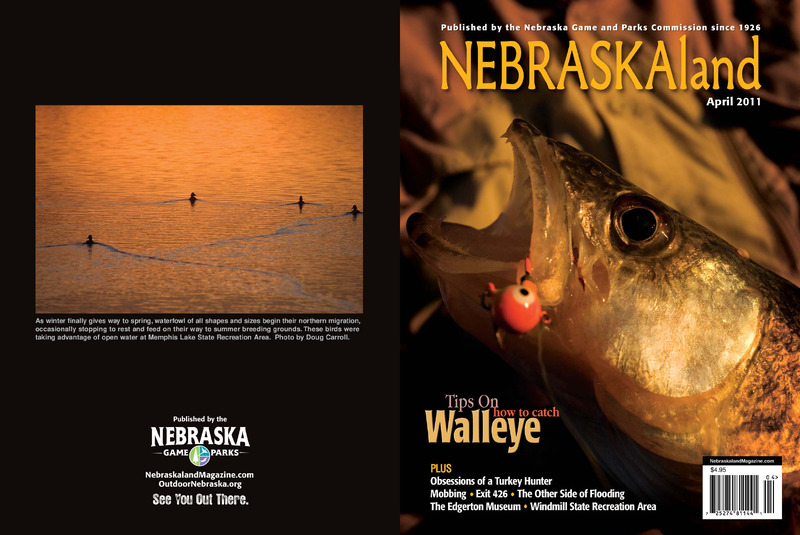
As winter finally gives way to spring, waterfowl of all shapes and sizes begin their northern migration,
occasionally stopping to rest and feed on their way to summer breeding grounds. These birds were
taking advantage of open water at Memphis Lake State Recreation Area. Photo by Doug Carroll.
Volume 89, Number 3, April 2011
14 The Incredible, Obsessive, Questionable, (and
sadly) Truthful Life of a Turkey Hunter
Find out what it is like to be a spring turkey hunter.
TEXT AND PHOTOS BY JEFF KURRUS
20 The Mob
A witness to one of nature’s many common, but poorly
understood, phenomenons. TEXT AND PHOTOS BY MICHAEL FORSBERG
22 More Than One Way – to Catch a Walleye
Learning how to walleye fish takes nothing more than a little
bit of time and an open mind. BY JEFF KURRUS
30 Exit 426
Take this exit off of I-80 near Ashland and see three of the
state’s best attractions. BY PASQUALE MINGARELLI
32 The Other Side of Flooding
When rivers flood, talk usually revolves around the property
and lives lost, but for fish, wildlife and the habitat they
occupy, floods are good. TEXT AND PHOTOS BY ERIC FOWLER
40 Exploring with Edgerton
The Edgerton Explorit Center in Aurora serves as an
interactive museum about this Nebraska-born scientist who
invented the high-speed stroboscope. BY KELSEA NORE
30
●
40
●
42 Windmill SRA – Where Life Spins More Slowly
While Interstate 80 was still being planned, Mel Steen saw
an opportunity for a “chain of lakes.” Thus Windmill State
Recreation Area was born. PHOTOS AND TEXT BY JON FARRAR.
Comment . . . . . . . . . . . . . . . . . . . . . . . . . . . . . . . . . 4
Mixed Bag . . . . . . . . . . . . . . . . . . . . . . . . . . . . . . . . 6
Outdoor Update . . . . . . . . . . . . . . . . . . . . . . . . . . . .46
In the Field . . . . . . . . . . . . . . . . . . . . . . . . . . . . . . .47
Classifieds . . . . . . . . . . . . . . . . . . . . . . . . . . . . . . . 48
Portraits from the Past . . . . . . . . . . . . . . . . . . . . . . 50
20
●
42
●
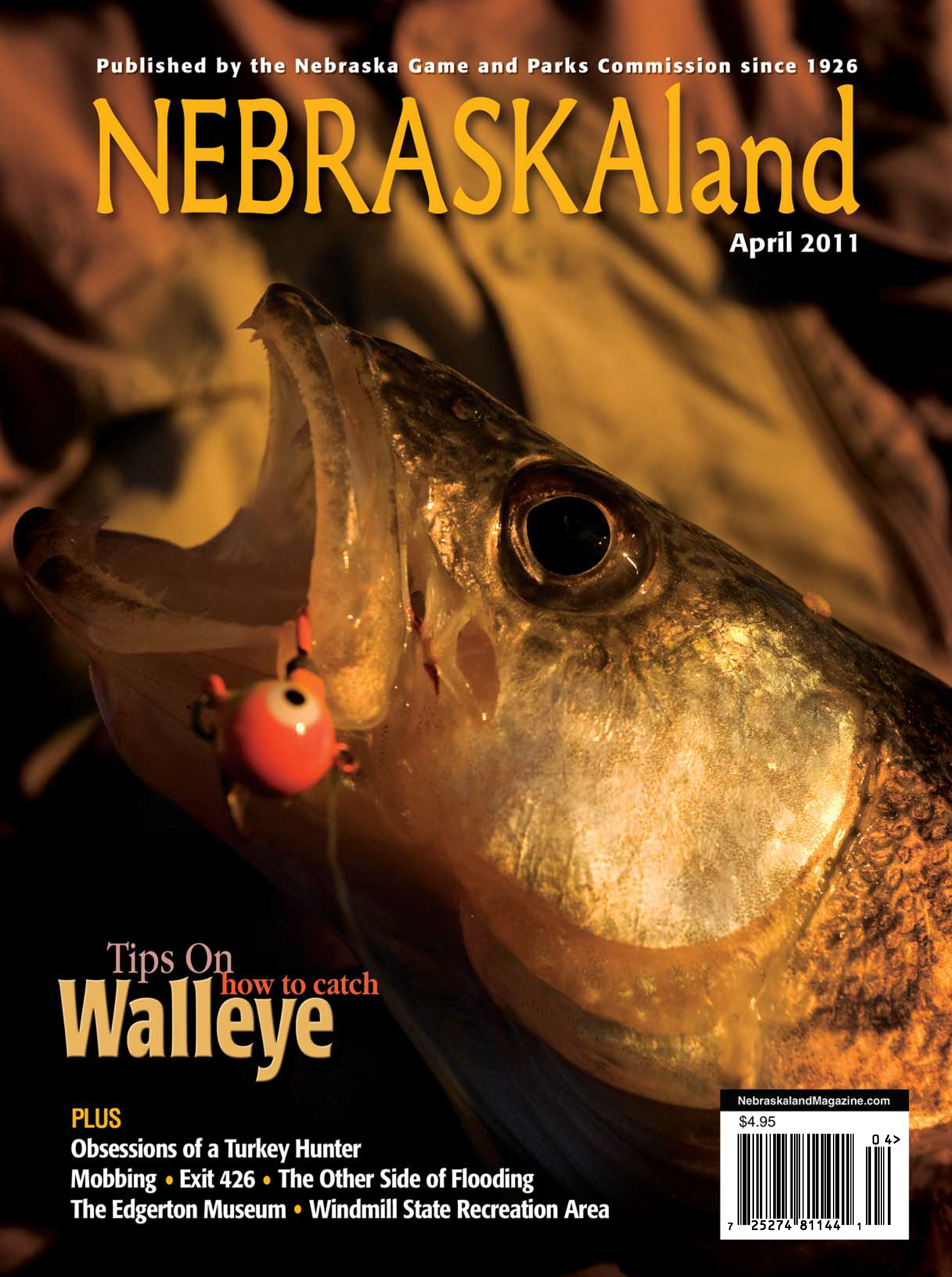
Cover: To the novice, walleye fishing is often seen as a complicated
passion. Yet last year the author learned that there’s more than one way
to catch a walleye. See story, page 22. Photo by Jeff Kurrus.
Opposite: A dominant tom struts on the crest of a hill along the western
edge of E.T. Mahoney State Park in Cass County. Photo by Justin Reed.
NEBRASKAland (VOL. 89 / NO. 3, ISSN 0028-1964) is published monthly, except for the
combined Jan./Feb. and Aug./Sept. issues, by the Nebraska Game and Parks Commission,
2200 N. 33rd St., Lincoln, NE. Periodicals postage paid at Lincoln, Nebraska, and additional
mailing offices. POSTMASTER: Send address changes to NEBRASKAland, P.O. Box 30370,
Lincoln, NE 68503-0370.
APRIL 2011 • NEBRASKALAND 3
Here are some of the many wonderful
responses we received:
Hi, I found your bug on page 50
down in the right corner. We always
called them leaf hoppers, don't know
the “legal name.”
My late husband was an avid hunter
and fisherman, we spent many a
summers camping and fishing and
many winters enjoying hunting.
Our favorite campgrounds were at
Calamus by Burwell – sure do miss
those days. We always made a trip
out there around Christmas time to see
all of the eagles and crows on the frozen
lake.
Janelle Schachenmeyer
Waco, Nebraska
Whooper Siting
On opening day of pheasant season
in 2010, just north of Tilden, Jack
Verschuur and I saw what we considered
quite an unusual sight. Three huge
birds – the two largest were white and
the smaller was a tannish colored
juvenile. We were quite sure they were
whooping cranes. Of course I didn't
have my camera with me but fortunately
the man that rents the land, Dave
Negus of Tilden, did and was on the
opposite end of the field when he took
these pictures.
William Barr
Tilden, Nebraska
Baby Foxes
My wife spotted some baby foxes
along our road by Ceresco. We turned
around and went back home to get a
camera, and got some good pictures.
The foxes were romping around and
were curious about us watching them.
This was sometime in May. Thank you.
Doug and Shawn Rudeen
Ceresco, Nebraska
4 NEBRASKALAND • APRIL 2011
But Where?
The “Do
you know
where this
photograph
was taken?”
quiz on
page 9 of the
March 2011
issue brought
back many
memories for
me. Having
grown up in
the Crawford area, I immediately knew
where the photo was taken.
As a youth I hunted, fished and
hiked as much of the Pine Ridge area
around Crawford as I could. One of
my favorite hikes was to the top of
Saddle Rock Butte, which is in the
background of your photo. My fondest
memory was the fantastic view from
the top of Saddle Rock looking west
up the White River valley toward
Fort Robinson, especially in the
autumn with the beautiful fall colors
on full display. Thanks for your great
magazine.
Michael Hudson
Lake Havasu City, Arizona
NEBRASKAland Visitor Letters
We want to thank all 83 readers
that sent e-mails and letters for last
issue’s visitor, a treehopper that was
on page 50 (see page 13 for the
winner, rules and this issue’s hint).
Your treehopper (order Homoptera;
family Membracidae) is on the bottom
right margin of page 50.
Loved the bone broth suggestion
you had on page 12. I have made it
occasionally, but have been reading it
more lately and will have to save more
bones of my deer harvest from now on.
Need to just saw up the long bones
especially and the ribs and freeze them
for soup! I did deer heart soup this year
and it was great! Keep up the good
work,
Ron Macomber
Sioux City, Iowa
Found it! The visitor in the March
issue of Nebraskaland Magazine is on
the bottom of page 50 and is, I believe,
a katydid.
Thank you for the article about the
sandhill cranes! My husband and I talk
about going to see them every year and
never have. THIS is going to be the
year and we have plans to take the trek
south this year for a weekend road trip.
Thank you also for the great article
about snow geese! Such amazing and
interesting birds. Two years ago we
were fortunate to witness the migration
back south as they stopped on the
Missouri River behind our home. The
sky was so full of them it blacked out
the satellite dish. Watching them circle
the sky over the river before they landed
was so amazing – just like watching a
tornado in slow motion. Awesome sight!
Vicki Butler
Burbank, South Dakota
This afternoon, I barely had a chance
to set down the stack of mail before my
seven-year-old son, Alex, picked up the
March issue of your magazine, opened
the back cover and said “Dad, there’s
the cicada.” Upon further review, he
decided that it is a Buffalo Treehopper
on page 50.
Our family really enjoys the stories
and photography in the magazine.
This monthly challenge has really
sparked my son's interest in identifying
insects and many other things found in
nature.
Thank you for helping interest in the
outdoors to thrive.
Scott Carson
Omaha, Nebraska
This small, bright green insect is a
treehopper, in the order Hemiptera,
and is closely related to planthoppers
and cicadas. This one is likely a
Buffalo treehopper, one of the largest
and more common treehoppers in
North America. They get their common
name because they can be found on
trees and shrubs, and are known to
jump or hop away from danger. They
often have a prominent pronotum,
sometimes shaped to look like a thorn
or spur, to camouflage the inset from
predators. These insects overwinter as
an egg. Females insert eggs into plants
with their ovipositor. They emerge as
nymphs and may secrete a
sweet substance called
honeydew, which is
collected by ants.
– Julie Van Meter,
State Entomologist,
Nebraska Department of Agriculture.
Send your comments to:
Doug Carroll, Editor
NEBRASKAland Magazine
P.O. Box 30370
Lincoln, NE 68503
or e-mail Doug.Carroll@Nebraska.gov
Please include your postal address and
telephone number.
Letters may be condensed and edited
for clarity. Photographs are
welcome and will be returned.
COMMISSION
CONSERV
CONSERVATION OFFICERS
Director Rex Amack
Deputy Director Jim Douglas
Commissioners
Chairman - Mick Jensen, Blair
Vice Chairman - Ron Stave, Waterloo
2nd Vice Chairman - Norris Marshall, Kearney
Jerrod Burke, Curtis
Dr. Mark Pinkerton, Wilber
Dr. Kent Forney, Lincoln
Lynn Berggren, Broken Bow
Rex Fisher, Omaha
Mark Spurgin, Paxton
PANHANDLE
Officer
City
Jim Zimmerman (S) Gering
MAGAZINE
MAGAZINE STAFF
STAFF
Editor Doug Carroll
Associate Editor Jeff Kurrus
Art Director Tim Reigert
Senior Editor Jon Farrar
Regional Editor Eric Fowler
Contributing Editor Michael Forsberg
Regular Contributors Bill Hager, Chris Helzer,
Lisa Knopp
Photo Librarian Sarah Johnson
Circulation Donna Robinson
For address changes and questions about
your subscription, e-mail
Donna.Robinson@Nebraska.gov
or call (800) 632-5263
Marketing/Advertising
For advertising information contact
Larson Enterprises
e-mail dave@larsonent.com
or call (515) 440-2810
NEBRASKAland Magazine Copyright 2011, all rights reserved.
NEBRASKAland is available on audio cassette from the Nebraska
Library Commission Talking Book and Braille Service, Suite 120, 1200 N
St., Lincoln, NE 68508. (800) 742-7691. NEBRASKAland Magazine and
the Nebraska Game and Parks Commission reserve the right to reject any
advertising not in keeping with the agency mission.
Rates: $18 for one year; $33 for two years; $44 for three years. Nebraska
recipients must add appropriate sales tax. To subscribe call
1-800-NEBLAND (632-5263), or go online to:
NebraskalandMagazine.com.
COMMISSION OFFICES
Headquarters
2200 N. 33rd Street Lincoln, NE 68503
Phone (402) 471-0641
District Office I
East Hwy. 2, Box 725 Alliance, NE 69301
Phone (308) 763-2940
District Office II
524 Panzer St., Box 508 Bassett, NE 68714
Phone (402) 684-2921
District Office III
2201 N. 13th St. Norfolk, NE 68701
Phone (402) 370-3374
District Office IV
301 E. State Farm Rd. North Platte, NE 69101
Phone (308) 535-8025
District Office VI
1617 First Ave. Kearney, NE 68847
Phone (308) 865-5310
Omaha Office
1212 Bob Gibson Blvd. Omaha, NE 68108
Phone (402) 595-2144
Ak-Sar-Ben Aquarium
21502 W. Highway 31 Gretna, NE 68028
Phone (402) 332-3901
Scott Brandt
Heath Packett
Dennis Thompson
Frank Miller
Dan Kling
Phone (308)
(office) 763-2940
(cell) 641-6138
Gering
631-0663
Gordon
360-0682
Ogallala
289-0755
Valentine (402) 389-0444
Harrison
430-0572
SOUTHWEST
Officer
City
Phone (308)
Roger Thompson (S) N. Platte (office) 535-8025
(cell) 530-3097
Ray Dierking
Brkn. Bow
870-0322
George Sund
Cambridge
655-0028
Michael Thome
Cozad
529-8146
Matt Andrews
Elwood
746-2418
Dirk Greene
Imperial
882-0015
Virgil Gosch
McCook
340-2440
Dudley Sorensen
N. Platte
530-0016
Rich Routh
Rep. City
920-0367
SOUTH-CENTRAL
Officer
Jerry Pecha (Sup.)
Terry Brentzel
Randy Pomplun
Darin Gress
Dale Johnson
Robert Finke
Doug Pollard
City
Phone (308)
Kearney (office) 865-5327
(cell) 293-3551
Doniphan (402) 469-5795
Fullerton
550-0489
Hebron
(402) 768-8665
Kearney
440-3847
Milford
(402) 947-1363
Ord
778-7101
NORTHEAST
Officer
Tom Zimmer (Sup.)
City
Norfolk
Dale Davis
Steve Oberg
Daniel Roberts
Jeff Jones
Jon Reeves
Pat George
Tim Williams
Cory Krause
Phone (402)
(office) 370-3374
(cell) 649-8053
Bassett
760-0712
Columbus
910-3366
Fremont
719-1108
Hartington
762-5022
Kennard
889-8508
O’Neill
340-0787
Neligh
929-0051
West Point
380-6410
SOUTHEAST
Officer
Duane Arp (Sup.)
City
Gretna
Sean McKeehan
William Krause
Mike Luben
Dan Zuehlke
Douglas Kramer
Dina Barta
Stacey Lewton
Levi Krause
Russell Mort
Dan Evasco
Jeff Clauson
Phone (402)
(office) 332-2965
(cell) 521-0194
Ashland
521-0159
Auburn
274-8063
Colon
443-6392
Cortland (308) 289-3399
Lincoln
890-6465
Lincoln
890-6463
Lincoln
890-7140
Louisville
949-0593
Nebr. City
209-1506
Papillion
616-5961
Waterloo
658-7057
ADMINISTRATION
Officer
Ted Blume (Adm.)
Craig Stover (Asst.)
Wes Loos (Asst.)
Rod Loos (Asst.)
City
Lincoln
Lincoln
Lincoln
Ogallala
Phone (402)
471-5531
471-5532
471-5591
(308) 284-8056
Nebraska Wildlife Crimestoppers 1-800-742-7627
Under federal and/or state law, discrimination is prohibited on the basis
of race, color, religion, age, gender, marital status, national origin,
disability or political affiliation. If you think you have been discriminated
against in any program, activity or facility by the Nebraska Game and
Parks Commission or want more information, contact the Commission in
Lincoln, NE, at (402) 471-0641 or the Equal Opportunity Commission,
Lincoln, NE, (402) 471-2024, TTY/TDD (402) 471-4693).
APRIL 2011 • NEBRASKALAND 5
PHOTO BY CHRIS HELZER
Tiny Assassins
Chris Helzer
Not surprisingly, assassin
bugs aren’t exactly cute and
cuddly little creatures. As
their name suggests, they are
lethal predators, catching prey by
ambushing them or simply hunting
them down. Assassin bugs use their
sharp beak to pierce and inject small
insects with paralyzing venom before
sucking out and ingesting the liquefied
remains.
Assassin bugs are part of the order of
insects called Hemiptera or “true bugs.”
Other insects in the same order include
stink bugs, boxelder bugs and aphids.
True bugs are characterized by their
long, sharp mouth parts that most use
to puncture and siphon juices out of
plants. A few, however, are predators
(including assassin bugs) and have
adapted these same mouth structures
into deadly weapons.
One of the most common species of
assassin bugs is Zelus luridus – a small
green assassin bug about half an inch in
length. As with all assassin bugs, both
Nebland Flashbacks
Can you identify this young man
from the November 1967 issue of
NEBRASKAland Magazine?
Seen here in a story on how to
make jerky, he was working in the
Information and Education Division
of the agency. He has worked for
the Commission for 43 years –
23 in his current position – and
has been honored by serving as
President of the Association of
Fish and Wildlife Agencies in 20082009.
6 NEBRASKALAND • APRIL 2011
the
adults
and the
various
nymph stages
are predatory. The
above photo shows a
nymph that caught a fly
in my backyard prairie
garden and was busily sucking it
dry while I photographed it. Zelus
is commonly found on green
vegetation, especially trees and shrubs,
throughout Nebraska. They catch and
eat many kinds of small insects, but
particularly like flies. Special glands on
their front legs produce a very sticky
fluid that the assassin bug rubs on the
hairs of those legs, helping them to
grab and hold on to strong prey.
There are many kinds of assassin
bugs, found all over the world. In the
United Kingdom, researchers have
discovered that at least one kind of
assassin bug fools spiders by plucking
their webs in a way that makes the
spiders think they’ve captured prey.
When the spider comes to investigate,
the assassin bug kills and eats the spider!
Another kind of assassin bug are
known as “kissing bugs” and actually
feed on the blood of mammals, including
humans. Found from southern North
America through much of South
America, these bugs pierce the skin of
mammals and suck their blood. Their
name comes from their tendency to bite
humans on or around their lips. If that
isn’t disturbing enough, some species –
mainly in South America – can carry a
dangerous parasitic disease that can
cause severe illness or death to people.
In Nebraska, assassin bugs are
commonly found in gardens and many
natural habitats, feeding on small
insects rather than humans. If you pick
them up some can give you a painful
bite, but it’s a defensive tactic rather
than a bloodthirsty attack. Since
assassin bugs prey upon many insect
species we’ve designated as pests, they
can probably be called “beneficial”
insects. Regardless, they are worthy of
admiration and interest because of their
rugged good looks and killer abilities.
If you see these small creatures in your
yard, take a moment to admire (and
maybe even thank) them.
But I wouldn’t kiss them.
Here is a list of
upcoming outdoor
events across
Nebraska.
For more
information
about
these and
other events, click on
the calendar at
www.OutdoorNebraska.org.
April 1
• Ashfall Fossil Beds SHP – Royal
Will conduct school and tour groups
by special arrangement from April 1October 20. For details and to make
reservations, call the park at (402) 8932000.
April 1-30
• Paddlefish Archery Application
Period – Statewide
Permits remaining following the first
draw will be sold on first-come, firstserved basis beginning at 1 p.m. on
June 1.
Contact: Bob Zegar
(402) 471-5455
bob.zegar@nebraska.gov
April 8
• Becoming an Outdoors Woman
Workshop – Ponca State Park, Ponca
Learn a variety of outdoor skills
through hands-on/one-on-one
instruction. Registration is online at
OutdoorNebraska.org.
Contact: Ponca State Park
(402) 755-2284
ngpc.ponca@nebraska.gov
April 9
• Spring Turkey — Youth Shotgun
Season – Statewide
The youth shotgun turkey season
starts April 9 and youth turkey permits
only cost $5. The regular shotgun
turkey season begins the following
Saturday, on April 16. Purchase
permits at OutdoorNebraska.org
Contact: Jeff Lusk
(402) 471-1756
jeff.lusk@nebraska.gov
April 18
• Bighorn Sheep Lottery Application
Period – Statewide
Lottery permit applications are
accepted from Nebraska residents
only. All applications must be
submitted with a nonrefundable $25
application fee.
Applications may be submitted at
OutdoorNebraska.org
Contact: Bob Zegar
(402) 471-5455
bob.zegar@nebraska.gov
Wildlife Conservation Fund
Jeff Kurrus
Jon Farrar
Beginning in March
and peaking mid-April,
male prairie grouse
gather on display
grounds called leks,
sharptails on dancing
grounds and prairie
chickens on booming
grounds, to attract and mate
with hens. Everyone who
enjoys watching wildlife should
observe both species display at
least once in their lifetime.
Male prairie grouse display most vigorously
in the morning. Plan on being in the blind at least
an hour before sunrise, and stay in the blind until
displaying grouse have left, anywhere from two to three hours after sunrise. Dress
warmly. You can always shed layers of clothing you have on, and in April the
nights are often chilly. Displaying grouse are amazingly tolerant, but for the best
display keep noise and observable movement to a minimum.
There are a number of private grouse viewing outfitters in the state. Google
“grouse viewing Nebraska” or something similar to find them. Several public
viewing sites with blinds are listed below.
Burchard Lake Wildlife Management Area – Five miles north, five miles east
of Burchard; Pawnee County. Greater prairie chickens. Two blinds on a firstcome/first-served basis. Few birds have used the area in recent years.
Valentine National Wildlife Refuge – Cherry County. One sharptail, one
prairie chicken blind. For information call (402) 376-1889 or (402) 376-3789.
Crescent Lake National Wildlife Refuge – Garden County. One sharptail
blind. For information call (308) 762-4893.
Nebraska National Forest Bessey Ranger Division – Thomas and Blaine
counties. One sharptail, one prairie
chicken blind. For information
call (308) 533-2257.
Samuel R. McKelvie National
Forest – Southwest of Valentine
in Cherry County. No blinds,
visitors allowed to view displaying grouse from a distance or
with personal blinds. For more
information call (402) 823-4154.
The Nebraska Bird Library
Kelsea Nore
The Nebraska Bird Library web site
(www.NebraskaBirdLibrary.org) offers
users several easy and effective methods
to determine just what kind of bird has
been chirping outside of their window
now that spring has arrived.The web
site was launched in early September
and by year’s end had over 1,000 visitors
from 20 states and four different
countries, said Nebraska Game and
Parks Commission wildlife education
specialist Lindsay Rogers.
The site is the result of what was
initially going to be a field book for
students participating in Project BEAK
(Bird Education and Awareness for
Kids), a program whose aim is “the
more students understand and are
connected to the places where they live,
the more they will care about what
happens on the land.” Early research
with Project BEAK suggested that a
web-based program would benefit a
larger population and the Nebraska
Bird Library found its place on the
Internet, where it is accessible to
birdwatchers of all ages.
More than 400 different species of
birds can be found in Nebraka.
Determining which species you’re
looking at (or for) can be a little
daunting. The web site allows you to
The end of winter and reappearance of open water across
Nebraska means one thing to many people – boating season.
Make sure you stay safe this season by following boating regulations and wearing an approved life jacket
whenever you are on the water.
search by characteristic, common or
scientific name or group (goose or owl,
for instance). The characteristics search
is broken into three categories: size,
colors and region (or habitat).
Using this tool, you can discover
that the small, red bird you saw in
Schramm Park SRA wasn’t a cardinal
but a male summer tanager. By clicking
on a bird’s image, you can find more
in-depth information about it, such as
habitat, songs or calls, and fun facts.
The site will be adding sound recordings
of each bird by the year’s end.
“The goal of the Nebraska Bird
Library is to provide a comprehensive
library of all Nebraska’s bird species.
We hope it will help beginner
birdwatchers identify what they are
seeing in the field, homeowners identify
what they see in their backyard and in
the end,” said Rogers “get more
Nebraskans outside enjoying birds and
birdwatching.”
PHOTO BY JEFF KURRUS
8 NEBRASKALAND • APRIL 2011
Grouse Viewing
PHOTO BY JON FARRAR
It’s only a matter of time before I
wear down longtime Nebraska
humorist Roger Welsh into writing
for NEBRASKAland again. Yet
until that day comes, I’ll have to
rely on his past stories in our
publication, including his April 1986
article entitled “Sniping” which
begins:
“Just as Nebraska newspapers
tend to overload their pages with
football stories and to ignore
minor sports like competitive
moseying or frog-sled racing,
NEBRASKAland has, it seems to
me, devoted too much attention to
pheasant and deer stalkers or
bass fishing, and has neglected
fundamental sports like sandcat
fishing or snipe hunting.”
Once your snipe bags were full,
you could pick this issue back up
and read “Canada Geese –
Managing The Comeback,” a
Notes on Nebraska Fauna piece
on Orioles, or “Blueprints for
Broods,” with the latter being a
step-by-step tutorial for building
artificial nest boxes.
“Legacy of Grass” was the next
article in this month’s edition,
which speaks of the value of
native grasses, with writer Carl
Wolfe penning the words to paper.
A voice, once again, that would
be nice to hear in our current
publication.
To read “Sniping” and
“Legacy of Grass,” visit
NebraskalandMagazine.com and
click on “A Look Back.”
Stay Safe This Spring
Tax season is upon us, which provides provides an
opportunity for Nebraskans to contribute to wildlife and
habitat conservation in our state. Line 41 on the 2010
state income tax form (Form 1040N) allows individuals
to donate all or a part of their tax refund to the Wildlife
Conservation Fund.
“The check-off is one of the principal sources of state
funding used to conserve more than 98 percent of fish and
wildlife species that are not hunted, trapped or fished,”
said Kristal Stoner, wildlife diversity program manager
for the Nebraska Game and Parks Commission.
Check-off donations are matched to other grant
sources that require a financial match before they can
be used; so a donation of $10 allows $40 to be spent on
wildlife projects.
Taxpayers who are not entitled to a state tax refund
may contribute by visiting NebraskaWildlifeFund.org,
or by mailing: The Wildlife Conservation Fund,
Nebraska Game and Parks Commission, P.O. Box
30370, Lincoln, NE 68503-0370.
Information about the indigo bunting (pictured) and other Nebraska bird species can
be found at NebraskaBirdLibrary.org.
APRIL 2011 • NEBRASKALAND 9
A Book of Pheasants
Jon Farrar
Lonnie Shafer’s book, Nebraska
Pheasant Hunting Almanac, was a
two-year labor of love. Shafer’s father
planted the pheasant hunting passion
that is now in the family’s third
10 NEBRASKALAND • APRIL 2011
Permit Brings Record Price
A Nebraska bighorn sheep hunting
permit has brought a record $117,500
at auction, according to the Nebraska
Game and Parks Commission. Thomas
Lemmerholz of Heiligenhaus,
Germany, made the winning bid at the
Grand Slam Club/Ovis Hunter and
Outfitter Convention held at the end of
February in Las Vegas.
The previous record for a Nebraska
bighorn sheep auction permit was
$87,500 in 1998. All proceeds from the
sale of the permit go to the state’s
bighorn sheep management program.
Lemmerholz, who has never visited
Nebraska, hopes to make a scouting
trip this June. Along with the bighorn
permit, he will receive four days of
guide service, lodging and meals at
Fort Robinson State Park during the
2011 bighorn sheep hunting season,
which is Nov. 29-Dec. 22.
Two bighorn permits are authorized
in Nebraska for 2011. A lottery for
Nebraska residents will take place
later this year for the other permit.
Lottery applications will be accepted
April 18 through August 5, and the
drawing will take place in late-August.
The estimated bighorn population in
the state is 250-300.
PHOTO BY JEFF KURRUS
Kelsea Nore
Paul A.
Johnsgard’s
latest book,
Sandhill and
Whooping
Cranes:
Ancient
Voices over
America’s
Wetlands,
is an informative and interesting
addition to his vast collection of books.
Johnsgard, Professor Emeritus in the
Biology Department at UN-L, has a
keen appreciation for his subjects that
is reflected in his writing, which is both
professional and tender. The book is
divided by chapters on the Lesser and
Other Sandhill and Whooping Cranes
and the future of all North American
cranes. Also included are the author’s
own illustrations, maps, references,
suggested readings and the wonderful
inclusion of an appendix of crane
viewing sites throughout the United
States and Canada.
The book touches upon the biology
of the cranes but focuses more on the
migration patterns, habitats and the
efforts being made to protect and grow
wild crane populations. The book,
available in
March of 2011,
will be enjoyed
by admirers and
enthusiasts
alike. All
proceeds will be
donated to the
Lillian Annette
Rowe Sanctuary
and Iain
Nicolson
Audubon
Center near
Kearney.
generation. The book is a combination
of Shafer’s personal reminiscences of
times afield in pursuit of the ring-necked
pheasant and the most thorough
summary of the bird’s history in
Nebraska to be found between two
covers. Included is an accounting of
early introduction efforts and
Nebraska’s first pheasant hunting season
in 1927, when only Wheeler and parts
of Sherman counties were open for a
three-day season with a limit of five
cock pheasants. Shafer methodically
traces the changes in hunting
regulations, year by year, from that first
season to the present. In addition, the
book is filled with sundry information
about Nebraska’s most successfully
introduced game bird – everything from
how to dress and debone a pheasant, to
recipes, to a primer on pheasant habitat
requirements. It should be on the shelf
of ever dedicated pheasant hunter. See
the classified advertising section of this
issue for ordering information.
Nine-year-old Morgan McCarthy focuses
while fishing at Platte River State Park.
Check Your Park Facts
Michelle Stryker
Every two years the Nebraska Game
and Parks Commission’s parks division
conducts a survey of visitors to the
state park system starting in June and
going through mid-July. It includes
questions regarding what people are
participating in while at the park, how
the services and amenities rate, how
long they are there, what the visitor
would like added to the area, and
input on management issues the parks
division is dealing with. Trend data is
gathered to use for management
decisions, support information to the
Nebraska Legislature and for other
various planning documents. Visitors
will be surveyed again this summer at
32 different state parks, recreation
areas and historical parks. Below are
a few highlights of the most recent
survey:
The most important activities to park
visitors, whose overall average age was
50.6 years, was camping, fishing,
picnicking, swimming and boating.
While 79.2 percent of the visitors to
Nebraska’s state park system were
residents, Colorado, Iowa, Wyoming,
Kansas and Missouri led the park system’s out-of-state visitors. The average
stay when spending at least one night
was 3.67 nights, and the average daily
use at a park was 4.02 hours.
S
PHOTO BY JEFF KURRUS
Ancient
Voices
Become a campground host at one of Nebraska state parks and recreation areas by
applying at http://outdoornebraska.ne.gov/parks/programs.
Campground Host Program Call for Volunteers
Kelsea Nore
Do you plan on spending your summer vacation in a Nebraska state park?
Know the area around one of these parks like the back of your hand? If so, you
are a great candidate for the NGPC’s Campground Host Program, which is
currently looking for volunteers. Hosts will act as liaisons in parks throughout the
state, sharing their outdoors and camping knowledge with visitors and assisting
with some light maintenance. Examples of maintenance may include litter pickup,
painting, mowing and overall care of the park facilities. The most important activity
a campground host will do, however, is meeting and greeting visitors, assisting
them in finding their campsites and answering questions on the area and the park.
Hosts must be able to spend at least two weeks in the park and in return will
receive free camping with electrical hook-ups and showers (where available). Host
positions are open to anyone 18 years or older who are familiar with the area
where they will be staying and Nebraska camping regulations. The program will
generally run from April 1 through September 15. For more information on areas
to volunteer at, contact Michelle Stryker at michelle.stryker@nebraska.gov.
Leo Turner of grew up fishing, hunting
and trapping in Nebraska. He remembers
getting $20 for a mink, measuring beaver
pelts by the inch, and shooting his first
buck at Swanson Reservoir one morning and still making it to work on time
in Stratton, where he was school superintendent. When he retired as
superintendent at Arthur in 1998, the faculty gave him this plate. Now 77
and living in Lisco, he believes trout fishing is the state’s best kept secret.
If you have a unique outdoor message plate you would like to share, or
know someone who does, e-mail a photo (high-resolution, jpeg format only,
please) of it to Eric.Fowler@Nebraska.gov, along with your name,
hometown, and a brief description of the interests expressed on your
license plate.
tate
wildlife biologists
in Bethel, Maine
recently captured a barred owl
that had been decapitating chickens
inside a local barn and flying off
with their heads. This serial killer, as
local authorities called it, was killing
about one chicken a day.
Wildlife biologist Judy Camuso
stated that during the winter months,
barred owls have a tough time finding
food because of the deep snow.
“Then you combine our snowpack
with the rain we got that created a
little ice pack on top of it – that
makes it even harder for them,” she
said.
She added that many animals that
owls eat – such as red squirrels and
voles – live under the snow. “That's
why many owls, particularly barred
owls as they're so common, are being
taken to wildlife rehabbers now,” she
said. "They end up hunting along
roadsides and tend to get hit by cars."
The owl was taken to Avian
Haven, a wildlife rehabilitator in
Freedom, Maine, said local wildlife
biologist Chuck Hulsey. “It was
probably under a lot of stress and is
going to rehab, which won't hurt it,”
Hulsey added.
“Owls will often eat the head of an
animal first,” said Camuso. “There
are some nutrients in the brain that
they like, minerals in particular.
Usually, owls and weasels are kind
of notorious for
eating heads.”
Authorities
caught the
owl with a
mist net after
receiving a
call from
the local farmer,
yet not before
the bird had
collected six
chicken heads.
APRIL 2011 • NEBRASKALAND 11
Chronic Wasting Disease Numbers Up
Nebraska saw an increase in the number of deer testing
positive for chronic wasting disease (CWD) in 2010, as well as
a wider distribution according to the Nebraska Game and Parks
Commission. There were a record 51 positives found in harvested
deer in 2010, compared to 42 in 2009.
CWD is a disease that can affect deer and elk and is always
fatal to the affected animal. Humans, however have never been
known to contract CWD.
As part of its ongoing efforts to monitor the disease, the
Commission collected 3,645 lymph node samples from deer
harvested during the 2010 November firearm season and also
tested elk that were harvested in Nebraska.
The counties with the highest number of positives were:
Sioux, 11; Sheridan, 7; Dawes, 6; Garden, 6; Box Butte, 4;
Scotts Bluff, 4; and Morrill, 3. There were two positives each in
Banner and Hitchcock counties and one each in Hooker, Keith,
Lincoln, Loup, Cherry, and Hall counties. The counties in
which CWD was found for the first time were Hitchcock,
Hooker, Lincoln and Loup.
No elk tested positive for CWD in 2010.
12 NEBRASKALAND • APRIL 2011
Dick Turpin
I was cleaning my
camping gear awhile
back and I was shining up the silverware
and some of it was silver. It was those
old silver plated spoons in my camp kit
and boy they really shined up and I got
to thinking how those things would
make good fishing lures. So I took
some of them home and I drilled holes
in the ends so I could hook my line in
and of course my hook…and then I
took a grinder…took the spoon handle
off…and I ground that smooth and I
narrowed it up with a grinder so it
made a little more of a spoon shape
like the commercial fishing lures…like
a daredevil or something like that. I
just shined them up and after I put the
split ring, the hook in the end…and
boy they made a terrific spoon
lure…really flashed in the water when
you cleaned that silver up and I got to
thinking with all the grandkids I have
and them throwing those 3 to 5 dollar
See You Out There ...
But Where?
PHOTO BY JEFF KURRUS
– Randy Pomplun,
Conservation Officer, Fullerton
Jeff Kurrus
For many people, an
occasional roadside
view of a deer is about
all that is seen of this
wary mammal outside
of harvest and hunting
seasons. Yet even with
minimal viewing
throughout the year,
February 23
it’s quite evident how
much a deer’s coat
changes through the
seasons.
Designed to provide
thermoregulation and
camouflage, a deer’s
coat undergoes two
yearly molts, altering
coat color dramatically.
In the spring, a deer’s
thicker winter coat is
replaced by a reddish
summer coat that is
May 15
thin, allowing deer to
better cope with
warmer temperatures.
This coat molts in
August and September,
replaced by a winter
coat that consists of
two layers: The outer
coat has hollow, stiff,
grayish-brown hairs
that are about two
inches long. The
July 27
undercoat has short,
wool-like hairs that
are soft, dense and
insulate the deer from
cold winter weather
and snow and is again
molted in the spring.
Coat color, regardless
of season, can also be
influenced by sun
exposure – the more
open the areas that a
deer inhabits, the
lighter the coat color.
In addition, fawns are
born with a reddishNovember 9
brown coat that has
several hundred small
white spots for camouflage. At approximately three to
four months of age, this coat is replaced the brownishgray winter coat worn by their elders.
PHOTOS BY JEFF KURRUS
A few years ago, when fur prices were high enough that
lots of people were trapping and hunting raccoons, I
received a call about someone spotlighting coons before
the season opened. The informant gave me a general idea
where the spotlighting was taking place, and also told me
where the raccoons were being stored after they were
shot.
I spent the next three nights staking out the area where
the spotlighting was supposedly taking place, but didn’t
see anybody. The day before raccoon season started, I
decided to contact the suspect since I didn’t have any
other options. I visited the location the informant had given
me and it was just as they had described. I walked over
the shed and saw a deep freeze with feed sacks on top
and surrounded by hay bales. Since I didn’t have a search
warrant, I couldn’t look inside the freezer, so I went to the
suspect’s place of work and asked to speak to him.
After identifying myself, I told him I had information that
he had been shooting raccoons out of season, which he
denied, of course. Then I asked him, “You don’t have
raccoons in a freezer surrounded by hay bales with feed
sacks on top?”
His whole attitude did an abrupt about-face when I asked
that question. “There’s a few in there,”
he admitted. He went with me as we
went back to the freezer, and when he
opened it up, a “few” raccoons turned
out to be 63. He ended up paying a
pretty penny in fines and liquidated
damages, thanks to an informant and
asking the right questions.
Turpin Time
Do you know where this
Nebraska photograph
was taken?
See answer at the bottom
of page 13.
lures out and snagging them up that
this made a way more reasonable
approach to that. You could sit down
and make 50 of these so fast it would
make your head swim so I thought this
is the route to go…make your own
lures. I got some fishing buddies that
tell me “Sometimes you’ve got to
spoon feed those bass”…you know
something…I literally do that…I spoon
feed them.
Vilsak Announces 2011 CRP
General Signup
Eric Fowler
Up to four million acres could be
enrolled in the latest federal
Conservation Reserve Program (CRP)
general signup
currently underway
and announced by
Agriculture Secretary
Tom Vilsack at
National Pheasant
Fest 2011 in Omaha
in January.
Tom Vilsack
"Over the past
25 years, support for CRP has grown
thanks to strong backing from partners
like Pheasants Forever, farmers, ranchers,
conservationists, hunters, fishermen
and other outdoor sports enthusiasts,"
said Vilsack. "Not only has CRP
contributed to the national effort to
improve water and air quality, it has
preserved habitat for wildlife, and
prevented soil erosion by protecting the
most sensitive areas including those
prone to flash flooding and runoff."
Nebraskans enrolled 189,515 acres in
the 2010 general signup, the first since
2006, replacing slightly more than the
172,000 acres expiring. Of the land
offered for enrollment, 95.1 percent was
accepted. Nationally, 4.3 million of the
4.8 million acres offered were accepted.
Conservationists had hoped to see
higher demand in the 2010 signup to
help make their case for increasing the
cap on enrollment from the 32 million
acres set in the 2008 Farm Bill to the
previous caps of 39 million or even
45 million acres in the next Farm Bill.
Interest may not improve in this
signup, with high commodity prices
making it much more profitable to farm
land than enroll it in CRP at the current
rental rates. Additional incentives are
available to landowners who agree to
allow public walk-in hunting and enroll
their CRP in the Commission’s Open
Fields and Waters program.
Contracts will expire on 151,895 acres
of CRP in Nebraska and 4.4 million
acres nationally in October. Vilsak said
the signup should keep acreage near the
32 million acre cap. Current enrollment
is about 31 million acres nationally and
one million in Nebraska.
Acceptance in CRP is based in part
on the Environmental Benefits Index
(EBI), which weighs wildlife, water,
soil, air and enduring benefits and cost.
Nebraska’s average EBI trailed only
Missouri and Oklahoma nationally.
Anyone interested in enrolling in the
general CRP program can visit their
local Farm Service Agency office
between March 14 and April 15. There
are many other options for enrolling
land in other conservation programs.
For more information, contact the farm
bill biologist in your area. ■
NEBRASKAland Visitor
Winner and Hint
Last issue’s winner of
the NEBRASKAland
Visitor drawing was
Jackie Nunnenkamp of
Henderson, Nebraska, who found the
treehopper on page 50.
Readers are encouraged to contact
NEBRASKAland within 10 days
after this issue’s publication with the
correct page number and name of
this issue’s “Visitor” – a bug found
in Nebraska that just happened to
find its way onto one of the pages of
our publication.
We will then gather the correct
entries and draw one to win a new
NEBRASKAland Magazine mug.
To enter each month, write:
NEBRASKAland Visitor
2200 North 33rd Street,
Lincoln, NE 68503.
Or e-mail:
Tim.Reigert@Nebraska.gov
with “Visitor” in the subject line of
the message.
HINT: This issue’s visitor is not on
page 5, 6, or 33.
Niobrara State Park in Knox County
“There’s a Few in There”
Coat Color
APRIL 2011 • NEBRASKALAND 13
The
Incredible,
Obsessive,
Questionable, (and sadly)
Truthful Life of a
Turkey Hunter
Text and photos by
Jeff Kurrus
I
t’s 4 a.m., nearly two hours from
legal shooting time, and I’m sitting
against a tree in a small patch of
woods with my eyes wide open, sweat
already creeping down my forehead
from my long walk in. I’m here because
sleep evades me during spring turkey
season; I’m here because every single
morning when I arrive near shooting
time the toms I covet walk in the
opposite direction; I’m here
because this is no longer a
quest for fun – it has
simply become
a quest.
I was introduced to turkey hunting by
a close friend who stands 6’5”, topples
the scale at 350 pounds and is afraid of
no man, big or small. Snakes, raccoons,
possums, spiders and the dark, however,
scare him beyond words. Yet during
his first year of turkey hunting, he
admitted to
crawling
across
forest
floors,
swimming
across
creeks
and arriving in
the woods for a
morning hunt more
toward midnight than daylight
in an attempt to get close to a
roosting tree. “It’s the most fun I’ve
ever had in the woods,” he said, “and I
never fired a single shot.”
But I still wasn’t convinced of turkey
hunting’s allure … at least not until
I walked into Commission fisheries
biologist Daryl Bauer’s office the next
April, the one location where I
thought fish and fishing are always
paramount, and asked when we might
be able to catch a few walleyes
together. “Let me be honest with
you, Kurrus,” he said. “I have turkey
on the brain right now. I’ll fish later.”
Turkey on the brain. There’s probably
no better way to explain the spring
14 NEBRASKALAND • APRIL 2011
turkey hunting phenomenon. For the
turkey hunter, everything in life sounds
like that guttural call from a tom –
doors slamming, a coffee pot turning
on – and every noise afield makes a
hunter tilt their head to listen in hopes
of hearing a second blast.
Sometimes, however, one call is all
that a hunter hears, at least until the bird
has walked completely around the blind,
crept to within 10 feet and gobbled
again at point-blank range, only to run
away before a shot can be had. These
moments lead to seemingly sleepless
nights for the hunter, when one finally
dozes off two hours too late and wakes
up two hours too early.
This morning turkeys will not evade
me. It’s near 5 a.m. now, still an hour
and four minutes before shooting time,
and I am less than 60 yards from their
roosting tree. The air is cool, in the
mid-50s, and I am absent of both
insects and fatigue. All I can see are
stars and it’s still too dark to make out
even a single bird in the roost tree. I
lower my head, stretching the muscles
in my neck, and hear the first gobble of
the morning. Turkeys will not evade me
today.
“Dawn for show, noon for dough” is
a common turkey hunting statement. If
you want to hear birds, arrive before
sunrise as a tom attempts to gather every
hen he possibly can for a morning stroll
Early morning calling for turkeys is one of
hunting’s most exciting, and anxious, activities.
It can also be a waste of time since many toms
are already with hens when they leave the roost.
through the woods. Never has
the phrase “one in the hand”
been more true. He may talk
back to you, responding
so quickly to your calls
that you’re convinced
he’s running in your
direction, but if he is
already with hens,
stop calling.
You’re probably
wasting your
time.
Come
midday,
however,
the tom
tends to get a
bit lonely. While strutting
and calling all morning,
he’s more than likely
forgotten to pay close
attention to his harem.
They’ve disappeared,
often one by one, to lay
eggs in the woods and
the tom suddenly finds
himself alone.
I’m here because
sleep evades me
during spring
turkey season ...
I’m here because
this is no longer
a quest for fun –
it has simply
become a quest.
But my tom is not alone this morning.
At least not yet. There are at least two
more gobblers with him, as well as a
number of hens. I can’t see them yet,
but soon I may be able to. Despite the
twinges of regret already entering my
mind regarding my close proximity to
the roost tree, I remain still. They are
only twinges, mind you – I have hunted
these birds for nearly two straight
weeks, and this morning I plan on
shooting the first one in range as soon
as his feet hit the forest floor. I feel
nearly compelled to do so.
Turkey hunting is a cure of many
phobias including, but not limited to,
acarophobia (itching), achluophobia
(darkness), ambulophobia (walking),
amychophobia (being scratched),
arachnophobia (spiders), entomophobia
(insects) and herpetophobia (reptiles).
Unfortunately, turkey hunting can also
lead to fears, namely atychiphobia
(failure), decidophobia (making
decisions), and, most notably,
dementophobia (insanity). It is
unimaginable what it must have been
like for hunters who needed to kill a
bird for food. Unimaginable how much
hate accumulated in the hearts of men
whose survival was predicated on
whether they could convince a bird to
coming within killing range.
Watching Richard Johnson of Gretna
take his six-year-old son Nolan on his
first turkey hunt last spring, it was
impossible not to think about the
treacherous road that the father was
introducing to his son. Nolan skipped
through the woods like only a child
can, with camouflage clothes too large
for him and the inability to see the
heartaches ahead in his life.
The birds are on the ground. I still
can’t see them, but I can hear them.
Multiple “peeps” fill the woods as an
occasional gobble echoes through me.
I call, first with my slate, then with a
box, and a tom responds. I scratch
again, and he returns my advance.
Repeatedly we talk to each other,
me asking if he would like more
companionship. He affirms, yet his
replies grow fainter, regardless of
what “hen” I use.
Trying to sneak up on a turkey is usually not a good idea, but frustration and obsession
often force poor decisions.
16 NEBRASKALAND • APRIL 2011
A grunt call, a bleat call and an
occasional set of rattling antlers. What
a deer hunter carries. A rarely blown
for practice but too often blown in the
field call. What a duck hunter carries.
A mouth call, another mouth call, a
third mouth call, a slate call, a second
slate call, two strikers, a gobble call
and your son’s push-button hen yelper.
What a turkey hunter carries.
Two chest pockets and two shell
pockets. What the vest of a duck, quail,
The beautiful, exhilarating, nerve-racking experience of watching a tom strut up to a hunter’s call is highly, and dangerously, addictive.
deer or pheasant hunter looks like. Two
large chest pockets, two shell pockets,
two inside pockets, two interior pockets
with shell pockets inside, two thin,
long pockets between the chest and the
shell pockets. And Velcro, buttons and
zippers. Lots of zippers. What the vest
of a turkey hunter looks like.
I continue to call, even though I have
seen this act before. I will receive an
occasional over-the-shoulder reply that
will bring a brief feeling of hope, but
every other gobble will continue to be
fainter. I lean my head against the tree,
for the first time tired, and remove the
wet mouth call from my lips. “Damn,”
I say to myself. “You gotta be kidding
me.”
Then I catch a glimpse of my birds,
at least five toms and fifteen hens,
already 200 yards away. I have no idea
which way they will go from there, so
any advances toward them are for
naught. I must now wait for midday,
hoping that one of the toms finds his
way back across a creek, through a
patch of woods and into my open area.
I’m sure these grounds have more birds
than this flock, but my own doubtful
shrugs convince me otherwise. So I
remove my facemask and continue to
shake my head.
Unless one is a member of the
special forces, a sniper…or a turkey
hunter, one probably doesn’t own a
ghillie suit. Yet for those whose springs
are spent trying to get close to what
seems to be nature’s smartest animal,
ghillie suits are one possible option. Face
painting and head-to-toe camouflage
also provide confidence to the turkey
hunter, at least until a bead of sweat
crosses the tip of the nose, forcing an
itch so demanding that the hunter’s
eyes start to water, prompting a scratch.
“You can be as camouflaged as you
want,” a turkey hunter once told me,
“as soon as that camouflage moves,
you’re done.”
A non-turkey hunting friend, one
whose hunting choices in life I often
envy, recently relayed a story about a
turkey encounter he had during the
archery deer season.
“I saw some turkeys the other day
when I was hunting,” he said. “I almost
got a shot, but they just slowly eased
away from me as I watched them in the
field. It was strange. They were walking
right toward me until they started fading.
I mean, they didn’t see me – I know
that. They must have just wanted to go
in that other direction.” I didn’t have the
heart to tell my friend he’d been made.
As I contemplate my next move,
continuing to watch the flock feeding in
the field, I notice one of the hens running
back toward the
creek. Then I
see another
one following suit, legs
comically
moving as
they race
away from
some fear I
have yet to see. A
coyote appears in the distance, running
full sprint toward the flock with a
running mate close his side. Its partner,
however, is not another coyote. Instead
of the sleekness associated with coyotes,
I watch a short, round-bodied sidekick
APRIL 2011 • NEBRASKALAND 17
peck at their own reflections in windows, not care. I can buy more supplies, but I
that
watched them feed on the median of
may never get a shot at a turkey again.
looks
Interstate 80 as vehicles pass in both
I think I am close to the creek, but dare
like a
directions, and heard them gobble
not look up. I’m not even sure if the
badger
after the slam of a car door. How can
turkeys are still in the field, but will
pursuing
something this disillusioned and
crawl across a highway if it will keep
alongside
absent-minded evade me repeatedly?
me from being detected.
the coyote.
So I crawl, stinging nettles now and
I reach the creek, slide down its
The turkey
poison ivy later itching my skin.
muddy embankment, fill my boots with
flock soon
water and attempt to crawl up the
busts
Turkey hunting is the closest
other side. My gun, clothes and face
completely as
comparison most people will ever have
mask are covered with mud. I care not.
birds fly across
to going to war, or at least playing war
I only care about getting to the edge of
the creek and
like we did as children. The shotgun
this field.
back into the
manufacturers have picked up on this
When I arrive, my face falls to the
woods, many
moving to the top of phenomenon in recent years, as “turkey” forest floor as I swear again. The
guns look much more tactical than
turkeys are at least 200 yards to my
the tallest tree. With
right. From my angle, there
newfound
is no way I can maneuver
hope, I
through the woods and get
lower my
ahead of them without being
face mask
made. I am tired, I am
back and
frustrated and a combination
ready for a
of sweat, mud and creek
second
water is already making me
round.
smell. I am done.
Yet this
But as I move to stand
round is shortup, I catch a glimpse of
lived. I once
something black to my left. I
again call, and
turn and see a lone tom
toms once again
hustling across the cut
respond, yet when
cornfield, displaced by the
I hear them fly back down,
earlier coyote interruption
their calls grow faint once
and quickly making his
again. I try another call.
way back to the group,
Then another. Then another.
surprisingly within range.
I curse myself, convinced
I shoulder my gun, click the
that I should never blow a
safety off and “baah” like a
call again, that the birds I
sheep. He stops, I shoot and
had seen walk to my call in
my hunt is over. I lay my
the past were anomalies
head down on the dewand should not be
covered grass at the edge of
considered reasons for
the field, exhausted.
current or future
With bird in hand, a
confidence.
newfound smile on face and
I watch the group fly
an empty vest, I retrace my
across the creek again. I
path through the woods and
pocket my call, pick up my
Nolan Johnson of Gretna was too young to understand the future
slowly begin to recover one
870 and begin to crawl
heartaches his dad, Richard, was setting him up for during Nolan’s box call, two slate calls,
through the woods. It’s at
first turkey hunt last spring in Nemaha County.
three mouth calls, a dozen
least 100 yards to the creek,
heavy load 4s, camouflage gloves, an
where I will have to find a place to
before, some appearing more like an
extra face mask and a can of bug
effectively cross before mapping a way
anti-home intruder piece of weaponry
spray. Then I make the long, but
to the edge of the field where the
than a turkey gun. With pistol grip
enjoyable, trek back to my truck,
turkeys are feeding. Logic still says that
handles, full camouflage details and
already wondering when I might be
there is no particular direction that
an occasional scope, turkey guns are
able to do this all over again. ■
these birds traditionally travel. Logic
unlike any other shotguns on the
also says that there is no possible way I market. Maybe for good reason.
The author would like to thank
can move that far without being made.
NEBRASKAland blog reader Kyle
To hell with logic. I keep crawling.
I continue to crawl despite feeling
Schumacher for this article’s title.
I crawl because I have seen turkeys
things emptying from my pockets. I do
18 NEBRASKALAND • APRIL 2011
Text and photo by Michael Forsberg
Last year, while taking a Sunday
drive on backroads along the
Platte River, I witnessed one of nature’s
many common but poorly understood
phenomenons – mobbing.
AST YEAR IN LATE-FEBRUARY I WENT
for a Sunday drive, lazily following the etch-asketch pattern of gravel roads that parallels the
south bank of the Platte River between Grand
Island and Kearney.
I was birdwatching with a camera in the passenger seat
next to me, hoping to see something out of the ordinary. I
had become almost indifferent to the numerous flocks of
snow geese gathered like snowdrifts in the center of brown
crop fields, and the Canada geese flying in arrow-like
formations overhead on their daily jaunts between crop field,
river and prairie slough. What I was really looking for was a
bald eagle perched on an arched limb over the river, or
maybe the boomerang shape of a peregrine falcon speeding
its way north up the central flyway.
Then, far off in the distance and through the heat waves
of the horizon, I saw something extraordinary – a huge flock
of blackbirds and starlings were moving in near perfect
synchrony like a school of baitfish, shape-shifting in a sea
of blue, noonday sky. The flock, numbering a thousand or
more, would rise off the tarmac, swirl around in rhythmic,
cyclonic waves, then fall back to earth or alight in a row
of tall cottonwoods serving as a windbreak for a farmer’s
calving yard.
Sometimes during migration flocks like these are simply
moving across the landscape. But curiously, each time this
flock would come to rest they would pile in on one particular
tree, clustered as tightly on its naked branches as leaves in
the summertime. As I drove closer to get a better look, I
could see why.
A red-tailed hawk had set up perch in the tallest tree along
the windbreak, and the flock wanted no part of its company.
The birds would land around the hawk, starting on the
outermost branches, and then fill in until those that were
closest were almost within the raptor’s wing length away.
The flock’s noise was loud from the roadside, so it must
L
20 NEBRASKALAND • APRIL 2011
Already getting a good scolding, this red-tailed hawk readies for an impending attack from these blackbirds and starlings.
have been deafening to the hawk. As if the noise wasn’t
enough, a small squadron of blackbirds was relentlessly
dive-bombing the hawk, strafing its head from behind
repeatedly and without mercy. If the hawk moved, the roost
would explode into a flurry of wings and an attack mode
commenced. Eventually the redtail had enough and flew off.
A few minutes later, an immature bald eagle flew into the
same windbreak, perched in a nearby tree, and the mob
scene started all over again.
SCIENTISTS SAY MOBBING BEHAVIOR by birds is a
common, but poorly understood, phenomenon. Birds often
guilty of mobbing in Nebraska include blackbirds and
jays, terns and gulls, crows, swallows, orioles, flycatchers,
nuthatches and chickadees, to name a few. The mob victims
are predators – raptors such as eagles, hawks, falcons and
owls; and egg and chick eaters such as squirrels, snakes,
raccoons and domestic cats. Just about anything that poses a
threat to the birds may be attacked.
Mobbing can take several forms – from a gentle scolding
by one or more individuals to an attack by a large flock of
mixed species. In a woodland if you hear a racket of birds
and walk towards the sound, you will usually find birds
scolding a predator that is trying to remain inconspicuous in
the shadows of a tree. If you stay there long enough, the
scolding will often draw the attention of birds of other
species and the scolding may or may not elevate to an attack.
Sometimes the predator leaves. Sometimes it does not.
Mobbing behavior can be seen any time of year. It is
particularly common during the breeding season, when it
is used to distract predators away from nests or chicks.
Scientists believe that at other times of year it is simply a
strategy to let other birds know there is a predator in their
midst, which hinders the predator’s element of surprise and
perhaps even teaches younger birds how to recognize certain
species as threats, a key survival skill they will need well
into maturity.
In one sense, nature is a constant battle of strategies, a cat
and mouse game between predator and prey. Mobbing is just
one of many behaviors that probably helped coin the old
adage that there is safety in numbers, at least most of the
time. On this day: Mob 1. Hawk 0. ■
To see more of Mike’s images, visit his web site and online
gallery at www.MichaelForsberg.com.
APRIL 2011 • NEBRASKALAND 21
By Jeff Kurrus
A
lifelong fisherman, I had neither taken the time or
had the opportunity to learn about walleye fishing
until I moved to Nebraska. When I relocated I suddenly had
the opportunity, but no real background on the sport – at
least in my mind. To be honest, I was intimidated. Most of
what I had ever read about walleye fishing talked about
trolling (which I had never done), planer boards (I wasn’t
really sure what they were), in open water (where I was
unfamiliar), at depths I didn’t even know existed. However,
with the help of some experienced walleye anglers, I quickly
learned that there’s more than one way to catch a walleye,
with gear I already have, and on lakes I was already fishing
for bass and catfish – two predators I found out were very
similar to walleyes in multiple ways.
So, here are some of the tips I’ve learned. Put them to use,
and you too could add “walleye angler” to your title and
start enjoying this fierce fighting, and delectably tasty, game
fish.
Fishing the Spawn
PHOTOS BY JEFF KURRUS
This time of year is a favorite for many walleye anglers,
when cool weather often forces anglers to wear parkas while
fishing, and when it seems as if every walleye is in shallow
water. “If you were to turn an electrofishing boat on at
sunset and drive it down the dam this time of year, the water
would be white with walleyes,” said Commission Fisheries
Outreach Program Manager Daryl Bauer. “If those fish were
interested in eating, you’d catch a fish on every single cast.
That’s how many walleyes there are.”
But they’re not interested in eating, they’re interested in
spawning. At this time, males move in looking for females
shortly after ice out. When a female appears, she’ll broadcast
her eggs on the rocks and the males will fertilize them in
very shallow water. Once this occurs, the female retreats to
deeper water while the males remain in the shallows, looking
for the next female. After every female in a water body
spawns, all of the walleyes move deeper.
While most walleye anglers catch males during this
period, the heavier females are what anglers like Lincoln
native Andrew Soderstrom are after. “I try and catch these
big females with a variety of lures, including No. 13 Rapalas,
Shad Raps and weightless flukes,” he said. “And while the
fishing can be slow at times because the fish are more
concentrated on spawning, I often get a flurry of bites in
quick order at some point during a night.” Yet Soderstrom
doesn’t necessarily wait for this flurry – he is always
prepared to move if need be.
His moving can consist of simply fishing another spot on
the lake, or changing lakes altogether. While he spends a lot
of time fishing 210-acre East Twin, he also fishes Pawnee,
Wagon Train, Stagecoach and Branched Oak in the Lincoln
area. “East Twin warms up faster than other larger water
While walleyes are not typically known for being small-water fish, Soderstrom takes advantage of the fisheries close to
home and frequently catches walleyes at the Salt Valley lakes around Lincoln, including East Twin.
APRIL 2011 • NEBRASKALAND 23
bodies, so I usually start fishing there toward the end of
March, during the pre-spawn and spawn. Then I move on
to other lakes, where my largest walleye has weighed
10 pounds at Stagecoach, but I’ve caught quite a few eights
as well.”
To the novice walleye angler, this time of year is often
seen as the best time to catch a trophy fish because the area
being fished will be holding nearly all of a lake’s walleye
population close to the bank. This may not, however, be the
best time to catch a walleye. “Those fish don’t want to bite,
they want to spawn,” repeated Bauer. “Another option is to
wait until the walleyes have finished spawning and are
coming to the shallow water looking for food. That’s when
they’re a lot easier to catch.”
Merritt Casting
PHOTO RIGHT BY ANDREW SODERSTROM. PHOTO OPPOSITE BY JEFF KURRUS
PHOTO BY DOUG STEINKE
Steve Isom is a long-time tournament angler who calls
Merritt Reservoir home. When there, he hits spots he has
fished during tourneys over the last 16 years. The day I
fished with him, he fished one lure all day: a silver-colored
Rapala Shad Rap, simply casting and reeling this lure from
his boat. I felt right at home.
Isom uses this technique from early spring until the early
part of July in shallow water, catching those post-spawn fish
that Bauer spoke of. “The way I look at it, all of these fish
are predators. They’re in the shallows this time of year looking
for other fish that are making their beds. So you can catch
most of these fish in the same spots when the water is near
60 degrees.”
“Following the spawn, walleyes are feeding ravenously,”
agreed Nebraska Walleye Association tournament angler
Todd Consbruck. “Through May and June various patterns
seem to work, and it’s not uncommon to have success in
water from one to 25 feet deep.”
Isom agreed. While he chose to fish crankbaits during our
Above: Blake Steinke caught this walleye while shallow-water
trolling with his father, Doug, at Johnson Lake near Lexington.
Opposite: Crankbait fishing is one successful technique Steve
Isom uses when walleye fishing during the late spring and early
summer, as seen by this fish caught at Merritt Reservoir.
trip to Merritt – casting and reeling, casting and reeling –
he will also pitch leadhead marabou jigs from 1/8-ounce to
3
/8-ounce, and will also use minnows, leeches and crawlers,
varying his retrieve until he finds the pattern. During this
time of year he works coves and points, not unlike a
largemouth, smallmouth or northern pike angler, casting near
weedbeds, shallow-water drop-offs and submerged timber.
That day Isom caught a six-pound female that had already
spawned and told of fish up to 10 pounds he has caught at
Merritt using these same techniques, in water that could be
accessed from a boat or by a very determined bank angler in
a nice pair of hiking boots or waders.
By the end of the day with Isom, walleye fishing was
beginning to look like something a bass angler like me could
learn.
Early Summer Trolling
Soderstrom catches big female walleyes during the spawn on
multiple Salt Valley lakes each year, including Stagecoach. He
releases all of the larger females.
For the bluegill, catfish or even bass angler, trolling
forces thoughts of wide-open water and true depth finder
knowledge. Yet, once again, a novice walleye angler can
often overthink this summertime technique.
APRIL 2011 • NEBRASKALAND 25
Walleye Fishing 202
• Jamie Vasa: The first trick to openwater walleye fishing in the summer is
finding fish on your sonar. If your
sonar doesn’t show fish, then don’t
fish that spot. I know
a lot of people who
look at their sonar
and don’t trust it.
They see fish on the
Understanding your sonar is the key to open-water walleye fishing. The large
screen and then if
objects on both sides of this readout are bait balls, a very welcome sight for
they don’t catch any,
walleye anglers. The small “arcs” within and between those bait balls are
walleyes.
they say their fish
finder doesn’t work very well. Sonars
can’t lie – they only display what they see.
the lake, so be ready to make adjustments.
Interpreting what the sonar is showing on the
• From Todd Consbruck: Unfortunately, the odds
screen is where the learning curve begins. Read
start to tip in the favor of the walleye in late-June or
the manual, research online forums and further
July, when anglers have to compete with “real”
educate yourself about your electronics. You’ll be
forage and less hungry fish. Therefore, novice
the much better walleye angler for it.
trolling anglers should understand a few things:
Doug
Steinke:
I
fish
Lake
McConaughy
in
the
One, both color and action do matter – if they didn’t
•
summer, and look for walleyes in 30 to 80 feet of
we wouldn’t have so many different lures that we’ve
water. What dictates my movements are previous
had excellent days with.
success, conversations with other anglers and bait
Experiment with sizes, actions and
shop owners, and accessing online chat forums.
coloration. Think subtle and natural
Also, if we start to catch big catfish
in clear, cooler water and the oppoand wipers, then we’re close to
site in warm, stained water. Two,
where the big walleyes are. Quite
trolling success is highly
often a lake’s predators are reacting
dependent on boat speed, line
to baitfish similarly to each other,
diameter, weight and the lure used.
so when you locate these fish you’ll
There is a lot to learn – do so steplocate walleyes. Once you find bait,
by-step and understand that it all won’t make sense
place your lures right above the
when you start. Three, repeatability is the key with
bait balls on your sonar. Walleyes
trolling. Catch a fish, and go right back to the exact
usually strike from below and this gives you a better spot with the same amount of line out at the same
opportunity to catch fish. And if fish are actively
speed. Make this even easier with GPS. Four, troll
feeding, they will be right in the middle of the bait
downwind if you can. It makes everything easier,
balls. At large waters like Lake Mac, your main
especially for the newcomer. And lastly, once you’re
purpose is to stay flexible. Some walleyes at Mac
comfortable with the basics of trolling, purchase
are keying on alewives and some are keying on
Precision Trolling by Mark Romanack. This book
gizzard shad, so you already have a couple of bait
shows the depth that lures dive at certain speeds
options. Plus, some fish are near the dam and
and with various lines, and also explains many
some concentrate near all the new flooded timber in trolling methods and concepts.
whitetails. We were looking for points,
flats, and little holes through these
trees all year. But trolling in those trees
begs for precision. It’s a good way to
lose a lot of lures, especially after an
8- to 10-hour day.” Bottom line for
newcomers: look at smaller water bodies
like Johnson or open-water areas where
you can get your trolling feet wet.
Jigging at Lewis and
Clark
After spending a lifetime casting and
reeling, jigging over the edge of the
COURTESY OF JAMIE VASA
“I’ve seen many anglers have great
success at Lake McConaughy using a
variety of techniques,” said Doug Steinke
(pictured with a Lake Mac walleye). “So
never think you’re limited to one method.”
To a novice, open-water walleye
fishing sounds like a daunting task,
but these tips from a few of my new
friends may help.
PHOTO LEFT BY DOUG STEINKE
This time of year, walleyes begin to
move away from the shore into cooler,
deeper water, where the forage base is
nomadic, moving seasonally throughout
a reservoir as well as being affected by
changes in weather and wind. For the
new troller, “wind” and “realistic
expectations” are where you start.
For the beginner troller, determine
what bank is the most windblown and
start working there – the wind will help
concentrate algae in the water, and
baitfish that feed on the algae will
follow it. If you find bait, you will have
a better chance of finding walleyes. But
this is also where realistic expectations
come into play. “Don’t begin your
trolling career at 30,000-acre Lake
McConaughy,” said longtime walleye
angler and NEBRASKAland contributor
Doug Steinke. “Starting smaller will
burn you out much slower.” Steinke
takes his own advice and often starts
trolling at 2,200-acre Johnson Lake
SRA near Lexington.
“We look for active fish after the
spawn still making their way to deep
water, even earlier than most traditional
trolling takes place,” said Steinke.
Working water two to five feet deep
with crankbaits, Steinke is most
comfortable when he sees carp running
the shallows. “If we’re not accidentally
snagging an occasional carp, then
we’re not in the right spot,” he said.
“And that’s still in May.”
“You can find fish shallow until lateJune, maybe even early July,” said
Bauer. “But once it’s the middle of the
summer, fishing gets very tough. Most
walleyes go offshore and follow shad
in most of our waters.” This is the time
of year when the novice walleye angler
will need some help, and patience, to
succeed in finding fish (see Walleye
Fishing 202 sidebar).
However, some fish can still be found
relatively close to the bank. “Last year
at Lake McConaughy,” Steinke said,
“I’d be fishing in 40 feet of water in
timber 35 feet tall under the water. We
hunted walleyes like people hunt
boat didn’t seem like a very profitable,
or thrilling, way to fish – until I was
introduced to this technique last fall at
Lewis and Clark Lake by longtime
walleye tournament angler Mike Polak.
Now I’m wondering what I’ve been
missing all these years.
“We’re fishing in 30 feet of water,”
APRIL 2011 • NEBRASKALAND 27
PHOTOS BY JEFF KURRUS
Above: Catching walleye with a jig and a minnow is one of the
easiest walleye fishing methods to learn and is an effective way
of catching fish during the late summer and early fall.
Opposite: Mike Polak holds a late-day “eater” from Lewis and
Clark Lake after a day of vertical jigging.
Polak said that day as he set me up with a jig and bucket of
minnows. “Lower your bait down until you feel the bottom,
reel up two feet and start jigging.” For the next eight hours,
that’s what we did, and what a fun day it became.
We fished drop-offs all day, and Polak used his sonar
equipment some, but not as extensively as a summer troller
might. Instead of looking for bait balls, he eye-balled depth
changes, and made sure our baits consistently found those
areas. It was as simple as that.
And for the lifelong largemouth angler, some of the
strikes were just as savage as a spring-time bass bite. My
preconceived notion of the soft-hitting walleye was all but
erased entirely that day.
Fishing for walleye is not a good beginner thing – that’s
what anglers new to walleyes usually think. Yet what I saw,
very clearly, was that walleye fishing can be a beginner activity
as long as anglers have a few technique options once they get
on the water and have a little bit of common sense to use with
these techniques.
Any type of fishing, including going after those “rough
fish” walleye anglers refer to as largemouth bass, can become
complicated. When in doubt, check out In-Fisherman’s
500-page largemouth fishing manual or any one of the
thousands of largemouth articles written every year
concerning this “easy to catch” species.
Walleye fishing has always been known for its complications,
but fishing for this species doesn’t have to be. Simply use one
of these techniques listed above, either during the time of year
specified or the one you are the most comfortable using, and
give walleye fishing a try. I wouldn’t even worry about buying
new tackle – crankbaits, jigs and even spinnerbaits are used to
catch walleyes at different times of the year. Use what you
have right now. There will always be time to increase your
walleye fishing lure arsenal. Believe me.
By that time, you might just learn that you never were a
largemouth, wiper or crappie angler per se, but instead you
liked casting, trolling or vertical jigging for anything that
would strike – even if you’re relegated to some of those ole’
nasty tasting walleyes … just kidding. ■
APRIL 2011 • NEBRASKALAND 29
PHOTO BY JEFF KURRUS
By Pasquale Mingarelli
W
Elk spar at the Lee G. Simmons Conservation Park and Wildlife Safari south of Exit 426.
30 NEBRASKALAND • APRIL 2011
A suspended helicopter hangs from the
ceiling at the Stategic Air Command
(SAC) Museum. Girl Scouts try the flight
simulator during one of museum’s
overnight stay programs.
you to the Strategic Air & Space
Museum and Eugene T. Mahoney SP.
The museum has more than 30
different aircraft in its fleet, and
Mahoney SP is consistently rated just
behind Omaha’s Henry Doorly Zoo as
one of Nebraska’s most visited
attractions.
Upon entering the museum, you are
greeted by an impressive SR-71
“Blackbird” suspended in air.
According to Tom York, the museum’s
director of operations, this former
reconnaissance aircraft once reached
speeds of 2,193 mph and is one of the
museum’s most prized possessions.
There are plenty of other jets and
vintage aircraft to examine in the
main exhibit area, which looks like an
airplane hangar that transports you
through time. There are bombers and
fighters from various eras of flight,
such as the B-17G Flying Fortress, a
famed World War II bomber; and a
Cold War–era MIG-21F Fishbed-C
used by the North Vietnamese in the
Vietnam War.
The plentiful, detailed and
informative displays also include one
about Clayton Anderson, the only
Nebraskan to visit space. Not only
do the displays satisfy the soul of any
history buff, the younger generation
benefits from educational programs
and overnight adventures put on by the
museum.
Kids looking for a bigger thrill can
check out the museum’s two simulators,
where flight can be “experienced” in a
military helicopter or weightlessness in
a simulator used to train astronauts. Be
warned – the latter is not for the faint
of heart or stomach, as the museum
staff team affectionately refers to it as
“The Bone Crusher.”
Perhaps the most popular attraction
off Exit 426 is E.T. Mahoney SP. It’s
a perfect place for a fun day out, a
weekend getaway or a family reunion.
Whether it’s summer, winter, spring or
fall, those who like the outdoors will
always find plenty to do.
In the summer the park’s signature
attraction is the family aquatic center,
which features a wave pool and two
200-foot-plus water slides. Those who
like water but want to stay dry can also
enjoy paddleboat rentals and plenty of
fishing opportunities. Other summer (as
well spring and fall) activities include
miniature golf, a driving range, tennis
and basketball courts, softball fields,
horseback trail rides, crafts, picnicking
and hiking.
Mahoney SP superintendent Brian
Schmidt says the park continues to stay
busy throughout the winter. The area’s
cabins can provide cozy lodging for up
to 16 guests and come complete with
heat and air conditioning, as well as a
The attractions at Interstate 80 Exit
426 can make for a fun, year-round
family getaway. Upcoming events
include:
• March 26-27 Indoor Air Show
(Strategic Air & Space Museum)
• April 2-3 Platte River Art Show
(Eugene T. Mahoney State Park)
• April 2-3 Opening Weekend (Lee G.
•
•
•
•
•
•
•
•
•
•
★
•
•
Exit 426 is located west of where
Interstate 80 crosses the Platte River
between Lincoln and Omaha.
•
Simmons Conservation Park and
Wildlife Safari)
April 23 Easter Egg Hunt (Museum)
April 24 Easter Buffet (Mahoney SP)
May 8 Mother’s Day Buffet (Mahoney
SP)
June 11 Bird Watch (Wildlife Safari)
June 19 Father’s Day Buffet
(Mahoney SP)
July 23 Annual Helicopter Day
(Museum)
August 13 “Going Buggy” (Wildlife
Safari)
September 10 Sounds of Fall
(Wildlife Safari)
September 10 Moonshell
Storytelling Festival (Mahoney SP)
October 1-2 Autumn Harvest Art
Show (Mahoney SP)
October 16, 17 Haunted Safari
(Wildlife Safari)
October 21-23 Holiday Craft Show
(Mahoney SP)
October 29-30 Closing Weekend
(Wildlife Safari)
PHOTO BY DOUG CARROLL
PHOTO RIGHT AND ABOVE BY PASQUALE MINGARELLI
wide-open environment. Here herds of
bison, elk and antelope roam the
Nebraska prairie. A four-mile-long road
winds through the rolling hills,
bringing families up close to these
historic stalwarts of the American West.
Visitors will pass by plenty of other
indigenous critters on their trip as well.
Perhaps the most exciting part of
your visit happens midway through the
park. As you exit your car at the
designated parking area, you will be
greeted by shrieks from a bald eagle
aviary before you journey down a trail
toward either black bear territory or
wolf country.
At wolf canyon you’ll encounter a
pack of wolves roaming a three-acre
enclosure and interacting just a few
feet from you. Sometimes you can even
hear them howl.
Because part of the park’s mission
is to educate the public, park
superintendent Gary Pettit says if
your children want to learn a bit more
about the animals, there are educational
opportunities for youth in the form of
campouts and outdoor classes.
Crossing back over I-80 will take
PHOTO BY TIM REIGERT
ant to get away? Do the kids
want to come too? What if
you could hike down a quiet
path and suddenly find a pair of green
wolf eyes staring at you through the
trees? How about sitting inside the
cockpit of a classic World War II
bomber making an imaginary run
somewhere over Germany? If all this
sounds a bit too adventurous for you,
how about spending a simple evening
in a quiet ridgetop cabin listening to
the crackle of wood burning in a
fireplace?
What if you could easily do all three
activities in one day? They sound like
they’re worlds apart, but they’re not –
you can take part in these experiences
(and more) within a mile of Interstate
80 Exit 426 in eastern Nebraska.
Heading south will bring you to the
Lee G. Simmons Conservation Park
and Wildlife Safari. Exiting north will
bring you to both the Strategic Air &
Space Museum and Eugene T.
Mahoney State Park (SP).
The wildlife safari is 440 acres of
land that give visitors the opportunity
to see native fauna in a natural,
fireplace, TV, refrigerator, range,
microwave and outdoor deck and grill.
The cabins are great for families making
a winter weekend getaway to experience
the park’s recreation opportunities. These
include ice skating on an outdoor rink,
along with sledding and cross-country
skiing. If the kids get cold, there is
plenty to keep them busy indoors at the
park’s indoor playground, which has
lots of tunnels and slides.
The park also has something to offer
for those who just want to relax. There
are 40 rooms in Peter Kiewit Lodge,
which overlooks the Platte River, and
slower-paced activities include watching
plays at the Denman and Mary Mallory
Kountze Memorial Theater or taking
walks through the James Family
Conservatory.
So if you really want to get away,
staying in Nebraska is clearly a great
option and Exit 426 will provide fun
for the whole family. ■
The wave pool at E.T. Mahoney SP’s family aquatic center is one of the main summer
attractions near Interstate 80’s Exit 426.
APRIL 2011 • NEBRASKALAND 31
The Other Side of
Flooding
Text and photos by Eric Fowler
W
hen rivers flood, the
news reports are typically
of doom and gloom:
Houses, businesses and
crops lost, roads and bridges closed or
washed out, lives disrupted. All of that
certainly happened along the 14 rivers in
Nebraska where the water measured at
or above flood stage on U.S. Geological
Survey river gauges last summer.
Fish and wildlife biologists look at
things through different colored glasses,
however, and know something the
news reports seldom include: For fish,
wildlife and the habitat they occupy in
and along rivers, floods are good. They
are nature’s way of resculpting and
revitalizing the landscape, pumping
nutrients into the system that are vital
to fish and other organisms that live in
the water, which in turn provides a
boost to the terrestrial species that
depend on them.
This is especially true in meandering
rivers such as the Elkhorn, which last
June saw flooding worse than any on
record. Nebraska’s largest meandered
river, the Missouri, also flooded last year,
but the results were much different. The
difference between the two is simple: the
Missouri is the state’s most engineered
river and the Elkhorn one of the least.
Above: When Missouri River floodwaters receded from Schilling Wildlife Management
Area near Plattsmouth last July, the splayed pattern created by the foot of sand
deposited by water flowing out of the area’s reconstructed chute (bottom right of
photo) was plainly visible. High water limited or prevented access to Schilling and
other Nebraska Game and Parks Commission areas along the Missouri into fall.
Opposite: Heron, raccoon, deer and nightcrawler tracks crisscross the road at Wood
Duck WMA near Stanton. Taken six days after the Elkhorn River fell below flood stage,
water was still retreating from much of the floodplain.
32 NEBRASKALAND • APRIL 2011
Meandering Rivers
Meandering rivers twist, turn and
carve their way through the landscape,
constantly taking material from one
spot and putting it in another.
On the outside of each bend, the
river chews away at the bank. Here
the current is often the swiftest and
the water the deepest, with holes that
provide homes for catfish. Trees
growing near the riverbank are
undercut and topple into the river.
Some stay where they fall, while
others drift downstream before
snagging on the bottom. In either case,
they create cover for fish, as well as a
substrate that supports a variety of
aquatic insects which become food for
other organisms.
The river carries sand and soil eroded
from the cutbank downstream and
deposits it on the inside of the next
bend, building a point bar with a
gradual slope that supports a variety of
aquatic and terrestrial creatures, as well
as plants. On the downstream side of a
point bar, shallow slack water provides
nursery areas for fish and abundant
aquatic insects attract shorebirds. As
the point bar grows, it is colonized by
sand-loving vegetation, including
cottonwoods and willows. The result is
concentric rings of varied habitats, a
continual succession ranging from bare
sand to annual grasses and forbs to
pioneering woodlands to mature
cottonwoods.
Between the bends, in the middle of
the channel, sandbars provide roosting
areas for waterfowl. Throughout the
river, fish can find the habitat they
prefer among the highly varied water
depths and velocities.
Through time, what started as a
The scouring power of the Elkhorn moved tons of sand and unearthed bison bones
buried by the river more than 100 years earlier, possibly up to 1,000 years earlier.
gradual bend in a meandering river,
somewhat of a bump in the road,
becomes more sweeping. The sharper
the bend, the greater the rate of
erosion. Eventually, the river will
loop back on itself and, when the
opportunity presents itself, will take a
shortcut – the path of least resistance –
and plot a new course across the neck
of the bend. Left in its wake is an
oxbow lake or backwater. These slack
water areas can serve as nursery
areas for river fish like sturgeon,
which can come and go at will in
connected backwaters or seasonally
in oxbows that reconnect to the river
only during high flows, and also are
home to species such as bass and
crappies that won’t thrive in the
current. Water-loving, wildlife
friendly plants such as cattail,
arrowhead and duckweed colonize
such areas, adding to the diversity of
habitats available to fish and wildlife,
34 NEBRASKALAND • APRIL 2011
The Elkhorn River gobbled up acres of pasture and 1,100 feet of the Cowboy Trail west
of Clearwater last year, as well as several bridges downstream. Officials are still
sorting out their options for fixing the trail, most notably the cost that will be involved.
PHOTO BY JEFF KURRUS
A pair of wood ducks swim through a flooded cornfield at Langdon Bend WMA near Brownville in March 2010, flooding that was
caused by heavy runoff from melting snow in Nebraska, Iowa and South Dakota.
including wood ducks, a common
nester in these habitats along the
Elkhorn River. What might start out as
a lake will change greatly with age,
filling with silt and turning to marsh.
The continual erosion that occurs
on meandering rivers provides
nutrients vital to the base of the
aquatic food web. But equally
important is the seasonal flooding that
occurs on all rivers, caused either by
the melting of snow or heavy rains
falling on the plains in the spring, or
by snowmelt runoff from distant
mountains in the summer. Whether
the water rises only enough to simply
cover a vegetated point bar or tops
the high bank and spills onto the
floodplain, these periodic high flows
wash grasses, leaves and other
materials into the river which
decompose rapidly, feeding microscopic
organisms at the base of the food web
which, in turn, explodes.
“When that vegetation decays, those
nutrients are recycled throughout the
system,” said Gene Zuerlein, Missouri
River Program manager with the
Nebraska Game and Parks Commission.
“That’s why the floodplain is important,
for that energy and the process that
moves things down the system.”
Some species of fish, such as pallid
sturgeon in the Missouri River, rely on
rising water in the spring as their cue
to spawn. Other opportunistic species
spawn on the floodplain, taking
advantage of abundant food.
As swift-moving floodwater spills
onto the floodplain it slows, depositing
the sediment it carries across the
landscape. The heaviest sediment,
mostly sand, settles out first. Farther
from the river, a layer of silt and clay
might cover the land when the water
recedes. “Different species of plants
take to the soils and the wetness of the
individual sites, so that’s what keeps a
plant community diverse and why
disturbance is, in fact, a good thing,”
said Scott Luedtke, district manager for
the Commission’s private lands
programs in southeastern Nebraska.
The more diverse the habitat, the
greater the variety of species that
occupy it. And with water, wetlands,
riparian forests, wet meadows and
other habitats, the number of species
found along meandering rivers can be
incredibly diverse.
At the crest of the Elkhorn River flood on June 18, water four feet deep lapped at the
base of the windowsills of the shelter at Dead Timber State Recreation Area near
Scribner. Built by federal work crews during the Great Depression, the shelter
sits on an oxbow lake one-half mile from the river.
APRIL 2011 • NEBRASKALAND 35
Riding flows coming off the floodplain six days after the peak of the flood, a grass pickerel fingerling struggles to make its way
across a sandbar just feet from a newly created oxbow near Stanton. Fish are free to move back and forth between rivers and ponds
during floods, which can lead to the unwelcome introduction of common carp and other rough fish.
Much Different Results
River Science 101
The majority of Nebraska’s rivers are of alluvial form, flowing
through a flat landscape comprised of sand and soil deposited by
tributaries flowing from higher ground on either side of the river
valley.
Most are meandering rivers, with beds and banks that are often
easily eroded, allowing the river channel to migrate back and forth
across the valley. There are exceptions in reaches of some rivers,
such as the Niobrara and Snake rivers, where water flows over
rock, more common in bedrock rivers in mountainous regions.
Other Nebraska rivers, most notably the Platte, are
braided streams in which the river takes a relatively straight
course but whose waters twist and turn within a high bank,
leaving a maze of sandbars and channels when flows are low.
While rivers mostly stay within their high banks, they periodically
spill onto the floodplain, which stretches from the banks to the
edge of the valley through which the river flows. Many species of
fish and wildlife have adapted to take advantage of these annual
events.
Man’s efforts to dam, straighten, channelize and stabilize rivers
for irrigation, navigation and flood control have removed the
natural meandering function of some rivers and the annual
flooding once experienced by others.
36 NEBRASKALAND • APRIL 2011
Other than their size, the Missouri
and Elkhorn rivers are very similar. At
least they used to be. That was readily
apparent last summer, when these
meandering rivers flooded.
The flooding on the Missouri lasted
for months, yet did little more than
inundate adjacent farm fields before
finally slipping back into its highlyengineered banks. The Elkhorn was
above flood stage for just five days. In
that time, however, the river resculpted
the landscape in and adjacent to the
river, diversifying and revitalizing the
habitats available to fish and wildlife,
even creating a new course in places.
Cutoffs can occur gradually under
normal flows on any meandering river,
even groundwater-fed Sandhills rivers
such as the Calamus, where there is
little flow variation. They can also
occur abruptly during high flows, as
was the case last June on the Elkhorn,
where at least four cutoffs were made
in the 50 mile stretch of river between
Stanton and Clearwater.
While meander cutoffs aren’t an
everyday occurrence on the Elkhorn
River, fly above the river in an airplane
or look at it on Google Earth, a free,
downloadable software, and you will
see how common they are. “That
signature of the river spreads all over
the place and at one time the river
flowed in a lot of different places,” said
Tom Welstead, district wildlife manager
in the Nebraska Game and Parks
Commission’s Norfolk office.
A feature on the newest version
of Google Earth easily answers the
question others couldn’t: How often do
cutoffs occur on the Elkhorn? In the
same stretch of river where four cutoffs
formed last summer, two were made in
the 1990s, likely during the previous
record high flows in 1995. Other cutoffs
were formed in upstream and
downstream reaches of the river.
Cutoffs were also common on the
Missouri River before dams erased the
river’s biannual peak flows. Several
persist as oxbow lakes today, including
Carter Lake in Omaha, formed when
the river changed course in 1877.
But except where they have been
rebuilt to restore lost habitat, backwaters
and side channels are gone on the
lower Missouri. These habitats once
provided storage for floodwaters. Now
levees contain overbank flows on a
fraction of the floodplain. But where
the levees are close together, they can
also cause water to back up and flood
points upstream.
Below the mouth of the Platte River,
which feeds a heavy sediment load into
the Missouri, the riverbed has risen.
According to a U.S. Army Corps of
Engineers report, flooding now occurs
at Nebraska City with half the flows of
what it took 40 years ago. Last year’s
flooding below the Platte was the second
in three years, and the deposition of
sediment along the river has further
reduced the amount of water the levees
can contain.
While high flows may now lead to
more severe flooding, in most years the
channelized Missouri River still rarely
connects with its floodplain below the
Platte and does so even less frequently
above it. With less habitat and food,
there are far fewer fish in the river than
there were historically. And while
mature cottonwoods are abundant
along the river, regeneration and young
trees are almost nonexistent because
The Elkhorn River carves away at a farm field, shifting the riverbank more than 100 yards
inland from its former location. Farming on the floodplain comes with the risk of floods
taking land or drowning crops, as well as the rewards provided by fertile soils.
the species’ fluffy, air-borne seeds
rarely find silt-covered sandbars left
moist by receding floodwaters,
conditions vital to germination.
Cottonwoods are an important
component of riparian forests, which
are home to countless bird species, and
biologists now worry what will happen
when these old-growth cottonwoods
disappear.
Unless something is changed, flooding
problems will worsen on the Missouri
below the Platte. Biologists and
conservationists are asking that an
erodible corridor concept be adopted
on the river. Money that has been spent
to bail out flood victims could instead
be used to purchase flood-prone lands,
and the river could be left to act like a
meandering river between the levees,
APRIL 2011 • NEBRASKALAND 37
Above: The Elkhorn River cuts a new course across the neck of a mile-long meander
near Stanton on June 16, the crest of the flooding. Below: In the upper end of the
oxbow lake left by the cutoff, the river created a massive sandbar covering 40 acres
and measuring six feet deep or more in spots, as seen in this photo taken November 2.
which could even be moved back in
places to give the river more wiggle
room. Not only would this increase
flood storage and reduce downstream
flooding, it would also create needed
fish and wildlife habitat, which in turn,
would draw hunters, anglers, wildlife
watchers and the money they spend.
“Give the river some time and space
to heal itself and it will create the
habitat we want,” said Zuerlein.
38 NEBRASKALAND • APRIL 2011
Life on the River
When meandering rivers are left to
do what they do, there are winners and
losers. Austin Funk of Stanton lost
quite a bit when the Elkhorn took a
shortcut across his property last June.
The river cut off a meander and created
a mile-and-a-half-long oxbow lake. But
in the process it also took a sandpit
chock-full of crappies, an irrigation
well, a grain bin, a small vineyard and
14 acres of farmland.
Funk and his wife only recently
moved to the property to escape the
big city life in Denver. They converted
part of a pole barn into a cabin that is
home for now and will be their hunting
cabin when a new home is complete.
From the cabin they watched the river
carve away at their property, closing
the distance between their door and its
banks from what had been more than
200 yards to just 50 or so.
“We knew it could happen, but we
were hoping it wouldn’t,” said Funk,
who said he’s always been drawn to
riverbottoms since growing up in
Minnesota, and understands the risks
involved with living on a river.
Funk now has to get permission
from a neighbor to access some of his
land, which now lies on the other side
of the river channel. Before the flood,
Eldon Taake of Battle Creek had to ask
the same of Funk in order to access land
he owned on the inside of the meander.
“It did me a lot more good than harm
for being as bad of a flood as it was,”
said Taake, a winner in the flood.
Taake had purchased the property
primarily for the deer, duck, turkey and
pheasant hunting, as well as the fishing
it offered. “It was tough to [duck] hunt
the river there, it was so deep and fast,”
he said. Now not only will hunting be
easier, it will likely be better. The same
might be said for his fishing.
Man went to great lengths to ensure
that the lower Missouri River no longer
changes course. Funk didn’t take such
drastic measures, but he did try to slow
the river’s migration, feathering and
riprapping the bank and seeding it with
grasses to prevent erosion. He’ll do so
again, this time adding trees and shrubs
to the mix. “And if we get lucky, we
may go several years without any
serious floodwater and we might be ok.
It might just hold it,” he said. “But if
we get another (flood) like last year, all
bets are off.”
Because whether the river is naturally
free flowing like the Elkhorn, or
engineered like the Missouri, floods
will happen, no matter how hard man
tries to prevent them. That’s nature,
however, and that’s okay. “You hope it
doesn’t [flood],” Funk said. “But that’s
the river and there’s nothing you can do
about it.” ■
How Wet Was It?
The flooding that occurred last year on the Elkhorn, Missouri and other Nebraska rivers was triggered
by a very wet June. Omaha saw the seventh wettest June in more than 120 years of records, and the
10.71 inches of rain – 6.46 inches above normal – that fell in Norfolk made for the area’s fourth wettest
June on record.
But the stage was set when rains saturated the soil in the fall of 2009 prior to the freeze. When the
heavy snows that piled up in Nebraska, South Dakota and Iowa last winter began to melt, most of the
moisture ran off. That boosted flows and caused some
lowland flooding along the Missouri and its tributaries,
including the Elkhorn, in March. At Nebraska City, the
Missouri was above flood stage for 88 days. At Rulo, it
was out of bank for 106 days. It was the second time
in three years this reach flooded.
Six large reservoirs on the Missouri River in
Nebraska, North and South Dakota, and Montana can
capture runoff from melting snow on the plains and
the mountains, but there is nothing to hold back runoff
below the reservoirs. And that’s where the rains fell
last June. Norfolk was in the midst of a band stretching
from the center of Nebraska across Iowa that saw two
to three times the normal rainfall in June. One storm
after another dumped rain on eastern Nebraska and
western Iowa. Once soils were saturated the water had
The rising water that flooded much of Langdon Bend WMA
only one place to go, leaving rivers and streams
between the levee and the Missouri in March was but
brimming, even in the Sandhills, where rivers primarily
a precursor of things to come.
fed by groundwater washed out several low dams.
The flooding on the Elkhorn River was historic, with record rains pushing river levels at gauges in Ewing,
Norfolk and Pilger to two or three times the previous recorded high. Experts categorized the flooding on
the Elkhorn as a 200- or even a 500-year flood event. Put another way, there is a .5 to .2 percent chance
of such a flood happening in a given year.
The river spread far beyond its banks for much of its reach between O’Neill and its mouth near Gretna,
flooding cities, farms and farmland and closing or washing out roads and bridges. One man was killed
when a railroad bridge he was inspecting near Norfolk washed out. Damage to public property totaled
more than $10 million.
Flows from the Elkhorn, Loup and other rivers sent the Platte so far above flood stage that its flows
alone would have been enough to cause flooding along the Missouri, but the Platte was far from the only
Missouri tributary that was swollen. The
U.S. Army Corps of Engineers cut
releases from Gavins Point Dam for a
short time to alleviate problems
downstream, but was forced to increase
flows when the lake’s level came within
inches of topping the floodgates.
From the mouth of the Platte River
south, the Missouri spilled over the
rip-rapped banks of its narrow, 600foot-wide navigation channel, nearly
topping some federal flood levees that
parallel most of its course, and washing
out several smaller levees. On the
landward side of those levees,
tributaries backed up and caused
additional flooding. At Rulo the
While the overall benefits to fish and wildlife are good, there is collateral
floodwaters stretched for five miles
damage caused by flooding, as illustrated by this egg floating in Elkhorn
across the riverbottom.
River floodwaters at Wood Duck WMA near Stanton.
APRIL 2011 • NEBRASKALAND 39
EXPLORE WITH EDGERTON
THE HAROLD AND ESTHER EDGERTON FOUNDATION
golf swing and a bullet slicing through
a playing card, were captured using a
multiflash strobe light. For the first
time, high-speed motion could be
captured. Edgerton’s photographs were
extremely popular with the public and
he even won an Oscar for his work on
a short film entitled ‘Quicker ‘n a Wink.’
Edgerton’s illustrious career also
included crafting a large quartz flash
lamp that allowed WWII pilots to take
nighttime photographs of enemy
territory. Another of his inventions, the
rapatronic camera, was used to capture
atomic test explosions in the 1950s.
Edgerton was contacted by National
Geographic regarding underwater
photography. His work in this field
earned Edgerton the nickname ‘Papa
Flash’ from Jacques Cousteau; the two
became lifelong friends shortly after
meeting. Edgerton took several voyages
in the Calypso and created sonar and
echo transmitters (‘pingers’ and
‘boomers’) that relayed important
information about ocean depths,
information that was then used to craft
the cameras and flashes necessary to
film oceanic landscapes.
Science Educator Michael Randall
told me that during the week the
Edgerton Explorit Center is often filled
to capacity with curious children on
school trips. “We’ll have two groups of
70 some days, one bunch in the morning
and another in the afternoon.” It is easy
to imagine the facility filled with noise,
movement and knowledge. “Doc was
highly admired as a teacher,” Randall
said, “and he gave off a very infectious
energy. Edgerton was quoted as saying,
‘The trick to education is to teach people
in such a way that they don't realize
they're learning until it's too late,’
something that is very evident when
watching visitors at the center.”
The Edgerton Explorit Center is a
testament to that philosophy. The
hands-on, interactive nature of the
exhibits and demonstrations teaches
both children and adults about the many
ways that science influences our lives.
Doc Edgerton would undoubtedly be
delighted.
If you plan to include the Edgerton
Explorit Center on your vacation, Mormon
Island SRA is a mere twenty miles east on
I-80, a perfect distance to hear
“how did he do that picture?”
from your children on the
way back to your campsite. ■
Kelsea Nore is a freelance writer
living in Omaha.
COURTESY OF THE EDGERTON EXPLORIT CENTER
40 NEBRASKALAND • APRIL 2011
Bobby Jones Swing Golf Club, 1938.
Unidentified boxer punching bag – ca 1930.
THE HAROLD AND ESTHER EDGERTON FOUNDATION
Milk Drop Coronet, 1957.
freezes one’s shadow in place, courtesy
of a bright flash. Outside the busy,
colorful room of exhibits is Strobe
Alley – part biography, part exhibition
research position at General Electric.
and all in celebration of the life and
While there, Edgerton worked
work of Dr. Harold ‘Doc’ Edgerton,
hands-on with the era’s latest technology,
a man who National Geographic
Magazine named “one of most influential electrical generators. Whenever one of
the machines experienced a glitch, it
scientists of the twentieth century.”
was hard to assess the problem without
Edgerton is often known for his
running the machine and harder still to
photographs, many of which are
featured in the center. During my trip, I find the exact location while the
machine was in motion. Edgerton
see one boy staring up at one of the
noticed that a bright flash of light from
more famous images, “Coronet (Milk
Drop),” and his small face scrunches up the tube used to send power surges
appeared to capture the motion, to hold
with curiosity. “How did he do that
picture?” he asks his mother, “How did it still for just a moment, forming an
he know it dropped?”
Similar questions have
crossed many minds
when admiring the
work of this native
Nebraskan scientist.
Harold Eugene
Edgerton was born in
Fremont in 1903. His
father, Frank, was a
lawyer, journalist,
author and orator and
served as the assistant
attorney general of
Nebraska from 1911 to
Cutting the Card Quickly, 1964
1915. Harold grew up
in Aurora, but also
idea that would eventually change science.
spent some of his childhood years in
Dr. Edgerton began studies at MIT in
Washington, D.C., and Lincoln. As a
1927 and completed his Masters of
high school student, Edgerton split his
Science a year later. His work at this
free time between work in his uncle’s
point focused on the electronic
photography shop and the Nebraska
stroboscope and motors, but at the
Power and Light Company, two places
that heavily influenced Edgerton’s later encouragement of his colleague,
Charles Stark Draper, Edgerton used
work. In 1925, after graduating from
his knowlege in combination with
UN-L with an electrical engineering
photography. What would later become
degree, Edgerton moved east to
some of his iconic images, such as a
Schenectady, New York to take a
MIT MUSEUM
T
he Edgerton Explorit Center sits on
the south side of Aurora in a brick
building less than five minutes off
the Interstate. The day I visited, the
center was fairly quiet, especially for a
Saturday – the result, I assume, of the
day’s cold temperatures and gray skies.
A group of men arrive shortly after my
friend and I do, and I overhear one of
them mention working as an engineer.
The handful of children visiting the
museum that morning are making
joyful noises, dashing from one handson exhibit to the next with happy cries
of “Hey c’mere, this is so cool!”
Although the engineer’s group spends
far more time reading the histories
written on the walls of the center and is
more subdued, their interest is just as
obvious and enthusiastic.
The robotics station is popular, and
there’s fairly constant motion around
the green phosphorescent wall that
THE METROPOLITAN MUSEUM OF ART.
By Kelsea Nore
SMITHSONIAN AMERICAN ART MUSEUM
Nebraska-born Dr. Harold E. Edgerton (1903-1990) was the
inventor of high-speed stroboscopic photography.
A museum stands in his honor in Aurora.
Interactive displays and presentations entertain and teach visitors at the Edgerton Center.
APRIL 2011 • NEBRASKALAND 41
Windmill SRA
Where Life Spins More Slowly
Photos and text by Jon Farrar
The credit for the string of fishing holes along Interstate-80 is generally
given to Mel Steen, former director of the Nebraska Game and Parks
Commission. In the early-1960s, as the Interstate was still being planned,
Steen saw an opportunity: Uncounted yards of fill would be needed to
construct the new super highway and much of that would come from
barrow pits where the Interstate paralleled the Platte River. Why not make
those water-filled pits the core of a string of recreation areas, a “chain of
lakes?” Windmill State Recreation Area at the Gibbon interchange became
one of the first. After acquiring land from Duncan E. McGregor, a staunch
supporter of the project, sand and gravel was pumped in 1966 and 1967,
Spencer Price of Council Bluffs dip-nets for aquatic life during his family’s rest-stop on their way to Idaho.
42 NEBRASKALAND • APRIL 2011
APRIL 2011 • NEBRASKALAND 43
creating six small lakes around which the
recreation area was shaped. Initially called the
Gibbon Road Ranch, part of what Steen called the
Platte Valley Parkway, the construction of
camping and picnicking areas soon began and the
area was officially dedicated on April 5, 1970. The
area’s name was chosen because Pawnee that once
lived on the Loup River used to follow and cross
the Platte near present-day Gibbon, where a
trader’s post with a windmill became a landmark
for them. In keeping with the area’s name, and
with the help of local supporters, a large, Standard
windmill was acquired, restored
and erected near the SRA’s
entrance. Two additional
windmills were subsequently
purchased, a Dempster
(manufactured in Beatrice) and a
Waupum. Today Windmill SRA
provides a welcome stopping
place for road-weary travelers and
a great weekend or after work
getaway for campers and anglers.
Steen would be proud.
44 NEBRASKALAND • APRIL 2011
Above: Left to right – Parker Kenter,
Baylee Rockefeller, Jade Bentley, Stacy
Rockefeller, Laci Bentley and Sandy
Clymer bask in the summer sun on
Windmill’s beach area.
Right: Mick Hutcheson of Nehawka
casts for shoreline bass on one of the
area’s six lakes.
Opposite: Master Angler-sized bluegills
are not required to bring a smile to the
face of Fatima Simental of Gibbon.
For more information about
Windmill SRA and other camping,
hunting and fishing areas along
Interstate I-80, go to:
outdoornebraska@ne.gov
APRIL 2011 • NEBRASKALAND 45
Big Rise at Big Mac
Nebraska’s Southwest Playa Wetlands
Lake McConaughy is expected to fill this year, which bodes well for the future.
Little Gems of the Plains
By Eric Fowler
By Ted LaGrange, Wetland Program Manager, Nebraska Game and Parks Commission
F
from North Platte River reservoirs in
Wyoming, which are well above normal
levels, to make room for it. Releases
were increased from McConaughy as
well to insure there will be enough
room for the runoff, which Steinke said
should easily fill the lake if forecasts
hold true. While that is good, Steinke
said, high inflows may require additonal
releases, which could cause lowland
flooding along the North Platte River
between the lake and North Platte.
Boaters can once again launch their
boat on either end of the nearly 20-mile
long reservoir, and many spots in
between. The two low-water boat ramps
on the lake’s east end that served boaters
during the drought are now under water,
but most of the lake’s 13 ramps should
be in service for all or part of this
summer. The one that won’t, the
bayside ramp at Cedar Vue, was
damaged by erosion during the low
water and the unexpected rise covered
the damage before repairs could be made.
Cedar Vue campground, the lake’s
largest, was once again bustling last
summer. Located at the upper end of the
reservoir, the campground was seven
miles from the lake at its low point and
rarely had campers. Grafford said last
July 4th all but seven of its 117 camper
pads were full. The Commission’s
other modern campgrounds – Lone
Eagle and Little Thunder – have stayed
full on weekends in recent years, but
like Cedar Vue can once again boast
having campsites only yards from the
water’s edge. Other public and private
campgrounds areas around the lake
also reported a busy summer.
Campsites on the beach – what little
there was – were hard to find on busy
weekends last summer and will be at a
premium this summer if the lake fills as
expected. Still, there will be room for
plenty of campers in the uplands and in
bays above the waterline.
Walleye have been hard to find at the
lake the past two years for both anglers
and biologists, who sampled one-third
as many walleye in their annual survey
last fall as they did in 2009. That haul
included not only lots of fish, but lots
of trophy-class fish.
Darrol Eichner, the Commission’s
district fisheries manager, knows the
walleye are still there, it’s just that
the lake’s water volume doubled to
1.5 million acre feet and its surface area
increased 40 percent to 28,000 acres
last year, giving the fish more water to
hide in.
“We have more elbow room – a lot
more elbow room – and all of that has a
lot of submerged trees and willows,”
said Eichner. “It’s tough fishing (in the
trees), but it’s a very good fishproducing situation.”
Eichner is encouraged by the number
and condition of young-of-the-year
walleye they sampled late last summer.
Those fish benefited from the explosion
at the base of the aquatic food chain
that occurs when vegetation is flooded.
Eichner also saw excellent reproduction
in channel catfish, which he says are
both underappreciated and underutilized
at Big Mac. White bass recruitment
was good, but not great. Yellow perch,
smallmouth and largemouth bass and
northern pike numbers have grown
from natural reproduction. Black and
white crappies stocked in the reservoir
last year are also expected to benefit
from the added habitat.
“We’re building for the future,” said
Eichner. ■
to fill with water if surrounded by
he car rolled to a stop on a Duel to be a stormy one for parts of Chase
County gravel road next to what and Perkins counties, as a thunderstorm native rangeland, were less likely if
surrounded by cropland, and were
dumped rain in a narrow band about
only a few weeks earlier had
least likely to fill if surrounded by tall,
12 miles wide and 60 miles long, with
been a dry low spot in a
dense vegetation.
some areas receiving up to four inches.
farmer’s wheat field. The “low
The conservation challenge is
After confirming that many of the
spot” was now full of water from a
ensuring these playas receive water, but
area’s playas had water in them, we
recent thunderstorm and was teeming
not sediment carried into
with life, including snails,
them by runoff across
tadpoles and frogs. At the
exposed cropland – sediment
water’s edge, shorebirds
that over time results in
and waterfowl were
shallower or even vanishing
feeding in the newly
wetlands. The good news is
flooded shallows.
that programs are available
With me were Alison
for farmers and ranchers to
Cariveau and Lacrecia
address these challenges,
Johnson, research
and new program options
biologists from the
are being developed based
Rocky Mountain Bird
on the results of this study.
Observatory (RMBO).
Our work with the
We were stopped at a
southwest playas has
southwest playa wetland,
given us a much greater
one of about 16,000 such
appreciation of the
sites located in parts of
importance and dynamics
13 Nebraska counties,
Derek Hill (left) and Cliff Cordy from the Rocky Mountain Bird
of these little gems. So if
from Lincoln County in
Observatory evaluate plants found in a southwest playa wetland.
you ever happen to pass by
the east to Kimball County
one of these dry, low spots, think of it
in the west. Southwest playas are small began our study and were awed at how
as a playa wetland in waiting: Soon
rapidly wildlife found these newly
wetlands, most covering only an acre
after the storm clouds gather in the
flooded areas.
or two, that fill with snowmelt and
west and raindrops begin to fall, the
We also monitored the wetlands
rainfall runoff. Most have no natural
wetland will fill with water, a multitude
after a second rain event in May 2008.
outlet and hold water because of a clay
of amazing life forms will quickly
From these two events we counted
layer in the soil. When the rains stop,
appear and disappear, and the playa
158,232 birds using the 558 playa
the water disappears in a matter of
will once again patiently wait until the
wetlands surveyed, comprising
weeks to a few months.
next time thunder rolls across the plains,
140 species, 29 of which were species
Although we had information about
like a frog waiting to be “kissed” by the
of conservation concern. We also
where these wetlands were from soil
rain. ■
documented four species of frogs and
and wetland maps, we had little idea
toads using 93 percent of the playas
about how important they might be for
wildlife, even though they are often dry surveyed. This information confirmed
This study was conducted by the
and farmed. We also lacked information that these transient and frequently
Rocky Mountain Bird Observatory in
cropped wetlands were indeed important cooperation with the Nebraska Game
on what conservation measures might
for a wide array of wildlife species,
be needed for these wetlands. So in
and Parks Commission. Funding was
especially waterfowl and shorebirds.
2006, RMBO initiated a three-year
provided by a Playa Lakes Joint
Because these wetlands are dependent Venture Conoco/Phillips grant and a
study to fill this information gap.
upon rainfall runoff, a second major
Realizing these wetlands were often
State Wildlife Grant from the U.S. Fish
component of the study was to evaluate and Wildlife Service. Additional
without water, and that studying
the effects surrounding land cover had
wetland wildlife in a dry wetland
assistance was provided by the Natural
would not yield the information needed, on the likelihood that a playa would fill Resources Conservation Service. We
with water. The watersheds evaluated
we started monitoring Doppler radar
thank the private landowners who gave
were cropland, native rangeland and
returns for thunderstorm events and
us access to study their playas – their
land planted to tall, dense vegetation.
going where the rain fell.
cooperation was indispensable for the
We learned that playas were most likely success of this project.
The night of August 8, 2006 proved
T
PHOTO BY ERIC FOWLER
or most of the past decade, the
talk around Lake McConaughy
focused on water or, more
accurately, the lack of it after
drought and other issues resulted
in a record low in 2004. With the lake
nearly filling last year and expected to
this year, the talk is now turning to
there being too much water.
“Now we’ll be hearing, ‘Where’s all
the beach? The water’s too high,’” Ty
Grafford, superintendent at the state
recreation area north of Ogallala,
jokingly said of the turnaround, which
no doubt helped boost the number of
visitor days at the lake to just under
one million, up 350,000 from 2004.
The water level at Big Mac typically
falls 10 to 20 feet during the summer
as water is released for irrigation in
south-central Nebraska and refills the
remainder of the year. In 2010, the lake
dropped less than two feet during the
irrigation season, a new record that
came on the heels of a meteoric 30-foot
rise from the end of the 2009 season.
The rise was due to inflows from the
North Platte River that were 160 percent
of normal thanks to above-average
snowpack in the Rocky Mountains and
heavy spring rains in lower elevations.
Lake releases that were only 75 percent
of normal thanks to high flows on the
South Platte River meeting much of the
irrigation demand also helped.
“This is what happens with
consecutive years of good snowpack,”
said Cory Steinke of Central Nebraska
Public Power and Irrigation District,
which manages the reservoir.
With above-average runoff forecasted
once again in the North Platte River
basin, the U.S. Bureau of Reclamation
in late-February began releasing water
PHOTO BY TED LAGRANGE
APRIL 2011 • NEBRASKALAND 47
ATTRACTIONS/EVENTS
bass, perch, crappie, bluegill, walleye, rainbow trout,
grass carp, minnows. Pleasant Valley Fish Farm, 72645
U.S. Highway 83, McCook, NE 69001. (308) 345-6599.
WILDERNESS SURVIVAL CLASS - Start a fire with
the bow-drill method, build a survival shelter,
be introduced to primitive traps, cordage, flint
knapping, edible and medicinal plants, water
location and purification, and much more! Go to
www.greatplainstracker.com.
NEBRASKA LAKE MANAGEMENT. Biological lake
surveys, fish stocking, rough fish control, lake aeration,
algae control, aquatic weed control. Rob Hofpar, Aquatic
Biologist, licensed, insured and qualified. (402) 784-6005
Valparaiso - (888) 850-2460 www.nelakes.net.
FOOD/GIFTS/HOME
BOOKS/PUBLICATIONS/VIDEOS
HOMEBREWING/BEER AND WINEMAKING.
Fermenter’s Supply, 8410 K Plaza, Suite #10, Omaha, NE
68127. Phone orders only, (888) 655-2739. Advice line
(402) 593-9171. www.fermenterssupply.com.
EXPLORE NEBRASKA art, history, culture and the
great outdoors with a subscription to Nebraska Life
Magazine. One year (six issues) for $21 or two years
(12 issues) just $38. Phone (800) 777-6159, write us at
206 W Norfolk Ave, Norfolk NE 68702-0819 or visit
www.NebraskaLife.com. Makes a great gift.
DISCOVER NEBRASKA HISTORY and its culture with
a membership to the Nebraska State Historical Society.
Membership includes Nebraska History and Nebraska
History News, quarterly for $40/annually or save $10 and
get two years for $70/annually. Call 1-800-833-6747 or
(402) 471-3270 and mention Code N2, or visit
www.nebraskahistory.org. A membership makes a great
gift!
SHAFER’S NEBRASKA PHEASANT HUNTING
ALMANAC celebrates Nebraska’s 2011 Pheasantennial,
the 100th anniversary of the ring-necked pheasant and
more. A unique book and gift. Black and white edition:
$20.00, Color edition: $35.00. Send check or money
order to Lonnie Shafer, PO Box 404 Exeter NE 68351.
Email: Exeter.shafer@yahoo.com or call (402) 266-4401.
DOGS
PLUM CREEK KENNEL. German shorthairs, stud
service, puppies and started dogs. Training for all pointing breeds. Specialize in training the handler as well as
the dog. Wayne Clark, Percival, Iowa (near Omaha) (712)
529-4238, clarks1@iowatelecom.net.
DUCKDAWG RETRIEVERS - Raising exceptional
hunting yellow and black Labradors. Puppies raised in
our home. 30-month, written health guarantee. Stud
service: GRHRCH UN DuckDawg’s Eba Roll the Dice
48 NEBRASKALAND • APRIL 2011
GUIDES/OUTFITTERS
CANOE - KAYAK - TUBE RENTALS on the
beautiful Niobrara River with Dryland Aquatics at
Sparks, Nebraska. Your Niobrara River Specialist.
(800) 337-3119. www.drylandaquatics.com, info@
drylandaquatics.com.
and GRHRCH UH McMac Magic Eyes A’Smilin MH.
The first Grand Hunting Retriever Champions in
Nebraska. www.duckdawg.com Ron Green, DVM and
Libby Milroy, North Platte, NE (308) 534-3659.
PREMIER GUNDOGS TRAINING KENNEL, Inc:
Nebraska state licensed gundog training kennel specializing
in training programs for waterfowl and upland hunting
retrievers, spaniels, pointing Labradors and all gundog
pointing breeds. Dale-Kris Taylor (402) 787-2048
www.premiergundogs.com.
FLATLANDER KENNELS INC. Bayard, NE
Full-time retriever training facility for the serious hunter
or AKC and HRC hunt tester. Trainer of Nebraska's first
and only GRHRCH's! Super Retriever Series competitor
and a member of Avery's Team Waterdog. Training
available for all levels of hunt tests and gundogs. Chris
Jobman: (308) 249-0707, www.flatlanderkennels.com.
FISH/FISHING
FISH FOR SALE. Catfish, largemouth bass, smallmouth
hiking, birdwatching and ranch adventures on 2000+ acre
cattle ranch in southeastern Nebraska. Beautiful log
cabin, with fireplaces, kitchens & big covered porches,
overlooks 20-acre lake. www.bigblueranch.com (402)
730-3643.
WANTED
WANTED – VOLUNTEER INSTRUCTORS. Interested
in making a difference? Get involved in teaching the next
generation of hunters. Contact Mike Streeter at
mike. streeter@nebraska.gov or call (402) 471-6134.
Classified Rates: 85¢ per word, minimum $15.
Closing: First business day six weeks before issue
date. Classified ads are accepted on a first-come,
first-served, space-available basis. Classified Ads,
NEBRASKAland Magazine, P.O. Box 30370,
Lincoln, NE 68503-0370. Telephone (402) 471-5473.
Fax: (402) 471-1984. E-mail: ngpc.classifieds
@nebraska.gov. Ads are posted online at
NebraskalandMagazine.com at no additional charge.
OUTDOOR EQUIPMENT
IS PERFORMANCE IMPORTANT? For the finest
canoes and accessories look to Great Plains Canoe Co.,
205 Main, Springfield, NE 68059. Phone (402) 253-2000.
VACATIONS/RESORTS
THE OLDE MAIN STREET INN. A historic bed and
breakfast listed in the National Register of Historic
Places. Beautiful dining room with fireplace.
Headquarters for General Nelson Miles, Wounded Knee
Incident, 1890-91. 115 Main Street, Chadron NE 69337
(308) 432-3380. www.chadron.com/oldemain.
DIAMOND B TROUT RESORT, Orchard, Nebraska.
Lodge, cabins, spring-fed lakes, playground equipment,
paddleboats. Great for families, groups, hunters. Book
your cabin now! Call for brochure (800) 974-3002.
www.diamondbtroutresort.com.
BIG BLUE RANCH & LODGE - Enjoy fishing, hunting,
APRIL 2011 • NEBRASKALAND 49
▲
Here is poster that my grandfather, Otto Wessels, saved
from back in the ‘40s. My dad, Rayburn Wessels, found
the poster a couple years ago. I think that my grandfather
may be in the photo. We all grew up in Webster County.
– Wendell Wessels, Kearney, Nebraska
▲ This was taken in 1917 or 1918 at Climax, located in
the northwestern corner of Custer County. The person
in the lower center is my wife’s grandfather, Henry
Zimmerman, and the person on the lower right is my
grandfather, John Jacobson.
– C.D. Thomas, via e-mail
▲
This photo,
taken around
October 1936
in Ravenna,
shows my
grandfather,
George Nolda,
his oldest son,
Herb Nolda
(my dad) and
George’s
youngest son,
Wilbur, called
“Curly.”
Grandpa had another son, Virg, who isn't with them.
That’s Grandpa’s pride and joy, the 1936 Ford behind them. Herb was
16 and Curly was eight in this photo. Grandpa and his sons loved hunting
pheasants together after they moved to Ravenna in 1934 when
Grandpa secured a job working as a machinist for the Chicago, Quincy
and Burlington Railroad at the roundhouse there.
Curly entered the U.S. Army in 1950 and was sent to Korea. In one of
his letters he wrote that he'd seen pheasants in Korea and wished he
was home to go hunting with his dad and brothers. He also wrote, “But
next year I'll be home, and we'll give 'em hell.” He was killed in action in
November 1951 and is buried in Lincoln.
– Valerie Vierk, Ravenna, Nebraska
▲ This was taken along the Platte River east of Wann
about 1946. It shows my dad, W.R. Surface, and
myself with a stringer of catfish.
– Bill Surface, Republican City, Nebraska
▲ My dad, Don Anderson, is shown in 1970 with his faithful
bluetick coon hound, “Blue.” These coons were treed in creeks
outside Newcastle near the Missouri River. That is me at four
years of age hanging out of my dad’s Willy pickup. We also hunted
out of my parent’s 1964 Ford Falcon.
I am proud to say that I have owned coon hounds now and I
love to hunt with my three kids. We enjoy all types of hunting and
harvest about 50 coons per year.
– Deric Anderson, Newcastle, Nebraska
Send contributions to: Portraits from the Past, NEBRASKAland Magazine, P.O. Box 30370, Lincoln, NE 68503-0370. Or e-mail to
tim.reigert@nebraska.gov. Photos should show people enjoying Nebraska outdoor activities, such as camping, boating, hunting or fishing,
and must have been taken before 1980. We will give priority to unusual photos or activities. When possible, please include a story about
the photograph and identify the people, places and approximate date it was taken. Photos will be returned.
50 NEBRASKALAND • APRIL 2011
Position: 736 (15 views)