Volume 86, Issue 9, 2008
November 2008
- Identifier:
- nela.2008_086_09
- Title:
- Volume 86, Issue 9, 2008
- Issue Name:
- November 2008
- Date Issued:
- 2008-11-01
- year:
- 2008
- month:
- November
- Season:
- Autumn
- PDF filename:
- NL_86.09_2008_Nov_Spreads_Entire.pdf
- Publisher:
- Nebraska Game and Parks Commission
- Format:
- Periodical
- volume:
- 086
- issue:
- 09
- number:
- 086.09
- Decade:
- 2000s
- Type:
- Rights Holder:
- Copyright Nebraskaland Magazine/Nebraska Game and Parks Commission, all rights reserved.
- Extracted Text:
-
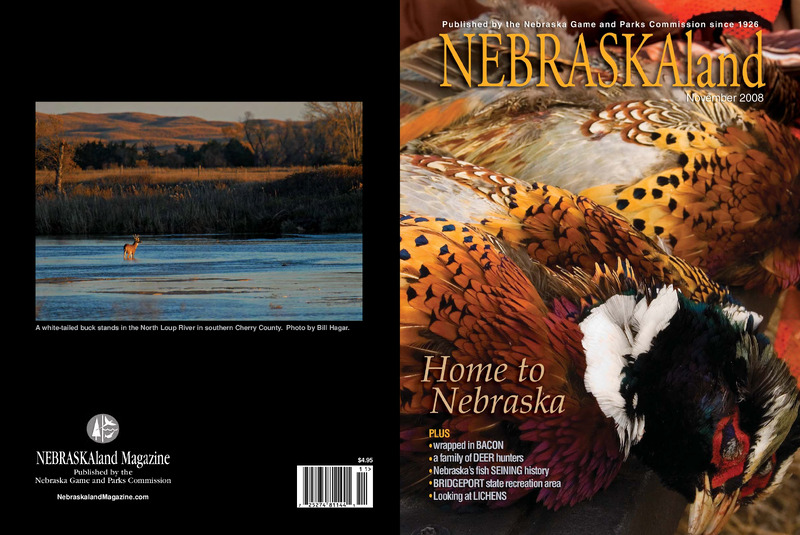
A white-tailed buck stands in the North Loup River in southern Cherry County. Photo by Bill Hagar.
NEBRASKAland Magazine
Published by the
Nebraska Game and Parks Commission
NebraskalandMagazine.com
$4.95
Volume 86, Number 9, November 2008
12 Hunting the Home Place
The Colburns ranch has been in the family for more than
100 years, and the opening weekend of the firearm deer
season is a family tradition and affair.
TEXT AND PHOTOS BY JOHN FARRAR
20 Wrapped in Bacon
Here’s a sampling of simple recipes sure to bring out the
chef in the most modest of cooks.
TEXT AND PHOTOS BY JEFF KURRUS
24 Looking at Lichens
Naturalist Lisa Knopp takes us on yet another journey of
discovery, this time to the world of lichens.
BY LISA KNOPP
26 Home to Nebraska
Every November, native Nebraskan Jamie Vasa returns to the
fields of his youth to hunt wild pheasants. It is a pilgrimage
he shares with friends – new and old.
TEXT AND PHOTOS BY JAMIE VASA
32 Saving Fish for Fishermen
26
●
For more than 50 years, Nebraska’s game and fish
department’s seining crew salvaged fish for stocking and sale.
BY JON FARRAR
42 Bridgeport State Recreation Area
Relatively small in size, this Panhandle destination is big
in popularity for fishermen, campers and water sports
enthusiasts. TEXT AND PHOTOS BY BOB GRIER
10 Mixed Bag
Balloons, window mounts and broad-winged hawks.
46 Outdoor Update
The other turkey season.
20
●
24
●
49 Parks & Places
New Powder Creek Reservoir is providing good fishing.
Comment . . . . . . . . . . . . . . . . . . . . . . . . . . . . . . . . . 6
Outdoor News . . . . . . . . . . . . . . . . . . . . . . . . . . . . . 8
Classifieds . . . . . . . . . . . . . . . . . . . . . . . . . . . . . . . 48
Portraits from the Past . . . . . . . . . . . . . . . . . . . . . 50
Nebraskaland Gift Collection . . . . . . . . . . . . . . . . 51
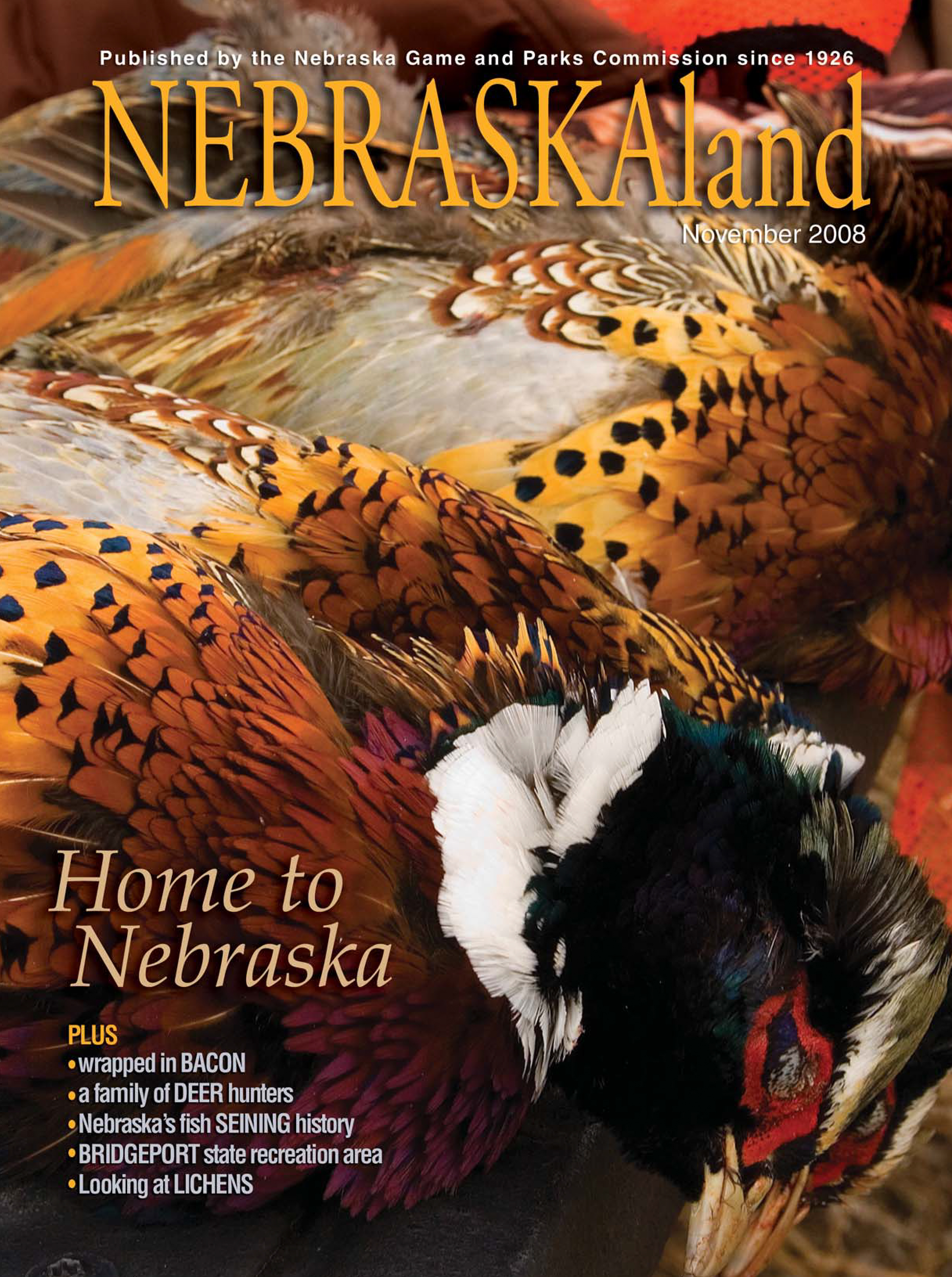
Cover: Brightly colored rooster pheasants and the chance to show off his home state brings
native Nebraskan Jamie Vasa back home whenever possible (see story on page 26). Photo by
Jamie Vasa. Opposite: An autumn-colored red oak leaf seen on an early morning walk hangs in
a Sarpy County field. Photo by Jeff Kurrus.
42
●
NOVEMBER 2008 • NEBRASKALAND 5
Mystery Birds
I am curious if you can identify
the hawks that were in a couple of
fields in Clay County last night.
One field had 75 (by my count) and
the larger field with the combine had
more than 100. It was strange that
they ALL were facing south.
Published by the
Nebraska Game and
Parks Commission
Director: Rex Amack
Assistant Directors:
Roger Kuhn, Kirk Nelson, Sam Sidner
Information & Education Administrator:
Doug Bauch
Commissioners
Chairman:
James Ziebarth, Wilcox
Vice Chairman:
George E. Hall, Bridgeport
2nd Vice Chairman:
Jerrod Burke, Curtis
Dr. Mark Pinkerton, Wilber
Ron Stave, Waterloo
Dr. Kent Forney, Lincoln
Lynn Berggren, Broken Bow
Mick Jensen, Blair
Magazine Staff
Editor: Doug Carroll
Associate Editor: Jeff Kurrus
Art Director: Tim Reigert
Senior Editor: Jon Farrar
Regional Editors:
Eric Fowler, Bob Grier, Rocky Hoffmann
Circulation: Donna Robinson
Photo Librarian: Sarah Johnson
Marketing/Advertising: Jane Gustafson
For advertising information e-mail
advertising@ngpc.ne.gov
or call (402) 471-5481
NEBRASKAland
ISSN: 0028-1964
VOL. 86 / NO. 9
NOVEMBER 2008
Published monthly, except for Jan./Feb. and Aug./Sept.
issues, by the Nebraska Game and Parks Commission, 2200
N. 33rd St., Lincoln, NE. Copyright 2008, all rights reserved.
Please address comments or questions to this address.
Periodicals postage paid at Lincoln, Nebraska, and other
locations. POSTMASTER: Send all address changes to
NEBRASKAland, P.O. Box 30370, Lincoln, NE 68503-0370.
NEBRASKAland is available on audio cassette from the
Nebraska Library Commission Talking Book and Braille
Service, Suite 120, 1200 N St., Lincoln, NE 68508. (800)
742-7691. NEBRASKAland Magazine and the Nebraska
Game and Parks Commission reserve the right to reject
any advertising not in keeping with the agency mission.
Rates: $18 for one year; $33 for two years; $44 for
three years. Nebraska residents must add
appropriate sales tax.
To subscribe call 1-800-NEBLAND (632-5263),
or go online to: NebraskalandMagazine.com.
For address changes and questions about your
subscription, e-mail donna.robinson@ngpc.ne.gov.
6 NEBRASKALAND • NOVEMBER 2008
Good Grouse Advice
Dear Jon Farrar,
I wanted to send out a couple of
notes to you … first off, loved your
article on the grouse hunting using
decoys up in the Sandhills. One of
the early paragraphs on starting
hunting around midday and wrapping
it up around 2 p.m. was quite
contrary to what I had done all these
years (now 67 year old), but as I
pondered the article, I decided I was
going to try your advice. Well, as
they say, the proof is in the pudding,
and opening weekend up in the
Springview area garnered a pair of
limits on Saturday and Sunday, and
that was in only an hour or so of
walking. I am impressed – guess old
dogs can still learn new tricks.
I haven’t missed a grouse opener
since I was a kid in the mid-50s. Did
a lot of it with my father over the
same familiar haunts that I walk
now. Treasured hunting grounds and
tons of sentimental value refresh the
mind each year I travel to Keya Paha
County since my dad passed away
back in 1965.
Next week I head north to
Manitoba to help my son with his
waterfowl operation – about three
weeks of 4:30 a.m. rise and shine
routines make for long days in the
field. But it’s fun, and though my
age is showing, it’s a great way
to spend time with my son and
three-year-old grandson.
Better close, but wanted to let
you know I took the hunting advice
and it works. Great article as
always.
Fred Lambley
Morse Bluff, Nebraska.
Sioux County Expansion?
I enjoy the magazine and rarely
find errors in it. But, I hope you can
appreciate the shock to my system
when I turned to page 41 in the
October 2008 issue, and read the
caption under the picture: “...Crow
Butte in Sioux County.”
Whoa, now! Being an old
Crawford native (and a climber of
Crow Butte more than once as a
kid) I want to remind you that Crow
Butte is in Dawes County – unless
1) it has been moved sometime in
the last 50 years, or 2) Sioux County
has swallowed up Dawes County in
its expansion efforts.
Please tell me I am correct – and
I will try not to let this grievous
error affect my high regard for the
magazine.
Gary Mason
Kearney, Nebraska
Our mistake – yes, Crow Butte is
still in Dawes County. We apologize
for the error.
Editor
Joel Jorgensen, Nongame Bird
Program Manager for the Nebraska
Game and Parks Commission,
responds:
Theresa,
Nice pictures. These would be
Swainson’s Hawks, which breed in
the Great Plains and Intermountain
West. During spring and fall
migration, these birds group and
migrate together. The first of
October is when we see the biggest
numbers come through Nebraska,
and they are rather fond of picked
soybean fields.
What is very interesting is that
these hawks are headed to Argentina
for the winter. More informaton
about the species can be found at:
http://www.birds.cornell.edu/All
AboutBirds/BirdGuide/Swainsons_
Hawk.html.
Send your comments to:
Doug Carroll, Editor
NEBRASKAland Magazine
P.O. Box 30370
Lincoln, NE 68503
or e-mail doug.carroll@ngpc.ne.gov
Please include your postal address
and telephone number.
Letters may be condensed and edited
for clarity. Photographs are
welcome and will be returned.
Under federal and/or state law, discrimination is prohibited on the
basis of race, color, religion, age, gender, marital status, national
origin, disability or political affiliation. If you think you have been
discriminated against in any program, activity or facility by the
Nebraska Game and Parks Commission or want more information,
contact the Commission in Lincoln, NE, at (402) 471-0641 or the
Equal Opportunity Commission, Lincoln, NE, (402) 471-2024,
TTY/TDD (402) 471-4693).
Headquarters
2200 N. 33rd Street
Lincoln, NE 68503
Phone (402) 471-0641
District Office I
East Hwy. 2, Box 725
Alliance, NE 69301
Phone (308) 763-2940
District Office II
524 Panzer St., Box 508
Bassett, NE 68714
Phone (402) 684-2921
District Office III
2201 N. 13th St.
Norfolk, NE 68701
Phone (402) 370-3374
District Office IV
301 E. State Farm Rd.
North Platte, NE 69101
Phone (308) 535-8025
District Office VI
1617 First Ave.
Kearney, NE 68847
Phone (308) 865-5310
Omaha Office
1212 Bob Gibson Blvd.
Omaha, NE 68108
Phone (402) 595-2144
Ak-Sar-Ben Aquarium
21502 W. Highway 31
Gretna, NE 68028
Phone (402) 332-3901
World Wide Web site: www.OutdoorNebraska.org
E-mail: info@ngpc.ne.gov
Administration
Ted Blume (Adm.)
Craig Stover (Asst.)
Wes Loos (Asst.)
Rod Loos (Asst.)
Murray Johnson
Lincoln
471-5531
Lincoln
471-5532
Lincoln
471-5591
Ogallala (308) 284-8056
Lincoln
471-5003
Panhandle
Officer
City
Phone (308)
Jim Zimmerman (Sup.) Gering
436-7561
Walt Meyer
Chadron
432-4398
Scott Brandt
Gering
436-3418
Heath Packett
Gordon
282-2553
Dennis Thompson
Lemoyne
355-2024
Dan Zuehlke
Ogallala
284-4815
Doug Pollard
Oshkosh
772-9950
Frank Miller
Valentine (402) 376-1183
Dan Kling
Whitney
432-8367
Southwest
Officer
City
Phone (308)
Roger Thompson (Sup.) N. Platte
532-9175
Ray Dierking
Brkn. Bow
872-3078
George Sund
Cambridge
697-4629
Michael Thome
Cozad
784-4362
Matt Andrews
Elwood
785-3025
Dirk Greene
Imperial
882-5328
Virgil Gosch
McCook
345-2185
Dudley Sorensen
N. Platte
532-0747
Rich Routh
Rep. City
799-2085
South-central
Officer
Jerry Pecha (Sup.)
Jeff Jones
Terry Brentzel
City
Phone (308)
Kearney
865-5327
Clay Center(402)762-3124
Doniphan (402)845-2021
Randy Pomplun
Darin Gress
Dale Johnson
Mark Reeves
Robert Finke
Richard Seward
Fullerton
536-2987
Hebron (402) 768-2287
Kearney
237-1079
Loup City
745-0662
Milford (402) 761-3537
Ord
728-3115
Northeast
Officer
Tom Zimmer (Sup.)
Dale Davis
Ross Oestmann
Steve Oberg
Daniel Roberts
Jon Reeves
Marion Shafer
Pat George
Eric Wiebe
Tim Williams
Cory Krause
City
Phone (402)
Norfolk
371-6625
Bassett
273-1700
Bloomfield
373-4412
Columbus
564-5937
Fremont
721-7852
Kennard
427-7378
Norfolk
371-2031
O’Neill
336-1588
Ponca
755-2566
Neligh
887-1335
West Point
372-6979
Southeast
Officer
Duane Arp (Sup.)
Sean McKeehan
William Krause
Mike Luben
Douglas Kramer
Dina Barta
Stacey Lewton
Levi Krause
Russell Mort
Dan Evasco
Jeff Clauson
City
Gretna
Ashland
Auburn
Colon
Lincoln
Lincoln
Lincoln
Louisville
Nebr. City
Papillion
Waterloo
Phone (402)
332-2965
944-4174
274-3789
443-4278
466-9001
483-2358
476-0436
234-2212
873-5684
592-6733
359-5301
Nebraska Wildlife Crimestoppers 1-800-742-7627
NOVEMBER 2008 • NEBRASKALAND 7
Aspen Project Set at
Smith Falls SP
Visitors to Smith Falls State Park
this fall may be greeted by the
sounds of chainsaws and the sight
of brush piles as work begins on a
project to reinvigorate eight stands
of aspen trees in the park.
More than a century of fire
suppression has allowed eastern red
cedar and other trees and shrubs to
encroach on these trees, believed
to be a hybrid of quaking and
big-toothed aspen species. Starved
of sunlight, the mother trees in the
stand have been producing few
suckers (trees that spring up from
the roots of the mother tree) and
both young and mature trees have
been affected by disease. Paper birch
trees have also been affected by
encroachment from shade-tolerant
trees.
The project, a cooperative effort
between the Nebraska Game and
Parks Commission and the National
Park Service, is expected to take
several years. It will start small with
crews clearing trees in and around
the groves by hand, but the
Commission hopes to obtain a grant
from the National Forest Service to
fund mechanical clearing and speed
the project along. Prescribed fire
may be used to stimulate suckering.
8 NEBRASKALAND • NOVEMBER 2008
The Commission and Park Service
also hope to expand the project to
include four other aspen stands on
nearby private land in the Niobrara
River Valley.
Mule Deer Restrictions at
Fort Robinson State Park
A significant reduction of their
population in Nebraska has led to
restrictions aimed at bolstering the
state’s mule deer herd, according to
Todd Nordeen, district wildlife
manager at the Game and Parks
Commission’s office in Alliance.
“For the 2008 deer seasons, a new
mule deer special management area
that includes Fort Robinson State
Park, the nearby Soldier Creek
National Wilderness Area, as well as
the Peterson and new Fort Robinson
Wildlife Management Areas (WMA)
provides the opportunity to restrict
mule deer harvest on a fairly large
tract of the Pine Ridge,” Nordeen said.
“For 2008, no harvest of antlerless
mule deer will be permitted on the
special management area for all
weapons and all seasons. Deer
hunters will still be able to harvest
antlered mule deer and white-tailed
deer as their permits allow,” he said.
According to Nordeen, the
fragmentation of mule deer habitat,
the mule deer’s visibility in open
terrain and even their tendency to
stop and look back before moving
out of the hunter’s sight, increases
the opportunity to harvest mule deer
compared to white-tailed deer.
“Hunters, wildlife biologists and
wildlife enthusiasts alike see mule
deer populations on the decline and
increased numbers of white-tailed
deer. White-tailed does can breed
after their first year and whitetails
are much more elusive and difficult
to harvest in the habitat they tend to
select. Basically, mule deer have
been pushed westward into the
state’s remaining mule deer habitat
in the open Sandhills, southwest
Nebraska and the Panhandle.”
All entrances to the special
management unit near Fort Robinson
State Park will be signed to identify
the new management unit and
informational brochures will be
available from state park areas in
the Pine Ridge as well as from
conservation officers and Commission
offices.
“Like all of the regulations needed
to properly manage Nebraska’s
wildlife resources, hunter cooperation
and understanding plays a critical
role in the success of this effort. Our
hope is that hunters and others will
see increased numbers of mule deer
on their traditional western Nebraska
ranges.” ■
10 NEBRASKALAND • NOVEMBER 2008
Quail Instruction CD
Jeff Kurrus
The Wild
Quail Habitat
Management
Course, formed
in cooperation
between
Progressive
Farmer and the University of
Kentucky, is a 30-minute CD-ROM
instructional course focusing on the
management of the bobwhite quail.
The CD provides information on the
life cycle of quail, including mating,
brood-rearing, and diet. The course
also gives information on the effects
that predators and hunters have on
quail population.
The course’s biggest strength is its
discussion of land management for
quail, including information on
agricultural crops, woodlands, food
plots, grassland cover, and appropriate
brood habitat.
Resembling a PowerPoint slideshow,
the visual elements of the CD are not
from their vehicles – often carry a
“window pod” or heavy bean bag
or pillow to rest the camera on the
vehicle’s window frame. Attempting
to photograph a possible tornado for a
special issue of NEBRASKAland
Magazine years ago, I’d set up a
tripod close to the driver’s window
and used a long cable release to trip
the camera’s shutter because of nearby
lightening. Swarms of mosquitoes
sometimes require the same technique.
Low-maintenance, yet open, county
roads that cross sections of farmland
and grassland pastures are often
favorite routes of many photographers.
Legally passable roads are normally
marked. Roadside vegetation – plum
thickets for example, and cattail
marshes and other wildlife-holding
habitat along these often nearly
desolate trails usually offer numerous
subjects for the camera. County roads
in the Pine Ridge, including East and
Roadside Beauty
Bob Grier
I’ll certainly admit to being
somewhat of a “road hunter,” but not
the kind you would imagine – most
nature, landscape and wildlife
photographers may not readily admit
that some of their best shots are taken
out of a vehicle, but watching for fall
color landscapes and wildlife portraits
while driving along state, county and
even two-track trail roads can be a
low-intensity, successful way to find
and approach photo subjects.
For some species, such as stateendangered swift foxes at their natal
dens, photographing from a vehicle
for a short period in the morning or
evening is universally practiced by
knowledgeable and ethical wildlife
photographers that know human
presence around a den site, or a
portable blind setup nearby, is the
quickest way to attract unnecessary
attention and cause stress, even
endangering that year’s litter of pups.
Photographers in a vehicle should be
extremely cautious when approaching
wildlife. Cars and trucks are regularly
observed by wildlife that may not be
alarmed by the vehicle’s approach, but
safety should be a key consideration
when slowing down or stopping to
observe and photograph wildlife and
the natural world. Watch the vehicle’s
rearview mirror frequently and always
try to park safely well off travel lanes.
Even on minimum maintenance county
roads there is a chance of other traffic.
Seasoned photographers – even
those that won’t admit to photographing
PHOTO BY BOB GRIER
PHOTO BY JEFF KURRUS
Jeff Kurrus
While it was the final day of last
year’s November firearm season, it was
Matt’s first deer hunt ever. We were
sitting five yards apart in a Cass County
patch of CRP grass, me with my rifle
and him with a shotgun and slugs.
After an hour, we had seen or heard
nothing, except for one hot air balloon
that appeared on the horizon shortly
after sunrise. As we watched for deer,
the balloon flew closer. Then closer.
Finally, Matt leaned over. “Hey, that
balloon is coming right at us.” I nodded,
half-ignoring him, still looking for
deer. A few minutes later, Matt leaned
over again. “Hey, I think that balloon
is going to crash in our field.”
This time I was listening. The
rainbow-colored balloon made sporadic
loud “pshhhhhhh” sounds as it cleared
some power lines, began to lower and
came to a hard landing in our field.
To our left, a vehicle threw dirt as it
barreled across the field and came to a
sliding stop at the balloon. A group of
guys jumped out – a fold here, a wrap
there, and the trucks drove away
without a glance in our direction. “Ever
happened to you befo…?” Matt started.
“Nope.”
On the last day of spring turkey
season, six months later, Matt and I
were hunting on the edge of another
field in Cass County and trying hard
top-notch, but the instructional elements
of the course provide a starting point
for developing the type of quail habitat
conducive to increasing the population
of this steadily decreasing game bird.
People can order the video at
www.progressivefarmer.com or by
mailing Progressive Farmer, Wild
Quail Habitat Management Course,
2204 Lakeshore Drive, Suite 414,
Birmingham, AL 35209. The cost is
$19.95 plus $4.95 for shipping and
handling.
Broad-winged Hawks Nest in
North Platte
By T. J. Walker, Nebraska Game
and Parks Commission
In late-June, I returned from a day
in the field as a North Platte-based
Nebraska Game and Parks Commission
biologist to find a note on my desk.
“Falcon nest in town…adult birds
dive-bombing people and pets at
intersection of Maple and E streets.”
On the way there I considered what
the birds might be. I was certain that I
would not find falcons. Probably it was
going to be a pair of Cooper’s hawks,
but I was optimistically hopeful that it
might be a Mississippi kite nest, as
they have nested in nearby Ogallala
for several years and are known for
defending their nests.
I located the nest about 20 feet high
in an elm tree immediately over the
front door of the resident that had
been “attacked.”
It was small for a
raptor nest, just a
clump of sticks
that looked like
something a
Cooper’s hawk
might use. Then
one of the adults
flew into a nearby
tree. My first
impression was
that it might be a
juvenile Cooper’s
hawk (some
barring on the
breast, not real
pronounced, and a
mid-sized raptor),
but something
didn’t look right.
Some of the best landscape and wildlife photos are taken from a The bird was
vehicle, but make sure you have good camera support.
stocky. Cooper’s
hawks are slender.
It had a short tail. Cooper’s hawks have
West Ash Creek, Cottonwood Creek
relatively long tails. I also noticed a
and Sand Creek roads, and Sioux and
bright yellow “cere,” the portion of
Dawes county roads on the Oglala
the beak adjacent to the feathers
National Grasslands, can be very
between the bird’s eyes. Its legs were
rewarding in the fall and other times
equally yellow. In flight, the deep
of the year.
wingbeats were definitely not those of
Sometimes being a “road hunter”
a Cooper’s and the bars on the tail
isn’t necessarily a bad thing.
PHOTO BY ROCKY HOFFMANN
Two Guys, Two Hunts,
Two Balloons
to ignore the hot air balloon flying
directly toward us.
From where I was sitting, it was
close. Yet from where Matt was, the
balloon was less than 100 yards above
him, its engines turning on every few
seconds to keep from crashing into
the woods behind him.
When I met back up with him a
short time later, after the balloon had
disappeared, he was infuriated.
Obviously the balloon had interrupted
our hunt, once again, but it was kind
of amusing, wasn’t it?
“Not really,” Matt said. “Two toms
were 60 yards away, frozen on top of
the hill, when that balloon came over.
And there are two guys riding in it.
So one of them says, ‘Hey, look at
those two turkeys.’ I could hear it
plain as day, and the other guy is
pointing down at the birds. The two
toms sprinted down the hill, flew
across the creek, and were gone.” He
looked down, then back at me again.
“Ever happen…?” he started.
“Nope.”
were too thick for an accipiter hawk.
The bird flew around a bit, giving
me the opportunity to see the barred
tail and blocky wings typical of
broad-winged hawks, but I was trying
to make the bird into something that
made more sense – broad-winged
hawks normally nest in deciduous
woodlands and are very rare west of
the Missouri River Valley. Then came
the final piece of evidence: The bird
started to call, which instantly brought
back memories of a time at Ponca
State Park several years ago when I had
chased that sound through the bur oak
forest trying to get a glimpse of this
deciduous woodland species. The bird
was indeed a broad-winged hawk, an
extremely rare sighting for North
Platte, Nebraska.
Joel Jorgensen, nongame bird
program manager for the Commission
suggested getting photographic
documentation, which I got later that
day. The telephoto lens also revealed
something else – a young bird in the
nest. Successful nesting of broadwinged hawks had occurred where the
species normally doesn’t occur.
On July 17, 2008, I revisited the
site and found that the nest had been
damaged by a recent thunderstorm that
had damaged a lot of trees in town. The
young bird was gone, and I did not
observe either of the adults. The fate of
the young hawk is not known, but it is
possible that it did in fact fledge as it
was beginning to get wing feathers on
July 3, and two weeks had passed. ■
NOVEMBER 2008 • NEBRASKALAND 11
Hunting the
Home Place
Photos and text by Jon Farrar
The opening weekend of the firearm
deer season is a family affair for the Colburns.
Roots are deep on the ranch that has been
in the family for over 100 years.
T
he Shell convenience store in
Valentine was awash in orange
two hours before the opening of
the 2007 firearm deer season. Hunters
streamed in, a thermos in one hand,
traveling mug in the other; and
emerged minutes later, pockets bulging
with Zingers and sandwiches made
who knows where and when, vacuumsealed in plastic clam shells requiring a
Leatherman tool to open. Shiny new
four-wheel-drive pickups with nary a
brush scratch on a quarter panel
rumbled in parking stalls. The stench of
spent diesel hung like a cloud over the
pavement in the morning calm. ATVs
with knobby tires were nestled in the
beds of some trucks, other trucks
pulled trailers carrying three
four-wheelers with gun racks mounted
on the handlebars. Had the
light been better, and the
hunters more comely, the
scene had all the makings for
a Kawasaki or Honda ATV
catalog photo.
At the Colburn ranch on the
south side of the Valentine
National Wildlife Refuge,
opening morning was more
serene. Two orange-clad
figures stalked slowly through
the woodlot behind Keith and
Kristi Colburn’s house.
Keith’s dad, Dean Colburn,
was already in the corrals,
switch in hand, making sure
each twin fall calf had equal
time to suck their mother.
Dean’s wife, Delores, came
from the house, then Keith
down the lane between the
two houses. We milled and
talked until sunlight struck the
ridgetops to the west, spread
down the sidehills and swept
across the big meadow to the
west. It was balmy for
Seth Colburn shot this mulie buck on the second
November, already in the midday of the season last year.
12 NEBRASKALAND • NOVEMBER 2008
Seth glasses for mule deer moving back into choppy hills to bed, looking for one he can stalk.
40s at sunrise, with low, scudding
clouds that would linger though the day.
There was talk of abundant rains
after six or seven years of drought, but
the need for more; of the unusually
high number of twin calves born earlier
that fall; of World War II pilots gone
astray on practice bombing runs over
the refuge and bomb fragments still
found in the pastures. There was talk
of lazy hunters who already were
patrolling the county road past the
Colburn’s, hoping for an easy and
illegal shot at a deer, and of the morning
hunting plans of Keith and Kristi’s
three children – Seth, Mark and Joni.
Seth, at 20, was the most experienced
hunter, having killed a deer every year
since he was 14. Mark, 18, a senior
in high school, had more interest in
organized sports, wrestling in particular,
and found time for hunting scarce. For
Joni, 16, it was her first deer hunt.
When legal shooting time came,
Mark and his spotter, girlfriend Erika
Schneider, were already walking the
big range of hills in the Farlow pasture
on the north side of the ranch, a pasture
bordering the refuge. After finding no
deer in the woodlot near the house,
Seth and Joni shifted their search to a
range of choppy hills on the eastern
edge of the ranch. The three young
Colburns were the only deer hunters
on the ranch, circumstances most deer
hunters can only dream about. But
having a whole ranch to yourself on
opening morning comes at a price the
rest of the year and, in the case of the
Colburns, a long history.
Deep Roots
The core of the Colburn ranch
has been family land for more than
100 years. In 1891, Delores’s greatuncle, Gustav Wendler, an immigrant
from Germany, homesteaded and filed
a timber claim where the Colburns live
today. His brother Max – Seth, Mark
and Joni’s great-great grandfather –
came to America in 1907 with “five
good kids and $100.” The following
year, he and his wife, Ida, homesteaded
adjacent to Gustav, on the east end of
nearby Rat Lake. To help ends meet
during their early years, they ran a
hunting and fishing resort with cabins,
boat rentals and meals in the 1920s and
1930s. In 1932, after Gus was run over
and badly injured by a team of horses,
Max bought his brother’s land. One of
Max and Ida’s “five good kids” was
Gretchen, a feisty, red-headed girl
NOVEMBER 2008 • NEBRASKALAND 13
Joni’s second shot at a deer was true,
the slug passing through both lungs.
By dark the second Colburn deer was
hanging in the trees behind the house.
On opening day, Seth was the guide for his younger sister, Joni Colburn, who was hunting deer for the first time.
everyone called Shorty. Shorty married
Clint Hull and the couple had one child,
Delores, who married Dean Colburn in
1951 and moved to the ranch. Today,
Keith and Kristi operate the ranch with
them, and live only 250 yards away, a
distance Keith frequently travels on a
bicycle with no fenders that leans on
the fence in front of his house. Seth,
Mark and Joni were not just hunting
deer, they were hunting deer on family
land, land with as much family history
written on it as birth, marriage and
death notes in the front of a family
bible.
The first deer of the day, a mule deer
doe, fell to Mark, who was shooting a
14 NEBRASKALAND • NOVEMBER 2008
borrowed Model 700 .280-caliber
Remington. Keith picked his way up into
the range of hills in the ranch pickup,
slipping over the lowest ridgecuts and
across grassed pockets to within 30
yards of where Mark and Erika were
waiting. There are nine saddle horses
on the ranch but not a single fourwheeler. “There are probably places for
four-wheelers on a ranch,” Keith said,
“but once you have one, you start using
them for things you shouldn’t.”
There was something wholesomely
matter-of-fact about Mark’s decision to
shoot a doe on the opening morning of
deer season, something akin to raising
cattle – you raise meat, you harvest
meat, you eat the meat you raised or, in
the case of a cattle ranch, sell it to others
to eat. There were no high-fives, no
hooting over long shots or massive
racks, no comments about shooting a
doe on opening morning, only smiles
and getting to the business of field
dressing the deer. Mark’s account of
the hunt was succinct, sparing with his
words, a common trait of young men in
the Sandhills.
“We drove up to the west end of
the pasture,” he recounted, “walked up
into the hills and worked our way back
east because the wind was out of the
southeast, staying off the ridges where
deer would see us, working along the
sidehills, easing to the top now and
then to look for deer on the other side.
We walked about 20 minutes and then
saw a nice buck, a mule deer. A little
later, we saw four does running across
the meadow, all mule deer, and go up
into the hills where we had seen the
buck. We worked back west, but never
saw the four does again. Then all of a
sudden we saw four deer, and then a
fifth. We worked around through the
hills to get closer but they kept moving,
grazing. We worked back north though
the choppies and saw eight come up a
sharp bank. There was a little forkhorn
with them but I didn’t see him until
after I shot the doe. I didn’t care. I was
Joni missed her first shot ever at a deer on opening morning. “I was pretty shaky,” she
confessed at the dinner table. That evening she killed a spike buck at 120 yards.
NOVEMBER 2008 • NEBRASKALAND 15
Mark Colburn and his friend and spotter, Erika Schneider, glass for mule deer on the ranch’s north pasture.
either after a big buck or a fat doe.” By
noon Mark’s doe was hanging from
lariat ropes in a tree behind the house.
After a sweep of the high hills in the
east pasture without finding deer, Seth
and Joni moved their hunt into the
Farlow Pasture where Mark had shot
his doe. The range of choppy hills,
pocked with little grassy pockets,
clumps of brush and studded with
soapweed, was prescription mule deer
habitat. North of the range of hills was
the Colburn’s expansive North
Meadow, and between the hills and the
meadow were tree groves and brush
patches where deer could retreat during
severe winter weather.
16 NEBRASKALAND • NOVEMBER 2008
Joni was shooting Seth’s .270-caliber
Remington 700. Seth was spotting,
carrying only a lightweight rifle bipod
he called his “sticks.” He was a deer
hunter mature beyond his age, confident
of his proficiency and that he would
shoot his deer before the weekend
ended. His hunting pace was measured,
and on this opening day, he was his little
sister’s deer guide.
After an hour of slipping through the
hills, Seth spotted a buck mule deer, a
3-by-3, bedded down on a sidehill and
they stalked within 100 yards. By the
time Joni had the rifle resting on the
bipod, the buck had heard, scented or
sighted them and stood broadside.
Joni’s one shot was high and the buck
gave no chance for a second. “I was
pretty shaky,” Joni later confessed.
Opening morning was over.
There are palatable advantages to
hunting the home place in addition to
free rein to an entire ranch and being
able to drive a pickup right up to your
downed deer, advantages like dinner.
Dinner is still the noon meal at the
Colburn ranch, and the evening meal is
supper. Keith apologized for the dinner
before all gathered around the table
made long enough to accommodate the
multitude by the addition of a card
table on the end. “Kind of embarrassing
to serve chicken on a cattle ranch,” he
said with a smile. But everyone bellied
up and made short work of Kristi’s
fried chicken, potatoes and gravy, corn
and homemade desserts. There was
easy family talk, no discussion of world
affairs. It was, well, sort of a traditional
Sunday dinner with family on a
Saturday, the sort once common, the
sort of dinner special enough for a son
to bring his girlfriend out from town.
Wind Breaks and
Mule Deer
The Colburn ranch has a good mix of
bottomland meadows and upland
The horse was accommodating right up
pastures. Dean and Delores moved to
to the point of being led home, at which
the ranch in 1951. It was not until the
point Sam started spinning in circles.
next year they saw their first deer, a
When the deer slid down on one side
mule deer. As years passed, whitetails
became more abundant until there were all hell broke loose, the terrified animal
bucking and snorting as it vanished
about equal numbers of each species,
the whitetails staying near the meadows over a ridge. The horse was “sitting
like a dog” on top of the deer carcass
and valleys where there was traditional
when Dean and Keith cleared the ridge.
whitetail habitat – cattails and rushes
Keith walked to the horse to calm it,
fringing lakes and marshes – and
and the horse spit out a tongue. Keith
shelterbelts. Mule deer have been far
and Dean thought the horse had bitten
more abundant than whitetails in the
its own tongue off in the fray, but when
last five or six years.
they looked in its mouth, the horse’s
The ranch has more woodlands than
tongue was where a horse’s tongue
most Sandhills ranches. Since the first
ought to be. The deer, though, was
Wendler Timber Claim plantings in the
missing its tongue, apparently bitten
early 1900s, shelterbelts and woodlots
off by the frantic horse. Both of the
have been planted and nurtured to
provide livestock protection. Clint Hull, horse’s hind feet were caught in the
same stirrup explaining why it gave up
Delores’s father, served on several
and sat down. The deer was hauled
conservation boards and associations,
back to the ranch in a pickup, and
and for 14 years headed a tree planting
Keith never again had the urge to hunt
crew. He planted trees to protect
deer. Since then, all dead deer have
livestock on his own ranch and the
been hauled home in pickups.
family has continued planting trees.
By mid-afternoon, Seth and Joni
Even the large branches of dead and
were back in the east pasture’s high
fallen trees are put to use.
If they’re not burned to
warm Keith and Kristi’s
house, they’re stacked
with a front-end loader to
form massive wind
breaks where cattle can
huddle when wind and
snow blows hard from
the northwest in winter.
Keith only hunted deer
once. The story of why
was retold after
Saturday’s dinner. In
1973, when Keith was
14 and old enough to
buy a deer permit, he
and Dean hunted from
horseback in the big
range of hills south of
Dads Lake. Keith was
riding Sam, a Shetland
and quarter horse cross,
a “not-too-tall horse,”
800-900 pounds, but
with small feet. Keith
shot a mule deer buck, A few years before his one and only deer hunt in 1973, Keith
they field dressed the Colburn was photographed on Sam, his Shetland and quarter
horse cross. Sam passively accepted having Keith’s deer tied
animal, threw it over
on the saddle, right up to the point of being led home, when
the saddle on Keith’s
he started spinning in circles and the deer slipped loose.
horse and tied it down.
Since that day, deer are hauled home in a pickup.
NOVEMBER 2008 • NEBRASKALAND 17
Kristi Colburn takes a snapshot of Joni and her first deer.
hills, easing field glasses and rifle
scope over soapweeds on ridges, looking
for deer still bedded down before the late
day move to feed. Seth was convinced
there were deer in the east pasture
and they just hadn’t found them in
the morning. They were sitting on a
highpoint glassing when they saw the
spike buck moving through the hills.
Rut was beginning and even little
bucks were on the prowl. Seth and Joni
circled ahead, guessing the cuts the
buck would take, and were waiting
when it emerged 120 yards away.
Joni’s second shot at a deer was true,
the slug passing through both lungs. By
dark the second Colburn deer was
hanging in the trees behind the house.
Another Balmy Day
Clouds had mostly blown east by
dawn of the second day, and again it
was unseasonably warm, already 50
degrees at 6 a.m., but with a rising
wind shifting from the southwest to the
northwest. Seth took a stand at the
south end of the east range of hills
before shooting time, thinking, as had
happened in deer seasons past, that
hunters would move deer off the
refuge. He had killed his deer just that
way the last two or three years. His
vigil was short-lived and by the time
18 NEBRASKALAND • NOVEMBER 2008
the sun had cleared the eastern ridge,
he was already bouncing across the
north meadow in the 1960 Ford pickup
he had repaired and repainted when he
was 18 years old. It was a classic ranch
flatbed Seth had built, a fencing pickup
with more side mirrors than most
18-wheelers, a wood shelf above the
windshield for the CB radio and
coil-spring seats, mostly lacking any
covering. The chrome handle for the
spotlight on the cab had been long ago
replaced with a pair of vise grips. It
was, well, Seth’s pickup.
“I pulled out on the meadow next to
the high hills to glass,” Seth later
recounted. “And right away I saw one
mule doe, way up on the ridgeline,
probably half a mile away. I thought
there would be more with her. I stalked
back into the hills and got the wind
right. Wind was out of the west, blowing
pretty hard. I’d go over a hill and glass,
then move on. Sometimes you might
only take 10 steps and you can see new
country, and glass some more. I was
just doing that and saw one deer in a
pocket on a sidehill. I thought it was
probably a mulie buck, three-by-three,
probably the one Joni hunted yesterday.
But I was too far to know for sure.
“I worked a little closer and could
see he was pretty decent,” Seth
continued. “I got settled, lined up on
him, shot and he ran over the
hill. I had heard a thump and I
saw blood on his side so I knew
he wasn’t going far. It was a
150-yard shot. He gave me
enough time to use my sticks
and get steady. When I first
spotted him, he hadn’t seen me,
but when I got up to the next
little ridge, he turned and
looked toward me, standing
broadside, and that’s when I
fired. There were four does within
30 yards of him in a pocket,
getting out of the wind. I didn’t
see them until I shot. They were
bedded down for midday.”
Seth’s 4-by-4 had a tall and
wide rack, but wasn’t as heavybeamed as he would have liked.
It was, he said, his second
largest deer. He said he would
“wait for a nicer one” when
he hunted with a muzzleloader in
December.
When Seth drove into the ranch with
his deer, Kristi was taking a photo of
Joni with her first deer. It was going to
be too warm, expected to reach the
mid-60s, to let the deer hang and age.
In the time it took Seth to drive to the
refuge and check in his deer, Keith
and Mark had the other two deer cut,
packaged and in the freezer. The
backstraps had been carefully trimmed
out, cut into eight-inch lengths and
wrapped. The quarters were carved into
assorted roasts and labeled – “Good Top
Round Roast,” followed by “Almost as
Good Near Top Round Roast.” The
secret to ciphering the package contents
would be chronological stacking in the
freezer.
By the time Seth returned from the
check station it was too late in the
morning to process another deer, so it
was hoisted up in the machine shop to
cool. There was a proper ranch dinner
of homegrown beef with brown gravy
over potatoes and more homemade
desserts, then a rush for everyone to
change clothes and drive the 32 miles
to town to watch Joni in the high
school drama performance of Arabian
Nights’ Tale. Just another opening
weekend of the firearm deer season on
the Colburn ranch. ■
NOVEMBER 2008 • NEBRASKALAND 19
Wrapped in Bacon
Outdoor recipes even I can do
Text and photos by Jeff Kurrus
Q
uick and easy. Better yet, quick,
easy and tasty. That’s how I
like to cook, whether with wild
game or something harvested at the
local grocery store. To me, cooking
wild game is especially enjoyable when
doing more than just creating the dishes
normally associated with it: deer roast
and fish fry. Both are acceptable, yes,
but a little variety is also needed for
brunch, lunch and dinner guests.
Luckily, it doesn’t take a pile of recipe
books or a lot of prep time to put a
good wild game dish on the table. When
done right, quite often guests won’t
know what they’re eating in the first
place. Their guesses most certainly will
not be anything “wild.” Here are some
recipes from my modest kitchen that will
help keep your freezer empty of game.
Wrapped in Bacon
As the title indicates, this is the
quintessential recipe that anyone can
do. Take venison backstrap, tenderloin
nuggets, breasted dove or duck, and
wrap them in bacon. Put a toothpick
through the meat to keep the bacon
from falling off, and place on the grill.
Melt a small bowl of butter in the
microwave, and baste the meat each
time the grill is opened. Turn the pieces
constantly, cooking on low heat to keep
the bacon from burning, and cover with
salt, pepper and garlic. When the bacon
is done, the meat is done. It’s that
simple. Serve as appetizers, the main
course or a midday snack. Regardless
of when it is served, I can promise
there won’t be any left on the table.
If there is, the way I look at it, that
means more for the cook.
washing afterward.
Don’t salt too much and, if so
desired, use lemon pepper instead of
black pepper – it’ll give this dish a bit
more kick. For additional flavor, include
strips of bacon, lemon juice or anything
else within reach of the cooking pan.
Now the question becomes: Should
this meal be cooked in any sort of
liquid? Quite simply: How healthy do
you want to be? I’ll put half a cup of
melted butter or olive oil on the fish if I
want a bit more taste, but if I’m trying
to cook healthier, I’ll use water.
Once the mushrooms, onions and
fish start to cook, these ingredients will
produce enough liquid to keep the fish
from burning. However, burning isn’t
necessarily a bad thing, especially if
you’re cooking on the grill. If so, leave
the pan uncovered and cook until the
fish starts to flake apart. Stir constantly,
turning the meat over and spicing the
underside. It shouldn’t take longer than
20 minutes on the grill. If you’re out of
charcoal or propane, cover the aluminum
boat with foil and cook in the oven the
same way at 350 degrees, checking it
every 15 minutes until the fish is flaking
apart.
Because I like it when all the
ingredients combine together, I don’t
mind my fillets turning into chunks of
fish and vegetables. Once it’s cooked,
serve in bowls or plates, but leave a
little shredded cheese on the table
beside the finishing dish – it’s a good
topper to a great meal of fish and
veggies.
One word of warning: Before making
this meal, learn how to fillet fish properly.
Get a book, watch a video, watch a
friend. If your friend tells you that it’s
hard to get all the bones out of the fillets,
find a new friend to watch. No one, and
I mean no one, wants to eat fish fillets
with the thought in their mind that
bones might be included.
It’s amazing what a combination
of these three ingredients can do for
cooking. Garlic, either fresh, in a
granulated form or combined with
salt, gives the meat just enough
flavor without overburdening it.
Remember, the meat itself and
the taste from the grill is going to
provide most of the flavor needed.
Pepper will give a little bit of a kick,
but don’t use too much. Salt is key,
but due to health concerns, also
use in moderation.
Too little salt is always best. When
serving time comes, put spices on
the table and let people know a
limited amount of salt was used.
This will make everyone that much
more comfortable if they feel your
“wild” game is just too darn bland.
Fish in a Boat
Deer (pictured), duck and dove are just a few of the game meats perfect for wrapping
in bacon and cooking on the grill.
20 NEBRASKALAND • NOVEMBER 2008
Place boneless fish fillets in an
aluminum foil pan, arranging the
smaller pieces in the middle with the
larger ones on the side. Because onepan cooking results in the least amount
of clean-up, add broccoli, mushrooms
and onions with the fish. If available,
asparagus, cauliflower, spinach, squash
and diced potatoes can also be included.
If you grew up like I did, under the
notion of “something meat, something
yellow, something green,” then fish in a
boat is so convenient due to the small
number of dishes that will need
Clean-up is simple when one-pan cooking fish fillets and vegetables on the grill.
NOVEMBER 2008 • NEBRASKALAND 21
Shredded shoulder is a great
recipe to use because it’s hard to
separate from the bone using a knife.
It can be done, but the hindquarters
are much better for separating into
jerky, roasts, steaks, etc. If you
don’t want to spend a lot of time
trimming from the hindquarters,
however, remove the major cuts
and then save the remainder to
slow cook the same way as the
shoulder meat. Delicious.
Shredded deer shoulder is an excellent potluck dish for holiday parties.
Shredded Shoulder
garlic, onions, perhaps some sliced
mushrooms, finish it off with four
tablespoons of butter and place,
uncovered, on the grill. As it cooks,
constantly turn it over – you’re looking
for a smoky taste to the meat, and
time on the grill will aid this. Cook as
long as you want. Five minutes, 10,
15 – the longer cooked, the crispier the
meat edges will become.
This recipe should serve four to six
people and works best when cooked
with another deer shoulder and eaten
while watching football. Add chips,
maybe even a little barbecue sauce or
sour cream, and the afternoon is set.
It also makes a great potluck dish,
allowing you to serve wild game to the
masses. In the unlikely event that there
is any meat left over, freeze in
sandwich bags and bring along on your
next fishing trip. Place these on top of
the cooler at sunrise, and they will be
thawed by lunchtime, making a great
midday snack.
I don’t want this to sound too darn
elementary, but it’ll be hard not to.
Preheat the oven to 250 degrees. While
it’s heating, place the deer shoulder
(see sidebar) in a roasting pan that has
sides at least three inches deep,
because the meat will lose a bit of
moisture as it cooks. How much
exactly? I’m not sure, but it’s not enough
to flow over a 3-inch roasting pan.
Take one of the larger cuts of meat,
Apply garlic, salt, pepper and include
such as a muscle from the hindquarters,
and cut it into chicken nugget-sized
enough water to cover the entire bottom
of the pan. No more than a couple
of cups. Cover with aluminum foil
and place in the oven. For how
long? Again, I’m not exactly sure,
but what I usually do is start it as
soon as I wake up in the morning,
allow it to cook throughout the
day, and take it out at suppertime,
somewhere in the 5 to 6 o’clock
hour. The shoulder is done when
the meat can easily be pulled off
the bone with a fork.
Once the meat is taken out,
uncover it and give it about
15 minutes to cool, then
completely separate the meat
from the bone, also discarding
any small pieces of sinew and fat
that are found.
The meat should now be in
relatively large chunks. Pull these
apart until they resemble pulled
or shredded pork. Dump any
remaining fluid from the pan and
place the pulled meat back into it.
When cooking geese, serve breast meat to guests but keep the bony drummies for yourself.
Add a little more salt, pepper,
22 NEBRASKALAND • NOVEMBER 2008
Deer and Onions
chunks. Combine in a plastic bag with
diced onions and flour and shake well.
On the stovetop, cover the bottom of
a pan with cooking oil, less than 1/8-inch
deep. Place the floured chunks in the
pan, salt, pepper, then cook on medium
heat. Cover the dish to maintain the
meat’s moisture and turn often.
The meat sometimes soaks up a lot
of the oil on the bottom of the pan and,
if not watched, can begin to burn rather
quickly. Combat this by adding a little
butter while cooking if there is limited
or no moisture in the pan bottom. The
meat should give off a little moisture as
it cooks, as should the onions, but you
don’t want the meat crispy outside and
undercooked inside. Lastly, water can
be substituted for butter if a healthy
meal is desired.
Once the meat is cooked, uncover the
pan and cook until the meat’s edges are
crispy enough for your liking.
Crockpot Goose
Place goose drumsticks and breasts
into a crockpot before work. Cover
with two cans of cream-of-mushroom
soup and cook on low heat. Go to work
or call in sick. When you return later
that evening, turn off the crockpot and
start preparing the side dishes.
A baked potato in the microwave and
a can of green beans cooked on the
stove are some of the easiest. Pull the
meat from the crockpot and allow it to
cool, but keep the crockpot on low
because the mushroom soup is now
mushroom gravy. Serve the breasts to
wild game newcomers, and keep the
drummies, and their bones, for
yourself.
Because steel shot tends to stay
in waterfowl meat quite often, make
sure the meat has been checked
thoroughly before giving it to others.
If there are any concerns that there
may be some pellets left in the
meat, let guests know. Tell them to
eat it relatively slowly and not to
bite down too hard. Also tell them
that the meat will be so tender at
this point that biting down hard is
pointless in the first place.
A nice alternative to a bacon and egg breakfast is a turkey and bacon brunch.
Turkey and Bacon
Brunch
My wife cuts up food as if she is
cooking for royalty. I cut up food as if
I’m running the last diner on earth and
there’s never an empty seat. For my
wife, the prep time for this meal would
be 20 minutes. For me, it takes less
than five.
Start by frying four strips of bacon in
a pan on medium or high heat,
covering it to keep moisture in the pan.
As the bacon cooks, take those five
minutes to slice onions, peel potatoes
and cut a wild turkey breast into bitesized pieces. When the bacon is done,
remove it and add the potatoes, onions,
and turkey nuggets to the pan.
Cook these on medium, covered, for
10 minutes, continually flipping to
keep them from burning. Once cooked,
uncover, re-add the cooked bacon and
crisp the edges for five more minutes.
When no one is looking, get a fork and
taste a piece of potato. If it’s soft and
trying to get crispy on the edges, then
everything in the pan will be ready.
I’ve always liked this as a brunch
dish. Sort of a late-morning breakfast,
either in the duck blind or just having
left it. Serve with a couple of biscuits
and save the side-dish greens for
dinner. If the turkey is a bit too dry for
your taste, half a can of cream-ofmushroom soup or a thin covering of
sour cream should wet it perfectly.
There are a growing number of people
who don’t want to cook because they
think it’s too difficult and takes too long,
especially when a drive-thru window is
so much easier to manage. How many
hunters or anglers do you know that
give their game away because they
don’t know how to cook it? How many
others throw away meat each year
because it’s been freezer-burned? None
of that is necessary, especially when
there are so many ways to cook
without spending hours doing it or days
reading about it.
Quick and easy, I promised. If you
haven’t tried these, do so. You’ll quickly
find out that the “tasty” takes care of
itself. ■
NOVEMBER 2008 • NEBRASKALAND 23
Looking at Lichens
By Lisa Knopp
Observing one of the least known and understood organisms on Earth.
I
guessing at species’ names. I decide that
in the absence of certain identification,
I’ll provide my own name for a
specimen. This is an invigorating
challenge, since some lichens have
unique, evocative common names:
powder-headed birdbone; wrinkled
wrinkle; blood-spattered beard;
hammered crottle; antlered perfume
and fairy barf.
Lichen is a curious organism – or
rather, a dual organism. It’s produced
by the union of a fungus, an organism
that absorbs nutrients from organic
matter and that reproduces by spores,
and an alga, an organism that lacks
true leaves, roots or stems but, like
other plants, can convert sunlight and
carbon dioxide into carbohydrates.
When we behold the lichen, 90 to
95 percent of what we see is fungus.
Dispersed among the fungus’s hyphae
or threads are the green algal cells.
Through photosynthesis, the alga
makes the carbohydrates that
the fungus cannot; the
spongelike fungus
supplies water
and nutrients
and provides
the structure
that holds
the alga
and
protects
it from
planteaters. In
the past,
textbooks
identified
this relationship as an
example of
mutualism, an
association that benefits
different organisms and
harms neither. But now experts believe
that, at least in some cases, the fungus
can’t live without the alga but the alga
can live without the fungus. In other
24 NEBRASKALAND • NOVEMBER 2008
words, the fungus is a parasite and the
alga, a host and hostage.
When I look at lichens, I don’t think
in terms of fungus and alga, mutualism
or parasitism. Rather, what I see is
beauty and mystery. Consider the
locust twig in my collection. One side
is lichen-free, but the other side bears a
Lilliputian forest. Most of the patches
of lichen are gray-green, radiating
outward from a center point, the edges
scalloped or lobed like livers, lungs and
some leaves. Most lobes are overlapping,
but along the edge they are freestanding and I can peel them off with
tweezers. When I look at the colony
with my naked eyes, I see dark dots on
the gray-green patches and a single cup
filled to the brim with something black.
But with my super-magnifiers, I see
that in the center of the lobes are
dozens of tiny gray-green goblets
filled with black, as well as that large
conspicuous cup. These are the
lichen’s spore-producing, reproductive
structures.
Perhaps this particular lichen is the
common greenshield, an apt name
since the body, or thallus, is green, the
leaves are shield-like and it’s definitely
common. Once I became aware of this
lichen, I noticed it growing on most
mature trees in my neighborhood.
Fructose or leafy lichens, which
includes greenshield, are attached to
the substrate by rhizines – tiny, hyphal
cords I cannot see even with my supermagnifiers. The rhizines don’t harm the
tree yet are strong enough to hold the
lichen in place through the seasons and
centuries. In the absence of other food,
deer will eat this lichen; hummingbirds
and peewees line their nests with it. I
watch a tiny insect creep beneath a
lobe. Apparently, some creatures find
shelter there, too.
Growing near the tip of the twig is a
single patch of tall, bright green lichen
whose reproductive cups are brimming
with bright orange. Since I can’t find
anything in the black-and-white field
reproduce through the
chance meeting
of a fungal
spore and
an algal
cell, or
through
fragmentation (I
could
grow
colonies from
the tiny pieces
that I’ve
collected) or
through soredia,
a few algal cells
wrapped in
fungal filaments
that can produce
a plant identical
to the parent.
Anywhere I go in
this wide world,
I’ll find lichens,
from the
bright
orange
ones that
coat
desert
rocks to
the vast
mats of
reindeer
lichens
(incorrectly
called “reindeer
moss”) in the
Arctic. Anywhere,
that is, where the air
is relatively clean.
Since lichens don’t have
roots, they draw moisture
and nutrients from the air.
In the presence of fluoride,
sulfur dioxide or other pollutants,
the lichen suffers. Some lichens are
fragile but others are so tenacious that
to remove them from stone is to
damage the stone. Because lichens are
probably the least known and understood
organisms on Earth, no one knows how
many species there are, though experts
estimate 20,000 to 25,000. That means
abundant opportunities for exploring
the unknown. Perhaps there’s even a
lichen in my neighborhood waiting to
be discovered and named. Cladonia
knoppis – Lisa’s lichen.
Each
time I don my
super-magnifiers and
look at lichens, I place myself in the
presence of beauty and mystery.
There’s nothing dull or uninspiring
about that. ■
Lisa Knopp is a teacher and writer
who lives in Lincoln.
NOVEMBER 2008 • NEBRASKALAND 25
PHOTOS BY TIM REIGERT
set a bright lamp in the middle of
my kitchen table. Beneath it I
spread white paper. Then I don the
+325-strength magnifying glasses from
the $9.99 rack at the drug store. I wear
low-level magnifiers when I read, but
these super-magnifiers are so strong
that they blur anything that isn’t right
beneath my nose. On the white
background I set pieces of trees,
rocks and a wooden board. With my
super-magnifiers, I see that each item
hosts a garden of lichens.
Seeing lichens is easier than
identifying them. The bookstore I
frequent doesn’t have a single book
about lichens in stock. The public
library has one field guide to the
lichens, copyright 1969, with blackand-white drawings instead of the color
photos I need. References to lichens are
plentiful on the internet, yet most sites
admit to one or more of the following:
(1) identification is difficult without a
compound microscope and
chemicals best used in a
laboratory with a
fume hood (I
have none of
these);
(2) the
featured
lichens
were
collected from
heaths,
bogs,
and sea
cliffs (I
suspect a
limited correspondence
between the
lichens
of
Great
Britain and the
Great Plains); (3) the
identifier is not an
expert, so is merely
guide that comes close to what I see,
I bring forth my own names for this
lichen: Flaming Chalice, Hot Lava
Tarts, Blazing Buttons. Also striking
is the bright yellow-orange lichen
growing on decaying bark or boards –
Candelaria concolor, or candleflame.
The dullest lichen in my collection is
the flat, gray-white crustlike lichen that
I find on tree trunks and rocks, a
species of Lecanora, perhaps. This
lichen, which is embedded in the
substrate, can cover such wide areas
that the tree trunk looks as if it had
been whitewashed.
Since I can’t remove some lichens to
take home for a closer look, I take my
super-magnifiers to them. In Roberts
Park, a 20-minute walk from my house,
I study two pieces of ornamental stone
stacked atop each other and resting on
a cement base near the parking lot.
These were the capstones on Lincoln
Normal University, which once stood
near 56th and South Streets. But time,
weather and vandalism have taken their
toll: Parts of the faces of two ghouls
and a mermaidlike creature, as well as
the flourishes surrounding them, are
missing. Many of the initials carved in
stone by lovers or hopefuls are now
indecipherable. But the lichens – a
greenshield or a close relative, a graywhite crustose, and something chartreuse
and branching – are thriving.
Lichen is a pioneer plant, which
means that it’s the first to colonize
places that other plants find hostile,
such as the disturbed or denuded
landscape following a glacier, volcano,
or fire. The lichen releases acids that
over time break down the rock on
which it lives, turning the rock into soil,
eventually creating an environment that
is hospitable to mosses, ferns and
flowering plants. Someday, violets
might bloom in the soil that the lichens
make from these capstones.
Compared to watching cranes or
chasing tornados, looking at lichens
may appear to be a dull and uninspiring
pastime, yet everything I’ve learned
about lichens proves otherwise.
Lichens are an ancient lifeform, first
appearing in the fossil record about
400 million years ago. They grow slowly
(with a typical growth rate of 40-160
inches per millennium, they’re not the
bindweeds of the plant world) and can
live for thousands of years. They can
Home to Nebraska
Every November, Jamie Vasa returns to the fields of Nebraska to hunt
wild pheasants. It is a pilgrimage he shares with friends – new and old.
Text and photos by Jamie Vasa
“Hey it’s good to be back home again.”
These words from a John Denver song
always go through my mind when I come
to Nebraska, and it’s hard to explain the
emotions they invoke. Growing up in the
heartland, I never dreamed of moving
away – I thought my place in life was
etched in stone, or should I say, the
sandy-loam fields of Keith County.
When opportunity knocked, however, I
had to move on. Now I only return during
the holidays and special occasions, mostly
to visit family and friends, but sometimes
to show new friends my home state and the
fantastic hunting opportunities it bestows.
ABOVE: KERRY DYKSTRA OF OGDEN, UTAH, PUSHES AN UNCUT, WEEDY CORNFIELD SOUTH OF ELSIE.
OPPOSITE: ARROW, A GERMAN DRAHTHAAR, WAITS FOR ANOTHER PHEASANT DRIVE TO BEGIN.
26 NEBRASKALAND • NOVEMBER 2008
NOVEMBER 2008 • NEBRASKALAND 27
ABOVE: LEFT TO RIGHT, LARRY RIGGS, BRETT SKINNER, SCOTT SAXTON, TOM JASNOCH AND KERRY DYKSTRA DISCUSS THEIR NEXT DRIVE WHILE
HUNTING THE WEST END OF LAKE MCCONAUGHY. OPPOSITE, TOP: A 12-GAUGE AND NO. 6 SHOT IS ALL YOU NEED TO BRING DOWN A PHEASANT.
OPPOSITE, BOTTOM: THE SHINY OVER-AND-UNDER SHOTGUN OF OGALLALA’S TOM JASNOCH BROUGHT DOWN A PAIR OF ROOSTERS.
There are few places in our
country where you can still hunt
wild pheasants, and I’m proud
that Nebraska has been able to
maintain a healthy pheasant
population. Many states, such as
Utah, where I lived for 16 years,
once had excellent pheasant
hunting, but due to the lack of
quality habitat, people now
mainly hunt pen-raised birds
released just a few days before
28 NEBRASKALAND • NOVEMBER 2008
the week-long hunt.
I now work and reside in
Ontario, Canada, where the
problem is similar. A large
quantity of land with no suitable
habitat, plus the overuse of farm
chemicals, has all but eliminated
the pheasant. There is still a
season, but only for pen-raised
birds, and I just can’t get myself
to take part in a canned hunt
such as that.
My desire to walk down a
long, weedy fencerow is still
strong, however, and my usual,
boastful self just can’t keep from
bragging about the abundance of
stubble-busting roosters where I
come from. The new
acquaintances I have met
outside of Nebraska have been
quick to pick up on these
sometimes over-exaggerations,
but luckily I’ve been able to say
“I told you so” after leading
several groups of hunters
through the fields of my past
and introducing them to my
native heritage. The rewards
have been not only birds for the
table but the creation of some
long-lasting friendships and
more memories to share during
future adventures.
NOVEMBER 2008 • NEBRASKALAND 29
“Coming home to Nebraska with new friends to
show them where I lived – the old farm, the old
stompin” grounds – and introduce them to my
old huntin’ buddies is very satisfying.”
ABOVE: LARRY RIGGS OF OGDEN, UTAH, WALKS A CRP FIELD NEAR AN OLD ABANDONED HOMESTEAD IN PERKINS COUNTY. BELOW: DOGS THAT
LOOK “BIRDY” OFTEN INDICATE THE IMMINENT EXPLOSION OF TAKEOFF. OPPOSITE: EVIDENCE OF A SUCCESSFUL HUNT.
Coming home to Nebraska
with new friends to show them
where I lived – the old farm,
the old stompin’ grounds – and
introduce them to my old
huntin’ buddies is very
satisfying. In my youth I spent
many days traipsing through
the brush in Eagle Canyon on
the west end of Lake Mac,
including days when I should
have been in class. I’ve ripped
30 NEBRASKALAND • NOVEMBER 2008
my jeans walking fencerows,
felt lost walking through acres
of CRP grass, walked around
irrigation pits and lagoons, up
and down tree rows and
shelterbelts, have been slapped
by willows and overcome by
cattails. Now I get to drag my
friends down the same
torturous trails. This is where
I show them how I was made.
In Nebraska. ■
NOVEMBER 2008 • NEBRASKALAND 31
t was a concept born in a simpler time, a time of practical
solutions and cheap labor – salvage fish from waters
where they will perish and stock them in waters where
they will flourish to provide sport fishing, or sell them at low
cost to feed the hungry. Out of that concept the state’s seining
crew struggled to life, blossomed and died; but for more than
50 years it was one of the Nebraska game and fish department’s
most popular missions – saving fish for fishermen.
Ironically, the seining crew grew from the Nebraska Fish
Commission established in 1879 to rear fish in hatcheries for
stocking, and in the end it would in part be the efficiency of
the state’s hatchery system that led to its demise.
The Fish Commission seined native fish for broodstock in
the late-1800s, although many of the fish reared in hatcheries
came from sources outside of Nebraska and from private
hatcheries within the state. The first fish exhibit at the State
Fair was in 1885 (a tradition continuing to this day) and
large specimen fish were seined and held for display. But the
first mention of “salvaging” fish for stocking did not appear
until the 1896 annual report of the Board of Fish
Commissioners.
“During the June rise the Platte and Missouri rivers usually
overflow their banks, and deposit large numbers of fish in
the overflow ponds on the adjacent lowlands,” hatchery
superintendent W.J. O’Brien reported. “When the water
recedes the ponds dry up and the fish perish.” O’Brien and
his crew traveled in the Commission’s railcar, designed and
equipped with tanks to transport fish, to “the strip of land
lying between the junction of the Platte and Missouri rivers,
near La Platte [between Bellevue and Plattsmouth]” and
seined “about 2,000 fish of various kinds, mostly bass,
croppies, catfish, carp and a few pike.” All of the fish were
stocked in Steverson’s Lake in southwestern Cherry County.
“This method of rescuing fish from overflow ponds is carried
on by Illinois, Iowa, and Wisconsin State Fish Commissions,”
O’Brien continued, “also by the National Fish Commission,
and is considered one of the most important branches of
their work.”
O’Brien and his small crew continued to salvage stranded
fish in subsequent years but it was little more than a token
effort. In his 1903-04 report to the governor, after noting that
approximately 7,000 fish had been rescued from receding
floodwaters near Plattsmouth, he made his pitch for additional
money for more fish salvaging work. O’Brien wrote that if
all the carp, buffalo and bullheads he had found in ponds had
been seined, “it would have required the services of a crew
of three or four men and the fish car at least three or four
months each year, and with the limited funds at my disposal
I could not incur this expense, although there is no doubt of
the value and feasibility of this work.”
Not until the 1911 legislative session was O’Brien’s plea
for annual fish salvage operations funded when lawmakers
provided $3,000 “for the purpose of conservation and
transferring fish” from floodwaters. Two years later, O’Brien
reported on his work: “Overflow ponds along the Missouri
I
By Jon Farrar
For more than 50 years, Nebraska’s game and fish
department’s seining crew salvaged fish for stocking and sale.
The Commission first seined fish from under the ice during
World War I. The technique was still being used in the late1960s. Winter seining kept the crew busy the year-round, was
easier on some lakes than during open-water seasons, and fish
were believed to be in better flesh in the winter.
Two seining crew men break ice on a Sandhills lake to reach nets
set for spawning northern pike to be used for hatchery production.
and Platte rivers were examined, and when found to contain
fish enough to justify the expense, [the] same have been
seined and the fish distributed to living water ....” In addition
to salvaging fish stranded in floodwaters, O’Brien’s crew
seined fish from floodplain lakes being drained to create
cropland. Clark’s Lake near La Platte was nearly dry during
the summer of 1911. “A shanty and holding ponds were built
at this point and a crew maintained for over two months
seining the past fall,” O’Brien wrote, “and this work will be
continued the coming spring, as it is the intention of the
landowners to entirely drain this slough to benefit the
adjoining lands.” Over 60,000 crappie were removed and
“a large number of Bass, Bullheads, Sunfish, and Carp.”
Carp to Cash
O’Brien, long a champion of stocking carp as a “food fish
for the masses,” defended the salvaging of carp and buffalo.
“Some of our anglers will likely criticize me for saving these
coarse fish, but this branch of the fish and game department
should not be conducted altogether for the benefit of the
angler, but in the interests of the greatest good to the greatest
number, and while up to the present this department has
received little revenue from the seining of coarse fish; in my
opinion the time is ripe for a change.” At the end of the
1913-14 biennium, he reported “$1,000 has been turned into
our fish hatchery cash fund from the sale of Carp and
Buffalo fish, while fully as many coarse fish were given
away as were sold.”
“In [the] future I would recommend that none be
distributed free, but that all fish be sold at a nominal price,”
O’Brien continued. “I may be over-optimistic on this, but I
am firmly of the opinion that if all the Carp now in our
streams and lakes could be taken and properly marketed,
there would be enough value therein to reimburse the state
for every dollar paid for fish propagation in the past twenty
years, and the employees of this commission should be
empowered to do all seining where it is deemed necessary
for the benefit of the game fish, and the proceeds of the sale
of these fish, over expense of conducting the work, should
be paid into a fish and game fund for the support of this
department.”
NOVEMBER 2008 • NEBRASKALAND 33
First Seining Crew
The words “seining crew” first appeared
in O’Brien’s 1922 report. Salvaging
efforts, he wrote, were still not carried out
on a “sufficient scale” for lack of adequate
funding. But he noted the seining crew had
become of a “permanent nature” and carried
“on the work in an efficient manner in
many different parts of the state,” and that
a “seining crew could be utilized from
early spring until late fall.” Up to this time,
much of the salvage crew’s work had been
rescuing threatened fish in the eastern part
of the state. By the early 1920s, O’Brien
had his eye on the fish-rich lakes of
the Sandhills, many of them shallow,
thus susceptible to winter-kills, and
Paul Todd, center, worked on the seining crew for 42 years, retiring in 1971 when it
overpopulated with stunted bullheads, a
was disbanded. His first paycheck was for $100 per month.
popular fish in eastern waters. Ironically,
In the years that followed, O’Brien’s campaign to expand
O’Brien, a hatchery man through and through, came to see
fish salvaging work was increasingly viewed with favor. By
the efficiency of allowing nature to rear fish for stocking.
1918, the name of the “Conservation of Fish” program was
He proposed establishing fish-holding substations in the
Sandhills “rather than the expenditure of large sums of
changed to “Seining and Conservation of Fish.” The budget
was increased, but only to $4,000 per year. O’Brien’s seining money for the purchase of new fish hatcheries.”
Recognition of the value of a state seining crew grew
crew seemed to be everywhere, rescuing fish threatened by
summer drought and fish threatened in winter with suffocation during the mid- and late-1920s. In 1919, the formerly,
independent Game and Fish Commission was reduced to a
because of heavy snow cover on iced-over, shallow lakes,
bureau within the state Department of Agriculture, where the
leading to oxygen deprivation. Portions of the Platte and
idea of “harvesting” was warmly received. Nebraska chapters
Republican rivers that withered during droughty summer
of the Izaak Walton League also endorsed stocking salvaged
months, “leaving thousands of fish stranded in holes,” were
seined, as were periodically drained irrigation ditches. “There fish, and local chapters often furnished men and
transportation at their own expense to support the work. Still,
are enough bullheads going to waste in the overflow ponds
along the Missouri River every year to stock every mill pond the effort remained small because of inadequate funding.
O’Brien reported in the August 1926 issue of Outdoor
in our State,” O’Brien wrote, “and with meat at its present
Nebraska that a crew of four men had been “almost constantly
price, this waste should be stopped.”
employed for the past five months, seining drying up ponds
With the onset of World War I, support for O’Brien’s
and lake beds and transferring fish to living waters.” He
program of feeding the masses with salvaged fish became a
reported more than 300,000 fish had been moved to “suitable
patriotic mission, but at the same time he had a barebones
surroundings,” a larger number of salvaged fish than during
budget for his seining crew. “Soon after the declaration of
war, both the State [and] the National Food Administrations
urgently requested this department to place as many fish on
the market as possible,” O’Brien wrote in his report to the
governor in 1918, “so as to supply a cheap and nutritious
article of food, and a crew of men has been engaged in this
work the greater part of the time for the past 18 months.”
O’Brien reported that the high cost of labor and cost of
equipment made the effort difficult, but still they marketed
about 125,000 pounds of carp and buffalo at two to ten cents
per pound. O’Brien was convinced the work could be done
less expensively by “hiring a crew on a percentage basis,”
which in the future the Commission did do in some cases.
Additional funding was not forthcoming, even after the war,
and by 1920, O’Brien had resorted “to volunteer help”
seining, sorting and preparing salvaged fish for stocking.
Salvaged fish were distributed “to communities which
were interested in obtaining them in carload shipments,”
communities that would pay transportation costs. Bass,
bullheads, crappies and sunfish were the principal species
Seining crew member Doug Thompson holds a large, salvaged
catfish to be stocked in a Sandhills lake.
requested.
34 NEBRASKALAND • NOVEMBER 2008
Carp seined from southwestern reservoirs or the Sandhills were often kept in a “holding pond” by Lake Maloney south of North
Platte. In this photo, taken in 1969, the carp have been seined again and are being loaded with a winch and boom to be stocked.
any year in the preceding 25. “Two crews were kept busy
most of each summer taking fish from ponds, irrigation
ditches and lakes, where there was danger of fish freezing
out and transferring them to other waters,” O’Brien reported
in 1928.
The legislature removed game and fish responsibilities
from the state Department of Agriculture in 1929 and created
an independent Game, Forestation and Parks Commission.
That year the new Commission authorized the expenditure of
$20,000 for the construction of a modern fish “holding and
distribution” plant on the state fairgrounds in Lincoln;
complete with “... tanks for the holding of several carloads
of fish, together with [rail] trackage and unloading platforms
for the fish car, storerooms for seines and other equipment,
an office and rooms for employee’s quarters.” That facility
became the headquarters of the seining crew. The October
1929 issue of Outdoor Nebraska stated that henceforth no
more private contracts for the removal of rough fish would
be granted, all such work would be done by the
Commission, and set an incredibly unrealistic goal: “The
State Seining Crews will remove all coarse fish from
Nebraska lakes.”
Holding ponds were constructed four miles east of
Havelock in Lancaster County in 1931, where “hundreds of
thousands of bullheads from over-stocked sand hill lakes”
could be held and fed before being distributed to ponds and
lakes in eastern Nebraska. The previous year, 309,000 adult
bullheads had been seined from Sandhills lakes and stocked
in eastern waters.
Lee Hudleson, seining crew foreman, wrote in a 1933
report to the governor that the Commission “has found it
advisable to carry on salvage work as it is cheaper to save
the fish which nature hatches than it is to propagate them at
the state hatcheries. This work has been greatly enlarged
during the past three years and proper equipment furnished
in order to carry on the work.” In addition to salvaging
threatened game fish, “the same crew is used for the removal
of coarse fish from such water where they are a menace to
game fish.” Hudleson reported that in 1932, “some million
game fish” were transplanted to more secure waters and
161,580 pounds of “coarse fish” seined and sold.
As drought settled over Nebraska in the 1930s, withering
rivers, lakes and ponds, the seining crew’s work grew,
especially in Sandhills’ lakes. A January 1933 Outdoor
Nebraska article noted that carp seined from Moon Lake in
Brown County were “too small to sell on eastern markets as
the price secured would not even pay transportation costs” and
so were given away “for charitable purposes.” Several hundred
thousand pounds were given to people in north-central
Nebraska, “and a carload shipped to Omaha to the needy ....”
In 1935, the Commission’s seining crew was composed of
10 fulltime employees. Lee Hudleson was the crew’s supervisor
and Paul Todd the foreman. Hudleson was paid $150 monthly,
Todd $110. Truck drivers’ and seine operators’ wages ranged
from $75 to $110 monthly depending on their experience
and years of service. By 1940, the seining crew’s budget was
NOVEMBER 2008 • NEBRASKALAND 35
Seining crew members and game wardens pose in front of their Lincoln headquarters in 1934 with illegal nets confiscated on the
Missouri River. Left to right: Charles Herling, Lee Hudleson, Mickey Gray, Paul Todd, Rudy Fick, Lloyd Winkelman and Ed Lake.
still only a shoestring $10,000 per year. C.R. “Rudy” Fick
briefly worked on the seining crew in the early-1930s, and
being new in the job was paid only $75 per month. During
the Depression years, though, any job was a good job, even
though the work was hard and required the men to be away
from home much of the year.
“We had a lot of fun,” Fick recalled in a 1987 interview,
three years before his death by drowning in the Missouri
River. “You had to make your own fun. Didn’t have any
wages. One good thing, you had an expense account that
paid for your eating. We ate T-bone steaks every night, you
could get ‘em for 65 cents, nice big T-bones for 65 cents,
and all the trimmings with ‘em. That seining crew was heavy
eaters. Those guys worked hard.”
Fick recalled a time when the crew was seining in the
Hyannis area and staying at the hotel. “I was up in
Hudleson’s room and he got a letter from O’Connell.
O’Connell was Chief of the Commission, an old army officer,
a colonel but he was sharper than a tack. Dry as hell, never
talked very much. Hudleson’s board bill on his crew was
acomin’ pretty high, so O’Connell writes him a letter and
says, ‘it seems to me you hire enormous eaters on your
crew.’ I laughed out loud ‘cause I knew O’Connell was just
teasing him, you know. Hudleson hadn’t gotten it. It made
Hudleson mad.”
The Commission’s seining crew was often used for work
other than salvaging fish. Fick recalled the crew floated the
Missouri River with game wardens searching for illegal fish
nets. The use of seines, hoop nets and trammel nets by
36 NEBRASKALAND • NOVEMBER 2008
commercial fishermen was legal on the Missouri River for
the harvest of catfish and rough fish, provided they were
licensed and each device bore a metal tag issued by the
Commission. Many fishermen, including some netting fish
for the market, blatantly ignored the law. “We’d start at
Yankton, South Dakota, the first day of September, and float
clear to Rulo.” Nets were found by dragging “clinker hooks”
through holes and chutes that were likely locations for nets.
Unlicensed nets and traps were confiscated and destroyed.
World War II
As during World War I, carp were promoted by the
federal government as patriotic protein for those still at
home during World War II, and the Commission was again
asked to provide rough fish to the public at minimal cost.
And as before, that request came at the same time the
Commission was slashing its budget and losing young men
to the armed services. In 1943, the Commission’s board of
directors suggested “… key individuals in relation to the
food production program especially on the seining crew” be
deferred from the draft.
As a cost-saving measure, the Commission stopped
purchasing fish from private hatcheries for stocking in 1942.
With the money saved it purchased a new truck to transport
fish and additional seining equipment “to carry on this salvage
work for at least eighteen months regardless of the ban on
the purchase of new trucks and tires,” wrote acting
Commission secretary W. Lytle in the Winter 1942 issue of
Outdoor Nebraska. He reported that nearly
five million game fish were rescued and
stocked in other waters that year.
In addition to seining fish for stocking
elsewhere in the state, the small crews
seined as many rough fish for the market
as they could. “The members of this
department were at somewhat of a loss
when the [federal] government issued a
request that Nebraska produce a million
and a quarter pounds of carp for her own
people,” Paul Gilbert, Secretary of the
Game, Forestation and Parks Commission
wrote in an August 1943 Outdoor
Nebraska article. At the time, the seining
crews had only been able to gather about
10,000 pounds, fish that were sold for
10 cents per pound to the public.
Charlie Koester is pictured using a “pulling jack” gas motor winch built with a
In 1943, the Lincoln-based seining crew
Model A Ford transmission and rear end to pull in a net set under the ice in 1959.
was divided. One crew remained stationed
of the “Carp for Victory” campaign. Almost five million fish
in Lincoln under Lee Hudleson, the other moved to North
were salvaged in 1942. In addition to seining rough fish for
Platte with Paul Todd in charge. “The large number of
the war effort, the crew also ran hoop nets baited with
reservoirs and irrigation projects in the state has made it
cheese in the Missouri, Platte and Niobrara rivers for catfish
necessary to establish a seining crew in the western part of
to stock inland. Because of their unique skills, seining crew
the state to salvage fish that would otherwise be lost in the
members were often called upon for more gruesome work
irrigation ditches and to control the large number of rough
than dragging for illegal fish nets and traps. “An undesirable
fish being produced in the reservoirs,” the Spring 1945
phase of this crew’s activities is the attempted salvage of
Outdoor Nebraska article reported.
bodies when drowning accidents occur,” the 1952 annual
The total number of men on the seining crews was
report noted. And the seining crew was occasionally called
nearly halved during the war. In 1943, Gilbert listed their
on to assist with rescue work during severe floods.
equipment as one large truck, a pickup, one large transport
tank truck, an 8-by-18-foot barge, a 2,000-foot net and a pair
of gasoline winches.
“The huge net is piled in the floating barge and is laboriously
“The first winter seining in this state was done during the
played out as the barge makes a wide circle of the area to be
war,” George G. Koster, Chief Deputy Commissioner for the
seined,” Gilbert recounted of a typical open-water seining
Game and Fish Commission, was quoted as saying in a
operation. “The 2,000 feet of net, being set by hand under
January 29, 1922 Omaha World-Herald article. It was
motor power derived from two pair of strong arms, takes a
good part of the morning. In fact, if difficulties arise, as they undertaken “to give employment to idle men and help reduce
often do, a good part of the day may be spent in this procedure. the high cost of living.” The article included photos of men
seining Quinnebaugh Lake southeast of Decatur in Burt
The large gas winches are then started and with the help of
County. Buffalo, carp and quillbacks were taken, game fish
willing strong arms the huge net is gradually pulled toward
the bank in an ever decreasing circle, trapping all the members immediately returned to the water, and gar thrown on the ice
to die. The rough fish were sold to an Omaha dealer for 5 to
of the finny tribe that may have had the unfortunate fate of
10 cents per pound, depending on the size of the fish, and
being in that locality when the net was lowered [around]
resold in meat markets at 17 to 18 cents per pound. That
them. If the net is not mudded down because of heavy silt in
the bottom of the lake and if it is not caught and mangled by seining operation was done by contractors, with 25 percent
sharp snags and submerged junk the circle will be reduced to of the proceeds going to the state game fund. Once the
Commission’s seining crew was formalized, seining under ice
the point where large and small fish of every kind will start
breaking water, thrilling hearts of nearby anglers unaccustomed was done most, if not all, years until the crew was disbanded.
There were good reasons for seining under ice – it kept the
to such a sight.”
crew busy year-round, it was easier working on ice than in
Gilbert wrote that 1,100 to 1,200 pounds of rough fish
muddy Sandhills’ lakes, and the fish salvaged were believed
were then placed in the tanks of the transport truck, and the
to be in better flesh.
tanks fed oxygen to sustain the fish on their journey to
“The biggest haul we ever had was at Johnson Lake in
concrete holding tanks on the State Fairgrounds in Lincoln.
1967 – 128,000 pounds of carp in one haul from under the
A small sign at the fairground entrance was posted when a
ice,” recalled Larry Zadina, who started working on the
new shipment of carp arrived. The public could select the
fish they wanted to purchase or just request so many pounds; North Platte seining crew in 1959 when just out of high
school. Charlie Koester, who was on the seining crew briefly
and, as Gilbert wrote, “another fish is on its way to replace
in the mid-1950s, came back in 1957 and remained on the
the meat being used by our boys across the big lake” as part
Seining Under Ice
NOVEMBER 2008 • NEBRASKALAND 37
When seining under ice, the net, sometimes as long as 2,400 feet, was pulled onto the ice through a 16-by-10-foot hole and fish
removed with dip nets. The height of the net used was tailored to the depth of the water.
crew until it was disbanded, recalls using a 36-foot-tall net
for seining deep reservoirs such as Johnson Lake.
“I’ll never forget seining in Maloney one time,” said
Zadina. “We put the seine out that morning, under the ice,
and people came out there to watch us. A guy came up to me
and he says, ‘When did you put the seine in there? Did you
do that last fall?’ I said, ‘No, we just did it this morning.’
He says, ‘You’re so full of it,’ and he walked off. He thought
we put it in there last fall and waited for it to freeze. Most
people wouldn’t believe you could run a seine under ice
unless they saw it.”
The technique for seining under ice apparently changed
little from World War I through the 1960s. An article in the
Winter 1951 issue of Outdoor Nebraska, probably authored
by Paul Todd, described the difficult-to-describe procedure.
“Some of the winter equipment used consists of ice chisels,
pike poles, ice tongs and a needle. The needles are made
Even in the 1960s, ice chisels, not augers, were used to make
holes to feed the seining net under the ice. They were so sharp
“you could practically shave with them,” Larry Zadina recalled.
38 NEBRASKALAND • NOVEMBER 2008
from 1-by-4-inch boards, 16 feet long. Enough of these
boards are nailed together until the total length of the needle
is about 75 feet.
“After completing the needle, the crew moves out on the
ice a long distance from shore. There, with the use of ice
chisels and saws, a 16-foot-long, 10-foot-wide hole is cut in
the ice. Additional holes – about 18 inches in diameter – are
cut every 75 feet apart on both sides of the main hole in the
direction the net is going to be spread out.
“The needle is threaded through the large hole and
maneuvered towards the nearest 18-inch hole. A long rope is
fastened to one end of the needle. One end of the seine, tied
to the rope, is fed into the large hole as the needle is pushed
from one hole in the ice to another. The other end of the
seine is fastened and moved along in the same manner, only
in the opposite direction. The needles are pulled from one
hole to another by the use of pike poles – a long wooden
pole with an iron hook on one end.
“All these holes were lined up pretty straight until the
corner. However wide your net was, you would stretch it that
far – when using a 2,400-foot long seine, the net is pulled
about 1,000 feet in each direction from the main hole. When
this is completed, the net is moved at right angles across the
lake in the same manner as followed in laying out the net,
using the needle and 18-inch holes that had been drilled in
the direction of shore. The seine is pulled in about 400 feet
at a time by power winches attached to the rope and then the
winch is moved back and the procedure repeated. When the
net is worked near shore, another 16-by-10-foot hole is cut
in the ice. Both ends of the seine are pulled out through this
large hole by either truck power or by hand until only the bag
of the net remains in the icy water. The bag of the seines is
heavy and loaded with fish, which are removed with dip nets.”
Even in Zadina’s time, holes were cut by hand with ice
chisels. “Everybody had their own ice chisel,” he said. “That
tool was very important to a seining crew guy. Nobody
messed with your chisel, because if they dulled it, it was
twice the work cutting the holes. You could practically shave
with them.”
Both the 1922 Omaha World-Herald article and a July
1928 Outdoor Nebraska article mentioned a total of about
one-half mile of net being deployed under ice. Zadina said in
his time they had 300-foot-long nets and as many could be
connected as they wanted, with power take-offs on two
trucks being used to take up the net. The most dreaded event
when seining under the ice was the net hanging up on a
snag. Sometimes the net could be pulled though without
damage, sometimes the net would tear, allowing fish to
escape, and other times a hole would have to be cut in the
ice to free the net. Occasionally, the net could not be freed.
“We were up to Lake Minatare one time,” Koester
recalled, “and it was a beautiful morning, pretty cold but no
wind and it looked like it would be a nice day. We just got
the net under the ice and you could feel the wind change,
and kind of see snow start coming across the lake. It
was a big old blizzard. We had the net under the ice, we
couldn’t stop. We started pulling the net out the hole and
got it snagged. God knows what they put in some of those
lakes we seined. A lot of times you could see the corks
underneath the ice and you could tell where the big bend
was, where it was snagged. You would just chop some holes
and start pulling up on it, but we couldn’t get that net up.
Todd pulled his pocketknife and cut the lead line in two, and
we took it out that way. We walked off the ice at 8 o’clock
that night.”
The Heydays
Even after World War II and growing Commission budgets,
the Salvage and Distribution crew continued to operate with
only a handful of men. Hudleson left the Commission in
June 1945 to take a job promoting Storz beer and guiding
during the waterfowl seasons at Art Storz’s famous Ducklore
lodge near Lisco. Commission records are not complete
enough to confirm, but apparently the Lincoln seining crew
was disbanded at about the same time. Only Todd’s six-man
crew in North Platte remained to conduct the fish salvage
and distribution work. After the war, the Commission
increasingly used its budget hiring fish and game biologists
and conducting research.
Although few in number, the seining crew accomplished
an amazing amount of work. Gilbert reported that in 1947,
more than 10,000 catfish were trapped in the Missouri River
and stocked in inland waters, 2.5 million fish were seined
“from waters no longer suitable for fish and placed in proper
lakes and streams,” and more than 130,000 pounds of rough
fish were seined and sold for nearly $8,000 dollars.
By the early 1950s, enough men were added that two
small crews, each with a foreman, were formed, both working
out of North Platte. In 1954, the income from the sale of
rough fish was reported to be “nearly three times the cost of
removing and transporting the fish.” Part of the reason the
seining crew showed a profit, though, was because of low
wages paid. “The big problem in the enlargement or
improvement of this crew is the difficulty in keeping men on
the crew,” Paul Todd wrote in his 1955 annual report. “This
“Man for man, they struggle with
gigantic seines and nets during all
hours of the day and night.They
remove rough fish from ice-covered
lakes and ponds during the winter
months when blizzards roar and
few others choose to venture
outdoors.They trap catfish in the
treacherous Missouri river during
the early spring and fall months
when wet, cold weather is
prevalent.They seine fish from
overcrowded waters throughout the
year, sometimes having to work and
trudge in knee-deep mud.They
stock salvaged fish during the
summer when the hot, broiling sun
beats down, coloring the shirtless
and perspiring huskies with a deep
coat of tan.”
– Winter 1951 Outdoor Nebraska
is probably the hardest and most disagreeable work within
the department, and all personnel are away from home most
of the time. Many men become discouraged within a year or
two and look for other work. It takes from one to two years
Periodically the settling basin below Harlan County Dam was
drained to inspect the structure. The seining crew salvaged the
stranded fish to be stocked in the reservoir or elsewhere.
NOVEMBER 2008 • NEBRASKALAND 39
water over three feet of muck. Bullheads were unloaded into
washtubs on the waterside of the cattails or bulrushes,
walked to shore and dumped in the tank trucks. Carp were
moved in wooden boxes, each box holding about 150 pounds
of carp. It was little wonder that most of the seining crew
preferred seining under the ice in winter when a sled could
be pulled across the ice to move fish.
Zadina’s first monthly paycheck when he started with the
seining crew in 1959 was $197.60. “I thought I was the richest
son-of-a-gun in the world,” he recalled. Zadina said it only cost
a dollar or two a night to stay in small town hotels, rooms with
one bathroom at the end of the hall for everyone on that floor.
“We would go down to the local café and have breakfast. A
short stack and a cup of coffee were 20 cents in ’59, and
$1.25 would buy you supper anyplace, you know. Nothing
real fancy, but a lot of times you could get a rib steak or a
hamburger steak for a buck.”
“I would leave town on Monday morning with $20 in my
pocket and come home at the end of the week with some
money still in my pocket, and we’d drink a little beer and play
cards at night sometimes,” Koester said. “Can you believe that?
We didn’t come back to town for lunch so we’d pool our
resources and buy a loaf of bread, some lunch meat and pop.”
“You got paid once a month, and it had to last a month,”
Zadina remembered. “We had guys, you know, couldn’t even
afford to go out for $20 worth at a time. Todd would float
those guys loans.”
Carp were placed in wooden boxes, each box holding about 150 pounds of fish, loaded on a homemade sled and dragged across
the ice to be loaded on trucks to be transported for stocking or sale to fish distributors.
to train a man in this work and new men are being trained
almost constantly. It is felt by older members of the crew
that the present salary plan is one reason for this turnover.”
In 1956, the seining crew moved into new quarters at the
hatchery site south of North Platte. The top floor of a two-story
brick building attached to the new district office building
was used for making and repairing nets, the lower story for
equipment maintenance. Not only did the crew make and
repair their own nets, shop foreman Lloyd Winkelman made
redwood boats for the seining crew. Most were 14 to 16 feet
long and five to six feet wide at the beams, although a larger,
18-foot redwood boat was built for use on the Missouri River.
“The seining crew make all their nets,” Todd wrote in his
1955 annual report. “Webbing rope, corks and preservative is
purchased in large lots and nets are made up in sections so
that a net can be made available in a short time for any size
lake. Hoop nets are made the same way. This year 2,400 feet
of 30-foot-deep seine was made and five sets of five nets
from 10 to 200 feet long were made. All nets are rehung and
treated at least once a year to prolong their life.” The seining
crew was still making its own nets when it was disbanded.
With the construction of irrigation reservoirs in south-central
Nebraska after World War II, an increasingly important work
for the seining crew was seining and salvaging fish from
treacherous irrigation canals each fall before they froze.
Seining bullheads from overcrowded Sandhills’ lakes for
stocking in eastern waters continued to occupy many days
each year. By the 1950s, the number of carp seined and sold
was declining, and most of the catch was used to stock eastern
waters not capable of supporting game fish, but Zadina
40 NEBRASKALAND • NOVEMBER 2008
recalls truckloads of carp being shipped to Omaha, some
eventually landing on plates at Joe Tess’s, a fresh fish market
and tavern café that has featured carp on its menu since the
1930s. Zadina remembers the buyer showing up when the
crew was winter seining in a two-ton truck with plywood
sides. “We would fill that thing up with carp, no water. He
would just haul them that way. It was cold enough they didn’t
spoil. When he got to Omaha, he’d clean them.” Stoller
Fisheries at Spirit Lake, Iowa, was another regular buyer of
carp seined in Nebraska. In 1954, carp brought 10 cents per
pound; buffalo, 15 cents; shad, quillback and small carp,
20 to 30 cents per hundredweight. During the mid-1960s,
rough fish were also sold to mink breeders and as hog food.
Without actually seeing the seining crew work, it is almost
impossible to comprehend how efficient they were. Zadina
recalled his crew seining a 300-acre lake in Brown County.
“We threw the net around that lake,” he recalls, “and we had
four fish trucks setting there. We filled all four trucks in one
day with bullheads that were hauled to lakes by Omaha and
stocked. We seined the second day and got as many as the
first. We seined that lake four times that week and every day
we got all the tank trucks could haul.”
Almost everyone who stayed with the Commission’s seining
crew for long came to see the work as being part of a special
group of men. The work was extremely hard, often under
miserable conditions, and the hours long and erratic.
“We had more fun than a barrel full of monkeys ever
thought of having,” Zadina said, “but we worked hard, oh
hell we worked hard.” When the crew was seining Sandhills’
lakes in the summer, much of the work was done in a foot of
Beginning of the End
Boats and nets were made by the seining crew. Boats were
fashioned of redwood and typically 14 to 16 feet long.
of the seining crew shrank during the late-1960s, and they
were increasingly doing work other than salvaging fish.
“The Salvage and Distribution crew, which in earlier years
served a valuable function in hauling catchable fish from
western Nebraska to heavily-fished waters of eastern Nebraska,
was discontinued,” the 1970 Nebraska Game and Parks
Commission annual report noted. “New fish-producing water
in the east and changing circumstances rendered the operation
largely unnecessary.” Actually, the seining crew did not cease
to exist until July 1, 1971. Most of the nine remaining crew
members took jobs elsewhere within the Commission. Paul
Todd started as a seining crew worker in 1929, was promoted
to crew foreman, and in 1943 named as the seining crew’s
superintendent. He remained in that position until the crew
was disbanded, and retired in 1971. His first paycheck was
$100 per month, his last $880 per month. Lloyd Winkelman
who started in 1935, had been with the seining crew nearly
as long. Today the once popular seining crew is now no
more than memories and fading photographs.
“A friend of mine, Ralph Jennings, he was on the seining
crew,” Koester said in a 2007 interview, “he said he still has
dreams, and if he does, it’s usually about working on the
seining crew. I do the same once in a while. There wasn’t
any work quite like it.” ■
The seining crew was increasingly pressed into service
doing work other than removing rough fish in the 1960s,
such as helping fisheries biologists doing sampling and
research studies. As needed they helped stock hatcheryreared fish, netting spawning fish for hatchery production,
and transporting fish from federal hatcheries or when fish
were traded with other states.
During the early and mid-1960s, the seining crew was
probably at its peak, with two or three crews totaling nearly
20 men. But times were changing. Fish management biologists
were not enamored with seining fish for stocking or to
remove rough fish. By the end of the 1950s, fish-killing
chemicals such as
rotenone were coming
into favor to eliminate
unwanted rough fish,
allowing the pond or
lake to be stocked with
game fish. Hatcheries
were becoming more
efficient and the cost of
maintaining a large
seining crew and its
equipment year-round
was escalating. As
in the rest of the
world, science and
mechanization was
replacing old-fashion
The seining crew was mostly composed of young men who worked hard and played hard. In the 1959
elbow grease. The size
photo above, a young Ralph Jennings dumps a tub of water on another crew member.
NOVEMBER 2008 • NEBRASKALAND 41
Bridgeport State
Recreation Area
Text and photos by Bob Grier
Relatively small in size, this Panhandle destination is big in popularity
for fishermen, campers and enthusiasts of water sports.
F
rom the air, Bridgeport State
Recreation Area (SRA) offers an
alluring, oasis-like scene – a
central, 50-acre lake surrounding a
forested island and four other lakes,
each treelined and accessible from the
park’s circular interior road. With only
78 total surface acres of water and
126 acres of North Platte River riparian
habitat, Bridgeport SRA is relatively
small, but it’s still one of the
Panhandle’s most popular destinations
for fishermen, water skiers, campers,
swimmers, hunters and others.
Located on the northwestern edge
of Bridgeport, the area’s five sandpit
lakes were formed by the LymanRichie Corporation’s sand and gravel
operation that began less than 30 years
after the town was established on the
south banks of the North Platte River
in 1900. The company’s Bridgeport
operation hit its zenith during World
War II, supplying aggregate for
emergency wartime construction
projects, including the three main
runways for the Army airfield in
Alliance that alone totaled more than
1.4 million square feet of asphalt.
In 1944, Lyman-Richie moved their
mining operations less than a half-mile
to the west, leaving the property’s
future to far-sighted community leaders
that began working after the war to
preserve the attractive site’s recreation
potential. In 1952, the Nebraska Game
and Parks Commission purchased the
land and water from Lyman-Richie and
began creating the SRA that exists
there today. This area’s tremendous use
throughout the year by a multitude of
local and regional visitors belies its
modest size and humble beginnings.
It’s surprising that the area’s main lake
– circularly shaped, with seven large
bays formed along its outer shoreline
and a diamond-shaped island carved in
the middle – wasn’t specifically
David Zinke of Golden, Colorado, sprays water as he makes a hard cut while slalom skiing at Bridgeport State Recreation Area.
42 NEBRASKALAND • NOVEMBER 2008
designed as a recreation
lake. Yet with the exception
of two narrow channels at
the east and west end of
the island, the lake’s shape
is ideal for water sports
and attracts skiers and
other water enthusiasts
from northeastern
Colorado, southeastern
Wyoming and across the
Nebraska Panhandle.
The main lake is open
to power boating in a
counter-clockwise direction
only and cautionary buoy
markers are placed at the
narrow, shallow channels
at each end of the lake
as well as around an
unsupervised swim beach
on the lake’s southeastern
shore. Camper pads and a
Shade trees, a sandy beach and a camping spot near the shoreline combine to make an unbeatable
short access road were
combination for fun on a summer weekend.
recently added along the
shoreline that had attracted largemouth
In 2008, contractors and park
middle lake’s northern shore and RV and
bass disappeared along with the
employees removed large numbers
tent campers continue to use both
Russian olive trees, hopefully to be
shaded and open shorelines throughout the of Russian olive trees that restricted
replaced someday with fewer, but
recreational access to the main lake’s
recreation area for primitive campsites.
larger, cottonwood trees.
shorelines. The project improved
The main lake’s boat ramp and dock is
“Typically, sandpit lakes are less
access, although a few anglers
located near the recreation area’s
productive fisheries,” says Tony
discovered their favorite shaded
entrance at its southwestern corner.
Munter, a Nebraska Game and Parks
Commission fisheries biologist in
Alliance. “Lakes formed by mining
operations are usually deep with steep
banks and don’t have attendant shallow
areas, the vegetation needed for
spawning or the productive habitat
required for the aquatic organisms that
form the critical base component for
all varieties of aquatic life and larger
game fish.”
According to Munter, the five lakes
at Bridgeport SRA offer fisheries
managers diversity and room for a
variety of management options,
including the use of floating fish
feeders and even experimental and
unconventional stocking mixes to
increase fishing success. Fisheries
biologists have added automated
floating feeders on the northwest,
southwest, southeast and main lakes.
The floating feeders dispense pellets
to help replace the lake’s low food
supply, and catchable channel catfish
are stocked annually along with
smaller numbers of bluegill and
largemouth bass. Several of the lakes
NOVEMBER 2008 • NEBRASKALAND 43
in the early spring each year
from the Commission’s
hatchery system,” said Munter.
“We continue to maintain the
northwest lake for trout, but
we’ve also stocked largemouth
bass. Anglers are also enjoying
good panfishing for bluegill,
usually in the spring before the
summer heat takes its toll on
fishing success.
“The smaller and shallower
northeast lake, as well as the
southwest and southeast lakes,
are primarily managed for
channel catfish, and although
we haven’t stocked black
crappie and sunfish, those
species are still present within
the recreation area.
“Additionally, the main lake
has been stocked with wipers
since 2005,” Munter added.
“We hope the wiper population
Kelly Zinke of Golden, Colorado, skims across the
will provide an additional
surface of Bridgeport SRA’s main lake.
trophy fish, as this lake also has
a population of gizzard shad to provide
also have existing populations of black
forage for these sporty hybrids. We
crappie and sunfish.
received reports this year of 18- to
“The northwest lake is popularly
20-inch wipers being caught. It would
known as the area’s ‘trout lake,’ and
be great if more anglers had the
we’ve stocked catchable rainbow trout
opportunity to tie into a hard-charging
wiper or one of the lake’s larger
channel catfish or trophy-sized
largemouth bass. The main lake also
holds a few large, ‘carry-over’ trout
from earlier stockings as well.
“Sandpit lakes typically make it
difficult to manage populations of
largemouth bass and bluegill,” Munter
continued. “It’s difficult to maintain
consistent reproduction in steep-sided
sandpit lakes and it is additionally
difficult with the very clear water and
lack of cover for bluegill and other
prey species to find adequate cover.
“With that said, our ongoing
sampling of the middle lake continues
to find a population of above-average
size largemouth bass – not a large
number of fish, but largemouth bass
that are attractive to fishermen. The
relatively short growing season here
in the Panhandle has an additional
effect on the lake’s ability to support
largemouth bass.”
Annual sampling efforts by the
Commission’s fisheries division also
find channel catfish up to 20 pounds
at Bridgeport SRA, and special
regulations there – a daily bag of
three channel catfish with only one
Bridgeport SRA’s five lakes, including the southeast, northeast and main lake in the foreground, with the northwest and southwest
lakes hidden on the area’s western (upper) edge, attract park visitors from all across the region.
44 NEBRASKALAND • NOVEMBER 2008
Nine-year-old Cheyenne Nickel of Sidney enjoys fishing at Bridgeport SRA’s northeast lake. Each of the recreation area’s five lakes
are stocked with catchable catfish, and the northwest lake receives spring and early summer stockings of rainbow trout.
fish more than 18 inches in length –
are designed to preserve this trophy
channel catfish fishery for as many
anglers as possible, said Munter.
In addition to fishing, Bridgeport
SRA also provides a small amount of
limited hunting. Although rifles and
handguns cannot be used there,
hunting with muzzleloaders, shotguns
and archery equipment is permitted
beginning on the first Tuesday
following Labor Day until the end
of the spring wild turkey season, but
cannot be done within 100 yards of
picnic areas, campgrounds, boat ramps
or parking lots.
A foot trail beginning at the parking
area at the northwest lake leads to the
nearby North Platte River channel,
providing canoe and kayak access to
the river throughout the year as well as
to the recreation area’s riparian habitat
for hunting.
“We see a limited amount of
waterfowl hunting on the area each
year,” says Jim Zimmerman, district
law enforcement supervisor based at
the Commission’s district office in
Alliance, “but hunters need to remember
that while daily waterfowl blinds may
be installed and used on Bridgeport SRA,
the blinds must be removed at the end
of each hunting day.”
While the fall and winter hunting
access is limited, the impact of this
popular state recreation area is
unchallenged. “The state recreation
area here is a major drawing card for
our small community and businesses,”
says Bridgeport mayor Jack Berg.
“Our family enjoys going out there all
summer long, the park’s visitors are a
major asset for our local business
community and the nearby recreation
area is very popular with our residents.
Imagine the opportunity to walk a few
blocks from your home to enjoy the
cool, clear water, shaded campsites
and the opportunity to fish without the
need to travel. The park continues to
improve with the recent Russian olive
removal and continuing campsite
development, but we’ve always had
a special place in our hearts for the
recreation area.” ■
Colorado’s Cole Wise (left), Jason Roth, and Annalise Roth cool off during one of their
families’ yearly extended weekends at Bridgeport SRA.
NOVEMBER 2008 • NEBRASKALAND 45
The Other Turkey Season
With little competition and great scenery, fall is a great time to hunt turkeys.
By Aaron Hershberger, Outdoor Education Specialist
hanks to some of the largest
populations in recent history,
Nebraska hunters have enjoyed
some of the best wild turkey
hunting in the world in recent
years. However, most are not taking
full advantage of the state’s largest
upland bird. Despite impressive
populations and a long, liberal season,
T
few hunters take the opportunity to
chase turkeys in October, November
and December. While Nebraska’s
spring turkey season sees 30,000-plus
hunters taking to the fields each year,
only about a third of this number
pursues them in the fall.
This, however, might make the fall
season the state’s best kept secret in
46 NEBRASKALAND • NOVEMBER 2008
ground blinds, decoys and several
types of calls, but you don’t have to if
you don’t want to. Many fall turkey
hunters are very successful with just
the items listed above.
As far as tactics are concerned, it
doesn’t matter if you are hunting in
the spring or fall, you must first find
the birds and the best places to look
involve food. When the season opens
in October, birds might be keying in
on insects and plant seeds that are
available. As mast-producing trees,
especially oaks, begin to drop their
bounty, the birds will spend more time
scratching for mast in and along
wooded areas. Birds will also spend
time in harvested fields as they become
available, feeding on waste grains,
especially in colder weather.
Because of the number of wild
turkeys in Nebraska, and the fact that
you can harvest either sex in the fall,
finding birds isn’t all that difficult. In
fact, in good turkey areas you can
often find them by driving backroads
and keeping your eye out for the dark
birds feeding in fields. This can be
especially productive in the morning
and early evenings. Also, be sure to
hike likely looking spots, especially
wooded ones, as they can reveal travel
routes and roosting sites. Look for
feathers, droppings and scratchings,
which can cover large areas.
In the fall you are most likely to
encounter turkeys that are in flocks.
Interestingly, there is often a pattern to
a flock of wild turkeys – hens with
birds of the year; young toms with
other young toms; and mature toms
with mature toms. Knowing which is
which can increase your chance at
harvesting a bird, as each presents
unique opportunities. Hens and nearly
full-grown, young-of-the-year birds
can be the most exciting, as they are
very vocal and have a keen interest in
staying together. Young toms can be
just as fun and during some occasions
in the fall can be hunted just like it
was the spring breeding season.
Flocks of old toms can be some of
the most challenging quarry, as their
urge to stay together is not always
strong.
Once you find the birds, you now
get to choose how you want to hunt
them. The simplest method involves
sitting down along a feeding area or
travel path and waiting for the birds to
come past. If you have done your
scouting, this can be pretty easy and
might be the best method for pursuing
mature toms. If you want to use a
turkey call, some clucking and yelping
can help speed the process along.
Perhaps the most traditional method
of fall turkey hunting is to bust up a
flock of turkeys and then set up to call
them back together. This can be very
exciting with hens and young-of-theyear, as they have a strong desire to
regroup. For those that like to call, the
use of kee-kees, whistles and whines
is very effective. One of the more
challenging aspects of this type of
hunting is getting the birds to separate
from one another when you bust them
up – just getting all the turkeys to
fly off in the same direction does not
help. This is best done by sneaking up
as closely as you can, then running
into the flock shouting and hands
waving – you want to make a lot of
noise and surprise the snoods right off
them. (Obviously, when busting turkeys
in this way, you will need to place
your firearm or bow in a safe spot,
away from the excitement – just don’t
forget where you put it.) In Nebraska,
dogs can also be useful in breaking up
a turkey flock. Then find a comfortable
place to sit nearby, maybe even in the
direction that a bird went, wait a minute
or two and then start calling like a lost
turkey looking for a flockmate.
Sneaking up on turkeys, when done
safely, can be effective, but is very
difficult due to the number of eyes
that are available to spot danger in a
turkey flock. Also, identify what you
are stalking and avoid keying in on
sound alone, just in case there happens
to be another hunter nearby.
Turkey hunters in Nebraska have
never had it as good as they do right
now, so grab your gear and take
advantage of the fall turkey season,
one of the best times of the year to
be in the woods – the “other turkey
season.” ■
NOVEMBER 2008 • NEBRASKALAND 47
PHOTO BY DOUG CARROLL
Fall is one of the prettiest, and best, times of the year to hunt wild turkeys in Nebraska.
hunting as well as the very best time
to give the wild turkey a go. Think
about it – very little, if any, competition
from other hunters, even on public
access lands; a season that runs more
than 2½ months for shotgunners and
even longer for archery hunters; the
opportunity to harvest two birds on
each of the two permits that fall turkey
hunters are allowed; and, best of all,
a chance to experience the fun of
challenging the craftiest bird in the
woods.
Only minimal equipment is needed
and most hunters, especially spring
turkey hunters, are already geared up
for battle with these big birds. All you
really need besides your permits and
habitat stamp (if required) is a shotgun
or bow shooting the required size of
shot or broadhead (see 2008 Fall Turkey
Season Regulations) and maybe some
camouflage or drab-colored clothes.
Sure, you can spend a bunch more on
ATTRACTIONS/EVENTS
GOT PRAIRIE? We do! Prairie Plains Resource
Institute is Nebraska born and dedicated to the people
and landscape of the Great Plains. Since 1980 we’ve
been planting prairies, getting kids outside and spending time with people on the land. For beautiful photos,
calendar of events or to become a member, visit
www.prairieplains.org or call (402) 694-5535.
WILDERNESS SURVIVAL CLASS - Start a fire
with the bow-drill method, build a survival shelter,
be introduced to primitive traps, cordage, flint
knapping, edible and medicinal plants, water
location and purification, and much more! Go to
www.greatplainstracker.com.
BOOKS/PUBLICATIONS/VIDEOS
CHRISTMAS GIFT BOOKS: New 2nd Edition,
“Ju-Ju Swallowed a Penny.” Hardcover - $23:
Softcover - $13. Nebraska novels, “In the Shadow of
the Bluff” and “The Courthouse.” Available
bookstores or Betty Dunn, 410 CR 324, Navasota, TX
77868; bdunn@mssblue.net.
DOGS
PLUM CREEK KENNEL. German shorthairs, stud
service, puppies and started dogs. Training for all
pointing breeds. Specialize in training the handler as
well as the dog. Wayne Clark, Percival, Iowa (near
Omaha) (712) 529-4238, clarks1@iowatelecom.net.
WILDERNESS KENNELS. Since 1968 – over 60
years combined experience. Gun dog training, all
sporting breeds – retrievers, flushing and pointing.
All dogs worked on pen-raised birds and wild game.
Obedience training includes heel, sit, stay, down and
come when called. Pups, started dogs and fully
trained dogs for sale. Hunting dogs trained by hunters.
Henry Sader, Roca, NE
(402) 423-4212.
www.wildernesskennels.com.
DUCKDAWG RETRIEVERS – Raising exceptional
hunting/field-bred yellow and black Labradors.
Hunting, family and competition companions.
Puppies raised in our home. Written health guarantee.
Stud services available.
Home of GRHRCH
DuckDawg’s Eba Roll The Dice – (Ylw) and
GRHRCH McMac Magic Eyes A’Smilin MH-(Blk).
The only two Grand Hunting Retriever Champions in
Nebraska. www.duckdawg.com. Ron Green DVM
and Libby Milroy, North Platte NE (308) 534-3659.
AT STUD: GRHRCH UH Platte's TNT Duckdawg
Dozer MH. First yellow Labrador in the State of
Kansas to earn his Grand, Upland and Master titles.
Seventy pounds of muscle, exceptional marker and
blind runner Dozer is available for breeding to
approved females. Natural breeding requires a brucellosis test on females. Chilled semen available. Stud
Fee $600. Contact owner Tom Phillips at (785) 6355776 or trainer/handler - Chris Jobman at (308) 2490707, www.flatlanderkennels.com.
PREMIER GUNDOGS TRAINING KENNEL:
Gundog training for all pointing breeds and hunting
retrievers. GSP and Labrador retriever puppies and
started dogs with 30-month hip and eye guarantees.
References gladly given. Dale and Kris Taylor (402)
787-2048, www.premiergundogs.com.
FLATLANDER KENNELS INC. Bayard, NE
Full-time retriever training facility for the serious
hunter or AKC and HRC hunt tester. Trainer of
Nebraska's first and only GRHRCH's! Super Retriever
Series competitor and a member of Avery's Team
Waterdog. Training available for all levels of hunt
tests and gundogs. Chris Jobman: (308) 249-0707,
www.flatlanderkennels.com
TGK’s NEBRASKA POINTING LABS: AKC/APLA
hunt-tested. Puppies & started dogs available all year.
Written health guarantee. Waverly NE (402) 5800323 www.tgksptlabs.com
FISH/FISHING
FISH FOR SALE. Catfish, largemouth bass, smallmouth bass, perch, crappie, bluegill, walleye, rainbow
trout, grass carp, minnows. Pleasant Valley Fish Farm,
27851 U.S. Highway 83, McCook, NE 69001. (308)
345-6599.
NEBRASKA LAKE MANAGEMENT. Biological
lake surveys, fish stocking, rough fish control, lake
aeration, algae control, shorewall construction. Rob
Hofpar, Aquatic Biologist, licensed, insured and qualified. (402) 784-6005 Valparaiso - 1(888) 850-2460.
FOOD/GIFTS/HOME
HOMEBREWING/BEER AND WINEMAKING.
Fermenter’s Supply, 8410 K Plaza, Suite #10, Omaha,
NE 68127. Phone orders only, (888) 655-2739.
Advice line (402) 593-9171. www.fermenters
supply.com.
NEBRASKAland Now
Offers Display
Advertising...
Enhance your
advertisement with
photos, graphics
and color!
48 NEBRASKALAND • NOVEMBER 2008
NEW POSTER! 22” x 30” Nebraska State Capitol
poster featuring a dramatic photograph of the Sower.
Printed on glossy, heavy 100 lb. coverstock. Visit
www.lightstruckpress.com to order.
GUIDES/OUTFITTERS
CANOE THE NIOBRARA with an affordable canoe
trip by Dryland Aquatics. One- and two-day trips ... full
service, or just canoe, tube or kayak. Transportation
furnished. Your Niobrara River specialists ... We do it
your way! Dryland Aquatics, Dept. N, Box 33C,
Sparks, NE 69220 or phone (800) 337-3119. www.drylandaquatics.com, info@drylandaquatics.com.
GUNS/SHOOTING/ARCHERY
GUNS – Browning, Benelli, Winchester, Ruger, etc.
1700 guns, buy-sell-trade (402) 729-6112, Bedlan’s,
Fairbury, NE 68352. www.bedlans.com.
OUTDOOR EQUIPMENT
IS PERFORMANCE IMPORTANT? For the finest
canoes and accessories look to Great Plains Canoe Co.,
205 Main, Springfield, NE 68059. Phone (402) 253-2000.
PHOTOGRAPHY
WILDLIFE PHOTOGRAPHIC PRINTS. Matted,
framed and signed. Go to inplainssight.homestead.com,
hathfotofreak@hotmail.com, (402) 848-2358. “The
more you buy, the quicker my wife can retire!”
REAL ESTATE
260 ACRES OF LAND close to Sherman Lake, 3 bedroom, 2 bath, 2040-square-foot, 2005 mobile home.
Good hunting, close to good fishing, Loop Realty,
PO Box 567, Loup City, NE (308) 745-1097,
www.looprealty.com.
VACATIONS/RESORTS
FOR FISHING AND HUNTING accommodations.
Guided pheasant hunts. Jefco Inn, South Cornell St.,
Gordon, NE 69343 (308) 282-2935.
THE OLDE MAIN STREET INN. A historic bed and
breakfast listed in the National Register of Historic
Places. Beautiful dining room with fireplace.
Featuring prime rib, buffalo, seafood, homemade
soups, chilis and desserts. 115 Main Street, Chadron
NE 69337 (308) 432-3380. www.chadron.com/oldemain.
DIAMOND B TROUT RESORT, Orchard, Nebraska.
Lodge, cabins, spring-fed lakes, playground equipment, paddleboats. Great for families, groups,
hunters. Book your cabin now! Call for brochure
(800) 974-3002. www.diamondbtroutresort.com.
MILL IRON V LODGING has modern cabins for
your vacation pleasure. We are located near Verdigre,
NE in turkey country. Each cabin offers privacy, view
and a birdwatcher’s paradise. Stay with us for a COUNTRY
EXPERIENCE. (402) 668-7488. www.milliron-vlodging.com, jpeinrem@gpcom.net.
BIG BLUE RANCH & LODGE - Enjoy fishing,
hunting, hiking, birdwatching and ranch adventures
on 2000+ acre cattle ranch in southeastern Nebraska.
Beautiful log cabin, with fireplaces, kitchens & big
covered porches, overlooks 20-acre lake.
www.bigblueranch.com (402) 730-3643.
Classified Rates: 85¢ per word, minimum $15.
Closing: First business day six weeks before
issue date. Classified ads are accepted on a
first-come, first-served, space-available basis.
Classified Ads, NEBRASKAland Magazine,
P.O. Box 30370, Lincoln, NE 68503-0370.
Telephone (402) 471-5473. Fax: (402) 471-1984.
E-mail: classifieds@ngpc.ne.gov. Ads are
posted online at NebraskalandMagazine.com at
no additional charge.
Powder Creek Reservoir
New NRD lake will provide good fishing in northeastern Nebraska.
By Eric Fowler
hanks to the
construction of
flood control
reservoirs,
northeastern
Nebraska anglers have
gained a few new fishing
holes in the past 20 years
or so. The latest, Powder
Creek Reservoir near
Newcastle, is starting to
come into its own.
The Lewis and Clark
Natural Resources District
built the reservoir on Powder Creek
as part of its 55,000-acre Aowa Creek
Watershed flood control project, but
worked with Nebraska Game and
Parks Commission fisheries biologists
and Olsson Associates engineers to
ensure fishing and recreation were a
priority in the design of the 108-acre
lake. About $310,000 of federal
Sport Fish Restoration program funds
went into the $2 million project.
Included in the reservoir’s design
were two sediment dikes to keep silt
out of the main lake; islands, jetties
and offshore breakwaters to increase
the kind of shoreline habitat preferred
by largemouth bass and bluegill,
reduce shoreline erosion and improve
angler access; and underwater rock
and gravel shoals and shoreline gravel
beds to provide spawning habitat for
walleye, bass and bluegills.
Soil was scraped from the lakebed
in strategic locations to increase the
amount of deep water available to
fish, including several spots on the
west bank near standing trees that
should be attractive to the crappie
that were stocked in the reservoir for
the first time this year. The soil that
was removed was used to build
islands, jetties and breakwaters, and
also to terrace a hillside on the west
side of the lake to control erosion
while warm-season grasses became
established. Most trees along the
T
creek were left standing to provide
fish habitat, and those that were
removed were piled in the lake bottom
to provide more fish habitat.
Steve Satra, a program specialist
with the Commission’s fisheries
division, said many of the features
used at Powder Creek Reservoir are
included in Aquatic Habitat Program
lake rehabilitation projects to correct
problems that have led to poor water
quality and fishing in aging reservoirs.
“If you build them into new lakes
from the start, you can extend the
useful life of that lake,” Satra said,
adding that the structures are cheaper
to build with dry soil scraped from a
cornfield than silty muck scraped
from a lakebed.
One such structure is the main
sediment dike that separates the upper
third of the lake from the rest. Water
can pass over the dike following
heavy rains, but also flows through a
culvert. The culvert allows fish to
pass back and forth, but is also raised
off the bottom to slow the movement
of sediment into the main lake. Two
boat ramps provide access to both
portions of the lake.
The development of the fishery is
slightly behind what biologists had
hoped for, thanks to the presence of
black bullheads and green sunfish
that washed into the reservoir with
heavy rains that fell about the time it
was completed. Those
species outcompeted
the initial stocking of
largemouth bass and
bluegill, but Jeff
Schuckman, district
fisheries biologist in the
Commission’s Norfolk
office, said numerous adult
bass, catfish, walleye and
northern pike stocked in
the lake since, and the
development of additional
stockings of bass and
bluegill fingerlings, are bringing the
predator and prey population back
into balance. “Everything appears to
be growing pretty well,” he said.
And that initial flush of bullheads
is providing excellent fishing. “You
can take the kids over there and
catch bullheads and have a ball,”
Schuckman said.
The development of camping
facilities at the lake has also come
slowly, but Terry Julesgard, resource
technician with the NRD, said the
campground opened for business this
year. Six of the 32 camper pads on
the lake’s east side have picnic tables
and fire rings installed and more will
be added each year as funds become
available, as will water and electricity.
The NRD and the Commission’s
wildlife division will maintain the
area. There are no entry or camping
fees charged at the area.
Hunting is allowed on the area,
which holds deer, pheasants, quail,
cottontails and waterfowl. ■
★
Powder Creek Reservoir is located
2 miles east and 4 miles south
of Newcastle in Dixon County.
NOVEMBER 2008 • NEBRASKALAND 49
PHOTO BY ERIC FOWLER
Reach thousands of
NEBRASKAland readers
with your message
through our display
advertising program.
A limited number of
spots are available,
so contact us today at
advertising@ngpc.ne.gov
or call (402) 471-5481
CABIN/BUILDING/HOME
Design
and
Construction. Full-line building materials. Schreier’s
Lumber Company - Verdigre, NE. “Over 100 years
experience” schrlmbr@gpcom.net (402) 668-2624.
This picture was taken after a pheasant hunting trip on the Gunder Qualset
ranch along Beaver Creek near Petersburg, Nebraska in the fall of 1941.
My uncle Omer Qualset (left) is using his Model 97 12-gauge. I am holding
my new Mossberg bolt-action .410 three shot. Omer was wearing hip waders
because our hunt was along the Beaver and in and around the marshes.
At that time, hens were legal and it appears we each had three pheasants.
Because times were tough and money for shells was short, Omer would brag
about getting two ducks with one shell when we jumped ducks along the
Beaver and in the Sandhills blowout ponds early in the season.
– Bill Hamilton, Ankeny, Iowa
“TURPIN TIME” SEASON FOUR – DVD
Pictured is my father,
James A. “Jim” Ott, of South
Sioux City, Nebraska.
Originally from Hooper, and
a lifelong resident of this
great state, Dad was an avid
outdoorsman his entire life.
In his early days, he ran trap
lines along the Elkhorn
River and Logan Creek in
Dodge County, and his
bounty was varied. The proceeds received from the sale of
numerous mink, muskrat and raccoon pelts were often used
to buy Christmas gifts for his family. He was the founder of
our annual November deer hunt, which in 30-plus years has
morphed into a family reunion of sorts.
Dad passed away in May 2007, one month shy of his 76th
birthday.
– Damon Ott, South Sioux City, Nebraska
This picture is of my brother Herbert Johnson (left) of
Fairfield, Nebraska, taken around 1930. With him is
J. Neihman of Clay Center, Nebraska, who owned a
drugstore there. They liked to go hunting. Looks like they
got their pheasants and had fun.
Our father was Herman Johnson and we lived near
Fairfield on a farm. I am Herbert’s younger sister, Lois
(Johnson) Dilky. They are all deceased now except me.
I get NEBRASKAland Magazine and have for a long time.
My husband, Raymond (deceased now seven years), and I
have lived north of Big Springs for over 60 years.
– Lois Dilky, Big Springs, Nebraska
Pictured is my brother, Warren Kennedy, and my sister, Virginia, in 1945. My dad,
Dave Kennedy, and my two brothers, Warren and Don, took a rubber raft out on
Sutherland Reservoir fishing. Dad put the anchor overboard and they put their cane
poles in the water. After fishing a while with varying luck, Warren got a big fish on. Now
a big fish on a cane pole in a boat with no motor and no net can be interesting. Dad
was afraid the line was ready to break (you can’t let line out on a cane pole) so he told
Don to pull up the anchor before the fish was able to break the line. Then they went for
a ride, letting the fish pull them around. Now even a big fish can’t pull around a rubber
raft with a full-grown man and two boys for very long. Soon Dad was able to paddle the
boat to shore where they pulled up the biggest Northern pike they had ever seen.
Bill Kallhoff was on the bank and came over to see what all the excitement was about.
He decided to teach the boys how dangerous a Northern pike’s teeth can be by pointing
them out. At that point the fish decided to do a demonstration of its own and clamped
down on Bill’s fingers so tight Dad had to use a pliers to get him off. Pretty good lesson,
and a pretty big fish.
– Eugenia Kennedy, Central City, Nebraska
Send contributions to: Portraits from the Past, NEBRASKAland Magazine, P.O. Box 30370, Lincoln, NE 68503-0370.
Photos should show people enjoying Nebraska outdoor activities, such as camping, boating, hunting or fishing, and must
have been taken before 1970. We will give priority to unusual photos or activities. When possible, please include a story
about the photograph and identify the people, places and approximate date it was taken. Photos will be returned.
50 NEBRASKALAND • NOVEMBER 2008
W
NE
Dick Turpin is Nebraska’s best-known outdoor personality.
His weekly television vignette, “Turpin Time,” celebrates fishing,
hunting and outdoor recreation. Each season contains 52 episodes.
Season One – $5.95 VID-3207 (Was $8.95 - save $3.00!)
Season Two – $6.95 VID-3208 (Was $8.95 - save $2.00!)
Season Three – $8.95 VID-3210
Season Four – $8.95 VID-3218
First three seasons – $15.95 VID-3211 (Save $5.90 on the bundle)
All four seasons – $23.99 VID-3219 (Save $6.81 on the bundle)
NEBRASKALAND
MUG
This attractive, 11-ounce,
white ceramic mug
features a dark green
handle and halo. A green
waterfowl imprint is on both
sides.
Ceramic Mug – $4.50 MUG-2005
Set of 4 – $16 MUG-2006
W
NE
2009 NEBRASKALAND
CALENDAR
The NEBRASKAland Calendar is a lasting reminder to friends and relatives –
whether near or far away – of you and
of home. Spectacular, full-color,
all-Nebraska photos highlight every
month. A tremendous value.
$9.95 CAL-2009
NEBRASKA LIFETIME PERMITS
Get a three-year subscription to save the most!
Now you can save 70% off the cover price
of NEBRASKAland when you subscribe
for three years! Don’t miss out on this award-winning
magazine about Nebraska!
Get it for yourself and send it to the special people on
your gift list. Every issue is filled with breathtaking
photographs and informative, entertaining articles
about Nebraska’s outdoor activities, history,
parklands, people and wildlife.
$18 for one year SUB-2901
A great gift for grandchildren or graduates!
Treat someone special to the gift that lasts a lifetime . . . a Nebraska
Lifetime Permit. Available to Nebraska residents and nonresidents,
it is the ultimate gift for any hunter or angler and an investment in the
future. All funds go into escrow, with the interest used to help support wildlife
and fisheries management programs.
Lifetime Hunt
Lifetime Fish
Lifetime Hunt and Fish
Residents
Residents
Residents
(0-5 years old) $126
(6-15 years old) $186
(16-45 years old) $286
(46+ years old) $186
(0-5 years old) $276
(6-15 years old) $326
(16-45 years old) $426
(46+ years old) $326
(0-5 years old) $376
(6-15 years old) $501
(16-45 years old) $646
(46+ years old) $501
Nonresidents
Nonresidents
Nonresidents
(0-16 years old) $626
(17+ years old) $1,001
(0-16 years old) $551
(17+ years old) $851
(0-16 years old) $1,076
(17+ years old) $1,601
Lifetime Habitat Stamp
$320
Lifetime Waterfowl Stamp
$100
Lifetime permits prices good through December 31, 2008
(Great value – 64% off the cover price – 10 issues)
$33 for two years SUB-2902
(Better value – 66% off the cover price – 20 issues)
W
NE
W
NE
$44 for three years SUB-2903
2009 NEBRASKA
MIGRATORY
WATERFOWL
STAMP
2009 NEBRASKA
PARK PERMIT
(Best value – 70% off the cover price – 30 issues)
The Award-Winning Outdoor Magazine
Just For Kids
Eight colorful, 16-page issues of
Trail Tales, four each year, feature
puzzles, games, drawings, photos
and interesting articles about nature,
Nebraska and the outdoors. Send Trail
Tales to a youngster, just $15 for two
school years.
Visit more than 80 beautiful
state park and recreation
areas across the state.
Annual Park Permit – $20
Duplicate Park Permit – $10
This stamp is
required for all
waterfowl hunters who are nonresidents
and all Nebraska waterfowlers who are
16 years old and older. Money raised from
the sale of these stamps will be used to
improve waterfowl habitat and increase
duck and goose populations in the state.
Waterfowl Stamp – $5
ANNUAL HUNT AND FISH PERMITS
Hunting for just the right gift for your
special hunter? Fishing for the perfect
present for your favorite angler?
Hunting and fishing permits are
passports to outdoor fun, and the
ideal gifts for that hard-to-buy-for
outdoor enthusiast on your list.
$8 for one year SUB-2920
$15 for two years SUB-2921
W
NE
2009 WILDLIFE
HABITAT STAMP
Prices include agent issuing fee.
(4 issues each year)
Reading material for the whole family to enjoy! Get both publications shipped to one address and save!
$40 for two years SUB-2926 (you save $8.00!)
(20 issues of NEBRASKAland Magazine and 8 issues of Trail Tales Magazine - two years worth)
WILD GAME COOKBOOK
This 183-page cookbook,
bound in a durable 6-inch by
9-inch vinyl cover, includes 158
recipes sure to tantalize the
appetite of all outdoor lovers.
Also illustrated with artwork.
Bon appetit!
$2 PUB-2710 (Originally $12.95)
call toll-free
1-800-742-0056
FORT
HARTSUFF
NEBRASKA
DVD
This DVD is a
historic review
of Fort Hartsuff
from 1874 to
present day.
Highlights
include a look at
fort structures and their purpose, the
infantryman's uniform and the process of
baking bread at the fort's brick oven.
$6.95 VID-3215
PERMIT
Resident Hunt and Fish Permit ................................$37.50
Resident Hunt Permit ....................................................$14
Resident Fish Permit......................................................$26
Nonresident Hunt Permit ..............................................$81
Nonresident Fish Permit ................................................$58
Required of resident
hunters and trappers
ages 16 and older and
all nonresidents. Not
required for hunters age
69 and over or veterans
age 64 and older who
are holders of a valid fee-exempt permit.
Habitat Stamp – $16
Be sure to specify on the order form if you are buying permits or stamps for
2008 or 2009. Year 2009 permits will be mailed after November 1, 2008.
NEBRASKA GAME AND PARKS BUCKS COUPONS
The perfect gift for all outdoor enthusiasts, these
“bucks” may be used to purchase any Nebraska
Game and Parks Commission merchandise,
including subscriptions and permits. Available only
in booklets with five $5 certificates. $25 MIS-1919
These certificates will be accepted by all Nebraska Game and Parks offices where Nebraska Game and Parks
goods and services are sold. These certificates cannot be exchanged for cash.
Order online at NebraskalandGifts.com (more items available online)
2009 Gift Collection Order Form
To order: mail this form to the address below, fax it to (402) 471-1984, call toll-free 1-800-742-0056 using your VISA or MasterCard, or go to NebraskalandGifts.com.
Charges for hunting and fishing permits will appear on credit card statements as separate transactions from other purchases.
For delivery by Christmas, orders must be received by December 16, 2008.
Your Name
Address
City/State/ZIP
Phone (8 a.m. – 5 p.m.)
Permits
Permits good for their calendar year. For example, a 2008 permit expires December 31, 2008
Please provide the following information about the people for whom any fishing and/or hunting permits
are ordered on this form or on another sheet of paper. The last four digits of a permit holder’s Social
Security Number (SSN) are required for all hunting and fishing permits.
NEBRASKA PARK PERMITS
QTY
Name
Last 4 digits SSN
Address
PARK PERMIT TYPE
FEE
Annual Park Permit`
$20
Duplicate Park Permit
$10
TOTAL AMOUNT
City/State/ZIP
Date of Birth: Month
Weight
Day
Year
Sex
Hair Color
Height
QTY
TYPE OF PERMIT(S)
Name
Last 4 digits SSN
Address
City/State/ZIP
Date of Birth: Month
Weight
HUNTING AND FISHING PERMITS
Eye Color
Day
Year
Sex
Hair Color
Height
Eye Color
PERMITS & STAMPS
2008
2009
Resident Hunt and Fish Permit ......................$37.50 ❏
$37.50 ❏
Resident Hunt Permit ....................................$14.00 ❏
$14.00 ❏
Resident Fish Permit ......................................$26.00 ❏
$26.00 ❏
Resident Fur Harvest Permit ........................$16.00 ❏
$16.00 ❏
Nonresident Fish Permit ................................$58.00 ❏
$58.00 ❏
Nonresident Hunt Permit ..............................$81.00 ❏
$81.00 ❏
Migratory Waterfowl Stamp ..............................$5.00 ❏
$5.00 ❏
Habitat Stamp (required with all hunting permits) ......$16.00 ❏
$16.00 ❏
TOTALS
Lifetime Hunt Permit (resident) ...........................see previous page
TYPE OF PERMIT(S)
Lifetime Hunt Permit (nonresident) ....................see previous page
Lifetime Fish Permit (resident) ............................see previous page
Lifetime Fish Permit (nonresident) ......................see previous page
NEBRASKAland Magazine Subscriptions
Lifetime Hunt and Fish Permit (resident) ..........see previous page
For subscriptions to NEBRASKAland Magazine,
please call toll-free 1-800-632-5263
or go online to
NebraskalandMagazine.com
Lifetime Habitat Stamp .................................................. $320.00 ❏
Lifetime Hunt and Fish Permit (nonresident) ....see previous page
Lifetime Nebraska Waterfowl Stamp ............................ $100.00 ❏
Prices include agent issuing fee where applicable. No sales tax on permits and stamps.
TOTAL PERMIT ORDER $
Enter this total on the PERMITS and STAMPS line below.
Gift Items
Enter totals for gift items below on line A
Nebraska residents please add state and local sales tax on the following items.
QUANTITY
ITEM NUMBER
ITEM DESCRIPTION
Mail order form with your payment to:
NEBRASKAland Gifts
P.O. Box 30370, Lincoln, NE 68503-0370
PAYMENT METHOD
❏ Check
❏ Money Order
❏ VISA
Credit Card Number
Security code (3 digits on back of card)
Expiration Date
❏ MasterCard
Shipping and Handling Charges
$0.00 – 10.00 . . . . . . . . . . . .$3.95
10.01 – 25.00 . . . . . . . . . . . . .5.95
25.01 – 50.00 . . . . . . . . . . . . .7.95
50.01 – 75.00 . . . . . . . . . . . .10.15
75.01 – 100.00 . . . . . . . . . . .10.95
100.01 and over . . . . . . . . . . .FREE
Shipping and handling not required for
subscriptions, permits, and stamps.
For overseas shipping please call
about extra mailing fees that may
apply.
COLOR
UNIT PRICE
TOTAL AMOUNT
(A) GIFT ITEMS $
SHIPPING & HANDLING CHARGES $
Not required for permits, stamps & subscriptions
SUBSCRIPTIONS $
SALES TAX $
PERMITS & STAMPS $
TOTAL ALL ITEMS $
Daytime Phone
For additional orders provide information on another sheet of paper. Please provide complete mailing information for items to be sent to additional addresses.
Order online at NebraskalandGifts.com (more items available online - some 90% off!)
Position: 854 (10 views)