Volume 86, Issue 1, 2008
January-February 2008
- Identifier:
- nela.2008_086_01
- Title:
- Volume 86, Issue 1, 2008
- Issue Name:
- January-February 2008
- Date Issued:
- 2008-01-01
- year:
- 2008
- Season:
- Winter
- PDF filename:
- NL_86.01_2008_Jan_Feb_Spreads_Entire.pdf
- Publisher:
- Nebraska Game and Parks Commission
- Format:
- Periodical
- volume:
- 086
- issue:
- 01
- number:
- 086.01
- Decade:
- 2000s
- Type:
- Rights Holder:
- Copyright Nebraskaland Magazine/Nebraska Game and Parks Commission, all rights reserved.
- Extracted Text:
-
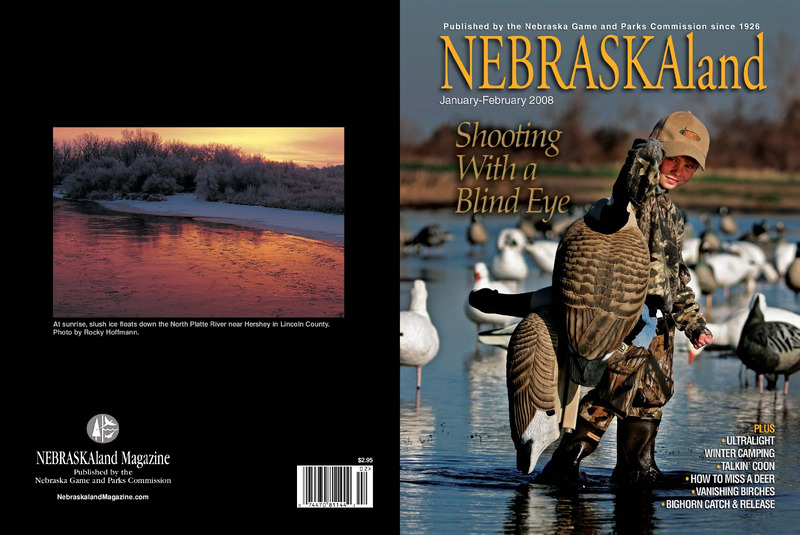
At sunrise, slush ice floats down the North Platte River near Hershey in Lincoln County.
Photo by Rocky Hoffmann.
NEBRASKAland Magazine
$2.95
0 2>
Published by the
Nebraska Game and Parks Commission
NebraskalandMagazine.com
0
74470 81144
2
Volume 86, Number 1, January-February 2008
10 Shooting With a Blind Eye
Doug Steinke of Shelton became serious about wildlife
photography only three years ago, yet his tack-sharp, framefilling images of ducks and geese in flight challenge and
exceed photographs taken by long-in-the-tooth professionals.
PHOTOS BY DOUG STEINKE
18 How to Miss a Deer
Five easy steps to an unsuccessful hunt.
BY ERIC FOWLER PHOTOS BY JAMIE VASA
20 Nebraska’s Archery Industries
Even though Nebraska was not at the forefront of states with
big game archery seasons, two companies in the state were
leaders in the manufacture of archery equipment. BY JON FARRAR
26 Bighorn Catch & Release
The Hubbard Gap bighorn reintroduction is the latest effort to
return bighorn sheep to their historic range and marks the
first release of bighorns entirely on private land in Nebraska.
TEXT AND PHOTOS BY BOB GRIER
32 Out in the Cold
Winter camping at Nebraska’s state parks is a seldompracticed activity for many outdoor enthusiasts. Especially
when doing so without a tent.
BY MATTHEW MARX PHOTOS BY JEFF KURRUS
32
●
40 Tree My Dog
There aren’t as many people running coonhounds now as there
were when Jerry Spech was young. “You got to be silly,” said
Spech, who still enjoys turning his dogs out and following
them through the woods at night with a light on his head.
TEXT AND PHOTOS BY ERIC FOWLER
9 Outdoor Business
Biologists helping walleye and white bass populations.
46 In the Field
40
●
20
●
Paper birch trees declining along the Niobrara River.
49 Parks & Places
Rainbow trout stocked in lakes across state.
Comment . . . . . . . . . . . . . . . . . . . . . . . . . . . . . . . . . 4
Outdoor News . . . . . . . . . . . . . . . . . . . . . . . . . . . . . 6
Classifieds . . . . . . . . . . . . . . . . . . . . . . . . . . . . . . . 48
Portraits from the Past . . . . . . . . . . . . . . . . . . . . . 50
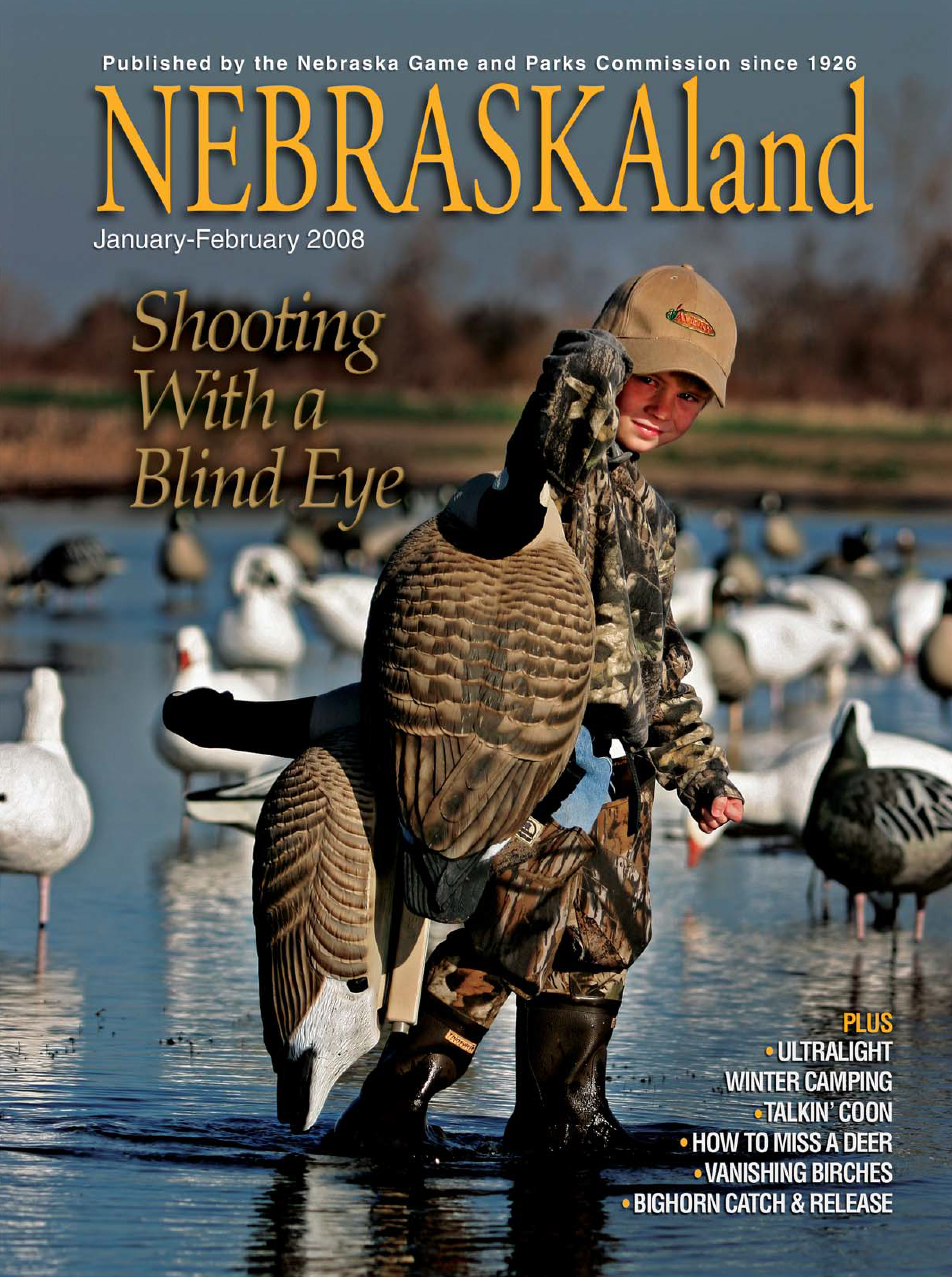
Cover: Blake Steinke, son of photographer Doug Steinke of Shelton, carries Canada goose
decoys during a hunting trip near the Platte River. See story beginning on page 10. Photo by
Doug Steinke. Opposite: Resembling an aerial photograph, a raccoon track leaves landscapelike indentions in the sand at Schilling Wildlife Management Area. Photo by Jeff Kurrus.
26
●
JANUARY-FEBRUARY 2008 • NEBRASKALAND 3
Published by the
Nebraska Game and
Parks Commission
Director: Rex Amack
Assistant Directors:
Roger Kuhn, Kirk Nelson, Sam Sidner
Information & Education Administrator:
Doug Bauch
Commissioners
Chairman:
Gary Parker, Columbus
Vice Chairman:
George E. Hall, Bridgeport
2nd Vice Chairman:
James Ziebarth, Wilcox
Jerrod Burke, Curtis
Dr. Mark Pinkerton, Wilber
Ron Stave, Waterloo
Dr. Kent Forney, Lincoln
Lynn Berggren, Broken Bow
Magazine Staff
Editor: Doug Carroll
Associate Editor: Jeff Kurrus
Art Director: Tim Reigert
Senior Editor: Jon Farrar
Regional Editors:
Eric Fowler, Bob Grier, Rocky Hoffmann
Contributing Editor: Michael Forsberg
Circulation: Donna Robinson
Photo Librarian: Sarah Johnson
NEBRASKAland
ISSN: 0028-1964
VOL. 86 / NO. 1
JANUARY-FEBRUARY 2008
Published monthly, except for Jan./Feb. and Aug./Sept.
issues, by the Nebraska Game and Parks Commission, 2200
N. 33rd St., Lincoln, NE. Copyright 2008, all rights reserved.
Please address comments or questions to this address.
Periodicals postage paid at Lincoln, Nebraska, and other
locations. POSTMASTER: Send all address changes to
NEBRASKAland, P.O. Box 30370, Lincoln, NE 68503-0370.
NEBRASKAland is available on audio cassette from the
Nebraska Library Commission Talking Book and Braille
Service, Suite 120, 1200 N St., Lincoln, NE 68508. (800)
742-7691.
Rates: $18 for one year; $33 for two years; $44 for
three years. Nebraska residents must add
appropriate sales tax.
To subscribe call 1-800-NEBLAND (632-5263),
or go online to: NebraskalandMagazine.com.
For address changes and questions about your
subscription, e-mail donna.robinson@ngpc.ne.gov.
Misidentified
Rock
I did my
geology masters
of science
fieldwork in
Boyd and
northern Holt
counties in
1953. I made
one auto trip
east to west across Keya
Paha County in July that year from
Butte to Valentine and back. It was
terribly hot, and the road was cow-trail
sand. I could not stop or the car
would boil. I did not see any glacial
deposits in western Boyd County for
sure and I am not aware of glacial
moraine or till in Keya Paha, so I
wonder about the caption for the
photo on the cover of the July issue
and on page 17 identifying the
boulders in northern Keya Paha
County as glacial in origin. The area
has fairly widespread occurrences of
what appears to be light-colored
outcropping on or around hilltops in
the area near Mills.
Gerald V. Mendenhall, Geologist
Midland, Texas
This second e-mail was received
from Mr. Mendenhall after examining
a sample of the rock shown in the
photos. We appreciate his help in
correctly identifying these boulders:
The sample is definitely limestone
and from all appearances is an Ash
Hollow member of the Ogallala
formation of the Pliocene Age (5.3
to 1.8 million years before present).
As for the boulders being glacial,
there is very little likelihood of their
being transported by glacial action.
It is almost certain that no major
glaciation extended west of the
Missouri River Valley. The boulders
in the photo are essentially in their
place of origin. In Boyd County
there is glacial till in the bluffs west
of the Missouri River, but the till
does not extend onto the tableland
west of the breaks.
All of this geologic history makes
4 NEBRASKALAND • JANUARY-FEBRUARY 2008
no difference in the beauty of
the landscape and photography
in a bit of Nebraska preserved
off the beaten track.
Goldeneyes Revisited
I wanted to thank you for the
good article on goldeneyes
(“Winter Whistlers” December
2007 NEBRASKAland). While
cleaning my garage last month I
came across one of the wooden
goldeneye decoys I carved in high
school. Looking at the decoy, I
wondered if anyone was ever crazy
enough to make whistler decoys just
to hunt over them. Your article
confirmed the fact that maybe I am
not all that crazy or at least there are
others like me out there.
The spot I hunted was one of
those areas that seemed magical – a
channel on the Platte that flowed
into a large sandpit. The small area
held about every kind of puddle
duck and diver on it, including large
numbers of goldeneyes late in the
year. There was usually a flock of
Canadas and a covey or two of
quail. I even shot a pair of woodcock
over my springer there. You never
knew what you would come home
with. I could reminisce all day about
this, but I must return to reality.
Thanks again for the confirmation
about not being too crazy.
Matt Houska
Omaha, Nebraska
Petrified Troll?
Thanks for a great magazine. I’ve
subscribed off and on over the years,
especially when I’ve lived away
from Nebraska, as I do now. The
October issue reminded me of the
black squirrels that used to
venture out from the southern end of
Hanscom Park, into my South
Omaha neighborhood. I saw them
fairly regularly over the years. I
heard once that they came from the
colony across the river in Council
Bluffs.
As for the interesting rock
formation on November’s back
cover – are you sure it’s not a
petrified troll, tricked into exposing
itself to the dawn by some intrepid
hobbit? That’s what I thought of
immediately, recalling such an
incident in J.R.R. Tolkein’s The
Hobbit. If not that, then I imagine it
was a bunch of kids looking for
fossils who eventually had other ideas.
Blessings on your work.
John F. Montag
St. Louis, Missouri
Headquarters
2200 N. 33rd Street
Lincoln, NE 68503
Phone (402) 471-0641
District Office I
East Hwy. 2, Box 725
Alliance, NE 69301
Phone (308) 763-2940
District Office II
524 Panzer St., Box 508
Bassett, NE 68714
Phone (402) 684-2921
District Office III
2201 N. 13th St.
Norfolk, NE 68701
Phone (402) 370-3374
District Office IV
301 E. State Farm Rd.
North Platte, NE 69101
Phone (308) 535-8025
District Office VI
1617 First Ave.
Kearney, NE 68847
Phone (308) 865-5310
Omaha Office
1212 Bob Gibson Blvd.
Omaha, NE 68108
Phone (402) 595-2144
Ak-Sar-Ben Aquarium
21502 W. Highway 31
Gretna, NE 68028
Phone (402) 332-3901
World Wide Web site: www.OutdoorNebraska.org
E-mail: info@ngpc.ne.gov
Seth Byler shows off his muskie.
Muskie Man
I thought I’d share these pictures
of a muskie I caught on my fly rod. I
am a 17-year-old avid fly-fisherman
from Montana. My uncle, Daryl
Bauer, put me on this muskie last
November at Fremont State
Recreation Area. I put my fly, a size
1/0 yellow bunny strip, right on a
submerged log and this muskie came
out and hammered it. Although I
only hooked one muskie in four days
of fishing, I had a great time with
my uncle and cousin. What a blast!
Thanks for the memories.
Seth Byler
Molt, Montana
Send your comments to:
Doug Carroll, Editor
NEBRASKAland Magazine
P.O. Box 30370
Lincoln, NE 68503
or e-mail doug.carroll@ngpc.ne.gov
Please include your postal address
and telephone number.
Letters may be condensed and edited
for clarity. Photographs are
welcome and will be returned.
Under federal and/or state law, discrimination is prohibited on the
basis of race, color, religion, age, gender, marital status, national
origin, disability or political affiliation. If you think you have been
discriminated against in any program, activity or facility by the
Nebraska Game and Parks Commission or want more information,
contact the Commission in Lincoln, NE, at (402) 471-0641 or the
Equal Opportunity Commission, Lincoln, NE, (402) 471-2024,
TTY/TDD (402) 471-4693).
Administration
Ted Blume (Adm.)
Craig Stover (Asst.)
Wes Loos (Asst.)
Rod Loos (Asst.)
Murray Johnson
Lincoln
471-5531
Lincoln
471-5532
Lincoln
471-5591
Ogallala (308) 284-8056
Lincoln
471-5003
Panhandle
Officer
City
Phone (308)
Jim Zimmerman (Sup.) Gering
436-7561
Walt Meyer
Chadron
432-4398
Scott Brandt
Gering
436-3418
Heath Packett
Gordon
282-2553
Dennis Thompson
Ogallala
284-6450
Dan Zuehlke
Ogallala
284-4815
Doug Pollard
Oshkosh
772-9950
Frank Miller
Valentine (402) 376-1183
Dan Kling
Whitney
432-8367
Southwest
Officer
City
Phone (308)
Roger Thompson (Sup.) N. Platte
532-9175
Ray Dierking
Brkn. Bow
872-3078
George Sund
Cambridge
697-4629
Michael Thome
Cozad
784-4362
Matt Andrews
Elwood
785-3025
Dirk Greene
Imperial
882-5328
Virgil Gosch
McCook
345-2185
Dudley Sorensen
N. Platte
532-0747
Rich Routh
Rep. City
799-2085
South-central
Officer
Jerry Pecha (Sup.)
Jeff Jones
Randy Pomplun
City
Phone (308)
Kearney
865-5327
Clay Center(402)762-3124
Fullerton
536-2987
Terry Brentzel
Darin Gress
Dale Johnson
Mark Reeves
Robert Finke
Richard Seward
Grand Is.
384-8296
Hebron (402) 768-2287
Kearney
237-1079
Loup City
745-0662
Milford (402) 761-3537
Ord
728-3115
Northeast
Officer
Tom Zimmer (Sup.)
Robert Kelly
Dale Davis
Ross Oestmann
Steve Oberg
Daniel Roberts
Jon Reeves
Marion Shafer
Pat George
Eric Wiebe
Tim Williams
Cory Krause
City
Phone (402)
Norfolk
371-6625
Albion
395-2538
Bassett
273-1700
Bloomfield
373-4412
Columbus
564-5937
Fremont
721-7852
Kennard
427-7378
Norfolk
371-2031
O’Neill
336-1588
Ponca
755-2566
Neligh
887-1335
West Point
372-6979
Southeast
Officer
Duane Arp (Sup.)
Sean McKeehan
William Krause
Jeremy TenKley
Mike Luben
Douglas Kramer
Dina Barta
Stacey Lewton
Levi Krause
Russell Mort
Dan Evasco
Jeff Clauson
City
Gretna
Ashland
Auburn
Beatrice
Colon
Lincoln
Lincoln
Lincoln
Louisville
Nebr. City
Papillion
Waterloo
Phone (402)
332-2965
944-4174
274-3789
228-1437
443-4278
466-9001
483-2358
476-0436
234-2212
873-5684
592-6733
359-5301
Nebraska Wildlife Crimestoppers 1-800-742-7627
JANUARY-FEBRUARY 2008 • NEBRASKALAND 5
Great Backyard Bird Count
PHOTO BY JEFF KURRUS
Nebraska deer hunters harvested a record number of deer during the 2007
November firearm season, but more antlerless deer need to be harvested in
many parts of the state in order to control the population.
November Deer Harvest Sets
New Record
Hunters harvested a record number
of deer in Nebraska during the
November firearm season, according
to a preliminary report by the
Nebraska Game and Parks
Commission.
With all but one check station
reporting, 48,505 deer were killed,
compared to 48,170 in 2006.
Harvest numbers could have been
even higher – unusually warm
weather during the season probably
reduced some hunters’ success levels,
since deer and hunters move less on
warmer days.
There were 4,610 deer killed in
the Panhandle during this year’s
firearm season, compared to 5,194
in 2006 after the number of bonus
antlerless-only tags was reduced by
4,800. The north-central region saw
8,212 deer killed, compared to 7,899
last year. There were an additional
5,000 bonus antlerless-only and 700
either-sex tags available in the
northeast, where 10,823 deer were
harvested, compared to 9,896 in
2006. The southwest saw 5,038 deer
harvested, compared to 5,383 last
year, and 8,492 taken in the southcentral region, compared to 8,557 in
2006. In the southeast, 11,330 deer
6 NEBRASKALAND • JANUARY-FEBRUARY 2008
were taken, compared to 11,241 last
year after 600 either-sex permits
were added.
Despite the record success in
November, state biologists are hoping
hunters take even more deer during
the late firearm deer season.
“Hunters are encouraged to take
antlerless deer during the January
late seasons to help control the deer
herd,” said Kit Hams, the
Commission’s big game program
manager.
The January antlerless deer season
runs Jan. 1-15, 2008. Season Choice
Area (SCA) permits are still available
for many areas of the state and allow
hunters to harvest antlerless deer
with a firearm during the January
season. Many of these permits also
include a bonus antlerless tag, and
nonresidents returning to the state
for the holidays can buy SCA
antlerless permits for $55.
For more information, or to
purchase a permit, go to
www.OutdoorNebraska.org. Permits
may also be purchased at
Commission permitting offices at
Ak-Sar-Ben Aquarium, Alliance,
Bassett, Chadron State Park (SP),
Fort Robinson SP, Niobrara SP,
Kearney, Norfolk, North Platte,
Omaha, Lincoln and Wildcat Hills
State Recreation Area.
The 11th annual Great Backyard
Bird Count (GBBC) will occur
February 15-18, 2008. Sponsored by
the Cornell Lab of Ornithology and
the National Audubon Society, this
outdoor family event asks anyone to
count birds wherever they are and
enter their tallies online at
www.birdcount.org.
These reports create a picture of
where birds are across the continent
and contribute valuable information
for science and conservation. Past
count results already show how the
numbers of some bird species have
changed in recent years, such as a
decline in northern pintails and an
increase in hooded mergansers,
consistent with trends from the
Christmas Bird Count and Breeding
Bird Survey.
“People who take part in the Great
Backyard Bird Count see the results
of their efforts in the news and in
bird conservation work taking place
across the country,” said Audubon
Education Vice President Judy
Braus. “Whether the counts occur at
home, at schools or at nature centers,
they’re more than engaging and
educational science activities for
young people and adults, they’re a
way to contribute to the conservation
of birds and habitat nationwide.”
In 2007, GBBC participants made
history, breaking records for the
number of birds reported, and the
number of checklists. Participants
sent in 81,203 checklists tallying
11,082,387 birds and 613 species. A
web site dedicated to the GBBC,
complete with a gallery of
photographs taken by birdwatchers,
can be found at
www.birdsource.org/gbbc/gallery/2007.
Valentine’s Day Special
Eugene T. Mahoney SP is offering
a special Valentine’s Day package at
the park. The package deal is
available February 10-14 and
includes one night’s lodging, a special
meal for two, and a complimentary
gift package. The price varies based
Your Season
Pass to Fun!
A 2008 Nebraska
Park permit is your ticket to
a whole year of fun. It opens the door to
86 park and recreation areas statewide –
for the whole family, 365 days a year. Get
your park entry permit today!
Order online at
www.OutdoorNebraska.org
or call
1-800-742-0056
(Monday through Friday, 8 am to 5 pm CST)
www.OutdoorNebraska.org
NEBRASKA GAME AND PARKS COMMISSION
JANUARY-FEBRUARY 2008 • NEBRASKALAND 7
on the unit chosen. For more
information or to make a reservation,
call the park at (402) 944-2523.
Nebraska’s Largest Wildlife
Training Seminar
Pheasants Forever (PF) announces
the state’s largest wildlife training
seminar will be held in Grand Island
on Saturday, February 2, 2008, as
part of PF’s State Habitat Meeting.
Topics at the seminar will focus on
many aspects of increasing and
improving wildlife habitat in
Nebraska.
“Every hunter, landowner, or
person interested in increasing
wildlife in the state should consider
attending the State Habitat Meeting,”
said Pete Berthelsen, PF’s Senior
Field Coordinator for Nebraska. “It’s
an incredibly knowledgeable lineup
of Nebraska’s wildlife experts all
together in one stop.”
All sessions are open to the public
for a full-day ticket price of $40
(includes lunch and refreshments,
$30 if registered by 1-31-08). Held
at the Midtown Holiday Inn, the
seminars will run from 9 a.m. to
4 p.m., and topics include the
following: The future of CRP, Quail
Management 101, 201 and 301
classes, wildlife management and
programs for western Nebraska,
CRP Mid-contract Management, the
use of prescribed burning on the
landscape, patch burn/patch grazing
management, a summary of PF and
Quail Forever accomplishments in
Nebraska, and many others.
The event will also feature a
landowner help desk, which will
allow landowners from across the
state the opportunity to receive an
aerial photo of their property and
consult with a wildlife biologist
about their habitat and conservation
program options.
For more information or to
register for the event, please visit
www.NebraskaPF.com or call the PF
State Office at 308-754-5339.
Registration to attend the State
Habitat Meeting is limited to the
first 400 people registered due to
space limitations so get your tickets
now.
Nebraska Outdoors Radio
Show
Nebraska Outdoors is a weekly
call-in talk show that airs every
Saturday morning from 7-8 a.m. on
ESPN 1480 AM. The show allows
outdoor listeners in Lincoln, York,
Hastings, Grand Island, Kearney and
beyond the chance to call in with
questions about hunting, fishing,
shooting and outdoor Nebraskarelated topics with KFOR’s Tim
Barrett and the Commission’s Jeff
Rawlinson, Ralph Wall and Aaron
Hershberger.
The number to call to the show is
(402) 466-ESPN (3776). You can
also link to ESPN1480.com for the
streaming online feed of Nebraska
Outdoors, which is a partnership
between the Nebraska Game and
Parks Commission and Three Eagles
Communication.
Information Sought in Eagle
Killing
8 NEBRASKALAND • JANUARY-FEBRUARY 2008
Biologists looking for information to help walleye and white bass populations.
By Rocky Hoffmann
in irrigation reservoirs not only
he Nebraska Game and
in Nebraska but throughout the
Parks Commission and
Great Plains as well.
researchers from the
“The study we are conducting
University of Nebraskawill provide an in-depth analysis
Lincoln (UN-L) are
of recruitment variability.
entering their second year of a
Further, little is known about
study looking at the recruitment
the ecology of white bass in
of walleye and white bass in
reservoirs, and any information
five southwestern Nebraska
gained on white bass ecology
irrigation reservoirs – Enders,
from this study will be an
Medicine Creek, Red Willow,
important contribution to the
Swanson and Harlan County.
general knowledge of white
The five-year project is under
bass,” said Koupal.
the direction of Kevin Pope of
One of the unique elements
UN-L and Keith Koupal of the
of the study consists of using
Commission.
telemetry to track adult white
All five reservoirs being
bass and walleye prior to and
studied were created for flood
during their spawning seasons.
control and irrigation, but they
During the past two falls, Pope
also provide important white
and Commission fisheries
bass and walleye fisheries for
biologists collected white bass
anglers. Because these reservoirs
and walleye from Red Willow
are severely drawn down
and Enders reservoirs and Pope
annually for irrigation purposes,
surgically implanted
researchers believe that a
UN-L graduate student Dustin Martin conducts
transmitters that resemble
“recruitment bottleneck” is
affecting white bass and walleye telemetry for a five-year study of walleye and white AAA batteries into their
bass populations at Enders Reservoir.
abdominal cavities. This
there. In order to maintain a
dynamics for both species,” said Pope. allows researchers to track individual
walleye fishery in southwestern
fish during their breeding season
“Researches have already begun to
reservoirs, annual stockings are
discover and document the spawning and determine the preferred
currently necessary because there is
spawning habitat of walleye and
habitat of walleye and white bass in
very little natural reproduction and
white bass in irrigation reservoirs.
the reservoirs. Objectives also will
very poor development in the young
The transmitters have a nine-month
include a prey study of larval and
walleye that are produced. And
expected lifespan, so the fish have to
juvenile walleye and white bass
although white bass reproduction
be collected before each breeding
during each project year.”
and recruitment occur naturally in
season.
“This information is vital to our
these reservoirs, year classes of
Koupal feels that several factors
white bass are often weak or missing. understanding of walleye and white
Walleye and white bass recruitment bass population dynamics in irrigation likely influence the recruitment of
white bass and walleye in these large
is not a new problem, but the specific reservoir systems,” said Koupal.
irrigation reservoirs, primarily wind
“The Commission invests an
factors that influence recruitment
enormous amount of time, resources and other weather phenomena,
in these reservoirs are not fully
recruitment of gizzard shad, water
understood. This five-year cooperative and money trying to manage the
temperature and excessive long- and
variable recruitment of walleye and
study is designed to hopefully
short-term water-level fluctuations.
white bass in the southwestern
discover some of the problems
Researchers hope this study will help
Nebraska irrigation reservoirs.”
involved.
pinpoint some of the recruitment
Both researchers believe that
“The project objectives are to
problems in irrigation reservoirs and
information gained from this study
document the period of the
lead to solutions that will improve
will help improve management
recruitment bottleneck, while
these valuable fisheries. ■
activities for walleye and white bass
developing a model of population
T
JANUARY-FEBRUARY 2008 • NEBRASKALAND 9
PHOTO BY ROCKY HOFFMANN
The Nebraska Game and Parks
Commission and the U.S. Fish and
Wildlife Service are encouraging
citizens to notify Nebraska Wildlife
Crimestoppers (NWC) with any
information they have about the
Nov. 12 killing of a bald eagle five
miles southeast of St. Paul in
Howard County, according to Wes
Loos, assistant administrator of the
Commission’s Law Enforcement
Division.
If you have knowledge of this or
any other game law violation, you
are encouraged to call the NWC
toll-free hotline, 1-800-742-7627.
Persons reporting a violation are not
required to give their name or
appear in court, but they may be
eligible for a cash reward. ■
Recruitment Study Enters Second Year
Shooting
With a
Blind Eye
Photos by Doug Steinke
It is difficult to believe that Doug
Steinke of Shelton became serious
about wildlife photography only
three years ago. His tack-sharp,
frame-filling images of ducks and
geese in flight challenge and surpass
photographs taken by many
long-in-the-tooth professionals.
WHITE-FRONTED GOOSE.
10 NEBRASKALAND • JANUARY-FEBRUARY 2008
JANUARY-FEBRUARY 2008 • NEBRASKALAND 11
OPPOSITE: A YELLOW LAB PUP INVESTIGATES DECOYS AND A ROSS’S GOOSE PORTRAIT. ABOVE: A SANDHILL CRANE
INSPECTS CANADA GOOSE DECOYS. BELOW: A FOGGY PLATTE RIVER MORNING.
While Steinke’s photography
experience is recent, his love of
waterfowl spans nearly all of his
39 years. Steinke grew up in
Holdrege, the heart of the
Rainwater Basin, where he
discovered his love for
waterfowl. That, and about 60
days spent each year in a blind
on the Platte River, explains his
remarkable waterfowl images.
12 NEBRASKALAND • JANUARY-FEBRUARY 2008
JANUARY-FEBRUARY 2008 • NEBRASKALAND 13
OPPOSITE: BLAKE, ONE OF STEINKE’S THREE SONS, HELPS MOVE DECOYS. ABOVE: A DRAKE MALLARD’S
ICE-STORM RETREAT. BELOW: A DRAKE PINTAIL IN NUPTIAL PLUMAGE.
Some of Steinke’s photos are
taken while hunting, but he
also makes solo trips to his
blind just for waterfowl
photography. “You can go out
there every day for a week,” he
said, “and you might get one
good day for photos.” Many of
his photos are taken while
sitting outside of his blind
dressed in camouflage. A
shotgunner by nature,
he seldom uses a tripod.
14 NEBRASKALAND • JANUARY-FEBRUARY 2008
JANUARY-FEBRUARY 2008 • NEBRASKALAND 15
Steinke said he has matured as a waterfowler
to the point it doesn’t matter whether he shoots
a shotgun or camera once he has ducks or
geese hanging over the decoys. “When you are
young,” he said, “you want to shoot as much
as you can. I think every hunter goes through
that phase. I remember an older hunter telling
me years ago that eventually I would be satisfied
just to be there. I didn’t believe him then.”
Where Steinke hunts, who he hunts with, and
luring birds close with decoys and convincing
calling is what the hunt is all about. ■
ABOVE: CANADA GEESE. BELOW: BLUE-PHASE SNOW GEESE. OPPOSITE: AFTER THE ICE-STORM MELTDOWN.
Most of Steinke’s photos
were taken with a Canon
EOS 20D digital single lens
reflex camera, but he recently
upgraded to a Canon EOS
40D. He uses three lenses
for nearly all of his wildlife
photography: a 24-105
zoom, 70-200 zoom and a
100-400 zoom.
16 NEBRASKALAND • JANUARY-FEBRUARY 2008
JANUARY-FEBRUARY 2008 • NEBRASKALAND 17
How To Miss A Deer
3 When the deer finally turns, pull
●
the trigger. But make sure you
do so when your head is several
inches above the gunstock
instead of snug against it. This
step is important, because if
you use proper shooting form,
you might actually hit the deer
and end your hunt.
By Eric Fowler
Photos by Jamie Vasa
love chasing deer in the Sandhills. Maybe it’s the
Cro-Magnon man in me, but there’s just something
magical about sneaking up on a wild creature and taking
it home to the freezer. To me, spot-and-stalk hunting is true
hunting, and a lot more fun than sitting in a tree getting cold
feet and hoping a whitetail walks within gun or bow range.
A few years ago, while on a hunt north of Arthur, I
discovered a great way to get more out of my muzzleloader
permit and extend the season: just miss the deer. I call it
catch-and-release hunting, and I’m sure the concept will
soon be as big as it has become for largemouth bass fishing.
I
If you don’t already know how to miss a deer, you’re a liar
… er, uh … you can probably figure it out on your own. But
for you real liars … excuse me … crack shots who have no
experience in this realm, I’ll provide the details on how I
missed a deer I snuck within smokepole range of one
weekend. I even had Jamie Vasa, a longtime friend and
professional photographer, document the fun.
You might have to modify these steps to fit your own
hunting situation, but rest assured, they can be applied to a
tree stand whitetail hunt as easily as I applied it to this
spot-and-stalk mule deer hunt.
1 In the first hour of your hunt,
●
crawl to within 50 yards or so
of a pair of bedded mulie does,
using the wind to keep the deer
from smelling you and a
soapweed to keep them from
seeing you.
Slide around the soapweed,
take aim and wait for the deer
to stand. If they don’t right
away, whistle and wave your
hands and they soon will.
4 Watch in awe as the bullet
●
causes sand to explode on the
hillside behind the deer after
sailing several feet over its back.
5 Quickly reload in case the deer
●
stop and give you another
2 Repeatedly lift your head from
●
your gun sights to get a better
view of the deer as you wait for
one to turn and present a
broadside shot.
18 NEBRASKALAND • JANUARY-FEBRUARY 2008
chance to miss. If they don’t,
you’ll still be ready to repeat
the process as soon as you
find some more deer. Repeat as
often as you’d like, unless, of
course, you have hungry
children to feed at home.
JANUARY-FEBRUARY 2008 • NEBRASKALAND 19
PHOTO ON PAGES 20-21 COURTESY OF SAUNDERS ARCHERY. PHOTO, RIGHT, NEBRASKA GAME AND PARKS COMMISSION
C.A. “Chuck” Saunders made the first archery target-making machine (preceding
pages) from parts he salvaged from other machines. By 1963, Saunders Archery in
Columbus was manufacturing 70 percent of the targets used by U.S. archers.
Saunders Archery
Nebraska’s largest volume, longest
operating archery equipment
manufacturing company had its humble
beginning in a Chicago basement. In
the 1930s, C.A. “Chuck” Saunders
was employed as an electrician and
machinist. In his spare time he fashioned
bows and arrows. Saunders was
dissatisfied with arrow-stopping targets
of the time made of green rye straw,
and was convinced he could make one
that was more durable. He also believed
he could make them with a machine
rather than by hand, as targets were
made at that time. In 1940, after
sketching out a design on the back of
an envelope, Saunders built the world’s
first archery target-making machine
from parts of other machines. Flush with
optimism, Chuck and his wife, Phyllis,
moved their mat-making operation to
the family farm near Manilla, Iowa, in
1942 to be near a supply of rye straw.
Ben Pearson Archery’s ad for
machine-wound targets appeared in Ye
Sylvan Archer, the archery magazine of
the day, one month before Saunders’s
ad appeared. Pearson was the world’s
largest manufacturer of archery tackle
at the time. The machines used by
Pearson and Saunders were different in
design and both were patented, but
Saunders found his little family company
up against the industry Goliath. Both
22 NEBRASKALAND • JANUARY-FEBRUARY 2008
PHOTO COURTESY OF SAUNDERS ARCHERY
A
lthough Nebraska did not
have an archery season
for deer until 1955,
years later than many
states, two Nebraska
manufacturers have played critical roles
in the archery industry – Saunders
Archery in Columbus and Cornhusker
Archery in Bassett. Their roles in the
development of equipment paralleled
the emergence of bowhunting and
target archery as the widely embraced
outdoor sports they are today.
Saunders invented or modified equipment to harvest prairie cordgrass from wetlands near Columbus for the manufacture of target mats.
were using rye straw to make their
mats, but Saunders was not satisfied
with their durability and cast about for
alternatives. He found it in soggy marsh
lands along the Missouri River, a native
grass resistant to rot and rodents, one
that could absorb more arrows – prairie
cordgrass.
“Pearson switched to Johnson grass,
which wasn’t very tough,” Saunders
wrote in a short history of his company.
“In a few years they got out of the
business, and for 35 years we didn’t
have a serious competitor.”
Lacking funds for advertising,
Saunders let his cordgrass mats sell
themselves. “I would just fill an order
for rye straw mats with Indian cord
grass mats,” he wrote. “A short note
was typed on the invoice that we were
temporarily out of rye straw and were
substituting the more expensive Indian
cord grass mats at the same price. It
worked. After they tried the Indian
Cord Grass Mat, they could immediately
see the advantage.”
Saunders’ father and Phyllis made
and marketed mats while Chuck served
two years in World War II. When he
returned from the army, Chuck
resumed making archery mats and, as
always, searched for a better way to
make a better product. One problem
continued to plague Saunders – an
unreliable supply of cordgrass along
the Missouri River. Some years the
meadows were too wet to harvest, or
even under water, and were 90 to 150
miles from Manilla.
So in 1949, Saunders moved his
young company to Columbus,
Nebraska, where there was an abundant
supply of cordgrass in wet meadows
along the Platte and Loup rivers and
their tributaries. Saunders modified or
invented equipment to harvest the
grass, including a “marsh-buggy”
tractor and special mowing equipment.
JANUARY-FEBRUARY 2008 • NEBRASKALAND 23
Saunders target faces were familiar
sights at all national archery
tournaments. The company produced
52 different target faces, each available
in several types of material – paper,
oilcloth, cardboard and a “toughenized”
cover made of a meshwork of nylon
threads between two sheets of heavy
paper. By 1963, Saunders Archery was
manufacturing 70 percent of the targets
used by archers in the U.S. By the
1980s, it was selling target faces of
game animals as well as the traditional
target bull’s-eye. The company never
manufactured the three-dimensional
game animal targets popular today.
Saunders also marketed several designs
of target stands. Saunders equipment
had a reputation of being well designed
and expertly constructed.
While target mats were the company’s
core product, Saunders was constantly
adding archery accessories to its
catalog. The “Bow Bird” was a
cardboard disc target with whirling
wings that could be launched into the
air by hand or machine. By the 1960s,
Saunders reels were probably on more
carp-shooters’ bows than any other
brand. During that same decade, Chuck
invested a great deal of time and
money developing and marketing
indoor archery ranges with automated
lanes suggestive of a bowling alley.
That venture was abandoned after
several years.
By the mid-1980s, 55 patents were
registered to the Saunders family.
Saunders Archery products filled many
catalog pages, and included bow strings,
bow stringers, string silencers, nocking
points, arm guards, shooting gloves
and tabs, an array of target and hunting
arrow points, arrow rests, bow stabilizers,
target and hunting sights, bow quivers,
arrow holders, camo bow covers, and
camo face and hand cream. An
advertising tag line for Saunders
summarized the company’s product
line: “Everything for the archer but the
bow and arrow.”
Chuck Saunders was a towering
figure in the archery industry and was
instrumental in forming the Archery
Manufacturers Organization (AMO),
which led to the standardization of
equipment such as bowstring lengths.
In 1986, he was inducted into the
Archery Hall of Fame. From the
beginning, Saunders Archery was
literally a family-run business, with
Phyllis and three sons, Eugene, Tom
and Charles, integral parts of the
company. Chuck Saunders died in
1995. Saunders Archery is still located
in Columbus. For information or a
catalog: call 1-800-228-1408, write
Saunders Archery, PO Box 1707,
1874 14th Ave., Columbus, NE 686021707, or go to www.sausa.com.
Cornhusker Archery
During Cornhusker Archery’s early years, and before nationwide standards were
imposed, it manufactured 108 different bowstrings in its Bassett factory.
24 NEBRASKALAND • JANUARY-FEBRUARY 2008
Cornhusker Archery was an
internationally important, but littleknown, Nebraska archery equipment
manufacturer. Dick Mauch, a Bassett
native whose name pops up again and
again in the history of all aspects of the
archery industry and bowhunting, was
the key figure in forming the company.
During the 1960s, Mauch was a
shareholder and field representative for
Bear Archery, which was growing by
leaps and bounds at the time but was
dependent on several small bowstring
manufacturers who could not keep pace
with the sale of Bear bows. Further
compounding that problem was the
lack of industry-wide standards for
bowstring length, stretch or material.
That would not change until the AMO
appointed Mauch, Earl Hoyt and
Charles Saunders to write the first U.S.
standards for archery equipment,
PHOTOS BY JON FARRAR
The grass was cut and twisted into a
loose rope, then allowed to age and dry
to the proper moisture content. Then
the grass rope was fed through a Rube
Goldberg sort of machine of Saunders
design and construction, and under
pressure wound into a circular target.
At this point the mats were transported
to the factory, where they were cured,
stitched and the outside of the mat
bound with burlap tape. After a few
years Saunders began sealing the entire
target in burlap. He developed more
durable target cores by folding the
grass back and forth so the fibers ran
parallel to the arrow penetration, rather
than spiral wound like the outer rings
of the mat, and he marketed target core
replacements.
In 1952, Saunders Archery moved
out of a rental building into its new,
larger factory, and continued to expand
its product line, including Wrist
Rockets, high-tech slingshots. Saunders
had a knack of identifying the
accessories archers needed, then
designing and manufacturing them,
typically jerryrigging the needed
machinery from junkyard parts such as
bicycle wheels and corn picker clutches.
In the early 1950s, most archers made
their own target faces, do-it-yourself
bull’s-eye creations with uneven circles,
targets not acceptable for archery
competition. By the late-1950s,
Longtime Cornhusker Archery employee Lorrie Shaul finishes a bowstring. At its peak, Cornhusker had 35 employees.
standards imposed in 1968. Mauch
served two terms as the AMO president
in the 1980s.
Like most small Nebraska towns in
the 1960s, Bassett was losing its young
people as they moved away to college
or to find urban jobs. When Fred Bear
suggested Mauch start a bowstring
factory in Bassett in the mid-1960s it
seemed like the solution to both Bear
Archery’s bowstring shortage and
Bassett’s shrinking population. Mauch
encouraged local businessmen to form a
company and bring the archery industry
to Bassett with a virtual guarantee from
Bear Archery. The endeavor was never
launched, however, and Bear continued
buying strings elsewhere.
Bear Archery was sold to Victor
Comptometer in 1967, but Bear
remained a stockholder and figurehead
for many years. In 1975, Bear Archery
management again approached Mauch
about starting a bowstring company. At
that time Mauch was no longer
working for the company and had sold
his hardware and lumber business in
Bassett. With more time for a new
venture, he spearheaded the formation
of a company financed by a group of
local investors. Bowstring machines
were brought from Michigan and local
workers trained to use them.
Cornhusker Archery turned out its
first bowstring in February 1976 and its
one-millionth string the following year.
At that time Cornhusker was producing
strings almost exclusively for Bear
Archery, about 500,000 a year, but as
its production capabilities grew it
began to supply other archery
equipment manufacturers, including
Saunders Archery in Columbus. During
its early years, Cornhusker made 108
different bowstrings. Cornhusker
Archery never sold its bowstrings at the
retail level to avoid competing with its
manufacturing and distributor clients.
“We were working on volume, and a
small margin to make it,” Mauch said.
“The whole idea of making bowstrings
was to bring employment to Bassett,
which we did for over 30 years.” At
its peak, 35 employees produced
bowstrings, most working full time at
the factory in downtown Bassett, some
working part time on equipment in
their homes. At one point, Cornhusker
Archery was the biggest bowstring
manufacturer in the U.S.
In January 2006, Cornhusker Archery
was sold to Concept Archery, a
Pennsylvania company producing
top-end, compound bows. Concept’s
bowmaking operations were moved to
Nebraska and housed under the same
roof as the bowstring manufacturing
operations. In October 2007, the entire
operation was moved from Bassett to
Pennsylvania, the close of one chapter
in the history of Nebraska’s role in the
archery industry. ■
JANUARY-FEBRUARY 2008 • NEBRASKALAND 25
As the crow flies, it’s almost exactly 600 miles from
Havre, Montans to the small Nebraska Panhandle
Bighorn Catch & Release
Text and Photos by Bob Grier
Bighorns captured in Montana and cooperative landowners are brought together to
make Nebraska's newest bighorn herd a reality – the Hubbard Gap bighorn
reintroduction is the latest effort to return bighorn sheep to their historic range and
the first release of bighorns entirely on private land in Nebraska.
A
s the crow flies, it’s
almost exactly 600 miles
from Havre, Montana to
the small Nebraska
Panhandle community of
McGrew. The mileage by gravel and
paved roads is substantially greater, so
it takes a long time to make that trip,
especially when a vehicle can only
drive 15 to 30 mph because of icy,
snow-covered and windswept roads
through most of Montana, all of
Wyoming and a portion of western
Nebraska. Which explains why
Nebraska Game and Parks Commission
staff had to drive nearly nonstop for
more than 20 hours to transport several
large stock trailers carrying bighorn
sheep back to Nebraska.
For the bighorns, the January 2007
trip to Nebraska took even longer – it’s
been well over 100 years since
bighorns were last seen in the central
Wildcat Hills.
The 51 Montana bighorns – 42 ewes,
2 lambs and 7 rams – were released
near Hubbard Gap in the Wildcat Hills
south of McGrew in mid-January. The
Biologist Holly Kufahl tracks the Hubbard Gap bighorns using a handheld radio
receiver and antenna. Each bighorn's radio collar transmits on its own frequency,
letting biologists identify and track individual bighorns.
26 NEBRASKALAND • JANUARY-FEBRUARY 2008
bighorns were Nebraska’s latest efforts
to reintroduce bighorn sheep into their
historic range that once extended
across western Nebraska and possibly
further east. Of greater significance, the
newly established herd is Nebraska’s
first release of bighorns entirely on
private land.
Across the continent, substantial
blocks of the bighorn’s historical range
are no longer suitable habitat for wild
sheep, and their current ranges in the
west continue to shrink before a growing
tidal wave of changing land use and
continuing development. South of
McGrew, however, farmers, ranchers
and other landowners enthusiastically
enrolled more than 20,000 acres of land
for the opportunity to see free-roaming
bands of bighorns return to the area.
The Hubbard Gap herd is Nebraska’s
fourth bighorn herd, joining the original
Fort Robinson herd, the Cedar Canyon
herd southwest of Scottsbluff and the
Barrel Butte bighorn herd released
southwest of Chadron in 2005 that
currently roams the Pine Ridge as far
east as Chadron State Park and west to
the Ponderosa Wildlife Management
Area (WMA) southeast of Crawford.
The Nebraska herds and their
counterparts throughout the west are
testaments to the bighorn’s ability to
survive and to the esteem that
landowners, wildlife enthusiasts,
biologists and sportsmen’s groups,
including the Nebraska Chapter of
Safari Club International, the Foundation
for North American Wild Sheep
Transplanted from Montana, radio-collared bighorns emerged from trailers in the Wildcat Hills south of McGrew in mid-January.
JANUARY-FEBRUARY 2008 • NEBRASKALAND 27
“I was originally concerned with the damage that bighorns might do to
fences, at least until a small group of rams approached me in the pasture
one morning and each, in turn, easily jumped my fence.”
— Darrell Roberts, rural McGrew landowner
Helicopters were used to capture bighorn sheep and carry them back to
waiting biologists at the processing site.
(FNAWS), the Iowa Chapter of FNAWS
and many others share for bighorns.
Since the early 1900s, at least 19 wildlife
agencies from the United States and
Canada have engaged in efforts to
re-establish bighorns throughout North
America.
These efforts are possible because
some western states and Canadian
provinces have surplus bighorn
populations in their scattered herds that
have been used for relocation efforts
across the continent.
Kevin Hurley, a wildlife biologist
with the Wyoming Game and Fish
Department, said trapping and moving
extra sheep help the donor agencies as
much as those that receive sheep. “The
With its rugged terrain, the Missouri River Breaks in north-central Montana is perfect habitat for a burgeoning bighorn sheep
population. In 2005, bighorns from the breaks south of the river were captured and released on the Bighorn WMA southeast of Crawford.
The sheep captured last January that eventually became the Hubbard Gap herd were captured on the north side of the Missouri.
28 NEBRASKALAND • JANUARY-FEBRUARY 2008
Bighorn enthusiasts, biologists and researchers alike are intrigued by the display antics used by the bighorn rams during the
November and December rutting season. With its head lowered, a young ram from the Cedar Canyon herd approaches several larger
rams. Ram breeding displays include the famous "head butting," "front kicks" and "horning" displays.
relocation of sheep to historic ranges is
one way to help manage densities on
the bighorn’s critical winter range.
Wyoming’s Whiskey Basin herd near
Dubois, Wyoming is a good example.
Surplus sheep from the Whiskey Basin
herd of about 1,500 bighorns provided
sheep to six states over the past 50
years.”
Hurley points to research conducted
in Alberta that clearly revealed the
effect on bighorn winter range densities.
During the study, bighorn numbers on
selected ranges were allowed to
increase and decrease under controlled
conditions to study how the population
was affected.
“Alberta’s research showed
dramatically that as winter range
densities of bighorns increase, the
herds respond with delayed age of
breeding, lower recruitment and decreases
in horn growth,” said Hurley “When
winter densities were intentionally
reduced, the herds return to strong
recruitment and greater horn growth.”
Nebraska’s Cedar Canyon herd came
from Colorado, and the bighorns for
the Barrel Butte herd came from the
Missouri River Breaks in north-central
Montana. Part of the Hubbard Gap
bighorns were also captured there, with
the rest coming from the Sun River
herd near Augusta. Sheep for the Fort
Robinson herd originated with several
animals from Colorado and Wyoming,
with the remainder coming from nearby
herds in South Dakota.
One key to successful reintroduction
efforts nationwide is the identification
and selection of suitable sheep habitat.
Nebraska Game and Parks Commission
wildlife biologists have been conducting
habitat suitability studies in the Pine
Ridge and Wildcat Hills to identify,
quantify and qualify the important
components of bighorn habitat
requirements there, including the
rugged and steep terrain that bighorns
use for escape cover, lambing sites and
to meet other needs. Since the initial
releases of bighorns in the Pine Ridge
and Wildcat Hills, Commission
biologists have conducted almost daily
tracking and monitoring of Nebraska’s
bighorn herds – research that has
provided valuable insights into bighorn
habitat requirements as work to identify
potential release sites continues.
“The habitat suitability studies look
specifically at larger tracts within the
historical range of bighorns here in
Nebraska in both the Pine Ridge and
Wildcat Hills. The historic bighorns
probably ranged further east, perhaps
down the Niobrara and eastward along
the North Platte River corridor,” said
Todd Nordeen, wildlife manager of the
Commission’s district office in Alliance.
“There is at least one historical account
of a bighorn as far east as Lincoln
County, but information on their historic
ranges farther east is much less clear.
“The record of bighorns in the Wildcat
Hills includes accounts of mountain
men, fur traders and immigrants on the
Oregon Trail in the mid- to late-1800s,
and several rocky outcrops near the
North Platte River are still identified by
their association or use by the historical
bighorns, including Sheep Mountain
near the Hubbard Gap release site and
Spoon Butte on the Wyoming-Nebraska
border north of Henry. Archeologists
excavating paleo-Indian sites at Signal
Butte and elsewhere in the Panhandle
have recovered numerous bighorn
JANUARY-FEBRUARY 2008 • NEBRASKALAND 29
“Younger rams travel better than larger rams during capture and
transport ... and, are able to sucessfully breed during the November and
December rut that follows the late winter move to Nebraska.”
— Todd Nordeen, district wildlife manager
Left to right, Todd Nordeen, Dean Studnicka, Chuck Butterfield, and Chad Taylor carry a young bighorn ram from the helicopter to a
nearby work station. Butterfield is a Chadron State College wildlife professor, while the others are Commission biologists. Blindfolds
were used to calm captured bighorns as they were processed for the trip back to the Nebraska release site.
artifacts and remains that indicate the
bighorns were important to the region’s
earliest human occupants.
“The proposals for additional release
sites considered private land releases as
well and a strong effort was initiated
seeking cooperative support, including
landowner visits and organized public
and news media tours. We were
fortunate that Kit Hams, the
Commission’s big game program
manager in Lincoln, was well acquainted
with landowners near the proposed
release site. Once the Hubbard Gap site
was identified, numerous landowners
stepped forward to enroll their land and
provide written permission for the
bighorn reintroduction.”
With the release site determined, the
Commission’s wildlife division
administrators began discussions with
wildlife agencies and departments that
had provided bighorns for national
reintroduction projects, and Montana
responded by placing Nebraska fairly
high on their priority list to receive
surplus bighorns. Montana also agreed
to provide the bighorns at no cost as
long as Nebraska paid for the capture
and transport.
In mid-January, 2007, Nordeen, Hams
and a crew of Commission wildlife
biologists from across Nebraska arrived
on the north side of the Missouri River
Breaks near Havre. The area is rugged,
deeply etched, eroded – and home to
several bands of bighorn sheep. The
sheep used for the 2005 reintroduction
on Nebraska’s Bighorn WMA came
from this same general area.
Montana wildlife biologists,
veterinarians and conservation
technicians provided capture and
handling instructions for both the
Nebraska crew and biologists from
North Dakota that gathered at the
capture site in January. North Dakota
Game and Fish Department’s request
for bighorns had priority, so the Nebraska
staff helped process the morning’s first
sheep for the waiting North Dakota
trailers before beginning work on the
sheep destined for Nebraska.
Bighorns captured by the contracting
30 NEBRASKALAND • JANUARY-FEBRUARY 2008
helicopter wildlife capture crew were
flown to the work site, unloaded and
carefully processed under the Montana
veterinarian’s formalized protocols for
bighorn sheep. Each bighorn was aged,
blood-tested, had DNA samples collected
and was fitted with a radio telemetry
collar before being loaded into stock
trailers for transport back to Nebraska.
Montana’s wildlife manager responsible
for the Missouri Breaks herds worked
with the airborne capture crew to
identify both sex and age of sheep for
the relocation effort.
“Montana’s surplus sheep included
ewes and younger rams,” Nordeen said.
“Larger rams are much more difficult
to work with, are abusive to the other
bighorns during transport and, once
released, are likely to wander away
from the release site. The Montana
biologists did provide several rams
2½ years of age, and in our experience
with previous releases, rams up to that
age have been very successful during
the subsequent breeding seasons.”
Several of Nebraska’s transport trailers
updates on where the bighorns are. By
Nebraska’s and other bighorn herds
were filled with bighorns by late
fall of 2007, her research had found the across the region. We’ve documented at
afternoon but the day’s operations were
least 30 lambs born during the 2007
suspended by nightfall before Nebraska’s Hubbard Gap bighorns roaming east to
the vicinity of Chimney Rock, and the
summer, but unfortunately we’ve lost
quota of sheep could be captured.
sheep are once again using Sheep
about half of them so far. The bighorn’s
Instead of holding the sheep overnight
immunity to viruses and other diseases
to complete the quota the following day, Mountain, nearby Castle Rock and
other Wildcat Hills outliers above the
that have no impact in domestic sheep is
the decision was made to dispatch the
North Platte River. In addition to the
well known, and it is almost impossible,
trailers back to Nebraska immediately,
radio telemetry signals, individual
and certainly extremely costly, to
a fortunate turn of events since high
re-capture and continue efforts to
winds and weather grounded the capture sheep carry easily seen, colored ear
inoculate wild-ranging bighorns in an
crew for several days and suspended all tags. Sheep from the Hubbard Gap and
Cedar Canyon releases can be identified effort to reduce the losses.”
capture efforts on the Missouri.
The small band of Cedar Canyon
by their ear tags and in November,
The overnight return to western
Nebraska on black ice and snow-packed Kufahl observed several of the Hubbard bighorn rams and Hubbard Gap ewes
found near the Wildcat Hills Nature
roads was tedious but uneventful, and the Gap bighorn ewes accompanied by
Center has re-energized regional
Cedar Canyon rams on the edge of
first trailer arriving on the release site
bighorn interest this winter and Kufahl
Highway 71, near the Wildcat Hills
was greeted by landowners and their
families, media representatives,
school students and others that
wanted to witness the return of
the bighorns. Additionally, Game
and Parks Commissioner George
Hall from Bridgeport was on
hand to see the release project
that he helped approve.
During this first release,
Nebraska was receiving a mild
touch of the northern weather
encountered in Montana, and the
released bighorns quickly headed
to higher, rocky buttes shrouded
in the foggy snowfall.
The Nebraska crew that stayed
in Montana moved their base
camp closer to the Sun River herd
and had to put up with several
Onlookers, including landowners and school students, watch the first release of Montana
days of inhospitable weather
bighorns near Hubbard Gap.
before aerial trapping efforts
and other Commission biologists will
could resume. Nebraska’s quota of
Nature Center south of Gering.
bighorns was soon met, however, and
“The observations have let me follow continue to expand on the success of
Nebraska’s most recent effort to return
the movement and distribution of the
the second release occurred in bright
bighorn sheep to their historic range.
herd, as well as its general health and
sunshine across a brilliant, snowUncertainty still attends the newly
well-being. I’ve also gained insights
covered terrain.
released herds and other sheep that still
into their habitat requirements,” she
Commission wildlife biologist Holly
roam their historical ranges, but wherever
said. “We lost several of the Hubbard
Kufahl is currently conducting the
the continent’s bighorns are located,
daily tracking and monitoring of the
Gap bighorns immediately following
wildlife enthusiasts are strong in their
Hubbard Gap bighorns. Kufahl has
the release and we are continuing to
belief that bighorn sheep are a valuable
received excellent cooperation from the see losses, primarily of lambs lost to
part of North America’s wildlife heritage
pasteurella pneumonia, similar to the
region’s landowners and fields several
and experience. ■
die-off seen for several years now in
calls each week from people seeking
JANUARY-FEBRUARY 2008 • NEBRASKALAND 31
Out in
the Cold
Ultralight Solo Winter Camping in
Nebraska’s State Parks
Text by Matthew Marx
Photos by Jeff Kurrus
I was soon on the trail, looking out at the snowy forest. I
drew a deep, cold breath, then watched it unfurl like
smoke. No one had yet set foot here...
“W
hy the heck would you
want to do that?” That’s
what I usually hear when I
tell people I’m going solo
winter camping in
Nebraska without a tent. Sometimes I
ask myself the same question, yet every
winter I find myself lacing up my boots
for an overnight solo trek with very little
gear. How did I get to this point?
Certainly the joys of ultralight solo
winter camping don’t just come out of
nowhere – I can’t think of anyone who
just woke up one snowy morning and
decided to head out into a frigid and
desolate Nebraska wilderness area for
several days. In my case, it came from
an ongoing progression of “normal”
camping experiences and searching for
something I couldn’t find anywhere
else.
Going Ultralight
I’ve always loved to camp. During
summers when I was a kid, my parents
would take the family camping in central
Nebraska where we would set up an
oversized aluminum-pole tent, inflate
rubber air mattresses with an accordionstyle foot pump and cook on one of
those 20-pound, suitcase-style Coleman
stoves. As I grew older, we started
leaving the safety net of the campground
to hike into the wilderness. The heavy
equipment, of course, had to be
abandoned or replaced by something
lighter, but the reward was a sense of
isolation and the peace that comes with
escaping the hectic buzz of everyday
life. After taking progressively longer
and longer hikes, I soon realized that
the less weight I carried, the freer I felt,
and that much of the gear I originally
thought of as essential, like a tent, was
really unnecessary. At that point, I
realized I was “going ultralight” –
carrying as light and as little of gear as
possible.
For the last 10 years I’ve been hiking
and camping mostly with my brother.
He’s an ultralight equipment junkie, and
I never mind inheriting a barely used
sleeping bag because his new model is
three ounces lighter. Even in the rainy
Northwest where he lives, he almost
never carries a tent – when the weather
turns foul, he simply rigs up an ultralight
Siltarp that weighs next to nothing.
I’m always surprised how little I
really need to be comfortable on the
trail. When I’m camping, I expect to
give up most of the comforts of home.
Part of the experience is getting in
touch with something internal through
the physicality of hiking, and gaining a
stillness of mind through the beauty of
the landscape. And even though I like
sharing these experiences with other
people, some of the best trips I’ve had
were on my own, especially in Nebraska
where the beauty is quietly understated.
When camping, I gladly give up comfort
for the serenity of the wilderness, and
when going ultralight, I have an
increased sense of lightness and freedom.
By camping alone, I have only the
stream of my own thoughts as company,
and after a couple of days those thoughts
adopt the qualities of the Nebraska
landscape and I’m left with a kind of
clarity I can rarely find in the city.
Why Winter?
The biggest difference between
summer and winter camping is the
emphasis on survival. While there is
some danger in any kind of outdoor
excursion, in the winter the cold is ever
present, so the smart hiker packs the
correct gear and keeps an eye on the
weather. In the winter you have to be
more aware of the elements and things
like sweating too much, which can
ultimately chill the body. This necessity
of awareness tends to heighten my
senses, giving me great satisfaction
when I overcome cold conditions by
remaining warm and dry. I certainly
The desolate winter woods of Ponca State
Park offer challenging hikes as well as
many glimpses of Nebraska wildlife,
including white-tailed deer.
34 NEBRASKALAND • JANUARY-FEBRUARY 2008
let the ranger know I would be spending
the night in the forest and thought he’d
ask the standard, “Why would you
want to do that?” Rangers are rangers
for a reason, however, and he seemed
to understand. “It’s beautiful out there,”
he said, “and you’ll certainly have the
place to yourself.” After asking if I had
all the necessary equipment (I didn’t
tell him I was going without a tent) and
making sure I knew the rules of lowimpact camping (which is easier in the
winter), he produced a map and showed
me the best places to hike and camp.
I was soon on the trail, looking out at
the snowy forest. I drew a deep, cold
breath, then watched it unfurl like
smoke. No one had yet set foot here
and the path spread before me like
canvas. The quiet beauty hushed even
the dampened sounds of my own steps.
Already my mind began to lose the
chattering noise of normal thoughts and
absorb the peace of the landscape.
The hills around me had been formed
by the ancient river, and I soon found
myself climbing a snowy chute. As I
ascended, sweat started to emerge
Keeping the hands warm means performing dexterous tasks quickly – and a good headlamp helps.
don’t recommend camping alone in a
blizzard, which is downright dangerous
for novices, but during a normal winter
day, with a little know-how and good
gear, you may find it to be the most
comfortable camping of your life.
When ultralight camping, having
quality equipment is especially important
(see sidebar on page 39). If you’re on
the trail freezing in a cheap sleeping
bag, you’ll gladly pay triple right then
and there for the good one you should
have bought in the first place.
For your first solo winter camping trip,
go someplace small for just one night.
There will be many new experiences to
troubleshoot – such as using your stove
A full moon rises over the Missouri River
at Ponca State Park.
36 NEBRASKALAND • JANUARY-FEBRUARY 2008
to melt snow for drinking water, learning
how to vent excess heat away from the
body, and making a perfectly level
place to sleep – so don’t attempt a
weeklong excursion into a secluded
wilderness until you know what you’re
doing. Many of Nebraska’s state parks
provide a balance of safety and seclusion.
There likely won’t be anyone else on
the trail, so finding solitude is easy.
On my most recent winter trip I visited
Ponca State Park, which boasts nearly
1,400 acres of heavily forested hills
overlooking the Missouri River. A
foot of heavy snow blanketed the
ground during my visit, with daytime
temperatures in the twenties and
nighttime temperatures in the single
digits.
I first checked in at the park lodge to
Eat a hot, protein-rich meal just before bed to increase your body temperature.
JANUARY-FEBRUARY 2008 • NEBRASKALAND 37
under all the Capilene and fleece I was
wearing, so I took off my hat and
unzipped the layers of jackets. This kind
of conscious awareness is necessary
when hiking in the cold; if my clothes
should get soaked with sweat, it can
make for a miserable night when the
body begins to cool and the mercury
drops. When winter hiking, it’s always
best to keep the body’s core temperature
on the cool side of comfortable.
I soon found myself on the edge of a
clearing and could hear the horses
before I saw them. I approached the
corral – a back area of the park where
the animals were housed – and
removed my gloves to pat their velvety
noses. I felt the heat under their skin
and traced the vein lines on their
cheeks. Curious about their strange
visitor, they gathered along the fence,
gently stomping and billowing streams
of moist air from their nostrils.
After hiking for most of the day, it
was time to find a suitable spot to bed
down. The best places to camp are on
the sides of gullies or valleys, away
from cliffs. I look for fallen logs, which
make good seats. In very deep snow,
I’ll make a snow kitchen – a rectangular
pit a few feet deep – in which I can
drop my legs to make a chair and keep
my stove out of the wind. On this trip,
however, the night was calm and there
were plenty of logs on which to sit. I
always set up camp before I eat, as a
full belly makes for a sleepy head.
Make sure you stamp out your sleeping
area to make the snow hard and level.
You may think that the snow will be
like a soft mattress, but the weight of
your body will compact it in strange
places and you’ll end up with a lumpy
“bed.” Also, all that stamping warms
the body before you rest.
Dusk lingers in Nebraska’s wintry
valleys, the snow seeming to glow with
its own light after the sun has fallen.
Nestled in a mummy sack, I felt
completely secure in my warm cocoon.
The moon had not yet risen, and as the
light failed, the stars began to emerge
between the branches overhead.
Sleep came slowly, but it did come,
though I woke several times at the
strange sounds of the forest. I was, after
all, alone in the middle of a dark forest
in the middle of winter. Though the
body and mind rested, the ears stayed
alert, and when coyotes began to
investigate my tiny camp, I shook off
my rest and loosened the sleeping bag’s
drawstring to peek out into the
darkness. The shadows cast by my
imagination loped for a few minutes
beyond the stand of trees at the boundary
of my sight, but in reality, the coyotes
were already gone, leaving nothing but
footprints and a few howls growing as
distant as my fading dream.
The morning was cold, and I was
reluctant to leave my shelter, so I waited
for the sun to creep across my bivy
sack. After a quick breakfast, I was
soon ready for the trail. Slinging the
pack across my shoulders, I looked
back at my campsite. The only hint I
had been there was a brushed-off log
and a man-shaped indentation in the
snow. As I hiked back to the parking
area, I felt light, all of the heaviness of
city life having been left somewhere in
the woods with the snow and coyotes.
This is why I have come here, I told
myself. This is why I will come here
again. ■
A bivouac sack is more a glorified sleeping
bag cover than a tent, and weighs a
fraction of its big brother.
38 NEBRASKALAND • JANUARY-FEBRUARY 2008
Gearing Up Correctly for Cold Weather Camping
Having good gear is mandatory when winter camping.
Here is a list of some things to consider:
A sleeping bag. Down bags are lighter and warmer
than synthetics but are useless when wet. And even
though it will be below freezing when you’re camping,
things can get damp while you sleep, either by body
heat melting the snow beneath you or by your body
being too warm and sweating, which is surprisingly
common. In the winter I use a synthetic sleeping bag
made by Wiggies that is rated down to zero degrees.
Note: Mummy-style bags are much more efficient than
traditional rectangular bags.
A sleeping pad. This isn’t for the hard ground you find
when summer camping, but for keeping your backside
warm. Your body weight compresses your sleeping bag
beneath you, and it’s the pockets of trapped air that
keep things warm. Sleeping directly on the snow will
chill you. If you want to go high-tech, I recommend the
versatile and surprisingly tough Therm-a-Rest selfinflating air mattress. If you go low tech, take an Ensolite
pad, which doubles as a dry seat on a fallen log when
you need to rest. The Ensolite pad also rolls up to form
the “walls” of my ultralight GoLite frameless backpack.
A bivouac sack. Okay, I know I said to leave the tent
behind, but a bivy sack is more a glorified sleeping bag
cover than a tent, and weighs a fraction of its big brother.
Take it if there is any chance of wind or snow. Falling
snow will melt on your warm sleeping bag and soak the
outer layer, which will eventually freeze the entire bag. I
recommend Outdoor Research’s Advanced Bivy, which
has a hoop to keep the bag off of your face.
Boots. Nothing ruins a trip more than cold feet. They
must be waterproof and insulated. When the snow isn’t
too deep (a foot or less) I just wear a pair of gaiters. If
you’re tromping through deep snow, snowshoes are a
must.
A stove. Nothing warms up your core temperature
better than a hot meal. Ultralight models abound on the
market. I keep it simple with an MSR alcohol-burning,
self-contained, one-pot stove. Eat a hot, protein-rich
meal just before bed to increase your body temperature.
I like precooked Indian curry meals that come in handy
foil packets. For breakfast, nothing is better than instant
oatmeal. If it’s really cold, you’ll need to use your stove
to melt snow for drinking water. Don’t eat snow, as it
decreases your core temperature and increases the
risk of hypothermia.
Layered clothing. Hiking increases your body
temperature and can make you sweat, which is one of
the worst things when it’s cold. Resting decreases body
temperature, and if you’ve been sweating it’s easy to get
chilled. You don’t want to be cold when winter camping,
but you don’t want to be too warm, either. Layered
clothing, especially fleece and outer jackets, should zip
all the way down the front, which is the easiest way to
quickly vent unwanted heat. Wear clothes to bed; it may
be warm enough in your sleeping bag when the sun goes
down, but rummaging naked through your backpack at
4 a.m. for that fleece jacket is downright bracing. A
variety of high-tech clothing abounds, and while I admit
I love my Patagonia Capilene long johns, if you’re on a
budget you can usually find warm clothes at Goodwill.
My winter camping pants are secondhand, fleece-lined
workout pants, and they’ve never let me down.
The rest of the equipment I take is just basic
camping supplies like matches, a pocketknife, ultralight
trekking poles (for stability in deeper snow), a space
blanket, assorted food and a few other odds and ends.
For a two-day trip I try to keep my total equipment
weight under 20 pounds.
JANUARY-FEBRUARY 2008 • NEBRASKALAND 39
TREE MY DOG
Text and Photos by Eric Fowler
There aren’t as many people running coonhounds as
there were when Jerry Spech was young. “You got to be
silly,” said Spech, who still enjoys turning his dogs out
and following them through the woods at night with a
light on his head.
J
erry Spech started hunting raccoons
with bluetick hounds in 1960 when
he was 13 years old. He’s only
missed a few seasons since, is
pretty good at it, and has a fine
pack of dogs to hunt behind. He
only wishes more people wanted to
hunt with him.
“It ain’t that nobody likes me,” Spech
said. “There just ain’t too many people
who like to hunt coon.”
That doesn’t stop Spech from donning
his mining helmet and following his
dogs into the woods near his rural
Ceresco home long after the sun goes
down. But while pheasant hunters are
able to watch their dogs work a field,
houndsmen must settle for listening to
the bawls, chops and howls the dogs let
out when they’re on a trail. It’s an eerie
sound the first time you hear it. But to a
houndsman it’s magical, sweet music.
“I get so much enjoyment in listening
to a coonhound run that coon,” Spech
Treed by Spech’s hounds, a raccoon
peers down from its treetop perch.
said. “There ain’t nothing like it. Not to
be narrow-minded, but I feel the only
way God wanted you to hunt raccoons
is with a dog.”
Hunting raccoons with hounds
appears, on the surface, to be a fairly
simple task. Just send your dogs into
the woods, sit back and listen. It usually
isn’t long before they come across a
raccoon trail and let out a howl
houndsmen call a strike (see Coonhound
Lingo on page 45 for more of the
unique language spoken by houndsmen).
Then the chase is on. With their
incredible sense of smell, hounds can
follow a track for miles. Sometimes
they straddle the track the entire way,
but Spech says a good hound will drift
downwind of the track, circling ahead
and pressuring the raccoon until it
decides to stop running and climb a
tree. When this happens, a hound will
let out another distinctive howl, a locate,
that tells the handler that a coon is treed.
Handlers recognize the nuances of
their dog’s trailing and treeing language
and know exactly what their animals
are doing. Take Spech’s prized dog,
Rambo. “He’ll start a track with a
bawl, and when he gets it warmed up it
goes to a chop, and then he’ll shut up
for probably 30 seconds and boy, when
you’re in a [competitive] night hunt,
just get ready, because pretty soon he’s
going to go ‘oowww’ and you can say
‘tree my dog.’”
What happens when a raccoon is
treed depends on the time of year and
the hunter. In Nebraska, raccoons can
be harvested from September through
February. A single shot from a .22caliber rifle will bring a raccoon to
hand and soon its hide will be on the
40 NEBRASKALAND • JANUARY-FEBRUARY 2008
Jerry Spech handles Colonel and Thor, two of his five bluetick coonhounds, at the base of a cottonwood where they treed a raccoon.
way to a fur buyer. But for houndsmen,
the season never ends since they can
run raccoons year-round as long as they
don’t kill them. And it’s the chase that
Spech really cares about.
He hunts several nights a week all
year long and usually trees a coon
every night. Yet he only harvested
seven of the raccoons his dogs treed in
the 2006-2007 season. “There’s a lot of
good coon hunters out there, and the
older we get the better coon hunters we
get, because we don’t have that killing
instinct and we don’t take every
raccoon,” Spech said.
Not harvesting raccoons is something
the dogs have a hard time understanding.
“They want that coon so bad you can’t
get them away from a tree,” Spech said.
“During the season, if you knock a
coon out, then they’re all content and
they’ll walk back to the truck with you.
My dog Sooner will carry a coon in her
mouth all the way back to the truck.”
But putting that dog, which can
weigh 100 pounds or more, on a lead
and trying to convince it to leave its
prize and head back to the truck takes
all the strength Spech has, sometimes
more. He’s been pulled from his feet
more than once. A smaller handler
might be dragged through the woods,
especially when working two dogs.
Bluetick, Walker, black and tan,
English and other coonhound breeds
were developed by early American
settlers who found the foxhounds
they’d been using in Europe didn’t cut
it here for raccoons, bears, bobcats,
mountain lions and other game that
climb trees to escape dogs. These new
breeds not only have the incredible
sense of smell needed to follow a track,
but instinctively tree game and keep it
there until their handler arrives.
Some have better noses than others:
A cold-nosed dog can follow a track
that’s hours old, while a warm-nosed
dog can only follow fresh tracks. “I’ve
never had a cold-nosed dog and I don’t
want one,” Spech said. “The bad thing
is there’s a lot of tracks out there and
by the time he warms it up, that coon’s
probably back in his den already.
You’re not going to see that coon.
That’s why it’s more fun to have a
medium-nosed dog.”
Perhaps the trickiest part of hunting
raccoons with hounds is not being able
to control where they go. When they
JANUARY-FEBRUARY 2008 • NEBRASKALAND 41
Spech (right), and his son-in-law, Jerry Foral, cast Sooner and Sadie into the woods to find a trail.
strike a track, they will follow wherever
it goes with no regard to property
boundaries. “You can’t have enough
permission,” said Spech, who has had
to knock on doors late at night to ask
landowners if it was okay to retrieve
his dogs.
While they have great noses, coon
dogs aren’t perfect. Even the best ones
will occasionally tree a possum, also
known to coon hunters as a slick tail or
grinner. “They just can’t resist the
temptation to tree that thing,” Spech said.
Sometimes hounds will sound as if
they have treed a raccoon, but by the
time their handler finds them, the coon,
if it was ever there in the first place,
is gone. Spech said it may be that
the raccoon started to climb a tree
and jumped down, leaving enough
scent on the bark to keep the dog “on
wood.”
In other cases, a raccoon might climb
one tree, jump to another and climb
down without the dogs even knowing
it. Treed raccoons also sometimes
crawl in a cavity or lay in a crotch or
squirrel nest where they can’t be seen.
Occasionally a squall, a call used to
imitate a raccoon fight, will draw them
from their hiding place. But if hounds
locate a coon in a den tree, it might
never show itself.
Some raccoons outsmart the dogs on
the ground, leading them to a dead end.
Flying coons, Spech calls them. “When
I was young, we’d run into them flying
coons a lot, but heck, none of us had a
good coon dog either,” he said with a
laugh.
Deer hunters going to or coming
from tree stands are about the only
other people “nuts enough to come out
here with a light on their head and
walk through this stuff at night,” Spech
said of the woods frequented by coon
hunters. Stepping in holes and getting
whipped by unseen tree branches are
only minor blips in the list of risks that
lurk for dog and handler.
A raccoon will sometimes take to a
pond or river to try to escape a dog. If
the dog follows, the raccoon might
swim circles around the dog before
crawling on the dog’s head and taking
them both down. Remembering one
42 NEBRASKALAND • JANUARY-FEBRUARY 2008
such occasion, Spech said, “There ain’t
no coon that’s going to kill my dog, so
I take off into the pond with all my
clothes on, grab the coon and throw it
off. He was panicked too, so there I am
out there with this coon and he’s trying
to crawl on me because he drowning.”
On another occasion, Spech went into a
creek to save his dog and found the
water to be a bit deeper than expected.
When his friend, Bob John, arrived on
the scene, the only sign he found of
Spech was his headlamp shining under
the water as he fought to pull the coon
off his dog.
And then there are the times when
hounds “tree in a hole.” For novices,
that’s when they locate a raccoon in a
hole in the ground. When the hole is a
beaver den and big enough for a dog to
crawl in, it can mean trouble.
For obvious reasons, simply finding a
dog that has treed in a hole is difficult,
if not impossible. Spech now relies on
a radio collar and telemetry to find his
dogs when they go underground. That’s
a welcome change to the countless
vacation days he took to look for his
dogs during the 34 years he worked
at Goodyear. It’s one of two major
technological advancements the sport
has seen. The other is battery-powered
headlamps, which replaced the carbide
gas miner’s lights Spech used as a boy.
“It was just like using an acetylene
torch for a light,” Spech said. “And
those miller moths would fly around
and they’d fly through it and get burned
and then they’d fall right in your face,
an old, dead, stinking, burnt miller.
All night long you’d smell that miller
burning in your light.”
Finding a dog in a hole is one thing.
Getting them out is another. “Thank
God, in all my life, I’ve never lost one
in a beaver hole, but there’s plenty of
men who have,” Spech said. “I got so I
don’t like to crawl in those beaver
holes by myself anymore because I’m
kind of afraid they’re going to cave in.
Some of them holes are pretty big and
when you get back in there quite a
ways it’s a little hairy. I usually tie both
of my leashes on my legs so at least if
it caves in somebody can see them
leads sticking out the hole.”
Spech occasionally hunts with the
grandsons of Leonard Roeber, who
along with Milford Meisinger taught
him to hunt 40-plus years ago when he
was growing up in Ashland. “The Lord
blessed me as a boy,” Spech said. “I got
tied up with nice people who showed
me really good coon dogs. My dad
wasn’t a coon hunter. I spotlighted
when it was legal. When they made it
illegal to spotlight, I didn’t want to give
up coon hunting – I enjoyed it too
much. I asked if I could go with them
one night and they said yes. They never
said no. When it was over, I said ‘I sure
have been missing out on a lot.’”
He quit for a time after sending three
dogs out one night and having only one
come home, and it had a gunshot
wound. It was back when fur prices
were high and hunter ethics low, and he
suspected a vengeful neighbor who
wanted all of the fur to himself was to
blame. With a young family and no
time to train new dogs, Spech gave his
surviving dog to a friend. “I couldn’t
justify taking time away from my
family,” he said.
Six years later, that same friend, who
had kept the bloodline alive that Spech
had begun as a boy, gave him a pup.
“He said, ‘You’ve been out of this too
long, Jerry. You’ve got to get back in.’”
Now Spech is helping Roeber’s
grandsons get back into the sport. He
gained the utmost respect for them a few
years ago when they hired a backhoe to
dig their hound out of a beaver hole.
The operator was impressed, too, and
didn’t charge them a dime when they
got their dog out. He gained more
respect for them – and knew they were
real coon hunters – when they crossed
Wahoo Creek to handle their dogs in
the dead of winter.
“By the time we got back to the
pickup, our pants were frozen solid,”
Levi Roeber said.
“That was fun though,” said Landy
Roeber.
Spech fears there aren’t enough
people like the Roeber family to keep
the sport from dying in this part of the
country. When he was growing up,
“Everybody hunted coons.” Now he
guesses there are only 50 people in the
entire state with coonhounds. Included
on that roster is Ryan Sears of Herman,
who won the prestigious Autumn Oaks
hunt in Richmond, Indiana, last year
with a 21/2-year-old treeing Walker that
earned the title of National Grand Nite
Champion.
Hunting with coonhounds remains
strong in the South, but records
maintained by the United Kennel Club,
which sanctions raccoon hunting
competitions, confirm Spech’s fears –
only six clubs held organized hunts in
Nebraska last year, and participation in
those was low compared to other states.
Four more Nebraska clubs are inactive,
some not having held a hunt for a
decade or more. And while youth
competitions draw more than 100
participants in the South, just 20
attended the Nebraska youth
championship last year.
“Kids aren’t into this stuff no more,”
Spech said. “I tell you, kids are different
Spech reaches into a hole to put a lead on Sooner after she trailed a raccoon into it.
JANUARY-FEBRUARY 2008 • NEBRASKALAND 43
The desire of Sooner and other
good coonhounds to catch a
raccoon is so great they will
climb a tree when the opportunity
presents itself.
now. Everything has to be organized.
Back then we’d play pickup baseball
on a vacant lot. Today I’d bet you
there’s no pickup baseball games ever
going on. It’s all got to be organized.”
Spech attends a few of the sanctioned
hunts in Nebraska and nationally
because he likes to show off his dogs.
He could do without the competitive
nature of some who participate,
especially breeders with plenty to gain
from a good showing. Spech quit in the
middle of last year’s Battle of the
Breeds, a prestigious hunt held annually
in Ada, Oklahoma, because other
hunters were bending the rules. He did
so with a score that gave him a chance
to finish high in the standings.
That aside, he likes coon hunters. In
Ada, he looked around at the crowd of
hunters and told a friend, “I’ll bet you
$100 that there ain’t one millionaire
standing in these 300 men. And I’ll bet
you 30 percent of them spent their
week’s paycheck to get down here to
hunt. I guarantee, you look around and
it don’t get any more wholesome in
America than these boys right here. If it
come to having a fight for this country
there ain’t one of the 300 that would turn
and run. They’d fight for this country.”
Using hounds isn’t the only way to
hunt raccoons. While spotlighting
coons from a vehicle is now illegal,
using a spotlight while on foot is not.
Like many farm kids, that was the only
exposure Jerry Foral, Spech’s son-inlaw, had to raccoon hunting before
becoming part of the Spech family. “I
didn’t think it (spotlighting) was that
much fun because heck, it’s so easy,”
said Foral, who now has his own coon
dog and hunts near his home in Wilber
and, whenever possible, with his fatherin-law. “You just get in the middle of the
creek and shine your light and you know
where the coons are. It’s like jumping a
dam to shoot ducks instead of calling
them in. It just ain’t the same I guess.”
Not to say that hunting raccoons with
hounds is difficult. “With a coonhound,
you can always go out and catch
coons,” Spech said. “Very seldom do
we go home at night without looking
one in the face. I can only think of a
few times when I’ve had to catch my
dog. They always end up at a tree.”
Spech hunts close to home so often
that raccoons in the area are tougher to
hunt. “When you go to fresh woods,
COONHOUND LINGO
You don’t have to spend much time around a raccoon hunter to figure out
the sport has its own vocabulary. Some of the colloquialisms are selfexplanatory, but those who don’t know the difference between a bluetick
and a deer tick should read on.
Strike – When a hound finds the first raccoon scent trail after being sent into
the woods at the start of a hunt.
Open – The howl a dog lets out when it strikes a track.
On track – When a hound is trailing a raccoon.
Warming him up – When dogs start to close in on a coon and become a bit
more excited.
Chop mouthing on a run – The constant “arw arw arw” barking a hound
makes while on track, usually a sign they are right on a coon’s tail. When
silence separates the barks, the dogs are working the track.
Track straddler – A dog that works directly over the track with its nose
down, barking constantly.
Locate – The long bawl that a hound lets out when it trees a raccoon.
Smoked that dude – When hounds quickly tree a coon after running a trail
hard and fast.
Tree my dog – What a handler says during a hunt competition when they
hear their dog locate. Points are awarded to the first dog to both strike and
tree.
Turning it over – The chop and “ow, ow, ow” that follows a locate and
continues until the handler arrives at the tree.
Blowing the acorns out of the tree – The incessant barking of a dog with a
treed raccoon. Of course, since the handler has no idea if the coon is in an
oak tree until he gets to it, some simply say their dog is “blowing the top
out of it.”
Tree in a hole – When a hound runs a raccoon into a beaver den or other
hole in the ground rather than up a tree.
Squall – A call used to imitate a raccoon fight and coax a raccoon out of a
tree-top hiding spot.
Deer race – When a dog takes up the track of a deer.
Cornfield race – Dogs following raccoons through a cornfield during the
summer running season, when scenting conditions are often perfect and
raccoon numbers high.
Ahead of the race – The rare occasion when a dog runs a raccoon past its
handler, allowing them to see the animals in action.
Slick tree – When a handler makes it to his treed dog and doesn’t find a raccoon.
Cold track – An old track that is losing scent, making it difficult for dogs to
follow. The opposite, an extremely fresh track, is referred to as “a smokin’
hot deal.”
Layup – Raccoons that have been in a tree for long enough that their track
is gone but the dogs still catch their scent in the wind.
Brick wall – When dogs follow a track that hits a dead end.
Dozer pile – A pile of brush on the ground, often left behind when draws are
cleared for farming, in which hounds sometimes tree a coon.
Nice mouth – A dog that has a pleasant howl … or at least one that’s
pleasant to a houndsman.
it’s like fishing in a barrel,” Spech said.
In rare cases, a houndsmen gets
“ahead of the race” and gets to watch
their dogs work. It’s only happened to
Spech once. A pup of his was running a
coon hard, trailing by 150 yards or less,
when the raccoon ran across the road
and up a tree right in front of him. “I
watched her take it across the road and
down the road ditch and watched her
run over and grab that tree,” Spech
said. “It was so exciting to watch that.
That was a helluva race.”
That’s about the only thing better than
a cornfield race, something Foral and
Spech enjoy each summer. “With the
moisture in the corn rows the scent holds
really good and the dogs can just run
right on the tail of that coon,” Foral said.
“Of course, you’ve got to really
enjoy hounds, but that’s beautiful
music to listen to,” Spech said. ■
JANUARY-FEBRUARY 2008 • NEBRASKALAND 45
Vanishing Paper Birches
Birch trees along the Niobrara River have been declining since the mid-1980s.
By Jon Farrar
C
stands along the Niobrara, funded by
The Nature Conservancy, did not note
a dieback at any of the 46 birch
colonies surveyed. Since that time,
however, mature birch trees have been
dying, and are not being replaced at
the expected rate. While Stroh has
not ruled out any explanation for
the decline, very few instances of
common birch pests or diseases were
found in 258 trees examined in 24
sites. The principal thrust of her study
was designed to monitor the
microenvironment found in birch tree
colonies, and to investigate if changes
in temperature and humidity, or
weather patterns, in recent years might
be responsible for the decline.
Stroh and her assistants selected
10 birch tree colonies in which to study
microclimate. Small data loggers
were installed at each site to measure
the temperature and humidity at
30-minute intervals. The information
was recorded from June 2005 into
November 2007. More elaborate
weather monitoring equipment was
The appearance of mushrooms marks
dead but still standing birch trees.
46 NEBRASKALAND • JANUARY-FEBRUARY 2008
installed at the Niobrara Valley
Preserve near the Norden Bridge.
Birch colonies selected for study
represented a variety of locations –
upper and lower reaches of the study
area, spring branch canyons, northfacing banks at the river’s edge, and
stands in protected canyons on the
north side of the river.
The upper reach of the study area
extended from Borman Bridge
Wildlife Management Area immediately
southeast of Valentine, about 15 miles
downstream to Brewer Bridge south of
Sparks. The lower reach of the study
area spanned from Brewer Bridge
downstream to two miles above the
mouth of Plum Creek north of
Ainsworth.
In addition to monitoring the microclimates, Stroh’s team counted,
numbered, photographed and rated the
health of every birch tree on 24 sites.
Each tree was inspected for damage
from borers, root rot and animals.
Stroh’s research is also investigating
the genetics of the surviving birches to
see if healthy trees have some unique
genotype, but results from that study
are not yet available.
Stroh found that birch stands on the
upper reach of the study area have a
higher proportion of living trees than
sites on the lower reach or in canyons
on the north side of the river. Her data
shows the only difference in
microclimate between prospering and
failing birch colonies was in the daily
temperature range of late-winter and
early spring. During the March-May
period, there was greater daily
temperature fluctuation on lower sites.
This variation is probably explained by
the nature of the river valley. In the
first 20 or so miles east of Valentine,
the Niobrara River courses through a
deep cut canyon. By the time it
approaches the Norden Bridge north
of Johnstown, though, the river is
spreading, the valley widening and
Stark white tree skeletons along the Niobrara River are indicators of declining paper birch colonies.
woodlands are more exposed to the
Great Plains’s weather extremes. Stroh
speculates that weather extremes in
March and April in recent years may
have had a significant effect on birch
trees along the Niobrara.
“If you have a warm March followed
by a cold April, such as we had in
2007,” she said, “that can be a problem
if you are a birch tree. Paper birch is a
very shallowly rooted tree, so its roots
are sensitive to freeze-thaw events.
This affects the water transport in the
trees, and root damage is expressed as
dieback in the tips of the branches
until the entire tree is dead.”
There are precedents for massive
die-offs of birches in their principal
range, such as in Nova Scotia and
Maine in the 1930s and 1940s, where
about 80 percent were lost, and in
northern Michigan and New York in
1981. Stroh said an army of researchers
investigated the 1940s die-off, but no
cause was ever singled out, although
weather extremes were suggested as a
factor. A recent study of the die-offs
incorporating weather data, Stroh said,
“found a strong spatial correlation
between early warm springs followed
by hard freezes and birch diebacks.”
But dying mature birch trees are
only part of the equation – there is
also little or no population recruitment
by way of seedlings in some of the
Niobrara River colonies. The scarcity
of seedlings may be a direct reflection
of scant seed production. In 2007, less
than 10 percent of the mature birch
trees in the study area produced seeds.
Even if seeds are produced, though,
there is no guarantee they will fall on
sites conducive to germination and
survival. Birch seedlings require bare
mineral soils and light, hence an
opening in the forest canopy.
The encroachment of red cedar into
Niobrara Valley woodlands in recent
years could be a factor in the poor
recruitment of young birch. “Trees
might not be putting out seed because
they don’t feel there is enough light
there,” Stroh said. “Plants are amazing.
If it is not a good year to produce
seed, they’re not going to invest the
resources. I don’t know, though,
whether opening up the canopy would
actually make more of them attempt to
put out seeds, or if more would survive
and become new trees.”
Stroh said that the majority of
young birches found at the study sites
are suckers from the roots of older
trees, not trees that grew from
seedlings. Will suckering alone sustain
the Niobrara’s birch colonies?
“According to the people who study
birches for a living,” Stroh said,
“birches lose their ability to sprout after
about 120 years, and then you need to
have some young seedlings coming
up. What I’ve been trying to get across
is, paper birches have been on the
central Niobrara for about 10,000 years.
Even if the birch colonies only recruit
by seedlings once every 100 years, that
is still enough to keep the population
going if conditions continue to favor
survival of mature birches.”
It is not known if the die-off of
mature birch trees in recent years
threatens their future existence in the
central Niobrara River Valley, or if
during the last 10,000 years these
remnant populations have gone
through similar cycles and survived.
Only time and additional research will
answer those questions. Stroh said one
of the most prosperous colonies of
paper birches with young seedlings is
just east of the Wachiska footbridge
along the nature trail at Smith Falls
State Park. ■
JANUARY-FEBRUARY 2008 • NEBRASKALAND 47
PHOTOS BY JON FARRAR
anoeists drifting down the
Niobrara River from Valentine
expect, and delight in finding,
waterfalls and birch tree
colonies along the way. Both
are part of what makes the deep river
canyon unique. Since the mid-1980s,
though, the number and vigor of the
Niobrara’s birch trees have been
declining. In 2005, Dr. Esther D. Stroh,
an ecologist with the U.S. Geological
Survey Columbia Environmental
Research Center in Columbia, Missouri,
initiated a three-year study to find the
reason or reasons for the decline.
The central Niobrara Valley is often
called the biological crossroads of the
Great Plains, a unique region where
six distinct ecosystems exist in close
proximity to each other. One of those
ecosystems, boreal forest, is a relict
of the colder climate found at the end
of the Wisconsin glacial period
approximately 10,000 years ago.
Today, boreal forest communities
occur in a wide band spanning Canada
and the northern United States. One of
the floral components of boreal forest
is the paper birch (Betula papyrifera).
Paper birch is a cold climate species
rarely found where average July
temperatures exceed 70 degrees
Fahrenheit. The average July
temperature at Valentine is slightly
more than 73 degrees Fahrenheit, so
why, and how, have birch trees persisted
along the central Niobrara River? The
answer is microclimates. Compared
to nearby uplands, temperatures are
cooler and humidity higher on shady,
north-facing valley walls, where springs
come to the surface as seeps or small
streams with waterfalls. Protected
from desiccating summer winds, these
isolated pockets support relict
populations of boreal flora – ferns,
shrubs, forbs, club mosses and paper
birch – far from those species’
contemporary range to the north.
A 1982 inventory of birch tree
ATTRACTIONS/EVENTS
NEBRASKA MUSHROOM FESTIVAL: April 27th
& 28th, 2008. Mushroom hunts - contests - food music. Contact Canfields Sporting Goods - (800)
333-2263 Visit www.NebraskaTheGoodLife.com.
DOGS
PLUM CREEK KENNEL. German Shorthairs, stud
service, puppies and started dogs. Training for all
pointing breeds. Specialize in training the handler as
well as the dog. Wayne Clark, Percival, Iowa 51648
(close to Omaha) (712) 529-4238, e-mail
wclark@heartland.net.
WILDERNESS KENNELS. Gun dog training – over
60 years combined experience. Training all sporting
breeds – retrievers, flushing and pointing dogs. All
dogs worked on pen-raised birds and wild game.
Training program also includes obedience training –
heel, sit, stay, down and come when called. Pups,
started dogs and fully trained dogs for sale. Hunting
dogs trained by hunters. Henry Sader, Wilderness
Kennels, Roca, NE (402) 423-4212. Since 1968.
DUCKDAWG RETRIEVERS – Raising exceptional
hunting/field-bred yellow and black Labradors.
Hunting, family and competition companions.
Puppies raised in our home. Written health guarantee.
Stud services available.
Home of GRHRCH
DuckDawg’s Eba Roll The Dice – (Y1w) and
GRHRCH McMac Magic Eyes A’Smilin MH-(Blk).
The only two Grand Hunting Retriever Champions in
Nebraska. www.duckdawg.com Ron Green DVM
and Libby Milroy, North Platte NE (308) 534-3659.
FROSTY BROOKE ACRES LLC, Labradors and
Golden Retrievers - Hunt test and Field Trial bloodlines up close. Super temperament, desire and looks.
Great all-purpose Labs and Goldens, www.frostybrooke.com, (308) 783-LABS (5227), Scottsbluff
Valley, Nebraska.
BRITISH LABRADOR PUPPIES, AKC/UKC,
O.F.A./CERF. Guarantees. “Wildrose” Dam and Sire.
Exceptional British field trial lines. Free training.
Wildwind British Labradors. (402) 429-1836
steve.macdonald@davisdesign.com.
WILDWIND BRITISH LABRADOR PUPPIES AKC/UKC, O.F.A./CERF. Guarantees. Parents from
imported British FTCh's. Properly socialized. Calm.
Intelligent. Exceptional hunters / companions. Black,
Yellow, Fox, and Red. www.wildwindbritlabs.com
(402) 429-1836.
FISH/FISHING
FISH FOR SALE. Catfish, largemouth bass, smallmouth bass, perch, crappies, bluegills, walleyes, rainbow trout, grass carp, minnows, bullheads. Consulting
available. Pleasant Valley Fish Farm, 27851 U.S.
Highway 83, McCook, NE 69001. (308) 345-6599.
NEBRASKA LAKE MANAGEMENT – Biological
lake surveys, fish stocking, rough fish control, lake
aeration, algae control, shorewall construction.
Rob Hofpar, Aquatic Biologist, licensed, insured and
qualified. Phone (402) 784-6005 (Lincoln), or
toll-free (888) 850-2460.
hathfotofreak@hotmail.com, (402) 848-2358. “The
more you buy, the quicker my wife can retire!”
BUZZ’S MARINE, YOUR FISHING and recreational
boat super store, www.buzzsmarine.com and family
watersports dealer, www.buzzswatersports.com.
OUTDOORMEN'S DREAM PROPERTY - sitting on
40 acres near various ponds and Summit Lake.
Excellent deer, turkey and pheasant hunting. Lavish in
its 2,172 sq ft of beautiful wood floors,
cathedral vaulted ceilings and wrap-around porch,
providing panoramic views of the rolling hills.
$300,000. Call Matt Rasmussen at (402) 657-1969,
www.omahahomes4u.net.
FREE WAXWORMS & MEALWORMS – raise your
own. Thousands of waxworms and mealworms with
our breeder kits $22.95 - $24.95. New Illuminator
lighted glow jigs. Automatically light up when wet
and turn off when dry. (763) 323-9273,
www.waxwormkit.com.
FOOD/GIFTS/HOME
HOMEBREWING/BEER AND WINEMAKING.
Fermenter’s Supply, 8410 K Plaza, Suite #10, Omaha,
NE 68127. Phone orders only, (888) 655-2739.
Advice line (402) 593-9171. www.fermenters
supply.com.
GUIDES/OUTFITTERS
CANOE THE NIOBRARA with an affordable canoe
trip by Dryland Aquatics. One- and two-day trips...full
service, or just canoe, tube or kayak. Transportation
furnished. Your Niobrara River specialists...We do it
your way! Dryland Aquatics, Dept. N, Box 33C,
Sparks, NE 69220 or phone (800) 337-3119. www.drylandaquatics.com, info@drylandaquatics.com.
KRIPPLE DUCK ADVENTURES – Southwestern
Nebraska. Guided hunts along the Frenchman Creek
for white-tailed and mule deer, waterfowl, upland
birds and turkey. We also have a controlled-shooting
area for pheasants, quail, and chukar. New lodging
accommodations are available on site. For information, please call (308) 394-5345 or (308) 280-5345.
E-mail cdorn@bwtelcom.net, www.krippleduck.com.
GUNS/SHOOTING/ARCHERY
GUNS – Browning, Benelli, Winchester, Ruger, etc.
1700 guns, buy-sell-trade (402) 729-6112, Bedlan’s,
Fairbury, NE 68352. www.bedlans.com.
OUTDOOR EQUIPMENT
IS PERFORMANCE IMPORTANT? For the finest
canoes and accessories look to Great Plains Canoe Co.,
205 Main, Springfield, NE 68059. Phone (402) 253-2000.
OMAHA CANOE AND KAYAK RENTALS! Visit
website www.canfields.com, click on Rentals page for
rates, or call (800) 333-2263 for reservations.
Canfield’s Sporting Goods.
PHOTOGRAPHY
WILDLIFE PHOTOGRAPHIC PRINTS. Matted,
framed and signed. Go to inplainssight.homestead.com,
Last Chance for a Great Rate!
www.NEBRASKAlandMagazine.com
48 NEBRASKALAND • JANUARY-FEBRUARY 2008
VACATION OLDER HOME - Scenic wildlife
paradise. Two bedroom, 1 bathroom, ¾ unfinished
basement, detached garage. A well-established lot in
Oshkosh, NE.
Only 20 mins. from Lake
McConaughy. (970) 520-3379, dldenbo@hotmail.com.
VACATIONS/RESORTS
FOR FISHING AND HUNTING accommodations.
Guided pheasant hunts. Jefco Inn, Gordon, NE 69343.
South Cornell, (308) 282-2935.
THE OLDE MAIN STREET INN. A historic bed and
breakfast listed in the National Register of Historic
Places. Beautiful dining room with fireplace.
Featuring prime rib, buffalo, seafood, homemade
soups, chilis and desserts. 115 Main Street, Chadron
NE 69337 (308) 432-3380. www.chadron.com/oldemain.
LORD RANCH RESORT. Hunters, fishermen, family
vacations, family reunions. Deluxe cabins, complete
cooking facilities & TV. Quiet and peaceful in the
middle of the Sandhills. Three miles north of
Valentine Wildlife Refuge, open all year. Aubrey and
Dorothy Lord, HC 37, Box 41, Valentine, NE 69201.
Call (800) 270-0181. www.lordranchresort.com.
DIAMOND B TROUT RESORT & RESTAURANT,
Orchard, Nebraska. Restaurant, lodge, cabins, springfed lakes, playground equipment, paddleboats. Great
for families, groups, hunters. Book your cabin now!
Call for brochure (800) 974-3002. www.diamondbtroutresort.com.
MILL IRON V LODGING has modern cabins for
your vacation pleasure. We are located near Verdigre,
NE in turkey country. Each cabin offers privacy, view
and a birdwatcher’s paradise. Stay with us for a COUNTRY
EXPERIENCE. (402) 668-7488. www.milliron-vlodging.com, jpeinrem@gpcom.net.
DELUXE NIOBRARA RIVER CABIN: Private,
fully furnished. Kids’ adventure or adult-getaway. Ideal for out-of-town hunters. www.nolasupertubes.com, (800) 799-9929.
BIG BLUE RANCH & LODGE - Enjoy fishing,
hunting, hiking, birdwatching and ranch adventures
on 2000+ acre cattle ranch in southeastern Nebraska.
Beautiful log cabin, with fireplaces, kitchens & big
covered porches, overlooks 20-acre lake.
www.bigblueranch.com (402) 730-3643.
WEB SITES
JOIN THE HUNTING NEBRASKA COMMUNITY:
Hunting, fishing and general outdoor discussions.
Come in and join the great conversations going on
right now at www.huntingne.com/forum.
Make RESERVATIONS for your favorite
NEBRASKA STATE PARKS
Online at
www.OutdoorNebraska.org
Classified Rates: 75¢ per word, minimum $15.
Closing: First business day two months before
issue date. Classified ads are accepted on a
first-come, first-served, space-available basis.
Classified Ads, NEBRASKAland Magazine, P.O.
Box 30370, Lincoln, NE 68503-0370.
Telephone (402) 471-5473. Fax: (402) 471-1984.
E-mail: classifieds@ngpc.ne.gov. Ads are
posted online at NebraskalandMagazine.com at
no additional charge.
Rainbow trout fill Nebraska lakes during winter and spring months.
By Jeff Kurrus
“I
’m not after trout, specifically,”
said Omahan Mark Steele. “Kind
of whatever happens to hit.” Yet
as he stood at Standing Bear
Lake in north Omaha, trout just
happened to be the “whatever” that
kept hitting. Fishing approximately
20 feet off the bank through the ice,
Steele was using wax worms with
tip-ups in about 13 feet of water, just
inches off the bottom.
“Catch two, then they go away. An
hour later, they come back,” he said,
watching each of the three holes he
had drilled that morning. Yet he wasn’t
the only one on the ice that day.
Another angler down the lake also
had three trout on hard water, four
less than the statewide limit of seven.
Each year the Nebraska Game and
Parks Commission stocks lakes
throughout the state with trout. And
this past year was no different,
providing the opportunity for anglers
to take advantage of 10-12 inch
rainbows during the winter and
spring. That list of lakes is as follows:
1 Humphrey Pond near Ogallala,
●
300 trout.
2 Birdwood Lake near North Platte,
●
4,000 trout.
3 Arnold Lake in Arnold, 850 trout.
●
4 Lexington City Park Lake, 1,500
●
trout.
5 Holdrege City Park Lake, 3,000
●
19 Halleck Lake in Papillion,
●
1,200 trout.
● Steinhart Park in Nebraska City,
1,200 trout.
21
Auburn
Lake in Auburn,
●
1,400 trout.
20
Mark Steele fishes through the ice
for trout at Standing Bear Lake in
Omaha.
13 Holmes Lake in Lincoln,
●
4,000 trout.
● Fremont Lake No. 5 near
Fremont, 4,250 trout.
15
● Crystal Cove in South Sioux
City, 4,250 trout.
16
● Qwest Lake at Eugene T.
Mahoney State Park, 2,500 trout.
17
Weeping
Water Pond, Weeping
●
Water, 1,200 trout.
18 Benson Lake, 1,050 trout;
●
Hitchcock Lake, 450 trout;
Standing Bear, 6,500 trout; and
Towl Park, 300 trout (all in
Omaha).
14
Anglers 16 years of age and older
only need a Nebraska fishing license
and Aquatic Habitat Stamp to fish
for trout across the state except at
Two Rivers State Recreation Area
(SRA), where an additional $4 trout
tag is needed and allows the harvest
of four trout. Check the 2008
Nebraska Fishing Guide for other
trout regulations at Two Rivers SRA.
As far as catching them, that is a
relatively modest proposal. “Trout
have a great sense of smell,” said
fisheries biologist Daryl Bauer.
“Corn, cheese, marshmallows,
salmon eggs, Powerbait, and
nightcrawlers are great options.”
Since they are curious feeders, they
also strike a variety of shiny lures
through the winter, such as blade
baits or spinners, during months
when bluegill and bass are
traditionally hard to catch.
For more information about trout,
including the possibility of additional
spring stockings, log on to the
Commission’s web site at
www.OutdoorNebraska.com. ■
trout.
6 Windmill SRA Lake No. 1 near
●
Gibbon, 4,000 trout.
7 Ord City Lake, 1,500 trout.
●
8 Such’s Lake in Grand Island,
●
12
●
1
0
●
1,300 trout.
9 Pawnee Park Lake in Columbus,
●
1,500 trout.
10 Ta-Ha-Zouka Park Lake in
●
Norfolk, 1,500 trout.
11 David City Lake, 600 trout.
●
12 Grove Lake near Royal,
●
1,500 trout.
7
●
3
●
2
8
●
1
●
●
4
6
●
●
5
●
9
●
11
●
15
●
14
●
18
16 ●
●
19
●
1
7
1
3
● ● 20
●
21
●
JANUARY-FEBRUARY 2008 • NEBRASKALAND 49
PHOTO BY JEFF KURRUS
For a limited time, you can subscribe, renew or give a
2-year subscription to NEBRASKAland for only $24!
This is the best rate we have ever offered for a 2-year
subscription, but you have to act fast – this offer
expires January 31, 2008!
Stock up on Stocked Trout
REAL ESTATE
This is my father, Raymond Lecher, and his three children (from left
to right) Krissa, Pam and son, Kim, at their home on 306 Paddock
Street in Crawford, Nebraska about 1953. Dad trapped for years along
White River and Soldier Creek near Crawford. He trapped beaver,
mink, muskrats, coon, badgers, etc – whatever the fur buyers would
pay him for. Trapping helped our family get by financially since wages
were so low back then. I remember sitting in his fur room in the
basement, watching him skin and then stretch the hides. I often
pinched my nose to keep out the smell that wasn’t always good. It was
fascinating though.
He was also a good hunter. He’d bring home deer, antelope, turkey,
grouse, prairie chicken and pheasants. In addition to trapping and
hunting, he loved to fish. He could catch a fish when no one else
could. All these pastimes helped put food on our table. Mom could
cook it all so good we’d always want more. I still enjoy eating wild
game.
– Pam (Lecher) Hersh, Ord, Nebraska
My grandfather, Jens Julius Hansen Eldhardt,
immigrated from Denmark to the United States in 1906.
He farmed near Randolph and lived in that area until his
death in 1958.
Grandpa loved to hunt and trap. He would have photos
of himself taken with his “trophies” and send them back
to his relatives in Denmark. This is one of those photos, probably taken on the farm near Randolph around 1920.
Thanks NEBRASKAland, keep up the excellent work!
– Margene M. Timm, Lincoln, Nebraska
Don’t Let
These Species
Slip Away!
Your contribution at tax time
will make a difference for
Nebraska’s threatened and
endangered species.
Swift Fox
Salt Creek Tiger Beetle
Piping Plover
Your donation, however big or small, is vital to
the conservation efforts we Nebraskans need to
support to protect these native
species. With your help they can
be saved for future generations.
Sturgeon Chub
River Otter
www.OutdoorNebraska.org
Interior Least Tern
Small White Lady’s-Slipper
As habitat is continually lost each year, so are
the diverse and unique wildlife species that
are Nebraska’s natural legacy.
In order to ensure their survival, we must work
with both public agencies and private
landowners to conserve the habitat these
species so desperately need.
The first picture is of my great-greatgrandfather, Albert Etting (standing), hunting
with another gentleman somewhere on
the Platte River. The shotgun held by the
gentleman is still in our family (above). It is
neat to see a photo from the past and actually
have a physical connection to it. The gun is
still in great condition and was given a clean
bill of health from a gunsmith, with the restriction that only reduced powder shells or black powder be fired through it. Due to
its sentimental value, I refuse to take the risk of shooting it. It has earned a well-deserved retirement.
– Scott Krugerud, Aurora, Colorado
Send contributions to: Portraits from the Past, NEBRASKAland Magazine, P.O. Box 30370, Lincoln, NE 68503-0370.
Photos should show people enjoying Nebraska outdoor activities, such as camping, boating, hunting or fishing, and must
have been taken before 1970. We will give priority to unusual photos or activities. When possible, please include a story
about the photograph and identify the people, places and approximate date it was taken. Photos will be returned.
50 NEBRASKALAND • JANUARY-FEBRUARY 2008
NEBRASKA GAME AND PARKS COMMISSION
Check the box on your Nebraska State Tax form to designate
a part of your state tax refund for the Nebraska Nongame and
Endangered Species Conservation Fund.
Position: 626 (18 views)