Volume 85, Issue 6, 2007
July 2007
- Identifier:
- nela.2007_085_06
- Title:
- Volume 85, Issue 6, 2007
- Issue Name:
- July 2007
- Date Issued:
- 2007-07-01
- year:
- 2007
- month:
- July
- Season:
- Summer
- PDF filename:
- NL_85.06_2007_Jul_Spreads_Entire.pdf
- Publisher:
- Nebraska Game and Parks Commission
- Format:
- Periodical
- volume:
- 085
- issue:
- 06
- number:
- 085.06
- Decade:
- 2000s
- Type:
- Rights Holder:
- Copyright Nebraskaland Magazine/Nebraska Game and Parks Commission, all rights reserved.
- Extracted Text:
-
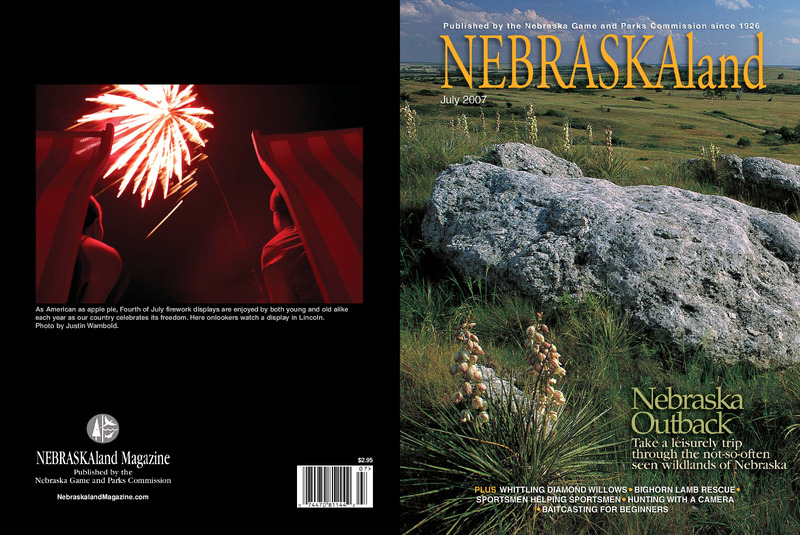
As American as apple pie, Fourth of July firework displays are enjoyed by both young and old alike
each year as our country celebrates its freedom. Here onlookers watch a display in Lincoln.
Photo by Justin Wambold.
NEBRASKAland Magazine
$2.95
0 7>
Published by the
Nebraska Game and Parks Commission
NebraskalandMagazine.com
0
74470 81144
2
Volume 85, Number 6, July 2007
10 Nebraska Outback
An evening drive down a country road or a walk through
woodland or grassland watching the subtle changes of the
seasons is one of the simple joys of life in Nebraska.
BY JON FARRAR
20 Rocky Rescue
Volunteer firefighters from Gering work with Nebraska Game
and Parks Commission employees to rescue a wayward
bighorn lamb.
BY BOB GRIER
24 SANDS – Nature for Everyone
Sportsmen Assisting Nebraska’s Disabled Sportsmen teams
volunteers with disabled participants seeking time afield.
BY JEFF KURRUS
32 Photographing Nebraska Outdoors
This month we discuss camera stablilization techniques, how
to “hunt” with a camera and how to use a histogram to help
you properly expose digital images.
BY JUSTIN WAMBOLD, ERIC FOWLER AND DOUG CARROLL
32
●
38 Diamonds in the Rough
Whittling diamond willow canes was once a common craft in
rural Nebraska, transforming rough sticks into works of art.
BY JON FARRAR
24
●
8 Outdoor Business
Flow-through chute at Schilling WMA is improving habitat.
46 Outdoor Update
Rock hunters can have great fun on U.S. Forest Service land.
47 Wilderness Workshop
20
●
Baitcasting 101 – how to successfully use an oft-feared reel.
49 Parks & Places
Nemaha NRD lake an out-of-the-way hotspot for anglers.
Comment . . . . . . . . . . . . . . . . . . . . . . . . . . . . . . . . . 4
Outdoor News . . . . . . . . . . . . . . . . . . . . . . . . . . . . . 6
Classifieds . . . . . . . . . . . . . . . . . . . . . . . . . . . . . . . 48
Portraits from the Past . . . . . . . . . . . . . . . . . . . . . 50
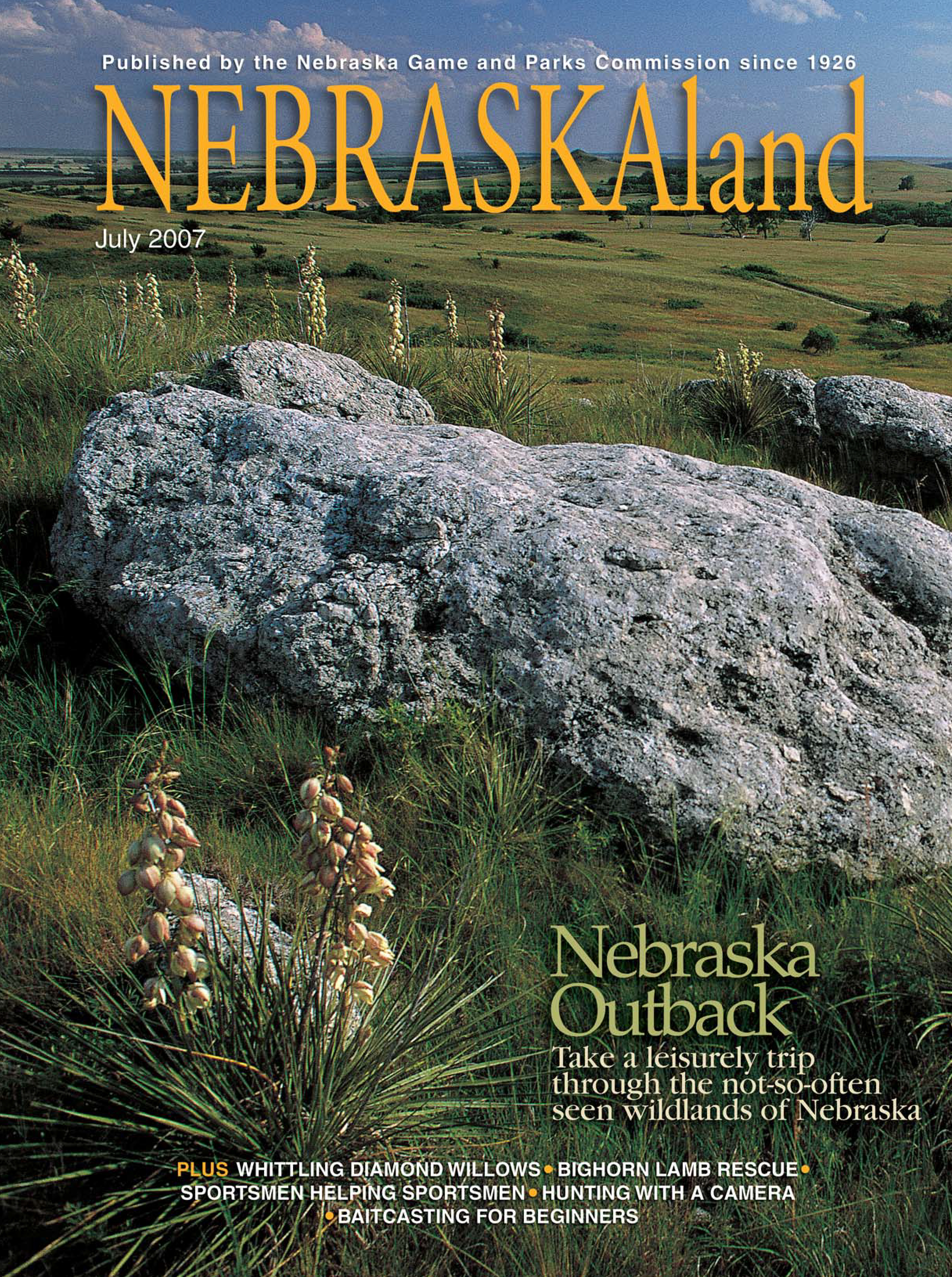
Cover: Scenes like these glacial boulders surrounded by flowering soapweed are some of the
simple joys of living in Nebraska. See story beginning on page 10. Photo by Jon Farrar.
Opposite: Randy Deck of Doniphan portrays a blacksmith hard at work during a living history
day at Fort Kearny State Historical Park. Photo by Eric Fowler.
38
●
NEBRASKAland ● July 2007
3
Comment
Comment
Published by the
Nebraska Game and
Parks Commission
Director: Rex Amack
Assistant Directors:
Roger Kuhn, Kirk Nelson, Sam Sidner
Information & Education Administrator:
Doug Bauch
Commissioners
Chairman:
Gary Parker, Columbus
Vice Chairman:
Bill Zutavern, Dunning
2nd Vice Chairman:
George E. Hall, Bridgeport
James Ziebarth, Wilcox
Jerrod Burke, Curtis
Dr. Mark Pinkerton, Wilber
James Stuart, Jr., Lincoln
Ron Stave, Waterloo
Magazine Staff
Editor: Doug Carroll
Associate Editor: Jeff Kurrus
Art Director: Tim Reigert
Senior Editors: Jon Farrar, Ken Bouc
Regional Editors:
Eric Fowler, Bob Grier, Rocky Hoffmann
Contributing Editor: Michael Forsberg
Circulation: Donna Robinson
Photo Librarian: Sarah Johnson
NEBRASKAland
ISSN: 0028-1964
VOL. 85 / NO. 6
JULY 2007
Published monthly, except for Jan./Feb. and Aug./Sept.
issues, by the Nebraska Game and Parks Commission, 2200
N. 33rd St., Lincoln, NE. Copyright 2007, all rights reserved.
Please address comments or questions to this address.
Periodicals postage paid at Lincoln, Nebraska, and other
locations. POSTMASTER: Send all address changes to
NEBRASKAland, P.O. Box 30370, Lincoln, NE 68503-0370.
NEBRASKAland is available on audio cassette from the
Nebraska Library Commission Talking Book and Braille
Service, Suite 120, 1200 N St., Lincoln, NE 68508. (800)
742-7691.
Rates: $18 for one year; $33 for two years; $44 for
three years. Nebraska residents must add
appropriate sales tax.
To subscribe call 1-800-NEBLAND (632-5263),
or go online to: NebraskalandMagazine.com.
For address changes and questions about your
subscription, e-mail donna.robinson@ngpc.ne.gov.
4 NEBRASKAland ● July 2007
Six Air Force personnel stationed in southwest Asia are pictured showing where
their hearts are. From left to right are: Capt. Johanna Ollerich, Sioux Falls, S.D.;
Capt. Nathan Frederickson, Lincoln; Lt. Col. R. Bruce Mundie, Papillion; Capt. Jason
Howell, Lincoln, Capt. Chris Shannon, Lincoln; and Capt. Steve Ohlmeyer, Papillion.
Memories of Home
While preparing to deploy to
southwest Asia, I bought a copy of
NEBRASKAland Magazine and put
it in my deployment bag. When I
pulled it out a few weeks later to
read, the magazine drew a lot of
attention. The discussion quickly
turned to other Nebraskans who were
deployed to the same location. Come
to find out there were quite a few.
Attached is a picture of our small
group of fellow Nebraskans serving
in the United States Air Force in
support of Operation ENDURING
FREEDOM. We are pictured in
front of an RC-135 deployed from
the Fighting 55th Wing at Offutt Air
Force Base Nebraska.
Love your magazine and home
back in Nebraska. All the best.
R. Bruce Mundie,
Lt Col, USAF
Papillion, Nebraska
I am writing on behalf of myself
and many fellow soldiers currently
serving in Iraq to thank you for the
great work you do.
There is not a month that goes by
that we don’t anxiously await the
arrival of care packages that we
know will contain the newest
NEBRASKAland. With a good portion
of Nebraska soldiers currently
deployed, I see many of them passing
new and old issues of the magazine
around daily, each enjoying its photos
and articles for different reasons.
Most find that it simply reminds
them of home and simpler days.
In our travels I have also shared
my joy of Nebraska by sharing
copies of NEBRASKAland with
fellow soldiers from other states who
share our love of the outdoors. There
is not a one who hasn’t commented
on the outstanding photos and
articles, wishing their state provided
such a magazine.
Again, thanks for the outstanding
work you do,
Capt. Bradley Wangler
1-167th RSTA (CAV)
LSA-Anaconda Iraq
Well Done
I am a seasoned citizen and
moderately longtime subscriber
(probably 20-plus years, but I am
sure that you have many subscribers
in the 40-plus year range).
Before the end of my seasons, I
would like to congratulate and thank
everyone associated (past and
present) with NEBRASKAland. I
have subscribed to many magazines
over the seasons, including the Sierra
Club magazine, but NEBRASKAland
has always been and continues to be
my favorite. The photos and writing
are superb, even better than what is
in the Sierra magazine. What I
especially like about NEBRASKAland
is that it is all substance, not page
after page of commercial advertising.
Although I have meant to write this
letter for years, the kick in the pants
was the Jan/Feb issue with the
beautiful photos of sandhill cranes
and the article "A Cause for
Celebration" about them nesting in
the Panhandle.
I keep the October 2005 issue by
my desk so that when I need a
moment away from work, I can gaze
upon the fall prairie grasses in Grant
County or any of the other marvelous
Forsberg photos from "Sandhills
Autumn on the Rise."
Of course, The Way Home is on
my coffee table, the Lewis and Clark
special is on my breakfast table for
ready reference to the journey; and
many other past issues are in my
filing cabinet for wintertime review
and refreshment.
In other words, every issue is
special and extremely well done.
Thank you again, and please thank
everyone associated with the
magazine for your wonderful work.
Clayton Brant
Lincoln, Nebraska
Send your comments to:
Doug Carroll, Editor
NEBRASKAland Magazine
P.O. Box 30370
Lincoln, NE 68503
or e-mail doug.carroll@ngpc.ne.gov.
Please include your postal address
and telephone number.
Letters may be condensed and edited
for clarity. Photographs are
welcome and will be returned.
Story and photo submissions can be
sent to the same address. Include a
self-addressed stamped envelope for
mailed submissions. The publisher
assumes no responsibility for
unsolicited material.
Under federal and/or state law, discrimination is prohibited on the
basis of race, color, religion, age, gender, marital status, national
origin, disability or political affiliation. If you think you have been
discriminated against in any program, activity or facility by the
Nebraska Game and Parks Commission or want more information,
contact the Commission in Lincoln, NE, at (402) 471-0641 or the
Equal Opportunity Commission, Lincoln, NE, (402) 471-2024,
TTY/TDD (402) 471-4693).
Headquarters
2200 N. 33rd Street
Lincoln, NE 68503
Phone (402) 471-0641
District Office I
East Hwy. 2, Box 725
Alliance, NE 69301
Phone (308) 763-2940
District Office II
524 Panzer St., Box 508
Bassett, NE 68714
Phone (402) 684-2921
District Office III
2201 N. 13th St.
Norfolk, NE 68701
Phone (402) 370-3374
District Office IV
301 E. State Farm Rd.
North Platte, NE 69101
Phone (308) 535-8025
District Office VI
1617 First Ave.
Kearney, NE 68847
Phone (308) 865-5310
Omaha Office
1212 Bob Gibson Blvd.
Omaha, NE 68108
Phone (402) 595-2144
Ak-Sar-Ben Aquarium
21502 W. Highway 31
Gretna, NE 68028
Phone (402) 332-3901
World Wide Web site: OutdoorNebraska.org
E-mail: ngpc@ngpc.state.ne.us
Administration
Ted Blume (Adm.)
Craig Stover (Asst.)
Wes Loos (Asst.)
Rod Loos (Asst.)
Murray Johnson
Lincoln
471-5531
Lincoln
471-5532
Lincoln
471-5591
Ogallala (308) 284-8056
Lincoln
471-5003
Panhandle
Officer
City
Phone (308)
Jim Zimmerman (Sup.) Gering
436-7561
Walt Meyer
Chadron
432-4398
Scott Brandt
Gering
436-3418
Heath Packett
Gordon
282-2553
Dennis Thompson
Ogallala
284-6450
Dan Zuehlke
Ogallala
284-4815
Doug Pollard
Oshkosh
772-9950
Frank Miller
Valentine (402) 376-1183
Dan Kling
Whitney
432-8367
Southwest
Officer
City
Phone (308)
Roger Thompson (Sup.) N. Platte
532-9175
Ray Dierking
Brkn. Bow
872-3078
George Sund
Cambridge
697-4629
Michael Thome
Cozad
784-4362
Matt Andrews
Elwood
785-3025
Dirk Greene
Imperial
882-5328
Virgil Gosch
McCook
345-2185
Dudley Sorensen
N. Platte
532-0747
Rich Routh
Rep. City
799-2085
South-central
Officer
Jerry Pecha (Sup.)
Jeff Jones
Randy Pomplun
City
Phone (308)
Kearney
865-5327
Clay Center(402)762-3124
Fullerton
536-2987
Terry Brentzel
Darin Gress
Dale Johnson
Mark Reeves
Robert Finke
Richard Seward
Grand Is.
384-8296
Hebron (402) 768-2287
Kearney
237-1079
Loup City
745-0662
Milford (402) 761-3537
Ord
728-3115
Northeast
Officer
Tom Zimmer (Sup.)
Robert Kelly
Dale Davis
Ross Oestmann
Steve Oberg
Daniel Roberts
Jon Reeves
Marion Shafer
Pat George
Eric Wiebe
Tim Williams
Cory Krause
City
Phone (402)
Norfolk
371-6625
Albion
395-2538
Bassett
273-1700
Bloomfield
373-4412
Columbus
564-5937
Fremont
721-7852
Kennard
427-7378
Norfolk
371-2031
O’Neill
336-1588
Ponca
755-2566
Neligh
887-1335
West Point
372-6979
Southeast
Officer
Duane Arp (Sup.)
Sean McKeehan
William Krause
Jeremy TenKley
Mike Luben
Douglas Kramer
Dina Barta
Stacey Lewton
Levi Krause
Russell Mort
Dan Evasco
Jeff Clauson
City
Gretna
Ashland
Auburn
Beatrice
Colon
Lincoln
Lincoln
Lincoln
Louisville
Nebr. City
Papillion
Waterloo
Phone (402)
332-2965
944-4174
274-3789
228-1437
443-4278
466-9001
483-2358
476-0436
234-2212
873-5684
592-6733
359-5301
Nebraska Wildlife Crimestoppers 1-800-742-7627
NEBRASKAland ● July 2007
5
Outdoor News
Outdoor News
Tune In To
Turpin Time
Veteran outdoorsman Dick
Turpin offers outdoor tips in
Turpin Time, produced by the
Nebraska Game and Parks
Commission.
Each 60-second spot
features Dick's trademark
humor, and includes advice
on camping, hunting, fishing,
cooking, wildlife viewing, or
safety.
KOLN-KGIN (LincolnGrand Island)
Thursdays: 6:50 AM
Thursdays: 6:00 PM Sports
KNOP (North Platte)
Thursdays: 11:30 AM News
Fridays 6:55 AM
KDUH (Scottsbluff)
Tuesdays: Noon, 5:30 PM
and 10 PM News
KMEG (Dakota Dunes SD
– Sioux City market)
Wednesdays: 6 PM News
6 NEBRASKAland ● July 2007
impoundments and 1,306 were
released.
Although anglers can catch
master angler-sized fish each month
in Nebraska, in 2006 March was the
best month for flathead catfish (42);
May for walleye (38), crappie (30),
northern pike (14), and carp (6);
June for largemouth bass (87),
channel catfish (80), and bluegill (34);
July for striped bass hybrid (175)
and smallmouth bass (7) and August
for white bass (11) and drum (6).
For information on Master Angler
rules and other fishing regulations,
pick up a copy of the 2007 Nebraska
Fishing Guide or go online to
OutdoorNebraska.com and click on
Fishing.
Brett Cooper’s acrylic painting of a pair of trumpeter swans was chosen Best of
Show at this year’s Nebraska Federal Junior Duck Stamp Contest.
Nebraska Federal Junior
Duck Stamp Winner
Brett Cooper of Harrisburg won
the Nebraska Federal Junior Duck
Stamp Contest for the fifth time
when his acrylic painting of a pair of
trumpeter swans was chosen Best of
Show.
An 18-year-old student at Banner
County High School this past year,
Cooper’s artwork was selected from
more than 900 entries received from
across the state. Cooper’s painting
will be used for the 2008 Nebraska
Waterfowl Stamp and was entered in
the National Junior Duck Stamp
Competition held at the National
Zoo in Washington, DC.
The winner entry in the national
competition will be used for the
2007-2008 Junior Duck Stamp.
Proceeds from the sale of Junior
Duck Stamps, which cost $5,
support conservation education.
Last year Cooper’s painting of a
canvasback duck pair placed second
in the national contest.
Judges for this year’s competition
were Connie McKinney, a
Scottsbluff artist and educator;
NEBRASKAland writer/photographer
Bob Grier; Neal Anderson, an awardwinning wildlife artist from Lincoln;
Hod Kosman, a conservationist from
Scottsbluff; and Jim Holland, editor
of the Scottsbluff Star Herald.
Information for next year’s contest
will be posted on the U.S. Fish and
Wildlife Service’s internet homepage
at http://duckstamps.fws.gov.
2006 Master Angler Results
In 2006 a total of 1,852 Master
Angler (MA) fish were caught in
Nebraska, with largemouth bass (435),
striped bass hybrid (328) and channel
catfish (309) leading the way.
Some of the top lakes across the
state by region included Box Butte
Reservoir with 18 MA awards,
Merrit with 55, Fremont Lakes with
10, Red Willow with 165, Branched
Oak with 149 and Harlan County
Lake with 58.
Looking at individual species
and where they were caught,
82 MA flathead catfish were caught
at Branched Oak, 44 MA walleyes
at Lake McConaughy, 39 MA
channel catfish at Merritt ,
9 MA largemouth bass at Zorinsky
Lake in Omaha, 7 MA northern pike
at Box Butte and 3 MA bluegill
came from Smith Lake.
Of the 1,852 MA fish caught in
2006, 396 were caught from private
Advanced Muskellunge
Stocked in Nebraska Lakes
Nebraska Game and Parks
Commission personnel from the
North Platte Fish Hatchery recently
stocked advanced-sized muskellunge
in six Nebraska Lakes as part of the
agency’s trophy fishery program.
These included 2,000 muskies that
measured 12-14 inches long in
Enders Reservoir, Fremont Lakes
Nos. 7 and 8, Wagon Train Lake,
Calamus Reservoir and Zorinsky
Lake. Anglers should note that there
is a 40-inch minimum statewide for
muskellunge.
New Online Feature
The Nebraska Game and Parks
Commission’s Outdoor Calendar is
now available and can be accessed at
OutdoorNebraska.com.
The calendar features upcoming
outdoor activities including state park
events, living history demonstrations,
buffalo cookouts, entertainment,
hunting and fishing. The calendar
also features outdoor education
programs including boater education, hunter education and naturalist
programs. It is the perfect way to
plan a Nebraska outdoor vacation
this summer.
Corners for Wildlife
Program Receives $300,000
Corners for Wildlife, a Pheasants
Forever (PF) program in Nebraska,
has received a $300,000 grant from
the Nebraska Environmental Trust to
help establish wildlife habitat on
center pivot irrigation corners.
The Trust is a state program
dedicated to the preservation of
Nebraska’s natural resources.
Pheasants Forever, the Nebraska
Environmental Trust, the Nebraska
Game and Parks Commission and
local Natural Resources Districts
help fund Corners for Wildlife,
which gives landowners the option
of enrolling in a program to help
establish wildlife habitat on corners
of center pivot-irrigated fields.
Center pivot irrigation systems
leave areas of irrigated fields where
the pivot cannot reach. Through the
Corners for Wildlife program, these
marginal corner areas are planted
with prairie grasses, shrubs and trees,
which provides critical wildlife
habitat. Willing landowners enter
into five-year contracts and receive
annual rental payments up to a
maximum of $75 per acre and costshare assistance for planting and
maintenance. Once replanted with
native plants and trees, these corner
areas provide food and cover for
pheasants, quail, grassland
songbirds and other wildlife. They
also reduce soil erosion and protect
water supplies from agricultural
runoff.
“Corners for Wildlife is the only
program like it in the nation,” said
Pete Berthelsen, Senior Field
Coordinator for PF. “The fact is many
landowners have marginal areas or
pockets that aren’t as agriculturally
productive, such as pivot corners that
won’t produce without supplemental
water. The average pivot corner is
seven acres, and this program gives
us the opportunity to do some very
valuable wildlife habitat work in
otherwise intensely farmed areas.”
Last year, Trust funding allowed
for the enrollment of 185 corners in
2006, the most projects ever enrolled
in a single year. Since the Corners
for Wildlife program was introduced
in 1994, over 6,698 acres of habitat
have been planted on 1,183 projects
by local PF chapters and their
partners.
Purchase Deer Permits Now
Resident and nonresident deer
hunters may now purchase any
remaining firearm, youth or season
choice permits for Nebraska’s 2007
deer hunting seasons.
There is an unlimited number of
permits available for the archery
deer season that runs
Sept. 15 - Nov. 9 and Nov. 19 Dec. 31, as well as the muzzleloader
season that will run Dec. 1-31.
Hunters may obtain no more than
two permits that allow the taking of
a buck, but there is no limit to the
number of antlerless-only
permits a hunter may have.
Permits are available online at the
Nebraska Game and Parks
Commission’s web site at
OutdoorNebraska.com and over the
counter at Commission offices in
Alliance, Bassett, Kearney, Norfolk,
North Platte, Omaha, Lincoln and at
the Ak-Sar-Ben Aquarium.
Completed application forms will
also be accepted by mail at the
Commission’s Lincoln office at 2200
N. 33rd Street, Lincoln, 68503. ■
NEBRASKAland ● July 2007
7
Outdoor Business
Family Fun!
Restoration Project Paying Immediate Dividends
A Missouri River success story for wildlife and anglers.
By Eric Fowler
he construction of a flowthrough chute and backwater at
Randall W. Schilling Wildlife
Management Area has given
the 1,789-acre area near
Plattsmouth a completely new look
and re-created a diversity of fish and
wildlife habitat not seen there for
decades.
The 12,000-foot-long chute was
completed in 2005 as part of the U.S.
Army Corps of Engineers Missouri
River Mitigation Program, which is
restoring some of the 500,000 acres of
T
feet, averaging 150 feet in width. The
depth varies throughout its length and
width and rises and falls with river
levels, but should range from five to 15
feet during the summer under normal
water levels. When river levels are
low, the backwater will be disconnected
from the chute, but still deep enough
that fish can survive the winter.
The Metropolitan Utilities District
in Omaha paid for the backwater to
offset the effects its new well field,
which will draw 100 million gallons
per day from the groundwater along
PHOTO BY ERIC FOWLER
A recently completed flow-through chute at Schilling Wildlife Management Area near
Plattsmouth has greatly increased fish and wildlife diversity in the area.
fish and wildlife habitat that was lost
when the river was channelized. The
chute begins just below the mouth of
the Platte River and empties back into
the Missouri just above the Plattsmouth
Boat Club. In between, it branches off
and passes through Schilling’s Goose
Lake, built in the early 1950s to provide
a roosting area for migrating waterfowl.
The backwater, completed last fall,
connects to the chute and branches off
to the south for approximately 9,300
8 NEBRASKAland ● July 2007
the Platte River west of Omaha, is
expected to have on river flows and
the endangered pallid sturgeon. In
May, the Corps offered to help expand
the backwater through its mitigation
program, but those plans were not
finalized at press time.
Fish quickly found the chute and
backwater to their liking. Anglers
reported catching pallid sturgeon in
the portion of the chute passing
through Goose Lake in May 2006, and
Nebraska Game and Parks
Commission biologists captured pallids
in their nets on more than one occasion
in 2006 while sampling the fish
community. Biologists have also
found shovelnose sturgeon, channel
and flathead catfish, sauger, smallmouth
bass, carp, bigmouth and smallmouth
buffalo, blue sucker, goldeye and
gizzard shad in the chute. This spring,
they found crappies, catfish and
bluegills, as well as some of the
previously mentioned species, in the
backwater. Largemouth bass, sauger
and catfish are expected to
find their way into the
backwater as well.
Heavy rains in May sent a
flush of water through and
across the area, which had
been dry because of
drought. As a result, the
chute is a bit wider, a
process that will continue
and eventually lead to the
development of sandbars and
other important components
of riverine habitat.
Construction of the chute
created a 500-acre island
and made 21/2-miles of the
area’s 33/4-miles of Missouri
River frontage inaccessible
to bank anglers who had
enjoyed fishing behind wing
dikes. The Commission and
Corps are currently working
on plans for a bridge that
will span the chute, but whether it will
be large enough for vehicles and when
it will be built is not known. The area
also has about ¾-mile of Platte River
frontage.
Originally named the Plattsmouth
Waterfowl Management Area, the area
was renamed in 1980 for Randall
Schilling, a wildlife biologist and
manager of the area who was one of
three biologists killed in a plane crash
while on a deer survey. The area got
its start when the Commission
purchased 1,167 acres from the
federal government in 1947 and
began developing it as a waterfowl
refuge with Goose Lake as its
centerpiece. A flock of captive
Canada geese was held in a 15-acre
pen on the lake to attract migrants,
and those birds also hatched
goslings that contributed to the
expansion and recovery of geese in
Nebraska. Eventually, as many as
100,000 ducks and geese a day
were using Schilling during the fall
migration.
In 1967, portions of the area were
opened to controlled waterfowl
hunting. Hunters lucky enough to
have their name drawn could reserve
one of several blinds scattered
throughout the crop fields on the
area and had good luck, especially
on snow geese. Shifts in the snow
goose migration route and the
resulting drop in hunter success had
all but ended that program by the
late-1990s.
The Commission purchased an
additional 478 acres on the south end
of the area in 1997, and in 2005 lifted
restrictions that limited access to the
original acreage, making the area
open to the public year-round for
fishing, wildlife viewing and most
hunting, including archery deer,
pheasant and waterfowl. Parts of the
area are reserved for a special youth
dove hunt September 1-4 each year.
Some of the cropland on the area,
including the island and the area
around the backwater, has been
replanted with a native grass and
wildflower mix that includes Canada
and Virginia wild rye, little bluestem,
Indian grass, Illinois bundleflower,
black-eyed Susan and Illinois
bundleflower. ■
For more information on Randall
W. Schilling WMA, go to
www.OutdoorNebraska.org.
Fishing’s Great at Nebraska’s
Parks and Recreation Areas
Few activities combine family
fun and togetherness as well as
camping and fishing. Whether
your family includes experienced
anglers or beginning campers,
Nebraska’s state parks and
recreation areas offer
something for everyone.
Visit our web site today for
information about fishing and camping
opportunities across the state. You can even
purchase state park entry and fishing
permits online. Round up your family and
head outdoors for great family fun!
www.OutdoorNebraska.org
NEBRASKA GAME AND PARKS COMMISSION
NEBRASKAland ● July 2007
9
Nebraska
Outback
Photos and text by Jon Farrar
Flowering elderberry found its piece of earth at the foot of a weathering barn north of Sargent in Custer County.
T
he price of gasoline has robbed us of some of life’s small pleasures, like Sundayevening drives across the river. It was a small town ritual, a parade of cars poking
along one after the other, especially in the heat of summer, before air conditioning in
houses was common and such an addiction. It was such a quiet joy, cruising along at 30
miles an hour down dirt and gravel roads, windows cranked down, delighting in the
summertime wind chill; checking the progress of chokecherries, field corn and springborn calves; laughing at your grandmother “making music” by humming on a comb
wrapped in waxed paper.
A western meadowlark sings from a soapweed’s dried flower stalk in the Sandhills.
10 NEBRASKAland ● July 2007
NEBRASKAland ● July 2007
11
I
t’s not just the cost of gas keeping people from
drives down country roads, it’s a change in how we
spend our hours away from work. And country
roads are not what they used to be. Still, if you know
your countryside, or don’t fear not knowing exactly
where you are or will end up, there are enough left to
use up a bit more fossil fuel. With any luck at all you
might come out at the Dairy Queen the next town
over from yours.
B
etter than driving, and certainly less costly, is
walking a bit of wildland. State parks are laced
with walking trails, but not everyone lives near a
park. Wildlife management areas are sprinkled across
the state and open to the public the year-round.
They are perfect places to park your car, extract your
walking staff from the trunk and set off on foot. Day
to day, week to week and through the seasons there is
change, some small and subtle, easily overlooked,
some so dramatic that familiar old stomping grounds
are transformed into another world.
Clouds roll across calm pond waters on Prairie Wolf Wildlife Management Area south of Genoa in Nance County.
W
ater, it is the stuff of all life: All creatures are built of it. All creatures require it.
All creatures are drawn to it. And so the pencil-thin line where water and land
come together is the richest in life. Sit in the willow patch by the edge of it and
watch. Great blue herons stalking shallows for careless frogs, muskrats harvesting
bulrush groves to build their lodges, red-winged blackbirds crying out their territorial
songs. And there are magic moments in the windlessness of predawn and dusk, when
wind-raked waters calm to smooth as glass, and only a sliver of horizon separates the
clouds gathering on sky and seemingly on water. Daytime creatures retreat and
nighttime creatures move silently through their dark world.
A killdeer pauses during its race along a sandy beach in search of insects.
12 NEBRASKAland ● July 2007
NEBRASKAland ● July 2007
13
A
n old Sandhill rancher told me
one time his “pet peeve” with
photographers was that they
photographed old dilapidated barns
and outbuildings. “Why don’t they
photograph the new, well-kept steads?”
I said nothing. I was his guest, but,
well, brick ranch houses and metal barns
are just not that visually interesting.
Even more, they are too young to have
stories to tell.
Once a farmer’s pride, a rusting International tractor is swallowed up by the land along the central Niobrara River.
W
henever I look at an old run-down, two-story farmhouse occupied only by
raccoons and skunks, with a lilac bush by the screened door leading to the mud
porch and irises still prospering by the yard gate, I try to imagine the first
occupant’s pride as their house was built, when they moved in their sparse furniture,
how they must have showed it off to neighbors and relatives at Sunday dinners.
Perhaps they were newly married. Perhaps the man promised his bride a new house,
one with running water. How many children were born in the winter-cold upstairs
bedroom, played barefoot in the dirt, grew like July corn. Where are they now? Long
moved to noisy cities to raise their own children without plump red chickens gleaning
potato bugs from the garden patch?
A sprawling cottonwood rubbed by generations of cattle north of Haigler in Dundy County.
14 NEBRASKAland ● July 2007
NEBRASKAland ● July 2007
15
S
pring comes with a blush of yellow-green
to the tops of willows, a change more
sensed than seen. Summer seems to come
by default on grasslands, marked more by
the end of spring, when the landscape’s lush
softness braces for scorching days with
relentless south winds. Autumn begins with
ripening grasses and, if rains have been
timely, a rankness of vegetation. Winter
comes not by the calendar but whenever the
notion moves it south out of Canada. Each
little spot of earth has its own progression,
its own cast of characters.
A patch of butterfly milkweed at Oak Glen Wildlife Management Area in Seward
County glows in early morning light.
Glacial boulders and flowering soapweed dot a hill northwest of Mills in Keya Paha County.
16 NEBRASKAland ● July 2007
NEBRASKAland ● July 2007
17
I
think of Marchs past, of driving down the interstate
where it parallels the central Platte River and of
swarms of sandhill cranes shifting low overhead
from fields to sandbars. I look at other drivers, their
eyes steely fixed on the road, none looking, and so
none seeing. And so it is on every back road we drive,
every deer trail we follow through riverside woodlands.
So much to see, so little seen by so few.
A carpet of Rocky Mountain bee plants covers a pasture southeast of Tryon in McPherson County.
P
reconceptions close our eyes to the world. We were taught apples
are red, so we never look closely at the subtle blending of color on
an apple’s skin. We have been programmed to believe beautiful
landscapes have snowy mountains and pounding surf. But beauty
surrounds us, even in the least likely of places, even in this flat place
we call Nebraska. It is in the wide sweep and the intricate details, in
the pasture rich with weedy wildflowers and the uncountable, tiny
blossoms that compose it.
A dew-covered Rocky Mountain bee plant glistens in the light of a new day.
18 NEBRASKAland ● July 2007
NEBRASKAland ● July 2007
19
Rocky
Rescue
Photos and text by Bob Grier
Volunteer firefighters from Gering work with
Nebraska Game and Parks Commission employees
to rescue a wayward bighorn lamb.
he odds of finding a two-weekold, 10-pound bighorn lamb
caught in a rocky crevasse
near the top of a
steep butte in the
Wildcat Hills are
extremely small. The
chances that three
volunteer firefighters
and a handful of
Nebraska Game and
Parks Commission
personnel could stage a
successful rescue of a lamb unable to
reach its mother in the area’s nearly
vertical terrain would have to be
considered nearly impossible.
“Trapped like it was and unable to
nurse, it was a sure death for the
lamb,” said Todd Nordeen, district
wildlife manager of the Commission’s
district office in Alliance, “but Gering
Volunteer Fire Department chief Jay
Templar and his crew had mountain
rescue training and Conservation
Officer Scott Brandt and our wildlife
division crew were eager to do all we
reasonably could to keep from losing
the lamb. We’re not able to rescue
every animal that we hear about, but
because of the bighorn population’s
small size and the fact that we had a
trained climbing crew available, we
felt it was well worth the effort.”
The lamb’s predicament was
discovered by Jennifer Malmberg, a
T
20 NEBRASKAland ● July 2007
Chadron State College graduate
student who is conducting research
for the Commission on the Cedar
Canyon bighorn herd
that lives in the Wildcat
Hills southwest of
Scottsbluff and Gering.
As part of her study,
every day she tracks
bighorns fitted with
radio-transmitting collars
and observes their
habitat use and
movements throughout the region.
While following the radio signals of
an adult female bighorn west of the
Cedar Canyon Wildlife Management
Area in late-May, Malmberg found
the ewe lying along the skyline at the
edge of a steep cliff face. Movement
below the sheep caught Malmberg’s
attention and as she watched, a weeksold lamb made several attempts to
climb the sheer rock walls below the
ewe, each time sliding back to the
bottom of a U-shaped notch.
Malmberg continued to observe the
ewe and lamb for about four hours
and after returning that evening for
additional observations, watched the
lamb make several more unsuccessful
escape attempts while the ewe
remained on the butte’s rim.
“While this was going on,”
Malmberg said, “a coyote moved
across the hillside below the lamb and
As rescue workers wait below with a net, Gering Volunteer Fire Department chief Jay Templar tries to rappel close enough to
capture a trapped bighorn lamb (circled in red) and reunite it with its mother. The lamb eventually jumped safely into the net.
it was obvious – even at a distance –
that the ewe became very alert and
disturbed by the predator’s presence.
There was no doubt that she was
intent on protecting her lamb.”
Malmberg never saw the ewe try to
climb down to the lamb, but the young
animal did try to get some nourishment
as she watched. “We’d received rain
on the previous day and it was obvious
the lamb was attempting to get water
from the rocks and even browse on
vegetation at the floor of the notch.”
Malmberg telephoned Nordeen that
afternoon to explain the situation and
after returning home was able to e-mail
photos showing the lamb’s location
among the steep terrain.
The odds of somehow extracting the
lamb and getting it back with the ewe
were really slim, Nordeen said, but
given the herd’s history, he felt it
was important that they try. “The
Commission and a partnership of
sportsmen’s and conservation groups
reintroduced bighorn sheep into the
Wildcat Hills in March 2001 with
22 bighorn captured near Colorado
Springs, Colorado. The bighorn
population quickly grew that spring
with the addition of 11 lambs, and
eventually reached approximately
64 bighorn by 2006. That year,
however, the herd suffered a
devastating outbreak of pasteurella
pneumonia that cut the Cedar Canyon
bighorn herd in half. The difficulty of
a rescue attempt to reunite this lamb
with its mother was daunting, but we
wanted to at least try.”
After receiving the report of the
lamb’s predicament, Nordeen contacted
Templar, whose reaction he described
as enthusiastic and determined.
“He and his personnel had received
mountain rescue and recovery training
and had previously rescued a climber
caught on the side of Scotts Bluff
National Monument,” Nordeen said.
“Jay felt the rescue attempt could be a
valuable scenario to provide additional
training for his department. During
NEBRASKAland ● July 2007
21
After the lamb was safely captured and secured in a carry bag, conservation technician Rana Tucker safely took it back to the
top of the ridge where it was reunited with its mother.
our planning that evening and the next
morning, everyone understood that the
trained firemen would do the climbing
and that our wildlife team would follow
their instructions and assist as much
as possible without placing anyone in
a risky situation.”
When the rescue crew arrived at the
scene the following morning, the lamb
was standing on a narrow foothold on
the north side of the notch, occasionally
moving to the notch’s floor where it
tried to feed and drink. While the
rescuers watched with spotting scopes
and binoculars, it also retreated several
times into a long, narrow passage that
had eroded into the back of the notch.
If a net could be thrown across the
opening while the lamb was inside,
rescuers realized, it would be possible
to control the lamb’s movements.
The ewe was nowhere to be found as
the crew hiked to the base of the butte
but reappeared above the lamb and
22 NEBRASKAland ● July 2007
watched as Brandt and three members
of the Commission’s wildlife division
spread a large net on the ground 30 to
35 feet below the lower rim of the
notch. The cliff wall angled outward
as it rose and prevented the net crew
from observing the movements of the
lamb, but the slight overhang also
provided protection from rocks
dislodged by the activity above.
When the netting crew was in place,
Nordeen, Templar, Malmberg and the
other rescue team members hiked
around the base of the butte and after
finding a gentle slope that provided
access to the rim overlooking the
lamb’s location, began their hike to
the top carrying the ropes, climbing
harnesses and safety equipment that
would be needed for a safe descent
into the notch. Nordeen also carried a
throw net, blindfold, hobbles and a
nylon carry bag that could be used to
safely catch and control the lamb.
They were met at the top by the ewe.
“The ewe was obviously concerned
and ready to defend her lamb,” said
Malmberg. “The ewe continued to
move back and forth fairly close, and
at one point we felt it necessary to
walk toward the ewe to move it back
from the climbers as they rigged the
ropes and rappelling equipment for
the descent. The ewe couldn’t see
everything that was going on and she
continued to move forward and closer –
she definitely wasn’t going to abandon
her lamb.”
A large pine on the butte’s eastern
slope served as a tie-off for the ropes
and as Templar began his descent, the
lamb began to sprint across the notch
opening, climbing the steep rocky
walls on both sides. The bighorn
lamb’s climbing ability was impressive
but not enough to carry it out of the
notch – several times it was able to
climb within five to ten feet of the top
before slipping back.
When Templar reached the notch’s
floor the lamb sprinted by within a
few feet of him several times and
once or twice nearly bounced off of
his helmet as it frantically moved
from one side of the notch to the
other. However, it never entered the
narrow passageway that might have
provided an opportunity to use the net
to restrict its movements, and throwing
the net at the small, high-speed lamb
as it crossed back and forth proved
equally futile.
The safety net now stretched below
the cliff appeared to offer the best
remaining hope for the lamb’s rescue
and when the lamb momentarily
stopped below him, Templar lowered
himself further into the notch to see if
it would be possible to catch the lamb
before it attempted to jump. As he
moved closer to it, Templar continued
to tell the net crew the lamb’s exact
location, so they were ready when the
lamb suddenly attempted to climb
down the sheer rock face below the
notch before leaping approximately
20 to 25 feet into the waiting net.
“The lamb suddenly appeared in
mid-air above us,” said Brandt, “but
fortunately it landed almost exactly
between three of us holding the south
end of the net. If it had jumped several
feet further south it would have
missed the net because of the narrow
foothold we had on the platform at
the base of the cliff, and several feet
to the north was a large boulder that
would have certainly injured or killed
the falling lamb. It was an amazing
leap, but because of its landing spot,
the lamb never touched the ground
before we lowered it in the net.”
Brandt and the rest of the net crew
quickly covered the lamb’s eyes and
placed it into the nylon carry bag that
was lowered from above. Just as
quickly, the decision to return the
lamb to the top of the butte using a
circular route along the west and
southern edge of the butte was relayed
from the rescue crew above, so
Brandt and Rana Tucker with the
Commission’s wildlife division
carefully carried the lamb back to
Nordeen and Malmberg’s location.
Rather than re-climb the vertical cliff,
Templar rappelled to the bottom and
the remaining climbers packed the
ropes and remaining climbing gear
and began their hike to the south as
well.
Nordeen said the ewe had moved
away from the rescue crew on top of
the butte, but they were soon able to
find her again.
“Once the lamb was back on top,
we worked our way south to relocate
the ewe and found her still attempting
to observe our activity from a narrowedged point at the south end of the
butte. She remained there as we
approached to within 100 yards. We
needed to maintain line-of-sight with
the ewe and once that was possible, I
opened the bag and, holding the lamb,
let it raise its head. The lamb began to
call and the ewe immediately
responded with her calls to the lamb.
As we released the lamb, it ran to an
open area about 30 feet below the ewe
and the ewe quickly moved to the
lamb. They touched noses, smelling
each other before the lamb began to
nurse, and with the immediate
business out of the way, the two
walked slowly along the edge of the
butte and out of sight to the south.”
The sight of the ewe and lamb finally
together again was met with cheering
from the rescue party watching below.
“I was really excited about being
there when the lamb was released,”
Malmberg said later. “I’d spent several
years already both at Chadron State
College and with the Game and Parks
Commission studying bighorns and it
was great everything turned out the
way it did. I’d have to say that it was
really one of the very special days
that I’ve been able to spend with the
bighorns.”
Malmberg was able to observe the
ewe and lamb over the next few days
following the rescue and watched as
they joined several other bighorn ewes
and another lamb. Malmberg remains
concerned for any delayed response to
the stressful rescue and she noted the
ewes with their lambs moved to a
more grassy and flat plateau, where
the lambs continually circled the ewes
and the rescued lamb occasionally
darted between the ewe’s legs to
nurse.
Based on her experience observing
bighorn sheep with lambs, Malmberg
noticed that, perhaps not unexpectedly,
the rescued lamb is now sticking very
close to its mother. ■
After being reunited, the lamb made up for lost nursing time before
the pair slowly walked over the hill and out of sight.
NEBRASKAland ● July 2007
23
Photos and text by Jeff Kurrus
Sportsmen Assisting Nebraska’s Disabled
Sportsmen teams volunteers with disabled
participants seeking time afield.
’ve been told by more than one
hunter that if they could stand a
deer back up after they shot it and
watch the animal walk away, they
would do so. For many outdoor
enthusiasts, the challenge of making
the shot, or seeing the strike of a fish,
is the most gratifying part. Harvesting
the animal is just icing. Yet what
happens if a person is never able to
experience these moments in the first
place? What happens if a person who
adores their time in nature has these
moments completely taken away by
circumstance?
For people yet to experience nature
as well as those whose hunting trips
have been cut short by their disabilities,
there is a program in Nebraska dedicated
I
Mason Freel, who has cerebral palsy,
fishes from a pier at Zorinsky Lake.
24 NEBRASKAland ● July 2007
to providing support. It is known as
Sportsmen Assisting Nebraska’s
Disabled Sportsmen (SANDS), and it
seeks to provide the opportunity for all
people, regardless of their disability, to
gain access to the outdoors where their
own challenges of making a shot, or
seeing a fish strike, can be fulfilled.
History of SANDS
“‘Disabled hunter needs assistance’
was what I originally wrote on the
Nebraska Game and Parks
Commission’s (NGPC) message
board,” said SANDS co-founder Dave
Burgess. His wife was unable to push
Dave and his wheelchair through the
areas he wanted to hunt. Without help,
he was at a loss how to continue his
outdoor ventures until he received his
first response, then another. “In the
end, about a dozen people offered to
take me out,” he said. Little did he
know where his simple request would
lead. At first, Burgess admitted, the
main focus was on him.
One of the people that responded was
Mike Freel, who was interested in
helping Dave because Freel’s daughter,
Mason, has cerebral palsy. As Mike and
Dave began to talk, they spoke not only
of getting Dave reacclimated to the
outdoors, but also getting others involved.
“There had to be other people out there
who were in the same boat,” Burgess
remembers thinking. “Then I found out
there were at least 29,000 people in
Nebraska with disabilities in 2003.”
Dave continued to research ways to
construct a program where able-bodied
volunteers could match up with
disabled hunters needing assistance.
SANDS co-founder Dave Burgess and volunteer John Swinarski mark yardages before beginning their afternoon deer hunt at
Boyer Chute.
Then he found out about an organization
in Illinois called Far Cry that had a
disabled-assistance program. Realtree
and Buckmasters, two of the outdoor
field’s largest companies, also had
disabled programs. So Mike and Dave,
after compiling their findings and
constructing a plan of their own, took
their idea to Greg Wagner, who runs
the NGPC’s Omaha office and suggested
they take it to Jeff Rawlinson, who was
the Commission’s outdoor education
specialist at the time. Like Wagner,
Rawlinson favored the idea, and he
presented it to the NGPC’s board of
commissioners and it was approved in
May of 2005, only three months after
Burgess and Freel first spoke. Dave
originally suggested they call it the
Outdoor Nebraska Buddies program.
Then Rawlinson suggested the SANDS
acronym.
The main goal Burgess and Freel
wanted to accomplish was provide an
avenue for volunteers and the disabled
to contact each other. Currently there is
a link on the Commission’s web site
that does just that, which is exactly
what Burgess intended. But the
program has grown even more than
Burgess thought it would.
The first year saw more than 40
participants and 50 volunteers signed
up. Now, there are more than 78
participants and 165 mentors whose
varied interests include hunting, fishing,
camping, boating and other outdoor
activities like astronomy.
“I don’t tell people what activity they
must do,” said Burgess. “And I don’t
pick and choose who takes them. Let’s
be real — If I tell you you’re going to
go with this person over here, and you
can’t stand them, you might want to
spend the day choking him instead of
fishing with him. Instead, here’s this
guy’s name and phone number. You
contact him, arrange it, and build a
NEBRASKAland ● July 2007
25
have permission to hunt,” he told me
last fall. When asked what chance the
SANDS participant he was taking
would get a shot, he said, “We’ll get
him a deer if he can hit it.”
I was then able to go with Burgess
and Swinarski on a hunt at the Boyer
Chute National Wildlife Refuge. What
interested me most about the hunt, and
the most fascinating aspect of the
SANDS program, is the amount of
work the volunteers put in. The entire
time we were in the woods, even while
I interviewed Burgess, Swinarski was
hunting, trying to get Dave a shot. As
we talked, John was steadily scanning
the front of the blind. At the end of the
hunt, I asked John how he had so much
free time.
“I just use vacation time to make
these trips work.”
I caught up with them again the next
day. Only this time, they weren’t lining
up a crossbow. They were telling a story,
one they had already told before and
would most certainly tell again.
“I looked out in the grass field right
before sunset and saw a doe. Then I
saw two more does right behind her. I
hadn’t seen a deer all day up to this
point, and now the front doe was
walking right toward me. I looked
where Tyler had marked 30 yards for
me, where he had stuck an arrow in the
ground,” Don said.
“We can
shoot past
30 yards
but we
wanted to
keep it
under 30,”
Tyler added.
“She was just
on the other side of
the marker, then she turned sideways. I
aimed at the front shoulder, using the
sticks Tyler had made me. Then I
squeezed the trigger.”
The 14-Year Deer
SANDS member Don Rydburg (left) is congratulated by mentor Tyler Huffaker after Rydburg killed his first deer in more than a decade.
rapport between the two of you. You
will have done more than start a
hunting or fishing event. You will have
started a friendship.”
But Burgess’s work still isn’t done,
sending emails to a legion of people
and organizations in an effort to not
only find volunteers to hunt with but
also sponsors for the program. Through
these efforts the Bass Pro Shops in
Council Bluffs allowed SANDS to run
a mechanical bull at their 2006 Fall
Classic, with all proceeds going to the
SANDS program; Michael Cox,
promotions manager for Bass Pro,
donated over $1,600 at their spring
classic; free hunts have been donated
by the National Wild Turkey
Federation, Nebraska Safari Club and
Pheasant Bonanza to participants of the
program; and Whitetails Unlimited has
sponsored one of the SANDS
participants, Don Rydburg, with hunting
gear. While Burgess is pleased with the
sponsored hunts and extremely grateful
for the ability of his members to
participate in them, he still understands
the cornerstone of the program.
26 NEBRASKAland ● July 2007
“I don’t want SANDS to just be
donated hunts,” he said. “I want there
to be an outlet where mentors and
disabled people can set up their own
hunts just like everyone else. I
researched what people were doing in
other states and 90 percent, if not more,
were donated hunts. I don’t want it like
that forever.
“Nebraska is the first state to have
this program. There are other states that
have privately owned organizations that
charge you to join and hunt. Nebraska’s
is a free service. There is no fee for the
equipment I lend out, including fish
finders, ground blinds, tackle boxes and
hunting supplies. All you have to do is
buy your own tag. If you can’t do that,
I try and find funds to have that tag
bought for you.”
Volunteer Intensity
The first noticeable thing about John
Swinarski is the intensity in his eyes.
Once you meet him, you’ll see where
that intensity is directed.
“Someone needs to take him fishing,”
he said about a man with Parkinson’s
disease he had just met at a SANDS
picnic last fall at Omaha’s Zorinsky
Lake. “I don’t have a boat but I can
take him somewhere off the bank.”
Swinarski had first asked Greg
Wagner about helping people with
disabilities a few years back, but at the
time there wasn’t a program of that
type in Nebraska. “Then I got on the
Internet one day, saw the SANDS link
and started talking to Burgess. We
worked a fishing event with disabled
kids in the Millard area. I didn’t realize
there were so many kids who needed
help. We had over 100 children at
Zorinsky Lake that day in May of
2006. We also hosted a fishing
tournament at Carter Lake that matched
up disabled participants with mentors.”
Swinarski became interested in
SANDS because his mom has limited
mobility, eventually losing a leg last
year. He has places close to Omaha
where he can take people hunting, and
they are not second-rate areas. “I saw
35 deer yesterday afternoon, including
two respectable bucks, at the place I
“I want you to shoot one more off
the sticks,” Tyler Huffaker told SANDS
participant Don Rydburg after Huffaker
had made him a set of handmade
shooting sticks to use as a brace on
their hunt at Boyer Chute. The two met
after Tyler signed up to be part of the
SANDS program after meeting Dave
Burgess at a booth he was running at
the Council Bluffs Bass Pro Shops.
Tyler then started calling people who
had registered online for the program,
but was not having much luck getting a
response. ‘Maybe next year,’ he’d hear,
or ‘Not right now.’ “I basically gave up
on the program,” he said.
Then Don Rydburg called asking for
help, and Tyler jumped at the
opportunity. A few months later, Tyler
was helping Don line up a crossbow
Whitetails Unlimited had donated to
him. They also gave Don the money for
his tag, a knife and the first camouflage
that Don has ever owned.
“Don, you’re not missing up and
down, but you’ve been consistently to
the right. I think you’re pulling instead
of squeezing,” Tyler told him. After
making a couple more adjustments to
Don’s equipment, Tyler loaded another
bolt into the crossbow, one of the things
Don needs help doing, then had him
shoot again. “Dead center,” Tyler said.
“Whenever you shoot, remember to
squeeze, not pull. It’s not a shotgun,
Don.”
Loading a crossbow is one of many tasks where SANDS volunteers can aid their
disabled hunted partners.
NEBRASKAland ● July 2007
27
“It’s just a start,” Tyler said. “We
have a lot more hunting to do.”
A Blind Interview
I had the opportunity to sit in a blind
with Dave Burgess on a Boyer Chute
deer hunt last year. We talked about
SANDS, his physical conditions, and a
host of other subjects while we waited
for a deer to pass by.
“The degenerative disk disease in my
back started with me walking with a
cane, then walking with a walker, then
using a wheelchair to get around.
There’s nothing that can be done about
my back,” he told me. “The rest of the
disks in my back will slowly
deteriorate and my spine will crush
itself. The little bit of bending and
mobility I now have will lessen.
Physical therapy won’t work. I’m not
even a candidate for surgery any longer.”
When he finished telling me that, he
reached into a bag he had brought with
him. “But a doughnut always helps,” he
said, pulling out a box of Krispy
Kremes and offering me one.
I declined, explaining that doughnuts
give me heartburn. “That’s awful, must
be stress-related,” he told me, downing
a pastry. Then, “Are you good at making
This blind placement under fall foliage at Boyer Chute by SANDS volunteer Tyler Huffaker allowed Don Rydburg to kill his
first deer in 14 years.
“I heard a pop,” Tyler said, who was
hunting thirty yards away from Don in
another blind Burgess had lent them. “I
started walking toward him, got a shot
of my own at one of the other does,
missed her, then realized I had only
brought one arrow with me. The doe
just stood there watching me.” Tyler
paused, shaking his head and smiling.
“We found his arrow covered in
blood about 10 yards from where he
shot. Close to that, we also found my
arrow. It was clean as could be.”
“Then Tyler made me wait 25
minutes,” Don interrupted. “I thought
those 25 minutes were never going to
end.”
“By then it was about dark,” Tyler
28 NEBRASKAland ● July 2007
said, “so we started calling everyone
we could to come help us.”
Don’s brother and nephew met up with
the two, and a friend of Tyler’s and his
wife also joined the search. While each
person searched for blood through the
woods, Don stood at the last place they
had found any sign. “We lost blood twice
and we were hands and knees looking,”
said Tyler. “By the time we found the
deer lying dead in a creek, it was 10:40.”
“She took us for a hell of a ride,”
Don said.
“Yea, after walking into trees, bushes
and stickers, my clothes were done,”
Tyler said. “My arms, chest, and legs
were rubbed raw.”
Don, with his diamond willow cane
(see story page 38) and very limited
mobility, still managed to walk the
entire way with them. “I couldn’t let
someone else finish what I had started.”
Where they had started was in a
different spot than they had been that
morning. “We changed our blind
placement from the first morning after
picking a spot on paper before ever
seeing the place. Deer had our blind
pegged from 40 yards away. This new
spot was nice and secluded, backed off
the road a bit. We were better hid and
Don had a shooting lane both ways. In
the end, we saw seven deer at our new
spot.”
When asked about the SANDS
program, Don shook his head. “I told
myself, if I ever got a chance, I was
going for it. I got hooked up with
SANDS and the following year a friend
of mine said I could have an old
crossbow of his. But that old crossbow
is nothing like what you see here. You
had to jerk the trigger.”
“It had a 30-pound trigger,” Tyler
said. “And past 20 yards, it just wasn’t
accurate. So I talked to Burgess, and he
talked to Kevin Harrington from
Whitetails Unlimited. Next thing you
know, Don, Dave, Dave’s wife Danielle
and I are sitting on Don’s front porch
putting his new crossbow together.”
“This was the first time in 14 years
that I’ve hunted or killed a deer,” Don
said.
Lani Baker poses with guide Brian Frost after killing her three-bird limit
at Pheasant Bonanza near Tekamah last fall.
NEBRASKAland ● July 2007
29
Lani Baker prepares to shoot at a flushed rooster during her hunt at Pheasant Bonanza as guide Frosty watches.
distances out?” he asked.
“I’m okay,” I said.
He pointed at a series of objects
outside the blind, “Over there, those
three trees, about 30 yards?”
“Sounds about right,” I told him, and
he continued to point while I gave my
thoughts on the various landmarks he
pointed toward.
“I haven’t gotten a deer in six years,”
he told me a bit later. “But it’s all about
getting out for me. The thing is, I just
need a bit more help than most. People
volunteer their time and skills but some
are worried about working with a
disabled person. They don’t know what
to do — Is it okay to ask them how
they got hurt? I need help carrying
stuff, cleaning a deer, but I’m pretty
self-sufficient.”
Plus, Burgess told me he expects
volunteers to bring their own weapons.
30 NEBRASKAland ● July 2007
“There’s nothing worse than sitting
there, helping someone out, and not
being able to participate yourself. We
don’t want a babysitter, we want
someone to hunt with,” he said.
I asked Dave what it took to be a part
of the program. “What people need to
realize is I never ask someone what
their disability is. I don’t want to
accept some and not accept others. As
far as I am concerned, if you’re 75
years old and can’t get around very
well, that’s a disability. Disability is the
inability to do what you were once able
to do. If there is something you want to
do and can’t do by yourself, as far as
I’m concerned you have a disability.
And SANDS is here to help.
“A house is your home. It’s not a
prison. That window is quarter-inch
glass, but it’s just as strong as a prison
bar if you can’t get out. And what kind
of life is that? There’s no enjoyment
there, there’s no living. You’re existing.
If you have a chance to get out and
meet people, you become part of a
community.”
Dave then offered me another
doughnut. Again I declined. “We got a
rule at the house that if you’re hungry,
it’s your fault,” he said. Then he told
me, “It comes back to this: People
everywhere have needs for various
reasons. The people helping those with
needs are the real glory of SANDS. If
not for them, the whole concept is a
pipe dream, something that could have
never come to fruition.”
A Walk To Remember
“We volunteered for the Outdoor
Buddy program that used to be in
western Nebraska,” said Lani Baker, a
participant of the SANDS program.
But she’s no longer a mentor, now
she’s a disabled participant needing
assistance. “At that time, I was healthy.
I would whitewater raft for days on end
in desolate rivers. I always thought I
was going to be this strong, agile
woman. I was a workaholic, then a
light switch flipped. It wasn’t even
piecemeal. All of a sudden, it was a
major, major adjustment.”
In 1998, Lani was diagnosed with
multiple sclerosis. With it came shaking,
trembling, and muscle spasms.
Sometimes she can’t talk, can’t walk,
and her multiple arthritic joints have
led to 24 surgeries and an artificial hip.
When she told me about her history, we
were on an arranged hunt at Pheasant
Bonanza, a private game farm near
Tekamah. “I’m just starting with the
excuses early,” she said.
Due to Lani’s physical conditions,
she had not been pheasant hunting for
10 years, but had won a drawing for
the guided SANDS hunt in Tekamah.
Once there, a crowd of people
surrounded her, including her husband
Larry, Mike Freel and her guide, Brian
“Frosty” Frost. “Because of MS, I have
issues with memory. I do lots of word
association. I have a girlfriend that has
a jackass named Frosty. That’s how
I will remember you,” she told her
newfound friend.
“Thanks a lot,” Frosty replied.
Someone asked if she wanted to ride
through the fields on a golf cart during
her guided hunt, and for the most part,
she declined. “It’s a good day today,”
she said, missing birds early but having
the opportunity to kill roosters later in
the morning. With each step she took, a
throng of people walked behind, each
one hoping her next shot would find its
mark. For while Burgess said that he
didn’t want SANDS to become a
program relying on guided hunts, he
couldn’t have frowned at this. A person
smiling through the day, and crying by
the end, whose first pheasant hunt in 10
years had yielded so many good feelings.
But she also knows what hunts like
this do to her body. “I’ll sleep for a day
or two after a day like today,” she told
me. “Twice a year we kayak the
Niobrara and it’s the same thing there.
But I’m willing to experience the pain
to do what I want to do. I can’t imagine
curling up and stopping.”
A house is your home. It’s not a
prison.That window is quarter-inch
glass, but it’s just as strong as a prison
bar if you can’t get out.What kind of
life is that?
By the end of the morning, Lani’s
good fortune of winning the drawing
was over. And she was definitely spent
to the point that her husband had to
support her from falling by placing his
finger through her back belt loop as she
walked. But to everyone else, it was
just a husband walking by his wife, who
for that day was just another hunter in
the field. The way she wanted it.
Future of SANDS
as carrying a rifle, helping to reel in a
fish, or casting out. Little things are the
things we need. Personally, I need help
field dressing game. We all need help
from time to time.”
When asked what Dave’s ultimate
goal was, he responded without
hesitation. “Right now, SANDS means
Sportsmen Assisting Nebraska’s
Disabled Sportsmen. One day I’d like it
to stand for Sportsmen Assisting the
Nation’s Disabled Sportsmen.”
That’s a lofty goal, but SANDS
definitely has the right person for
the job. ■
While Dave Burgess’s to-do list is
long, he understands how much longer
he would like it to be. “It’s
dropping a pebble in a pond,” he
said. “I’ve been contacting the
DNR resources from surrounding
states, even Washington D.C.,
trying to get support from
everyone in the nation. I would
like to see this program as a
nationwide service offered
through each state. I’ve also been
working up satisfaction surveys
to see how we could make our
own program better. I just
haven’t totally figured it out yet.”
Burgess said that much of the
work left to do with the program
has to do with the volunteers
themselves. He knows there are a
lot more people out there
wanting to help than those who
do. “If a person is thinking, ‘I
don’t know how to deal with a
person with a disability,’ I tell
them to not be afraid. People
with disabilities are just like
able-bodied individuals. They’re
just going to do things a little
different. That’s the only
difference. Make the phone calls,
get to know each other, start to
Dave’s Burgess’s mission with SANDS is to
build those relationships. The
ensure that all people have the opportunity to
help needed could be as simple
participate in outdoor-related activities.
NEBRASKAland ● July 2007
31
This month we discuss camera stablilization
techniques, how to “hunt” with a camera
and how to use a histogram to help you
properly expose digital images.
Steady that Camera
Justin Wambold – Nature Photographer
Capturing compelling images with great color often means
shooting in low-light conditions using long exposures. As
exposure time increases, however, so does the difficulty of
capturing sharp images. Any unintentional movement of the
camera during an exposure can result in a loss of crucial
sharpness and effectively ruin a photograph. Here are a few
tips to keep in mind to ensure your images remain sharp, no
matter how long the exposure.
Tip number one: Use a tripod
In today’s world of light, compact cameras, it’s tempting
to cast aside a bulky, sometimes heavy tripod in order to
JUSTIN WAMBOLD
•
move faster with less
weight and fewer
hassles. However,
the benefits of
traveling light don’t
matter if you can’t
make a good
photograph when
you want to. Tripods
keep the camera
perfectly still for the
duration of the
exposure – whether
it’s one second, or
one minute – helping
to ensure a sharp
image. In addition,
great advancements
have been made to
reduce the size and
weight of tripods,
making them much
more manageable in
the field.
When selecting a
tripod, there are many factors to consider – size, weight,
height and load capacity, for instance. In the end, however,
the best tripod for you is the one that you will use on a
regular basis – it doesn’t matter how nice the tripod is if it
is in your closet when you need it most.
Tripods are not only a good idea when using long exposures;
they are also a good idea when you are using long, telephoto
lenses. For wildlife photography, long lenses – often more
than 200mm – can be the key to getting good images.
However, as lenses get longer the ability to handhold them
gets tougher. Not only are these lenses heavier, but with their
JUSTIN WAMBOLD
Stabilizing the camera is a must for nighttime exposures. This
image of a camper at Rock Creek Station State Historical Park in
southeastern Nebraska was exposed for 30 seconds. During
that time the sky was lit by stars and an out-of-frame moon, and
the camper was lit by its dim lights and a nearby campfire.
32 NEBRASKAland ● July 2007
This 1.6-second exposure of Snake River Falls in north-central Nebraska would not have been possible without the use of a tripod.
During the exposure, the movement of the water over the falls and down the river creates a smooth, blurred effect while the secured
camera is able to keep stationary objects, such as the rocks in the foreground, in focus.
magnification the slightest movement can create a soft
image. Good tripods help offset this movement.
As a rule I do not handhold the camera for any image
taken with an exposure longer than a fraction of a second
equaling the focal length of the lens. For example, if the
focal length is 200mm, I do not handhold the camera for
longer than 1/200th of a second. This also holds true for
wide-angle lenses – if the focal length is 35mm, I don’t
handhold longer than 1/35th of a second.
Tip number two: Use a remote switch or built-in timer.
Never underestimate the amount of movement you impart
•
to the camera as you press the shutter button, even when
using a tripod. The shake caused by simply placing or
removing your hand from the camera can ruin an otherwise
great photo.
Many single lens reflex cameras allow the use of remote
switches that enable you to trigger the shutter without touching
the body, thus eliminating the possibility of accidentally
moving the camera during the exposure. If you can’t use or
don’t have a remote switch, your camera probably has a
built-in timer that can be equally effective if you are not
shooting a time-sensitive subject. The same built-in timers
NEBRASKAland ● July 2007
33
ERIC FOWLER
ERIC FOWLER
Blinds allow photographers to get shots of otherwise unapproachable wildlife subjects.
that allow photographers to place themselves in family photos
can also be used to ensure sharp images in the field. By
delaying the operation of the shutter, you are able to remove
your hands and allow the camera to stop moving before the
image is exposed. With either method, you can compose and
focus the image and then be completely hands free once the
exposure begins.
Tip number three: Be resourceful
If you don’t have a tripod handy when taking a picture,
use whatever you can to steady your camera. I often use my
camera bag atop a rock to hold my camera still. When shooting
from a car window, or at ground level, I use sandbags made
from plastic bags, sand and duct tape.
Rocks, trees, fallen logs, fences, road signs, bridges or the
ground also make great impromptu tripods and can save an
image.
If all else fails, push the camera tight against your face,
•
34 NEBRASKAland ● July 2007
brace your elbows against your chest, hold your breath, press
the shutter and pray you can hold still long enough to make
the exposure.
Hunting with a Camera
Eric Fowler – NEBRASKAland Magazine
When I head into the field in the fall, the only way my
wife can really tell if I’m heading out to work or to play is
whether I’m carrying my camera or a firearm. In a way,
that’s how little of a difference there is between nature
photography and hunting.
Of course, there are many different types of hunting. Some
are active, others passive. In either case, a hunter must know
something about his or her quarry, particularly its habits and
habitats. Some of this can be learned from books. The rest
must be learned from observation.
Great photos can be obtained by using hunting techniques and gear, such as stalking while wearing camouflage clothing.
A wise deer hunter increases his chances for success by
spending time before the hunt searching his quarry’s home
range for sign and watching its movements from a distance.
Wildlife photographers can use similar strategies to improve
their success, whether they’re photographing deer or birds.
The senses of birds and mammals are very acute, especially
their sight. Most are programmed to avoid the human form,
making the use of camouflage and blinds critical to both
hunting success and to capturing a photograph of most
species in their natural surroundings. Hunters and
photographers decked out in camouflage clothing can
sometimes be successful by concealing themselves in natural
vegetation, but depending on your quarry, a blind may be
needed to break up your outline and conceal your movements.
Blinds can be as simple or as complex as you want them
to be, ranging from of pile of sticks or sheet of camouflage
fabric to a commercially made pop-up blind, boat blind or
treestand. Or it could simply be your vehicle, something
animals are used to seeing.
To further increase the odds of your subject coming within
camera range, you might even try using decoys or calls. In
the case of the latter, photographers have a huge advantage
over most hunters in that they can use electronic calls to
attract their quarry. Scents that either cover your human
scent or attract animals can also be deployed.
While working from a photo blind can be rewarding, I
must admit that I have trouble sitting still and would rather
actively pursue my quarry. Maybe it’s my daily newspaper
background, but I’d rather stalk a bedded mule deer than sit
in a tree or ground blind waiting for one to walk by. Success
depends on my ability to not be seen, smelled or heard.
Stalking dictates you use terrain or vegetation to conceal
your approach, move slowly and approach from downwind.
Still-hunting is another strategy I often use when I’m in
NEBRASKAland ● July 2007
35
The inset histogram of this photo indicates that the highlight portions of the scene are properly recorded without being overexposed.
the field with my camera. Walk quietly, constantly scan the
woods ahead of you and have your camera ready, just as a
pheasant hunter would his shotgun, and you sometimes are
lucky enough to stumble on a good photo.
Hunting tactics can be applied to landscape photography
as easily as they can wildlife photography. Scouting might
reveal a pristine scene, but just as a deer hunter may spend
days in the perfect spot, many visits to a particular location
may be required before the light or weather come together to
provide the perfect photo.
A final strategy to consider that often leads to great photos
is frowned upon in most hunting circles: road hunting. Road
hunting with a gun is at best unethical, at worst unlawful and
is the largest source of complaints involving “hunters,” but
road hunting for photographs is perfectly legal as long as it’s
done safely. Unless I’m traveling at night, my camera is always
on the seat next to me, telephoto lens attached, in case a deer,
bobcat, duck, nighthawk or other furred or feathered critter
appears on the roadside. These opportunities are fleeting –
there is no time to dig a camera out of a bag or change lenses.
Right next to the camera on the seat is my DeLorme
Nebraska Atlas and Gazetteer, which helps me chart a
course to my destination via the state’s back roads when time
allows, giving new meaning to road hunting. These roads take
you to some of the state’s most scenic spots and afford a
slower pace. And when you slow down, you’ll see things you
might have otherwise missed when barreling down a super
slab of concrete. Sometimes, great photographs just happen.
But more often than not, you have to hunt for them.
36 NEBRASKAland ● July 2007
Using Histograms
Doug Carroll – NEBRASKAland Magazine
There’s no question that the advent of digital photography
has had a huge impact on both the photography industry and
people’s photo-taking habits. Virtually anywhere you go
nowadays, you see more and more people taking pictures,
usually with a digital camera.
As with almost any new technological gadget, however,
there are a lot more people using it than really understanding
it and taking advantage of all of its capabilities. I’m as guilty
of that as anyone – although I know that today’s automatic
exposure features on most cameras will work for the majority
of photos that are taken, I still find myself shooting on
manual mode for the most part. I can do this with confidence,
however, by taking advantage of what in my opinion may be
the single greatest advantage digital cameras have over film
cameras – the histogram.
In the old days – you know, more than 10 or so years ago –
serious photographers who knew the importance of getting
the proper exposure usually had to rely on a combination of
experience, handheld light meters and, more often than not,
bracketing to make sure they came home with a wellexposed image. Today, however, digital aficionados often
have histogram features to help them. Although not found on
all digital cameras, an increasing number of camera models
have this feature, which can be invaluable to photographers
who know how to use them. So what exactly are histograms,
and why are they so important?
In a properly exposed, low contrast scene such as this one, most of the information is recorded in the middle tones, as shown.
In short, a histogram is a graphic display of how many
light, dark and midtone areas there are in a picture that the
camera has recorded, with dark areas represented by the left
side of the graph, and light areas indicated by the right side
(think right = light). The graph’s extreme left side shows any
portions of the photo that contain featureless dark areas,
areas with no shadow detail. Conversely, the extreme right
side of the histogram indicates bright white areas of the
photo that have no highlight detail. The area in between
shows how much of the picture falls between those two
extremes.
So how do we use histograms to help us make better
pictures? By getting in the habit of looking at it when we’re
shooting to make sure we’re exposing a scene properly and
not losing detail that we think is important.
Say you’re photographing a waterfall in a dense forest
shortly after a rain and you want to maintain the saturation
of fallen leaves without losing detail in the wet rocks. You
set up the tripod, compose the scene and make an exposure
based on the camera meter, a hand-held meter, past
experience or perhaps all three. With a film camera you have
to wait to see the results, but with a digital camera with a
display and histogram option, you can check both your
composition and exposure: The way you framed the scene
looks nice and the leaves certainly look saturated, but you’re
having trouble seeing much in rocks, so you take a look at
the histogram and notice that the graph is heavily weighted
to the far left and trails off well short of the display’s right
side. This type of histogram indicates probable underexposure
that might be saved with photo-editing software on the
computer, but who wants to spend time on the computer
trying to fix mistakes when they could be out taking more
pictures? So you increase your exposure a stop or two until
the histogram is indicating that you’re getting shadow detail
without blowing out the highlights and you shoot with
confidence, trying out a variety of different angles and
periodically re-checking the histogram to make sure the light
hasn’t changed on you.
Conversely, if you happen to be shooting a snow scene or
similarly light-colored composition that a camera meter
typically tends to underexpose, the histogram can help you
have clean, white snow in your final image without losing
highlight detail. Just make sure your histogram is weighted
heavily to the right side of the graph but doesn’t abruptly
end too far up the “wall.” Many digital cameras can be set
so that highlight areas without detail will “blink” when the
captured image is shown on the camera display, and this is
another great tool that can be used to make sure the proper
exposure is obtained.
One final note about the use of histograms: If you overexpose an image and lose highlight detail, you can’t get it
back, but in general you’ll end up with a lot cleaner and
smoother-looking image if your histograms are weighted
more on the right side. ■
Look in the August/September issue to see the final
installment of this summer’s Photographing Nebraska’s
Outdoors series.
NEBRASKAland ● July 2007
37
Diamonds
in the
Rough
Photos and text by
Jon Farrar
Whittling diamond willow
canes was once a common
craft in rural Nebraska,
transforming rough sticks
into works of art.
I
n the late-1950s, the small town of
Monroe in Platte County was
replete with genuine characters.
Orville Flemming was one of
them. In those days, when people
owned less, little cash was required to
make it from year to year, just a big
potato patch. I don’t recall Orville
working, but his endeavors could well
have escaped the notice of a 10-year-old
boy. He was married to Rosy, the town
postmistress, and they lived behind
the post office on the first floor of a
cream-colored, two-story, stucco
building on the west end of the blocklong business district on main street.
With the first warm days of spring
and the last of fall, the south side of
Flemming’s building, especially the
rotting wood trim around the big glass
windows, crawled with box elder bugs,
better known in those times as
Democrat bugs as they only came out
on warm days. There was a crude
wooden bench in front of the post
office, and Orville was often found
perched on it on warm sunny days
whittling with a little pocketknife. He
was, perhaps, a Democrat, too. The
object of Orville’s whittling was
diamond willow canes.
As the decades passed I came to
believe whittling diamond willow canes
was a pursuit of old men long laid to
38 NEBRASKAland ● July 2007
Jerry Motacek of Verdel has been working diamond willow wood since 1978. His backyard shop is filled with drying diamond willow,
canes and other items in the works, and finished pieces. He calls the large diamond willow behind him a “mother tree,”
a term probably with some botanical validity as many willow species form colonies by suckering.
NEBRASKAland ● July 2007
39
Imagination is
required to see
the beautiful
wood hidden
under the
rough-bark
exterior of a
diamond
willow.
rest, a
pursuit
banished
by the
invention of
television. It
wasn’t until last
fall, when I talked
to Scott Wessel, a
friend in Norfolk,
and he said, “I
know a guy up by
Niobrara who makes
diamond willow
canes,” that I began a
nostalgic trip back in
time.
When Wessel and I
walked into Bill Meier’s
farm shop southeast of
Niobrara early on a snowy
December morning there
were two griddles on the
homemade shepherd’s stove,
one sizzling with a mound of
farm-cut bacon, the other with
fried potatoes and chicken
gizzards. Meier sat on an ornate
bench near the stove, a rack on
the wall behind him crammed
with diamond willow canes. The
talked turned, as it always does
when diamond willow folks gather,
to what makes the diamonds on
diamond willows.
40 NEBRASKAland ● July 2007
point of view has held sway in most
quarters to this day, yet there has been
no thorough, scientific study to
definitively answer the question.
Many botanists today discount a
fungi infection as the cause of the
characteristic diamond shapes,
suggesting they are just a feature of
some species of willows. Complicating
the debate is that botanists have quibbled
over the species names for willows
with diamond-shaped growth scars for
decades. The willow family is complex,
and there is little consensus about
which plants deserve distinct species
designations and which do not. And
willows considered distinct species are
known to cross, producing hybrids,
further compounding their taxonomy.
So, after more than a hundred years of
debate one can probably still choose
whichever explanation one prefers –
natural growth habit or fungus.
Most authorities today identify only
one species of willow in Nebraska,
with two varieties, as having the
characteristic diamond-shaped scars:
the Missouri willow, Salix eriocephala
eriocephala; and the yellow diamond
willow Salix eriocephala famelica.
Missouri and yellow diamond willows
are widely distributed, from southern
Missouri north into Minnesota and
North Dakota. There is significant
variation in height across its range,
from shrubby plants eight- to 10-feet tall,
to small trees 20 feet or taller. Lutz
reported the “Missouri River type”
occasionally attained a height of 50
feet and diameter of 18 inches, “but as
a rule none of the forms reaches large
size.” In Nebraska today, a diamond
willow six to eight inches in diameter
at the widest point on its trunk is an
exceptional specimen. It is usually
found in pure stands or colonies, in wet
soils, particularly in river floodplains,
and is reported from all major river
drainages in Nebraska.
The wood of most willows is not
durable, and so it is surprising to read,
or have an old-timer tell you, diamond
willow was once used for fence posts,
stakes and even rail ties in eastern
Nebraska and western Iowa. Nebraska
governor Robert W. Furnas (18731875), later employed at the U.S.
Department of Agriculture, writing of
lumber and wood trade of western
states in 1884, noted: “Experience
demonstrates it to be as durable almost
for underground uses, posts, etc., as red
cedar.” The native word for diamond
willow among some Northern Indian
tribes, Furnas noted, translated as
“durable.”
The explanation for diamond willow
being more durable than other willows
apparently lies in its reddish-brown
heartwood. The creamy white sapwood
immediately under the bark is thin.
While the color of the wood in the
diamonds can vary, it is typically
reddish-brown like the heartwood, and
darkens with time if the bark is
Bill Meier, a diamond willow cane maker of rural Niobrara, in his shop last December.
His canes were fashioned from willow found on his own property. Meier died in April.
Nature of the Beast
“The term ‘diamond willow’ seems
to have first been applied in the middle
and upper Missouri River valley to
willows that showed peculiar diamondshaped depressions on their stems,”
H.J. Lutz wrote in a paper published in
the American Midland Naturalist in
1958. That paper has long been the
source, and Lutz the authority, on the
nature and occurrence of diamond
willow and origin of the characteristic
diamond-shaped growths on its surface.
“When the stems were carved or
otherwise finished, a striking pattern
resulted from the curious diamond-
shaped cavities and the contrast
between the white or cream sapwood
and reddish-brown heartwood.”
According to Lutz, debate had raged
since at least the late-1800s as to
whether the diamond-shaped scars are
caused by a fungus, or several species
of fungi, infecting the bases of small
branches, and subsequent cankerous,
scar-tissue growing around and away
from the point of infection. Most
diamond scars do have a small stub of
a former branch in their centers. He
believed it occurred on several species
of willows. Willows bearing diamond
shapes are common in Alaska, where
Lutz studied them in the 1950s. Lutz’s
Motacek’s principal diamond willow tools are three small palm gouges and a castrating knife.
NEBRASKAland ● July 2007
41
Among many items Motacek has fashioned from diamond willow are canes with an assortment of ornate handles, ladle handles,
jigging rod handles and pool cues. The dark cane, center, was naturally stained when Motacek found it in a river bed.
42 NEBRASKAland ● July 2007
NEBRASKAland ● July 2007
43
removed. The diamonds can be quite
large on larger trees. Typically they are
two to three times longer than wide,
although some claim that different
colonies have characteristic-shaped
diamonds. Lutz reported diamonds four
to five inches wide and three to four
inches deep. On larger plants diamonds
often abut one another forming clusters,
making the pieces particularly desirable
for woodworking.
Working the Wood
Bill Meier made diamond willow
canes and walking sticks for about
10 years before failing eyesight forced
him to quit. He basically used two tools
– a pocketknife, and a Dremel power
tool used only to work hard-to-get-to
places. Jerry Motacek of Verdel has
been working diamond willow wood
since 1978. Occasionally he uses a
rotary rasp bit on a drill for rough work
but avoids power tools because of the
noise and dust. His principal tools are
three small palm gouges and a castrating
knife. Speed of production does not
seem to be an important consideration
for most people working diamond
willow. John Munter of Randolph is
also of that ilk. The only tools he uses
to make diamond willow furniture are
a hunting knife and sandpaper.
When I walked into Munter’s house
my jaw fell slack on my chest. The
house was filled with furniture
fashioned from the showy wood –
rockers, high-back chairs, highchairs for
dolls, a dining room table (with an oak
top salvaged from an old refrigerated
rail car), coffee tables, stools, benches,
bookshelves and lamps. Munter’s
interest in diamond willow began in
1975 when he and his wife Vernell
worked at a fishing resort near
International Falls, Minnesota.
“I noticed a few people were using
diamond willow canes,” Munter recalled.
“And I stumbled into a person who had
a stool made of diamond willow. Later,
when I was fishing on the lake, I saw
some diamond willow growing and the
thought came to my mind ‘Why can’t
I do that?’ So I collected some that
summer and brought it home on the top
of the car. First I made a cane, then a
Roger Leader of Bloomfield, a friend of the late Bill Meier, has sent pieces of diamond willow in the rough
to a California artist to be made into canes with elaborately carved details of plant and animal figures.
John Munter of Randolph has been fashioning furniture, and a host of other items, from diamond willow since the mid-1970s.
His interest was piqued when he saw a cane and three-legged stool while working at a fishing resort in Minnesota.
44 NEBRASKAland ● July 2007
little three-legged stool. I’ve been
working with it ever since. I try to come
up with something different to make
each winter. I don’t sell any of my
diamond willow furniture, it’s just for
my family.”
Munter continued bringing diamond
willow back from fishing trips in
Minnesota, and has never looked for it
growing in Nebraska. Motacek gathers
his wood stock close to home, as did
Meier. The ends of newly cut pieces
are sealed with paint to slow drying
and prevent the wood from cracking.
Depending on the size of the piece, a
year of drying is usually required
before they strip the bark.
Some diamond willow carvers only
strip the bark, sand the surface and
inside the diamond depressions
smooth, and then apply a finish.
Others, and Orville Flemming was one
of them, go a step farther, carving
white-wood from under the lip of each
diamond so they stand out in relief.
Munter does not when making furniture
so the pieces are more comfortable.
Perhaps the most unusual cane in
Motacek’s shop is deep brown, nearly
black, as if heavily stained. The stain,
though, is natural, the color the
diamond willow had when Motacek
retrieved it from a river bed. He simply
let it dry, sanded it, and applied two
coats of polyurethane. He speculates
that piece may have been charred in a
fire or stained by river sediment. The
largest diamond willow in Motacek’s
shop stands from floor to ceiling and is
about six inches in diameter where a
large cluster of diamonds spreads
above the base. It is the largest he has
found. He called it a “mother tree,” a
term probably with some botanically
validity as many willow species form
colonies by suckering out from the first
tree established. I saw an equally large
diamond willow leaning in the corner
of John Munter’s sunroom in Randolph
a few weeks later.
Wherever diamond willow grows,
woodworkers have always found it
and a creative use for it, and the interest
in it has spread far beyond where it
naturally grows. An Internet search for
“diamond willow” yields over 50,000
sites with information, many selling
unfinished wood; others selling finished
canes, staffs and other items. No doubt
some diamond willow grown in
Nebraska now resides far beyond the
state’s borders.
On the snowy morning Wessel and I
spent at Bill Meier’s farm, Roger
Leader, a neighbor and friend, stopped
with an incredibly ornate cane fashioned
from Nebraska diamond willow. Leader
sent a stick in the rough to an artistcarver in San Diego who fashioned
intricate figures of plants and animals
in relief on the cane. It was an incredible
metamorphosis, from rough-barked,
river-bottom stick to an object of art.
Orville Flemming’s eyes would have
spread wide at the sight. ■
NEBRASKAland ● July 2007
45
Outdoor Update
Wilderness Workshop
Rock Hunting on USFS Pastures
Baitcasting for Beginners
Agates and other collectible stones free for the taking.
Here’s how to use one of fishing’s most important tools.
By Bob Grier
By Jeff Kurrus
PHOTO BY BOB GRIER
R
46 NEBRASKAland ● July 2007
ost novice anglers cringe
at baitcasting reels when
they first see them. They
seem to fear a large
amount of line is going to
shoot out like a busted covey of
quail if the reel is even picked up.
These reels, however, are by far, the
simplest to use once you get used to
them, and are a necessity for the
avid angler due to their winch-like
power and torque as compared to a
spinning or closed-face reel.
So why don’t more anglers use
baitcasters?
Most people are afraid of
backlashing – the jumbled knot of
line that occurs when the spool spins
faster than the line leaves it. For
example, when a lure hits the water
after being cast, it stops pulling line
from the reel’s spool. The spool,
however, keeps spinning until either
the angler stops it or the momentum
created by the cast lure ends. If the
spool spins for too long after the line
stops, a backlash will occur.
So how do you stop the spool
from spinning? Thumb pressure. As
long as the thumb is pressed against
the spool whenever you don’t want it
to spin, then you’ll have no problems.
Start by tightening the brake,
located on the handle side of most
baitcasting reels, turning it clockwise
until you feel tension. Tightening the
brake means you won’t be able to
cast very far, but you won’t have to
worry about backlashing either.
Now the cast: With the thumb of
your casting hand firmly on the
spool, press the spool release button
with your opposite hand and bend
your casting arm back at the elbow,
as if you were covering your ear. As
you bring your arm forward, using
your wrist to supply most of the
cast’s power, remove your thumb
from the spool at your release point.
There are at least two different
M
The thumb is the critical key for anglers trying to use a baitcasting reel.
ways the release point is taught to
novices, and I am split on which is
better. The first involves pointing the
rod tip directly at where you want
the lure to land and is how the
beginning angler will cast once they
become more proficient. However,
novice anglers are often unable to
control their release point and end
up casting the lure straight down
instead of to their desired spot.
The second method involves the
angler releasing the lure as if they
were attempting to cast to the top of
a tree. This prevents the straightdown cast and results in some casting
distance, but might also force the
beginning angler to cast higher than
they will want to at a later date.
However, the proper release point
can usually be mastered after further
practice.
Either way, the casting thumb
should be used to stop the spinning
spool right before the lure lands to
prevent backlashing. With the brake
tightened down you won’t be able to
cast far, but if it is too loose, you risk
the chance of backlashing, so keep it
tight until you feel comfortable with
the motion and timing, then gradually
loosen it as you continue to practice.
Eventually you will get to the ideal
point that when you push your spool
release button before casting, the
lure slowly falls when you take your
thumb off the line.
When practicing your baitcasting,
the best spot is in your front yard.
Back yard if you’re self-conscious.
Give yourself an hour and a 3/8-ounce
hookless plug and you should be
extremely close to having these
basics down. The interesting thing
about baitcasters is that many people
allow backlashing fears to thwart
their use of these reels when they
could become accustomed to using
them effectively in a reasonably short
amount of time.
There’s more than one person
reading this that has an old baitcaster,
perhaps even a new one, that’s been
rarely used because of the fear of
backlashing. But it doesn’t have to
be that way. Keep the brake tight,
your thumb close to the spool, and
practice, practice, practice. That’s
how you’re going to learn to use this
type of reel, and once you do, you
may never go back to fishing any
other kind. ■
NEBRASKAland ● July 2007
PHOTO BY ERIC FOWLER
what they’re looking for. And a good Barb Beasley, Northern Zone Great
ock collectors around the
Plains Paleontologist based at the
globe know of the agate beds rainfall might just wash out a rare
U.S. Forest Service Supervisor’s
find like a four-and-a-half-pound
found on small portions of
agate that Linda found this spring on Office in Chadron. “While restrictions
the Oglala National
on rock collection vary on federal
the grasslands.
Grassland in northwestern
lands across the nation, rock hunting
“For someone that would like to
Nebraska. The chance to find
try their hand at rock collecting, there – the surface collection of rocks and
intricately banded Fairburn agates,
agates for personal, hobby and
are numerous resources available,
the more common prairie agate and
from local rock shops to field guides, noncommercial use only – is allowed
even blue agates, Nebraska’s state
brochures and other publications, and without a permit on Nebraska
gemstone, is attracting a growing
the Internet offers numerous web sites National Forest pastures.”
number of rock hounds each year.
Current Nebraska National Forest
that display examples of the different
Named for a small community
regulations allow collectors to
gemstones and rocks. Experienced
south of Rapid City, South Dakota,
collectors are usually a very friendly remove up to 25 pounds of rock per
Fairburn agates can be found in a
day and 250 pounds per year, but
narrow band running along the eastern and helpful group as well.”
prohibit the trading, bartering or
Both Domans wear snake gaiters
edge of the Black Hills and south into
selling of rocks and agates found on
when hunting the agate beds.
the grassland rock beds of northern
forest land. Petrified wood can also
“Prairie rattlesnakes really blend in
Sioux and Dawes counties in
be found on the agate beds and rock
well on the gumbo agate beds. We’d
Nebraska. Fairburns have a wide
hunters can collect up to 25 pounds
range of colors with sharply defined, probably be surprised to know how
per day or 250 pounds per year of
many rattlers that we’ve walked by
intricately shaped and often thin
without seeing over the years.” Other it for personal, hobby and
banding. Rocks with patterns that
noncommercial use without a permit.
rock hunting necessities include
resemble an aerial view of a sharply
Beasley stressed that while rock
sunscreen, cool hats with wide brims
cornered fortress are known as
and a good supply of drinking water. hunting is allowed, collecting or
fortification agates.
damaging paleontological and
Travel on even the best Sioux and
Like most rock collectors, Mike
Dawes county road should be avoided archeological resources, including
and Linda Doman of Hot Springs,
fossils and material remains of
during and after snowmelt and
South Dakota, try to spend time
prehistoric and
looking for agates
historic human
and other
life, such as
collectible stones
arrowheads and
during their travels
other humanacross the midwest.
worked stone
The couple likes to
objects, is not
polish and cut the
allowed on the
stones they find to
Nebraska National
display in their
Forest. ■
home.
“We really look
For current
for all kinds of
federal lands
rocks, but
restrictions and
Mike and Linda Doman of Hot Springs, South Dakota, look for agates and
Fairburns are
other specific
other collectible stones at a well-known agate bed near Crawford.
always an exciting
information on
rainfall due to muddy conditions.
find,” Mike Doman explained while
rocks, agates, meteorites, artifacts
“The interest in rock collecting on and fossils on the Nebraska National
walking the well-known agate beds
Nebraska National Forest pastures
north of Crawford. “Fairburns are
Forest pastures in northwest
north of Crawford continues to
rare but even after all the years
Nebraska, contact the Nebraska
increase and we’ve seen rock
people have been collecting them,
National Forest Supervisor’s Office,
collectors from nearly every state on 125 N. Main St. Chadron, NE 69337
the agates are still there, waiting for
someone with a keen eye that knows the grasslands over the years,” said
(308) 432-0300.
47
Parks & Places
Classifieds
DOGS
PLUM CREEK KENNEL. German Shorthairs, stud
service, puppies and started dogs. Training for all
pointing breeds. Specialize in training the handler as
well as the dog. Wayne Clark, Percival, Iowa 51648
(close to Omaha) (712) 529-4238, e-mail
wclark@heartland.net.
WILDERNESS KENNELS. Gun dog training – over
60 years combined experience. Training all sporting
breeds – retrievers, flushing and pointing dogs. All
dogs worked on pen-raised birds and wild game.
Training program also includes obedience training –
heel, sit, stay, down and come when called. Pups,
started dogs and fully trained dogs for sale. Hunting
dogs trained by hunters. Henry Sader, Wilderness
Kennels, Roca, NE (402) 423-4212. Since 1968.
VISIT THE NEBRASKA MAPS & MORE STORE
at the School of Natural Resources UNL, U.S.G.S.
Topographic maps for the entire state of Nebraska – a
great tool to enhance your outdoor adventures. More
than 4,000 titles of natural resource, geology, wildlife
and agate books and maps. Shop online 24/7
http://nebraskamaps.unl.edu, 3310 Holdrege St.
Lincoln, NE, East Campus, (402) 472-3471.
GUIDES/OUTFITTERS
CANOE THE NIOBRARA with an affordable canoe
trip by Dryland Aquatics. One- and two-day trips...full
service, or just canoe, tube or kayak. Transportation
furnished. Your Niobrara River specialists...We do it
your way! Dryland Aquatics, Dept. N, Box 33C,
Sparks, NE 69220 or phone (800) 337-3119. www.drylandaquatics.com, info@drylandaquatics.com.
DUCKDAWG RETRIEVERS - Raising exceptional
field-bred yellow and black Labradors. Hunting,
family and competition companions. Puppies raised in
our home. Written health guarantee. Stud service
available. Home of GRHRCH DuckDawg’s Eba Roll
The Dice - first and only Grand Hunting Retriever
Champion in Nebraska. www.duckdawg.com, Ron
Green DVM and Libby Milroy, North Platte, NE
(308) 534-3659.
KRIPPLE DUCK ADVENTURES – Southwestern
Nebraska. Guided hunts along the Frenchman Creek
for white-tailed and mule deer, waterfowl, upland
birds and turkey. We also have a controlled-shooting
area for pheasants, quail, and chukar. New lodging
accommodations are available on site. For information please call (308) 394-5345 or (308) 280-5345.
Email at cdorn@bwtelcom.net, www.krippleduck.com.
FROSTY BROOKE ACRES LLC, Labradors and
Golden Retrievers - Hunt test and Field Trial bloodlines up close. Super temperament, desire and looks.
Great all-purpose Labs and Goldens, www.frostybrooke.com, (308) 783-LABS (5227), Scottsbluff
Valley, Nebraska.
CATFISH ON THE ELKHORN Channel, Blue &
Flathead •Day trips / Overnights •Guided boat trips or
bank fish from camp •Fish shack or tent camp lodging
for overnights •Shore lunch included on guided trips
•All bait & gear available or bring your own •Less
than 1 hr. from Omaha Call (402) 427-3288 / (402)
478- 0025.
BRITISH LABRADOR PUPPIES, AKC/UKC,
O.F.A./CERF. Guarantees. “Wildrose” Dam and Sire.
Exceptional British field trial lines. Free training.
Wildwind British Labradors. (402) 429-1836
steve.macdonald@davisdesign.com.
PRAIRIE DOG KENNELS, INC. specializes in
retrievers and versatile pointers. Dogs worked in
water, grass and timber on upland birds and waterfowl. Brian Moreland. Bennet, NE (402) 782-2075.
GUNS/SHOOTING/ARCHERY
GUNS – Browning, Benelli, Winchester, Ruger, etc.
1700 guns, buy-sell-trade (402) 729-6112, Bedlan’s,
Fairbury, NE 68352. www.bedlans.com.
IS PERFORMANCE IMPORTANT? For the finest
canoes and accessories look to Great Plains Canoe Co.,
205 Main, Springfield, NE 68059. Phone (402) 253-2000.
ENVIRONMENTAL SERVICES
PHOTOGRAPHY
TOXIC ALGAE MONITORING, Environmentally
Safe Blue-Green Algae Control. Complete toxic algae
consulting; algae sample analysis; laboratory analysis
for toxins produced by blue-green algae; environmentally safe, EPA approved blue-green algae control;
water quality monitoring on streams, lakes and wetlands. Contact: Ripple Environmental, Inc. Lincoln,
NE (402) 438-0806 www.rippleenvironmental.com.
WILDLIFE PHOTOGRAPHIC PRINTS. Matted,
framed and signed. Go to inplainssight.homestead.com,
hathfotofreak@hotmail.com, (402) 848-2358. “The
more you buy, the quicker my wife can retire!”
FISH FOR SALE. Catfish, largemouth bass, smallmouth bass, perch, crappies, bluegills, walleyes, rainbow trout, grass carp, minnows, bullheads. Consulting
available. Pleasant Valley Fish Farm, 27851 U.S.
Highway 83, McCook, NE 69001. (308) 345-6599.
NEBRASKA LAKE MANAGEMENT – Biological
lake surveys, fish stocking, rough fish control, lake
aeration, algae control, shorewall construction.
Rob Hofpar, Aquatic Biologist, licensed, insured and
qualified. Phone (402) 784-6005 (Lincoln), or
toll-free (888) 850-2460.
BUZZ’S MARINE, YOUR FISHING and recreational
boat super store, www.buzzsmarine.com and family
watersports dealer, www.buzzswatersports.com.
FOOD/GIFTS/HOME
HOMEBREWING/BEER AND WINEMAKING.
Fermenter’s Supply, 8410 K Plaza, Suite #10, Omaha,
NE 68127. Phone orders only, (888) 655-2739.
Advice line (402) 593-9171. www.fermenterssupply.com.
48 NEBRASKAland ● July 2007
MILL IRON V LODGING is modern cabins for your
vacation pleasure. We are located near Vedigre, NE in
turkey country. Each cabin offers privacy, view and a
birdwatcher’s paradise. Stay with us for a COUNTRY
EXPERIENCE. (402) 668-7488. www.milliron-vlodging.com, jpeinrem@gpcom.net.
DELUXE NIOBRARA RIVER CABIN: Private,
fully furnished. Kids’ adventure or adult getaway.
Also Biggest Tubes on the Niobrara! www.nolasupertubes.com, (800) 799-9929.
VISIT NEBRASKA STATE PARKS this summer and
enjoy activities such as fishing, swimming, camping
and hiking. Call (402) 471-1414 or go online at
OutdoorNebraska.org and follow the Parks link.
TROUT FISHING, HUNTING, TUBING on a cool,
spring-fed stream. Perfect accommodations for families. www.aboutpinevalleyresort.com, 402-273-4351.
WEB SITES
JOIN FELLOW OUTDOOR ENTHUSIASTS
www.nebraska-outdoors.com. Post pictures, place
your classified and join in conversation at nebraskaoutdoors!
REAL ESTATE
HUNTER'S PARADISE IN WESTERN NEBRASKA,
Geese/Ducks/Deer/Pheasant/Turkey, 204 +/- Acres,
½ mile frontage on North Platte River. Contact:
Morrow
Realty,
LLC
(308)
262-1207,
jb.morrow@charter.net.
NANCE COUNTY NEBRASKA LAND AUCTION
– Friday, August 10, 2007. A Hunter's Paradise!
Property is taxed as 130 wooded acres with approximately 1/2 mile of Loup River frontage. This property
is located close to 3 State Wildlife Management areas
and the Genoa Municipal Airport. Also to be offered
will be the adjoining 160 acres with 90 acres of cropland, a Lindsay pivot, a 3 bedroom bungalow home, a
Quonset and bins as well as other outbuildings. This
property would make a great getaway lodge with
income potential for the hunter and outdoorsman
alike. For further details, call Fowlkes Realty and
Auction Co. Inc. at 1-800-275-5522, (402) 948-0162
or www.fowlkesrealtyandauction.com.
VACATIONS/RESORTS
FOR FISHING AND HUNTING accommodations.
Guided pheasant hunts. Jefco Inn, Gordon, NE 69343.
South Cornell, (308) 282-2935.
THE OLDE MAIN STREET INN. A historic bed and
breakfast listed in the National Register of Historic
Places. Beautiful dining room with fireplace.
Featuring prime rib, buffalo, seafood, homemade
soups, chilis and desserts. 115 Main Street, Chadron
NE 69337 (308) 432-3380. www.chadron.com/oldemain.
LORD RANCH RESORT. Hunters, fishermen, family
A Three-day Workshop
Oct. 5-7, 2007
Located in the beautiful Nebraska
National Forest near Halsey
For more information, call
(402) 471-5482
or visit online at:
www.NebraskaBOW.com
www.OutdoorNebraska.org
NEBRASKA GAME AND PARKS COMMISSION
Classified Rates: 75¢ per word, minimum $15.
Closing: First business day two months before
issue date. Classified ads are accepted on a
first-come, first-served, space-available basis.
Classified Ads, NEBRASKAland Magazine, P.O.
Box 30370, Lincoln, NE 68503-0370.
Telephone (402) 471-5473. Fax: (402) 471-1984.
E-mail: classifieds@ngpc.ne.gov. Ads are
posted online at NebraskalandMagazine.com at
no additional charge.
Wirth Brothers Lake
Even though few anglers know about this Nemaha NRD lake, they should.
By Jeff Kurrus
hocolate milk. That is the
best way to describe the
water at Wirth Brothers, a
34-acre Nemaha Natural
Resources District (NRD)
lake southwest of Cook in Johnson
County. However, don’t pass this
honeyhole up. There are big fish to be
caught at this tree-infested hotspot and
you might be the only angler fishing
it.
I first encountered Wirth Brothers
after a fellow angler told me about
the big bass, and possibility of
northern pike, in its waters. Since
I’m always looking for a new place
to fish, I started in the middle of a
spring day when the sun had gotten
too high to have much success at the
clear-water lake I was fishing near
Burchard. With Wirth’s stained
water, the high, midday sun did little
to discourage its shallow-water
lunkers. At least for another angler
on the lake that day.
I have a bit of paranoia when it
comes to fishing places for the first
time. While my sensible psyche says
most public lakes have fish, my
cynical side always needs to catch
that first fish for confirmation.
I didn’t need to be concerned for
long. I watched a man in another
boat catch a nice bass weighing in
the three pound range, then I was
able to concentrate, but not for long.
It was one of those days I needed a
pair of binoculars to spy on the
angler beside me, because whatever
he was doing, I assuredly was not.
By the end of the visit, however,
my partner and I had caught three
nice bass weighing between two and
four pounds apiece while the other
angler caught, and released, 10 bass.
I know this number because I watched
him closely, yet each time I tried to
move closer to talk, he disappeared
into a grassy cove, avoiding me like
the fish I was coveting.
C
Jeff Chin of Omaha pulls a largemouth bass from Wirth Brothers this spring.
Despite the limited time spent on
Wirth Brothers, it is mentioned here
because it is probably one of those
lakes that most people have either A)
never heard of; or B) want me to
stop talking about because they know
how productive its fishing can be.
It was opened in 1996 as part of
the South Branch Watershed flood
control project and was stocked by
the Nebraska Game and Parks
Commission with largemouth bass,
northern pike, channel catfish, and
bluegill from 1996 through 2003.
However, it isn’t the only Nemaha
NRD lake available. Iron Horse Trail
Lake, Kirkman’s Cove and Prairie
Owl are also accessible for fishing.
For anglers, annual permits currently
costing $12 can be purchased online
at www.nemahanrd.org and 2-day
permits are available for $5 at
collection boxes at each park. Yet
there is one thing worth noting: no
Nemaha NRD park permit is required
at Prairie Owl.
While my partner and I only
caught a few fish at Wirth Brothers,
I’ve been thinking about the place
ever since. It’s just a fishy looking
area that can be easily attacked
with nothing more than a white
spinnerbait. While murky, it offers
the perfect midday destination to
find fish in its combinations of
submergent and emergent structure
as well as the long lines of aquatic
vegetation bordering its edges. There
are also catfish and bluegill in its
waters, and I’m still waiting to see if
that northern pike rumor is true.
Wirth Brothers Lake also offers
picknicking and camping. But that’s
not why I’ll revisit its muddy waters.
I’ll drive back to this NRD lake in
Johnson County for the aggressive
fish that lie beneath the water, even
if I can’t easily see them. ■
PHOTO BY JEFF KURRUS, MAP BY TIM REIGERT
FREE WAXWORMS & MEALWORMS – raise your
own. Thousands of waxworms and mealworms with
our breeder kits $22.95 - $24.95. New Illuminator
lighted glow jigs. Automatically light up when wet
and turn off when dry. (763) 323-9273,
www.waxwormkit.com.
DIAMOND B TROUT RESORT & RESTAURANT,
Orchard, Nebraska. Restaurant, lodge, cabins, springfed lakes, playground equipment, paddleboats. Great
for families, groups, hunters. Book your cabin now!
Call for brochure (800) 974-3002. www.diamondbtroutresort.com.
OUTDOOR EQUIPMENT
FOR SALE, AKC GERMAN SHORTHAIR pups.
Parents good hunters. All shots current. Four males,
five females. Call (402) 762-3864.
FISH/FISHING
vacations, family reunions. Deluxe cabins, complete
cooking facilities & TV. Quiet and peaceful in the
middle of the Sandhills. Three miles north of
Valentine Wildlife Refuge, open all year. Aubrey and
Dorothy Lord, HC 37, Box 41, Valentine, NE 69201.
Call (800) 270-0181. www.lordranchresort.com.
★
Wirth Brothers in Johnson County is a
little known Nemaha District NRD lake
that offers picknicking, camping, and
fishing for bluegill, catfish and bass.
NEBRASKAland ● July 2007
49
Portraits from the Past
Pictured is my father,
Charles Shada from
Ansley, during a duck
hunting trip with his
friend Guy Smith from
Grand Island.
– Venetta Harmon,
Ord, Nebraska
My father, Fred Joosten, was an avid coon hunter in the
mid-30s. He skinned the coons that he and his dogs,
Ranger, Joe and Rex, killed. This picture was taken in
1947. Sometimes I got the honor of going with him on his
hunts near and around Cortland. He sold his pelts until
the early 50s when the price went down. We enjoy your
magazine very much. Your photographs are fantastic.
– Kay Hall, Lugoff, South Carolina
Nebraska state parks offer joys
as simple and diverse as life
itself. Camp, ski, fish, ride,
or relax to a chorus of nature.
Visit a state park today and
discover a world of wonder.
To learn more, or to buy a Park
Entry Permit – visit us online at
www.OutdoorNebraska.org.
Nebraska
State Parks
Nebraska Game and Parks Commission
Pictured is E.P. Spud Kapustka trout fishing in the North Loup River below Big Falls, approximately 35 miles north/northwest
of Mullen in south-central Cherry County. Although no trout were caught below the falls, we both caught trout upriver a few
miles. This photo was taken June 1956.
Spud owned and operated Midway Market in Elyria, ran the town’s post office for many years and was well-known among
the fishing and hunting circles in Nebraska.
We followed the North Loup River as best we could to its source in Survey Valley, where the river drains from a meadow.
Since Spud was reared and lived in Valley County near the North Loup River all his life, he wanted to say he could straddle
the river, as shown in the other picture.
I’ve heard from other sources, as well as from Spud, that Big Falls has crumbled into a rapid since the picture was taken.
The land is now owned by Ted Turner and there is no trespassing allowed.
I would love to visit the area again.
– Harry Dubas, Ord, Nebraska
Send contributions to: Portraits from the Past, NEBRASKAland Magazine, P.O. Box 30370, Lincoln, NE 68503-0370.
Photos should show people enjoying Nebraska outdoor activities, such as camping, boating, hunting or fishing, and must
have been taken before 1970. We will give priority to unusual photos or activities. When possible, please include a story
about the photograph and identify the people, places and approximate date it was taken. Photos will be returned.
50 NEBRASKAland ● July 2007
Position: 33 (262 views)