Volume 85, Issue 2, 2007

Published by the Nebraska Game and Parks Commission since 1926
NEBRASKAland
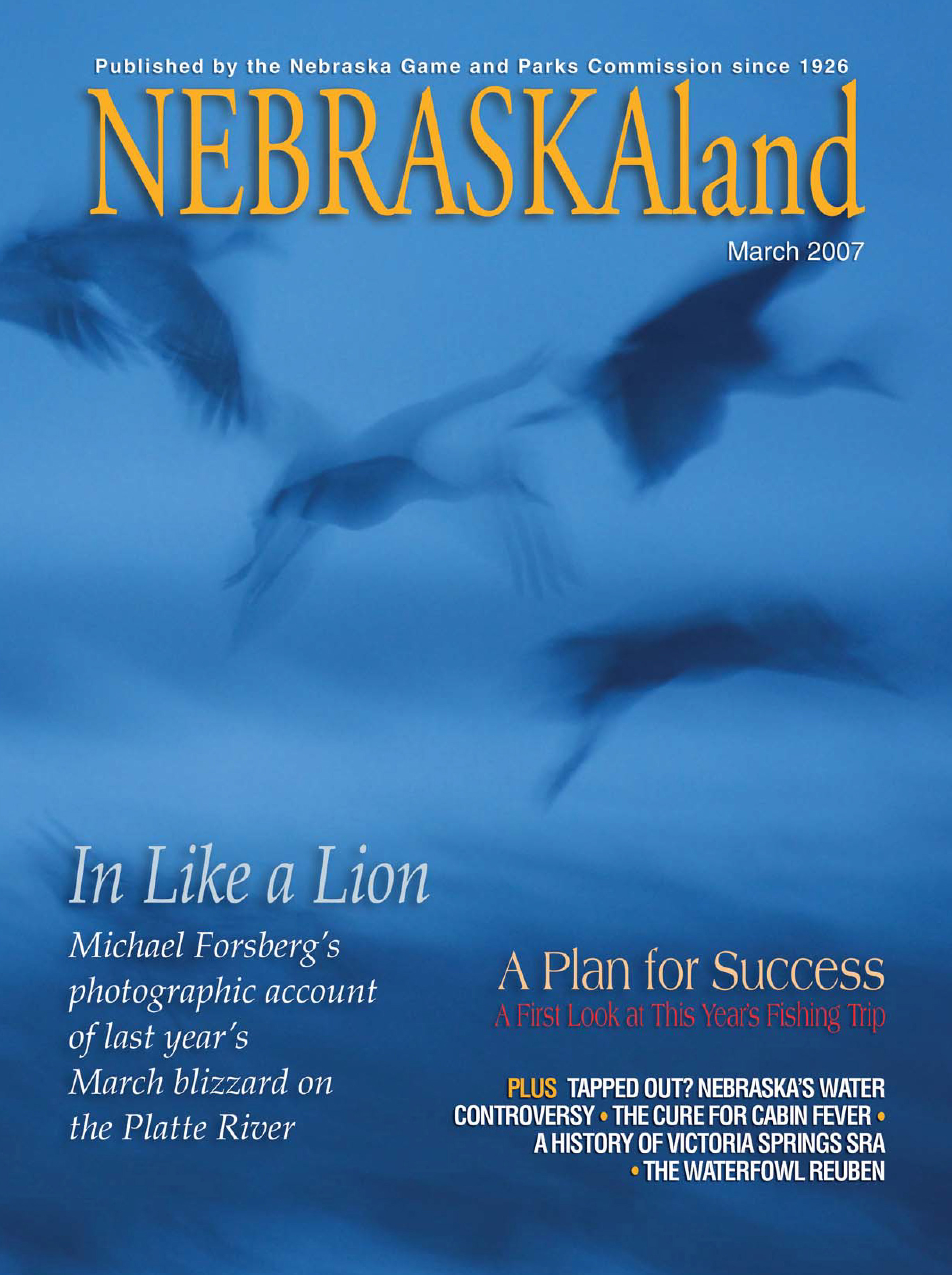
March 2007> In Like a Lion Michael Forsberg's photographic account of last year's March blizzard on the Platte River A Plan for Success A First Look at This Year's Fishing Trip PLUS TAPPED OUT? NEBRASKA'S WATER CONTROVERSY THE CURE FOR CABIN FEVER A HISTORY OF VICTORIA SPRINGS SRA THE WATERFOWL REUBEN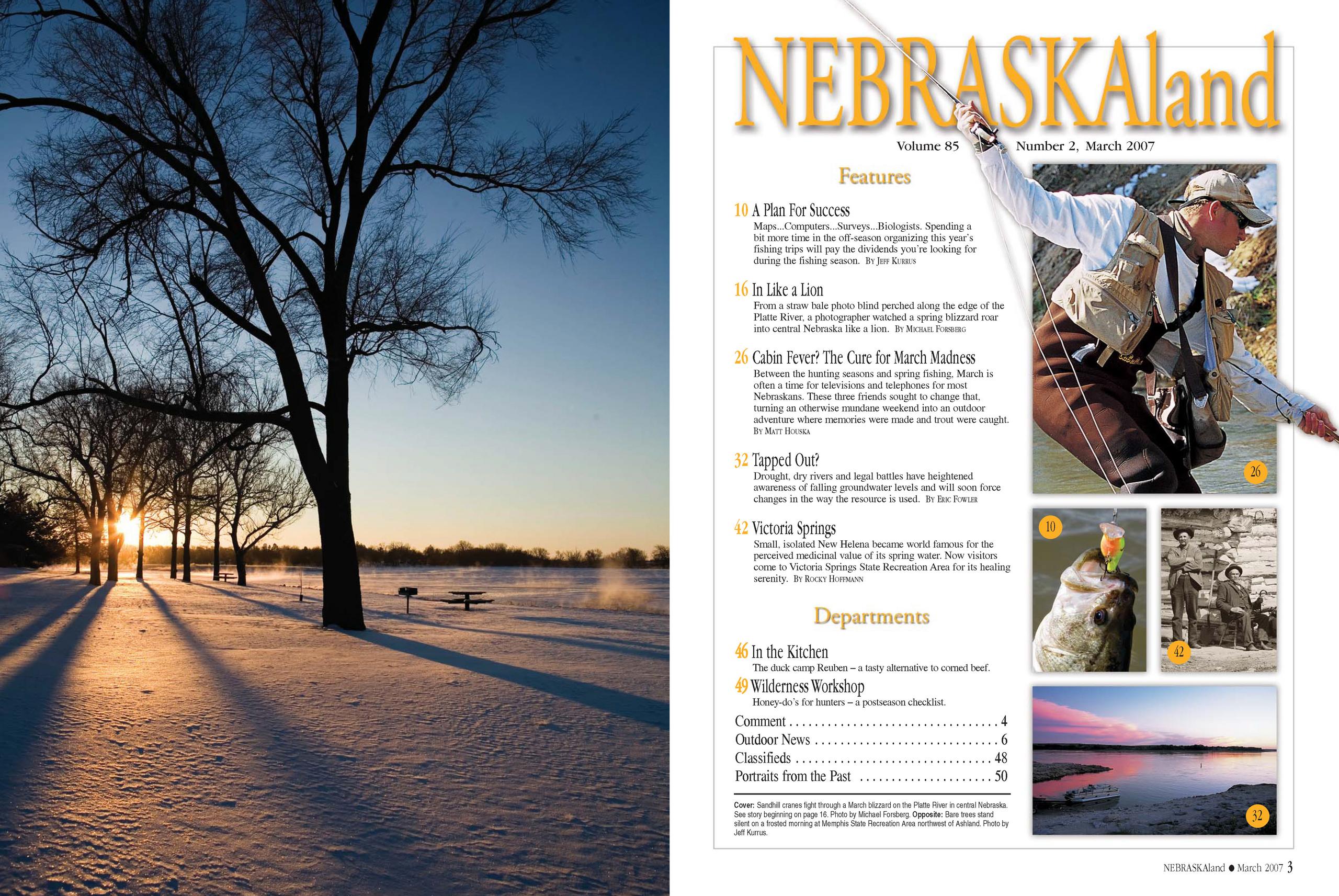
NEBRASKAland
Volume 85, Number 2, March 2007 Features 10 A Plan For Success Maps...Computers...Surveys...Biologists. Spending a bit more time in the off-season organizing this year's fishing trips will pay the dividends you're looking for during the fishing season. BY JEFF KURRUS 16 In Like a Lion From a straw bale photo blind perched along the edge of the Platte River, a photographer watched a spring blizzard roar into central Nebraska like a lion. BY MICHAEL FORSBERG 26 Cabin Fever? The Cure for March Madness Between the hunting seasons and spring fishing, March is often a time for televisions and telephones for most Nebraskans. These three friends sought to change that, turning an otherwise mundane weekend into an outdoor adventure where memories were made and trout were caught. BY MATT HOUSKA 32 Tapped Out? Drought, dry rivers and legal battles have heightened awareness of falling groundwater levels and will soon force changes in the way the resource is used. BY ERIC FOWLER 42 Victoria Springs Small, isolated New Helena became world famous for the perceived medicinal value of its spring water. Now visitors come to Victoria Springs State Recreation Area for its healing serenity. BY ROCKY HOFFMANN Departments 46 In the Kitchen The duck camp Reuben – a tasty alternative to corned beef. 49Wilderness Workshop Honey-do's for hunters – a postseason checklist. Comment . . . . . . . . . . . . . . . . . . . . . . . . . . . . . . . . . 4 Outdoor News . . . . . . . . . . . . . . . . . . . . . . . . . . . . . 6 Classifieds . . . . . . . . . . . . . . . . . . . . . . . . . . . . . . . 48 Portraits from the Past . . . . . . . . . . . . . . . . . . . . . 50 Cover: Sandhill cranes fight through a March blizzard on the Platte River in central Nebraska. See story beginning on page 16. Photo by Michael Forsberg. Opposite: Bare trees stand silent on a frosted morning at Memphis State Recreation Area northwest of Ashland. Photo by Jeff Kurrus26
10
42
32
Comment
I am a historical archaeologist, and Jon Farrar's April 2005 article "The History of Art and Shotshells" in NEBRASKAland Magazine has been the best resource on shotgun shells I've encountered. I'd like to cite it in my dissertation.
My dissertation research is in Belize, Central America. The site dates from 1860 to 1940. I found about 40 shotgun shells...U.M.C. New Club (No. 12 & No. 16) and Winchester New Rival (No. 12, No. 16, & No. 20).
The site, called Holotunich, was a Maya village in the 19th century and a British logging camp in the 20th century. The shotshells are going to be pretty important in dating parts of the site, because they have a short use life compared to ceramics and glass in the tropical climate.
Olivia Ng, Department of Anthropology University of Pennsylvania Crane CongratulationsAmazing, simply amazing. Bob Grier's chronicle of nesting sandhill cranes in the North Platte River Valley is spectacular. What a photographer's dream come true to be able to capture on camera a creature with so much meaning to Nebraskans against the backdrop of Chimney Rock – the symbol of the American West.
The fact that this rare event took place on a state wildlife management area says a lot about the Nebraska Game and Parks Commission's ability to select, acquire and manage precious tracts of public access habitat.
Nebraskans are fortunate in that to observe cranes in the wild, they don't have to just stumble upon them the way that these greater sandhill cranes were discovered. Hundreds of thousands of sandhill cranes visit the central Platte River Valley each spring, mostly between Kearney and Grand Island from late-February into April. Visitors can experience the thrill of the mass concentrations of cranes, waterfowl and shorebirds from riverside viewing blinds at Audubon's Rowe Sanctuary near Gibbon and at Crane Meadows near Alda.
Thanks to Bob and NEBRASKAland for once again allowing your readers to peer into the daily lives of creatures that are often overlooked.
Alan J. Bartels Farwell, Nebraska"Bowhunting Nebraska – The Early Years" certainly brought back some vivid memories.
I bought a bow from Herter's with my paper route money – a 45-pound fiberglass turkish recurve – in about 1957. One of my neighbors was getting heavy into deer bowhunting about the same time and took me under his wing. I was invited to many practice sessions with his brother and others that held the same interest.
We traveled to a Nebraska City shoe store on many occasions to buy American Arrow blanks and Bodkin heads. With the help of the older guys' tutelage, I managed to take my first deer in 1959 with that Herter's bow. I later bought a fiberglass Paul Bunyan bow, a 65-pound behemoth I could hardly come to full draw with if the temperature was much below 32 degrees.
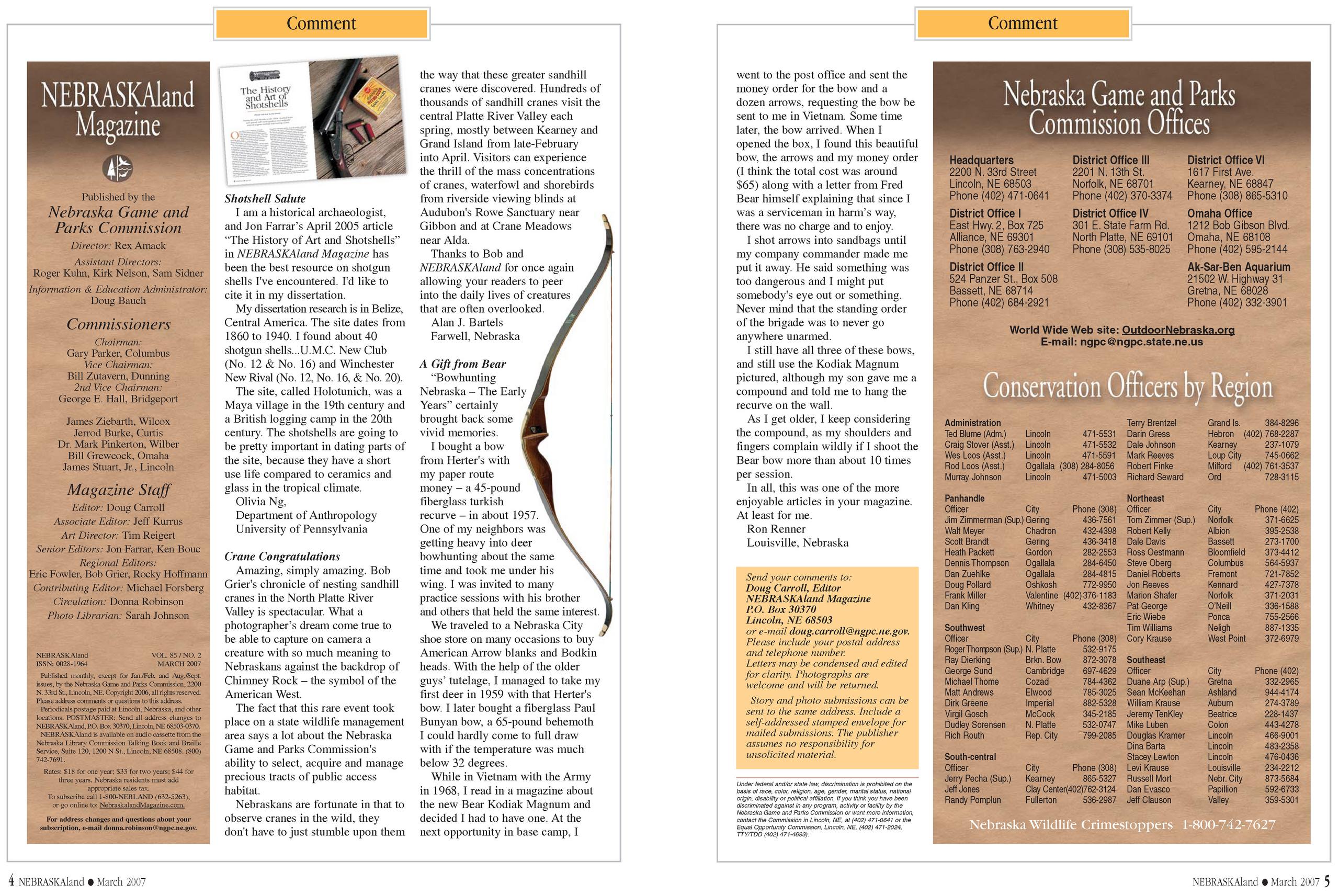
While in Vietnam with the Army in 1968, I read in a magazine about the new Bear Kodiak Magnum and decided I had to have one. At the next opportunity in base camp, I 4 NEBRASKAland March 2007 went to the post office and sent the money order for the bow and a dozen arrows, requesting the bow be sent to me in Vietnam. Some time later, the bow arrived. When I opened the box, I found this beautiful bow, the arrows and my money order (I think the total cost was around $65) along with a letter from Fred Bear himself explaining that since I was a serviceman in harm's way, there was no charge and to enjoy
I shot arrows into sandbags until my company commander made me put it away. He said something was too dangerous and I might put somebody's eye out or something. Never mind that the standing order of the brigade was to never go anywhere unarmed.
I still have all three of these bows, and still use the Kodiak Magnum pictured, although my son gave me a compound and told me to hang the recurve on the wall.
As I get older, I keep considering the compound, as my shoulders and fingers complain wildly if I shoot the Bear bow more than about 10 times per session.
In all, this was one of the more enjoyable articles in your magazine. At least for me.
Ron Renner Louisville, Nebraska Send your comments to: Doug Carroll, Editor NEBRASKAland Magazine P.O. Box 30370 Lincoln, NE 68503 or e-mail doug.carroll@ngpc.ne.gov. Please include your postal address and telephone number. Letters may be condensed and edited for clarity. Photographs are welcome and will be returned. Story and photo submissions can be sent to the same address. Include a self-addressed stamped envelope for mailed submissions. The publisher assumes no responsibility for unsolicited material. Under federal and/or state law, discrimination is prohibited on the basis of race, color, religion, age, gender, marital status, national origin, disability or political affiliation. If you think you have been discriminated against in any program, activity or facility by the Nebraska Game and Parks Commission or want more information, contact the Commission in Lincoln, NE, at (402) 471-0641 or the Equal Opportunity Commission, Lincoln, NE, (402) 471-2024, TTY/TDD (402) 471-4693). Comment Nebraska Game and Parks Commission Offices Headquarters 2200 N. 33rd Street Lincoln, NE 68503 Phone (402) 471-0641 District Office 1 East Hwy. 2, Box 725 Alliance, NE 69301 Phone (308) 763-2940 District Office II 524 Panzer St., Box 508 Bassett, NE 68714 Phone (402) 684-2921 District Office III 2201 N. 13th St. Norfolk, NE 68701 Phone (402)370-3374 District Office IV 301 E. State Farm Rd. North Platte, NE 69101 Phone (308) 535-8025 District Office VI 1617 First Ave. Kearney, NE 68847 Phone (308) 865-5310 Omaha Office 1212 bob Gibson Blvd. Omaha, NE 68108 Phone (402) 595-2144 Ak-Sar-Ben Aquarium 21502 W. Highway 31 Gretna, NE 68028 Phone (402) 332-3901 World Wide Web site: OutdoorNebraska.org E-mail: ngpc@ngpc.state.ne.us Conservation Officers by Region Administration Ted Blume (Adm.) Lincoln 471-5531 Craig Stover (Asst.) Lincoln 471-5532 Wes Loos (Asst.) Lincoln 471-5591 Rod Loos (Asst.) Ogallala (308) 284-8056 Murray Johnson Lincoln 471-5003 Panhandle Officer City Phone (308) Jim Zimmerman (Sup.) Gering 436-7561 Walt Meyer Chadron 432-4398 Scott Brandt Gering 436-3418 Heath Packett Gordon 282-2553 Dennis Thompson Ogallala 284-6450 Dan Zuehlke Ogallala 284-4815 Doug Pollard Oshkosh 772-9950 Frank Miller Valentine (402) 376-1183 Dan Kling Whitney 432-8367 Southwest Officer City Phone (308) Roger Thompson (Sup.) N. Platte 532-9175 Ray Dierking Brkn. Bow 872-3078 George Sund Cambridge 697-4629 Michael Thome Cozad 784-4362 Matt Andrews Elwood 785-3025 Dirk Greene Imperial 882-5328 Virgil Gosch McCook 345-2185 Dudley Sorensen N. Platte 532-0747 Rich Routh Rep. City 799-2085 South-central Officer City Phone (308) Jerry Pecha (Sup.) Kearney 865-5327 Jeff Jones Clay Center(402)762-3124 Randy Pomplun Fullerton 536-2987 Terry Brentzel Grand Is. 384-8296 Darin Gress Hebron (402) 768-2287 Dale Johnson Kearney 237-1079 Mark Reeves Loup City 745-0662 Robert Finke Milford (402) 761-3537 Richard Seward Ord 728-3115 Northeast Officer City Phone (402) Tom Zimmer (Sup.) Norfolk 371-6625 Robert Kelly Albion 395-2538 Dale Davis Bassett 273-1700 Ross Oestmann Bloomfield 373-4412 Steve Oberg Columbus 564-5937 Daniel Roberts Fremont 721-7852 Jon Reeves Kennard 427-7378 Marion Shafer Norfolk 371-2031 Pat George O'Neill 336-1588 Eric Wiebe Ponca 755-2566 Tim Williams Neligh 887-1335 Cory Krause West Point 372-6979 Southeast Officer City Phone (402) Duane Arp (Sup.) Gretna 332-2965 Sean McKeehan Ashland 944-4174 William Krause Auburn 274-3789 Jeremy TenKley Beatrice 228-1437 Mike Luben Colon 443-4278 Douglas Kramer Lincoln 466-9001 Dina Barta Lincoln 483-2358 Stacey Lewton Lincoln 476-0436 Levi Krause Louisville 234-2212 Russell Mort Nebr. City 873-5684 Dan Evasco Papillion 592-6733 Jeff Clauson Valley 359-5301 Nebraska Wildlife Crimestoppers 1-800-742-7627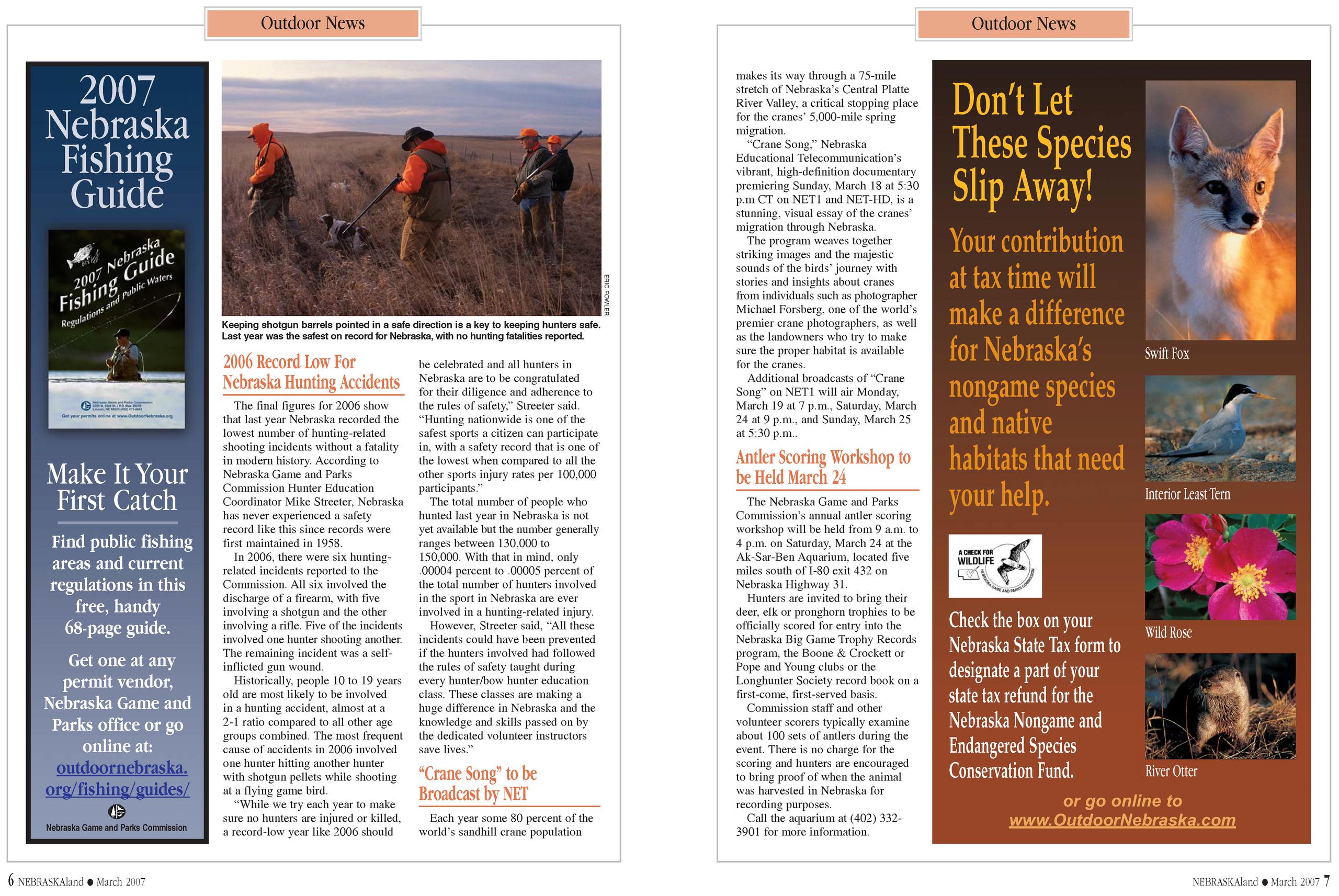
Keeping shotgun barrels pointed in a safe direction is a key to keeping hunters safe. Last year was the safest on record for Nebraska, with no hunting fatalities reported. ERIC FOWLER
The final figures for 2006 show that last year Nebraska recorded the lowest number of hunting-related shooting incidents without a fatality in modern history. According to Nebraska Game and Parks Commission Hunter Education Coordinator Mike Streeter, Nebraska has never experienced a safety record like this since records were first maintained in 1958. In 2006, there were six huntingrelated incidents reported to the Commission. All six involved the discharge of a firearm, with five involving a shotgun and the other involving a rifle. Five of the incidents involved one hunter shooting another. The remaining incident was a selfinflicted gun wound. Historically, people 10 to 19 years old are most likely to be involved in a hunting accident, almost at a 2-1 ratio compared to all other age groups combined. The most frequent cause of accidents in 2006 involved one hunter hitting another hunter with shotgun pellets while shooting at a flying game bird. "While we try each year to make sure no hunters are injured or killed, a record-low year like 2006 should be celebrated and all hunters in Nebraska are to be congratulated for their diligence and adherence to the rules of safety," Streeter said. "Hunting nationwide is one of the safest sports a citizen can participate in, with a safety record that is one of the lowest when compared to all the other sports injury rates per 100,000 participants." The total number of people who hunted last year in Nebraska is not yet available but the number generally ranges between 130,000 to 150,000. With that in mind, only .00004 percent to .00005 percent of the total number of hunters involved in the sport in Nebraska are ever involved in a hunting-related injury. However, Streeter said, "All these incidents could have been prevented if the hunters involved had followed the rules of safety taught during every hunter/bow hunter education class. These classes are making a huge difference in Nebraska and the knowledge and skills passed on by the dedicated volunteer instructors save lives."
"Crane Song" to be Broadcast by NETEach year some 80 percent of the world's sandhill crane population
6 NEBRASKAland March 2007 Outdoor Newsstretch of Nebraska's Central Platte River Valley, a critical stopping place for the cranes' 5,000-mile spring migration. "Crane Song," Nebraska Educational Telecommunication's vibrant, high-definition documentary premiering Sunday, March 18 at 5:30 p.m CT on NET1 and NET-HD, is a stunning, visual essay of the cranes' migration through Nebraska. The program weaves together striking images and the majestic sounds of the birds' journey with stories and insights about cranes from individuals such as photographer Michael Forsberg, one of the world's premier crane photographers, as well as the landowners who try to make sure the proper habitat is available for the cranes. Additional broadcasts of "Crane Song" on NET1 will air Monday, March 19 at 7 p.m., Saturday, March 24 at 9 p.m., and Sunday, March 25 at 5:30 p.m..
Antler Scoring Workshop to be Held March 24The Nebraska Game and Parks Commission's annual antler scoring workshop will be held from 9 a.m. to 4 p.m. on Saturday, March 24 at the Ak-Sar-Ben Aquarium, located five miles south of I-80 exit 432 on Nebraska Highway 31. Hunters are invited to bring their deer, elk or pronghorn trophies to be officially scored for entry into the Nebraska Big Game Trophy Records program, the Boone & Crockett or Pope and Young clubs or the Longhunter Society record book on a first-come, first-served basis. Commission staff and other volunteer scorers typically examine about 100 sets of antlers during the event. There is no charge for the scoring and hunters are encouraged to bring proof of when the animal was harvested in Nebraska for recording purposes. Call the aquarium at (402) 332- 3901 for more information.
Swift Fox
Interior Least Tern
Wild Rose
River Otter

Several years ago, conservation officer Dennis Thompson and I were trying to figure out which blinds and goose pits on the west end of Lake McConaughy were using electronic calls. Set up inconspicuously in a wooded area just off the road, we were listening to one particular goose pit. The hunters in this blind were either exceptionally good at calling, or they were using electronic calls, so we decided to wait awhile and see if any geese reacted to the calls. As many people know, January hunting can be very slow, due to the fact that most geese by this time have established patterns and are very wary of hunters.
Eventually some geese did come in, but we were not totally sure the call was electronic, so we decided to give it one more good listen. The surveillance was getting quite boring, so I decided to start snooping around in Officer Thompson's truck. Every officer arranges their truck in a way that personalizes it, and his was pretty boring, to say the least. I was intrigued, however, by the way he had his console radios meticulously arranged. I started sabotaging all of his radio dials so that when he turned one on, it would cause pure confusion. Eventually I came upon the public address system, which also includes the sirens. Thinking of another cruel joke to play, I turned up the volume full blast, accidentally hitting the manual override in the process. Grabbing the microphone, I told him jokingly that I was going to order the hunters out of the blind with electronic call in hand, but when I hit the on button, the sirens went off at bull blast. What a loudspeaker system his truck had! As I scrambled looking for the off switch, Thompson stared in disbelief as a two-hour surveillance was blown by my idiotic horseplay.
After what seemed like hours but was more like three seconds, the sirens were shut off and you could've heard a pin drop in that truck. My face must have been as red as the dash siren, and all I could think to say was, "You think they heard that, or do you think the wind covered the noise?" Officer Thompson barely said a word, then laughed and said, "Well, let's go check them now that they know we're here." The hunters were waiting with permits in hand, and needless to say, we didn't find an illegal call. Embarrassed and scolded by my senior officer about my surveillance skills, I proceeded to end the shift by myself.
By the way, the feds pinched that blind for electronic calls a week later.
– Dan Zuehlke, Conservation Officer, OgallalaFor the first time, hunters may purchase up to three permits for the spring turkey season, which opens March 25 for archers and April 14 for the shotgun season, with all turkey seasons closing May 20.
The permits may be any combination of shotgun and archery tags, are unlimited in number and are valid statewide. "There are more turkeys than ever in Nebraska," said Kit Hams, big game program manager for the Nebraska Game and Parks Commission. "It's a wonderful time to be a turkey hunter."
Youth permits are also available for hunters 12 to 15 years old. With the permit, a youth may hunt during the archery and shotgun seasons until the permit is filled. The permit also allows youth to begin their shotgun season a week earlier (April 7) then the general shotgun season.
A Nebraska Habitat Stamp is required for all resident turkey hunters 16 years of age and older and all nonresidents. Permits may be purchased online at the Commission's web site, OutdoorNebraska.org, and at Commission offices across the state.
Addition to 2007 Nebraska Fishing GuideThe minimum statewide size limits for the following popular fish species were omitted in early editions of the 2007 Nebraska Fishing Guide.
They are:
• Largemouth bass: 15-inch minimum statewide limit on all government or publicly-owned, controlled or managed waters, except where other limits apply, and parts of the Missouri River.
• Smallmouth and spotted bass: 12-inch limit on all publicly-owned, controlled or managed waters, except where other limits apply, and parts of the Missouri River.
• Walleye, sauger and saugeye: 15-inch minimum statewide except 8 NEBRASKAland March 2007 for that portion of the Missouri River downstream from Gavins Point Dam.
• Muskellunge/tiger muskie: 40-inch limit statewide.
Outdoor News Forest Service Limiting Motorized TravelBeginning January 29, 2007, motorized travel restrictions directed by the 2002 Revised Management Plan went into effect at several areas managed by the Nebraska National Forest in western Nebraska and South Dakota.
"The 2002 Revised Land and Resource Management Plan identified several areas that have special characteristics where motorized travel was deemed inappropriate," said Jerry Schumacher, Forest Service spokesperson. "We now have the required special order in place to implement the motorized restrictions, and will begin installing the necessary signs to identify the restricted areas. Existing restrictions not addressed by this order remain in place and unchanged."
The restricted areas include five parcels on the Buffalo Gap National Grassland in southwestern South Dakota and seven in Nebraska. The restricted Nebraska areas include the 2,500-acre Steer Creek Research Natural Area (RNA) on the Samuel R. McKelvie National Forest, and the 500-acre Signal Hill RNA on the Nebraska National Forest in central Nebraska. Forest Service Roads 601 and 602 in the Steer Creek RNA remain open.
New motorized restrictions on forest ground in Nebraska's northern panhandle include the 2,000-acre Toadstool Geologic Park Special Interest Area (SIA), a 40-acre area around the nearby Hudson-Meng SIA, and an 8-acre fenced area around an unusual stand of quaking aspen trees.
Copies of the new motorized restriction order and accompanying maps are available on the internet at www.fs.fed.us/r2/nebraska.
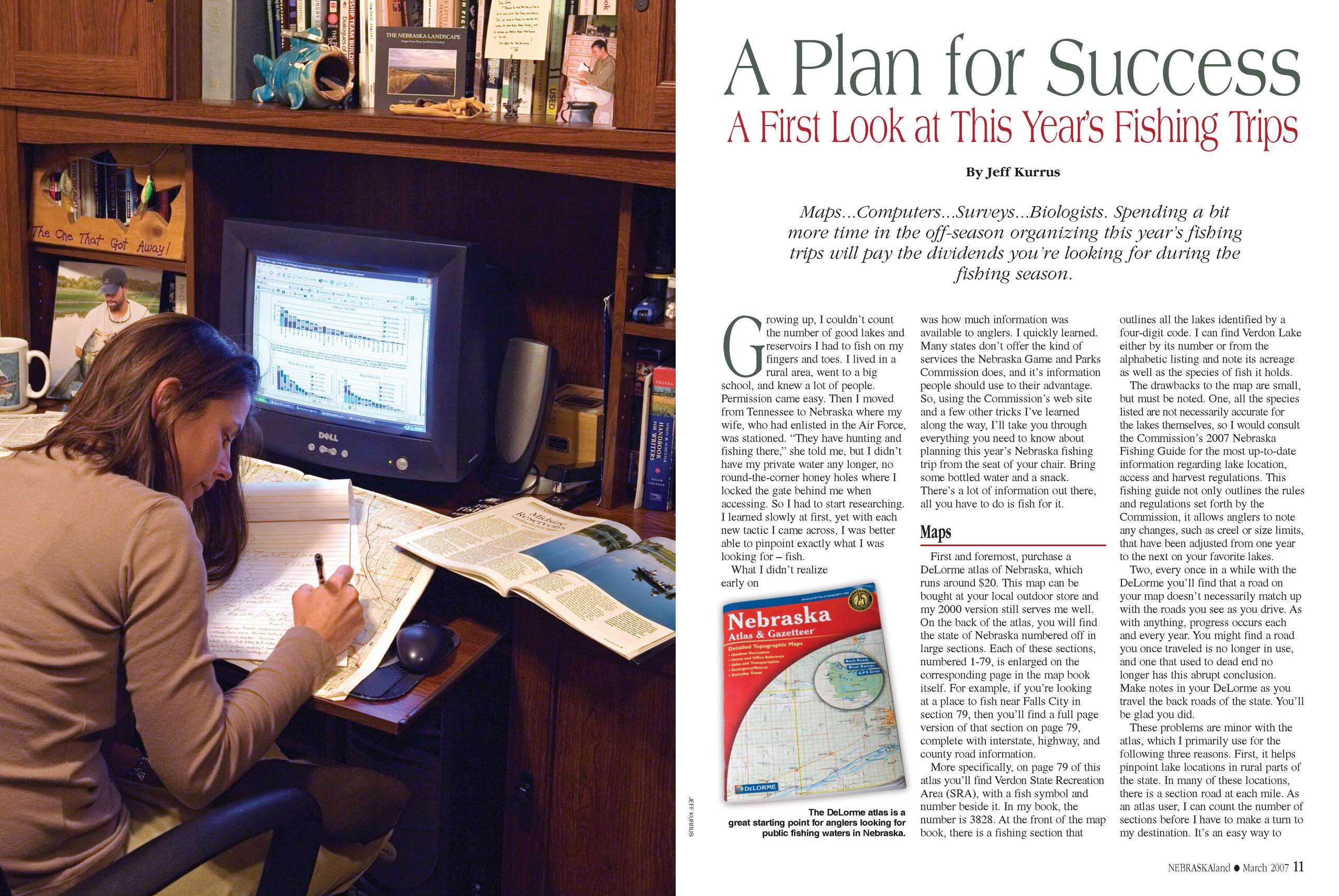
JEFF KURRUS
Growing up, I couldn't count the number of good lakes and reservoirs I had to fish on my fingers and toes. I lived in a rural area, went to a big school, and knew a lot of people. Permission came easy. Then I moved from Tennessee to Nebraska where my wife, who had enlisted in the Air Force, was stationed. "They have hunting and fishing there," she told me, but I didn't have my private water any longer, no round-the-corner honey holes where I locked the gate behind me when accessing. So I had to start researching. I learned slowly at first, yet with each new tactic I came across, I was better able to pinpoint exactly what I was looking for – fish
The DeLorme atlas is a great starting point for anglers looking for public fishing waters in Nebraska.
First and foremost, purchase a DeLorme atlas of Nebraska, which runs around $20. This map can be bought at your local outdoor store and my 2000 version still serves me well. On the back of the atlas, you will find the state of Nebraska numbered off in large sections. Each of these sections, numbered 1-79, is enlarged on the corresponding page in the map book itself. For example, if you're looking at a place to fish near Falls City in section 79, then you'll find a full page version of that section on page 79, complete with interstate, highway, and county road information.
More specifically, on page 79 of this atlas you'll find Verdon State Recreation Area (SRA), with a fish symbol and number beside it. In my book, the number is 3828. At the front of the map book, there is a fishing section that outlines all the lakes identified by a four-digit code. I can find Verdon Lake either by its number or from the alphabetic listing and note its acreage as well as the species of fish it holds.
The drawbacks to the map are small, but must be noted. One, all the species listed are not necessarily accurate for the lakes themselves, so I would consult the Commission's 2007 Nebraska Fishing Guide for the most up-to-date information regarding lake location, access and harvest regulations. This fishing guide not only outlines the rules and regulations set forth by the Commission, it allows anglers to note any changes, such as creel or size limits, that have been adjusted from one year to the next on your favorite lakes.
Two, every once in a while with the DeLorme you'll find that a road on your map doesn't necessarily match up with the roads you see as you drive. As with anything, progress occurs each and every year. You might find a road you once traveled is no longer in use, and one that used to dead end no longer has this abrupt conclusion. Make notes in your DeLorme as you travel the back roads of the state. You'll be glad you did.
These problems are minor with the
atlas, which I primarily use for the
following three reasons. First, it helps
pinpoint lake locations in rural parts of
the state. In many of these locations,
there is a section road at each mile. As
an atlas user, I can count the number of
sections before I have to make a turn to
my destination. It's an easy way to
NEBRASKAland March 2007 11
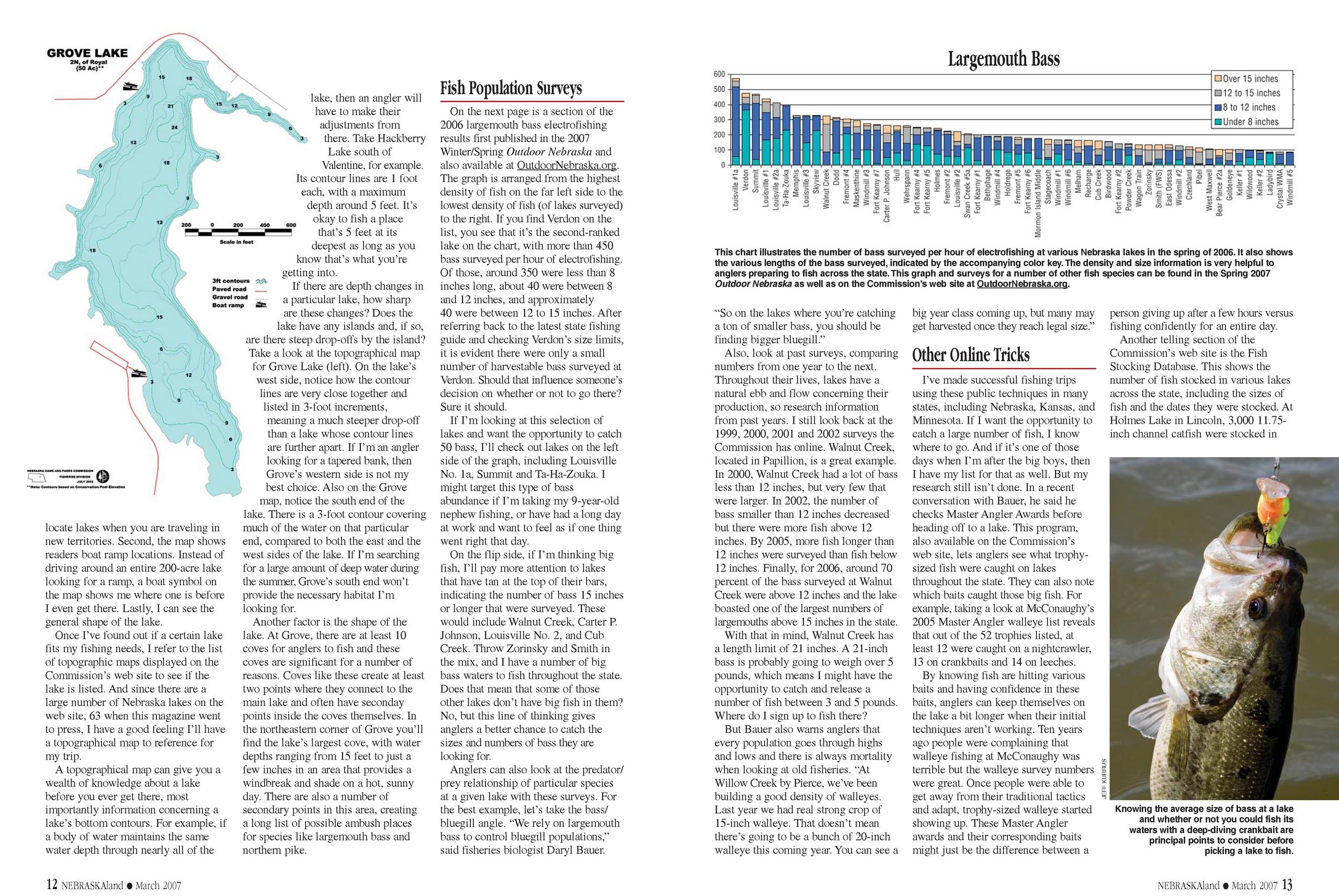
Once I've found out if a certain lake fits my fishing needs, I refer to the list of topographic maps displayed on the Commission's web site to see if the lake is listed. And since there are a large number of Nebraska lakes on the web site, 63 when this magazine went to press, I have a good feeling I'll have a topographical map to reference for my trip.
A topographical map can give you a wealth of knowledge about a lake before you ever get there, most importantly information concerning a lake's bottom contours. For example, if a body of water maintains the same water depth through nearly all of the lake, then an angler will have to make their adjustments from there. Take Hackberry Lake south of Valentine, for example. Its contour lines are 1 foot each, with a maximum depth around 5 feet. It's okay to fish a place that's 5 feet at its deepest as long as you know that's what you're getting into.
If there are depth changes in a particular lake, how sharp are these changes? Does the lake have any islands and, if so, are there steep drop-offs by the island? Take a look at the topographical map for Grove Lake (left). On the lake's west side, notice how the contour lines are very close together and listed in 3-foot increments, meaning a much steeper drop-off than a lake whose contour lines are further apart. If I'm an angler looking for a tapered bank, then Grove's western side is not my best choice. Also on the Grove map, notice the south end of the lake. There is a 3-foot contour covering much of the water on that particular end, compared to both the east and the west sides of the lake. If I'm searching for a large amount of deep water during the summer, Grove's south end won't provide the necessary habitat I'm looking for.
Another factor is the shape of the lake. At Grove, there are at least 10 coves for anglers to fish and these coves are significant for a number of reasons. Coves like these create at least two points where they connect to the main lake and often have seconday points inside the coves themselves. In the northeastern corner of Grove you'll find the lake's largest cove, with water depths ranging from 15 feet to just a few inches in an area that provides a windbreak and shade on a hot, sunny day. There are also a number of secondary points in this area, creating a long list of possible ambush places for species like largemouth bass and northern pike.
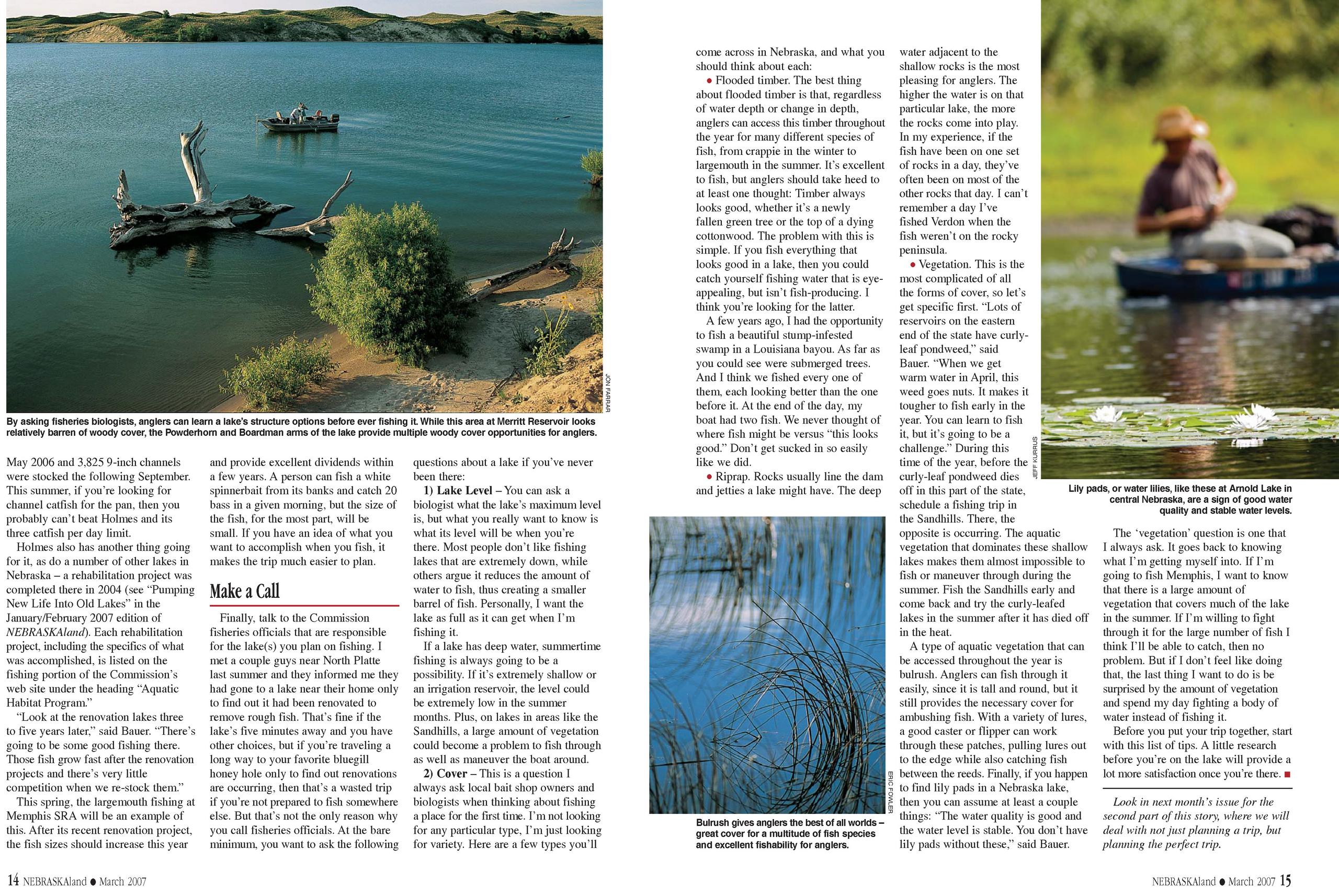
Fish Population SurveysOn the next page is a section of the 2006 largemouth bass electrofishing results first published in the 2007 Winter/Spring Outdoor Nebraska and also available at OutdoorNebraska.org. The graph is arranged from the highest density of fish on the far left side to the lowest density of fish (of lakes surveyed) to the right. If you find Verdon on the list, you see that it's the second-ranked lake on the chart, with more than 450 bass surveyed per hour of electrofishing. Of those, around 350 were less than 8 inches long, about 40 were between 8 and 12 inches, and approximately 40 were between 12 to 15 inches. After referring back to the latest state fishing guide and checking Verdon's size limits, it is evident there were only a small number of harvestable bass surveyed at Verdon. Should that influence someone's decision on whether or not to go there? Sure it should.
If I'm looking at this selection of lakes and want the opportunity to catch 50 bass, I'll check out lakes on the left side of the graph, including Louisville No. 1a, Summit and Ta-Ha-Zouka. I might target this type of bass abundance if I'm taking my 9-year-old nephew fishing, or have had a long day at work and want to feel as if one thing went right that day.
On the flip side, if I'm thinking big fish, I'll pay more attention to lakes that have tan at the top of their bars, indicating the number of bass 15 inches or longer that were surveyed. These would include Walnut Creek, Carter P. Johnson, Louisville No. 2, and Cub Creek. Throw Zorinsky and Smith in the mix, and I have a number of big bass waters to fish throughout the state. Does that mean that some of those other lakes don't have big fish in them? No, but this line of thinking gives anglers a better chance to catch the sizes and numbers of bass they are looking for.
Anglers can also look at the predator/ prey relationship of particular species at a given lake with these surveys. For the best example, let's take the bass/ bluegill angle. "We rely on largemouth bass to control bluegill populations," said fisheries biologist Daryl Bauer.
Also, look at past surveys, comparing numbers from one year to the next. Throughout their lives, lakes have a natural ebb and flow concerning their production, so research information from past years. I still look back at the 1999, 2000, 2001 and 2002 surveys the Commission has online. Walnut Creek, located in Papillion, is a great example. In 2000, Walnut Creek had a lot of bass less than 12 inches, but very few that were larger. In 2002, the number of bass smaller than 12 inches decreased but there were more fish above 12 inches. By 2005, more fish longer than 12 inches were surveyed than fish below 12 inches. Finally, for 2006, around 70 percent of the bass surveyed at Walnut Creek were above 12 inches and the lake boasted one of the largest numbers of largemouths above 15 inches in the state.
With that in mind, Walnut Creek has a length limit of 21 inches. A 21-inch bass is probably going to weigh over 5 pounds, which means I might have the opportunity to catch and release a number of fish between 3 and 5 pounds. Where do I sign up to fish there?
But Bauer also warns anglers that every population goes through highs and lows and there is always mortality when looking at old fisheries. "At Willow Creek by Pierce, we've been building a good density of walleyes. Last year we had real strong crop of 15-inch walleye. That doesn't mean there's going to be a bunch of 20-inch walleye this coming year. You can see a big year class coming up, but many may get harvested once they reach legal size."
Other Online TricksI've made successful fishing trips using these public techniques in many states, including Nebraska, Kansas, and Minnesota. If I want the opportunity to catch a large number of fish, I know where to go. And if it's one of those days when I'm after the big boys, then I have my list for that as well. But my research still isn't done. In a recent conversation with Bauer, he said he checks Master Angler Awards before heading off to a lake. This program, also available on the Commission's web site, lets anglers see what trophysized fish were caught on lakes throughout the state. They can also note which baits caught those big fish. For example, taking a look at McConaughy's 2005 Master Angler walleye list reveals that out of the 52 trophies listed, at least 12 were caught on a nightcrawler, 13 on crankbaits and 14 on leeches.
By knowing fish are hitting various baits and having confidence in these baits, anglers can keep themselves on the lake a bit longer when their initial techniques aren't working. Ten years ago people were complaining that walleye fishing at McConaughy was terrible but the walleye survey numbers were great. Once people were able to get away from their traditional tactics and adapt, trophy-sized walleye started showing up. These Master Angler awards and their corresponding baits might just be the difference between a person giving up after a few hours versus fishing confidently for an entire day.
Another telling section of the Commission's web site is the Fish Stocking Database. This shows the number of fish stocked in various lakes across the state, including the sizes of fish and the dates they were stocked. At Holmes Lake in Lincoln, 3,000 11.75- inch channel catfish were stocked in
May 2006 and 3,825 9-inch channels were stocked the following September. This summer, if you're looking for channel catfish for the pan, then you probably can't beat Holmes and its three catfish per day limit.
Holmes also has another thing going for it, as do a number of other lakes in Nebraska – a rehabilitation project was completed there in 2004 (see "Pumping New Life Into Old Lakes" in the January/February 2007 edition of NEBRASKAland). Each rehabilitation project, including the specifics of what was accomplished, is listed on the fishing portion of the Commission's web site under the heading "Aquatic Habitat Program."
"Look at the renovation lakes three to five years later," said Bauer. "There's going to be some good fishing there. Those fish grow fast after the renovation projects and there's very little competition when we re-stock them."
This spring, the largemouth fishing at Memphis SRA will be an example of this. After its recent renovation project, the fish sizes should increase this year and provide excellent dividends within a few years. A person can fish a white spinnerbait from its banks and catch 20 bass in a given morning, but the size of the fish, for the most part, will be small. If you have an idea of what you want to accomplish when you fish, it makes the trip much easier to plan.
Make a CallFinally, talk to the Commission fisheries officials that are responsible for the lake(s) you plan on fishing. I met a couple guys near North Platte last summer and they informed me they had gone to a lake near their home only to find out it had been renovated to remove rough fish. That's fine if the lake's five minutes away and you have other choices, but if you're traveling a long way to your favorite bluegill honey hole only to find out renovations are occurring, then that's a wasted trip if you're not prepared to fish somewhere else. But that's not the only reason why you call fisheries officials. At the bare minimum, you want to ask the following questions about a lake if you've never been there:
1) Lake Level – You can ask a biologist what the lake's maximum level is, but what you really want to know is what its level will be when you're there. Most people don't like fishing lakes that are extremely down, while others argue it reduces the amount of water to fish, thus creating a smaller barrel of fish. Personally, I want the lake as full as it can get when I'm fishing it.
If a lake has deep water, summertime fishing is always going to be a possibility. If it's extremely shallow or an irrigation reservoir, the level could be extremely low in the summer months. Plus, on lakes in areas like the Sandhills, a large amount of vegetation could become a problem to fish through as well as maneuver the boat around.
always ask local bait shop owners and biologists when thinking about fishing a place for the first time. I'm not looking for any particular type, I'm just looking for variety. Here are a few types you'll 14 NEBRASKAland March 2007 come across in Nebraska, and what you should think about each:
• Flooded timber. The best thing about flooded timber is that, regardless of water depth or change in depth, anglers can access this timber throughout the year for many different species of fish, from crappie in the winter to largemouth in the summer. It's excellent to fish, but anglers should take heed to at least one thought: Timber always looks good, whether it's a newly fallen green tree or the top of a dying cottonwood. The problem with this is simple. If you fish everything that looks good in a lake, then you could catch yourself fishing water that is eyeappealing, but isn't fish-producing. I think you're looking for the latter.
A few years ago, I had the opportunity to fish a beautiful stump-infested swamp in a Louisiana bayou. As far as you could see were submerged trees. And I think we fished every one of them, each looking better than the one before it. At the end of the day, my boat had two fish. We never thought of where fish might be versus "this looks good." Don't get sucked in so easily like we did.
• Riprap. Rocks usually line the dam and jetties a lake might have. The deep
• Vegetation. This is the most complicated of all the forms of cover, so let's get specific first. "Lots of reservoirs on the eastern end of the state have curlyleaf pondweed," said Bauer. "When we get warm water in April, this weed goes nuts. It makes it tougher to fish early in the year. You can learn to fish it, but it's going to be a challenge." During this time of the year, before the curly-leaf pondweed dies off in this part of the state, schedule a fishing trip in the Sandhills. There, the opposite is occurring. The aquatic vegetation that dominates these shallow lakes makes them almost impossible to fish or maneuver through during the summer. Fish the Sandhills early and come back and try the curly-leafed lakes in the summer after it has died off in the heat.
A type of aquatic vegetation that can be accessed throughout the year is bulrush. Anglers can fish through it easily, since it is tall and round, but it still provides the necessary cover for ambushing fish. With a variety of lures, a good caster or flipper can work through these patches, pulling lures out to the edge while also catching fish between the reeds. Finally, if you happen to find lily pads in a Nebraska lake, then you can assume at least a couple things: "The water quality is good and the water level is stable. You don't have lily pads without these," said Bauer.
The 'vegetation' question is one that I always ask. It goes back to knowing what I'm getting myself into. If I'm going to fish Memphis, I want to know that there is a large amount of vegetation that covers much of the lake in the summer. If I'm willing to fight through it for the large number of fish I think I'll be able to catch, then no problem. But if I don't feel like doing that, the last thing I want to do is be surprised by the amount of vegetation and spend my day fighting a body of water instead of fishing it.
Before you put your trip together, start with this list of tips. A little research before you're on the lake will provide a lot more satisfaction once you're there.
Look in next month's issue for the second part of this story, where we will deal with not just planning a trip, but planning the perfect trip.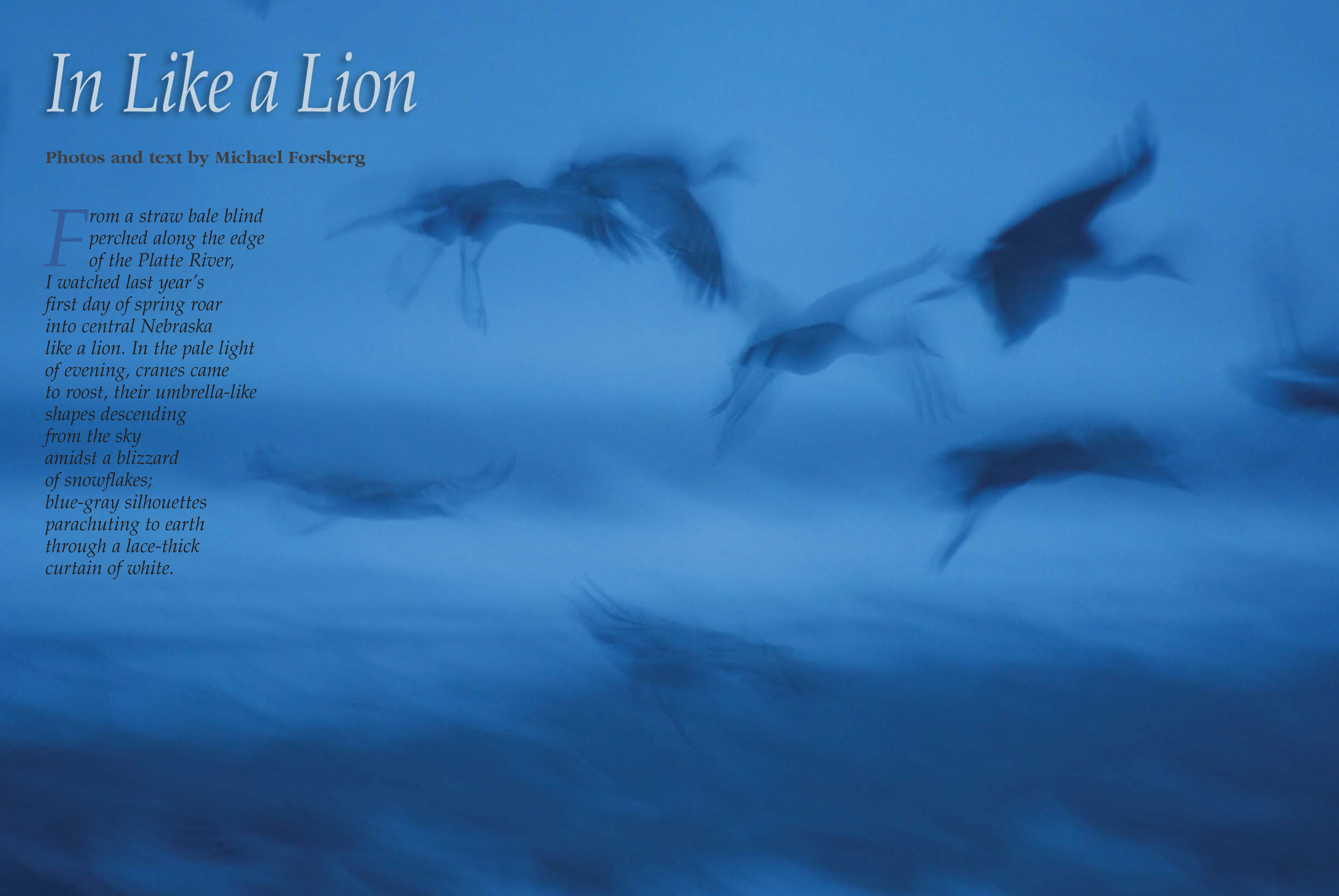
In Like a Lion
From a straw bale blind perched along the edge of the Platte River, I watched last year's first day of spring roar into central Nebraska like a lion. In the pale light of evening, cranes came to roost, their umbrella-like shapes descending from the sky amidst a blizzard of snowflakes; blue-gray silhouettes parachuting to earth through a lace-thick curtain of white.
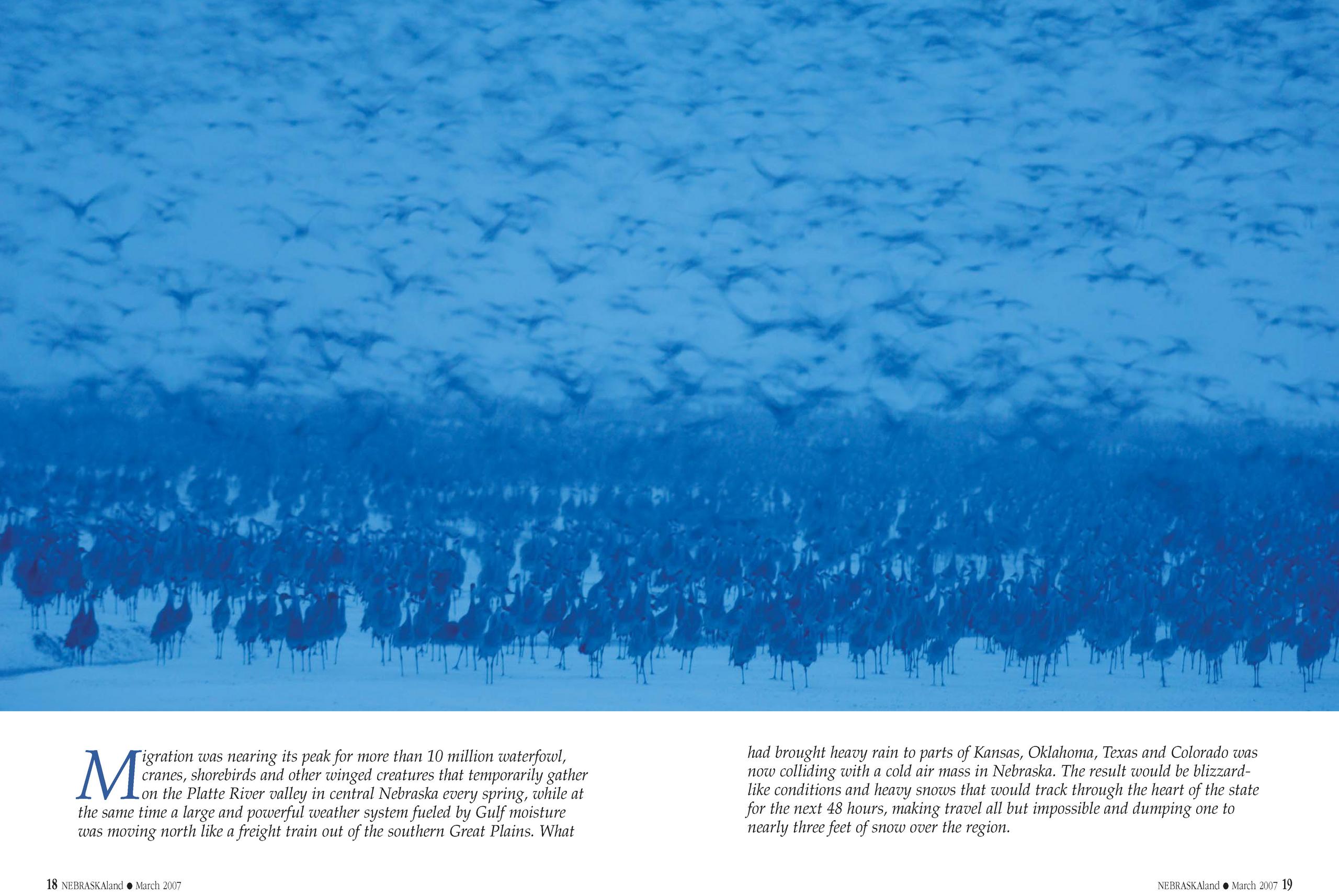
Migration was nearing its peak for more than 10 million waterfowl, cranes, shorebirds and other winged creatures that temporarily gather on the Platte River valley in central Nebraska every spring, while at the same time a large and powerful weather system fueled by Gulf moisture was moving north like a freight train out of the southern Great Plains. What 18 NEBRASKAland March 2007 had brought heavy rain to parts of Kansas, Oklahoma, Texas and Colorado was now colliding with a cold air mass in Nebraska. The result would be blizzardlike conditions and heavy snows that would track through the heart of the state for the next 48 hours, making travel all but impossible and dumping one to nearly three feet of snow over the region.
NEBRASKAland March 2007 19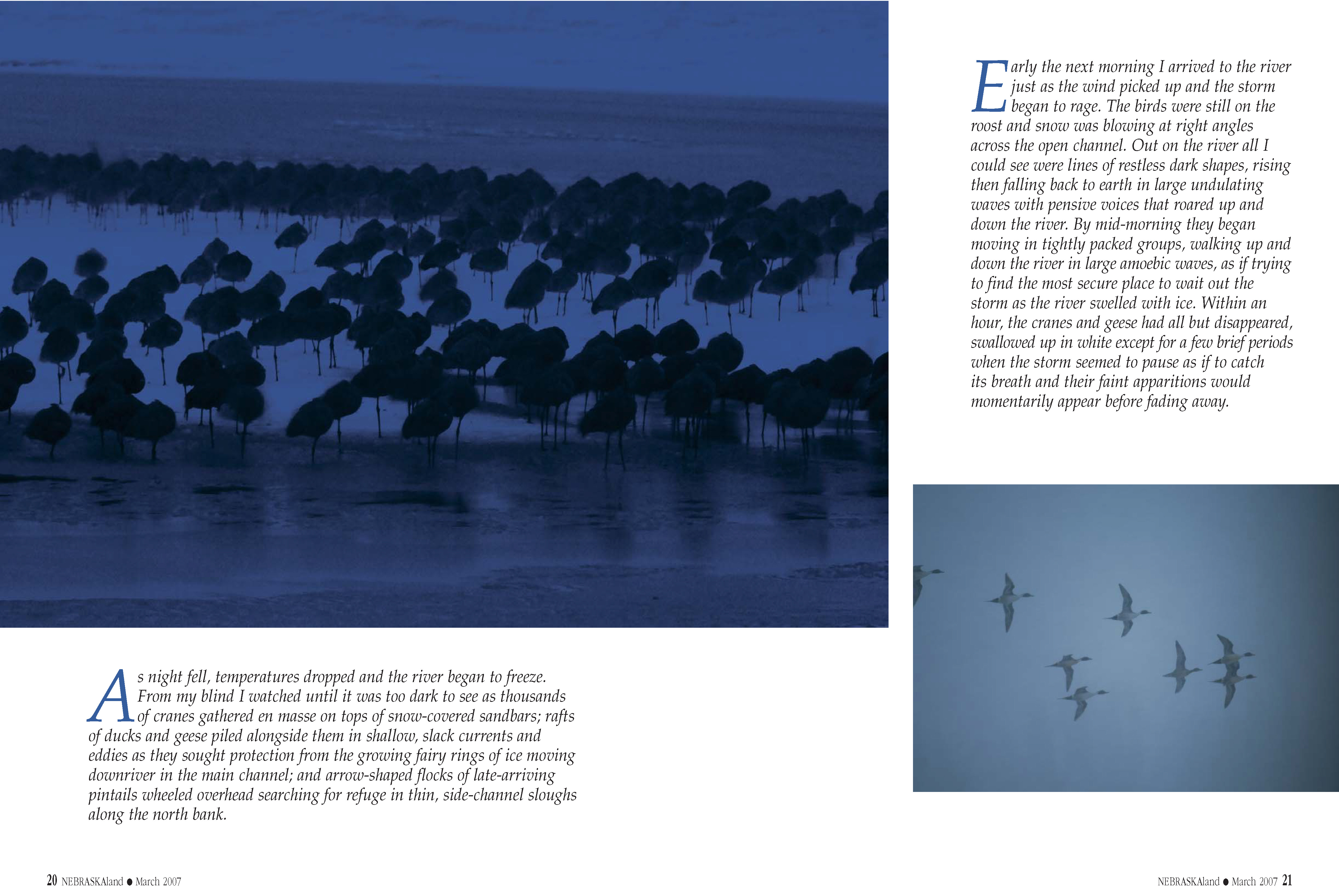
As night fell, temperatures dropped and the river began to freeze. From my blind I watched until it was too dark to see as thousands of cranes gathered en masse on tops of snow-covered sandbars; rafts of ducks and geese piled alongside them in shallow, slack currents and eddies as they sought protection from the growing fairy rings of ice moving downriver in the main channel; and arrow-shaped flocks of late-arriving pintails wheeled overhead searching for refuge in thin, side-channel sloughs along the north bank.
20 NEBRASKAland March 2007Early the next morning I arrived to the river just as the wind picked up and the storm began to rage. The birds were still on the roost and snow was blowing at right angles across the open channel. Out on the river all I could see were lines of restless dark shapes, rising then falling back to earth in large undulating waves with pensive voices that roared up and down the river. By mid-morning they began moving in tightly packed groups, walking up and down the river in large amoebic waves, as if trying to find the most secure place to wait out the storm as the river swelled with ice. Within an hour, the cranes and geese had all but disappeared, swallowed up in white except for a few brief periods when the storm seemed to pause as if to catch its breath and their faint apparitions would momentarily appear before fading away.
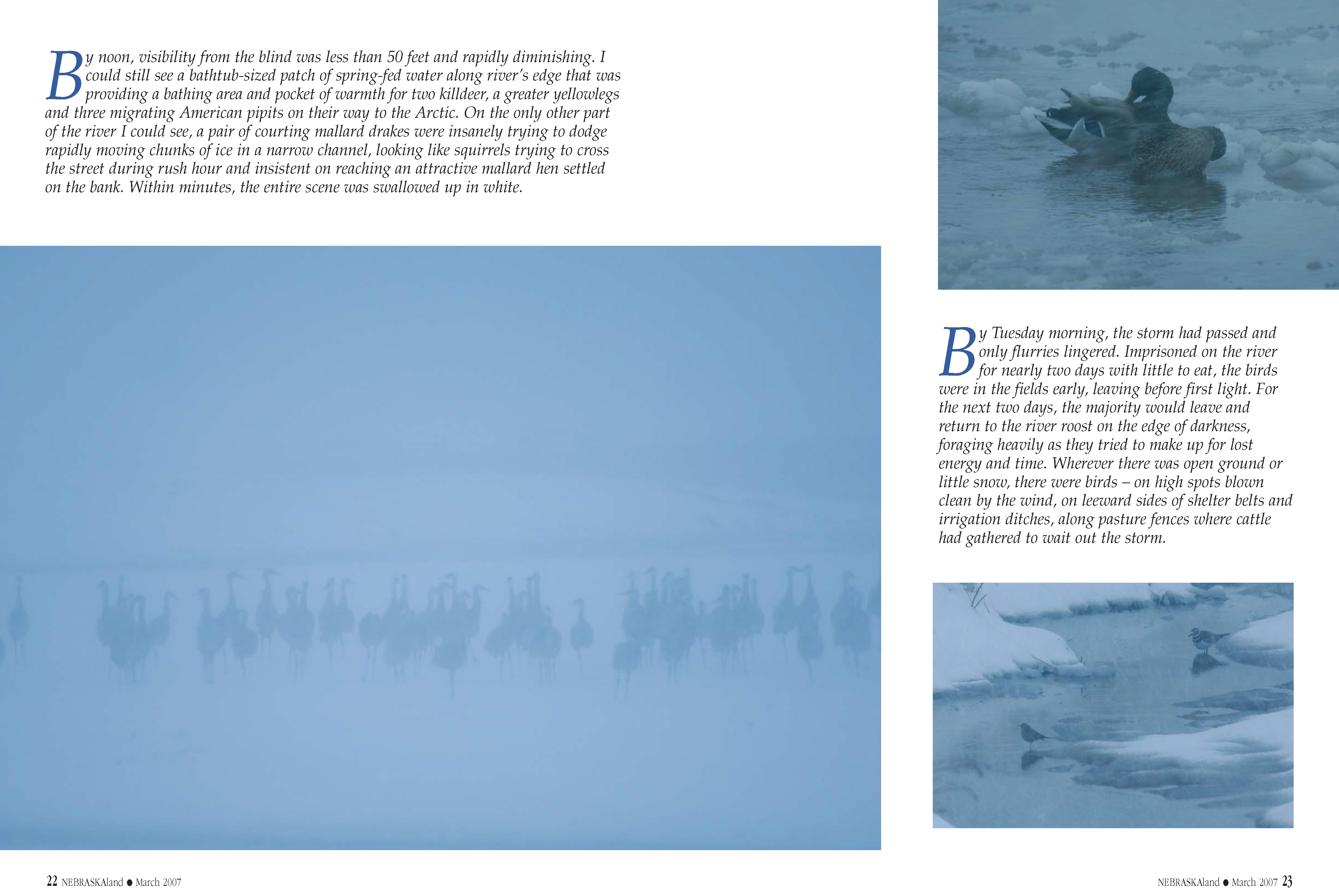
By noon, visibility from the blind was less than 50 feet and rapidly diminishing. I could still see a bathtub-sized patch of spring-fed water along river's edge that was providing a bathing area and pocket of warmth for two killdeer, a greater yellowlegs and three migrating American pipits on their way to the Arctic. On the only other part of the river I could see, a pair of courting mallard drakes were insanely trying to dodge rapidly moving chunks of ice in a narrow channel, looking like squirrels trying to cross the street during rush hour and insistent on reaching an attractive mallard hen settled on the bank. Within minutes, the entire scene was swallowed up in white.
22 NEBRASKAland March 2007By Tuesday morning, the storm had passed and only flurries lingered. Imprisoned on the river for nearly two days with little to eat, the birds were in the fields early, leaving before first light. For the next two days, the majority would leave and return to the river roost on the edge of darkness, foraging heavily as they tried to make up for lost energy and time. Wherever there was open ground or little snow, there were birds – on high spots blown clean by the wind, on leeward sides of shelter belts and irrigation ditches, along pasture fences where cattle had gathered to wait out the storm.
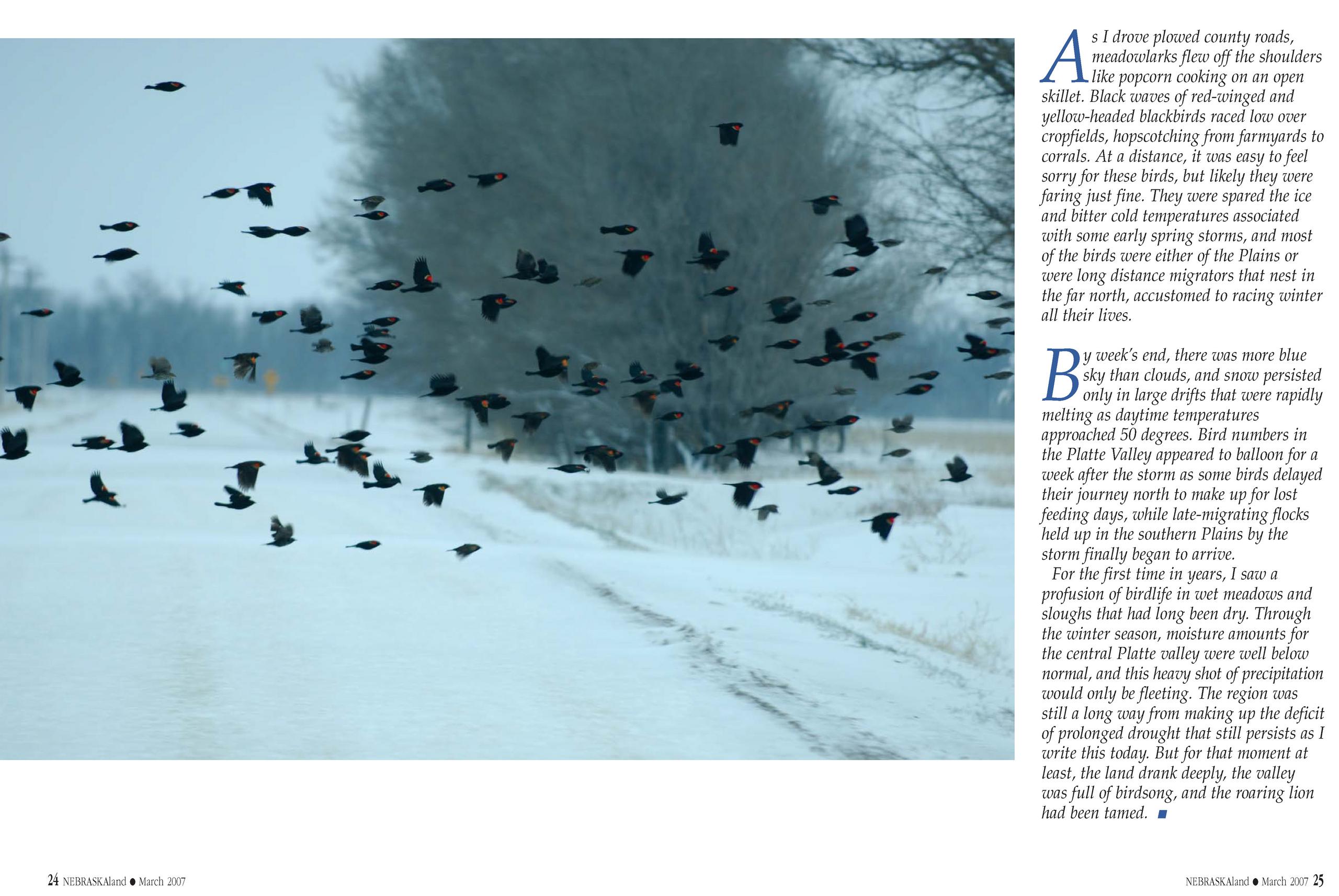
As I drove plowed county roads, meadowlarks flew off the shoulders like popcorn cooking on an open skillet. Black waves of red-winged and yellow-headed blackbirds raced low over cropfields, hopscotching from farmyards to corrals. At a distance, it was easy to feel sorry for these birds, but likely they were faring just fine. They were spared the ice and bitter cold temperatures associated with some early spring storms, and most of the birds were either of the Plains or were long distance migrators that nest in the far north, accustomed to racing winter all their lives.
By week's end, there was more blue sky than clouds, and snow persisted only in large drifts that were rapidly melting as daytime temperatures approached 50 degrees. Bird numbers in the Platte Valley appeared to balloon for a week after the storm as some birds delayed their journey north to make up for lost feeding days, while late-migrating flocks held up in the southern Plains by the storm finally began to arrive. For the first time in years, I saw a profusion of birdlife in wet meadows and sloughs that had long been dry. Through the winter season, moisture amounts for the central Platte valley were well below normal, and this heavy shot of precipitation would only be fleeting. The region was still a long way from making up the deficit of prolonged drought that still persists as I write this today. But for that moment at least, the land drank deeply, the valley was full of birdsong, and the roaring lion had been tamed.
Cabin Fever?
The Cure for March Madness
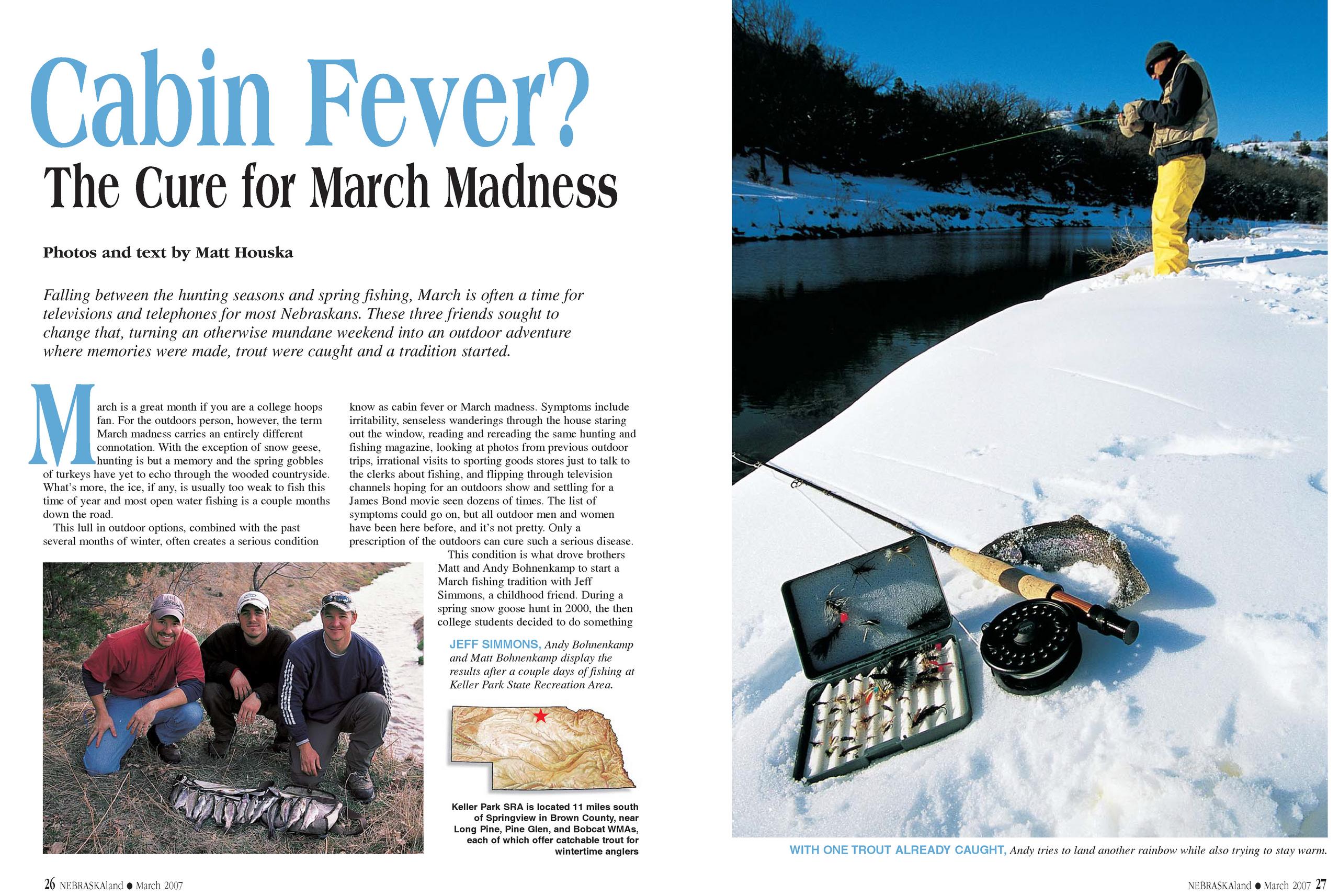
Falling between the hunting seasons and spring fishing, March is often a time for televisions and telephones for most Nebraskans. These three friends sought to change that, turning an otherwise mundane weekend into an outdoor adventure where memories were made, trout were caught and a tradition started.March is a great month if you are a college hoops fan. For the outdoors person, however, the term March madness carries an entirely different connotation. With the exception of snow geese, hunting is but a memory and the spring gobbles of turkeys have yet to echo through the wooded countryside. What's more, the ice, if any, is usually too weak to fish this time of year and most open water fishing is a couple months down the road.
This lull in outdoor options, combined with the past several months of winter, often creates a serious condition know as cabin fever or March madness. Symptoms include irritability, senseless wanderings through the house staring out the window, reading and rereading the same hunting and fishing magazine, looking at photos from previous outdoor trips, irrational visits to sporting goods stores just to talk to the clerks about fishing, and flipping through television channels hoping for an outdoors show and settling for a James Bond movie seen dozens of times. The list of symptoms could go on, but all outdoor men and women have been here before, and it's not pretty. Only a prescription of the outdoors can cure such a serious disease
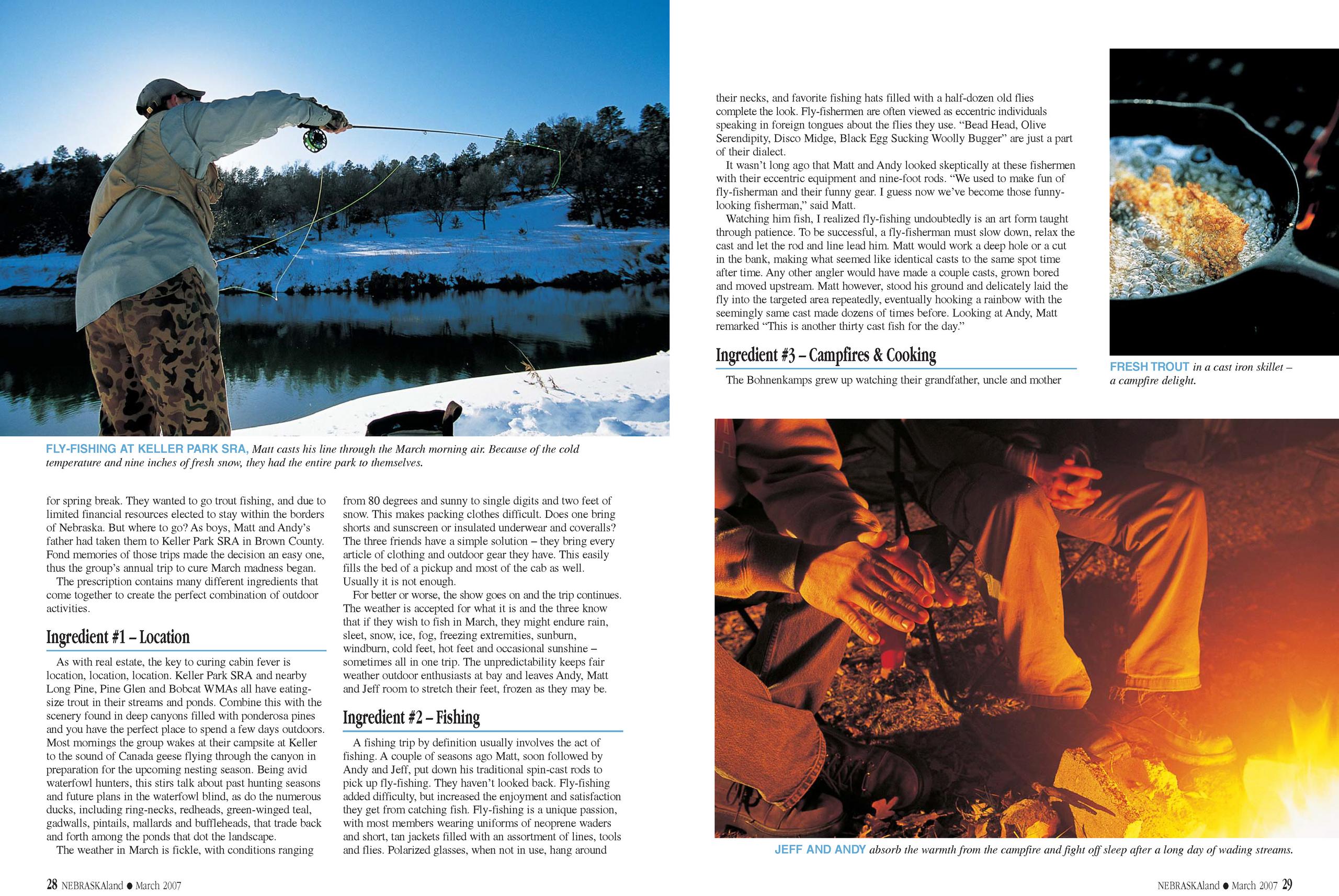
This condition is what drove brothers Matt and Andy Bohnenkamp to start a March fishing tradition with Jeff Simmons, a childhood friend. During a spring snow goose hunt in 2000, the then college students decided to do something
The prescription contains many different ingredients that come together to create the perfect combination of outdoor activities.
Ingredient #1 – LocationAs with real estate, the key to curing cabin fever is location, location, location. Keller Park SRA and nearby Long Pine, Pine Glen and Bobcat WMAs all have eatingsize trout in their streams and ponds. Combine this with the scenery found in deep canyons filled with ponderosa pines and you have the perfect place to spend a few days outdoors. Most mornings the group wakes at their campsite at Keller to the sound of Canada geese flying through the canyon in preparation for the upcoming nesting season. Being avid waterfowl hunters, this stirs talk about past hunting seasons and future plans in the waterfowl blind, as do the numerous ducks, including ring-necks, redheads, green-winged teal, gadwalls, pintails, mallards and buffleheads, that trade back and forth among the ponds that dot the landscape.
The weather in March is fickle, with conditions ranging from 80 degrees and sunny to single digits and two feet of snow. This makes packing clothes difficult. Does one bring shorts and sunscreen or insulated underwear and coveralls? The three friends have a simple solution – they bring every article of clothing and outdoor gear they have. This easily fills the bed of a pickup and most of the cab as well. Usually it is not enough.
For better or worse, the show goes on and the trip continues. The weather is accepted for what it is and the three know that if they wish to fish in March, they might endure rain, sleet, snow, ice, fog, freezing extremities, sunburn, windburn, cold feet, hot feet and occasional sunshine – sometimes all in one trip. The unpredictability keeps fair weather outdoor enthusiasts at bay and leaves Andy, Matt and Jeff room to stretch their feet, frozen as they may be.
Ingredient #2 – FishingA fishing trip by definition usually involves the act of fishing. A couple of seasons ago Matt, soon followed by Andy and Jeff, put down his traditional spin-cast rods to pick up fly-fishing. They haven't looked back. Fly-fishing added difficulty, but increased the enjoyment and satisfaction they get from catching fish. Fly-fishing is a unique passion, with most members wearing uniforms of neoprene waders and short, tan jackets filled with an assortment of lines, tools and flies. Polarized glasses, when not in use, hang around 28 NEBRASKAland March 2007 their necks, and favorite fishing hats filled with a half-dozen old flies complete the look. Fly-fishermen are often viewed as eccentric individuals speaking in foreign tongues about the flies they use. "Bead Head, Olive Serendipity, Disco Midge, Black Egg Sucking Woolly Bugger" are just a part of their dialect.
It wasn't long ago that Matt and Andy looked skeptically at these fishermen with their eccentric equipment and nine-foot rods. "We used to make fun of fly-fisherman and their funny gear. I guess now we've become those funnylooking fisherman," said Matt.
Watching him fish, I realized fly-fishing undoubtedly is an art form taught through patience. To be successful, a fly-fisherman must slow down, relax the cast and let the rod and line lead him. Matt would work a deep hole or a cut in the bank, making what seemed like identical casts to the same spot time after time. Any other angler would have made a couple casts, grown bored and moved upstream. Matt however, stood his ground and delicately laid the fly into the targeted area repeatedly, eventually hooking a rainbow with the seemingly same cast made dozens of times before. Looking at Andy, Matt remarked "This is another thirty cast fish for the day."
Ingredient #3 – Campfires & CookingThe Bohnenkamps grew up watching their grandfather, uncle and mother
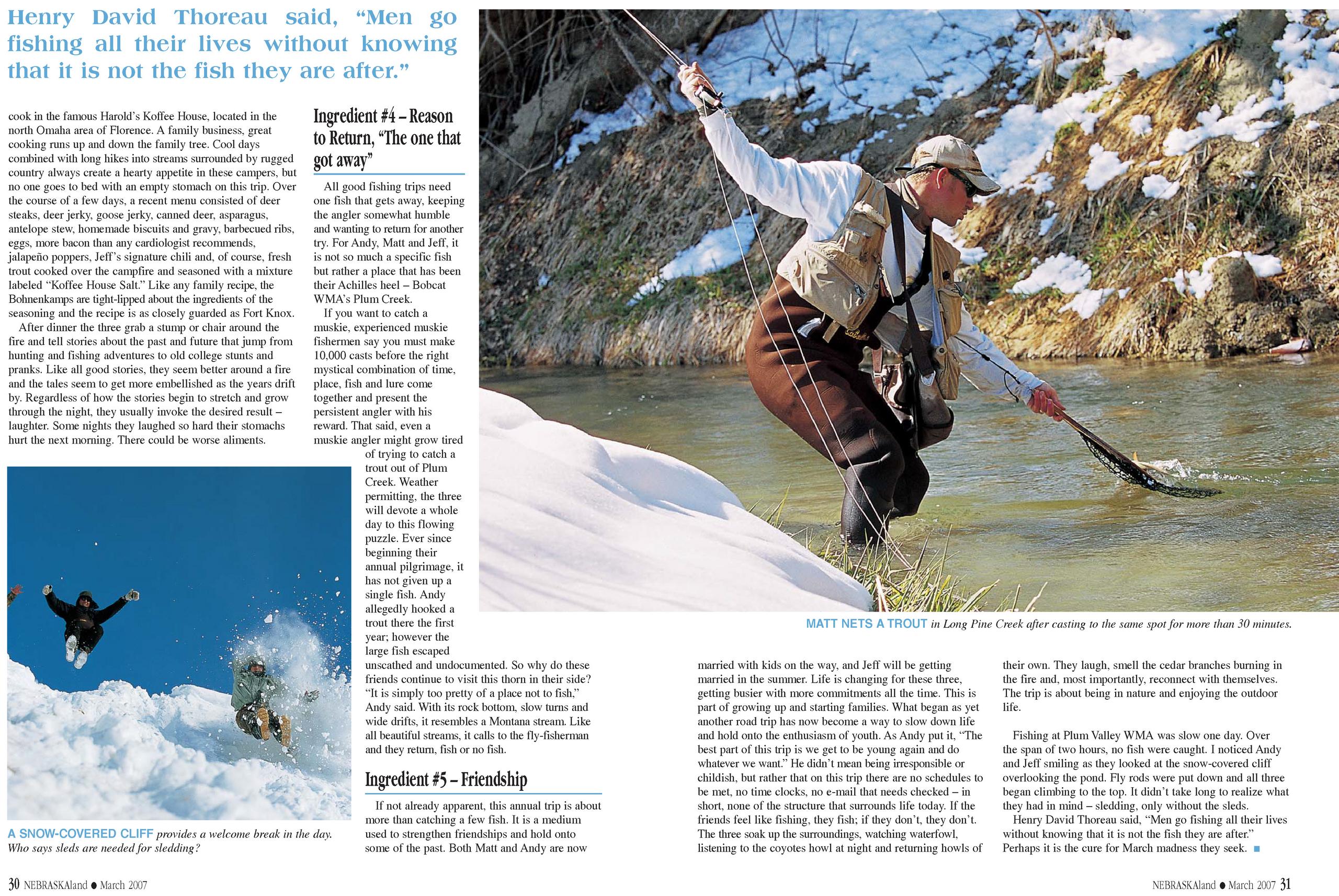
cook in the famous Harold's Koffee House, located in the north Omaha area of Florence. A family business, great cooking runs up and down the family tree. Cool days combined with long hikes into streams surrounded by rugged country always create a hearty appetite in these campers, but no one goes to bed with an empty stomach on this trip. Over the course of a few days, a recent menu consisted of deer steaks, deer jerky, goose jerky, canned deer, asparagus, antelope stew, homemade biscuits and gravy, barbecued ribs, eggs, more bacon than any cardiologist recommends, jalapeño poppers, Jeff's signature chili and, of course, fresh trout cooked over the campfire and seasoned with a mixture labeled "Koffee House Salt." Like any family recipe, the Bohnenkamps are tight-lipped about the ingredients of the seasoning and the recipe is as closely guarded as Fort Knox.Henry David Thoreau said, "Men go fishing all their lives without knowing that it is not the fish they are after."
After dinner the three grab a stump or chair around the fire and tell stories about the past and future that jump from hunting and fishing adventures to old college stunts and pranks. Like all good stories, they seem better around a fire and the tales seem to get more embellished as the years drift by. Regardless of how the stories begin to stretch and grow through the night, they usually invoke the desired result – laughter. Some nights they laughed so hard their stomachs hurt the next morning. There could be worse aliments.
All good fishing trips need one fish that gets away, keeping the angler somewhat humble and wanting to return for another try. For Andy, Matt and Jeff, it is not so much a specific fish but rather a place that has been their Achilles heel – Bobcat WMA's Plum Creek.
If you want to catch a muskie, experienced muskie fishermen say you must make 10,000 casts before the right mystical combination of time, place, fish and lure come together and present the persistent angler with his reward. That said, even a muskie angler might grow tired of trying to catch a trout out of Plum Creek. Weather permitting, the three will devote a whole day to this flowing puzzle. Ever since beginning their annual pilgrimage, it has not given up a single fish. Andy allegedly hooked a trout there the first year; however the large fish escaped unscathed and undocumented. So why do these friends continue to visit this thorn in their side? "It is simply too pretty of a place not to fish," Andy said. With its rock bottom, slow turns and wide drifts, it resembles a Montana stream. Like all beautiful streams, it calls to the fly-fisherman and they return, fish or no fish.
Ingredient #5 – FriendshipIf not already apparent, this annual trip is about more than catching a few fish. It is a medium used to strengthen friendships and hold onto some of the past. Both Matt and Andy are now 30 NEBRASKAland March 2007
Fishing at Plum Valley WMA was slow one day. Over the span of two hours, no fish were caught. I noticed Andy and Jeff smiling as they looked at the snow-covered cliff overlooking the pond. Fly rods were put down and all three began climbing to the top. It didn't take long to realize what they had in mind – sledding, only without the sleds. Henry David Thoreau said, "Men go fishing all their lives without knowing that it is not the fish they are after." Perhaps it is the cure for March madness they seek.
Tapped Out?
Drought, dry rivers and legal battles have heightened awareness of falling groundwater levels in Nebraska and will soon force changes in the way the state uses the resource.Water.
Until recently, that subject raised few eyebrows outside agricultural and environmental circles. "As long as water comes out of my faucet when I turn on the tap, why should I worry about it?" most Nebraskans would say.
Funny what eight years of drought, dry rivers, mostly empty reservoirs, a few lawsuits and seeing the multimillion dollar price tag for fixing the problems in the Platte and Republican river basins will do
it runs much deeper, as deep as the thousands of irrigation wells that tap the massive High Plains Aquifer underlying most of Nebraska and parts of five others states. That aquifer contributes to the flow of most of our state's rivers and streams. As its levels have dropped, so have the rivers.
Agreements with Kansas regarding the Republican River and with the U.S. Fish and Wildlife Service (USFWS), Colorado and Wyoming on the Platte mean restoring flows in these rivers is now a requirement. In both cases, cuts in groundwater use will be required. Some say the effects on the state's multibillion dollar agricultural industry will be crippling. Yet others, especially those with an interest in fish, wildlife and recreation resources, say there is hope, and studies have shown that using the state's natural resources for something other than commodity production could pay off in the long run.
The issue of water is a deep one, one that couldn't be covered completely in
While they have glaring differences, the Platte and Republican rivers have much in common. The North and South Platte rivers are fed by Rocky Mountain snowmelt and overland runoff from the plains of Colorado, Wyoming and Nebraska. They join near North Platte to form the Platte River, which flows lazily across the state before dumping into the Missouri 32 NEBRASKAland March 2007 River near Plattsmouth.
The source of the Republican River is runoff from rain and snowmelt on the plains of Colorado, Kansas and Nebraska. The river crosses the southern tier of Nebraska before flowing into Kansas near Superior.
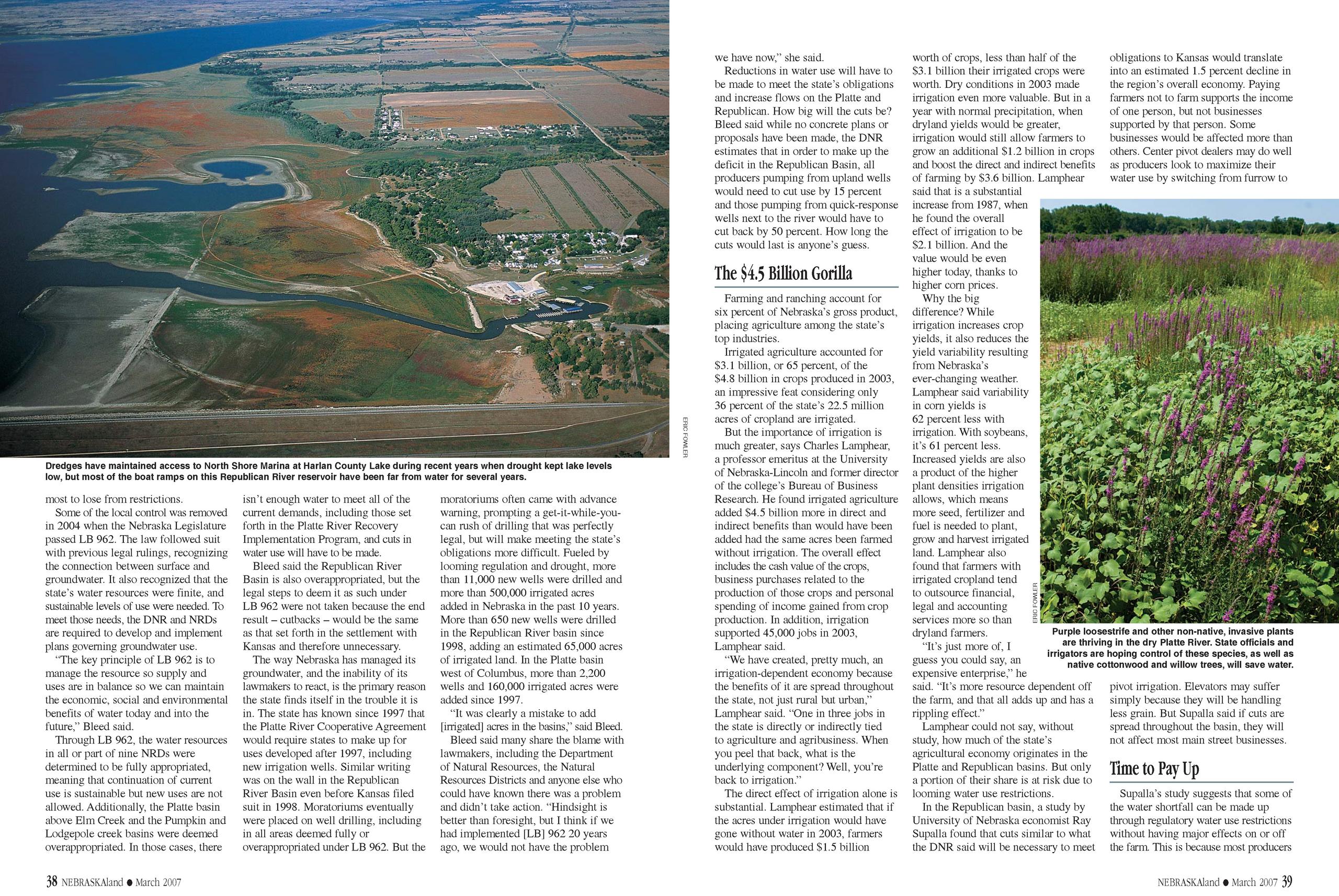
Both the Platte and Republican rivers are highly developed. There are six large reservoirs on the North Platte River – Lake McConaughy near Ogallala and five more in Wyoming. The South Platte reservoirs are not as large, but there are more than 20 of them. The Republican River Basin has nine large reservoirs, including Enders, Swanson, Red Willow, Medicine Creek and Harlan County in Nebraska. Water stored in these reservoirs is diverted through canal systems to irrigate more than 600,000 acres of farmland in Nebraska alone, and even more in the other three states.
The Platte and Republican rivers pick up additional flow from surface runoff as they cross Nebraska, but they also gain a considerable amount of flow from groundwater, both from spring-fed streams that empty into them and from where their beds cut into the High Plains Aquifer, a 3-billion acre-foot underground reservoir. Approximately 60 percent of the Platte's flow at its mouth is contributed by groundwater, thanks in large part to the groundwaterfed Loup River system, which rises in the Sandhills and empties into the Platte near Columbus. About 20 percent of the Republican's flows in Nebraska are from groundwater. All told, five times more water flows out of Nebraska than flows in. "We are a water machine," said James Goeke, a University of Nebraska-Lincoln hydrogeologist.
Nebraskans have tapped into the
seemingly endless supply of
groundwater almost at will. The first
recorded well was drilled in 1895, and
development took off in the late-1940s.
The number of wells more than tripled
in the 1950s, but most of the 24,000
NEBRASKAland March 2007 33
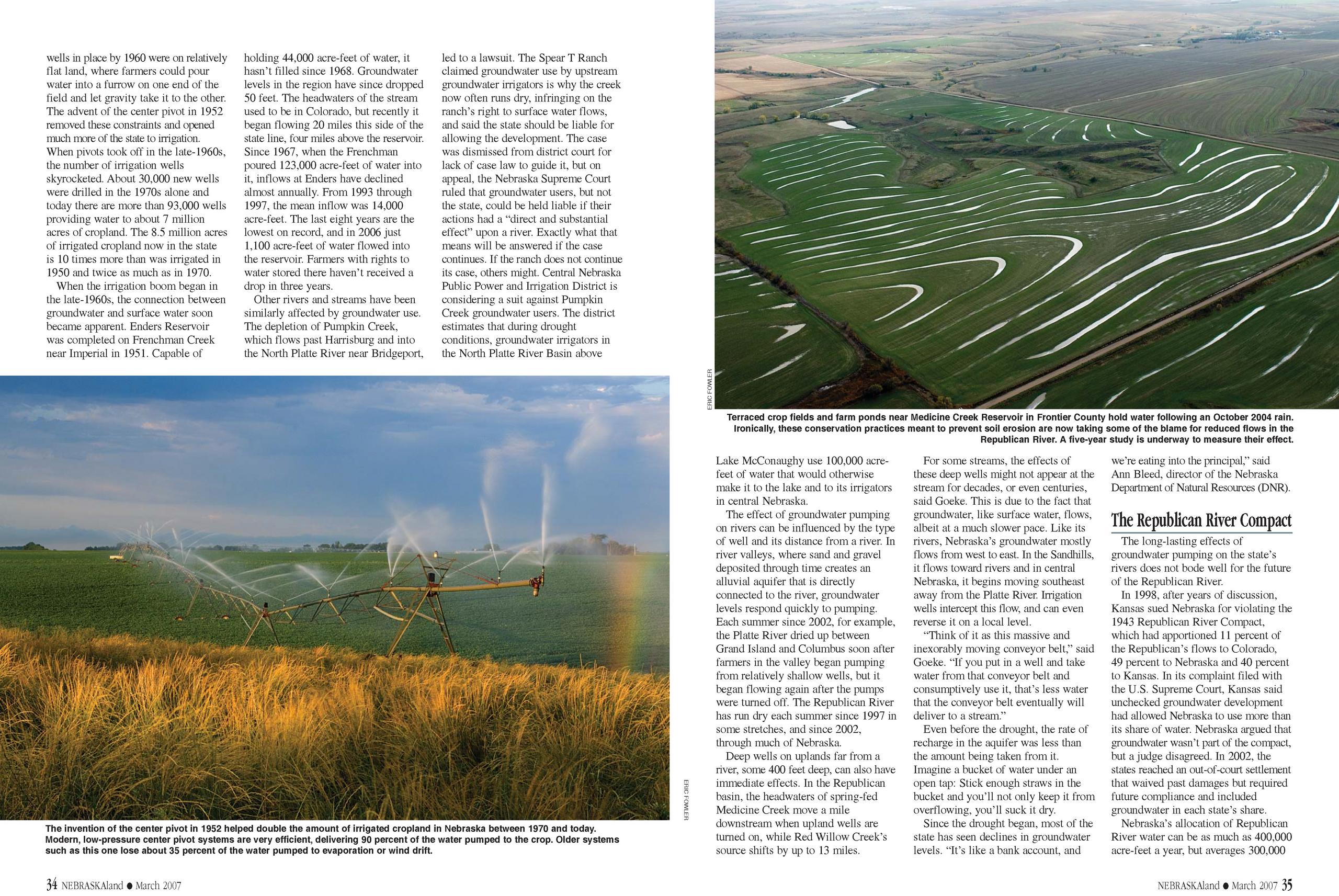 wells in place by 1960 were on relatively
flat land, where farmers could pour
water into a furrow on one end of the
field and let gravity take it to the other.
The advent of the center pivot in 1952
removed these constraints and opened
much more of the state to irrigation.
When pivots took off in the late-1960s,
the number of irrigation wells
skyrocketed. About 30,000 new wells
were drilled in the 1970s alone and
today there are more than 93,000 wells
providing water to about 7 million
acres of cropland. The 8.5 million acres
of irrigated cropland now in the state
is 10 times more than was irrigated in
1950 and twice as much as in 1970.
wells in place by 1960 were on relatively
flat land, where farmers could pour
water into a furrow on one end of the
field and let gravity take it to the other.
The advent of the center pivot in 1952
removed these constraints and opened
much more of the state to irrigation.
When pivots took off in the late-1960s,
the number of irrigation wells
skyrocketed. About 30,000 new wells
were drilled in the 1970s alone and
today there are more than 93,000 wells
providing water to about 7 million
acres of cropland. The 8.5 million acres
of irrigated cropland now in the state
is 10 times more than was irrigated in
1950 and twice as much as in 1970.
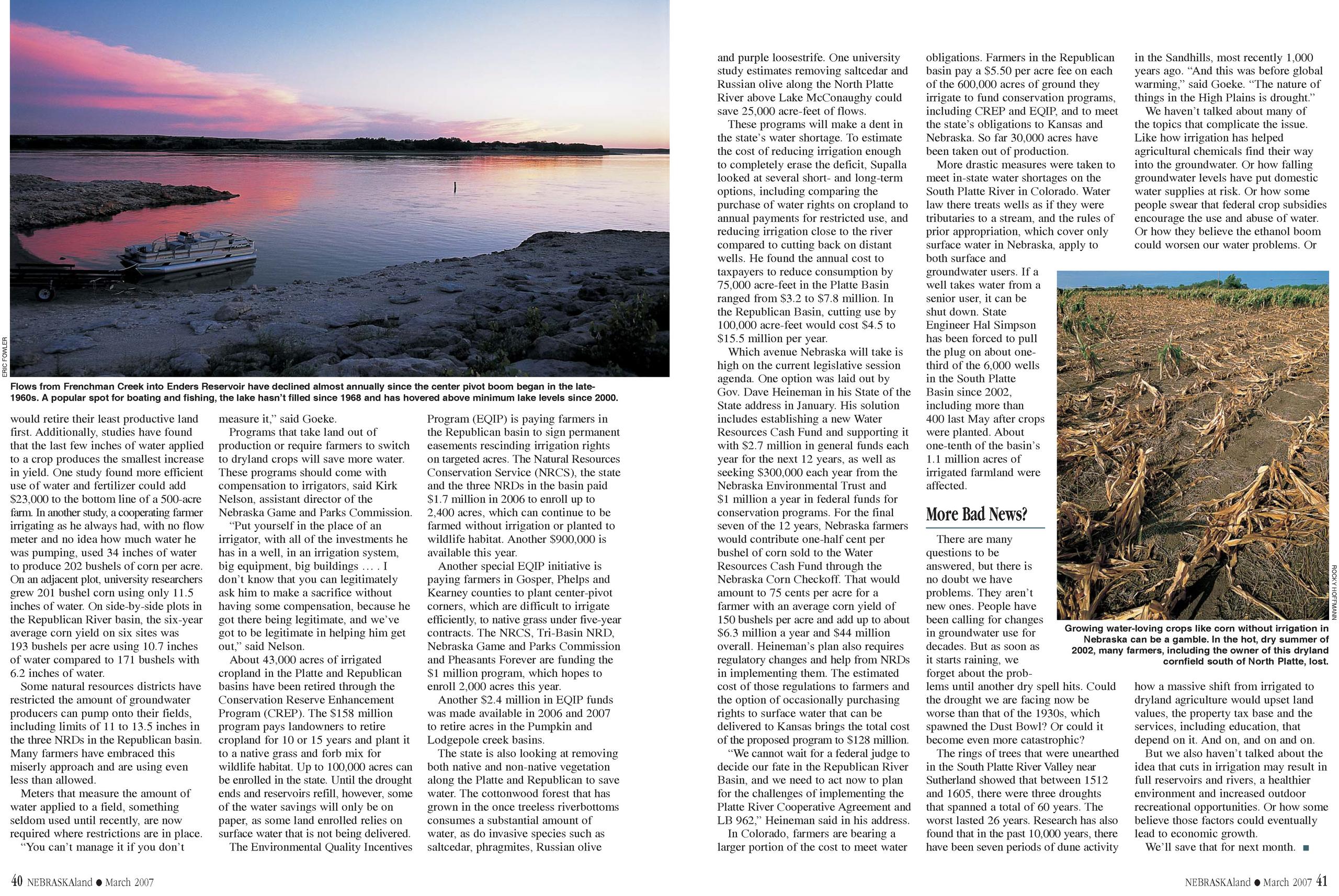
When the irrigation boom began in the late-1960s, the connection between groundwater and surface water soon became apparent. Enders Reservoir was completed on Frenchman Creek near Imperial in 1951. Capable of holding 44,000 acre-feet of water, it hasn't filled since 1968. Groundwater levels in the region have since dropped 50 feet. The headwaters of the stream used to be in Colorado, but recently it began flowing 20 miles this side of the state line, four miles above the reservoir. Since 1967, when the Frenchman poured 123,000 acre-feet of water into it, inflows at Enders have declined almost annually. From 1993 through 1997, the mean inflow was 14,000 acre-feet. The last eight years are the lowest on record, and in 2006 just 1,100 acre-feet of water flowed into the reservoir. Farmers with rights to water stored there haven't received a drop in three years.
Other rivers and streams have been similarly affected by groundwater use. The depletion of Pumpkin Creek, which flows past Harrisburg and into the North Platte River near Bridgeport, led to a lawsuit. The Spear T Ranch claimed groundwater use by upstream groundwater irrigators is why the creek now often runs dry, infringing on the ranch's right to surface water flows, and said the state should be liable for allowing the development. The case was dismissed from district court for lack of case law to guide it, but on appeal, the Nebraska Supreme Court ruled that groundwater users, but not the state, could be held liable if their actions had a "direct and substantial effect" upon a river. Exactly what that means will be answered if the case continues. If the ranch does not continue its case, others might. Central Nebraska Public Power and Irrigation District is considering a suit against Pumpkin Creek groundwater users. The district estimates that during drought conditions, groundwater irrigators in the North Platte River Basin above
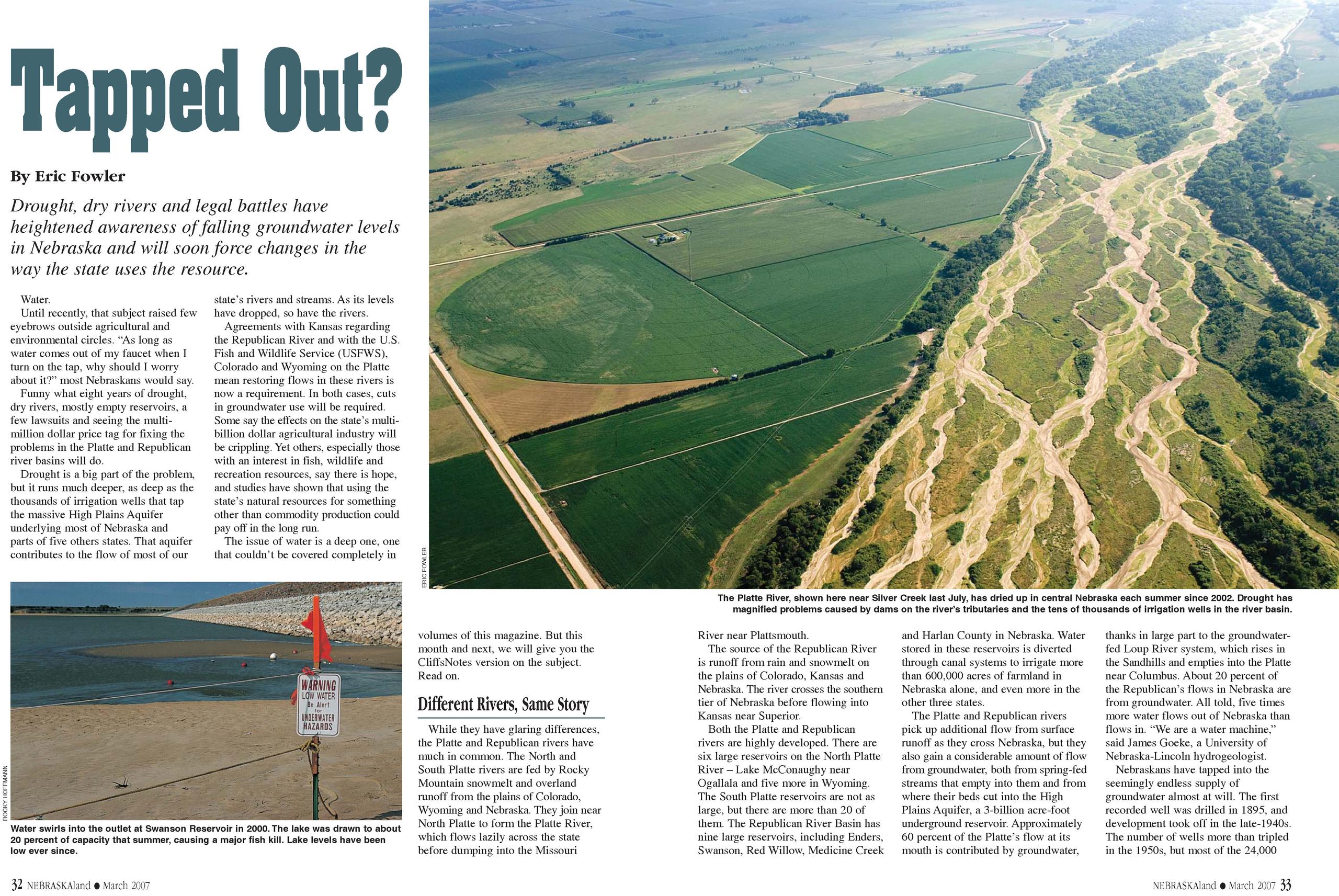
The effect of groundwater pumping on rivers can be influenced by the type of well and its distance from a river. In river valleys, where sand and gravel deposited through time creates an alluvial aquifer that is directly connected to the river, groundwater levels respond quickly to pumping. Each summer since 2002, for example, the Platte River dried up between Grand Island and Columbus soon after farmers in the valley began pumping from relatively shallow wells, but it began flowing again after the pumps were turned off. The Republican River has run dry each summer since 1997 in some stretches, and since 2002, through much of Nebraska.
Deep wells on uplands far from a river, some 400 feet deep, can also have immediate effects. In the Republican basin, the headwaters of spring-fed Medicine Creek move a mile downstream when upland wells are turned on, while Red Willow Creek's source shifts by up to 13 miles.
For some streams, the effects of these deep wells might not appear at the stream for decades, or even centuries, said Goeke. This is due to the fact that groundwater, like surface water, flows, albeit at a much slower pace. Like its rivers, Nebraska's groundwater mostly flows from west to east. In the Sandhills, it flows toward rivers and in central Nebraska, it begins moving southeast away from the Platte River. Irrigation wells intercept this flow, and can even reverse it on a local level.
"Think of it as this massive and inexorably moving conveyor belt," said Goeke. "If you put in a well and take water from that conveyor belt and consumptively use it, that's less water that the conveyor belt eventually will deliver to a stream."
Even before the drought, the rate of recharge in the aquifer was less than the amount being taken from it. Imagine a bucket of water under an open tap: Stick enough straws in the bucket and you'll not only keep it from overflowing, you'll suck it dry.
Since the drought began, most of the state has seen declines in groundwater levels. "It's like a bank account, and we're eating into the principal," said Ann Bleed, director of the Nebraska Department of Natural Resources (DNR).
The long-lasting effects of groundwater pumping on the state's rivers does not bode well for the future of the Republican River.
In 1998, after years of discussion, Kansas sued Nebraska for violating the 1943 Republican River Compact, which had apportioned 11 percent of the Republican's flows to Colorado, 49 percent to Nebraska and 40 percent to Kansas. In its complaint filed with the U.S. Supreme Court, Kansas said unchecked groundwater development had allowed Nebraska to use more than its share of water. Nebraska argued that groundwater wasn't part of the compact, but a judge disagreed. In 2002, the states reached an out-of-court settlement that waived past damages but required future compliance and included groundwater in each state's share.
Nebraska's allocation of Republican
River water can be as much as 400,000
acre-feet a year, but averages 300,000
NEBRASKAland March 2007 35
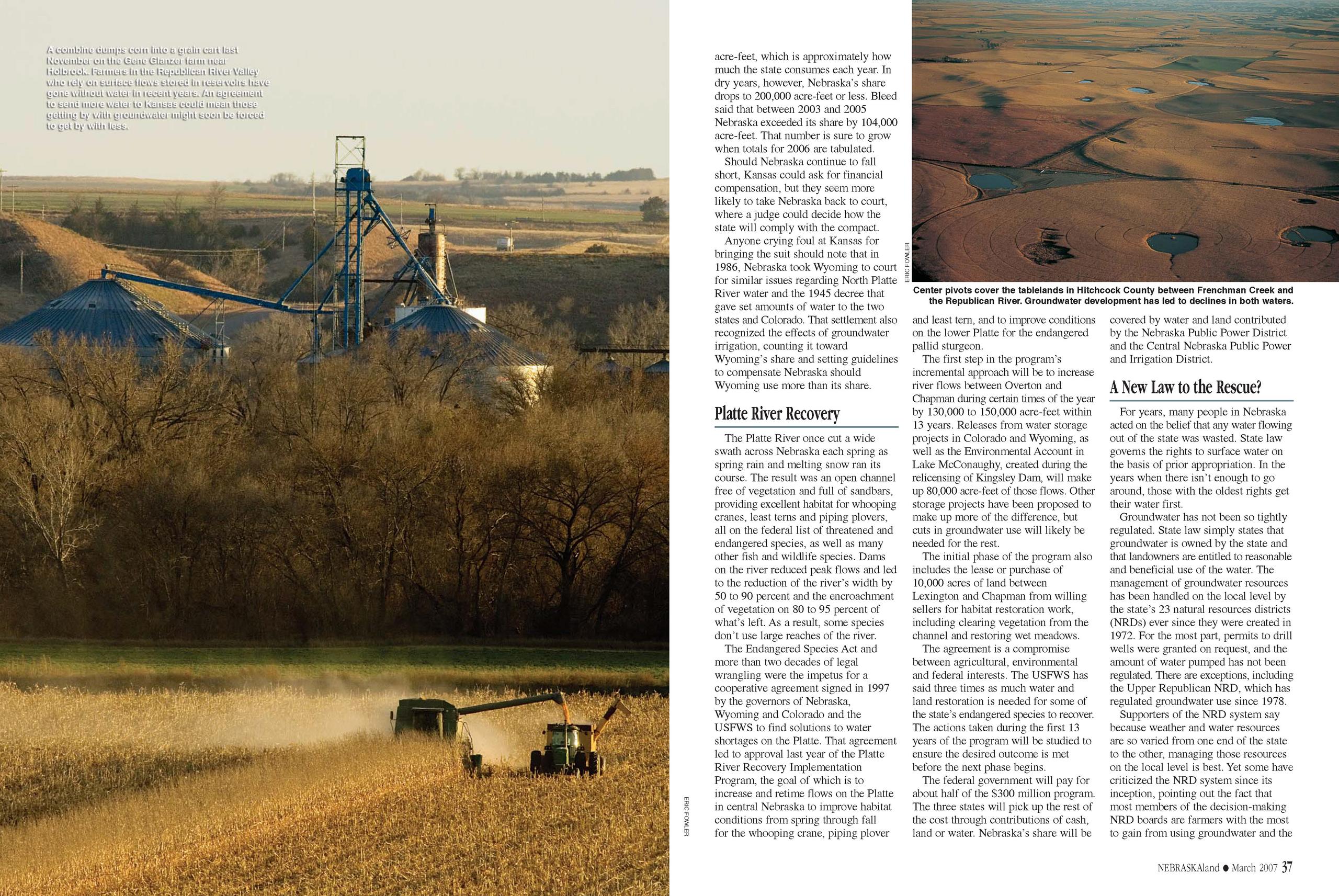
Should Nebraska continue to fall short, Kansas could ask for financial compensation, but they seem more likely to take Nebraska back to court, where a judge could decide how the state will comply with the compact.
Anyone crying foul at Kansas for bringing the suit should note that in 1986, Nebraska took Wyoming to court for similar issues regarding North Platte River water and the 1945 decree that gave set amounts of water to the two states and Colorado. That settlement also recognized the effects of groundwater irrigation, counting it toward Wyoming's share and setting guidelines to compensate Nebraska should Wyoming use more than its share.
Platte River RecoveryThe Platte River once cut a wide swath across Nebraska each spring as spring rain and melting snow ran its course. The result was an open channel free of vegetation and full of sandbars, providing excellent habitat for whooping cranes, least terns and piping plovers, all on the federal list of threatened and endangered species, as well as many other fish and wildlife species. Dams on the river reduced peak flows and led to the reduction of the river's width by 50 to 90 percent and the encroachment of vegetation on 80 to 95 percent of what's left. As a result, some species don't use large reaches of the river.
The Endangered Species Act and more than two decades of legal wrangling were the impetus for a cooperative agreement signed in 1997 by the governors of Nebraska, Wyoming and Colorado and the USFWS to find solutions to water shortages on the Platte. That agreement led to approval last year of the Platte River Recovery Implementation Program, the goal of which is to increase and retime flows on the Platte in central Nebraska to improve habitat conditions from spring through fall for the whooping crane, piping plover
The first step in the program's incremental approach will be to increase river flows between Overton and Chapman during certain times of the year by 130,000 to 150,000 acre-feet within 13 years. Releases from water storage projects in Colorado and Wyoming, as well as the Environmental Account in Lake McConaughy, created during the relicensing of Kingsley Dam, will make up 80,000 acre-feet of those flows. Other storage projects have been proposed to make up more of the difference, but cuts in groundwater use will likely be needed for the rest.
The initial phase of the program also includes the lease or purchase of 10,000 acres of land between Lexington and Chapman from willing sellers for habitat restoration work, including clearing vegetation from the channel and restoring wet meadows.
The agreement is a compromise between agricultural, environmental and federal interests. The USFWS has said three times as much water and land restoration is needed for some of the state's endangered species to recover. The actions taken during the first 13 years of the program will be studied to ensure the desired outcome is met before the next phase begins.
The federal government will pay for about half of the $300 million program. The three states will pick up the rest of the cost through contributions of cash, land or water. Nebraska's share will be covered by water and land contributed by the Nebraska Public Power District and the Central Nebraska Public Power and Irrigation District.
A New Law to the Rescue?For years, many people in Nebraska acted on the belief that any water flowing out of the state was wasted. State law governs the rights to surface water on the basis of prior appropriation. In the years when there isn't enough to go around, those with the oldest rights get their water first.
Groundwater has not been so tightly regulated. State law simply states that groundwater is owned by the state and that landowners are entitled to reasonable and beneficial use of the water. The management of groundwater resources has been handled on the local level by the state's 23 natural resources districts (NRDs) ever since they were created in 1972. For the most part, permits to drill wells were granted on request, and the amount of water pumped has not been regulated. There are exceptions, including the Upper Republican NRD, which has regulated groundwater use since 1978.
Supporters of the NRD system say
because weather and water resources
are so varied from one end of the state
to the other, managing those resources
on the local level is best. Yet some have
criticized the NRD system since its
inception, pointing out the fact that
most members of the decision-making
NRD boards are farmers with the most
to gain from using groundwater and the
NEBRASKAland March 2007 37
Some of the local control was removed in 2004 when the Nebraska Legislature passed LB 962. The law followed suit with previous legal rulings, recognizing the connection between surface and groundwater. It also recognized that the state's water resources were finite, and sustainable levels of use were needed. To meet those needs, the DNR and NRDs are required to develop and implement plans governing groundwater use.
"The key principle of LB 962 is to manage the resource so supply and uses are in balance so we can maintain the economic, social and environmental benefits of water today and into the future," Bleed said.
Through LB 962, the water resources in all or part of nine NRDs were determined to be fully appropriated, meaning that continuation of current use is sustainable but new uses are not allowed. Additionally, the Platte basin above Elm Creek and the Pumpkin and Lodgepole creek basins were deemed overappropriated. In those cases, there isn't enough water to meet all of the current demands, including those set forth in the Platte River Recovery Implementation Program, and cuts in water use will have to be made.
Bleed said the Republican River Basin is also overappropriated, but the legal steps to deem it as such under LB 962 were not taken because the end result – cutbacks – would be the same as that set forth in the settlement with Kansas and therefore unnecessary.
The way Nebraska has managed its groundwater, and the inability of its lawmakers to react, is the primary reason the state finds itself in the trouble it is in. The state has known since 1997 that the Platte River Cooperative Agreement would require states to make up for uses developed after 1997, including new irrigation wells. Similar writing was on the wall in the Republican River Basin even before Kansas filed suit in 1998. Moratoriums eventually were placed on well drilling, including in all areas deemed fully or overappropriated under LB 962. But the moratoriums often came with advance warning, prompting a get-it-while-youcan rush of drilling that was perfectly legal, but will make meeting the state's obligations more difficult. Fueled by looming regulation and drought, more than 11,000 new wells were drilled and more than 500,000 irrigated acres added in Nebraska in the past 10 years. More than 650 new wells were drilled in the Republican River basin since 1998, adding an estimated 65,000 acres of irrigated land. In the Platte basin west of Columbus, more than 2,200 wells and 160,000 irrigated acres were added since 1997.
"It was clearly a mistake to add [irrigated] acres in the basins," said Bleed.
Bleed said many share the blame with lawmakers, including the Department of Natural Resources, the Natural Resources Districts and anyone else who could have known there was a problem and didn't take action. "Hindsight is better than foresight, but I think if we had implemented [LB] 962 20 years ago, we would not have the problem 38 NEBRASKAland March 2007 we have now," she said.
Reductions in water use will have to be made to meet the state's obligations and increase flows on the Platte and Republican. How big will the cuts be? Bleed said while no concrete plans or proposals have been made, the DNR estimates that in order to make up the deficit in the Republican Basin, all producers pumping from upland wells would need to cut use by 15 percent and those pumping from quick-response wells next to the river would have to cut back by 50 percent. How long the cuts would last is anyone's guess.
The $4.5 Billion GorillaFarming and ranching account for six percent of Nebraska's gross product, placing agriculture among the state's top industries.
Irrigated agriculture accounted for $3.1 billion, or 65 percent, of the $4.8 billion in crops produced in 2003, an impressive feat considering only 36 percent of the state's 22.5 million acres of cropland are irrigated.
But the importance of irrigation is much greater, says Charles Lamphear, a professor emeritus at the University of Nebraska-Lincoln and former director of the college's Bureau of Business Research. He found irrigated agriculture added $4.5 billion more in direct and indirect benefits than would have been added had the same acres been farmed without irrigation. The overall effect includes the cash value of the crops, business purchases related to the production of those crops and personal spending of income gained from crop production. In addition, irrigation supported 45,000 jobs in 2003, Lamphear said.
"We have created, pretty much, an irrigation-dependent economy because the benefits of it are spread throughout the state, not just rural but urban," Lamphear said. "One in three jobs in the state is directly or indirectly tied to agriculture and agribusiness. When you peel that back, what is the underlying component? Well, you're back to irrigation."
The direct effect of irrigation alone is substantial. Lamphear estimated that if the acres under irrigation would have gone without water in 2003, farmers would have produced $1.5 billion worth of crops, less than half of the $3.1 billion their irrigated crops were worth. Dry conditions in 2003 made irrigation even more valuable. But in a year with normal precipitation, when dryland yields would be greater, irrigation would still allow farmers to grow an additional $1.2 billion in crops and boost the direct and indirect benefits of farming by $3.6 billion. Lamphear said that is a substantial increase from 1987, when he found the overall effect of irrigation to be $2.1 billion. And the value would be even higher today, thanks to higher corn prices
Why the big difference? While irrigation increases crop yields, it also reduces the yield variability resulting from Nebraska's ever-changing weather. Lamphear said variability in corn yields is 62 percent less with irrigation. With soybeans, it's 61 percent less. Increased yields are also a product of the higher plant densities irrigation allows, which means more seed, fertilizer and fuel is needed to plant, grow and harvest irrigated land. Lamphear also found that farmers with irrigated cropland tend to outsource financial, legal and accounting services more so than dryland farmer
"It's just more of, I guess you could say, an expensive enterprise," he said. "It's more resource dependent off the farm, and that all adds up and has a rippling effect."
Lamphear could not say, without study, how much of the state's agricultural economy originates in the Platte and Republican basins. But only a portion of their share is at risk due to looming water use restrictions.
In the Republican basin, a study by University of Nebraska economist Ray Supalla found that cuts similar to what the DNR said will be necessary to meet obligations to Kansas would translate into an estimated 1.5 percent decline in the region's overall economy. Paying farmers not to farm supports the income of one person, but not businesses supported by that person. Some businesses would be affected more than others. Center pivot dealers may do well as producers look to maximize their water use by switching from furrow to
Supalla's study suggests that some of
the water shortfall can be made up
through regulatory water use restrictions
without having major effects on or off
the farm. This is because most producers
NEBRASKAland March 2007 39
Some natural resources districts have restricted the amount of groundwater producers can pump onto their fields, including limits of 11 to 13.5 inches in the three NRDs in the Republican basin. Many farmers have embraced this miserly approach and are using even less than allowed.
Meters that measure the amount of water applied to a field, something seldom used until recently, are now required where restrictions are in place.
"You can't manage it if you don't measure it," said Goeke.
Programs that take land out of production or require farmers to switch to dryland crops will save more water. These programs should come with compensation to irrigators, said Kirk Nelson, assistant director of the Nebraska Game and Parks Commission.
"Put yourself in the place of an irrigator, with all of the investments he has in a well, in an irrigation system, big equipment, big buildings … . I don't know that you can legitimately ask him to make a sacrifice without having some compensation, because he got there being legitimate, and we've got to be legitimate in helping him get out," said Nelson.
About 43,000 acres of irrigated cropland in the Platte and Republican basins have been retired through the Conservation Reserve Enhancement Program (CREP). The $158 million program pays landowners to retire cropland for 10 or 15 years and plant it to a native grass and forb mix for wildlife habitat. Up to 100,000 acres can be enrolled in the state. Until the drought ends and reservoirs refill, however, some of the water savings will only be on paper, as some land enrolled relies on surface water that is not being delivered
The Environmental Quality Incentives Program (EQIP) is paying farmers in the Republican basin to sign permanent easements rescinding irrigation rights on targeted acres. The Natural Resources Conservation Service (NRCS), the state and the three NRDs in the basin paid $1.7 million in 2006 to enroll up to 2,400 acres, which can continue to be farmed without irrigation or planted to wildlife habitat. Another $900,000 is available this year.
Another special EQIP initiative is paying farmers in Gosper, Phelps and Kearney counties to plant center-pivot corners, which are difficult to irrigate efficiently, to native grass under five-year contracts. The NRCS, Tri-Basin NRD, Nebraska Game and Parks Commission and Pheasants Forever are funding the $1 million program, which hopes to enroll 2,000 acres this year.
Another $2.4 million in EQIP funds was made available in 2006 and 2007 to retire acres in the Pumpkin and Lodgepole creek basins.
The state is also looking at removing both native and non-native vegetation along the Platte and Republican to save water. The cottonwood forest that has grown in the once treeless riverbottoms consumes a substantial amount of water, as do invasive species such as saltcedar, phragmites, Russian olive 40 NEBRASKAland March 2007 and purple loosestrife. One university study estimates removing saltcedar and Russian olive along the North Platte River above Lake McConaughy could save 25,000 acre-feet of flows.
These programs will make a dent in the state's water shortage. To estimate the cost of reducing irrigation enough to completely erase the deficit, Supalla looked at several short- and long-term options, including comparing the purchase of water rights on cropland to annual payments for restricted use, and reducing irrigation close to the river compared to cutting back on distant wells. He found the annual cost to taxpayers to reduce consumption by 75,000 acre-feet in the Platte Basin ranged from $3.2 to $7.8 million. In the Republican Basin, cutting use by 100,000 acre-feet would cost $4.5 to $15.5 million per year
Which avenue Nebraska will take is high on the current legislative session agenda. One option was laid out by Gov. Dave Heineman in his State of the State address in January. His solution includes establishing a new Water Resources Cash Fund and supporting it with $2.7 million in general funds each year for the next 12 years, as well as seeking $300,000 each year from the Nebraska Environmental Trust and $1 million a year in federal funds for conservation programs. For the final seven of the 12 years, Nebraska farmers would contribute one-half cent per bushel of corn sold to the Water Resources Cash Fund through the Nebraska Corn Checkoff. That would amount to 75 cents per acre for a farmer with an average corn yield of 150 bushels per acre and add up to about $6.3 million a year and $44 million overall. Heineman's plan also requires regulatory changes and help from NRDs in implementing them. The estimated cost of those regulations to farmers and the option of occasionally purchasing rights to surface water that can be delivered to Kansas brings the total cost of the proposed program to $128 million.
"We cannot wait for a federal judge to decide our fate in the Republican River Basin, and we need to act now to plan for the challenges of implementing the Platte River Cooperative Agreement and LB 962," Heineman said in his address.
In Colorado, farmers are bearing a larger portion of the cost to meet water obligations. Farmers in the Republican basin pay a $5.50 per acre fee on each of the 600,000 acres of ground they irrigate to fund conservation programs, including CREP and EQIP, and to meet the state's obligations to Kansas and Nebraska. So far 30,000 acres have been taken out of production.
More drastic measures were taken to meet in-state water shortages on the South Platte River in Colorado. Water law there treats wells as if they were tributaries to a stream, and the rules of prior appropriation, which cover only surface water in Nebraska, apply to both surface and groundwater users. If a well takes water from a senior user, it can be shut down. State Engineer Hal Simpson has been forced to pull the plug on about onethird of the 6,000 wells in the South Platte Basin since 2002, including more than 400 last May after crops were planted. About one-tenth of the basin's 1.1 million acres of irrigated farmland were affected.
More Bad News?There are many questions to be answered, but there is no doubt we have problems. They aren't new ones. People have been calling for changes in groundwater use for decades. But as soon as it starts raining, we forget about the problems until another dry spell hits. Could the drought we are facing now be worse than that of the 1930s, which spawned the Dust Bowl? Or could it become even more catastrophic?
The rings of trees that were unearthed in the South Platte River Valley near Sutherland showed that between 1512 and 1605, there were three droughts that spanned a total of 60 years. The worst lasted 26 years. Research has also found that in the past 10,000 years, there have been seven periods of dune activity in the Sandhills, most recently 1,000 years ago. "And this was before global warming," said Goeke. "The nature of things in the High Plains is drought."
We haven't talked about many of the topics that complicate the issue. Like how irrigation has helped agricultural chemicals find their way into the groundwater. Or how falling groundwater levels have put domestic water supplies at risk. Or how some people swear that federal crop subsidies encourage the use and abuse of water. Or how they believe the ethanol boom could worsen our water problems. Or
But we also haven't talked about the idea that cuts in irrigation may result in full reservoirs and rivers, a healthier environment and increased outdoor recreational opportunities. Or how some believe those factors could eventually lead to economic growth.
We'll save that for next month
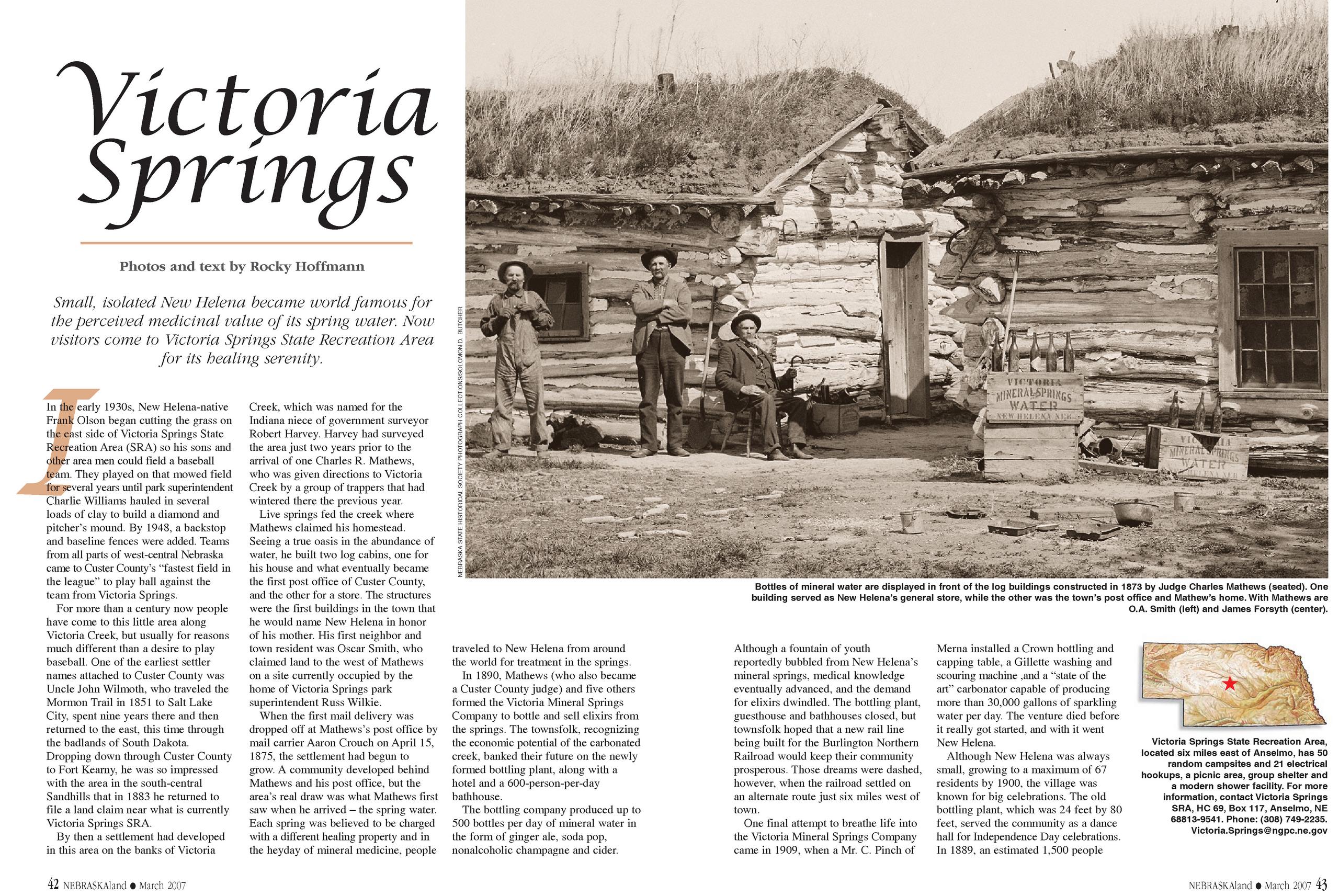
Victoria Springs
Small, isolated New Helena became world famous for the perceived medicinal value of its spring water. Now visitors come to Victoria Springs State Recreation Area for its healing serenity.
In the early 1930s, New Helena-native Frank Olson began cutting the grass on the east side of Victoria Springs State Recreation Area (SRA) so his sons and other area men could field a baseball team. They played on that mowed field for several years until park superintendent Charlie Williams hauled in several loads of clay to build a diamond and pitcher's mound. By 1948, a backstop and baseline fences were added. Teams from all parts of west-central Nebraska came to Custer County's "fastest field in the league" to play ball against the team from Victoria Springs.
For more than a century now people have come to this little area along Victoria Creek, but usually for reasons much different than a desire to play baseball. One of the earliest settler names attached to Custer County was Uncle John Wilmoth, who traveled the Mormon Trail in 1851 to Salt Lake City, spent nine years there and then returned to the east, this time through the badlands of South Dakota. Dropping down through Custer County to Fort Kearny, he was so impressed with the area in the south-central Sandhills that in 1883 he returned to file a land claim near what is currently Victoria Springs SRA.
By then a settlement had developed in this area on the banks of Victoria Creek, which was named for the Indiana niece of government surveyor Robert Harvey. Harvey had surveyed the area just two years prior to the arrival of one Charles R. Mathews, who was given directions to Victoria Creek by a group of trappers that had wintered there the previous year.
Live springs fed the creek where Mathews claimed his homestead. Seeing a true oasis in the abundance of water, he built two log cabins, one for his house and what eventually became the first post office of Custer County, and the other for a store. The structures were the first buildings in the town that he would name New Helena in honor of his mother. His first neighbor and town resident was Oscar Smith, who claimed land to the west of Mathews on a site currently occupied by the home of Victoria Springs park superintendent Russ Wilkie.
dropped off at Mathews's post office by mail carrier Aaron Crouch on April 15, 1875, the settlement had begun to grow. A community developed behind Mathews and his post office, but the area's real draw was what Mathews first saw when he arrived – the spring water. Each spring was believed to be charged with a different healing property and in the heyday of mineral medicine, people
In 1890, Mathews (who also became a Custer County judge) and five others formed the Victoria Mineral Springs Company to bottle and sell elixirs from the springs. The townsfolk, recognizing the economic potential of the carbonated creek, banked their future on the newly formed bottling plant, along with a hotel and a 600-person-per-day bathhouse.
The bottling company produced up to 500 bottles per day of mineral water in the form of ginger ale, soda pop, nonalcoholic champagne and cider. 42 NEBRASKAland March 2007 Although a fountain of youth reportedly bubbled from New Helena's mineral springs, medical knowledge eventually advanced, and the demand for elixirs dwindled. The bottling plant, guesthouse and bathhouses closed, but townsfolk hoped that a new rail line being built for the Burlington Northern Railroad would keep their community prosperous. Those dreams were dashed, however, when the railroad settled on an alternate route just six miles west of town.
One final attempt to breathe life into the Victoria Mineral Springs Company came in 1909, when a Mr. C. Pinch of Merna installed a Crown bottling and capping table, a Gillette washing and scouring machine ,and a "state of the art" carbonator capable of producing more than 30,000 gallons of sparkling water per day. The venture died before it really got started, and with it went New Helena.
Although New Helena was always small, growing to a maximum of 67 residents by 1900, the village was known for big celebrations. The old bottling plant, which was 24 feet by 80 feet, served the community as a dance hall for Independence Day celebrations. In 1889, an estimated 1,500 people
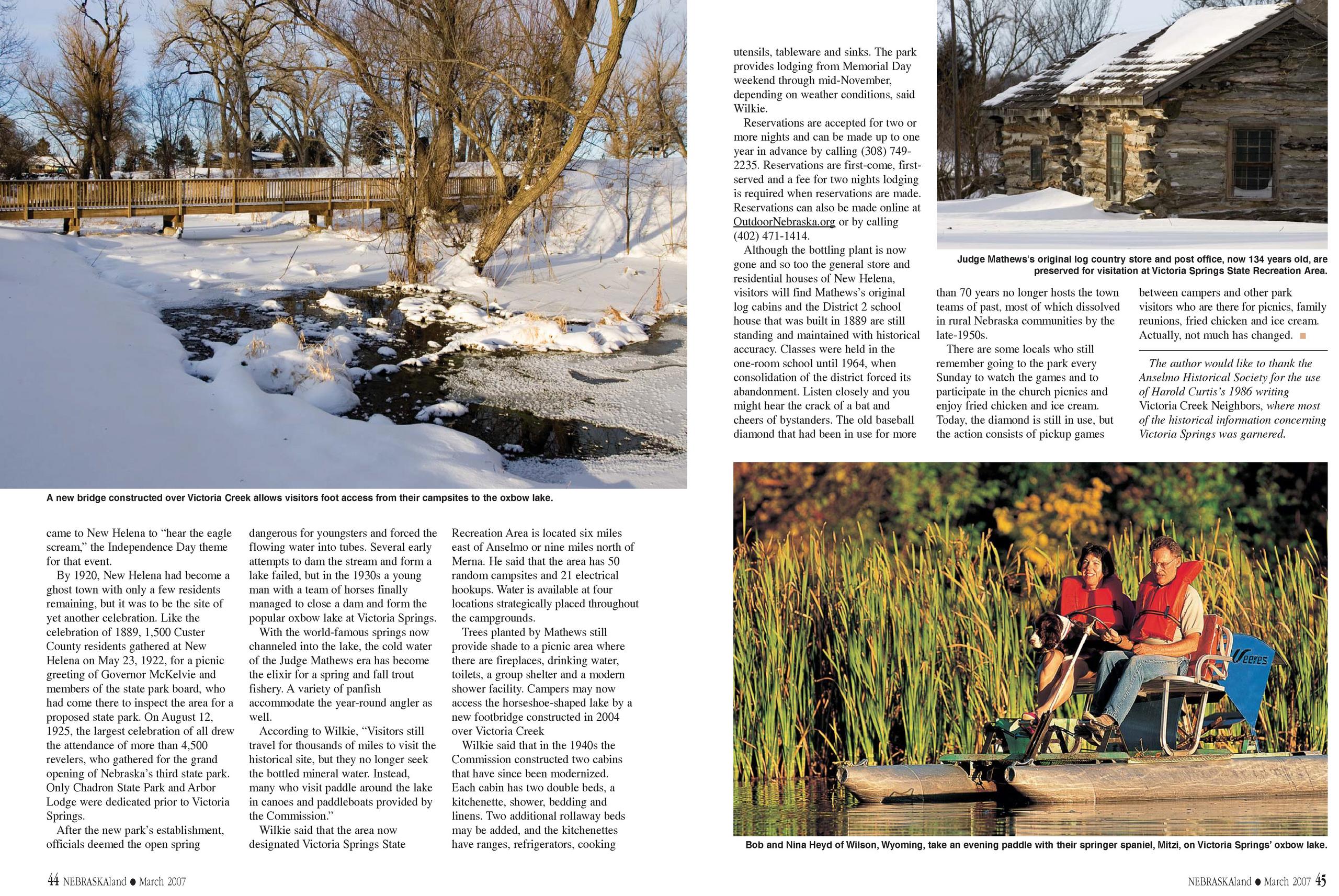
By 1920, New Helena had become a ghost town with only a few residents remaining, but it was to be the site of yet another celebration. Like the celebration of 1889, 1,500 Custer County residents gathered at New Helena on May 23, 1922, for a picnic greeting of Governor McKelvie and members of the state park board, who had come there to inspect the area for a proposed state park. On August 12, 1925, the largest celebration of all drew the attendance of more than 4,500 revelers, who gathered for the grand opening of Nebraska's third state park. Only Chadron State Park and Arbor Lodge were dedicated prior to Victoria Springs.
After the new park's establishment, officials deemed the open spring dangerous for youngsters and forced the flowing water into tubes. Several early attempts to dam the stream and form a lake failed, but in the 1930s a young man with a team of horses finally managed to close a dam and form the popular oxbow lake at Victoria Springs.
With the world-famous springs now channeled into the lake, the cold water of the Judge Mathews era has become the elixir for a spring and fall trout fishery. A variety of panfish accommodate the year-round angler as well.
According to Wilkie, "Visitors still travel for thousands of miles to visit the historical site, but they no longer seek the bottled mineral water. Instead, many who visit paddle around the lake in canoes and paddleboats provided by the Commission."
Wilkie said that the area now designated Victoria Springs State Recreation Area is located six miles east of Anselmo or nine miles north of Merna. He said that the area has 50 random campsites and 21 electrical hookups. Water is available at four locations strategically placed throughout the campgrounds.
Trees planted by Mathews still provide shade to a picnic area where there are fireplaces, drinking water, toilets, a group shelter and a modern shower facility. Campers may now access the horseshoe-shaped lake by a new footbridge constructed in 2004 over Victoria Creek
Wilkie said that in the 1940s the Commission constructed two cabins that have since been modernized. Each cabin has two double beds, a kitchenette, shower, bedding and linens. Two additional rollaway beds may be added, and the kitchenettes have ranges, refrigerators, cooking 44 NEBRASKAland March 2007 utensils, tableware and sinks. The park provides lodging from Memorial Day weekend through mid-November, depending on weather conditions, said Wilkie.
Reservations are accepted for two or more nights and can be made up to one year in advance by calling (308) 749- 2235. Reservations are first-come, firstserved and a fee for two nights lodging is required when reservations are made. Reservations can also be made online at OutdoorNebraska.org or by calling (402) 471-1414.
Although the bottling plant is now gone and so too the general store and residential houses of New Helena, visitors will find Mathews's original log cabins and the District 2 school house that was built in 1889 are still standing and maintained with historical accuracy. Classes were held in the one-room school until 1964, when consolidation of the district forced its abandonment. Listen closely and you might hear the crack of a bat and cheers of bystanders. The old baseball diamond that had been in use for more
There are some locals who still remember going to the park every Sunday to watch the games and to participate in the church picnics and enjoy fried chicken and ice cream. Today, the diamond is still in use, but the action consists of pickup games between campers and other park visitors who are there for picnics, family reunions, fried chicken and ice cream. Actually, not much has changed.
The author would like to thank the Anselmo Historical Society for the use of Harold Curtis's 1986 writing Victoria Creek Neighbors, where most of the historical information conconcerning Victoria Springs was garnered.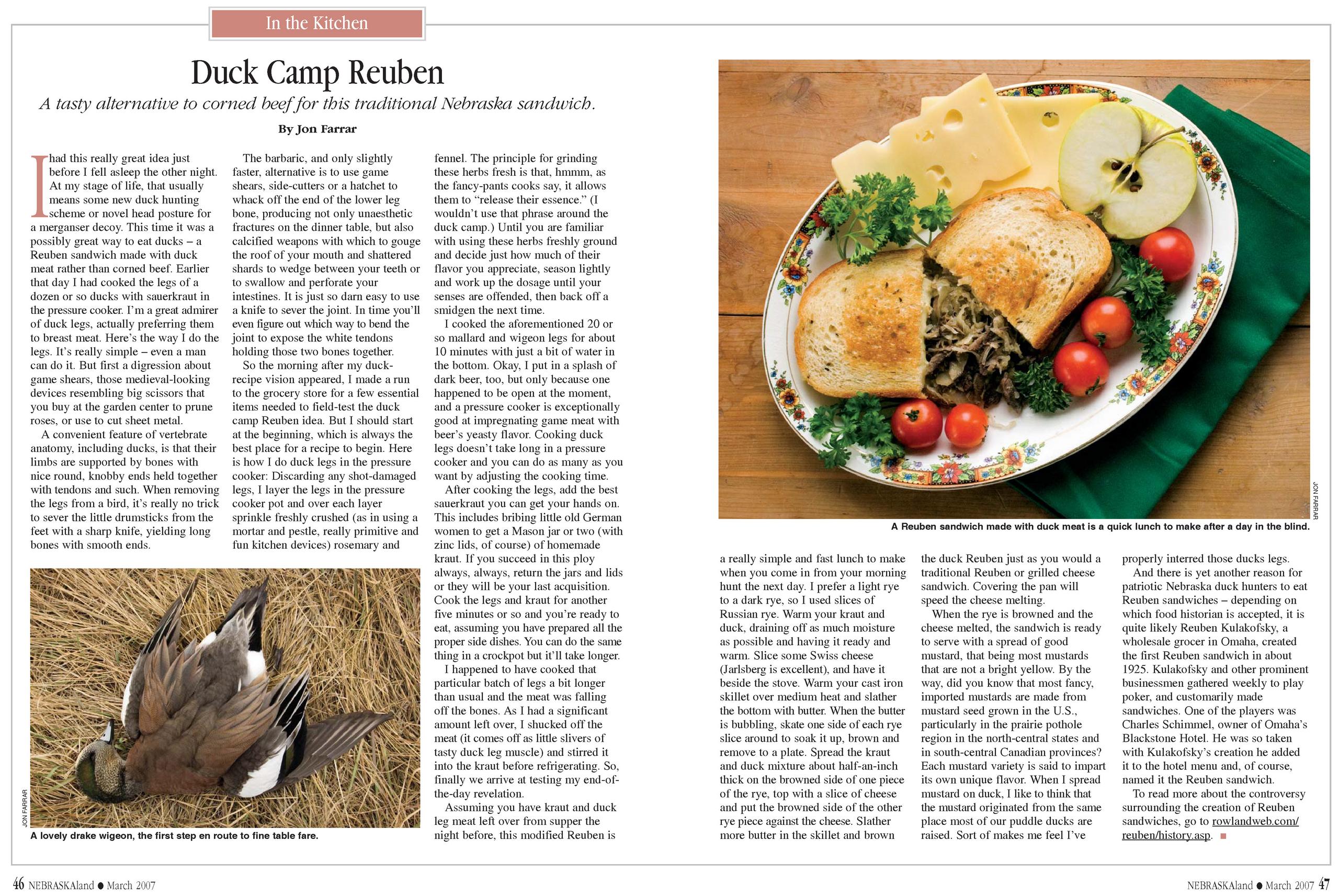
In the Kitchen
Duck Camp Reuben
A tasty alternative to corned beef for this traditional Nebraska sandwich.
Ihad this really great idea just before I fell asleep the other night. At my stage of life, that usually means some new duck hunting scheme or novel head posture for a merganser decoy. This time it was a possibly great way to eat ducks – a Reuben sandwich made with duck meat rather than corned beef. Earlier that day I had cooked the legs of a dozen or so ducks with sauerkraut in the pressure cooker. I'm a great admirer of duck legs, actually preferring them to breast meat. Here's the way I do the legs. It's really simple – even a man can do it. But first a digression about game shears, those medieval-looking devices resembling big scissors that you buy at the garden center to prune roses, or use to cut sheet metal.
A convenient feature of vertebrate anatomy, including ducks, is that their limbs are supported by bones with nice round, knobby ends held together with tendons and such. When removing the legs from a bird, it's really no trick to sever the little drumsticks from the feet with a sharp knife, yielding long bones with smooth ends.
The barbaric, and only slightly faster, alternative is to use game shears, side-cutters or a hatchet to whack off the end of the lower leg bone, producing not only unaesthetic fractures on the dinner table, but also calcified weapons with which to gouge the roof of your mouth and shattered shards to wedge between your teeth or to swallow and perforate your intestines. It is just so darn easy to use a knife to sever the joint. In time you'll even figure out which way to bend the joint to expose the white tendons holding those two bones together.
So the morning after my duckrecipe vision appeared, I made a run to the grocery store for a few essential items needed to field-test the duck camp Reuben idea. But I should start at the beginning, which is always the best place for a recipe to begin. Here is how I do duck legs in the pressure cooker: Discarding any shot-damaged legs, I layer the legs in the pressure cooker pot and over each layer sprinkle freshly crushed (as in using a mortar and pestle, really primitive and fun kitchen devices) rosemary and fennel. The principle for grinding these herbs fresh is that, hmmm, as the fancy-pants cooks say, it allows them to "release their essence." (I wouldn't use that phrase around the duck camp.) Until you are familiar with using these herbs freshly ground and decide just how much of their flavor you appreciate, season lightly and work up the dosage until your senses are offended, then back off a smidgen the next time.
I cooked the aforementioned 20 or so mallard and wigeon legs for about 10 minutes with just a bit of water in the bottom. Okay, I put in a splash of dark beer, too, but only because one happened to be open at the moment, and a pressure cooker is exceptionally good at impregnating game meat with beer's yeasty flavor. Cooking duck legs doesn't take long in a pressure cooker and you can do as many as you want by adjusting the cooking time.
After cooking the legs, add the best sauerkraut you can get your hands on. This includes bribing little old German women to get a Mason jar or two (with zinc lids, of course) of homemade kraut. If you succeed in this ploy always, always, return the jars and lids or they will be your last acquisition. Cook the legs and kraut for another five minutes or so and you're ready to eat, assuming you have prepared all the proper side dishes. You can do the same thing in a crockpot but it'll take longer.
I happened to have cooked that particular batch of legs a bit longer than usual and the meat was falling off the bones. As I had a significant amount left over, I shucked off the meat (it comes off as little slivers of tasty duck leg muscle) and stirred it into the kraut before refrigerating. So, finally we arrive at testing my end-ofthe- day revelation.
Assuming you have kraut and duck leg meat left over from supper the night before, this modified Reuben is
When the rye is browned and the cheese melted, the sandwich is ready to serve with a spread of good mustard, that being most mustards that are not a bright yellow. By the way, did you know that most fancy, imported mustards are made from mustard seed grown in the U.S., particularly in the prairie pothole region in the north-central states and in south-central Canadian provinces? Each mustard variety is said to impart its own unique flavor. When I spread mustard on duck, I like to think that the mustard originated from the same place most of our puddle ducks are raised. Sort of makes me feel I've properly interred those ducks legs.
patriotic Nebraska duck hunters to eat Reuben sandwiches – depending on which food historian is accepted, it is quite likely Reuben Kulakofsky, a wholesale grocer in Omaha, created the first Reuben sandwich in about 1925. Kulakofsky and other prominent businessmen gathered weekly to play poker, and customarily made sandwiches. One of the players was Charles Schimmel, owner of Omaha's Blackstone Hotel. He was so taken with Kulakofsky's creation he added it to the hotel menu and, of course, named it the Reuben sandwich.
To read more about the controversy surrounding the creation of Reuben sandwiches, go to rowlandweb.com/ reuben/history.asp.
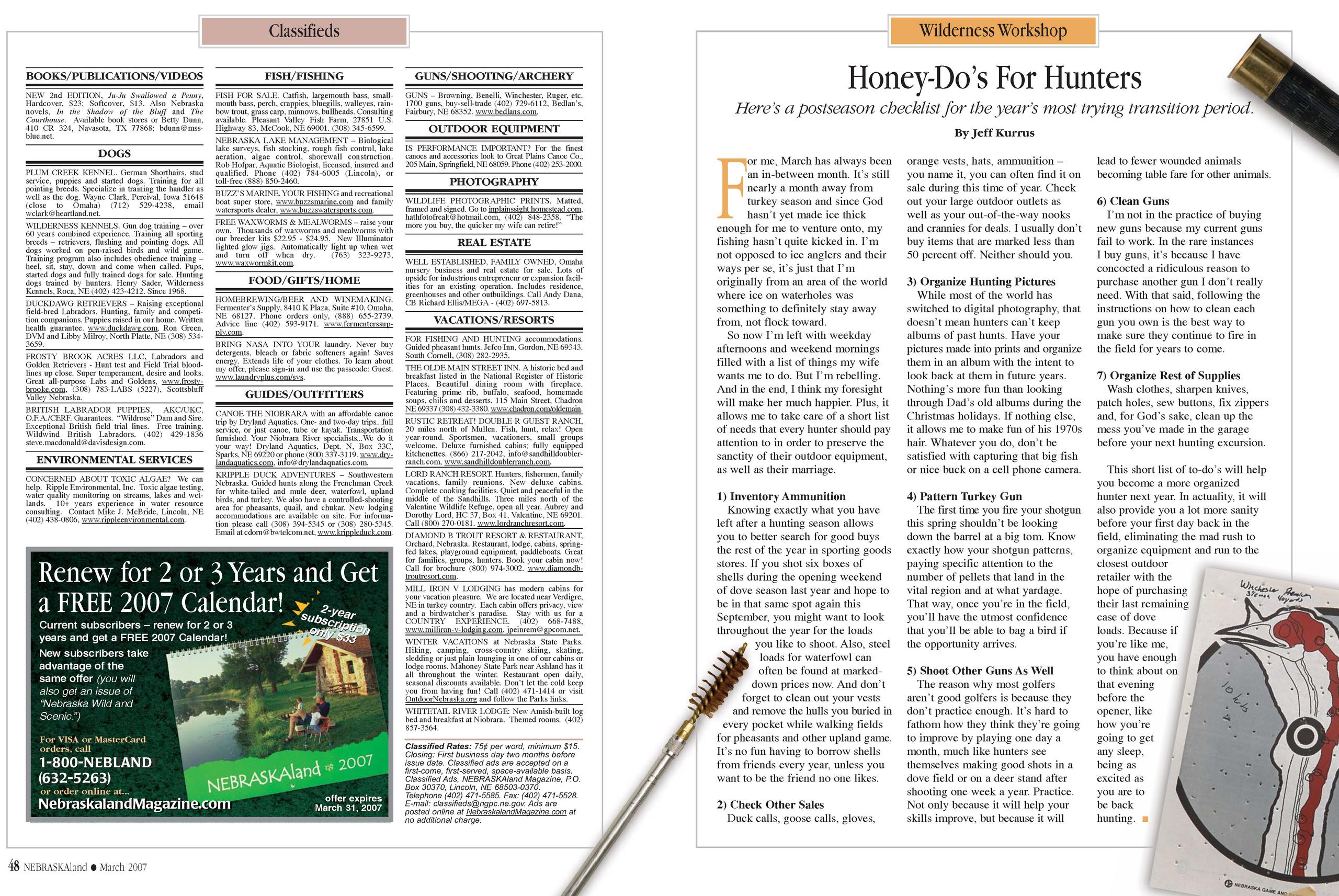
Classifieds
BOOKS/PUBLICATIONS/VIDEOS NEW 2nd EDITION, Ju-Ju Swallowed a Penny, Hardcover, $23; Softcover, $13. Also Nebraska novels, In the Shadow of the Bluff and The Courthouse. Available book stores or Betty Dunn, 410 CR 324, Navasota, TX 77868; bdunn@mssblue. net. DOGS PLUM CREEK KENNEL. German Shorthairs, stud service, puppies and started dogs. Training for all pointing breeds. Specialize in training the handler as well as the dog. Wayne Clark, Percival, Iowa 51648 (close to Omaha) (712) 529-4238, email wclark@heartland.net. WILDERNESS KENNELS. Gun dog training – over 60 years combined experience. Training all sporting breeds – retrievers, flushing and pointing dogs. All dogs worked on pen-raised birds and wild game. Training program also includes obedience training – heel, sit, stay, down and come when called. Pups, started dogs and fully trained dogs for sale. Hunting dogs trained by hunters. Henry Sader, Wilderness Kennels, Roca, NE (402) 423-4212. Since 1968. DUCKDAWG RETRIEVERS – Raising exceptional field-bred Labradors. Hunting, family and competition companions. Puppies raised in our home. Written health guarantee. www.duckdawg.com. Ron Green, DVM and Libby Milroy, North Platte, NE (308) 534- 3659. FROSTY BROOK ACRES LLC, Labradors and Golden Retrievers - Hunt test and Field Trial bloodlines up close. Super temperament, desire and looks. Great all-purpose Labs and Goldens, www.frostybrooke. com, (308) 783-LABS (5227), Scottsbluff Valley Nebraska. BRITISH LABRADOR PUPPIES, AKC/UKC, O.F.A./CERF. Guarantees. "Wildrose" Dam and Sire. Exceptional British field trial lines. Free training. Wildwind British Labradors. (402) 429-1836 steve.macdonald@davisdesign.com. ENVIRONMENTAL SERVICES CONCERNED ABOUT TOXIC ALGAE? We can help. Ripple Environmental, Inc. Toxic algae testing, water quality monitoring on streams, lakes and wetlands. 10+ years experience in water resource consulting. Contact Mike J. McBride, Lincoln, NE (402) 438-0806, www.rippleenvironmental.com. Renew for 2 or 3 Years and Get a FREE 2007 Calendar! Current subscribers – renew for 2 or 3 years and get a FREE 2007 Calendar! New subscribers take advantage of the same offer (you will also get an issue of "Nebraska Wild and Scenic.") For VISA or MasterCard orders, call 1-800-NEBLAND (632-5263) or order online at... NebraskalandMagazine.com 2-year subscription only $33 offer expires March 31, 2007 FISH/FISHING FISH FOR SALE. Catfish, largemouth bass, smallmouth bass, perch, crappies, bluegills, walleyes, rainbow trout, grass carp, minnows, bullheads. Consulting available. Pleasant Valley Fish Farm, 27851 U.S. Highway 83, McCook, NE 69001. (308) 345-6599. NEBRASKA LAKE MANAGEMENT – Biological lake surveys, fish stocking, rough fish control, lake aeration, algae control, shorewall construction. Rob Hofpar, Aquatic Biologist, licensed, insured and qualified. Phone (402) 784-6005 (Lincoln), or toll-free (888) 850-2460. BUZZ'S MARINE,YOUR FISHING and recreational boat super store, www.buzzsmarine.com and family watersports dealer, www.buzzswatersports.com. FREE WAXWORMS & MEALWORMS – raise your own. Thousands of waxworms and mealworms with our breeder kits $22.95 - $24.95. New Illuminator lighted glow jigs. Automatically light up when wet and turn off when dry. (763) 323-9273, www.waxwormkit.com. FOOD/GIFTS/HOME HOMEBREWING/BEER AND WINEMAKING. Fermenter's Supply, 8410 K Plaza, Suite #10, Omaha, NE 68127. Phone orders only, (888) 655-2739. Advice line (402) 593-9171. www.fermenterssupply. com. BRING NASA INTO YOUR laundry. Never buy detergents, bleach or fabric softeners again! Saves energy. Extends life of your clothes. To learn about my offer, please sign-in and use the passcode: Guest. www.laundryplus.com/svs. GUIDES/OUTFITTERS CANOE THE NIOBRARA with an affordable canoe trip by Dryland Aquatics. One- and two-day trips...full service, or just canoe, tube or kayak. Transportation furnished. Your Niobrara River specialists...We do it your way! Dryland Aquatics, Dept. N, Box 33C, Sparks, NE 69220 or phone (800) 337-3119. www.drylandaquatics. com, info@drylandaquatics.com. KRIPPLE DUCK ADVENTURES – Southwestern Nebraska. Guided hunts along the Frenchman Creek for white-tailed and mule deer, waterfowl, upland birds, and turkey. We also have a controlled-shooting area for pheasants, quail, and chukar. New lodging accommodations are available on site. For information please call (308) 394-5345 or (308) 280-5345. Email at cdorn@bwtelcom.net, www.krippleduck.com. GUNS/SHOOTING/ARCHERY GUNS – Browning, Benelli, Winchester, Ruger, etc. 1700 guns, buy-sell-trade (402) 729-6112, Bedlan's, Fairbury, NE 68352. www.bedlans.com. OUTDOOR EQUIPMENT IS PERFORMANCE IMPORTANT? For the finest canoes and accessories look to Great Plains Canoe Co., 205 Main, Springfield, NE 68059. Phone (402) 253-2000. PHOTOGRAPHY WILDLIFE PHOTOGRAPHIC PRINTS. Matted, framed and signed. Go to inplainssight.homestead.com, hathfotofreak@hotmail.com, (402) 848-2358. "The more you buy, the quicker my wife can retire!" REAL ESTATE WELL ESTABLISHED, FAMILY OWNED, Omaha nursery business and real estate for sale. Lots of upside for industrious entrepreneur or expansion facilities for an existing operation. Includes residence, greenhouses and other outbuildings. Call Andy Dana, CB Richard Ellis/MEGA - (402) 697-5813. VACATIONS/RESORTS FOR FISHING AND HUNTING accommodations. Guided pheasant hunts. Jefco Inn, Gordon, NE 69343. South Cornell, (308) 282-2935. THE OLDE MAIN STREET INN. A historic bed and breakfast listed in the National Register of Historic Places. Beautiful dining room with fireplace. Featuring prime rib, buffalo, seafood, homemade soups, chilis and desserts. 115 Main Street, Chadron NE 69337 (308) 432-3380. www.chadron.com/oldemain. RUSTIC RETREAT! DOUBLE R GUEST RANCH, 20 miles north of Mullen. Fish, hunt, relax! Open year-round. Sportsmen, vacationers, small groups welcome. Deluxe furnished cabins; fully equipped kitchenettes. (866) 217-2042, info@sandhilldoublerranch. com, www.sandhilldoublerranch.com. LORD RANCH RESORT. Hunters, fishermen, family vacations, family reunions. New deluxe cabins. Complete cooking facilities. Quiet and peaceful in the middle of the Sandhills. Three miles north of the Valentine Wildlife Refuge, open all year. Aubrey and Dorothy Lord, HC 37, Box 41, Valentine, NE 69201. Call (800) 270-0181. www.lordranchresort.com. DIAMOND B TROUT RESORT & RESTAURANT, Orchard, Nebraska. Restaurant, lodge, cabins, springfed lakes, playground equipment, paddleboats. Great for families, groups, hunters. Book your cabin now! Call for brochure (800) 974-3002. www.diamondbtroutresort. com. MILL IRON V LODGING has modern cabins for your vacation pleasure. We are located near Verdigre, NE in turkey country. Each cabin offers privacy, view and a birdwatcher's paradise. Stay with us for a COUNTRY EXPERIENCE. (402) 668-7488, www.milliron-v-lodging.com, jpeinrem@gpcom.net. WINTER VACATIONS at Nebraska State Parks. Hiking, camping, cross-country skiing, skating, sledding or just plain lounging in one of our cabins or lodge rooms. Mahoney State Park near Ashland has it all throughout the winter. Restaurant open daily, seasonal discounts available. Don't let the cold keep you from having fun! Call (402) 471-1414 or visit OutdoorNebraska.org and follow the Parks links. WHITETAIL RIVER LODGE: New Amish-built log bed and breakfast at Niobrara. Themed rooms. (402) 857-3564. Classified Rates: 75¢ per word, minimum $15. Closing: First business day two months before issue date. Classified ads are accepted on a first-come, first-served, space-available basis. Classified Ads, NEBRASKAland Magazine, P.O. Box 30370, Lincoln, NE 68503-0370. Telephone (402) 471-5585. Fax: (402) 471-5528. E-mail: classifieds@ngpc.ne.gov. Ads are posted online at NebraskalandMagazine.com at no additional charge.Wilderness Workshop
Honey-Do's For Hunters
Here's a postseason checklist for the year's most trying transition period.
For me, March has always been an in-between month. It's still nearly a month away from turkey season and since God hasn't yet made ice thick enough for me to venture onto, my fishing hasn't quite kicked in. I'm not opposed to ice anglers and their ways per se, it's just that I'm originally from an area of the world where ice on waterholes was something to definitely stay away from, not flock toward.
So now I'm left with weekday afternoons and weekend mornings filled with a list of things my wife wants me to do. But I'm rebelling. And in the end, I think my foresight will make her much happier. Plus, it allows me to take care of a short list of needs that every hunter should pay attention to in order to preserve the sanctity of their outdoor equipment, as well as their marriage.
1) Inventory Ammunition Knowing exactly what you have left after a hunting season allows you to better search for good buys the rest of the year in sporting goods stores. If you shot six boxes of shells during the opening weekend of dove season last year and hope to be in that same spot again this September, you might want to look throughout the year for the loads
2) Check Other Sales Duck calls, goose calls, gloves, orange vests, hats, ammunition – you name it, you can often find it on sale during this time of year. Check out your large outdoor outlets as well as your out-of-the-way nooks and crannies for deals. I usually don't buy items that are marked less than 50 percent off. Neither should you.
3) Organize Hunting Pictures While most of the world has switched to digital photography, that doesn't mean hunters can't keep albums of past hunts. Have your pictures made into prints and organize them in an album with the intent to look back at them in future years. Nothing's more fun than looking through Dad's old albums during the Christmas holidays. If nothing else, it allows me to make fun of his 1970s hair. Whatever you do, don't be satisfied with capturing that big fish or nice buck on a cell phone camera.
4) Pattern Turkey Gun The first time you fire your shotgun this spring shouldn't be looking down the barrel at a big tom. Know exactly how your shotgun patterns, paying specific attention to the number of pellets that land in the vital region and at what yardage. That way, once you're in the field, you'll have the utmost confidence that you'll be able to bag a bird if the opportunity arrives.
5) Shoot Other Guns As Well The reason why most golfers aren't good golfers is because they don't practice enough. It's hard to fathom how they think they're going to improve by playing one day a month, much like hunters see themselves making good shots in a dove field or on a deer stand after shooting one week a year. Practice. Not only because it will help your skills improve, but because it will lead to fewer wounded animals becoming table fare for other animals.
6) Clean Guns I'm not in the practice of buying new guns because my current guns fail to work. In the rare instances I buy guns, it's because I have concocted a ridiculous reason to purchase another gun I don't really need. With that said, following the instructions on how to clean each gun you own is the best way to make sure they continue to fire in the field for years to come.
7) Organize Rest of Supplies Wash clothes, sharpen knives, patch holes, sew buttons, fix zippers and, for God's sake, clean up the mess you've made in the garage before your next hunting excursion.
This short list of to-do's will help you become a more organized hunter next year. In actuality, it will also provide you a lot more sanity before your first day back in the field, eliminating the mad rush to organize equipment and run to the closest outdoor retailer with the hope of purchasing their last remaining case of dove loads. Because if you're like me, you have enough to think about on that evening before the opener, like how you're going to get any sleep, being as excited as you are to be back hunting.

Portraits from the Past
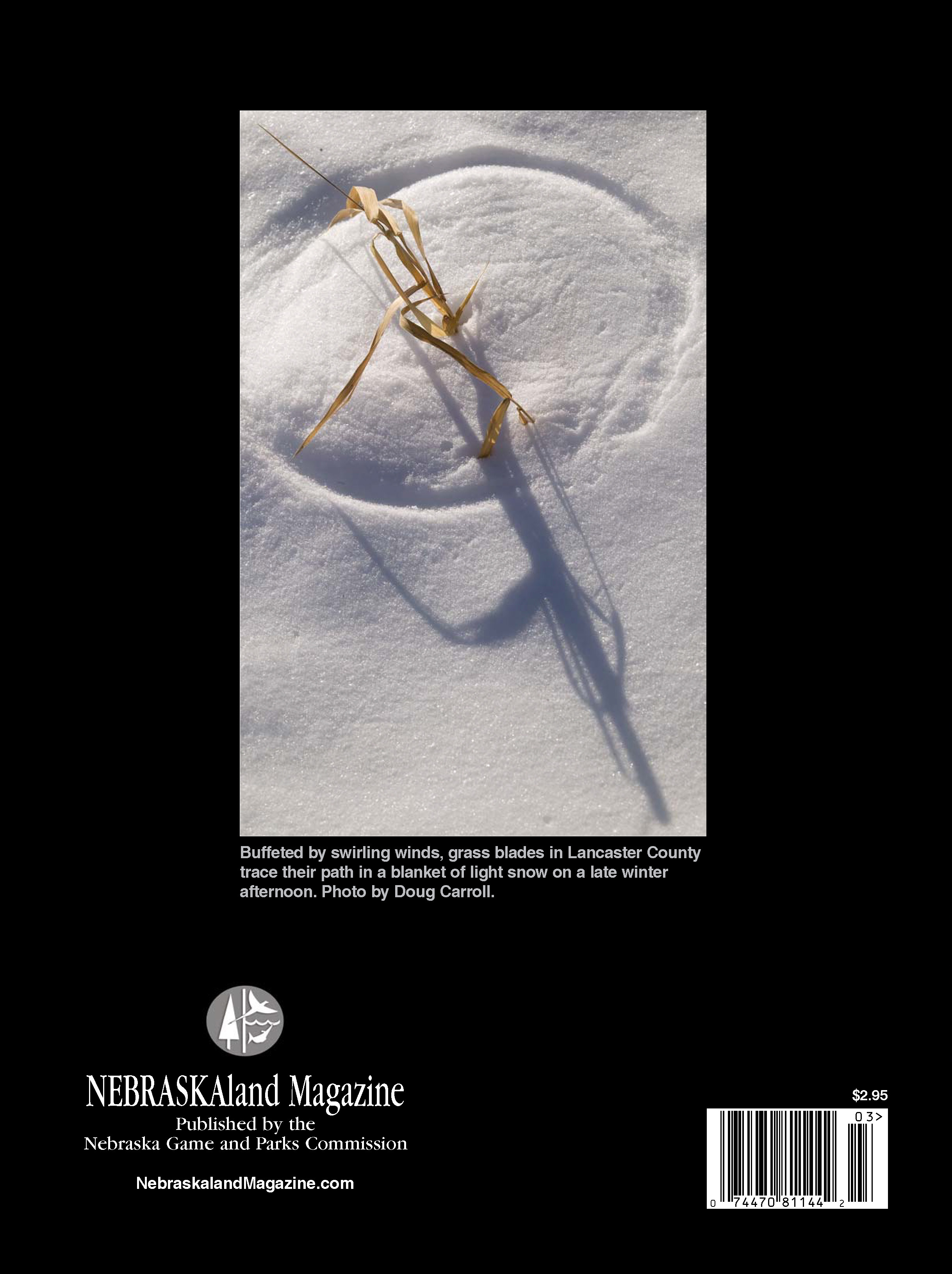
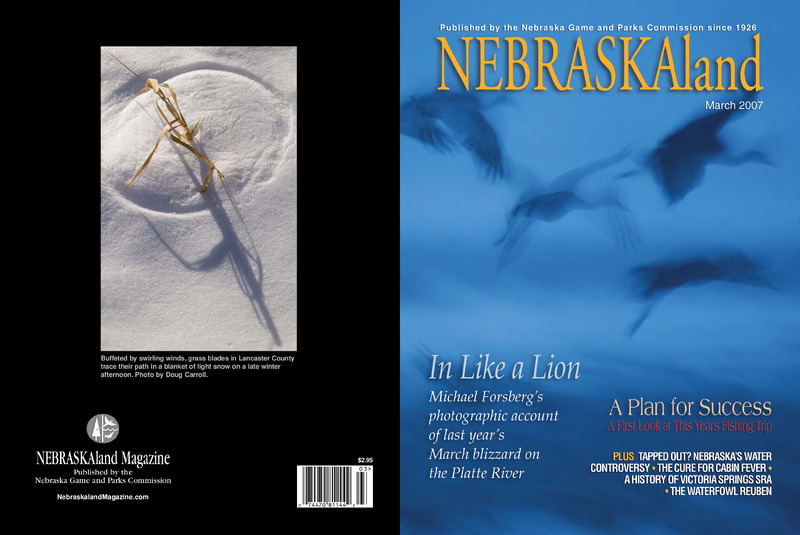
Position: 140 (43 views)