Volume 84, Issue 1, 2006
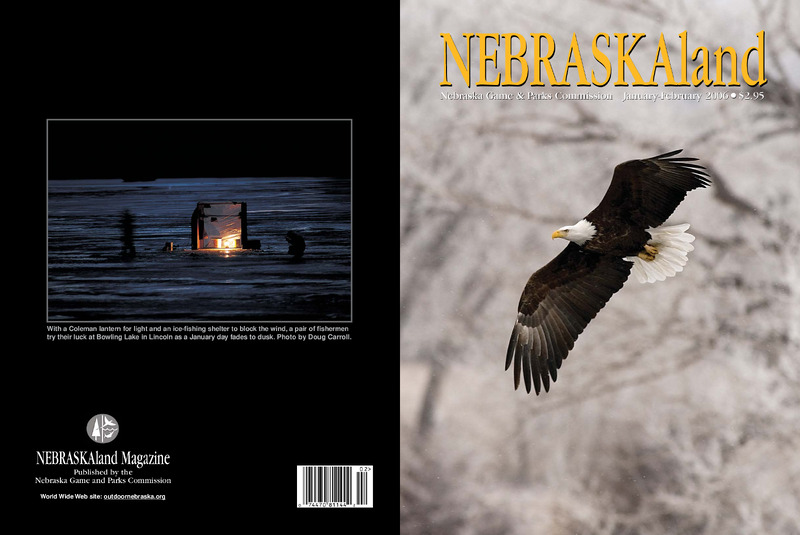
NEBRASKAland
Volume 84, Number 1, January-February 2006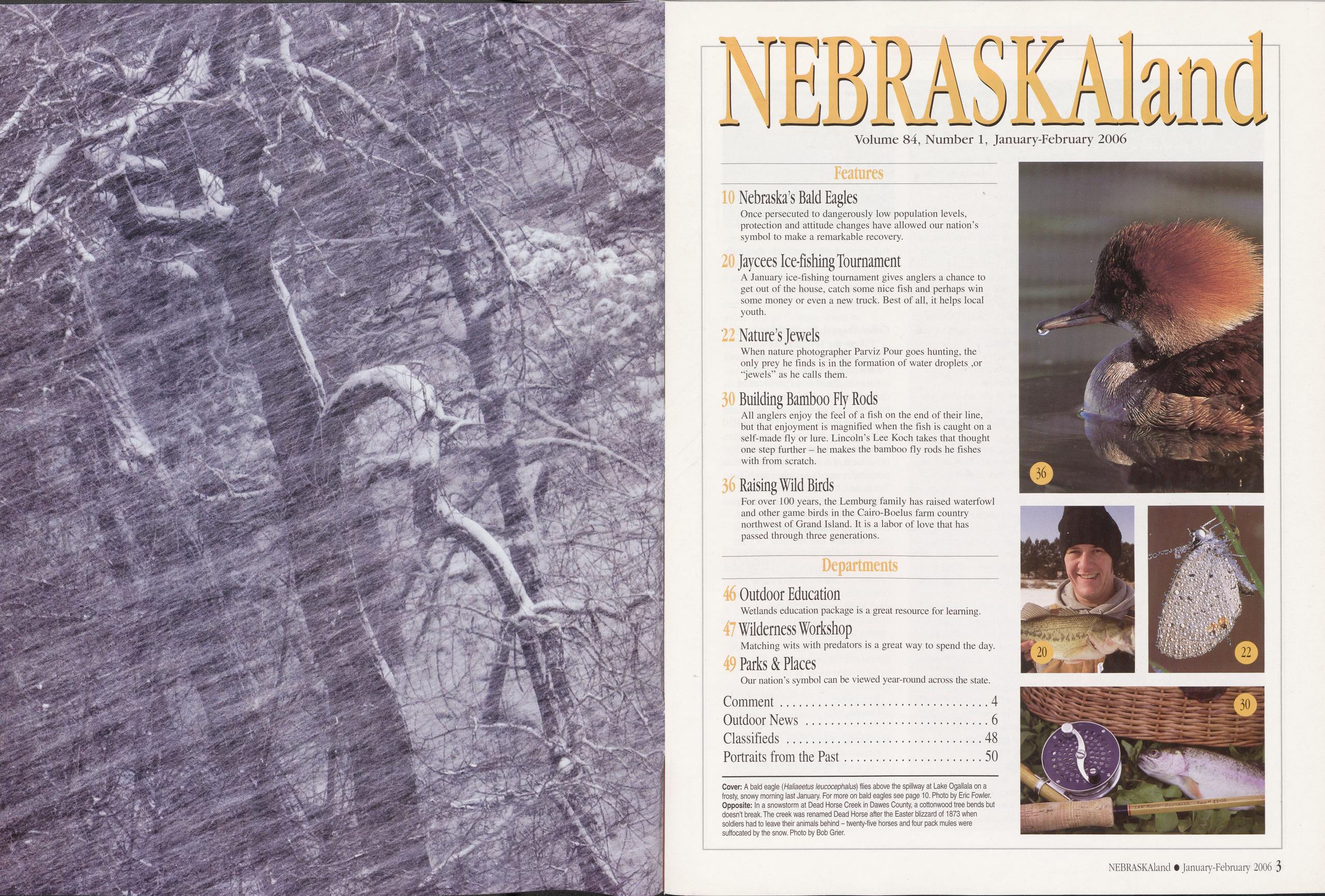
NEBRASKAland
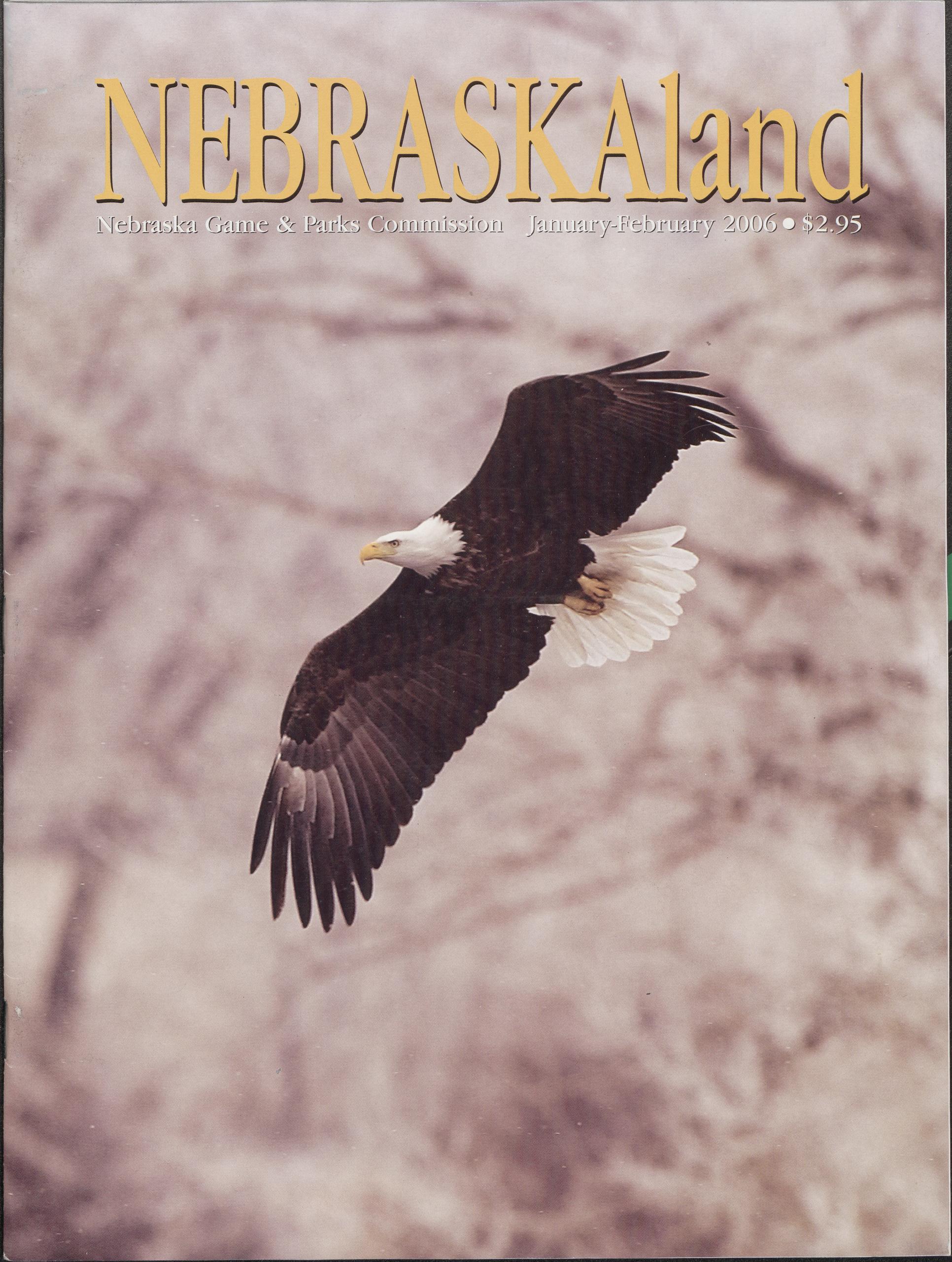
Volume 84, Number 1, January-February 2006 Nebraska’s Bald Eagles Once persecuted to dangerously low population levels, protection and attitude changes have allowed our nation’s symbol to make a remarkable recovery. Jaycees Ice-fishing Tournament A January ice-fishing tournament gives anglers a chance to get out of the house, catch some nice fish and perhaps win some money or even a new truck. Best of all, it helps local youth. Nature’s Jewels When nature photographer Parviz Pour goes hunting, the only prey he finds is in the formation of water droplets ,or “jewels” as he calls them. Building Bamboo Fly Rods All anglers enjoy the feel of a fish on the end of their line, but that enjoyment is magnified when the fish is caught on a self-made fly or lure. Lincoln’s Lee Koch takes that thought one step further - he makes the bamboo fly rods he fishes with from scratch. Raising Wild Birds For over 100 years, the Lemburg family has raised waterfowl and other game birds in the Cairo-Boelus farm country northwest of Grand Island. It is a labor of love that has passed through three generations. Departments Outdoor Education Wetlands education package is a great resource for learning. Wilderness Workshop Matching wits with predators is a great way to spend the day. Parks & Places Our nation’s symbol can be viewed year-round across the state. Comment.....................................4 Outdoor News ...............................6 Classifieds ...............................48 Portraits from the Past....................50 Cover: A bald eagle (Haliaeetus leucocephalus) flies above the spillway at Lake Ogallala on a frosty, snowy morning last January. For more on bald eagles see page 10. Photo by Eric Fowler. Opposite: In a snowstorm at Dead Horse Creek in Dawes County, a cottonwood tree bends but doesn’t break. The creek was renamed Dead Horse after the Easter blizzard of 1873 when soldiers had to leave their animals behind - twenty-five horses and four pack mules were suffocated by the snow. Photo by Bob Grier.36
20
22
30
Comment
Letter Writer “Uninformed”Betty Ann Ritscher’s letter (Dec issue, NEBRASKAland) was typical of the uninformed and misinformed liberal, left-wing, anti-hunting group. Their lunacy can be dangerous, and it is our duty as responsible conservationists to reorient these ill- informed citizens.
Nobody does more for wildlife conservation than hunters. Nobody invests more of their resources and money protecting and developing wildlife habitat, conducting wildlife research, and protecting all wild animal, fowl, and fish species than hunters and fishermen. Without caring sportsmen, and government agencies that regulate hunting and fishing, our wildlife would be grossly degraded or disappear though massive starvation, die offs, and uncontrolled disease.
In 1903, one of the greatest true sportsmen that ever lived in these United States, Theodore Roosevelt, said: “In a civilized and cultivated country wild animals only continue to exist at all when preserved by sportsmen. The excellent people who protest against all hunting, and consider sportsmen as enemies of wildlife, are ignorant of the fact that in reality the genuine sportsman is by all odds the most important factor in keeping the larger and more valuable wild creatures from total extermination
To properly reorient future generations, we should require all public educators be trained and informed how correct wildlife conservation really works. Further, we should require all school children be then educated accordingly. The success of this program would preclude people like Ms. Ritscher and her ilk from being so unfortunately misinformed.
W.C. “Tiny” TomsenTulsa, Oklahoma
Mr. Tomsen makes several valid points: The money that hunters and anglers provide through their permit and stamp fees, not to mention the taxes they asked be placed on their equipment back in 1937 through the passage of the Federal Aid in Wildlife Restoration Act, provides a large part of the money used to protect all wildlife and fish. Anyone who has spent time on any wildlife management land (purchased with habitat stamp money spent by hunters and trappers) knows that not only game animals use the area. In fact, biologists estimate that only 15 percent of the animals and birds using these areas are classified as game.
- Editor Cedar Trees A Big Problem“Elk on the Home Place” (October 2005) is not the only story NEBRASKAland has done that points out the serious problem of cedar tree expansion. In this case only 40 head of cattle can be grazed in an area that supported 80 head 30 years ago. Cedars are taking away valuable and productive farm and ranchland at a much higher rate than urban sprawl or any other problem. Texas and Oklahoma are losing more than one million acres each year to cedars. In addition, cedar infestation actually drives away most wildlife like the deer in your story and birds and eventually the elk will leave when the grazing area is gone. A mature 6-foot cedar consumes 32 gallons of water every day! More needs to be done to eliminate this problem and Nebraska cannot afford to let the land that produces our food and our wildlife for recreation and tourism continue to be eroded away at such an alarming rate.
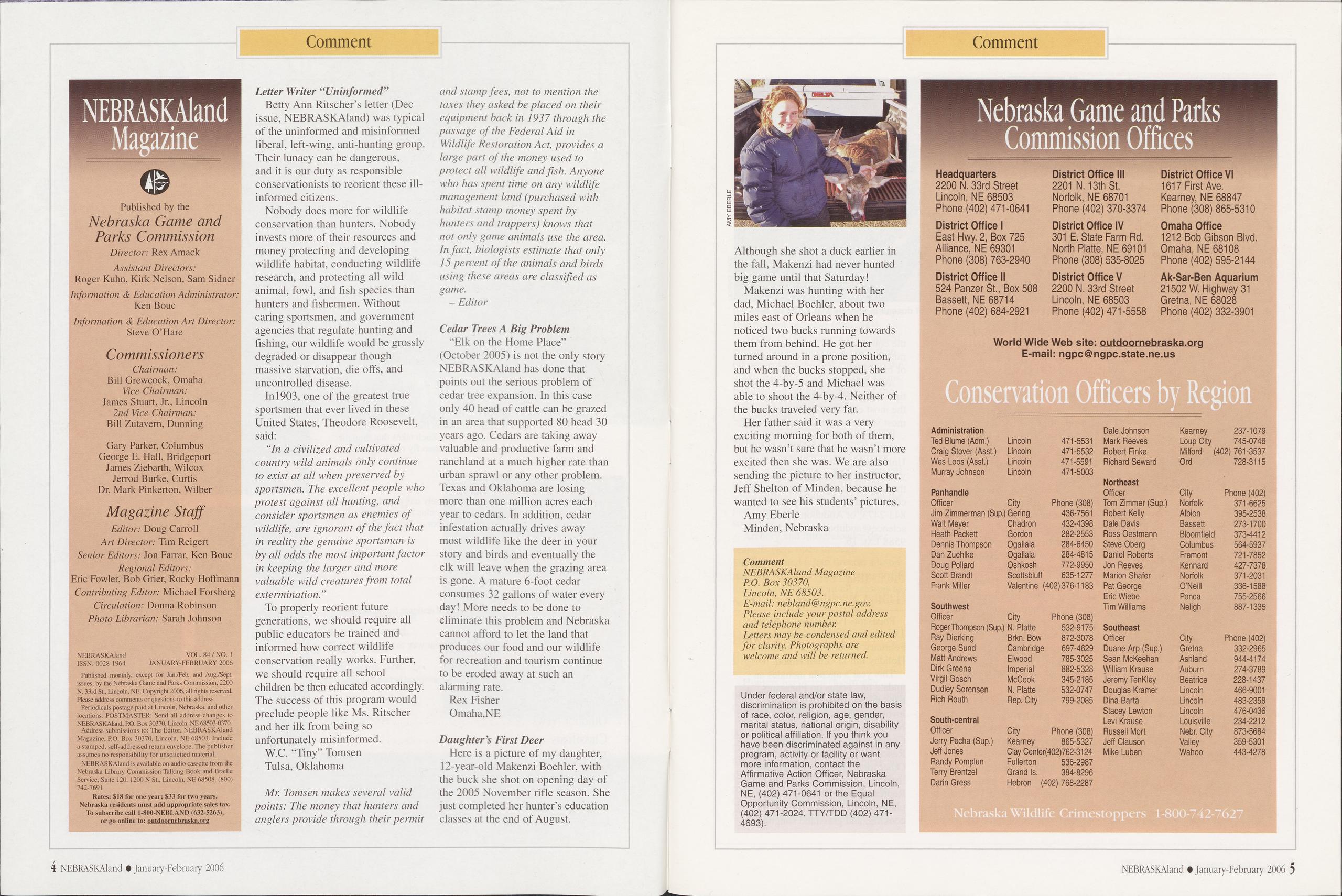
Rex Fisher Omaha,NE Daughter's First DeerHere is a picture of my daughter, 12-year-old Makenzi Boehler, with the buck she shot on opening day of the 2005 November rifle season. She just completed her hunter’s education classes at the end of August.
Comment
Although she shot a duck earlier in the fall, Makenzi had never hunted big game until that Saturday!
Makenzi was hunting with her dad, Michael Boehler, about two miles east of Orleans when he noticed two bucks running towards them from behind. He got her turned around in a prone position, and when the bucks stopped, she shot the 4-by-5 and Michael was able to shoot the 4-by-4. Neither of the bucks traveled very far.
Her father said it was a very exciting morning for both of them, but he wasn’t sure that he wasn’t more excited then she was. We are also sending the picture to her instructor, Jeff Shelton of Minden, because he wanted to see his students’ pictures.
Amy Eberle, Minden, Nebraska Nebraska Game and Parks Commission Offices Headquarters 2200 N. 33rd Street Lincoln, NE 68503 Phone (402) 471-0641 District Office I East Hwy. 2, Box 725 Alliance, NE 69301 Phone (308) 763-2940 District Office II 524 Panzer St., Box 508 Bassett, NE 68714 Phone (402) 684-2921 District Office III 2201 N. 13th St. Norfolk, NE 68701 Phone (402) 370-3374 District Office IV 301 E. State Farm Rd. North Platte, NE 69101 Phone (308) 535-8025 District Office V 2200 N. 33rd Street Lincoln, NE 68503 Phone (402) 471-5558 District Office VI 1617 First Ave. Kearney, NE 68847 Phone (308) 865-5310 Omaha Office 1212 Bob Gibson Blvd. Omaha, NE 68108 Phone (402) 595-2144 Ak-Sar-Ben Aquarium 21502 W. Highway 31 Gretna, NE 68028 Phone (402) 332-3901 World Wide Web site: outdoornebraska.org E-mail: ngpc@ngpc.state.ne.us Conservation Officers by Region Comment NEBRASKAland Magazine P.O. Box 30370, Lincoln, NE 68503. E-mail: nebland@ngpc.ne.gov. Please include your postal address and telephone number. Letters may be condensed and edited for clarity. Photographs are welcome and will be returned. Under federal and/or state law, discrimination is prohibited on the basis of race, color, religion, age, gender, marital status, national origin, disability or political affiliation. If you think you have been discriminated against in any program, activity or facility or want more information, contact the Affirmative Action Officer, Nebraska Game and Parks Commission, Lincoln, NE, (402) 471-0641 or the Equal Opportunity Commission, Lincoln, NE, (402) 471-2024, TTY7TDD (402) 471- 4693). Conservation Officers by Region Administration Dale Johnson Kearney 237-1079 Ted Blume (Adm.) Lincoln 471-5531 Mark Reeves Loup City 745-0748 Craig Stover (Asst.) Lincoln 471-5532 Robert Finke Milford (402) 761-3537 Wes Loos (Asst.) Lincoln 471-5591 Richard Seward Ord 728-3115 Murray Johnson Lincoln 471-5003 Northeast Panhandle Officer City Phone (402) Officer City Phone (308) Tom Zimmer (Sup.) Norfolk 371-6625 Jim Zimmerman (Sup.) Gering 436-7561 Robert Kelly Albion 395-2538 Walt Meyer Chadron 432-4398 Dale Davis Bassett 273-1700 Heath Packett Gordon 282-2553 Ross Oestmann Bloomfield 373-4412 Dennis Thompson Ogallala 284-6450 Steve Oberg Columbus 564-5937 Dan Zuehlke Ogallala 284-4815 Daniel Roberts Fremont 721-7852 Doug Pollard Oshkosh 772-9950 Jon Reeves Kennard 427-7378 Scott Brandt Scottsbluff 635-1277 Marion Shafer Norfolk 371-2031 Frank Miller Valentine (402)376-1183 Pat George O’Neill 336-1588 Eric Wiebe Ponca 755-2566 Southwest Officer City Phone (308) Tim Williams Neligh 887-1335 Roger Thompson (Sup.) N. Platte 532-9175 Southeast Ray Dierking Brkn. Bow 872-3078 Officer City Phone (402) George Sund Cambridge 697-4629 Duane Arp (Sup.) Gretna 332-2965 Matt Andrews Elwood 785-3025 Sean McKeehan Ashland 944-4174 Dirk Greene Imperial 882-5328 William Krause Auburn 274-3789 Virgil Gosch McCook 345-2185 Jeremy TenKley Beatrice 228-1437 Dudley Sorensen N. Platte 532-0747 Douglas Kramer Lincoln 466-9001 Rich Routh Rep. City 799-2085 Dina Barta Lincoln 483-2358 Stacey Lewton Lincoln 476-0436 South-central Levi Krause Louisville 234-2212 Officer City Phone (308) Russell Mort Nebr. City 873-5684 Jerry Pecha (Sup.) Kearney 865-5327 Jeff Clauson Valley 359-5301 Jeff Jones Clay Center(402)762-3124 Mike Luben Wahoo 443-4278 Randy Pomplun Fullerton 536-2987 Terry Brentzel Grand Is. 384-8296 Darin Gress Hebron (402) 768-2287 Nebraska Wildlife Crimestoppers 1-800-742-7627 4 NEBRASKAland • January-February 2006 NEBRASKAland • January-February 2006 5
Outdoor News
Magazine PHOTOS FOR PURCHASE ONLINE First releases from our collection are perfect for your home or office. Available in several sizes, these prints are appropriate for framing and make great gifts. Visit our web site often, and click on to see the latest offerings. Available by phone or online! 1-800-742-0056The National Audubon Society and Cornell Laboratory of Ornithology are encouraging bird enthusiasts to count birds with a buddy during their ninth annual Great Backyard Bird Count February 17-20.
The Great Backyard Bird Count provides a unique snapshot of winter bird abundance and distribution across the continent. Everyone can participate, from beginning bird watchers to seasoned experts. During the count, bird watchers can tally up birds for as little as 15 minutes or for as long as they like, keeping track of the highest number of each bird species they see together at one time. People are encouraged to report birds from public lands and local parks, as well as from their own backyards. Participants enter their numbers online at www.birdsource.org/gbbc and can explore sightings maps, lists, and charts as the count progresses.
In 2005, participants sent in more than 52,000 checklists, with a record-breaking 613 species and more than 6 million birds counted. Nebraskans submitted 516 checklists from 95 localities and had the fifth- highest number of birds counted in the country. Clay Center and Gibbon ranked in the top-ten for the number of birds counted.
Awards will be given for the first time this year to localities returning the most checklists and reporting the most species and most birds overall. For more information on the event, which is sponsored by Wild Birds Unlimited, go to www.birdsource.org/gbbc. contact the Cornell Lab of Ornithology at cornellbirds@cornell.edu or (800) 843-2473; or Audubon at citizen- science® audubon.org; (215) 355- 9588 Ext. 16.
Pheasants Forever State Habitat MeetingPheasants Forever will hold its 15th Annual State Habitat Meeting February 4, 2006, at the Midtown Holiday Inn in Grand Island.
This year’s agenda includes an update on “Focus on Pheasants,” a habitat improvement program involving Pheasants Forever, the Nebraska Game and Parks Commission and the Natural Resources Conservation Service. Other topics include: a Farm Bill listening session with Congressional Representatives, wildlife habitat planting techniques; wild game cooking; and grassland songbird response to CRP upgrades in Northeast Nebraska. Those attending can also visit a help desk to learn more about how to improve their land for pheasants.
The fee for the meeting, which includes lunch, is $40 if paid by January 25, $50 if paid later.
For more information, visit the Nebraska Pheasants Forever web site at www.nebraskapf.org or contact Pete Berthelsen at (308) 754-5339.
Firearm Deer Harvest UpNebraska hunters harvested 43.636 deer during the annual firearm deer season last November, a five percent increase from 2004.
About 75,000 hunters participated, putting hunter success at more than 60 percent for the first time since the 2000 season, according to Kit Hams, big game program manager for the Nebraska Game and Parks Commission.
The deer harvest in southwestern Nebraska climbed 13 percent from 2004. Harvest increased 7 percent in the north-central region, 6 percent in the northeast, 5 percent in the south-central region, 2 percent in the panhandle and was stable in the southeast.
Archery and muzzleloader deer seasons were open through December, and a late firearm season runs January 1-15. Hams expects the total deer harvest from all seasons to be about 58,000.
Hunters Harvest Two Bighorn RamsHunters harvested two trophy bighorn sheep in the Pine Ridge near Crawford in early December.
Joe Glover of Sawyerville, Alabama, took his full-curl ram December 1, completing his quest for a grand slam of North American sheep. Glover paid $83,000 for his permit, which was auctioned at the Grand Slam/Ovis Annual Conference in Biloxi, Mississippi,
Get a Full Year's Worth of Outdoor Recreation 6 NEBRASKAland • January-February 2006 NEBRASKAland • January-February 2006 7
Outdoor News
Officer's NotebookA Long Memory Several years ago I received a telephone call from a police officer in a small southeastern Nebraska town about a possible poaching case. He had heard a gunshot at the edge of the town the night before and while investigating, saw a local man driving away from the area. The officer had heard rumors about the man taking deer out of season.
We decided to question the man at his home and see if we could collect evidence from his truck for a DNA sample. When we arrived, I introduced myself and said I wanted to talk about his illegal hunting. After talking for a while, the man admitted to hunting illegally. When I asked him to retrieve the game, he went into his house and came back with a duck and a quail. The officer and I looked at each other and asked him to tell us about the birds. After hearing his confession about poaching birds we knew nothing about, I asked him about the deer. Looking surprised, the suspect said he didn’t have the deer because it was at a friend’s house.
When the officer and I arrived at the other man’s house, we saw a deer hanging in a tree and the man standing nearby. We told him about the illegal shooting and that we had been told that the deer was at his place. Standing just a few feet away from the carcass, he asked, “What deer?” We pointed to the deer immediately behind him, and he said, “Where did that come from?”
Though he argued that another friend must have hung the deer there, his story didn’t get him very far. By the end of the day, we had written three people citations for taking a deer out of season, and one got bonus tickets for taking a quail and a duck out of season that we knew nothing about when we started. - Russell Mort, Conservation Officer, Nebraska City
The Duck is Out of the BagSeveral years ago I received a call stating that three people were shooting ducks within the city limit on Salt Creek east of Lincoln. Because I wasn’t too far away, I drove to the area and found a vehicle at the location I had been given. I could hear shots being fired nearby, so I started recording how many shots I heard and what the time was when they occurred.
Several hours later, three people carrying firearms returned to the vehicle. When I asked if they had been hunting, they told me that they were only target shooting. However, one of the hunters was wearing a fanny pack that he had pulled around to the front, and hanging out of the pack and between his legs was the head and neck of a drake canvasback duck. I pointed this out to him and requested that he remove the duck for me. He was charged for possession of game during a closed season. - Doug Kramer, Conservation Officer, Lincoln last January.
"The country is beautiful," Glover said. "Everybody has been so nice and helpful. I loved and enjoyed the experience, and really appreciated the opportunity to do it."
Janies Milliken of Wayne took his near full-curl ram from the Smiley Canyon area at Fort Robinson December 3. Milliken was one of 1,445 Nebraskans who paid $20 to enter a lottery for the bighorn permit.
Native to the state, bighorn sheep were reintroduced to Nebraska in 1981, when 12 animals were turned out in a 500-acre enclosure at Fort Robinson State Park. The progeny of those animals were released into the wild in 1988 and 1993. The first bighorn sheep permit was issued in 1998. In all, auction permits and lotteries have raised about $560,000 for the state’s bighorn sheep program. In recent years, the program has helped relocate 22 sheep from Colorado to the Wildcat Hills near Gering and brought 49 from Montana to Bighorn WMA in the Pine Ridge east of Crawford.
The Commission chose to not hold a bighorn hunt in 2006 after most of the lambs born in 2004 died from ecthyma, also called sore mouth, and 13 adult sheep died of pneumonia last winter. With disease loss and hunter harvest, the herd now has fewer than six full-curl rams, the goal set forth in the agency’s bighorn management plan.
Photography Workshop The fourth-annual Winter Photography Workshop will be held February 3-5, 2006 at the Nebraska State 4-H Camp near Halsey.Open to photographers of all skill levels, the workshop offers classes in digital, nature, large format and portrait photography, as well as instruction on alternative photographic processes, photo display and other related subjects. Most of the classes are one to two hours in length, and students can pick the topics of interest to them.
Guest speakers at the workshop include National Geographic photographer Joel Sartore, freelance wildlife photographer and NEBRASKAland contributor Michael Forsberg, NEBRASKAland Photographer Bob Grier and longtime photo editor and photojournalist Randy Hampton.
All meals, lodging and snacks are provided, and registration must be made by January 27, 2006. Workshop fees are $185 for adults and $120 for students ages 15-19. For more information or to inquire about family rates, call Brad Mellema at (308) 533-2224, or e-mail him at bmellema2@unl.edu. Aquarium Plans Bird Banding Workshops, MoviesBird banding workshops and wildlife movies with subjects ranging from wolves to snakes are planned this winter at Ak-Sar-Ben Aquarium in Schramm Park State Recreation Area, according to Tony Korth, aquarium director.
Volunteer naturalist Ruth Green will conduct bird banding workshops at which she captures, bands and releases songbird species while teaching participants about them.
The workshops are free and designed for children and adults. Groups that wish to attend are asked to call the aquarium at (402) 332-3901 for scheduling.
The bird banding workshops will be held from 9 a.m. until noon on the following Saturdays: January 7, February 4, March 4 and April 1.Park visitors can also enjoy wildlife movies at the aquarium at 11 a.m. and 2 p.m. Winter hours, in effect at the aquarium from December 1 through March 31, are Wednesday through Sunday, 10 a.m. to 4:30 p.m., closed Mondays, Tuesdays and holidays.
The aquarium and Schramm Park SRA are located six miles south of Interstate 80 Exit 432. Create the 2007 Nebraska Habitat NEBRASKA GAME AND PARKS COMMISSION Enter your work of art - in oil, chalk, pastel, or pencil - depicting a Nebraska wildlife species in the 2006 contest. is March 1, 2006. For complete contest rules and an entry form for the adult or youth contest divisions, call (402) 471-5585 or go online to www.ncmc.state.ne.us/wildlife/Droarams/habitat/rules.asn 8 NEBRASKAland • January-February 2006 NEBRASKAland • January-February 2006 9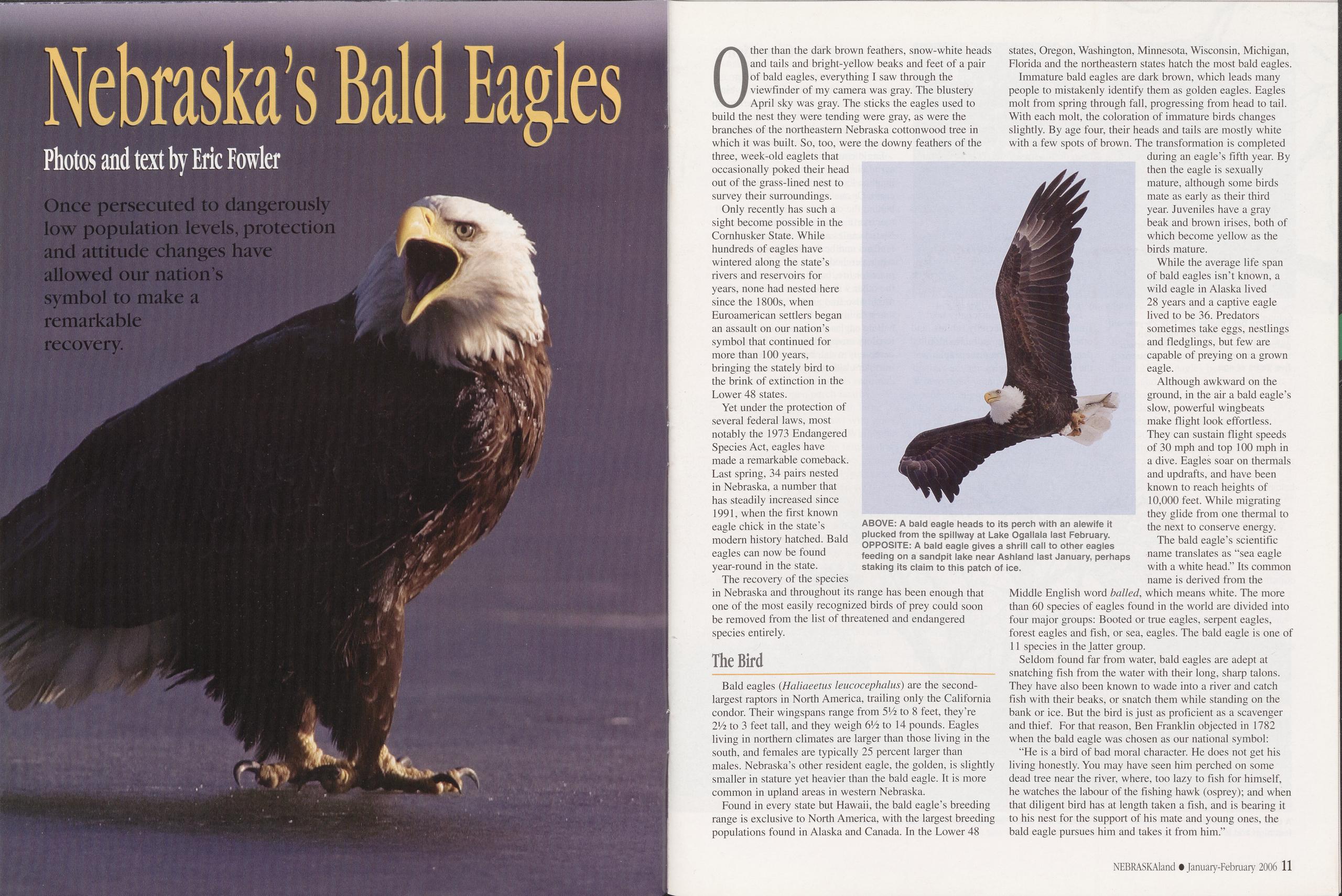
Nebraska’s Bald Eagles
Photos and text by Eric Fowler Once persecuted to dangerously low population levels, protection and attitude changes have allowed our nation’s symbol to make a remarkable recoveryOther than the dark brown feathers, snow-white heads and tails and bright-yellow beaks and feet of a pair of bald eagles, everything I saw through the viewfinder of my camera was gray. The blustery April sky was gray. The sticks the eagles used to build the nest they were tending were gray, as were the branches of the northeastern Nebraska cottonwood tree in which it was built. So, too, were the downy feathers of the three, week-old eaglets that occasionally poked their head out of the grass-lined nest to survey their surroundings.
Only recently has such a sight become possible in the Cornhusker State. While hundreds of eagles have wintered along the state’s rivers and reservoirs for years, none had nested here since the 1800s, when Euroamerican settlers began an assault on our nation’s symbol that continued for more than 100 years, bringing the stately bird to the brink of extinction in the Lower 48 states.
Yet under the protection of several federal laws, most notably the 1973 Endangered Species Act, eagles have made a remarkable comeback. Last spring, 34 pairs nested in Nebraska, a number that has steadily increased since 1991, when the first known eagle chick in the state’s modern history hatched. Bald eagles can now be found year-round in the state.
The recovery of the species in Nebraska and throughout its range has been enough that one of the most easily recognized birds of prey could soon be removed from the list of threatened and endangered species entirely.
The BirdBald eagles (Haliaeetus leucocephalus) are the second- largest raptors in North America, trailing only the California condor. Their wingspans range from 5Vi to 8 feet, they’re D/i to 3 feet tall, and they weigh 6L2 to 14 pounds. Eagles living in northern climates are larger than those living in the south, and females are typically 25 percent larger than males. Nebraska’s other resident eagle, the golden, is slightly smaller in stature yet heavier than the bald eagle. It is more common in upland areas in western Nebraska.
Found in every state but Hawaii, the bald eagle’s breeding range is exclusive to North America, with the largest breeding populations found in Alaska and Canada. In the Lower 48 ABOVE: A bald eagle heads to its perch with an alewife it plucked from the spillway at Lake Ogallala last February. OPPOSITE: A bald eagle gives a shrill call to other eagles feeding on a sandpit lake near Ashland last January, perhaps staking its claim to this patch of ice. states, Oregon, Washington, Minnesota, Wisconsin, Michigan, Florida and the northeastern states hatch the most bald eagles.
Immature bald eagles are dark brown, which leads many people to mistakenly identify them as golden eagles. Eagles molt from spring through fall, progressing from head to tail. With each molt, the coloration of immature birds changes slightly. By age four, their heads and tails are mostly white with a few spots of brown. The transformation is completed during an eagle’s fifth year. By then the eagle is sexually mature, although some birds mate as early as their third year. Juveniles have a gray beak and brown irises, both of which become yellow as the birds mature.
While the average life span of bald eagles isn’t known, a wild eagle in Alaska lived 28 years and a captive eagle lived to be 36. Predators sometimes take eggs, nestlings and fledglings, but few are capable of preying on a grown eagle.
Although awkward on the ground, in the air a bald eagle’s slow, powerful wingbeats make flight look effortless. They can sustain flight speeds of 30 mph and top 100 mph in a dive. Eagles soar on thermals and updrafts, and have been known to reach heights of 10,000 feet. While migrating they glide from one thermal to the next to conserve energy.
The bald eagle’s scientific name translates as “sea eagle with a white head.” Its common name is derived from the Middle English word balled, which means white. The more than 60 species of eagles found in the world are divided into four major groups: Booted or true eagles, serpent eagles, forest eagles and fish, or sea, eagles. The bald eagle is one of 11 species in the latter group.
Seldom found far from water, bald eagles are adept at snatching fish from the water with their long, sharp talons. They have also been known to wade into a river and catch fish with their beaks, or snatch them while standing on the bank or ice. But the bird is just as proficient as a scavenger and thief. For that reason, Ben Franklin objected in 1782 when the bald eagle was chosen as our national symbol: “He is a bird of bad moral character. He does not get his living honestly. You may have seen him perched on some dead tree near the river, where, too lazy to fish for himself, he watches the labour of the fishing hawk (osprey); and when that diligent bird has at length taken a fish, and is bearing it to his nest for the support of his mate and young ones, the bald eagle pursues him and takes it from him.”
NEBRASKAland • January-February 2006 11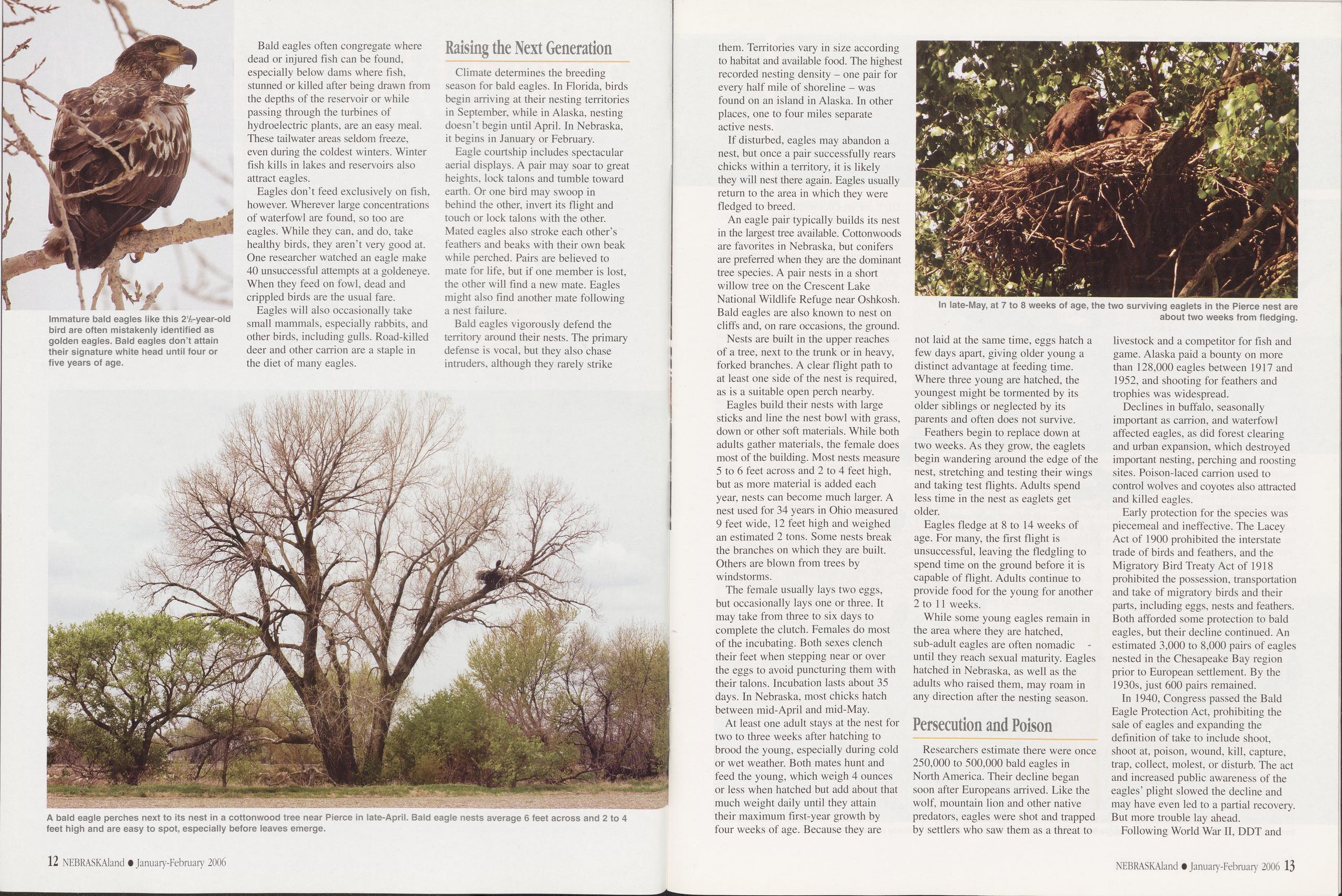
Bald eagles often congregate where dead or injured fish can be found, especially below dams where fish, stunned or killed after being drawn from the depths of the reservoir or while passing through the turbines of hydroelectric plants, are an easy meal. These tailwater areas seldom freeze, even during the coldest winters. Winter fish kills in lakes and reservoirs also attract eagles.
Eagles don’t feed exclusively on fish, however. Wherever large concentrations of waterfowl are found, so too are eagles. While they can, and do, take healthy birds, they aren’t very good at. One researcher watched an eagle make 40 unsuccessful attempts at a goldeneye. When they feed on fowl, dead and crippled birds are the usual fare.
Eagles will also occasionally take small mammals, especially rabbits, and other birds, including gulls. Road-killed deer and other carrion are a staple in the diet of many eagles.
Climate determines the breeding season for bald eagles. In Florida, birds begin arriving at their nesting territories in September, while in Alaska, nesting doesn’t begin until April. In Nebraska, it begins in January or February.
Eagle courtship includes spectacular aerial displays. A pair may soar to great heights, lock talons and tumble toward earth. Or one bird may swoop in behind the other, invert its flight and touch or lock talons with the other. Mated eagles also stroke each other’s feathers and beaks with their own beak while perched. Pairs are believed to mate for life, but if one member is lost, the other will find a new mate. Eagles might also find another mate following a nest failure.
Bald eagles vigorously defend the territory around their nests. The primary defense is vocal, but they also chase intruders, although they rarely strike them. Territories vary in size according to habitat and available food. The highest recorded nesting density - one pair for every half mile of shoreline - was found on an island in Alaska. In other places, one to four miles separate active nests.
If disturbed, eagles may abandon a nest, but once a pair successfully rears chicks within a territory, it is likely they will nest there again. Eagles usually return to the area in which they were fledged to breed.
An eagle pair typically builds its nest in the largest tree available. Cottonwoods are favorites in Nebraska, but conifers are preferred when they are the dominant tree species. A pair nests in a short willow tree on the Crescent Lake National Wildlife Refuge near Oshkosh. Bald eagles are also known to nest on cliffs and, on rare occasions, the ground.
Nests are built in the upper reaches of a tree, next to the trunk or in heavy, forked branches. A clear flight path to at least one side of the nest is required, as is a suitable open perch nearby. Eagles build their nests with large sticks and line the nest bowl with grass, down or other soft materials. While both adults gather materials, the female does most of the building. Most nests measure 5 to 6 feet across and 2 to 4 feet high, but as more material is added each year, nests can become much larger. A nest used for 34 years in Ohio measured 9 feet wide, 12 feet high and weighed an estimated 2 tons. Some nests break the branches on which they are built. Others are blown from trees by windstorms.
The female usually lays two eggs, but occasionally lays one or three. It may take from three to six days to complete the clutch. Females do most of the incubating. Both sexes clench their feet when stepping near or over the eggs to avoid puncturing them with their talons. Incubation lasts about 35 days. In Nebraska, most chicks hatch between mid-April and mid-May.
At least one adult stays at the nest for two to three weeks after hatching to brood the young, especially during cold or wet weather. Both mates hunt and feed the young, which weigh 4 ounces or less when hatched but add about that much weight daily until they attain their maximum first-year growth by four weeks of age. Because they are In late-May, at 7 to 8 weeks of age, the two surviving eaglets in the Pierce nest are about two weeks from fledging. not laid at the same time, eggs hatch a few days apart, giving older young a distinct advantage at feeding time. Where three young are hatched, the youngest might be tormented by its older siblings or neglected by its parents and often does not survive.
Feathers begin to replace down at two weeks. As they grow, the eaglets begin wandering around the edge of the nest, stretching and testing their wings and taking test flights. Adults spend less time in the nest as eaglets get older.
Eagles fledge at 8 to 14 weeks of age. For many, the first flight is unsuccessful, leaving the fledgling to spend time on the ground before it is capable of flight. Adults continue to provide food for the young for another 2 to 11 weeks.
While some young eagles remain in the area where they are hatched, sub-adult eagles are often nomadic - until they reach sexual maturity. Eagles hatched in Nebraska, as well as the adults who raised them, may roam in any direction after the nesting season.
Persecution and PoisonResearchers estimate there were once 250,000 to 500,000 bald eagles in North America. Their decline began soon after Europeans arrived. Like the wolf, mountain lion and other native predators, eagles were shot and trapped by settlers who saw them as a threat to livestock and a competitor for fish and game. Alaska paid a bounty on more than 128,000 eagles between 1917 and 1952, and shooting for feathers and trophies was widespread.
Declines in buffalo, seasonally important as carrion, and waterfowl affected eagles, as did forest clearing and urban expansion, which destroyed important nesting, perching and roosting sites. Poison-laced carrion used to control wolves and coyotes also attracted and killed eagles.
Early protection for the species was piecemeal and ineffective. The Lacey Act of 1900 prohibited the interstate trade of birds and feathers, and the Migratory Bird Treaty Act of 1918 prohibited the possession, transportation and take of migratory birds and their parts, including eggs, nests and feathers. Both afforded some protection to bald eagles, but their decline continued. An estimated 3,000 to 8,000 pairs of eagles nested in the Chesapeake Bay region prior to European settlement. By the 1930s, just 600 pairs remained.
In 1940, Congress passed the Bald Eagle Protection Act, prohibiting the sale of eagles and expanding the definition of take to include shoot, shoot at, poison, wound, kill, capture, trap, collect, molest, or disturb. The act and increased public awareness of the eagles’ plight slowed the decline and may have even led to a partial recovery. But more trouble lay ahead. Following World War II, DDT and
12 NEBRASKAland •January-February 2006 NEBRASKAland • January-February 2006 13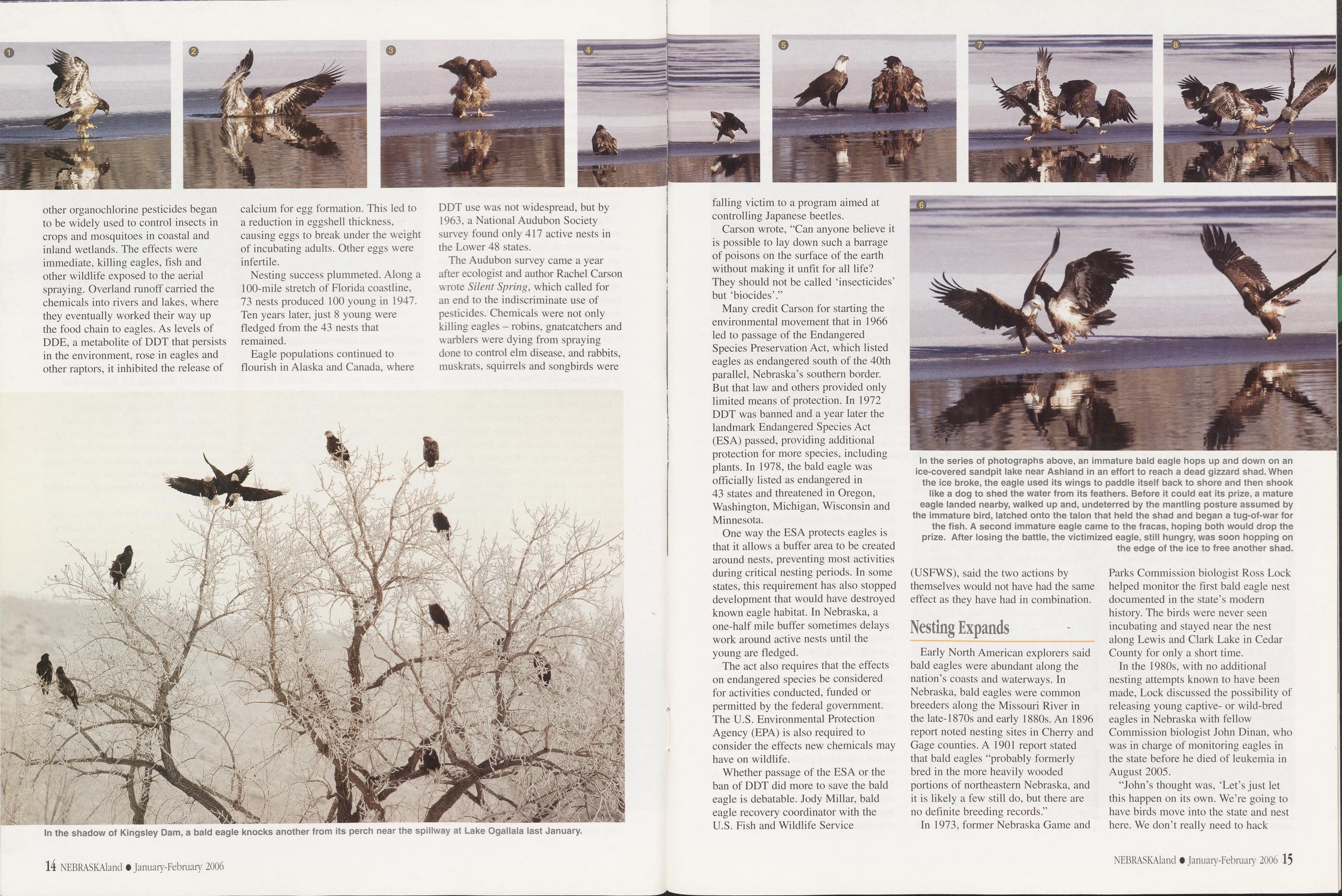
1
2
3
4
5
6
7
8
other organochlorine pesticides began to be widely used to control insects in crops and mosquitoes in coastal and inland wetlands. The effects were immediate, killing eagles, fish and other wildlife exposed to the aerial spraying. Overland runoff carried the chemicals into rivers and lakes, where they eventually worked their way up the food chain to eagles. As levels of DDE, a metabolite of DDT that persists in the environment, rose in eagles and other raptors, it inhibited the release of In the shadow of Kingsley Dam, a bald eagle knocks another from its perch near the spillway at Lake Ogallala last January. calcium for egg formation. This led to a reduction in eggshell thickness, causing eggs to break under the weight of incubating adults. Other eggs were infertile.
Nesting success plummeted. Along a 100-mile stretch of Florida coastline, 73 nests produced 100 young in 1947. Ten years later, just 8 young were fledged from the 43 nests that remained.
Eagle populations continued to flourish in Alaska and Canada, where DDT use was not widespread, but by 1963, a National Audubon Society survey found only 417 active nests in the Lower 48 states.
The Audubon survey came a year after ecologist and author Rachel Carson wrote Silent Spring, which called for an end to the indiscriminate use of pesticides. Chemicals were not only killing eagles - robins, gnatcatchers and warblers were dying from spraying done to control elm disease, and rabbits, muskrats, squirrels and songbirds were falling victim to a program aimed at controlling Japanese beetles.
Carson wrote, "Can anyone believe it is possible to lay down such a barrage of poisons on the surface of the earth without making it unfit for all life? They should not be called ‘insecticides’ but ‘biocides’.”
Many credit Carson for starting the environmental movement that in 1966 led to passage of the Endangered Species Preservation Act, which listed eagles as endangered south of the 40th parallel, Nebraska’s southern border. But that law and others provided only limited means of protection. In 1972 DDT was banned and a year later the landmark Endangered Species Act (ESA) passed, providing additional protection for more species, including plants. In 1978, the bald eagle was officially listed as endangered in 43 states and threatened in Oregon, Washington, Michigan, Wisconsin and Minnesota.
One way the ESA protects eagles is that it allows a buffer area to be created around nests, preventing most activities during critical nesting periods. In some states, this requirement has also stopped development that would have destroyed known eagle habitat. In Nebraska, a one-half mile buffer sometimes delays work around active nests until the young are fledged.
The act also requires that the effects on endangered species be considered for activities conducted, funded or permitted by the federal government. The U.S. Environmental Protection Agency (EPA) is also required to consider the effects new chemicals may have on wildlife.
Whether passage of the ESA or the ban of DDT did more to save the bald eagle is debatable. Jody Millar, bald eagle recovery coordinator with the U.S. Fish and Wildlife Service In the series of photographs above, an immature bald eagle hops up and down on an ice-covered sandpit lake near Ashland in an effort to reach a dead gizzard shad. When the ice broke, the eagle used its wings to paddle itself back to shore and then shook like a dog to shed the water from its feathers. Before it could eat its prize, a mature eagle landed nearby, walked up and, undeterred by the mantling posture assumed by the immature bird, latched onto the talon that held the shad and began a tug-of-war for the fish. A second immature eagle came to the fracas, hoping both would drop the prize. After losing the battle, the victimized eagle, still hungry, was soon hopping on the edge of the ice to free another shad. (USFWS), said the two actions by themselves would not have had the same effect as they have had in combination.
Nesting ExpandsEarly North American explorers said bald eagles were abundant along the nation’s coasts and waterways. In Nebraska, bald eagles were common breeders along the Missouri River in the late-1870s and early 1880s. An 1896 report noted nesting sites in Cherry and Gage counties. A 1901 report stated that bald eagles “probably formerly bred in the more heavily wooded portions of northeastern Nebraska, and it is likely a few still do, but there are no definite breeding records.”
In 1973, former Nebraska Game and Parks Commission biologist Ross Lock helped monitor the first bald eagle nest documented in the state’s modern history. The birds were never seen incubating and stayed near the nest along Lewis and Clark Lake in Cedar County for only a short time.
In the 1980s, with no additional nesting attempts known to have been made, Lock discussed the possibility of releasing young captive- or wild-bred eagles in Nebraska with fellow Commission biologist John Dinan, who was in charge of monitoring eagles in the state before he died of leukemia in August 2005.
"John’s thought was, ‘Let’s just let this happen on its own. We’re going to have birds move into the state and nest here. We don’t really need to hack
14 NEBRASKAland O January-February 2006 NEBRASKAland • January-February 2006 15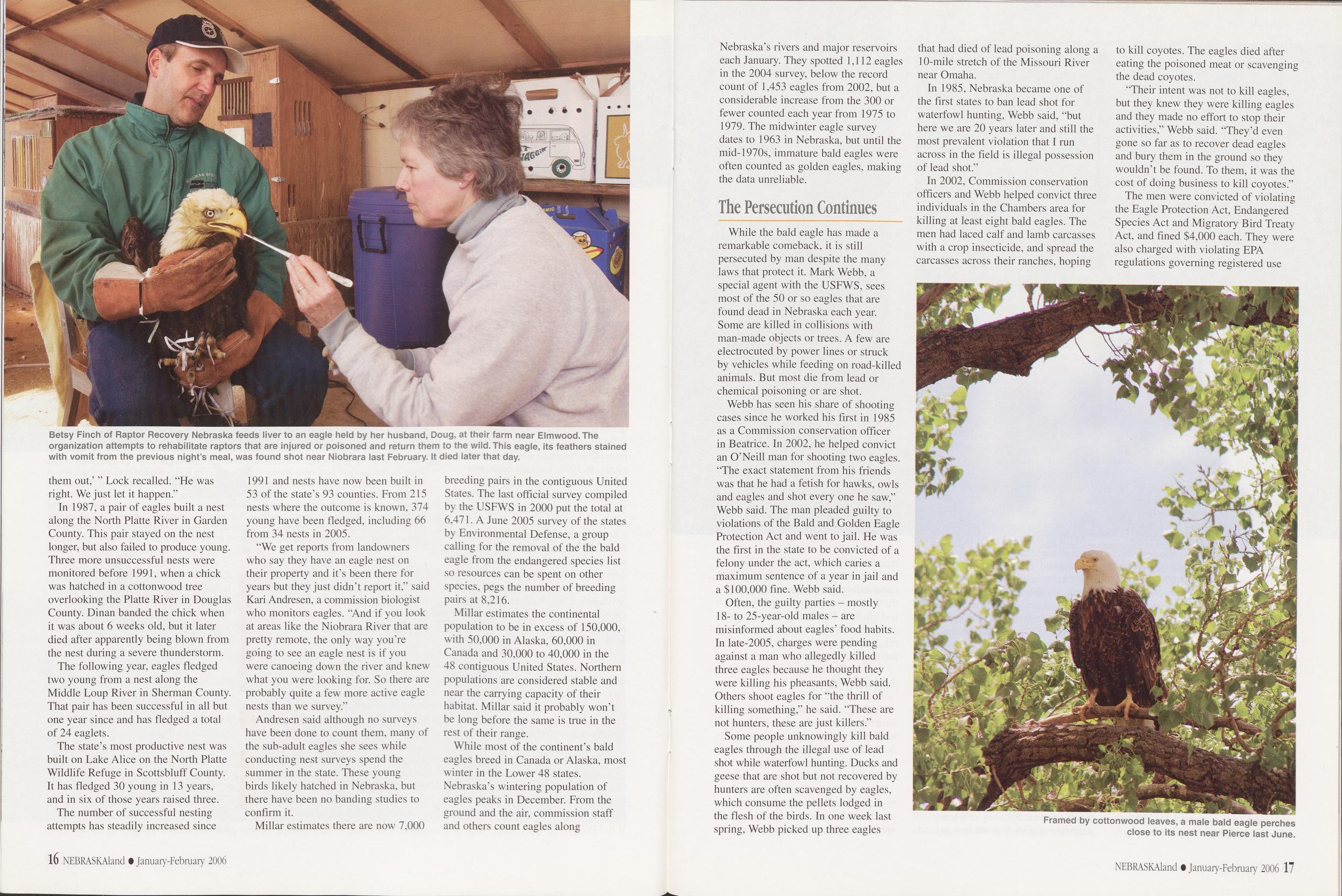
them out,’ ” Lock recalled. “He was right. We just let it happen.”
In 1987, a pair of eagles built a nest along the North Platte River in Garden County. This pair stayed on the nest longer, but also failed to produce young. Three more unsuccessful nests were monitored before 1991, when a chick was hatched in a cottonwood tree overlooking the Platte River in Douglas County. Dinan banded the chick when it was about 6 weeks old, but it later died after apparently being blown from the nest during a severe thunderstorm.
The following year, eagles fledged two young from a nest along the Middle Loup River in Sherman County. That pair has been successful in all but one year since and has fledged a total of 24 eaglets.
The state’s most productive nest was built on Lake Alice on the North Platte Wildlife Refuge in Scottsbluff County. It has fledged 30 young in 13 years, and in six of those years raised three. The number of successful nesting attempts has steadily increased since 1991 and nests have now been built in 53 of the state’s 93 counties. From 215 nests where the outcome is known, 374 young have been fledged, including 66 from 34 nests in 2005.
“We get reports from landowners who say they have an eagle nest on their property and it’s been there for years but they just didn’t report it,” said Kari Andresen, a commission biologist who monitors eagles. “And if you look at areas like the Niobrara River that are pretty remote, the only way you’re going to see an eagle nest is if you were canoeing down the river and knew what you were looking for. So there are probably quite a few more active eagle nests than we survey.”
Andresen said although no surveys have been done to count them, many of the sub-adult eagles she sees while conducting nest surveys spend the summer in the state. These young birds likely hatched in Nebraska, but there have been no banding studies to confirm it.
Millar estimates there are now 7,000 breeding pairs in the contiguous United States. The last official survey compiled by the USFWS in 2000 put the total at 6,471. A June 2005 survey of the states by Environmental Defense, a group calling for the removal of the the bald eagle from the endangered species list so resources can be spent on other species, pegs the number of breeding pairs at 8,216.
Millar estimates the continental population to be in excess of 150,000, with 50,000 in Alaska, 60,000 in Canada and 30,000 to 40,000 in the 48 contiguous United States. Northern populations are considered stable and near the carrying capacity of their habitat. Millar said it probably won’t be long before the same is true in the rest of their range.
While most of the continent’s bald eagles breed in Canada or Alaska, most winter in the Lower 48 states. Nebraska’s wintering population of eagles peaks in December. From the ground and the air, commission staff and others count eagles along Nebraska’s rivers and major reservoirs each January. They spotted 1,112 eagles in the 2004 survey, below the record count of 1,453 eagles from 2002, but a considerable increase from the 300 or fewer counted each year from 1975 to 1979. The midwinter eagle survey dates to 1963 in Nebraska, but until the mid-1970s, immature bald eagles were often counted as golden eagles, making the data unreliable.
The Persecution ContinuesWhile the bald eagle has made a remarkable comeback, it is still persecuted by man despite the many laws that protect it. Mark Webb, a special agent with the USFWS, sees most of the 50 or so eagles that are found dead in Nebraska each year. Some are killed in collisions with man-made objects or trees. A few are electrocuted by power lines or struck by vehicles while feeding on road-killed animals. But most die from lead or chemical poisoning or are shot.
Webb has seen his share of shooting cases since he worked his first in 1985 as a Commission conservation officer in Beatrice. In 2002, he helped convict an O’Neill man for shooting two eagles. “The exact statement from his friends was that he had a fetish for hawks, owls and eagles and shot every one he saw,” Webb said. The man pleaded guilty to violations of the Bald and Golden Eagle Protection Act and went to jail. He was the first in the state to be convicted of a felony under the act, which caries a maximum sentence of a year in jail and a $100,000 fine. Webb said.
Often, the guilty parties - mostly 18- to 25-year-old males - are misinformed about eagles’ food habits. In late-2005, charges were pending against a man who allegedly killed three eagles because he thought they were killing his pheasants, Webb said. Others shoot eagles for “the thrill of killing something,” he said. “These are not hunters, these are just killers.”
Some people unknowingly kill bald eagles through the illegal use of lead shot while waterfowl hunting. Ducks and geese that are shot but not recovered by hunters are often scavenged by eagles, which consume the pellets lodged in the flesh of the birds. In one week last spring, Webb picked up three eagles that had died of lead poisoning along a 10-mile stretch of the Missouri River near Omaha.
In 1985, Nebraska became one of the first states to ban lead shot for waterfowl hunting, Webb said, “but here we are 20 years later and still the most prevalent violation that I run across in the field is illegal possession of lead shot.”
In 2002, Commission conservation officers and Webb helped convict three individuals in the Chambers area for killing at least eight bald eagles. The men had laced calf and lamb carcasses with a crop insecticide, and spread the carcasses across their ranches, hoping Framed by cottonwood leaves, a male bald eagle perches close to its nest near Pierce last June. to kill coyotes. The eagles died after eating the poisoned meat or scavenging the dead coyotes.
“Their intent was not to kill eagles, but they knew they were killing eagles and they made no effort to stop their activities,” Webb said. “They’d even gone so far as to recover dead eagles and bury them in the ground so they wouldn’t be found. To them, it was the cost of doing business to kill coyotes.”
The men were convicted of violating the Eagle Protection Act, Endangered Species Act and Migratory Bird Treaty Act, and fined $4,000 each. They were also charged with violating EPA regulations governing registered use
16 NEBRASKAland • January-February 2006 NEBRASKAland • January-February 2006 17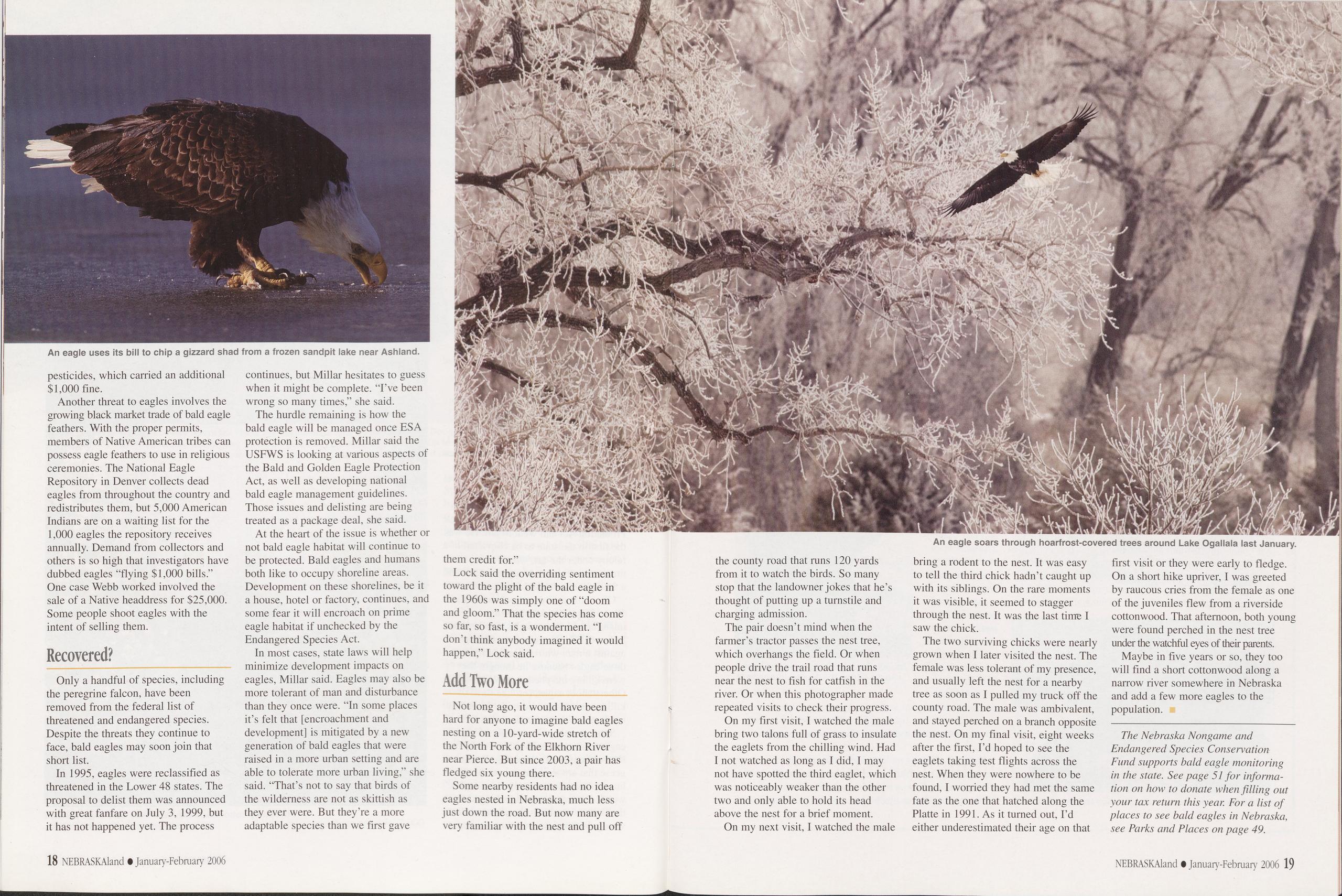
pesticides, which carried an additional $1,000 fine.
Another threat to eagles involves the growing black market trade of bald eagle feathers. With the proper permits, members of Native American tribes can possess eagle feathers to use in religious ceremonies. The National Eagle Repository in Denver collects dead eagles from throughout the country and redistributes them, but 5,000 American Indians are on a waiting list for the 1,000 eagles the repository receives annually. Demand from collectors and others is so high that investigators have dubbed eagles “flying $1,000 bills.” One case Webb worked involved the sale of a Native headdress for $25,000. Some people shoot eagles with the intent of selling them.
Recovered?Only a handful of species, including the peregrine falcon, have been removed from the federal list of threatened and endangered species. Despite the threats they continue to face, bald eagles may soon join that short list.
In 1995, eagles were reclassified as threatened in the Lower 48 states. The proposal to delist them was announced with great fanfare on July 3, 1999, but it has not happened yet. The process continues, but Millar hesitates to guess when it might be complete. “I’ve been wrong so many times,” she said.
The hurdle remaining is how the bald eagle will be managed once ESA protection is removed. Millar said the USFWS is looking at various aspects of the Bald and Golden Eagle Protection Act, as well as developing national bald eagle management guidelines. Those issues and delisting are being treated as a package deal, she said.
At the heart of the issue is whether or not bald eagle habitat will continue to be protected. Bald eagles and humans both like to occupy shoreline areas. Development on these shorelines, be it a house, hotel or factory, continues, and some fear it will encroach on prime eagle habitat if unchecked by the Endangered Species Act.
In most cases, state laws will help minimize development impacts on eagles, Millar said. Eagles may also be more tolerant of man and disturbance than they once were. “In some places it’s felt that [encroachment and development] is mitigated by a new generation of bald eagles that were raised in a more urban setting and are able to tolerate more urban living,” she said. “That’s not to say that birds of the wilderness are not as skittish as they ever were. But they’re a more adaptable species than we first gave them credit for.”
Lock said the overriding sentiment toward the plight of the bald eagle in the 1960s was simply one of “doom and gloom.” That the species has come so far, so fast, is a wonderment. “I don’t think anybody imagined it would happen,” Lock said.
Add Two MoreNot long ago, it would have been hard for anyone to imagine bald eagles nesting on a 10-yard-wide stretch of the North Fork of the Elkhorn River near Pierce. But since 2003, a pair has fledged six young there.
Some nearby residents had no idea eagles nested in Nebraska, much less just down the road. But now many are very familiar with the nest and pull off An eagle soars through hoarfrost-covered trees around Lake Ogallala last January. the county road that runs 120 yards from it to watch the birds. So many stop that the landowner jokes that he’s thought of putting up a turnstile and charging admission.
The pair doesn’t mind when the farmer’s tractor passes the nest tree, which overhangs the field. Or when people drive the trail road that runs near the nest to fish for catfish in the river. Or when this photographer made repeated visits to check their progress.
On my first visit, I watched the male bring two talons full of grass to insulate the eaglets from the chilling wind. Had I not watched as long as I did, I may not have spotted the third eaglet, which was noticeably weaker than the other two and only able to hold its head above the nest for a brief moment.
On my next visit, I watched the male bring a rodent to the nest. It was easy to tell the third chick hadn’t caught up with its siblings. On the rare moments it was visible, it seemed to stagger through the nest. It was the last time I saw the chick.
The two surviving chicks were nearly grown when I later visited the nest. The female was less tolerant of my presence, and usually left the nest for a nearby tree as soon as I pulled my truck off the county road. The male was ambivalent, and stayed perched on a branch opposite the nest. On my final visit, eight weeks after the first, I’d hoped to see the eaglets taking test flights across the nest. When they were nowhere to be found, I worried they had met the same fate as the one that hatched along the Platte in 1991. As it turned out, I’d either underestimated their age on that first visit or they were early to fledge.
On a short hike upriver, I was greeted by raucous cries from the female as one of the juveniles flew from a riverside cottonwood. That afternoon, both young were found perched in the nest tree under the watchful eyes of their parents.
Maybe in five years or so, they too will find a short cottonwood along a narrow river somewhere in Nebraska and add a few more eagles to the population.
The Nebraska Nongame and Endangered Species Conservation Fund supports bald eagle monitoring in the state. See page 51 for informa- tion on how to donate when filling out your tax return this year. For a list of places to see bald eagles in Nebraska, see Parks and Places on page 49. 18 NEBRASKAland • January-February 2006 NEBRASKAland • January-February 2006 19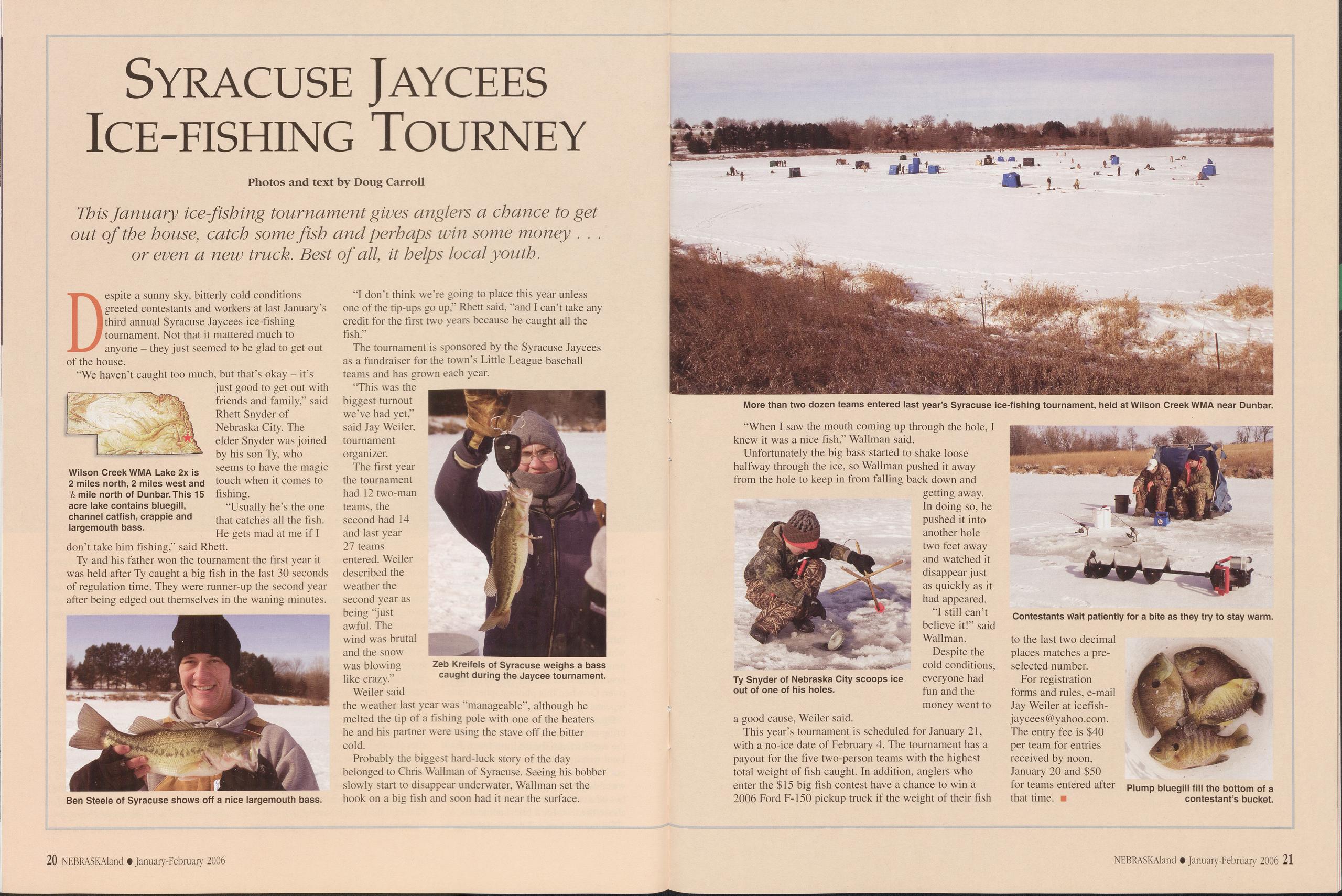
Syracuse Jaycees Ice-fishing Tourney Photos and text by Doug Carroll This January ice-fishing tournament gives anglers a chance to get out of the house, catch some fish and perhaps win some money . . . or even a new truck. Best of all, it helps local youth.
Despite a sunny sky, bitterly cold conditions greeted contestants and workers at last January’s third annual Syracuse Jaycees ice-fishing tournament. Not that it mattered much to anyone - they just seemed to be glad to get out of the house.
“We haven’t caught too much, but that’s okay - it’s just good to get out with friends and family,” said Rhett Snyder of Nebraska City. The elder Snyder was joined by his son Ty, who seems to have the magic touch when it comes to fishing.
“Usually he’s the one that catches all the fish. He gets mad at me if I don’t take him fishing,” said Rhett.
Ty and his father won the tournament the first year it was held after Ty caught a big fish in the last 30 seconds of regulation time. They were runner-up the second year after being edged out themselves in the waning minutes.
“I don’t think we’re going to place this year unless one of the tip-ups go up,” Rhett said, “and I can’t take any credit for the first two years because he caught all the fish.”
The tournament is sponsored by the Syracuse Jaycees as a fundraiser for the town's Little League baseball teams and has grown each year.
“This was the biggest turnout we’ve had yet,” said Jay Weiler, tournament organizer.
The first year the tournament had 12 two-man teams, the second had 14 and last year 27 teams entered. Weiler described the weather the second year as being “just awful. The wind was brutal and the snow was blowing Zeb Kreifels of Syracuse weighs a bass like crazy”
caught during the Jaycee tournament.Weiler said the weather last year was “manageable”, although he melted the tip of a fishing pole with one of the heaters he and his partner were using the stave off the bitter cold.
Probably the biggest hard-luck story of the day belonged to Chris Wallman of Syracuse. Seeing his bobber slowly start to disappear underwater, Wallman set the hook on a big fish and soon had it near the surface.
“When I saw the mouth coming up through the hole, I knew it was a nice fish,” Wallman said. Unfortunately the big bass started to shake loose halfway through the ice, so Wallman pushed it away from the hole to keep in from falling back down and getting away. In doing so, he pushed it into another hole two feet away and watched it disappear just as quickly as it had appeared.
“I still can’t believe it!” said Wallman.
Despite the cold conditions, everyone had fun and the money went to a good cause, Weiler said.
This year’s tournament is scheduled for January 21, with a no-ice date of February 4. The tournament has a payout for the five two-person teams with the highest total weight of fish caught. In addition, anglers who enter the $15 big fish contest have a chance to win a 2006 Ford F-150 pickup truck if the weight of their fish to the last two decimal places matches a pre- selected number. For registration forms and rules, e-mail Jay Weiler at icefish- jaycees@yahoo.com. The entry fee is $40 per team for entries received by noon, January 20 and $50 for teams entered after that time.
Plump bluegill fill the bottom of a contestant’s bucket.
20 NEBRASKAland • January-February 2006 NEBRASKAland • January-February 2006 21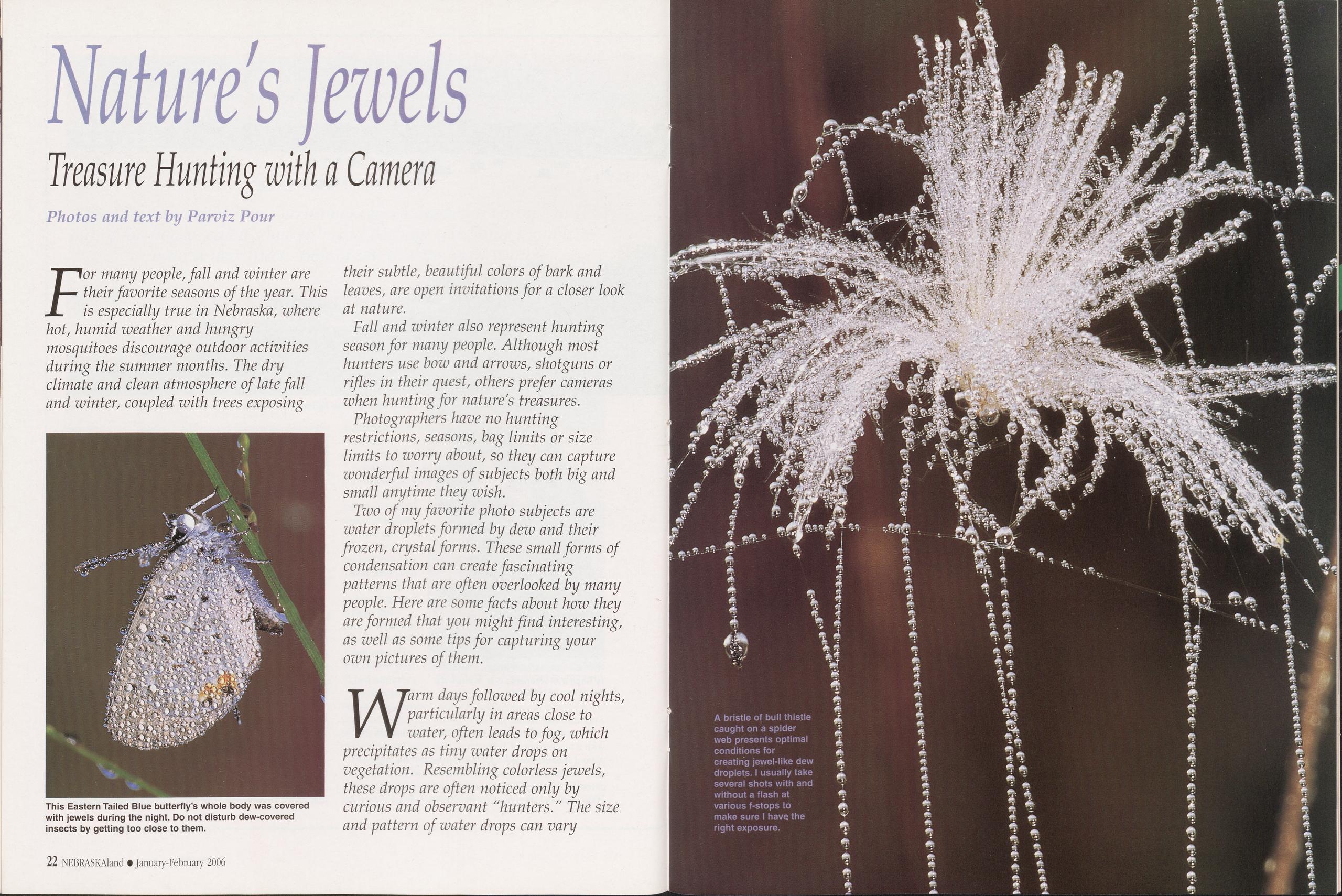
For many people, fall and winter are their favorite seasons of the year. This is especially true in Nebraska, where hot, humid weather and hungry mosquitoes discourage outdoor activities during the summer months. The dry climate and clean atmosphere of late fall and winter, coupled with trees exposing This Eastern Tailed Blue butterfly’s whole body was covered with jewels during the night. Do not disturb dew-covered insects by getting too close to them. 22 NEBRASKAland • January-February 2006 their subtle, beautiful colors of bark and leaves, are open invitations for a closer look at nature.
Fall and winter also represent hunting season for many people. Although most hunters use bow and arrows, shotguns or rifles in their quest, others prefer cameras when hunting for nature's treasures.
Photographers have no hunting restrictions, seasons, bag limits or size limits to worry about, so they can capture wonderful images of subjects both big and small anytime they wish.
Two of my favorite photo subjects are water droplets formed by dew and their frozen, crystal forms. These small forms of condensation can create fascinating patterns that are often overlooked by many people. Here are some facts about how they are formed that you might find interesting, as well as some tips for capturing your own pictures of them.
Warm days followed by cool nights, particularly in areas close to water, often leads to fog, which precipitates as tiny water drops on vegetation. Resembling colorless jewels, these drops are often noticed only by curious and observant "hunters." The size and pattern of water drops can vary
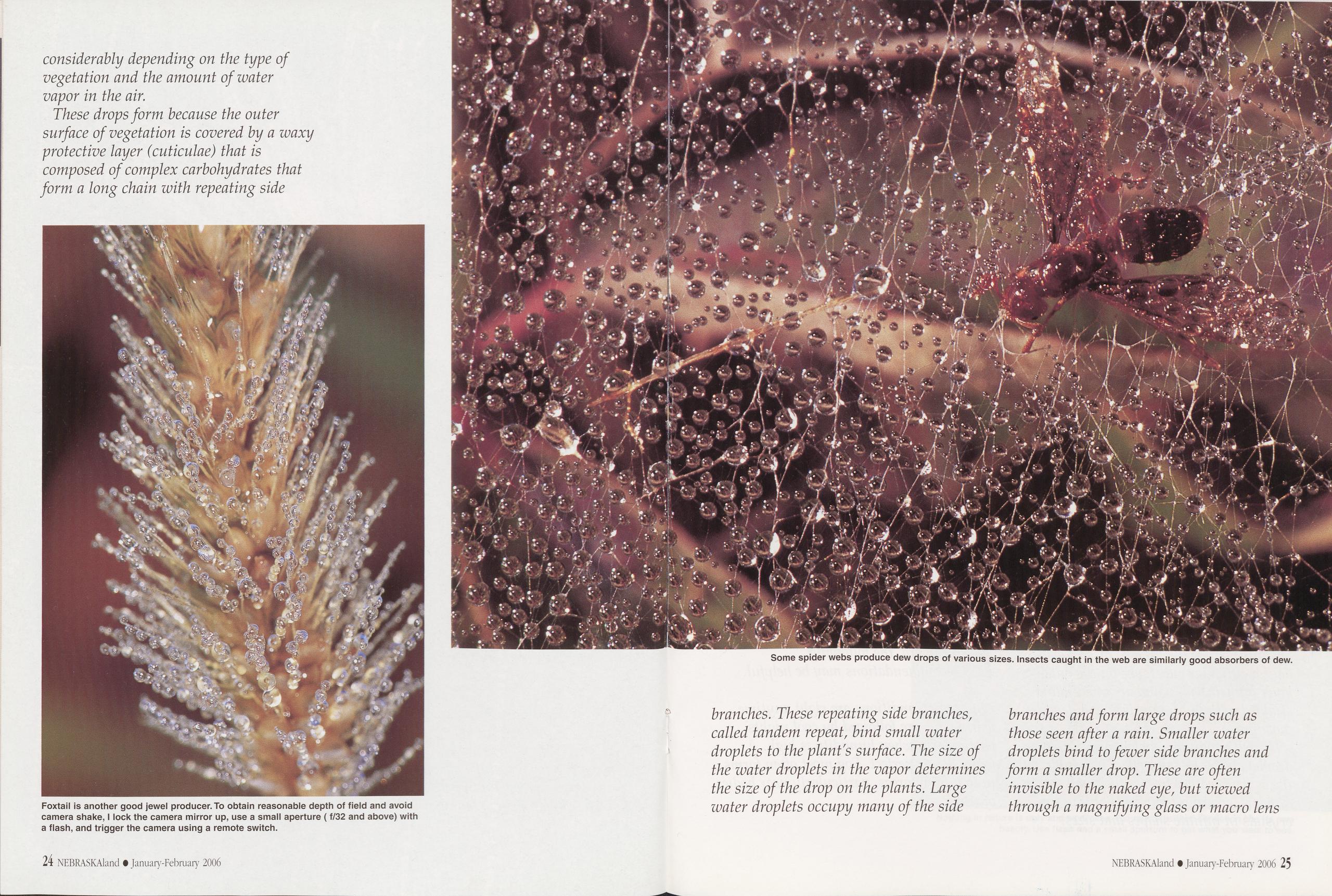
considerably depending on the type of vegetation and the amount of water vapor in the air.
These drops form because the outer surface of vegetation is covered by a waxy protective layer (cuticulae) that is composed of complex carbohydrates that form a long chain with repeating side branches. These repeating side branches, called tandem repeat, bind small water droplets to the plant's surface. The size of the water droplets in the vapor determines the size of the drop on the plants. Large water droplets occupy many of the side branches and form large drops such as those seen after a rain. Smaller water droplets bind to fewer side branches and form a smaller drop. These are often invisible to the naked eye, but viewed through a magnifying glass or macro lens
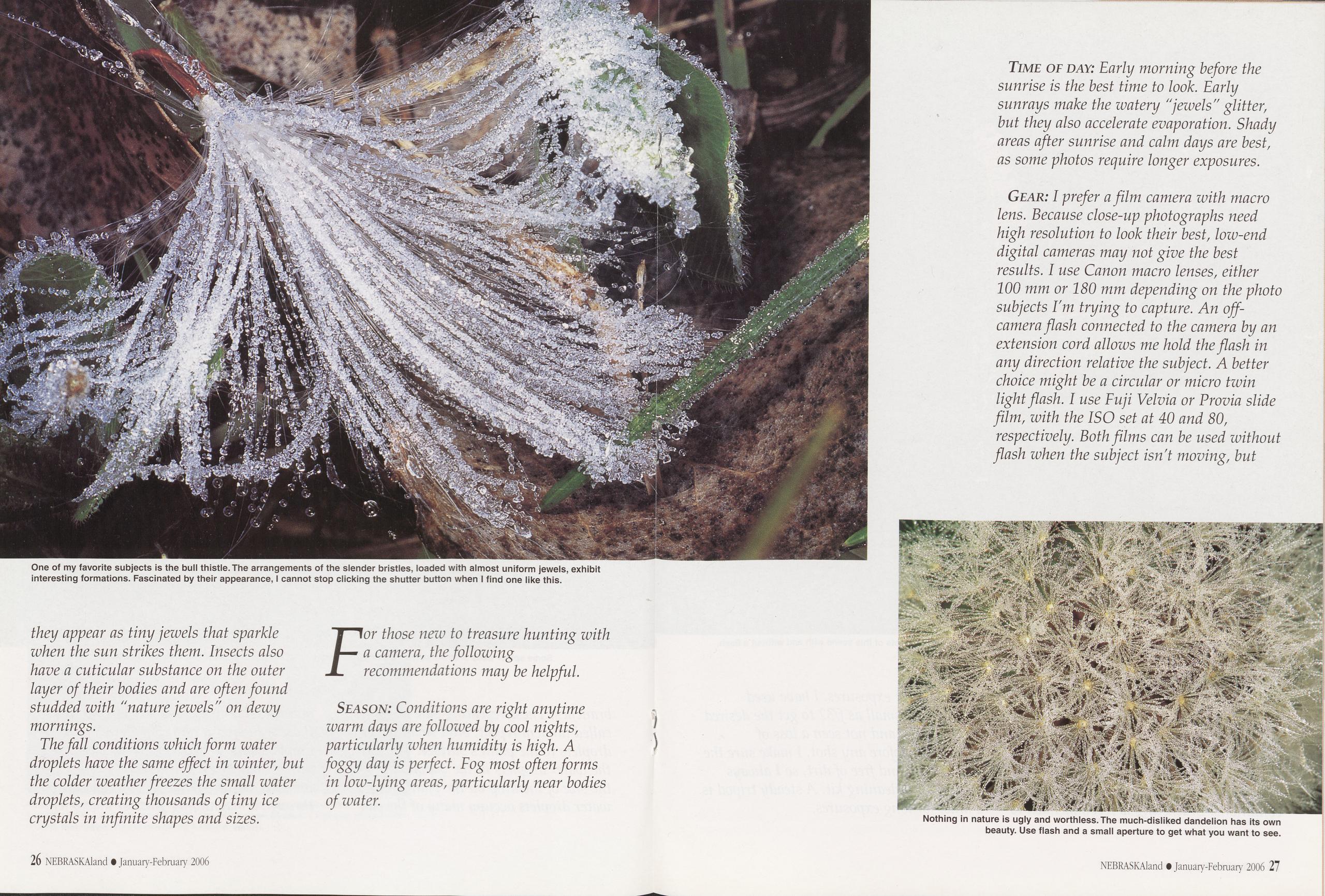
they appear as tiny jewels that sparkle when the sun strikes them. Insects also have a cuticular substance on the outer layer of their bodies and are often found studded with "nature jewels" on dewy mornings.
The fall conditions which form water droplets have the same effect in winter, but the colder weather freezes the small water droplets, creating thousands of tiny ice crystals in infinite shapes and sizes.
For those new to treasure hunting with a camera, the following recommendations may be helpful
Season: Conditions are right anytime warm days are followed by cool nights, particularly when humidity is high. A foggy day is perfect. Fog most often forms in low-lying areas, particularly near bodies of water.
Time of day: Early morning before the sunrise is the best time to look. Early sunrays make the watery "jewels" glitter, but they also accelerate evaporation. Shady areas after sunrise and calm days are best, as some photos require longer exposures.
Gear: I prefer a film camera with macro lens. Because close-up photographs need high resolution to look their best, low-end digital cameras may not give the best results. I use Canon macro lenses, either 100 mm or 180 mm depending on the photo subjects I'm trying to capture. An off- camera flash connected to the camera by an extension cord allows me hold the flash in any direction relative the subject. A better choice might be a circular or micro twin light flash. I use Fuji Velvia or Provia slide film, with the ISO set at 40 and 80, respectively. Both films can be used without flash when the subject isn't moving, but
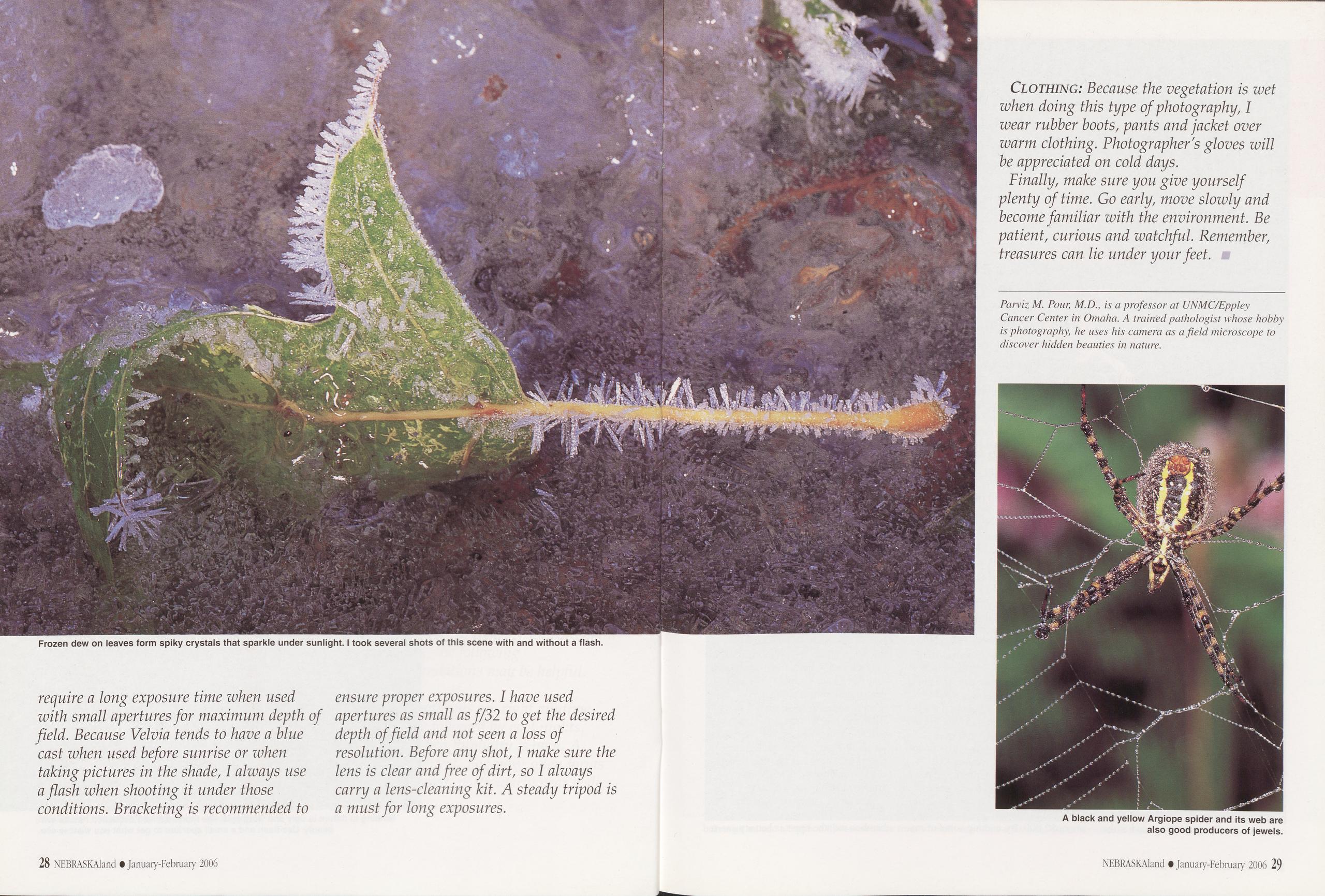
require a long exposure time when used with small apertures for maximum depth of field. Because Velvia tends to have a blue cast when used before sunrise or when taking pictures in the shade, I always use a flash when shooting it under those conditions. Bracketing is recommended to ensure proper exposures. I have used apertures as small as f/32 to get the desired depth of field and not seen a loss of resolution. Before any shot, I make sure the lens is clear and free of dirt, so I always carry a lens-cleaning kit. A steady tripod is a must for long exposures.
Clothing: Because the vegetation is wet when doing this type of photography, I wear rubber boots, pants and jacket over warm clothing. Photographer's gloves will be appreciated on cold days.
Finally, make sure you give yourself plenty of time. Go early, move slowly and become familiar with the environment. Be patient, curious and watchful. Remember, treasures can lie under your feet.
Building a Bamboo Fly Rod From the Ground Up
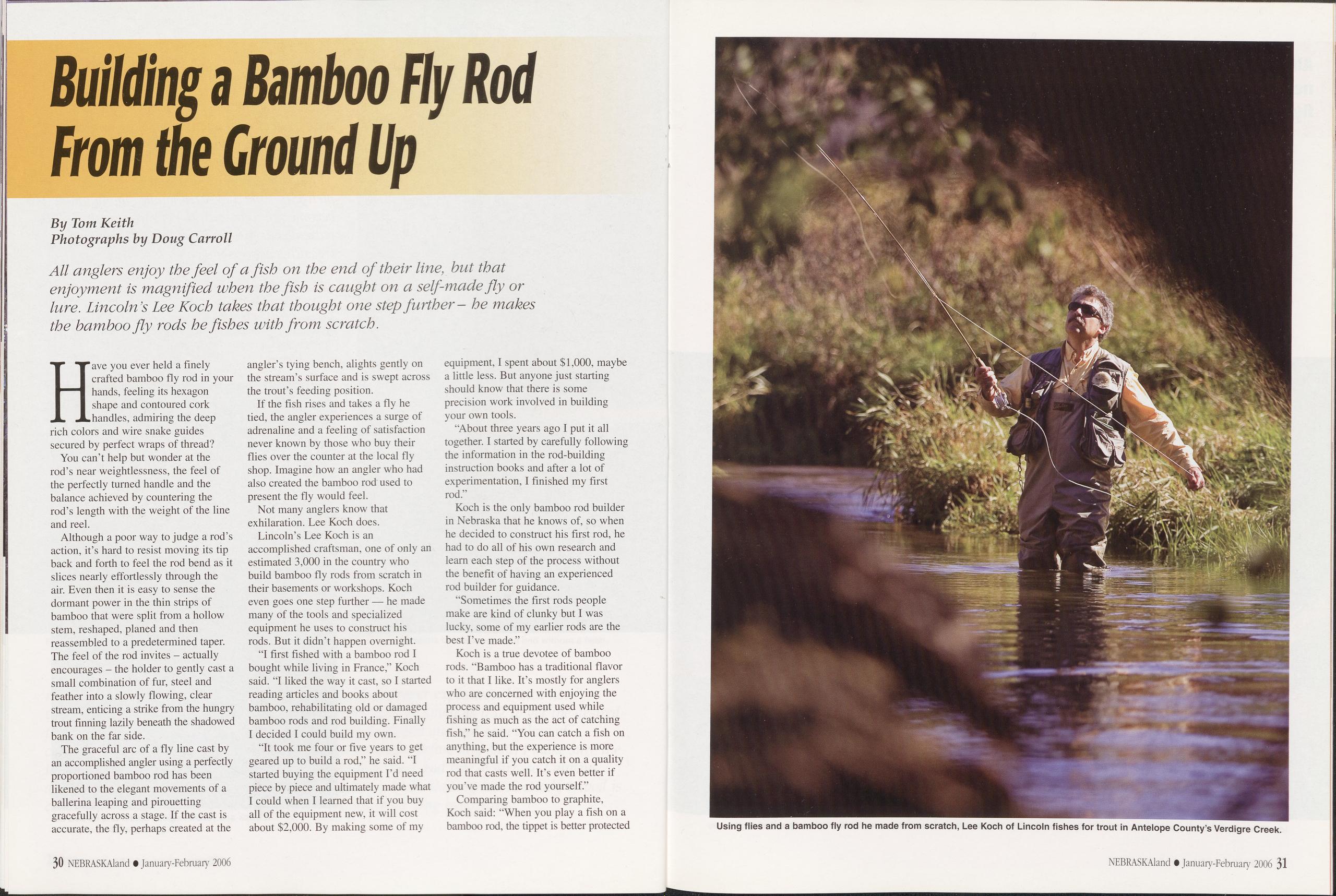
By Tom Keith Photographs by Doug CarrollAll anglers enjoy the feel of a fish on the end of their line, but that enjoyment is magnified when the fish is caught on a self-made fly or lure. Lincoln’s Lee Koch takes that thought one step further- he makes the bamboo fly rods be fishes with from scratch.
Have you ever held a finely crafted bamboo fly rod in your I 11 hands, feeling its hexagon shape and contoured cork JL JLhandles, admiring the deep rich colors and wire snake guides secured by perfect wraps of thread?
You can’t help but wonder at the rod’s near weightlessness, the feel of the perfectly turned handle and the balance achieved by countering the rod’s length with the weight of the line and reel.
Although a poor way to judge a rod’s action, it’s hard to resist moving its tip back and forth to feel the rod bend as it slices nearly effortlessly through the air. Even then it is easy to sense the dormant power in the thin strips of bamboo that were split from a hollow stem, reshaped, planed and then reassembled to a predetermined taper. The feel of the rod invites - actually encourages - the holder to gently cast a small combination of fur, steel and feather into a slowly flowing, clear stream, enticing a strike from the hungry trout finning lazily beneath the shadowed bank on the far side.
The graceful arc of a fly line cast by an accomplished angler using a perfectly proportioned bamboo rod has been likened to the elegant movements of a ballerina leaping and pirouetting gracefully across a stage. If the cast is accurate, the fly, perhaps created at the angler’s tying bench, alights gently on the stream’s surface and is swept across the trout’s feeding position. If the fish rises and takes a fly he tied, the angler experiences a surge of adrenaline and a feeling of satisfaction never known by those who buy their flies over the counter at the local fly shop. Imagine how an angler who had also created the bamboo rod used to present the fly would feel.
Not many anglers know that exhilaration. Lee Koch does.Lincoln’s Lee Koch is an accomplished craftsman, one of only an estimated 3,000 in the country who build bamboo fly rods from scratch in their basements or workshops. Koch even goes one step further — he made many of the tools and specialized equipment he uses to construct his rods. But it didn’t happen overnight.
"I first fished with a bamboo rod I bought while living in France,” Koch said. T liked the way it cast, so I started reading articles and books about bamboo, rehabilitating old or damaged bamboo rods and rod building. Finally I decided I could build my own.
"It took me four or five years to get geared up to build a rod,” he said. "I started buying the equipment I’d need piece by piece and ultimately made what I could when I learned that if you buy all of the equipment new, it will cost about $2,000. By making some of my equipment, I spent about $1,000, maybe a little less. But anyone just starting should know that there is some precision work involved in building your own tools.
"About three years ago I put it all together. I started by carefully following the information in the rod-building instruction books and after a lot of experimentation, I finished my first rod.”
Koch is the only bamboo rod builder in Nebraska that he knows of, so when he decided to construct his first rod, he had to do all of his own research and learn each step of the process without the benefit of having an experienced rod builder for guidance.
"Sometimes the first rods people make are kind of clunky but I was lucky, some of my earlier rods are the best I’ve made.”
Koch is a true devotee of bamboo rods. "Bamboo has a traditional flavor to it that I like. It’s mostly for anglers who are concerned with enjoying the process and equipment used while fishing as much as the act of catching fish,” he said. "You can catch a fish on anything, but the experience is more meaningful if you catch it on a quality rod that casts well. It’s even better if you’ve made the rod yourself.”
Comparing bamboo to graphite, Koch said: "When you play a fish on a bamboo rod, the tippet is better protected
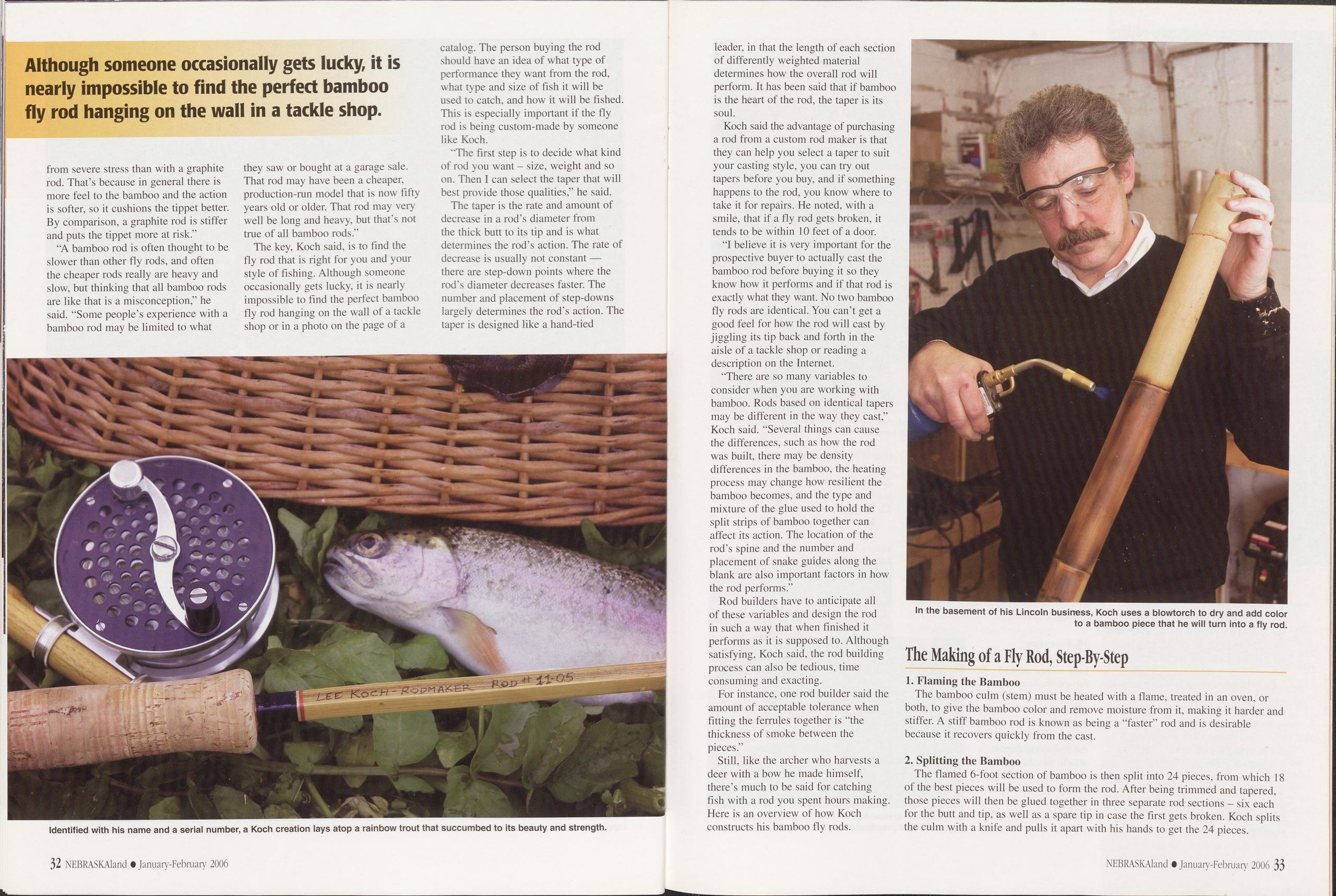
from severe stress than with a graphite rod. That’s because in general there is more feel to the bamboo and the action is softer, so it cushions the tippet better. By comparison, a graphite rod is stiffer and puts the tippet more at risk.”
“A bamboo rod is often thought to be slower than other fly rods, and often the cheaper rods really are heavy and slow, but thinking that all bamboo rods are like that is a misconception,” he said. “Some people’s experience with a bamboo rod may be limited to what they saw or bought at a garage sale. That rod may have been a cheaper, production-run model that is now fifty years old or older. That rod may very well be long and heavy, but that’s not true of all bamboo rods.”
The key, Koch said, is to find the fly rod that is right for you and your style of fishing. Although someone occasionally gets lucky, it is nearly impossible to find the perfect bamboo fly rod hanging on the wall of a tackle shop or in a photo on the page of a catalog. The person buying the rod should have an idea of what type of performance they want from the rod, what type and size of fish it will be used to catch, and how it will be fished. This is especially important if the fly rod is being custom-made by someone like Koch.
“The first step is to decide what kind of rod you want - size, weight and so on. Then I can select the taper that will best provide those qualities,” he said.
The taper is the rate and amount of decrease in a rod’s diameter from the thick butt to its tip and is what determines the rod’s action. The rate of decrease is usually not constant — there are step-down points where the rod’s diameter decreases faster. The number and placement of step-downs largely determines the rod’s action. The taper is designed like a hand-tied leader, in that the length of each section of differently weighted material determines how the overall rod will perform. It has been said that if bamboo is the heart of the rod, the taper is its soul.
Koch said the advantage of purchasing a rod from a custom rod maker is that they can help you select a taper to suit your casting style, you can try out tapers before you buy, and if something happens to the rod, you know where to take it for repairs. He noted, with a smile, that if a fly rod gets broken, it tends to be within 10 feet of a door.
“I believe it is very important for the prospective buyer to actually cast the bamboo rod before buying it so they know how it performs and if that rod is exactly what they want. No two bamboo fly rods are identical. You can’t get a good feel for how the rod will cast by jiggling its tip back and forth in the aisle of a tackle shop or reading a description on the Internet.
“There are so many variables to consider when you are working with bamboo. Rods based on identical tapers may be different in the way they cast,” Koch said. “Several things can cause the differences, such as how the rod was built, there may be density differences in the bamboo, the heating process may change how resilient the bamboo becomes, and the type and mixture of the glue used to hold the split strips of bamboo together can affect its action. The location of the rod’s spine and the number and placement of snake guides along the blank are also important factors in how the rod performs.”
Rod builders have to anticipate all of these variables and design the rod in such a way that when finished it performs as it is supposed to. Although satisfying, Koch said, the rod building process can also be tedious, time consuming and exacting.
For instance, one rod builder said the amount of acceptable tolerance when fitting the ferrules together is “the thickness of smoke between the pieces.”
Still, like the archer who harvests a deer with a bow he made himself, there’s much to be said for catching fish with a rod you spent hours making. Here is an overview of how Koch constructs his bamboo fly rods.
The bamboo culm (stem) must be heated with a flame, treated in an oven, or both, to give the bamboo color and remove moisture from it, making it harder and stiffer. A stiff bamboo rod is known as being a “faster” rod and is desirable because it recovers quickly from the cast.
2. Splitting the BambooThe flamed 6-foot section of bamboo is then split into 24 pieces, from which 18 of the best pieces will be used to form the rod. After being trimmed and tapered, those pieces will then be glued together in three separate rod sections - six each for the butt and tip, as well as a spare tip in case the first gets broken. Koch splits the culm with a knife and pulls it apart with his hands to get the 24 pieces.
32 NEBRASKAland • January-February 2006 NEBRASKAland O January-February 2006 33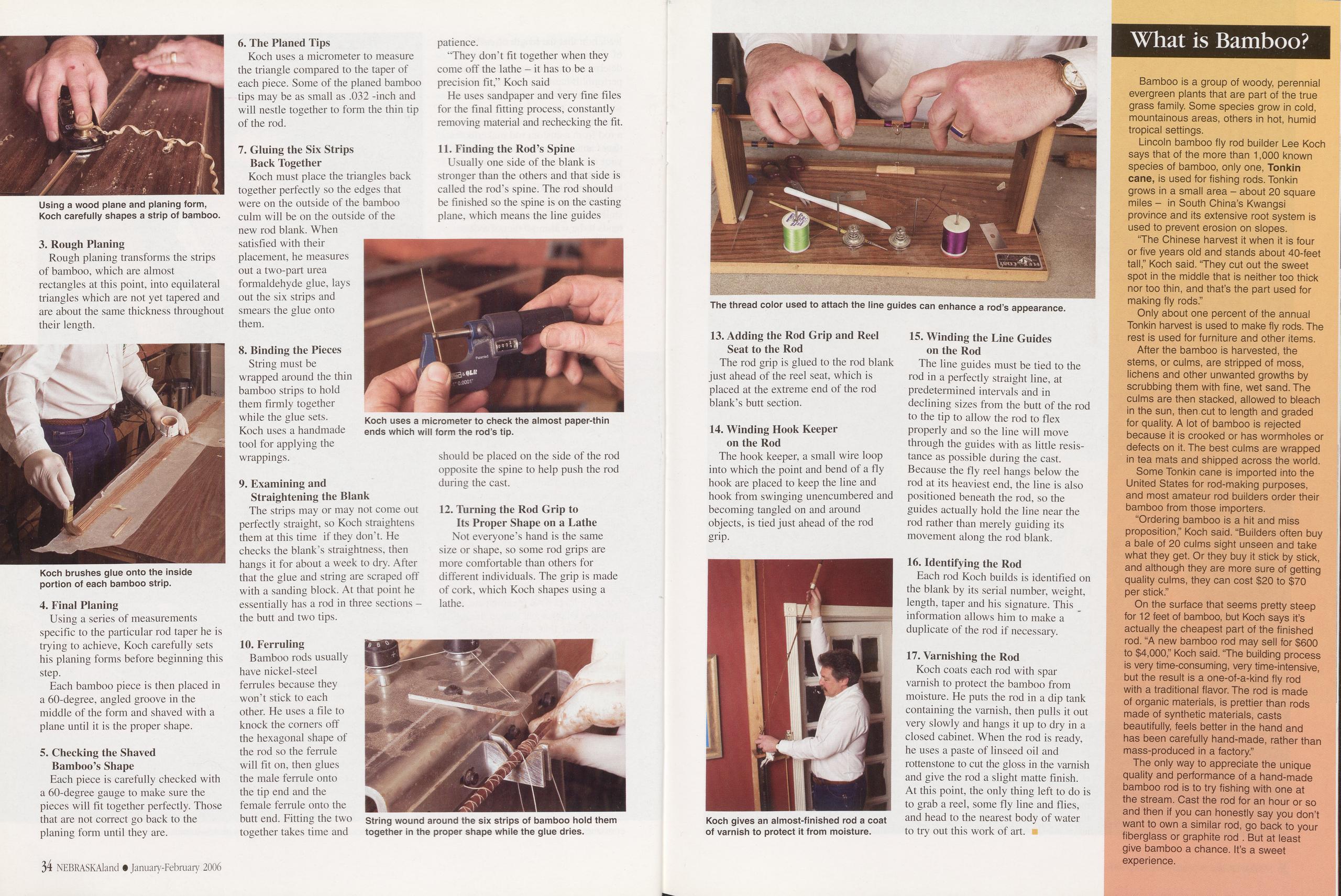
Rough planing transforms the strips of bamboo, which are almost rectangles at this point, into equilateral triangles which are not yet tapered and are about the same thickness throughout their length.
Using a series of measurements specific to the particular rod taper he is trying to achieve, Koch carefully sets his planing forms before beginning this step.
Each bamboo piece is then placed in a 60-degree, angled groove in the middle of the form and shaved with a plane until it is the proper shape.
5. Checking the Shaved Bamboo’s ShapeEach piece is carefully checked with a 60-degree gauge to make sure the pieces will fit together perfectly. Those that are not correct go back to the planing form until they are patience.
6. The Planed TipsKoch uses a micrometer to measure the triangle compared to the taper of each piece. Some of the planed bamboo tips may be as small as .032 -inch and will nestle together to form the thin tip of the rod.
7. Gluing the Six Strips Back TogetherKoch must place the triangles back together perfectly so the edges that were on the outside of the bamboo culm will be on the outside of the new rod blank. When satisfied with their placement, he measures out a two-part urea formaldehyde glue, lays out the six strips and smears the glue onto them.
8. Binding the PiecesString must be wrapped around the thin bamboo strips to hold them firmly together while the glue sets. Koch uses a handmade tool for applying the wrappings.
9. Examining and Straightening the BlankThe strips may or may not come out perfectly straight, so Koch straightens them at this time if they don’t. He checks the blank’s straightness, then hangs it for about a week to dry. After that the glue and string are scraped off with a sanding block. At that point he essentially has a rod in three sections - the butt and two tips.
10. FerrulingBamboo rods usually have nickel-steel ferrules because they won’t stick to each other. He uses a file to knock the corners off the hexagonal shape of the rod so the ferrule will fit on, then glues the male ferrule onto the tip end and the female ferrule onto the butt end. Fitting the two together takes time and patience.
"They don’t fit together when they come off the lathe - it has to be a precision fit,” Koch said,.
He uses sandpaper and very fine files for the final fitting process, constantly removing material and rechecking the fit.
11. Finding the Rod’s SpineUsually one side of the blank is stronger than the others and that side is called the rod’s spine. The rod should be finished so the spine is on the casting plane, which means the line guides should be placed on the side of the rod opposite the spine to help push the rod during the cast.
Not everyone’s hand is the same size or shape, so some rod grips are more comfortable than others for different individuals. The grip is made of cork, which Koch shapes using a lathe.
The rod grip is glued to the rod blank just ahead of the reel seat, which is placed at the extreme end of the rod blank’s butt section.
14. Winding Hook Keeper on the RodThe hook keeper, a small wire loop into which the point and bend of a fly hook are placed to keep the line and hook from swinging unencumbered and becoming tangled on and around objects, is tied just ahead of the rod grip.
The line guides must be tied to the rod in a perfectly straight line, at predetermined intervals and in declining sizes from the butt of the rod to the tip to allow the rod to flex properly and so the line will move through the guides with as little resis- tance as possible during the cast. Because the fly reel hangs below the rod at its heaviest end, the line is also positioned beneath the rod, so the guides actually hold the line near the rod rather than merely guiding its movement along the rod blank.
16. Identifying the RodEach rod Koch builds is identified on the blank by its serial number, weight, length, taper and his signature. This information allows him to make a duplicate of the rod if necessary.
17. Varnishing the RodKoch coats each rod with spar varnish to protect the bamboo from moisture. He puts the rod in a dip tank containing the varnish, then pulls it out very slowly and hangs it up to dry in a closed cabinet. When the rod is ready, he uses a paste of linseed oil and rottenstone to cut the gloss in the varnish and give the rod a slight matte finish. At this point, the only thing left to do is to grab a reel, some fly line and flies, and head to the nearest body of water to try out this work of art.
What is Bamboo?Bamboo is a group of woody, perennial evergreen plants that are part of the true grass family. Some species grow in cold, mountainous areas, others in hot, humid tropical settings.
Lincoln bamboo fly rod builder Lee Koch says that of the more than 1,000 known species of bamboo, only one, Tonkin cane, is used for fishing rods. Tonkin grows in a small area - about 20 square miles - in South China’s Kwangsi province and its extensive root system is used to prevent erosion on slopes.
“The Chinese harvest it when it is four or five years old and stands about 40-feet tall,” Koch said. “They cut out the sweet spot in the middle that is neither too thick nor too thin, and that’s the part used for making fly rods.”
Only about one percent of the annual Tonkin harvest is used to make fly rods. The rest is used for furniture and other items.
After the bamboo is harvested, the stems, or culms, are stripped of moss, lichens and other unwanted growths by scrubbing them with fine, wet sand. The culms are then stacked, allowed to bleach in the sun, then cut to length and graded for quality. A lot of bamboo is rejected because it is crooked or has wormholes or defects on it. The best culms are wrapped in tea mats and shipped across the world.
Some Tonkin cane is imported into the United States for rod-making purposes, and most amateur rod builders order their bamboo from those importers.
“Ordering bamboo is a hit and miss proposition,” Koch said. “Builders often buy a bale of 20 culms sight unseen and take what they get. Or they buy it stick by stick, and although they are more sure of getting quality culms, they can cost $20 to $70 per stick.”
On the surface that seems pretty steep for 12 feet of bamboo, but Koch says it’s actually the cheapest part of the finished rod. “A new bamboo rod may sell for $600 to $4,000,” Koch said. “The building process is very time-consuming, very time-intensive, but the result is a one-of-a-kind fly rod with a traditional flavor. The rod is made of organic materials, is prettier than rods made of synthetic materials, casts beautifully, feels better in the hand and has been carefully hand-made, rather than mass-produced in a factory.”
The only way to appreciate the unique quality and performance of a hand-made bamboo rod is to try fishing with one at the stream. Cast the rod for an hour or so and then if you can honestly say you don’t want to own a similar rod, go back to your fiberglass or graphite rod . But at least give bamboo a chance. It’s a sweet experience.
Raising Wild Birds
Photos and text by Jon Farrar For over 100 years, the Lemburg family has raised waterfowl and other game birds.There must be DNA in the Lemburg family gene predisposing them to raise wild birds. It has now passed through three generations. Or perhaps it is a virus, as spouses coming into the family are soon infected with a desire to be surrounded by wild birds. For more than 100 years, Lemburgs have raised ducks and geese in the Cairo-Boelus farm country northwest of Grand Island — not just North American species, but species from around the world.
It began in about 1900 when William H. “Willie” Lemburg, then a boy of 13 years, was sent by his father to frighten wild geese off recently sowed grain fields. The first year Willie went with a shotgun and black powder shotshells stuffed with paper rather than lead shot. The second year he was given shotshells with lead pellets. Occasionally he broke a bird’s wing, and before long the youngster had captive flocks of Canada, white-fronted and snow geese.
When Willie married and took over the family farm, the number of birds he kept grew larger and larger. Eventually he had eight acres fenced and divided into goose pens around a three-acre farm pond. Most of the Canadas he raised were small races—Hutchin’s, cacklers, lessors or Richardson’s. Willie sold some to hunters for use as live decoys until call birds became illegal in 1935, but most were shipped to zoos or other game bird breeders.
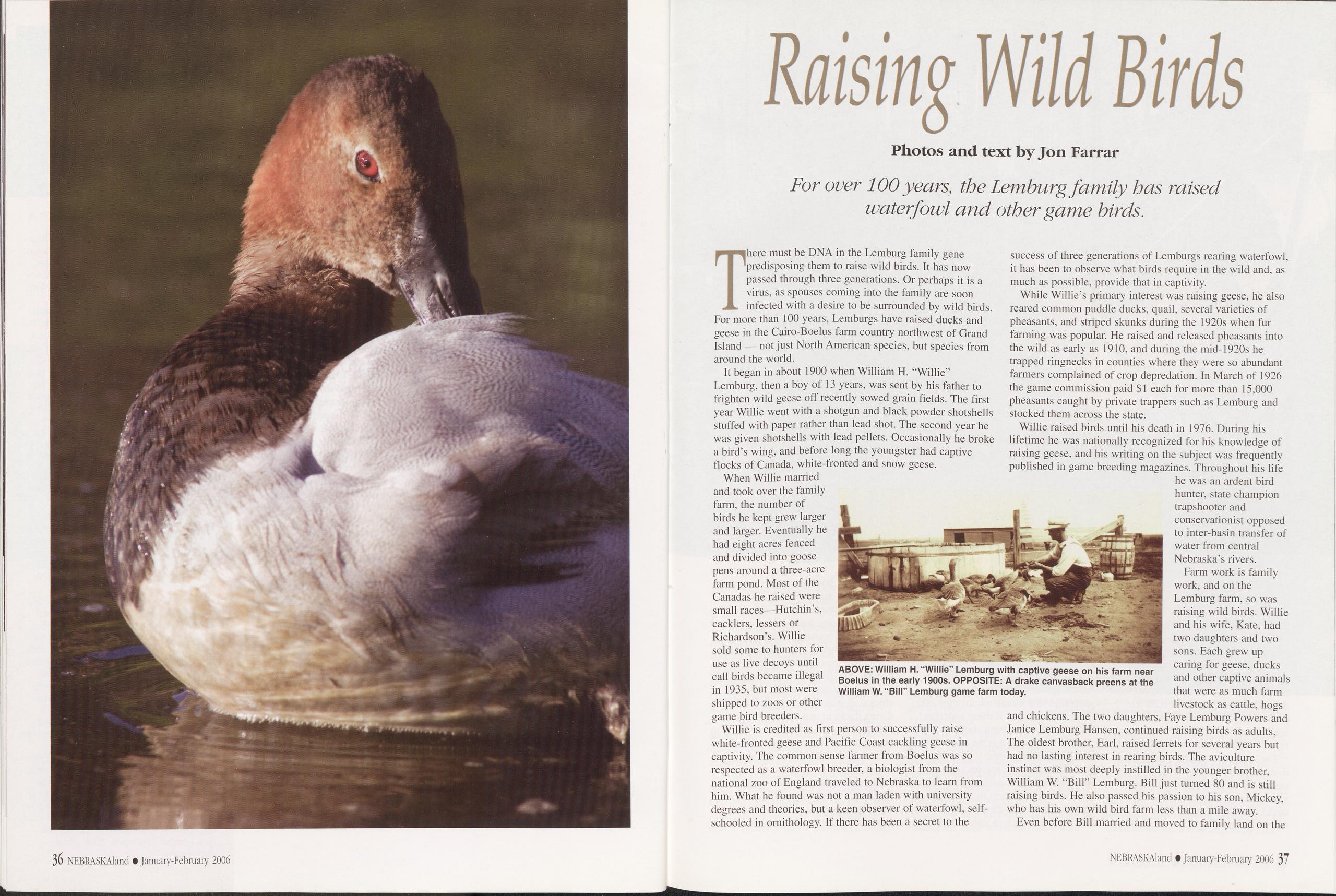
Willie is credited as first person to successfully raise white-fronted geese and Pacific Coast cackling geese in captivity. The common sense farmer from Boelus was so respected as a waterfowl breeder, a biologist from the national zoo of England traveled to Nebraska to learn from him. What he found was not a man laden with university degrees and theories, but a keen observer of waterfowl, self- schooled in ornithology. If there has been a secret to the ABOVE: William H. “Willie” Lemburg with captive geese on his farm near Boelus in the early 1900s. OPPOSITE: A drake canvasback preens at the William W. “Bill” Lemburg game farm today. success of three generations of Lemburgs rearing waterfowl, it has been to observe what birds require in the wild and, as much as possible, provide that in captivity.
While Willie’s primary interest was raising geese, he also reared common puddle ducks, quail, several varieties of pheasants, and striped skunks during the 1920s when fur farming was popular. He raised and released pheasants into the wild as early as 1910, and during the mid-1920s he trapped ringnecks in counties where they were so abundant farmers complained of crop depredation. In March of 1926 the game commission paid $1 each for more than 15,000 pheasants caught by private trappers such, as Lemburg and stocked them across the state.
Willie raised birds until his death in 1976. During his lifetime he was nationally recognized for his knowledge of raising geese, and his writing on the subject was frequently published in game breeding magazines. Throughout his life he was an ardent bird hunter, state champion trapshooter and conservationist opposed to inter-basin transfer of water from central Nebraska’s rivers.
Farm work is family work, and on the Lemburg farm, so was raising wild birds. Willie and his wife, Kate, had two daughters and two sons. Each grew up caring for geese, ducks and other captive animals that were as much farm livestock as cattle, hogs and chickens. The two daughters, Faye Lemburg Powers and Janice Lemburg Hansen, continued raising birds as adults. The oldest brother, Earl, raised ferrets for several years but had no lasting interest in rearing birds. The aviculture instinct was most deeply instilled in the younger brother, William W. “Bill” Lemburg. Bill just turned 80 and is still raising birds. He also passed his passion to his son, Mickey, who has his own wild bird farm less than a mile away. Even before Bill married and moved to family land on the
36 NEBRASKAland •January-February 2006 NEBRASKAland • January-February 2006 37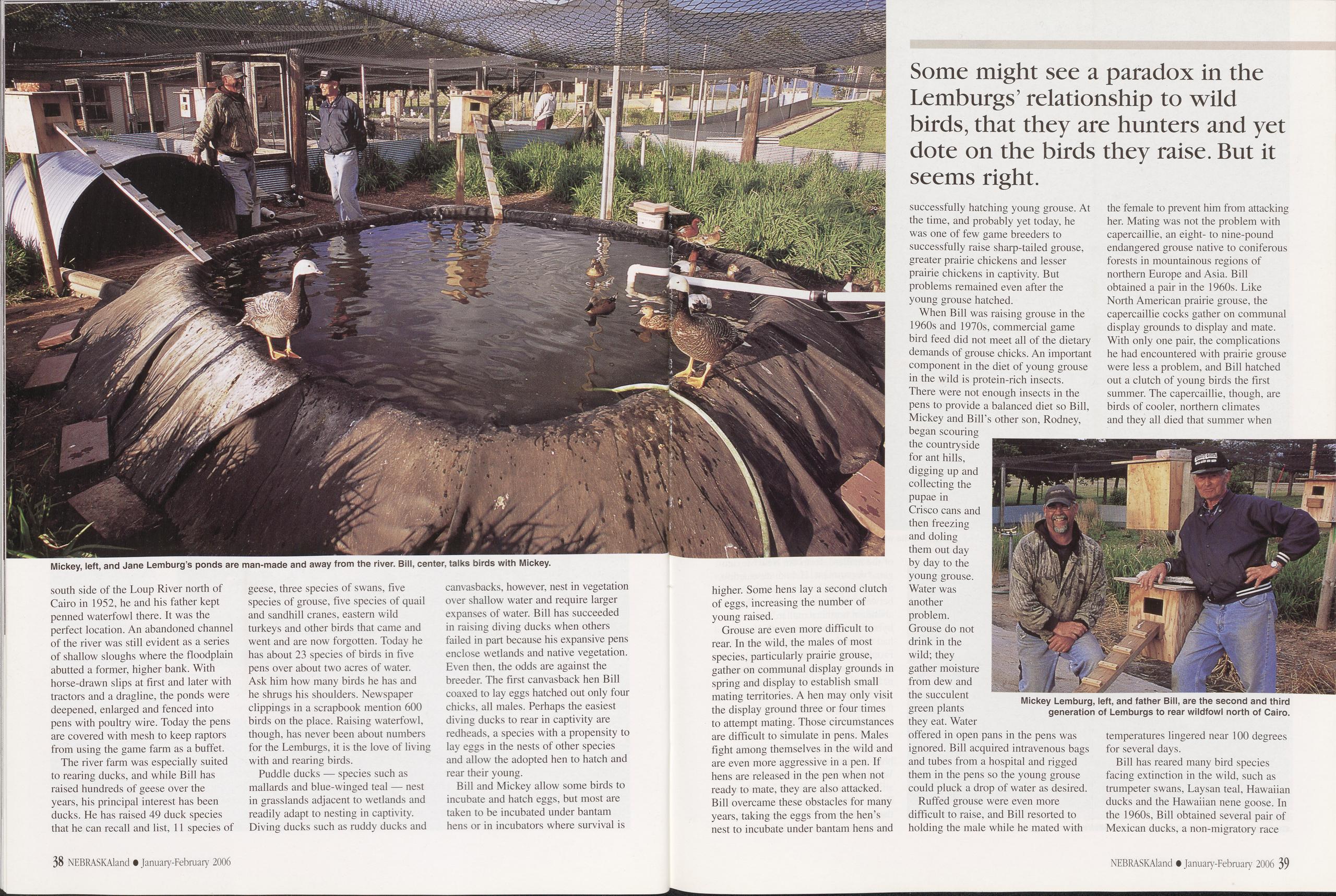
south side of the Loup River north of Cairo in 1952, he and his father kept penned waterfowl there. It was the perfect location. An abandoned channel of the river was still evident as a series of shallow sloughs where the floodplain abutted a former, higher bank. With horse-drawn slips at first and later with tractors and a dragline, the ponds were deepened, enlarged and fenced into pens with poultry wire. Today the pens are covered with mesh to keep raptors from using the game farm as a buffet.
The river farm was especially suited to rearing ducks, and while Bill has raised hundreds of geese over the years, his principal interest has been ducks. He has raised 49 duck species that he can recall and list, 11 species of geese, three species of swans, five species of grouse, five species of quail and sandhill cranes, eastern wild turkeys and other birds that came and went and are now forgotten. Today he has about 23 species of birds in five pens over about two acres of water. Ask him how many birds he has and he shrugs his shoulders. Newspaper clippings in a scrapbook mention 600 birds on the place. Raising waterfowl, though, has never been about numbers for the Lemburgs, it is the love of living with and rearing birds.
Puddle ducks — species such as mallards and blue-winged teal — nest in grasslands adjacent to wetlands and readily adapt to nesting in captivity. Diving ducks such as ruddy ducks and canvasbacks, however, nest in vegetation over shallow water and require larger expanses of water. Bill has succeeded in raising diving ducks when others failed in part because his expansive pens enclose wetlands and native vegetation. Even then, the odds are against the breeder. The first canvasback hen Bill coaxed to lay eggs hatched out only four chicks, all males. Perhaps the easiest diving ducks to rear in captivity are redheads, a species with a propensity to lay eggs in the nests of other species and allow the adopted hen to hatch and rear their young.
Bill and Mickey allow some birds to incubate and hatch eggs, but most are taken to be incubated under bantam hens or in incubators where survival is higher. Some hens lay a second clutch of eggs, increasing the number of young raised.
Grouse are even more difficult to rear. In the wild, the males of most species, particularly prairie grouse, gather on communal display grounds in spring and display to establish small mating territories. A hen may only visit the display ground three or four times to attempt mating. Those circumstances are difficult to simulate in pens. Males fight among themselves in the wild and are even more aggressive in a pen. If hens are released in the pen when not ready to mate, they are also attacked. Bill overcame these obstacles for many years, taking the eggs from the hen’s nest to incubate under bantam hens and successfully hatching young grouse. At the time, and probably yet today, he was one of few game breeders to successfully raise sharp-tailed grouse, greater prairie chickens and lesser prairie chickens in captivity. But problems remained even after the young grouse hatched.
Some might see a paradox in the Lemburgs’ relationship to wild birds, that they are hunters and yet dote on the birds they raise. But it seems right.When Bill was raising grouse in the 1960s and 1970s, commercial game bird feed did not meet all of the dietary demands of grouse chicks. An important component in the diet of young grouse in the wild is protein-rich insects. There were not enough insects in the pens to provide a balanced diet so Bill, Mickey and Bill’s other son, Rodney, began scouring the countryside for ant hills, digging up and collecting the pupae in Crisco cans and then freezing and doling them out day by day to the young grouse. Water was another problem. Grouse do not drink in the wild; they gather moisture from dew and the succulent green plants they eat. Water Mickey Lemburg, left, and father Bill, are the second and third generation of Lemburgs to rear wildfowl north of Cairo. offered in open pans in the pens was ignored. Bill acquired intravenous bags and tubes from a hospital and rigged them in the pens so the young grouse could pluck a drop of water as desired.
Ruffed grouse were even more difficult to raise, and Bill resorted to holding the male while he mated with the female to prevent him from attacking her. Mating was not the problem with capercaillie, an eight- to nine-pound endangered grouse native to coniferous forests in mountainous regions of northern Europe and Asia. Bill obtained a pair in the 1960s. Like North American prairie grouse, the capercaillie cocks gather on communal display grounds to display and mate. With only one pair, the complications he had encountered with prairie grouse were less a problem, and Bill hatched out a clutch of young birds the first summer. The capercaillie, though, are birds of cooler, northern climates and they all died that summer when temperatures lingered near 100 degrees for several days.
Bill has reared many bird species facing extinction in the wild, such as trumpeter swans, Laysan teal, Hawaiian ducks and the Hawaiian nene goose. In the 1960s, Bill obtained several pair of Mexican ducks, a non-migratory race
38 NEBRASKAland • January-February 2006 NEBRASKAland • January-February 2006 39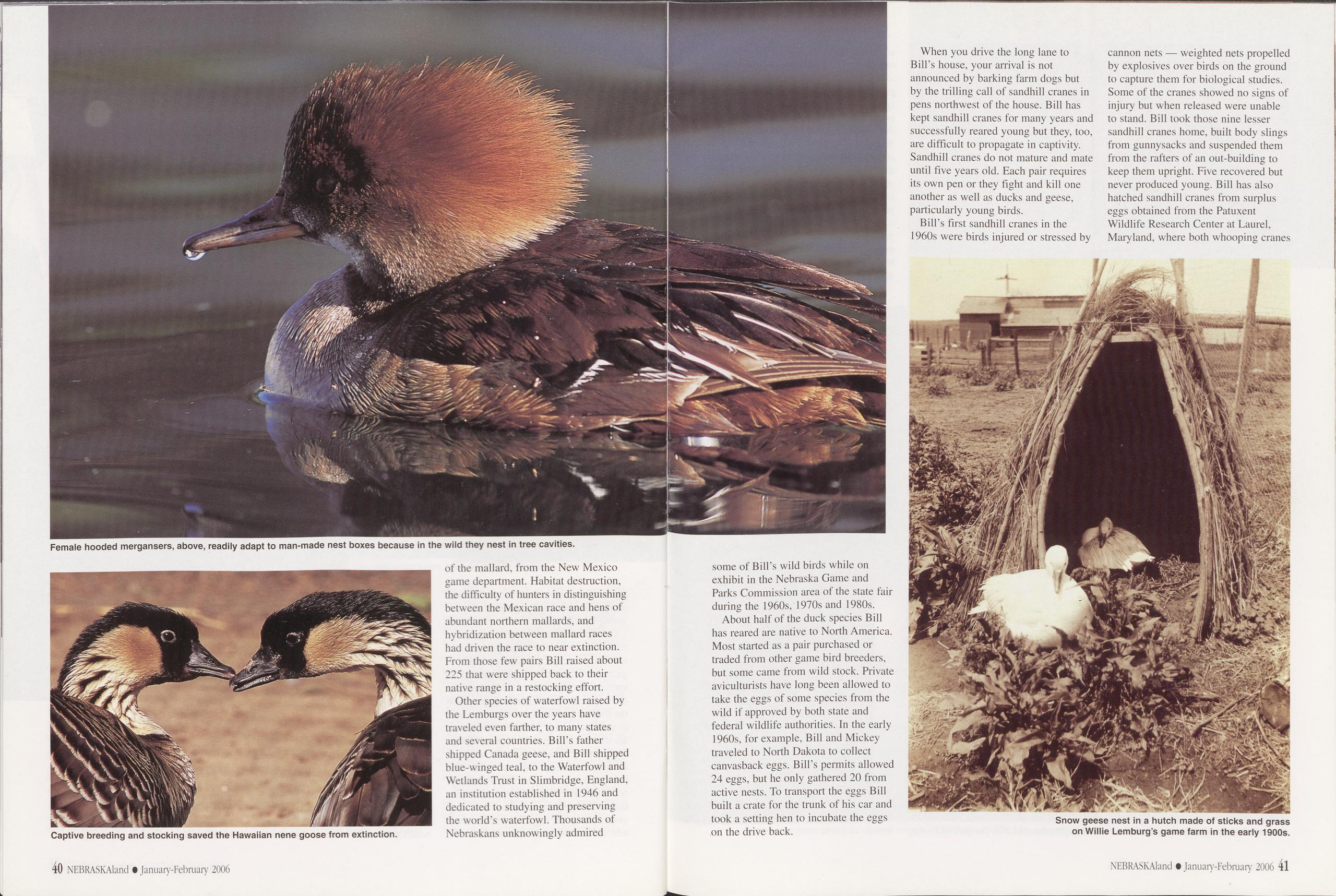
of the mallard, from the New Mexico game department. Habitat destruction, the difficulty of hunters in distinguishing between the Mexican race and hens of abundant northern mallards, and hybridization between mallard races had driven the race to near extinction. From those few pairs Bill raised about 225 that were shipped back to their native range in a restocking effort.
Other species of waterfowl raised by the Lemburgs over the years have traveled even farther, to many states and several countries. Bill’s father shipped Canada geese, and Bill shipped blue-winged teal, to the Waterfowl and Wetlands Trust in Slimbridge, England, an institution established in 1946 and dedicated to studying and preserving the world’s waterfowl. Thousands of Nebraskans unknowingly admired When you drive the long lane to Bill’s house, your arrival is not announced by barking farm dogs but by the trilling call of sandhill cranes in pens northwest of the house. Bill has kept sandhill cranes for many years and successfully reared young but they, too, are difficult to propagate in captivity. Sandhill cranes do not mature and mate until five years old. Each pair requires its own pen or they fight and kill one another as well as ducks and geese, particularly young birds. Bill’s first sandhill cranes in the 1960s were birds injured or stressed by some of Bill’s wild birds while on exhibit in the Nebraska Game and Parks Commission area of the state fair during the 1960s, 1970s and 1980s.
About half of the duck species Bill has reared are native to North America. Most started as a pair purchased or traded from other game bird breeders, but some came from wild stock. Private aviculturists have long been allowed to take the eggs of some species from the wild if approved by both state and federal wildlife authorities. In the early 1960s, for example, Bill and Mickey traveled to North Dakota to collect canvasback eggs. Bill’s permits allowed 24 eggs, but he only gathered 20 from active nests. To transport the eggs Bill built a crate for the trunk of his car and took a setting hen to incubate the eggs on the drive back.
When you drive the long lane to Bill's house, your arrival is not announced by barking farm dogs but by the trilling call of sandhill cranes in pens northwest of the house. Bill has kept sandhill cranes for many years and successfully reared young but they, too, are difficult to propagate in captivity. Sandhill cranes do not mature and mate until five years old. Each pair requires its own pen or they fight and kill one another as well as ducks and geese, particularly young birds.
Bill's first sandhill cranes in the 1960s were birds injured or stressed by cannon nets — weighted nets propelled by explosives over birds on the ground to capture them for biological studies. Some of the cranes showed no signs of injury but when released were unable to stand. Bill took those nine lesser sandhill cranes home, built body slings from gunnysacks and suspended them from the rafters of an out-building to keep them upright. Five recovered but never produced young. Bill has also hatched sandhill cranes from surplus eggs obtained from the Patuxent Wildlife Research Center at Laurel, Maryland, where both whooping cranes
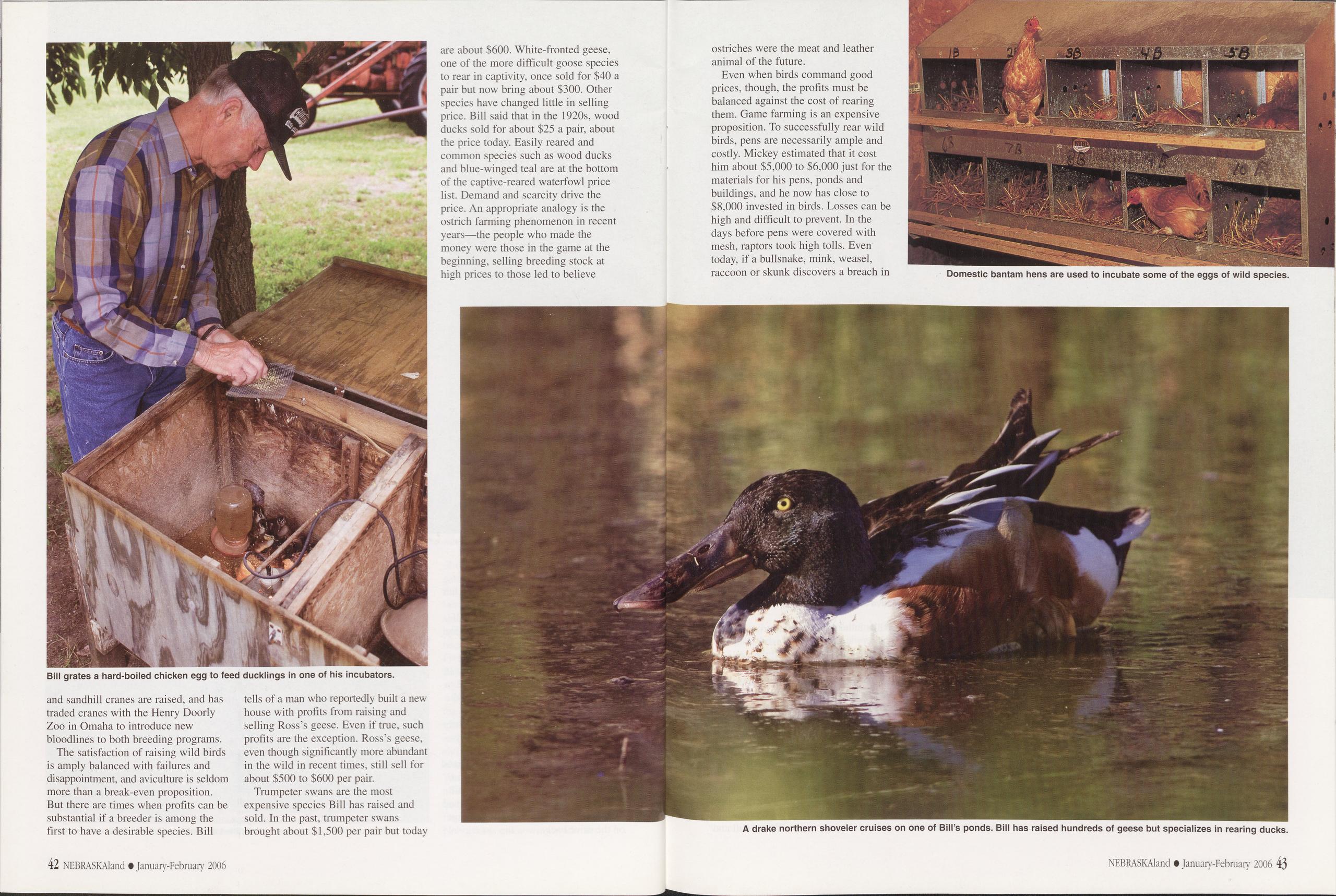
and sandhill cranes are raised, and has traded cranes with the Henry Doorly Zoo in Omaha to introduce new bloodlines to both breeding programs.
The satisfaction of raising wild birds is amply balanced with failures and disappointment, and aviculture is seldom more than a break-even proposition. But there are times when profits can be substantial if a breeder is among the first to have a desirable species. Bill tells of a man who reportedly built a new house with profits from raising and selling Ross’s geese. Even if true, such profits are the exception. Ross’s geese, even though significantly more abundant in the wild in recent times, still sell for about $500 to $600 per pair.
Trumpeter swans are the most expensive species Bill has raised and sold. In the past, trumpeter swans brought about $1,500 per pair but today are about $600. White-fronted geese, one of the more difficult goose species to rear in captivity, once sold for $40 a pair but now bring about $300. Other species have changed little in selling price. Bill said that in the 1920s, wood ducks sold for about $25 a pair, about the price today. Easily reared and common species such as wood ducks and blue-winged teal are at the bottom of the captive-reared waterfowl price list. Demand and scarcity drive the price. An appropriate analogy is the ostrich farming phenomenon in recent years—the people who made the money were those in the game at the beginning, selling breeding stock at high prices to those led to believe A drake northern shoveler cruises on one of Bill’s ponds. Bill has raised hundreds of geese but specializes in rearing ducks. ostriches were the meat and leather animal of the future.
Even when birds command good prices, though, the profits must be balanced against the cost of rearing them. Game farming is an expensive proposition. To successfully rear wild birds, pens are necessarily ample and costly. Mickey estimated that it cost him about $5,000 to $6,000 just for the materials for his pens, ponds and buildings, and he now has close to $8,000 invested in birds. Losses can be high and difficult to prevent. In the days before pens were covered with mesh, raptors took high tolls. Even today, if a bullsnake, mink, weasel, raccoon or skunk discovers a breach in
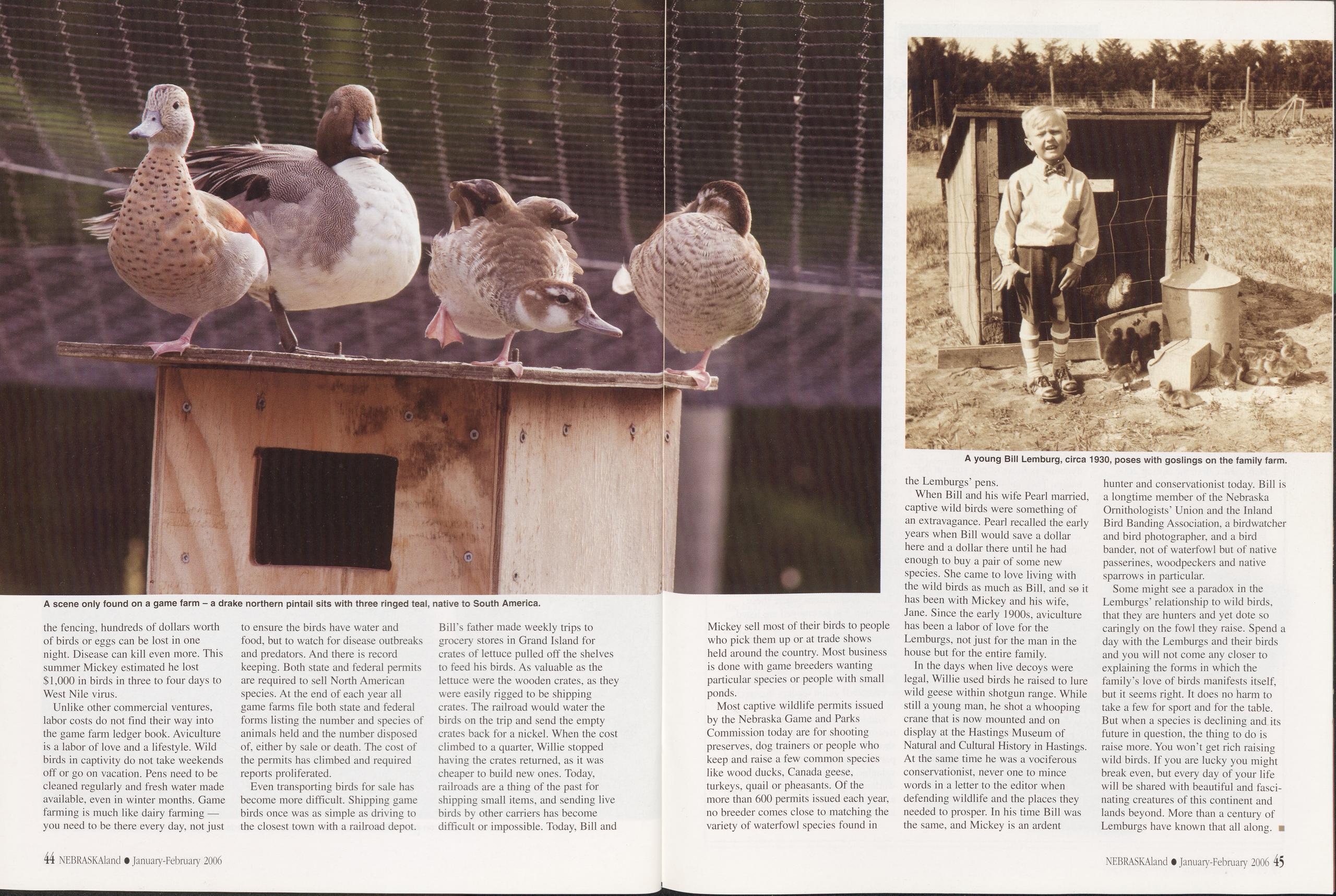
the fencing, hundreds of dollars worth of birds or eggs can be lost in one night. Disease can kill even more. This summer Mickey estimated he lost $1,000 in birds in three to four days to West Nile virus.
Unlike other commercial ventures, labor costs do not find their way into the game farm ledger book. Aviculture is a labor of love and a lifestyle. Wild birds in captivity do not take weekends off or go on vacation. Pens need to be cleaned regularly and fresh water made available, even in winter months. Game farming is much like dairy farming — you need to be there every day, not just to ensure the birds have water and food, but to watch for disease outbreaks and predators. And there is record keeping. Both state and federal permits are required to sell North American species. At the end of each year all game farms file both state and federal forms listing the number and species of animals held and the number disposed of, either by sale or death. The cost of the permits has climbed and required reports proliferated.
Even transporting birds for sale has become more difficult. Shipping game birds once was as simple as driving to the closest town with a railroad depot. Bill’s father made weekly trips to grocery stores in Grand Island for crates of lettuce pulled off the shelves to feed his birds. As valuable as the lettuce were the wooden crates, as they were easily rigged to be shipping crates. The railroad would water the birds on the trip and send the empty crates back for a nickel. When the cost climbed to a quarter, Willie stopped having the crates returned, as it was cheaper to build new ones. Today, railroads are a thing of the past for shipping small items, and sending live birds by other carriers has become difficult or impossible. Today, Bill and Mickey sell most of their birds to people who pick them up or at trade shows held around the country. Most business is done with game breeders wanting particular species or people with small ponds.
Most captive wildlife permits issued by the Nebraska Game and Parks Commission today are for shooting preserves, dog trainers or people who keep and raise a few common species like wood ducks, Canada geese, turkeys, quail or pheasants. Of the more than 600 permits issued each year, no breeder comes close to matching the variety of waterfowl species found in the Lemburgs’ pens.
When Bill and his wife Pearl married, captive wild birds were something of an extravagance. Pearl recalled the early years when Bill would save a dollar here and a dollar there until he had enough to buy a pair of some new species. She came to love living with the wild birds as much as Bill, and so it has been with Mickey and his wife, Jane. Since the early 1900s, aviculture has been a labor of love for the Lemburgs, not just for the man in the house but for the entire family.
In the days when live decoys were legal, Willie used birds he raised to lure wild geese within shotgun range. While still a young man, he shot a whooping crane that is now mounted and on display at the Hastings Museum of Natural and Cultural History in Hastings. At the same time he was a vociferous conservationist, never one to mince words in a letter to the editor when defending wildlife and the places they needed to prosper. In his time Bill was the same, and Mickey is an ardent hunter and conservationist today. Bill is a longtime member of the Nebraska Ornithologists’ Union and the Inland Bird Banding Association, a birdwatcher and bird photographer, and a bird bander, not of waterfowl but of native passerines, woodpeckers and native sparrows in particular.
Some might see a paradox in the Lemburgs’ relationship to wild birds, that they are hunters and yet dote so caringly on the fowl they raise. Spend a day with the Lemburgs and their birds and you will not come any closer to explaining the forms in which the family’s love of birds manifests itself, but it seems right. It does no harm to take a few for sport and for the table. But when a species is declining and its future in question, the thing to do is raise more. You won’t get rich raising wild birds. If you are lucky you might break even, but every day of your life will be shared with beautiful and fasci- nating creatures of this continent and lands beyond. More than a century of Lemburgs have known that all along.
44 NEBRASKAland • January-February 2006 NEBRASKAland • January-February 2006 45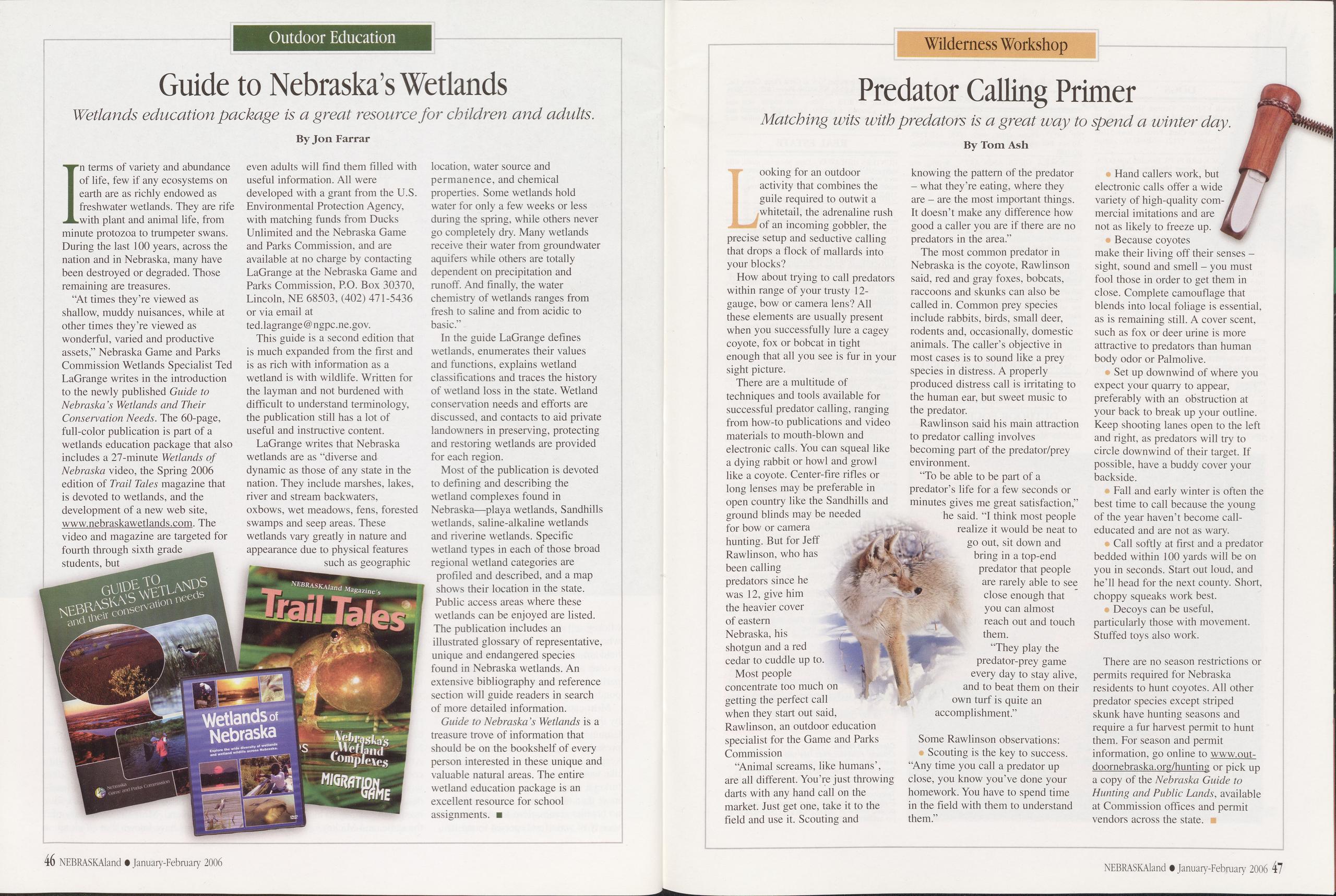
In terms of variety and abundance of life, few if any ecosystems on earth are as richly endowed as freshwater wetlands. They are rife with plant and animal life, from minute protozoa to trumpeter swans. During the last 100 years, across the nation and in Nebraska, many have been destroyed or degraded. Those remaining are treasures.
"At times they're viewed as shallow, muddy nuisances, while at wonderful, varied and productive assets,” Nebraska Game and Parks Commission Wetlands Specialist Ted LaGrange writes in the introduction to the newly published Guide to Nebraska’s Wetlands and Their Conservation Needs. The 60-page, full-color publication is part of a wetlands education package that also includes a 27-minute Wetlands of Nebraska video, the Spring 2006 edition of Trail Tales magazine that is devoted to wetlands, and the development of a new web site, www.nebraskalandwetlands.com. The video and magazine are targeted for fourth through sixth grade stiudents, but even adults will find them filled with useful information. All were developed with a grant from the U.S. Enviromental Protection Agency, with matching funds from Ducks Unlimited and the Nebraska Game and Parks Commission, and are available at no charge by contacting LaGrange at the Nebraska Game and Parks Commission, P.O. Box 30370, Lincoln, NE 68503, (402) 471-5436 or via email at ted.lagrange@ngpc.ne.gov.
This guide is a second edition that is much expanded from the first and is as rich with information as a wetland is with wildlife. Written for the layman and not burdened with difficult to understand terminology, the publication still has a lot of useful and instructive content.
LaGrange writes that Nebraska wetlands are as “diverse and dynamic as those of any state in the nation. They include marshes, lakes, river and stream backwaters, oxbows, wet meadows, fens, forested swamps and seep areas. These wetlands vary greatly in nature and appearance due to physical features such as geographic location, water source and permanence, and chemical properties. Some wetlands hold water for only a few weeks or less during the spring, while others never go completely dry. Many wetlands receive their water from groundwater aquifers while others are totally dependent on precipitation and runoff. And finally, the water chemistry of wetlands ranges from fresh to saline and from acidic to basic.”
In the guide LaGrange defines wetlands, enumerates their values and functions, explains wetland classifications and traces the history of wetland loss in the state. Wetland conservation needs and efforts are discussed, and contacts to aid private landowners in preserving, protecting and restoring wetlands are provided for each region.
Most of the publication is devoted to defining and describing the wetland complexes found in Nebraska—playa wetlands, Sandhills wetlands, saline-alkaline wetlands and riverine wetlands. Specific wetland types in each of those broad regional wetland categories are profiled and described, and a map shows their location in the state. Public access areas where these wetlands can be enjoyed are listed. The publication includes an illustrated glossary of representative, unique and endangered species found in Nebraska wetlands. An extensive bibliography and reference section will guide readers in search of more detailed information.
Guide to Nebraska’s Wetlands is a treasure trove of information that should be on the bookshelf of every person interested in these unique and valuable natural areas. The entire wetland education package is an excellent resource for school assignments.
Wilderness Workshop Predator Calling Primer Matching wits with predators is a great way to spend a winter day. By Tom AshLooking for an outdoor activity that combines the guile required to outwit a whitetail, the adrenaline rush of an incoming gobbler, the precise setup and seductive calling that drops a flock of mallards into your blocks?
How about trying to call predators within range of your trusty 12- gauge, bow or camera lens? All these elements are usually present when you successfully lure a cagey coyote, fox or bobcat in tight enough that all you see is fur in your sight picture.
There are a multitude of techniques and tools available for successful predator calling, ranging from how-to publications and video materials to mouth-blown and electronic calls. You can squeal like a dying rabbit or howl and growl like a coyote. Center-fire rifles or long lenses may be preferable in open country like the Sandhills and ground blinds may be needed for bow or camera hunting. But for Jeff Rawlison, who has been calling predators since he was 12, give him the heavier cover of eastern Nebraska, his shotgun and a red cedar to cuddle up to.
Most people concentrate too much on getting the perfect call when they start out said, Rawlinson, an outdoor education specialist for the Game and Parks Commission.
“Animal screams, like humans’, are all different. You’re just throwing darts with any hand call on the market. Just get one, take it to the field and use it. Scouting and knowing the pattern of the predator - what they're eating, where they are - are the most important things. It doesn't make any difference how good a caller you are if there are no predators in the area".
The most common predator in Nebraska is the coyote, Rawlinson said, red and gray foxes, bobcats, raccoons and skunks can also be called in. Commonon prey species include rabbits, birds, small deer, rodents and, occasionally, domestic animals. The caller's objective in most cases is to sound like a prey species in distress call is irrating to the human ear, but sweet music to the predator.
Rawlinson said his main attraction to predator calling involves becoming part of the predator/prey environment.
“To be able to be part of a predator’s life for a few seconds or minutes gives me great satisfaction,” for bow or camera hunting. But for Jeff Rawlinson, who has been calling predators since he was 12, give him the heavier cover he said. “I think most people of eastern Nebraska, his shotgun and a red cedar to cuddle up to. realize it would be neat to go out, sit down and bring in a top-end predator that people are rarely able to see close enough that you can almost reach out and touch them.
“They play the predator-prey game every day to stay alive, and to beat them on their own turf is quite an accomplishment.”
Some Rawlinson observations: Scouting is the key to success. “Any time you call a predator up close, you know you’ve done your homework. You have to spend time in the field with them to understand them.”
Hand callers work, but electronic calls offer a wide variety of high-quality com-mercial imitations and are not as likely to freeze up.
Because coyotes make their living off their senses - sight, sound and smell - you must fool those in order to get them in close. Complete camouflage that blends into local foliage is essential, as is remaining still. A cover scent, such as fox or deer urine is more attractive to predators than human body odor or Palmolive.
Set up downwind of where you expect your quarry to appear, preferably with an obstruction at your back to break up your outline. Keep shooting lanes open to the left and right, as predators will try to circle downwind of their target. If possible, have a buddy cover your backside.
Fall and early winter is often the best time to call because the young of the year haven’t become call- educated and are not as wary.
Call softly at first and a predator bedded within 100 yards will be on you in seconds. Start out loud, and he’ll head for the next county. Short, choppy squeaks work best.
Decoys can be useful, particularly those with movement. Stuffed toys also work.
There are no season restrictions or permits required for Nebraska residents to hunt coyotes. All other predator species except striped skunk have hunting seasons and require a fur harvest permit to hunt them. For season and permit information, go online to www.out- doornebraska.org/hunting or pick up a copy of the Nebraska Guide to Hunting and Public Lands, available at Commission offices and permit vendors across the state.
46 NEBRASKAland • January-February 2006 NEBRASKAland • January-February 2006 47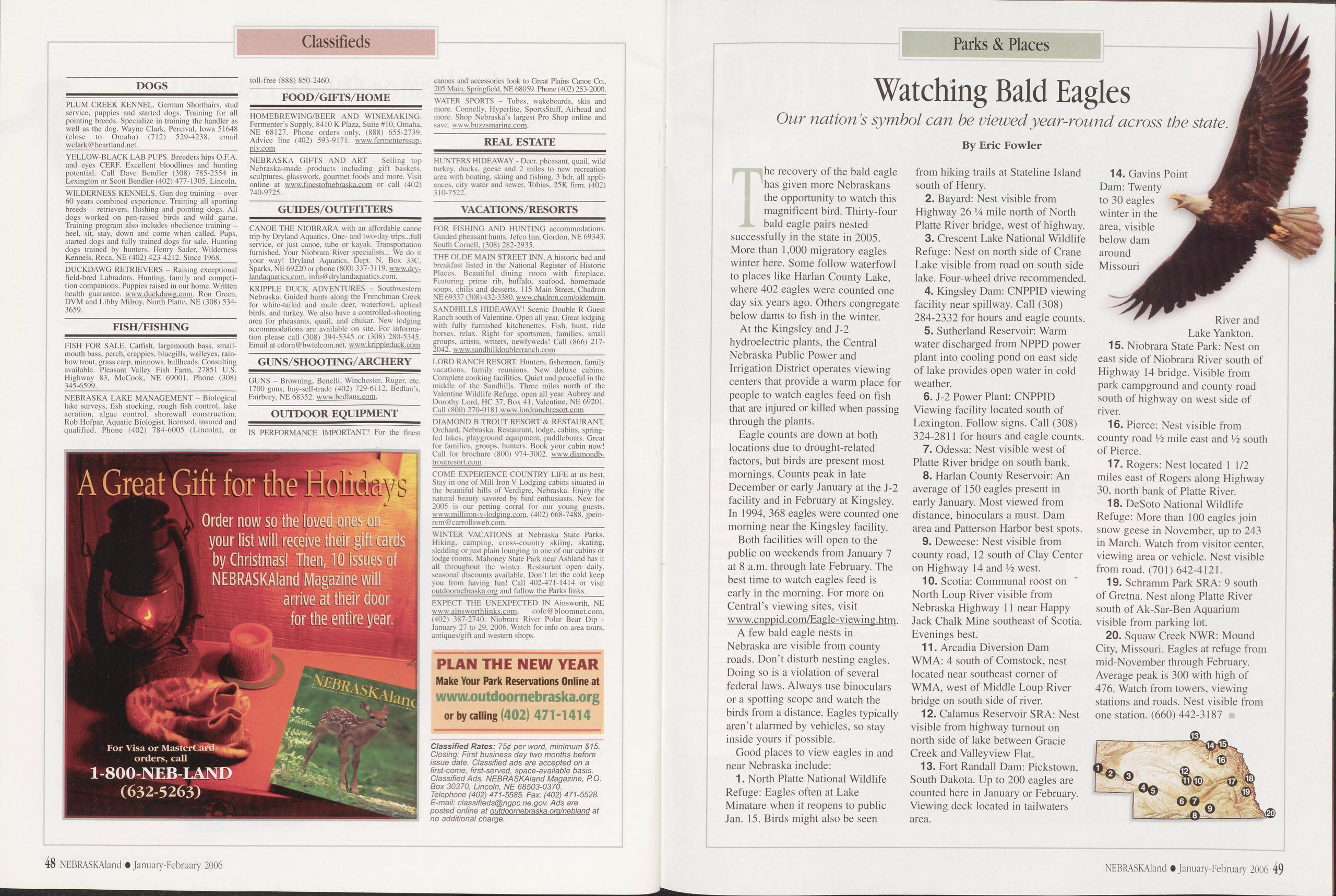
PLUM CREEK KENNEL. German Shorthairs, stud service, puppies and started dogs. Training for all pointing breeds. Specialize in training the handler as well as the dog. Wayne Clark, Percival, Iowa 51648 (close to Omaha) (712) 529-4238, email wclark@heartland.net.
YELLOW-BLACK LAB PUPS. Breeders hips O.F.A. and eyes CERF. Excellent bloodlines and hunting potential. Call Dave Bendler (308) 785-2554 in Lexington or Scott Bendler (402) 477-1305, Lincoln.
WILDERNESS KENNELS. Gun dog training - over 60 years combined experience. Training all sporting breeds - retrievers, flushing and pointing dogs. All dogs worked on pen-raised birds and wild game. Training program also includes obedience training - heel, sit, stay, down and come when called. Pups, started dogs and fully trained dogs for sale. Hunting dogs trained by hunters. Henry Sader, Wilderness Kennels, Roca, NE (402) 423-4212. Since 1968.
DUCKDAWG RETRIEVERS - Raising exceptional field-bred Labradors. Hunting, family and competi- tion companions. Puppies raised in our home. Written health guarantee, www.duckdawg.com. Ron Green, DVM and Libby Milroy, North Platte, NE (308) 534- 3659.
FISH/FISHINGFISH FOR SALE. Catfish, largemouth bass, small- mouth bass, perch, crappies, bluegills, walleyes, rain- bow trout, grass carp, minnows, bullheads. Consulting available. Pleasant Valley Fish Farm, 27851 U.S. Highway 83, McCook, NE 69001. Phone (308) 345-6599. NEBRASKA LAKE MANAGEMENT - Biological lake surveys, fish stocking, rough fish control, lake aeration, algae control, shorewall construction. Rob Hofpar, Aquatic Biologist, licensed, insured and qualified. Phone (402) 784-6005 (Lincoln), or toll-free (888) 850-2460
A Great Gift for the HolidaysOrder now so the your list will receive by Christmas! Then, 10 issues of NEBRASKAIand Magazine will arrive at their door for the entire year.
For Visa or MasterCard orders, call 1-800-NEB-LAND (632-5263)
FOOD/GIFTS/HOMEHOMEBREWING/BEER AND WINEMAKING. Fermenter’s Supply, 8410 K Plaza, Suite #10, Omaha, NE 68127. Phone orders only, (888) 655-2739. Advice line (402) 593-9171. www.fermenterssup- ply.com NEBRASKA GIFTS AND ART - Selling top Nebraska-made products including gift baskets, sculptures, glass work, gourmet foods and more. Visit online at www.fmestofnebraska.com or call (402) 740-9725.
GUIDES/OUTFITTERSCANOE THE NIOBRARA with an affordable canoe trip by Dryland Aquatics. One- and two-day trips...full service, or just canoe, tube or kayak. Transportation furnished. Your Niobrara River specialists... We do it your way! Dryland Aquatics, Dept. N, Box 33C, Sparks, NE 69220 or phone (800) 337-3119. www.drv- landaquatics.com, info@drylandaquatics.com. KRIPPLE DUCK ADVENTURES - Southwestern Nebraska. Guided hunts along the Frenchman Creek for white-tailed and mule deer, waterfowl, upland birds, and turkey. We also have a controlled-shooting area for pheasants, quail, and chukar. New lodging accommodations are available on site. For informa- tion please call (308) 394-5345 or (308) 280-5345. Email at cdom@bwtelcom.net, www.kripDleduck.com
GUNS/SHOOTING/ARCHERY
GUNS - Browning, Benelli, Winchester, Ruger, etc. 1700 guns, buy-sell-trade (402) 729-6112, Bedlan’s, Fairbury, NE 68352. www.bedlans.com.
OUTDOOR EQUIPMENTIS PERFORMANCE IMPORTANT? For the finest canoes and accessories look to Great Plains Canoe Co., 205 Main. Springfield, NE 68059. Phone (402) 253-2000. WATER SPORTS - Tubes, wakeboards, skis and more. Connelly. Hyperlite, SportsStuff, Airhead and more. Shop Nebraska’s largest Pro Shop online and save, www.buzzsmarine.com.
REAL ESTATEHUNTERS HIDEAWAY - Deer, pheasant, quail, wild turkey, ducks, geese and 2 miles to new recreation area with boating, skiing and fishing. 3 bdr, all appli- ances, city water and sewer, Tobias, 25K firm. (402) 310-7522.
VACATION S/RESORTSFOR FISHING AND HUNTING accommodations. Guided pheasant hunts. Jefco Inn, Gordon, NE 69343. South Cornell, (308) 282-2935. THE OLDE MAIN STREET INN, A historic bed and breakfast listed in the National Register of Historic Places. Beautiful dining room with fireplace. Featuring prime rib, buffalo, seafood, homemade soups, chilis and desserts. 115 Main Street, Chadron NE 69337 (308) 432-3380. www.chadron.com/oldemain. SANDHILLS HIDEAWAY! Scenic Double R Guest Ranch south of Valentine. Open all year. Great lodging with fully furnished kitchenettes. Fish, hunt, ride horses, relax. Right for sportsmen, families, small groups, artists, writers, newlyweds! Call (866) 217- 2042. www.sandhilldoublerranch.com LORD RANCH RESORT. Hunters, fishermen, family vacations, family reunions. New deluxe cabins. Complete cooking facilities. Quiet and peaceful in the middle of the Sandhills. Three miles north of the Valentine Wildlife Refuge, open all year. Aubrey and Dorothy Lord, HC 37, Box 41, Valentine, NE 69201. Call (800) 270-0181 .www.lordranchresort.com DIAMOND B TROUT RESORT & RESTAURANT, Orchard, Nebraska. Restaurant, lodge, cabins, spring- fed lakes, playground equipment, paddleboats. Great for families, groups, hunters. Book your cabin now! Call for brochure (800) 974-3002. www.diamondb- troutresort.com COME EXPERIENCE COUNTRY LIFE at its best. Stay in one of Mill Iron V Lodging cabins situated in the beautiful hills of Verdigre, Nebraska. Enjoy the natural beauty savored by bird enthusiasts. New for 2005 is our petting corral for our young guests. www.milliron-v-lodging.com. (402) 668-7488, jpein- rem@carrollsweb.com. WINTER VACATIONS at Nebraska State Parks. Hiking, camping, cross-country skiing, skating, sledding or just plain lounging in one of our cabins or lodge rooms. Mahoney State Park near Ashland has it all throughout the winter. Restaurant open daily, seasonal discounts available. Don’t let the cold keep you from having fun! Call 402-471-1414 or visit outdoomebraska.org and follow the Parks links. EXPECT THE UNEXPECTED IN Ainsworth, NE www.ainsworthlinks.com. cofc@bloomnet.com, (402) 387-2740. Niobrara River Polar Bear Dip - January 27 to 29, 2006. Watch for info on area tours, antiques/gift and western shops.
PLAN THE NEW YEAR Make Your Park Reservations Online at www.outdoornebraska.org or by calling (402) 471-1414Classified Rates: 750 per word, minimum $15. Closing: First business day two months before issue date. Classified ads are accepted on a first-come, first-served, space-available basis. Classified Ads, NEBRASKAIand Magazine, P.O. Box 30370, Lincoln, NE 68503-0370. Telephone (402) 471-5585. Fax: (402) 471-5528. E-mail: classifieds@ngpc.ne.gov. Ads are posted online at outdoornebraska. ora/nebland at no additional charge.
Parks & Places
Watching Bald Eagles
Our nation’s symbol can be viewed year-round across the state.
The recovery of the bald eagle has given more Nebraskans the opportunity to watch this magnificent bird. Thirty-four bald eagle pairs nested successfully in the state in 2005. More than 1,000 migratory eagles winter here. Some follow waterfowl to places like Harlan County Lake, where 402 eagles were counted one day six years ago. Others congregate below dams to fish in the winter.
At the Kingsley and J-2 hydroelectric plants, the Central Nebraska Public Power and Irrigation District operates viewing centers that provide a warm place for people to watch eagles feed on fish that are injured or killed when passing through the plants.
Eagle counts are down at both locations due to drought-related factors, but birds are present most mornings. Counts peak in late December or early January at the J-2 facility and in February at Kingsley. In 1994, 368 eagles were counted one morning near the Kingsley facility.
Both facilities will open to the public on weekends from January 7 at 8 a.m. through late February. The best time to watch eagles feed is early in the morning. For more on Central’s viewing sites, visit www.cnppid.com/Eagle-viewing.htm.
A few bald eagle nests in Nebraska are visible from county roads. Don’t disturb nesting eagles. Doing so is a violation of several federal laws. Always use binoculars or a spotting scope and watch the birds from a distance. Eagles typically aren’t alarmed by vehicles, so stay inside yours if possible.
Good places to view eagles in and near Nebraska include:
1. North Platte National Wildlife Refuge: Eagles often at Lake Minatare when it reopens to public Jan. 15. Birds might also be seen from hiking trails at Stateline Island south of Henry.
2. Bayard: Nest visible from Highway 26 lA mile north of North Platte River bridge, west of highway.
3. Crescent Lake National Wildlife Refuge: Nest on north side of Crane Lake visible from road on south side lake. Four-wheel drive recommended.
4. Kingsley Dam: CNPPID viewing facility near spillway. Call (308) 284-2332 for hours and eagle counts.
5. Sutherland Reservoir: Warm water discharged from NPPD power plant into cooling pond on east side of lake provides open water in cold weather.
6. J-2 Power Plant: CNPPID Viewing facility located south of Lexington. Follow signs. Call (308) 324-2811 for hours and eagle counts.
7. Odessa: Nest visible west of Platte River bridge on south bank.
8. Harlan County Reservoir: An average of 150 eagles present in early January. Most viewed from distance, binoculars a must. Dam area and Patterson Harbor best spots.
9. Deweese: Nest visible from county road, 12 south of Clay Center on Highway 14 and 1/2 west.
10. Scotia: Communal roost on North Loup River visible from Nebraska Highway 11 near Happy Jack Chalk Mine southeast of Scotia. Evenings best.
11. Arcadia Diversion Dam WMA: 4 south of Comstock, nest located near southeast corner of WMA, west of Middle Loup River bridge on south side of river.
12. Calamus Reservoir SRA: Nest visible from highway turnout on north side of lake between Grade Creek and Valleyview Flat.
13. Fort Randall Dam: Pickstown, South Dakota. Up to 200 eagles are counted here in January or February. Viewing deck located in tailwaters area. River and Lake Yankton.
14. Gavins Point Dam: Twenty to 30 eagles winter in the area, visible below dam around Missouri
15. Niobrara State Park: Nest on east side of Niobrara River south of Highway 14 bridge. Visible from park campground and county road south of highway on west side of river.
16. Pierce: Nest visible from county road 1/2 mile east and Yz south of Pierce.
17. Rogers: Nest located 1 1/2 miles east of Rogers along Highway 30, north bank of Platte River.
18. DeSoto National Wildlife Refuge: More than 100 eagles join snow geese in November, up to 243 in March. Watch from visitor center, viewing area or vehicle. Nest visible from road. (701) 642-4121.
19. Schramm Park SRA: 9 south of Gretna. Nest along Platte River south of Ak-Sar-Ben Aquarium visible from parking lot.
20. Squaw Creek NWR: Mound City, Missouri. Eagles at refuge from mid-November through February. Average peak is 300 with high of 476. Watch from towers, viewing stations and roads. Nest visible from one station. (660) 442-3187
48 NEBRASKAIand • January-February 2006 NEBRASKAIand • January-February 2006 49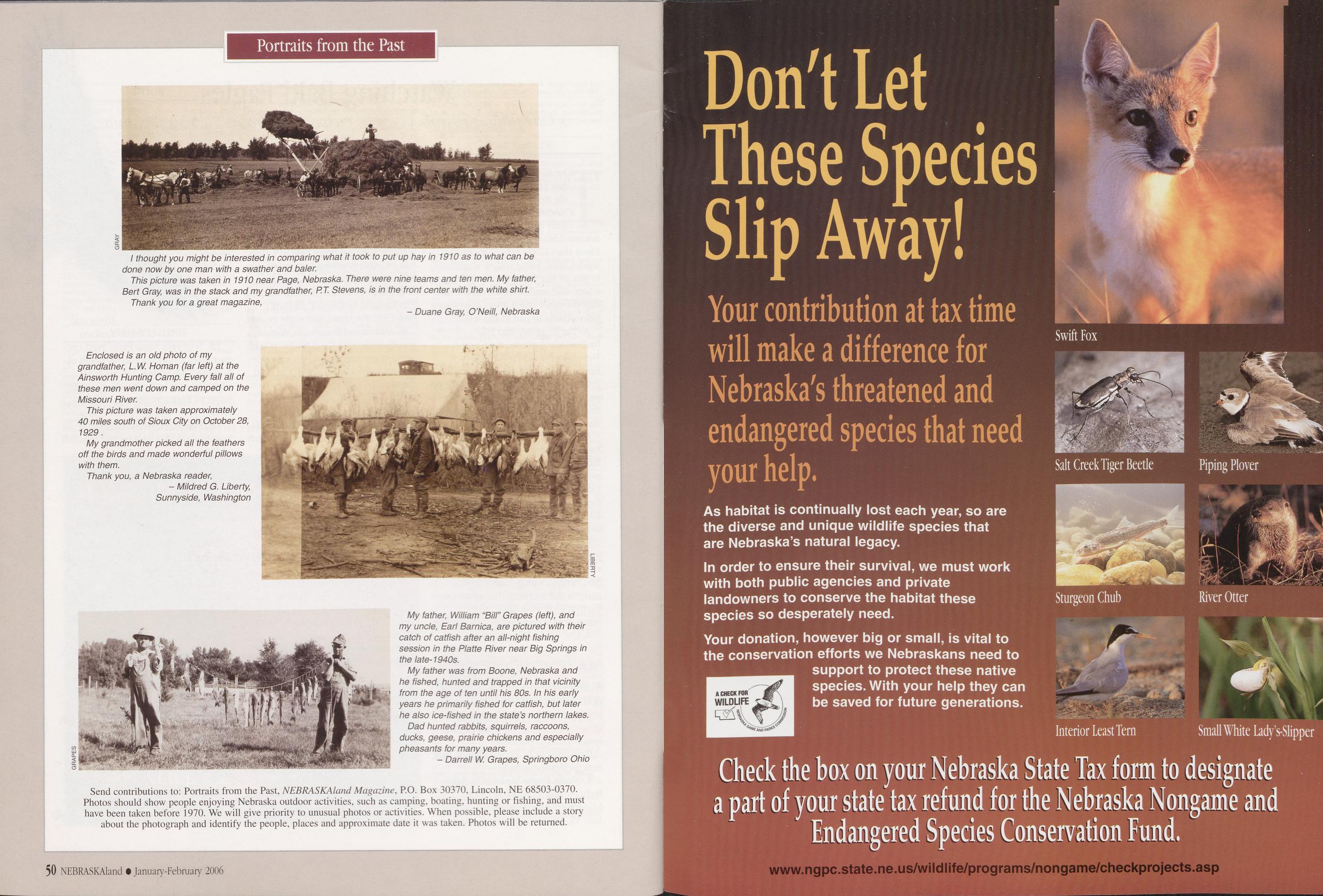
Send contributions to: Portraits from the Past, NEBRASKAland Magazine, P.O. Box 30370, Lincoln, NE 68503 0370. Photos should show people enjoying Nebraska outdoor activities, such as camping, boating, hunting or fishing, and must have been taken before 1970. We will give priority to unusual photos or activities. When possible, please include a story about the photograph and identify the people, places and approximate date it was taken. Photos will be returned.
Don't Let These Species Slip Away! Your contribution at tax time will make a difference for Nebraska's threatened and endangered species that need your help. As habitat is continually lost each year, so are the diverse and unique wildlife species that are Nebraska's natural legacy. In order to ensure their survival, we must work with both public agencies and private landowners to conserve the habitat these species so desperately need. Your donation, however big or small, is vital to the conservation efforts we Nebraskans need to support to protect these native species. With your help they can be saved for future generations.Swift Fox
Salt Creek Tiger Beetle
Piping Plover
Sturgeon Chub
River Otter
Interior Least Tern
Small White Lady's-Slipper
Check the box on your Nebraska State Tax form to designate a part of your state tax refund for the Nebraska Nongame and Endangered Species Conservation Fund. www.ngpc.state.ne.us/wildlife/programs/nongame/checkprojects.asp 50 NEBRASKAland • January-February 2006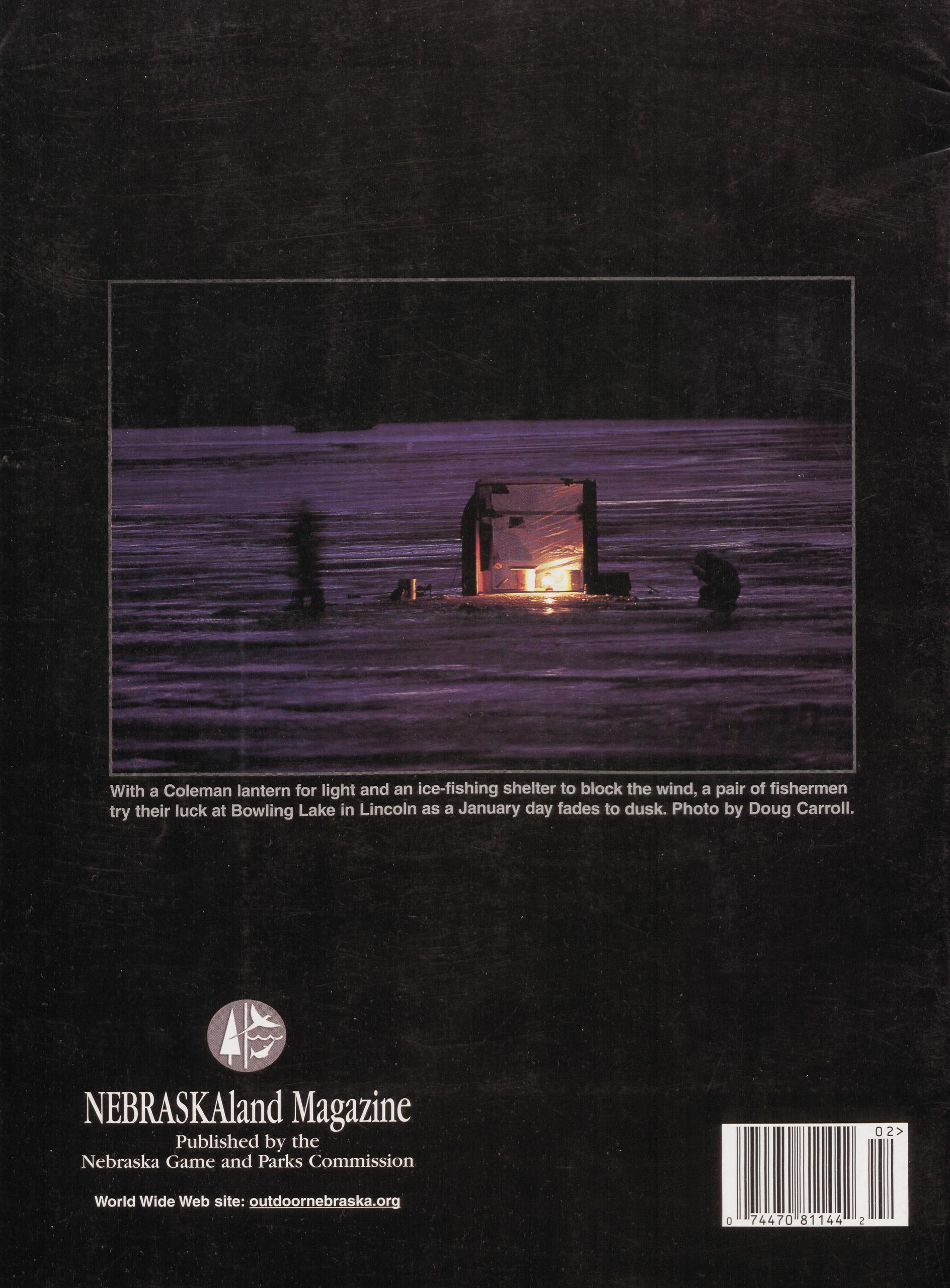
Position: 71 (99 views)