Volume 83, Issue 6, 2005
NEBRASKAland
Nebraska Game & Parks Comission July 2005 $2.95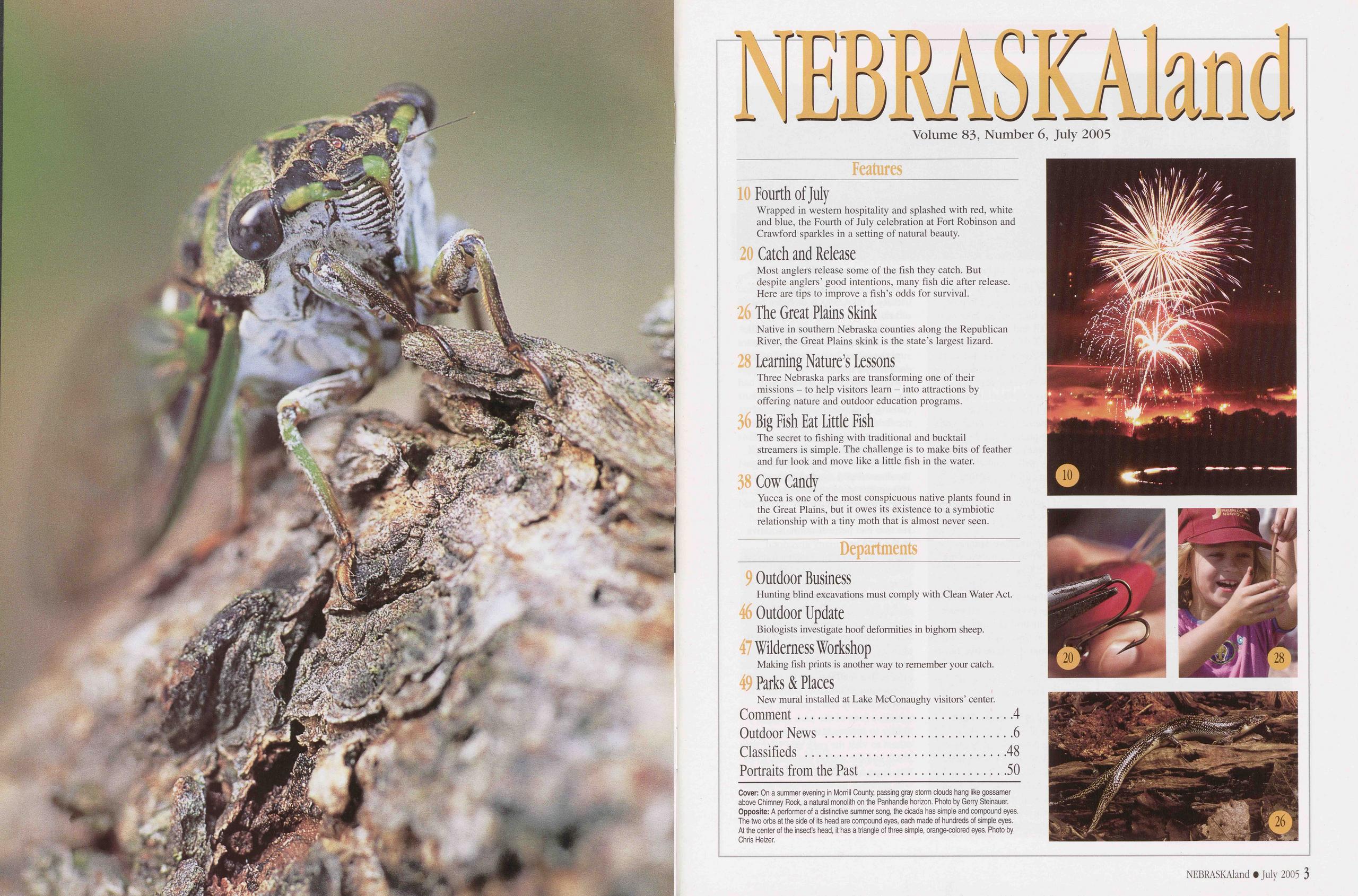
NEBRASKAland
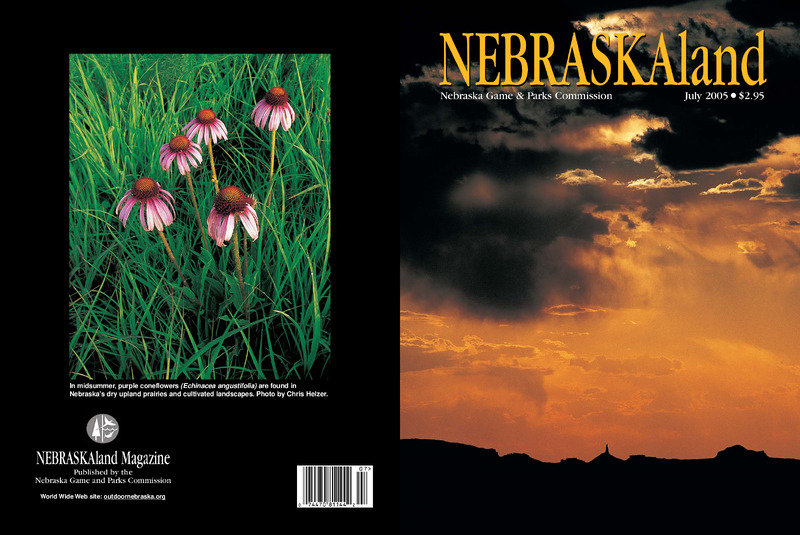
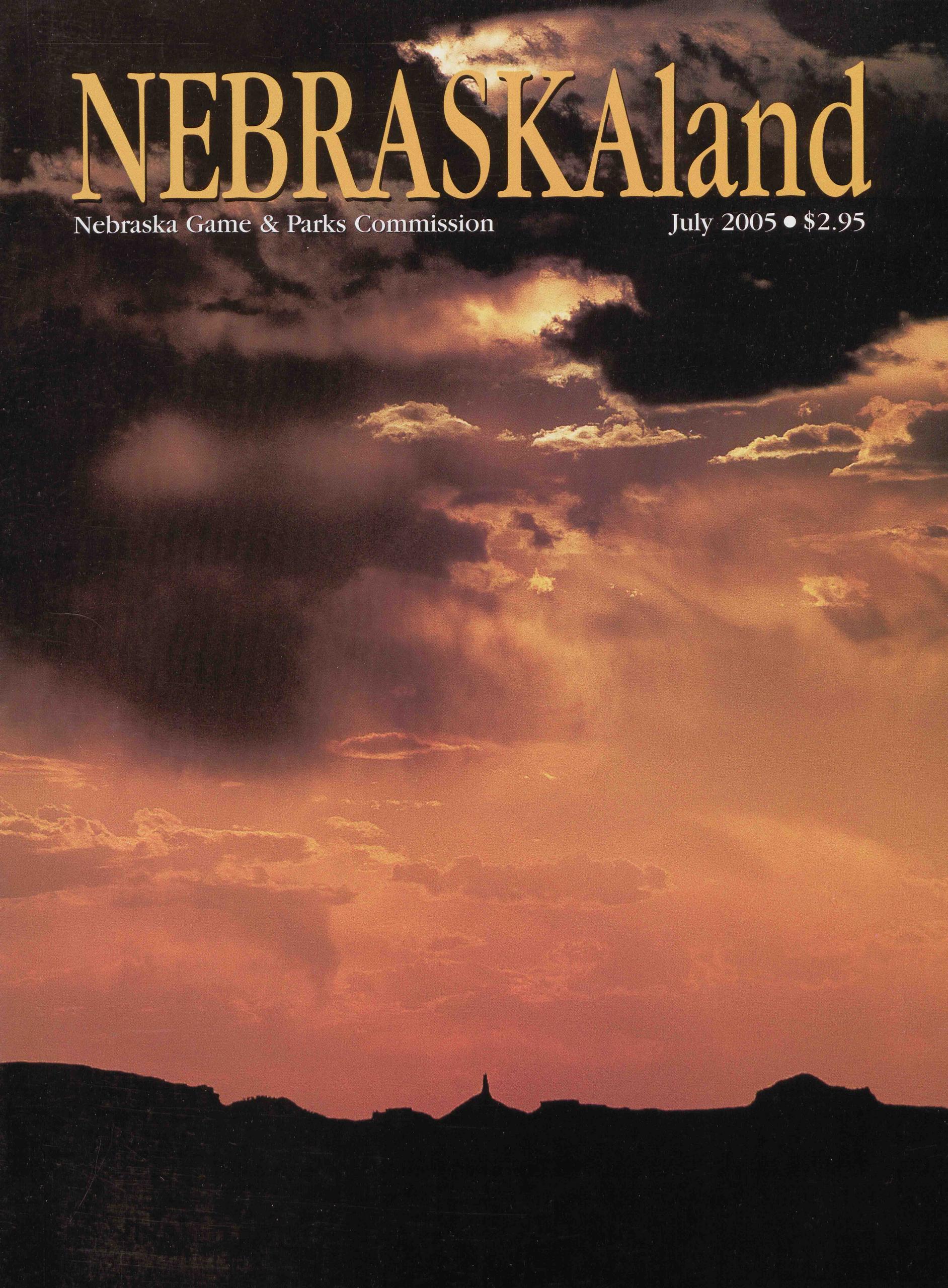
Volume 83, Number 6, July 2005 Features 10 Fourth of July Wrapped in western hospitality and splashed with red, white and blue, the Fourth of July celebration at Fort Robinson and Crawford sparkles in a setting of natural beauty. 20 Catch and Release Most anglers release some of the fish they catch. But despite anglers’ good intentions, many fish die after release. Here are tips to improve a fish’s odds for survival. 26 The Great Plains Skink Native in southern Nebraska counties along the Republican River, the Great Plains skink is the state’s largest lizard. 28 Learning Nature’s Lessons Three Nebraska parks are transforming one of their missions - to help visitors learn - into attractions by offering nature and outdoor education programs. 36 Big Fish Eat Little Fish The secret to fishing with traditional and bucktail streamers is simple. The challenge is to make bits of feather and fur look and move like a little fish in the water. 38 Cow Candy Yucca is one of the most conspicuous native plants found in the Great Plains, but it owes its existence to a symbiotic relationship with a tiny moth that is almost never seen. Departments 9 Outdoor Business Hunting blind excavations must comply with Clean Water Act. 46 Outdoor Update Biologists investigate hoof deformities in bighorn sheep. 47 Wilderness Workshop Making fish prints is another way to remember your catch. 49 Parks & Places New mural installed at Lake McConaughy visitors’ center. Comment...........................................4 Outdoor News .................................... 6 Classifieds .....................................48 Portraits from the Past .........................50 Cover: On a summer evening in Morrill County, passing gray storm clouds hang like gossamer above Chimney Rock, a natural monolith on the Panhandle horizon. Photo by Gerry Steinauer. Opposite: A performer of a distinctive summer song, the cicada has simple and compound eyes. The two orbs at the side of its head are compound eyes, each made of hundreds of simple eyes. At the center of the insect’s head, it has a triangle of three simple, orange-colored eyes. Photo by Chris Helzer.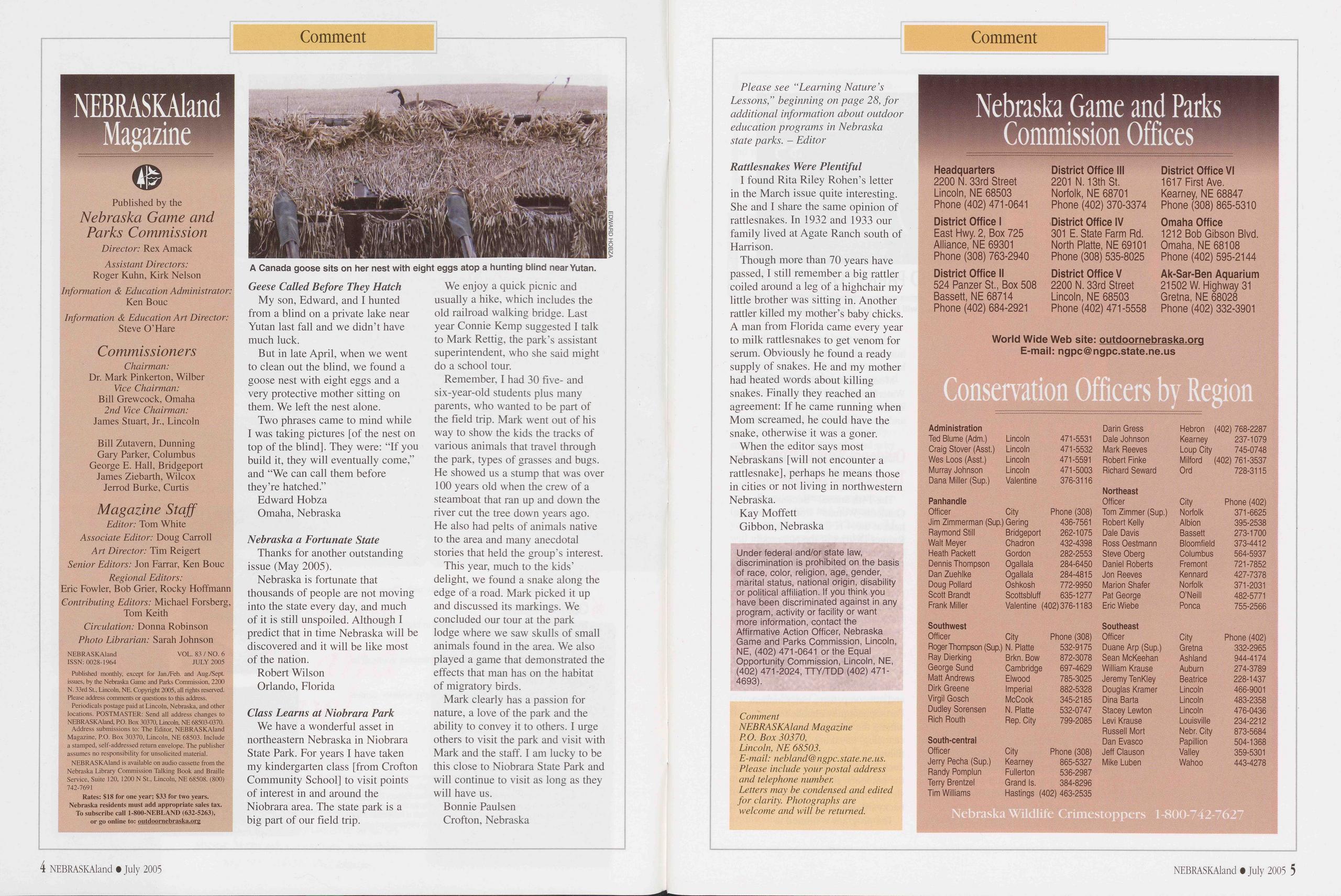
Comment
NEBRASKAland Magazine Published by the Nebraska Game and Parks Commission Director: Rex Amack Assistant Directors: Roger Kuhn, Kirk Nelson Information & Education Administrator: Ken Bouc Information & Education Art Director: Steve O’Hare Commissioners Chairman: Dr. Mark Pinkerton, Wilber Vice Chairman: Bill Grewcock, Omaha 2nd Vice Chairman: James Stuart, Jr., Lincoln Bill Zutavern, Dunning Gary Parker, Columbus George E. Hall, Bridgeport James Ziebarth, Wilcox Jerrod Burke, Curtis Magazine Staff Editor: Tom White Associate Editor: Doug Carroll Art Director: Tim Reigert Senior Editors: Jon Farrar, Ken Bouc Regional Editors: Eric Fowler, Bob Grier, Rocky Hoffmann Contributing Editors: Michael Forsberg, Tom Keith Circulation: Donna Robinson Photo Librarian: Sarah Johnson NEBRASKAland VOL. 83 / NO. 6 ISSN: 0028-1964 JULY 2005 Published monthly, except for Jan./Feb. and Aug./Sept. issues, by the Nebraska Game and Paries Commission, 2200 N. 33rd St., Lincoln, NE. Copyright 2005, all rights reserved. Please address comments or questions to this address. Periodicals postage paid at Lincoln, Nebraska, and other locations. POSTMASTER: Send all address changes to NEBRASKAland, P.O. Box 30370, Lincoln, NE 68503-0370. Address submissions to: The Editor, NEBRASKAland Magazine, P.O. Box 30370, Lincoln, NE 68503. Include a stamped, self-addressed return envelope. The publisher assumes no responsibility for unsolicited material. NEBRASKAland is available on audio cassette from the Nebraska Library Commission Talking Book and Braille Service, Suite 120, 1200 N St., Lincoln, NE 68508. (800) 742-7691 Rates: $18 for one year; $33 for two years. Nebraska residents must add appropriate sales tax. To subscribe call 1-800-NEBLAND (632-5263), or go online to: outdoomebraska.orgMy son, Edward, and I hunted from a blind on a private lake near Yutan last fall and we didn’t have much luck.
But in late April, when we went to clean out the blind, we found a goose nest with eight eggs and a very protective mother sitting on them. We left the nest alone.
Two phrases came to mind while I was taking pictures [of the nest on top of the blind]. They were: "If you build it, they will eventually come,” and "We can call them before they’re hatched.”
Edward Hobza Omaha, Nebraska Nebraska a Fortunate StateThanks for another outstanding issue (May 2005).
Nebraska is fortunate that thousands of people are not moving into the state every day, and much of it is still unspoiled. Although I predict that in time Nebraska will be discovered and it will be like most of the nation.
Robert Wilson Orlando, Florida Class Learns at Niobrara ParkWe have a wonderful asset in northeastern Nebraska in Niobrara State Park. For years I have taken my kindergarten class [from Crofton Community School] to visit points of interest in and around the Niobrara area. The state park is a big part of our field trip.
We enjoy a quick picnic and usually a hike, which includes the old railroad walking bridge. Last year Connie Kemp suggested I talk to Mark Rettig, the park’s assistant superintendent, who she said might do a school tour.
Remember, I had 30 five- and six-year-old students plus many parents, who wanted to be part of the field trip. Mark went out of his way to show the kids the tracks of various animals that travel through the park, types of grasses and bugs. He showed us a stump that was over 100 years old when the crew of a steamboat that ran up and down the river cut the tree down years ago. He also had pelts of animals native to the area and many anecdotal stories that held the group’s interest.
This year, much to the kids’ delight, we found a snake along the edge of a road. Mark picked it up and discussed its markings. We concluded our tour at the park lodge where we saw skulls of small animals found in the area. We also played a game that demonstrated the effects that man has on the habitat of migratory birds.
Mark clearly has a passion for nature, a love of the park and the ability to convey it to others. I urge others to visit the park and visit with Mark and the staff. I am lucky to be this close to Niobrara State Park and will continue to visit as long as they will have us.
Bonnie Paulsen Crofton, Nebraska 4 NEBRASKAland • July 2005 Please see “Learning Nature’s Lessonsbeginning on page 28, for additional information about outdoor education programs in Nebraska state parks. - Editor Rattlesnakes Were PlentifulI found Rita Riley Rohen’s letter in the March issue quite interesting. She and I share the same opinion of rattlesnakes. In 1932 and 1933 our family lived at Agate Ranch south of Harrison.
Though more than 70 years have passed, I still remember a big rattler coiled around a leg of a highchair my little brother was sitting in. Another rattler killed my mother’s baby chicks. A man from Florida came every year to milk rattlesnakes to get venom for serum. Obviously he found a ready supply of snakes. He and my mother had heated words about killing snakes. Finally they reached an agreement: If he came running when Mom screamed, he could have the snake, otherwise it was a goner.
When the editor says most Nebraskans [will not encounter a rattlesnake], perhaps he means those in cities or not living in northwestern Nebraska.
Kay Moffett Gibbon, Nebraska Under federal and/or state law, discrimination is prohibited on the basis of race, color, religion, age, gender, marital status, national origin, disability or political affiliation. If you think you have been discriminated against in any program, activity or facility or want more information, contact the Affirmative Action Officer, Nebraska Game and Parks Commission, Lincoln, NE, (402) 471-0641 or the Equal Opportunity Commission, Lincoln, NE, (402) 471-2024, TTY/TDD (402) 471- 4693). Comment NEBRASKAland Magazine P.O. Box 30370 Lincoln, NE 68503 E-mail: nebland@ngpc.state.ne.us Please include your postal address and telephone number. Letters may be condensed and edited for clarity. Photographs are welcome and will be returned. Nebraska Game and Parks Commission Offices Headquarters 2200 N. 33rd Street Lincoln, NE 68503 Phone (402) 471-0641 District Office I East Hwy. 2, Box 725 Alliance, NE 69301 Phone (308) 763-2940 District Office II 524 Panzer St., Box 508 Bassett, NE 68714 Phone (402) 684-2921 District Office III 2201 N. 13th St. Norfolk, NE 68701 Phone (402) 370-3374 District Office IV 301 E. State Farm Rd. North Platte, NE 69101 Phone (308) 535-8025 District Office V 2200 N. 33rd Street Lincoln, NE 68503 Phone (402) 471-5558 District Office VI 1617 First Ave. Kearney, NE 68847 Phone (308) 865-5310 Omaha Office 1212 Bob Gibson Blvd. Omaha, NE 68108 Phone (402) 595-2144 Ak-Sar-Ben Aquarium 21502 W. Highway 31 Gretna, NE 68028 Phone (402) 332-3901 World Wide Web site: outdoornebraska.org E-mail: ngpc@ngpc.state.ne.us Conservation Officers by Region Administration Darin Gress Hebron (402) 768-2287 Ted Blume (Adm.) Lincoln 471-5531 Dale Johnson Kearney 237-1079 Craig Stover (Asst.) Lincoln 471-5532 Mark Reeves Loup City 745-0748 Wes Loos (Asst.) Lincoln 471-5591 Robert Finke Milford (402) 761-3537 Murray Johnson Lincoln 471-5003 Richard Seward Ord 728-3115 Dana Miller (Sup.) Valentine 376-3116 Northeast Panhandle Officer City Phone (402) Officer City Phone (308) Tom Zimmer (Sup.) Norfolk 371-6625 Jim Zimmerman (Sup.) Gering 436-7561 Robert Kelly Albion 395-2538 Raymond Still Bridgeport 262-1075 Dale Davis Bassett 273-1700 Walt Meyer Chadron 432-4398 Ross Oestmann Bloomfielo I 373-4412 Heath Packett Gordon 282-2553 Steve Oberg Columbus 564-5937 Dennis Thompson Ogallala 284-6450 Daniel Roberts Fremont 721-7852 Dan Zuehlke Ogallala 284-4815 Jon Reeves Kennard 427-7378 Doug Pollard Oshkosh 772-9950 Marion Shafer Norfolk 371-2031 Scott Brandt Scottsbluff 635-1277 Pat George O’Neill 482-5771 Frank Miller Valentine (402)376-1183 Eric Wiebe Ponca 755-2566 Southwest Southeast Officer City Phone (308) Officer City Phone (402) Roger Thompson (Sup.) N. Platte 532-9175 Duane Arp (Sup.) Gretna 332-2965 Ray Dierking Brkn. Bow 872-3078 Sean McKeehan Ashland 944-4174 George Sund Cambridge 697-4629 William Krause Auburn 274-3789 Matt Andrews Elwood 785-3025 Jeremy TenKley Beatrice 228-1437 Dirk Greene Imperial 882-5326 Douglas Kramer Lincoln 466-9001 Virgil Gosch McCook 345-2185 Dina Barta Lincoln 483-2358 Dudley Sorensen N. Platte 532-0747 Stacey Lewton Lincoln 476-0436 Rich Routh Rep. City 799-2085 Levi Krause Louisville 234-2212 Russell Mort Nebr. City 873-5684 South-central Dan Evasco Papillion 504-1368 Officer City Phone (308) Jeff Clauson Valley 359-5301 Jerry Pecha (Sup.) Kearney 865-5327 Mike Luben Wahoo 443-4278 Randy Pomplun Fullerton 536-2987 Terry Brentzel Grand Is. 384-8296 Tim Williams Hastings (402) 463-2535 Nebraska Wildlife Crimestoppers 1-800-742-7627 NEBRASKAland • July 2005 5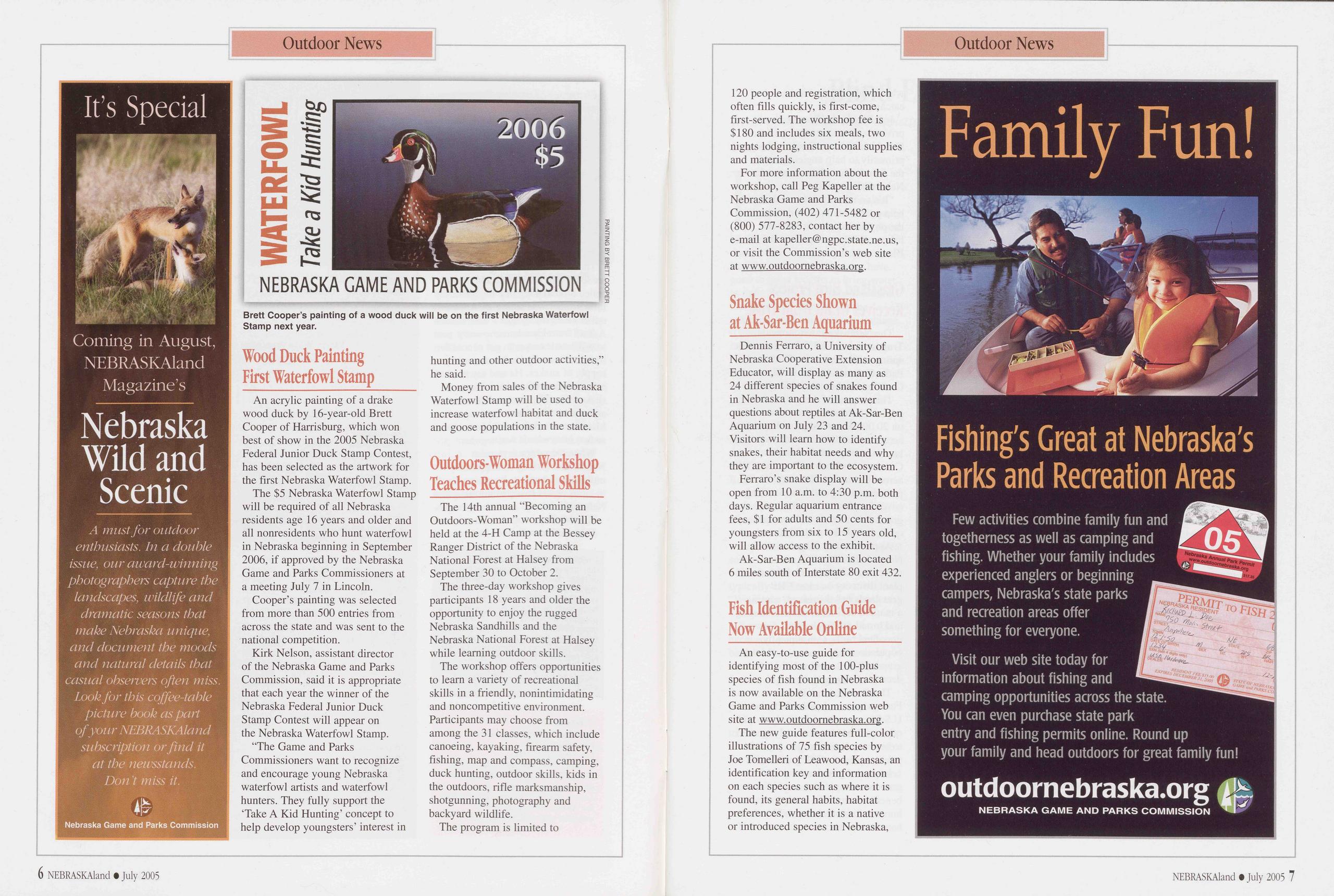
Outdoor News
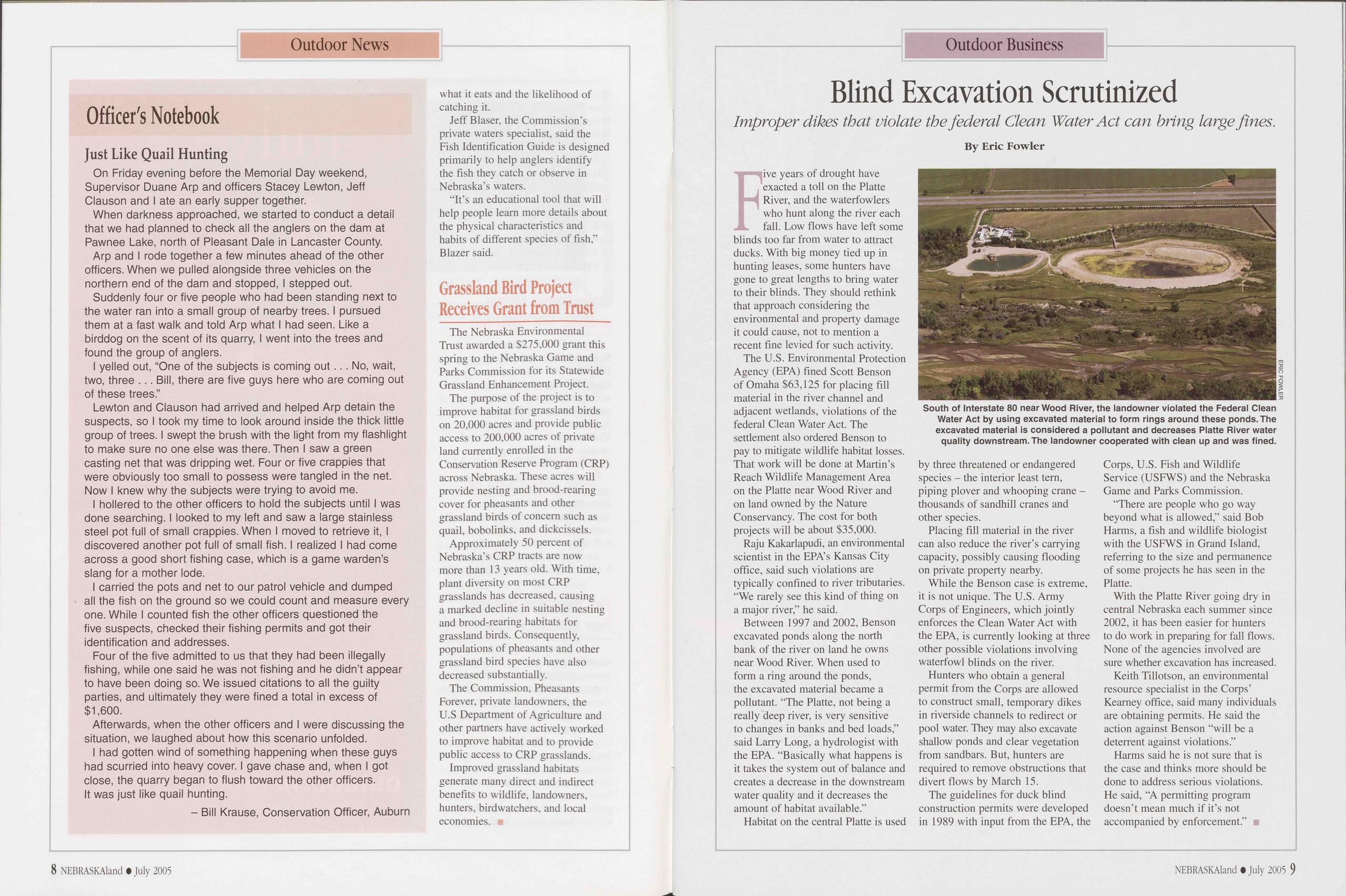
It’s Special Coming in August, NEBRASKAland Magazine’s Nebraska Wild and Scenic A must for outdoor enthusiasts. In a double issue, our award-winning photographers capture the landscapes, wildlife and dramatic seasons that make Nebraska unique, and document the moods and natural details that casual observers often miss. Look for this coffee-table picture book as part of your NEBRASKAland subscription or find it at the newsstands. Don't miss it. Nebraska Game and Parks CommissionAn acrylic painting of a drake wood duck by 16-year-old Brett Cooper of Harrisburg, which won best of show in the 2005 Nebraska Federal Junior Duck Stamp Contest, has been selected as the artwork for the first Nebraska Waterfowl Stamp.
The $5 Nebraska Waterfowl Stamp will be required of all Nebraska residents age 16 years and older and all nonresidents who hunt waterfowl in Nebraska beginning in September 2006, if approved by the Nebraska Game and Parks Commissioners at a meeting July 7 in Lincoln.
Cooper’s painting was selected from more than 500 entries from across the state and was sent to the national competition.
Kirk Nelson, assistant director of the Nebraska Game and Parks Commission, said it is appropriate that each year the winner of the Nebraska Federal Junior Duck Stamp Contest will appear on the Nebraska Waterfowl Stamp.
“The Game and Parks Commissioners want to recognize and encourage young Nebraska waterfowl artists and waterfowl hunters. They fully support the ‘Take A Kid Hunting’ concept to help develop youngsters’ interest in hunting and other outdoor activities,” he said.
Money from sales of the Nebraska Waterfowl Stamp will be used to increase waterfowl habitat and duck and goose populations in the state.
Outdoors-Woman Workshop Teaches Recreational SkillsThe 14th annual “Becoming an Outdoors-Woman” workshop will be held at the 4-H Camp at the Bessey Ranger District of the Nebraska National Forest at Halsey from September 30 to October 2.
The three-day workshop gives participants 18 years and older the opportunity to enjoy the rugged Nebraska Sandhills and the Nebraska National Forest at Halsey while learning outdoor skills.
The workshop offers opportunities to learn a variety of recreational skills in a friendly, nonintimidating and noncompetitive environment. Participants may choose from among the 31 classes, which include canoeing, kayaking, firearm safety, fishing, map and compass, camping, duck hunting, outdoor skills, kids in the outdoors, rifle marksmanship, shotgunning, photography and backyard wildlife.
The program is limited to 6 NEBRASKAland • July 2005 120 people and registration, which often fills quickly, is first-come, first-served. The workshop fee is $180 and includes six meals, two nights lodging, instructional supplies and materials.
For more information about the workshop, call Peg Kapeller at the Nebraska Game and Parks Commission, (402) 471-5482 or (800) 577-8283, contact her by e-mail at kapeller@ngpc.state.ne.us, or visit the Commission’s web site at www.outdoornebraska.org.
Snake Species Shown at Ak-Sar-Ben AquariumDennis Ferraro, a University of Nebraska Cooperative Extension Educator, will display as many as 24 different species of snakes found in Nebraska and he will answer questions about reptiles at Ak-Sar-Ben Aquarium on July 23 and 24. Visitors will learn how to identify snakes, their habitat needs and why they are important to the ecosystem.
Ferraro’s snake display will be open from 10 a.m. to 4:30 p.m. both days. Regular aquarium entrance fees, $1 for adults and 50 cents for youngsters from six to 15 years old, will allow access to the exhibit.
Ak-Sar-Ben Aquarium is located 6 miles south of Interstate 80 exit 432.
Fish Identification Guide Now Available OnlineAn easy-to-use guide for identifying most of the 100-plus species of fish found in Nebraska is now available on the Nebraska Game and Parks Commission web site at www.outdoornebraska.org.
The new guide features full-color illustrations of 75 fish species by Joe Tomelleri of Leawood, Kansas, an identification key and information on each species such as where it is found, its general habits, habitat preferences, whether it is a native or introduced species in Nebraska,
 what it eats and the likelihood of
catching it.
Officer's Notebook
Just Like Quail Hunting
what it eats and the likelihood of
catching it.
Officer's Notebook
Just Like Quail Hunting
On Friday evening before the Memorial Day weekend, Supervisor Duane Arp and officers Stacey Lewton, Jeff Clauson and I ate an early supper together.
When darkness approached, we started to conduct a detail that we had planned to check all the anglers on the dam at Pawnee Lake, north of Pleasant Dale in Lancaster County.
Arp and I rode together a few minutes ahead of the other officers. When we pulled alongside three vehicles on the northern end of the dam and stopped, I stepped out.
Suddenly four or five people who had been standing next to the water ran into a small group of nearby trees. I pursued them at a fast walk and told Arp what I had seen. Like a birddog on the scent of its quarry, I went into the trees and found the group of anglers.
I yelled out, “One of the subjects is coming out... No, wait, two, three ... Bill, there are five guys here who are coming out of these trees.”
Lewton and Clauson had arrived and helped Arp detain the suspects, so I took my time to look around inside the thick little group of trees. I swept the brush with the light from my flashlight to make sure no one else was there. Then I saw a green casting net that was dripping wet. Four or five crappies that were obviously too small to possess were tangled in the net. Now I knew why the subjects were trying to avoid me.
I hollered to the other officers to hold the subjects until I was done searching. I looked to my left and saw a large stainless steel pot full of small crappies. When I moved to retrieve it, I discovered another pot full of small fish. I realized I had come across a good short fishing case, which is a game warden’s slang for a mother lode.
I carried the pots and net to our patrol vehicle and dumped all the fish on the ground so we could count and measure every one. While I counted fish the other officers questioned the five suspects, checked their fishing permits and got their identification and addresses.
Four of the five admitted to us that they had been illegally fishing, while one said he was not fishing and he didn’t appear to have been doing so. We issued citations to all the guilty parties, and ultimately they were fined a total in excess of $1,600.
Afterwards, when the other officers and I were discussing the situation, we laughed about how this scenario unfolded.
I had gotten wind of something happening when these guys had scurried into heavy cover. I gave chase and, when I got close, the quarry began to flush toward the other officers. It was just like quail hunting.
- Bill Krause, Conservation Officer, AuburnJeff Blaser, the Commission’s private waters specialist, said the Fish Identification Guide is designed primarily to help anglers identify the fish they catch or observe in Nebraska’s waters.
“It’s an educational tool that will help people learn more details about the physical characteristics and habits of different species of fish,” Blazer said.
Grassland Bird Project Receives Grant from TrustThe Nebraska Environmental Trust awarded a $275,000 grant this spring to the Nebraska Game and Parks Commission for its Statewide Grassland Enhancement Project.
The purpose of the project is to improve habitat for grassland birds on 20,000 acres and provide public access to 200,000 acres of private land currently enrolled in the Conservation Reserve Program (CRP) across Nebraska. These acres will provide nesting and brood-rearing cover for pheasants and other grassland birds of concern such as quail, bobolinks, and dickcissels.
Approximately 50 percent of Nebraska’s CRP tracts are now more than 13 years old. With time, plant diversity on most CRP grasslands has decreased, causing a marked decline in suitable nesting and brood-rearing habitats for grassland birds. Consequently, populations of pheasants and other grassland bird species have also decreased substantially.
The Commission, Pheasants Forever, private landowners, the U.S Department of Agriculture and other partners have actively worked to improve habitat and to provide public access to CRP grasslands.
Improved grassland habitats generate many direct and indirect benefits to wildlife, landowners, hunters, birdwatchers, and local economies.
8 NEBRASKAland • July 2005Outdoor Business
Blind Excavation Scrutinized
Improper dikes that violate the federal Clean Water Act can bring large fines.
Five years of drought have exacted a toll on the Platte River, and the waterfowlers who hunt along the river each fall. Low flows have left some blinds too far from water to attract ducks. With big money tied up in hunting leases, some hunters have gone to great lengths to bring water to their blinds. They should rethink that approach considering the environmental and property damage it could cause, not to mention a recent fine levied for such activity.
The U.S. Environmental Protection Agency (EPA) fined Scott Benson of Omaha $63,125 for placing fill material in the river channel and adjacent wetlands, violations of the federal Clean Water Act. The settlement also ordered Benson to pay to mitigate wildlife habitat losses. That work will be done at Martin’s Reach Wildlife Management Area on the Platte near Wood River and on land owned by the Nature Conservancy. The cost for both projects will be about $35,000.
Raju Kakarlapudi, an environmental scientist in the EPA’s Kansas City office, said such violations are typically confined to river tributaries. “We rarely see this kind of thing on a major river,” he said.
Between 1997 and 2002, Benson excavated ponds along the north bank of the river on land he owns near Wood River. When used to form a ring around the ponds, the excavated material became a pollutant. “The Platte, not being a really deep river, is very sensitive to changes in banks and bed loads,” said Larry Long, a hydrologist with the EPA. “Basically what happens is it takes the system out of balance and creates a decrease in the downstream water quality and it decreases the amount of habitat available.”
Habitat on the central Platte is used
Placing fill material in the river can also reduce the river’s carrying capacity, possibly causing flooding on private property nearby.
While the Benson case is extreme, it is not unique. The U.S. Army Corps of Engineers, which jointly enforces the Clean Water Act with the EPA, is currently looking at three other possible violations involving waterfowl blinds on the river.
Hunters who obtain a general permit from the Corps are allowed to construct small, temporary dikes in riverside channels to redirect or pool water. They may also excavate shallow ponds and clear vegetation from sandbars. But, hunters are required to remove obstructions that divert flows by March 15.
The guidelines for duck blind construction permits were developed in 1989 with input from the EPA, the Corps, U.S. Fish and Wildlife Service (USFWS) and the Nebraska Game and Parks Commission.
“There are people who go way beyond what is allowed,” said Bob Harms, a fish and wildlife biologist with the USFWS in Grand Island, referring to the size and permanence of some projects he has seen in the Platte.
With the Platte River going dry in central Nebraska each summer since 2002, it has been easier for hunters to do work in preparing for fall flows. None of the agencies involved are sure whether excavation has increased.
Keith Tillotson, an environmental resource specialist in the Corps’ Kearney office, said many individuals are obtaining permits. He said the action against Benson “will be a deterrent against violations.”
Harms said he is not sure that is the case and thinks more should be done to address serious violations. He said, “A permitting program doesn’t mean much if it’s not accompanied by enforcement.”
NEBRASKAland • July 2005 9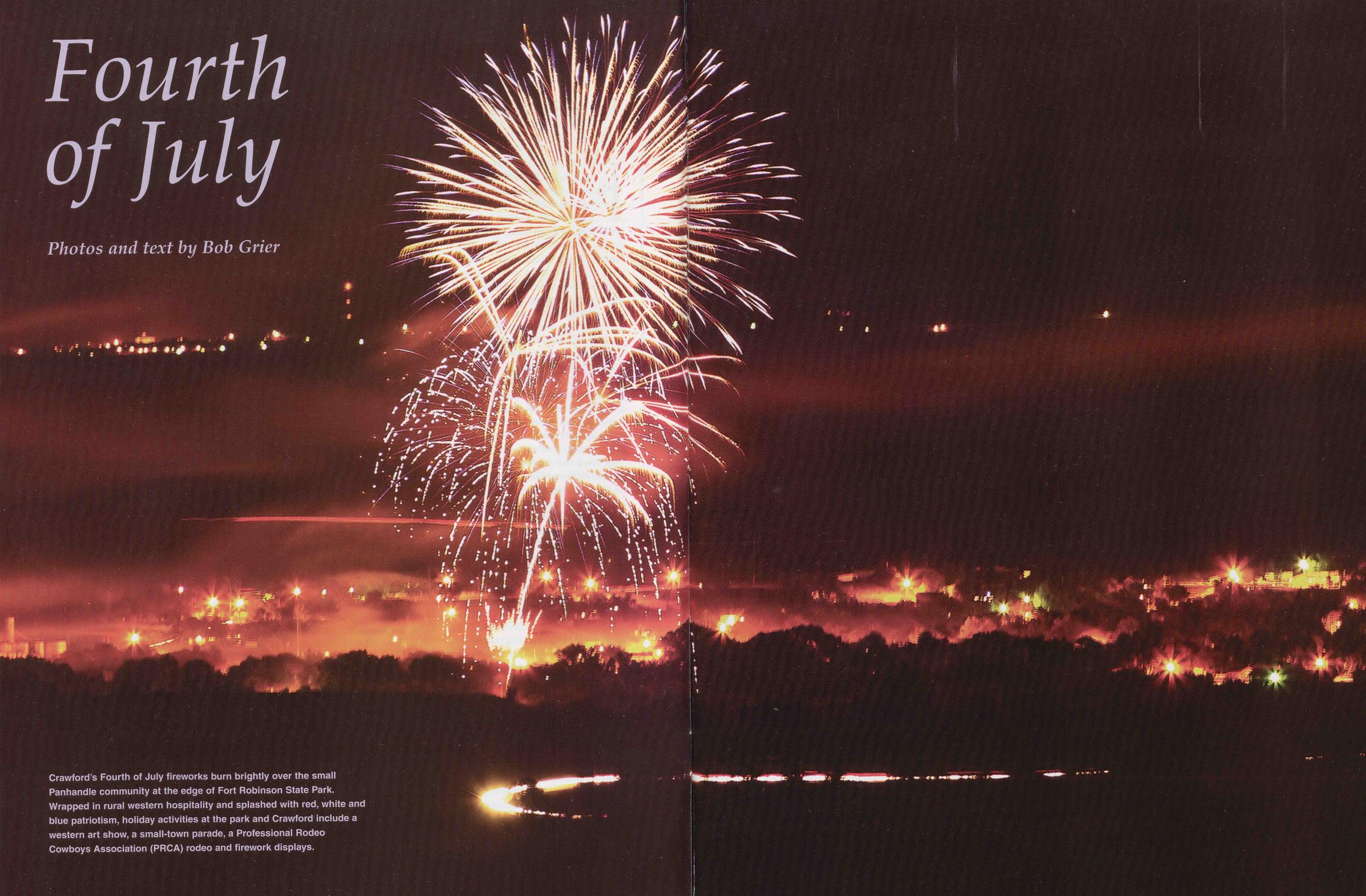
Fourth of July
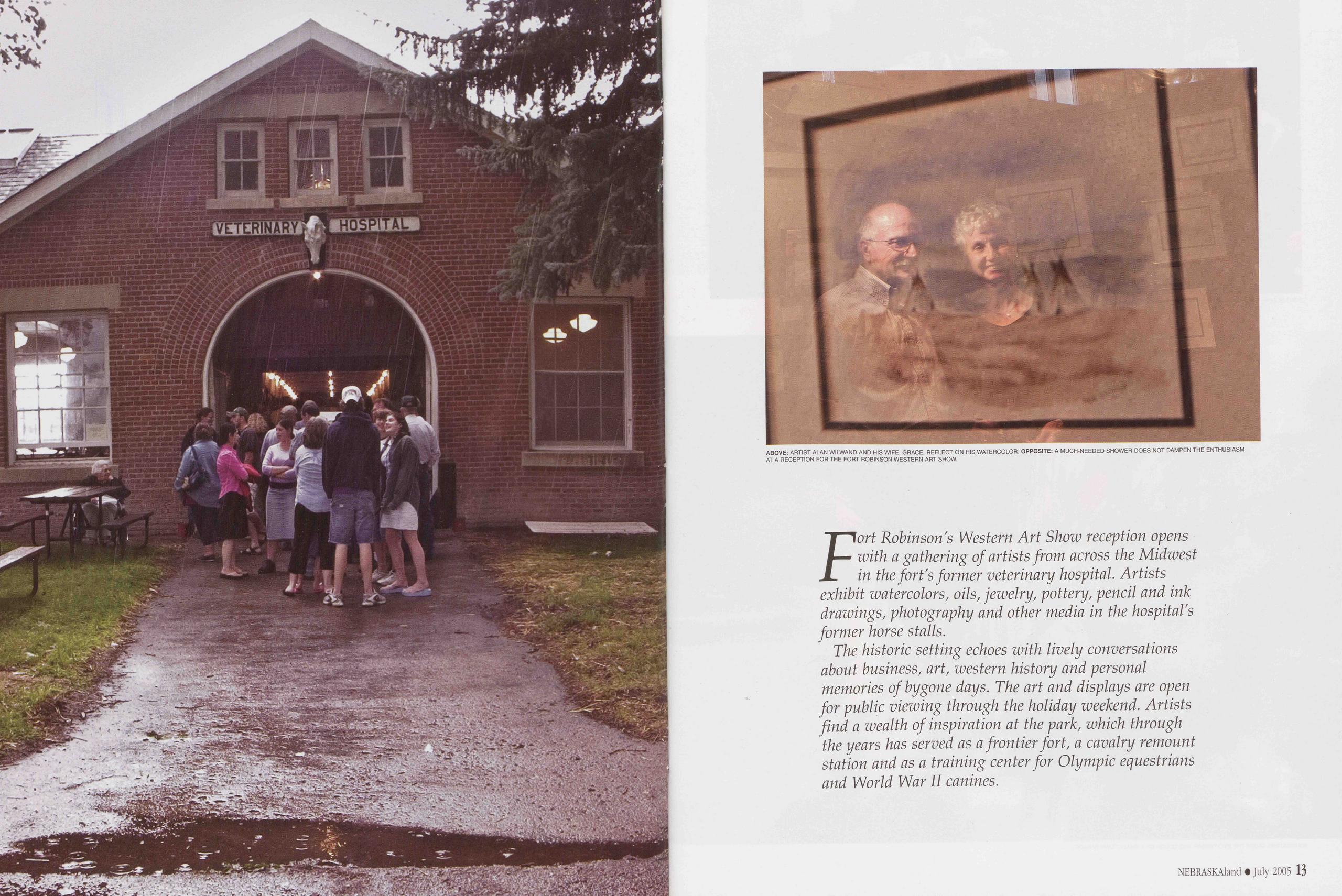
Fort Robinson's Western Art Show reception opens with a gathering of artists from across the Midwest in the fort's former veterinary hospital. Artists exhibit watercolors, oils, jewelry, pottery, pencil and ink drawings, photography and other media in the hospital's former horse stalls.
The historic setting echoes with lively conversations about business, art, western history and personal memories of bygone days. The art and displays are open for public viewing through the holiday weekend. Artists find a wealth of inspiration at the park, which through the years has served as a frontier fort, a cavalry remount station and as a training center for Olympic equestrians and World War II canines.
NEBRASKAland • July 2005 13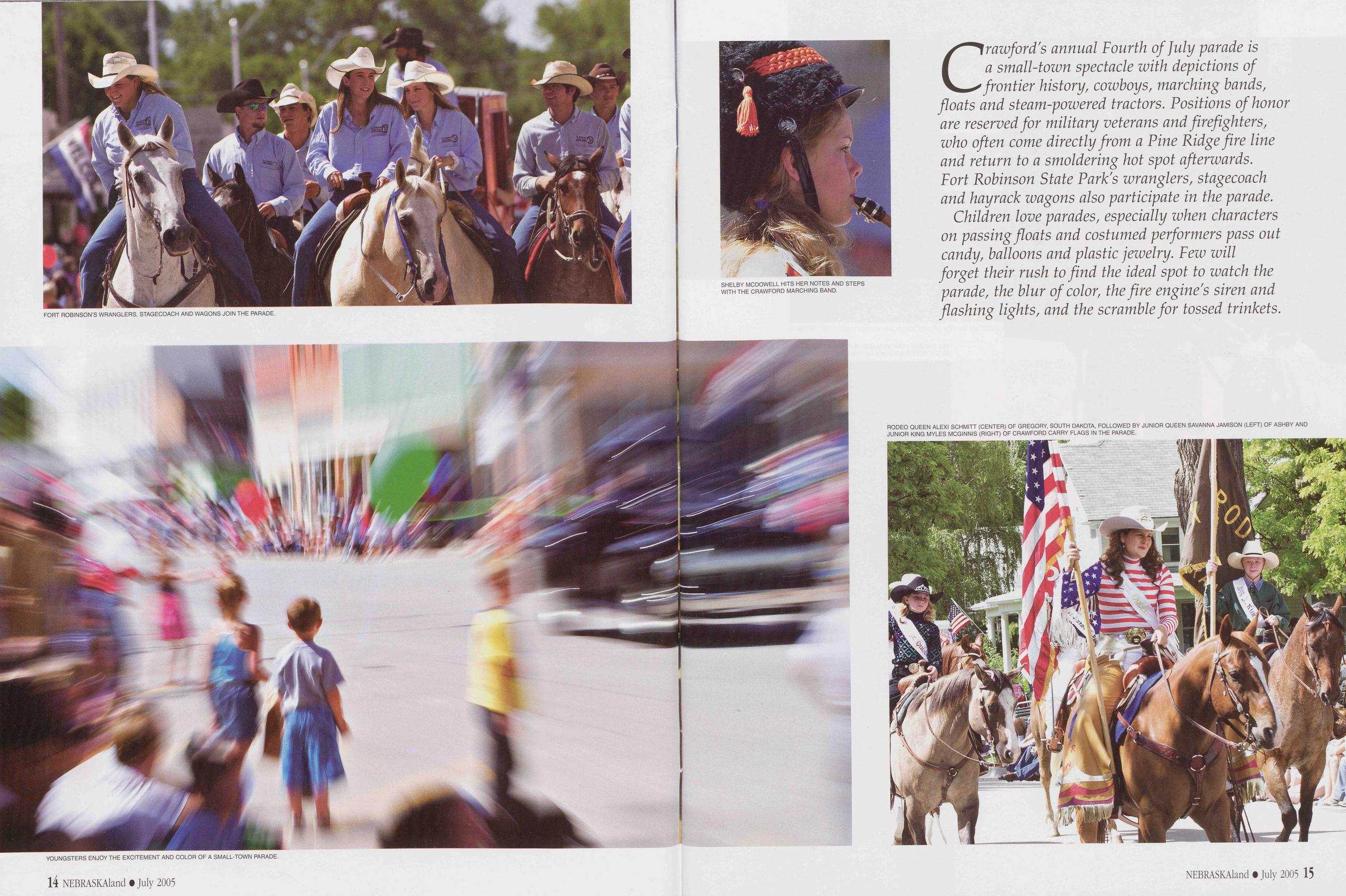
Crawford's annual Fourth of July parade is a small-town spectacle with depictions of frontier history, cowboys, marching bands, floats and steam-powered tractors. Positions of honor are reserved for military veterans and firefighters, who often come directly from a Pine Ridge fire line and return to a smoldering hot spot afterwards. Fort Robinson State Park's wranglers, stagecoach and hayrack wagons also participate in the parade.
Children love parades, especially when characters on passing floats and costumed performers pass out candy, balloons and plastic jewelry. Few will forget their rush to find the ideal spot to watch the parade, the blur of color, the fire engine's siren and flashing lights, and the scramble for tossed trinkets.

The midday parade ends in time for an afternoon cookout and for family and friends to visit in the shade before the evening performance of the PRCA rodeo. Crawford's rodeo shows off the skills of working cowboys - roping and riding, and whooping and hollering. In the crowd, a veteran cowpuncher scores each event with the knowledge of someone who has been there and done that.
16 NEBRASKAland • July 2005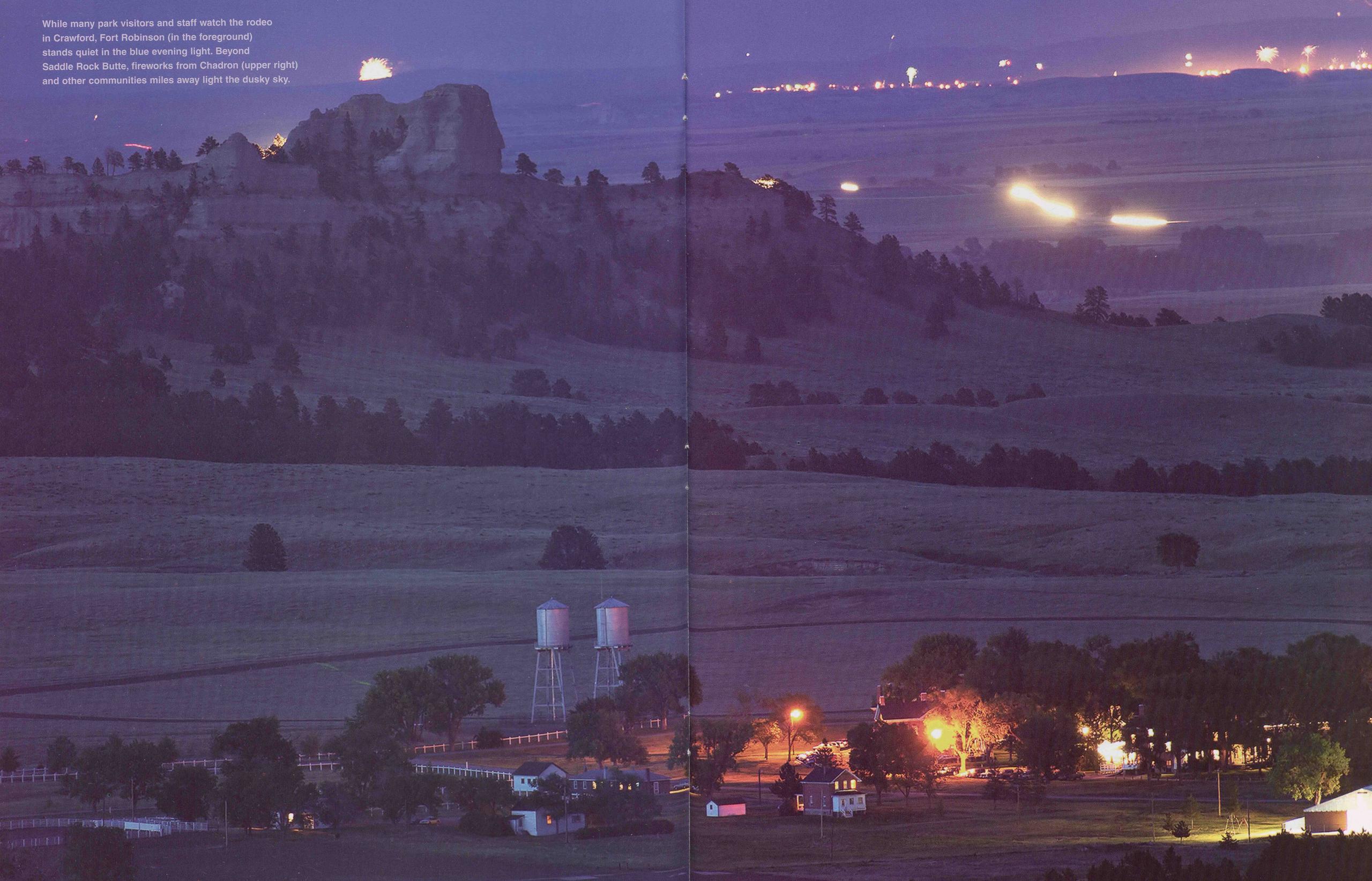
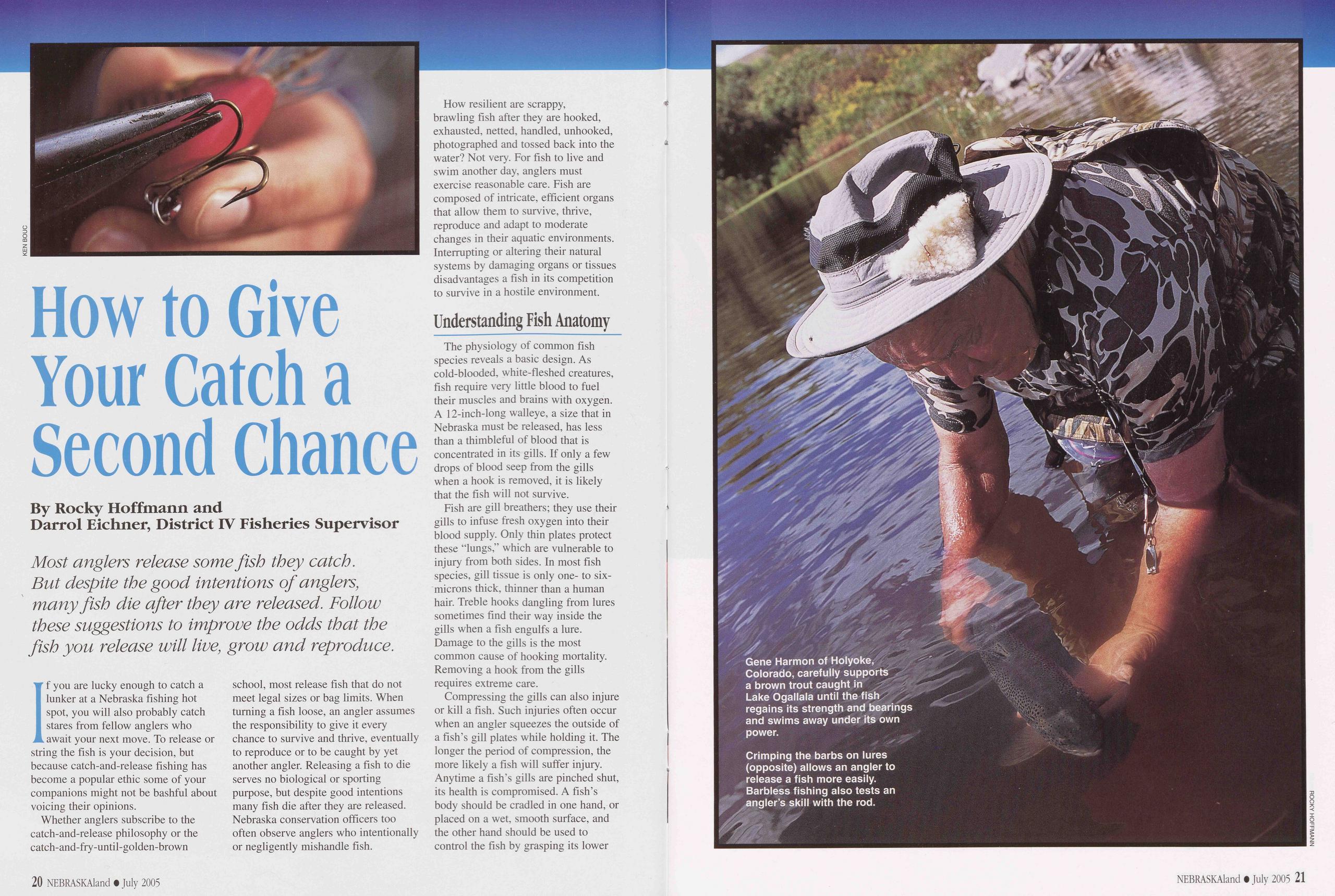
How to Give Your Catch a Second Chance
Most anglers release some fish they catch. But despite the good intentions of anglers, many fish die after they are released. Follow these suggestions to improve the odds that the fish you release will live, grow and reproduce.
If you are lucky enough to catch a lunker at a Nebraska fishing hot spot, you will also probably catch stares from fellow anglers who await your next move. To release or string the fish is your decision, but because catch-and-release fishing has become a popular ethic some of your companions might not be bashful about voicing their opinions.
Whether anglers subscribe to the catch-and-release philosophy or the catch-and-fry-until-golden-brown school, most release fish that do not meet legal sizes or bag limits. When turning a fish loose, an angler assumes the responsibility to give it every chance to survive and thrive, eventually to reproduce or to be caught by yet another angler. Releasing a fish to die serves no biological or sporting purpose, but despite good intentions many fish die after they are released. Nebraska conservation officers too often observe anglers who intentionally or negligently mishandle fish.
How resilient are scrappy, brawling fish after they are hooked, exhausted, netted, handled, unhooked, photographed and tossed back into the water? Not very. For fish to live and swim another day, anglers must exercise reasonable care. Fish are composed of intricate, efficient organs that allow them to survive, thrive, reproduce and adapt to moderate changes in their aquatic environments. Interrupting or altering their natural systems by damaging organs or tissues disadvantages a fish in its competition to survive in a hostile environment.
Understanding Fish AnatomyThe physiology of common fish species reveals a basic design. As cold-blooded, white-fleshed creatures, fish require very little blood to fuel their muscles and brains with oxygen. A 12-inch-long walleye, a size that in Nebraska must be released, has less than a thimbleful of blood that is concentrated in its gills. If only a few drops of blood seep from the gills when a hook is removed, it is likely that the fish will not survive.
Fish are gill breathers; they use their gills to infuse fresh oxygen into their blood supply. Only thin plates protect these “lungs,” which are vulnerable to injury from both sides. In most fish species, gill tissue is only one- to six- microns thick, thinner than a human hair. Treble hooks dangling from lures sometimes find their way inside the gills when a fish engulfs a lure. Damage to the gills is the most common cause of hooking mortality. Removing a hook from the gills requires extreme care.
Compressing the gills can also injure or kill a fish. Such injuries often occur when an angler squeezes the outside of a fish’s gill plates while holding it. The longer the period of compression, the more likely a fish will suffer injury. Anytime a fish’s gills are pinched shut, its health is compromised. A fish’s body should be cradled in one hand, or placed on a wet, smooth surface, and the other hand should be used to control the fish by grasping its lower 20 NEBRASKAland • July 2005
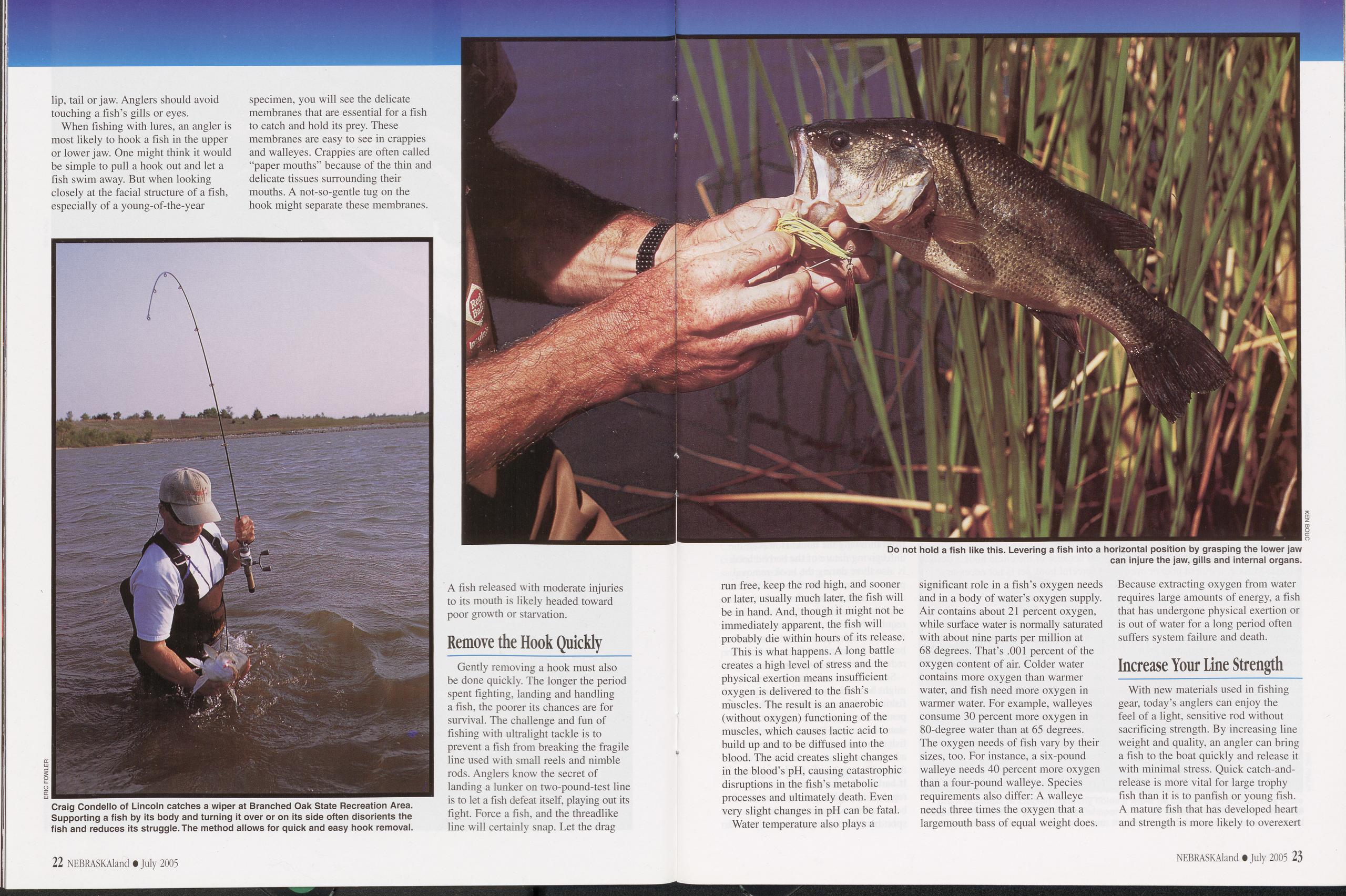 lip, tail or jaw. Anglers should avoid
touching a fish's gills or eyes.
lip, tail or jaw. Anglers should avoid
touching a fish's gills or eyes.
When fishing with lures, an angler is most likely to hook a fish in the upper or lower jaw. One might think it would be simple to pull a hook out and let a fish swim away. But when looking closely at the facial structure of a fish, especially of a young-of-the-year
Gently removing a hook must also be done quickly. The longer the period spent fighting, landing and handling a fish, the poorer its chances are for surviva;. The challenge and fun of fishing with ultralight tackle is to prevent a fish from breaking the fragile line used with small reels and nimble rods. Anglers know the secret of landing a lunker on two-pound-test line is to let a fish defeat itself, playing out its fight. Force a fish, and the threadlike line will certainly snap. Let the drag 22 NEBRASKAland July 2005
This is what happens. A long battle creates a high level of stress and the physical exertion means insufficient oxygen is delivered to the fish's muscles. The result is an anaerobic (without oxygen) functioning of the muscles, which causes lactic acid to build up and to be diffused into the blood. The acid creates slight changes in the blood's pH, causing catastrophic disruptions in the fish's metabolic processes and ultimately deat. Even very slight changes in the pH can be fatal.
Water temperature also plays a significant role in a fish's oxygen needs and in a body of water's ozygen supply. Air contains about 21 percent oxygen, while surface water is normally saturated woth about nine parts per million at 68 degrees. That's .001 percent of the oxygen content of air. Colder water contains more oxygen than warmer water, and fish need more oxygen in warmer water. For example, walleyes consume 30 percent more oxygen in 80-degree water than at 65 degrees. The oxygen needs of fish vary by their sizes, too. For instance, a six-pound walleye needs 40 percent more oxygen than a four-pound walleye. Species requirements also differ: A walleye needs three times the oxygen that a largemouth bass of equal weight does. Because extracting oxygen from water requires large amount sof energy, a fish that has undergone physical exertion or is out of water for a long period often suffers system failure and death.
Increase Your Line StrengthWith new materials used in fishing
gear, today's anglers can enjoy the
feel of a light, sensitive rod without
sacrificing strength. By increasing line
weight and quality, an angler can bring
a fish to the boat quickly and release it
with minimal stress. Quick catch-and-
release is more vital for large trophy
fish than it is to panfish or young fish.
A mature fish that has developed heart
and strength is more likely to overexert
NEBRASKAland July 2005 23
Modern super line is thin, sensitive and strong. An angler who uses it does not impose an unfair advantage over a fish if the objective is a safe catch and release. Muskie, northern pike or even bass fishermen often use lines tested at more than 50 pounds. Many muskie anglers use 100-pound-test line because modern muskie fishing is a catch-and- release game. Getting these brawlers to a boat quickly is paramount to their survival.
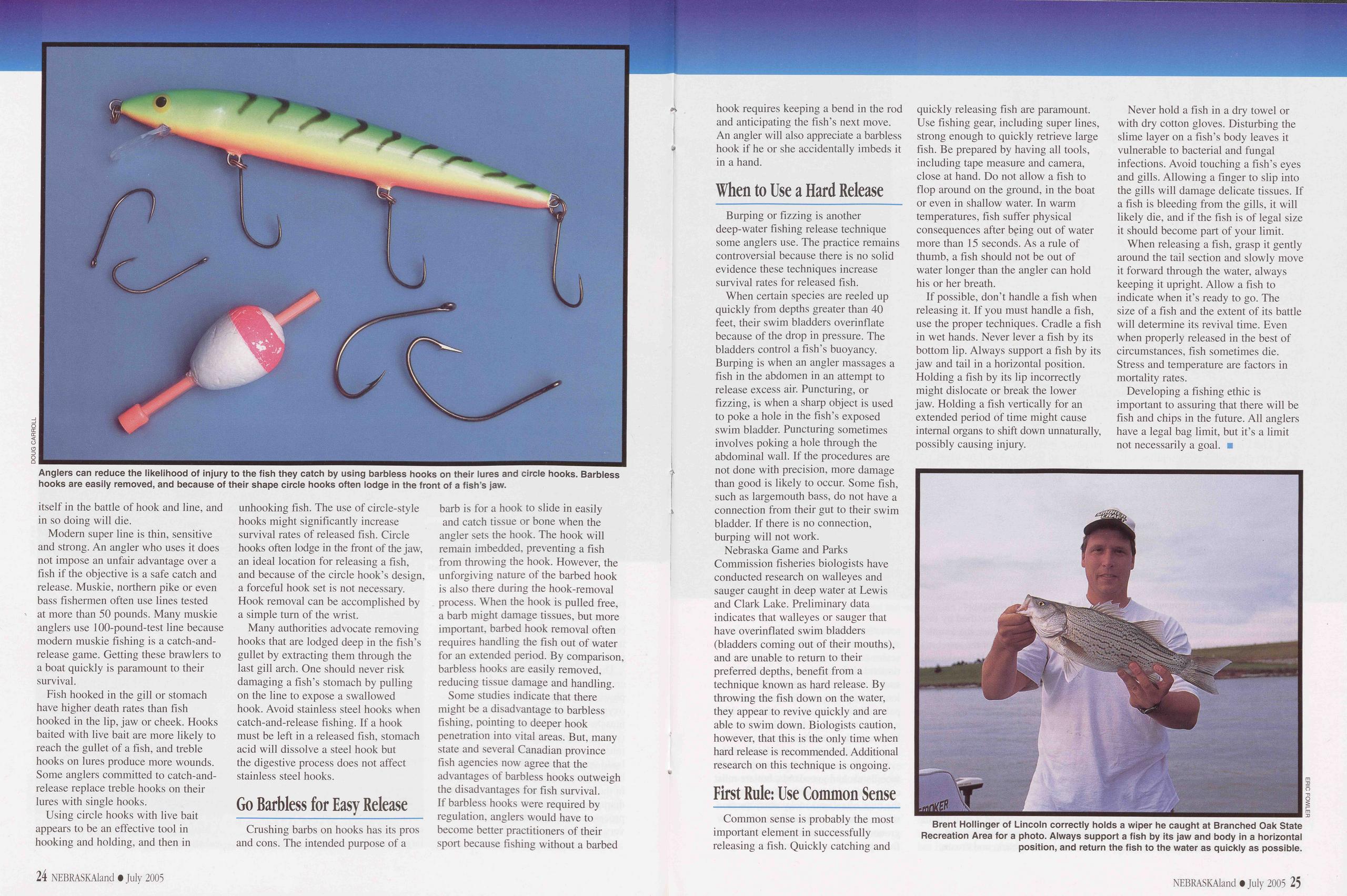
Fish hooked in the gill or stomach have higher death rates than fish hooked in the lip, jaw or cheek. Hooks baited with live bait are more likely to reach the gullet of a fish, and treble hooks on lures produce more wounds. Some anglers committed to catch-and- release replace treble hooks on their lures with single hooks.
Using circle hooks with live bait appears to be an effective tool in hooking and holding, and then in unhooking fish. The use of circle-style hooks might significantly increase survival rates of released fish. Circle hooks often lodge in the front of the jaw, an ideal location for releasing a fish, and because of the circle hook’s design, a forceful hook set is not necessary. Hook removal can be accomplished by a simple turn of the wrist.
Many authorities advocate removing hooks that are lodged deep in the fish’s gullet by extracting them through the last gill arch. One should never risk damaging a fish’s stomach by pulling on the line to expose a swallowed hook. Avoid stainless steel hooks when catch-and-release fishing. If a hook must be left in a released fish, stomach acid will dissolve a steel hook but the digestive process does not affect stainless steel hooks.
Go Barbless for Easy ReleaseCrushing barbs on hooks has its pros and cons. The intended purpose of a barb is for a hook to slide in easily and catch tissue or bone when the angler sets the hook. The hook will remain imbedded, preventing a fish from throwing the hook. However, the unforgiving nature of the barbed hook is also there during the hook-removal process. When the hook is pulled free, a barb might damage tissues, but more important, barbed hook removal often requires handling the fish out of water for an extended period. By comparison, barbless hooks are easily removed, reducing tissue damage and handling.
Some studies indicate that there might be a disadvantage to barbless fishing, pointing to deeper hook penetration into vital areas. But, many state and several Canadian province fish agencies now agree that the advantages of barbless hooks outweigh the disadvantages for fish survival. If barbless hooks were required by regulation, anglers would have to become better practitioners of their sport because fishing without a barbed 24 NEBRASKAland • July 2005 hook requires keeping a bend in the rod and anticipating the fish’s next move. An angler will also appreciate a barbless hook if he or she accidentally imbeds it in a hand.
When to Use a Hard ReleaseBurping or fizzing is another deep-water fishing release technique some anglers use. The practice remains controversial because there is no solid evidence these techniques increase survival rates for released fish.
When certain species are reeled up quickly from depths greater than 40 feet, their swim bladders overinflate because of the drop in pressure. The bladders control a fish’s buoyancy. Burping is when an angler massages a fish in the abdomen in an attempt to release excess air. Puncturing, or fizzing, is when a sharp object is used to poke a hole in the fish’s exposed swim bladder. Puncturing sometimes involves poking a hole through the abdominal wall. If the procedures are not done with precision, more damage than good is likely to occur. Some fish, such as largemouth bass, do not have a connection from their gut to their swim bladder. If there is no connection, burping will not work.
Nebraska Game and Parks Commission fisheries biologists have conducted research on walleyes and sauger caught in deep water at Lewis and Clark Lake. Preliminary data indicates that walleyes or sauger that have overinflated swim bladders (bladders coming out of their mouths), and are unable to return to their preferred depths, benefit from a technique known as hard release. By throwing the fish down on the water, they appear to revive quickly and are able to swim down. Biologists caution, however, that this is the only time when hard release is recommended. Additional research on this technique is ongoing.
First Rule: Use Common SenseCommon sense is probably the most important element in successfully releasing a fish. Quickly catching and quickly releasing fish are paramount. Use fishing gear, including super lines, strong enough to quickly retrieve large fish. Be prepared by having all tools, including tape measure and camera, close at hand. Do not allow a fish to flop around on the ground, in the boat or even in shallow water. In warm temperatures, fish suffer physical consequences after being out of water more than 15 seconds. As a rule of thumb, a fish should not be out of water longer than the angler can hold his or her breath.
If possible, don’t handle a fish when releasing it. If you must handle a fish, use the proper techniques. Cradle a fish in wet hands. Never lever a fish by its bottom lip. Always support a fish by its jaw and tail in a horizontal position. Holding a fish by its lip incorrectly might dislocate or break the lower jaw. Holding a fish vertically for an extended period of time might cause internal organs to shift down unnaturally, possibly causing injury.
Never hold a fish in a dry towel or with dry cotton gloves. Disturbing the slime layer on a fish’s body leaves it vulnerable to bacterial and fungal infections. Avoid touching a fish’s eyes and gills. Allowing a finger to slip into the gills will damage delicate tissues. If a fish is bleeding from the gills, it will likely die, and if the fish is of legal size it should become part of your limit.
When releasing a fish, grasp it gently around the tail section and slowly move it forward through the water, always keeping it upright. Allow a fish to indicate when it’s ready to go. The size of a fish and the extent of its battle will determine its revival time. Even when properly released in the best of circumstances, fish sometimes die. Stress and temperature are factors in mortality rates.
Developing a fishing ethic is important to assuring that there will be fish and chips in the future. All anglers have a legal bag limit, but it’s a limit not necessarily a goal.
NEBRASKAland • July 2005 25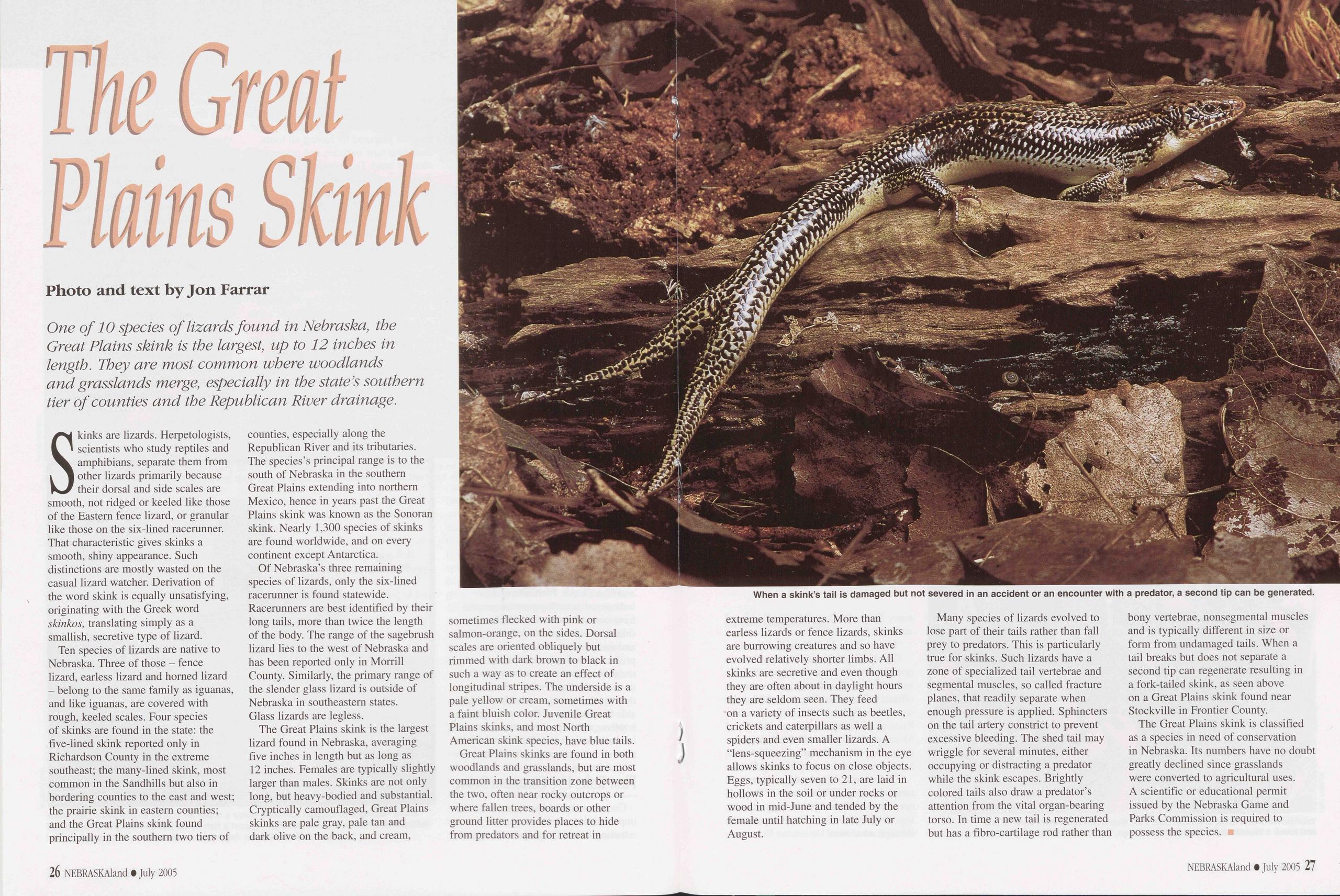
The Great Plains Skink
One of 10 species of lizards found in Nebraska, the Great Plains skink is the largest, up to 12 inches in length. They are most common where woodlands and grasslands merge, especially in the state’s southern tier of counties and the Republican River drainage.
Skinks are lizards. Herpetologists, scientists who study reptiles and amphibians, separate them from other lizards primarily because their dorsal and side scales are smooth, not ridged or keeled like those of the Eastern fence lizard, or granular like those on the six-lined racerunner. That characteristic gives skinks a smooth, shiny appearance. Such distinctions are mostly wasted on the casual lizard watcher. Derivation of the word skink is equally unsatisfying, originating with the Greek word skinkos, translating simply as a smallish, secretive type of lizard.
Ten species of lizards are native to Nebraska. Three of those - fence lizard, earless lizard and horned lizard - belong to the same family as iguanas, and like iguanas, are covered with rough, keeled scales. Four species of skinks are found in the state: the five-lined skink reported only in Richardson County in the extreme southeast; the many-lined skink, most common in the Sandhills but also in bordering counties to the east and west; the prairie skink in eastern counties; and the Great Plains skink found principally in the southern two tiers of counties, especially along the Republican River and its tributaries. The species’s principal range is to the south of Nebraska in the southern Great Plains extending into northern Mexico, hence in years past the Great Plains skink was known as the Sonoran skink. Nearly 1,300 species of skinks are found worldwide, and on every continent except Antarctica.
Of Nebraska’s three remaining species of lizards, only the six-lined racerunner is found statewide. Racerunners are best identified by their long tails, more than twice the length of the body. The range of the sagebrush lizard lies to the west of Nebraska and has been reported only in Morrill County. Similarly, the primary range of the slender glass lizard is outside of Nebraska in southeastern states. Glass lizards are legless.
The Great Plains skink is the largest lizard found in Nebraska, averaging five inches in length but as long as 12 inches. Females are typically slightly larger than males. Skinks are not only long, but heavy-bodied and substantial. Cryptically camouflaged, Great Plains skinks are pale gray, pale tan and dark olive on the back, and cream sometimes flecked with pink or salmon-orange, on the sides. Dorsal scales are oriented obliquely but rimmed with dark brown to black in such a way as to create an effect of longitudinal stripes. The underside is a pale yellow or cream, sometimes with a faint bluish color. Juvenile Great Plains skinks, and most North American skink species, have blue tails.
Great Plains skinks are found in both woodlands and grasslands, but are most common in the transition zone between the two, often near rocky outcrops or where fallen trees, boards or other ground litter provides places to hide from predators and for retreat in 26 NEBRASKAland • July 2005
Many species of lizards evolved to lose part of their tails rather than fall prey to predators. This is particularly true for skinks. Such lizards have a zone of specialized tail vertebrae and segmental muscles, so called fracture planes, that readily separate when enough pressure is applied. Sphincters on the tail artery constrict to prevent excessive bleeding. The shed tail may wriggle for several minutes, either occupying or distracting a predator while the skink escapes. Brightly colored tails also draw a predator’s attention from the vital organ-bearing torso. In time a new tail is regenerated but has a fibro-cartilage rod rather than bony vertebrae, nonsegmental muscles and is typically different in size or form from undamaged tails. When a tail breaks but does not separate a second tip can regenerate resulting in a fork-tailed skink, as seen above on a Great Plains skink found near Stockville in Frontier County.
The Great Plains skink is classified as a species in need of conservation in Nebraska. Its numbers have no doubt greatly declined since grasslands were converted to agricultural uses. A scientific or educational permit issued by the Nebraska Game and Parks Commission is required to possess the species.
NEBRASKAland • July 2005 27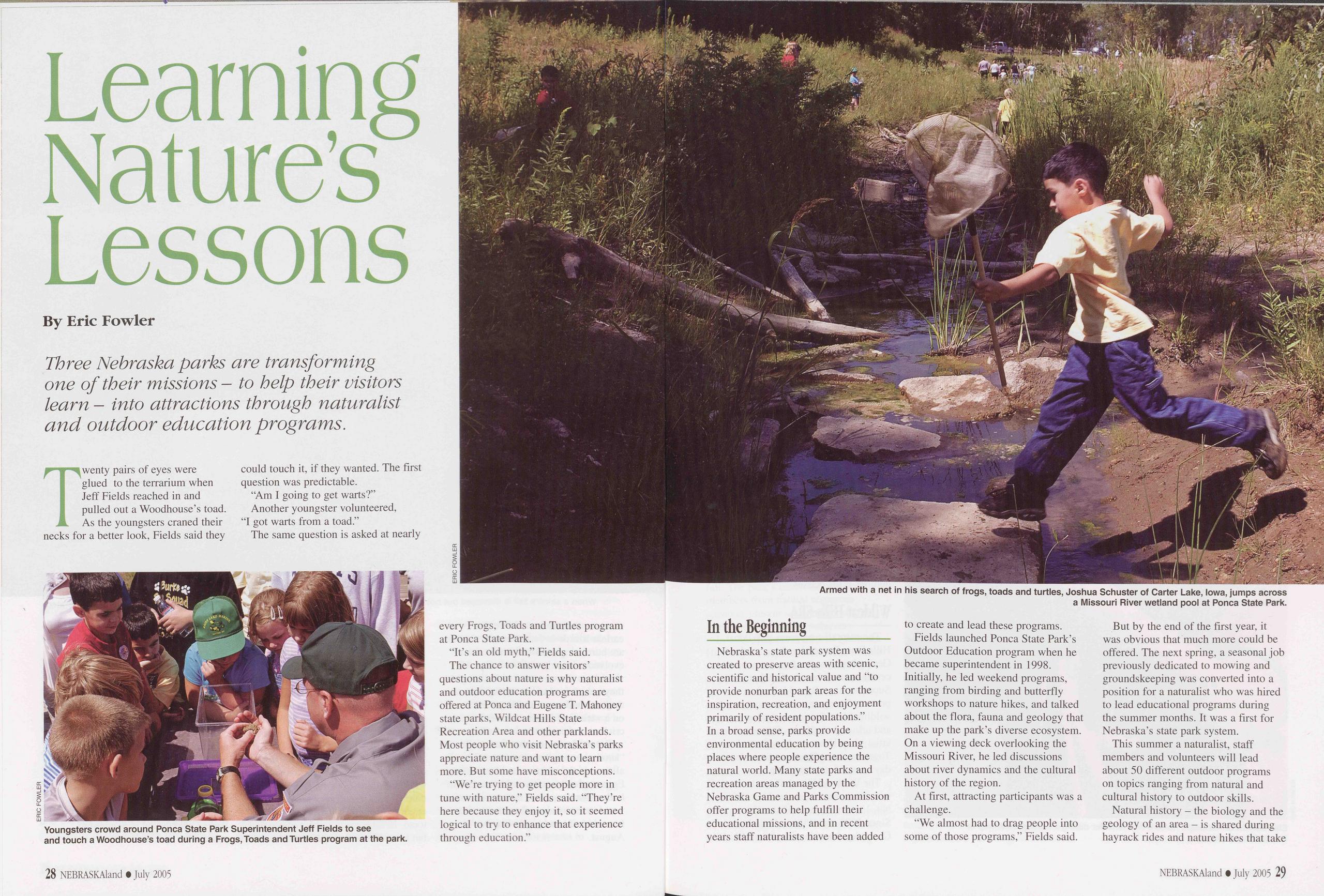
Learning Nature’s Lessons
Three Nebraska parks are transforming one of their missions - to help their visitors learn - into attractions through naturalist and outdoor education programs.
Twenty pairs of eyes were glued to the terrarium when Jeff Fields reached in and pulled out a Woodhouse’s toad. As the youngsters craned their necks for a better look, Fields said they
"Am I going to get warts?” Another youngster volunteered, “I got warts from a toad.”
The same question is asked at nearly every Frogs, Toads and Turtles program at Ponca State Park.
“It’s an old myth,” Fields said.
The chance to answer visitors’ questions about nature is why naturalist and outdoor education programs are offered at Ponca and Eugene T. Mahoney state parks, Wildcat Hills State Recreation Area and other parklands. Most people who visit Nebraska’s parks appreciate nature and want to learn more. But some have misconceptions.
“We’re trying to get people more in tune with nature,” Fields said. “They’re here because they enjoy it, so it seemed logical to try to enhance that experience through education.”
28 NEBRASKAland • July 2005Nebraska’s state park system was created to preserve areas with scenic, scientific and historical value and “to provide nonurban park areas for the inspiration, recreation, and enjoyment primarily of resident populations.” In a broad sense, parks provide environmental education by being places where people experience the natural world. Many state parks and recreation areas managed by the Nebraska Game and Parks Commission offer programs to help fulfill their educational missions, and in recent years staff naturalists have been added to create and lead these programs.
Fields launched Ponca State Park’s Outdoor Education program when he became superintendent in 1998. Initially, he led weekend programs, ranging from birding and butterfly workshops to nature hikes, and talked about the flora, fauna and geology that make up the park’s diverse ecosystem. On a viewing deck overlooking the Missouri River, he led discussions about river dynamics and the cultural history of the region.
At first, attracting participants was a challenge.
“We almost had to drag people into some of those programs,” Fields said.
But by the end of the first year, it was obvious that much more could be offered. The next spring, a seasonal job previously dedicated to mowing and groundskeeping was converted into a position for a naturalist who was hired to lead educational programs during the summer months. It was a first for Nebraska’s state park system.
This summer a naturalist, staff members and volunteers will lead about 50 different outdoor programs on topics ranging from natural and cultural history to outdoor skills.
Natural history - the biology and the
geology of an area - is shared during
hayrack rides and nature hikes that take
NEBRASKAland • July 2005 29
 visitors on tours of the park’s wooded
hills and Missouri River bottomland.
During the annual plesiosaur fossil
hunt, visitors search for pieces of a
95-million year old marine reptile that
was discovered in 2001. “Last year
they broke a piece of shale open and
a complete fish unfolded ... a fish
out of the mackerel family from
95 million years ago,” Fields said.
visitors on tours of the park’s wooded
hills and Missouri River bottomland.
During the annual plesiosaur fossil
hunt, visitors search for pieces of a
95-million year old marine reptile that
was discovered in 2001. “Last year
they broke a piece of shale open and
a complete fish unfolded ... a fish
out of the mackerel family from
95 million years ago,” Fields said.
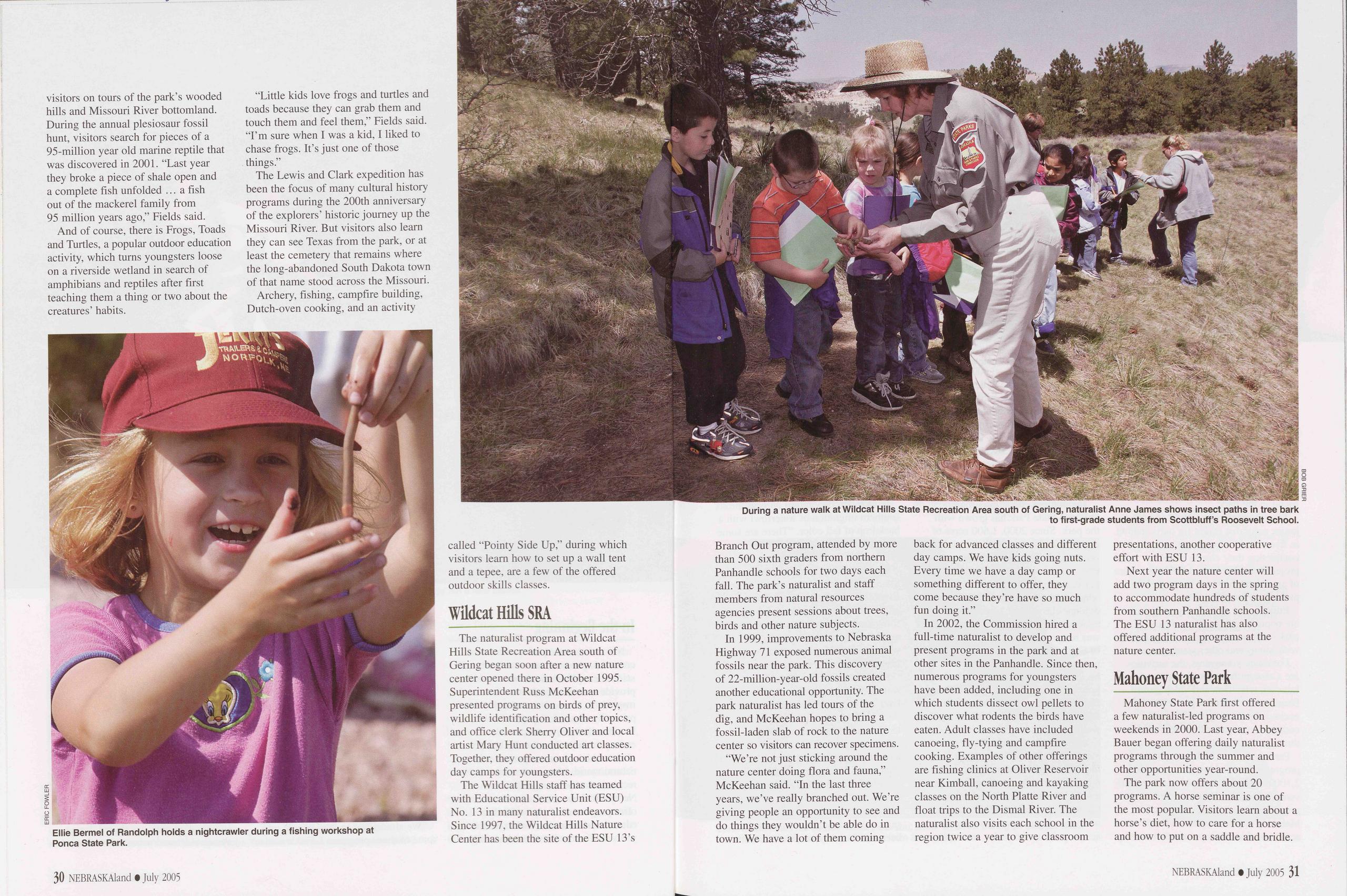
And of course, there is Frogs, Toads and Turtles, a popular outdoor education activity, which turns youngsters loose on a riverside wetland in search of amphibians and reptiles after first teaching them a thing or two about the creatures’ habits.
“Little kids love frogs and turtles and toads because they can grab them and touch them and feel them,” Fields said. “I’m sure when I was a kid, I liked to chase frogs. It’s just one of those things.”
The Lewis and Clark expedition has been the focus of many cultural history programs during the 200th anniversary of the explorers’ historic journey up the Missouri River. But visitors also learn they can see Texas from the park, or at least the cemetery that remains where the long-abandoned South Dakota town of that name stood across the Missouri.
Archery, fishing, campfire building, Dutch-oven cooking, and an activity called “Pointy Side Up,” during which visitors learn how to set up a wall tent and a tepee, are a few of the offered outdoor skills classes.
Wildcat Hills SRAThe naturalist program at Wildcat Hills State Recreation Area south of Gering began soon after a new nature center opened there in October 1995. Superintendent Russ McKeehan presented programs on birds of prey, wildlife identification and other topics, and office clerk Sherry Oliver and local artist Mary Hunt conducted art classes. Together, they offered outdoor education day camps for youngsters.
The Wildcat Hills staff has teamed with Educational Service Unit (ESU) No. 13 in many naturalist endeavors. Since 1997, the Wildcat Hills Nature Center has been the site of the ESU 13’s 30 NEBRASKAland • July 2005
In 1999, improvements to Nebraska Highway 71 exposed numerous animal fossils near the park. This discovery of 22-million-year-old fossils created another educational opportunity. The park naturalist has led tours of the dig, and McKeehan hopes to bring a fossil-laden slab of rock to the nature center so visitors can recover specimens.
"We re not just sticking around the nature center doing flora and fauna,” McKeehan said. “In the last three years, we’ve really branched out. We’re giving people an opportunity to see and do things they wouldn’t be able do in town. We have a lot of them coming back for advanced classes and different day camps. We have kids going nuts. Every time we have a day camp or something different to offer, they come because they’re have so much fun doing it.”
In 2002, the Commission hired a full-time naturalist to develop and present programs in the park and at other sites in the Panhandle. Since then, numerous programs for youngsters have been added, including one in which students dissect owl pellets to discover what rodents the birds have eaten. Adult classes have included canoeing, fly-tying and campfire cooking. Examples of other offerings are fishing clinics at Oliver Reservoir near Kimball, canoeing and kayaking classes on the North Platte River and float trips to the Dismal River. The naturalist also visits each school in the region twice a year to give classroom presentations, another cooperative effort with ESU 13.
Next year the nature center will add two program days in the spring to accommodate hundreds of students from southern Panhandle schools. The ESU 13 naturalist has also offered additional programs at the nature center.
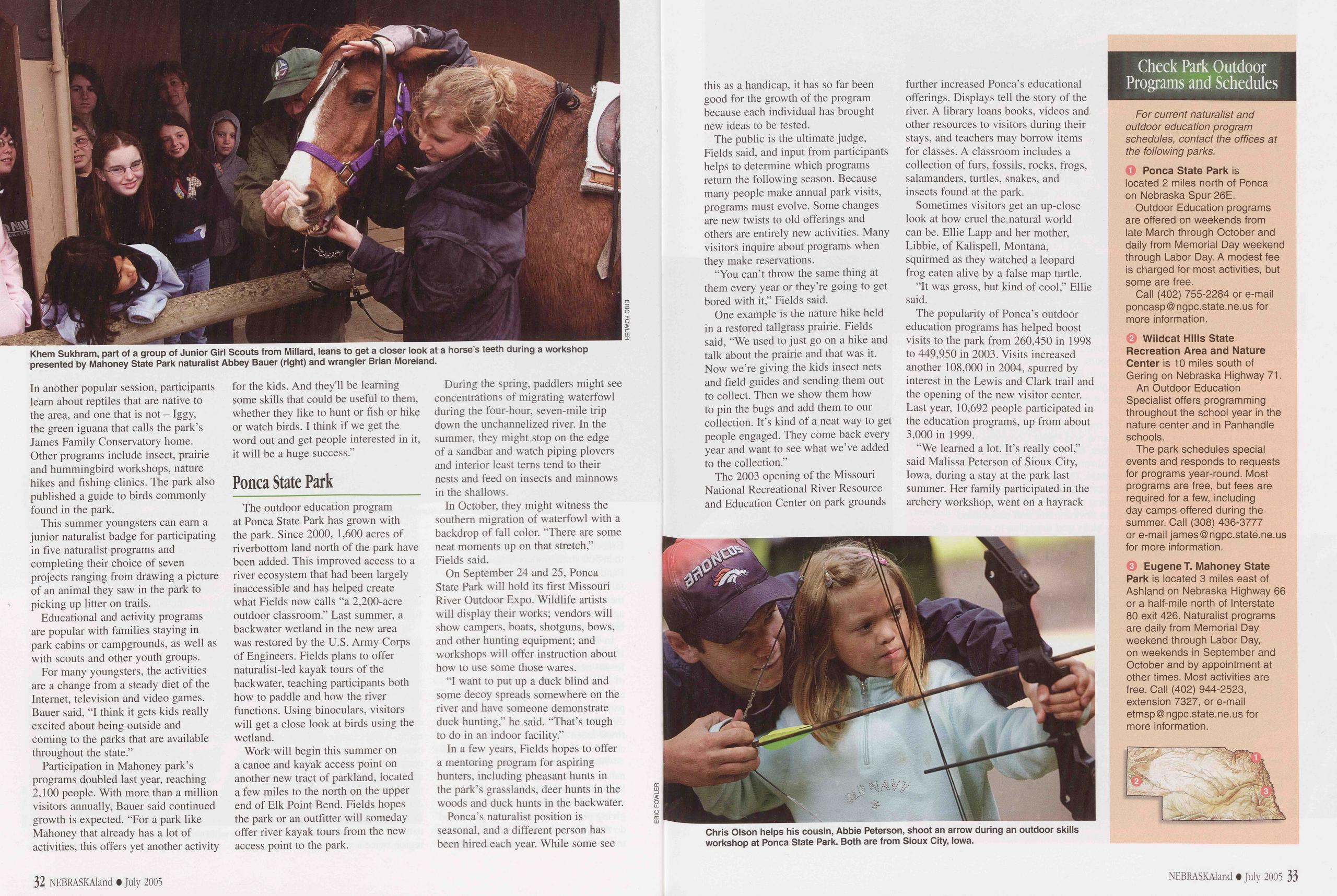
Mahoney State ParkMahoney State Park first offered a few naturalist-led programs on weekends in 2000. Last year, Abbey Bauer began offering daily naturalist programs through the summer and other opportunities year-round.
The park now offers about 20
programs. A horse seminar is one of
the most popular. Visitors learn about a
horse’s diet, how to care for a horse
and how to put on a saddle and bridle.
NEBRASKAland July 2005 31
This summer youngsters can earn a junior naturalist badge for participating in five naturalist programs and completing their choice of seven projects ranging from drawing a picture of an animal they saw in the park to picking up litter on trails.
Educational and activity programs are popular with families staying in park cabins or campgrounds, as well as with scouts and other youth groups.
For many youngsters, the activities are a change from a steady diet of the Internet, television and video games. Bauer said, "I think it gets kids really excited about being outside and coming to the parks that are available throughout the state.”
Participation in Mahoney park’s programs doubled last year, reaching 2,100 people. With more than a million visitors annually, Bauer said continued growth is expected. "For a park like Mahoney that already has a lot of activities, this offers yet another activity for the kids. And they’ll be learning some skills that could be useful to them, whether they like to hunt or fish or hike or watch birds. I think if we get the word out and get people interested in it, it will be a huge success.”
Ponca State ParkThe outdoor education program at Ponca State Park has grown with the park. Since 2000, 1,600 acres of riverbottom land north of the park have been added. This improved access to a river ecosystem that had been largely inaccessible and has helped create what Fields now calls “a 2,200-acre outdoor classroom.” Last summer, a backwater wetland in the new area was restored by the U.S. Army Corps of Engineers. Fields plans to offer naturalist-led kayak tours of the backwater, teaching participants both how to paddle and how the river functions. Using binoculars, visitors will get a close look at birds using the wetland.
Work will begin this summer on a canoe and kayak access point on another new tract of parkland, located a few miles to the north on the upper end of Elk Point Bend. Fields hopes the park or an outfitter will someday offer river kayak tours from the new access point to the park.
During the spring, paddlers might see concentrations of migrating waterfowl during the four-hour, seven-mile trip down the unchannelized river. In the summer, they might stop on the edge of a sandbar and watch piping plovers and interior least terns tend to their nests and feed on insects and minnows in the shallows.
In October, they might witness the southern migration of waterfowl with a backdrop of fall color. "There are some neat moments up on that stretch,” Fields said.
On September 24 and 25, Ponca State Park will hold its first Missouri River Outdoor Expo. Wildlife artists will display their works; vendors will show campers, boats, shotguns, bows, and other hunting equipment; and workshops will offer instruction about how to use some those wares.
"I want to put up a duck blind and some decoy spreads somewhere on the river and have someone demonstrate duck hunting,” he said. "That’s tough to do in an indoor facility.”
In a few years, Fields hopes to offer a mentoring program for aspiring hunters, including pheasant hunts in the park’s grasslands, deer hunts in the woods and duck hunts in the backwater.
Ponca’s naturalist position is seasonal, and a different person has been hired each year. While some see 32 NEBRASKAland • July 2005 this as a handicap, it has so far been good for the growth of the program because each individual has brought new ideas to be tested.
The public is the ultimate judge, Fields said, and input from participants helps to determine which programs return the following season. Because many people make annual park visits, programs must evolve. Some changes are new twists to old offerings and others are entirely new activities. Many visitors inquire about programs when they make reservations.
"You can’t throw the same thing at them every year or they’re going to get bored with it,” Fields said.
One example is the nature hike held in a restored tailgrass prairie. Fields said, "We used to just go on a hike and talk about the prairie and that was it. Now we’re giving the kids insect nets and field guides and sending them out to collect. Then we show them how to pin the bugs and add them to our collection. It’s kind of a neat way to get people engaged. They come back every year and want to see what we’ve added to the collection.”
The 2003 opening of the Missouri National Recreational River Resource and Education Center on park grounds
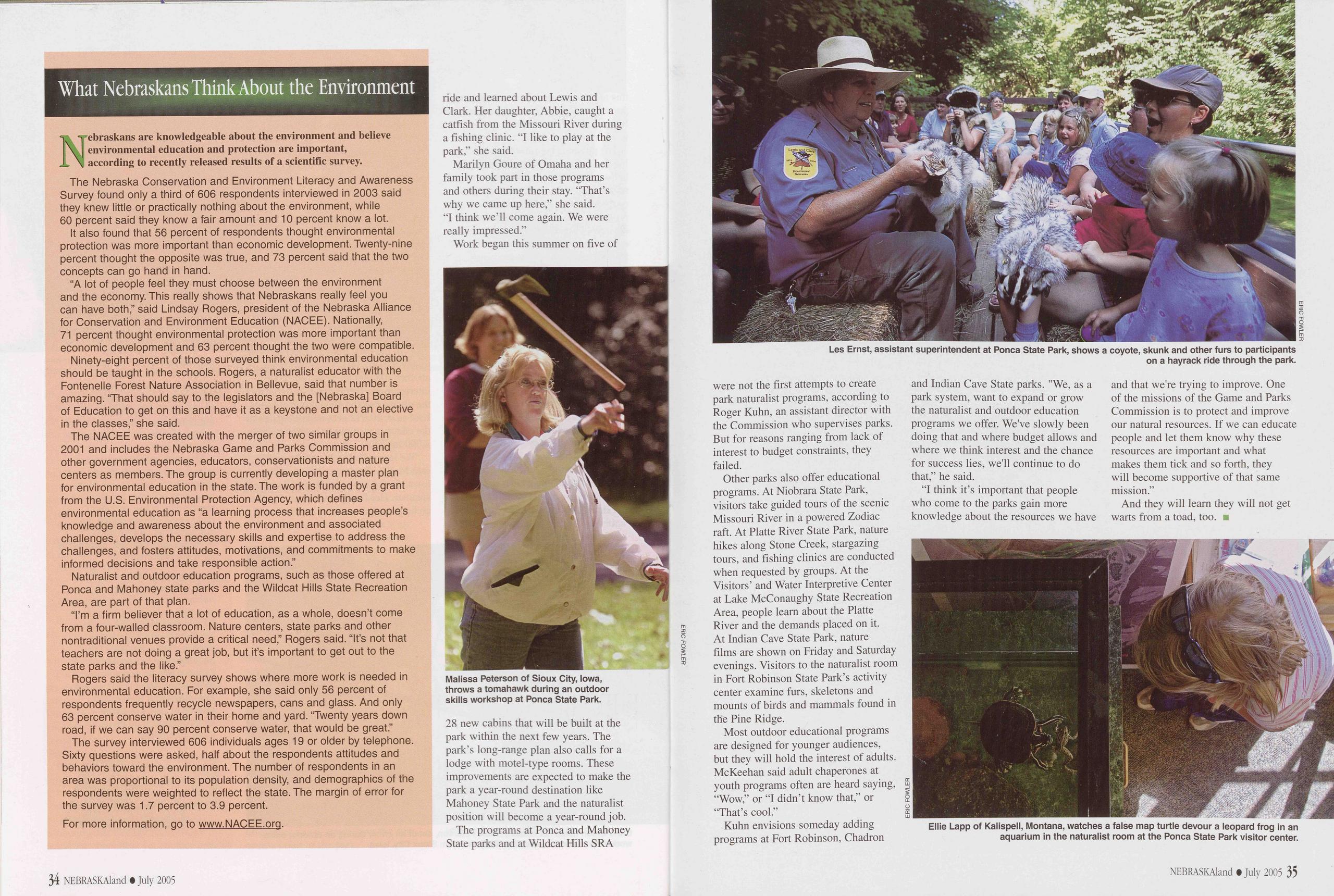
Sometimes visitors get an up-close look at how cruel the natural world can be. Ellie Lapp and her mother, Libbie, of Kalispell, Montana, squirmed as they watched a leopard frog eaten alive by a false map turtle.
“It was gross, but kind of cool,” Ellie said.
The popularity of Ponca’s outdoor education programs has helped boost visits to the park from 260,450 in 1998 to 449,950 in 2003. Visits increased another 108,000 in 2004, spurred by interest in the Lewis and Clark trail and the opening of the new visitor center. Last year, 10,692 people participated in the education programs, up from about 3,000 in 1999.
"We learned a lot. It’s really cool,” said Malissa Peterson of Sioux City, Iowa, during a stay at the park last summer. Her family participated in the archery workshop, went on a hayrack
 ride and learned about Lewis and
Clark. Her daughter, Abbie, caught a
catfish from the Missouri River during
a fishing clinic. "I like to play at the
park,” she said.
What Nebraskans Think About the Environment
ride and learned about Lewis and
Clark. Her daughter, Abbie, caught a
catfish from the Missouri River during
a fishing clinic. "I like to play at the
park,” she said.
What Nebraskans Think About the Environment
Nebraskans are knowledgeable about the environment and believe environmental education and protection are important, according to recently released results of a scientific survey.
The Nebraska Conservation and Environment Literacy and Awareness Survey found only a third of 606 respondents interviewed in 2003 said they knew little or practically nothing about the environment, while 60 percent said they know a fair amount and 10 percent know a lot.
It also found that 56 percent of respondents thought environmental protection was more important than economic development. Twenty-nine percent thought the opposite was true, and 73 percent said that the two concepts can go hand in hand.
“A lot of people feel they must choose between the environment and the economy. This really shows that Nebraskans really feel you can have both,” said Lindsay Rogers, president of the Nebraska Alliance for Conservation and Environment Education (NACEE). Nationally, 71 percent thought environmental protection was more important than economic development and 63 percent thought the two were compatible.
Ninety-eight percent of those surveyed think environmental education should be taught in the schools. Rogers, a naturalist educator with the Fontenelle Forest Nature Association in Bellevue, said that number is amazing. “That should say to the legislators and the [Nebraska] Board of Education to get on this and have it as a keystone and not an elective in the classes,” she said.
The NACEE was created with the merger of two similar groups in 2001 and includes the Nebraska Game and Parks Commission and other government agencies, educators, conservationists and nature centers as members. The group is currently developing a master plan for environmental education in the state. The work is funded by a grant from the U.S. Environmental Protection Agency, which defines environmental education as “a learning process that increases people’s knowledge and awareness about the environment and associated challenges, develops the necessary skills and expertise to address the challenges, and fosters attitudes, motivations, and commitments to make informed decisions and take responsible action.”
Naturalist and outdoor education programs, such as those offered at Ponca and Mahoney state parks and the Wildcat Hills State Recreation Area, are part of that plan.
“I’m a firm believer that a lot of education, as a whole, doesn’t come from a four-walled classroom. Nature centers, state parks and other nontraditional venues provide a critical need,” Rogers said. “It’s not that teachers are not doing a great job, but it’s important to get out to the state parks and the like.”
Rogers said the literacy survey shows where more work is needed in environmental education. For example, she said only 56 percent of respondents frequently recycle newspapers, cans and glass. And only 63 percent conserve water in their home and yard. “Twenty years down road, if we can say 90 percent conserve water, that would be great.”
The survey interviewed 606 individuals ages 19 or older by telephone. Sixty questions were asked, half about the respondents attitudes and behaviors toward the environment. The number of respondents in an area was proportional to its population density, and demographics of the respondents were weighted to reflect the state. The margin of error for the survey was 1.7 percent to 3.9 percent.
For more information, go to www.NACEE.org.
Marilyn Goure of Omaha and her family took part in those programs and others during their stay. “That’s why we came up here,” she said. "I think we’ll come again. We were really impressed.”
Work began this summer on five of
The programs at Ponca and Mahoney State parks and at Wildcat Hills SRA 34 NEBRASKAland • July 2005
Other parks also offer educational programs. At Niobrara State Park, visitors take guided tours of the scenic Missouri River in a powered Zodiac raft. At Platte River State Park, nature hikes along Stone Creek, stargazing tours, and fishing clinics are conducted when requested by groups. At the Visitors’ and Water Interpretive Center at Lake McConaughy State Recreation Area, people learn about the Platte River and the demands placed on it. At Indian Cave State Park, nature films are shown on Friday and Saturday evenings. Visitors to the naturalist room in Fort Robinson State Park’s activity center examine furs, skeletons and mounts of birds and mammals found in the Pine Ridge.
Most outdoor educational programs are designed for younger audiences, but they will hold the interest of adults. McKeehan said adult chaperones at youth programs often are heard saying, “Wow,” or “I didn’t know that,” or “That’s cool.”
Kuhn envisions someday adding programs at Fort Robinson, Chadron and Indian Cave State parks. "We, as a park system, want to expand or grow the naturalist and outdoor education programs we offer. We’ve slowly been doing that and where budget allows and where we think interest and the chance for success lies, we'll continue to do that,” he said.
“I think it’s important that people who come to the parks gain more knowledge about the resources we have Ellie Lapp of Kalispell, Montana, watches a false map turtle devour a leopard frog in an aquarium in the naturalist room at the Ponca State Park visitor center. and that we're trying to improve. One of the missions of the Game and Parks Commission is to protect and improve our natural resources. If we can educate people and let them know why these resources are important and what makes them tick and so forth, they will become supportive of that same mission.”
And they will learn they will not get warts from a toad, too.
NEBRASKAland • July 2005 35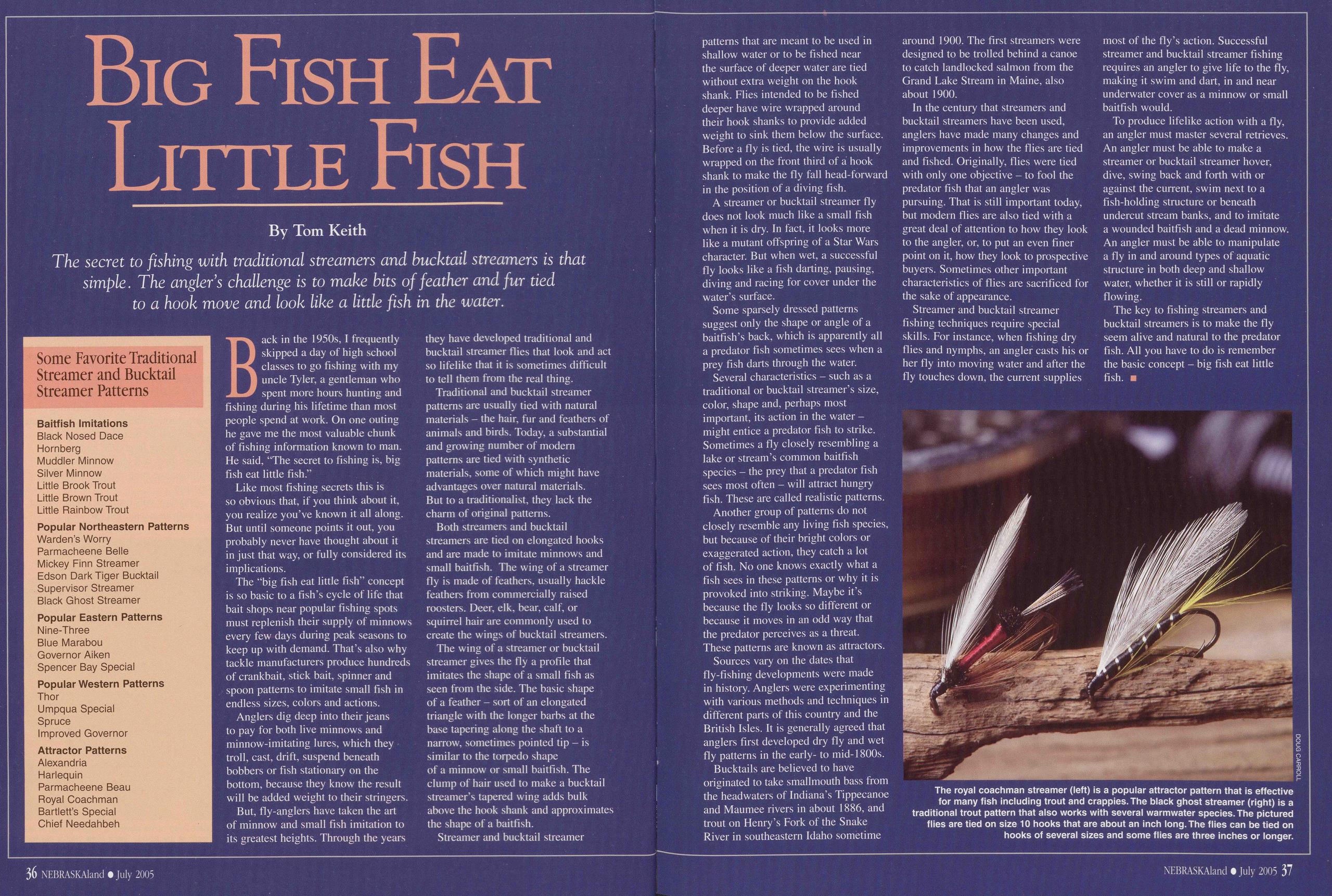
Big Fish Eat Little Fish
The secret to fishing with traditional streamers and bucktail streamers is that simple. The angler’s challenge is to make bits of feather and fur tied to a hook move and look like a little fish in the water.
Some Favorite Traditional Streamer and Bucktail Streamer Patterns Baitfish Imitations Black Nosed Dace Hornberg Muddler Minnow Silver Minnow Little Brook Trout Little Brown Trout Little Rainbow Trout Popular Northeastern Patterns Warden’s Worry Parmacheene Belle Mickey Finn Streamer Edson Dark Tiger Bucktail Supervisor Streamer Black Ghost Streamer Popular Eastern Patterns Nine-Three Blue Marabou Governor Aiken Spencer Bay Special Popular Western Patterns Thor Umpqua Special Spruce Improved Governor Attractor Patterns Alexandria Harlequin Parmacheene Beau Royal Coachman Bartlett’s Special Chief NeedahbehBack in the 1950s, I frequently skipped a day of high school classes to go fishing with my uncle Tyler, a gentleman who spent more hours hunting and fishing during his lifetime than most people spend at work. On one outing he gave me the most valuable chunk of fishing information known to man. He said, “The secret to fishing is, big fish eat little fish.”
Like most fishing secrets this is so obvious that, if you think about it, you realize you’ve known it all along. But until someone points it out, you probably never have thought about it in just that way, or fully considered its implications.
The “big fish eat little fish” concept is so basic to a fish’s cycle of life that bait shops near popular fishing spots must replenish their supply of minnows every few days during peak seasons to keep up with demand. That’s also why tackle manufacturers produce hundreds ofcrankbait, stick bait, spinner and spoon patterns to imitate small fish in endless sizes, colors and actions.
Anglers dig deep into their jeans to pay for both live minnows and minnow-imitating lures, which they troll, cast, drift, suspend beneath bobbers or fish stationary on the bottom, because they know the result will be added weight to their stringers.
But, fly-anglers have taken the art of minnow and small fish imitation to its greatest heights. Through the years they have developed traditional and bucktail streamer flies that look and act so lifelike that it is sometimes difficult to tell them from the real thing.
Traditional and bucktail streamer patterns are usually tied with natural materials - the hair, fur and feathers of animals and birds. Today, a substantial and growing number of modern patterns are tied with synthetic materials, some of which might have advantages over natural materials. But to a traditionalist, they lack the charm of original patterns.
Both streamers and bucktail streamers are tied on elongated hooks and are made to imitate minnows and small baitfish. The wing of a streamer fly is made of feathers, usually hackle feathers from commercially raised roosters. Deer, elk, bear, calf, or squirrel hair are commonly used to create the wings of bucktail streamers.
The wing of a streamer or bucktail streamer gives the fly a profile that imitates the shape of a small fish as seen from the side. The basic shape of a feather - sort of an elongated triangle with the longer barbs at the base tapering along the shaft to a narrow, sometimes pointed tip - is similar to the torpedo shape of a minnow or small baitfish. The clump of hair used to make a bucktail streamer’s tapered wing adds bulk above the hook shank and approximates the shape of a baitfish.
Streamer and bucktail streamer 36 NEBRASKAland • July 2005 patterns that are meant to be used in shallow water or to be fished near the surface of deeper water are tied without extra weight on the hook shank. Flies intended to be fished deeper have wire wrapped around their hook shanks to provide added weight to sink them below the surface. Before a fly is tied, the wire is usually wrapped on the front third of a hook shank to make the fly fall head-forward in the position of a diving fish.
A streamer or bucktail streamer fly does not look much like a small fish when it is dry. In fact, it looks more like a mutant offspring of a Star Wars character. But when wet, a successful fly looks like a fish darting, pausing, diving and racing for cover under the water’s surface.
Some sparsely dressed patterns suggest only the shape or angle of a baitfish’s back, which is apparently all a predator fish sometimes sees when a prey fish darts through the water.
Several characteristics - such as a traditional or bucktail streamer’s size, color, shape and, perhaps most important, its action in the water - might entice a predator fish to strike. Sometimes a fly closely resembling a lake or stream’s common baitfish species - the prey that a predator fish sees most often - will attract hungry fish. These are called realistic patterns.
Another group of patterns do not closely resemble any living fish species, but because of their bright colors or exaggerated action, they catch a lot of fish. No one knows exactly what a fish sees in these patterns or why it is provoked into striking. Maybe it’s because the fly looks so different or because it moves in an odd way that the predator perceives as a threat. These patterns are known as attractors.
Sources vary on the dates that fly-fishing developments were made in history. Anglers were experimenting with various methods and techniques in different parts of this country and the British Isles. It is generally agreed that anglers first developed dry fly and wet fly patterns in the early- to mid-1800s.
Bucktails are believed to have originated to take smallmouth bass from the headwaters of Indiana’s Tippecanoe and Maumee rivers in about 1886, and trout on Henry’s Fork of the Snake River in southeastern Idaho sometime around 1900. The first streamers were designed to be trolled behind a canoe to catch landlocked salmon from the Grand Lake Stream in Maine, also about 1900.
In the century that streamers and bucktail streamers have been used, anglers have made many changes and improvements in how the flies are tied and fished. Originally, flies were tied with only one objective - to fool the predator fish that an angler was pursuing. That is still important today, but modern flies are also tied with a great deal of attention to how they look to the angler, or, to put an even finer point on it, how they look to prospective buyers. Sometimes other important characteristics of flies are sacrificed for the sake of appearance.
Streamer and bucktail streamer fishing techniques require special skills. For instance, when fishing dry flies and nymphs, an angler casts his or her fly into moving water and after the fly touches down, the current supplies
To produce lifelike action with a fly, an angler must master several retrieves. An angler must be able to make a streamer or bucktail streamer hover, dive, swing back and forth with or against the current, swim next to a fish-holding structure or beneath undercut stream banks, and to imitate a wounded baitfish and a dead minnow. An angler must be able to manipulate a fly in and around types of aquatic structure in both deep and shallow water, whether it is still or rapidly flowing.
The key to fishing streamers and bucktail streamers is to make the fly seem alive and natural to the predator fish. All you have to do is remember the basic concept - big fish eat little fish.
NEBRASKAland • July 2005 37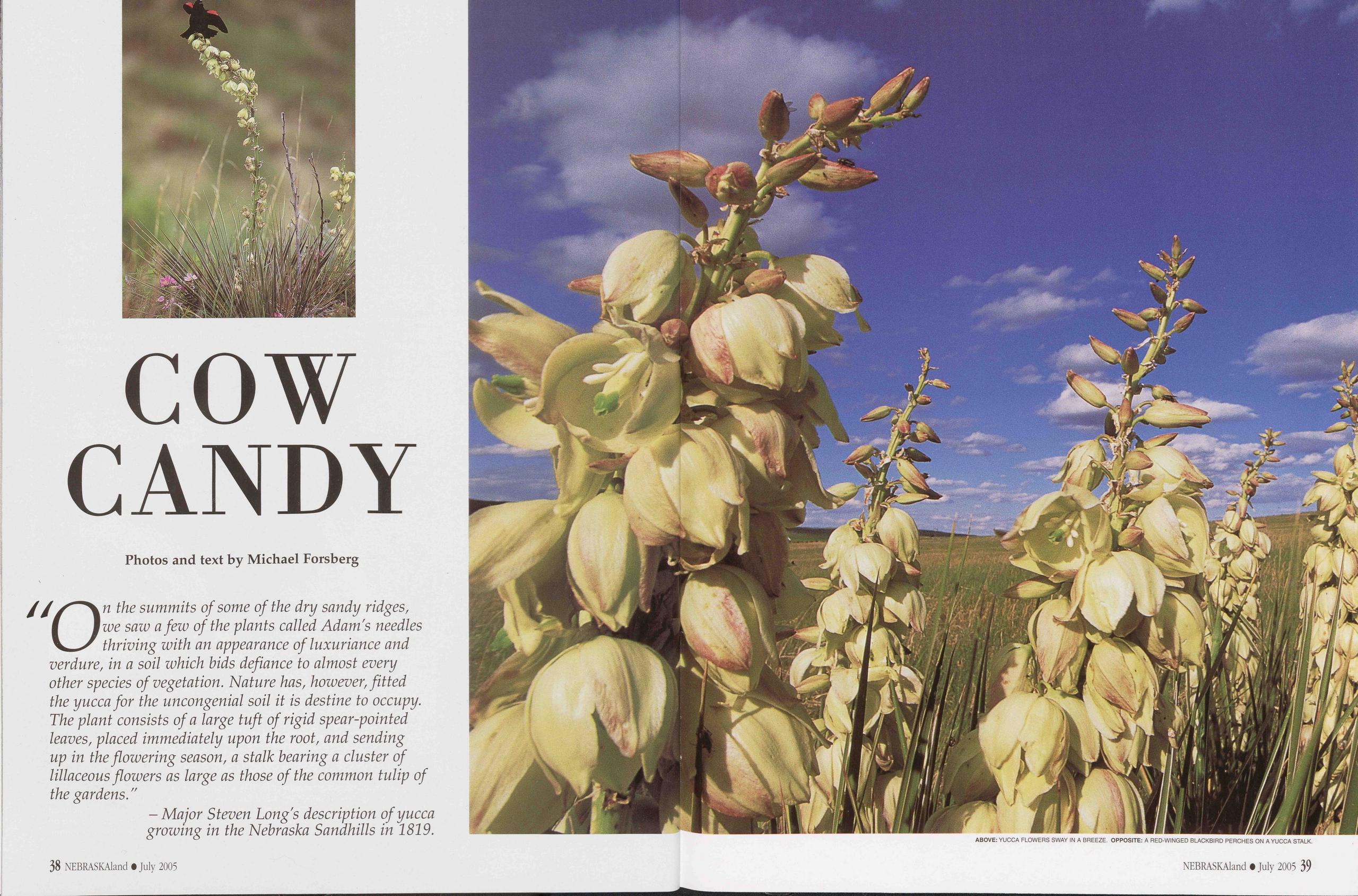
COW CANDY
"On the summits of some of the dry sandy ridges, we saw a few of the plants called Adam's needles thriving with an appearance of luxuriance and verdure, in a soil which bids defiance to almost every other species of vegetation. Nature has, however, fitted the yucca for the uncongenial soil it is destine to occupy. The plant consists of a large tuft of rigid spear-pointed leaves, placed immediately upon the root, and sending up in the flowering season, a stalk bearing a cluster of liliaceous flowers as large as those of the common tulip of the gardens.”
- Major Steven Long's description of yucca growing in the Nebraska Sandhills in 1819. 38 NEBRASKAland • July 2005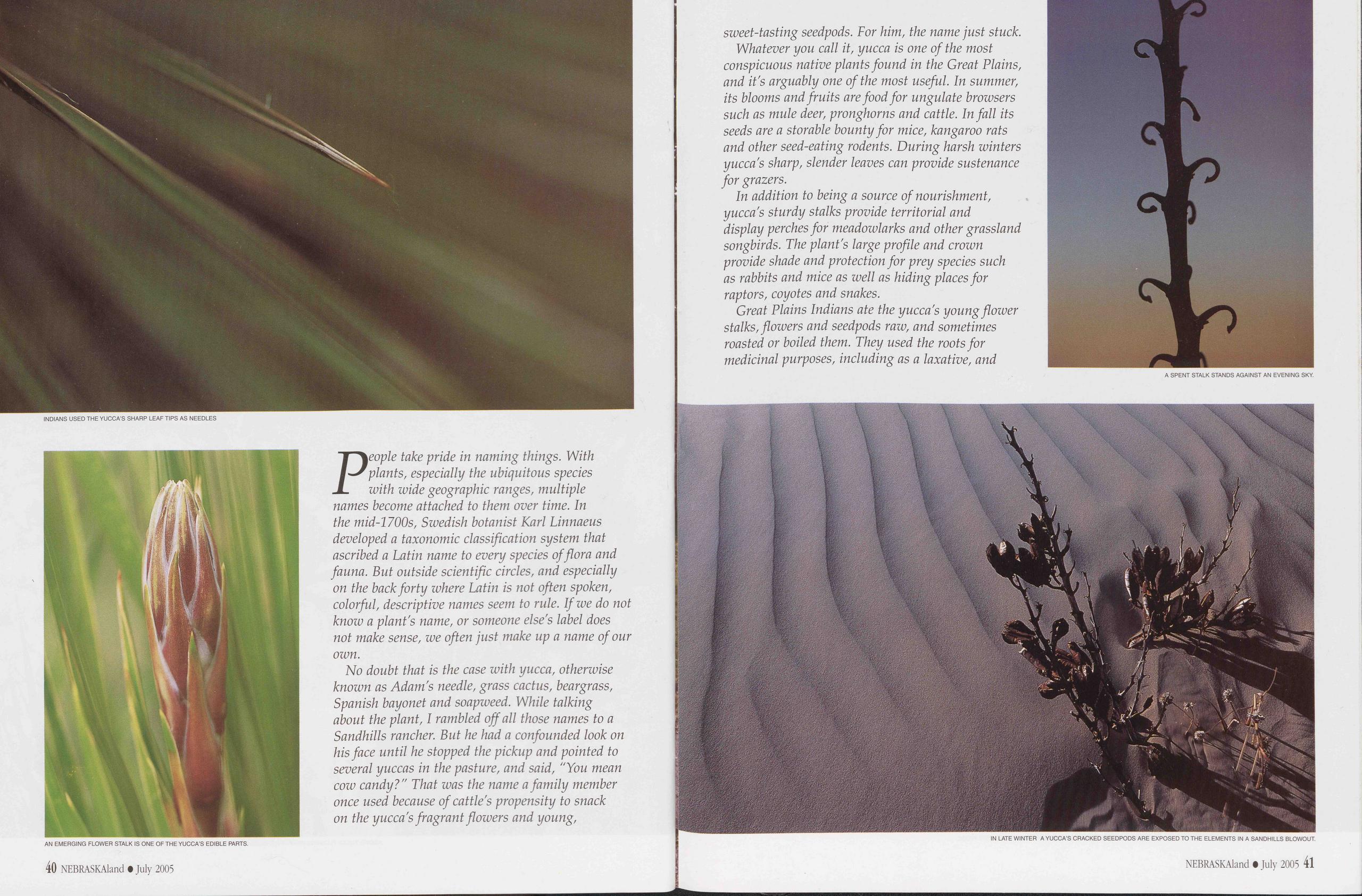
People take pride in naming things. With plants, especially the ubiquitous species with wide geographic ranges, multiple names become attached to them over time. In the mid-1700s, Swedish botanist Karl Linnaeus developed a taxonomic classification system that ascribed a Latin name to every species of flora and fauna. But outside scientific circles, and especially on the back forty where Latin is not often spoken, colorful, descriptive names seem to rule. If we do not know a plant's name, or someone else's label does not make sense, we often just make up a name of our own.
No doubt that is the case with yucca, otherwise known as Adam's needle, grass cactus, bear grass, Spanish bayonet and soapweed. While talking about the plant, I rambled off all those names to a Sandhills rancher. But he had a confounded look on his face until he stopped the pickup and pointed to several yuccas in the pasture, and said, "You mean cow candy?" That was the name a family member once used because of cattle's propensity to snack on the yucca's fragrant flowers and young, 40 NEBRASKAland • July 2005 sweet-tasting seedpods. For him, the name just stuck.
Whatever you call it, yucca is one of the most conspicuous native plants found in the Great Plains, and it's arguably one of the most useful. In summer, its blooms and fruits are food for ungulate browsers such as mule deer, pronghorns and cattle. Infall its seeds are a storable bounty for mice, kangaroo rats and other seed-eating rodents. During harsh winters yucca's sharp, slender leaves can provide sustenance for grazers.
In addition to being a source of nourishment, yucca's sturdy stalks provide territorial and display perches for meadowlarks and other grassland songbirds. The plant's large profile and crown provide shade and protection for prey species such as rabbits and mice as well as hiding places for raptors, coyotes and snakes.
Great Plains Indians ate the yucca's young flower stalks, flowers and seedpods raw, and sometimes roasted or boiled them. They used the roots for medicinal purposes, including as a laxative, and
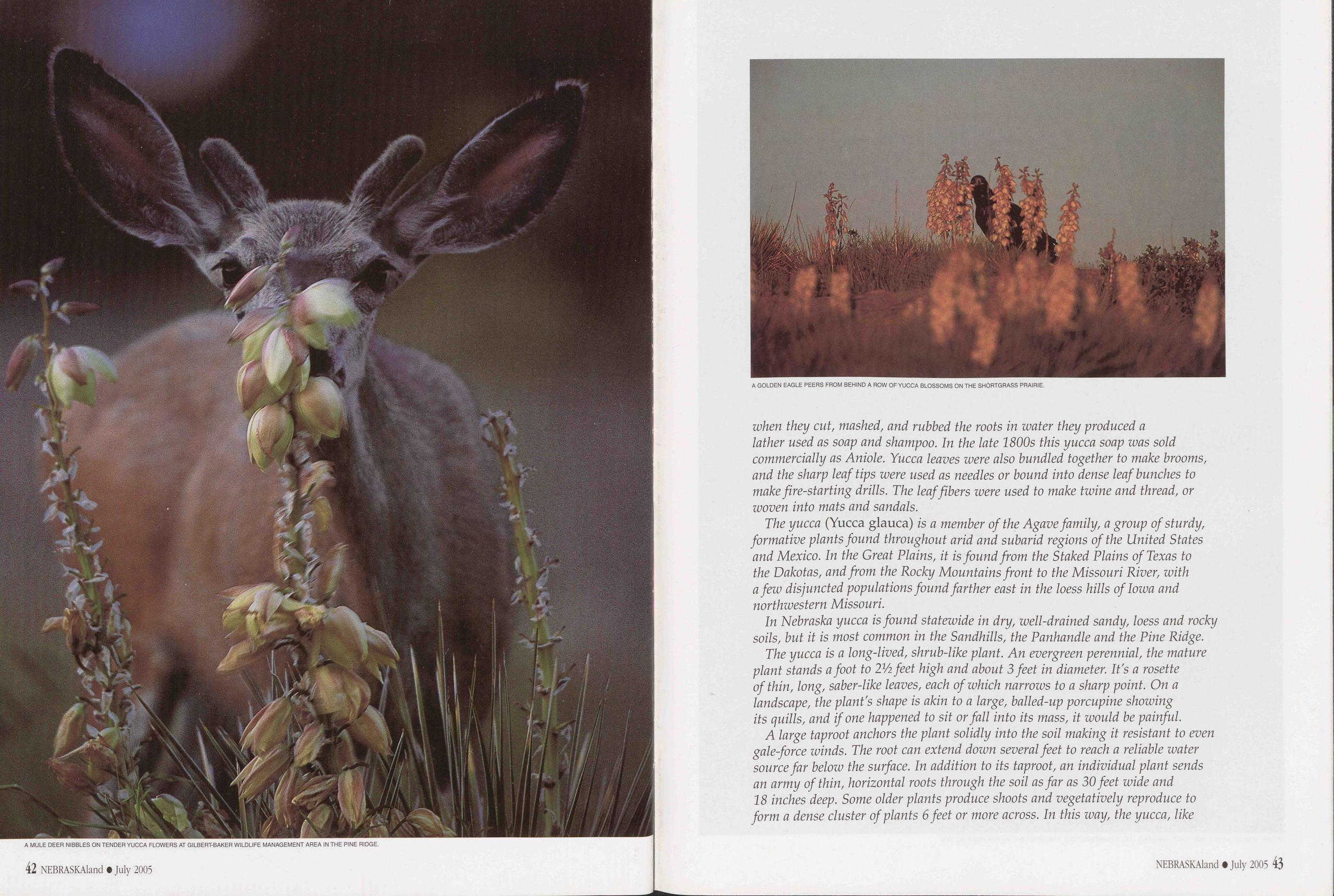
The yucca (Yucca glauca) is a member of the Agave family, a group of sturdy, formative plants found throughout arid and subarid regions of the United States and Mexico. In the Great Plains, it is found from the Staked Plains of Texas to the Dakotas, and from the Rocky Mountains front to the Missouri River, with a few disjuncted populations found farther east in the loess hills of Iowa and northwestern Missouri.
In Nebraska yucca is found statewide in dry, well-drained sandy, loess and rocky soils, but it is most common in the Sandhills, the Panhandle and the Pine Ridge. The yucca is a long-lived, shrub-like plant. An evergreen perennial, the mature plant stands afoot to ZVifeet high and about 3 feet in diameter. It's a rosette of thin, long, saber-like leaves, each of which narrows to a sharp point. On a landscape, the plant's shape is akin to a large, balled-up porcupine showing its quills, and if one happened to sit or fall into its mass, it would be painful.
A large taproot anchors the plant solidly into the soil making it resistant to even
gale-force winds. The root can extend down several feet to reach a reliable water
source far below the surface. In addition to its taproot, an individual plant sends
an army of thin, horizontal roots through the soil as far as 30 feet wide and
18 inches deep. Some older plants produce shoots and vegetatively reproduce to
form a dense cluster of plants 6 feet or more across. In this way, the yucca, like
NEBRASKAland • July 2005 43
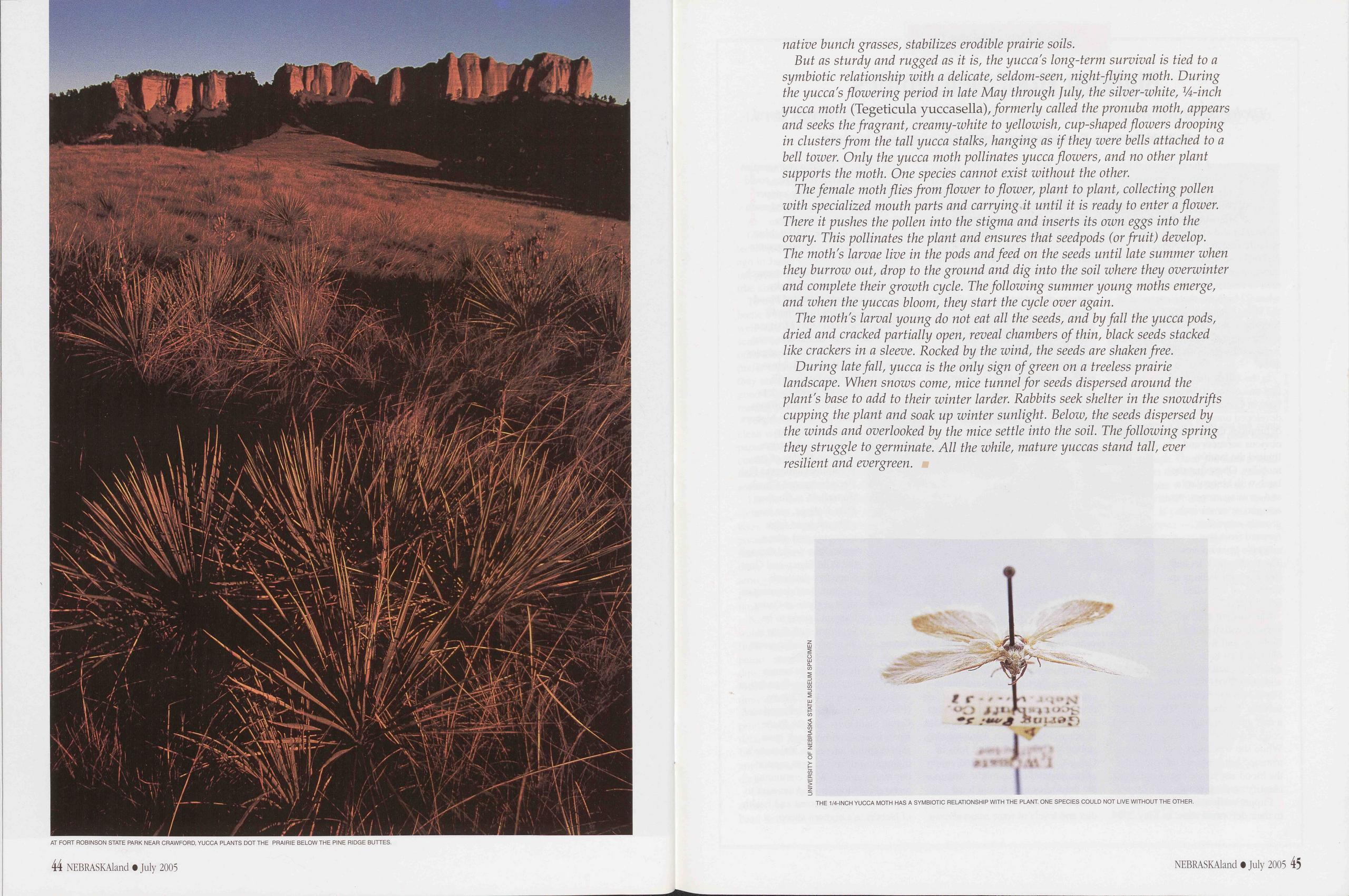
But as sturdy and rugged as it is, the yucca's long-term survival is tied to a symbiotic relationship with a delicate, seldom-seen, night-flying moth. During the yucca's flowering period in late May through July, the silver-white, Vi-inch yucca moth (Tegeticula yuccasella), formerly called the pronuba moth, appears and seeks the fragrant, creamy-white to yellowish, cup-shaped flowers drooping in clusters from the tall yucca stalks, hanging as if they were bells attached to a bell tower. Only the yucca moth pollinates yucca flowers, and no other plant supports the moth. One species cannot exist without the other.
The female moth flies from flower to flower, plant to plant, collecting pollen with specialized mouth parts and carrying it until it is ready to enter a flower. There it pushes the pollen into the stigma and inserts its own eggs into the ovary. This pollinates the plant and ensures that seedpods (or fruit) develop. The moth's larvae live in the pods and feed on the seeds until late summer when they burrow out, drop to the ground and dig into the soil where they overwinter and complete their growth cycle. The following summer young moths emerge, and when the yuccas bloom, they start the cycle over again.
The moth's larval young do not eat all the seeds, and by fall the yucca pods, dried and cracked partially open, reveal chambers of thin, black seeds stacked like crackers in a sleeve. Rocked by the wind, the seeds are shaken free.
During late fall, yucca is the only sign of green on a treeless prairie landscape. When snows come, mice tunnel for seeds dispersed around the plant's base to add to their winter larder. Rabbits seek shelter in the snowdrifts cupping the plant and soak up winter sunlight. Below, the seeds dispersed by the winds and overlooked by the mice settle into the soil. The following spring they struggle to germinate. All the while, mature yuccas stand tall, ever resilient and evergreen.
Outdoor Update
Bighorn Hoof Deformities
Biologists study abnormalities in some ewes in the Cedar Canyon herd.
Most of the time, wildlife biologists are immersed in the annual cycles of wildlife surveys, harvest statistics, landowner assistance and keeping up with wildlife research that applies to Nebraska species. Occasionally, a question or problem opens a new area of research. Such was the case when 22 bighorn sheep captured in the Pikes Peak area near Colorado Springs, Colorado, were relocated to Cedar Canyon Wildlife Management Area southwest of Gering in January 2001.
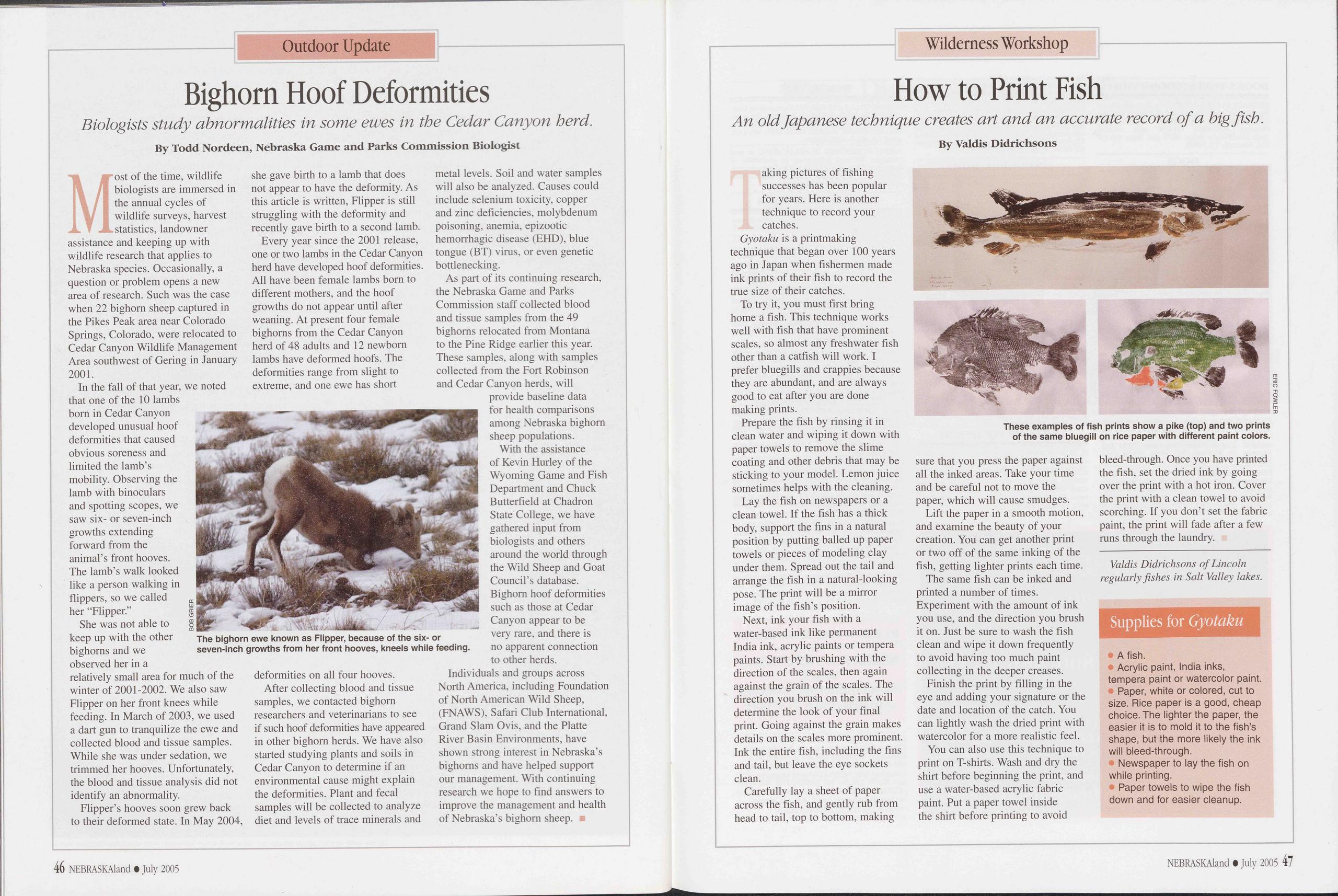
In the fall of that year, we noted that one of the 10 lambs born in Cedar Canyon developed unusual hoof deformities that caused obvious soreness and limited the lamb’s mobility. Observing the lamb with binoculars and spotting scopes, we saw six- or seven-inch growths extending forward from the animal’s front hooves. The lamb’s walk looked like a person walking in flippers, so we called her “Flipper.”
She was not able to keep up with the other bighorns and we observed her in a relatively small area for much of the winter of 2001-2002. We also saw Flipper on her front knees while feeding. In March of 2003, we used a dart gun to tranquilize the ewe and collected blood and tissue samples. While she was under sedation, we trimmed her hooves. Unfortunately, the blood and tissue analysis did not identify an abnormality.
Flipper’s hooves soon grew back to their deformed state. In May 2004, she gave birth to a lamb that does not appear to have the deformity. As this article is written, Flipper is still struggling with the deformity and recently gave birth to a second lamb.
Every year since the 2001 release, one or two lambs in the Cedar Canyon herd have developed hoof deformities. All have been female lambs born to different mothers, and the hoof growths do not appear until after weaning. At present four female bighorns from the Cedar Canyon herd of 48 adults and 12 newborn lambs have deformed hoofs. The deformities range from slight to extreme, and one ewe has short
After collecting blood and tissue samples, we contacted bighorn researchers and veterinarians to see if such hoof deformities have appeared in other bighorn herds. We have also started studying plants and soils in Cedar Canyon to determine if an environmental cause might explain the deformities. Plant and fecal samples will be collected to analyze diet and levels of trace minerals and metal levels. Soil and water samples will also be analyzed. Causes could include selenium toxicity, copper and zinc deficiencies, molybdenum poisoning, anemia, epizootic hemorrhagic disease (EHD), blue tongue (BT) virus, or even genetic bottlenecking.
As part of its continuing research, the Nebraska Game and Parks Commission staff collected blood and tissue samples from the 49 bighorns relocated from Montana to the Pine Ridge earlier this year. These samples, along with samples collected from the Fort Robinson and Cedar Canyon herds, will provide baseline data for health comparisons among Nebraska bighorn sheep populations.
With the assistance of Kevin Hurley of the Wyoming Game and Fish Department and Chuck Butterfield at Chadron State College, we have gathered input from biologists and others around the world through the Wild Sheep and Goat Council’s database. Bighorn hoof deformities such as those at Cedar Canyon appear to be very rare, and there is no apparent connection to other herds.
Individuals and groups across North America, including Foundation of North American Wild Sheep, (FNAWS), Safari Club International, Grand Slam Ovis, and the Platte River Basin Environments, have shown strong interest in Nebraska’s bighorns and have helped support our management. With continuing research we hope to find answers to improve the management and health of Nebraska’s bighorn sheep.
46 NEBRASKAland • July 2005Wilderness Workshop
How to Print Fish
An old Japanese technique creates art and an accurate record of a big fish.
Taking pictures of fishing successes has been popular for years. Here is another technique to record your catches.
Gyotaku is a printmaking technique that began over 100 years ago in Japan when fishermen made ink prints of their fish to record the true size of their catches.
To try it, you must first bring home a fish. This technique works well with fish that have prominent scales, so almost any freshwater fish other than a catfish will work. I prefer bluegills and crappies because they are abundant, and are always good to eat after you are done making prints.
Prepare the fish by rinsing it in clean water and wiping it down with paper towels to remove the slime coating and other debris that may be sticking to your model. Lemon juice sometimes helps with the cleaning.
Lay the fish on newspapers or a clean towel. If the fish has a thick body, support the fins in a natural position by putting balled up paper towels or pieces of modeling clay under them. Spread out the tail and arrange the fish in a natural-looking pose. The print will be a mirror image of the fish’s position.
Next, ink your fish with a water-based ink like permanent India ink, acrylic paints or tempera paints. Start by brushing with the direction of the scales, then again against the grain of the scales. The direction you brush on the ink will determine the look of your final print. Going against the grain makes details on the scales more prominent. Ink the entire fish, including the fins and tail, but leave the eye sockets clean.
Carefully lay a sheet of paper across the fish, and gently rub from head to tail, top to bottom, making
Lift the paper in a smooth motion, and examine the beauty of your creation. You can get another print or two off of the same inking of the fish, getting lighter prints each time.
The same fish can be inked and printed a number of times. Experiment with the amount of ink you use, and the direction you brush it on. Just be sure to wash the fish clean and wipe it down frequently to avoid having too much paint collecting in the deeper creases.
Finish the print by filling in the eye and adding your signature or the date and location of the catch. You can lightly wash the dried print with watercolor for a more realistic feel.
You can also use this technique to print on T-shirts. Wash and dry the shirt before beginning the print, and use a water-based acrylic fabric paint. Put a paper towel inside the shirt before printing to avoid bleed-through. Once you have printed the fish, set the dried ink by going over the print with a hot iron. Cover the print with a clean towel to avoid scorching. If you don’t set the fabric paint, the print will fade after a few runs through the laundry.
Valdis Didrichsons of Lincoln regularly fishes in Salt Valley lakes. Supplies for Gyotaku • A fish. • Acrylic paint, India inks, tempera paint or watercolor paint. Paper, white or colored, cut to size. Rice paper is a good, cheap choice. The lighter the paper, the easier it is to mold it to the fish’s shape, but the more likely the ink will bleed-through. Newspaper to lay the fish on while printing. Paper towels to wipe the fish down and for easier cleanup. NEBRASKAland • July 2005 47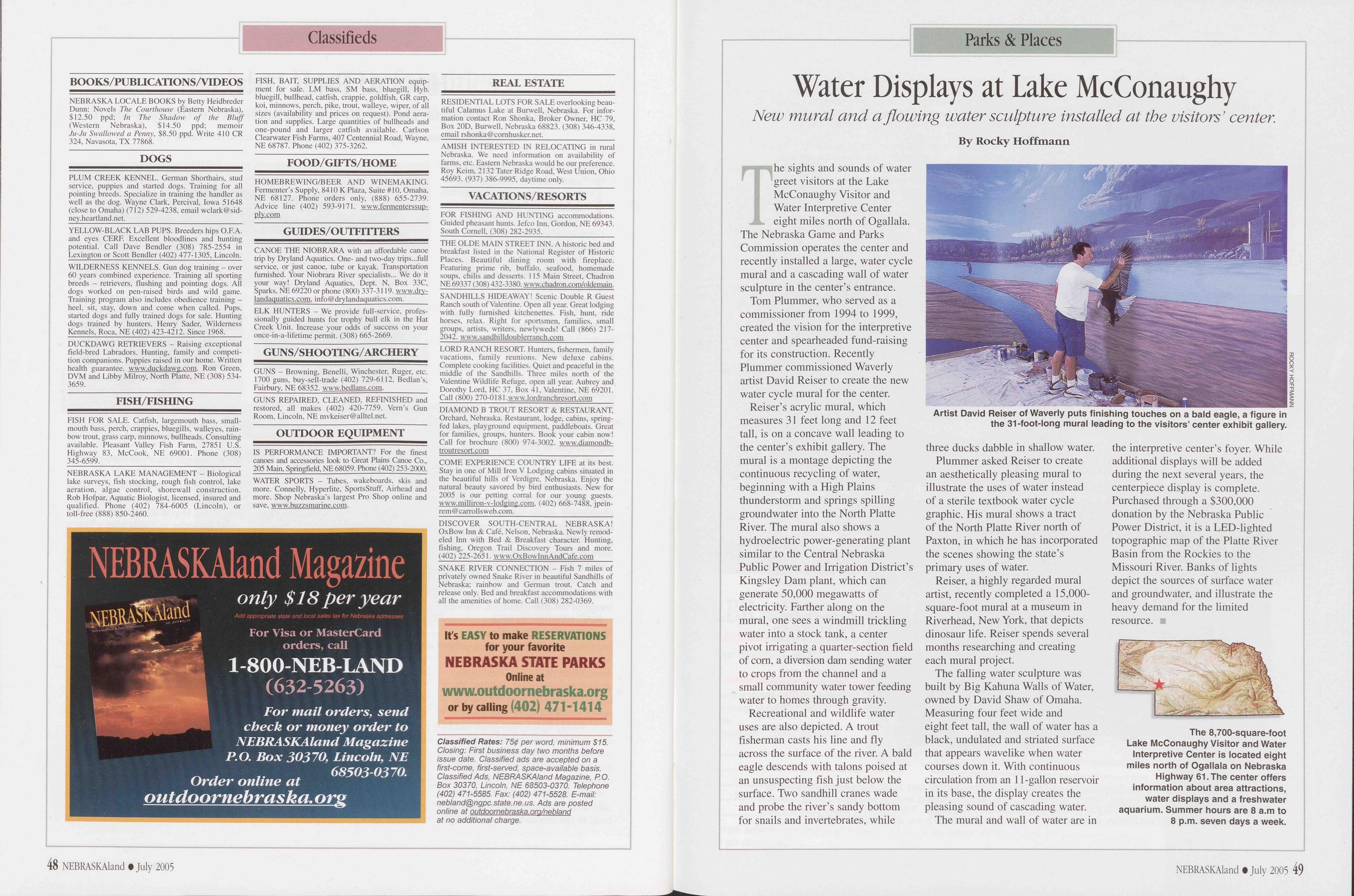
Classifieds
BOOKS/PUBLICATIONS/VIDEOS NEBRASKA LOCALE BOOKS by Betty Heidbreder Dunn: Novels The Courthouse (Eastern Nebraska), $12.50 ppd; In The Shadow of the Bluff (Western Nebraska), $14.50 ppd; memoir Ju-Ju Swallowed a Penny, $8.50 ppd. Write 410 CR 324, Navasota, TX 77868. DOGS PLUM CREEK KENNEL. German Shorthairs, stud service, puppies and started dogs. Training for all pointing breeds. Specialize in training the handler as well as the dog. Wayne Clark, Percival, Iowa 51648 (close to Omaha) (712) 529-4238, email wclark@sid- ney.heartland.net.___________________________ YELLOW-BLACK LAB PUPS. Breeders hips O.F.A. and eyes CERF. Excellent bloodlines and hunting potential. Call Dave Bendler (308) 785-2554 in Lexington or Scott Bendler (402) 477-1305, Lincoln. WILDERNESS KENNELS. Gun dog training - over 60 years combined experience. Training all sporting breeds - retrievers, flushing and pointing dogs. All dogs worked on pen-raised birds and wild game. Training program also includes obedience training - heel, sit, stay, down and come when called. Pups, started dogs and fully trained dogs for sale. Hunting dogs trained by hunters. Henry Sader, Wilderness Kennels, Roca, NE (402) 423-4212. Since 1968. DUCKDAWG RETRIEVERS - Raising exceptional field-bred Labradors. Hunting, family and competi- tion companions. Puppies raised in our home. Written health guarantee, www.duckdawg.com. Ron Green, DVM and Libby Milroy, North Platte, NE (308) 534- 3659. FISH/FISHING FISH FOR SALE. Catfish, largemouth bass, small- mouth bass, perch, crappies, bluegills, walleyes, rain- bow trout, grass carp, minnows, bullheads. Consulting available. Pleasant Valley Fish Farm, 27851 U.S. Highway 83, McCook, NE 69001. Phone (308) 345-6599._________________________________________ NEBRASKA LAKE MANAGEMENT - Biological lake surveys, fish stocking, rough fish control, lake aeration, algae control, shorewall construction. Rob Hofpar, Aquatic Biologist, licensed, insured and qualified. Phone (402) 784-6005 (Lincoln), or toll-free (888) 850-2460.Parks & Places
Water Displays at Lake McConaughy
New mural and a flowing water sculpture installed at the visitors’ center.
The sights and sounds of water greet visitors at the Lake McConaughy Visitor and Water Interpretive Center eight miles north of Ogallala. The Nebraska Game and Parks Commission operates the center and recently installed a large, water cycle mural and a cascading wall of water sculpture in the center’s entrance.
Tom Plummer, who served as a commissioner from 1994 to 1999, created the vision for the interpretive center and spearheaded fund-raising for its construction. Recently Plummer commissioned Waverly artist David Reiser to create the new water cycle mural for the center.
Reiser’s acrylic mural, which measures 31 feet long and 12 feet tall, is on a concave wall leading to the center’s exhibit gallery. The mural is a montage depicting the continuous recycling of water, beginning with a High Plains thunderstorm and springs spilling groundwater into the North Platte River. The mural also shows a hydroelectric power-generating plant similar to the Central Nebraska Public Power and Irrigation District’s Kingsley Dam plant, which can generate 50,000 megawatts of electricity. Farther along on the mural, one sees a windmill trickling water into a stock tank, a center pivot irrigating a quarter-section field of com, a diversion dam sending water to crops from the channel and a small community water tower feeding water to homes through gravity.
Recreational and wildlife water uses are also depicted. A trout fisherman casts his line and fly across the surface of the river. A bald eagle descends with talons poised at an unsuspecting fish just below the surface. Two sandhill cranes wade and probe the river’s sandy bottom for snails and invertebrates, while
Plummer asked Reiser to create an aesthetically pleasing mural to illustrate the uses of water instead of a sterile textbook water cycle graphic. His mural shows a tract of the North Platte River north of Paxton, in which he has incorporated the scenes showing the state’s primary uses of water.
Reiser, a highly regarded mural artist, recently completed a 15,000- square-foot mural at a museum in Riverhead, New York, that depicts dinosaur life. Reiser spends several months researching and creating each mural project.
The falling water sculpture was built by Big Kahuna Walls of Water, owned by David Shaw of Omaha. Measuring four feet wide and eight feet tall, the wall of water has a black, undulated and striated surface that appears wavelike when water courses down it. With continuous circulation from an 11-gallon reservoir in its base, the display creates the pleasing sound of cascading water.
The mural and wall of water are in the interpretive center’s foyer. While additional displays will be added during the next several years, the centerpiece display is complete. Purchased through a $300,000 donation by the Nebraska Public Power District, it is a LED-lighted topographic map of the Platte River Basin from the Rockies to the Missouri River. Banks of lights depict the sources of surface water and groundwater, and illustrate the heavy demand for the limited resource.
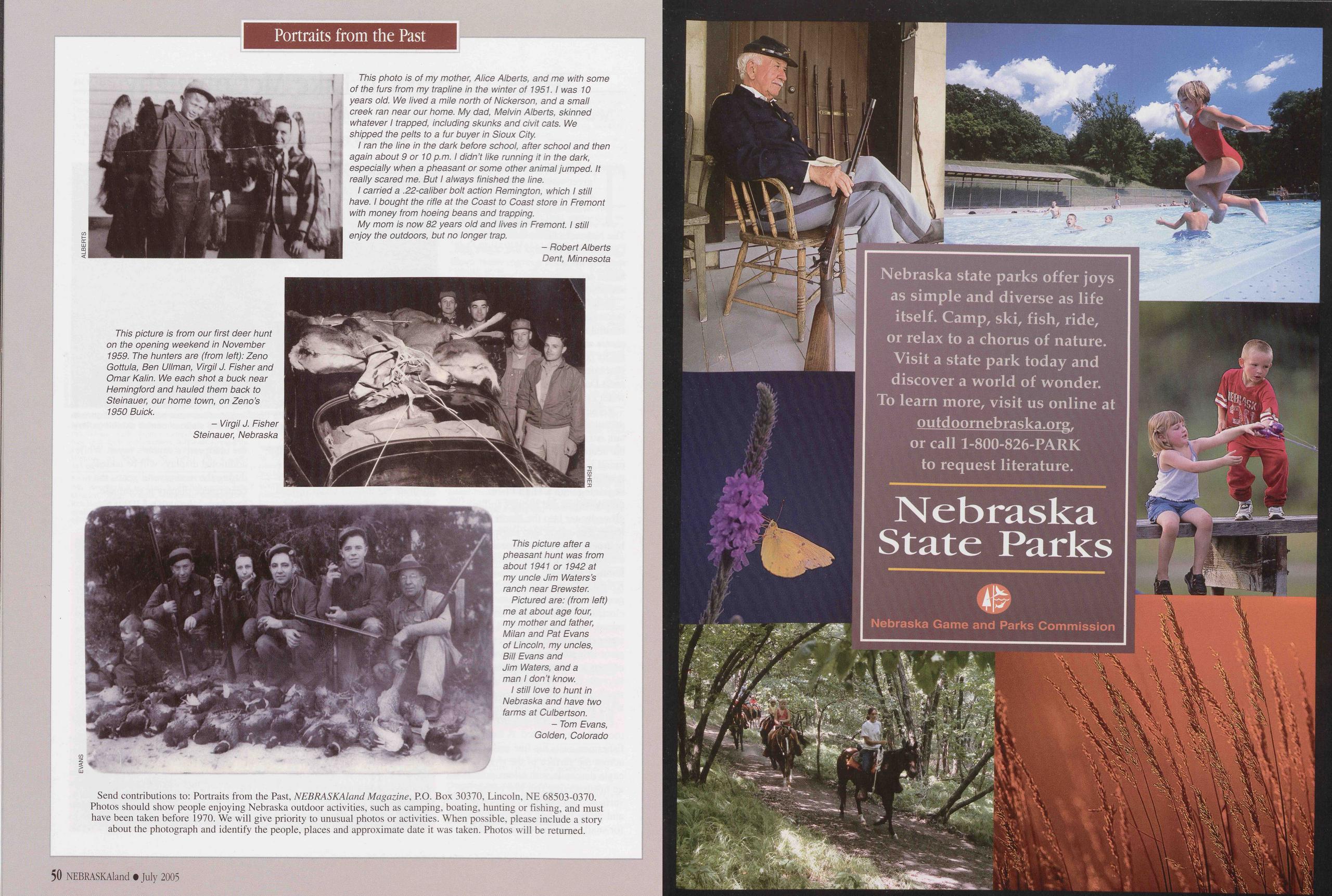
Portraits from the Past
This photo is of my mother, Alice Alberts, and me with some of the furs from my trapline in the winter of 1951.1 was 10 years old. We lived a mile north of Nickerson, and a small creek ran near our home. My dad, Melvin Alberts, skinned whatever I trapped, including skunks and civit cats. We shipped the pelts to a fur buyer in Sioux City.
I ran the line in the dark before school, after school and then again about 9 or 10 p.m. I didn’t like running it in the dark, especially when a pheasant or some other animal jumped. It really scared me. But I always finished the line.
I carried a .22-caliber bolt action Flemington, which I still have. I bought the rifle at the Coast to Coast store in Fremont with money from hoeing beans and trapping.
My mom is now 82 years old and lives in Fremont. I still enjoy the outdoors, but no longer trap.
- Robert Alberts Dent, MinnesotaThis picture is from our first deer hunt on the opening weekend in November 1959. The hunters are (from left): Zeno Gottula, Ben Ullman, Virgil J. Fisher and Omar Kalin. We each shot a buck near Hemingford and hauled them back to Steinauer, our home town, on Zeno’s 1950 Buick.
- Virgil J. Fisher Steinauer, NebraskaThis picture after a pheasant hunt was from about 1941 or 1942 at my uncle Jim Waters’s ranch near Brewster.
Pictured are: (from left) me at about age four, my mother and father, Milan and Pat Evans of Lincoln, my uncles, Bill Evans and Jim Waters, and a man I don’t know.
I still love to hunt in Nebraska and have two farms at Culbertson.
- Tom Evans, Golden, Colorado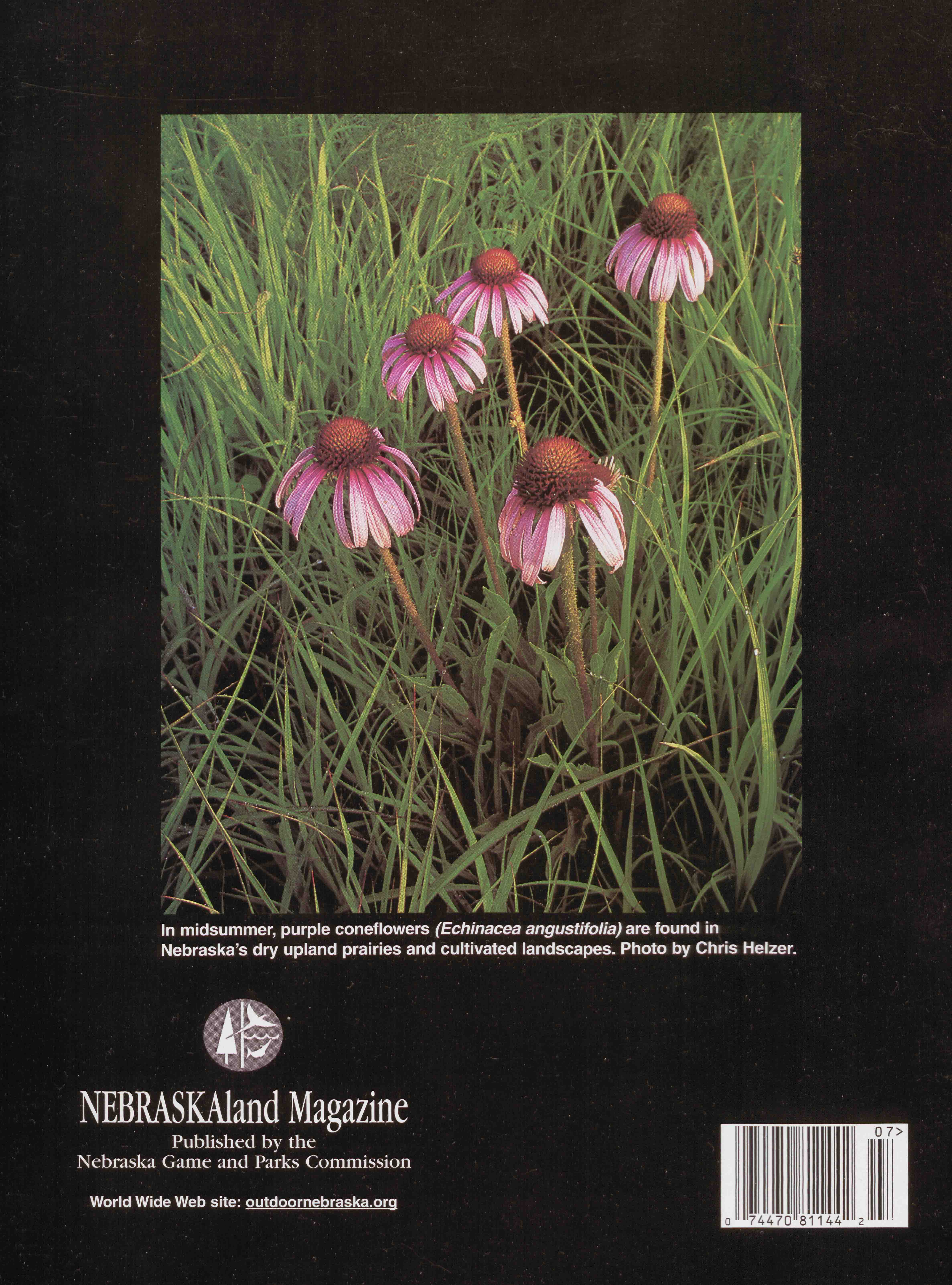
Position: 769 (14 views)