Volume 83, Issue 4, 2005
NEBRASKAland
Nebraska Game & Parks Commission May • $2.95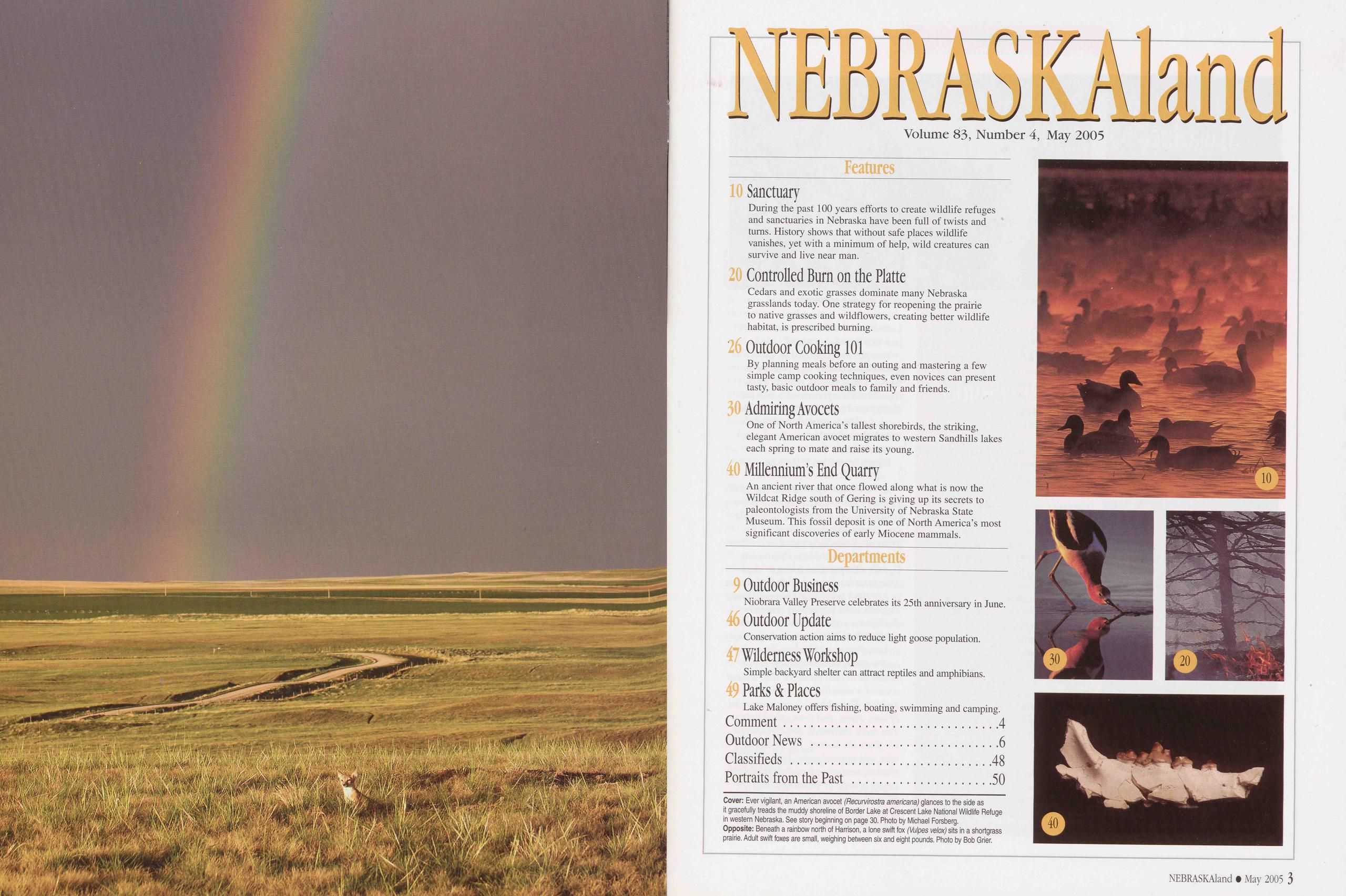
NEBRASKAland
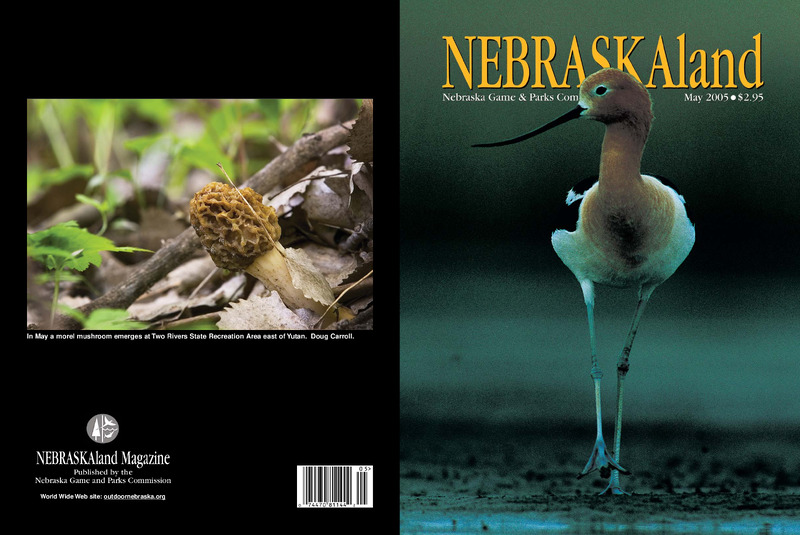
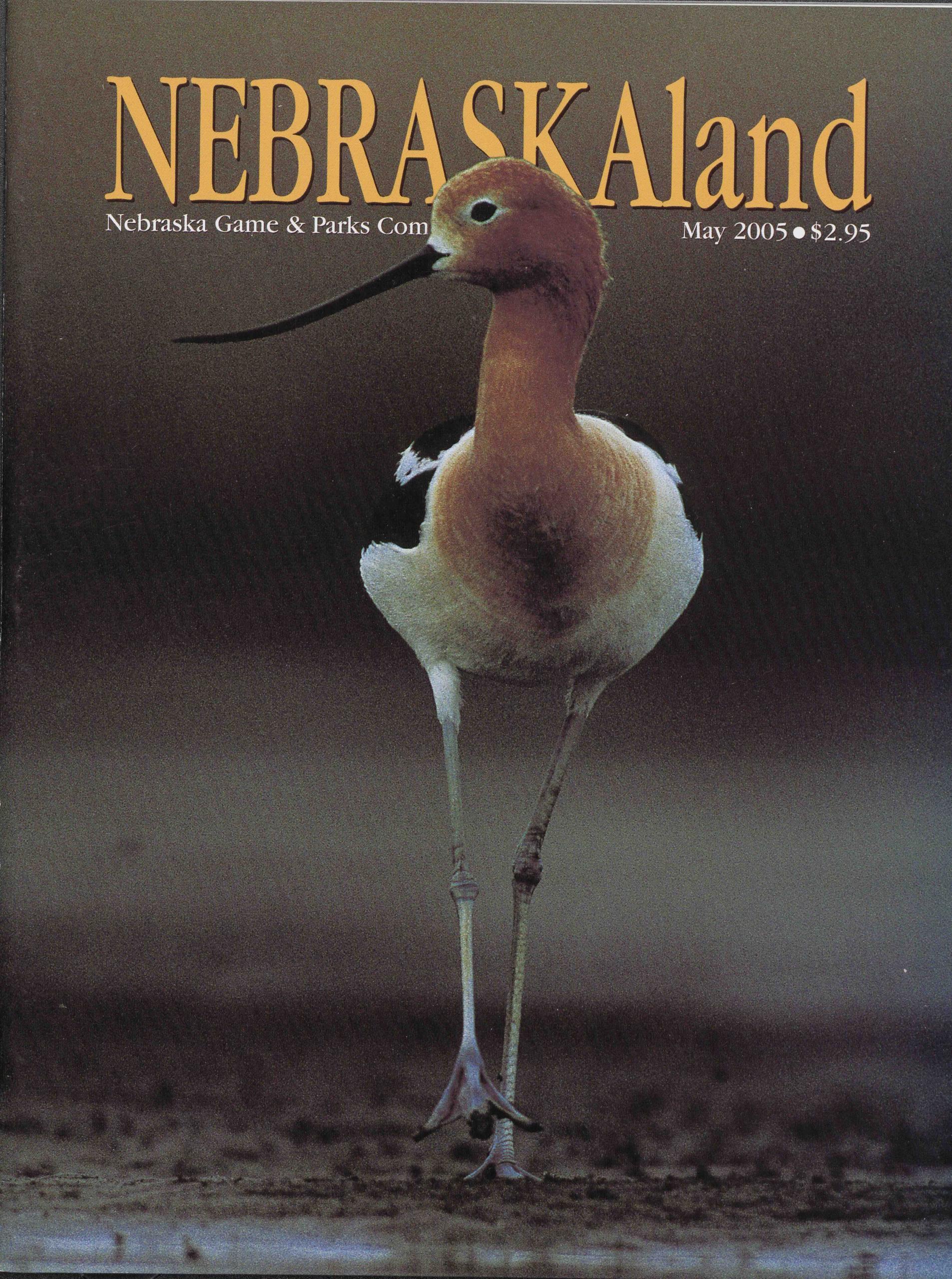
Volume 83, Number 4 May 2005 Features 10 Sanctuary During the past 100 years efforts to create wildlife refuges and sanctuaries in Nebraska have been full of twists and turns. History shows that without safe places wildlife vanishes, yet with a minimum of help, wild creatures can survive and live near man. 20 Controlled Burn on the Platte Cedars and exotic grasses dominate many Nebraska grasslands today. One strategy for reopening the prairie to native grasses and wildflowers, creating better wildlife habitat, is prescribed burning. 26 Outdoor Cooking 101 By planning meals before an outing and mastering a few simple camp cooking techniques, even novices can present tasty, basic outdoor meals to family and friends. 30 Admiring Avocets One of North America’s tallest shorebirds, the striking, elegant American avocet migrates to western Sandhills lakes each spring to mate and raise its young. 40 Millennium’s End Quarry An ancient river that once flowed along what is now the Wildcat Ridge south of Gering is giving up its secrets to paleontologists from the University of Nebraska State Museum. This fossil deposit is one of North America’s most significant discoveries of early Miocene mammals. Departments 9 Outdoor Business Niobrara Valley Preserve celebrates its 25th anniversary in June. 46 Outdoor Update Conservation action aims to reduce light goose population. 47Wilderness Workshop Simple backyard shelter can attract reptiles and amphibians. 49 Parks & Places Lake Maloney offers fishing, boating, swimming and camping. Comment.............................................4 Outdoor News .......................................6 Classifieds .......................................48 Portraits from the Past ...........................50 Cover: Ever vigilant, an American avocet (Recurvirostra americana) glances to the side as it gracefully treads the muddy shoreline of Border Lake at Crescent Lake National Wildlife Refuge in western Nebraska. See story beginning on page 30. Photo by Michael Forsberg. Opposite: Beneath a rainbow north of Harrison, a lone swift fox (Vulpes velox) sits in a shortgrass prairie. Adult swift foxes are small, weighing between six and eight pounds. Photo by Bob Grier.
Comment
NEBRASKAland Magazine Published by the Nebraska Game and Parks Commission Director: Rex Amack Assistant Directors: Roger Kuhn, Kirk Nelson Information & Education Administrator: Ken Bouc Information & Education Art Director: Steve O’Hare JIM MITCHELL Commissioners Chairman: Dr. Mark Pinkerton, Wilber Vice Chairman: Bill Grewcock, Omaha 2nd Vice Chairman: James Stuart, Jr., Lincoln Bill Zutavern, Dunning Gary Parker, Columbus George E. Hall, Bridgeport James Ziebarth, Wilcox Jerrod Burke, Curtis Magazine Staff Editor: Tom White Associate Editor: Doug Carroll Art Director: Tim Reigert Senior Editors: Jon Farrar, Ken Bouc Regional Editors: Eric Fowler, Bob Grier, Rocky Hoffmann Contributing Editors: Michael Forsberg, Tom Keith Circulation: Donna Robinson Photo Librarian: Sarah Johnson NEBRASKAland VOL. 83 / NO. 4 ISSN: 0028-1964 MAY 2005 Published monthly, except for Jan./Feb. and Aug./Sept. issues, by the Nebraska Game and Paries Commission, 2200 N. 33rd St, Lincoln, NE. Copyright 2005, all rights reserved. Please address comments or questions to this address. Periodicals postage paid at Lincoln, Nebraska, and other locations. POSTMASTER: Send all address changes to NEBRASKAland, P.O. Box 30370, Lincoln, NE 68503-0370. Address submissions to: The Editor, NEBRASKAland Magazine, P.O. Box 30370, Lincoln, NE 68503. Include a stamped, self-addressed return envelope. The publisher assumes no responsibility for unsolicited material. NEBRASKAland is available on audio cassette from the Nebraska Library Commission Talking Book and Braille Service, Suite 120, 1200 N St., Lincoln, NE 68508. (800) 742-7691 Rates: $18 for one year; $33 for two years. Nebraska residents must add appropriate sales tax. To subscribe call 1-800-NEBLAND (632-5263), or go online to: outdoornebraska.orgWhile hiking in central Nebraska, I have seen white porcupines on more than one occasion. I wonder if this color is unusual, or if white porcupines are common.
Jim Mitchell Grand Island, NebraskaMike Fritz, a Nebraska Game and Parks Commission zoologist, said the porcupine in the photo has dark eyes, so it is not a full albino, but the color of its claws and feet indicate it is a partial albino. “That’s unusual, very unusual,” he said.
Albinism, caused by a pigment deficiency, is rare in mammals. According to the International Albinism Center at the University of Minnesota, albinism occurs in about 1 in every 20,000 humans. Hugh Genoways, chair of the museum studies program at the University of Nebraska-Lincoln said no one knows how often it occurs in other mammals. “Nobody is out there counting all the deer and porcupines and everything else,” he said. But he sees no reason the frequency would differ from that of humans.
- Editor Black Powder For Damascus BarrelsDon’t shoot the shells pictured on page 29 of the April issue of NEBRASKAland in the gun pictured on the same page. I had a fine old Lefever with the Damascus barrels just like the one pictured.
You are not supposed to shoot smokeless powder in a Damascus barrel. I’m sure you already knew that. There’s a picture of a box [of shells] on the next page that would work fine because it doesn’t say "smokeless powder.”
Norm Ken- Republican City, NebraskaAs Norm Kerr points out, the 1897 Lefever shotgun pictured with a box of Remington Nitro Club shotshells has Damascus steel barrels. Damascus steel originated in ancient Syria with sword blades that were lighter, sharper and stronger than European iron blades. Jack O’Connor, in his 1965 book, The Shotgun Book, describes the process by which Damascus steel barrels were made.
“These were made by taking long strips of steel and iron and twisting and welding them together. These twists were then pounded flat, wound around a mandrel in a spiral, and welded. The ribbons were composed of two, three, and four spiral twists. The more the twists, it was thought, the finer the barrel. The resulting tube was reamed out to bore diameter, choked, and chambered. It is easy to detect a twist or Damascus barrel because the metal has a spiral, whirly, or speckled pattern. The reason for this is that the iron and steel take the blue (in this case ‘browning ’) differently, with resulting contrast in color and value.”
During the late 1800s most American-made shotgun barrels were manufactured in Europe, usually England or Germany. O’Connor wrote that no Damascus steel barrels were manufactured in the United States. The quality of Damascus barrels used on quality firearms, such as Lefever side-by-side shotguns, was improved in the early 1900s to accommodate the new nitro powders. Because they were made of part iron and part steel and spiral-welded, the barrels, like a chain, were no stronger than their weakest link. In the era of low breech pressure black powder shot shells, Damascus barrels were sufficiently strong. As higher pressure, smokeless nitro powders came into use in the 1890s, poorly made Damascus steel barrels frequently failed and ruptured when improperly loaded shotshells were used.
Lynn Stockall, whose Lefever was pictured, recommends that old Damascus steel shotguns be used only with black powder shotshells. Modern, low-pressure powders probably could be safely used in high-quality Damascus steel shotguns, but why risk injury and ruining a lovely old shotgun ? Stockall shoots a 10-gauge Lefever that has had the choke removed by a gunsmith. He shoots only black powder shotshells. Stockall recommends that before shooting any Damascus steel shotgun it should be examined by a qualified gunsmith to determine if it should be fired at all, and what powders and powder loads would be safe to use.
- Editor Comment NEBRASKAland Magazine P.O. Box 30370, Lincoln, NE 68503. E-mail: nebland@ ngpe. state, ne. us. Please include your postal address and telephone number. Letters may be condensed and edited for clarity. Photographs are welcome and will be returned. Nebraska Game and Parks Commission Offices Headquarters 2200 N. 33rd Street Lincoln, NE 68503 Phone (402) 471-0641 District Office I East Hwy. 2, Box 725 Alliance, NE 69301 Phone (308) 763-2940 District Office II 524 Panzer St., Box 508 Bassett, NE 68714 Phone (402) 684-2921 District Office III 2201 N. 13th St. Norfolk, NE 68701 Phone (402) 370-3374 District Office IV 301 E. State Farm Rd. North Platte, NE 69101 Phone (308) 535-8025 District Office V 2200 N. 33rd Street Lincoln, NE 68503 Phone (402) 471-5558 District Office VI 1617 First Ave. Kearney, NE 68847 Phone (308) 865-5310 Omaha Office 1212 Bob Gibson Blvd. Omaha, NE 68108 Phone (402) 595-2144 Ak-Sar-Ben Aquarium 21502 W. Highway 31 Gretna, NE 68028 Phone (402) 332-3901 World Wide Web site: outdoornebraska.org E-mail: ngpc@ngpc.state.ne.us Conservation Officers by Region Administration Darin Gress Hebron (402) 768-2287 Ted Blume (Adm.) Lincoln 471-5531 Dale Johnson Kearney 237-1079 Craig Stover (Asst.) Lincoln 471-5532 Mark Reeves Loup City 745-0748 Wes Loos (Asst.) Lincoln 471-5591 Robert Finke Milford (402) 761-3537 Murray Johnson Lincoln 471-5003 Richard Seward Ord 728-3115 Dana Miller (Sup.) Valentine 376-3116 Northeast Panhandle Officer City Phone (402) Officer City Phone (308) Tom Zimmer (Sup.) Norfolk 371-6625 Jim Zimmerman (Sup.) Gering 436-7561 Robert Kelly Albion 395-2538 Raymond Still Bridgeport 262-1075 Dale Davis Bassett 273-1700 Walt Meyer Chadron 432-4398 Ross Oestmann Bloomfielo I 373-4412 Heath Packett Gordon 282-2553 Steve Oberg Columbus 564-5937 Dennis Thompson Ogallala 284-6450 Daniel Roberts Fremont 721-7852 Dan Zuehlke Ogallala 284-4815 Jon Reeves Kennard 427-7378 Doug Pollard Oshkosh 772-9950 Marion Shafer Norfolk 371-2031 Scott Brandt Scottsbluff 635-1277 Pat George O’Neill 482-5771 Frank Miller Valentine (402)376-1183 Eric Wiebe Ponca 755-2566 Southwest Southeast Officer City Phone (308) Officer City Phone (402) Roger Thompson (Sup.) N. Platte 532-9175 Duane Arp (Sup.) Gretna 332-2965 Ray Dierking Brkn. Bow 872-3078 Sean McKeehan Ashland 944-4174 George Sund Cambridge 697-4629 William Krause Auburn 274-3789 Matt Andrews Elwood 785-3025 Jeremy TenKley Beatrice 228-1437 Dirk Greene Imperial 882-5328 Douglas Kramer Lincoln 466-9001 Virgil Gosch McCook 345-2185 Dina Barta Lincoln 483-2358 Dudley Sorensen N. Platte 532-0747 Stacey Lewton Lincoln 476-0436 Rich Routh Rep. City 799-2085 Levi Krause Louisville 234-2212 Russell Mort Nebr. City 873-5684 South-central Dan Evasco Papillion 504-1368 Officer City Phone (308) Jeff Clauson Valley 359-5301 Jerry Pecha (Sup.) Kearney 865-5327 Mike Luben Wahoo 443-4278 Randy Pomplun Fullerton 536-2987 Terry Brentzel Grand Is. 384-8296 Tim Williams Hastings (402) 463-2535 Nebraska Wildlife Crimestoppers 1-800-742-7627 4 NEBRASKAland • May 2005 NEBRASKAland • May 2005 5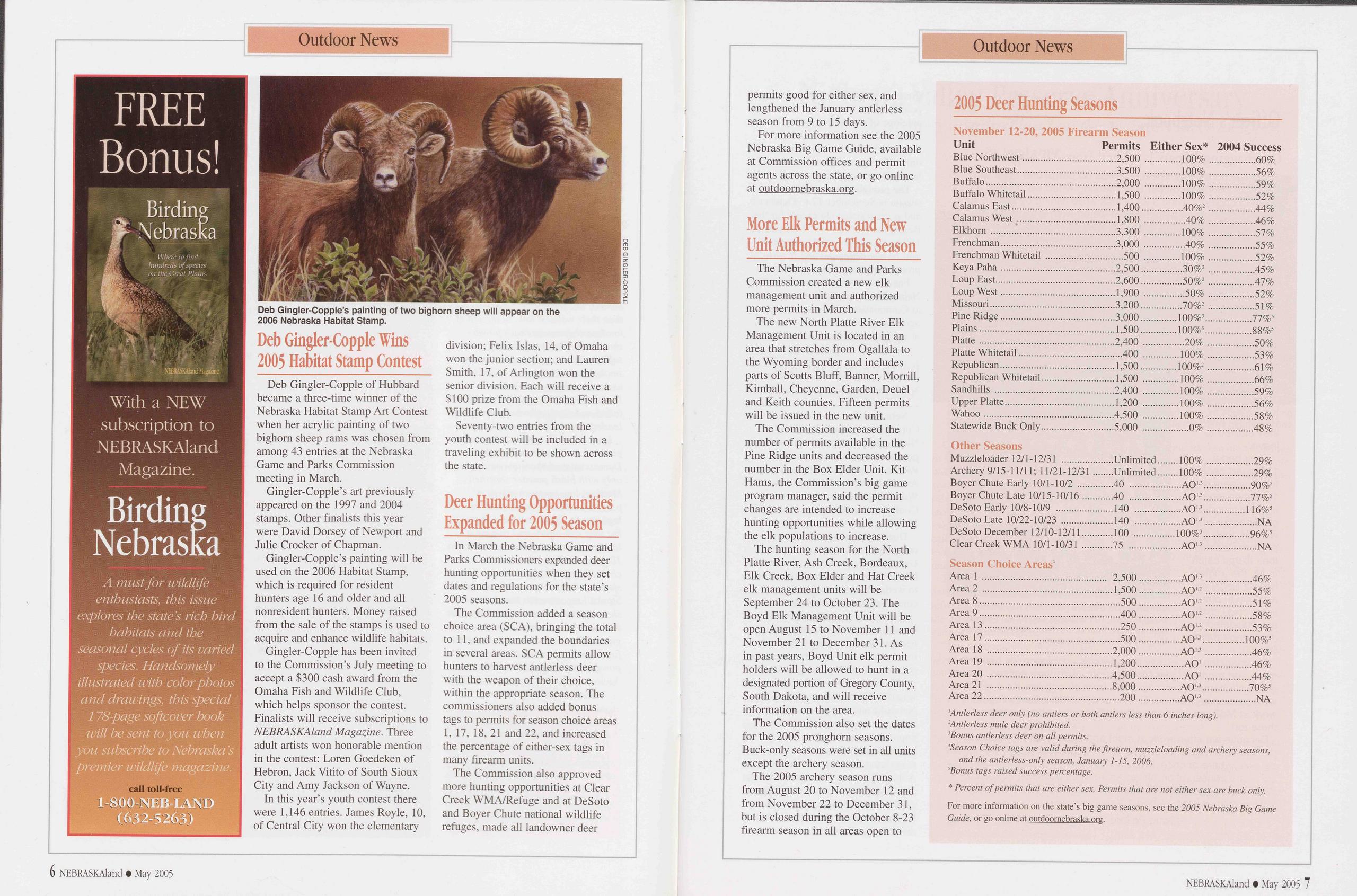
Outdoor News
FREE Bonus! With a NEW subscription to NEBRASKAland Magazine. Birding Nebraska A must for wildlife enthusiasts, this issue explores the states rich bird habitats and the seasonal cycles of its varied species. Handsomely illustrated with color photos and drawings, this special 178-page softcover hook will be sent to you when you subscribe to Nebraska’s premier wildlife magazine. call toll-free 1-800 NEB-LAND (632-5263)Deb Gingler-Copple of Hubbard became a three-time winner of the Nebraska Habitat Stamp Art Contest when her acrylic painting of two bighorn sheep rams was chosen from among 43 entries at the Nebraska Game and Parks Commission meeting in March.
Gingler-Copple’s art previously appeared on the 1997 and 2004 stamps. Other finalists this year were David Dorsey of Newport and Julie Crocker of Chapman.
Gingler-Copple’s painting will be used on the 2006 Habitat Stamp, which is required for resident hunters age 16 and older and all nonresident hunters. Money raised from the sale of the stamps is used to acquire and enhance wildlife habitats.
Gingler-Copple has been invited to the Commission’s July meeting to accept a $300 cash award from the Omaha Fish and Wildlife Club, which helps sponsor the contest. Finalists will receive subscriptions to NEBRASKAland Magazine. Three adult artists won honorable mention in the contest: Loren Goedeken of Hebron, Jack Vitito of South Sioux City and Amy Jackson of Wayne.
In this year’s youth contest there were 1,146 entries. James Royle, 10, of Central City won the elementary division; Felix Islas, 14, of Omaha won the junior section; and Lauren Smith, 17, of Arlington won the senior division. Each will receive a $100 prize from the Omaha Fish and Wildlife Club.
Seventy-two entries from the youth contest will be included in a traveling exhibit to be shown across the state.
Deer Hunting Opportunities Expanded for 2005 SeasonIn March the Nebraska Game and Parks Commissioners expanded deer hunting opportunities when they set dates and regulations for the state’s 2005 seasons.
The Commission added a season choice area (SCA), bringing the total to 11, and expanded the boundaries in several areas. SCA permits allow hunters to harvest antlerless deer with the weapon of their choice, within the appropriate season. The commissioners also added bonus tags to permits for season choice areas 1, 17, 18, 21 and 22, and increased the percentage of either-sex tags in many firearm units.
The Commission also approved more hunting opportunities at Clear Creek WMA/Refuge and at DeSoto and Boyer Chute national wildlife refuges, made all landowner deer permits good for either sex, and lengthened the January antlerless season from 9 to 15 days.
For more information see the 2005 Nebraska Big Game Guide, available at Commission offices and permit agents across the state, or go online at outdoornebraska.org.
More Elk Permits and New Unit Authorized This SeasonThe Nebraska Game and Parks Commission created a new elk management unit and authorized more permits in March.
The new North Platte River Elk Management Unit is located in an area that stretches from Ogallala to the Wyoming border and includes parts of Scotts Bluff, Banner, Morrill, Kimball, Cheyenne, Garden, Deuel and Keith counties. Fifteen permits will be issued in the new unit.
The Commission increased the number of permits available in the Pine Ridge units and decreased the number in the Box Elder Unit. Kit Hams, the Commission’s big game program manager, said the permit changes are intended to increase hunting opportunities while allowing the elk populations to increase.
The hunting season for the North Platte River, Ash Creek, Bordeaux, Elk Creek, Box Elder and Hat Creek elk management units will be September 24 to October 23. The Boyd Elk Management Unit will be open August 15 to November 11 and November 21 to December 31. As in past years, Boyd Unit elk permit holders will be allowed to hunt in a designated portion of Gregory County, South Dakota, and will receive information on the area.
The Commission also set the dates for the 2005 pronghorn seasons. Buck-only seasons were set in all units except the archery season.
The 2005 archery season runs from August 20 to November 12 and from November 22 to December 31, but is closed during the October 8-23 firearm season in all areas open to
 firearm pronghorn hunting. Archery
permits allow bowhunters to take an
antelope of either sex. In the Bessey
Ranger District of the Nebraska
National Forest, bowhunters may
only take a pronghorn with horns
longer than its ears.
firearm pronghorn hunting. Archery
permits allow bowhunters to take an
antelope of either sex. In the Bessey
Ranger District of the Nebraska
National Forest, bowhunters may
only take a pronghorn with horns
longer than its ears.
The pronghorn muzzleloader season is September 17 to October 3 and is open statewide except for the Bessey Ranger District. This year 150 buck-only muzzleloader permits will be available, and 542 firearm pronghorn permits were authorized. For more information see the 2005 Nebraska Big Game Guide, available at Commission offices and permit agents across the state, or go online at outdoornebraska.org.
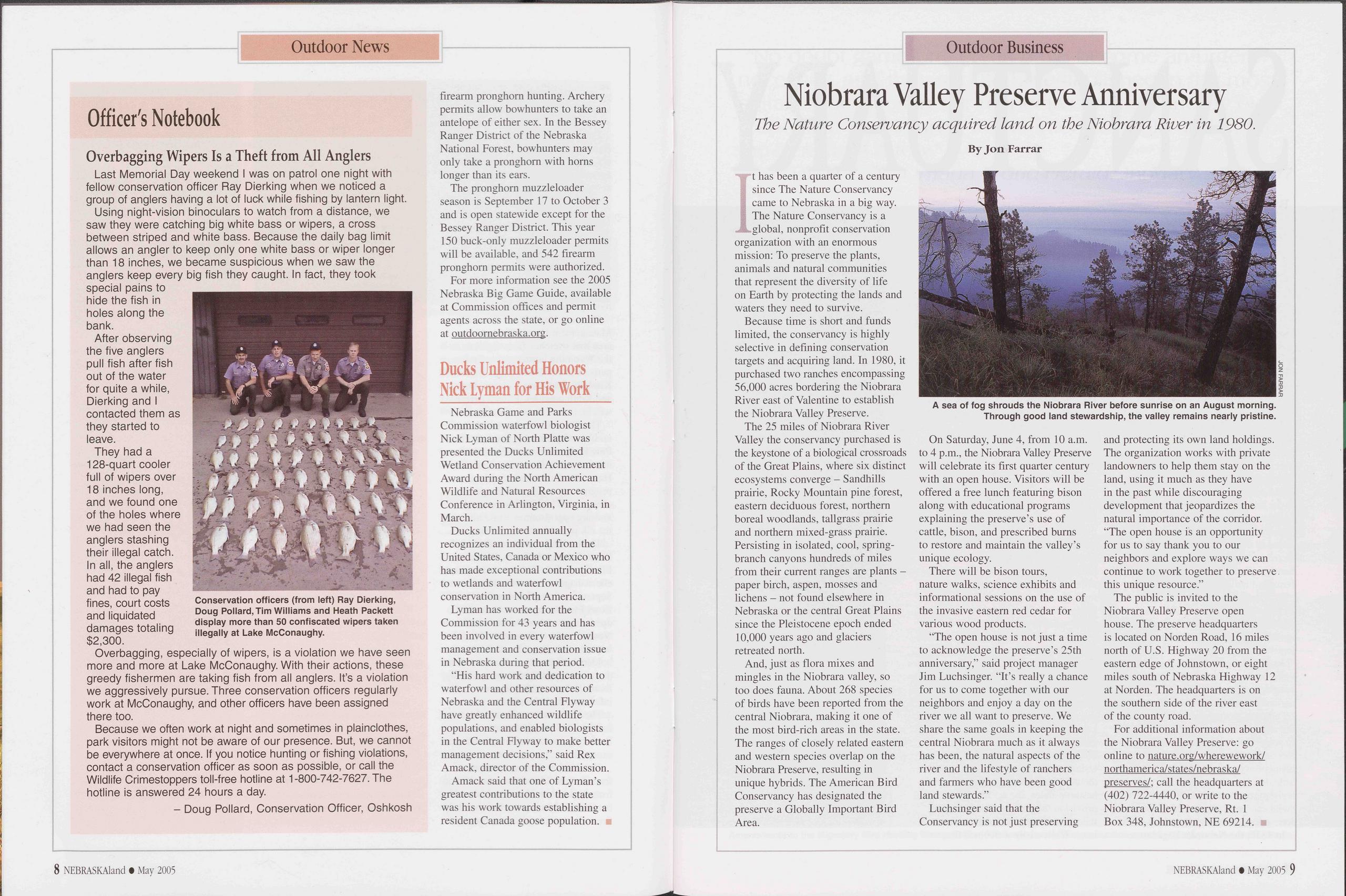
Outdoor News Officer's Notebook Overbagging Wipers Is a Theft from All AnglersLast Memorial Day weekend I was on patrol one night with fellow conservation officer Ray Dierking when we noticed a group of anglers having a lot of luck while fishing by lantern light.
Using night-vision binoculars to watch from a distance, we saw they were catching big white bass or wipers, a cross between striped and white bass. Because the daily bag limit allows an angler to keep only one white bass or wiper longer than 18 inches, we became suspicious when we saw the anglers keep every big fish they caught. In fact, they took
After observing the five anglers pull fish after fish out of the water for quite a while, Dierking and I contacted them as they started to leave.
They had a 128-quart cooler full of wipers over 18 inches long, and we found one of the holes where we had seen the anglers stashing their illegal catch. In all, the anglers had 42 illegal fish and had to pay fines, court costs and liquidated damages totaling $2,300.
Overbagging, especially of wipers, is a violation we have seen more and more at Lake McConaughy. With their actions, these greedy fishermen are taking fish from all anglers. It’s a violation we aggressively pursue. Three conservation officers regularly work at McConaughy, and other officers have been assigned there too.
Because we often work at night and sometimes in plainclothes, park visitors might not be aware of our presence. But, we cannot be everywhere at once. If you notice hunting or fishing violations, contact a conservation officer as soon as possible, or call the Wildlife Crimestoppers toll-free hotline at 1-800-742-7627. The hotline is answered 24 hours a day.
- Doug Pollard, Conservation Officer, Oshkosh Ducks Unlimited Honors Nick Lyman for His WorkNebraska Game and Parks Commission waterfowl biologist Nick Lyman of North Platte was presented the Ducks Unlimited Wetland Conservation Achievement Award during the North American Wildlife and Natural Resources Conference in Arlington, Virginia, in March.
Ducks Unlimited annually recognizes an individual from the United States, Canada or Mexico who has made exceptional contributions to wetlands and waterfowl conservation in North America.
Lyman has worked for the Commission for 43 years and has been involved in every waterfowl management and conservation issue in Nebraska during that period.
“His hard work and dedication to waterfowl and other resources of Nebraska and the Central Flyway have greatly enhanced wildlife populations, and enabled biologists in the Central Flyway to make better management decisions,” said Rex Amack, director of the Commission.
Amack said that one of Lyman’s greatest contributions to the state was his work towards establishing a resident Canada goose population.
Outdoor Business
Niobrara Valley Preserve Anniversary
The Nature Conservancy acquired land on the Niobrara River in 1980.
It has been a quarter of a century since The Nature Conservancy came to Nebraska in a big way. The Nature Conservancy is a global, nonprofit conservation organization with an enormous mission: To preserve the plants, animals and natural communities that represent the diversity of life on Earth by protecting the lands and waters they need to survive.
Because time is short and funds limited, the conservancy is highly selective in defining conservation targets and acquiring land. In 1980, it purchased two ranches encompassing 56,000 acres bordering the Niobrara River east of Valentine to establish the Niobrara Valley Preserve.
The 25 miles of Niobrara River Valley the conservancy purchased is the keystone of a biological crossroads of the Great Plains, where six distinct ecosystems converge - Sandhills prairie, Rocky Mountain pine forest, eastern deciduous forest, northern boreal woodlands, tailgrass prairie and northern mixed-grass prairie. Persisting in isolated, cool, spring- branch canyons hundreds of miles from their current ranges are plants - paper birch, aspen, mosses and lichens - not found elsewhere in Nebraska or the central Great Plains since the Pleistocene epoch ended 10,000 years ago and glaciers retreated north.
And, just as flora mixes and mingles in the Niobrara valley, so too does fauna. About 268 species of birds have been reported from the central Niobrara, making it one of the most bird-rich areas in the state. The ranges of closely related eastern and western species overlap on the Niobrara Preserve, resulting in unique hybrids. The American Bird Conservancy has designated the preserve a Globally Important Bird Area.
On Saturday, June 4, from 10 a.m. to 4 p.m., the Niobrara Valley Preserve will celebrate its first quarter century with an open house. Visitors will be offered a free lunch featuring bison along with educational programs explaining the preserve’s use of cattle, bison, and prescribed burns to restore and maintain the valley’s unique ecology.
There will be bison tours, nature walks, science exhibits and informational sessions on the use of the invasive eastern red cedar for various wood products.
“The open house is not just a time to acknowledge the preserve’s 25th anniversary,” said project manager Jim Luchsinger. “It’s really a chance for us to come together with our neighbors and enjoy a day on the river we all want to preserve. We share the same goals in keeping the central Niobrara much as it always has been, the natural aspects of the river and the lifestyle of ranchers and farmers who have been good land stewards.”
Luchsinger said that the Conservancy is not just preserving and protecting its own land holdings. The organization works with private landowners to help them stay on the land, using it much as they have in the past while discouraging development that jeopardizes the natural importance of the corridor. “The open house is an opportunity for us to say thank you to our neighbors and explore ways we can continue to work together to preserve this unique resource.”
The public is invited to the Niobrara Valley Preserve open house. The preserve headquarters is located on Norden Road, 16 miles north of U.S. Highway 20 from the eastern edge of Johnstown, or eight miles south of Nebraska Highway 12 at Norden. The headquarters is on the southern side of the river east of the county road.
For additional information about the Niobrara Valley Preserve: go online to nature. org/wherewework/ northamerica/states/nebraska/ preserves/: call the headquarters at (402) 722-4440, or write to the Niobrara Valley Preserve, Rt. 1 Box 348, Johnstown, NE 69214.
8 NEBRASKAland • May 2005 NEBRASKAland • May 2005 9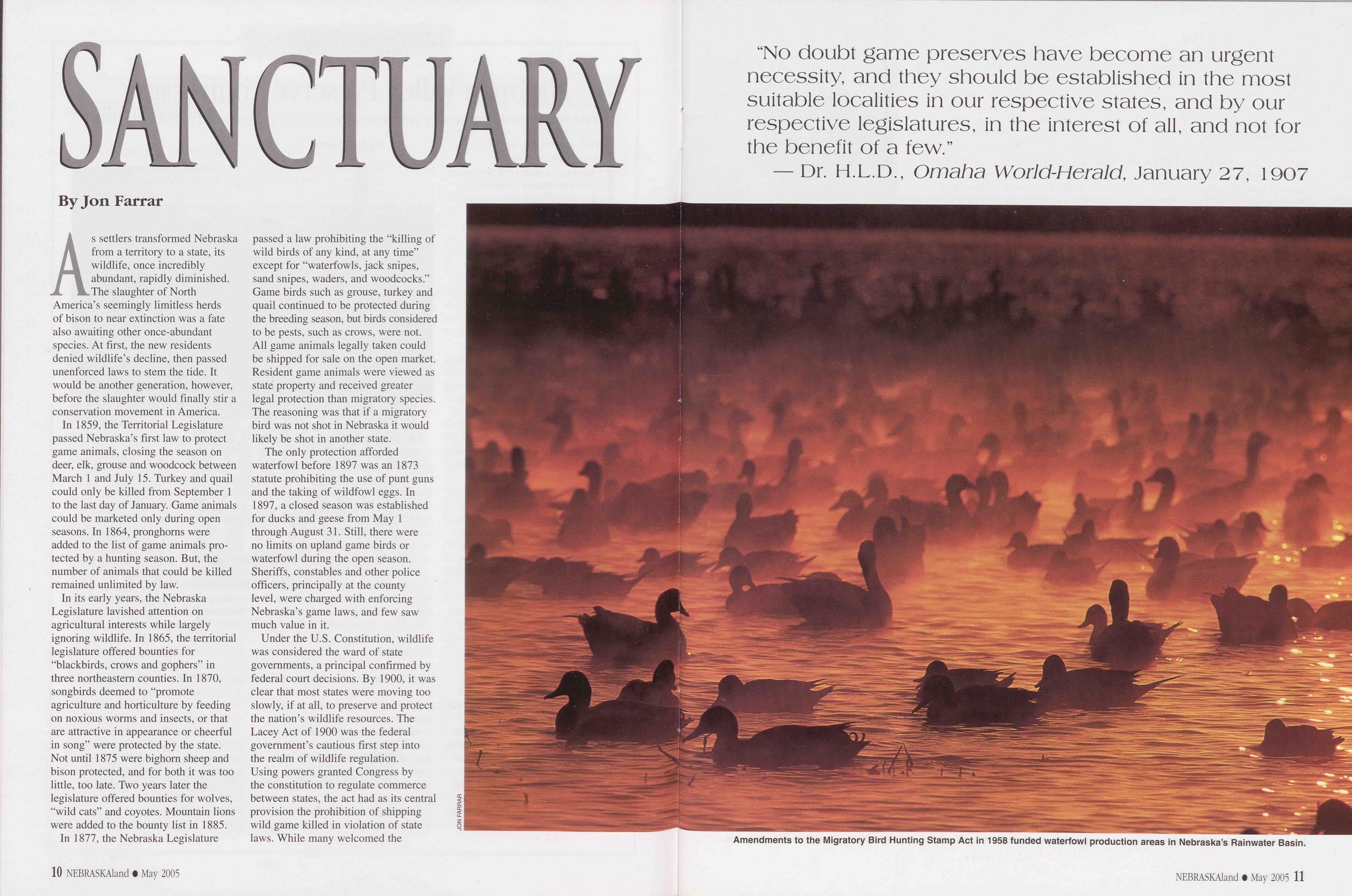
SANCTUARY
“No doubt game preserves have become an urgent necessity, and they should be established in the most suitable localities in our respective states, and by our respective legislatures, in the interest of all, and not for the benefit of a few.” — Dr. H.L.D., Omaha World-Herald, January 27, 1907
As settlers transformed Nebraska from a territory to a state, its wildlife, once incredibly abundant, rapidly diminished.
The slaughter of North America’s seemingly limitless herds of bison to near extinction was a fate also awaiting other once-abundant species. At first, the new residents denied wildlife’s decline, then passed unenforced laws to stem the tide. It would be another generation, however, before the slaughter would finally stir a conservation movement in America.
In 1859, the Territorial Legislature passed Nebraska’s first law to protect game animals, closing the season on deer, elk, grouse and woodcock between March 1 and July 15. Turkey and quail could only be killed from September 1 to the last day of January. Game animals could be marketed only during open seasons. In 1864, pronghorns were added to the list of game animals pro- tected by a hunting season. But, the number of animals that could be killed remained unlimited by law.
In its early years, the Nebraska Legislature lavished attention on agricultural interests while largely ignoring wildlife. In 1865, the territorial legislature offered bounties for “blackbirds, crows and gophers” in three northeastern counties. In 1870, songbirds deemed to “promote agriculture and horticulture by feeding on noxious worms and insects, or that are attractive in appearance or cheerful in song” were protected by the state. Not until 1875 were bighorn sheep and bison protected, and for both it was too little, too late. Two years later the legislature offered bounties for wolves, “wild cats” and coyotes. Mountain lions were added to the bounty list in 1885.
In 1877, the Nebraska Legislature 10 NEBRASKAland • May 2005 passed a law prohibiting the “killing of wild birds of any kind, at any time” except for “waterfowls, jack snipes, sand snipes, waders, and woodcocks.” Game birds such as grouse, turkey and quail continued to be protected during the breeding season, but birds considered to be pests, such as crows, were not. All game animals legally taken could be shipped for sale on the open market. Resident game animals were viewed as state property and received greater legal protection than migratory species. The reasoning was that if a migratory bird was not shot in Nebraska it would likely be shot in another state.
The only protection afforded waterfowl before 1897 was an 1873 statute prohibiting the use of punt guns and the taking of wildfowl eggs. In 1897, a closed season was established for ducks and geese from May 1 through August 31. Still, there were no limits on upland game birds or waterfowl during the open season. Sheriffs, constables and other police officers, principally at the county level, were charged with enforcing Nebraska’s game laws, and few saw much value in it.
Under the U.S. Constitution, wildlife was considered the ward of state governments, a principal confirmed by federal court decisions. By 1900, it was clear that most states were moving too slowly, if at all, to preserve and protect the nation’s wildlife resources. The Lacey Act of 1900 was the federal government’s cautious first step into the realm of wildlife regulation. Using powers granted Congress by the constitution to regulate commerce between states, the act had as its central provision the prohibition of shipping wild game killed in violation of state laws. While many welcomed the
 federal government’s action, others saw
it as a federal incursion into states’
rights. The Lacey Act was a shot across
the bow, signaling to states to protect
and preserve their wildlife or the federal
government would.
federal government’s action, others saw
it as a federal incursion into states’
rights. The Lacey Act was a shot across
the bow, signaling to states to protect
and preserve their wildlife or the federal
government would.
In 1901, the Nebraska Legislature passed its first comprehensive game statutes. A Game and Fish Commission replaced the Fish Commission, which had been established in 1879. The new law provided for four full-time employees including a chief warden, a traveling warden, seasonal wardens and allowed for unpaid special deputies; required a $1 license for male hunters and anglers over the age of 18 to fund the new department; shortened the open season; and for the first time, set limits on the number of game animals that could be legally killed. The seasons and limits remained liberal and the sale of game during the open seasons remained legal. Still, it was landmark wildlife legislation for Nebraska.
Asylums for WildlifeThe game preservation movement swept the country during the 1890s and early 1900s, largely supported by sportsmen alarmed by the declining abundance of wildlife, especially big game and waterfowl. National conservation organizations such as the Camp Fire Club of America and the Audubon Society pressured for laws to end market hunting, establish
By 1900, the League of American Sportsmen actively recruited Nebraska members to “enforce game laws where such exist and to secure and enforce such laws where not now in existence.” The league noted, “Never before were the agencies of destruction so numerous as now. Never before were they so widely distributed, and never before were they so effective for slaughter.” Other national conservation organizations composed largely of hunters followed. The American Game Protective and Propagation Association, the forerunner of today’s Wildlife Management Institute, was founded in New York in 1911 and became an agent of governmental change. By the 1920s, the Izaak Walton League was an effective lobby for conservation legislation in Nebraska and nationally.
While game laws were in place by 1901, Nebraska and other states had few game wardens to enforce them. Early in the 20th century, hunting seasons became more restrictive, bag limits were added, and more wardens were authorized. Still, in Nebraska as
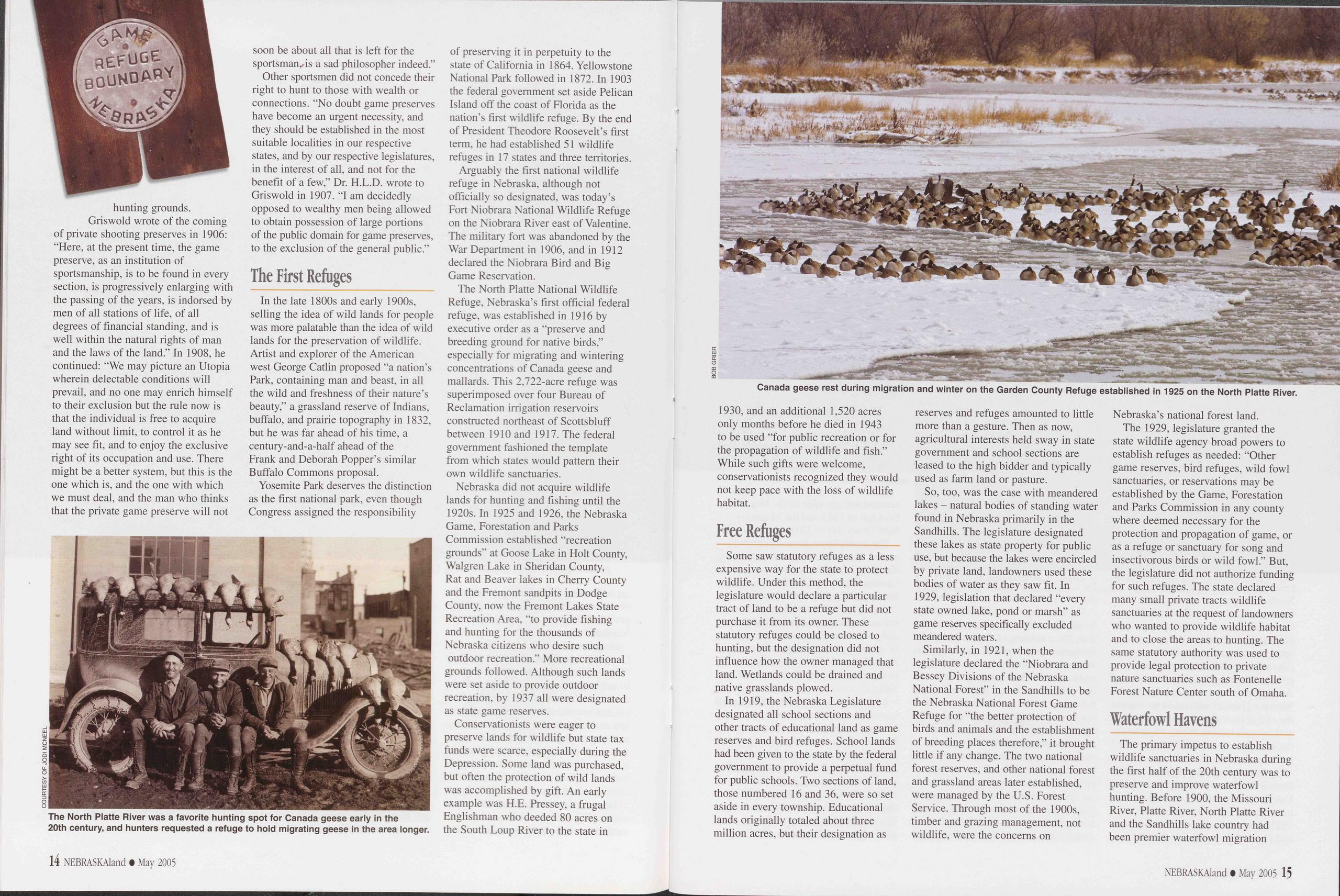
“Geese and ducks are being slaughtered ... all along the Platte as soon as they begin to come,” wrote A.C. Connor of Central City to the Omaha World-Herald in 1894. “Blinds are built every 200 or 300 yards along the river and are occupied from daylight until dark, keeping up a continuous fusillade.”
Six years later, Wm. C. Huffman of Doniphan wrote that little had changed: “The sport of goose shooting will soon be a thing of the past, not because there are no geese or that there is nothing to eat, but because the river is generally low and hunters have had easy access to them, consequently they have been driven out. Hunters go out in midstream in a boat, if not possible to wade, and build a blind on a sand bar. Geese coming into the river are easily killed in large numbers and are not likely to remain long with those kind of neighbors on the bars. Now if this mode of hunting is allowed to be carried on, before three years will have passed the game will pass on over the river in spring as they now do in the fall. Unmolested they generally stay two months on the river, as it is now they are driven out in two weeks or less.”
In 1911, Omaha World-Herald outdoor writer Sandy Griswold wrote that 20 years earlier a hunter could see more geese in one day than a hunter in 1911 would see in a whole year. He wrote: “In the halcyon old days, as we are wont to call them through force of vividly recollected excitement and passion, of unrestricted shooting, a bag of from seventy-five to 100 geese a day, to a couple of guns, was no extraordinary achievement. The sight of a flock of Canadas is now an event to excite the most enthusiastic exclamations of even the most persistent hunters along the waters of the far and long famed Platte valley, when a decade ago flock after flock, in almost endless continuity, would cleave their aerial way over head and occasion to more of a flutter in the indurated hunter’s breast than the passage of a flock of redwing blackbirds or the rustle of the vernal winds.”
Sportsmen were not just alarmed by
the decline of wildlife, but also the
increasing difficulty in finding places
to hunt. During the early 1900s,
wealthy sportsmen from eastern cities
and hunting clubs in small towns
acquired titles or leases to favored
NEBRASKAland • May 2005 13
 hunting grounds.
Griswold wrote of the coming of private shooting preserves in 1906: Here, at the present time, the game preserve, as an institution of sportsmanship, is to be found in every section, is progressively enlarging with the passing of the years, is indorsed by men of all stations of life, of all degrees of financial standing, and is well within the natural rights of man and the laws of the land.” In 1908, he continued: “We may picture an Utopia wherein delectable conditions will prevail, and no one may enrich himself to their exclusion but the rule now is that the individual is free to acquire land without limit, to control it as he may see fit, and to enjoy the exclusive right of its occupation and use. There might be a better system, but this is the one which is, and the one with which we must deal, and the man who thinks that the private game preserve will not
Other sportsmen did not concede their right to hunt to those with wealth or connections. “No doubt game preserves have become an urgent necessity, and they should be established in the most suitable localities in our respective states, and by our respective legislatures, in the interest of all, and not for the benefit of a few,” Dr. H.L.D. wrote to Griswold in 1907. “I am decidedly opposed to wealthy men being allowed to obtain possession of large portions of the public domain for game preserves, to the exclusion of the general public.”
The First RefugesIn the late 1800s and early 1900s, selling the idea of wild lands for people was more palatable than the idea of wild lands for the preservation of wildlife. Artist and explorer of the American west George Catlin proposed “a nation’s Park, containing man and beast, in all the wild and freshness of their nature’s beauty,” a grassland reserve of Indians, buffalo, and prairie topography in 1832, but he was far ahead of his time, a century-and-a-half ahead of the Frank and Deborah Popper’s similar Buffalo Commons proposal.
Yosemite Park deserves the distinction as the first national park, even though Congress assigned the responsibility of preserving it in perpetuity to the state of California in 1864. Yellowstone National Park followed in 1872. In 1903 the federal government set aside Pelican Island off the coast of Florida as the nation’s first wildlife refuge. By the end of President Theodore Roosevelt’s first term, he had established 51 wildlife refuges in 17 states and three territories.
Arguably the first national wildlife refuge in Nebraska, although not officially so designated, was today’s Fort Niobrara National Wildlife Refuge on the Niobrara River east of Valentine. The military fort was abandoned by the War Department in 1906, and in 1912 declared the Niobrara Bird and Big Game Reservation.
The North Platte National Wildlife Refuge, Nebraska’s first official federal refuge, was established in 1916 by executive order as a “preserve and breeding ground for native birds,” especially for migrating and wintering concentrations of Canada geese and mallards. This 2,722-acre refuge was superimposed over four Bureau of Reclamation irrigation reservoirs constructed northeast of Scottsbluff between 1910 and 1917. The federal government fashioned the template from which states would pattern their own wildlife sanctuaries.
Nebraska did not acquire wildlife lands for hunting and fishing until the 1920s. In 1925 and 1926, the Nebraska Game, Forestation and Parks Commission established “recreation grounds” at Goose Lake in Holt County, Walgren Lake in Sheridan County, Rat and Beaver lakes in Cherry County and the Fremont sandpits in Dodge County, now the Fremont Lakes State Recreation Area, “to provide fishing and hunting for the thousands of Nebraska citizens who desire such outdoor recreation.” More recreational grounds followed. Although such lands were set aside to provide outdoor recreation, by 1937 all were designated as state game reserves.
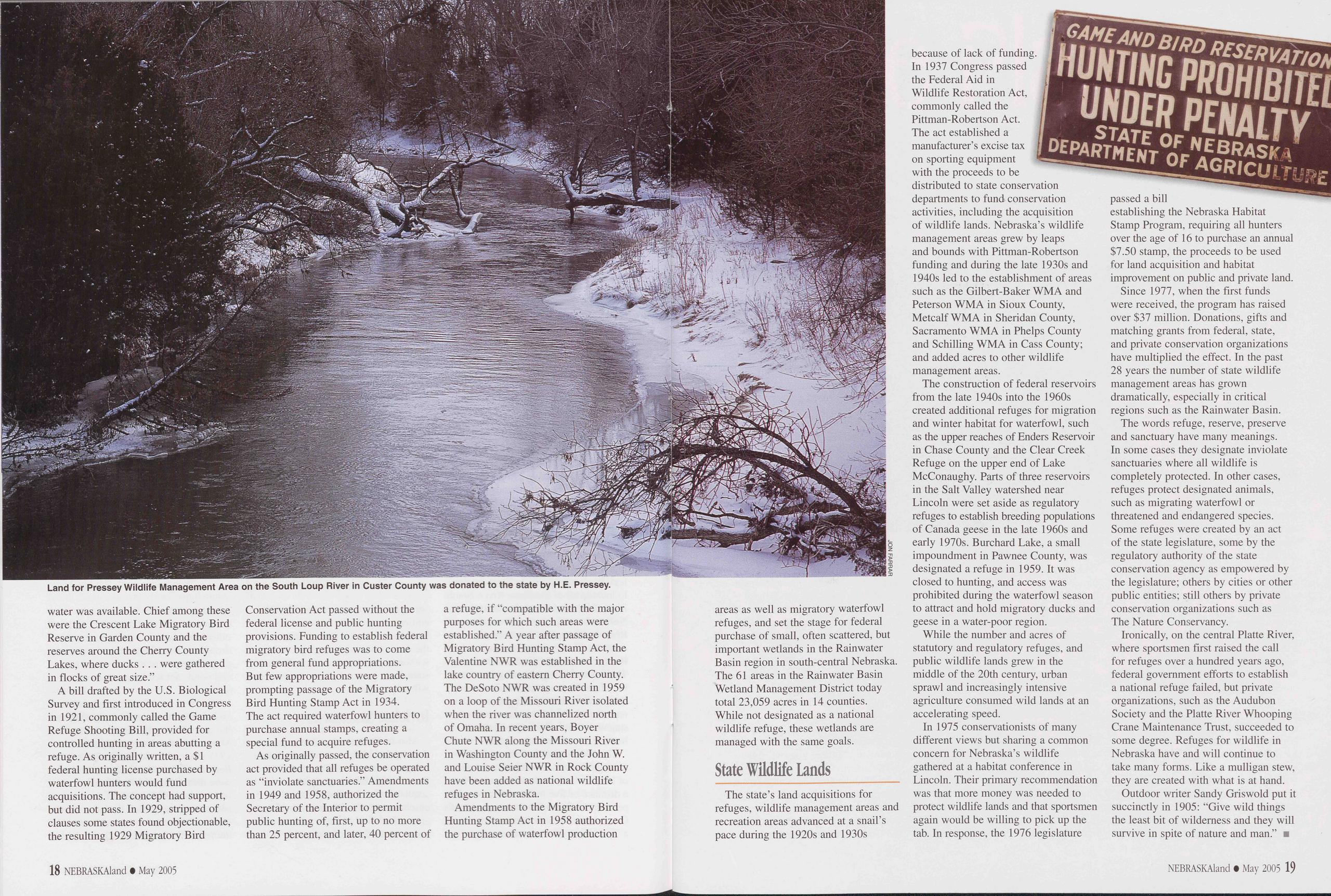
Conservationists were eager to preserve lands for wildlife but state tax funds were scarce, especially during the Depression. Some land was purchased, but often the protection of wild lands was accomplished by gift. An early example was H.E. Pressey, a frugal Englishman who deeded 80 acres on the South Loup River to the state in 14 NEBRASKAland • May 2005
Some saw statutory refuges as a less expensive way for the state to protect wildlife. Under this method, the legislature would declare a particular tract of land to be a refuge but did not purchase it from its owner. These statutory refuges could be closed to hunting, but the designation did not influence how the owner managed that land. Wetlands could be drained and native grasslands plowed.
In 1919, the Nebraska Legislature designated all school sections and other tracts of educational land as game reserves and bird refuges. School lands had been given to the state by the federal government to provide a perpetual fund for public schools. Two sections of land, those numbered 16 and 36, were so set aside in every township. Educational lands originally totaled about three million acres, but their designation as reserves and refuges amounted to little more than a gesture. Then as now, agricultural interests held sway in state government and school sections are leased to the high bidder and typically used as farm land or pasture.
So, too, was the case with meandered lakes - natural bodies of standing water found in Nebraska primarily in the Sandhills. The legislature designated these lakes as state property for public use, but because the lakes were encircled by private land, landowners used these bodies of water as they saw fit. In 1929, legislation that declared “every state owned lake, pond or marsh” as game reserves specifically excluded meandered waters.
Similarly, in 1921, when the legislature declared the “Niobrara and Bessey Divisions of the Nebraska National Forest” in the Sandhills to be the Nebraska National Forest Game Refuge for “the better protection of birds and animals and the establishment of breeding places therefore,” it brought little if any change. The two national forest reserves, and other national forest and grassland areas later established, were managed by the U.S. Forest Service. Through most of the 1900s, timber and grazing management, not wildlife, were the concerns on Nebraska’s national forest land.
The 1929, legislature granted the state wildlife agency broad powers to establish refuges as needed: “Other game reserves, bird refuges, wild fowl sanctuaries, or reservations may be established by the Game, Forestation and Parks Commission in any county where deemed necessary for the protection and propagation of game, or as a refuge or sanctuary for song and insectivorous birds or wild fowl.” But, the legislature did not authorize funding for such refuges. The state declared many small private tracts wildlife sanctuaries at the request of landowners who wanted to provide wildlife habitat and to close the areas to hunting. The same statutory authority was used to provide legal protection to private nature sanctuaries such as Fontenelle Forest Nature Center south of Omaha.
Waterfowl HavensThe primary impetus to establish
wildlife sanctuaries in Nebraska during
the first half of the 20th century was to
preserve and improve waterfowl
hunting. Before 1900, the Missouri
River, Platte River, North Platte River
and the Sandhills lake country had
been premier waterfowl migration
NEBRASKAland • May 2005 15
Encouraged by hunters, state senators Bern R. Coulter of Morrill County and Freeman L. Whitney of Deuel County introduced a bill in the legislature in 1925 to set aside the North Platte River and 10 rods (55 yards) on each side from the mouth of the North Platte River upstream to the Nebraska-Wyoming line as a state game refuge. The bill’s supporters believed if migrating and wintering ducks and geese had a refuge they would linger, providing hunting for a longer period, a point of view not shared by all North Platte River hunters.
The February 14, 1925 edition of the North Platte Evening Telegraph reported that: “At a meeting of the Lions club at Bridgeport last week the members seemed unanimously against the bill and instructed their secretary to draw up resolutions asking Coulter to lay the bill aside, as this part of the state did not care to protect game for the benefit of southern hunters who slaughtered the birds in large numbers as soon as the migrating game reached its objective grounds in the south.” It was such parochial and shortsighted attitudes, and the reluctance of individual states to establish reasonable shooting seasons and bag limits, that led to federal control of migratory bird hunting seasons with passage of the Migratory Bird Act of 1913 and the Migratory Bird Treaty Act of 1918.
The North Platte River refuge bill passed, but the statutory refuge was reduced to the stretch of the river in Garden County. A December 2, 1925 Evening Telegraph article reported: “Sportsmen in this section profess to see in the increased numbers of ducks and geese a confirmation of the wisdom of creating game preserves. There are more ducks and twice as many geese as in any previous year in the North Platte Valley.”
Legislation passed in the 1930 special session authorized establishing game reserves in Scotts Bluff, Banner or Morrill counties, setting the stage for the Commission to buy land near Scotts Bluff and established a big game reserve today known as the Wildcat Hills State Recreation Area. In 1931, the legislature declared 562 acres on the Niobrara River impoundment above Spencer Dam north of O’Neill 16 NEBRASKAland • May 2005 as a statutory refuge. That game reserve was abolished by law in 1941.
Two additional statutory refuges with regulations the same as those in Garden County were subsequently established by the legislature. In 1939, a refuge was created along the Platte River between Saunders, Dodge and Douglas counties, extending roughly from Rogers to the Nebraska Highway 92 bridge near Yutan southeast of Fremont. The 1947 legislature created a state statutory refuge on the Niobrara River between Holt and Boyd counties. The last statutory refuge established on a Nebraska river came in 1955 when about four miles of the North Platte River on edge of North Platte were set aside.
Refuges by the HourThe legislature exercised its statutory authority to protect wildlife in yet another way in 1927 by establishing a “game reserve” on the North Platte River and 10 rods on each side of its banks for over 40 miles extending west from northeast of Hershey to north of Ogallala. The regulation closed the North Platte River Bird and Animal Refuge to all hunting except between a half hour before sunrise until noon. The regulation was to provide safe roosting and feeding grounds for most of the day, encouraging the birds to remain rather than to continue their southward migration.
In 1935, in the depth of prolonged drought on the Great Plains and plummeting waterfowl numbers, the legislature expanded the game reserve to include all of the Platte River, South Platte River and North Platte River in Nebraska except for the North Platte River in Scotts Bluff and Morrill counties. The Garden County Game Refuge remained closed to all hunting. The forenoon-only shooting law for the Platte River system outside of designated statutory refuges was repealed in 1941 to conform with statewide rules allowing waterfowl hunting from sunrise to 4 p.m.
The 1929 legislature also provided the legal framework whereby owners of land on both banks of any river for a distance of five miles or more could petition the Game, Forestation and Parks Commission to have that land declared a “game and wild fowl sanctuary.” That statute remains in effect today.
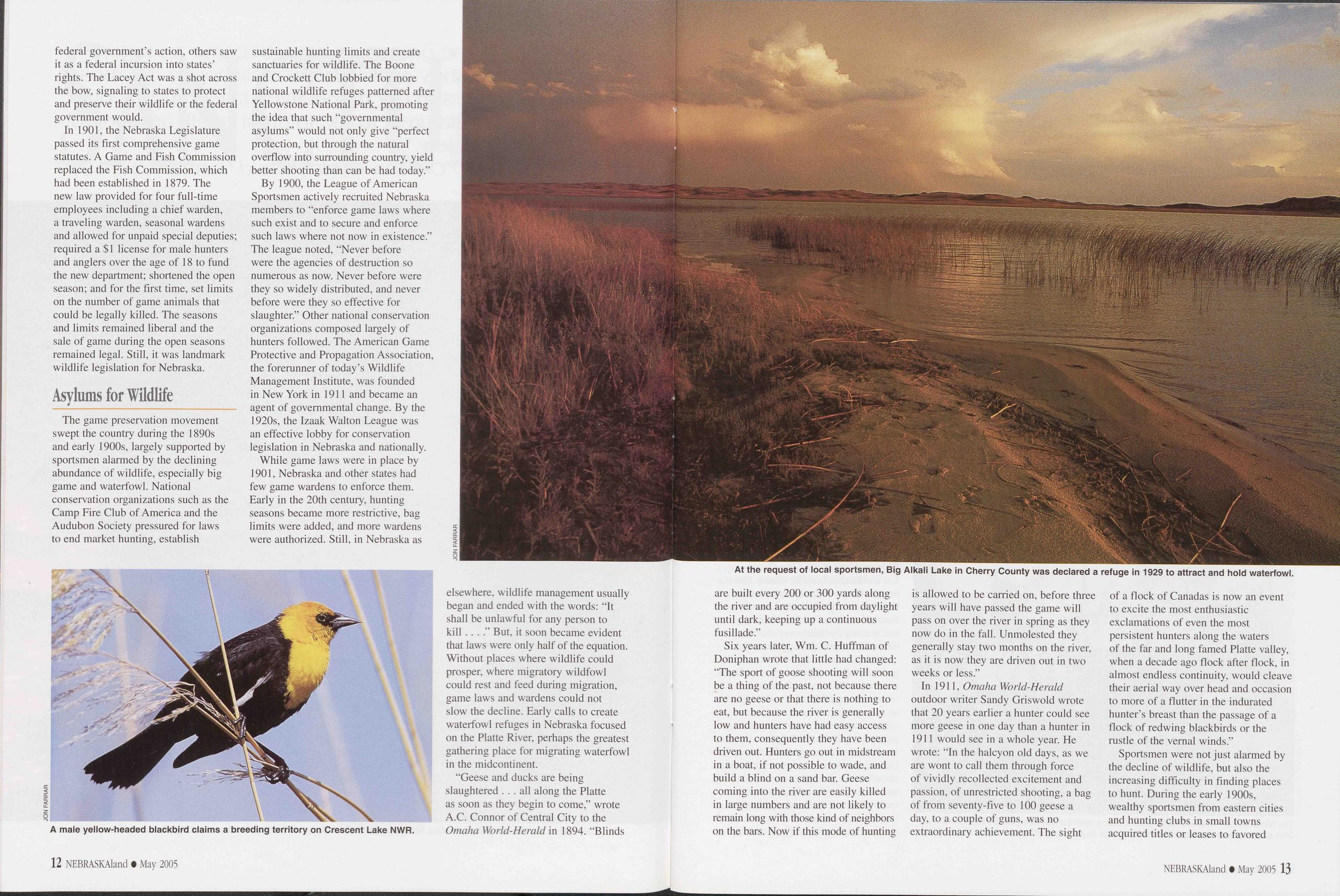
Only the legislature could establish statutory refuges but it assigned the Commission the authority to declare regulatory refuges as it saw the need. For example, the Game, Forestation and Parks Commission, in the autumn of 1929, acting on a petition from sportsmen in north-central Nebraska, declared Big Alkali and Dads lakes in Cherry County to be regulatory refuges and closed to all hunting. The local hunters’ rationale for requesting the closure was much the same as that of the sportsmen along the North Platte River. “These lakes are not feeding grounds [both are moderately alkaline] but are used by the ducks as resting places in their annual flights,” petition supporter F.A. Baldwin of Ainsworth
Also in 1929, the legislature paved the way for additional federal wildlife refuges in the state: “Consent of the State of Nebraska is given to the acquisition by the United States by purchase, gift, devise, or lease of such areas of land or water, or of land and water, in the State of Nebraska, as the United States may deem necessary for the establishment of migratory bird reservations in accordance with the Act of Congress approved February 18,1929 ...”
The federal Migratory Bird Conservation Act of 1929 was drafted to supplement the Migratory Bird Treaty of 1918, specifically to diminish “the dangers threatening migratory game birds from drainage and other causes by the acquisition of areas of land and of water to furnish in perpetuity reservations for the adequate protection of such birds ...”
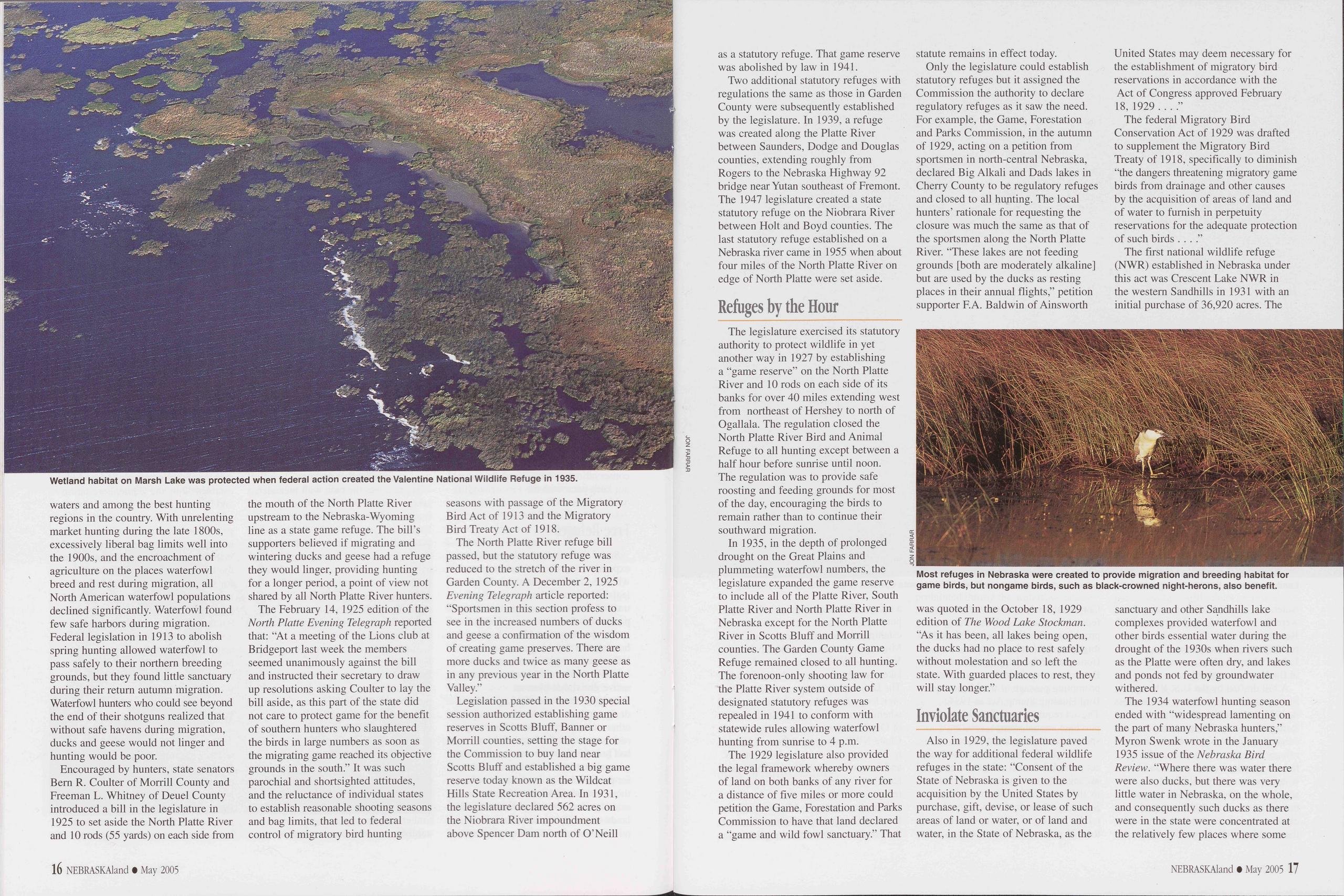
The first national wildlife refuge (NWR) established in Nebraska under this act was Crescent Lake NWR in the western Sandhills in 1931 with an initial purchase of 36,920 acres. The sanctuary and other Sandhills lake complexes provided waterfowl and other birds essential water during the drought of the 1930s when rivers such as the Platte were often dry, and lakes and ponds not fed by groundwater withered.
The 1934 waterfowl hunting season
ended with “widespread lamenting on
the part of many Nebraska hunters,”
Myron Swenk wrote in the January
1935 issue of the Nebraska Bird
Review. “Where there was water there
were also ducks, but there was very
little water in Nebraska, on the whole,
and consequently such ducks as there
were in the state were concentrated at
the relatively few places where some
NEBRASKAland • May 2005 17
A bill drafted by the U.S. Biological Survey and first introduced in Congress in 1921, commonly called the Game Refuge Shooting Bill, provided for controlled hunting in areas abutting a refuge. As originally written, a $1 federal hunting license purchased by waterfowl hunters would fund acquisitions. The concept had support, but did not pass. In 1929, stripped of clauses some states found objectionable, the resulting 1929 Migratory Bird Conservation Act passed without the federal license and public hunting provisions. Funding to establish federal migratory bird refuges was to come from general fund appropriations. But few appropriations were made, prompting passage of the Migratory Bird Hunting Stamp Act in 1934. The act required waterfowl hunters to purchase annual stamps, creating a special fund to acquire refuges.
As originally passed, the conservation act provided that all refuges be operated as “inviolate sanctuaries.” Amendments in 1949 and 1958, authorized the Secretary of the Interior to permit public hunting of, first, up to no more than 25 percent, and later, 40 percent of a refuge, if “compatible with the major purposes for which such areas were established.” A year after passage of Migratory Bird Hunting Stamp Act, the Valentine NWR was established in the lake country of eastern Cherry County. The DeSoto NWR was created in 1959 on a loop of the Missouri River isolated when the river was channelized north of Omaha. In recent years, Boyer Chute NWR along the Missouri River in Washington County and the John W. and Louise Seier NWR in Rock County have been added as national wildlife refuges in Nebraska.
Amendments to the Migratory Bird Hunting Stamp Act in 1958 authorized the purchase of waterfowl production 18 NEBRASKAland • May 2005 areas as well as migratory waterfowl refuges, and set the stage for federal purchase of small, often scattered, but important wetlands in the Rainwater Basin region in south-central Nebraska. The 61 areas in the Rainwater Basin Wetland Management District today total 23,059 acres in 14 counties. While not designated as a national wildlife refuge, these wetlands are managed with the same goals.
State Wildlife LandsThe state’s land acquisitions for refuges, wildlife management areas and recreation areas advanced at a snail’s pace during the 1920s and 1930s because of lack of funding. In 1937 Congress passed the Federal Aid in Wildlife Restoration Act, commonly called the Pittman-Robertson Act. The act established a manufacturer’s excise tax j on sporting equipment ' with the proceeds to be distributed to state conservation departments to fund conservation activities, including the acquisition of wildlife lands. Nebraska’s wildlife management areas grew by leaps and bounds with Pittman-Robertson funding and during the late 1930s and 1940s led to the establishment of areas such as the Gilbert-Baker WMA and Peterson WMA in Sioux County, Metcalf WMA in Sheridan County, Sacramento WMA in Phelps County and Schilling WMA in Cass County; and added acres to other wildlife management areas.
The construction of federal reservoirs from the late 1940s into the 1960s created additional refuges for migration and winter habitat for waterfowl, such as the upper reaches of Enders Reservoir in Chase County and the Clear Creek Refuge on the upper end of Lake McConaughy. Parts of three reservoirs in the Salt Valley watershed near Lincoln were set aside as regulatory refuges to establish breeding populations of Canada geese in the late 1960s and early 1970s. Burchard Lake, a small impoundment in Pawnee County, was designated a refuge in 1959. It was closed to hunting, and access was prohibited during the waterfowl season to attract and hold migratory ducks and geese in a water-poor region.
While the number and acres of statutory and regulatory refuges, and public wildlife lands grew in the middle of the 20th century, urban sprawl and increasingly intensive agriculture consumed wild lands at an accelerating speed.
In 1975 conservationists of many different views but sharing a common concern for Nebraska’s wildlife gathered at a habitat conference in Lincoln. Their primary recommendation was that more money was needed to protect wildlife lands and that sportsmen again would be willing to pick up the tab. In response, the 1976 legislature passed a bill establishing the Nebraska Habitat Stamp Program, requiring all hunters over the age of 16 to purchase an annual $7.50 stamp, the proceeds to be used for land acquisition and habitat improvement on public and private land.
Since 1977, when the first funds were received, the program has raised over $37 million. Donations, gifts and matching grants from federal, state, and private conservation organizations have multiplied the effect. In the past 28 years the number of state wildlife management areas has grown dramatically, especially in critical regions such as the Rainwater Basin.
The words refuge, reserve, preserve and sanctuary have many meanings. In some cases they designate inviolate sanctuaries where all wildlife is completely protected. In other cases, refuges protect designated animals, such as migrating waterfowl or threatened and endangered species. Some refuges were created by an act of the state legislature, some by the regulatory authority of the state conservation agency as empowered by the legislature; others by cities or other public entities; still others by private conservation organizations such as The Nature Conservancy.
Ironically, on the central Platte River, where sportsmen first raised the call for refuges over a hundred years ago, federal government efforts to establish a national refuge failed, but private organizations, such as the Audubon Society and the Platte River Whooping Crane Maintenance Trust, succeeded to some degree. Refuges for wildlife in Nebraska have and will continue to take many forms. Like a mulligan stew, they are created with what is at hand.
Outdoor writer Sandy Griswold put it succinctly in 1905: “Give wild things the least bit of wilderness and they will survive in spite of nature and man.”
NEBRASKAland • May 2005 19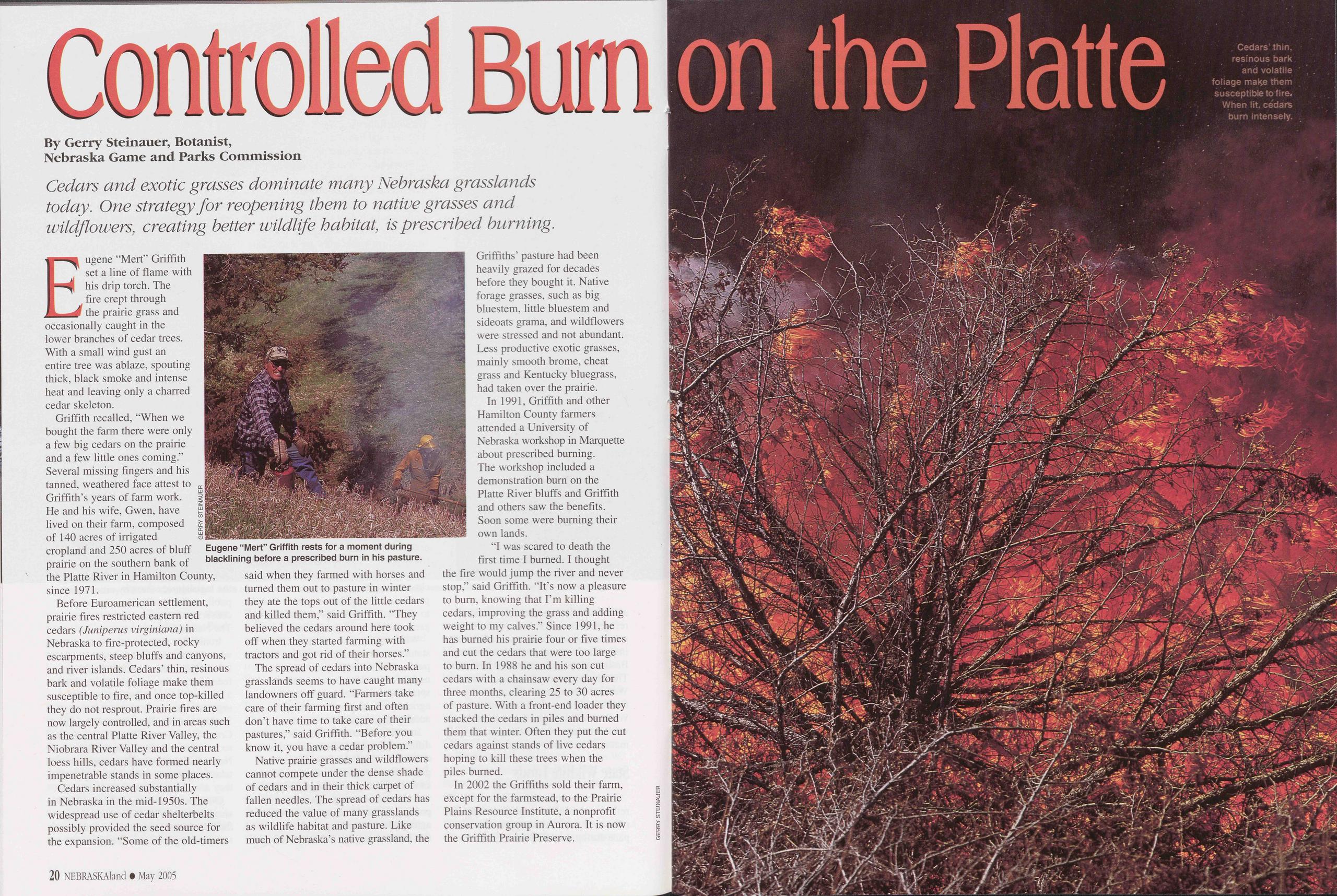
Controlled Burn on the Platte
Cedars and exotic grasses dominate many Nebraska grasslands today. One strategy for reopening them to native grasses and wildflowers, creating better wildlife habitat, is prescribed burning.
Eugene “Mert” Griffith set a line of flame with his drip torch. The fire crept through the prairie grass and occasionally caught in the lower branches of cedar trees. With a small wind gust an entire tree was ablaze, spouting thick, black smoke and intense heat and leaving only a charred cedar skeleton.
Griffith recalled, “When we bought the farm there were only a few big cedars on the prairie and a few little ones coming.” Several missing fingers and his tanned, weathered face attest to Griffith’s years of farm work. He and his wife, Gwen, have lived on their farm, composed of 140 acres of irrigated cropland and 250 acres of bluff prairie on the southern bank of the Platte River in Hamilton County, since 1971.
Before Euroamerican settlement, prairie fires restricted eastern red cedars (Juniperus virginiana) in Nebraska to fire-protected, rocky escarpments, steep bluffs and canyons, and river islands. Cedars’ thin, resinous bark and volatile foliage make them susceptible to fire, and once top-killed they do not resprout. Prairie fires are now largely controlled, and in areas such as the central Platte River Valley, the Niobrara River Valley and the central loess hills, cedars have formed nearly impenetrable stands in some places.
Cedars increased substantially in Nebraska in the mid-1950s. The widespread use of cedar shelterbelts possibly provided the seed source for the expansion. “Some of the old-timers said when they farmed with horses and turned them out to pasture in winter they ate the tops out of the little cedars and killed them,” said Griffith. “They believed the cedars around here took off when they started farming with tractors and got rid of their horses.”
The spread of cedars into Nebraska grasslands seems to have caught many landowners off guard. “Farmers take care of their farming first and often don’t have time to take care of their pastures,” said Griffith. “Before you know it, you have a cedar problem.”
Native prairie grasses and wildflowers cannot compete under the dense shade of cedars and in their thick carpet of fallen needles. The spread of cedars has reduced the value of many grasslands as wildlife habitat and pasture. Like much of Nebraska’s native grassland, the Griffiths’ pasture had been heavily grazed for decades before they bought it. Native forage grasses, such as big bluestem, little bluestem and sideoats grama, and wildflowers were stressed and not abundant. Less productive exotic grasses, mainly smooth brome, cheat grass and Kentucky bluegrass, had taken over the prairie.
In 1991, Griffith and other Hamilton County farmers attended a University of Nebraska workshop in Marquette about prescribed burning. The workshop included a demonstration burn on the Platte River bluffs and Griffith and others saw the benefits. Soon some were burning their own lands.
“I was scared to death the first time I burned. I thought the fire would jump the river and never stop,” said Griffith. “It’s now a pleasure to burn, knowing that I’m killing cedars, improving the grass and adding weight to my calves.” Since 1991, he has burned his prairie four or five times and cut the cedars that were too large to burn. In 1988 he and his son cut cedars with a chainsaw every day for three months, clearing 25 to 30 acres of pasture. With a front-end loader they stacked the cedars in piles and burned them that winter. Often they put the cut cedars against stands of live cedars hoping to kill these trees when the piles burned.
In 2002 the Griffiths sold their farm, except for the farmstead, to the Prairie Plains Resource Institute, a nonprofit conservation group in Aurora. It is now the Griffith Prairie Preserve.
20 NEBRASKAland • May 2005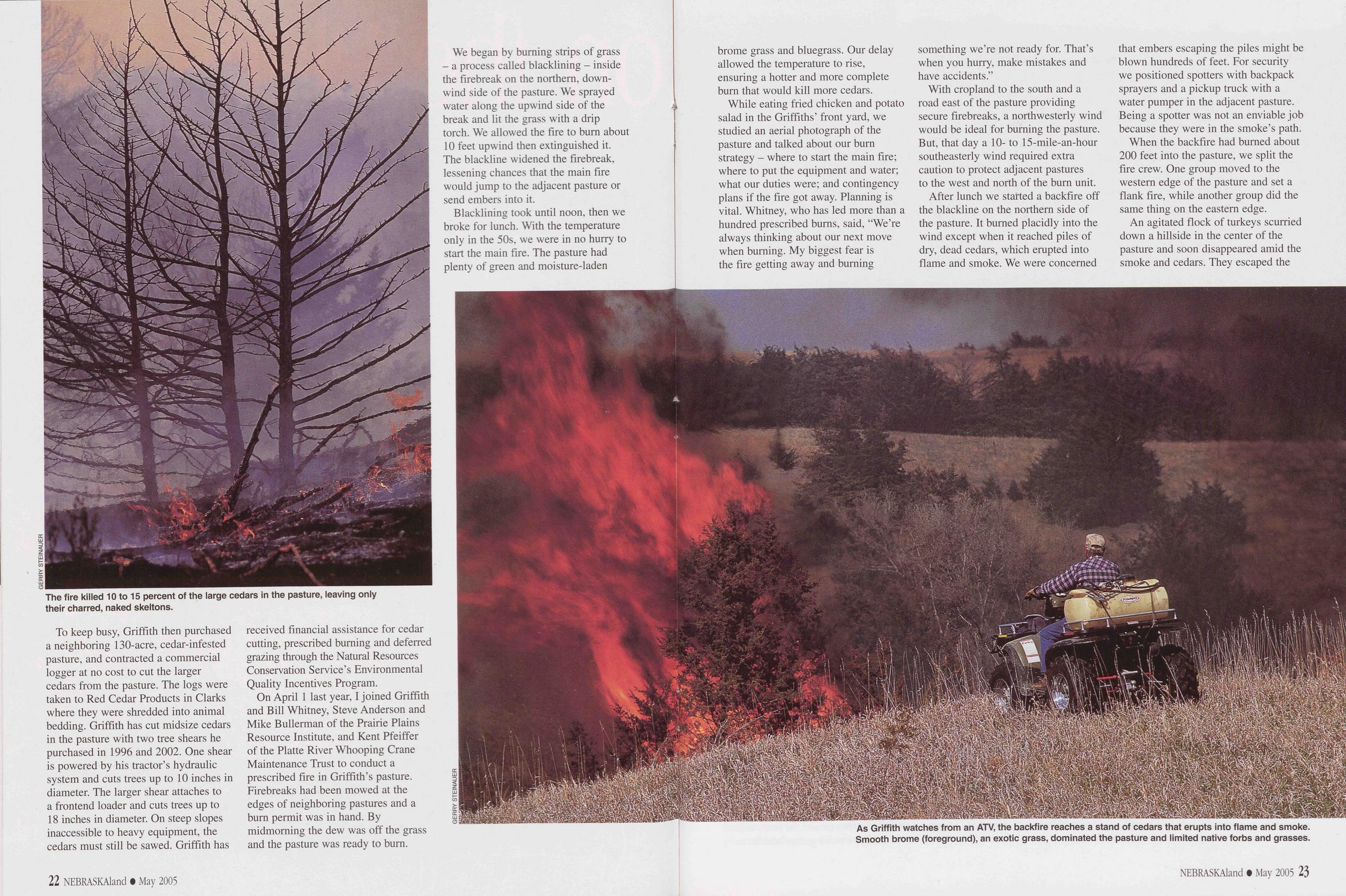
To keep busy, Griffith then purchased a neighboring 130-acre, cedar-infested pasture, and contracted a commercial logger at no cost to cut the larger cedars from the pasture. The logs were taken to Red Cedar Products in Clarks where they were shredded into animal bedding. Griffith has cut midsize cedars in the pasture with two tree shears he purchased in 1996 and 2002. One shear is powered by his tractor’s hydraulic system and cuts trees up to 10 inches in diameter. The larger shear attaches to a frontend loader and cuts trees up to 18 inches in diameter. On steep slopes inaccessible to heavy equipment, the cedars must still be sawed. Griffith has received financial assistance for cedar cutting, prescribed burning and deferred grazing through the Natural Resources Conservation Service’s Environmental Quality Incentives Program.
On April 1 last year, I joined Griffith and Bill Whitney, Steve Anderson and Mike Bullerman of the Prairie Plains Resource Institute, and Kent Pfeiffer of the Platte River Whooping Crane Maintenance Trust to conduct a prescribed fire in Griffith’s pasture. Firebreaks had been mowed at the edges of neighboring pastures and a burn permit was in hand. By midmorning the dew was off the grass and the pasture was ready to burn.
We began by burning strips of grass - a process called blacklining - inside the firebreak on the northern, down- wind side of the pasture. We sprayed water along the upwind side of the break and lit the grass with a drip torch. We allowed the fire to burn about 10 feet upwind then extinguished it. The blackline widened the firebreak, lessening chances that the main fire would jump to the adjacent pasture or send embers into it.
Blacklining took until noon, then we broke for lunch. With the temperature only in the 50s, we were in no hurry to start the main fire. The pasture had plenty of green and moisture-laden 22 NEBRASKAland • May 2005
While eating fried chicken and potato salad in the Griffiths’ front yard, we studied an aerial photograph of the pasture and talked about our burn strategy - where to start the main fire; where to put the equipment and water; what our duties were; and contingency plans if the fire got away. Planning is vital. Whitney, who has led more than a hundred prescribed bums, said, “We’re always thinking about our next move when burning. My biggest fear is the fire getting away and burning something we’re not ready for. That’s when you hurry, make mistakes and have accidents.”
With cropland to the south and a road east of the pasture providing secure firebreaks, a northwesterly wind would be ideal for burning the pasture. But, that day a 10- to 15-mile-an-hour southeasterly wind required extra caution to protect adjacent pastures to the west and north of the burn unit.
After lunch we started a backfire off the blackline on the northern side of the pasture. It burned placidly into the wind except when it reached piles of dry, dead cedars, which erupted into flame and smoke. We were concerned that embers escaping the piles might be blown hundreds of feet. For security we positioned spotters with backpack sprayers and a pickup truck with a water pumper in the adjacent pasture. Being a spotter was not an enviable job because they were in the smoke’s path.
When the backfire had burned about 200 feet into the pasture, we split the fire crew. One group moved to the western edge of the pasture and set a flank fire, while another group did the same thing on the eastern edge.
An agitated flock of turkeys scurried
down a hillside in the center of the
pasture and soon disappeared amid the
smoke and cedars. They escaped the
NEBRASKAland • May 2005 23
By late afternoon we had reached the southern side of the pasture and lit the head fire. Pushed by the wind, it moved quickly, but because the sun was low on the horizon and the temperature had dropped, the fire burned with less intensity than we had hoped. After about a half hour, the back, flank and head fires met and the burn was essentially over. Two crewmembers 24 NEBRASKAland • May 2005 lit patches of unburned grass in the pasture while others patrolled the perimeter dousing logs and other debris that was still burning. If the wind rose during the night, these hot spots might send embers into a neighboring pasture. One crewmember stayed into the evening to monitor the burn.
As the sun set, I walked the pasture to admire the burn. I flushed a rabbit from an unburned patch and it darted over the ash as if a hawk was eyeing it. I saw no burned or dead animals. During the fire, they had fled to unburned areas or into burrows. The fire killed 10 to 15 percent of the large cedars and most of the small cedars. The foliage of many cedars did not burn, but the intense heat browned it and, in time, these trees will die. The piles of dead cedars burned almost completely.
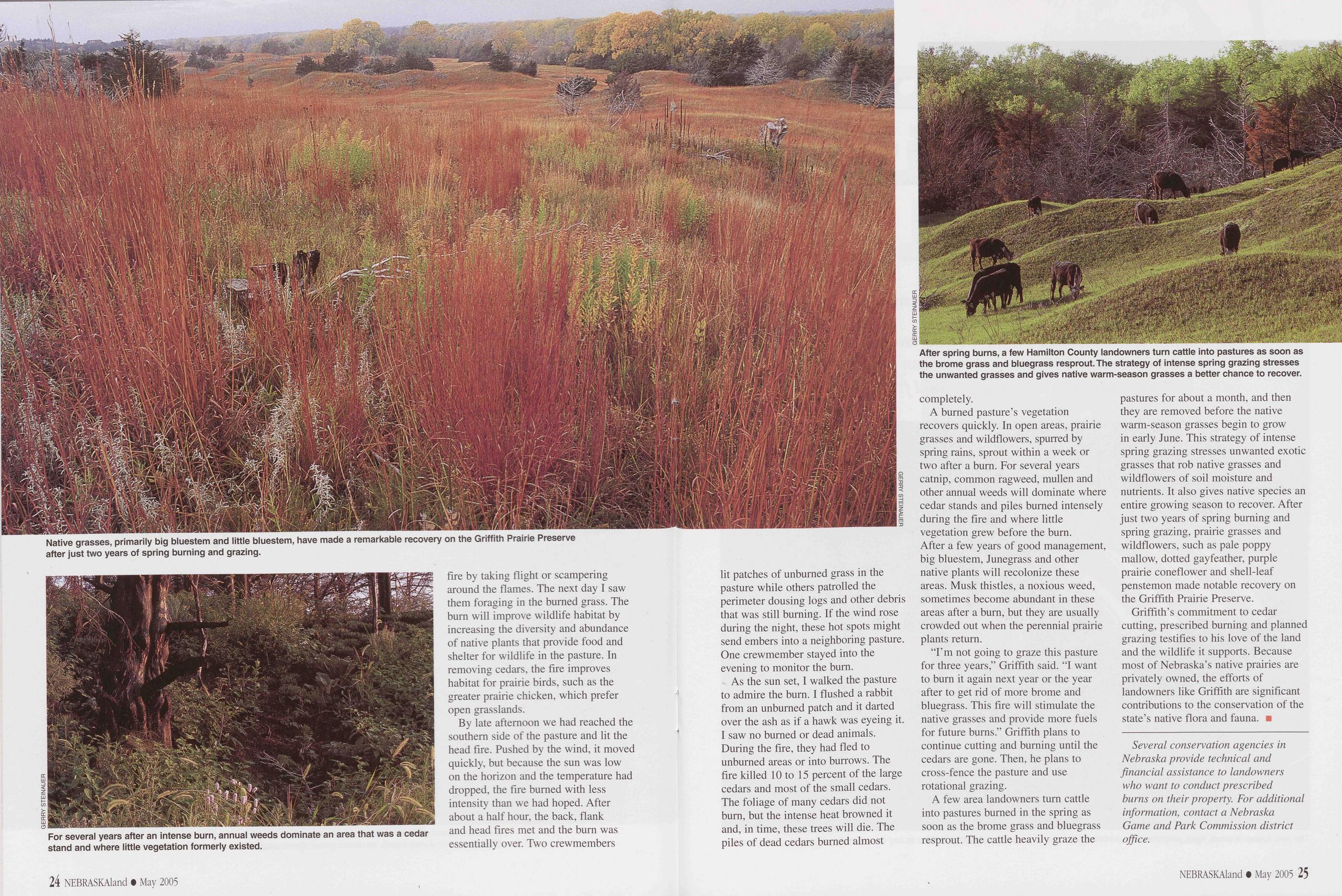
A burned pasture’s vegetation recovers quickly. In open areas, prairie grasses and wildflowers, spurred by spring rains, sprout within a week or two after a burn. For several years catnip, common ragweed, mullen and other annual weeds will dominate where cedar stands and piles burned intensely during the fire and where little vegetation grew before the burn. After a few years of good management, big bluestem, Junegrass and other native plants will recolonize these areas. Musk thistles, a noxious weed, sometimes become abundant in these areas after a burn, but they are usually crowded out when the perennial prairie plants return.
“I’m not going to graze this pasture for three years,” Griffith said. "I want to burn it again next year or the year after to get rid of more brome and bluegrass. This fire will stimulate the native grasses and provide more fuels for future burns.” Griffith plans to continue cutting and burning until the cedars are gone. Then, he plans to cross-fence the pasture and use rotational grazing.
A few area landowners turn cattle into pastures burned in the spring as soon as the brome grass and bluegrass resprout. The cattle heavily graze the pastures for about a month, and then they are removed before the native warm-season grasses begin to grow in early June. This strategy of intense spring grazing stresses unwanted exotic grasses that rob native grasses and wildflowers of soil moisture and nutrients. It also gives native species an entire growing season to recover. After just two years of spring burning and spring grazing, prairie grasses and wildflowers, such as pale poppy mallow, dotted gayfeather, purple prairie coneflower and shell-leaf penstemon made notable recovery on the Griffith Prairie Preserve.
Griffith’s commitment to cedar cutting, prescribed burning and planned grazing testifies to his love of the land and the wildlife it supports. Because most of Nebraska’s native prairies are privately owned, the efforts of landowners like Griffith are significant contributions to the conservation of the state’s native flora and fauna.
Several conservation agencies in Nebraska provide technical and financial assistance to landowners who want to conduct prescribed burns on their property. For additional information, contact a Nebraska Game and Park Commission district office. NEBRASKAland • May 2005 25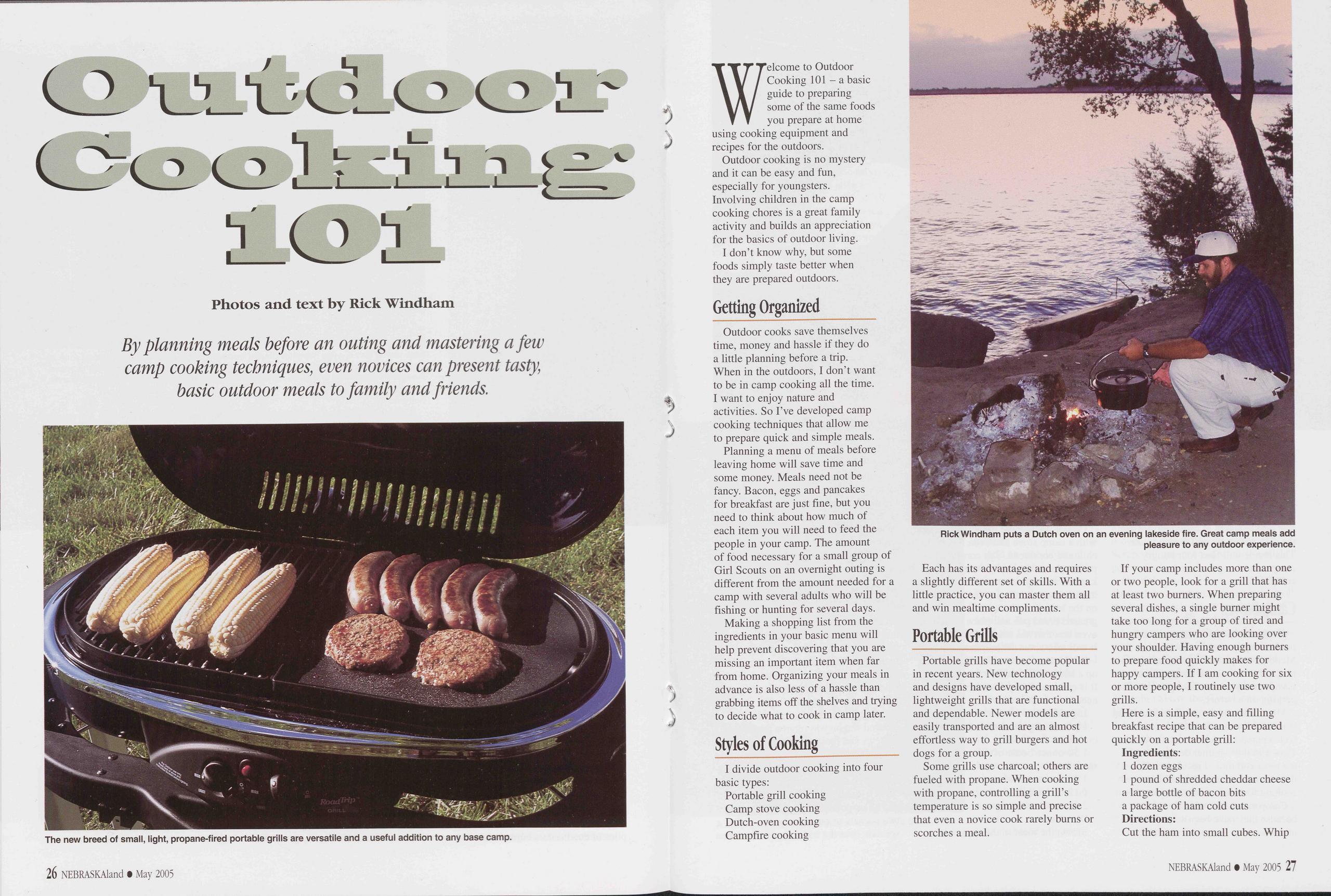
Outdoor Cooking 101
By planning meals before an outing and mastering a few camp cooking techniques, even novices can present tasty, basic outdoor meals to family and friends.
Welcome to Outdoor Cooking 101 - a basic guide to preparing some of the same foods you prepare at home using cooking equipment and recipes for the outdoors.
Outdoor cooking is no mystery and it can be easy and fun, especially for youngsters. Involving children in the camp cooking chores is a great family activity and builds an appreciation for the basics of outdoor living.
I don’t know why, but some foods simply taste better when they are prepared outdoors.
Getting OrganizedOutdoor cooks save themselves time, money and hassle if they do a little planning before a trip. When in the outdoors, I don’t want to be in camp cooking all the time. I want to enjoy nature and activities. So I’ve developed camp cooking techniques that allow me to prepare quick and simple meals.
Planning a menu of meals before leaving home will save time and some money. Meals need not be fancy. Bacon, eggs and pancakes for breakfast are just fine, but you need to think about how much of each item you will need to feed the people in your camp. The amount of food necessary for a small group of Girl Scouts on an overnight outing is different from the amount needed for a camp with several adults who will be fishing or hunting for several days.
Making a shopping list from the ingredients in your basic menu will help prevent discovering that you are missing an important item when far from home. Organizing your meals in advance is also less of a hassle than grabbing items off the shelves and trying to decide what to cook in camp later.
Styles of CookingI divide outdoor cooking into four basic types: Portable grill cooking Camp stove cooking Dutch-oven cooking Campfire cooking
Each has its advantages and requires a slightly different set of skills. With a little practice, you can master them all and win mealtime compliments.
Portable GrillsPortable grills have become popular in recent years. New technology and designs have developed small, lightweight grills that are functional and dependable. Newer models are easily transported and are an almost effortless way to grill burgers and hot dogs for a group.
Some grills use charcoal; others are fueled with propane. When cooking with propane, controlling a grill’s temperature is so simple and precise that even a novice cook rarely burns or scorches a meal.
If your camp includes more than one or two people, look for a grill that has at least two burners. When preparing several dishes, a single burner might take too long for a group of tired and hungry campers who are looking over your shoulder. Having enough burners to prepare food quickly makes for happy campers. If I am cooking for six or more people, I routinely use two grills.
Here is a simple, easy and filling
breakfast recipe that can be prepared
quickly on a portable grill:
Ingredients:
1 dozen eggs
1 pound of shredded cheddar cheese
a large bottle of bacon bits
a package of ham cold cuts
Directions:
Cut the ham into small cubes. Whip
NEBRASKAland • May 2005 27
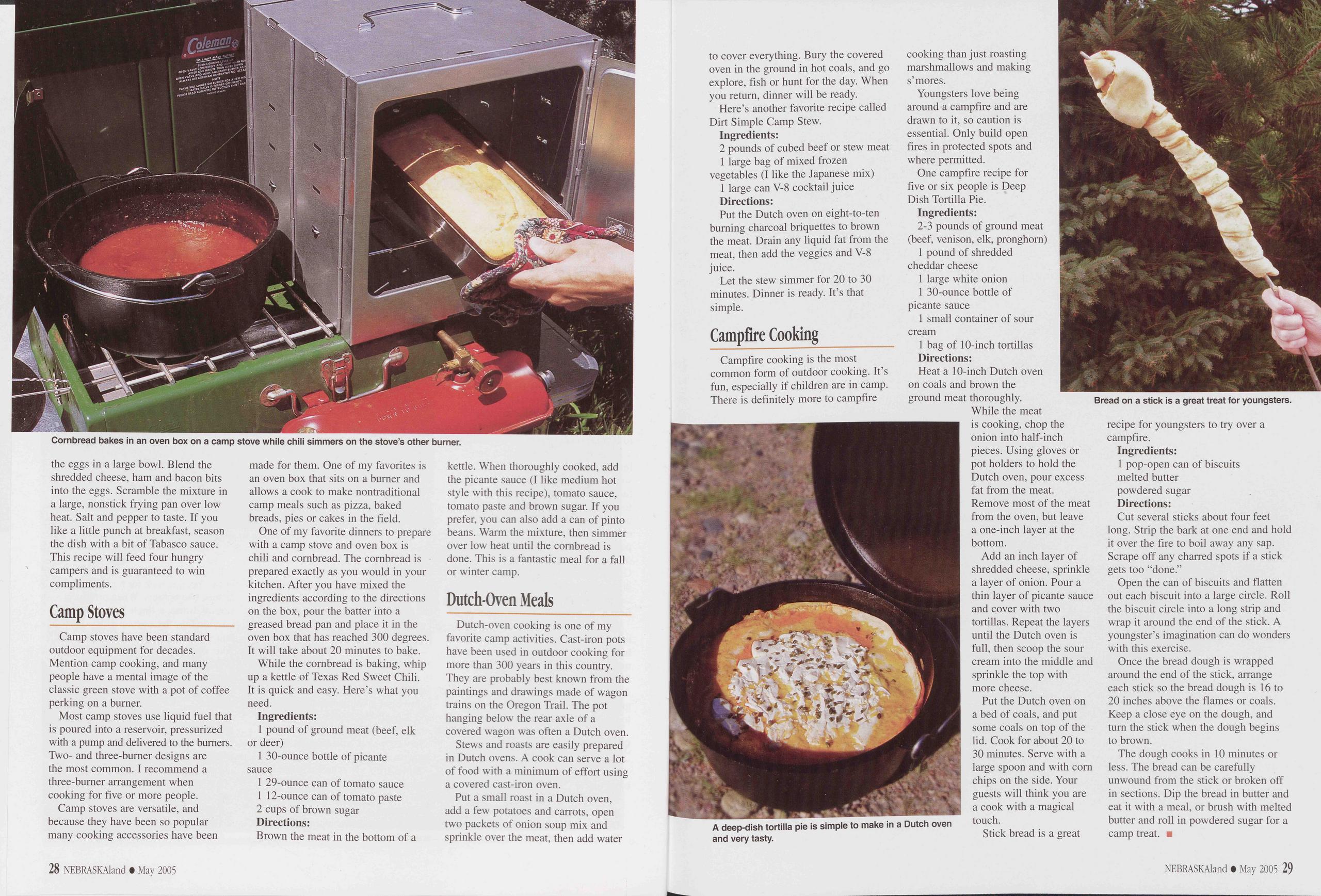
Camp stoves have been standard outdoor equipment for decades. Mention camp cooking, and many people have a mental image of the classic green stove with a pot of coffee perking on a burner.
Most camp stoves use liquid fuel that is poured into a reservoir, pressurized with a pump and delivered to the burners. Two- and three-burner designs are the most common. I recommend a three-burner arrangement when cooking for five or more people.
Camp stoves are versatile, and because they have been so popular many cooking accessories have been made for them. One of my favorites is an oven box that sits on a burner and allows a cook to make nontraditional camp meals such as pizza, baked breads, pies or cakes in the field.
One of my favorite dinners to prepare with a camp stove and oven box is chili and cornbread. The cornbread is prepared exactly as you would in your kitchen. After you have mixed the ingredients according to the directions on the box, pour the batter into a greased bread pan and place it in the oven box that has reached 300 degrees. It will take about 20 minutes to bake.
While the cornbread is baking, whip up a kettle of Texas Red Sweet Chili. It is quick and easy. Here’s what you need. Ingredients: 1 pound of ground meat (beef, elk or deer) 1 30-ounce bottle of picante sauce 1 29-ounce can of tomato sauce 1 12-ounce can of tomato paste 2 cups of brown sugar Directions: Brown the meat in the bottom of a kettle. When thoroughly cooked, add the picante sauce (I like medium hot style with this recipe), tomato sauce, tomato paste and brown sugar. If you prefer, you can also add a can of pinto beans. Warm the mixture, then simmer over low heat until the cornbread is done. This is a fantastic meal for a fall or winter camp.
Dutch-Oven MealsDutch-oven cooking is one of my favorite camp activities. Cast-iron pots have been used in outdoor cooking for more than 300 years in this country. They are probably best known from the paintings and drawings made of wagon trains on the Oregon Trail. The pot hanging below the rear axle of a covered wagon was often a Dutch oven.
Stews and roasts are easily prepared in Dutch ovens. A cook can serve a lot of food with a minimum of effort using a covered cast-iron oven.
Put a small roast in a Dutch oven, add a few potatoes and carrots, open two packets of onion soup mix and sprinkle over the meat, then add water 28 NEBRASKAland • May 2005 to cover everything. Bury the covered oven in the ground in hot coals, and go explore, fish or hunt for the day. When you return, dinner will be ready.
Here’s another favorite recipe called Dirt Simple Camp Stew. Ingredients: 2 pounds of cubed beef or stew meat 1 large bag of mixed frozen vegetables (I like the Japanese mix) 1 large can V-8 cocktail juice Directions: Put the Dutch oven on eight-to-ten burning charcoal briquettes to brown the meat. Drain any liquid fat from the meat, then add the veggies and V-8 juice.
Let the stew simmer for 20 to 30 minutes. Dinner is ready. It’s that simple.
Campfire Cooking Campfire cooking is the most common form of outdoor cooking. It’s fun, especially if children are in camp. There is definitely more to campfireYoungsters love being around a campfire and are drawn to it, so caution is essential. Only build open fires in protected spots and where permitted.
One campfire recipe for five or six people is Deep Dish Tortilla Pie. Ingredients: 2-3 pounds of ground meat (beef, venison, elk, pronghorn) 1 pound of shredded cheddar cheese 1 large white onion 1 30-ounce bottle of picante sauce 1 small container of sour cream 1 bag of 10-inch tortillas Directions: Heat a 10-inch Dutch oven on coals and brown the ground meat thoroughly. While the meat is cooking, chop the onion into half-inch pieces. Using gloves or pot holders to hold the Dutch oven, pour excess fat from the meat. Remove most of the meat from the oven, but leave a one-inch layer at the bottom.
Add an inch layer of shredded cheese, sprinkle a layer of onion. Pour a thin layer of picante sauce and cover with two tortillas. Repeat the layers until the Dutch oven is full, then scoop the sour cream into the middle and sprinkle the top with more cheese.
Put the Dutch oven on a bed of coals, and put some coals on top of the lid. Cook for about 20 to 30 minutes. Serve with a large spoon and with corn chips on the side. Your guests will think you are a cook with a magical touch.
Stick bread is a great Bread on a stick is a great treat for youngsters. recipe for youngsters to try over a campfire. Ingredients: 1 pop-open can of biscuits melted butter powdered sugar Directions: Cut several sticks about four feet long. Strip the bark at one end and hold it over the fire to boil away any sap. Scrape off any charred spots if a stick gets too “done.”
Open the can of biscuits and flatten out each biscuit into a large circle. Roll the biscuit circle into a long strip and wrap it around the end of the stick. A youngster’s imagination can do wonders with this exercise.
Once the bread dough is wrapped around the end of the stick, arrange each stick so the bread dough is 16 to 20 inches above the flames or coals. Keep a close eye on the dough, and turn the stick when the dough begins to brown.
The dough cooks in 10 minutes or less. The bread can be carefully unwound from the stick or broken off in sections. Dip the bread in butter and eat it with a meal, or brush with melted butter and roll in powdered sugar for a camp treat.
NEBRASKAland • May 2005 29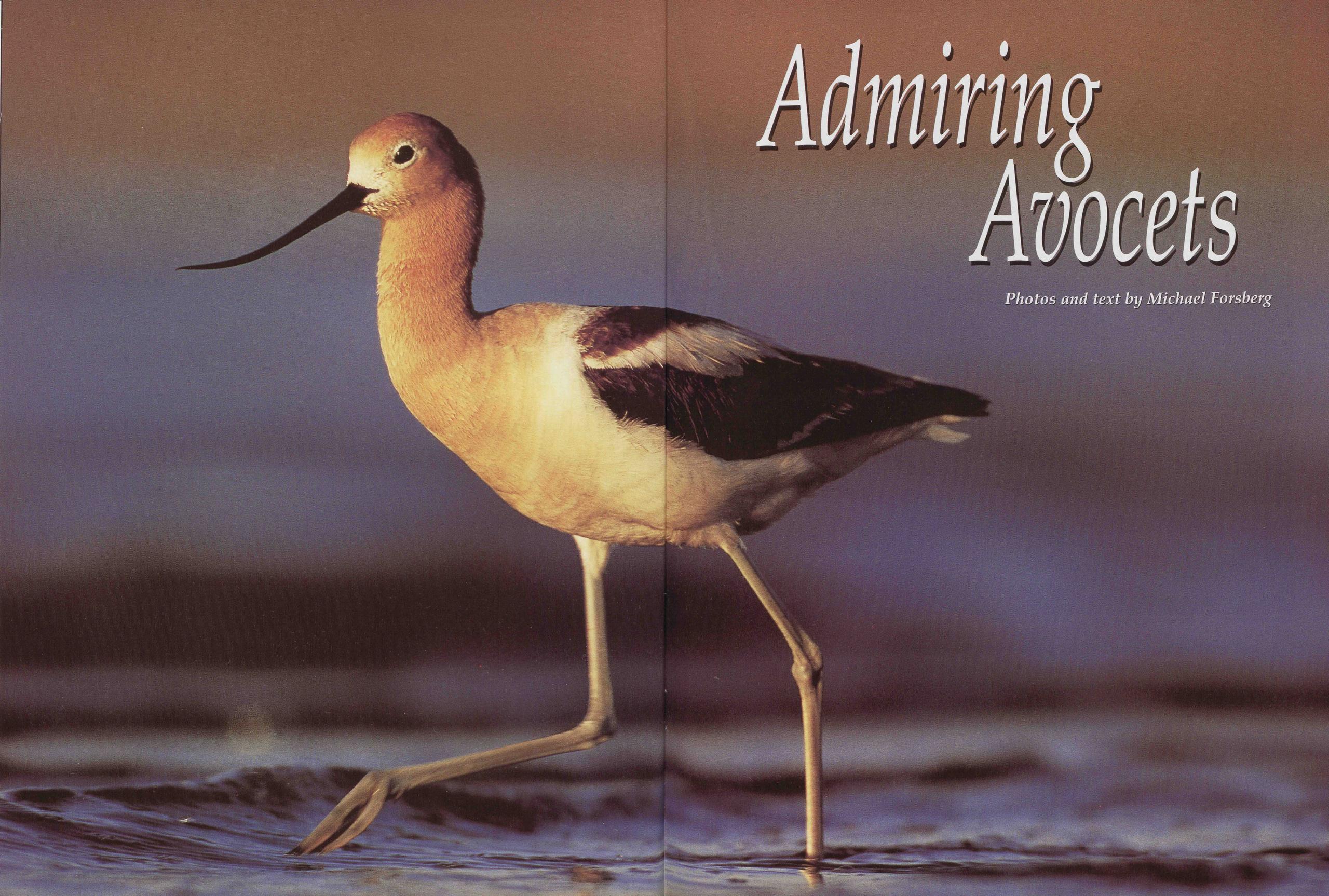
Admiring Avocets
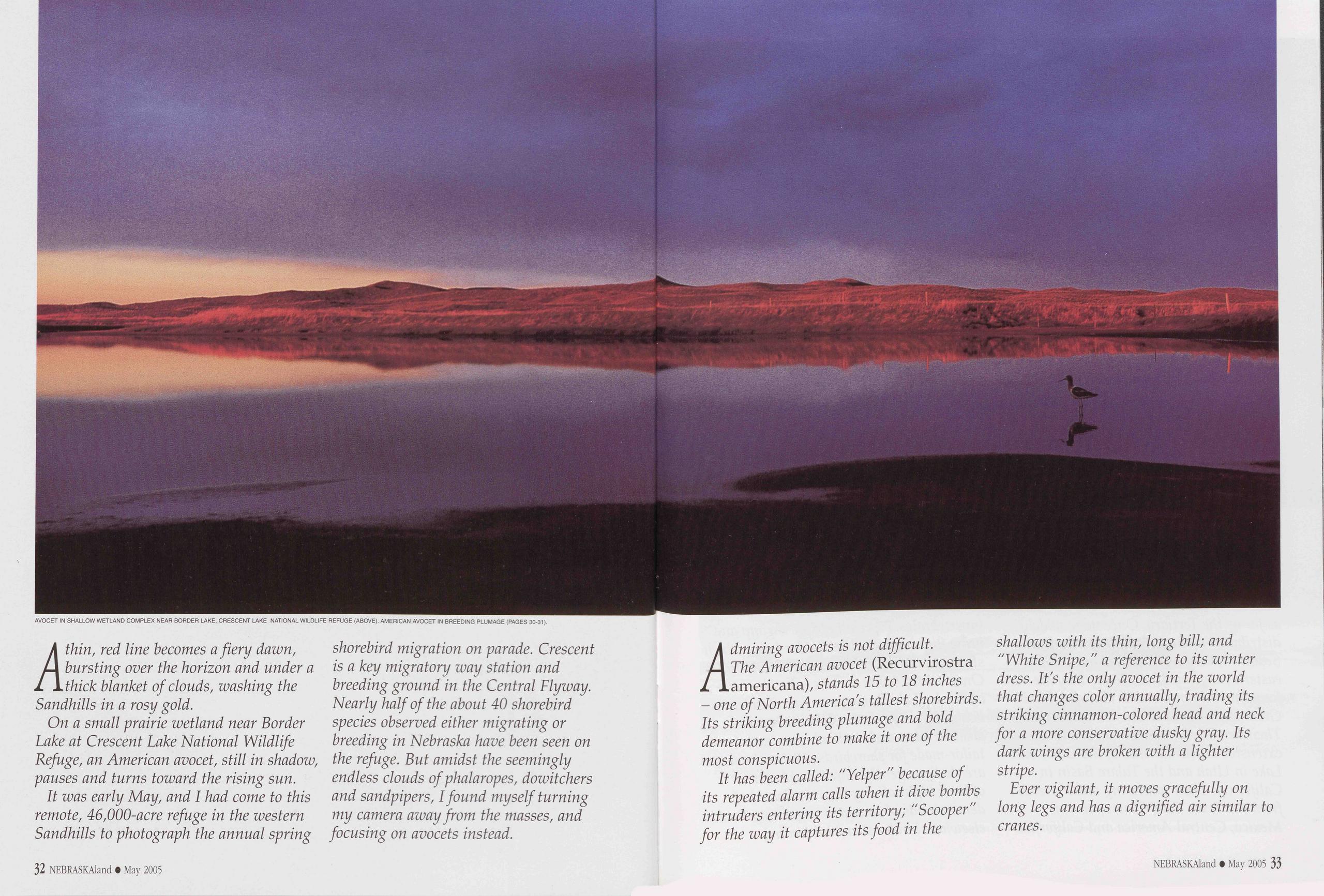
A thin, red line becomes a fiery dawn, bursting over the horizon and under a thick blanket of clouds, washing the Sandhills in a rosy gold.
On a small prairie wetland near Border Lake at Crescent Lake National Wildlife Refuge, an American avocet, still in shadow, pauses and turns toward the rising sun.
It was early May, and I had come to this remote, 46,000-acre refuge in the western Sandhills to photograph the annual spring shorebird migration on parade. Crescent is a key migratory way station and breeding ground in the Central Flyway. Nearly half of the about 40 shorebird species observed either migrating or breeding in Nebraska have been seen on the refuge. But amidst the seemingly endless clouds of phalaropes, dowitchers and sandpipers, I found myself turning my camera away from the masses, and focusing on avocets instead.
32 NEBRASKAland • May 2005Admiring avocets is not difficult. The American avocet (Recurvirostra americana), stands 15 to 18 inches - one of North America's tallest shorebirds. Its striking breeding plumage and bold demeanor combine to make it one of the most conspicuous.
It has been called: "Yelper" because of its repeated alarm calls when it dive bombs intruders entering its territory; "Scooper" for the way it captures its food in the shallows with its thin, long bill; and "White Snipe," a reference to its winter dress. It's the only avocet in the world that changes color annually, trading its striking cinnamon-colored head and neck for a more conservative dusky gray. Its dark wings are broken with a lighter stripe.
Ever vigilant, it moves gracefully on long legs and has a dignified air similar to cranes.
NEBRASKAland • May 2005 33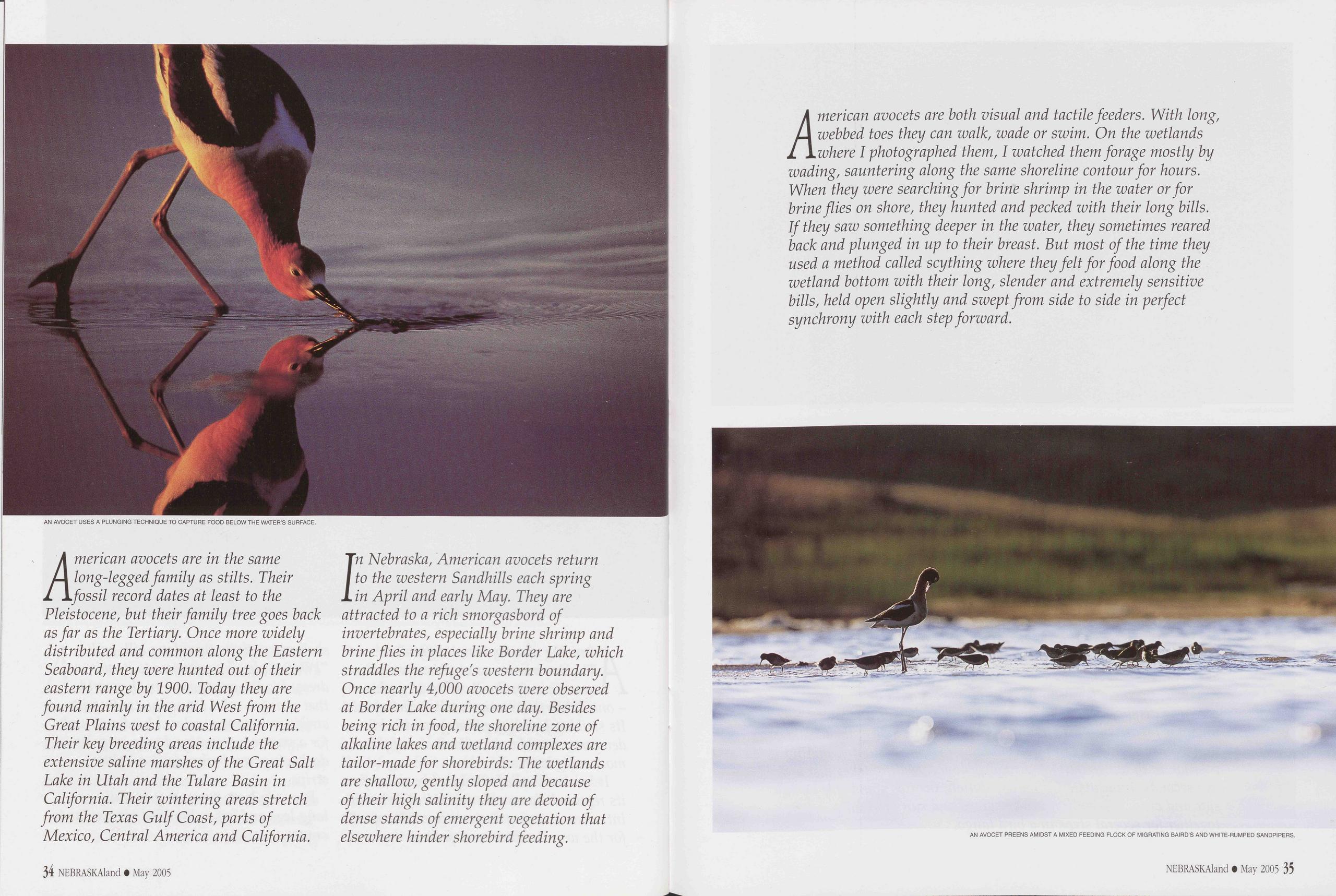
American avocets are in the same long-legged family as stilts. Their fossil record dates at least to the Pleistocene, but their family tree goes back as far as the Tertiary. Once more widely distributed and common along the Eastern Seaboard, they were hunted out of their eastern range by 1900. Today they are found mainly in the arid West from the Great Plains west to coastal California. Their key breeding areas include the extensive saline marshes of the Great Salt Lake in Utah and the Tulare Basin in California. Their wintering areas stretch from the Texas Gulf Coast, parts of Mexico, Central America and California.
In Nebraska, American avocets return to the western Sandhills each spring in April and early May. They are attracted to a rich smorgasbord of invertebrates, especially brine shrimp and brine flies in places like Border Lake, which straddles the refuge's western boundary. Once nearly 4,000 avocets were observed at Border Lake during one day. Besides being rich in food, the shoreline zone of alkaline lakes and wetland complexes are tailor-made for shorebirds: The wetlands are shallow, gently sloped and because of their high salinity they are devoid of dense stands of emergent vegetation that elsewhere hinder shorebird feeding.
34 NEBRASKAland • May 2005American avocets are both visual and tactile feeders. With long, webbed toes they can walk, wade or swim. On the wetlands where I photographed them, I watched them forage mostly by wading, sauntering along the same shoreline contour for hours. When they were searching for brine shrimp in the water or for brine flies on shore, they hunted and pecked with their long bills. If they saw something deeper in the water, they sometimes reared back and plunged in up to their breast. But most of the time they used a method called scything where they felt for food along the wetland bottom with their long, slender and extremely sensitive bills, held open slightly and swept from side to side in perfect synchrony with each step forward.
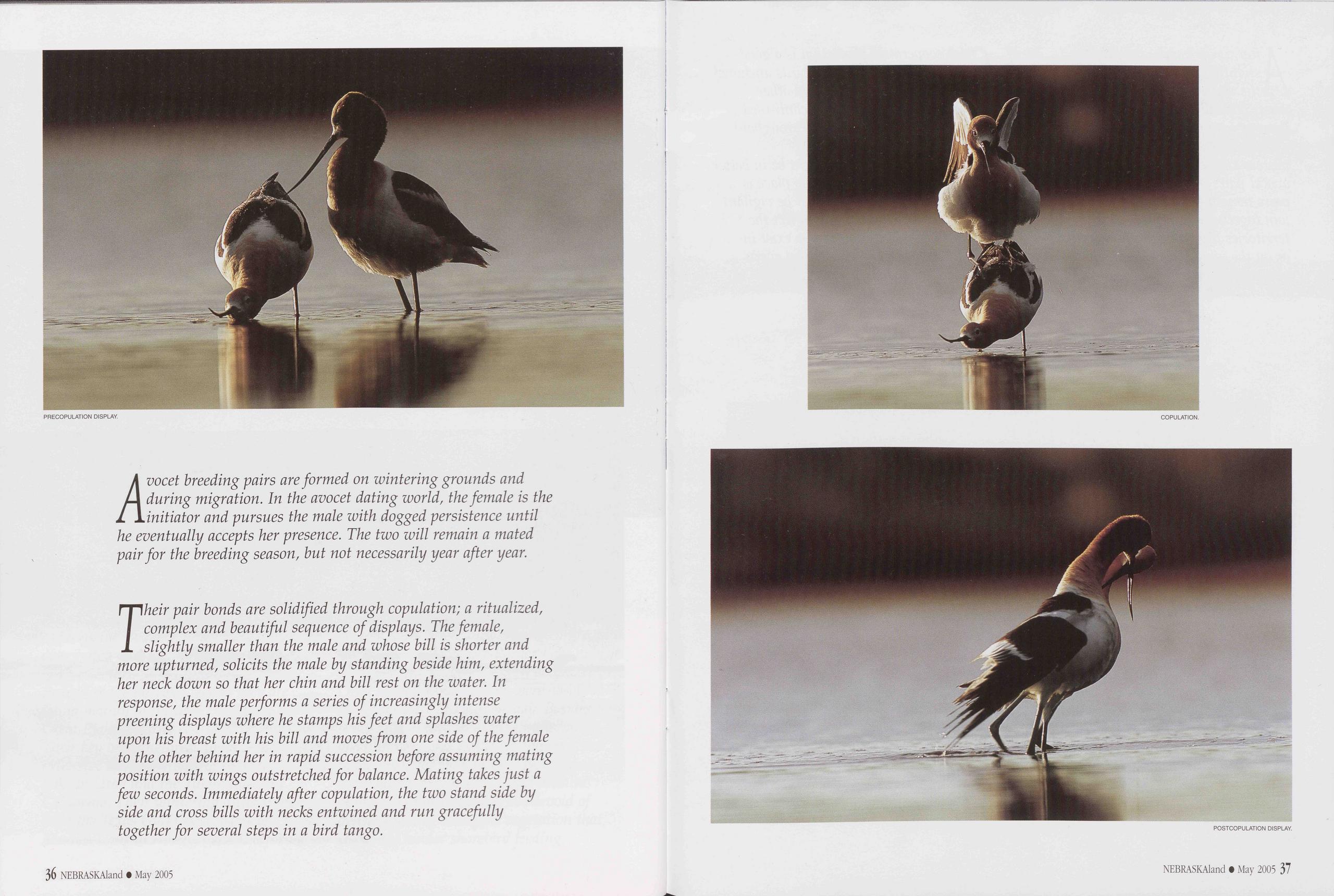
Avocet breeding pairs are formed on wintering grounds and during migration. In the avocet dating world, the female is the initiator and pursues the male with dogged persistence until he eventually accepts her presence. The two will remain a mated pair for the breeding season, but not necessarily year after year.
Their pair bonds are solidified through copulation; a ritualized, complex and beautiful sequence of displays. The female, slightly smaller than the male and whose bill is shorter and more upturned, solicits the male by standing beside him, extending her neck down so that her chin and bill rest on the water. In response, the male performs a series of increasingly intense preening displays where he stamps his feet and splashes water upon his breast with his bill and moves from one side of the female to the other behind her in rapid succession before assuming mating position with wings outstretched for balance. Mating takes just a few seconds. Immediately after copulation, the two stand side by side and cross bills with necks entwined and run gracefully together for several steps in a bird tango.
36 NEBRASKAland • May 2005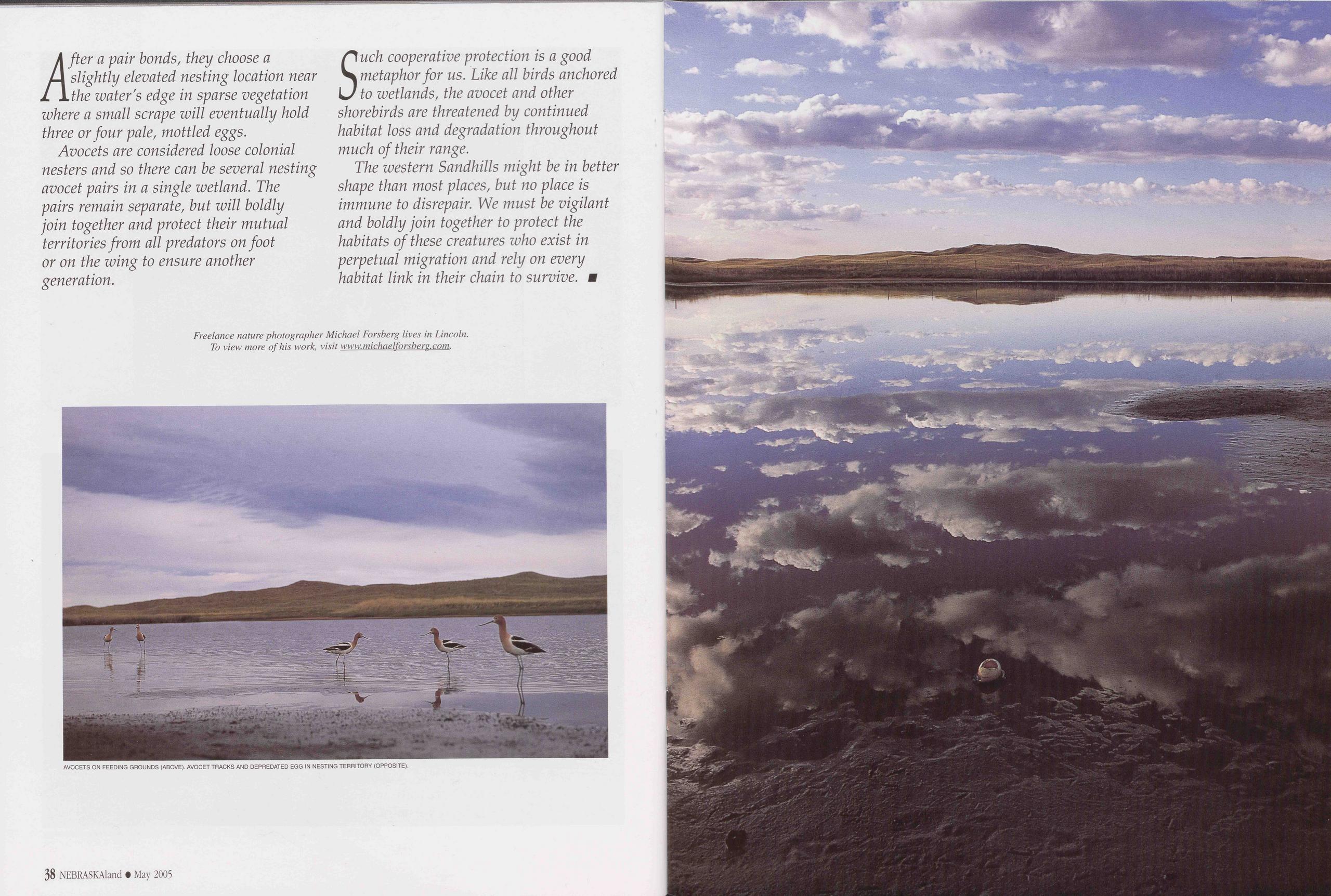
After a pair bonds, they choose a slightly elevated nesting location near the water's edge in sparse vegetation where a small scrape will eventually hold three or four pale, mottled eggs.
Avocets are considered loose colonial nesters and so there can be several nesting avocet pairs in a single wetland. The pairs remain separate, but will boldly join together and protect their mutual territories from all predators on foot or on the wing to ensure another generation.
Freelance nature photographer Michael Forsberg lives in Lincoln. To view more of his work, visit www. michaelforsberg. com.Such cooperative protection is a good metaphor for us. Like all birds anchored to wetlands, the avocet and other shorebirds are threatened by continued habitat loss and degradation throughout much of their range.
The western Sandhills might be in better shape than most places, but no place is immune to disrepair. We must be vigilant and boldly join together to protect the habitats of these creatures who exist in perpetual migration and rely on every habitat link in their chain to survive.
38 NEBRASKAland • May 2005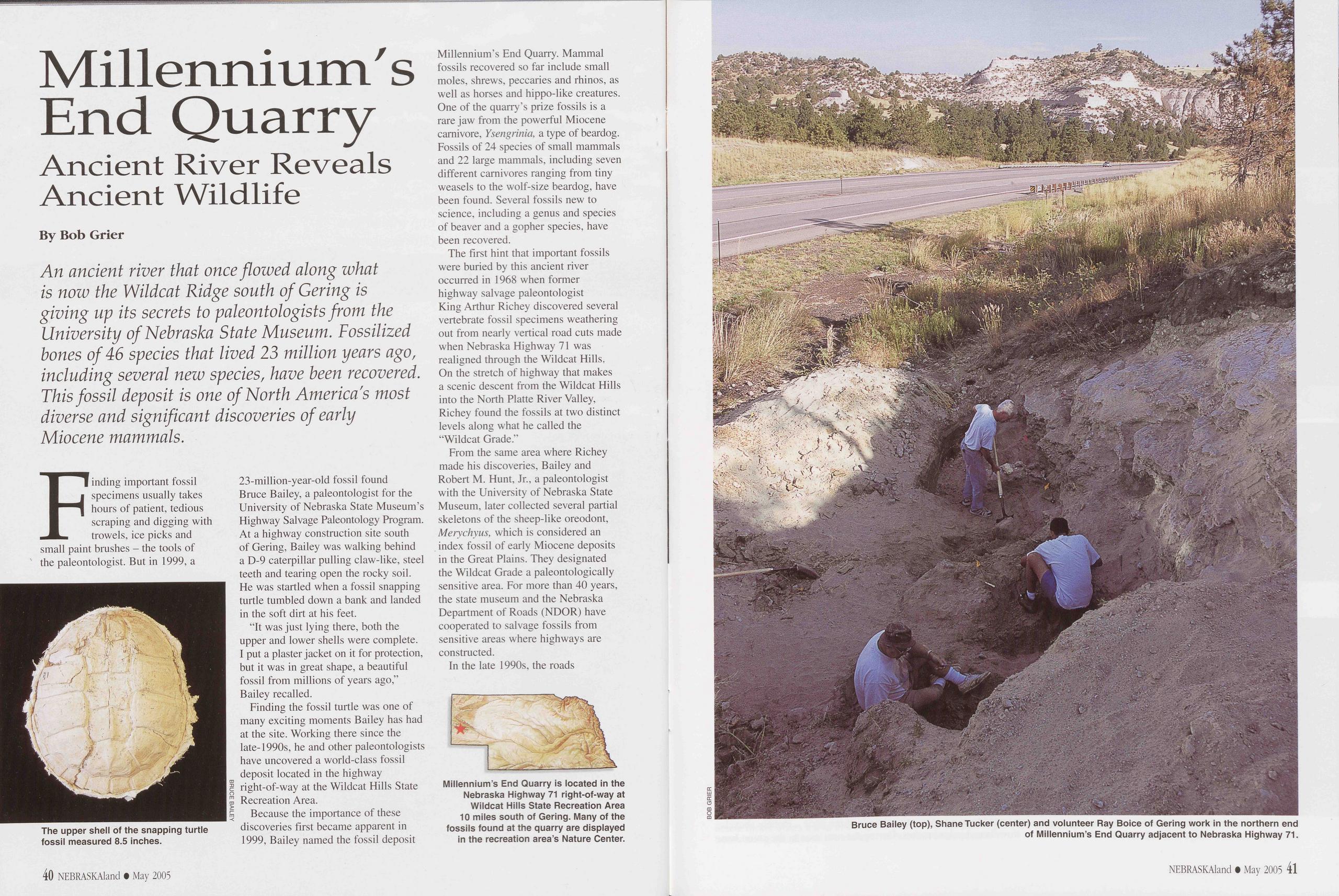
Millennium's End Quarry Ancient River Reveals Ancient Wildlife
An ancient river that once flowed along what is now the Wildcat Ridge south of Gering is giving up its secrets to paleontologists from the University of Nebraska State Museum. Fossilized bones of 46 species that lived 23 million years ago, including several new species, have been recovered. This fossil deposit is one of North America's most diverse and significant discoveries of early Miocene mammals.
Finding important fossil specimens usually takes hours of patient, tedious scraping and digging with trowels, ice picks and small paint brushes - the tools of the paleontologist. But in 1999, a The upper shell of the snapping turtle fossil measured 8.5 inches. 23-million-year-old fossil found Bruce Bailey, a paleontologist for the University of Nebraska State Museum’s Highway Salvage Paleontology Program. At a highway construction site south of Gering, Bailey was walking behind a D-9 caterpillar pulling claw-like, steel teeth and tearing open the rocky soil. He was startled when a fossil snapping turtle tumbled down a bank and landed in the soft dirt at his feet.
“It was just lying there, both the upper and lower shells were complete. I put a plaster jacket on it for protection, but it was in great shape, a beautiful fossil from millions of years ago,” Bailey recalled.
Finding the fossil turtle was one of many exciting moments Bailey has had at the site. Working there since the late-1990s, he and other paleontologists have uncovered a world-class fossil deposit located in the highway right-of-way at the Wildcat Hills State Recreation Area.
Because the importance of these discoveries first became apparent in 1999, Bailey named the fossil deposit Millennium’s End Quarry. Mammal fossils recovered so far include small moles, shrews, peccaries and rhinos, as well as horses and hippo-like creatures. One of the quarry’s prize fossils is a rare jaw from the powerful Miocene carnivore, Ysengrinia, a type of beardog. Fossils of 24 species of small mammals and 22 large mammals, including seven different carnivores ranging from tiny weasels to the wolf-size beardog, have been found. Several fossils new to science, including a genus and species of beaver and a gopher species, have been recovered.
The first hint that important fossils were buried by this ancient river occurred in 1968 when former highway salvage paleontologist King Arthur Richey discovered several vertebrate fossil specimens weathering out from nearly vertical road cuts made when Nebraska Highway 71 was realigned through the Wildcat Hills. On the stretch of highway that makes a scenic descent from the Wildcat Hills into the North Platte River Valley, Richey found the fossils at two distinct levels along what he called the “Wildcat Grade.”
From the same area where Richey made his discoveries, Bailey and Robert M. Hunt, Jr., a paleontologist with the University of Nebraska State Museum, later collected several partial skeletons of the sheep-like oreodont, Merychyus, which is considered an index fossil of early Miocene deposits in the Great Plains. They designated the Wildcat Grade a paleontologically sensitive area. For more than 40 years, the state museum and the Nebraska Department of Roads (NDOR) have cooperated to salvage fossils from sensitive areas where highways are constructed.
In the late 1990s, the roads
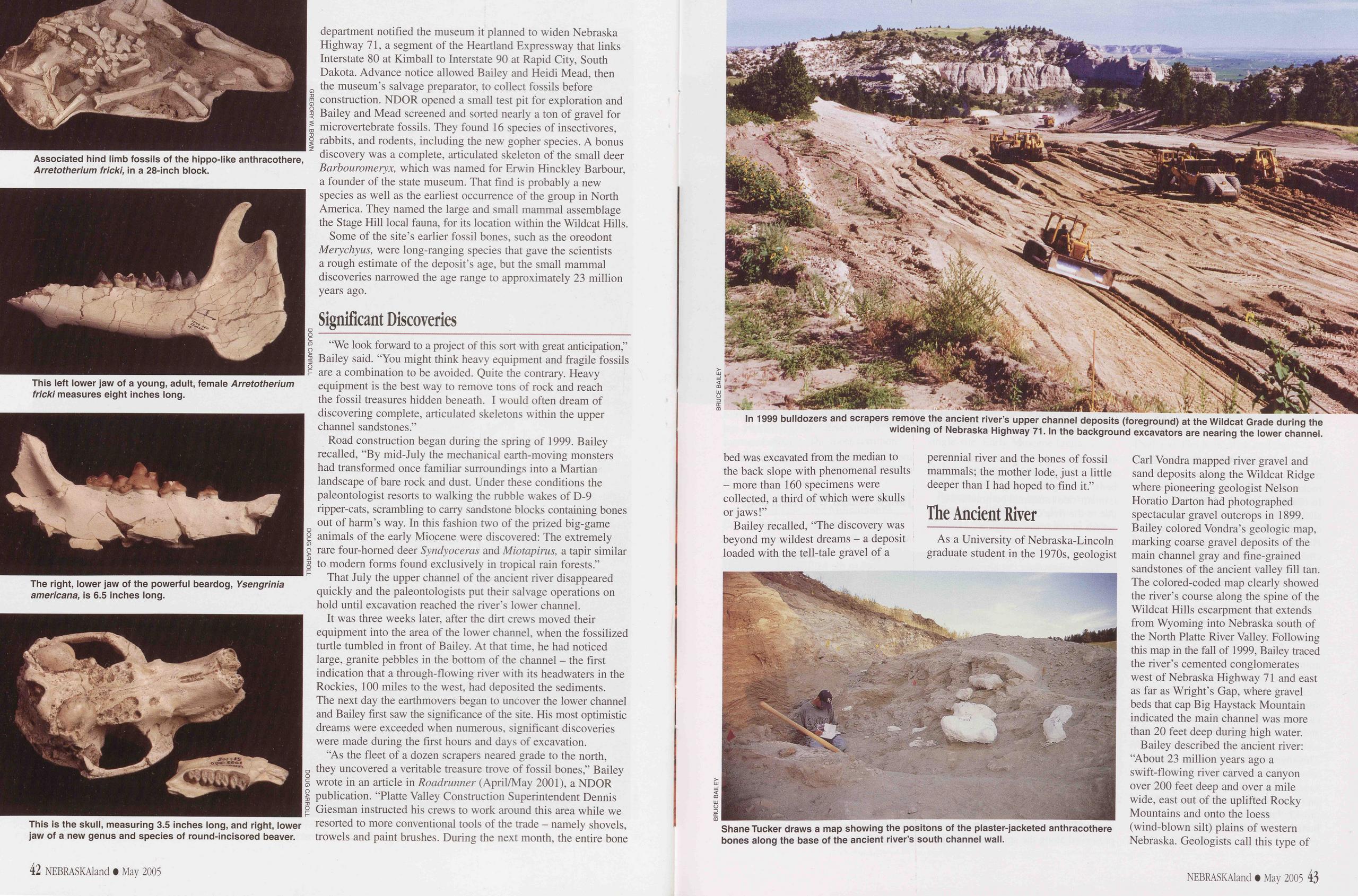
Some of the site’s earlier fossil bones, such as the oreodont Merychyus, were long-ranging species that gave the scientists a rough estimate of the deposit’s age, but the small mammal discoveries narrowed the age range to approximately 23 million years ago.
Significant Discoveries"We look forward to a project of this sort with great anticipation,” Bailey said. "You might think heavy equipment and fragile fossils are a combination to be avoided. Quite the contrary. Heavy equipment is the best way to remove tons of rock and reach the fossil treasures hidden beneath. I would often dream of discovering complete, articulated skeletons within the upper channel sandstones.”
Road construction began during the spring of 1999. Bailey recalled, "By mid-July the mechanical earth-moving monsters had transformed once familiar surroundings into a Martian landscape of bare rock and dust. Under these conditions the paleontologist resorts to walking the rubble wakes of D-9 ripper-cats, scrambling to carry sandstone blocks containing bones out of harm’s way. In this fashion two of the prized big-game animals of the early Miocene were discovered: The extremely rare four-homed deer Syndyoceras and Miotapirus, a tapir similar to modern forms found exclusively in tropical rain forests.”
That July the upper channel of the ancient river disappeared quickly and the paleontologists put their salvage operations on hold until excavation reached the river’s lower channel.
It was three weeks later, after the dirt crews moved their equipment into the area of the lower channel, when the fossilized turtle tumbled in front of Bailey. At that time, he had noticed large, granite pebbles in the bottom of the channel - the first indication that a through-flowing river with its headwaters in the Rockies, 100 miles to the west, had deposited the sediments. The next day the earthmovers began to uncover the lower channel and Bailey first saw the significance of the site. His most optimistic dreams were exceeded when numerous, significant discoveries were made during the first hours and days of excavation.
"As the fleet of a dozen scrapers neared grade to the north, they uncovered a veritable treasure trove of fossil bones,” Bailey wrote in an article in Roadrunner (April/May 2001), a NDOR publication. “Platte Valley Construction Superintendent Dennis desman instructed his crews to work around this area while we resorted to more conventional tools of the trade - namely shovels, trowels and paint brushes. During the next month, the entire bone 42 NEBRASKAland • May 2005
Bailey recalled, "The discovery was beyond my wildest dreams - a deposit loaded with the tell-tale gravel of a perennial river and the bones of fossil mammals; the mother lode, just a little deeper than I had hoped to find it.”
The Ancient RiverAs a University of Nebraska-Lincoln graduate student in the 1970s, geologist
Bailey described the ancient river:
"About 23 million years ago a
swift-flowing river carved a canyon
over 200 feet deep and over a mile
wide, east out of the uplifted Rocky
Mountains and onto the loess
(wind-blown silt) plains of western
Nebraska. Geologists call this type of
NEBRASKAland May 2005 43
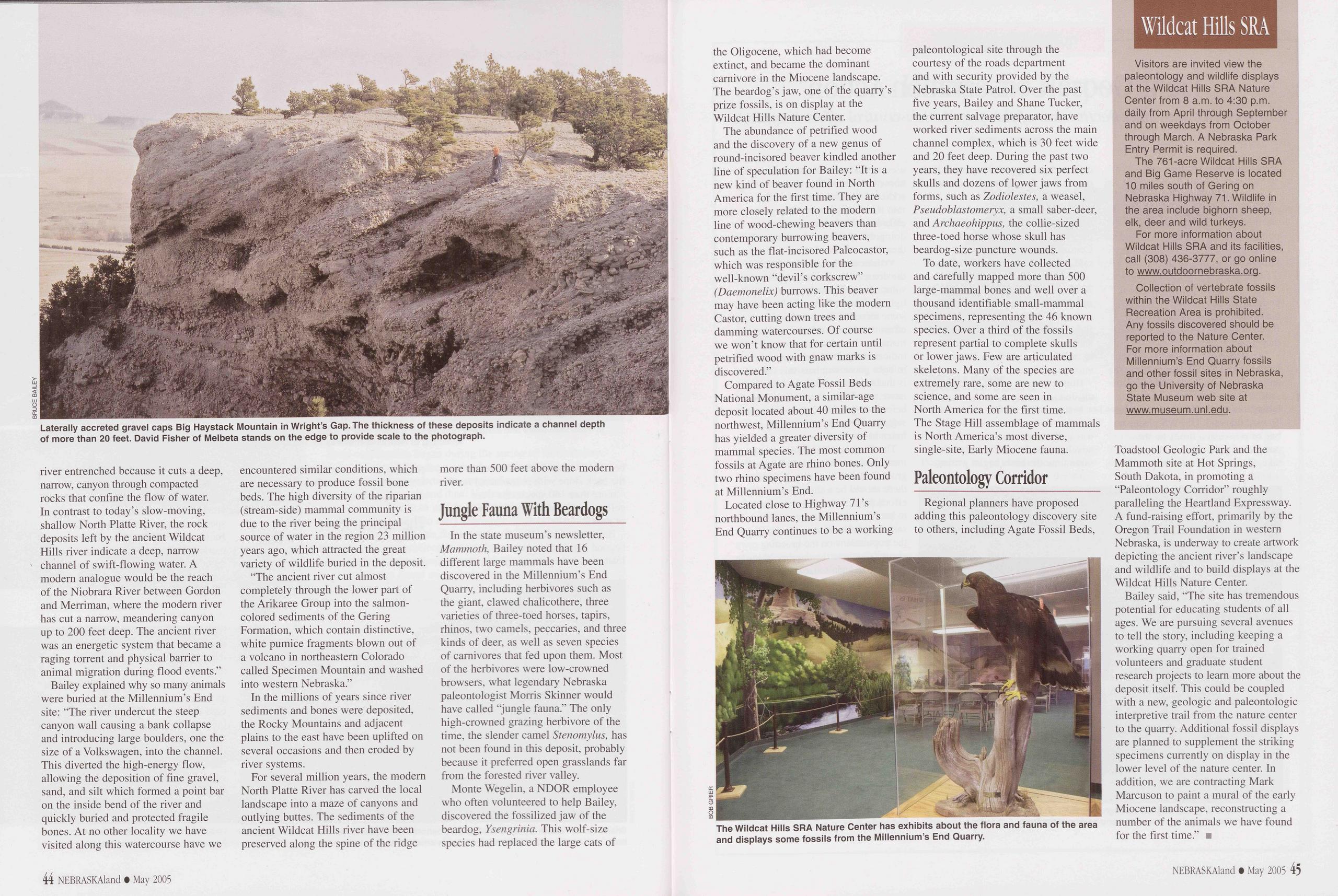
Bailey explained why so many animals were buried at the Millennium’s End site: "The river undercut the steep canyon wall causing a bank collapse and introducing large boulders, one the size of a Volkswagen, into the channel. This diverted the high-energy flow, allowing the deposition of fine gravel, sand, and silt which formed a point bar on the inside bend of the river and quickly buried and protected fragile bones. At no other locality we have visited along this watercourse have we encountered similar conditions, which are necessary to produce fossil bone beds. The high diversity of the riparian (stream-side) mammal community is due to the river being the principal source of water in the region 23 million years ago, which attracted the great variety of wildlife buried in the deposit.
"The ancient river cut almost completely through the lower part of the Arikaree Group into the salmon- colored sediments of the Gering Formation, which contain distinctive, white pumice fragments blown out of a volcano in northeastern Colorado called Specimen Mountain and washed into western Nebraska.”
In the millions of years since river sediments and bones were deposited, the Rocky Mountains and adjacent plains to the east have been uplifted on several occasions and then eroded by river systems.
For several million years, the modem North Platte River has carved the local landscape into a maze of canyons and outlying buttes. The sediments of the ancient Wildcat Hills river have been preserved along the spine of the ridge more than 500 feet above the modern river.
Jungle Fauna With BeardogsIn the state museum’s newsletter, Mammoth, Bailey noted that 16 different large mammals have been discovered in the Millennium’s End Quarry, including herbivores such as the giant, clawed chalicothere, three varieties of three-toed horses, tapirs, rhinos, two camels, peccaries, and three kinds of deer, as well as seven species of carnivores that fed upon them. Most of the herbivores were low-crowned browsers, what legendary Nebraska paleontologist Morris Skinner would have called "jungle fauna.” The only high-crowned grazing herbivore of the time, the slender camel Stenomylus, has not been found in this deposit, probably because it preferred open grasslands far from the forested river valley.
Monte Wegelin, a NDOR employee who often volunteered to help Bailey, discovered the fossilized jaw of the beardog, Ysengrinia. This wolf-size species had replaced the large cats of 44 NEBRASKAland • May 2005 the Oligocene, which had become extinct, and became the dominant carnivore in the Miocene landscape. The beardog’s jaw, one of the quarry’s prize fossils, is on display at the Wildcat Hills Nature Center.
The abundance of petrified wood and the discovery of a new genus of round-incisored beaver kindled another line of speculation for Bailey: "It is a new kind of beaver found in North America for the first time. They are more closely related to the modern line of wood-chewing beavers than contemporary burrowing beavers, such as the flat-incisored Paleocastor, which was responsible for the well-known "devil’s corkscrew” (Daemonelix) burrows. This beaver may have been acting like the modern Castor, cutting down trees and damming watercourses. Of course we won’t know that for certain until petrified wood with gnaw marks is discovered.”
Compared to Agate Fossil Beds National Monument, a similar-age deposit located about 40 miles to the northwest, Millennium’s End Quarry has yielded a greater diversity of mammal species. The most common fossils at Agate are rhino bones. Only two rhino specimens have been found at Millennium’s End.
Located close to Highway 71’s northbound lanes, the Millennium’s End Quarry continues to be a working
To date, workers have collected and carefully mapped more than 500 large-mammal bones and well over a thousand identifiable small-mammal specimens, representing the 46 known species. Over a third of the fossils represent partial to complete skulls or lower jaws. Few are articulated skeletons. Many of the species are extremely rare, some are new to science, and some are seen in North America for the first time. The Stage Hill assemblage of mammals is North America’s most diverse, single-site, Early Miocene fauna.
Paleontology CorridorRegional planners have proposed adding this paleontology discovery site to others, including Agate Fossil Beds, Toadstool Geologic Park and the Mammoth site at Hot Springs, South Dakota, in promoting a "Paleontology Corridor” roughly paralleling the Heartland Expressway. A fund-raising effort, primarily by the Oregon Trail Foundation in western Nebraska, is underway to create artwork depicting the ancient river’s landscape and wildlife and to build displays at the Wildcat Hills Nature Center.
Bailey said, "The site has tremendous potential for educating students of all ages. We are pursuing several avenues to tell the story, including keeping a working quarry open for trained volunteers and graduate student research projects to learn more about the deposit itself. This could be coupled with a new, geologic and paleontologic interpretive trail from the nature center to the quarry. Additional fossil displays are planned to supplement the striking specimens currently on display in the lower level of the nature center. In addition, we are contracting Mark Marcuson to paint a mural of the early Miocene landscape, reconstructing a number of the animals we have found for the first time.”
Wildcat Hills SRA Visitors are invited view the paleontology and wildlife displays at the Wildcat Hills SRA Nature Center from 8 a.m. to 4:30 p.m. daily from April through September and on weekdays from October through March. A Nebraska Park Entry Permit is required. The 761-acre Wildcat Hills SRA and Big Game Reserve is located 10 miles south of Gering on Nebraska Highway 71. Wildlife in the area include bighorn sheep, elk, deer and wild turkeys. For more information about Wildcat Hills SRA and its facilities, call (308) 436-3777, or go online to www.outdoornebraska.org. Collection of vertebrate fossils within the Wildcat Hills State Recreation Area is prohibited. Any fossils discovered should be reported to the Nature Center. For more information about Millennium’s End Quarry fossils and other fossil sites in Nebraska, go the University of Nebraska State Museum web site at www.museum.unl.edu. NEBRASKAland • May 2005 45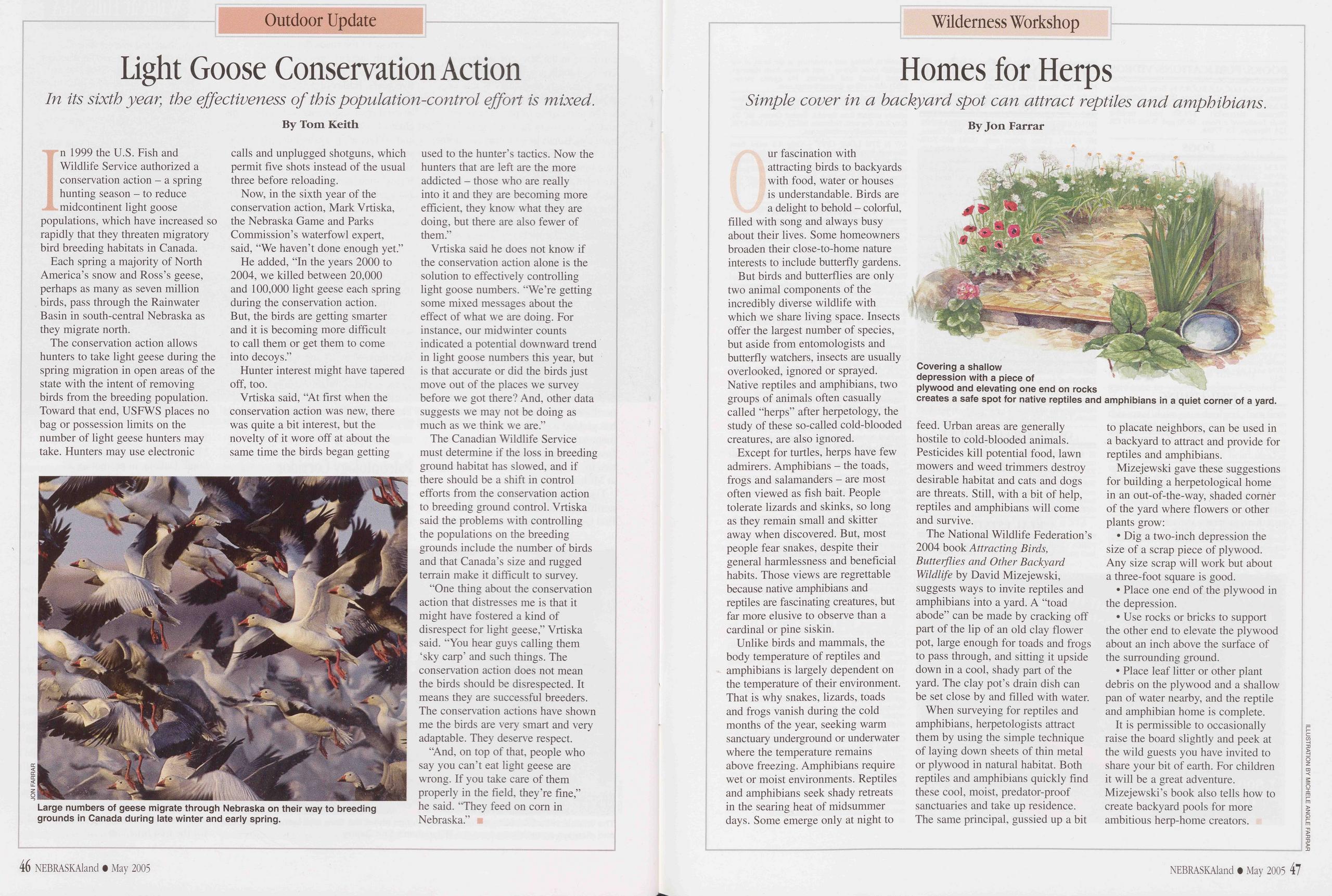
Outdoor Update
Light Goose Conservation Action
In its sixth year, the effectiveness of this population-control effort is mixed.
In 1999 the U.S. Fish and Wildlife Service authorized a conservation action - a spring hunting season - to reduce midcontinent light goose populations, which have increased so rapidly that they threaten migratory bird breeding habitats in Canada.
Each spring a majority of North America’s snow and Ross’s geese, perhaps as many as seven million birds, pass through the Rainwater Basin in south-central Nebraska as they migrate north.
The conservation action allows hunters to take light geese during the spring migration in open areas of the state with the intent of removing birds from the breeding population. Toward that end, USFWS places no bag or possession limits on the number of light geese hunters may take. Hunters may use electronic
Now, in the sixth year of the conservation action, Mark Vrtiska, the Nebraska Game and Parks Commission’s waterfowl expert, said, "We haven’t done enough yet.”
He added, "In the years 2000 to 2004, we killed between 20,000 and 100,000 light geese each spring during the conservation action. But, the birds are getting smarter and it is becoming more difficult to call them or get them to come into decoys.”
Hunter interest might have tapered off, too.
Vrtiska said, "At first when the conservation action was new, there was quite a bit interest, but the novelty of it wore off at about the same time the birds began getting used to the hunter’s tactics. Now the hunters that are left are the more addicted - those who are really into it and they are becoming more efficient, they know what they are doing, but there are also fewer of them.”
Vrtiska said he does not know if the conservation action alone is the solution to effectively controlling light goose numbers. "We’re getting some mixed messages about the effect of what we are doing. For instance, our midwinter counts indicated a potential downward trend in light goose numbers this year, but is that accurate or did the birds just move out of the places we survey before we got there? And, other data suggests we may not be doing as much as we think we are.”
The Canadian Wildlife Service must determine if the loss in breeding ground habitat has slowed, and if there should be a shift in control efforts from the conservation action to breeding ground control. Vrtiska said the problems with controlling the populations on the breeding grounds include the number of birds and that Canada’s size and rugged terrain make it difficult to survey.
"One thing about the conservation action that distresses me is that it might have fostered a kind of disrespect for light geese,” Vrtiska said. "You hear guys calling them ‘sky carp’ and such things. The conservation action does not mean the birds should be disrespected. It means they are successful breeders. The conservation actions have shown me the birds are very smart and very adaptable. They deserve respect.
"And, on top of that, people who say you can’t eat light geese are wrong. If you take care of them properly in the field, they’re fine,” he said. "They feed on corn in Nebraska.”
46 NEBRASKAland O May 2005Wilderness Workshop
Home for Herps
Simplw cover in a backyard spot can attract reptiles and amphibians.
Our fascination with attracting birds to backyards with food, water or houses is understandable. Birds are a delight to behold - colorful, filled with song and always busy about their lives. Some homeowners broaden their close-to-home nature interests to include butterfly gardens.
But birds and butterflies are only two animal components of the incredibly diverse wildlife with which we share living space. Insects offer the largest number of species, but aside from entomologists and butterfly watchers, insects are usually overlooked, ignored or sprayed. Native reptiles and amphibians, two groups of animals often casually called "herps” after herpetology, the study of these so-called cold-blooded creatures, are also ignored.
Except for turtles, herps have few admirers. Amphibians - the toads, frogs and salamanders - are most often viewed as fish bait. People tolerate lizards and skinks, so long as they remain small and skitter away when discovered. But, most people fear snakes, despite their general harmlessness and beneficial habits. Those views are regrettable because native amphibians and reptiles are fascinating creatures, but far more elusive to observe than a cardinal or pine siskin.
Unlike birds and mammals, the body temperature of reptiles and amphibians is largely dependent on the temperature of their environment. That is why snakes, lizards, toads and frogs vanish during the cold months of the year, seeking warm sanctuary underground or underwater where the temperature remains above freezing. Amphibians require wet or moist environments. Reptiles and amphibians seek shady retreats in the searing heat of midsummer days. Some emerge only at night to
The National Wildlife Federation’s 2004 book Attracting Birds, Butterflies and Other Backyard Wildlife by David Mizejewski, suggests ways to invite reptiles and amphibians into a yard. A "toad abode” can be made by cracking off part of the lip of an old clay flower pot, large enough for toads and frogs to pass through, and sitting it upside down in a cool, shady part of the yard. The clay pot’s drain dish can be set close by and filled with water.
When surveying for reptiles and amphibians, herpetologists attract them by using the simple technique of laying down sheets of thin metal or plywood in natural habitat. Both reptiles and amphibians quickly find these cool, moist, predator-proof sanctuaries and take up residence. The same principal, gussied up a bit to placate neighbors, can be used in a backyard to attract and provide for reptiles and amphibians.
Mizejewski gave these suggestions for building a herpetological home in an out-of-the-way, shaded corner of the yard where flowers or other plants grow: • Dig a two-inch depression the size of a scrap piece of plywood. Any size scrap will work but about a three-foot square is good. • Place one end of the plywood in the depression. • Use rocks or bricks to support the other end to elevate the plywood about an inch above the surface of the surrounding ground. • Place leaf litter or other plant debris on the plywood and a shallow pan of water nearby, and the reptile and amphibian home is complete.
It is permissible to occasionally raise the board slightly and peek at the wild guests you have invited to share your bit of earth. For children it will be a great adventure. Mizejewski’s book also tells how to create backyard pools for more ambitious herp-home creators.
ILLUSTRATION BY MICHELE ANGLE FARRAR NEBRASKAland • May 2005 47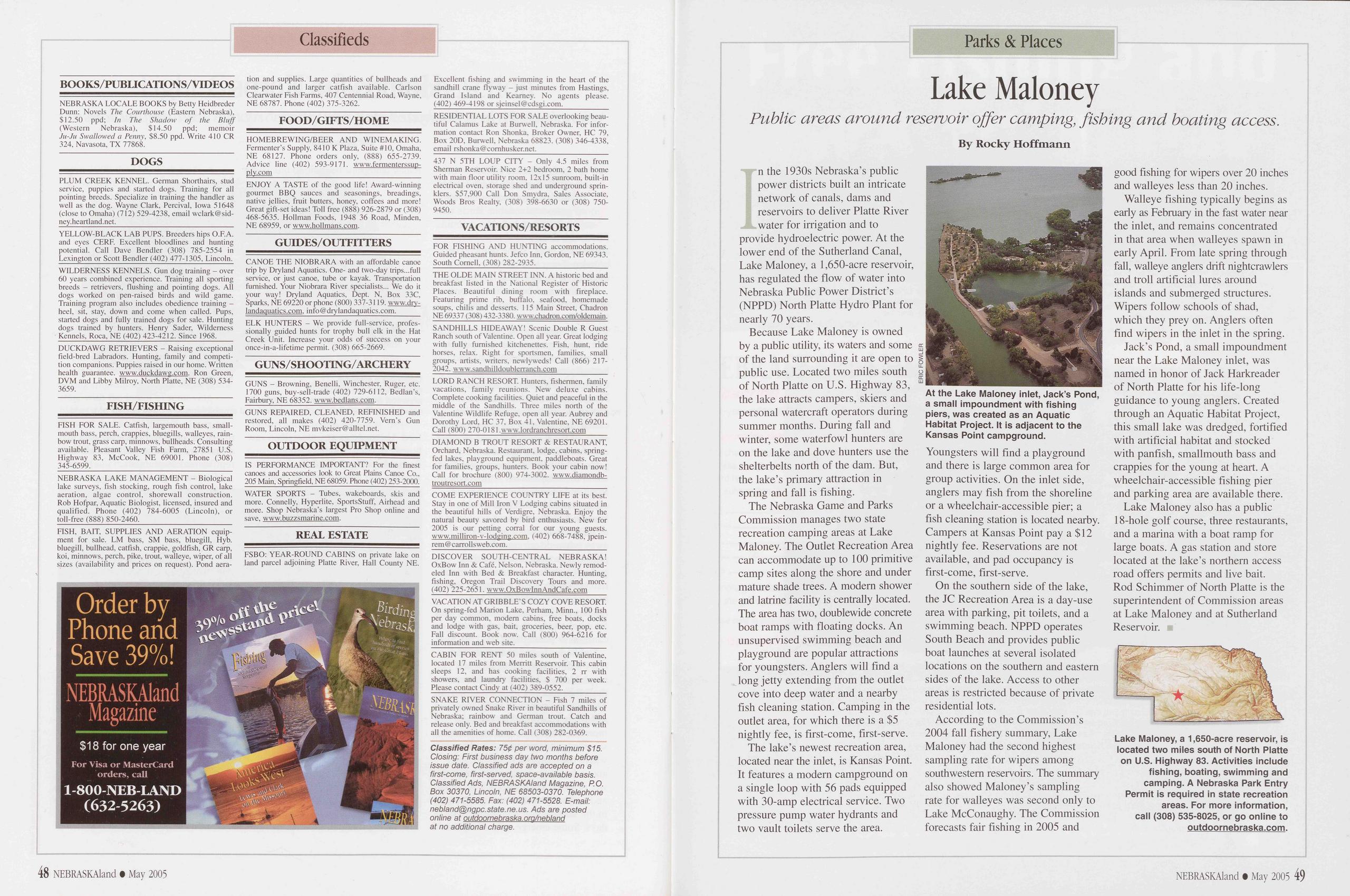
Classifieds
BOOKS/PUBLICATIONS/VIDEOS NEBRASKA LOCALE BOOKS by Betty Heidbreder Dunn: Novels The Courthouse (Eastern Nebraska), $12.50 ppd; In The Shadow of the Bluff (Western Nebraska), $14.50 ppd; memoir Ju-Ju Swallowed a Penny, $8.50 ppd. Write 410 CR 324, Navasota, TX 77868. DOGS PLUM CREEK KENNEL. German Shorthairs, stud service, puppies and started dogs. Training for all pointing breeds. Specialize in training the handler as well as the dog. Wayne Clark, Percival, Iowa 51648 (close to Omaha) (712) 529-4238, email wclark@sid- ney.heartland.net. YELLOW-BLACK LAB PUPS. Breeders hips O.F.A. and eyes CERF. Excellent bloodlines and hunting potential. Call Dave Bendler (308) 785-2554 in Lexington or Scott Bendler (402) 477-1305, Lincoln. WILDERNESS KENNELS. Gun dog training - over 60 years combined experience. Training all sporting breeds - retrievers, flushing and pointing dogs. All dogs worked on pen-raised birds and wild game. Training program also includes obedience training - heel, sit, stay, down and come when called. Pups, started dogs and fully trained dogs for sale. Hunting dogs trained by hunters. Henry Sader, Wilderness Kennels, Roca, NE (402) 423-4212, Since 1968. DUCKDAWG RETRIEVERS - Raising exceptional field-bred Labradors. Hunting, family and competi- tion companions. Puppies raised in our home. Written health guarantee, www.duckdawg.com. Ron Green, DVM and Libby Milroy, North Platte, NE (308) 534- 3659. FISH/FISHING FISH FOR SALE. Catfish, largemouth bass, small- mouth bass, perch, crappies, bluegills, walleyes, rain- bow trout, grass carp, minnows, bullheads. Consulting available. Pleasant Valley Fish Farm, 27851 U.S. Highway 83, McCook, NE 69001. Phone (308) 345-6599. NEBRASKA LAKE MANAGEMENT - Biological lake surveys, fish stocking, rough fish control, lake aeration, algae control, shorewall construction. Rob Hofpar, Aquatic Biologist, licensed, insured and qualified. Phone (402) 784-6005 (Lincoln), or toll-free (888) 850-2460. FISH, BAIT, SUPPLIES AND AERATION equip- ment for sale. LM bass, SM bass, bluegill, Hyb. bluegill, bullhead, catfish, crappie, goldfish, GR carp, koi, minnows, perch, pike, trout, walleye, wiper, of all sizes (availability and prices on request). Pond aera-Parks & Places
Lake Maloney
Public areas around reservoir offer camping, fishing and boating access.
In the 1930s Nebraska’s public power districts built an intricate network of canals, dams and reservoirs to deliver Platte River water for irrigation and to provide hydroelectric power. At the lower end of the Sutherland Canal, Lake Maloney, a 1,650-acre reservoir, has regulated the flow of water into Nebraska Public Power District’s (NPPD) North Platte Hydro Plant for nearly 70 years.
Because Lake Maloney is owned by a public utility, its waters and some of the land surrounding it are open to public use. Located two miles south of North Platte on U.S. Highway 83, the lake attracts campers, skiers and personal watercraft operators during summer months. During fall and winter, some waterfowl hunters are on the lake and dove hunters use the shelterbelts north of the dam. But, the lake’s primary attraction in spring and fall is fishing.
The Nebraska Game and Parks Commission manages two state recreation camping areas at Lake Maloney. The Outlet Recreation Area can accommodate up to 100 primitive camp sites along the shore and under mature shade trees. A modern shower and latrine facility is centrally located. The area has two, doublewide concrete boat ramps with floating docks. An unsupervised swimming beach and playground are popular attractions for youngsters. Anglers will find a long jetty extending from the outlet cove into deep water and a nearby fish cleaning station. Camping in the outlet area, for which there is a $5 nightly fee, is first-come, first-serve.
The lake’s newest recreation area, located near the inlet, is Kansas Point. It features a modern campground on a single loop with 56 pads equipped with 30-amp electrical service. Two pressure pump water hydrants and two vault toilets serve the area.
Youngsters will find a playground and there is large common area for group activities. On the inlet side, anglers may fish from the shoreline or a wheelchair-accessible pier; a fish cleaning station is located nearby. Campers at Kansas Point pay a $12 nightly fee. Reservations are not available, and pad occupancy is first-come, first-serve.
On the southern side of the lake, the JC Recreation Area is a day-use area with parking, pit toilets, and a swimming beach. NPPD operates South Beach and provides public boat launches at several isolated locations on the southern and eastern sides of the lake. Access to other areas is restricted because of private residential lots.
According to the Commission’s 2004 fall fishery summary, Lake Maloney had the second highest sampling rate for wipers among southwestern reservoirs. The summary also showed Maloney’s sampling rate for walleyes was second only to Lake McConaughy. The Commission forecasts fair fishing in 2005 and good fishing for wipers over 20 inches and walleyes less than 20 inches.
Walleye fishing typically begins as early as February in the fast water near the inlet, and remains concentrated in that area when walleyes spawn in early April. From late spring through fall, walleye anglers drift nightcrawlers and troll artificial lures around islands and submerged structures. Wipers follow schools of shad, which they prey on. Anglers often find wipers in the inlet in the spring.
Jack’s Pond, a small impoundment near the Lake Maloney inlet, was named in honor of Jack Harkreader of North Platte for his life-long guidance to young anglers. Created through an Aquatic Habitat Project, this small lake was dredged, fortified with artificial habitat and stocked with panfish, smallmouth bass and crappies for the young at heart. A wheelchair-accessible fishing pier and parking area are available there.
Lake Maloney also has a public 18-hole golf course, three restaurants, and a marina with a boat ramp for large boats. A gas station and store located at the lake’s northern access road offers permits and live bait. Rod Schimmer of North Platte is the superintendent of Commission areas at Lake Maloney and at Sutherland Reservoir.
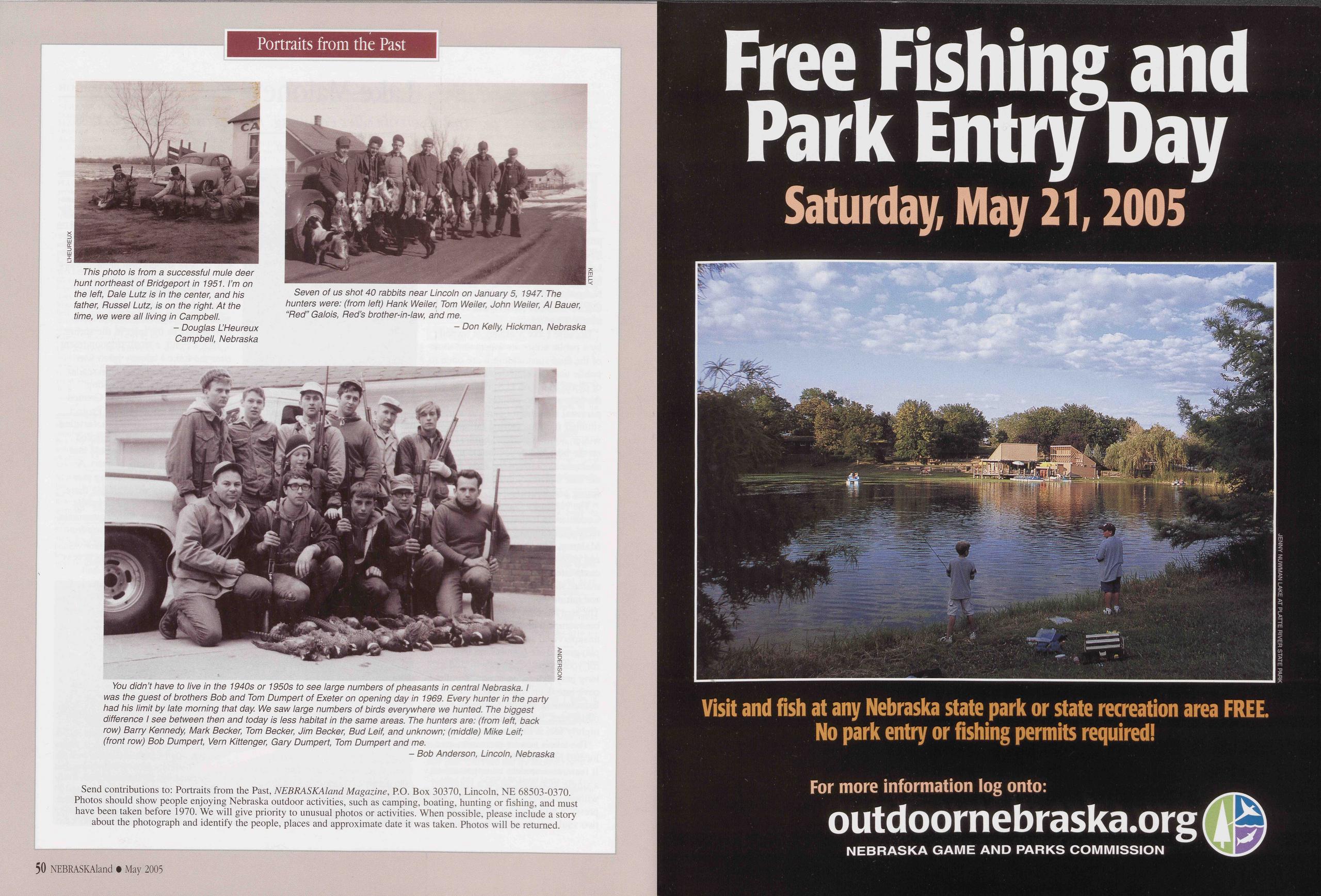
Portraits from the Past
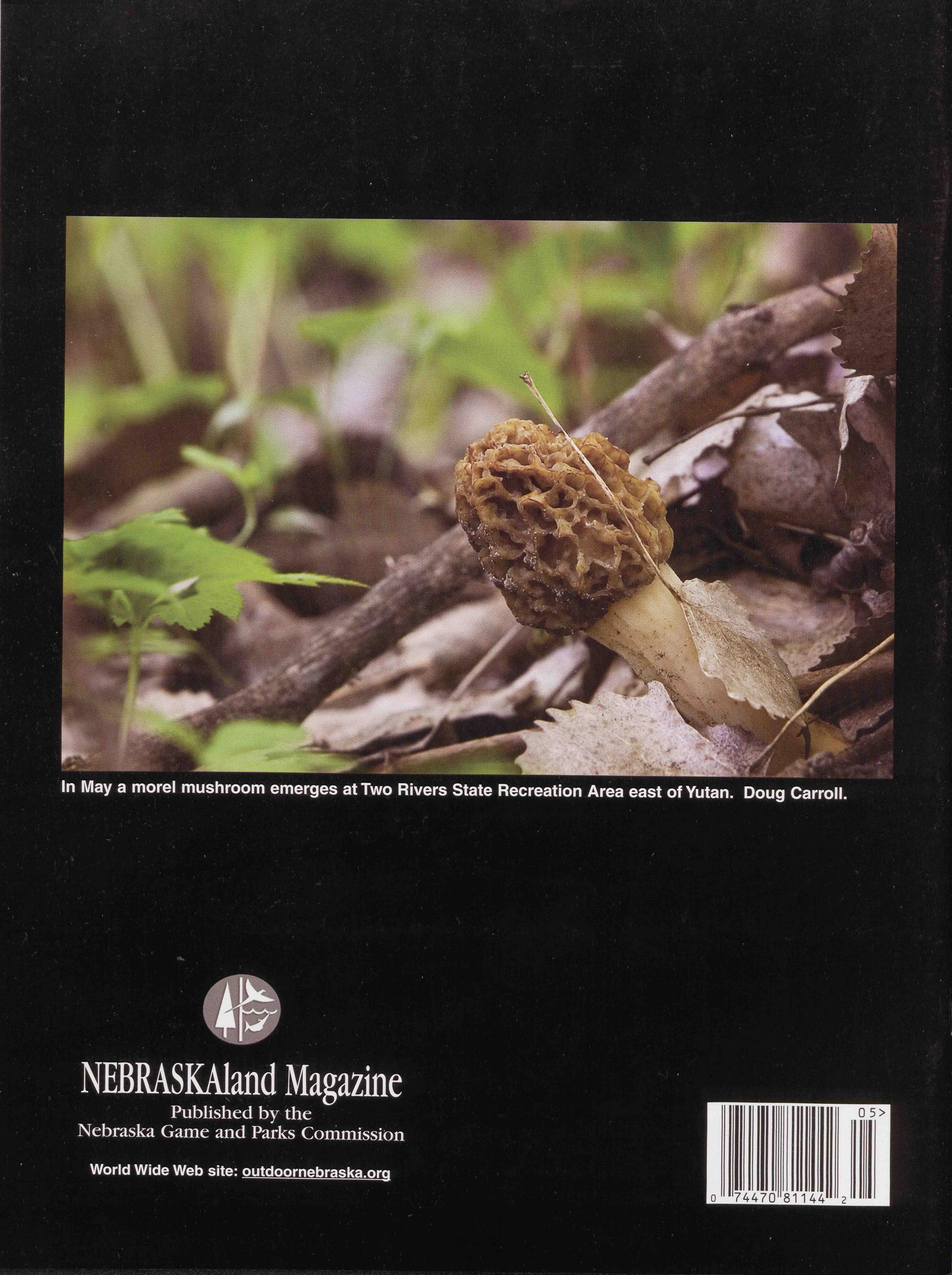
Position: 820 (12 views)