Volume 104, Issue 3, 2026
April 2026
- Title:
- Volume 104, Issue 3, 2026
- Issue Name:
- April 2026
- Date Issued:
- 2026-04-01
- year:
- 2026
- month:
- April
- Season:
- Spring
- PDF filename:
- NL_104.03_2026_Apr_Spreads_Entire.pdf
- Cover image:
- NL_104.03_2026_Apr_Cover.jpg
- Publisher:
- Nebraska Game and Parks Commission
- Format:
- Periodical
- volume:
- 104
- issue:
- 03
- number:
- 104.03
- Decade:
- 2020s
- Type:
- Rights Holder:
- Copyright Nebraskaland Magazine/Nebraska Game and Parks Commission, all rights reserved.
- Subject:
- nebraskaland
- Extracted Text:
-
INSPIRING OUTDOOR ADVENTURE SINCE 1926
APRIL 2026
Swift
Foxes
See page 20
INSIDE
Illustrating Nebraskaland l Get Low Photography
Old Tackleboxes l Omaha Train Robbery of 1909
Lake Ogallala l 125 Years of Conservation Officers
2
Nebraskaland • April 2026
April 2026 •
Nebraskaland
3
Volume 104
April 2026
No. 3
FEATURES
20
THE FAST AND THE FURRY
28
OUTDOOR NEBRASKA
Story and photos by Justin Haag
What to Do in April
By Jeff Kurrus
30
THE INTRIGUE OF OLD TACKLEBOXES
36
OMAHA’S 1909 TRAIN ROBBERY
40
LAKE OGALLALA
48
125 YEARS OF PROTECTING WILDLIFE
RESOURCES
60
Story and photos by Gerry Steinauer
By David L. Bristow, Nebraska State Historical Society
Photos and story by Eric Fowler
By Jenny Nguyen-Wheatley
ILLUSTRATING NEBRASKALAND
The Art of Tim Reigert
Story by Jeff Kurrus, Art by Tim Reigert
DEPARTMENTS
8
12
70
76
78
Your Nebraska
In the Field
Mixed Bag
Portraits from the Past
The Last Stop
ON THE WEB
For more articles and
information, visit
NebraskalandMagazine.com
Nebraskaland (VOL. 103 / NO. 10 ISSN 0028-1964) is published monthly, except for the combined Jan./Feb. and Aug./Sept.
issues, by the Nebraska Game and Parks Commission, 2200 N. 33rd St., Lincoln, NE. Periodicals postage paid at Lincoln,
Nebraska, and additional mailing offices. POSTMASTER: Send all UAA to CFS. (See DMM 507.1.5.2); NON-POSTAL AND
MILITARY FACILITIES: send address corrections to Nebraskaland, P.O. Box 30370, Lincoln, NE 68503-0370.
4
Nebraskaland • April 2026
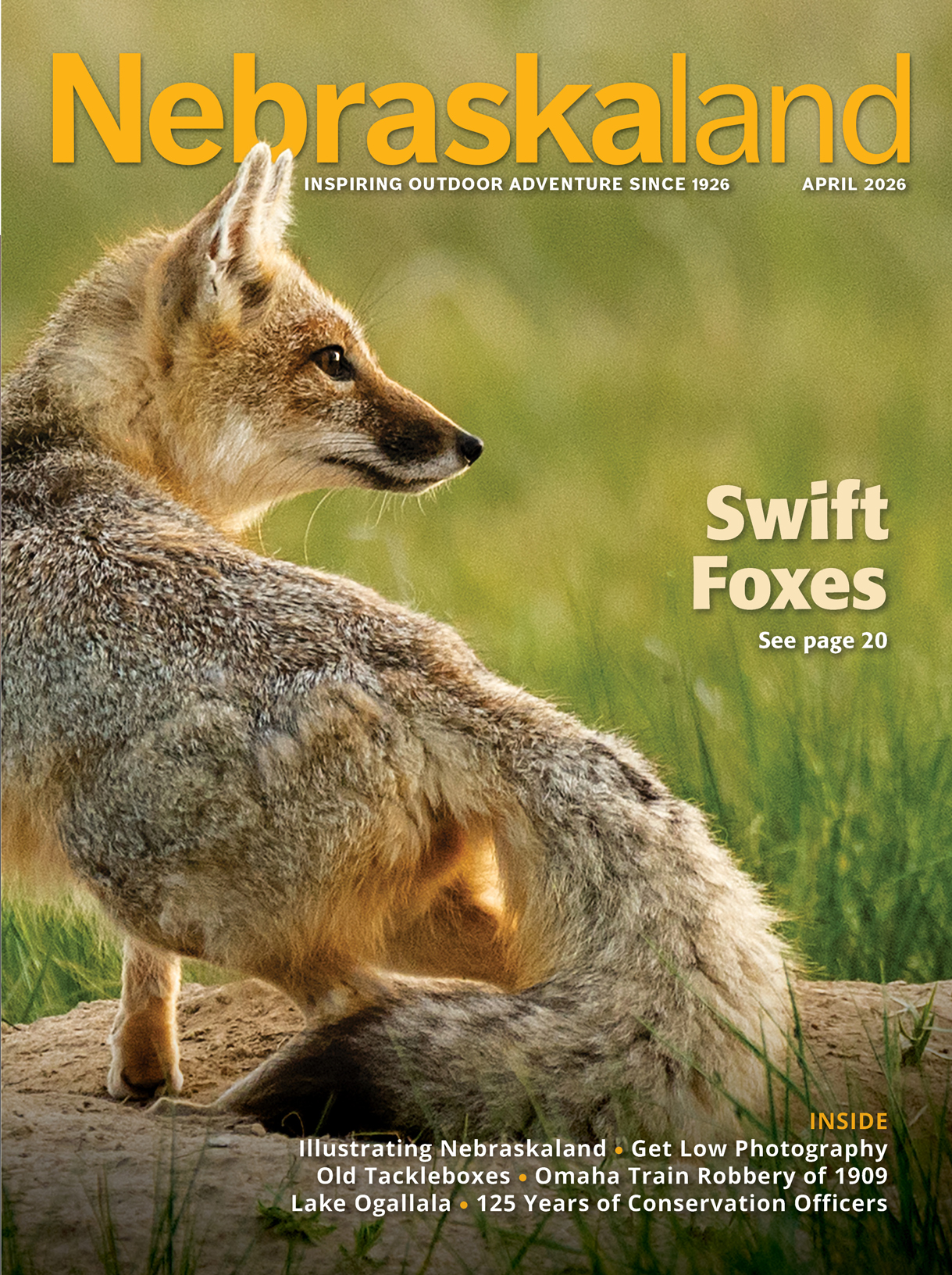
Cover: An adult swift fox stands alert near the entrance
of its den in Sioux County. See story on page 20.
JUSTIN HAAG, NEBRASKALAND
This page: Clouds fill the sky above the South Platte
River at sunrise in Lincoln County.
ERIC FOWLER, NEBRASKALAND
April 2026 •
Nebraskaland
5
magazine
Published by the Nebraska Game and Parks
Commission since 1926. The Commission
is dedicated to the conservation and
protection of all the state's natural
resources and the people who use them.
Magazine Staff
Communications Director Christy Firestone
Public Relations Manager Shawna Richter-Ryerson
Editor Jeff Kurrus
Associate Editor Jenny Nguyen-Wheatley
Regional Editors Eric Fowler, Julie Geiser,
Justin Haag
Contributing Editor Michael Forsberg
Regular Contributors Chris Helzer, Chris Masada,
Todd Mills, Ryan Sparks, Gerry Steinauer
Art Director Ryan Holt
Graphic Designer Mel Severin
Videographer Nick Sauvageau
Photo Librarian Jaclyn Cruikshank Vogt
Administration
Director Tim McCoy
Chair - Donna Kush, Omaha
Vice Chair - Dan Hughes, Venango
Kurt Arganbright, Valentine
Scott Cassels, Omaha
John Hoggatt, Kearney
Kent McNeill, Papillion
Steve Mossman, Lincoln
Lisa Roskens, Omaha
Doug Zingula, Sidney
Commission Offices
Headquarters/Southeast District Office
2200 N. 33rd Street Lincoln, NE 68503
Phone 402-471-0641
Northeast District Office
2201 N. 13th St. Norfolk, NE 68701
Phone 402-370-3374
Southwest District Office
301 E. State Farm Rd. North Platte, NE 69101
Phone 308-535-8025
Northwest District Office (temporary)
1317 W 3rd St., Alliance, NE 69301
Phone 308-763-2940
Bassett Office
524 Panzer St., Box 508 Bassett, NE 68714
Phone 402-684-2921
South Central District Office
1617 First Ave. Kearney, NE 68847
Phone 308-865-5310
Schramm Education Center
21502 W. Highway 31 Gretna, NE 68028
Phone 402-332-3901
Omaha Office
8495 Frederick Street, Omaha, NE 68124
Phone 402-595-2144
OutdoorNebraska.gov
The Nebraska Game and Parks Commission does not discriminate
based on race, color, ethnicity, national origin, sex, pregnancy, religion,
disability, age, genetic information, veteran status, marital status,
and/or political affiliation in its programs, activities, or employment.
Any person who believes he or she has been discriminated against in
any program, activity, facility, or service should contact the Nebraska
Game and Parks Commission, Lincoln, NE 402-471-0641, the Equal
Opportunity Commission, Lincoln, NE 402-471-2024, TTY/TDD 800-6426112; Director, Office of Civil Rights, U.S. Department of the Interior,
1849 C St., NW, Washington, DC 20240.
6
Nebraskaland • April 2026
Magazine Subscriptions
For address changes, magazine and subscription
questions, 800-632-5263 or visit
nebraskalandmagazine.com
Advertising
For advertising information, contact:
Shane G. Gilster, 402-742-0125
shanegilster@solotreemedia.com
North America’s smallest diving duck,
the bufflehead, relies on old nesting
cavities created by northern flickers,
which larger ducks struggle to fit
into. This limits their breeding area
to wherever northern flickers can be
found. JEFF KURRUS, NEBRASKALAND
Nebraskaland Magazine Copyright 2026, all rights reserved. Nebraskaland is available in audio from the Nebraska Library Commission Talking Book
and Braille Service, Suite 120, 1200 N St., Lincoln, NE 68508. 800-742-7691. Nebraskaland Magazine and the Nebraska Game and Parks Commission
reserve the right to reject any advertising not in keeping with the agency mission. Rates: $18 for one year; $33 for two years; $44 for three years.
Nebraska recipients must add appropriate sales tax. To subscribe call 1-800-NEBLAND (632-5263), or go online to: NebraskalandMagazine.com.
Conservation Officers
ADMINISTRATION
Jeff Clauson
402-471-5531
Lincoln HQ
Administrator
Travis Shepler
402-471-5531
Lincoln HQ
Asst. Administrator
Stacey Lewton
402-471-5531
Lincoln HQ
Asst. Administrator
Mike Thome
402-471-5531
Lincoln HQ
Asst. Administrator
(Includes counties covered)
NORTHWEST
Sean McKeehan 308-672-1824
Captain
SOUTH SUB-DISTRICT
Jerod Hahn
308-520-5539
Sergeant
Grant Albrecht
531-229-4405
Cheyenne, Deuel, Kimball
Hunter Lee
308-280-4320
Keith, Deuel
Jaden Porter
308-289-2274
Garden, Grant
Tyler Stueck
308-289-6260
Keith, Arthur
Keith Jadlowski 531-310-2869
Keith, Arthur
NORTH SUB-DISTRICT
Casey Gehrt
402-617-2112
Sergeant
Josh Widhelm
308-279-9133
Scotts Bluff, Banner, Sioux
Brandon Wallace 308-280-4488
Scotts Bluff, Banner, Sioux
Travis Schultz
308-279-1292
Morrill, Scotts Bluff, Box Butte
Vacant:
Dawes, Sheridan, Sioux
Cassidy Harwood 308-562-9099
Box Butte, Sheridan
Justin Gress
308-629-9335
Dawes, Sioux, Sheridan
NORTHEAST
Dale Davis
402-760-0712
Captain
WEST SUB-DISTRICT
Jeff Jones
402-762-5022
Sergeant
Hannah Holtmeier 402-601-7514
Boyd, Holt
Greg Hesse
308-546-7464
Rock, Brown, Keya Paha
Jonathan Andreasen 402-340-3981
Madison, Pierce
Trevor Stahlecker 402-928-9099
Knox, Antelope, Pierce
Mitch Johnson
402-613-8612
Cedar, Knox
EAST SUB-DISTRICT
Cory Krause
402-380-6410
Sergeant
Kyler Prochaska 402-830-8278
Platte, Colfax
Matt Costello
402-317-4014
Dodge, Colfax
Kelbi Abke
402-237-2537
Washington, Burt
Nicholas Fix
402-508-0261
Dixon, Dakota, Thurston
Kyle Hansen
531-739-7392
Dodge
Vacant:
Cuming, Wayne, Stanton
CENTRAL SUB-DISTRICT
Doug Pollard
308-730-7050
Sergeant
Vacant:
Howard, Greeley, Merrick
Matt Brandt
308-202-0819
Sherman, Howard
Klint Gill
402-613-5800
Nance, Wheeler, Boone, Polk
Garrett Zimmer 402-416-5736
Garfield, Loup, Valley
Tim Williams
308-380-7331
Hall, Hamilton
SOUTHWEST
Brian Piernicky 308-330-8780
Captain
NORTH SUB-DISTRICT
Alex Hasenauer
308-660-4671
Sergeant
402-389-0444
Frank Miller
Cherry, Hooker
Dana Miller
531-229-4404
Cherry, Hooker
Luis Nuñez
531-333-6093
Blaine, Custer, Thomas
Jacob Stoinski
308-395-6001
Lincoln, Perkins
Brandon O’Neal 308-530-3157
Lincoln, McPherson, Logan
SOUTH SUB-DISTRICT
Kelsey Glodowski 308-242-9000
Sergeant
Logan Smith
531-229-4406
Frontier, Furnas, Red Willow
Bryce Streger
308-537-0404
Dawson, Gosper
Logan Sanders
402-601-6302
Frontier, Hayes, Hitchcock, Red Willow
Tyler Adelman
402-314-4783
Dawson, Gosper
Sophia Gobber
308-222-0368
Chase, Dundy, Hayes, Hitchcock
SOUTHEAST
Matt Seitz
402-806-0915
Captain
WEST SUB-DISTRICT
Matt Taylor
402-200-9597
Sergeant
Vacant:
Adams, Clay, Webster
Vacant:
Thayer, Nuckolls, Fillmore
Vacant:
Harlan, Franklin, Phelps
Vacant:
Buffalo, Kearney
EAST SUB-DISTRICT
Heath Packett
402-210-0888
Sergeant
Brett Greenfield 531-350-0915
Cass
Russell Mort
402-209-1506
Otoe, Johnson
Rich Berggren
402-619-1355
Douglas
Brian Arp
531-530-9011
Douglas, Sarpy
Mike Luben
402-443-6392
Saunders
Bryan Adams
402-429-1924
Nemaha, Pawnee, Richardson
CENTRAL SUB-DISTRICT
Curt Prohaska
402-470-1298
Sergeant
531-229-4407
Easton Albrecht
Lancaster
Benjamin Keller 308-430-5500
Gage, Jefferson
Mark McDonald 402-805-2353
Lancaster
Mark Sullivan
402-741-0636
Lancaster, Seward, Butler
Jarrod Messman 531-739-9760
Lancaster, Saline, York
April 2026 •
Nebraskaland
7
YOUR NEBRASKA
Instagram Photos
Follow us @nebraskaland
and tag us in your photos
to be featured in an
upcoming issue.
8
Nebraskaland • April 2026
TOP RIGHT: Brandon Fankhauser, Scottsbluff
Mallard Drake
BOTTOM RIGHT: Chad Gideon, Wood River
On the Hunt with Cauy Gideon
BELOW: Jeff Phelps, Sidney
Echoes of a Winter Past
April 2026 •
Nebraskaland
9
OPPOSITE LEFT: Curt Blum, Lincoln
Harvest is Over
OPPOSITE RIGHT: Kojo Baidoo, Wood River
The Evening Special
RIGHT: Rachel Valdez, Mesa, Arizona
My Nebraska Roots
LEFT: Paul Snyder, Scottsbluff
Rams in Rut
ABOVE: Marquene Koontz, Ogallala
Windy Day at Kingsley Dam
Send your comments and photos to:
Jeff Kurrus, Editor
Nebraskaland Magazine
P.O. Box 30370
Lincoln, NE 68503
or email Jeff.Kurrus@Nebraska.gov
Please include your postal address
and telephone number. Letters
may be condensed and edited.
Photographs are also welcome.
10
Nebraskaland • April 2026
April 2026 •
Nebraskaland
11
IN THE FIELD
ALMOST
The hand of Gretna’s Ryan
Glatter waits for a crappie
to make one final shake
before landing the fish at
a Douglas County pond.
JEFF KURRUS, NEBRASKALAND
12
Nebraskaland • April 2026
April 2026 •
Nebraskaland
13
IN THE FIELD
THE MISUNDERSTOOD WATER SNAKE
By Monica Macoubrie, Wildlife Education Specialist
If you spend enough time along Nebraska’s lakes, rivers
or wetlands, you’ll likely spot a long, dark snake gliding
effortlessly across the surface or coiled on a sunny bank.
Chances are, it’s a northern water snake (Nerodia sipedon)
— and the odds are even higher that someone nearby will
immediately call it a “water moccasin” or “cottonmouth.”
Let’s bust this myth: Cottonmouths don’t live in Nebraska.
What we do have are northern water snakes, which are
nonvenomous, native and important to our ecosystems.
Life by the Water
Northern water snakes are true to their name. They spend
nearly all their time around water, whether it’s a quiet farm
pond, a shaded creek, a muddy riverbank or the cattail
edges of a marsh. They’re built for an aquatic life: Their
bodies are muscular and streamlined, and their keeled, or
rough-textured, scales help them move smoothly through
both water and vegetation. Watching one slide from a sunwarmed rock into the water is like watching liquid slipping
into liquid — they vanish with barely a ripple.
These snakes aren’t just good swimmers — they’re also
athletes. They can climb low branches to bask above the
water, wedge themselves into rock crevices to hide from
predators and even hunt while partially submerged.
Northern water snakes are opportunistic feeders, eating
whatever they can overpower. Fish make up a large portion of
their diet, from small minnows to unlucky sunfish to catfish
fry. They’re also quick to snatch up frogs and tadpoles, and
they won’t pass up a tasty salamander or crayfish.
If the opportunity arises, northern water snakes also will
go after mice or young muskrats that wander too closely
14
Nebraskaland • April 2026
to shore. They swallow their prey whole using backwardpointing teeth to grab hold while flexible jaws do the rest.
By preying on so many different species, northern water
snakes help keep aquatic ecosystems balanced. They
prevent any one population — like frogs or small fish —
from exploding in numbers, which in turn helps protect
water quality and the fragile web of life in these habitats.
Live Birth, No Eggs!
One of the northern water snake’s most fascinating
adaptations is their ability to give live birth instead of
laying eggs. This adaptation, called ovoviviparity, means
females carry the eggs inside their bodies until the babies
are fully developed and ready to be born — usually in late
summer or early fall. This strategy protects the eggs from
being eaten by predators or washed away by floods, and it
gives the newborns a head start on survival.
Water snakes can have anywhere from 10 to 30 tiny, fully
formed young in a single litter, each ready to swim and
hunt from the moment they hit the water. Combined with
their strong swimming ability, excellent camouflage and
defensive behaviors, this live-bearing trait helps northern
water snakes thrive in Nebraska’s waterways year after year.
The Misunderstood Water Neighbor
Because they’re dark, thick-bodied and not shy about
standing their ground, northern water snakes often get
labeled as “dangerous” — a reputation they don’t deserve.
Their color doesn’t help their case: most are brown, gray or
reddish with darker bands or blotches that can look almost
black when wet. To the untrained eye, that can resemble a
A common water snake suns itself on a fallen tree at Stagecoach State Recreation Area. These nonvenomous snakes are often
misidentified as the venomous cottonmouth. ERIC FOWLER, NEBRASKALAND
cottonmouth. Consequently, a lot of harmless snakes are
unfairly accused and, often killed on sight.
When they feel threatened, northern water snakes
employ an arsenal of defensive tricks. The most obvious
one is the bluff. They’ll flatten their heads and bodies,
which makes them look broader, almost like a triangleheaded venomous snake. They’ll also hiss loudly and
sometimes strike toward the threat without trying to bite,
hoping to scare off whatever’s bothering them.
What if all that bluffing doesn’t work? They’ll bite.
And bite. And bite again. These snakes don’t have venom,
but they do have dozens of tiny, needle-sharp teeth
that can leave your hand looking like you lost a fight
with a blackberry bush. Their saliva contains a mild
anticoagulant, which means their bites tend to bleed more
than you might expect — it looks dramatic, but it’s not
dangerous.
If you really push their buttons, northern water snakes
have one final, stinky trick up their sleeve: musk. When
threatened, they can release a foul-smelling liquid that
seeps into your clothes and seems impossible to wash
out. A lot of people assume this musk is just snake poop,
but that’s not quite true. While both musk and feces exit
from the same opening —the cloaca — they’re different
substances. Musk comes from specialized scent glands,
while feces is simply the digested leftovers of their
last meal.
Note that northern water snakes don’t chase people.
They’re not out to pick fights on riverbanks. Every display
— the flattening, the hissing, even the biting — is about
one thing: Convincing you to back off so they can get away.
When left alone, these snakes prefer to slip quietly into
the water and vanish.
When Water Snakes Board Your Boat
If you spend enough time paddling or fishing, you might
eventually spot a northern water snake climbing onto
a kayak, canoe or even a boat dock. While this can make
your heart skip a beat, the snake isn’t “attacking” or trying
to hitch a ride, it’s looking for the easiest way out of the
water. Like us, snakes can get tired after a long swim and will
seek out the nearest solid surface to rest and warm up.
Boats, docks and even the sides of kayaks make convenient
“logs” in their eyes. Once they’ve caught their breath
or warmed up a bit, they usually slip back into the water
on their own.
The best thing you can do is stay calm, give the snake
a little space and avoid splashing or swatting. It’s not looking
for trouble — just a moment to bask before moving on.
Water Moccasin vs. Northern Water Snake
It’s easy to see why people mistake the northern water
snake for the water moccasin, or cottonmouth.
Northern water snakes have slender bodies with round
pupils and a narrow, more oval-shaped head that blends
smoothly into their neck, while cottonmouths have stockier,
heavier bodies and a distinct blocky triangular head.
Color can be tricky — both can have dark bands — but
cottonmouths tend to have wider, “chunkier” bands and a
more uniform, dull tone as they age, often turning nearly
solid brown or black.
Another giveaway? Cottonmouths have that famous
“cotton-white” mouth lining they flash when threatened,
while northern water snakes don’t have that dramatic display.
And here’s the most important clue that Nebraskans
should remember — cottonmouths simply aren’t found in
the state. But the fascinating water snake is.
April 2026 •
Nebraskaland
15
IN THE FIELD
A juvenile brown-headed cowbird clings to the branch of a ponderosa pine tree at Ponderosa Wildlife Management Area. This
bird species relies solely on other birds incubating and feeding their young; this is called brood parasitism. JUSTIN HAAG, NEBRASKALAND
BROOD PARASITES
By Alie Mayes, Assistant Division Administrator – Fish & Wildlife Education
Cuckoos gained their name from the sound of the Eurasian
common cuckoo’s call. But the term “cuckoo” has now grown
to be synonymous with brood parasitism, an evolutionary
strategy for outsourcing the rearing of young.
Let’s begin with avian brood parasitism.
incubating and feeding their young but still provide vital
parenting to their young. In a study published by ecologist
Matthew Louder, cowbird females continue to keep tabs on
their young and even use the failure or success of different
nests to decide where to lay future broods.
Avian Brood Parasites
Cuckoos — More Than Just Birds
Avian brood parasites are birds that lay their eggs in
other birds’ nests. In Nebraska, birds that exhibit brood
parasitism include cliff swallows, goldeneye and of course,
our cuckoos.
We have two kinds of cuckoos in Nebraska: the blackbilled cuckoo and the yellow-billed cuckoo. Both species are
migratory, with the black-billed being the rarer of the two.
Our native cuckoos differ from their Eurasian namesake in
many ways, including not having the classic cuckoo call and
not being obligate brood parasites — species that depend
on a host to complete its life cycle, as it cannot survive or
reproduce on its own. In contrast, a non-obligate parasite
can live and reproduce both with and without a host.
All these birds mentioned also rear their own young, an
example of non-obligate brood parasites. There is a benefit to
having this two-pronged reproductive strategy — it increases
the chances that at least some of their young will survive.
However, Nebraska and the greater United States is home
to one avian obligate brood parasite, the brown-headed
cowbird. These incredible birds rely solely on other birds
16
Nebraskaland • April 2026
Birds are not the only group of animals that rely on
parasitic reproductive strategies. In Nebraska, we have
two kinds of cuckoo bumble bees that have been found in
recent years. Although rare, both the indiscriminate and the
lemon cuckoo bumble bee have been recorded. Like cowbirds,
cuckoo bumble bees are obligate brood parasites.
Cuckoo bumble bees don’t just lay eggs in the host’s
nest, they also take over. Female cuckoo bumble bees will
invade the host’s nest and replace the current queen. This
allows them to take over a fully functional nest with plenty
of worker bees to take care of both the false queen and
their young.
Nomad cuckoo bees are a kind of bee in Nebraska that
utilizes brood parasitism. These bees are wasp-like in
appearance. They lay their eggs in the nest of groundnesting bees. The larvae hatch with impressive mouthparts
that enable them to kill the host larvae and utilize the food
left by the host mother.
These evolutionary strategies have allowed these species
to thrive in our complicated natural world.
April 2026 •
Nebraskaland
17
IN THE FIELD
VENISON STIR-FRY
By Jenny Nguyen-Wheatley
Velveting is a special technique
in Chinese stir fry. Marinating slices
of raw meat in egg and cornstarch
protects it from drying out while
cooking, which results in juicy meat.
For this recipe, I used the eye of round
from an older doe, a muscle located
in the hindquarter. I was surprised
by how tender it was and thought
leftovers reheated well, too.
Servings: 2-4
Prep Time: 1 hour
Cooking Time: 40 minutes
Ingredients:
• 1 pound of venison eye of round, or
another tender cut
• 1 egg
• 5 tbsp. of cornstarch, separated
• 1 tsp. of kosher salt, separated
• Canola/vegetable oil for frying
•
cup of sweet chili sauce
•
cup of hoisin sauce
• ½ to 1 tsp. red pepper flakes, to taste
• 1½ tbsp. of apple cider vinegar
• ¼ cup of water
• 1 tsp. of sugar
• 1 red bell pepper
• Half a medium onion
• 5 cloves of garlic, minced
• Freshly cooked white rice
• Thinly sliced green onion for garnish
1. Trim off silver skin on venison
and cut thinly against the grain. In
a small bowl, beat egg and then mix
in 1 tablespoon of cornstarch and ½
teaspoon of kosher salt. Add sliced
venison, stir to coat and refrigerate
covered for 1 hour.
2. Meanwhile, remove ribs and seeds
from the red bell pepper and cut into
1-inch squares. Cut onion into similarsize pieces. In a small bowl, combine
sweet chili sauce, hoisin sauce, red
pepper flakes, apple cider vinegar,
18
Nebraskaland • April 2026
water, ½ teaspoon of kosher salt and
sugar, and set aside.
3. When venison is done marinating,
add the remaining cornstarch to the
bowl and stir to coat. In a saucepan,
heat 1 inch of oil to 350 degrees F.
Separate venison pieces and carefully
drop into the hot oil one by one — do
not crowd the pan. Once the pieces
start turning golden at the edges,
about 1 to 2 minutes, remove and drain
on paper towels. Repeat with the rest
of the venison.
4. While the venison is frying, add
oil to coat the bottom of a frying pan/
wok over medium-high heat. Add
onion and red bell pepper and sauté
until caramelized at the edges. Lower
heat to medium and then add minced
garlic and a pinch of salt; sauté for
30 seconds.
5. Add the sauce and bring to a low
boil, stirring frequently and being
careful not to scorch the bottom.
Add the cooked venison and toss to
coat. Simmer for a couple minutes
until thickened and warmed through.
Season to taste. Serve hot with freshly
cooked white rice. Garnish with sliced
green onion.
April 2026 •
Nebraskaland
19
Story and photos by Justin Haag
THE SWIFT FOX is an iconic species of
western Nebraska’s shortgrass prairie.
20
Nebraskaland • April 2026
April 2026 •
Nebraskaland
21
THE SWIFT FOX PREFERS
SHORTGRASS PRAIRIES AS AREAS
IT CAN SEE ITS SURROUNDINGS
AND SCAN FOR DANGER.
ABOVE: A young swift fox looks to its mother while growing up in Kimball County.
A
t 3 to 7 pounds, the swift fox (Vulpes
velox) is the smallest wild canine
species in North America. It’s
surely diminutive but stands tall as one
of the most charming mammals residing
in western Nebraska — a superb poster
species to represent wildlife diversity of the
often overlooked wide-open prairies of the
High Plains.
22
Nebraskaland • April 2026
LEFT: Although the swift fox measures only 12 inches tall at the shoulders,
it stands tall on the shortgrass prairies.
The swift fox is about the size of a housecat, half as big as
the much more common red fox. It also is distinguished from
the red fox with a black-tipped tail instead of white and its
proportionally bigger ears that help in listening for predators.
As the swift fox’s name indicates, its agile feet are among
its best features for evading predators. Even though it’s much
smaller than one of its nemeses, the coyote, its short legs can
run at about the same speed — up to 40 mph.
The swift fox is an opportunistic omnivore who typically
hunts at night, consuming a variety of rodents and other
small mammals, insects, grasses and carrion. Most daytime
sightings of swift foxes are when they’re sunning themselves
at the entrance to their den with pups, sometimes called kits.
The swift fox prefers shortgrass prairies as areas it can
see its surroundings and scan for danger. Unlike other canid
species, it uses the cover of burrows year-round and not just
during mating season. They are capable of digging dens but
often take up residence in the vacant holes of badgers and
prairie dogs, the latter of which is one of their favorite prey.
Swift foxes form monogamous pairs in the fall, and those
relationships often last until death do them part. A female
swift fox gives birth to two to six pups in spring, which
both parents help raise until the young disperse in the fall.
They are not considered to be territorial, and family ranges
often overlap.
As the parents are teaching them to hunt and avoid
predators, the family may live in several different burrows
and often move because of flea infestations. A swift fox may
travel 4 to 9 miles each night in search of food.
Long ago, the swift fox’s range extended from Alberta
to Texas and from Iowa to New Mexico and Montana. The
decline in shortgrass prairie has not been kind to the
population, however. It now lives on less than 44 percent of
its original range.
Eradication efforts on prey, such as the prairie dog, and
even other predators, also have put the swift fox in peril.
Even though coyotes prey upon swift foxes, efforts to poison
and trap that species have been linked to the unintentional
killing of many of their smaller relatives.
April 2026 •
Nebraskaland
23
AS PARENTS ARE
TEACHING YOUNG
TO HUNT AND AVOID
PREDATORS, THE FAMILY
MAY LIVE IN SEVERAL
DIFFERENT BURROWS.
For pups, the area surrounding the swift fox den is all about play, and the occasional snack.
Mother, however, keeps a watchful eye for danger.
24
Nebraskaland • April 2026
April 2026 •
Nebraskaland
25
As swift foxes frequently reside in burrows near roads,
where coyotes avoid, the risk of becoming roadkill is high.
The swift fox is not listed as an endangered species on the
federal level, but it is on Nebraska’s endangered species list.
Once extirpated from Canada, the species has rebounded
after reintroduction efforts there.
Sam Wilson, Nebraska Game and Parks Commission
furbearer and carnivore program manager, said the agency
has conducted surveys in the past and takes note of photos
from the public, roadkill data and staff observations.
In 2016, Lucia Corral Hurtado published results of the
state’s most comprehensive survey of swift fox distribution
ever for the University of Nebraska. Using camera traps, she
and her conservation partners conducted four surveys on
200 public and private sites within western Nebraska over
two years. The cameras were placed on both private and
public lands west of a line running roughly diagonal between
Gordon and Beaver City.
“We found they are mostly present where we had been
detecting them in the past through track surveys and
opportunistic data collection — in the shortgrass prairies of
the Panhandle and there may be a few in the southwestern
portion of the state,” Wilson said. “Distribution looks
somewhat stable over time.”
Wilson encourages the public to contact him or a nearby
wildlife biologist if they see swift foxes.
To learn more about the swift fox and other wildlife, visit
OutdoorNebraska.gov. N
Mother works to keep a youngster safe and well groomed on the Sioux County grasslands.
26
Nebraskaland • April 2026
April 2026 •
Nebraskaland
27
Outdoor
Neb raska
WHAT TO DO IN APRIL
By Jeff Kurrus
Green surrounds us. Take advantage of spring
with a variety of activities that include hiking,
hunting and counting butterflies. Then, when the
sun sets, cook up a mess of fish for dinner.
N
ig utterfly ount
April and May | Statewide
ebraska’s ig utterfly ount is a community science pro ect designed to collect
population and habitat data to better understand butterfly diversity across
ebraska. Training is re uired to contribute to this pro ect, and workshops and field
days will take place in April and May. During these workshops participants will
learn about community science, identifying eastern and central ebraska butterfly
species, and how to conduct surveys for ebraska’s ig utterfly ount. olunteers
will conduct a survey at least once every other week, from May 1 through
ept. 0. Learn more at Outdoor ebraska.gov by searching for “big butterfly count.”
BRIANNA NUGENT
rying
argemouths
April | Select Fisheries
Largemouth bass are great in the
frying pan, grill or oven, and there are
three lakes
rairie iew, uck reek
and Prairie Queen — where there is a
15- to 18-inch protected slot, allowing
anglers to legally keep largemouth
bass less than 1 inches and one fish
above 18 inches. At Frye Lake, there is
no minimum length limit and anglers
are allowed one bass over 18 inches.
Look for shallow water next to deeper
contours at these lakes and en oy
having the water to yourself. isit
OutdoorNebraska.gov/guides for the
complete regulations.
JEFF KURRUS, NEBRASKALAND
porting lays
obble ime
a ea
i e
April | Statewide
April | Statewide
April | Statewide
Recently, a huntering partner who
had bought a new pump shotgun
was struggling with this new action
versus what he had shot his entire
life. “ porting clays,” I told him. “ lot
of kinks can get worked out on these
courses.” With facilities across the
state, these courses allow shooters to
replicate scenarios like pass shooting,
birds dumping into a decoy spread and
rabbits on the run. And April is the
perfect month to practice for the fall
season.
As photoperiod increases and days
b e g i n to wa r m , to m s w i l l b e g i n
separating from the flock in search of
mating partners. The early part of the
season is so advantageous to hunters
because toms aren’t call shy, and there
are ust enough grasses to hide in if
you’re stationary or on the move. On
cooler temperature hunts or when
birds are flocked up, hunt the middle
of the day to catch insecure toms by
themselves.
The earliest spring wildflowers are
in bloom, and hikers should keep an
eye out for these small beauties. In
the wooded hills of onca and Indian
ave state parks, white fawn lily and
Dutchman’s breeches add color to the
forest floors. In tallgrass prairie at Rock
reek tation tate istorical ark and
iobrara , look for the purple flowers
of prairie violet and buffalo bean, along
with the white tufts of field pussytoes.
Out west at ort Robinson, hadron
and Wildcat ills state parks, white
star lily, pussytoes and several cushionlike milkvetches with various-colored
f lowers stand out on the rugged,
prairie- and pine-covered escarpments.
JEFF KURRUS, NEBRASKALAND
JEFF KURRUS, NEBRASKALAND
BY GERRY STEINAUER, PHOTO BY ERIC FOWLER, NEBRASKALAND
28
Nebraskaland • April 2026
April 2026 •
Nebraskaland
29
The
INTRIGUE
OF
Old
TACKLEBOXES
Story and photos by Gerry Steinauer
Although I am not a serious fisherman, I have long been
drawn to old tackleboxes. Opening one feels a bit like gazing
into a long-forgotten treasure chest. Among the battlescarred jigheads, rusty hooks and melted rubber worms there
is always usable gear, but what really grabs my attention are
the older lures — some of them art, others antiques.
I have acquired several tackleboxes from friends who
have given up fishing or died. For me, just as interesting
as the gear inside is the insight they offer into the former
owner’s fishing habits, or even their personality. They are
cherished keepsakes, especially two I acquired from people
I greatly admired.
30
Nebraskaland • April 2026
April 2026 •
Nebraskaland
31
Jon Farrar’s
Tacklebox
J o n Fa r r a r w a s a l o n g t i m e
Nebraskaland photographer and
writer, as well as a close friend and
co-worker. I admired his love of
nature — especially the Sandhills,
his favorite haunt — along with
his dry humor and his writing. His
articles, whether about duck hunting,
black-necked stilts or wildflowers,
we re we l l - re s e a rc h e d , h i g h l yorganized and beautifully-written. His
tacklebox came into my possession by
plain luck.
When Jon died a few years ago, I
bought several of his hand-carved
duck decoys and some hunting gear
through his online estate auction. On
a fall Saturday, hoping to beat the
crowd, I was among the first to arrive
at his Lincoln home to pick up those
items. I was surprised to see that the
auction company had laid out more
of Jon’s possessions in his garage for
sale. My heart skipped a beat when
I saw his tacklebox beneath a table.
I grabbed it, along with his decoycarving tools and a few other items.
I asked the woman from the auction
company how much she wanted for
my armful. “Twenty bucks,” she said.
I about dropped.
My d r ive h o m e w a s o n e o f
anticipation. Once there, I opened the
box, and, as expected, its contents
were immaculately organized — much
like the file cabinets in Jon’s office.
Rubber worms were lined up in one
tray, lures neatly placed in others and
lead weights and hooks sorted by size
into plastic containers and old, metal
film canisters. Small spinners and Doll
32
Nebraskaland • April 2026
Flies were tucked into Sucrets tins.
There was not a loose item about.
The gear was basic: Jon was not an
avid fisherman, and it was what one
would expect for fishing Sandhills
waters. For years, he kept a trailer
house and small johnboat on Big
Alkali Lake in Cherry County. Fishing
for Jon was likely a diversion during
spring and summer photo expeditions,
or between morning and evening
duck flights. His real passion was
duck hunting.
“I know Jon fished Big Alkali and
Pelican Lake, and he also fooled
around on the lakes at Crescent Lake
National Wildlife Refuge,” said Jim
Van Winkle, Jon’s longtime friend
from Wood Lake. Van Winkle said Jon
fished for catfish in the Loup River
and Loup Power Canal when he was
growing up in Monroe. That explains
the numerous large sinkers in his
tacklebox.
The wire leaders and many spoons
were for hooking toothy northern pike
in the shallow reed beds of Sandhills
lakes; the small spinners, Beetle Spins,
and Doll Flies for panfish; and the
rubber worms, Jitterbugs, and other
plugs for largemouth bass. Jon’s lures
all appeared older and a bit faded,
suggesting his interest in fishing
waned after he lost his trailer lease on
Big Alkali a few decades ago.
Although I will use Jon’s leaders,
hooks and weights, the Jitterbugs,
Rapalas and other plugs will stay
in the tacklebox as a remembrance
of Jon: They are too valuable to risk
losing on a snag.
April 2026 •
Nebraskaland
33
Henry Wagner’s
Tacklebox
My wife Grace’s father, Ernie Kostel,
died in a farm accident when she was
2 years old. After his death, Grace,
her mother Lucille and younger sister
moved in with her great-uncle, Henry
Wagner, at his farmhouse in eastern
Charles Mix County, South Dakota. He
became Grace’s father figure.
Henry’s trade was farming, but his
passion was fishing. “When he had a
break from farming, he went fishing
— it was his way to relax,” Grace said.
He fished from shore at Lake Andes
and other local waters, as well as the
Missouri River below Fort Randall Dam,
15 miles from his farm. Occasionally,
he ventured to the glacial lakes of
northeastern South Dakota.
G ra c e wa s o f te n h i s f i s h i n g
companion, sitting beside him with a
rod in hand or wandering the shore and
nearby fields under his watchful eye.
For Henry, all species were fair game.
“I remember us catching pike, walleye
and catfish from the river, and when I
was little, he would take me to Dante
Lake to catch bluegill,” she said. “Our
freezer was always packed with bags of
bullheads for fish fries.”
When Henry died in 1983, the
farmhouse became Lucille’s. A few
years ago, when she moved to town the
house became ours. Along with it came
Henry’s three tackleboxes, which had
been tucked away in a dark basement
coal room, along with his fishing rods,
which were leaning in a corner and
strewn with spider webs. Two large
plastic tackleboxes were packed with
a general, ramshackle assortment of
fishing gear, while a smaller metal
box held large treble hooks and heavy
sinkers for snagging paddlefish in the
Missouri River.
Although I never knew Henry, I
have come to admire him through
family stories about his appreciation
34
Nebraskaland • April 2026
of the farm’s prairie and of hunting and
fishing. Lucille’s favorite story is about
a summer evening when he fished
the Missouri River and did not come
home at his usual hour. She stayed up,
worried sick that he had fallen into the
river’s deep, swift waters. After sunrise,
he pulled into the driveway, tail tucked
between his legs. His excuse: “The fish
kept biting all night long.”
Grace has especially fond memories
of Henry’s tackleboxes from her
childhood. On cold winter days, as
Henry worked in his basement shop,
she often sat nearby in front of the
wood-burning stove, organizing the
boxes and cleaning the lures of their
summer accumulation of grime.
The bright colors and artistry of the
Heddon Pumpkinseeds, the Norman
Scoopers and many Rapala crankbaits
fascinated her.
I was always puzzled by the slight,
strange odor that wafted from Henry’s
tackleboxes. Recently, I asked Grace
if she recognized the smell. She took
a deep whiff from one of the boxes,
pondered for a moment, and then, in a
flash of remembrance, said, “It’s wheel
grease. As a farmer, his hands were
always covered in it, and he smeared it
on his lures’ hooks to keep them from
rusting.” The odor has lingered for
nearly 40 years since his passing.
Lucille told me that it would “put
a smile on Henry’s face” if he knew I
used his weights, hooks and swivels
when I fish one of his old haunts — the
Missouri River. Under strict orders from
Grace, however, the lures and other
gear will stay in the tackleboxes, as
they are now family heirlooms.
Someday, when someone inherits my
many tackleboxes, their first thought
will likely be, “He must have been a
heck of a fisherman. He sure had a lot of
gear, but what a hodgepodge.” N
April 2026 •
Nebraskaland
35
Omaha’s 1909
Train Robbery
By David L. Bristow, Nebraska State Historical Society
A double-header freight train leaving the Union Pacific
yard near South 35th Street in Omaha, 1921. This is about
seven blocks east of where the Overland Limited train
was robbed in 1909. NSHS RG2941-6-70
N
ext time you’re driving through Omaha on I-80,
notice the Union Pacific tracks running parallel
to the Interstate. Just east of 72nd Street, imagine
you’re still west of town, rolling east aboard the Overland
Limited by night, your hands on the steam engine’s levers. It
is May 22, 1909.
Suddenly, two men appear over the coal tender and jump
down to the engine, pistols drawn. Wearing slouch hats, long
coats, and with blue polka-dot handkerchiefs covering their
faces, they look like Western outlaws. Which they are.
Holding a pistol to your temple, one of them looks out
the cab window until he spots a signal fire. He orders you to
proceed until he has you stop the train in a deep cut just west
of 42nd Street. There are four or five bandits in all, and in no
more than 15 minutes, they empty the postal cars of seven
registered mail sacks bound for eastern banks — “a hell of a
load to carry in an automobile,” one of them complains.
Though the bandits do not enter the passenger cars,
they keep everyone cooperative by firing their revolvers at
random. Before disappearing into the night, they order you
to take the train ahead into the city. Shaken, you notify the
authorities as soon as you arrive at Union Station.
That’s what you would have seen and heard had you lived
through the “Mud Cut Robbery.” As soon as the morning
papers arrived, it became the talk of the city. But despite the
offer of thousands of dollars in reward money, days passed
without any useful leads.
A group of South Omaha schoolboys broke the case
open on May 27. They attended Brown Park Elementary
at 19th and U streets. Playing in a wooded gully nearby,
they discovered abandoned guns, hats and blue polka-dot
handkerchiefs. Police staked out the area and soon arrested
three men. Janitors then found the missing mail sacks —
minus everything of value — in the Brown Park school attic.
Post Office inspectors with the stolen mail sacks found in the
attic of Brown Park Elementary School. Omaha Daily News,
May 29, 1909.
36
Nebraskaland
• April 2026
April 2026 •
Nebraskaland
37
ABOVE: The old Douglas County Courthouse, right, on the site
of the present courthouse. A corner of the turreted, red-brick
county jail is shown at far right. NSHS RG3348-6-394
LEFT: News of the attempted jailbreak was kept from the
sequestered jury to avoid prejudicing the verdict. Omaha
World-Herald, Nov. 11, 1909.
ABOVE: A studio photo (with an auto cutout and fake
scenery) helped investigators identify the suspects and
pressure Lillian Stevenson (center) into testifying against
the others. Evening World-Herald, May 28, 1909.
LEFT: Overland Limited train in Oakland, California, in 1906.
The train was operated jointly by the Southern Pacific,
Union Pacific and Chicago and North Western railroads.
Library of Congress
Searches of the suspects’ apartments turned up more
evidence. Of special interest was a group photo showing the
three men plus a fourth man and his lady friend — a Denver
woman who, after being “sweated” by the police, agreed
to turn state’s evidence against the others. The men were
said to be a gang of “well-known Spokane crooks and safeblowers” who apparently left the Pacific Northwest after
becoming too well-known to authorities.
By the time the trial was underway in November, the
defendants — apparently believing that conviction was
inevitable — tried to break out of jail. They were caught
with saws in their cells, and one of them had nearly finished
sawing through the roof of his “solitary cage.” After the jury
found the five men guilty, they were immediately hustled
off to Fort Leavenworth for what was supposed to be “a life
of hard labor.”
In Omaha, the schoolboys, school principal and janitors,
and members of the Omaha Police Department spent the
next four years squabbling over the reward money, which a
judge eventually divided among them.
Most of the convicted men ended up serving between
one and 17 years. One was pardoned by President Woodrow
Wilson after the others swore he was innocent, and three of
the others had their sentences commuted for good behavior.
But one of the five, Frank Grigware, escaped from
Leavenworth with a group of convicts who “commandeered
a locomotive in the prison grounds and crashed through
a gate to freedom,” in the words of historian Tommy R.
Thompson. Grigware lived for many years in Canada under
an assumed name. By the time his identity was discovered
in 1934, he was such a popular local citizen that he was
never extradited. N
Read more about the case by searching “Great Omaha Train Robbery” at history.nebraska.gov
38
Nebraskaland
• April 2026
April 2026 •
Nebraskaland
39
The sun sets a little earlier at Lake Ogallala
than it does elsewhere in Keith County, as
much as a half hour earlier if you are parked
in the west campground of the lake.
Photos and story by Eric Fowler
40
Nebraskaland • April 2026
April 2026 •
Nebraskaland
41
That’s what happens when you find
yourself in the shadow of Kingsley
Dam, rising 150 feet above the west
side of the lake.
Not only does Lake Ogallala literally
lie in the shadow of the dam, and Lake
McConaughy behind it, it sits there
figuratively as well. And that suits its
regulars, who often refer to it simply as
“the little lake,” just fine.
The depression left behind when
sand and clay were pumped from the
North Platte River Valley to build
Kingsley Dam between 1935 and
1941 is Lake Ogallala. But while they
were born at the same time, the two
couldn’t be more different.
There are no Jet skis flying around
the little lake, where the speed limit is
5 mph. No wake boats with loud music
blaring from their speakers either. You
will find kayaks and fishing boats
plying its waters, which are sheltered
from the westerly winds by the dam.
The campgrounds are quiet, too,
be it the modern campground on the
east side or the basic RV and tent sites
strung along the north and west sides.
The most noise you are likely to hear is
from playgrounds in the east and west
campgrounds when the youngsters
are burning off some energy, or from
a spirited conversation around the
evening campfire.
Abigail Martens of Sidney rides a stand-up paddleboard past a boat.
ABOVE: Children enjoy the playground in the west campground.
BELOW: The east campground is reflected in the lake.
The Parriott family of Murray relaxes
around a fire in the east campground.
42
Nebraskaland • April 2026
April 2026 •
Nebraskaland
43
There are no white sand beaches on
the little lake either. You can swim there
if you like, but you will likely find the
water, which is drawn from the depths
of Big Mac, a bit cold. That makes it
more suited for trout and yellow perch,
which have done well in the cold, clear
waters since a 2023 Aquatic Habitat
Program project renovated the lake to
reset a fish population dominated by
common carp and white suckers.
More than 134,000 9- to 13-inch
trout have been stocked since, mostly
rainbows but also some tiger trout,
a brook and brown trout hybrid, and
cutbows, a cross between cutthroat
and rainbow trout. With plenty of
invertebrates to eat, these trout are
growing fast, 6- to 8-inches a year,
with some already reaching Master
Angler proportions now topping 23
inches, or 5 pounds.
The 80,000 perch that were stocked
are growing nicely, too, with some
topping 8 inches. While none were
stocked, plenty of channel catfish
h ave s w u m t h ro u g h t h e d a m ,
including some big ones waiting to
be caught. This year, walleyes will be
added to the mix as well.
Callie Beck and her dad, Britt, of Colorado
Springs, fish for catfish in the spillway.
Doug Steinke of Grand Island fly-fishes for trout in the shallow Keystone basin on the
lake’s east end.
Rainbow trout are thriving in Lake Ogallala following an Aquatic Habitat Program project
completed in 2022.
44
Nebraskaland • April 2026
April 2026 •
Nebraskaland
45
Bald eagles flock to Lake Ogallala during
the dead of winter, roosting in trees
around the lake and feasting on fish
flushed through the dam.
American white pelicans take flight from a sandbar in the Keystone basin.
The sky glows over the Kingsley Hydroplant on Lake Ogallala.
Tent camping sites line much of the west side of Lake Ogallala.
46
Nebraskaland • April 2026
If you want some exercise, you can
take the nearly mile-long mowed
trail up the north end of the dam, hop
across the highway and go explore
the beach at Martin Bay. Or you can
take the Lake Ogallala Hike-Bike
Trail from the east campground to
the Nebraska Public Power District’s
Diversion Dam. There, along the
shallow Keystone Pool, you might
find pelicans, shorebirds and other
waterbirds feeding on shallow flats
or in deeper water. If you are really
adventurous, you can take a 6.4 mile
lap around the lake.
The Keystone basin draws duck
and goose hunters during the fall
and winter. And during winter,
especially when rivers and lakes,
including McConaughy, freeze, bald
eagles and other waterbirds flock
to the spillway in the southwest
corner of the lake to feed on alewife,
gizzard shad and other fish that
flushed through Central Nebraska
Public Power and Irrigation District’s
hydroelectric plant.
“We love it over here,” said Vincent
Cooper of North Platte, who, with his
wife, Tia, camp there often. “You can’t
beat waking up and looking out of
your tent and seeing this.” He pointed
to the lake and the cedar-covered hills
on its south shore.
It’s a different world below the dam.
And people like it that way. N
April 2026 •
Nebraskaland
47
125 YEARS
OF PROTECTING
WILDLIFE
RESOURCES
Nebraska conservation officers
celebrate quasquicentennial
By Jenny Nguyen-Wheatley
48
Nebraskaland • April 2026
April 2026 •
Nebraskaland
49
Still, despite its rough start, this
new arm of law enforcement was vital
to the survival of the fledgling Game
and Fish Commission.
EARLY CONUNDRUMS
F
or 125 years, Nebraska game wardens, better known as
conservation officers, have seen through every game law
revision and stood at the frontlines of encountering every
whim of public sentiment in the field. Their duties have
been ever changing, reflecting the shifting landscape of wildlife
conservation and public expectations. What started as an open-
season mentality on wildlife has evolved into a Powerful sense of
shared responsibility and stewardship among Nebraskans.
DE FACTO OPEN SEASON
Despite the game laws that existed prior to 1900, hunting and fishing at this time
was more of “a de facto open season,” wrote Jon Farrar in “Centennial of Wardens,”
published in Nebraskaland Magazine, November 2001. Although overstretched
county sheriffs and town constables were responsible for enforcing all state laws,
catching poachers was low priority, and wildlife suffered.
In 1901, after mounting pressure from concerned sportsmen, the Nebraska
Legislature finally took meaningful action. Alongside the creation of the Game
and Fish Commission — a precursor of the Nebraska Game and Parks Commission
— the legislature backed up this new agency with the state’s first game wardens.
Lincoln Gun Club President George Simpkins would serve as chief deputy; Joseph
Matousek of Brainard was his second; and P.C. Counselman of Omaha, Harry
L. McConnel of Albion and George Carter of North Platte were named assistant
deputies, reported the Stanton Register on April 9.
This thinly staffed, underbudgeted department depended on 88 special deputies
to be their “eyes and ears” throughout the state. These special wardens had the
authority to issue citations and make arrests, but they initially served without
pay. Wardens were not issued uniforms and, before 1921, depended on inefficient
railways, horses and rented vehicles to cover their areas.
Consequently, enforcement during these first several decades was spotty, and
game wardens faced an uphill effort to get Nebraskans to abandon their old ways
of seeing wildlife as mere commodity. Although fines for violations were steep, up
to $500 for dynamiting fish or $300 for killing protected species, the odds of getting
caught were miniscule. Furthermore, not all special wardens were armed and were
occasionally shot at by violators.
The challenges in enforcing game
laws in the early 20th century
were manyfold. The most obvious
hurdle being funding, which was
controlled by a Nebraska Legislature
that continually fielded criticism on
whether wildlife law enforcement was
good value for money.
The few paid game wardens had
to cover an immense territory, and
the reliability and competency of
the volunteer special wardens was
tenuous. Occasionally, special wardens
were arrested for violations, which
newspapers delighted in reporting.
Market hunting also continued to be
widespread. As Farrar wrote, “There
were too many hungry settlers, too
many families to whom $4 for a dozen
prairie chickens was a windfall.”
During the Commission’s first two
years, only 5,718 resident and 97
non-resident licenses were issued.
Created in 1901, the new license law
required all male hunters and anglers
over the age of 18 to buy a $1 license
and imposed additional restrictions
on the taking of fish and game.
The low number of permits sold
suggested that many hunters and
anglers simply ignored the new law or
did not know it existed.
The game department and
its wardens had a conundrum
o n t h e i r h a n d s. How d o t h ey
educate Nebraskans about wildlife
conservation? And how do they
persuade the public to care? Only then
will game laws be honored.
POWER OF THE PRESS
In January 1917, George C. Kosters
of Niobrara was appointed head of the
Commission and chief deputy warden.
It was also Kosters who quickly
recognized that building a relationship
with the state’s newspapers would be
advantageous to the Commission’s
objectives. With his political acumen
and public support, Kosters fostered
respect for game laws by sharing his
warden’s exploits in apprehending
poachers and violators with the press.
Still, despite his administration’s
best efforts, it would be many years
before the tide of public opinion would
truly turn. But it was a start.
On March 1, 1926, Frank B. O’Connell
— former adjutant of the American
Legion — was appointed chief deputy
warden. Although O’Connell was not
a “sportsman of any fashion,” reported
the newspapers, he was a competent
administrator, wrote Farrar. And he
understood the power of the press.
While Kosters solicited the favor
of the newspapers, O’Connell took
one step further by creating his
own publication.
more funding, this measure would
also help remove politicians from
the game department and increase
its accountability.
The larger budget allowed for
hiring more and better qualified game
wardens to handle the increasing
demands of a new pheasant season in
October 1927 and the rise in violations
that resulted from more stringent
federal waterfowl hunting regulations
during the 1930s — a response to
plummeting bird numbers. At the end
of 1928, a growing department budget
left room for 12 to 20 paid wardens to
be employed on a seasonal basis.
Then, at the end of the decade,
another major shift occurred — one
that would usher in the modern era
of game, fish and parks management
in Nebraska.
A NEW ERA
In June 1926, the first edition of
Outdoor Nebraska magazine — the
precursor of Nebraskaland Magazine
— was published. In addition to
serving as chief game warden and
secretary of the Bureau of Game and
Fish — formally the Game and Fish
Commission — O’Connell was also
the magazine’s editor. He used this
new platform to spread the word of
conservation, to urge the public to
adhere to game laws and to advance
the aims of his administration.
A TURNING POINT
O’Connell’s administration was a
turning point. In 1927, the legislature
determined that all fees collected from
hunting and fishing licenses were to
fund the work of the Bureau of Game
and Fish — a measure that sportsmen
had been demanding. In addition to
Prior to 1930, the Bureau and its
wardens were effectively one and
the same. Law enforcement had
made up half of the state’s game and
fish department, and its leadership
served as both chief deputy game
warden and Bureau head. However,
during the 1929 legislative session,
that changed.
Backed by the Izaak Walton
League, “which has been working
for a number of years to put in force
the Commission form of government
in game affairs,” reported Outdoor
Nebraska magazine in July 1929, the
Bureau of Game and Fish was removed
from the Department of Agriculture
and merged with the Forestation
Commission and the Park Board,
resulting in the creation of the Game,
Forestation and Parks Commission.
A board of commissioners would
increase efficiency and help prevent
corruption. Elected officials would also
be leaders in their fields, bringing their
knowledge and expertise in decision
making. However, this restructuring
meant that law enforcement would
take a less prominent role in the
administration of the fish and game
department, subsequently becoming
one of many divisions that fell under
the responsibility of the agency. Still,
the role of game wardens became no
less vital — it became more focused.
By the end of the year, 17 full-time
officers were on payroll and furnished
with green and gray, Mountie-like
uniforms that were fitting of their
position. O’Connell also began
e l i m i n a t i n g vo l u n te e r s p e c i a l
deputy wardens, keeping only a few
individuals on a commission basis.
In a 1929-1931 report, he referred to
game wardens as “officers” for the
first time.
“In the 1930s and 1940s, less
was said about game wardens and
more about game farms, improved
fish hatcheries and new recreation
areas and parks,” Farrar wrote. “Law
enforcement had become the reliable
old horse in the team. It pulled its load
without a lot of attention.”
It seems Nebraskans were finally
warming up to their defenders of
wildlife and wild places.
THE NEW CONSERVATION OFFICER
In 1942, McCook junior college
sc ience teacher Paul T. Gilbert
replaced Acting Secretary W.H. Lytle
as head of the Commission. Under
Gilbert and William R. Cunningham,
who filled the newly created role
of “supervisors of conservation
officers,” conservation officers
evolved to become much more than
game wardens. In 1946, Gilbert’s
officers made more than 200 public
appearances, including speaking to
civic groups, school classrooms and
sportsmen clubs to educate the public
on conservation.
Hired as a deputy warden in
1932, Roy Owen was a legend and
often credited with the coming
transformation of the conservation
officer’s role. A world-class storyteller
and public relations genius, Owen
also had a special talent for outdoor
education. He was an accomplished
trap shooter and was devoted to
teaching gun safety to children.
“Good public relations are worth
a thousand arrests,” Owen often
said, highlighting the importance of
building relationships and trust with
the public. He believed education was
key to getting Nebraskans to comply
with the law.
During Gilbert’s tenure, the number
of officers grew, and the division
saw several upgrades in equipment.
Although expenditures by the game
department were under constant
scrutiny, Gilbert moved forward with
the purchase of a 22-foot boat to
patrol the new Lake McConaughy.
A single-engine Cub Cruiser was also
52
Nebraskaland • April 2026
purchased to help catch violators
who were using remote areas for
concealment, and after World War
II, surplus walkie-talkie sets were
available for the Commission to obtain.
As editor, Gilbert utilized the
pages of Outdoor Nebraska to justify
expenses that some in the public
decried as “luxury.”
In April 1956, Gilbert died
unexpectedly and was replaced
by Melvin O. Steen. A former
Missouri fish and game division
chief, Steen promised to further
develop Nebraska’s wildlife resources
and believed the state was full of
possibilities, reported The Tecumseh
Chieftain on June 7.
Steen proved to be a sharp
administrator and was relentless in
his belief that Nebraskans deserved a
top-notch fish and game department
and more recreation opportunities. As
a result, the legislature increased the
cost of hunting and fishing permits
three times, and with the expanded
budget, Steen grew the number of
conservation officers from 29 to 50.
Under Steen’s administration, the
expectations of conservation officers
also grew considerably. When officers
weren’t patrolling Nebraska’s fields,
waters, woods and roads, or making
public appearances, they assisted
with other emergencies as needed,
such as flood patrols or storm damage
clean-up.
Nebraska’s conservation officers
would continue to evolve from
O’Connell, Gilbert and Steen’s
modernist vision through the turn
“For 125 years, we have stood as the thin green line educating
the public and enforcing laws that protect Nebraska’s natural
resources. We honor those who came before us in celebrating our
long tradition of stewardship and professionalism and set the
path for those coming in behind us. I am truly humbled to serve.”
~ Jeff Clauson, Chief Conservation Officer
April 2026 •
Nebraskaland
53
of the century, and since the centennial,
would see through even more changes.
ENTER SOCIAL MEDIA
While the conservation
o cer s ob has grown more
comple their duty in ser ing
the public and protecting
the state s natural resources
remains the same.
54
Nebraskaland • April 2026
Presently, the Nebraska Game and
Parks Commission’s law enforcement
team continues to face many of the
challenges of the last century, in
addition to new ones — the rise of
social media and technology being
two of the most significant factors
in changing the way conservation
officers have done business during the
last 25 years, said Law Enforcement
Division Assistant Administrator
Travis Shepler.
“Everybody likes to take pictures
of what they kill,” said Shepler. “It
used to be everything was stored in
somebody’s deep freeze in their house.
Now, everything’s stored in their
phone or on the cloud somewhere.”
Today’s conservation officer must
be adept in digital evidence collection,
including obtaining search warrants
on a violator’s phone, email and social
media accounts when needed, along
with integrating traditional methods
of investigation. The division also
employs a team of investigators
dedicated to working on complex
cases involving commercialization
and trafficking.
These investigators are “techtype, undercover officers” skilled
in the collection of digital evidence
and analysis, and they have been
instrumental in cracking larger, more
complex investigations, such as the
Noble Outdoors case, when a North
Platte man was prosecuted for guiding
114 unlawful hunts to knowing, paying
clients between 2015 and 2021
(see page 57).
Social media also has changed the
way officers have traditionally shared
information and formed relationships
with people.
“Historically, the way that was done
was meeting with people in person to
talk and go into coffee shops,” Shepler
said. With social media, those spaces
no longer exist, and more people prefer
to get their information online.
On the one hand, social media
has allowed conservation officers
to reach more people. On the other,
Shepler also feels that it has hindered
their ability to maintain meaningful
connections with the public, as
conservation officers have previously
relied on these relationships to gain
tips and information on violations.
Although the division has come a
long way since 1901, with 72 sworn-in
officers and 5 vacancies to be filled,
coverage will always be a problem.
Each officer patrols an average of
1,700 square miles — an area larger
than the size of Rhode Island. They
simply can’t be everywhere at once.
“The number of officers that we
have, it’s not enough. It’ll never be
enough for us to be behind every
violation,” said Shepler. “A deer gets
poached on Farmer John’s property.
Does he know who to call now? We
lost that connection.”
NEW TECH
Violators, too, are using technology
to change the way they poach. The
availability of thermal imaging
rifle scopes has allowed poachers
to unlawfully kill big bucks under
the cover of night. Compared to
the old method of spotlighting,
thermal imaging is just about
impossible to detect. At the same
time, conservation officers are using
this same technology to rescue
people at night.
If Shepler could point to one major
shift in Nebraskan’s expectations
of conservation officers in the last
25 years, it would be public safety.
Today’s conservation officers respond
to considerably more non-fish-andwildlife-related calls than they did
25 years ago, and communities have
come to rely on them.
“If there’s an accident on the
interstate or a domestic violence call
in a small town, we may be the only
law enforcement available. This day
and age, we’re trained and expected
to be able to deal with those things,”
Shepler said.
Search and rescue efforts are more
common than not. A fleet of allterrain vehicles, utility-task vehicles,
advanced patrol boats, personal
watercrafts and airboats are vital for
searching missing people in remote
areas or drowning victims.
L a rg e r l a ke s, s u c h a s L a ke
McConaughy, can be unpredictable
during storms, capsizing boats and
stranding people in the water. It’s
also not uncommon for a duck hunter
to drown or an ice fisherman to go
under, said Shepler, sharing that
his team might respond to about 15
sportsmen-related drowning incidents
per year. During the flood of 2019, law
enforcement patrol boats were used to
rescue stranded people in Fremont.
Shepler also told a story of how
technology helped save a hiker who
had gotten lost deep in a Scotts Bluff
canyon. Although the hiker’s phone
died, conservation officers were able
to locate him by drone, after which
local emergency medical services
came to the rescue.
The conservation officer’s green
and gray uniform has not changed
much in the last 25 years, but a loadbearing vest with body armor is a new
addition. Although Shepler admits
the vests can make officers look more
aggressive, their adoption was purely
driven by comfort.
“They’re designed so that everything
besides your gun can be carried on
your vest. And it’s a load-bearing
vest that takes the weight off your
hips, which historically has caused
back problems for law enforcement,”
Shepler said. When fully loaded, these
vests can weigh as much as 15 pounds.
In 2021, conservation officers also
transitioned from the Glock .40 caliber
to the 9mm. Advances in ammunition
ballistics has come a long way for
the 9mm, and the smaller-frame gun
allows officers with smaller hands to
shoot more comfortably and with less
recoil; the 9mm also can hold more
ammo in each magazine.
A COMPLEX JOB
All in all, a conservation officer’s
job has become — if not harder —
more complex and diverse. Ironically,
officers look forward to the slowness
of the fall and winter hunting
season after coming off the long
park and boating season, with nonconsumptive outdoor recreation
becoming increasingly popular.
“Most of our calls in the summer
are reactive to disturbances —
domestic violence, drugs, alcohol,
that kind of stuff,” Shepler said.
But during hunting season, most
interactions are positive and more
about compliance checks.
In addition to hunting and fishing
law enforcement, conservation officers
must also maintain proficiency in
boat operation, boating under the
influence enforcement and general
law enforcement in state park areas,
including handling alcohol use, drug
use, traffic, domestic violence, assaults,
etc. Thus, training requirements
have also increased. On top of
state-mandated firearms shooting
qualifications, the law enforcement
division also has added additional
training to make sure their officers are
prepared, including dynamic shooting,
scenario-based training.
Conservation officer Curt Prohaska
is a sergeant in the southeast district.
After retiring from the National State
Patrol, where he served 21 years as
a police officer, deputy sheriff, and
a state trooper, and transitioning
to a career in the financial industry,
Prohaska realized that public service
and law enforcement was where his
passion truly lay. As a CO, Prohaska
enjoys combining law enforcement
with outdoor education, stewardship
and long-term resource protection.
April 2026 •
Nebraskaland
55
OPERATION NO TRACE
By Jeff Kurrus
“Conservation work ... requir[es]
strong law enforcement skills and
judgement but applied in a way that
protects natural resources for future
generations. After many years in
traditional policing, that aspect has
been especially fulfilling,” Prohaska
said. He appreciates working with the
public in a setting that fosters positive,
proactive interactions rather than
strictly reactive enforcement.
What Prohaska enjoys less about
being a conservation officer is the
paperwork, reporting and time
spent navigating the complexities
of evolving rules and regulations.
While necessary, the administrative
workload can sometimes take away
from time spent in the field and
interacting with the public, he said.
A d d i t i o n a l l y, “ e n f o r c e m e n t
isn’t always clearly understood by
the public. Educating individuals who
may not realize they are in violation
c a n b e t i m e c o n s u m i n g, a n d
compliance doesn’t always come
easily. That said, those moments also
reinforce the importance of patience,
communication and professionalism,”
he explained.
56
Nebraskaland • April 2026
The downsides don’t outweigh
the satisfaction of the work. Serving
the public and protecting the state’s
natural resources is what ultimately
drives conservation officers to do
what they do.
Although there is no “typical”
work week, officers do “follow the
activity.” They adjust their schedules
to whenever hunters, anglers, boaters
and parkgoers are most active.
For example, during deer season,
Shepler is out early in the morning
to check permits. Then he might go
home for a couple hours and then go
back out in the afternoon. And then
again at night to watch for night
hunters. On the other hand, during
the park season, most bad activity
happens during the evening, late night
and early morning.
Despite having to work weekends,
holidays and some nights, which can
put a strain on family life, the job does
allow for some flexibility during the
week, and it’s fun.
“What other job do you get issued a
truck and/or a boat and/or a UTV and/
or a jet ski? Where your job is to go
out and interact with people who are
fishing, and get on the water and ride
a boat, and enjoy the sunrise and the
quiet?” said Shepler. “And the good
thing is, most of the people that we
interact with are good people.”
While officers like Prohaska and
Shepler found conservation law
enforcement later in their careers,
there are rare birds like Sophia Gobber,
who became a conservation officer
right out of college at 21 years old, the
minimum age. She is the youngest CO
to be hired since southeastern district
conservation officer Russell Mort
joined 50 years ago. Six years on the
team, Gobber still considers herself a
“baby” in her career.
Gobber showed a strong interest in
wildlife from an early age. She grew
up hunting and fishing near
Syracuse located outside of Lincoln
and volunteered her time with
a local wildlife biologist, who inspired
her to pursue a career in the outdoors.
Then, while attending the University
of Nebraska-Lincoln, an internship
with the Nebraska Game and Parks
Commission cemented her path. The
time she spent riding along with COs
led to her pursuing a double major
i n f i s h e r i e s a n d w i l d l i fe a n d
criminal justice.
Accepting the job meant that
Gobber was trading the timber and
whitetails of southeastern Nebraska
for the rolling hills and canyons of
mule deer country in the southwest.
Prior to becoming a CO, she had never
visited that part of the state.
“My husband and I always told each
other, ‘Two years and we’re going to
move home’,” Gobber said. “But we
have absolutely fallen in love with
southwestern Nebraska, and the
natural resources that are out here, and
the people, and the landowners, and
the opportunities for being outdoors —
personally and professionally. It’s just
an amazing place to be.”
Gobber loves the complexity of her
work. She enjoys the diversity and
ever-changing nature of a career that
combines law enforcement, wildlife
conservation and education in one. She
gets to teach people firearm safety and
take kids and first-timers out hunting,
and she gets to work with landowners.
“Landowners are what fill my cup,”
she said. “I love talking about the
wildlife populations that are on their
Operation No Trace, conducted by conservation officers from
the Nebraska Game and Parks Commission, U.S. Fish and Wildlife
Service and multiple state agencies, was one of the largest game
violation cases in Nebraska history. After more than four years
of investigation and subsequent court proceedings, federal
sentencing outcomes were handed down against outfitter Dustin
Noble and his business, Noble Outdoors, in U.S. District Court.
Noble was ordered to pay more than $179,680 in restitution
and is currently serving 22 months’ imprisonment for 114 big
game animals and turkeys he or clients of Noble Outdoors
illegally harvested between 2015 and 2021.
The first evidence from this landmark case came from a
traffic stop on the Missouri River bridge near Nebraska City
in 2017. A state patrol officer stopped a hunter who had a
pronghorn in the back of his truck. The officer called Russ Mort,
the conservation officer assigned to that area at the time, who
asked where the animal had come from. The pronghorn had not
been checked in legally.
The hunter told Mort he had been hunting with Noble and
his outfitter business near North Platte. From there, officers
investigated and found Noble was hunting and guiding mostly
at night with thermal devices and suppressed rifles; he was also
leading clients to hunt before the season and dumping carcasses
at nearby public areas or in the Tri-County Canal. As a taxidermist,
he would mount the heads for the clients.
These actions weighed in the favor of investigators from Game
and Parks, as well as colleagues from the Fish and Wildlife Service,
April 2026 •
Nebraskaland
57
property. If they have problems, I
enjoy going out there and working
with them.”
Gobber is one of five female
conservation officers in the state.
The Commission hired its first female
conservation officer in 1992, and
officer Dana Miller, who continues to
serve in Cherry and Hooker counties,
was the second hire in 1996.
“It’s obviously extremely challenging
on some days to have to constantly
prove yourself to some individuals
just because of your gender ... [but]
at the end of the day, becoming a
better officer and overcoming those
challenges, that’s the most rewarding.
And seeing little girls talk about
wanting to be a game warden — that’s
empowering,” Gobber said.
CHANGING EXPECTATIONS
While game wardens struggled with
gaining compliance and public support
for conservation early in the 20th
century, perhaps the most glaring PR
challenge is the anti-law enforcement
sentiment that has been growing
n a t i o nw i d e. A l t h o u g h S h e p l e r
would say that the Commission law
enforcement has fared better than
other agencies, the backlash has
created several challenges.
“I do feel like it’s steering people,
younger people, totally away from
law enforcement,” Shepler said.
“[However], we are hiring people that
have an interest in the outdoors, for
the most part. They may initially,
like me, think they’re going to be
a biologist. They just go down a
different path. So, we’re kind of hiring
from a different pool of people.”
T h e a n t i - l aw e n fo rc e m e n t
movement, if anything, has reiterated
the importance of professionalism. In
2025, Commission law enforcement
made the big change of adopting
marked trucks, when, for over a
century, conservation officers have
historically driven unmarked vehicles.
“If we’re making a stop on the
interstate [or] we’re making a contact
for a domestic violence case, if we
roll up in a truck that isn’t marked
and has personal plates, there has
been questions on whether we are
actually law enforcement, even
though we’re standing there in full
uniform,” Shepler explained. “So,
it’s a public safety issue. It’s an
accountability issue, because that’s
the accountability that the public
expects these days.”
Another change is the return of
body cameras, which will be in use
starting this year. Although COs
previously had them, the state
legislature and Nebraska Crime
Commission passed a statute in 2016
that placed restrictive requirements
on the use of body cameras and the
storage of video, which at the time,
the Commission did not have the
infrastructure to fulfill.
“It’s really common during any
contact that you expect to be on
camera. That’s not a bad thing —
that’s one area that’s changed since
the anti-law enforcement movement,
is the accountability that people
expect, and we do, too,” Shepler said.
Also, officers’ well-being and
m e n ta l h e a l t h h a s b e e n m o re
concerning than ever, spurring
administrators to make positive
changes to provide officers the
sup p o rt t h ey n eed t h ro ug hout
their careers.
THE FUTURE
Conservation law enforcement is
changing fast. In addition to checking
licenses and enforcing season dates,
today’s officers also contend with
organized wildlife trafficking, more
complex criminal activity, public
safety calls in rural areas and growing
challenges, such as wildlife diseases
and climate impacts. To keep up,
conservation officers will continue
to modernize and adapt their policies,
training and use of technology,
just as they did 125 years ago.
However, their maintaining positive
relationships with Nebraskans will
never change.
“Nebraska outdoor traditions are
built on respect — respect for the
land, the wildlife and for one another.
Whether you hunt, fish, trap, hike
or simply enjoy our outdoor spaces,
you’re part of a shared stewardship
that makes this state spec ial.
Conservation isn’t just something the
agency does. It’s something we all do
together,” Shepler said.
“On this 125th anniversary year, we
celebrate our conservation officers
for their dedicated service protecting
Nebraska’s natural resources and
helping keep the people who use
our state parks and public lands
safe,” said Nebraska Game and
Parks Commission Director Tim
McCoy. “Whether enforcing laws
during hunting and fishing seasons
or educating and interacting with the
public, our COs have been key players
in the continuation of our state’s
outdoor legacy.”
For much that has changed, the
conservation officer’s mission has
been unwavering. N
Celebrating 100 Years of
Nebraskaland Magazine
58
Nebraskaland • April 2026
who began comparing evidence from mounted animals to
discarded carcasses found in the field.
In 2020, conservation officers from Nebraska, other state
agencies and the USFWS interviewed Noble and many of his
clients and executed search warrants on their cellular devices,
computers and residences.
“It was a close circle of people that Noble was working with,”
Conservation Officer Stacey Lewton said. “They would drive
around, harvest a deer by illegal methods, and then leave a beer
can up by the road so they knew where to find it later and recover
it at night.
“These clients knew up front it was going to be an illegal hunt.
‘Pay me $4,000, and I’ll get you a big deer.’ Some people would
buy permits after the animals were already taken down. All of
this was happening after Noble had previously received a 15-year
revocation of his licenses for other fish and game violations
dating back to 2014.”
In the end, conservation officers had gathered enough
information to substantiate 114 illegal hunts, mostly for mule
deer. Because Noble’s clients had transported mounts across
state lines, it became a case of illegal commerce in violation of
the Lacey Act.
“Wildlife in Nebraska and across this country is a public resource,”
Lewton said. “It belongs to every citizen. When someone
intentionally violates wildlife laws for financial gain, they are
taking from the public. Our responsibility is to protect that
resource so lawful hunters, anglers and families can continue
to enjoy it.
“Cases like this require proactive enforcement. When individuals
repeatedly choose to operate outside the law, we must be
present, attentive and thorough. That is exactly what our officers
and partners did.”
Several of the unlawfully possessed wildlife mounts are now
on display inside a Wildlife Crimestoppers trailer. The exhibit
highlights the quality of deer and other big game species
Nebraska provides through lawful management and conservation.
The display also serves as a reminder that wildlife belongs
to the public, and violations involving commercialization or
unlawful take will be investigated and prosecuted. Conservation
officers are committed to protecting these resources for present
and future generations.
April 2026 •
Nebraskaland
59
Illustrating Nebraskaland
T
A o
i
e
R
rrus
By Jeff Ku
Tim Reigert’s journal, which contains
any number of caricature drawings,
ize.
has always been the real pr
60
Nebraskaland • April 2026
April 2026 •
Nebraskaland
61
D
e s p i te b e i n g a n a r t i s t fo r
Nebraskaland Magazine for
38 years, having contributed
hundreds of sc ience-based
illustrations through that time, nothing
makes one laugh more — especially
during a staff meeting — than to see
Tim “taking notes” from the speaker.
Would the Nebraskaland editor be
portrayed as a caveman? Or George
Washington crossing the Potomac with
the rest of the magazine staff? One
delights in finding out.
These are the
treasures in his
portfolio.
“I’ve always loved cartoons,” Tim said
during a recent interview. “Even when I
was a little kid. I still have a drawing
of the Tin Man from the Wizard of Oz
when I was 3-years-old.” As he grew up,
Tim was encouraged by teachers and
continued to draw, knowing he would
become an artist.
Tim then fell in love with MAD
Magazine cartoons, underground
comics and artists like Jack Davis
and Al Jaffee. He continued to draw
throughout his teenage years and
into college, where he graduated
with a degree in art from Nebraska
Wesleyan University.
From there he worked odds and
ends jobs in the art field, eventually
landing at the Nebraska Game and
Parks Commission in 1988 and with the
magazine that same year.
His cartoons continued through
the years, most often appearing on
Page 49 — a staple essay column for
Nebraskaland for many years — as well
as supporting pieces by author Roger
Welsch, longtime ebraskaland staffer
Jon Farrar and others. But cartoons
were just a small part.
“I’ve always used the National
Geographic Magazine theory regarding
illustrations,” said Tim. “When you
can, use a photograph to illustrate
something. Otherwise, use artwork.”
62
Nebraskaland • April 2026
ABOVE: Pencil illustration for Jon Farrar’s satirical Nebraskaland Magazine essay
on morel mushrooms.
OPPOSITE: Watercolor and ink artwork for the “Teaming with Wildlife” poster
to promote an excise tax on equipment to help fund wildlife efforts.
April 2026 •
Nebraskaland
63
LEFT: Pencil and watercolor diagram
of a fen for Nebraskaland Magazine.
BELOW: Watercolor and colored pencil
artwork for a duck hunting article.
BOTTOM: Pencil drawing for a Roger
Welsch essay.
OPPOSITE: Pencil and watercolor
illustration explaining the mystery
of waterfowl migrations.
64
Nebraskaland • April 2026
April 2026 •
Nebraskaland
65
False morel mushroom
True morel mushroom
Killdeer
Larvae of the Salt Creek tiger beetle
Rainbow smelt
Exploded view of a DIY bucketwarmer
Beaver lodge
All pencil, watercolor and ink illustrations on these pages.
66
Nebraskaland • April 2026
W i t h t h i s p h i l o s o p hy, T i m ’s
d e p i c t i o n s h ave b e e n s h ow n i n
the magazine since 1988 and have
been included in fiction, humor,
remembrance, diagrammatic and
numerous other stories where artwork
was beneficial.
His drawings have included various
animal spec ies from a sc ientific
perspective — detailing, for example,
h ow t h e p o i s o n o u s f a l s e m o re l
mushroom differs from a morel. “For
scientific illustrations, I have always
observed the species or would use
photo references. Illustration is very
beneficial if it helps to explain. Do a
diagram if you don’t have a photo.”
He has also created watercolor visuals
for DIY projects, types of knots and the
imaginative visuals for essays that have
appeared in the magazine.
With a background of hunting and
fishing as a kid to observing various
a r t i s t s w h o h ave d o n e wo r k fo r
Nebraskaland through the years, Tim’s
versatility was endless, from showing
what it looks like beneath the water in a
beaver lodge to depicting Nebraskaland
regional editor Eric Fowler as an armored
knight from Camelot besieging a castle
with a fishing pole in his hand.
He, and his work for the entire
Nebraska Game and Parks Commission
for the past 38 years, is one of a kind. N
OPPOSITE: Former Nebraskaland
Magazine editor Don Cunningham
at his essence.
April 2026 •
Nebraskaland
67
68
Nebraskaland • April 2026
April 2026 •
Nebraskaland
69
MIXED BAG
NEBRASKA’S BEST BAIT
By Jeff Kurrus
Scrolling through the Nebraskaland Digital
Archive at Archives.OutdoorNebraska.gov,
I paused on the May 1960 cover image and its
teaser “Best Bait Going.” I was beyond excited.
What was the new-fangled answer to every
angler’s problem 65 years ago? What might I
discover that today’s anglers had long since
forgotten about?
I quickly turned to page 12, engrossed with
the possibilities.
“THERE ISN’T an angler who doesn’t sport a
surplus of artificials in his tackle box,” the text
read. “And chances are he’ll also cache some
worms. But for real insurance, he’ll include a can
of minnows. Along with garden hackle, these
lively come-ons are the most popular bait going.
“The bluegill is about the only fish that shuns
minnows. Trout, walleye, sauger, northerns, bass,
perch, crappie, and channel catfish all find the
minnow tempting fare … .
“The effectiveness of the bait depends
much on the abundance or scarcity of
minnows in the water. Before the spawn
in the spring, minnows prove a rare treat.
Later, when the water warms and teems
with fry, they aren’t as desirable. During
the colder months, fish are more inactive,
and often only minnows will lure them
into action.”
We l l , so m e t i m e s yo u co m e a c ro s s
something that surprises you. Other times,
like in this instance, you just nod your
head, say “Obviously,” and press on. It just
goes to show that fishing hasn’t changed
that much.
However, some of the other tips in the
1960 article continue to apply today.
• Do not subject minnows to rapid water temperature change.
• When purchasing, look for “clean, strong minnows,”
without missing scales.
• Always aerate a minnow bucket. As the water temperature
warms, these fish use more oxygen. A crowded minnow
bucket does the same.
• Hook the minnow through the lower lip, back or tail. Avoid
the brain and backbone to keep it alive longer on the hook.
70
Nebraskaland • April 2026
• Keep leftover minnows alive until the
next trip by feeding them goldfish food,
but not so much that leftover food
accumulates in the carrier.
“When all else has failed,” continued
the 1960 article, “the minnow moves in
to transform the hook into an irresistible
come-on. The smart fisherman who knows
how and when to use this lively runt parleys it into a catch
at least 20 times its size. Is it any wonder that it’s about the
‘best’ bait going?”
The best? I don’t know about that. Still, it’s one to remember
when fish are hard to catch.
Celebrating 100 Years of
Nebraskaland Magazine
April 2026 •
Nebraskaland
71
MIXED BAG
PRAIRIE-CHICKEN VIEWING
By Jeff Kurrus
Each April, Prairie Wind Birding
Tours owners, Robyn and Kent Hubbert,
watch one magical moment after
another at their prairie-chicken leks,
but too often there are not enough
people sharing these moments
with them.
“The majority of our guests are in
Nebraska to see the crane migration,”
said Robyn. “Prairie-chicken viewing is
outstanding the entire crane migration
season, but it doesn’t end with the
crane migration. The viewing is off the
charts in April.”
The females spend more time on the
leks, Robyn said, and guests typically
see five to 10 females and between 20
and 25 males. “Our record day we saw
45 birds on the lek at one time.”
Visitors are within 10 to 30 yards
from the majority of the birds, with
room for tripods and larger photography
equipment alongside comfortable
office chairs.
A 20-minute drive from Kearney,
Prairie Wind hosts visitors from March
6 to April 11. For more information,
visit prairiewindbirdingtour.com.
Other April Prairie Chicken
Locations to Reserve
Dusty Trails, North Platte: Boasting
“the largest known prairie chicken lek
in Nebraska,” Dusty Trails welcomes
visitors to their school bus blind, where
they climb in before sunrise and watch
this spring ritual each morning. Prairie
-chicken viewing begins March 10 and
concludes April 11. dustytrails.biz.
Big Blue Ranch, Burchard: Big Blue
offers greater prairie-chicken tours
April 1-30. A two-person minimum is
required, and lodging is also available.
bigblueranch.com.
Prairie Chicken Dance Tours,
McCook: Tours include an orientation
and viewing session from March 17 to
April 25. prairiechickendancetours.com.
72
Nebraskaland • April 2026
Visitors to Prairie Wind Birding Tours have ample opportunities to bring along
large photography equipment to view prairie-chickens within 10 yards. ROBYN HUBBERT
Call First Locations
NCORPE, North Platte: One viewing
blind opportunity is available March 15
to April 30. Aside from the blind, there
are no other amenities on-site. Call 308534-6752 to request a viewing date and
make reservations.
Va l e n t i n e Na t i o n a l Wi l d l i fe
Refuge, Valentine: Two viewing blinds
are available from April 1 to May 15.
Reservations required. 402-376-3398.
First-Come, First
Served Location
Burchard Lake Wildlife
Management Area, Burchard: Two
blinds are available at this southern
Nebraska location. 402-335-2534.
Overall Ethics
Regardless of the viewing location,
visitors are expected to have their cell
phones on silent, wear dark clothes and
have no flash photography or littering.
“At self-directed blinds,” said Joel
Jorgensen Nebraska Game and Parks
Commission Nongame Bird Program
Manager, “people need to arrive and get
settled in before first light. Otherwise,
if they show up late, around sunrise,
they’re apt to kick birds off the lek.”
Prairie-chicken viewing is one of
spring’s most sought-after birding
activities, yet most of the interest ends
by the end of April. Have the lek to
yourself for an entire other month of
booming action.
April 2026 •
Nebraskaland
73
MIXED BAG
WHAT DO YOU NEED IN A BLIND?
By Julie Geiser
Other options include the need for dog doors on A-frames,
whether a pop-up blind uses Velcro, zippers or some other
fasteners, and the angle of the seat in a laydown blind.
With so many types of blinds on the market from pop-up
types, hay bales, A-frames and more, it’s hard to determine
which is going to be best for you. Whether you’re waterfowl,
turkey or deer hunting, knowing what to look for can make
or break a hunt.
A Better Pop-Up Blind
Picking a Blind
A Better A-Frame
Your blind must fit the type of hunting you plan to do. Will
you be hunting alone? Will you need a heater? Shooting
sticks? What kind of seat will you need? All of these are
important questions as you decide the type of hunting you’ll
do and what your comfort needs are when in the field.
Fit can also mean the size and weight of the blind. It
would be ideal if the blind is easy to access once placed in
the field, but that’s rarely the case. Rain and snow become
huge obstacles when transporting a blind, so size and
weight considerations are a must. Bigger isn’t always better
depending on your situation.
Ensure the blind has enough room (top) and your camouflage
matches the blind’s inside (above). JULIE GEISER, NEBRASKALAND
74
Nebraskaland • April 2026
Once you have purchased a blind, there are other
considerations. In a pop-up blind, be sure to keep the windows
behind you closed. This prevents light coming into the blind,
exposing you to be seen. Placing a roll of lightweight carpet in
a pop-up is a must to keep noises down from inside the blind
whether there is snow or leaves and twigs. Roll and strap the
carpet onto the blind when carrying to condense gear.
If the inside of your ground blind is black, be sure to wear
dark clothing to disappear inside. Wearing camouflage
clothing may not hide you in this background.
When purchasing a chair, think about weight, stability
and comfort. If you plan to hunt for hours, have a chair that
won’t interfere with the pleasure of your hunt. You must also
be able to shoot from it effectively.
Whether you’re using an A-frame or laydown blind for
waterfowl, your hide is crucial. Having success from one of
these blinds in the middle of a cut crop field is not uncommon,
but these blinds have to be “brushed up” with surrounding
habitat to blend in. Having some sort of cutters with you to
gather anything from cut cornstalks to nearby sticks and
grasses will be the difference between waterfowl finishing
into your decoys or turning tail completely.
Regardless of what you plan to hunt, spend some time in
the blind before ever purchasing it. A lot of troubleshooting
can be accomplished before ever leaving the store.
Whether in an A-frame (top) or laydown (above), brushing up
a blind with nearby materials is a must. JEFF KURRUS, NEBRASKALAND
April 2026 •
Nebraskaland
75
PORTRAITS FROM THE PAST
Pheasant hunting in Wausa, 1970
My brothers and me after a
Thanksgiving Day pheasant hunt near
Wausa in 1970. Left to right: Greg
Kirby, Kevin Kirby, Mark Kirby and me.
We usually had about 70 relatives for
dinner, so we threw the pheasants in
the roaster with the turkey. I’m sure
some got a few pellets in their food
that day, but it added to a great time
with family.
– Neil Kirby, Wausa
Canoe trip down the Niobrara, 1986
Loren Wilson owned Rocky Ford Campground on the Niobrara and Wilson Outfitters with an office in
Lincoln for a number of years. In spring, he would haul the canoes from Lincoln to the Niobrara and
then back to Lincoln in the fall for repair. In 1980, I started working with him and even worked for the
outfitter for a short time after his death in 1986. This memorial marker for Loren is located at the Rocky
Ford Campground while his ashes were sprinkled into the Niobrara River. The other photo is of my wife,
Jo, and myself camping at Fred Krzyanowski’s pasture, just downstream from Turkey Feather Falls.
– Tom Bouse, Lincoln
1940s Pheasant Hunt
Left to right: An unknown man; my
uncle, Bob Litz (the young boy); my
grandfather, Glenn Litz; and my greatgrandfather, George Curtiss. This was
probably from somewhere near Bassett
in the early 1940s. It is possible that the
photo was taken near Valley County,
too, as my grandfather hunted there for
pheasants with the Arnold family who
farmed in that area.
– Tom Lanz, Omaha
World record channel catfish
at Merritt Reservoir, 1988
My great uncle and lifetime resident
of North Platte, Lynn Stockall, holding
the International Game Fish Association
world record channel catfish on 4-pound
test; it weighed 34 pounds 8 ounces.
He caught it at Merritt Reservoir
in 1988 on one of his many fishing
trips with his buddies. Lynn was an
avid hunter and angler all his life.
He passed away in May 2024.
– Andy Yelinek, Omaha
Send contributions to: Portraits from the Past, Nebraskaland Magazine, P.O. Box 30370, Lincoln, NE 68503-0370. Or e-mail to Jenny.Wheatley@Nebraska.gov.
Photos should show people enjoying Nebraska outdoor activities, such as camping, boating, hunting or fishing, and must have been taken before 2000. We will give
priority to unusual photos or activities. When possible, please include a story about the photograph and identify the people, places and approximate date it was taken.
Text may be edited and photos adjusted for reproduction. All photos will be returned. PLEASE SEND ORIGINALS IF POSSIBLE FOR BEST REPRODUCTION.
76
Nebraskaland • April 2026
April 2026 •
Nebraskaland
77
THE LAST STOP
Carolina anemone (Anemone caroliniana) is a spring wildflower that often grows only 3-4 inches tall. With my camera on the
ground, it looks much more prominent than if I’d photographed it from above. CHRIS HELZER
GET LOW
By Chris Helzer
Ne b r a s k a h a s s o m e ve r y t a l l
wildflowers, including goldenrods,
bonesets and sunf lowers. Most of
those statuesque species, however,
bloom in the summer or fall. Most early
wildflowers grow and bloom low to the
ground. That makes sense for a couple
of reasons. First, they don’t have much
time for growing between frozen
ground and flowering time. Second,
morning frosts occur frequently in the
early spring and soil holds heat much
better than air. Hugging the ground
is a smart strategy for protecting
sensitive leaves and flowers.
The short stature of spring
wildflowers can make them hard for
hikers to find. Like an Easter egg hunt,
wildflower hiking in the springtime
takes patience and perseverance.
I’m always anxious to find and
photograph the first wildflowers of
the season. For years, though, I had a
hard time getting images I was happy
78
Nebraskaland • April 2026
with. Photographed from above, the
f lowers always looked small and
insignificant. Kneeling down and
getting closer helped a little, but the
real breakthrough for me was getting
myself and my camera right on the
ground with the flowers.
From a low angle, photos of spring
wildflowers can capture the majesty
of those plants which, while short in
stature, rule the early season prairies
and woodlands of Nebraska. I also
love photographing them with a wideangle lens to show both the flowers
and the world around them. While I’m
lying there, I often see some of the first
bees, butterflies and other pollinators
of the year as well.
Try it! You don’t even need a fancy
camera. Most cell phone cameras
work just as well close to the ground
as they do at head height. Lie down,
get comfortable and admire the tough,
beautiful blossoms of early spring.
April 2026 •
Nebraskaland
79
magazine
To renew your subscription or change your
address call 1-800-632-5263
$4.95
Position: 140 (43 views)