Volume 104, Issue 1, 2026
January-February 2026
- Title:
- Volume 104, Issue 1, 2026
- Issue Name:
- January-February 2026
- Date Issued:
- 2026-01-01
- year:
- 2026
- Season:
- Winter
- PDF filename:
- NL_104.01_2026_Jan_Feb_Spreads_Entire.pdf
- Cover image:
- NL_104.01_2026_Jan_Feb_Cover.jpg
- Publisher:
- Nebraska Game and Parks Commission
- Format:
- Periodical
- volume:
- 104
- issue:
- 01
- number:
- 104.01
- Decade:
- 2020s
- Type:
- Rights Holder:
- Copyright Nebraskaland Magazine/Nebraska Game and Parks Commission, all rights reserved.
- Subject:
- nebraskaland
- Extracted Text:
-
magazine
$4.95
To renew your subscription or change your
address call 1-800-632-5263
I N S P I R I N G O U T D O O R A DV E N T U R E S I N C E 192 6
JA N UA RY- F E B RUA RY 2026
2025
PHOTO
CONTEST
See page 16
PLUS
First Issue of Nebraskaland in 1926 Hunting Late-Season Does
Pawnee State Recreation Area Chief Standing Bear
Showy Partridge Pea How Cold Air Boosts Sound
Volume 104 No. 1
January-February 2026
FEATURES
16
2025 PHOTO CONTEST
34
OUTDOOR NEBRASKA
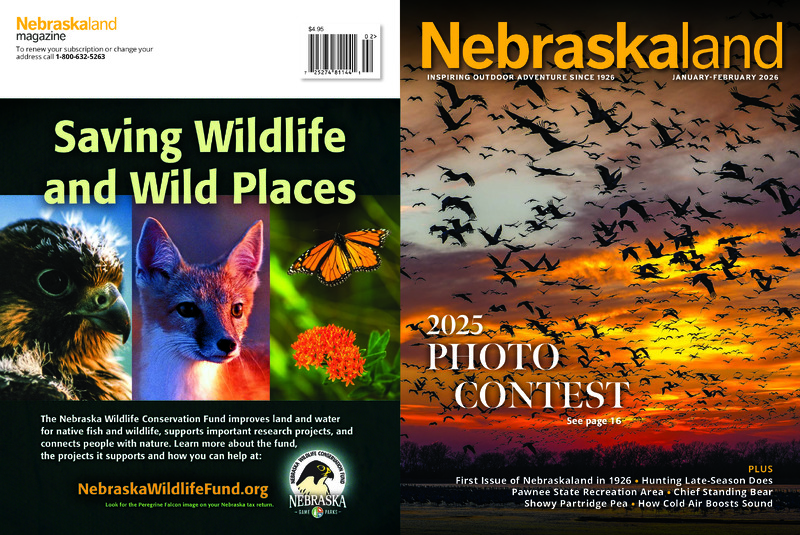
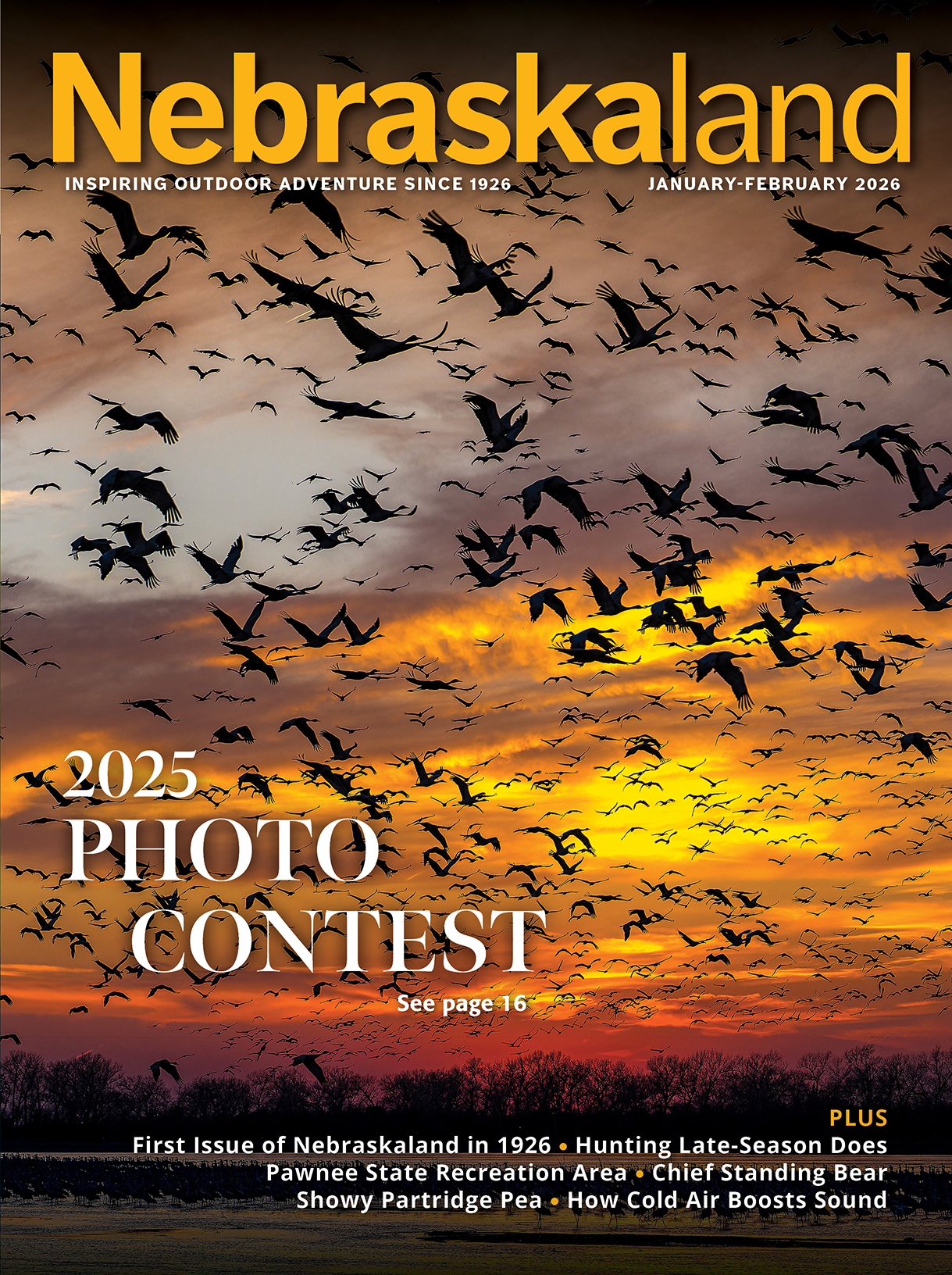
Cover: Jeffrey Z. Carney, of Ashland,
won Best of Show in the 2025
Nebraskaland Photo Contest for his
image entitled “A Final March Toward
Migration.” See page 16.
This page: A rooster ring-necked
pheasant stands atop a row of hay
bales east of Chadron.
JUSTIN HAAG, NEBRASKALAND
Photos submitted by Nebraskaland Magazine readers
What to Do in January and February
By Jeff Kurrus
36
PAWNEE STATE RECREATION AREA
44
CHIEF STANDING BEAR AND THE
DECLARATION OF INDEPENDENCE
Photos and story by Eric Fowler
By David L. Bristow, Nebraska State Historical Society
48
ONE HUNDRED YEARS LATER
The First Issue of Nebraskaland Magazine
By Jeff Kurrus
50
SHOWY PARTRIDGE PEA
A Wildlife Favorite
Story and photos by Gerry Steinauer, Botanist
DEPARTMENTS
8
52
64
66
In the Field
Mixed Bag
Portraits from the Past
The Last Stop
ON THE WEB
For more articles and
information, visit
NebraskalandMagazine.com
4
Nebraskaland • January-February 2026
Nebraskaland (VOL. 104 / NO. 1 ISSN 0028-1964) is published monthly, except for the combined Jan./Feb. and Aug./Sept. issues, by the Nebraska Game and Parks Commission, 2200 N. 33rd
St., Lincoln, NE. Periodicals postage paid at Lincoln, Nebraska, and additional mailing offices. POSTMASTER: Send all UAA to CFS. (See DMM 507.1.5.2); NON-POSTAL AND MILITARY
FACILITIES: send address corrections to Nebraskaland, P.O. Box 30370, Lincoln, NE 68503-0370.
January-February 2026 •
Nebraskaland
5
magazine
Published by the Nebraska Game and Parks
Commission since 1926. The Commission
is dedicated to the conservation and
protection of all the state's natural
resources and the people who use them.
Magazine Staff
Communications Director Christy Firestone
Public Relations Manager Shawna Richter-Ryerson
Editor Jeff Kurrus
Associate Editor Jenny Nguyen-Wheatley
Regional Editors Eric Fowler, Julie Geiser,
Justin Haag
Contributing Editor Michael Forsberg
Regular Contributors Chris Helzer, Chris Masada,
Todd Mills, Ryan Sparks, Gerry Steinauer
Art Director Tim Reigert
Graphic Designer Mel Severin
Videographer Nick Sauvageau
Photo Librarian Jaclyn Cruikshank Vogt
Administration
Director Tim McCoy
Chairman - John Hoggatt, Kearney
Vice Chairman - Donna Kush, Omaha
CORRECTION — Nebraskaland
Magazine strives to promote safe
and responsible outdoor recreation.
Our December 2025 cover missed
the mark, featuring a hunter walking
along railroad tracks — an activity
that constitutes trespassing. We
regret the error and will work to
uphold the high standards readers
expect in our publication.
Editor
Magazine Subscriptions
For address changes, magazine and subscription
questions, 800-632-5263 or visit
nebraskalandmagazine.com
Advertising
For advertising information, contact:
Shane G. Gilster, 402-742-0125
shanegilster@solotreemedia.com
Kurt Arganbright, Valentine
Scott Cassels, Omaha
Dan Hughes, Venango
Kent McNeill, Papillion
Steve Mossman, Lincoln
Lisa Roskens, Omaha
Doug Zingula, Sidney
Nebraskaland Magazine Copyright 2025, all rights reserved. Nebraskaland is available in audio from the Nebraska Library Commission Talking Book
and Braille Service, Suite 120, 1200 N St., Lincoln, NE 68508. 800-742-7691. Nebraskaland Magazine and the Nebraska Game and Parks Commission
reserve the right to reject any advertising not in keeping with the agency mission. Rates: $18 for one year; $33 for two years; $44 for three years.
Nebraska recipients must add appropriate sales tax. To subscribe call 1-800-NEBLAND (632-5263), or go online to: NebraskalandMagazine.com.
Commission Offices
Conservation Officers
Headquarters/Southeast District Office
2200 N. 33rd Street Lincoln, NE 68503
Phone 402-471-0641
Northeast District Office
2201 N. 13th St. Norfolk, NE 68701
Phone 402-370-3374
Southwest District Office
301 E. State Farm Rd. North Platte, NE 69101
Phone 308-535-8025
ADMINISTRATION
Jeff Clauson
402-471-5531
Lincoln HQ
Administrator
Travis Shepler
402-471-5531
Lincoln HQ
Asst. Administrator
Stacey Lewton
402-471-5531
Lincoln HQ
Asst. Administrator
Mike Thome
402-471-5531
Lincoln HQ
Asst. Administrator
(Includes counties covered)
Northwest District Office (temporary)
1317 W 3rd St., Alliance, NE 69301
Phone 308-763-2940
NORTHWEST
Sean McKeehan 308-672-1824
Captain
Bassett Office
524 Panzer St., Box 508 Bassett, NE 68714
Phone 402-684-2921
Jerod Hahn
South Central District Office
1617 First Ave. Kearney, NE 68847
Phone 308-865-5310
Schramm Education Center
21502 W. Highway 31 Gretna, NE 68028
Phone 402-332-3901
Omaha Office
8495 Frederick Street, Omaha, NE 68124
Phone 402-595-2144
OutdoorNebraska.gov
The Nebraska Game and Parks Commission does not discriminate
based on race, color, ethnicity, national origin, sex, pregnancy, sexual
orientation, gender identity, religion, disability, age, genetic information,
veteran status, marital status, and/or political affiliation in its programs,
activities, or employment. Any person who believes he or she has been
discriminated against in any program, activity, facility, or service,
should contact the Nebraska Game and Parks Commission, Lincoln, NE
402-471-0641, the Nebraska Equal Opportunity Commission, Lincoln,
NE 402-471-2024, TTY/TDD 800-642-6112; Director, Office of Diversity,
Inclusion and Civil Rights, U.S. Department of Interior, 1849 C Street,
NW, Washington, D.C. 20240.
6
– EAST SUB-DISTRICT –
308-520-5539
Sergeant
Grant Albrecht
531-229-4405
Cheyenne, Deuel, Kimball
Hunter Lee
308-280-4320
Keith, Deuel, Arthur
Jaden Porter
308-289-2274
Garden, Grant, Keith
Tyler Stueck
308-289-6260
Keith, Arthur, Grant
Keith Jadlowski 531-310-2869
Keith
– WEST SUB-DISTRICT –
Casey Gehrt
402-617-2112
Sergeant
KayLynn Miller
308-665-8440
Dawes, Sioux, Sheridan
Cassidy Harwood 308-562-9099
Box Butte, Sheridan
Josh Widhelm
308-279-9133
Scotts Bluff, Banner, Sioux
Brandon Wallace 308-280-4488
Scotts Bluff, Banner, Sioux
Travis Schultz
308-279-1292
Morrill, Scotts Bluff, Box Butte
Vacant
Dawes, Sheridan, Sioux
NORTHEAST
Dale Davis
402-760-0712
Captain
– WEST SUB-DISTRICT –
Jeff Jones
402-762-5022
Sergeant
Greg Hesse
308-546-7464
Rock, Brown, Keya Paha
Jonathan Andreasen 402-340-3981
Madison, Pierce, Stanton
Nebraskaland • January-February 2026
Trevor Stahlecker 402-928-9099
Knox, Antelope, Pierce
Mitch Johnson
402-613-8612
Cedar, Knox
– EAST SUB-DISTRICT –
Cory Krause
402-380-6410
Sergeant
Kyler Prochaska 402-830-8278
Platte, Colfax
Matt Costello
402-317-4014
Dodge, Colfax
Kelbi Abke
402-237-2537
Washington, Burt
Nicholas Fix
402-508-0261
Dixon, Dakota, Thurston
Kyle Hansen
531-739-7392
Dodge
– CENTRAL SUB-DISTRICT –
Doug Pollard
308-730-7050
Sergeant
Vacant
308-440-1863
Howard, Greeley, Merrick
Matt Brandt
308-202-0819
Sherman, Howard
Klint Gill
402-613-5800
Nance, Wheeler, Boone, Polk
Garrett Zimmer 402-416-5736
Garfield, Loup Valley
Vacant
308-380-7331
Hall, Hamilton
SOUTHWEST
Brian Piernicky 308-330-8780
Captain
– NORTH SUB-DISTRICT –
Alex Hasenauer
308-660-4671
Sergeant
Dana Miller
531-229-4404
Cherry, Hooker, Thomas
Jacob Stoinski
308-395-6001
Lincoln, Perkins
Frank Miller
402-389-0444
Cherry, Hooker
Luis Nuñez
531-333-6093
Blaine, Custer, Thomas
Brandon O’Neal 308-530-3157
Lincoln, McPherson, Logan
– SOUTH SUB-DISTRICT –
Kelsey Glodowski 308-242-9000
Sergeant
Logan Smith
531-229-4406
Frontier, Furnas, Gosper, Red Willow
Bryce Streger
308-537-0404
Dawson, Gosper
Tyler Adelman
402-314-4783
Dawson, Gosper, Furnas
Sophia Gobber
308-222-0368
Chase, Dundy, Hayes, Hitchcock
SOUTHEAST
Matt Seitz
402-806-0915
Captain
– WEST SUB-DISTRICT –
Matt Taylor
402-200-9597
Sergeant
402-902-2017
Vacant
Adams, Clay, Webster
Justin Gress
308-629-9335
Thayer, Nuckolls, Fillmore
Vacant
308-920-2762
Harlan, Franklin, Phelps
Vacant
308-440-3847
Buffalo, Kearney
– EAST SUB-DISTRICT –
Heath Packett
402-210-0888
Sergeant
Brett Greenfield 531-350-0915
Cass
Russell Mort
402-209-1506
Otoe, Johnson
Rich Berggren
402-619-1355
Douglas
Brian Arp
531-530-9011
Douglas, Sarpy
Mike Luben
402-443-6392
Saunders
Bryan Adams
402-429-1924
Nemaha, Pawnee, Richardson
– CENTRAL SUB-DISTRICT –
Curt Prohaska
402-470-1298
Sergeant
531-229-4407
Easton Albrecht
Lancaster
Ben Keller
308-430-5500
Gage, Jefferson
Mark McDonald 402-805-2353
Lancaster
Mark Sullivan
402-741-0636
Lancaster, Seward, Butler
Jarrod Messman 531-739-9760
Lancaster, Saline, York
IN THE FIELD
FROSTY PINES
Heavy frost covers
ponderosa pines along
the scenic loop drive at
Chadron State Park.
JUSTIN HAAG, NEBRASKALAND
8
Nebraskaland • January-February 2026
January-February 2026 •
Nebraskaland
9
IN THE FIELD
A herd of white-tailed does feed in a Lincoln County cornfield.
JULIE GEISER, NEBRASKALAND
HUNTING LATE-SEASON DOES
By Julie Geiser
For those still looking to fill their freezer or just can’t get
enough of being outside, the January antlerless deer season
fits the bill. After the rut, deer will focus on feeding and
putting on fat to survive the winter. Hunters, too, should
shift their focus to achieve late-season success.
Food and Water
Standing crops and agricultural fields with waste grain or
winter wheat are good areas to find deer. Also, look for oak
trees and other browse that deer depend on during this harsh
season. Finding open water is another place to locate deer or
deer sign during winter.
When to Hunt
During early, cold mornings, deer typically won’t use up
energy to move around, so sleep in. Afternoons or evenings
are the prime times to hunt in the late season as deer will be
more active, moving from bedding to feeding areas, finding a
drink or simply stretching their legs.
However, get in place before the deer start moving to avoid
spooking them. Knowing when they move depends on the
weather and how much scouting you’ve done beforehand.
10
Nebraskaland • January-February 2026
Weather
When severe weather is approaching, deer will be driven to
feed. Digestion generates body heat and deer will search out
food sources before and after weather patterns. So they don’t
expend precious energy, deer will browse on twigs, bark and
other natural foods close to bedding areas.
Deer will seek shelter from wind in hilly areas, ravines,
and they will bed down on slopes facing the sun to keep
warm. Cedar-covered areas provide good shelter from wind
and snow and provide warmth, especially when the sun is
shining.
Locating Deer
Finding groups of does can be somewhat easy, as they will
travel to and from bedding and feeding areas in the same
patterns unless spooked. If there is snow on the ground,
locating signs, such as tracks and scat, becomes much easier.
Hunting tactics this time of year centers, more than ever,
on food and shelter. As long as you’re willing to brave the
cold, focusing on these necessities will increase your odds of
finding deer.
IN THE FIELD
rea
orned ow per
es on a dead ree a
asswa
rp
d e
ana e en
rea n u a o oun
.
ERIC FOWLER, NEBRASKALAND
GO OWLING
By Olivia DaRugna, Wildlife Diversity Biologist
Owls are one of the earliest nesting birds in Nebraska,
and now is a great time to listen for them. Great horned
owls (Bubo virginianus) and barred owls (Strix varia) call to
mates and hoot to defend nesting territories throughout the
winter. Great horned owls may begin laying eggs as early as
late January, and barred owls nest as early as the first week
of February.
While dawn and dusk can be the most productive times to
view owls, there are opportunities to observe these nocturnal
birds any time of day. With no leaves on the trees in winter,
owls are more visible as they perch on branches. Take a
closer look at those dark clumps in the trees. What might
appear to be a squirrel nest could actually be an owl.
Even if you can’t see an owl, you can often hear them.
Listen for the various owl calls from hoots to squawks to
barks. The great horned owl is recognizable by its low “hoo
hoodoo hooo hoo” song. The barred owl is unmistakable by
its “Who cooks for you? ... Who cooks for you all?” hoot.
Owling Do’s and Don’t’s
Keep your distance and do not disturb an owl’s natural
behavior and activity. If an owl is fidgeting, repeatedly
staring at you or changing position, you’re too close. Use
binoculars, a viewing scope or watch from the comfort of
your vehicle.
Do not feed owls.
Do not use electronic playback, especially if you suspect
12
Nebraskaland • January-February 2026
that owls might be nesting or on territory. As winter
marches on, vocal activity will naturally pick up, and
these devices will be unnecessary.
Where to Go Owling
To view barred owls, visit eastern Nebraska parks with
mature woods around riparian habitats, such as Ponca
and Indian Cave state parks, Schramm Park State
Recreation Area and Rock Creek Station State Historical
Park at dawn or dusk.
Great horned owls often are observed in neighborhoods,
city parks and state parks. Try Branched Oak and Enders
state recreation areas.
Short-eared owls (Asio flammeus) are an open-prairie
dwelling species that are most often observed in winter
and early spring when there is little snow cover. For best
chances of viewing this stealthy, nomadic species, visit
less developed areas with grassland habitat, such as
Kiowa, North Lake Basin or Jack Sinn Memorial wildlife
management areas.
During the day, look for snowy owls (Bubo scandiacus)
in open fields or near large water bodies. Typically, there
are a few to over a dozen snowy owls that wander into
Nebraska each winter.
To discover more birding locations, visit
birdtrail.outdoornebraska.gov.
IN THE FIELD
A Scottish soup made with pheasant.
JENNY NGUYEN-WHEATLEY, NEBRASKALAND
COCK-A-LEEKIE SOUP
By Jenny Nguyen-Wheatley
1 bay leaf
10 cups of water
2 large leeks, washed and white- and
light-green parts coarsely chopped
2-3 tsp. chicken bouillon
½ cup of uncooked white rice
½ cup of quick barley
6 prunes
1 cup of shredded carrot
Salt and pepper, to taste
Minced chives for garnish
Butter
Known as Scotland’s National Soup,
cock-a-leekie is a simple dish of leeks,
chicken and barley — and it’s just
as satisfying made with pheasant.
Traditionalists include prunes, which I
have done here to add extra sweetness
to the pheasant stock. However, if you
think prunes are ghastly, skip them.
The version I enjoyed for lunch at
a little cafe on Loch Lomond included
rice. I liked the rice, so I’m including
it, too.
Servings: 4-6
Prep Time: 15 minutes
Cooking Time: 2 hours
Ingredients:
1 whole pheasant, quartered
1 onion, halved
2 ribs of celery, cut in half
1 whole head of garlic
14
1. In a pot, combine pheasant,
onion, celery, bay leaf and water.
Rub the garlic head to remove loose
papery layers, and then cut off the
top to reveal its cross section. Drop
trimmed garlic head into the pot and
bring contents to a simmer. Simmer
partially uncovered for 1 hour and 30
Nebraskaland • January-February 2026
minutes, or until pheasant becomes
tender. Skim off foam.
2. Then discard onion, celery, garlic
and bay leaf. Remove pheasant from
the pot, and when cool enough to
handle, pick off meat and shred into
bite-size pieces and set aside.
3. Add chicken bouillon, chopped
leek, shredded carrot, rice, barley and
prunes to the pot and simmer for an
additional 30 minutes. If soup becomes
too thick, thin with more water and
bouillon.
4. Right before taking soup off the
heat, add shredded pheasant meat to
warm through. Season soup to taste.
Serve hot soup with chopped chives
and a pat of butter on top. There
should be one prune in each bowl.
Cock-a-leekie is usually served with
brown bread.
2025
PHOTO
CONTEST
This year’s Nebraskaland Magazine Photo
Contest was once again a thrill for our staff to
witness. Viewing scenes across our great state
through the eyes of others is such a stunning
way to cap off another year in the outdoors.
This year’s Best of Show winner, “A Final
March Toward Migration,” by Jeffrey Z. Carney
of Ashland, was taken at the Crane Trust in
Hall County.
“On this night, I put down my long telephoto
and picked up a 35mm wide-angle lens
to try and capture the moment we were
all witnessing. It was a scene I had not
experienced during other migrations … . By
the next afternoon, most of the area’s cranes
were gone.” (Read the rest of Carney’s story on
page 66.)
While the Nebraskaland staff has seen
thousands of sandhill crane images before, the
depth of the cranes and the beautiful colors
behind them were mesmerizing.
We thank everyone who participated in this
year’s contest and look forward to seeing our
wonderful state through your eyes next year.
Jeff Kurrus, Editor
Nebraskaland Magazine
BEST OF SHOW
A Final March Toward Migration, Hall County
Jeffrey Z. Carney, Ashland
WILDLIFE
FIRST PLACE — Meridian, Cherry County
Rex DeBord, Chadron
WILDLIFE
THIRD PLACE — A Bobwhite Song, Hall County
Colleen Childers, Grand Island
20
Nebraskaland • January-February 2026
SECOND PLACE — The Challenger, Thomas County
Brad Mellema, Grand Island
January-February 2026 •
Nebraskaland
21
MACRO
FIRST PLACE —
Dragonfly Double,
Hall County
Rita Flohr, Grand Island
22
Nebraskaland • January-February 2026
January-February 2026 •
Nebraskaland
23
MACRO
SECOND PLACE — A Drone Fly Close-Up, Frontier County
Don Brockmeier, Eustis
THIRD PLACE — Corn Kernel and a Jumping Spider, Lancaster County
Molly Boyd, Lincoln
24
Nebraskaland • January-February 2026
January-February 2026 •
Nebraskaland
25
RECREATION
FIRST PLACE — Foggy Fishing at Iron Horse Lake, Pawnee County
Ellen Hanzlicek, DuBois
RECREATION
SECOND PLACE — Just Getting Started, Perkins County
Matt Zvolanek, Ogallala
THIRD PLACE — A Campfire Night at Ponca State Park, Dixon County
Tiara Brown, Omaha
28
Nebraskaland • January-February 2026
January-February 2026 •
Nebraskaland
29
SCENIC
FIRST PLACE — The Meandering Middle Loup,
Hooker County
Jeffrey Z. Carney, Ashland
SCENIC
SECOND PLACE — Barn Storming, Butler County
Brandon Hammons, Creston
THIRD PLACE — Still Life in Swedeburg,
Saunders County
Colette Rathke, Wahoo
January-February 2026 •
Nebraskaland
33
Outdoor Nebraska
By Jeff Kurrus
Whether in the field, your comfy chair or the Turpin Outdoor
Education Center, there is plenty to keep you experiencing
nature during two of the most exciting months of the year. N
What to Do in January and February
First Day Hikes
Jan. 1 | Various Locations
Start the year off on the trail at one of the
Nebraska Game and Parks Commission’s
First Day Hikes. These guided events across
the state educate participants about the
winter season and the flora and fauna that
call these locations home. From the vistas at
Chadron State Park to the prairie and wooded
views at Rock Creek Station, these hikes
are an essential way to start your new year
happy and healthy. A valid 2026 Nebraska
state park vehicle permit is required for
entry. Visit Calendar.OutdoorNebraska.gov
for more information.
JUSTIN HAAG, NEBRASKALAND
e
s
s a
or a nbows
“Discover the hidden lives of Nebraska’s owls in this hourlong program exploring the biology, behavior, and unique
adaptations of our native species.” This is the introduction
to the Jan. 15 online class offered by educators from the
Nebraska Game and Parks Commission. Another class, The
Science of Squirrels, will be Feb. 12. These online classes take
place throughout the year and are free to the public, but you
must register in advance through the event listing found at
Calendar.OutdoorNebraska.gov. JUSTIN HAAG, NEBRASKALAND
Catching put-and-take rainbow trout through the ice is just one more reason to
visit destinations throughout the state. A list of these stocked waters can be
found at OutdoorNebraska.gov after searching Fish Stocking Database. These
fish can be caught using the traditional ice-fishing techniques. They tend to
strike quickly, so anglers will need to pay attention whether dead-sticking or
jigging. On the lure and gone in a flash, these fish add a species to locations
like Grove Lake in Antelope County, where largemouth bass, bluegill and
northern pike can also be found along with these aggressive fighters.
JEFF KURRUS, NEBRASKALAND
a
assroo
Various Dates | Online
All Month Long | Statewide
a e season
r ua
a e
Watch the Weather | Statewide
You can mark the weather forecast. Every winter, it
seems, a random two- or three-day warm-up blows
through Nebraska and provides highs in the 40s and
50s. Hot today, cold tomorrow, these days are perfect
for returning to the field with a shotgun in hand to hunt
for rabbits, squirrels or even pheasants. Not only are
these afternoons comfortable, a lot of life will be in the
field; game animals seem to notice the weather as well
and take advantage of the milder temperatures, making
them easier targets for hunters.
os
r
er
Jan. 2, 3:30-8 p.m.; Jan. 3, 12:30-5 p.m.
Turpin Outdoor Education Center
Perfect for the entire family, Cosmic Archery at the Turpin
Outdoor Education Center in Lincoln features black lights,
music and glowing targets. Equipment is provided and
beginners are welcome. Reserve your group under one
registration and choose from a group check-in time. Group
reservation is for a one-hour activity period. Limited
capacity available. DAVID WOLFE
JUSTIN HAAG, NEBRASKALAND
34
Nebraskaland • January-February 2026
January-February 2026 •
Nebraskaland
35
pawnee
Photos and story by Eric Fowler
Ben Vaneperen of Lincoln makes
a turn on his personal watercraft
at Pawnee State Recreation Area.
I
f you want to hop in a boat or on a personal watercraft
and go fast, there aren’t many places to visit in
southeastern Nebraska. Yet Pawnee State Recreation
Area is one of those spots, making it a busy place
on a summer weekend. But it is also a quiet place most
times, drawing families to its campgrounds, sunbathers to its
beaches, anglers to its water and hunters to its woodlands.
And all just a short drive from Lincoln.
The 780-acre lake is the second largest of the eight Salt
Valley lakes managed by the Nebraska Game and Parks
Commission and built in the 1960s by the U.S. Army Corps
of Engineers for flood control. The lake’s two campgrounds
offer nearly 200 sites, 68 with electrical hookups, all with
plenty of shade. Lakeview, located on the north side, is
the largest and lives up to its name, with tent sites on
the water’s edge. Area 3 includes RV and tent sites next
to the Middle Creek inlet. A group camp there is popular
among Scouts.
Large day-use areas on the east and west sides of the lake
draw plenty of folks from the capital city and other nearby
communities. Both include sandy swim beaches, and there
are two shelters and plenty of picnic tables and grills for
those who like dining outdoors on a summer day.
Mowed trails and service roads wind through the 1,150
acres of parkland and wildlife management area surrounding
the lake. Popular among hikers, bikers and horseback riders,
the trails and roads nearly encircle the entire lake, with the
only gap being 580 yards along Northwest 126th Street. But
don’t let that stop you from making the 7-mile hike.
Along the way, you might spot deer and other wildlife in
the woodlands, or shorebirds along the lake’s edge. In the late
winter, when ice comes off the lake, there could be as many
as 100 bald eagles feasting on gizzard shad that couldn’t
handle the cold, a sight that draws photographers from
Lincoln and other nearby communities.
Anglers can find blue, channel and flathead catfish,
saugeye, and crappies, including some big fish, as well as
bluegills at Pawnee. Kids can also keep busy catching white
perch and bullheads from the bank.
With no centerfire rifles or handguns allowed, archery and
muzzleloader deer hunters are drawn to the area, and squirrel
and rabbit hunters have plenty of critters to pursue. Even
waterfowl hunters have room to put out a spread of duck or
goose decoys on the lake.
The lake’s shotgun range, located in Area 1, is a popular
place among shooters wanting to get tuned up for the
hunting season or just learning to shoot. An archery range in
Area 3 gets plenty of use as well.
Pawnee has an interesting distinction of being both busy
and quiet, perfect both for relaxing away from the crowds,
no matter the season, or jumping right in the middle of the
summer fun on the water. N
ABOVE: Pawnee Lake, fed by Middle Creek, is located north of Emerald in Lancaster County.
OPPOSITE: Snow falls on a trail leading through the woodlands at Pawnee State Recreation Area.
38
Nebraskaland • January-February 2026
OPPOSITE: Amanda,
Joshua and Victoria Walls
of Omaha enjoy dinner
by lantern light in their
screen tent in the Area 3
campground.
BELOW: Jimmy Rawhouser
of Columbus and his son,
Lane, watch as his nephew,
Jimmy, reels in a bullhead.
RIGHT: Jonah Phillip, Foster
Pierce and Jaydon Phillip of
Lincoln play on the swim
beach in Area 1.
BOTTOM RIGHT: Crew Loos
of Roca rides his scooter
through the Lakeview
Campground.
January-February 2026 •
Nebraskaland
41
LEFT: Kenzie and Brianna Kesselring of
Garland ride their horses down a trail in
Area 2.
BOTTOM LEFT: A bald eagle perches in a
tree in Area 1. The lake is a favorite stop
for eagles in the spring.
RIGHT: Kobie Hill and Caleb Bruhn of
Lincoln head back to their vehicles
following a morning duck hunt.
a
s es ro
e
bank near their campsite in the Lakeview
Campground.
42
Nebraskaland • January-February 2026
Chief Standing Bear
and the Declaration of Independence
By David L. Bristow, Nebraska State Historical Society
A
statue of Chief Standing Bear stands in the U.S. Capitol,
and Lincoln’s newest high school is named in his honor.
The Ponca leader is celebrated for an 1879 court case in
which he successfully challenged the government that
was holding him prisoner.
In Standing Bear v. Crook (1879), Judge Elmer Dundy ruled
for the first time in a federal court that “an ndian is a person
within the meaning of the laws of the United States.” As
we commemorate 250 years of American independence
in 2026, it’s timely to look at the role of the Declaration of
Independence in this famous Omaha trial.
The Ponca had never been at war with the United
States and had never sold their land near the mouth of the
Niobrara River. Nevertheless, the government forced them
to move to ndian Territory. There, they suffered from hunger
and disease.
In the dead of winter, Chief Standing Bear led a group of
Poncas on foot back to Nebraska, where they were arrested
and held at Fort Omaha by Gen. George Crook.
Standing Bear, his wife and one of his sons, 1870s.
NSHS RG2066-PH5-2
A later photo of Standing Bear.
44
Nebraskaland
NSHS RG2066-PH5-1
• January-February 2026
Aided by Omaha attorneys, Standing Bear took the
unprecedented step of suing the federal government in
court. This was the first time a Native American had done so.
He sought a writ of habeas corpus, a concept from English
common law that prevents unlawful imprisonment. The
government had not charged the Poncas with a crime but
insisted that no Ponca could leave the reservation without
permission.
Federal attorneys even argued that Standing Bear had no
right to challenge them in court. As a Native American, they
said, he was not the kind of “person” that was meant when
the law spoke of the rights of the people.
As in most trials, many of the arguments were technical
and legalistic. But Judge Dundy got to the heart of the
matter in his ruling. He noted that the federal attorney had
Standing Bear, November 1877.
This portrait was made during
a visit to Washington D.C. and
is the basis for the statue at
the U.S. Capitol. NSHS RG1227-PH2-2
Standing Bear and his friends went on a speaking tour
after the trial. His interpreter was Bright Eyes (aka Susette
La Flesche), a young woman of the Omaha tribe who
became a powerful speaker in her own right.
Bright Eyes had a knack for distilling in a few sentences
the essence of America’s founding documents. One
of her main themes was that the central purpose of
constitutional government is its protection from arbitrary
power. In her introduction to a book about Standing Bear’s
case, she said she wanted the American people to hear the
Poncas’ story because, “The people are the power which
move the magistrates who administer the laws” — which
is about as succinct a definition of democracy as one
could ask for.
“ t is a little thing,” she continued, “a simple thing,
which my people ask of the nation whose watchword is
liberty; but it is endless in its consequences. They ask for
liberty, and law is liberty.” N
Visit the Nebraska State Historical Society’s website at
history.nebraska.gov.
Inshata Theumba (“Bright Eyes”), also known as Susette La
Flesche Tibbles. NSHS RG2737-PH0-9
Because a federal
court tried the
case, the trial was
held at the U.S.
os
e and
Custom House
building. Built in
1870, it stood on
the southwestern
corner of 15th
and Dodge
streets in Omaha.
NSHS RG2341-PH0-247
Judge Elmer Dundy.
NSHS RG2411-PH0-142
explained the history of habeas corpus in English law. The
attorney had demonstrated that habeas corpus had always
applied only to the “free subjects of the kingdom” and not
to everyone.
Dundy dismissed this argument. “ have not examined the
English laws ... ,” he said, “nor have thought it necessary
to do so.” Even if the federal attorney was correct, English
laws “will appear at a disadvantage when compared with
our own … that whilst the Parliament of Great Britain was
legislating in behalf of the favored few, the Congress of the
United States was legislating in behalf of all mankind who
come within our jurisdiction.”
Dundy did not address the question of citizenship or
restore the Poncas’ land, but he ordered General Crook
to release the Poncas. Standing Bear and his followers
46
Nebraskaland
• January-February 2026
had chosen to separate themselves from the rest of their
tribe, and that decision must be respected, Dundy said,
because — and here he referenced the Declaration — they
“have the inalienable right to life, liberty, and the pursuit
of happiness …’.”
Dundy did not argue that the Founders had Native
Americans in mind when they wrote those words. In truth,
colonists had wanted to move deeper into the Native
American’s territory beyond the Appalachians, and resented
the British government for trying to stop them.
But once Americans embraced the principles of equality,
self-government and inalienable rights, people who were
not protected by existing laws began to argue that so-called
universal principles ought to include everyone. Over time,
this proved to be a powerful argument.
January-February 2026 •
Nebraskaland
47
ONE
HUNDRED
YEARS
L A T E R
e rs ssue
e r s
u er e u
r e r s
s
r
e s s
er
e e ue
ser
Ju e
e
By Jeff Kurrus
T
he predecessor of Nebraskaland Magazine, Outdoor
Nebraska, was first published in June 1 26 with the
following mission:
"The Bureau of Game and Fish takes pleasure in
presenting to the citizens of Nebraska the first number of
Outdoor Nebraska.
It is the purpose of the department to publish this bulletin
from time to time for two reasons:
(a) To inform the sportsmen and other citizens of the state
who are interested in the work of the Department just what
is being done.
(b) To inculcate a greater appreciation for the wild life and
the natural beauty of Nebraska."
Let’s look back on what Nebraskans considered important
a century ago.
Concerns of the Day
Prairie chickens: “There were some things which the
breaking plow took from us that can never be returned. One
of these things was the prairie chicken. He had to give way
to the plow which year after year turned under more and
more sod. Today, there are very few of these native birds left
in eastern Nebraska, so few that they are almost a curiosity.”
— From “The Pheasant in Eastern Nebraska”
The future of waterfowl hunting: “With the growing
occupation of the continent, the increase in the number of
hunters, and the disappearance of great areas of marshes and
waters through drainage, the adverse effect on the supply
of migratory wild fowl became more and more evident.”
— “Our Migratory Wild Fowl and Present Conditions
Affecting Their Abundance,” Edward W. Nelson
Habitat loss: “We can go on and exploit all our natural
resources if we wish, let the wild life and natural beauty of
48
Nebraskaland • January-February 2026
Nebraska become a thing of the past, or we can conserve
these things and pass them on to our children and our
children's children. It all depends on what we do today.”
— “State Recreation Grounds for the Future,” Frank B. Connell
The need for game preserves: “WITH the population
increasing rapidly, low lands being drained, prairie lands
being broken into farms, the problem of conserving wild
life grows more and more difficult. … The Nebraska Bureau
of Game and Fish has come to the conclusion that the
only answer to this important problem is adequate game
preserves for both animal and bird life, and therefore quite
extensive plans are being made along this line.”
Conservation officers: "The average Game Warden of
today is a sincere sort of a fellow, serious-minded in his work
and generally willing to overlook an innocent mistake. His
job is a thankless one, his work hours never cease once he
has taken the oath of office; he can't satisfy everyone and
he shouldn't try.”
Entertainment: And what outdoor publication doesn't
need an essay on frogs, written by “A Young Norwegian”:
“What a wonderful bird the frog are. When stand, he sit,
almost. When he hop, he fly, almost. He ain't got no sense,
hardly. He ain't got no tail, hardly, either. When he sit, he sit
on what he ain't got, almost.”
These older editions are reminders that conservation, and
getting people interested in the outdoors, will be the focus
long into the future. However, there is one oversight in this
first edition. This magazine would not go on to be published
from “time to time.” It has faithfully informed Nebraskans
for 100 years, with many more years to come. N
ee r
100 Years
Nebraskaland Magazine
e rs
o er o
u door
ebras a
a a ne pub s ed n une
.
NEBRASKALAND ARCHIVES
January-February 2026 •
Nebraskaland
49
Showy Partridge Pea
Partridge pea showing
buds and open flowers.
A WILDLIFE FAVORIT E
Story and photos by Gerry Steinauer, Botanist
I
often include showy partridge
pea (Chamaecrista fasciculata)
in prairie and other planting
mixes. This pioneering annual is
inexpensive and usually establishes
in the first year, adding bright color
to the landscape while providing
an early source of pollen for hungry
insects. ts large, nutritious seeds are
also a favorite of wildlife.
Preferring sandy soils, partridge
pea grows on dry shorelines, open
woodlands, prairies and disturbed
sites across the eastern half of
Nebraska. As its name suggests,
it has striking, bright yellow, peaPartridge pea seed harvested with a combine and cleaned for planting.
shaped flowers that bloom from July
into September. These blooms are
Some landowners, especially in the South, are choosing
followed by flat, green pods that darken, twist and eventually
to “go natural,” planting partridge pea and other native
spring open, tossing seeds several feet. The seeds usually
legumes instead of corn, milo or alfalfa in wildlife food plots.
germinate late the following spring, though many remain
nlike crop food plots, partridge pea doesn’t require annual
dormant in the soil for years.
planting
just occasional disturbance, like harrowing or
Partridge pea often thrives in the first few years of
light disking, to rejuvenate the plants. These plots with dense
plantings but fades as perennial grasses and wildflowers
upper foliage over bare ground offer ideal brood-rearing cover
take hold. Only scattered plants and seeds usually persist
for pheasant and quail chicks.
without management. Prescribed fire, haying or livestock
Partridge pea also supports pollinators. ts flowers don’t
grazing can rejuvenate stands by setting back competing
produce nectar to attract pollinators; instead, they have
perennials, exposing bare soil and letting sunlight reach the
anthers of two colors. Yellow anthers produce reproductive
ground, stimulating germination and seedling growth. Fire,
pollen, while purple anthers produce “food pollen” that
in particular, can produce especially lush stands, a bonan a
attract bumble bees, honeybees and other long-tongued bees
for wildlife. ts heat helps break down the hard seed coat,
that can access the pollen.
while the nutrient-rich ash acts as a natural fertili er.
Another clever ploy Orange-red glands on its leaf stalks
Deer browse the foliage in late summer and early fall, and
secrete nectar all summer, drawing sweet-toothed ants that
pheasants, bobwhite quail, greater prairie-chickens, turkeys,
patrol and protect their food source, as well as the plant from
mallards, songbirds and rodents all feed on the protein- and
leaf-eating insects.
carbohydrate-rich seeds, which are low in fiber and easily
f you want an inexpensive, easy-to-grow plant that
digestible. Many pods stay closed and hang on the stems
supports wildlife and pollinators, partridge pea is hard
through winter, providing food during a stressful time when
to beat. N
other seeds are buried beneath snow.
50
Nebraskaland • January-February 2026
January-February 2026 •
Nebraskaland
51
MIXED BAG
A REGAL BIRD
Royalty? Perhaps not, but ferruginous hawks are an iconic species of the American West
By Justin Haag
A ferruginous hawk keeps watch over its surroundings from atop a utility pole in
Dawes County. JUSTIN HAAG, NEBRASKALAND
The word regal is used to define
something so magnificent or dignified
that it’s fit for a monarch, or resembles
one. One of the state’s hawk species is
so highly thought of that it bears the
name Buteo regalis.
The ferruginous hawk wears its
crown without trumpets and fanfare.
ts mottled appearance can make it
hard to distinguish from other hawks.
The species of western North
America that, in Nebraska, primarily
ranges only in the Panhandle, is what
you can call “a big deal,” though. With
a wingspan of almost 5 feet, it’s the
largest of big hawks known as buteos
and, therefore, the largest of the
hawk species.
The much more common red-tailed
hawk has rounder, shorter wings, a
distinction that helps identify the bird
52
in the air. The bald eagle and golden
eagle aren’t much larger than the
ferruginous.
The species has a range of color
morphs but is named for the hue of the
feathers on its legs and shoulders
ferruginous is a word that references
the rust of iron. t joins the golden
eagle and rough-legged hawk as the
only raptor species in America with
feathers down to their toes.
ost
others are only partially feathered and
not as suited to the cold.
The birds are well adapted to hunt
the open prairie. They often perch on
utility poles, dead trees and other high
vantages to survey the landscape.
Comparable to other hawks, they have
outstanding eyesight, estimated to
be about eight times better than that
of humans.
Nebraskaland • January-February 2026
They primarily feed on small
mammals but have been known to
kill and fly off with larger species,
such as jackrabbits. They’ve even
been observed standing near the
holes of prairie dogs and other small
mammals waiting to ambush the
unsuspecting prey when they emerge.
As a distinction from other hawks,
they will run down prey on foot.
After performing a courting display
of aerial acrobatics, ferruginous
hawks build large nests, about
feet high and feet across. Further
solidifying the hawk’s reputation as
a species of the West are accounts
of it using bison bones in nest
construction when the big beasts
roamed the plains in vast numbers.
The nests can occur as high as 65 feet
or down to ground level.
The species is among those listed
for greatest need of conservation in
Nebraska, where the total population
is estimated to be 200 to 400. There are
fewer than 4,000 breeding pairs in the
nited States.
The bird’s scientific name did not
always bear its regal distinction. t
was first called Falco ferrugineus in
the 1 0s by the curator of a German
museum who received a specimen
from California. t was later discovered
that name had already been used to
describe another raptor species of
ra il. O cial naming rights then
went to the next on the list a keeper
at the ritish useum received skins
of birds from exico and had given it
the Buteo regalis epithet in 1 44.
No, you won’t see this hawk riding
a royal carriage over the western
Nebraska countryside. From its throne
high above, though, Buteo regalis
looms large to small mammals and
keeps watch over its prairie kingdom.
January-February 2026 •
Nebraskaland
53
MIXED BAG
HOW COLD AIR BOOSTS SOUND
By Monica Macoubrie, Wildlife Education Specialist
Winter in Nebraska transforms the landscape into a world
of snow-covered fields, fro en lakes and crisp, clear air. ut
beyond the visual changes, winter also affects the way sound
travels, influencing how animals communicate, hunt and
evade predators.
n the winter, air is denser due to lower temperatures,
which allows sound waves to travel farther and with greater
clarity. This is why on a still winter night, the call of a distant
coyote or the hoot of a great horned owl might seem eerily
close. Without the humidity and thermal turbulence of
summer, sound waves experience less distortion, creating an
almost amplified effect.
Silent Snow
Freshly fallen snow does more than just create a winter
wonderland it also acts as a sound absorber. The complex,
airy structure of snowflakes scatters and dampens sound
waves, creating that peaceful, mu ed hush after a big
snowfall. This can be great news for small animals like
rabbits and voles, making it harder for predators to pinpoint
their location. ut as snow compacts or forms an icy crust,
it starts to reflect sound instead, suddenly amplifying every
crunch, rustle or tiny movement. A scurrying mouse beneath
the snowpack might be hidden from sight, but to a sharpeared owl, it sounds like a dinner bell ringing from below.
In the winter, beavers drum their tails on the ice, sending
vibrations through the water to communicate.
JUSTIN HAAG, NEBRASKALAND
Ice Drums and Tail Slaps
Nebraska’s beavers are known for their impressive
engineering skills, but they also have creative ways of
communicating in winter. When their ponds and streams
free e over, beavers can no longer slap their tails on open
water to warn their family of danger. nstead, they adjust by
drumming their tails on the ice, sending vibrations through
the water below. These sound waves travel e ciently under
the fro en surface, alerting their colony without drawing
unwanted attention from predators above.
This white-breasted nuthatch from the Pine Ridge relies on
calls to stay in touch with other birds while foraging.
JUSTIN HAAG, NEBRASKALAND
Bird Calls on Ice
Even when the trees are bare and the landscape is fro en,
Nebraska’s winter birds keep singing. Chickadees, cardinals
and nuthatches rely on their calls to stay in touch while
foraging. Since sound waves can travel farther through cold
air, their whistles and chirps can carry over greater distances
than in the summer. Plus, with no dense foliage to block
the sound, their songs can echo across snowy fields with
surprising clarity. f you hear a cardinal’s bright, cheerful
call on a cold morning, it may be reaching much farther than
you reali e.
Predator Playlist
A black-tailed jackrabbit huddles in deep snow, hoping to stay silent to evade predators in North Platte. ROCKY HOFFMAN, NEBRASKALAND
54
Nebraskaland • January-February 2026
For hunters who rely on their ears, winter presents
challenges and opportunities. Without rustling leaves and
bu ing insects, it’s easier to focus on the subtle sounds of
prey. ut the mu ing effect of snow means predators must
fine-tune their hearing. Owls have an edge thanks to their
silent flight and disc-shaped faces that funnel sound directly
to their ears. A great horned owl can detect the faintest
scratch of a mouse moving beneath the snow and strike with
pinpoint accuracy even in total darkness.
Foxes, too, have incredible hearing and are known to make
acrobatic pounces into the snow, guided entirely by sound.
In winter, sound travels farther in the cold so a single coyote
howl can seem much closer than it actually is.
JUSTIN HAAG, NEBRASKALAND
Howling Through the Frost
Coyotes are Nebraska’s winter vocalists, their calls
carrying for miles across the fro en plains. n winter, they use
their long-distance howls to coordinate with pack members,
defend territory or even attract a mate. ecause sound travels
farther in cold, still air, a single howl can reach animals much
farther away than it would in summer.
Foxes and owls, too, benefit from this extended range,
allowing them to call to mates or warn away intruders over
greater distances.
Winter in Nebraska may seem quiet at first, but it’s actually
a season filled with sound
just in different ways. The
fro en landscape creates a world where some sounds travel
farther, while others disappear into the snow.
Animals must adapt to be heard or stay hidden. Whether
it’s the amplified howl of a coyote, the mu ed rustling of a
rabbit underneath fresh snow, or the perfectly tuned hearing
of an owl hunting in the dark, winter’s acoustic world is
just as alive and active as any other season
if you listen
closely enough.
January-February 2026 •
Nebraskaland
55
MIXED BAG
OUR PHOTO CONTEST HISTORY
By Jeff Kurrus
The
June
1 0
edition
of
Nebraskaland
aga ine accepted
entries
for
the
“Nebraskaland
Festival of Color Photo Contest,” a
first in its history. n the categories
of scenic, wildlife, events, outdoor
recreation and people, the maga ine’s
editors outlined an exhaustive list of
submission rules as well as guidelines
for a winning photograph. Complete
with an entry form for participants to
cut out like a newspaper coupon, the
editors ended with this proposition
“Study the contest rules again. Then,
start the entries pouring in. The judges
are waiting.”
For the grand pri e winner, the
contest offered A Frontier Airlines
flight from “that airline’s terminal
nearest winner’s home to Omaha,
tour starting point, and back again
at the journey’s end,” two weeks’
use of a 1 1 air-conditioned
automobile from Hert Rent-A-Car
of Omaha, lodging at Holiday nns
“throughout Nebraskaland,” and 500
expense money.
n arch 1 1, the contest winners
were announced in a 12-page spread.
“Nebraskaland’s Festival of Color
Photo Contest promoted such a
tremendous response that the judging
team was literally up to its elbows in
excellent photography,” wrote Dick H.
Schaffer, editor of the maga ine and
a member of the final judging panel.
“And, the 1, 00 entries from camera
buffs proved both a joy and an agony.”
“There were so many top-notch
photos with tremendous creativity
and imagination,” Schaffer continued,
“that we were really hard-pressed
to pick a winner.” Given Schaffer’s
positivity
about
the
contest’s
response, it was somewhat surprising
that there was no photo contest the
following year. However, it does makes
perfect sense, because only color
56
prints and slides were accepted during
those days, and the maga ine’s staff
promised to return all 1, 00 entries
to their respective owners. On top of
a generous grand pri e, the cost of
labor probably took significant time
to recoup.
The March 1971 issue of Nebraskaland announced
w nners o
e rs p o o on es . NEBRASKALAND ARCHIVES
However, Nebraskaland
aga ine
gave the contest another go in 1 2
this time, with a much more subdued
advertisement.
Winning
photos
were to be published in ay 1
,
with first-place winners receiving a
bound volume of Nebraskaland’s 1 2
issues plus a two-year subscription to
the maga ine.
The result These winners were
hard to find
the ay 1
edition
included no photos, and the winners
were listed in a small box toward the
back pages.
Following the 1 2 contest, there
would be no photo contest until
2014’s
eautiful Nebraska special
issue.
ecause of advancements
in technology, the photo selection
Nebraskaland • January-February 2026
process by this time had become
much easier, as slides and prints were
replaced by JPEGS and T FFS, and an
online form replaced the written cutout of the 1 0s.
Despite the photo contest’s sporadic
start, one similarity does thread
together the years. The selection
process continues to be challenging,
and next year will provide another
bevy of photographs from across the
state. We won’t take a year, or 40,
off
because there’s nothing more
delightful than seeing our wonderful
state through the eyes of our readers.
Celebrating 100 Years of
Nebraskaland Magazine
January-February 2026 •
Nebraskaland
57
January-February 2026 •
Nebraskaland
61
MIXED BAG
WHERE DO INSECTS GO IN WINTER?
By Monica Macoubrie, Wildlife Education Specialist
nsects are organisms that are
ectothermic, or cold-blooded, which
means they cannot produce their own
body heat like mammals or birds. n
order to survive and thrive in climates
that can be as unforgiving as Nebraska,
insects have developed several
strategies to deal with frigid weather.
Diapause
Rather than hibernation, insects
have their own version of this lifesaving tool known as diapause. nsects
that prepare for diapause, such as
woolly bear caterpillars, will try to seek
some kind of shelter for the winter,
similarly to hibernating mammals.
These shelters could be under rocks,
in tree trunks, leaf litter or in burrows
underground just a few inches beneath
your feet.
Migration
One approach that insects employ
is migration. For example, monarch
butterflies in Nebraska are known to
fly thousands of miles every year to
venture to the same areas of the oyamel
fir forests in the mountains of central
exico. This microclimate is heavenly
for these butterflies as temperatures
don’t get too hot nor too cold, and the
area provides the butterflies the right
amount of humidity to live until they
can return north in spring. Eventually,
the children or grandchildren of
last year’s monarchs will return
to Nebraska.
Freeze Avoidance
When cold temperatures stay for
long periods of time, insects utili e
a free e avoidance strategy. Some
species of insects will enter a “dry”
hibernation state, when they purge all
the food and water in their bodies. This
prevents ice inside their bodies from
forming, which is deadly.
62
Although most adult praying mantises die during the late fall and early winter,
females leave behind a foamy-looking egg case, known as an ootheca.
JENNY NGUYEN-WHEATLEY, NEBRASKALAND
Other
species
can
produce
cryoprotectants, such as glycerol and
sugar, to reduce the lethal free ing
temperature of their bodies. This
concept is similar to the antifree e
found in your car. any insects use
this strategy if they are overwintering
as larvae.
Some species of grubs will burrow
deeper into the soil to escape the cold.
Other insects have a heavy, waxy
coating on their exoskeletons that
protects against ice formation.
Overwintering as Nymphs
Not many insects are active in the
winter, but the nymphs of dragonflies,
mayflies and stoneflies can live under
the ice in ponds and streams. These
insects actively feed and grow all
winter to emerge as adults in early
Nebraskaland • January-February 2026
spring. Some species may stay in the
aquatic larval stage for several years.
Overwintering as Eggs
A few insects lay eggs that can
survive the winter, such as the praying
mantis. Although most adults die
during the late fall and early winter,
the females leave behind a foamylooking egg case, known as an ootheca,
on rocks, twigs, stems or even on the
sides of buildings or fences. nside
the egg case are do ens or hundreds
of mantis eggs that can survive the
winter due to the foamy insulation.
As the weather warms in the spring,
young mantids emerge.
Even during a time when we don’t
see them, we can appreciate the
cleverness of insects.
January-February 2026 •
Nebraskaland
63
PORTRAITS FROM THE PAST
Fishing with my father, 1999
Out on Goose Lake with the best fishing buddy
a kid could ask for my dad, Joe Janousek, of
O’Neill. Every cast in this johnboat was a lesson
and a laugh, whether we were landing bluegill or
battling a northern pike. These are memories ’ll
always cherish. Thanks for the fishing bug, Dad
Ryan Janousek, O’Neill
Deer hunting in Valentine, Circa 1973
From left Larry Hansen me , ike Loofe, Chris Loofe and ob Wingert.
This picture was taken after a great hunt in the Valentine area.
Larry Hansen, Wayne
Coon hunting in Fairbury, 1979
y uncle, ike Leonard left , and my dad, Charles Steele, and his bluetick coonhound, Pat. y
uncle grew up in Fairbury but moved to California around 1 60. He used to come back every year in
November to watch his nephews deer hunt in the mornings. At night, he would coon hunt with my
dad. This was a great night hunting as there were many chases and memories made. y dad has
passed away, and my uncle, now in his late 0s, doesn’t make it back to Nebraska much, but takes
Nebraskaland aga ine to keep up with all things going on in Nebraska.
en Steele, Holland
Goose hunting near Rulo, 1974
el nopp Jr. left hunting with an unidentified
Goodyear coworker. oth Canadas and snows were
harvested. el was my dear old childhood hunting
buddy in Lincoln. nfortunately, he passed away
in November 201 at 5 years old. ran into these
photos recently and thought Portraits of the Past
would be a great tribute to el.
Jeffrey Obrecht, Cheyenne, Wyoming
Send contributions to: Portraits from the Past, Nebraskaland Magazine, P.O. Box 30370, Lincoln, NE 68503-0370. Or e-mail to Jeff.Kurrus@Nebraska.gov.
Photos should show people enjoying Nebraska outdoor activities, such as camping, boating, hunting or fishing, and must have been taken before 2000. We will give
priority to unusual photos or activities. When possible, please include a story about the photograph and identify the people, places and approximate date it was taken.
Text may be edited and photos adjusted for reproduction. All photos will be returned. PLEASE SEND ORIGINALS IF POSSIBLE FOR BEST REPRODUCTION.
64
Nebraskaland • January-February 2026
January-February 2026 •
Nebraskaland
65
THE LAST STOP
one sand
rane fl es abo e
e
a e
er pro d n one na
e or
or a a
na
ew n b nd.
@CARNEYPHOTOGRAPHY1
SHARING THE MIGRATION WITH FAMILY
By Jeffrey Z. Carney
Experiencing Nebraska’s sandhill crane migration has
been on the “bucket list” of my brother-in-law and sister-inlaw, Jeff and Judy Willour of Omaha, for decades.
After spending most of arch 2025 hosting migration
photography workshops at the Crane Trust near Alda,
extended my stay another night so could share one of
nature’s greatest spectacles with them.
This trip was going to be emotional for many reasons.
The biggest Judy is living with multiple myeloma, a blood
cancer. “After my diagnosis,” Judy said, “ decided to live my
life in the present, in nature, and with family. That’s very
important to me.”
Our evening in a blind along the banks of the Platte River
started slowly. t was frustratingly slow. There were no
cranes for more than two hours. The sun was setting fast.
was beginning to wonder if the area’s record migration
about 1 million migrated through the 0-mile stretch of river
on their journey north this season was going to elude us. t
was late arch after all, and a strong south wind would push
the remaining cranes out of the area.
Despite the record numbers, Jeff recalls me lowering our
expectations. “Sometimes the cranes just do not cooperate,”
had told them.
Then, suddenly, the power and emotion of nature were on
full display. Small groups of cranes began to appear from all
directions. They were returning to the river for the night after
66
Nebraskaland • January-February 2026
feeding in nearby cornfields. Their calls were deafening. The
sky and river sandbars were becoming crowded. Of course,
from a photographer’s perspective, all of this had to happen
after the sun had set. Fortunately, the clouds and reflections
of blue hour light provided a beautiful backdrop for a few,
fleeting moments.
had my camera equipment with me to document the
evening. ut this night was different. put down my long
telephoto and picked up a 5mm wide-angle lens to try and
capture the moment we were all witnessing. t was a scene
had not experienced during other migrations.
The roost had literally grown to the point that the cranes
were about 10 feet from our blind. As if the evening needed
any more drama, we had to crawl out of the blind in total
darkness so we didn’t disturb the cranes.
t was a long, quiet walk back to the truck. Once in the cab,
we smiled, hugged and shed a few more tears.
“ brought my binoculars and a spotting scope with me,”
Jeff said. “ ut quickly knew had to put all of that down and
live in the moment. The sounds. The smells. t was ama ing.
Like nothing ’d ever experienced.”
Then, nature intervened again. y the next afternoon,
most of the area’s cranes were gone. A strong south wind
blew through the Platte River Valley, sending most of the
cranes on their way north. ut through our photographs and
shared memories, the evening lives on for our family.
Position: 265 (31 views)