Volume 103, Issue 9, 2025
November 2025
- Title:
- Volume 103, Issue 9, 2025
- Issue Name:
- November 2025
- Date Issued:
- 2025-11-01
- year:
- 2025
- month:
- November
- Season:
- Autumn
- Publisher:
- Nebraska Game and Parks Commission
- Format:
- Periodical
- volume:
- 103
- issue:
- 09
- number:
- 103.09
- Decade:
- 2020s
- Type:
- Rights Holder:
- Copyright Nebraskaland Magazine/Nebraska Game and Parks Commission, all rights reserved.
- Extracted Text:
-
magazine
$4.95
To renew your subscription or change your
address call 1-800-632-5263
I N S P I R I N G O U T D O O R A DV E N T U R E S I N C E 192
1 92 6
N OV
O V E M B E R 20 25
A Club for
Carvers
See page 28
PLUS
Longhorns at Fort Rob Burning of the Grand Central Hotel
Wildlife-Friendly Holidays What to Do in November
Bobwhite Quail Habitat The Backpack Buck
Bring Nebraska’s Natural
Beauty Indoors
Transform your home or office with the stunning photography of Nebraskaland Magazine.
From sweeping landscapes to iconic wildlife, discover new ways to enjoy the Nebraska
you love. Whether you’re decorating your space or searching for the perfect gift, choose
from a mix of our favorite images — available as high-quality prints and keepsakes.
Browse by theme or explore the full gallery. Ordering is simple, secure and fast.
• Paper Prints
• Canvas Prints
• Metal Prints
• Framed Prints
• Acrylic Prints
• Fleece Blankets
• Greeting Cards
• Albums
• Acrylic Blocks
• Keepsake Boxes
• Mugs
• Ceramic Mugs
• Coasters
• Magnets
Visit
ShopNebraskaland.com
2
Nebraskaland • November 2025
to learn more.
November 2025 •
Nebraskaland
3
Volume 103 No. 9
November 2025
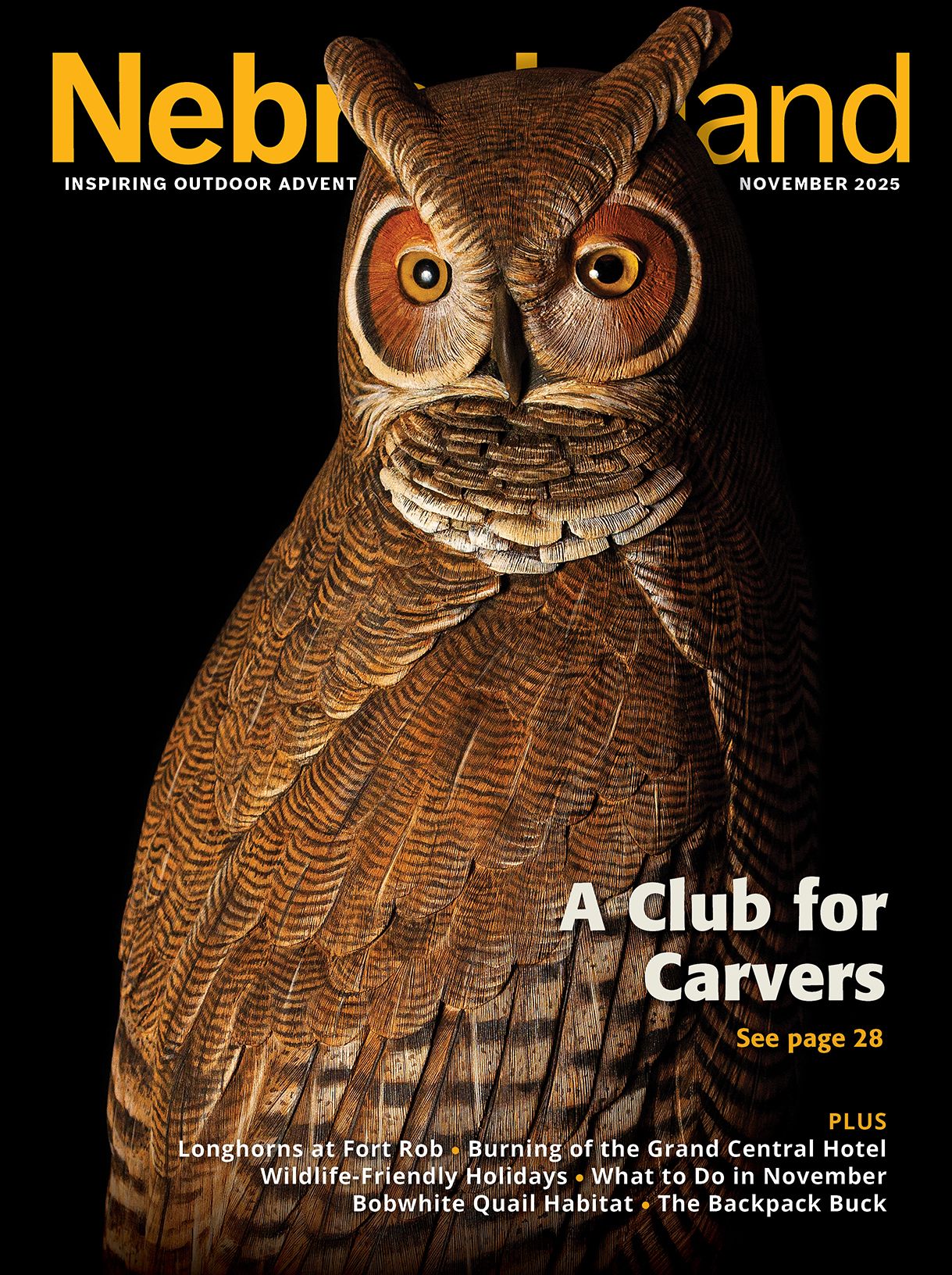
Cover: Cliff Hollestelle’s great horned owl wood carving
is one of the many examples of spectacular work being
created by members of the Central Flyway Decoy
Collectors and Carvers Club. See story on page 28.
JEFF KURRUS, NEBRASKALAND
FEATURES
20
This page: An American coot seemingly walks on water
as it takes flight from a wetland at Conestoga Lake
Wildlife Management Area near Denton.
ERIC FOWLER, NEBRASKALAND
THE LONGHORNS AT FORT ROBINSON
A special herd of cattle links Nebraska’s largest
state park to the Wild West
Story and photos by Justin Haag
26
OUTDOOR NEBRASKA
What to Do in November
By Tim Reigert
28
A CLUB FOR CARVERS
Veterans and Novices Welcome
Story and photos by Jeff Kurrus
38
BURNING OF THE GRAND CENTRAL HOTEL
44
MAKING THE HOLIDAYS WILDLIFE-FRIENDLY
By David L. Bristow, Nebraska State Historical Society
By Monica Macoubrie
DEPARTMENTS
8
12
48
56
58
Your Nebraska
In the Field
Mixed Bag
Portraits From the Past
The Last Stop
ON THE WEB
For more articles and
information, visit
NebraskalandMagazine.com
Nebraskaland (VOL. 102 / NO. 9 ISSN 0028-1964) is published monthly, except for the combined Jan./Feb. and Aug./Sept. issues, by the Nebraska Game and Parks Commission, 2200 N. 33rd
St., Lincoln, NE. Periodicals postage paid at Lincoln, Nebraska, and additional mailing offices. POSTMASTER: Send all UAA to CFS. (See DMM 507.1.5.2); NON-POSTAL AND MILITARY
FACILITIES: send address corrections to Nebraskaland, P.O. Box 30370, Lincoln, NE 68503-0370.
4
Nebraskaland • November 2025
November 2025 •
Nebraskaland
5
Magazine Staff
magazine
Communications Director Christy Firestone
Public Relations Manager Shawna Richter-Ryerson
Published by the Nebraska Game and Parks
Commission since 1926. The Commission is
dedicated to the conservation and protection of
all the state's natural resources and the people
who use them.
Editor Jeff Kurrus
Associate Editor Jenny Nguyen-Wheatley
Regional Editors Eric Fowler, Julie Geiser,
Justin Haag
Contributing Editor Michael Forsberg
Regular Contributors Renae Blum,
Chris Helzer, Chris Masada, Todd Mills,
Ryan Sparks, Gerry Steinauer
Art Director Tim Reigert
Graphic Designer Mel Severin
Videographer Nick Sauvageau
Photo Librarian Jaclyn Cruikshank Vogt
Administration
Director Tim McCoy
Chairman - John Hoggatt, Kearney
Vice Chairman - Donna Kush, Omaha
Kurt Arganbright, Valentine
Scott Cassels, Omaha
Dan Hughes, Venango
Kent McNeill, Papillion
Steve Mossman, Lincoln
Lisa Roskens, Omaha
Doug Zingula, Sidney
Commission Offices
Headquarters/Southeast District Office
2200 N. 33rd Street Lincoln, NE 68503
Phone 402-471-0641
Northeast District Office
2201 N. 13th St. Norfolk, NE 68701
Phone 402-370-3374
Southwest District Office
301 E. State Farm Rd. North Platte, NE 69101
Phone 308-535-8025
Magazine Subscriptions
For address changes, magazine and subscription
questions, 800-632-5263 or visit
nebraskalandmagazine.com
Advertising
For advertising information, contact:
Shane G. Gilster, 402-742-0125
shanegilster@solotreemedia.com
Conservation Officers
ADMINISTRATION
Jeff Clauson
402-471-5531
Lincoln HQ
Administrator
Travis Shepler
402-471-5531
Lincoln HQ
Asst. Administrator
Stacey Lewton
402-471-5531
Lincoln HQ
Asst. Administrator
Mike Thome
402-471-5531
Lincoln HQ
Asst. Administrator
(Includes counties covered)
NORTHWEST
Sean McKeehan 308-672-1824
Captain
Bassett Office
524 Panzer St., Box 508 Bassett, NE 68714
Phone 402-684-2921
Jerod Hahn
Schramm Education Center
21502 W. Highway 31 Gretna, NE 68028
Phone 402-332-3901
Omaha Office
8495 Frederick Street, Omaha, NE 68124
Phone 402-595-2144
OutdoorNebraska.gov
The Nebraska Game and Parks Commission does not discriminate
based on race, color, ethnicity, national origin, sex, pregnancy, sexual
orientation, gender identity, religion, disability, age, genetic information,
veteran status, marital status, and/or political affiliation in its programs,
activities, or employment. Any person who believes he or she has been
discriminated against in any program, activity, facility, or service,
should contact the Nebraska Game and Parks Commission, Lincoln, NE
402-471-0641, the Nebraska Equal Opportunity Commission, Lincoln,
NE 402-471-2024, TTY/TDD 800-642-6112; Director, Office of Diversity,
Inclusion and Civil Rights, U.S. Department of Interior, 1849 C Street,
NW, Washington, D.C. 20240.
6
Nebraskaland • November 2025
PHOTO BY JEFF KURRUS
Nebraskaland Magazine Copyright 2025, all rights reserved. Nebraskaland is available in audio from the Nebraska Library Commission Talking Book
and Braille Service, Suite 120, 1200 N St., Lincoln, NE 68508. 800-742-7691. Nebraskaland Magazine and the Nebraska Game and Parks Commission
reserve the right to reject any advertising not in keeping with the agency mission. Rates: $18 for one year; $33 for two years; $44 for three years.
Nebraska recipients must add appropriate sales tax. To subscribe call 1-800-NEBLAND (632-5263), or go online to: NebraskalandMagazine.com.
Northwest District Office (temporary)
1317 W 3rd St., Alliance, NE 69301
Phone 308-763-2940
South Central District Office
1617 First Ave. Kearney, NE 68847
Phone 308-865-5310
It’s a great time to begin your winter
bird feeding.
– EAST SUB-DISTRICT –
308-520-5539
Sergeant
Grant Albrecht
531-229-4405
Cheyenne, Deuel, Kimball
Hunter Lee
308-280-4320
Keith, Deuel, Arthur
Jaden Porter
308-289-2274
Garden, Grant, Keith
Tyler Stueck
308-289-6260
Keith, Arthur, Grant
Keith Jadlowski 531-310-2869
Keith
Vacant
– WEST SUB-DISTRICT –
308-672-1824
Sergeant
KayLynn Miller
308-665-8440
Dawes, Sioux, Sheridan
Cassidy Harwood 308-562-9099
Box Butte, Sheridan
Josh Widhelm
308-279-9133
Scotts Bluff, Banner, Sioux
Brandon Wallace 308-280-4488
Scotts Bluff, Banner, Sioux
Travis Schultz
308-279-1292
Morrill, Scotts Bluff, Box Butte
Casey Gehrt
402-617-2112
Dawes, Sheridan, Sioux
NORTHEAST
Dale Davis
402-760-0712
Captain
– WEST SUB-DISTRICT –
Jeff Jones
402-762-5022
Sergeant
Greg Hesse
308-546-7464
Rock, Brown, Keya Paha
Jonathan Andreasen
402-340-3981
Madison, Pierce, Stanton
Trevor Stahlecker
402-928-9099
Knox, Antelope, Pierce
Mitch Johnson
402-613-8612
Cedar, Knox
– EAST SUB-DISTRICT –
Cory Krause
402-380-6410
Sergeant
Kyler Prochaska 402-830-8278
Platte, Colfax
Matt Costello
402-317-4014
Dodge, Colfax
Kelbi Abke
402-237-2537
Washington, Burt
Nicholas Fix
402-508-0261
Dixon, Dakota, Thurston
Kyle Hansen
531-739-7392
Dodge
– CENTRAL SUB-DISTRICT –
Doug Pollard
308-730-7050
Sergeant
Vacant
308-440-1863
Howard, Greeley, Merrick
Matt Brandt
308-202-0819
Sherman, Howard
Klint Gill
402-613-5800
Nance, Wheeler, Boone, Polk
Garrett Zimmer 402-416-5736
Garfield, Loup Valley
Vacant
308-380-7331
Hall, Hamilton
SOUTHWEST
Brian Piernicky 308-330-8780
Captain
– NORTH SUB-DISTRICT –
Alex Hasenauer
308-660-4671
Sergeant
Dana Miller
531-229-4404
Cherry, Hooker, Thomas
Jacob Stoinski
308-395-6001
Lincoln, Perkins
Frank Miller
402-389-0444
Cherry, Hooker
Luis Nuñez
531-333-6093
Blaine, Custer, Thomas
Brandon O’Neal 308-530-3157
Lincoln, McPherson, Logan
– SOUTH SUB-DISTRICT –
Kelsey Glodowski 308-242-9000
Sergeant
Logan Smith
531-229-4406
Frontier, Furnas, Gosper, Red Willow
Bryce Streger
308-537-0404
Dawson, Gosper
Tyler Adelman
402-314-4783
Dawson, Gosper, Furnas
Sophia Gobber
308-222-0368
Chase, Dundy, Hayes, Hitchcock
SOUTHEAST
Matt Seitz
402-806-0915
Captain
– WEST SUB-DISTRICT –
Matt Taylor
402-200-9597
Sergeant
402-902-2017
Vacant
Adams, Clay, Webster
Justin Gress
308-629-9335
Thayer, Nuckolls, Fillmore
Vacant
308-920-2762
Harlan, Franklin, Phelps
Vacant
308-440-3847
Buffalo, Kearney
– EAST SUB-DISTRICT –
Heath Packett
402-210-0888
Sergeant
Brett Greenfield 531-350-0915
Cass
Russell Mort
402-209-1506
Otoe, Johnson
Rich Berggren
402-619-1355
Douglas
Brian Arp
531-530-9011
Douglas, Sarpy
Mike Luben
402-443-6392
Saunders
Bryan Adams
402-429-1924
Nemaha, Pawnee, Richardson
– CENTRAL SUB-DISTRICT –
Curt Prohaska
402-470-1298
Sergeant
531-229-4407
Easton Albrecht
Lancaster
Ben Keller
308-430-5500
Gage, Jefferson
Mark McDonald 402-805-2353
Lancaster
Mark Sullivan
402-741-0636
Lancaster, Seward, Butler
Jarrod Messman 531-739-9760
Lancaster, Saline, York
YOUR NEBRASKA
Instagram Photos
Follow us @nebraskaland
and tag us in your photos
to be featured in an
upcoming issue.
Marquene Koontz, Ogallala
Grandpa’s Truck
8
Nebraskaland • November 2025
Quinsen Arce, Omaha
From Elmwood Park
November 2025 •
Nebraskaland
9
Amber Tull, Omaha
Hummingbirds in Motion
Roger Richters, Utica
Face-off
Send your comments and photos to:
Jeff Kurrus, Editor
Nebraskaland Magazine
P.O. Box 30370
Lincoln, NE 68503
or email Jeff.Kurrus@Nebraska.gov
Please include your postal address
and telephone number. Letters
may be condensed and edited.
Photographs are also welcome.
Howie Isaacs, Unadilla
Mama Kestrel
10
Nebraskaland • November 2025
November 2025 •
Nebraskaland
11
IN THE FIELD
WALKING THE LINE
A coyote pauses as it walks
along a fenceline in a
pasture in Perkins County.
ERIC FOW
OWLER,
LER, N
NEB
BRASK
RA ALAN
AND
D
12
Nebraskaland • November 2025
November 2025 •
Nebraskaland
13
IN THE FIELD
Do something new this deer season, like sitting atop a ridgeline, bow at your grasp, scanning the horizon on your Nebraska
adventure. ERIC FOWLER, NEBRASKALAND
SOMETHING NEW THIS DEER SEASON
By Jeff Kurrus
Deer season is more about making memories than success.
Very rarely does a deer harvested outweigh everything else
that surrounded the hunt. Form a new memory this firearm
deer season with one, or more, of these options:
A New Cut – Whether you process your deer at home or
take it to a meat locker, try something new. After years of
grinding the majority of my venison into burger, I ordered
some jalapeno-and-cheese summer sausage from my
processor, and it has become a family favorite.
Stop at the Check Station – Even if you don’t have a deer
to check in, it can be fun to pull into a check station parking
lot, talk to other hunters and see what they have harvested.
You never know what you will find. I just happened to pull
into the check station at the Schramm Education Center
in 2009 when Wesley O’Brien, a hunter from Texas, was
checking in a 38-point whitetail buck that would be the new
non-typical state record.
Hunt All Day – With today’s creature comforts, this is
easy to do. While I’ve never done it, sitting atop a ridge
overlooking a valley with the wind in my face on opening
day while watching a full slate of college football games
sounds like a relaxing way to spend the day. This puts you
in the field when other hunters are coming and going, which
14
Nebraskaland • November 2025
often forces deer to move.
Bucket List – Plan an out-of-town trip to a place you’ve
never hunted. Use the Nebraska Public Access Guide and the
onX Hunt app and talk to regional biologists about finding a
place for your first spot-and-stalk deer hunt. If you’re a rifle
hunter, it might be too late to get a permit in some of these
units. If you’re a bowhunter, you might just be able to start
packing now.
The Local Tavern – The first opening day hunt I ever
went on, at the age of 12, began at a local tavern outside of
Ashland, Mississippi. Following our group in the door, the
sight of hunter orange vests filling the room nearly blinded
me. Decades later, this memory is still firmly cemented in
my mind.
Group Chat – A few years ago, I sent a text to a long list
of friends and colleagues, asking if they wanted to be part
of a group chat about what they were seeing from their
stand on opening morning. Shortly after sunset on the
eve of the opener, people began to wish each other luck.
The next morning, hunters shared photographs, stories and
congratulations — truly happy for someone else’s success
even if they hadn’t yet squeezed the trigger. Start your own
group, or another type of memory, this year.
IN THE FIELD
A PLUM THICKET CAN SAVE A COVEY
By Ryan Sparks, Editor of Quail Forever Journal
Unlike ducks or
geese that travel
thousands
of
miles each year,
bobwhite quail live
their entire lives
close to where
they hatch. These
small, iconic game
birds of America’s
grasslands
and
farmlands
rely
on the immediate
habitat
around
them.
Research shows
that a bobwhite’s
home range can be as small as 20 acres, sometimes stretching
to 100 acres depending on food, cover and seasonal needs.
Within that space, quail form coveys in fall and winter,
nest in spring and raise broods through the summer. Their
survival depends on the habitat within a relatively small
area.
Within a bobwhite quail’s already small home range,
coveys spend most of their time in what biologists call
“covey headquarters.” These are areas of cover that provide
protection from predators, shelter from weather, and serve
as a central hub for daily activity.
A covey headquarters is sometimes no more than a single
plum thicket growing in a ditch or the limbs of a fallen tree.
Other times it’s a patch of brush or a hedgerow just big
enough to hide a dozen quail.
The quality and availability of these headquarters
determine whether quail can persist on the landscape.
Without them, birds are far more vulnerable and less likely
to survive harsh winters or predation.
For landowners and conservationists, recognizing and
preserving these small but vital features is key. Leaving that
lone thicket or brushy fenceline can provide the anchor a
covey needs to thrive.
Unlike migratory birds, quail can’t fly away to better
conditions. They are tied to the land in a way that makes
them both vulnerable and emblematic of the places they
live.
A single covey headquarters can literally be the difference
between a place with quail and one without.
16
Nebraskaland • November 2025
This roadside ditch included plum thickets (bottom) before
being cleared (top), eliminating all signs of quail habitat.
JEFF KURRUS, NEBRASKALAND
IN THE FIELD
Danish-style meatballs with gravy and boiled potatoes.
JENNY NGUYEN WHEATLEY, NEBRASKALAND
DANISH VENISON MEATBALLS
By Jenny Nguyen-Wheatley
Unlike Swedish meatballs, Danish
meatballs — or frikadeller — are
football-shaped. Serve them hot with
gravy, boiled potatoes and pickled
cabbage or cucumbers. Enjoy them
cold sliced and served on top of rye
bread with pickles.
This recipe was inspired by my dear
friends Nathan and Amy Kramer of
Benson who have introduced me to
the customs and comforts of Danish
food — and aquavit. My life has been
richer since.
Servings: 6-8
Prep Time: 10 minutes
Cooking Time: 30 minutes
Ingredients:
1 lb. ground venison
1 lb. fatty ground pork
2 tbsp. olive oil, divided
1 medium onion, minced
2 small shallots, minced
2 cloves of garlic, minced
⅓ cup panko breadcrumbs
½ cup whole milk
2 tsp. kosher salt
½ tsp. freshly cracked pepper
¼ tsp. ground nutmeg
•
•
•
•
•
•
•
•
•
•
•
18
Nebraskaland • November 2025
• 2 eggs
• 3 tbsp. flour
Gravy
2 tbsp. butter
3 tbsp. flour
1½ cups venison or beef stock,
heated
Salt and pepper, to taste
Splash of heavy cream
•
•
•
•
•
1. Over medium heat, add 2
teaspoons of olive oil in a pan. Sweat
minced onion and shallot, with a
pinch of salt, for 5-7 minutes, or until
softened and translucent. Add garlic
and stir for 30 seconds. Do not brown.
Transfer to a large mixing bowl and
cool completely. Meanwhile, soak
panko breadcrumbs with milk in a
small bowl.
2. Into the mixing bowl with the
cooled onion, add ground venison,
pork, soaked breadcrumbs, 2 teaspoons
of kosher salt, ½ teaspoon cracked
pepper, ¼ teaspoon nutmeg, eggs and
3 tablespoons of flour. Knead with your
hands until you get a well-combined
paste. Cover and refrigerate for 1 hour.
3. Shape meat mixture into
quenelles using two large spoons
or use your hands to make footballshaped dumplings. Place them onto
a cookie sheet lined with wax paper
while you work.
4. Preheat oven to 350° Fahrenheit.
In a pan, heat 1 tablespoon of oil
over medium-high heat. Working in
batches, sear frikadeller until well
browned on all sides. Add more oil as
needed. Place browned meat into a
baking dish, cover with foil and place
in the oven to cook through for another
10 minutes or so. You’re looking for an
internal temperature of at least 155
degrees Fahrenheit.
5. While the meat is in the oven,
make the gravy: Heat the venison or
beef stock. In the same pan you cooked
the frikadeller, melt 2 tablespoons of
butter over medium-low heat. Next,
add 3 tablespoons of flour and whisk
for 2 minutes. Then gradually whisk
in hot stock, allowing the stock to
reabsorb and thicken with each
addition. Whisk until there are no
more lumps. Add a splash of heavy
cream and season to taste. Add more
stock as needed.
November 2025 •
Nebraskaland
19
The Longhorns at Fort Robinson
A special herd of caƩle links Nebraska’s largest state park to the Wild West
Story and photos by Justin Haag
Texas longhorns add to the scenic
beauty of Fort Robinson State
Park as they graze near the
Red Cloud Buttes.
20
Nebraskaland
• November 2025
November 2025 •
Nebraskaland
21
T
he sight of Texas longhorns
on the High Plains isn’t all
that uncommon, but this herd is
special. Not only do the cattle
— with their signature horns that can
span 8 feet or more — look at home
grazing among the scenic Pine Ridge
at Fort Robinson State Park, they
also have special ties to the American
cowboys’ long cattle drives of the late
1800s.
Rob Lemmon, Fort Robinson’s
superintendent, said the cattle
grazing at Nebraska’s largest state
park represent one of just two
registered longhorn herds in the world
with careful documentation on the
Cattleman’s Texas Longhorn Registry.
“We DNA test all of our bulls to make
sure we’re keeping the bloodlines
correct,” Lemmon said. “They are
purebred Texas longhorns just like the
cattlemen drove back in the day.”
Longhorns serve as an iconic symbol
of the Wild West, even if they are
not native to the continent and their
heyday in the United States was shortlived. The hardy species that was
introduced to the Americas from Spain
more than 500 years ago and roamed
mostly feral in Mexico for ensuing
generations, proved ideal for cowboys’
long, arduous drives north to railheads
and pastures in the late 1800s and
helped feed the masses on the East
Coast. Ogallala served as an important
railhead, receiving about 100,000 cattle
annually between 1876 and 1885.
When the railroad came to Texas,
less mobile but faster growing breeds
featuring more meat gained favor with
cattlemen.
Even if the breeding wasn’t watched
as closely as it is today, records exist
of longhorns grazing at Fort Robinson
ABOVE: Fort Robinson State Park employees and volunteers move longhorn cattle
down Soldier Creek Road in 2018.
BELOW LEFT: As winter gives way to spring, a new arrival to the herd receives a
meal from its mother.
even before it was a state park. Perhaps
exemplifying how loose things were in
the past, a Hereford-bison cross named
Levi made the news in 1980 as it grazed
with Fort Robinson’s longhorns.
How the pure-bred herd came to Fort
Robinson can be traced back to efforts
to preserve the species as it was facing
extinction in the early 20th century.
In the 1920s, the federal government
identified 30 purebred longhorns and
set them aside at Wichita Mountains
National Wildlife Refuge in Oklahoma.
In 1936, a portion of that herd was
taken to Fort Niobrara National
Wildlife Refuge near Valentine where
the attractive bovines were managed
for purity. They grazed there for the
remainder of the century.
In 2000, the refuge determined the
non-native longhorns were not in line
with its mission, unlike the native
bison that roam there today, and
were evicted. After some uncertainty
about the herd’s future, Fort Robinson
arranged to take in the Fort Niobrara
22
Nebraskaland
• November 2025
cattle to add to the park’s attractions
and serve as a fitting tribute to its
Western heritage. To make way for
the purebreds, the park’s existing 100
cattle were sold and moved off the
property.
How the 160 of the original
longhorns arrived to Fort Robinson
from Fort Niobrara was fitting for a
park that prides itself on its rich history
of horsemanship as a cavalry post.
Lemmon was 12 and remembers
accompanying
Fort
Robinson’s
superintendent at the time, who was
his father Jim, and others on a 180mile cattle drive from Valentine to Fort
Robinson during a spell of bitterly cold
weather.
“The people of Valentine were
pretty nice. They rounded up a bunch
of trailers and stuff to haul them here
for us,” Rob Lemmon said. “My dad
decided that wasn’t the way Texas
longhorns should be moved. So, in
November, we drove them. I think it
took us nine days to get from Valentine
November 2025 •
Nebraskaland
23
LEFT: Park employees and volunteers
round up cattle from the rugged Pine
Ridge terrain in late fall.
BELOW: Drovers move cattle from
Fort Niobrara National Wildlife Refuge
through Valentine during the 171-mile
journey to Fort Robinson in
November 2000. BOB GRIER, NEBRASKALAND
24
Nebraskaland
• November 2025
to here.”
The drovers on horseback, which at
first numbered about 60 but dropped
to about a dozen with the cold temps,
provided a spectacle to observers
as they moved the cattle through
Valentine and other towns along U.S.
Highway 20. About 60 other cattle,
bulls and calves, were moved to the
park by trailer.
Today,
the
22,000-acre
park
runs about 125 cows with the
herd totaling about 200. They’re
complemented by the resident
bison and wild pronghorn, muleys,
whitetails and other fauna at the
park.
“From the end of May through
July, we have them in seven different
pastures so we can put one bull with
them,” Lemmon said. “Once the
breeding season is over, we put them
down by the golf course near Crawford.
But, at all times, we have the show
steers near the water towers, which
have grown big horns and look good in
pictures.”
A true taste of the Wild West, and
just one more picturesque feature for a
park that is full of them. N
November 2025 •
Nebraskaland
25
Outdoor Nebraska
By Tim Reigert
Soak in the last of autumn by spending time outdoors — whether
that’s hunting, fishing, taking in a little Nebraska history or
visiting a park for a Halloween under the stars. N
What to Do in November
Fall Fishing
Through November | Statewide
“Fall provides some of the best openwater fishing of the year,” said Daryl
Bauer, Nebraska Game and Parks
fisheries outreach program manager,
who enjoys fall fishing because of
the lack of competition with other
anglers. Fish behavior in the fall is
largely dictated by the need to feed,
and most species will be in their best
body condition. “Big baits for big
fish” is true for fall.
JEFF KURRUS, NEBRASKALAND
Stargazing at Niobrara State Park
Year-round | Niobrara State Park
It’s hard to beat the scenic views at Niobrara State Park in northeastern
Nebraska. Nestled atop rolling hills, the park offers stunning overlooks of
the Missouri River, beautiful sunrises and sunsets and stunning views of
the Milky Way during the fall and winter months. Stay in one of the park’s
scenic-overlook cabins. Add a Star Package to your cabin stay and get an
easy-to-use telescope and receive seasonal stargazing recommendations. A
park entry permit is required. JEFF KURRUS, NEBRASKALAND
1875 Grand Thanksgiving Ball
Nov. 15, 5:30 to 8 p.m. | Fort Hartsuff State Historical Park
Celebrate the 150th anniversary of Fort Hartsuff with a re-creation of the 1875
Grand Thanksgiving Ball. The Enlisted Men’s Barracks will be decorated for a
period-correct catered supper, music and dancing. Daytime activities will occur
ahead of the event, including dance rehearsal, a shooting demonstration and
more. Tickets are $35 per person (must be 18 years or older). A valid Nebraska
state park vehicle permit is required for entry. Contact the park at
308-346-4715 for more details. ERIC FOWLER, NEBRASKALAND
Camp & Treat at Red
Willow
Oct. 31-Nov. 2 | Red Willow State
Recreation Area Campgrounds
Enjoy the spooky season at Red Willow State
Recreation Area. Enjoy off-season discounted
camping rates throughout the weekend.
Halloween activities will take place from 4 to
7 p.m. Saturday including a pumpkin-painting
contest and a camper- or campsite-decorating
contest. A valid Nebraska state park vehicle
permit is required for entry.
Archery deer hunting
Season is Sept. 1 to Dec. 31 | Statewide
The week before the firearm deer season, which
is Nov. 15-23, is a Nebraska archery hunter’s
most intriguing days of the year. Hunters
looking to catch a buck moving in rut will spend
time afield as most crops are usually out and
bucks are on the move during their breeding
season. Plan to hunt at different times of the
day, or all day, as the weather and action are
perfect reasons to be in the stand.
JEFF KURRUS, NEBRASKALAND
ERIC FOWLER, NEBRASKALAND
26
Nebraskaland • November 2025
November 2025 •
Nebraskaland
27
A Club for
Carvers
This great horned owl, carved
by Cliff Hollestelle, is just one
example of his meticulously
detailed work.
Veterans and Novices Welcome
Story and photos by Jeff Kurrus
T
he Central Flyway Decoy Collectors and Carvers Club is
an eclectic group. There are world-class decoy carvers
and first-time folks with the worry of “I’m not sure if I
can do this.” There are those who carve for medical and
mental health benefits; there are others who just want their
carving to resemble the species they have chosen. Folks who
are terrified to paint and others who carve so they can paint.
The one thing they all have in common is the step during
this process that possesses them during the most tedious
parts of this fascinating passion: the carving.
Thursdays with Norm
“Thursdays with Norm” is an often-repeated phrase among
this group of carvers.
This describes the days away from the monthly club
meetings to get together in La Vista at Norm Wise’s house for
carving, critiquing and camaraderie.
“I just enjoy doing it,” said Norm, who began carving in
1980. “A lot of people who come to my place are just good
friends. We enjoy each other’s work.”
Much like with other artistic disciplines like photography,
carvers develop their own style — so much so that Norm can
pick out a carver’s work without seeing their name attached.
“Bill Browne [a club member] … the thing he does best is
make a bird come to life. To not be stiff.”
During conversations with the group, the term “stiff ”
resurfaces often. “A stiff bird has no negative space with
shaping,” Norm said. “It looks more like an inanimate object.
Norman Wise, one of the club’s long-time members and a weekly host to aspiring carvers at his home, has more than 50 bird
mounts at his house for carvers to reference, like this hen mallard he carved.
28
Nebraskaland • November 2025
November 2025 •
Nebraskaland
29
It’s the shadows, layers and depth that keep it less stiff.”
Besides learning from and helping other carvers, Norm
admits his greatest reason for carving. “The only reason I
carve is because I like to paint.”
Many carvings ago, he took five years of instruction from a
local artist. On the first night of class, he brought a tackle box
of paints and brushes.
“What’s that?” the teacher asked. Once he explained, she
followed. “Well, you can take that home because you won’t
need it for two years.”
“For the next two years,” Norm said, “we worked on
composition and mediums. It was often boring, but it was
rewarding to make my carvings more animated and more
comfortable when I got the paint out.”
In Norm’s mind, decoy carving has a few simple steps.
has been the difficult part for me.”
Like many of the club’s carvers, they lean on each other
for instruction. “I have an appointment with Norm soon so
he can help me get the details of the feathers. He knows the
anatomy of the bird so well.”
Bill’s next step is a full-size decoy. “Starting with the
miniature is great because I learned that the tail feathers
have to go this way, and the head has to be shaped like this.
And the bill has to be cut just right. I can look at the miniature
to go by, and that’s a big plus.”
Carving by Necessity
Originally, Tom Christie from Ashland began carving
decoys out of necessity. “While I was duck hunting, I couldn’t
get goldeneyes to come to my river rig when I was using other
decoys.”
Once he started carving his own, “the
goldeneyes came right in.”
In 1986, Tom began submitting his
carvings to competitions. There are 12
categories, he said. These include mantel,
what he deemed “fancy” birds, miniatures,
functional and even a “no holds barred”
category where carvers can go all out on
any number of methods. In some of the
categories, like the hunting ones, the decoys
have to be placed in a water tank to ensure
they float upright.
Regardless of the category Tom competes
in, he is constantly challenged by his
lifelong pastime. “The difficult part for me
is sculpting a bird in the preening position
where it looks comfortable.”
The painting can also be a challenge,
even though he enjoys this process the
most. “Adding a third dimension with the
This miniature redhead duck was Bill Arneson’s first carving for the club. It
painting is a challenge for me.”
relaxes him, he said, but it also has an added health benefit. “My doctor told me
But the draw for the entire process is
to keep my fingers moving, because I have rheumatoid arthritis.”
simple. “I love seeing something to fruition.
It comes to life.”
In the beginning you survive. Then you model great work
Either on the competition table or in the duck blind.
around you. Finally, the process starts to become your own.
What Color to Put Where
Simply Love the Work
After Bill Arneson from Lincoln took a carving class at
Southeast Community College a couple of years ago, he was
off and running. He spent his early carving days making
decorative plates but has since moved on to the task of
carving decoys.
The club’s first instruction was to start small, giving Bill
the assignment of a miniature decoy, which has many
advantages.
“You start to learn the anatomy of the bird and what color
to put where,” said Bill. “There’s a difference between the
back of the bird and its wing pockets. Painting is intense. It
Chances are you have seen Cliff Hollestelle’s work. This
carver from Lincoln has been featured in this magazine
before, and his bronze sculptures have been on display across
the country.
Yet he, too, is a member of the Central Flyway Decoy
Collectors and Carvers Club, having started carving in the
1960s while getting an art degree in college.
His work is meticulously detailed, but he also knows where
his limitations are. “I don’t make a lot of folksy birds,” he said,
describing birds that resemble simple portrayals versus reallife interpretations. “But I really like them. People have an
30
Nebraskaland • November 2025
Tom Christie began carving decoys out of necessity. “While I was duck hunting, I couldn’t get
goldeneyes to come to my river rig.” Once he started carving his own, “the goldeneyes came right in.”
While many of his carvings end up on the mantel, Christie mostly competes in categories where his birds, such as this
spectacled eider hen, are judged on the water.
November 2025 •
Nebraskaland
31
eye for that stuff that I don’t have.”
He has also made birds for utilitarian purposes, using his
finished carvings while hunting near Cedar Bluffs, and his
house is filled with any manner of carvings, from intricately
detailed duck decoys and owl recreations to life-sized
songbirds yet to be painted.
“I simply love the work,” he said.
Look Like a Duck
Jade Chapman from Papillion was looking to expand her
skills in art, including 3D art. She was always interested in
wood carving but was unsure how to get involved. She then
saw an ad for a wildfowl carver course in a Game and Parks
e-mail newsletter and signed up.
“I didn’t know if there were going to be any other girls there,”
she said. “Then, when I showed up, there were four.”
For her first carving, Jade’s primary goal was that her
duck “looked like a duck.” It went well, and since that day in
February, Jade continues to attend club meetings, learning the
art form and receiving instruction from other members, who
have encouraged her to enter competitions.
“They build my confidence,” she said. “They’ll definitely
push you and find a way to get [your work] to look the best.”
“The fun part is the challenge.”
One of Cliff Hollestelle’s early carvings, this drake bluebill
duck, is an example of the type of carving — not meticulously
detailed — he’s uncomfortable attempting. “People have an
eye for these types of carvings that I simply don’t have.”
Learn the Bird
New carver Jade Chapman doesn’t have world championship
aspirations. “I just want my duck to look like a duck.”
32
Nebraskaland • November 2025
“You have to study the birds,” said William Browne from
Lincoln. “You can’t just make stuff up.”
When Bill started competing, he jumped right into the
professional track because he had been carving for six years
for money. In many ways, this transition became a shock to
him.
“I got thrown in with the best carvers,” he said. “And judges
are crazy picky at the big shows.” Photographs, other carvers
and even ornithologists are used to judge. But there remains
an additional element that many viewers don’t realize.
“You can be really intricate, but that doesn’t mean it’s good.
The bird has to have a flow to it. You have to know where
the feathers come from on the wing so you know how the
feathers lay. This is the hardest thing to do for carvers.”
Another hard part is being critiqued at big shows. “The
first three years of the show, you think someone has won
because it’s their last name and they’ve won before. But then
you realize and start seeing that a certain person’s birds have
more presence and feel than the one next to them.”
In one such moment, he had a realization. “I’m not
putting in the time,” he thought. “I’m not learning the bird.”
William Browne’s birds, including this female gadwall, are intricately sculpted, but he says that alone doesn’t make a great
carving. “The bird has to have a flow to it,” he said. “You have to study the birds. You can’t just make this stuff up.”
November 2025 •
Nebraskaland
33
Before School, After School
Lon Bernth from Papillion was a school principal for more
than 30 years, and the role of a principal is enormous. Early
morning meetings and after-school athletic events. It’s a
24/7 job. Which is why Lon always had a carving nearby, just
in case he got a few minutes to work on it.
“I always loved art,” he said. “I was always painting and
coloring as a kid.” Then, when he started carving, he fell
in love with the step-by-step process. “Watching it come
from a block of wood to look like a bird or animal. Then you
woodburn it, and it added more. Then you painted it, and it
added even more. I was hooked.”
Now, he’s nearly 50 years into carving. “A lot of people,
when they retire, don’t have something to do,” he said. “You
just want something you like and that you can spend time to
do.” Carving is it for Lon.
When Al Thomas, the artist of
this Canada goose, went to his
first competition, a light clicked
on. “I had been carving in a
vacuum,” he said. “This allowed
me to see what else was out
there.”
Make a Smaller Bird
Lon Bernth, carver of this bald eagle, has always loved art.
A school principal for more than 30 years, he would always
have a project close by in case he had extra time to work.
Kirk Pfeffer from Council Bluffs remembers the day 27
years ago that he was walking through an airport and saw a
man detailing a carving as he waited on his plane. “This guy
was an old member of the club, and he turned me on to Norm,
and I eventually started taking lessons from Norm and have
been doing that for a long time now.”
To carve, Kirk said, you have to find a mentor. “You get so
much help from everyone here,” he said. “Finding a mentor,
an instructor, that was huge.”
This support remains so important because the act of wood
carving is not a simple one, he said. “Anyone can do this, but
it takes perseverance, and the learning curve is steep.”
An engineer by trade, painting is toughest for Kirk. “I’m
never good enough in my own mind doing it,” he said. “It’s
a struggle.”
But he does have one tip that can help any carver, new
or experienced. “If you start out carving a larger bird and it
looks like garbage, then make a smaller bird out of it.”
A Light Clicked On
“I was carving in a vacuum,” said long-time carver Al
Thomas from Omaha. “Then I went to a show and saw what
the other guys were doing. It turned the light on.”
That light has stayed on for five decades as Al has
continued to work, competing nationally and contributing
any number of projects to Pheasants Forever and Ducks
Unlimited banquets. “When I started in 1979,” he said, “I was
an art teacher. I started to do woodworking, and I had grown
up hunting. I put these three things together.”
Now, long since retired, Al — for the most part — continues
to have fun with it, except for one aspect. “Sawdust is not
fun,” he admitted. “Instead, I use a lot of knives.”
Kirk Pfeffer, creator of this avocet, has very practical advice
for would-be carvers. “If you start out carving a larger bird
and it looks like garbage, then make a smaller bird out of it.”
34
Nebraskaland • November 2025
I’m Not Going Back
“When I first went to the club,” said Dick Zechmann of
Lincoln. “I told my wife I wasn’t going back. They were
November 2025 •
Nebraskaland
35
A Brief Club History
“I’m not going back,” Dick Zechmann — artist of this
redhead — told his wife after his first club meeting. “They
were so good.” But without their encouragement through
the years, Dick would not have become the carver he is.
Each new member of the club, including creator of this
decoy Claire Meerian, is tasked with carving a miniature.
She carves to have an escape from her stressful job.
“The painting is my satisfaction,” said Ed Svoboda, carver
of this ruddy duck. “The goal is to get your work competing
with folks around the world.”
so good.”
His wife encouraged him to return, which he did, producing
his first carving soon after. “I was so proud of it,” he said. “I
was super happy.”
Since that first bird, the carvings have become much more
elaborate, yet he continues to find value in that first bird. “I
show students and younger people where I started,” he said.
“Then I show them the real thing. This encourages them.”
Like other members, he has consumed videos and books,
was critiqued by club members and spent many sessions with
Norm. And the challenges have continued.
“The colors,” he said with a shake of his head. “I just couldn’t
get the colors right when I started. I didn’t know what mixed
with what. I needed a color wheel to show me.”
He would do this over and over again, slowly improving
through the years. “The guys in the club kept telling me to
keep trying. Keep going.”
This is exactly what she has needed. Plus, all of her friends
want decoys for Christmas and can’t wait to see what she
comes up with.
“Johnsgard pointed out my errors on the bird and said
another one should have won instead of mine.”
While he laughs at the memory, it also set Don on a path
of gathering as much information as he could to become as
detailed as possible. He has continued to receive critiques of
his work, even if he never leaves the house.
“I’m red-green colorblind,” Don said. “But my wife was an
art teacher, and my daughter is an art teacher. ‘You’re not
I Needed to De-stress
Claire Meerian of Gretna started carving decoys because her
dad, Randy, asked her to come along. From his perspective, it
was one more way to spend some time with his daughter who
had finished college and had now entered the workforce. But
for her, an accountant, it was a welcome relief from tax season.
“I was working 60 hours a week and needed some creativity
to deal with that,” she said. “I needed to de-stress.”
So she started going to meetings and working on her
miniature duck decoy. “I’m technical to a tee,” she said. “And
the members of the club let me know that my duck was boxy. It
looked good, they said, but they showed me I had to have some
creativity when I was carving.”
36
Nebraskaland • November 2025
It Becomes Real
“It comes to life,” said Ed Svoboda, looking at his carvings
before him. “The painting is the most enjoyable. It becomes
real when it’s painted.”
Ed has carved since 1980, spending Thursday mornings
through the years with Norm and many of the other members
working on projects to display during competitions.
“I’m in an intermediate category,” he said. “There are novice,
intermediate, advanced and master’s levels. If you start to win
the novice and intermediate, you move up. I’ve gotten as high
as second place in those.”
Regardless of his finishes, it’s therapy for Ed. He’s currently
working on a wigeon and has no plans to quit anytime soon
despite its challenges.
“Finding the pattern and getting it cut from the block of
wood is the tough part for me,” he said. “The painting — the
painting is my satisfaction.”
In the late 1960s, a group of folk art enthusiasts,
wildfowl hunters, artists — both amateur and
professional — biologists and game managers came
together to form a group interested in collecting duck
and goose decoys as well as carving working decoys.
The champion of the group was Lincoln accountant
Robert Wohlers, who hosted the first meeting of the
club in January 1970.
Through the years, club members have competed
on a regional and national level and continued to
critique each other’s work with the goal of keeping
this long-standing artistic tradition alive.
Now, 55 years later, the club welcomes those with
national competition aspirations, as well as others
who just want to see what decoy carving is all
about.
For more information on the club, including meeting
times, email Norm Wise at wcwau1945@gmail.com.
supposed to have green here,’ is something they would say
to me, commenting about a particular bird I’m carving. Plus,
there are so many other resources.”
He uses books, magazines and Tom Christie’s YouTube
videos for tasks like determining feather size, shape and
position and paint color mixing. “You have to totally
understand the anatomy of the bird you’re doing,” he said, a
constant reminder for a veteran or novice carver. N
I’d Go Crazy
Don Gabelhouse of Lincoln carved his first decoy in 1970.
More than 55 years later, he continues to carve for one main
reason. “If I didn’t have carving, I’d go crazy.”
Don, meticulous by nature, began entering carving contests
soon after he started, eventually winning an amateur category
just a few years later, only to receive some much needed, albeit
critical, comments by his former University of NebraskaLincoln instructor, Paul Johnsgard.
Don Gabelhouse, a former fisheries administrator with Game and Parks and a 55-year carver, continues to improve in his
carvings, including this drake green-winged teal. His most important carving tool is a pair of lighted magnifying glasses.
November 2025 •
Nebraskaland
37
Burning of
the Grand
Central
Hotel
By David L. Bristow,
Nebraska State Historical Society
t was after midnight, and Billy McNamara and three other
volunteer firemen were manning a hose inside the secondfloor dining room of Omaha’s Grand Central Hotel. Billy
was “a popular young man and soon to be married.” A
hotel employee, he knew the building well.
When other firemen warned Billy and the others to get out
of there, Billy replied (as reported in the Omaha Bee) “that he
had been employed in the hotel so long that he did not feel
like going back on it just then.” Nearby, John Lee — another
young man, married less than a year — “proposed to stay
with the fire till (sic) the last moment.”
They saw no immediate danger. They had time.
Eight years earlier, in 1870, Omaha leaders decided their
growing city of 16,000 residents needed a first-class hotel.
Selecting the southwest corner of 14th and Farnam streets
(where the Paxton Hotel stands today), more than 120
prominent men bought shares in a joint company and eagerly
anticipated the money that well-to-do travelers would spend
I
Sept. 5, 1878. Aftermath of the Grand Central Hotel fire.
NSHS
RG2341-PH0-270
38
Nebraskaland
• November 2025
November 2025 •
Nebraskaland
39
Inside Omaha’s Grand Central Hotel.
NEW YORK PUBLIC LIBRARY
in the city.
The project was troubled from the beginning. Funds ran
out and construction halted after less than four months. Ed
Creighton — the richest man in town — made a big personal
loan, but two years later, the company again ran short before
the hotel was finished. When Creighton tried to foreclose, the
other stockholders fought him in court to prevent him from
gaining sole ownership. The feud was still unresolved when
the hotel finally opened in 1873.
Five stories tall and billing itself as the “largest and best
hotel between Chicago and San Francisco,” the Grand Central
offered the latest in style and comfort. Its ground-floor
exterior featured lots of iron and glass; the upper stories were
brick with white stone window caps. Every room had hot
and cold water, steam heat and gas lighting. The local press
described each floor in detail — the chandeliers and marbletopped stands, the richly carpeted hallways, the lavish bar
and billiard rooms and the Western Union telegraph office
with its 34-wire switchboard.
But the hotel struggled financially and was sold at auction
in 1878. Renovations were underway when, on the evening
of Sept. 4, a workman accidentally kicked over a candle on
the fifth floor. Omaha’s all-volunteer fire department arrived
to find dense smoke rolling from the mansard roof and
upper windows. The city had supported a hook-and-ladder
company since 1860, starting with a single cart pulled by the
men themselves. Other equipment had been added over the
40
Nebraskaland
• November 2025
The Union Pacific Railroad had its own volunteer fire company, the Durant Engine and Hose Co., shown here in May 1875.
NSHS RG2341-PH0-98
years, including a steam engine and a network of cisterns
from which water could be pumped — because the city had
no waterworks.
The fire began about 6:45 p.m. Within an hour, the firemen
ran out of water and spent the next 15 to 20 minutes running
hose to more distant cisterns. Even then, they could not
pump water higher than the third floor.
Onlookers filled surrounding blocks. It seemed the whole
city turned out to watch. The hotel and adjacent buildings
swarmed with men hauling anything movable to safety. The
Omaha Herald moved their presses. An undertaker moved his
coffins.
“Great excitement and confusion prevailed among
the firemen during the fire,” the Bee reported, “and there
seemed to be a general lack of order, management, and good
judgment.” Telegrammed by Omaha’s mayor, the Council
Bluffs fire department arrived between 10 and 11 p.m. By
then, the fire was down to the fourth and third stories.
November 2025 •
Nebraskaland
41
“Omaha’s First Fire Engine” was brought out for a parade
during the 1939 Golden Spike Days celebration. The event
celebrated the world premiere of Cecil B. DeMille’s film
“Union Pacific.” NSHS RG3882-PH35-47
Part of the fifth-floor wall collapsed onto Farnam Street at
10:30 p.m. Two hours later, the ground floor was burning. But
Billy McNamara and his companions were still manning a hose
on the second. They had no warning when a wall collapsed on
them, crashing through the floor into the billiard hall below.
For the next few hours, “walls here and there tumbled in
sections” until the fire burned itself out at 5 a.m. The four
firemen’s charred bodies were recovered from the ruins by
the light of day. That evening, a fifth fireman died of injuries
suffered in another part of the hotel.
The disaster changed Omaha. The city was both grateful
and embarrassed that the arrival of the Council Bluffs fire
department had saved the rest of downtown. Omaha dismissed
its fire chief and replaced its volunteers with a professional
fire department. (The volunteer firefighters that serve many
communities today are far better trained and equipped than
Omaha’s old hook-and-ladder companies.)
The Omaha Bee, meanwhile, lambasted residents who
opposed the expense of a city waterworks. Omaha soon built
a system of pressurized fire hydrants and reservoirs. Although
the city suffered other major fires afterward, it would never
again face one so unprepared. N
Visit the Nebraska State Historical Society’s website at
history.nebraska.gov.
42
Nebraskaland
• November 2025
The Grand Central Hotel on the southwest corner of 14th and Farnam.
November 2025 •
NSHS RG2341-2-P32
Nebraskaland
43
Make the Holidays
Wildlife-Friendly
By Monica Macoubrie, Outdoor Education Specialist
T
he holiday season is a time of joy, warmth and
celebration. As we deck the halls and light up our homes,
let’s consider how our festive practices might impact the
environment and local wildlife. By making mindful choices,
we can create a holiday season that’s not only merry and
bright but also beneficial to the creatures that share our
environment.
Light Pollution
For many people around the world, the holidays are a
magical time of year, often highlighted by festive outdoor
lighting displays. With many holidays falling around the
winter solstice, these lights bring warmth and joy to the
A Christmas decoration made from pheasant feathers
decorates a tree at the Cody mansion at Buffalo Bill State
Historical Park. ROCKY HOFFMANN, NEBRASKALAND
44
Nebraskaland
• November 2025
dark, cold days of mid-winter. But do holiday light displays
contribute to light pollution? And should we be concerned?
Light pollution is generally described as any negative
impact caused by the use of artificial light at night. This helps
distinguish the beneficial uses of nighttime lighting from the
known or suspected harmful effects it can have. Importantly,
not all outdoor lighting qualifies as light pollution.
According to a 2014 National Aeronautics and Space
Administration study, “nighttime light shines 20-50 percent
brighter during Christmas and New Year’s compared to
the rest of the year.” This pattern is also observed in other
parts of the world. For instance, during the Islamic month of
Ramadan, some Middle Eastern cities experience nighttime
lighting that is more than 50 percent brighter than at other
times of the year.
While we have limited data on the adverse impacts of this
increased lighting on the nighttime environment, we do know
light emissions contribute to skyglow — the brightening of
the night sky that makes it harder to see stars.
Still, the potential impact of light pollution from
holiday lights is relatively small compared to the constant
illumination of streetlights or buildings that remain on
throughout the night year-round. In most cases, holiday
lighting does not pose a significant environmental threat,
especially when installed away from ecologically sensitive
areas, such forests, prairies, river corridors or wetlands. So,
it’s still possible to enjoy the warmth and charm of holiday
lights without causing undue harm to the environment.
However, there are several ways to make holiday lighting
more wildlife-friendly. First, consider using fewer lights
overall. As David Hardisty, a University of British Columbia
business professor, explains, “The first string of lights you
put up adds a lot of holiday cheer. Having one string up versus
none makes a big difference, but adding six strings instead of
five barely changes anything [in adding holiday appeal].”
Second, be mindful of the color of your lights. Avoid using
lights with a cool or blue tone, as blue light is particularly
disruptive to raptors, such as owls and hawks, and
contributes significantly to skyglow. If you prefer white
lights, opt for warmer hues that resemble the soft glow of
Christmas lights outline the lodge at Fort Robinson State Park.
JUSTIN HAAG, NEBRASKALAND
a candle flame. These are less harsh on the eyes and cause
fewer disturbances to nocturnal creatures.
Finally, use timers to control when your outdoor holiday
lights are on, and be sure to turn them off at bedtime. Lights
left on all night serve no real purpose and waste electricity.
Instead, limit illumination to the hours when people are
most likely to be outside to enjoy them, ensuring they don’t
disrupt the nighttime environment. By following these
simple steps, we can continue to enjoy the festive ambiance
of holiday lights while minimizing their impact on the
natural world.
Mindful Soundscapes
The holiday season is often filled with the sounds of
celebrations, music and fireworks. While these noises bring
joy to many, they can have a significant impact on local
wildlife. Loud sounds, such as those from music, can cause
stress in animals, leading to disorientation and changes in
their behavior. For example, loud noises can cause deer, foxes
and birds to flee their habitats or alter their movements to
seek resources during the winter. To ensure that wildlife is
not disturbed during our celebrations, it is important to adopt
practices that minimize noise pollution.
One way to create a quieter celebration is by opting for
low-volume music. Keeping the volume at a moderate
level reduces the impact of sound traveling long distances,
especially in open areas or residential neighborhoods. This
helps ensure that nearby wildlife is not overwhelmed. If
using outdoor speakers, position them away from areas with
high wildlife activity. Setting a time limit for music also helps
avoid excessive disruption.
Finally, it’s important to respect quiet hours, particularly
during early mornings and late nights when many animals
are most active. Nocturnal species, including owls, rely on
the quiet of the night for essential activities like hunting,
foraging and communication. Excessive noise during these
hours can disrupt their natural routines, leading to stress
and disorientation. By keeping noise levels down during
these times, we help ensure that wildlife can carry out their
activities undisturbed. A simple way to do this is by ending
November 2025 •
Nebraskaland
45
Another important step toward more sustainable holiday
decorations is investing in reusable decor. While it may be
tempting to purchase new ornaments every year, these items
often come from plastic or other non-biodegradable materials
that contribute to waste. Instead, consider investing in
durable, high-quality ornaments made from natural or
long-lasting materials such as wood, metal or glass. These
decorations can be used year after year, reducing the need
for constant replacements and limiting the environmental
toll of disposable holiday items. Reusable decor can also have
a timeless, classic appeal that adds a sense of tradition and
sentimental value to your celebrations.
By incorporating wildlife-friendly practices into your
holiday traditions, you can create a season of celebration
that’s harmonious with nature. Small changes, like adjusting
light schedules, using natural materials and reducing noise,
can make a big difference for local ecosystems. This year, let’s
celebrate the holidays with kindness toward our environment
and the creatures that call it home. N
LEFT: A bird feeder made out of a pine cone, suet and seeds.
JENNY NGUYEN-WHEATLEY, NEBRASKALAND
BELOW: A mule deer approaches deer holiday decorations in
Chadron. JUSTIN HAAG, NEBRASKALAND
Choose natural and biodegradable decorations to make your holiday decor more sustainable.
celebrations earlier in the evening or minimizing noise
during these crucial hours.
Natural and Biodegradable Decorations
The holiday season is a time to celebrate, but it’s also
an opportunity to reflect on how we can reduce our
environmental impact. One of the most effective ways to
make your holiday decor more sustainable is by choosing
natural and biodegradable decorations. These options not
only add a rustic, organic charm to your home, but they also
offer an eco-friendly alternative to plastic and synthetic
materials. By opting for decorations that can break down
naturally in the environment, you can enjoy the beauty
of the season while minimizing waste and supporting
sustainability.
One of the simplest and most popular choices for natural
decorations is pinecones. These can be collected from the
ground in forests or your backyard — just make sure to
gather fallen materials rather than removing them from
living trees, which can harm local ecosystems. Pinecones
make an excellent addition to wreaths, garlands and table
46
Nebraskaland
• November 2025
JENNY NGUYEN-WHEATLEY, NEBRASKALAND
centerpieces. They add texture, warmth and a seasonal
fragrance to your home.
Similarly, branches from trees like fir, spruce or holly can
be woven into wreaths or used to create natural garlands.
These elements not only bring the beauty of nature indoors,
but they can be composted after the season ends, leaving
behind no waste. Using materials that are sourced from
nature reminds us of the beauty and bounty of the earth
and encourages us to be more mindful of our environmental
footprint.
Dried fruits and berries also make beautiful, biodegradable
holiday decorations. These items can be strung together
to create colorful, natural garlands or used in bowls and
centerpieces. Dried orange slices, cranberries and apples
are particularly popular choices, as their vibrant colors and
sweet scents evoke the holiday spirit. These decorations
can be hung on trees, mantelpieces or draped across dining
tables. Once the season is over, you can compost the dried
fruits, ensuring that nothing goes to waste. Additionally,
the dried fruits can serve as a food source for birds and other
animals during the winter months.
November 2025 •
Nebraskaland
47
MIXED BAG
ONE
R
CALENDAR
RY
FOR EVERY
YEAR
By Jeff Kurrus
I should have done this
is
years ago. Grab an old
calendar and, alongside
a collection of photos
and journal entries, fill in
n
your outdoor activities
through the years. A few
w
areas to consider:
Include days you
had success
Patterns will develop
telling where you
should hunt/fish at the
same time next year.
Also include
days you haven’t
had success
Sometimes we
force trips — over
and over again
— because we’re
convinced a result
will occur. Use this
calendar to try
something new.
Include who
you were with
Time goes by incredibly
ly
fast. The bird hunt you think you went on last year might
have occurred four years ago. Reach out to people you’ve
had fun with in the past to get together again. This is
especially important to stay in touch with landowners and
remind yourself of the gifts you need to drop off to them for
allowing you access.
Save vacation days
I didn’t realize until this calendar how many days I spend
in the field each January. Between ice fishing and goose
hunting, I’m out all of the time. Good to know so you don’t
48
Nebraskaland • November 2025
schedule any doctor’s
appointments during prime time.
Talk to friends
One of my fishing buddies works nights and weekends,
leaving his weekdays open for fishing. Most of the time I
am not with him, but I have included everything he’s told
me throughout the year. Just because you weren’t with your
buddy doesn’t mean that information can’t be good for your
future trips to the water or woods. Also include what tactics
are being used, as they might be different from yours.
November 2025 •
Nebraskaland
49
MIXED BAG
IMPACT NEBRASKA ARTISTS
By Jenny Nguyen-Wheatley
Impact was created in 1985
to provide Nebraska artists
opportunities
to
collaborate
and share their work through
exhibitions. Members commit to
five exhibition themes per year.
In 2025, exhibits included Impact
Willa Cather, Spirit of Robert Henri,
Waters of Life, Color of MusicRhythm of Art, and Pollinators.
Nebraska Game and Parks
graphic
designer
Donna
Schimonitz has been an Impact
member for 20 years. She describes
her work as mostly nature-based
and enjoys painting wildlife and
scenic landscapes. Unsurprisingly,
the Waters of Life and Pollinators
exhibits
have
been
most
meaningful to her.
“I try to do something a little
different,” Schimonitz said. “[For]
the Waters of Life [exhibit], I did
the tiger salamander because I
figured no one else would be doing
that.”
For the Pollinators exhibit,
artists aimed to highlight the
importance of pollinators and the
roles they play in our ecosystems
and everyday lives. Schimonitz
chose to paint a calligrapher fly on
purple aster flowers. This hoverfly
is known for its distinctive black
markings and is an important
Acrylic painting of a calligrapher fly on purple aster flowers.
BY DONNA SCHIMONITZ
pollinator of native flowers. Also,
its larvae are beneficial predators,
“juried-in” by a third party, such as an outside artist or
helping to control plant pests such as aphids.
museum director, who judges their portfolio. Membership
The group occasionally shows outside of Nebraska —
is a four-year commitment, with the expectation
they’ve had exhibits in Wyoming, Florida, Kansas and
of participation in all programs, exhibitions and
Washington, D.C. Impact is a professional community that
twice-a-year meetings.
provides its members opportunities to improve their craft.
The next Impact art exhibit will feature works inspired
Member artists practice a variety of styles and media.
by American writer Willa Cather, known for her novels
“It’s a group of high-quality art producers that made me
about the Great Plains. See the exhibit Nov. 1-Dec. 1 at the
push myself to be a better artist. I love the camaraderie
Valentine Public Library in Valentine and Dec. 4-28 at the
and solid group of friendly but very professional artists,”
West Arts Center in Scottsbluff.
Schimonitz said.
Membership is selective, with applicants being
For more information, visit impactart-ne.org.
50
Nebraskaland • November 2025
November 2025 •
Nebraskaland
51
MIXED BAG
USING DAYLIGHT TO UNDERSTAND
BIRD MOVEMENTS
By Stephen J. Brenner, Audubon Great Plains, and Joel Jorgensen, Nongame Bird Program Manager
because their nest has a domed appearance that some might
Modern technology has unlocked a kaleidoscope of tools
say resembles an oven. This species has a large breeding
that can be used to reveal animal movements, including those
range across North America but a limited breeding range in
of small migratory birds. Transmitters that use the same
Nebraska, restricted primarily to the Pine Ridge, Niobrara
GPS that we tap into to navigate our vehicles to restaurants,
River Valley and sparingly along the Missouri River Valley. Its
airports and auto-part stores can also be harnessed to
wintering range is also large, spanning
follow the real-time movements
from northern South America up
of many animals. However, most
through parts of northern Mexico and
migratory songbirds that breed in
much of the Caribbean.
our state present a challenge for
Birds from the core range of this
GPS technology. As many migratory
species have been tracked before using
species need to travel over 1,000
geolocators, tracking migrations from
miles twice a year and weigh as little
the expansive boreal forests of Canada
as a couple dozen paper clips, most
down to Central America, and from the
are incapable of carrying the heavy
islands of the Caribbean to the idyllic
load of a GPS unit while in flight. But
woods of New England. However, no
there is a less weighty alternative
one has studied the populations at the
that utilizes an old school technology
very edge of their range in western
to answer new questions about the
Nebraska, and as you might expect,
annual movements of migratory
no one is sure where these individuals
birds.
migrate, spend the winter, or what
Light-level geolocators are small
their survival rate is compared to more
data loggers whose only function is
well-studied counterparts in eastern
to record the length of daylight every
North America.
24-hour period. As all the information
Researchers at Nebraska Game and
is stored on board and there is no need
Parks and Audubon Great Plains set
to transmit or spend energy finding a Ovenbirds have a limited breeding range in
out to understand where warblers
satellite, almost no battery is required Nebraska. JON FARRAR, NEBRASKALAND
living on the edge in the Cornhusker
and the simplicity of the technology
state might spend the winter months, and what — if any
greatly reduces the weight. Yet with this simple data of
— breeding success these birds have relative to previouslysunrise and sunset times paired with knowing the date and
studied populations. As it so happens, ovenbirds breeding
original location of deployment, these tiny devices can be
at the range-limits in Nebraska overwinter at the known
used to track the movements of small songbirds traveling
nonbreeding range-limits in northwestern Mexico and
long distances anywhere across the globe.
Baja California, and it seems very likely from the data that
The positional data from geolocators compared to GPS
Nebraska ovenbirds may have extended the map of where this
units is certainly less precise: think about a 100-kilometer
species spends the “off-season” in western Mexico.
scale for a geolocator and a 10-meter scale for GPS. But with
As if new tropical wintering grounds some 1,300 miles
the newest light-level geolocators coming in at under 0.5
away weren’t interesting enough, three years of data have
grams (that’s roughly 1/6th the weight of a penny), there is
revealed that ovenbirds breeding in the pine forests of the
no better way to safely track the incredible journeys of these
western Plains have very high survival rates relative to birds
amazing animal athletes on their endurance flights across the
breeding in both sub-optimal and high-quality habitats out
continent.
east. This research completes the larger picture about the
One such small but impressive long-distance traveler is
breeding and migratory ecology of this incredible bird across
the ovenbird. Ovenbirds are migratory wood-warblers that
its range, and is a testament to the amazing journeys and
spend much of their time foraging on the ground feeding on
geographic connections that even the smallest birds in our
invertebrates and blasting their loud, escalating “teacherstate can make.
Teacher-TEACHER!” song. The ovenbird got its swanky name
52
Nebraskaland • November 2025
November 2025 •
Nebraskaland
53
MIXED BAG
FISHY FISH
A look at the science of why they taste better from cold water
By Justin Haag
Those who catch fish in winter often profess there is no
better-tasting fillet of a given species than one harvested
through a hole in the ice.
But why is it that a fish caught in January is often favored
table fare over one harvested in August?
Late in summer, the water is often loaded with vegetation,
algae and small organisms which can find their way into the
fillets in a “you-are-what-you-eat” sort of way. Some develop
a “muddy” taste in these conditions. Another reason often
the floor of the boat on a 100-degree afternoon will not hold
up as well as one that is chucked onto the ice for the duration
of a hardwater trip.
It’s not as easy to give proper care to meat on a sweltering
day of summer as it is in the cold of winter, but it can be done
with just one step. Putting fish in a cooler loaded with ice
helps ward off the enzymes and bacteria that cause spoilage
and negatively affect fish taste. It’s something people should
do anyway, since it’s illegal to move water from Nebraska’s
Putting a fish on clean ice not only helps improve the taste but also combats the spread of invasive aquatic species.
JUSTIN HAAG, NEBRASKALAND
cited is that colder temperatures tighten the muscles of fish,
resulting in firmer flesh.
While there’s not much you can do for those factors,
perhaps the most important aspect influencing fish taste is
something within the angler’s control.
As with all pursuits that involve harvesting natural
resources, much of it comes down to how things are cared for
from field to table. Obviously, the taste of a fish left to sit on
54
Nebraskaland • November 2025
lakes, ponds, rivers and streams, whether it’s in a livewell,
bucket or something else. Not only does putting fish on clean
ice help improve the taste, it also helps combat the spread of
invasive aquatic species.
Thankfully, though, we’re entering the time that we
can enjoy the conveniences of the big “cooler,” or perhaps
“freezer,” that is Nebraska’s outdoors. Enjoy the harvest and
respect the resource.
November 2025 •
Nebraskaland
55
PORTRAITS FROM THE PAST
Pheasant hunting near Aurora, 1931
This is a photo of my grandfather and friends hunting near Aurora in 1931. Pictured from left are:
Mr. Kelpe (first name unknown), Doc Walker, Vincent Schaultz, Fagan Fadden and Milton J. Peterson (my grandfather).
– Danny McEntarffer, Lincoln
56
Nebraskaland • November 2025
November 2025 •
Nebraskaland
57
THE LAST STOP
A white-tailed buck walks toward the spot where Andy Moore of Maxwell had dropped his backpack and called minutes earlier
while bowhunting in the loess canyons of Lincoln County. ERIC FOWLER, NEBRASKALAND
THE BACKPACK BUCK
By Eric Fowler
Patience is a virtue Andy Moore does not have.
That is one of the reasons he prefers spot-and-stalk
bowhunting for deer in the loess canyons south of his home
in Brady over sitting in a tree stand waiting for a deer to walk
by. That lack of patience, however, cost Moore a shot at a
white-tailed buck last fall.
As many bowhunters do, Moore was hunting as much as he
could in the days leading up to the November firearm season.
On this day, he was in the canyons before sunrise, sitting
below a ridgetop that provided an extensive view of land that
had been cleared of cedars and enrolled in the Open Fields
and Waters program, scanning the countryside for deer
through his tripod-mounted binoculars. After glassing for an
hour and seeing nothing, it was time for him to get moving.
After stopping here and there to glass for the next two
hours, he settled in behind his binoculars once again. Thirty
minutes later, at 11:30 a.m., he spotted a buck walking along
a sidehill below a ridge three-quarters of a mile away. When
the deer dropped into the bottom, so did Andy.
Still hunting seemed fruitless, as the tall, tinder-dry
vegetation cracked beneath his feet at every step. But 20
minutes after starting this quest, Moore caught a glimpse
of the buck in the shadows of a finger of the steep-walled
canyon, raking his antlers against a tree and making enough
noise that he didn’t hear the hunter’s approach.
58
Nebraskaland • November 2025
As I slid into the shadows on the opposite side of the
bottom, hoping to photograph a successful end to a hunt,
Moore posted up behind a cedar near the tip of the finger.
After shedding his pack, he nocked an arrow, pulled out a
rattling bag and grunt call, and made some noise with both.
Soon after, I saw the buck step out of the shadows between
a gap in the tall weeds. The deer stood and listened for a bit,
probably wondering which of his buddies might be sparring
around the corner. As he did, Moore’s patience wore out. After
merely four minutes, he walked 50 yards north, thinking the
deer might have taken the high road to the next finger.
From his new position, Moore rattled and called again.
Immediately, the deer made a beeline for the spot where
Moore had initially stood, stopping in a position that would
have provided a 10-yard, quartering shot and an incredible
photograph. Sensing something was just not right, the buck
retreated a few steps before continuing toward the calls.
When the buck rounded the corner, he recoiled at the sight
of Moore’s pack before bolting up the canyon, passing within
30 yards of the hunter before disappearing into the canyon.
“I guess maybe I should give it more than a couple of
minutes next time,” Moore said. “I didn’t think this actually
worked.
“Just add it to the list of should’ve beens.”
Add it to this photographer’s list, too.
November 2025 •
Nebraskaland
59
Position: 286 (30 views)