Volume 42, Issue 11, 1964
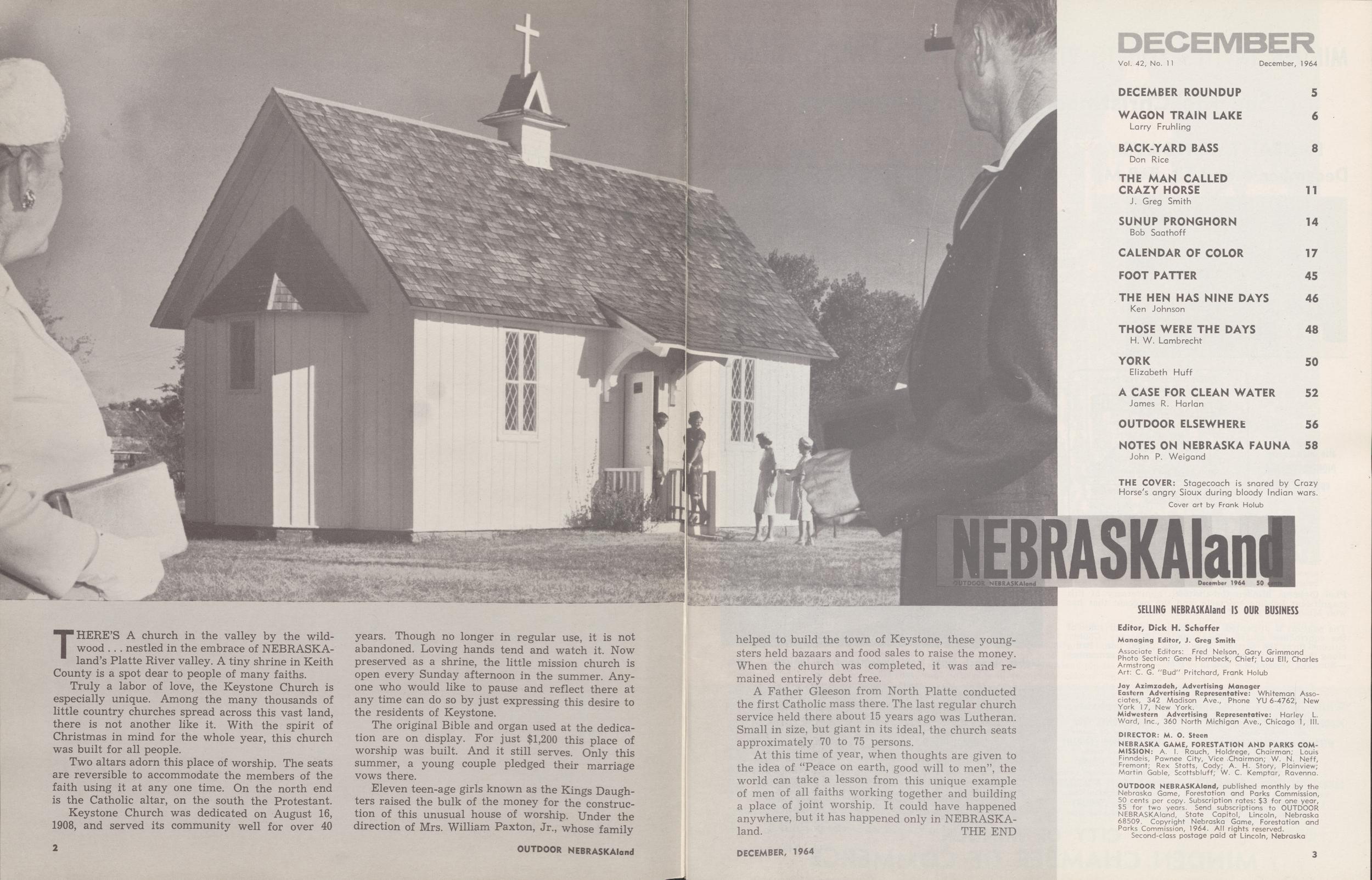
THERE'S A church in the valley by the wildwood ... nestled in the embrace of NEBRASKAland's Platte River valley. A tiny shrine in Keith County is a spot dear to people of many faiths.
Truly a labor of love, the Keystone Church is especially unique. Among the many thousands of little country churches spread across this vast land, there is not another like it. With the spirit of Christmas in mind for the whole year, this church was built for all people.
Two altars adorn this place of worship. The seats are reversible to accommodate the members of the faith using it at any one time. On the north end is the Catholic altar, on the south the Protestant.
Keystone Church was dedicated on August 16, 1908, and served its community well for over 40 years. Though no longer in regular use, it is not abandoned. Loving hands tend and watch it. Now preserved as a shrine, the little mission church is open every Sunday afternoon in the summer. Anyone who would like to pause and reflect there at any time can do so by just expressing this desire to the residents of Keystone.
The original Bible and organ used at the dedication are on display. For just $1,200 this place of worship was built. And it still serves. Only this summer, a young couple pledged their marriage vows there.
Eleven teen-age girls known as the Kings Daughters raised the bulk of the money for the construction of this unusual house of worship. Under the direction of Mrs. William Paxton, Jr., whose family helped to build the town of Keystone, these youngsters held bazaars and food sales to raise the money. When the church was completed, it was and remained entirely debt free.
A Father Gleeson from North Platte conducted the first Catholic mass there. The last regular church service held there about 15 years ago was Lutheran. Small in size, but giant in its ideal, the church seats approximately 70 to 75 persons.
At this time of year, when thoughts are given to the idea of "Peace on earth, good will to men", the world can take a lesson from this unique example of men of all faiths working together and building a place of joint worship. It could have happened anywhere, but it has happened only in NEBRASKAIand. THE END
WAGON TRAIN LAKE 6
Larry Fruhling
BACK-YARD BASS 8
Don Rice
THE MAN CALLED CRAZY HORSE 11
J. Greg Smith
SUNUP PRONGHORN 14
Bob Saathoff
CALENDAR OF COLOR 17
FOOT PATTER 45
THE HEN HAS NINE DAYS 46
Ken Johnson
THOSE WERE THE DAYS 48
H. W. Lambrecht
YORK 50
Elizabeth Huff
A CASE FOR CLEAN WATER 52
James R. Harlan
OUTDOOR ELSEWHERE 56
NOTES ON NEBRASKA FAUNA 58
John P. Weigand
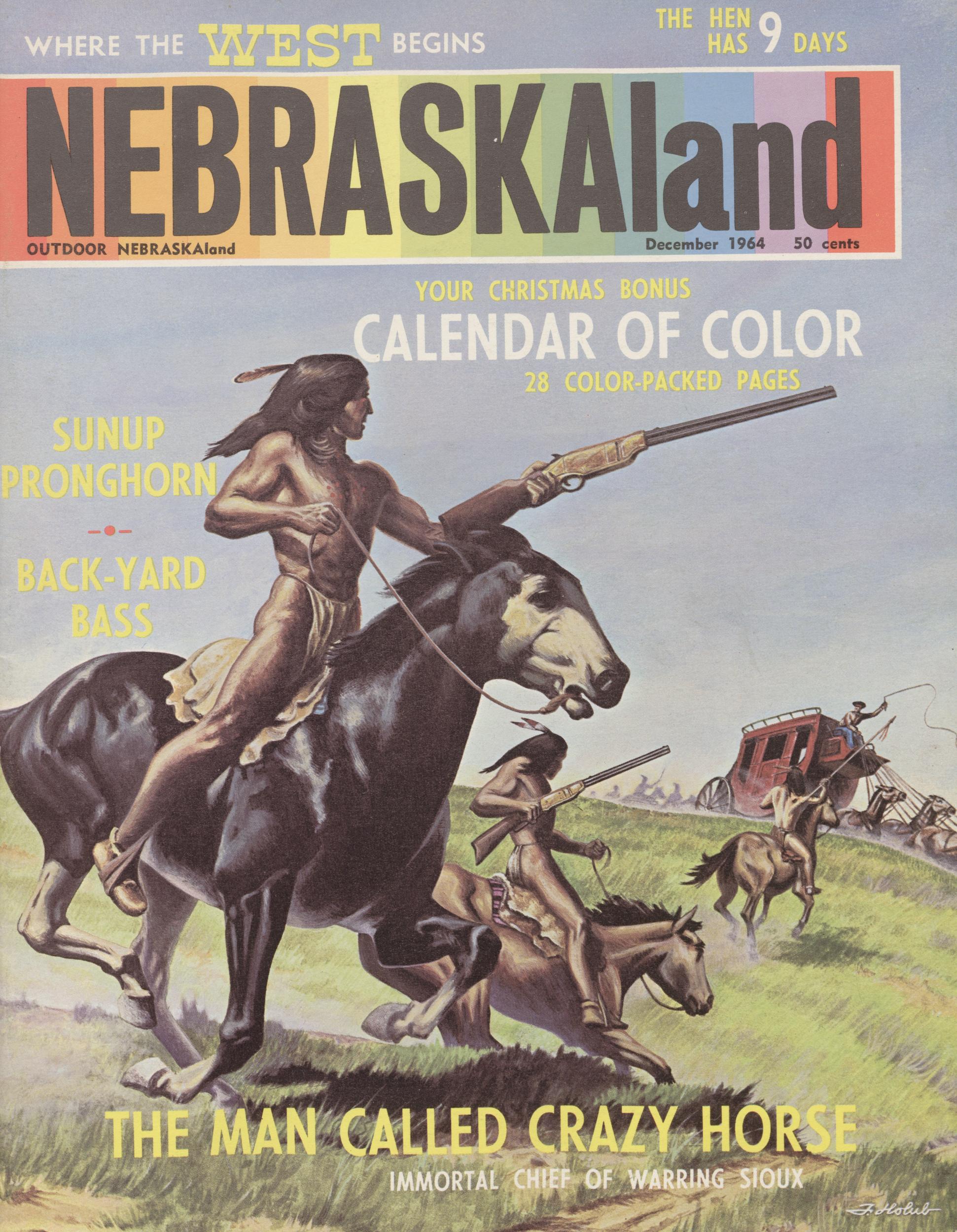
THE COVER: Stagecoach is snared by Crazy Horse's angry Sioux during bloody Indian wars. Cover art by Frank Holub
NEBRASKA GAME, FORESTATION AND PARKS COM- MISSION: A. I. Rauch, Holdrege, Chairman; Louis Finndeis, Pawnee City, Vice .Chairman; W. N. Neff, Fremont; Rex Stotts, Cody; A. H. Story, Plainview; Martin Gable, Scottsbluff; W. C. Kemptar, Ravenna.
OUTDOOR NEBRASKAIand, published monthly by the Nebraska Game, Forestation and Parks Commission, 50 cents per copy. Subscription rates: $3 for one year, $5 for two years. Send subscriptions to OUTDOOR NEBRASKAIand, State Capitol, Lincoln, Nebraska 68509. Copyright Nebraska Game, Forestation and Parks Commission, 1964. All rights reserved. Second-class postage paid at Lincoln, Nebraska
2 OUTDOOR NEBRASKAIand DECEMBER, 1964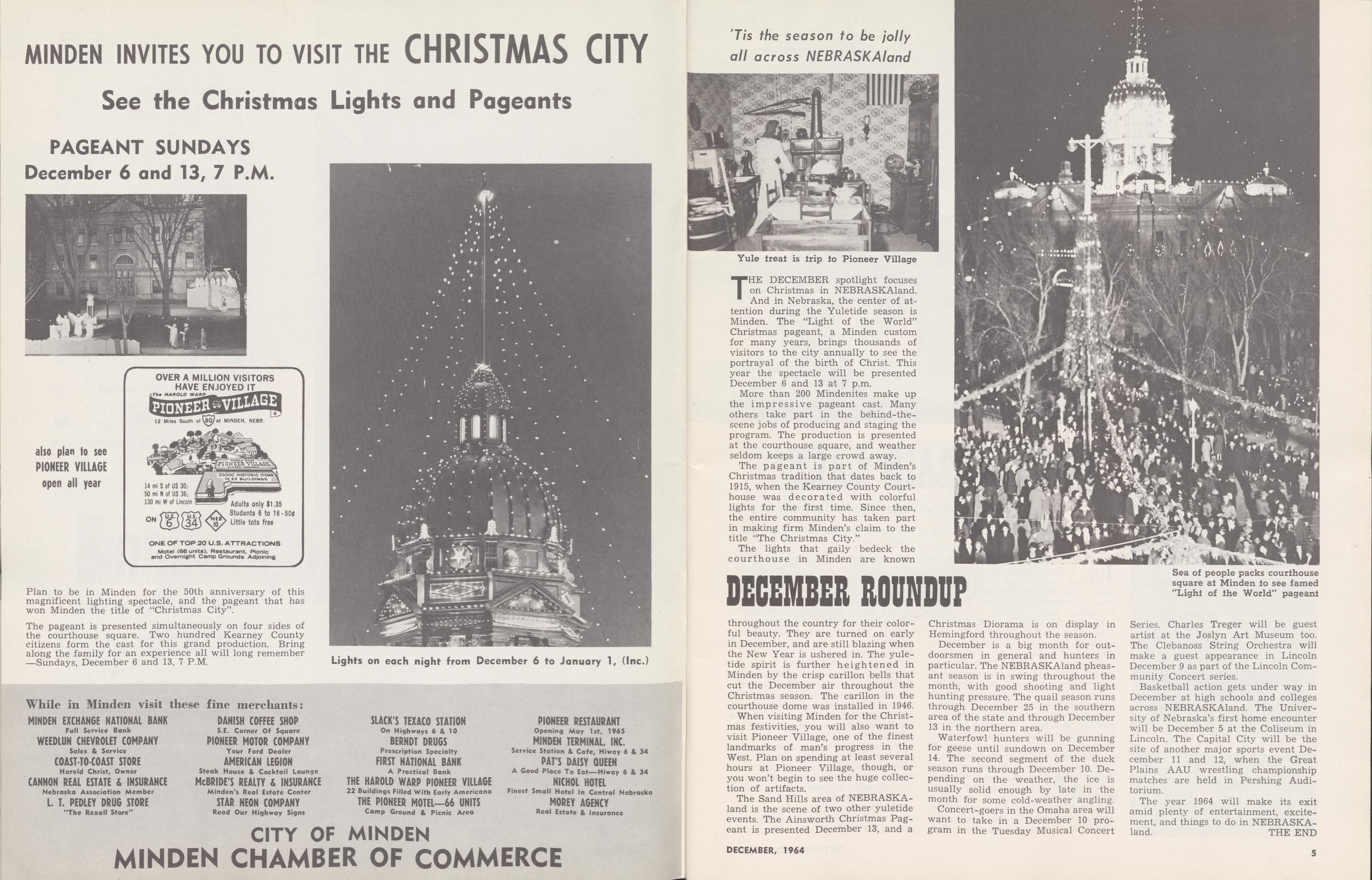
MINDEN INVITES YOU TO VISIT THE CHRISTMAS CITY
See the Christmas Lights and Pageants PAGEANT SUNDAYS December 6 and 13, 7 P.M. also plan to see PIONEER VILLAGE open all year OVER A MILLION VISITORS HAVE ENJOYED IT 12 Miles South of 80 at MINDEN, NEBR. 14 mi S of US 30; 50 mi N of US 36; 130 mi W of Lincoln ON Adults only (1.35 Students 6 to 16-500 Little tots free ONE OF TOP 20 U.S. ATTRACTIONS Motel (66 units), Restaurant, Picnic and Overnight Camp Grounds AdjoiningPlan to be in Minden for the 50th anniversary of this magnificent lighting spectacle, and the pageant that has won Minden the title of "Christmas City".
The pageant is presented simultaneously on four sides of the courthouse square. Two hundred Kearney County citizens form the cast for this grand production. Bring along the family for an experience all will long remember —Sundays, December 6 and 13, 7 P.M.
While in Minden visit these fine merchants: MINDEN EXCHANGE NATIONAL BANK Full Service Bonk WEEDLUN CHEVROLET COMPANY Sales & Service COAST-TO-COAST STORE Harold Christ, Owner CANNON REAL ESTATE & INSURANCE Nebraska Association Member L. T. PEDLEY DRUG STORE "The Rexall Store" Lights on each night from December 6 to January T, (Inc.) DANISH COFFEE SHOP S.E. Corner Of Square PIONEER MOTOR COMPANY Your Ford Dealer AMERICAN LEGION Steak House & Cocktail Lounge McBRIDE'S REALTY & INSURANCE Minden's Real Estate Center STAR NEON COMPANY Read Our Highway Signs SLACK'S TEXACO STATION On Highways 6 & 10 BERNDT DRUGS Prescription Specialty FIRST NATIONAL BANK A Practical Bank THE HAROLD WARP PIONEER VILLAGE 22 Buildings Filled With Eorly Americana THE PIONEER MOTEL—66 UNITS Camp Ground & Picnic Area PIONEER RESTAURANT Opening May 1st, 1965 MINDEN TERMINAL, INC. Service Station & Cafe, Hiway 6 & 34 PAT'S DAISY QUEEN A Good Place To Eat—Hiway 6 & 34 NICHOL HOTEL Finest Small Hotel In Central Nebraska M0REY AGENCY Real Estate & Insurance CITY OF MINDEN MINDEN CHAMBER OF COMMERCE'Tis the season to be jolly all across NEBRASKAIand
DECEMBER ROUNDUP
Yule treat is trip to Pioneer Village
THE DECEMBER spotlight focuses on Christmas in NEBRASKAIand. And in Nebraska, the center of attention during the Yuletide season is Minden. The "Light of the World" Christmas pageant, a Minden custom for many years, brings thousands of visitors to the city annually to see the portrayal of the birth of Christ. This year the spectacle will be presented December 6 and 13 at 7 p.m.
More than 200 Mindenites make up the impressive pageant cast. Many others take part in the behind-the- scene jobs of producing and staging the program. The production is presented at the courthouse square, and weather seldom keeps a large crowd away.
The pageant is part of Minden's Christmas tradition that dates back to 1915, when the Kearney County Courthouse was decorated with colorful lights for the first time. Since then, the entire community has taken part in making firm Minden's claim to the title "The Christmas City." The lights that gaily bedeck the courthouse in Minden are known throughout the country for their colorful beauty. They are turned on early in December, and are still blazing when the New Year is ushered in. The yuletide spirit is further heightened in Minden by the crisp carillon bells that cut the December air throughout the Christmas season. The carillon in the courthouse dome was installed in 1946.
When visiting Minden for the Christmas festivities, you will also want to visit Pioneer Village, one of the finest landmarks of man's progress in the West. Plan on spending at least several hours at Pioneer Village, though, or you won't begin to see the huge collection of artifacts.
The Sand Hills area of NEBRASKAIand is the scene of two other yuletide events. The Ainsworth Christmas Pageant is presented December 13, and a Christmas Diorama is on display in Hemingford throughout the season.
December is a big month for outdoorsmen in general and hunters in particular. The NEBRASKAIand pheasant season is in swing throughout the month, with good shooting and light hunting pressure. The quail season runs through December 25 in the southern area of the state and through December 13 in the northern area.
Waterfowl hunters will be gunning for geese until sundown on December 14. The second segment of the duck season runs through December 10. Depending on the weather, the ice is usually solid enough by late in the month for some cold-weather angling.
Sea of people packs courthouse square at Minden to see famed "Light of the World" pageant
Basketball action gets under way in December at high schools and colleges across NEBRASKAIand. The University of Nebraska's first home encounter will be December 5 at the Coliseum in Lincoln. The Capital City will be the site of another major sports event December 11 and 12, when the Great Plains AAU wrestling championship matches are held in Pershing Auditorium.
The year 1964 will make its exit amid plenty of entertainment, excitement, and things to do in NEBRASKAIand. THE END
DECEMBER, 1964 5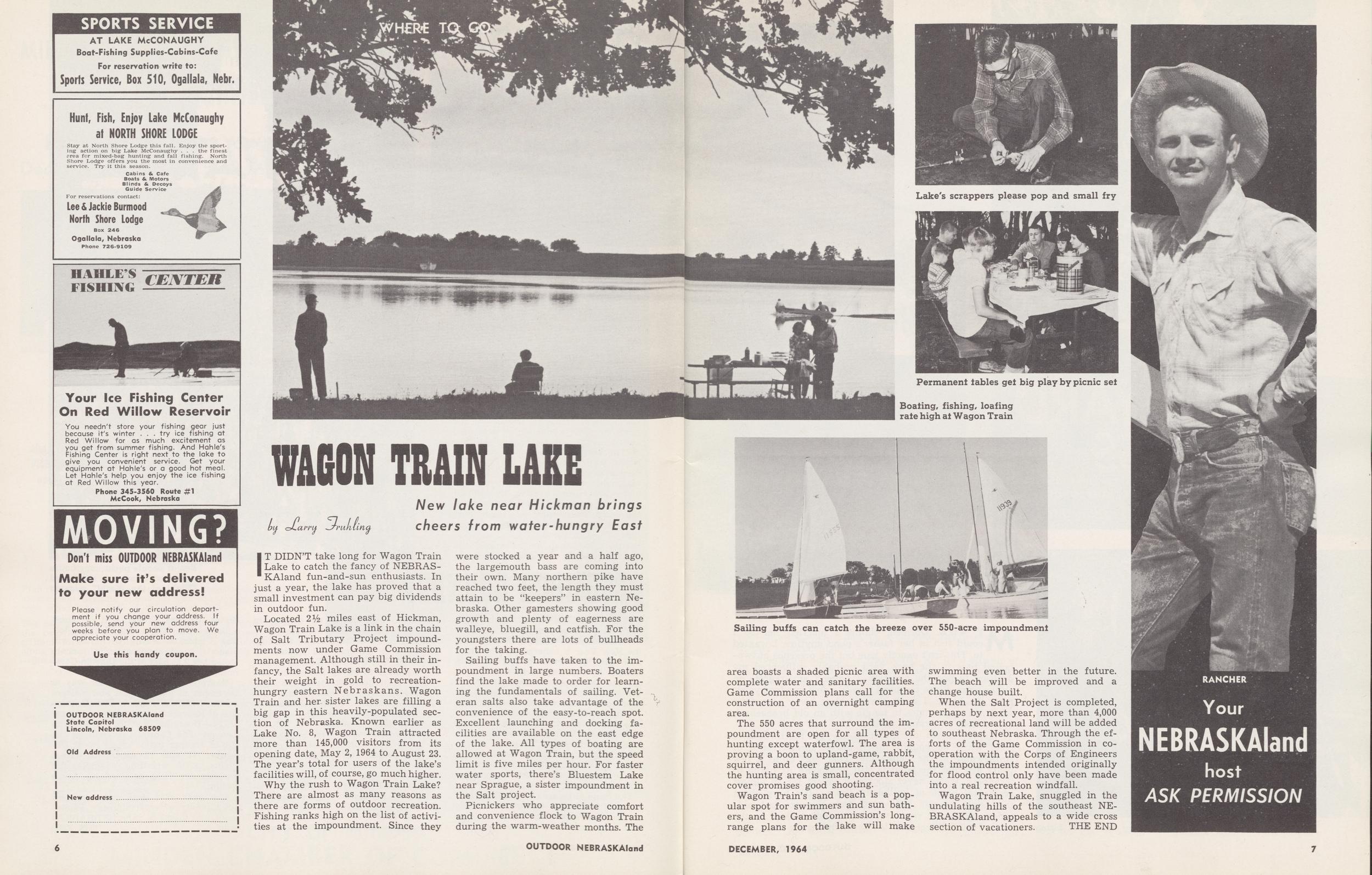
Hunt, Fish, Enjoy Lake McConaughy at NORTH SHORE LODGE Stay at North Shore Lodge this fall. Enjoy the sport- ing action on big Lake McConaughy . . . the finest nrea for mixed-bag hunting and fall fishing. North Shore Lodge offers you the most in convenience and service. Try it this season. Cabins & Cafe Boats & Motors Blinds & Decoys Guide Service For reservations contact: Lee & Jackie Burmood North Shore Lodge Box 246 Ogallala, Nebraska Phone 726-9109
HAHLE'S FISHING CENTER Your Ice Fishing Center On Red Willow Reservoir You needn't store your fishing gear just because it's winter . . . try ice fishing at Red Willow for as much excitement as you get from summer fishing. And Hahle's Fishing Center is right next to the lake to give you convenient service. Get your equipment at Hahle's or a good hot meal. Let Hahle's help you enjoy the ice fishing at Red Willow this year. Phone 345-3560 Route #1 McCook, Nebraska
MOVING? Don't miss OUTDOOR NEBRASKAIand Make sure it's delivered to your new address! Please notify our circulation department if you change your address. If possible, send your new address four weeks before you plan to move. We appreciate your cooperation. Use this handy coupon. OUTDOOR NEBRASKAIand State Capitol Lincoln, Nebraska 68509 Old Address New addressLake's scrappers please pop and small fry
Permanent tables get big play by picnic set
Boating, fishing, loafing rate high at Wagon Train
WAGON TRAIN LAKE
New lake near Hickman brings cheers from water-hungry East
IT DIDN'T take long for Wagon Train Lake to catch the fancy of NEBRASKAIand fun-and-sun enthusiasts. In just a year, the lake has proved that a small investment can pay big dividends in outdoor fun.
Located 21/2 miles east of Hickman, Wagon Train Lake is a link in the chain of Salt Tributary Project impoundments now under Game Commission management. Although still in their infancy, the Salt lakes are already worth their weight in gold to recreation- hungry eastern Nebraskans. Wagon Train and her sister lakes are filling a big gap in this heavily-populated section of Nebraska. Known earlier as Lake No. 8, Wagon Train attracted more than 145,000 visitors from its opening date, May 2, 1964 to August 23. The year's total for users of the lake's facilities will, of course, go much higher.
Why the rush to Wagon Train Lake? There are almost as many reasons as there are forms of outdoor recreation. Fishing ranks high on the list of activities at the impoundment. Since they were stocked a year and a half ago, the largemouth bass are coming into their own. Many northern pike have reached two feet, the length they must attain to be "keepers" in eastern Nebraska. Other gamesters showing good growth and plenty of eagerness are walleye, bluegill, and catfish. For the youngsters there are lots of bullheads for the taking.
Sailing buffs have taken to the impoundment in large numbers. Boaters find the lake made to order for learning the fundamentals of sailing. Veteran salts also take advantage of the convenience of the easy-to-reach spot. Excellent launching and docking facilities are available on the east edge of the lake. All types of boating are allowed at Wagon Train, but the speed limit is five miles per hour. For faster water sports, there's Bluestem Lake near Sprague, a sister impoundment in the Salt project.
Picnickers who appreciate comfort and convenience flock to Wagon Train during the warm-weather months. The Sailing buffs can catch the breeze over 550-acre impoundment area boasts a shaded picnic area with complete water and sanitary facilities. Game Commission plans call for the construction of an overnight camping area.
The 550 acres that surround the impoundment are open for all types of hunting except waterfowl. The area is proving a boon to upland-game, rabbit, squirrel, and deer gunners. Although the hunting area is small, concentrated cover promises good shooting.
Wagon Train's sand beach is a popular spot for swimmers and sun bath- ers, and the Game Commission's long- range plans for the lake will make swimming even better in the future. The beach will be improved and a change house built.
When the Salt Project is completed, perhaps by next year, more than 4,000 acres of recreational land will be added to southeast Nebraska. Through the efforts of the Game Commission in cooperation with the Corps of Engineers the impoundments intended originally for flood control only have been made into a real recreation windfall.
Wagon Train Lake, snuggled in the undulating hills of the southeast NEBRASKAIand, appeals to a wide cross section of vacationers. THE END
6 OUTDOOR NEBRASKAIandDECEMBER, 1964 7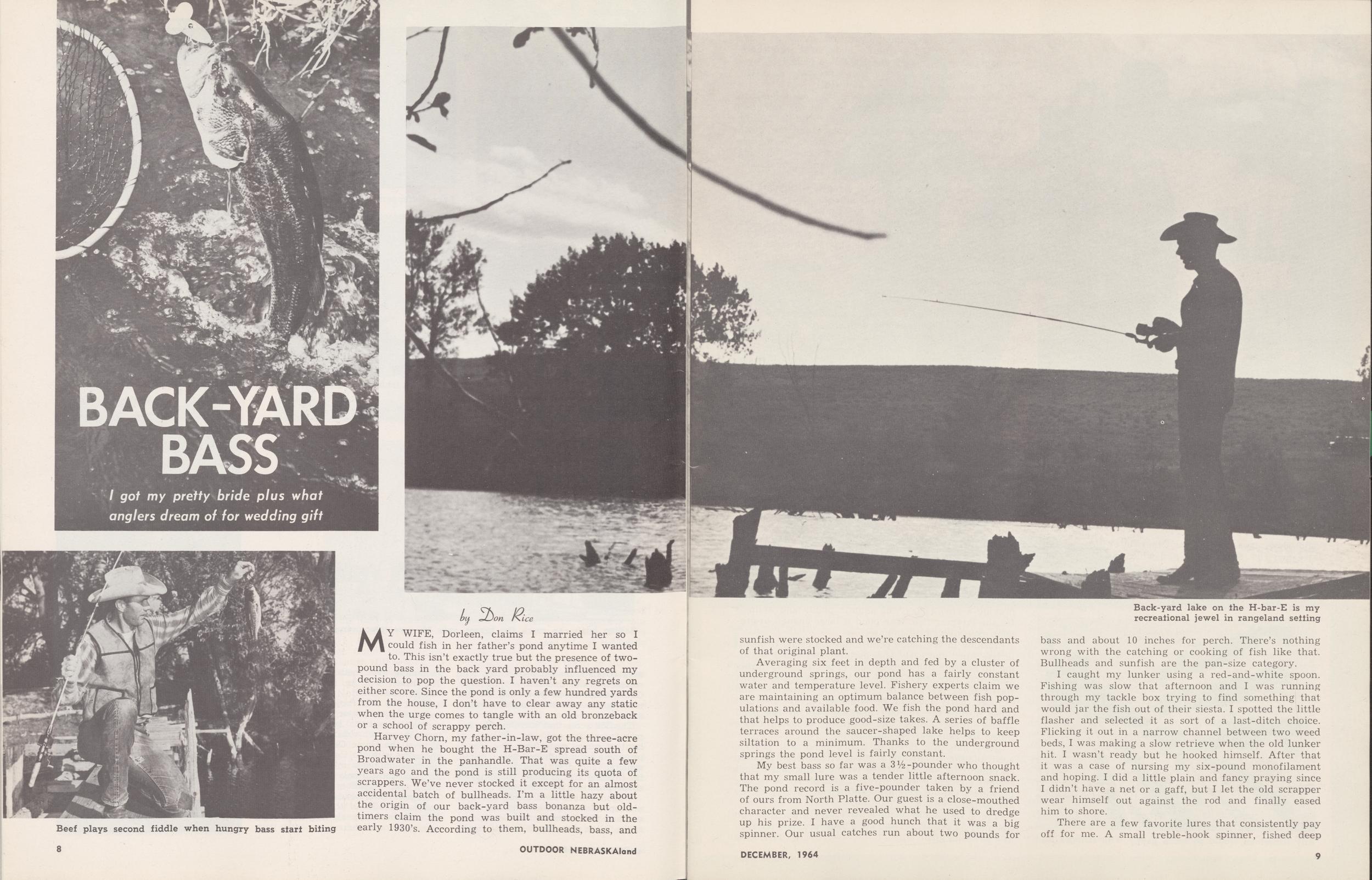
Back-Yard Bass
I got my pretty bride plus what anglers dream of for wedding gift
Beef plays second fiddle when hungry bass start biting
MY WIFE, Dorleen, claims I married her so I could fish in her father's pond anytime I wanted to. This isn't exactly true but the presence of two- pound bass in the back yard probably influenced my decision to pop the question. I haven't any regrets on either score. Since the pond is only a few hundred yards from the house, I don't have to clear away any static when the urge comes to tangle with an old bronzeback or a school of scrappy perch.
Harvey Chorn, my father-in-law, got the three-acre pond when he bought the H-Bar-E spread south of Broadwater in the panhandle. That was quite a few years ago and the pond is still producing its quota of scrappers. We've never stocked it except for an almost accidental batch of bullheads. I'm a little hazy about the origin of our back-yard bass bonanza but old- timers claim the pond was built and stocked in the early 1930's. According to them, bullheads, bass, and sunfish were stocked and we're catching the descendants of that original plant.
Averaging six feet in depth and fed by a cluster of underground springs, our pond has a fairly constant water and temperature level. Fishery experts claim we are maintaining an optimum balance between fish populations and available food. We fish the pond hard and that helps to produce good-size takes. A series of baffle terraces around the saucer-shaped lake helps to keep siltation to a minimum. Thanks to the underground springs the pond level is fairly constant.
Back-yard lake on the H-bar-E is my recreational jewel in rangeland setting
I caught my lunker using a red-and-white spoon. Fishing was slow that afternoon and I was running through my tackle box trying to find something that would jar the fish out of their siesta. I spotted the little flasher and selected it as sort of a last-ditch choice. Flicking it out in a narrow channel between two weed beds, I was making a slow retrieve when the old lunker hit. I wasn't ready but he hooked himself. After that it was a case of nursing my six-pound monofilament and hoping. I did a little plain and fancy praying since I didn't have a net or a gaff, but I let the old scrapper wear himself out against the rod and finally eased him to shore.
There are a few favorite lures that consistently pay off for me. A small treble-hook spinner, fished deep
8 OUTDOOR NEBRASKAIand DECEMBER, 1964 9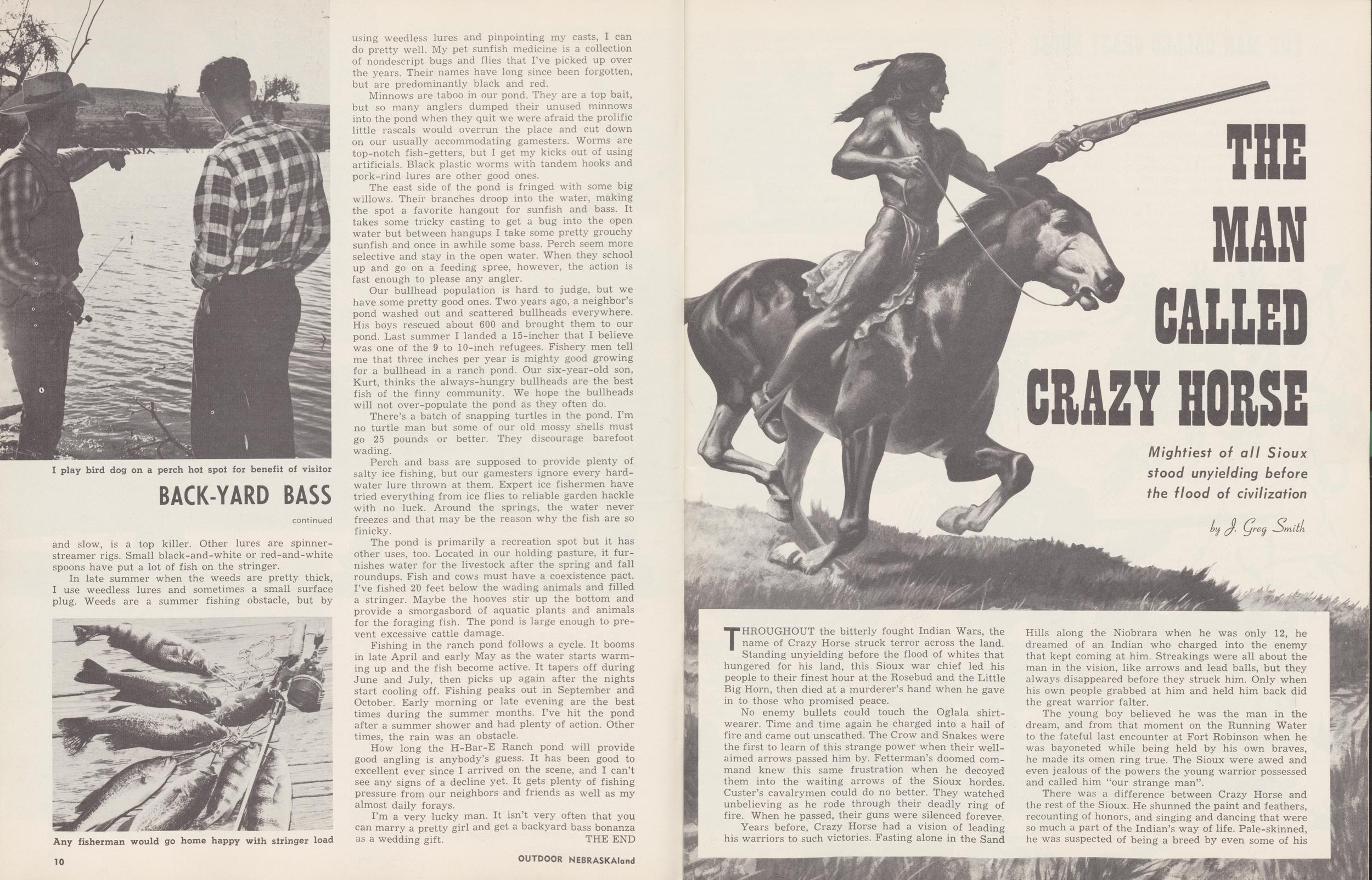
I play bird dog on a perch hot spot for benefit of visitor
and slow, is a top killer. Other lures are spinner- streamer rigs. Small black-and-white or red-and-white spoons have put a lot of fish on the stringer.
Any fisherman would go home happy with stringer load
Minnows are taboo in our pond. They are a top bait, but so many anglers dumped their unused minnows into the pond when they quit we were afraid the prolific little rascals would overrun the place and cut down on our usually accommodating gamesters. Worms are top-notch fish-getters, but I get my kicks out of using artificials. Black plastic worms with tandem hooks and pork-rind lures are other good ones.
The east side of the pond is fringed with some big willows. Their branches droop into the water, making the spot a favorite hangout for sunfish and bass. It takes some tricky casting to get a bug into the open water but between hangups I take some pretty grouchy sunfish and once in awhile some bass. Perch seem more selective and stay in the open water. When they school up and go on a feeding spree, however, the action is fast enough to please any angler.
Our bullhead population is hard to judge, but we have some pretty good ones. Two years ago, a neighbor's pond washed out and scattered bullheads everywhere. His boys rescued about 600 and brought them to our pond. Last summer I landed a 15-incher that I believe was one of the 9 to 10-inch refugees. Fishery men tell me that three inches per year is mighty good growing for a bullhead in a ranch pond. Our six-year-old son, Kurt, thinks the always-hungry bullheads are the best fish of the finny community. We hope the bullheads will not over-populate the pond as they often do.
There's a batch of snapping turtles in the pond. I'm no turtle man but some of our old mossy shells must go 25 pounds or better. They discourage barefoot wading.
Perch and bass are supposed to provide plenty of salty ice fishing, but our gamesters ignore every hardwater lure thrown at them. Expert ice fishermen have tried everything from ice flies to reliable garden hackle with no luck. Around the springs, the water never freezes and that may be the reason why the fish are so finicky.
The pond is primarily a recreation spot but it has other uses, too. Located in our holding pasture, it furnishes water for the livestock after the spring and fall roundups. Fish and cows must have a coexistence pact. I've fished 20 feet below the wading animals and filled a stringer. Maybe the hooves stir up the bottom and provide a smorgasbord of aquatic plants and animals for the foraging fish. The pond is large enough to prevent excessive cattle damage.
Fishing in the ranch pond follows a cycle. It booms in late April and early May as the water starts warming up and the fish become active. It tapers off during June and July, then picks up again after the nights start cooling off. Fishing peaks out in September and October. Early morning or late evening are the best times during the summer months. I've hit the pond after a summer shower and had plenty of action. Other times, the rain was an obstacle.
How long the H-Bar-E Ranch pond will provide good angling is anybody's guess. It has been good to excellent ever since I arrived on the scene, and I can't see any signs of a decline yet. It gets plenty of fishing pressure from our neighbors and friends as well as my almost daily forays.
I'm a very lucky man. It isn't very often that you can marry a pretty girl and get a backyard bass bonanza as a wedding gift. THE END
10 OUTDOOR NEBRASKAIandTHE MAN CALLED CRAZY HORSE
Mightiest of all Sioux stood unyielding before the flood of civilization
THROUGHOUT the bitterly fought Indian Wars, the name of Crazy Horse struck terror across the land. Standing unyielding before the flood of whites that hungered for his land, this Sioux war chief led his people to their finest hour at the Rosebud and the Little Big Horn, then died at a murderer's hand when he gave in to those who promised peace.
No enemy bullets could touch the Oglala shirt- wearer. Time and time again he charged into a hail of fire and came out unscathed. The Crow and Snakes were the first to learn of this strange power when their well- aimed arrows passed him by. Fetterman's doomed com- mand knew this same frustration when he decoyed them into the waiting arrows of the Sioux hordes. Custer's cavalrymen could do no better. They watched unbelieving as he rode through their deadly ring of fire. When he passed, their guns were silenced forever,
Years before, Crazy Horse had a vision of leading his warriors to such victories. Fasting alone in the Sand Hills along the Niobrara when he was only 12, he dreamed of an Indian who charged into the enemy that kept coming at him. Streakings were all about the man in the vision, like arrows and lead balls, but they always disappeared before they struck him. Only when his own people grabbed at him and held him back did the great warrior falter.
The young boy believed he was the man in the dream, and from that moment on the Running Water to the fateful last encounter at Fort Robinson when he was bayoneted while being held by his own braves, he made its omen ring true. The Sioux were awed and even jealous of the powers the young warrior possessed and called him "our strange man".
There was a difference between Crazy Horse and the rest of the Sioux. He shunned the paint and feathers, recounting of honors, and singing and dancing that were so much a part of the Indian's way of life. Pale-skinned, he was suspected of being a breed by even some of his
 THE MAN CALLED CRAZY HORSE
own people. But a warrior's blood coursed his veins, a blending of Oglala, Brule, and Minneconjou Sioux and some Cheyenne. His hair was soft and light and he was called Curly until he proved himself against the Snakes when he was only 15. Then he was given his father's name, Crazy Horse, for the deeds that he had done.
Crazy Horse was not a bloodthirsty savage. His was a war to the end to keep his land free from the whites who pushed in from all sides. Born in 1842 when only white traders and trappers roamed unnoticed through the wilderness prairies, he fought the losing fight to keep it that way.
As a young boy, Crazy Horse had marveled at the long strings of wagons that pushed up the Platte from the east. But they never stayed, always going and never returning. This "Holy Road" was but a thin line in the vast unclaimed territory, and his people willingly signed a paper in return for goods if they let the wagons go through unharmed. But the migration that was only a trickle became an exodus. More treaties were signed and more promises made until the thin line became a broad highway with arteries stretching out in all directions to ensnare the Sioux.
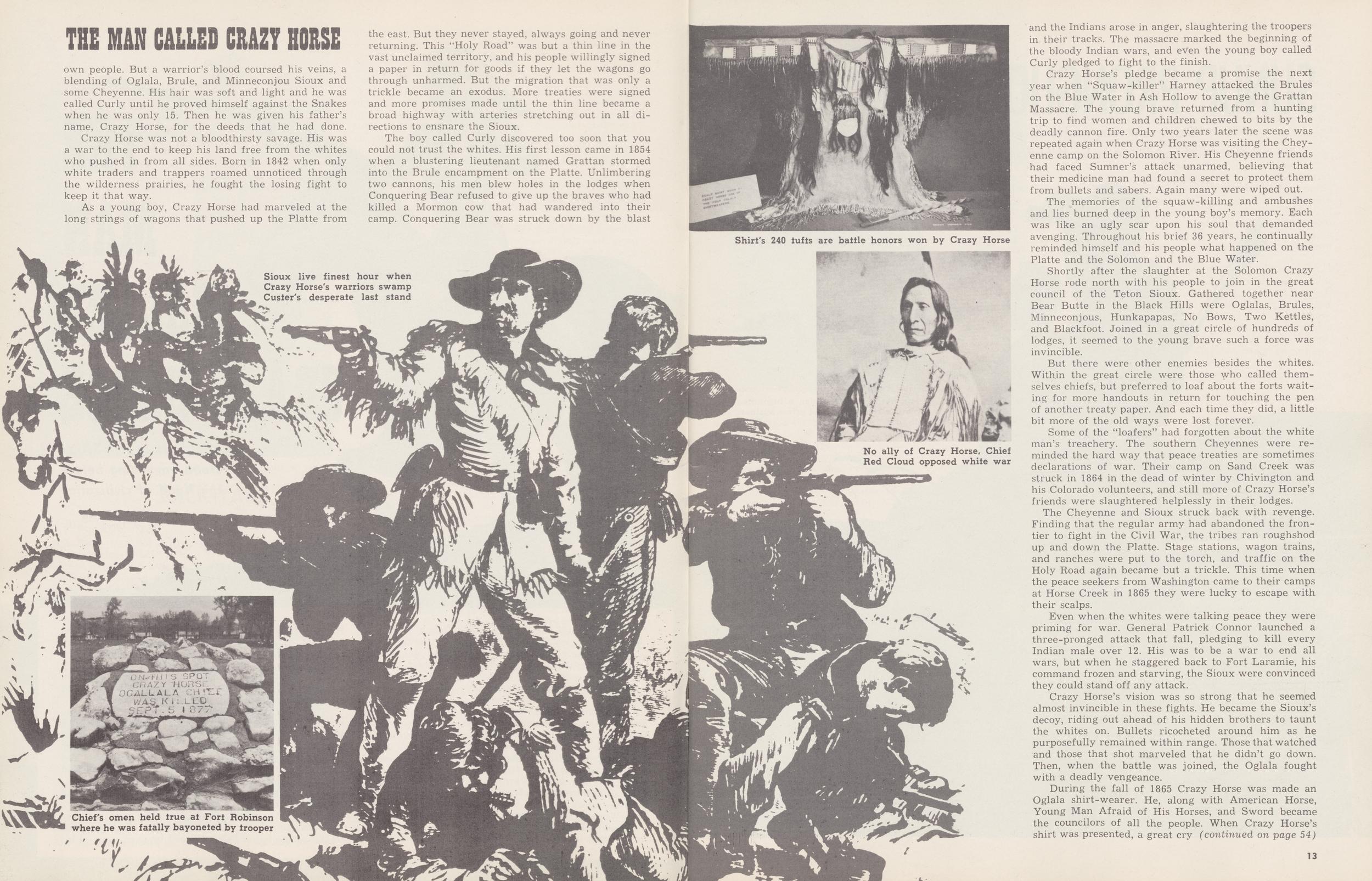
Sioux live finest hour when Crazy Horse's warriors swamp Custer's desperate last stand
Chief's omen held true at Fort Robinson where he was fatally bayoneted by trooper
Shirt's 240 tufts are battle honors won by Crazy Horse
No ally of Crazy Horse, Chief Red Cloud opposed white war
Crazy Horse's pledge became a promise the next year when "Squaw-killer" Harney attacked the Brules on the Blue Water in Ash Hollow to avenge the Grattan Massacre. The young brave returned from a hunting trip to find women and children chewed to bits by the deadly cannon fire. Only two years later the scene was repeated again when Crazy Horse was visiting the Cheyenne camp on the Solomon River. His Cheyenne friends had faced Sumner's attack unarmed, believing that their medicine man had found a secret to protect them from bullets and sabers. Again many were wiped out.
The memories of the squaw-killing and ambushes and lies burned deep in the young boy's memory. Each was like an ugly scar upon his soul that demanded avenging. Throughout his brief 36 years, he continually reminded himself and his people what happened on the Platte and the Solomon and the Blue Water.
Shortly after the slaughter at the Solomon Crazy Horse rode north with his people to join in the great council of the Teton Sioux. Gathered together near Bear Butte in the Black Hills were Oglalas, Brules, Minneconjous, Hunkapapas, No Bows, Two Kettles, and Blackfoot. Joined in a great circle of hundreds of lodges, it seemed to the young brave such a force was invincible.
But there were other enemies besides the whites. Within the great circle were those who called them- selves chiefs, but preferred to loaf about the forts waiting for more handouts in return for touching the pen of another treaty paper. And each time they did, a little bit more of the old ways were lost forever.
Some of the "loafers" had forgotten about the white man's treachery. The southern Cheyennes were reminded the hard way that peace treaties are sometimes declarations of war. Their camp on Sand Creek was struck in 1864 in the dead of winter by Chivington and his Colorado volunteers, and still more of Crazy Horse's friends were slaughtered helplessly in their lodges.
The Cheyenne and Sioux struck back with revenge. Finding that the regular army had abandoned the fron- tier to fight in the Civil War, the tribes ran roughshod up and down the Platte. Stage stations, wagon trains, and ranches were put to the torch, and traffic on the Holy Road again became but a trickle. This time when the peace seekers from Washington came to their camps at Horse Creek in 1865 they were lucky to escape with their scalps.
Even when the whites were talking peace they were priming for war. General Patrick Connor launched a three-pronged attack that fall, pledging to kill every Indian male over 12. His was to be a war to end all wars, but when he staggered back to Fort Laramie, his command frozen and starving, the Sioux were convinced they could stand off any attack.
Crazy Horse's vision was so strong that he seemed almost invincible in these fights. He became the Sioux's decoy, riding out ahead of his hidden brothers to taunt the whites on. Bullets ricocheted around him as he purposefully remained within range. Those that watched and those that shot marveled that he didn't go down. Then, when the battle was joined, the Oglala fought with a deadly vengeance.
During the fall of 1865 Crazy Horse was made an Oglala shirt-wearer. He, along with American Horse, Young Man Afraid of His Horses, and Sword became the councilors of all the people. When Crazy Horse's shirt was presented, a great cry (continued on page 54)
13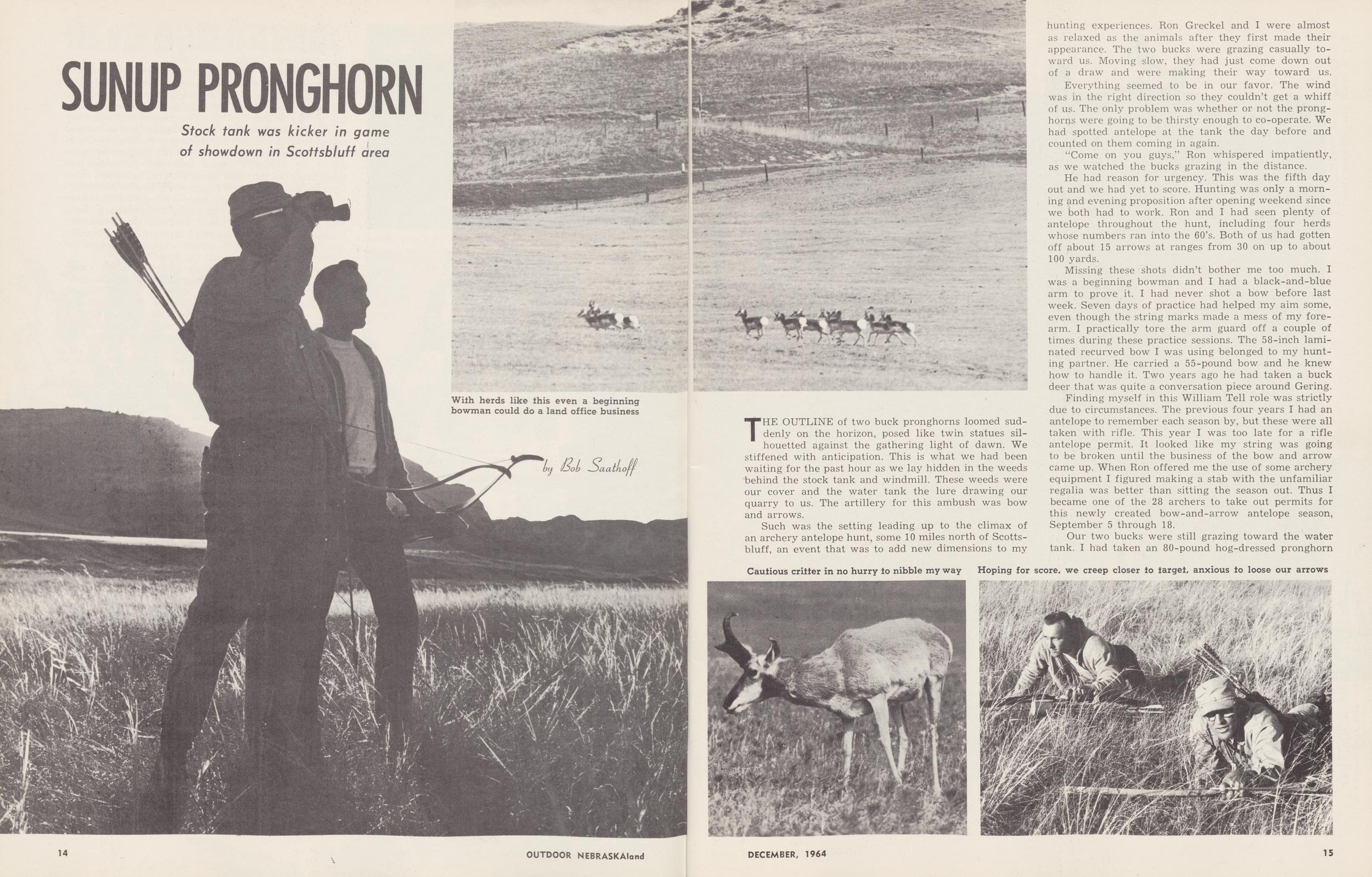
SUNUP PRONGHORN
Stock tank was kicker in game of showdown in Scottsbluff area
With herds like this even a beginning bowman could do a land office business
THE OUTLINE of two buck pronghorns loomed suddenly on the horizon, posed like twin statues silhouetted against the gathering light of dawn. We stiffened with anticipation. This is what we had been waiting for the past hour as we lay hidden in the weeds behind the stock tank and windmill. These weeds were our cover and the water tank the lure drawing our quarry to us. The artillery for this ambush was bow and arrows.
Such was the setting leading up to the climax of an archery antelope hunt, some 10 miles north of Scottsbluff, an event that was to add new dimensions to my hunting experiences. Ron Greckel and I were almost as relaxed as the animals after they first made their appearance. The two bucks were grazing casually toward us. Moving slow, they had just come down out of a draw and were making their way toward us.
Everything seemed to be in our favor. The wind was in the right direction so they couldn't get a whiff of us. The only problem was whether or not the pronghorns were going to be thirsty enough to co-operate. We had spotted antelope at the tank the day before and counted on them coming in again.
"Come on you guys," Ron whispered impatiently, as we watched the bucks grazing in the distance.
He had reason for urgency. This was the fifth day out and we had yet to score. Hunting was only a morning and evening proposition after opening weekend since we both had to work. Ron and I had seen plenty of antelope throughout the hunt, including four herds whose numbers ran into the 60's. Both of us had gotten off about 15 arrows at ranges from 30 on up to about 100 yards.
Missing these shots didn't bother me too much. I was a beginning bowman and I had a black-and-blue arm to prove it. I had never shot a bow before last week. Seven days of practice had helped my aim some, even though the string marks made a mess of my fore- arm. I practically tore the arm guard off a couple of times during these practice sessions. The 58-inch laminated recurved bow I was using belonged to my hunt- ing partner. He carried a 55-pound bow and he knew how to handle it. Two years ago he had taken a buck deer that was quite a conversation piece around Gering.
Finding myself in this William Tell role was strictly due to circumstances. The previous four years I had an antelope to remember each season by, but these were all taken with rifle. This year I was too late for a rifle antelope permit. It looked like my string was going to be broken until the business of the bow and arrow came up. When Ron offered me the use of some archery equipment I figured making a stab with the unfamiliar regalia was better than sitting the season out. Thus I became one of the 28 archers to take out permits for this newly created bow-and-arrow antelope season, September 5 through 18.
Our two bucks were still grazing toward the water tank. I had taken an 80-pound hog-dressed pronghorn
Cautious critter in no hurry to nibble my way
Hoping for score, we creep closer to target, anxious to loose our arrows
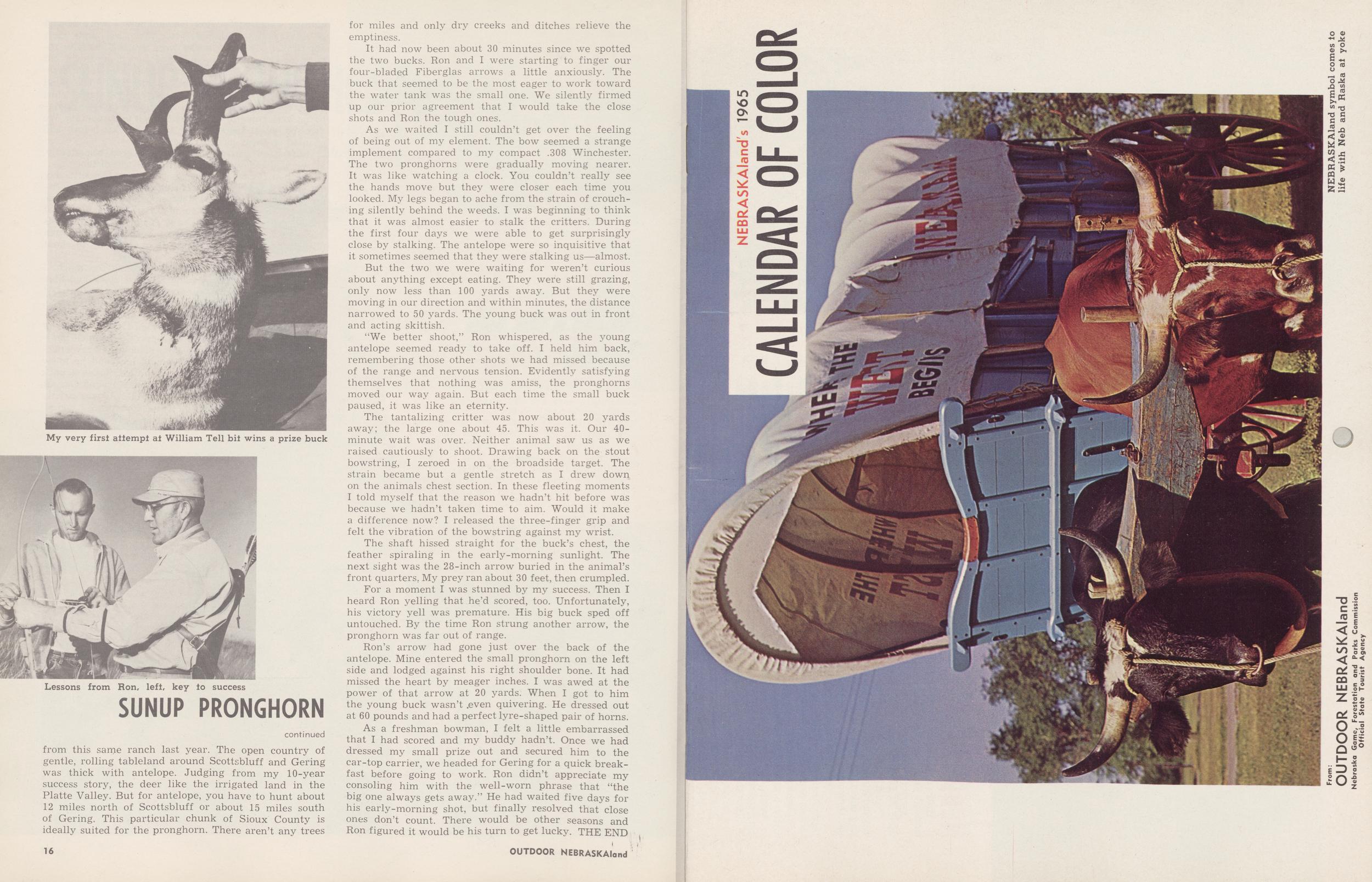
My very first attempt at William Tell bit wins a prize buck
Lessons from Ron, left, key to success
from this same ranch last year. The open country of gentle, rolling tableland around Scottsbluff and Gering was thick with antelope. Judging from my 10-year success story, the deer like the irrigated land in the Platte Valley. But for antelope, you have to hunt about 12 miles north of Scottsbluff or about 15 miles south of Gering. This particular chunk of Sioux County is ideally suited for the pronghorn. There aren't any trees for miles and only dry creeks and ditches relieve the emptiness.
It had now been about 30 minutes since we spotted the two bucks. Ron and I were starting to finger our four-bladed Fiberglas arrows a little anxiously. The buck that seemed to be the most eager to work toward the water tank was the small one. We silently firmed up our prior agreement that I would take the close shots and Ron the tough ones.
As we waited I still couldn't get over the feeling of being out of my element. The bow seemed a strange implement compared to my compact .308 Winchester. The two pronghorns were gradually moving nearer. It was like watching a clock. You couldn't really see the hands move but they were closer each time you looked. My legs began to ache from the strain of crouching silently behind the weeds. I was beginning to think that it was almost easier to stalk the critters. During the first four days we were able to get surprisingly close by stalking. The antelope were so inquisitive that it sometimes seemed that they were stalking us—almost.
But the two we were waiting for weren't curious about anything except eating. They were still grazing, only now less than 100 yards away. But they were moving in our direction and within minutes, the distance narrowed to 50 yards. The young buck was out in front and acting skittish.
"We better shoot," Ron whispered, as the young antelope seemed ready to take off. I held him back, remembering those other shots we had missed because of the range and nervous tension. Evidently satisfying themselves that nothing was amiss, the pronghorns moved our way again. But each time the small buck paused, it was like an eternity.
The tantalizing critter was now about 20 yards away; the large one about 45. This was it. Our 40- minute wait was over. Neither animal saw us as we raised cautiously to shoot. Drawing back on the stout bowstring, I zeroed in on the broadside target. The strain became but a gentle stretch as I drew down on the animals chest section. In these fleeting moments I told myself that the reason we hadn't hit before was because we hadn't taken time to aim. Would it make a difference now? I released the three-finger grip and felt the vibration of the bowstring against my wrist.
The shaft hissed straight for the buck's chest, the feather spiraling in the early-morning sunlight. The next sight was the 28-inch arrow buried in the animal's front quarters. My prey ran about 30 feet, then crumpled. For a moment I was stunned by my success. Then I heard Ron yelling that he'd scored, too. Unfortunately, his victory yell was premature. His big buck sped off untouched. By the time Ron strung another arrow, the pronghorn was far out of range.
Ron's arrow had gone just over the back of the antelope. Mine entered the small pronghorn on the left side and lodged against his right shoulder bone. It had missed the heart by meager inches. I was awed at the power of that arrow at 20 yards. When I got to him the young buck wasn't .even quivering. He dressed out at 60 pounds and had a perfect lyre-shaped pair of horns.
As a freshman bowman, I felt a little embarrassed that I had scored and my buddy hadn't. Once we had dressed my small prize out and secured him to the car-top carrier, we headed for Gering for a quick breakfast before going to work. Ron didn't appreciate my consoling him with the well-worn phrase that "the big one always gets away." He had waited five days for his early-morning shot, but finally resolved that close ones don't count. There would be other seasons and Ron figured it would be his turn to get lucky. THE END
16 OUTDOOR NEBRASKAIandNebraskaland's 1965 Calendar of Color
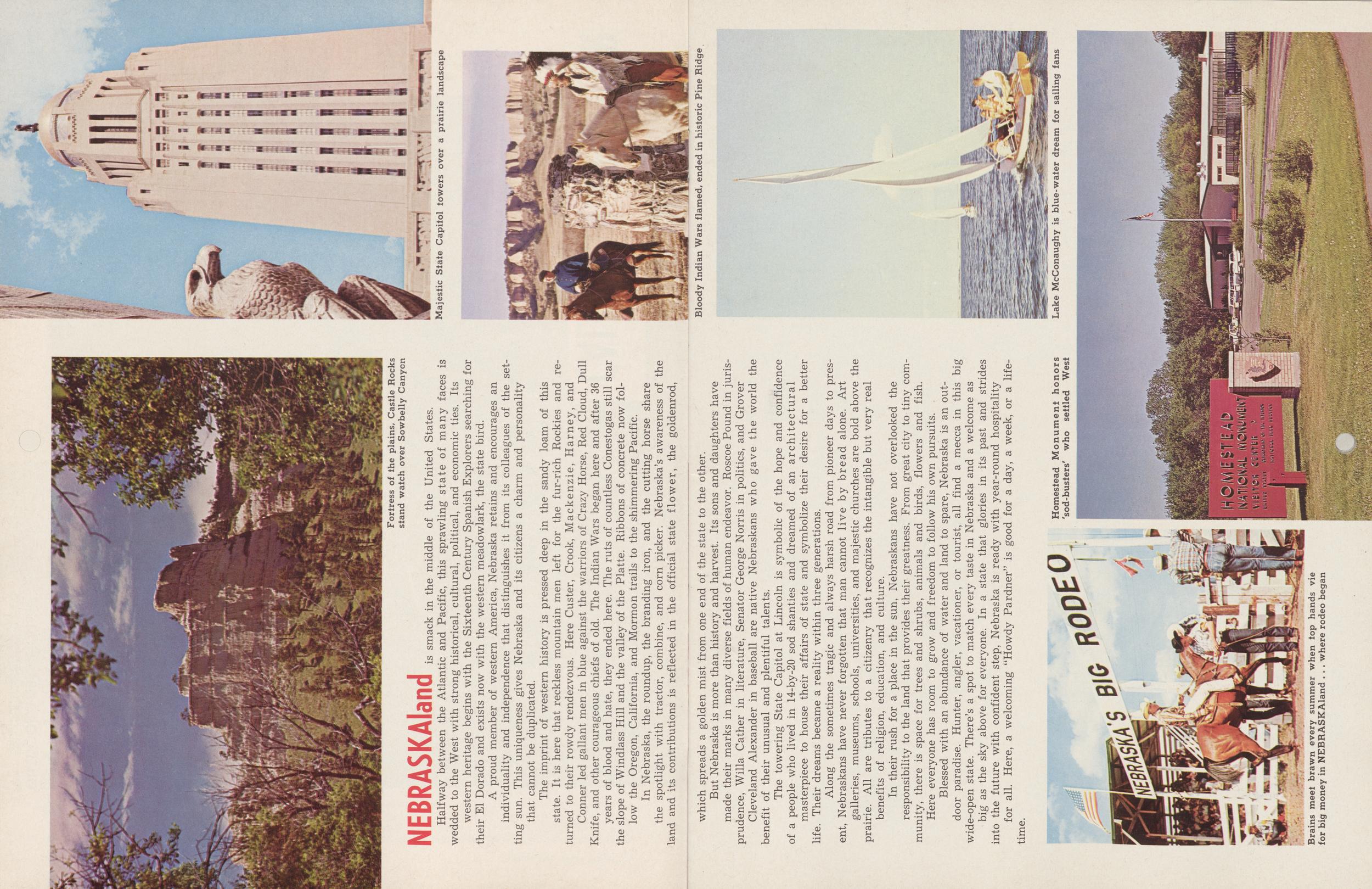
Fortress of the plains, Castle Rocks stand watch over Sowbelly Canyon
Nebraskaland is smack in the middle of the United States. Halfway between the Atlantic and Pacific, this sprawling state of many faces is wedded to the West with strong historical, cultural, political, and economic ties. Its western heritage begins with the Sixteenth Century Spanish Explorers searching for their El Dorado and exists now with the western meadowlark, the state bird.
A proud member of western America, Nebraska retains and encourages an individuality and independence that distinguishes it from its colleagues of the set- ting sun. This uniqueness gives Nebraska and its citizens a charm and personality that cannot be duplicated.
The imprint of western history is pressed deep in the sandy loam of this state. It is here that reckless mountain men left for the fur-rich Rockies and returned to their rowdy rendezvous. Here Custer, Crook, Mackenzie, Harney, and Conner led gallant men in blue against the warriors of Crazy Horse, Red Cloud, Dull Knife, and other courageous chiefs of old. The Indian Wars began here and after 36 years of blood and hate, they ended here. The ruts of countless Conestogas still scar the slope of Windlass Hill and the valley of the Platte. Ribbons of concrete now follow the Oregon, California, and Mormon trails to the shimmering Pacific.
In Nebraska, the roundup, the branding iron, and the cutting horse share the spotlight with tractor, combine, and corn picker. Nebraska's awareness of the land and its contributions is reflected in the official state flower, the goldenrod, which spreads a golden mist from one end of the state to the other.
But Nebraska is more than history and harvest. Its sons and daughters have made their marks in many diverse fields of human endeavor. Roscoe Pound in jurisprudence, Willa Cather in literature, Senator George Norris in politics, and Grover Cleveland Alexander in baseball are native Nebraskans who gave the world the benefit of their unusual and plentiful talents.
The towering State Capitol at Lincoln is symbolic of the hope and confidence of a people who lived in 14-by-20 sod shanties and dreamed of an architectural masterpiece to house their affairs of state and symbolize their desire for a better life. Their dreams became a reality within three generations.
Along the sometimes tragic and always harsh road from pioneer days to present, Nebraskans have never forgotten that man cannot live by bread alone. Art galleries, museums, schools, universities, and majestic churches are bold above the prairie. All are tributes to a citizenry that recognizes the intangible but very real benefits of religion, education, and culture.
In their rush for a place in the sun, Nebraskans have not overlooked the responsibility to the land that provides their greatness. From great city to tiny community, there is space for trees and shrubs, animals and birds, flowers and fish. Here everyone has room to grow and freedom to follow his own pursuits.
Blessed with an abundance of water and land to spare, Nebraska is an outdoor paradise. Hunter, angler, vacationer, or tourist, all find a mecca in this big wide-open state. There's a spot to match every taste in Nebraska and a welcome as big as the sky above for everyone. In a state that glories in its past and strides into the future with confident step, Nebraska is ready with year-round hospitality for all. Here, a welcoming "Howdy Pardner" is good for a day, a week, or a lifetime.
Homestead Monument honors 'sod-busters' who settled West
Majestic State Capitol towers over a prairie landscape
Bloody Indian Wars flamed, ended in historic Pine Ridge
Lake McConaughy is blue-water dream for sailing fans
Brains meet brawn every summer when lop hands vie for big money in NEBRASKAland . . . where rodeo began
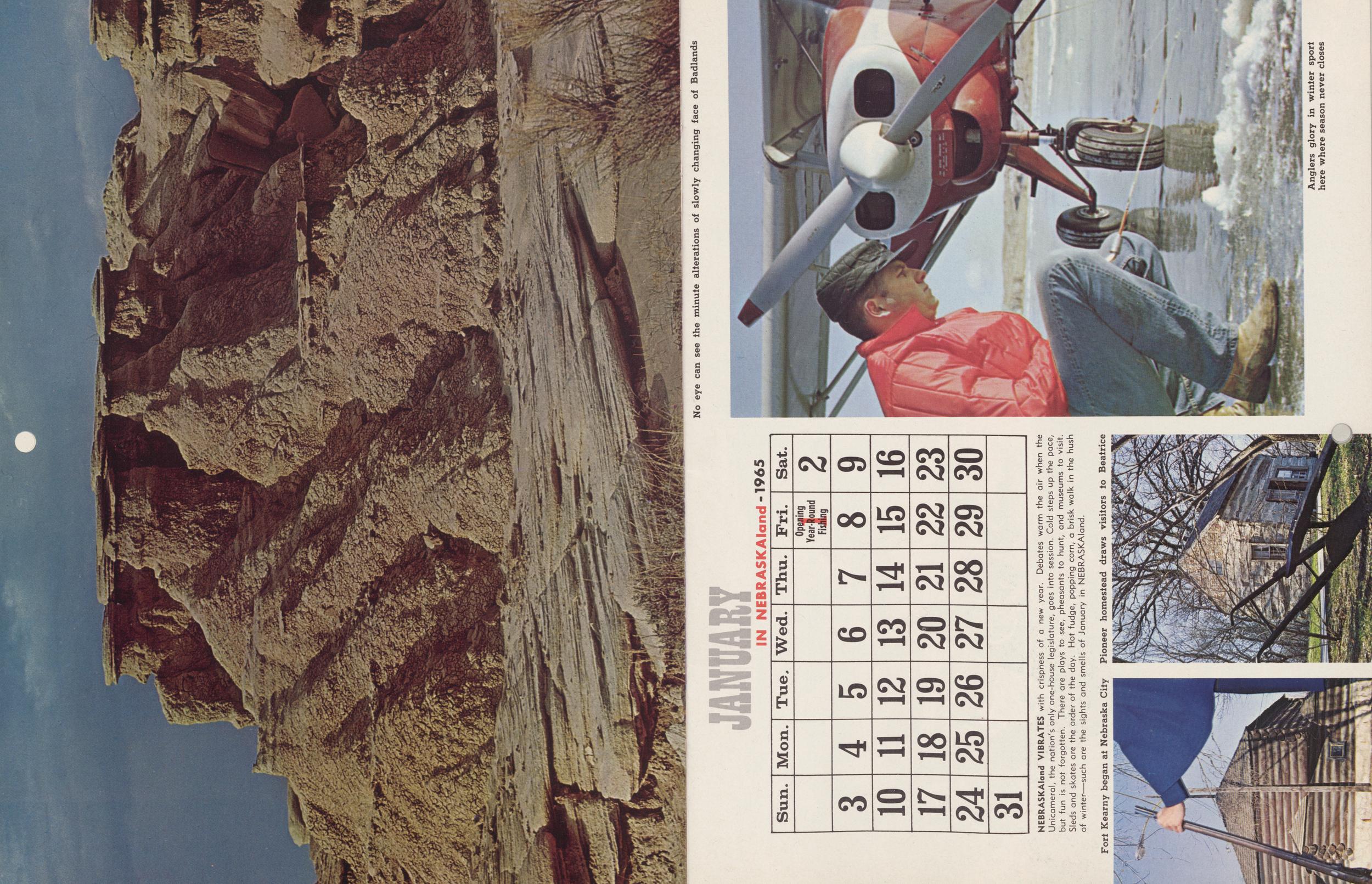
No eye can see the minute alterations of slowly changing face of Badlands
NEBRASKAiand VIBRATES with crispness of a new year. Debates warm the air when the Unicameral, the nation's only one-house legislature, goes into session. Cold steps up the pace, but fun is not forgotten. There are plays to see, pheasants to hunt, and museums to visit. Sleds and skates are the order of the day. Hot fudge, popping corn, a brisk walk in the hush of winter—such are the sights and smells of January in NEBRASKAiand.
Fort Kearny began at Nebraska City
Pioneer homestead draws visitors to Beatrice
Anglers glory in winter sport here where season never closes
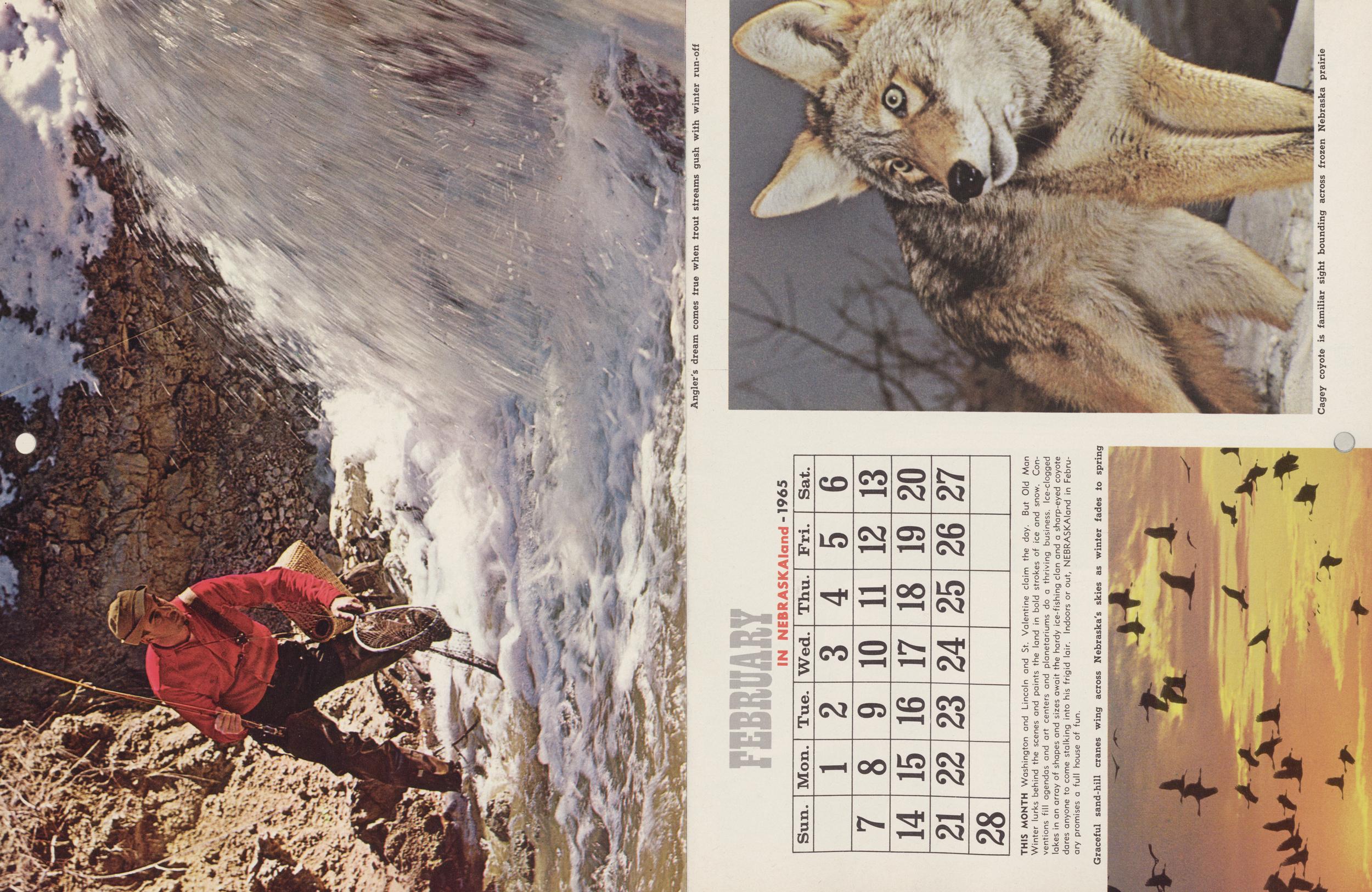
Angler's dream comes true when trout streams gush with winter run-off
THIS MONTH Washington and Lincoln and St. Valentine claim the day. But Old Man Winter lurks behind the scenes and paints the land in bold strokes of ice and snow. Conventions fill agendas and art centers and planetariums do a thriving business. Ice-clogged lakes in an array of shapes and sizes await the hardy ice-fishing clan and a sharp-eyed coyote dares anyone to come stalking into his frigid lair. Indoors or out, NEBRASKAIand in February promises a full house of fun.
Graceful sand-hill cranes wing across Nebraska's skies as winter fades to spring
Cagey coyote is familiar sight bounding across frozen Nebraska prairie
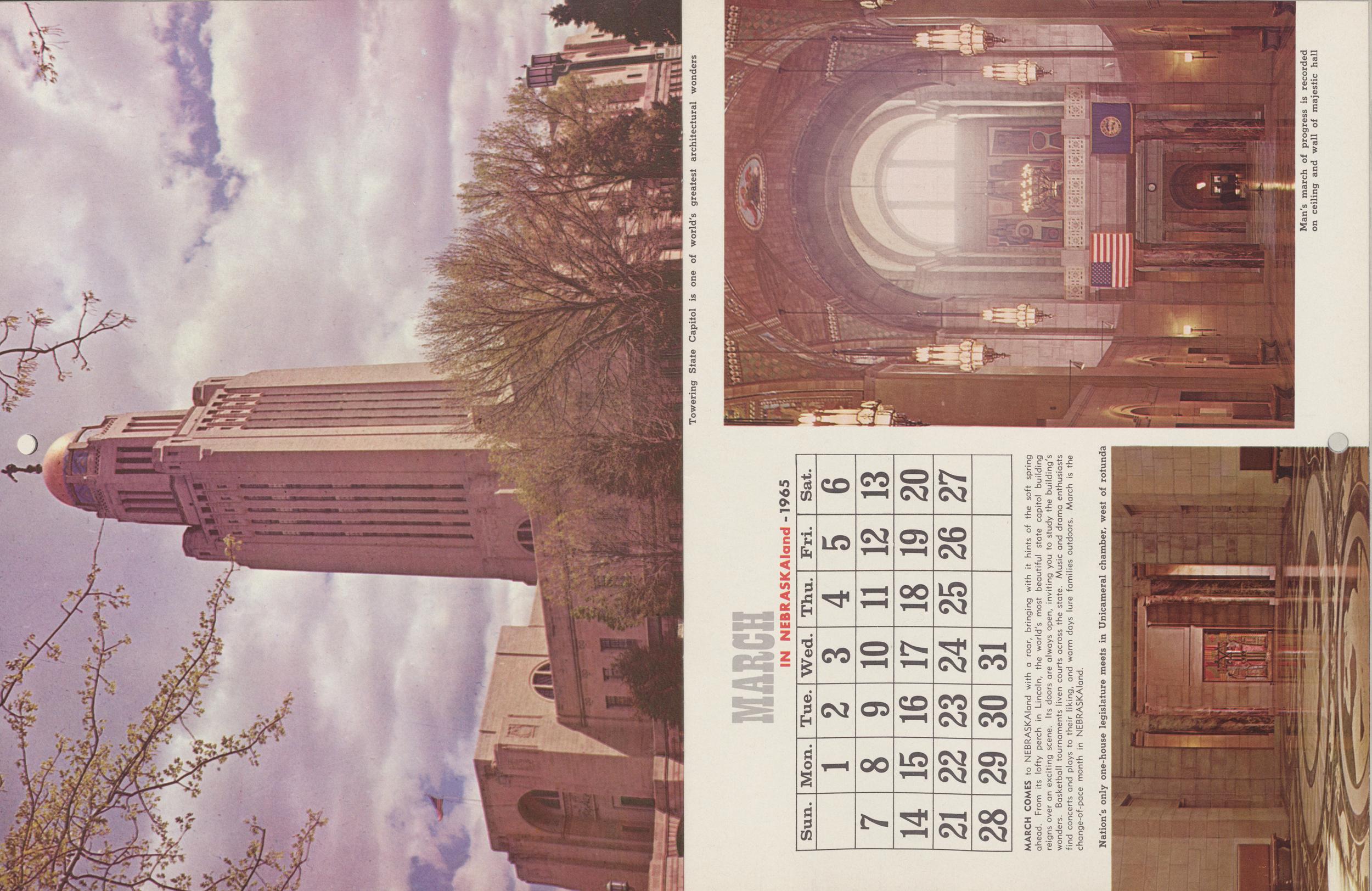
Towering State Capitol is one of world's greatest architectural wonders
MARCH COMES to NEBRASKAIand with a roar, bringing with it hints of the soft spring ahead. From its lofty perch in Lincoln, the world's most beautiful state capitol building reigns over an exciting scene. Its doors are always open, inviting you to study the building's wonders. Basketball tournaments liven courts across the state. Music and drama enthusiasts find concerts and plays to their liking, and warm days lure families outdoors. March is the change-of-pace month in NEBRASKAIand.
Nation's only one-house legislature meets in Unicameral chamber, west of rotunda
Man's march of progress is recorded on ceiling and wall of majestic hall
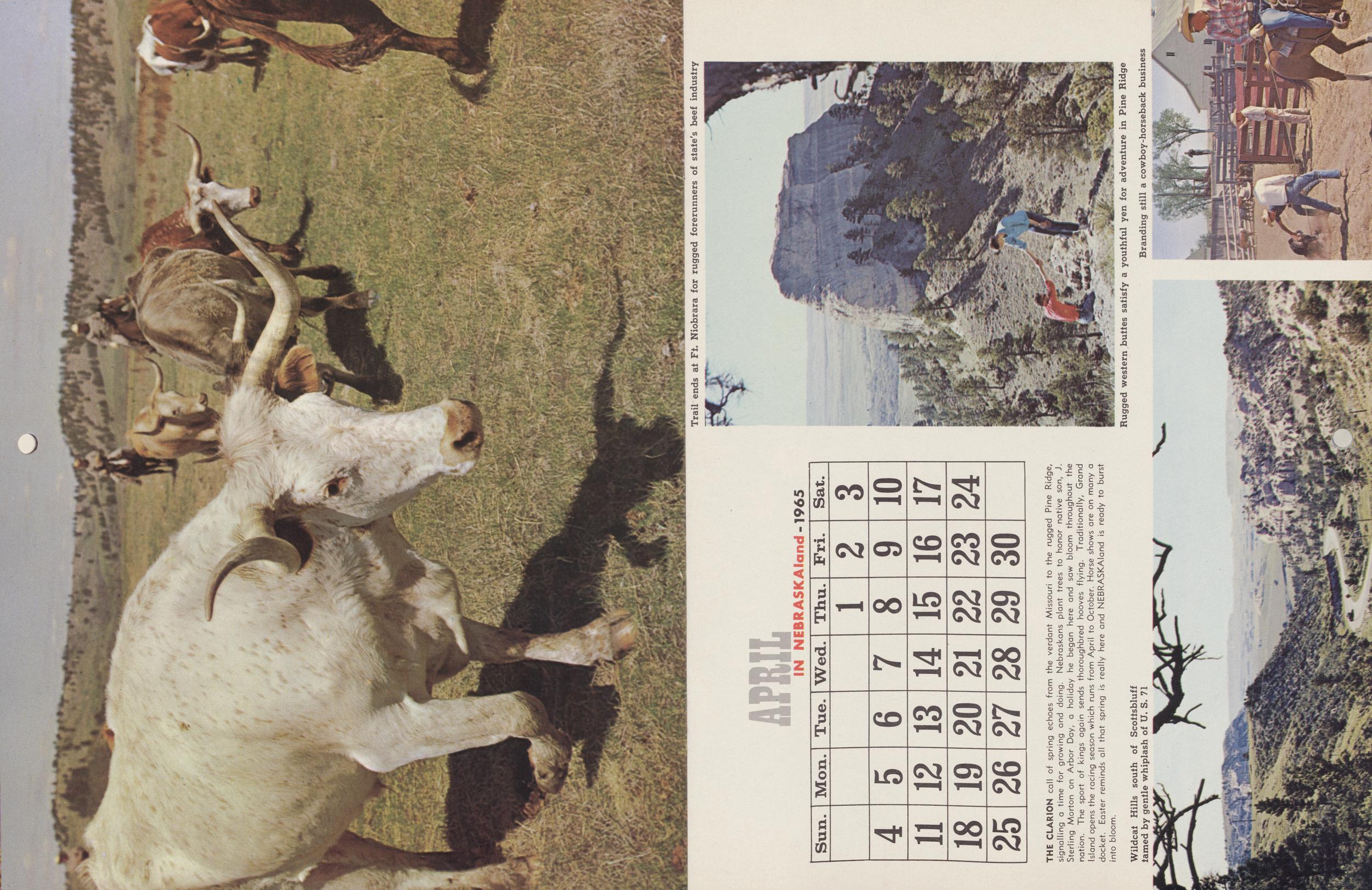
Trail ends at Ft. Niobrara for rugged forerunners of state's beef industry
THE CLARION call of spring echoes from the verdant Missouri to the rugged Pine Ridge, signalling a time for growing and doing. Nebraskans plant trees to honor native son, J. Sterling Morton on Arbor Day, a holiday he began here and saw bloom throughout the nation. The sport of kings again sends thoroughbred hooves flying. Traditionally, Grand Island opens the racing season which runs from April to October. Horse shows are on many a docket. Easter reminds all that spring is really here and NEBRASKAIand is ready to burst into bloom.
Wildcat Hills south of Scottsbluff tamed by gentle whiplash of U. S. 71
Rugged western buttes satisfy a youthful yen for adventure in Pine Ridge
Branding still a cowboy-horseback business
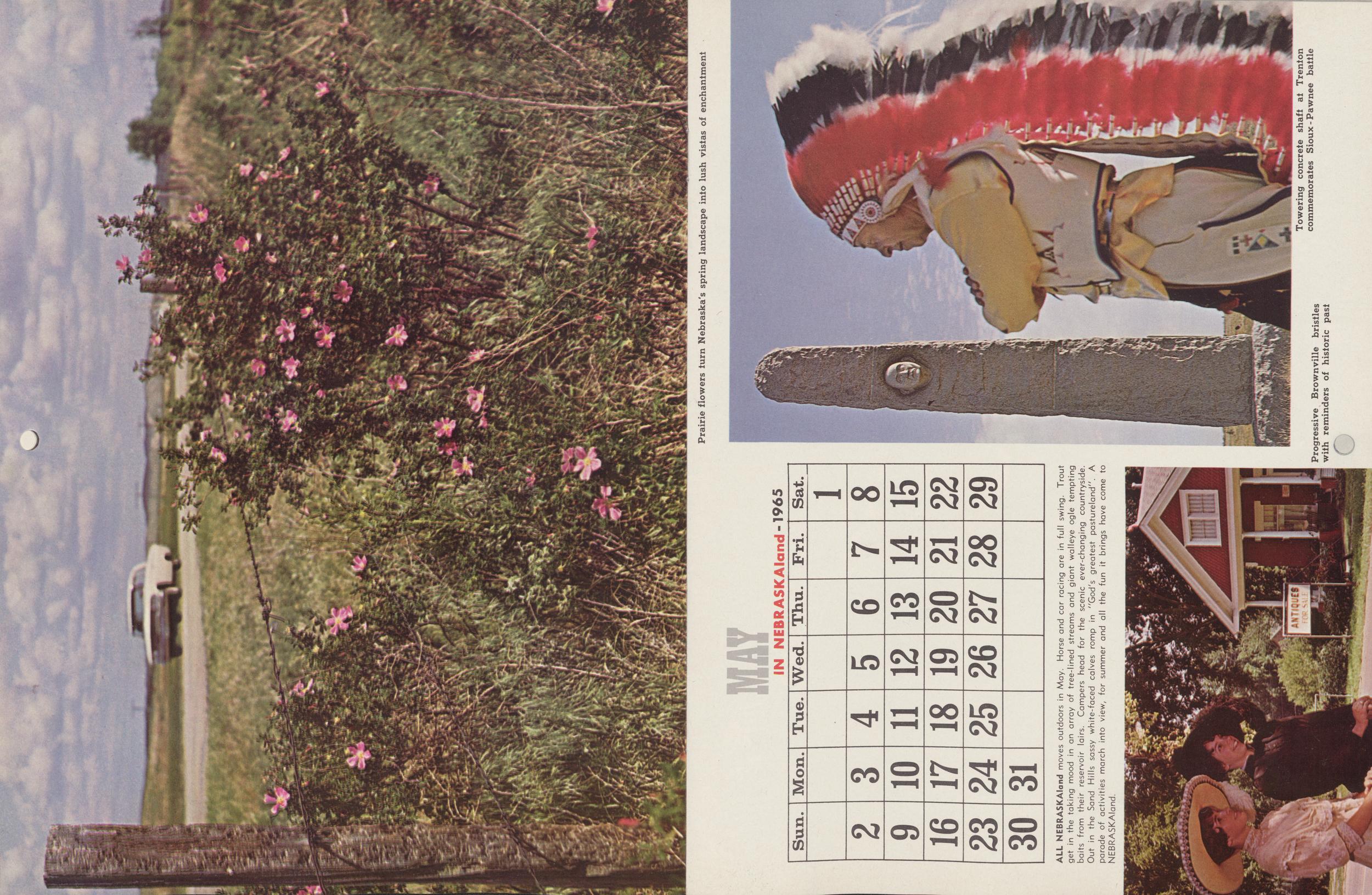
Prairie flowers turn Nebraska's spring landscape into lush vistas of enchantment
ALL NEBRASKAIand moves outdoors in May. Horse and cor racing are in full swing. Trout get in the taking mood in an array of tree-lined streams and giant walleye ogle tempting baits from their reservoir lairs. Campers head for the scenic ever-changing countryside. Out in the Sand Hills sassy white-faced calves romp in "God's greatest pastureland". A parade of activities march into view, for summer and all the fun it brings have come to NEBRASKAIand.
Progressive Brownville bristles with reminders of historic past
Towering concrete shaft at Trenton commemorates Sioux - Pawnee battle
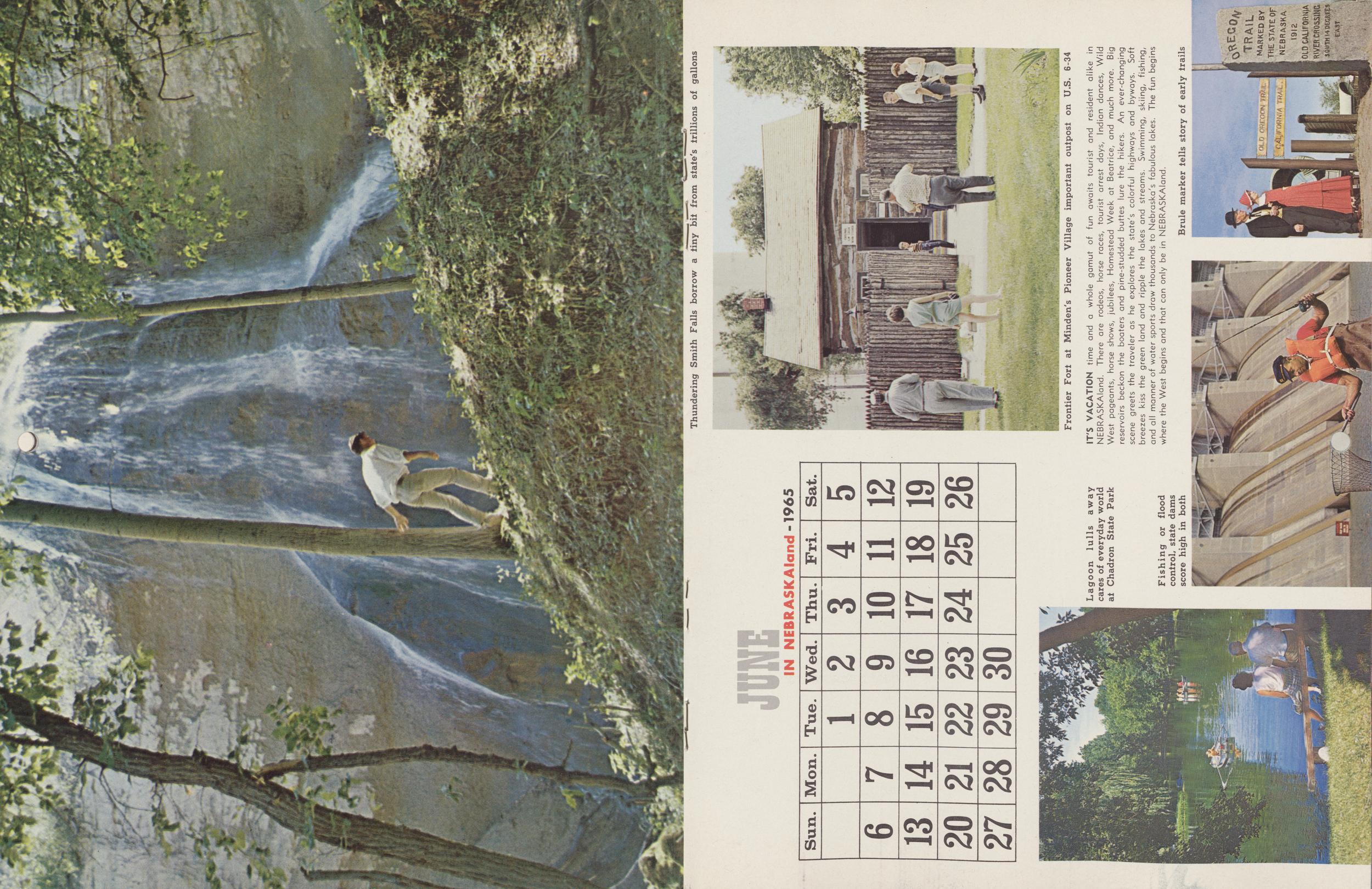
Thundering Smilh Falls borrow a liny bit from stale's trillions of gallons
Lagoon lulls away cares of everyday world at Chadron Stale Park
Fishing or flood control, stale dams score high in both
Frontier Fori at Minden's Pioneer Village imporlanl oulposl on U.S. 6-34
IT'S VACATION time and a whole gamut of fun awaits tourist and resident alike in NEBRASKAIand. There are rodeos, horse races, tourist arrest days, Indian dances, Wild West pageants, horse shows, jubilees, Homestead Week at Beatrice, and much more. Big reservoirs beckon the boaters and pine-studded buttes lure the hikers. An ever-changing scene greets the traveler as he explores the state's colorful highways and byways. Soft breezes kiss the green land and ripple the lakes and streams. Swimming, skiing, fishing, and all manner of water sports draw thousands to Nebraska's fabulous lakes. The fun begins where the West begins and that can only be in NEBRASKAIand.
Brule marker lells story of early trails
TRAIL MARKED BY THE STATE Of NEBRASKA 1912 OLD CAUF0RN)A RIVER CROSSING SOUTH 14 DEQUES EAST
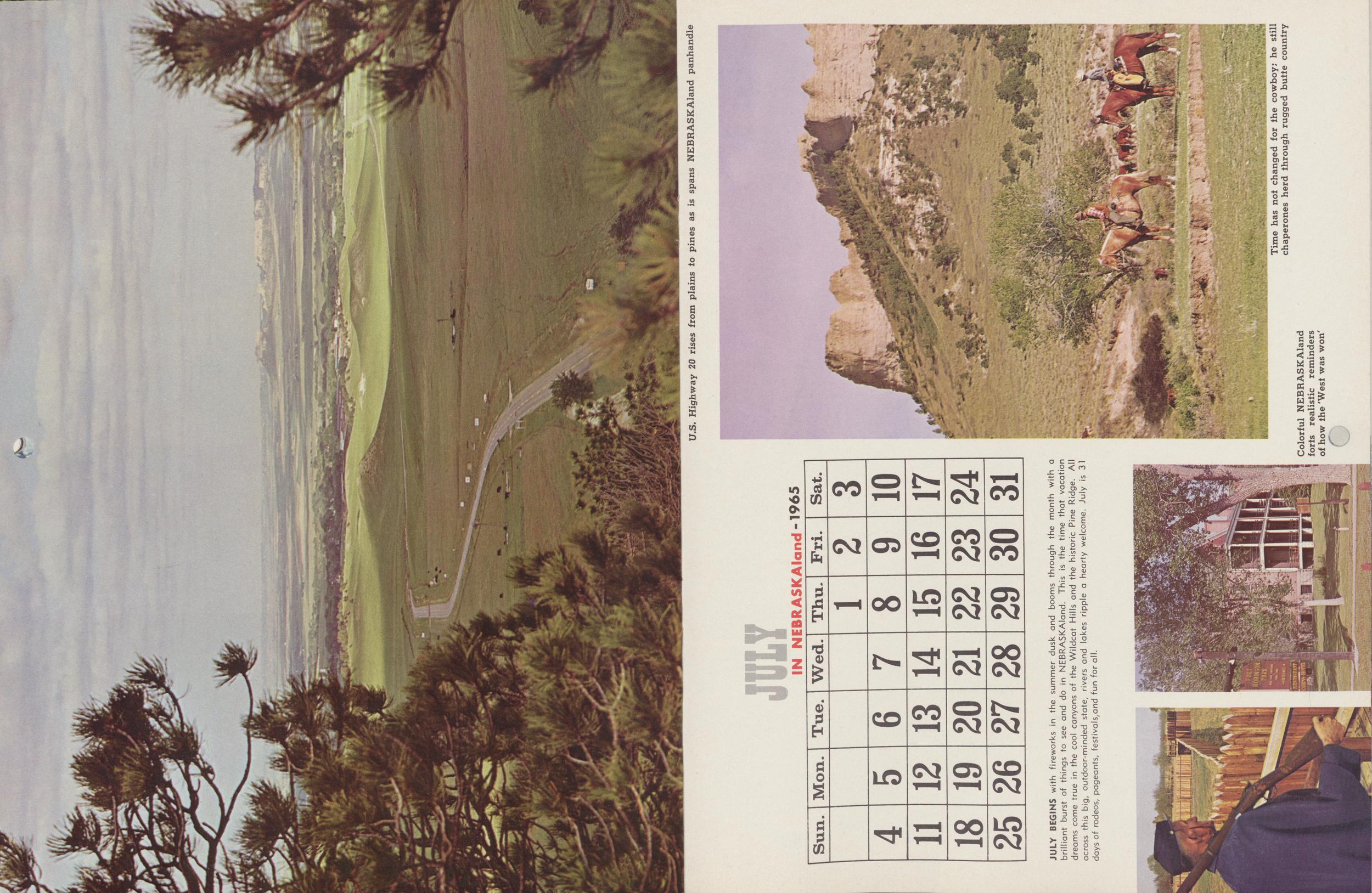
U.S. Highway 20 rises from plains to pines as is spans NEBRASKAland panhandle
JULY BEGINS with fireworks in the summer dusk and booms through the month with a brilliant burst of things to see and do in NEBRASKAland. This is the time that vacation dreams come true in the cool canyons of the Wildcat Hills and the historic Pine Ridge. All across this big, outdoor-minded state, rivers and lakes ripple a hearty welcome. July is 31 days of rodeos, pageants, festivals,and fun for all.
Time has not changed for the cowboy; he still chaperones herd through rugged butte country
Colorful NEBRASKAland forts realistic reminders of how the 'West was won'
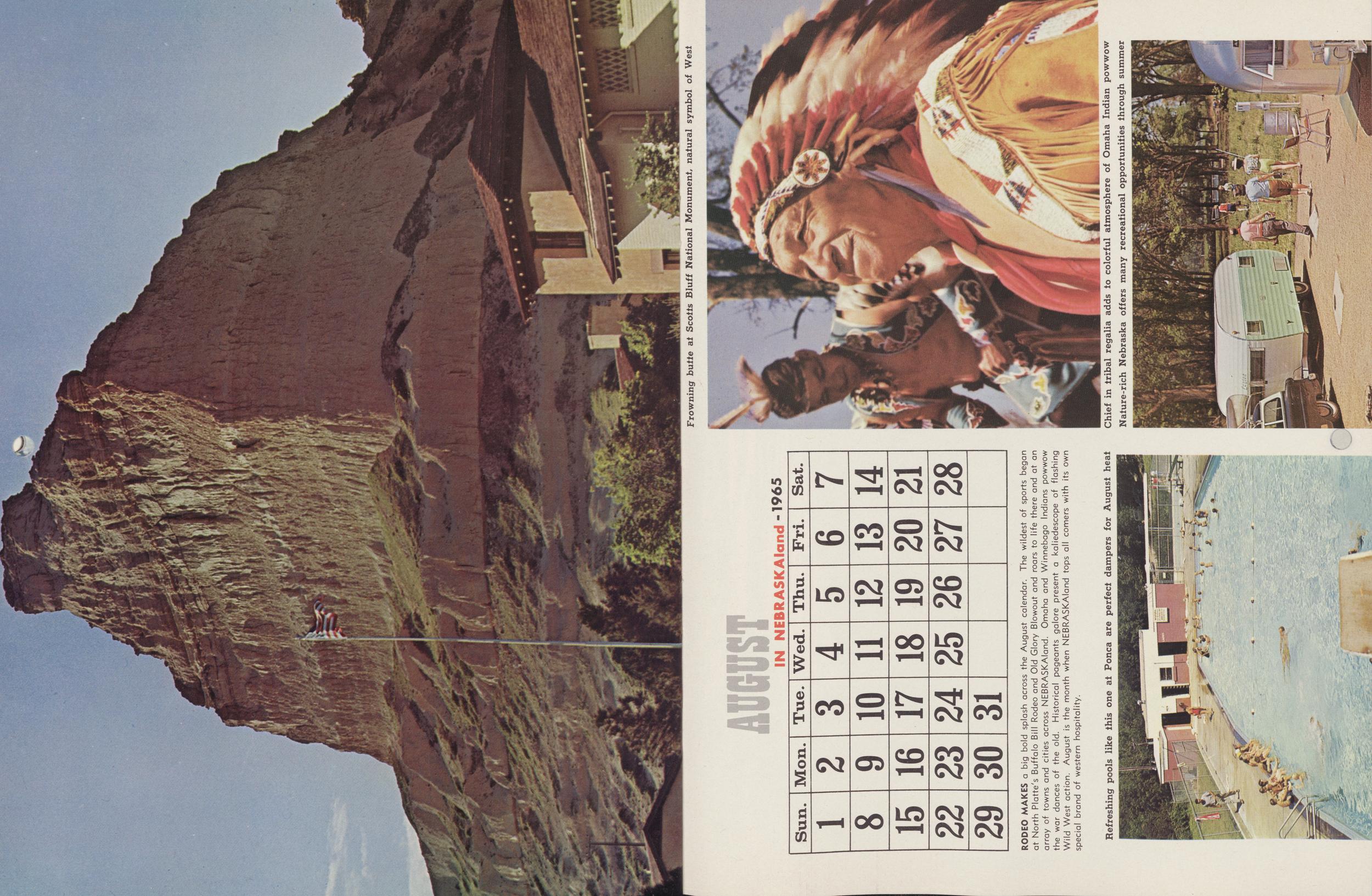
Frowning bufle at Scoils Bluff National Monument, natural symbol of West
RODEO MAKES a big bold splash across the August calendar. The wildest of sports began at North Platte's Buffalo Bill Rodeo and Old Glory Blowout and roars to life there and at an array of towns and cities across NEBRASKAIand. Omaha and Winnebago Indians powwow the war dances of the old. Historical pageants galore present a kaliedescope of flashing Wild West action. August is the month when NEBRASKAIand tops all comers with its own special brand of western hospitality.
Refreshing pools like this one at Ponca are perfect dampers for August heat
Chief in tribal regalia adds to colorful atmosphere of Omaha Indian powwow
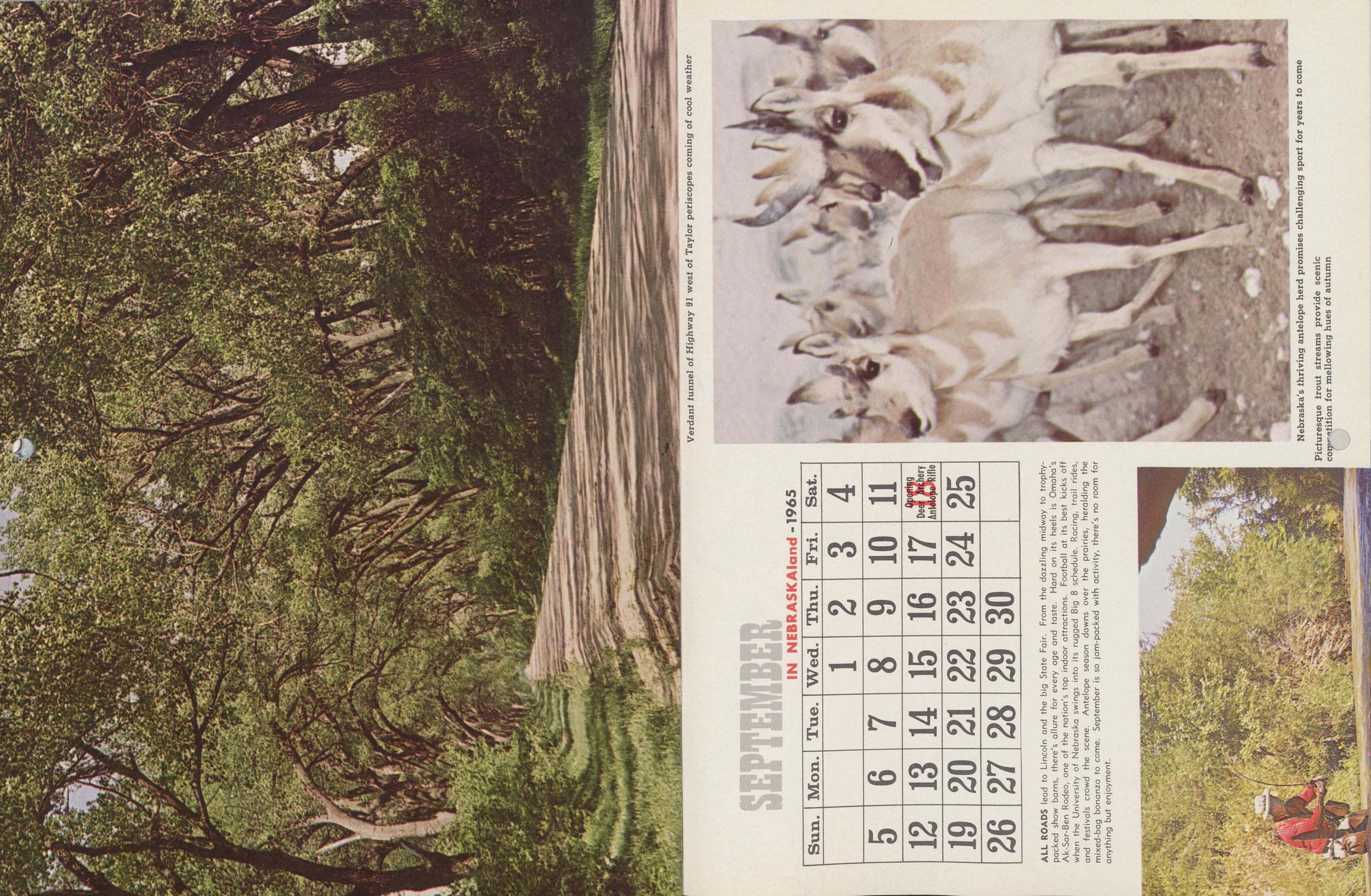
Verdant tunnel of Highway 91 west of Taylor periscopes coming of cool weather
ALL ROADS lead to Lincoln and the big State Fair. From the dazzling midway to trophy- packed show barns, there's allure for every age and taste. Hard on its heels is Omaha's Ak-Sar-Ben Rodeo, one of the nation's top indoor attractions. Football at its best kicks off when the University of Nebraska swings into its rugged Big 8 schedule. Racing, trail rides, and festivals crowd the scene. Antelope season dawns over the prairies, heralding the mixed-bag bonanza to come. September is so jam-packed with activity, there's no room for anything but enjoyment.
Nebraska's thriving antelope herd promises challenging sport for years to come
Picturesque trout streams provide scenic for mellowing hues of autumn
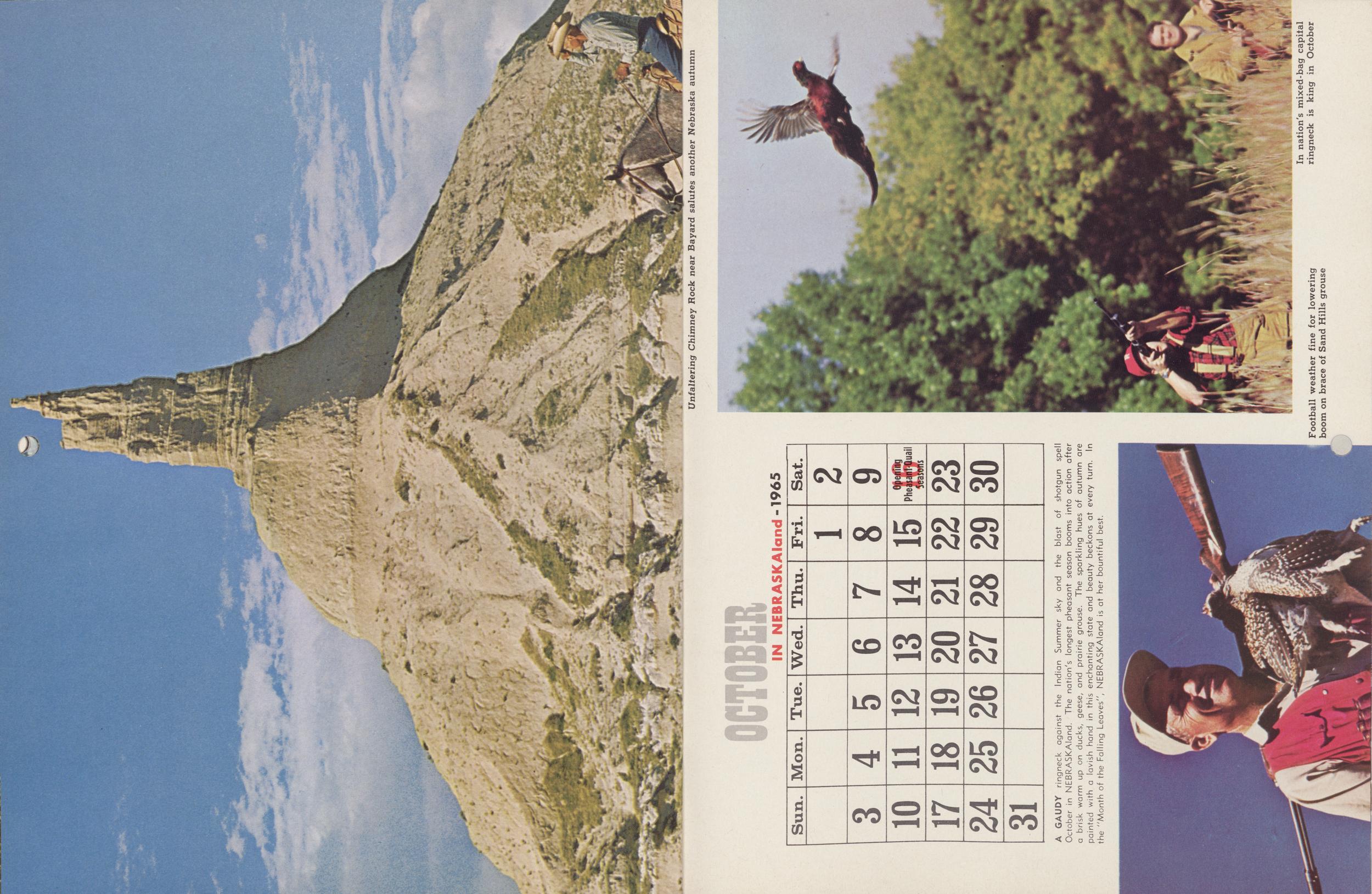
Unfaltering Chimney Hock near Bayard salutes another Nebraska autumn
A GAUDY ringneck against the Indian Summer sky and the blast of shotgun spell October in NEBRASKAIand. The nation's longest pheasant season booms into action after a brisk warm up on ducks, geese, and prairie grouse. The sparkling hues of autumn are painted with a lavish hand in this enchanting state and beauty beckons at every turn. In the "Month of the Falling Leaves", NEBRASKAIand is at her bountiful best.
Football weather fine for lowering boom on brace of Sand Hills grouse
In nation's mixed-bag capital ringneck is king in October
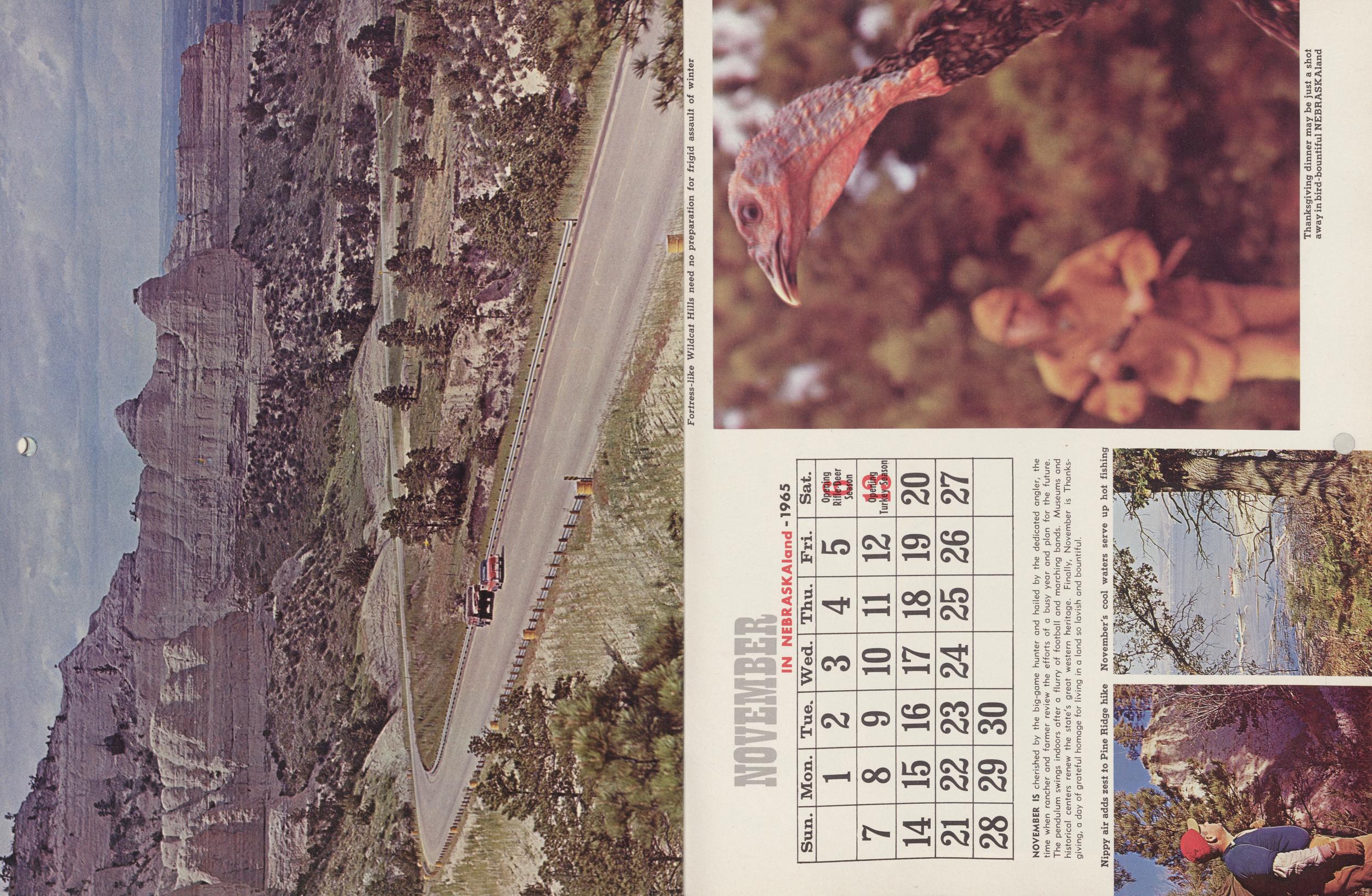
Fortress-like Wildcat Hills need no preparation for frigid assault of winter
NOVEMBER IS cherished by the big-game hunter and hailed by the dedicated angler, the time when rancher and farmer review the efforts of a busy year and plan for the future. The pendulum swings indoors after a flurry of football and marching bands. Museums and historical centers renew the state's great western heritage. Finally, November is Thanksgiving, a day of grateful homage for living in a land so lavish and bountiful.
Nippy air adds zest to Pine Ridge hike
November's cool waters serve up hoi fishing
Thanksgiving dinner may be just a shot away in bird-bountiful NEBRASKAland
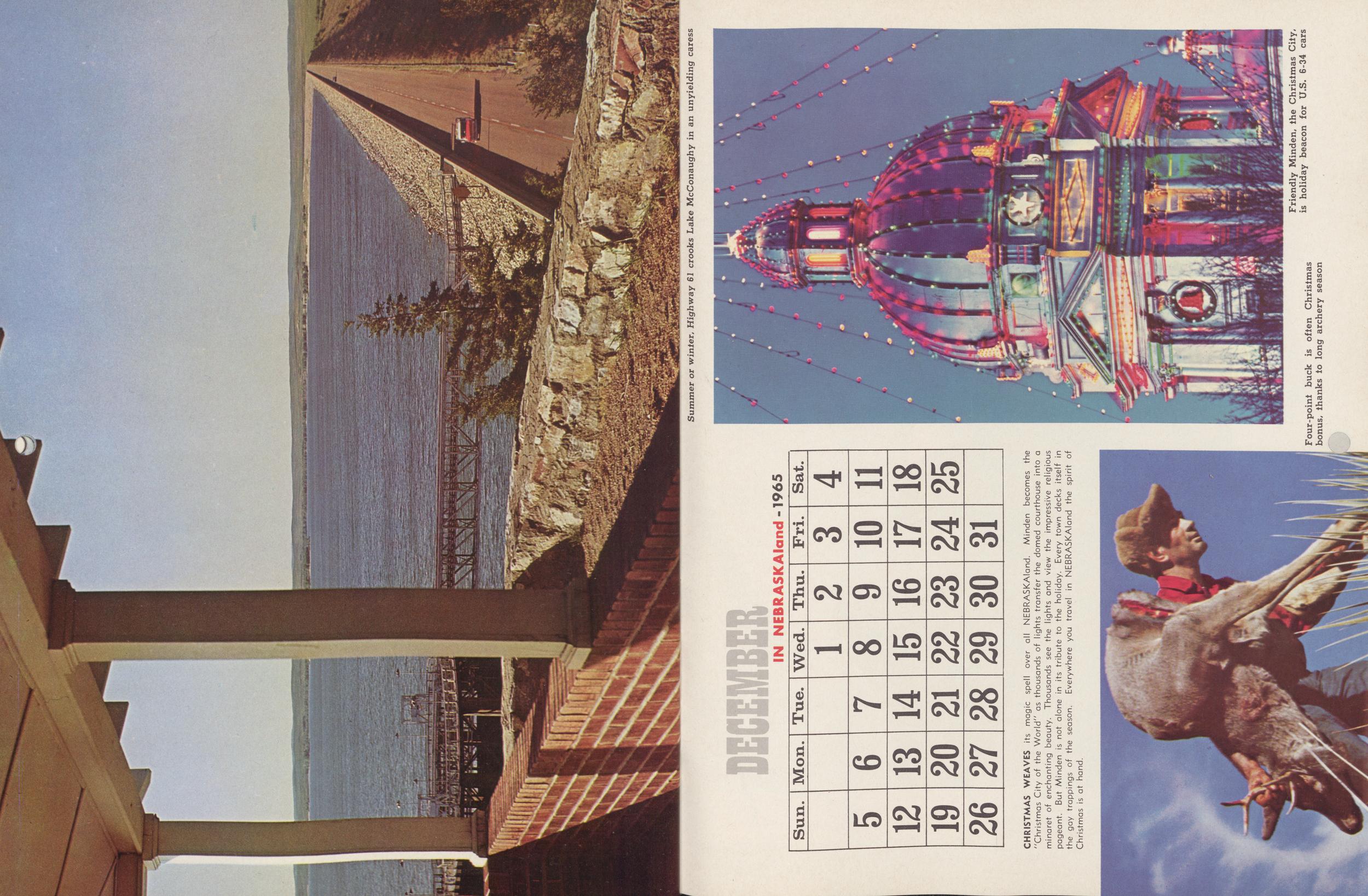
Summer or winter. Highway 61 crooks Lake McConaughy in an unyielding caress
CHRISTMAS WEAVES its magic spell over all NEBRASKAIand. Minden becomes the "Christmas City of the World" as thousands of lights transfer the domed courthouse into a minaret of enchanting beauty. Thousands see the lights and view the impressive religious pageant. But Minden is not alone in its tribute to the holiday. Every town decks itself in the gay trappings of the season. Everywhere you travel in NEBRASKAIand the spirit of Christmas is at hand.
Four-point buck is often Christmas bonus, thanks to long archery season
Friendly Minden, the Christmas City, is holiday beacon for U.S. 6-34 cars
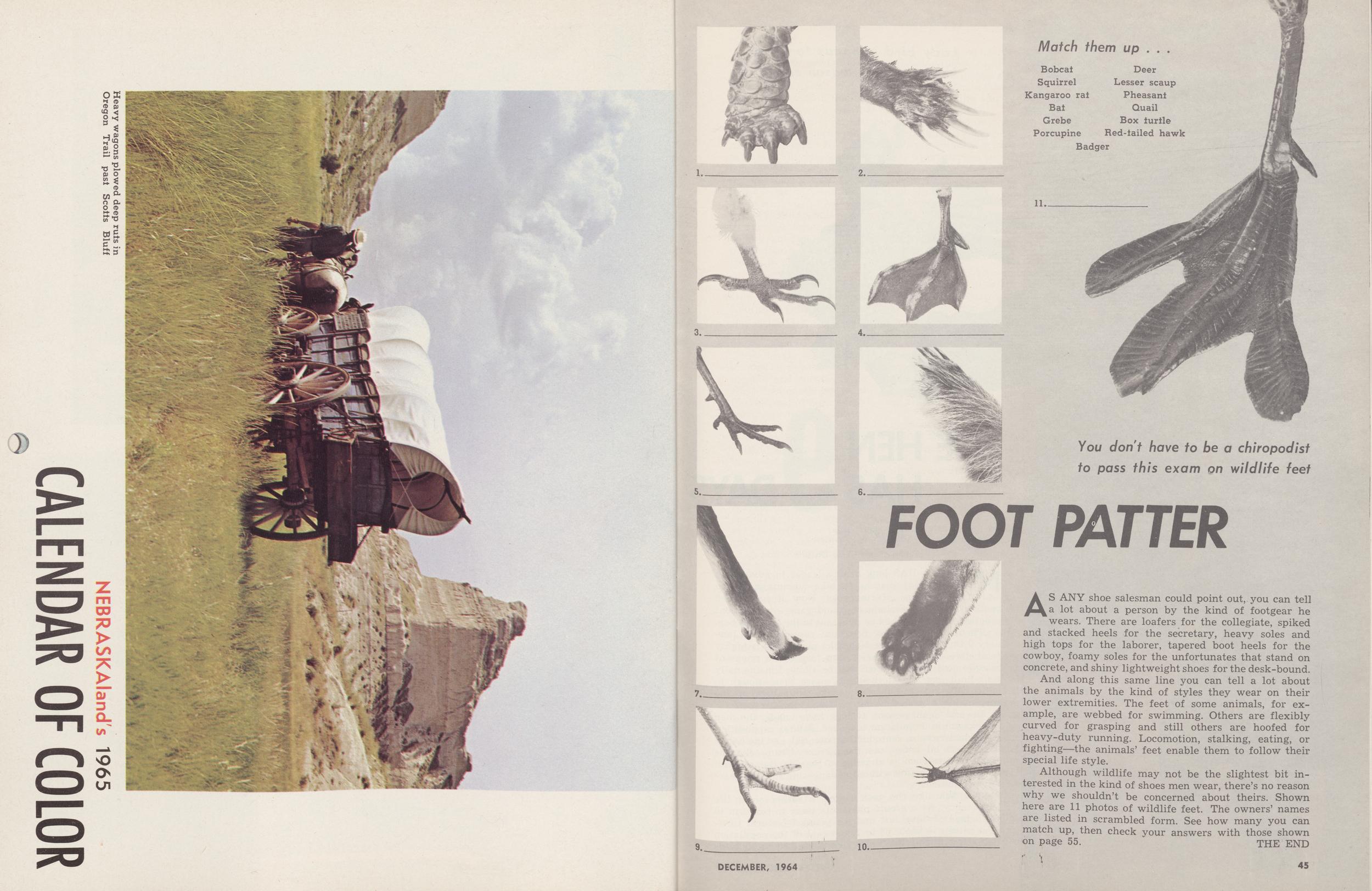
Heavy wagons plowed deep ruts in Oregon Trail past Scotts Bluff
Match them up Bobcat Squirrel Kangaroo rat Bat Grebe Porcupine Deer Lesser scaup Pheasant Quail Box turtle Red-tailed hawk Badger
1.2.3.4.5.6.7.8.9.10.11.
You don't have to be a chiropodist to pass this exam on wildlife feet
FOOT PATTER
AS ANY shoe salesman could point out, you can tell a lot about a person by the kind of footgear he wears. There are loafers for the collegiate, spiked and stacked heels for the secretary, heavy soles and high tops for the laborer, tapered boot heels for the cowboy, foamy soles for the unfortunates that stand on concrete, and shiny lightweight shoes for the desk-bound.
And along this same line you can tell a lot about the animals by the kind of styles they wear on their lower extremities. The feet of some animals, for example, are webbed for swimming. Others are flexibly curved for grasping and still others are hoofed for heavy-duty running. Locomotion, stalking, eating, or fighting—the animals' feet enable them to follow their special life style.
Although wildlife may not be the slightest bit interested in the kind of shoes men wear, there's no reason why we shouldn't be concerned about theirs. Shown here are 11 photos of wildlife feet. The owners' names are listed in scrambled form. See how many you can match up, then check your answers with those shown on page 55. THE END
DECEMBER, 1964 45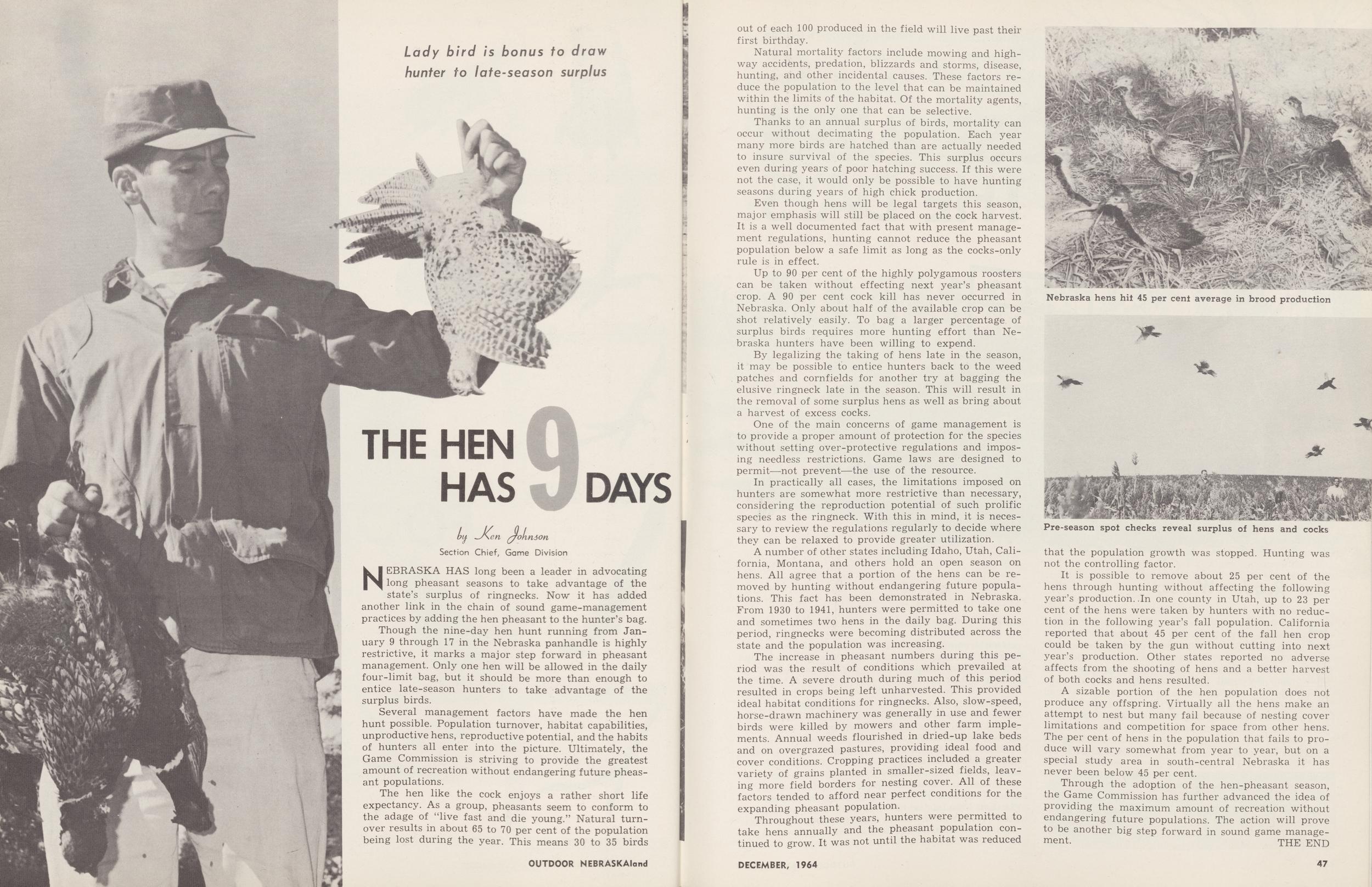
Lady bird is bonus to draw hunter to late-season surplus
THE HEN HAS 9 DAYS
NEBRASKA HAS long been a leader in advocating long pheasant seasons to take advantage of the state's surplus of ringnecks. Now it has added another link in the chain of sound game-management practices by adding the hen pheasant to the hunter's bag.
Though the nine-day hen hunt running from January 9 through 17 in the Nebraska panhandle is highly restrictive, it marks a major step forward in pheasant management. Only one hen will be allowed in the daily four-limit bag, but it should be more than enough to entice late-season hunters to take advantage of the surplus birds.
Several management factors have made the hen hunt possible. Population turnover, habitat capabilities, unproductive hens, reproductive potential, and the habits of hunters all enter into the picture. Ultimately, the Game Commission is striving to provide the greatest amount of recreation without endangering future pheasant populations.
The hen like the cock enjoys a rather short life expectancy. As a group, pheasants seem to conform to the adage of "live fast and die young." Natural turnover results in about 65 to 70 per cent of the population being lost during the year. This means 30 to 35 birds out of each 100 produced in the field will live past their first birthday.
Natural mortality factors include mowing and highway accidents, predation, blizzards and storms, disease, hunting, and other incidental causes. These factors reduce the population to the level that can be maintained within the limits of the habitat. Of the mortality agents, hunting is the only one that can be selective.
Thanks to an annual surplus of birds, mortality can occur without decimating the population. Each year many more birds are hatched than are actually needed to insure survival of the species. This surplus occurs even during years of poor hatching success. If this were not the case, it would only be possible to have hunting seasons during years of high chick production.
Even though hens will be legal targets this season, major emphasis will still be placed on the cock harvest. It is a well documented fact that with present manage- ment regulations, hunting cannot reduce the pheasant population below a safe limit as long as the cocks-only rule is in effect.
Up to 90 per cent of the highly polygamous roosters can be taken without effecting next year's pheasant crop. A 90 per cent cock kill has never occurred in Nebraska. Only about half of the available crop can be shot relatively easily. To bag a larger percentage of surplus birds requires more hunting effort than Ne- braska hunters have been willing to expend.
By legalizing the taking of hens late in the season, it may be possible to entice hunters back to the weed patches and cornfields for another try at bagging the elusive ringneck late in the season. This will result in the removal of some surplus hens as well as bring about a harvest of excess cocks.
One of the main concerns of game management is to provide a proper amount of protection for the species without setting over-protective regulations and imposing needless restrictions. Game laws are designed to permit—not prevent—the use of the resource.
In practically all cases, the limitations imposed on hunters are somewhat more restrictive than necessary, considering the reproduction potential of such prolific species as the ringneck. With this in mind, it is necessary to review the regulations regularly to decide where they can be relaxed to provide greater utilization.
A number of other states including Idaho, Utah, California, Montana, and others hold an open season on hens. All agree that a portion of the hens can be removed by hunting without endangering future populations. This fact has been demonstrated in Nebraska. From 1930 to 1941, hunters were permitted to take one and sometimes two hens in the daily bag. During this period, ringnecks were becoming distributed across the state and the population was increasing.
The increase in pheasant numbers during this period was the result of conditions which prevailed at the time. A severe drouth during much of this period resulted in crops being left unharvested. This provided ideal habitat conditions for ringnecks. Also, slow-speed, horse-drawn machinery was generally in use and fewer birds were killed by mowers and other farm implements. Annual weeds flourished in dried-up lake beds and on overgrazed pastures, providing ideal food and cover conditions. Cropping practices included a greater variety of grains planted in smaller-sized fields, leaving more field borders for nesting cover. All of these factors tended to afford near perfect conditions for the expanding pheasant population.
Throughout these years, hunters were permitted to take hens annually and the pheasant population continued to grow. It was not until the habitat was reduced Nebraska hens hit 45 per cent average in brood produclion Pre-season spot checks reveal surplus of hens and cocks that the population growth was stopped. Hunting was not the controlling factor.
It is possible to remove about 25 per cent of the hens through hunting without affecting the following year's production. .In one county in Utah, up to 23 per cent of the hens were taken by hunters with no reduction in the following year's fall population. California reported that about 45 per cent of the fall hen crop could be taken by the gun without cutting into next year's production. Other states reported no adverse affects from the shooting of hens and a better harvest of both cocks and hens resulted.
A sizable portion of the hen population does not produce any offspring. Virtually all the hens make an attempt to nest but many fail because of nesting cover limitations and competition for space from other hens. The per cent of hens in the population that fails to produce will vary somewhat from year to year, but on a special study area in south-central Nebraska it has never been below 45 per cent.
Through the adoption of the hen-pheasant season, the Game Commission has further advanced the idea of providing the maximum amount of recreation without endangering future populations. The action will prove to be another big step forward in sound game management. THE END
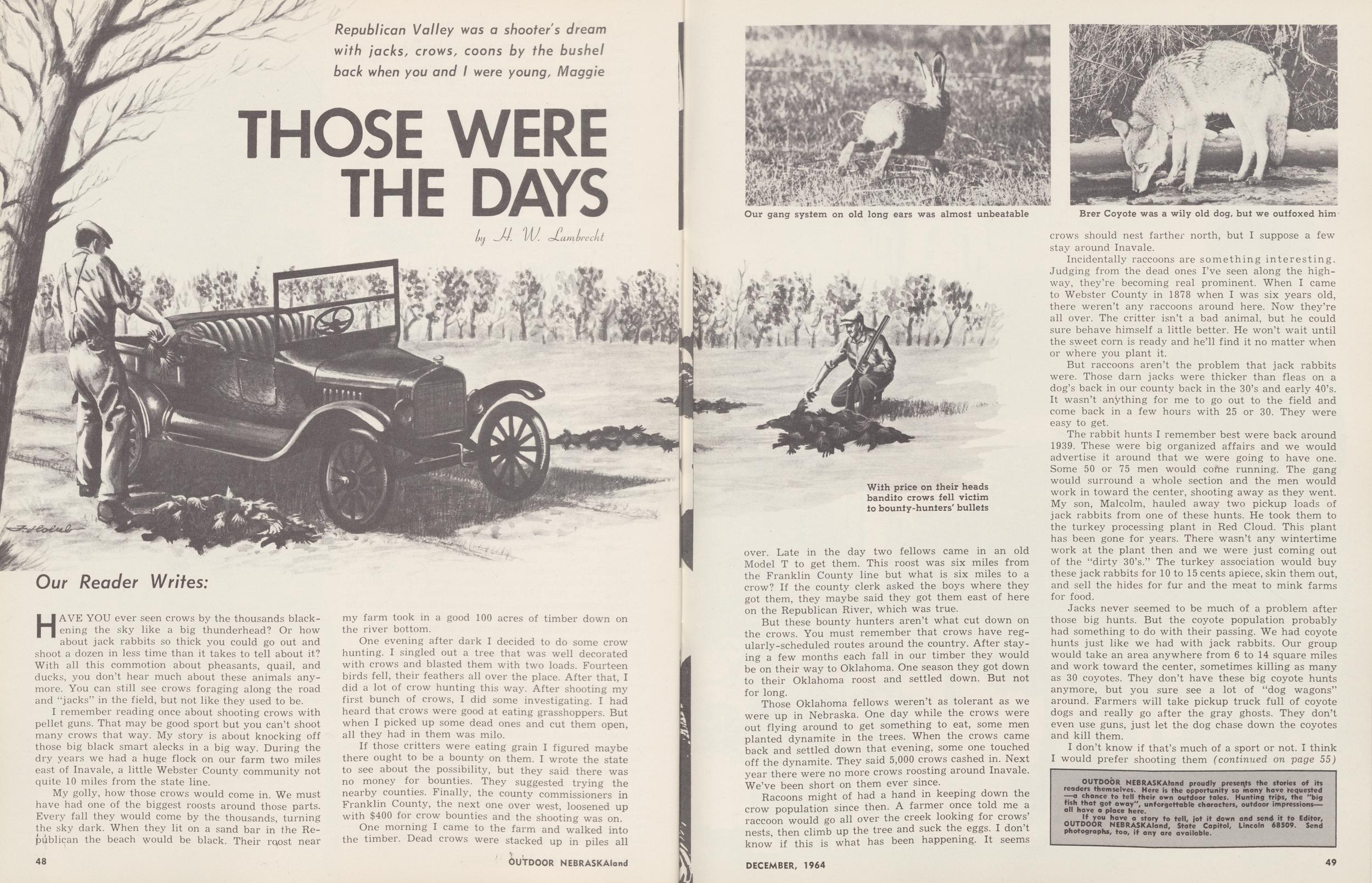
Republican Valley was a shooter's dream with jacks, crows, coons by the bushel back when you and I were young, Maggie
THOSE WERE THE DAYS
Our gang system on old long ears was almost unbeatable
With price on their heads bandito crows fell victim to bounty-hunters' bullets
HAVE YOU ever seen crows by the thousands blackening the sky like a big thunderhead? Or how about jack rabbits so thick you could go out and shoot a dozen in less time than it takes to tell about it? With all this commotion about pheasants, quail, and ducks, you don't hear much about these animals anymore. You can still see crows foraging along the road and "jacks" in the field, but not like they used to be.
I remember reading once about shooting crows with pellet guns. That may be good sport but you can't shoot many crows that way. My story is about knocking off those big black smart alecks in a big way. During the dry years we had a huge flock on our farm two miles east of Inavale, a little Webster County community not quite 10 miles from the state line.
My golly, how those crows would come in. We must have had one of the biggest roosts around those parts. Every fall they would come by the thousands, turning the sky dark. When they lit on a sand bar in the Republican the beach would be black. Their rqost near my farm took in a good 100 acres of timber down on the river bottom.
One evening after dark I decided to do some crow hunting. I singled out a tree that was well decorated with crows and blasted them with two loads. Fourteen birds fell, their feathers all over the place. After that, I did a lot of crow hunting this way. After shooting my first bunch of crows, I did some investigating. I had heard that crows were good at eating grasshoppers. But when I picked up some dead ones and cut them open, all they had in them was milo.
If those critters were eating grain I figured maybe there ought to be a bounty on them. I wrote the state to see about the possibility, but they said there was no money for bounties. They suggested trying the nearby counties. Finally, the county commissioners in Franklin County, the next one over west, loosened up with $400 for crow bounties and the shooting was on.
One morning I came to the farm and walked into the timber. Dead crows were stacked up in piles all over. Late in the day two fellows came in an old Model T to get them. This roost was six miles from the Franklin County line but what is six miles to a crow? If the county clerk asked the boys where they got them, they maybe said they got them east of here on the Republican River, which was true.
But these bounty hunters aren't what cut down on the crows. You must remember that crows have regularly-scheduled routes around the country. After staying a few months each fall in our timber they would be"on their way to Oklahoma. One season they got down to their Oklahoma roost and settled down. But not for long.
Those Oklahoma fellows weren't as tolerant as we were up in Nebraska. One day while the crows were out flying around to get something to eat, some men planted dynamite in the trees. When the crows came back and settled down that evening, some one touched off the dynamite. They said 5,000 crows cashed in. Next year there were no more crows roosting around Inavale. We've been short on them ever since.
Racoons might of had a hand in keeping down the crow population since then. A farmer once told me a raccoon would go all over the creek looking for crows' nests, then climb up the tree and suck the eggs. I don't know if this is what has been happening. It seems Brer Coyote was a wily old dog, but we outfoxed him crows should nest farther north, but I suppose a few stay around Inavale.
Incidentally raccoons are something interesting. Judging from the dead ones I've seen along the highway, they're becoming real prominent. When I came to Webster County in 1878 when I was six years old, there weren't any raccoons around here. Now they're all over. The critter isn't a bad animal, but he could sure behave himself a little better. He won't wait until the sweet corn is ready and he'll find it no matter when or where you plant it.
But raccoons aren't the problem that jack rabbits were. Those darn jacks were thicker than fleas on a dog's back in our county back in the 30's and early 40's. It wasn't anything for me to go out to the field and come back in a few hours with 25 or 30. They were easy to get.
The rabbit hunts I remember best were back around 1939. These were big organized affairs and we would advertise it around that we were going to have one. Some 50 or 75 men would come running. The gang would surround a whole section and the men would work in toward the center, shooting away as they went. My son, Malcolm, hauled away two pickup loads of jack rabbits from one of these hunts. He took them to the turkey processing plant in Red Cloud. This plant has been gone for years. There wasn't any wintertime work at the plant then and we were just coming out of the "dirty 30's." The turkey association would buy these jack rabbits for 10 to 15 cents apiece, skin them out, and sell the hides for fur and the meat to mink farms for food.
Jacks never seemed to be much of a problem after those big hunts. But the coyote population probably had something to do with their passing. We had coyote hunts just like we had with jack rabbits. Our group would take an area anywhere from 6 to 14 square miles and work toward the center, sometimes killing as many as 30 coyotes. They don't have these big coyote hunts anymore, but you sure see a lot of "dog wagons" around. Farmers will take pickup truck full of coyote dogs and really go after the gray ghosts. They don't even use guns, just let the dog chase down the coyotes and kill them.
I don't know if that's much of a sport or not. I think I would prefer shooting them (continued on page 55)
OUTDOOR NEBRASKAIand proudly presents the stories of its readers themselves. Here is the opportunity so many have requested —a chance to tell their own outdoor tales. Hunting trips, the "big fish that got away", unforgettable characters, outdoor impressions— all have a place here.
If you have a story to tell, jot it down and send it to Editor, OUTDOOR NEBRASKAIand, State Capitol, Lincoln 68509. Send photographs, too, if any are available.
48 OUTDOOR NEBRASKAIand DECEMBER, 1964 49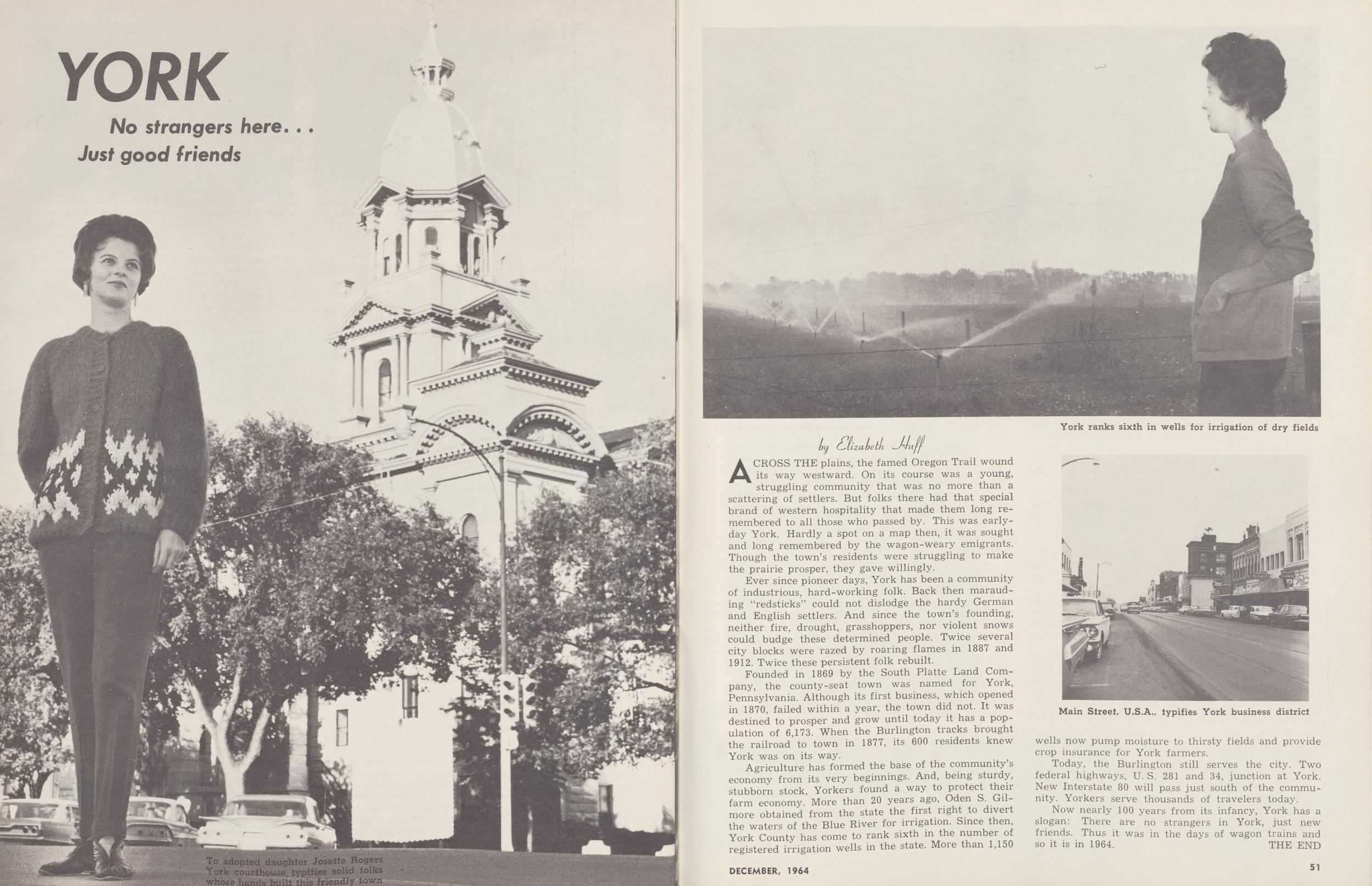
YORK
No strangers here... Just good friends
York ranks sixth in wells for irrigation of dry fields
ACROSS THE plains, the famed Oregon Trail wound its way westward. On its course was a young, struggling community that was no more than a scattering of settlers. But folks there had that special brand of western hospitality that made them long remembered to all those who passed by. This was early-day York. Hardly a spot on a map then, it was sought and long remembered by the wagon-weary emigrants. Though the town's residents were struggling to make the prairie prosper, they gave willingly.
Ever since pioneer days, York has been a community of industrious, hard-working folk. Back then marauding "redsticks" could not dislodge the hardy German and English settlers. And since the town's founding, neither fire, drought, grasshoppers, nor violent snows could budge these determined people. Twice several city blocks were razed by roaring flames in 1887 and 1912. Twice these persistent folk rebuilt.
Founded in 1869 by the South Platte Land Company, the county-seat town was named for York, Pennsylvania. Although its first business, which opened in 1870, failed within a year, the town did not. It was destined to prosper and grow until today it has a population of 6,173. When the Burlington tracks brought the railroad to town in 1877, its 600 residents knew York was on its way.
Agriculture has formed the base of the community's economy from its very beginnings. And, being sturdy, stubborn stock, Yorkers found a way to protect their farm economy. More than 20 years ago, Oden S. Gil- more obtained from the state the first right to divert the waters of the Blue River for irrigation. Since then, York County has come to rank sixth in the number of registered irrigation wells in the state. More than 1,150 Main Street, U.S.A., typifies York business district wells now pump moisture to thirsty fields and provide crop insurance for York farmers.
Today, the Burlington still serves the city. Two federal highways, U. S. 281 and 34, junction at York. New Interstate 80 will pass just south of the community. Yorkers serve thousands of travelers today. Now nearly 100 years from its infancy, York has a slogan: There are no strangers in York, just new friends. Thus it was in the days of wagon trains and so it is in 1964. THE END
DECEMBER, 1964 51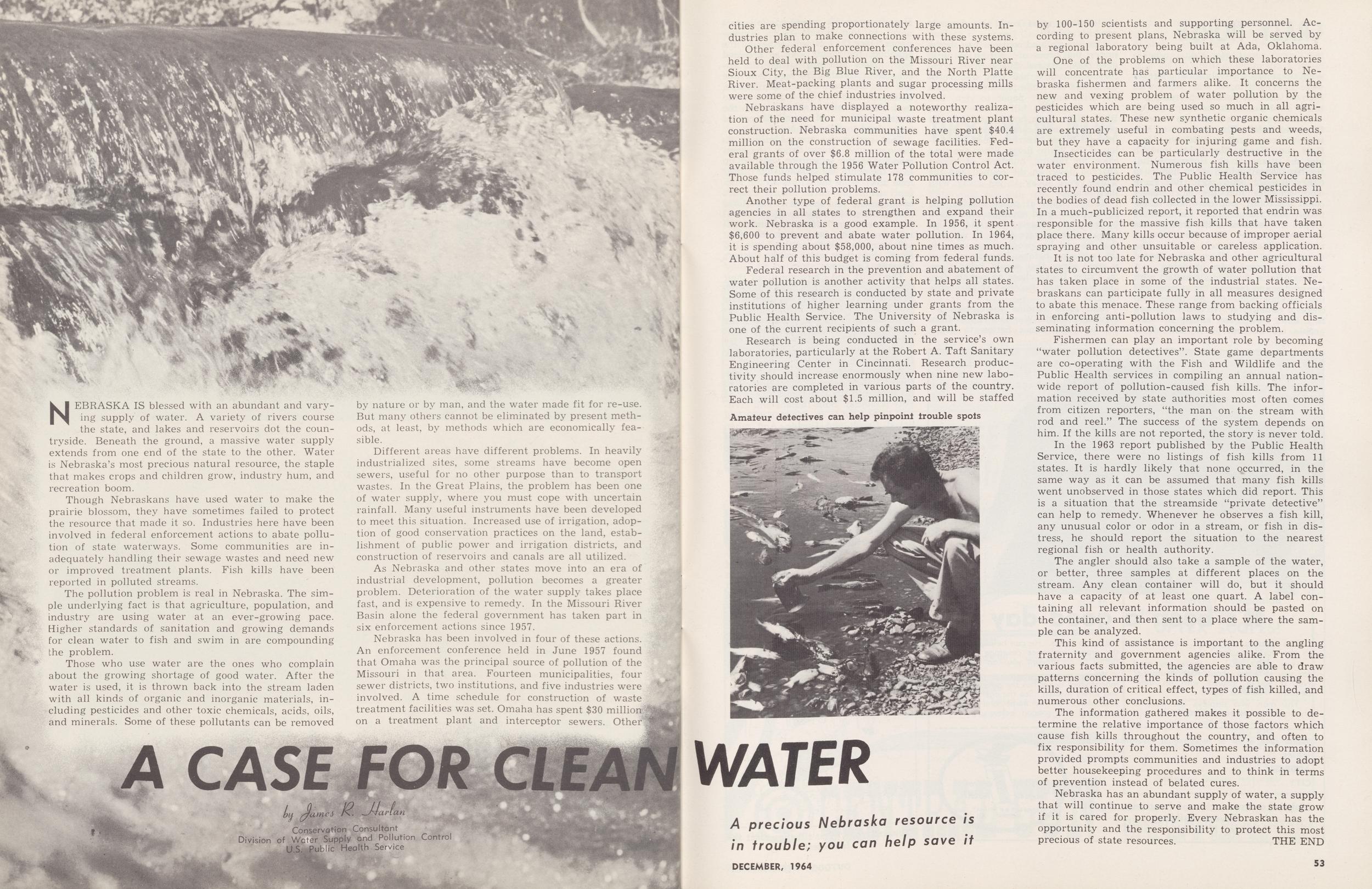
A CASE FOR CLEAN WATER
A precious Nebraska resource is in trouble; you can help save it
NEBRASKA IS blessed with an abundant and varying supply of water. A variety of rivers course the state, and lakes and reservoirs dot the countryside. Beneath the ground, a massive water supply extends from one end of the state to the other. Water is Nebraska's most precious natural resource, the staple that makes crops and children grow, industry hum, and recreation boom.
Though Nebraskans have used water to make the prairie blossom, they have sometimes failed to protect the resource that made it so. Industries here have been involved in federal enforcement actions to abate pollution of state waterways. Some communities are inadequately handling their sewage wastes and need new or improved treatment plants. Fish kills have been reported in polluted streams.
The pollution problem is real in Nebraska. The simple underlying fact is that agriculture, population, and industry are using water at an ever-growing pace. Higher standards of sanitation and growing demands for clean water to fish and swim in are compounding the problem.
Those who use water are the ones who complain about the growing shortage of good water. After the water is used, it is thrown back into the stream laden with all kinds of organic and inorganic materials, including pesticides and other toxic chemicals, acids, oils, and minerals. Some of these pollutants can be removed by nature or by man, and the water made fit for re-use. But many others cannot be eliminated by present methods, at least, by methods which are economically feasible.
Different areas have different problems. In heavily industrialized sites, some streams have become open sewers, useful for no other purpose than to transport wastes. In the Great Plains, the problem has been one of water supply, where you must cope with uncertain rainfall. Many useful instruments have been developed to meet this situation. Increased use of irrigation, adoption of good conservation practices on the land, establishment of public power and irrigation districts, and construction of reservoirs and canals are all utilized.
As Nebraska and other states move into an era of industrial development, pollution becomes a greater problem. Deterioration of the water supply takes place fast, and is expensive to remedy. In the Missouri River Basin alone the federal government has taken part in six enforcement actions since 1957.
Nebraska has been involved in four of these actions. An enforcement conference held in June 1957 found that Omaha was the principal source of pollution of the Missouri in that area. Fourteen municipalities, four sewer districts, two institutions, and five industries were involved. A time schedule for construction of waste treatment facilities was set. Omaha has spent $30 million on a treatment plant and interceptor sewers. Other cities are spending proportionately large amounts. Industries plan to make connections with these systems.
Other federal enforcement conferences have been held to deal with pollution on the Missouri River near Sioux City, the Big Blue River, and the North Platte River. Meat-packing plants and sugar processing mills were some of the chief industries involved.
Nebraskans have displayed a noteworthy realiza- tion of the need for municipal waste treatment plant construction. Nebraska communities have spent $40.4 million on the construction of sewage facilities. Federal grants of over $6.8 million of the total were made available through the 1956 Water Pollution Control Act. Those funds helped stimulate 178 communities to correct their pollution problems.
Another type of federal grant is helping pollution agencies in all states to strengthen and expand their work. Nebraska is a good example. In 1956, it spent $6,600 to prevent and abate water pollution. In 1964, it is spending about $58,000, about nine times as much. About half of this budget is coming from federal funds.
Federal research in the prevention and abatement of water pollution is another activity that helps all states. Some of this research is conducted by state and private institutions of higher learning under grants from the Public Health Service. The University of Nebraska is one of the current recipients of such a grant.
Amateur detectives can help pinpoint trouble spots
One of the problems on which these laboratories will concentrate has particular importance to Nebraska fishermen and farmers alike. It concerns the new and vexing problem of water pollution by the pesticides which are being used so much in all agricultural states. These new synthetic organic chemicals are extremely useful in combating pests and weeds, but they have a capacity for injuring game and fish.
Insecticides can be particularly destructive in the water environment. Numerous fish kills have been traced to pesticides. The Public Health Service has recently found endrin and other chemical pesticides in the bodies of dead fish collected in the lower Mississippi. In a much-publicized report, it reported that endrin was responsible for the massive fish kills that have taken place there. Many kills occur because of improper aerial spraying and other unsuitable or careless application.
It is not too late for Nebraska and other agricultural states to circumvent the growth of water pollution that has taken place in some of the industrial states. Nebraskans can participate fully in all measures designed to abate this menace. These range from backing officials in enforcing anti-pollution laws to studying and disseminating information concerning the problem.
Fishermen can play an important role by becoming "water pollution detectives". State game departments are co-operating with the Fish and Wildlife and the Public Health services in compiling an annual nationwide report of pollution-caused fish kills. The information received by state authorities most often comes from citizen reporters, "the man on the stream with rod and reel." The success of the system depends on him. If the kills are not reported, the story is never told.
In the 1963 report published by the Public Health Service, there were no listings of fish kills from 11 states. It is hardly likely that none occurred, in the same way as it can be assumed that many fish kills went unobserved in those states which did report. This is a situation that the streamside "private detective" can help to remedy. Whenever he observes a fish kill, any unusual color or odor in a stream, or fish in distress, he should report the situation to the nearest regional fish or health authority.
The angler should also take a sample of the water, or better, three samples at different places on the stream. Any clean container will do, but it should have a capacity of at least one quart. A label containing all relevant information should be pasted on the container, and then sent to a place where the sample can be analyzed.
This kind of assistance is important to the angling fraternity and government agencies alike. From the various facts submitted, the agencies are able to draw patterns concerning the kinds of pollution causing the kills, duration of critical effect, types of fish killed, and numerous other conclusions.
The information gathered makes it possible to determine the relative importance of those factors which cause fish kills throughout the country, and often to fix responsibility for them. Sometimes the information provided prompts communities and industries to adopt better housekeeping procedures and to think in terms of prevention instead of belated cures.
Nebraska has an abundant supply of water, a supply that will continue to serve and make the state grow if it is cared for properly. Every Nebraskan has the opportunity and the responsibility to protect this most precious of state resources. THE END
DECEMBER, 1964 53
CRAZY HORSE
(continued from page 13)went up among the Oglalas. The sleeves were heavily fringed with hair, with each of the 240 locks representing a brave deed earned in battle.
There were more honors to come to the quiet Oglala. The massacre of Fetterman's command in 1866, the Hayfield and Wagon Box fights in 1867, and the attack at old Horseshoe Station in 1868 all added more honors to Crazy Horse's coup stick. But there were enemies that the shirt-wearer could not count coup on—those of his people who hungered for the crackers dipped in molasses at the treaty table and the agencies. The Sioux was a nation divided between hostiles like Crazy Horse and those who loafed about the agencies for handouts.
Crazy Horse shunned all contact with the whites and became the symbol and the rallying point for all those who chose to remain free. He was even more of a loner now, even among his own people, and he rode out by himself to contemplate what could be done to save his people.
The Sioux's land continued to shrink under the press of civilization until even their sacred Black Hills were threatened. Gold had been discovered there, and the white peacemakers came out with another paper to sign, this one a $6 million bill of sale for the Black Hills. Both hostile and friendly rebelled in anger, and when the meeting was called, warriors lined the valley of the White River. When the time came for talking, hundreds of braves charged down on the council and the whites were lucky to get away with their scalps.
Having failed at peace making, the government tried another tact. Even before Crazy Horse returned to his camp, runners were there to tell him that he and his people must come to the agencies before January or face a great army that would bring them in. Crazy Horse chose to remain free and was named the chief of all hostile Oglalas.
Both sides readied themselves for inevitable battle. Warriors rallied from all over the Sioux nation to Crazy Horse's cause. He moved his followers north to join Sitting Bull's Hunkapapas. Once they came together on the Rosebud, the valley was so crowded with lodges and ponies that the encampment couldn't be seen from one end to the other. Oglala, Hunkapapa, Brule, Minneconjou, No Bows, and even Santee and Yanktonais of the eastern nation and many Cheyennes had joined to fight as one.
That spring the army launched its three-pronged attack. Crook, the commander of the expedition, pushed up from the south while Miles and Custer rode down from their forts on the Missouri from the north. When Crook's encampment was spotted Crazy Horse led his braves in a great victory, catch- ing "Three Stars" off balance and sending him reeling. Soon after, the great village moved north to the Little Big Horn and their date with Custer's Seventh Cavalry.
The Sioux and Cheyenne lived their finest hour on that hot day of June 17, 1876. But then it was all over. The tribes scattered and being split, be- came easy prey for the persistent army attacks. Only months after their great victory the Sioux were whipped. By January, even the dauntless Crazy Horse gave into his lifelong enemies.
Spring lay heavy over the White River Valley when Crazy Horse led his people to the Red Cloud Agency at Fort Robinson. Both Indians and civilians turned out to see the man who had licked Crook and Custer. And when they saw the proud warrior unadorned at the head of the long column, one soldier said to those around him: "By God, this is a triumphal march, not a surrender."
But it was surrender, final and complete. Throughout the summer his enemies among the Oglala spread their rumors of hate that "Crazy Horse planned to escape to the north to fight until all white men were dead," that he would lead 60 warriors to "slaughter Crook and Bradley and the rest of the soldiers at the next council." Even his old friends turned against him, men like young Man Afraid and American Horse who rode to victory with him just the summer before.
August at the Red Cloud Agency boiled from more than the heat of the sun. One night near the end of the month Crazy Horse dreamed of a spotted eagle that flew high over the buttes at Red Cloud, then suddenly plunged to earth at the Oglala's feet. Under his wing an iron knife was stuck deep, its blood filling the eagle's moccasins—Indian moccasins beaded with zigzags of lightning.
Only too soon, the eagle that was Crazy Horse would fall in the dust at Fort Robinson, betrayed by his own people. Thousands of Sioux saw him fall, fatally bayoneted by a trooper in front of the guardhouse while Little Big Man held him.
The vision seen so long ago on the Niobrara had run full circle, and the greatest of the Sioux was dead. There would be no more avenging, only the remembering of the days when the buffalo blackened the prairies and the white man was but a stranger on the far side of the Missouri. But it was only a dream, a dream that died with the quiet, pale-skinned warrior that was their strange man. THE END
NEBRASKAIand QUIZ Answers
No. 1 Box Turtle No. 7 Deer No. 2 Badger No. 8 Bobcat No. 3 Red-lailedhawk No. 9 Quail No. 4 Lesser scaup No. 10 Bat No. 5 Pheasant No. 11 Grebe No. 8 PorcupineTHOSE WERE DAYS
(continued from page 49)I would prefer shooting them with my old double-barreled 12-gauge. This good old gun was made out of Damascus steel and I used it up until I was 70 years old. Then it got too heavy so I got a 16-gauge single-barrel shotgun. I had that double-barrel shotgun so many years I almost lost count. But I still remember my first gun. It was an old army musket I got when I was 16. After I shot it once I was almost afraid to shoot it again. All I ever got with it were cottontails.
Someone once told me that when a rabbit runs all you have to do is whistle and he'll stop. It never worked for me. I guess he never stopped until he was out of sight. I soon got a double-barrel for $10, a cheap imported gun. I bought loading tools with it and would measure out my own powder and shot and make my own shells. I could buy 10 empty shells and then buy black powder for 30 cents a pound. Three pounds of shot cost 25 cents in those days.
Before there were game laws I got in a lot of hunting. I also did a lot of trapping, taking everything from skunk to coyotes and most everything else. Trapping along the Republican, I picked up a lot of pin money. I remember getting my beaver limit several years, back in the days when the game warden had to stamp the skins.
Even after moving to Inavale from the farm when I was near 80 I would get down to the nearby creek and get in a little trapping. As you might have guessed, I'm a great one for the outdoors. Now that I can't get out to hunt, fish, or trap I have to be content with just writing about the fun.
I'm 91 now and writing this story without my glasses. I've filled up a couple of dozen tablets with everything from poetry to animal stories to a history of Inavale. There's not much chance of anybody but me and some of the family ever reading my stories and poems. That's how I came to write a story for your magazine. I thought maybe somebody would enjoy reading about crows and jack rabbits along with all the other good hunting there is now days. THE END
Outdoor Elsewhere
Bunny Tale. A game protector was releasing trapped rabbits when he saw three full-grown barn owls circling a field in search of food. He released six rabbits in the area and observed the results with binoculars. He watched the owls for about three hours. At no time did they make a pass at any of the rabbits, which points out that the barn owl is truly the farmer's and the sportsman's friend. In the three hours they were observed, the owls killed only field mice.—Pennsylvania.
Poison Cheese. The Food and Drug Administration recently prevented several thousand pounds of Utah cheese, contaminated by the pesticide, Dieldrin, from getting to market. The tainted cheese was found in a spot check in Los Angeles. The pesticide was noted in the cheese after alfalfa was sprayed with a heavy dose of Dieldrin late in the growing season. The alfalfa threshings were eaten by cows whose milk was used in the cheese production. About 15 milk producers out of a total of 130 in the Delta, Utah, area were found to have "dangerously high" residues of Dieldrin in their milk. All agreed to withhold milk until it was found to be uncontaminated.—The Izaak Walton League.
Deer Didn't Make It. More deer are killed by automobiles on the nation's highways each year, 70,000, than are legally harvested by hunters in 41 of the 50 states. About 24,000 are killed by cars in New York state alone, and 12,000 meet a similar fate each year in Pennsylvania. Only in Colorado, Michigan, Minnesota, Montana, Oregon, Pennsylvania, Texas, Utah, and Wyoming have more than 70,000 deer been taken by hunters in recent seasons.—National Wildlife.
Uninvited Guest. Across the nation, thousands of women would give their eye teeth for an ermine, but not Ruby Brooks. She was glad to get rid of the one she had. She came home from work one day to find the pesky critter peeking out from under her refrigerator. The uninvited weasel for several days resisted all attempts of his unwilling landlady to evict him. However, it was the last straw when he crawled in bed with her one night. She promptly called the game and fish department. —New Hampshire.
London Bridge. U.S. visitors to Britain during 1963 numbered a record 509,142 for a 12 per cent increase over the year before. It was the first year American arrivals in Britain passed the half-million mark.—Travel Weekly.
Slightly Mistaken. A game protector had a call from an irate gentleman complaining that he had just come down one of the state highways and had seen lots of deer "just standing there and starving." He informed the officer that he had better take some corn out to them. When the caller described the area, the officer realized it was one where food and cover crews had just cut 35 acres of deer browse, which is why the animals were there in the first place.—Pennsylvania.
NEBRASKAIand TRADING POST
Classified Ads: 15 cents a word; minimum order $3 January closing dote, November 1 ANTIQUES GENERAL LINE ANTIQUES to please begin- ners and advanced collectors. Through the Years, Sprague, Nebraska. Open Wednesdays and Saturdays, 2 to 9 p.m. Telephone 432-6038, 423-8950, 477-1681. DOGS GERMAN SHORTHAIRED POINTERS, Bourn's Game Farm, Route 2, Box 190, Lex- ington, Nebraska, 68850. VIZSLA POINTING GUN DOGS. Ripp Barat champion bloodlines. Proven excellent hunters. Field trial prospect pups. Stud Ser- vice to approved bitches. J. R. Holcomb, P. O. Box 177, Englewood, Colorado. Tele- phone 781-1860. HUNGARIAN VIZSLA pups whelped June 22. Grandsons and Granddaughters of the great Broc Olca. Natural pointers and retrievers. Telephone Panama 763-2649. Duane Topp, Adams, Nebraska. FOR SALE: Brittanies all ages, some par- tially trained. Rudy Brunkhorst, Columbus, Nebraska. Telephone 563-0011 (day time). LABRADOR PUPPIES, whelped September 15, 1964 Sire- National Champion, Del Tone Calvin- Dam: Doll's Black Splasher. Four males and four females. Contact Platte Valley Kennels, Route #1, Box 61, Grand Island, Nebraska. BEAUTIFUL IRISH SETTER pups from hunt- ing stock. Two litters, whelped July 4, and September 8. Papers. Males $35, females, $25. Roland Everett, Atkinson, Nebraska. A.K.C. BEAGLES. Field bred. Some with Field Trial Ribbons. Trial here. Jim Con- way, Route #1, Fort Crook, Nebraska. Tele- phone 291-1322. FISHING LURES $100 WEEKLY Possible, assembling our cus- tomized fishing lures for stores. Everything furnished. United, 3173-ON Delaware, In- dianapolis, Indiana. GUNS NEW, USED AND ANTIQUE GUNS, send for list including Browning O & U's, Weatherby, Winchester, Ithaca, Colt, Ruger and others in stock for sale or trade. Send large self-ad- dressed 10 stamped envelope or stop in, Bedlan's Sporting Goods, just off U.S. 136, Fairbury, Nebraska. COMPLETE line of muzzle-loading guns and supplies. Also modern guns and accessories, new and used. Gunsmithing. Dr. Carlson, Crofton, Nebraska. SILENCERS. Pistol, rifle. Compact, efficient attachment. Actual copyrighted plans, plus background information-no GYPO mimeo sheets: satisfaction or refund. $1.50 Postpaid. Service Sales, Dept. ON, Box 889, Seattle, Washington, 98111. GUNSTOCKS CUSTOM GUNSTOCK WORK^Rif.e, shot- ISSth an6?st P,UncoglnPSNebraska. Telephone 489-3425 HUNTING CAMPS RICHARDSON HEREFORD RANCH. Beauti- ful surroundings, comfortable beds, superb food. Adjacent to National Forest for miles. Hunters' rates $10 and $13 per day. Levi and Polly Richardson, Crawford, Nebraska. Tele- phone 2w2. MISCELLANEOUS STONEGROUND CORNMEAL. Most complete line Health Foods. Many processed daily. Come see us or write. Brownville Mills, Brownville, Nebraska. YOUNG WILD TURKEY. May and June hatch for restocking. Also adults. Price list free. Cozy Pine Hunting Preserve, RD No. 2, Salem, New Jersey. WANT TO KNOW location of rattlesnake den or will buy live rattlers at 45 cents a pound. L. B. Froning, Rural Route #1, Council Bluffs, Iowa. Telephone 323-6208. NEBRASKA STATE CAPITOL PICTURES featured in the June and July issues of OUT- DOOR NEBRASKAIand are still available. Each issue contains a different twelve-page color section picturing Nebraska's architec- tural masterpiece plus historical information on the building's background. This is some- thing every teacher, student, and proud Nebraskan will want to see and save. Only fifty cents per copy while the supply lasts. Send your order now to OUTDOOR NE- BRASKAIand, State Capitol, Lincoln, Ne- braska 68509. SCUBA EQUIPMENT BOB-K'S AQUA SUPPLY, Nebraska's largest scuba dealer. U.S. Divers, Sportsways, Voit, Swimmaster, Scubrapro. Air Station, Regu- lator Repair. Telephone 553-0777. 5051 Leaven- worth Street, Omaha, Nebraska. TAXIDERMY TAN YOUR OWN HIDES AND FURS. Com- plete easy-to-follow instructions and formu- las, $1. Western Products, Box 36044-N, Houston, Texas. HAVE YOUR DEER SKINS tanned and made into jackets, gloves and other articles. Write for our folder showing cost and styles. John- son's Market, Tilden, Nebraska. TRY TAXIDERMY. World's most complete taxidermy supply house. Has everything. Big full color catalog 10 Vandyke, Woonsocket 8, South Dakota. SAVE THAT TROPHY THROUGH TAXI- DERMY. All types of taxidermy work done. Lifelike mounts at reasonable prices. Also hides tanned for glove or jacket making. Livingston Taxidermy, Mitchell, Nebraska. TRAPS COLLAPSIBLE Farm-Pond Fish-Traps: Ani- ma} Traps, postpaid. Free information, pic- tures. Shawnee, 3934-AX Buena Vista, Dallas 4, Texas. WANTED TO BUY OLD COINS, silver dollars, gold pieces. Any penny, nickel, dime, or quarter collections, com- plete or not. We pay top prices. Send name and address with your list of coins and their conditions to: OLD COINS, Box 4782 Lincoln, Nebraska CATCH THEM ALIVE AND UNHURT! Amazing HAVAHABT trap captures raiding rats, rabbits squirrels, skunks, weasels, etc. Takes mink, coons without injury. Straying pets, poultry released unhurt. Easy to use — open ends give animal confidence. No springs to break Sizes for all needs. FREE booklet on trapping secrets' HAVAHART, 246-D Water Street, Ossining, N. i. Please send me FREE new 48-page booklet and price list. Name Address-OUTDOOR NEBRASKAIand of the Air
Dick H. Schaffer
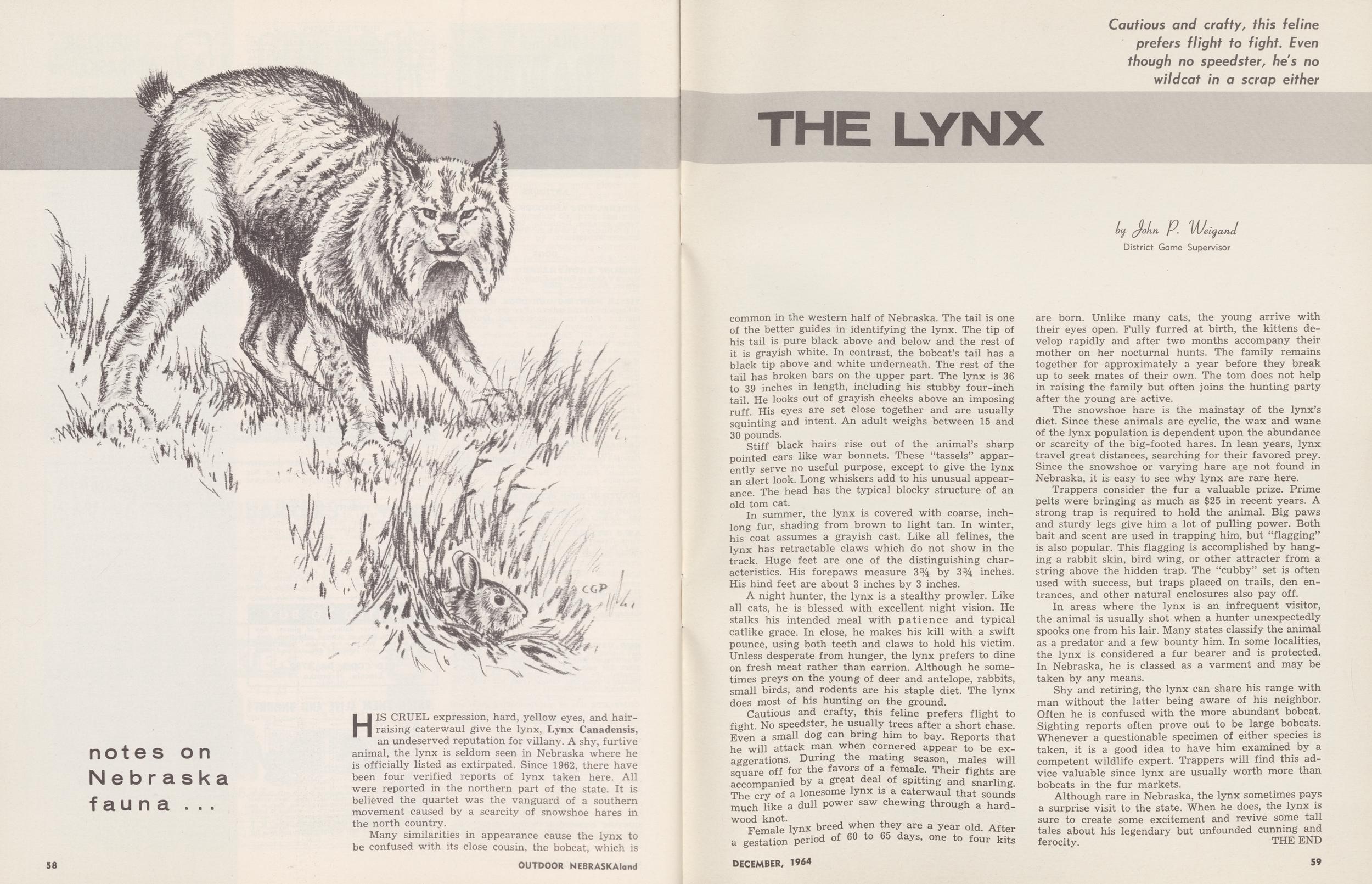
Cautious and crafty, this feline prefers flight to fight. Even though no speedster, he's no wildcat in a scrap either
notes on Nebraska fauna
The Lynx
HIS CRUEL expression, hard, yellow eyes, and hair- raising caterwaul give the lynx, Lynx Canadensis, an undeserved reputation for villany. A shy, furtive animal, the lynx is seldom seen in Nebraska where he is officially listed as extirpated. Since 1962, there have been four verified reports of lynx taken here. All were reported in the northern part of the state. It is believed the quartet was the vanguard of a southern movement caused by a scarcity of snowshoe hares in the north country.
Many similarities in appearance cause the lynx to be confused with its close cousin, the bobcat, which is Cautious and crafty, this feline prefers flight to fight. Even though no speedster, hes no wildcat in a scrap either common in the western half of Nebraska. The tail is one of the better guides in identifying the lynx. The tip of his tail is pure black above and below and the rest of it is grayish white. In contrast, the bobcat's tail has a black tip above and white underneath. The rest of the tail has broken bars on the upper part. The lynx is 36 to 39 inches in length, including his stubby four-inch tail. He looks out of grayish cheeks above an imposing ruff. His eyes are set close together and are usually squinting and intent. An adult weighs between 15 and 30 pounds.
Stiff black hairs rise out of the animal's sharp pointed ears like war bonnets. These "tassels" apparently serve no useful purpose, except to give the lynx an alert look. Long whiskers add to his unusual appearance. The head has the typical blocky structure of an old torn cat.
In summer, the lynx is covered with coarse, inch- long fur, shading from brown to light tan. In winter, his coat assumes a grayish cast. Like all felines, the lynx has retractable claws which do not show in the track. Huge feet are one of the distinguishing characteristics. His forepaws measure 3% by 3% inches. His hind feet are about 3 inches by 3 inches.
A night hunter, the lynx is a stealthy prowler. Like all cats, he is blessed with excellent night vision. He stalks his intended meal with patience and typical catlike grace. In close, he makes his kill with a swift pounce, using both teeth and claws to hold his victim. Unless desperate from hunger, the lynx prefers to dine on fresh meat rather than carrion. Although he some- times preys on the young of deer and antelope, rabbits, small birds, and rodents are his staple diet. The lynx does most of his hunting on the ground.
Cautious and crafty, this feline prefers flight to fight. No speedster, he usually trees after a short chase. Even a small dog can bring him to bay. Reports that he will attack man when cornered appear to be exaggerations. During the mating season, males will square off for the favors of a female. Their fights are accompanied by a great deal of spitting and snarling. The cry of a lonesome lynx is a caterwaul that sounds much like a dull power saw chewing through a hardwood knot.
Female lynx breed when they are a year old. After a gestation period of 60 to 65 days, one to four kits are born. Unlike many cats, the young arrive with their eyes open. Fully furred at birth, the kittens develop rapidly and after two months accompany their mother on her nocturnal hunts. The family remains together for approximately a year before they break up to seek mates of their own. The torn does not help in raising the family but often joins the hunting party after the young are active.
The snowshoe hare is the mainstay of the lynx's diet. Since these animals are cyclic, the wax and wane of the lynx population is dependent upon the abundance or scarcity of the big-footed hares. In lean years, lynx travel great distances, searching for their favored prey. Since the snowshoe or varying hare are not found in Nebraska, it is easy to see why lynx are rare here.
Trappers consider the fur a valuable prize. Prime pelts were bringing as much as $25 in recent years. A strong trap is required to hold the animal. Big paws and sturdy legs give him a lot of pulling power. Both bait and scent are used in trapping him, but "flagging" is also popular. This flagging is accomplished by hanging a rabbit skin, bird wing, or other attracter from a string above the hidden trap. The "cubby" set is often used with success, but traps placed on trails, den entrances, and other natural enclosures also pay off.
In areas where the lynx is an infrequent visitor, the animal is usually shot when a hunter unexpectedly spooks one from his lair. Many states classify the animal as a predator and a few bounty him. In some localities, the lynx is considered a fur bearer and is protected. In Nebraska, he is classed as a varment and may be taken by any means.
Shy and retiring, the lynx can share his range with man without the latter being aware of his neighbor. Often he is confused with the more abundant bobcat. Sighting reports often prove out to be large bobcats. Whenever a questionable specimen of either species is taken, it is a good idea to have him examined by a competent wildlife expert. Trappers will find this advice valuable since lynx are usually worth more than bobcats in the fur markets.
Although rare in Nebraska, the lynx sometimes pays a surprise visit to the state. When he does, the lynx is sure to create some excitement and revive some tall tales about his legendary but unfounded cunning and ferocity. THE END
58 OUTDOOR NEBRASKAland DECEMBER, 1964 59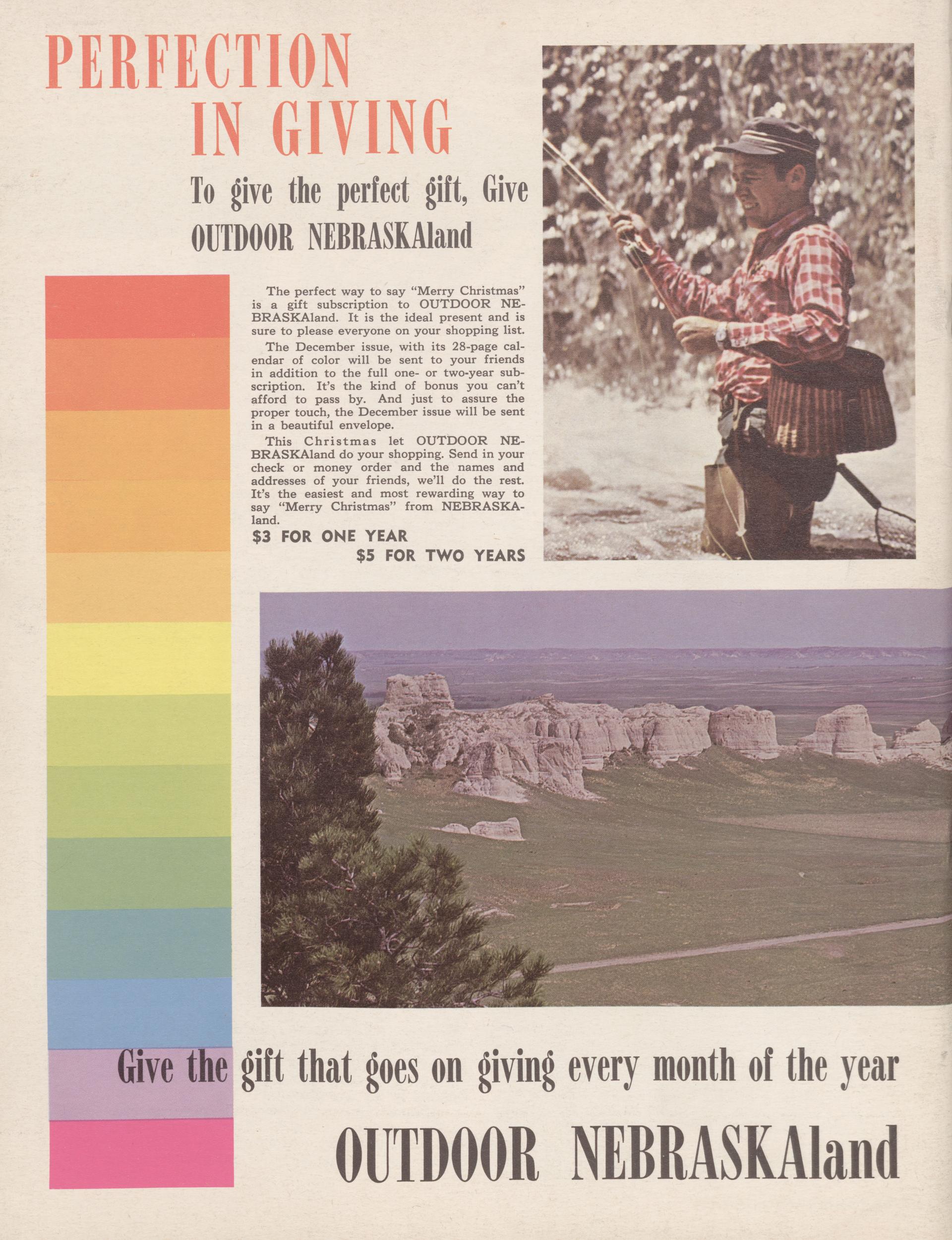
PERFECTION GIVING
To give the perfect gilt, Give OUTDOOR NEBRASKAIand The perfect way to say "Merry Christmas" is a gift subscription to OUTDOOR NEBRASKAIand. It is the ideal present and is sure to please everyone on your shopping list. The December issue, with its 28-page calendar of color will be sent to your friends in addition to the full one- or two-year subscription. It's the kind of bonus you can't afford to pass by. And just to assure the proper touch, the December issue will be sent in a beautiful envelope. This Christmas let OUTDOOR NEBRASKAIand do your shopping. Send in your check or money order and the names and addresses of your friends, we'll do the rest. It's the easiest and most rewarding way to say "Merry Christmas" from NEBRASKAIand. $3 FOR ONE YEAR $5 FOR TWO YEARS
Position: 224 (34 views)