Volume 69, Issue 5, 1991
NEBRASKAland
June 1991 $1.50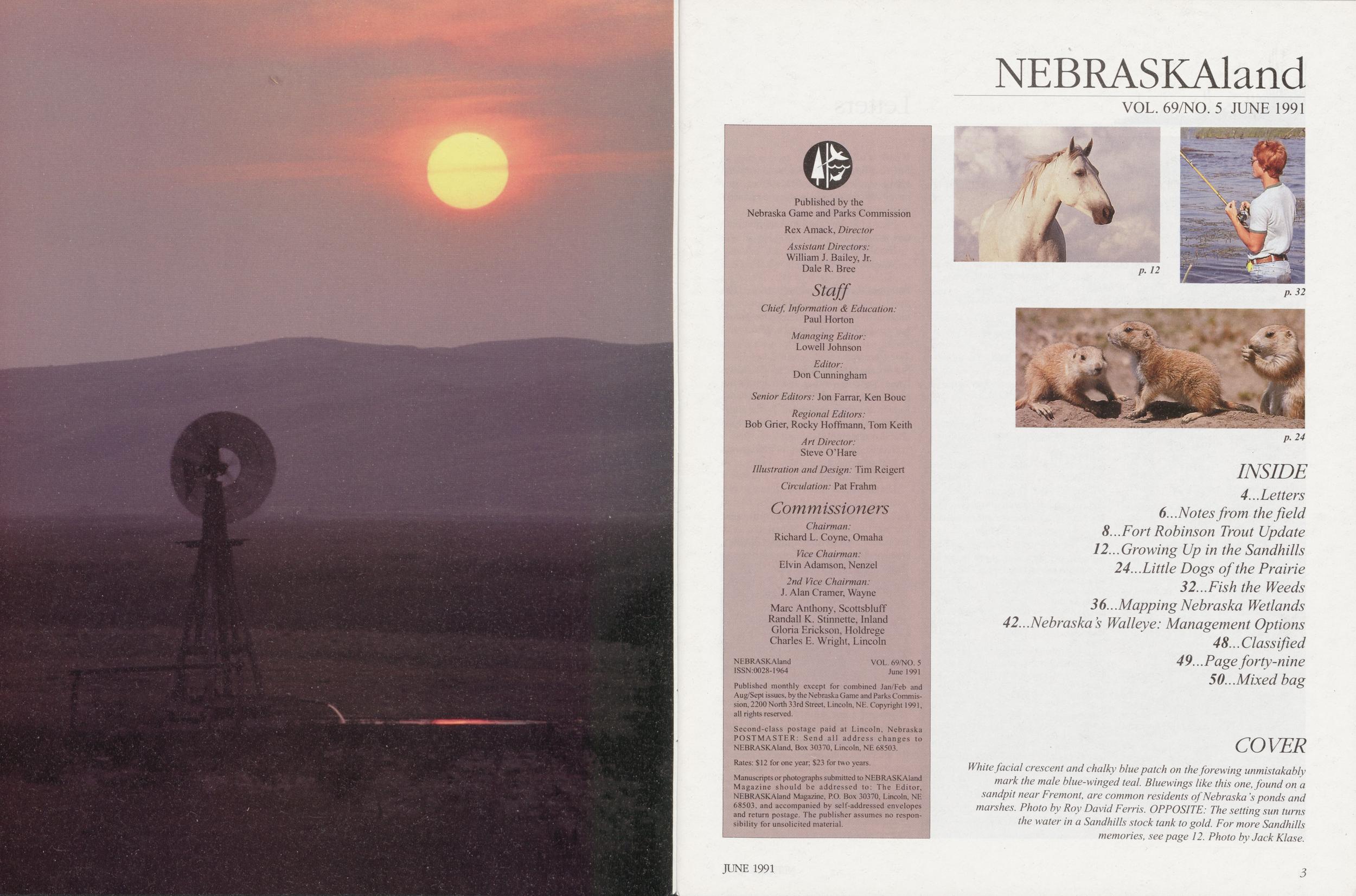
NEBRASKAland
VOL. 69/NO. 5 JUNE 1991 Published by the Nebraska Game and Parks Commission Rex Arnack, Director Assistant Directors: William J. Bailey, Jr. Dale R. Bree Staff Chief, Information & Education: Paul Horton Managing Editor: Lowell Johnson Editor: Don Cunningham Senior Editors: Jon Farrar, Ken Bouc Regional Editors: Bob Grier, Rocky Hoffmann, Tom Keith Art Director: Steve O'Hare Illustration and Design: Tim Reigert Circulation: Pat Frahm Commissioners Chairman: Richard L. Coyne, Omaha Vice Chairman: Elvin Adamson, Nenzel 2nd Vice Chairman: J. Alan Cramer, Wayne Marc Anthony, Scottsbluff Randall K. Stinnette, Inland Gloria Erickson, Holdrege Charles E. Wright, Lincoln NEBRASKAland ISSN-.0028-1964 VOL, 69/NO. 5 June 1991 Published monthly except for combined Jan/Feb and Aug/Sept issues, by the Nebraska Game and Parks Commission, 2200 North 33rd Street, Lincoln, NE. Copyright 1991, all rights reserved. Second-class postage paid at Lincoln, Nebraska POSTMASTER: Send ail address changes to NEBRASKAland, Box 30370, Lincoln, NE 68503. Rates: $ 12 for one year; $23 for two years. Manuscripts or photographs submitted to NEBRASKAland Magazine should be addressed to: The Editor, NEBRASKAland Magazine, P.O. Box 30370, Lincoln, NE 68503, and accompanied by self-addressed envelopes and return postage. The publisher assumes no responsibility for unsolicited material.p. 12
p. 32
p. 24
4... Letters
6...Notes from the field
8...Fort Robinson Trout Update
12...Growing Up in the Sandhills
24...Little Dogs of the Prairie
32...Fish the Weeds
36.. .Mapping Nebraska Wetlands
42...Nebraska s Walleye: Management Options
48...Classified
49. ..Page forty-nine
50...Mixed bag
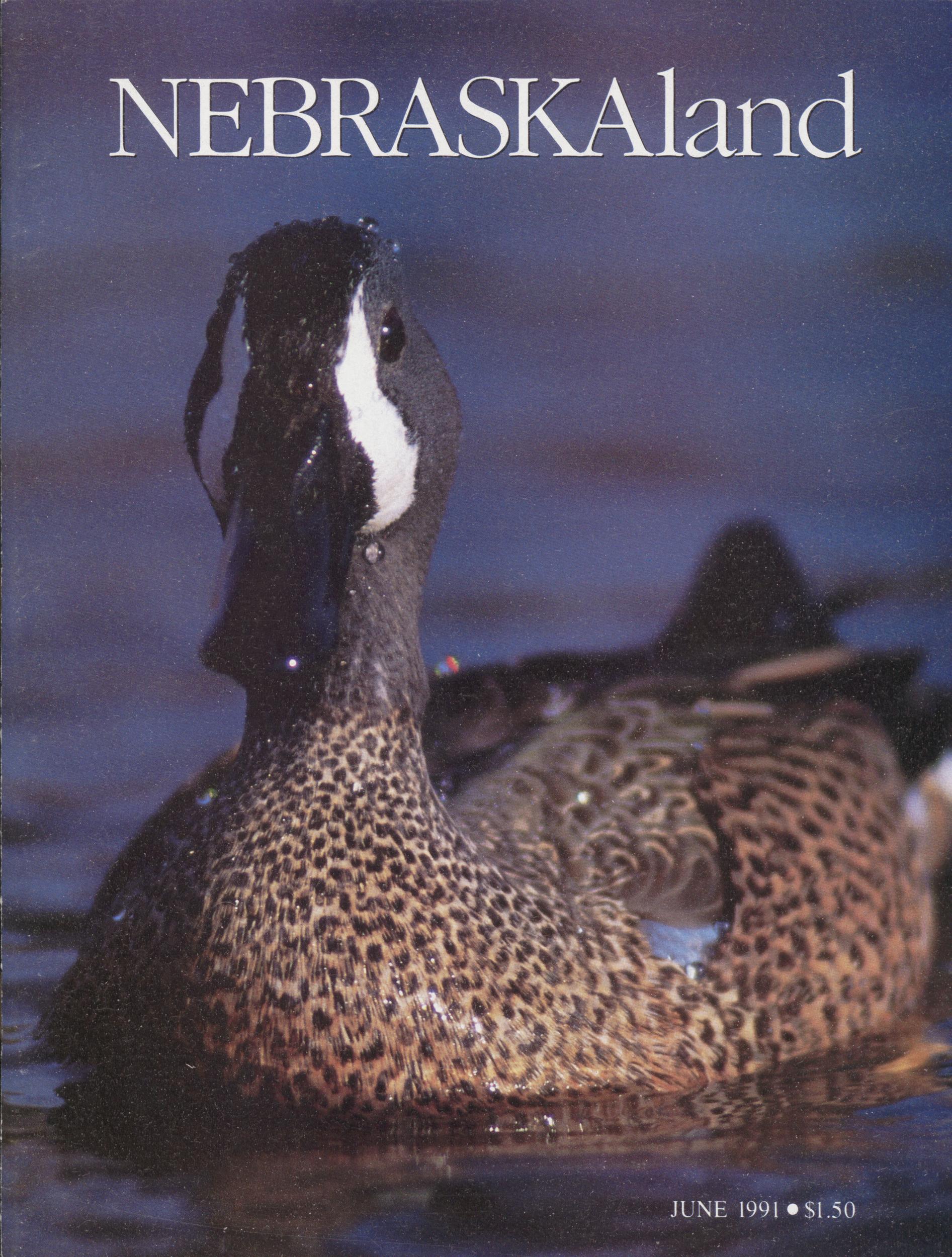
COVER White facial crescent and chalky blue patch on the forewing unmistakably mark the male blue-winged teal. Blue wings like this one, found on a sandpit near Fremont, are common residents of Nebraska 's ponds and marshes. Photo by Roy David Ferris. OPPOSITE: The setting sun turns the water in a Sandhills stock tank to gold. For more Sandhills memories, seepage 12. Photo by Jack Klase.
Headquarters
2200 North 33rd Street
Lincoln, NE 68503
Phone (402)471-0641
District Office I
Box 725
Alliance, NE 69301
Phone (308)762-5605
District Office II
Box 508
Bassett, NE 68714
Phone (402)684-2921
District Office III
Box 934
Norfolk, NE 68702
Phone (402)370-3374
District Office IV
Route 4, Box 36
North Platte, NE 69101
Phone (308)535-8025
District Office V
2200 North 33rd Street
Lincoln, NE 68503
Phone (402)471-5558
Omaha Office
State Office Building Mall
1313Farnam
Omaha, NE 68102,
Phone (402) 595-2144
Ak-Sar-Ben Aquarium
21502 West Highway 31
Gretna, NE 68028
Phone (402) 332-3901 Conservation Officers by Region Panhandle Officer Richard Furley (Supv) Joseph Ulrich Walt Meyer John Murphy Jim Zimmerman Marvin Kampbeil E.W. Zimmerman Dennis Thompson Don Hunt Richard Brandt South-Central Officer Jerry Pecha (Supv) Lester Johnson Terry Brentzel Dale Johnson Daniel Klammer Dayton Shultis Mark Reeves Robert Finke Northeast Officer Bob Downing (Supv) Robert Kelly Ross Oestmann L.A. Wilkinson Gary Ralston Daniel Roberts Randy Pomplun Marion Shafer Eric Wiebe Jon Reeves Raymond Still City Alliance Bridgeport Chadron Crawford Gering Hay Springs Ogallala Ogallala Oshkosh Scottsbluff Phone (308) 762-2024 262-0541 432-4398 665-2021 436-7561 638-7527 284-3013 284-6450 772-3697 635-1277 Southwest Officer Gail Woodside(Supv) George Sund Jack Henderson Dirk Greene Ray Frandsen Virgil Gosch Dwight Allbery Roger Thompson Rich Routh City No. Platte Cambridge Gothenburg Imperial Lexington McCook No. Platte No. Platte Republican Phone (308) 532-0279 697-4629 537-7483 882-5328 324-2753 345-2185 532-2753 532-9175 City 799-2085 City York David City Grand Isl. Hebron Hastings Kearney Loup City Seward City Norfolk Albion Bloomfield Columbus Creighton Fremont Fullerton Norfolk Ponca Tekamah West Point Phone (402) 362-5707 367-4037 (308)384-8296 768-7363 461-3389 (308)234-3349 (308)745-1126 643-2056 Phone (402) 371-2675 395-2538 373-4412 564-4375 847-3284 721-7852 (308)536-2987 371-2031 755-2566 374-1339 372-5676 Southeast Officer City- Don Schaepler (Chief) Lincoln Ted Blume (Asst Chief) Lincoln Roger Guenther (Supv) Lincoln William Krause Murray Johnson Douglas Kramer Levi Krause Russell Mort Duane Arp Larry Elston Craig Stover Mike Luben Steve Oberg Dan Evasco Sandhills Officer Bruce Wiebe (Supv) Max Showalter Larry Bauman Tom Zimmer Richard Seward Mick Gray Auburn Lincoln Lincoln Louisville Nebr. City Omaha Omaha Omaha Wahoo Lincoln Beatrice City Bassett Ainsworth Atkinson Brkn. Bow Ord Valentine Phone (402) 488-2957 483-5643 423-5671 274-3789 488-2923 466-9001 234-2212 873-5684 332-4954 292-4910 359-2833 443-4278 464-2813 228-5935 Phone (402) 684-3867 387-1960 925-5569 (308)872-6063 (308)728-5338 376-3136 Operation Game Thief (800) 742-7627
Letters
Where is it?Sir/ As a former Nebraska game warden, I have traveled all over the state, but have never seen the eroded landscape pictured on your April cover.
Please tell me exactly where that picture was taken.
Harold J. Miner Wakefield, NESir/ What a treasure in Steven C. Wilson's lyrical style of writing and magnificent photographs [April 1991, "A Past Collected; A Future Suspected"]. The only sadness, though, is the loss of lived-in, once-loved homes.
Thank you and Wilson for giving us a special experience.
Mrs. LA. Trively Highlands, NCSir/ A line on page 18 of the April issue hit me like a brick: "When the rain stopped, the greed didn't; plows like this kept breaking the plains."
I imagine this sentence would have hit his parents and grandparents like a brick, also. It wasn't greed, it was feeding family—his family, grandchildren, the world. What a "New Age" baloney sentence that was. His pictures are too depressing; they are not beautiful Nebraska.
Nancy Graham Normandy, TNSir/ You may be interested in this picture of an albino skunk taken while observing the cranes near Elm Creek, NE. I got several pictures, but when he rushed me, I decided to depart ASAP.
Bryon Kinnan Elm Creek, NESir/I would like to thank you for the help you gave me a couple of years ago in finding Blue Barrel Soap ["Letters," July, August-September 1989].
Now I can use some more help. I am looking for some detailed information on identifying the various edible mushrooms. I am especially interested in what I believe is called the elephant ear. I would also appreciate it if any of your readers have any recipes on preparing and preserving either the morel of the elephant ear.
Ralph Lampe Auburn, NE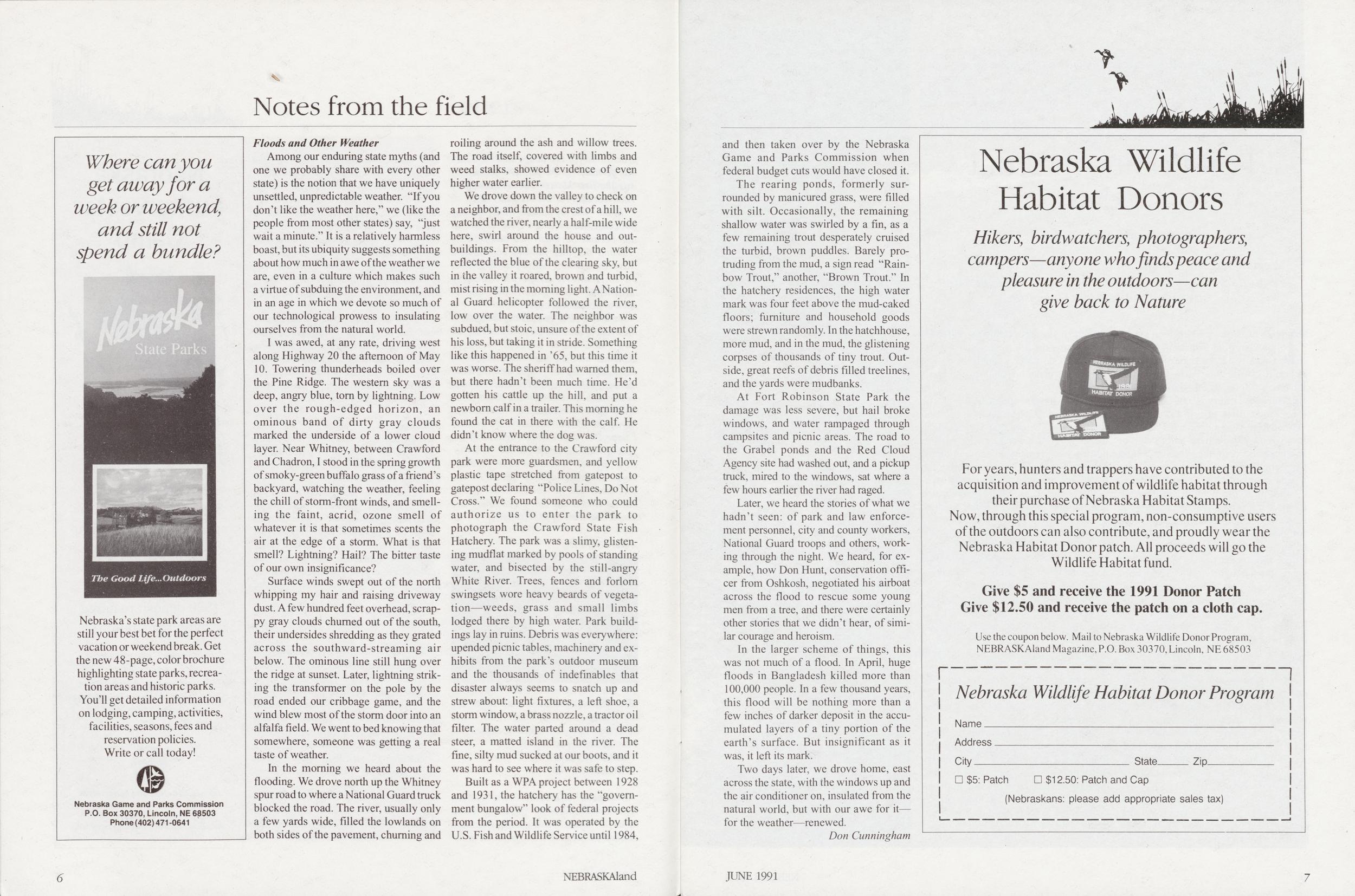
Notes from the field
Floods and Other WeatherAmong our enduring state myths (and one we probably share with every other state) is the notion that we have uniquely unsettled, unpredictable weather. "If you don't like the weather here," we (like the people from most other states) say, "just wait a minute." It is a relatively harmless boast, but its ubiquity suggests something about how much in awe of the weather we are, even in a culture which makes such a virtue of subduing the environment, and in an age in which we devote so much of our technological prowess to insulating ourselves from the natural world.
I was awed, at any rate, driving west along Highway 20 the afternoon of May 10. Towering thunderheads boiled over the Pine Ridge. The western sky was a deep, angry blue, torn by lightning. Low over the rough-edged horizon, an ominous band of dirty gray clouds marked the underside of a lower cloud layer. Near Whitney, between Crawford and Chadron, I stood in the spring growth of smoky-green buffalo grass of a friend's backyard, watching the weather, feeling the chill of storm-front winds, and smelling the faint, acrid, ozone smell of whatever it is that sometimes scents the air at the edge of a storm. What is that smell? Lightning? Hail? The bitter taste of our own insignificance?
Surface winds swept out of the north whipping my hair and raising driveway dust. A few hundred feet overhead, scrappy gray clouds churned out of the south, their undersides shredding as they grated across the southward-streaming air below. The ominous line still hung over the ridge at sunset. Later, lightning striking the transformer on the pole by the road ended our eribbage game, and the wind blew most of the storm door into an alfalfa field. We went to bed knowing that somewhere, someone was getting a real taste of weather.
In the morning we heard about the flooding. We drove north up the Whitney spur road to where a National Guard truck blocked the road. The river, usually only a few yards wide, filled the lowlands on both sides of the pavement, churning and roiling around the ash and willow trees. The road itself, covered with limbs and weed stalks, showed evidence of even higher water earlier.
We drove down the valley to check on a neighbor, and from the crest of a hill, we watched the river, nearly a half-mile wide here, swirl around the house and outbuildings. From the hilltop, the water reflected the blue of the clearing sky, but in the valley it roared, brown and turbid, mist rising in the morning light. A National Guard helicopter followed the river, low over the water. The neighbor was subdued, but stoic, unsure of the extent of his loss, but taking it in stride. Something like this happened in '65, but this time it was worse. The sheriff had warned them, but there hadn't been much time. He'd gotten his cattle up the hill, and put a newborn calf in a trailer. This morning he found the cat in there with the calf. He didn't know where the dog was.
At the entrance to the Crawford city park were more guardsmen, and yellow plastic tape stretched from gatepost to gatepost declaring "Police Lines, Do Not Cross." We found someone who could authorize us to enter the park to photograph the Crawford State Fish Hatchery. The park was a slimy, glistening mudflat marked by pools of standing water, and bisected by the still-angry White River. Trees, fences and forlorn swing sets wore heavy beards of vegetation—weeds, grass and small limbs lodged there by high water. Park buildings lay in ruins. Debris was everywhere: upended picnic tables, machinery and exhibits from the park's outdoor museum and the thousands of indefinables that disaster always seems to snatch up and strew about: light fixtures, a left shoe, a storm window, a brass nozzle, a tractor oil filter. The water parted around a dead steer, a matted island in the river. The fine, silty mud sucked at our boots, and it was hard to see where it was safe to step.
Built as a WPA project between 1928 and 1931, the hatchery has the "government bungalow" look of federal projects from the period. It was operated by the U.S. Fish and Wildlife Service until 1984, and then taken over by the Nebraska Game and Parks Commission when federal budget cuts would have closed it.
The rearing ponds, formerly surrounded by manicured grass, were filled with silt. Occasionally, the remaining shallow water was swirled by a fin, as a few remaining trout desperately cruised the turbid, brown puddles. Barely protruding from the mud, a sign read "Rainbow Trout," another, "Brown Trout." In the hatchery residences, the high water mark was four feet above the mud-caked floors; furniture and household goods were strewn randomly. In the hatch house, more mud, and in the mud, the glistening corpses of thousands of tiny trout. Outside, great reefs of debris filled tree lines, and the yards were mudbanks.
At Fort Robinson State Park the damage was less severe, but hail broke windows, and water rampaged through campsites and picnic areas. The road to the Grabel ponds and the Red Cloud Agency site had washed out, and a pickup truck, mired to the windows, sat where a few hours earlier the river had raged.
Later, we heard the stories of what we hadn't seen: of park and law enforcement personnel, city and county workers, National Guard troops and others, working through the night. We heard, for example, how Don Hunt, conservation officer from Oshkosh, negotiated his airboat across the flood to rescue some young men from a tree, and there were certainly other stories that we didn't hear, of similar courage and heroism.
In the larger scheme of things, this was not much of a flood. In April, huge floods in Bangladesh killed more than 100,000 people. In a few thousand years, this flood will be nothing more than a few inches of darker deposit in the accumulated layers of a tiny portion of the earth's surface. But insignificant as it was, it left its mark.
Two days later, we drove home, east across the state, with the windows up and the air conditioner on, insulated from the natural world, but with our awe for the weather—renewed.
Nebraska Wildlife Habitat Donors
Hikers, birdwatchers, photographers, campers—anyone who finds peace and pleasure in the outdoors—can give back to Nature For years, hunters and trappers have contributed to the acquisition and improvement of wildlife habitat through their purchase of Nebraska Habitat Stamps. Now, through this special program, non-consumptive users of the outdoors can also contribute, and proudly wear the Nebraska Habitat Donor patch. All proceeds will go the Wildlife Habitat fund. Give $5 and receive the 1991 Donor Patch Give $12.50 and receive the patch on a cloth cap. Use the coupon below. Mail to Nebraska Wildlife Donor Program, NEBRASKAland Magazine, P.O. Box 30370, Lincoln, NE 68503 Nebraska Wildlife Habitat Donor Program Name Address City State. Zip. $5: Patch $12.50: Patch and Cap (Nebraskans: please add appropriate sales tax)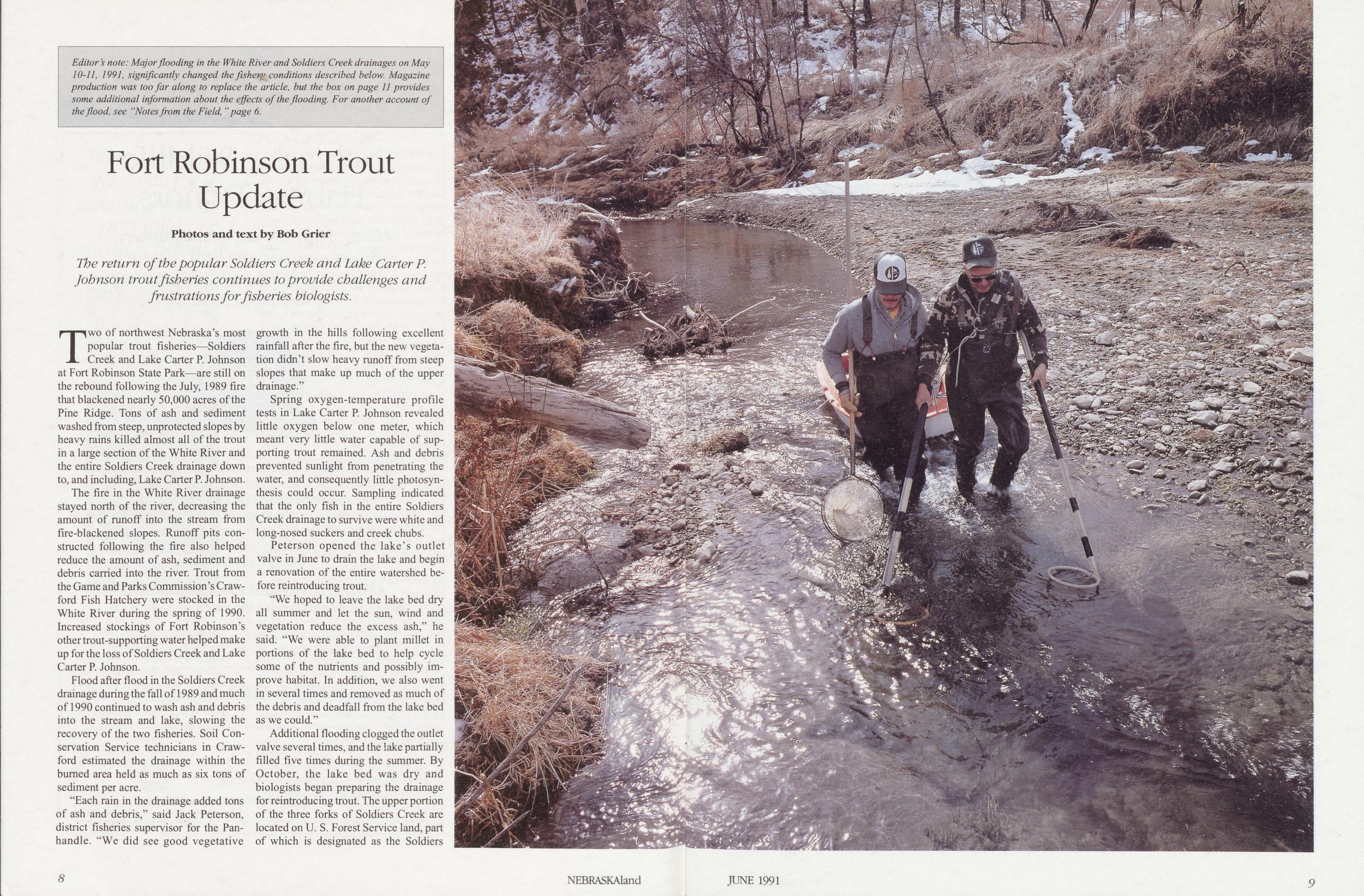
Fort Robinson Trout Update
The return of the popular Soldiers Creek and Lake Carter P. Johnson trout fisheries continues to provide challenges and frustrations for fisheries biologists.Two of northwest Nebraska's most popular trout fisheries—Soldiers Creek and Lake Carter P. Johnson at Fort Robinson State Park—are still on the rebound following the July, 1989 fire that blackened nearly 50,000 acres of the Pine Ridge. Tons of ash and sediment washed from steep, unprotected slopes by heavy rains killed almost all of the trout in a large section of the White River and the entire Soldiers Creek drainage down to, and including, Lake Carter P. Johnson.
The fire in the White River drainage stayed north of the river, decreasing the amount of runoff into the stream from fire-blackened slopes. Runoff pits constructed following the fire also helped reduce the amount of ash, sediment and debris carried into the river. Trout from the Game and Parks Commission's Crawford Fish Hatchery were stocked in the White River during the spring of 1990. Increased stockings of Fort Robinson's other trout-supporting water helped make up for the loss of Soldiers Creek and Lake Carter P. Johnson.
Flood after flood in the Soldiers Creek drainage during the fall of 1989 and much of 1990 continued to wash ash and debris into the stream and lake, slowing the recovery of the two fisheries. Soil Conservation Sendee technicians in Crawford estimated the drainage within the burned area held as much as six tons of sediment per acre.
"Each rain in the drainage added tons of ash and debris," said Jack Peterson, district fisheries supervisor for the Panhandle. We did see good vegetative growth in the hills following excellent rainfall after the fire, but the new vegetation didn't slow heavy runoff from steep slopes that make up much of the upper drainage."
Spring oxygen-temperature profile tests in Lake Carter P. Johnson revealed little oxygen below one meter, which meant very little water capable of supporting trout remained. Ash and debris prevented sunlight from penetrating the water, and consequently little photosynthesis could occur. Sampling indicated that the only fish in the entire Soldiers Creek drainage to survive were white and long-nosed suckers and creek chubs.
Peterson opened the lake's outlet valve in June to drain the lake and begin a renovation of the entire watershed before reintroducing trout.
"We hoped to leave the lake bed dry all summer and let the sun, wind and vegetation reduce the excess ash," he said. "We were able to plant millet in portions of the lake bed to help cycle some of the nutrients and possibly improve habitat. In addition, we also went in several times and removed as much of the debris and deadfall from the lake bed as we could."
Additional flooding clogged the outlet valve several times, and the lake partially filled five times during the summer. By October, the lake bed was dry and biologists began preparing the drainage for reintroducing trout. The upper portion of the three forks of Soldiers Creek are located on U. S. Forest Service land, part of which is designated as the Soldiers
8 NEBRASKAland JUNE 1991 9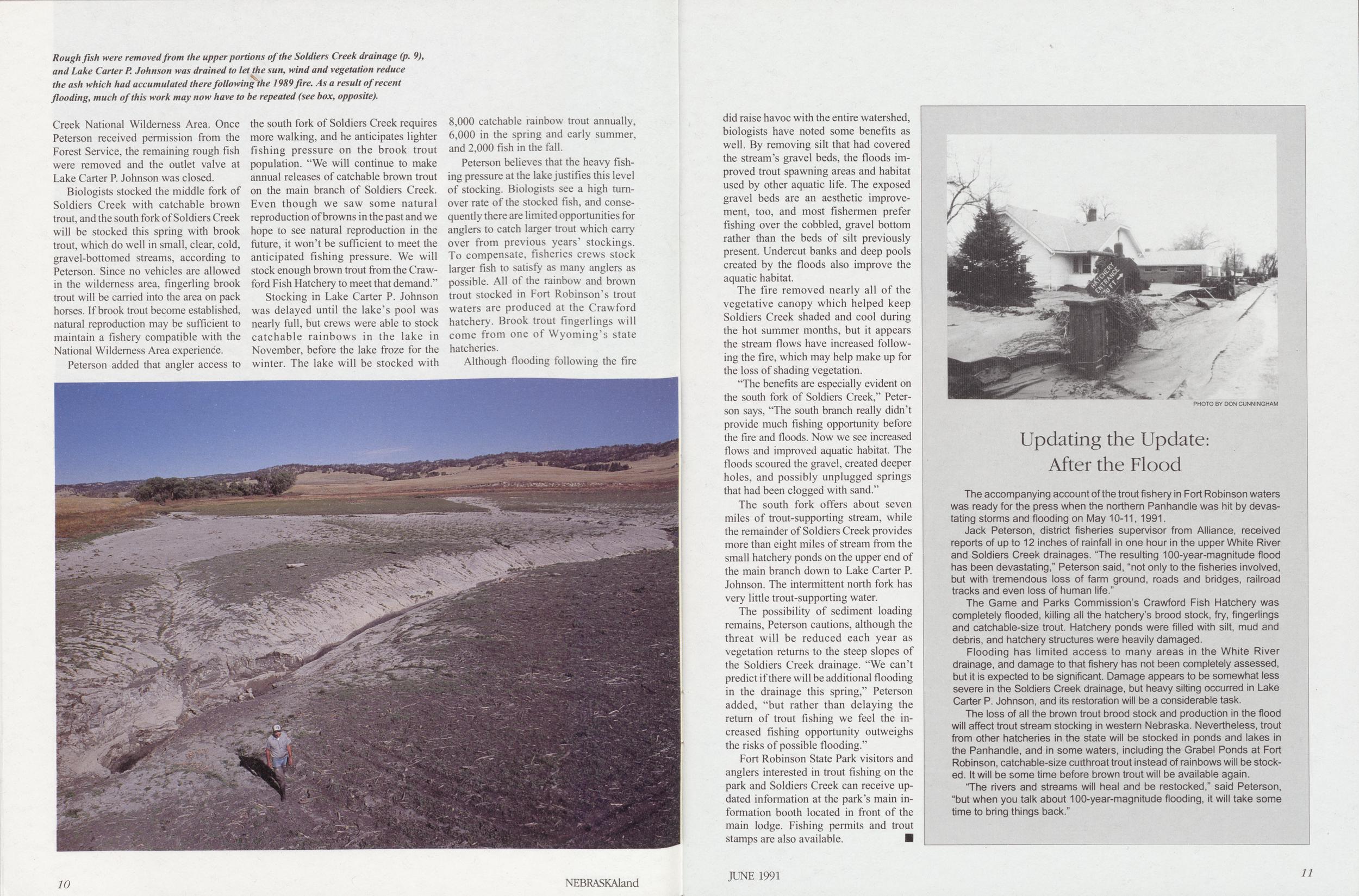
Rough fish were removed from the upper portions of the Soldiers Creek drainage (p. 9), and Lake Carter P. Johnson was drained to let the sun, wind and vegetation reduce the ash which had accumulated there following the 1989 fire. As a result of recent flooding, much of this work may now have to be repeated (see box, opposite).
Creek National Wilderness Area. Once Peterson received permission from the Forest Service, the remaining rough fish were removed and the outlet valve at Lake Carter P. Johnson was closed.
Biologists stocked the middle fork of Soldiers Creek with catchable brown trout, and the south fork of Soldiers Creek will be stocked this spring with brook trout, which do well in small, clear, cold, gravel-bottomed streams, according to Peterson. Since no vehicles are allowed in the wilderness area, fingerling brook trout will be carried into the area on pack horses. If brook trout become established, natural reproduction may be sufficient to maintain a fishery compatible with the National Wilderness Area experience.
Peterson added that angler access to the south fork of Soldiers Creek requires more walking, and he anticipates lighter fishing pressure on the brook trout population. "We will continue to make annual releases of catchable brown trout on the main branch of Soldiers Creek. Even though we saw some natural reproduction of browns in the past and we hope to see natural reproduction in the future, it won't be sufficient to meet the anticipated fishing pressure. We will stock enough brown trout from the Crawford Fish Hatchery to meet that demand."
Stocking in Lake Carter P. Johnson was delayed until the lake's pool was nearly full, but crews were able to stock catchable rainbows in the lake in November, before the lake froze for the winter. The lake will be stocked with 8,000 catchable rainbow trout annually, 6,000 in the spring and early summer, and 2,000 fish in the fall.
Peterson believes that the heavy fishing pressure at the lake justifies this level of stocking. Biologists see a high turnover rate of the stocked fish, and consequently there are limited opportunities for anglers to catch larger trout which carry over from previous years' stockings. To compensate, fisheries crews stock larger fish to satisfy as many anglers as possible. All of the rainbow and brown trout stocked in Fort Robinson's trout waters are produced at the Crawford hatchery. Brook trout fingerlings will come from one of Wyoming's state hatcheries.
Although flooding following the fire did raise havoc with the entire watershed, biologists have noted some benefits as well. By removing silt that had covered the stream's gravel beds, the floods improved trout spawning areas and habitat used by other aquatic life. The exposed gravel beds are an aesthetic improvement, too, and most fishermen prefer fishing over the cobbled, gravel bottom rather than the beds of silt previously present. Undercut banks and deep pools created by the floods also improve the aquatic habitat.
The fire removed nearly all of the vegetative canopy which helped keep Soldiers Creek shaded and cool during the hot summer months, but it appears the stream flows have increased following the fire, which may help make up for the loss of shading vegetation.
"The benefits are especially evident on the south fork of Soldiers Creek," Peterson says, "The south branch really didn't provide much fishing opportunity before the fire and floods. Now we see increased flows and improved aquatic habitat. The floods scoured the gravel, created deeper holes, and possibly unplugged springs that had been clogged with sand."
The south fork offers about seven miles of trout-supporting stream, while the remainder of Soldiers Creek provides more than eight miles of stream from the small hatchery ponds on the upper end of the main branch down to Lake Carter P. Johnson. The intermittent north fork has very little trout-supporting water.
The possibility of sediment loading remains, Peterson cautions, although the threat will be reduced each year as vegetation returns to the steep slopes of the Soldiers Creek drainage. "We can't predict if there will be additional flooding in the drainage this spring," Peterson added, "but rather than delaying the return of trout fishing we feel the increased fishing opportunity outweighs the risks of possible flooding."
Fort Robinson State Park visitors and anglers interested in trout fishing on the park and Soldiers Creek can receive updated information at the park's main information booth located in front of the main lodge. Fishing permits and trout stamps are also available.
Updating the Update: After the Flood
The accompanying account of the trout fishery in Fort Robinson waters was ready for the press when the northern Panhandle was hit by devastating storms and flooding on May 10-11, 1991.
Jack Peterson, district fisheries supervisor from Alliance, received reports of up to 12 inches of rainfall in one hour in the upper White River and Soldiers Creek drainages. "The resulting 100-year-magnitude flood has been devastating," Peterson said, "not only to the fisheries involved, but with tremendous loss of farm ground, roads and bridges, railroad tracks and even loss of human life."
The Game and Parks Commission's Crawford Fish Hatchery was completely flooded, killing all the hatchery's brood stock, fry, fingerlings and catchable-size trout. Hatchery ponds were filled with silt, mud and debris, and hatchery structures were heavily damaged.
Flooding has limited access to many areas in the White River drainage, and damage to that fishery has not been completely assessed, but it is expected to be significant. Damage appears to be somewhat less severe in the Soldiers Creek drainage, but heavy silting occurred in Lake Carter P. Johnson, and its restoration will be a considerable task.
The loss of all the brown trout brood stock and production in the flood will affect trout stream stocking in western Nebraska. Nevertheless, trout from other hatcheries in the state will be stocked in ponds and lakes in the Panhandle, and in some waters, including the Grabel Ponds at Fort Robinson, catchable-size cut throat trout instead of rainbows will be stocked. It will be some time before brown trout will be available again.
"The rivers and streams will heal and be restocked," said Peterson, "but when you talk about 100-year-magnitude flooding, it will take some time to bring things back."
10 NEBRASKAland JUNE 1991 11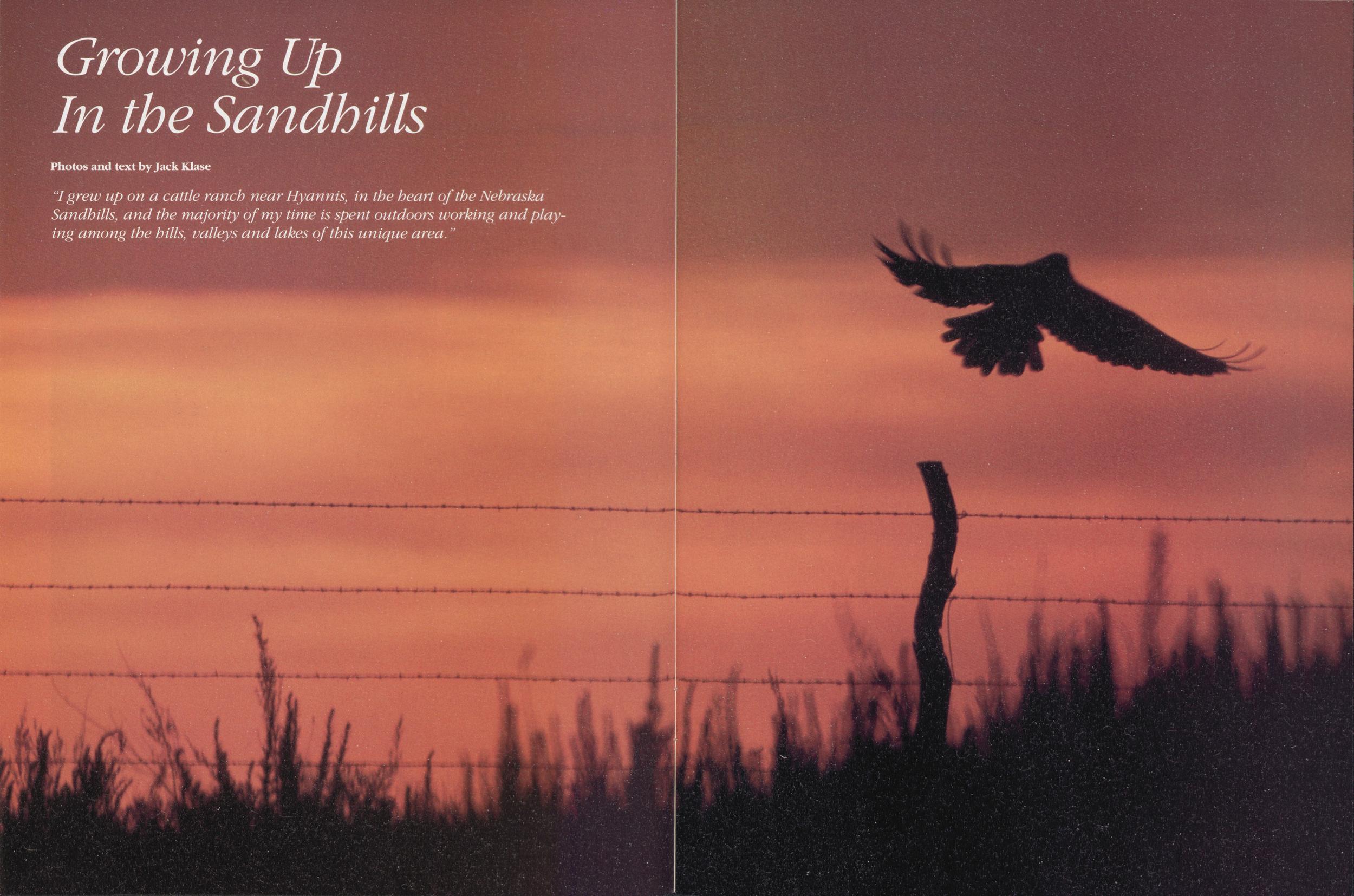
Growing Up In the Sandhills
"I grew up on a cattle ranch near Hyannis, in the heart of the Nebraska Sandhills, and the majority of my time is spent outdoors working and playing among the hills, valleys and lakes of this unique area."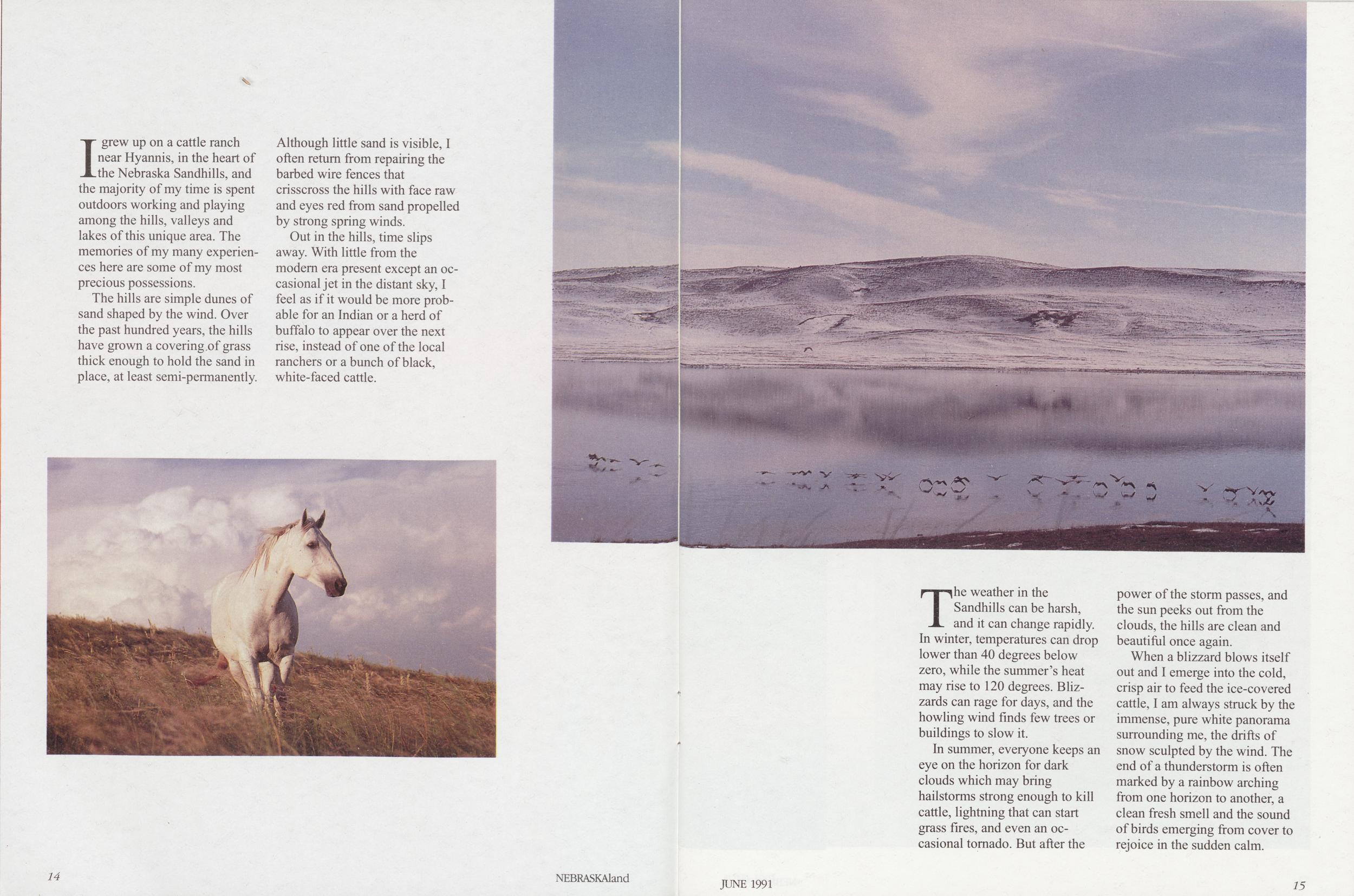
I grew up on a cattle ranch near Hyannis, in the heart of the Nebraska Sandhills, and the majority of my time is spent outdoors working and playing among the hills, valleys and lakes of this unique area. The memories of my many experiences here are some of my most precious possessions.
The hills are simple dunes of sand shaped by the wind. Over the past hundred years, the hills have grown a covering of grass thick enough to hold the sand in place, at least semi-permanently. Although little sand is visible, I often return from repairing the barbed wire fences that crisscross the hills with face raw and eyes red from sand propelled by strong spring winds.
Out in the hills, time slips away. With little from the modem era present except an occasional jet in the distant sky, I feel as if it would be more probable for an Indian or a herd of buffalo to appear over the next rise, instead of one of the local ranchers or a bunch of black, white-faced cattle.
The weather in the Sandhills can be harsh, and it can change rapidly. In winter, temperatures can drop lower than 40 degrees below zero, while the summer's heat may rise to 120 degrees. Blizzards can rage for days, and the howling wind finds few trees or buildings to slow it.
In summer, everyone keeps an eye on the horizon for dark clouds which may bring hailstorms strong enough to kill cattle, lightning that can start grass fires, and even an occasional tornado. But after the power of the storm passes, and the sun peeks out from the clouds, the hills are clean and beautiful once again.
When a blizzard blows itself out and I emerge into the cold, crisp air to feed the ice-covered cattle, I am always struck by the immense, pure white panorama surrounding me, the drifts of snow sculpted by the wind. The end of a thunderstorm is often marked by a rainbow arching from one horizon to another, a clean fresh smell and the sound of birds emerging from cover to rejoice in the sudden calm.
14 NEBRASKAland JUNE 1991 15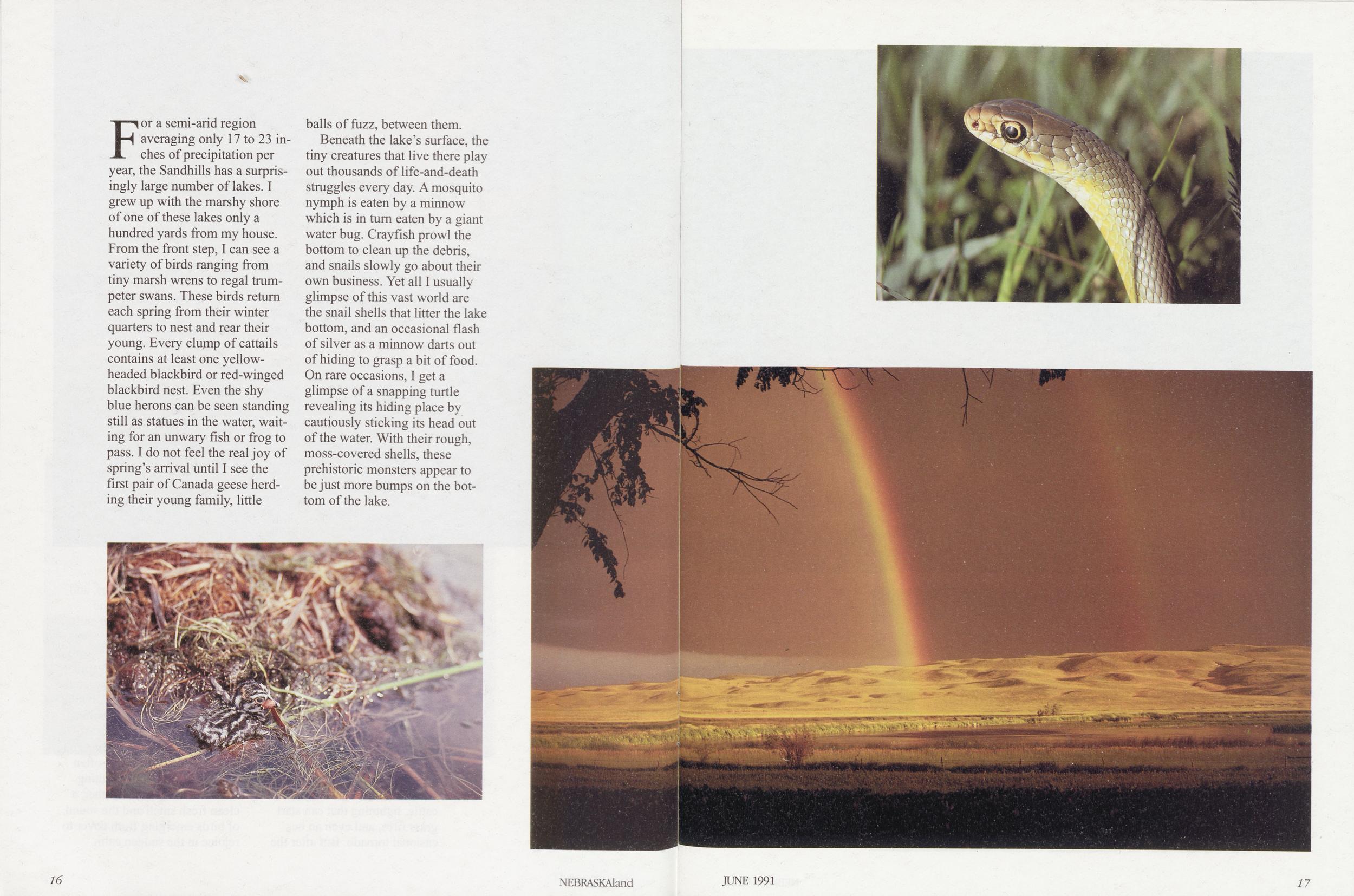
For a semi-arid region averaging only 17 to 23 inches of precipitation per year, the Sandhills has a surprisingly large number of lakes. I grew up with the marshy shore of one of these lakes only a hundred yards from my house. From the front step, I can see a variety of birds ranging from tiny marsh wrens to regal trumpeter swans. These birds return each spring from their winter quarters to nest and rear their young. Every clump of cattails contains at least one yellow headed blackbird or red-winged blackbird nest. Even the shy blue herons can be seen standing still as statues in the water, waiting for an unwary fish or frog to pass. I do not feel the real joy of spring's arrival until I see the first pair of Canada geese herding their young family, little balls of fuzz, between them.
Beneath the lake's surface, the tiny creatures that live there play out thousands of life-and-death struggles every day. A mosquito nymph is eaten by a minnow which is in turn eaten by a giant water bug. Crayfish prowl the bottom to clean up the debris, and snails slowly go about their own business. Yet all I usually glimpse of this vast world are the snail shells that litter the lake bottom, and an occasional flash of silver as a minnow darts out of hiding to grasp a bit of food. On rare occasions, I get a glimpse of a snapping turtle revealing its hiding place by cautiously sticking its head out of the water. With their rough, moss-covered shells, these prehistoric monsters appear to be just more bumps on the bottom of the lake.
In late fall, muskrats frantically build structures of moss, cattails and rushes. Every year I climb the hills behind my house and look down upon these houses, black dots scattered across the lake, to watch as they increase in size and number until ice stops construction.
These houses not only give the muskrats a place to eat and sleep above the winter's ice, they also provide shelter against the cold for mice, shrews and waterbugs. When spring comes, a few of the muskrats' houses are maintained so that young muskrats can be born and raised in them.
Raccoons, mink and weasels leave scattered fur, feathers, fish scales and a few tracks to mark their passing, but they themselves are seldom seen. I have seen a live mink only once, when one darted out of cover to attack some young muskrats, a mink's natural prey. The muskrats, playing in shallow water, were saved by their mother who jumped on the mink from behind and scared it away.
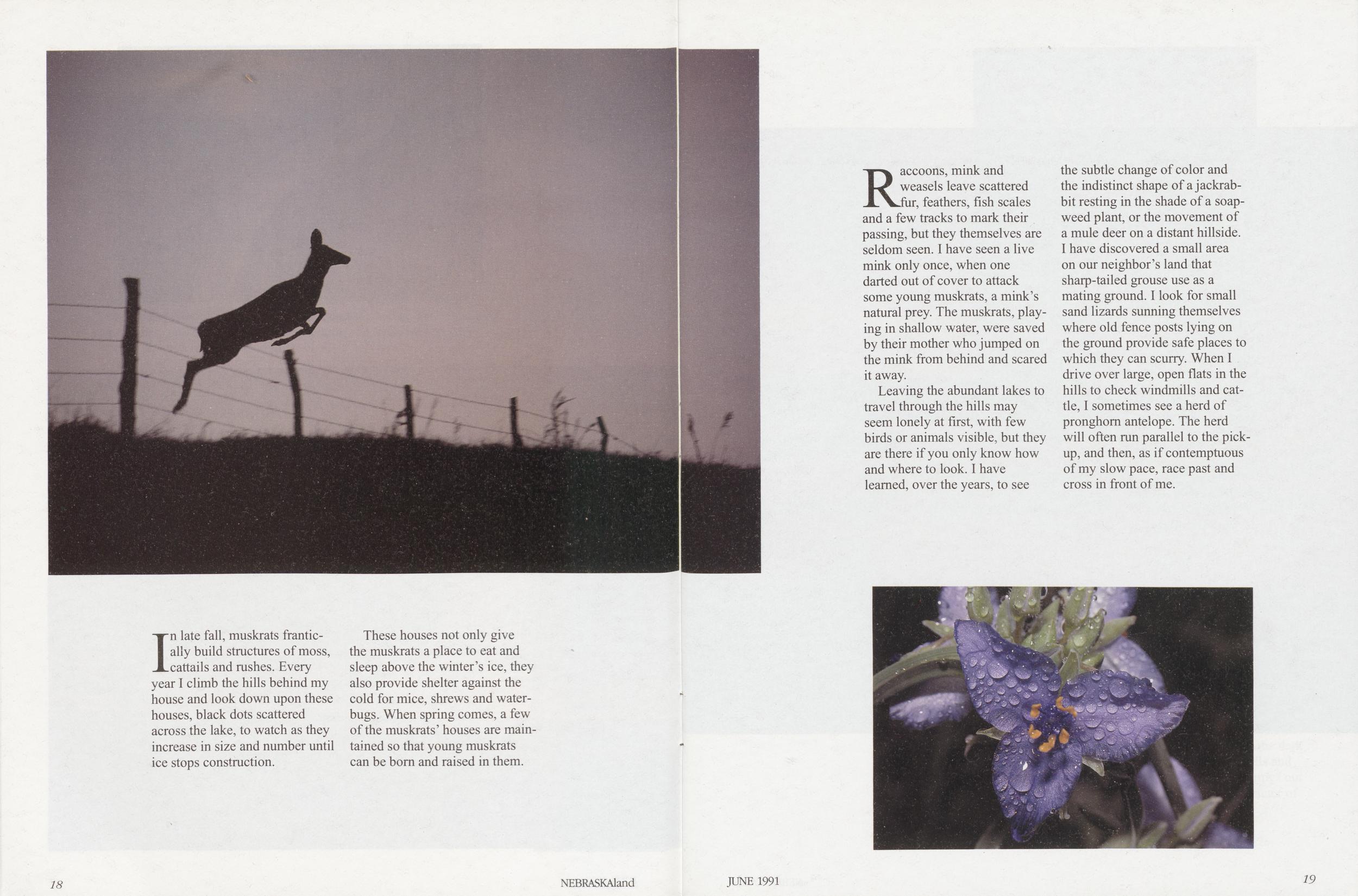
Leaving the abundant lakes to travel through the hills may seem lonely at first, with few birds or animals visible, but they are there if you only know how and where to look. I have learned, over the years, to see the subtle change of color and the indistinct shape of a jackrabbit resting in the shade of a soap weed plant, or the movement of a mule deer on a distant hillside. I have discovered a small area on our neighbor's land that sharp-tailed grouse use as a mating ground. I look for small sand lizards sunning themselves where old fence posts lying on the ground provide safe places to which they can scurry. When I drive over large, open flats in the hills to check windmills and cattle, I sometimes see a herd of pronghorn antelope. The herd will often run parallel to the pickup, and then, as if contempt of my slow pace, race past and cross in front of me.
On a quiet evening just before dark, I will go outside and listen. Soon a short series of yips leads to a long, drawn-out howl as a coyote up in the hills prepares for a night of hunting. The first coyote is almost immediately joined by others scattered throughout the hills, in a chorus as touching to me as any classical symphony. The song of the coyote stirs feelings deep within me and sends shivers up and down my spine.
I am not sure why I get so much pleasure from seeing and hearing such common animals. Perhaps it is because their great variety and number prove that the ecology of the Sandhills is still healthy and prosperous.
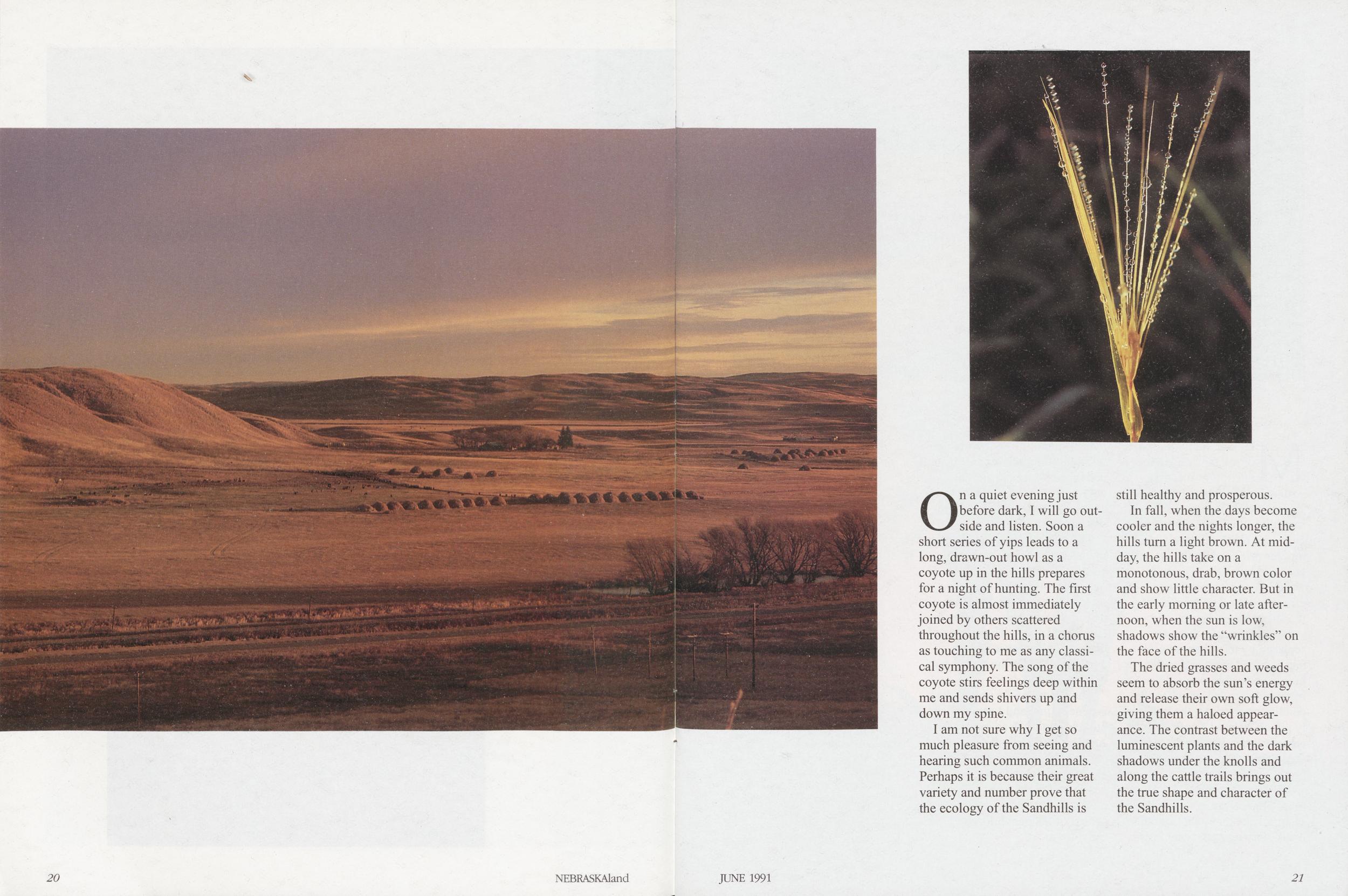
In fall, when the days become cooler and the nights longer, the hills turn a light brown. At midday, the hills take on a monotonous, drab, brown color and show little character. But in the early morning or late afternoon, when the sun is low, shadows show the "wrinkles" on the face of the hills.
The dried grasses and weeds seem to absorb the sun's energy and release their own soft glow, giving them a haloed appearance. The contrast between the luminescent plants and the dark shadows under the knolls and along the cattle trails brings out the true shape and character of the Sandhills.
20 NEBRASKAland JUNE 1991 21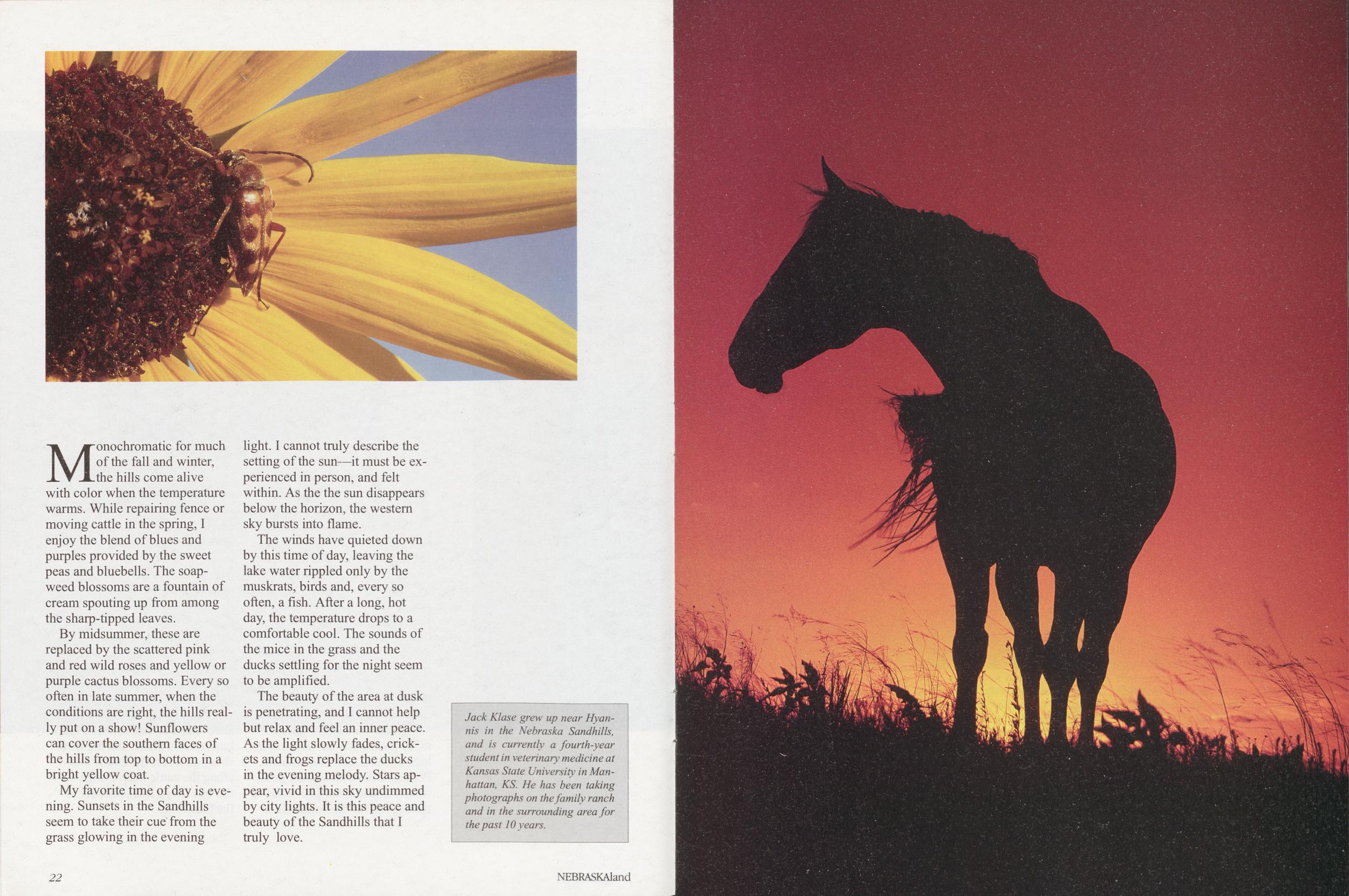
Monochromatic for much of the fall and winter, the hills come alive with color when the temperature warms. While repairing fence or moving cattle in the spring, I enjoy the blend of blues and purples provided by the sweet peas and bluebells. The soap weed blossoms are a fountain of cream spouting up from among the sharp-tipped leaves.
By midsummer, these are replaced by the scattered pink and red wild roses and yellow or purple cactus blossoms. Every so often in late summer, when the conditions are right, the hills really put on a show! Sunflowers can cover the southern faces of the hills from top to bottom in a bright yellow coat.
My favorite time of day is evening. Sunsets in the Sandhills seem to take their cue from the grass glowing in the evening light. I cannot truly describe the setting of the sun—it must be experienced in person, and felt within. As the the sun disappears below the horizon, the western sky bursts into flame.
The winds have quieted down by this time of day, leaving the lake water rippled only by the muskrats, birds and, every so often, a fish. After a long, hot day, the temperature drops to a comfortable cool. The sounds of the mice in the grass and the ducks settling for the night seem to be amplified.
The beauty of the area at dusk is penetrating, and I cannot help but relax and feel an inner peace. As the light slowly fades, crickets and frogs replace the ducks in the evening melody. Stars appear, vivid in this sky undimmed by city lights. It is this peace and beauty of the Sandhills that I truly love.
Little Dogs of the Prairie
First noted by Lewis and Clark, these fascinating prairie natives are sometimes in conflict with human land-use interests, but they are an important part of the ecosystem, and through proper management, humans and prairie dogs can coexist.In 1804, Captains Meriwether Lewis and William Clark set out with the Corps of Discovery on their historic journey up the Missouri River, over the Rocky Mountains to the Pacific Ocean. They carried with them instructions from President Thomas Jefferson to observe "the animals of the country generally and especially those not known in the U.S." This proved to be an exceptional task, for ahead of them lay vast grasslands inhabited by a multitude of unfamiliar fish, reptiles, amphibians, birds and mammals. By the end of their journey, these explorers had documented 122 new species or subspecies. The one new mammal discovered in Nebraska was the small, sociable prairie dog.
Lewis and Clark discovered their first prairie dogs in what is now Boyd County. About their new discovery, Clark said, "The village of these animals covered about four acres of ground on a gradual descent of a hill and contains great numbers of holes on top of which those little animals sit erect, making a whistling noise, and when alarmed, step into their hole." Obtaining specimens of prairie dogs proved difficult. A private in the Corps was able to shoot one, at which time all of the others disappeared. The group then tried to dig out the animals. After going down six feet, only to find no end to the runways, they resorted to flooding. The men spent nearly an entire day carrying water from the river and pouring it into a hole. They were able to capture only one more. Little did they know at the time that they would encounter this "barking squirrel" many more times before their journey's end.
Lewis and Clark named the prairie dog for the barking noise it makes, but it is not a dog, nor is it related to any canine. The prairie dog is really a rodent and is closely related to ground squirrels and marmots. Five species of prairie dogs are found in North America: the black-tailed, Mexican, white-tailed, Gunnison's and Utah prairie dogs. Only one species, the black-tailed prairie dog, occurs in Nebraska. It is the most abundant and widely distributed of the five species, living in groups scattered across the prairies from northern Mexico to southern Canada. The animal is cinnamon brown with buffy undersides, and, as its name indicates, has a black-tipped tail. Adults may weigh from one to three pounds, and are 14 to 17 inches long. At last count they occupied approximately 70,000 acres of land in Nebraska. The Mexican prairie dog also has a black tipped tail, but is smaller than its northern relative. This species occurs only in Mexico, where it is listed as endangered.
White-tailed, Gunnison's and Utah prairie dogs all have white tipped tails. The white-tailed prairie dog lives in sparsely populated colonies on sagebrush plateaus of the Rocky Mountains. It is usually smaller than its close cousin, the black-tailed prairie dog, weighing between U/2 and 21/2 pounds. Gunnison's prairie dog, the smallest of the five species, inhabits open grassy and brushy areas at higher elevations. The Utah prairie dog is found only in south-central Utah and is a threatened species.
In the summer of 1990, we studied the behavior of black-tailed prairie dogs in Nebraska. Black taiis are the most sociable of the five species, living in colonies or "towns" built on slopes of less than 10 percent and on well-drained, finer soils. Towns may range in size from one to over 1,000 acres. The largest town ever recorded was found in Texas at the beginning of the 20th century. It measured 100 miles wide and 250 miles long, and contained an estimated 400 million prairie dogs! The average town in Nebraska, however, only covers about 30 acres.
One of the most obvious features of a prairie dog town is the abundance of mounds and holes. Prairie dogs are equipped with short, muscular front legs and long claws useful for burrowing. Black-tailed prairie dog towns usually have about 40 burrow entrances per acre, but there may be as many as 95 per acre in some towns. Each burrow entrance leads to a tunnel three to six feet deep and about 15 feet long. Not all tunnels in a town are connected. In fact, most tunnel systems have only one opening.
Prairie dogs often dig small chambers just below the surface, where they sit and listen for above-ground activity. Deeper below ground, they make nest chambers where they sleep and care for their young. Prairie dogs use the soil excavated from their tunnels to construct crater- and dome-shaped mounds up to two feet high and 10 feet in diameter! Most mound construction and repair occurs shortly after a rain, when the soil is more workable. A prairie dog scrapes soil from around a mound or digs it out of a burrow. The animal then pushes the soil to the mound and tamps it into place with its nose. Mounds serve as lookout stations
Prairie Dogs and Their Ecosystem As
ILLUSTRATION BY MARK E. MARCUSON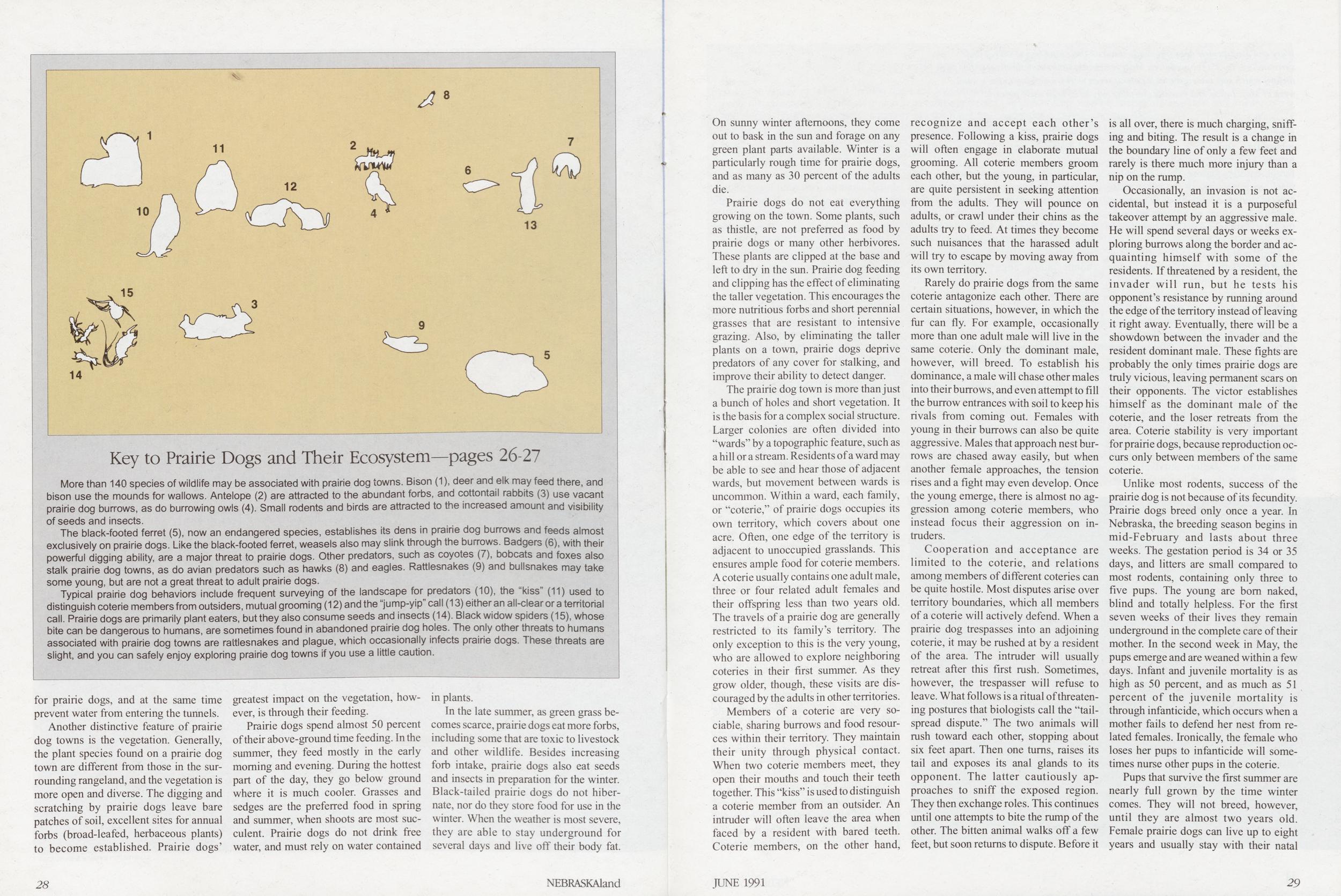
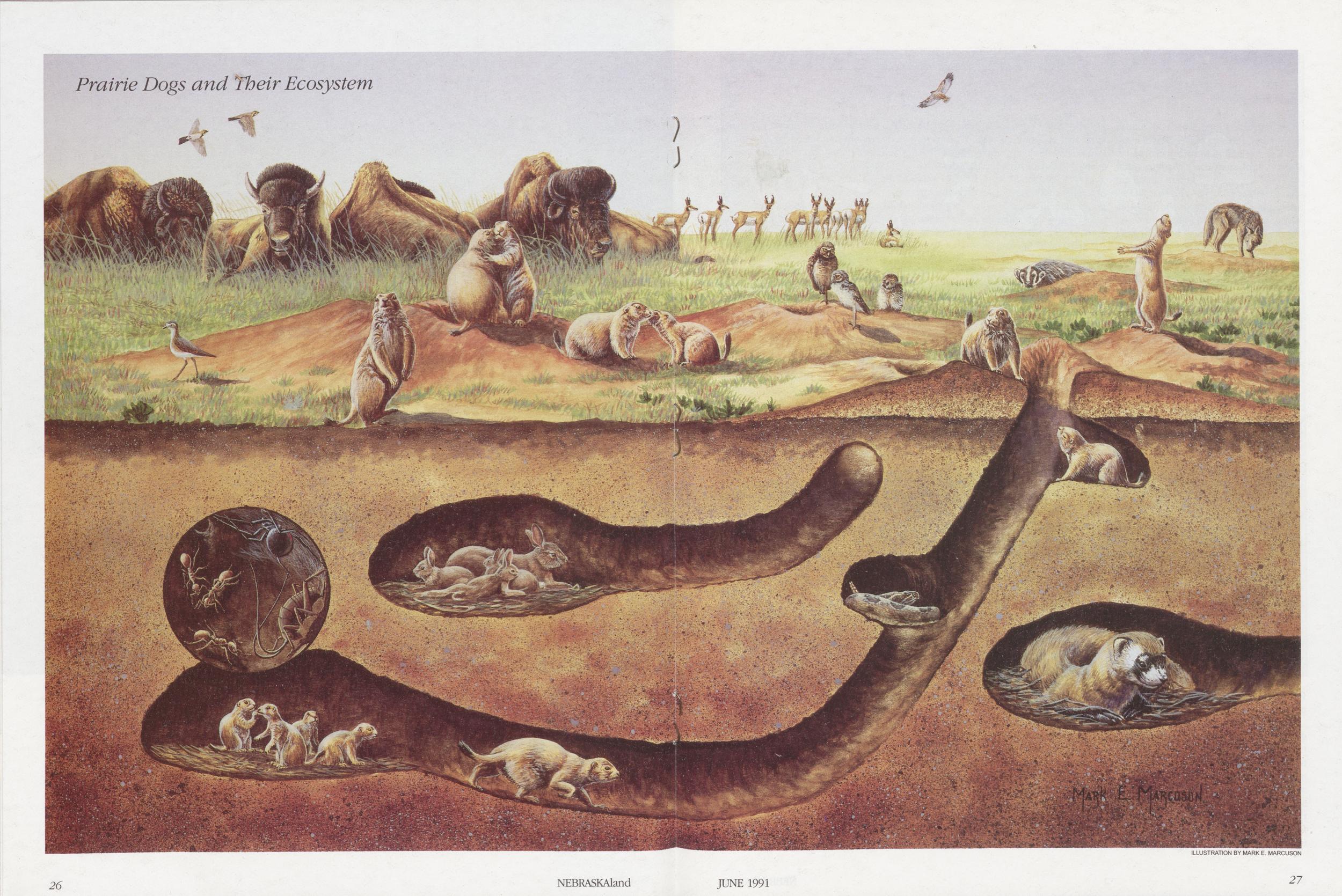
More than 140 species of wildlife may be associated with prairie dog towns. Bison (1), deer and elk may feed there, and bison use the mounds for wallows. Antelope (2) are attracted to the abundant forbs, and cottontail rabbits (3) use vacant prairie dog burrows, as do burrowing owls (4). Small rodents and birds are attracted to the increased amount and visibility of seeds and insects.
The black-footed ferret (5), now an endangered species, establishes its dens in prairie dog burrows and feeds almost exclusively on prairie dogs. Like the black-footed ferret, weasels also may slink through the burrows. Badgers (6), with their powerful digging ability, are a major threat to prairie dogs. Other predators, such as coyotes (7), bobcats and foxes also stalk prairie dog towns, as do avian predators such as hawks (8) and eagles. Rattlesnakes (9) and bull snakes may take some young, but are not a great threat to adult prairie dogs.
Typical prairie dog behaviors include frequent surveying of the landscape for predators (10), the "kiss" (11) used to distinguish coterie members from outsiders, mutual grooming (12) and the "jump-yip" call (13) either an all-clear or a territorial call. Prairie dogs are primarily plant eaters, but they also consume seeds and insects (14). Black widow spiders (15), whose bite can be dangerous to humans, are sometimes found in abandoned prairie dog holes. The only other threats to humans associated with prairie dog towns are rattlesnakes and plague, which occasionally infects prairie dogs. These threats are slight, and you can safely enjoy exploring prairie dog towns if you use a little caution.
for prairie dogs, and at the same time prevent water from entering the tunnels.
Another distinctive feature of prairie dog towns is the vegetation. Generally, the plant species found on a prairie dog town are different from those in the surrounding rangeland, and the vegetation is more open and diverse. The digging and scratching by prairie dogs leave bare patches of soil, excellent sites for annual forbs (broad-leafed, herbaceous plants) to become established. Prairie dogs' greatest impact on the vegetation, however, is through their feeding.
Prairie dogs spend almost 50 percent of their above-ground time feeding. In the summer, they feed mostly in the early morning and evening. During the hottest part of the day, they go below ground where it is much cooler. Grasses and sedges are the preferred food in spring and summer, when shoots are most succulent. Prairie dogs do not drink free water, and must rely on water contained in plants.
In the late summer, as green grass becomes scarce, prairie dogs eat more forbs, including some that are toxic to livestock and other wildlife. Besides increasing forb intake, prairie dogs also eat seeds and insects in preparation for the winter. Black-tailed prairie dogs do not hibernate, nor do they store food for use in the winter. When the weather is most severe, they are able to stay underground for several days and live off their body fat. On sunny winter afternoons, they come out to bask in the sun and forage on any green plant parts available. Winter is a particularly rough time for prairie dogs, and as many as 30 percent of the adults die.
Prairie dogs do not eat everything growing on the town. Some plants, such as thistle, are not preferred as food by prairie dogs or many other herbivores. These plants are clipped at the base and left to dry in the sun. Prairie dog feeding and clipping has the effect of eliminating the taller vegetation. This encourages the more nutritious forbs and short perennial grasses that are resistant to intensive grazing. Also, by eliminating the taller plants on a town, prairie dogs deprive predators of any cover for stalking, and improve their ability to detect danger.
The prairie dog town is more than just a bunch of holes and short vegetation. It is the basis for a complex social structure. Larger colonies are often divided into "wards" by a topographic feature, such as a hill or a stream. Residents of a ward may be able to see and hear those of adjacent wards, but movement between wards is uncommon. Within a ward, each family, or "coterie," of prairie dogs occupies its own territory, which covers about one acre. Often, one edge of the territory is adjacent to unoccupied grasslands. This ensures ample food for coterie members. A coterie usually contains one adult male, three or four related adult females and their offspring less than two years old. The travels of a prairie dog are generally restricted to its family's territory. The only exception to this is the very young, who are allowed to explore neighboring coteries in their first summer. As they grow older, though, these visits are discouraged by the adults in other territories.
Members of a coterie are very sociable, sharing burrows and food resources within their territory. They maintain their unity through physical contact. When two coterie members meet, they open their mouths and touch their teeth together. This "kiss" is used to distinguish a coterie member from an outsider. An intruder will often leave the area when faced by a resident with bared teeth. Coterie members, on the other hand, recognize and accept each other's presence. Following a kiss, prairie dogs will often engage in elaborate mutual grooming. All coterie members groom each other, but the young, in particular, are quite persistent in seeking attention from the adults. They will pounce on adults, or crawl under their chins as the adults try to feed. At times they become such nuisances that the harassed adult will try to escape by moving away from its own territory.
Rarely do prairie dogs from the same coterie antagonize each other. There are certain situations, however, in which the fur can fly. For example, occasionally more than one adult male will live in the same coterie. Only the dominant male, however, will breed. To establish his dominance, a male will chase other males into their burrows, and even attempt to fill the burrow entrances with soil to keep his rivals from coming out. Females with young in their burrows can also be quite aggressive. Males that approach nest burrows are chased away easily, but when another female approaches, the tension rises and a fight may even develop. Once the young emerge, there is almost no aggression among coterie members, who instead focus their aggression on intruders.
Cooperation and acceptance are limited to the coterie, and relations among members of different coteries can be quite hostile. Most disputes arise over territory boundaries, which all members of a coterie will actively defend. When a prairie dog trespasses into an adjoining coterie, it may be rushed at by a resident of the area. The intruder will usually retreat after this first rush. Sometimes, however, the trespasser will refuse to leave. What follows is a ritual of threatening postures that biologists call the "tailspread dispute." The two animals will rush toward each other, stopping about six feet apart. Then one turns, raises its tail and exposes its anal glands to its opponent. The latter cautiously approaches to sniff the exposed region. They then exchange roles. This continues until one attempts to bite the rump of the other. The bitten animal walks off a few feet, but soon returns to dispute. Before it is all over, there is much charging, sniffing and biting. The result is a change in the boundary line of only a few feet and rarely is there much more injury than a nip on the rump.
Occasionally, an invasion is not accidental, but instead it is a purposeful takeover attempt by an aggressive male. He will spend several days or weeks exploring burrows along the border and acquainting himself with some of the residents. If threatened by a resident, the invader will run, but he tests his opponent's resistance by running around the edge of the territory instead of leaving it right away. Eventually, there will be a showdown between the invader and the resident dominant male. These fights are probably the only times prairie dogs are truly vicious, leaving permanent scars on their opponents. The victor establishes himself as the dominant male of the coterie, and the loser retreats from the area. Coterie stability is very important for prairie dogs, because reproduction occurs only between members of the same coterie.
Unlike most rodents, success of the prairie dog is not because of its fecundity. Prairie dogs breed only once a year. In Nebraska, the breeding season begins in mid-February and lasts about three weeks. The gestation period is 34 or 35 days, and litters are small compared to most rodents, containing only three to five pups. The young are bom naked, blind and totally helpless. For the first seven weeks of their lives they remain underground in the complete care of their mother. In the second week in May, the pups emerge and are weaned within a few days. Infant and juvenile mortality is as high as 50 percent, and as much as 51 percent of the juvenile mortality is through infanticide, which occurs when a mother fails to defend her nest from related females. Ironically, the female who loses her pups to infanticide will sometimes nurse other pups in the coterie.
Pups that survive the first summer are nearly full grown by the time winter comes. They will not breed, however, until they are almost two years old. Female prairie dogs can live up to eight years and usually stay with their natal
28 NEBRASKAland JUNE 1991 29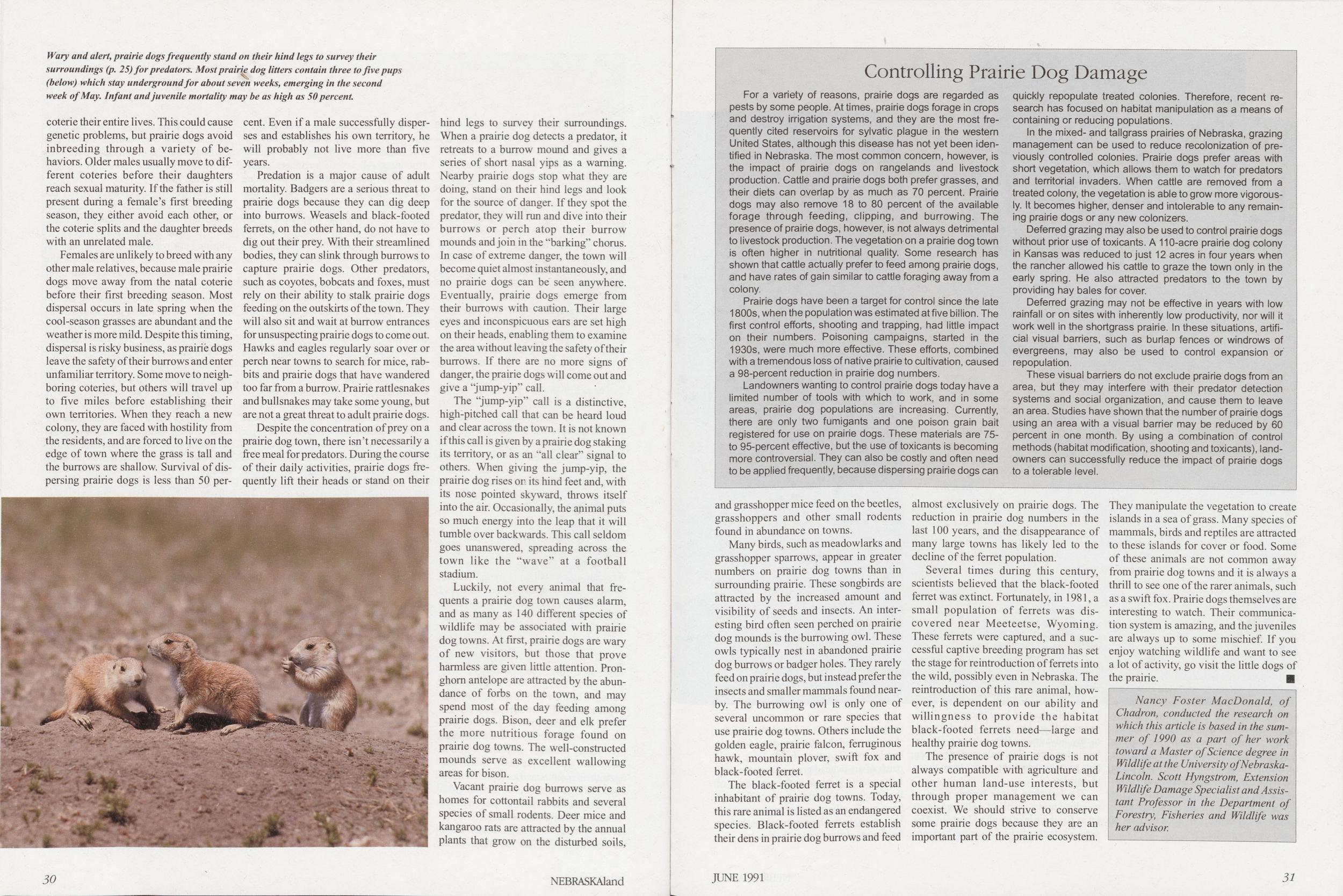
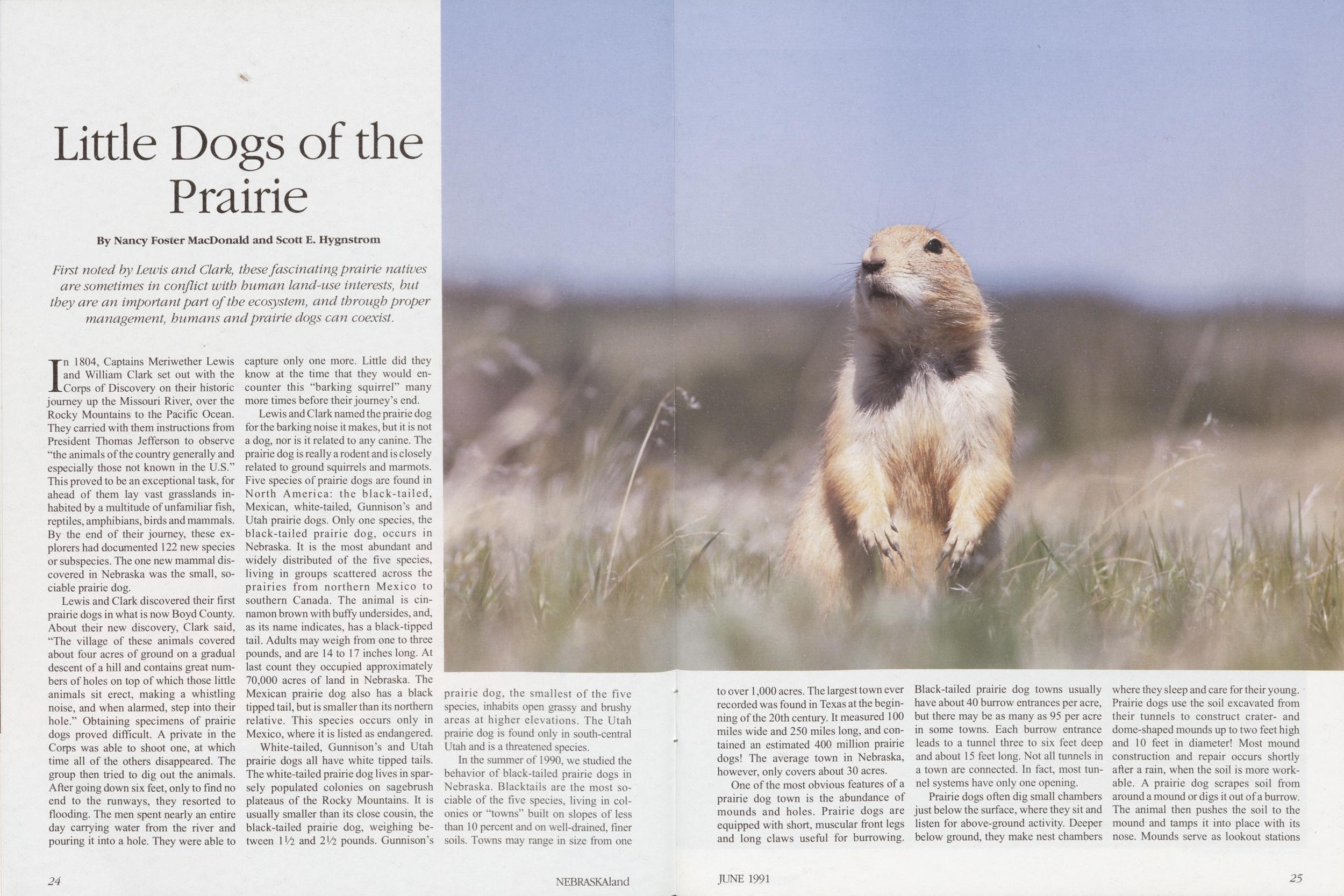
Wary and alert, prairie dogs frequently stand on their hind legs to survey their surroundings (p. 25) for predators. Most prairie dog litters contain three to five pups (below) which stay underground for about seven weeks, emerging in the second week of May. Infant and juvenile mortality may be as high as 50 percent.
coterie their entire lives. This could cause genetic problems, but prairie dogs avoid inbreeding through a variety of behaviors. Older males usually move to different coteries before their daughters reach sexual maturity. If the father is still present during a female's first breeding season, they either avoid each other, or the coterie splits and the daughter breeds with an unrelated male.
Females are unlikely to breed with any other male relatives, because male prairie dogs move away from the natal coterie before their first breeding season. Most dispersal occurs in late spring when the cool-season grasses are abundant and the weather is more mild. Despite this timing, dispersal is risky business, as prairie dogs leave the safety of their burrows and enter unfamiliar territory. Some move to neighboring coteries, but others will travel up to five miles before establishing their own territories. When they reach a new colony, they are faced with hostility from the residents, and are forced to live on the edge of town where the grass is tall and the burrows are shallow. Survival of dispersing prairie dogs is less than 50 percent. Even if a male successfully disperses and establishes his own territory, he will probably not live more than five years.
Predation is a major cause of adult mortality. Badgers are a serious threat to prairie dogs because they can dig deep into burrows. Weasels and black-footed ferrets, on the other hand, do not have to dig out their prey. With their streamlined bodies, they can slink through burrows to capture prairie dogs. Other predators, such as coyotes, bobcats and foxes, must rely on their ability to stalk prairie dogs feeding on the outskirts of the town. They will also sit and wait at burrow entrances for unsuspecting prairie dogs to come out. Hawks and eagles regularly soar over or perch near towns to search for mice, rabbits and prairie dogs that have wandered too far from a burrow. Prairie rattlesnakes and bull snakes may take some young, but are not a great threat to adult prairie dogs.
Despite the concentration of prey on a prairie dog town, there isn't necessarily a free meal for predators. During the course of their daily activities, prairie dogs frequently lift their heads or stand on their hind legs to survey their surroundings. When a prairie dog detects a predator, it retreats to a burrow mound and gives a series of short nasal yips as a warning. Nearby prairie dogs stop what they are doing, stand on their hind legs and look for the source of danger. If they spot the predator, they will run and dive into their burrows or perch atop their burrow mounds and join in the "barking" chorus. In case of extreme danger, the town will become quiet almost instantaneously, and no prairie dogs can be seen anywhere. Eventually, prairie dogs emerge from their burrows with caution. Their large eyes and inconspicuous ears are set high on their heads, enabling them to examine the area without leaving the safety of their burrows. If there are no more signs of danger, the prairie dogs will come out and give a "jump-yip" call.
The "jump-yip" call is a distinctive, high-pitched call that can be heard loud and clear across the town. It is not known if this call is given by a prairie dog staking its territory, or as an "all clear" signal to others. When giving the jump-yip, the prairie dog rises on its hind feet and, with its nose pointed skyward, throws itself into the air. Occasionally, the animal puts so much energy into the leap that it will tumble over backwards. This call seldom goes unanswered, spreading across the town like the "wave" at a football stadium.
Luckily, not every animal that frequents a prairie dog town causes alarm, and as many as 140 different species of wildlife may be associated with prairie dog towns. At first, prairie dogs are wary of new visitors, but those that prove harmless are given little attention. Pronghorn antelope are attracted by the abundance of forbs on the town, and may spend most of the day feeding among prairie dogs. Bison, deer and elk prefer the more nutritious forage found on prairie dog towns. The well-constructed mounds serve as excellent wallowing areas for bison.
Vacant prairie dog burrows serve as homes for cottontail rabbits and several species of small rodents. Deer mice and kangaroo rats are attracted by the annual plants that grow on the disturbed soils,
Controlling Prairie Dog Damage
For a variety of reasons, prairie dogs are regarded as pests by some people. At times, prairie dogs forage in crops and destroy irrigation systems, and they are the most frequently cited reservoirs for sylvatic plague in the western United States, although this disease has not yet been identified in Nebraska. The most common concern, however, is the impact of prairie dogs on rangelands and livestock production. Cattle and prairie dogs both prefer grasses, and their diets can overlap by as much as 70 percent. Prairie dogs may also remove 18 to 80 percent of the available forage through feeding, clipping, and burrowing. The presence of prairie dogs, however, is not always detrimental to livestock production. The vegetation on a prairie dog town is often higher in nutritional quality. Some research has shown that cattle actually prefer to feed among prairie dogs, and have rates of gain similar to cattle foraging away from a colony.
Prairie dogs have been a target for control since the late 1800s, when the population was estimated at five billion. The first control efforts, shooting and trapping, had little impact on their numbers. Poisoning campaigns, started in the 1930s, were much more effective. These efforts, combined with a tremendous loss of native prairie to cultivation, caused a 98-percent reduction in prairie dog numbers.
Landowners wanting to control prairie dogs today have a limited number of tools with which to work, and in some areas, prairie dog populations are increasing. Currently, there are only two fumigants and one poison grain bait registered for use on prairie dogs. These materials are 75- to 95-percent effective, but the use of toxicants is becoming more controversial. They can also be costly and often need to be applied frequently, because dispersing prairie dogs can quickly repopulate treated colonies. Therefore, recent research has focused on habitat manipulation as a means of containing or reducing populations.
In the mixed- and tail grass prairies of Nebraska, grazing management can be used to reduce recolonization of previously controlled colonies. Prairie dogs prefer areas with short vegetation, which allows them to watch for predators and territorial invaders. When cattle are removed from a treated colony, the vegetation is able to grow more vigorously. It becomes higher, denser and intolerable to any remaining prairie dogs or any new colonizers.
Deferred grazing may also be used to control prairie dogs without prior use of toxicants. A 110-acre prairie dog colony in Kansas was reduced to just 12 acres in four years when the rancher allowed his cattle to graze the town only in the early spring. He also attracted predators to the town by providing hay bales for cover.
Deferred grazing may not be effective in years with low rainfall or on sites with inherently low productivity, nor will it work well in the shortgrass prairie. In these situations, artificial visual barriers, such as burlap fences or windrows of evergreens, may also be used to control expansion or repopulation.
These visual barriers do not exclude prairie dogs from an area, but they may interfere with their predator detection systems and social organization, and cause them to leave an area. Studies have shown that the number of prairie dogs using an area with a visual barrier may be reduced by 60 percent in one month. By using a combination of control methods (habitat modification, shooting and toxicants), landowners can successfully reduce the impact of prairie dogs to a tolerable level.
and grasshopper mice feed on the beetles, grasshoppers and other small rodents found in abundance on towns.
Many birds, such as meadowlarks and grasshopper sparrows, appear in greater numbers on prairie dog towns than in surrounding prairie. These songbirds are attracted by the increased amount and visibility of seeds and insects. An interesting bird often seen perched on prairie dog mounds is the burrowing owl. These owls typically nest in abandoned prairie dog burrows or badger holes. They rarely feed on prairie dogs, but instead prefer the insects and smaller mammals found nearby. The burrowing owl is only one of several uncommon or rare species that use prairie dog towns. Others include the golden eagle, prairie falcon, ferruginous hawk, mountain plover, swift fox and black-footed ferret.
The black-footed ferret is a special inhabitant of prairie dog towns. Today, this rare animal is listed as an endangered species. Black-footed ferrets establish their dens in prairie dog burrows and feed almost exclusively on prairie dogs. The reduction in prairie dog numbers in the last 100 years, and the disappearance of many large towns has likely led to the decline of the ferret population.
Several times during this century, scientists believed that the black-footed ferret was extinct. Fortunately, in 1981, a small population of ferrets was discovered near Meeteetse, Wyoming. These ferrets were captured, and a successful captive breeding program has set the stage for reintroduction of ferrets into the wild, possibly even in Nebraska. The reintroduction of this rare animal, however, is dependent on our ability and willingness to provide the habitat black-footed ferrets need—large and healthy prairie dog towns.
The presence of prairie dogs is not always compatible with agriculture and other human land-use interests, but through proper management we can coexist. We should strive to conserve some prairie dogs because they are an important part of the prairie ecosystem. They manipulate the vegetation to create islands in a sea of grass. Many species of mammals, birds and reptiles are attracted to these islands for cover or food. Some of these animals are not common away from prairie dog towns and it is always a thrill to see one of the rarer animals, such as a swift fox. Prairie dogs themselves are interesting to watch. Their communication system is amazing, and the juveniles are always up to some mischief. If you enjoy watching wildlife and want to see a lot of activity, go visit the little dogs of the prairie.
Fish The Weeds
Relaxing on the grassy bank I fiddled with my tackle and argued with myself about the necessity of fishing weed heds. One side of me quarreled, "Why invite the frustration?" while the other side answered, "Because you want to catch fish, and generally speaking, where there are weeds there'll be fish"
Weeds ... best known as the nemesis of gardeners and elegant lawn aficionados, some species also thrive in and around standing and flowing waters where they invariably become the archenemies of every fisherman who encounters them. At best they are a mere nuisance, especially to those who fish shallow water and find themselves spending more time pulling stems and leaves from the hook than actually fishing. They can become so frustrating that the only answer is to move to a different spot where there are fewer weeds. At worst, weeds become an overwhelming obsession, finally driving the defeated angler to trade in his graphite bass sticks or delicate fly rods for a set of (ugh) used golf clubs.
But recent studies have shown that weed beds can be conquered! In fact, weeds can actually improve fishing because they attract fish, and just knowing that can dramatically increase your chances of success. Recognizing spots where fish are likely to be, helps you to spend less time working unproductive water.
As a veteran of many weed bed wars, I've finally learned how to cope with the green stuff, and to make it actually work to my advantage. But it hasn't always been that way. I've only recently been able to come away the victor from those skirmishes.
PHOTOS BY KEN BOUC
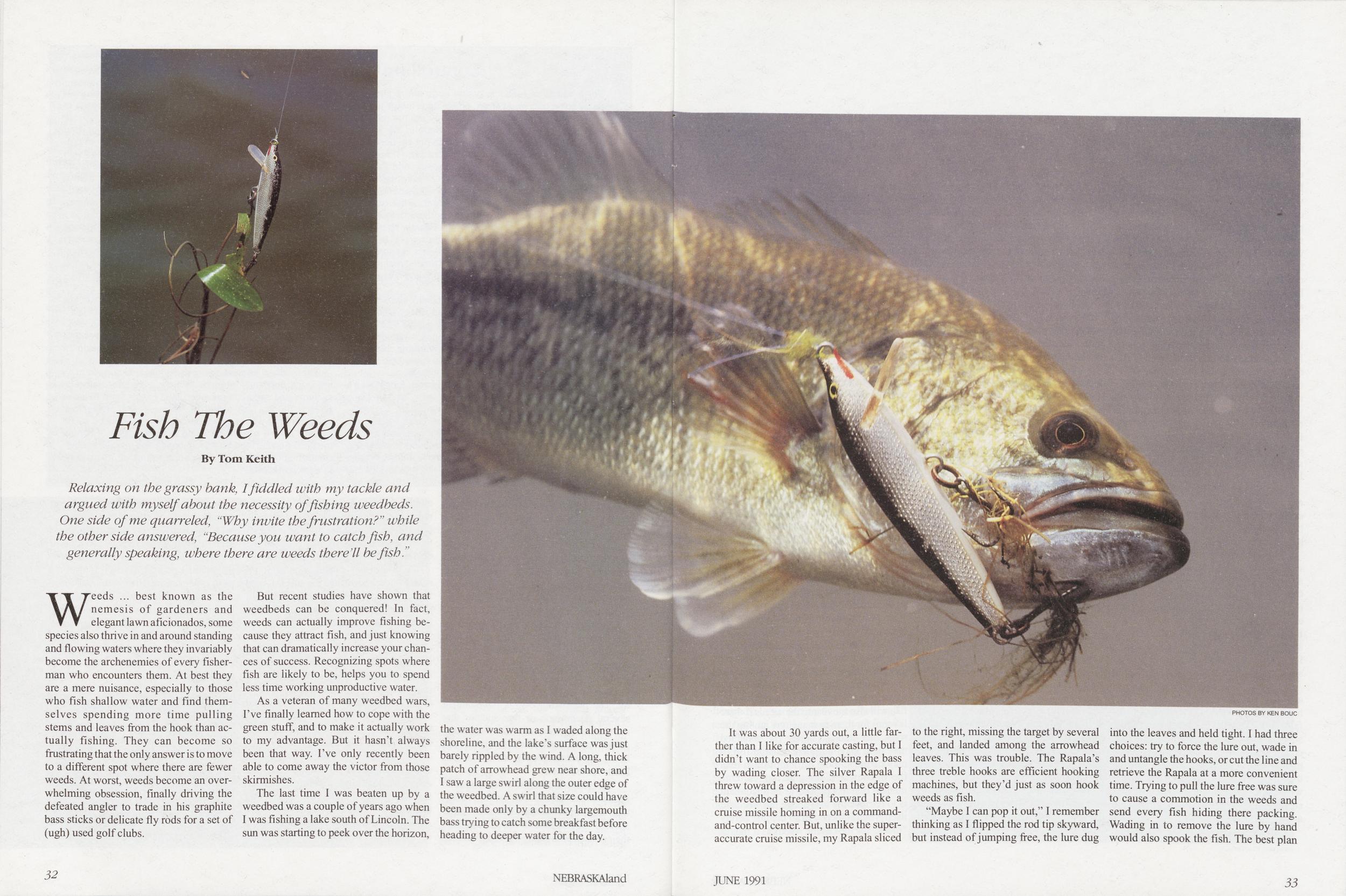
It was about 30 yards out, a little farther than I like for accurate casting, but I didn't want to chance spooking the bass by wading closer. The silver Rapala I threw toward a depression in the edge of the weed bed streaked forward like a cruise missile homing in on a command and-control center. But, unlike the super accurate cruise missile, my Rapala sliced to the right, missing the target by several feet, and landed among the arrowhead leaves. This was trouble. The Rapala's three treble hooks are efficient hooking machines, but they'd just as soon hook weeds as fish.
"Maybe I can pop it out," I remember thinking as I flipped the rod tip skyward, but instead of jumping free, the lure dug into the leaves and held tight. I had three choices: try to force the lure out, wade in and untangle the hooks, or cut the line and retrieve the Rapala at a more convenient time. Trying to pull the lure free was sure to cause a commotion in the weeds and send every fish hiding there packing. Wading in to remove the lure by hand would also spook the fish. The best plan 32 NEBRASKAland JUNE 1991 33 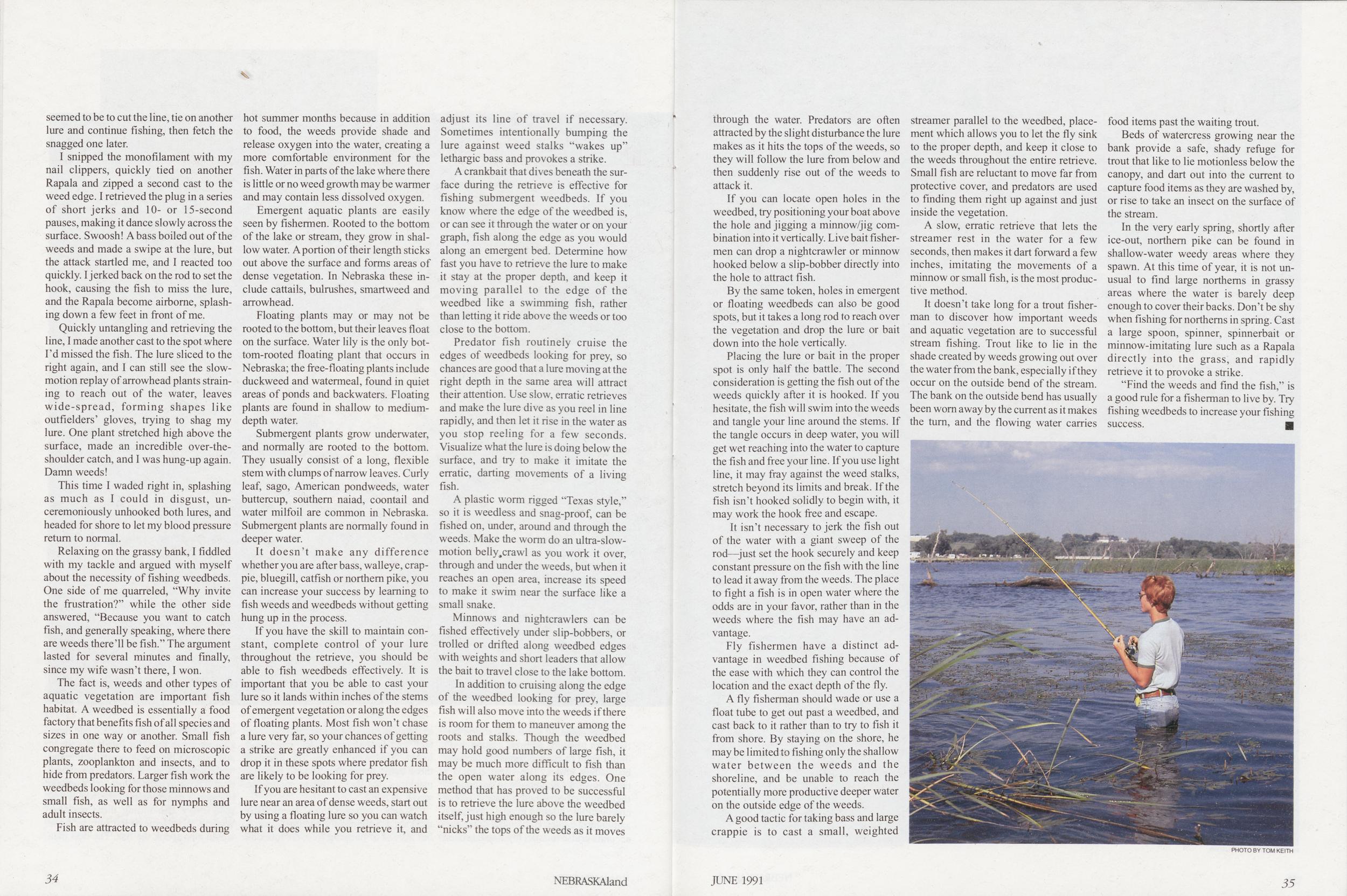 seemed to be to cut the line, tie on another lure and continue fishing, then fetch the snagged one later.
I snipped the monofilament with my nail clippers, quickly tied on another Rapala and zipped a second cast to the weed edge. I retrieved the plug in a series of short jerks and 10- or 15-second pauses, making it dance slowly across the surface. Swoosh! A bass boiled out of the weeds and made a swipe at the lure, but the attack startled me, and I reacted too quickly. I jerked back on the rod to set the hook, causing the fish to miss the lure, and the Rapala become airborne, splashing down a few feet in front of me.
Quickly untangling and retrieving the line, I made another cast to the spot where I'd missed the fish. The lure sliced to the right again, and I can still see the slow motion replay of arrowhead plants straining to reach out of the water, leaves wide-spread, forming shapes like outfielders' gloves, trying to shag my lure. One plant stretched high above the surface, made an incredible over-the- shoulder catch, and 1 was hung-up again. Damn weeds!
This time I waded right in, splashing as much as I could in disgust, unceremoniously unhooked both lures, and headed for shore to let my blood pressure return to normal.
Relaxing on the grassy bank, I fiddled with my tackle and argued with myself about the necessity of fishing weed beds. One side of me quarreled, "Why invite the frustration?" while the other side answered, "Because you want to catch fish, and generally speaking, where there are weeds there'll be fish." The argument lasted for several minutes and finally, since mv wife wasn't there, I won.
The fact is, weeds and other types of aquatic vegetation are important fish habitat. A weed bed is essentially a food factory that benefits fish of all species and sizes in one way or another. Small fish congregate there to feed on microscopic plants, zooplankton and insects, and to hide from predators. Larger fish work the weed beds looking for those minnows and small fish, as well as for nymphs and adult insects.
Fish are attracted to weed beds during hot summer months because in addition to food, the weeds provide shade and release oxygen into the water, creating a more comfortable environment for the fish. Water in parts of the lake where there is little or no weed growth may be warmer and may contain less dissolved oxygen.
Emergent aquatic plants are easily seen by fishermen. Rooted to the bottom of the lake or stream, they grow in shallow water. A portion of their length sticks out above the surface and forms areas of dense vegetation. In Nebraska these include cattails, bulrushes, smartweed and arrowhead.
Floating plants may or may not be rooted to the bottom, but their leaves float on the surface. Water lily is the only bottom-rooted floating plant that occurs in Nebraska; the free-floating plants include duckweed and watermeal, found in quiet areas of ponds and backwaters. Floating plants are found in shallow to medium depth water.
Submergent plants grow underwater, and normally are rooted to the bottom. They usually consist of a long, flexible stem with clumps of narrow leaves. Curly leaf, sago, American pondweeds, water buttercup, southern naiad, coontail and water milfoil are common in Nebraska. Submergent plants are normally found in deeper water.
It doesn't make any difference whether you are after bass, walleye, crappie, bluegill, catfish or northern pike, you can increase your success by learning to fish weeds and weed beds without getting hung up in the process.
If you have the skill to maintain constant, complete control of your lure throughout the retrieve, you should be able to fish weed beds effectively. It is important that you be able to cast your lure so it lands within inches of the stems of emergent vegetation or along the edges of floating plants. Most fish won't chase a lure very far, so your chances of getting a strike are greatly enhanced if you can drop it in these spots where predator fish are likely to be looking for prey.
If you are hesitant to cast an expensive lure near an area of dense weeds, start out by using a floating lure so you can watch what it does while you retrieve it, and adjust its line of travel if necessary. Sometimes intentionally bumping the lure against weed stalks "wakes up" lethargic bass and provokes a strike.
A crankbait that dives beneath the surface during the retrieve is effective for fishing submergent weed beds. If you know where the edge of the weed bed is, or can see it through the water or on your graph, fish along the edge as you would along an emergent bed. Determine how fast you have to retrieve the lure to make it stay at the proper depth, and keep it moving parallel to the edge of the weed bed like a swimming fish, rather than letting it ride above the weeds or too close to the bottom.
Predator fish routinely cruise the edges of weed beds looking for prey, so chances are good that a lure moving at the right depth in the same area will attract their attention. Use slow, erratic retrieves and make the lure dive as you reel in line rapidly, and then let it rise in the water as you stop reeling for a few seconds. Visualize what the lure is doing below the surface, and try to make it imitate the erratic, darting movements of a living fish.
A plastic worm rigged "Texas style," so it is weedless and snag-proof, can be fished on, under, around and through the weeds. Make the worm do an ultra-slow- motion belly crawl as you work it over, through and under the weeds, but when it reaches an open area, increase its speed to make it swim near the surface like a small snake.
Minnows and nightcrawlers can be fished effectively under slip-bobbers, or trolled or drifted along weed bed edges with weights and short leaders that allow the bait to travel close to the lake bottom.
In addition to cruising along the edge of the weed bed looking for prey, large fish will also move into the weeds if there is room for them to maneuver among the roots and stalks. Though the weed bed may hold good numbers of large fish, it may be much more difficult to fish than the open water along its edges. One method that has proved to be successful is to retrieve the lure above the weed bed itself, just high enough so the lure barely "nicks" the tops of the weeds as it moves through the water. Predators are often attracted by the slight disturbance the lure makes as it hits the tops of the weeds, so they will follow the lure from below and then suddenly rise out of the weeds to attack it.
If you can locate open holes in the weed bed, try positioning your boat above the hole and jigging a minnow/jig combination into it vertically. Live bait fishermen can drop a nightcrawler or minnow hooked below a slip-bobber directly into the hole to attract fish.
By the same token, holes in emergent or floating weed beds can also be good spots, but it takes a long rod to reach over the vegetation and drop the lure or bait down into the hole vertically.
Placing the lure or bait in the proper spot is only half the battle. The second consideration is getting the fish out of the weeds quickly after it is hooked. If you hesitate, the fish will swim into the weeds and tangle your line around the stems. If the tangle occurs in deep water, you will get wet reaching into the water to capture the fish and free your line. If you use light line, it may fray against the weed stalks, stretch beyond its limits and break. If the fish isn't hooked solidly to begin with, it may work the hook free and escape.
It isn't necessary to jerk the fish out of the water with a giant sweep of the rod—just set the hook securely and keep constant pressure on the fish with the line to lead it away from the weeds. The place to fight a fish is in open water where the odds are in your favor, rather than in the weeds where the fish may have an advantage.
Fly fishermen have a distinct advantage in weed bed fishing because of the ease with which they can control the location and the exact depth of the fly.
A fly fisherman should wade or use a float tube to get out past a weed bed, and cast back to it rather than to try to fish it from shore. By staying on the shore, he may be limited to fishing only the shallow water between the weeds and the shoreline, and be unable to reach the potentially more productive deeper water on the outside edge of the weeds.
A good tactic for taking bass and large crappie is to cast a small, weighted streamer parallel to the weed bed, placement which allows you to let the fly sink to the proper depth, and keep it close to the weeds throughout the entire retrieve. Small fish are reluctant to move far from protective cover, and predators are used to finding them right up against and just inside the vegetation.
A slow, erratic retrieve that lets the streamer rest in the water for a few seconds, then makes it dart forward a few inches, imitating the movements of a minnow or small fish, is the most productive method.
It doesn't take long for a trout fisherman to discover how important weeds and aquatic vegetation are to successful stream fishing. Trout like to lie in the shade created by weeds growing out over the water from the bank, especially if they occur on the outside bend of the stream. The bank on the outside bend has usually been worn away by the current as it makes the turn, and the flowing water carries food items past the waiting trout.
Beds of watercress growing near the bank provide a safe, shady refuge for trout that like to lie motionless below the canopy, and dart out into the current to capture food items as they are washed by, or rise to take an insect on the surface of the stream.
In the very early spring, shortly after ice-out, northern pike can be found in shallow-water weedy areas where they spawn. At this time of year, it is not unusual to find large northerns in grassy areas where the water is barely deep enough to cover their backs. Don't be shy when fishing for northerns in spring. Cast a large spoon, spinner, spinnerbait or minnow-imitating lure such as a Rapala directly into the grass, and rapidly retrieve it to provoke a strike.
"Find the weeds and find the fish," is a good rule for a fisherman to live by. Try fishing weed beds to increase your fishing success.
PHOTO BY TOM KEITH
MAPPING NEBRASKA WETLANDS
In order to help Nebraskans understand the number, kind and location of the state's wetlands, the National Wetlands Inventory is identifying and classifying all the wetlands in Nebraska using high-altitude infrared photography. Final maps are available for 56 percent of the state, and the project is continuing.Whatever you call them, marshes, sloughs, swamps or swales, wetlands occur in a variety of landscapes. They may be any shape or size and may be either deep or shallow. They may contain water all year or only for several weeks. Wetlands often have fluctuating water levels not only from year to year, but also from season to season. Wetlands may in fact be "dry" as much as they are "wet."
Wetlands occur throughout Nebraska. They are most numerous in the Sandhills, a moderate number remain in portions of the Rainwater Basin, and comparatively fewer in the Panhandle. Along major stretches of Interstate 80, the Platte River is the dominant feature, and the Missouri River marks Nebraska's eastern border. Perennial and intermittent streams, small impoundments and larger reservoirs occur all across Nebraska's landscape. Nebraska contains diverse surface water features and aquatic plant communities that provide the state with a rich and abundant wetland resource.
Although wetlands have a wide diversity of physical features, they have one major component in common: water. More than just water, wetlands are those areas that maintain sufficient water to alter plant composition and to modify underlying soils. Wetland plants (called hydrophytes or water plants), such as cattails, sedges and rushes, have special adaptations that allow them to live in a watery environment. These adaptations include special tissues that allow them to transport oxygen from the air into the roots. Wetland plants also have defense mechanisms that prevent toxicity buildup in plant tissues so they are not poisoned by chemical changes in waterlogged soils. Water ponded in depressions will drown upland plants, yet wetland plants in the same depression will thrive.
Wetlands are a natural resource affecting the quality of life for all Nebraska's residents, and wetlands are among the most productive land types in the world. Wetlands provide water for irrigation, for municipal and industrial water supplies and for groundwater recharge. Wetlands also retain flood water and trap chemical runoff. Further, wetlands provide habitat for more species of wildlife than any other single habitat type in Nebraska.
Some Nebraska wetlands are of national and even international importance. Three major wetland complexes, for example, provide critical habitat to continental wildlife populations. From south to north, the Rainwater Basin, the Platte River and the Sandhills wetlands serve as vital spring staging, breeding, migration and wintering habitat both for endangered species and for millions of migratory waterbirds.
36 NEBRASKAland JUNE 1991 37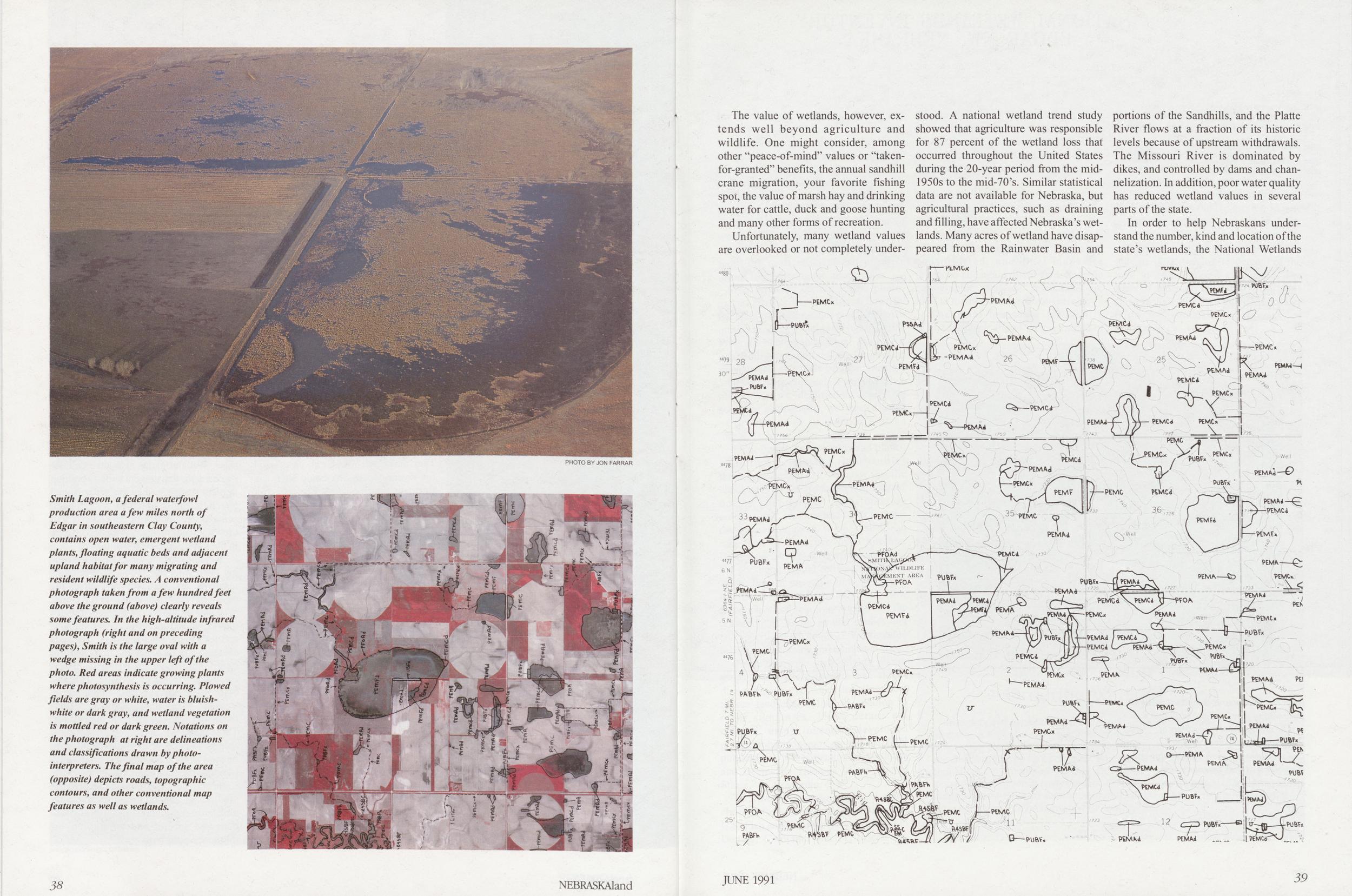
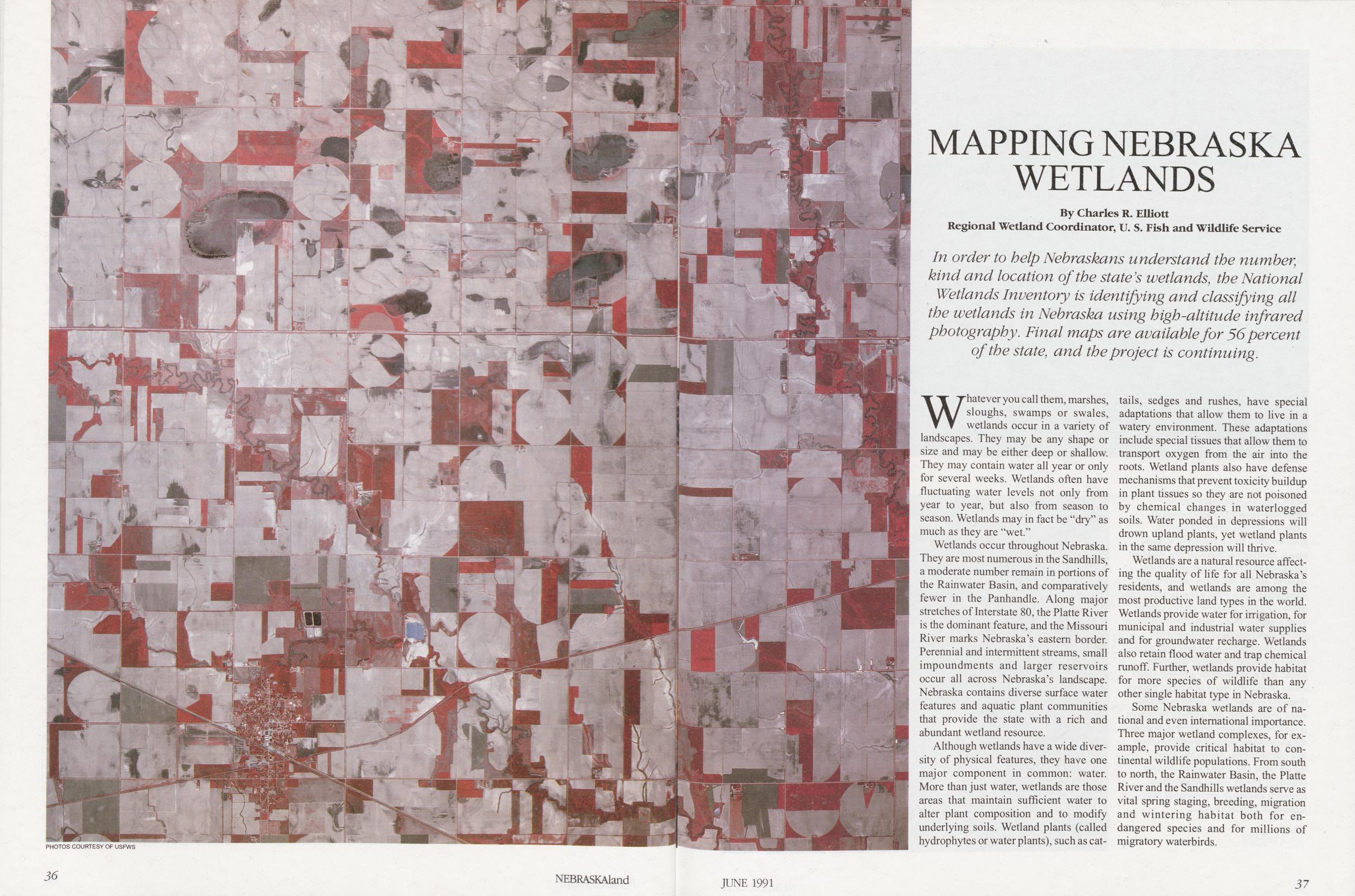
Smith Lagoon, a federal waterfowl production area a few miles north of Edgar in southeastern Clay County, contains open water, emergent wetland plants, floating aquatic beds and adjacent upland habitat for many migrating and resident wildlife species. A conventional photograph taken from a few hundred feet above the ground (above) clearly reveals some features. In the high-altitude infrared photograph (right and on preceding pages), Smith is the large oval with a wedge missing in the upper left of the photo. Red areas indicate growing plants where photosynthesis is occurring. Plowed fields are gray or white, water is bluish white or dark gray, and wetland vegetation is mottled red or dark green. Notations on the photograph at right are delineations and classifications drawn by photo- interpreters. The final map of the area (opposite) depicts roads, topographic contours, and other conventional map features as well as wetlands.
The value of wetlands, however, extends well beyond agriculture and wildlife. One might consider, among other "peace-of-mind" values or "taken-for-granted" benefits, the annual sandhill crane migration, your favorite fishing spot, the value of marsh hay and drinking water for cattle, duck and goose hunting and many other forms of recreation.
Unfortunately, many wetland values are overlooked or not completely understood. A national wetland trend study showed that agriculture was responsible for 87 percent of the wetland loss that occurred throughout the United States during the 20-year period from the mid-1950s to the mid-70's. Similar statistical data are not available for Nebraska, but agricultural practices, such as draining and filling, have affected Nebraska's wetlands. Many acres of wetland have disappeared from the Rainwater Basin and portions of the Sandhills, and the Platte River flows at a fraction of its historic levels because of upstream withdrawals. The Missouri River is dominated by dikes, and controlled by dams and channelization. In addition, poor water quality has reduced wetland values in several parts of the state.
In order to help Nebraskans understand the number, kind and location of the state's wetlands, the National Wetlands
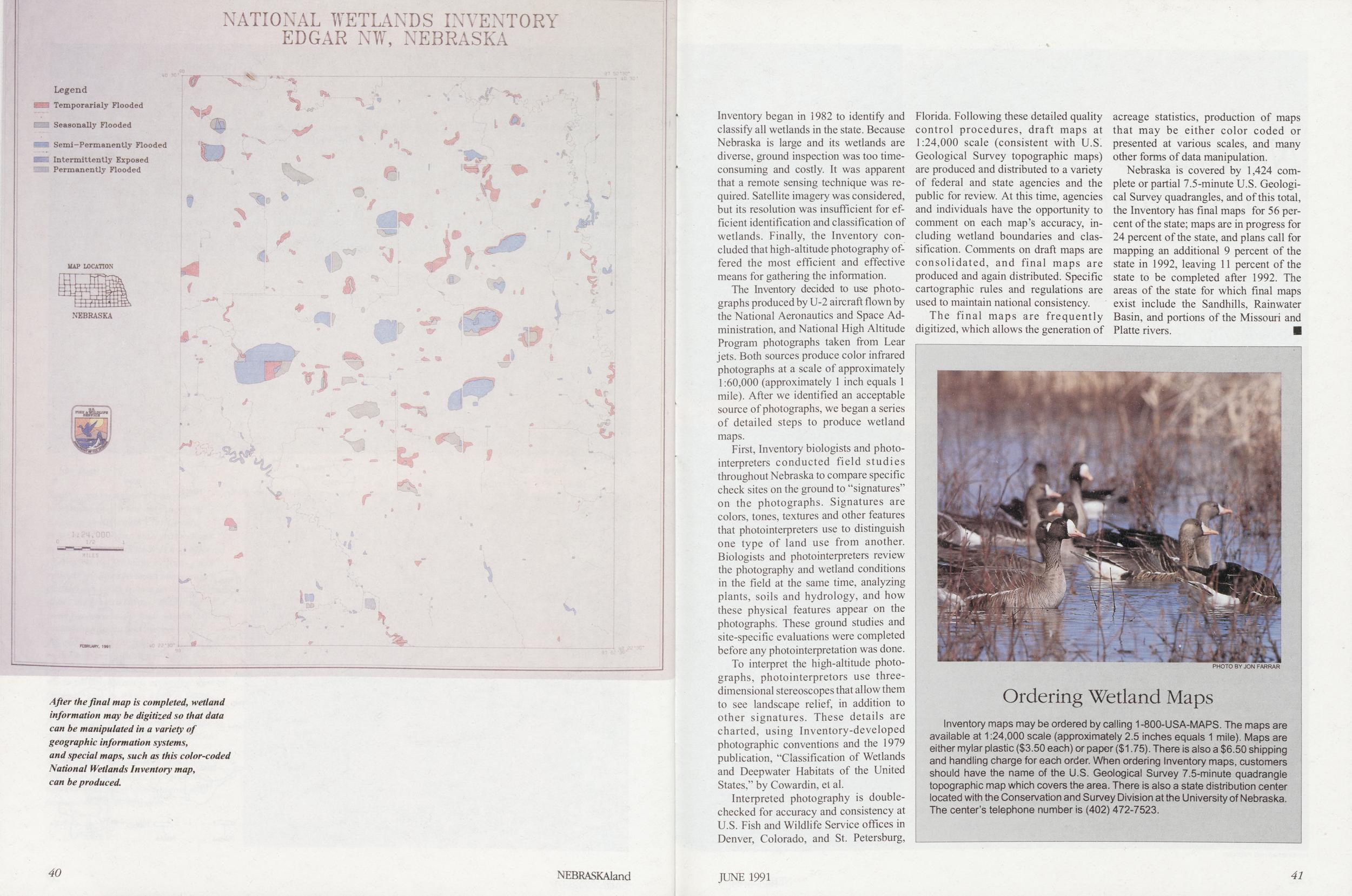
NATIONAL WETLANDS INVENTORY EDGAR NW, NEBRASKA Legend 7771 Temporarialy Flooded Seasonally Flooded Semi-Permanently Flooded Intermittently Exposed Permanently Flooded MAP LOCATION NEBRASKA FEBRUARY, 1991
After the final map is completed, wetland information may be digitized so that data can be manipulated in a variety of geographic information systems, and special maps, such as this color-coded National Wetlands Inventory map, can be produced.
Inventory began in 1982 to identify and classify all wetlands in the state. Because Nebraska is large and its wetlands are diverse, ground inspection was too time consuming and costly. It was apparent that a remote sensing technique was required. Satellite imagery was considered, but its resolution was insufficient for efficient identification and classification of wetlands. Finally, the Inventory concluded that high-altitude photography offered the most efficient and effective means for gathering the information.
The Inventory decided to use photographs produced by U-2 aircraft flown by the National Aeronautics and Space Administration, and National High Altitude Program photographs taken from Lear jets. Both sources produce color infrared photographs at a scale of approximately 1:60,000 (approximately 1 inch equals 1 mile). After we identified an acceptable source of photographs, we began a series of detailed steps to produce wetland maps.
First, Inventory biologists and photo-interpreters conducted field studies throughout Nebraska to compare specific check sites on the ground to "signatures" on the photographs. Signatures are colors, tones, textures and other features that photo interpreters use to distinguish one type of land use from another. Biologists and photo interpreters review the photography and wetland conditions in the field at the same time, analyzing plants, soils and hydrology, and how these physical features appear on the photographs. These ground studies and site-specific evaluations were completed before any photo interpretation was done.
To interpret the high-altitude photographs, photo interpreters use three=dimensional stereoscopes that allow them to see landscape relief, in addition to other signatures. These details are charted, using Inventory-developed photographic conventions and the 1979 publication, "Classification of Wetlands and Deepwater Habitats of the United States," by Coward in, et al.
Interpreted photography is double-checked for accuracy and consistency at U.S. Fish and Wildlife Service offices in Denver, Colorado, and St. Petersburg, Florida. Following these detailed quality control procedures, draft maps at 1:24,000 scale (consistent with U.S. Geological Survey topographic maps) are produced and distributed to a variety of federal and state agencies and the public for review. At this time, agencies and individuals have the opportunity to comment on each map's accuracy, including wetland boundaries and classification. Comments on draft maps are consolidated, and final maps are produced and again distributed. Specific cartographic rules and regulations are used to maintain national consistency.
The final maps are frequently digitized, which allows the generation of acreage statistics, production of maps that may be either color coded or presented at various scales, and many other forms of data manipulation.
Nebraska is covered by 1,424 complete or partial 7.5-minute U.S. Geological Survey quadrangles, and of this total, the Inventory has final maps for 56 percent of the state; maps are in progress for 24 percent of the state, and plans call for mapping an additional 9 percent of the state in 1992, leaving 11 percent of the state to be completed after 1992. The areas of the state for which final maps exist include the Sandhills, Rainwater Basin, and portions of the Missouri and Platte rivers.
Inventory maps may be ordered by calling 1-800-USA-MAPS. The maps are available at 1:24,000 scale (approximately 2.5 inches equals 1 mile). Maps are either mylar plastic ($3.50 each) or paper ($1.75). There is also a $6.50 shipping and handling charge for each order. When ordering Inventory maps, customers should have the name of the U.S. Geological Survey 7.5-minute quadrangle topographic map which covers the area. There is also a state distribution center located with the Conservation and Survey Division at the University of Nebraska. The center's telephone number is (402) 472-7523.
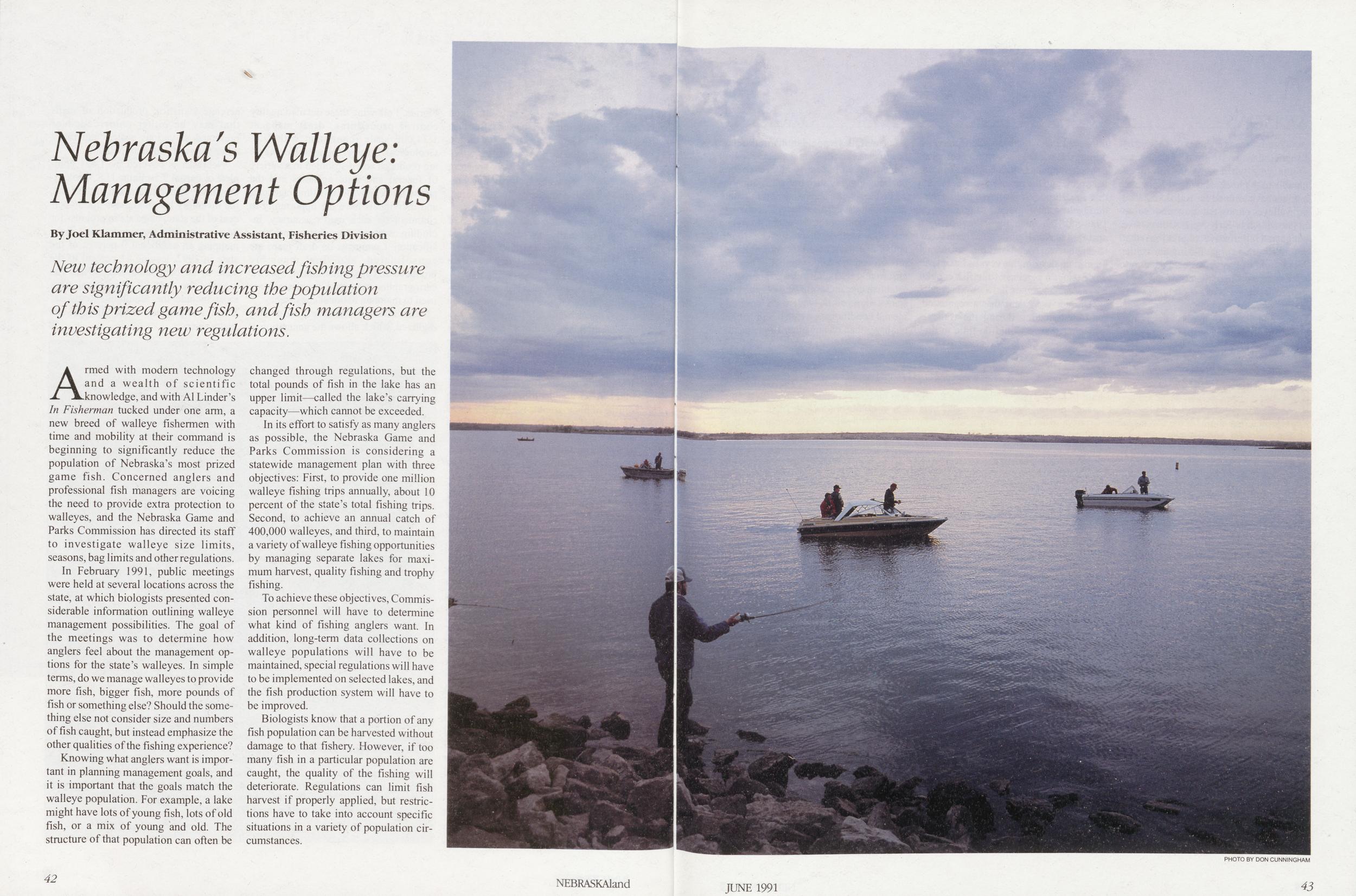
Nebraska's Walleye: Management Options
New technology and increased fishing pressure are significantly reducing the population of this prized game fish, and fish managers are investigating new regulations.Armed with modern technology and a wealth of scientific knowledge, and with Al Tinder's In Fisherman tucked under one arm, a new breed of walleye fishermen with time and mobility at their command is beginning to significantly reduce the population of Nebraska's most prized game fish. Concerned anglers and professional fish managers are voicing the need to provide extra protection to walleyes, and the Nebraska Game and Parks Commission has directed its staff to investigate walleye size limits, seasons, bag limits and other regulations.
In February 1991, public meetings were held at several locations across the state, at which biologists presented considerable information outlining walleye management possibilities. The goal of the meetings was to determine how anglers feel about the management options for the state's walleyes. In simple terms, do we manage walleyes to provide more fish, bigger fish, more pounds of fish or something else? Should the something else not consider size and numbers offish caught, but instead emphasize the other qualities of the fishing experience?
Knowing what anglers want is important in planning management goals, and it is important that the goals match the walleye population. For example, a lake might have lots of young fish, lots of old fish, or a mix of young and old. The structure of that population can often be changed through regulations, but the total pounds of fish in the lake has an upper limit—called the lake's carrying capacity—which cannot be exceeded.
In its effort to satisfy as many anglers as possible, the Nebraska Game and Parks Commission is considering a statewide management plan with three objectives: First, to provide one million walleye fishing trips annually, about 10 percent of the state's total fishing trips. Second, to achieve an annual catch of 400,000 walleyes, and third, to maintain a variety of walleye fishing opportunities by managing separate lakes for maximum harvest, quality fishing and trophy fishing.
To achieve these objectives, Commission personnel will have to determine what kind of fishing anglers want. In addition, long-term data collections on walleye populations will have to be maintained, special regulations will have to be implemented on selected lakes, and the fish production system will have to be improved.
Biologists know that a portion of any fish population can be harvested without damage to that fishery. However, if too many fish in a particular population are caught, the quality of the fishing will deteriorate. Regulations can limit fish harvest if properly applied, but restrictions have to take into account specific situations in a variety of population circumstances.
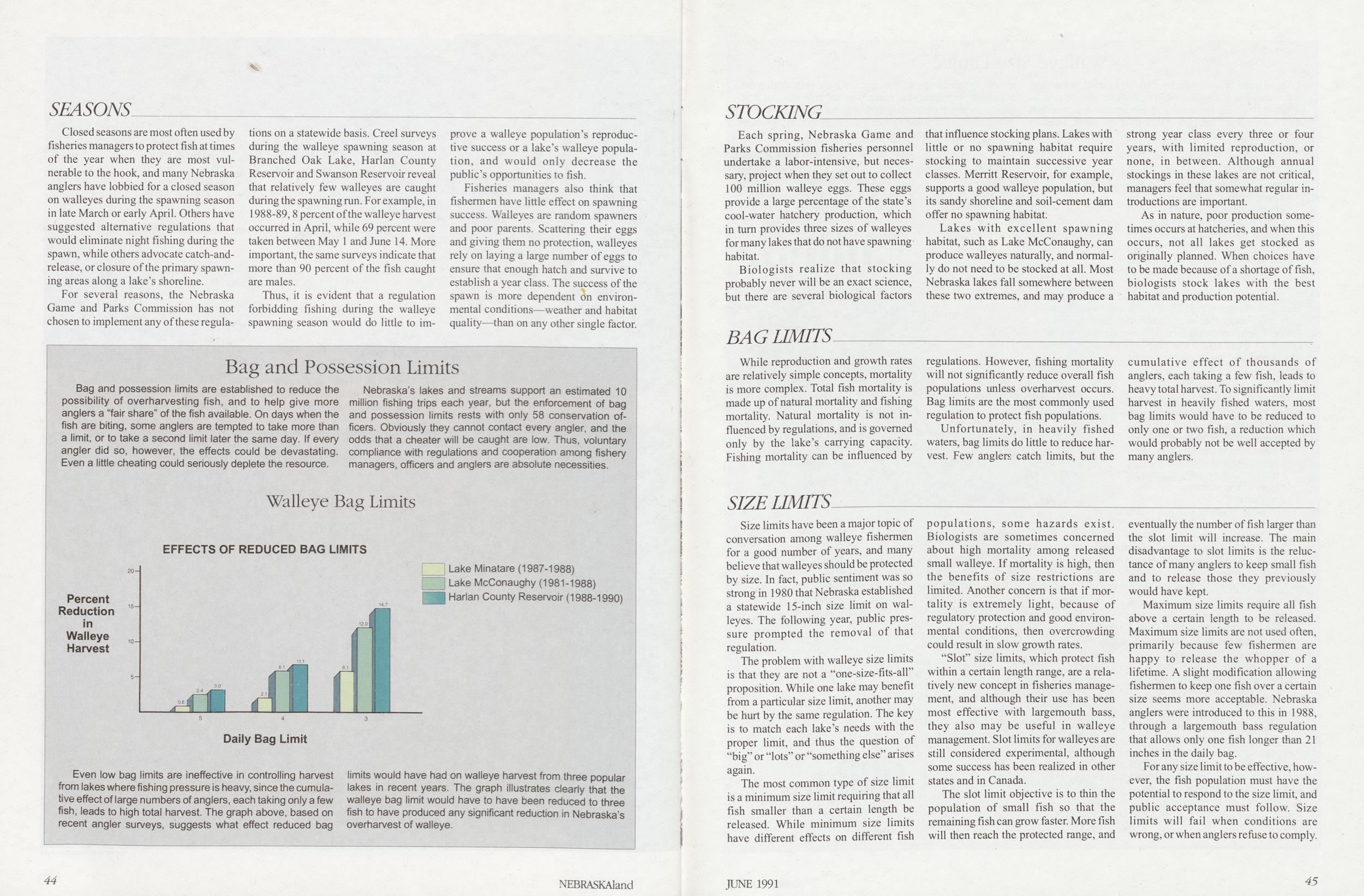 SEASONS.
Closed seasons are most often used by fisheries managers to protect fish at times of the year when they are most vulnerable to the hook, and many Nebraska anglers have lobbied for a closed season on walleyes during the spawning season in late March or early April. Others have suggested alternative regulations that would eliminate night fishing during the spawn, while others advocate catch-and- release, or closure of the primary spawning areas along a lake's shoreline.
For several reasons, the Nebraska Game and Parks Commission has not chosen to implement any of these regulations on a statewide basis. Creel surveys during the walleye spawning season at Branched Oak Lake, Harlan County Reservoir and Swanson Reservoir reveal that relatively few walleyes are caught during the spawning run. For example, in 1988-89,8 percent of the walleye harvest occurred in April, while 69 percent were taken between May 1 and June 14. More important, the same surveys indicate that more than 90 percent of the fish caught are males.
Thus, it is evident that a regulation forbidding fishing during the walleye spawning season would do little to improve a walleye population's reproductive success or a lake's walleye population, and would only decrease the public's opportunities to fish.
Fisheries managers also think that fishermen have little effect on spawning success. Walleyes are random spawners and poor parents. Scattering their eggs and giving them no protection, walleyes rely on laying a large number of eggs to ensure that enough hatch and survive to establish a year class. The success of the spawn is more dependent on environ- mental conditions—weather and habitat quality—than on any other single factor.
Bag and Possession Limits
Bag and possession limits are established to reduce the possibility of over harvesting fish, and to help give more anglers a "fair share" of the fish available. On days when the fish are biting, some anglers are tempted to take more than a limit, or to take a second limit later the same day. If every angler did so, however, the effects could be devastating. Even a little cheating could seriously deplete the resource. Nebraska's lakes and streams support an estimated 10 million fishing trips each year, but the enforcement of bag and possession limits rests with only 58 conservation officers. Obviously they cannot contact every angler, and the odds that a cheater will be caught are low. Thus, voluntary compliance with regulations and cooperation among fishery managers, officers and anglers are absolute necessities.
Walleye Bag LimitsEFFECTS OF REDUCED BAG LIMITS 20- Percent Reduction in Walleye Harvest 15- 10- 5- 14.7 Lake Minatare (1987-1988) Lake McConaughy (1981-1988) Harlan County Reservoir (1988-1990) 11.1 2.4 3.0 Daily Bag Limit
Even low bag limits are ineffective in controlling harvest from lakes where fishing pressure is heavy, since the cumulative effect of large numbers of anglers, each taking only a few fish, leads to high total harvest. The graph above, based on recent angler surveys, suggests what effect reduced bag limits would have had on walleye harvest from three popular lakes in recent years. The graph illustrates clearly that the walleye bag limit would have to have been reduced to three fish to have produced any significant reduction in Nebraska's over harvest of walleye.
Each spring, Nebraska Game and Parks Commission fisheries personnel undertake a labor-intensive, but necessary, project when they set out to collect 100 million walleye eggs. These eggs provide a large percentage of the state's cool-water hatchery production, which in turn provides three sizes of walleyes for many lakes that do not have spawning habitat.
Biologists realize that stocking probably never will be an exact science, but there are several biological factors that influence stocking plans. Lakes with little or no spawning habitat require stocking to maintain successive year classes. Merritt Reservoir, for example, supports a good walleye population, but its sandy shoreline and soil-cement dam offer no spawning habitat.
Lakes with excellent spawning habitat, such as Lake McConaughy, can produce walleyes naturally, and normally do not need to be stocked at all. Most Nebraska lakes fall somewhere between these two extremes, and may produce a strong year class every three or four years, with limited reproduction, or none, in between. Although annual stockings in these lakes are not critical, managers feel that somewhat regular introductions are important.
As in nature, poor production sometimes occurs at hatcheries, and when this occurs, not all lakes get stocked as originally planned. When choices have to be made because of a shortage offish, biologists stock lakes with the best habitat and production potential.
BAG LIMITSWhile reproduction and growth rates are relatively simple concepts, mortality is more complex. Total fish mortality is made up of natural mortality and fishing mortality. Natural mortality is not influenced by regulations, and is governed only by the lake's carrying capacity. Fishing mortality can be influenced by regulations. However, fishing mortality will not significantly reduce overall fish populations unless over harvest occurs. Bag limits are the most commonly used regulation to protect fish populations.
Unfortunately, in heavily fished waters, bag limits do little to reduce harvest. Few anglers catch limits, but the cumulative effect of thousands of anglers, each taking a few fish, leads to heavy total harvest. To significantly limit harvest in heavily fished waters, most bag limits would have to be reduced to only one or two fish, a reduction which would probably not be well accepted by many anglers.
SIZE LIMITSSize limits have been a major topic of conversation among walleye fishermen for a good number of years, and many believe that walleyes should be protected by size. In fact, public sentiment was so strong in 1980 that Nebraska established a statewide 15-inch size limit on walleyes. The following year, public pressure prompted the removal of that regulation.
The problem with walleye size limits is that they are not a "one-size-fits-all" proposition. While one lake may benefit from a particular size limit, another may be hurt by the same regulation. The key is to match each lake's needs with the proper limit, and thus the question of "big" or "lots" or "something else" arises again.
The most common type of size limit is a minimum size limit requiring that all fish smaller than a certain length be released. While minimum size limits have different effects on different fish populations, some hazards exist. Biologists are sometimes concerned about high mortality among released small walleye. If mortality is high, then the benefits of size restrictions are limited. Another concern is that if mortality is extremely light, because of regulatory protection and good environmental conditions, then overcrowding could result in slow growth rates.
"Slot" size limits, which protect fish within a certain length range, are a relatively new concept in fisheries management, and although their use has been most effective with largemouth bass, they also may be useful in walleye management. Slot limits for walleyes are still considered experimental, although some success has been realized in other states and in Canada.
The slot limit objective is to thin the population of small fish so that the remaining fish can grow faster. More fish will then reach the protected range, and eventually the number offish larger than the slot limit will increase. The main disadvantage to slot limits is the reluctance of many anglers to keep small fish and to release those they previously would have kept.
Maximum size limits require all fish above a certain length to be released. Maximum size limits are not used often, primarily because few fishermen are happy to release the whopper of a lifetime. A slight modification allowing fishermen to keep one fish over a certain size seems more acceptable. Nebraska anglers were introduced to this in 1988, through a largemouth bass regulation that allows only one fish longer than 21 inches in the daily bag.
For any size limit to be effective, however, the fish population must have the potential to respond to the size limit, and public acceptance must follow. Size limits will fail when conditions are wrong, or when anglers refuse to comply.
44 NEBRASKAland JUNE 1991 45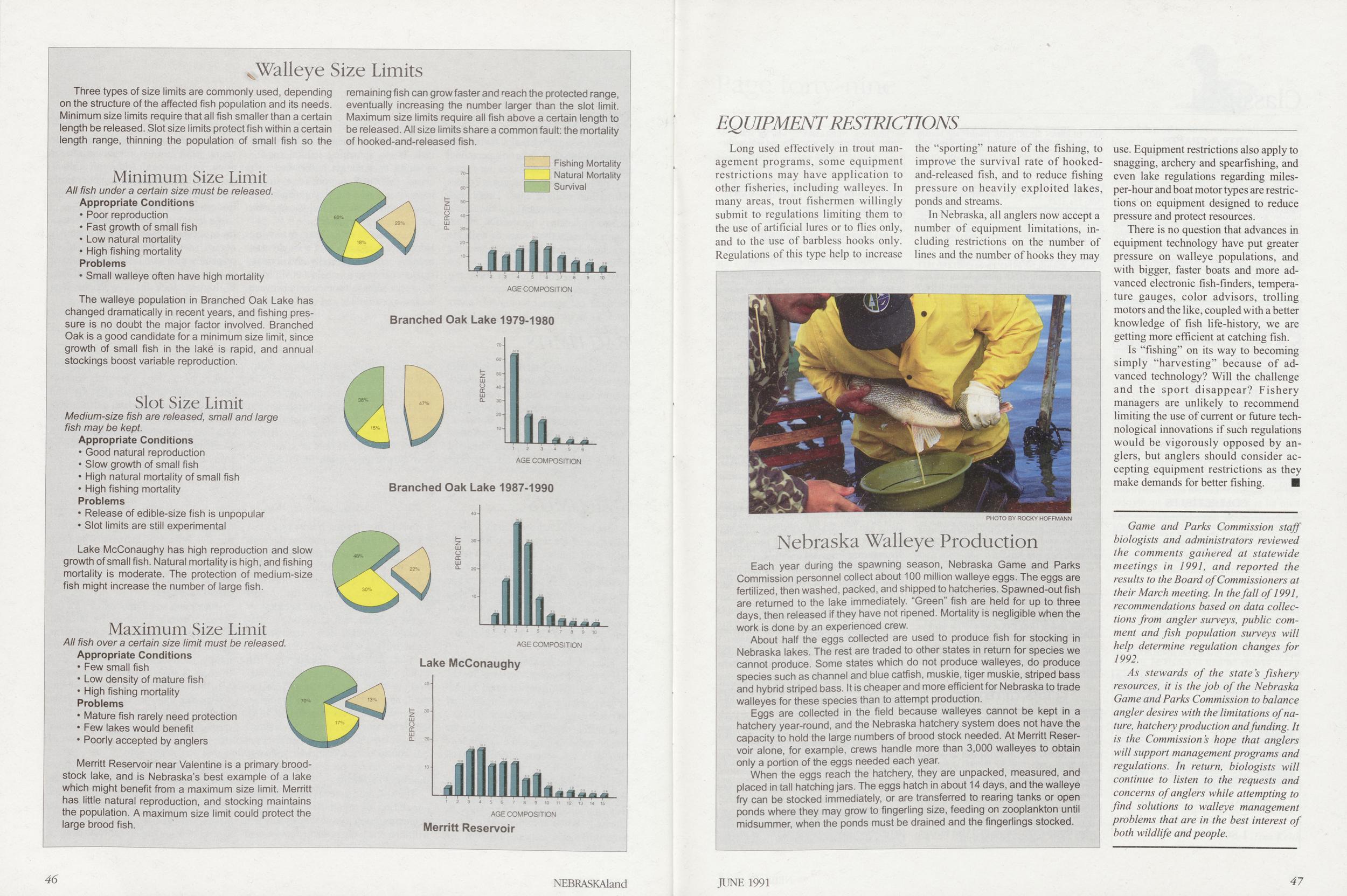
Walleye Size Limits
Three types of size limits are commonly used, depending on the structure of the affected fish population and its needs. Minimum size limits require that all fish smaller than a certain length be released. Slot size limits protect fish within a certain length range, thinning the population of small fish so the remaining fish can grow faster and reach the protected range, eventually increasing the number larger than the slot limit. Maximum size limits require all fish above a certain length to be released. All size limits share a common fault: the mortality of hooked-and-released fish.
Minimum Size Limit All fish under a certain size must be released.Appropriate Conditions
• Poor reproduction
• Fast growth of small fish
• Low natural mortality
• High fishing mortality
Problems
• Small walleye often have high mortality
The walleye population in Branched Oak Lake has changed dramatically in recent years, and fishing pressure is no doubt the major factor involved. Branched Oak is a good candidate for a minimum size limit, since growth of small fish in the lake is rapid, and annual stockings boost variable reproduction.
Slot Size Limit Medium-size fish are released, small and large fish may be kept.Appropriate Conditions
• Good natural reproduction
• Slow growth of small fish
• High natural mortality of small fish
• High fishing mortality
Problems
• Release of edible-size fish is unpopular
• Slot limits are still experimental
Lake McConaughy has high reproduction and slow growth of small fish. Natural mortality is high, and fishing mortality is moderate. The protection of medium-size fish might increase the number of large fish.
Maximum Size Limit All fish over a certain size limit must be released.Appropriate Conditions
• Few small fish
• Low density of mature fish
• High fishing mortality
Problems
• Mature fish rarely need protection
• Few lakes would benefit
• Poorly accepted by anglers
Merritt Reservoir near Valentine is a primary broodstock lake, and is Nebraska's best example of a lake which might benefit from a maximum size limit. Merritt has little natural reproduction, and stocking maintains the population. A maximum size limit could protect the large brood fish.
Fishing Mortality Natural Mortality survival 12 AGE COMPOSITION
Branched Oak Lake 1979-1980 AGE COMPOSITION Branched Oak Lake 1987-1990
AGE COMPOSITION Lake McConaughy 40
AGE COMPOSITION Merritt Reservoir
Long used effectively in trout management programs, some equipment restrictions may have application to other fisheries, including walleyes. In many areas, trout fishermen willingly submit to regulations limiting them to the use of artificial lures or to flies only, and to the use of barbless hooks only. Regulations of this type help to increase the "sporting" nature of the fishing, to improve the survival rate of hooked- and-released fish, and to reduce fishing pressure on heavily exploited lakes, ponds and streams.
In Nebraska, all anglers now accept a number of equipment limitations, including restrictions on the number of lines and the number of hooks they may use. Equipment restrictions also apply to snagging, archery and spearfishing, and even lake regulations regarding miles- per-hour and boat motor types are restrictions on equipment designed to reduce pressure and protect resources.
There is no question that advances in equipment technology have put greater pressure on walleye populations, and with bigger, faster boats and more advanced electronic fish-finders, tempera-ture gauges, color advisors, trolling motors and the like, coupled with a better knowledge of fish life-history, we are getting more efficient at catching fish.
Is "fishing" on its way to becoming simply "harvesting" because of advanced technology? Will the challenge and the sport disappear? Fishery managers are unlikely to recommend limiting the use of current or future technological innovations if such regulations would be vigorously opposed by anglers, but anglers should consider accepting equipment restrictions as they make demands for better fishing.
Each year during the spawning season, Nebraska Game and Parks Commission personnel collect about 100 million walleye eggs. The eggs are fertilized, then washed, packed, and shipped to hatcheries. Spawned-out fish are returned to the lake immediately. "Green" fish are held for up to three days, then released if they have not ripened. Mortality is negligible when the work is done by an experienced crew.
About half the eggs collected are used to produce fish for stocking in Nebraska lakes. The rest are traded to other states in return for species we cannot produce. Some states which do not produce walleyes, do produce species such as channel and blue catfish, muskie, tiger muskie, striped bass and hybrid striped bass. It is cheaper and more efficient for Nebraska to trade walleyes for these species than to attempt production.
Eggs are collected in the field because walleyes cannot be kept in a hatchery year-round, and the Nebraska hatchery system does not have the capacity to hold the large numbers of brood stock needed. At Merritt Reservoir alone, for example, crews handle more than 3,000 walleyes to obtain only a portion of the eggs needed each year.
When the eggs reach the hatchery, they are unpacked, measured, and placed in tall hatching jars. The eggs hatch in about 14 days, and the walleye fry can be stocked immediately, or are transferred to rearing tanks or open ponds where they may grow to fingerling size, feeding on zooplankton until midsummer, when the ponds must be drained and the fingerlings stocked.
46 NEBRASKAland JUNE 1991 47
Classified
ARTS & CRAFTSSCREENPRINTED T-SHIRTS AND SWEATSHIRTS: Native American/wildlife designs. Send for free illustrated brochure. Forsha Creek Graphics, Route 1, Box 88A, Hardy, NE 68943.
WESTERN AND WILDLIFE ART WORKSHOP to be held at Doane College, Crete, NE on July 21-25. Includes woodcarving game fish; watercolor and oil painting; stone, moose antler, and other wood carving classes. $270 cost includes lodging and meals. Call John Burke (402) 623-4292 for a brochure.
INDIAN BEADWORK, baskets, pottery wanted by local collector. Send photos/prices to Frank, 3074 S. 44th St., Omaha, NE 68105; or call (402) 444-3401.
BIRDSPHEASANTS-WILD TURKEYS-CHUKARS & HUNS! Eggs, chicks, started & adults. National Poultry Improvement Plan Approved. Live overnight delivery guaranteed. THE BEST for propagation, hunting, eating, and taxidermy. Call now to place 1991 chick orders! Bargain prices on ringneck hens. Trouble Game Bird Farms, 8716 W St. Lawrence Rd., Dept. NE, Beloit, WI 53511. Phone (608) 365-1789. "Our birds MAKE IT in the WILDr
BOOKS/PRINTINGFREE! Booklets on northeastern Nevada; fishing, rockhounding maps, Carl Hayden, Box 528. Jackpot, Nevada 89825.
FREE BOOK CATALOG. Novels, westerns, romances, children's; old out of print, found barns, attic. Authors: Grey, Bower, Connor, Fox, Curwood, Raine, Wright, Aldrige, Pollyanna, Freckles, many others. Postage appreciated. Pierce, 4400 N. Pine Cluster, Oroville, CA 95965.
COLLECTIBLESBUYING: American Indian artifacts such as beadwork, weavings, baskets, etc.; also cowboy memorabilia such as chaps, spurs, photographs, etc. Best price first letter; photographs promptly returned. Jack Ringwalt, 1550 California St., Suite 6, #211, San Francisco, CA 94109, (415)759-6343.
DOGSTRAINING ALL BREEDS hunting dogs—Vizslas and English Pointers for sale. Rozanek Kennels, R 2, Schuyler, NE 68661. Phone (402) 352-8769.
PINKERTON BIRD DOGS—English setter, brittany puppies. Started dogs available this fall. Our dogs are bred for nose and style. Give us a call at (402) 673-4540
NEBRASKAland Magazine Toll Free Orders 1-800-742-0056
AKC GERMAN SHORTHAIR pointers and brittany spaniels. Pups, started and trained dogs. Birdland Kennels, Hunter Ingwerson, Nehawka, NE 68413,402-227- 4655. Wayne Clark, 712-529-4238 also will be doing some training.
YELLOW-BLACK Lab pups. FC-AFC sired. AKC. Hips OFA certified. Dew claws removed. Excellent hunting potential. Contact Bob Bendler, Lexington, NE, (308) 324-4247.
CHESAPEAKE BAY OR BLACK LABRADOR pup- pies and started dogs. Available year-round. NAFC pedigree available. Training and stud service. Call PLATTE VALLEY RETRIEVERS, (308) 995-2318.
GERMAN SHORTHAIR PUPS. Trained and started dogs. Gun dog training available. Cactus Kennels, Dave Wickham, Kimball, NE 69145. Phone (308) 235-3237.
GUN DOG TRAINING. All sporting breeds. All dogs worked on game birds. Over 25 years experience. Henry Sader, Wilderness Kennels, Roca, NE (402) 423-4212. AKC WEIMARANER puppies for sale. Excellent hunt- ing potential. John Wright, Box 71, Greenwood, NE 68366. Phone (402) 789-3915.
FISH/FISHINGFISH FOR SALE. Catfish, perch, coho salmon, rainbow trout, crappie, bluegill, walleye, minnows, goldfish, bullhead, largemouth bass, smallmouth bass, triploid grass carp. Commercial grower prices on catfish, perch, coho salmon, rainbow trout. Consulting available. Pleasant Valley Fish Farm, Rt 1 Box 147, McCook, NE 69001. Phone (308) 345-6599.
DEE'S CONTOUR MAPS—High quality, waterproof, tearproof, 25x35 inches. Most Nebraska and Kansas reservoirs, some Colorado. $4.95 each. Write or call Dee's Maps, P.O. Box 702, Broken Bow, NE 68822- 0702; phone (308) 872-6539.
WILLOW LAKE FISH HATCHERY. Channel cat, blue- gill, hybrid bluegill, largemouth bass, crappie, bullheads, triploid grass carp, walleye, perch, minnows available for stocking. Gaylord Crawford, Rt. 3 Box 46, Hastings, NE 68901 or phone (402) 463-8022 day or night. Also pond consultant.
FISHING FLIES—Large selection of trout, panfish and northern pike flies, bass bugs. All types and sizes. Hand- tied in USA with top-quality materials. Write or phone for price list or to order. Keith Flies, Box 30036, Lincoln, NE 68503, (402) 489-3403.
FOODNEBRASKA BASKETS: The original Nebraska Company specializing in fine foods from Nebraska. A beautiful array of baskets filled with ethnic, healthful and long-time favorite foods. Call or write for our brochure: PO Box 98, McCook, NE 69001. 1-800-345-7725.
DELICIOUS NATURALLY NUTRITIOUS snack recipes for kids. Home tested, quick and easy, send $2 to Midwestern Moms, P.O. Box 25181-N, West Des Moines, IA 50265.
GUIDES/OUTFITTERSMAD RIVER CANOES offers the finest quality and performance. For the finest canoes and accessories look to Great Plains Canoe Co., 205 Main, Springfield, NE. Phone (402) 253-2001.
DISMAL RIVER CANOE TRIPS. Full service trips include meals, canoe rental, hot showers, in-door pool, hot tub and lodging. Group packages and daily rental also available. For more information contact POWDER HORN OUTFITTERS, Box 225, Brownlee, NE 69126 Phone 1-800-373-1648 or 402-437-6585.
GRAHAM CANOE OUTFITTERS: Top quality full- service camping and canoe trips on the Niobrara River. Daily canoe rentals and car shuttle-service available Contact Doug & Twyla Graham, HC 13 Box 16, Valentine, NE 69201 or phone (402) 376-3708.
EXPERIENCE NEBRASKA ... with an affordable canoe trip by Dr yland Aquatics. One and two-day trips ... canoe rental or fully catered. Niobrara ... Dismal ... Platte... Elkhorn... We do it your way! For free brochure: Dry land Aquatics, Dept. N, 1837 E. Cuming, Fremont, NE 68025 or phone (402) 721-4177.
CANOE RENTALS: Kamp Kaleo, Burwell, NE. 17 ft. aluminum canoes, $ 15 per day. Call (308) 346-5083 for information and reservations.
KEN KO INC. Spend a day fishing the scenic Missouri River with Fishing Guide Kenneth Cooksey. For information write 2002 2nd Ave., Nebraska City, NE 68025 or call (402) 873-6288 mornings/evenings.
OUTDOOR EQUIPMENTGUNS — Browning, Winchester, Remington, others, Hi-powers, shotguns, new, used, antiques. Want Pre-'64 Winchesters. Buy-Sell-Trade. (402) 729-6112. Bedlan's Sporting Goods, Fairbury, NE 68352.
AIR GUNS repaired—Benjamin, Crosman, Daisy, other American made. Restoration; old guns wanted. Jack's Air Guns, 1225 No. 46th, Lincoln, NE 68503. Phone (402) 466-9223.
REAL ESTATEFOR SALE—40 acres with modern 2-bedroom log cabin. Good water well—fireplace—great summer home or hunting lodge. 14 miles northwest of Crawford, NE. Write N. Rawhouser, 517 Annin, Crawford, NE 69339. Phone (308) 665-1822.
HARRISON, NEBRASKA: Hunting—fishing—beautiful Pine Ridge country. Nice older home—2 bedroom, 2 bath, 2 car garage—ready to move in—corner lot—surrounded by large spruce trees. Would sell furnished. Reasonable price. John Broderick Estate. Call (308) 668-2581.
TAXIDERMYALLISON'S TAXIDERMY STUDIO & GIFT GALLERY. Wally and Betty Allison Licensed Taxidermist. We've mounted 32 Nebraska State Record fish. Specializing in fish, birds and small game. We use freeze-dry. 421 North Dewey, North Platte, NE 69101. (308) 534-2324 or (308) 534-4267 home.
PEISTER TAXIDERMY—Award winning taxidermy and fish carvings. 1020 Central Avenue, Box 3201, Kearney, NE 68847. Phone (308) 236-9700 or (308) 237-7575 evening.
VACATION/RESORTSNE NEBRASKA trout fishing. 3 modern cottages, 1 available year round. 5 spring fed lakes with open water all year. Trout up to 7 pounds. Other varieties fish also. Diamond E. Trout Resort, Orchard, NE 69764. Phone (402) 893-4745.
BIG HORN BAY RESORT. Lake Ida, modern cabins, sand beach, boat ramp, gas, bait, groceries. Walleye, northern, large-smallmouth bass, crappie, sunfish. RR 1 Box 232, Alexandria, MN 56308.
CABIN FOR RENT. Modern three-bedroom, fully- equipped cabin overlooking secluded, scenic 3-acre pond. Call or write Orchard Fish Hatchery, RR 2, Box 117, Orchard, NE 68764 or phone (402) 893-2521.
NATIONAL PARK VACATIONS. 6 days and 5 nights start at $238 or 3 days and 2 nights for $99. Enchanting cottages in Ozark tranquility. Canoe the Jacks Fork and Current rivers, hike, auto tour or horseback ride. Eminence Canoes, Cottages and Campgrounds. Phone (314)226-3642.
Classified ad rates: 75? per word, minimum 5/5. Closing date is the first business day 2 months preceding date of issue. To place ads or for more information write NEBRASKAland Magazine, P.O. Box 30370, Lincoln, NE 68503, or call (402) 471-5478.
Page forty-nine
Therapeutic FishingNot long ago I went to the doctor with a variety of aches and pains that I thought he would attribute to my advancing age, lack of physical activity and expanding waistline. He heard my complains, then hooked up his stethoscope and went on a fact-finding tour of his own. He listened here, thumped there, poked around in several different places, and scribbled notes as he went along.
When he finished with the physical portion of the examination, he sat down on a wheeled stool and asked me if I was sleeping well, if I'd lost any weight (we both snickered at that one), if I had started smoking cigarettes, and if I was getting any exercise. How were things going at home? Was I having trouble at work? Was anything really bugging me? His interrogation lasted just a couple of minutes. Then, when I thought he was going to write me a fistful of prescriptions for an array of expensive miracle drugs, he told me I was going to have learn to relax.
Relax? I told him my wife constantly accuses me of trying to set a new world's record for perpetual relaxation, but he was quick to point out the difference between relaxing and just being lazy. He told me about stress and how it can erode both mental and physical health if you let it. His prescription? Dieting and exercise to get rid of the extra pounds and improve my health physically, and he said I should take some time and do something I enjoy—like fishing. Now there's a program I can live with!
I have a personal, inflexible rule: don't argue with the doctor. I go to him when I'm sick, put my faith in his ability to help me get well, and pay good money to hear his advice, so it would be irresponsible—no, downright dumb—not to do what he says. I went straight home and dug out my fishing gear.
It was midafternoon when I got to the lake. Heeding his advice about increasing my exercise, I parked in the lot, gathered my tackle box, rods, cooler, minnow bucket and lawn chair, and walked along the dam clear to the far end. I set up, cast my lines into the water and got comfortable in the lawn chair. It was a beautiful day—the sky mostly clear, temperature about 75 degrees, a faint breeze, no one around to bother me. I sat there letting my mind wander, almost hypnotized by the ripples moving up and down on the baseball-sized rocks at the base of the dam. My arms and legs felt heavier than usual, but my shoulders and neck were loose and relaxed for the first time in weeks. I was starting to relax.
I sat there for about three hours, watching as geese flew north in loose V-formations, as gulls darted and twisted low above the water, then dove and splashed down, apparently feeding on minnows or small fish near the surface. There were a half-dozen boats on the lake, some trolling lazily back and forth 50 yards or so off the dam, others bobbing anchored over the deep water of the lake's main creek channel.
It was quiet. I couldn't hear the neighbor's kids running up and down the street yelling just to hear themselves yell, the irritating metallic clanging and grinding of skateboards roaring across the cement, and the high-pitched screech of brakes when the little urchins refuse to yield to traffic. There were no loud lawn mowers, chain saws or blaring rock music coming from the boom-box the woman across the street thinks is mandatory equipment for washing her car. And no sirens. We live near a large hospital and a fire department substation, so the noise of blaring sirens has become a frequent addition to our lives.
I sat there and thought-not about my job, not about the lawn work waiting for me at home, not about ill or aging relatives, but about the really important things, like maybe I should call my fishing buddy Verl Borg and plan a fly fishing trip to sample Long Pine Creek's trout population. Or, how about fly fishing for northerns at the Valentine Refuge this spring, trying the new "bass buggs" my wife was tying for a customer (she's a professional fly tyer), or visiting a friend's farm pond to check on the bluegill there. So many fish to catch and so little time ...
Since my doctor issued my relaxation prescription, I've done some reading. I learned that medical studies have determined that 50 to 80 percent of all diseases have psychosomatic or stress-related origins. A conservative list of those diseases includes peptic ulcers, some forms of colitis, bronchial asthma, hay fever, arthritis, hypertension, hyperthyroidism, migraine headaches, impotence, general sexual dysfunctions, insomnia, alcoholism, and many neurotic and psychotic disorders. Stress is said to be a major contributing factor in the development of hypertension or high blood pressure, a condition that affects some 20 to 25 million Americans.
Everything I've read agrees with my doctor that a regimen of diet, exercise and relaxation can contribute greatly to stress reduction. Some sources also recommend meditation, self hypnosis, visualization, yoga exercises and biofeedback.
I think my doctor really hit the nail on the head when he recommended some low-key, laid-back activity such as painting, decoy carving, listening to music or fishing.
I'm not talking about competitive fishing that creates its own set of frustrations and irritations; I mean fishing just for the enjoyment of it, when the act is its own reward—no mad dash in a high-speed boat to the spot you want to fish, no worrying about how many fish the other guy is catching and if they'll weigh more than yours, no concern about how much time is left on the clock, no longing for the big trophy or the prize money at the end of the day. I mean fishing for only one reason: because you like to.
Verl Borg is a fly fisherman who likes to catch trout. He says one of the main reasons he fishes is that he enjoys being in the places where trout live, places like Long Pine Creek, Verdigre Creek or, prior to the fire and more recent devastating flood, the White River in Nebraska's Panhandle. He says he has to fish, and though he likes to catch fish, he doesn't have to catch any to relax and enjoy the day, but he does have to fish. There's a big difference there, and it's a good philosophy. Verl knows how to relax.
It's a fact: fishing can be therapeutic just ask your doctor.
48 NEBRASKAland JUNE 1991 49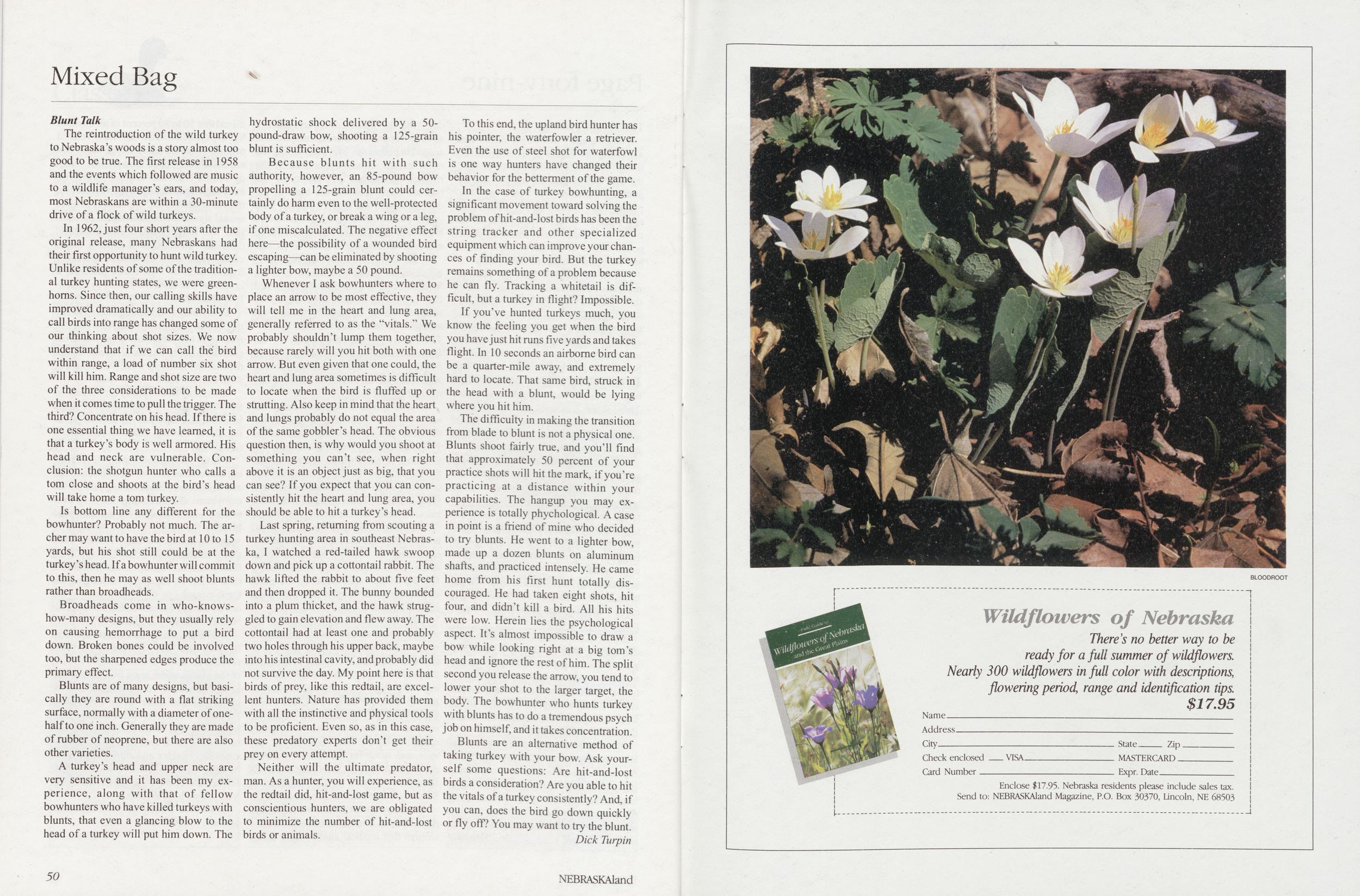
Mixed Bag
Blunt TalkThe reintroduction of the wild turkey to Nebraska's woods is a story almost too good to be true. The first release in 1958 and the events which followed are music to a wildlife manager's ears, and today, most Nebraskans are within a 30-minute drive of a flock of wild turkeys.
In 1962, just four short years after the original release, many Nebraskans had their first opportunity to hunt wild turkey. Unlike residents of some of the traditional turkey hunting states, we were greenhorns. Since then, our calling skills have improved dramatically and our ability to call birds into range has changed some of our thinking about shot sizes. We now understand that if we can call the bird within range, a load of number six shot will kill him. Range and shot size are two of the three considerations to be made when it comes time to pull the trigger. The third? Concentrate on his head. If there is one essential thing we have learned, it is that a turkey's body is well armored. His head and neck are vulnerable. Conclusion: the shotgun hunter who calls a torn close and shoots at the bird's head will take home a torn turkey.
Is bottom line any different for the bowhunter? Probably not much. The archer may want to have the bird at 10 to 15 yards, but his shot still could be at the turkey's head. If a bowhunter will commit to this, then he may as well shoot blunts rather than broad heads.
Broad heads come in who-knows-how-many designs, but they usually rely on causing hemorrhage to put a bird down. Broken bones could be involved too, but the sharpened edges produce the primary effect.
Blunts are of many designs, but basically they are round with a flat striking surface, normally with a diameter of one-half to one inch. Generally they are made of rubber of neoprene, but there are also other varieties.
A turkey's head and upper neck are very sensitive and it has been my experience, along with that of fellow bowhunters who have killed turkeys with blunts, that even a glancing blow to the head of a turkey will put him down. The hydrostatic shock delivered by a 50- pound-draw bow, shooting a 125-grain blunt is sufficient.
Because blunts hit with such authority, however, an 85-pound bow propelling a 125-grain blunt could certainly do harm even to the well-protected body of a turkey, or break a wing or a leg, if one miscalculated. The negative effect here—the possibility of a wounded bird escaping—can be eliminated by shooting a lighter bow, maybe a 50 pound.
Whenever I ask bowhunters where to place an arrow to be most effective, they will tell me in the heart and lung area, generally referred to as the "Vitals." We probably shouldn't lump them together, because rarely will you hit both with one arrow. But even given that one could, the heart and lung area sometimes is difficult to locate when the bird is fluffed up or strutting. Also keep in mind that the heart and lungs probably do not equal the area of the same gobbler's head. The obvious question then, is why would you shoot at something you can't see, when right above it is an object just as big, that you can see? If you expect that you can consistently hit the heart and lung area, you should be able to hit a turkey's head.
Last spring, returning from scouting a turkey hunting area in southeast Nebraska, I watched a red-tailed hawk swoop down and pick up a cottontail rabbit. The hawk lifted the rabbit to about five feet and then dropped it. The bunny bounded into a plum thicket, and the hawk struggled to gain elevation and flew away. The cottontail had at least one and probably two holes through his upper back, maybe into his intestinal cavity, and probably did not survive the day. My point here is that birds of prey, like this redtail, are excellent hunters. Nature has provided them with all the instinctive and physical tools to be proficient. Even so, as in this case, these predatory experts don't get their prey on every attempt.
Neither will the ultimate predator, man. As a hunter, you will experience, as the redtail did, hit-and-lost game, but as conscientious hunters, we are obligated to minimize the number of hit-and-lost birds or animals.
To this end, the upland bird hunter has his pointer, the water fowler a retriever. Even the use of steel shot for waterfowl is one way hunters have changed their behavior for the betterment of the game.
In the case of turkey bowhunting, a significant movement toward solving the problem of hit-and-lost birds has been the string tracker and other specialized equipment which can improve your chances of finding your bird. But the turkey remains something of a problem because he can fly. Tracking a whitetail is difficult, but a turkey in flight? Impossible. If you've hunted turkeys much, you know the feeling you get when the bird you have just hit runs five yards and takes flight. In 10 seconds an airborne bird can be a quarter-mile away, and extremely hard to locate. That same bird, struck in the head with a blunt, would be lying where you hit him.
The difficulty in making the transition from blade to blunt is not a physical one. Blunts shoot fairly true, and you'll find that approximately 50 percent of your practice shots will hit the mark, if you're practicing at a distance within your capabilities. The hangup you may experience is totally psychological. A case in point is a friend of mine who decided to try blunts. He went to a lighter bow, made up a dozen blunts on aluminum shafts, and practiced intensely. He came home from his first hunt totally discouraged. He had taken eight shots, hit four, and didn't kill a bird. All his hits were low. Herein lies the psychological aspect. It's almost impossible to draw a bow while looking right at a big tom's head and ignore the rest of him. The split second you release the arrow, you tend to lower your shot to the larger target, the body. The bowhunter who hunts turkey with blunts has to do a tremendous psych job on himself, and it takes concentration.
Blunts are an alternative method of taking turkey with your bow. Ask yourself some questions: Are hit-and-lost birds a consideration? Are you able to hit the vitals of a turkey consistently? And, if you can, does the bird go down quickly or fly off? You may want to try the blunt.
50 NEBRASKAlandBLOODROOT
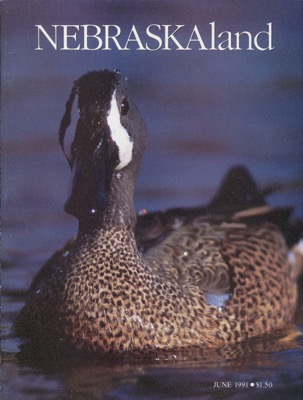
Position: 373 (26 views)