Volume 79, Issue 4, 2001
NEBRASKAland
Nebraska Game & Parks Commission May 2001 $2.50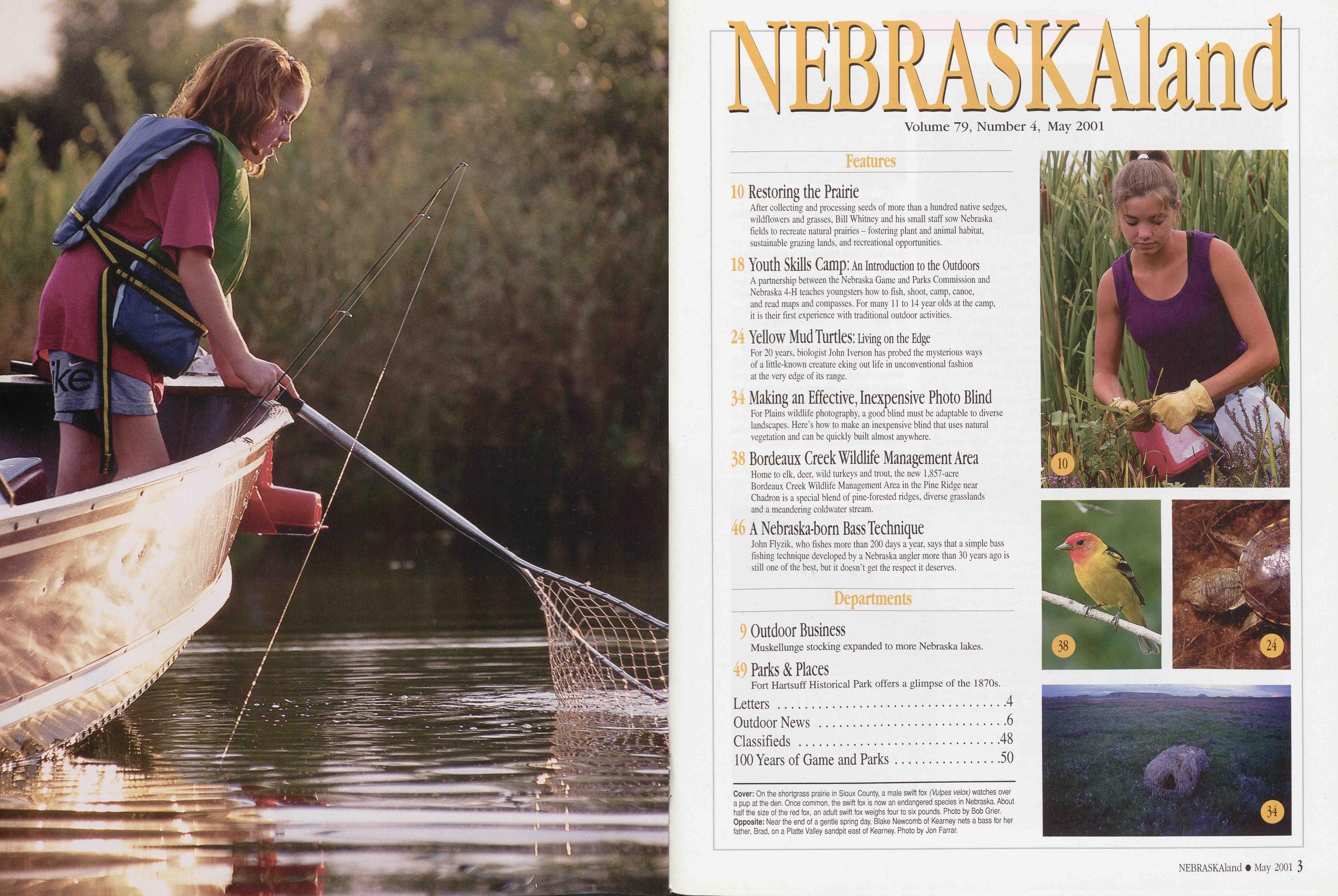
NEBRASKAland
Volume 79, Number 4, May 2001 Features 10 Restoring the PrairieAfter collecting and processing seeds of more than a hundred native sedges, wildflowers and grasses, Bill Whitney and his small staff sow Nebraska fields to recreate natural prairies - fostering plant and animal habitat, sustainable grazing lands, and recreational opportunities.
18 Youth Skills Camp: An Introduction to the OutdoorsA partnership between the Nebraska Game and Parks Commission and Nebraska 4-H teaches youngsters how to fish, shoot, camp, canoe, and read maps and compasses. For many 11 to 14 year olds at the camp, it is their first experience with traditional outdoor activities.
Yellow Mud Turtles: Living on the EdgeFor 20 years, biologist John Iverson has probed the mysterious ways of a little-known creature eking out life in unconventional fashion at the very edge of its range.
34 Making an Effective, Inexpensive Photo BlindFor Plains wildlife photography, a good blind must be adaptable to diverse landscapes. Here’s how to make an inexpensive blind that uses natural vegetation and can be quickly built almost anywhere.
38 Bordeaux Creek Wildlife Management AreaHome to elk, deer, wild turkeys and trout, the new 1,857-acre Bordeaux Creek Wildlife Management Area in the Pine Ridge near Chadron is a special blend of pine-forested ridges, diverse grasslands and a meandering coldwater stream.
46 A Nebraska-born Bass TechniqueJohn Flyzik, who fishes more than 200 days a year, says that a simple bass fishing technique developed by a Nebraska angler more than 30 years ago is still one of the best, but it doesn’t get the respect it deserves.
Departments 9 Outdoor BusinessMuskellunge stocking expanded to more Nebraska lakes.
49 Parks & PlacesFort Hartsuff Historical Park offers a glimpse of the 1870s.
Letters 4Outdoor News 6
Classifieds 48
100 Years of Game and Parks 50
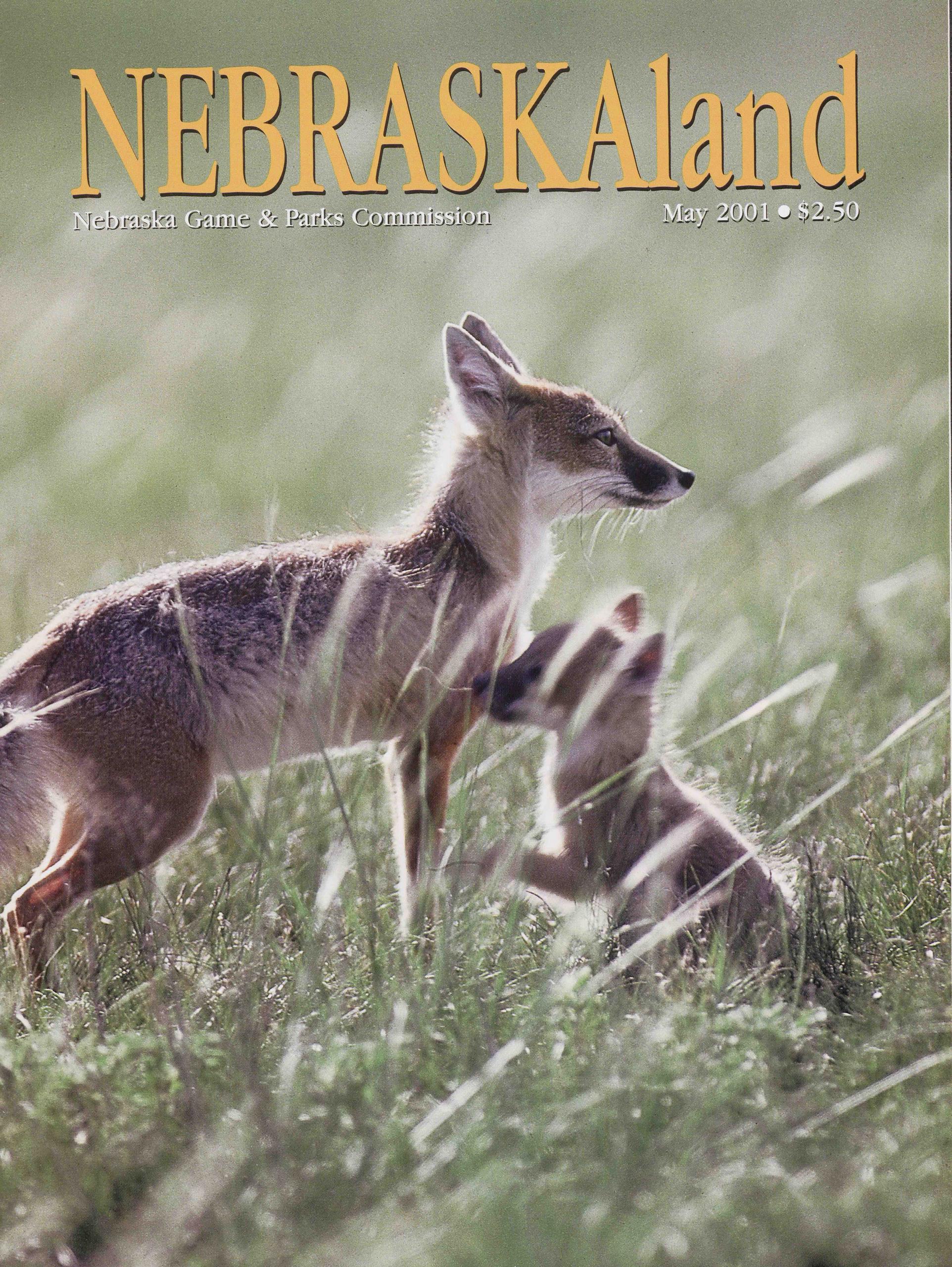
Cover: On the shortgrass prairie in Sioux County, a male swift fox (Vulpes velox) watches over a pup at the den. Once common, the swift fox is now an endangered species in Nebraska. About half the size of the red fox, an adult swift fox weighs four to six pounds. Photo by Bob Grier. Opposite: Near the end of a gentle spring day, Blake Newcomb of Kearney nets a bass for her father, Brad, on a Platte Valley sandpit east of Kearney. Photo by Jon Farrar.
10
38
24
34
NEBRASKAland Magazine
Published by the Nebraska Game and Parks Commission Director: Rex Amack Assistant Directors: Noelyn Isom Roger Kuhn Kirk Nelson Information & Education Administrator: Paul Horton Information & Education Art Director: Steve O’Hare Commissioners Chairman: Rob Coupland, Valentine Vice Chairman: John P Miller, Blair 2nd Vice Chairman: Connie Lapaseotes, Bridgeport George W. Egermayer Jr., Omaha Randall K. Stinnette, Inland Marvin Westcott, Holdrege James Stuart, Jr., Lincoln Magazine Staff Editor: Tom White Art Director: Tim Reigert Senior Editors: Ken Bouc, Jon Farrar Regional Editors: Bob Grier, Rocky Hoffmann Contributing Editors: Michael Forsberg, Tom Keith Circulation: Pat Frahm NEBRASKAland VOL. 79 / NO. 4 ISSN: 0028-1964 MAY 2001Published monthly, except for Jan ./Feb. and Aug./Sept. issues, by the Nebraska Game and Parks Commission, 2200 N. 33rd St., Lincoln, NE. Copyright 2001, all rights reserved. Please address comments or questions to this address. Periodicals postage paid at Lincoln, Nebraska. POST- MASTER: Send all address changes to NEBRASKAland, P.O. Box 30370, Lincoln, NE 68503-0370.
Address submissions to: The Editor, NEBRASKAland Magazine, P.O. Box 30370, Lincoln, NE 68503. Include a stamped, self-addressed return envelope. The publisher assumes no responsibility for unsolicited material.
NEBRASKAland is available on audio cassette from the Nebraska Library Commission Talking Book and Braille Service, Suite 120, 1200 N St., Lincoln, NE 68508.
Rates: $16 for one year; $30 for two years.Web site: www.ngpc.state.ne.us/nebland
Letters
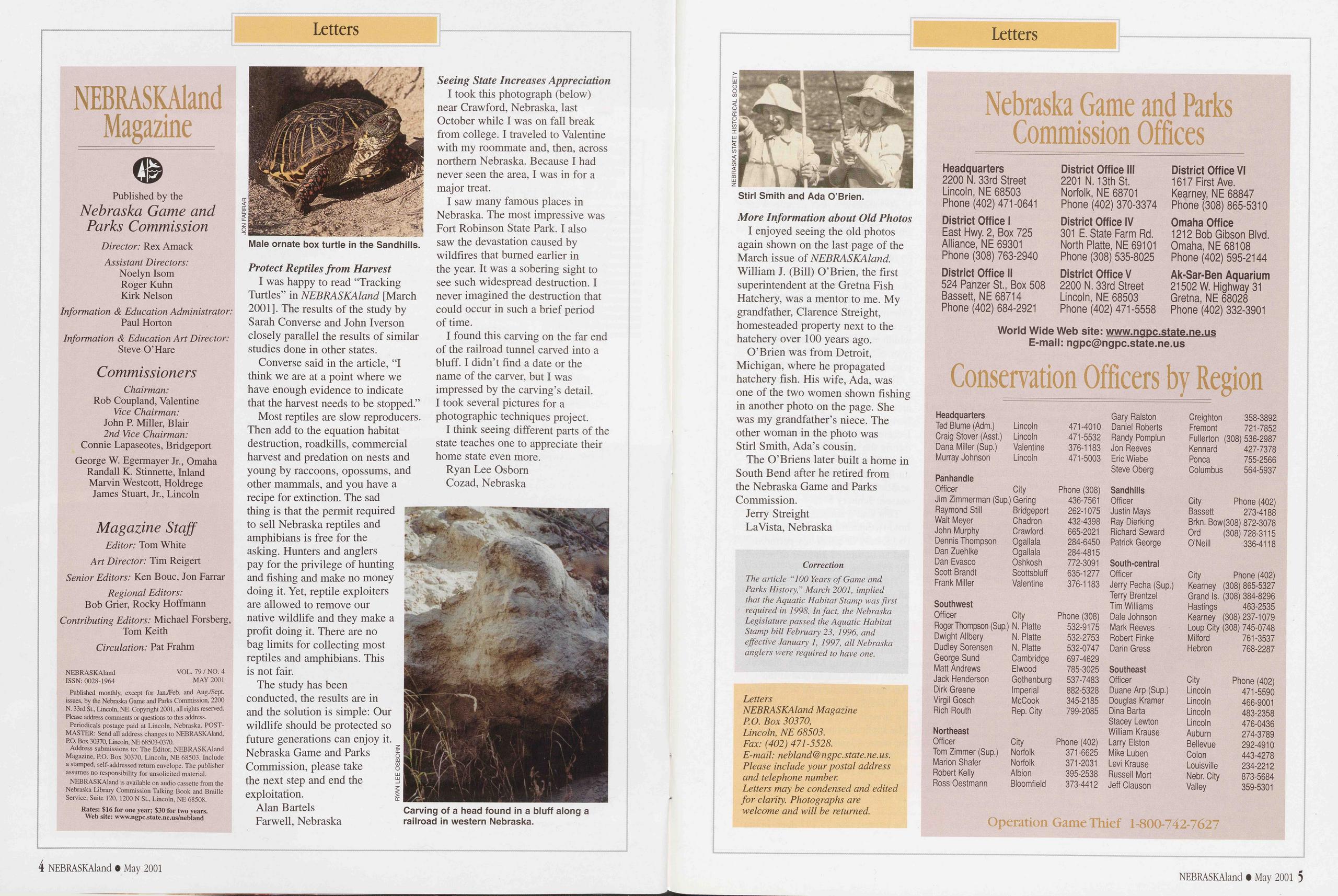
Male ornate box turtle in the Sandhills.
I was happy to read “Tracking Turtles” in NEBRASKAland [March 2001]. The results of the study by Sarah Converse and John Iverson closely parallel the results of similar studies done in other states.
Converse said in the article, “I think we are at a point where we have enough evidence to indicate that the harvest needs to be stopped.”
Most reptiles are slow reproducers. Then add to the equation habitat destruction, roadkills, commercial harvest and predation on nests and young by raccoons, opossums, and other mammals, and you have a recipe for extinction. The sad thing is that the permit required to sell Nebraska reptiles and amphibians is free for the asking. Hunters and anglers pay for the privilege of hunting and fishing and make no money doing it. Yet, reptile exploiters are allowed to remove our native wildlife and they make a profit doing it. There are no bag limits for collecting most reptiles and amphibians. This is not fair.
The study has been conducted, the results are in and the solution is simple: Our wildlife should be protected so future generations can enjoy it. Nebraska Game and Parks Commission, please take the next step and end the exploitation.
Alan BartelsFarwell, Nebraska Seeing State Increases Appreciation
I took this photograph (below) near Crawford, Nebraska, last October while I was on fall break from college. I traveled to Valentine with my roommate and, then, across northern Nebraska. Because I had never seen the area, I was in for a major treat.
I saw many famous places in Nebraska. The most impressive was Fort Robinson State Park. I also saw the devastation caused by wildfires that burned earlier in the year. It was a sobering sight to see such widespread destruction. I never imagined the destruction that could occur in such a brief period of time.
I found this carving on the far end of the railroad tunnel carved into a bluff. I didn’t find a date or the name of the carver, but I was impressed by the carving’s detail. I took several pictures for a photographic techniques project.
I think seeing different parts of the state teaches one to appreciate their home state even more.
Ryan Lee OsbornCozad, Nebraska
Carving of a head found in a bluff along a milroad in western Nebraska.
Stirl Smith and Ada O’Brien.
More Information about Old Photos I enjoyed seeing the old photos again shown on the last page of the March issue of NEBRASKAland. William J. (Bill) O’Brien, the first superintendent at the Gretna Fish Hatchery, was a mentor to me. My grandfather, Clarence Streight, homesteaded property next to the hatchery over 100 years ago.
O’Brien was from Detroit, Michigan, where he propagated hatchery fish. His wife, Ada, was one of the two women shown fishing in another photo on the page. She was my grandfather’s niece. The other woman in the photo was Stirl Smith, Ada’s cousin.
The O’Briens later built a home in South Bend after he retired from the Nebraska Game and Parks Commission.
Jerry StreightLaVista, Nebraska Correction
The article “100 Years of Game and Parks History,” March 2001, implied that the Aquatic Habitat Stamp was first required in 1998. In fact, the Nebraska Legislature passed the Aquatic Habitat Stamp bill February 23, 1996, and effective January 1, 1997, all Nebraska anglers were required to have one.
Letters NEBRASKAland Magazine P.O. Box 30370, Lincoln, NE 68503. Fax: (402) 471-5528. E-mail: nebland@ ngpc. state, ne. us. Please include your postal address and telephone number. Letters may be condensed and edited for clarity. Photographs are welcome and will be returned.Nebraska Game and Parks Commission Offices
Headquarters District Office III District Office VI 2200 N. 33rd Street 2201 N. 13th St. 1617 First Ave. Lincoln, NE 68503 Norfolk, NE 68701 Kearney, NE 68847 Phone (402) 471 -0641 Phone (402) 370-3374 Phone (308) 865-5310 District Office 1 District Office IV Omaha Office East Hwy. 2, Box 725 301 E. State Farm Rd. 1212 Bob Gibson Blvd. Alliance, NE 69301 North Platte, NE 69101 Omaha, NE 68108 Phone (308) 763-2940 Phone (308) 535-8025 Phone (402) 595-2144 District Office II District Office V Ak-Sar-Ben Aquarium 524 Panzer St., Box 508 2200 N. 33rd Street 21502 W. Highway 31 Bassett, NE 68714 Lincoln, NE 68503 Gretna, NE 68028 Phone (402) 684-2921 Phone (402) 471 -5558 Phone (402) 332-3901 World Wide Web site: www.napc.state.ne.usE-mail: ngpc@ngpc.state.ne.us Conservation Officers by Region Headquarters Gary Ralston Creighton 358-3892 Ted Blume (Adm.) Lincoln 471-4010 Daniel Roberts Fremont 721-7852 Craig Stover (Asst.) Lincoln 471-5532 Randy Pomplun Fullerton (308) 536-2987 Dana Miller (Sup.) Valentine 376-1183 Jon Reeves Kennard 427-7378 Murray Johnson Lincoln 471-5003 Eric Wiebe Ponca 755-2566 Steve Oberg Columbus 564-5937 Panhandle Officer City Phone (308) Sandhills Jim Zimmerman (Sup.) Gering 436-7561 Officer City Phone (402) Raymond Still Bridgeport 262-1075 Justin Mays Bassett 273-4188 Walt Meyer Chadron 432-4398 Ray Dierking Brkn. Bow(308) 872-3078 John Murphy Crawford 665-2021 Richard Seward Ord (308) 728-3115 Dennis Thompson Ogallala 284-6450 Patrick George O’Neill 336-4118 DanZuehlke Ogallala 284-4815 Dan Evasco Oshkosh 772-3091 South-central Scott Brandt Scottsbluff 635-1277 Officer City Phone (402) Frank Miller Valentine 376-1183 Jerry Pecha (Sup.) Kearney (308) 865-5327 Terry Brentzel Grand Is. (308) 384-8296 Southwest Tim Williams Hastings 463-2535 Officer City Phone (308) Dale Johnson Kearney (308) 237-1079 Roger Thompson (Sup.) N. Platte 532-9175 Mark Reeves Loup City (308) 745-0748 Dwight Allbery N. Platte 532-2753 Robert Finke Milford 761-3537 Dudley Sorensen N. Platte 532-0747 Darin Gress Hebron 768-2287 George Sund Cambridge 697-4629 Matt Andrews Elwood 785-3025 Southeast Jack Henderson Gothenburg 537-7483 Officer City Phone (402) Dirk Greene Imperial 882-5328 Duane Arp (Sup.) Lincoln 471-5590 Virgil Gosch McCook 345-2185 Douglas Kramer Lincoln 466-9001 Rich Routh Rep. City 799-2085 Dina Barta Lincoln 483-2358 Stacey Lewton Lincoln 476-0436 Northeast William Krause Auburn 274-3789 Officer City Phone (402) Larry Elston Bellevue 292-4910 Tom Zimmer (Sup.) Norfolk 371-6625 Mike Luben Colon 443-4278 Marion Shafer Norfolk 371-2031 Levi Krause Louisville 234-2212 Robert Kelly Albion 395-2538 Russell Mort Nebr. City 873-5684 RossOestmann Bloomfield 373-4412 Jeff Clauson Valley 359-5301 Operation Game Thief 1-800-742-7627
Outdoor News
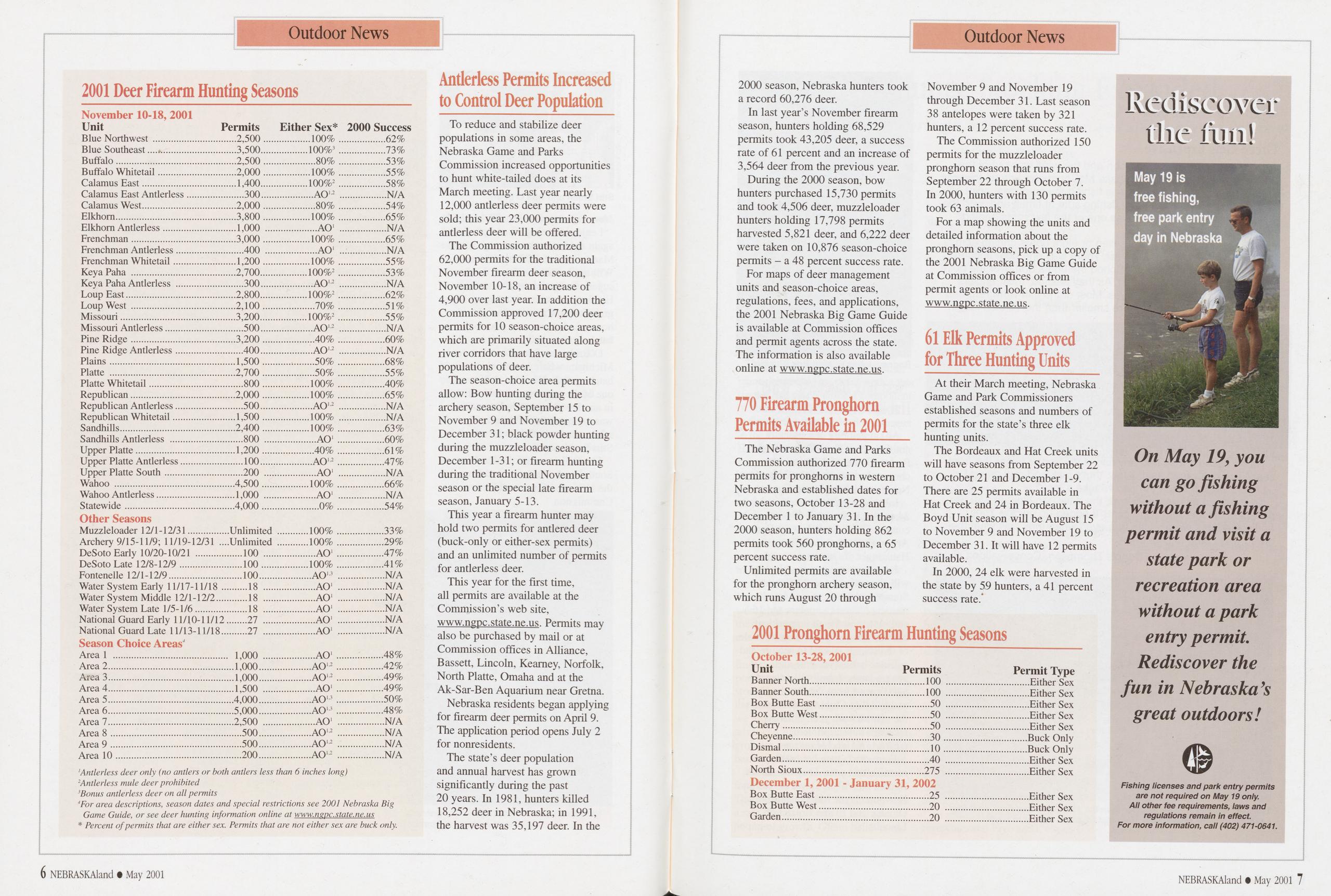
2001 Deer Firearm Hunting Seasons
November 10-18, 2001| Permits Blue Northwest Either Sex* 2000 Success Blue Southeast . Buffalo Butta o Whitetai Calamus East 1,400 Calamus East Antlerless Calamus West. .2.000 Elkhom. Elkhom Antierless 1,000 LAO Frenchman .. Frenchman Whitetail 1.200| Keya Paha Antierless .300 Loup Bast. 2.800 Loup West - 2,100| Missouri Pine Ridge Pine Ridge Antierless Plains ..1.500 Platte Platte Whitetail .800 100% 40%6 Republican.. Republican Whitetail .1,500) ..2,400) Sandhills Antieriess 800 AO' Upper Platte .1.200 40% Upper Platte Antieriess Upper Piatte South AO' Wahoo Antierless .1.000 „AO' N/A Statewide Other Seasons Muzzleloader 12/1-12/31| .Unlimited 100% -33% Archery 9/15-11/9: 11/19-12/31 …...Unlimited 100% 29% DeSoto Early 10/20-10/21| 100.. AO' 47% DeSoto Late 12/8-12/9 415| Water System Barly 11/17-11/18 AO' N/A Water System Middle 12/1-12/2. Water System Late 1/S-1/6 AO' National Guard Early 11/10-11/12. N/A National Guard Late 11/13-11/18. Season Choice Areas' AO' N/A Area 1 AO' 48% rea2 Area 3. AO" 49% Area 4 AO' Area 5. Area 6. Area 7. Area 8 AO'* Area 9 AO"" Area 10 200 AO"" N/A "Antierless male deer prohibited*Bonus anlerless deer on all permiss
*For ama deterintions, seuson dates ene soccial restrictions see 200) Nebraska Biel Game Guide, or see deer hunting information online ar yangocatencus
• Percent of permits that are cither sex. Permits what are not eicher sex are buck only
Antlerless Permits Increased to Control Deer Population
To reduce and stabilize deer populations in some areas, the Nebraska Game and Parks Commission increased opportunitics to hunt white-tailed does at its March meeting. Last year nearly 12,000 antierless deer permits were sold; this year 23,000 permits for antlerless deer will be offered.
The Commission authorized 62,000 permits for the traditional November firearm deer season, November 10-18, an increase of 4,900 over last year. In addition the Commission approved 17,200 decr permits for 10 season-choice areas. which are primarily situated along river corridors that have large populations of deer.
The season-choice area permits allow: Bow hunting during the archery season, September 15 to November 9 and November 19 tol December 31; black powder hunting | during the muzzleloader season. December 1-31; or firearm hunting during the traditional November season or the special late firearm season, January 5-13.
This year a firearm hunter may hold two permits for antiered deer (buck-only or cither-sex permits) and an unlimited number of permits for antierless deer.
This year for the first time, all permits are available at the Commission's web site. www.nspc.statc.nc.us. Permits may also be purchased by mail or at Commission offices in Alliance, Bassett, Lincoln, Kearney. Norfolk. North Platte. Omaha and at the Ak-Sar-Ben Aquarium near Gretna.
Nebraska residents began applying for fircarm deer permits on April 9. The application period opens July 2 for nonresidents.
The state's deer population and annual harvest has grown significantly during the past 20 years. In 1981, hunters killed 18.252 deer in Nebraska: in 1991. the harvest was 35,197 deer. In the 2000 season, Nebraska hunters took a record 60,276 deer.
In last year's November firearm season, hunters holding 68,529 permits took 43,205 deer, a success rate of 61 percent and an increase of 3,564 deer from the previous year.
During the 2000 season, bow hunters purchased 15,730 permits and took 4,506 deer, muzzleloader hunters holding 17,798 permits harvested 5,821 deer, and 6,222 deer were taken on 10,876 season-choice permits - a 48 percent success rate.
For maps of deer management units and season-choice areas, regulations, fees, and applications, the 2001 Nebraska Big Game Guide is available at Commission offices and permit agents across the state. The information is also available online at www.ngpc.statc.nc.us.
Outdoor News
770 Firearm Pronghorn Permits Available in 2001
The Nebraska Game and Parks Commission authorized 770 firearm permits for pronghorns in western Nebraska and established dates for two scasons, October 13-28 and December 1 to January 31. In the 2000 scason, hunters holding 862 permits took 560 pronghorns, a 65 percent success rate.
Unlimited permits are available for the pronghorn archery season, which runs August 20 through November 9 and November 19 through December 31. Last season 38 antelopes were taken by 321 hunters, a 12 percent success rate.
The Commission authorized 150 permits for the muzzleloader pronghom season that runs from September 22 through October 7. In 2000, hunters with 130 permits took 63 animals.
For a map showing the units and detailed information about the pronghorn seasons, pick up a copy of the 2001 Nebraska Big Game Guide at Commission offices or from permit agents or look online at www.ngpc.statc.nc.us.
61 Elk Permits Approved for Three Hunting Units
At their March meeting, Nebraska Game and Park Commissioners established seasons and numbers of permits for the state's three elk hunting units.
The Bordeaux and Hat Creck units will have seasons from September 22 to October 21 and December 1-9. There are 25 permits available in Hat Crock and 24 in Bordeaux. The Boyd Unit season will be August 15 to November 9 and November 19 to December 31. It will have 12 permits available.
In 2000, 24 elk were harvested in the state by 59 hunters, a 41 percent success rate.
2001 Pronghorn Firearm Hunting Seasons
October 13-28, 2001| Unit Permits Permit Type Banner North Bither S Banner South Either Sex Box Butte West 50 Either Sex Cherry| Either Sex Cheycane, Buck Only Buck Only Either Sex North Sioux. 275 December 1, 2001 - January 31, 2002 Either Sex Box Butte West Either Sex Garden Either Sex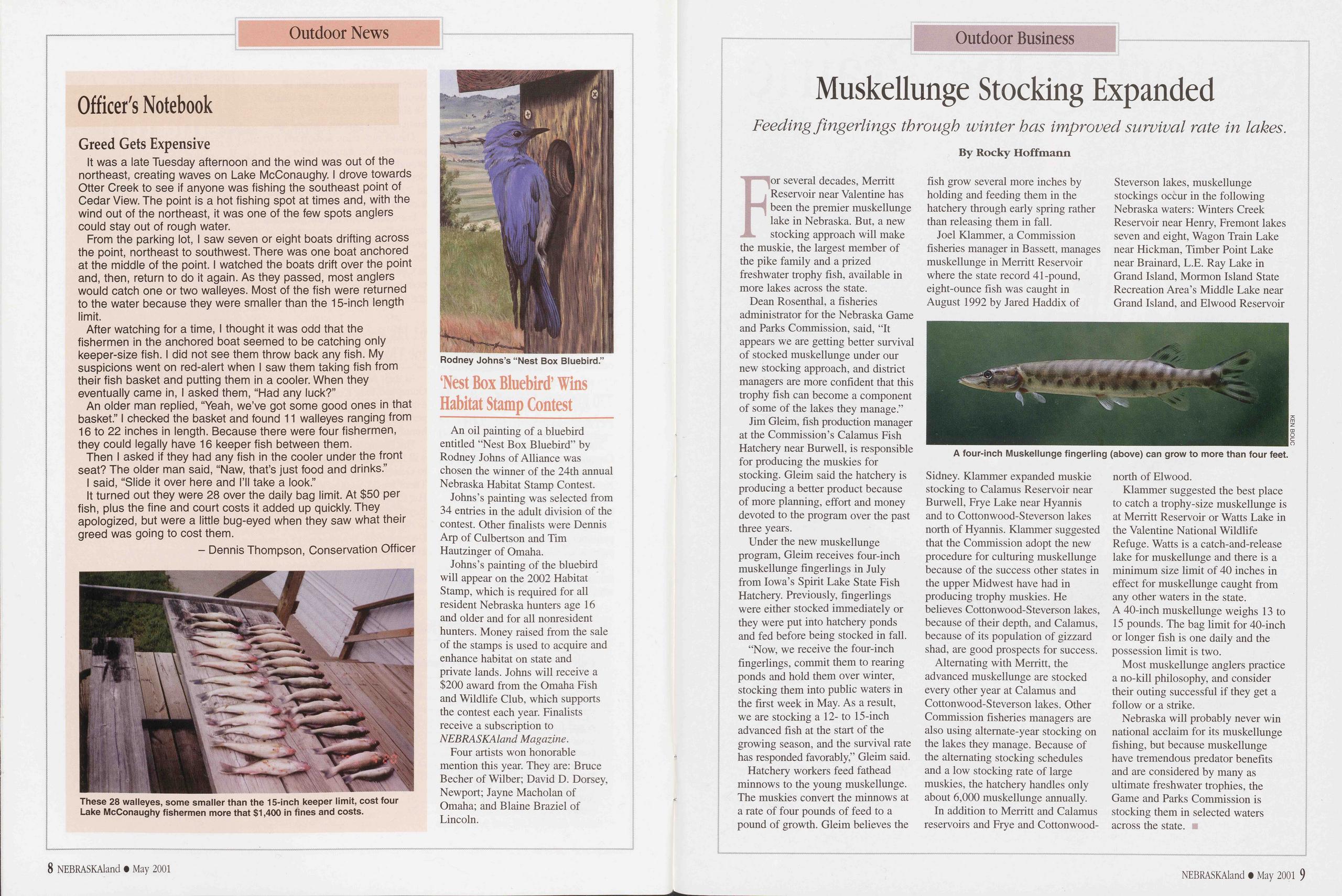
Outdoor News
Officer's Notebook
Greed Gets Expensive
It was a late Tuesday afternoon and the wind was out of the northeast, creating waves on Lake McConaughy. I drove towards Otter Creek to see if anyone was fishing the southeast point of Cedar View. The point is a hot fishing spot at times and, with the wind out of the northeast, it was one of the few spots anglers could stay out of rough water.
From the parking lot, I saw seven or eight boats drifting across the point, northeast to southwest. There was one boat anchored at the middle of the point. I watched the boats drift over the point and, then, return to do it again. As they passed, most anglers would catch one or two walleyes. Most of the fish were returned to the water because they were smaller than the 15-inch length limit.
After watching for a time, I thought it was odd that the fishermen in the anchored boat seemed to be catching only keeper-size fish. I did not see them throw back any fish. My suspicions went on red-alert when I saw them taking fish from their fish basket and putting them in a cooler. When they eventually came in, I asked them, “Had any luck?”
An older man replied, “Yeah, we’ve got some good ones in that basket.” I checked the basket and found 11 walleyes ranging from 16 to 22 inches in length. Because there were four fishermen, they could legally have 16 keeper fish between them.
Then I asked if they had any fish in the cooler under the front seat? The older man said, “Naw, that’s just food and drinks.”
I said, “Slide it over here and I’ll take a look.”
It turned out they were 28 over the daily bag limit. At $50 per fish, plus the fine and court costs it added up quickly. They apologized, but were a little bug-eyed when they saw what their greed was going to cost them.
- Dennis Thompson, Conservation OfficerThese 28 walleyes, some smaller than the 15-inch keeper limit, cost four Lake McConaughy fishermen more that $1,400 in fines and costs.
Rodney Johns’s “Nest Box Bluebird.”
An oil painting of a bluebird entitled “Nest Box Bluebird” by Rodney Johns of Alliance was chosen the winner of the 24th annual Nebraska Habitat Stamp Contest.
Johns’s painting was selected from 34 entries in the adult division of the contest. Other finalists were Dennis Arp of Culbertson and Tim Hautzinger of Omaha. Johns’s painting of the bluebird will appear on the 2002 Habitat Stamp, which is required for all resident Nebraska hunters age 16 and older and for all nonresident hunters. Money raised from the sale of the stamps is used to acquire and enhance habitat on state and private lands. Johns will receive a $200 award from the Omaha Fish and Wildlife Club, which supports the contest each year. Finalists receive a subscription to NEBRASKAland Magazine.
Four artists won honorable mention this year. They are: Bruce Becher of Wilber; David D. Dorsey, Newport; Jayne Macholan of Omaha; and Blaine Braziel of Lincoln.
Outdoor Business
Muskellunge Stocking Expanded
Feeding fingerlings through winter has improved survival rate in lakes.
For several decades, Merritt H Reservoir near Valentine has been the premier muskellunge lake in Nebraska. But, a new JL stocking approach will make the muskie, the largest member of the pike family and a prized freshwater trophy fish, available in more lakes across the state.
Dean Rosenthal, a fisheries administrator for the Nebraska Game and Parks Commission, said, “It appears we are getting better survival of stocked muskellunge under our new stocking approach, and district managers are more confident that this trophy fish can become a component of some of the lakes they manage.”
Jim Gleim, fish production manager at the Commission’s Calamus Fish Hatchery near Burwell, is responsible for producing the muskies for stocking. Gleim said the hatchery is producing a better product because of more planning, effort and money devoted to the program over the past three years.
Under the new muskellunge program, Gleim receives four-inch muskellunge fingerlings in July from Iowa’s Spirit Lake State Fish Hatchery. Previously, fingerlings were either stocked immediately or they were put into hatchery ponds and fed before being stocked in fall.
“Now, we receive the four-inch fingerlings, commit them to rearing ponds and hold them over winter, stocking them into public waters in the first week in May. As a result, we are stocking a 12- to 15-inch advanced fish at the start of the growing season, and the survival rate has responded favorably,” Gleim said.
Hatchery workers feed fathead minnows to the young muskellunge. The muskies convert the minnows at a rate of four pounds of feed to a pound of growth. Gleim believes the fish grow several more inches by holding and feeding them in the hatchery through early spring rather than releasing them in fall.
A four-inch Muskellunge fingerling (above) can grow to more than four feet.
KEN BOUCAlternating with Merritt, the advanced muskellunge are stocked every other year at Calamus and Cottonwood-Steverson lakes. Other Commission fisheries managers are also using altemate-year stocking on the lakes they manage. Because of the alternating stocking schedules and a low stocking rate of large muskies, the hatchery handles only about 6,000 muskellunge annually.
In addition to Merritt and Calamus reservoirs and Frye and Cottonwood- Steverson lakes, muskellunge stockings occur in the following Nebraska waters: Winters Creek Reservoir near Henry, Fremont lakes seven and eight, Wagon Train Lake near Hickman, Timber Point Lake near Brainard, L.E. Ray Lake in Grand Island, Mormon Island State Recreation Area’s Middle Lake near Grand Island, and Elwood Reservoir north of Elwood.
Klammer suggested the best place to catch a trophy-size muskellunge is at Merritt Reservoir or Watts Lake in the Valentine National Wildlife Refuge. Watts is a catch-and-release lake for muskellunge and there is a minimum size limit of 40 inches in effect for muskellunge caught from any other waters in the state.
A 40-inch muskellunge weighs 13 to 15 pounds. The bag limit for 40-inch or longer fish is one daily and the possession limit is two.
Most muskellunge anglers practice a no-kill philosophy, and consider their outing successful if they get a follow or a strike.
Nebraska will probably never win national acclaim for its muskellunge fishing, but because muskellunge have tremendous predator benefits and are considered by many as ultimate freshwater trophies, the Game and Parks Commission is stocking them in selected waters across the state. ■
8 NEBRASKAland • May 2001 NEBRASKAland • May 2001 9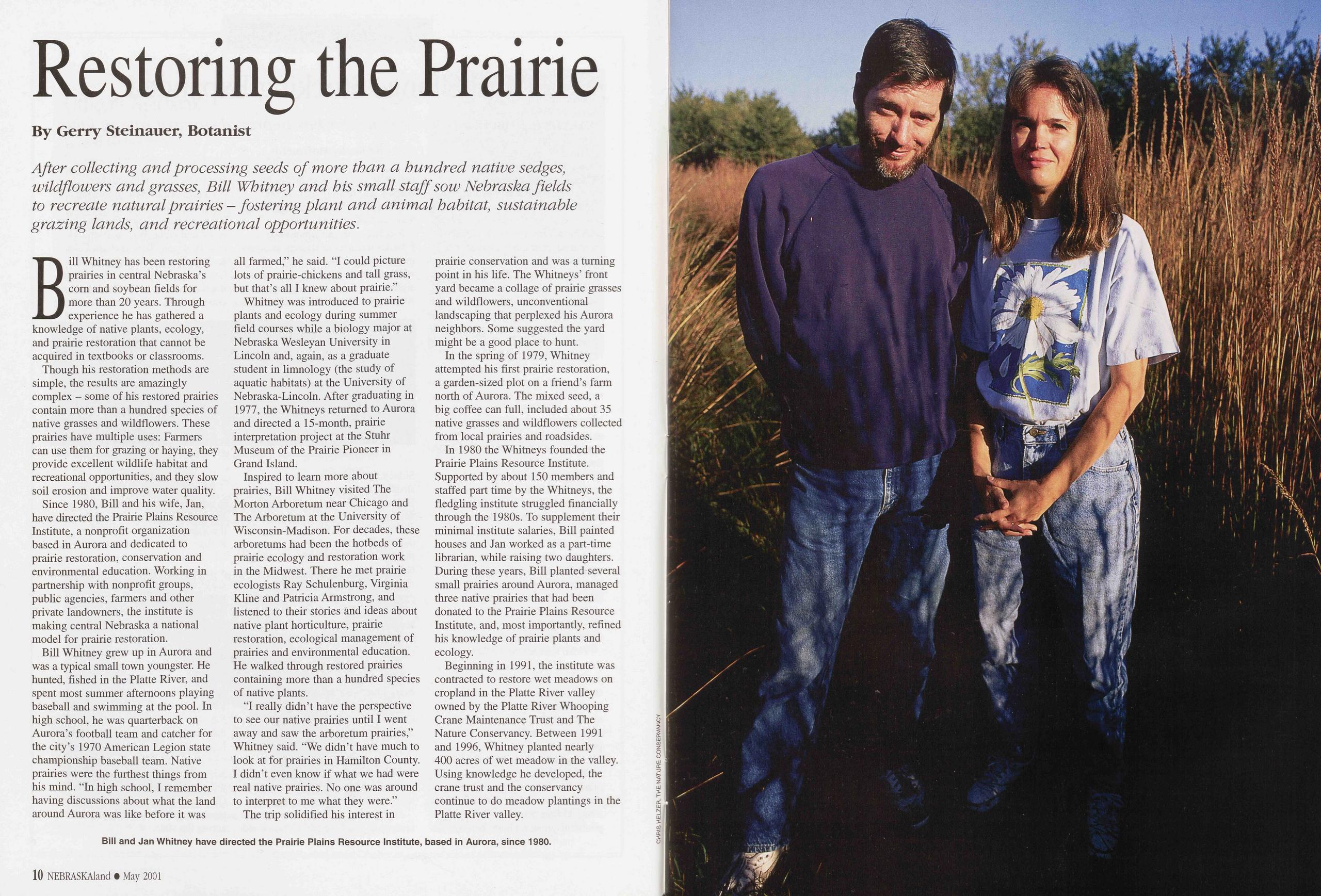
Restoring the Prairie
After collecting and processing seeds of more than a hundred native sedges, wildflowers and grasses, Bill Whitney and his small staff sow Nebraska fields to recreate natural prairies - fostering plant and animal habitat, sustainable grazing lands, and recreational opportunities.Bill Whitney has been restoring prairies in central Nebraska’s com and soybean fields for more than 20 years. Through experience he has gathered a knowledge of native plants, ecology, and prairie restoration that cannot be acquired in textbooks or classrooms.
Though his restoration methods are simple, the results are amazingly complex - some of his restored prairies contain more than a hundred species of native grasses and wildflowers. These prairies have multiple uses: Farmers can use them for grazing or haying, they provide excellent wildlife habitat and recreational opportunities, and they slow soil erosion and improve water quality.
Since 1980, Bill and his wife, Jan, have directed the Prairie Plains Resource Institute, a nonprofit organization based in Aurora and dedicated to prairie restoration, conservation and environmental education. Working in partnership with nonprofit groups, public agencies, farmers and other private landowners, the institute is making central Nebraska a national model for prairie restoration.
Bill Whitney grew up in Aurora and was a typical small town youngster. He hunted, fished in the Platte River, and spent most summer afternoons playing baseball and swimming at the pool. In high school, he was quarterback on Aurora’s football team and catcher for the city’s 1970 American Legion state championship baseball team. Native prairies were the furthest things from his mind. Tn high school, I remember having discussions about what the land around Aurora was like before it was all farmed,” he said. "I could picture lots of prairie-chickens and tall grass, but that’s all I knew about prairie.”
Whitney was introduced to prairie plants and ecology during summer field courses while a biology major at Nebraska Wesleyan University in Lincoln and, again, as a graduate student in limnology (the study of aquatic habitats) at the University of Nebraska-Lincoln. After graduating in 1977, the Whitneys returned to Aurora and directed a 15-month, prairie interpretation project at the Stuhr Museum of the Prairie Pioneer in Grand Island.
Inspired to learn more about prairies, Bill Whitney visited The Morton Arboretum near Chicago and The Arboretum at the University of Wisconsin-Madison. For decades, these arboretums had been the hotbeds of prairie ecology and restoration work in the Midwest. There he met prairie ecologists Ray Schulenburg, Virginia Kline and Patricia Armstrong, and listened to their stories and ideas about native plant horticulture, prairie restoration, ecological management of prairies and environmental education. He walked through restored prairies containing more than a hundred species of native plants.
"I really didn’t have the perspective to see our native prairies until I went away and saw the arboretum prairies,” Whitney said. "We didn’t have much to look at for prairies in Hamilton County. I didn’t even know if what we had were real native prairies. No one was around to interpret to me what they were.”
The trip solidified his interest in prairie conservation and was a turning point in his fife. The Whitneys’ front yard became a collage of prairie grasses and wildflowers, unconventional landscaping that perplexed his Aurora neighbors. Some suggested the yard might be a good place to hunt.
In the spring of 1979, Whitney attempted his first prairie restoration, a garden-sized plot on a friend’s farm north of Aurora. The mixed seed, a big coffee can full, included about 35 native grasses and wildflowers collected from local prairies and roadsides.
In 1980 the Whitneys founded the Prairie Plains Resource Institute. Supported by about 150 members and staffed part time by the Whitneys, the fledgling institute struggled financially through the 1980s. To supplement their minimal institute salaries, Bill painted houses and Jan worked as a part-time librarian, while raising two daughters. During these years, Bill planted several small prairies around Aurora, managed three native prairies that had been donated to the Prairie Plains Resource Institute, and, most importantly, refined his knowledge of prairie plants and ecology.
Beginning in 1991, the institute was contracted to restore wet meadows on cropland in the Platte River valley owned by the Platte River Whooping Crane Maintenance Trust and The Nature Conservancy. Between 1991 and 1996, Whitney planted nearly 400 acres of wet meadow in the valley. Using knowledge he developed, the crane trust and the conservancy continue to do meadow plantings in the Platte River valley.
Bill and Jan Whitney have directed the Prairie Plains Resource Institute, based in Aurora, since 1980.
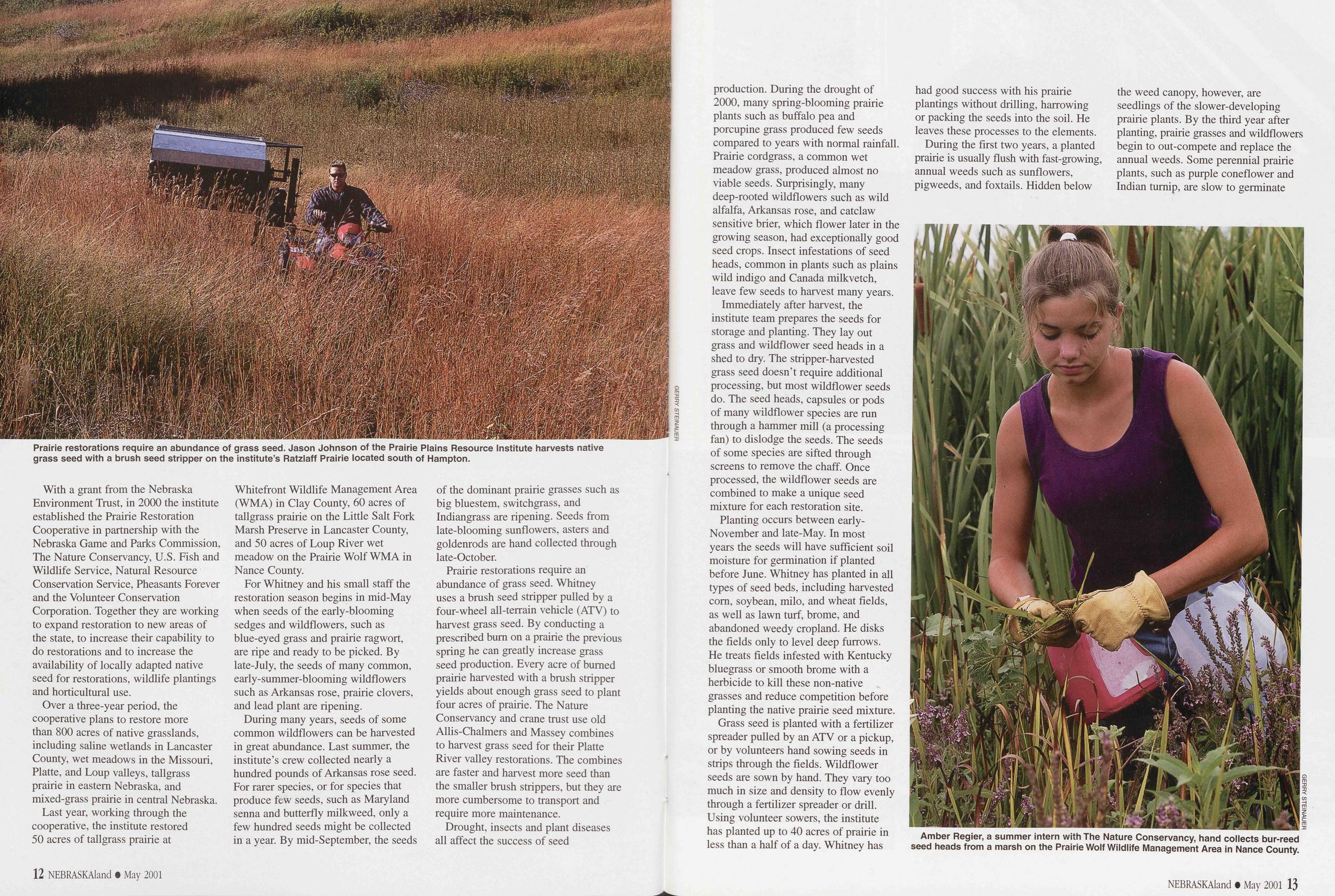
Prairie restorations require an abundance of grass seed. Jason Johnson of the Prairie Plains Resource Institute harvests native grass seed with a brush seed stripper on the institute’s Ratzlaff Prairie located south of Hampton.
GERRY STEINAUERWith a grant from the Nebraska Environment Trust, in 2000 the institute established the Prairie Restoration Cooperative in partnership with the Nebraska Game and Parks Commission, The Nature Conservancy, U.S. Fish and Wildlife Service, Natural Resource Conservation Service, Pheasants Forever and the Volunteer Conservation Corporation. Together they are working to expand restoration to new areas of the state, to increase their capability to do restorations and to increase the availability of locally adapted native seed for restorations, wildlife plantings and horticultural use.
Over a three-year period, the cooperative plans to restore more than 800 acres of native grasslands, including saline wetlands in Lancaster County, wet meadows in the Missouri, Platte, and Loup valleys, tailgrass prairie in eastern Nebraska, and mixed-grass prairie in central Nebraska.
Last year, working through the cooperative, the institute restored 50 acres of tailgrass prairie at Whitefront Wildlife Management Area (WMA) in Clay County, 60 acres of tailgrass prairie on the Little Salt Fork Marsh Preserve in Lancaster County, and 50 acres of Loup River wet meadow on the Prairie Wolf WMA in Nance County.
For Whitney and his small staff the restoration season begins in mid-May when seeds of the early-blooming sedges and wildflowers, such as blue-eyed grass and prairie ragwort, are ripe and ready to be picked. By late-July, the seeds of many common, early-summer-blooming wildflowers such as Arkansas rose, prairie clovers, and lead plant are ripening.
During many years, seeds of some common wildflowers can be harvested in great abundance. Last summer, the institute’s crew collected nearly a hundred pounds of Arkansas rose seed. For rarer species, or for species that produce few seeds, such as Maryland senna and butterfly milkweed, only a few hundred seeds might be collected in a year. By mid-September, the seeds of the dominant prairie grasses such as big bluestem, switchgrass, and Indiangrass are ripening. Seeds from late-blooming sunflowers, asters and goldenrods are hand collected through late-October.
Prairie restorations require an abundance of grass seed. Whitney uses a brush seed stripper pulled by a four-wheel all-terrain vehicle (ATV) to harvest grass seed. By conducting a prescribed bum on a prairie the previous spring he can greatly increase grass seed production. Every acre of burned prairie harvested with a brush stripper yields about enough grass seed to plant four acres of prairie. The Nature Conservancy and crane trust use old Allis-Chalmers and Massey combines to harvest grass seed for their Platte River valley restorations. The combines are faster and harvest more seed than the smaller brush strippers, but they are more cumbersome to transport and require more maintenance.
Drought, insects and plant diseases all affect the success of seed production. During the drought of 2000, many spring-blooming prairie plants such as buffalo pea and porcupine grass produced few seeds compared to years with normal rainfall. Prairie cordgrass, a common wet meadow grass, produced almost no viable seeds. Surprisingly, many deep-rooted wildflowers such as wild alfalfa, Arkansas rose, and catclaw sensitive brier, which flower later in the growing season, had exceptionally good seed crops. Insect infestations of seed heads, common in plants such as plains wild indigo and Canada milkvetch, leave few seeds to harvest many years.
Immediately after harvest, the institute team prepares the seeds for storage and planting. They lay out grass and wildflower seed heads in a shed to dry. The stripper-harvested grass seed doesn’t require additional processing, but most wildflower seeds do. The seed heads, capsules or pods of many wildflower species are run through a hammer mill (a processing fan) to dislodge the seeds. The seeds of some species are sifted through screens to remove the chaff. Once processed, the wildflower seeds are combined to make a unique seed mixture for each restoration site.
Planting occurs between early- November and late-May. In most years the seeds will have sufficient soil moisture for germination if planted before June. Whitney has planted in all types of seed beds, including harvested com, soybean, milo, and wheat fields, as well as lawn turf, brome, and abandoned weedy cropland. He disks the fields only to level deep furrows. He treats fields infested with Kentucky bluegrass or smooth brome with a herbicide to kill these non-native grasses and reduce competition before planting the native prairie seed mixture.
Grass seed is planted with a fertilizer spreader pulled by an ATV or a pickup, or by volunteers hand sowing seeds in strips through the fields. Wildflower seeds are sown by hand. They vary too much in size and density to flow evenly through a fertilizer spreader or drill. Using volunteer sowers, the institute has planted up to 40 acres of prairie in less than a half of a day. Whitney has had good success with his prairie plantings without drilling, harrowing or packing the seeds into the soil. He leaves these processes to the elements.
Amber Regier, a summer intern with The Nature Conservancy, hand collects bur-reed seed heads from a marsh on the Prairie Wolf Wildlife Management Area in Nance County.
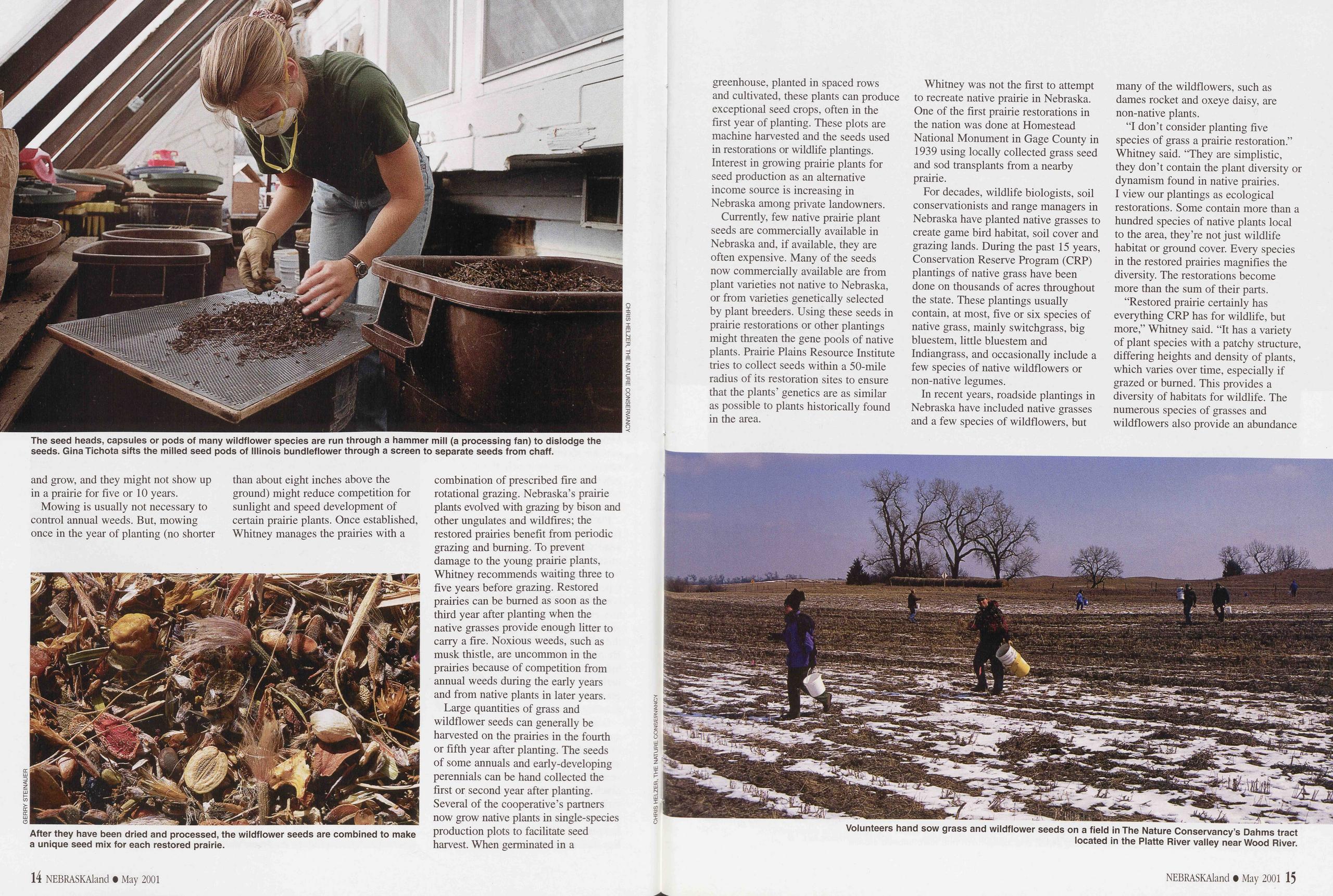
The seed heads, capsules or pods of many wildflower species are run through a hammer mill (a processing fan) to dislodge the seeds. GinaTichota sifts the milled seed pods of Illinois bundleflower through a screen to separate seeds from chaff.
CHRIS HELZER, THE NATURE CONSERVANCYand grow, and they might not show up in a prairie for five or 10 years.
After they have been dried and processed, the wildflower seeds are combined to make a unique seed mix for each restored prairie.
Large quantities of grass and wildflower seeds can generally be harvested on the prairies in the fourth or fifth year after planting. The seeds of some annuals and early-developing perennials can be hand collected the first or second year after planting. Several of the cooperative’s partners now grow native plants in single-species production plots to facilitate seed harvest. When germinated in a greenhouse, planted in spaced rows and cultivated, these plants can produce exceptional seed crops, often in the first year of planting. These plots are machine harvested and the seeds used in restorations or wildlife plantings. Interest in growing prairie plants for seed production as an alternative income source is increasing in Nebraska among private landowners.
Currently, few native prairie plant seeds are commercially available in Nebraska and, if available, they are often expensive. Many of the seeds now commercially available are from plant varieties not native to Nebraska, or from varieties genetically selected by plant breeders. Using these seeds in prairie restorations or other plantings might threaten the gene pools of native plants. Prairie Plains Resource Institute tries to collect seeds within a 50-mile radius of its restoration sites to ensure that the plants’ genetics are as similar as possible to plants historically found in the area.
Volunteers hand sow grass and wildflower seeds on a field in The Nature Conservancy’s Dahms tract located in the Platte River valley near Wood River.
Whitney was not the first to attempt to recreate native prairie in Nebraska. One of the first prairie restorations in the nation was done at Homestead National Monument in Gage County in 1939 using locally collected grass seed and sod transplants from a nearby prairie.
For decades, wildlife biologists, soil conservationists and range managers in Nebraska have planted native grasses to create game bird habitat, soil cover and grazing lands. During the past 15 years, Conservation Reserve Program (CRP) plantings of native grass have been done on thousands of acres throughout the state. These plantings usually contain, at most, five or six species of native grass, mainly switchgrass, big bluestem, little bluestem and Indiangrass, and occasionally include a few species of native wildflowers or non-native legumes.
In recent years, roadside plantings in Nebraska have included native grasses and a few species of wildflowers, but many of the wildflowers, such as dames rocket and oxeye daisy, are non-native plants.
"I don’t consider planting five species of grass a prairie restoration.” Whitney said. “They are simplistic, they don’t contain the plant diversity or dynamism found in native prairies. I view our plantings as ecological restorations. Some contain more than a hundred species of native plants local to the area, they’re not just wildlife habitat or ground cover. Every species in the restored prairies magnifies the diversity. The restorations become more than the sum of their parts.
“Restored prairie certainly has everything CRP has for wildlife, but more,” Whitney said. “It has a variety of plant species with a patchy structure, differing heights and density of plants, which varies over time, especially if grazed or burned. This provides a diversity of habitats for wildlife. The numerous species of grasses and wildflowers also provide an abundance
14 NEBRASKAland • May 2001 NEBRASKAland • May 2001 15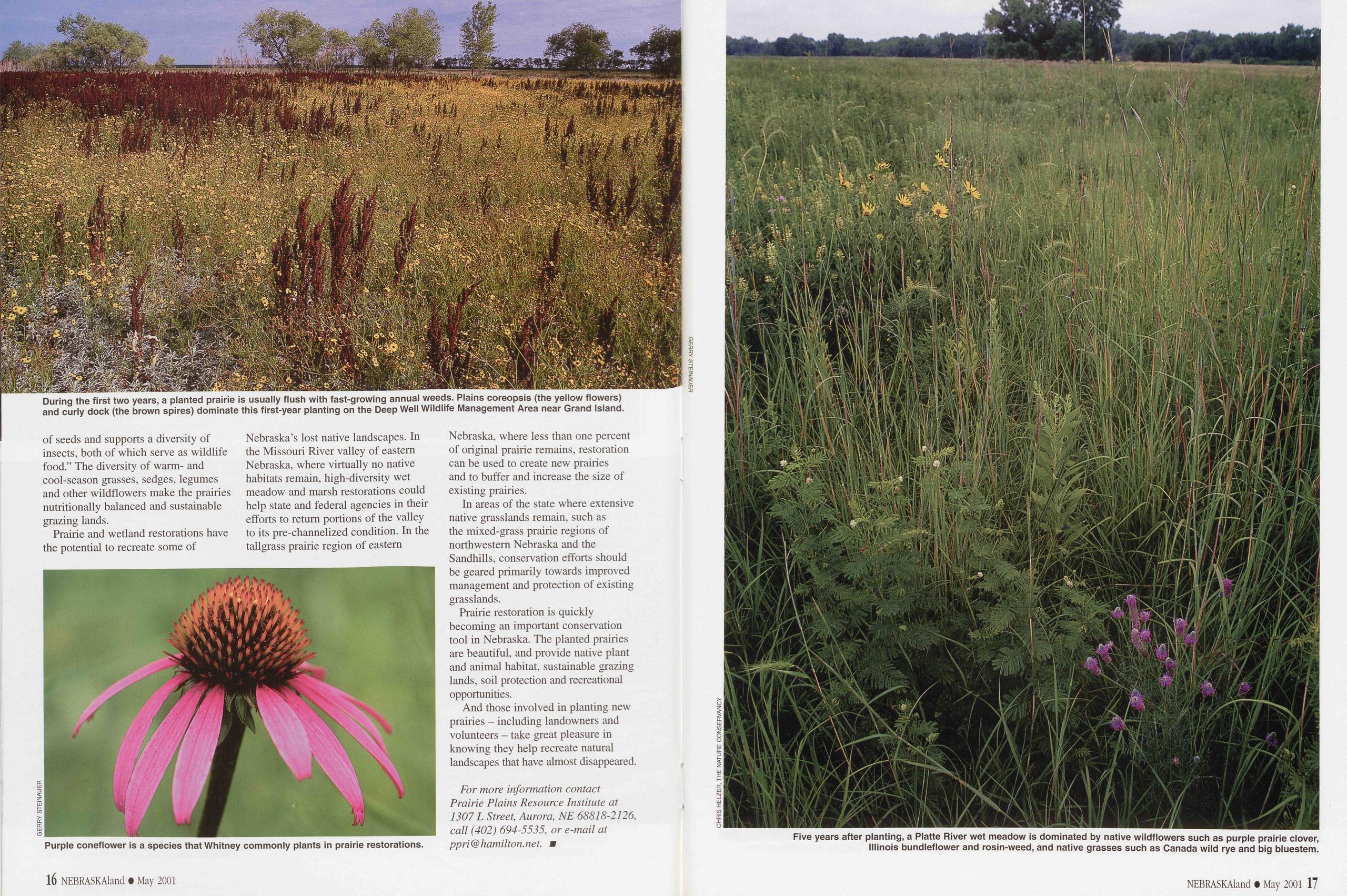
During the first two years, a planted prairie is usually flush with fast-growing annual weeds. Plains coreopsis (the yellow flowers) and curly dock (the brown spires) dominate this first-year planting on the Deep Well Wildlife Management Area near Grand Island.
GERRY STEINAUERof seeds and supports a diversity of insects, both of which serve as wildlife food.” The diversity of warm- and cool-season grasses, sedges, legumes and other wildflowers make the prairies nutritionally balanced and sustainable grazing lands.
Prairie and wetland restorations have the potential to recreate some of Purple coneflower is a species that Whitney commonly plants in prairie restorations. Nebraska’s lost native landscapes. In the Missouri River valley of eastern Nebraska, where virtually no native habitats remain, high-diversity wet meadow and marsh restorations could help state and federal agencies in their efforts to return portions of the valley to its pre-channelized condition. In the tallgrass prairie region of eastern Nebraska, where less than one percent of original prairie remains, restoration can be used to create new prairies and to buffer and increase the size of existing prairies.
In areas of the state where extensive native grasslands remain, such as the mixed-grass prairie regions of northwestern Nebraska and the Sandhills, conservation efforts should be geared primarily towards improved management and protection of existing grasslands.
Prairie restoration is quickly becoming an important conservation tool in Nebraska. The planted prairies are beautiful, and provide native plant and animal habitat, sustainable grazing lands, soil protection and recreational opportunities.
And those involved in planting new prairies - including landowners and volunteers - take great pleasure in knowing they help recreate natural landscapes that have almost disappeared. For more information contact Prairie Plains Resource Institute at 1307 L Street, Aurora, NE 68818-2126, call (402) 694-5535, or e-mail at ppri@hamilton.net. u
Five years after planting, a Platte River wet meadow is dominated by native wildflowers such as purple prairie clover, Illinois bundleflower and rosin-weed, and native grasses such as Canada wild rye and big bluestem.
Youth Skills Camp
An Introduction to Learning Outdoor Activities
A partnership between the Nebraska Game and Parks Commission and Nebraska 4-H teaches youngsters how to fish, shoot, camp, canoe, cook in Dutch ovens, and read maps and compasses. For many of the 11 to 14 year olds at camps, it is their first experience with traditional outdoor activities.Katie Kros of Millard was all smiles. She was doing things she had never done before and having a ball doing them. Before participating in an Outdoor Skills Camp at the Eastern Nebraska 4-H Center near Gretna last year, she had never fired a gun. She had heard her grandfather and uncle talk about hunting and she thought shooting would be fun. After taking her turn with a shotgun, a .22-caliber rifle and a muzzleloading rifle, she wasn’t disappointed. “The black powder kicks back a lot but they’re real fun,” she said. “I never knew it took so long to load them. It was fun because they made a lot of noise and sounded cool.”
Kros’s reaction was typical.
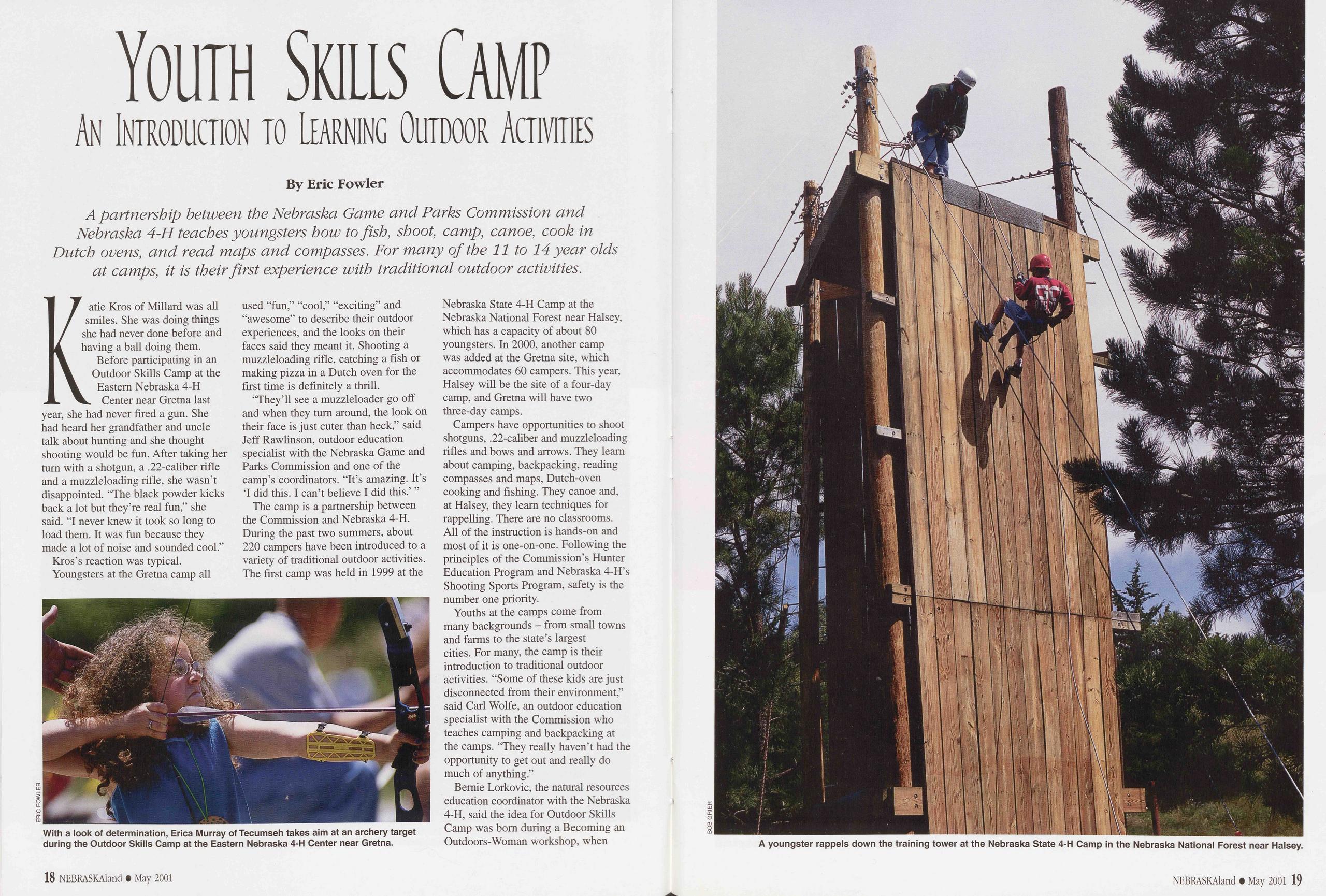
With a look of determination, Erica Murray of Tecumseh takes aim at an archery target during the Outdoor Skills Camp at the Eastern Nebraska 4-H Center near Gretna.
“They’ll see a muzzleloader go off and when they turn around, the look on their face is just cuter than heck,” said Jeff Rawlinson, outdoor education specialist with the Nebraska Game and Parks Commission and one of the camp’s coordinators. “It’s amazing. It’s I did this. I can’t believe I did this.’ ”
The camp is a partnership between the Commission and Nebraska 4-H. During the past two summers, about 220 campers have been introduced to a variety of traditional outdoor activities. The first camp was held in 1999 at the Nebraska State 4-H Camp at the Nebraska National Forest near Halsey, which has a capacity of about 80 youngsters. In 2000, another camp was added at the Gretna site, which accommodates 60 campers. This year, Halsey will be the site of a four-day camp, and Gretna will have two three-day camps.
Campers have opportunities to shoot shotguns, .22-caliber and muzzleloading rifles and bows and arrows. They learn about camping, backpacking, reading compasses and maps, Dutch-oven cooking and fishing. They canoe and, at Halsey, they learn techniques for rappelling. There are no classrooms. All of the instruction is hands-on and most of it is one-on-one. Following the principles of the Commission’s Hunter Education Program and Nebraska 4-H’s Shooting Sports Program, safety is the number one priority.
Youths at the camps come from many backgrounds - from small towns and farms to the state’s largest cities. For many, the camp is their introduction to traditional outdoor activities. “Some of these kids are just disconnected from their environment,” said Carl Wolfe, an outdoor education specialist with the Commission who teaches camping and backpacking at the camps. “They really haven’t had the opportunity to get out and really do much of anything.”
Bernie Lorkovic, the natural resources education coordinator with the Nebraska 4-H, said the idea for Outdoor Skills Camp was bom during a Becoming an Outdoors-Woman workshop, when
A youngster rappels down the training tower at the Nebraska State 4-H Camp in the Nebraska National Forest near Halsey.
someone suggested a similar camp for youngsters.
“We have access to a ton of kids. Game and Parks has access to a lot of instructors with a lot of expertise. It seemed like a natural fit bringing those things together,” said Lorkovic, who coordinates activities at the state’s 4-H camps.
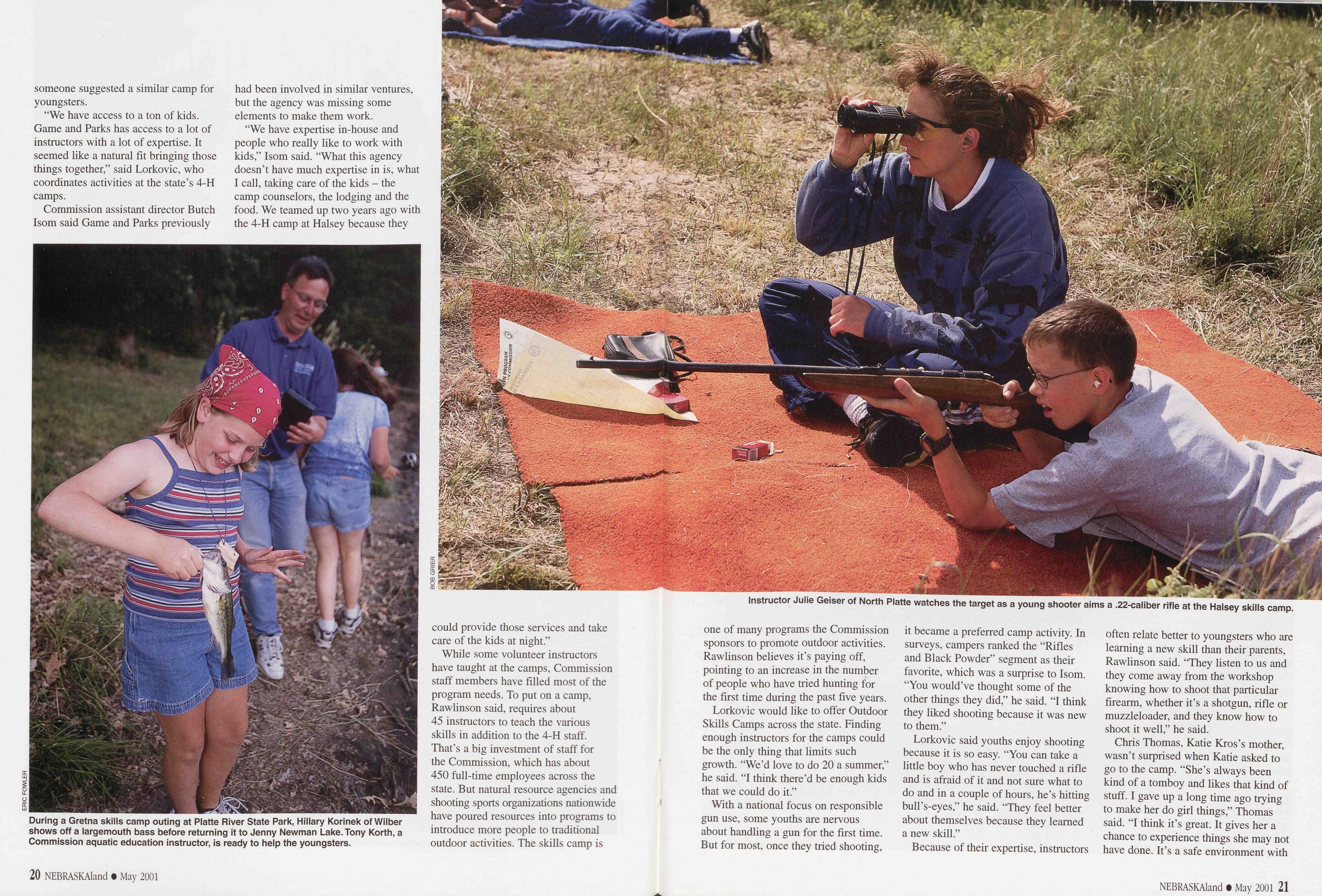
During a Gretna skills camp outing at Platte River State Park, Hillary Korinek of Wilber shows off a largemouth bass before returning it to Jenny Newman Lake. Tony Korth, a Commission aquatic education instructor, is ready to help the youngsters.
Instructor Julie Geiser of North Platte watches the target as a young shooter aims a .22-caliber rifle at the Halsey skills camp.
While some volunteer instructors have taught at the camps, Commission staff members have filled most of the program needs. To put on a camp, Rawlinson said, requires about 45 instructors to teach the various skills in addition to the 4-H staff. That’s a big investment of staff for the Commission, which has about 450 full-time employees across the state. But natural resource agencies and shooting sports organizations nationwide have poured resources into programs to introduce more people to traditional outdoor activities. The skills camp is one of many programs the Commission sponsors to promote outdoor activities. Rawlinson believes it’s paying off, pointing to an increase in the number of people who have tried hunting for the first time during the past five years.
Lorkovic would like to offer Outdoor Skills Camps across the state. Finding enough instructors for the camps could be the only thing that limits such growth. “We’d love to do 20 a summer,” he said. “I think there’d be enough kids that we could do it.”
With a national focus on responsible gun use, some youths are nervous about handling a gun for the first time. But for most, once they tried shooting, it became a preferred camp activity. In surveys, campers ranked the “Rifles and Black Powder” segment as their favorite, which was a surprise to Isom. “You would’ve thought some of the other things they did,” he said. “I think they liked shooting because it was new to them.”
Lorkovic said youths enjoy shooting because it is so easy. “You can take a little boy who has never touched a rifle and is afraid of it and not sure what to do and in a couple of hours, he’s hitting bull’s-eyes,” he said. “They feel better about themselves because they learned a new skill.”
Because of their expertise, instructors often relate better to youngsters who are learning a new skill than their parents, Rawlinson said. “They listen to us and they come away from the workshop knowing how to shoot that particular firearm, whether it’s a shotgun, rifle or muzzleloader, and they know how to shoot it well,” he said.
Chris Thomas, Katie Kros’s mother, wasn’t surprised when Katie asked to go to the camp. “She’s always been kind of a tomboy and likes that kind of stuff. I gave up a long time ago trying to make her do girl things,” Thomas said. “I think it’s great. It gives her a chance to experience things she may not have done. It’s a safe environment with
20 NEBRASKAland • May 2001 NEBRASKAland • May 2001 21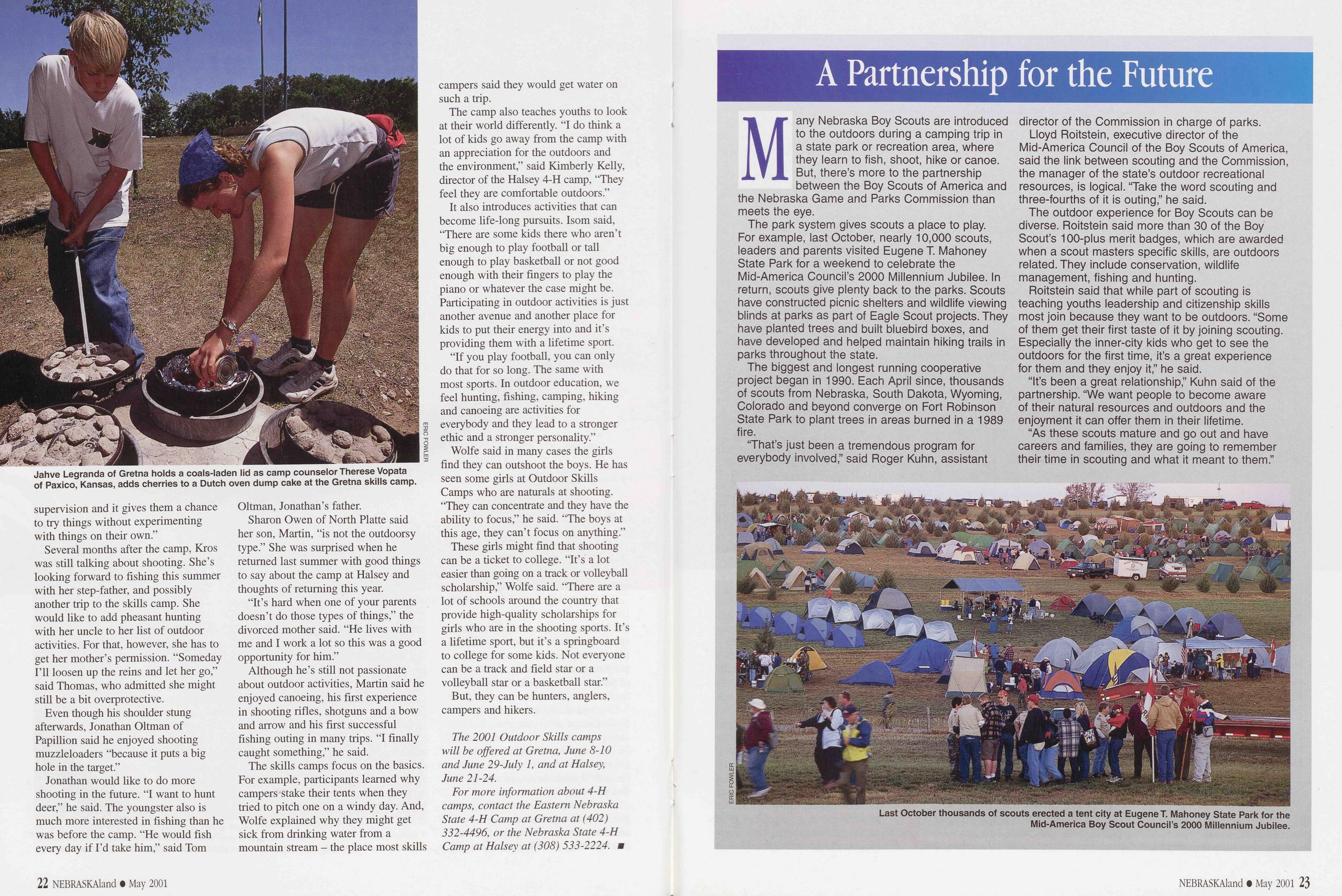
Jahve Legranda of Gretna holds a coals-laden lid as camp counselor Therese Vopata of Paxico, Kansas, adds cherries to a Dutch oven dump cake at the Gretna skills camp.
supervision and it gives them a chance to try things without experimenting with things on their own.”
Several months after the camp, Kros was still talking about shooting. She’s looking forward to fishing this summer with her step-father, and possibly another trip to the skills camp. She would like to add pheasant hunting with her uncle to her list of outdoor activities. For that, however, she has to get her mother’s permission. “Someday I’ll loosen up the reins and let her go,” said Thomas, who admitted she might still be a bit overprotective.
Even though his shoulder stung afterwards, Jonathan Oltman of Papillion said he enjoyed shooting muzzleloaders “because it puts a big hole in the target.”
Jonathan would like to do more shooting in the future. “I want to hunt deer,” he said. The youngster also is much more interested in fishing than he was before the camp. “He would fish every day if I’d take him,” said Tom Oltman, Jonathan’s father.
Sharon Owen of North Platte said her son, Martin, “is not the outdoorsy type.” She was surprised when he returned last summer with good things to say about the camp at Halsey and thoughts of returning this year.
“It’s hard when one of your parents doesn’t do those types of things,” the divorced mother said. “He lives with me and I work a lot so this was a good opportunity for him.”
Although he’s still not passionate about outdoor activities, Martin said he enjoyed canoeing, his first experience in shooting rifles, shotguns and a bow and arrow and his first successful fishing outing in many trips. “I finally caught something,” he said.
The skills camps focus on the basics. For example, participants learned why campers stake their tents when they tried to pitch one on a windy day. And, Wolfe explained why they might get sick from drinking water from a mountain stream - the place most skills campers said they would get water on such a trip.
The camp also teaches youths to look at their world differently. “I do think a lot of kids go away from the camp with an appreciation for the outdoors and the environment,” said Kimberly Kelly, director of the Halsey 4-H camp, “They feel they are comfortable outdoors.”
It also introduces activities that can become life-long pursuits. Isom said, “There are some kids there who aren’t big enough to play football or tall enough to play basketball or not good enough with their fingers to play the piano or whatever the case might be. Participating in outdoor activities is just another avenue and another place for kids to put their energy into and it’s providing them with a lifetime sport.
“If you play football, you can only do that for so long. The same with most sports. In outdoor education, we feel hunting, fishing, camping, hiking and canoeing are activities for everybody and they lead to a stronger ethic and a stronger personality.”
Wolfe said in many cases the girls find they can outshoot the boys. He has seen some girls at Outdoor Skills Camps who are naturals at shooting. “They can concentrate and they have the ability to focus,” he said. “The boys at this age, they can’t focus on anything.”
These girls might find that shooting can be a ticket to college. “It’s a lot easier than going on a track or volleyball scholarship,” Wolfe said. “There are a lot of schools around the country that provide high-quality scholarships for girls who are in the shooting sports. It’s a lifetime sport, but it’s a springboard to college for some kids. Not everyone can be a track and field star or a volleyball star or a basketball star.”
But, they can be hunters, anglers, campers and hikers.
The 2001 Outdoor Skills camps will be offered at Gretna, June 8-10 and June 29-July 1, and at Halsey, June 21-24.
For more information about 4-H camps, contact the Eastern Nebraska State 4-H Camp at Gretna at (402) 332-4496, or the Nebraska State 4-H Camp at Halsey at (308) 533-2224.
A Partnership for the Future
Many Nebraska Boy Scouts are introduced to the outdoors during a camping trip in a state park or recreation area, where they learn to fish, shoot, hike or canoe. But, there’s more to the partnership between the Boy Scouts of America and the Nebraska Game and Parks Commission than meets the eye.
The park system gives scouts a place to play. For example, last October, nearly 10,000 scouts, leaders and parents visited Eugene T. Mahoney State Park for a weekend to celebrate the Mid-America Council’s 2000 Millennium Jubilee. In return, scouts give plenty back to the parks. Scouts have constructed picnic shelters and wildlife viewing blinds at parks as part of Eagle Scout projects. They have planted trees and built bluebird boxes, and have developed and helped maintain hiking trails in parks throughout the state.
The biggest and longest running cooperative project began in 1990. Each April since, thousands of scouts from Nebraska, South Dakota, Wyoming, Colorado and beyond converge on Fort Robinson State Park to plant trees in areas burned in a 1989 fire.
“That’s just been a tremendous program for everybody involved,” said Roger Kuhn, assistant director of the Commission in charge of parks.
Lloyd Roitstein, executive director of the Mid-America Council of the Boy Scouts of America, said the link between scouting and the Commission, the manager of the state’s outdoor recreational resources, is logical. “Take the word scouting and three-fourths of it is outing,” he said.
The outdoor experience for Boy Scouts can be diverse. Roitstein said more than 30 of the Boy Scout’s 100-plus merit badges, which are awarded when a scout masters specific skills, are outdoors related. They include conservation, wildlife management, fishing and hunting.
Roitstein said that while part of scouting is teaching youths leadership and citizenship skills most join because they want to be outdoors. “Some of them get their first taste of it by joining scouting. Especially the inner-city kids who get to see the outdoors for the first time, it’s a great experience for them and they enjoy it,” he said.
“It’s been a great relationship,” Kuhn said of the partnership. “We want people to become aware of their natural resources and outdoors and the enjoyment it can offer them in their lifetime.
“As these scouts mature and go out and have careers and families, they are going to remember their time in scouting and what it meant to them.”
Last October thousands of scouts erected a tent city at Eugene T. Mahoney State Park for the Mid-America Boy Scout Council’s 2000 Millennium Jubilee.
Yellow Mud Turtles
—Living on the Edge—
For 20 years, John Iverson has probed the mysterious ways of a little-known creature eking out life in unconventional fashion at the very edge of its range.
It is easy to fall in love with sandhill cranes or bald eagles, and it is more prestigious for a scientist to study grizzly bears or tropical tree frogs. But who loves or studies turtles?
Subtract from that list those who admire or study appealing species of turtles - box turtles, painted turtles and the like - and those remaining could ride in the same elevator at a herpetological conference and, on most days, have no one to talk to.
The size of a quarter, a yellow mud turtle hatchling feeds in food-rich shallows.
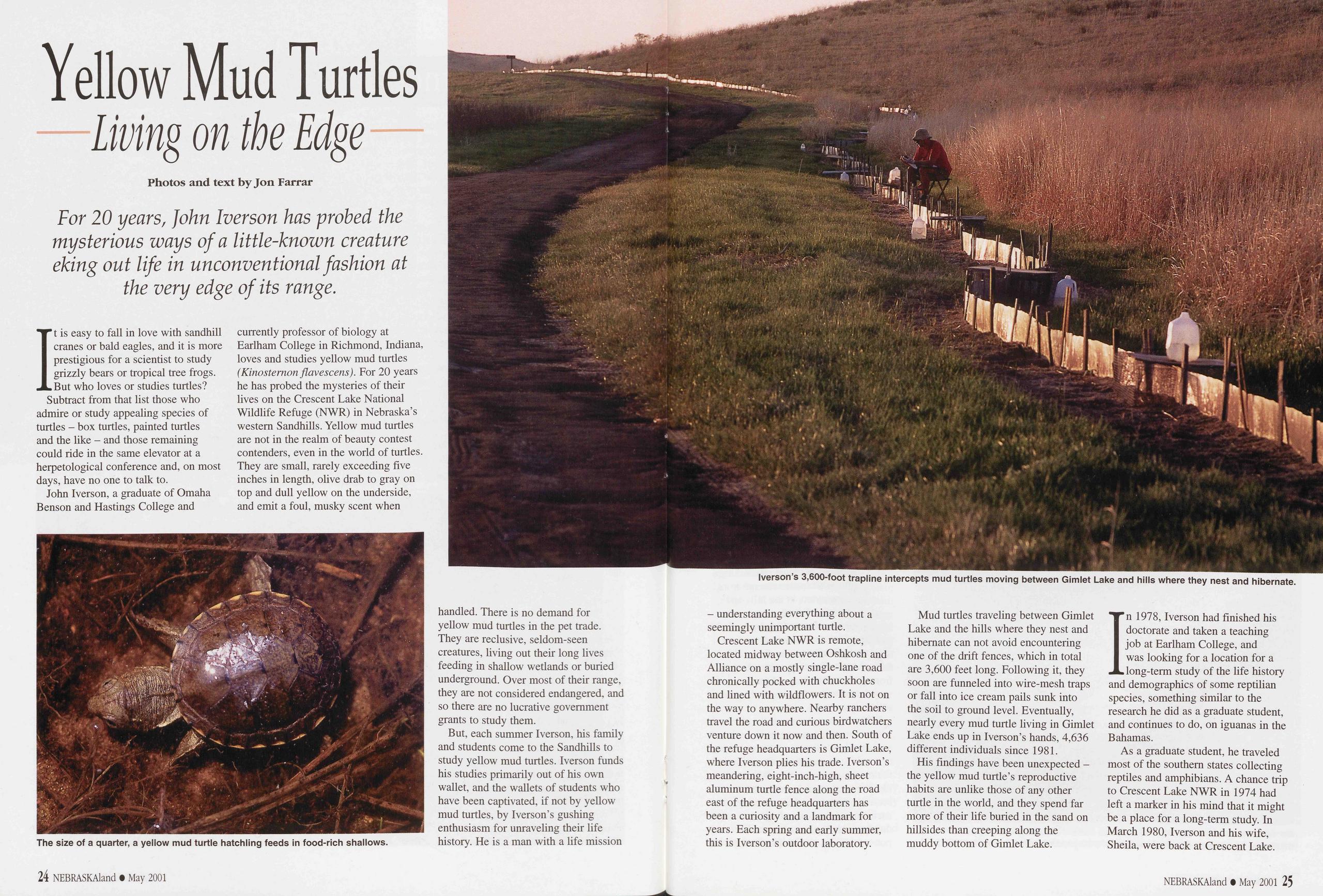
Iverson’s 3,600-foot trapline intercepts mud turtles moving between Gimlet Lake and hills where they nest and hibernate.
But, each summer Iverson, his family and students come to the Sandhills to study yellow mud turtles. Iverson funds his studies primarily out of his own wallet, and the wallets of students who have been captivated, if not by yellow mud turtles, by Iverson’s gushing enthusiasm for unraveling their life history. He is a man with a life mission - understanding everything about a seemingly unimportant turtle.
Crescent Lake NWR is remote, located midway between Oshkosh and Alliance on a mostly single-lane road chronically pocked with chuckholes and lined with wildflowers. It is not on the way to anywhere. Nearby ranchers travel the road and curious birdwatchers venture down it now and then. South of the refuge headquarters is Gimlet Lake, where Iverson plies his trade. Iverson’s meandering, eight-inch-high, sheet aluminum turtle fence along the road east of the refuge headquarters has been a curiosity and a landmark for years. Each spring and early summer, this is Iverson’s outdoor laboratory.
Mud turtles traveling between Gimlet Lake and the hills where they nest and hibernate can not avoid encountering one of the drift fences, which in total are 3,600 feet long. Following it, they soon are funneled into wire-mesh traps or fall into ice cream pails sunk into the soil to ground level. Eventually, nearly every mud turtle living in Gimlet Lake ends up in Iverson’s hands, 4,636 different individuals since 1981.
His findings have been unexpected - the yellow mud turtle’s reproductive habits are unlike those of any other turtle in the world, and they spend far more of their life buried in the sand on hillsides than creeping along the muddy bottom of Gimlet Lake.
In 1978, Iverson had finished his doctorate and taken a teaching job at Earlham College, and was looking for a location for a « »long-term study of the life history and demographics of some reptilian species, something similar to the research he did as a graduate student, and continues to do, on iguanas in the Bahamas.
As a graduate student, he traveled most of the southern states collecting reptiles and amphibians. A chance trip to Crescent Lake NWR in 1974 had left a marker in his mind that it might be a place for a long-term study. In March 1980, Iverson and his wife, Sheila, were back at Crescent Lake.
24 NEBRASKAland • May 2001 NEBRASKAland • May 2001 25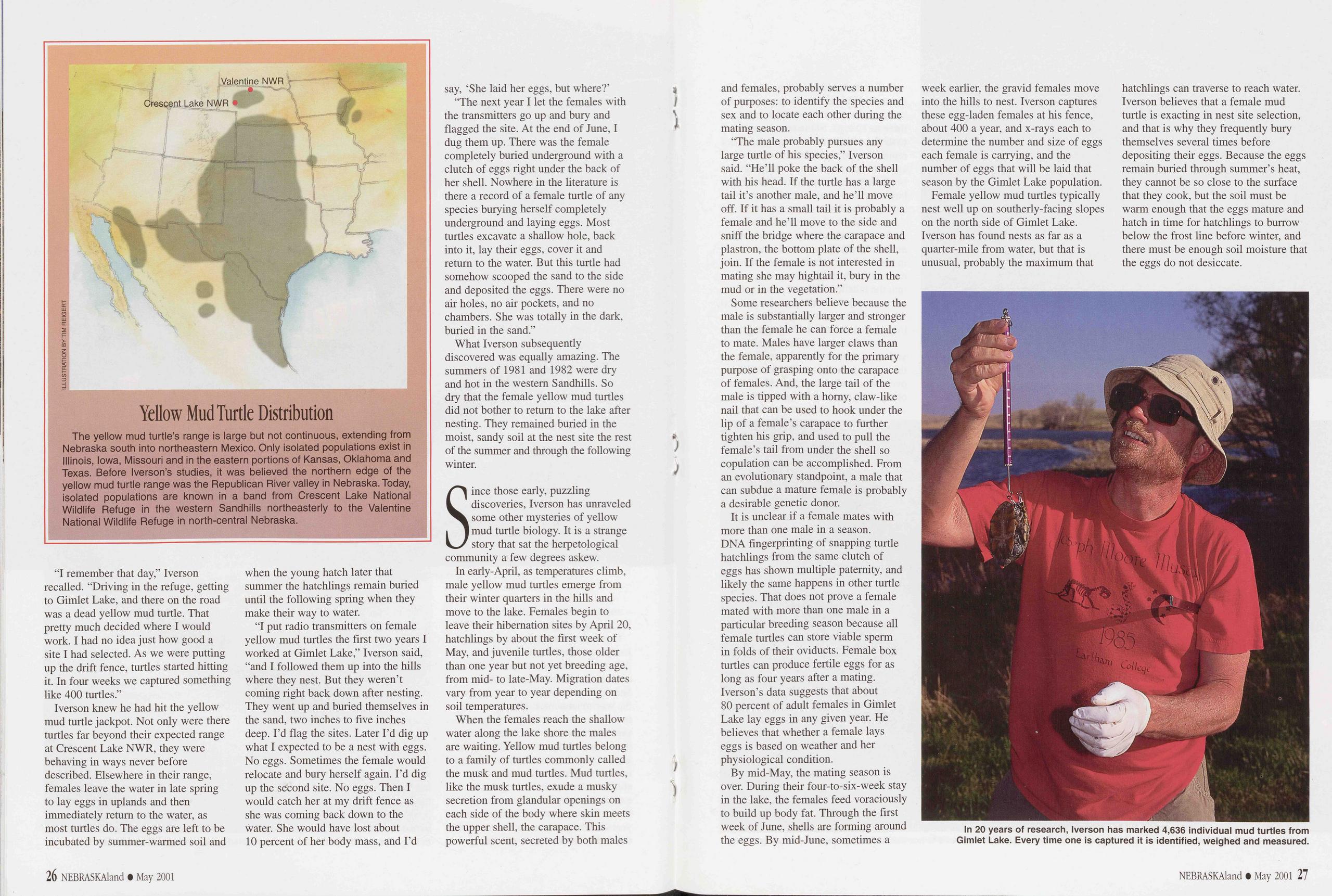
The yellow mud turtle’s range is large but not continuous, extending from Nebraska south into northeastern Mexico. Only isolated populations exist in Illinois, Iowa, Missouri and in the eastern portions of Kansas, Oklahoma and Texas. Before Iverson’s studies, it was believed the northern edge of the yellow mud turtle range was the Republican River valley in Nebraska. Today, isolated populations are known in a band from Crescent Lake National Wildlife Refuge in the western Sandhills northeasterly to the Valentine National Wildlife Refuge in north-central Nebraska.
"I remember that day,” Iverson recalled. “Driving in the refuge, getting to Gimlet Lake, and there on the road was a dead yellow mud turtle. That pretty much decided where I would work. I had no idea just how good a site I had selected. As we were putting up the drift fence, turtles started hitting it. In four weeks we captured something like 400 turtles.”
Iverson knew he had hit the yellow mud turtle jackpot. Not only were there turtles far beyond their expected range at Crescent Lake NWR, they were behaving in ways never before described. Elsewhere in their range, females leave the water in late spring to lay eggs in uplands and then immediately return to the water, as most turtles do. The eggs are left to be incubated by summer-warmed soil and when the young hatch later that summer the hatchlings remain buried until the following spring when they make their way to water.
"I put radio transmitters on female yellow mud turtles the first two years I worked at Gimlet Lake,” Iverson said, "and I followed them up into the hills where they nest. But they weren’t coming right back down after nesting. They went up and buried themselves in the sand, two inches to five inches deep. I’d flag the sites. Later I’d dig up what I expected to be a nest with eggs. No eggs. Sometimes the female would relocate and bury herself again. I’d dig up the second site. No eggs. Then I would catch her at my drift fence as she was coming back down to the water. She would have lost about 10 percent of her body mass, and I’d say, ‘She laid her eggs, but where?’
"The next year I let the females with the transmitters go up and bury and flagged the site. At the end of June, I dug them up. There was the female completely buried underground with a clutch of eggs right under the back of her shell. Nowhere in the literature is there a record of a female turtle of any species burying herself completely underground and laying eggs. Most turtles excavate a shallow hole, back into it, lay their eggs, cover it and return to the water. But this turtle had somehow scooped the sand to the side and deposited the eggs. There were no air holes, no air pockets, and no chambers. She was totally in the dark, buried in the sand.”
What Iverson subsequently discovered was equally amazing. The summers of 1981 and 1982 were dry and hot in the western Sandhills. So dry that the female yellow mud turtles did not bother to return to the lake after nesting. They remained buried in the moist, sandy soil at the nest site the rest of the summer and through the following winter.
Since those early, puzzling discoveries, Iverson has unraveled some other mysteries of yellow mud turtle biology. It is a strange story that sat the herpetological community a few degrees askew. In early-April, as temperatures climb, male yellow mud turtles emerge from their winter quarters in the hills and move to the lake. Females begin to leave their hibernation sites by April 20, hatchlings by about the first week of May, and juvenile turtles, those older than one year but not yet breeding age, from mid- to late-May. Migration dates vary from year to year depending on soil temperatures.
When the females reach the shallow water along the lake shore the males are waiting. Yellow mud turtles belong to a family of turtles commonly called the musk and mud turtles. Mud turtles, like the musk turtles, exude a musky secretion from glandular openings on each side of the body where skin meets the upper shell, the carapace. This powerful scent, secreted by both males and females, probably serves a number of purposes: to identify the species and sex and to locate each other during the mating season.
"The male probably pursues any large turtle of his species,” Iverson said. "He’ll poke the back of the shell with his head. If the turtle has a large tail it’s another male, and he’ll move off. If it has a small tail it is probably a female and he’ll move to the side and sniff the bridge where the carapace and plastron, the bottom plate of the shell, join. If the female is not interested in mating she may hightail it, bury in the mud or in the vegetation.”
Some researchers believe because the male is substantially larger and stronger than the female he can force a female to mate. Males have larger claws than the female, apparently for the primary purpose of grasping onto the carapace of females. And, the large tail of the male is tipped with a homy, claw-like nail that can be used to hook under the lip of a female’s carapace to further tighten his grip, and used to pull the female’s tail from under the shell so copulation can be accomplished. From an evolutionary standpoint, a male that can subdue a mature female is probably a desirable genetic donor.
It is unclear if a female mates with more than one male in a season. DNA fingerprinting of snapping turtle hatchlings from the same clutch of eggs has shown multiple paternity, and likely the same happens in other turtle species. That does not prove a female mated with more than one male in a particular breeding season because all female turtles can store viable sperm in folds of their oviducts. Female box turtles can produce fertile eggs for as long as four years after a mating. Iverson’s data suggests that about 80 percent of adult females in Gimlet Lake lay eggs in any given year. He believes that whether a female lays eggs is based on weather and her physiological condition.
By mid-May, the mating season is over. During their four-to-six-week stay in the lake, the females feed voraciously to build up body fat. Through the first week of June, shells are forming around the eggs. By mid-June, sometimes a week earlier, the gravid females move into the hills to nest. Iverson captures these egg-laden females at his fence, about 400 a year, and x-rays each to determine the number and size of eggs each female is carrying, and the number of eggs that will be laid that season by the Gimlet Lake population.
In 20 years of research, Iverson has marked 4,636 individual mud turtles from Gimlet Lake. Every time one is captured it is identified, weighed and measured.
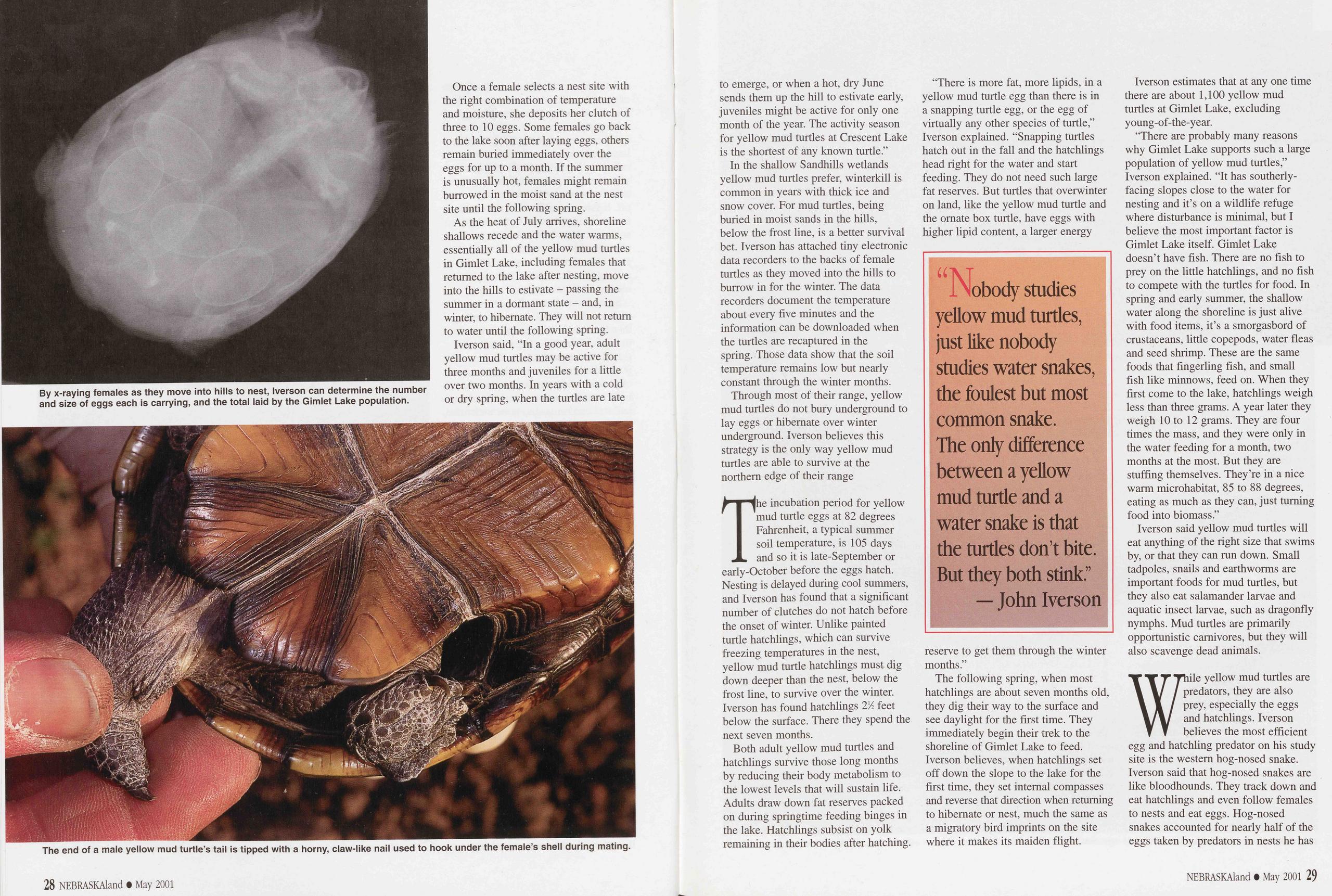
By x-raying females as they move into hills to nest, Iverson can determine the number and size of eggs each is carrying, and the total laid by the Gimlet Lake population.
Once a female selects a nest site with the right combination of temperature and moisture, she deposits her clutch of three to 10 eggs. Some females go back to the lake soon after laying eggs, others remain buried immediately over the eggs for up to a month. If the summer is unusually hot, females might remain burrowed in the moist sand at the nest site until the following spring.
As the heat of July arrives, shoreline shallows recede and the water warms, essentially all of the yellow mud turtles in Gimlet Lake, including females that returned to the lake after nesting, move into the hills to estivate - passing the summer in a dormant state - and, in winter, to hibernate. They will not return to water until the following spring.
The end of a male yellow mud turtle’s tail is tipped with a horny, claw-like nail used to hook under the female’s shell during mating.
In the shallow Sandhills wetlands yellow mud turtles prefer, winterkill is common in years with thick ice and snow cover. For mud turtles, being buried in moist sands in the hills, below the frost line, is a better survival bet. Iverson has attached tiny electronic data recorders to the backs of female turtles as they moved into the hills to burrow in for the winter. The data recorders document the temperature about every five minutes and the information can be downloaded when the turtles are recaptured in the spring. Those data show that the soil temperature remains low but nearly constant through the winter months.
Through most of their range, yellow mud turtles do not bury underground to lay eggs or hibernate over winter underground. Iverson believes this strategy is the only way yellow mud turtles are able to survive at the northern edge of their range
The incubation period for yellow mud turtle eggs at 82 degrees Fahrenheit, a typical summer soil temperature, is 105 days and so it is late-September or early-October before the eggs hatch. Nesting is delayed during cool summers, and Iverson has found that a significant number of clutches do not hatch before the onset of winter. Unlike painted turtle hatchlings, which can survive freezing temperatures in the nest, yellow mud turtle hatchlings must dig down deeper than the nest, below the frost line, to survive over the winter. Iverson has found hatchlings 2lA feet below the surface. There they spend the next seven months.
Both adult yellow mud turtles and hatchlings survive those long months by reducing their body metabolism to the lowest levels that will sustain life. Adults draw down fat reserves packed on during springtime feeding binges in the lake. Hatchlings subsist on yolk remaining in their bodies after hatching.
“There is more fat, more lipids, in a yellow mud turtle egg than there is in a snapping turtle egg, or the egg of virtually any other species of turtle,” Iverson explained. “Snapping turtles hatch out in the fall and the hatchlings head right for the water and start feeding. They do not need such large fat reserves. But turtles that overwinter on land, like the yellow mud turtle and the ornate box turtle, have eggs with higher lipid content, a larger energy
Nobody studies yellow mud turtles, just like nobody studies water snakes, the foulest but most common snake. The only difference between a yellow mud turtle and a water snake is that the turtles don’t bite. But they both stink.” — John Iversonreserve to get them through the winter months.”
The following spring, when most hatchlings are about seven months old, they dig their way to the surface and see daylight for the first time. They immediately begin their trek to the shoreline of Gimlet Lake to feed. Iverson believes, when hatchlings set off down the slope to the lake for the first time, they set internal compasses and reverse that direction when returning to hibernate or nest, much the same as a migratory bird imprints on the site where it makes its maiden flight.
Iverson estimates that at any one time there are about 1,100 yellow mud turtles at Gimlet Lake, excluding young-of-the-year.
“There are probably many reasons why Gimlet Lake supports such a large population of yellow mud turtles,” Iverson explained. “It has southerly- facing slopes close to the water for nesting and it’s on a wildlife refuge where disturbance is minimal, but I believe the most important factor is Gimlet Lake itself. Gimlet Lake doesn’t have fish. There are no fish to prey on the little hatchlings, and no fish to compete with the turtles for food. In spring and early summer, the shallow water along the shoreline is just alive with food items, it’s a smorgasbord of crustaceans, little copepods, water fleas and seed shrimp. These are the same foods that fingerling fish, and small fish like minnows, feed on. When they first come to the lake, hatchlings weigh less than three grams. A year later they weigh 10 to 12 grams. They are four times the mass, and they were only in the water feeding for a month, two months at the most. But they are stuffing themselves. They’re in a nice warm microhabitat, 85 to 88 degrees, eating as much as they can, just turning food into biomass.”
Iverson said yellow mud turtles will eat anything of the right size that swims by, or that they can run down. Small tadpoles, snails and earthworms are important foods for mud turtles, but they also eat salamander larvae and aquatic insect larvae, such as dragonfly nymphs. Mud turtles are primarily opportunistic carnivores, but they will also scavenge dead animals.
While yellow mud turtles are predators, they are also prey, especially the eggs and hatchlings. Iverson believes the most efficient egg and hatchling predator on his study site is the western hog-nosed snake. Iverson said that hog-nosed snakes are like bloodhounds. They track down and eat hatchlings and even follow females to nests and eat eggs. Hog-nosed snakes accounted for nearly half of the eggs taken by predators in nests he has
28 NEBRASKAland • May 2001 NEBRASKAland • May 2001 29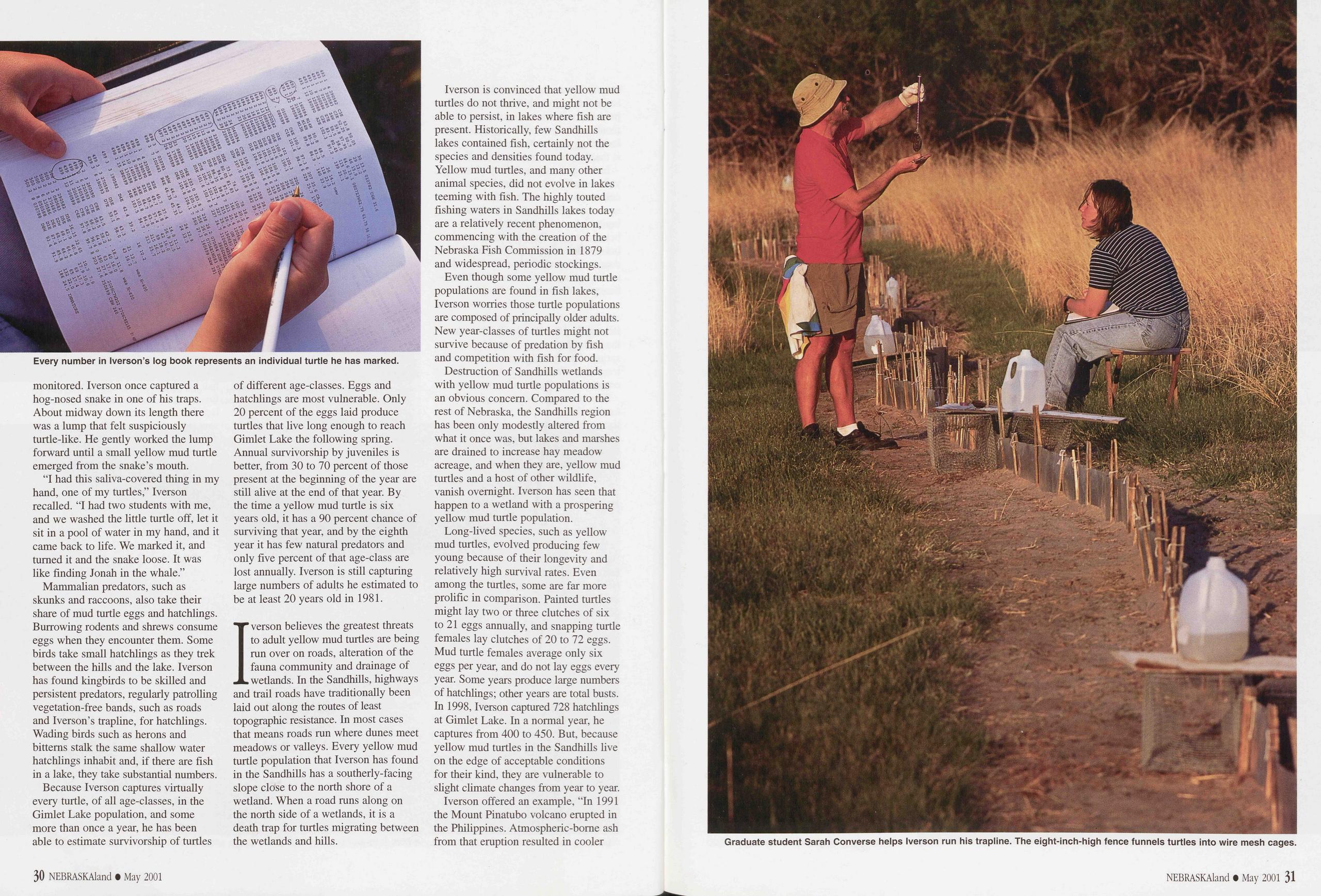
Every number in Iverson’s log book represents an individual turtle he has marked.
monitored. Iverson once captured a hog-nosed snake in one of his traps. About midway down its length there was a lump that felt suspiciously turtle-like. He gently worked the lump forward until a small yellow mud turtle emerged from the snake’s mouth.
"I had this saliva-covered thing in my hand, one of my turtles,” Iverson recalled. "I had two students with me, and we washed the little turtle off, let it sit in a pool of water in my hand, and it came back to life. We marked it, and turned it and the snake loose. It was like finding Jonah in the whale.”
Mammalian predators, such as skunks and raccoons, also take their share of mud turtle eggs and hatchlings. Burrowing rodents and shrews consume eggs when they encounter them. Some birds take small hatchlings as they trek between the hills and the lake. Iverson has found kingbirds to be skilled and persistent predators, regularly patrolling vegetation-free bands, such as roads and Iverson’s trapline, for hatchlings. Wading birds such as herons and bitterns stalk the same shallow water hatchlings inhabit and, if there are fish in a lake, they take substantial numbers.
Because Iverson captures virtually every turtle, of all age-classes, in the Gimlet Lake population, and some more than once a year, he has been able to estimate survivorship of turtles of different age-classes. Eggs and hatchlings are most vulnerable. Only 20 percent of the eggs laid produce turtles that live long enough to reach Gimlet Lake the following spring. Annual survivorship by juveniles is better, from 30 to 70 percent of those present at the beginning of the year are still alive at the end of that year. By the time a yellow mud turtle is six years old, it has a 90 percent chance of surviving that year, and by the eighth year it has few natural predators and only five percent of that age-class are lost annually. Iverson is still capturing large numbers of adults he estimated to be at least 20 years old in 1981.
Iverson believes the greatest threats to adult yellow mud turtles are being run over on roads, alteration of the fauna community and drainage of wetlands. In the Sandhills, highways and trail roads have traditionally been laid out along the routes of least topographic resistance. In most cases that means roads run where dunes meet meadows or valleys. Every yellow mud turtle population that Iverson has found in the Sandhills has a southerly-facing slope close to the north shore of a wetland. When a road runs along on the north side of a wetlands, it is a death trap for turtles migrating between the wetlands and hills.
Iverson is convinced that yellow mud turtles do not thrive, and might not be able to persist, in lakes where fish are present. Historically, few Sandhills lakes contained fish, certainly not the species and densities found today. Yellow mud turtles, and many other animal species, did not evolve in lakes teeming with fish. The highly touted fishing waters in Sandhills lakes today are a relatively recent phenomenon, commencing with the creation of the Nebraska Fish Commission in 1879 and widespread, periodic stockings.
Even though some yellow mud turtle populations are found in fish lakes, Iverson worries those turtle populations are composed of principally older adults. New year-classes of turtles might not survive because of predation by fish and competition with fish for food.
Destruction of Sandhills wetlands with yellow mud turtle populations is an obvious concern. Compared to the rest of Nebraska, the Sandhills region has been only modestly altered from what it once was, but lakes and marshes are drained to increase hay meadow acreage, and when they are, yellow mud turtles and a host of other wildlife, vanish overnight. Iverson has seen that happen to a wetland with a prospering yellow mud turtle population.
Long-lived species, such as yellow mud turtles, evolved producing few young because of their longevity and relatively high survival rates. Even among the turtles, some are far more prolific in comparison. Painted turtles might lay two or three clutches of six to 21 eggs annually, and snapping turtle females lay clutches of 20 to 72 eggs. Mud turtle females average only six eggs per year, and do not lay eggs every year. Some years produce large numbers of hatchlings; other years are total busts. In 1998, Iverson captured 728 hatchlings at Gimlet Lake. In a normal year, he captures from 400 to 450. But, because yellow mud turtles in the Sandhills live on the edge of acceptable conditions for their kind, they are vulnerable to slight climate changes from year to year.
Iverson offered an example, "In 1991 the Mount Pinatubo volcano erupted in the Philippines. Atmospheric-borne ash from that eruption resulted in cooler
Graduate student Sarah Converse helps Iverson run his trapline. The eight-inch-high fence funnels turtles into wire mesh cages.
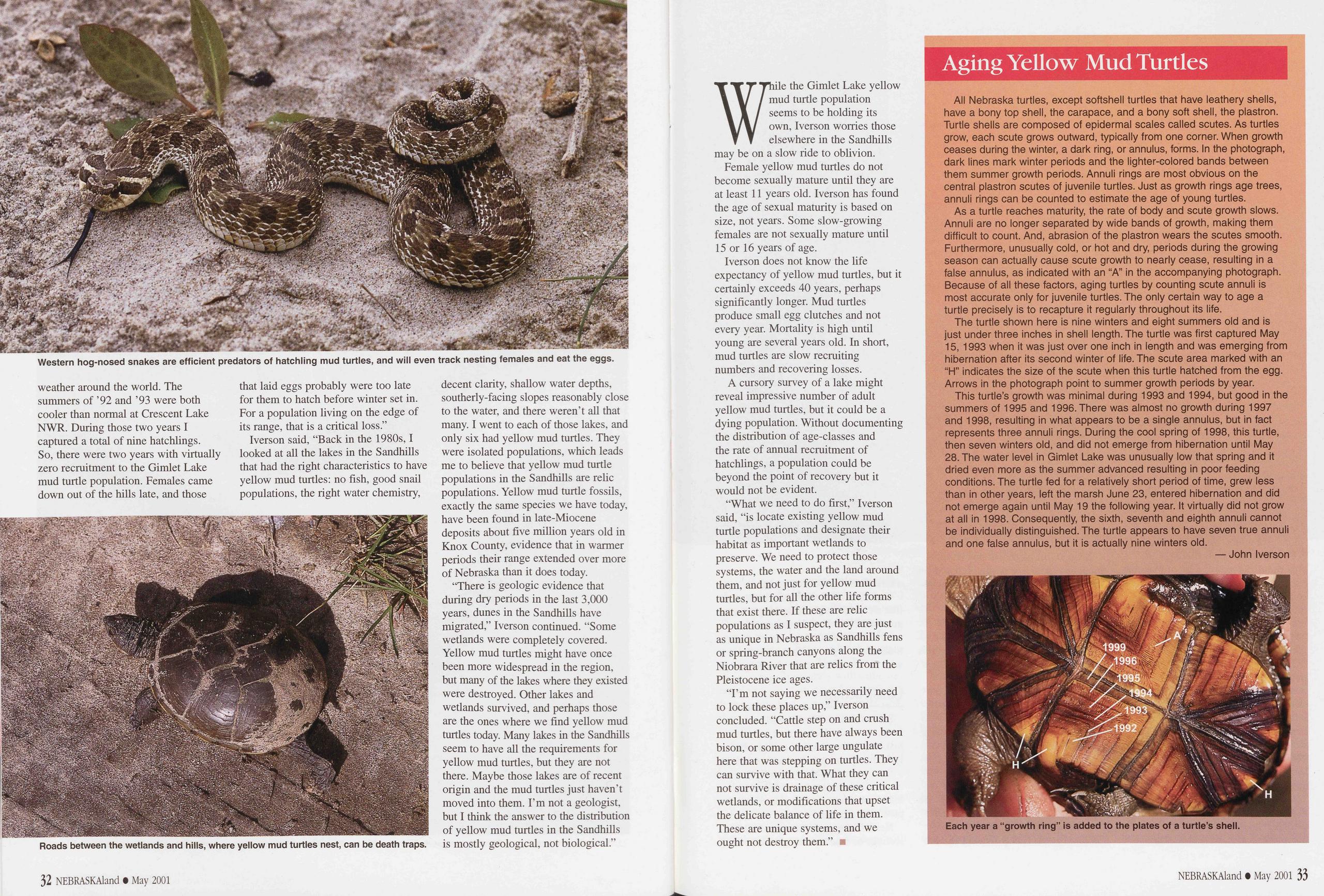
Western hog-nosed snakes are efficient predators of hatchling mud turtles, and will even track nesting females and eat the eggs.
weather around the world. The summers of ’92 and ’93 were both cooler than normal at Crescent Lake NWR. During those two years I captured a total of nine hatchlings. So, there were two years with virtually zero recruitment to the Gimlet Lake mud turtle population. Females came down out of the hills late, and those Roads between the wetlands and hills, where yellow mud turtles nest, can be death traps. that laid eggs probably were too late for them to hatch before winter set in. For a population living on the edge of its range, that is a critical loss.”
Iverson said, “Back in the 1980s, I looked at all the lakes in the Sandhills that had the right characteristics to have yellow mud turtles: no fish, good snail populations, the right water chemistry, decent clarity, shallow water depths, southerly-facing slopes reasonably close to the water, and there weren’t all that many. I went to each of those lakes, and only six had yellow mud turtles. They were isolated populations, which leads me to believe that yellow mud turtle populations in the Sandhills are relic populations. Yellow mud turtle fossils, exactly the same species we have today, have been found in late-Miocene deposits about five million years old in Knox County, evidence that in warmer periods their range extended over more of Nebraska than it does today.
“There is geologic evidence that during dry periods in the last 3,000 years, dunes in the Sandhills have migrated,” Iverson continued. “Some wetlands were completely covered. Yellow mud turtles might have once been more widespread in the region, but many of the lakes where they existed were destroyed. Other lakes and wetlands survived, and perhaps those are the ones where we find yellow mud turtles today. Many lakes in the Sandhills seem to have all the requirements for yellow mud turtles, but they are not there. Maybe those lakes are of recent origin and the mud turtles just haven’t moved into them. I’m not a geologist, but I think the answer to the distribution of yellow mud turtles in the Sandhills is mostly geological, not biological.”
While the Gimlet Lake yellow mud turtle population seems to be holding its own, Iverson worries those elsewhere in the Sandhills may be on a slow ride to oblivion.
Female yellow mud turtles do not become sexually mature until they are at least 11 years old. Iverson has found the age of sexual maturity is based on size, not years. Some slow-growing females are not sexually mature until 15 or 16 years of age.
Iverson does not know the life expectancy of yellow mud turtles, but it certainly exceeds 40 years, perhaps significantly longer. Mud turtles produce small egg clutches and not every year. Mortality is high until young are several years old. In short, mud turtles are slow recruiting numbers and recovering losses.
A cursory survey of a lake might reveal impressive number of adult yellow mud turtles, but it could be a dying population. Without documenting the distribution of age-classes and the rate of annual recruitment of hatchlings, a population could be beyond the point of recovery but it would not be evident.
“What we need to do first,” Iverson said, “is locate existing yellow mud turtle populations and designate their habitat as important wetlands to preserve. We need to protect those systems, the water and the land around them, and not just for yellow mud turtles, but for all the other life forms that exist there. If these are relic populations as I suspect, they are just as unique in Nebraska as Sandhills fens or spring-branch canyons along the Niobrara River that are relics from the Pleistocene ice ages.
“I’m not saying we necessarily need to lock these places up,” Iverson concluded. “Cattle step on and crush mud turtles, but there have always been bison, or some other large ungulate here that was stepping on turtles. They can survive with that. What they can not survive is drainage of these critical wetlands, or modifications that upset the delicate balance of life in them. These are unique systems, and we ought not destroy them.” ■
Aging Yellow Mud Turtles
All Nebraska turtles, except softshell turtles that have leathery shells, have a bony top shell, the carapace, and a bony soft shell, the plastron. Turtle shells are composed of epidermal scales called scutes. As turtles grow, each scute grows outward, typically from one corner. When growth ceases during the winter, a dark ring, or annulus, forms. In the photograph, dark lines mark winter periods and the lighter-colored bands between them summer growth periods. Annuli rings are most obvious on the central plastron scutes of juvenile turtles. Just as growth rings age trees, annuli rings can be counted to estimate the age of young turtles.
As a turtle reaches maturity, the rate of body and scute growth slows. Annuli are no longer separated by wide bands of growth, making them difficult to count. And, abrasion of the plastron wears the scutes smooth. Furthermore, unusually cold, or hot and dry, periods during the growing season can actually cause scute growth to nearly cease, resulting in a false annulus, as indicated with an "A" in the accompanying photograph. Because of all these factors, aging turtles by counting scute annuli is most accurate only for juvenile turtles. The only certain way to age a turtle precisely is to recapture it regularly throughout its life.
The turtle shown here is nine winters and eight summers old and is just under three inches in shell length. The turtle was first captured May 15, 1993 when it was just over one inch in length and was emerging from hibernation after its second winter of life. The scute area marked with an “H” indicates the size of the scute when this turtle hatched from the egg. Arrows in the photograph point to summer growth periods by year.
This turtle’s growth was minimal during 1993 and 1994, but good in the summers of 1995 and 1996. There was almost no growth during 1997 and 1998, resulting in what appears to be a single annulus, but in fact represents three annuli rings. During the cool spring of 1998, this turtle, then seven winters old, and did not emerge from hibernation until May 28. The water level in Gimlet Lake was unusually low that spring and it dried even more as the summer advanced resulting in poor feeding conditions. The turtle fed for a relatively short period of time, grew less than in other years, left the marsh June 23, entered hibernation and did not emerge again until May 19 the following year. It virtually did not grow at all in 1998. Consequently, the sixth, seventh and eighth annuli cannot be individually distinguished. The turtle appears to have seven true annuli and one false annulus, but it is actually nine winters old.
Each year a “growth ring” is added to the plates of a turtle’s shell.
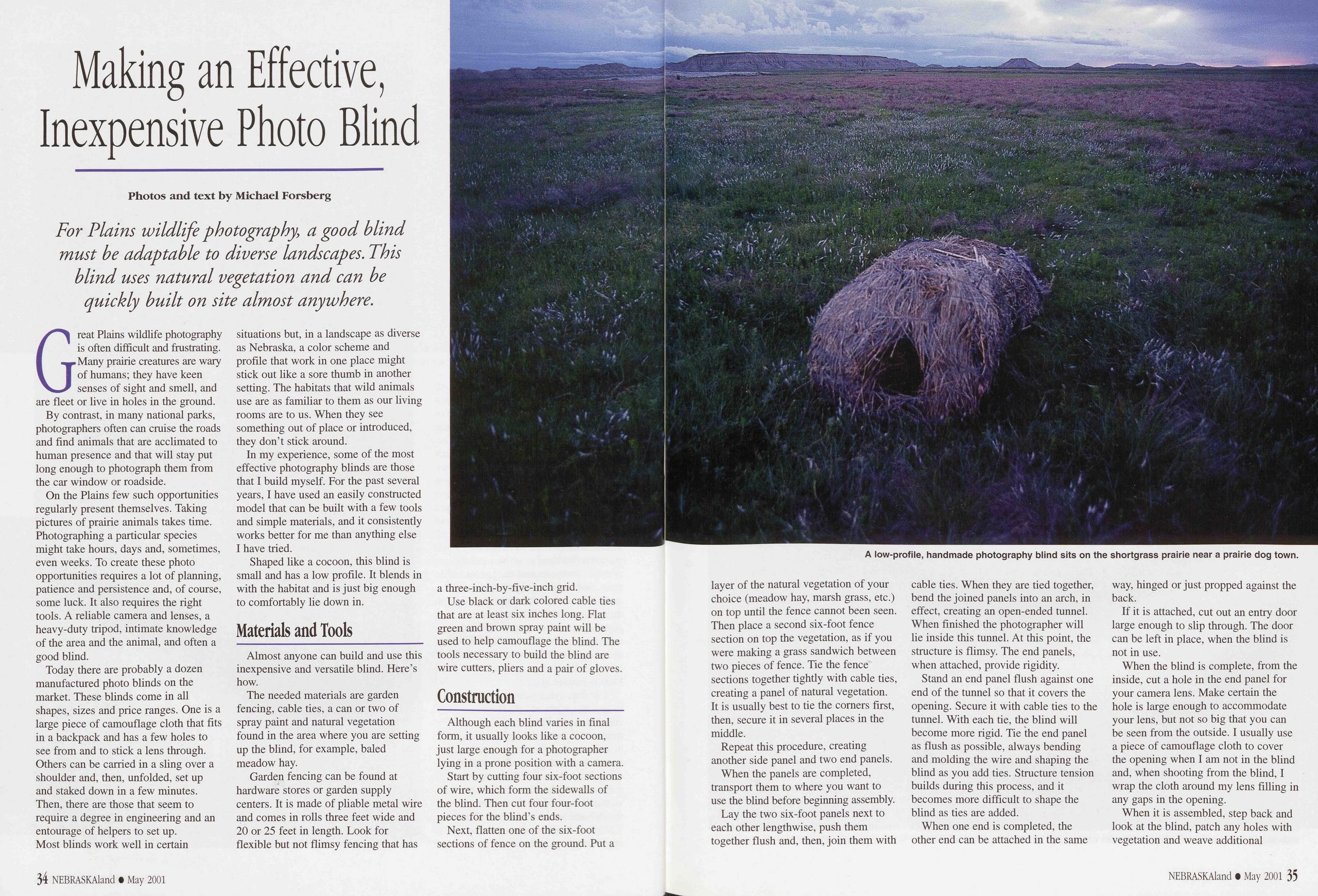
Making an Effective, Inexpensive Photo Blind
For Plains wildlife photography, a good blind must be adaptable to diverse landscapes. This blind uses natural vegetation and can be quickly built on site almost anywhere.Great Plains wildlife photography is often difficult and frustrating. Many prairie creatures are wary of humans; they have keen senses of sight and smell, and are fleet or live in holes in the ground.
By contrast, in many national parks, photographers often can cruise the roads and find animals that are acclimated to human presence and that will stay put long enough to photograph them from the car window or roadside.
On the Plains few such opportunities regularly present themselves. Taking pictures of prairie animals takes time. Photographing a particular species might take hours, days and, sometimes, even weeks. To create these photo opportunities requires a lot of planning, patience and persistence and, of course, some luck. It also requires the right tools. A reliable camera and lenses, a heavy-duty tripod, intimate knowledge of the area and the animal, and often a good blind.
Today there are probably a dozen manufactured photo blinds on the market. These blinds come in all shapes, sizes and price ranges. One is a large piece of camouflage cloth that fits in a backpack and has a few holes to see from and to stick a lens through. Others can be carried in a sling over a shoulder and, then, unfolded, set up and staked down in a few minutes. Then, there are those that seem to require a degree in engineering and an entourage of helpers to set up. Most blinds work well in certain situations but, in a landscape as diverse as Nebraska, a color scheme and profile that work in one place might stick out like a sore thumb in another setting. The habitats that wild animals use are as familiar to them as our living rooms are to us. When they see something out of place or introduced, they don’t stick around.
In my experience, some of the most effective photography blinds are those that I build myself. For the past several years, I have used an easily constructed model that can be built with a few tools and simple materials, and it consistently works better for me than anything else I have tried.
Shaped like a cocoon, this blind is small and has a low profile. It blends in with the habitat and is just big enough to comfortably lie down in.
Materials and ToolsAlmost anyone can build and use this inexpensive and versatile blind. Here’s how.
The needed materials are garden fencing, cable ties, a can or two of spray paint and natural vegetation found in the area where you are setting up the blind, for example, baled meadow hay.
A low-profile, handmade photography blind sits on the shortgrass prairie near a prairie dog town.
Use black or dark colored cable ties that are at least six inches long. Flat green and brown spray paint will be used to help camouflage the blind. The tools necessary to build the blind are wire cutters, pliers and a pair of gloves.
Construction Although each blind varies in final form, it usually looks like a cocoon, just large enough for a photographer lying in a prone position with a camera. Start by cutting four six-foot sections of wire, which form the sidewalls of the blind. Then cut four four-foot pieces for the blind’s ends. Next, flatten one of the six-foot sections of fence on the ground. Put a layer of the natural vegetation of your choice (meadow hay, marsh grass, etc.) on top until the fence cannot been seen. Then place a second six-foot fence section on top the vegetation, as if you were making a grass sandwich between two pieces of fence. Tie the fence sections together tightly with cable ties, creating a panel of natural vegetation. It is usually best to tie the comers first, then, secure it in several places in the middle. Repeat this procedure, creating another side panel and two end panels. When the panels are completed, transport them to where you want to use the blind before beginning assembly. Lay the two six-foot panels next to each other lengthwise, push them together flush and, then, join them with cable ties. When they are tied together, bend the joined panels into an arch, in effect, creating an open-ended tunnel. When finished the photographer will lie inside this tunnel. At this point, the structure is flimsy. The end panels, when attached, provide rigidity. Stand an end panel flush against one end of the tunnel so that it covers the opening. Secure it with cable ties to the tunnel. With each tie, the blind will become more rigid. Tie the end panel as flush as possible, always bending and molding the wire and shaping the blind as you add ties. Structure tension builds during this process, and it becomes more difficult to shape the blind as ties are added. When one end is completed, the other end can be attached in the same way, hinged or just propped against the back. If it is attached, cut out an entry door large enough to slip through. The door can be left in place, when the blind is not in use. When the blind is complete, from the inside, cut a hole in the end panel for your camera lens. Make certain the hole is large enough to accommodate your lens, but not so big that you can be seen from the outside. I usually use a piece of camouflage cloth to cover the opening when I am not in the blind and, when shooting from the blind, I wrap the cloth around my lens filling in any gaps in the opening. When it is assembled, step back and look at the blind, patch any holes with vegetation and weave additional 34 NEBRASKAland • May 2001 NEBRASKAland • May 2001 35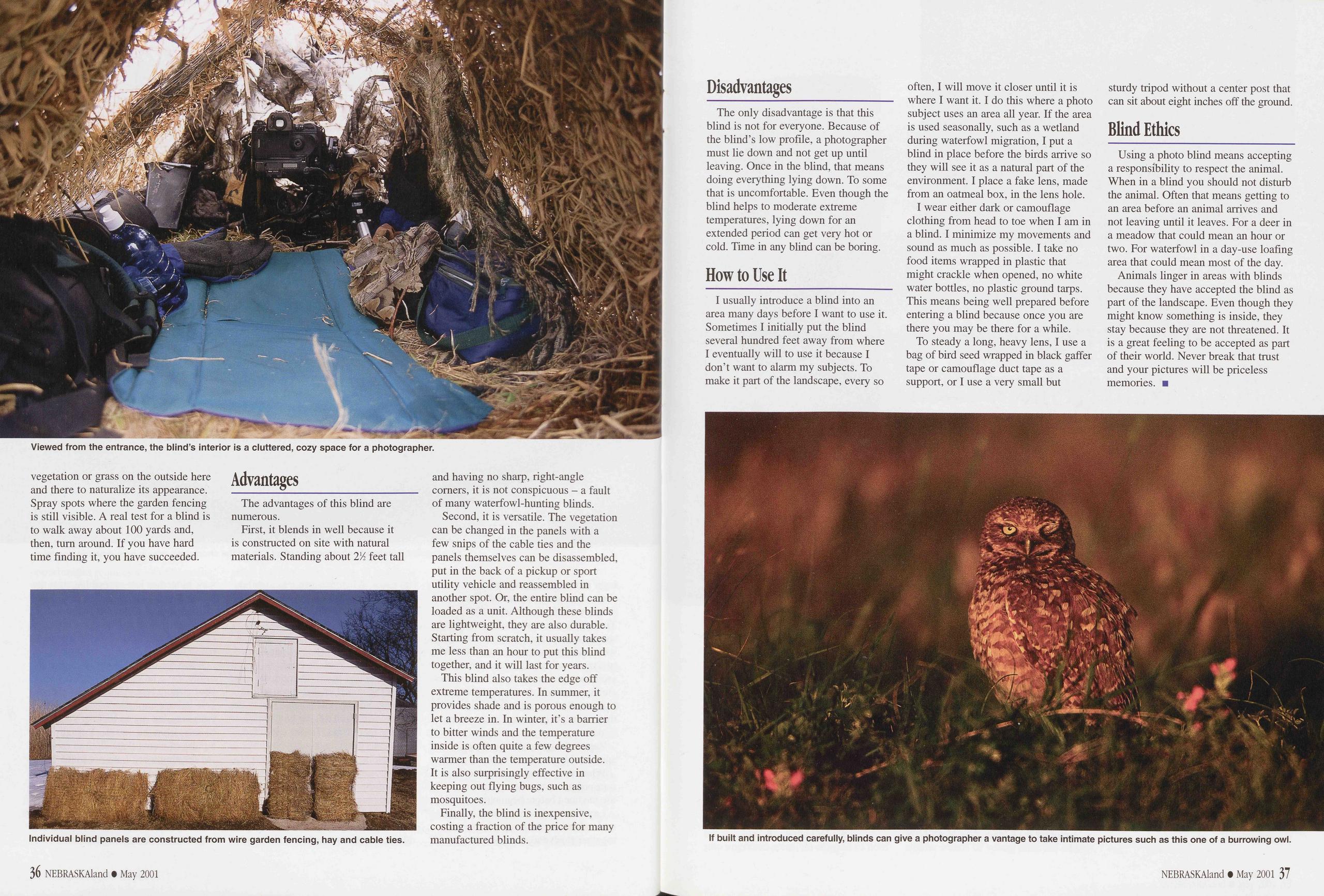
Viewed from the entrance, the blind’s interior is a cluttered, cozy space for a photographer.
vegetation or grass on the outside here and there to naturalize its appearance. Spray spots where the garden fencing is still visible. A real test for a blind is to walk away about 100 yards and, then, turn around. If you have hard time finding it, you have succeeded.
AdvantagesThe advantages of this blind are numerous.
Individual blind panels are constructed from wire garden fencing, hay and cable ties.
Second, it is versatile. The vegetation can be changed in the panels with a few snips of the cable ties and the panels themselves can be disassembled, put in the back of a pickup or sport utility vehicle and reassembled in another spot. Or, the entire blind can be loaded as a unit. Although these blinds are lightweight, they are also durable. Starting from scratch, it usually takes me less than an hour to put this blind together, and it will last for years.
This blind also takes the edge off extreme temperatures. In summer, it provides shade and is porous enough to let a breeze in. In winter, it’s a barrier to bitter winds and the temperature inside is often quite a few degrees warmer than the temperature outside. It is also surprisingly effective in keeping out flying bugs, such as mosquitoes.
Finally, the blind is inexpensive, costing a fraction of the price for many manufactured blinds.
DisadvantagesThe only disadvantage is that this blind is not for everyone. Because of the blind’s low profile, a photographer must lie down and not get up until leaving. Once in the blind, that means doing everything lying down. To some that is uncomfortable. Even though the blind helps to moderate extreme temperatures, lying down for an extended period can get very hot or cold. Time in any blind can be boring.
How to Use ItIf built and introduced carefully, blinds can give a photographer a vantage to take intimate pictures such as this one of a burrowing owl.
I wear either dark or camouflage clothing from head to toe when I am in a blind. I minimize my movements and sound as much as possible. I take no food items wrapped in plastic that might crackle when opened, no white water bottles, no plastic ground tarps. This means being well prepared before entering a blind because once you are there you may be there for a while.
To steady a long, heavy lens, I use a bag of bird seed wrapped in black gaffer tape or camouflage duct tape as a support, or I use a very small but sturdy tripod without a center post that can sit about eight inches off the ground.
Blind EthicsUsing a photo blind means accepting a responsibility to respect the animal. When in a blind you should not disturb the animal. Often that means getting to an area before an animal arrives and not leaving until it leaves. For a deer in a meadow that could mean an hour or two. For waterfowl in a day-use loafing area that could mean most of the day.
Animals linger in areas with blinds because they have accepted the blind as part of the landscape. Even though they might know something is inside, they stay because they are not threatened. It is a great feeling to be accepted as part of their world. Never break that trust and your pictures will be priceless memories. ■
36 NEBRASKAland • May 2001 NEBRASKAland • May 2001 37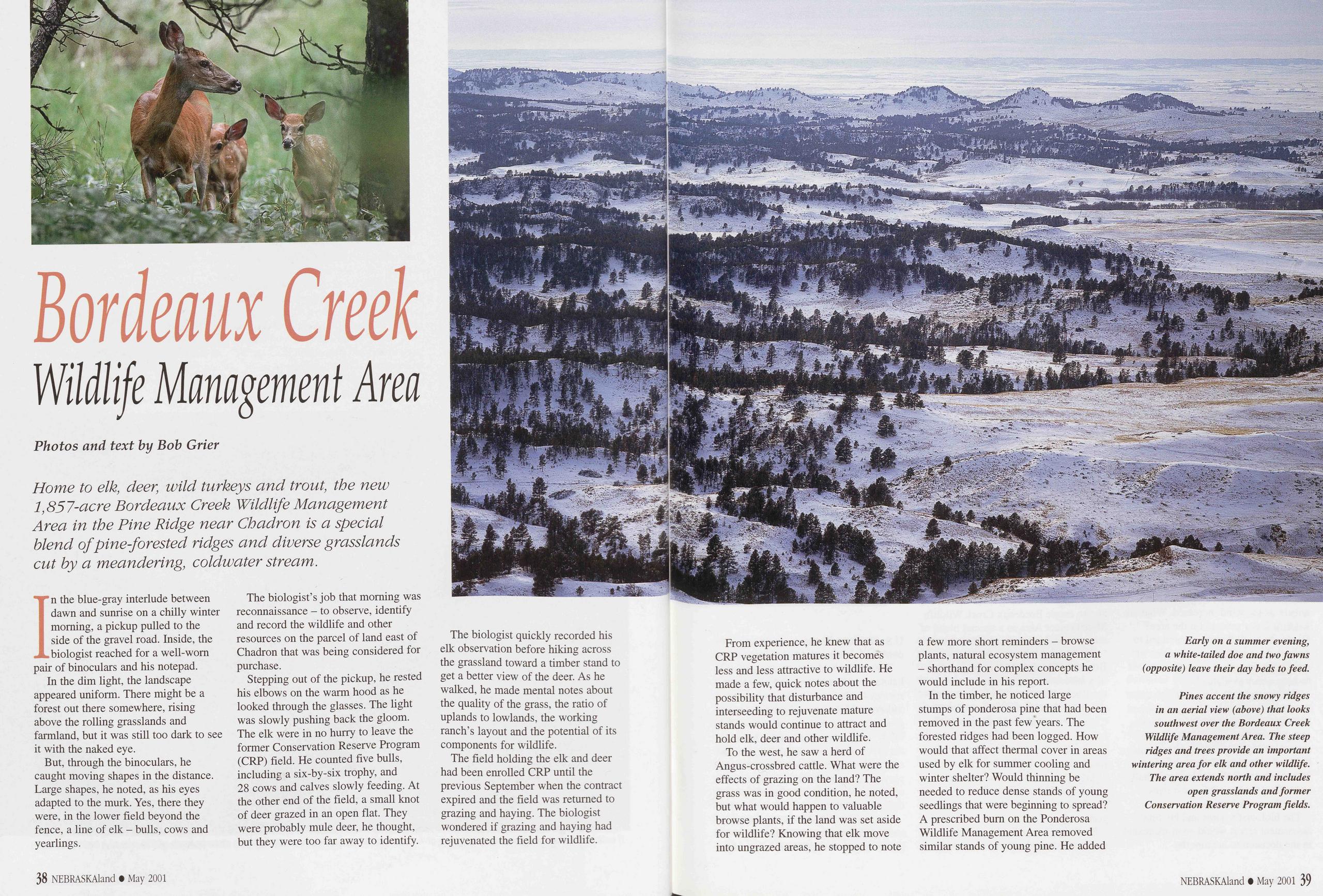
Bordeaux Creek
Wildlife Management Area
Home to elk, deer, wild turkeys and trout, the new 1,857-acre Bordeaux Creek Wildlife Management Area in the Pine Ridge near Chadron is a special blend of pine-forested ridges and diverse grasslands cut by a meandering, coldwater stream.In the blue-gray interlude between dawn and sunrise on a chilly winter morning, a pickup pulled to the side of the gravel road. Inside, the biologist reached for a well-worn pair of binoculars and his notepad.
In the dim light, the landscape appeared uniform. There might be a forest out there somewhere, rising above the rolling grasslands and farmland, but it was still too dark to see it with the naked eye.
But, through the binoculars, he caught moving shapes in the distance. Large shapes, he noted, as his eyes adapted to the murk. Yes, there they were, in the lower field beyond the fence, a line of elk - bulls, cows and yearlings.
The biologist’s job that morning was reconnaissance - to observe, identify and record the wildlife and other resources on the parcel of land east of Chadron that was being considered for purchase.
Stepping out of the pickup, he rested his elbows on the warm hood as he looked through the glasses. The light was slowly pushing back the gloom. The elk were in no hurry to leave the former Conservation Reserve Program (CRP) field. He counted five bulls, including a six-by-six trophy, and 28 cows and calves slowly feeding. At the other end of the field, a small knot of deer grazed in an open flat. They were probably mule deer, he thought, but they were too far away to identify.
The biologist quickly recorded his elk observation before hiking across the grassland toward a timber stand to get a better view of the deer. As he walked, he made mental notes about the quality of the grass, the ratio of uplands to lowlands, the working ranch’s layout and the potential of its components for wildlife.
The field holding the elk and deer had been enrolled CRP until the previous September when the contract expired and the field was returned to grazing and haying. The biologist wondered if grazing and haying had rejuvenated the field for wildlife.
From experience, he knew that as CRP vegetation matures it becomes less and less attractive to wildlife. He made a few, quick notes about the possibility that disturbance and interseeding to rejuvenate mature stands would continue to attract and hold elk, deer and other wildlife.
To the west, he saw a herd of Angus-crossbred cattle. What were the effects of grazing on the land? The grass was in good condition, he noted, but what would happen to valuable browse plants, if the land was set aside for wildlife? Knowing that elk move into ungrazed areas, he stopped to note a few more short reminders - browse plants, natural ecosystem management - shorthand for complex concepts he would include in his report.
In the timber, he noticed large stumps of ponderosa pine that had been removed in the past few years. The forested ridges had been logged. How would that affect thermal cover in areas used by elk for summer cooling and winter shelter? Would thinning be needed to reduce dense stands of young seedlings that were beginning to spread? A prescribed bum on the Ponderosa Wildlife Management Area removed similar stands of young pine. He added
Early on a summer evening, a white-tailed doe and two fawns (opposite) leave their day beds to feed.
Pines accent the snowy ridges in an aerial view (above) that looks southwest over the Bordeaux Creek Wildlife Management Area. The steep ridges and trees provide an important wintering area for elk and other wildlife. The area extends north and includes open grasslands and former Conservation Reserve Program fields.
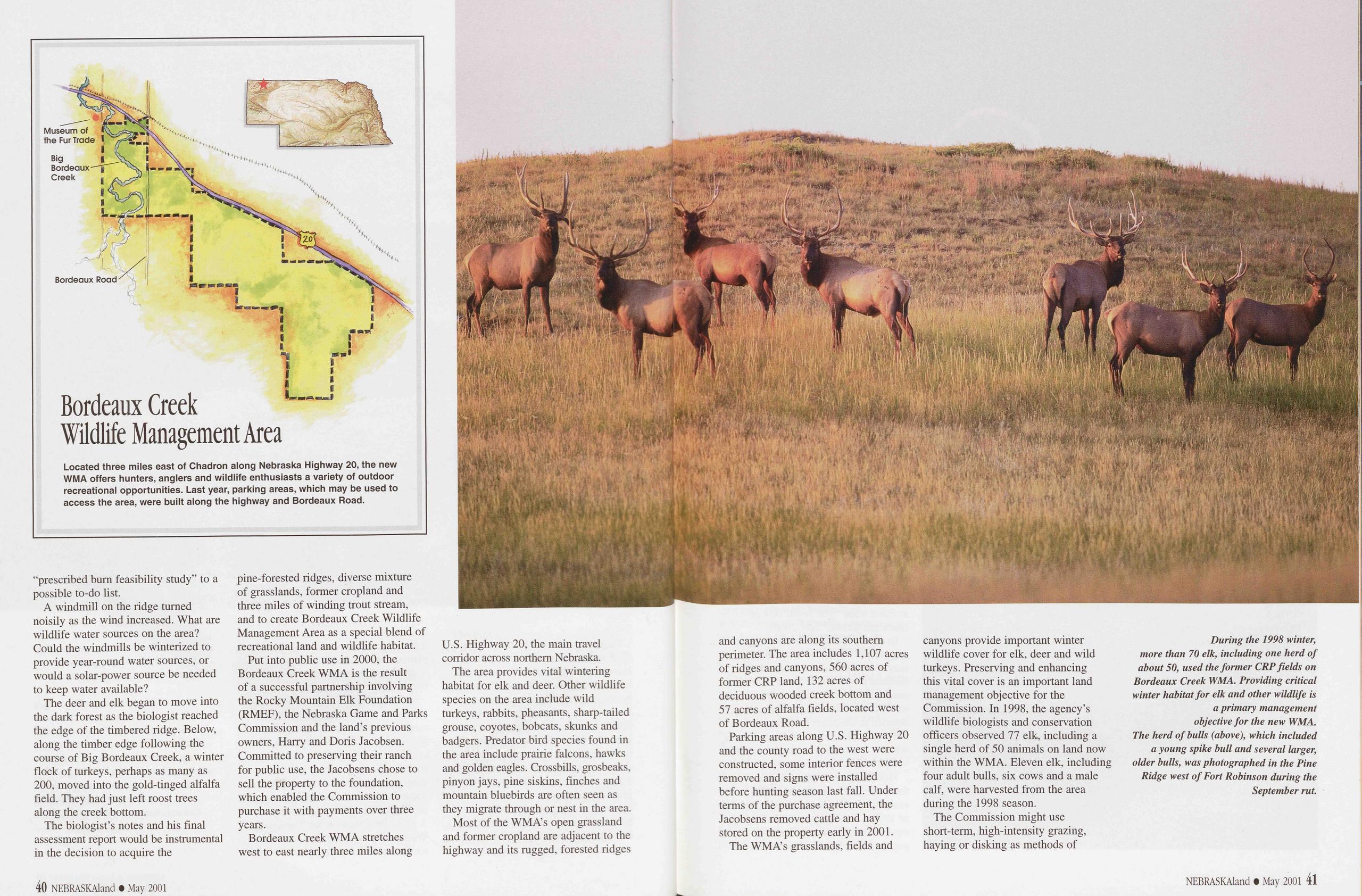
Bordeaux Creek Wildlife Management Area
Located three miles east of Chadron along Nebraska Highway 20, the new WMA offers hunters, anglers and wildlife enthusiasts a variety of outdoor recreational opportunities. Last year, parking areas, which may be used to access the area, were built along the highway and Bordeaux Road.
“prescribed bum feasibility study” to a possible to-do list.
A windmill on the ridge turned noisily as the wind increased. What are wildlife water sources on the area? Could the windmills be winterized to provide year-round water sources, or would a solar-power source be needed to keep water available?
The deer and elk began to move into the dark forest as the biologist reached the edge of the timbered ridge. Below, along the timber edge following the course of Big Bordeaux Creek, a winter flock of turkeys, perhaps as many as 200, moved into the gold-tinged alfalfa field. They had just left roost trees along the creek bottom.
The biologist’s notes and his final assessment report would be instrumental in the decision to acquire the pine-forested ridges, diverse mixture of grasslands, former cropland and three miles of winding trout stream, and to create Bordeaux Creek Wildlife Management Area as a special blend of recreational land and wildlife habitat.
Put into public use in 2000, the Bordeaux Creek WMA is the result of a successful partnership involving the Rocky Mountain Elk Foundation (RMEF), the Nebraska Game and Parks Commission and the land’s previous owners, Harry and Doris Jacobsen. Committed to preserving their ranch for public use, the Jacobsens chose to sell the property to the foundation, which enabled the Commission to purchase it with payments over three years.
Bordeaux Creek WMA stretches west to east nearly three miles along U.S. Highway 20, the main travel corridor across northern Nebraska.
The area provides vital wintering habitat for elk and deer. Other wildlife species on the area include wild turkeys, rabbits, pheasants, sharp-tailed grouse, coyotes, bobcats, skunks and badgers. Predator bird species found in the area include prairie falcons, hawks and golden eagles. Crossbills, grosbeaks, piny on jays, pine siskins, finches and mountain bluebirds are often seen as they migrate through or nest in the area.
Most of the WMA’s open grassland and former cropland are adjacent to the highway and its rugged, forested ridges and canyons are along its southern perimeter. The area includes 1,107 acres of ridges and canyons, 560 acres of former CRP land, 132 acres of deciduous wooded creek bottom and 57 acres of alfalfa fields, located west of Bordeaux Road.
Parking areas along U.S. Highway 20 and the county road to the west were constructed, some interior fences were removed and signs were installed before hunting season last fall. Under terms of the purchase agreement, the Jacobsens removed cattle and hay stored on the property early in 2001.
The WMA’s grasslands, fields and canyons provide important winter wildlife cover for elk, deer and wild turkeys. Preserving and enhancing this vital cover is an important land management objective for the Commission. In 1998, the agency’s wildlife biologists and conservation officers observed 77 elk, including a single herd of 50 animals on land now within the WMA. Eleven elk, including four adult bulls, six cows and a male calf, were harvested from the area during the 1998 season.
The Commission might use short-term, high-intensity grazing, haying or disking as methods of
During the 1998 winter, more than 70 elk, including one herd of about 50, used the former CRP fields on Bordeaux Creek WMA. Providing critical winter habitat for elk and other wildlife is a primary management objective for the new WMA. The herd of bulls (above), which included a young spike bull and several larger, older bulls, was photographed in the Pine Ridge west of Fort Robinson during the September rut.
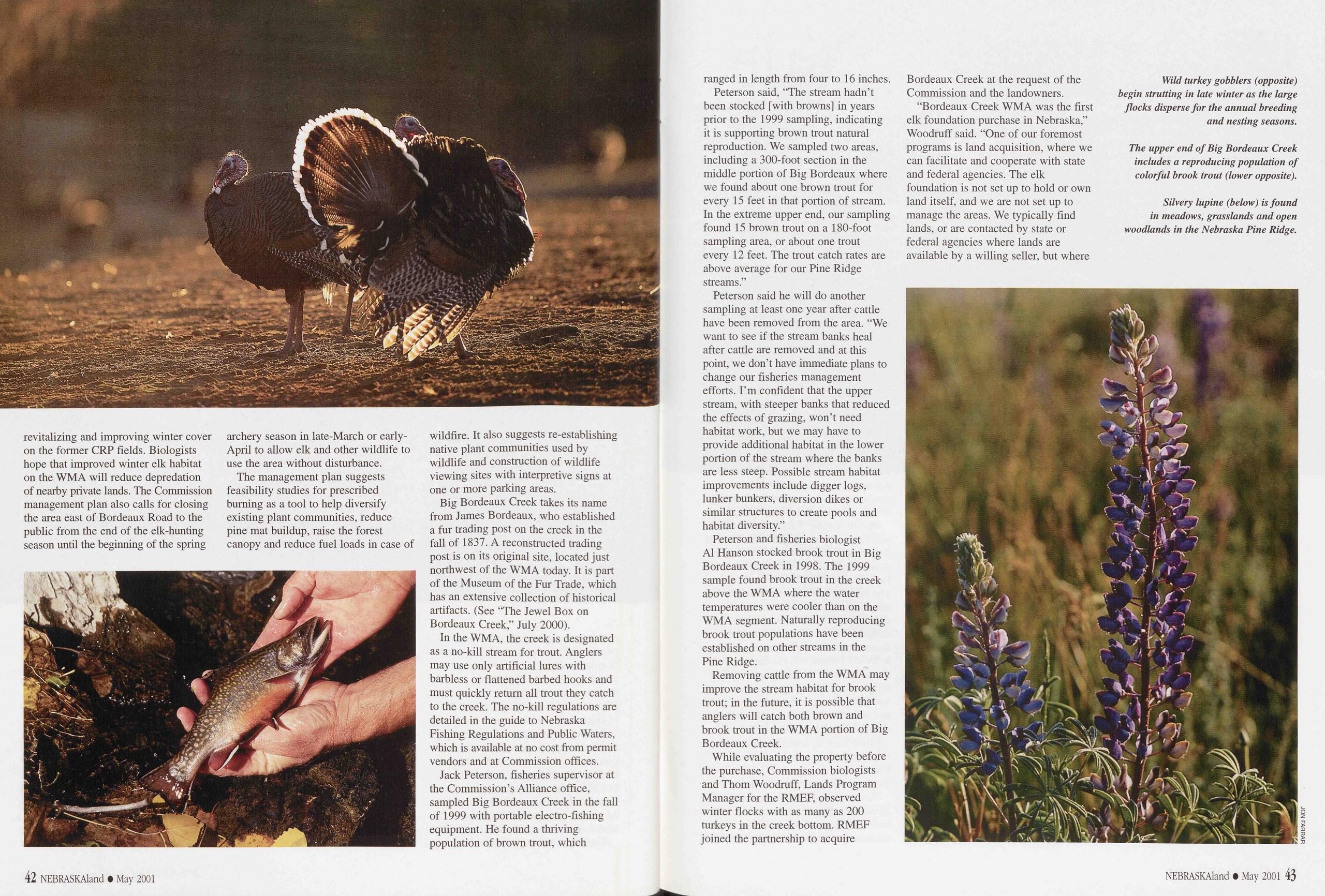
revitalizing and improving winter cover on the former CRP fields. Biologists hope that improved winter elk habitat on the WMA will reduce depredation of nearby private lands. The Commission management plan also calls for closing the area east of Bordeaux Road to the public from the end of the elk-hunting season until the beginning of the spring archery season in late-March or early - April to allow elk and other wildlife to use the area without disturbance.
The management plan suggests feasibility studies for prescribed burning as a tool to help diversify existing plant communities, reduce pine mat buildup, raise the forest canopy and reduce fuel loads in case of wildfire. It also suggests re-establishing native plant communities used by wildlife and construction of wildlife viewing sites with interpretive signs at one or more parking areas.
Big Bordeaux Creek takes its name from James Bordeaux, who established a fur trading post on the creek in the fall of 1837. A reconstructed trading post is on its original site, located just northwest of the WMA today. It is part of the Museum of the Fur Trade, which has an extensive collection of historical artifacts. (See “The Jewel Box on Bordeaux Creek,” July 2000).
In the WMA, the creek is designated as a no-kill stream for trout. Anglers may use only artificial lures with barbless or flattened barbed hooks and must quickly return all trout they catch to the creek. The no-kill regulations are detailed in the guide to Nebraska Fishing Regulations and Public Waters, which is available at no cost from permit vendors and at Commission offices.
Jack Peterson, fisheries supervisor at the Commission’s Alliance office, sampled Big Bordeaux Creek in the fall of 1999 with portable electro-fishing equipment. He found a thriving population of brown trout, which ranged in length from four to 16 inches.
Peterson said, “The stream hadn’t been stocked [with browns] in years prior to the 1999 sampling, indicating it is supporting brown trout natural reproduction. We sampled two areas, including a 300-foot section in the middle portion of Big Bordeaux where we found about one brown trout for every 15 feet in that portion of stream. In the extreme upper end, our sampling found 15 brown trout on a 180-foot sampling area, or about one trout every 12 feet. The trout catch rates are above average for our Pine Ridge streams.”
Peterson said he will do another sampling at least one year after cattle have been removed from the area. “We want to see if the stream banks heal after cattle are removed and at this point, we don’t have immediate plans to change our fisheries management efforts. I’m confident that the upper stream, with steeper banks that reduced the effects of grazing, won’t need habitat work, but we may have to provide additional habitat in the lower portion of the stream where the banks are less steep. Possible stream habitat improvements include digger logs, lunker bunkers, diversion dikes or similar structures to create pools and habitat diversity.”
Peterson and fisheries biologist Al Hanson stocked brook trout in Big Bordeaux Creek in 1998. The 1999 sample found brook trout in the creek above the WMA where the water temperatures were cooler than on the WMA segment. Naturally reproducing brook trout populations have been established on other streams in the Pine Ridge.
Removing cattle from the WMA may improve the stream habitat for brook trout; in the future, it is possible that anglers will catch both brown and brook trout in the WMA portion of Big Bordeaux Creek.
While evaluating the property before the purchase, Commission biologists and Thom Woodruff, Lands Program Manager for the RMEF, observed winter flocks with as many as 200 turkeys in the creek bottom. RMEF joined the partnership to acquire Bordeaux Creek at the request of the Commission and the landowners.
“Bordeaux Creek WMA was the first elk foundation purchase in Nebraska,” Woodruff said. “One of our foremost programs is land acquisition, where we can facilitate and cooperate with state and federal agencies. The elk foundation is not set up to hold or own land itself, and we are not set up to manage the areas. We typically find lands, or are contacted by state or federal agencies where lands are available by a willing seller, but where
Wild turkey gobblers (opposite) begin strutting in late winter as the large flocks disperse for the annual breeding and nesting seasons.
The upper end of Big Bordeaux Creek includes a reproducing population of colorful brook trout (lower opposite).
Silvery lupine (below) is found in meadows, grasslands and open woodlands in the Nebraska Pine Ridge.
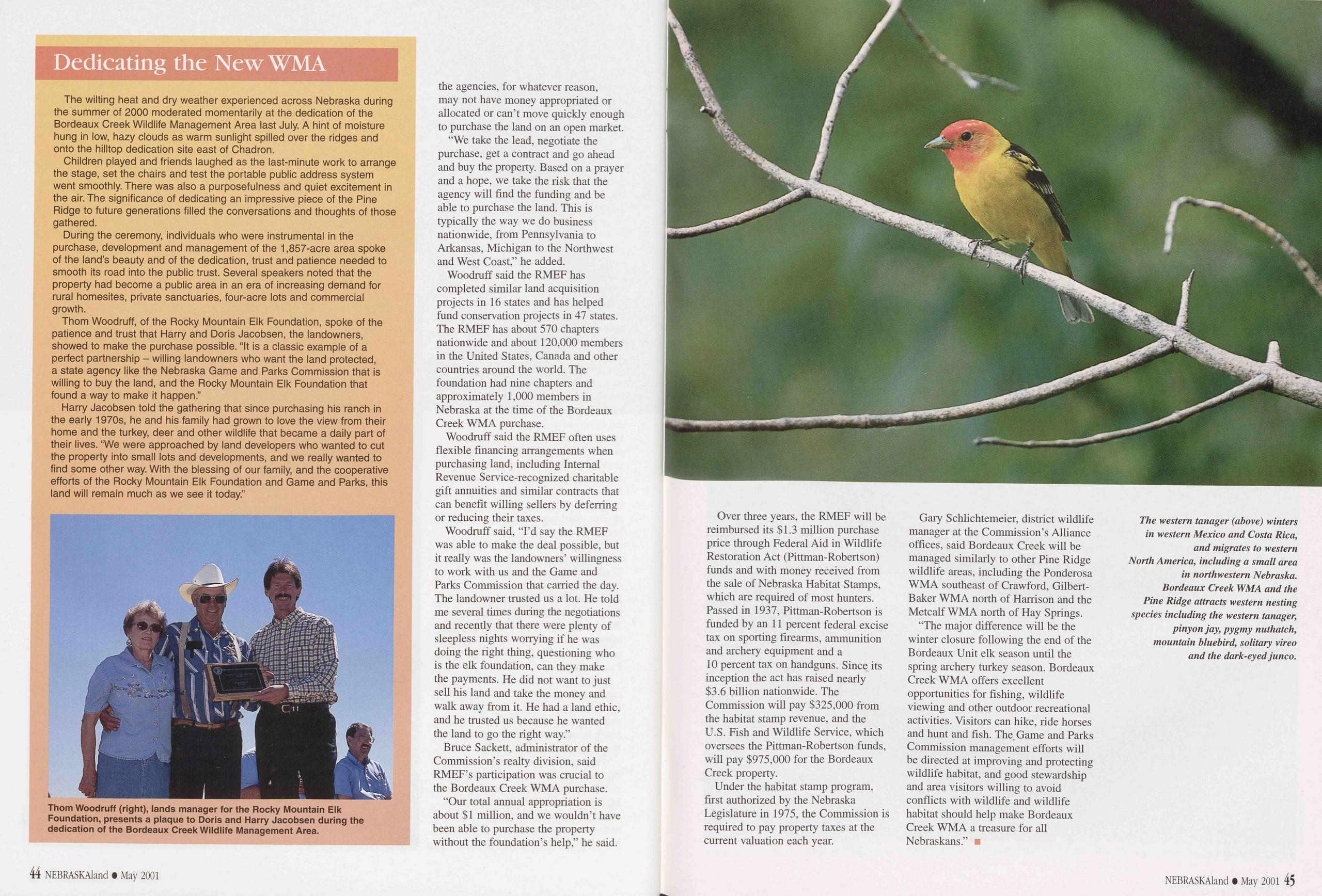
Dedicating the New WMA
The wilting heat and dry weather experienced across Nebraska during the summer of 2000 moderated momentarily at the dedication of the Bordeaux Creek Wildlife Management Area last July. A hint of moisture hung in low, hazy clouds as warm sunlight spilled over the ridges and onto the hilltop dedication site east of Chadron.
Children played and friends laughed as the last-minute work to arrange the stage, set the chairs and test the portable public address system went smoothly. There was also a purposefulness and quiet excitement in the air. The significance of dedicating an impressive piece of the Pine Ridge to future generations filled the conversations and thoughts of those gathered.
During the ceremony, individuals who were instrumental in the purchase, development and management of the 1,857-acre area spoke of the land’s beauty and of the dedication, trust and patience needed to smooth its road into the public trust. Several speakers noted that the property had become a public area in an era of increasing demand for rural homesites, private sanctuaries, four-acre lots and commercial growth.
Thom Woodruff, of the Rocky Mountain Elk Foundation, spoke of the patience and trust that Harry and Doris Jacobsen, the landowners, showed to make the purchase possible. “It is a classic example of a perfect partnership - willing landowners who want the land protected, a state agency like the Nebraska Game and Parks Commission that is willing to buy the land, and the Rocky Mountain Elk Foundation that found a way to make it happen.”
Harry Jacobsen told the gathering that since purchasing his ranch in the early 1970s, he and his family had grown to love the view from their home and the turkey, deer and other wildlife that became a daily part of their lives. “We were approached by land developers who wanted to cut the property into small lots and developments, and we really wanted to find some other way. With the blessing of our family, and the cooperative efforts of the Rocky Mountain Elk Foundation and Game and Parks, this land will remain much as we see it today.”
Thom Woodruff (right), lands manager for the Rocky Mountain Elk Foundation, presents a plaque to Doris and Harry Jacobsen during the dedication of the Bordeaux Creek Wildlife Management Area.
the agencies, for whatever reason, may not have money appropriated or allocated or can’t move quickly enough to purchase the land on an open market.
“We take the lead, negotiate the purchase, get a contract and go ahead and buy the property. Based on a prayer and a hope, we take the risk that the agency will find the funding and be able to purchase the land. This is typically the way we do business nationwide, from Pennsylvania to Arkansas, Michigan to the Northwest and West Coast,” he added.
Woodruff said the RMEF has completed similar land acquisition projects in 16 states and has helped fund conservation projects in 47 states. The RMEF has about 570 chapters nationwide and about 120,000 members in the United States, Canada and other countries around the world. The foundation had nine chapters and approximately 1,000 members in Nebraska at the time of the Bordeaux Creek WMA purchase.
Woodruff said the RMEF often uses flexible financing arrangements when purchasing land, including Internal Revenue Service-recognized charitable gift annuities and similar contracts that can benefit willing sellers by deferring or reducing their taxes.
Woodruff said, “I’d say the RMEF was able to make the deal possible, but it really was the landowners’ willingness to work with us and the Game and Parks Commission that carried the day. The landowner trusted us a lot. He told me several times during the negotiations and recently that there were plenty of sleepless nights worrying if he was doing the right thing, questioning who is the elk foundation, can they make the payments. He did not want to just sell his land and take the money and walk away from it. He had a land ethic, and he trusted us because he wanted the land to go the right way.”
Bruce Sackett, administrator of the Commission’s realty division, said RMEF’s participation was crucial to the Bordeaux Creek WMA purchase.
“Our total annual appropriation is about $1 million, and we wouldn’t have been able to purchase the property without the foundation’s help,” he said.
Over three years, the RMEF will be reimbursed its $1.3 million purchase price through Federal Aid in Wildlife Restoration Act (Pittman-Robertson) funds and with money received from the sale of Nebraska Habitat Stamps, which are required of most hunters. Passed in 1937, Pittman-Robertson is funded by an 11 percent federal excise tax on sporting firearms, ammunition and archery equipment and a 10 percent tax on handguns. Since its inception the act has raised nearly $3.6 billion nationwide. The Commission will pay $325,000 from the habitat stamp revenue, and the U.S. Fish and Wildlife Service, which oversees the Pittman-Robertson funds, will pay $975,000 for the Bordeaux Creek property.
Under the habitat stamp program, first authorized by the Nebraska Legislature in 1975, the Commission is required to pay property taxes at the current valuation each year.
Gary Schlichtemeier, district wildlife manager at the Commission’s Alliance offices, said Bordeaux Creek will be managed similarly to other Pine Ridge wildlife areas, including the Ponderosa WMA southeast of Crawford, Gilbert- Baker WMA north of Harrison and the Metcalf WMA north of Hay Springs.
“The major difference will be the winter closure following the end of the Bordeaux Unit elk season until the spring archery turkey season. Bordeaux Creek WMA offers excellent opportunities for fishing, wildlife viewing and other outdoor recreational activities. Visitors can hike, ride horses and hunt and fish. The. Game and Parks Commission management efforts will be directed at improving and protecting wildlife habitat, and good stewardship and area visitors willing to avoid conflicts with wildlife and wildlife habitat should help make Bordeaux Creek WMA a treasure for all Nebraskans.” ■
The western tanager (above) winters in western Mexico and Costa Rica, and migrates to western North America, including a small area in northwestern Nebraska. Bordeaux Creek WMA and the Pine Ridge attracts western nesting species including the western tanager; piny on jay, pygmy nuthatch, mountain bluebird, solitary vireo and the dark-eyed junco.
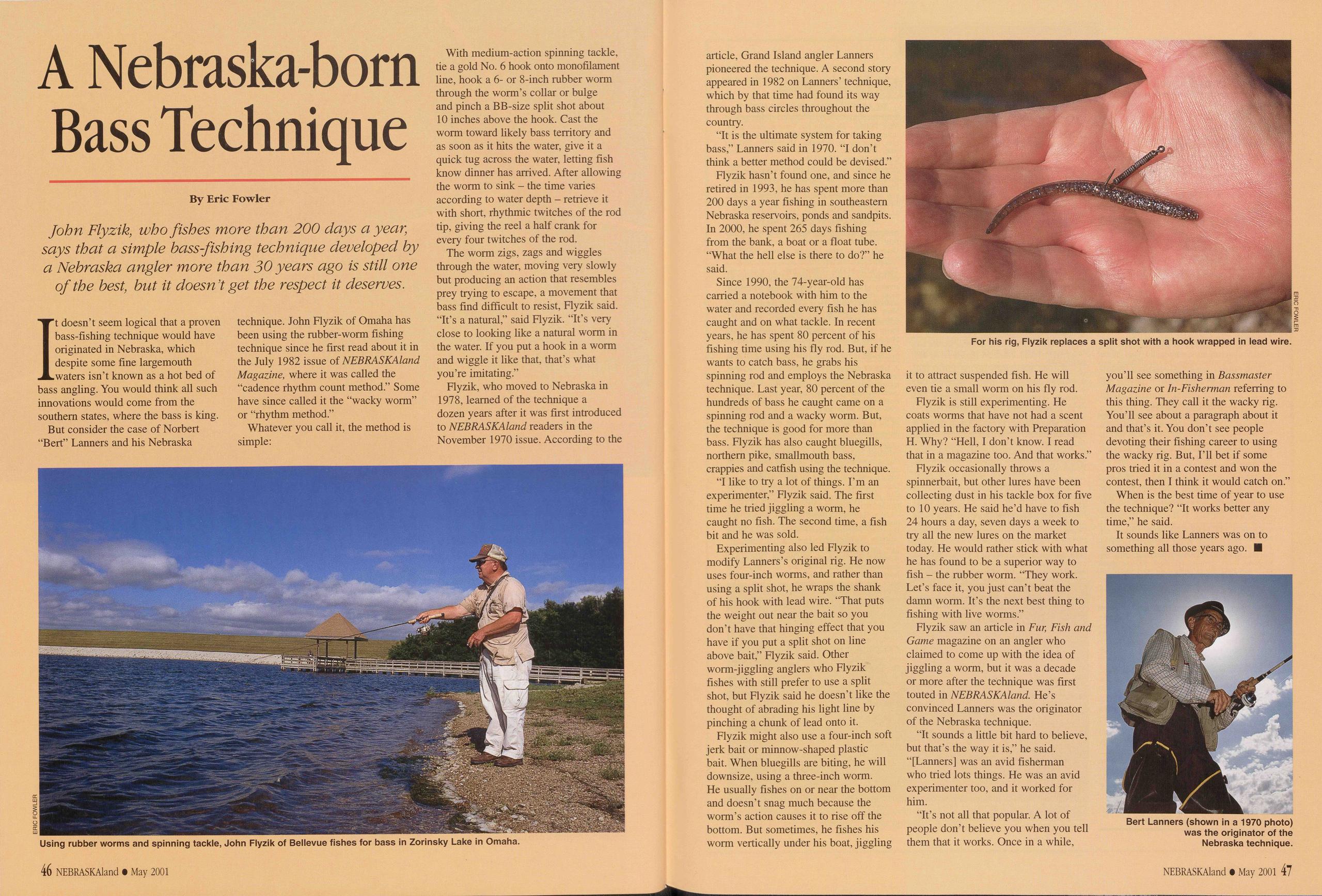
A Nebraska-born Bass Technique
John Flyzik, who fishes more than 200 days a year, says that a simple bass-fishing technique developed by a Nebraska angler more than 30 years ago is still one of the best, but it doesn’t get the respect it deserves.It doesn’t seem logical that a proven bass-fishing technique would have originated in Nebraska, which despite some fine largemouth waters isn’t known as a hot bed of bass angling. You would think all such innovations would come from the southern states, where the bass is king.
Using rubber worms and spinning tackle, John Flyzik of Bellevue fishes for bass in Zorinsky Lake in Omaha.
Whatever you call it, the method is simple:
With medium-action spinning tackle, tie a gold No. 6 hook onto monofilament line, hook a 6- or 8-inch rubber worm through the worm’s collar or bulge and pinch a BB-size split shot about 10 inches above the hook. Cast the worm toward likely bass territory and as soon as it hits the water, give it a quick tug across the water, letting fish know dinner has arrived. After allowing the worm to sink - the time varies according to water depth - retrieve it with short, rhythmic twitches of the rod tip, giving the reel a half crank for every four twitches of the rod.
The worm zigs, zags and wiggles through the water, moving very slowly but producing an action that resembles prey trying to escape, a movement that bass find difficult to resist, Flyzik said. “It’s a natural,” said Flyzik. “It’s very close to looking like a natural worm in the water. If you put a hook in a worm and wiggle it like that, that’s what you’re imitating.”
Flyzik, who moved to Nebraska in 1978, learned of the technique a dozen years after it was first introduced to NEBRASKAland readers in the November 1970 issue. According to the article, Grand Island angler Banners pioneered the technique. A second story appeared in 1982 on Banners’ technique, which by that time had found its way through bass circles throughout the country.
“It is the ultimate system for taking bass,” Banners said in 1970. “I don’t think a better method could be devised.”
Flyzik hasn’t found one, and since he retired in 1993, he has spent more than 200 days a year fishing in southeastern Nebraska reservoirs, ponds and sandpits. In 2000, he spent 265 days fishing from the bank, a boat or a float tube. “What the hell else is there to do?” he said.
Since 1990, the 74-year-old has carried a notebook with him to the water and recorded every fish he has caught and on what tackle. In recent years, he has spent 80 percent of his fishing time using his fly rod. But, if he wants to catch bass, he grabs his spinning rod and employs the Nebraska technique. Bast year, 80 percent of the hundreds of bass he caught came on a spinning rod and a wacky worm. But, the technique is good for more than bass. Flyzik has also caught bluegills, northern pike, smallmouth bass, crappies and catfish using the technique.
“I like to try a lot of things. I’m an experimenter,” Flyzik said. The first time he tried jiggling a worm, he caught no fish. The second time, a fish bit and he was sold.
Experimenting also led Flyzik to modify Banners’s original rig. He now uses four-inch worms, and rather than using a split shot, he wraps the shank of his hook with lead wire. “That puts the weight out near the bait so you don’t have that hinging effect that you have if you put a split shot on line above bait,” Flyzik said. Other worm-jiggling anglers who Flyzik fishes with still prefer to use a split shot, but Flyzik said he doesn’t like the thought of abrading his light line by pinching a chunk of lead onto it.
For his rig, Flyzik replaces a split shot with a hook wrapped in lead wire.
ERIC FOWLERFlyzik is still experimenting. He coats worms that have not had a scent applied in the factory with Preparation H. Why? “Hell, I don’t know. I read that in a magazine too. And that works.”
Flyzik occasionally throws a spinnerbait, but other lures have been collecting dust in his tackle box for five to 10 years. He said he’d have to fish 24 hours a day, seven days a week to try all the new lures on the market today. He would rather stick with what he has found to be a superior way to fish - the rubber worm. “They work. Bet’s face it, you just can’t beat the damn worm. It’s the next best thing to fishing with live worms.”
Flyzik saw an article in Fur, Fish and Game magazine on an angler who claimed to come up with the idea of jiggling a worm, but it was a decade or more after the technique was first touted in NEBRASKAland. He’s convinced Banners was the originator of the Nebraska technique.
“It sounds a little bit hard to believe, but that’s the way it is,” he said. “[Banners] was an avid fisherman who tried lots things. He was an avid experimenter too, and it worked for him.
“It’s not all that popular. A lot of people don’t believe you when you tell them that it works. Once in a while, you’ll see something in Bassmaster Magazine or In-Fisherman referring to this thing. They call it the wacky rig. You’ll see about a paragraph about it and that’s it. You don’t see people devoting their fishing career to using the wacky rig. But, I’ll bet if some pros tried it in a contest and won the contest, then I think it would catch on.”
When is the best time of year to use the technique? “It works better any time,” he said.
It sounds like Banners was on to something all those years ago. ■
Bert banners (shown in a 1970 photo) was the originator of the Nebraska technique.
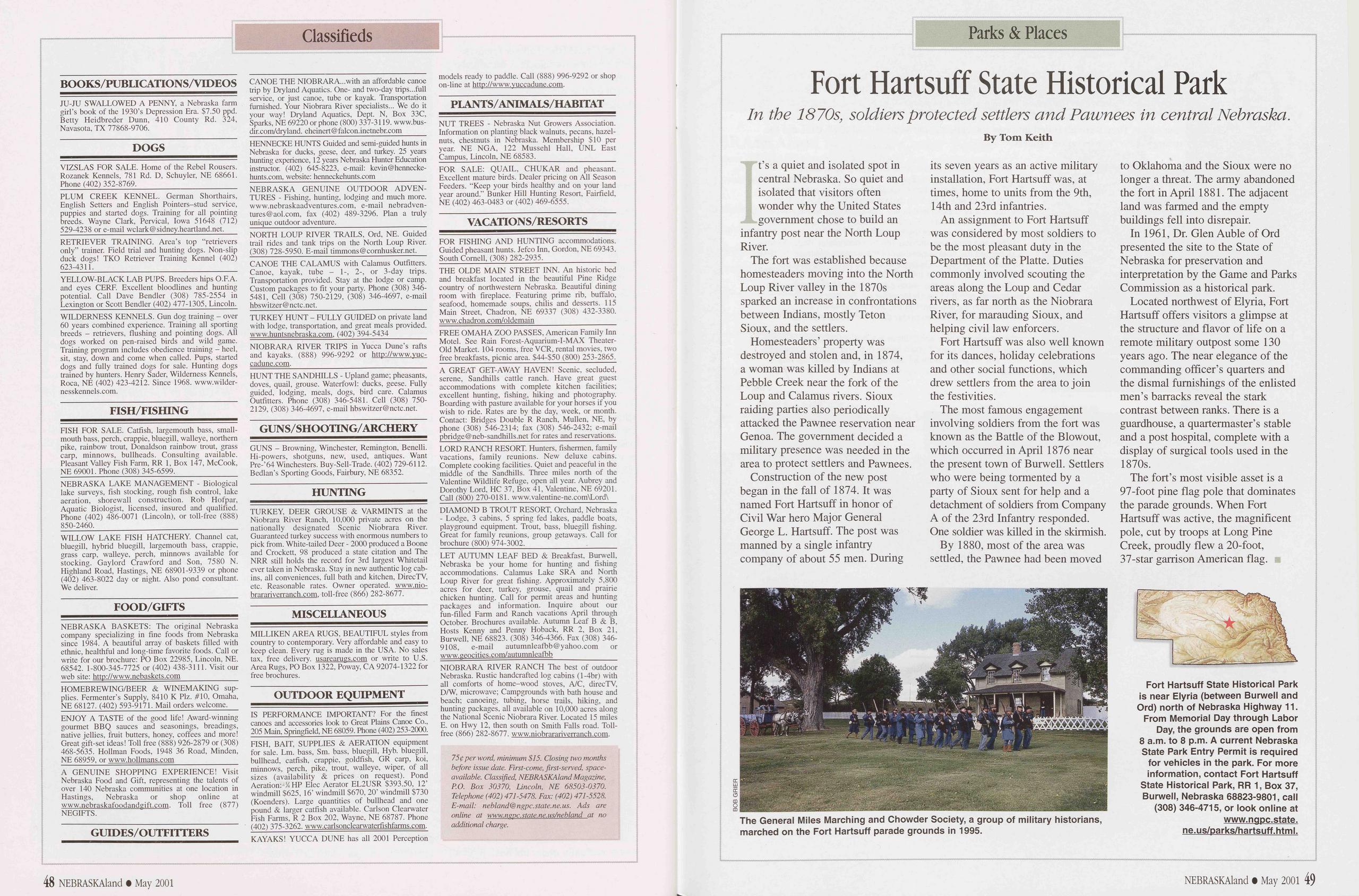
Classifieds
Parks & Places BOOKS/PUBLICATIONS/VIDEOS JU-JU SWALLOWED A PENNY, a Nebraska farm girl’s book of the 1930’s Depression Era. $7.50 ppd. Betty Heidbreder Dunn, 410 County Rd. 324, Navasota, TX 77868-9706. DOGS VIZSLAS FOR SALE. Home of the Rebel Rousers. Rozanek Kennels, 781 Rd. D, Schuyler, NE 68661. Phone (402) 352-8769. PLUM CREEK KENNEL. German Shorthairs, English Setters and English Pointers-stud service, puppies and started dogs. Training for all pointing breeds. Wayne Clark, Pervical, Iowa 51648 (712) 529-4238 or e-mail wclark@sidney.heartland.net. RETRIEVER TRAINING. Area’s top “retrievers only” trainer. Field trial and hunting dogs. Non-slip duck dogs! TKO Retriever Training Kennel (402) 623-4311. YELLOW-BLACK LAB PUPS. Breeders hips O.F.A. and eyes CERF. Excellent bloodlines and hunting potential. Call Dave Bendler (308) 785-2554 in Lexington or Scott Bendler (402) 477-1305, Lincoln. WILDERNESS KENNELS. Gun dog training - over 60 years combined experience. Training all sporting breeds - retrievers, flushing and pointing dogs. All dogs worked on pen-raised birds and wild game. Training program includes obedience training - heel, sit, stay, down and come when called. Pups, started dogs and fully trained dogs for sale. Hunting dogs trained by hunters. Henry Sader, Wilderness Kennels, Roca, NE (402) 423-4212. Since 1968. www.wilder- nesskennels.com. FISH/FISHING FISH FOR SALE. Catfish, largemouth bass, small- mouth bass, perch, crappie, bluegill, walleye, northern pike, rainbow trout, Donaldson rainbow trout, grass carp, minnows, bullheads. Consulting available. Pleasant Valley Fish Farm, RR 1, Box 147, McCook, NE 69001. Phone (308) 345-6599. NEBRASKA LAKE MANAGEMENT - Biological lake surveys, fish stocking, rough fish control, lake aeration, shorewall construction. Rob Hofpar, Aquatic Biologist, licensed, insured and qualified. Phone (402) 486-0071 (Lincoln), or toll-free (888) 850-2460. WILLOW LAKE FISH HATCHERY. Channel cat, bluegill, hybrid bluegill, largemouth bass, crappie, grass carp, walleye, perch, minnows available for stocking. Gaylord Crawford and Son, 7580 N. Highland Road, Hastings, NE 68901-9339 or phone (402) 463-8022 day or night. Also pond consultant. We deliver. FOOD/GIFTS NEBRASKA BASKETS: The original Nebraska company specializing in fine foods from Nebraska since 1984. A beautiful array of baskets filled with ethnic, healthful and long-time favorite foods. Call or write for our brochure: PO Box 22985, Lincoln, NE. 68542. 1-800-345-7725 or (402) 438-3111. Visit our web site: http://www.nebaskets.com HOMEBREWING/BEER & WINEMAKING sup- plies. Fermenter’s Supply, 8410 K Plz. #10, Omaha, NE 68127. (402) 593-9171. Mail orders welcome. ENJOY A TASTE of the good life! Award-winning gourmet BBQ sauces and seasonings, breadings, native jellies, fruit butters, honey, coffees and more! Great gift-set ideas! Toll free (888) 926-2879 or (308) 468-5635. Hollman Foods, 1948 36 Road, Minden, NE 68959, or www.hollmans.com A GENUINE SHOPPING EXPERIENCE! Visit Nebraska Food and Gift, representing the talents of over 140 Nebraska communities at one location in Hastings, Nebraska or shop online at www.nebraskafoodandgift.com. Toll free (877) NEGIFTS. GUIDES/OUTFITTERS CANOE THE NIOBRARA...with an affordable canoe trip by Dryland Aquatics. One- and two-day trips...full service, or just canoe, tube or kayak. Transportation furnished. Your Niobrara River specialists... We do it your way! Dryland Aquatics, Dept. N, Box 33C, Sparks, NE 69220 or phone (800) 337-3119. www.bus- dir.com/dryland. eheinert@falcon.inetnebr.com HENNECKE HUNTS Guided and semi-guided hunts in Nebraska for ducks, geese, deer, and turkey. 25 years hunting experience, 12 years Nebraska Hunter Education instructor. (402) 645-8223, e-mail: kevin@hennecke- hunts.com, website: henneckehunts.com NEBRASKA GENUINE OUTDOOR ADVEN- TURES - Fishing, hunting, lodging and much more. www.nebraskaadventures.com, e-mail nebradven- tures@aol.com, fax (402) 489-3296. Plan a truly unique outdoor adventure. NORTH LOUP RIVER TRAILS, Ord, NE. Guided trail rides and tank trips on the North Loup River. (308) 728-5950. E-mail timmons@cornhusker.net. CANOE THE CALAMUS with Calamus Outfitters. Canoe, kayak, tube - 1-, 2-, or 3-day trips. Transportation provided. Stay at the lodge or camp. Custom packages to fit your party. Phone (308) 346- 5481, Cell (308) 750-2129, (308) 346-4697, e-mail hbs witzer @ nctc. net. TURKEY HUNT - FULLY GUIDED on private land with lodge, transportation, and great meals provided. www.huntsnebraska.com, (402) 394-5434 NIOBRARA RIVER TRIPS in Yucca Dune’s rafts and kayaks. (888) 996-9292 or http://www.vuc- cadune.com. HUNT THE SANDHILLS - Upland game; pheasants, doves, quail, grouse. Waterfowl: ducks, geese. Fully guided, lodging, meals, dogs, bird care. Calamus Outfitters. Phone (308) 346-5481. Cell (308) 750- 2129, (308) 346-4697, e-mail hbswitzer@nctc.net. GUNS/SHOOTING/ARCHERY GUNS - Browning, Winchester, Remington, Benelli. Hi-powers, shotguns, new, used, antiques. Want Pre-’64 Winchesters. Buy-Sell-Trade. (402) 729-6112. Bedlan’s Sporting Goods, Fairbury, NE 68352. HUNTING TURKEY, DEER GROUSE & VARMINTS at the Niobrara River Ranch, 10,000 private acres on the nationally designated Scenic Niobrara River. Guaranteed turkey success with enormous numbers to pick from. White-tailed Deer - 2000 produced a Boone and Crockett, 98 produced a state citation and The NRR still holds the record for 3rd largest Whitetail ever taken in Nebraska. Stay in new authentic log cab- ins, all conveniences, full bath and kitchen, DirecTV, etc. Reasonable rates. Owner operated, www.nio- brarariverranch.com. toll-free (866) 282-8677. MISCELLANEOUS MILLIKEN AREA RUGS, BEAUTIFUL styles from country to contemporary. Very affordable and easy to keep clean. Every rug is made in the USA. No sales tax, free delivery, usarearugs.com or write to U.S. Area Rugs, PO Box 1322, Poway, CA 92074-1322 for free brochures. OUTDOOR EQUIPMENT IS PERFORMANCE IMPORTANT? For the finest canoes and accessories look to Great Plains Canoe Co., 205 Main, Springfield, NE 68059. Phone (402) 253-2000. FISH, BAIT, SUPPLIES & AERATION equipment for sale. Lm. bass, Sm. bass, bluegill, Hyb. bluegill, bullhead, catfish, crappie, goldfish, GR carp, koi, minnows, perch, pike, trout, walleye, wiper, of all sizes (availability & prices on request). Pond Aeration: %HP Elec Aerator EL2USR $393.50, 12’ windmill $625, 16’ windmill $670, 20’ windmill $730 (Koenders). Large quantities of bullhead and one pound & larger catfish available. Carlson Clearwater Fish Farms, R 2 Box 202, Wayne, NE 68787. Phone (402) 375-3262. www.carlsonclearwaterfishfarms.com. KAYAKS! YUCCA DUNE has all 2001 Perception models ready to paddle. Call (888) 996-9292 or shop on-line at http://www.vuccadune.com. PLANTS/ANIMALS/HABITAT NUT TREES - Nebraska Nut Growers Association. Information on planting black walnuts, pecans, hazel- nuts, chestnuts in Nebraska. Membership $10 per year. NE NG A, 122 Mussehl Hall, UNL East Campus, Lincoln, NE 68583. FOR SALE: QUAIL, CHUKAR and pheasant. Excellent mature birds. Dealer pricing on All Season Feeders. “Keep your birds healthy and on your land year around.” Bunker Hill Hunting Resort, Fairfield, NE (402) 463-0483 or (402) 469-6555. VACATION S/RESORTS FOR FISHING AND HUNTING accommodations. Guided pheasant hunts. Jefco Inn, Gordon, NE 69343. South Cornell, (308) 282-2935. THE OLDE MAIN STREET INN. An historic bed and breakfast located in the beautiful Pine Ridge country of northwestern Nebraska. Beautiful dining room with fireplace. Featuring prime rib, buffalo, seafood, homemade soups, chilis and desserts. 115 Main Street, Chadron, NE 69337 (308) 432-3380. www.chadron.com/oldemain FREE OMAHA ZOO PASSES, American Family Inn Motel. See Rain Forest-Aquarium-I-MAX Theater- Old Market. 104 rooms, free VCR, rental movies, two free breakfasts, picnic area. $44-$50 (800) 253-2865. A GREAT GET-AWAY HAVEN! Scenic, secluded, serene, Sandhills cattle ranch. Have great guest accommodations with complete kitchen facilities; excellent hunting, fishing, hiking and photography. Boarding with pasture available for your horses if you wish to ride. Rates are by the day, week, or month. Contact: Bridges Double R Ranch, Mullen, NE, by phone (308) 546-2314; fax (308) 546-2432; e-mail pbridge@neb-sandhills.net for rates and reservations. LORD RANCH RESORT. Hunters, fishermen, family vacations, family reunions. New deluxe cabins. Complete cooking facilities. Quiet and peaceful in the middle of the Sandhills. Three miles north of the Valentine Wildlife Refuge, open all year. Aubrey and Dorothy Lord, HC 37, Box 41, Valentine, NE 69201. Call (800) 270-0181. www.valentine-ne.com\Lord\ DIAMOND B TROUT RESORT, Orchard, Nebraska - Lodge, 3 cabins, 5 spring fed lakes, paddle boats, playground equipment. Trout, bass, bluegill fishing. Great for family reunions, group getaways. Call for brochure (800) 974-3002. LET AUTUMN LEAF BED & Breakfast, Burwell, Nebraska be your home for hunting and fishing accommodations. Calamus Lake SRA and North Loup River for great fishing. Approximately 5,800 acres for deer, turkey, grouse, quail and prairie chicken hunting. Call for permit areas and hunting packages and information. Inquire about our fun-filled Farm and Ranch vacations April through October. Brochures available. Autumn Leaf B & B, Hosts Kenny and Penny Hoback, RR 2, Box 21, Burwell, NE 68823. (308) 346-4366. Fax (308) 346- 9108, e-mail autumnleafbb@yahoo.com or www.geocities.com/autumnleafbb NIOBRARA RIVER RANCH The best of outdoor Nebraska. Rustic handcrafted log cabins (l-4br) with all comforts of home-wood stoves, A/C, direcTV, D/W, microwave; Campgrounds with bath house and beach; canoeing, tubing, horse trails, hiking, and hunting packages, all available on 10,000 acres along the National Scenic Niobrara River. Located 15 miles E. on Hwy 12, then south on Smith Falls road. Toll- free (866) 282-8677. www.niobrarariverranch.com. 75c per word, minimum $15. Closing two months before issue date. First-come, first-served, space- available. Classified, NEBRASKAland Magazine, P.O. Box 30370, Lincoln, NE 68503-0370. Telephone (402) 471-5478. Fax: (402) 471-5528. E-mail: nebland@ngpc.state.ne.us. Ads are online at www.ngpc.state.ne.us/nebland at no additional charge.Parks & Places
Fort Hartsuff State Historical Park
In the 1870s, soldiers protected settlers and Pawnees in central Nebraska.
It’s a quiet and isolated spot in central Nebraska. So quiet and isolated that visitors often wonder why the United States government chose to build an infantry post near the North Loup River.
The fort was established because homesteaders moving into the North Loup River valley in the 1870s sparked an increase in confrontations between Indians, mostly Teton Sioux, and the settlers.
Homesteaders’ property was destroyed and stolen and, in 1874, a woman was killed by Indians at Pebble Creek near the fork of the Loup and Calamus rivers. Sioux raiding parties also periodically attacked the Pawnee reservation near Genoa. The government decided a military presence was needed in the area to protect settlers and Pawnees.
Construction of the new post began in the fall of 1874. It was named Fort Hartsuff in honor of Civil War hero Major General George L. Hartsuff. The post was manned by a single infantry company of about 55 men. During
An assignment to Fort Hartsuff was considered by most soldiers to be the most pleasant duty in the Department of the Platte. Duties commonly involved scouting the areas along the Loup and Cedar rivers, as far north as the Niobrara River, for marauding Sioux, and helping civil law enforcers.
Fort Hartsuff was also well known for its dances, holiday celebrations and other social functions, which drew settlers from the area to join the festivities.
The most famous engagement involving soldiers from the fort was known as the Battle of the Blowout, which occurred in April 1876 near the present town of Burwell. Settlers who were being tormented by a party of Sioux sent for help and a detachment of soldiers from Company A of the 23rd Infantry responded. One soldier was killed in the skirmish.
By 1880, most of the area was settled, the Pawnee had been moved to Oklahoma and the Sioux were no longer a threat. The army abandoned the fort in April 1881. The adjacent land was farmed and the empty buildings fell into disrepair.
In 1961, Dr. Glen Auble of Ord presented the site to the State of Nebraska for preservation and interpretation by the Game and Parks Commission as a historical park.
Located northwest of Elyria, Fort Hartsuff offers visitors a glimpse at the structure and flavor of life on a remote military outpost some 130 years ago. The near elegance of the commanding officer’s quarters and the dismal furnishings of the enlisted men’s barracks reveal the stark contrast between ranks. There is a guardhouse, a quartermaster’s stable and a post hospital, complete with a display of surgical tools used in the 1870s.
The fort’s most visible asset is a 97-foot pine flag pole that dominates the parade grounds. When Fort Hartsuff was active, the magnificent pole, cut by troops at Long Pine Creek, proudly flew a 20-foot, 37-star garrison American flag.
Fort Hartsuff State Historical Park is near Elyria (between Burwell and Ord) north of Nebraska Highway 11. From Memorial Day through Labor Day, the grounds are open from 8 a.m. to 8 p.m. A current Nebraska State Park Entry Permit is required for vehicles in the park. For more information, contact Fort Hartsuff State Historical Park, RR 1, Box 37, Burwell, Nebraska 68823-9801, call (308) 346-4715, or look online at www.ng pc.state. ne.us/parks/hartsuff.html.
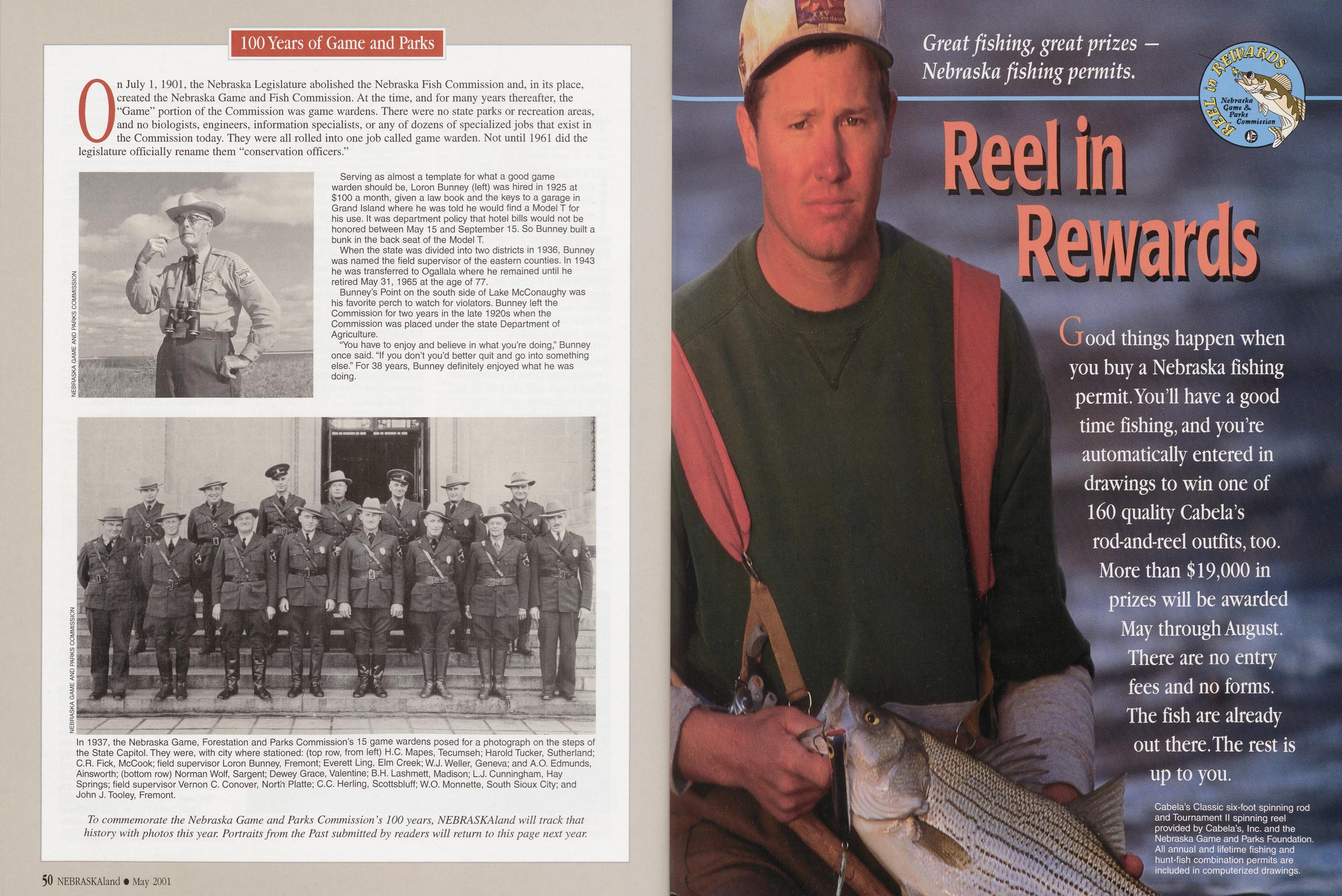
On July 1, 1901, the Nebraska Legislature abolished the Nebraska Fish Commission and, in its place, created the Nebraska Game and Fish Commission. At the time, and for many years thereafter, the "Game" portion of the Commission was game wardens. There were no state parks or recreation areas, and no biologists, engineers, information specialists, or any of dozens of specialized jobs that exist in the Commission today. They were all rolled into one job called game warden. Not until 1961 did the legislature officially rename them "conservation officers."
Serving as almost a template for what a good game warden should be, Loron Bunney (left) was hired in 1925 at $100 a month, given a law book and the keys to a garage in Grand Island where he was told he would find a Model T for his use. It was department policy that hotel bills would not be honored between May 15 and September 15. So Bunney built a bunk in the back seat of the Model T.
When the state was divided into two districts in 1936, Bunney was named the field supervisor of the eastern counties. In 1943 he was transferred to Ogallala where he remained until he retired May 31, 1965 at the age of 77.
Bunney's Point on the south side of Lake McConaughy was his favorite perch to watch for violators. Bunney left the Commission for two years in the late 1920s when the Commission was placed under the state Department of Agriculture.
"You have to enjoy and believe in what you're doing," Bunney once said. "If you don't you'd better quit and go into something else." For 38 years, Bunney definitely enjoyed what he was doing.
In 1937, the Nebraska Game, Forestation and Parks Commission's 15 game wardens posed for a photograph on the steps of the State Capitol. They were, with city where stationed: (top row, from left) H.C. Mapes, Tecumseh; Harold Tucker, Sutherland; C.R. Fick, McCook; field supervisor Loron Bunney, Fremont; Everett Ling, Elm Creek; W.J. Weller, Geneva; and A.O. Edmunds, Ainsworth; (bottom row) Norman Wolf, Sargent; Dewey Grace, Valentine; B.H. Lashmett, Madison; L.J. Cunningham, Hay Springs; field supervisor Vernon C. Conover, North Platte; C.C. Herling, Scottsbluff; W.O. Monnette, South Sioux City; and John J. Tooley, Fremont.
To commemorate the Nebraska Game and Parks Commission's 100 years, NEBRASKAland will track that history with photos this year. Portraits from the Past submitted by readers will return to this page next year.
Reel in Rewards
Good things happen when you buy a Nebraska fishing permit. You'll have a good time fishing, and you're automatically entered in drawings to win one of 160 quality Cabela's rod-and-reel outfits, too. More than $19,000 in prizes will be awaded May through August. There are no entry fees and no forms. The fish are already out there. The rest is up to you.
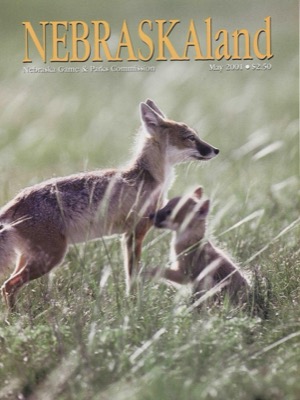
Position: 468 (22 views)