Volume 27, Issue 3-4, 1950
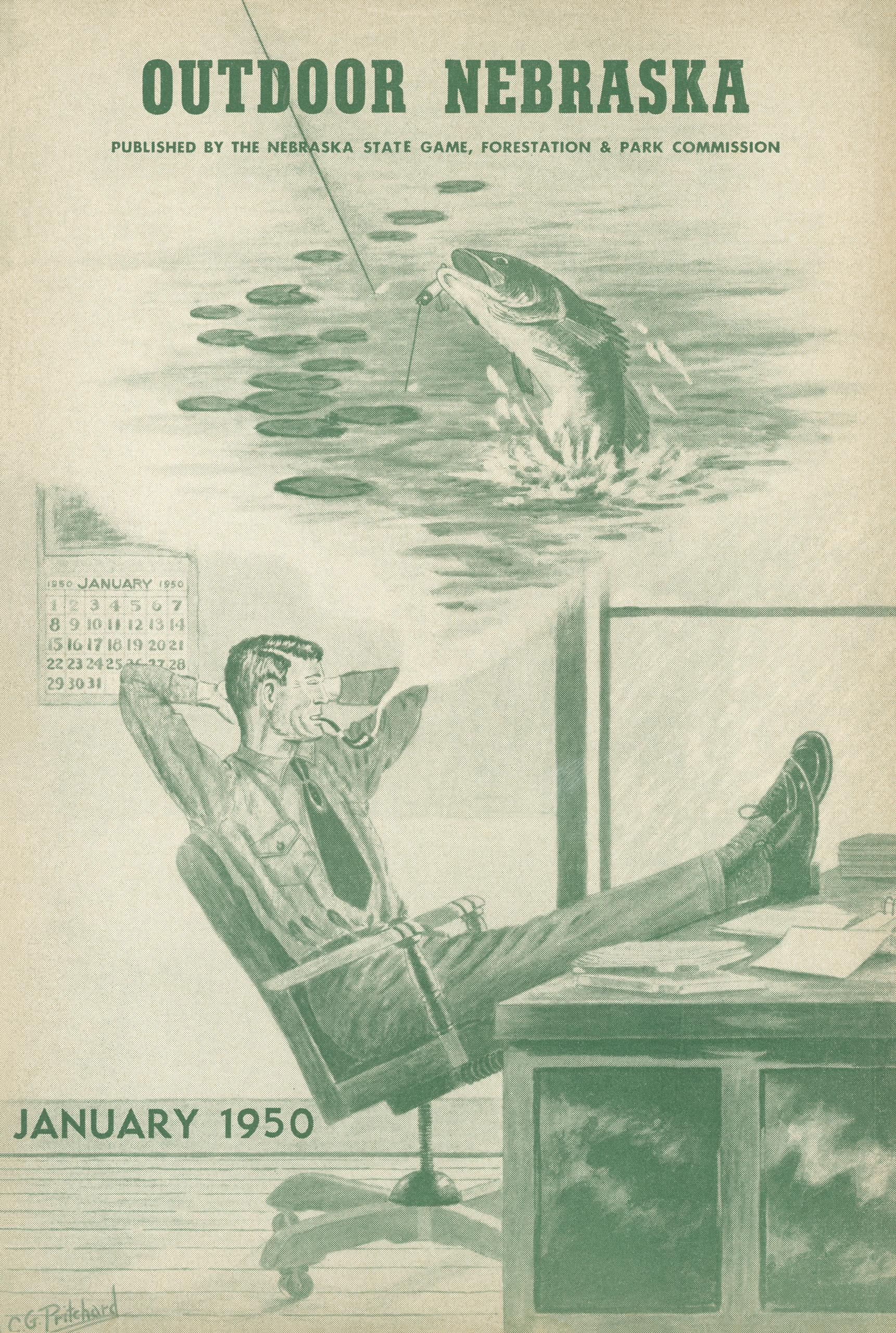
OUTDOOR NEBRASKA
PUBLISHED BY NEBRASKA STATE GAME, FORESTATION & PARK COMMISSION JANUARY 1950 C.G. Prtichard
TO NEBRASKA SPORTSMEN:
This edition of "Outdoor Nebraska" is dedicated to all sportsmen who have endeavored and succeeded in making the state's annual fishing seasons highly successful. Featured hearin are the following articles and pictures:
Page 3—1950 Fishing Season Shows Signs of Being One of the Best. 7—Eight State Fishing Records Broken. 8—Nebraska Fishing Records. 10—Fish Need Food. 13—Two's A Party—Three's A Crowd. 17—"Outdoor Nebraska" Quiz. 18—Three New Lakes Join State Fishing Waters. 20—Fish Scales Indicate Rapid Growth. 22—"Nebraska, the Land of Many Fishing Waters" Map. 25—All Fishing Waters According to Counties. 32—Recreational Planning in Nebraska. 35—Know All The Fish Found in Nebraska. 42—Kennedy New Chairman of Commissioners. 42—Hunting, Fishing Public Commended 43—Pond, Lake Requirements Revised. 44—Notes on Nebraska Fauna.
1950 Fishing Season Shows Signs of Being One of Best
Gazing into the very near future, as is the prospective angler piictured on the cover of this edition of "Outdoor Nebraska", the state's rapid growing number of anglers see the coming 1950 fishing season as one of the most productive ever experienced in the state. Their high aspirations are duly justified in that the Nebraska Game, Forestation and Parks Commission during 1949 executed a progressive program aimed directly at bettering fishing throughout the state in 1950. Its five hatcheries, at North Platte, Benkelman, Paks, Valentine, and Gretna, produced a spectacularly large hatch. This production combined iwth the many fine hatches found in natural waters supplied the big total which was stocked during the year. Though the total number planted failed ot surpass the previous high, those stocked on the whole did run considerably larger in size than those planted at any other time. Now the fishermen have both numers and good size with which to match their abilities. In addition the game commission constructed several new lakes and deepened and cleaned out a number of future, the commission planted huge others. Still looking further into the numbers of fish, both adult and fingerling size, in the state's new reservoirs at Medicine Creek and Enders. These two reservoirs will probably remain closed to fishin for a periodo of two years.
Nebraska anglers, it is true, find the majority of fishing waters in the central and western parts of the sstate. But where the fishing grounds are limited the commission has trie dto concentrate on what they have in making them as productive as possible. A search is continuing for possible lake sites in the eastern part of the state where fishing pressure is by far the heaviest of any sector of the state. It is common knowledge that once anglers decide to go fishing in Nebraska, they can make a selection from an estimated 3,000 different fishing bodies, taking into consideration type of fishing spot desired— lake, reseroir, river or creek—and kind of fish wanted. Nebraska provides some 2,300 lakes, the greater precentage of which are natural and range from 10 to 15 feet in depth. The majority of these, Nebraska's most cherrished possession, are found in the vast sand hills region which is pratically untouched by any other than local anglers. The commision derives many of its fish for stocking from this region.
Vol. 27 Outdoor Neraska Nos. 3-4 Published quarterly at Lincoln, Nebraska, by the Game, Forestation, and Parks Commission, State of Nebraska. Subscription price 25c a year; $1.00 for 5 years. STAFF: Editor Dick H. Schaffer COMMISSIONERS: Herbert B. Kennedy (Omaha), chairman, Clarke L. Wilson (Lincoln) Jack H. Lowe (Sidney) Cloyd E. Clark (Elwood) Frank J. Brady (Atkinson), vice-chairman. Lynn D. Hutton (Norfolk) W.O. Baldwin (Hebron) EXECUTIVE SECRETARY Paul T. Gilbert Seright Publication Bureau--Printers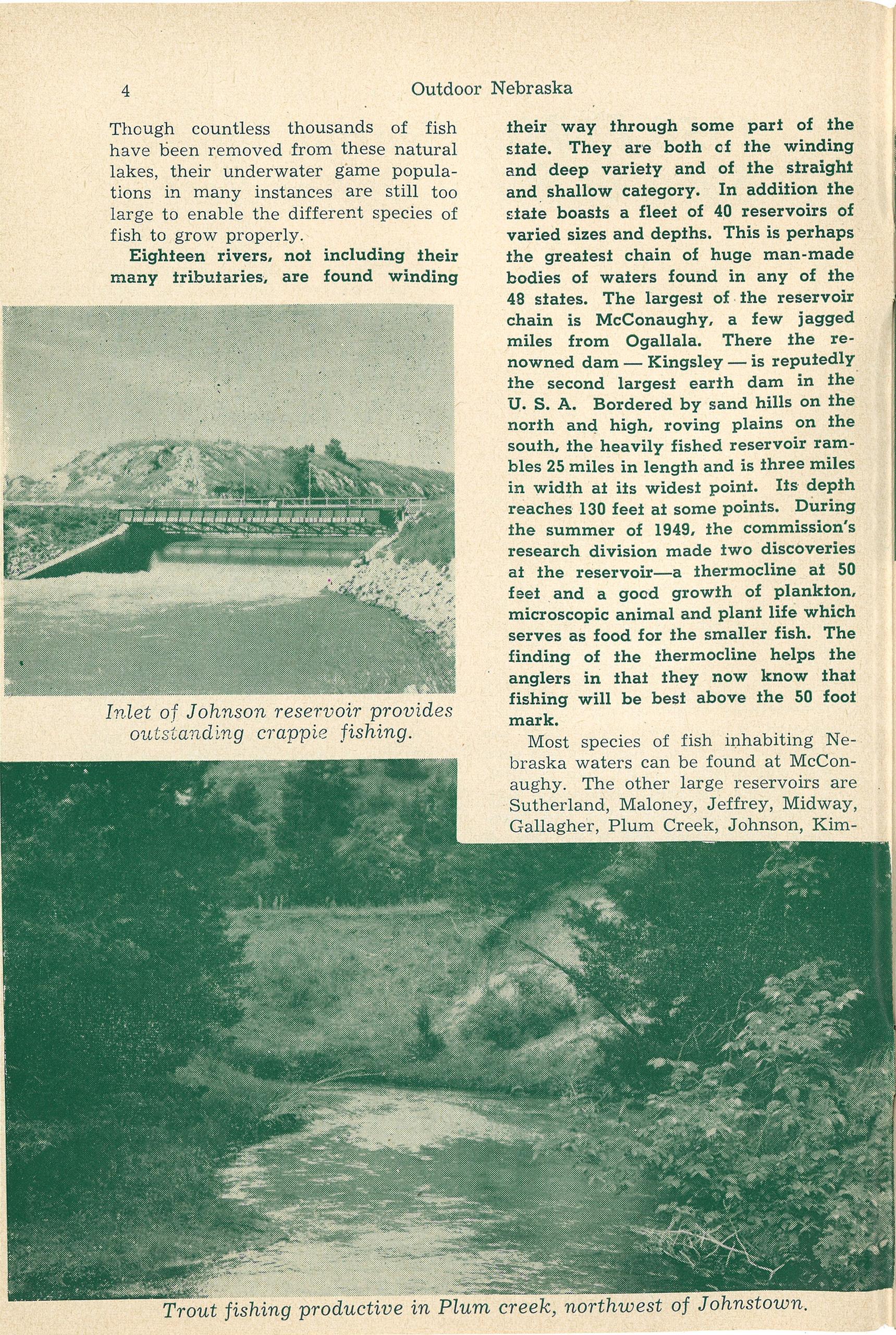 4 Outdoor Nebraska
Though countless thousands of fish have been removed from these natural lakes, their underwater game populations in many instances are still too large to enable the different species of fish to grow properly.
Eighteen rivers, not including their many tributaties, are found winding their way through some part of the state. They are both of the winding and deep variety and of the straight and shallow category. In addition the state boasts a fleet of 40 reservoirs of varied sizes and depths. This is perhaps the greatest chain of huge man-made bodies of waters found in any of the 48 states. The largest of the reservoir chain is McConaughy, a few jagged miles from Ogallala. There the renowned dam—Kingley—is reputedly the second largest earth dam in the U. S. A. Bordered by sand hills on the north and high, roving plains on the south, the heavily fished reservoir rambles 25 miles in lenght and is three miles in width at its widest point. Its depth reaches 130 feet at some points. During the summer of 1949, the commission's research division made two discoveries at the reservoir—a thermocline at 50 feet and a good growth of plankton, microscopic animal and plant life which serves as food for the smaller fish. The finding of the thermocline helps the anglers in that the now know that fishing will be best above the 50 foot mark.
Most species of fish inhabiting Nebraska waters can be found at McConaughy. The other large reservoirs are Sutherland, Maloney, Jeffrey, Midway, Gallagher, Plum creek, Johnson, Kim-
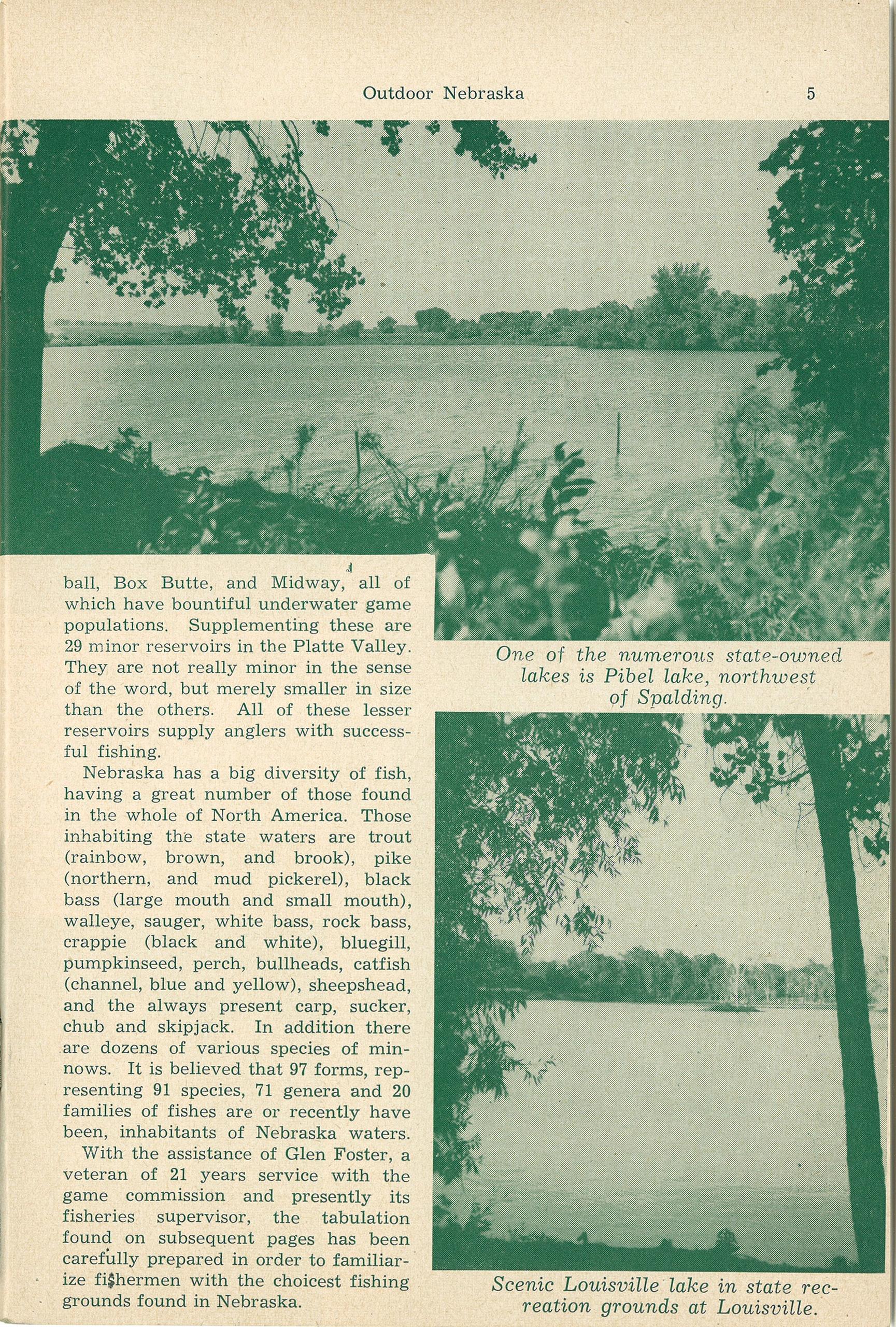 Outdoor Nebraska 5 ball, Box Butte, and Midway, all of which have bountiful underwater game populations. Supplementing hese are 29 minor reservoirs in the Platte Valley. They are not Rreally minor in the sense of the word, but merely smalelr in size than the others. All or these lesser reservoirs supply anglers with successful fishing.
Nebraska has a big diversity of fish, havig a great number of those found in the whole of North America. Those inhabiting the state waters are trout (rainbow, brown, and brook), pike (northern, and mud pickerel), black bass (large mouth and small mouth), walleye, sauger, white bass, rock bass, crappie (black and white), bluegill, pumpkinseed, perch, bullheads, catfish (channel, blue and yellow), sheepshead, and the always present carp, sucker chub and slipjack. In addition there are dozens of various species of minnows. It is believed that 97 forms, representing 91 speicies, 71 genera and 20 families of fishes are or recently have been, inhabitants of Nebraska waters.
With the assistance of Glen Foster, a veterna of 21 years serivce with the game commission and presently its fisheries supervisor, the tabulation foudn on subsequent pages has been carefully prepared in order to familiarize fishermen with the choicest fishing grounds in Nebraska.
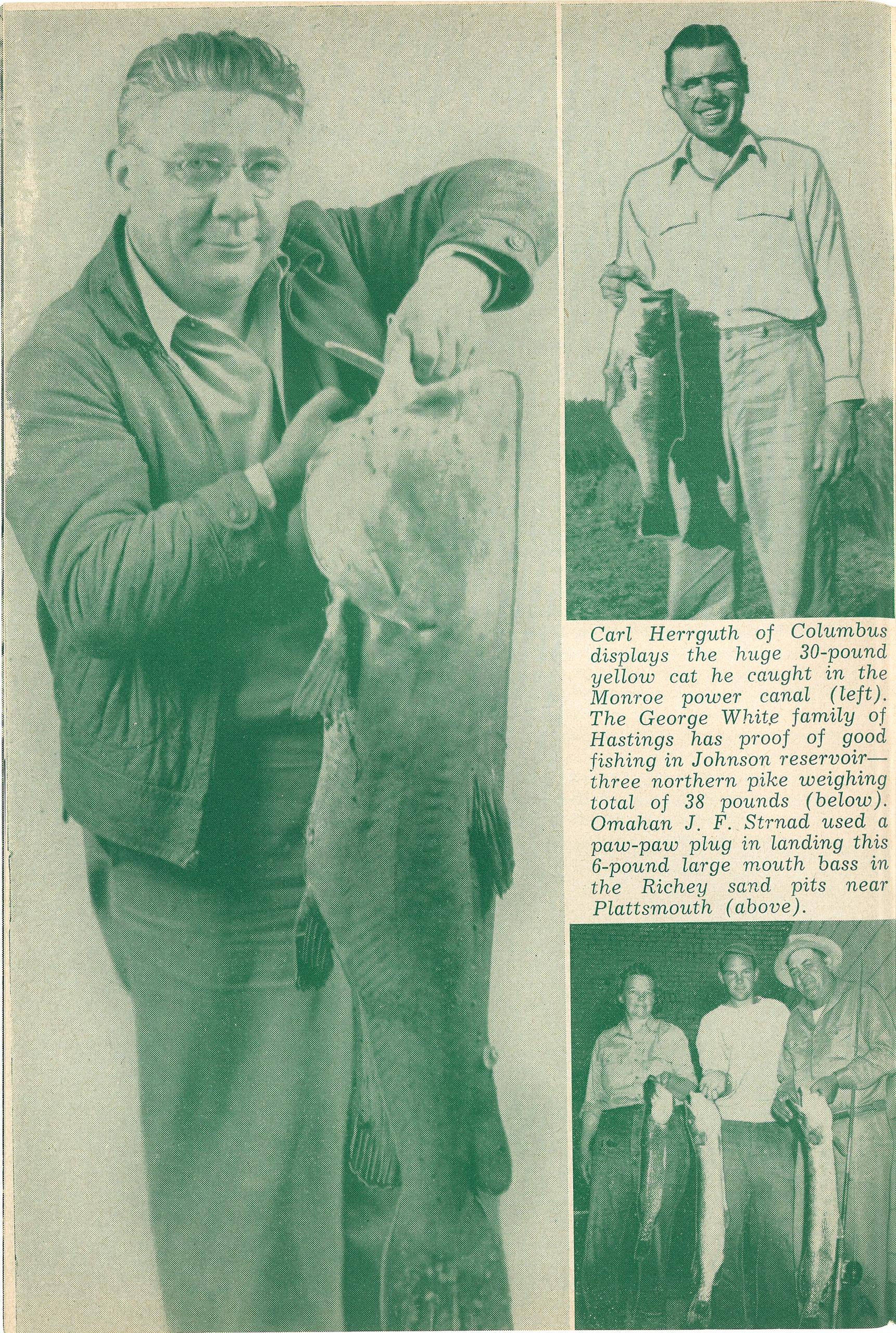
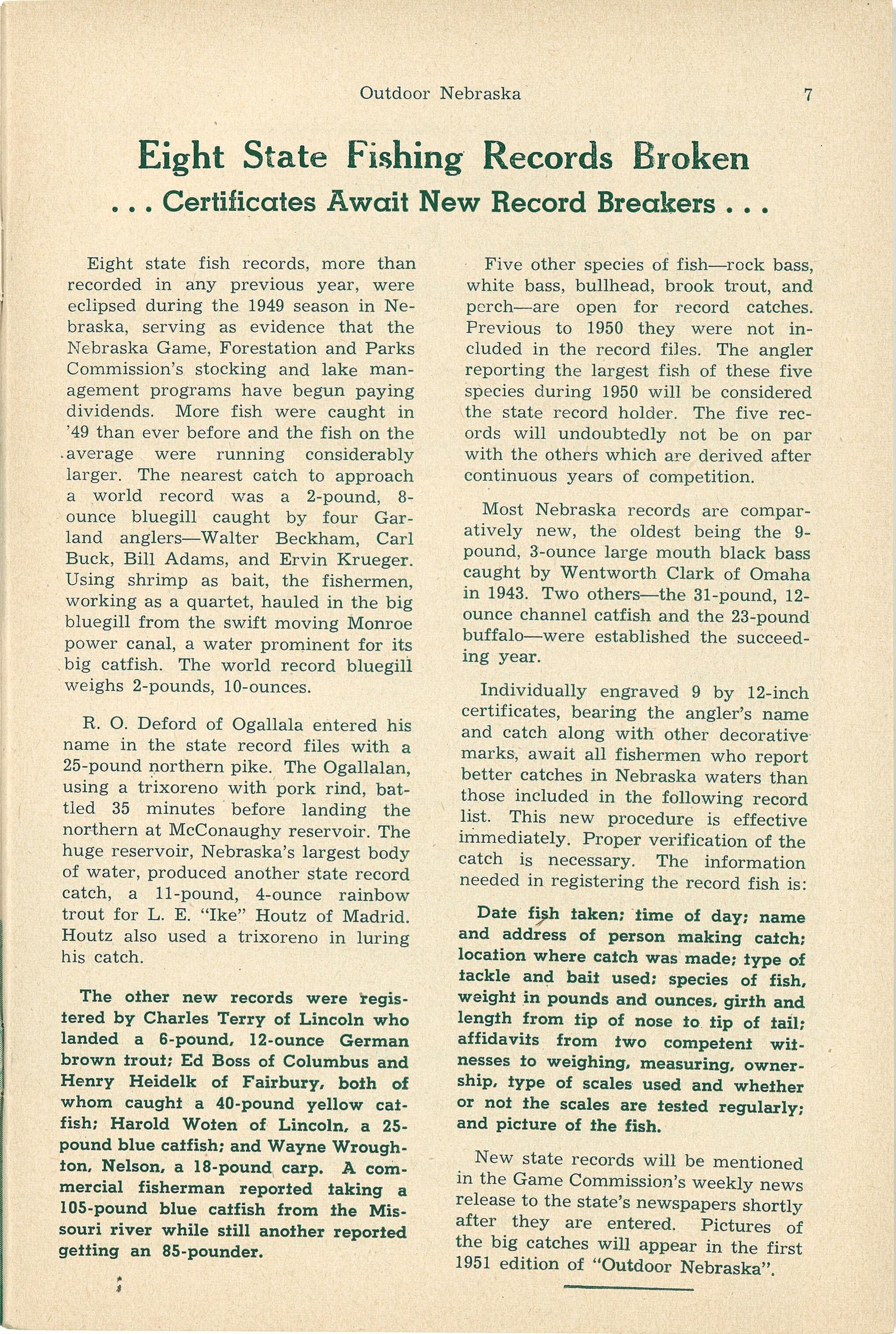 Outdoor Nebraska 7
Eight State Fishing Records Broken
. . . Certificates Await New Record Breakers . . .
Eight state fish records, more than recorded in any previous year, were eclipsed during the 1949 season in Nebraska, serving as evidence that the Nebraska Game, Forestation and Parks Commission's stocking and lake management programs have begun paying dividends. More fish were caught in '49 than ever before and the fish on the average were runnning considerably larger. The nearest catch to approach a world record was a 2-pound, 8-ounce bluegill caught by four Garland anglers--Water Beckham, Carl Buck, Bill Adams, and Ervin Krueger. Using shrimp as bait, the fishermen, working as a quartet, hauled in the big bluegill from the swift moving Monroe power canal, a water prominent for its big catfish. The world record bluegill weights 2-pounds, 10-ounces.
R. O. Deford of Ogallala entered his name in the state record files with a 25-pound northern pike. The Ogallalan, using a trixoreno with pork rind, battled 35 minutes before landing the northern at McConaughy reservoir. The huge reservoir, Nebraska'a largest body of water, produced another state record catch, a 11-pound, 4-ounce rainbow trout for L. E. "Ike" Houtz of Madrid. Houtz also used a trixoreno in luring his catch
The other new records were regis tered by Charles Terry of Lincoln who landed a 6-pound, 12-ounce German brown trout; Ed Boss of Columbus and Henry Heidelk of Fairbury, both of whom caught a 40-pound yellow catfish; Harold Woten of Lincoln, a 2Spound blue catfish; and Wayne Wroughton, Nelson, a 15-pound carp. A commercial fisherman reported taking a IDS-pound blue catfish from the Missouri river while still another reported getting an 85-pounder.
Five other species of fish-rock bass, white bass, bullhead, brook trout, and perch-are open for record catches. Previous to 1950 they were not included in the record files. The angler reporting the largest fish of these five species during 1950 will be considered the state record holder. The five records will undoubtedly not be on par with the others which are derived after continuous years of competition.
Most Nebraska records are comparatively new, the oldest being the 9-pound, 3-ounce large mouth black bass caught by Wentworth Clark of Omaha in 1943. Two others-the 31-pound, 12-ounce channel catfish and the 23-pound buffalo-were established the succeeding year.
Individually engraved 9 by 12-inch certificates, bearing the angler's name and catch along with other decorative· marks, await all fishermen who r eport better catches in Nebraska waters than those included in the following record list. This new procedure is effect ive immediately. Proper verification of the catch is necessary. The information needed in registering the record fish is:
Date fish taken; time of day; name and address of person making catch; location where catch was made; type of tackle an~ bait used; species of fish, weight in pounds and ounces, girth and length from tip of nose to. tip of tail; affidavits from two competent witnesses to weighing, measuring, ownership, type of scales used and whether or not the scales are tested regularly; and picture of the fish.
New state records will be mentioned in the Game Commission's weekly news release to the state's newspapers shortly after they are entered. Pictures of the big catches will appear in the first 1951 edit ion of "Outdoor Nebraska".
 8 Outdoor Nebraska
Nebraska Fishing Records
. . . AS OF DECEMBER 31, 1949 . . .
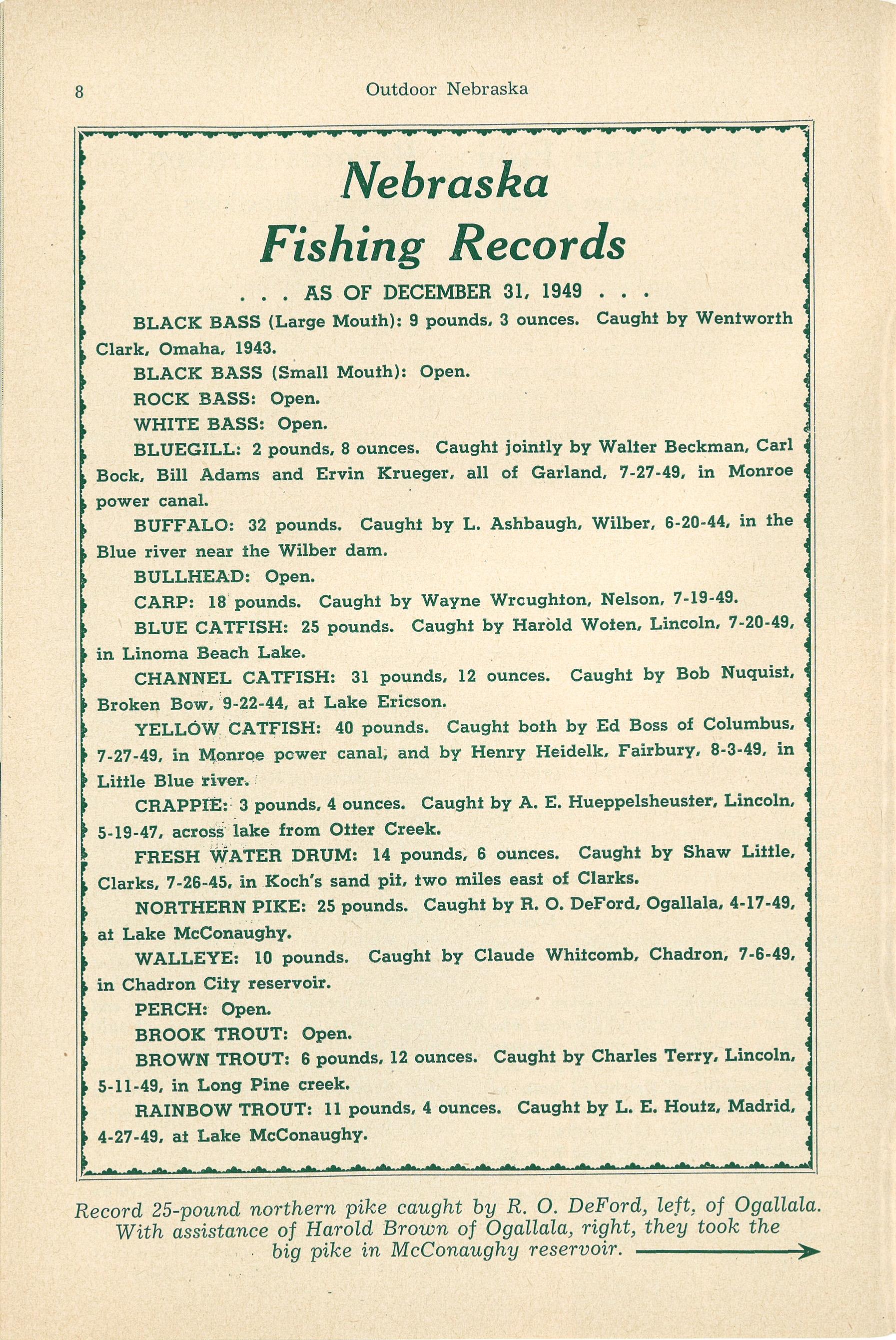
BLACK BASS (Large Mouth): 9 pounds, 3 ounces. Caught by Wentworth Clark, Omaha, 1943. BLACK BASS (Small Mouth): Open. ROCK BASS: Open. WHITE BASS: Open. BLUEGILL: 2 pounds, 8 ounces. Caught jointly by Walter Beckman. Carl Bock. Bill Adams and Ervin Krueger, all of Garland, 7-27-49, in Monroe power canal. BUFFALO: 32 pounds. Caught by L. Ashbaugh, Wilber, 6-20-44, in the Blue river near the Wilber dam. BULLHEAD: Open CARP: 18 pounds. Caught by Wayne Wroughton, Nelson, 7-19-49. BLUE CATFISH: 25 pounds. Caught by Harold Woten, Lincoln, 7-20-49, in Linoma Beach Lake. CHANNEL CATFISH: 31 pounds, 12 ounces. Caught by Bob Nuqist, Broken Bow, 9-22-44, at Lake Ericson. YELLOW CATFISH: 40 pounds. Caught both by Ed Boxx of Columbus, 7-27-49 in Monroe power canal, and by Henrey Heidelk, Fairfury, 8-3-49, in Little Blue river. CRAPPIE: 3 pounds, 4 ounces. Caught by A. E. Hueppelsheuster, LIncoln, 5-19-47, across lake from Otter Creek. FRESH WATER DRUM: 14 pounds, 6 ounces. Caught by Shaw LIttle, Clarks, 7-26-45, in Koch's sand pit, two miles east of Clarks. NORTHERN PIKE: 25 pounds. Caught by R. O. DeFord, Ogallala, 4-17-49, at Lake McConaughy. WALLEYE: 10 pounds. Caught by Claude Whitcomb, Chadron, 7-6-49, in Chadron City reservoir. PERCH: Open BROOK TROUT: Open BROWN TROUT: 6 pounds, 12 ounces. Caught by Charles Terry, Lincoln, 5-11-49, in Long Pine creek. RAINBOW TROUT: 11 pounds, 4 ounces. Caught by L. E. Houtz, Madrid, 4-27-49, at Lake McConaughy. Record 25-pound northern pike caught by R. O. DeFord, left, of Ogallala. With assistance of Harold Brown of Ogallala, right, they took the big pike in McConaughy reservoir.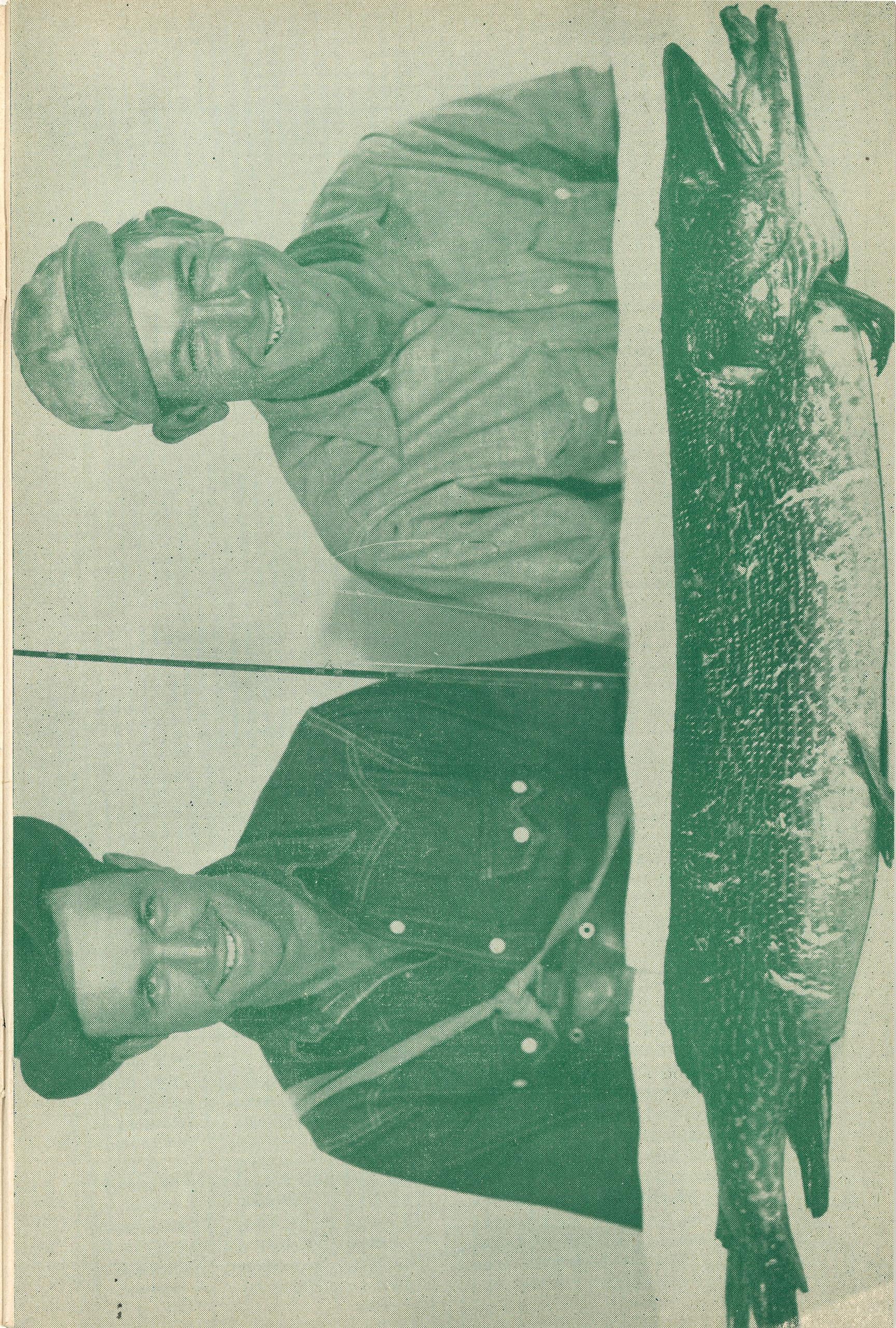
 10 Outdoor Nebraska
Fish Need Food
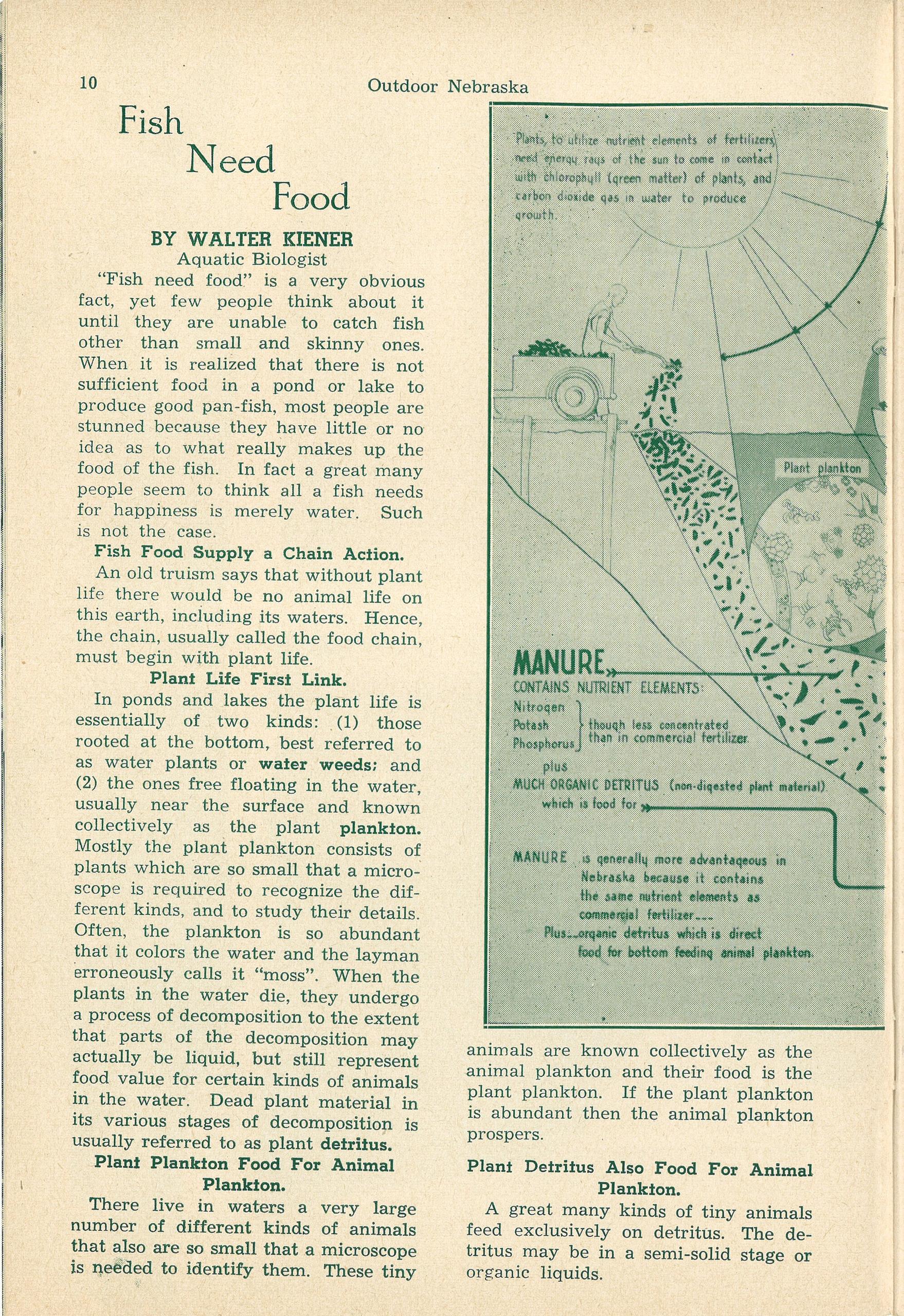
"Fish need food" is a very obvious fact, yet few people think about it until they are unable to catch fish other than small and skinny ones. When it is realized that there is not sufficient food in a pond or lake to produce good pan-fish, most people are stunned because they have little or no idea as to what really makes up the food of the fish. In fact a great many people seem to think all a fish needs for happiness is merely water. Such is not the case.
Fish Food Supply a Chain ActionAn old truism says that without plant life there would be no animal life on this earth, inciuding its waters. Hence, the chain, usually called the food chain, must begin with plant life.
Plant Life First Link.In ponds and lakes the plant life is essentially of two kinds: (1) those rooted at the bottom, best referred to as water plants or water weeds; and (2) the ones free floating in the water, usually near the surface and known collectively as the plant plankton. Mostly the plant plankton consists of plants which are so small that a micro-· scope is required to recognize the different kinds, and to study their details. Often, the plankton is so abundant that it colors the water and the layman erroneously calls it "moss". When the plants in the water die, they undergo a process of decomposition to the extent that parts of the decomposition may actually be liquid, but still represent food value for certain kinds of animals in the water. Dead plant material in its various stages of decomposition is usually referred to as plant detritus.
Plant Plankton Food For Animal Plankton.There live in waters a very large number of different kinds of animals that also are so small that a microscope is :qeeded to identify them. These tiny animals are known collectively as the animal plankton and their food is the plant plankton. If the plant plankton is abundant then the animal plankton prospers.
Plant Detritus Also Food For Animal PlanktonA great many kinds of tiny animals feed exclusively on detritus. The detritus may be in a semi-solid stage or organic liquids.
 Outdoor Nebraska 11
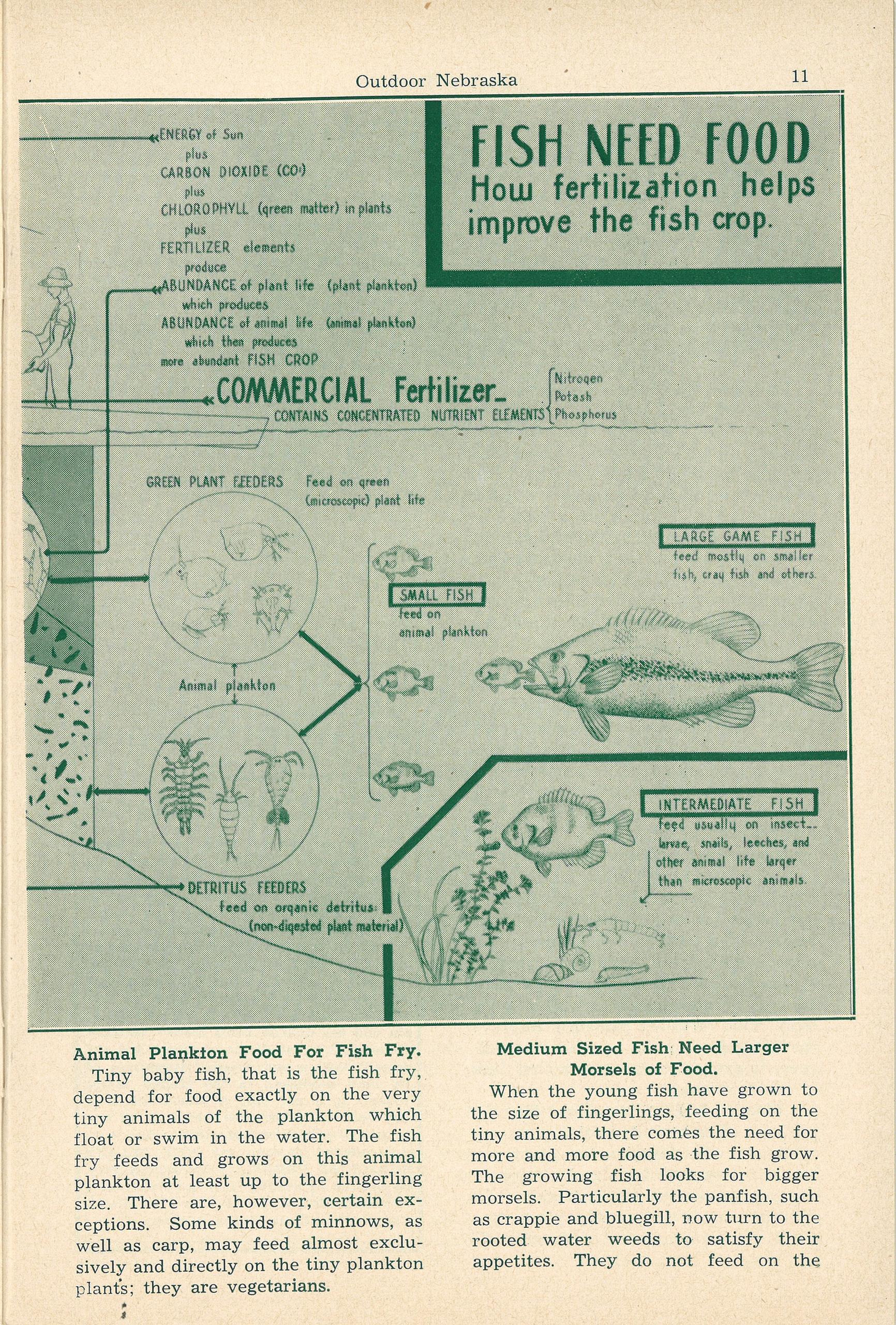
Tiny baby fish, that is the fish fry, depend for food exactly on the very tiny animals of the plankton which float or swim in the water. The fish fry feeds and grows on this animal plankton at least up to the fingerling size. There are, however, certain exceptions. Some kinds of minnows, as w·en as carp, may feed almost exclusively and directly on the tiny plankton plant's; they are vegetarians.
Medium Sized Fish Need Larger Morsels of Food.When the young fish have grown to the size of fingerlings, feeding on the tiny animals, there comes the need for more and more food as the fish grow. The growing fish looks for bigger morsels. Particularly the panfish, such as crappie and bluegill, now turn to the rooted water weeds to satisfy their appetites. They do not feed on the  12 Outdoor Nebraska water weeds themselves, but look for insect larvae, leeches, snails and the like, which do feed on the water weeds. It is obvious, therefore, that water weeds are necessary to produce the better sized feed animals, to produce nice crappies and bluegills. Again the carp is an exception as it will grow to large and very large size mostly on plant life alone.
The game fish such as pike, bass, and others, may start at the age of fingerling preying on other fish th~t are smaller than themselves. These fish do not bother to hunt for the lowly. snail when plenty of minnow-sized fish are available. Thus, ·when a lake produces a large amount of plankton, both plant and animal, then the same lake produces through this .plankton also a large number of nice, fat, minnow-sized fish, with the end result that the fishermen catch many more big, fat game fish which have been feeding on the smaller fish.
Fertilization Improves Food Chain.The application of fertilizer to the water· of a pond may increase the produ~ tion of plant life, both plankton and water weeds. The fertilizer may be in two forms, commercial fertilizer or manure.
Commerical Fertilizer Improves Only First Link.The common fertilizer, commercially available, is mostly chemical matter containing nitrogen, potash and phosphorus which are essential nutrients for plants, but which cannot be used as food by any animal in water or on land. This fertilizer can only improve the living green plant to greater abundance, it can act only on the first link of the food chain.
Manure Is Fertilizer, Food For Plankton Animals.Manure also contll.ins the plant nutrients nitrogen, potash, and phosphorus, but in lesser concentration. In addition, manure is mostly plant mat erial in various stages of decomposition which becomes food immediately avail.able to the tiny animals of the plankton. When the plankton animals increase, the small fish increase, and the game fish get bigger and bigger, the fish crop improves.
Better Fish Crop Follows Manuring of Farm Ponds and Small Lakes.Manure is available on almost any farm at no extra cost. Manure (1) stimulates the production of the green plant life in the water, and (2) introduces decaying plant material which is ready food for the small microscopic animals known collectively as the plankton. Manure acts on the first and second link of the food chain. Manure, as well as commercial fertilizer, may be applied in too large quantities and become harmful. Commercial fertilizer is useless if the necessary plant life is not present to begin with. Manure, however, would still h ave its food value for the plankton animals, through its organic matter. Hence, manure r ecommends itself for the improvement of the fish crop.
WHY DELAY? SUBSCRIBE TODAY! Five cents per quarterly copy of "Outdoor Nebraska", For the mere cost of the average daily newspaper sportsmen can purchase the Nebraska Game, Forestation and Parks Commission's quarterly magazine containing informative and humorous stories on the state's fishing and hunting activities. For a five year subscription the cost is only $1.00 for 20 magazines or five cents each. If subscribing for one year the cost is 25 cents or an average of six and one-qμarter cents each. "Outdoor Nebraska" is one of the cheapest, but yet most complete and detailed magazines of its kind published in the United States today. It is not only a prized token of any sportsman but also serves as an appropriate and cherished gift for any outdoorminded person. SO WHY DELAY? SUBSCRIBE TODAY. Subscriptions may be entered by writing "Outdoor Nebraska", Nebraska Game, Forestation and Parks Commission, State House, Lincoln.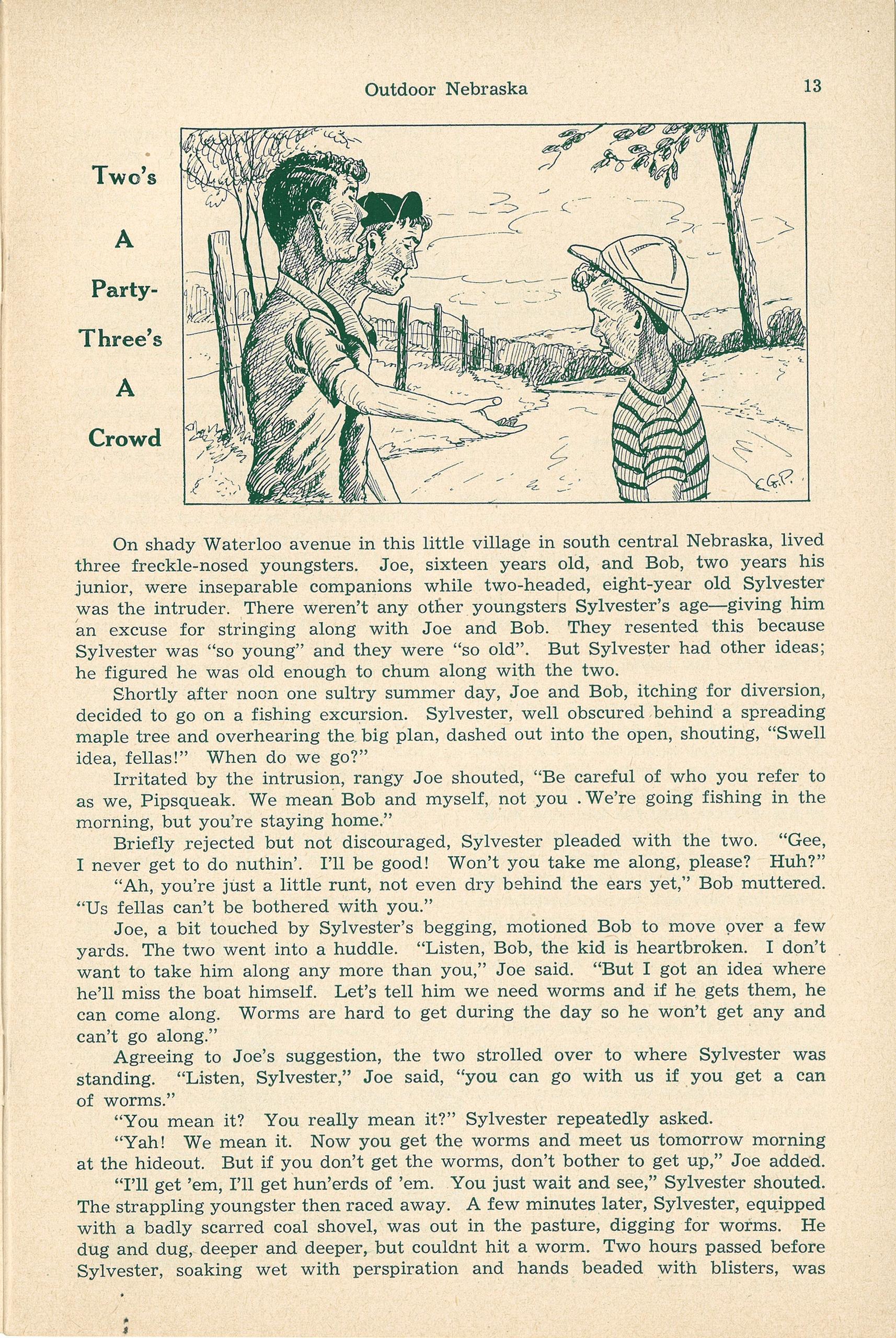 Outdoor Nebraska 13
Two's A Party-Three's A Crowd
On shady Waterlook avenue in the little village in south central Nebraska, lived three freckle-nosed youngsters. Joe, sixteen years old, and Bob, two years his junior, were inseparable companions while two-headed, eight-year old Sylvester was the intruder. There weren't any otlier youngsters Sylvester's age-giving him an excuse for stringing along with Joe and Bob. They resented this because Sylvester was "so young" and they were "so old". But Sylvester had other ideas; he figured he was old enough to chum along with the two.
Shortly after noon one sultry summer day, Joe and Bob, itching for diversion, decided to go on a fishing excu_rsion. Sylvester, well obscured behind a spreading maple tree and overhearing the big plan, dashed out into the open, shouting, "Swell idea, fellas!" When do we go?"
Irritated by the intrusion, rangy Joe shouted, "Be careful of who you refer to as we, Pipsqueak. We mean Bob and myself, not you . We're going fishing in the morning, but you're staying home."
Briefly .rejected but not discouraged, Sylvester pleaded with the two. "Gee, I never get to do nuthin'. I'll be good! Won't you take me along, please? Huh?"
"Ah, you're just a little runt, not even dry behind the ears yet," Bob muttered. "Us fellas can't be bothered with you."
Joe, a bit touched by Sylvester's begging, motioned Bob to move 9ver a few yards. The two went into a huddle. "Listen, Bob, the kid is heartbroken. I don't want to take him along any more than you," Joe said. "But I got an idea where he'll miss the boat himself. Let's tell him we need worms and if he gets them, he can come along. Worms are hard to get during the day so he won't get any and can't go along."
Agreeing to Joe's suggestion, the two strolled over to where Sylvester was standing. "Listen, Sylvester," Joe said, "you can go with us if _you get a can of worms."
"You mean it? You really mean it?" Sylvester repeatedly asked.
"Yahl We mean it. Now you get the worms and meet us tomorrow morning at the hideout. But if you don't get the worms, don't bother to get up," Joe added.
"I'll get 'em, I'll get hun'erds of 'em. You just wait and see," Sylvester shouted. The strappling youngster then raced away. A few minutes later, Sylvester, equ_ipped with a badly scarred coal shovel, was out in the pasture, digging for worms. He dug and dug, deeper and deeper, but couldnt hit a worm. Two hours passed before Sylvester, soaking wet with perspiration and hands beaded with blisters, was 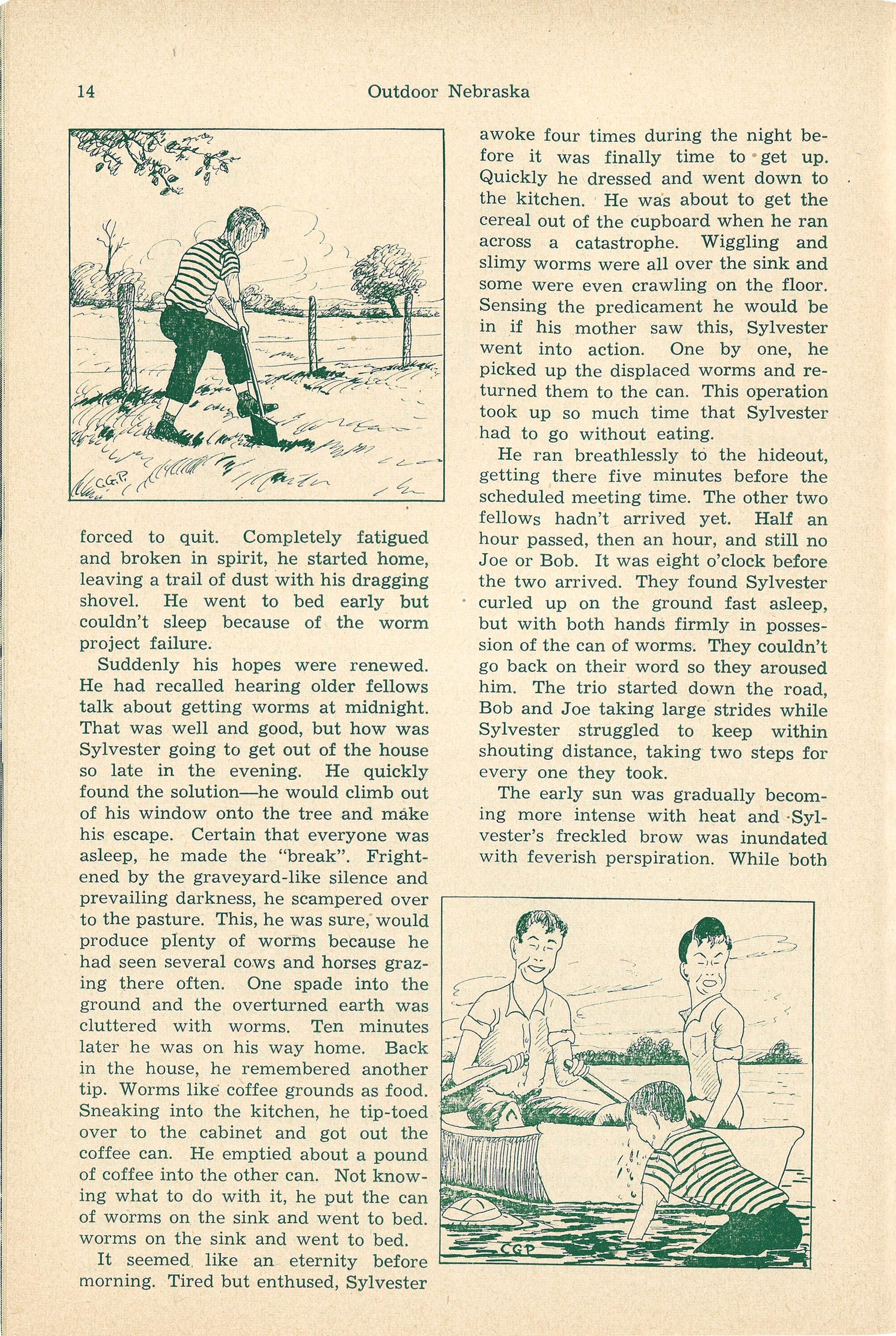
Suddenly his hopes were renewed. He had recalled hearing older fellows talk about getting worms at midnight. That was well and good, but how was Sylvester going to get out of the house so late in the evening. He quickly found the solution-he would climb out of his window onto the tree and make his escape. Certain that everyone was asleep, he made the "break". Frightened by the graveyard-like silence and prevailing darkness, he scampered over to the pasture. This, he was sure, would produce plenty of worms because he had seen several cows and horses grazing there often. One spade into the ground and the overturned earth was cluttered with worms. Ten minutes later he was on his way home. Back in the house, he remembered another tip. Worms like coffee grounds as food. Sneaking into the kitchen, he tip-toed over to the cabinet and got out the coffee can. He emptied about a pound of coffee into the other can. Not knowing what to do with it, he put the can of worms on the sink and went to bed. worms on the sink and went to bed. awoke four times during the night before it was finally time to • get up. Quickly he dressed and went down to the kitchen. He was about to get the cereal out of the cupboard when he ran across a catastrophe. Wiggling and slimy worms were all over the sink and some were even crawling on the floor. Sensing the predicament he would be in if his mother saw this, Sylvester went into action. One by one, he picked up the displaced worms and returned them to the can. This operation took up so much time that Sylvester had to go without eating.
He ran breathlessly to the hideout, getting there five minutes before the scheduled meeting time. The other two fellows hadn't arrived yet. Half an hour passed, then an hour, and still no Joe or Bob. It was eight o'clock before the two arrived. They found Sylvester curled up on the ground fast asleep, but with both hands firmly in possession of the can of worms. They couldn't go back on their word so they aroused him. The trio started down the road, Bob and Joe taking large strides while Sylvester struggled to keep within shouting distance, taking two steps for every one they took.
The early sun was gradually becoming more intense with heat and ·Sylvester's freckled brow was inundated with feverish perspiration. While both
 Outdoor Nebraska 15
"Aren't you going to use my worms?" Sylvester asked.
"Shucks no," Bob answered, "minnows are better." Both Bob and Joe laughed.
To Sylvester the remark failed to live up to a joke. "If my worms aren't any good, can I use some of your minnows?", he asked.
"Sure, you can use our minnows," Bob jeered, "but you don't have a line."
Poor little Sylvester was broken. He had worms but they weren't any good for bait; he could use the fellows' minnows, but he didn't have a fishing line.
Looking for the best place to fish, Joe spotted a !'OW boat about five hundred yards around the bend. The trio walked in that direction when Sylvester timidly asked, "Is it all right to use somebody else's boat?"
"Sure, it's okay". Joe replied. "Nobody's using it and besides the best fishing is in the middle of the lake, not here on shore."
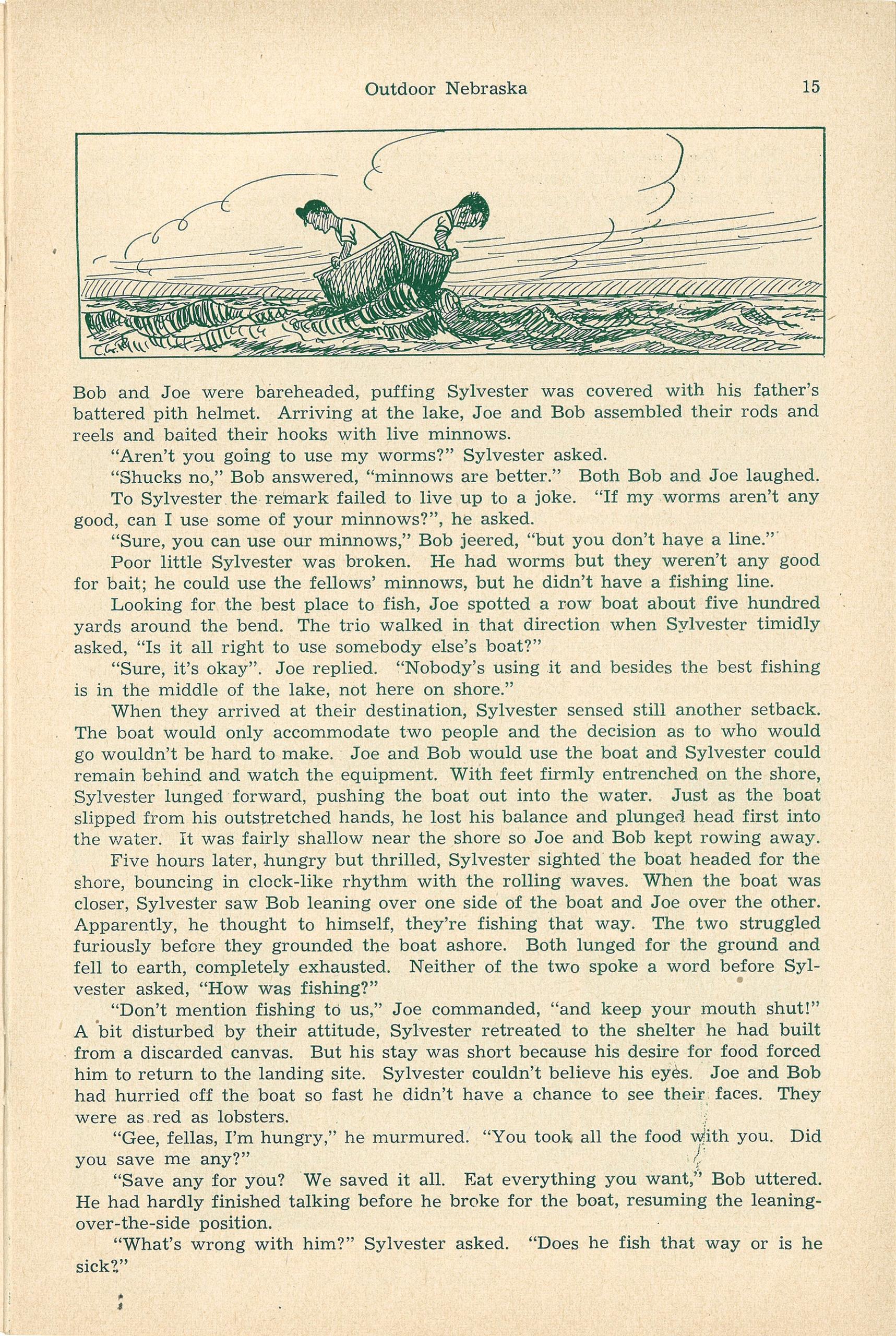
When they arrived at their destination, Sylvester sensed still another setback. The boat would only accommodate two people and the decision as to who would go wouldn't be hard to make. · Joe and Bob would use the boat and Sylvester could remain behind and watch the equipment. With feet firmly entrenched on the shore, Sylvester lunged forward, pushing the boat out into the water. Just as the boat slipped from his outstretched hands, he lost his balance and plunged head first into the water. It was fairly shallow near the shore so Joe and Bob kept rowing away.
Five hours later, hungry but thrilled, Sylvester sighted the boat headed for the shore, bouncing in clock-like rhythm with the rolling waves. When the boat was closer, Sylvester saw Bob leaning over one side of the boat and Joe over the other. Apparently, he thought to himself, they're fishing that way. The two struggled furiously before they grounded the boat ashore. Both lunged for the ground and fell to earth, completely exhausted. Neither of the two spoke a word before Sylvester asked, "How was fishing?"
"Don't mention fishing tci us," Joe commanded, "and keep your mouth shut!" A bit disturbed by their attitude, Sylvester retreated to the shelter he had built from a discarded canvas. But his stay was short because his desire for food forced him to return to the landing site. Sylvester couldn't believe his eyes. Joe and Bob had hurried off the boat so fast he didn't have a chance to see their faces. They were as red as lobsters.
"Gee, fellas, I'm hungry," he murmured. "You took; all the food vJith you. Did you save me any?"
"Save any for you? We saved it all. Eat everything you want,'' Bob uttered. He had hardly finished talking before he broke for the boat, resuming the leaning-over-the-side position.
"What's wrong with him?" Sylvester asked. "Does he fish that way or is he sick?"
 16 Outdoor Nebraska
"Sick! Don't mention that word," Joe pleaded. He, too, then ran for the boat, joining Bob in his unusual stance.
Five minutes later, wiping their mouths with their blistered arms, the two returned. Picking up their equipment, they doggedly headed for home.
"Hey, wait fellas. You forgot your fish!" Sylvester shouted.
"Forgot what fish?" Joe asked. "We didn't even have a nibble."
"Didn't your minnows work? Gee, my worms did," Sylvester boasted.
"What do you mean, your worms worked?" Bob inquired.
"They must have worked," Sylvester replied, "I have ten fish."
"You didn't have any fishing tackle," Joe hollered. "How could you catch anything?"
"I had a line," Sylvester answered. "I found a part of a line when I fell into the lake trying to push the boat."
"Well, where did you catch the fish then?" Joe asked. "You had to stay on shore."
"That's where I fished. Right here from shore," he replied. "I only got ten fish though, I had to throw the others back."
"Throw the others back?" Joe yelled,
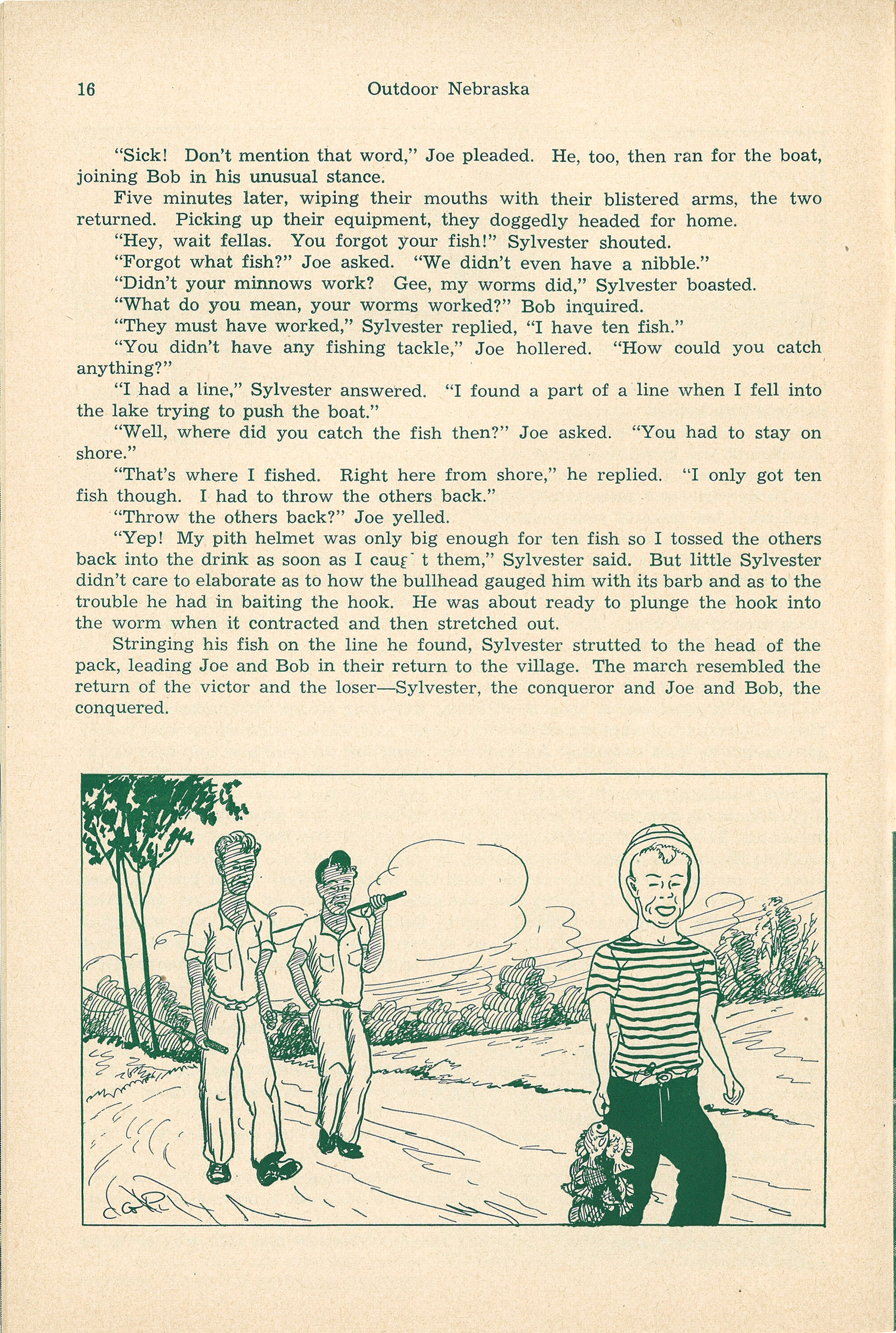
"Yep! My pith helmet was only big enough for ten fish so I tossed the others back into the drink as soon as I caught them," Sylvester said. But little Sylvester didn't care to elaborate as to how the bullhead gauged him with its barb and as to the trouble he had in baiting the hook, He was about ready to plunge the hook into the worm when it contracted and then stretched out.
Stringing his fish on the line he found, Sylvester strutted to the head of the pack, leading Joe and Bob in their return to the village. The march resembled the return of the victor and the loser--Sylvester, the conqueror and Joe and Bob, the conquered.
 Outdoor Nebraska 17
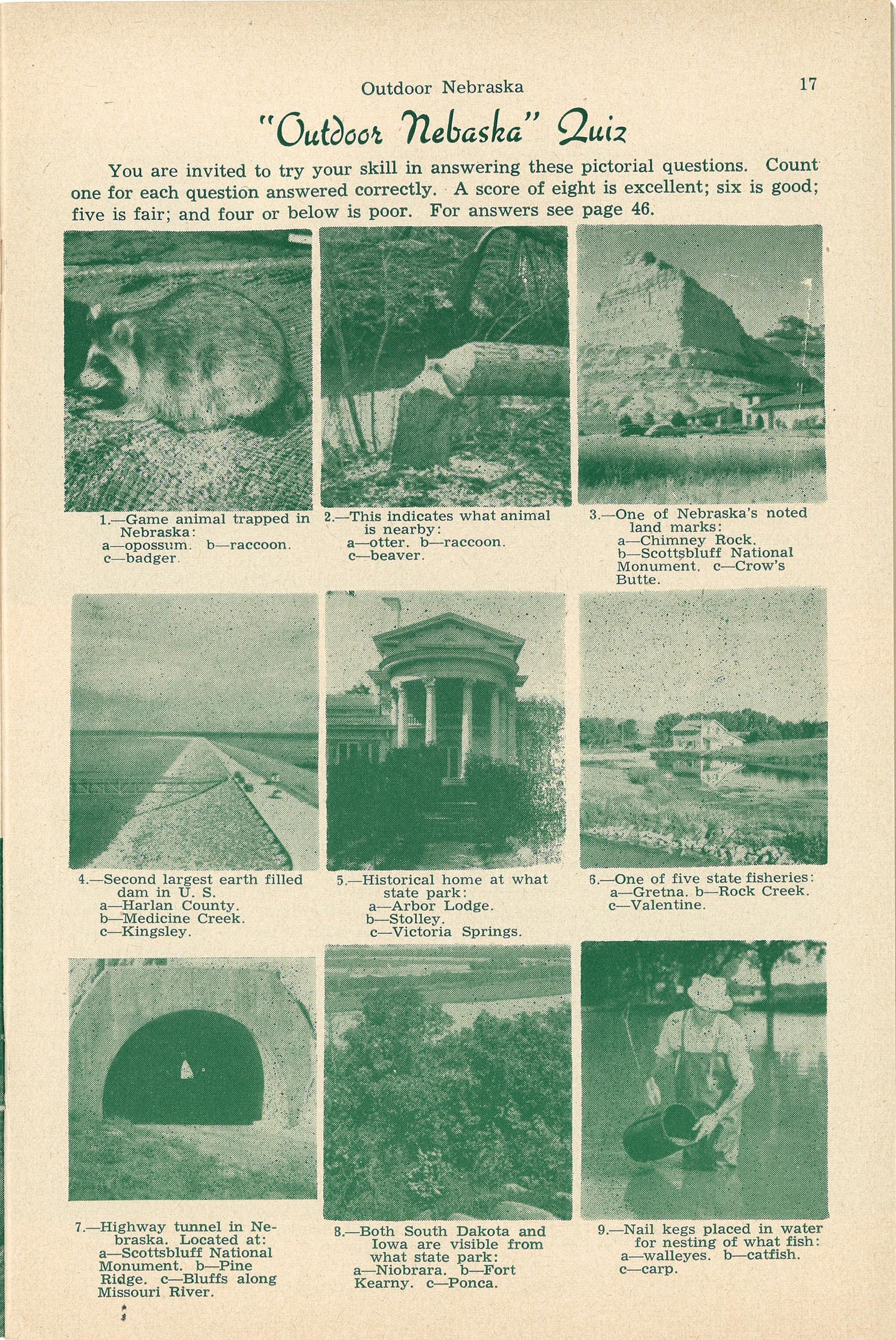
"Outdoor Nebraska" Quiz
You are invited to try your skill in answering these pictorial questions. Count one for each question answered correctly. A scor of eight is excellent; six is good; five is fair; and four or below is poor. For answers see page 46.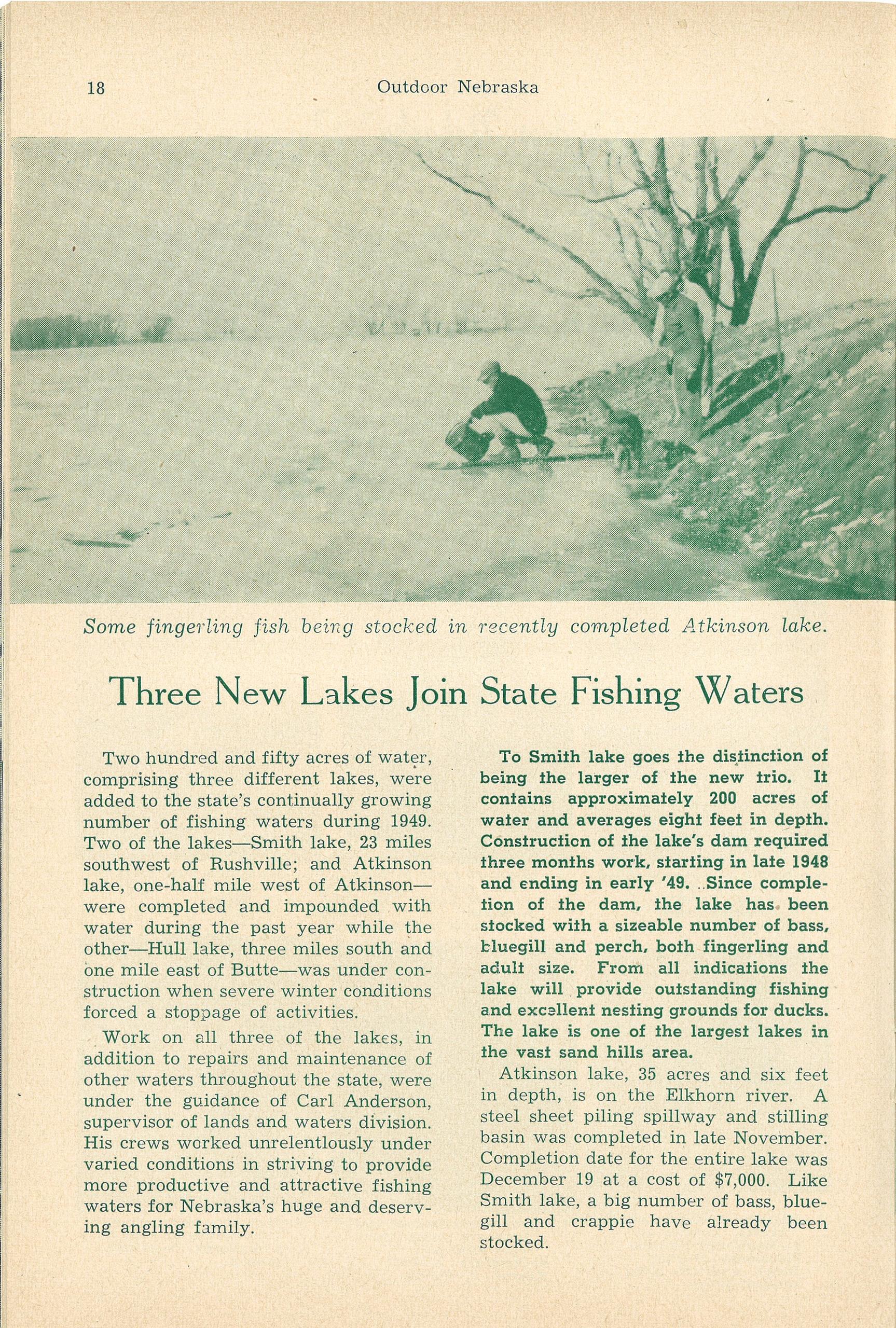 18 Outdoor Nebraska
Three New Lakes Join State Fishing Waters
Two hundred and fify acres of water, comprising three different lakes, were added to the state's continually growing number of fishing waters during 1949. Two of the lakes--Smith lake, 23 miles southwest of Rushville; and Atkinson lake, one-half mile west of Atkinson--were completed and impounded with water during the p ast year while the other--Hull lake, three miles south and one mile east of Butte--was under construction when severe winter conditions forced a stoppage of activities.
Work on all three of the lakes, in addition to repairs and maintenance of other waters throughout the state, were under the guidance of Carl Ander son, supervisor of lands and waters division. His crews worked unrelentlously under varied conditions in striving to provide more productive and attractive fish ing waters for Nebraska's huge and deserving angling family.
To Smith lake goes ihe distinction of being the larger of the new trio. It contains approximately 200 acres of water and averages eight feet in depth. Construciion of the lake's dam required three months work, starting in late 1948 and ending in early '49 . .. Since completion of the dam, the lake has been stocked with a sizeable number of bass, bluegill and perch, both fingerling and adult size. From all indications the lake will provide outstanding fishing and excellent nesting grounds for ducks. The lake is one of the largest lakes in the vast sand hills area.
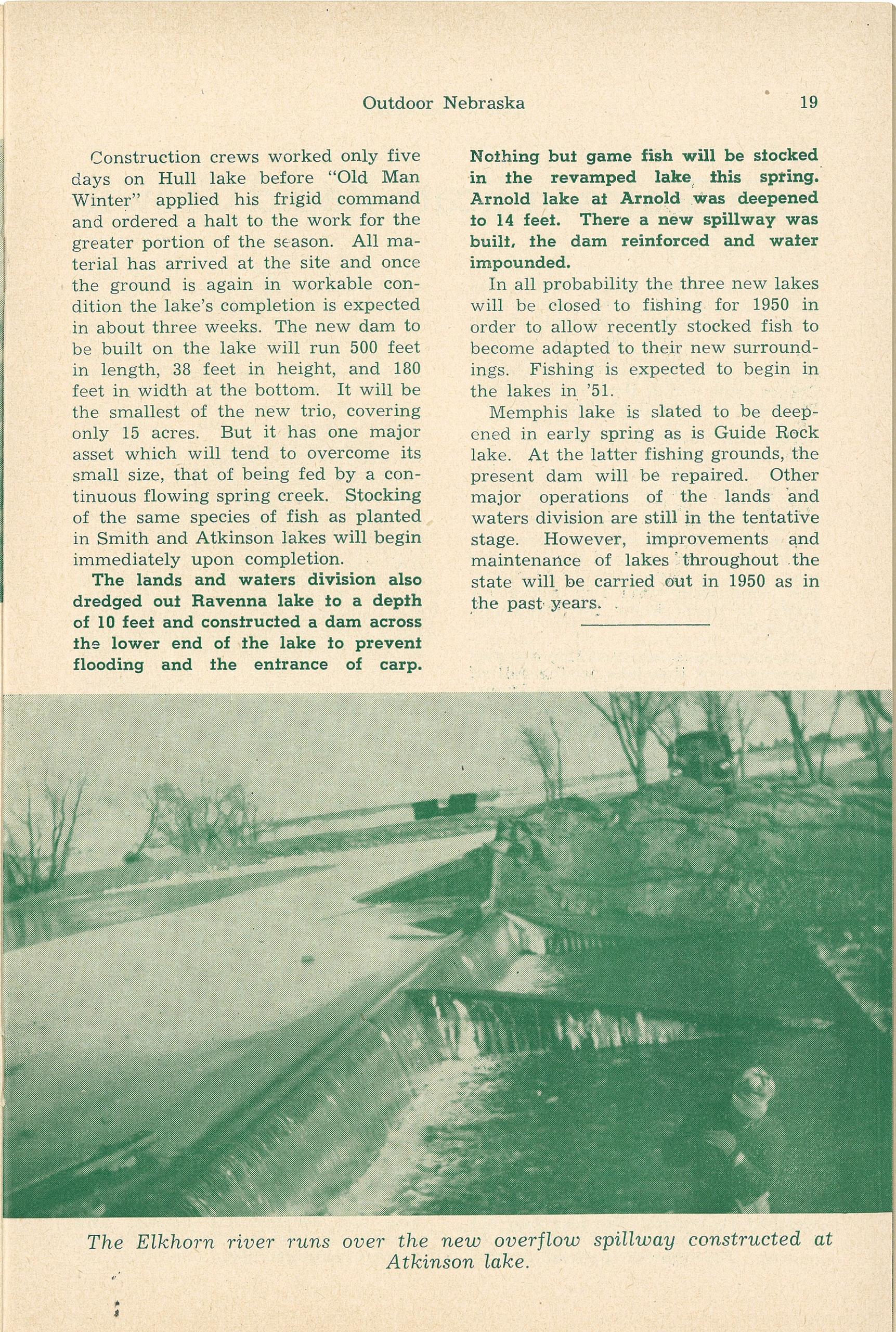
Atkinson lake, 35 acres and six feet in depth, is on the Elkhorn river. A steel sheet piling spillway and stilling basin was completed in late November. Completion date for the entire lake was December 19 at a cost of $7,000. Like Smith lake, a big number of bass, bluegill and crappie have already been stocked.
 Outdoor Nebraska 19
Construction crews worked only five days on Hull lake before "Old Man Winter" applied his frigid command and ordered a halt to the work for the greater portion of the SE:·ason. All material has arrived at the site and once the ground is again in workable condition the lake's completion is expected in about three weeks. The new dam to be built on the lake will run 500 feet in length, 38 feet in height, and 180 feet in width at the bottom. It will be the smallest of the new trio, covering only 15 acres. But it has one major asset which will tend to overcome its small size, that of being fed by a continuous flowing spring creek. Stocking of the same species of fish as planted in Smith and Atkinson lakes will begin immediately upon completion.
The lands and waters division also dredged out Ravenna lake to a depth of 10 feet and constructed a dam across the lower end of the lake to prevent flooding and the entrance of carp. Nothing but game fish will be stocked in the revamped lake, this spring. Arnold lake at Arnold was deepened to 14 feet. There a new spillway was built, the dam reinforced and water impounded.
In all probability the three new lakes will be closed to fishing for 1950 in order to allow recently stocked fish to become adapted to their new surroundings. Fishing is expected to begin in the lakes in. '51.
Memphis lake is slated to be deepened in early spring as is Guide Rock lake. At the latter fishing grounds, the present dam will be repaired. Other major operations of the lands ·and waters division are still in the tentative stage. However, improvements a,nd maintenance of lakes throughout the state will. be carried out in 1950 as in the past years.
 20 Outdoor Nebraska
Fish Scales Indicate Rapid Growth
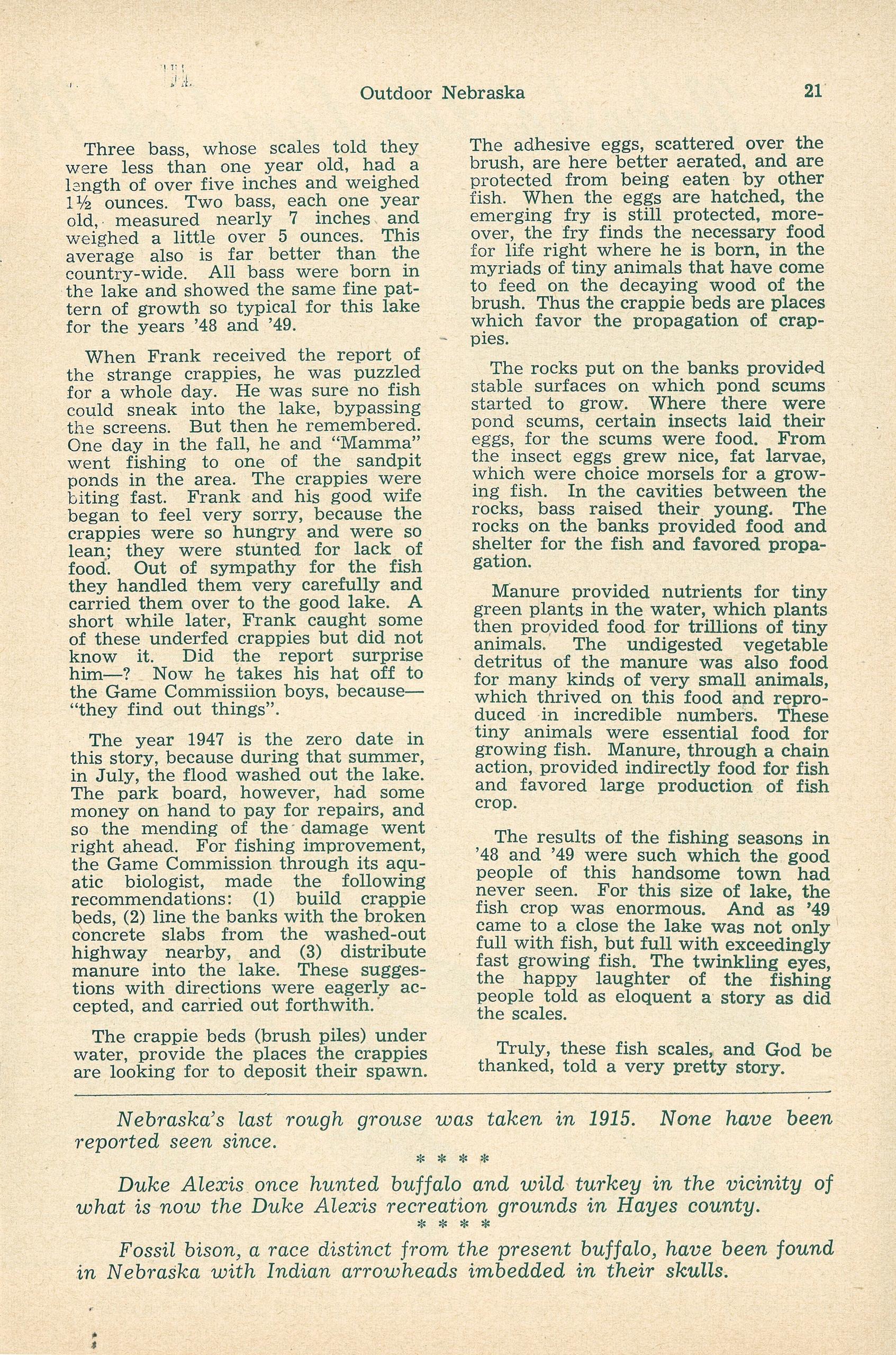
Scales from fish caught in the city park lake at Schuyler came to the fisheries research department of the Game Commission. Some of the fish scales were obtained by the seining crew during operations in mid-August. Others came two or three months later. This was in the fall of 1949.
Frank A. Havelka, a cheerful, publicminded, retired business man, gives much of his time to the care of the city park and its lake. With his good wife he loves to fish. He sent samples of scales from most of the fish he caught last fall. He carefully measured their length and weighed the fish. He even went fishing especially to supply the commission with fish scales for study, to better know the lake's fish production.
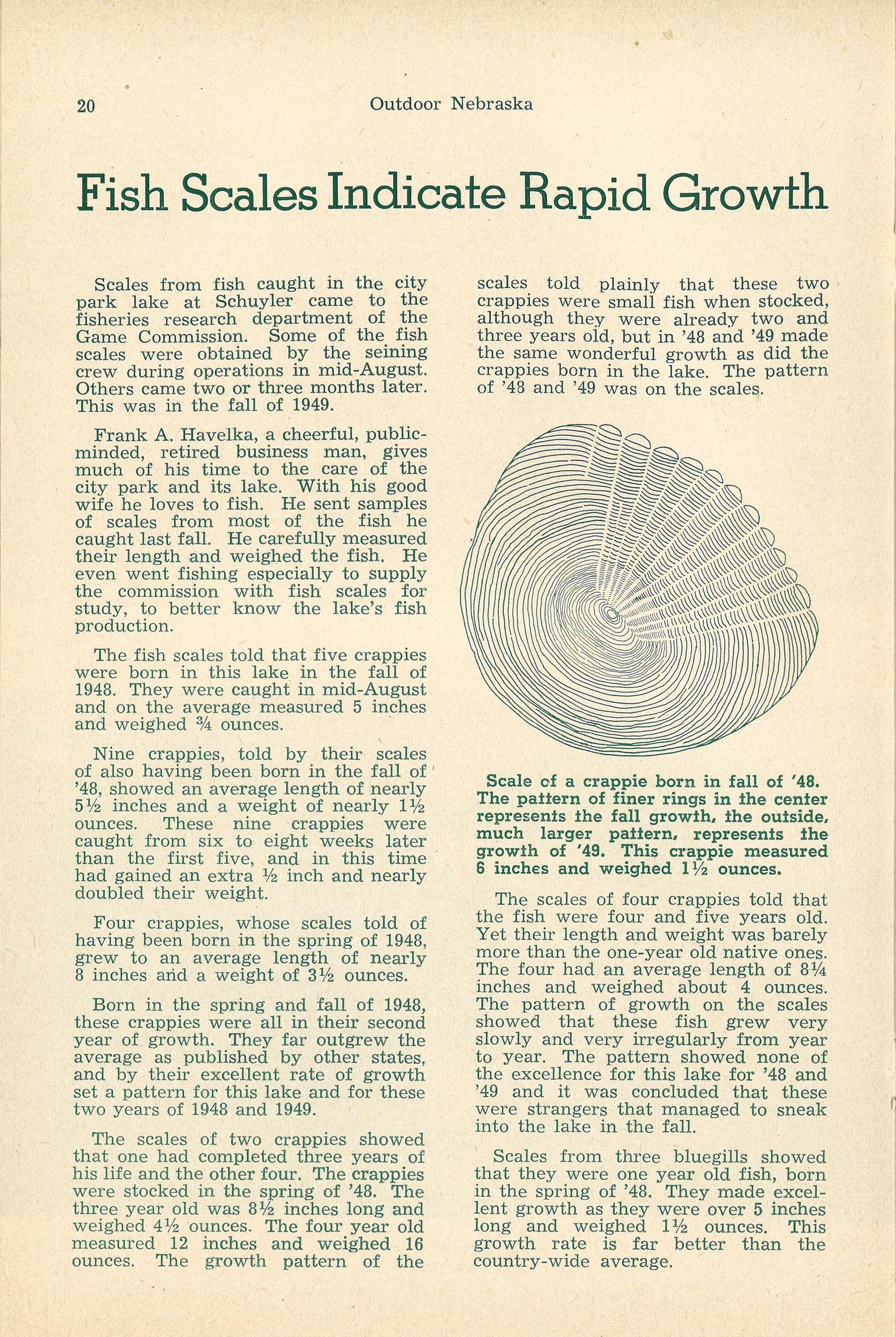
The fish scales told that five crappies were born in this lake in the fall of 1948. THey were caught in mid-August and on the average measured 5 inches and weighted 3/4 ounces.
Nine crappies, told by their scales of also having been born in the fall of '48, showed an average length of nearly 5 1/2 inches and a weight of nearly 1 1/2 ounces. These nine crappies were caught from six to eight weeks later than the first five, and in this time had gained an extra 1/2 inch and nearly doubled their weight.
Four crappies, whose scales told of having been born in the spring of 1948, grew to an average length of nearly 8 inches and a weight of 3 1/2 ounces.
Born in the spring and fall of 1948, these crappies were all in their second year of growth. They far outgrew the average as published by other states, and by their excellent rate of growth set a pattern for this lake and for these two years of 1948 and 1949.
The scales of two crappies showed that one had completed three years of his life and the other four. The crappies were stocked in the spring of '48. The three year old was 8½ inches long and weighed 4½ ounces. The four year old measured 12 inches and weighed 16 ounces. The growth pattern of the scales told plainly that these two crappies were smali fish when stocked, although they were already two and three years old, but in '48 and '49 made the same wonderful growth as did the crappies born in the lake. The pattern of '48 and '49 was on the scales.
The scales of four crappies told that the fish were four and five years old. Yet their length and weight was barely more than the one-year old native ones. The four had an average length of 8 1/4 inches and weighed about 4 ounces. The pattern of growth on the scales showed that these fish grew very slowly and very irregularly from year to year. The pattern showed none of the excellence for this lake for '48 and '49 and it was concluded that these were strangers that managed to sneak into the lake in the fall.
Scales from three bluegills showed that they were one year old fish, born in the spring of '48. They made excellent growth as they were over 5 inches long and weighed 1 1/2 ounces. This growth rate is far better than the country-wide average.
 Outdoor Nebraska 21
Three bass, whose scales told they were less than one year old, had a l2ngth of over five inches and weighed 1 1/2 ounces. Two bass, each one year old, measured nearly 7 inches and weighed a little over 5 ounces. This average also is far better than the country-wide. All bass were born in the lake and showed the same fine pattern of growth so typical for this lake for the years '48 and '49.
When Frank received the report of the strange crappies, he was puzzled for a whole day. He was sure no fish could sneak into the lake, bypassing the screens. But then he remembered. One day in the fall, he and "Mamma" went fishing to one of the sandpit ponds in the area. The crappies were biting fast. Frank and his good wife began to feel very sorry, because the crappies were so hungry and were so lean_; they were stunted for lack of food. Out of sympathy for the fish they handled them very carefully and carried them over to the good lake. A short while later, Frank caught some of these underfed crappies but did not know it. Did the report surprise him--? Now he takes his hat off to the Game Commissiion boys, because" they find out things".
The year 1947 is the zero date in this story, because during that summer, in July, the flood washed out the lake. The park board, however, had some money on hand to pay for repairs, and so the mending of the damage went right ahead. For fishing improvement, the Game Commission through its aquatic biologist, made the following recommendations: (1) build crappie beds, (2) line the banks with the broken concrete slabs from the washed-out highway nearby, and (3) distribute manure into the lake. These suggestions with directions were eagerly accepted, and carried out forthwith.
The crappie beds (brush piles) under water, provide the places the crappies are looking for to deposit their spawn. The adhesive eggs, scattered over the brush, are here better aerated, and are protected from being eaten by other fish. When the eggs are hatched, the emerging fry is still protected, moreover, the fry finds the necessary food for life right where he is born, in the myriads of tiny animals that have come to feed on the decaying wood of the brush. Thus the crappie beds are places which favor the propagation of crappies.
The rocks put on the banks providPd stable surfaces on which pond scums started to grow. Where there were pond scums, certain insects laid their eggs, for the scums were food. From the insect eggs grew nice, fat larvae which were choice morsels for a growing fish. In the cavities between the rocks, bass raised their young. The rocks on the banks provided food and she~ter for the fish and favored propagation.
Manure provided nutrients for tiny green plants in the water, which plants then provided food for trillions of tiny animals.' The undigested vegetable detritus of the manure was also food for many kinds of very small animals which thrived on this food and reproduced in incredible numbers. These tiny animals were essential food for growing fish. Manure, through a chain act10n, provided indirectly food for fish and favored large production of fish crop.
The results of the fishing seasons in '48 and '49 were such which the good people of this handsome town had never seen. For this size of lake, the fish crop was enormous. And as '49 came to a close the lake was not only full with fish, but full with exceedingly fast growmg fish. The twinkling eyes, the happy laughter of the fishing people told as eloquent a story as did the scales.
Truly, these fish scales, and God be thanked, told a very pretty story.
Nebraska's last rough grouse was taken in 1915. None have been reported seen since. Duke Alexis once hunted buffalo and wild turkey in the vicinity of what is now the Duke Alexis recreation grounds in Hayes county. Fossil bison, a race distinct from the present buffalo, have bene found in Nebraska with Indian arrowheads imbedded in their skulls.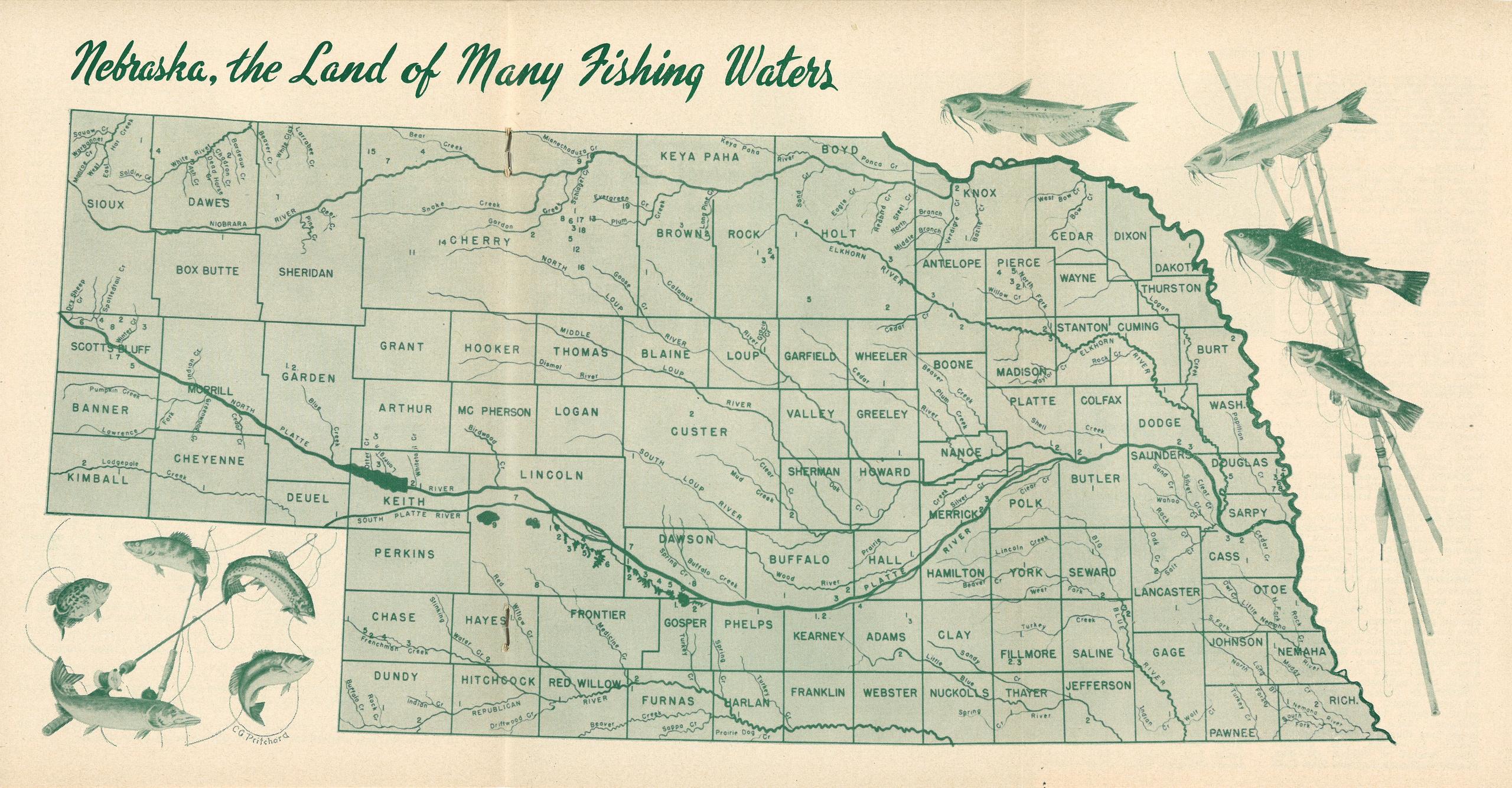
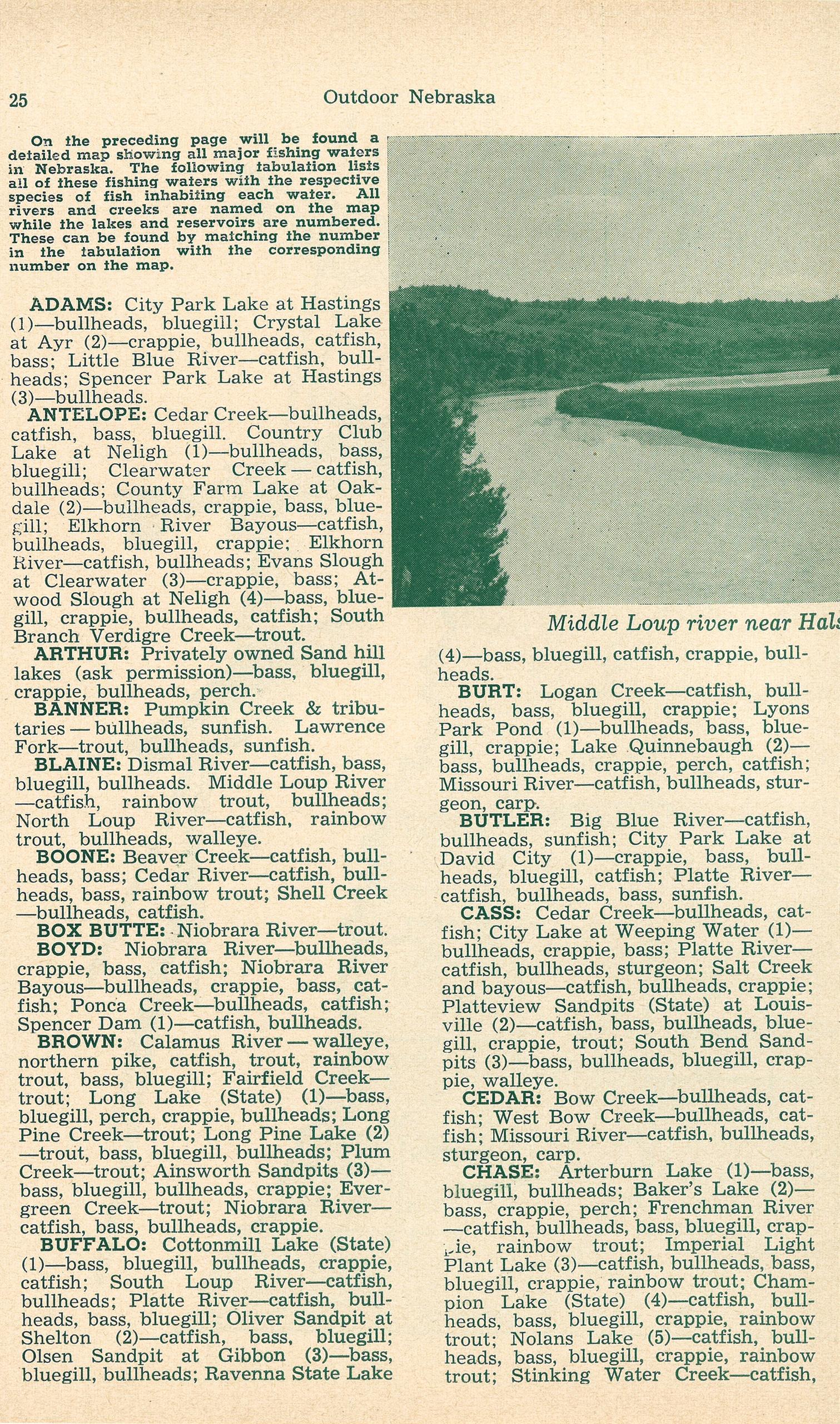 25 Outdoor Nebraska On the preceeding page will be found a detailed map showing all the major fishing waters in Nebraska. The following tabulation lists all of these fishing waters with the respective species of fish inhabiting each water. All rivers and creeks are name don the map while the lakes and reservoirs are numbered. These can be found by matching the number in the tabulation with the corresponding number on the map. ADAMS: City Park Lake at Hastings (1)-bullheads, bluegill; Crystal Lake at Ayr (2)-crappie, bullheads, catfish, bass· Little Blue River-catfish, bullheads; Spencer Park Lake at Hastings (3)-bullheads. ANTELOPE: Cedar Creek-bullheads, catfish, bass, bluegill. Country Club Lake at Neligh (1)-bullheads, bass, bluegill; Clearwater Creek- catfish, bullheads; County Farm Lake at Oakdale (2)-bullheads, crappie, bass, bluegill; Elkhorn · River Bayous-catfish, bullheads, bluegill, crappie; Elkhorn River-catfish, bullheads; Evans Slough at Clearwater (3)-crappie, bass; Atwood Slough at Neligh (4)-bass, bluegill, crappie, bullheads, catfish; South Branch Verdigre Creek-trout. ARTHUR: Privately owned Sand hill lakes (ask permission)-bass, bluegill, crappie, bullheads, perch. BANNER: Pumpkin Creek & tributaries - bullheads, sunfish. Lawrence Fork-trout, bullheads, sunfish. BLAINE: Dismal River-catfish, bass, bluegill, bullheads. Middle Loup River -catfish, rainbow trout, bullheads; North Loup River-catfish, rainbow trout, bullheads, walleye. BOONE: Beaver Creek-catfish, bullheads, bass; Cedar River-catfish, bullheads, bass, rainbow trout; Shell Creek -bullheads, catfish. BOX BUTTE: Niobrara River-trout. BOYD: Niobrara River-bullheads, crappie, bass, catfish; Niobrara River Bayous-bullheads, crappie, bass, catfish; Ponc·a Creek-bullheads, catfish; Spencer Dam (1)-catfish, bullheads. BROWN: Calamus River-walleye, northern pike, catfish, trout, rainbow trout, bass, bluegill; Fairfield Creektrout; Long Lake (State) (!)-bass, bluegill, perch, crappie, bullheads; Long Pine Creek-trout; Long Pine Lake (2) -trout, bass, bluegill, bullheads; Plum Creek-trout; Ainsworth Sandpits (3)bass, bluegill, bullheads, crappie; Evergreen Creek-trout; Niobrara Rivercatfish, bass, bullheads, crappie. BUFFALO: Cottonmill Lake (State) (1)-bass, bluegill, bullheads, crappie, catfish; South Loup River-catfish, bullheads; Platte River-catfish, bullheads, bass, bluegill; Oliver Sandpit at Shelton (2)-catfish, bass, bluegill; Olsen Sandpit at Gibbon (3)-bass, bluegill, bullheads; Ravenna State Lake (4)-bass, bluegill, catfish, crappie, bullheads. BURT: Logan Creek-catfish, bullheads, bass, bluegill, crappie; Lyons Park Pond (!)-bullheads, bass, bluegill, crappie; Lake .Quinnebaugh (2)bass, bullheads, crappie, perch, catfish; Missouri River-catfish, bullheads, sturgeon, carp-. BUTLER: Big Blue River-catfish, bullheads, sunfish; City Park Lake at David City (!)-crappie, bass, bullheads, bluegill, catfish; Platte Rivercatfish, bullheads, bass, sunfish. CASS: Cedar Creek-bullheads, catfish; City Lake at Weeping Water (!)bullheads, crappie, bass; Platte Rivercatfish, bullheads, sturgeon; Salt Creek and bayous-catfish, bullheads, crappie; Platteview Sandpits (State) at Louisville (2)-catfish, bass, bullheads, bluegill, crappie, trout; South Ben_d Sandpits (3)-bass, bullheads, bluegill, crappie, walleye. CEDAR: Bow Creek-bullheads, catfish West Bow Creek-bullheads, catfish; Missouri River-catfish, bullheads, sturgeon, carp. CHASE: Arterburn Lake (1)-bass, blue gill, bullheads; Baker's Lake (2)bass, crappie, perch; Frenchman River -catfish, bullheads, bass, bluegill, crap- 1,ie, rainbow trout; Imperial Light Plant Lake (3)-catfish, bullheads, bass, bluegill, crappie, rainbow tro~t; Champion Lake (State) (4)-catfish, bullheads, bass, bluegill, crappie, rainbow trout; Nolans Lake (5)-catfish, bullheads, bass, bluegill, crappie, rainbow trout; Stinking Water Creek-catfish,
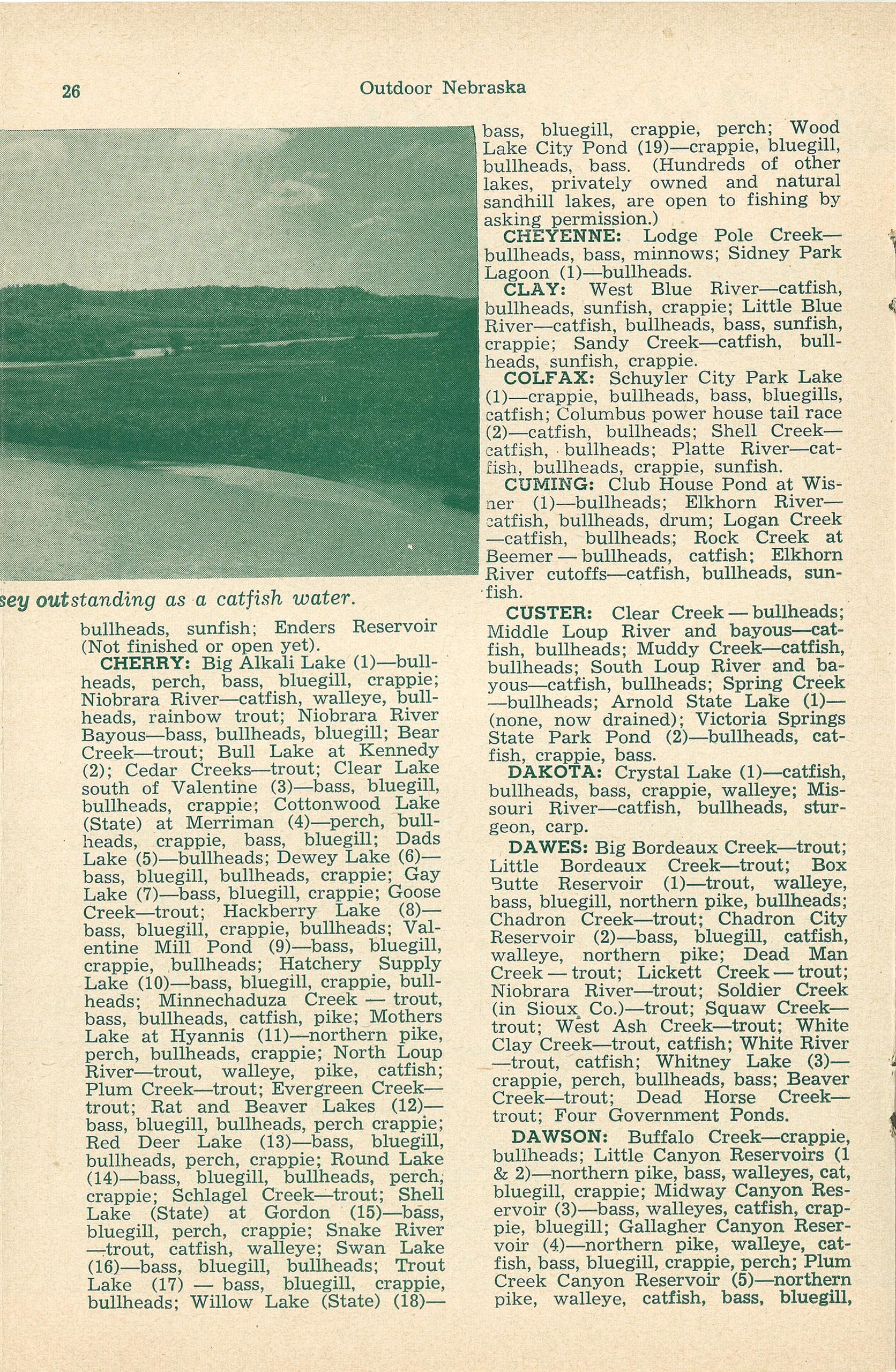 26 Outdoor Nebraska bullheads, sunfish; Enders Reservoir (Not finished or open yet). CHERRY: Big Alkali Lake (1)- bullheads, perch, bass, bluegill, crappie; Niobrara River-catfish, walleye, bullheads, rainbow trout; Niobrara River Bayous-bass, bullheads, bluegill; Bear Creek-trout; Bull Lake at Kennedy (2); Cedar Creeks-trout; Clear Lake south of Valentine (3)-bass, bluegill, bullheads, crappie; Cottonwood Lake (State) at Merriman (4)-perch, bullheads, crappie, bass, bluegill; Dads Lake (5)-bullheads; Dewey Lake (6)bass, bluegill, bullheads, crappie; Gay Lake (7)-bass, bluegill, crappie; Goose Creek-trout; Hackberry Lake (8)bass, bluegill, crappie, bullheads; Valentine Mill Pond (9)-bass, bluegill, crappie, bullheads; Hatchery Supply Lake (10)-bass, bluegill, crappie, bullheads; Minnechaduza Creek - trout, bass, bullheads, catfish, pike; Mothers Lake at Hyannis (11)-northern pike, perch, bullheads, crappie; North Loup River-trout, walleye, pike, catfish; Plum Creek-trout; Evergreen Creektrout; Rat and Beaver Lakes (12)bass, bluegill, bullheads, perch crappie; Red Deer Lake (13)-bass, bluegill, bullheads, perch, crappie; Round Lake (14)-bass, bluegill, bullheads, perch; crappie; Schlagel Creek-trout; Shell Lake (State) at Gordon (15)-bass, bluegill, perch, crappie; Snake River -,trout, catfish, walleye; Swan Lake (16)-bass, bluegill, bullheads; Trout Lake (17) - bass, bluegill, crappie, bullheads; Willow Lake (State) (18)- bass, bluegill, crappie, perch; Wood Lake City Pond {19)-crappie, bluegill, bullheads, bass. (Hundreds of other lakes, privately owned and natural sandhill lakes, are open to fishing by asking permission.) CHEYENNE: Lodge Pole Creekbullheads, bass, minnows; Sidney Park Lagoon (!)-bullheads. CLAY: West Blue River-catfish, bullheads, sunfish, crappie; Little Blue River-catfish, bullheads, bass, sunfish, crappie; Sandy Creek-catfish, bullheads, sunfish, crappie. COLFAX: Schuyler City Park Lake (!)-crappie, bullheads, bass, bluegills, catfish; Columbus power house tail race (2)-catfish, bullheads; Shell Creekcatfish, . bullheads; Platte River-catfish, bullheads, crappie, sunfish. CUMING: Club House Pond at Wisner (!)-bullheads; Elkhorn Rivercatfish, bullheads, drum; Logan Creek -catfish, bullheads; Rock Creek at Beemer - bullheads, catfish; Elkhorn River cutoffs-catfish, bullheads, sun- fish. CUSTER: Clear Creek- bullheads; . Middle Loup River and bayous-catfish, bullheads; Muddy Creek-catfish, bullheads; South Loup River and bayous- catfish, bullheads; Spring Creek -bullheads; Arnold State Lake (1)( none, now drained); Victoria Springs State Park Pond (2)-bullheads, catfish, crappie, bass. DAKOTA: Crystal Lake (!)-catfish, bullheads, bass, crappie, walleye; Missouri River-catfish, bullheads, sturgeon, carp. DAWES: Big Bordeaux Creek-trout; Little Bordeaux Creek-trout; Box '3utte Reservoir (1)-trout, walleye, bass, bluegill, northern pike, bullheads; Chadron Creek-trout; Chadron City Reservoir (2)-bass, bluegill, catfish, walleye, northern pike; Dead Man Creek - trout; Lickett Creek- trout; Niobrara River-trout; Soldier Creek (in Sioux. Co.)-trout; Squaw Creektrout; West Ash Creek-trout; White Clay Creek-trout, catfish; White River -trout, catfish; Whitney Lake (3)crappie, perch, bullheads, bass; Beaver Creek-trout; Dead Horse Creektrout; Four Government Ponds. DAWSON:_ Buffalo Creek-crappie, bullheads; Little Canyon Reservoirs (1 & 2)-northern pike, bass, walleyes, cat, bluegill, crappie; Midway Canyon Reservoir (3)-bass, walleyes, catfish, crappie, bluegill; Gallagher Canyon Reservoir (4)-northern pike, walleye, catfish, bass, bluegill, crappie, perch; Plum Creek Canyon Reservoir (5)-northern pike, walleye, catfish, bass, bluegill,
  Outdoor Nebraska 27 crappie, perch; Johnson Canyon Reservoir (6)-northern pike, walleye, catfish Gothenburg City Lake (7)-bass, crap- pie, bluegill, bullheads, catfish, drum; Lexington City Park Lake (8)-bass, crappie, bluegill, bullheads, catfish, drum; North Platte River-catfish, bull- heads, sunfish. DEUEL: Whitney Lake (1)-bluegill, crappie, bass; Lodgepole Creek-bull- heads, sunfish. DIXON: Missouri River - catfish, bullheads, sturgeon, carp; Logan Creek -catfish, bullheads. DODGE: Dead Timber State Lake at Scribner (1)-bass, bluegill, crappie, bullheads, catfish; State J.,akes at Fre- mont (ten) (2)-bass, bluegill, crappie, bullheads, trout, catfish, carp; North Platte River-catfish, bullheads, sun- fish : Elkhorn River-catfish, bullheads, drum, carp, sunfish; Highway 77 Sand- pit at Fremont (3)-bullheads, crappie, bass, catfish; Logan Creek-bullheads, catfish. DOUGLAS: Benson Park Lake at Omaha(1)--bullheads, carp; Carter Lake at Omaha (2)--bass, bluegill, crappie, bullheads, catfish, walleye; George's Lake at Omaha (3)-bull- heads; Hansom Park Lake at Omaha (4)-bullheads, catfish, crappie ; Hart- ford Lake at Waterloo (5)-crappie, bass; Miller Park Lake at Omaha (B)- bullheads, carp; Ralston Lake at Ral- ston (7 -carp; Riverview Park Lake at Omaha (8)-bullheads, carp; Missouri River-catfish, bullheads, carp; Elkhorn River-catfish, bullheads, carp; North Platte River--catfish, bullheads, carp; Papillion Creek-bullheads. DUNDY: Rock Creek State Lake (1) -trout, bass, bluegill, catfish, walleye, bullheads; Boy Scout Lake at Benkel- man (2)-bullheads; Republican River -bullheads, sunfish; Buffalo Creek at Haigler-bullheads; Rock Creek-cat- fish, bullheads; Indian Creek-bull- heads. FILLMORE: West Blue River-bullheads catfish, carp; Lions Club Lake at fish, bass, bluegill, crappie, perch; Geneva (1)-bullheads, bass, bluegills; North Pond (2) at Shickley-bullheads; Beatrice Gun Club at Shickley (3)- bullheads, crappie; Turkey Creek-catfish, bullheads, crappie. FRANKLIN: Republican River-cat fish, bullheads; Thompson Creek-bass, sunfish, bullheads; Turkey Creekbullheads. FRONTIER: Medicine Creek-cat fish, bullheads; Red Willow Creek- bullheads, sunfish. FURNAS: Cambridge· Lake (1)-bass, bullheads; Medicine Creek- catfish, bullheads; Republican River-catfish, bullheads; Turkey Creek-bullheads; Twin Lakes at Cambridge (2)-bull- heads, crappie, catfish; Beaver Creek bullheads. GAGE: Arbor Park Pond at Wymore (1)-bullheads; Big Blue River-catfish, bullheads, buffalo, carp; Indian Creek bullheads, sunfish, crappie, catfish; Turkey Creek-catfish, bullheads; Wolf Creek-bullheads. GARDEN: Blue Creek-trout; Crane Lake (Federal) (!)-perch, bass, crap- pie, bullheads; Island Lake (Federal) (2)-perch, bass, crappie, bullheads; North Platte River-walleye, catfish bullheads, trout. GARFIELD: Calamus River-catfish, walleye, Rock bass; North Loup River & bayous-catfish, bass, bluegill, crap pie, perch, bullheads, walleye; Cedar River-trout, bass, carp. GOSPER: Johnson Reservoir (1)- northern pike, walleye, bass, bluegill, bullheads, crappie, perch; Johnson Res- ervoir No. 2 (2)-northern pike, wall- eye, bass, bluegill, bullheads, crappie, perch; Turkey Creek-bullheads, carp, sunfish. GRANT: Many sandhill lakes priv- ately owned, but most open to Public. GREELEY: Cedar River - walleye, Rock bass, catfish, bullheads, crappie; Wolbach Park Lake (!)-bass, bluegill, bullheads; North Loup River-walleye, catfish, bullheads.
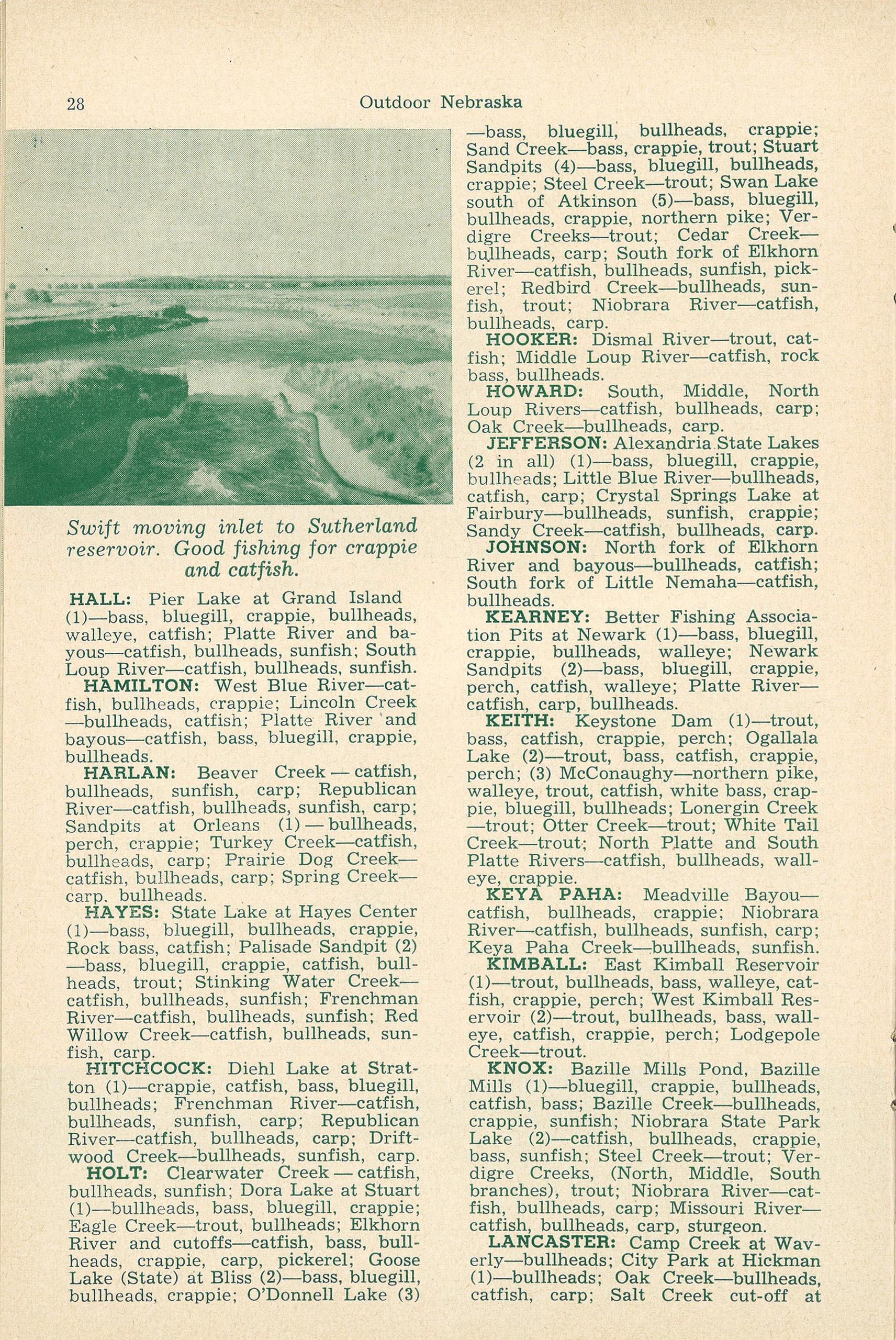 28 Outdoor Nebraska
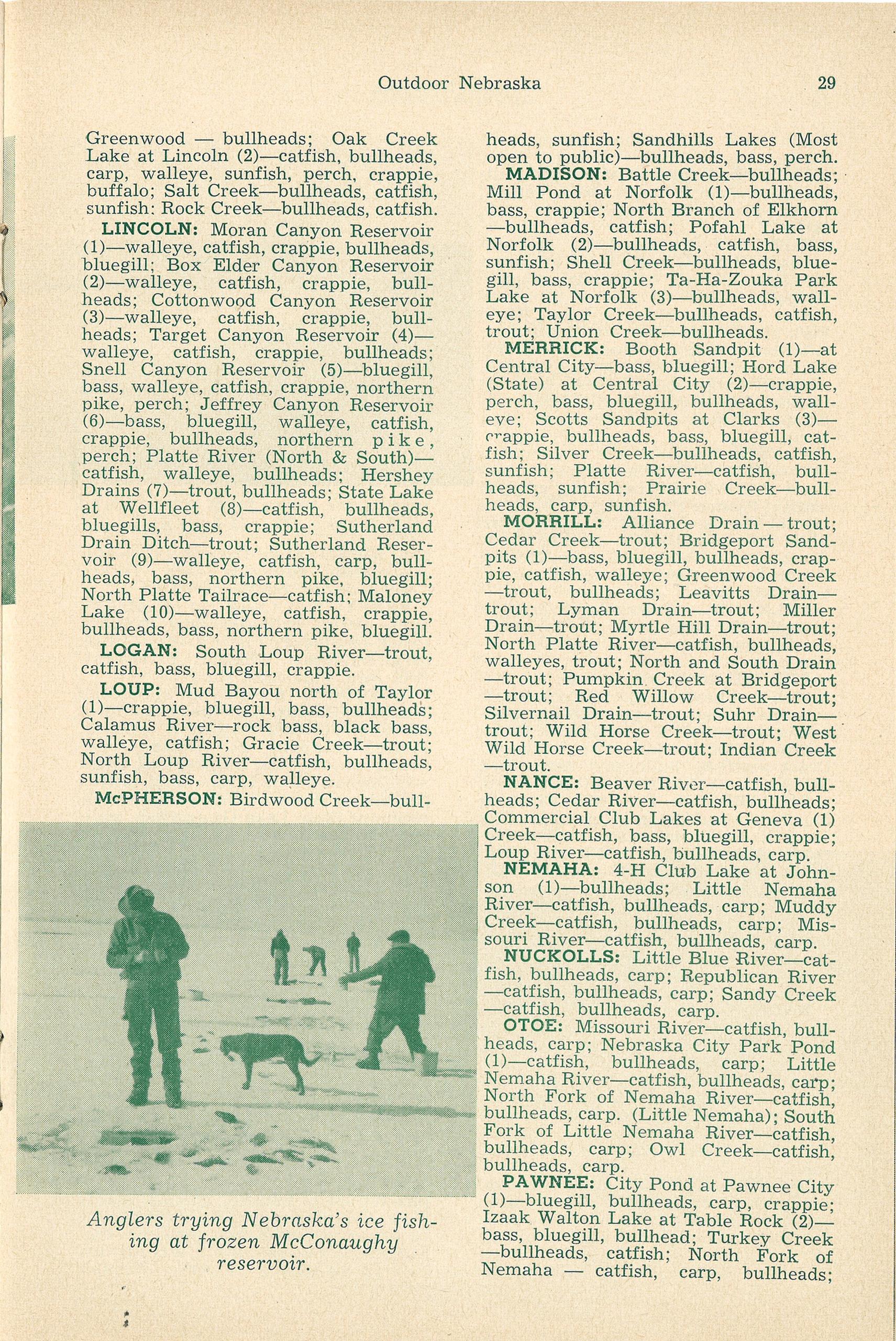 Outdoor Nebraska 29 Greenwood - bullheads; Oak Creek Lake at Lincoln (2)-catfish, bullheads, carp, walleye, sunfish, perch, crappie, buffalo; Salt Creek-bullheads, catfish, sunfish: Rock Creek-bullheads, catfish. LINCOLN: Moran Canyon Reservoir (1)-walleye, catfish, crappie, bullheads, bluegill; Box Elder Canyon Reservoir (2)-walleye, catfish, crappie, bullheads; Cottonwood Canyon Reservoir (3)-walleye, catfish, crappie, bullheads; Target Canyon Reservoir (4)walleye, catfish, crappie, bullheads; Snell Canyon Reservoir (5)-bluegill, bass, walleye, catfish, crappie, northern pike, perch; Jeffrey Canyon Reservoir (6)-~ass, bluegill, walleye, catfish, crappie, bullheads, northern pike, perch; Platte River (North & South-- catfish, walleye, bullheads; Hershey Drains (7)-trout, bullheads; State Lake at V,_Tellfleet (8)-catfish, bullheads, bluegills, bass, crappie; Sutherland Drain Ditch-trout· Sutherland Reservoir (9)-walleye, 'catfish, carp, bullheads, bass, northern pike, bluegill; North Platte Tailrace-catfish: Maloney Lake (10)-walleye, catfish, crappie, bullheads, bass, northern pike, bluegill. LOGAN: South Loup River-trout catfish, bass, bluegill, crappie. LOUP: Mud Bayou north of Taylor (1)-crappie, bluegill, bass, bullheads Calamus River-rock bass, black bass' walleye, catfish; Gracie Creek-trout; North Loup River-catfish, bullheads' sunfish, bass, carp, walleye. McPHERSON: Birdwood Creek-- bullheads, sunfish; Sandhills Lakes (Most open to public)-bullheads, bass, perch. MADISON: Battle Creek-bullheads; · Mill Pond at Norfolk (1)-bullheads, bass, crappie; North Branch of Elkhorn -bullheads, catfish; Pofahl Lake at Norfolk (2)-bullheads, catfish, bass, sunfish; Shell Creek-bullheads, bluegill, bass, crappie; Ta-Ha-Zouka Park Lake at Norfolk (3)-bullheads, walleye; Taylor Creek-bullheads, catfish, trout; Union Creek-bullheads. MERRICK: Booth Sandpit (1)-at Central City-bass, bluegill; Hord Lake (State) at Central City (2)-crappie, perch, bass, bluegill, bullheads, walleve; Scotts Sandpits at Clarks (3)(' rappie, bullheads, bass, bluegill, catfish; Silver Creek-bullheads, catfish, sunfish; Platte River-catfish, bullheads, sunfish; Prairie Creek-bullheads, carp, sunfish. MORRILL: Alliance Drain -- trout; Cedar Creek--trout; Bridgeport Sandpits (1)-bass, bluegill, bullheads, crappie, catfish, walleye; Greenwood Creek --trout, bullheads; Leavitts Draintrout; Lyman Drain-trout; Miller Drain-trout; Myrtle Hill Drain-trout; North Platte River-catfish, bullheads, walleyes, trout; North and South Drain --trout; Pumpkin Creek at Bridgeport --trout; Red Willow Creek-trout; Silvernail Drain-trout; Suhr Drain-- trout ; Wild Horse Creek-trout· West Wild Horse Creek-trout; Indian' Creek --trout. NANCE: Beaver River-catfish bullheads; Cedar River-catfish bullheads; Commercial Club Lakes at Geneva (1) Creek--catfish, bass, bluegill, crappie; Loup River-catfish, bullheads, carp. NEMAHA: 4-H Club Lake at Johnson (1)-bullheads; Little Nemaha River-catfish, bullheads, carp; Muddy Creek-catfish, bullheads, carp; Missouri River-catfish, bullheads, carp. NUCKOLLS: Little Blue River-catfish, bullheads, carp; Republican River -catfish, bullheads, carp; Sandy Creek -catfish, bullheads, carp. OTOE: Missouri River-catfish bullheads, carp; Nebraska City Park' Pond (1)-catfish, bullheads, carp; Little Nemaha River-catfish, bullheads, carp; North Fork of Nemaha River-catfish bullheads, ~arp. (Little Nemaha); South Fork of Little Nemaha River-catfish, bullheads, carp; Owl Creek-catfish bullheads, carp. PAWNEE: City Pond at Pawnee City (1)-bluegill, bullheads, carp crappie Izaak Walton Lake at Table Rock (2). bass, bluegill, bu~lhead; Turkey Creek -bullheads, catfish; North Fork of Nemaha - catfish, carp, bullheads;
 30 Outddoor Nebraska South Fork of Nemaha-catfish, bullh~ ads, carp. PHELPS: Sawyer Sandpits (1)-bullheads, crappie, bluegill, bass, catfish; North Platte River-bullheads, carp, catfish. PIERCE: Pierce City Lake (1)-bullheads, catfish; Gilman Lake at Pierce (2)- bass, catfish, bullheads, crappie; Gregerson Lake at Foster (3)-bullheads, crappie, bluegill, bass; North Fork of Elkhorn River-bullheads, catfish, bass, crappie, bluegill, walleye; Plainview Lake (4)-bass, bluegill, crappie, bullheads; Theisen Lake at Osmond (5)-bass, bluegill, bullheads, crappie; Willow Creek-crappie, bass, trout. PLATTE: Babcock Lake at Columbus (1)-catfish, bullheads, crappie; Lost Pond Creek at Creston-bass, crappie, catfish; Pawnee Park Lake at Columbus (2)- bullheads, bluegill, crappie, bass; Shell Creek-bullheads, catfish; Platte River-catfish, bullheads, carp; Monroe Power Canal at Monroe-catfish, drum, bullheads, carp. POLK: Clear Creek-trout, crappie, bluegill ;. Big Blue River-catfish, bullheads, carp; Platte River-catfish, bullheads, carp. RED WILLOW: Republican Rivercatfish, bullheads, carp ; McCook Sandpits- rock bass, crappie, sunfish, bullheads, catfish, black bass; Beaver Creek -catfish, bullheads, carp; Driftwood Creek-catfish, bullheads, carp; Red Willow Creek-catfish, bullheads, carp. RICHARDSON: Four Mile Creek at Humboldt--bullheads; Humboldt City Lake (1)-bullheads, carp, catfish; Nemaha River-catfish, bullheads, carp; South Fork of Nemaha-catfish, bullheads, carp; Muddy Creek-carp, catfish, bullheads; Rock Creek-catfish, bullheads, carp; Long Branch Creekcatfish, bullheads, carp; Spring Creekbullheads, catfish, bluegill; State Lake, Verdon-crappie, catfish, bass, bullheads. ROCK: Calamus River-catfish, walleye, northern pike, bullheads, rock bass; Fish Lake at Bassett (1)-bass, walleye, bullheads; Goose Lake at Bassett (2)-bass, bluegill, crappie, bulla heads; Pony Lake at Bassett (3)-walleye, bullheads; Wolf Lake at Newport (4)-bullheads, bluegill, bass, crappie; Niobrara River - catfish, bullheads, carp. SALINE: Big Blue River-catfish, bullheads, carp, walleye, black bass, crappie; Crete City Sandpits (!)-bullheads, bass, bluegill; College Pond at Crete (2)-bullheads; Crete Mill Pond (3)-bass, carp; bullheads, buffalo, cat-
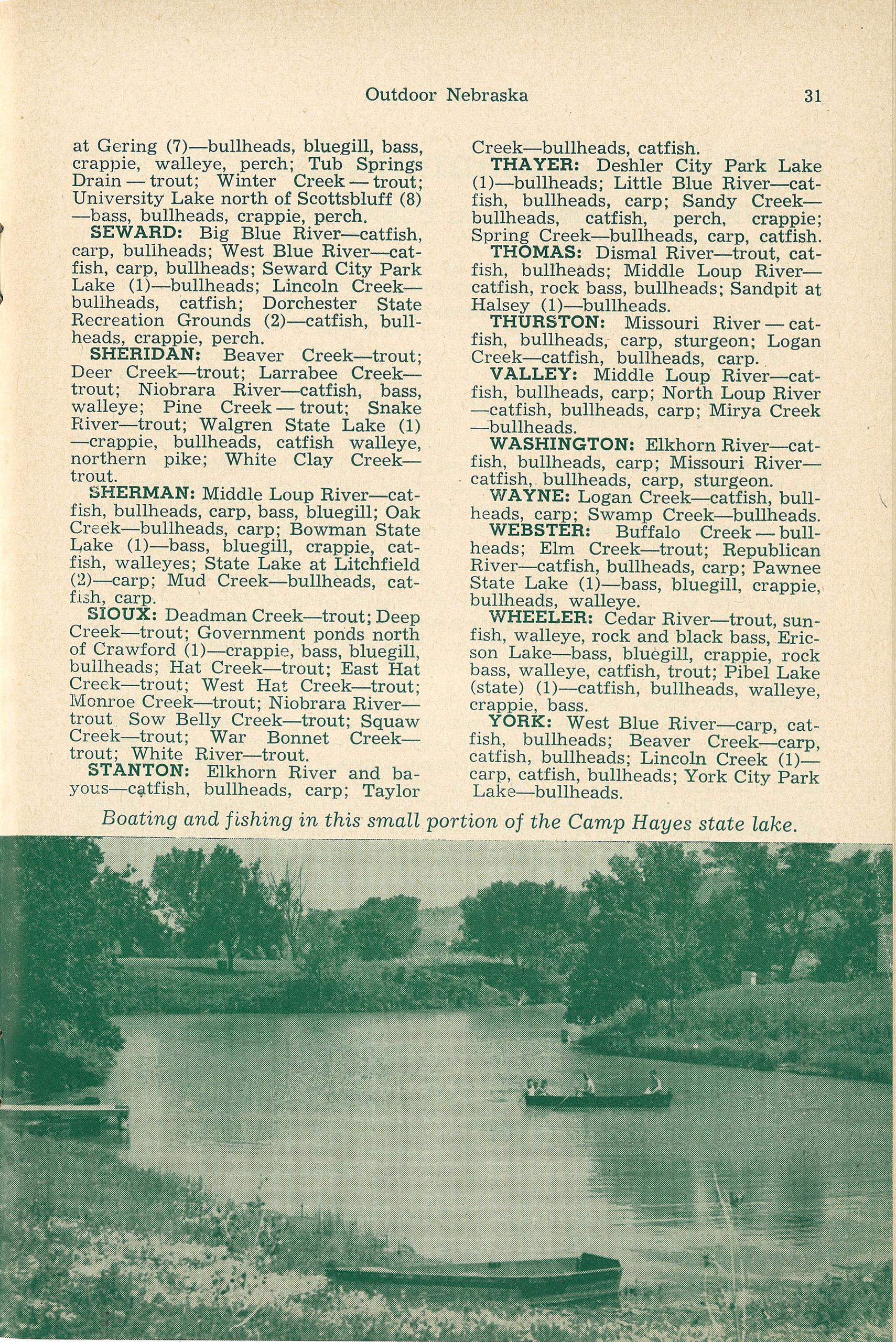 Outdoor Nebraska 31 at Gering (7)--bullheads, bluegill, bass, crappie, walleye, perch; Tub Springs Drain - trout; Winter Creek--trout; University Lake north of Scottsbluff (8) --bass, bullheads, crappie, perch. SEWARD: Big Blue River--catfish, carp, bullheads; West Blue River-- catfish, carp, bullheads; Seward City Park Lake (1)--bullheads; Lincoln Creek-- bullheads, catfish; Dorchester State Recreation Grounds (2)-catfish, bull- heads, crappie, perch. SHERMAN: Middle Loup River-cat- fish, bullheads, carp, bass, bluegill; Oak Creek-bullheads, carp; Bowman State Lake (1)-bass, bluegill, crappie, cat- fish, walleyes; State Lake at Litchfield 2)-carp ; Mud Creek-bullheads, catfish, carp. SIOUX: Deadman Creek-trout; Deep Creek-trout; Government porids north of Crawford (1)-crappie, bass, bluegill bullheads; Hat Creek-trout; East Hat Creek-trout; West Hat Creek-trout; Monroe Creek-trout; Niobrara River- trout Sow Belly Creek-trout; Squaw Creek-trout; War Bonnet Creek- trout; White River-trout. STANTON: Elkhorn River and ba- yous-catfish, bullheads, carp; Taylor Creek-bullheads, catfish. THAYER: Deshler City Park Lake (1)-bullheads; Little Blue River-cat- fish, bullheads, carp; Sandy Creek- bullheads, catfish, perch, crappie; Spring Creek-bullheads, carp, catfish. THOMAS: Dismal River-trout, catfish, bullheads; Middle Loup River catfish, rock bass, bullheads; Sandpit at Halsey (1)-bullheads. THURSTON: Missouri River -- catfish bullheads, carp, sturgeon; Logan Creek--catfish, bullheads, carp. VALLEY: Middle Loup River--catfish, bullheads, carp; North Loup River -catfish, bullheads, carp; Mirya Creek bullheads. WASHINGTON: Elkhorn River-catfish bullheads, carp; Missouri River catfish, bullheads, carp, sturgeon. WAYNE: Logan Creek-catfish, bull- heads, carp; Swamp Creek-bullheads. WEBSTER: Buffalo Creek -- bull- heads ; Elm Creek-trout; Republican River-catfish, bullheads, carp; Pawnee State Lake (1)-bass, bluegill, crappie, bullheads, walleye. WHEELER: Cedar River-trout, sun- fish, walleye, rock and black bass, Ericson Lake-bass, bluegill, crappie, rock bass, walleye, catfish, trout; Pibel Lake (state) (1)-catfish, bullheads, walleye, crappie, bass. YORK: West Blue River-carp, catfish, bullheads; Beaver Creek-carp, catfish, bullheads; Lincoln Creek (1)-- carp, catfish, bullheads; York City Park Lake--bullheads.
 32 Outdoor Nebraska
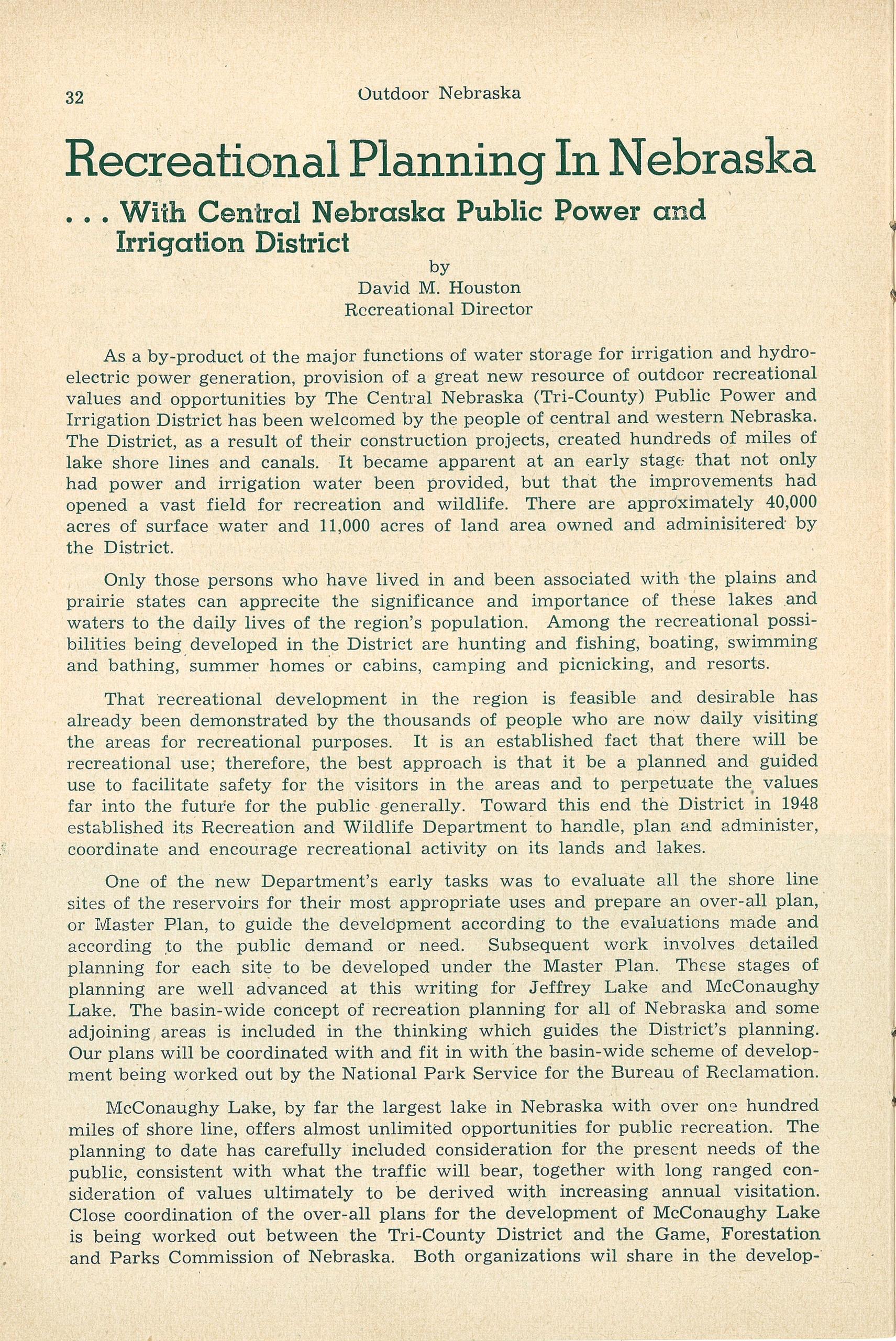
Recreational Planning In Nebraska
. . . With Central Nebraska Public Power and Irrigation District
As a by-product of the major functions of water storage for irrigation and hydroelectric power generation, provision of a great new resource of outdoor recreational values and opportunities by The Central Nebraska (Tri-County) Public Power and Irrigation District has been welcomed by the people of central and western Nebraska. The District, as a result of their construction projects, created hundreds of miles of lake shore lines and canals. It became apparent at an early stagE, that not only had power and irrigation water been provided, but that the improvements had opened a vast field for recreation and wildlife. There are approximately 40,000 acres of surface water and 11,000 acres of land area owned and adminisitered by the District.
Only those persons who have lived in and been associated with the plains and prairie states can apprecite the significance and importance of these lakes .and waters to the daily lives of the region's population. Among the recreational possibilities being developed in the District are hunting and fishing, boating, swimming and bathing, summer homes or cabins, camping and picnicking, and resorts.
That recreational development in the region is feasible and desirable has already been demonstrated by the thousands of people who are now daily visiting the areas for recreational purposes. It is an established fact that there will be recreational use; therefore, the best approach is that it be a planned and guided use to facilitate safety for the visitors in the areas and to perpetuate the values far into the future for the public generally. Toward this end the District 'in 1948 established its Recreation and Wildlife Department' to handle, plan and administer, coordinate and encourage recreational activity on its lands and lakes.
One of the new Department's early tasks was to evaluate all the shore line sites of the reservoirs for their most appropriate uses and prepare an over-all plan, or Master Plan, to guide the development according to the evaluations made and according to the public demand or need. Subsequent work involves detailed planning for each site to be developed under the Master Plan. These stages of planning are well ad~anced at this writing for Jeffrey Lake and Mcconaughy Lake. The basin-wide concept of recreation planning for all of Nebraska and some adjoining areas is included in the thinking which guides the District's planning. Our plans will be coordinated with and fit in with 'the basin-wide scheme of development being worked out by the National Park Service for the Bureau of Reclamation.
McConaughy Lake, by far the largest lake in Nebraska with over one hundred miles of shore line, offers almost unlimited opportunities for public recreation. The planning to date has carefully included consideration for the present needs of the public, consistent with what the traffic will bear, together with long ranged consideration of values ultimately to be derived with increasing annual visitation. Close coordination of the over-all plans for the development of McConaughy Lake is being worked out between the Tri-County District and the Game, Forestation and Parks Commission of Nebraska. Both organizations wil share in the develop- 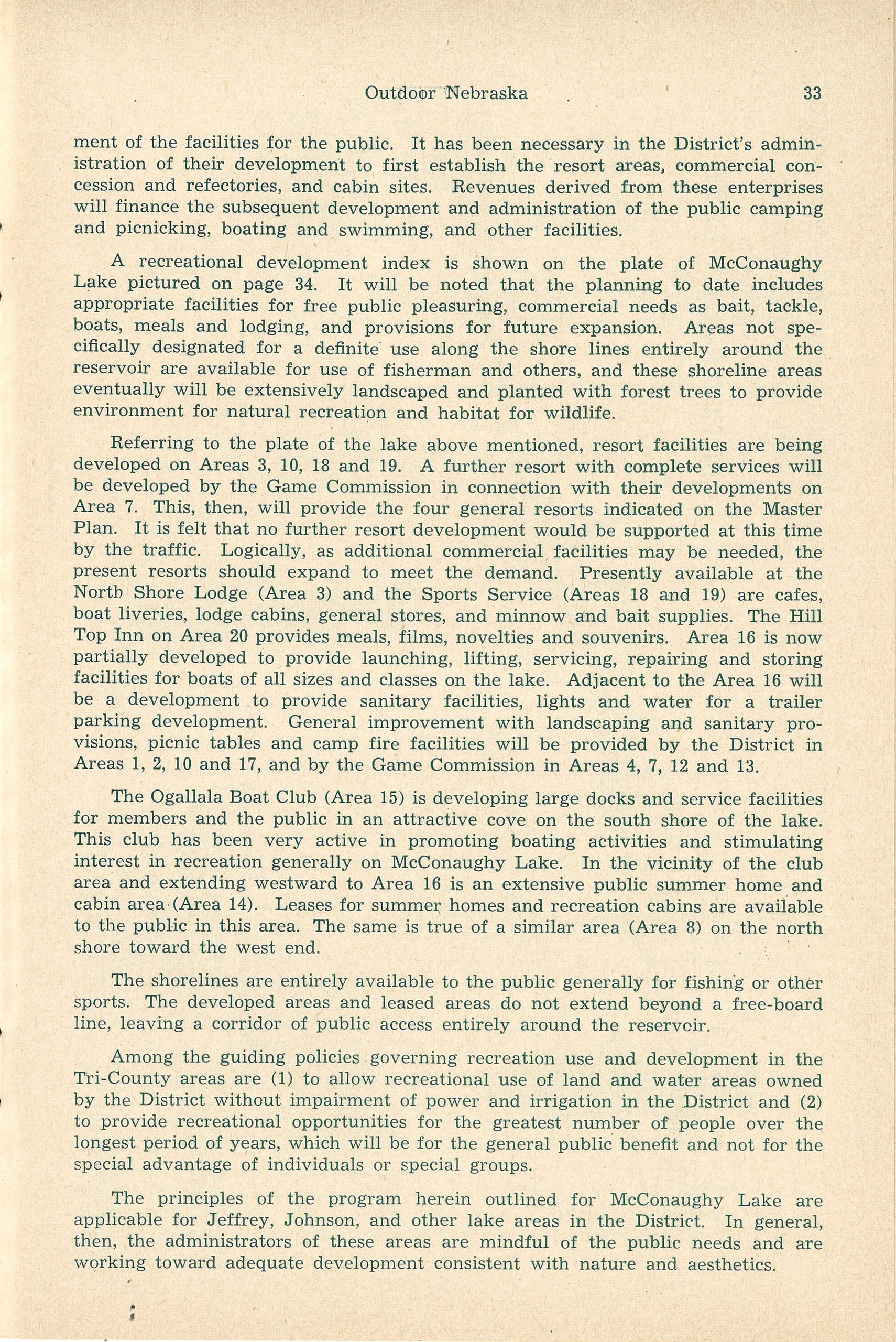 Outdoor Nebraska 33 ment of the facilities for the public. It has been necessary in the District's administration of their development to first establish the resort areas, commercial concession and refectories, and cabin sites. Revenues derived from these enterprises will finance the subsequent development and administration of the public camping and picnicking, boating and swimming, and other facilities.
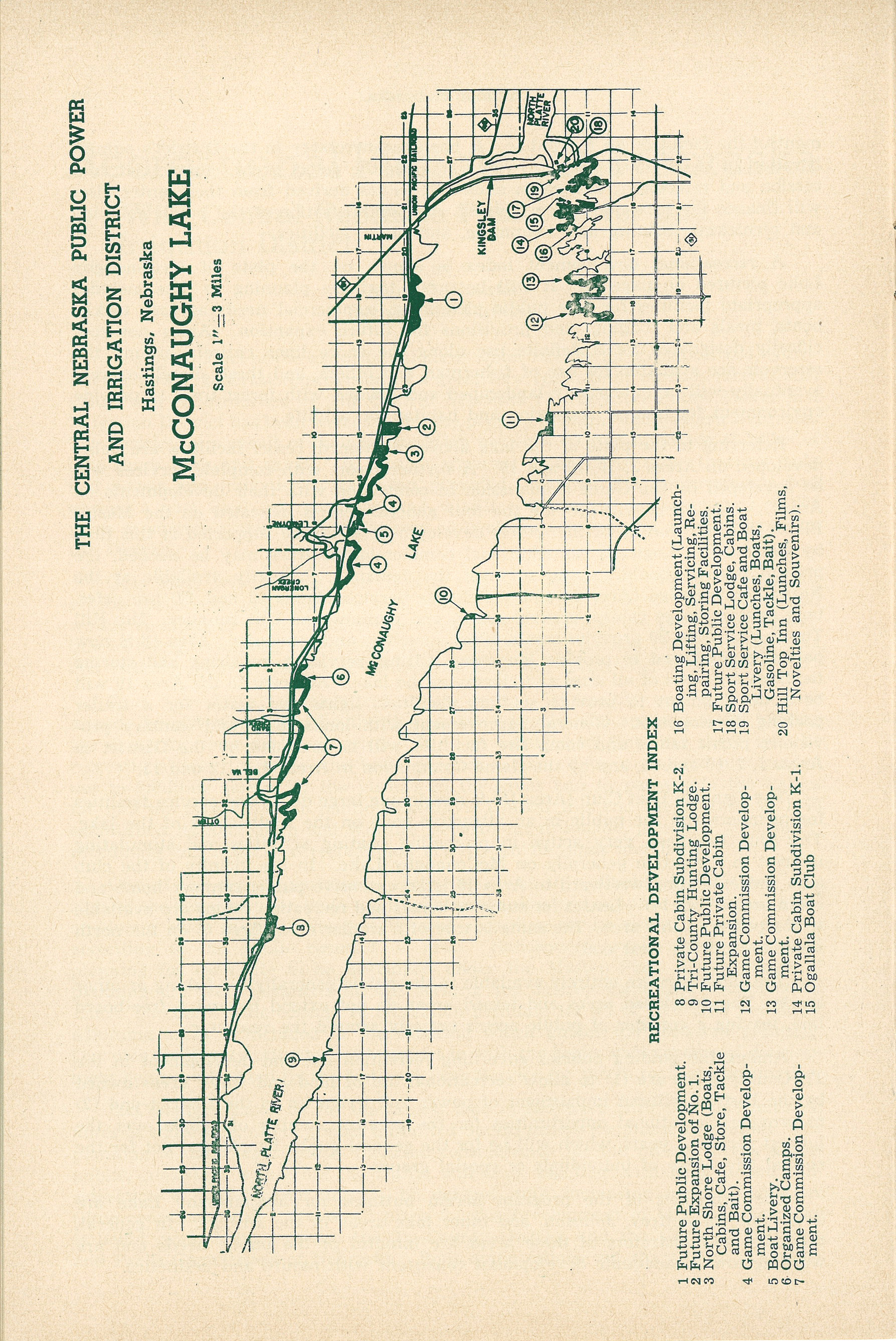
A recreational development index is shown on the plate of McConaughy Lake pictured on page 34. It will be noted that the planning to date includes appropriate facilities for free public pleasuring, commercial needs as bait, tackle, boats, meals and lodging, and provisions for future expansion. Areas not specifically designated for a definite· use along the shore lines entirely around the reservoir are available for use of fisherman and others, and these shoreline areas eventually will be extensively landscaped and planted with forest trees to provide environment for natural recreation and habitat for wildlife.
Referring to the plate of the lake above mentioned, resort facilities are being developed on Areas 3, 10, 18 and 19. A further resort with complete services will be developed by the Game Commission in connection with their developments on Area 7. This, then, will provide the four general resorts indicated on the Master Plan. It is felt that no further resort development would be supported at this time by the traffic. Logically, as additional commercial, facilities may be needed, the present resorts should expand to meet the demand. Presently available at the North Shore Lodge (Area 3) and the Sports Service (Areas 18 and 19) are cafes, boat liveries, lodge cabins, general stores, and minnow and bait supplies. The Hill Top Inn on Area 20 provides meals, films, novelties and souvenirs. Area 16 is now partially developed to provide launching, lifting, servicing, repairing and storing facilities for boats of all sizes and classes on the lake. Adjacent to the Area 16 will be a development to provide sanitary facilities, lights and water for a trailer parking development. General improvement with landscaping and sanitary provisions, picnic tables and camp fire facilities will be provided by the District in Areas 1, 2, 10 and 17, and by the Game Commission in Areas 4, 7, 12 and 13.
The Ogallala Boat Club (Area 15) is developing large docks and service facilities for members and the public in an attractive cove on the south shore of the lake. This club has been very active in promoting boating activities and stimulating interest in recreation generally on McConaughy Lake. In the vicinity of the club area and extending westward to Area 16 is an extensive public summer home and cabin area (Area 14). Leases for summei; homes and recreation cabins are available to the public in this area. The same is true of a similar area (Area 8) on the north shore toward the west end.
The shorelines are entirely available to the public generally for fishing or other sports. The developed areas and leased areas do not extend beyond a free-board line, leaving a corridor of public access entirely around the reservoir.
Among the guiding policies governing recreation use and development in the Tri-County areas are (1) to allow recreational use of land and water areas owned by the District without impairment of power and irrigation in the District and (2) to provide recreational opportunities for the greatest number of people over the longest period of years, which will be for the general public· benefit and not for the special advantage of individuals or special groups.
The principles of the program herein outlined for McConaughy Lake are applicable for Jeffrey, Johnson, and other lake areas in the District. In general, then, the administrators of these areas are mindful of the public needs and are wqrking toward adequate development consistent with nature and aesthetics.
 Outdoor Nebraska 35
Know All The Fish Found In Nebraska
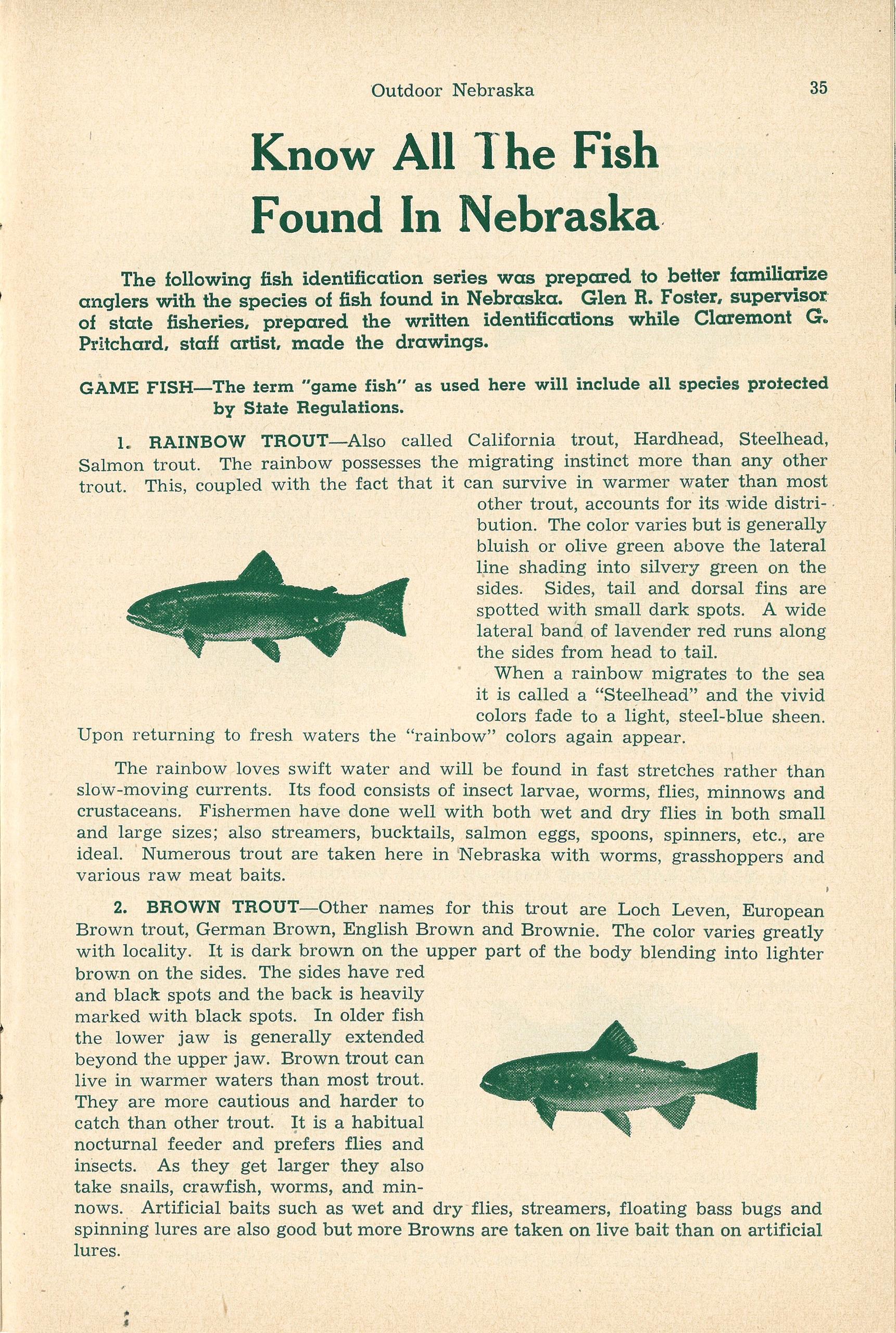
The following fish identification series was prepared to better familiarize anglers with the species of fish found in Nebraska. Glen R. Foster, supervisor of state fisheries. prepared the written identifications while Claremont G. Pritchard, staff artist, made the drawings. GAME FISH--The term "game fish" as used here will include all species protected by State Regulations. 1. RAINBOW TROUT-Also called California trout, Hardhead, Steelhead, Salmon trout. The rainbow possesses the migrating instinct more than any other trout. Th is, coupled with the fact that it can survive in warmer water than most other trout, accounts for its wide distribution. The color varies but is generally bluish or olive green above the lateral line shading into silvery green on the sides. Sides, tail and dorsal fins are spotted with small dark spots. A wide lateral band of lavender red runs along the sides from head to tail. When a rainbow migrates to the sea it is called a "Steelhead" and the vivid colors fade to a light, steel-blue sheen. Upon returning to fresh waters the "rainbow" colors again appear.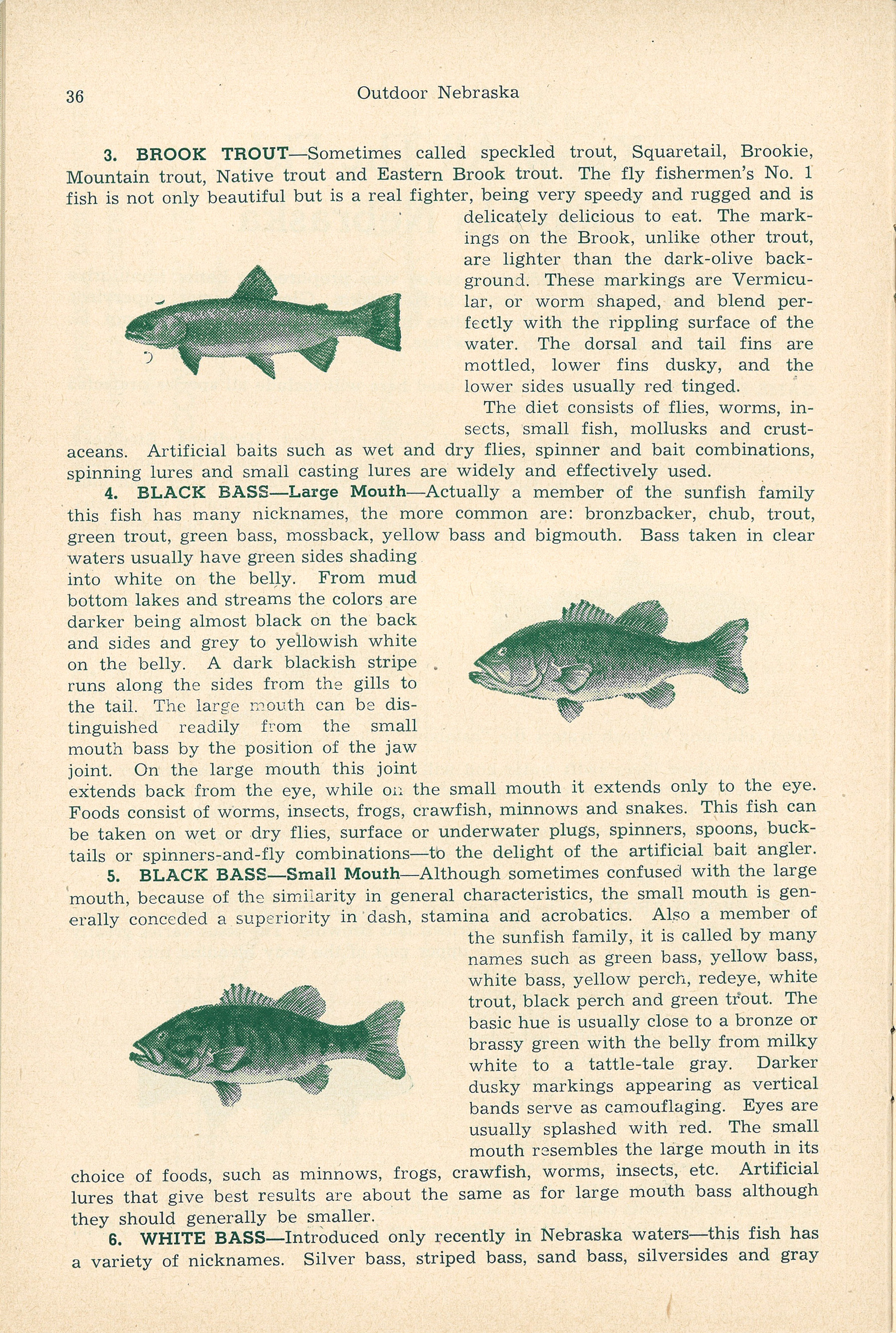 36 Outdoor Nebraska BROOK TROUT-Sometimes called speckled trout, Squaretail, Brookie, Mountain trout, Native trout and Eastern Brook trout. The fly fishermen's No. 1 fish is not only beautiful but is a real fighter, being very speedy and rugged and is delicately delicious to eat. The markings on the Brook, unlike other trout, are lighter than the dark-olive background. These markings are Vermicular, or worm shaped, and blend perfectly with the rippling surface of the water. The dorsal and tail fins are mottled, lower fins dusky, and the lower sides usually red tinged. The diet consists of flies, worms, insects, small fish, mollusks and crustaceans. Artificial baits such as wet and dry flies, spinner and bait combinations, spinning lures and small casting lures are widely and effectively used.
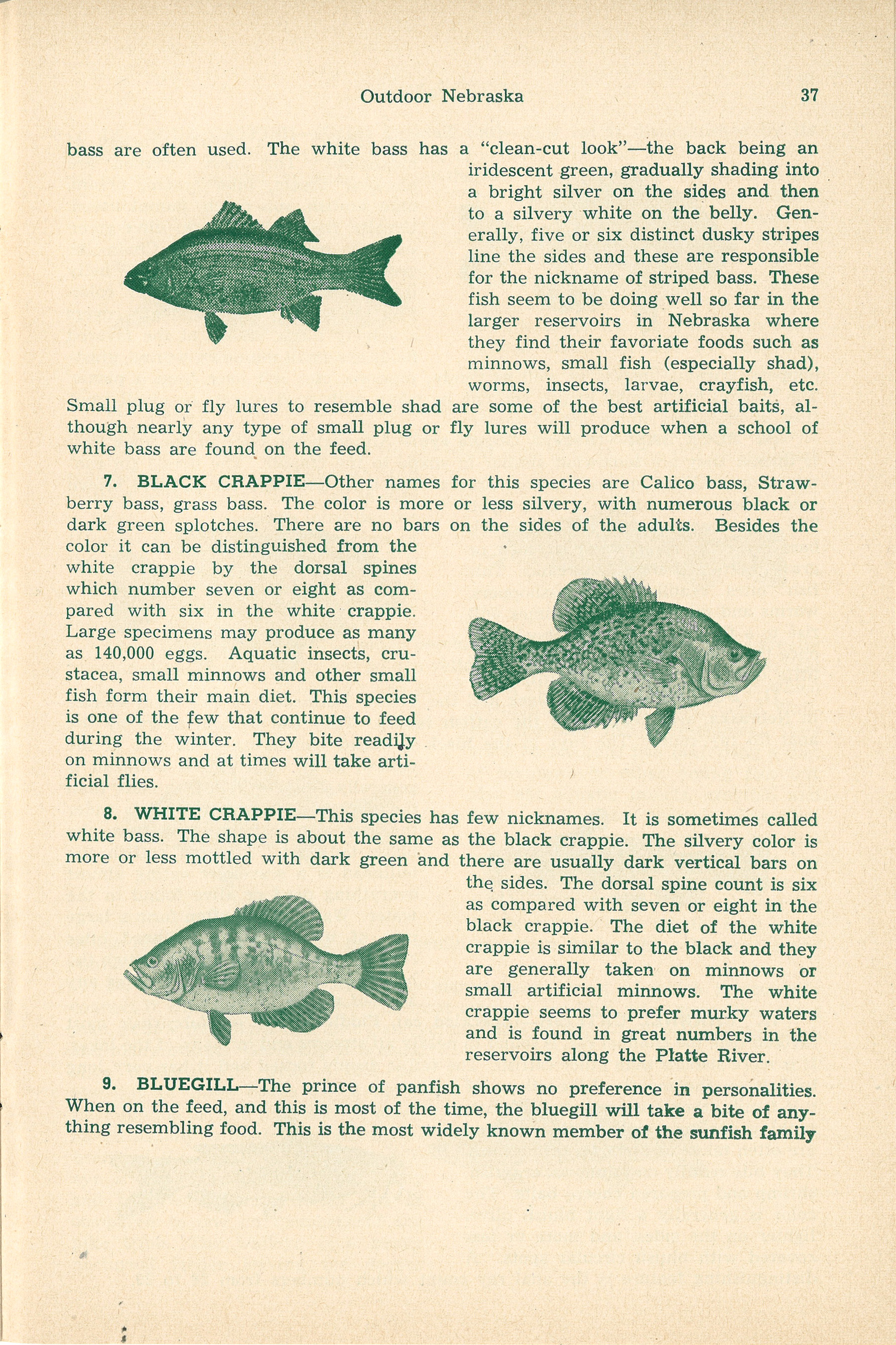 Outdoor Nebraska 37 bass are often used. The white bass has a "clean-cut look"-the back being an iridescent green, gradually shading into a bright silver on the sides and then to a silvery white on the· belly. Generally, five or six distinct dusky stripes line the sides and these are responsible for the nickname of striped bass. These fish seem to be doing well so far in the larger reservoirs in Nebraska where they find their favoriate foods such as minnows, small fish (especially shad), worms, insects, larvae, crayfish, etc. Small plug of fly lures to resemble shad are some of the best artificial baits, although nearly any type of small plug or fly lures will produce when a school of white bass are found. on the feed.
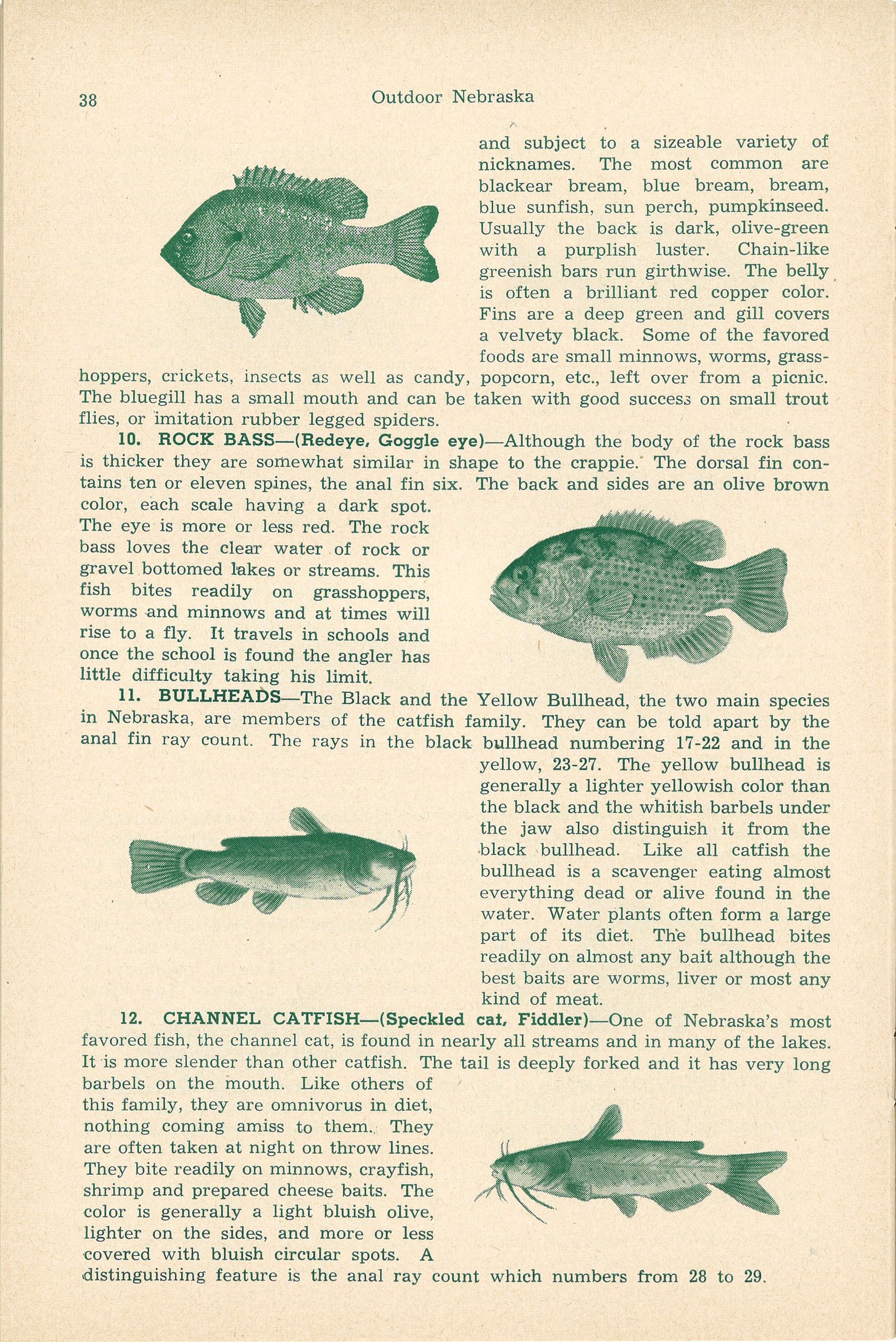 38 Outdoor Nebraska and subject to a sizeable variety of nicknames. The most common are blackear bream, blue bream, bream, blue sunfish, sun perch, pumpkinseed. Usually the back is dark, olive-green with a purplish luster. Chain-like greenish bars run girthwise. The belly . is often a brilliant red copper color. Fins are a deep green and gill covers a velvety black. Some of the favored foods are small minnows, worms, grasshoppers, crickets, insects as well as candy, popcorn, etc., left over from a picnic. The bluegill has a small mouth and can be taken with good succes.3 on small trout flies, or 'imitation rubber legged spiders.
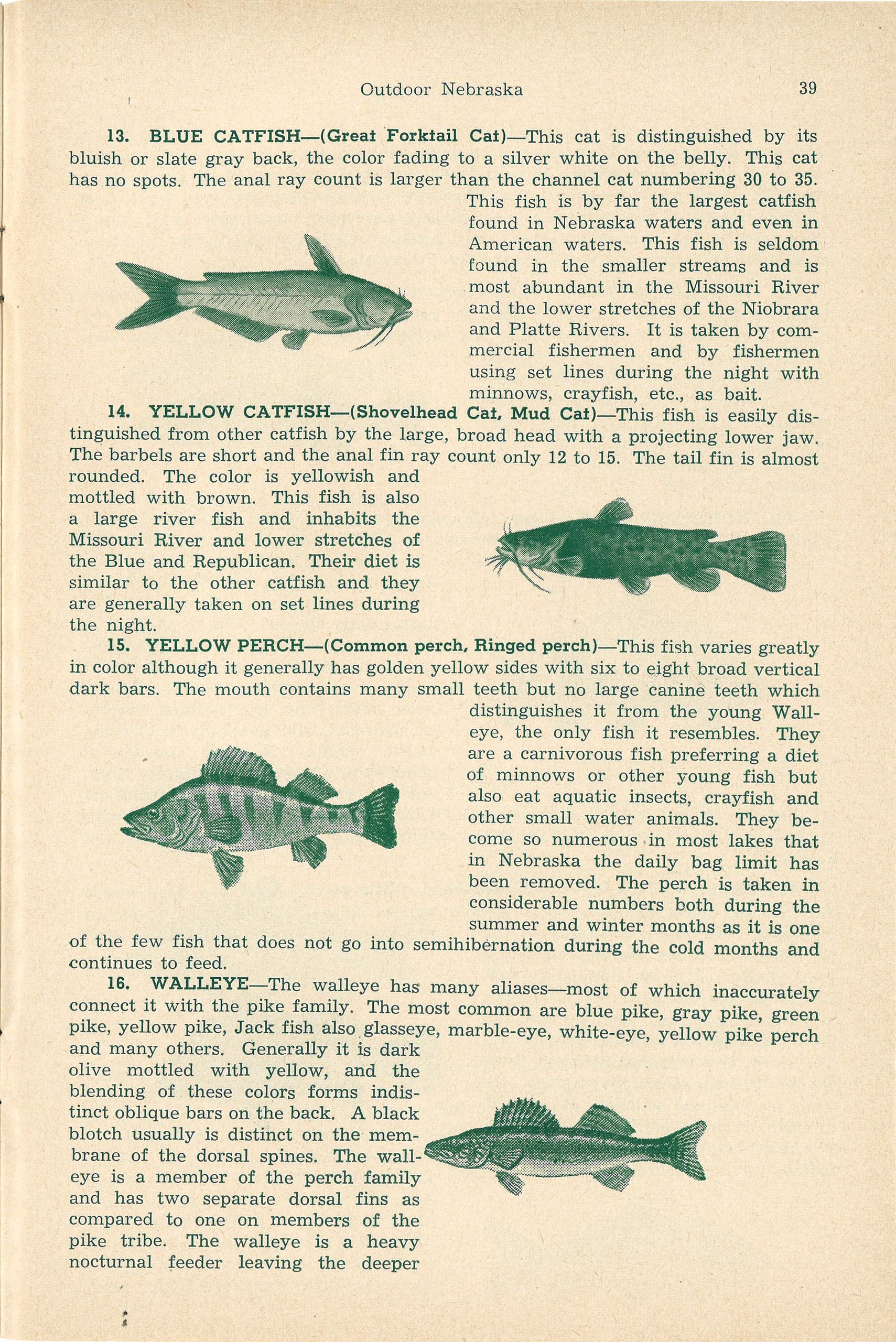 Outdoor Nebraska 39 13. BLUE CATFISH--(Great 'Forktail Cat)--This cat is distinguished by its bluish or slate gray back, the color fading to a silver white on the belly. This cat has no spots. The anal ray count is larger than the channel cat numbering 30 to 35. This fish is by far the largest catfish found in Nebraska waters and even in American waters. This fish is seldom found in the smaller streams and is most abundant in the Missouri River and the lower stretches of the Niobrara and Platte Rivers. It is taken by commercial fishermen and by fishermen using set lines during the night with minnows, crayfish, etc., as bait.
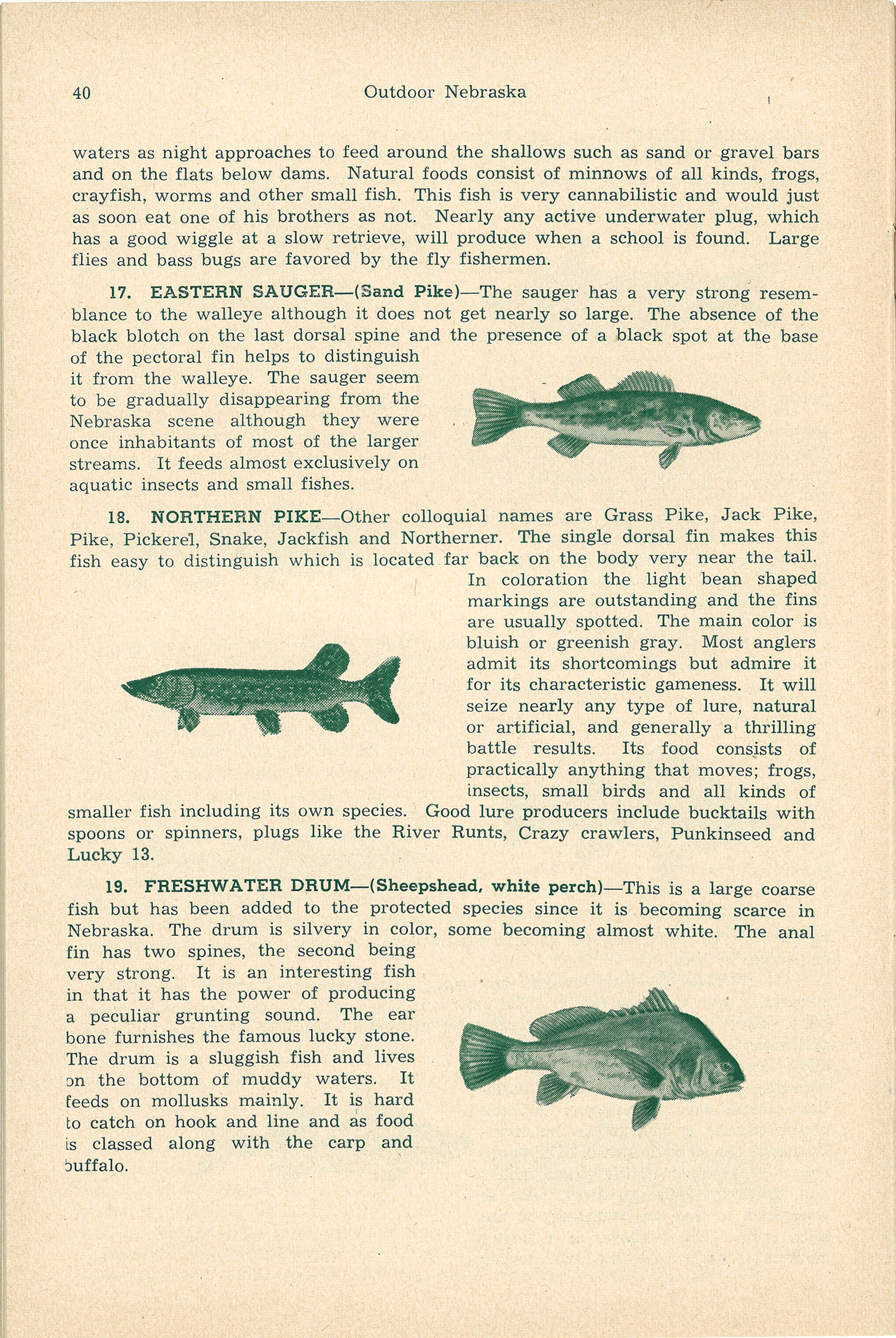 40 Outdoor Nebraska waters as night approaches to feed around the shallows such as sand or gravel bars and on the flats below dams. Natural foods consist of minnows of all kinds, frogs, crayfish, worms and other small fish. This fish is very cannabilistic and would just as soon eat one of his brothers as not. Nearly any active underwater plug, which has a good wiggle at a slow retrieve, will produce when a school is found. Large flies and bass bugs are favored by the fly fishermen. 17. EASTERN SAUGER--(Sand Pike)--The sauger has a very strong resemblance to the walleye although it does not get nearly so large. The absence of the black blotch on the last dorsal spine and the presence of a black spot at the base of the pectoral fin helps to distinguish it from the walleye. The sauger seem to be gradually disappearing from the Nebraska scene although they were once inhabitants of most of the larger streams. It feeds almost exclusively on aquatic insects and small fishes.
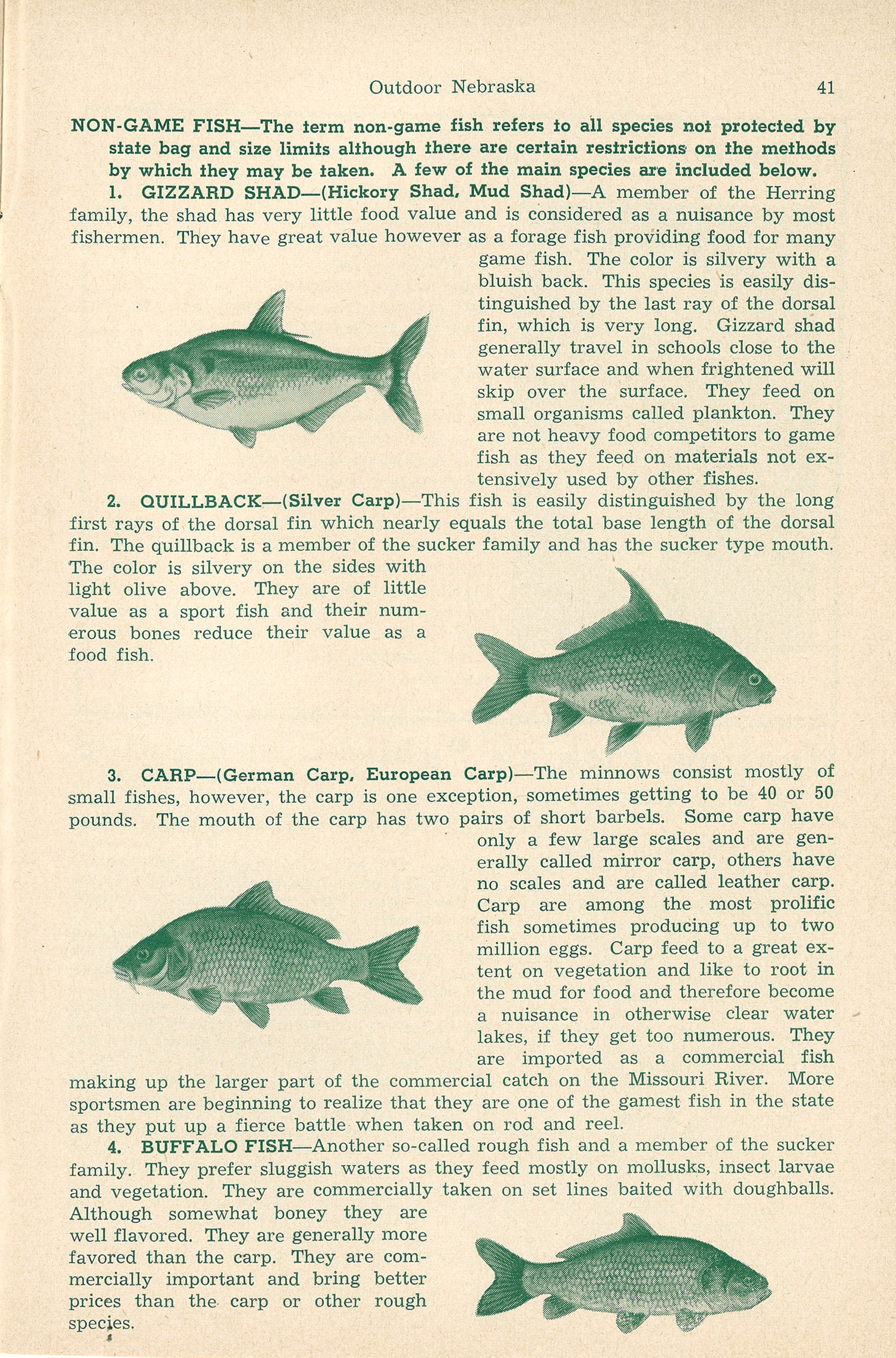 Outdoor Nebraska 41 NON-GAME FISH--The term non-game fish refers to all species not protected by state bag and size limits although there are certain restrictions on the methods by which they may be taken. A few of the main species are included below. 1. GIZZARD SHAD--(Hickory Shad, Mud Shad)--A member of the Herring family, the shad has very little food value and is considered as a nuisance by most fishermen. They have great value however as a forage fish providing food for many game fish. The color is silvery with a bluish back. This species is easily distinguished by the last ray of the dorsal fin, which is very long. Gizzard shad generally travel in schools close to the water surface and when frightened will skip over the surface. They feed on small organisms called plankton. They are not heavy food competitors to game fish as they feed on materials not extensively used by other fishes.
 42 Outdoor Nebraska
Kennedy New Chairman of Commissioners
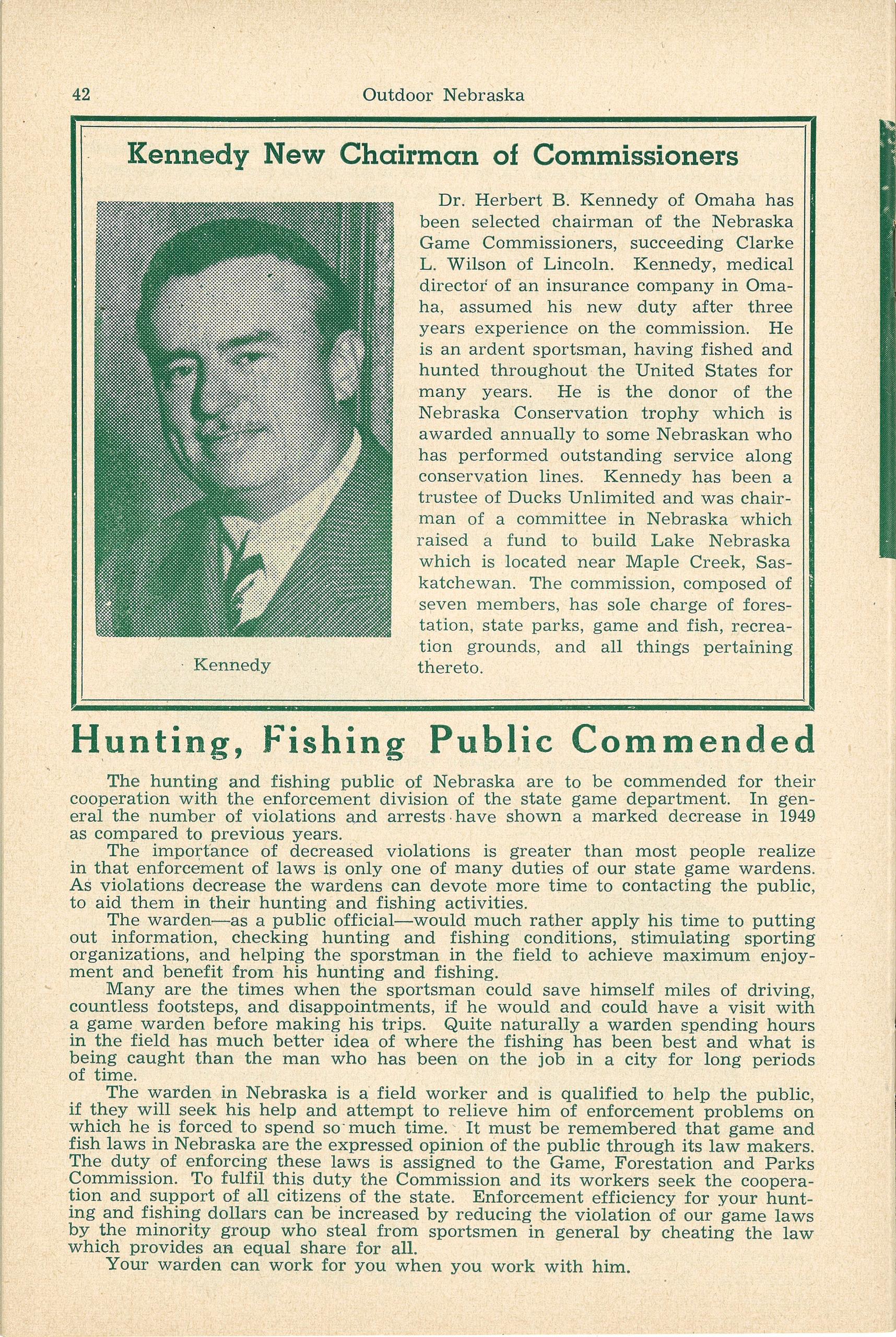
Dr. Herbert B. Kennedy of Omaha has been selected chairmand of the Nebraska Game Commissioners, succeeding Clarke L. Wilson of LIncoln. Kennedy, medical director of an insurance company in Omaha, assumed his new duty after three years experience on the commission. He is an aredent sportsman, havin gfishe dand hunted throughout the United States for many years. He is the donor of the Nebraska Conservation trophy which is awarded annualy to some Nebraskan who has performed outstnading service along conservation lines. Kennedy has been a trustee of Ducks Unlimited and was chairman of a committee in Nebrask which raised a fund to build Lake Nebraska which is locatead near Maple Creek, Saskatchewan. The commission composed of seven members, has sole charge of forestation, state parks, game and fish, recreation grounds, and all things pertaining thereto.
Hunting, Fishing Public Commended
The hunting and fishing public of Nebraska are to be commended for their cooperation with the enforcement division of the state game department. In general the number of violations a,nd arr ests . have shown a marked decrease in 1949 as compared to previous years.
The importance of decreased violations is greater than most people realize in that enforcement of laws is only one of many duties of our state game wardens. As violations decrease the wardens can devote more time to contacting the public, to aid them in their hunting and fishing activities.
The warden--as a public official-would much rather apply his time to putting out information, checking hunting and fishing conditions, stimulating sporting organizations, and helping the sporstman in the field to achieve maximum enjoyment and benefit from his hunting and fishing.
Many are the times when the sportsman could save himself miles of driving, countless footsteps, and disappointments, if he would and could have a visit with a game warden before making his trips. Quite naturally a warden spending hours in the field has much better idea of where the fishing has been best and what is being caught than the man who has been on the job in a city for long periods of time.
The warden in Nebraska is a field worker and is qualified to help the public, if they will seek his help and attempt to relieve him of enforcement problems on which he is forced to spend so much time. It must be remembered that game and fish laws in Nebraska are the expressed opinion of the public through its law makers. The duty of enforcing these laws is assigned to the Game, Forestation and Parks Commission. To fulfil this duty the Commission and its workers seek the cooperation and support of all citizens of the state. Enforcement efficiency for your hunting and fishing dollars can be increased by reducing the violation of our game laws by the minority group who steal from sportsmen in general by cheating the law which provides an equal share for all.
Your warden can work for you when you work with him.
 Outdoor Nebraska 43
Pond, Lake Requirements Revised; Fish Stocking On Priority Basis
To meet the ever increasing demands for pond and lake stockings and to assure the planted fish an opportunity to grow in adaptable waters, the Nebraska Game Commission has revised its pond and lake requirements. Before alotting fish either on state or federal applications, ponds and lakes must meet the minimum requirements. If the applications are approved, fish are allotted to each applicant in proper numbers and species for initial stocking only or when the original stock is lost.
The Commission will supply fish for the fall distribution period from Sept. 15- Nov. 30. Some state applications may be filled during May and June when fish are available. All fish for initial stocking will be fingerling size. Deadline for receiving applications for spring stocking has been set for April 15 and for fall stocking Sept. 1.
Distribution and stocking of fish by the Game Commission will be on a priority basis which is as follows: The primary obligation is the stocking of water on lands owned or controlled by the state. All of these are open to the public unless closed for some specific reason.
Secondary obligation is stocking of quasi-public waters open to public fishing without a fee being charged either for fishing or trespassing. Such areas include public power and irrigation reservoirs, city lakes, and natural streams where the public have free access for fishing.
Third priority is given to privately owned waters where the owners permit fishing entirely free to the public. These areas it1clude large sand hills lakes, large and small artificial lakes and streams running through privately owned land.
The following specifications for ponds and lakes are the minimum requirements:
1.--WATER SUPPLY: Ponds shall have a water supply large enough to maintain a water level. Ponds with rainwater supply only must be large enough and deep enough to carry fish over the winter and through the dry summer months. The water supply should be free from pollution or any- thing harmful to fish. 2.--SIZE AND DEPTH: Rainwater ponds shall have a surface area of one- half acre or more and shall have a depth of not less than 10 feet over one- fourth of the impounded area during the fall months of the year. Smaller ponds with a constant water supply sometimes produce good fishing with proper management but they seldom repay the effort expended in construction. 3.--CONSTRUCTION. Pond bottoms shall be graded to slope toward the outlet so all water can be removed and fish can be salvaged any time the pond is drained. Sides shall drop off sharply to give a depth of 18 inches or more. Shallower areas are of little value in a fish pond. Each pond should have a dram and water level control. When a pond, beccomes overstocked or undesirable fish get into it, the Pond must be completely drained, all fish removed and restocked with the right species and numbers of fish. The drain pipe should not be less than four inches in diameter and larger for ponds over three acres. An overflow spillway shall be provied on each pond as a protection against floods. It should be wide enough so the flow over it will not be over a few inches deep to prevent fish loss. Non-porous soil should be used for construction of the dam to prevent seepage. 4.--FENCING: The entire pond area and dam 100 feet or more back from the water edge shall be fenced or otherwise protected against livestock damage. Livestock break bank edges down and cause the water to become muddy. The shore line is a source of fish food supply and also may become good habitat for waterfowl. Stock may be watered in a trough or tank constructed in the pond below the dam. 5.--DRAINAGE AREA: Waterways and drainage area above the pond shall be grassed over or planted to prevent silt from washin ginto the pond. Natural food cannot be produced in a muddy pond. Small ponds will soon be filled up if silt is continually carried into it by floods and runoff water. 6.--STOCKING: Owners of ponds should not permit any fish of any species to be stocked in the pond without first consulting the Game Commission. Anyone planning to contstruct a new pond where htey intend to plant fish should first contact the Game Commission. 44 Outdoor Nebraska
Notes on Nebraska Fauna . . . The Mule Deer
This is the first of a series of pictures and storeis on Nebraska's game animals, game birds, game fish, and fur bearing animals. The story was written by Lloyd P. Vance, supervisor of state game, while the drawing of the deer on page 45 was made by Claremont G. Pritchard. Next edition's feature will be on the rainbow trout.
The mule deer was first discovered by white men along the Missouri river in the vicinity of the present town of Decatur by Lewis and Clark on their memoriable trip to discover an overland route to the Pacific Ocean. From their description of this new animal it was called a "blacktail deer", but its name was soon changed to "mule" deer because of its large mule-like ears.
With settlers killing deer for food, hide hunters, and agriculture continually pushing the mule deer from his home range, these deer met with almost complete elimination in Nebraska. However, with complete protection over a period of years this magnificient big game animal has made a remarkable comeback, until now there are several thousand of these animals within the state. It is not unusual to find these animals or their close cousin-- the white tail deer--in any countty of Nebraska.
There have been two open seasons declaired on deer in recent years. The first in 1945 was held in the Bessey Division of the Nebraska National Forest in Blaine and Thomas counties in which 361 deer were taken. The second season was held in 1949 in the counties of Sioux, Dawes, Sheridan, Scottsbluff, and Morrill, where some 904 male deer were killed.
A harvest of deer in other counties where big game is found in excessive numbers in relation to the state's agricultural cultural economy is impossible until the legislature meets again and makes such provision in Nebraska law.
Large herds of these deer are to be seen on occassion in certain favored areas of this state. Bucks weighin in excess of 300 pounds are not uncommon. During the recent season, many trophy deer were taken by Nebraska hunters. Racks of 37 5/8 , 37/1/2, and 361/2 inch spread were taken as well as many in excess of 30 inches.
Mule deer may be readilyii identified from white tail deer by the tail, antlers, metatarsal gland on the rear legs, and method of running. THe tail of the mule deer is rop lie, short (about seven inches in lenght) and held down while running, while the tail of the white tail deer is wide and bushy, long (about 12 inches in length), and is held high as a flag when running.
The antlers of the mule deer are divied. The main beam divides and each branch divides, making a perfect four points on prime adult bucks, in additionl to the brow tines, whereas the antler of the white tail is described as a one beam antler iwth points arising from the single beam on each side.
The metatarsal gland which may be observed on the dead deer is about four inches in length on the mule deer and is located on the inside of the hind legs below the hock, on the white tail deer this gland is about one inch in length.
When alarmed, the mule deer uses a particular stiff legged hop which could easily give them the name of "jumping deer". This spectacular method of traveling soon tires the deer, they jump high with all four feet drawn together and land on all four feet at once, jumps will average 12 to 15 feet. The white tail deer when alarmed moves off at a fast pace, usually with several bouncing hops and then into a swift, low, gallop at speeds up to 40 miles an hour.
ANSWERS TO "OUTDOOR NEBRASKA" QUIZ
1.--(b) raccon; 2.--(c) beaver; 3.--(b) Scottsbluf National Monument; 4.--(c) Kingsley; 5.--(a) Arbor Lodge; 6.--(b) Rock Creek; 7.--(a) Scottsbluff National Monument; 8.--(c) Ponca; 9.--(b) catfish.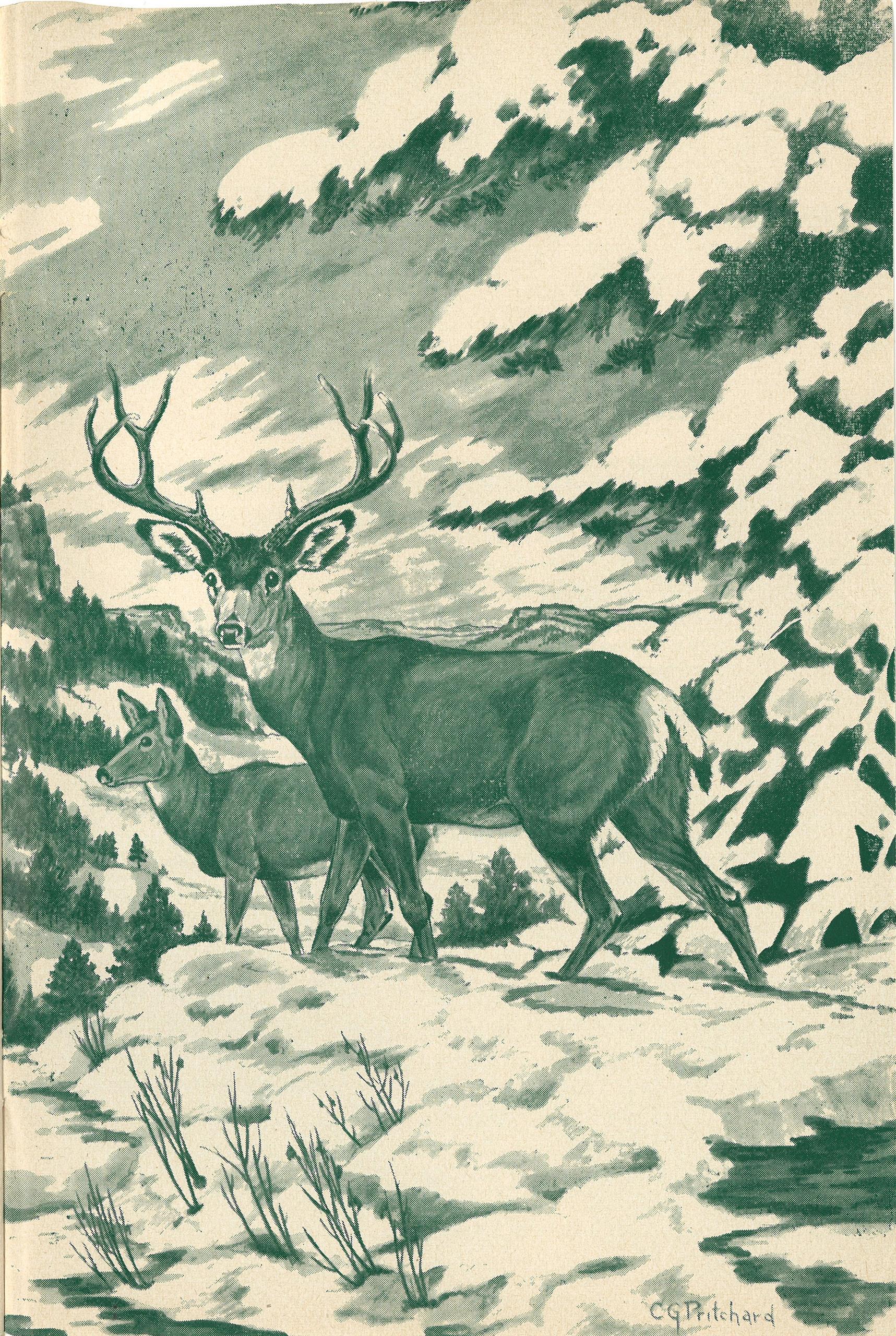
COOPERATION IS NECESSITY . . .
Nebraska's ever popular fishing sport is designed for all people, regardless of age, color, creed or social standing. All state-owned waters are open to the general public without cost. In an effort to provide bigger and better fishing annually for the vast angling population the Nebraska Gaem, Forestation and Parks Commission works untiringly toward this goal.
Sportsmen can help promote this cause by paying respect to the state's fishign regulations--bag size limit, and seasons; requesting permission before fishign in privately-owned waters; and contacting the Game Commision in reqard to any problem regardless of size. Lake owners can further the effort by proper management of the waters; improvement of habitate; and silt control of drainage areas into the lakes or ponds.
The Commission stocks the many fishing waters; manages and improves state-owned areas; controls underwater populations by removing surplus and rought fish; adjusts fishing regulations to improve the sport for all; and sets the groundwork for a better and efficient sportsman-land owner relationship. All these functions must be practices in order to give Nebraska the caliber of fishing it can and should have.
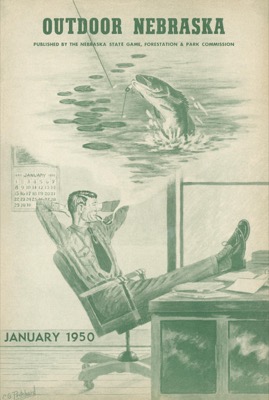
Position: 134 (45 views)